
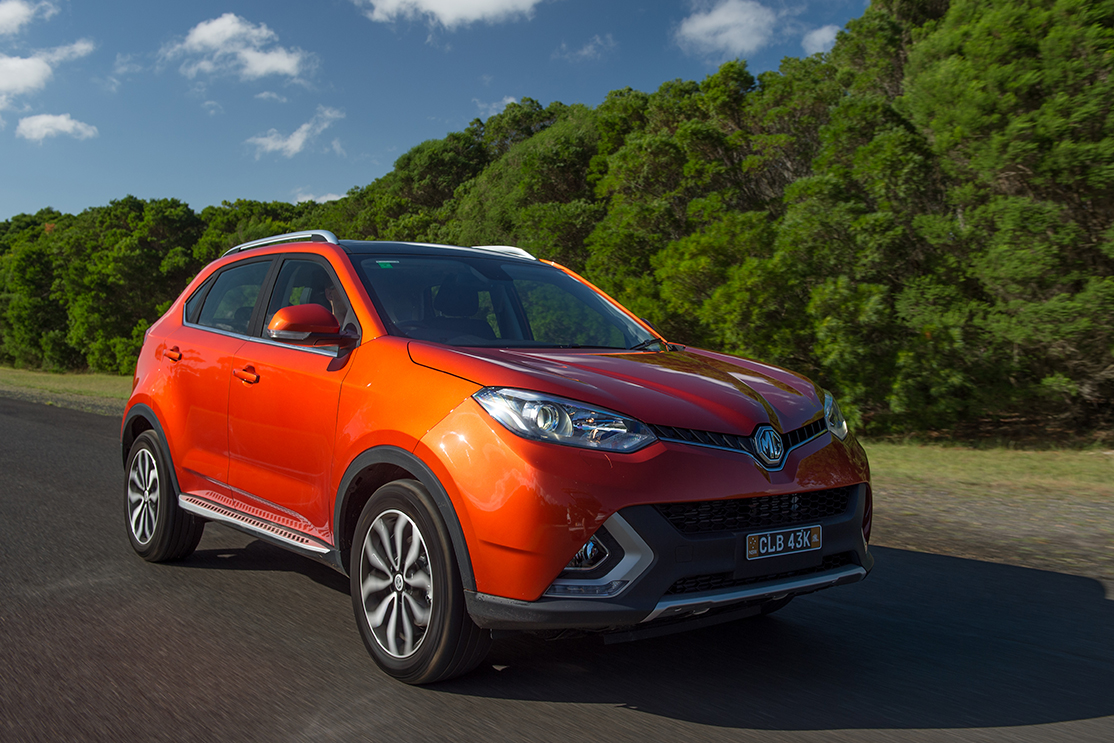
THE once-again-reborn MG brand is less than a year old in Australia, and the GS is the now Chinese-owned brand’s attempt to hit the mainstream with Australian car buyers. With cars fresh off the boat at the GS’ local launch event, the company has high hopes that the car – its first-ever SUV – will resonate with SUV shoppers already spoilt for choice.
WHAT IS IT? The very first SUV from the iconic British brand, now under Chinese ownership. Available in four different specs and using SAIC Motor’s own engines, gearbox and architecture, the GS range starts at $23,990 for the entry-level model and tops out at $34,990 for the flagship.
WHY WE’RE TESTING IT With a competitive price point and spec sheet the MG is angling the GS as a prospective buy for the budget-conscious buyer. Mid-size SUVs are among the fastest selling cars in Australia, and the GS represents MG’s attempt to tap into that cashflow.
MAIN RIVALS Mazda CX-5, Volkswagen Tiguan, Toyota Rav-4, Citroen C4 Cactus, Kia Sportage
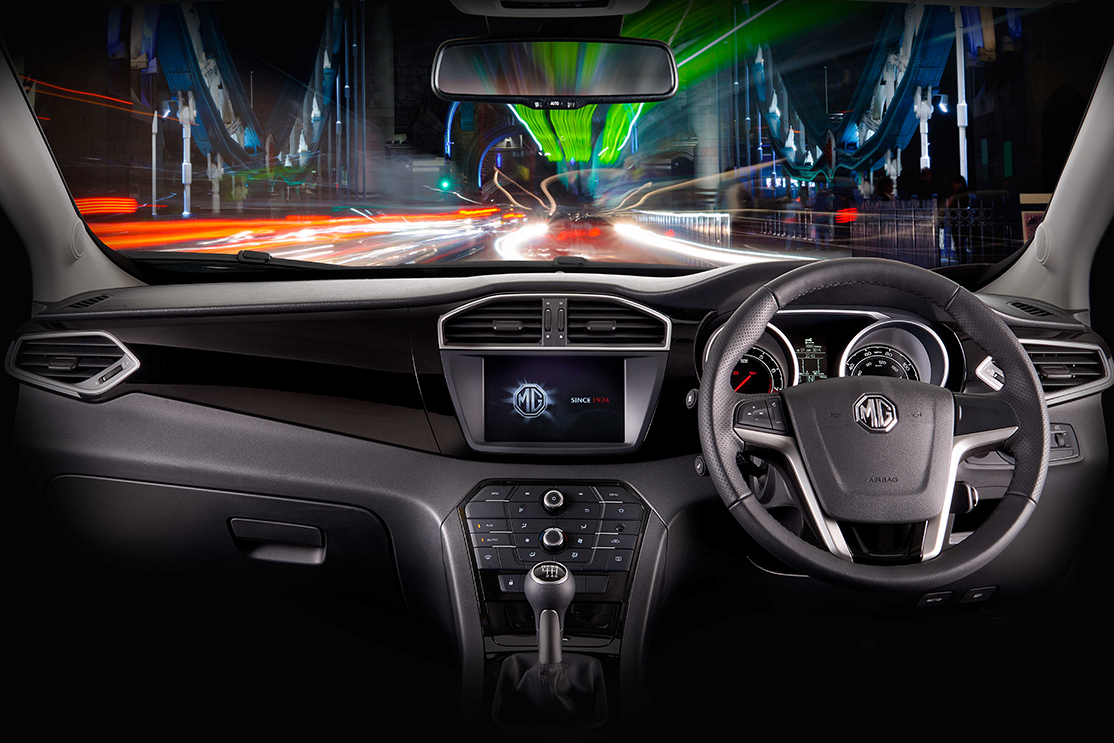
THE WHEELS VERDICT Despite the history of the MG brand, this is essentially a new Chinese company adding its name to the expansive list of manufactures for sale in Australia. The MG GS is a decent first attempt, with good power for the class. Its strongest points are an impressive chassis, competitive price point, and one of the best warranties on offer. Refinement, interior feel, and a decent suspension tune, however, are lacking.
PLUS: Eager engines; kit list; cabin and cargo space for the price MINUS: Budget feel; ride/handling compromise; jerky dual-clutch autos
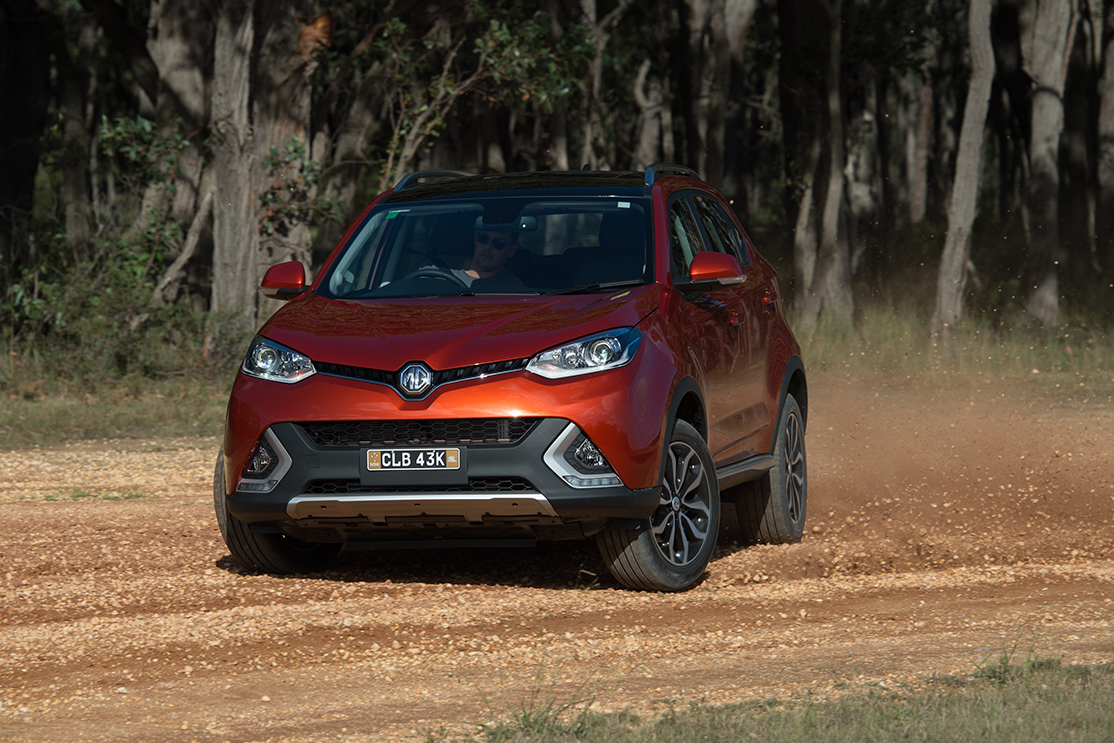
THE WHEELS REVIEW THREE hours of almost uninterrupted seat time on a skidpan and closed gravel course is the itinerary you’d expect for the launch of a highly strung all-paw turbo weapon, not a UK-designed and developed, Chinese-built SUV wearing a classic British sportscar badge. But that’s how the local launch program played out for the MG GS.
Despite this being about as far from its likely natural environment as a camel in Sydney Harbour, the launch setting did reveal some home truths about the new GS.
The first is that SAIC Motors, MG’s giant Chinese parent company, has done an impressive job with its new architecture, which underpins the GS. It turns in responsively and handles predictably, particularly in AWD 2.0-litre turbo form. However, the ride is firm, especially in the AWD, and the damping lacks something in nuanced rebound control on undulating roads. The steering’s reassuringly weighty but feedback is minimal, the sound of tyre scrub instead signalling the onset of understeer.
Stability control calibration is polished, the electronic safety net intervening gently. Despite many earnest attempts to unsettle the chassis, it prevented the car from leaving the course.
The GS is available with either a 162kW, 350Nm 2.0-litre turbo four-cylinder engine in the top-spec Essence X, or a 119kW, 250Nm 1.5-litre turbo four co-developed with GM (with family ties to the current Astra) in all other versions.
Both engines are lively, the 2.0-litre boasting a strong midrange beyond the initial lag, yet they’re both relatively noisy and unrefined. The bigger unit claims 9.6L/100km on the official combined cycle, the 1.5 a more reasonable 7.4L/100km, regardless of transmission.
The base-model Vivid is equipped with a six-speed manual transmission, while the Core and Soul have SAIC Motor-sourced seven-speed dual-clutch automatics. The AWD Essence X uses a six-speed dual-clutch with a higher torque capacity.
Both dual-clutch transmissions can be jerky at low speed if throttle application isn’t smooth, yet can be slow to select a lower ratio on the move when your right foot calls for acceleration.
The AWD GS usually sends power to the front wheels, but can transfer up to half to the rear axle when slip is detected.
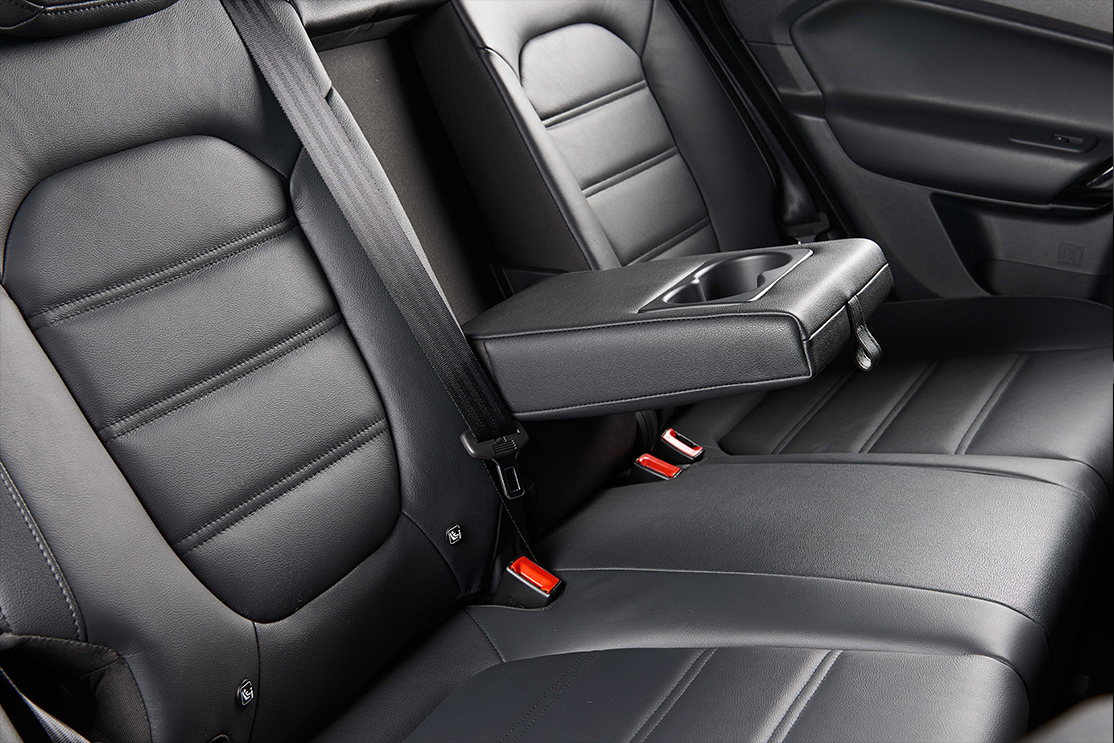
The GS is roomy indoors, falling roughly between a Mazda CX-3 and a CX-5 in size, with decent rear legroom and 60/40 seatbacks that fold completely flat.
The cabin is exclusively hard-finish plastics and the front seat cushions lack support, though the dash layout is intuitive.
All versions come with parking sensors and Bluetooth, with Vivid adding a reversing camera while the Soul gets leather and sat-nav and Essence X a sunroof. But there’s no AEB, and the GS scores four ANCAP stars.
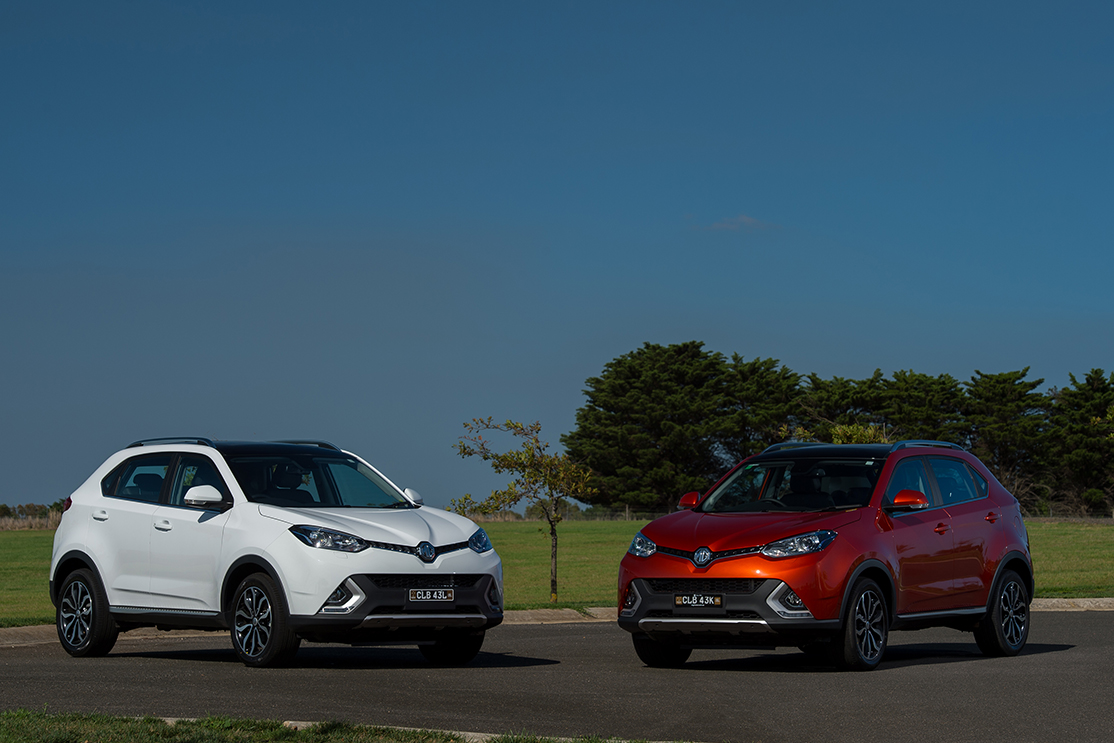
The rather derivative exterior styling depends heavily on the viewing angle; it’s handsome from the rear three-quarter.
Every MG GS comes with a generous six-year, unlimited kilometre warranty, six years of roadside assistance, and capped-price servicing. Paired with pricing of $23,990 for the Vivid, $25,990 for the Core, $27,990 for the Soul, and $34,990 for the Essence X, the GS makes for a competitive proposition. However, MG’s dealer network of just three locations in NSW and Queensland (more are planned) holds it back.
It’s a respectable effort at a sharp price point, but the MG GS is a long way from challenging the best-in-class small/medium SUVs.
SPECS Model: MG GS Essence X Engine: 1995cc 4cyl, dohc, 16v, turbo Max power: 162kW @ 5000rpm Max torque: 350Nm @ 2500-4000rpm Transmission: 6-speed dual-clutch auto Weight: 1642kg 0-100km/h: 9.9sec (estimated) Fuel economy: 9.6L/100km Price: $34,990 On sale: Now
MASERATI now has a car to take on the might of the Porsche Cayenne. Taking up the Italian sports car brand’s fight is the Levante, the first-ever high-riding model from the Italian powerhouse.
WHAT IS IT? The Maserati Levante is the first-ever SUV from the Italian sportscar brand. It joins an already crowded market hungry for high-riding luxury.
WHY WE’RE DRIVING IT Because if Zegna ever designed a track suit, it would look like this.
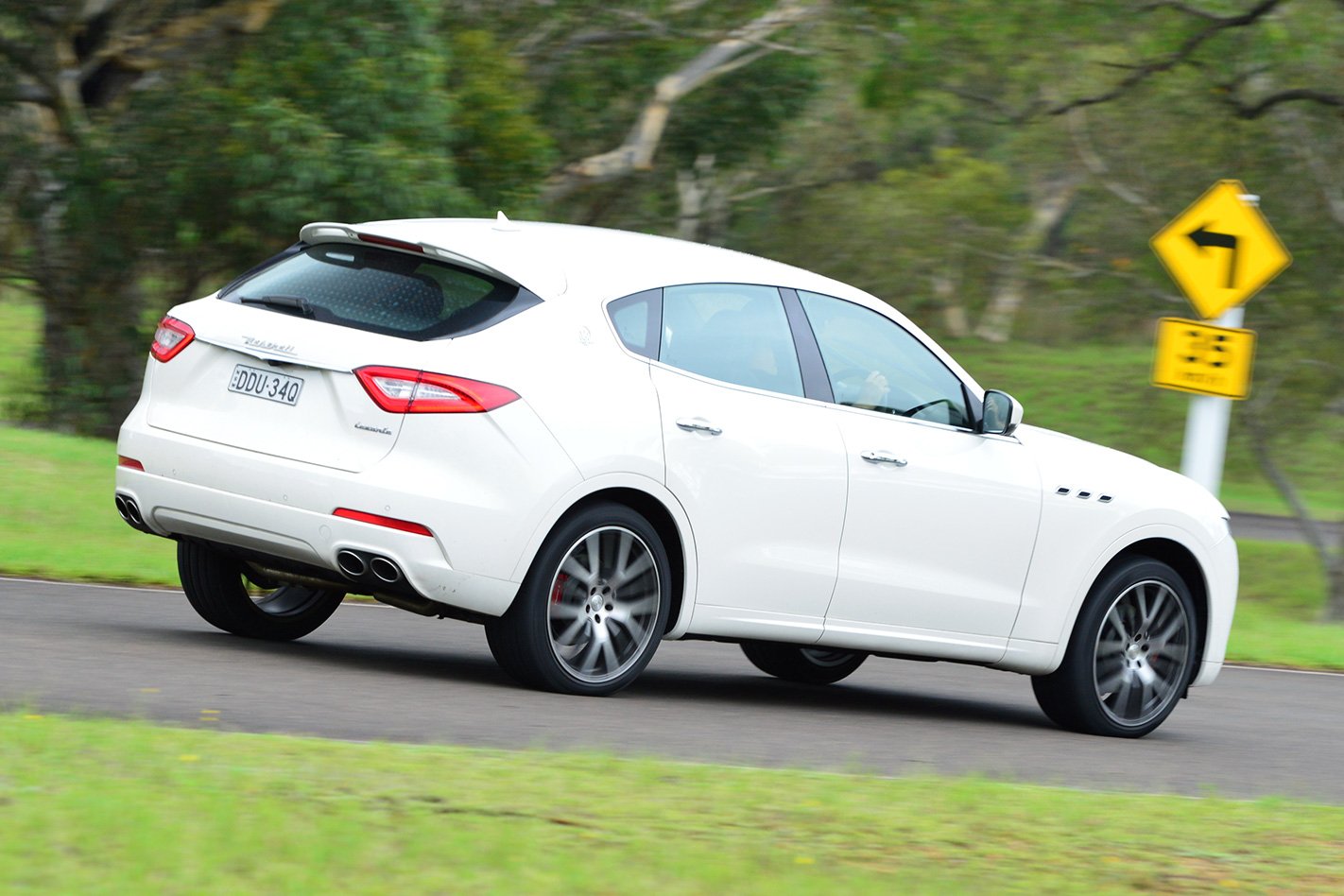
THE WHEELS VERDICT Sharp in looks, but a bit blunt in performance, the Levante doesn’t quite live up to expectations. Maserati’s SUV is a bit like David Beckham in a suit and tie; everything looks good until it opens its mouth to speak.
PLUS: Sharp exterior styling; comfortable, cosseting interior; good grip; decent fuel economy MINUS: Pricy when measured against competition; diesel-only; flatulent exhaust note
THE WHEELS REVIEW MASERATI. It’s a name etched in a rich history of racing and sports cars, with beautiful, shapely, flamboyant models designed to turn heads and generate envy. It’s something of a sad indictment, then, that even it eventually has to bow to the demands of the market.
The reality is, high-riding SUVs are in demand, and a growing part of even the luxury market. If Maserati was to survive into its second century, it would need to redefine itself. With the Maserati Levante, it sort of has.
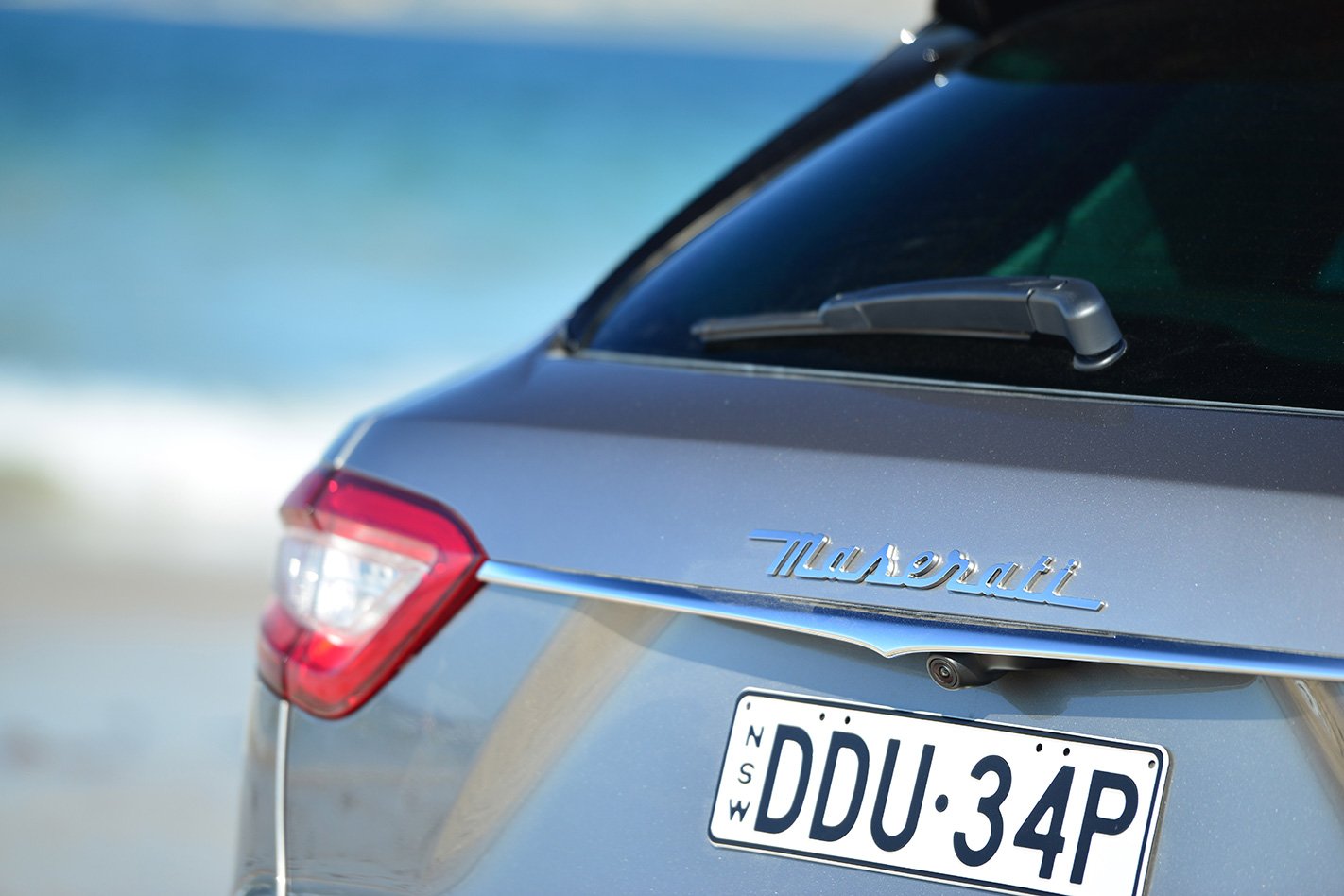
Even before we crack a door (unlocking it via a beautifully crafted, large and heavy remote key), there’s a problem. The only engine developed for right-hand drive is the 3.0-litre diesel, with the lack of the 3.0-litre petrol V6 severely limiting the Levante’s market appeal.
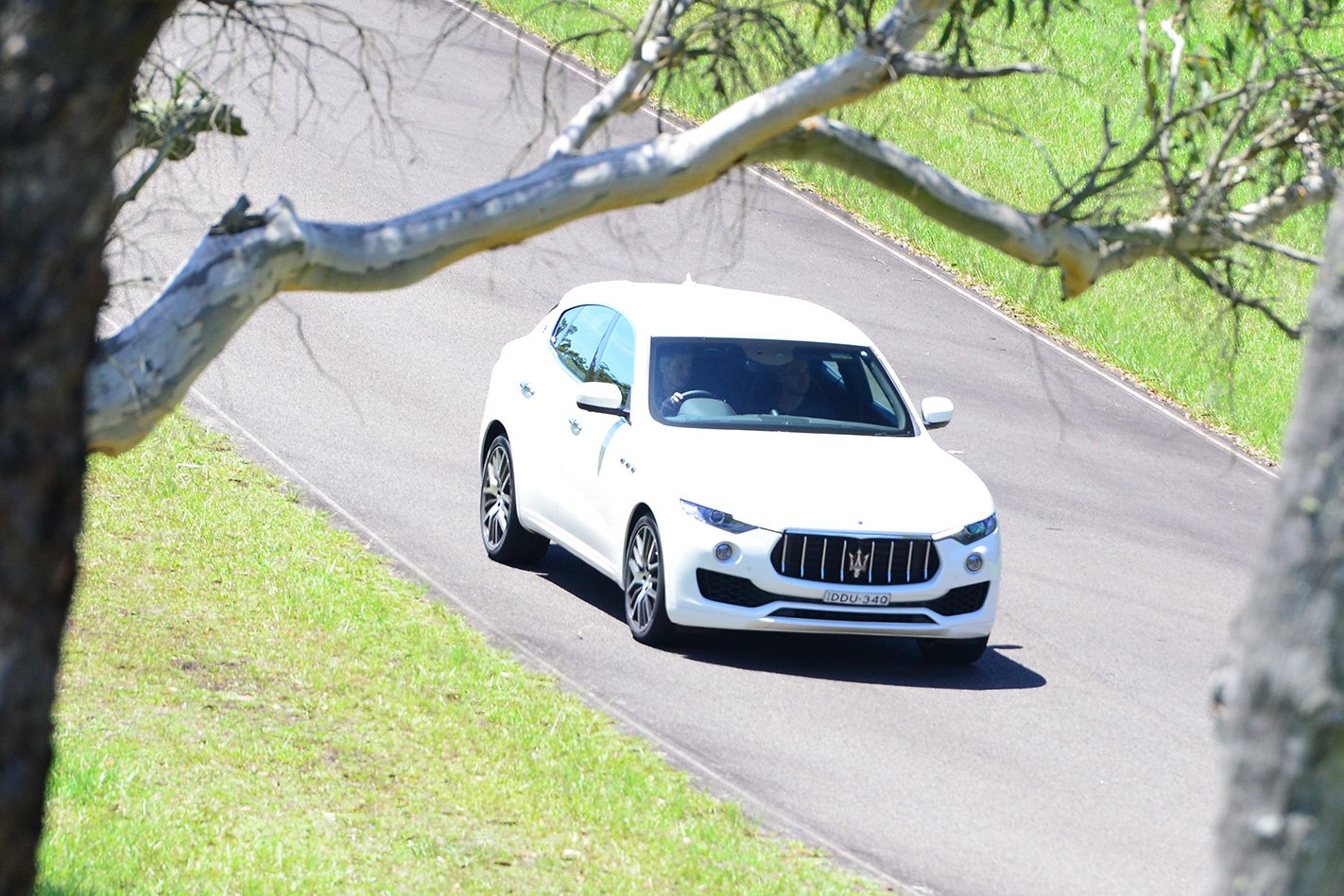
From the front Levante is unmistakably Maserati, the big, baleen whale mouth, guard-mounted air vents and the swept, slash-like headlights giving it a strong family connection. Big hips and a thin D-pillar down the back give it distinctive coupe lines.
Levante is built on the same platform that underpins the Ghibli and Quattroporte sedans, and that shows. Open the driver’s door with its frameless window, and there’s a huge expanse of skin hanging under it that wraps around to the SUV’s rocker cover. However, the aperture it opens to is sedan-small, not SUV-large.
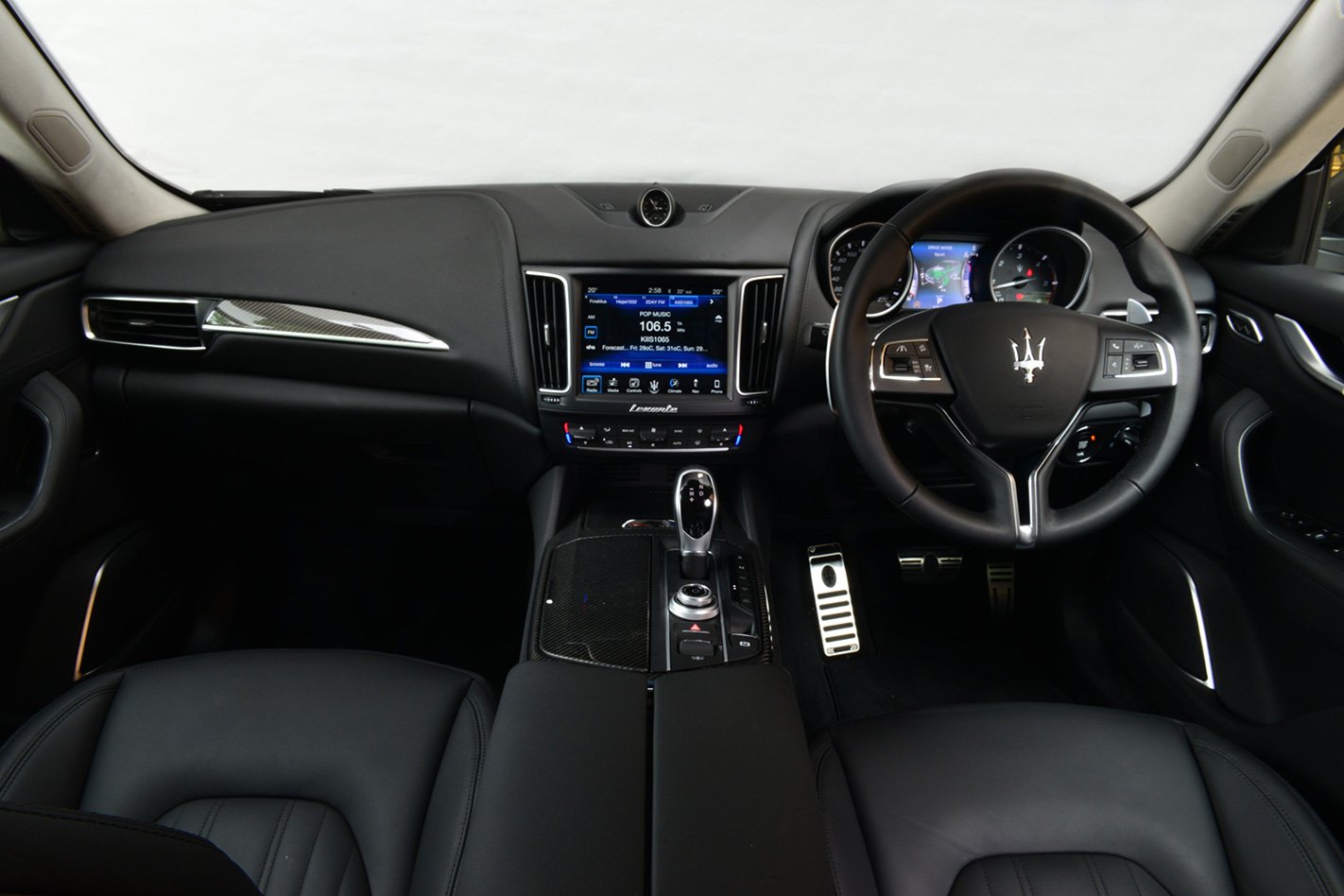
The cabin around the driver is functional, although the large, square touchscreen mounted high on the dash below an analogue clock – the de facto luxury car benchmark – has a lot going on, with rows and rows of virtual buttons controlling everything from the sat-nav to the surround-view cameras.
The diesel engine isn’t a Maserati strong suit. Sourced from fellow Italian VM Motori, it’s laggy on step-off and sounds much like tofu tastes. Punch the Sport button twice to beef up the suspension and sharpen the throttle, and it adds a slow, resonating “bom-bom-bom” at idle and a sound like radio static to the exhaust note under load, giving the illusion it has a higher cylinder count than just six.
The ride borders on firm around town, but comes more alive as speeds increase. The Levante, boasting a 50:50 weight distribution and lowest-in-class centre of gravity, transfers the weight of its 2205kg bulk quite well, showing only a hint of headshake through corners. It’s a shame, then, that the steering – hydraulic rather than electrically assisted – lacks decent feel, suffering from just a little too much on-centre vagueness.
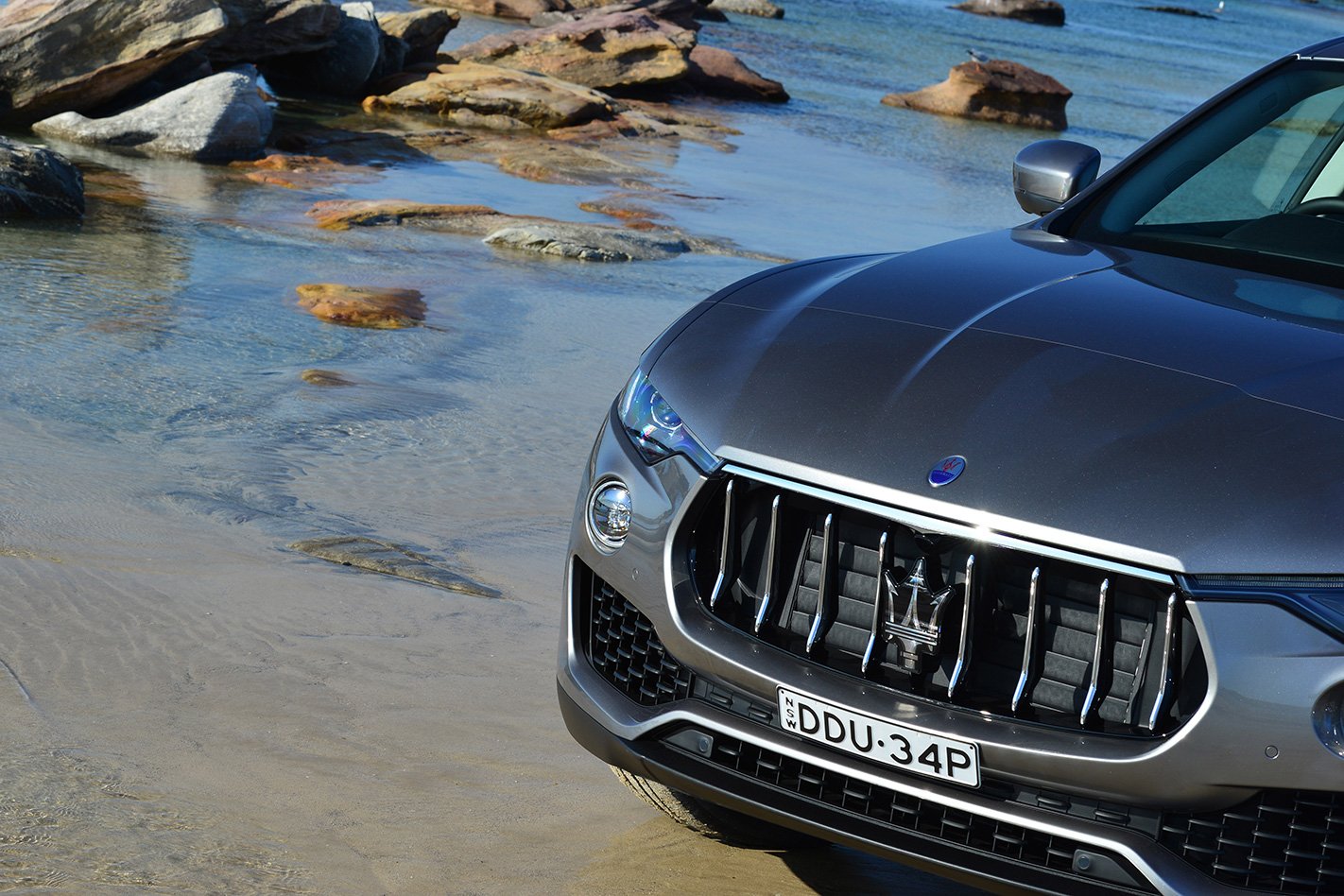
A flaw of the Maserati SUV, though, is pricing. Our base car costs $139,990 before on-roads, featuring a leather interior, dual-zone climate control, 19-inch alloys, a powered tailgate, heated 12-way power-adjust front seats, adaptive cruise control, blind-spot warnings, and front and rear parking sensors linked to a reversing camera.
Our test car added the sport pack that gives a different interior finish with more heavily bolstered sports seats, 21-inch wheels, steering column-mounted paddle shifters, a more premium Harman Kardon audio system, a bigger spoiler extending from the tailgate and red brake calipers.
It also had more swathes of leather; carbonfibre trim; Maserati tridents stitched into the front and rear outboard seats; a remote tailgate that opens at a sweep of a foot under the rear bumper; and heated rear seats.
That all adds up to an extra $48,504 over the base car. For a $188K-plus package lacking a more appealing petrol-engined option, it struggles against more keenly priced competition.
THERE are plenty of facts and figures to remember when it comes to HSV’s LS9-powered GTSR W1. Here are some of the lesser known facts.
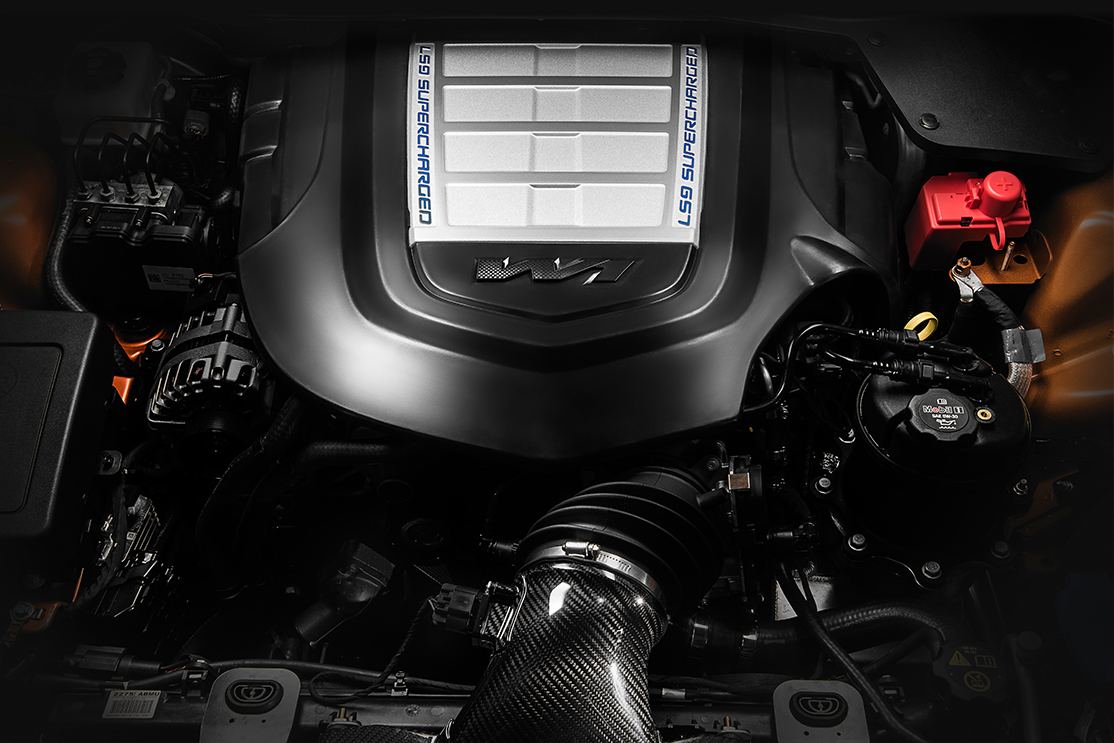
The GTS-R W1’s mega LS9 engine takes roughly five hours to be assembled by hand. The 300 Corvette engines were all built for HSV at General Motors’ Michigan Performance Build Centre, and produce 474kW and 815Nm. The LS9 has stopped production in the US, so HSV had to move heaven and earth to source the units which are put in the engine bay in place of the standard LSA unit. The 6.2-litre dry-sumped V8 is one of the main reasons for the W1’s almost $170,000 pricetag.
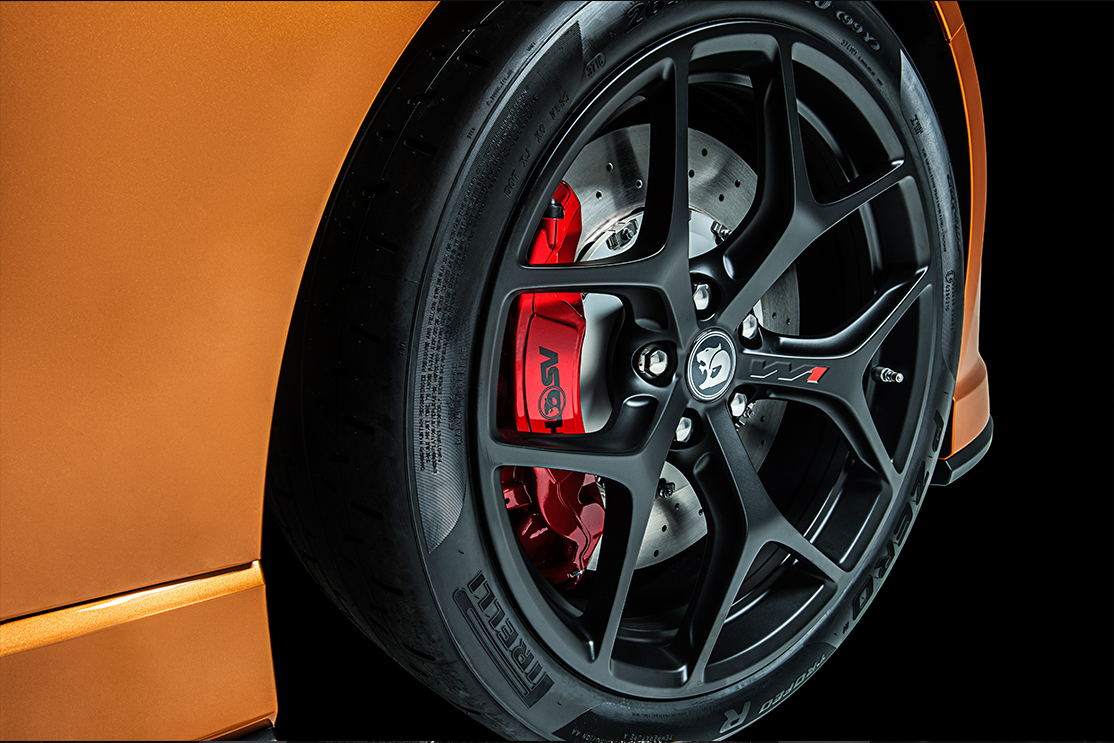
The W1 is the only car in the world which wears Pirelli P Zero Trofeo R tyres as standard. The track-ready rubber is some of the best of the world, and are optional extras on some of the quickest supercars and hypercars in the world including the Honda NSX and McLaren P1.
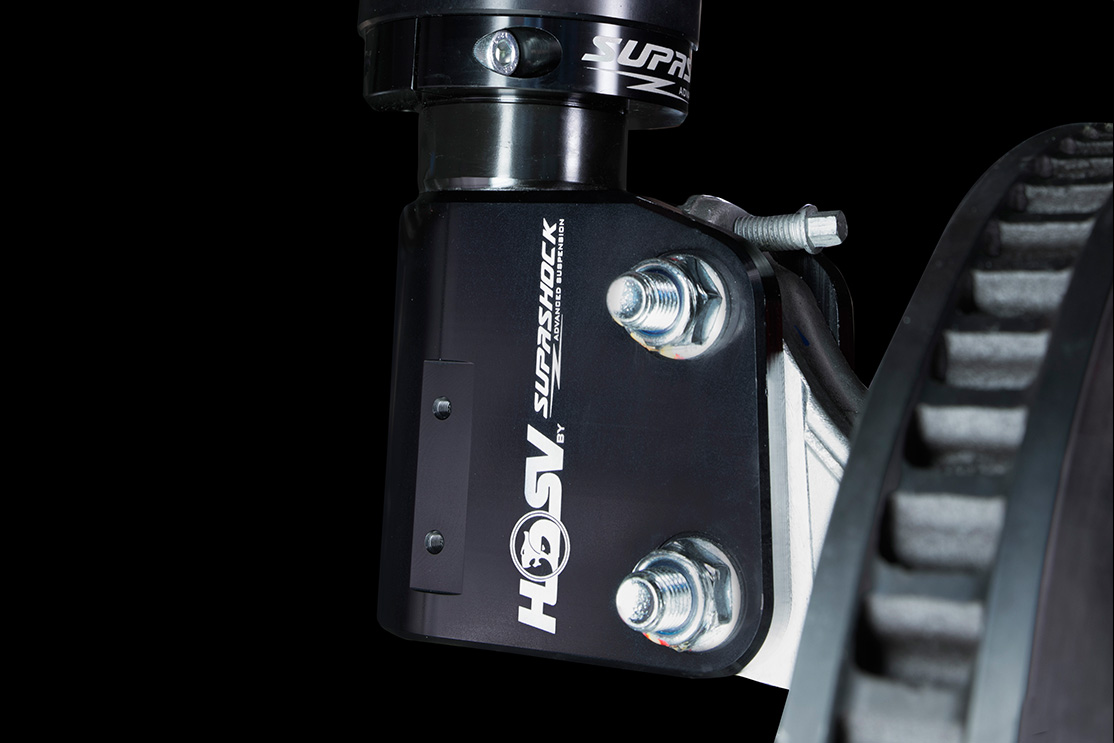
HSV and Walkinshaw has used some of its racing knowledge with the Holden Racing Team (now Walkinshaw Racing) to get the suspension right. The regular GTS’s adaptive MRC damper system was thrown in the bin for the W1, replaced with fixed-rate SupaShock dampers. SupaShock supplies the dampers and suspension for the Holden Supercars team, along with DJR Team Penske and Prodrive Racing.
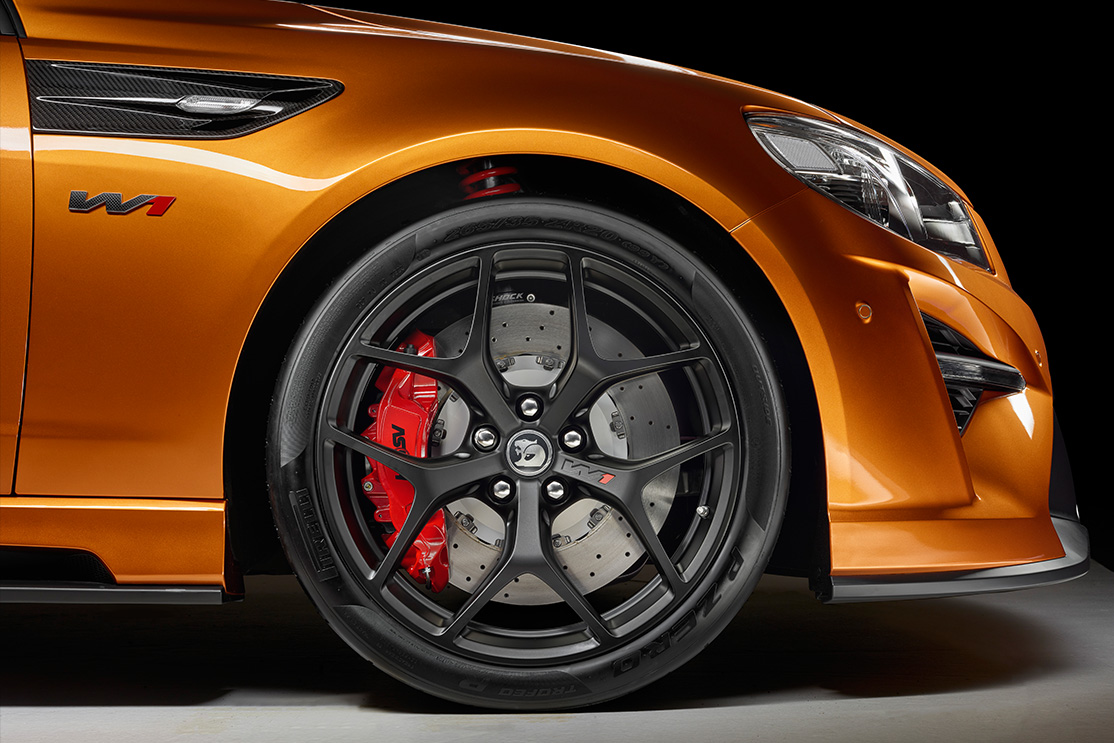
The aggressive stance of the W1 isn’t just down to restyled bodywork, it is physically wider than its HSV siblings. The front guards are 12mm wider on each side, and are constructed from polypropylene instead of aluminium. The W1 also has several bespoke carbonfibre pieces from Italian composite maestros BMC Air Filters.

Before the public knew the LS9 monster as the W1, it was called the P860HP. The W1’s regular GTSR sibling was given the internal code of P860 at HSV. This was arrived at completely at random. Since the W1 was set to be its high performance brother, it had HP added to its codename.
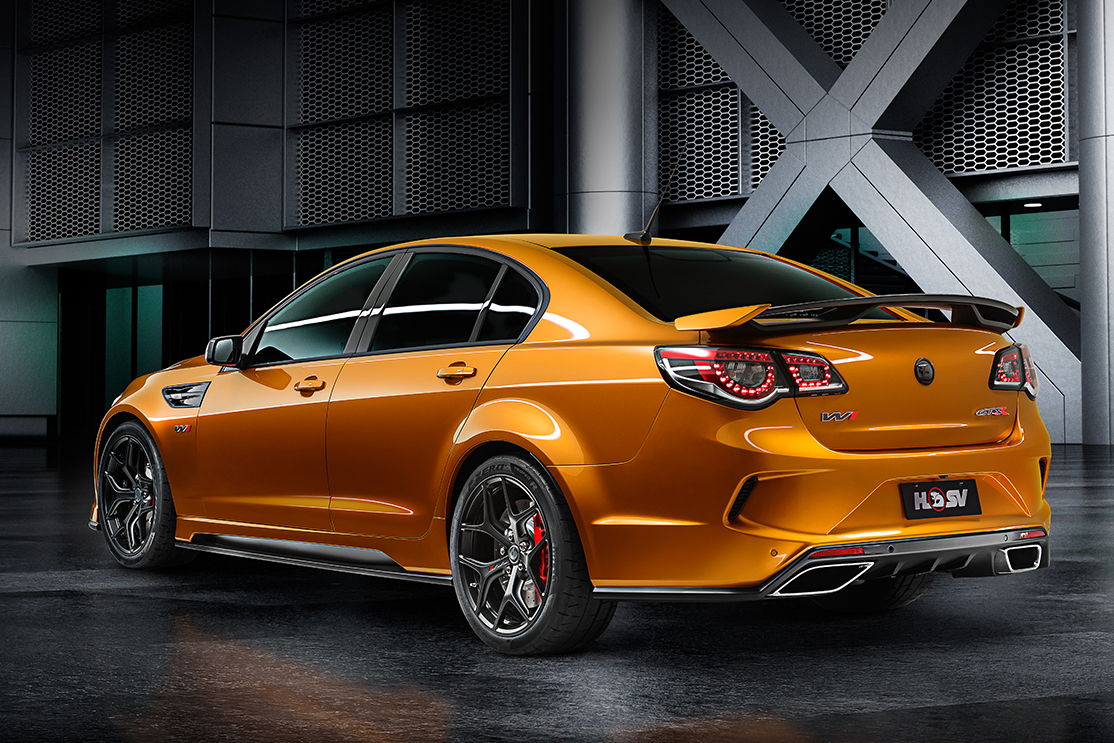
It’s not all about straight speed with the W1. While HSV has yet to release official performance figures (it expects 0-100km/h in less than 4.2 secs, and a quarter mile quicker than 12.1), it has confirmed the LS9-powered W1 lapped Winton Raceway four seconds faster than the LSA powered GTS. The 1:33.2 laptime was reached thanks to refined suspension, brakes, sticky rubber, and off course the extra grunt of the dry-sump V8.
There’s a new baby on the way and you’ve got the nursery ready, sold the two-seater convertible in favour of a more suitable SUV and already fitted it with an appropriate child seat.
There’s nothing else you need in your car, right?
There are a few other accessories that can make your life as a parent on the road a little bit easier. Here are our top five accessories we think every new parent should have in their car.
- Seat protectors: You’ve just spent thousands of dollars on a brand new family car, and you can guarantee that you’re little bundle of joy is going to cause some damage between food, drink, baby vomit and accidental nappy leakages. Not to mention the wear that a car seat can cause. Finding the right seat protector will ensure your rear car seats will last a little longer, and will certainly help with re-sale value. Try and find seats with thick mats to go under your kid’s seat to avoid the edges digging in to textiles and padding.
- Sippy cups: Are we there yet? I’m hungry. Can I have a drink now? At least you can be prepared for one of these questions with a sippy cup on-board once your new baby grows into a toddler. The best part about these cups is that they are less likely to spill everywhere.
- Stain guard: If the cup fails however, and it does happen to spill on the nice clean carpet, you’ll be glad for ticking this one off the checklist. Spray a stain guard over any fabric areas of your car to prevent nasty stains setting in.
- Wipes: This is a must have on a parent’s list. Handbag, kitchen, bedroom, bathroom, mother-in-laws house, and of course, the car… there’s no limit to where you should hide these handy wipes. Make sure you grab wipes that are specially made for babies – they have a dual-purpose in cleaning grub off your child, and also doubling as a surface wipe.
- Window shades: We know, a window tint looks a lot better than sticking up Finding Nemo window shades, but they’re a less permanent option and are just as effective, if not better, at keeping the sun out of your child’s eyes and off their skin. They don’t have to be kitsch either with a variety available these days so you can find an option that looks at least mildly stylish/interesting.
Bentley wants to build a Vantage fighter. And it’s bloody confident about its chances out in the wild if it makes it to production.
The company put two-seaters from Aston Martin, Ferrari, and McLaren in its crosshairs when it revealed the EXP 10 Speed 6 concept for the 2015 Geneva Motor Show.
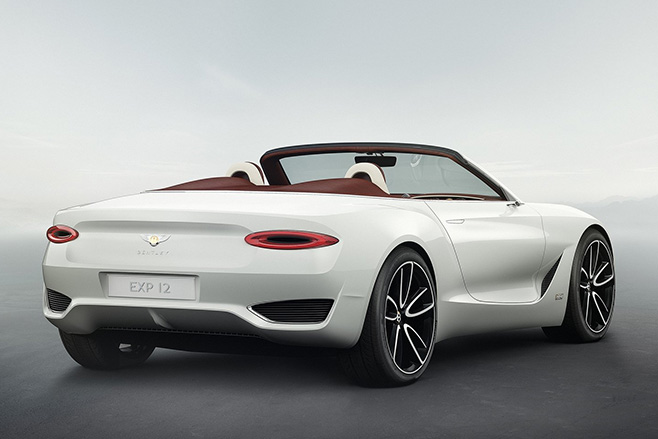
Positioned as a sportier offering than the Continental, it’s now followed that up with the EXP 12 Speed 6e, a convertible evolution of the original EXP 10 concept, at this year’s show.
And when asked about how the latest project’s been received by markets at the recent Bentayga diesel SUV launch, he told MOTOR it’s a shoe-in.
“We used to do big cars and then we went into Continental. Which many people told us was a bad a move. And Continental as we know today is the bread and butter of Bentley.
“Similarly we did the SUV which most people told us it was the wrong decision, and now every luxury brand out there is following us.”
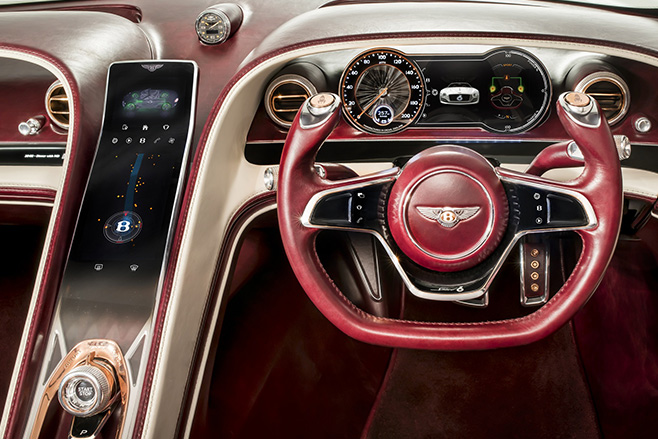
Since the EXP 10’s reveal the company has reportedly said a third sportier model would bolster its portfolio going forward.
Uday tells us there’s a solid business case and amount of development behind the new car, but finding its place in the Volkswagen Group is one of the last hurdles it must clear.
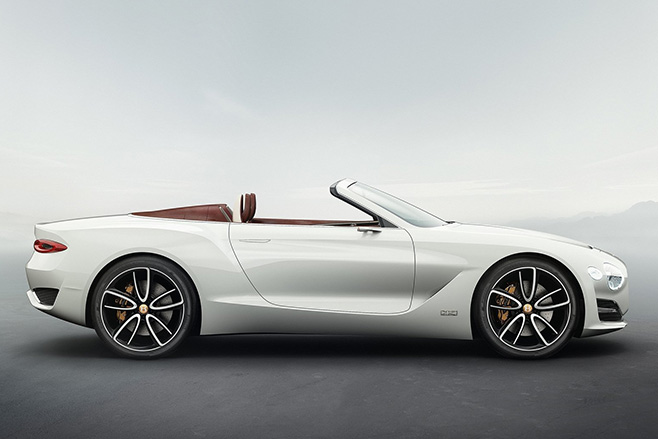
Used to gauge customer feedback on a Bentley performance hybrid, the EXP 12 Speed 6e uses an electric all-wheel drive powertrain and would likely use Porsche’s Mission-E’s platform if greenlighted.
He says Bentley’s completed a lot of development on electric performance, but “whether the [EXP 10/12] will be the vehicle carrying that propulsion system or not, those are the kinds of decisions we still need to make.”
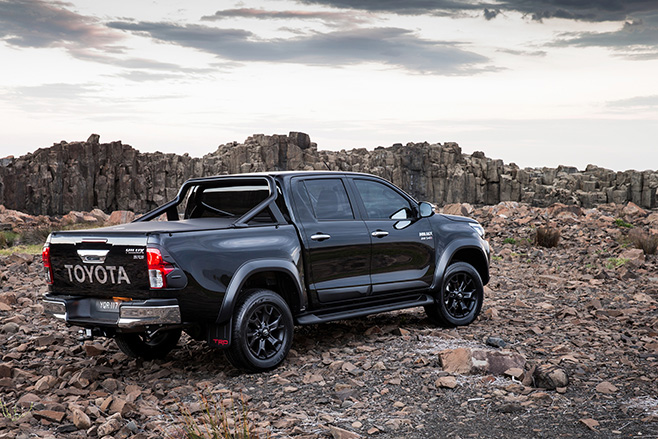
No one ever accused the Toyota Hilux of being prissy, but a new styling kit from its TRD (Toyota Racing Development) sub-brand gives the best-selling ute some aggressive appeal, if not extra performance, to match its ‘unbreakable’ reputation.
For less than $4000, the TRD kit is available for buyers of the range-topping Hilux SR5 double cab, with leather-accented interior trim and either black or white exterior paint.
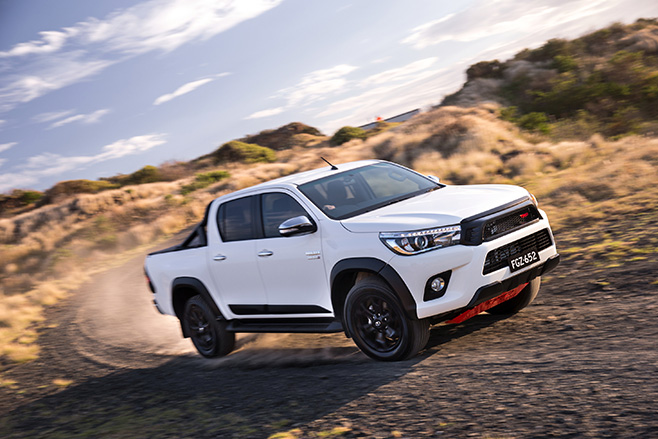
It transforms the ute’s appearance with just 15 components, most noticeable being the red TRD-branded front skid plate, which contrasts with the black TRD branded grille, lower bumper cover and fender flares.
Black mouldings are added to the leading edge of the bonnet and along the side including the wheel arches that house all-new 18-inch black six-spoke alloy wheels.
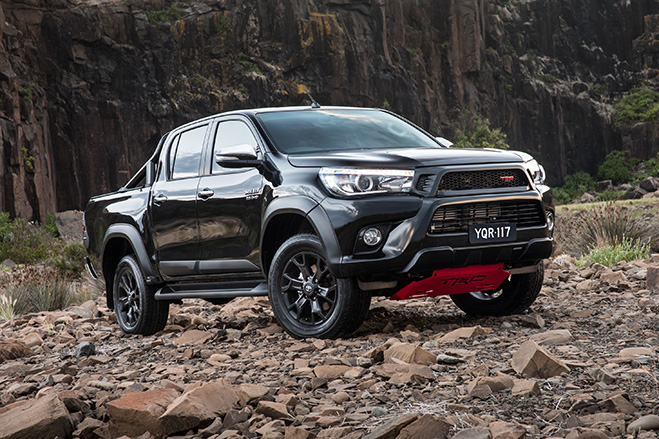
The black theme continues at the back with the sports bar, ute liner, soft tonneau cover, taillight covers and TRD mudflaps.
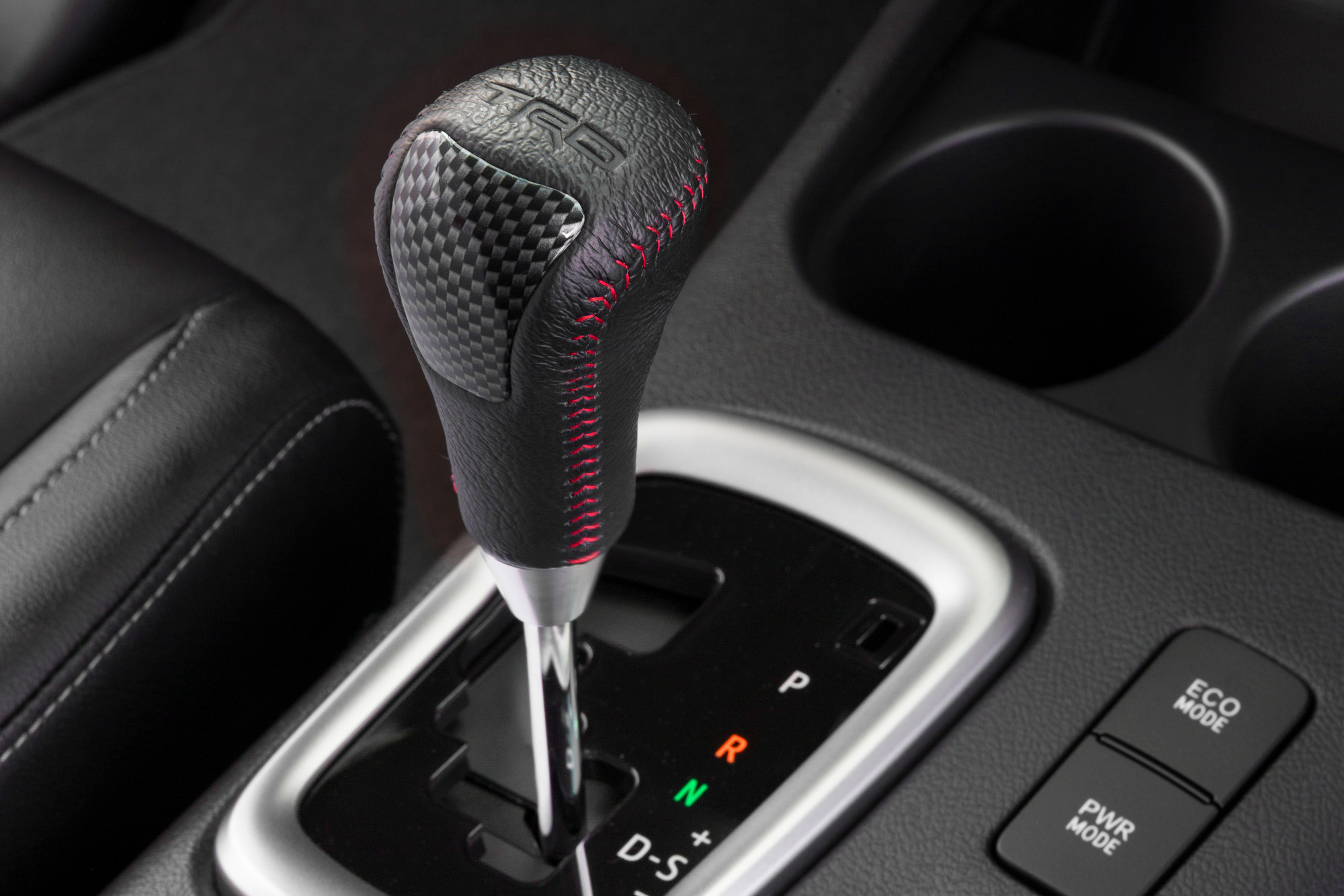
The interior receives minor touches including TRD carpet floor mats and, for automatic variants, a TRD gear knob.
Unlike previous TRD Hilux upgrades such as the 4000SL in 2008, there are no performance tweaks to go with the new aesthetics, with the SR5’s 130Kw/420Nm 2.8-litre turbo-diesel engine sitting behind the TRD branded grille with a choice of six-speed manual or automatic transmissions.
Other SR5 standard features include climate-control air-conditioning, cruise control, satellite navigation, power-operated driver’s seat, reversing camera and display audio system with DAB digital radio and auto-levelling LED headlamps.
And despite the glam, you’ll still be able to take it off-road with rear differential lock, electronic transfer case, vehicle stability and traction control, trailer sway control, hill-start assist control and for automatic models, downhill assist control.
Prices for the SR5 Hilux with TRD accessories start at $58,990* for white paint and manual transmission, $3000 more than the standard SR5.
Toyota Hilux SR5 Pricing*
- Hilux SR5 manual – $55,990
- Hilux SR5 manual, white paint with TRD kit – $58.990
- Hilux SR5 manual, black paint with TRD kit – $59,540
- Automatic transmission +$2000
Are you a keen driver after a convertible V8 Ferrari, but can’t quite stump up the $526,888 ‘base price’ for the 488 Spider?
Never fear, Ferrari is here – with the $15,750 Handling Speciale package that promises to turn your cushy boulevard-cruising California T into something you want to take for a long, hard fang – all for a relatively sharp $425,638.
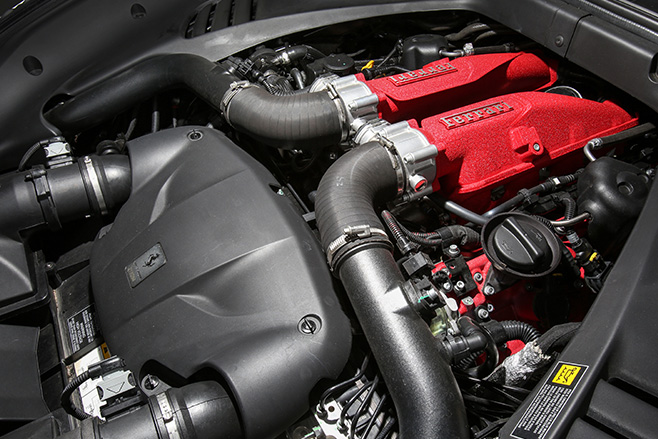
While the engine is untouched, the 3.9-litre V8 still pumping out a stonking 412kW and 755Nm to slingshot the 1730kg two-plus-two, rear-drive Cali to 100km/h in a claimed 3.6 seconds, the Handling Speciale pack focuses on making the Cali T sit flatter, swap gears more emotionally and sound meaner.
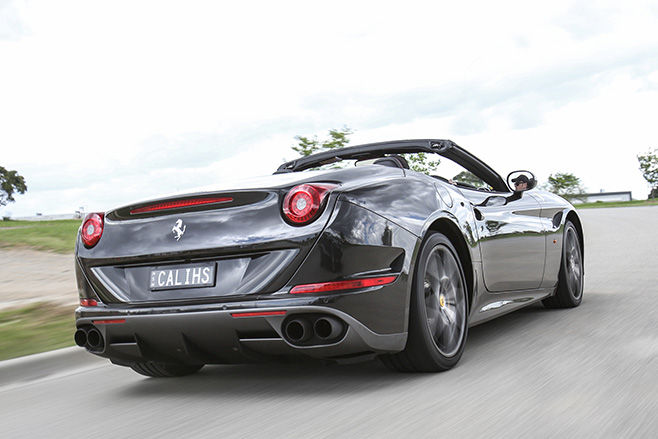
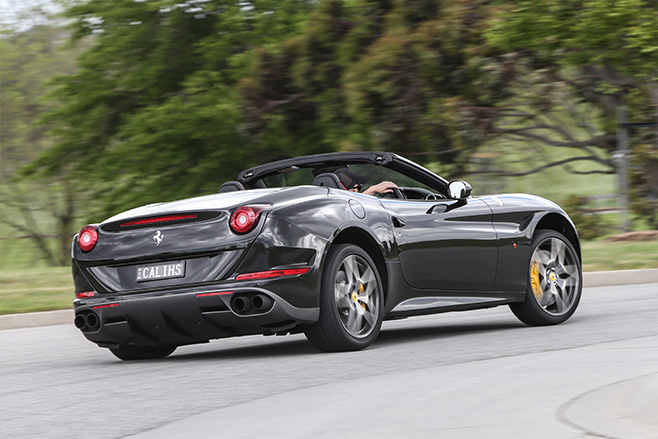
On the aesthetic front, only those folk who climb trees beside the Fiorano circuit on weekdays would spot the Handling Speciale, some black accents giving the ghost away on the exterior and a few subtle badges in the interior.
And Ferrari has also sought to make the California T a little growlier with a new, much louder exhaust system. Thumb the HS’s steering wheel starter button and it gurgles to a rich, loud-and-fast idle that’ll have your neighbours wishing you bought a Tesla. It sounds good.
The only drama is, we think the pack hasn’t gone far enough. The cushy Cali T feels ripe for transformation into something sublime and the Handling Speciale pack, while offering a ride/handling balance more up our alley, leaves us wanting a tad more.
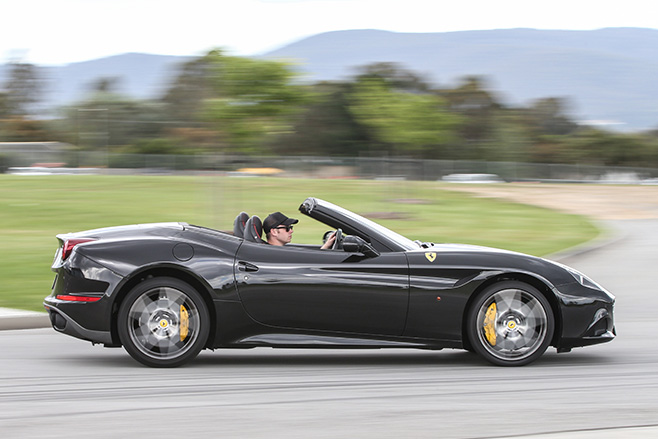
The manettino’s Sport mode is cruelly restrictive for a rear-driven sports car with a glut of tyre-frying lowdown torque; if only the HS offered a 488-style, more lenient ‘CT Off’ setting. The exhaust sounds fantastic, and you’ll be making regular detours for nearby tunnels, but this is probably what the standard Cali T should have got, and the HS should have come with an active exhaust button and an even naughtier bit of kit.
The HS is an impressive, satisfying corner carver but those 1730 kilos make it reasonably easy to exhaust the P-Zeros’ front grip. If only it had slightly more focused rubber.
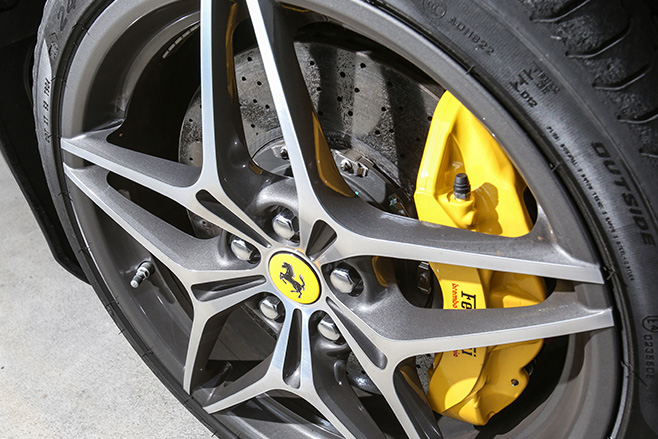
The engine is addictively flexible pulling hard and linearly from 2500rpm all the way to its 7500rpm limiter. And the dual-clutch seven-speed swaps its well-judged ratios crisply with a menacing blip on the downchanges.
4.0 out of 5 stars
Like Makes the Cali T seriously fun to drive
Dislike Could have gone further with upgrades
Specs Engine: 3855cc V8, DOHC, 32v, twin-turbo Power:412kW @ 7500rpm Torque: 755Nm @ 4750rpm Weight: 1730kg 0-100km/h: 3.6sec (claimed) Price: $425,638
Number plates are a divisive topic. Some people say a couple of hundred dollars is too much for a bit of metal, while other will happily push auction prices well past $50K.
When HSV officially announced the GTSR W1, it’s likely personalised plate combinations relating to the model were already scarce.
Now, they’re almost definitely impossible to acquire, unless you’re happy with replacing letters with numbers (or vice-versa) that might resemble the intended character.
What you can do, however, is buy one from a plate of the fast few who managed to snag one when the plates only cost standard fees. The problem is that they’re not reselling at standard rates.
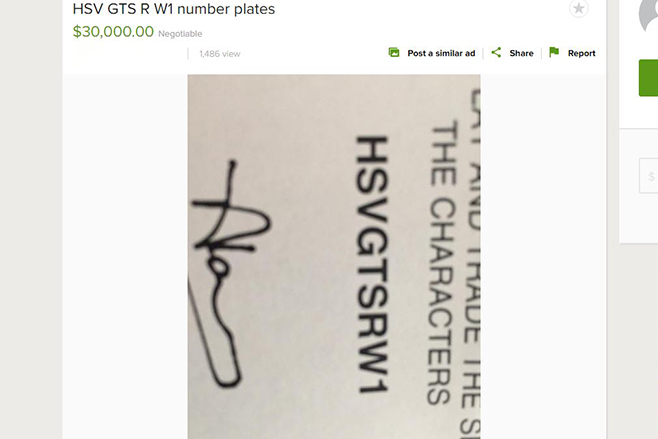
That’s not the most anyone has ever paid for a rego plate, but well above what it’d cost to buy one from the WA department of transport.
The advertiser hasn’t included a picture of the ‘HSVGTSRW1’ plates, only a very small section of what would appear to be a confirmation letter. Be wary of that.
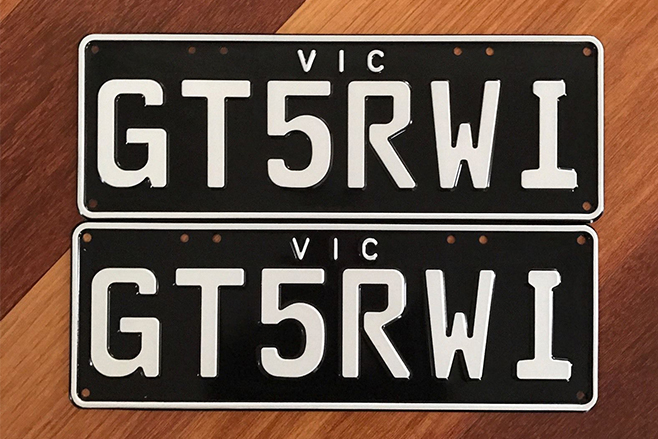
For a slightly more reasonable price of $22,000, you can attach ‘GT5RWI’ to the front of your new HSV, if you register it in Victoria. You’ve got to live there for that, by the way.
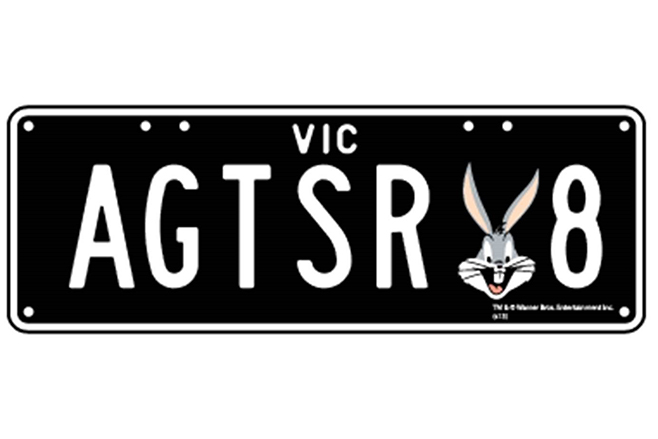
It’s the least W1-worthy, considering it could go on any GTSR, but it does have Bugs Bunny on it.
“I’ve been told that the ears look like the letter V,” the seller explains.
Advertised at $100K, two-thirds of the W1’s asking price, you’d want to hope they do.
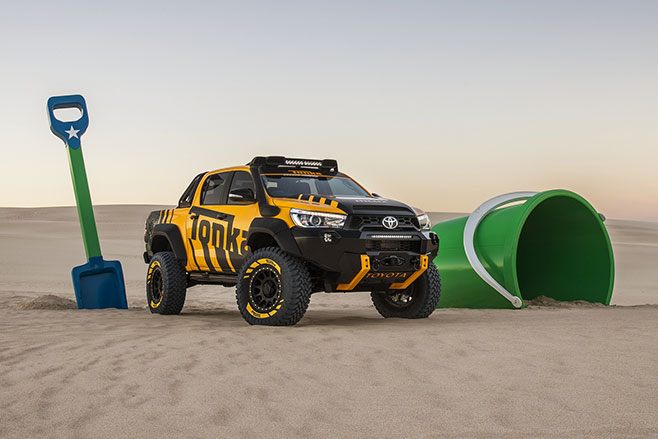
TOYOTA Australia has pulled the covers from a radical Hilux concept that will appeal to big kids and regular-sized ones alike with a top-to-bottom Tonka treatment that takes the popular one-tonner out of the sandpit and into the desert.
Bristling with hardcore off-road enhancements, the Hilux Tonka Concept is exclusively the work of the Australian product planning and development team with conception, design and construction all completed on red dirt.
For the larger-than-life toy, the Aussie team started with a top-of-the-range 4×4 double-cab SR5 variant and set to work with a series of enhancements that boost the Hilux’s off-road potential while adding an unmissable tough truck look.
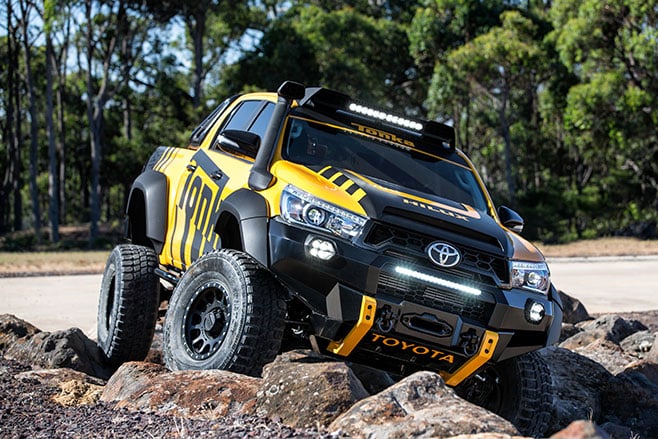
Its Method wheels measure 17 inches and are wrapped in whopping 35-inch Toyo Open Country rubber complete with Tonka branding – strictly an off road proposition only.
At the front-end, the beefed-up Hilux features a black steel ‘roo-bar complete with LED lighting, a variety of tow and snatch-strap points and Judge Dredd styling.
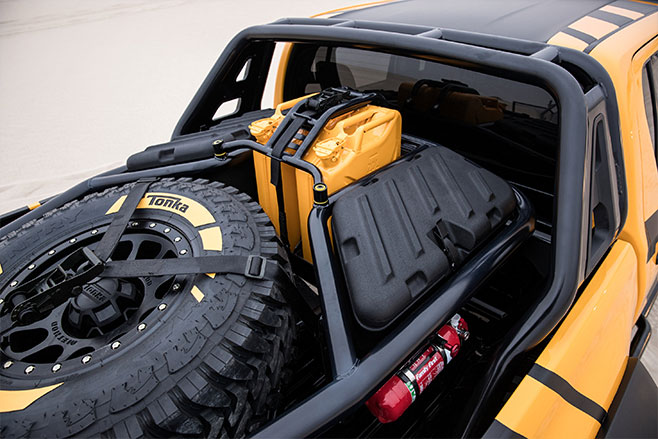
At the tail end, the Tonka Concept has more carbonfibre for the tailgate, an integrated spoiler and more vents, while the more conventional release handle is replaced in favour of a strap.
On top, a specially designed roof pod houses high-intensity LED lighting and ducts that pipe extra cooling air for the occupants.
Instead of a Kelpie and a concrete mixer, the unique Hilux’s tray is almost completely filled by a spare wheel, but the engineers found just enough leftover space for a brace of diesel cans and a pair of storage boxes. It is also supplied with an axe in the event of a zombie apocalypse.
More tubular steel is used for bespoke side rails, a roll-over bar and removable tub frame, completing the transformation.
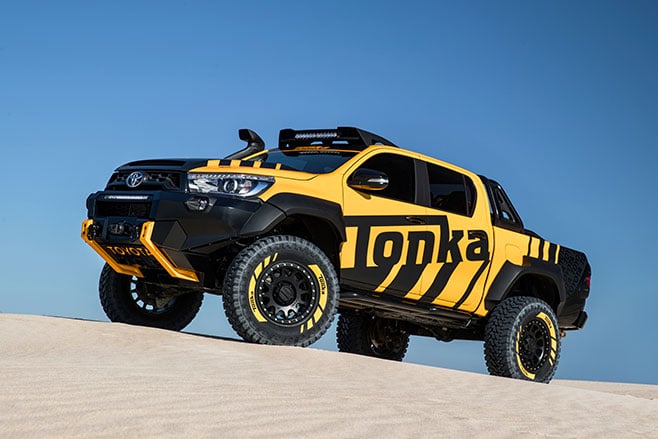
Toyota Australia product design chief Nicolas Hogios said that the concept would appeal to fans of Australia’s most popular one-tonne ute as well as appealing to a new generation of Toyota enthusiasts.
“We have taken Tonka out of the sand pit and reinvented Hilux from top to bottom and from nose to tail,” he said.
GRANT Denyer and his co-driver Dale Moscatt are both in hospital following a car-destroying crash at the weekend.
The pair was competing in the Lake Mountain Sprint Rally on Sunday, March 26. Driving a Lotus Exige S V6 Denyer lost control, with the car careening head-on into a large tree.
The TV personality and racing driver suffered a broken finger and coccyx in the shunt, while his co-driver had to be cut free of the wreckage.
Moscatt has been diagnosed with a broken knee and a suspected fractured vertebra.
“I can’t really walk at the moment but it’s sort of getting better each day,” Denyer told Ten News.
Denyer has an extensive racing background, but admitted he was reluctant to re-watch the footage of his shunt.
“I was kind of in two minds about whether I wanted to see it or not, because I remember it all too vividly.
Had Denyer run wide of the tree, his Lotus may have faced a sheer drop off the side of the alpine road.
“I had to decide whether to hit the biggest tree I had ever seen head-on, or try to avoid it.”
The crash sparked a war of words between the Confederation of Australian Motorsport (CAMS), the peak governing body for Motorsport in the country, and the event organiser The Australian Tarmac Rally Championship.
CAMS is calling for a police investigation into the event, which was run under the sanctioning of the Australian Auto-Sport Alliance (AASA).
ATRC Championship director Peter Washington responded in a statement threatening legal action against CAMS for defamation.
The sparring statements are a continuation of rising tensions between CAMS and AASA over safety standards and the treatment of event officials.
