
It’s not often talent and drop-dead gorgeous looks go together, so forgive us for keeping reserved about the Jaguar F-Type Coupe R prior to driving it. Something that looks that good surely must also be a bit wobbly at its limit, or so we worried.
But as a former prime minister once sagely said, nope, nope and nope. We were wrong. Let’s start with the grunt. Sweet mother, the grunt. The F-Type Coupe R rear-wheel drive version feels like a top fuel dragster to the layman that’s never been in anything fast before, but the all-wheel drive version is even quicker altogether. Earth to Jaguar, stop performance testing your cars into a headwind – we bettered Jag’s 4.1sec 0-100km/h claim for this car by nearly 0.4sec.
Our PCOTY as-tested 3.75sec 0-100km/h time for the all-claw Jag – without launch control, mind – put it second in the PCOTY drag stakes. Same, too, for its absolutely storming 11.8sec quarter at 193.35km/h. An eleven second car, folks.
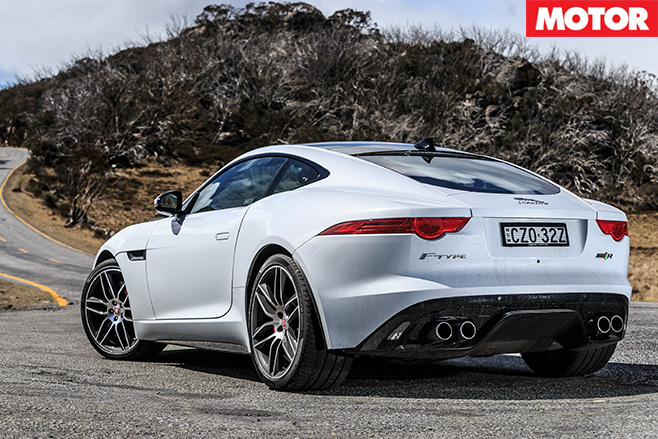
It’s on the open road you’re most aware of the extra pair of driveshafts, though. The rear-drive version invites care when picking up the throttle, but in the all-wheel drive version, not so much eggshell-treading is needed. Just boot it and go.
The traction is incredible; the all-wheel drive F-Type Coupe R converts its 404kW and 680Nm to forward momentum with a brutality and effectiveness the rear-drive version can’t quite match. And the ability to pick up the throttle earlier and harder shows in the lap times, the all-wheel driver 1.7sec faster than the rear-driver’s PCOTY time from last year (1:35.8 versus 1:37.5).
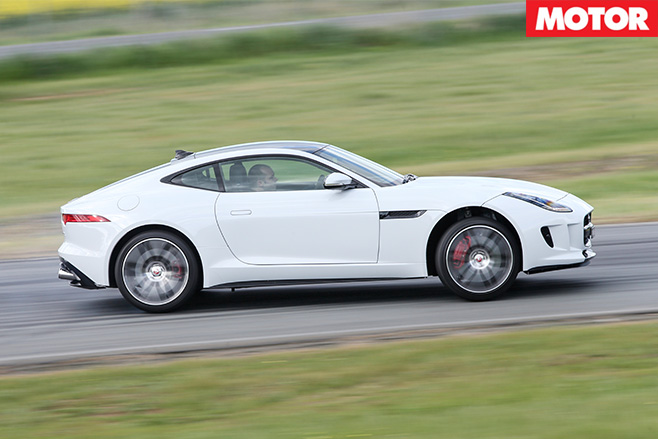
So, fourth place. This says more about how good the top three is than any particular shortcomings of the F-Type Coupe R AWD.
As a performance car, it’s truly mega. You’ll take forever to tire of the grunt, or the noise – it sounds proper. Dig deep in corners and you’ll find actual chassis talent and sophistication; on a twisty road it kept up with the semi-slick shod AMG GT S.
To think that this is Jaguar’s first stab at such a car – and it’s only up from here – makes us feel all warm and fuzzy about the future of V8 performance cars. PCOTY or otherwise, this big, feral kitty is truly one of MOTOR’s favourite cars right now.
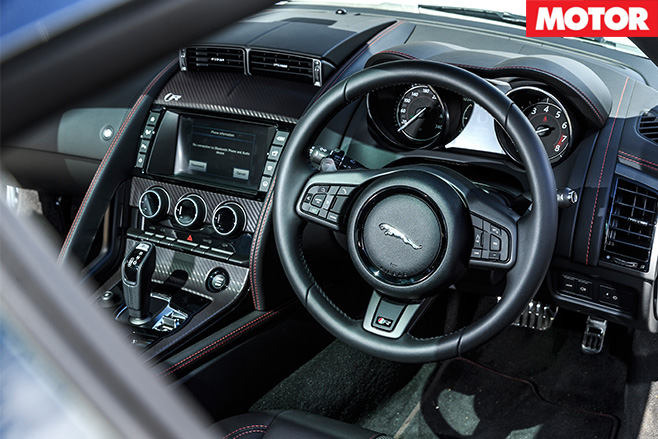
THE NUMBERS 0-100km/h: 3.75sec (2nd) 0-400m: 11.80sec @ 193.35km/h (3rd) Lap Time: 1:35.8sec (3rd)
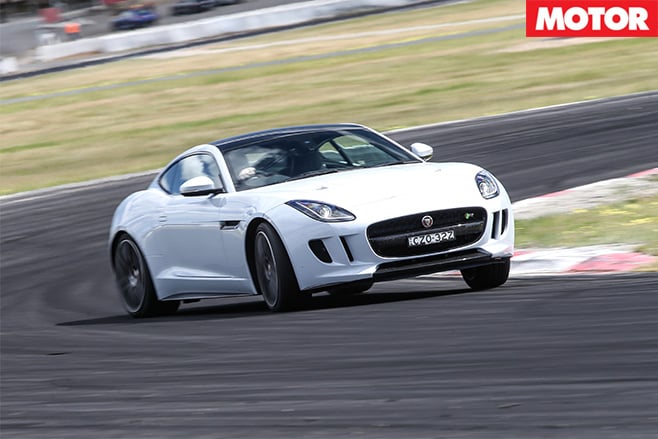
David Morley: 6TH “I’d prefer something a bit more tactile, but you can’t argue with the numbers”
Scott Newman: 3RD “Insanely fast, extremely enjoyable, all-wheel drive system just needs a little more rear-drive bias”
Tim Robson: 3RD “It doesn’t necessarily invite you to push hard to find it, but underneath lies an extra layer of talent and skill”
Warren Luff: 4TH “Many AWD cars understeer on the limit, but it maintains the character of the regular F-Type”
The BMW X5 xDrive40e is a plug-in hybrid, meaning it has a battery pack under the boot floor to power an electric motor that works in tandem with a conventional petrol engine under the bonnet. The battery pack is recharged in around five hours when plugged into a standard domestic socket, or more quickly (2.5 hours) via a special wall box installed in your garage by an electrician.
The xDrive40e aims to reduce petrol consumption and emissions by using the electric motor when it’s most efficient; namely in around-town driving.
STRENGTHS
1. With a charged battery, the BMW X5 moves away almost noiselessly, providing a serene, slightly surreal driving experience in urban and suburban driving conditions.
2. When the petrol engine does cut in to help the electric motor, or when charge is low (or exhausted), it’s completely seamless. At suburban speeds, you are barely aware it’s happening.
3. A menu of three driving modes allows you to best choose the combination of petrol/electric propulsion. You can leave it to the car to juggle between the two, or demand electric only, or petrol only (so you can preserve the battery charge for when later entering a city, for example).
4. If you’re still driving once the battery is depleted, the car will start to recharge it using energy harvested via the braking process, or you can direct the petrol engine to act as a recharging generator.
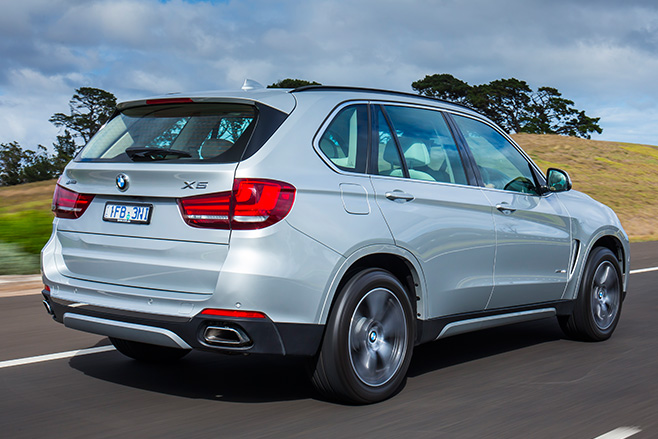
WEAKNESSES
1. The real-word electric range is only around 25km, so not far. Depending on traffic and speed limits, that may only be 35 minutes or so driving time. So once the charge is gone, and before the ‘re-gen’ function’ can start to add charge back, you will be burning fuel at the rate of at least 10 litres per 100 km around town.
2. Regular petrol or diesel X5 models can be optioned with a third-row seat which turns the car into a seven-seater. Around two out of every three X5 buyers choose this option. Unfortunately the battery pack located under the xDrive40e’s boot precludes this seven-seater option.
3. The battery pack also sees the deletion of the skinny space-saver spare tyre, replaced by an inflation kit and tyre sealant that only work for small punctures caused by nails or similar. A more serious flat in a remote area could see you stranded until a recovery truck arrives.
4. If you regularly drive sizable distances in one hit, the xDrive40e will be less economical overall than the comparably priced xDrive30d diesel model.
5. If you park on the street each night, you face issues of cable trip hazards, vandals unplugging you, etc, probably making the xDrive40e unviable.
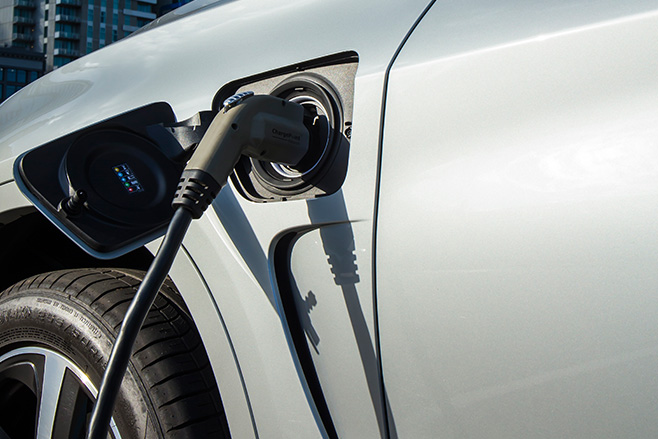
ANY RIVALS I SHOULD CONSIDER?
Yes, all of BMW’s German rivals – Mercedes Benz, Audi, and Porsche – do or will (later this year) offer comparable plug-in hybrid models. The Mercedes-Benz model is called the GLE 500e and it’s due here in the third quarter of this year. It teams an electric motor with a six-cylinder twin-turbo petrol engine, and will be more expensive, at around $140K.
Audi’s competitor, called the Audi Q7 e-tron, will also be more expensive, (like the Merc, around $140K) but uses a 3.0-litre turbo-diesel engine mated to an electric motor. It can travel around double the BMW’s distance in electric-only mode.
Finally, there’s the Porsche Cayenne S e-Hybrid, which is also around $140K, has a short electric-only range like the BMW, and becomes thirsty when relying solely on its supercharged 3.0-litre petrol V6 engine.
Kia’s most affordable model has been launched in a single, self-shifting specification that focuses on the transmission preferred by the majority of Australian motorists rather than a headline price tag.
The five-door Picanto costs more than manual versions of the Nissan Micra, Holden Spark and Mitsubishi Mirage but is notably cheaper when those cars are selected with optional autos – as most buyers do.
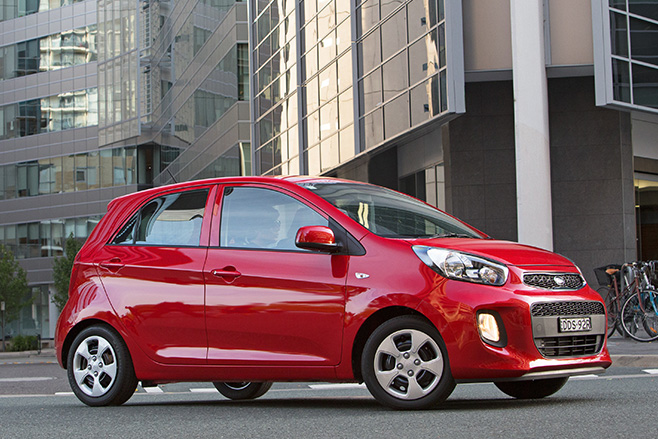
Suzuki’s Celerio remains the cheapest auto option of the major players, with a $14,490 driveaway cost.
The front-wheel-drive Picanto’s four-speed auto is teamed with a 1.2-litre four-cylinder engine offering above-average power and torque – 63kW and 120Nm – with fuel consumption that is slightly higher than the norm (5.3 litres per 100km).
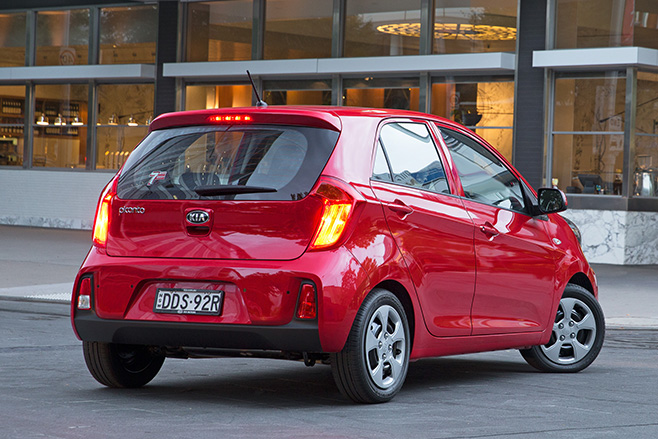
Rear parking sensors are also a rarity for a car costing $14,990 brand new, and are part of a features list including 14-inch steel wheels, black cloth seats, Bluetooth with audio streaming, electric windows front and rear, six airbags and a variety of electronic safety systems including stability control and anti-lock brakes.
The longest warranty available in the segment – seven years – is also likely to be hugely persuasive for buyers.
The boot is one of the smallest in the class, at 200 litres. The rear seats split-fold, though, to create a total of 605 litres of luggage space when the rear seats aren’t required for passengers.
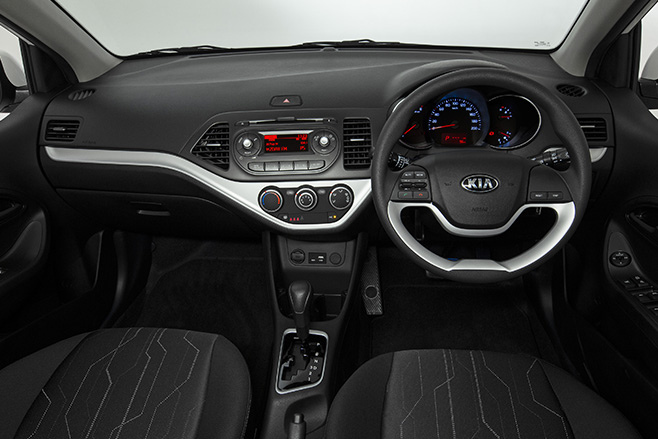
Seven exterior colours are available, though only one of them (Clear White) is a non-premium paint not costing extra.
Kia Australia has been contemplating the Picanto since it was launched in Europe in 2011. A 2015 update pushed it back into consideration, and the company is aiming for the Picanto to take over from the Mitsubishi Mirage as the segment best-seller.
The micro-car segment is currently shrinking, with year on year sales down more than 30 per cent.
Stretching to Lycra was a defining moment for Ford camouflage expert Neil Trickey.
First published in the March 2016 issue of Wheels magazine, Australia’s most experienced and most trusted car magazine since 1953.
IT’S a fair bet that when Neil Trickey began his apprenticeship as a fitter and turner in the small Victorian town of Maryborough, he wouldn’t have guessed he’d one day be designing slinky, body-hugging outerwear for Ford models. That’s “Ford models” as in Falcon sedans and Ranger utes, not the New York fashion agency.
Trickey, 57, joined Ford Australia in 1977 and moved into the prototype shop in 2000. “It really is an interesting job,” he says. “The engineer comes to me and says, ‘I want to make this widget’. So I go off and make a prototype part that he wants as best I can, or as best we can get it made. It could be any part of the car. And we’re playing with these things three years before you guys get to see ’em.”
Trickey’s worked in many different areas of toolmaking, with a lot of experience with CAD and sheetmetal stamping. He’s also the go-to guy for prototype camouflage.
“We used to use fibreglass, vacuum-formed panels, all sorts of things,” he says. “Then there were the vinyl covers. They added a lot of weight and we discovered that they tended to hold the vehicle together. They’d test the vehicle for months and it’d be terrific, but when they took the camo off, they started finding the bumpers coming loose. It also distracted from the wind-noise and cooling.
“We moved to stretchy Lycra covers after I saw a Holden Commodore, a VE, all camouflaged, driving past me one day. I found out that a Melbourne company had developed the idea to use Lycra.
“It was quite good, because the first job – I think it was BA Ford Falcon – we’d gone through prototype build, say 50 cars, and they said there wouldn’t be any XRs in the mix. So I made all these camouflage covers off a base-model car, no spoilers or anything. The first car that came down was a GT! But the Lycra just stretched over everything. You just clip it on, it hit all the high spots and you couldn’t see anything in between. It was brilliant.”
To make the covers (they’re sometimes subbed-out to upholstery shops), Trickey starts with measurements from the previous model. “Then we lay it over the clay model – when we’re allowed to – being careful not to damage them. We also have our CAD information. But you don’t really know that it’s going to work until you drive one out onto the road.”
The prototype test team loved Lycra, too. “The old vinyl camo would stay on the cars pretty well, but every day the engineers need to take it all off to do their tests and take readings. Where the Lycra, it had a separate engine hood bag, separate bumper-grille-headlights – it’s so much easier for them.”
As keen readers will know from our News pages, the Lycra is gradually being superseded by psychedelic-patterned adhesive film.
“It’s about as quick to put on as the Lycra, it doesn’t add any weight or affect the aero at all,” Trickey says. “The only thing is, I don’t think it hides quite as well.
“Still, the managers seem to like it. They’re the guys you’ve got to impress, I suppose.”
Camo king
Ford camouflage expert Neil Trickey says there are several stages of prototype. “There’s X1, the basic concept in terms of size, seating position or whatever … Then you go into M1, where the underbody has all got to be correct. Then it’s VP, verification prototype, where the ‘top hat’ is about 80 percent there. By then, you’d want pretty good camo.”
First impressions: can’t beat ’em sometimes. Like when you look inside the Megane Trophy-R and see the race seats with their adjustable aluminium runners and wild red harnesses.
But look again, and second impressions start to kick in. This is a pretty bare-bones little gadget, especially at the advertised price of all but $62,000.
It’s all about appeasing the gods of power-to-weight, so there’s no sat-nav, no reversing camera, no ashtray, no climate control (in fact, no air-con at all) and not even a radio for crying out loud. But don’t fret, the radio and air-con are delete options, so you can have them in your R just for asking.
On the other hand, you do get a suede tiller and cruise control, but you’ll soon discover that the shifter obscures the starter button and the other switchgear is all over the shop like a madman’s breakfast.
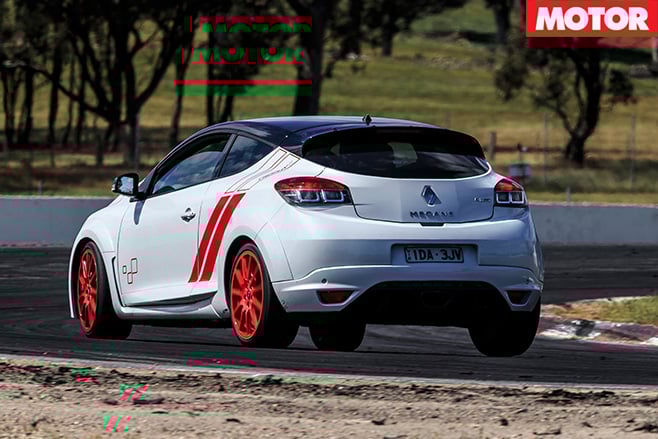
The real magic of the Trophy-R, however, is the clever electronic front diff which gives the thing power-down that most cars – even rear-drivers – will never match. You can get into the power so much earlier than you thought possible that it takes a few laps to actually recalibrate your brain and work out what this little frawg can do.
And it’s not just power-down – there’s a stunning amount of corner grip and, therefore, corner speed to be had. So chasing the Megane down a twisty road is not going to be easy, even in some big-dollar fast cars.
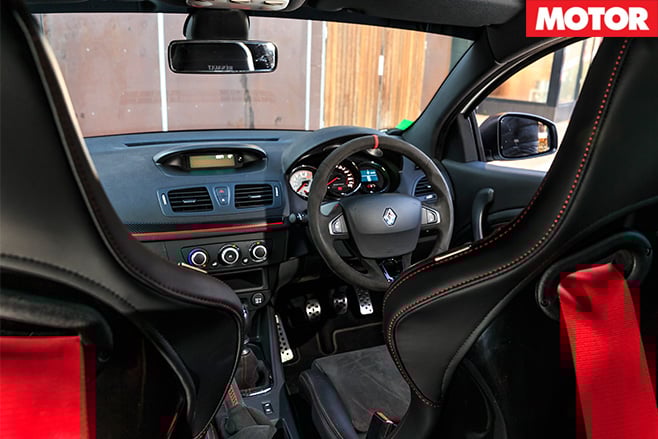
The Trophy is fitted with conventional retractable seatbelts, but I reckon I’d use the harnesses every time, just for the sense of occasion they bring to the deal. And that’s a large part of the magic of this car: every drive is going to be an occasion. It’s too sharp, too fast and too much fun to be any other way.
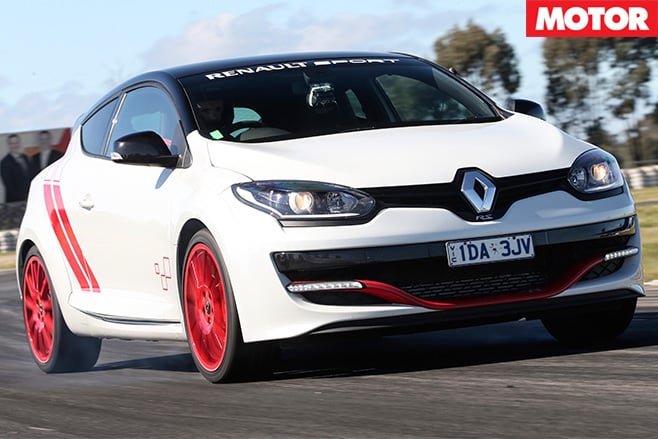
THE NUMBERS 0-100km/h: 5.80sec (9th) 0-400m: 13.90sec @ 170.02km/h (9th) Lap Time: 1:38.3sec (6th)
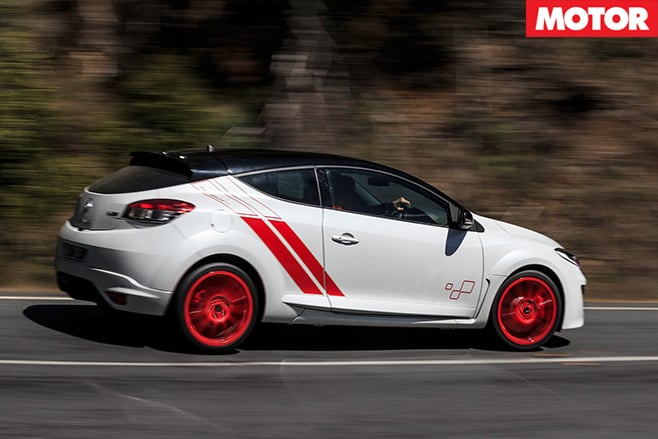
David Morley: 3RD “To be frank, didn’t like the Megane RS much at first. But this one I love”
Scott Newman: 4th “Is this the best front-driver ever? If it’s not, it’s right up there. Compromised, but worth it”
Tim Robson: 8th “Predictable, lively, flattering and easy to punt with rewards there for the taking”
Warren Luff: 5th “For the ultimate front-drive hot hatch, nothing comes close. Even put big rear-drive V8s to shame”
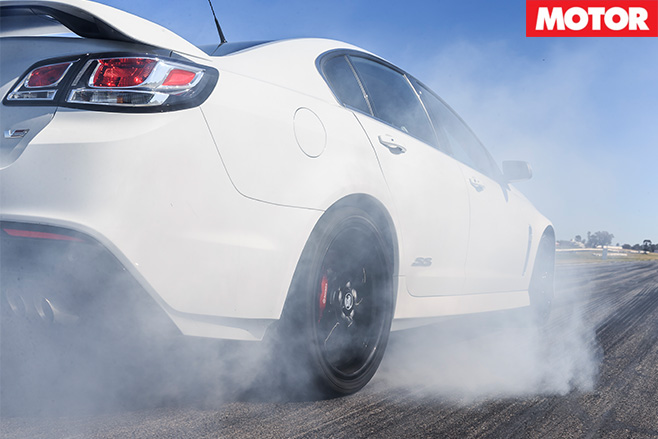
WE’VE been big fans of the Commodore SS V Redline since it broke cover in VE form back in 2010, but for various reasons it’s never made it to Performance Car of the Year.
In the final selection process it’s usually been pipped by an equivalent HSV product, but thanks to fortuitous timing and a big effort from Holden’s PR team, we managed to score a VF II Redline for PCOTY weeks ahead of the local launch.
On the face of it, sixth mightn’t seem anything to sing and dance about, but look what this boofy $53K V8 sedan is wedged between: a $130K V8 sports coupe from one of the world’s biggest manufacturers and the fastest front-drive car around the ’Ring. Make no mistake, Holden’s new performance hero is a brilliant achievement.
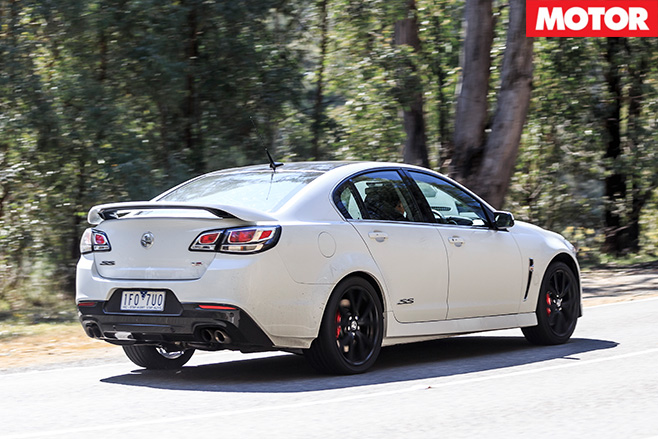
The brakes are strong, the chassis is balanced and there’s plenty of grip front and rear; you can push in the Commodore without having to make allowances like in the XR8. Then again, the chassis has always been a Redline strong point. What the installation of the 304kW/570Nm 6.2-litre LS3 V8 has done is even up the grip-to-grunt equation.
With all that extra torque and a shorter final drive the Commodore now rips through the first three gears with far greater ferocity, all the while making a noise that’s downright rude. The shift is better, too; it’s still no Honda S2000, but you can change quickly reasonably safe in the knowledge that you’ll end up in the next gear rather than floating somewhere in between.
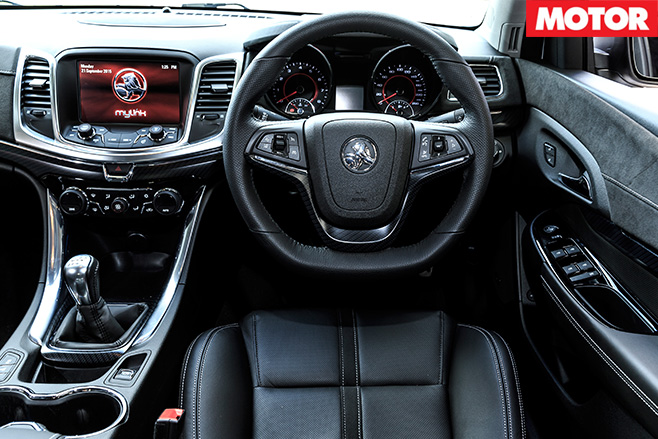
‘Bittersweet’ was an oft-heard word when discussing the VF II Redline. It seems such a shame that having finally got the product bang-on, we have less than 24 months to enjoy it before stumps are pulled. Whatever Holden pulls out of the bag for the next Commodore, it’s unlikely to be this entertaining, this shouty or this smoky. Buy one while you can.
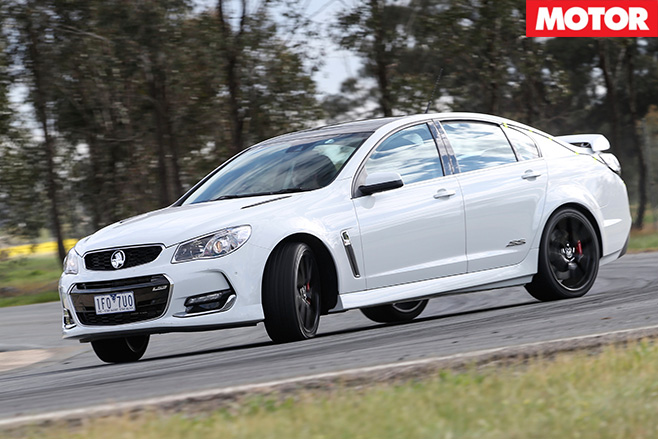
THE NUMBERS 0-100km/h: 5.00sec (8th) 0-400m: 13.10sec @ 179.40km/h (8th) Lap Time: 1:39.5sec (8th)
David Morley: 5th “What a shame this can’t go on forever. This is the best SS Commodore. Ever”
Scott Newman: 6th “For what it is and what it’s meant to be, very close to perfect. LS3 engine the icing on the cake”
Tim Robson: 6th “Gearbox is the best it’s ever been, the front end is immense, brakes are spot on – still a very handy device”
Warren Luff: 7th “Doesn’t feel like a 1700kg four-door sedan. Clearly not just a few badges with this update”
Somebody at Lexus gets it. From a brand that has served up its share of gridlock fodder over the years, the RC F owes more to the Lexus LFA supercar than it does any Camry with a sunroof.
This is indeed good news. The numbers themselves are more than just interesting: 351kW at 7100rpm and 530Nm at 4800rpm. That is one high-stepping atmo V8, my friends.
The bum note is the kerb weight which wobbles on to the spec page at a claimed 1860kg. But fear not, because even with that girth, the RC F can really lift its skirts. On the road it feels like it flows pretty well, and while the steering is a bit light for some tastes, it is reasonably accurate and faithful to your inputs.
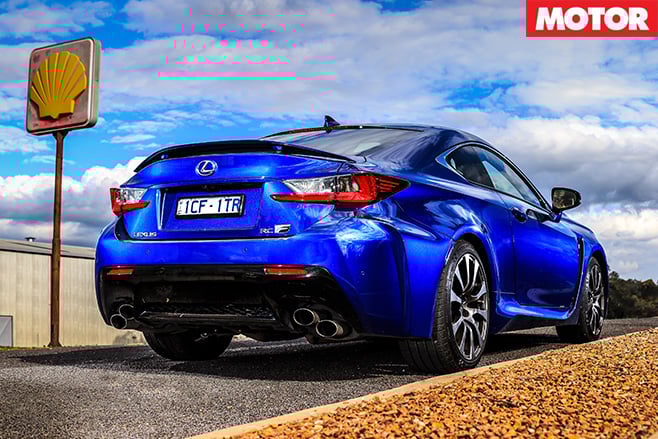
Head for the racetrack and things don’t stay quite so sunshine and roses, but thanks to that sheer grunt, the Lexus surprised the hell out of the judges by being fifth fastest. Okay, so the steering will eventually start writing cheques the front end can’t cash, but only after about nine tenths – even then, if you’re Luffy, you can squeeze a bit more out of it.
The gearbox is doing its bit, too, and the conventional eight-speed automatic transmission proves that there’s life in that technology yet, especially when it’s so eager to comply with the instructions issued via the paddles.
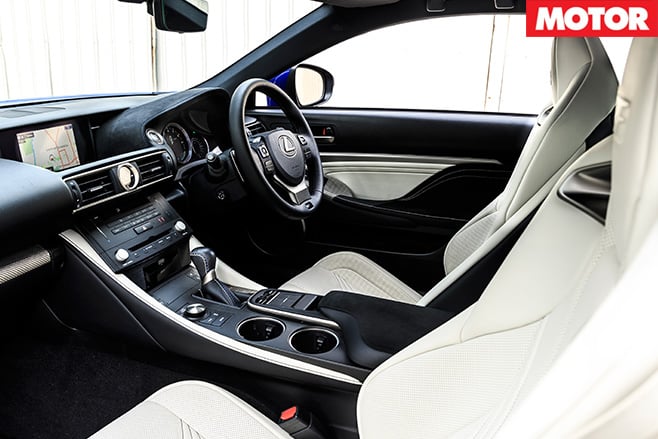
But deep within old big nose is a cracking car that not only drives better than we expected, it drives better than a lot of things here. Hell, it’s not even too shabby at drifting. As those scallywags in da hood would say: pretty fly for a white guy. Check.
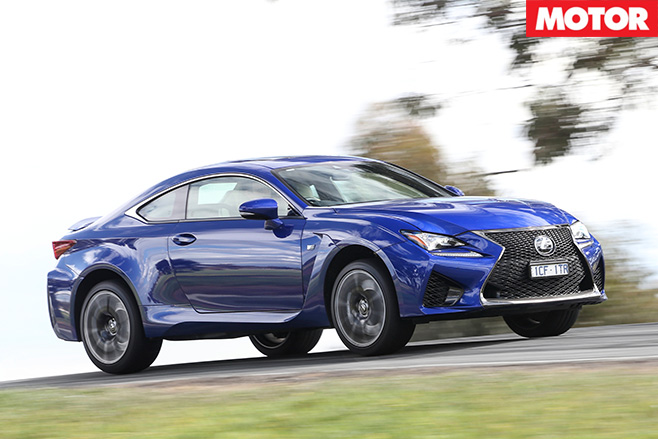
THE NUMBERS 0-100km/h: 4.75sec (5th) 0-400m: 12.86sec @ 182.38km/h (7th) Lap Time: 1:38.1sec (5th)
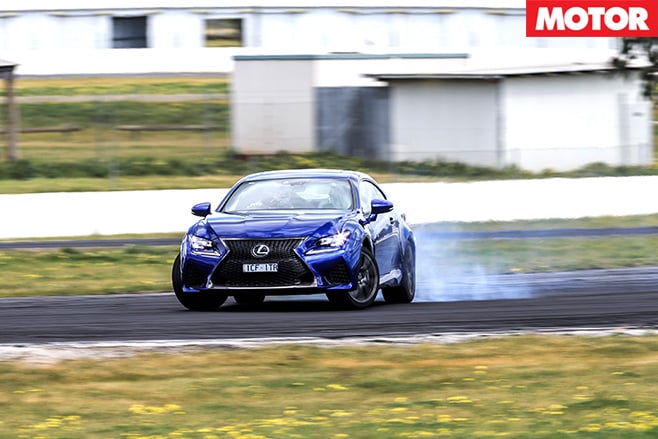
David Morley: 7th “Raised my eyebrows – a surprise packet. I smell a faint whiff of LFA, and about time, too”
Scott Newman: 9th “Does a lot of things well, but nothing brilliantly. Heavy and feels a little artificial”
Tim Robson: 10th “Weight played against it, but it’s a well-resolved package. Throttle response in Sport mode is too sharp”
Warren Luff: 6th “Really fun on the limit and very forgiving. You can drive it into corners with heaps of speed”
YEAH, sure, look, all right. Showing up for a PCOTY packing less than 100kW in 2015 is like admitting you voted for Rudd and Abbott at the same time.
Hell, the BMW i8’s second motor is almost more powerful than the entire Mazda MX-5. But if your mother has told you once, she’s told you a hundred times – always wear clean underwe… err, never judge a book by its cover.
The cover, in this case, is a lightly specced manual MX-5 sporting a 1.5-litre SkyActiv inline-four without a turbo or supercharger in sight. The whole shooting match might only weigh 1009kg, but its power output was always going to limit it in the final figuring.
And yet the number of judges who sat around agonising about where it should be ranked, and the overwhelmingly positive sentiment from everyone who drove it, is testament to how much fun everyone had with it. Mazda swore it would get back to the ethos that made the 1989 NA such a revelation, and by gum, it’s pulled it off.
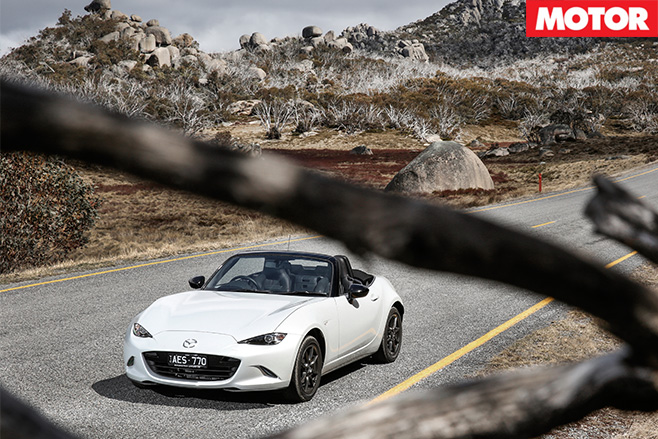
A couple of judges remarked on how supple the suspension tune is; a competent shock and damper tuner could definitely eke out a gain here. Letting the little engine breathe a bit better would also help its cause.
DECA is almost custom-made for the MX-5, of course, and the touring stages, too, kept the MX-5 high in the hearts of everyone who drove it. A run down Mount Buffalo chasing the more fancied Mercs will be a personal highlight for many, many years to come – so much so that the hunt for an early-model MX-5 is officially on.

We can only imagine how good an MX-5 that’s 10 per cent better everywhere – stiffer, lower, lighter and more powerful – could be. The 2.0-litre car should be eligible for a return bout in 2016, and with the impending MX-5 Nation’s Cup series, this book will only get better with every reading.
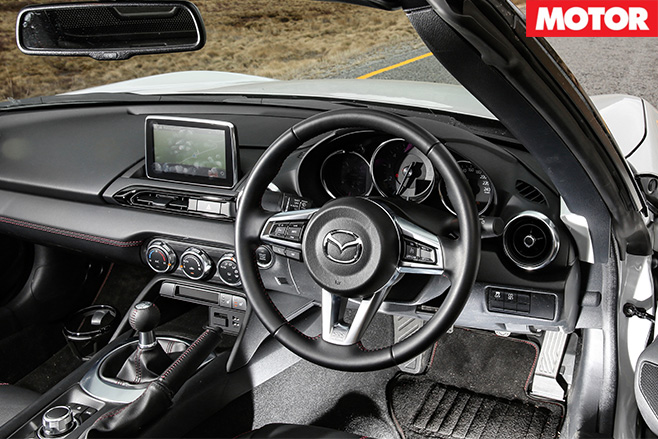
THE NUMBERS 0-100km/h: 7.50sec (11th) 0-400m: 15.40sec @ 142.80km/h (11th) Lap Time: 1:47.1sec (11th)
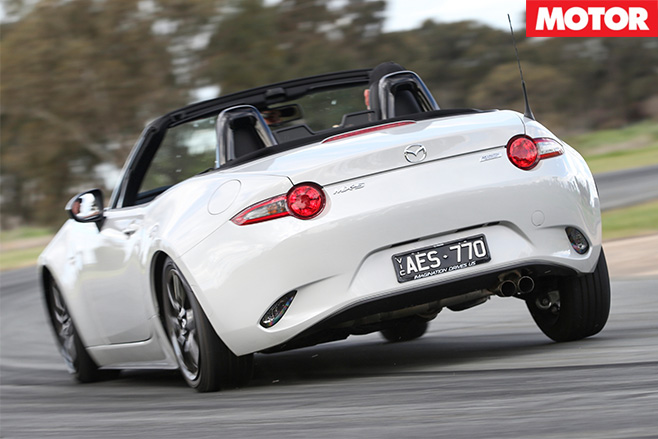
David Morley: 10th “Deserves to have all the impact of the 25-year-old original MX-5. Probably will”
Scott Newman: 7th “Cheap and very cheerful; possibly most fun of the lot on track thanks to wild oversteer tendency”
Tim Robson: 5th “OMG, what an utter delight. Playful chassis, loads of feel, maybe a mite too soft for my taste”
Warren Luff: 8th “If this was BFYB, this thing would be an outright winner for sure. Crying out for another 100kW”
DO you remember that TV show Towards 2000? I think it had to change its name to Beyond 2000 once the date ticked over…
Anyway, it was a telly show that previewed clever, expensive items that we were likely to see in the years to come. The BMW i8 – for me at least – falls squarely in this category.
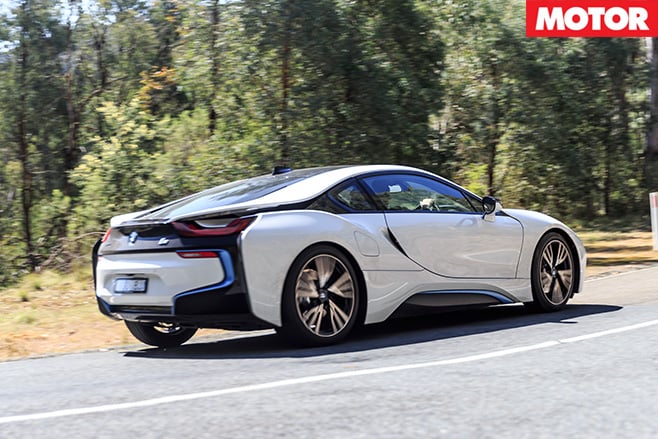
Everything from its carbonfibre-reinforced plastic passenger cell on an alloy chassis, its modular construction, its unusual body styling and tricky swing doors, its small-but-well-formed pair of power sources – even its iPod-white and electric-blue colour scheme screams ‘science project’. It’s a very advanced science project, of course, and it’s the only hybrid on test here at PCOTY this week; a stat that’s sure to unwind in future events.
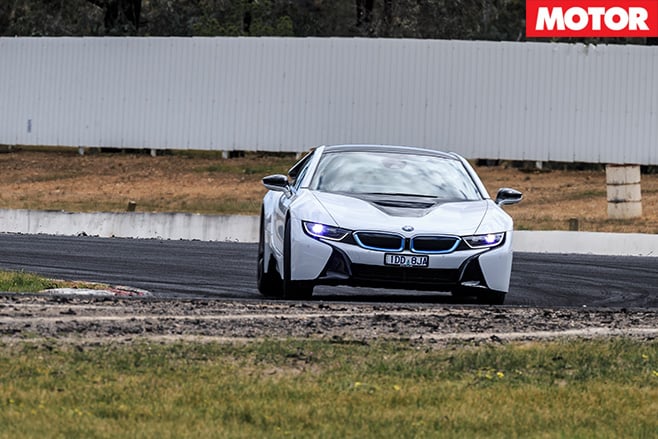
When the raw numbers are brought into it, though, what we have is a 1400kg-plus AWD 2+2 coupe with 266kW and 570Nm. In this company, the numbers aren’t knockout strong, and are somewhat limited by the size of the petrol engine – a 1.5-litre inline three-potter pinched from a MINI with a ginormous turbo whanged on it – and the electric motor that runs the front end.
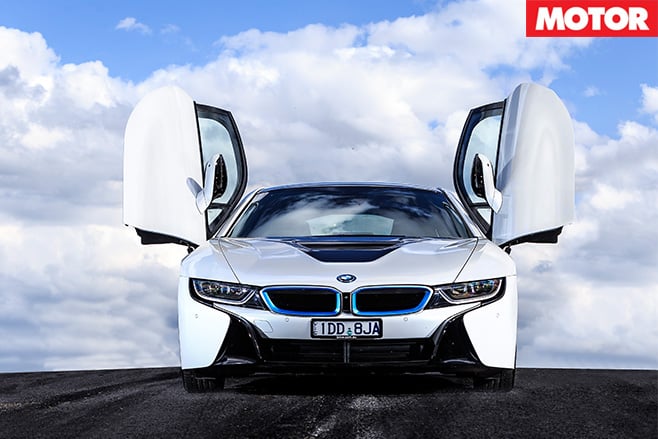
Underneath all that, though, is a stiff, light chassis that’s just begging to be let off the electronic leash, something that is borne out across the Alps time and again. The electronically enhanced soundtrack is sufficiently well done as not to be a distraction, a (somewhat surprising) lack of gizmos keeps the experience pure, and being able to settle back an d select electric mode (albeit for well less than the prescribed 37km) gives the i8 a second life.

Consider, too, that this is the first generation of the car, and BMW has gotten a lot of things very right. The i8 was found wanting in this year’s PCOTY, but don’t be surprised if another, much more focused version makes a start in a couple of years’ time.
THE NUMBERS 0-100km/h: 4.60sec (4th) 0-400m: 12.70sec @ 183.90km/h (5th) Lap Time: 1:38.9sec (7th)
David Morley: 8th “What’s this? A hybrid that doesn’t immediately put me to sleep? I’m all ears”
Scott Newman: 8th “Love it as a car, but fell short on outright performance and driver engagement. Great cruiser, though”
Tim Robson: 7th “Overly intrusive electronics kill the fun, even in Sport mode, and it needs another 100kW”
Warren Luff: 9th “It could clearly be made to go faster, but for what it’s designed to do, it scores an absolute 10/10”
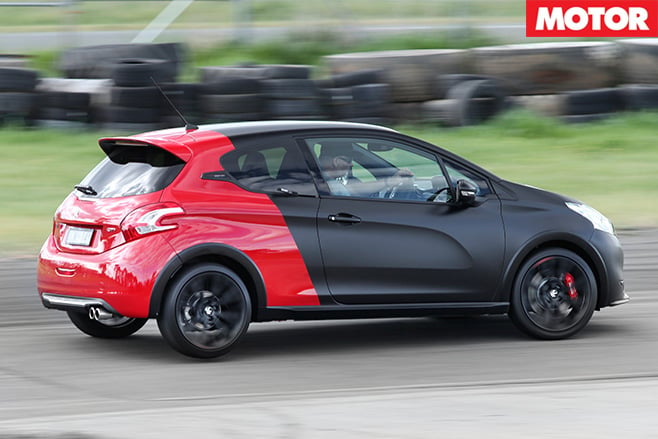
The Peugeot 208 GTi is a good car, but it’s unlikely to rate a mention on future lists of the top hatches of all time. But the baboon-butted 30th Anniversary special edition version? It just might.
The extra 6kW, 25Nm, suspension refiddle and mechanical limited slip diff do more than just add the zing the base 208 GTi so seems to need. And so at PCOTY, we had high hopes the little red and black, feral jellybean might kill some giants, along the lines of the Fiesta ST with its stunning third place finish at PCOTY 2013.
But alas, it was not to be – though it had more to do with the sheer strength of the field than it did for any major flaws of the little Peugeot.
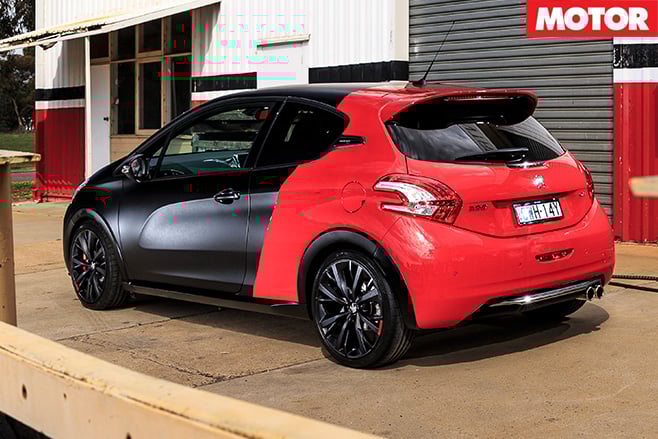
In lap time alone the 30th Anniversary treatment is apparently worth 4.3 seconds. And, we’re glad to report, it had nothing to do with the, err, polarising paint scheme. (Whether or not it’s to your tastes, that’s the $4000 question.)
But the differences were greatest on road, where the 30th showed mongrel and tenacity the donor car just doesn’t have. The engine has some welcome extra pep, felt mostly in the upper end of the tacho (even if Peugeot Sport could have given the exhaust note some extra herbs and spices – it sounds a little appliance-y when you rev it out. And apparently has no pops or crackles to speak of).
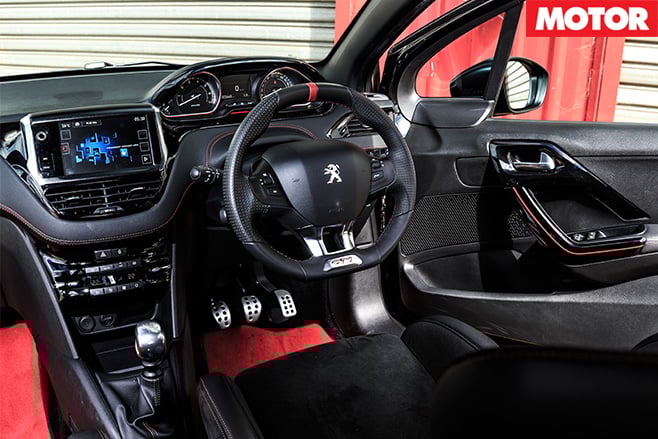
But on road, and on track, it’s not super playful – at least, if you try to unhinge the back you’re likely to end up white as a ghost rather than happy-clapping. It’s not Fiesta-ST-fun in that sense.
And the controls take some getting used to. Peugeot Sport can’t do much about the inherent 208 layout, where you sit high, the steering wheel is mounted low, and it can be tricky to find the perfect driving position. The gearshift and pedals could feel a bit ‘meatier’, too.
But in general the 208 GTi 30th was met with relief amongst the judges. ‘This is more like it,’ grunted Morley, before muttering something about the old 205 GTi. The 30th is probably what the 208 GTi should’ve been to begin with.
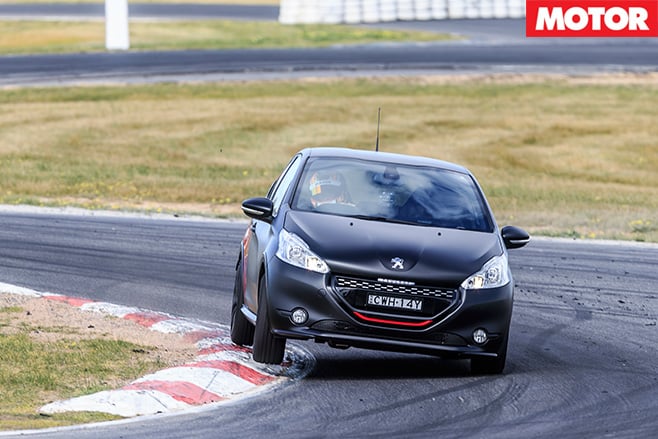
THE NUMBERS 0-100km/h: 6.60sec (10th) 0-400m: 14.81sec @ 156.73km/h (10th) Lap Time: 1:42.30sec (10th)
David Morley: 9th “Closer than ever to recapturing the magic of the original Peugeot 205 GTI”
Scott Newman: 10th “Fiery Frenchie much improved over standard, but small details stop it achieving true greatness”
Tim Robson: 9th “A hot hatch zinger with hot sauce and jalapenos, but let down by inconsistent, slippery brake pedal”
Warren Luff: 10th “A great car on the limit and a lot of fun, but it tends to have that typical front-wheel understeer”
