
Unless you’ve been living under a rock for the last week, you’ll know that Shane Van Gisbergen, along with team mates Jonathon Webb and Alvaro Parente, won the 2016 Bathurst 12 Hour in a McLaren 650S GT3.
Despite suffering a number of setbacks, the McLaren was essentially the fastest car all race, but it was on Saturday afternoon that SVG proved the 650S’s pace by setting an incredible 2:01.286 lap to put the Tekno Autosports run car on pole.
This set a new lap record for the Mount Panorama track, and thanks to McLaren you can watch in awe at how this flying Kiwi did it.
PLUS
- Tough. The Toyota Hilux is tough and so is the Fortuner. The Fortuner is more passenger car but shares the same DNA as the Hilux – a brand built on a reputation of durability.
- 4×4 capability. Like the new Hilux, the Fortuner is very capable off road. The electronic traction control delivers drive to the wheels that need it most, and low-speed punch is always available from the engine.
- Refinements. The Fortuner has an upmarket SUV feel. It has disc brakes at the rear, soft-touch points throughout the cabin, and coil spring suspension means a smooth ride on the highway. It looks pretty smart, too.
- Dealer network. Toyota has a massive dealer network. So you should be able to get support no matter where you are in Australia.
- Equipment. The Fortuner comes with most of the stuff you’d expect in a modern passenger car, including an array of power and USB outlets for your electronic goodies.
- Seven seats. Better than five.
- Fiddly tablet. The audio system is controlled via a touch screen, which can be hard to use, especially over rough terrain.
- Tyre size. The Fortuner’s tyre size is one of the most common, so there are plenty of options for rubber. But if you want to get bigger tyres, you’re out of luck – there isn’t enough room in the wheel wells.
- Sat-nav. There is no sat-nav or climate control air-con in the mid-spec GLX.
WELCOME the 2017 BMW X2 – yet another Sport Activity Vehicle in the mould of the ground-breaking BMW X6.
A coupe SUV then, you say, and that’s correct. This one, however, differs from the larger ones from BMW in using a transverse engine arrangement, for front or all-wheel drive configurations.
Based on the recently released, second-gen, BMW X1, the X2 – shown top in an artist’s impression – will be one of at least a dozen vehicles built on the company’s UKL architecture. This platform also underpins the latest F56 Mini, BMW 2 Series Active Tourer, and upcoming 2 Series four-door sedan.
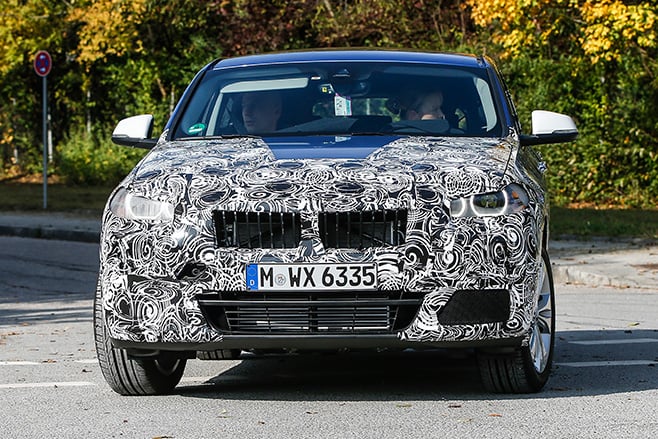
The transmission in question will most likely be an eight-speed automatic, underlining the X2’s intended sporty nature.
As the camouflaged prototype snapped in Europe’s wintry blast shows, the body follows BMW’s SAV form by having a greater windscreen angle, lower roofline, and sleeker silhouette than the more upright donor X1 manages, giving the X2 more youth appeal.
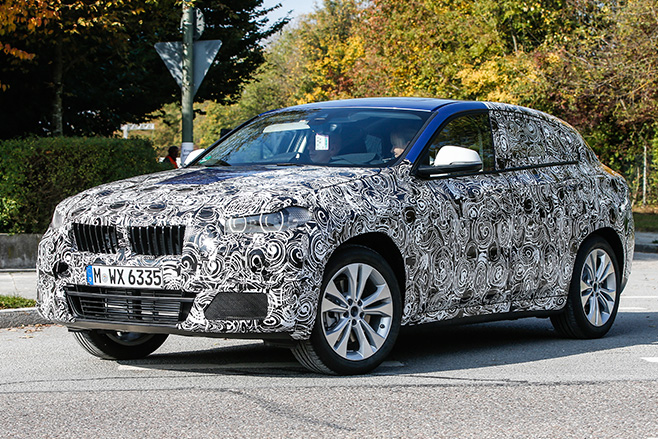
The BMW X2’s launch timing is yet to be confirmed, but expect to see it no sooner than at the Paris Motor Show in September. We hear Australian deliveries will commence not too far into 2017.
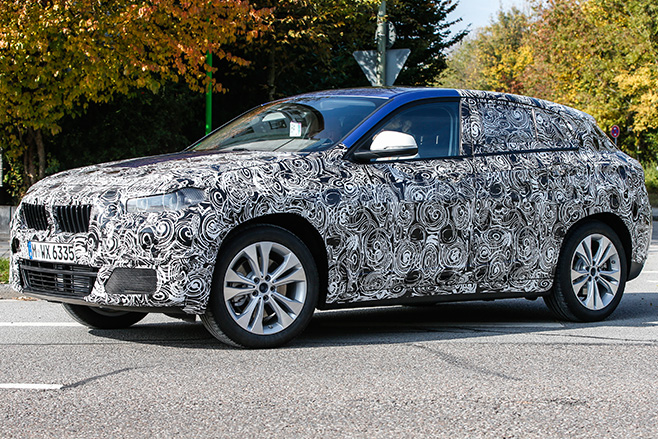
Have spy pics of your own? We’d love to see them. Just email them to [email protected]
The winds of change are blowing through Stuttgart, and they’re pressurised at 16psi.
That’s the maximum boost pressure of the new 991.2 911 Carrera S, which is the latest, but certainly not the last, of Porsche’s model range to turn to turbos. It’s a contentious move, especially for a model that, despite exploding SUV sales, Porsche still regards as its core business.
Of course, we’ve been here before. The front-engined 928, water cooling, direct injection and electric power steering were all supposed to herald the doom of Porsche’s iconic sports car, but the shift to turbocharging is still significant, partly because high-revving flat-sixes have been a key part of the 911’s appeal since its introduction in 1963, and partly because some of the world’s biggest manufacturers have struggled with the switch to forced induction.

The screaming 3.4 and 3.8-litre atmo engines are now a part of history, both replaced by a 3.0-litre twin-turbo flat-six in two states of tune: 309kW/500Nm for the Carrera and 272kW/450Nm for the base Carrera.
Both cars benefit from an extra 15kW and, more importantly, 60Nm smeared across the entire rev range, peak torque needing just 1700rpm to arrive versus 5600rpm in the old naturally-aspirated cars.
This extra grunt is put to good use, the new turbo Carrera matching the old S with a claimed 4.2sec 0-100km/h sprint when equipped with PDK and Sport Chrono, while the Carrera S becomes the first ‘regular’ (non GT or Turbo) 911 to dip under the four-second bracket with a 3.9sec claim.

The Carrera offers all the performance you could ever need – or, indeed, want – on the open road, while the S is just incredible. Floor the throttle at 2000rpm in second gear, there’s a quick surge as boost arrives and from there it’s an utterly linear progression to the 7500rpm limiter, the only forced induction giveway the sheer volume of acceleration on offer.
The muscularity of the mid-range means you can go a gear higher than before exiting most corners, however there’s still real reward in letting the engine exercise every rpm it has. The difference now is that you don’t need to do so to make extremely quick progress.
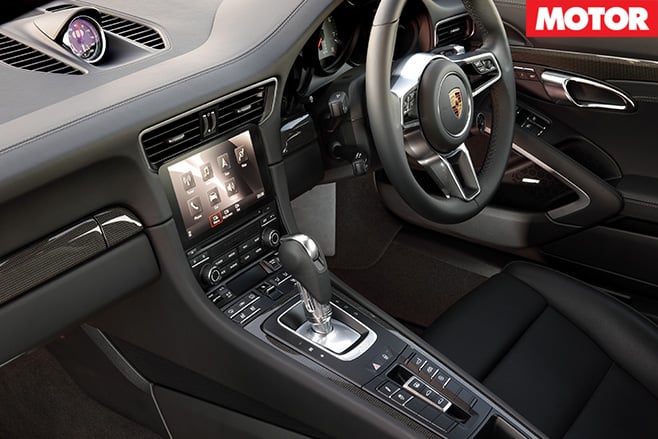
Gearbox choice will be a matter of preference; the seven-speed manual is brilliant, though the self-blip function on downshifts maybe makes things a little too easy, and the seven-speed PDK is the world’s best.
Changes to the 911 chassis are mainly in the details. There’s a little more rubber and adaptive dampers as standard, and either model is capable of face-melting speed in the corners. In fact, reaching the ultimate levels of the Carrera S on the public road is now inadvisable, if not impossible.

The new 911 has also taken an important step forward in terms of technology, it’s new smartphone-like infotainment screen and active safety systems (adaptive cruise, collision warning, lane assist) bringing it in line with the competition.
In almost every other area, however, the 991.2 continues to set the standard. Some may miss the ultimate crispness of the old atmo engine, but the new car still sounds like a 911, drives like a 911 and looks like a 911, it’s just faster and more capable than ever before. The winds of change may be blowing, but the end result is very familiar.
4.5/5
Specs – Porsche 911 Carrera S
Engine: 2981cc flat-6, DOHC, 24v, twin-turbo Power: 309kW @ 6500rpm Torque: 500Nm @ 1700-5000rpm Weight: 1440kg 0-100km/h: 3.9sec (PDK/claimed) Price: $258,750 (PDK)
When I was younger, there were two types of cars I always thought I’d own: an MG or a Jaguar. Granted, at the time my only exposure to Jags were the old yellow roadster E-Type in Audrey Hepburn’s how to steal a million or the business-man-like XJ6 in a Fish Called Wanda.
But while Jags of new don’t have quite the same ‘old-Hollywood’ vibe; they’re actually more desirable than ever. Cut to the newest member of the big-cat family, the Jaguar XE – a mid-sized premium sedan that has already made an impact as a finalist in Wheels Car Of The Year and the WhichCar Style Awards for 2016.WHAT IS IT MADE FOR?
STAND OUT FEATURES
Expected to be Jaguar’s volume seller, the XE is full of equipment and clocks in at a decent price.
The biggest appeal of the XE is in the badge, it gives families and corporations wanting a sedan the option of the Jaguar nameplate and styling.
But the Jaguars true colours come to the surface when it’s set free on to run the roads. Its mission was to produce an end result that was sportier than its competitors and in this case, the Jaguar’s roar is enough to rule the jungle.
Basically, aside from this beautiful badge on the front grille, this girl can drive.WE LOVE
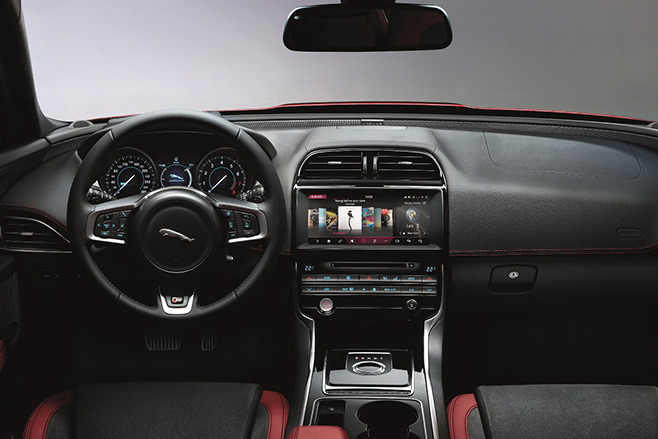
There are plenty of things to love about the Jaguar XE. It’s jam-packed with standard gear, for example, even in the base model 20t prestige.
We’re talking auto emergency braking, lane departure warning, and park assist including 360 degree parking aid. And that’s just standard.
If you’re willing to fork out for extra options like adaptive cruise control, heated seats and steering wheel, surround camera system or lane keep assist, then you could take it up a notch, all be it for a price tag.
Then there are the looks. It’s both the XE’s finest quality and biggest downfall. From the outside it looks elegant. The beautiful front grille and cat eye headlights give it a real sense of toughness.
But its pricing also let it down, with the guys at Wheels Magazine questioning whether the XE would have won Car Of The Year 2016 if it had better interiors.
THINGS WE’D LIKE TO CHANGE
And that’s probably the first thing we’d change. It’s not to say the interiors of the car aren’t nice, but it’s lacking the quintessential Jagness car-buyers have come to know and love. The lack of woodgrain trim, for example, is one of the first things the judges noticed at the WhichCar Style Awards.
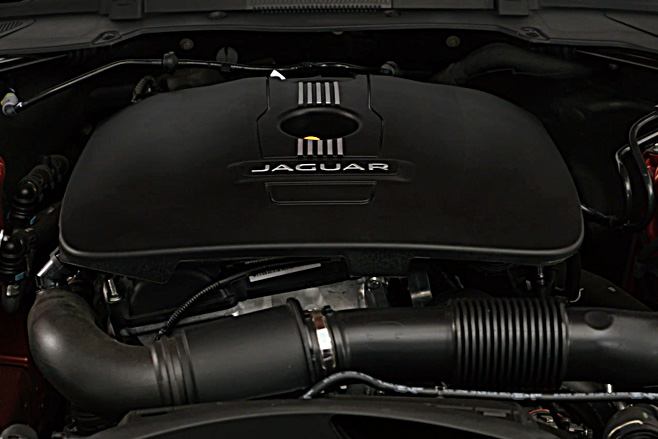
Additionally, its petrol engines are less economical than it’s competitors and its competitors feature more airbags than the XE’s six.WHO’S IT MADE FOR
The Jaguar XE has everyone in the WhichCar office talking, and it’s real personality shines on road, making it a great choice for a fleet or family car.
Click here to find out more about the Jaguar XE.
The final review of any long-standing iconic model is traditionally filled with the shedding of tears, waving of hankies and screeching of teeny, tiny violins, but things are a little different where the Mitsubishi Lancer Evolution is concerned.
When it comes to the Final Edition of Mitsubishi’s rally rocket, we’re angry. Angry this revered model line has been allowed to wither on the vine with minimal investment, when at its core there is still a brilliant driver’s car lurking within, capable of feats few other machines can match, and virtually nothing at the price point.
Changes to the Final Edition have been few, mostly concentrated under the bonnet. Sodium-filled valves improve heat dissipation and liberate nine more kilowatts – now 226kW at 6500rpm – from the 2.0-litre turbocharged four-cylinder, however more significant are the extra 48Nm, the 4B11T engine now punching out 414Nm at 3500rpm.
The numbers are similar to its T younger competitors – think VW Golf R, Renault Sport Megane – however the experience is very different.
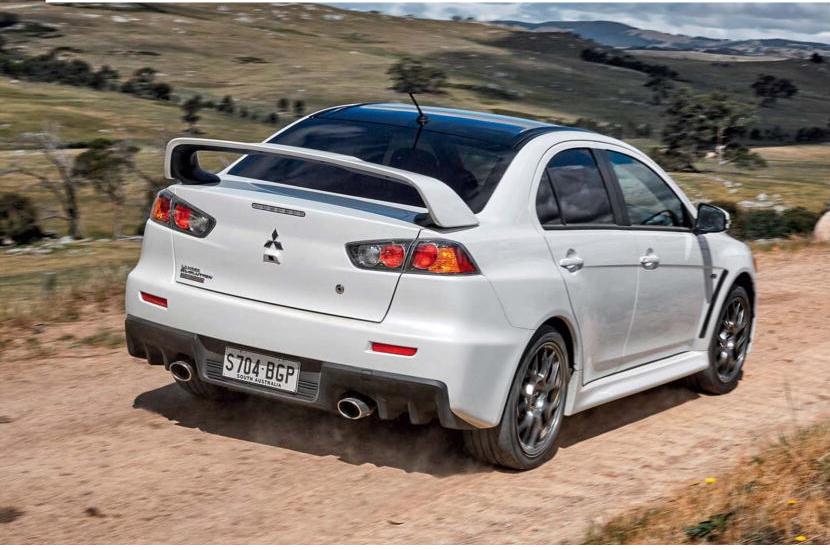
There’s old school turbo lag here; taking off from standstill requires a hefty dose of throttle to avoid being left behind by pedestrians, but it’s important to ease off the accelerator as boost builds lest you be thrown into the car in front, body-surfing a monstrous wave of mid-range torque.
Unfortunately, though the engine is effective, it’s not particularly pleasant.
It feels strained and industrial at high rpm and slurps through 98RON at a ferocious rate under hard use, a characteristic not helped by having a tiny 55-litre fuel tank and only five short ratios to choose from.
Mitsubishi hobbled the manual Evo X to encourage buyers to adopt its flash SST dual-clutch – how else to explain the retrograde step from the Evo IX’s six-speed ’box? – but with the paddle-shift not available for the Final Edition you’re left with a notchy shift and not enough cogs.
Before long you feel like you can do anything with this car; the Evo X is like your best friend, always happy to get you into trouble but right by your side to get you back out again.
The steering is like a driving simulator in its weighting and feedback, however it’s accurate and only really used to point the car into the corner. From there the brakes and throttle can be used to adjust the car’s attitude at will. Bilstein dampers and Eibach springs provide a jittery ride but the payoff is ruthlessly effective body control.
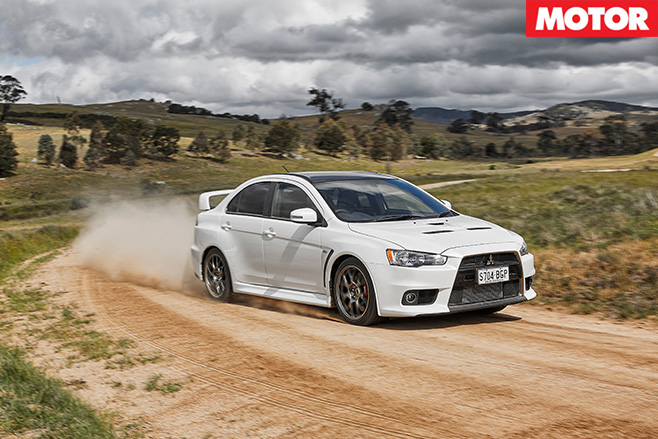
The tricky Super AYC diffs will step in to keep things getting too out of hand – even with ESP supposedly disengaged – however hold the ESP button down and “AYC Brake Off” appears, allowing you to experience this rally weapon as Mitsubishi intended.
Thanks to the Evo’s clever electronically-controlled differentials, there’s a third cornering option not available to front-drive or Haldexequipped all-paw rivals: keep your right foot in, ride out any understeer and you’ll leave corners in a beautiful four-wheel drift with perhaps a hint of oversteer. Nissan GT-R owners will know the sensation well.
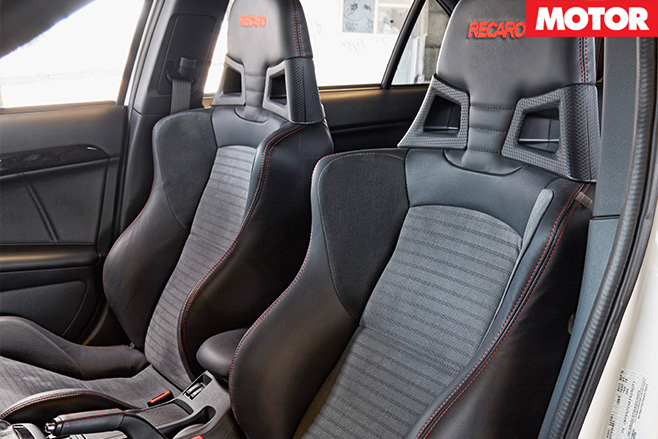
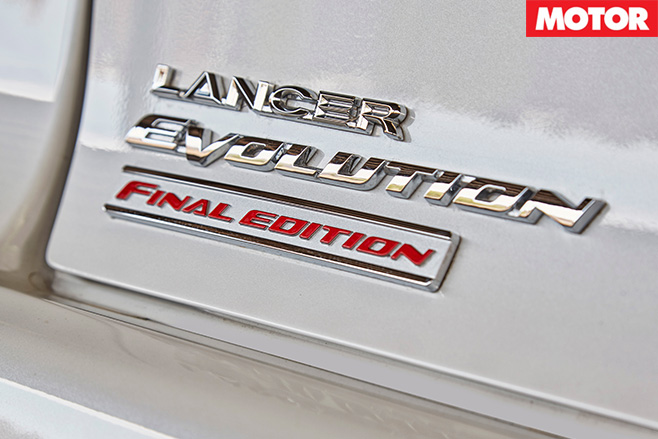
Unfortunately, the Final Edition’s case comes apart slightly when you’re not driving like Tommi Makinen. At $53,700, it seems like reasonable value when you consider the Evo X has at times cost up to $75,000 – especially when you consider the extra power and its limited-to-150-units status – however as you might expect from a car that made its debut in 2008, it’s found wanting in a few areas.
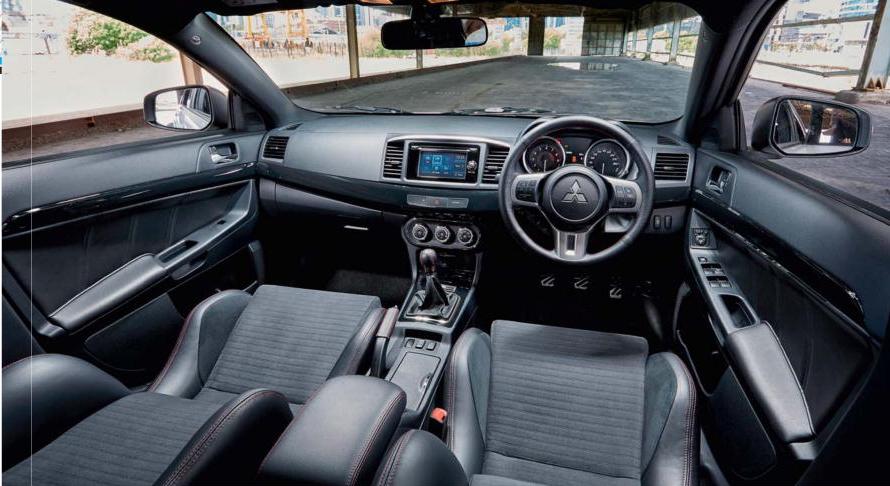
There’s moments of magic in the driving experience, but mostly the Lancer Evo X just feels old and in need of replacement. And therein lies the rub: it’s not going to be replaced.
The potential still exists for the Evo to be a benchmark performance car, capable of taking on the Golf R and forthcoming Focus RS, but sadly it feels like Mitsubishi gave up on the model some time ago.
Hence while the Final Edition might be the last of the Evo breed, it’s unlikely to be remembered as the best. If you’ll excuse us, we’re off to search for a well-kept Evo VI TME or IX MR. M
Specs
Engine: 1998cc inline-4, DOHC, 16v, turbo Power: 226kW @ 6500rpm Torque: 414Nm @ 3500rpm Weight: 1570kg 0-100km/h: 5.6sec (estimated) Price: $53,700
Star Rating: 3.0
Like: Brilliant chassis and playful handling
Dislike: Flawed gearbox, industrial note, old interior
Driving the turbocharged Porsche 911 Carrera on Tasmanian roads shows it is more potent than ever. But has it traded away character?
WHAT IS IT? Controversy, wearing four wheels and a Porsche badge. Porsche has changed the recipe of its sportscar icon, the 911, by ditching the Carreras’ high-revving 3.4- and 3.8-litre naturally aspirated engines in favour of, gasp, smaller turbocharged units.
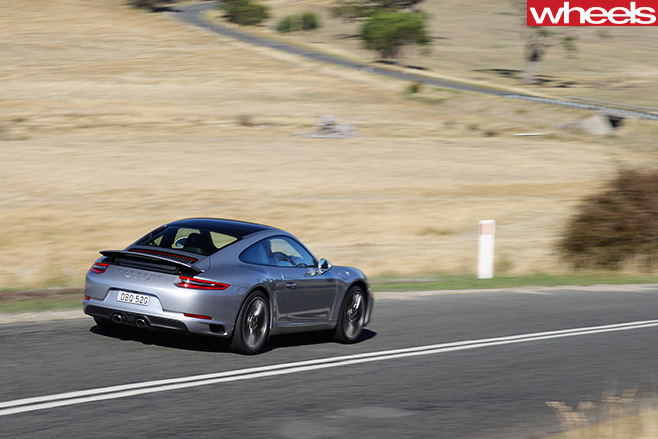
MAIN RIVALS Jaguar F-Type, Porsche Cayman, Aston Martin V8 Vantage, Nissan GT-R, Audi R8
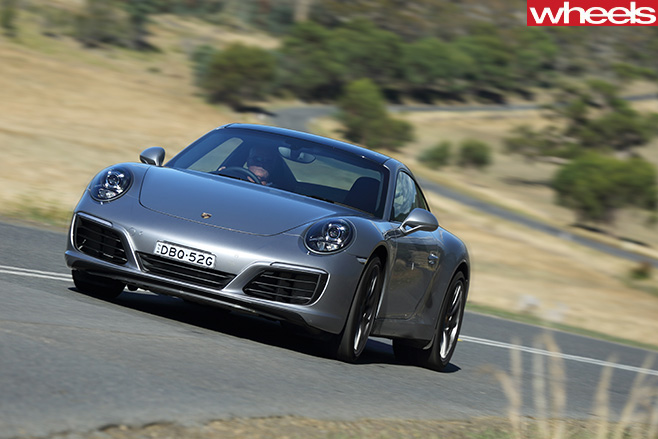
PLUS: New 3.0-litre turbo is a cracker; efficiency boost; faster and grippier; doesn’t feel turbocharged MINUS: Lacks effervescence of old atmo lumps; doesn’t sound as good either; more expensive; tyre roar

Unless you’ve fallen off the planet, you’ll know Porsche has turbocharged the Carrera. Purists have been moaning about it for months, and rightly so. No other sports car is as fiercely protected as the 911, and now, after 53 years of dogged naturally aspirated tradition, Porsche has switched to a new 3.0-litre twin-turbo flat six.
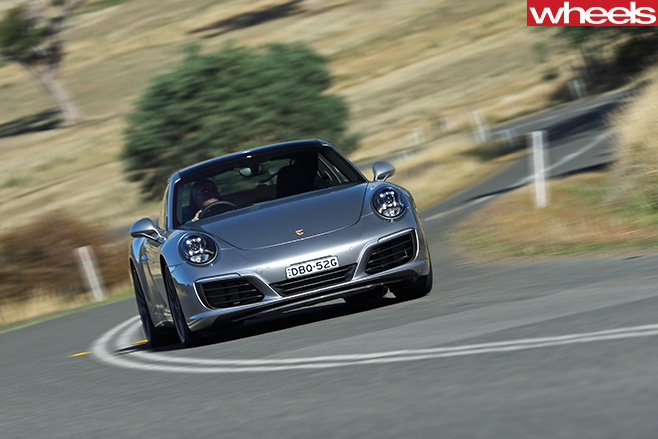
And of course, turbocharging means it’s now more fuel-efficient, with Porsche’s boffins claiming a 12 percent improvement in real world driving.
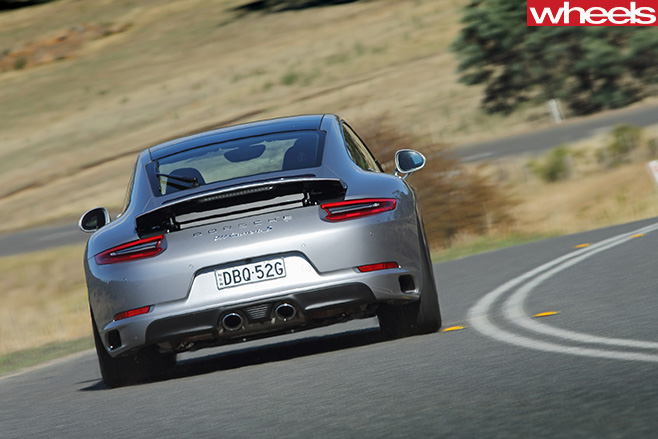
Time to nail the throttle. Hard. Second gear, right foot pinned. I’m in a base Carrera PDK and the new donk responds instantly from 2000rpm, the power delivery is linear and the noise, as the flat-six howls to its 7500rpm redline (which is just 300rpm less than the old rev-happy atmo donks), still has that unmistakable flax-six rasp. It’s an experience eerily similar to the old car, but drive it more and differences begin to surface. The bottom end of the rev range is more muscular and there’s so much extra twist, you quickly find yourself blasting through corners a gear higher than you would have in the old car.
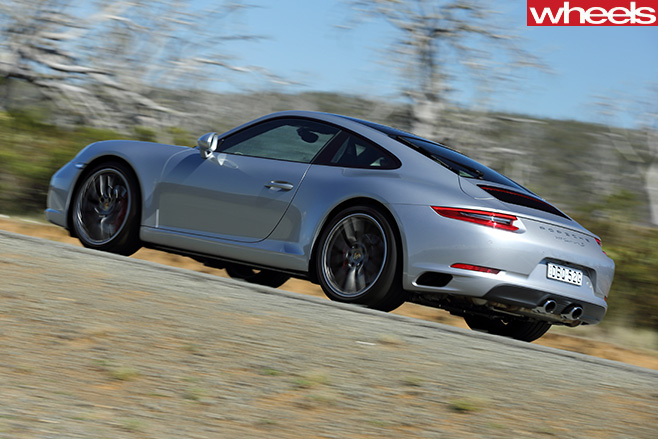
The consolation, though, is a significant boost in speed. Acceleration numbers are one thing, but on twisty Tassie roads the base Carrera and particularly the even more ferocious S are seriously rapid.
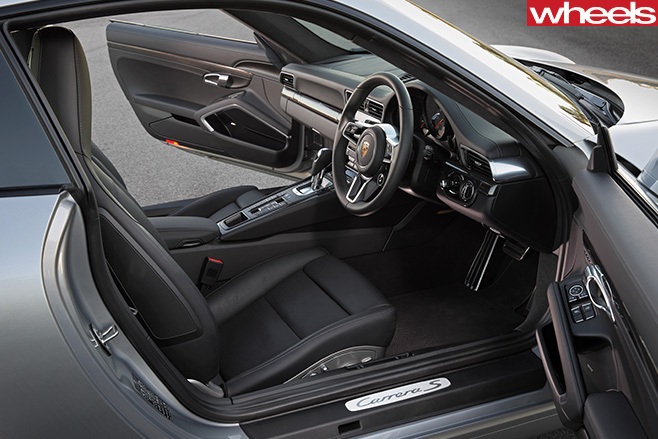
So has the switch to turbo power ruined the 911? Hardly. Porsche has transitioned to turbocharging so seamlessly that this new Carrera is not only more efficient, but also grippier and noticeably faster. Yes, some of the magic and rawness of the old car is gone. But all things considered, the trade off is a just one.
SPECS Model: Porsche 911 Carrera S Engine: 2981cc horizontally opposed 6, dohc, 24v, twin-turbo Max power: 309kW @ 6500rpm Max torque: 500Nm @ 1700-5000rpm Transmission: 7-speed dual-clutch Weight: 1440kg 0-100km/h: 4.1sec (claimed) Fuel economy: 7.7L/100km Price: $258,750 On sale: March 2016
HERE IS General Motors’ next-generation global midsized family car, quite clearly in left-hand-drive German Opel Insignia guise.
It’s set for a European launch sometime in 2017.
Longer, sleeker, and a lot more angular than the pretty existing model that surfaced nearly eight years ago, this one’s a five-door liftback, backing insider whispers that there will be no four-door sedan version of the Insignia next time around.
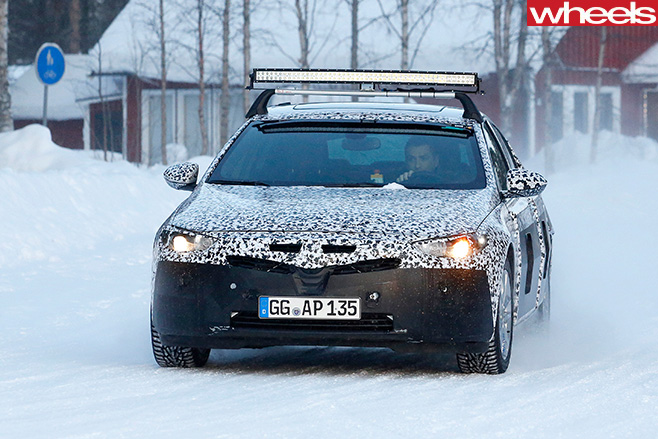
Sharing GM’s E2XX transverse front and all-wheel drive platform with the China-focussed Buick LaCrosse and North American-market Chevrolet Malibu (not to be confused with the older version sold – unsuccessfully – in Australia as the Holden EP Malibu) the 2018 Insignia will be powered by a range of three and four-cylinder turbo engines, some in diesel and possibly hybrid set-ups.
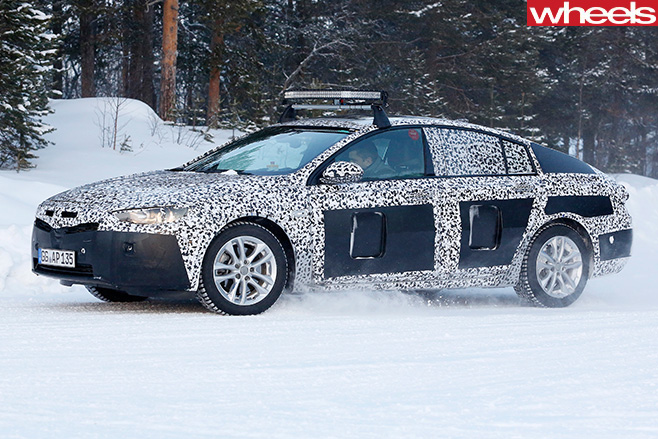
Clearly evident in these pictures is a size upgrade, with the wheelbase extending by 100mm or so to greatly boost rear-seat legroom (to beyond Commodore levels?). Yet there’s also a circa-130kg weight drop expected, as per the related Opel Astra K small car (coming to your Holden dealer soon-ish), improving performance and efficiency across the range.
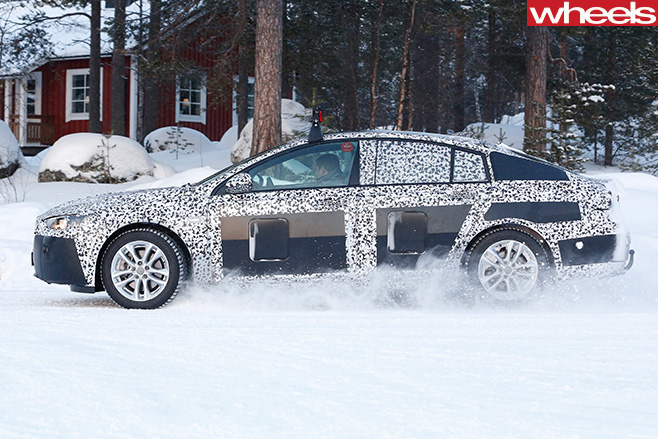
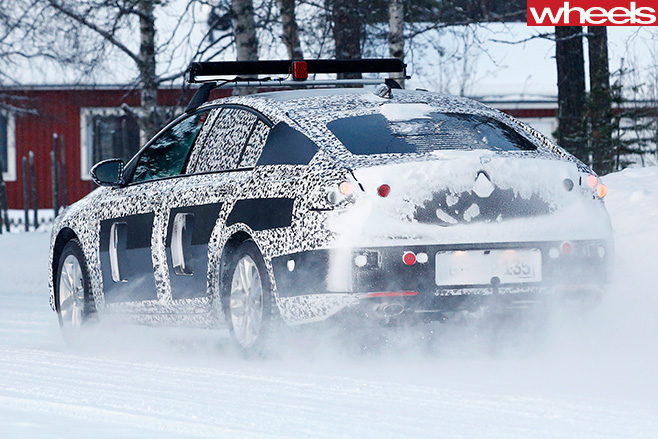
Watch this space!
Have spy pics of your own? We’d love to see them. Just email them to [email protected].
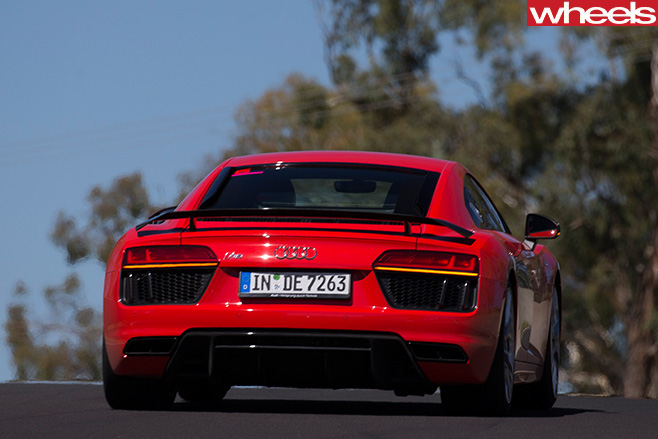
The 2016 Audi R8 V10 Plus moves the game forward with an all-new chassis, more power, and sophistication everywhere.
WHAT IS IT? Audi’s mid-engined performance flagship, organ donor to the supremely successful R8 GT3 LMS race car.
WHY WE’RE TESTING IT The 2016 model represents the first full generation change for the Audi R8. Effectively all-new, it leaves behind any Lamborghini legacy and aims to be a better car for both the road and the racetrack. Oh, it’s also the fastest production Audi. Ever.
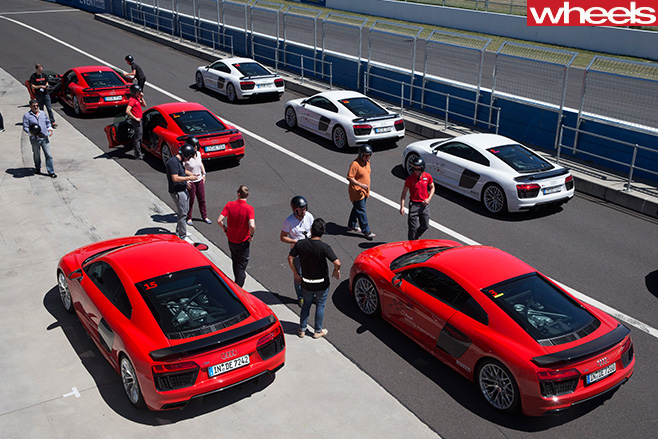
THE WHEELS VERDICT Meaningful improvement on an already great car, striking possibly the best balance of track day titan and streetable supercar.
PLUS: quick, responsive steering, at last; stable chassis; torrential acceleration; V10 sound MINUS: styling not crass enough, responses not crude enough, interior not OTT-opulent enough for some
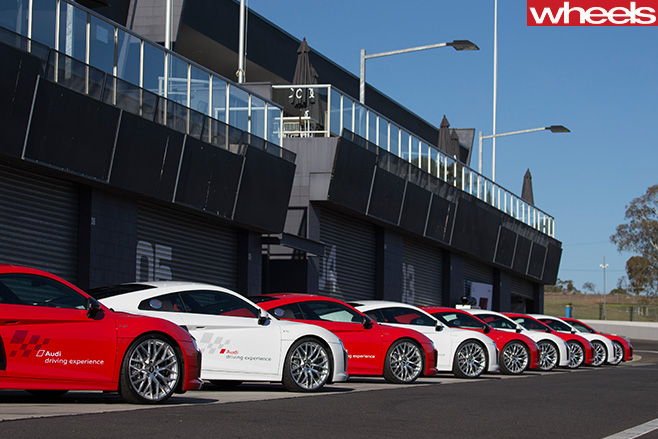
Especially this circuit, which had hosted the Bathurst 12 Hour for GT cars just a day earlier.
Normally, race circuits humble even very good road cars. But the new R8 V10 Plus was clearly in its element.
That speedo reading I saw – with possibly another 10-15km/h to add before Caltex Chase – makes the R8 road car as quick on Conrod as its R8 LMS racing equivalent – perhaps quicker. (The race car’s speed-penalising aero more than compensates everywhere else).
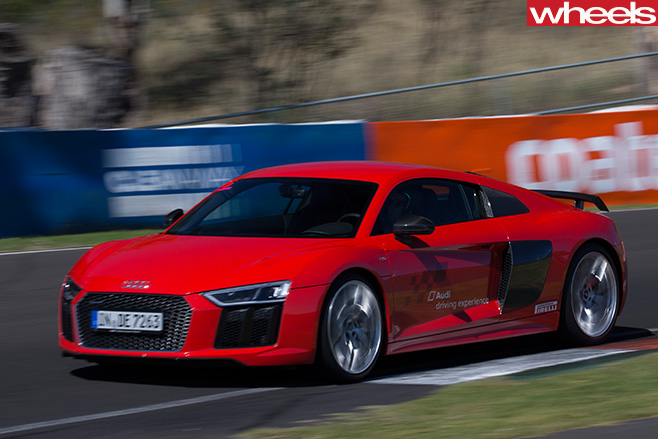
All R8s feature a seven-speed S-Tronic and – unless you’re lining up for a LMS racer – quattro all-wheel drive.
Then there’s the V10 Plus, expected to add about $30K to the base car’s estimated $370K (prices are announced mid-February). The Plus chuffs out 449kW and 560Nm and with a 40kg lighter kerb weight (1555kg) covers 0-100km/h in 3.2 seconds, three-tenths quicker than the stocker. The Plus’ power gains come solely via software, the weight through features like forged 20-inch wheels and carbon-ceramic brakes.
Romolo Liebchen has nothing to do with Audi’s road cars. Except that, as head of Audi Sport’s customer racing division, he had a hand in this R8 almost from the beginning.
Liebchen explained that the first-generation R8 (2007) was all but completed by the time Audi Sport initiated its customer program. “You remember the movie, I Robot? The rear of that car [Audi RSQ concept] was the preferred design. But it created too much rear lift for racing, so we were able to influence that.”
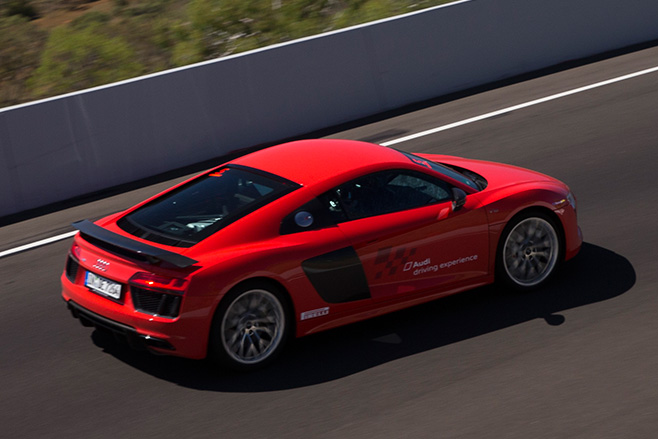
The biggest hardship inside is having to adjust the steering column manually. The cockpit is supremely comfortable, with the purposeful feel of a GTi more than a snooty supercar.
With the chassis electronics set in Dynamic (one of four modes), the glorious, roaring V10 gives a gorilla-sized shove. The low-three standing quarter club is a fairly tight one, but few other members are so unfussed about it.
The racetrack doesn’t hobble this car’s capabilities; it highlights them. The R8 is so obviously sharper, more intuitive and more stable than before. The steering has become comfortably quick without a hint of nervousness. Turn-in confidence and overall grip are amazing, yet when heat build-up knocks the edge off the grip after five hard laps, it only underlines the predictable responses of the chassis, with gentle understeer into the Cutting and the Dipper, and subtle signals from the tail in the downhill direction changes of the Esses.
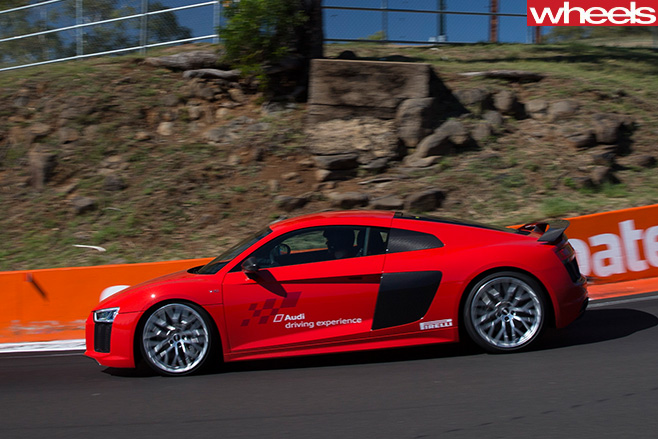
I can’t right now think of another car that was this easy to drive this fast. Certainly, the aero-steroided R8 GT3 LMS isn’t.
The R8 V10 Plus will do everything expected of a hard-edged supercar, without risk of regular laceration from those hard edges. And it seems to offer the docility and road-going comfort of a GT, without the need for a bladder-stop and a lie-down after a few hard laps on a racetrack.
SPECS Model: Audi R8 V10 Plus Engine: 5204cc 10cyl, dohc, 40v Max power: 449kW @ 8250rpm Max torque: 560Nm @ 6500rpm Transmission: 7-speed dual-clutch Weight: 1630kg 0-100km/h: 3.2sec Fuel economy: 12.3 L/100km (EU) Price: $400,000 (est.)
The Jaguar XE may not have the ‘Old Hollywood’ vibe like Jags of yore, yet it has entered the mid-size premium sedan market with a bang featuring as a finalist in Wheels Car Of The Year and the WhichCar Style Awards for 2016.
PLUS
- The XE is packed with standard gear. Even the base model 20t Prestige comes packed with equipment such as emergency braking, park assist and 360 degree camera.
- It looks elegant. The XE is an attractive, strong looking sedan. The front grille and cat eye headlights give it a real sense of toughness.
- It measures in at a decent price for a prestige brand, so people can now own the big cat nameplate affordably.
- It drives well. It’s sportier than its competitors and drives like a prestige sedan should.
- There are a bunch of excellent options to choose from to take the Jaguar XE up a notch. But they will cost you.
- It’s also missing the classic Jag-like qualities people look for in the brand, like the woodgrain trim on the interiors.
- It’s not as fuel efficient as its competitors.
- The XE only features six airbags which is also less than other mid-six sedans.
