
It was a normal day at work for Katie when she walked out to find her 20-year-old Holden Commodore had been replaced with a shiny new Mercedes-Benz A180.
Her boss had snuck her out for a “coffee in disguise” while Fifi and Dave from Hit1019 The Fox replaced her car.
When it came to buying a new car, Katie and her husband Wayne agreed it wasn’t big priority on the list of financial decisions the family of three had to make at the time. But her 20-year-old Holden Commodore had seen better days and had become unreliable. It was for this reason Katie decided to enter the WhichCar and The Fox Mercedes A180 Car Swap last August. And it couldn’t have come at a better time – the Commodore broke down just in time for Christmas.
“By simply entering the competition, I couldn’t lose. I had nothing to lose except an old car,” Katie said.
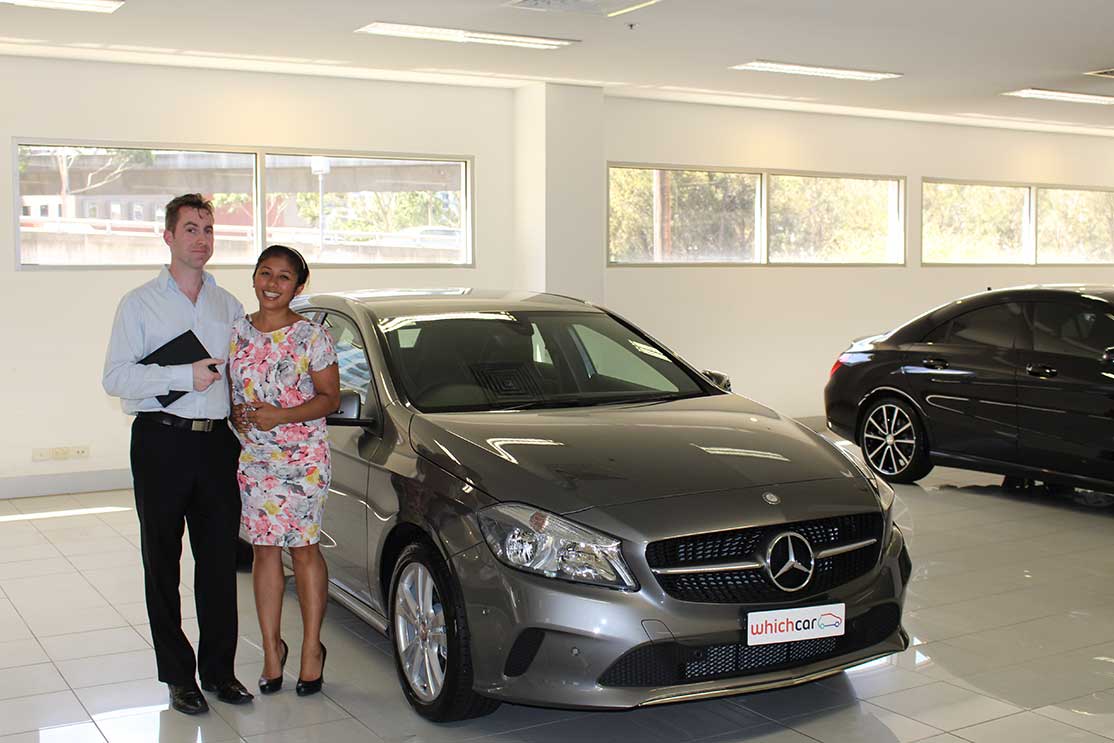
The blue Commodore Katie was previously driving was inherited from her husband, who had inherited it from his father when he was 18. So the Commodore had its day and now with a new baby boy, Spencer (one), and a job that required a lot of driving, Katie knew it wouldn’t be long before they’d have to find a more reliable set of wheels.
“Money wise, it wasn’t feasible for us to get a new car because we had a young son and a mortgage. But at the same time, it wasn’t ideal for driving with Spencer.
“It is so amazing to win the A180. Aside from it being a Mercedes, I now have a reliable car to feel comfortable and safe when I have my son in the car. “
Luxe badge aside, the Mercedes A180 comes with some great features to suit Katie’s lifestyle; Bluetooth to help with client and family calls while on the run, fuel efficiency, navigation and enough space for the family of three, plus the dog.
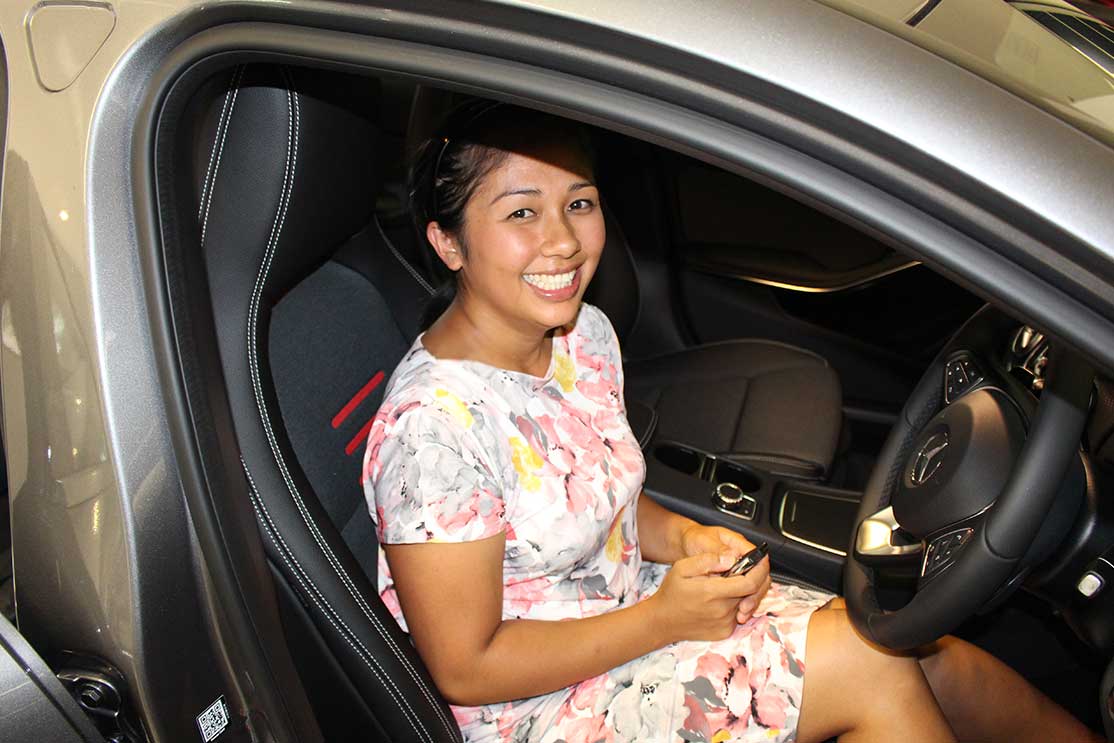
“Every chance I get, I want to drive it, but I’m also a little scared to drive it because I want to keep it as new as possible.
“It’s a dream and I’ve been very happy with it. Not having a price tag attached to the car is also a big bonus.
“I like the hands-free feature; it really makes my job easier when I’m visit clients. And my husband likes the Sports mode – he likes to pretend he’s in a rally car.” (Don’t worry Wayne, we do that in the WhichCar office too).
Katie and Wayne plan to take their new car along the Great Ocean Road next. “We’re really looking forward to and then we’ll really test it out and see its capabilities.”
If you do a lot of touring, especially if you tow a caravan, then you need to read this. You may have an idea about which fuel is best for your application, but few fuel tests have been done as well as this to eliminate any speculation.
The last time our sister brand 4×4 Australia compared economy and cost was back in 2006 when fuel prices skyrocketed. The team took diesel and petrol versions of the then-new and still-current Nissan Navara and Toyota Hilux for a comprehensive ’burbs, bush and beach bash all in the name of research.
Since then, the Australian Government’s LPG technology incentive rebate has come and gone.
Also, several 4×4 vehicle manufacturers have reduced the availability of petrol engines or deleted them altogether, a decision driven largely by the mining sector’s need for diesel (minimal fire risk) and the ever increasing economy and power outputs from turbo-diesel engines.
With the popularity of Aussie travel increasing, and with plenty of budget-conscious buyers looking to buy a second-hand 4×4, we figured it was time for another look at fuels: petrol, diesel and this time, LPG for outback and bush travelling.

THE GUINEA PIGS
We needed vehicles to run the numbers and Toyota’s Hilux is a good choice. It’s available four-cylinder turbo-diesel engines and is one of the few commercial vehicles to continue offering buyers a grunty petrol option: a 4.0-litre quad-cam four-valve V6 petrol.
Its popular diesel ladles out strong performance lower in the rev range, making it a more confident and capable tow vehicle than some newer-design engines. It’s backed by a manual or automatic gearbox (as shown here).
Next to it, Toyota’s 4.0-litre V6 develops a little more power but less torque than the diesel, though thanks to a few tech tricks the lusty V6 manages to fill-out the lower part of the torque curve far better than its ‘revvy’ specifications and capacity might suggest. It certainly doesn’t need much clutch-feathering to get moving.
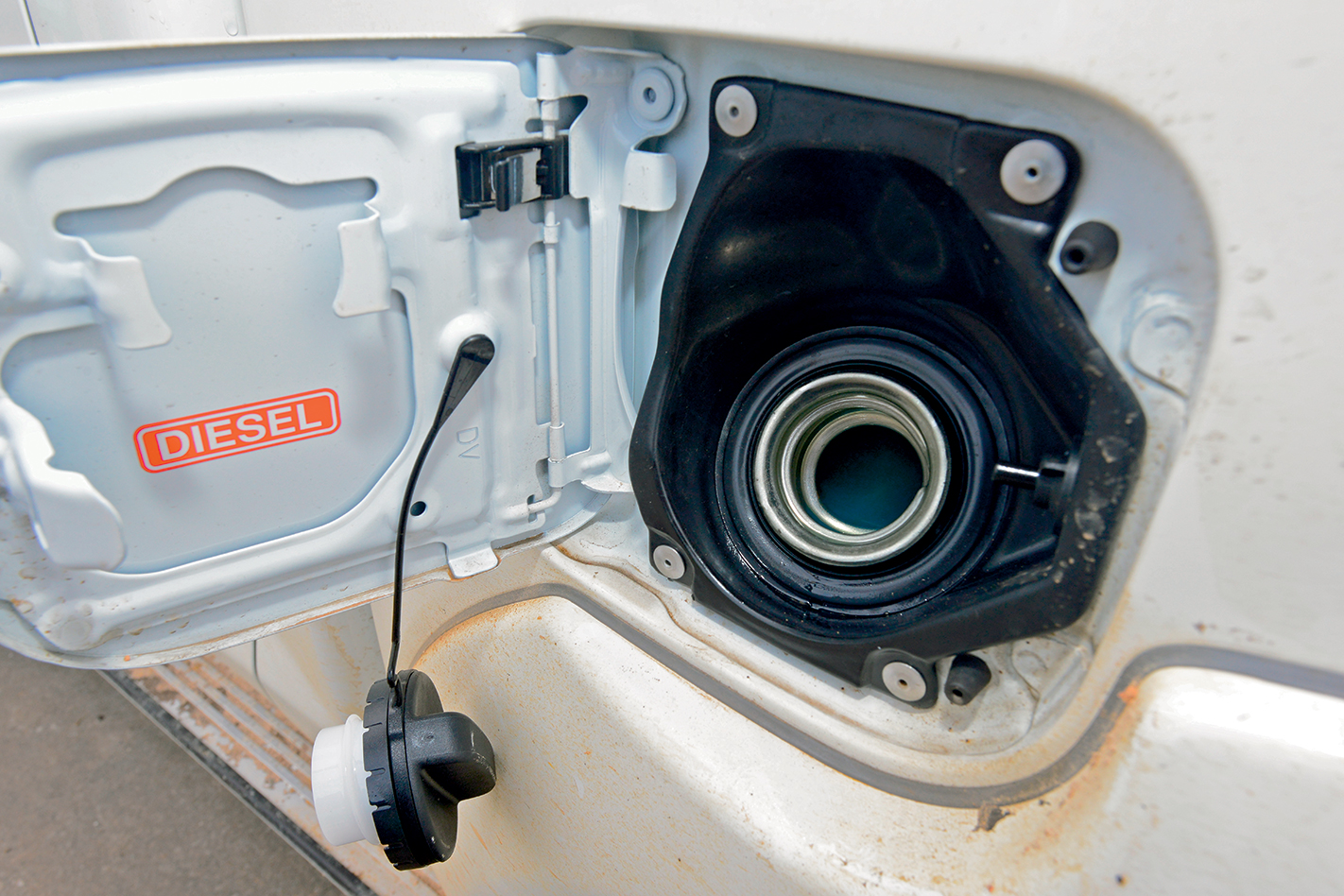
Petrol engines can be converted to run on cheaper, greener, liquefied petroleum gas (LPG) but this is not a showroom option on any 4×4 vehicle. So for this task, we used a camper-equipped 2005 Hilux SR 4WD 4.0-litre V6 fitted with an aftermarket LPG injection system to provide dual-fuel operation.
This LPG installation is just like a standard petrol injection system. In fact, the set-up interfaces with the factory Toyota ECU, copying the petrol injector’s behaviour to provide precise LPG delivery and engine outputs and driveability that are identical to petrol.
Even when in LPG mode, starting and warm-up happen on petrol. When the engine reaches operating temperature it almost seamlessly switches to LPG. If the LPG tank runs out, the system sounds a ‘no LPG’ warning to the driver and reverts to petrol operation.
This dual-fuel conversion provides reduced fuel costs, petrol servicing regimes (and prices) and extended range – very handy benefits for 4×4 owners.
The engine is also protected by a Valvemaster system to prevent or reduce valve seat damage as LPG burns hotter and is more aggressive on the exhaust valves. Note that while Toyota (and other manufacturers) offer an LPG option on some models, this one is an aftermarket system from Impco and is not endorsed or warranted by Toyota.
THE TEST AND THE TERRAIN
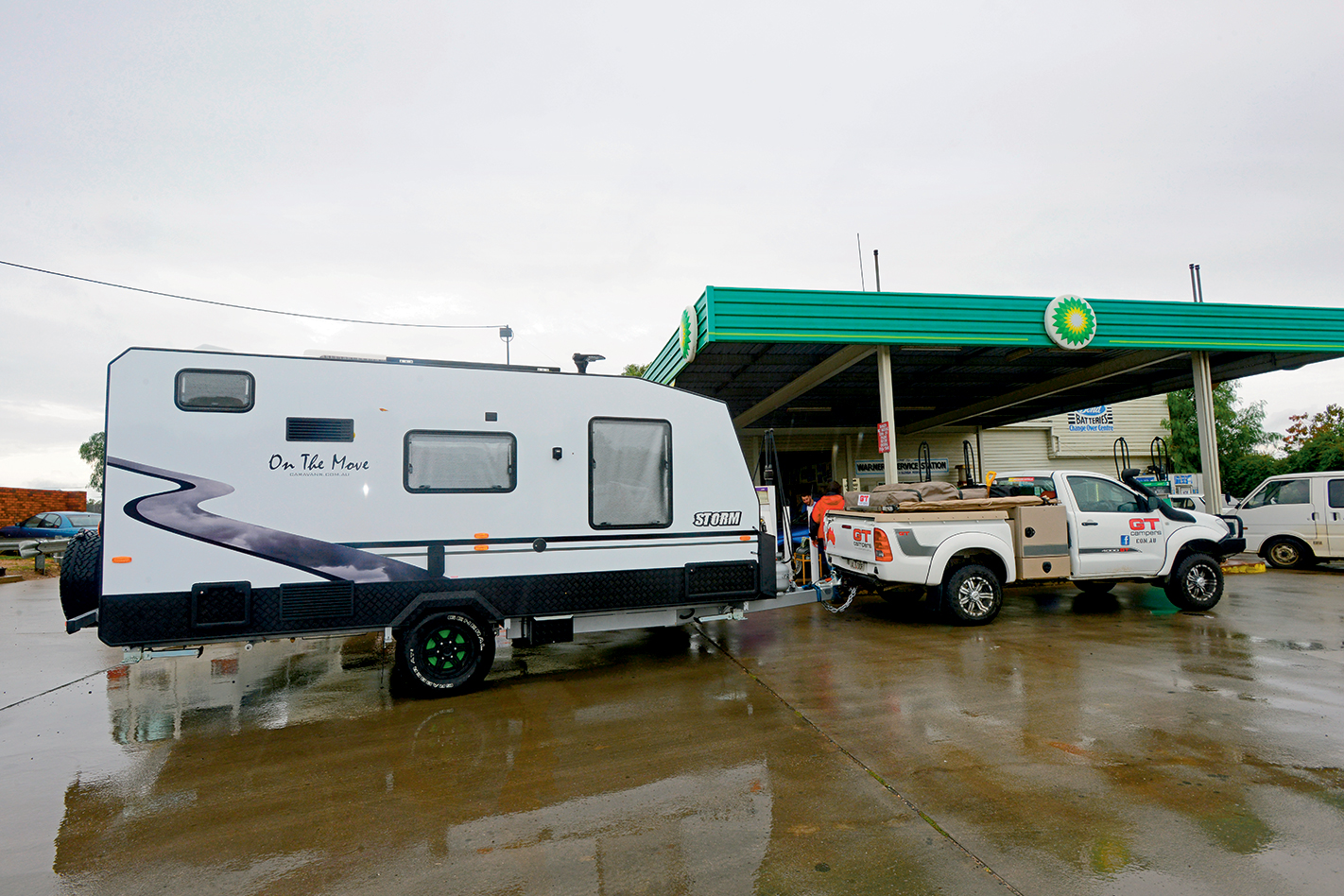
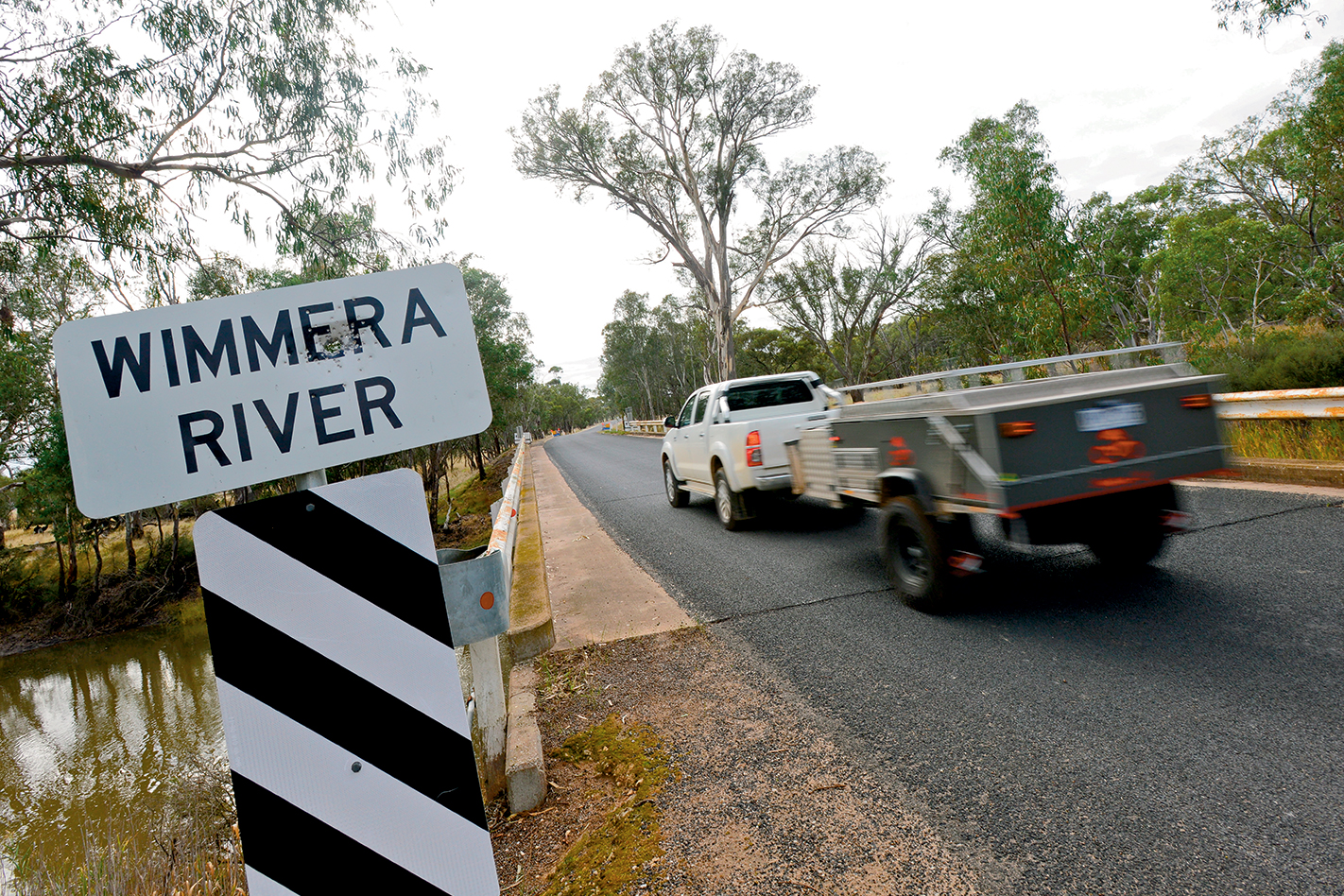
We laid-out an on-road test route in western Victoria. Our beginning and end point was Dimboola’s service station where we had a bit of space to pull-in and easily refuel with a caravan on the back.
Our loop was around 130km of mostly open 100km/h highway with a sprinkling of urban running through the small town of Horsham.
This allowed the three fuel types, in the two vehicles, to be assessed in real-world – and almost exact – conditions back-to-back. There was little change in elevation over the loop – in other words, there were no steep hills – and our aim was to derive comparative consumption figures between the fuel types in identical conditions which, with other costs such as servicing and LPG conversion pricing, would allow us to determine comparative costs.
Measuring of the fuel used on each test loop was critical so it was important to reduce or eliminate what the white-coats refer to as introduced errors. Each tank was carefully and precisely topped-up before and after each test to provide an exact fuel use while using the same roads and even the same bowsers kept things scientific.
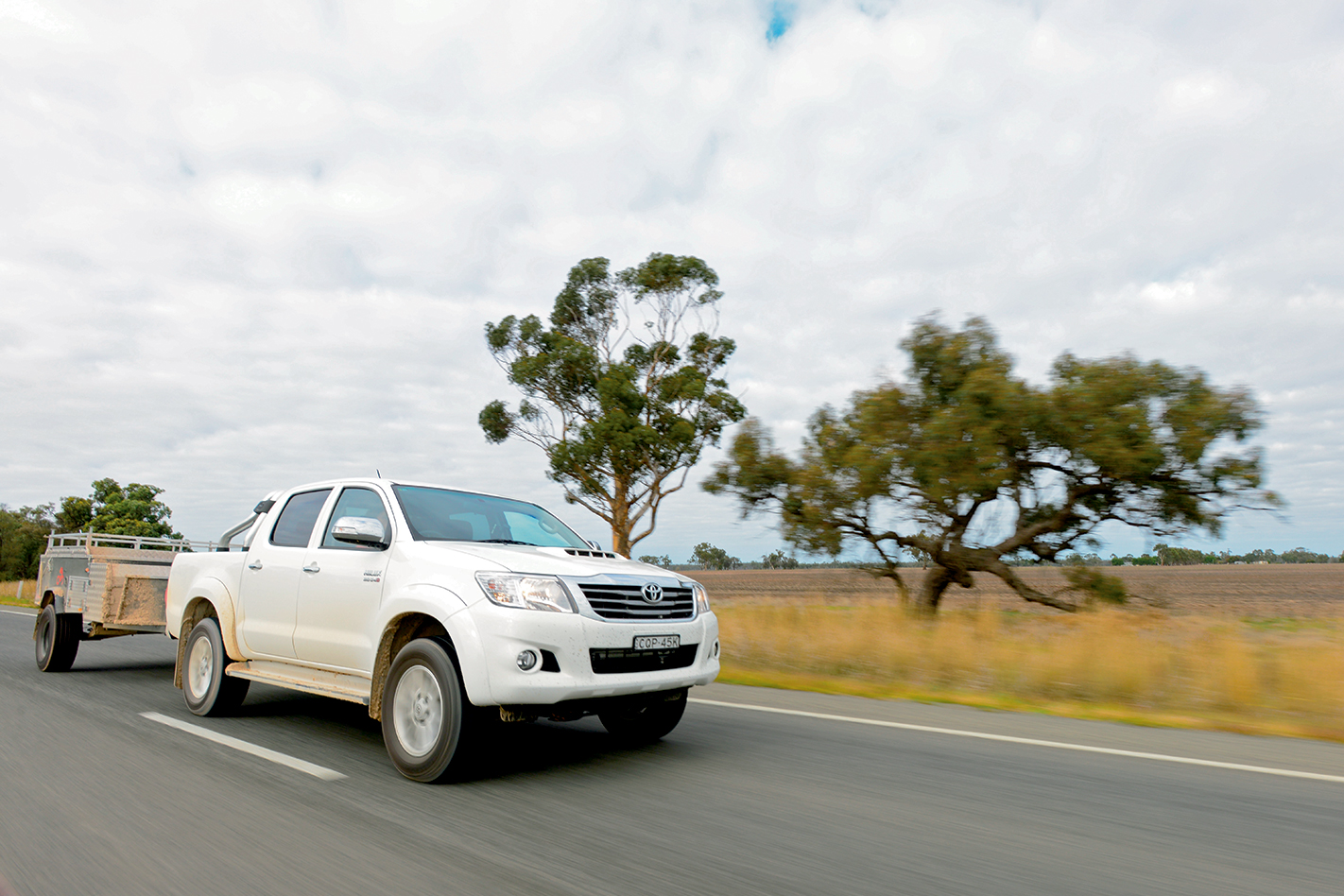
Each fuel type was used around our loop with nothing on the tail, an 800kg Cub camper trailer and a 2.2-tonne caravan. The two vehicles carried different hardware but were piloted by the same driver and, as mentioned, each test loop was replicated as exactly as possible right down to idling time at, and acceleration from, traffic lights and 100-to-40km/h deceleration for road works.
Acceleration requires significant fuel burn – more than idling at lights – so replicating these situations each time was critical to the validity of the test.
THE NUMBERS
Most people who have been around 4x4s, towing and travelling for a while won’t be surprised to learn that the diesel Hilux’s fuel use was, on numbers alone, the most economical in all three situations, whether towing a trailer, a ’van or nothing.
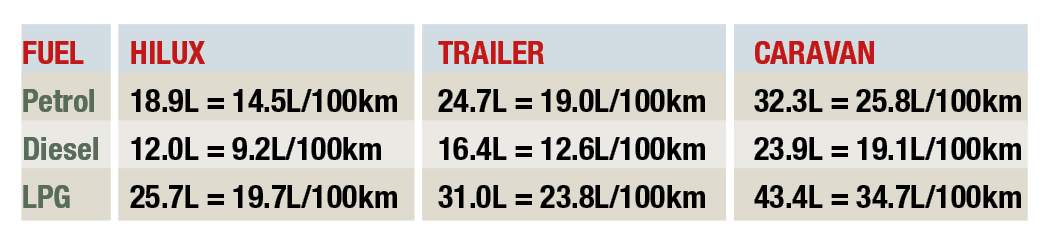
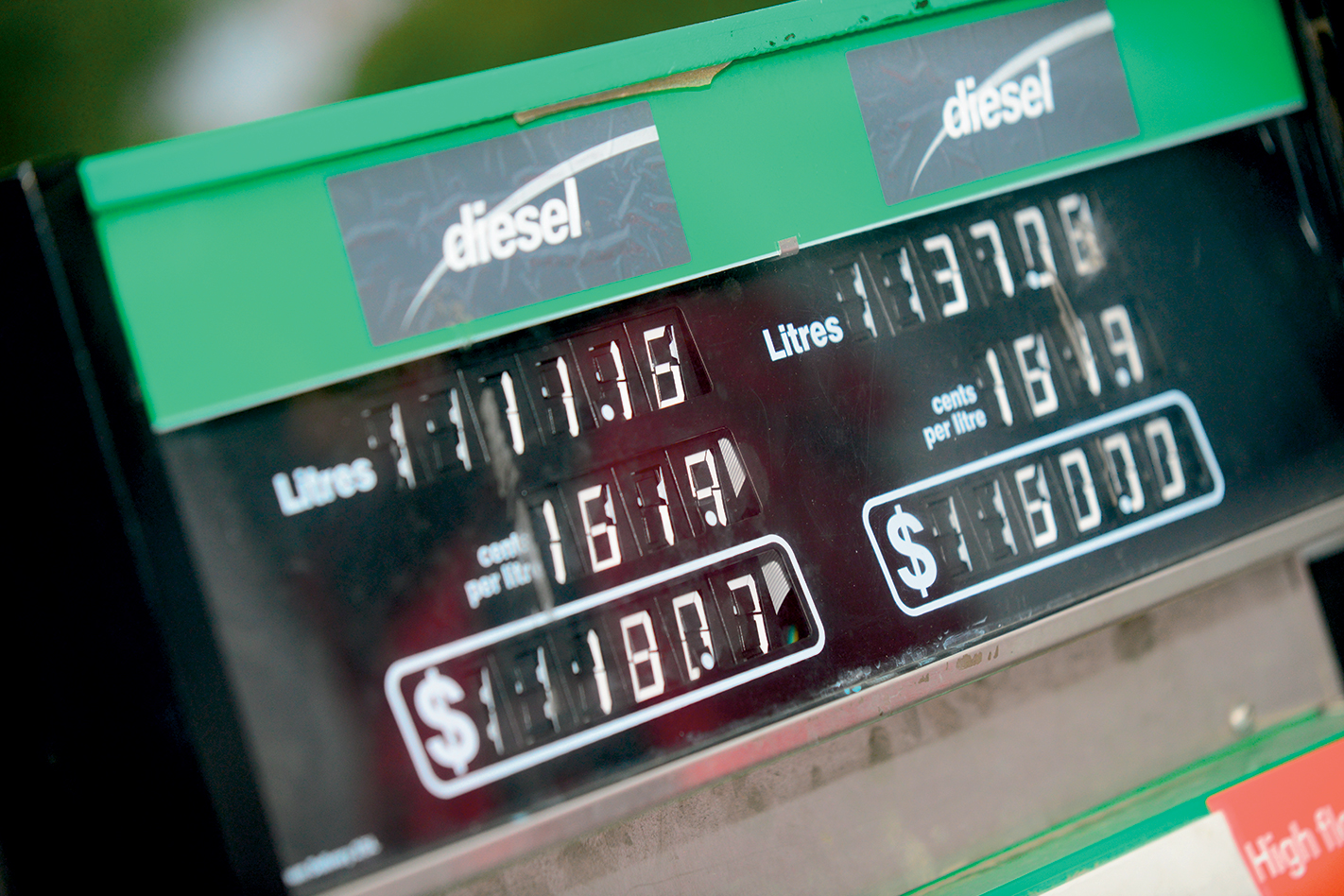
But what of actual running costs? Petrol was 156.9c, diesel 161.9c and LPG 92.9c. Without doing the sums it’s easy to see that diesel’s similar bowser price but more frugal burn means it’s the pick of the pair… but by how much?
And is LPG a viable alternative to diesel for overall running costs?
So, what’s the outcome of all this? Firstly, there’s no doubt that diesel is the fuel of choice for many of us for good reason – vehicles that use it are more frugal, especially when doing the hard yards towing.
What we haven’t analysed is the increased servicing costs of diesel vehicles compared to petrol and dual-fuel machines. This varies by brand and model but in general, diesels need more frequent servicing, with more expensive oil, and more of it, plus higher labour costs. This eats away at any day-to-day savings created by greater fuel economy.
Fixed price servicing as offered by most new car manufacturers these days takes the guess work out of estimating your overall service costs when comparing between fuel and/or vehicles. Similarly there is the extra cost of an LPG conversion: around $4000 for the clever dual-fuel EFI system as featured here. In 2008 the Australian government started offering a rebate for LPG conversions as it is a demonstrably cleaner fuel than petrol and (especially) diesel.
Unfortunately this rebate came on an end on June 30 and with an increase in the tax/excise on LPG, this fuel is having its decades of outstanding appeal for cost-conscious (and more environmentally aware) motorists eroded by fiscal policy.
While we’re talking costs, we paid rural prices for our three fuels. Closer to town, prices are lower – especially, proportionately, for LPG which means even further savings which brings LPG even closer to the per-100km cost of diesel but with petrol-vehicle servicing costs.
Diesel has wide appeal for good reason but do the sums and an LPG conversion on an older petrol-powered ute or wagon can make owning a 4×4 vehicle more affordable on a dual-fuel conversion than on diesel in the long run.
HOME ON THE RANGE
As well as reducing day-to-day running costs, an LPG dual-fuel conversion can increase your 4×4’s touring range by several hundred kilometres, by adding 60 or more litres of LPG to the petrol tank’s capacity. That means you may not need to carry jerries or install a purpose-built long-range petrol tank for a remote area trek. When touring, it’s a good idea to use the petrol first and keep the LPG for the home run – you’re more likely to find petrol and hence be able to top-up in remote areas… that’s impossible with a full petrol tank if you have been burning the LPG first!
CARRYING THE EXTRA FUEL
When converting to LPG, most vehicles’ spare wheel needs to be relocated to create space for the LPG tank. On the vehicle we used for testing, the spare wheel is relocated to the top of the storage cabinet behind the cab to make space under the tail for a toroidal (donut-shaped) 70L LPG tank. The slight extra depth, compared to a spare wheel, doesn’t affect ground clearance or departure angle.
Some 4x4s can have the rear-most of their two factory-fitted petrol tanks removed to create under-vehicle space for an LPG tank. Of course those popular touring vehicles also can have their remaining petrol tank replaced with a long-range version to provide even more outback touring range, coupled with LPG economy in town.
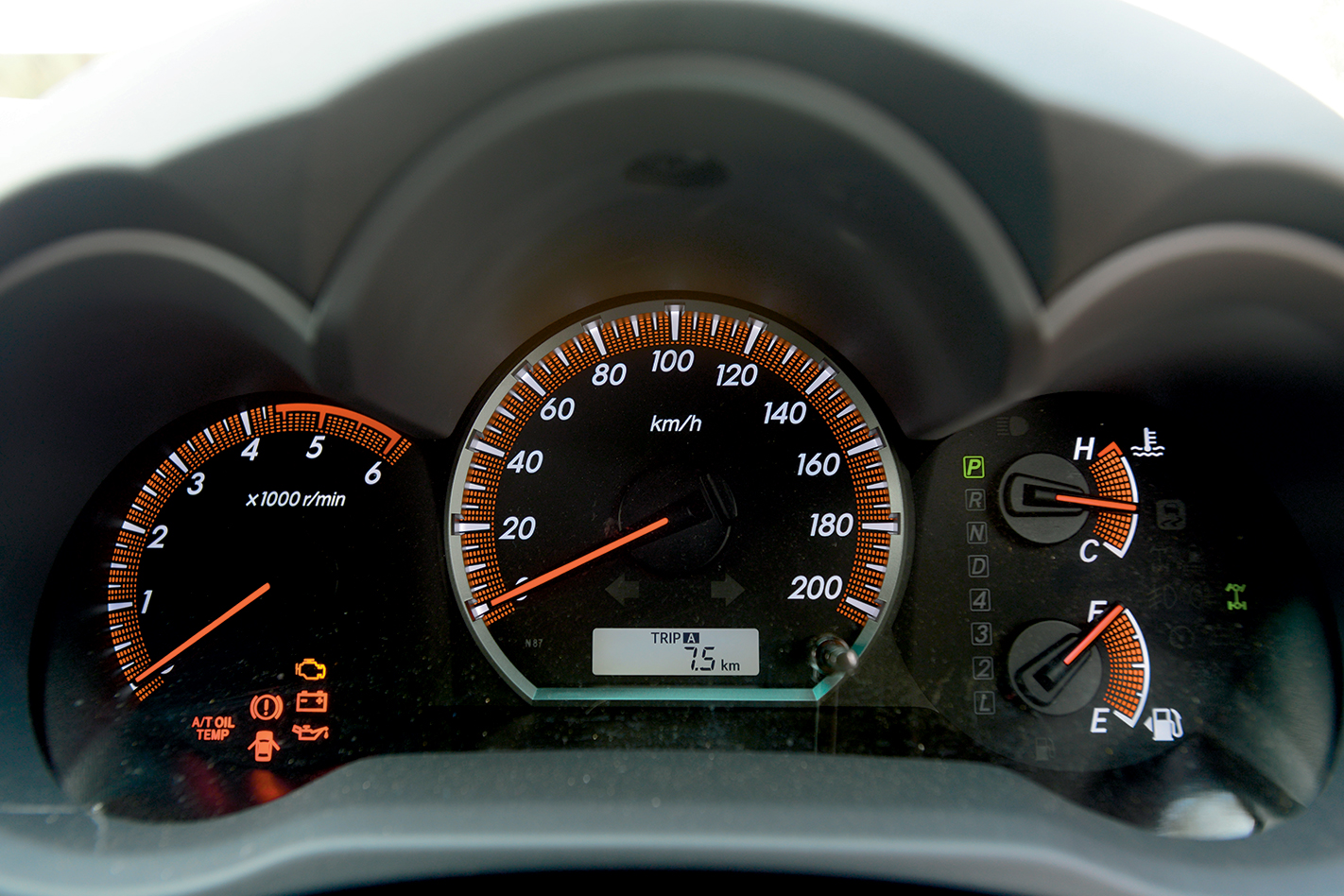
LIVING WITH LPG
LPG provides economical running but reduces absolute range. A valve-saver system is necessary but cheap (around $100 plus fitting) protection against valve seat recession for many engines due to the potentially damaging hot-burning nature of LPG. New-generation LPG systems start and warm-up the engine on petrol so the standard petrol injectors are flushed with fresh fuel at every start-up to prevent seizing and gumming: keep the petrol in the tank fresh by consuming it all and refilling (even if it is to only 1/3 or ½ full) every month or so in suburbia.
LPG AND DIESEL
It’s possible to install LPG on a diesel vehicle, too, but the outcome is different to that on a petrol/LPG dual-fuel vehicle. According to Diesel Gas Australia, introducing a small amount of LPG to a diesel-burning engine allows it to produce more power and torque with less diesel consumption.
The LPG works to improve the burning of the diesel, it does not replace diesel completely as LPG does in a petrol-powered engine. This better burn of the diesel thanks to the presence of LPG boosts torque and power. As the LPG is a ‘power adder’ fuel, its consumption in a diesel vehicle is a small proportion of the distillate burn. Of course, we couldn’t test this in our test loop, but more grunt and better economy is worth crunching the numbers for!
A stint – albeit mainly on snow – in the next A4 wagon from Audi suggests it will bring better dynamics, comfort and space when it arrives in Australia this year.
WHAT IS IT? This is the new-generation Audi A4 Avant, with Avant being Audi-speak for wagon. The current car has been in Australian showrooms since 2008, and this new gen sits on a fresh platform with updated drivetrains, more space and slicker overall execution.
WHY WE’RE DRIVING IT It’s our first chance to try the wagon version of Audi’s all-new A4 – an elegant alternative to a premium SUV.
MAIN RIVALS BMW 3 Series Touring, Mercedes C-Class Estate
THE WHEELS VERDICT The A4 Avant is a more handsome, better equipped and more spacious cargo-carrier than its predecessor, with better dynamics and likely lower running costs. It’s a slick, spacious wagon.
Plus: Improved space, better packaging, stylish cabin and clever tech Minus: Evolutionary styling both in and out
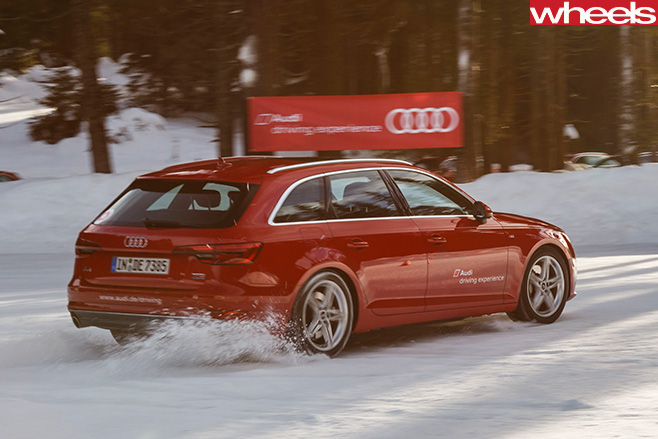
So we can’t talk about refinement levels for the all-new Avant, which will battle the BMW 3 Series Touring and Mercedes C-Class estate for cargo-carrying customers.
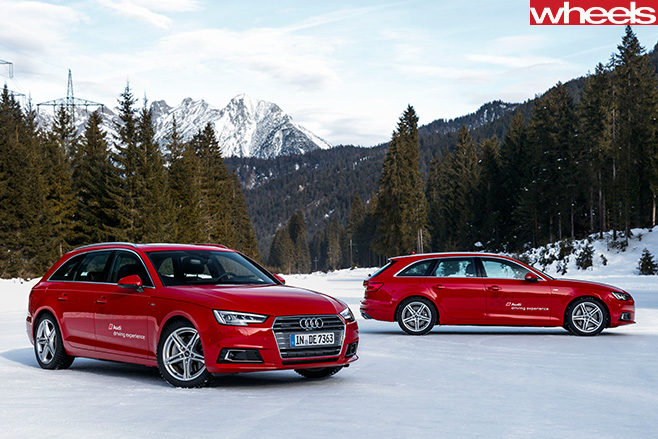
The new A4 Avant is bigger than the car it replaces: the wheelbase has grown 18mm to 2820mm, 10mm more than the 3 Series Touring but 20mm less the C-Class estate.
The A4 Avant’s 4725mm length is 26mm more, the 1842mm width a 16mm increase, and as is the fashion it sits 2mm lower at 1434mm. That makes it larger than the BMW 3 Series Touring and the Mercedes C-Class estate. The Lexus IS and Jaguar XE are not offered as wagons at present, making this contest a German civil war.
Cargo space is up from 490L to 505L, matching the C-Class Estate and trailing the 3 Series Touring by a mere five litres. With the 20:40:20 split-fold rear seat down, the A4 Avant matches the C-Class again with 1510 litres, but pips the 3-Series by 10 litres. The rear cargo area has a flat floor, with a level load lip and an electronic luggage cover and electronic tailgate on our test car that can be operated by a latch, or by using the key-fob.
While the exterior of the A4 is evolutionary, with a sharper-edges and clever shut lines fronted by that large, single-frame grille, the Avant’s rear follows the same swooping shape as its predecessor to maintain its athletic profile, with an integrated rear spoiler helping it achieve a Cd of 0.26, matching that of the super slippery C-Class.
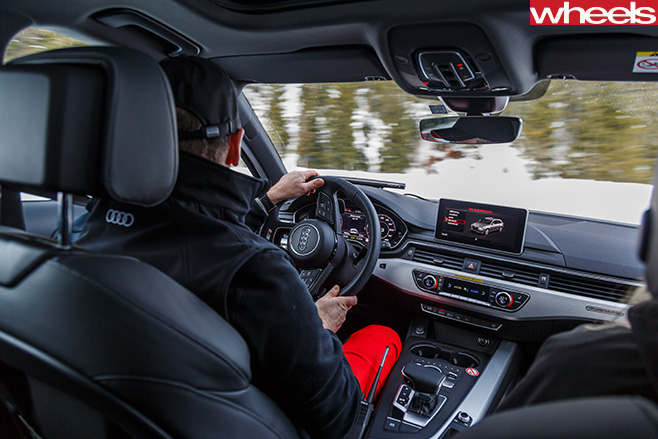
Functionality sees the brilliant Virtual Cockpit up front, the digital display that arrived with the latest TT and Q7 last year. It’s teamed with head-up display to make this the best instrument cluster in any motor vehicle – regardless of price – on sale today. Clever tech also includes wireless phone charging in the centre console.
The seats are more supportive and have better bolsters than the flat seats of the old model, and the dished, three-spoke, perforated leather steering wheel is thicker, giving an impression of quality as it feels great to hold. The adjustment in both the seats and steering wheel provides an excellent driving position, with ample all-round vision, while the 8.3-inch centre screen’s crisp reversing camera is teamed with a front-end camera too, both with clarity to match the clear, neat graphics when they’re not in use.
The A4 Avant is a much better balanced vehicle than the car it replaces, and that’s down to numerous factors. As well as the 50kg weight reduction over its predecessor, which makes the quattro Avant 1540kg, there’s electric steering that’s better weighted, and provides more feel and more precision.
This is an easier car to position on the road, and far more communicative. It needs to be, given the agility of the new Jaguar XE – which set a new class benchmark that sent it to the podium of 2016 Wheels Car of the Year. Audi addressed dynamics with the B8 generation, which saw the engine finally positioned behind the front axle, yet the B9 is a significant step up.
The 2.0-litre TFSI makes 185kW and 370Nm, up 20kW and 20Nm from its predecessor, and is fitted with a new seven-speed dual-clutch S tronic transmission. The wagon achieves 0-100km/h in a claimed 6.0sec. That’s a 0.6sec improvement, and the added punch comes with a better fuel figure too – as good as 6.1L/100km on 17-inch wheels, an entire litre better than before. Fuel consumption increases with larger wheels, the worst being a still impressive 6.4L/100km on 19s.
Our limited drive on snow and ice in Austria showed the engine possesses a smooth, flexible manner with a progressive throttle, making the power-slides and slaloms we tackled an utter joy. The throttle did have some delay – as expected on the ice – before the message translated to motion, but the steering was sharp and the body roll minimal. It felt more connected, more flexible and better balanced than before.
Australian pricing is yet to be announced, but the 2016 Audi A4 Avant should start at around $59,000, with the 2.0 TFSI Avant expected to cost around $71,000.SPECS Model: 2016 Audi A4 Avant 2.0 TFSI quattro Engine: 1984cc 4-cyl, dohc, 16v Power: 185kW@5000rpm Torque: 370Nm@1600-4500rpm Transmission: 7-speed automatic Weight: 1540kg 0-100km/h: 6.0sec (claimed) Fuel Economy: 6.3L/100km (EU) Price: $71,000 (estimated) On sale: June 2016
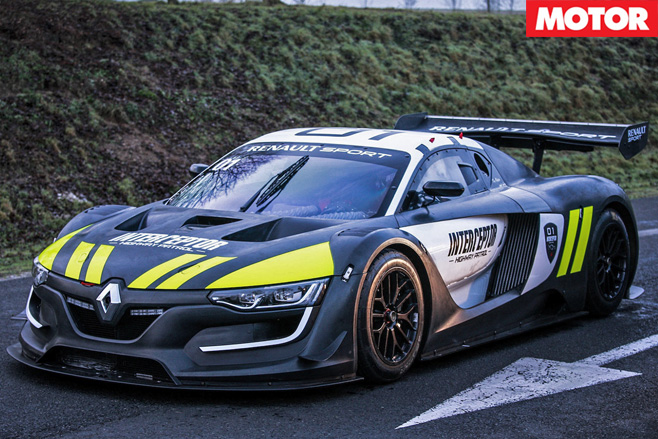
Renault Sport has turned its RS 01 supercar concept into a highway patrol car aptly called Interceptor – just to give French crims a fright from afar.
Cops in Renault’s home nation have been known before to wave their baguettes around to demand more power for their vehicles, with the power upgrade for the Megane RS 265 usurping the Megane RS 250 at the request of the Gendarmes.
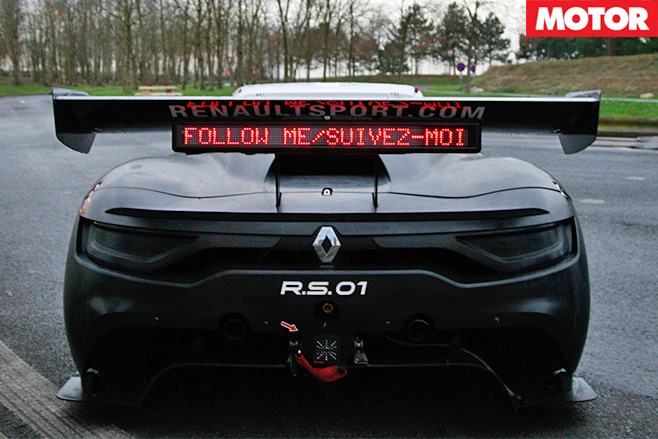
Most road users would likely see the back of the RS 01 Interceptor. It uses a 3.8-litre twin-turbo V6 engine from the Nissan GT-R, producing over 375kW and 600Nm in an all-wheel drive vehicle that tips the scales at just 1100kg.
In a flurry of tyre smoke, sliding and flashing lights, the pursuit is on as Ragnotti weaves between slow moving Clios and Meganes on the freeway. Let’s just say the rider gets to see LED board on the rear, but today he doesn’t get a free ride with the driving champ…
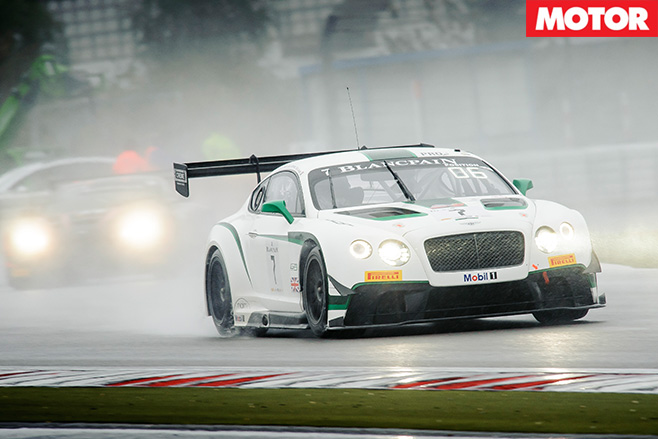
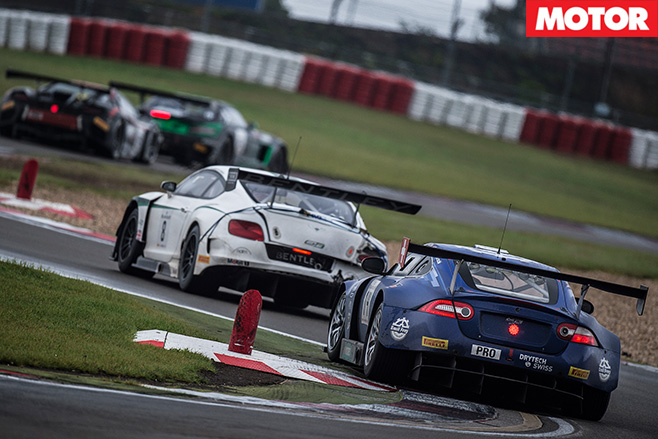
Picture a Bentley sandwiched by a McLaren and Aston Martin, charging down the Nürburgring Grand Prix circuit’s main straight. Behind them a Ferrari lurks.
Their carbon fibre bodywork is barraged by rain. They are huddled in changing formation. Brakes five hours hot. The Bentley’s V8 booms with bass while the Ferrari’s shrieks like a violin in an orchestra of noise. All are focused on the next apex.
This was 2014’s Blancpain Endurance Series final. For the new kids in the Endurance series, Bentley, the race didn’t end as it had hoped. Six other GT3 cars streaked across the finish line before the broad proportions of a Continental thundered past.
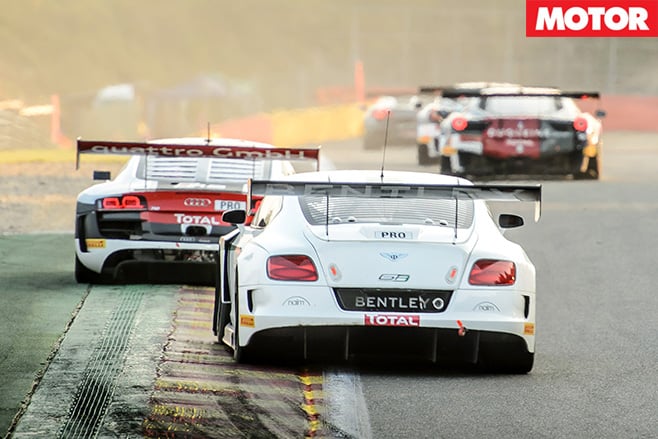
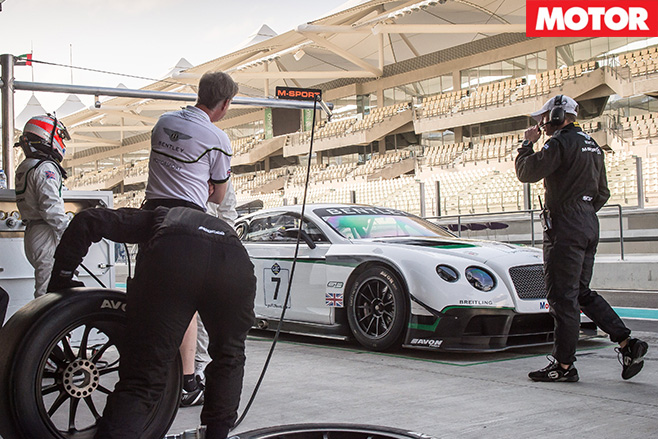
Seven hours prior, Bentley was on the cusp of making history. A top-two finish, and bad luck for the top-placed Audis, would have sealed Europe’s premiere international GT3 championship in its debut season.
But while this would have been the ultimate way to end a year’s hard work for Bentley, win or lose, the Continental’s successful season had reinforced a more important point about the GT3 category itself – it’s exciting, varied, and fair.
Compare that with a road-going McLaren 12C that boasts a carbon fibre tub and hydraulically-linked dampers and weighs only 1428kg. It, too, uses a turbocharged V8 engine, but it’s more powerful than the Bentley’s and mounted in the middle.
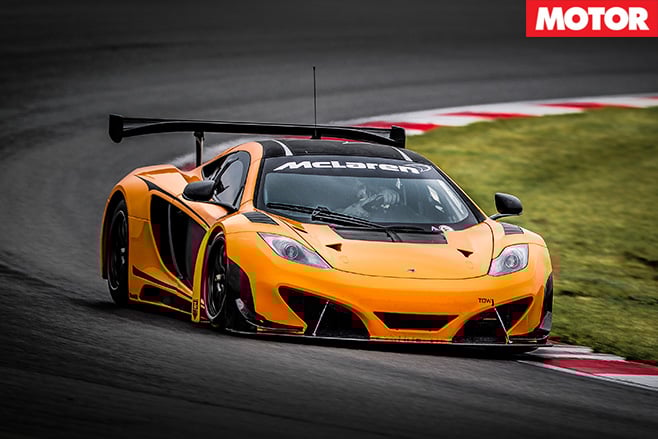
There was an hour to go. Bentley flashed into the race lead, passing the ART Grand Prix McLaren 12C GT3 that had just completed an impeccable stop on the other side of pit wall. Once released the McLaren latched onto the Bentley’s tail in second place. The chase continued until the finish line, where the McLaren trailed by 1.1sec.
How exactly did Bentley give a 2300kg luxury car the ability to stave off a McLaren for an hour? It began with a witch-hunt for kilograms, Brian Gush, Bentley’s Director of Motorsport, tells MOTOR at the ’Ring. “Perceptions were we would never get the weight down, but we knew we would,” he says.
Kilograms were also shed from the Continental’s chassis. The GT3 car may use the road car’s steel monocoque, but with a roll-cage stiffening its core the rear floor was cut to free up more weight. Bentley also saved another 23kg by opting for the Audi-sourced twin-turbo V8 engine instead of the brand’s iconic twin-turbo W12.
All up Bentley sliced 995kg off the road car. “We aimed for 1300kg and we achieved 1300kg,” explains Gush. But the job wasn’t done. Distributing the meat left on the Continental’s bones was equally as important for finding speed.
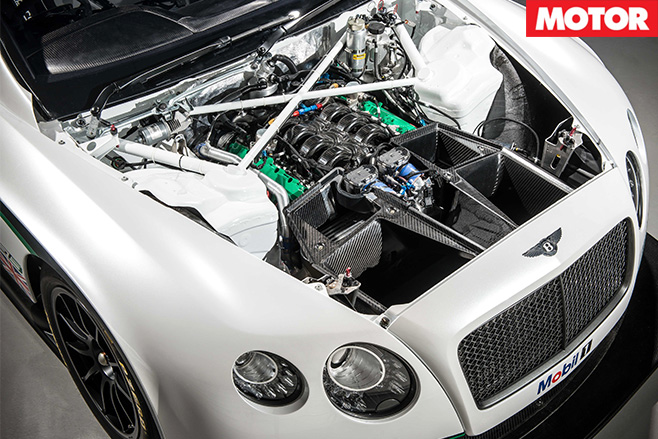
So we were able to put the transmission on the rear axle and move the engine back,” says Gush. “And then, of course, you can place components around the car where you want. So the [lightweight] battery is placed in the interior low down, the fuel tank is low down toward the rear, all aiming for 50:50 weight distribution.”
Rather than try and police parity through extensive technical regulations like Formula One, the FIA-developed GT3 rules that underpin the Blancpain Endurance Series do the opposite. They liberalise the framework to give manufacturers a window large enough to modify their cars to a certain level of performance.
The suspension used the same regime. The Continental’s front wheels were pushed slightly forward to increase wheelbase length while new double-wishbone arms and fully adjustable Öhlins dampers at each corner were tasked with sealing 310mm-wide Pirelli slicks to tarmac. And, to reign it all in, six-piston front and four-piston rear Brembo calipers were paired with iron discs.
However, all the engineering in the world wouldn’t have helped if the driver didn’t have the talent to exploit it. And with gentleman drivers being at the core of GT3 racing, driver aids were employed.
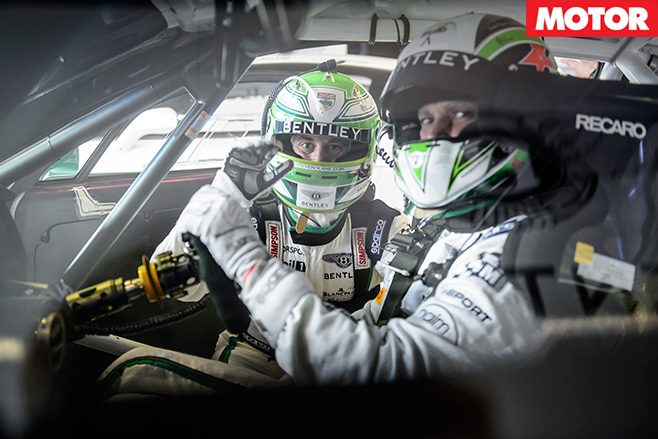
All these freedoms – huge brakes, wide slicks, radical diets, and a plethora of top-shelf racing components – help manufacturers build around a car’s flaws. The FIA then holds something called the balance of performance test before a season, to let it fine tune each GT3 car’s ability more precisely, allowing heavier, or less ideal, road cars to compete with faster ones.
For the balance of performance test every manufacturer’s GT3 car is driven on track by the same driver and its capability documented, before being modified to align its performance with a benchmark. This happens through changes to weight, aerodynamics, wheel width, ride height, fuel tank capacity, boost pressure or air intake restrictor size.
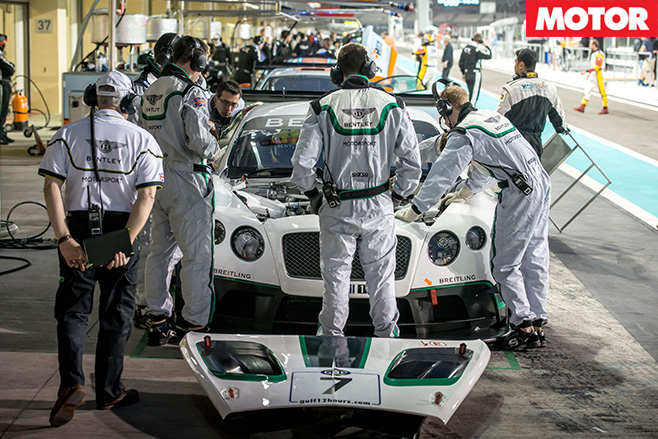
With the balance of performance equalising every car’s ability, and the technical rules affording an easy homologation, there’s no incentive for manufacturers to go silly spending resources on development.
Today, GT3 seems to satisfy everyone involved. It’s a huge global market for manufacturers (over 18 GT championships currently feature GT3 cars), a proper GT category that’s accessible for privateers, and a vibrant road-car based competition for fans.
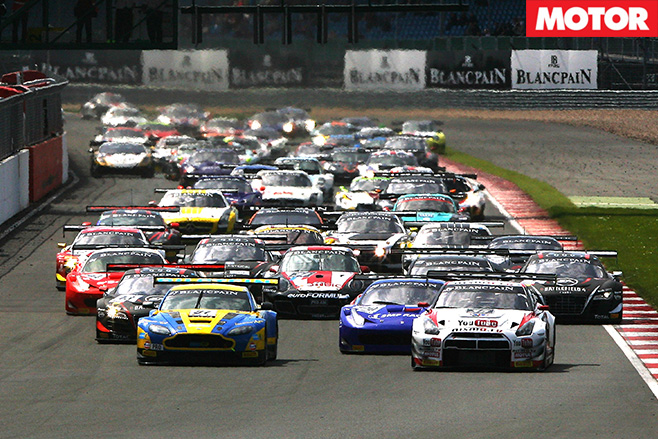
Erase the system, however, and you could say goodbye to the sport’s varied make-up. Like the late ’90s epoch of international GT racing that saw dominant homologation specials like the McLaren F1 GTR, Porsche 911 GT1 and Mercedes-Benz CLK GTR, the sport might become a victim of its own excess. Customers will gravitate to whatever car is fastest.
Manufacturer participation, meanwhile, would dissolve into a contest of resource to create the winning car. Such a car would become unbeatable, and expensive, and the gap between affordable one-make series and big-stage GT racing would be a bridge too far for aspiring competitors.
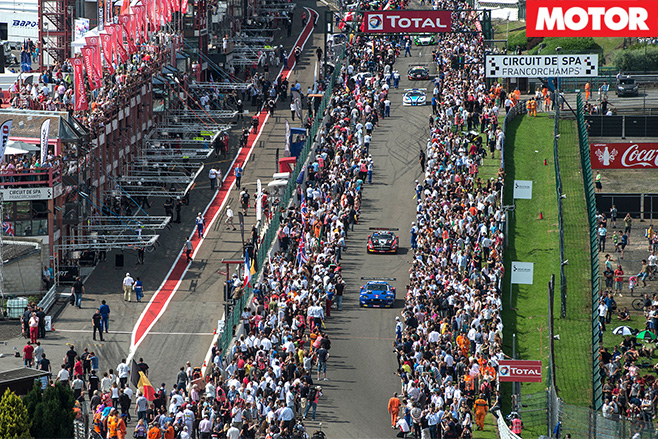
Riveting in anyone’s language – and, some say, so popular, V8 Supercars itself feels threatened. This year’s Bathurst epic, with two-factory supported Bentleys in the fray, should be even better.
Bentley doesn’t want to just take in our scenery here in Australia, either. It wants to win. Impressive when Gush admits there’s an omnipresent advantage enjoyed by cars like the Ferrari 458 GT3 that won last year. “A mid-engine sports car … will always be at an advantage over a front-engine four-seater.”
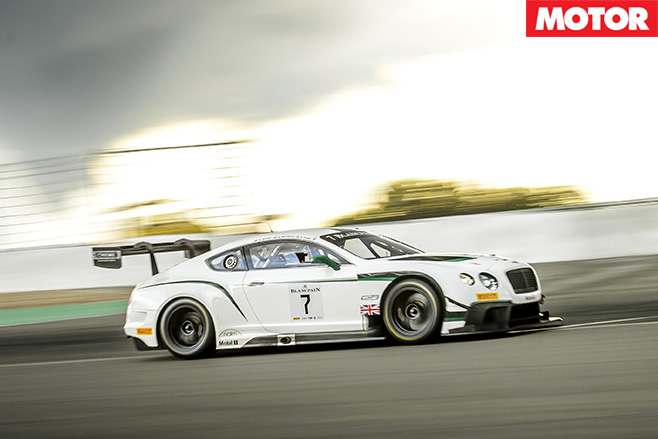
Bentley Continental GT3 Active years: 2014 – present Biggest 2014 win: Silverstone Pro Engine: 4.0-litre V8 twin-turbo Power: 373kW Chassis: Steel Weight: 1300kg Price: ¤368,000
IN THE BEGINNING
GT3 racing owes a lot to one man: Stephane Ratel. Following the demise of Group C it was Ratel, along with Patrick Peter and German engineer Jürgen Barth, who created the BPR GT Series to revive global GT racing. It didn’t last long.
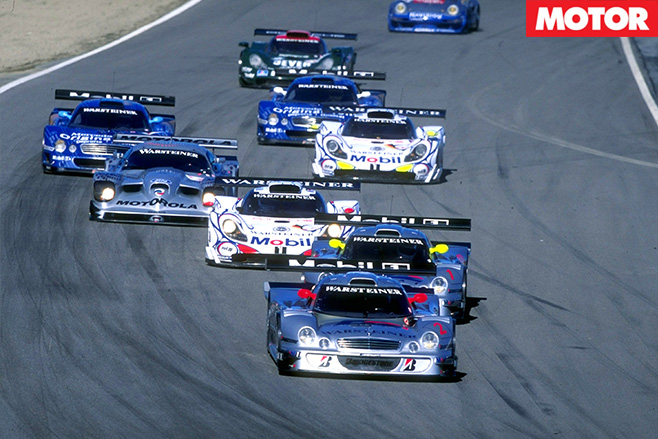
In 2005, after GT1 had died, Ratel decided to instil global GT racing with the accessibility that once defined it. For that to happen a new category had to be fair and cheap.
To address costs Ratel and the FIA considered infusing a field with cars from various one-make series, but each car’s speed would have wildly varied. However, the FIA had created the balance of performance system for its 2005 FIA GT Championship, it proved such a success it was adopted for GT3 in 2006 and remains a cornerstone of the series today.
Has fast-developing Kia taken another big step forward with its new-generation Sportage?
WHAT IS IT?
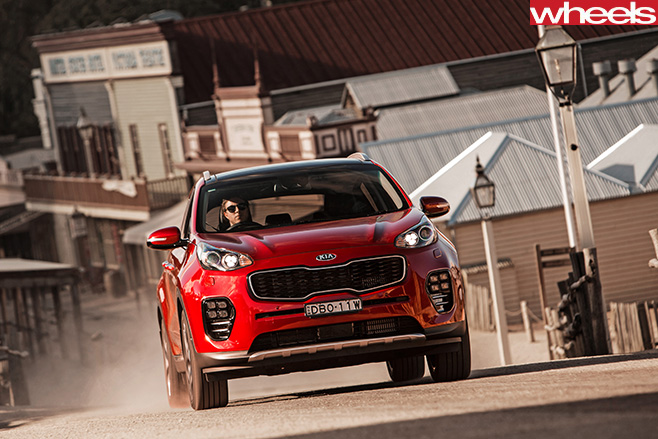
The 2016 Sportage is a new-generation medium SUV from Kia. It builds on the strengths of the already good third-generation Sportage while adding polish.
WHY WE’RE TESTING IT
It’s a new player in a very popular segment from the rapidly improving Korean car maker, and it has just gone on sale. Can Kia score another direct hit?
Hyundai Tucson, Nissan X-Trail, Subaru Forester, Ford Kuga, Mazda CX-5, Toyota RAV4
THE WHEELS VERDICT
The 2016 Kia Sportage is a terrific family car, offering a great looks, a top quality interior with excellent equipment at each of the three spec levels, an excellent turbo-diesel and good petrol engines.
PLUS: Exterior styling; interior design, finish and equipment; capable steering and handing; excellent ride and refinement; smooth and potent turbo-diesel; seven-year warranty
MINUS: Petrol 2.0 only just enough engine; frontal styling a matter of taste; it would be nice to have autonomous emergency braking across the range
THE WHEELS REVIEW
CAST YOUR mind back to the flimsy, uninspiring SUVs that once wore the Sportage badge. The increasingly uttered “Geez, Kia has come a long way,” is truer than ever of the new model.
The outgoing third-gen Sportage, introduced in 2010, had already covered ground, retaining the core Kia qualities of generous equipment and keen pricing alongside newer ones, such as Euro-sharp Schreyer styling, steering and handling smarts and a seven-year warranty. That’s precisely where the new model picks up.
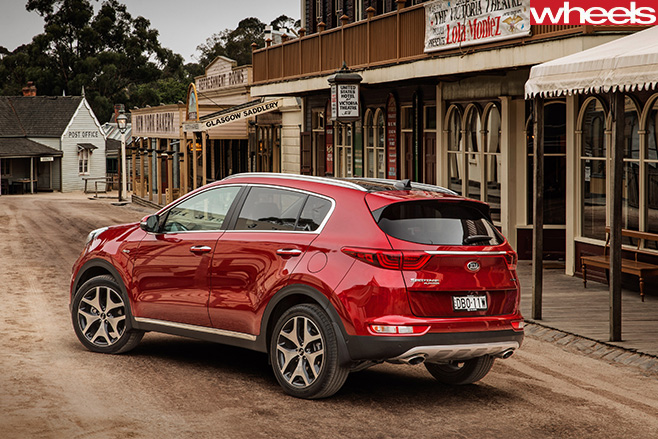
A switch to Korean production, from the third-gen’s mid-life switch to Slovakian supply, brings back the 2.4-litre non-turbo petrol four, but results in the binning of the direct-injected 2.0-litre four for a multi-point version. Outputs for the 2.0 drop from 122kW/205Nm to 114kW/192Nm. But fuel consumption also falls by about a litre to 7.9L/100km on the official combined cycle test, despite kerb weight increases of more than 100kg.
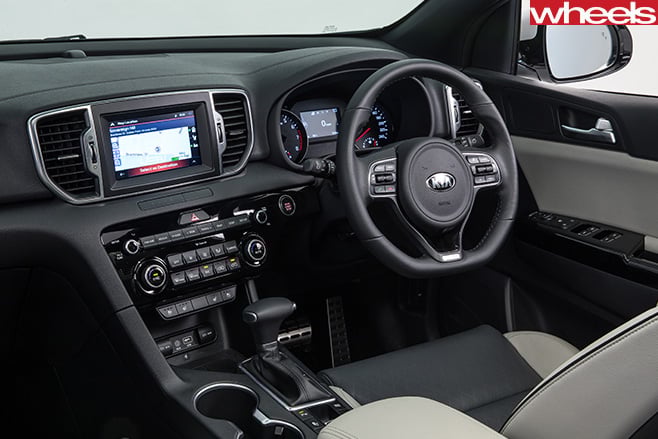
And by the time you’re into to the impressive looking and enviably equipped range-topper, you might as well opt for the stout 400Nm 2.0-litre turbo-diesel, which is an AWD-only proposition across the three variants. A great modern oil-burner, it’s a refined, immediate and efficient performer, offering official consumption of 6.8L/100km in mixed use and 5.5L/100km on the highway, which also brings a boost in range from a fill of the 62-litre fuel tank.
A good electric steering system – tautened in the switch from ‘normal’ or ‘eco’ to ‘sport’, along with the throttle and transmission calibration – and disciplined dynamics on strut front and redesigned multi-link rear suspension ensures a level of driver appeal that’s still not standard in an SUV.
There’s space to sprawl in most directions on the comfortably angled rear seat. An adjustable backrest angle, centre rear air-con vents and 12V and USB sockets add to the appeal of riding in the second row.
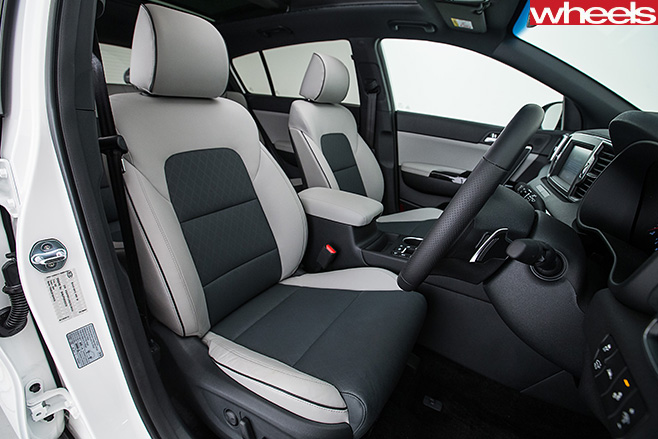
The Platinum (from $43,490) shares LED day running lights and taillights, tyre pressure monitors, front parking sensors, leather, a 10-way powered driver’s seat, rain-sensing wipers, sat-nav and dual-zone air-con with the SLi (from $33,990), and adds a stack of safety and convenience gear. (Among the highlights are autonomous emergency braking and radar-based forward collision warning systems.)
Medium SUV under $45K: Australia’s Best Value Cars
But even the $28,990 front-drive entry-level model ($33,990 for the diesel) is endowed with cruise, a reversing camera, rear parking sensors, dusk-sensing headlights, and a Bluetooth and iPhone compatible audio system with a 7.0-inch colour LCD touchscreen and steering wheel controls.
Long equipment lists, among persuasive strengths, are nothing new in a Kia, but the Sportage wasn’t always this great to drive or this nice to own.
SPECS
Model: Kia Sportage Platinum GT Line Engine: 2359cc 4cyl, dohc, 16v Max power: 135kW @ 6000rpm Max torque: 237Nm @ 4000rpm Transmission: 6-speed auto Weight: 1716kg 0-100km/h: 10.6sec (estimated) Fuel economy: 8.5L/100km Price: $43,490 On sale: Now.
Click here to read the full range review of the Kia sportage.
The XC90 looks the part. The seven seater SUV is proof Volvo have upped the design stakes with bold lines, luxury finishes, and a modern appearance inside and out. For such a large, seven-seater SUV, it has luxury written all over it.
It comes packed with plenty of features we liked. From the small things like the angelic warning sounds to optional extras like the 360 degree surround park view (seriously my favourite feature, especially when parking it).
There are several things that stood out in our longer-termer – XC90 Inscription D5 model. It’s got more power than we expected; especially given it’s just a 2.0L diesel engine under the bonnet. The two turbos do help there.
Its fuel economy was also surprising. I managed to drive from Melbourne to Adelaide and then on to the Barossa Valley in South Australia on less than one tank. Granted, it’s a 71-litre tank running on diesel, but they’re still decent figures and it certainly took the stress out of the nine hour plus drive.
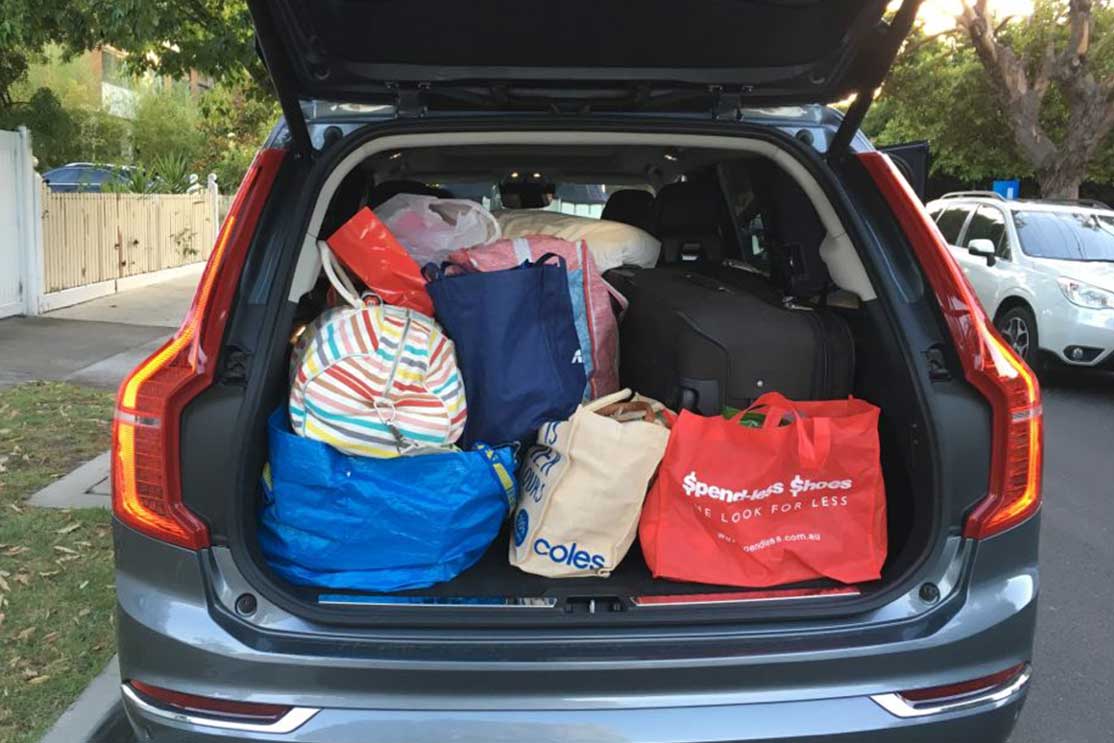
Then there is the all-important spaciousness. As soon as you see the beast that is the XC90, you know it’s not going to falter in the space department. The seats fold down flat so there’s enough room in the boot to move a small apartment but obviously, being a seven-seater, this space is compromised when the extra seats are clicked into space. Even then, though, it manages to fit enough gear for a family outing to the beach.
It’s also worth noting the extra two seats are quite comfortable and roomy. I forced various family members to ride out the back, but my number one fan, Mumma Kanta (who is a tidy 5ft 3”) made a point of telling me how comfortable she was back there before chewing my ear with her two cents on why she thought the car was really “groovy” and looked great in her driveway – I guess the vertically challenged need to have some perks, even if they do still use the word groovy.
The XC90 has plenty of added options which take it up a notch in terms of safety, but these additions certainly don’t come free. On our decked out Inscription model, we loved features like the Nappa leather, heated and vented front seats, panoramic sunroof and different drive mode settings.
Then there’s the driver support package – I wouldn’t call it a necessity but once you go there, there’s no turning back. We’ll never say no to Radar Cruise Control for those longer trips, but throw in Pilot Assist where the car drives itself in stop/start traffic, and automatic parking, you’ve got yourself one of the more accessible, early-stage autonomous cars. While I wasn’t quite prepared to give up full control of the steering wheel (I forgot to pack my brave pants), once I downgraded to the T6 Momentum with no costly options, I certainly missed them.
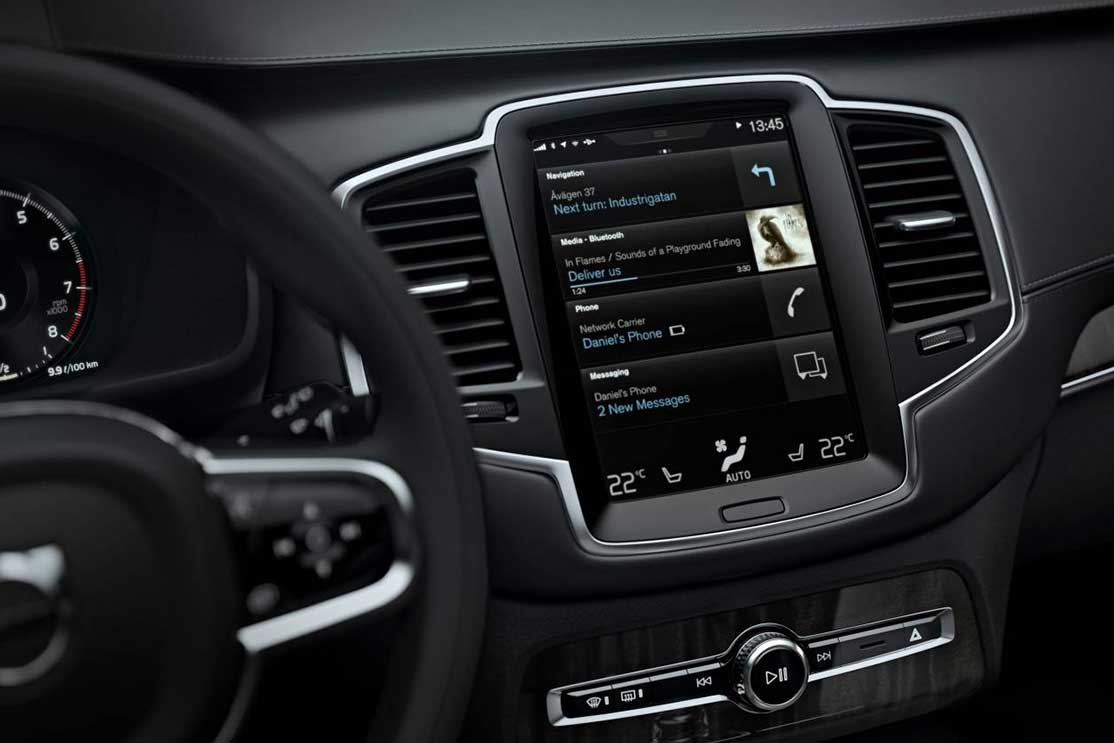
There are a few things missing in the XC90, like the limited storage in the front, and only one USB port, which is a strange omission and surprisingly irritating, albeit a first world problem.
The noisy air conditioning was annoying and the centre touch-screen, which looks like an iPad, isn’t as responsive as one would hope – plus, the incessant fingerprints and cleaning of the screen is this clean-freak’s nightmare. But then, I’m yet to live with kids and I hear fingerprints come part and parcel.
On my travels, I did get stopped by one couple who had an old-gen XC90 and were looking to upgrade to the newest version. Their biggest question was about the turning circle, which they said was terrible in the older SUV. While the newer seven-seater wasn’t about to make any U-Turns in Adelaide’s backstreets, it has certainly improved from older generations. To prove my point, the inquisitive lady told me her XC90 wouldn’t have made a U-Turn in the carpark in which we were standing, so I tried it for the sake of comparison and managed to avoid a three-point turn on this occasion.
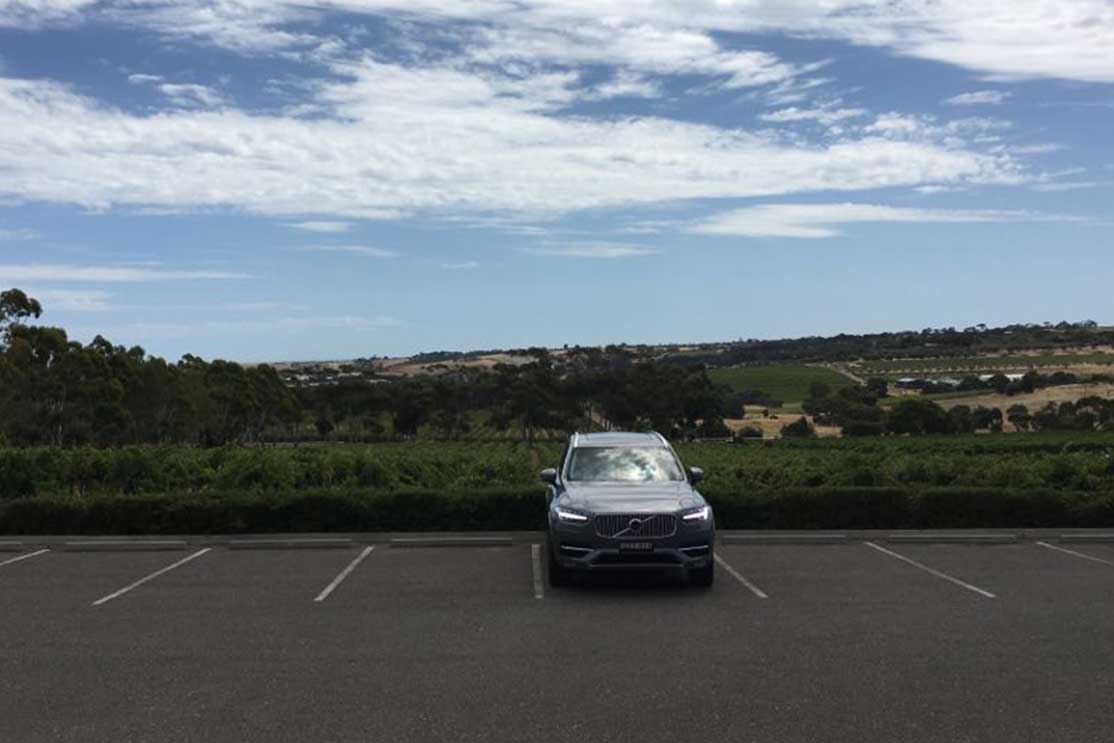
While we hear there have been some minor issues with the Volvo’s system alerts, based on my first impressions I’d be fairly happy if someone threw me the keys to the XC90 decked out with all the bells and whistles. I’m pretty sure Mumma Kanta would be thrilled too.
Breathe deeply, let your lungs drink. Assuming you’re reading this somewhere near sea level, your nostrils are flooding with 14.7psi of nitrogen marbled with blissful oxygen, 12 litres of it.
This is the stuff naturally-aspirated engines have survived on for decades. And, of course, in a world free of turbochargers, the only recipe for kilowatts is more compression ratio, more fuel, more revs.
Times, of course, are a changin’. Apparently we’re cooking ourselves on this little earth. The nitrogen and oxygen is getting elbowed by carbon dioxide. Cars are an easy target for regulatory greenies looking to reign in emissions. And naturally-aspirated engines are the weak zebras, an emissions-conscious car company’s easy target.

And they will be lotto goals because, unfortunately, right under our noses the affordable NA car is already gone. These days you need a wallet as thick as Clive Palmer to own a bewitching naturally-aspirated car. Even cars in the price range of M3 and RS4 are, of course, turbo or heading that way.
We must head into truly expensive territory to continue our NA worship, so we’ve grabbed three of the most spellbinding NA cars ever built. Representing V8s, the Ferrari 458 Speciale is, by way of specific output, the most powerful NA engine ever. Representing V10s, we have the howling, rollicking Lexus LFA. And for V12s, the Lamborghini Aventador, whose menacing exhaust note sounds a bit like an Italian tenor screaming into a didgeridoo.
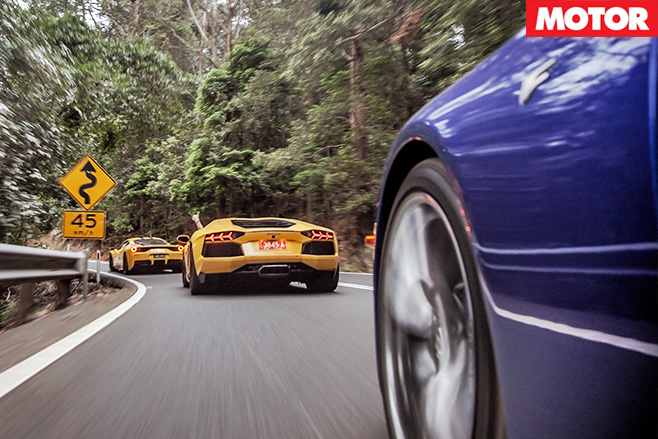
We took our supercar trio north from Sydney to Putty Road for one unbelievable day. Stopping short of requesting an agreement signed in blood, Ferrari lent us the Speciale on condition this wasn’t a comparison. Rather, it’s a celebration. Three NA supercars, two with trembling 9000rpm redlines. Let’s go.
BEST OF NA: V8 | FERRARI 458 SPECIALE
Both engine and car are one of Maranello’s best ever
Associate editor Newman tumbles out of the Speciale looking like he’s just won lotto and got Scarlett Johansson’s phone number in the last 15 minutes. He says nothing, just laughs. “It’s the best car I’ve ever driven,” he finally stutters. I know, I say – I was similarly speechless and fawning not 30 minutes earlier.
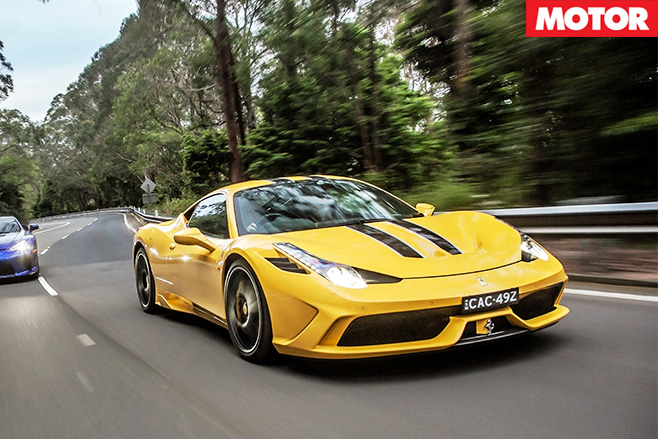
When the California T arrived last year it had been 27 years since the last turbo Ferrari. This year, Ferrari will insert turbos between the 458’s airboxes and throttle bodies, quietly ending a dynasty of small, NA mid-engine sports cars spanning back to the 1970s – and making the naturally-aspirated Speciale the last of its breed. It’s why it’s here.
Looking like a bright yellow shoe, the Speciale is low and heavy to the earth; like it’s just driven off some kid’s wall. You tumble into the thinly-padded seat, the low roof having contorted you into a hunch.
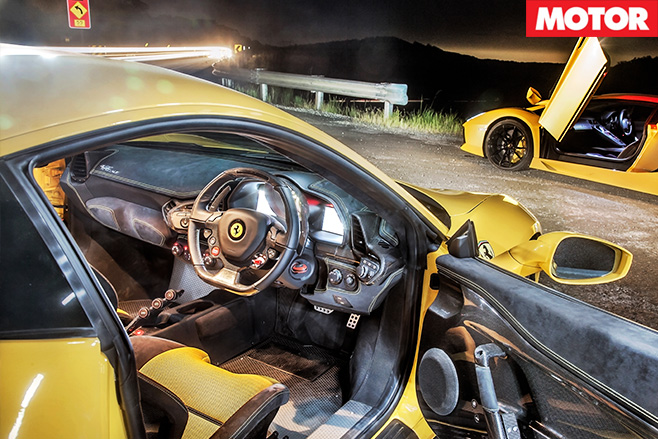
Having thumbed the Speciale’s steering wheel starter button, a rev solicits an angry blip like there’s no flywheel. The noise is rich, distinctive and angry. And loud. Very loud. First arrives with a pull of the ‘up’ paddle, electric handbrake off, the automatic clutch engages with a jerk. Assuming the Speciale is warm, the bitumen dry, the road empty – and, err, closed – boot it.
2000rpm, full throttle. The kick is instant – none of this waiting around for turbos to spool up. As the 4.5-litre V8 summons its 445kW, the rear 305-section Pilot Super Sport Cups wriggle in wheelspin, but are neatly contained by the traction control. Torque is impressive this low in the revs.
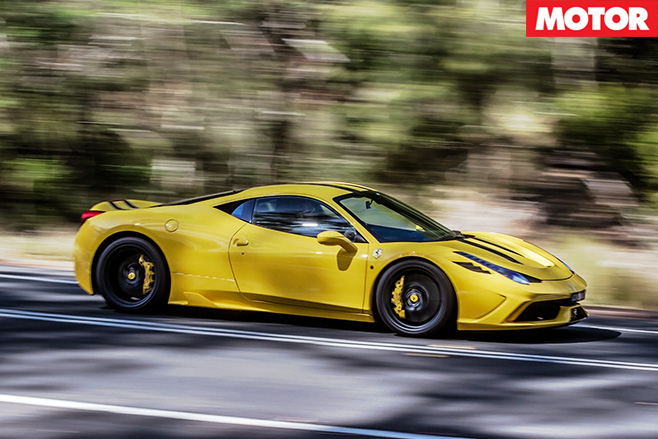
7500rpm. Engine roaring, vibration not insignificant, acceleration simply brutal. Brain squealing to pluck ‘up’ paddle. 8500rpm. Feels like the thing is going to explode. 9000rpm. LEDs atop the steering wheel beckon you to pull the tall, thin, carbon paddle.
There’s so much volume, pitch and intensity. All at once, you wince at the revs, yet at the same time it feels like it could wind on another 1000rpm. It’s at 9000rpm the Speciale is cranking its full 445kW and feels unbelievably alive.
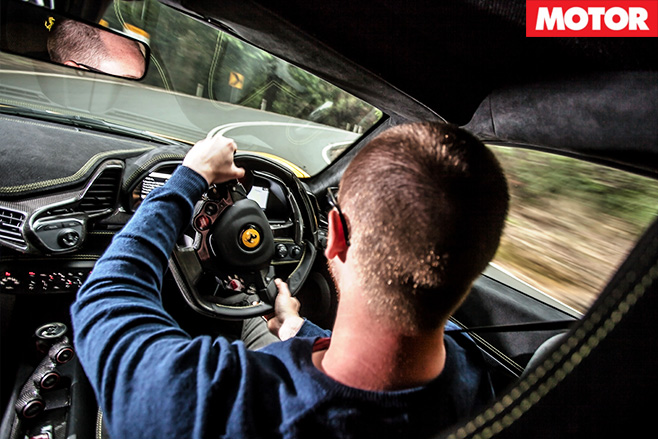
If there’s one thing we’ll miss about naturally-aspirated engines, it’s the intensity at redline. The 458 Speciale uses a flat-plane crank V8, 4497cc and Ferrari’s most powerful NA V8. Also, for specific output, it’s the most powerful NA engine ever made.
Its 99kW/litre eclipses, for comparison’s sake, the 991 911 GT3’s 92kW/litre. And with 350kW from 3.8 litres, that thing’s not messing about. So it’s worth pausing to appreciate the Speciale’s 445kW from 4.5 litres, without a blower or turbo in sight.
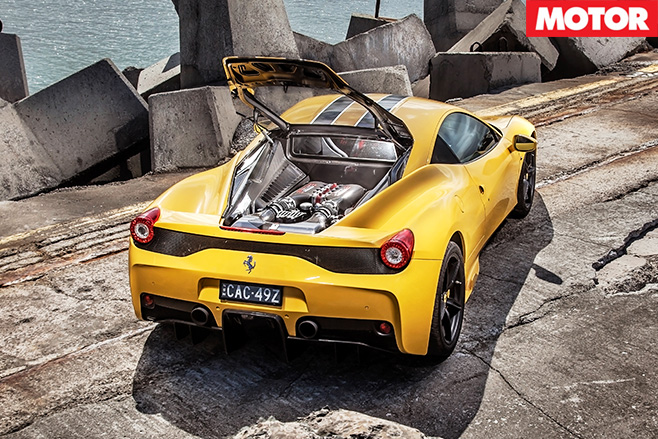
Of course, Ferrari’s engineers didn’t knock off when they’d finished with the Speciale’s engine. The Speciale is so easy and friendly to drive fast – and lord is it fast. When driven hard, other performance cars can take an eternity to reveal their frequency, into which, as a driver, you tune, all the while your confidence withers. Others, at eight tenths, fall apart around their dynamic edges. But it’s at this point the Speciale is only getting started.
You don’t sit in the Speciale so much as splice your brain into its wiring loom – there’s so much feedback coming to you, through the seat, the wheel, the pedals. A super-fast steering rack, which initially takes some getting used to, means you never have to move your hands from nine and three.
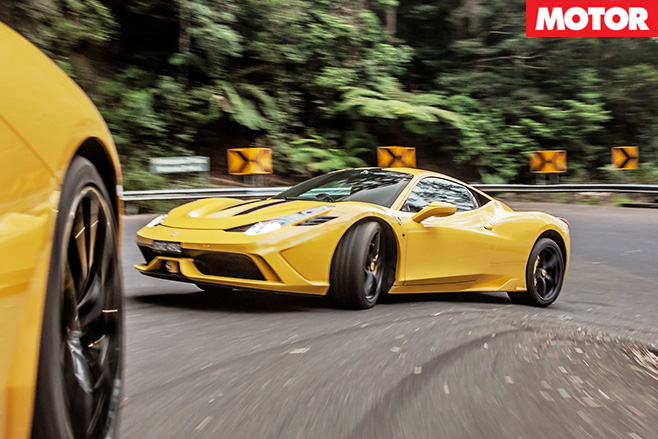
The brake pedal is almighty, clamping six-pot front and rear calipers into 398mm front carbon discs, 360mm rear. The pedal feels sensitive to the tiniest of pressure differences. And, of course, with unbelievable stopping power, a big stop in the Speciale is hugely satisfying and not at all frightening, such is its stability.
At high speed, big bumps merely rock the Speciale gently from side to side, while smaller, high-tempo bumps are worked impressively. The suspension performance is incredible. In fact, the Speciale can produce 1.33 cornering g.
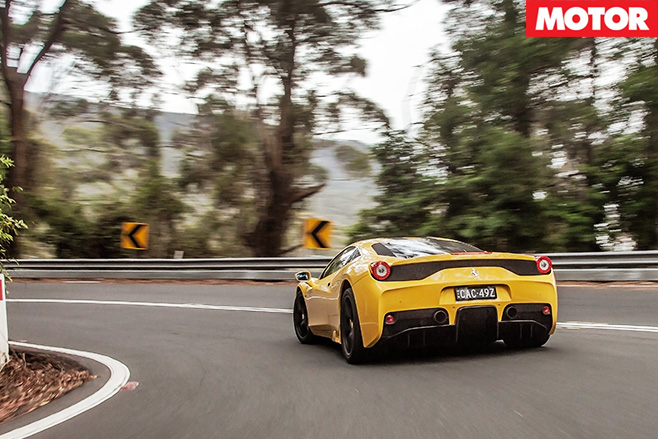
After a big stop, you can tip the Speciale in with only small steering input, given that crazy-fast rack – you’re free to attack apex with incredible entry speed thanks to those sticky Michelins. Stability on corner entry is excellent. On corner exit the Speciale wants to dance.
There’s incredible traction from the rear 305s but squeeze the gas a little harder and the Speciale’s bum will gently step, rather than snap, sideways, inviting more throttle, and more angle. It’ll have you cackling like a kid on red cordial.
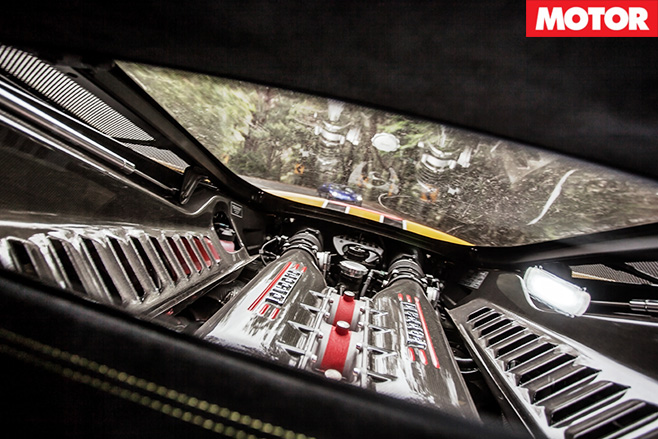
Welcome to something called Slide Slip Control, an ECU program that senses available grip, quietly takes over the throttle and locks and unlocks the diff to maintain a slide based on your steering input. You will feel like a drifting god but, sadly, it’s the car. It might be cheating but a grin is a grin.
It’s just one of the ways the Speciale flatters you. It has huge grip yet it’ll encourage you up to the limits, where the grip falls off a slope, not a cliff, doing good things for your bravado. But, as ever, the seamless electronics are there to catch you if you that corner tightens.

They’re fair criticisms to level against a $550,000 car. But then again, after 30 minutes in the Speciale, you won’t notice, nor care. The Speciale is as close to driving perfection I’ve ever come and will surely be remembered as one of Maranello’s greatest road cars.
BEST OF NA: V10 | LEXUS LFA
This automotive banshee took 10 years to perfect – it was time well spent
Each Lexus LFA buyer, a global total of just 500, received with their car a special book detailing the incredible decade-long development process. The first sentence of the book reads: “In the beginning is the engine.” There is so much to enjoy and discuss in the LFA, but every experience is dominated by the bespoke 4.8-litre V10 nestled front-midships.
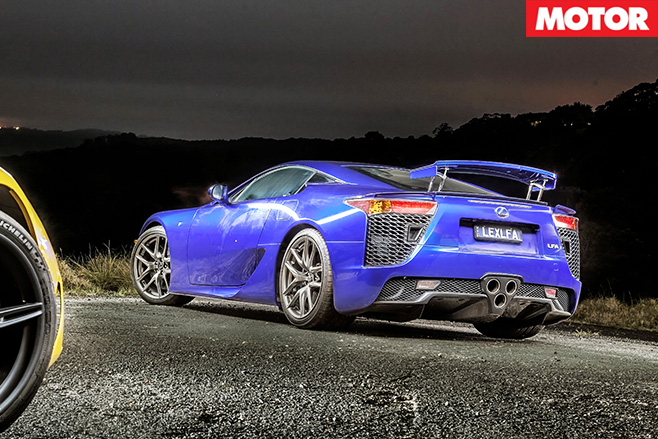
It fires with a neighbourhood-waking flare of revs and settles to a buzzing idle. Once warm, cylinder de-activation often means just five cylinders fire in a futile attempt to save fuel. The car is not particularly happy at low speeds; the engine is perfectly tractable, but the single-clutch transaxle feels clumsy.
If there’s one item that dates the LFA, it’s the gearbox, not helped by it only using odd-numbered gears in auto mode. Best to flick it to Sport and use the gorgeous, cold-to-the-touch magnesium-alloy paddles.
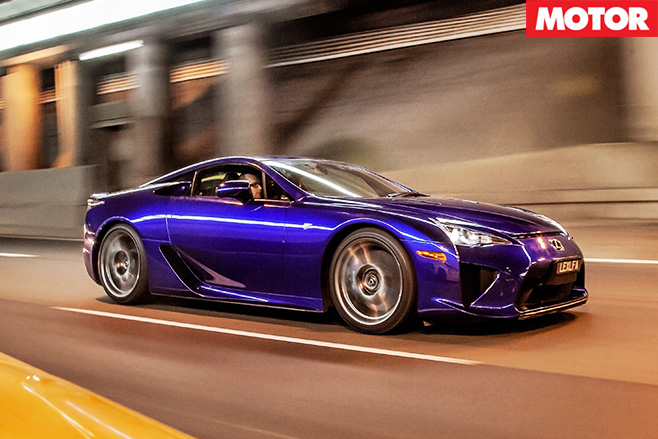
Lexus went to incredible lengths to ensure the LFA’s V10 possessed unheard of levels of response, including ultra-lightweight internals, 10 individual throttle bodies and ‘response prioritised control logic’, which estimates the volume of intake air based on the throttle position to ensure the correct level of fuel is injected instantaneously. If the driver possessed the required skill, it feels as if he or she could meter out the power in 0.5 per cent increments.
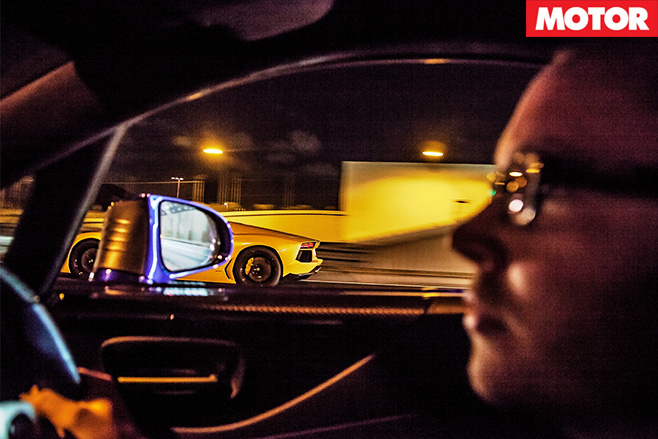
Pick a gear – any gear, but third is good – sink your foot to the carpet and you enjoy a gradual crescendo, the engine note changing timbre as the rpm rises. This mechanical shriek is no accident, but the result of months of work by Lexus engineers, who reportedly listened to Formula 1 CDs and DVDs on loop in an attempt to capture a similar sound. They succeeded admirably.
Windows down, extending the V10 through overhanging trees or past rock faces is as close as you can get to an automotive religious experience without driving through Vatican City. With the noise at its zenith, it envelopes you like an invisible, audible fog.
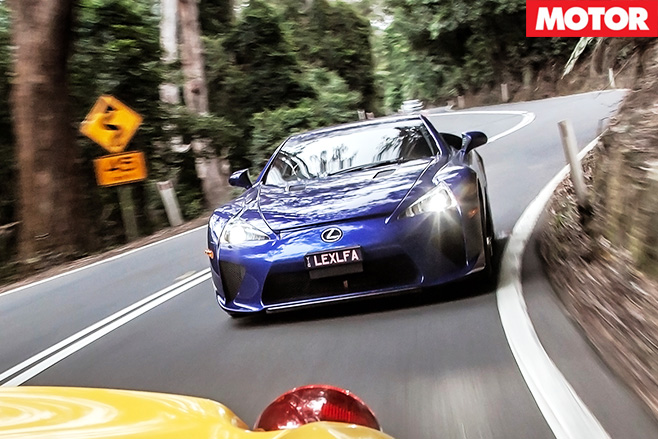
It responds instantly to driver input, both good and bad. Make a mistake and it’s not interested in flattering your abilities; too much throttle and it skips sideways sharply, and a firm hand is needed on the steering as the nose sniffs out road imperfections like an overzealous beagle.
Up to around eight-tenths the LFA is in no way demanding to drive, but nearer its limit it starts to feel edgy and focuses your attention. This is likely due to the car’s extremely low ‘moment of inertia’, ie, the amount of force needed to make the vehicle change its rate of rotation.
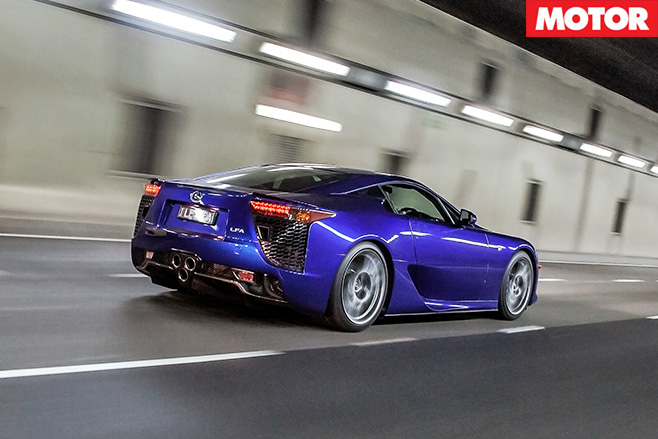
Key to the LFA’s handling balance is its compact layout. To achieve such a low moment of inertia, engineers needed to ensure as much weight as possible was concentrated towards the car’s centre. This explains why the V10 sits deep behind the front axle line.
The engine itself is a marvel, smaller in every dimension than Toyota’s 3.5-litre V6, yet the car’s compact dimensions – it’s no bigger than a 911 – created plenty of engineering headaches and the need for some novel solutions.
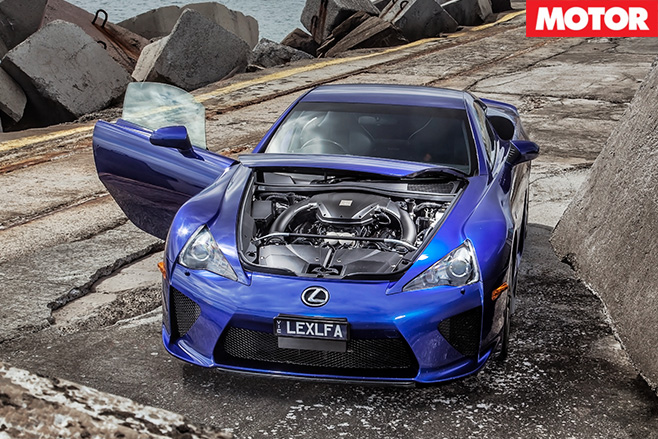
The latter is therefore stacked vertically above the former, driven by a counter gear rather than directly from the crankshaft, which allows the dry-sumped V10 to sit lower still.
With no room in the front, the radiators sit in the rear of the car. This creates a unique piece of supercar theatre, with following drivers able to see one or both of the radiator fans spin into life as the LFA drives along.
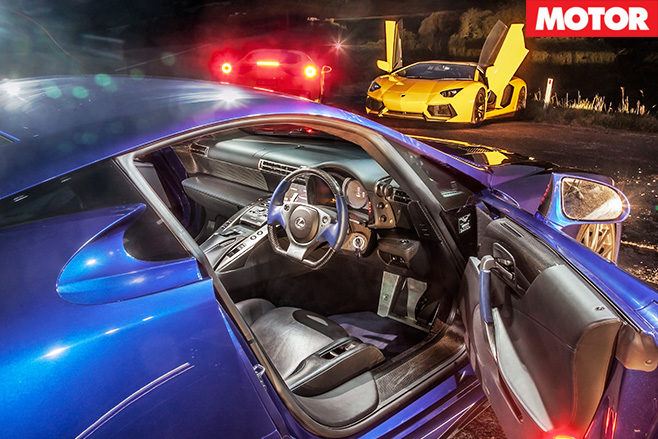
There’s plenty to geek out on, but what sets the LFA apart is the way it feels to drive. It is so finely honed. The steering, for instance: while some manufacturers, even high-end ones, still struggle to provide a decent electrically-assisted setup, the LFA’s steering is perfect – there is no other word for it.
Its speed and weighting are sublime and it’s full of the sort of textural feedback that supposedly isn’t possible without a conventional hydraulic setup. The brakes, too, are the best I’ve ever experienced on a road car, with none of the inconsistent feel or dead spots that plague some other manufacturer’s composite systems. Yes, Lexus engineers took 10 years to get it right, but they absolutely delivered.
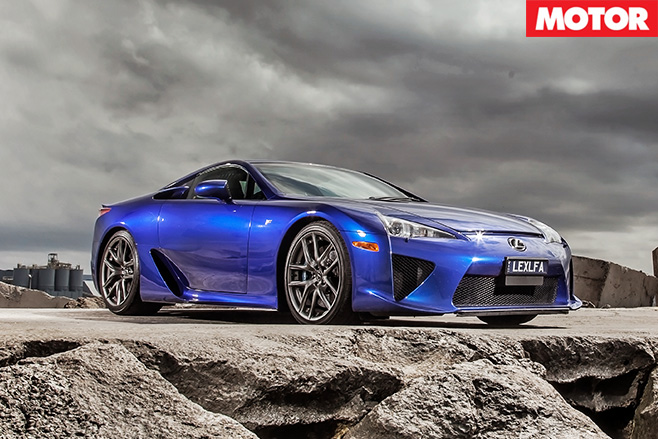
It’s undeniably Japanese, but that’s no criticism; whereas Italian supercars are infused with Latin passion, the LFA is imbued with a samurai’s honour. More than any car in recent memory, it’s a work of art, a finely wrought piece of automotive sculpture.
The LFA is a credit to chief engineer Haruhiko Tanahashi, who early on “decided to make the LFA exactly as I envisioned it…things that truly move people emotionally are not created through group consensus.” Tanahashi-san, we salute you.
BEST OF NA: V12 | LAMBORGHINI AVENTADOR
This raging bull is all about pure, unadulterated power
Other manufacturers have strong 12-cylinder heritages, but none have been as committed to the cause as Lamborghini. It’s dabbled in V8s over the years, and the Gallardo and new Huracán show there’s nothing wrong with a V10 Lambo, either, but all of Sant’Agata’s headline offerings have been powered by a V12 – Miura, Countach, Diablo, Murcielago, and now the Aventador.
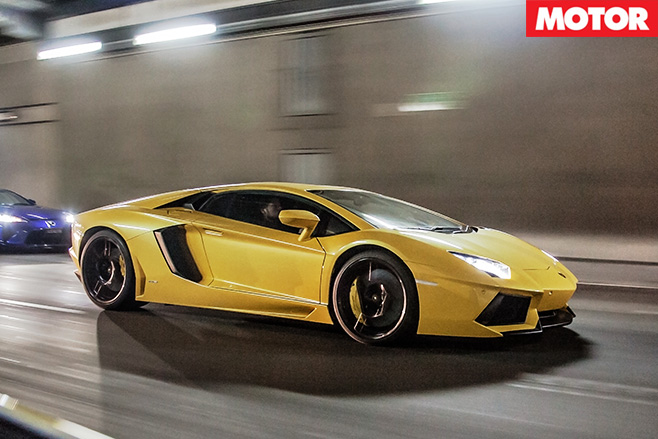
The story famously goes that Bizzarrini was to be paid by the horsepower, so his prototype produced 370bhp at a staggering 9000rpm, with Giotto adamant with a better fuel system it would hit 400bhp at 11,000rpm. How long it would last was another matter, and the 350GT debuted with a still-impressive 280bhp (209kW) in 1963.
Over the next four-and-a-half decades, Bizzarrini’s V12 would slowly increase in size; first to 3.9 litres for the Miura, then from 4.0 to 5.2 litres over the Countach’s 16-year lifespan. During that time four valves per cylinder arrived with the 5000QV in 1985, with fuel injection introduced at the same time on US-spec cars.
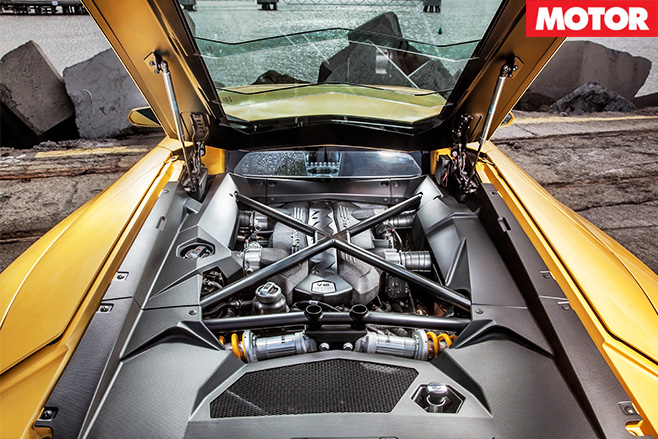
Dubbed L539, Lamborghini’s new V12 retains a 6.5-litre capacity, but is smaller, lighter, yet more powerful than the final Bizzarrini engine with 515kW/690Nm. And remember, this engine will have plenty of headroom built in for future models – 600kW Lambo anyone?
Its open-deck crankcase is built from aluminium-silicon alloy while the incredibly undersquare bore/stroke ratio (95mm vs 76.4mm) means it revs to the heavens, peak power being produced at an incredible 8250rpm.
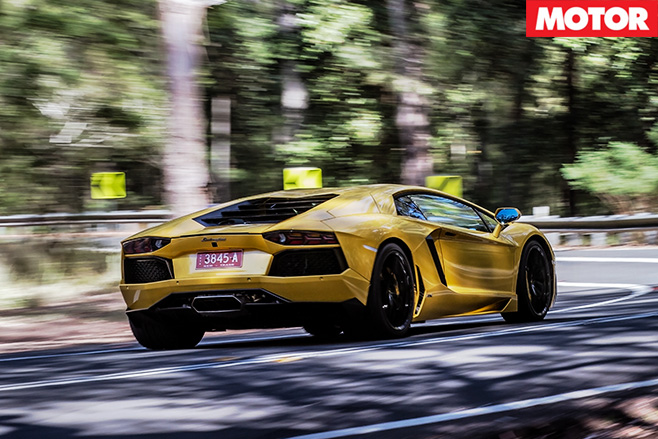
All this is accompanied by a V12 bellow, though it’s not hard to hear why so many owners fit straight-through exhausts, as this engine deserves bigger lungs. Corners arrive at a fearsome rate, requiring every bit of muscle the enormous composite brakes can muster to pull the car up in time, at which point the rear end starts to wander as all that engine mounted behind your head makes its presence felt.
With a modern dual-clutch ’box the Aventador would be unstoppable, but sadly the single-clutch ISR robotised manual is heavily compromised. While lighter and more compact, for shift quality and smoothness it feels a generation behind.
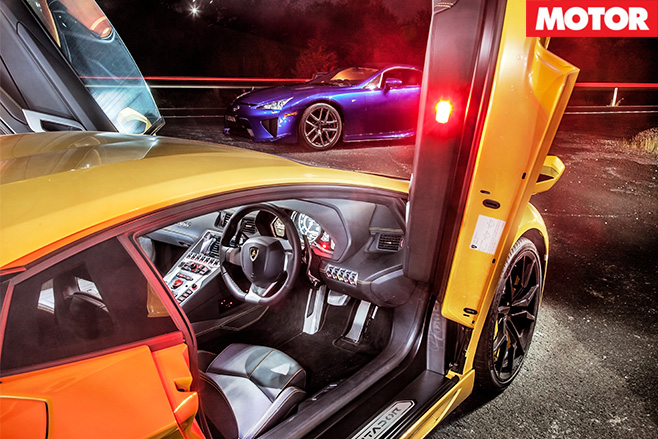
The low-speed ride is also particularly unyielding, meaning commuting in an Aventador isn’t likely to be the most pleasant experience, especially with such weighty steering (no doubt any Countach or Diablo owners just scoffed incredulously), not to mention its more than two-metre width. What is surprising, though, is what a great GT car the Lambo becomes once speeds rise – the steering lightens, the ride improves and the whole car seems to relax.
At 110km/h it feels like it’s barely interested, which, of course, it isn’t. It’s built to dispatch massive distances at two or three times that speed, though exercise the performance and the 90-litre fuel tank drains with alarming haste.
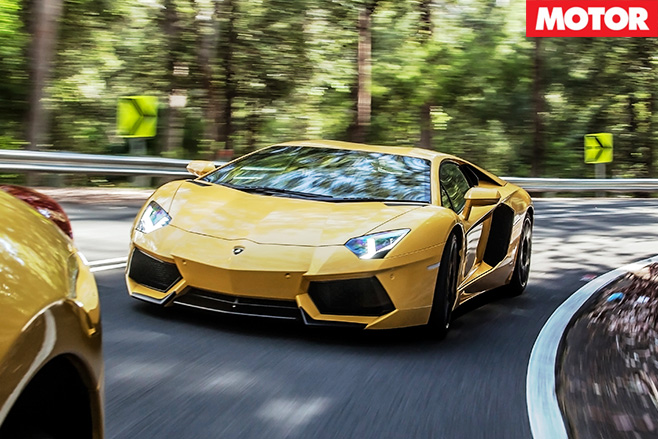
It’s takes a deep breath to disable the ESP system in something this big, fast and expensive, but do so and it’s a car transformed. With no electronic shackles, it picks up cleanly out of corners with such ferocious pace it leaves you breathless.
The Aventador is not a car you would ever provoke out of shape on the public road, but even at a slightly reduced pace, you’re still going faster than pretty much anything else around anyway.
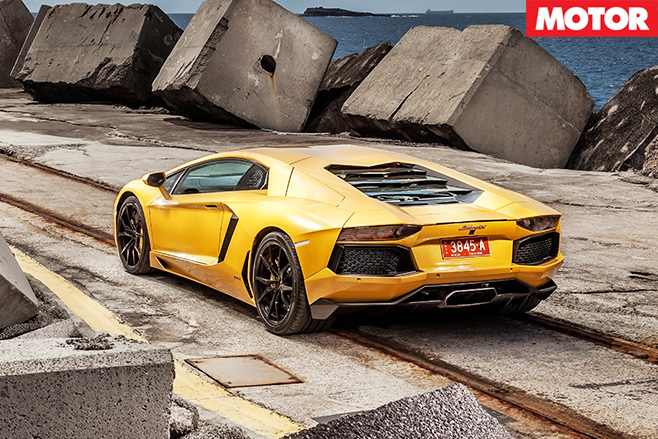
With Lambo boss Stephen Winkelmann’s noted distaste of hybrids, let alone turbos, it’s the good folk from Sant’Agata who are most likely to keep the naturally-aspirated flag flying in years to come.
THREE INCREDIBLE CARS
Three incredible cars, the likes of which, sadly, we’re unlikely to ever see again. The 458 Speciale is Ferrari at the absolute peak of its powers; we would not be at all surprised if it joins the Daytona, F40 et al as a marker in the company’s illustrious history of what it could achieve at its best. If nothing else, it’s a fitting end to the Montezemolo era.
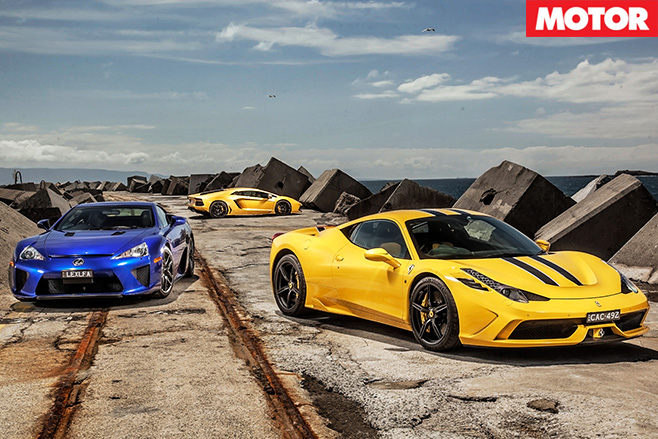
What’s certain is that we’ll never see another car like the LFA. You’re more likely to see Great Wall on the F1 grid in 2017 than a major car manufacturer sink 10 years and hundreds of millions of dollars into what is essentially an engineer’s wet dream.
That Toyota was the one to build it only makes it more remarkable. It’s the ultimate advertisement for what makes natural aspiration great. The noise, the response, the feeling, the ability to play the engine as you would a musical instrument.
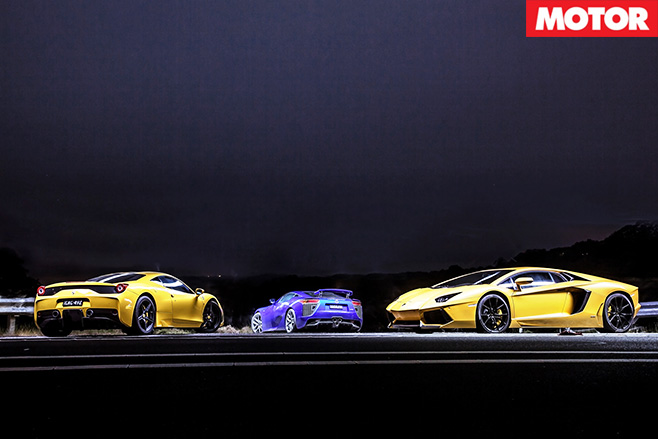
Which leaves us with the Aventador. Thankfully, it’s likely to be with us a while yet. Big Lambos typically have a shelf life of around 10 years, so we should be enjoying 12 atmosphere-gulping cylinders, with ever more impressive power figures, until 2020.
Even better, mention turbocharging to a Lambo powertrain engineer and they practically break down in tears at the thought of sullying their magnificent creations with such a device. Whether they can overcome ever stricter emissions and noise regulations remains to be seen, but they’ll have our support every step of the way.
| u00a0 | FERRARI 458 SPECIALE | LEXUS LFA | LAMBORGHINI AVENTADOR |
| Body | 2-door, 2-seat coupe | 2-door, 2-seat coupe | 2-door, 2-seat coupe |
| Drive | rear-wheel | rear-wheel | all-wheel |
| Engine | 4497cc V8, DOHC, 32v | 4805cc V10, DOHC, 40v | 6490cc V12, DOHC, 48v |
| Bore/Stroke | 94.0 x 81.0mm | 88.0 x 79.0mm | 95.0 x 76.4mm |
| Compression | 14.0:1 | 12.0:1 | 11.8:1 |
| Power | 445kW @ 9000rpm | 412kW @ 8700rpm | 515kW @ 8250rpm |
| Torque | 540Nm @ 6000rpm | 480Nm @ 7000rpm | 690Nm @ 5500rpm |
| Power/weight | 345kW/tonne | 278kW/tonne | 327kW/tonne |
| CO2 Emissions | 275g/km | N/A | N/Au00a0 |
| 0-100km/h | 3.0sec (claimed) | 3.7sec (claimed) | 2.9sec (claimed) |
| Top Speed | 325km/h (claimed) | 325km/h (claimed) | 350km/h (claimed) |
| Transmission | 7-speed dual-clutch | 6-speed automated manual | 7-speed automated manual |
| Weight | 1290kg (dry) | 1480kg (kerb) | 1575kg (dry) |
| Suspension | double A-arms, adaptive dampers, anti-roll bar (f); multi-links, adaptive dampers, anti-roll bar (r) | double A-arms, coil springs, anti-roll bar (f); multi-links, coil springs, anti-roll bar (r) | double A-arms, inboard push-rod coil-overs, anti-roll bar (f/r) |
| L/W/H | 4571/1951/1203mm | 4505/1895/1220mm | 4780/2030/1136mm |
| Wheelbase | 2650mm | 2605mm | 2700mm |
Tracks | 1679/1632mm | 1580/1570mm (f/r) | 1720/1700mm (f/r) |
| Steering | electrically assisted rack-and-pinion | electrically-assisted rack-and-pinion | hydraulically-assisted rack-and-pinion |
| Brakes | 398mm ventilated carbon discs, 6-piston calipers (f); 360mm ventilated carbon discs, 6-piston calipers (r) | 390mm two-piece carbon ceramic rotors, 6-piston calipers (f); 350mm two-piece carbon ceramic rotors, 4-piston calipers (r) | 400mm carbon ceramic rotors, 6-piston calipers (f); 380mm carbon ceramic rotors, 4-piston calipers (r) |
| Wheels | 20 x 9.0-inch (f); 20 x 11.0-inch (r) | 20 x 9.5-inch (f); 20 x 11.5-inch (r) | 19 x 9.0-inch (f); 20 x 12.0-inch (r) |
| Tyres | 245/35 R20 (f); 305/30 R20 (r) Michelin Pilot Sport Cup 2 | 265/35 R20 95Y (f); 305/30 R20 99Y (r) Bridgestone RE070 | 255/35 ZR19 (f); 335/30 ZR20 (r) Pirelli P Zero |
| Price | $550000 | $700,000 (in 2012)u00a0 | $761500 |
| Positives | Almost impossible to fault as a driving experience | Orgasmic engine; feedback; telepathic responses | Supermodel looks; goliath V12; sense of occasion |
| Negatives | Could be too hardcore for some; we didnu2019t get to keep it | Extremely focused; can be a handful at the limit; outdated gearbox | Low-speed ride; difficult gearbox; size issues; thirst |
| u00a0 | 5 out of 5 stars | 4.5 out of 5 stars | 4 out of 5 stars |
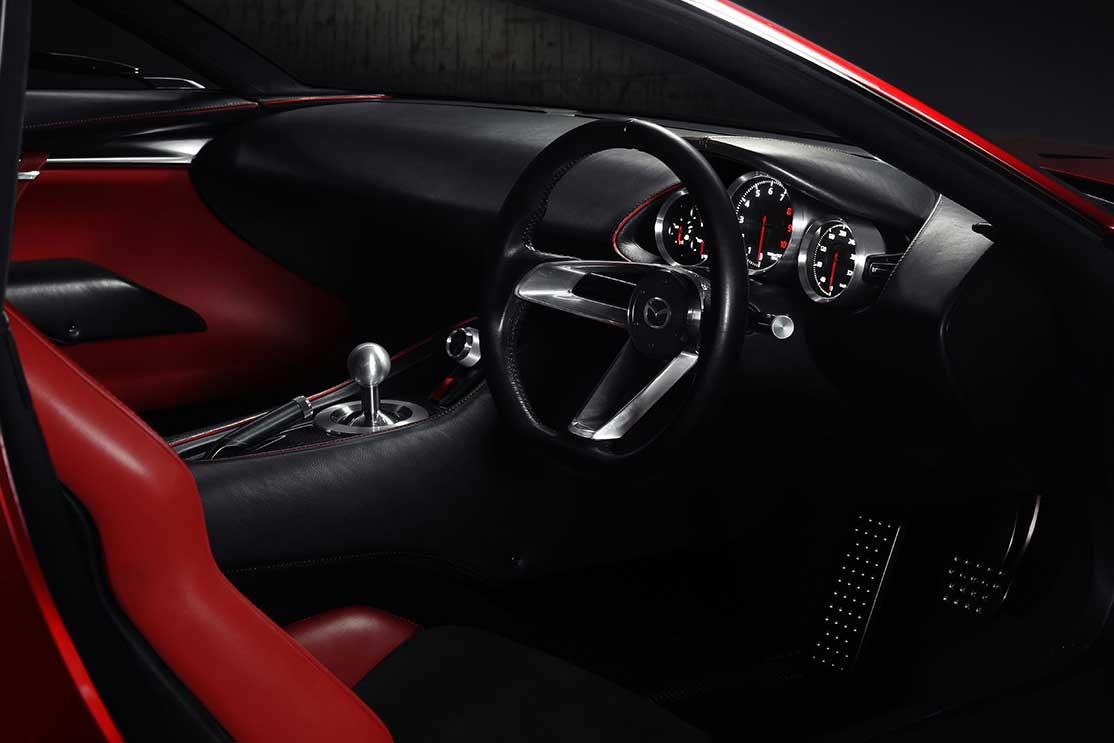
Mazda revealed the RX-VISION to a huge crowd at the Tokyo Motor Show in November 2015. Its long, low bonnet and rearward seating position are typical of rear-wheel drive sports cars, and draw on Mazda’s history of driver-focussed vehicles.
Mazda shared the accolade with the Porsche Mission E. The pair fought off tough competition from the Bentley EXP10 Speed 6 and Peugeot Fractal. Judges for the concept award choose the vehicle that best exemplifies purity of creative design and emerging trends.
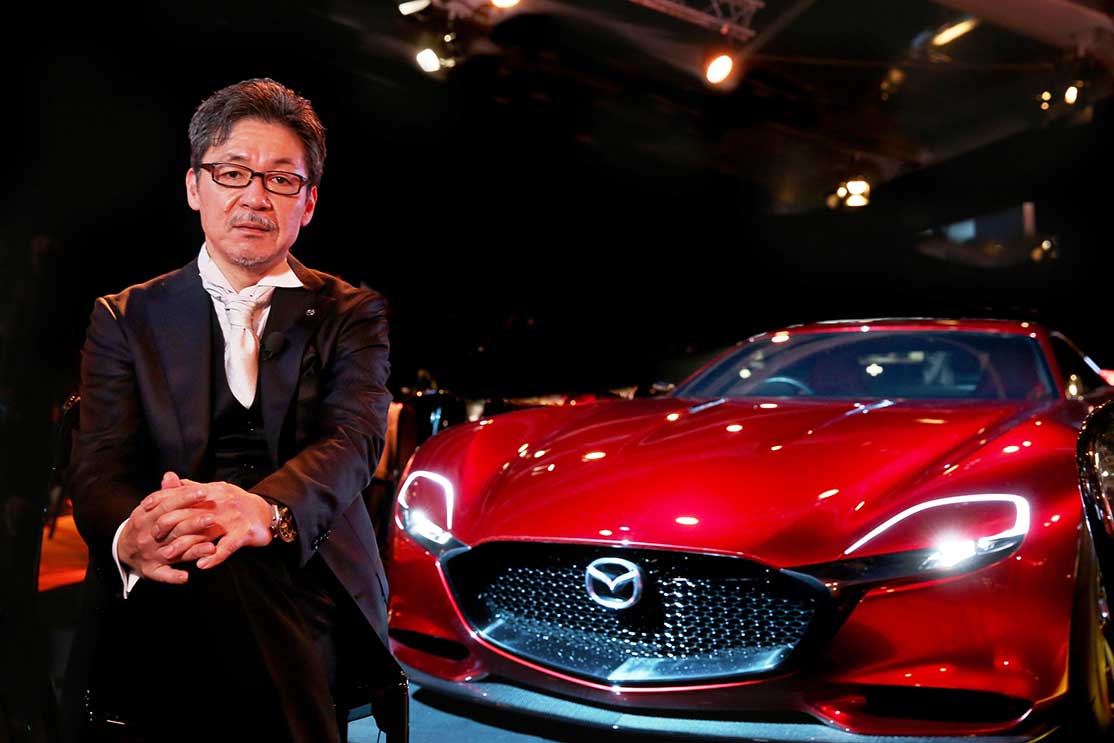
Four representatives of Mazda’s global design division were on hand at the gala event including Ikuo Maeda, the company’s international design chief, who accepted the award.
RX-VISION is the latest concept to come from Mazda and displays the most highly developed version of its ‘Kodo’ design language, as seen on a range of current production cars including Mazda 2, 3, 6, CX-3, CX-5 and CX-9.
Powered by the latest incarnation of Mazda’s rotary engine technology, SKYACTIV-R, the RX-VISION concept also adds credence to rumours of a rotary-engined production car returning to Mazda’s model line-up.
Many manufacturers employ concept cars to present a stylised preview of the company’s future design direction.
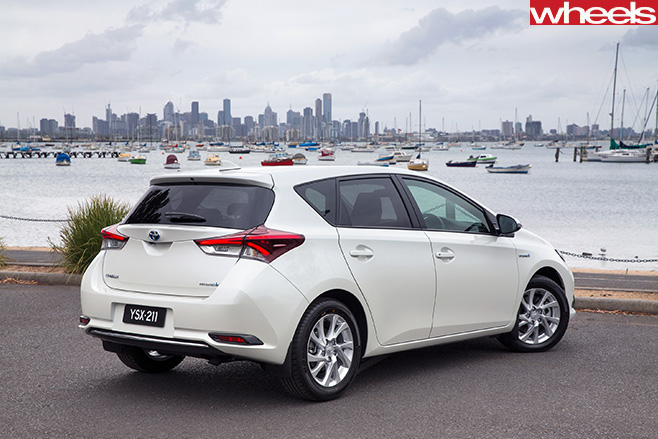
AUSTRALIA’S best-selling car, the Toyota Corolla, will soon add a petrol-electric hybrid version as the Japanese carmaker takes the small car fight to diesel-powered rivals.
With an expected starting price of about $28,000, fuel use for the petrol-electric Corolla Hybrid hatch (no sedan is planned) should undercut many diesel small cars, falling by about a third to as low as about 4.0 litres per 100 kilometres.
And while Toyota says the hybrid is expected to cannibalise some existing petrol-engined Corolla sales, it should add incremental volume to the 12-model Corolla line-up, further increasing the car’s sales lead.
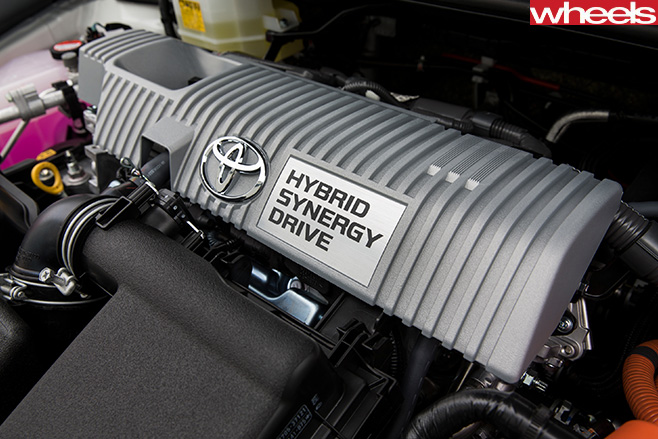
However, it’s teamed with a 60kW electric motor providing better low-rev torque and a combined system output of 100kW.
Toyota says the Corolla model will be about performance as much as fuel economy.
“This addition to the Corolla range will be fun to drive – and fun to own with fuel economy and emissions that are superior to its direct competitors, especially diesel,” said Tony Cramb, Toyota Australia’s executive director of sales and marketing.
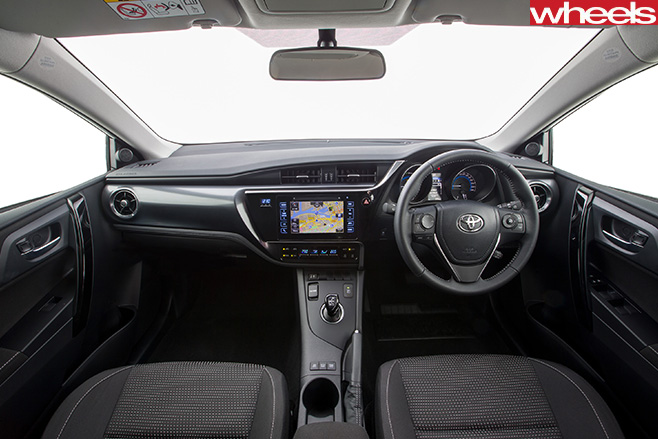
The Corolla Hybrid will only be offered as a single model (the Camry Hybrid has three trim levels) and will get more features than the popular mid-specification SX, such as LED headlights and dual-zone ventilation, for example, but won’t be as lavishly appointed as the leather-clad ZR that tops the range. The hybrid version of the Corolla also gains a double wishbone rear suspension in contrast to the regular model’s torsion beam set-up.
While pricing is yet to be finalised, expect it to come in well below $30,000 – and most likely below the $28,990 Corolla ZR.
Toyota is expecting it to appeal equally to private buyers and fleets.
The mid-2016 arrival of the Corolla Hybrid could also further squeeze the Toyota Prius, the Japanese carmaker’s environmental hero that has helped to popularise Toyota’s hybrid technology.
The Corolla’s most serious rival, the Mazda 3, does not offer a hybrid version. Mazda decided not to sell the 3 Hybrid that is available in Japan because it believed demand would not be strong enough.
Volkswagen has also opted not to sell the Golf hybrid, known as GTE, again because of predicted soft sales.
However Hyundai will later this year start selling its Ioniq, a small hybrid car designed to tackle the might of the Prius but also likely to have the Corolla Hybrid in its sights.
A new version of the Prius launches in Australia next month.
The Corolla topped Australia’s new-car popularity charts in 2015, selling 42,073 units as the market raced to a record 1.16 million sales.
Its nearest competitor, the Mazda 3, posted 38,664 sales for the year.
