
Mini’s brand new Clubman will raise eyebrows.
If not at least for its looks. However, while a little odd, the third-generation Clubman is yet the brand’s most resolved offering.
If the barn doors didn’t drop a big enough hint, the Clubman is about being able to lug around more than an Ikea pot plant.
With an extra 103mm of wheelbase woven in to a platform shared with both the 2-Series Active Tourer and Mini hatch, the new Clubman is so much longer than before it scores two new full sized passenger doors over its predecessor, and a proper boot.
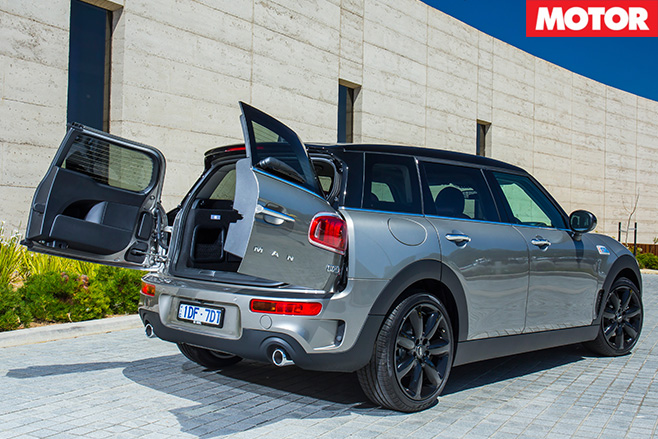
Along with the stretch job, Mini’s widened the Clubman, pumping out its track to make it the longest and widest offering in the range.
Climb aboard the Cooper S variant and you’ll also notice a new cabin layout when you plonk in its superb sport front pews.
Unlike the three-door hatch’s haphazard interior design, the Clubman’s is more compartmentalised, looks more resolved, and is finished with a mix of nice-touch-surfaces.
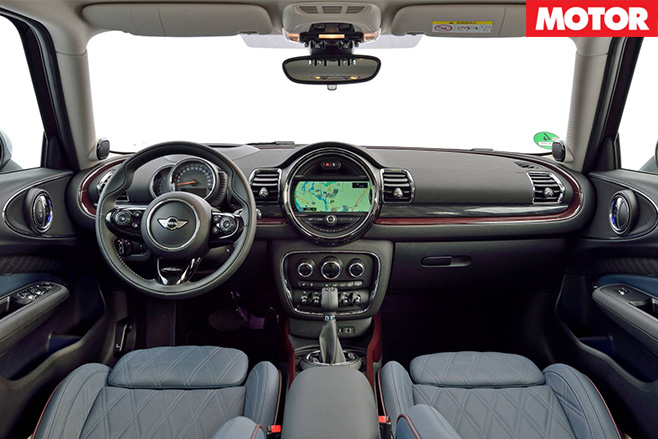
Its general ambience, defined by standard leather on the steering wheel and gear stick, will pacify posh tastes, while eccentrics will appreciate typical Mini details, such as when the polished metal starter switch lights red after you first stab the brake pedal – like a looming detonator.
Performance wise, though, the Clubman Cooper S isn’t very explosive.
If you had a blat in the Clubman Cooper S after another similarly priced performance hatch, you’d ask yourself: “is this it?”
After snacking on high-strength steel to reinforce its chassis, girth has become its biggest enemy.
And while its 2.0-litre turbocharged four manages a healthy 141kW and 280Nm, at 1360kg it will need 7.1 seconds to pass 100km/h. Even with its new eight-speed gearbox adding two ratios to the six the base Clubman makes do with.
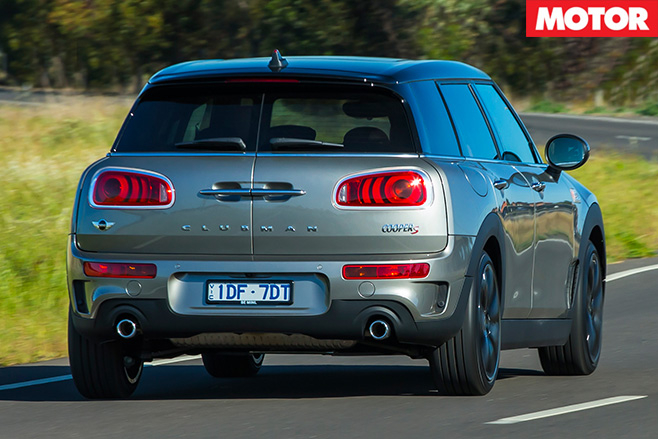
You can easily place the Clubman despite a steering system that feels lazy, and there’s a wonderful suppleness to its secondary ride that sees it smooth out unruly road terrain.
And yet, while it feels more planted than any other ‘practical’ Mini in the range –like the high-riding Paceman—it comes at no expense of the adjustability you’d find in a Mini hatch.
What ultimately stifles the Clubman Cooper S is its price. On one hand, few rivals offer the personality and charisma of such a car. And many will buy it purely on point of difference.
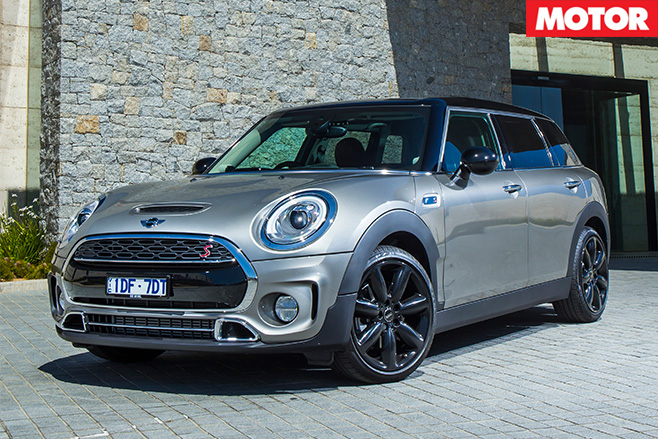
But at $42,990 for an automatic or manual variant, the Clubman Cooper S’s price drops it in the ring with the compact segment’s deadliest contender, the VW Golf GTI, which is just as practical, better looking, and significantly faster.
The Clubman Cooper S has glimpses of greatness, seen in its cushy chassis and interior. But it won’t be until a rabid JCW version, maybe, that the Clubman will raise eyebrows for the right reasons.
3.5 out of 5 stars
Specs
Engine: 1998cc, inline-four, DOHC, 16v, turbo Power: 141kW @ 5000rpm Torque: 280Nm @ 1250rpm (300Nm with overboost) Weight: 1360kg 0-100km/h: 7.1*sec (claimed) Top Speed: 228km/h (claimed) Price: $42,990
*automatic figures
Maranello, Monday morning. The weather forecast predicts a 99 per cent chance of rain.
Heavy rain. Though the atmosphere among the visitors – snapper, scribbler, PR man – is decidely chilly, the actual temperature is even colder, the gauge reading a mere 7.5C. It’s difficult to think of less appropriate conditions for tackling Fiorano, Ferrari’s test track, in the most ferocious Prancing Horse ever built.
But surely LaFerrari was engineered for such extreme conditions? Surely the ESC can cope, surely the track will dry when it stops raining later in the day. Surely. But right now, we must wait.
At last, the electric roller door opens and two LED headlights project into the gloom outside. Ferrari’s chief test driver, Raffaele de Simone, points at me, then at the passenger seat. Yessir, I’m coming, but give me two minutes to adjust the four-point harness.
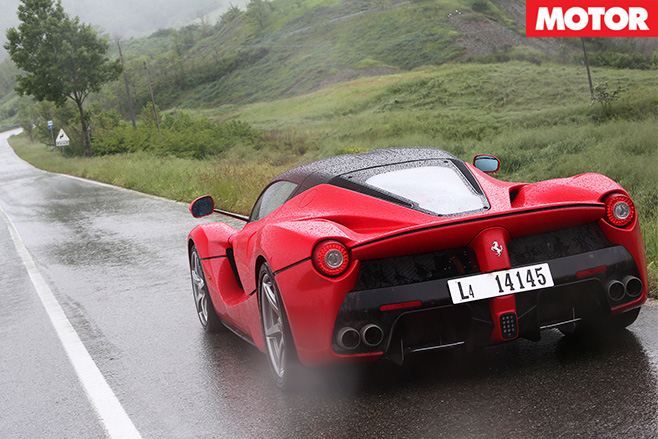
Now it’s my turn, but for a moment excitement turns to despair as it becomes apparent the one-size-fits-all seat carved into the carbonfibre passenger cell fits all but me (Georg stands well over two metres tall – Ed).
The only adjustable element is the pedal box, and it doesn’t slide far enough forward to accommodate my giraffe-like legs. A friendly mechanic removes the seat cushion and then the backrest. I feel like an idiot, but at least I can reach the pedals now, with the right shin chafing the knee bolster and the left thigh clasped solid in a vicelike position.
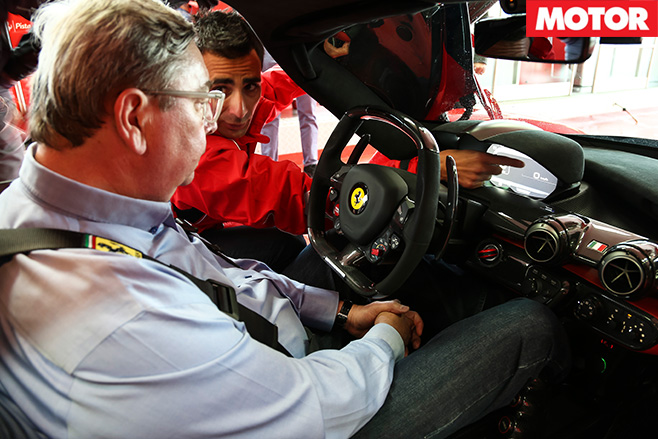
The all-new, full-width technicolour instrument panel appears to be almost at the same level as a head-up display, the quartic steering wheel sits unexpectedly close to the chest, and the scalp needs to find and occupy the only sweet spot which clears the massive gullwing door. Thanks to the deep cutaways in the sills, though, entry and exit are managed with something approaching grace.
During every Ferrari launch I have attended, they routinely call you back to the pits after five laps. One warm-up lap, three fast laps, one cool-down lap. Then the crew swarm out, adjust tyre pressures, check the brake temperature, clean the windscreen, interview the driver. Today, everything is different. There is more time to adjust. To the car, the conditions, the mix of fear and anticipation inside. If only there was more room to move.
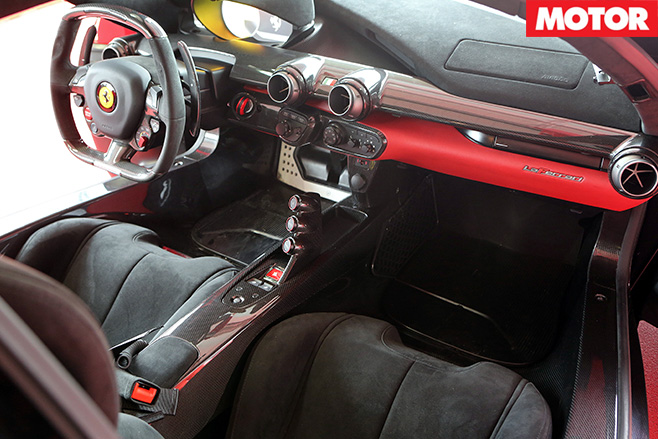
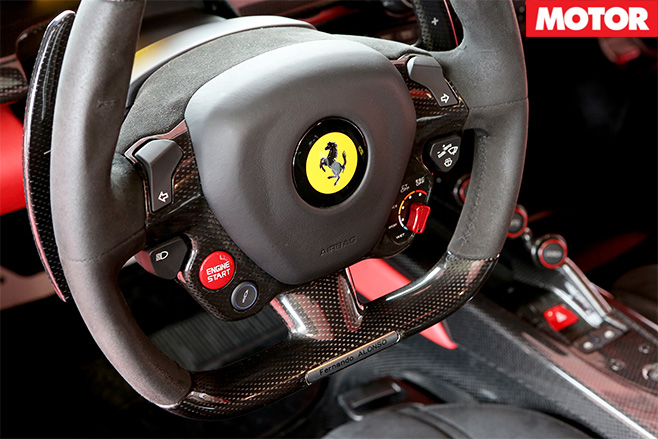
Opposite lock is reduced to a token gesture, especially in the rain when there is not enough front-end grip to establish a reassuring handling balance. The slim shift paddles must be the longest in the business, made possible thanks to the relocation of all the major controls from column stalks to the front of the steering wheel.
The first five laps are embarrassingly slow. I brake too early, turn in too early, step on the gas too late. Despite leaving the manettino in its default Sport setting, feeding 708kW and “in excess of 900Nm” (Ferrari press kits have never been particularly specific) through just the rear tyres creates drastic traction difficulties. After all, the all-wheel drive Bugatti Veyron had just 28 more kilowatts.
The next five laps are more coherent, but while the specially-made 345/30 ZR20 Pirellis warm up quickly, the fronts struggle for grip, understeer increasing with each lap. I pit and ask for advice.
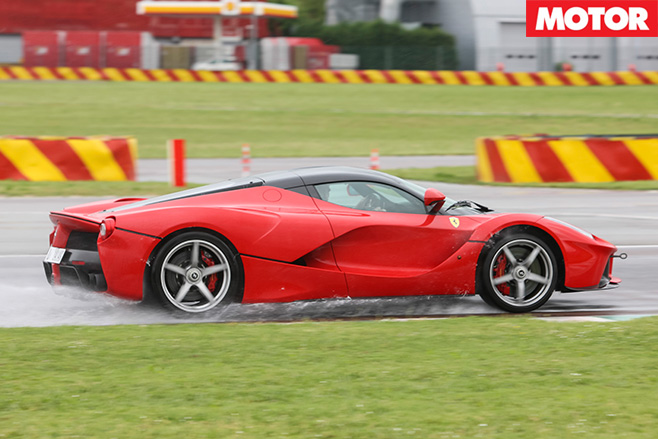
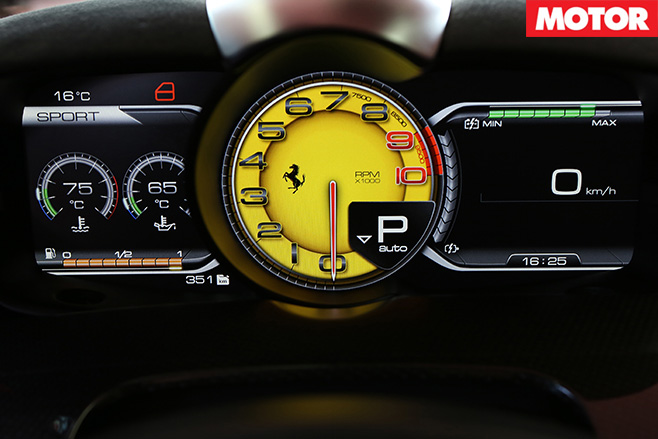
Three laps later, the character of the car has changed completely. With the tyre temperature display now showing four green symbols, the bespoke P Zeros are beginning to conquer the moisture, so at the end of lap 15 I venture into Race. Down the straight, I dare to push the mighty 6.3-litre V12 to its 9250rpm limiter for the first time in third and fourth gear before braking, again too early, for the right-hander that follows.
The incredible powertrain utterly dominates the experience. While you’re never consciously aware of its operation, the 120kW/270Nm electric motor is always providing assistance, beefing up bottom-end torque before letting the 588kW V12 have its head as the revs soar.
The hybrid system exists exclusively to boost performance, which meant weight was a key factor. The entire hybrid system, consisting of a high-voltage generator that replaces the alternator, 2.3kWh lithium-ion battery pack, dual-clutch transmission hooked up to the electric motor, cooling system and the power electronics complete with inverters and converters, weighs just 146kg.
Like the 918, LaFerrari recuperates energy under brakes, but, unlike the Porsche, from the rear wheels only to avoid the cost, complexity and weight associated with an electric front-wheel drive system.

As a result, the performance figures read like something out of George Lucas’s imagination: 0-100km/h in under 3.0sec; 0-200km/h in under seven; 0-300km/h in 15.0sec and a top speed “in excess of 350km/h”.
With the numbers in mind and a reputation to uphold – both mine and Maranello’s – it’s time to get our act together and put this beast to the real test. This is easier said than done. The approach to turn one, where the pros hit an indicated 270km/h, is a palm-moistening 230km/h even in the wet.
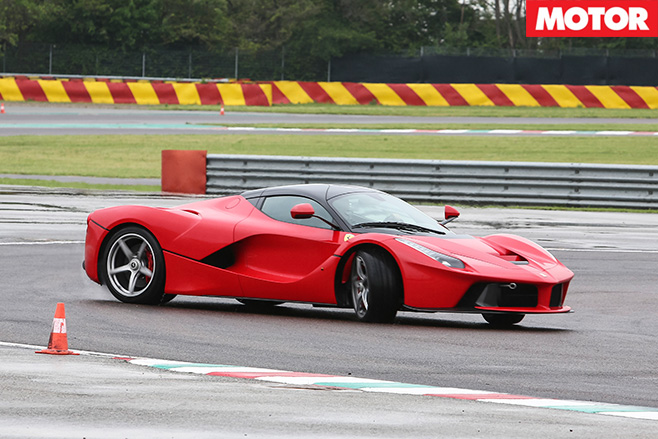
With an extra helping of courage, through the following corners LaFerrari slips into ground effect mode, sucking itself to the tarmac like Brabham’s infamous ‘fan car’.
The supporting act consists of five underfloor flaps – three in the front and two in the rear – which modulate the air flow for enhanced cornering grip or maximum velocity. At 200km/h, the aero kit increases vertical load by 360kg.
It takes a while to get used to these suction-cup talents, but after 20 or 25 laps I am slowly beginning to get the hang of it. Geared for total efficiency with no further input required, this is a very special, if somewhat eerie, driver assistance system.
As always, trust builds confidence, confidence breeds courage, and courage is required to explore the limits of adhesion and ability. Although it’s still pelting down, LaFerrari and I now and then consciously overstep the mark. Even in comparison to the 458, the steering is ultra-quick, changing direction so promptly the term oversteer gains a whole new meaning.
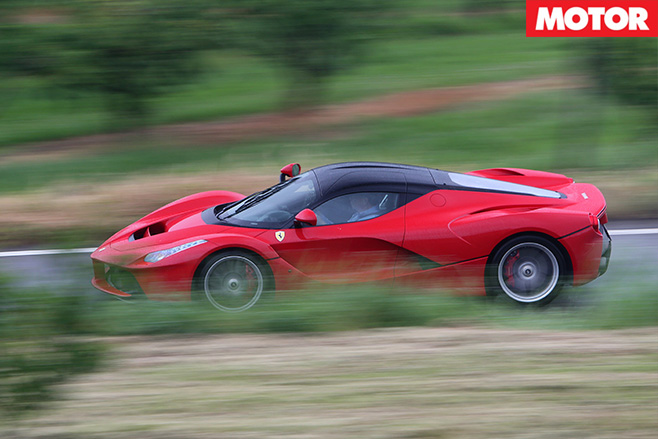
Fiorano, late Monday afternoon. It’s still raining, the sombre light looks suspiciously like early evening, and the men in their red anoraks are about to call it a day. After lunch, we complete seven more laps before disappearing for a three-hour blast through the Maranello hinterland, becoming a mere red streak through the lush green hills from Vignola to Pavullo and back.
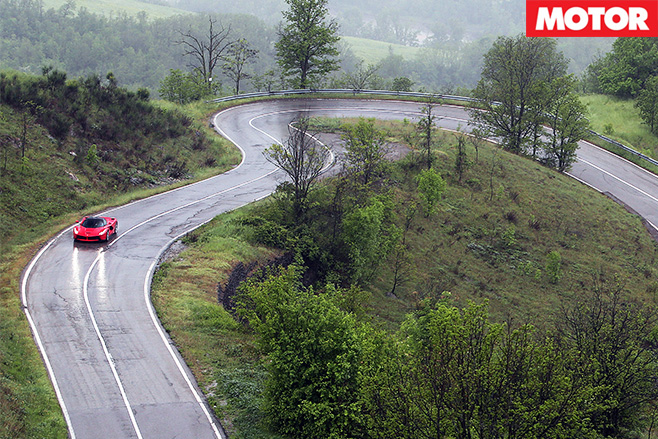
Can we please come back on a sunny day? Fat chance. All 499 LaFerraris are long spoken for, despite the steep asking price of €1,190,000 ($1.77m). The even more extreme FXXK version, of which only 30 units will be made, will not be road-legal, but perhaps we can get a go in the Spider, which is bound to be even more exclusive and expensive than our tight-fitting, fixed-head plaything.
Living quarters Ultra-compact passenger cell allowed the bodywork to be shrink-wrapped around it. This created both a narrow glasshouse and the opportunity to use the bodywork to influence airflow. Access issues solved by creating deep cutaways in the car’s sills.
Spreading the load LaFerrari’s centre of gravity is an incredible 375mm, 65mm lower than a 458 and 75mm lower than a Toyota 86. The HY-KERS system places a crucial role in this, lowering the powertrain by 35mm, as does dispensing with conventional seats. It’s the key to LaFerrari’s incredible stability.
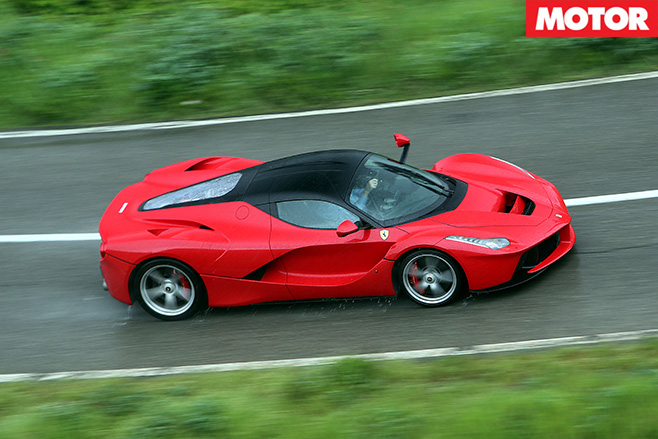
Diffusing the situation LaFerrari has no conventional wings. Rather, its downforce is produced by a series of hidden motorised flaps that automatically change at speed. There is one hidden in the nose cone, one on the car’s trailing edge and five under the floor. Together, they produce 360kg of downforce at 200km/h.
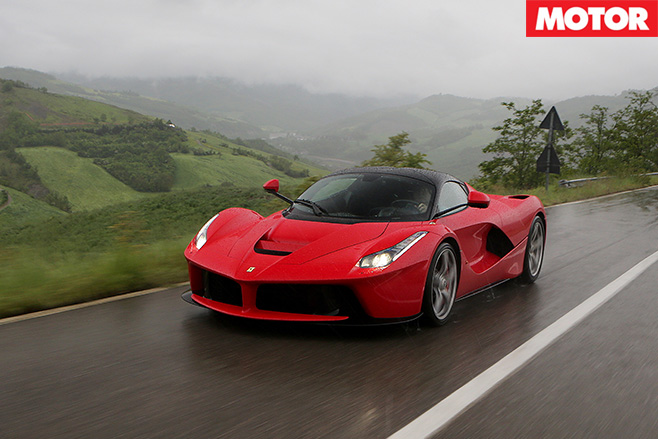
5 out of 5
| u00a0 | u00a0 | Laferrari |
| Body: | u00a0 | 2-door, 2-seat coupe |
| Drive: | u00a0 | rear-wheel |
| Engine: | u00a0 | 6262cc V12, DOHC, 48v |
| Bore/stroke: | u00a0 | 94.0 x 75.2mm |
| Compression: | u00a0 | 13.5:1 |
| Power: | u00a0 | 588kW @ 9000rpm |
| Torque: | u00a0 | 700Nm @ 6750rpm |
| Electric Motor: | u00a0 | 120kW/270Nm |
| Power-to-weight: | u00a0 | 495kW/tonne |
| Combined power: | u00a0 | 708kW |
| Combined torque: | u00a0 | over 900Nm |
| 0-100km/h: | u00a0 | under 3.0sec (claimed) |
| Top Speed: | u00a0 | over 350km/h (claimed) |
| Consumption: | u00a0 | 14.1L/100km (claimed) |
| Emissions: | u00a0 | 330g/km CO2 (claimed) |
| Transmission: | u00a0 | 7-speed dual-clutch |
| Weight: | u00a0 | 1430kg |
| Suspension: | u00a0 | A-arms, coil springs, adaptive damper, anti-roll bar (f) A-arms, coil springs, adaptive damper, anti-roll bar (r) |
| L/W/H: | u00a0 | 4702/1992/1116mm |
| Wheelbase: | u00a0 | 2650mm |
| Tracks: | u00a0 | 1545/1553mm (f/r) |
| Steering: | u00a0 | electrically assisted rack-and-pinion |
| Brakes: | u00a0 | 398mm ventilated/drilled discs, 8-piston calipers (f); 380mm ventilated/drilled discs, 6-piston calipers (r) |
| Wheels: | u00a0 | 19 x 9.5-inch (f); 20 x 13.0-inch (r) |
| Tyres: | u00a0 | 265/30ZR19 93Y (f); 345/30ZR20 106Y (r) Pirelli P-Zero Corsa |
| Price: | u00a0 | $1.77 million |
| Positives: | u00a0 | Otherwordly performance; seamless integration of technology; incredible presence |
| Negatives: | u00a0 | Otherwordly price; intimidating near the limit; mere mortals unlikely ever to drive one |
WEC: Webber bags first-ever championship in Bahrain thriller
MARK Webber and his fellow racers in the #17 Porsche 919 Hybrid – Brendon Hartley and Timo Bernard – have taken the 2015 World Endurance Championship after an enthralling, rollercoaster final race of the season, the Six Hours of Bahrain.
Webber, 39, had never previously won a championship of any description.
Struck down with engine issues whilst leading early, Webber and his teammates fought back with some spirited driving only to be hit again with problems in the final hour.
Ultimately, their championship triumph was determined by the efforts of Neel Jani, Marc Lieb and Romain Dumas in the #18 sister Porsche to grab their first race win of the 2015 season from the rival title contenders, Marcel Fassler, Benoit Treluyer and Andre Lotterer in the #7 Audi R18 e-tron quattro.
It was so desperate, so tight.
The weekend started with a flourish for the #17, Hartley and Bernhard combining to take the crew’s fifth consecutive pole.
Bernhardt duly jumped out to a strong lead, but thoughts of an easy run to the title ended abruptly after half an hour when #17 limped to the pits with throttle actuator problems. It re-joined after almost nine minutes with a makeshift repair – plastic cable ties saved the day – but more than four laps down.
After that, and as day turned to night, the trio went flat-out in a glory-or-bust effort from way back.
Webber took over from Hartley with 2.5 hours remaining, but there was yet another cruel twist. In the last hour, #17 was forced to make another unscheduled pit stop with an actuator problem, but it clung on to fifth at the finish.
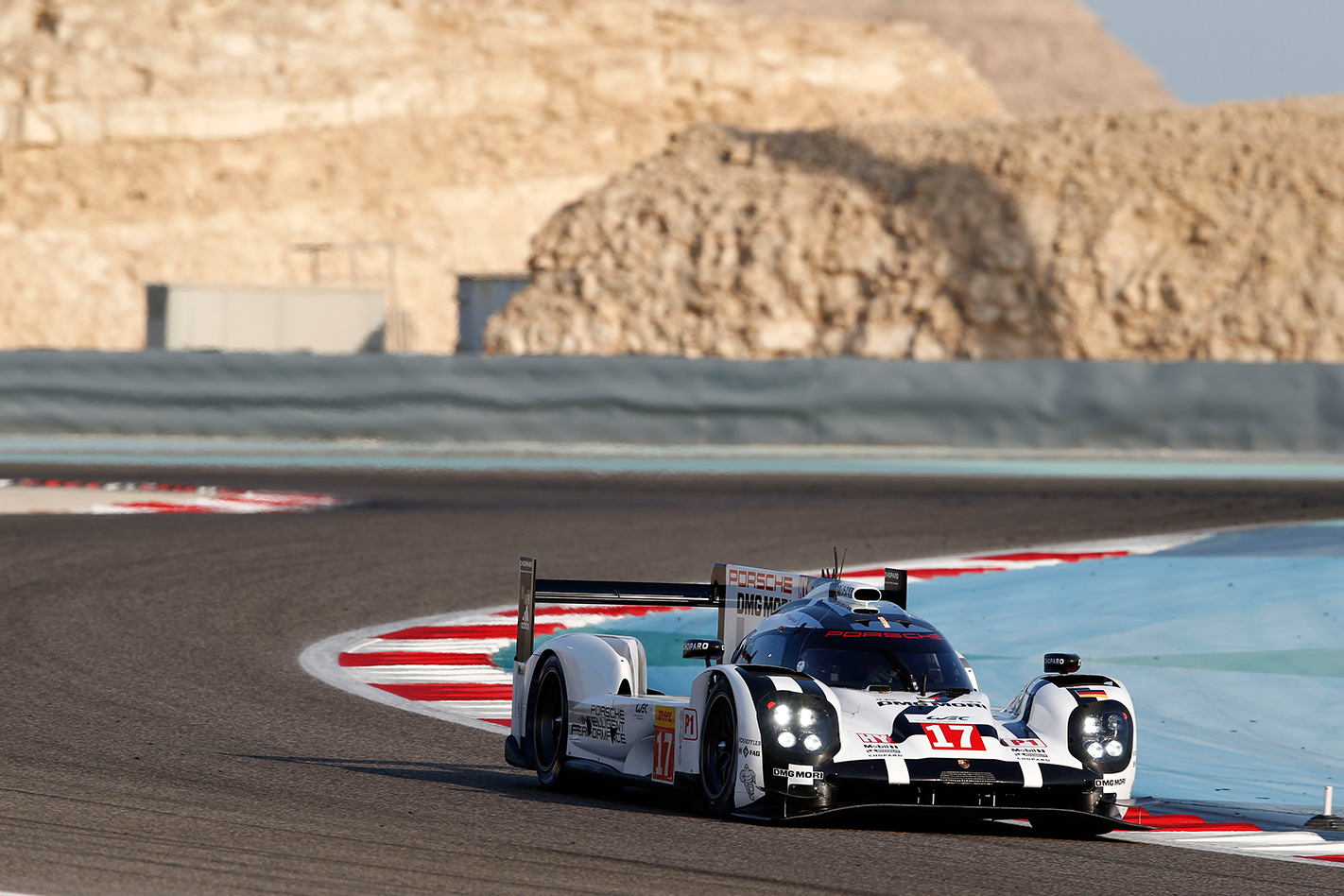
After eight rounds of a brilliant WEC, the winning margin in the drivers’ standings was a mere five points.
“Today clearly shows the qualities of the team,” said a delighted, yet relieved Webber, a champion (officially) at last. “We have had some very smooth days this year, but we executed the victories with clinical precision.
“Today was about fighting as hard as possible. You saw the spirit of the mechanics; you saw the spirit of the drivers. I cannot thank the mechanics enough.
“The pit stops we had in the garage were extremely stressful. It’s amazing that we were able to win the world championship under pressure like this. I am so proud to be world champion with Timo and Brendon, and with Porsche.”
Although inevitably competitive wherever he raced, the WEC marks Webber’s first championship victory.
Okay, he did win the 1996 Formula Ford Festival in the UK, but that and not a true title series.
He attracted notice with a fourth in the 1995 Australian Formula Ford Championship, and was second the following year in the British Formula Ford Championship, finishing that first season abroad with a win in the Formula Ford Festival.
Webber became an official Mercedes works junior driver for the 1998 FIA GT Championship, alongside reigning champion Bernd Schneider. The pair won five of the 10 rounds on their way to second in the overall standings, beaten to the title by teammates Klaus Ludwig and Ricardo Zonta by just eight seconds in the final race at Laguna Seca. Eight bloody seconds!
In 2000, he was runner-up in the International Formula 3000 Championship. In Formula One he was a contender but third-place finishes in three grand prix seasons were his rewards in the top category.
Ultimately, Webber became disenchanted with modern F1 due to politics, the need to manage tyres designed to wear out after a dozen laps, and the reliance on team-mandated strategy rather than balls-out competition. He exited and headed for the challenge of the World Endurance Championship.
Impressively, the Webber, Hartley and Bernhard triumvirate edged stellar opposition led by Audi, the manufacturer that until Porsche’s return absolutely dominated prototype sports car racing from the turn of the century.
Bahrain also marked the end to the professional track career of the respected Alex Wurz, after a successful 23 years in the sport.
A two-time Le Mans 24 Hours winner (and still the youngest after his 1996 success), a podium visitor in F1 (with Benetton and Williams) and a mainstay of both Peugeot, and more recently Toyota’s LMP1 WEC campaigns, Wurz has a rich motorsport CV.
And it was pleasing, too, to see another nice guy bow out with a podium.
V8 SUPERCARS: Lowndes powers closer at the Island
THE scenario that series frontrunner Mark Winterbottom and the Prodrive Ford team have feared most has materialised – the V8 Supercars championship will go to the wire, to be decided at the finale held on the often-fraught street circuit at Homebush, where the unpredictable is usually the norm.
Winterbottom remains in the box seat to take his first V8 Supercars title – he holds a chunky advantage over only rival, Red Bull Holden’s Craig Lowndes – but his stress levels on Sunday week will be higher than he would prefer.
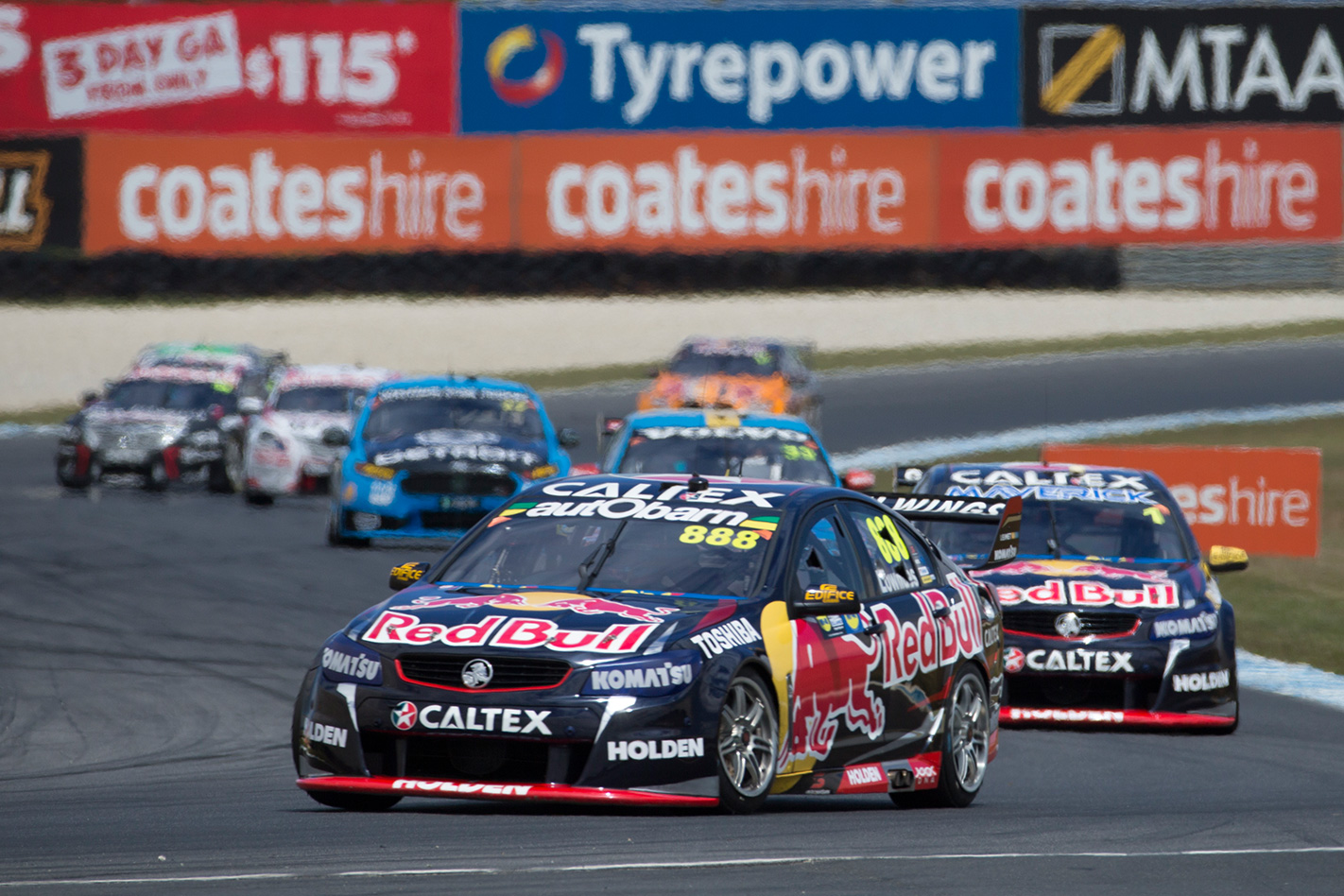
A total of 300 points are available across the three races of the Sydney 500. But Lowndes says it really is a championship for Frosty to lose.
“With a 179 point lead, as long as he drives smart and clean and keeps out of trouble they should have enough of a points gap to walk away with that number one,” Lowndes said. “But we won’t stop fighting until the chequered flag on Sunday.”
Heading to his home town for the decider, Winterbottom, will be feeling the pressure of knowing he is something of a Lone Ranger for Ford since teammate Chaz Mostert banged himself up at Bathurst.
At Phillip Island, after Saturday’s race, Winterbottom insisted the Holden teams were involved in some gang warfare. Agreed, said the men in red with brutal candour.
By Sunday, though, Frosty had hardened up. Even after Lowndes’ teammate Jamie Whincup mugged him dropping down into the right-hander after Lukey Heights and stole a podium spot on the final lap, Winterbottom was more diplomatic.
He called Whincup’s barging thrust underneath him a good move, even though it cost him nine points, the difference between third and fourth.
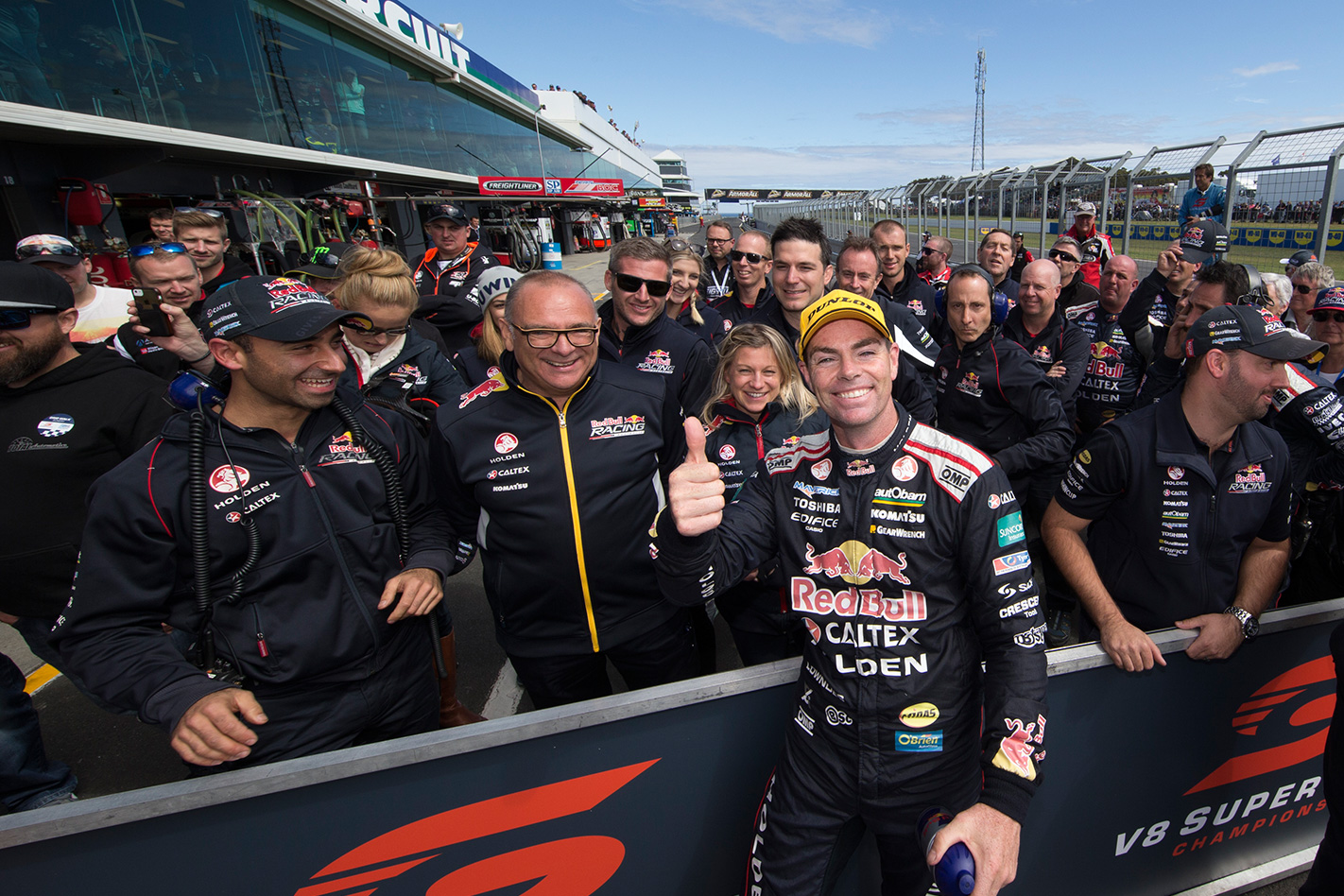
“I’m super happy with the team. We had a lot of issues this weekend and to repair it and get the engine in and put it on pole today it’s not that bad so finishing fourth is not as good as we expect from the team after this year but when you’re not quick enough you have to do what you can do.”
But Winterbottom will be uneasy that the Red Bull Holden duo dominated and has hit a peak at such a crucial time.
Volvo GRM’s Scott McLaughlin had a solid couple of days taking a pole on Saturday and podiums in all three races.
The Nissans also looked stronger, Todd and Rick Kelly finishing fifth and sixth yesterday. Still, the major talking point, and a source of serious aggro between the parties involved was Shane van Gisbergen’s Holden tapping a tune on the rear of Prodrive driver David Reynolds’ Falcon before hooking him into a frightening high-speed spin at the Hayshed in the first race on Saturday.
Reynolds finished last as a result, effectively ruining his title hopes after coming into the weekend in second place.
“He was drilling me a few corners before, drilled me at Siberia and must’ve got the tiniest little overlap – I don’t know I was just turned around at high speed,” Reynolds said on the telecast.
“I don’t know – it’s a really, really silly thing. Stupid, man, really stupid.”
The Kiwi was defiant, even after being docked 25 championship points, a penalty that many felt way too soft.
IMSA: Briscoe with factory backed Ganassi Ford GT squad
AUSTRALIA’S vastly experienced and versatile Ryan Briscoe will be a part of the Ford Chip Ganassi Racing team that will field two Ford GTs in the IMSA Sports Car Championship in 2016
Joining Briscoe in the quartet selected for full-time rides in the full IMSA series next year are Richard Westbrook, Dirk Müller and Joey Hand.
Hand and Müller will share the #66 Ford GT, while Briscoe and Westbrook take the reins of the #67 Ford GT.
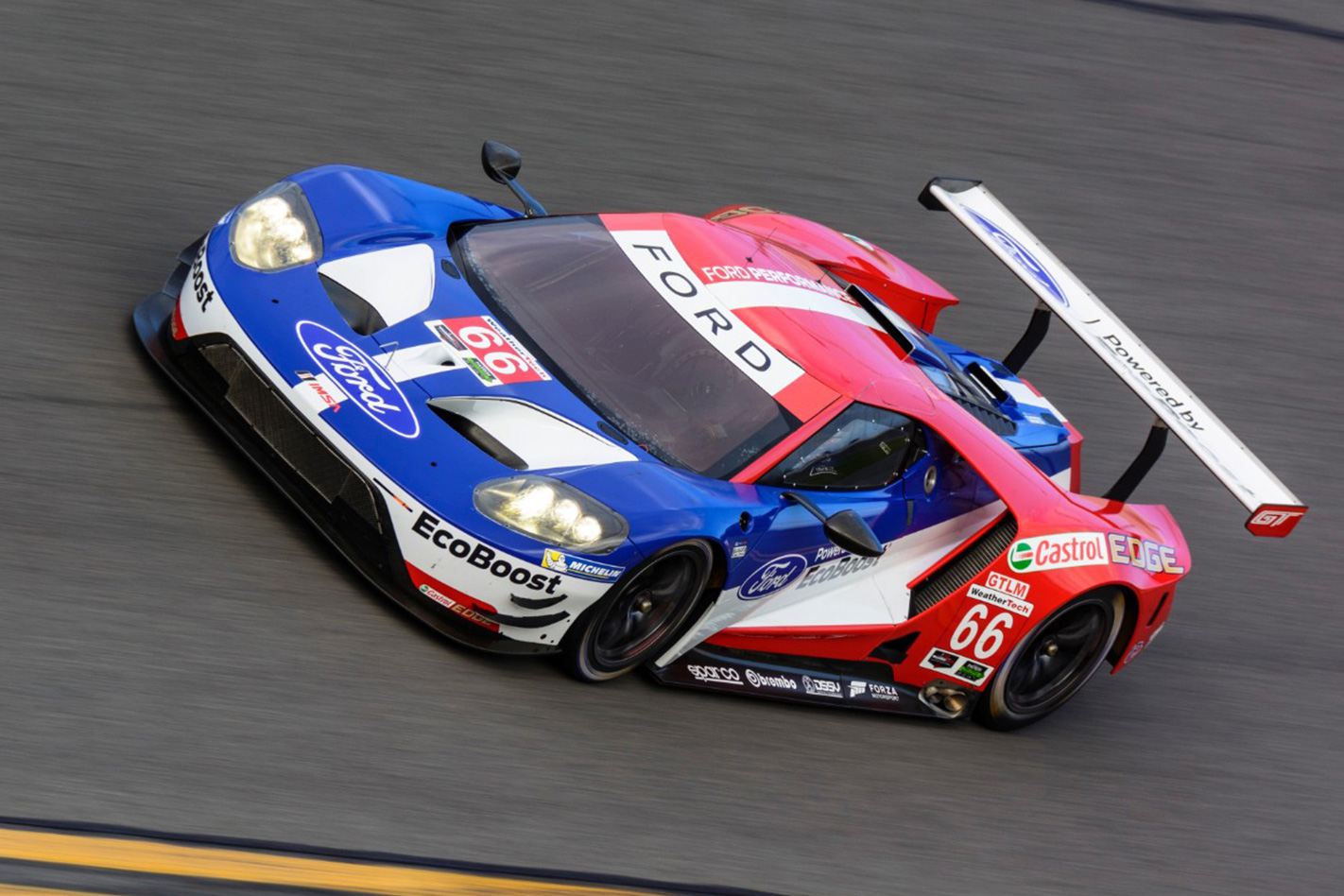
“What I look for in a driver first of all is heart,” said Chip Ganassi, owner of Ford Chip Ganassi Racing. “At this level, all drivers are fast. We want drivers that can work well with others. Drivers that have endurance car experience. Drivers that have been to Le Mans.
“All these things add up. It’s a team of drivers that act like they’ve been together for quite a while already.”
Ganassi’s team has already banked seven IMSA championship titles, 46 wins and has six overall victories at the 24 Hours of Daytona.
Briscoe and Ganassi are old partners. The Sydneysider launched his IndyCar racing career in 2005 driving for Target Chip Ganassi Racing, and was also a driver of the team’s 2005 Rolex 24 At Daytona entry. He has won 12 IMSA races to date. This year he shared GTLM class victory at Daytona and Sebring.
RALLY AND RACE: Citroën announces its future
CITROEN has laid out its plans for its future participation in global motorsport with its emphasis very much on world rallying, and a parting of the ways with legendary driver Sébastien Loeb after 15 years together.
A strategic withdrawal from the World Rally Championship next year is part of the process. However, Citroën will be back in the WRC from 2017 with a car based on a model complying with the FIA’s new technical regulations. So it doesn’t weaken its development of the new car, the Citroën Racing team has chosen to put its WRC activities on hold next season.
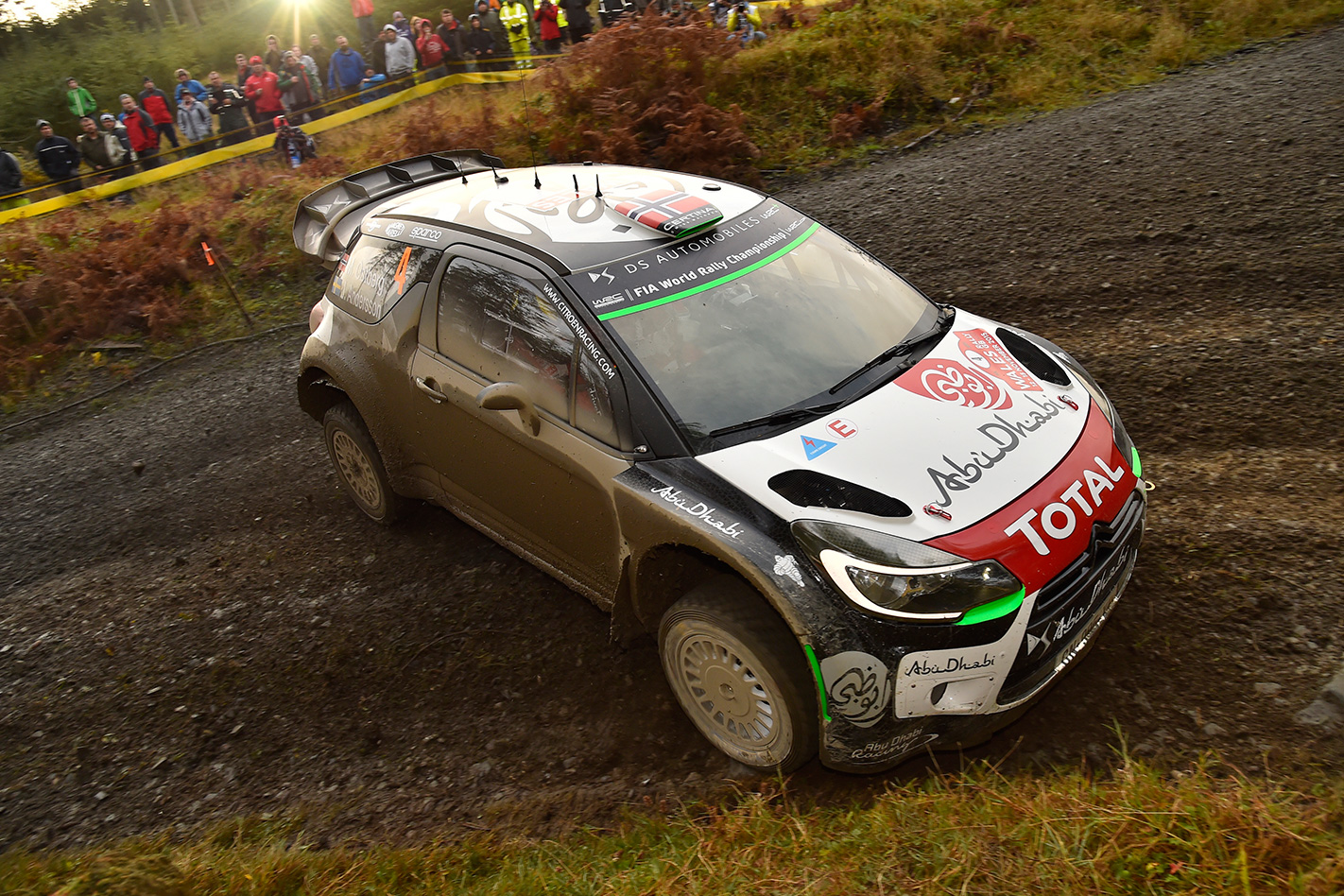
Gone from the team is nine-time world rally champ Sebastien Loeb, who is looking to concentrating on Dakar-type events with Peugeot.
Many rally fans have been outraged over the apparent elbowing of the greatest rally driver of all time. Settle, folks, settle: Loeb has simply moved on to a sibling brand within the group. He has a new challenge.
Collectively across a number of programs, Citroën has won an incredible 15 world titles over the last 22 years: five in the Cross Country Rally World Cup, eight in the WRC and two in the WTCC.
Choosing to put a renewed effort into world rallying was an easy call, with the WRC set for major expansion into China, the world’s biggest car market, and a broader television coverage.
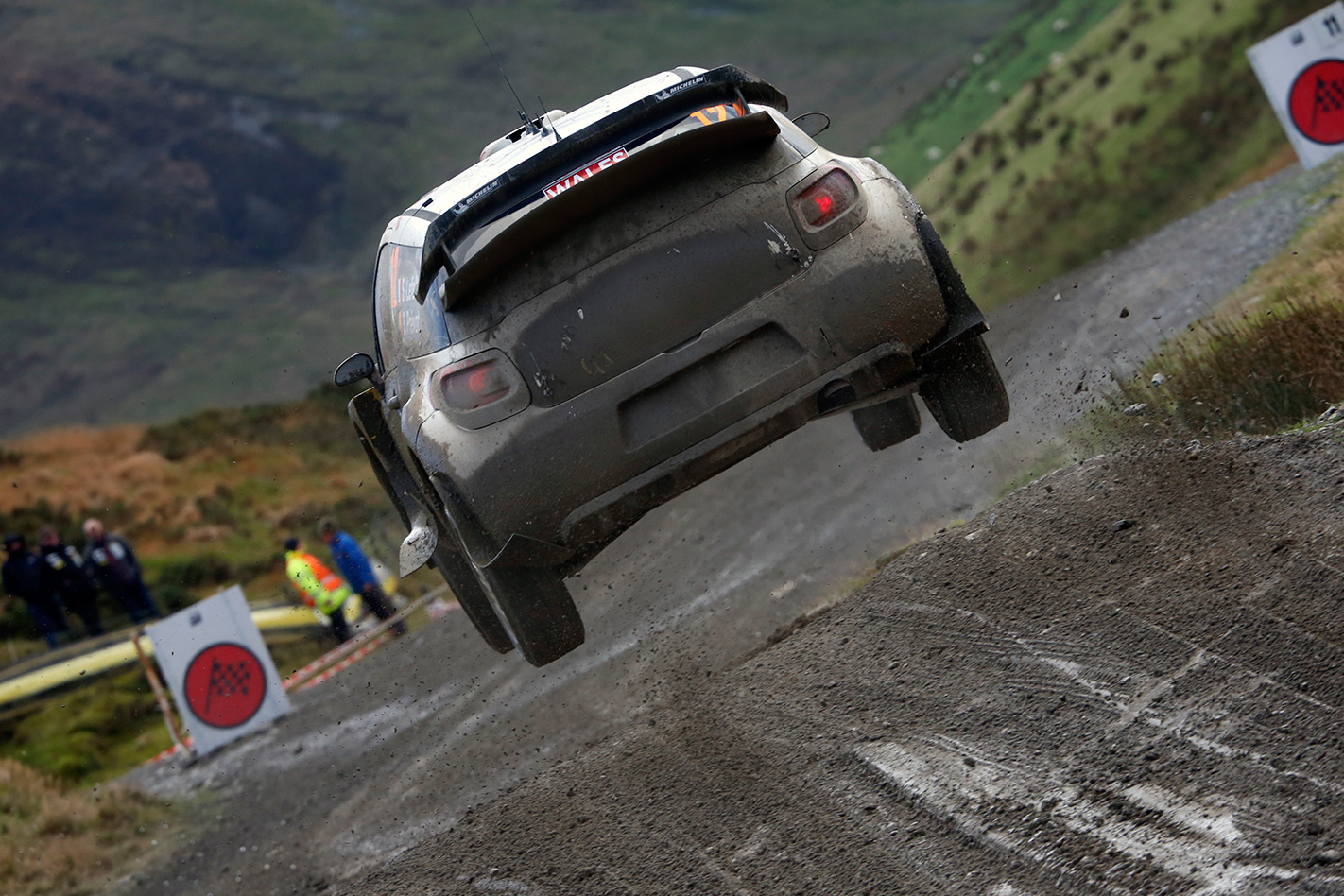
“In 2017, the appearance of a new generation of cars, which are purported to be very attractive, will coincide with our renewed involvement.”
The 2017-generation machines are wider, more powerful and meaner looking, with imposing aerodynamic features.
Ironically, the last time Citroen pulled out of the WEC for a year, Sebastian Loeb took the title … in a Citroen.
Honda has been dormant far too long. The Japanese giant used to be an engineering colossus, dominant in almost every form of motorsport, whether it be on four wheels (F1, Indycar), two wheels (MotoGP) or no wheels at all (powerboat racing).
This technical supremacy then trickled down into its road car range. It seemed no vehicle could escape the go-faster treatment; sure there was the NSX and the Integra Type R, but there were also tiny turbocharged city cars, and even the staid Accord family sedan received the Type R treatment.
Thankfully, there are signs of resurgence. It’s finally returned to Formula 1, though perhaps the less said about that the better, so let’s concentrate on the new Civic Type R (though we’re not getting it here), as well as the new NSX.
But we reckon there’s untapped potential in the CR-Z. Contrary to popular belief, Honda’s hybrid hatch is a great drive, it’s just the price is a joke and it can barely get out of its own way in a straight line. Here are a few tweaks that could unlock its hidden potential.
WHAT A SCREAM! Forget turbos, what Honda does best is screaming atmo engines. The CR-Z’s dull 99kW 1.5 is going straight in the bin, replaced by a highly tuned version of the Civic’s 1.8. Around 150kW should prove sufficient, but don’t call us until the redline starts with a nine, okay?
SPOILER ALERT It wouldn’t be a Japanese hot hatch without some aero addenda, hence the appearance of the optional ‘Mugen’ kit, consisting of that huge rear wing, aggressive front bar, ground-scraping side skirts and lightweight 18-inch wheels.
CLEAR OUT No normal-sized adult human has ever actually managed to sit in the back of a CR-Z. Therefore we’re junking the rear seats, giving the CR-X plenty of room for track tyres or Hello Kitty figurines.
HYBRID HELP It’ll be sacrilege to some, but the CR-Z’s batteries are staying. There’s no way its hi-po atmo engine would pass modern emissions tests without them. Thankfully, Honda’s F1 involvement will have those batteries producing twice the power with half the weight.
STICKING POINT Brembo calipers clamping ventilated discs all ’round will provide plenty of stopping power, while rubber choice will be crucial in providing a balance between grip and entertainment. We’re not chasing lap records here, so the Cup tyres can stay on the shelf.
You’re dreaming of an overseas driving holiday but first, it’s worth taking five to check you know all the obscure eccentricities before you put pedal to metal and a stress-free break turns to strife.
First things first: Your International Drivers Permit. Once it was standard to hit the NRMA or RACV up for an International Drivers Permit to demonstrate that you’re a competent driver. Most countries have streamlined and now accept your current Australian license along with passport proof that you are just visiting. The ‘just visiting’ bit can be key. In many states of the USA, for example, if you stay in the state over 30 days you are expected to apply for a local driver’s license, including passing the driving test.

In Europe, most hire cars have a manual transmission and in the USA? Book your car in advance. Worth noting are these lesser known but nevertheless key criminal acts you will want to avoid: drinking water and driving in Cyprus, driving shirtless in Thailand, driving a dirty car in Russia and driving while wearing a dressing gown in California. But there is one country in the world that women don’t need to know any of these rules, because baby, you are not allowed to drive.
In Saudi Arabia women can own cars, they just can’t drive them. To be clear, there is no formal law that actually makes driving illegal for a female, but the government refuses to issue women licenses. That would make it a religious edict, but there is nothing in the Koran suggesting women shouldn’t drive and no other Muslim country bans it – so it’s a Saudi thang.
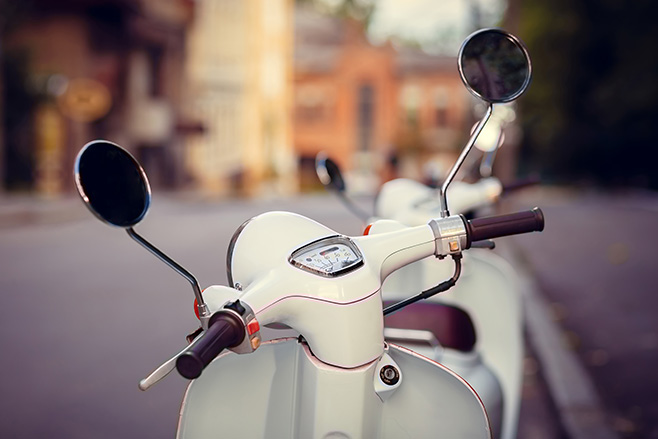
Curiously, since 2013 women in Saudi Arabia have been permitted to ride bicycles and mopeds, which makes the car ban even more baffling. Surely there is more leg and thigh gap on a bike than driving a car? Good to know this loophole though, because unless you have a male relative or spouse with you, women are not even allowed to passenger in a car. The solution? Either a bike or a limo with really heavy tinting and a simpatico driver.
Perversely, some western women choose to celebrate their freedom by visiting countries where other women appear oppressed. If that sounds like you, some insider advice might come in handy. In Pakistan locals refer to the verbal harassment of women as “eave-teasing”. The good news if you are Lahore-bound is that you can catch a “Pink Rickshaw” and avoid all contact with men while travelling in public. This might be easier than renting a car from a misogynist. In India you can ride a motorcycle and – as a woman – you are not obliged to wear a helmet. Apparently it’s about helmet hair…
You can drive in Yemen, another deeply conservative country, as long as a male gives you permission to leave the house. Women drivers are on the rise in Yemen where it is deemed a safer mode of transport than the bus. Driving in China on the other hand may be one of the closest near death experiences you will have. Although visitors and tourists are not permitted to drive in China, I was granted a temporary Chinese driver’s license in 2012 in order to drive a fuel cell car for Mercedes, from Xian to Beijing, and I am still scarred. Bear in mind that driving-age Chinese did not play with tiny toy cars. Driving is a relatively new concept and licenses are a matter of money not skill. It’s not uncommon for a Chinese driver to come hurtling down the wrong side of a four-lane highway leaning on the horn to clear a path. Oh and, the pavement is considered a legitimate passing lane.
Burma is another country where your own driver’s license doesn’t get a look in. You can apply for a local license in Rangoon but be aware that most of the cars are right-hand-drive and Burmese drive on the right. So, while the car looks and feels like home, remember to keep it on the right.
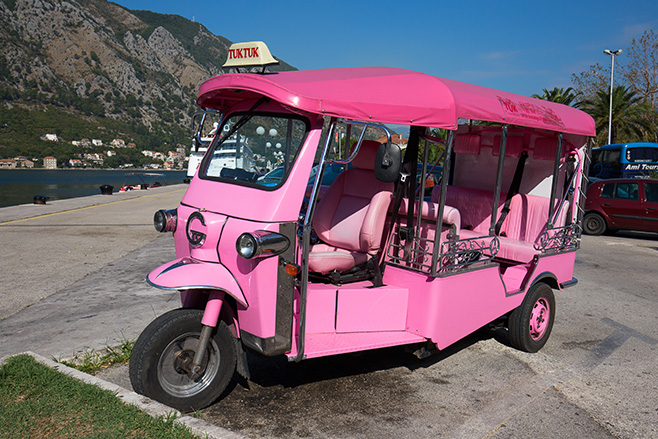
Worth noting also that, regardless of fault, if you hit a pedestrian in Burma, you are to blame. With this in mind, Burma might be another one for rickshaws and limos. Burma’s neighbours, Thailand and Vietnam, are good with your Australian license, but Cambodia also requires you to get a local license, even to ride a motorcycle or scooter. Your Cambodian license is good for a year so plan a longer holiday to get your money’s worth.
One final hot tip for a holiday filled with happiness. Don’t drive – period – In Johannesburg. Known as the car-jacking capital of the world there are over 10,000 carjackings every year in South Africa. Many drivers carry guns, even flame-throwers. You can’t compete.
Aloha!
So, what is it?
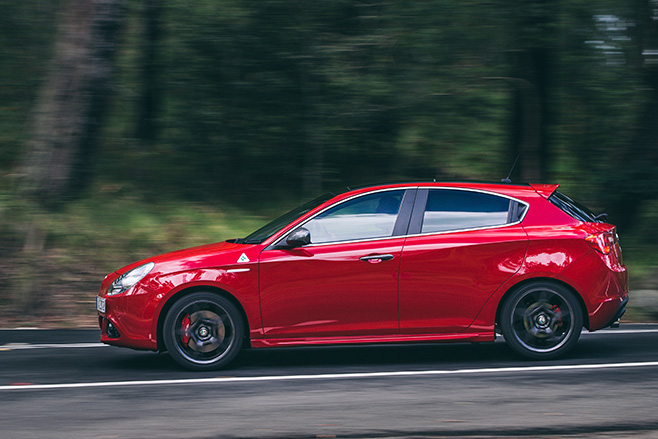
An Italian, winning the Targa Florio, in an Alfa Romeo; a testa di benzina’s dream that came true in 1923 when Ugo Sivocci conquered Sicily’s gruelling open road race at the wheel of the lightweight Alfa RLTF sports racer.
Sivocci’s car wore a green four-leaf clover symbol for good luck, and ever since his victory, Alfa Romeo racing cars have been adorned with the ‘Quadrifoglio Verde’ logo. And this Giulietta QV is the latest road-going Alfa to borrow some of that performance heritage and continue the tradition.
Why should I care?
Alfa’s mid-engine, mini-supercar, the 4C, is designed to position a shimmering performance halo over the entire brand, and this upgraded and mildly face-lifted Giulietta QV will benefit from that reflected glory (not to mention some of the 4C’s hardware) in a renewed push against established hot hatch players like the Mini Cooper S, Ford Focus ST, and VW Golf GTI.
What’s new about it?
Centrepiece of the 2015 QV is an all-alloy, direct-injection version of the 1,742cc turbo four, stolen directly from between the 4C’s axles. Like the 4C, it’s matched with a six-speed dual clutch ‘box, while unlike the 4C, a six-speed manual is also available (although engine output drops by 4kW in that configuration).
A new intake system, imaginatively titled ‘QV Intake Engine Sound’, is claimed to amplify the engine note, and the Giulietta is launch control equipped for the first time in the QV.
Alfa spotters should look for ‘Quadrifoglio Verde’ emblems on the front guards, as well as gloss Antracite finish on the exterior mirror housings, grille, door handles and fog light frames. Inside there are revised instruments, a new flat-bottom wheel, redesigned front seats, plus a new 6.5-inch ‘Uconnect’ multimedia touchscreen is built into the dash.
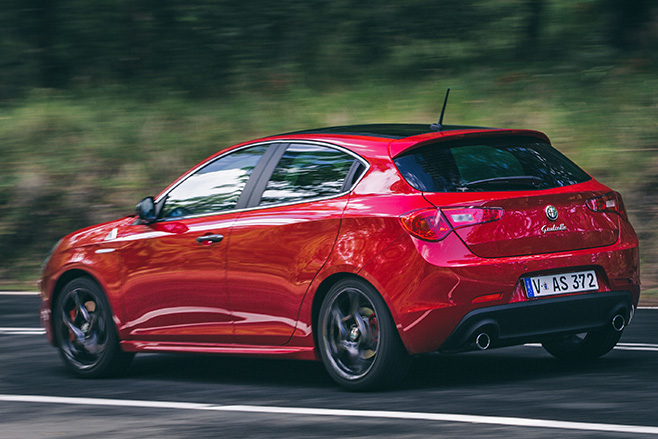
That’s all fine. What’s it like to drive fast?
Launch drive for the new QV Giulietta took in large sections of the ‘old’ Pacific Highway north of Sydney towards the NSW central coast, and first impressions were dominated by the engine’s meaty thrust and pitch-perfect note.
Power delivery is impressive, but far from linear, with a distinct boost of intercooled turbo assistance coming on stream at 5,000rpm as revs climb towards the point of peak power (5,750rpm).
The TCT dual clutch is quick and positive, with flappy paddle shifters adding to the fun in manual mode, and the driver-adjustable ‘DNA’ (Dynamic-Natural-All weather) system effectively manages engine, brake, steering, gearbox and throttle settings.
As the name implies, Natural is a default mode with stability and traction controls in full operation, DST (Dynamic Steering Torque) steering guidance (by braking) is enabled, and throttle response is ‘normal.’ Push the console switch forward into Dynamic and steering assistance is reduced, stability and traction controls are dialled back, and throttle response is sharpened.
The QV’s moderately lowered suspension maintains the car’s balance in quick cornering, with the nose remaining resolutely stuck to the tarmac, only starting a progressive push into understeer under extreme duress.
Braking is progressive and powerful, thanks to Brembo four-piston calipers up front, clamping 320mm ventilated rotors, and the DNA’s ‘Pre Fill’ function ensures the braking system is pressurised before the driver hits the brake pedal if it senses a hazardous situation.
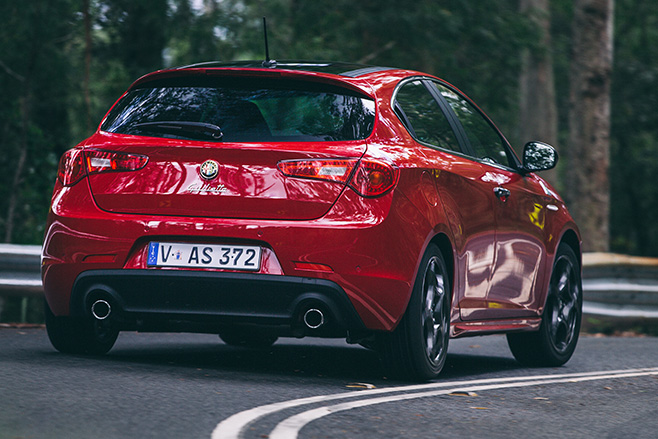
And driving from home to the office in the city?
Tweaks to the interior design dial up the sophistication quotient. The refreshed, leather-trimmed wheel looks and feels good, alloy sports pedals add a racy touch, and dark roof lining contributes to a cool ambience. The Bose nine speaker audio (including subwoofer) cranks nicely.
Is there anything bad about it?
The QV picture isn’t all rosy, with design and dynamic niggles making their presence felt.
We found the driver’s seating position to be problematic, with the relationship between the pedals, seating hard points, and forward raked steering wheel, making it difficult to find an ideal set-up. For the record, this tester is slightly above average height (183cm) and weight (88kg), with roughly even trunk to leg proportions.
Casting a critical eye around the interior we came across numerous rough and/or sharp edges on plastic moulded parts. And while steering weight is fine, road feel isn’t where we expected it to be.
Last gripe centres on the standard Dunlop SP Sport Maxx TT rubber; impressively grippy, but surprisingly noisy on all but the smoothest surfaces.
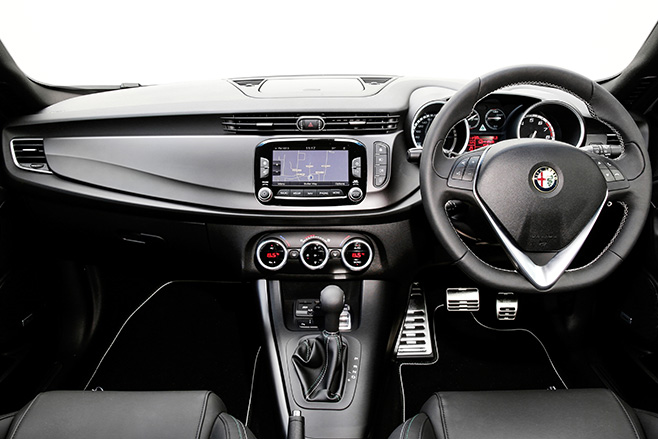
How much would I have to pay for one? And is it worth the coin?
List price for the Giulietta QV is $39,000, and the example we drive was one of 50 ‘Launch Edition’ units (25 Alfa Red, 25 Matte Magnesio Grey) weighing in at $45,000, boasting carbon fibre mirror housings, carbon spoiler, plus a front air dam, rear diffuser, and side skirts in dark finish.
The ‘standard’ car is line-ball with the Focus and Cooper S, while the Launch Edition is in Golf GTI territory. Worth the coin if you’re after an ‘individual’ hot hatch option.
Would you take the Alfa Giulietta QV or the VW Golf GTI?
It’s closer than you’d think. The Alfa is quicker in a straight line (0-100km/h in 6.0secs v 6.5) and in base form undercuts the Golf by more than five grand. But the Golf has the edge in terms of dynamics and build quality. We’d go the Golf.
Click here to find out more about the Alfa Romeo Giulietta.
THIS is it, the full rundown of the 43 eligible vehicles for our 2016 COTY award. And, no, you didn’t read that wrong. COTY 2016.
For the first time since the award’s inception in 1963, Wheels COTY will be branded with the year in which the award is announced, rather than when the testing took place. It’s a mild tweak to the world’s longest continuously running motoring award, one that now reflects the winner’s year of reign.
With prices stretching from $12,990 driveaway to half a million dollars, the list of eligible vehicles for the gruelling seven-day judging process is among the most diverse in the award’s 53-year history.
Only one will win. As editor Glenn Butler points out, COTY ain’t about giving everyone a gong, it’s about rewarding the best and highlighting the standouts.
“Yes, its purpose is to identify the Car of the Year,” Butler said, “but COTY plays a significant secondary role recognising the year’s exciting cars that had an impact on the broader market.”
In addition to Ford’s highly anticipated Mustang, the field includes Mercedes-AMG’s even more muscular GT S, with its twin-turbocharged V8, while BMW’s radical i8 supercar teams three-cylinder petrol power with electric motors for a 266kW carbonfibre punch. BMW has high hopes the i8 will defend its COTY crown, fresh from the controversy of the brand’s first win with the i3 electric car last year.
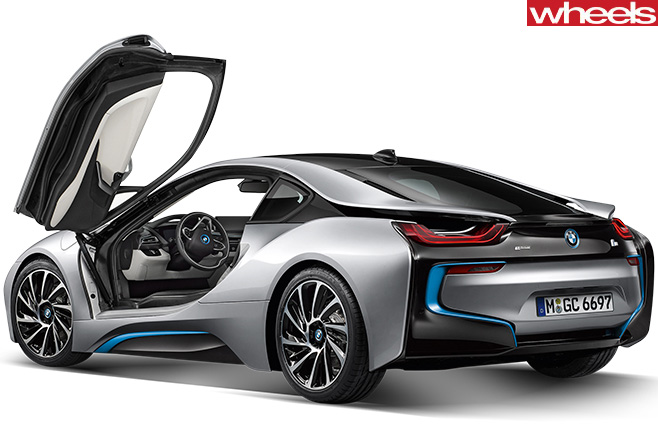
Small SUVs spearhead the charge, with the new Mazda CX-3 and Honda HR-V leading the influx of predominantly on-road, high-riding vehicles. Then there’s the Jeep Renegade and its mechanical twin, the Fiat 500X, and the long-awaited Vitara replacement from Suzuki. Throw in Renault’s cute Captur and it’s a bumper compact SUV field that’s indicative of a market increasingly overriding tradition.

There’s also an all-new nameplate in the form of fledgling Chinese brand Haval – one of 25 that could front Australia’s most experienced and hard-nosed judges – with three SUVs (H2, H8 and H9). Haval is almost unheard of in Australia, but it sells more SUVs in China (the world’s largest car market) than any other.
Our extensive list of SUV eligibles includes a host of luxury offerings in the form of the Mercedes-Benz GLC (a crucial new mid-size for the BMW X3 and Audi Q5) and GLE Coupe, the latter bringing some three-pointed-star flair to the category created by the BMW X6. Speaking of which, there’s also a new version of the X6, which refines the SUV-coupe formula.
BMW also has its new X1, complete with front-drive underpinnings and some Aussie design influence from Calvin Luk.
Audi’s second-generation Q7 makes the list, having shed 325kg of its substantial bulk to bring newfound agility to the sizeable seven-seater.
Land Rover’s Discovery Sport arrives with a famous nameplate wrapped in smaller packaging, but it’s the cleverness of this Freelander replacement that could make it a COTY dark horse.
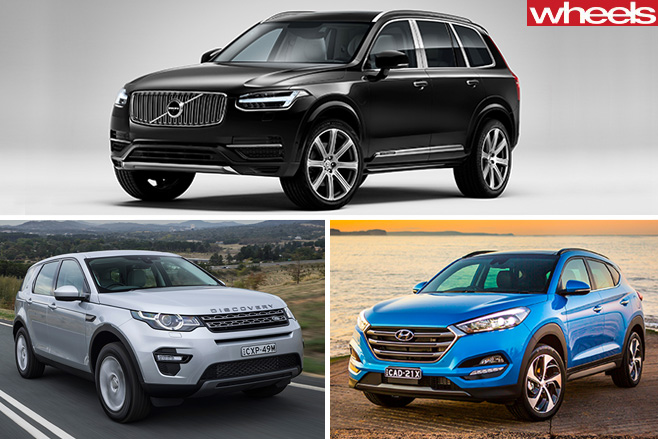
Rounding out our flood of SUVs are two designed with off-road conditions in mind.
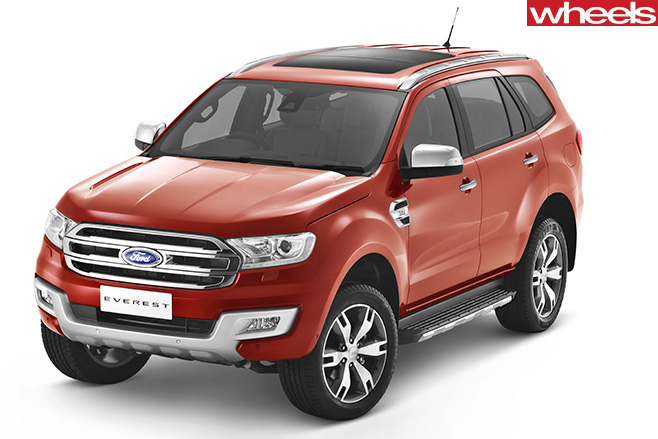
The Ford Everest was developed extensively in Australia and is being produced in Thailand alongside the Ranger ute on which it’s based, while Toyota’s Fortuner – also the result of local engineering input – is a revival of the concept behind the once popular 4Runner, teaming new-gen Hilux mechanicals with a seven-seat body.
Nissan has its new NP300 Navara – an all-new iteration of the popular dual-cab, and the first ute in its segment to eschew rugged leaf springs in favour of more controlled coils at the rear – and Mitsubishi’s all-new Triton also makes the field.
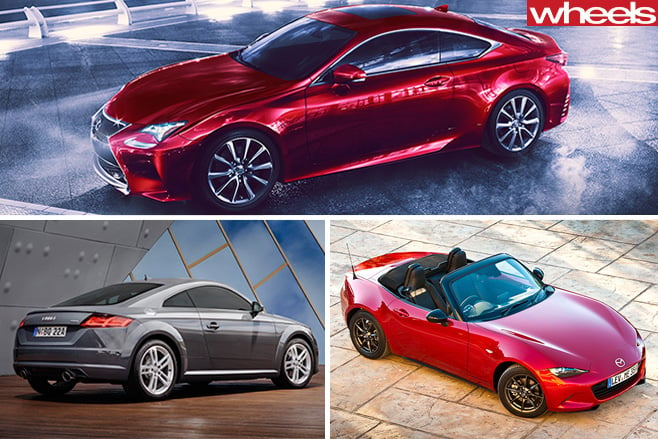
From workhorse to track warriors, Alfa Romeo’s 4C is waiting patiently on the dummy grid. The super-focused carbonfibre two-seater is billed as the renaissance of an Italian brand that’s been flailing for decades. It signals a new dawn for Alfa and that momentum should carry through to the forthcoming Giulia that we’re already looking forward to featuring in next year’s COTY.
Other sporties include Audi’s third-generation TT – in both coupe and roadster guises – and the Lexus RC that comes with a rare (for 2015) inclusion of a naturally aspirated V8.
The most expensive vehicle eligible for Wheels COTY 2016 is the Mercedes-Benz S-Class Coupe; the top-whack S65 AMG model – complete with a twin-turbo 463kW/1000Nm V12 – sells for $498,610, about 40 times more than our most affordable contender. Never let it be said that this competition is anything but a broad church.
Straddling the ground between sports car and luxury sedan is Jaguar’s most exciting entry in years, the all-new XE. It finally gives Jaguar the firepower against the mighty Mercedes C-Class and BMW 3 Series.
When it comes to crossing over, BMW’s 2 Series Active Tourer arguably pushes the boundaries harder than most. Its high-riding body gives it some people-mover cred, while its compact dimensions ensure city-friendly manoeuvrability. How will the judges feel about the first front-drive BMW ever?
It wouldn’t be COTY without plenty of mainstream offerings and it’s been a big year, with a fresh Subaru Liberty, the return of the Hyundai Sonata (replacing the i45), a new Kia Optima, VW’s latest Passat, and (finally) a new-generation Ford Mondeo.

Aussie-made cars are again conspicuously absent from the list of COTY hopefuls.
The update to the Commodore, in the form of the VF Series II
with its excellent V8 option, simply isn’t enough to warrant an entry. Similarly, the largely new skin for Toyota’s Camry can’t hide the fact that what lurks beneath is largely unchanged.
Not that Holden will necessarily miss out on the COTY action; its Cascada convertible – a drop-top version of the soon-to-be-replaced Astra – is new to Australia so technically classifies for entry, even if the latest version of the affordable four-seat convertible has been around for three years overseas. That ought to be more than enough to iron out any teething production issues.
Kia’s Carnival cuts a lone people-mover path, bringing a new body that still offers the same eight-seat value that has made it a segment leader.
But it’s the affordable end of the market that offers so much COTY promise. Suzuki’s unassuming Celerio brings serious $12K value with a thrummy three-cylinder while Skoda’s Fabia packs plenty into its sub-$20K Euro package.
For now our challenge is to whittle those 43 eligible models – compromising more than 140 variants between them – down to a more manageable COTY field. By the time you pick up the next issue we’ll have that sorted. Hopefully.
New but not new enough for COTY
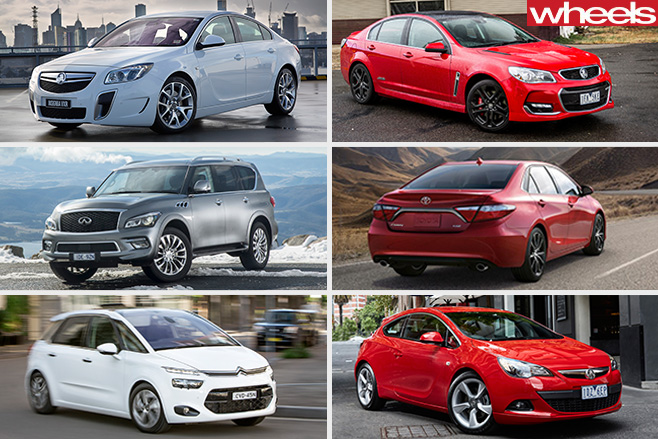
VF SERIES II A worthy update for the end of the Aussie Commodore line (V8-powered models are the standouts), but the body is unchanged, as is the chassis on all but SS-V Redline.
INFINITI QX80 It might be new to the fledgling luxury brand, but the QX80 is pure Y62 Nissan Patrol underneath, ruling it out of COTY eligibility.
TOYOTA CAMRY Billed as the biggest mid-cycle update ever to the popular mid-sizer, new panels can’t hide virtually unchanged mechanicals.
CITROEN C4 PICASSO It drops the Grand tag but doesn’t add enough of anything else, utilising the same platform and engine of the bigger people-mover in the Citroen family.
HOLDEN ASTRA Return of the Astra nameplate is big news for Holden, but the car is identical to the one that wore Opel badges here a couple of years ago.
Loud and clear
After the spirited discussion generated by last year’s victor, we’ve clarified the judging procedure and tweaked the five key points-scoring criteria.
This year’s event marks a step-change in transparency and inclusiveness, but reputations will still count for nothing and impartial objectivity reigns. And the winner will have gone through the industry’s most exhaustive selection process.
COTY remains our celebration of the cars of the year. The whittling process starts here.
Key COTY changes
- More inclusive selection process
- Minimum sales requirement scrapped
- Criteria refined to remove unknowables such as plant efficiency
- Award name now matches the year of reign
- …and no Peter Robinson, who for 43 years helped shaped the world’s longest-running award for motoring excellence.
A highlight this month was judging cars for the Australian Good Design awards, not only for the insights of my fellow judges but also for the all-too-rare opportunity to evaluate cars on innovation rather than outer-edge theatrics.
Sure, there was a test track available and photographers present, factors historically proven to be hormonally unsettling, but I’m pleased to report that, on the day, good taste prevailed.
And was duly rewarded. Satisfaction was sought, instead, not in the discovery of novel answers to old questions but, more importantly, of better answers. And that distinction is critical. Novel solutions to basic control functions simply add confusion to driving; better solutions, by contrast, turn a task into a pleasure.
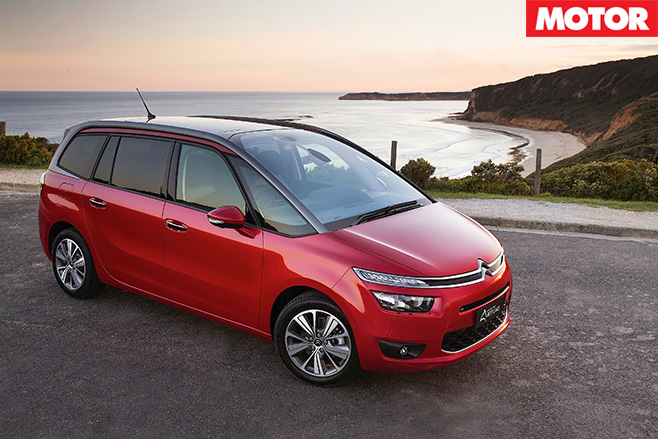
As they did again this year. Notably in Citroën’s Grand C4 Picasso, which offers advances in interior versatility, passenger consideration and work-station design that have won awards throughout Europe and now, after our assessment, in Australia.
And that’s one of the factors that distinguish design from style: the satisfaction is permanent.
Another, and perhaps more surprising difference, is that good design doesn’t add cost. To the contrary, its defining hallmarks of efficiency, elegance and economy can benefit every product that we make without the penalty of price.
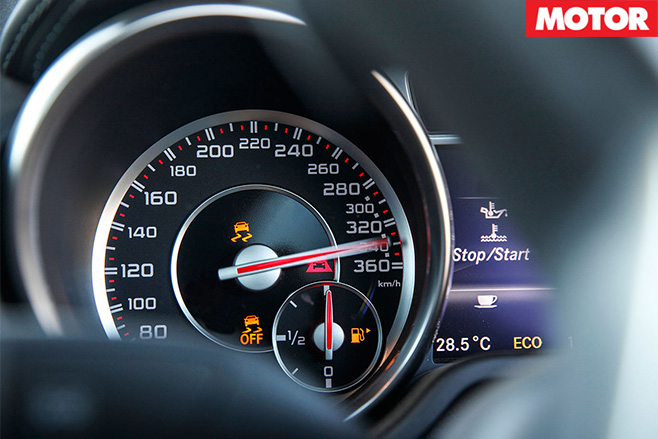
Which is why so many real advances in design have emerged in relatively inexpensive daily drivers rather than in high-end glitterbugs such as the $471,000 Merc I recently derided for boasting a never-to-be-savoured 360km/h speedometer rather than any attempt at usable innovation.
As a youngster I remember being amazed that, in Ford’s modestly priced Cortina, the family could cruise at speed on a summer’s day with the windows closed. Its simple ‘Aeroflow’ system, cleverly utilising natural forces, was to universally eliminate fiddly quarter-windows and remains the basis of virtually all automotive ventilation – and serenity – to this day.
That efficiency made the Mini not only the best-selling British car ever but reputedly, particularly in its sporting variants, a pleasure to drive. I say reputedly because I’ve never driven a Cooper S – if you have one anywhere near the Nepean Valley and, by coincidence, you’ve not tried an E-Type we should talk. But I digress…
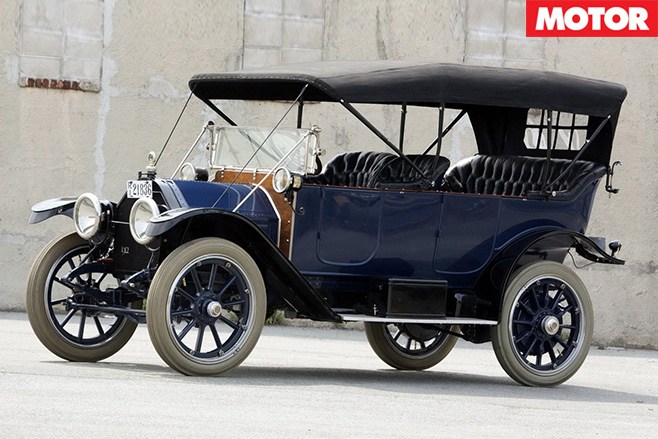
Which means the hunt for design advance can span the spectrum. Just as, perversely, can the discovery of idiocy ranging, on my watch, from Dodge’s current G-force meter (crazily on display mid-corner) all the way back to the original Land Rover Discovery’s ashtrays placed directly in front of its air-vents, that clearly reveals the maker’s grasp of reality. And that hunt, I believe, is an essential adjunct to any road-test.
Because design intelligence is the ultimate indicator of any new car’s potential for long-term satisfaction… and a far more laudable accomplishment than “3.26 seconds!”
Regular MOTORmag.com.au readers will no doubt have seen our recent drag race video between the Ford Falcon XR8 and Holden VF II Commodore Redline.
Well, on the day it just so happens that we had HSV’s new Clubsport R8 LSA to hand as well, so it would’ve been rude not to repeat the experiment and see what happened.
On paper it’s a bit of a one-sided affair, with the Clubsport’s 400kW/671Nm 6.2-litre supercharged V8 trouncing the XR8’s 335kW/570Nm.
As we know, though, Ford are being a little bit cute with the XR8’s official figures as it has an overboost function that can lift outputs by up to 15 per cent in the right conditions.
Is it enough for the $55K XR8 to give the $80K Clubsport a bloody nose? Both auto, both supercharged V8s, both very fast – but which one is fastest?
Senna? Hopeless at Trivial Pursuit. Loeb? I doubt he has ever won a meat tray at a pub in his life. And I don’t ever recall Brocky sitting opposite Eddie McGuire on Who Wants To Be A Millionaire?
Skill, talent and bravado behind the wheel win motorsport endeavours, right? Not quiz aptitude. So I ask that you consider this while I report that MOTOR has contested the Italian Connection Trophy road rally. And come last.
No, not last in category. Not ‘done poorly’ or ‘towards the bottom’. Bloody. Stone. Cold. Motherless. Last. Place. Outright.

It’s primarily a social grand touring event, and secondarily a charity run to raise money and awareness for Duchenne Muscular Dystrophy, a rare, ultimately terminal illness affecting one in 3300 males.
Some 800km of punting Australia’s finest twisties is supplemented by off-street elements such as timed motorkhanas, speed trials and lap sprints. All right up MOTOR’s alley. But the ICT bases its main competitive component on navigational skills (oh dear) and how adept entrants are at answering cryptic questions related to the route (oh very dear). So while Berry and I brought our game faces, turns out it was for the wrong game.

For starters, Fiat/Chrysler Oz supplied an Abarth 500C EsseEsse (aka, someone else’s car), good for 118kW/230Nm before you factor in its mod of an optional freer-flowing exhaust system.
The best optional extra, though, was its Michael Gee enhancement – a tireless Tassie lad who shadowed our white-on-white rag-top in a Jeep Grand Cherokee piled with supplies (aka, someone else’s fuel, tyres, helmets and credit card) as support crew. The most packed by half of the rest of the field was a sharp pencil for the quiz sheets and a picnic lunch.
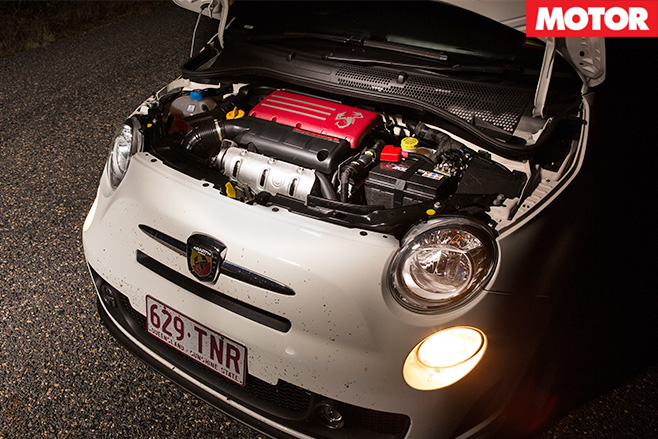
At scrutineering, a fellow competitor remarks that the Abarth is a quick breed, to which I respond it would be if we figure out how to activate its launch control system (which, I’ve heard, isn’t so much as mentioned in the owner’s manual) for “stage one”. He shoots me a look which clearly asks “why the bloody heck will you need launch control?”
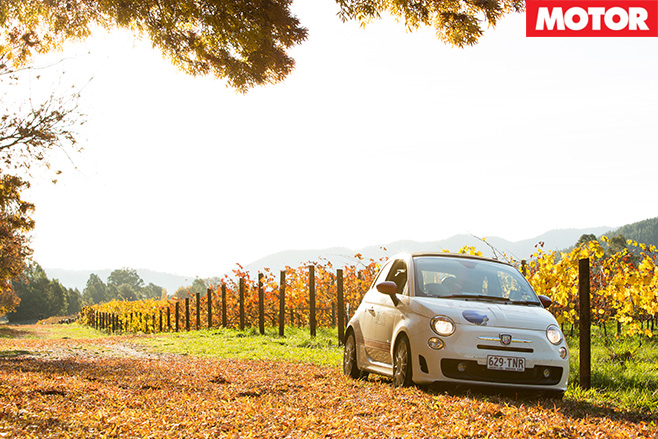
Of course, I blame Berry. And a lack of caffeine. And the car, which, even at $38,990 (a $4000 premium over the hardtop EsseEsse), has no sat-nav. I’d also noticed, well into Thursday’s 550km transport stage from Sydney to ICT’s base camp of Albury, that there’s no cruise control either.
It turns out the ICT, which isn’t strictly for Italian marques, is a bit of an Abarth-fest. We’re the only soft-top among a gaggle of five Abarth, meaning three of MOTOR’s direct rivals are 50kg lighter (1035kg) three-door tin-lid hatches sporting conventional five-speed manuals.
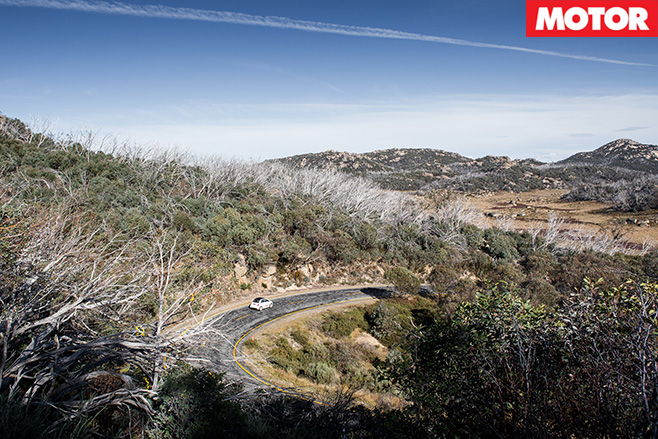
The flag drops, we blow the outskirts of Wodonga on a snaking 200km beeline toward Mount Hotham and I start strategising where I’m going to start rounding up our Abarth nemeses when, 15 kays in, Berry commands me to pull over.
“Scouts Australia is the parent body of what group?” he says. Pardon…? And so begins the quiz component of the rally, some 73 brain teasers spread over three days and two states that rely on observation, Sherlock Holmes-like deduction and the Abarth stuck firmly in Park on the side of the road. And I think to myself: why?
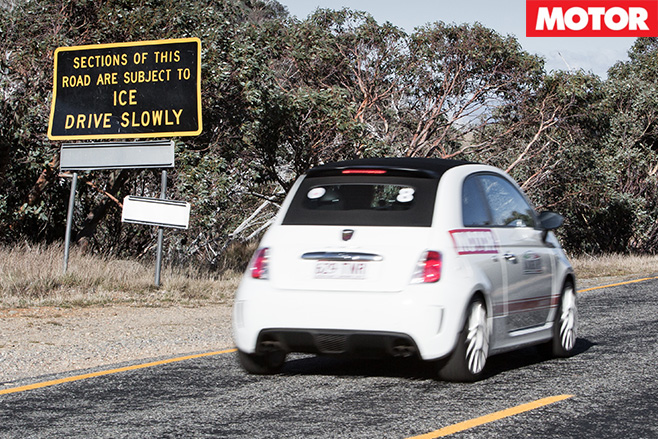
It’s simple really: success in ICT is as much – if not more – down to the co-driver as it is to the driver. Success or failure is largely down to those in the left-hand seat – the spouses, children and grandparents. Family-friendly motorsport, then, in the most literal and proactive sense.
That said, the driving component is brilliant. Mitta Mitta to Omeo could be the most relentless 100km stretch of tight, hard-attacking corners in Oz. And when the route gets challenging and serious, ICT suspends the quiz component from the itinerary. So as we climb Mount Wills, the 1.4-litre turbo strung off its redline, I’m surprised at my co-driver’s request to pull over. And not in the quest for trivial answers. Berry’s car sick.

It’s humiliation. So I do what any responsible team leader should do in such situations: I share Berry’s woes with anyone I can think of via electronic media. “I don’t get car sick,” Berry later retorted. “It was just a slight unsettling of the inner ear.” Sure.
By the time the wonderful Hotham Heights-Bright loop returns to Albury to complete day one, we’re placed 15th in the running and nowhere. But we’ve sampled some stunning roads, some of them even the correct ICT ones, to make the bottom order.

During 2014’s unseasonably fine May, though, it’s all smooth running, and the Abarth is proving as sharp as its pilots are blunt. We’re tumbling down the order like a pair of drunken clowns. At dinner, we discover we’re in last place. There’s another day to go.
In pathetic desperation, Team MOTOR Fiat – well, Berry, mostly – resorts to attempted cheating by trying to butter up three ICT veterans in a Valiant Regal to provide us with correct quiz answers. They shrewdly demand gold to the event’s sponsor charity in trade. Ruthless, I tell you.
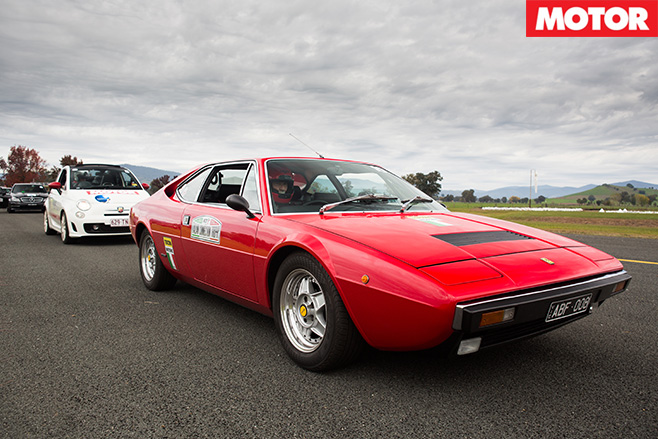
Motorkhana One, run one is a flurry of hapless steering inputs and handbrake butchery. Run two feels tighter and quicker…until an official informs me I ballsed up the cone sequence. D’oh. Fourth quickest though and our dignity, at last, begins to turn a corner.
Motorkhana Two is one run only. So a full kamikaze approach is the only way. Halfway along I clip a cone, copping a brutal five-second penalty. So imagine my surprise to find out my penalised time was still third quickest outright! Sans the cone infringement I’d have topped the table by two full seconds… We’re back!
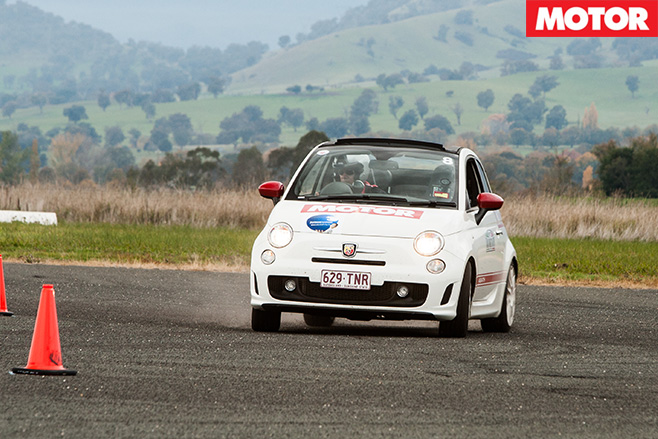
The event’s final road loop, some 144km to the Logic Driver Training Centre in Wodonga, is time to cool the heels and get the game face straightened up. Berry and I have now clocked up nearly 2000 kays in the Abarth and its driving position – all arms and no legs – is taking its toll on my back.
But, jeez, its agile little chassis, tremendous front-end grip and point, and robust handbraking talent have certainly made up for its ergonomic woes. The car’s abilities are bringing a shine to the MOTOR Militia party.

It doesn’t break. Far from it. I’m not sure which run was my 44.47 second pass but it tops the timesheet. Take that Scouts Australia.
With confidence rising, ICT presents its final challenge: two one-kilometre-long sprints, point-to-point, around Logic’s handy little, nine-corner race circuit. If MOTOR’s reputation will hang anywhere in the event, it’s here.

Pass two is a flat-out, 11-tenths flurry of constantly screaming tyres, nudged grass verges, wrung out redlines and torturous braking points. I almost take out the timing equipment over the flying finish. It wasn’t the prettiest lap, but the grab-its-scruff attitude is certainly what the Abarth seemed to relish.
It felt fast. Turns out that it was fast. The little 1.4-litre, convertible, automatic, trumped-up Fiat 500’s lap time of 49.13sec was third quickest of the entire field.
An absolute blast? Certainly. Even this dunce can understand that coming stone motherless last doesn’t really matter, as long as you have fun – and take a few scalps – getting there.
Abarth Fiat 500
Engine: 1368cc inline-4, DOHC, 16v, turbo Power: 118kW @ 5500rpm Torque: 230Nm @ 2750rpm Weight: 1085kg 0-100km/h: 7.4sec Price: $38,990
