
Just call it the Ned Kelly of hatchbacks – a more hardcore Ford Focus RS is being considered that would steal the fastest production hatch crown from the affluent Mercedes-AMG A45 and Audi RS3.
Ford Performance insiders have told UK car magazine Autocar that the company is awaiting sales reaction to the just-released Focus RS before signing off on a more potent, stripped-out version.
The aim is to lower the 4.7-second 0-100km/h claim of the current Focus RS to somewhere beneath the 4.2sec A45 AMG and 4.3sec RS3.
As the Benz has 280kW/475Nm, the Audi 280kW/475Nm and both have sub-$80K pricetags, the Focus RS needs only slight hikes to its outputs of 257kW/440Nm-470Nm (overboost) and $50,990 ask.
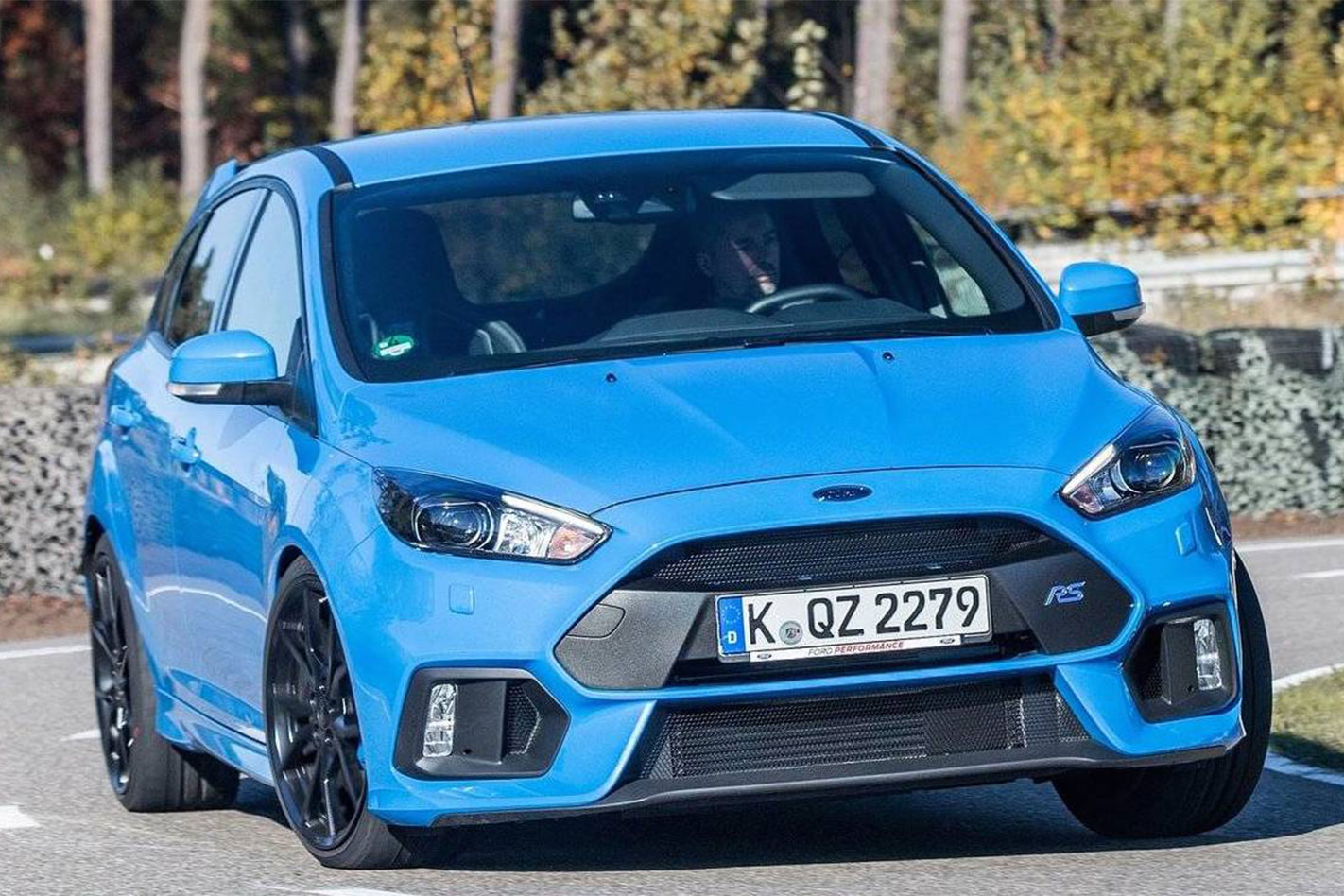
Most likely will be weight removal in a similar vein to that applied to the Renault Sport Megane Trophy-R – no back seat, flicked creature comforts, more expensive but lighter brakes and exhaust, and reduced insulation.
A electronically controlled mechanical front limited-slip differential was, according to the insider, ruled out for cost reasons in the original Focus RS program even though it was known to improve the all-wheel drive hatchback’s handling. It could return, particularly as a front LSD has since become an option on the facelifted A45 AMG.
The rumour mill is also spinning out considerations of a dual-clutch automatic gearbox that along with launch control would help improve the currently manual-only performance times, but it would be costly.
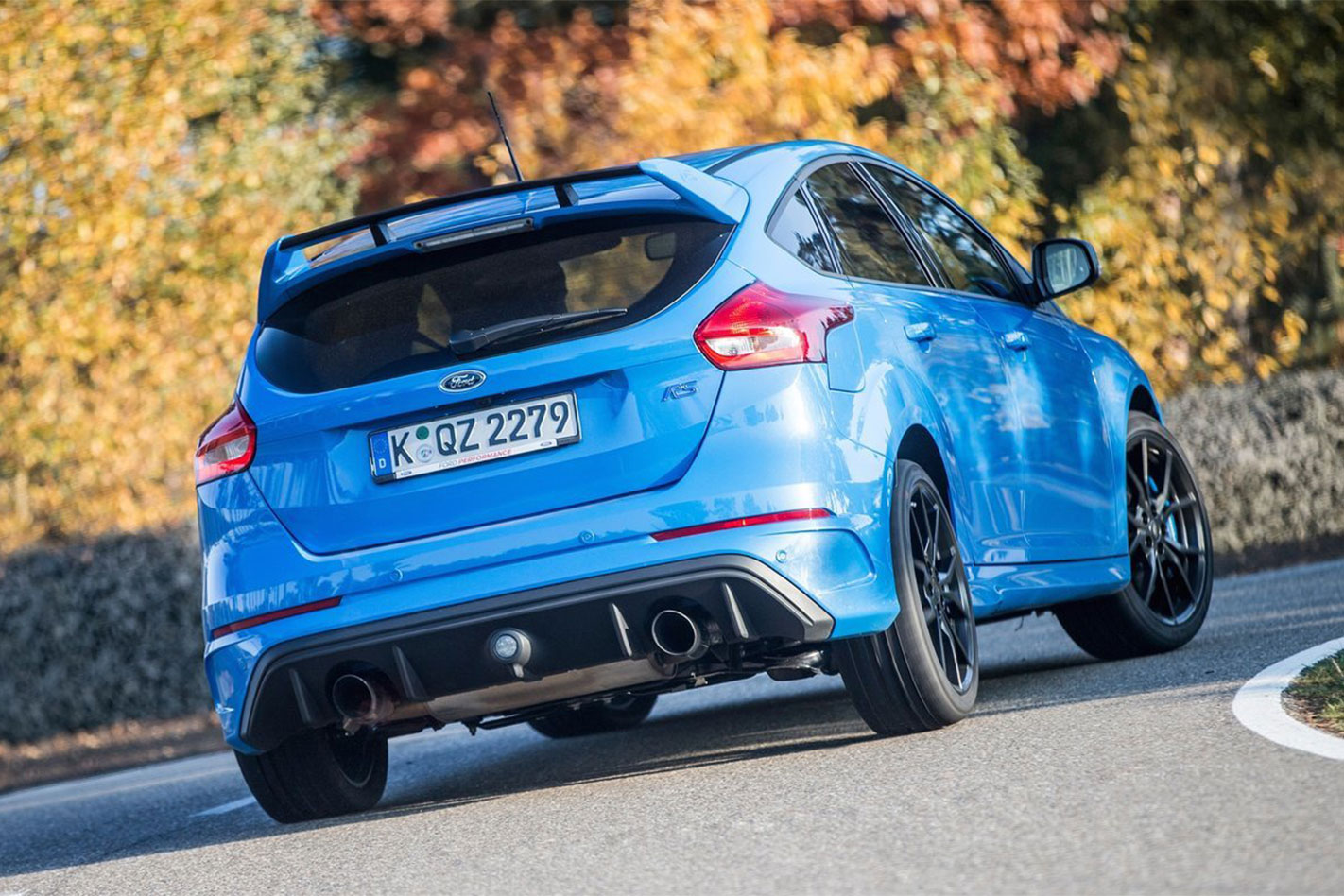
Currently the Fiesta ST, Focus ST and Focus RS are all manual only, but time will tell if there’s enough funding to install a dual-clutcher in any of this generation of small performance Fords.
Autocar believes that if Ford thinks it has a chance of breaking the 4.0sec 0-100km/h benchmark with a stripped-out, pumped up Focus RS, it will certainly seize on the opportunity to become the fastest production hatchback in the land.
Performance wars don’t end in draws, after all…
A cheap Italian supercar, a sharply suited German, or a firey, bolshy Frenchie? Better bring your gloves!
First published in the June 2015 issue of Wheels magazine, Australia’s most experienced and most trusted car magazine since 1953.
Can’t wait to see the final scores? Jump to the verdict now.
POP QUIZ: what was the last brilliant Alfa to grace Aussie roads? No, not 2010’s appealingly Italianate Giulietta, likeable as it is, and certainly not the bloody Mito. Nothing for at least a generation, then, and by that we don’t mean 2005’s striking Brera.
Clearly, patience is a virtue that would serve any Alfa Romeo enthusiast well because to uncover the gold, you have to dig much deeper into the brand’s back catalogue, at least three or four decades (we’re deliberately overlooking the ’89 Sprint Zagato and ’07 8C Competizione on the grounds of availability and relevance in Oz).
For our money, the last real Alfa Romeo was the Alfetta/GTV, with its twin-cam four (and later V6), and rear transaxle with inboard brakes. That’s in terms of the ability to hook a driver, before reeling you in with that indefinable element we call character.
An Alfa serpent hasn’t slithered on a snout as sensuous and exotic as 2015’s newcomer since the original Spider (1966-93). And you have to cast your mind back further still to find the last lightweight sports car to wear the emblem, at which point you’re back in the days of Alfa Romeo as an F1 engine supplier, and the mid-engined 33 Stradale (1967-69).
All of which makes the 4C the most electrifying Alfa – by a miglio – for about half a century. Take it from us, with a body like this, and in its initial months on sale, the 4C turns heads like nothing else, and it has the talent to go with it.
Evolution, not revolution
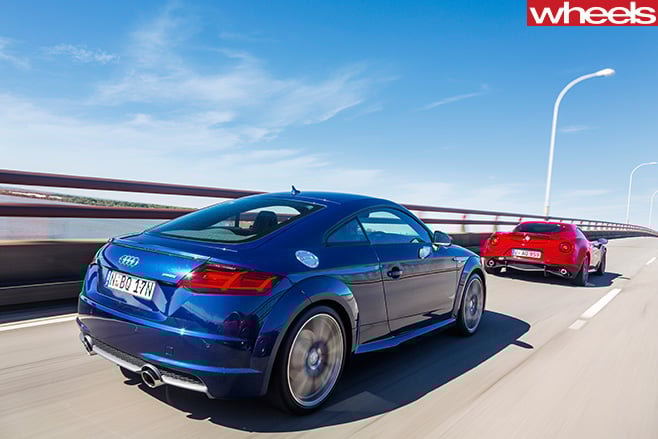
Okay, it won’t win a style stand-off with the low and wide 4C, but it has aces of its own. At anything less than Bentley prices, Audi cabins are peerless and the TT’s takes on a techno-cool slant centred on its new TFT-screen instrument cluster.
Audi’s evergreen sporty coupe brings a newfound nod to driver appeal, too, with more rear bias for its quattro all-wheel-drive system and variable-ratio steering among the improvements.
A return to form
JUST LIKE the long-suffering Alfisti, it paid for the average Francophile to be the persevering type. They’d been waiting since the dawn of the millennium and the demise of the Peugeot 306 – perhaps longer – before being rewarded in 2009 when the French marque embarked on a return to form with the RCZ.
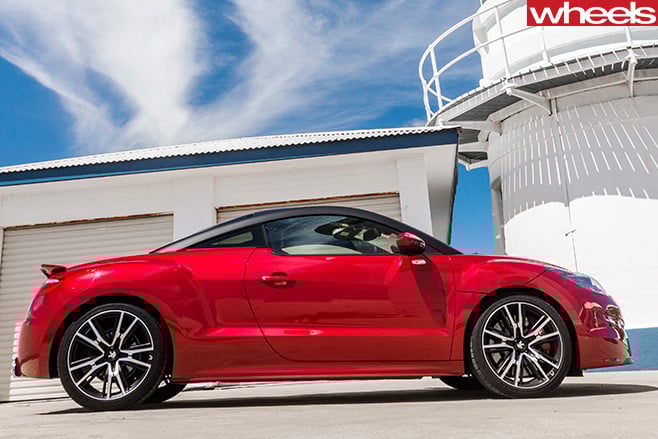
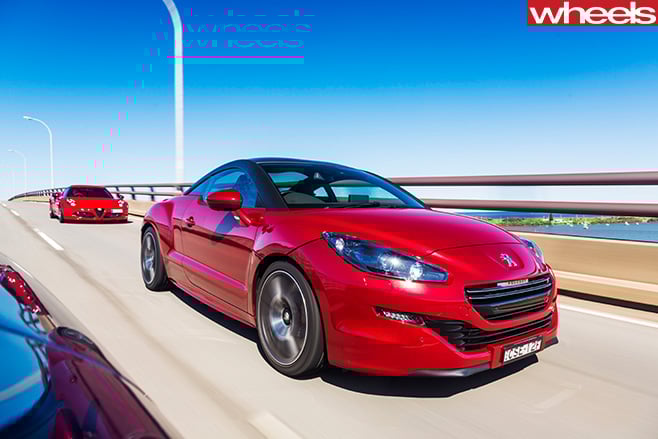
In the case of the RCZ, shooting for a slice of TT sales without blatantly ripping off its design isn’t in the league of achievement of the 205 GTi and its gift to hot-hatching (can the fact there’s a single millimetre between the coupes in overall height be coincidence?). But the RCZ’s double-bubble, cab-forward canopy gives it head-turning individuality (and a great boot) to make it worth ditching the more obvious Deutsch alternative.
Philosophical differences
OKAY, that’s it for history and philosophy. Onto pragmatics, and anyone seriously considering an Alfa Romeo 4C probably wouldn’t be remotely interested in a TT or an RCZ, mere coupes to the Italian brand’s exotic sportster. Conversely, anyone with even a passing interest in long-haul comfort and refinement or day-to-day usability – or who needs to seat more than two – won’t even consider a 4C. Well, if their blood is red they may for a while, but they’ll be dreaming.
The Audi TT S-line quattro costs $85,450 in standard form and sits atop a TT hierarchy that opens with a $72K front-driver. Add options and the flagship quickly heads north of $90K, as it did when S-line leather, Band & Olufsen audio, matrix LED headlights and an assistance pack were added to our test car.
The RCZ-R is Peugeot’s priciest coupe, but it’s the cheapest car here at $68,990, and differs from its rivals in that it has a gear lever and a clutch operated by the driver’s left leg, rather than a pair of them operated via paddles by a computer.
An arresting experience
BEYOND the six-speed gearboxes, there’s welcome drivetrain diversity in the Alfa’s mid-engined form to the others’ front engines, and the fact that with a front-drive, a rear-drive and an all-wheel-drive represented, no two share the same layout.
On a scribbly stretch of road north-west of Sydney, the 4C’s unassisted steering, via a small, over-sculpted wheel, relays why mid-engine and rear-drive is rightly regarded as the purest and the best.
Away from parking duties, the steering is light and arrows the nose into corners. It loads up to signpost the transition of load from one end of the chassis to the other, the wheel jiggling and kicking in your palms, which are necessarily wrapped tightly around its rim.
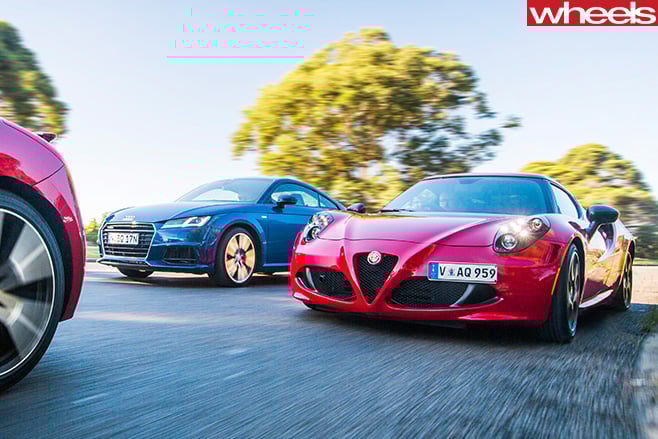
Its Giulietta-sourced, ‘1750’ turbo engine is as much a part of the 4C experience as its uncommonly challenging dynamics offered by the carbonfibre tub chassis manufactured by Dallara and shared with the KTM X-Bow. Every degree of pivot at the right ankle brings a furious whoosh and whistle from the intercooled, twin-cam 177kW turbo four, which sits just over your left shoulder. It’s loud enough in the cabin that it drowns out much of the exhaust raucousness, which is clearly audible from outside, and every bit the baby supercar in flavour.
The 4C’s ability to blitz the dragstrip is a bit deceptive. On the road, there are so many distractions – the induction cacophony and the fondness of the dual-clutch gearbox for kicking down – that it’s difficult to gauge the level of shove-in-the-back. The test equipment isn’t fooled, though; the 4C is more or less true to its maker’s claims, being capable of easy 4.6-second 0-100s, as well as 12.8sec quarters using the lesser launch control mode (full whack sees a high-rev clutch dump, and a quick time wheelspun away).
Pragmatism on point
THE performance of the 169kW 2.0-litre turbo Audi is deceptive in a different way. It sprints the strip with a carefully metered launch-control getaway and such calmly measured shifts that the speed seems unremarkable, yet it does a 5.5sec sprint and high-13 quarters, which is quicker than it feels on the road.
The TT’s back-road flavour departs from the 4C’s full driver immersion to bring a point-and-shoot personality. If the Alfa is a go-kart, the Audi is more like a couped-up hot hatch.
You must drive the Alfa by the scruff of its neck, whereas you have a choice in the Audi. However, the reward for wringing the TT out is more tangible than it has ever been in any previous generation.
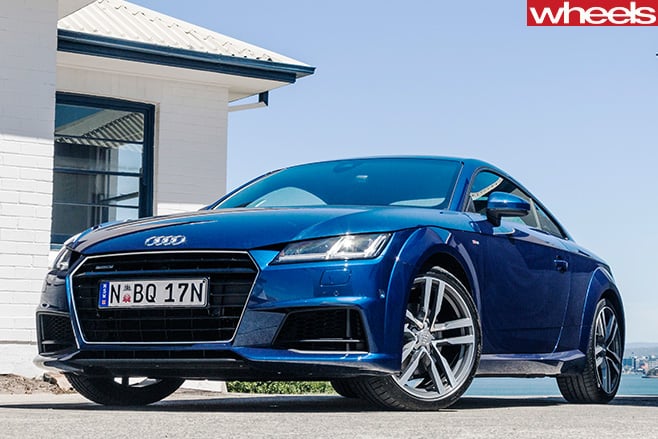
The TT’s dual-clutch ’box is immediately responsive – more so than the 4C’s, which can be slow and uncooperative – and brings a beautifully judged crack from the tailpipes on upshifts, while the engine has just enough character, as long as you’re in the upper reaches of throttle and revs.
However, especially in the company of the Alfa, it’s all a bit too easy and detached. As comparo wingman Ponch put it, you can think about what you’re going to have for dinner while punting the Audi, but there isn’t enough spare brainpower to process anything else when you’re arm-wrestling the Alfa.
French Connection
THE Peugeot’s manual gearbox – a six-speed stick-shift is the only transmission available – gives it an advantage as a driver’s car, and the RCZ-R needs an easy win given it’s at a disadvantage in some other areas from the outset. For example, where the Audi nails cabin functionality, tactility and comfort, and the Alfa eschews superfluous luxury in its quest for heightened purpose, the Peugeot’s cabin, which was a nice effort six years ago, feels a bit dated.
Coming to the French coupe’s defence are the talent and cohesion of its chassis, the potency of its powertrain, and the fact it’s tens of thousands less expensive than its rivals, which are no small points.
The 1.6-litre turbo Peugeot cedes cubic capacity to both its rivals, yet at 199kW it’s the most powerful, and just 20kg heavier than the Audi. Without the Audi’s all-wheel drive (or dual-clutch gearbox), the RCZ-R can’t match the TT on the strip, but its superior in-gear acceleration figures (and terminal speed) illustrate just how quick it is in many real-world scenarios.
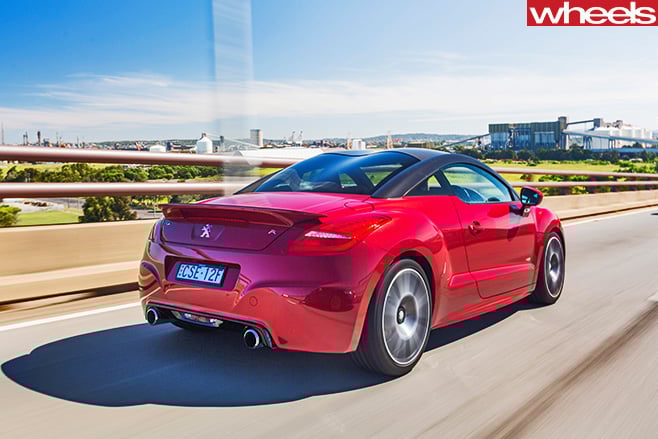
Chunky tyres and broad tracks give the RCZ-R a hunkered-down look, and that’s how it drives, thanks to a reassuring level of steering weight, good balance, well-contained roll and yaw, and damping that can manage all but the biggest hits. However, the Pug’s steering and front end don’t have quite the alacrity of the TT, and with only the front tyres doing the driving via a Torsen LSD, it torque steers.
Inside scoop
THE RCZ-R is not as hushed inside as the TT, and its ride is busier, too, though it does a commendable job of soaking bumps on same-sized 19s, despite our test car not having Audi’s optional adaptive dampers.
Calm in the Alfa’s cabin? Pfft… The best compliment we can pay the 4C is to say it rides well for what it is. The softer base model will likely be more supple – and more subtle – than the sports-suspended Launch Edition version.
But all this is far from the point. In the context of the Alfa Romeo, the Audi and Peugeot are just a couple of sporty coupes. The 4C, meanwhile, is a demanding sports car. It’s undoubtedly the quickest and most capable here, though extracting its best takes more driving skill and commitment than in the others. And therein lies the fun for some, and the deal-breaker for others.
Yes, the Alfa could be better, most obviously with an open-gated manual gearbox, but also with a bit more steering crispness and consistency of weight. A four with individual throttle bodies or a raspy V6 would make for a more visceral, linear experience, and it wouldn’t matter if the 4C wasn’t quite as quick without a turbo.
Still, given the way it looks and goes for the money, the 4C is a brilliant car. It would find closer competition in a Lotus showroom, though the Alfa is more accelerative and/or less expensive, depending on whether you’re comparing it with an Elise or an Exige.
The Salami Army won’t need any convincing – not after all these years – and the 4C’s sharp focus and spectacular aesthetics will surely help it bring new fans to the brand.
Unlike the Audi, though, it hasn’t the breadth of ability to find broad appeal, which makes the artful and accomplished third-generation Bauhaus style icon both the best TT yet and the all-round pick of the coupes.
Inside: Audi TT
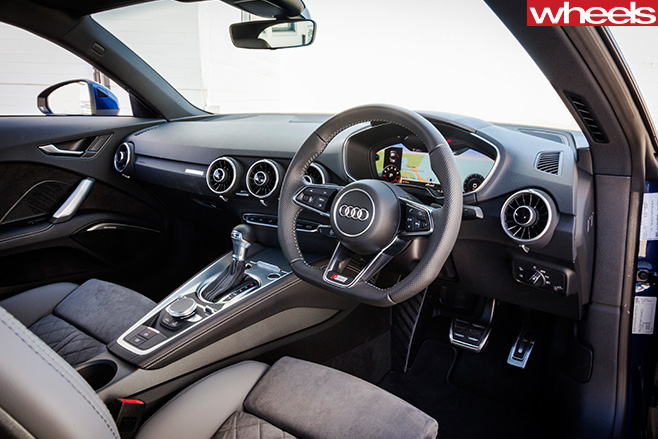
TFT-filled instrument cluster and redesigned multimedia interface headline a typically superb effort inside the Audi. The new (still-jet-engine-themed) air-con outlets look cool and bring a neat new mechanism for directing airflow. Like the RCZ-R, a sardine-can back seat trumps not having one at all.
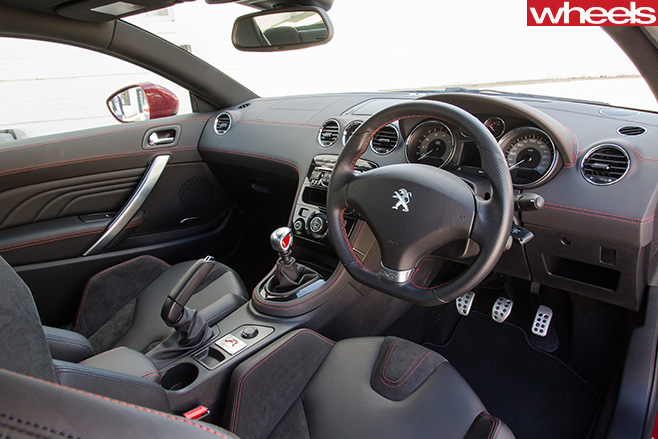
The French car’s cabin looked great in 2009, and holds up quite well today. In ‘R’ form it’s suitably sportified thanks to figure-hugging front seats, and is classed-up with stitched leather splashed across the dash and door trims.
Inside: Alfa Romeo 4C
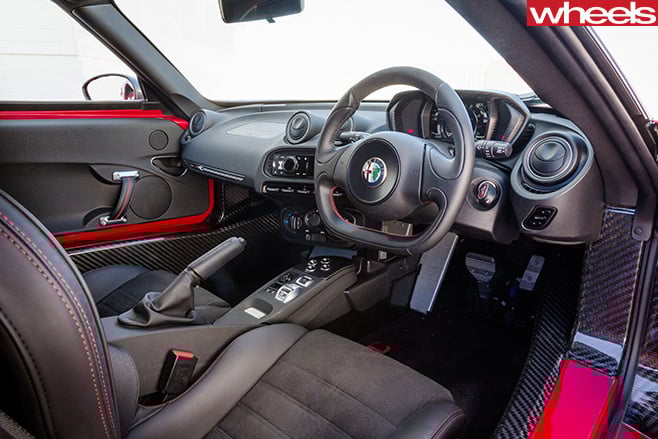
Exposed carbon floor spells pure race car and is beautifully finished. The seats are uncompromising, but offer unparalleled lateral support, and the small, over-styled wheel is chunky. Most controls are Fiat/Alfa parts-bin, but at this price we’re good with its bespoke ambience and appearance.
TO THE 4C’s carbonfibre-tub chassis and double A-arm front and strut/multi-link rear suspension, the Launch Edition model adds “racing” dampers and anti-roll bars, and inch-bigger alloys with Pirelli P Zeros. Both versions get Alfa’s Q2 electro-LSD.
The rest of the $20K upgrade is superficial – microfibre seat inserts with contrasting stitching, carbon bits inside, yet more carbon outside, including the exterior mirror shells and rear wing, and the questionably cool headlight surrounds.
The brake upgrade consists merely of a caliper paint job – the discs and four-pot Brembos aren’t any bigger – and engine outputs are unchanged. The ‘sports’ exhaust only enhances acoustics.
DNA strand
DYNAMIC mode in the Alfa’s ‘DNA’ system removes all linearity by applying an aggressive map to throttle and boost control, which exacerbates the induction histrionics.
All-Weather mode delays the onset of mid-range torque, and more surprisingly, makes the exhaust rortier (the turbo wastegate is open more of the time). Race slashes the safety net and introduces a two-level launch control, while Normal provides the best all-round settings.
But the system’s effect is limited (compared with, say, a Giulietta’s), given that it doesn’t take much to get the engine’s small, responsive turbo wound up, or much torque to push 4C’s lean body weight. The Alfa is a rocket regardless.
Verdict
 AUDI TT S-LINE QUATTRO
Price as tested: $93,420 *Includes metallic paint ($1400), Matrix LED headlights ($1900), assistance pack ($2200), quartz finish interior elements ($470), leather pack ($800), Bang & Olufsen sound ($1200)
NCAP rating: 5 stars (Euro)
Fuel economy: 9.3L/100km (test average)
Acceleration: 0-100km/h: 5.5sec (tested)
Plus: Grip and handling; AWD’s rear bias; quick steering; cabin; refinement
Minus: Needs more larrikin in its chassis (TT S could be worth waiting for)
Verdict: 8.0/10
 Alfa ROMEO 4C
Price as tested: $109,000
NCAP rating: not tested
Fuel economy: 8.5L/100km (test average)
Acceleration: 0-100km/h: 4.6sec (tested)
Plus: Supercar looks; light weight breeds handling and efficiency; involvement
Minus: Unassisted steering not for everyone; too much turbo whoosh
Verdict: 7.5/10
 PEUGEOT RCZ-R
Price as tested: $68,990
NCAP rating: not tested
Fuel economy: 8.7L/100km (test average)
Acceleration: 0-100km/h: 6.5sec (tested)
Plus: Engine delivers beyond its capacity; individual styling; sorted chassis
Minus: Cabin can’t match new TT for refinement, class or technology
Verdict: 7.0/10
1. CARS BY GARY NUMAN (1979)
The UK hit was a stray from Numan’s usual sound and it paid off reaching the heights of the charts over a couple of years.
2. BRAND NEW CADILLAC BY THE CLASH (1979)
The Clash’s remake of this song was feature on their popular London Calling album. Originally released in 1959 by Vince Taylor.
3. LITTLE RED CORVETTE BY PRINCE (1983)
It seems the Little Red Corvette was a bargain buy for Prince – the song was a great success, pushing him to the top 10 in the U.S. for the first time.
4. CAMARO BY KINGS OF LEON (2007)
Released on Kings of Leon’s third album, Because of the Times. “Go, go, go” Camaro.
5. MERCEDES BENZ BY JANIS JOPLIN (1970)
The ‘70s iconic song makes an important political statement for the time, rejecting consumerism. The story goes that Joplin was at a bar with songwriter Bob Neuwrith and started singing the first line to a poem written by poet Michael McClure. Impromptu lyrics were written on a napkin and the rest is history.
6. MUSTANG SALLY BY WILSON PICKETT (1966)
According to our Lifestyle Ed, this is the ultimate karaoke song. Not many people know, but Wilson Pickett’s version was a cover. The original was released in 1965 by Mack Rice, but didn’t become popular until Pickett released it on his 1966 album The Wicked Pickett.
7. PINK CADILLAC BY BRUCE SPRINGSTEEN (1984)
Let’s set the record straight with this one; this song is not about a Cadillac. When Springsteen sung about the Pink Cadillac, he wasn’t referring to Elvis’s tour car. He even stopped Bette Midler from recording this song because it wasn’t a “girl’s song”.
8. I’M IN LOVE WITH MY CAR BY QUEEN (1975)
Written entirely by Roger Taylor (Queen’s drummer), this song was inspired by a roadie and his love of his Triumph TR4. There’s no love like a man and his car – the WhichCar office will happily provide inspiration to Taylor for a new song.
9. BLACK LIMOUSINE BY THE ROLLING STONES (1981)
Black Limousine spent a few years locked away between 1978 until it’s release. It eventually featured on the bands Tattoo You album.
10. BIG RED CAR BY THE WIGGLES (1998)
Last but certainly not least… we think… this children’s favourite couldn’t miss out on this list.
Toot Toot, Chugga Chugga, Big Red Car!
And on that note, we leave you with that song on repeat in your head for the rest of the day. Enjoy!
I never really clicked with the original Porsche 911 Targa. Even though it was a 911, it was just never as cool as the coupe.
An early Targa looked like a crop-duster’s sliding canopy mounted on an upside-down wheelbarrow – even the convertible 911 seemed sane in comparison, so you knew it was loopy.
That was until I clapped eyes on the new 991-generation Targa at the Detroit Motor Show earlier this year and it became obvious this bigger, wider 911 was a much better platform from which to launch the oddball Targa roof. Finally it seems Porsche has been able to engineer the same concept as the original Targa without making it look like some kind of mutant Popemobile 911.
The new roof features a glass rear window that hinges – along with the panel surrounding it – at the touch of a button, while the semi-rigid soft-top section above the driver’s head folds into the void behind the rear seats. This creates an open roof and closed rear window. Clever.
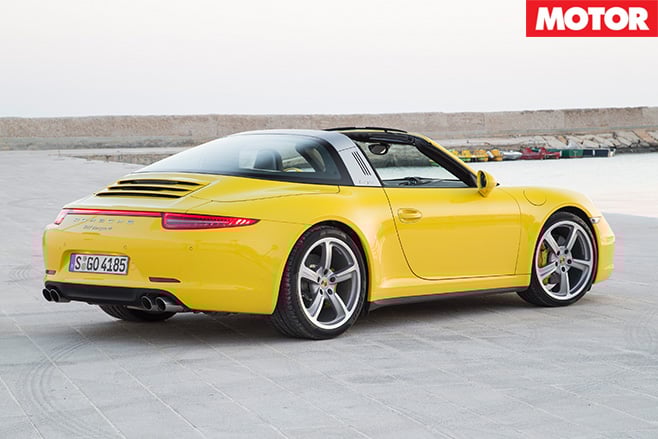
And thankfully, structural rigidity issues have been addressed by four decades of development and metallurgy. That said, it does still suffer from not having a roof welded in place. Porsche admitted at the launch in southern Italy the Targa had slightly less than half the bending rigidity of the coupe. And you can feel its loss.
Okay, it’s not terrible, but there is some scuttle-shake over the huge potholes that a post-GFC Italy throws up every few metres. The less-rigid body also seems to allow more road and suspension noise into the cabin. Even below 100km/h, there’s a fair wind-rustle from the top of the targa-hoop and the buffeting in the back seat is horrendous.
When up, the soft-top simply fails to damp out the faint sound of air rushing over the roof.
But my biggest complaint about the Targa-top architecture is the howling blind spot you’re left with over each shoulder. Entering traffic is downright scary when you can’t see what’s behind you. Especially in Italy.
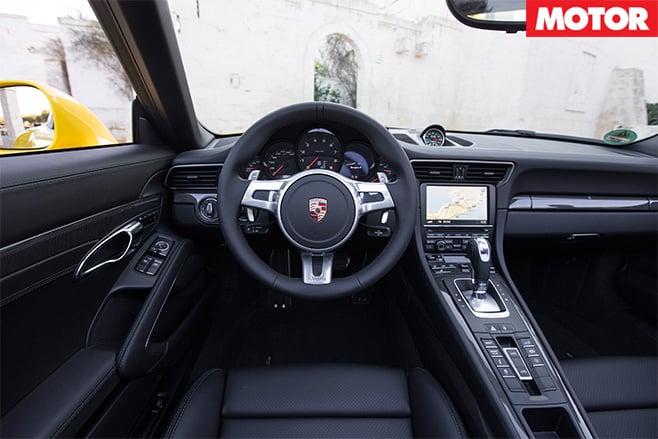
Porsche’s white-coats admit the decision to go with the wide-body was more to do with the bodyshell being a better visual match with the Targa design, rather than any desire for ultimate grip.
The whisper is we’ll only get the PDK transmission – although there’s talk a manual might be available on a special-order basis. Still, the current-gen PDK is so damn good it’s very difficult to be critical of the actual driving experience. And let’s be honest: this is still a Porsche 911, and that must count for something.
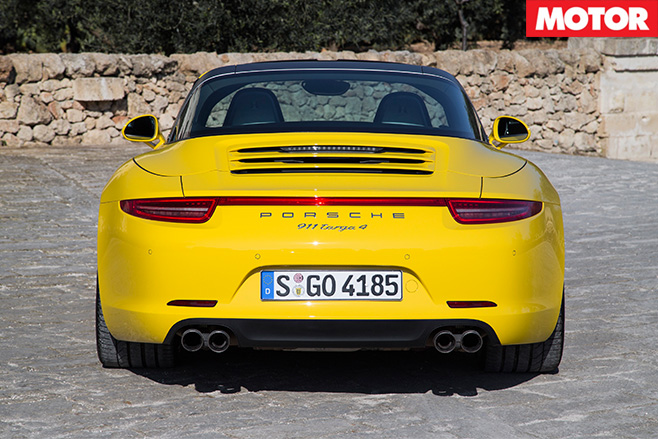
On the other hand, it won’t leak water anymore and it looks absolutely sensational. And that might just be enough, especially if you’re not a traditional 911 hard-head.
As a traditional fan of the coupe, I’m not entirely convinced on Porsche Australia’s market philosophy for the Targa – predicting it as an alternative to the coupe rather than a competitor for the convertible. Only time will tell.
Four out of 5
Specs
Engine: 3436cc flat-6, DOHC, 24v Power: 257kW @ 7400rpm Torque: 390Nm @ 5600rpm Weight: 1560kg 0-100km/h: 5.0sec (claimed) Price: $247,900
When I was handed the keys and offered the chance to drive the Jeep Renegade through Far North Queensland’s Daintree Rainforest, I jumped on the next plane.
Small SUVs bring the best-of-both worlds to life, offering a city-living ease that its larger cousins don’t, while still holding on to the ability to cope on those bumpier roads.
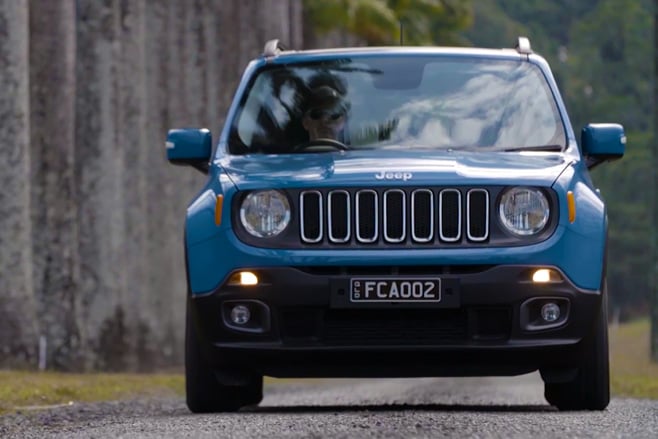
But what if we could take our small SUV beyond the dirt side-tracks and tackle those adventurous off-road terrains?
Available in four models, Sport, Longitude, Limited and Trailhawk, the baby Jeep offers the option of front-wheel and four-wheel drive on all models, except the Trailhawk, which is four-wheel only.
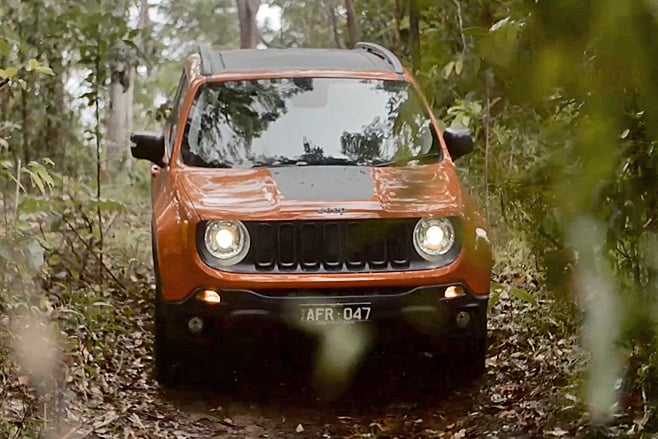
Sure, the compact-SUV apocalypse is taking over Australia, but Jeep’s Renegade stands out from the pack because of its tough, off-road capabilities. Obviously, we had to test it out for ourselves so we visited a private property to see just how tough it is, and the result: it’s pretty tough.
Designed in America and built in Italy, the Jeep Renegade is full of personality. It looks tough without compromising style.
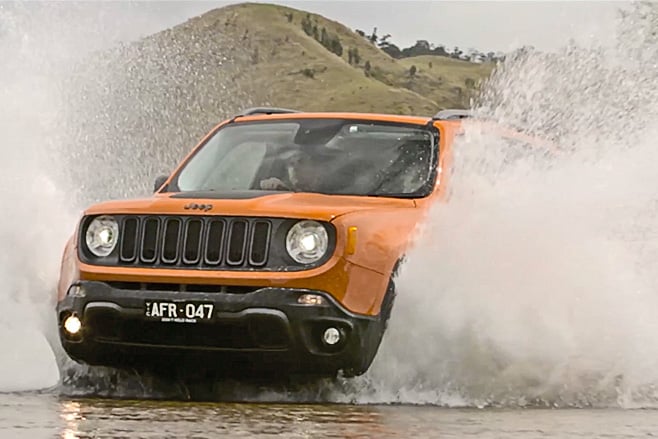
It’s full of quirky little features and it’s like the thrill-seeking little sibling, that isn’t afraid to venture from the norm.
And what would style be without a daring colour palette. The Jeep Renegade comes in some pretty cool colours and it certainly wouldn’t be caught dead in double denim.
There’s also plenty of space in the Renegade which is actually quite surprising given how it looks on the outside.
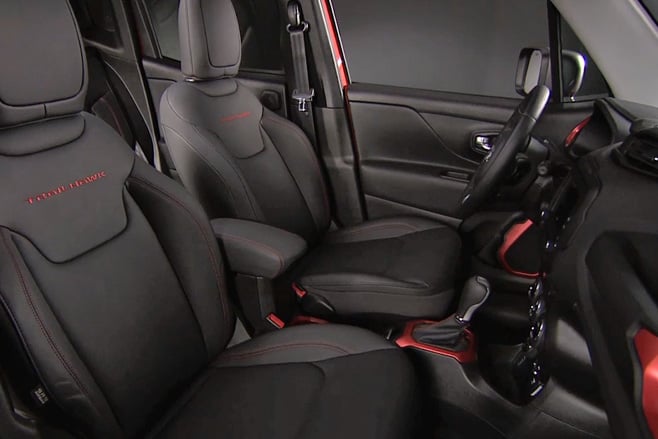
But on the downside, its rear seat cushion is flat. This makes space for the seats to fold flat but it means passengers lack under thigh support. There’s also no rear vents so it’s a double whammy for back seat passengers. Luckily for us, though, we managed to get to Mosman Gorge for a quick dip to cool off…
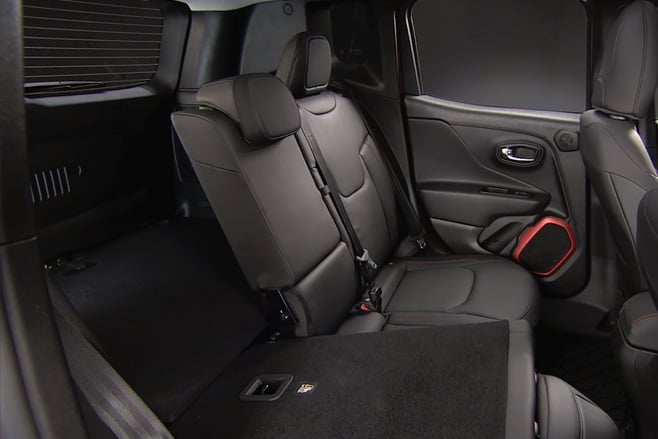
The Renegade could also do with a bit more grunt on all models and if we could be extra fussy, we wouldn’t mind a Sport mode on the nine-speed autos.
The Jeep Renegade stands for freedom, authenticity, adventure and passion, and our trip to Far North Queensland has perfectly encapsulated all of these words. So if you’re looking to live life on the wild side, in between your regular city-life-routine, then maybe the Renegade is your kindred spirit…
Click here to find out more about the Jeep Renegade.
If you’re going to crash a Ferrari, avoid using the company’s latest rare offering, of which only 499 were made, as your bumper kart – a lot of people will be watching.
This is what happened to one unlucky LaFerrari owner who crashed his AU$2m purchase after losing control of the car, reportedly after just leaving a Ferrari dealership in Budapest Hungary.
Three damaged parked cars bore the brunt of the sideways supercar, which left the LaFerrari in a rather bad way, missing both its front right fender and sporting damage to its right side.
Thankfully the only thing bruised on the driver was his ego.
Obviously excited and impatient, on board video from a tagging car reveals the LaFerrari’s 6.5-litre V12 and electric motor unit offered more power than the car and driver could handle.
Of course, when 705kW relies on only two-wheels for traction, you best be careful, or leave traction control on.
It’s the third LaFerrari crash in public since the car was released, but we’re betting it won’t be the last.
Having struggled my entire life with the whole ‘right and wrong’ thing, I have, over the years, given considerable thought on how to conduct oneself.
And, by definition, how not to conduct oneself. The end result being I’m pretty good at knowing when somebody is being rude, inconsiderate or just plain ignorant. This sort of aberrant behaviour is something I’m seeing more and more of.
Perhaps this increase in rudeness is simply a reflection of society as a whole: as we elect more and more officials who think it’s okay to disregard the concept of humanity, lie to us and treat us like idiots, perhaps it’s inevitable the behaviour of the rank-and-file punter starts to echo those state approved eff-you-Jack sentiments.
In the last month or so, I’ve seen two different people in two different circumstances, all behaving boorishly. Funnily enough, there’s always been a car involved.
The most recent was a few mornings ago when I was walking the dawg about dawn. A Hyundai stopped in my street and the female driver wound down her window and asked if I knew where the local basketball courts were. I did, and gave what I thought were pretty clear instructions, adding that the street she needed was a bit hard to spot. This latter piece of information seemed to throw her and, rather than illustrate I knew what I was talking about, she presumed the opposite, sniffed, shook her head, wound up her window and drove off.
‘Thank you’ was, I think, the phrase she was looking for.
Ignorant tool number two was a few weeks earlier when I was happily driving down a section of divided road. In the lane next to me was a Navara towing a tradie-trailer full of wheelbarrows and cut-off saws and stuff. Thing is, the towball on the Navara’s drawbar was loose and the ball itself was rocking to and fro as the rig sped up and slowed.
I drew level and made a window-winding motion to the bloke in the front passenger’s seat. He opened his window while I shouted the situation to him.
How do you reckon he responded? “Oh, really? Thanks mate, I’ll check it at the next red light” or, “Yeah, thanks mate, we know. It’s got a pin through it so it can’t fall off. Ta anyway”.
Nope, what he actually said was: “Okay” and then wound his window up.
I sincerely hope his trailer flew off the ute later that day and hit a speed camera. No losers there.
But what’s the car connection beyond the – perhaps random – fact that everybody who’s messed with me lately has been sitting in one? Not sure, but just as we’d never dream of thumping a fellow pedestrian, we seem happy to reach for the baseball bat when somebody wrongs us in traffic. Reckon we all better take a look at ourselves. And start learning some manners.
How much power is too much on ice? Wheels joins HSV in the New Zealand snowfields to find out.
BRAKE! Brake! Brake!” We’re sliding backwards in a bright green HSV GTS towards a snow bank after trying to do a 360-degree spin in the 6.2-litre V8-powered sedan – on ice. The roar of the engine as it bounces off the rev limiter drenches our ears because we’ve flattened the accelerator pedal, and the spin has carved up the ice as the green monster leaves us whirling in a cloud of white powder. Only our instructor, on this occasion V8 Supercar pilot David Russell, seems to have a clue where we’re going. But I reckon he doesn’t really.
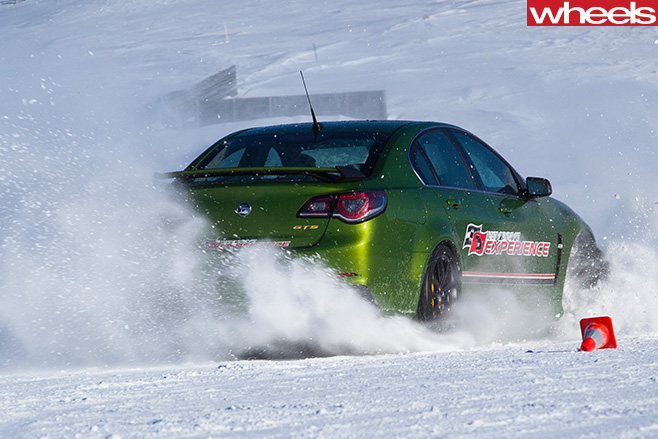
“It’s all about the art of driving,” says Nathan Pretty, Bathurst 24 Hour winner and one of six V8 Supercar drivers past and present who happily, courageously, sit in with this group of foolhardy, lead-footed HSV owners and prospective buyers, and me. “If you use the steering wheel [to turn the car], you’re doing it wrong.”
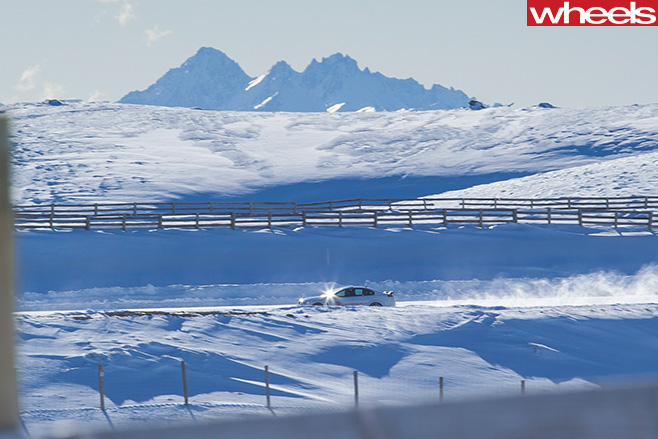
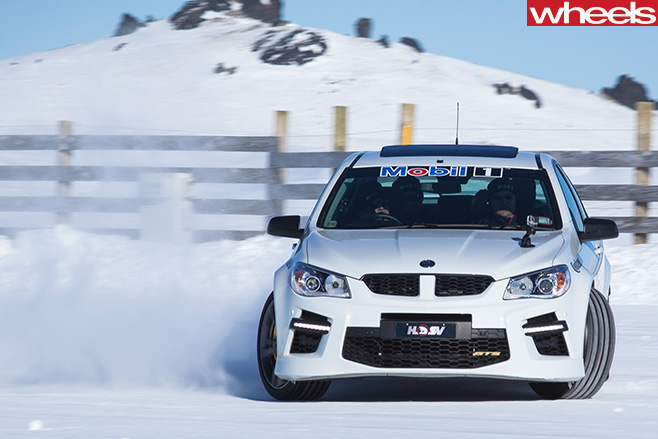
“I’ve got to go out and buy one of these on Monday,” shrieks Kiwi resident John Kuyf from the wheel of a Clubsport R8 sedan as he drifts it sideways with racer Tony D’Alberto riding shotgun. “I’ll miss this horsepower if I don’t!” he says, laughing harder than Joe Hockey at Budget time. The grin on his face, and the $3700 he’s paid to attend, shows that the HSV marketing magic has won him over. “I’m not really a Holden man,” he confesses. “Put it this way – I’ve got a few Ford things. But I’ve changed my opinion of Holden lately.”
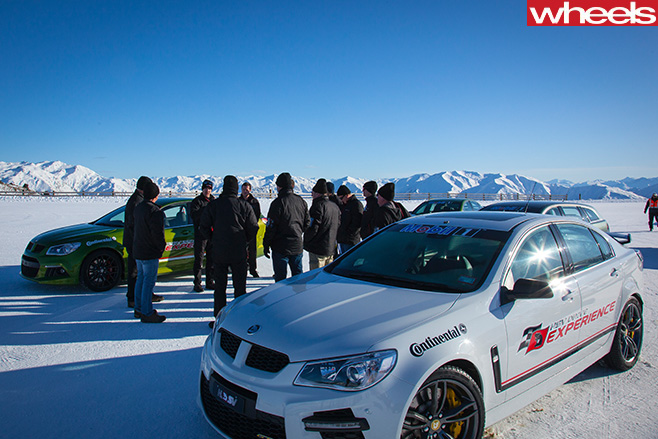
Laughing at my note-taking is Greg Murphy, a four-time Bathurst winner who’s had more cameras poked in his face during the day than most. He’s never driven on ice and snow like this – despite being a New Zealand native – and reckons that makes things a level playing field between us. Yeah, right.
As the sun melts the white stuff away, the surface is constantly changing, and it puts Fabian Coulthard, currently second in the V8 Supercar title chase, on the back foot. It also catches out some cars waiting for snow tyres – the only thing that has been changed in preparation for this event – when they couldn’t even make it up the access road. Have you ever seen a group of V8 Supercar drivers comically pushing a Clubsport? We hadn’t, either.
“How can you not love it?” says Mick Logan, who’s travelled from sunny Coffs Harbour. “It’s even more fun than I expected … and they’re actually doing something for us, aren’t they. I mean, it’s not a high-pressure sell, is it.”
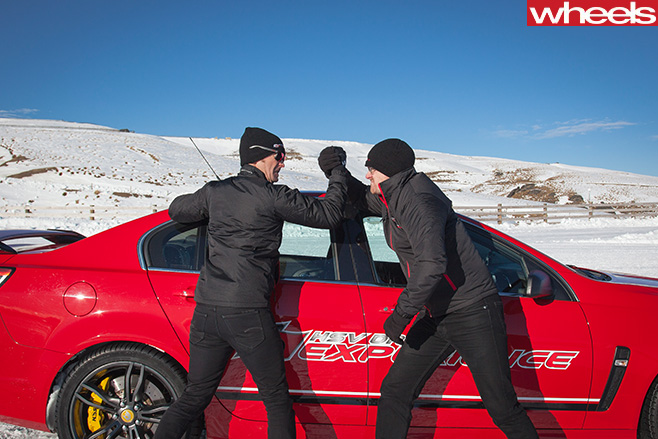
The attempted 360 that has us sliding backwards in the green GTS is something we’ve worked up to after doing the basics: drifting in a circle, and slalom and clover-leaf motorkhana layouts. The combination of huge horsepower and snow makes this a totally alien experience. Only a week earlier, Holden came here to launch an all-wheel-drive Insignia – the car that replaces the Aussie-made Commodore once Holden stops local production – and I can’t help but feel sorry for them. What’s more fun, an Opel or a stonking great rear-drive V8? I can’t imagine anyone choosing the former for a spirited session on ice.
What’s hugely refreshing is seeing supremely talented drivers make mistakes, laugh, adapt, then get the hang of the conditions as we mere mortals try to do the same. The pros work it out quickly, and some of the punters are surprisingly impressive. You’d be amazed how many CEOs can do a reverse-throw on their first attempt.
The iced-up sections have no respect for reputations or Bathurst wins. They’re instant trouble, with zero traction and so randomly located that, as you’re about to high-five a golden run, it all turns to mush in a backwards heap. Game over. Try again. “I didn’t think the snow would be so inconsistent,” says V8 racer Tim Slade. “That’s what makes it so hard.”
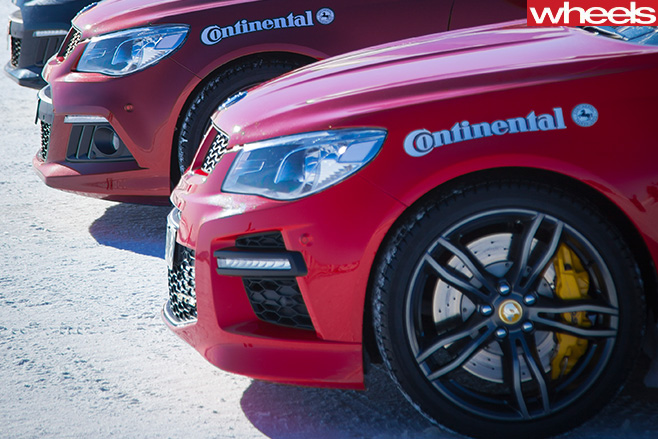
From the driver’s seat, it’s all about anticipating the slide, plus delicate throttle control. And that’s something I simply can’t get used to. Murphy laughs at me for being a lead-foot. “Okay, dab it; dab it; lift-off; okay, back on the throttle – too much!” We spin. Again. And again. And again. You know what? I don’t care. I can’t remember having this much fun in a car.
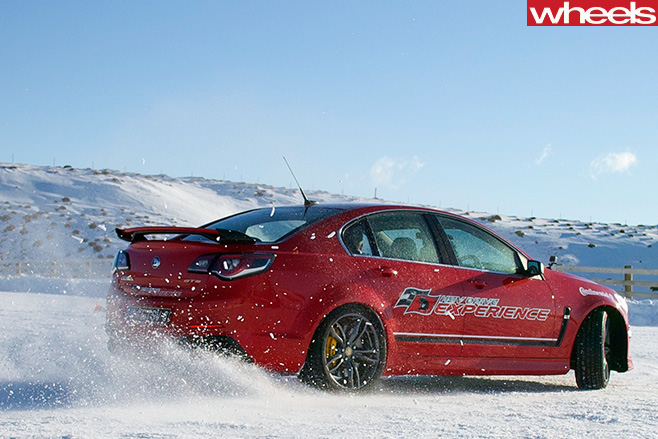
“That’s why it’s so good – you cannot master it,” says Lincoln Burns, who runs the show. “That’s why the instructors love it; it’s a chance to test their skillset.”
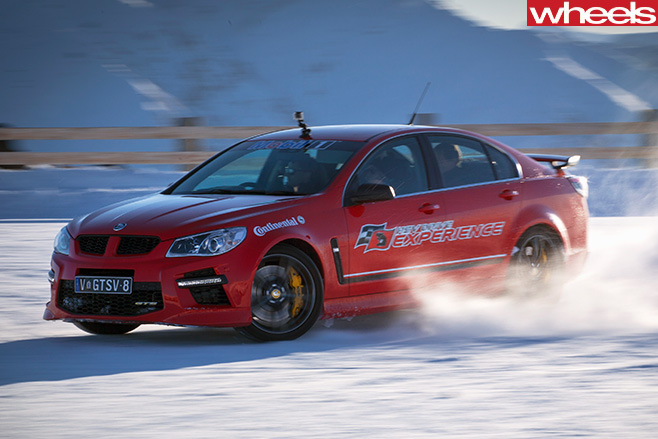
We race Murph… and lose
“I WAS going to say ‘Welcome to New Zealand,’ but if you’re gonna be like that…” says Greg Murphy as we rag each other in preparation for a race, on ice. Never has a motor race been held at such slow speeds and high revs. The cars themselves are completely stock, apart from brilliant Continental marshmallow-soft snow tyres (without studs). And when Murph has the same car and tyres as you, you’re pretty much stuffed when it comes to chasing victory. Check out the video at WheelsMag.com.au/TV.
Prove yourself
THIS winter playground is officially the Southern Hemisphere Proving Ground, built on more than 400 hectares of former ski fields for automotive manufacturers to conduct winter tests. There are well-cultivated ice sheets on which to slide, manicured fields of powdery snow, and a huge circle tailor-made for drifting. Many car companies and tech organisations use the venue for cold-weather testing, and to test tyres and electronic systems. We saw a few heavily camouflaged cars the day we were there, but were banned for taking photos.
McLaren is releasing new models at an astonishing rate.
In 2011, it entered the supercar domain with the competent but, to some tastes, visually bland 12C. One year later, along came the dynamically more ambitious 12C Spyder.
In 2013, the limited-edition P1 supercar debuted to rapturous acclaim, with all 375 units sold within a few months (with another 50 people on a provisional waiting list hoping for an encore). This was the year McLaren turned its first operating profit, which has only grown since thanks to deliveries of the mega bucks P1.
In hoping to continue this successful trend, McLaren has now made life even harder for the 458s and 911 Turbos of the world, replacing the 12C with a new contender called the 650S. It shares much of the 12C’s DNA, including its carbon chassis and tub, double-wishbone suspension, twin-turbo 3.8-litre V8 and seven-speed dual-clutch transmission.
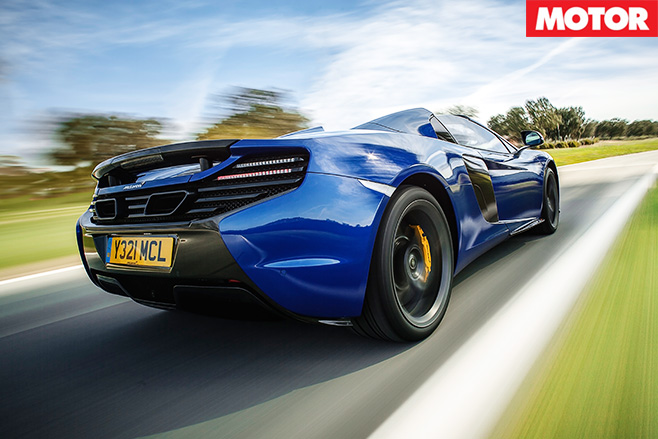
Improvements were also made in the chassis department, with spring rates stiffened by 22 per cent up front and 37 per cent in the rear. Yet thanks to McLaren’s hydraulically-linked ProActive chassis and a slightly softer damper tune, the 650S retains a lot of the magic compliancy now expected from Woking.
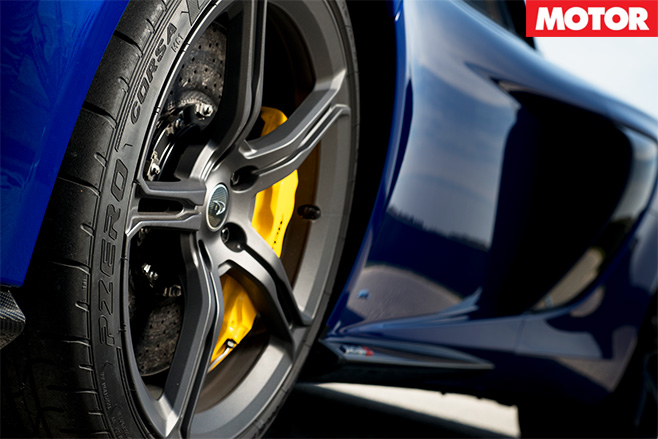
Available in coupe ($441,500) and convertible ($486,350) form, the 650S is lineball with Porsche’s 911 Turbo S and a fraction more than Lambo’s Huracan. While on paper that’s around 10 per cent more than the 12C, factor in the extra equipment now offered standard – carbon-ceramic brakes, LED headlights, full alcantara or leather trim, sat-nav and digital or satellite radio – and on a spec-for-spec basis you’re getting better value.
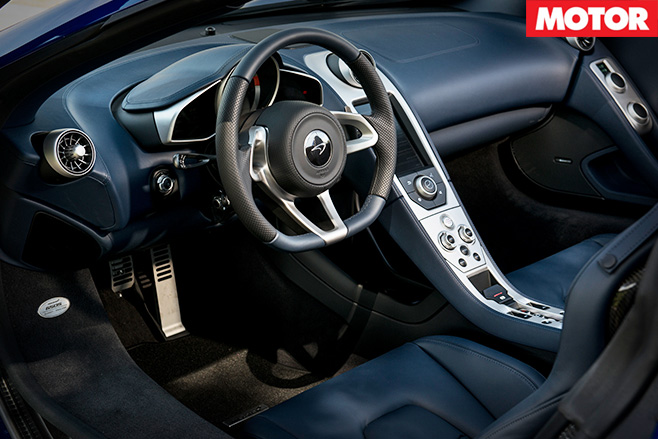
Thankfully, cornering at high speeds (reached quickly and frequently) is made less dramatic thanks to the revised aero package, which has increased downforce by 24 per cent at 240km/h and features a DRS-style active rear wing.
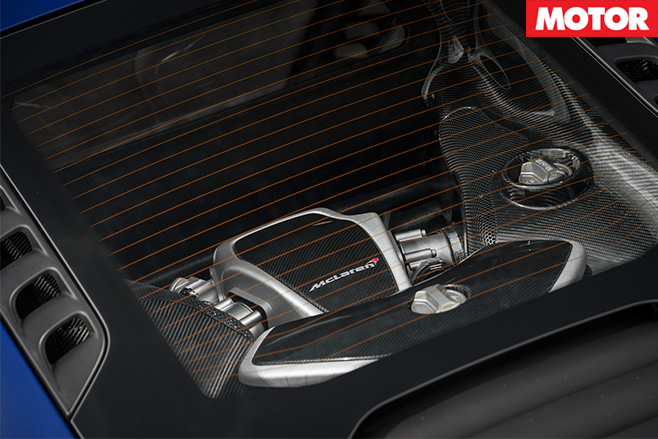
Sport ups the ante, requiring a hefty dose of concentration, and then there’s the Track setting, where the ESP will save you, but probably only after you’ve already crashed.
Overall there’s huge front-end grip and the progressive steering, alive with feel, provides confidence-inspiring turn-in. And thanks to the chassis’s inherent stiffness, the 40kg heavier Spider is equally impressive.
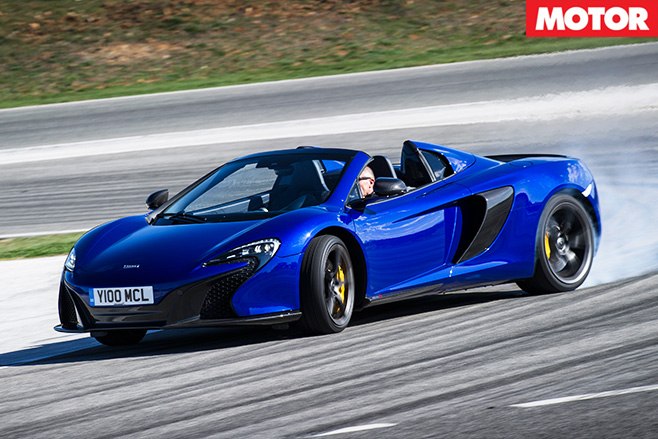
It isn’t as sexy as the Lambo or Ferrari and it lacks the Porsche’s all-weather ability, but the new 650S is a cool car that outperforms its main rivals with surprising ease and gets 10 out of 10 for entertainment value.
4.5/5
Specs Engine: 3799cc V8, DOHC, 32v, twin-turbo Power: 478kW @ 7250rpm Torque: 678Nm @ 6000rpm Weight: 1428kg 0-100km/h: 3.0sec (claimed) Price: from $464,000
So, what is it?
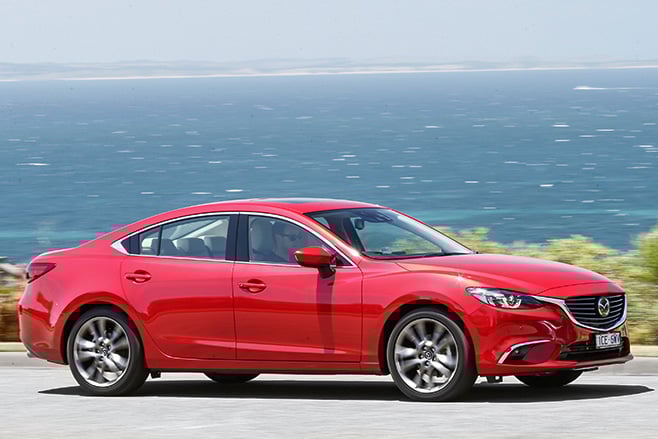
It feels like the third-gen Mazda 6 has only been around for five minutes, but Mazda’s on a mission to keep its range as fresh as Kate Upton’s complexion, and this in the ‘new’ 6.
Actually, the outgoing model’s been in market for two years, and program development chief Hideki Matsuoka says the updated car’s a product of Mazda’s Kodo design and Skyactiv tech maturing and improving over time. Adding, the overall aim of the refresh was to improve the flagship model’s sophistication in design, dynamics and safety.
There are four grades (Sport, Touring, GT and Atenza) available across sedan and wagon, with a choice of 138kW/250Nm 2.5-litre petrol four or 129kW/420Nm 2.2-litre turbodiesel four, both matched to a six-speed auto transmission.
Why should I care?
The new 6 is launching into a medium car market, which by Mazda’s own admission, is “doing it tough” because of this country’s seemingly insatiable appetite for SUVs. That said, Camry clobbers the segment, consistently out-selling the Mazda 6 (in second spot) almost three-to-one.
But that doesn’t mean the competition’s sitting on its hands. Subaru’s already lobbed the new Liberty/Outback into the mix, there’s a heap of fresh metal this year from the likes of Ford (Mondeo), Holden (Insignia), Hyundai (Sonata), Kia (Optima) and VW (Passat). And just to keep everyone honest, Toyota’s upped the ante with a Camry update. So this is Mazda’s pre-emptive strike to maintain the 6’s position as best of the rest.
What’s new about it?
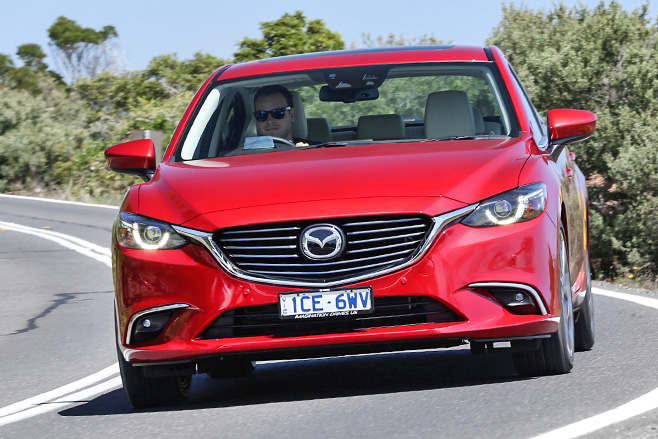
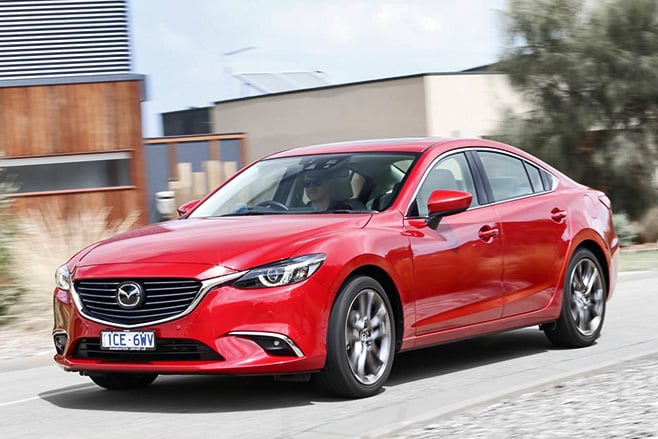
In terms of design, the 6 more strongly reflects Mazda’s Kodo ‘eye of the cheetah’ expression, the look reinforced by a distinctive front and rear lighting signature. The grille has also been tweaked with more clearly defined fins.
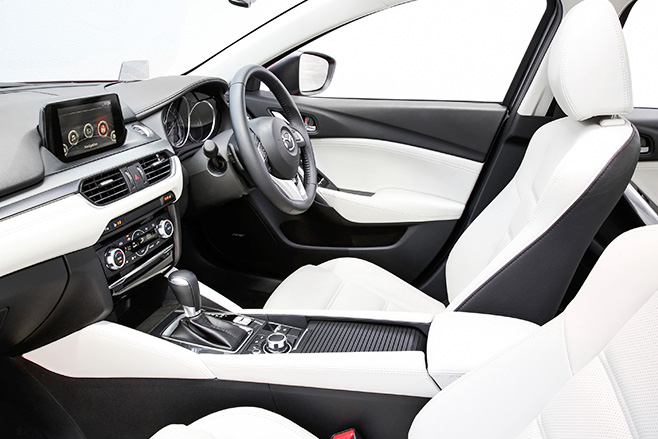
Mazda says a sizeable number of existing 6 owners have criticised the car’s interior for being “dark and drab.” So a lot of focus has gone into the cabin design, with the biggest changes being the seven inch MZD Connect colour touch screen standing proud of a more sweeping dash top, a refreshed centre stack and inclusion of an electric park brake.
The instrument binnacle has also been made lower and sleeker, HUD (Head Up Display) is included on premium variants, and cabin storage has been increased.
A range of new trim materials, including a rich, dark red finish on the dash and door cards, as well as brighter decoration and ornamentation deliver a richer, more premium feel.
Dynamically, the move to revised dampers on raised mounts front and rear, as well as new bushes for the front lower suspension arms is designed to improve ride comfort and NVH (Noise, Vibration and Harshness).
Petrol models also pick up a ‘Drive Selection’ control in the console which, when switched to Sport, sets the transmission to automatically select first gear from rest, and once underway, increase the amount of torque delivered for a given amount of accelerator pedal travel.
Headline safety inclusion is BMW and Merc-equalling adaptive LED headlights, fitted standard to all models above the base Sport; a first for Mazda. Among other things, they selectively drop out part of the main beams to accommodate oncoming traffic, using data from a smart on-board camera.
That’s all fine. What’s it like to drive fast?
We’ve had no major complaints with the 6’s dynamic performance or ride quality, but maybe we should have because this car’s a distinct step forward in both departments.
The launch program took in a mix of open highway and twisting hills around Albury Wodonga on the NSW/Victoria border, and we drove the turbo-diesel in second-top GT spec, and the petrol four in entry-level Sport trim.
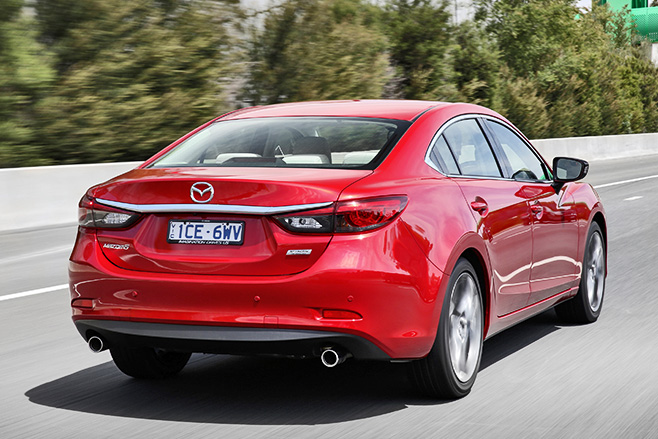
As well as the suspension work, there’s extra sound insulation and improved door sealing in all models, and first impression of the diesel is how quiet and civilised it is, the six-speed auto cycling through its ratios sweetly, with cabin noise levels at 100km/h on a coarse chip surface exceptionally low.
It’s no powerhouse, but it’s not a slouch either. Peak torque arrives at 2,000rpm, and there’s enough urge for swift overtaking and stress-free cruising. Steering weight is light, but road feel is good, the 6 is well balanced, and the nose is impressively sticky in quick cornering.
The petrol engine feels sharper, especially in Sport mode, and once you’re into the mid-range its slight power advantage and more free-revving nature delivers a stronger push in the back as the rev counter swings towards the top end.
And driving from home to the office in the city?
The interior makeover gives the Mazda flagship an even more premium feel. The seat cushions (front and rear) have been re-profiled for greater comfort, and proved their worth after several twinge-free hours behind the wheel.
Mazda says the exterior mirrors have been repositioned for a better rear view, although we struggled to sense a notable improvement.
But on the entertainment front, even the base Sport picks up six-speaker audio as standard with Bluetooth phone and music connectivity, internet radio, USB inputs and steering wheel controls. Anything above that cops a Bose 231 watt amp and (11) speakers. Nice.
A new front console with roll-top storage bin not only looks cool, but extra padding for knees down each side, and elbows along the top is welcome.
Is there anything bad about it?
More grunt would be a plus for both engines. Come on, as we’ve said before, there’s plenty of planet left, and enough environment for everyone. Maybe a little less sky, and a bit more activ(e)?
And despite good road feel, the overly light steering would benefit from more balanced (variable?) assistance.
How much would I have to pay for one? And is it worth the coin?
Almost all prices have been reduced, with more tech and features added; pricing covering an $18k spread between $32,540 for the petrol Sport sedan, to $50,920 for the diesel Atenza wagon. That’s definitely competitive, bordering on aggressive.
Would you take the Mazda 6 or Subaru Liberty?
Close, but the Mazda takes it on the basis of superior dynamics, particularly ride comfort. On a more subjective call, we also think the Mazda tonks the Subaru out of the park when it comes to visual appeal.
Click here to read the full review on the Mazda 6.
