
IT’S AN ugly question that follows the keys to anything expensive and exotic.
“Is it YOURS?”
It arrives most in car parks and at service stations, where on the odd occasion when I drive something special, I’m approached by complete strangers. They use the question as a greeting.
It’s not the query itself that I mind, as much as the emphasis on the final word – like they can’t believe I could possibly own such a machine.
Maybe it’s the way I dress. Or the fact I’m in my mid-20s.

Not this time, though.
With the keys to the Wheels Porsche 911 firmly wedged in my fist I decide that this weekend, the 911 is going to be mine.
“I own a small IT company,” I’ll tell the strangers. Or, “I just sold a social media app to Yahoo.”
This decision is down to the 911’s spec, which if I had $270K to spend, makes it almost the exact Porsche I’d buy. My Porsche 911 Carrera S would be white not black, would have three pedals and not two, and I wouldn’t option those 20-inch Turbo wheels, but the rest of the car is spot on.
The Sports Chrono pack, for example, is a must, as is the $5890 sports exhaust.

Porsche is rolling out turbo engines across its entire range (only the GT3 and GTS are likely to avoid forced induction), which means weekend drives like this are on borrowed time.
The benefit from turbo engines will be oodles of torque (an extra 60Nm in Carrera S spec) and improved efficiency, but after ringing this 911’s neck up a twisty road near Melbourne’s Mornington Peninsula, I’m convinced some of the magic will disappear.
No turbo donk can replicate the razor sharp throttle response of Porsche’s atmo flat six, or that intoxicating feeling of having the revs exactly where you want them at exactly the right time.
Then there’s the sound. Get an aspirated 911 above 4000rpm and the way the noise builds from a bark to a unique, spine-tingling howl at 8000rpm is intoxicating. Good luck achieving that engine note with turbos.

So there will be benefits, and I expect switching to turbo engines will be much the same as the 911’s shift to electric steering. People will grumble at first, but quickly get over it.
And it’s not like the rest of the 911’s legendary recipe will change. There’ll be the same rear-engine layout, the same beautifully made interior and the same unique handling balance.
Also unlikely to change is the 911’s masterstroke, which is the way it treads the line between supercar performance and everyday discretion. It has enough personality and presence to feel special every time you drive it, yet remains understated enough to park on the street without having to worry that someone’s scratching it.
Perhaps this is why not a single person asked “Is it yours?” all weekend. It’s a shame, because come Sunday night, my answer would have been a truthful “I wish”.
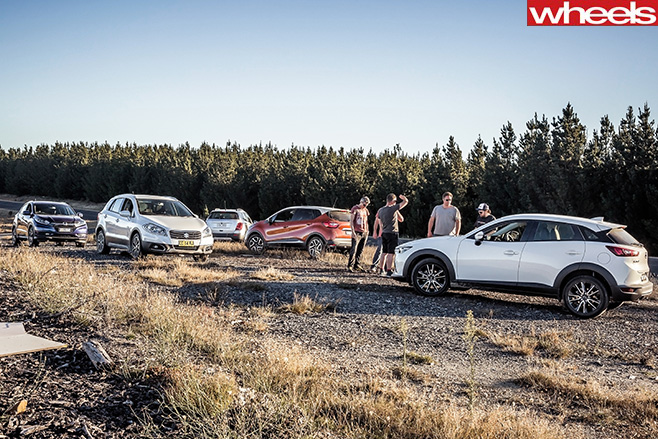
Boom, boom, boom goes the baby SUV as Renault, Mazda and Honda throw sexy new metal into this fast-growing segment.
First published in the May 2015 issue of Wheels magazine, Australia’s most experienced and most trusted car magazine since 1953.
Can’t wait to see the final scores? Jump to the verdict now.
EVER noticed how perceptions of size change over time? Suitably spacious and tasteful homes of the 1950s are often deemed unworkable shoeboxes in this era of the McMansion, seeing they need to accommodate super-sized kids that tower over their bread-and-dripping ancestors, plus all the ‘stuff’ people need these days. But what about the machines filling their multi-car vehicle holes?
That’s where the rather clever small SUV steps in. In architecture terms, it’s a modernist slice of neat space utilisation versus the McMansion-esque slab of excess that is many medium to large SUVs. Born in the back alleys of Europe, yet honed by the Japanese, the baby SUV has become the little darling of 2014/15.
‘Fashion-forward’ is a rare phenomenon in the automotive world, but if the newest contenders in the baby SUV brigade are anything to go by, being cool doesn’t mean you have to act dumb.
Five kinds of cool
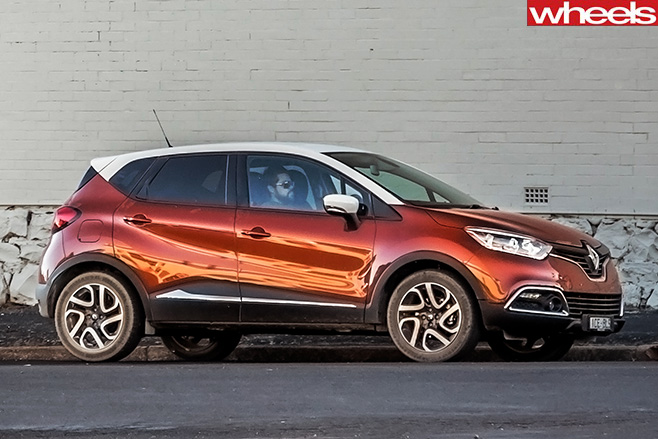
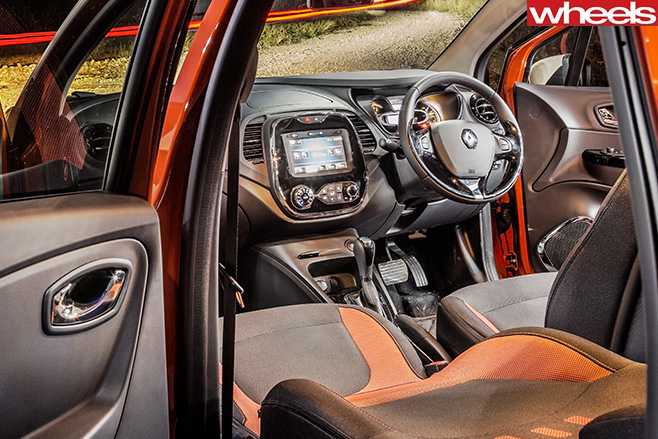
Renault’s Clio-based Captur is a striking example of small SUV sculpture, especially the test Dynamique with its metallic orange and cream two-tone paint playing up deeply scalloped flanks and its pert, Euro-chic rear end. Yet beneath all that Champs-Elysees glitz hides an incredibly well thought-out package.
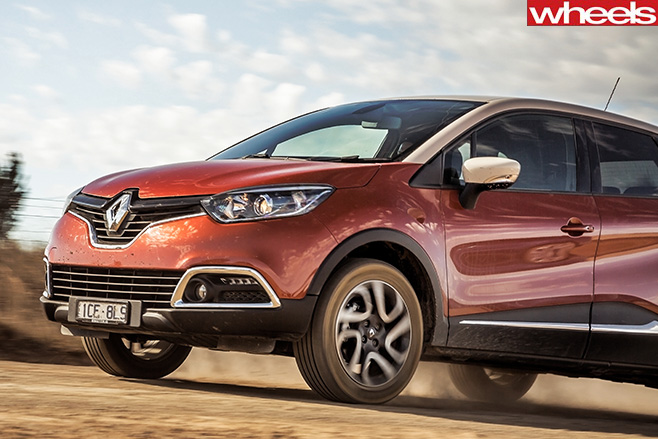
By building up instead of out, and fitting a neat rear bench that slides fore-aft through 160mm, Captur’s cabin is far more accommodating than a Clio’s. Ample leg and head room, 1.5-litre bottle holders in the front doors (though only 600ml slots in the rear) and a removable bin between the front seats that looks like it could double as a container for crook kids headline the Renault’s utility.
Captur’s removable, washable seat covers must be like the second coming for clean freaks, and likewise its Tardis-like boot for anyone into carrying stuff. Depending on the rear-seat position, it can vary between 377 and 455 litres in size, and has a removable floor that is rubberised on one side, and can be used as a partition to stop stuff sliding about.
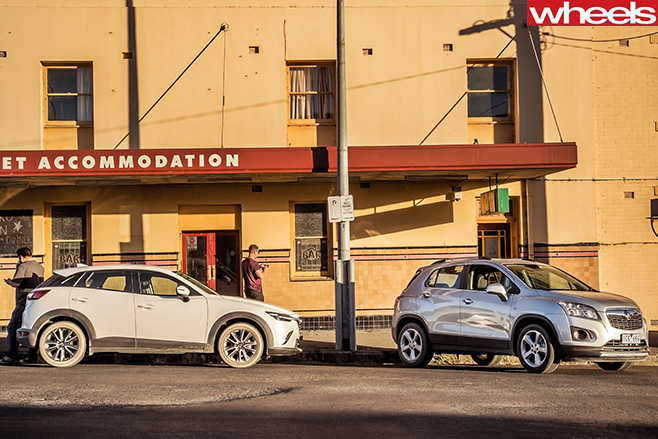
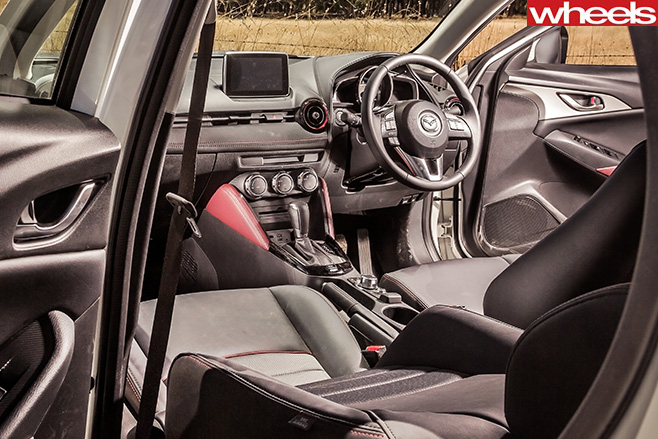
Similarly arresting in style, yet arguably even more of a head-turner than the Captur is Mazda’s CX-3. Sired by the Mazda 2 but sharing the 3’s 2.0-litre petrol engine, the CX-3’s cab-rearward shape was clearly prioritised by Hiroshima’s fashionistas. Walk around the multi-surfaced Mazda and its shape constantly changes – making it difficult to convey on camera – yet it has a visual identity that almost makes it classless.
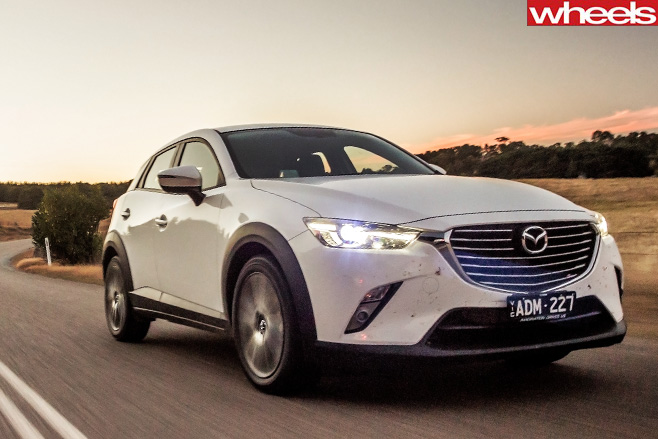
While clearly space-deprived compared to its expansive rivals, the CX-3’s plush rear seat is entirely liveable, though it’s the front-seat package that has received the most attention. The CX-3’s 264-litre boot is unable to fit even the smallest Mountain Buggy pram (what happened to good old strollers?), necessitating a folded backrest, and while there’s quite a bit of depth beneath its removable false floor, CX-3’s loading lip is high and its divider isn’t as useful as the Renault’s.
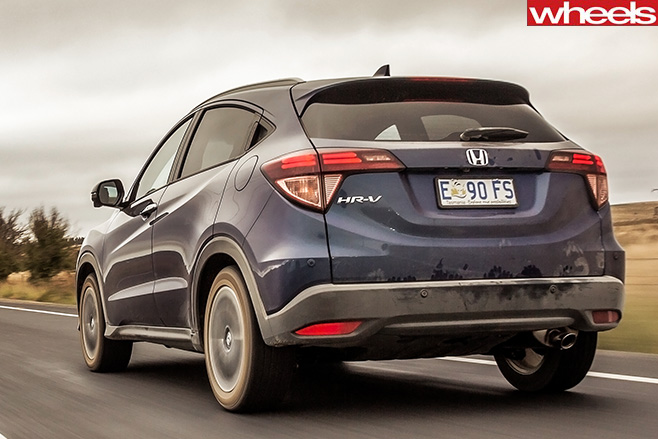
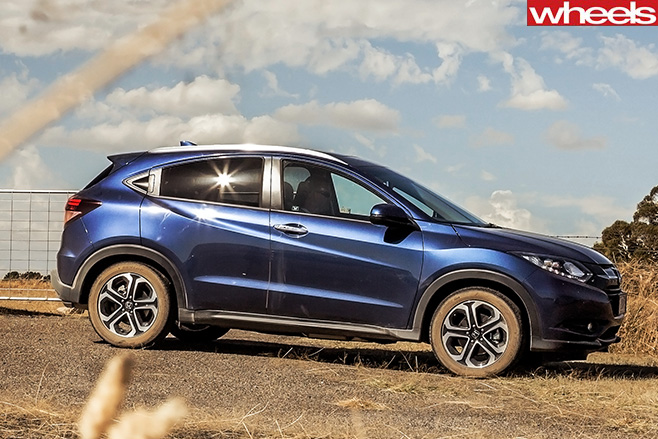
Given some of Honda’s recent efforts, like the malformed Jazz/City and the dorky Civic, it’s quite a surprise to feel drawn to an H-badged design, espcially an SUV. But the new-generation HR-V is that car.
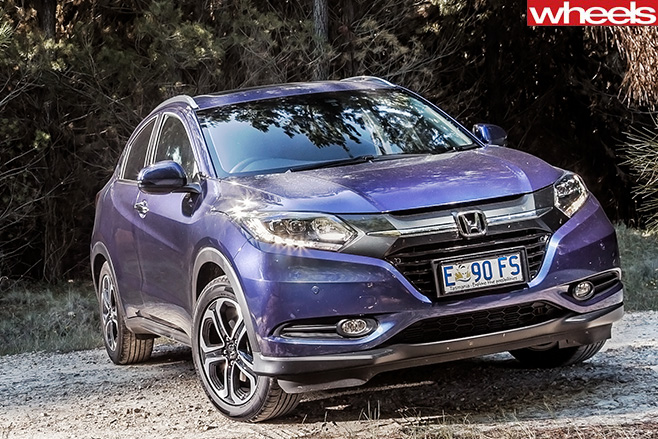
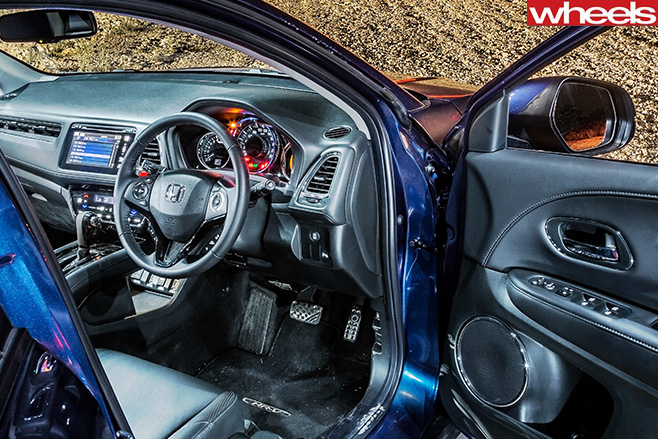
The HR-V continues its revival of Honda’s fortunes inside. A beautifully rendered dashboard with the finest plastics quality, acres of space and a commanding rear seat package with a fabulous view forward raise the Honda to a level its rivals can’t match. Likewise its vast boot with ‘magic seat’ flexibility that is both breathtakingly simple, yet supremely effective in using the rear-seat folding mechanism to maximum effect.
Yet the HR-V is a bit hit-and-miss. Its tailgate is heavy, its doors won’t take bottles any larger than 750ml, its front seats have short, flat cushions and inadequate adjustment, and its flimsy, mesh-like faux parcel shelf is a tragedy. Exactly why it’s so rubbish we can’t say, but you should at least be able to twist it and fold it away. Or pour kero on it and burn it.
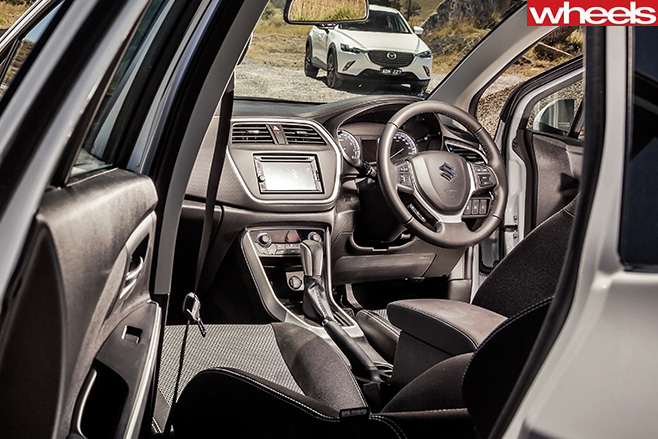
From left field in this five-star crew comes Suzuki’s underrated S-Cross. This replacement for the ageing SX4 has been with us for just over a year, yet it has hardly set the market ablaze. And part of the reason for that could be its relative normality. Unlike the slinky CX-3, coupe-like HR-V, catwalk-ready Captur or Holden’s tall-boy Trax, the S-Cross is simply a small mini-wagon, just like Peugeot’s 2008 but without that car’s visual flair.
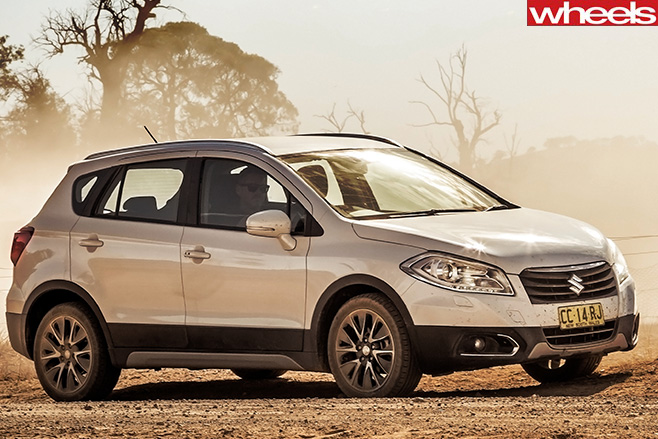
But – and it’s a big one – the S-Cross GLX tested here costs $30,465 driveaway, and that’s a sizeable wedge for what feels like an XL Swift inside. The S-Cross might be roomy, but its interior pales in comparison to the HR-V’s luxury, or the CX-3’s character, or the Captur’s colour. Given that so many parts are shared with its light-hatch sister, it’s no wonder the S-Cross struggles to escape its upbringing.
Likewise the Trax. It’s almost two years since Holden’s Barina-based small SUV launched here, and it’s done quite well. But the Trax must’ve spent too much time sunbaking on the Gold Coast because some wrinkles are starting to appear.
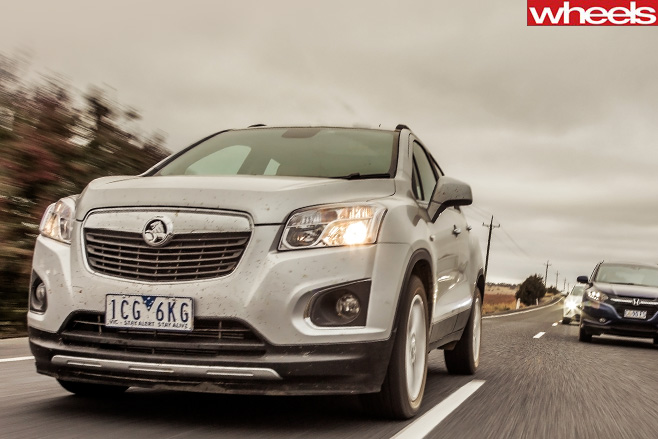
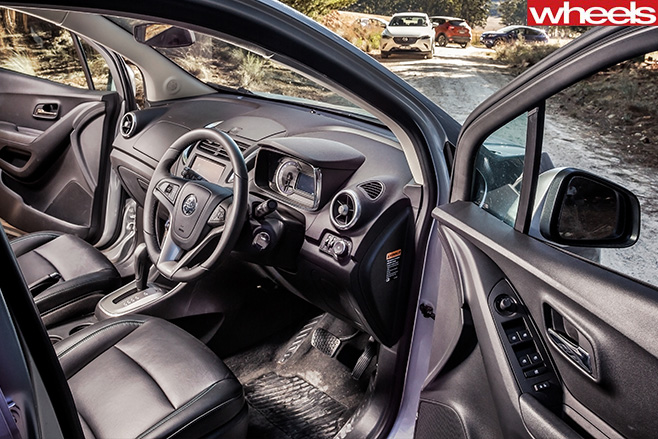
Inside, the cost-cutting scalpel is all too evident. While the Trax’s cabin is littered with useful storage compartments – some with rubberised mats – and cupholders aplenty (four in the centre console, two in the rear armrest, plus decent bottle holders in the doors), it’s the execution of its interior design that lets the side down.
Unlike the S-Cross and CX-3’s hard cabin plastics, the Trax’s are horribly scratch-prone, like pretty much every other sub-Commodore GM product since the 90s. And the sticky, cloying feel of its ‘Sportec’ vinyl trim is barely mitigated by the push-button air-con’s effectiveness – the sole non-climate-control system here. It’s a shame, really, because Trax packs plenty into its compact shape, including decent seats and a well-shaped boot with a double-fold rear seat that forms a fully flat floor.
Cruising corners on stilts
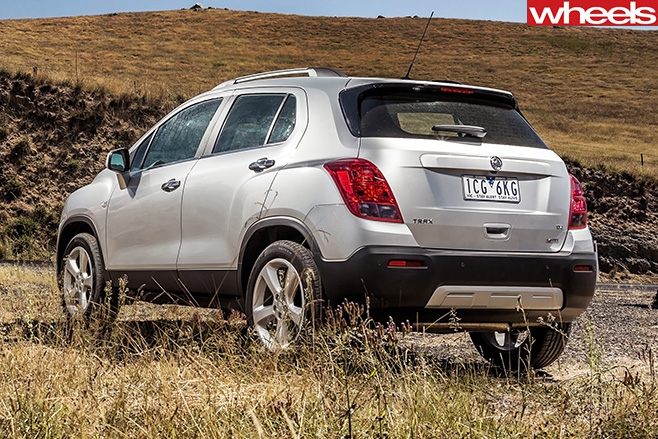
Where the Lang Lang-tuned Holden fights back big time is in the dynamic department. Riding on excellent 215/55R18 Continentals, the Trax’s chassis is taut and sweetly balanced, with inch-perfect steering precision and a newfound level of throttle adjustability thanks to the extra torque of its chubby turbo four.
Similarly sporty but not quite as polished is the CX-3. It also has turn-in, balance and grip by the bucketload, though it feels a bit skittish over bumps at times and its steering suffers kickback through lumpy corners. Then there’s the matter of its damping, which doesn’t quite feel in unison front-to-rear, though four-up ride quality is excellent, offering arguably the best combination of comfort and control.
Refreshingly, the Captur feels very French at speed. The faster you go, the better its ride gets, absorbing bumps that upset the unladen Mazda, yet around town, the 17in-wheeled Captur Dynamique can feel quite firm. And quiet.
Given the depressingly low dynamic base of its showroom buddies, it’s a surprise to discover the HR-V is decent to drive. While its steering can feel disconnected and anaesthetised unless loaded up, the HR-V lacks the vagueness that blights the CR-V and Accord. Despite some roll in the front end, there’s a keenness you can coax from it that dispatches winding roads quickly, and quite confidently. But, unlike its better rivals, you have to set the HR-V’s chassis up for corners. Drive it badly and its handling becomes slovenly.
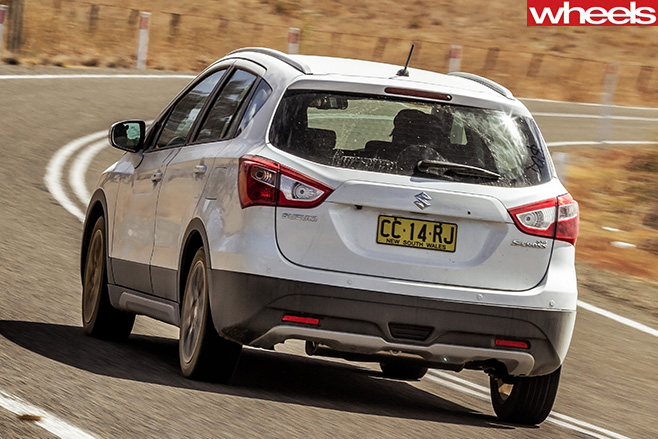
Unexpectedly, the S-Cross is the dynamic duffer in this company. In isolation, when driven briskly the S-Cross feels like it’s blessed with Swift DNA, thanks to the suspension’s underlying suppleness and the adjustable nature of its rear end. But the more you ask of it, the worse it gets.
Flexing those baby muscles
Also lacking in driveability polish is the Suzuki’s CVT. The transmission lacks smoothness when accelerating from rest, and gives the impression that the drive belt is slipping occasionally under full-throttle acceleration.
Yet there’s plenty of goodness. At decent speeds, Suzuki’s seemingly undernourished 86kW/158Nm 1.6-litre atmo four is smooth and unobtrusive when whisking the lithe 1125kg body along, though its quietness may have something to do with being drowned out by road noise. Then there’s the HR-V-beating acceleration to 60km/h, and its excellent test fuel consumption of just 9.0L/100km.
Renault’s 1.2 turbo is an admirably smooth and low-stressed engine, and doesn’t need revs to perform. In Drive, the six-speed dual-clutch ’box upshifts from first to second gear just under 5000rpm, and at 5400rpm thereafter, yet it’ll hit 6000rpm if you put it in the manual gate… and go slower. What spoils the fun, though, is the transmission’s lethargy. From standstill, Renault’s Getrag-developed dual-clutcher takes too long to engage, while at other times its throttle response has the immediacy of a cadaver. Captur’s plump mid-range is some compensation, though you often drive it flat to the floor.
The 1226kg Mazda is not only more economical (9.3L/100km), but much quicker. A 0-100km/h time of 8.9sec and the standing 400m in 16.4 cement the CX-3’s sporting credentials, as does its excellent transmission with highly effective Sport mode. But the downside to the engine’s induction growl is the vibes you feel through the wheel and pedals as it spins the tacho needle all the way to 6700rpm.
So which were our favourites?
But the Trax is a better car than the S-Cross, and arguably better value at an inflated $30K. While its plasticky interior, vinyl trim and equipment shortfalls put a big question mark next to its list price, no one can dispute the excellence of its handling, or its grunt and space.
Unfortunately for the Suzuki, there’s no way its interior feels like 30 grand’s worth, certainly not after experiencing the sizzle of its best rivals for less money. But there’s an unpretentious charm about the S-Cross. While it isn’t perfect, we could understand why someone would buy one, keep it for a fault-free 15 years and love it. But that person would probably be buying the GL manual for $22,990 driveaway, not the overpriced and out-of-its-depth GLX.
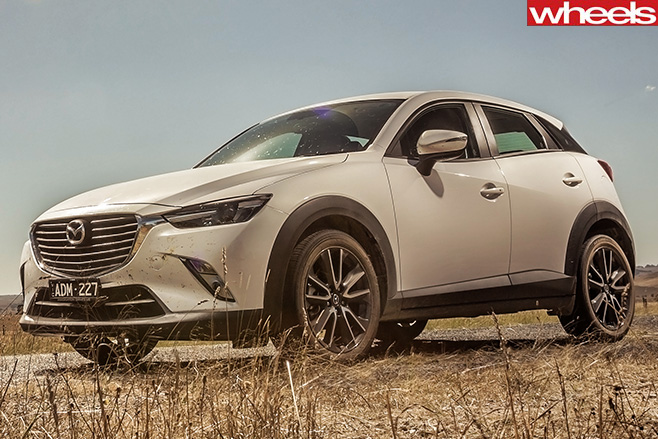
So, CX-3 or HR-V? Hate to say it, but it depends on your priorities because they’re so different. If the Honda offered the Mazda’s seats and dynamics, it would win because it’s such a versatile, stylish, beautifully built SUV. But the CX-3’s all-round ability, innate driver appeal and cool, classless design keep drawing us in.
Tall oil
AT PRESENT, the only diesel-engined variants among Australia’s burgeoning baby SUV brigade belong to the Mazda CX-3 (auto-only, front- or all-wheel drive), Peugeot 2008 (manual-only, front-drive) and Skoda Yeti (dual-clutch, all-wheel drive), though more are coming. The one we’re super-keen to drive is Honda’s HR-V diesel. Sharing its strong 88kW/300Nm 1.6-litre turbo-diesel with the Civic, the HR-V oiler will also bring with it a manual. We reckon it’ll be the HR-V to have when it lobs around Christmas.
SUV over MPV
Small-SUV sales have jumped almost 35 percent this year, on the back of a 16 percent rise in 2014, and the imminent Jeep Renegade, Peugeot 2008 update and quirky Citroen C4 Cactus (January 2016) can only add fuel to that fire. The casualty, of course, is the small MPV, whose popularity is waning in Europe and has dropped like a stone in Australia, despite being a more logical option for space-challenged families. Unfortunately for the baby MPV, the masses think they’re about as sexy as an orthopaedic sandal, though some find functional utility quite arousing.
Why no Pug?
Having won our January 2014 small-SUV comparo by a whisker, we chose not to invite Peugeot’s likeable 2008, simply because the game has moved on. And its decrepit automatic drivetrain hasn’t. But good news is on the way. Late this year, the 2008 range (and the 208 hatch) will be transformed when PSA’s brilliant 1.2-litre three-cylinder turbo migrates from the 308 in an 82kW/205Nm tune, tied to a new-generation six-speed automatic, and hopefully a manual. Unless you’re happy with the current 60kW 1.2 atmo five-speeder, which is a leisurely charmer, we’d hold off until the turbo-triple and new auto arrive.
Verdict
HOLDEN TRAX LTZ 1.4T
Price as tested: 30,540 *Includes metallic paint ($550)
NCAP rating: 5 stars (Aus)
Fuel economy: 11.1L /100km (test average)
Acceleration: 0-100km/h: 9.3sec (tested)
Plus: Engaging handling, steering and grip; roomy cabin; strong engine; vision
Minus: El-cheapo trim; refinement issues; rapidly ageing look; steep price
Verdict: 6.0/10
HONDA HR-V VTi-L
Price as tested: $33,139*Includes floor mats ($149)
NCAP rating: not tested
Fuel economy: 9.9L/100km (test average)
Acceleration: 0-100km/h: 10.2sec (tested)
Plus: Excellent interior; brilliant flexibility; space; vision; styling; build quality
Minus: Horrible rear parcel ‘shelf’; flat front seats; artificial steering
Verdict: 8.0/10
MAZDA CX-3 sTOURING
Price as tested: $28,990
NCAP rating: not tested
Fuel economy: 9.3L/100km (test average)
Acceleration: 0-100km/h: 8.9sec (tested)
Plus: Superb seat comfort; good ride; keen chassis; grunt; style; value; resale
Minus: Steering kickback; engine vibes; vinyl upholstery; small boot
Verdict: 8.0/10
RENAULT CAPTUR
Price as tested: $29,090 * Includes metallic paint ($800) and removable charcoal/orange seat trim ($300)
NCAP rating: 5 stars (Euro)
Fuel economy: 8.8L/100km (test average)
Acceleration: 0-100km/h: 11.1sec (tested)
Plus: Smooth and supple; neat packaging; styling; efficiency; utility; refinement
Minus: Gearbox lethargy; hard plastics; no rear-seat curtain airbags
Verdict: 7.0/10
SUZUKI S-Cross GLX
Price as tested: $30,465 *Includes premium paint ($475)
NCAP rating: 5 stars (Aus)
Fuel economy: 9.0L/100km (test average)
Acceleration: 0-100km/h: 10.5sec (tested)
Plus: Fuel and space efficiency; mildy entertaining chassis; great vision
Minus: Flawed CVT; sticky steering; plain interior; doesn’t look or feel special
Verdict: 5.0/10
The temptation in this day and age is to keep your tappet-head proclivities under wraps.
Failure to do so will reveal you to be a twelve-toed cousin-lover and ensure that you spend the rest of your miserable days on the very fringes of society. Or so it seems to me sometimes.
Frankly, however, I’m getting a bit tired of being expected to apologise for enjoying my motoring. And let’s face it, there are plenty of other inexplicable hobbies and past-times, aren’t there?
I mean, can somebody – anybody – explain stamp collecting to me? Or what about train-spotting? And yet admitting you’re a petrol-head is only one back from developing an interest in kiddy-porn. Beats me.
But get this: I don’t think we’re as alone as society would make us out to be. I went to a neighbour’s 80th birthday last weekend. And of the 20 or so people gathered on the verandah, quaffing cheap wine and making wise-cracks about turning 80, roughly half were card-carrying petrol-heads.
Okay, maybe not half (because half were the wives and squeezes of the blokes in my street) but of the chaps, more than 50 percent were brave enough to express an interest in internal combustion.
The bloke right across the road from me shares a hillclimb Nissan with his son and they’re currently working on turning the NX Coupe from front- to rear-wheel drive. Don’t ask me why, I’m just telling you what happened.
The birthday boy is still driving competently at 80 and has just bought himself a newish Corolla, the kid two doors up has a Golf R32 and the big bloke who lives next to him has an F150 ute with an improbably large V8 on board. Even the bloke who hosted the party admitted to a shed full of old dirt bikes. I felt as though I was among friends.
Thing is, these were just blokes at a birthday party on a Sunday afternoon. And while my suburb ain’t full of million-dollar houses, it’s not Sunnyvale, either. Pretty soon the discussion turned to speed limits, rabid highway patrol coppers and whether two cars doing 100 clicks having a head-on was the same as one car hitting a brick wall at 200. It’s not, apparently, although the bloke with the F150 reckoned it’d still be one hell of a mess.
So if this level of interest in things vehicular is not uncommon in modern Australian society, why the bloody hell do I still feel so marginalised by law-makers and those paid to uphold those laws? Why does the government wish to make me feel like a criminal and an environmental terrorist (especially since the last election proved there’s no such thing as climate change anymore)?
I don’t think the stamp collectors and train spotters would appreciate being treated with such disdain and even the kiddy-porn mob get a fair trial. Yet here we are, with cameras and radar guns trained on us the moment we wheel out our driveways, with a team of dogs waiting to tear our flesh open the instant we exceed an arbitrary speed limit by a single kay-em-haitch. I’m kind of sick of it. What about you?
Speaking of the last election, I see that the Australian Motoring Enthusiasts Party has won a Federal Senate seat. What this means for motorists is anybody’s guess, but looking at the AMEP’s website – and hopefully I’m wrong – I’m not filled with hope.
For a start, the party’s logo includes the southern cross – a graphic that has been well and truly hijacked by the redneck movement – and there’s a gallery pic of a young lady draped in the Australian flag next to a V8 Commodore.
And there’s me wondering why we’re all tarred with the hillbilly brush.
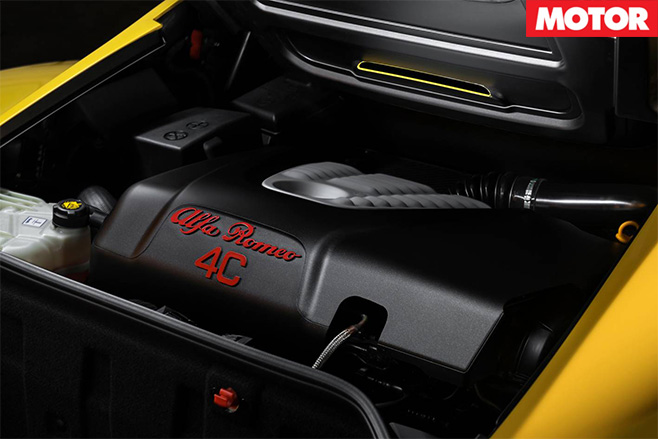
Losing some bodywork around you may be familiar to older Alfa Romeo owners (ahem) but the 4C Spider has taken it off in all the right places.
The local outlet will sell the open-top version of the hard-top 4C mini-supercar for a $10K premium, from $99,000 plus on-road costs, and Alfa dealers are taking orders now ahead of November 2015 delivery.
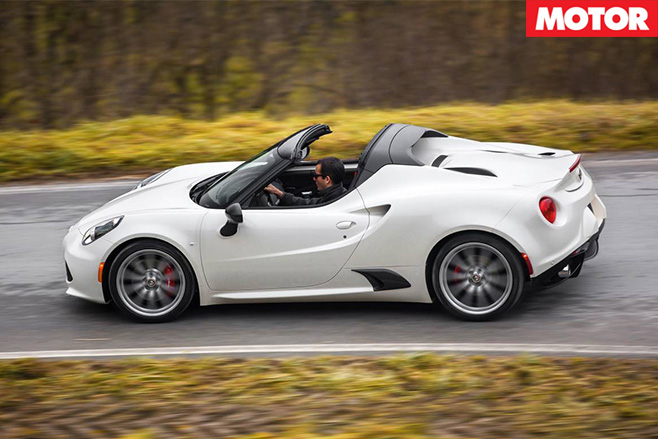
The 1035kg 4C Spider can therefore use the same 1.75-litre turbocharged four-cylinder with 177kW and 350Nm mated with a six-speed dual-clutch automatic transmission to achieve a coupe-matching 4.5sec 0-100km/h.
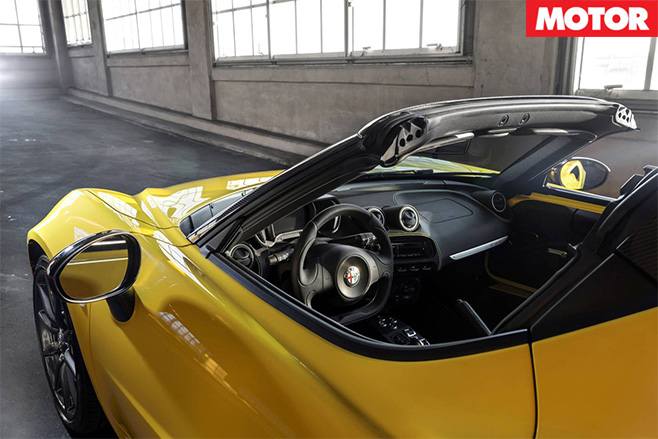
There will be no Launch Edition specification for the 4C Spider as there was with the coupe version, which retailed at $109,000 with special race suspension and exhaust.
VOLKSWAGEN Australia has declined to comment on how its customers will be affected by a diesel emissions scandal that could cripple the world’s biggest car maker, Volkswagen Group.
The German company admitted last night that up to 11 million of its vehicles worldwide had been sold with diesel engines that ran much cleaner during official emissions testing than they did in ordinary driving.
A switch in the engine control software ensures the engines perform better and, reportedly, use less fuel in the hands of customers than they do in testing – while emitting up to 40 times the permitted level of nitrogen oxides, pollutants linked with respiratory problems.
The scandal came to light in the United States, where the Environmental Protection Agency said 482,000 four-cylinder diesel Volkswagens and Audis had been fitted with the switch software.
Cars involved included Volkswagen Golf, Jetta, Beetle and Audi A3 models built since 2009 and Volkswagen Passats since last year.
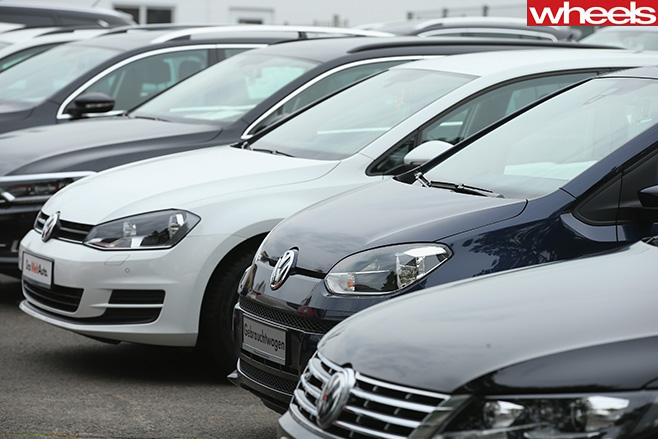
The US EPA has ordered Volkswagen to recall all the affected vehicles and ensure that pollution levels in customers’ hands are as tested.
Volkswagen CEO Martin Winterkorn has apologised on video for what he described as manipulations detected by the EPA.
“I personally am deeply sorry that we have broken the trust of our customers and the public,” he said in a statement posted on VW’s European website.
“We at Volkswagen will do everything that must be done in order to re-establish the trust that so many people have placed in us, and we will do everything necessary in order to reverse the damage this has caused.”
There was speculation that Winterkorn would be asked to resign at a board meeting tonight (Wednesday) Australian time. Update: VW chief Martin Winterkorn resigns.
The CEO of Volkswagen in the US, Michael Horn, has admitted the company had been dishonest, reports say.
“Our company was dishonest, with the EPA and the California Air Resources board, and with all of you and in my German words, we have totally screwed up,” he was quoted as saying yesterday at a launch for the Passat in New York.
He referred Wheels to a statement released overnight by Volkswagen Group, which said the company had set aside 6.4 billion euro (more than $A 10 billion) to “correct deviations” from test results that concerned only EA 189 turbodiesel engines fitted to 11 million vehicles worldwide.
Volkswagen was working intensely to eliminate the deviations through technical measures, it said.
Volkswagen share values have fallen 35 per cent as investors assess the cost to the company, reducing its market capitalisation by 25 billion euro ($A 39 billion).
Fellow German car importer Mercedes-Benz Australia, which offers a big range of models powered by its own diesels, said today it was 100 per cent confident its cars met Australian emissions standards.
Asked whether it would be taking a closer look at its range, a spokesman told Wheels: “No we aren’t looking at our range at all. We’re quite confident. But look, this isn’t a matter that concerns Mercedes-Benz and we prefer not to comment on rival manufacturers.”
Porsche Australia spokesman Paul Ellis said no Porsche would be affected – even though Porsche is a member of Volkswagen Group.
“From what we understand at this moment, it doesn’t affect any Porsche vehicles anywhere in the world,” Ellis said.
Internationally, BMW, Toyota, Honda and Renault were reported as denying absolutely that their cars could be ensnared in the scandal.
“I can confirm that we don’t use any software that could influence the emissions test,” a BMW spokesman was quoted by London’s The Daily Telegraph.
PLUS
- The Cayman is all about balance. Its handling is superb, its steering sharp and full of feedback and its mid-mounted flat-six engine is an absolute peach. Combine this with a tactile, well-oiled manual shift, or one of the fastest and most intuitive automatic gearboxes around and the Cayman is a hugely engaging and rewarding car to drive quickly.
- It sounds amazing. The Cayman is offered with the choice of three, high-revving flat-six petrol engines, and all of them provide a spine-tingling exhaust note. To enhance your aural pleasure, make sure you tick the optional sports exhaust system.
- Porsche has built an even faster one! Yep, a track-focused GT4 version of the Cayman has recently hit our roads and is propelled by a bigger, more powerful engine stolen from the iconic Porsche 911.
- You can use it every day. The Cayman has two well-sized boots, its vision is excellent and the interior is spacious and comfortable. A supple suspension tune and superb refinement only add to its everyday usability.
- There’s nowhere to put anything. As beautifully made and comfortable as the Cayman’s interior is, the cabin does lack storage space.
- It’s not a 911. The Cayman sits firmly in the middle of Porsche’s range (above Boxster, below 911) in terms of price and performance, which means one day at a set of traffic lights, a 911 will pull up next to you.
- It’s rather expensive. The base Cayman is over $106K and the new-range topping GT4 version is $190K, which we admit, is hardly cheap. Dollar for dollar, though, the Cayman offers one of the most pure driving experiences money can buy.
Forget Peugeot and Sebastian Loeb for just a second.
While the record-annihilating time set by the WRC legend rightfully garnered the lion’s share of the press, we can’t help but feel that an awesome story was missed.
Rhys Millen has taken a bunch of silverware home from the Pikes Peak International Hill Climb and is the first to admit he never considered himself a fighting chance against Peugeot. “They were in a class of their own – nobody had anywhere near their program’s budget or support and their race was really just against the mountain,” the 2012 PPIHC outright winner says.
Still, the Kiwi ex-pat and his Rhys Millen Racing team weren’t going to walk away from over 30 years of participation at Pikes Peak simply because some baguette- and snail-gobbling beret-wearers were turning up with a Le Mans car dressed as a 208. But they had a problem: they needed support for a racing program.
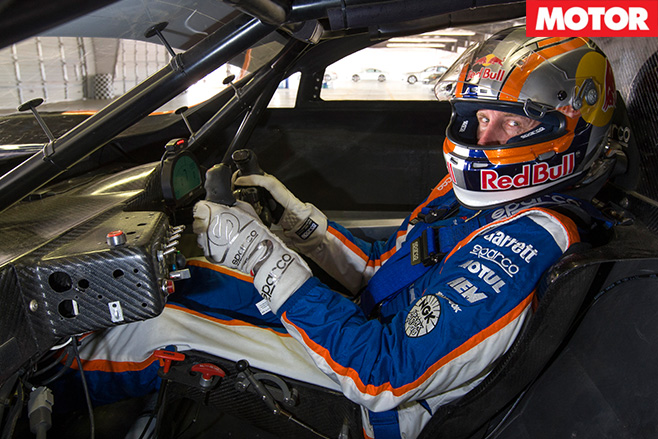
Once they did put pen to paper, RMR only had six months to build and test a car from scratch. With the Colorado course now fully sealed, cars built to race on the dirt/tar mix would not be competitive against the new breed of tarmac terrors.
They were up against a manufacturer with what was estimated to have been a $5 million budget, a car built using decades of experience at Le Mans, WRC and F1, the world’s greatest WRC driver in the hot seat and the marketing clout of Red Bull.
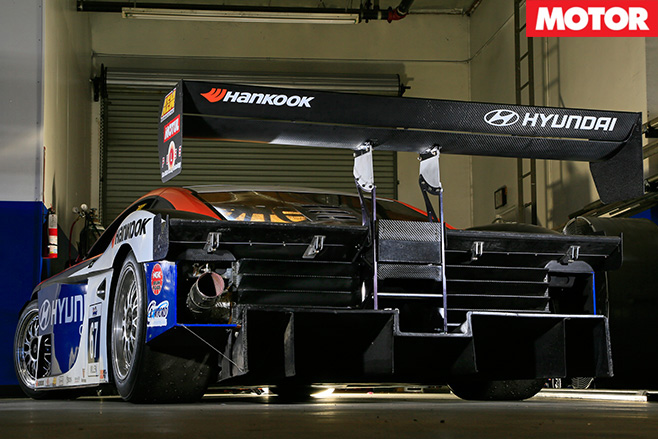
“We just didn’t have time to build something from the ground up, so we started looking for rolling chassis packages that would suit the engine package we already had,” Rhys says. The motor he refers to is the 3.8-litre V6 from the Genesis coupe, which he’d run previously in turbo form on his Genesis drift car.
To reach his goal of eight minutes, Rhys knew he needed nearly 750kW pushing no more than 1200kg. RMR replaced the weak stock pistons and conrods with forged items to handle boost, and pushed the motor from 3.8 to 4.1 litres.
Surprisingly, apart from aforementioned internal mods and adding a custom-designed four-stage dry sump oil system, twin 1000cc fuel injectors per-cylinder, AEM ECU and custom piping, the engine is stock. This is impressive when you consider it can produce between 595-710kW and a hefty 1150Nm of torque!
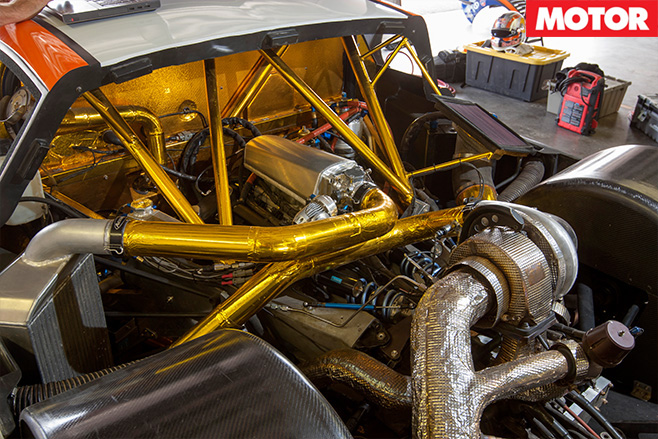
Many engine bay components were covered in gold reflective wrapping to help dissipate heat, while the AEM ECU controls a water-injection system to help cool the air charge and reduce detonation. This allows the V6 to run a hotter tune, and also protect it from self-destruction.
“We didn’t have time to test, so a lot of the parts on the car were specced like that, or modifications done just to safeguard against failure. The intercooler is that size because we could only estimate the size of the core we needed, so we went larger than required because we couldn’t afford downtime to fix things when we needed to be fine-tuning the set-up.
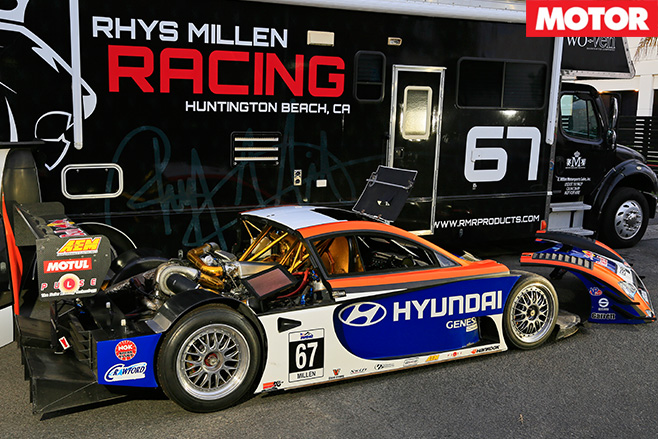
While the motor was sorted the RMR team figured a Daytona Prototype would be the best base for their challenger. The PM580T is actually a Crawford DP03 under the Genesis shell, built in 2005 for the Rolex Grand Am series run in the US.
While Rhys would have ultimately preferred a four-wheel drive platform, the budget and development time didn’t allow for it. “Four-wheel drive would add a lot of weight and complexity to this car, but it’s still a huge performance advantage. The speed Loeb was pulling out of corners was astounding – he could just stand on it and go, while I had to feather my way through.”
Due to rule differences between PPIHC and Grand Am there were changes required to the roll cage and A-pillar structure. The angle of the windscreen was lengthened, the top bar brought further forward, while extra lower bars were added to the cage. As the car was meant to represent the ultimate Hyundai Genesis, a custom body was required and was whipped up by RMR’s composite technology arm, Wo-Ven.
The DP03 came with the Xtrac five-speed DP386 sequential transaxle Rhys used at Pikes, which was rebuilt with shorter gearing to bring the top speed down to 225km/h, which Rhys hit several times on his way up the mountain.
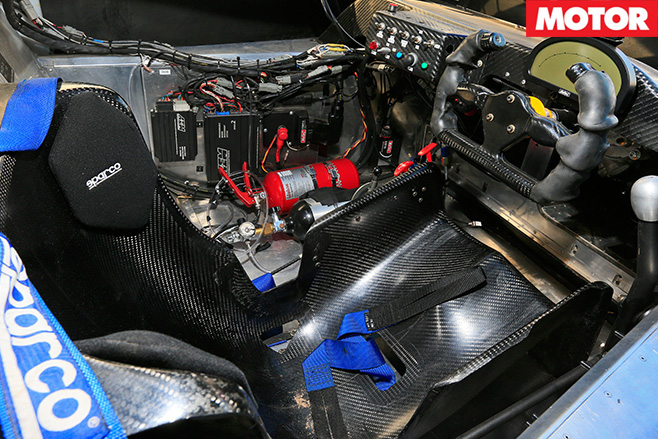
“There are probably 20 places on the course where I’m back in first gear and using all the lock available just to get around the hairpin,” Rhys says. The DP’s 18 degrees of lock wouldn’t cut it, so the steering system was altered to allow a full 24 degrees. The hydraulic power assistance was replaced with an electric unit from a Hyundai Sonata. This reduces parasitic drag on the motor, weight and potential problems from leaking or overheated fluid.
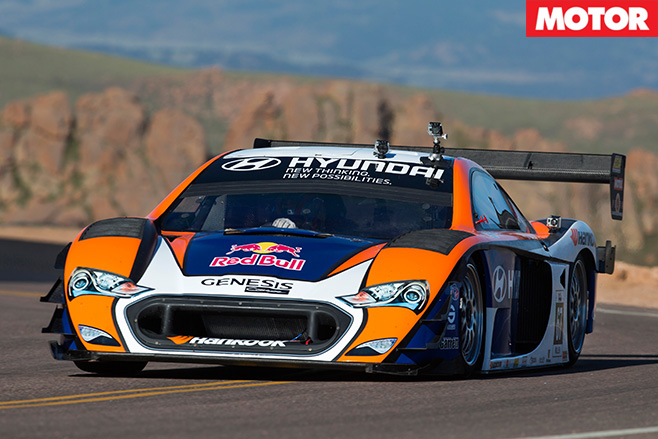
The PM580T was finished around mid-May and, after spending a couple of days on a chassis dyno, was shipped 130km out to Hyundai’s US proving ground for initial testing. Tweaks to the gear ratios and suspension were dialled in before the team packed up in July and headed for Colorado.
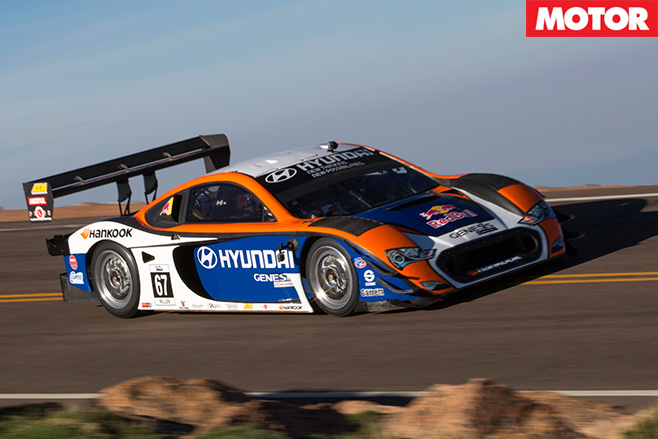
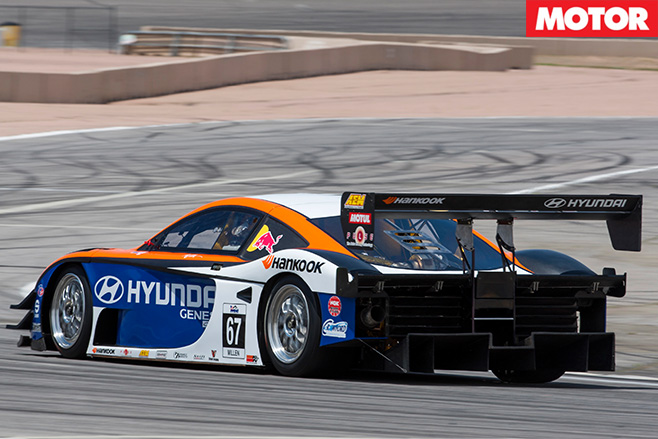
“Tyre companies just don’t make a soft enough compound for the race – you can’t keep the temperature in the tyres even with the softest tyres they make. Still, it’s quite neutral to drive, with a slight emphasis on being loose in the rear-end,” Rhys says. “This is because, as you climb higher, the tyres go cold and give a tendency to push [understeer]. Being on the loose side means the car will generally remain neutral in those sectors.”
In the end, while he couldn’t get near Loeb’s 8min 13sec time, Millen was head and shoulders above the other Unlimited contenders, besting third place Jean-Phillipe Dayraut by 40 seconds with a time of 9min 01.192sec.
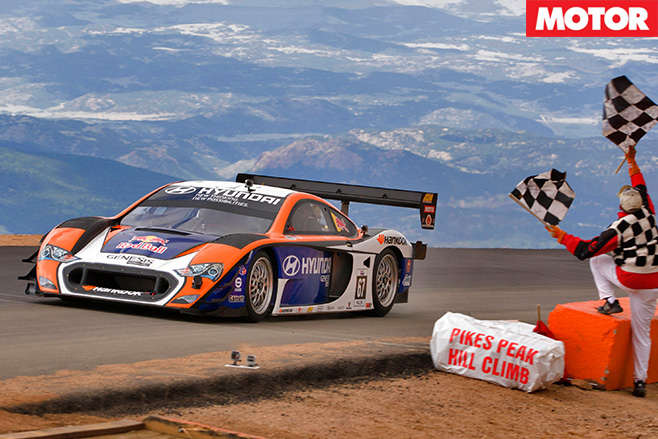
Peugeot has already said it’s not returning in 2014, so hopefully we see RMR come back to the mountain and break through the nine-minute barrier.
| Specs | u00a0 | u00a0 | u00a0 | u00a0 |
| u00a0 | u00a0 | u00a0 | u00a0 | u00a0 |
| Body | u00a0 | u00a0 | u00a0 | 2-door |
| Drive | u00a0 | u00a0 | u00a0 | rear-wheel |
| Engine | u00a0 | u00a0 | u00a0 | 4.1 litreu00a0Lambda DOHC V6 |
| Engine Mods | u00a0 | u00a0 | u00a0 | RMR forged pistons, connecting rods, inlet plenum, four-stage dry sump set-up, AEM ECU,u00a0MoTeC data-capture |
| Power | u00a0 | u00a0 | u00a0 | 710kW |
| Torque | u00a0 | u00a0 | u00a0 | 1150Nm |
| Power-To-Weight | u00a0 | u00a0 | u00a0 | 641kW/tonne |
| 0-100km/h | u00a0 | u00a0 | u00a0 | 2.5sec (esimated) |
| Top Speed | u00a0 | u00a0 | u00a0 | 225km/h (gearing limited) |
| Transmission | u00a0 | u00a0 | u00a0 | 5-speed sequential manual |
| Weight | u00a0 | u00a0 | u00a0 | 1107kg |
| Suspension | u00a0 | u00a0 | u00a0 | double wishbone with pushrod rocker actuation, coilover dampers (f/r) |
| L/W/H | u00a0 | u00a0 | u00a0 | 4506/2006/1118mm |
| Wheelbase | u00a0 | u00a0 | u00a0 | 2794mm |
| Steering | u00a0 | u00a0 | u00a0 | rack-and-pinion, electric |
| Brakes | u00a0 | u00a0 | u00a0 | 355mm carbon discs, 6-piston calipers (f); 320mm carbon discs, 4-piston calipers (r) |
| Wheels | u00a0 | u00a0 | u00a0 | 18 x 12.0-inch (f); 18 x 13.0-inch (r) |
| Tyres | u00a0 | u00a0 | u00a0 | 280/690-18 (f); 320/710-18 (r) |
“The interrelation between the body of a beautiful woman and that of a Farina-designed car is that both have simplicity and harmony of line, so that when they are old, one can still see how beautiful they were when they were young.”
– Battista ‘Pinin’ Farina
pininfarina. You may have seen that lowercase cursive dancing across the flanks of a beautiful car. Look closer for the fancy ‘f’, framed with a rectangle, crowned with a crest. The Italian design house is best known for its association with Ferrari but has also designed iconic cars for Fiat, Alfa Romeo, Maserati and more.
Even if you don’t recognise the name, you probably know the signature lines. Remember Magnum PI’s thumping red Ferrari 308 GTS Quattrovalvole? Pininfarina. The perfect curvature on both ends of the 1966 Alfa Duetta in The Graduate? Pininfarina. That square-ended rampaging 1984 Ferrari Testarossa with the long raked air vents featured in Miami Vice or 1987’s F40 with the square spoiler that featured on every teenage boy’s bedroom wall? Pininfarina. The elegant flanks and classic long hood of the Maserati GranTurismo in Iron Man 2? Pininfarina.
Battista ‘Pinin’ Farina founded his bespoke coach house, Carrozzeria Pinin Farina, in 1930. ‘Pinin’ means ‘youngest brother’ in Piedmontese and Battista was the 10th of 11 children.
During WWI, Farina supervised the building of Aviatic trainer planes in Italy, and in 1920 he travelled to America to learn more about the design and construction of cars. Although invited by Henry Ford to stay in the USA and work, Battista returned to Italy and set up shop designing and building beautiful car bodies in small production runs. He worked on the first Alfa Romeo cars as well as Fiats, Renaults and some American cars before WWII.
Immediately following the war, 1946 was his landmark year: Pininfarina created the body for the coupe Cisitalia 202GT, often referred to as the ‘rolling sculpture’. Based on the aerodynamics of race cars, this design revolutionized sports cars with its smooth rounded lines and one-piece construction. In 1951 MOMA acquired the car and Farina met with Enzo Ferrari to seal what became an iconic working relationship. As the founder of the Ferrari collector newsletter put it: “Ferrari would not be Ferrari without Pininfarina. Ferrari built the machines, and basically Pininfarina clothed them.”
Farina’s son, Sergio Pininfarina, continued his father’s vision with a series of beautiful and innovative designs, including the renowned Ferrari Dino. The Dino was launched in 1968 to compete with the Porsche 911, and its bug-eyed headlights, pronounced swooping front fenders and tapered rear are universally loved. Sergio also suggested the mid-engine layout, with the engine behind the driver but forward of the rear wheels. This positioning made the engine into a design feature and became a signature for Ferrari. The Dino’s successful marrying of engineering and design propelled Ferrari into the mass market and sealed the reputation of Pininfarina as the go-to for elegant, timeless design. Many current car designers cite the Dino as a car they wish they had designed.
Pininfarina also produced the signature styles of Peugeot and Alfa Romeo in the 60s and beyond. Sergio led the company until 2001, when his sons took over. Sergio was renowned for his refined aesthetic – asked what makes good design, he responded: “Good harmony, classic style, proportion, grace and honesty. Then, if you have good taste, the battle is won.”
The company is now run by Battista’s grandson, Paolo Pininfarina, who has diversified its work into industrial and interior design. He asserts that Pininfarina design is still based on the “three essential requirements” of elegance, purity and innovation.
The Opel Astra is new from the ground up, and will headline a cutting edge, high-tech future for Holden when it replaces the Cruze.
WHAT IS IT? The next edition in a long line of Opel Astra/Kadett models. Many have been seen in Australia before in various guises (Vauxhall Viva, Holden Gemini, Holden Astra and Opel Astra). But this Astra is brand spanking new, chocked with class-leading tech and riding on a new-generation D2XX platform that’s both lighter and stronger.
WHY WE’RE TESTING IT? The new-gen Astra is an extremely important car for Holden. With sales of the six-year-old Cruze dissolving faster than a Disprin (down 24 percent in 2014), it must hang on until the Astra lands about September 2016. It will boast a pair of new-generation direct-injection, turbocharged petrol fours, and the likelihood of a Sports Tourer wagon accompanying the five-door hatchback. This Holden Astra will form the cornerstone of Holden’s effort to maintain market share as it transitions from local manufacture, so it needs to be good. Really good.
MAIN RIVALS Volkswagen Golf (the class benchmark), Toyota Corolla (the current sales champ), and Mazda 3 (Australia’s number one private buyer’s choice), not to mention Hyundai’s strong-selling i30. But Astra also faces a wealth of small-car talent in the strongest, most competitive class in Australia – namely Ford Focus, Peugeot 308, Kia Cerato, Mitsubishi Lancer, Citroen C4 and the sedan-only Nissan Pulsar. And by the time Astra lands in 12 months time, it will also face Renault’s striking, all-new Megane IV and potentially Honda’s new-generation Civic.
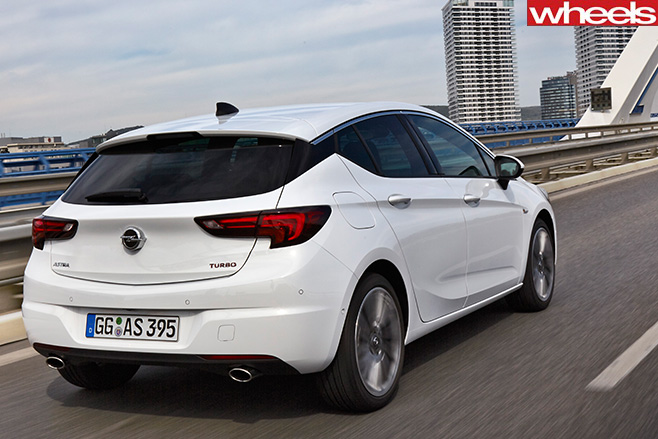
VERDICT Handsome, refined, and well-built, the Astra has a premium feel that is several generations ahead of the Aussie-built Cruze it will replace. The new Astra challenges Volkswagen’s benchmark Golf for packaging excellence, and may even go one better for seating comfort. Its all-new 1.4-litre turbo-petrol four – expected to be the volume engine for Holden – is in need of some calibration and gearing alteration if it’s to truly shine. But then that’s what Holden’s engineers do best, and they have 12 months to get it right.
THE WHEELS REVIEW IF CONSISTENCY is the key to success then Holden may face an uphill battle with its forthcoming Cruze replacement, the Astra. Destined to carry Holden’s fortunes from late 2016 in the most hotly contested class in Australia, the Astra will need to muster every fibre of talent, backed by a class-rattling value package, if it’s to get anywhere near the 34,218 sales record it set just a decade ago.
Thing is, the Astra faces exactly the same challenge in Europe. Hence GM’s German outfit, Opel, has thrown everything at the latest generation of its biggest seller. The Astra K, as it’s known in Opel circles, is virtually brand new, from its lighter and stronger platform to its full suite of direct-injection, turbocharged engines and class-leading levels of tech and equipment.
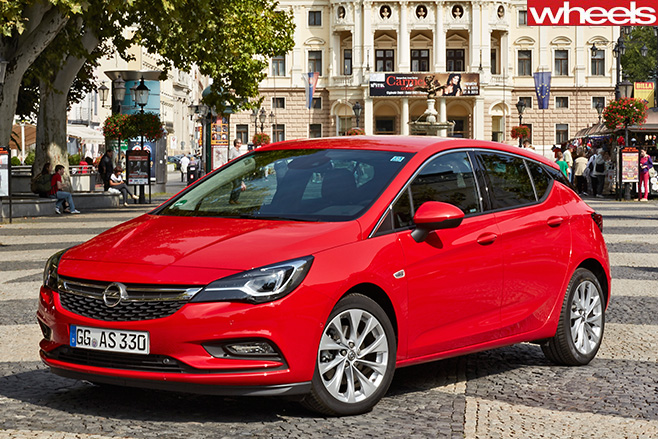
It’s new Astra’s serious weight saving, however, that amends the previous model’s biggest failing (and by association, the porky Cruze’s). Even the smallest weight loss is a sizeable 120kg, while diesel models have dropped up to 200kg, meaning an Astra 1.4 turbo manual now weighs 1203kg. In comparison, an equivalent Euro-spec Golf 1.4 turbo is 1150kg.
Adding to Astra’s considerable gains in packaging and construction efficiency are its new engines. This is the first car to debut GM’s entire new-generation engine line-up simultaneously, adding an all-aluminium, direct-injection, turbocharged 1.4-litre petrol four-cylinder to the 1.0-litre turbo three-pot and 1.6-litre turbo four-pot that have been progressively introduced since 2013. The Euro Astra also debuts a brand new range of 1.6-litre ‘Whisper’ turbo-diesels, although they won’t be coming to Australia.
Boasting variable intake and exhaust camshafts, but not variable valve lift, the 1399cc version’s aluminium block saves 10kg over the old 1364cc engine’s cast-iron example, while its fuel consumption is vastly superior. The six-speed manual 1.4 turbo Astra’s EU combined figure of 5.1L/100km – supported by a virtually seamless idle-stop system – puts it marginally ahead of Volkswagen’s 92TSI Golf, and miles ahead of the thirsty Cruze.
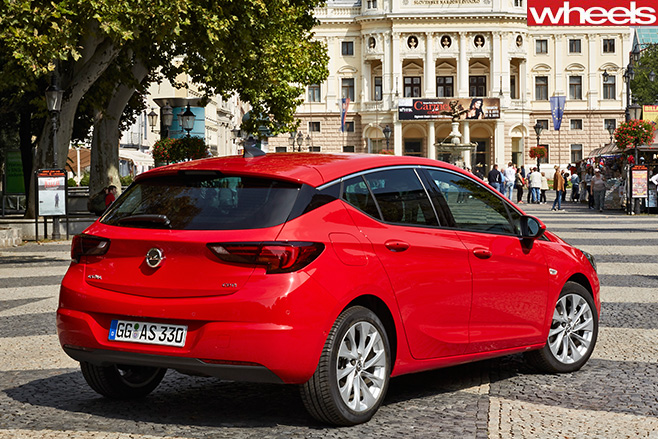
Running very tall gearing that sees the Astra ticking over at just 1900rpm in sixth gear at 100km/h, the 1.4 feels flat-footed in its response, with little to give at 1500rpm and a gradual build in grunt towards its respectable mid-range, then revving out fairly cleanly to the 6250rpm cut-out. Opel claims 0-100km/h in 8.5sec, yet this engine lacks the supreme flexibility of Volkswagen’s 92kW/200Nm 1.4 turbo, featured in entry-level Golfs.
Apparently the “band width” of the Astra means that Holden has the scope to make adjustments to the 1.4’s gear ratios and engine calibration. And even Opel’s powertrain director, Roland Kessler, said “we will see evolutions of the 1.4 turbo going forward”, which gives hope that this otherwise promising new-generation engine will live up to its potential.
Its big sister, a 1598cc version punching out 147kW at 5500rpm and 280Nm from 1650-3500rpm (with an overboost function taking that to 300Nm from 1700-4700rpm), is a much better proposition. Already featured in Holden’s current Astra GTC Sport – the coupe version of the previous-gen Astra – the 1.6 turbo is much livelier than the 1.4, and it’s shorter geared too, showing 2200rpm at 100km/h in sixth. It pulls with proper authority no matter what the ratio, even from 1500rpm, and backs that up with some induction throatiness beyond 5000rpm.
Its quoted 0-100km/h time is 7.8sec, but in reality the difference from its less powerful sibling is much greater. Opel says the 1.6 turbo is 3.3sec faster from 80-120km/h in fifth gear than the 1.4, without too much penalty in its combined fuel number (5.9L/100km). While the 1.4 had no trouble attacking Austria’s motorways at 150km/h-plus, without the gearing to properly complement its power delivery, it lacked the effortlessness of the 1.6.
Opel benchmarked the Ford Focus for handling and the Mk7 Volkswagen Golf for ride, aiming to be more dynamic than the VW, but also comfortable. And for the most part, they’ve achieved it. The highlight is arguably Astra’s steering, with a crispness and accuracy around straight ahead and through constant-radius corners that enhances the driver’s feeling of connection and makes the car easy to place. The 1.6 brings a Sport mode that adds some meat to the weighting without muddying feel, while GM’s new steering wheel is brilliant to hold, matched to an exemplary driving position.
Astra’s handling treads a relatively safe path, with neutral balance leading to mild understeer in tight corners when pushed hard, and pleasant poise on fast country roads tackled at pace, though Aussie cars will receive a locally developed tune.
The 1.4 on 225/45R17 Michelin Primacys is arguably the pick, given its sweeter blend of ride suppleness and handling poise, although the sports-suspended 1.6 wearing 225/40R18 Bridgestone Potenza T001s offers much more grip. That said, with traction control switched off to prevent ESC intervention, the 1.6 will easily spin an inside wheel in tight corners, and would benefit from some front diff smarts.
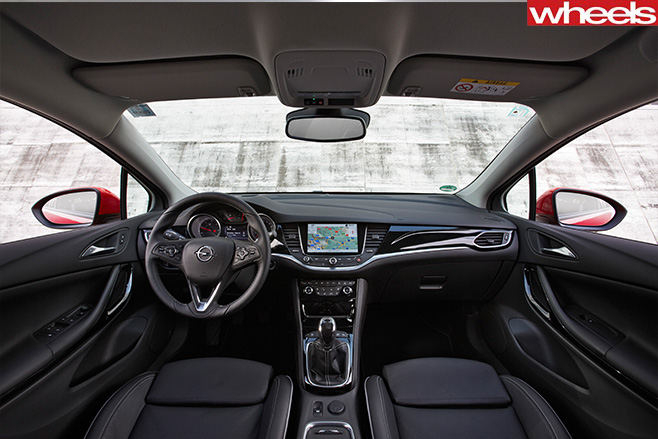
What may prove Astra’s piece de resistance, though, is its interior. With excellent front seats approved by AGR (a German campaign for healthier backs) that took five years to develop, each weighing 10kg less than before, the Astra combines class-leading comfort with available features such as seat ventilation and a massage function.
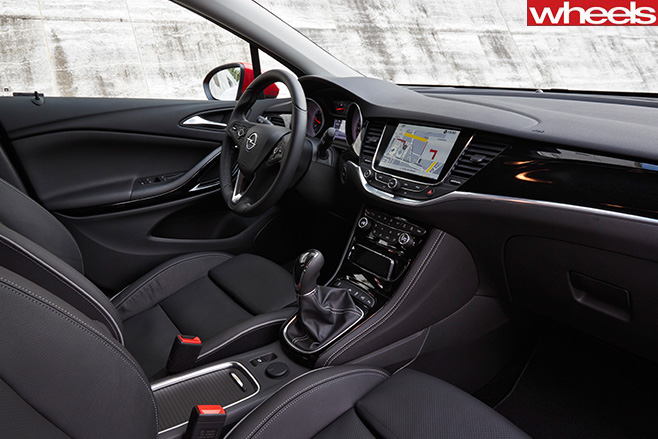
But it’s the front row that will impress most. Besides small-ish buttons for the climate-control panel, ergonomics are superb. Even the new column stalks are visible above the wheel spokes, while Opel’s IntelliLink touchscreen infotainment is arguably the best in the business, with beautifully crisp graphics and smartphone-style functionality, plus Apple CarPlay and Android Auto. Euro models also include GM’s OnStar telematics, as well as a 4G wi-fi hotspot, though OnStar will take several years to reach Australia.
The two grey areas are exactly which features our Astra will pick-up from the absolutely loaded European model, and whether we’ll also see the generously proportioned Sports Tourer wagon. While rear seat heaters and massage functions are of little importance, the availability of stuff like IntelliLux LED matrix headlights – just like an Audi A8 – as well as forward collision alert and Autonomous Emergency Braking (AEB) with full auto-brake up to 60km/h, thrust the new Astra several generations ahead of the cut-price Cruze it will replace in this country.
So, despite a lack of consistency in Holden’s small-car line-up, which stretches back more than 30 years, the new-generation Astra is good enough to overcome any prejudice that punters may hold against General Motors.
In terms of room, styling, comfort and features, it’s far beyond expectation. Now if Holden can successfully achieve a ride/handling sweet spot for Australia, and manage to cure the 1.4 turbo’s driveability and gearing flaws, then the Astra’s best may be yet to come. Watch this space.
SPECS Model: Holden Astra 1.4T Engine: 1399cc 4cyl, dohc, 16v, turbo Max power: 110kW @ 5000-5600rpm Max torque: 230Nm @ 2000-4000rpm Transmission: 6-speed manual Weight: 1203kg 0-100km/h: 8.5sec (claimed) Fuel economy: 5.1L/100 (EU) Price: From $21,000 (estimated) On sale: September 2016
THE Renault Alaskan will begin a family of new utes, as the French car maker aims to capitalise on the success of its light commercial range.
Speaking to Wheels at the Renault Technical Centre in Paris, head LCV designer Louis Morasse said the design language of the new Alaskan was easily applicable across a broader range of pick-ups, also suggesting that it would match the number of body styles of the vehicle it is based upon, the Nissan Navara.
“The idea around entering the one-tonne pick-up [market segment] is to enter ultimately with the full range of the one-tonne pick-ups, from the 4×2 workhorse single-cab to the top of the line double cab 4×4,” said Morasse.
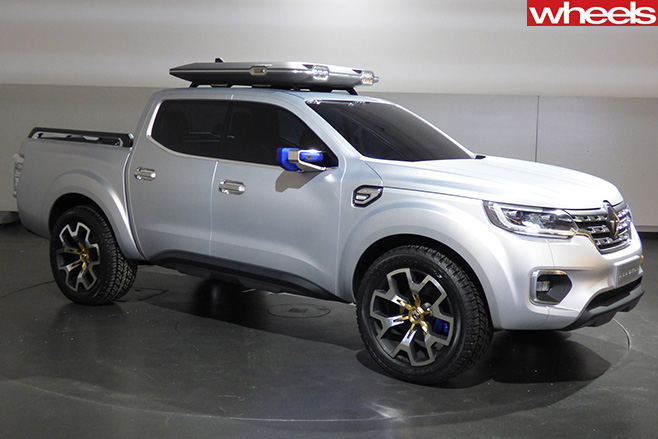
“You see the strong link with the rest of the line-up we just released. As you already saw on the Kadjar, or new Espace and Megane, we have a strong theme having the grille linking the two headlamps, the kink in the bonnet and the big logo,” Morasse said.
While not even the name is officially confirmed for production, Morass said that the concept car was 95 percent production ready, with only the wheels and accessories – such as the roof mounted satellite dish – not slated to the showroom version.
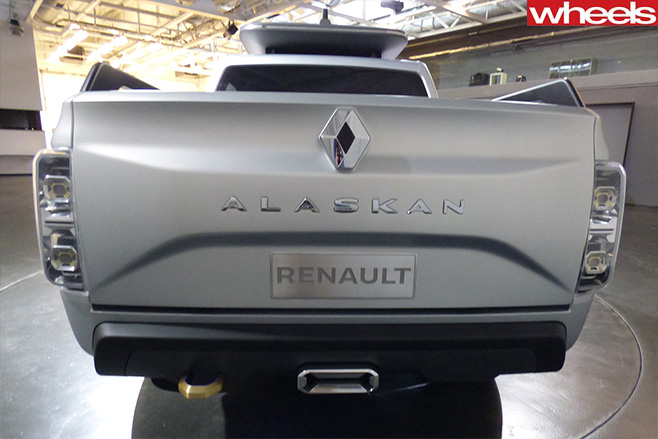
The arrival of the Alaskan in 2016 will come as Renault Australia expands its dealer network at an unprecedented rate here, growing from 19 dealers only three years ago to around 70 by the time its new pick-up goes on sale.
The Alaskan has been described as offering the brand a potential ‘step-change’ in terms of sales by Renault Australia MD Justin Hocevar. It will use the 2.3-litre twin-turbo diesel and mechanicals from the Navara, with unique styling from the A-pillar forwards and the rear given new tail-lamps.
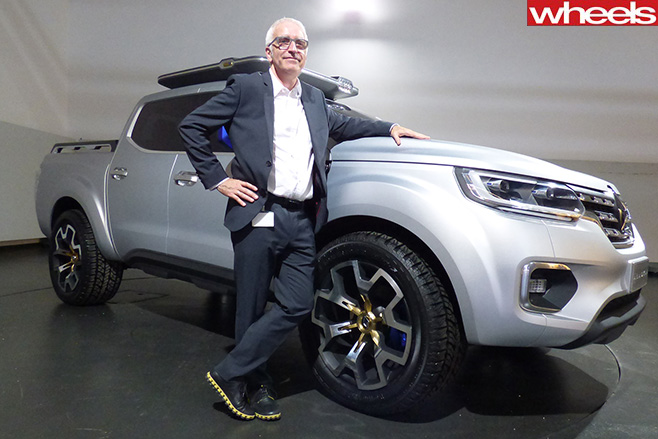
Renault would not confirm whether the Alaskan will be treated to a cabin redesign to differentiate it from the Navara. Yet given what the car maker has done with the Kadjar, which is a Nissan Qashqai restyled both inside and out, it’s a distinct possibility. The car shown to journalists featured blacked out windows to hide the interior, but was largely Navara with a Renault-badged steering wheel.
Morasse described the Alaskan as a “premium pick-up” that will be tilted towards lifestyle in some markets and commercial duties on others.
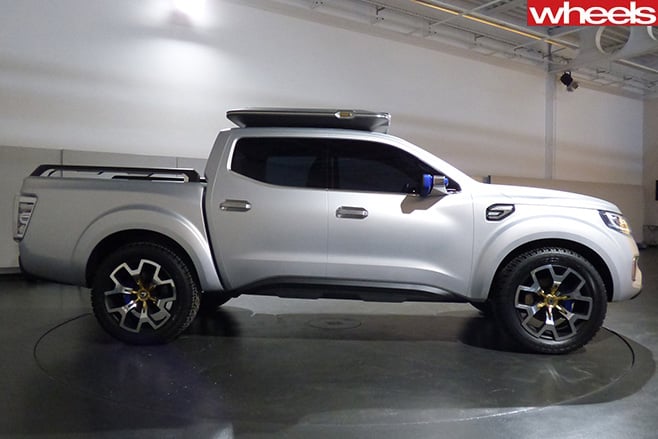
The Alaskan will be the second of three utes to use the platform, with Mercedes-Benz to partner with Renault-Nissan to produce its own. A key point of difference for the Mercedes is that the German maker will use its own engines.
