
WE WERE sceptical before finally driving the second-generation Peugeot 308 in Europe ahead of its October 26 local launch, even though it surprisingly scooped the European Car of the Year gong earlier this year, but we needn’t have been.
Built on an all-new lightweight modular platform dubbed EMP2, the Peugeot is slightly shorter than before, but sits on a 120mm longer wheelbase for improved cabin space.
It has shed up to 140kg, yet boasts a stronger body, improved aerodynamics and infused quality that its maker claims is only possible by engineering a car right from the ground up.
The doors shut with a thud now and the dashboard features the company’s controversial low-wheel/high-instruments driving position, with most minor functions relegated to an easily accessible touchscreen; first seen in the 208, it promotes maximum eyes-on-the-road time.
There is a sense of integrated harmony in the look and feel of the cabin that’s long been missing from earlier efforts. The dials look great at night.
Some hard plastics remain in lower areas, the windscreen pillars can mess with forward vision, and the (analogue) tacho annoyingly swings anti-clockwise for no apparent reason, but otherwise the comfy, roomy and refined interior appeals.
Power comes from all-new downsized direct-injection all-turbo petrol engines (with idle-stop tech all round), backed up by modern diesel and performance options topping the range.
First cab off the rank will be a ‘Puretech’ e-THP 1.2-litre three-cylinder turbo petrol delivering 96kW of power at 5500rpm and 230Nm of torque at 1750rpm.
With either the six-speed manual or six-speed auto, the Puretech is a fabulous little belter, pulling away with spirited zeal, then maintaining the pace in much the same way as VW’s TSIs do, thanks to exceptional torque flexibility.
The smooth, responsive and lag-free auto scoots to 100km/h from standstill in 9.1 seconds – 0.4sec faster than the slightly notchy manual.
It doesn’t sound like a traditional three-cylinder powerplant, though the exhaust note is very distinctive, it’s impressively frugal (averaging as little as 4.6L/100km), and is refined enough to be available on all 308 grades bar the luxury-focussed Allure Premium and warm-hatch GT flagships.
Come March, and matching up-spec Golf petrol offerings, will be the 1.6L four-cylinder 110kW e-THP in the 110kW/370Nm Allure and Allure Premium and 151kW e-THP powering the 151kW/285Nm GT.
On the diesel front, there will be a pair of revised Euro-6 ‘BlueHDi’ four-cylinder engines in 110kW/370Nm 1.6L and – from the second quarter of 2015 – 133kW/400Nm 2.0L forms.
The smaller turbo-diesel is a cultivated yet quick performer, the auto version benefitting from a smart set of gear ratios to accelerate strongly on the move, even when laden with three adults plus luggage.
A pretty Touring wagon also lobs from late October, as a higher-grade substitute to the handsomely understated hatch; aesthetically both are light years ahead of the dumpy old 308. There will be no more seven-seat option, but the load area is impressive and extremely practical.
The lower weight of the new 308 translates to a connected driving experience that should come as a pleasant surprise to disheartened Pug fans.
Though not razor sharp in either response or feedback, the steering remains informative and superbly well weighted, so it feels just as natural on the motorway as winding through a mountain pass.
Peugeot would argue that the revamped torsion-beam rear suspension is lighter and more space efficient, but the fluid suppleness and contained quietness enjoyed over smooth roads we experienced was undermined by bigger bumps in models with bigger wheels.
Nevertheless, Peugeot is at last fighting back in the most important passenger-car segment in Australia with a properly impressive driving machine.
The Access 96kW e-THP six-speed manual kicks off from $21,990, which puts it $500 above the excellent Golf 90TSI, although the $24K auto version is on par with the VW.
The Access is no stripper, either, with idle-stop, six airbags, cruise control with speed limiter, and integrated Bluetooth audio and phone streaming. A lack of touchscreen, just one cupholder and no rear-seat air vents are what it gives away to the Golf.
Higher-spec models are available with sat-nav with head-up display directions, parking sensors, an automatic park brake, rear-view camera, keyless entry/go, a glass roof, blind-spot monitoring, adaptive cruise control, emergency collision alert and braking, and automatic parking.
It’s no longer a mystery why the Euro COTY judges chose the latest 308. We’re impressed and looking forward to spending more time at the wheel in Australia.
Specs Model: Peugeot 308 Hatch e-THP Engine: 1199cc 3cyl, dohc, 12v turbo Max power: 96kW @ 5500rpm Max torque: 230Nm @ 1750rpm Transmission: 6-speed manual Kerb weight: 1090kg 0-100km/h: 9.6sec Price: From $21,990 On sale: October 26
THE Mercedes-Benz light-bulb moment with hybrid and electric vehicle technology didn’t come until well after darkness fell.
But now that the German luxury-car maker has seen the light, it’s full speed ahead with an avalanche of hybrids and EVs across the full range of volume products – from Smart tiddler to S-Class limousine.
While Mercedes hasn’t stepped away from the exciting sports saloons and GT cars that form a key part of its DNA, it is directing much of its research and development at cars that will help it achieve ever-tougher mandated European fleet average emissions targets – 95g/km, which equates to 4.0L/100km consumption – by 2020.
Daimler AG board member and head of research and development, Thomas Weber, says that, while the hybrid approach is being rolled out across the range, the Mercedes’ large cars are a specific EV focus.
“We’re making them smarter, rather than smaller,” Dr Weber said. “The rule of thumb is that the combustion part [of the hybrid systems] will diminish over time.”
But Dr Weber also warns of market realities: “Technology has to be affordable or there is no business case to go in that direction.” In other words, how much the punters are prepared to pay.
Australian consumers have already seen the S300 Hybrid, which costs $195,000 and achieves a combined fuel economy figure of 4.9L/100km, the E300 Hybrid ($109,400 and 4.5L/100km) and the C300 Hybrid ($71,900 and 3.8L/100km).
All three utilise the 2.1-litre 150kW/500Nm four-cylinder turbo diesel engine combined with a 20kW/250Nm electric motor with a smaller battery.
Remarkably, half of Mercedes-Benz’s R&D budget is directed at green technologies, the long-term goal being zero-emissions mobility.
Dr Weber describes the S500 Hybrid as a major step towards this aim, adding: “We have massively reduced our CO2 fleet emissions in Europe: from 230 grams in 1995 to 134 grams last year.”
Average fleet consumption has fallen by more than 40 per cent.
The stunning S500 Plug-In Hybrid, a car Merc boasts is the “most efficient and intelligent” S-Class yet, is close to launch and is heading to Australia in about a year from now.
“The S500 Plug-In shows the consumer is making no great sacrifice with these high-tech powertrains,” Dr Weber said confidently, pointing to its extraordinary combined fuel economy of 2.8L/100km.
Next year, Mercedes will add a new C-Class fuel-sipper – the C350 Plug-In Hybrid – to Australian showrooms.
Dr Weber says Mercedes will launch up to 10 new models with plug-in hybrid powertrains by 2017. This includes C-, E- and S-Class models, along with a number of SUV models, including the popular ML-Class due for a facelift next year.
While the present focus is on the bigger vehicles, smaller models including the A-Class, B-Class, CLA and GLA won’t escape the hybridisation treatment, and the resultant economy magic wand.
Mercedes-Benz also plans to continue with its mild hybrid BlueTec variants, including the S300, E300 BlueTec and C300.
The company’s vice-president in charge of electrics, electronics and e-Drive, Harald Kroger, says the key to the acceptance of its hybrid products is their user friendliness and daily driver capabilities.
“People who buy, say, a Tesla might own five cars in all. The S500 Plug-In has a range of 33km on electric alone and our buyers are people who maybe only have one or two cars, who commute fewer than 60km daily, ” Kroger said. “So with a recharge at work they can run exclusively on battery power.”
Lamborghini’s future has arrived and the good news is there isn’t a turbo in sight.
Meet the Asterion LPI-910, named after the Minotaur, a mythical half-man, half-bull creature – a hybrid in other words. Therein lies the first clue as to what separates the Asterion from Sant’Agata’s current range.
Yep, Lambo’s gone green, but as you’d expect the execution is much more Porsche 918 Spyder than Toyota Prius.
An electric motor with integrated starter motor and generator sits between the 5.2-litre V10 and seven-speed dual-clutch gearbox, both lifted from the Huracan, while another electric motor is located on each front wheel.
This gives the Asterion the ability to operate in full-electric mode for up to 50km and up to speeds of 125km/h. Combine the two power sources, though, and 669kW are at your disposal, enough to blast from 0-100km/h in 3.0sec, despite a weight increase of 250kg thanks to the hybrid system.
For optimum weight distribution, the batteries are located in the central tunnel area, forcing the seven-speed dual-clutch ’box to move astern the engine in a transaxle layout.
As well as previewing future powertrain technology, the Asterion also hints at Lamborghini’s future design direction.
Its more rounded, hatch-like shape is curvier and less edgy than the wedge-like Aventador and Huracan, more Jalpa than Countach.
Does it hint at a new grand touring-style third model for Lambo? More likely it previews the forthcoming Urus SUV, which is unlikely to be quite as visually extreme as Sant’Agata’s super sports cars.
The colour palette is also more subdued than Lamborghini’s usual retina-searing efforts, the glittering ‘Blue Elektra’ paintwork matched to an interior of brown and white leather.
A new three-spoke steering wheels apes that of the Miura while a tablet-style touch screen replaces the Audi MMI-based system currently in use for controlling infotainment, navigation and HVAC controls.
There is currently no word as to when a production version of the Asterion’s powertrain will appear, though all the technology is currently available, so it wouldn’t be a huge stretch for it to debut within the current life cycle.
The best news is that the Asterion confirms we’ll be enjoying the nape-prickling howl of Lambo’s naturally-aspirated engines for a good while yet.
AUDI had a surprise at the Aussie launch of its S1 Sportback: a hot lap of Tasmania’s Baskerville Raceway in a replica of one of the most famous rally cars in history, the S1 Quattro Group B
Here’s what you can read about this month:
- An in-depth look at HSV’s wild new GTS Maloo
- We head to California for the reveal of the new Mazda MX-5 and join 25th birthday celebrations for the iconic Japanese roadster
- Bang for your Bucks 2014: this issue we crown the best value $0-50,000 performance car on sale today
- Editor DC has an epiphany behind the wheel of Caterham’s CSR 175
- From our Stateside friends, almost 1000kW of supercharged American muscle does battle as the Chevrolet Camaro ZL1 takes on Dodge’s mental Challenger Hellcat
- Celebrating 10 years with OUR tame racing driver, the inimitable Warren Luff
- Hyundai says it’s getting serious about performance cars, we find out if it’s making any progress with a couple of modified Velosters
- Plus first drives of the Lexus RC F, Audi TTS, Infiniti Eau Rouge Concept, Mercedes-Benz GLA45 AMG and BMW’s M4 Convertible and M3 and all the details on AMG’s new GT supercar
WE CAN’T get enough of our hot hatches, so the Peugeot 308 GT is welcome news to join the Renault Megane RS, Ford Focus ST and forthcoming Honda Civic Type R in battling the VW Golf GTI benchmark.
The 308 is built on the French car maker’s new EMP2 modular platform, and the GT version is powered by a 1.6-litre turbocharged four-cylinder – also used in the Mini Cooper S and the Citroen DS3 – with 151kW/285Nm.
The 308 GT looks the part, but these modest outputs are closer to warm hatches such as the 150kW Kia Proceed GT, lagging behind the GTI and Megane GT, which both make 162kW.
There’s no 0-100km/h claim, but expect about 6.9sec or better if the Peugeot is to be taken seriously.
With 18-inch alloys and riding 10mm lower at the rear and 7mm lower up front, the GT has the stance, plus its own look with the Peugeot Lion moved to the centre of the grille, like the recently facelifted 508.
The 308 GT should be keenly priced below the Golf GTI’s $42K starting price, and will have to be to compete with the $36K Megane GT and $35K Kia Proceed GT.
Yet the most interesting potential reason for the 151kW output – when this engine has produced 199kW in the RCZ-R, so we know what it’s capable of – leaves room for a more potent version, most likely badged R, as indicated by a 308 R Concept displayed at the Frankfurt motor show last year.
There’s a diesel GT, too, with 133kW for its auto-only 1.5-litre diesel, but 400Nm of torque to give it a proper shove.
The other ace up Peugeot’s sleeve is that there’s also a wagon version, which should rattle the Skoda Octavia RS when the 308 GT goes on sale in February 2014.
Sexy they’re not, but light sedans are cheaper and (mostly) better than ever. Here are four of the best.
Can’t wait to see the final scores? Jump to the verdict now.
LIKE most things that seemed like a good idea at the time, testing this assortment of stunted sedans started off as a joke of dubious taste.
Months ago, I facetiously suggested we ought to pitch Mitsubishi’s then-upcoming Mirage-based Attrage (for Attractive Mirage!) sedan against the redesigned Honda City, plus one other B-segment four-door rival, and call the test “Ménage Attrage”.
But the powers that be agreed that, with two keenly priced sedan newcomers tackling segment stalwarts such as the Hyundai Accent and Holden Barina, the comparo was indeed a goer. And then Mitsubishi jettisoned the Attrage name for Australia anyway, killing the joke completely.
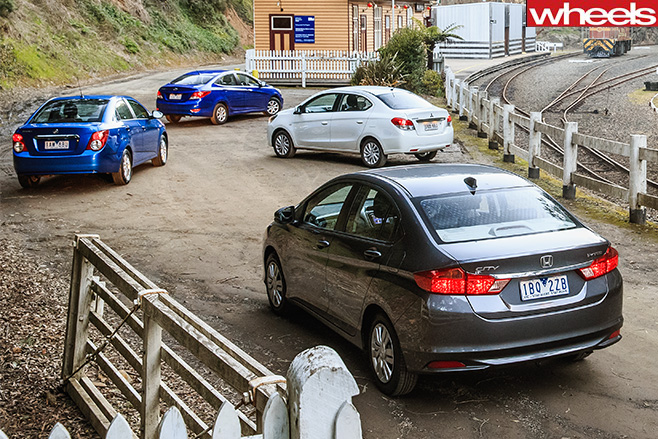
Welcome, then, to Wheels’ first-ever dedicated B-segment sedan comparo, presented in glorious full-colour automatic transmission form because that’s what the market wants.
Four for the money
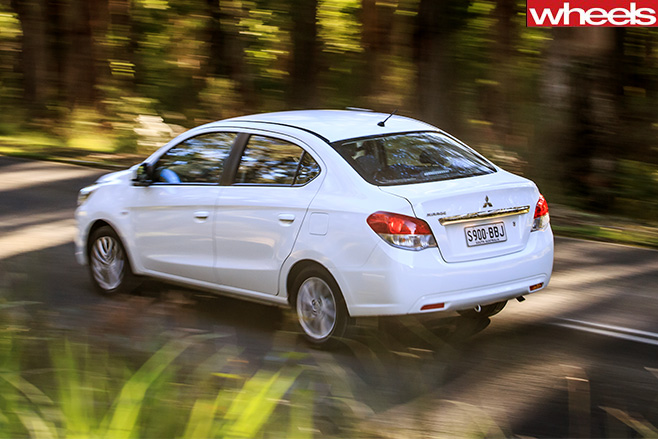
But let’s not beat around the bush. Mitsubishi’s new Mirage sedan looks like it crawled from the primordial soup – skinny and slab-sided, with big headlights and a gaping mouth. Any semblance to the sassy 1996-2003 Mirage three-door is just that. It’s an epic visual fail.
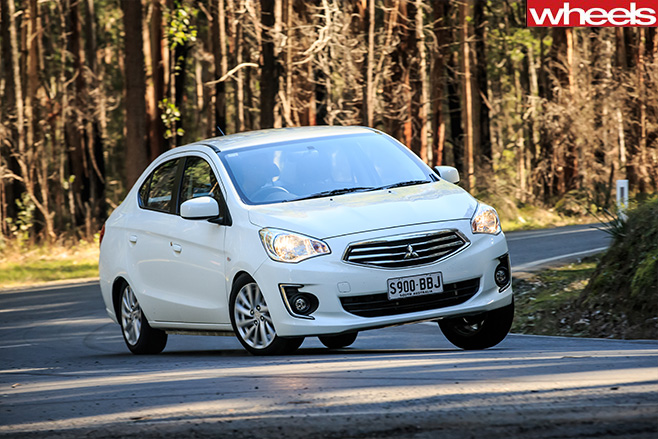
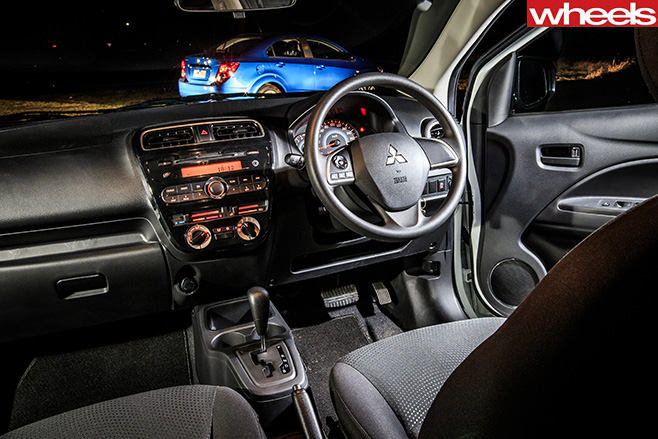
On the other hand, being gormlessly tall and narrow, the Mitsubishi formally known as Attrage is easy to enter, especially its back section with bountiful rear-seat legroom. Other plus points include a large glovebox, a crystal-clear Bluetooth system (but, curiously, no USB outlet) and rear windows that drop all the way down – handy if your dog likes sticking its head out the window at speed.
The lack of telescopic steering adjustment (the column is tilt-only, as is the Accent’s), old-school air temperature slide controls and sparse analogue instrumentation are total 80s throwbacks. And while overhead grab handles and a rear centre armrest with cupholders are unexpected surprises, the lack of a folding backrest, reading lights, coat hooks and full-size spare (City is also guilty of the latter) reveal the true depth of the cost-cutting here.
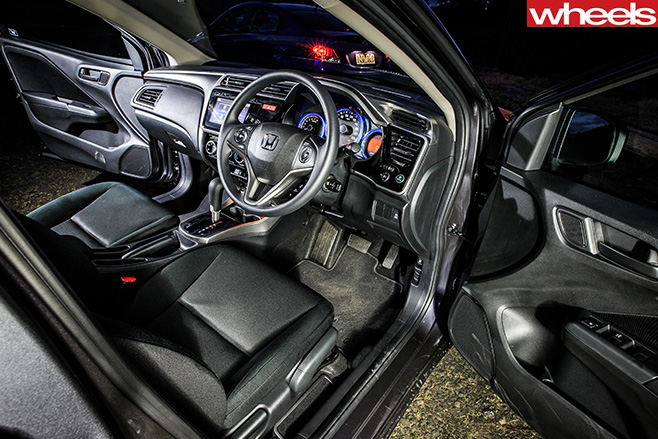
Sleekly contemporary in style, Honda’s $17,990 City VTi CVT seems upmarket and dignified by comparison – repugnant hubcaps aside. At least the City’s matte metallic-look plastics and piano-black dashboard finishes elevate its interior, backed up by the group’s only front centre armrest with storage, rear door bins and today’s must-have accessory – a reversing camera – as part of a central touchscreen unit with app capabilities. This one item underscores the City’s class-leading modernity.
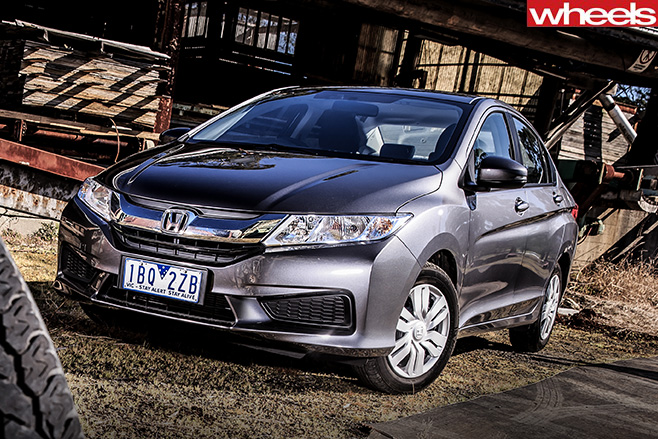
Firm but supportive seats and plenty of elbow space impart a sense of comfort, helped by the City’s relatively quiet drivetrain. However – and perhaps because of the latter – there’s quite a bit of road-noise intrusion when riding in the back.
The second most expensive sedan here – Holden’s $18,490 Barina CD automatic – boasts the most aggressive styling (by Aussie GM designer Ondrej Koromhaz), thanks to its chiselled nose and muscular wheelarches. It’s ironic considering the Barina’s entrenched hyper-fem image.
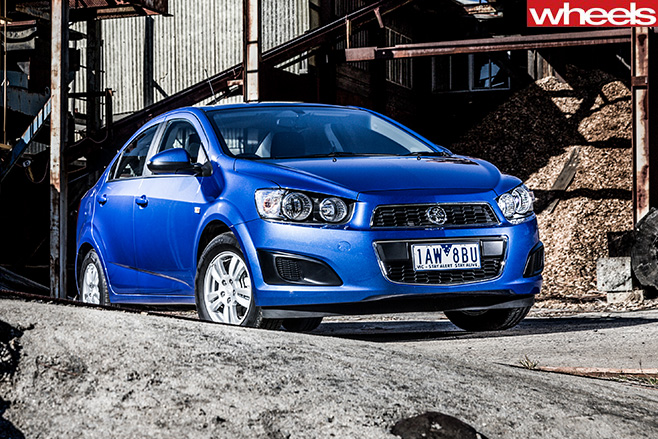
On the flipside, blighting our Barina’s cabin peace is a cacophony of cellophane sounds from one of its door trims, no rear-seat reading light and no centre armrest. Note also that the larger half of the split-fold backrest is on the driver’s side, forcing two passengers to exit road-side – a hangover from the car’s left-hand-drive origins. And everyone on test complained about a numb bum after driving the Barina. Also, its rear cushion is shapeless and passengers face sore shins from rubbing against the underside of the front-seat bases.
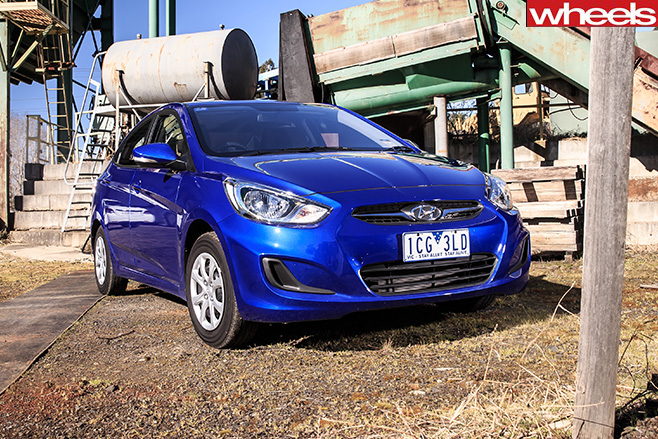
The oldest car here is Hyundai’s $18,990 Accent Active automatic, with an amorphous shape reminiscent of the old i45, Xeroxed down to 65 percent. The same applies to the car’s toweringly competent dashboard design and layout, featuring clear dials, user-friendly multimedia connectivity, a gigantic glovebox, classy illumination and ample cabin lighting. But why does the most expensive combatant here ignore cruise control and steering reach adjustment?
So how do they go?
There are also some anomalies under the bonnets of this quartet. Beginning with the newest to market, the Mirage might have only three naturally aspirated cylinders and a mere 57kW and 100Nm on hand, but that’s no real hindrance in a car that weighs just 940kg – easily the lightest of the four. If, like me, you relish the notion of a rorty triple, the Mitsubishi MIVEC unit obliges with a thrummy yet punchy power delivery right up to its 6500rpm redline. Indeed, the Mirage’s point-and-squirt eagerness is quite addictive, at least with the standard manual gearbox.
Nobody will be surprised to learn that a 14.5sec amble to 100km/h (recorded for all four cars with two occupants rather than the usual one due to a broken data-box mount) makes the Mitsubishi the segment’s slug. Add more passengers or a gradient and the Mirage’s pedal needs to be mashed to the floor, especially at highway speeds, for momentum to be sufficiently maintained. Inevitably, this hurts consumption, resulting in a second-placed 8.8L/100km average, somewhat more than the official combined average of 4.9L/100km.
Mated to an all-new CVT transmission that replaces an outdated five-speed torque-converter auto, the City is quick off the mark and maintains its accelerative urge all the way to 6600rpm, responding to throttle inputs with minimal delay. This is the sort of zingy and zestful engine for which Honda is renowned, and adding two adults in the rear hardly registered on the performance front, either.
It’s also far and away the smoothest drivetrain here – so much so that road noise is quite noticeable due to the lack of thrashy mechanical intrusion that inflicts the others to varying degrees.
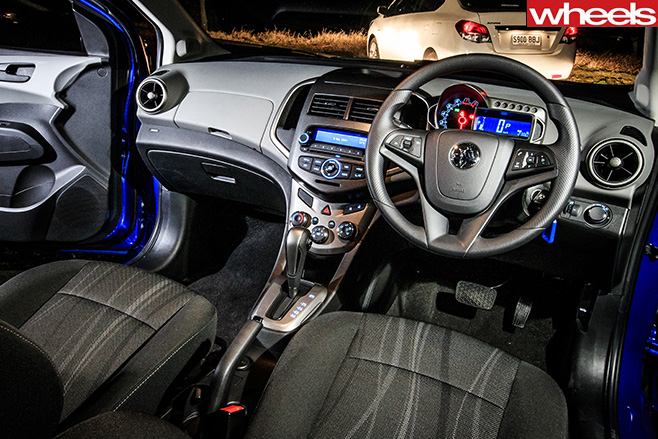
Ideal for zipping around town, the engine’s power delivery falls into a chasm just when you need to overtake on the open road, the transmission hesitating before finally discovering a lower gear, accompanied by a crude induction racket beyond about 4000rpm. Along with Mirage, the Barina auto failed to reach 140km/h in the available distance at Tooradin airstrip, while the 13.1sec it took to reach 100km/h betrays a 95kg weight penalty over Honda’s lithe City.
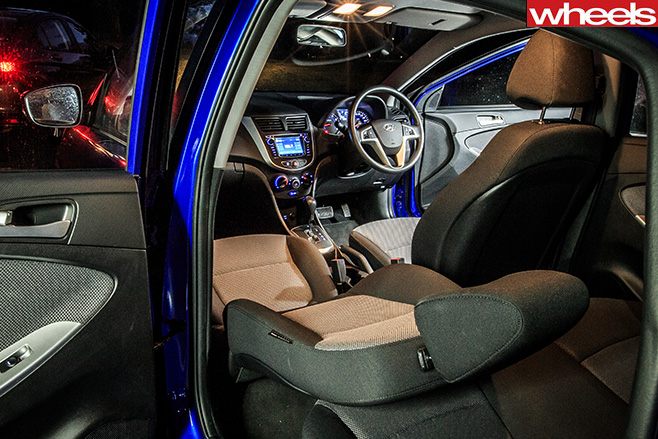
Steering, ride and roadholding
Following its inferior drivetrain performance, we didn’t expect the Barina to have the best steering, most entertaining handling and quietest ride. But Lang Lang’s dynamics team have earned their keep, with a little help from the best tyres in the group (Continentals), and the only hydraulic rather than electric-powered steering.
For weight, feel and turn-in response, the Barina blitzes the rest, keeping its driver informed with what’s going on up front while maintaining proper body control. There’s a caveat here, though. At higher speeds, through tight turns and arcing corners alike, the Holden’s sharp steering can at times feel nervous to the uninitiated.
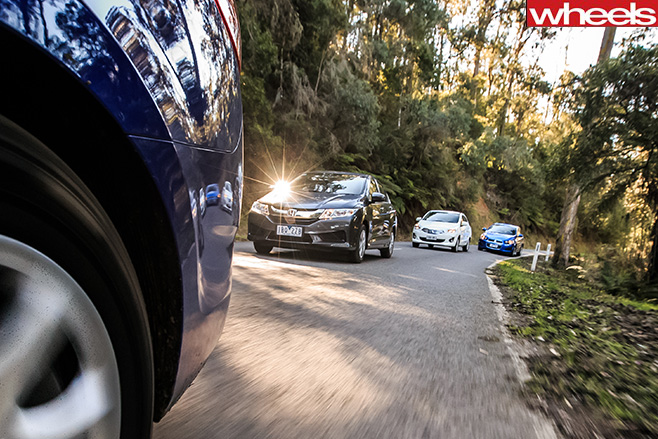
Dynamically, the Accent is a by-the-numbers operator, walking the middle ground between agility and security, being neither too light nor too sharp. It’s very easy to drive, aided by an eager traction-control system and the group’s most powerful brakes (the only one with rear discs), but the Hyundai’s remoteness leaves the keen driver stone cold. It is deathly dull.
Then there’s the Mirage. Compared to the dynamically underdone hatch, the sedan benefits from a 100mm-longer wheelbase and wider tracks, which have improved its manners markedly. With so little power to corrupt the front end, the Mitsubishi is a doddle to drive flat-out, its chassis gripping gamely despite increasingly dramatic body roll until it progressively succumbs to messy understeer. It’s strangely entertaining and entirely incongruous, as well as oddly endearing.
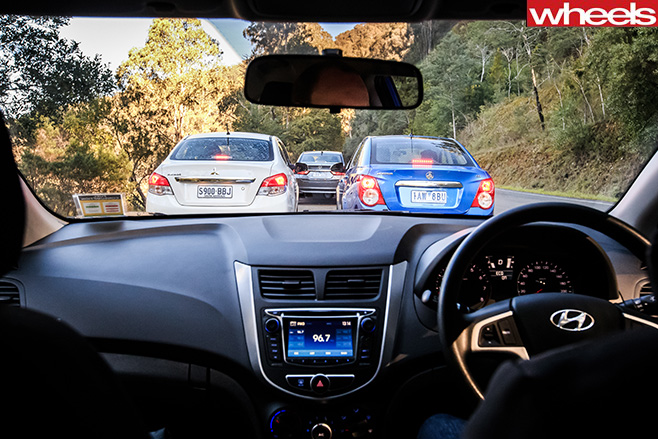
Where to spend your money
Ultimately, one light sedan shines brightest in this group test. The Honda City VTi scores a well-deserved victory. It is contemporary, spritely, economical, spacious, well-equipped and very keenly priced. It is another sign that Honda is at last reviving its once-enviable reputation, even though the City’s steering feel remains as lifeless as Honda’s recent sales performance.
Separating second and third is a close call. The Accent’s $1000 price premium over the next-dearest rival here is offset by this group’s most affordable servicing, the most grown-up dashboard design and its ease of operation – all admirable attributes. But the uninspired Hyundai is curiously uninvolving to drive, imparts a rental-car ambience, inflicts a fidgety ride, and suffers surprising specification shortfalls.
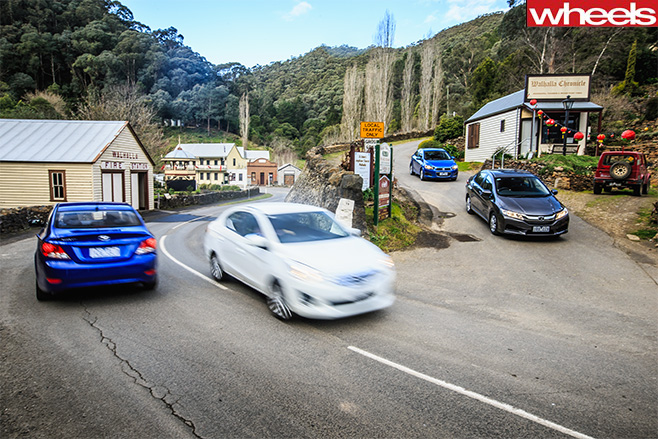
Which leaves the Mirage way off the pace, literally as well as metaphorically. Its price advantage is completely overshadowed by its third-world interior, dreary performance, odd packaging, equipment anomalies and dire lack of refinement.
Cheapness doesn’t necessarily equal value. People who venerated iconic older Mitsubishis such as the Colt, Sigma, Galant, Nimbus, Magna and previous Mirage would be horrified.
A joke involving the Mirage may have instigated this comparison, but its last-place finish is no laughing matter, revealing a depressing low for a company brimming with a proud heritage. The diamond brand is wilfully turning into a cubic zirconia and we’re heartbroken. Please reconsider, Mitsubishi.
VERDICT
Holden Barina CD
Price as tested: $18,490
NCAP rating: 5 stars (Aus)
Fuel economy: 9.5L/100km (test average)
Acceleration: 0-100km/h: 13.1sec (tested)
Plus: Sharp handling, controlled ride, solid feel, intuitive multimedia system
Minus: Noisy, thirsty, breathless at speed, gearing holes, poor seats
Verdict: 6.0/10
Honda City VTi
Price as tested: $18,485
NCAP rating: Not tested
Fuel economy: 7.9L/100km (test average)
Acceleration: 0-100km/h: 10.7sec (tested)
Plus: Performance, economy, dash layout, rear camera, massive boot
Minus: Rear headroom, some road noise, poor warranty/service intervals
Verdict: 7.0/10
Hyundai Accent Active
Price as tested: $19,485
NCAP rating: 5 stars (Euro)
Fuel economy: 8.8L/100km (test average)
Acceleration: 0-100km/h: 11.4sec (tested)
Plus: Dashboard design, cabin space, warranty/service costs, rear discs
Minus: Harsh at speed, expensive, ancient auto, no cruise, tilt-only wheel
Verdict: 6.0/10
Mitsubishi Mirage ES
Price as tested: $16,490
NCAP rating: 5 stars (Euro)
Fuel economy: 8.1L/100km (test average)
Acceleration: 0-100km/h: 14.5sec (tested)
Plus: Rorty engine, okay ride, low price, long warranty, rear-seat legroom
Minus: Slow, noisy, no folding rear seat, cheap cabin, meagre spec, resale
Verdict: 4.0/10
F1: Flying Mercs’ have to beat unreliability … and Ricciardo
It’s hotting up.
At a fascinating point in the Formula One world championship – with Lewis Hamilton leading team-mate Nico Rosberg by a mere three points – the circus next weekend moves to Suzuka, Japan, one of the great old-time drivers’ circuits.
Having won all grands prix this year except for the three rustled by Daniel Riccardo and Red Bull Racing, the dominant Mercedes cars will be favoured. Their Achilles heel is reliability. More on this later…
At the business end of the championship, Ricciardo, 60 points behind the leader, is still a mathematical chance at the drivers’ crown, helped by the Mercs too-regular mechanical issues. Of course it’s a long shot, but while there’s a chance he says he’ll go hunting the guys in the Silver Arrows.
At the last race in Singapore, won by Hamilton from RBR’s Sebastian Vettel and Ricciardo, the reigning world champion managed his tyres well enough to stay ahead of his nemesis. Ricciardo had intermittent problems with the battery and at different times it did not deliver power. For just the third time in 14 races Vettel came home ahead of Ricciardo.
Ricciardo’s really looking forward to the Japanese Grand Prix.
“Suzuka is all good, but for me the first sector is just a delight. It’s a dream. You have those fast changes of directions through the Esses, hard around the Dunlop Curve and then, arguably the best bit, turns Eight and Nine: Degner. Through Eight you’re hanging on, it’s so narrow and there’s no room for error but you want to push as hard as you can. Then just as you straighten up the car, you’re on the brakes, throwing it into this cambered right-hander and hoping you’ve got it right because if you haven’t then it’s all over. Getting to do that 53 times in a row is a pretty good way to earn a living.
“What you maybe don’t see on TV is that it’s a real rollercoaster, dropping into valleys and climbing up again, so that you’re rarely on a level surface.”
In Singapore, Hamilton won with no real opposition with Rosberg’s dramas beginning 30 minutes prior to the start. The steering wheel buttons would not react to him pressing them. Only the gearshift pedals worked.
Changing the steering wheel didn’t help and then Rosberg could not encourage the car to leave the pits after the first tyre change – he could not engage first gear due to a fault with the cable running through the steering column from the steering wheel to the ECU.
Rosberg’s non finish did nothing to help Mercedes’ appalling reliability record. According to F1 expert Michael Schmidt, the Mercs have an 80 per cent reliability record on race weekends, including technical troubles encountered in the practice. Last year the reliability was 88 per cent.
But the Mercs have the grunt and on race day and everyone else plays catch-up.
MotoGP: Amazing Aragon ends in mayhem
For so much of Sunday’s Grand Prix of Aragon, it was what we expect from modern MotoGP as under leaden skies Marc Marquez, Jorge Lorenzo and Dani Pedrosa went at it like prize fighters.
Valentino Rossi was a little further back until he had a massive crash and was stretchered off to hospital for checks.
All three of the front runners had turns in the lead and it seemed we were in for a stunning fight to the finish.
Then it began to drizzle, enough for the white flag to be displayed – a message that the riders may at any time thereafter come to the pits to swap to bikes fitted with rain tyres. For several more laps, no-one did. Then Andrea Dovizioso slid off, and riders started pitting to switch bikes while the Spanish trio up front stayed out and continued their scrap amidst the growing chaos.
The rain was light at the back of the circuit, but very evident on the front straight, and with four laps remaining Lorenzo ignored the high-risk gamble of Marquez and Pedrosa to pit for a bike better suited to the worsening conditions.
Pedrosa then crashed in turn one and a lap later Marquez also went down. Both riders were able to get back to the pit lane and change bikes, but clearly they had also tossed away any chance of winning.
Led by Lorenzo, the riders who made smarter calls and pitted earlier were stealing the race. Lorenzo won his first GP of 2014 for Yamaha while, fighting for his first MotoGP podium, Aleix Espargaro, also on a Yamaha, held off a rejuvenated Cal Crutchlow’s Ducati to take second.
Marquez collected 13th place points and was left to rue his poor decision making. Pedrosa, who survived a scary high-speed off, was 14th and also in the points.
“Today’s race was difficult because I, like many other riders in MotoGP, had never experienced track conditions like this before,” said Marquez. “It was a shame that it started to rain; if it hadn’t, then I think that Dani, Jorge and I would have made the end of the race really exciting for the fans. I think that we did a good job all weekend – it was just a pity about the crash. I tried to hold on because there were only a few laps remaining, but today I learned that in these situations it is better to use a different strategy.”
Marquez (292) still leads the championship by 75 points over Pedrosa (217), who is three points ahead of Rossi (214). Lorenzo (202) has closed the gap considerably after his race win.
The championship now moves to our neck of the woods, for the three back-to-back races in Japan, Australia and Malaysia.
Moto3: Miller crashes out of title lead
A controversial crash with his title rival Alex Marquez in Moto3 at Aragon cost Australia’s Jack Miller his long-held championship lead with just four grands prix remaining in the 2014 season.
Nineteen-year-old Miller went into the race nine points up, and was battling for the race lead in the early stages with Marquez on a drying track when the two banged together, with the Townsville rider flung into the air and off his KTM.
Marquez stayed aboard his machine and went on to take second behind Romano Fenati, while Miller remounted but couldn’t salvage anything from a day that looms as one to define the championship.
The wet-drying conditions saw a huge number of crashes throughout the race, some riders falling multiple times. Miller had a second crash and was classified 27th.
Marquez and Miller were summoned by Race Direction after contact between the pair saw Miller crash early in the race.
The start of the race had been delayed by mist and fog and although a dry line formed for the Moto3 contest the conditions were difficult for the lightweight class competitors.
Miller blamed Marquez for the crash didn’t make a big issue of the incident. “In the crash, Marquez had tried to overtake me on the straight but did not have the pace to do so. On the entry to the corner I was on the dry line and went in normally. I knew Marquez would try to block off inside corner, but he did not cut the gas and made me fall off the bike. Sometimes these things happen –it’s racing.
“Now we head to a circuit that I like and we’ll see what happens,” said Miller, who is now 11 points behind Marquez going into the next round of the championship on October 12 at Motegi, Japan.
NASCAR: Who’s in and who’s out of the Chase
And who can unravel the crazy system to determine the champ?
Gee, remember when the guy who accumulated the most points over a NASCAR season was declared the champion? Way too simple.
The Sprint Cup race at Dover proved crucial for the 16 drivers in the NASCAR Chase for the Championship, with four destined to be eliminated and 12 progressing.
AJ Allmendinger, Kurt Busch, Greg Biffle and Marcos Ambrose’s team-mate Aric Almirola are now out of contention while a happy dozen have done enough to move to the next part of the Chase.
Advancing to the Contender Round are:
Brad Keselowski (Won at Chicagoland) Joey Logano (Won at New Hampshire) Kevin Harvick Jimmie Johnson Jeff Gordon (Won at Dover) Kyle Busch Dale Earnhardt Jr. Matt Kenseth Ryan Newman Carl Edwards Denny Hamlin Kasey Kahne
One of this dozen will be champion. Eventually. The Contender Round comprises three races: Kansas Speedway, Charlotte Motor Speedway and Talladega Superspeedway. A Chase driver who wins one of those three races will automatically advance to the (next) Eliminator Round. The rest of the eight-driver field to make the Eliminator Round will be determined by the points scored in the three Contender Round races.
Got that?
It’s fair to say the original S60 Polestar didn’t blow us away. The bright blue Swede finished dead last at last year’s PCOTY, impressing with its straight-line speed but little else. “Proves that fast isn’t, of itself, enough,” was Morley’s neat summation.
To its credit, Volvo didn’t throw a tantrum and chuck its leksaker out of the pram; it took the criticism on the chin, made some mods and now we have Polestar v2.0. Cleverly, Volvo resisted the urge to make wholesale changes, instead tweaking the areas that needed it most, such as the brakes, gearbox and those awful seats that left the driver hanging on to the too-big steering wheel like a Viking about to be thrown overboard into the North Atlantic.
The over-sized steering wheel remains, but the flat front pews have been replaced by shapely buckets. It’s a case of ‘as you were’ for the rest of the interior, bar the cool sci-fi digital instruments introduced as part of the S60’s recent facelift. You can even change them from red (Performance) to blue (Elegant) to green (Eco) – red it is, then.
Under the bonnet was one place the Polestar needed no improvement. Having a turbo’d 3.0-litre six slung transversely over the front axle mightn’t do wonders for weight distribution, but there’s no doubting the efficacy of the engine itself. With 257kW and more than 500Nm, the Polestar hits 100km/h in about 5.0sec, with power everywhere and brilliant throttle response for a turbo engine.
It is thirsty, averaging around 15L/100km during our tenure, and despite the welcome addition of gearshift paddles, the six-speed auto is still too keen to act of its own accord, upshifting automatically at redline and downshifting to the lowest possible gear under full throttle. Frustrating.
Thankfully, the S60 Polestar now stops as well as it goes, with six-pot Brembo front calipers clasping 370mm discs and high performance pads at both ends. The pedal needs a firm shove but there’s ample retardation; almost too much, as it’s remarkably easy to trigger the ABS.
Attack a few corners and the Polestar is stable and surefooted, though trail the brakes and the rear pivots nicely. Greater rear bias to the all-wheel drive system would help matters, though possibly not as much as improving the ride.
Calling it harsh would be too, erm, harsh, but you feel every bump and a poor road can leave occupants feeling a bit battered. The expensive Öhlins dampers are adjustable, so it would be interesting to spend a day fiddling to see if a softer compromise could be found.
The best change Volvo’s made to the new Polestar, however, is lopping $10K off the price. At $99,950, this puts it within spitting distance of the more accomplished HSV GTS, but we suspect a potential Polestar buyer would no more consider the GTS than an HSV buyer would a Volvo.
Still, improved though it is, we can’t help but feel this is what the regular T6 R-Design should be like.
Specs Engine: 2953cc inline-6, DOHC, 24v, turbo Power: 257kW @ 5700rpm Torque: 500Nm+ @ 2800-4750rpm Weight: 1684kg 0-100km/h: 4.9sec (claimed) Price: $99,950
3.5/5
AT one point in the latest 508’s press blurb, Peugeot refers to it as a ‘5 Series’ model … a subtle hint or wishful thinking?
Out next February, the three-year old midsizer has undergone a facelift to help keep it competitive against ever-younger rivals in an increasingly shrinking class. But with Peugeot prattling on about blind spot monitors and a reverse camera as ‘fresh’ highlights, the ageing front-driver is merely playing catch-up with the Volkswagen Passat, Ford Mondeo, Mazda 6, Opel/Holden Insignia and Skoda Octavia.
Can’t spot the changes? The makeover includes a more upright front end, smaller headlights (all-LED on higher grades), different tail-lights, reshaped bumpers, and – a sign of things to come, we’re told – a more formal grille centring the lion as king. Where it belongs.
Meanwhile the newcomer’s dash boasts a much larger monitor that’s now touchscreen, with improved multimedia connectivity and a soupcon of trim and material upgrades.
It’s all about being blingier, really. After all, of the 370,000 previous 508s built, 36 percent found Chinese homes.
This is not to say the modifications aren’t worthwhile.
Top of the list is a lighter and more responsive six-speed auto, courtesy of Japan’s Aisin; dubbed EAT6, it will be the mainstay gearbox when the 508 surfaces in February with revised versions of the continuing all-turbo powerplants.
While the 2.0-litre and 2.2L HDi turbodiesels dominated in the outgoing edition, Peugeot reckons the newly Euro-6-rated 1.6L THP 165 – with Stop and Start for a 6.5L/100km fuel consumption claim – will represent the biggest conquest opportunity for 508.
Related to the previous-gen Mini’s Prince unit, the revamped four-pot turbo punches well above its size category … provided the revs stay in the 4000rpm-plus sweet spot. Below that, you’ll need to flex that right foot frequently for urgent acceleration needs. Once that turbo is spinning, however, the Peugeot feels far from undernourished – reflected in its official 210km/h top-speed.
Spain’s roads in late September are warm, dry and slicker than a boy bands’ collective quiff, and in this environment the mainstream 508 – fitted with MacPherson-type struts up front and a multi-link rear end – corners with a confident and well-balanced attitude, backed up by light yet alert steering responses, superb suspension suppleness on the 215/55 R17 rubber as tested, and a very willing set of stoppers.
Only an artificial feel from the helm lets the dynamic side down.
Rather surprisingly, Peugeot says there was no need to fettle with the steering or suspension for the facelift – a questionable move, for the heavier 2.2L HDi GT sedan tested on 18-inch tyres back in 2011 over less-than-complementary Aussie roads exposed copious steering rack rattle to match a jittery ride. And that was the model fitted with the more-sophisticated double-wishbone front-end.
Clearly what works in Spain might turn out to be a pain around the roads of Castlemaine.
On the subject of diesels, Peugeot is remaining coy about which engines are on their way.
Our money is on the 120kW/340Nm 2.0L and GT’s 150kW/450Nm 2.2L HDi units continuing from before, though the new EAT6 auto in combination with the re-engineered 133kW/400Nm 2.0L BlueHDi 180 turbodiesel may become the 508 eco vanguard, since it ushers in an exceptionally low consumption claim of around 4.4L/100km. Watch this space.
Everything else is as before – the spacious and practical cabin as sampled in the mid-range Allure and Euro-only Feline luxury variants have held up especially well in terms of design and utility, while benefitting enormously by the user-interface updates central to the new model’s appeal.
Pricing will be key to the 508 reversing a 50 per cent sales slide this year. Importers Sime Darby promise significant spec increases, which should assist the circa-$37K Active 1.6 THP auto opener against its formidable opponents.
But with the all-new Mondeo and Passat – long-standing dynamic and quality benchmarks respectively – expected to keep pushing out boundaries, is a mild makeover enough to keep buyers interested?
The 508 is competent at most things but commanding in none, as well as a tad too dull for a brand that once brought us the 504 and 505. While far from being a French Toyota Camry, referring to it as your ‘5 Series’ is a bit rich, Peugeot.
Model: Peugeot 508 1.6 THP 165 Engine: 1598cc 4cyl, dohc, 16v turbo Max power: 121kW @ 6000rpm Max torque: 240Nm @ 1400rpm Transmission: 6-speed auto Kerb weight: 1410kg 0-100km/h: 8.9sec (EU version) Price: From $37,000 (est.) On sale: February 2015
