
Snapshot
- Red Bull RB17 to launch in 2025
- V8 hybrid to provide more than 820kW of power
- Production will be limited to just 50 units at a price of u00a35m (AU$8.8m) each
Red Bull is making a hypercar for the race track with lessons learnt from its Formula 1 program.
The RB17 hypercar will be designed by Chief Technical Officer Adrian Newey – whose designs have netted 21 combined Formula 1 Drivers’ and Constructors’ Championships for Williams, McLaren and Red Bull – while the car itself will be built at the Red Bull Advanced Technologies campus in Milton Keynes, UK.
Details are scarce, but the team has confirmed power will come from a V8 hybrid engine, producing in excess of 820kW, while its carbon-composite tub will feature two seats.
Ground-effect aerodynamics are also set to be exploited, carrying across from the team’s RB18 Formula 1 car, which is currently leading both the 2022 Drivers’ and Constructors’ Championships.
Production is set to be capped at just 50 units, with an eye-watering price of £5 million (AU$8.8m) each – more thandouble the cost of the Mercedes-AMG One hypercar, which is road-legal and powered by a turbocharged V6 engine lifted from the Formula 1 car.
“The RB17 distills everything we know about creating championship-winning Formula One cars into a package that delivers extreme levels of performance in a two-seat track car,” said Newey.
“Driven by our passion for performance at every level, the RB17 pushes design and technical boundaries far beyond what has been previously available to enthusiasts and collectors.”
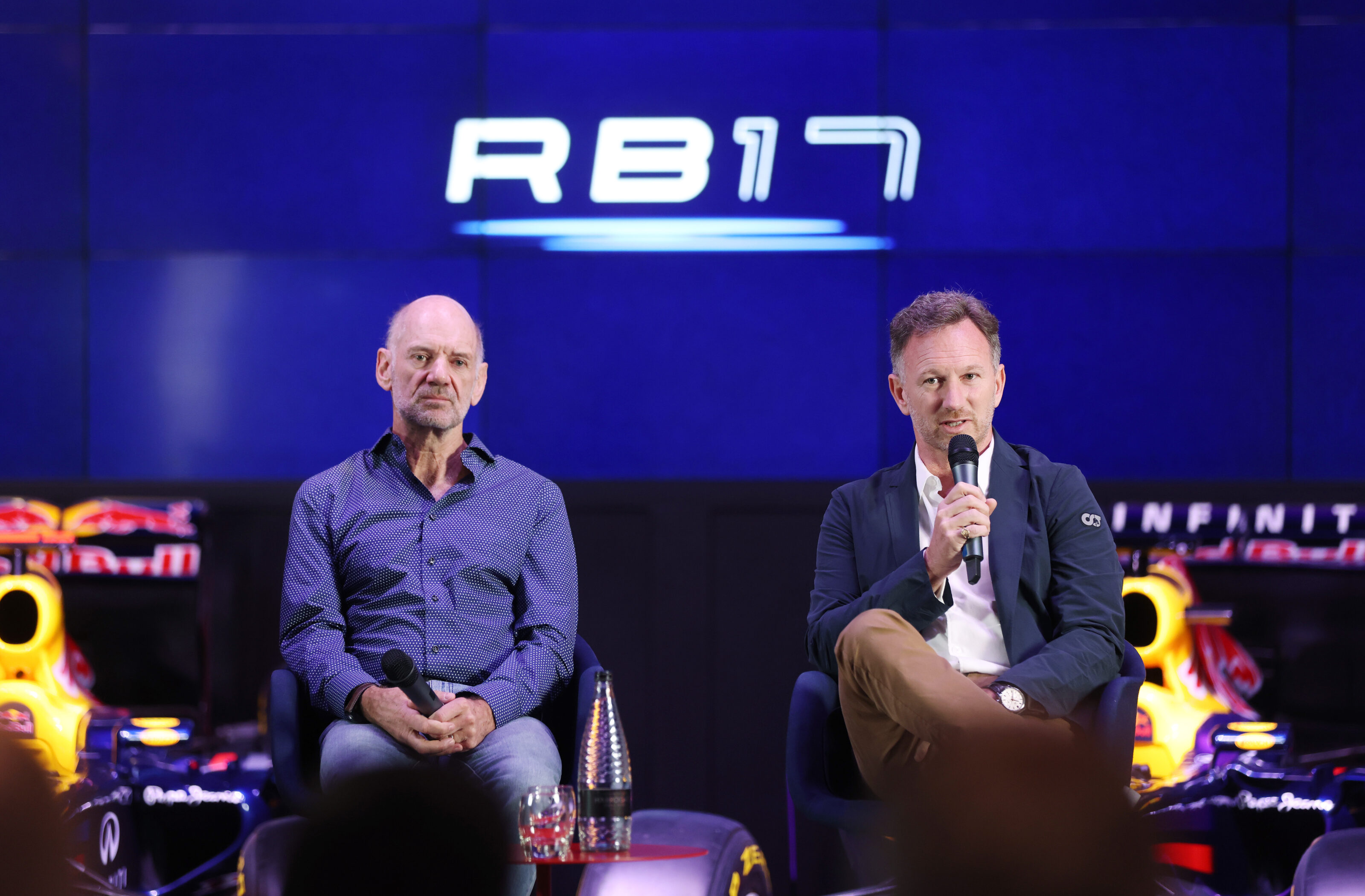
Having previously assisted Aston Martin in the development of the Valkyrie, the RB17 will be the first production car to wear the Red Bull nameplate, although it is designed with only the race track in mind.
“The RB17 marks an important milestone in the evolution of Red Bull Advanced Technologies, now fully capable of creating and manufacturing a series production car at our Red Bull Technology Campus,” said team principal Christian Horner.
“Further, the RB17 marks the first time that a car wearing the Red Bull brand has been available to collectors.”
As a part of the RB17 ownership package, buyers will have access to the racing team’s simulations, vehicle programme development and on-track training, while the Milton Keynes crew will also provide servicing and maintenance on the vehicle.
Snapshot
- VTi 7 +Luxe and Black Edition added to lineup
- Mid-spec models start from $43,700 and $44,600
- Both powered by 1.5-litre VTEC turbo engine
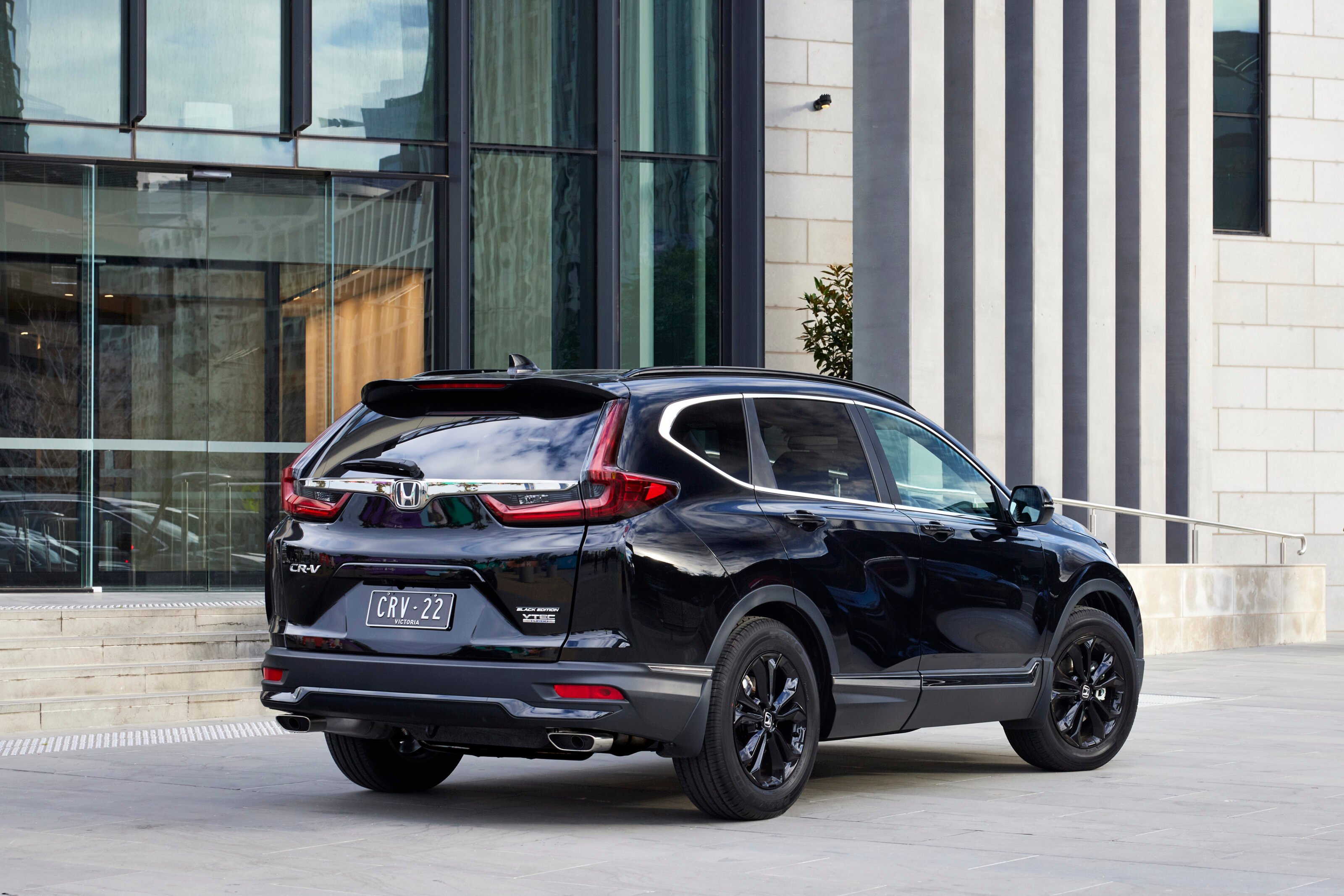
Two new special additions have been added to the popular 2022 Honda CR-V range, in the form of the Black Edition and VTi 7 +Luxe.
Both are based on the 1.5-litre turbocharged VTi variant, and receive a comprehensive list of features and luxuries usually reserved for the upper echelons of the range.
The CR-V Black Edition and CR-V 7 VTi +Luxe are currently offered with national drive-away prices of $44,600, and $43,700 respectively.
2022 Honda CR-V Australian pricing
All prices are drive-away.
| Variant | Pricing |
| Vi | $35,600 |
| VTi | $38,800 |
| VTi 7 | $40,700 |
| VTi X | $41,700 |
| VTi 7 +Luxe | $43,700 (new) |
| Black Edition | $44,600 (new) |
| VTi L AWD | $46,000 |
| VTi L7 | $49,200 |
| VTi LX AWD | $53,600 |
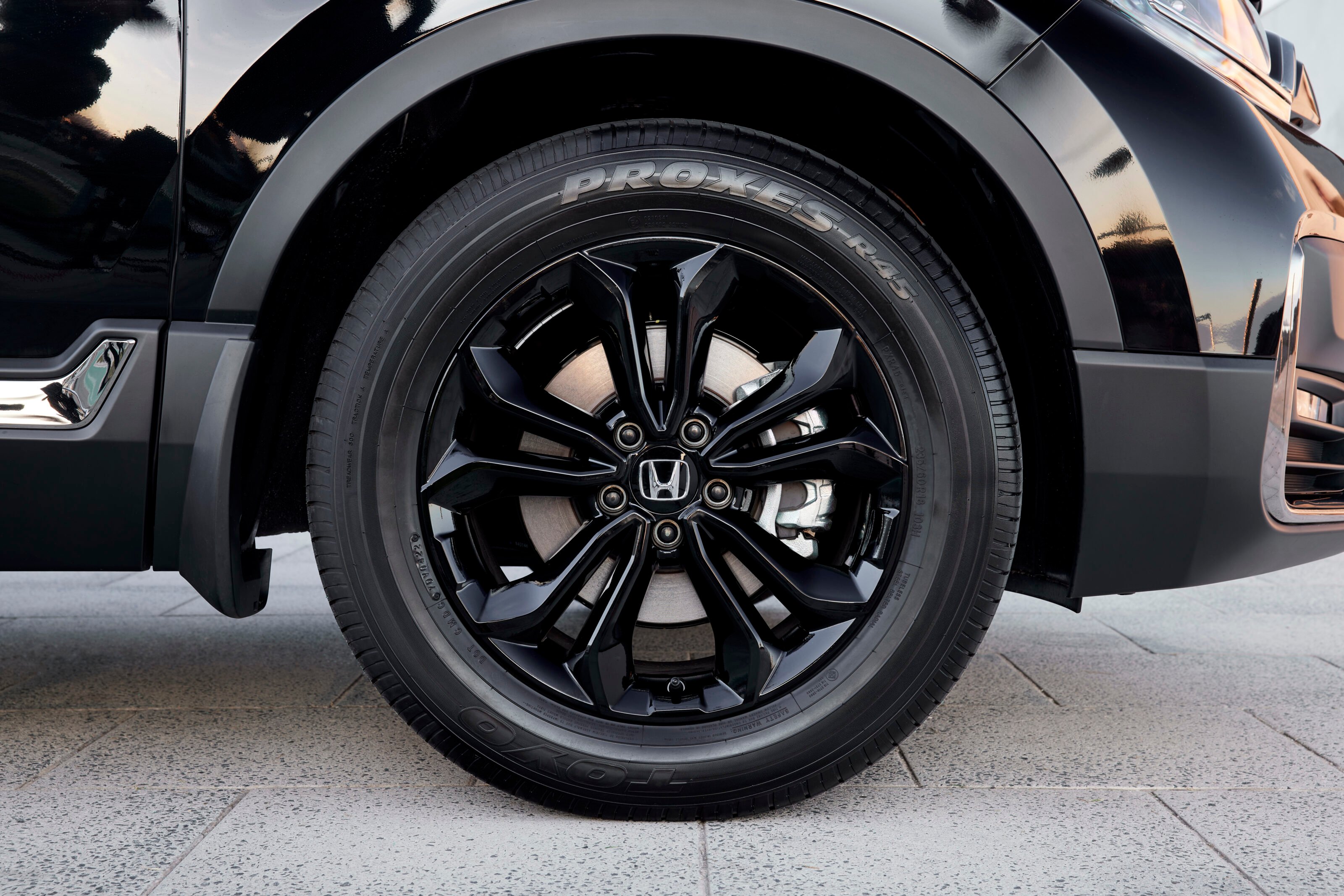
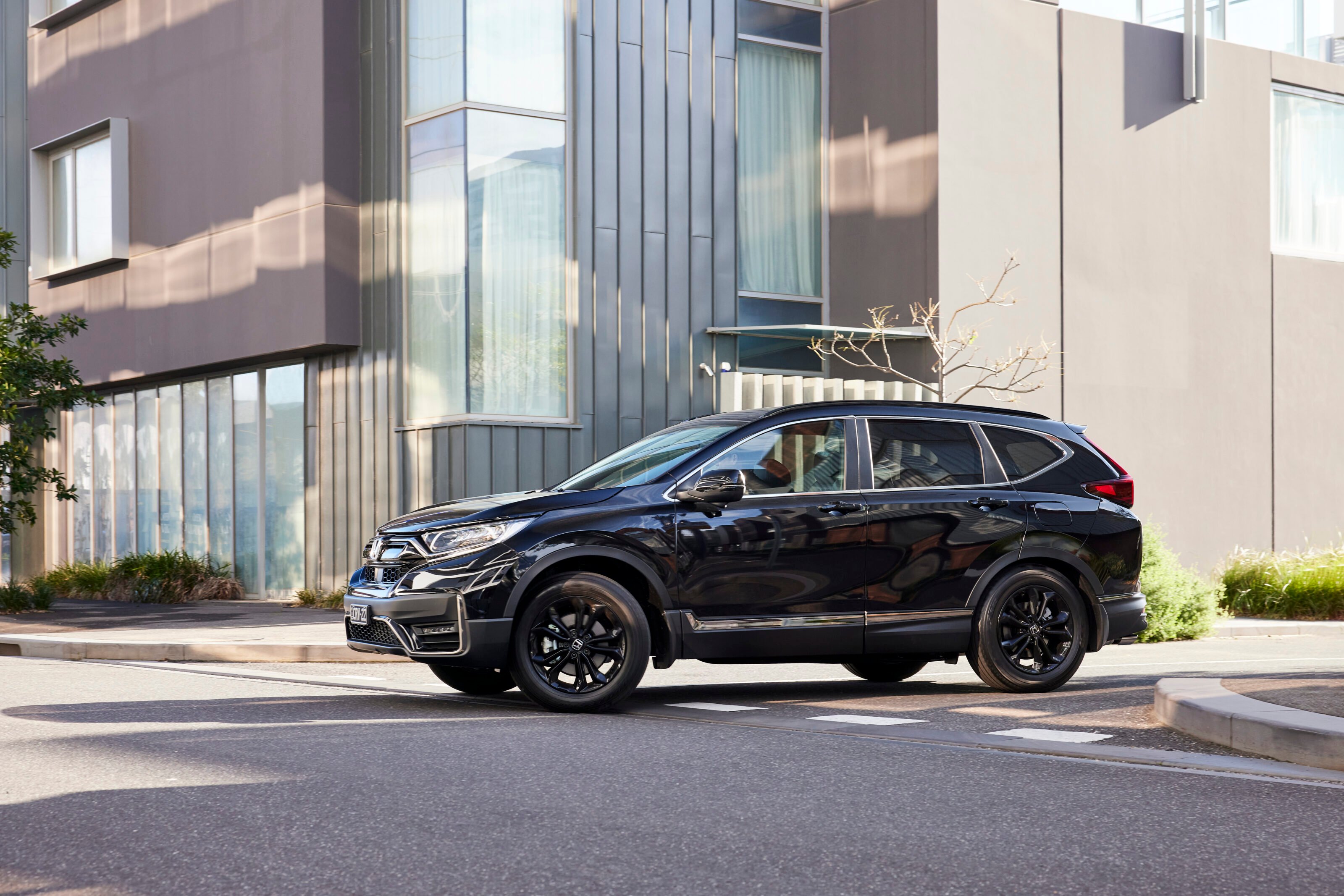
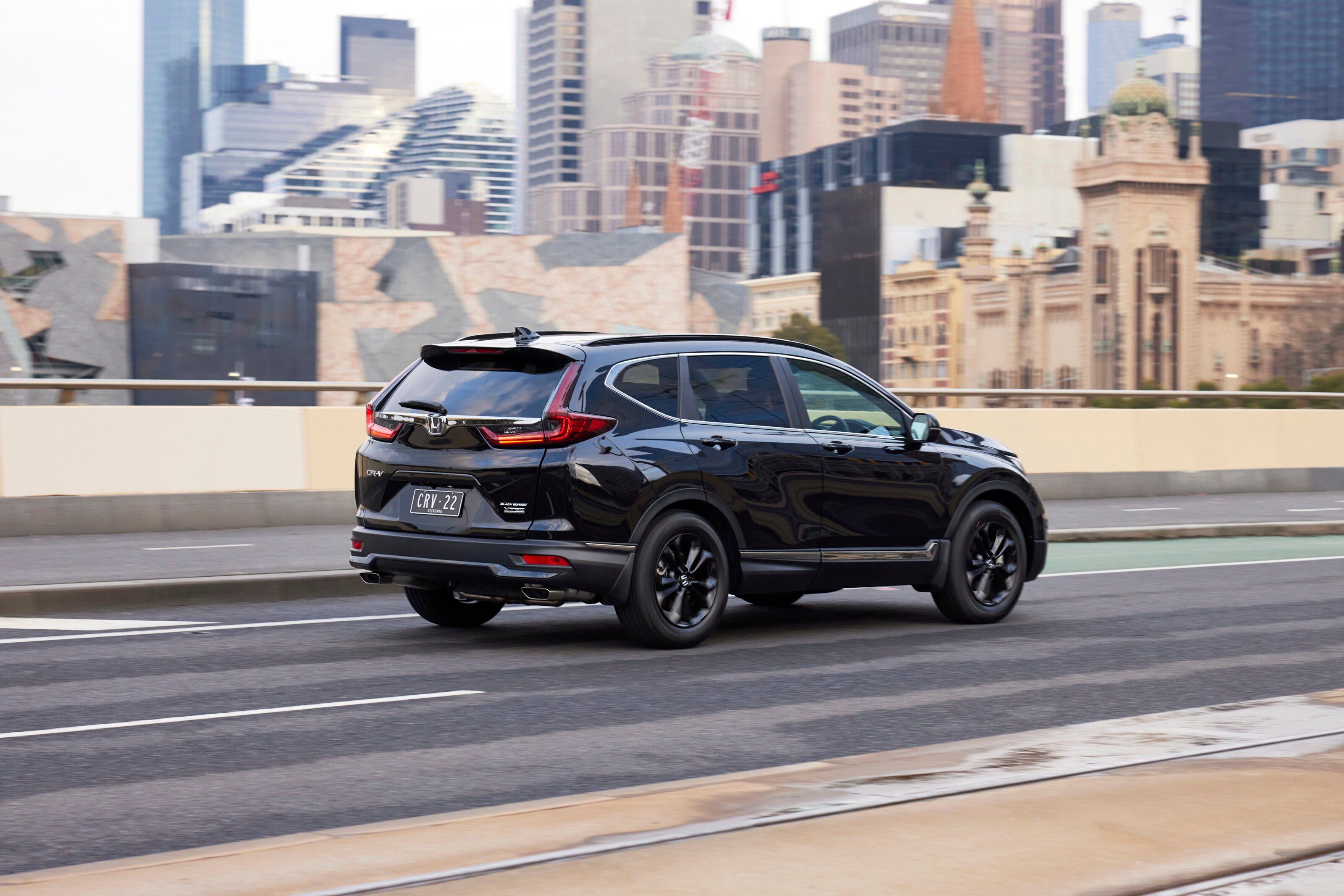
The CR-V Black Edition, as the name states, injects a big dose of dark styling with gloss black alloy wheels, smoked headlights, piano black bumper garnishes and ‘dark trivalent chromium’ trim pieces around the exterior.
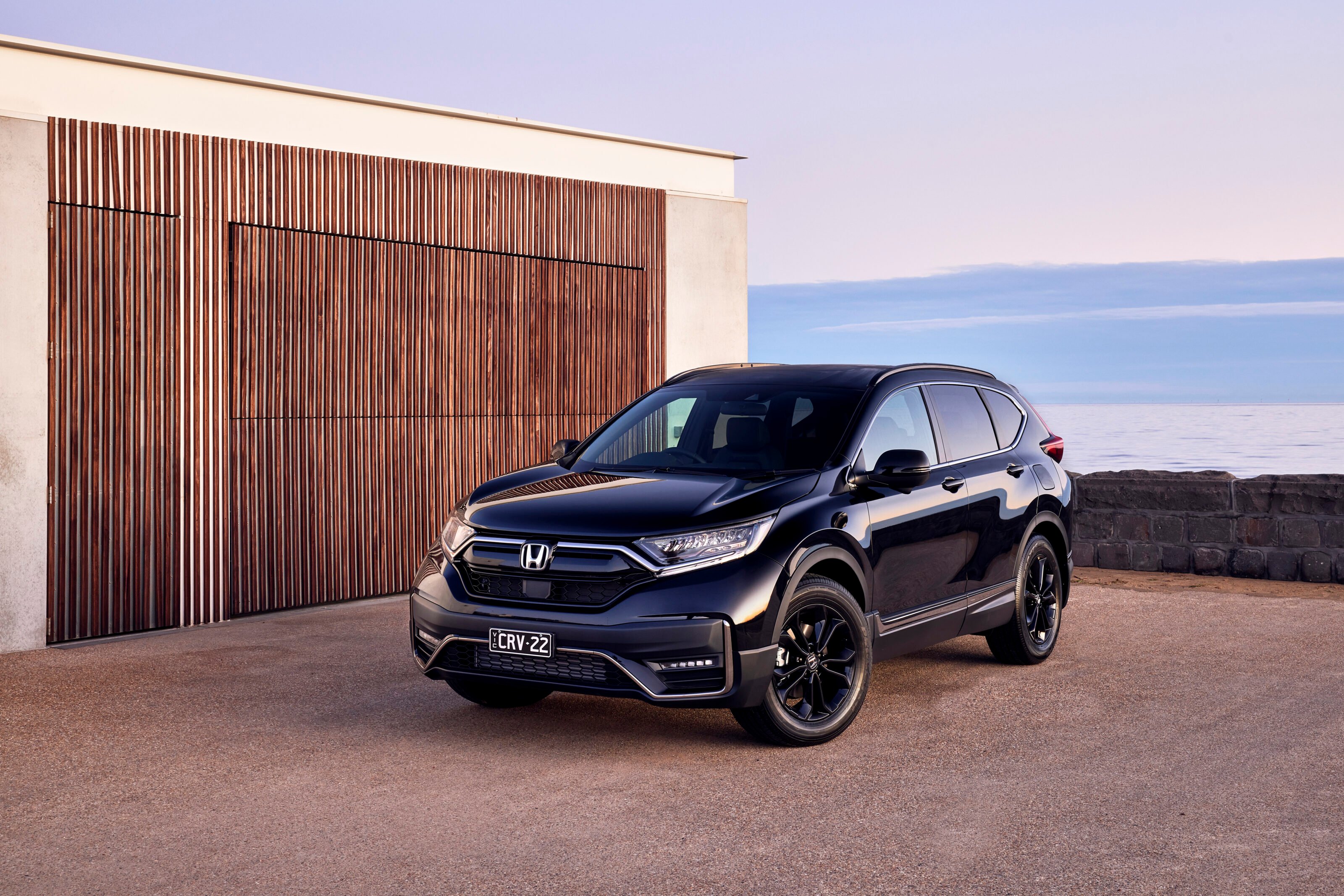
Inside the Black Edition there are; embroidered ‘Black Edition’ logos on the front seats, black headliner, and piano black inserts on the steering wheel, around the infotainment screen, gearshift console, HVAC controls and door trims.
The CR-V Black Edition also gets LED headlights with Active Cornering Lights (ACL), heated front seats, leather appointed trim and 18-inch alloy wheels.
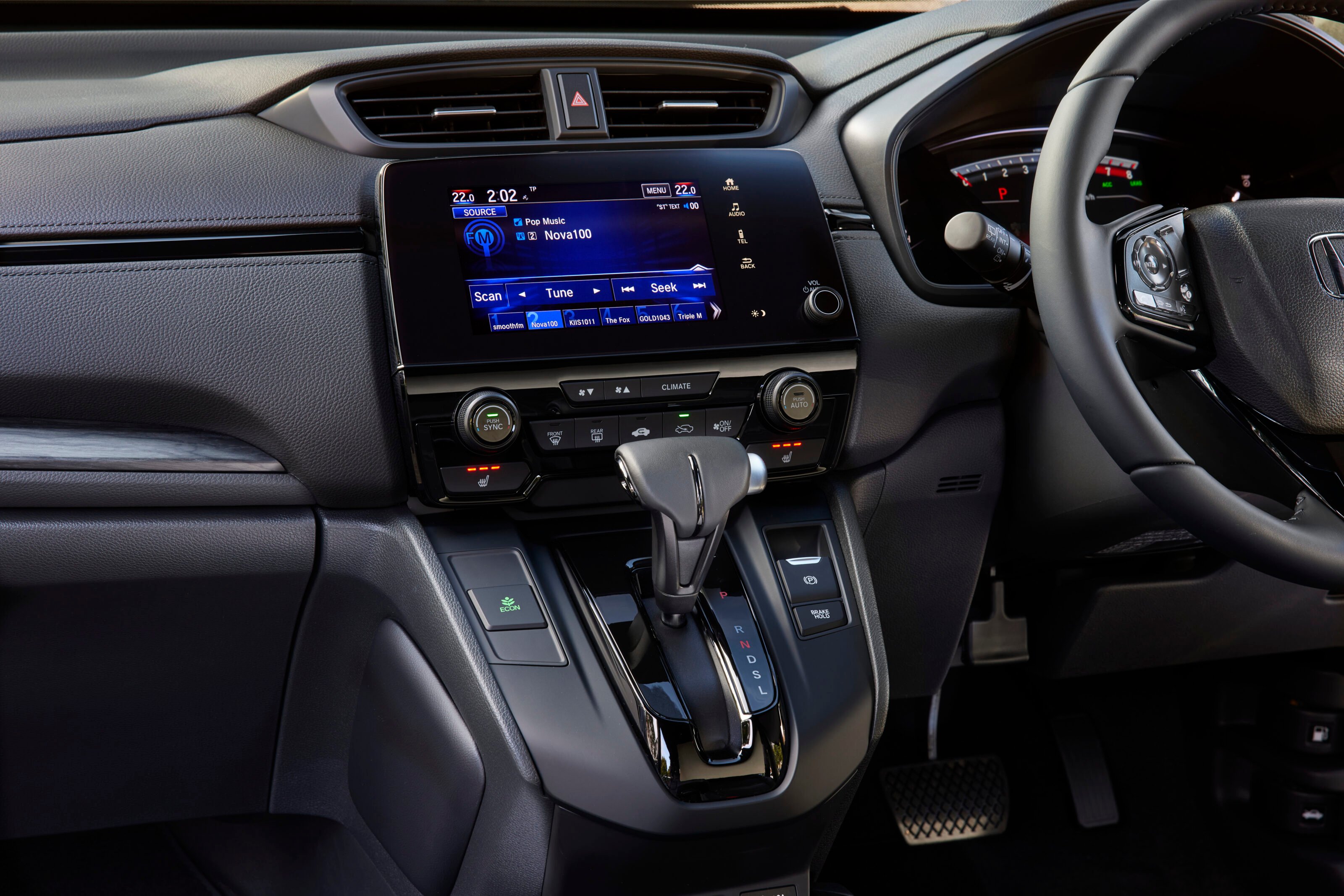
Available exclusively finished in either crystal black or platinum white pearlescent paint, the Honda CR-V Black Edition is currently offered for a national drive-away price of $44,600.
The Honda CR-V VTi 7 +Luxe cuts a more mature figure, adding an air of luxury to the affordable family-friendly seven-seat SUV.
Based on the existing VTi 7 variant – already fitted with niceties such as; dual-zone climate, four USB ports, multi-angle reversing camera and tyre pressure monitoring system (TPMS) – the luxurious special edition adds; leather trim, heated front seats and an eight-way power adjustable driver’s seat with two-position memory function.
The CR-V 7 VTi +Luxe is available in four metallic hues – ignite red, cosmic blue, lunar silver and meteoroid grey – as well as platinum white pearlescent. It joins the CR-V range with a national drive-away price of $43,700.
CR-V Black Edition features
Beyond what is already included in the lower spec CR-V lineup, the Black Edition features:
CR-V 7 VTi +Luxe features
Beyond what is already included in the existing CR-V 7 VTi variant, the CR-V 7 VTi +Luxe features:
Engine, transmission and fuel economy
Engine options across the CR-V range are primarily comprised of the turbocharged 1.5-litre four-cylinder petrol engine, producing 140kW/240Nm, claiming a fuel economy of 7.4-litres per 100km. It’s fitted to all CR-V variants except for the base $35,600 CR-V Vi.
The base Vi comes equipped with a 2.0-litre naturally-aspirated inline-four petrol producing 113kW/189Nm. Without the aid of turbocharging, combined fuel usage increases slightly to a claimed 7.6L/100km.
All CR-Vs across the range are fitted as standard with a Continuously Variable Transmission (CVT).
Availability
Both of the new CR-V special editions have been added to Honda Australia’s online configurator, with pre-orders now open at centres around the country.
Vehicles are expected to arrive in showrooms within the coming weeks.
UPDATE, June 29: One of the 99 examples coming to Australia
One of just 99 examples of BMW’s ‘8 X Jeff Koons’ Art Car is heading to Australia.
The exclusive edition M850i xDrive Gran Coupé was created by the marque with renowned American artist Jeff Koons, with BMW confirming today that one of the 99 vehicles produced will be available to purchase by a local customer in the third quarter of this year.
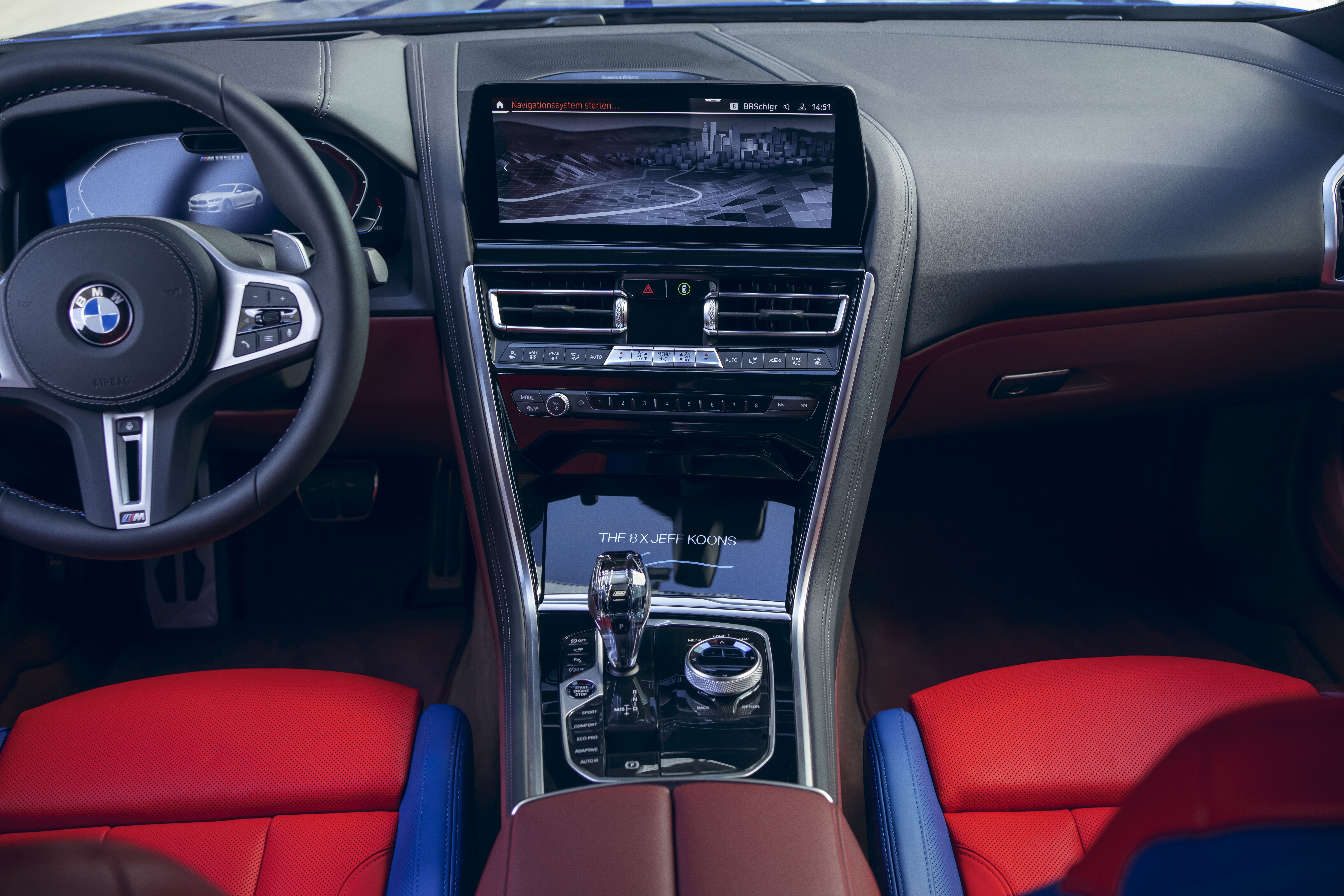
Pricing is yet to be confirmed, but considering it features a multi-coloured exterior and interior, high-end materials, leather and a cupholder lid with edition badging and the artist’s signature finished in Bavarian blue from the BMW logo – don’t expect it to come cheap.
Koons previously designed the 17th BMW Art Car, the BMW M3 GT2, which competed in the 2010 edition of the 24 Hours of Le Mans.
For more about the unique model, read our original story below.
The story to here
February 18: BMW reveals Art Car designed by Jeff Koons
BMW has revealed a new Art Car in conjunction with American artist Jeff Koons.
BMW’s iconic Art Car series started in 1975 and continues to this day, allowing famous artists to use a BMW model as their canvas.
The latest such car is the 8 Series X Jeff Koons, designed by Koons and produced by BMW.
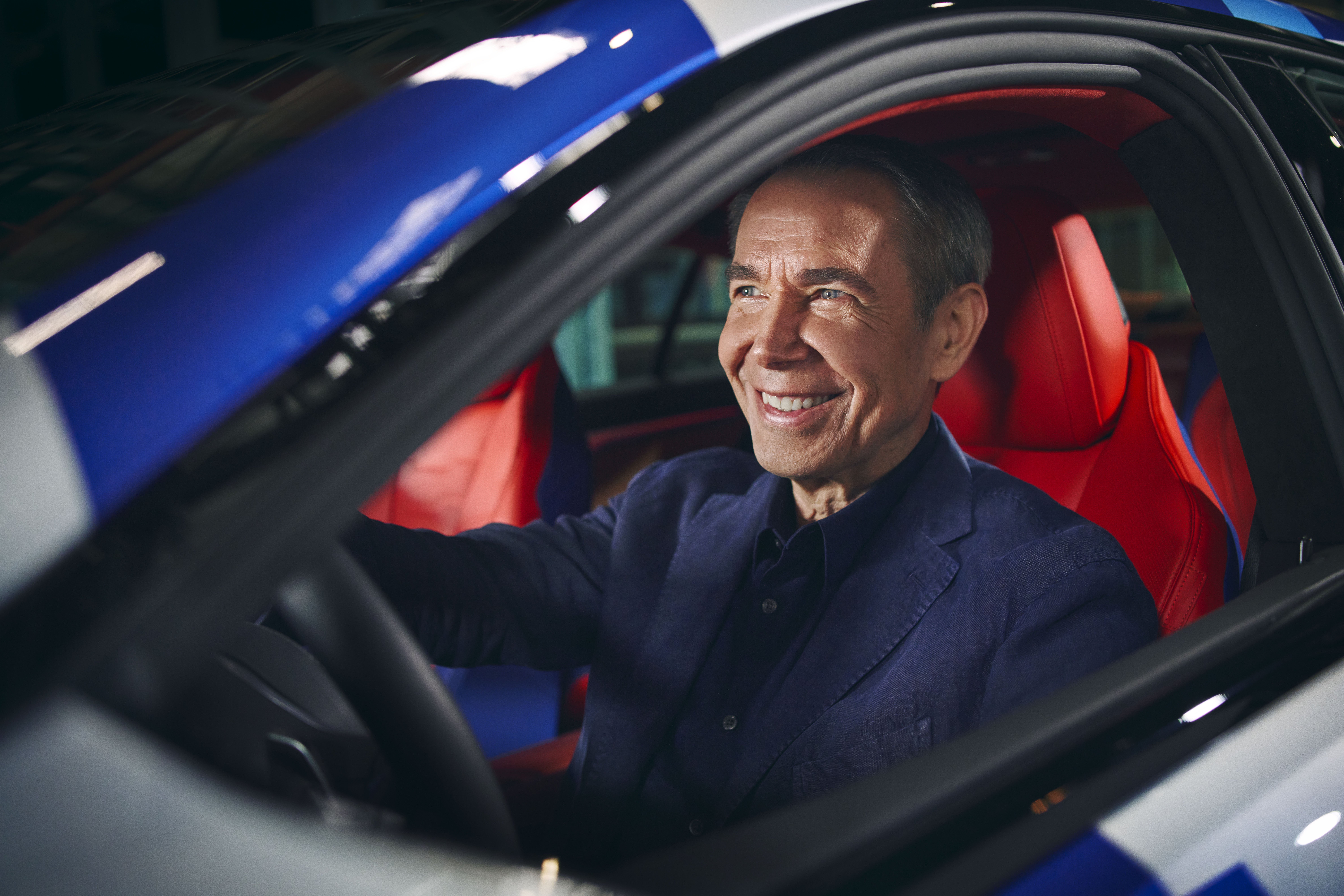
Bright and bash, the Koons’ styled Beemer will be made in a limited batch of just 99 units for an undisclosed price – but keen buyers should be aware that his most famous art piece is the sculpture “Rabbit”, which sold for over $125 million in its last auction…so there’s no telling what the price tag will be on this exclusive 8 Series.
BMW says the Pop Art livery takes more than 200 hours to apply in its factory and thus only four cars per week are produced. While the exterior is elaborately decorated, underneath is a regular BMW 850i xDrive Gran Coupe with no mechanical changes.
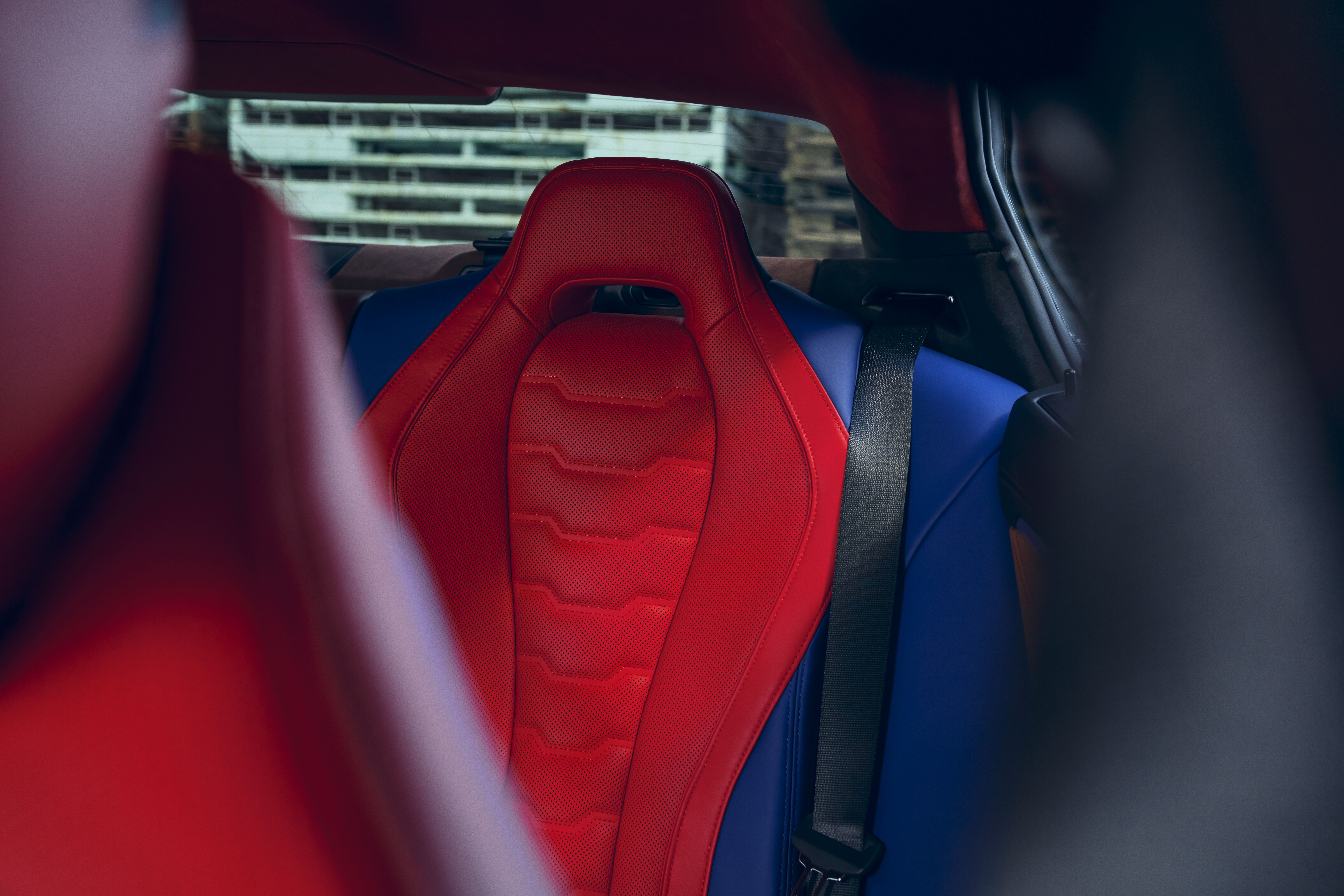
Inside is a different story, with a Spiderman-inspired mix of red and blue leather upholstery that is bulked out like a superhero’s chest. There’s a signature by Jeff Koons inside too, and a special plaque matching a special certificate of authenticity signed by Koons and BMW Chairman Oliver Zipse.
“My edition of the BMW 8 Series is my dream car,” said Koons.
“It is very special to me and I’ve wanted to create a special edition BMW for a long time. It is sporty and flashy as well as minimalist and conceptual. I can’t wait to drive it and ride in it, and I hope that people will enjoy the Gran Coupe just as much as I do.
“On the car, the lines are getting bigger on their journey from the hood towards the trunk, creating a sense of forward movement just as the ‘POP!’ and the vapour thrust design elements do. The blue colour resembles the vastness of space, and I like the idea of the car being a global car.”
The first BMW Art Car from the Koons collection will be auctioned in April this year at Christie’s in New York, and the final 98 other units sold directly by BMW with a price upon application.
Snapshot
- Victoria to increase road user charge by 0.1c/km
- Increase bumps electric and hydrogen vehicle charge up to 2.6c/km, plug-in hybrids to pay 2.1c/km
- All affected owners to continue receiving $100 annual registration discount
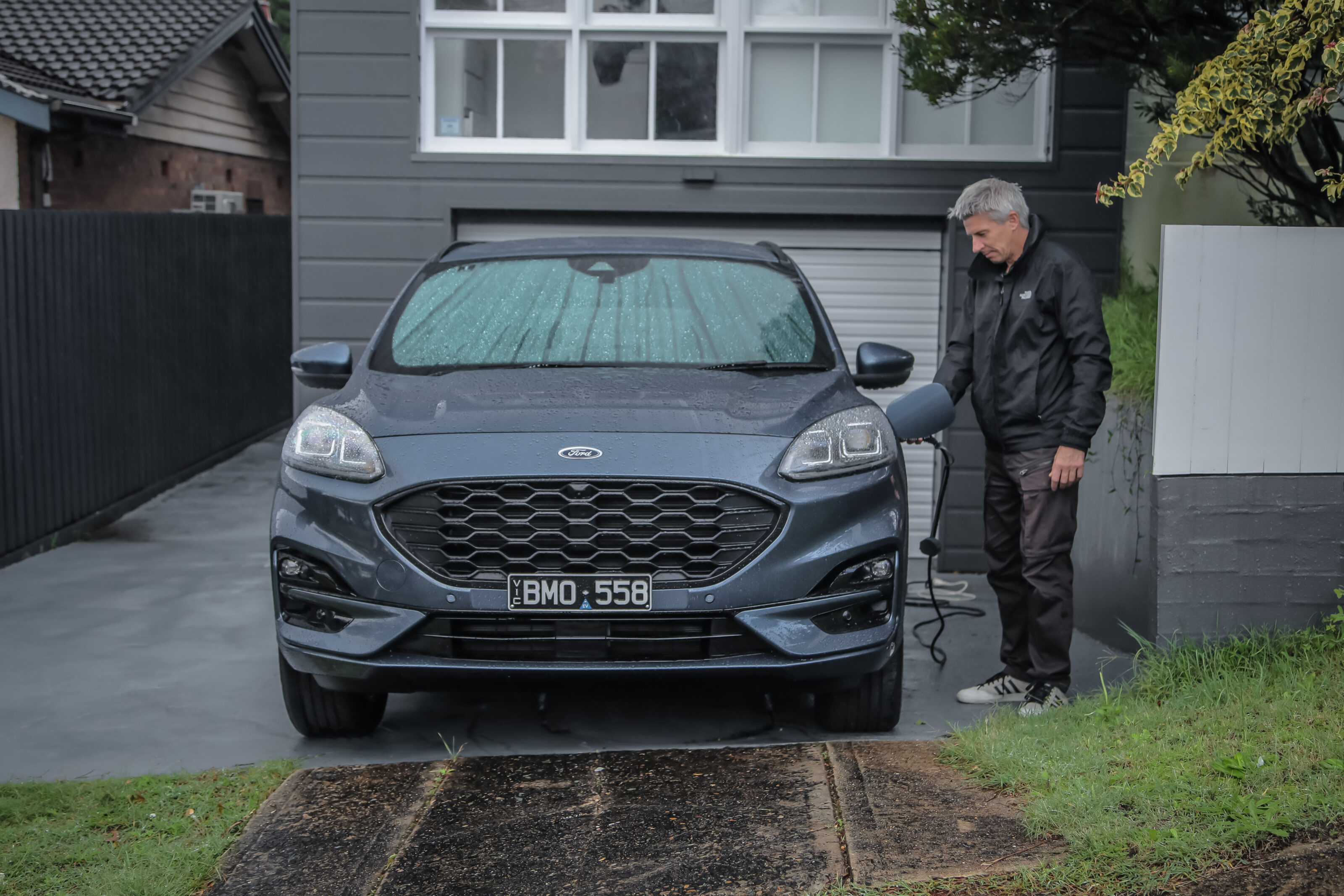
The Victorian Government’s controversial road user charge has been increased for the 2022-2023 financial year, with zero and low emission vehicle owners now having to pay an extra 0.1 cents per kilometre travelled.
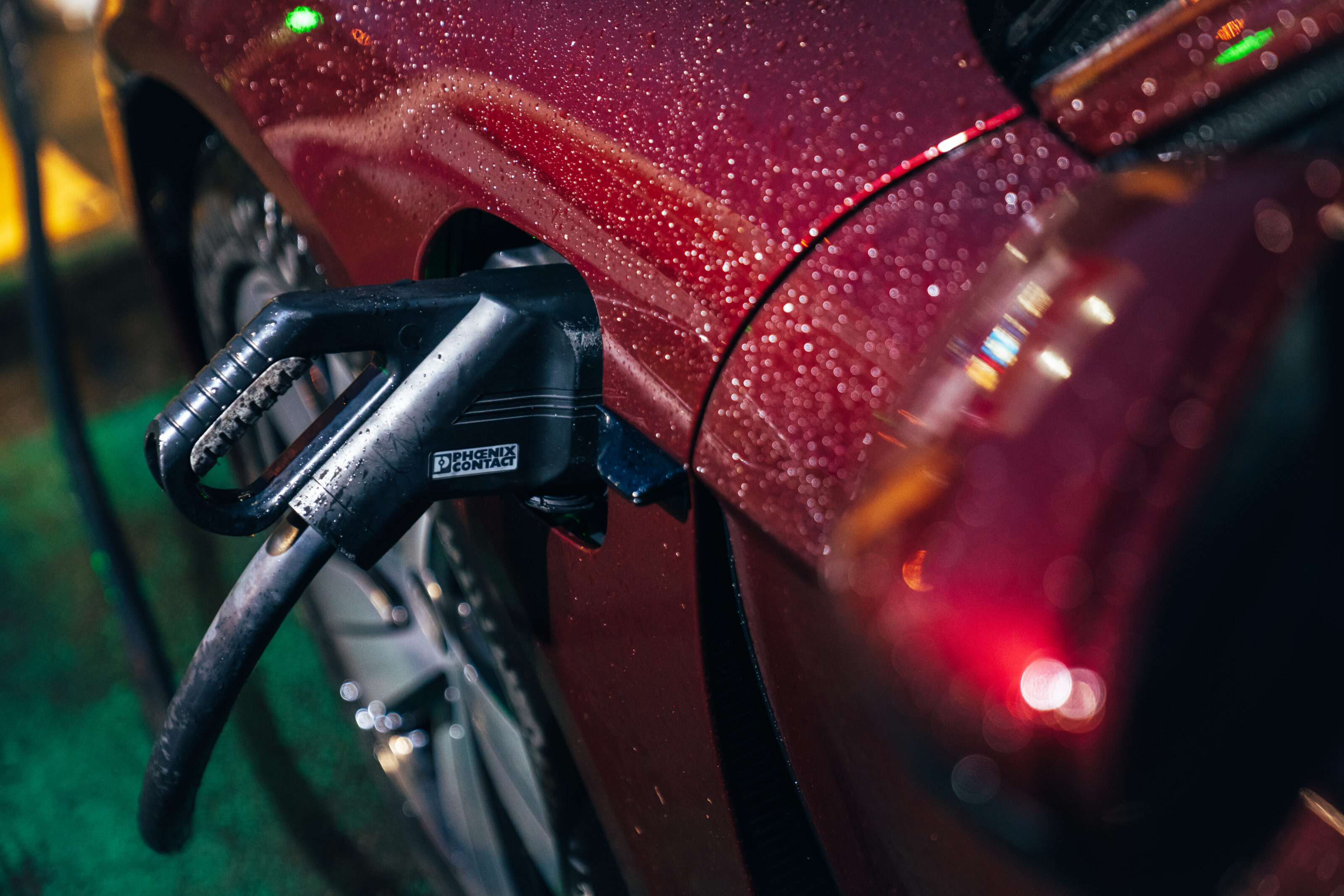
Coming into effect on July 1, the increased road user charge will result in electric vehicle (EV) and hydrogen fuel-cell vehicle (FCEV) owners now paying 2.6 cents per kilometre – up from the 2.5c/km charge which was introduced last year.
Owners of plug-in hybrid vehicles (PHEVs) will be slugged with the additional charge too, jumping up from 2.0c/km to 2.1c/km, while also having to pay the fuel excise – which is set to return to 44.2 cents per litre in September.
In the lead-up to the road user charge being implemented last year, a number of groups in the Australian automotive industry criticised it as a regressive tax on low emissions vehicles, with an open letter to the Victorian Parliament calling it the world’s worst EV policy.
“Going it alone will mean Victoria has the worst electric vehicle policy in the world,” the letter read.
“No other jurisdiction has introduced such a targeted levy on the cleanest vehicles on the road without significant incentives to balance it out.
“This new tax means the world’s manufacturers are far less likely to send Victorians their best, most affordable, zero emissions vehicles. That makes things much harder for Victorian families who want to buy and drive electric.”
New South Wales, South Australia and Western Australia will all introduce road user charges which mirror Victoria’s original tax, however all three states won’t be doing so until July 1, 2027.
Victoria’s transport department VicRoads requires owners to upload images of their odometers annually to determine how many kilometres the vehicles have travelled, threatening to cancel the registration of anyone who doesn’t submit a reading and imposing fines of nearly $10,000 if it is falsified.
VicRoads has confirmed its $100 annual registration discount will remain for EV, FCEV and PHEV owners, essentially offsetting the first 3846km of travel for EV/FCEV drivers and the first 4762km covered by those in PHEVs.
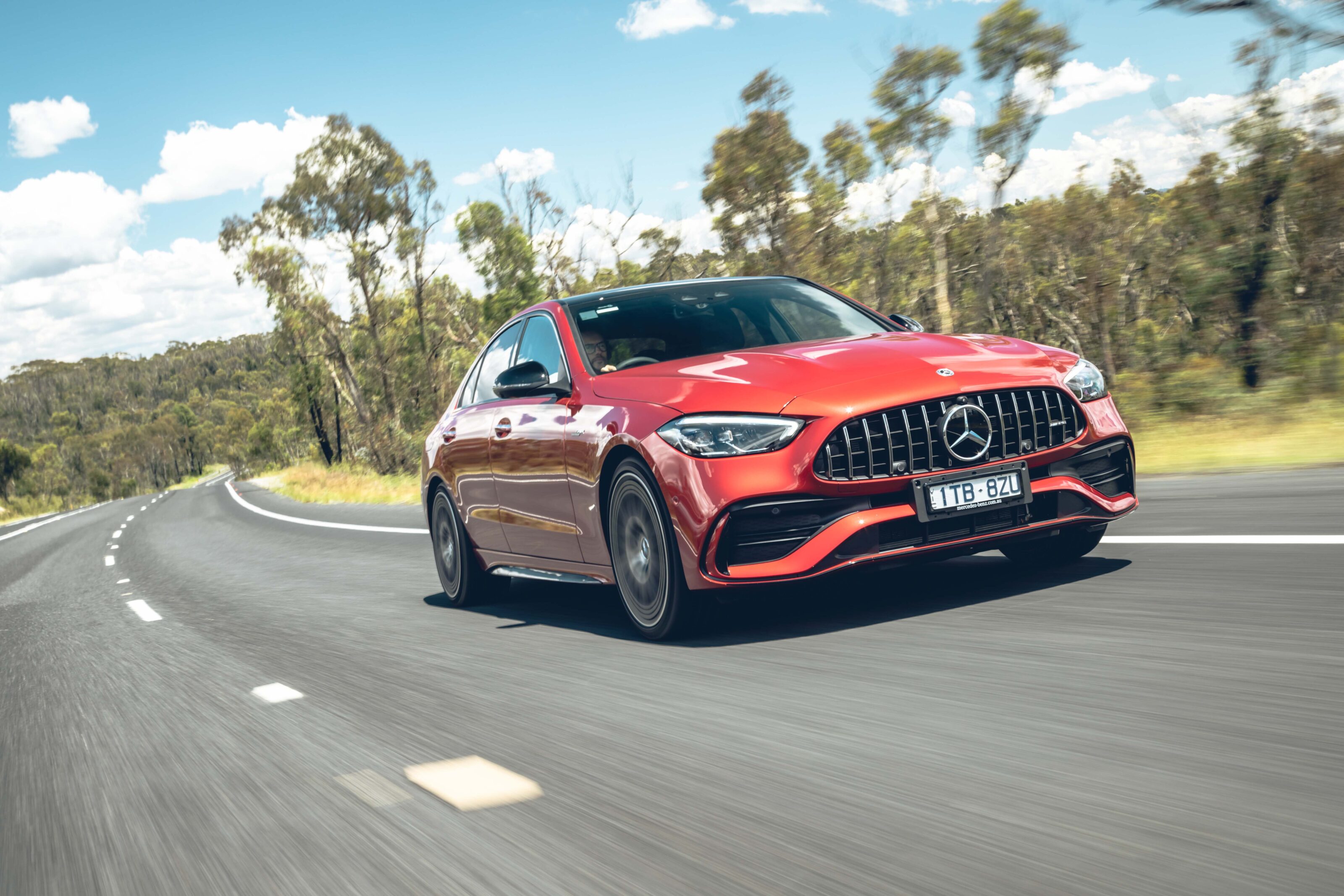
UPDATE, February 2023: New-gen C43 driven in Australia
The new-generation AMG C43 is now on sale in Australia, and we’ve driven it. Get the full story at the link below.
Story continues…
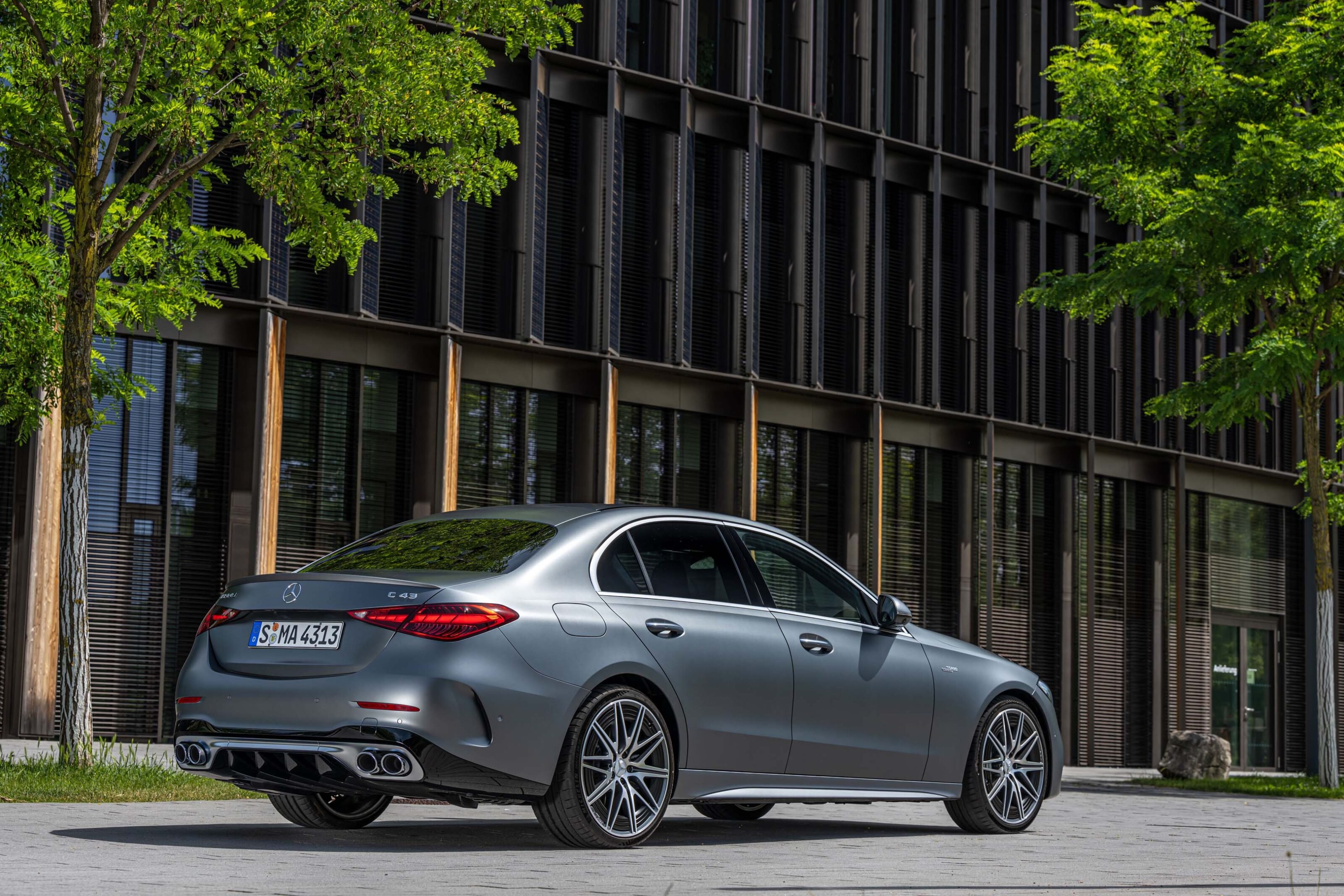
Until now, if you’ve been looking for a quick, performance-focused version of the new W206 Mercedes-Benz C-Class, the best Mercedes could offer you is the C300. Now, though, the mad hatters at AMG have got their hands on the W206 and given us this: the second-generation C43.
It’s interesting for a couple of reasons. Peel back the bonnet and you won’t find a big capacity six-cylinder like the old C43 but rather a highly strung and high-tech 2.0-litre four pot.
It uses an electric turbo and doesn’t only promise to eliminate turbo lag altogether, but it’s essentially the same power unit that will be wedged into the upcoming C63 flagship. So how the engine feels and performs is doubly significant.
The other point of intrigue surrounds the C43’s spec on paper. Most new models strive to surpass the cars they replace but this new C43 is heavier, has fewer cylinders, a litre less capacity and doesn’t make as much torque. So the question is: has AMG made a misstep? Or has doubling down on technology improved the recipe?
Pricing and features
First up, the bad news. When the second-gen C43 arrives in Australia next year it will carry a price tag of around $130,000.
That’s roughly $15K more than the old car but the trade-off is a machine that’s significantly more sophisticated. The most complex piece of tech is found in the engine.
The 2.0-litre four pot is the same M139 unit that you get in the Mercedes-AMG A45 only it’s mounted longitudinally in the C43 (giving it an internal code of M139L) and the turbocharger is new.
Built around hardware from turbo supplier Garrett, AMG’s engineers have fitted a 6kW brushless electric motor onto the shaft between the compressor and turbine wheels.
It’s fed by a 48V mild-hybrid sub-system that can spin up the turbo virtually instantaneously, meaning no more fun-sucking delays as you wait for exhaust gases to build. Feel like you’ve heard about this tech before? It’s exactly the same split turbo design that’s been powering Lewis Hamilton’s F1 car for years.
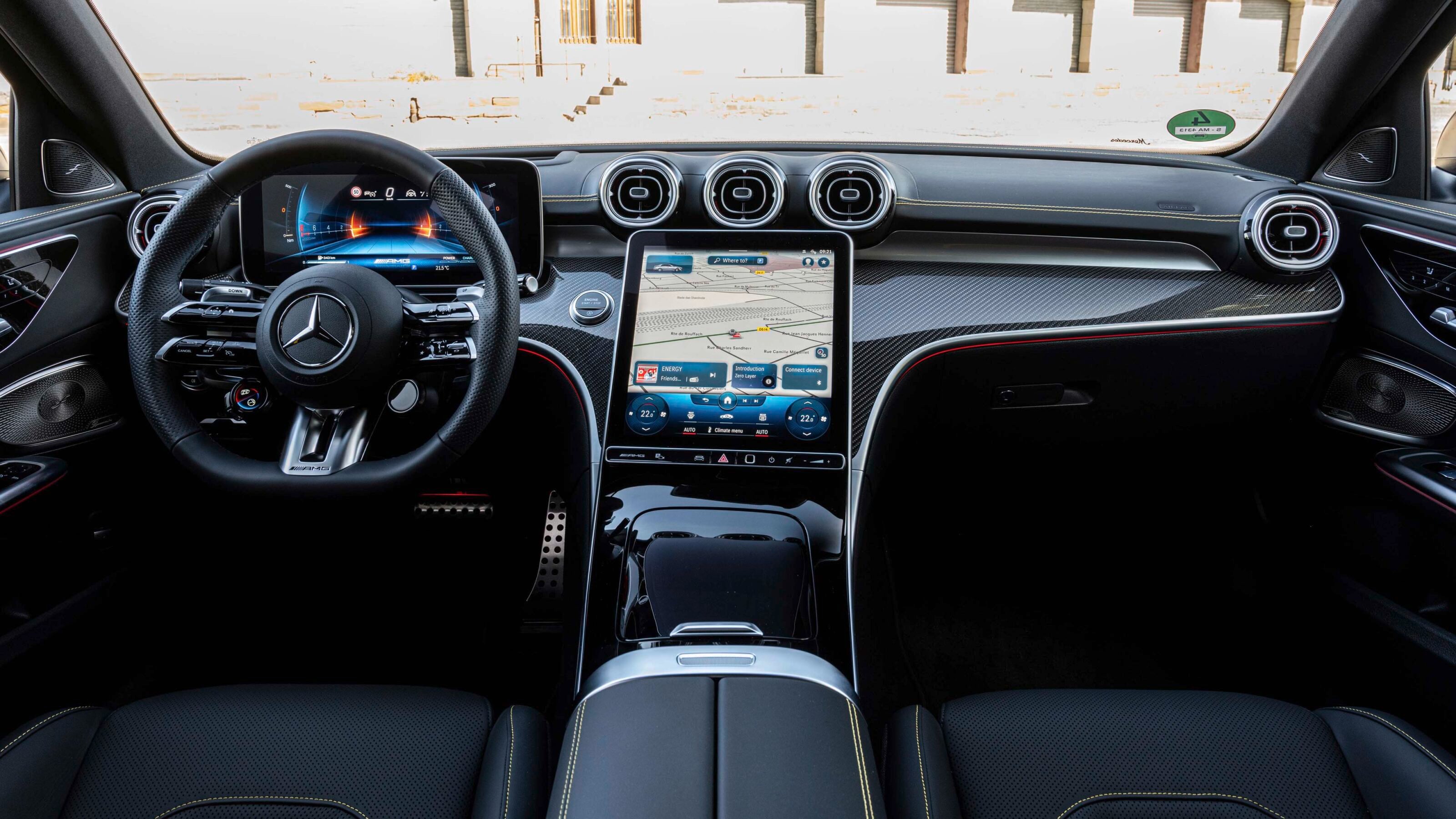
A new nine-speed multi-clutch gearbox does the shifting and it’s not only quicker than the unit in the old C43 but because it has a wet-clutch, it also offers launch control.
Engage it and the 300kW/500Nm C43 will hit 0-100km/h in 4.6 seconds.
That’s brisk, and given how fuss-free and rapid the launch-control runs we undertook during our stint behind the wheel were, it feels entirely achievable, too.
There’s also plenty of fresh chassis tech. The front brakes have been beefed up to 370mm discs with four-piston callipers, while four-wheel steering, which boosts low-speed agility and high-speed stability, is now standard. Three-stage adaptive dampers are also included and are perhaps the piece of chassis hardware we’re most interested in.
We aren’t massive fans of the adaptive chassis on the C300 but here’s hoping the C43’s more focused suspension banishes the floaty, unsettled sensation you get in non-AMG versions.
The turbo’s electric add-on is fed by a 48V mild-hybrid sub-system that can spin up the turbo virtually instantaneously, meaning no more fun-sucking delays as you wait for exhaust gases to build.
Comfort and space
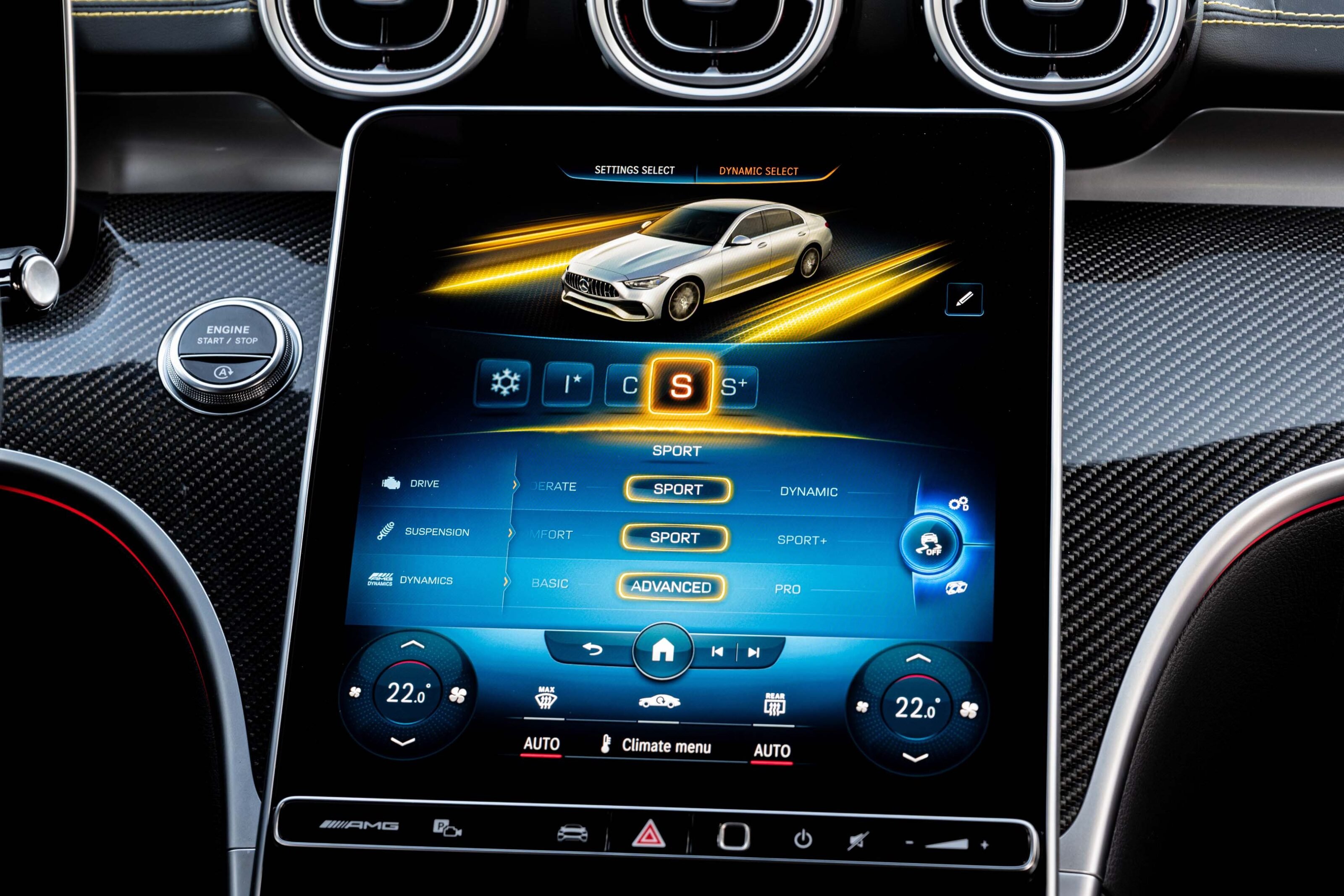
Inside you score the same tech-infused cabin as the rest of the W206 range, meaning digital dials and an excellent 11.9-inch portrait central touchscreen, but there are AMG specific touches.
The seats are sportier and heavily bolstered, you gain AMG specific functions like the company’s Track Pace data-logging system, and AMG’s multi-spoke steering wheel also features.
The wheel is a complex command centre in its own right with touch-sensitive controls on each of the four spokes and twin manettino-like dials that can be configured individually to control key functions and also allow you to cycle through the many drives modes: Individual, Comfort, Sport and Sport+.
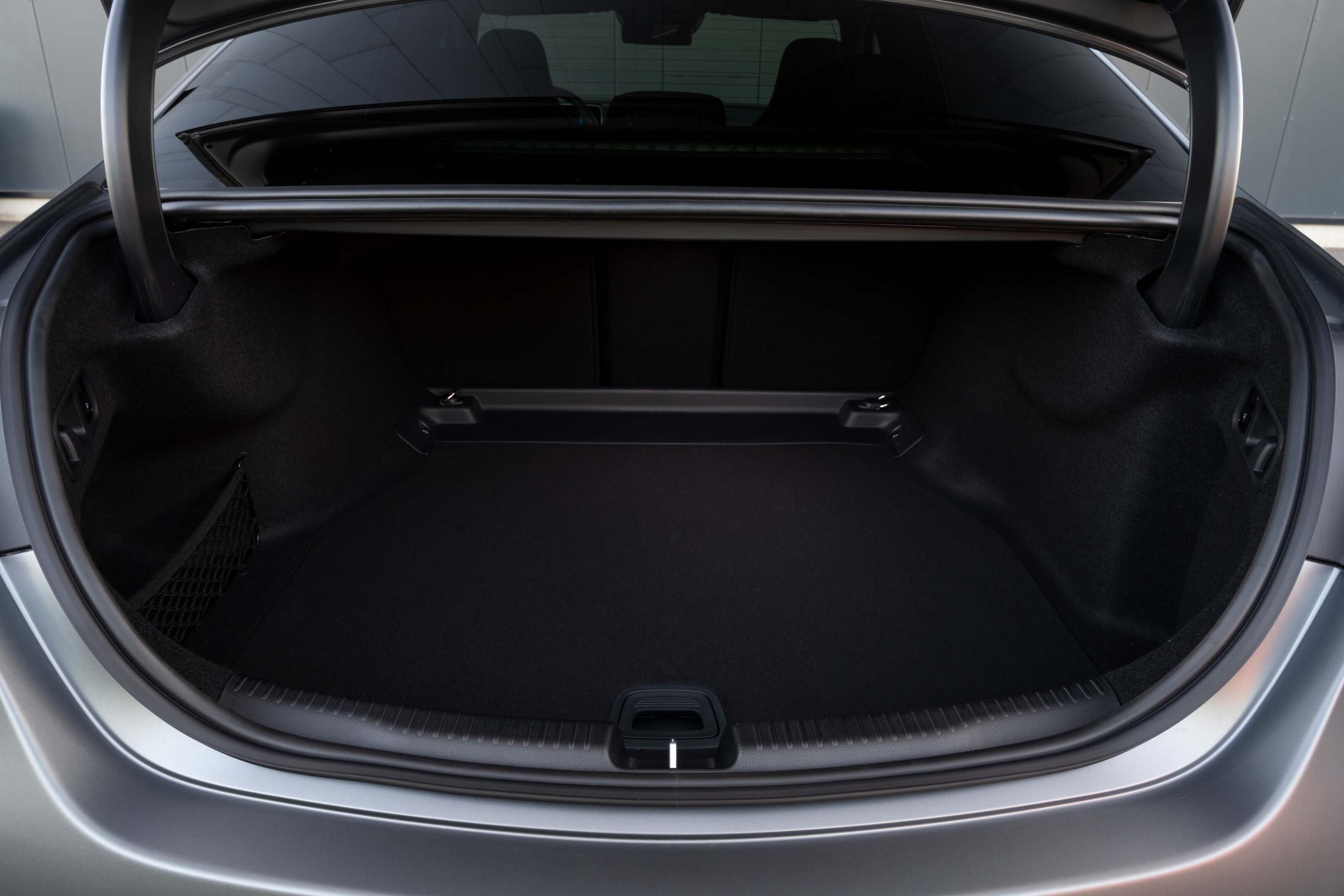
The rest of the cabin is a premium and comfortable place to spend time. Road and tyre noise are nicely contained on smooth hot mix (things do get a little vocal on coarse chip roads, though) and there’s a useful amount of cabin storage.
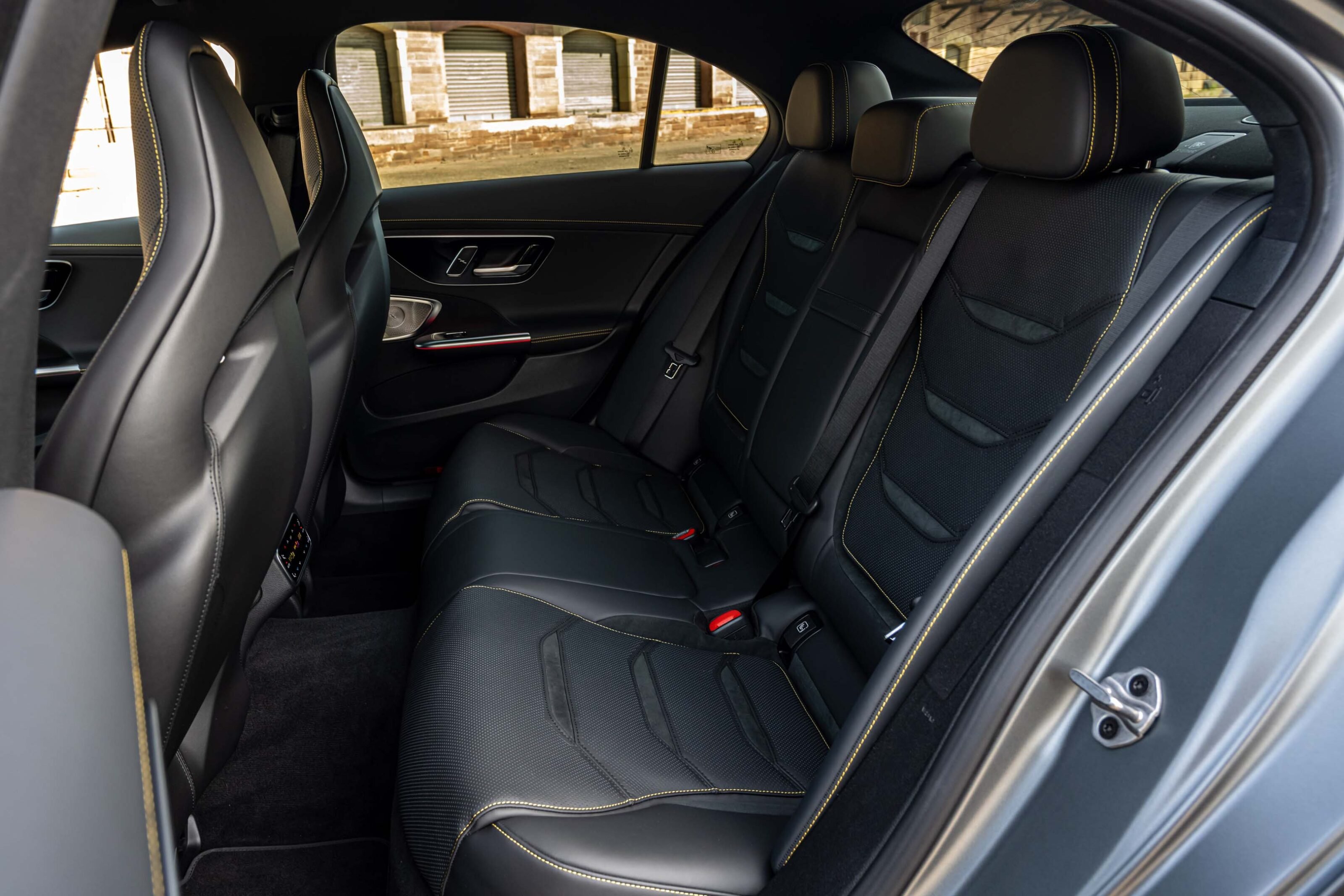
A large central cubby houses twin, adjustable cupholders, the door bins are enormous and there’s also a wireless charging pad and four USB-C ports in the front of the cabin.
Even better news is the ride quality isn’t as bone jarringly firm as expected. AMG has engineered the suspension for 18-inch alloys as standard but 19s and 20s are optional. It’s likely the 20s will be standard fitment in Australia and I did fear the larger wheels might make the C43 feel overly firm, but initial signs are good.
There’s decent compliance in Comfort and while the chassis does tense up considerably in Sport+ the suspension doesn’t jar or crash through unpleasantly.
Body control is a strength, too, and the more focused AMG-specific suspension seems to have reduced the floatiness we’ve encountered in the C300. Admittedly, though, the roads on our drive loop were fairly smooth.
The real test of how the C43 rides and behaves will be when we can drive it down a gnarly Aussie back road. Stay tuned.
On the road
It’s when you twist the drive mode selector into Sport and Sport+ that the C43 starts to come alive. Where the old C43 surfed lazily on huge reserves of torque, this new car feels noticeably more highly strung.
Peak outputs are sizeable at 300kW and 500Nm but they’re both achieved high in the rev range: 6750rpm for power and 5000rpm for torque.
It means that occasionally the C43 can feel a little sluggish at low revs but wait for the engine speed to build and the feisty 2.0-litre turbo delivers rapid propulsion.
In-gear response and acceleration are especially impressive and because the electric turbo keeps the turbine spinning even when you lift off the throttle – like an anti-lag system – it never feels like you catch the engine off-guard at full noise.
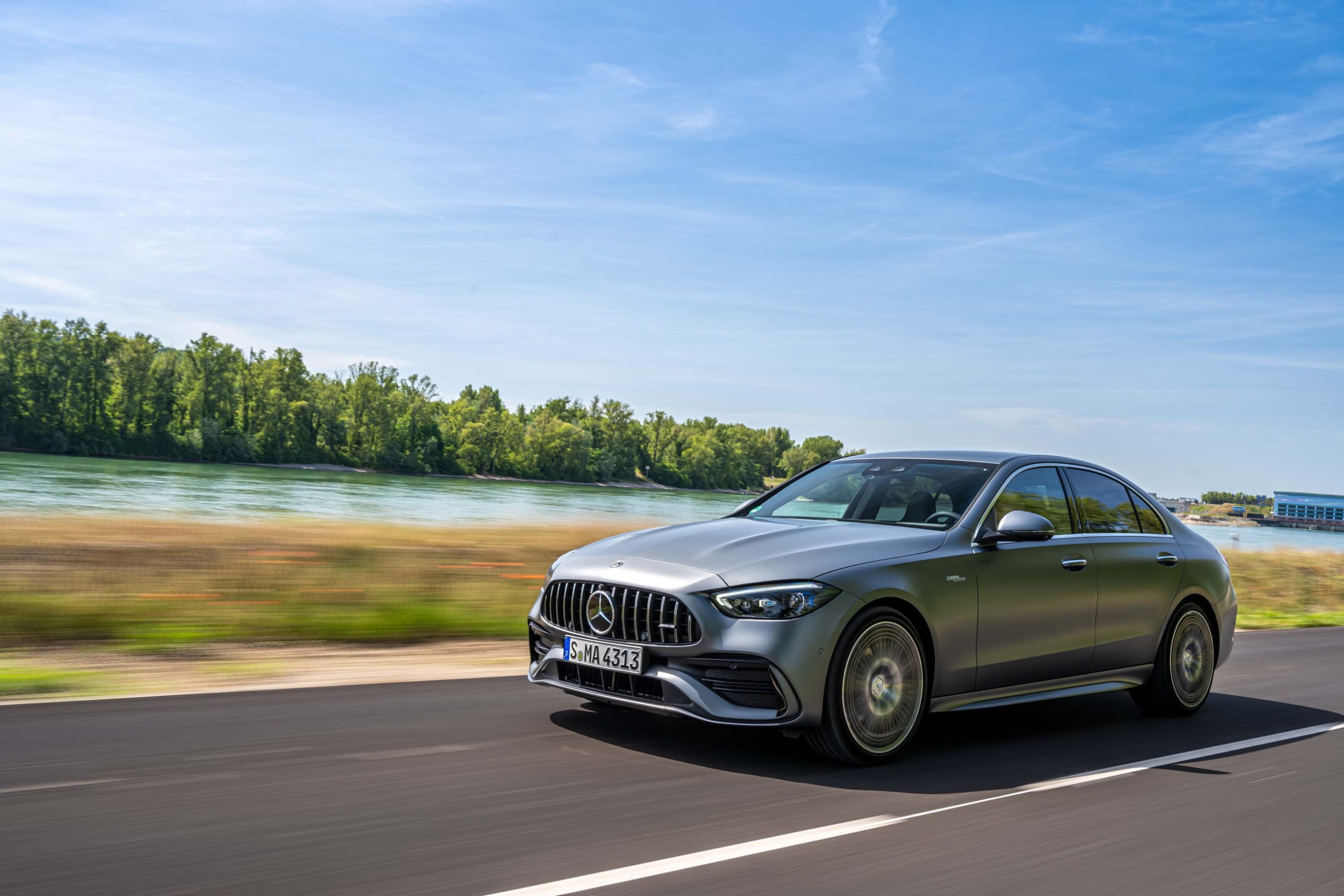
There’s ample reward for wringing it out, too, given peak power doesn’t arrive until the needle is almost at redline.
It’s a potent powertrain, and this is the 300kW tune. I can’t imagine what the C63 is going to feel like with 350kW from the combustion engine and an additional 150kW from a plug-in hybrid system. Monstrous, probably.
Has AMG’s clever electric turbo banished lag forever? Not quite. Let the revs drop, switch the gearbox into manual mode and there is still a hint of a delay as you climb through the rev range but, honestly, you really have to go searching to find it.
Most of the time the powertrain is punchy and eager and it certainly doesn’t feel like a small capacity engine with a huge turbo bolted to it.
It’s a potent powertrain, and this is the 300kW tune. I can’t imagine what the C63 is going to feel like… Monstrous, probably
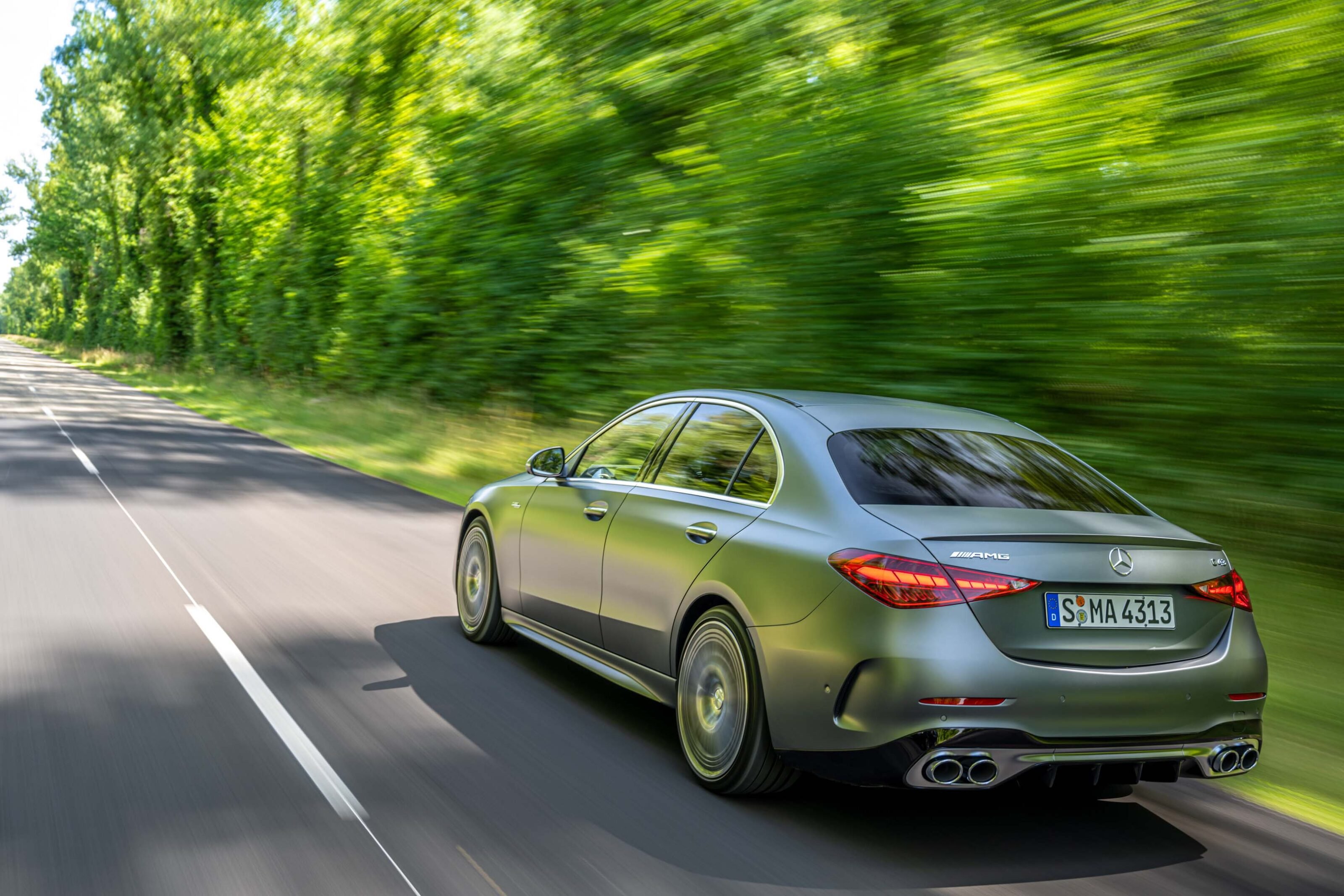
And it sounds good, too. Given the yobbish acoustics this 2.0-litre engine delivers in the A45 I had feared it mightn’t suit the more grown-up personality of the C43 but AMG hasn’t over egged the omelette.
There’s a deep bark and menacing tone on start-up, and with Sport+ engaged, the exhaust note is aggressive and purposeful without falling into the trap of delivering too many contrived pops and bangs on the overrun.
The chassis strikes a similar balance. Think of this as a C63 with most of the pace but none of the rear-drive hooliganism as you’re most of the way there.
Four-wheel drive is standard, with a fixed torque split of 39:69 front-to-rear, and the overriding dynamic takeaway is that this is a grippy and confidence inspiring car to drive quickly.
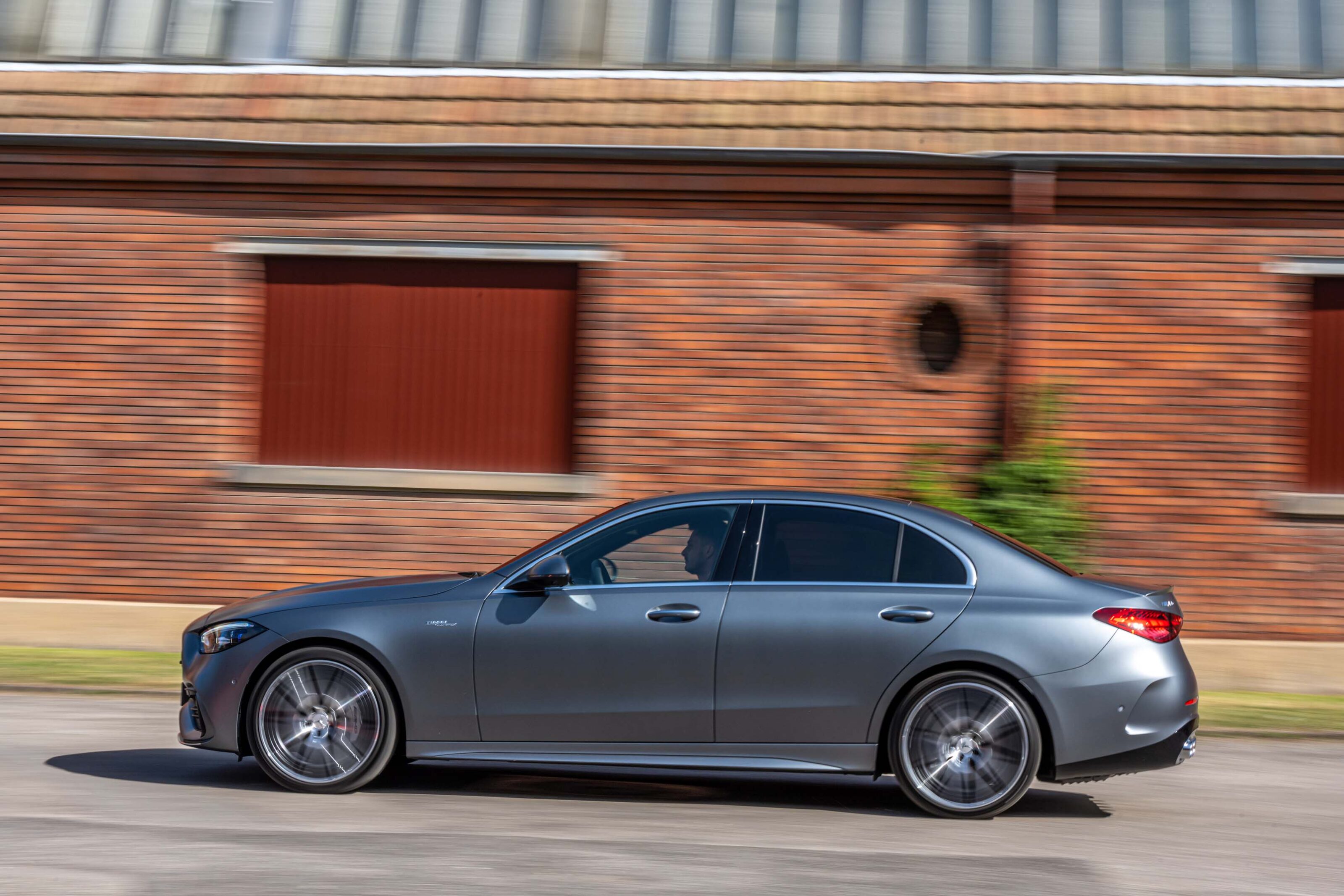
Quality Michelin Pilot Sport 4S rubber adds to the sense of grip and traction and the calibration of the four-wheel-steering system is also nicely judged.
Unlike some systems, which can feel unnatural and give the spooky sense that the car is about to rotate aggressively behind your hips, the C43’s rear-steer is really only perceptible through a welcome layer of eagerness and agility.
Don’t, however, think that fitting a smaller four-cylinder engine over the nose has made the C43 feel lighter on its feet. The body in white for this generation of C-Class is heavier than the W205, so weight has increased by 75kg over the old C43.
Is it an engaging and fun car to drive quickly? That depends on your definition of fun. Pedal it within its limits and the C43 is impressively fast and capable.
Step beyond those limits, however, and it’ll push into benign understeer. Despite the rear-biased torque split, the C43 doesn’t feel rear driven or as though you can easily steer it with the throttle. No surprises there; that’s the C63’s domain after all.
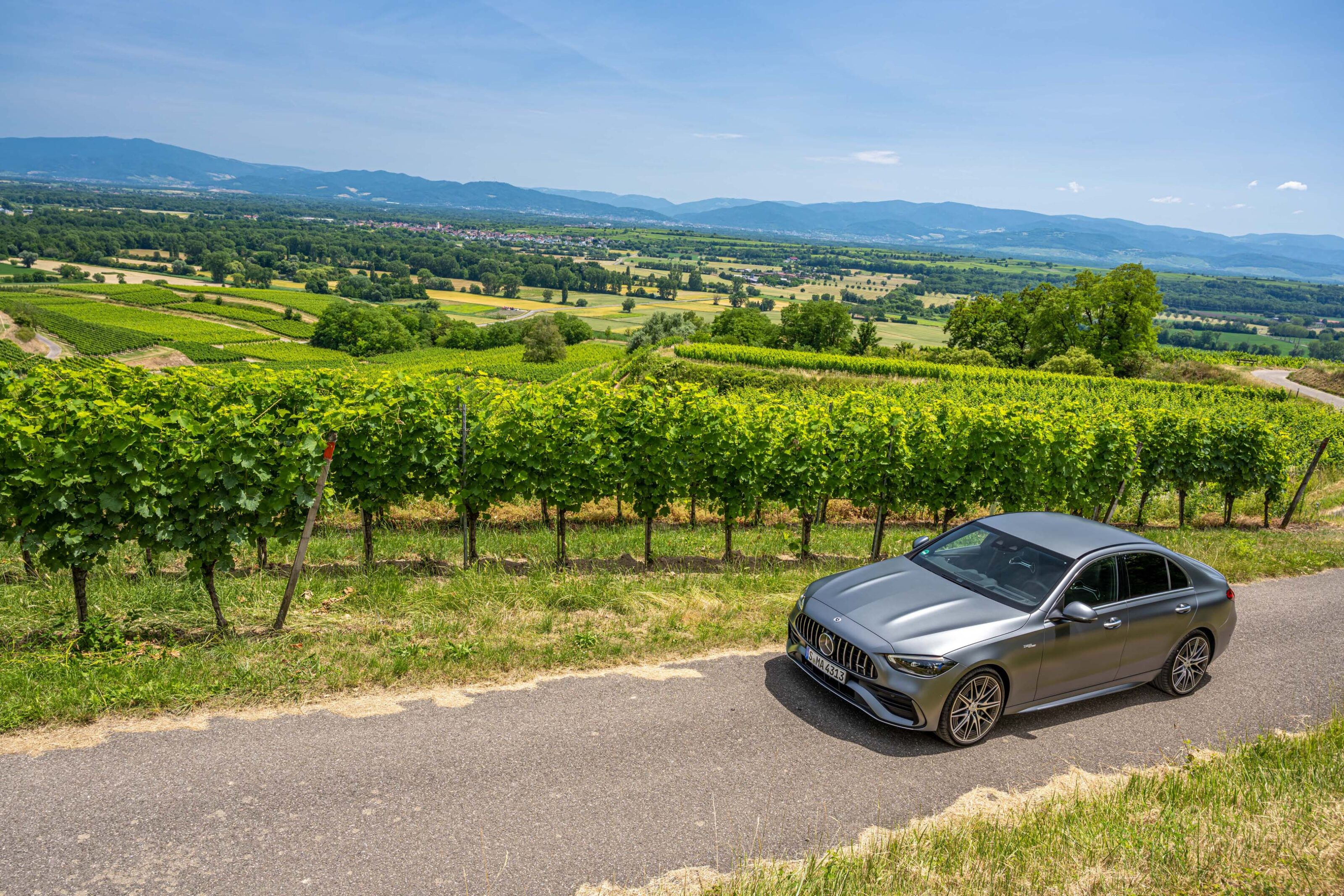
The brakes deserve a mention. The discs measure 370mm up front and 320mm on the rear axle and they offer serious stopping power through a pedal that’s easy to modulate. They breed confidence and are a dynamic highlight.
As for weaknesses? We really only encountered one during this short first taste in France: the gearbox. It’s basically the same nine-speed multi-clutch unit used in the current C63 but in this application it’s surprisingly jerky.
It shunts at low speed and also delivers the occasional bum shift on the move, too. Combine that with a belt-driven stop-start system that is noticeably clunkier than the almost imperceptible systems on other Mercs that use an integrated starter set-up and the C43 can feel clumsy in city traffic.
Here’s hoping the calibration is smoothed out before cars head our way in 2023.
As for weaknesses? We really only encountered one during this short first taste in France: the gearbox.
VERDICT
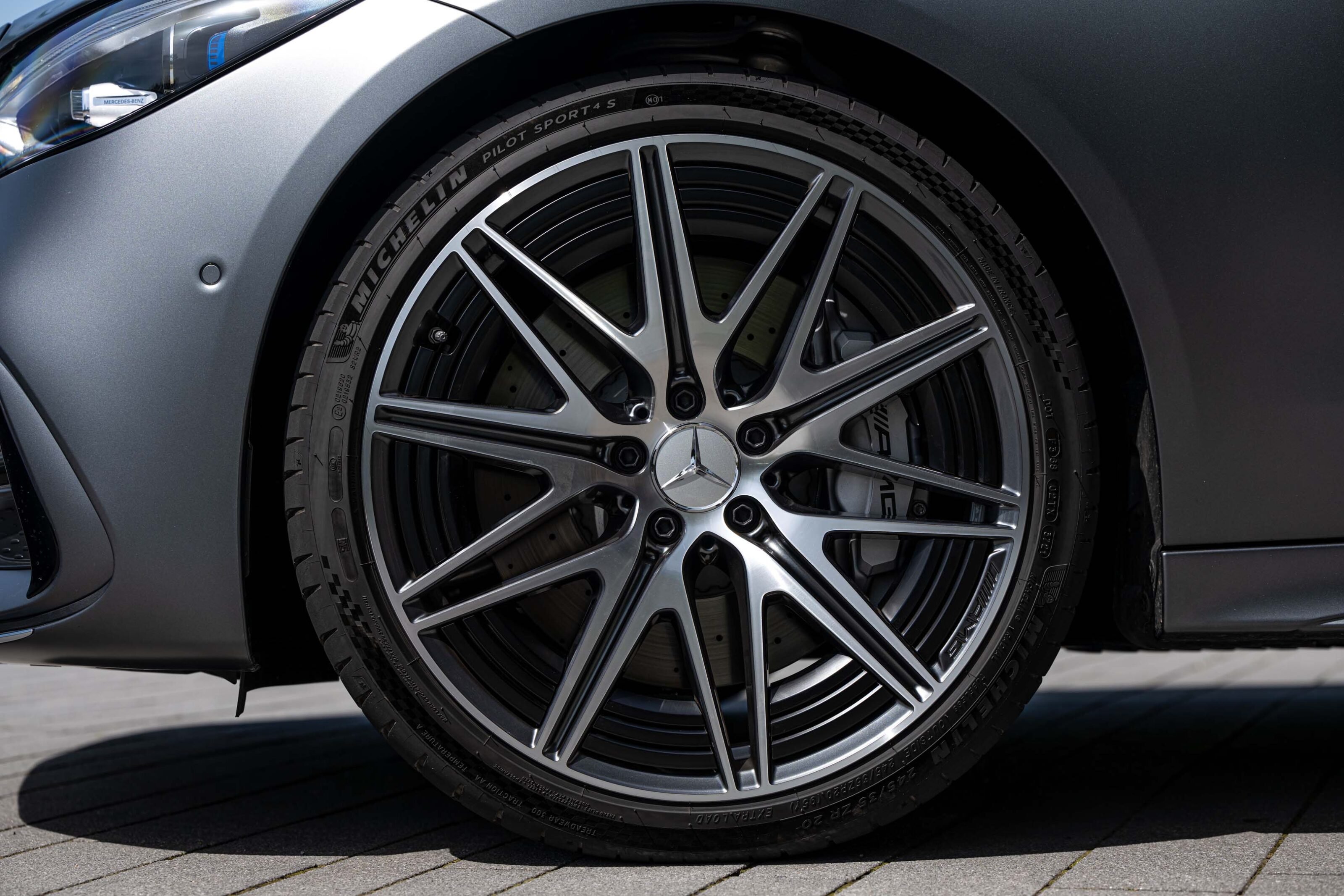
So it’s not quite the ‘thinking man’s C63’ – there’s certainly room above it for a more playful and more powerful C-Class flagship – but this new generation of C43 is a convincing thing.
It has shrugged off some of the stuffy, grown-up character of the model it replaces and instead feels more like a proper AMG product, with the personality to suit. Better news is this hasn’t come at the expense of refinement or comfort.
This remains a carefully polished and multi-talented sports sedan that neatly blends potent performance into a package that should be commendably easy to live with every day. And that sounds like exactly what buyers in this segment are looking for.
2023 Mercedes-AMG C43 specifications
UPDATE, July 14: Ioniq 6 technologies detailed
Hyundai has finally handed down all the important details on the new Ioniq 6 sedan’s dimensions, battery, power and driving range. Get the story at the link below.
The story to here: Ioniq 6 revealed
Snapshot
- 2023 Hyundai Ioniq 6 EV sedan unveiled
- Futuristic design inside and out with ultra-low drag coefficient
- Full details, including range and performance, to be announced in July
Watch out, Tesla Model 3 – there’s yet another new kid on the block.
The 2023 Hyundai Ioniq 6 electric sedan has finally debuted, following the reveal of the wild-looking Prophecy concept two years ago.
The Ioniq 6 rides on the brand’s rear-drive E-GMP EV platform with a fast-charging 800-volt electrical architecture, joining its Ioniq 5 sibling, the Kia EV6, and the Genesis GV60.
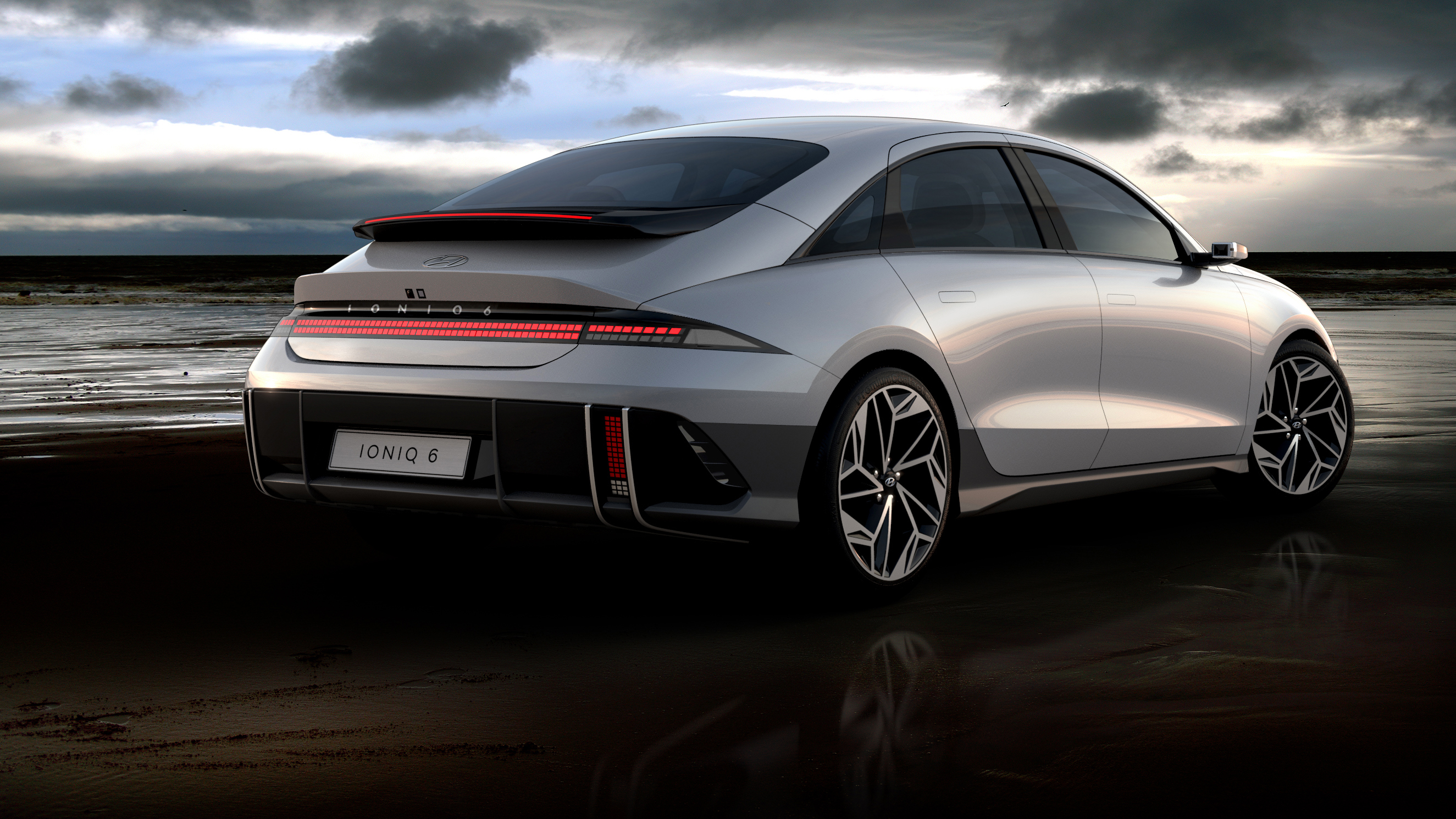
Hyundai says the Ioniq 6 was developed to be “human-centric”, with a spacious interior designed in tandem with its swoopy exterior.
For now, Hyundai is revealing only the styling of the Ioniq 6, with full details – including range and performance – to be announced in July.
As a low-slung sedan, aerodynamics played a significant role in the design of the Ioniq 6, which achieves a low drag coefficient of 0.21 when fitted with 18-inch wheels and digital side mirrors.
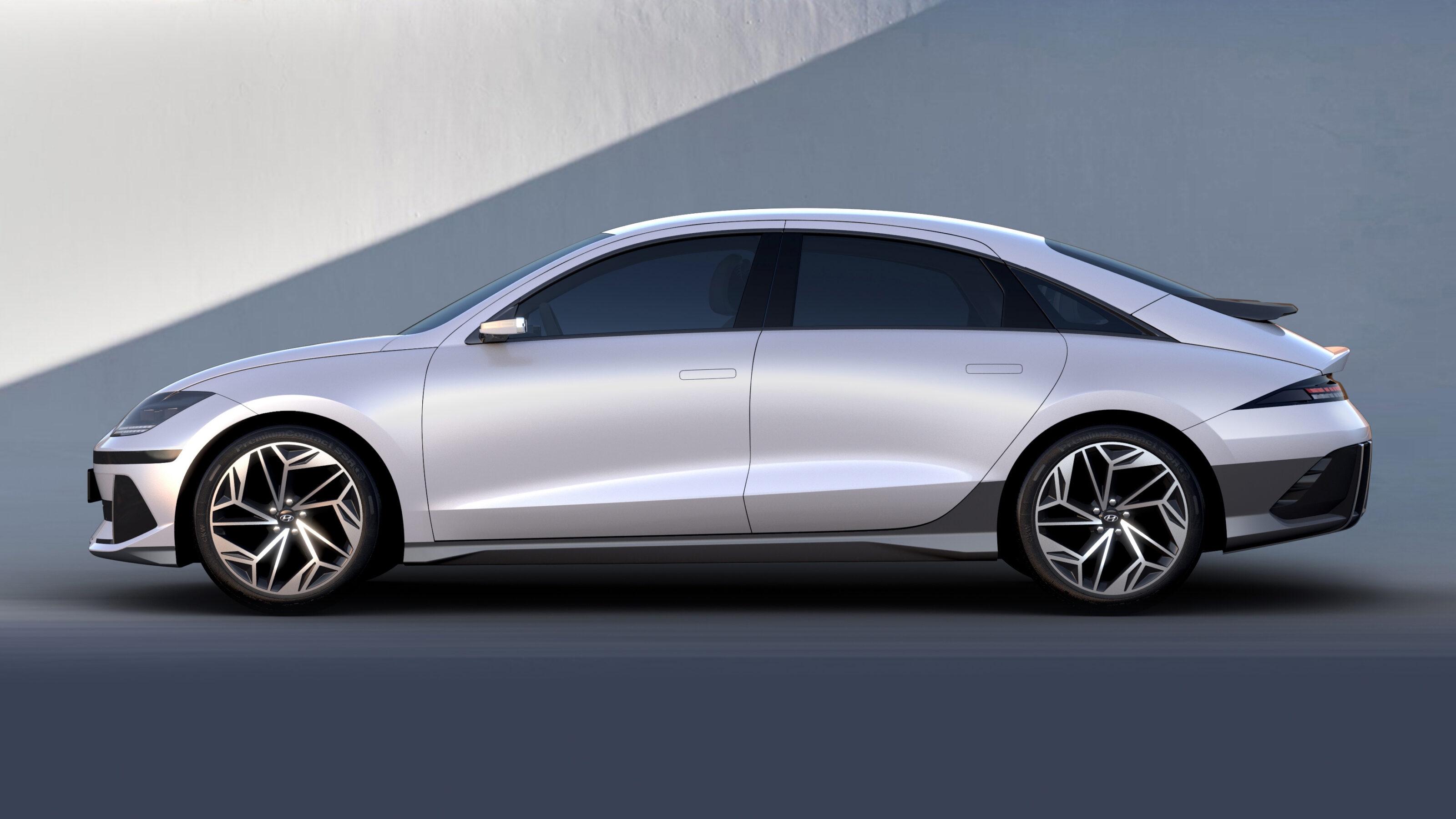
For reference, the Tesla Model 3 is less slippery at 0.23 Cd, while the larger Mercedes-Benz EQS has a lower drag coefficient of 0.20.
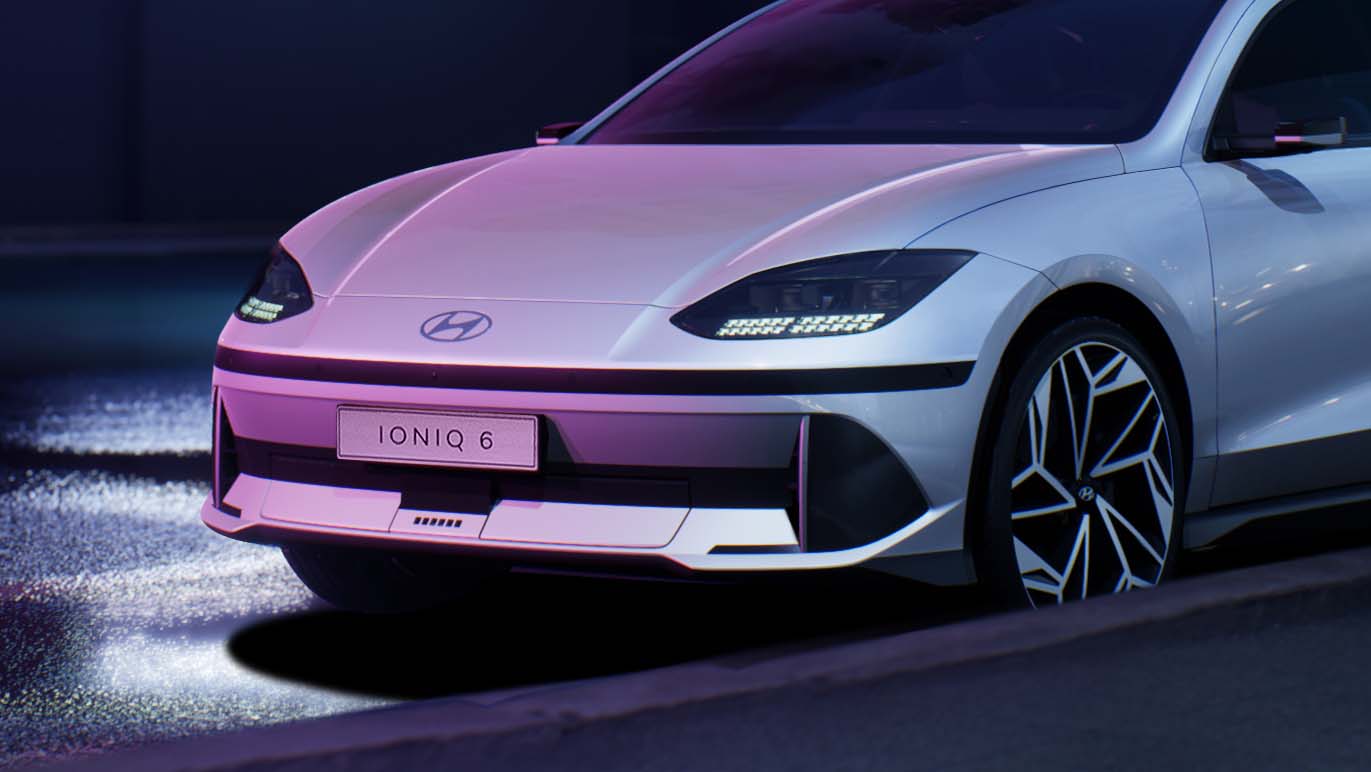
The brand’s ‘Parametric Pixel’ lighting elements – also seen on the Ioniq 5 and Staria – features across the Ioniq 6, with Hyundai claiming it includes ‘more than 700’ individual LEDs front to rear.
To assist with ingress and egress, the door frames of the Ioniq 6 sit above the low window frame – the latter of which echoes four-door coupes, such as the Mercedes-Benz CLS.
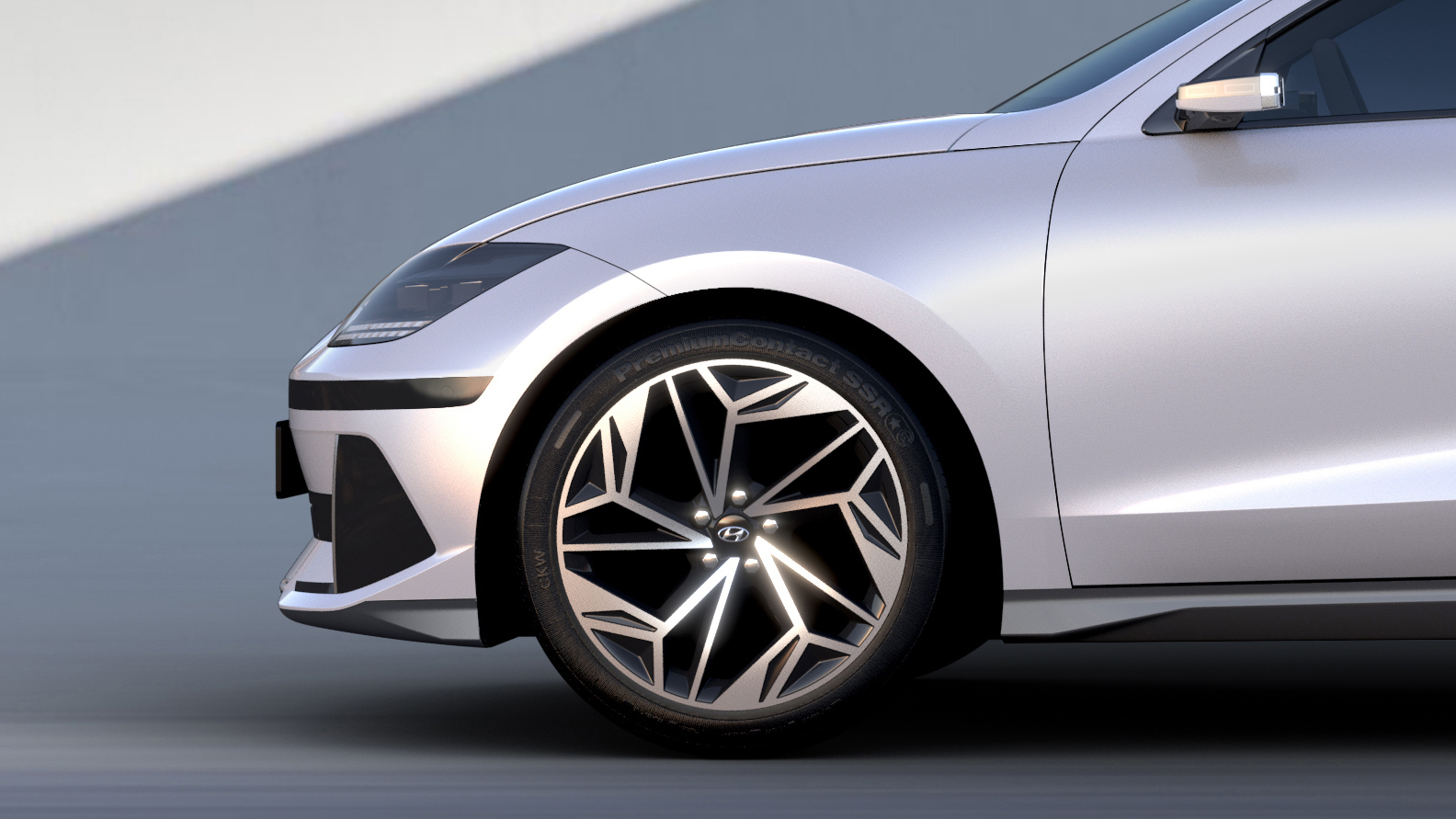
At the rear, the Ioniq 6 includes sharp full-width LED tail lights, a chunky bumper with air vents, and a ‘whale tail’ spoiler reminiscent of a Porsche 911 Turbo.
SangYup Lee, the head of Hyundai global design, said the styling of the Ioniq 6 “is the result of close cooperation between engineers and designers, with obsessive attention to detail and customer-centric values at the core.”
The liftback debuts a restyled emblem for the Korean marque, which now comprises a flatter, more two-dimensional design – as seen with other brands recently, such as Volkswagen and Nissan.
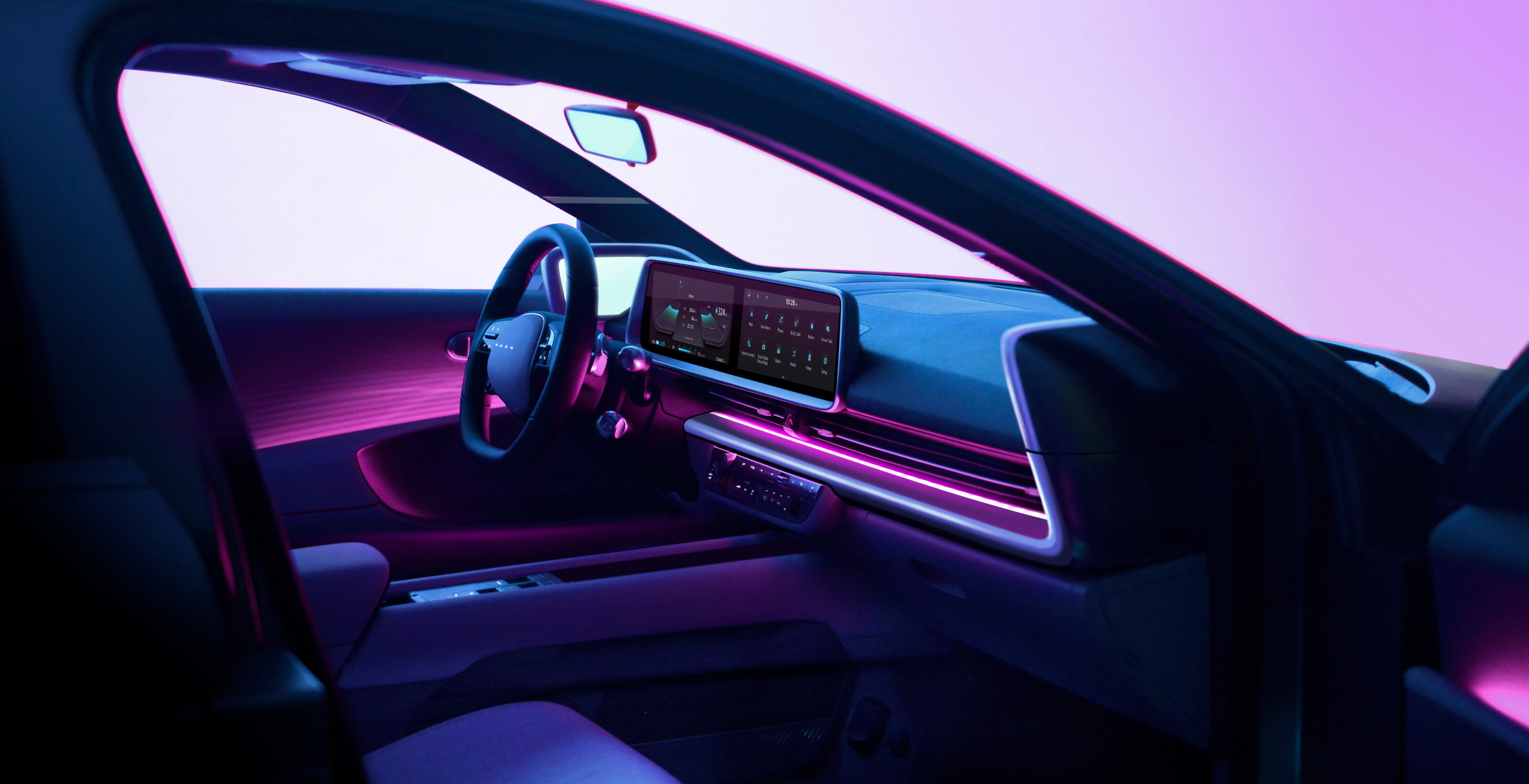
Moving inside, the Ioniq 6 has a premium look with large digital screens and a simplistic design.
A 12-inch touchscreen infotainment system will join an identically-sized digital instrument cluster linked through a single panel.
The screens in the Ioniq 6 extend to digital mirrors positioned against the pillar on each side of the vehicle. However, if the Ioniq 5 is any indication, this technology is unlikely to reach Australia.
The cabin will feature a 64-colour configurable ambient lighting and six dual-colour themes, while the four-dot icon on the steering wheel lights up to communicate important messages to the driver.
The ambient lighting system is positioned to bounce off the door panels, which remove traditional inclusions, such as switches and grab handles, for “more breathing room and more storage”.
Interestingly, Hyundai has seemingly taken a leaf from some older generations of cars, with the removal of buttons in the door cards requiring the switches of the Ioniq 6 to be relocated to the centre console.
The marque has prioritised sustainability within the cabin of the Ioniq 6, with faux leather materials, recycled polyester fabric for the seats, paint sourced from used vegetable oil for the doors, and recycled fishing net carpets.
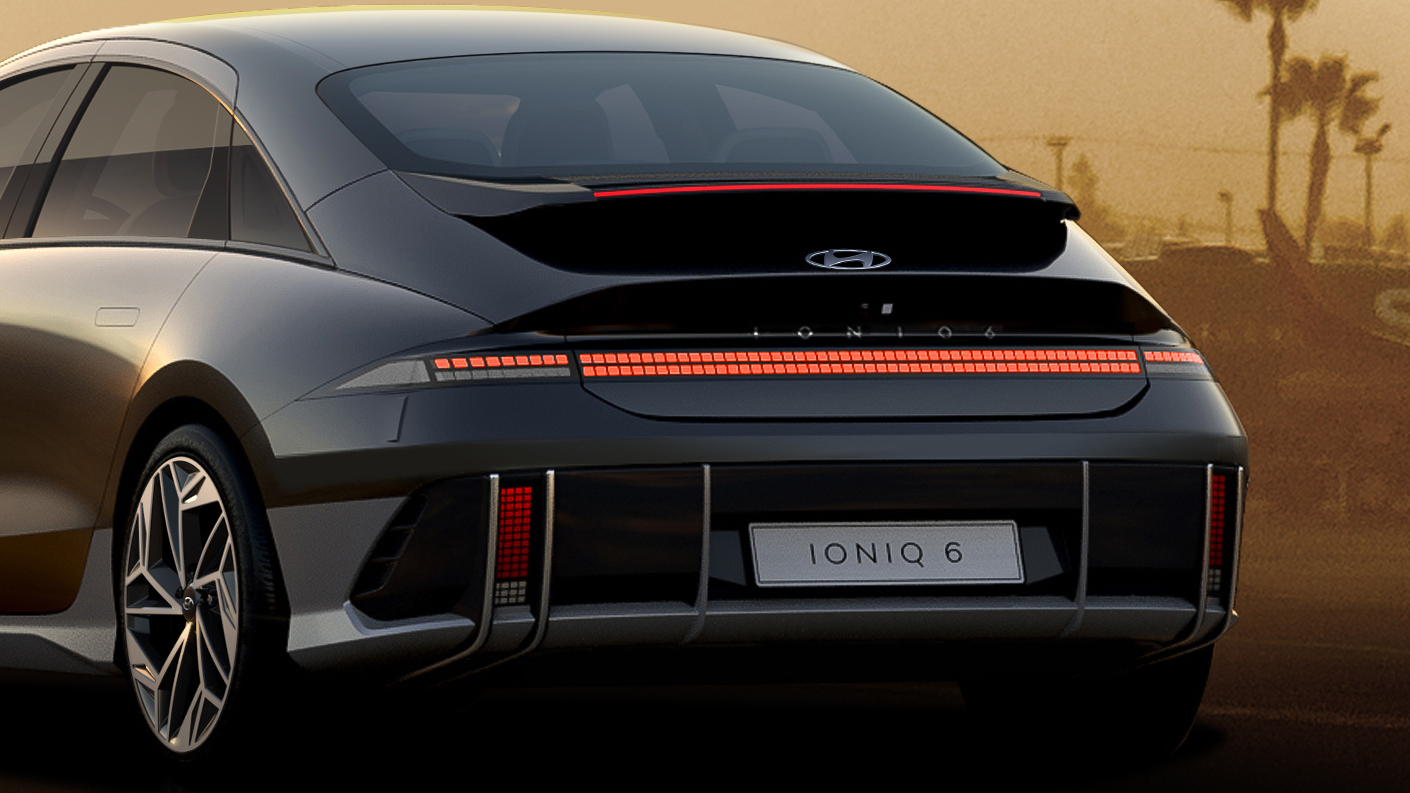
Hyundai is yet to announce powertrain details for the 2023 Ioniq 6, but similarities to the Ioniq 5 and Kia EV6 are likely.
The former sports a 72.5kWh battery pack, providing a driving range of up to 450 kilometres in rear-wheel-drive guise.
Next year, Hyundai will uncover the 2024 Ioniq 7 large SUV, its next ground-up electric vehicle similar in size to the current Palisade.
Wheels Media’s Daniel Gardner is bound for Korea in the coming weeks for an up-close look and drive of the Ioniq 6, so watch WhichCar for the full story.
Introduction: Big Mac with The Lot
Our long-term fleet gains the doors of a billionaire… and 530kW
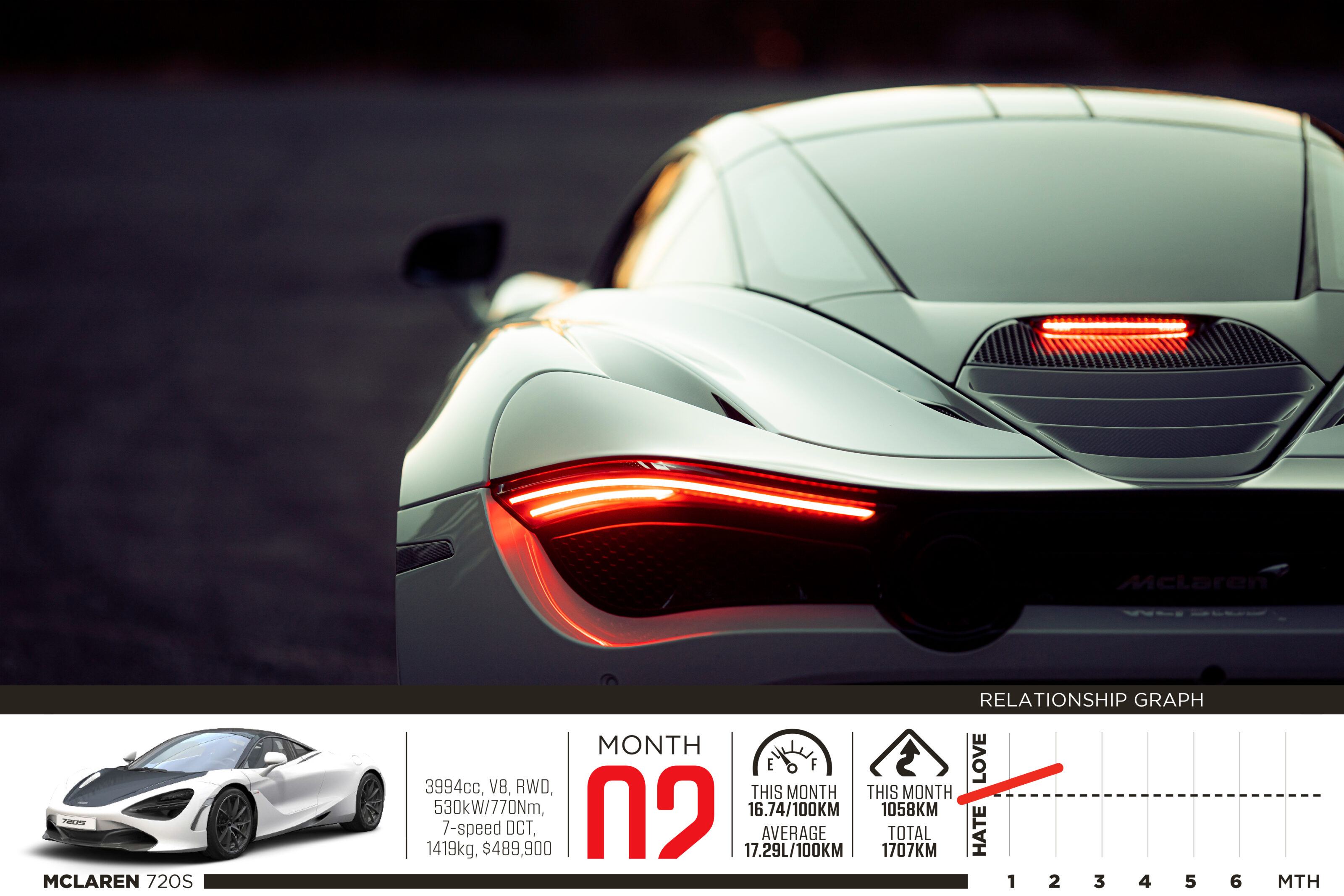
Say hello to the most thrilling long termer in MOTOR history – the McLaren 720S. Woking’s Super Series darling has joined our fleet of cars, but don’t think we’ll be giving the supercar kiddie-glove treatment. We intend to treat the 530kW/770Nm, half-million dollar beast like we would any other long-termer. Big drives, daily use, spirited excursions, it’s all part of the remit.
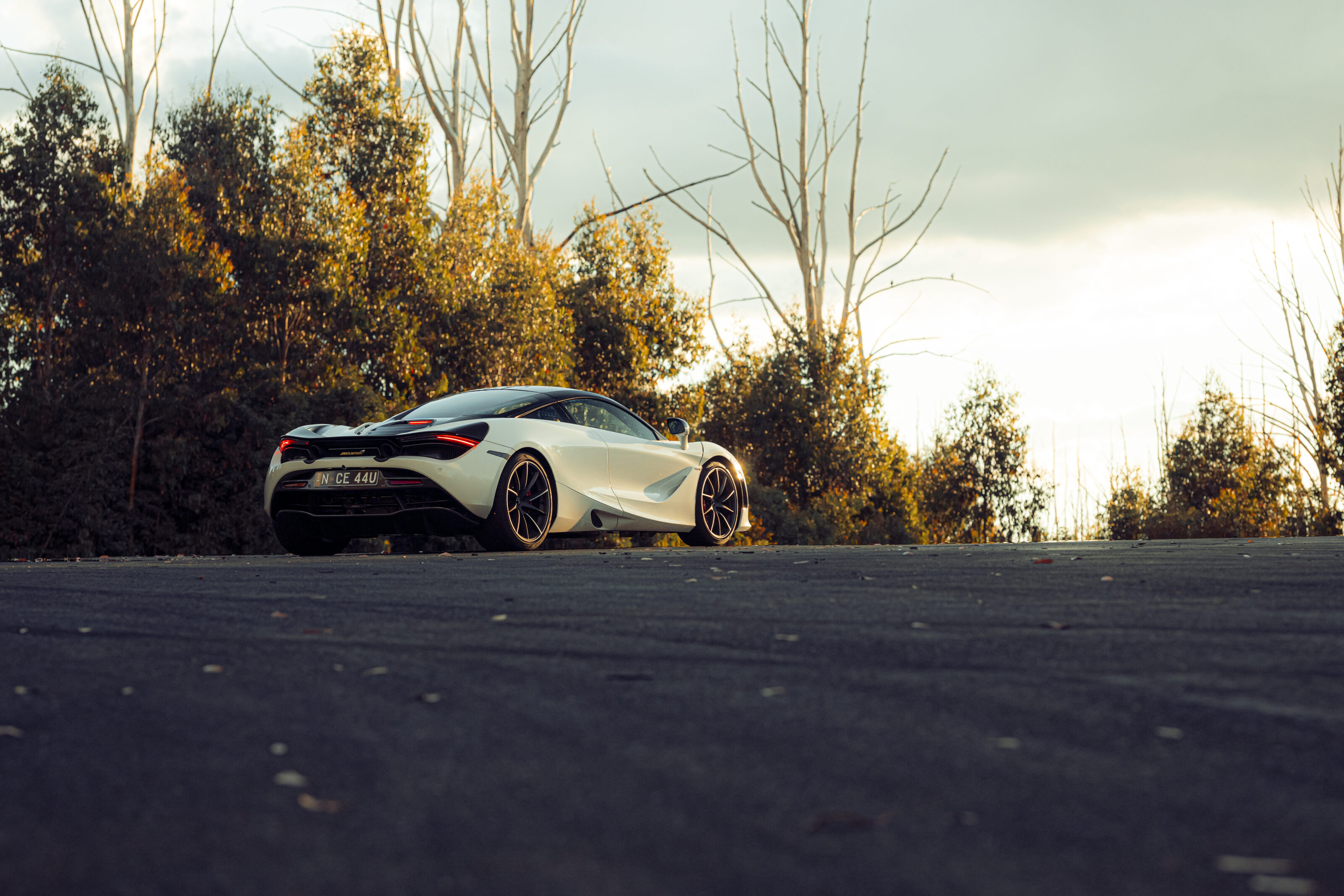
The 720S sits in an interesting place in McLaren’s line-up. It is, and will remain for the time being, the most powerful series production car you can buy from the British brand. Limited-run specials like the Longtails, Senna and Speedtail will sit above it, while the electrified V6 Artura will sit ever so slightly below when it finally arrives. Other than the grand touring GT, that’s it for McLaren’s rationalised line-up.
First revealed in 2017 the supercar game has moved on significantly since the 720S first peeked its sunken eye sockets beyond the curtain at the Geneva Motor Show. Can it stack up against its more modern supercar rivals in 2022?
It certainly fills the brief in terms of monetary exclusivity. McLaren are more than happy to tell us exactly what options are fitted to our test car – but remain strangely coy about the exact price of fitting them to the car. Our best guide is that the dealer box-ticking would come in around $200,000. That’s on top of the $489,900 sticker and on-roads. Though, if you must ask what the cost of the options are, it’s fair to say they don’t fall within your budget.
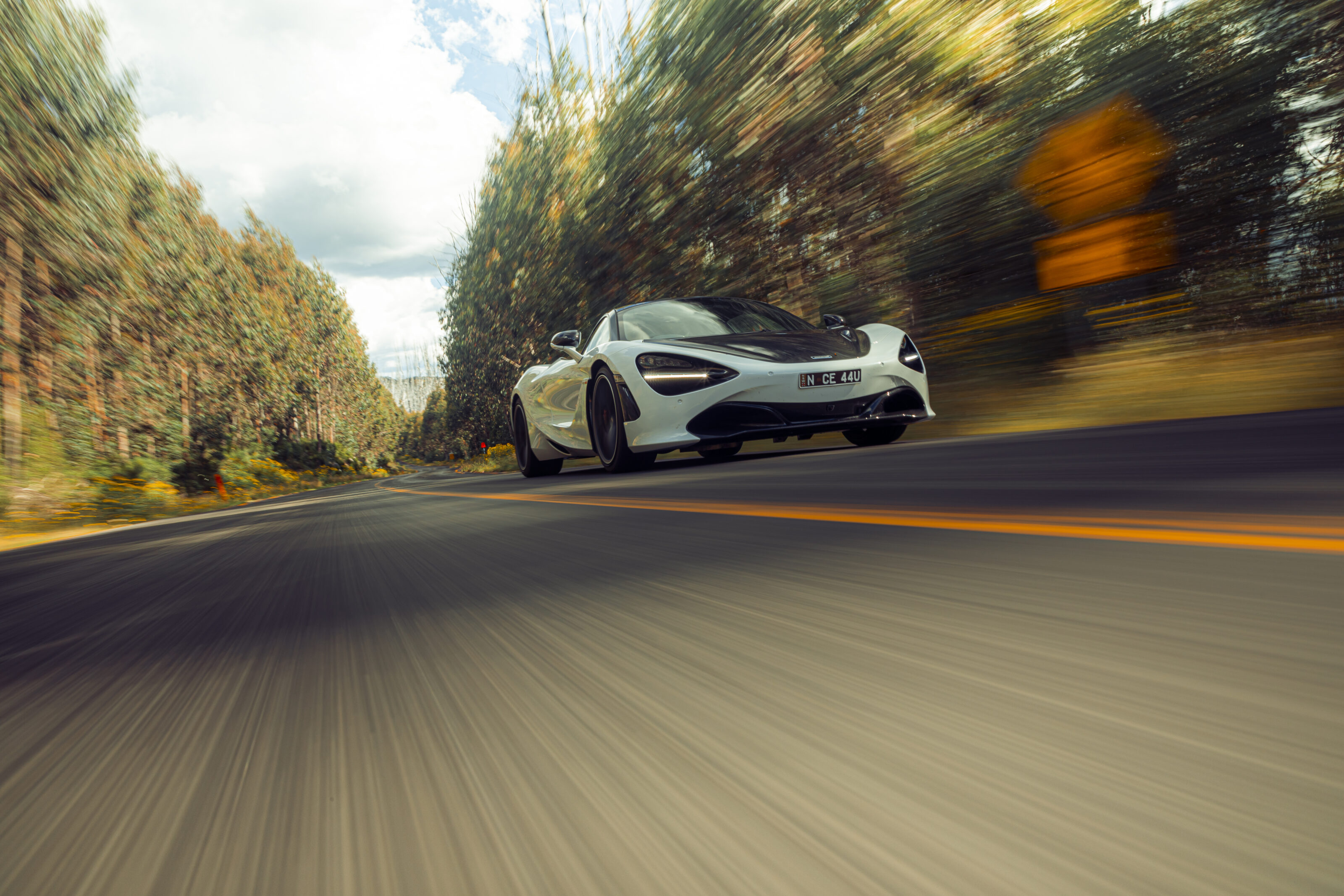
For the curious, ‘our’ McLaren comes fitted with the Performance Plus Pack, nine separate exterior carbon-fibre items (which will set you back roughly $100,000 alone), sports exhaust, soft close doors, diamond cut wheels, carbon-ceramic brakes, tyre pressure monitoring system, 360-degree parking camera, front nose lift, and a printed owner’s manual.
I share this in the name of transparency, but it’d be reductionist to focus on the deep fiduciary well that is McLaren Special Operations extras that are nice-to-haves on top of the 720S stunning core ability.
Of the options fitted, it’s only the nose lift that we’d recommend be a mandatory addition. There’s substantial front overhang on the 720S and without it most urban driveways would be inaccessible unless you wanted finely grated carbon fibre left on the street. My nerves barely survived a tour of an underground carpark underneath my local grocer.
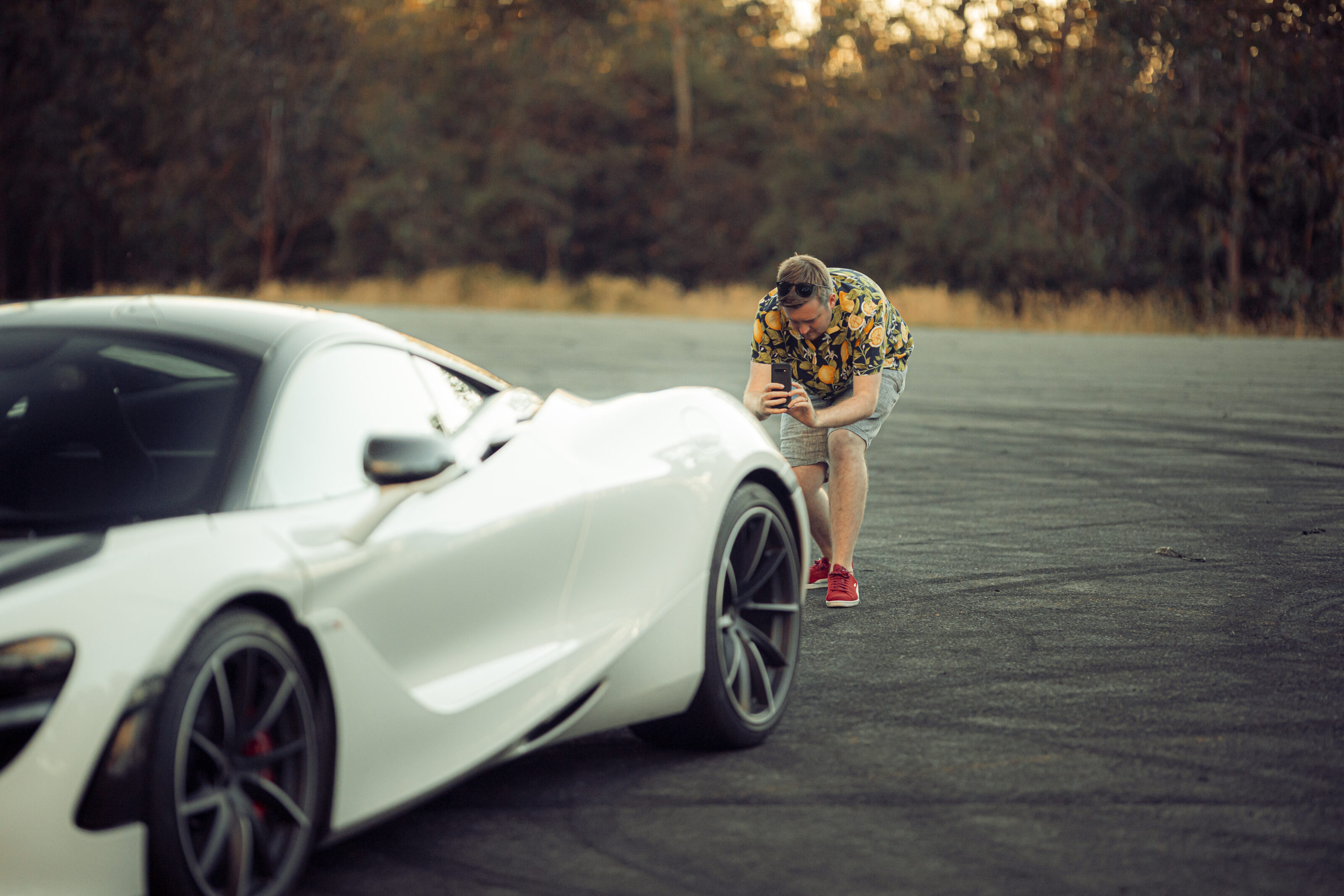
Despite all the pretence and potency contained beneath its skin, the 720S is remarkably approachable day-to-day if you avoid tight parking caverns. You sit quite far forward, giving you the sensation of being strapped into the front cabin of an alien spaceship. We aren’t going to lie to you and claim the interior of the 720S is spacious, but McLaren has been clever with the space that is available.
There are two useable cup holders, a tray for your phone, wallet, and keys (that can contain these items even under heavy acceleration loads), an appropriately sized centre console, two additional hidden compartments in the doors, and a fairly large parcel shelf behind the seats. That’s not including the surprisingly deep front luggage area totalling 150 litres – or to give some real-world context, enough space for two people’s carry-on luggage. Nice, but a GT this is not. McLaren still offers the imaginatively named GT for those wanting touring ability.
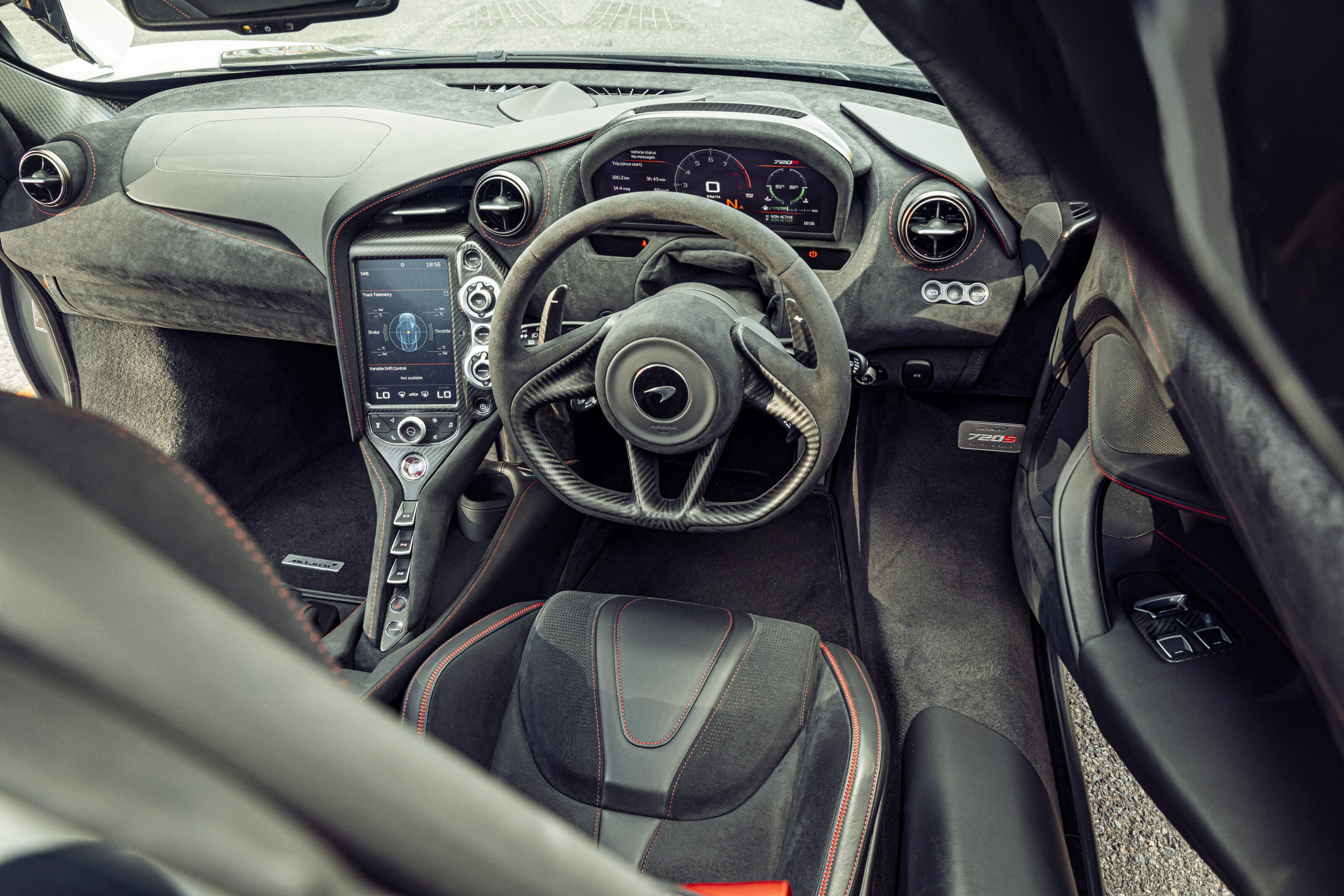
The biggest quirk-turned-gripe that has appeared on the daily commute is pedal placement, which caters heavily to left-foot braking on track. My size 11 feet mean that with certain shoes when I have my left foot placed on the rest plate to the far side of the footwell I can only have part of my right foot on the brake pedal. To get proper coverage of the brake I need to pull my left foot back to me and place it flat on the floor to allow enough space for my right foot. Adapt to a two-foot driving style and this issue withers away.
So far the most surprising element to the 720S has been just how damn well it rides. The hydraulically interlinked dampers allow McLaren to design the car without anti-roll bars, meaning each wheel deals with bumps and imperfections entirely independently. A drive in Affat’s Kona N drove home exactly how well judged the ride quality of the McLaren is – this is a high-end supercar with mind-warping levels of performance and body control that’d make Porsche engineers intrigued, while still riding better than some family-focused SUVs. Though to get the best out of the system you need to activate it by pressing a centre console-mounted button. Without doing so feels like the car is riding on house bricks instead of actual springs.
That is just one small part of the slightly lengthy start up process for the McLaren. It goes something like this. Foot on brake, press start, wait for engine to properly fire, activate suspension and powertrain modes, raise nose for driveway, select drive, release handbrake, and then you are good to roll. You feel like an astronaut completing pre-flight checks as you flick switches spread around the cabin, waiting for the appropriate chimes and dings to confirm that everything is cleared for launch.
When you do hit the open road, the McLaren provides you with a comprehensive rewiring of what you thought possible. Even initial interactions with the 4.0-litre twin-turbo flat-plane crank V8 – codename M840T – is enough to make you abundantly aware of the unit’s tarmac-ripping potential. Even in its tamest settings, throttle response and progression is sharp, the car happy to leap forward on your command. Press toward the firewall, and you need to have your wits about you – 530kW and 770Nm is fed through an open differential to the rear wheels exclusively.
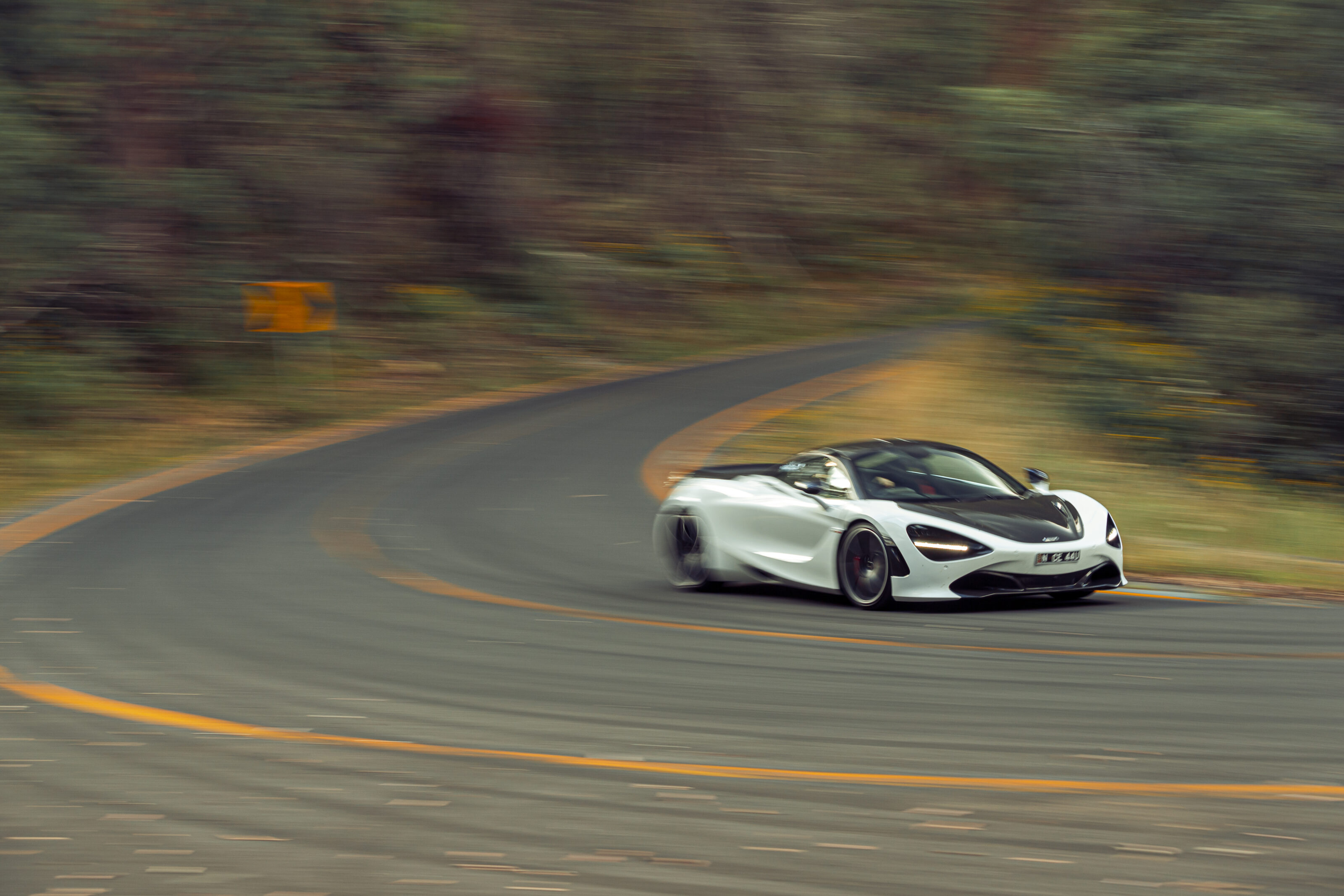
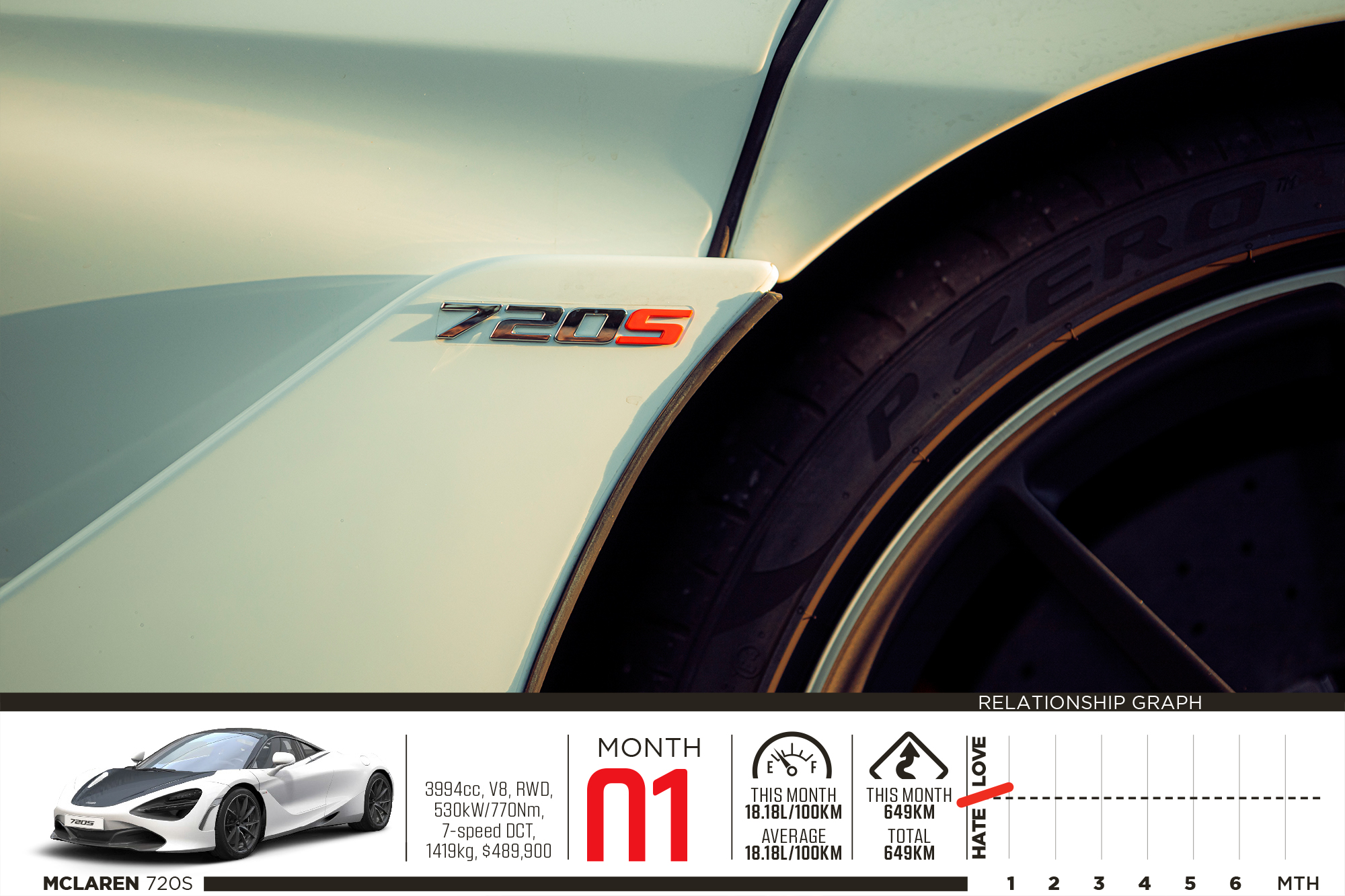
Under heavy acceleration, the 720S will squirm and shake at the rear before transposing everything ahead of you much, much closer at a rapid rate. Stay tuned next month for a deeper dynamic inspection, but already the price you pay for all that power is abundantly clear. The M840T doesn’t so much drink fuel as chug it, just peep our fuel figures as proof.
Genuine and nuanced impressions of the McLaren’s nature can be hard to parse from its outrageous extremes. The 720S is a case study in shock and awe. From its visual presence to its power delivery, Woking’s creation asserts its dominance with an overwhelming sensory overload. Weather the initial barrage though, and the intricate layers of complexity begin to be revealed.
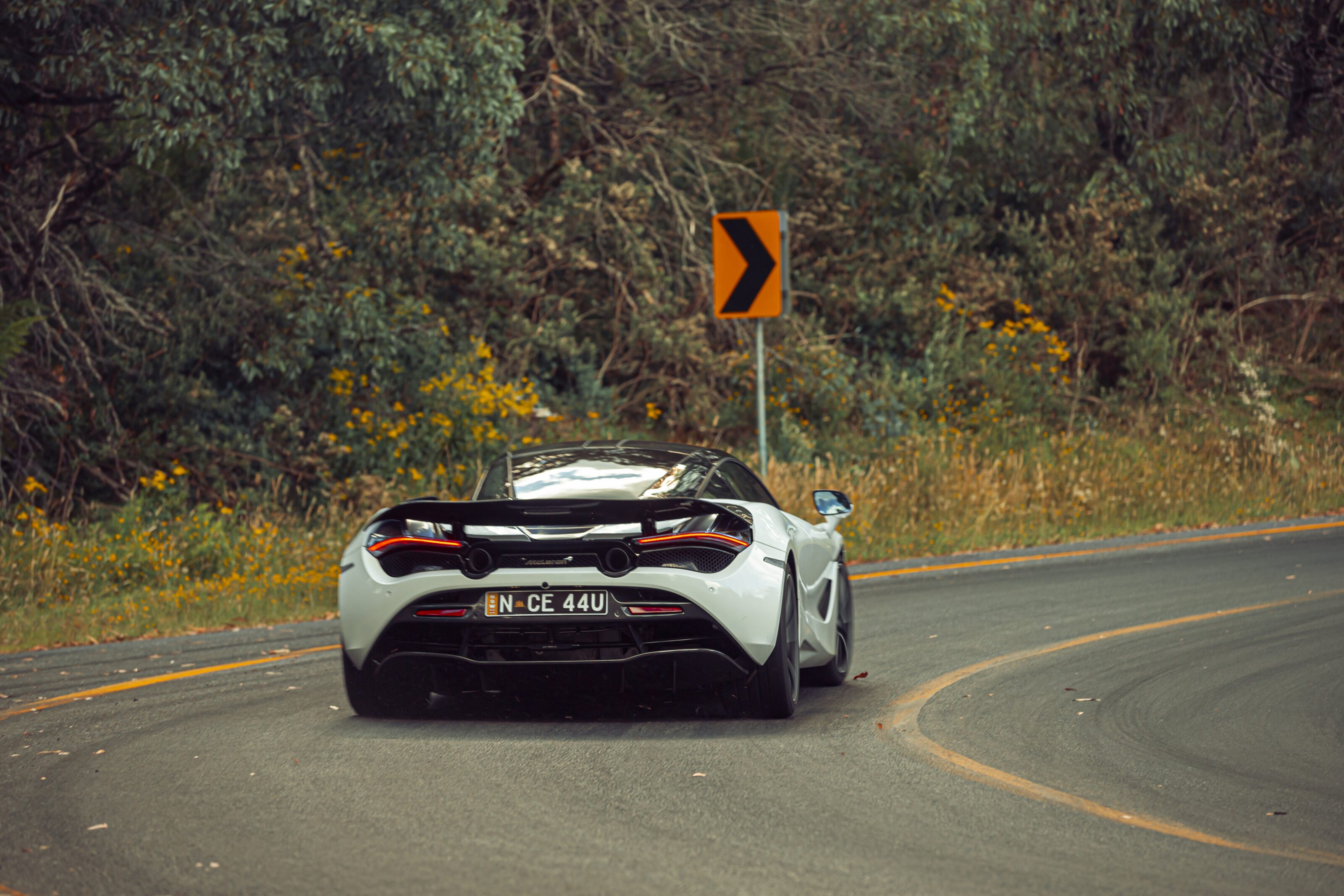
Criticism of the 720S that claim it to be characterless are muddied and short sighted. It’s early days, but the 720S is as defining of the supercar genre in 2022 as it was when it arrived five years ago. In our next instalment the leash is removed and the 720S is given room to truly stretch its legs. – CK
Things we love:
- Compliant ride
- X Factor
- It’s ‘ours’
- Heavy fuel use
- Pedal placement
- Front overhang
Month Two: Spoiler Warning
You didn’t think we’d book Phillip Island and not bring the 720S, did you?
By all accounts I should have been ready to pull up stumps. It was day four of this year’s bumper Performance Car of the Year testing, and I’d just spent the last seven hours putting our entire 18 car field through their paces at Phillip Island Grand Prix Circuit.
Track testing that many vehicles is a mammoth task in its own right, but adding in intermittent rain showers, suicidal Cape Barren geese, and the mental workout of keeping on top of the logistics required to keep the show running smoothly meant I was one missed caffeine injection from becoming a standing corpse.
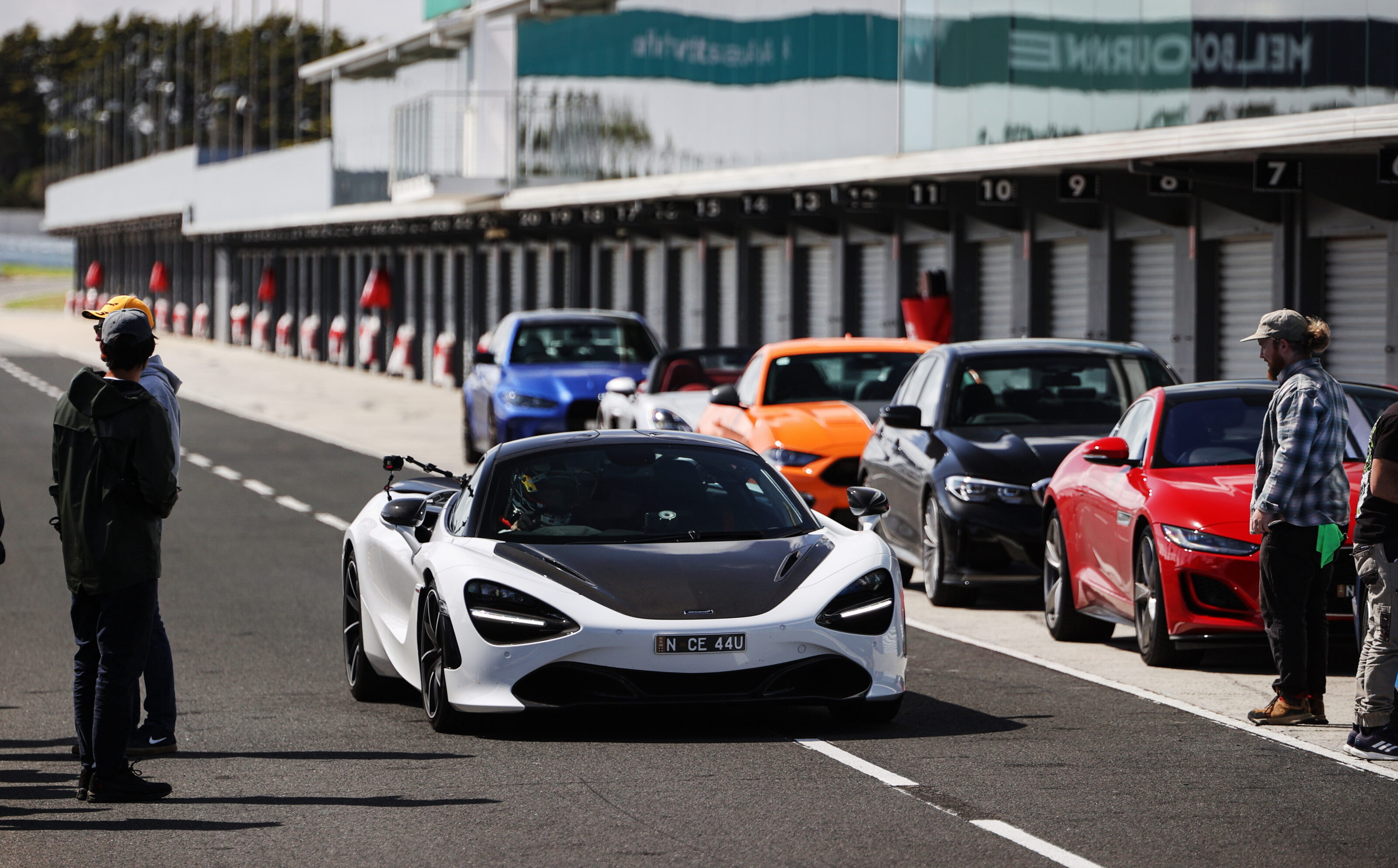
The rest of the judging panel had removed their helmets for the last time, but my work wasn’t done yet. Car number 19 for the day demanded its pound of flesh, and I was more than willing to provide. It wasn’t a contender for either of this year’s awards, but ‘our’ McLaren 720S long term tester. Things were about to get very, very fast.
While no longer a possible entrant for Australia’s premier performance car award, we weren’t going to let an opportunity to have the 720S tag along for the final days of testing slide.
If Phillip Island was a daunting plank above the ocean for our PCOTY and SCOTY contenders, the 720S was the golden-toothed pirate telling them to start walking. Not so much a wildcard, but a 530kW measuring stick that we promptly used to beat the field into submission with.
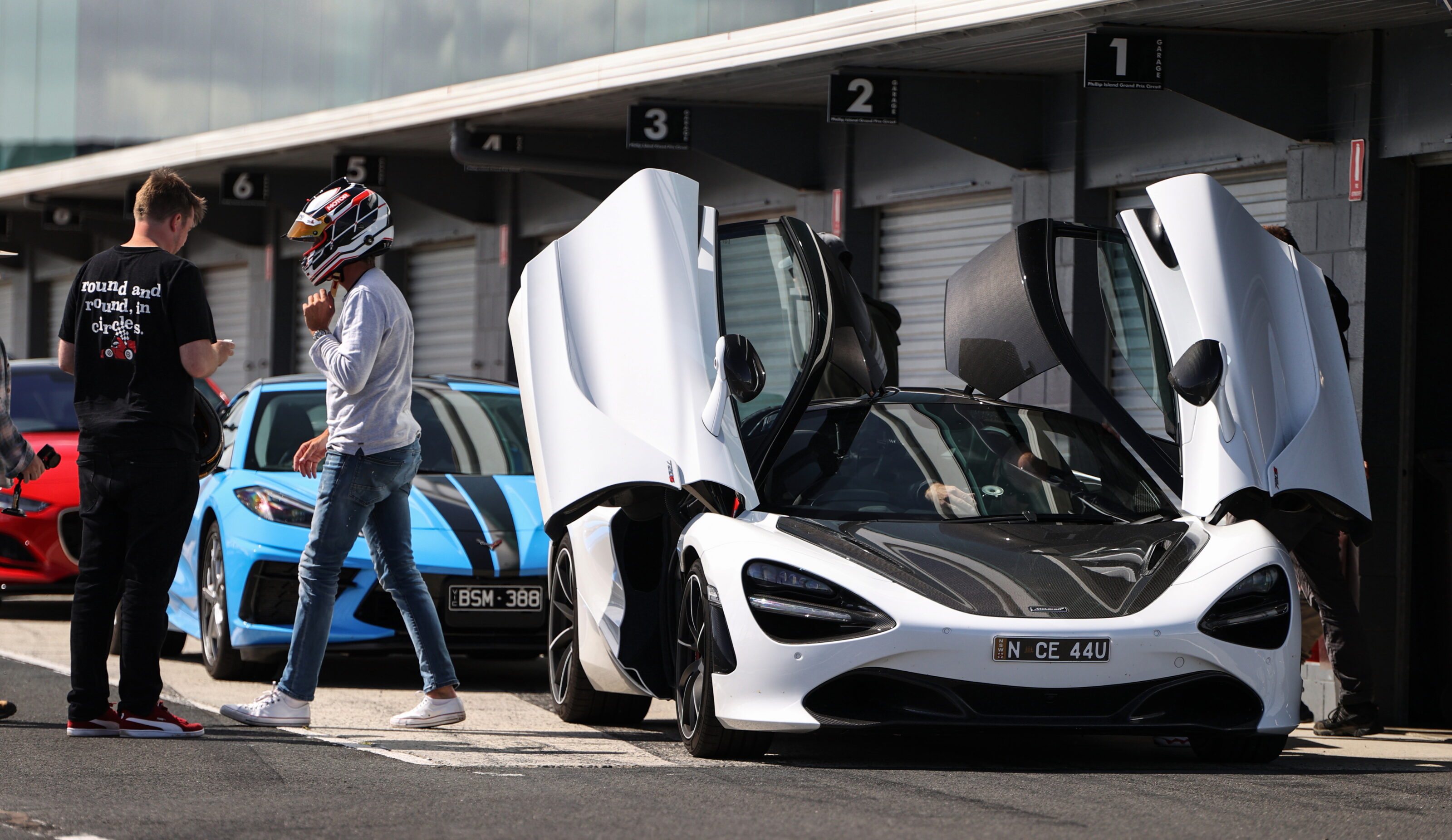
Before I wrap my hands around the svelte Alcantara-clad steering wheel, the indomitable Warren Luff slides over the carbon sills and we strap timing gear to the windscreen. Of the 18 car combined PCOTY and SCOTY contenders, only one was quicker than the 720S around Phillip Island. No prizes for correctly guessing it would be the Porsche 911 GT3.
Less than a second separate the two, with Luff’s best time in the McLaren being a 1:40.19, compared to his PCOTY-leading 1:39.74 benchmark set at the helm of the GT3. However, unlike the Porsche, which focuses heavily on track ability, the 720S is a road car first and foremost. An incredibly dramatic, powerful, and capable road car, yes, but we wouldn’t call it a track toy by any stretch.
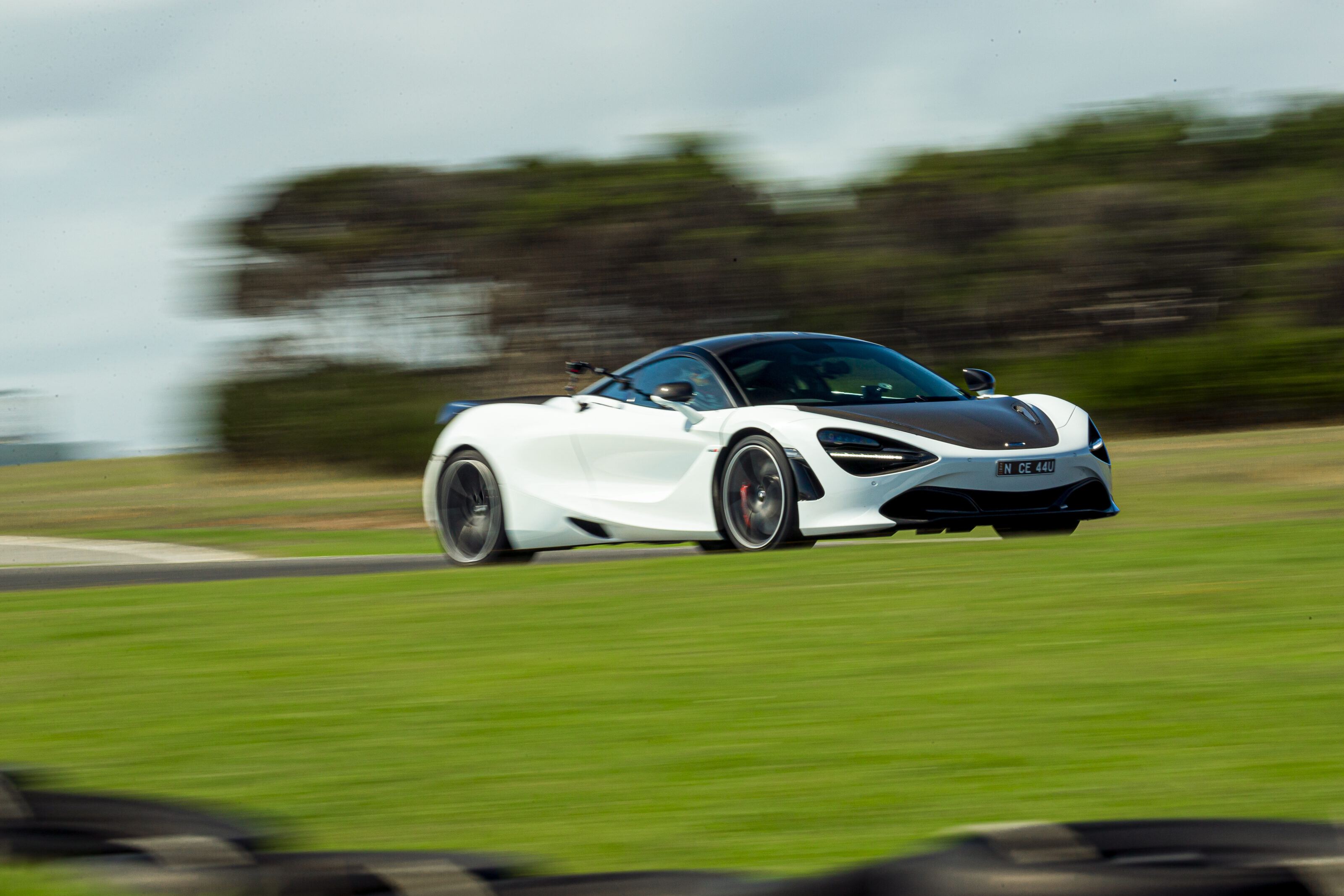
The more natural rival for the 720S at PCOTY was the $498,665, 470kW/600Nm 5.2-litre naturally aspirated V10-powered Lamborghini Huracán Fluo Capsule.
The Italian costs just $8765 more (practically pocket change in the half-million dollar price bracket), is down 60kW and 170Nm compared to the heavily turbocharged V8 McLaren, but uses an extra pair of driven wheels. Both the Huracán and 720S came equipped with Pirelli P Zero tyres that, frankly, aren’t up to the task of providing adequate grip for the amount of speed these vehicles can pile on in short order.
There is nowhere to hide for the Huracán, which is just a tenth shy of being three full seconds behind the 720S over a 4.4km lap. There’s no amount of excess Staedtler highlighter paint that’ll cover that gap.
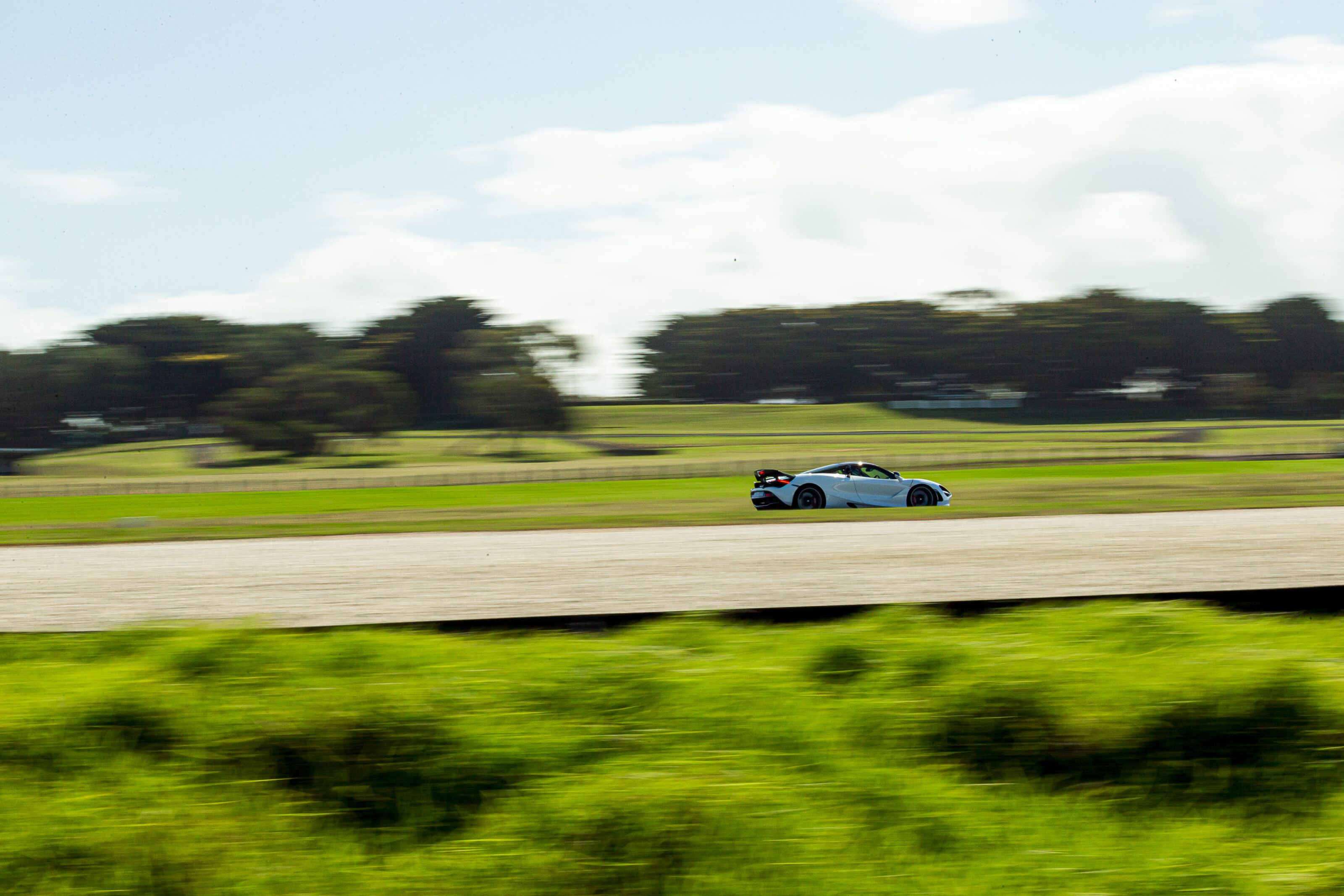
Watching Luff’s flying laps is an experience akin to seeing a low-flying fighter jet buzz a tower. You see the McLaren before you hear it, but the once-distant speck of white is suddenly atop you with a delayed burst of sound that is much a mix of air displacement as it is angry combustion.
Approaching a 278km/h V-max at the end of the front straight, it sounds like the air itself is being torn asunder as the 720S passes. There are no theatrics-by-design, with the shock factor coming from raw presence and speed alone.
Warren Luff is not a man easily challenged by modern road cars, but the wide-eyed stare upon returning to the pits was telling of the 720S capabilities. More so was his claim that this is the first road car he’s driven that has the same cut-throat personality of a racing car. Get it wrong and it’ll bite. I think of this as I remember the fact that there are no small accidents at a circuit as fast as Phillip Island.
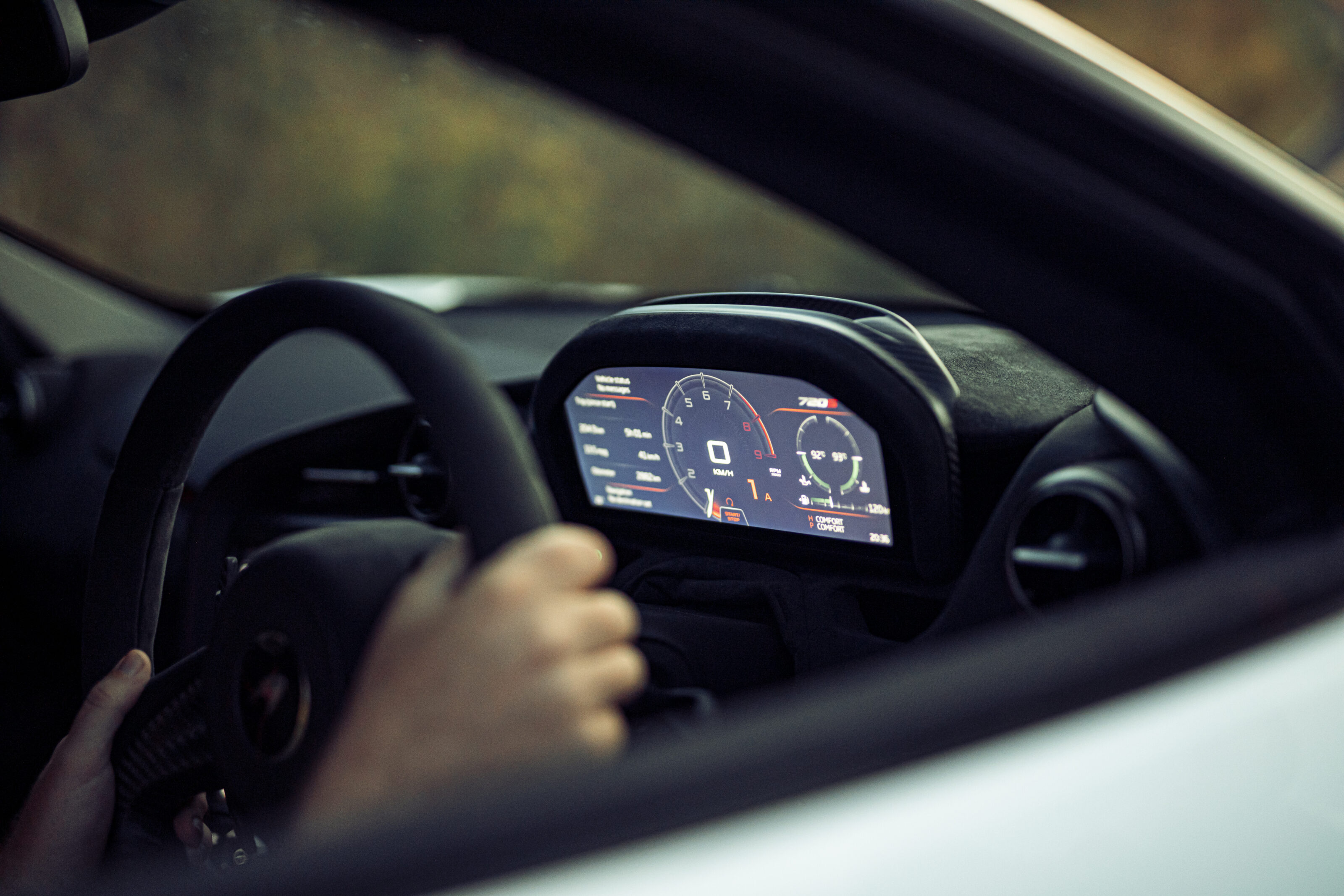
Excitement masks anxiety as I belt on the brain bucket tighter than I have all day. My turn.
Instead of disaster, I experience an adrenaline high that I’m yet to come down from.
Such is the level of the 720S’ firepower that it often struggles to deploy it appropriately. At the exit of the last turn on my first flying lap I thought something had gone awry with the car. I was applying throttle progressively but it felt like the engine wasn’t building boost. A traction control light that was fixed alight from apex all the way down the first third of the straight singled out traction as the true culprit.
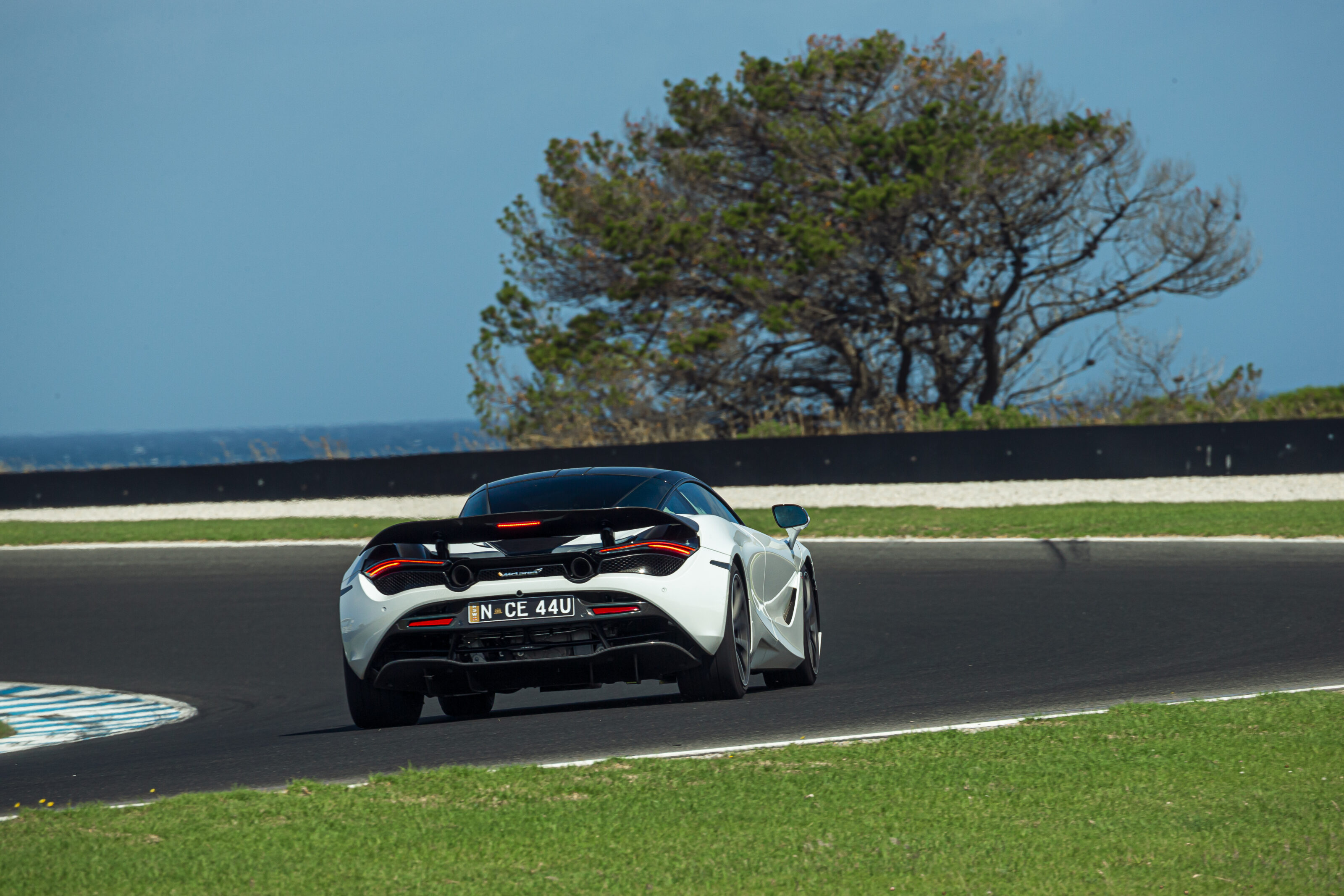
Patience is a virtue in the 720S, as I had to wait longer to get on the throttle than any other car on the day, and apply it deftly to avoid unwanted wheelspin – which you’ll still encounter with all systems on.
A cheeky look at the speedo confirmed I was exiting the last corner slower than I did in either the GT3 or Huracán, but had a nearly 10km/h advantage come the braking zone for Turn 1.
The greatest criticism that can be levelled at the 720S on track is focused entirely on the front tyres. McLaren’s choice of 245-section rubber for the front end leaves the 720S short-changed. Through the seriously fast corners, where you need confidence in the front axle the most, I was left wanting.
Thankfully steering feel and feedback is superb. Being a hydraulic steering system, every texture of the circuit’s surface was transposed directly into my fingertips, making me consistently aware of the waning grip levels mid-corner.
Still, the early signs of understeer aren’t something you want to encounter at 200km/h. A more aggressive Corsa compound is available as a no-cost option. Take it. You won’t be making a meaningful sacrifice in daily noise and gaining a significant performance benefit in return.
The 720S is a car that challenges you instead of coddling. It demands your respect, and talent. But that’s the point. This isn’t a supercar you can get into, half-arse, and still go quickly.
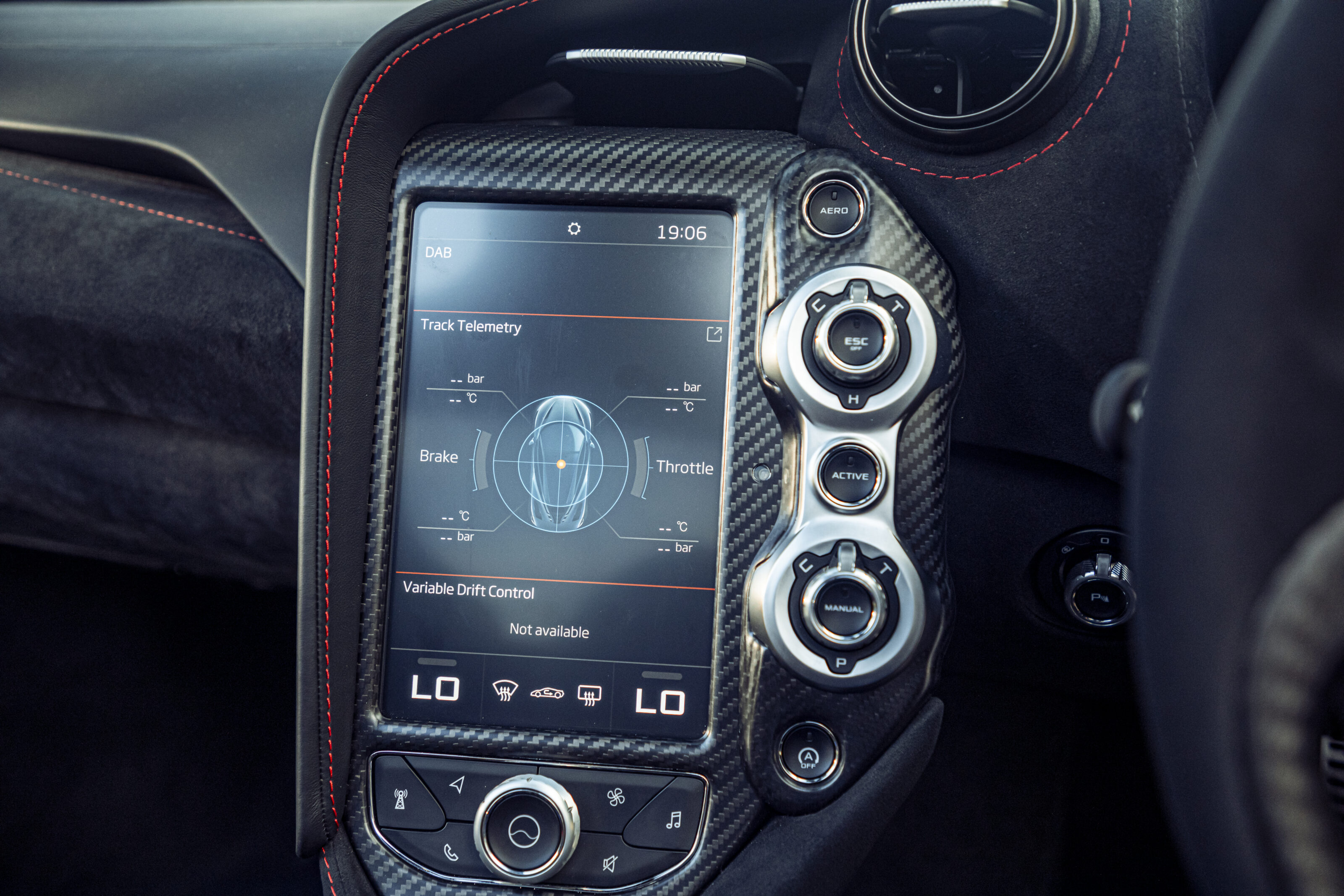
Given the opportunity to spend an entire day on Australia’s fastest permanent circuit with Luffy’s tutelage and the choice between a GT3 and 720S it’d be another tally in the win column for England for me.
Yes, even in the hands of a professional it’s not as quick as the Porsche, and when both are road registered the McLaren would command almost double the price. But there’s more to learn from its bristles, a skill to develop at every corner.
The 720S provides a driving test with ever-present consequences, demanding an elevation of your skills. Many will prefer the Huracán’s styling and soundtrack, but there’s something about the 720S, and its permanent spectre of consequence, that’s simultaneously scary yet hard to resist.
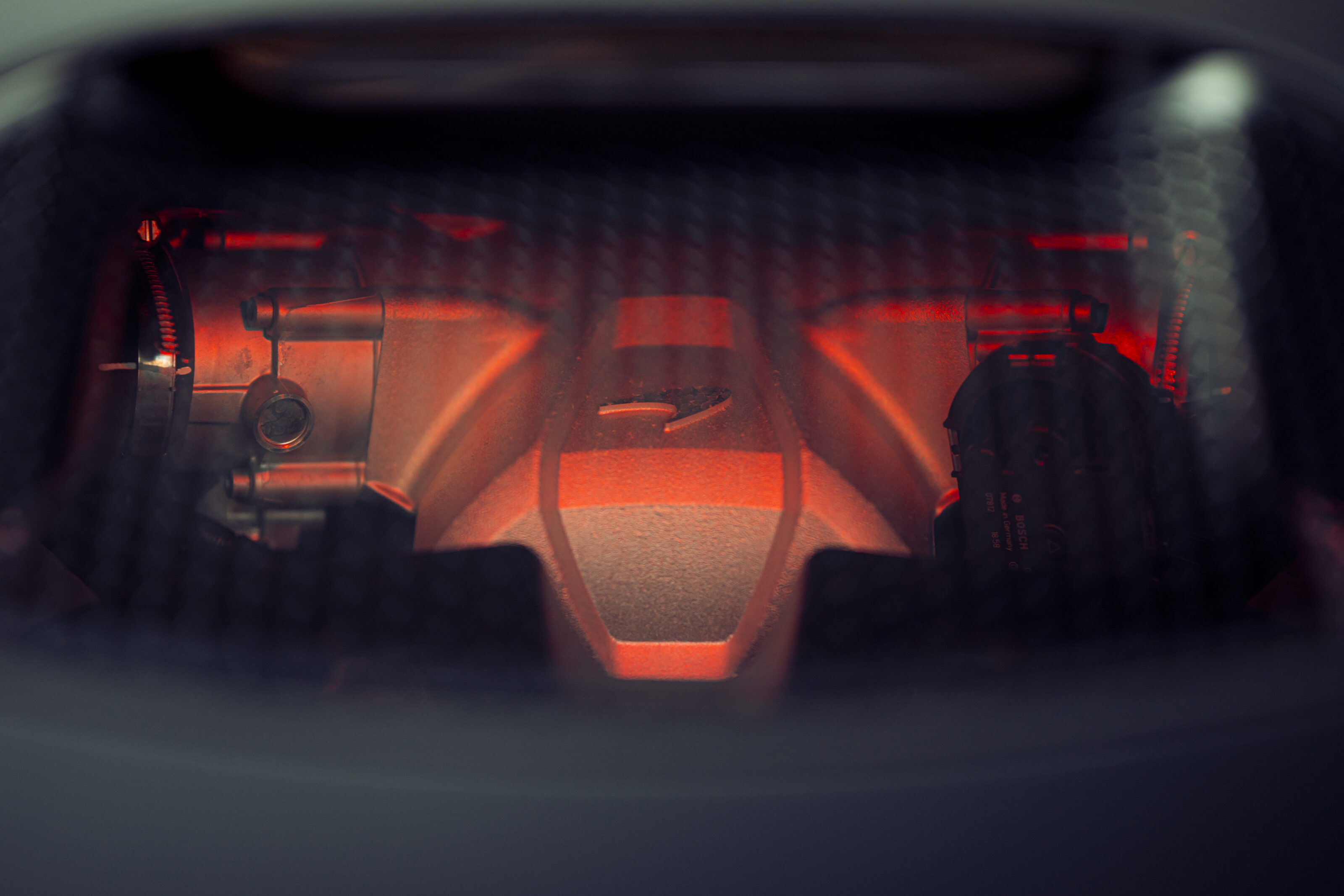
Modern supercars are derided for being too friendly, protecting ham-fisted pilots with a thick electronic support network of systems designed to flatter egos.
On the track, Woking’s wonder is not that kind of supercar. Cars & Coffee posers need not apply. – CK
Things we love:
- Track time
- Steering feel
- Headroom
- Tyre compound
- Tyre footprint
- Passing of time
The European Union is still on track to ban the sale of new comustion engine vehicles by 2035, but the move is being met by resistence.
As first reported by Reuters through Automotive News Europe, an alliance of five countries – Italy, Portugal, Slovakia, Bulgaria and Romania – will move to delay the proposed ban from its planned starting date of 2035 to 2040.
While the Italian Government has previously been vocal in its support of local manufacturers who rely on sales of combustion engine vehicles, the remaining four countries have so far been quiet on the issue, now throwing their support behind reduced emissions targets.
Rather than the 100 per cent reduction in emissions for passenger vehicles by 2035, the proposal suggests the 2035 target should be 90 per cent before going to a total cut in 2040.
Likewise with light commercial vehicles, the blanket ban of internal combustion engines by 2035 has also been pushed back to 2040, with a target of 80 per cent less emissions compared to 1990 levels by 2035.
The EU’s push for a 2035 cut-off is influenced by the 15-year average lifespan of a new car, with a majority of cars sold by the middle of next decade potentially being off the road by the time the 2050 net zero emissions target comes into play.
Snapshot
- MY17 and MY18 models affected
- 2540 cars involved
- Fault may cause vehicles to overheat and catch fire
Hyundai Australia is recalling more than 2500 examples of its Tucson mid-sized SUV due to an electrical fault which may cause it to overheat and catch fire.
Vehicles from 2017 and 2018 are involved in the recall, with the issue specifically affecting the 2.0-litre diesel engine.
According to the Department for Infrastructure, which issued the notice, due to a manufacturing issue, the connector to the heater core may overheat due to a faulty electrical connection.
This may cause excess heat in the connection and could cause the vehicle to catch fire.
A list of VINs for the 2540 vehicles involved can be found here.
Owners will be contacted by Hyundai and asked to contact an authorised dealership to have the component inspected and fixed, free of charge.
Alternatively, Hyundai can be contacted on 1800 186 306.
Snapshot
- Porsche 963 LMDh prototype racer unveiled at Goodwood
- Powered by a 500kW petrol-electric hybrid V8 from the 918 Spyder
- Set to officially start racing at the 24 Hours of Daytona in January 2023
UPDATE, June 28: Aussie Matt Campbell joins Porsche 963 factory drivers’ team
Young Aussie Matt Campbell has been announced as one of the factory drivers selected by Porsche for its new Porsche Penske Motorsport program.
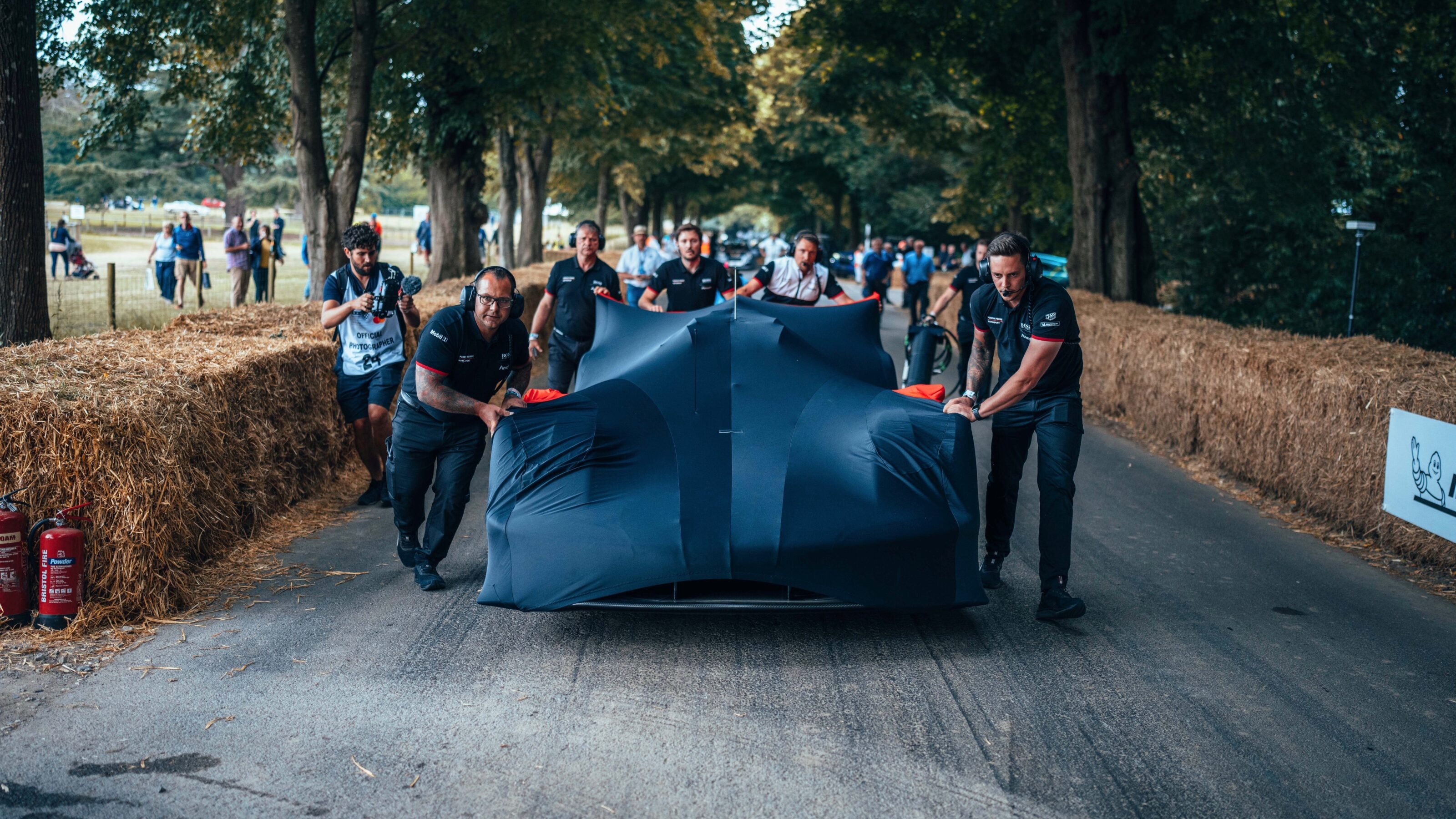
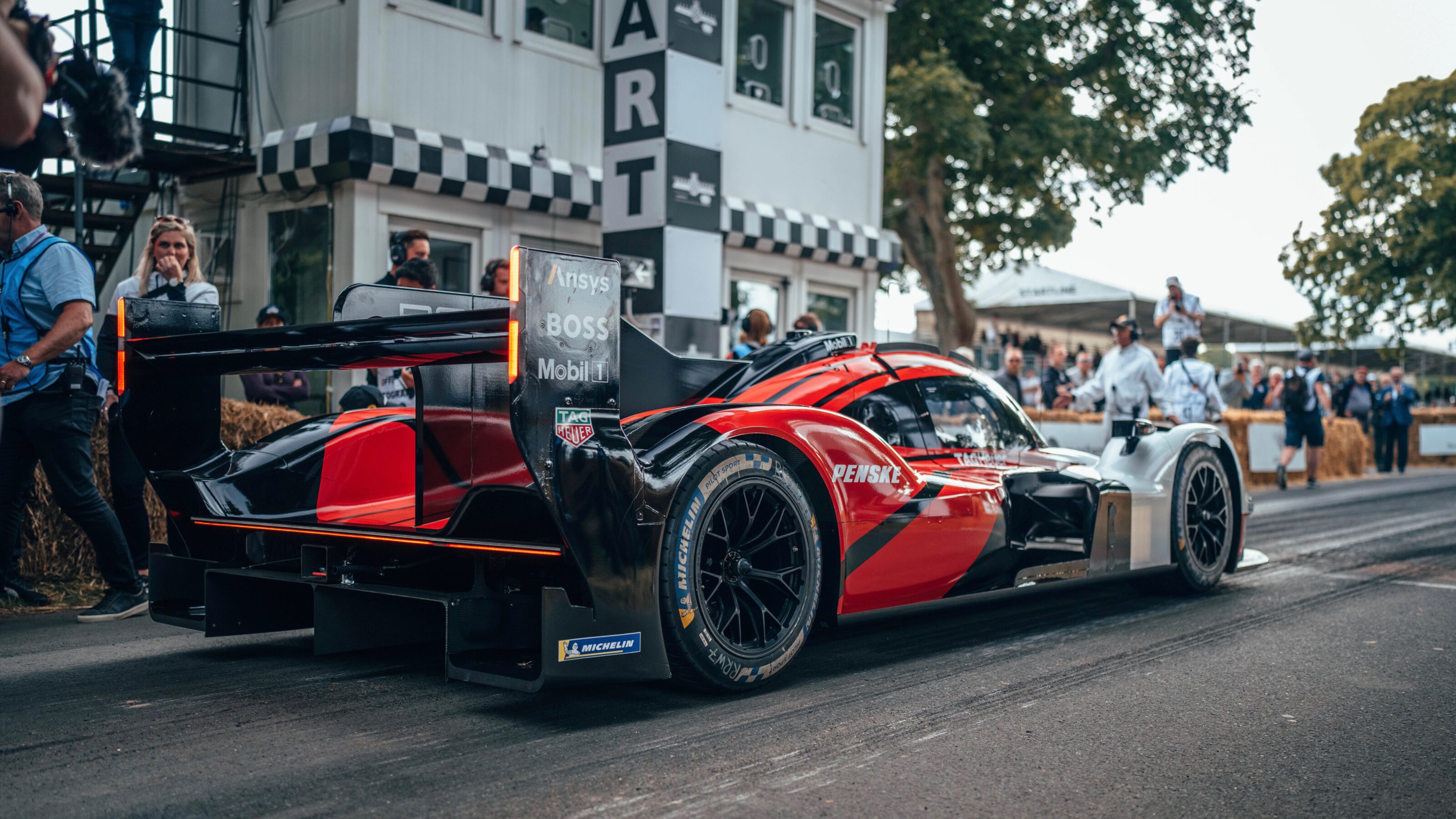
The news follows the Porsche 963 Prototype having been unveiled this weekend at the Goodwood Festival of Speed.
The 27-year-old from Warwick, Queensland, has enjoyed a stratospheric ascension through local motorsport, taking part in the Porsche GT3 Cup Challenge in 2014 before graduating to the Carrera Cup Championship – finishing third in his debut season.
He won the 2016 Carrera Cup Series the following year, before moving to Europe in 2017 to take part in the Porsche Supercup and subsequently making the leap to international WEC with Proton-Dempsey Racing and IMSA.
Campbell joins the new Porsche Penske operation and will make his prototype racing debut with the new 500kW Porsche 963, battling for outright honours on one of motorsport’s biggest stages.
Speaking to MOTOR today, Campbell revealed the vehicle which debuted at Goodwood is, in fact, the only one up and running – with the other three factory cars due to be completed later this year.
Testing commenced earlier in 2022, and Campbell has already turned wheels in Porsche’s latest Prototype. With plenty of European and American racing experience under his belt already, Campbell admits the step change from GT cars to Prototypes isn’t as big as he’d initially imagined.
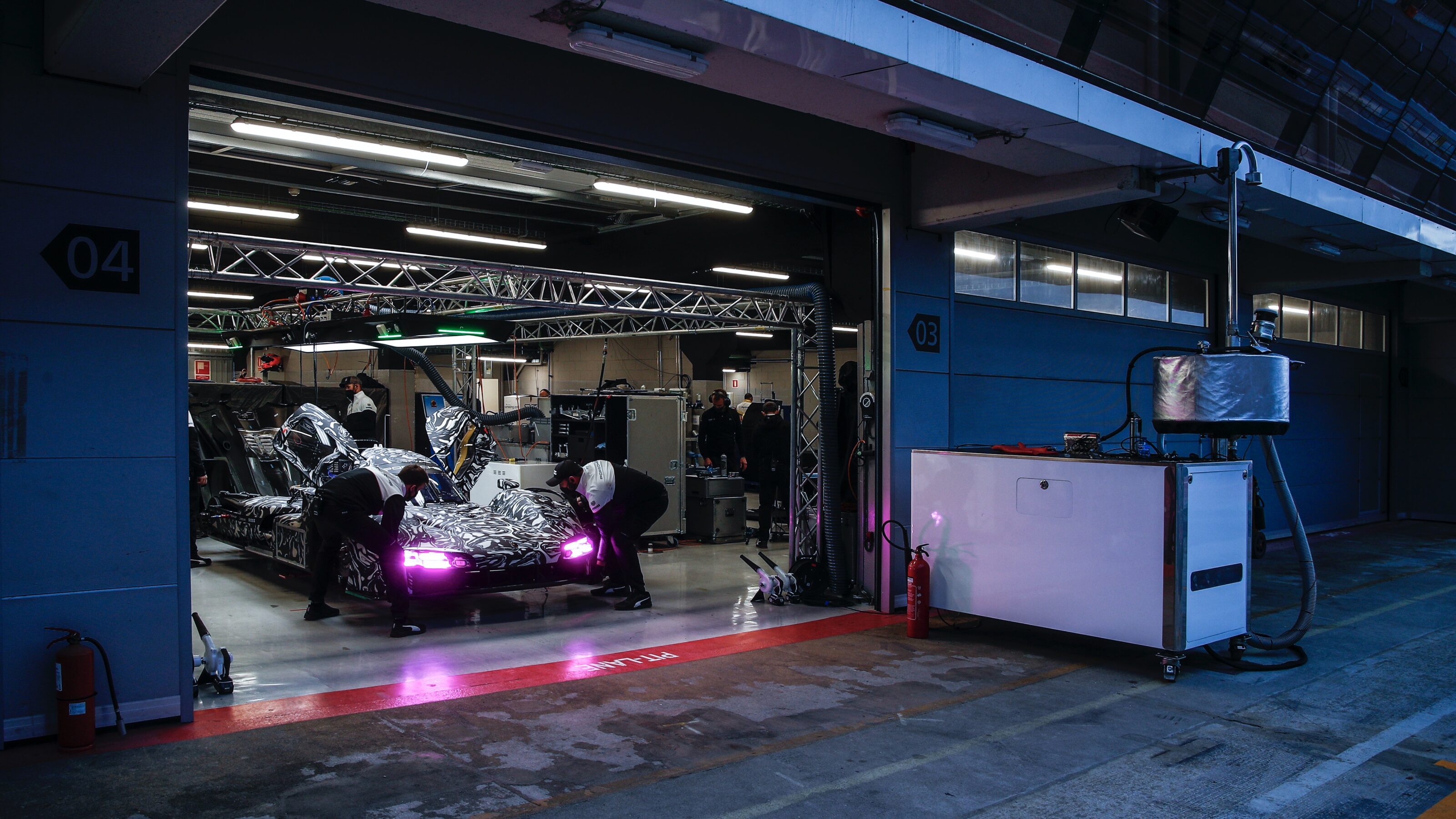
“The Prototypes are a lot heavier than the GT Cars… but there’s a lot of experience to draw from my time driving 911 RSRs. The steering wheel layout, the controls – there’s a lot that’s similar,” he said.
“It hasn’t been as big of a step as I’d thought.”
When asked what his biggest specific challenge is in graduating to Prototype racing, Campbell replied simply: “It’s learning all the systems”.
Harnessing a Bosch motor-generator, Williams Advanced Engineering battery and a seven-speed Xtrac gearbox, the high-tech Porsche 963 is far removed from the RSRs and GT3 Rs Campbell has raced for the past few years in WEC and IMSA.
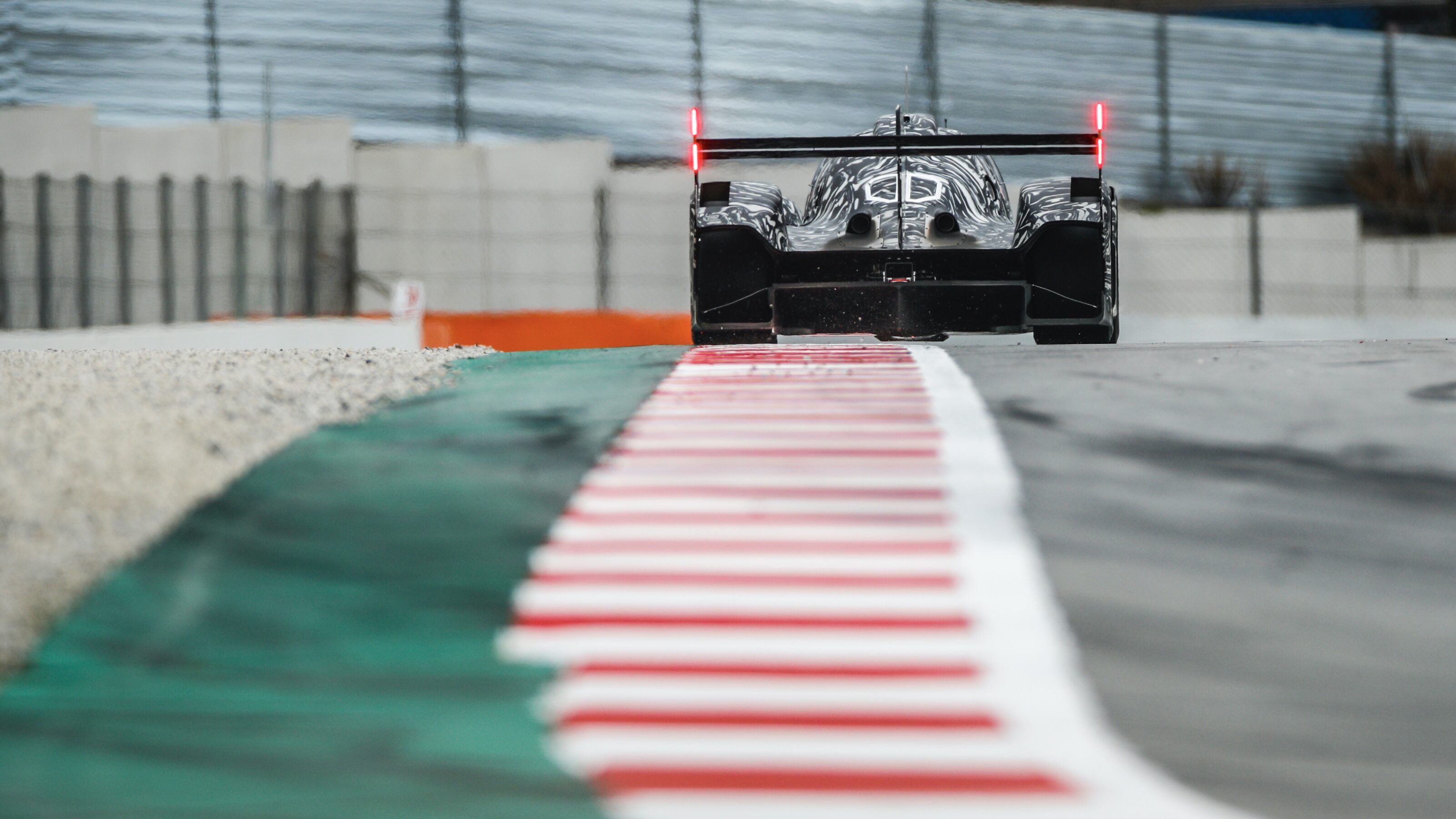
The 27-year-old Aussie is well placed for success on some of motorsport’s most esteemed stages, but was the prospect of topping the podium at the greatest endurance racing events ever a dream for young Campbell when he started out in Formula Fords locally?
“Probably not at that point, to be honest,” admits Campbell.
“But as soon as I joined the Porsche program, Cup Challenge and Carrera Cup here in Australia, then on to Supercup in Europe, this was always the goal.”
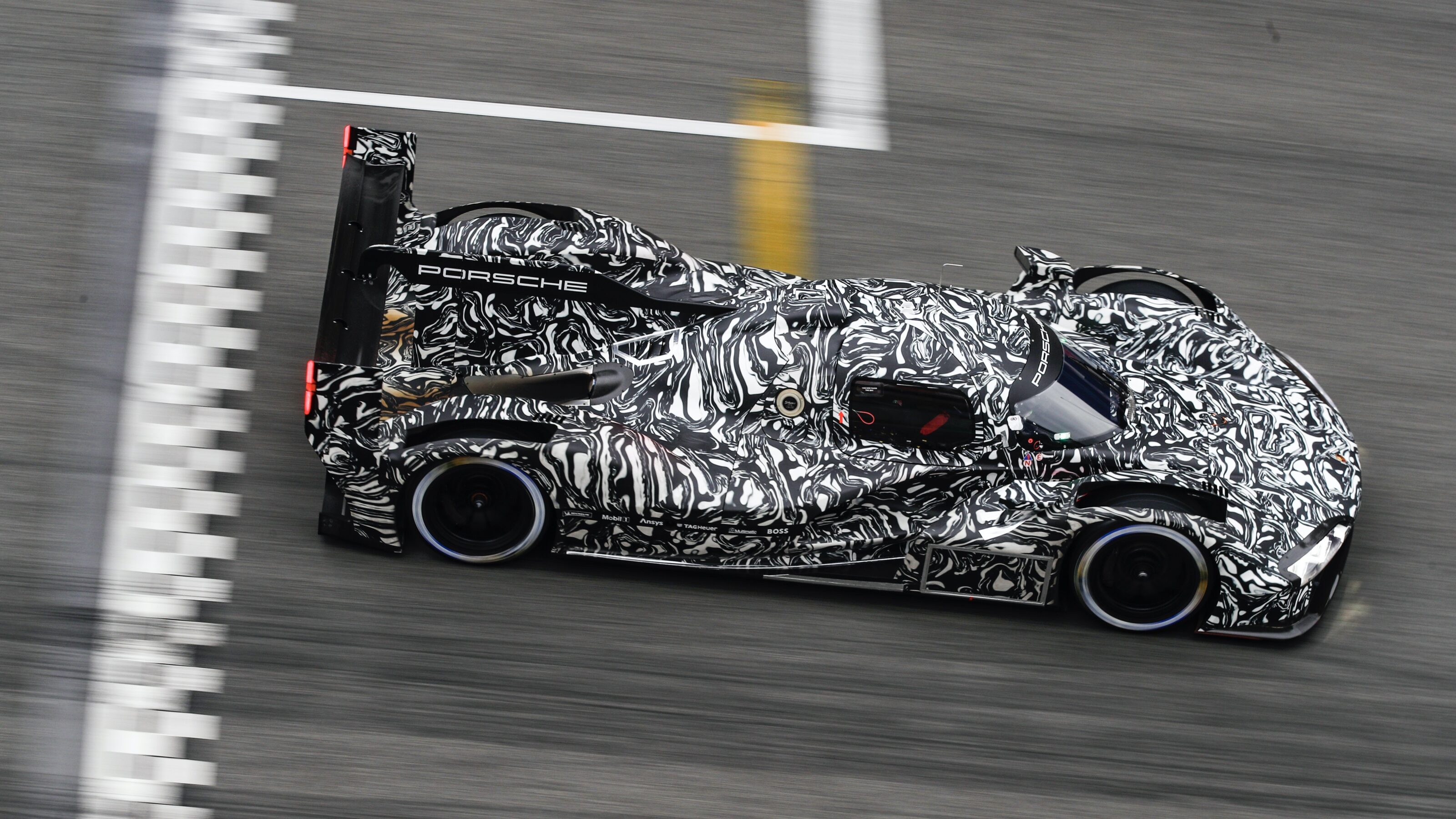
Matt Campbell joins fellow works drivers on the Porsche Penske roster, including; Kevin Estre, Michael Christensen, Andre Lotterer, Laurens Vanthoor and Mathieu Jaminet, as well as noted sports car drivers Dane Cameron and Felipe Nasr.
With Campbell’s selection for the Porsche Penske program, he joins an exclusive club of Australian Porsche works drivers. He can’t yet answer when his official competitive debut will be, but we’ll be keeping our eyes peeled for the young Australian’s Prototype debut.
The story to here
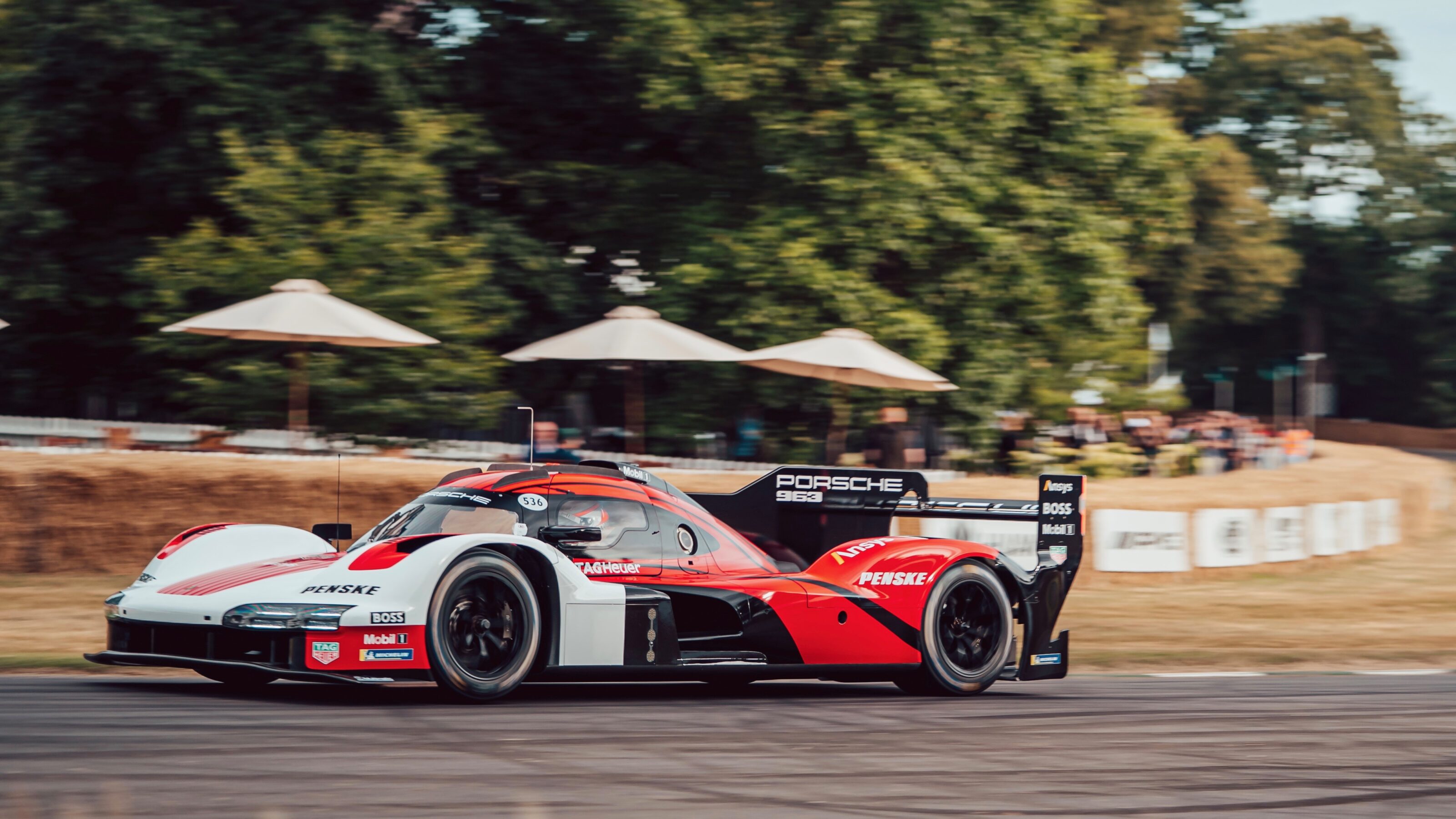
June 25: Porsche unveils 963 Prototype at Goodwood
Porsche has uncovered its prototype endurance race car at the 2022 Goodwood Festival of Speed.
The 2023 Porsche 963, run by Porsche Penske Motorsport, will compete in next year’s FIA World Endurance Championship and the IMSA WeatherTech SportsCar Championship in the United States.
Built to LMDh specifications, the Porsche Penske 963 is based on the LMP2 category, with its chassis developed on a new design by Canadian engineering company Multimatic.
A 4.6-litre twin-turbocharged V8 petrol-electric hybrid engine borrowed from the 918 Spyder is fitted to the 963, producing 500kW of power – the maximum limit under LMDh regulations.
Four examples will be produced, with two set for use for each championship.
For the WeatherTech SportsCar Championship, the Porsche-Penske team will be based in Mooresville, North Carolina, while the FIA World Endurance Championship squad will run out of Mannheim in Germany.
Porsche says each ‘high-tech’ centre will be able to transfer data in nearly real-time to ensure the teams across both sides of the Atlantic are kept up-to-date.
Thomas Laudenbach, vice president of Porsche Motorsport, said the team had completed 7889 kilometres of testing in the first half of 2022, but further work is required before the commencement of the next season.
“I’m positive that we’ll be well-positioned when it comes to technology and we’ve also created the relevant team structures to set us up for wins in the thrilling competition between many manufacturers and different concepts,” he added.
Porsche and Team Penske have a rich history, with the powertrain taking inspiration from the RS Spyder race car, which achieved many victories for the pair between 2005 and 2008.
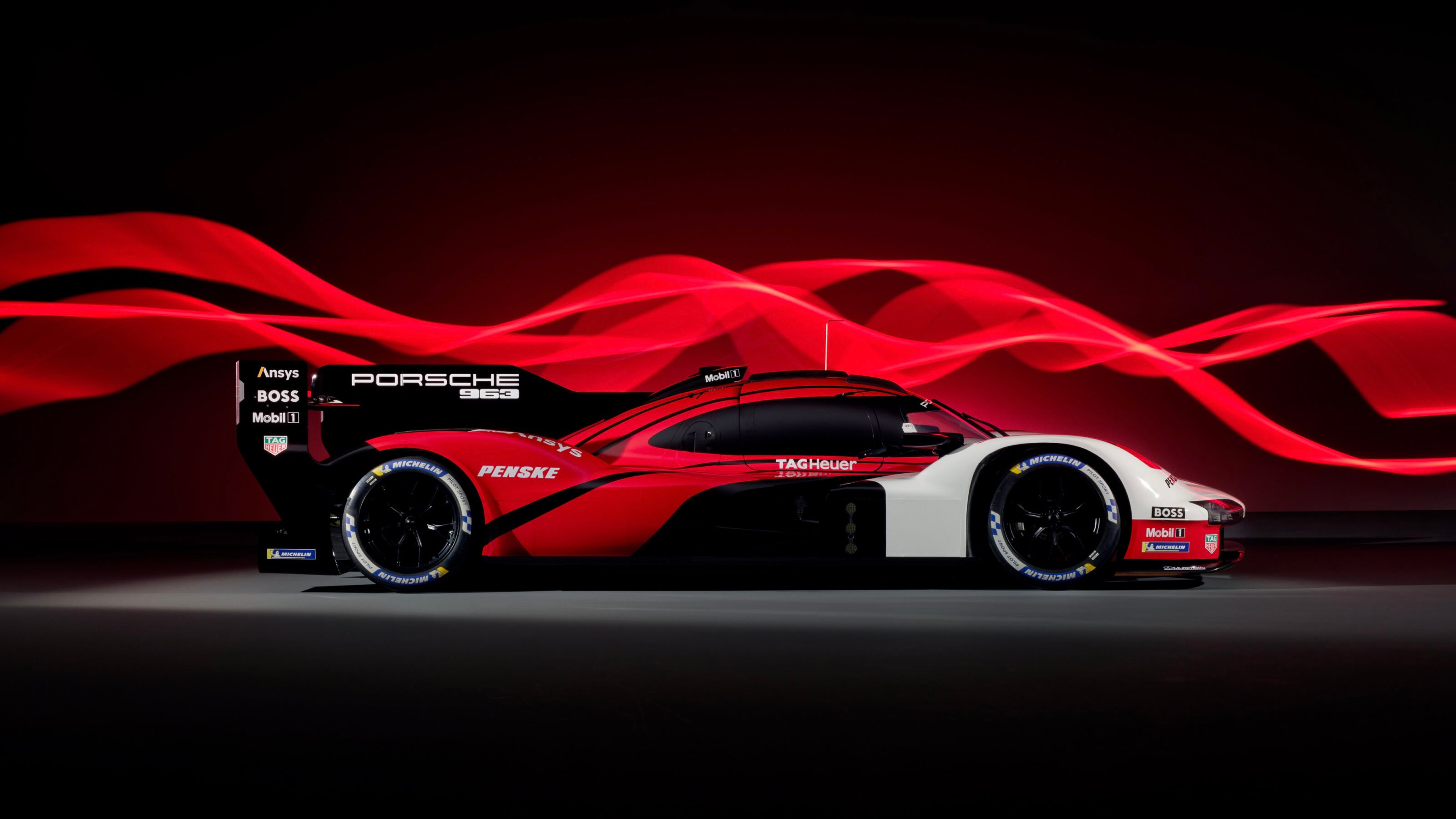
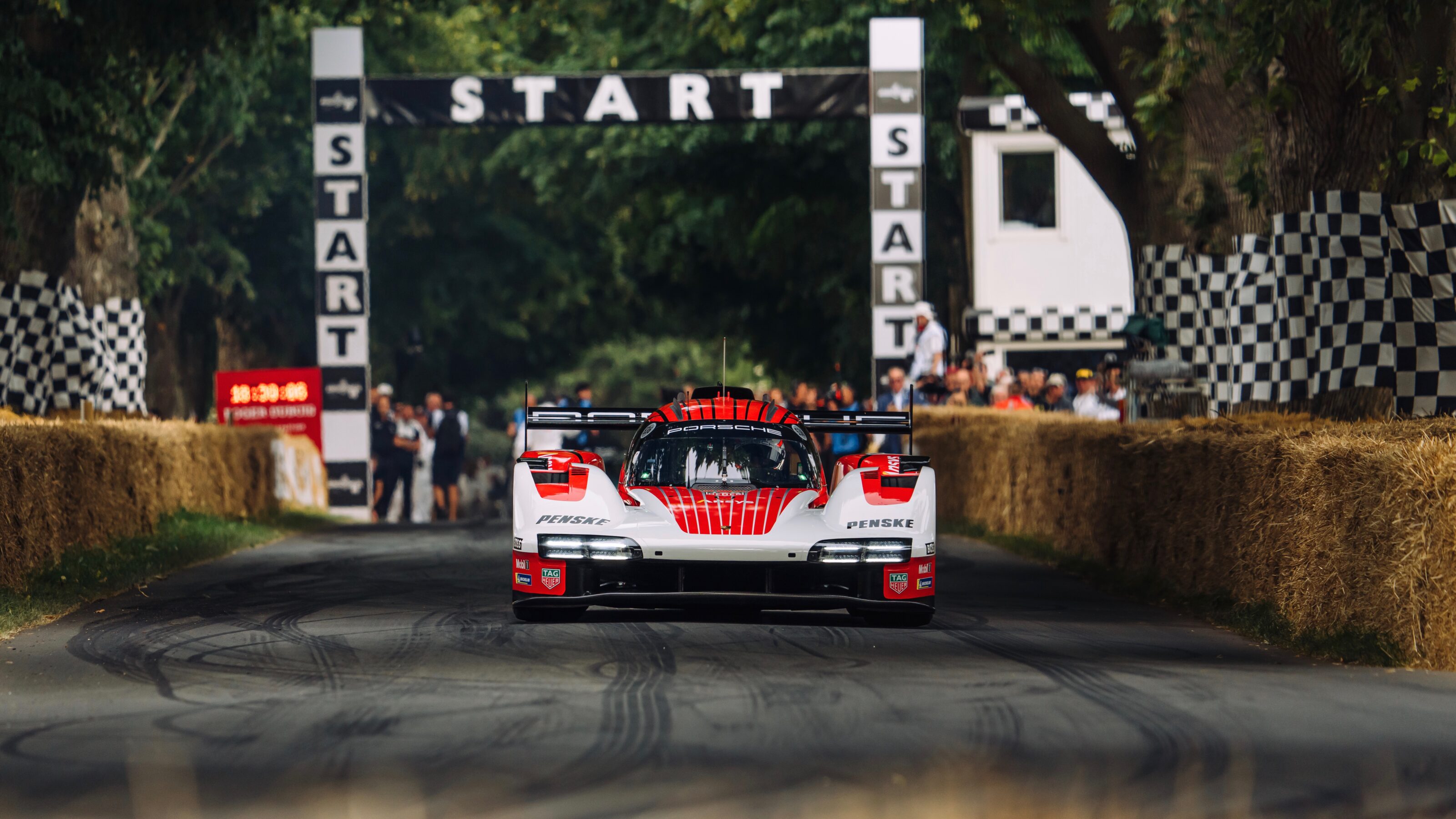
Finished in the German marque’s iconic white, black and red motorsport livery, the design of the 963 is influenced by the victorious 956 and 962 from the 1980s.
In addition, Porsche has fitted quad-LED running lamps at the front and a continuous light strip across the rear, in a nod to the Taycan and 992-series 911.
The drivers across the two championships include Australian racer Matt Campbell, with the full line-up – including for endurance races at Daytona, Sebring and Road Atlanta – to be announced in the coming months.
Officially, the Porsche Penske 963 will make its racing debut in January 2023 at the 24 Hours of Daytona in the United States; however, Porsche Penske is planning to hit the track for a non-competitive run at the final race of the 2022 season in Bahrain in November.
Additional races will include the 24 Hours of Le Mans and the 12 Hours of Sebring in 2023.
