
Snapshot
- 2015-2019 Mitsubishi Triton recalled due to towbar issue
- Fire risk can occur if liquid comes in contact with the harness
- A total of 102,616 vehicles are included in the notice
Mitsubishi has recalled a total of 102,616 examples of the 2015-2019 Triton due to a potential issue with the genuine towbar harness.
According to a recall notice published by the Department of Infrastructure, liquid could come into contact with the wiring and “may cause the harness and its surrounds to overheat, burn or catch fire.”
Mitsubishi will contact affected owners, but the company can be contacted directly by calling 1300 131 211 or visiting a dealership, found here.
You can check a list of all 102,616 VINs related to the recall by clicking here and here.
Hyundai has unveiled a baby brother to the Staria Load van.
The 2022 Hyundai Casper Van is the newest addition to the range of the minuscule crossover, which was revealed in September 2021.
A rival to the Kia Picanto and Suzuki Ignis, the load-lugging Casper Van variant sees the removal of the rear seats, in favour of an expanded luggage area surrounded by metal barriers for greater safety.
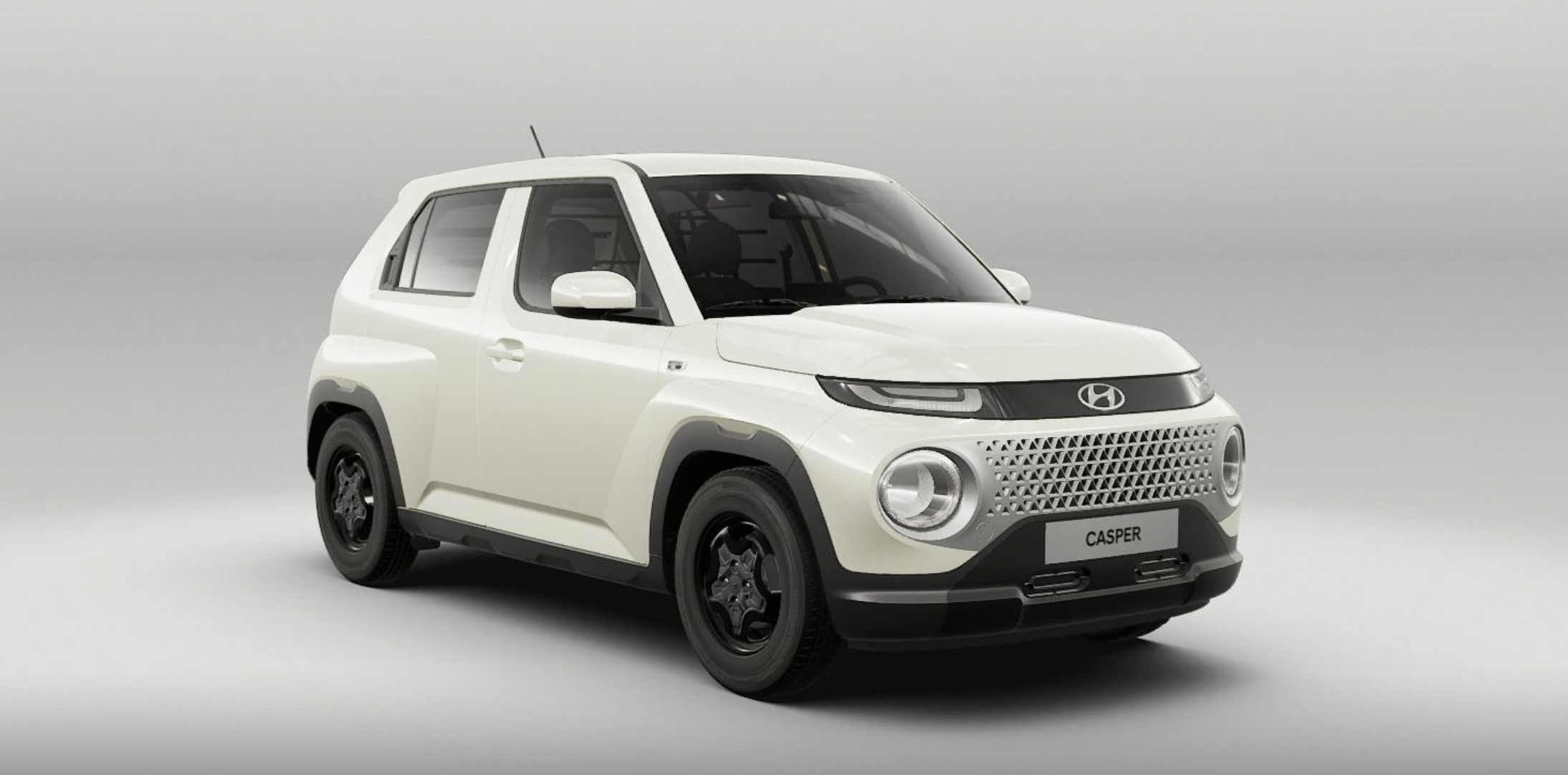
This additional space sees the luggage capacity grow to 940 litres, in spite of its tiny length.
In Korea, the 2022 Hyundai Casper Van is limited to a sole entry-level variant, known as Smart, priced from ₩13,850,000 (AU$16,155).
Standard equipment includes; a monochrome display with Bluetooth connectivity, 4.2-inch instrument cluster display, 15-inch black-painted steel wheels, cruise control, autonomous emergency braking, lane-keep assist, auto high beam, LED DRLs, dual USB ports, and two speakers.
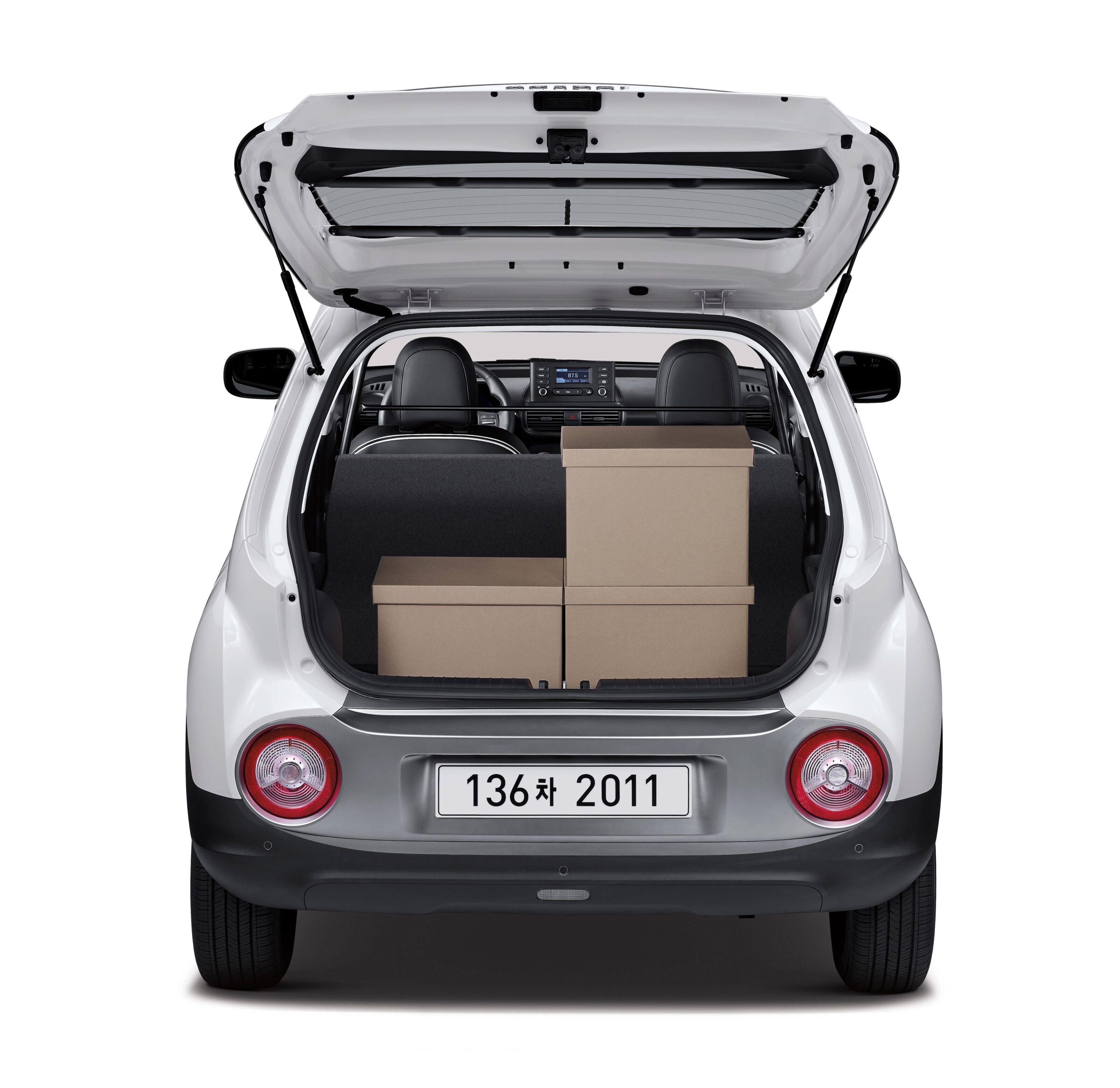
This means the cargo-carrying variant is unavailable with features available on range-topping Casper grades, such as an 8-inch infotainment system with Apple CarPlay and Android Auto, and larger alloy wheels.
Also excluded is a turbocharged version of the Casper’s 1.0-litre three-cylinder engine, with entry-level versions available in naturally-aspirated guise only – with 56kW of power and 95Nm of torque on offer.
Measuring up at 3595mm in length, 1595mm wide and 1575mm high, the Hyundai Casper is comparable to the related Kia Picanto hatch and the Suzuki Ingis small SUV, although it stacks up shorter than both rivals.
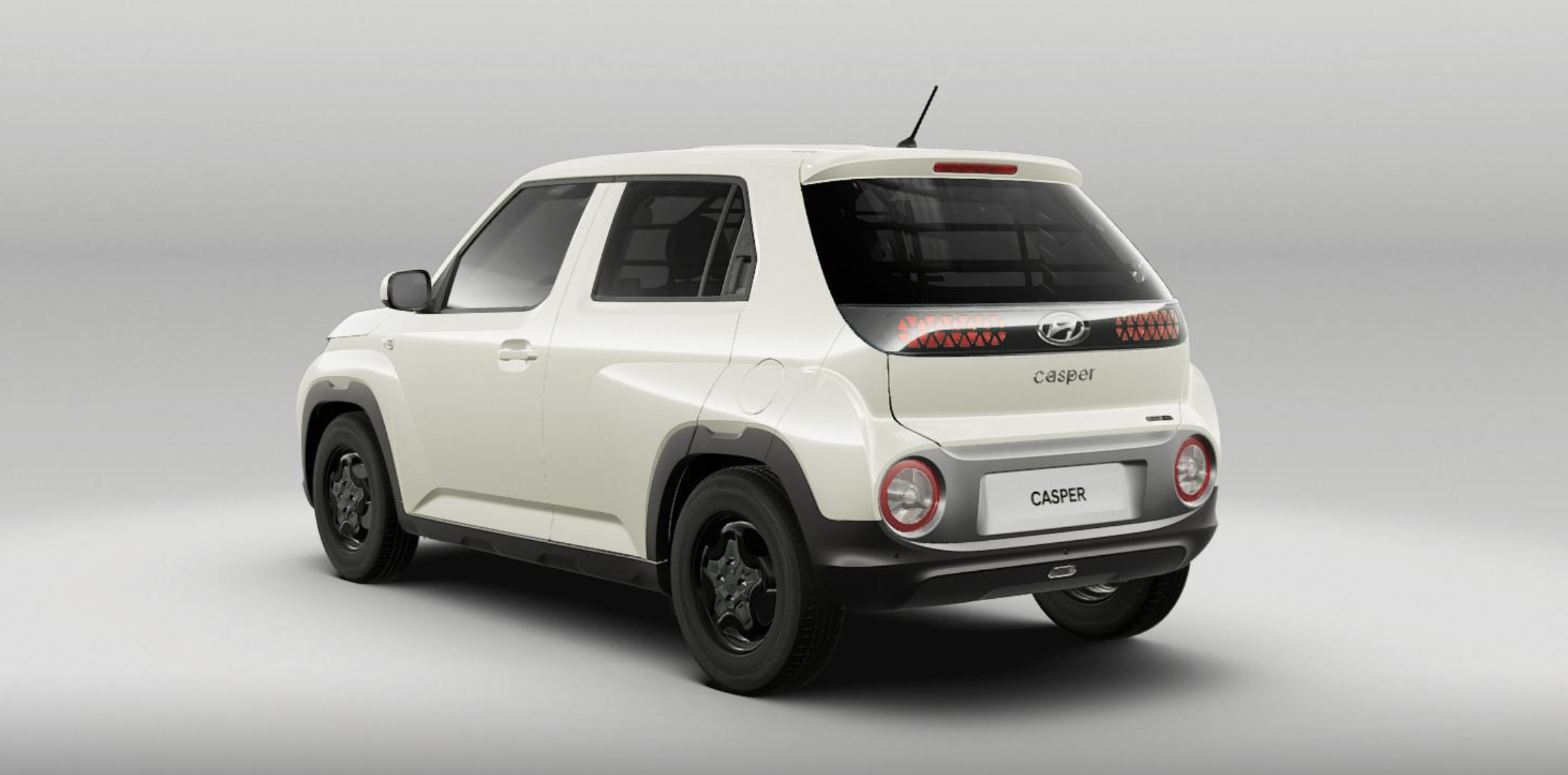
Sharing similar design language to the larger Venue, Kona and Nexo, the Casper has slim daytime running lights at the front, but also a pair of larger, circular headlights underneath, standing out on either side of the grille.
The 2022 Hyundai Casper Van is expected to remain exclusive to Korea, with the company remaining tight-lipped on the availability of Casper beyond India and its domestic market.
A spokesperson for Hyundai Australia told Wheels the local division has “no current plans to introduce Casper in Australia”, owing to competitiveness in the local market.
UPDATE, July 2022: Australian pricing announced for new Skoda Fabia
Local pricing and features for the new Skoda Fabia have now been revealed. Get all the details at the link below.
The story to here
Snapshot
- 2022 Skoda Fabia delayed until Q3 2022
- Monte Carlo unconfirmed for Australia; Launch Edition likely
- Fourth-generation light hatch previously expected by May
The local arrival of the fourth-generation 2022 Skoda Fabia has been delayed by up to six months.
Skoda’s local arm has confirmed the light hatch is now anticipated to touch down in the third quarter of 2022 (July to September inclusive), more than 12 months after it was first revealed, back in May 2021.
Previously, the fourth-generation Fabia was expected to arrive in Australia by the end of April.
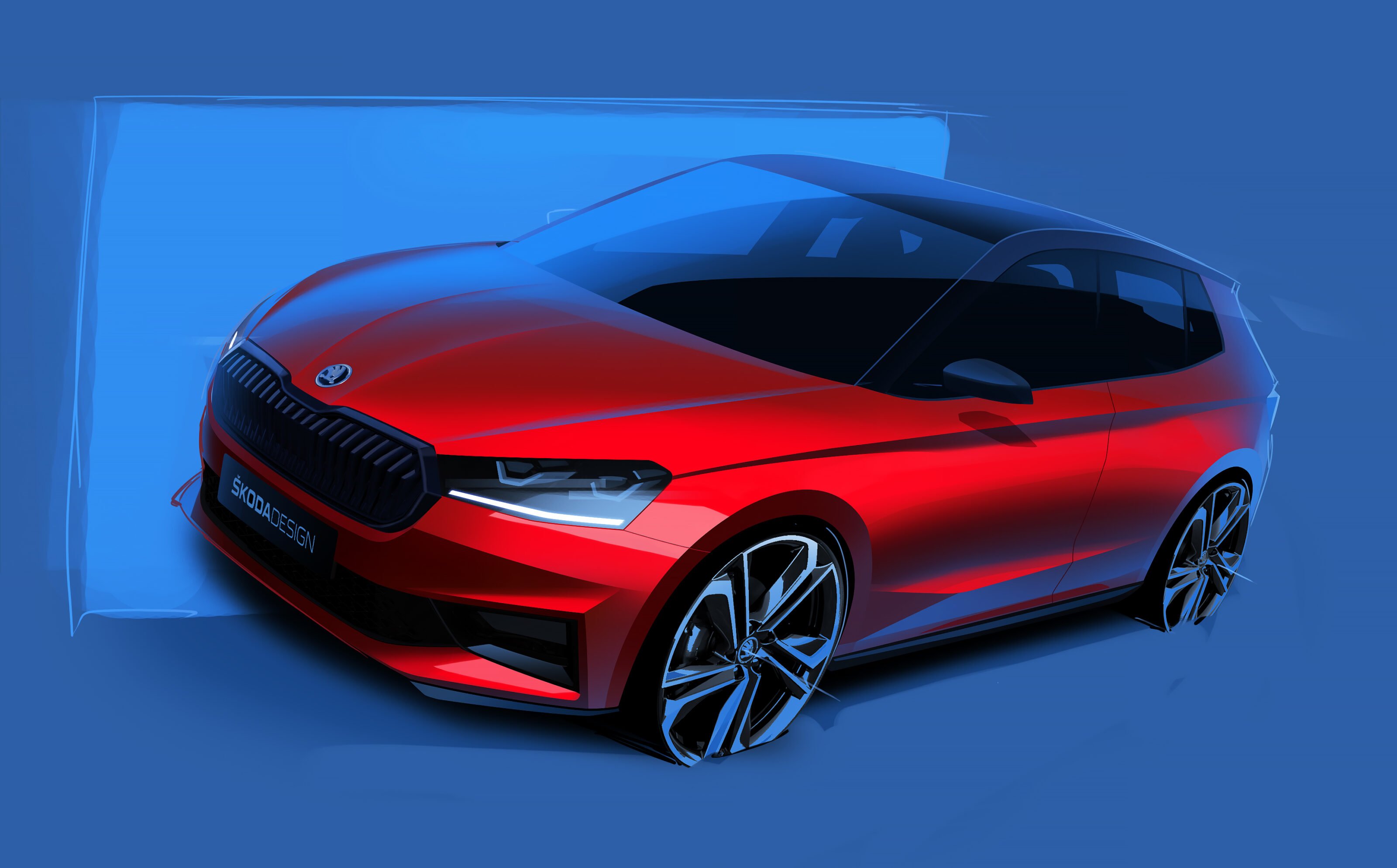
The news follows recent images for the sportier Fabia Monte Carlo range-topper, which were released in a series of sketches ahead of its official unveiling later this month.
However, the flagship variant is yet to be locked in for Australia, with a spokesperson for Volkswagen Group Australia confirming the brand is still discussing local details for the Fabia internally.
Instead, the initial range could be headlined by a Launch Edition variant – as seen with the related Kamiq and Scala – with Monte Carlo likely to join the line-up at a later date.
Under the bonnet, the Fabia is expected to offer the choice between an 81kW/200Nm 1.0-litre turbocharged three-cylinder petrol, or a 110kW/250Nm 1.5-litre turbo four.
The three-cylinder 81TSI is available with a six-speed manual or seven-speed dual-clutch automatic overseas, while the flagship 110TSI is an automatic-only proposition.
Underneath, the new-generation Fabia ditches the ageing PQ26 platform for the same MQB A0 architecture that underpins the Kamiq and Volkswagen Polo.
At 4107mm long, 1780mm wide and 1460mm tall, and with a 2564mm wheelbase, the Fabia has grown an extra 110mm in length, 48mm in width and 94mm in wheelbase (but 7mm less in height) over the outgoing Fabia.
Inspired by the larger Scala and Octavia, the Fabia features slim LED headlights, a larger front grille and thin C-shaped tail-lights.
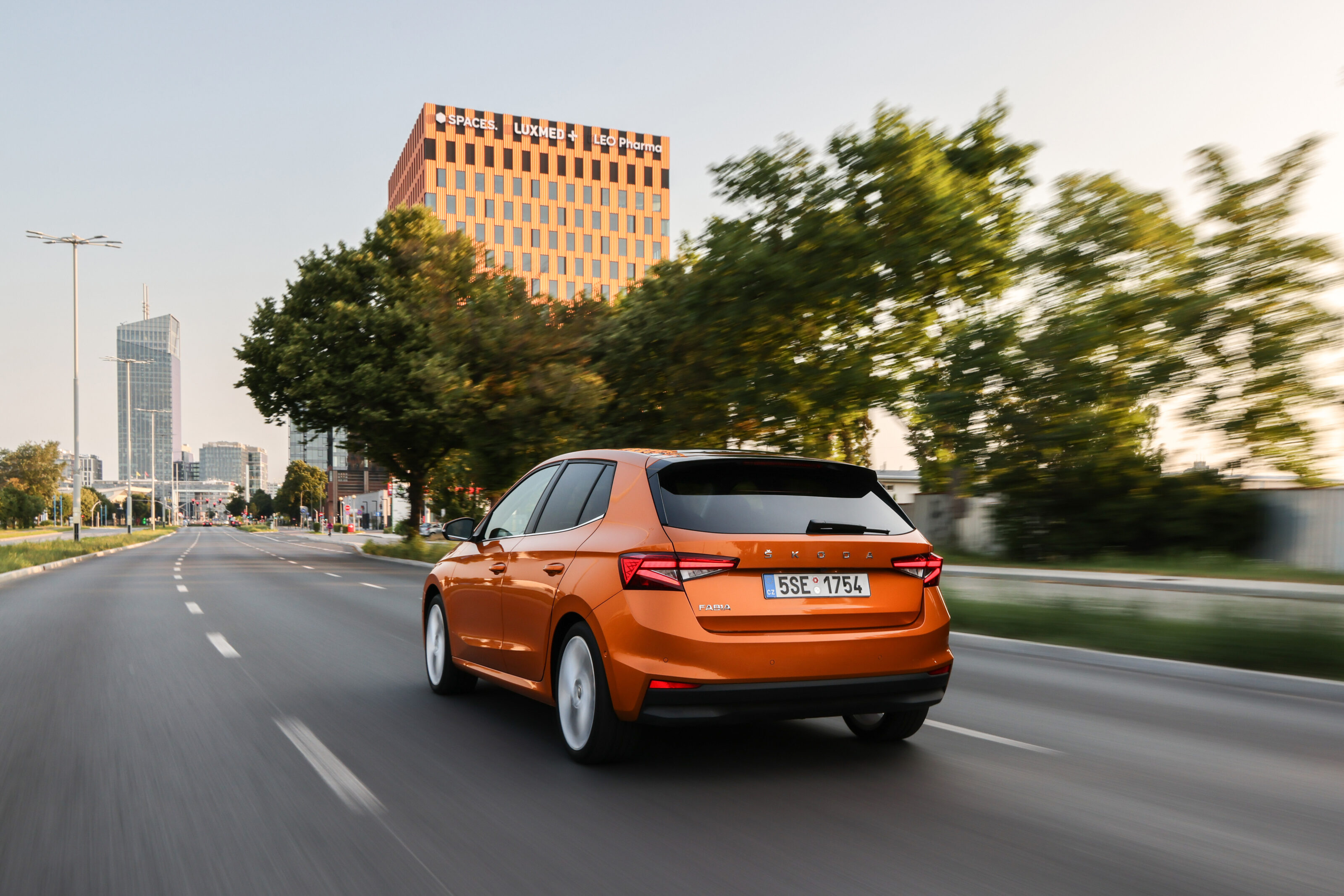
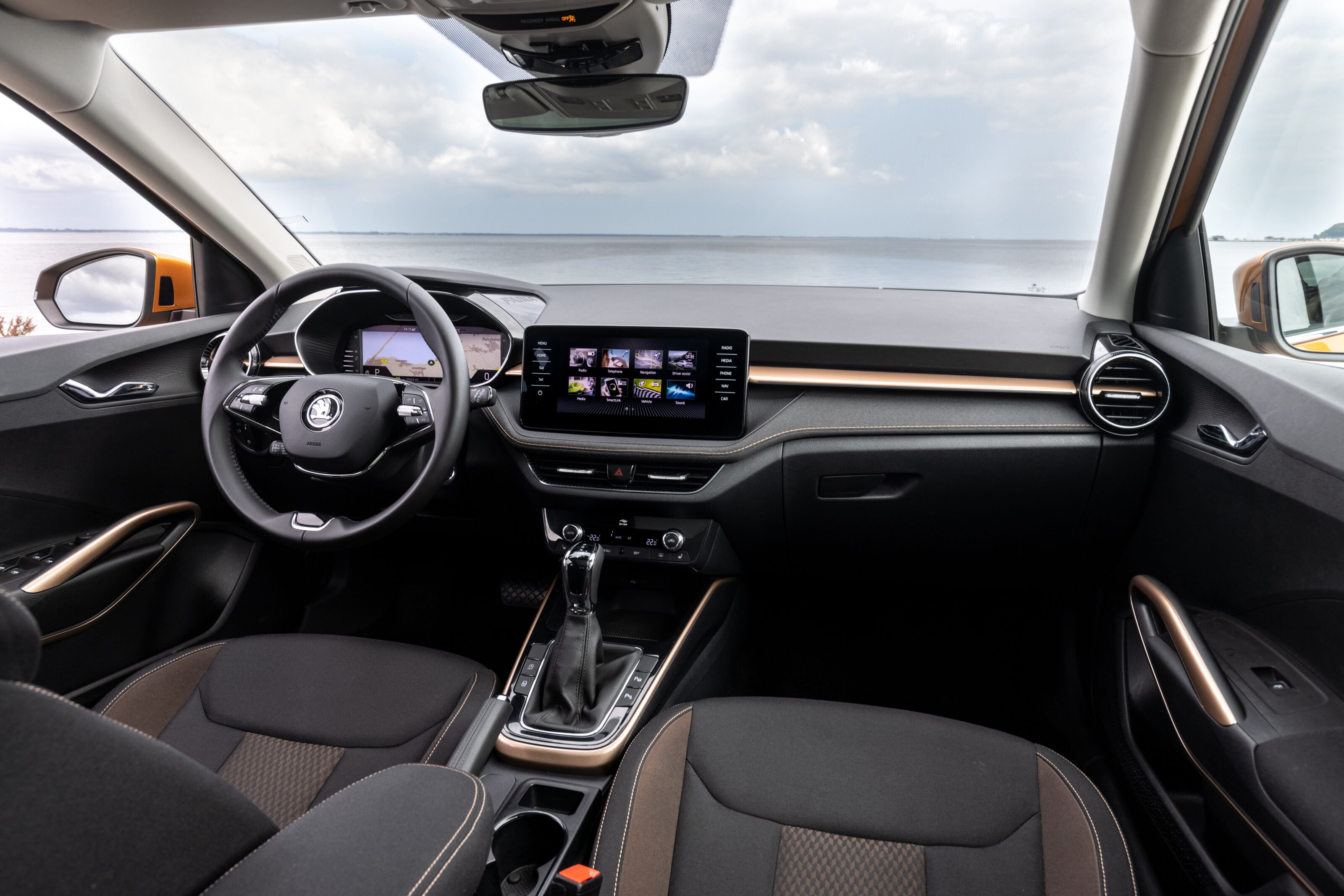
Up-to-date goodies such as a 10.25-inch digital instrument cluster, free-standing infotainment display measuring up to 9.2 inches and a panoramic sunroof are available.
Other new additions include; wireless phone charging, gesture control, ambient lighting, rear-seat air conditioning vents, a heated steering wheel and full-LED lighting.
An advantage of Australia running late in the transition to electric vehicles compared to other wealthy countries, is that we can see what’s worked well overseas and shamelessly copy those ideas.
As someone that’s been daily driving an EV for a little over three years, here are five things I’d like our governments to take inspiration from and to make charging an EV easier.
Create an official website listing all EV charging stations (New Zealand)
New Zealand has an online database of public EV fast charging stations, created when it set a target of a charger every 75 kilometres on its highways.
The nation also added minimum specifications for chargers to appear in this database. For example, chargers designed for use by the general public and 24/7 access and real-time monitoring.
Real-time monitoring in particular allows drivers to view; how much a charger costs to use, if it is offline/online, or if it is currently in use, before making the decision to drive to it.
This information is sporadically in PlugShare or an EV charging network operator’s app, but placing it in a central location operated by the Federal Government creates a minimum standard of charger quality in order to get listed in the database.
It also allows drivers to view all charging stations, regardless of who operates them, and lets third parties add EV charging facilities to their maps without paying fees to commercial businesses currently hoarding this information.
Ban brand-exclusive EV charging sites (Europe)
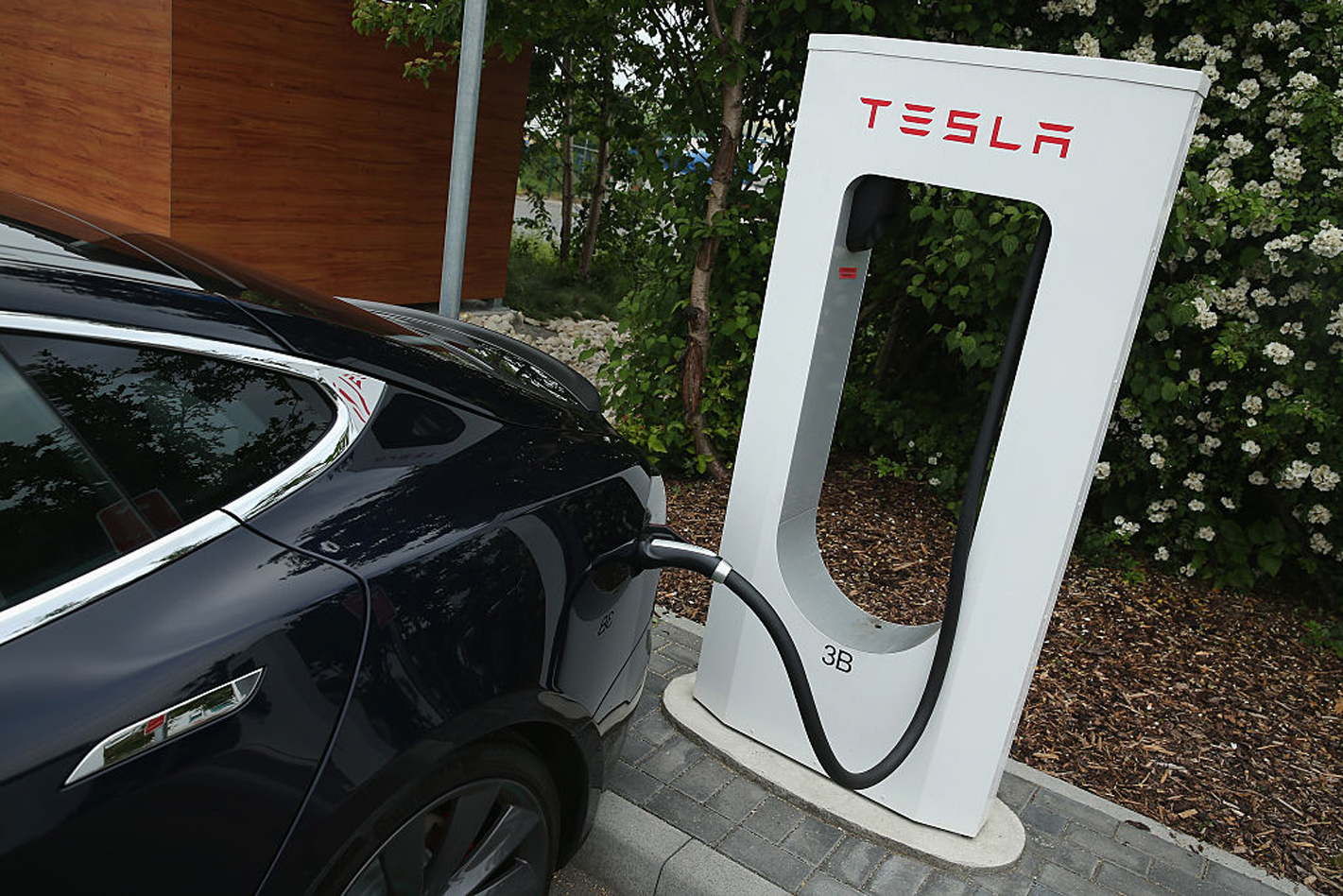
In the Netherlands, Norway and France, Tesla has either opened up or is in the process of opening up its Supercharger network to non-Tesla EVs. Owners of other EVs simply install the Tesla app on their smartphone, add a payment method and use the app to start and stop charging when at a Tesla Supercharger. Tesla owners pay a little less than non-owners.
There’s no reason why Tesla can’t do the same in Australia, as unlike in the US, its vehicles use CCS plugs for fast charging – the same plug that’s on the vast majority of EVs here.
To speed this up so all EV drivers have equal access to charging facilities, the Government could mandate that EV charging network operators can’t restrict to specific models or brands, applying an open access principle instead.

Mandate non-app payment at EV chargers (California)
Most non-EV owners expect to simply park at an EV charger, tap a credit card/smartphone on the unit and begin.
In reality, you need to install an app on your smartphone, make an account with that EV charging network (there are at least four in Australia already), add your credit card details and use the app to start charging. In more advanced EV locales like Norway and California there can be up to a dozen networks, each needing their own accounts – how annoying!
The US state of California decided this is unsustainable and introduced a law forcing “stations to accept credit and debit payment by chip card readers”. While the amount of chargers is thin on the ground, it’s a perfect time for governments to do the same in Australia. Offer a discount for those using the app if you want, but at least offer a way to quickly pay without registering online.
Grants for home and workplace charger installation (UK)
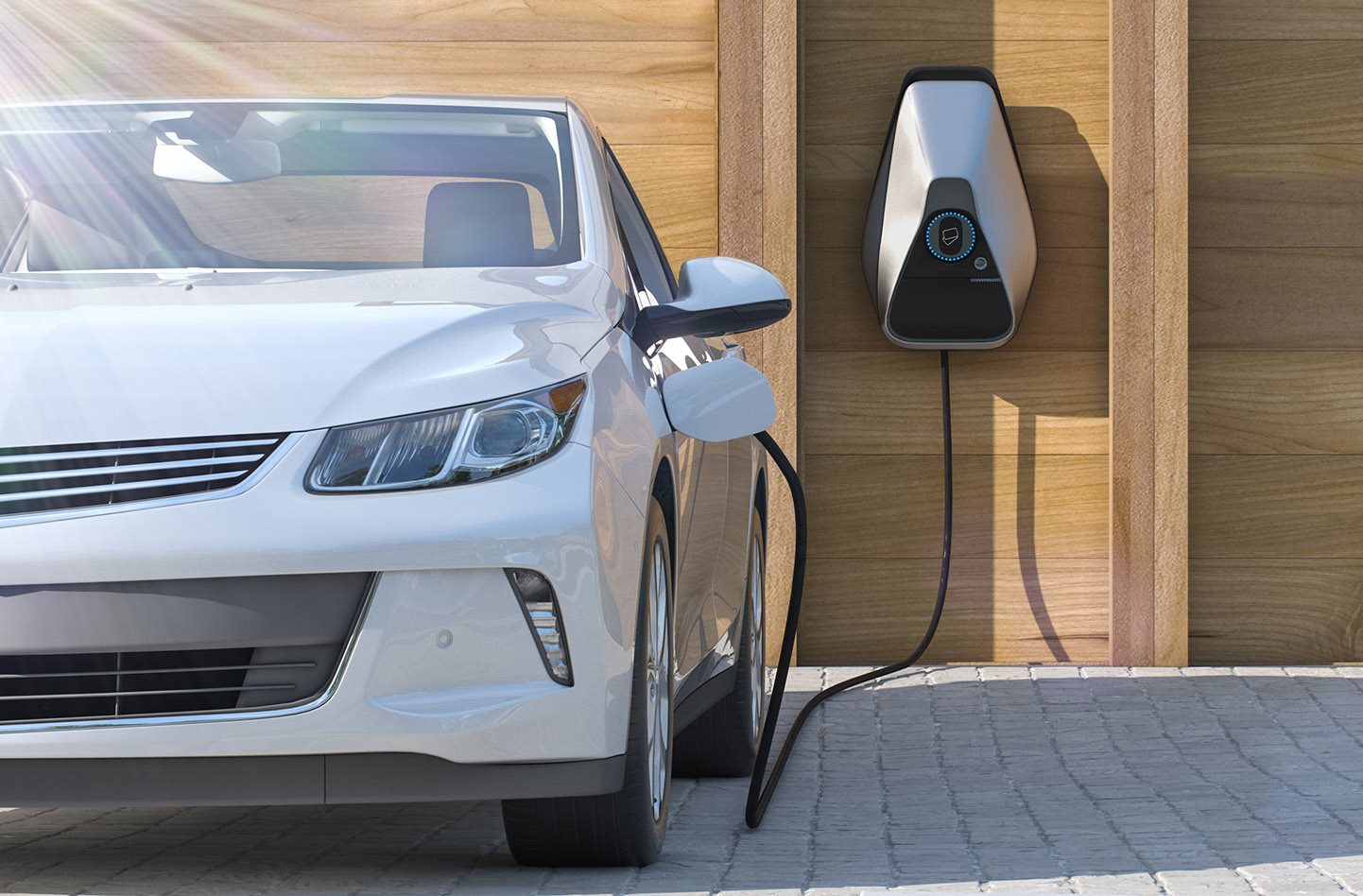
Those of us with off-street parking don’t use public charging very often as we can charge at home. In three years of EV ownership, maybe five per cent of the electricity going into my car after around 100,000km of driving is from public chargers. The cost of installing a charger at home however can be a bit of a burden when purchasing a new vehicle.
The UK decided to lower that burden for early adopters moving to electric vehicles by providing grants of up to £350 (~AU$670) for any charge point installed at a home or workplace.
Australia can take this a step further and mandate that chargers eligible for these grants are “smart”, meaning they are connected to the internet and able to be controlled by electricity grid operators in the same fashion as air-conditioners and solar inverters are now – to make sure they play nice with the grid.
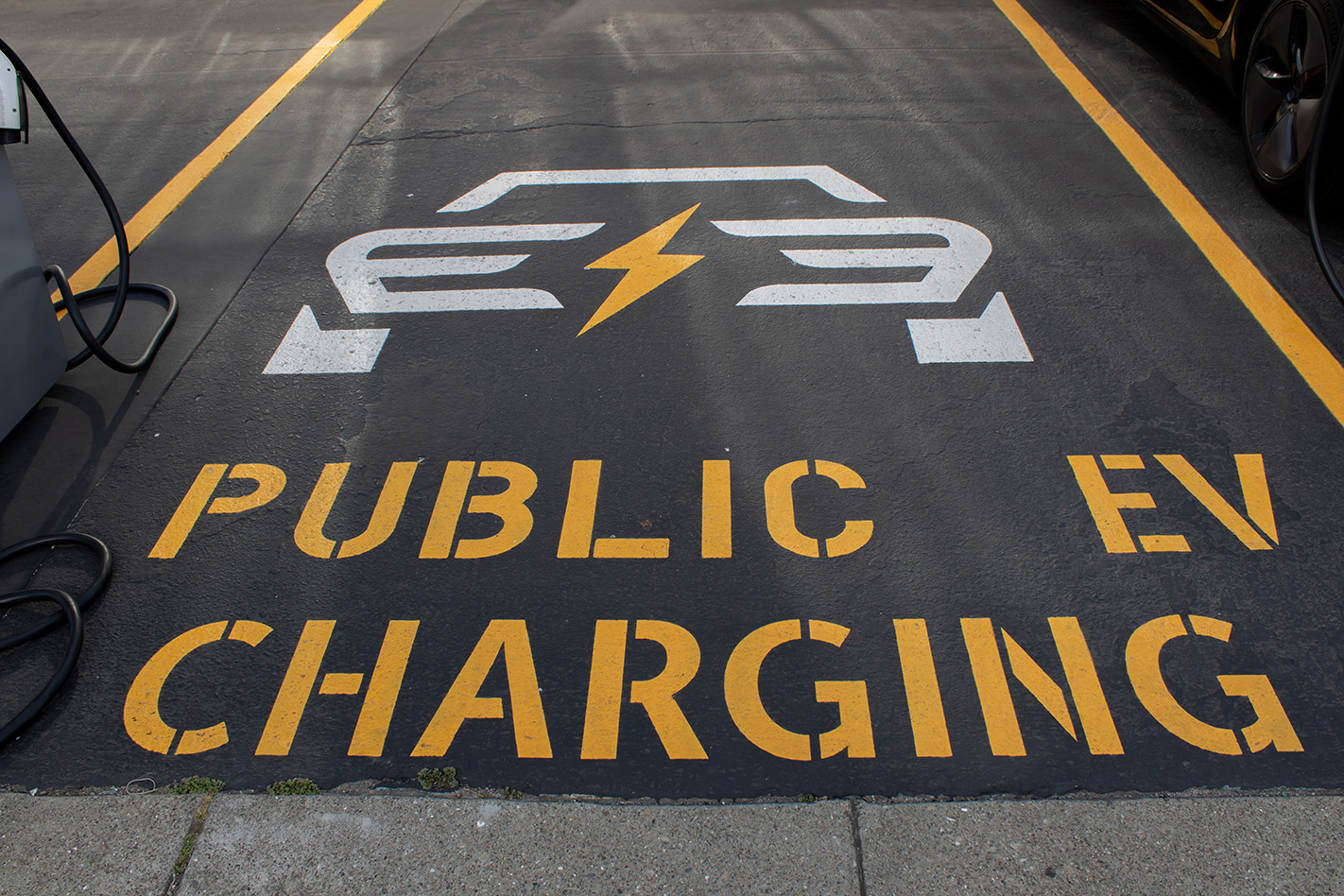
Fines for parking at chargers when not charging (Victoria & Queensland)
There is nothing more frustrating as an EV owner than needing to charge your car and there’s a fossil-fuel car parked in the way. These drivers are known colloquially as ‘ICEholes’, and while it’s a major inconvenience for EV owners, there are no penalties in most Australian states.
Victoria implemented a law to fine for this in 2020 and Queensland rolled out a law to do the same this week, but every state should do something similar. It’s easy revenue for them and helps against a massive headache for EV drivers.
There should also be a system for dobbing in offenders (e.g. send a photo to the local council, which is supposed to be enforcing these laws), perhaps even with a bounty attached for the person submitting the photo for maximum effectiveness.
Cupra has confirmed ex-WRC 2 champion and four-time Dakar winner Nasser Al-Attiyah is joining existing driver Jutta Kleinschmidt for the 2022 season of Extreme E.
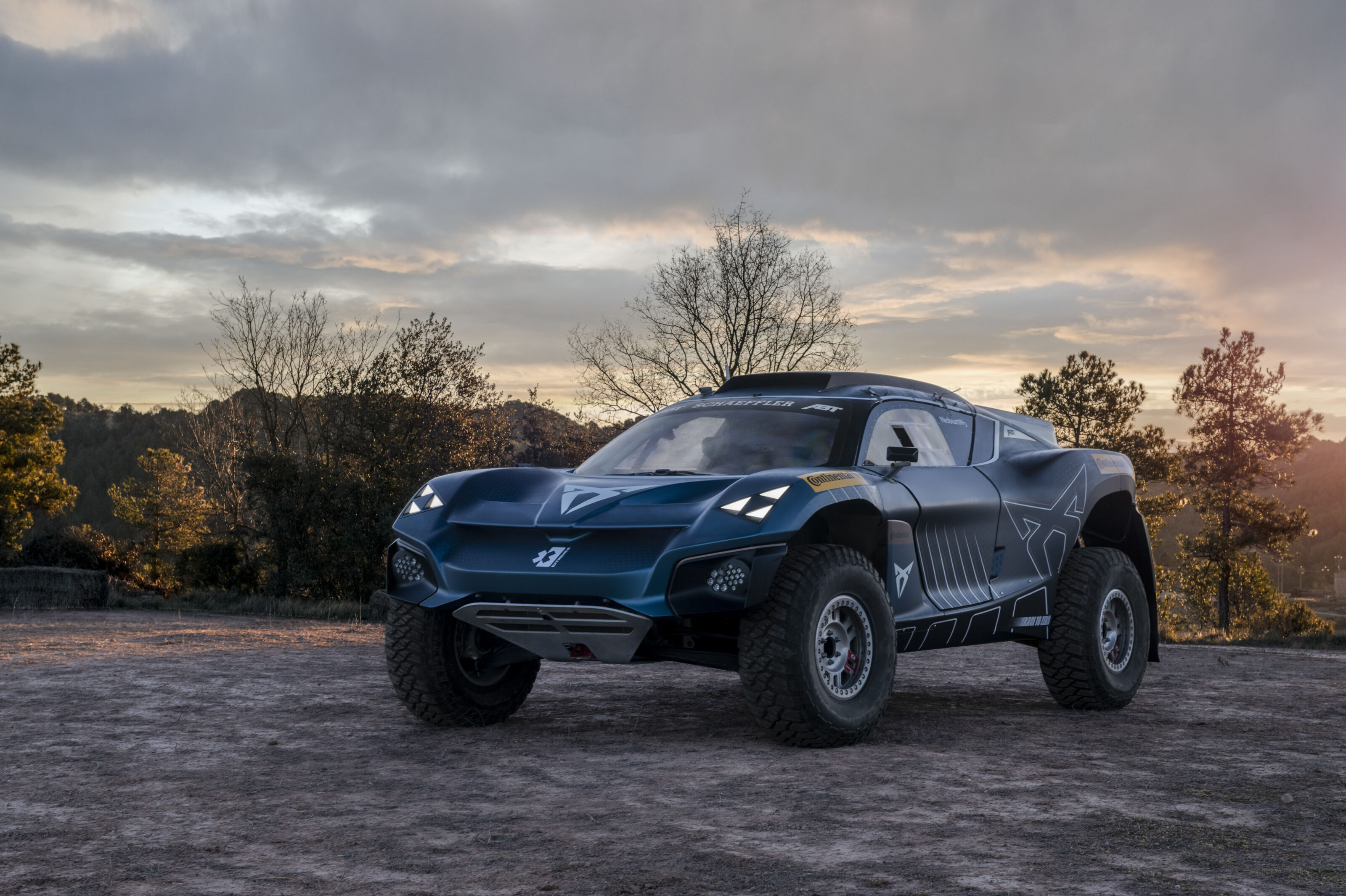
Abt Cupra XE will roll into the first event at Neom, Saudi Arabia later this month with the highly experienced pair piloting its 400kW buggy on challenging courses.
Rules for Extreme E stipulate there must be both a male and female competitor driving for each team, and returning driver Kleinschmidt is a Dakar winner herself, being the only female to win the Dakar car division in 2001.
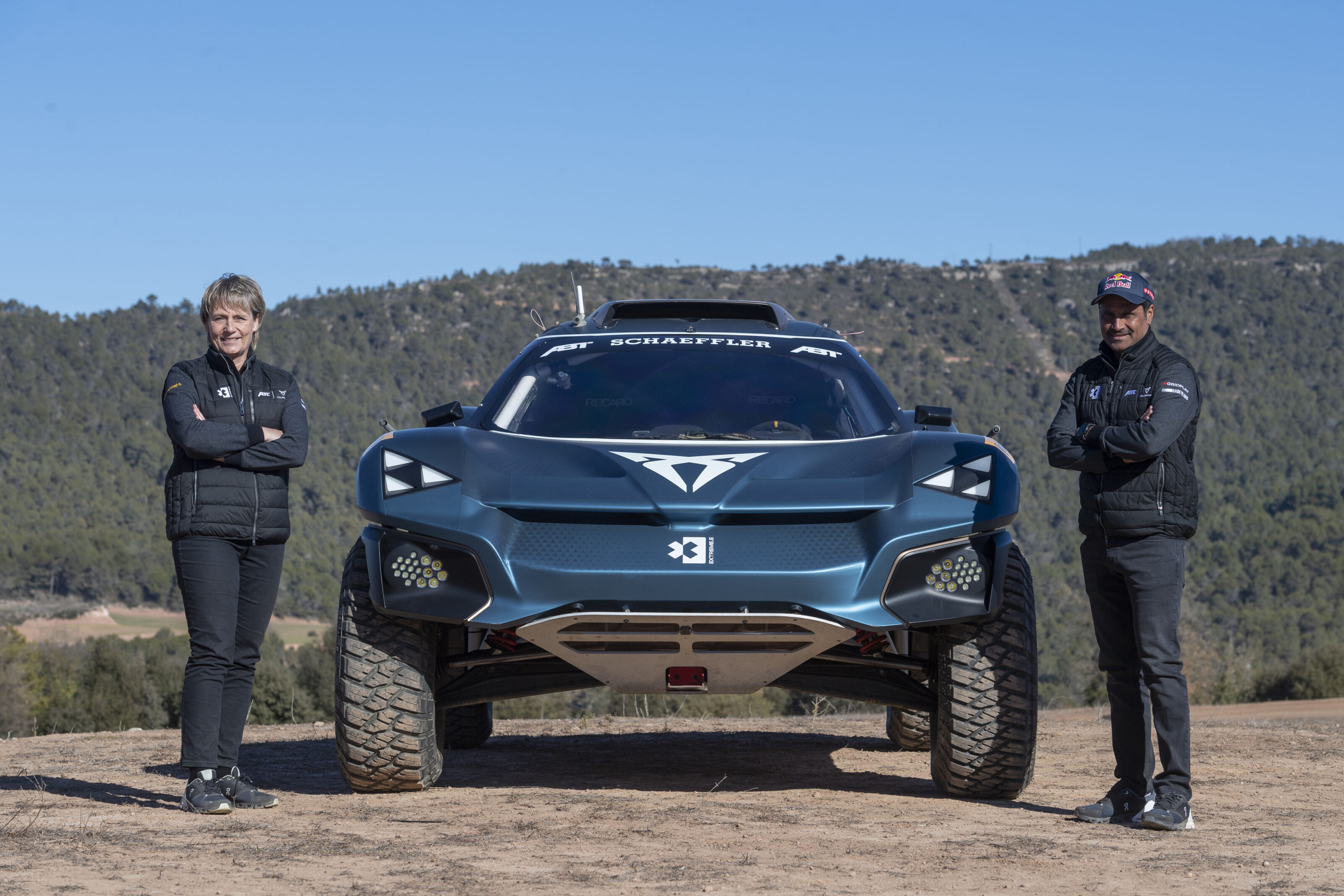
Al-Attiyah clocked his latest Dakar win last month in the works Toyota HiLux and is set to experience the electric rally competition for the first time.
“I am proud to be a part of the team now,” said Al-Attiyah. “Expectations are high: with the experience of ABT Cupra XE and Jutta [Kleinschmidt] by my side, we are determined to race for victories. I can’t wait to sit in the car and have fun.”
Kleinschmidt added that with the experience of Al-Attiyah, the team will be in a better position for a championship victory this season.
“Last year we created a solid basis and fought for front positions. This year the challenge is to be even more consistent in taking wins and trophies, and we are ready for that,” said Kleinschmidt.
“Being able to share my passion for off-road racing with such a great team and now a Dakar star like Nasser [Al-Attiyah] is fantastic motivation. I just want to start the season.”
Last year, Australian racing car driver Molly Taylor claimed victory in the inaugural Extreme E season alongside Swedish team-mate Johan Kristoffersson in Nico Rosberg’s Rosberg X Racing team.
Extreme E events are staged around the globe and are carefully planned to minimise environmental impact, using the same underlying Spark Odyssey electric buggy producing 400kW from a 52kWh battery pack to power to all four wheels. The result is 0-100km/h on a loose surface in around 4 seconds.
Cupra’s 2022 season follows its 2021 entry as the first manufacturer-backed team. The ’22 rally car is the Tavascan XE which previews its upcoming electric SUV. On the road, the brand is launching in Australia this year with its all-electric Cupra Born.
- Introduction: Works a Charm
- Month Two: On The Wrong Foot
- Month Three: Dollars and Sense
- Month Four: Farewell – Mini Big Day Out
Introduction: Works a Charm
Mini JCW lands at MOTOR’s HQ
I’ve come to view Mini as BMW’s Trojan horse, slyly sneaking the notion of front-wheel drive into the hallowed halls of Munich.
Let’s not forget that BMW was once a company so proud of its rear-wheel drive heritage that it produced a series of advertisements that mocked drive going to the front treads. That has changed.
BMW’s 128ti is now a front-drive hot hatch, and a very good one at that. Driving that car had piqued my curiosity. If the 128ti was that good, how would a properly hot Mini hatch stack up as a long term proposition?
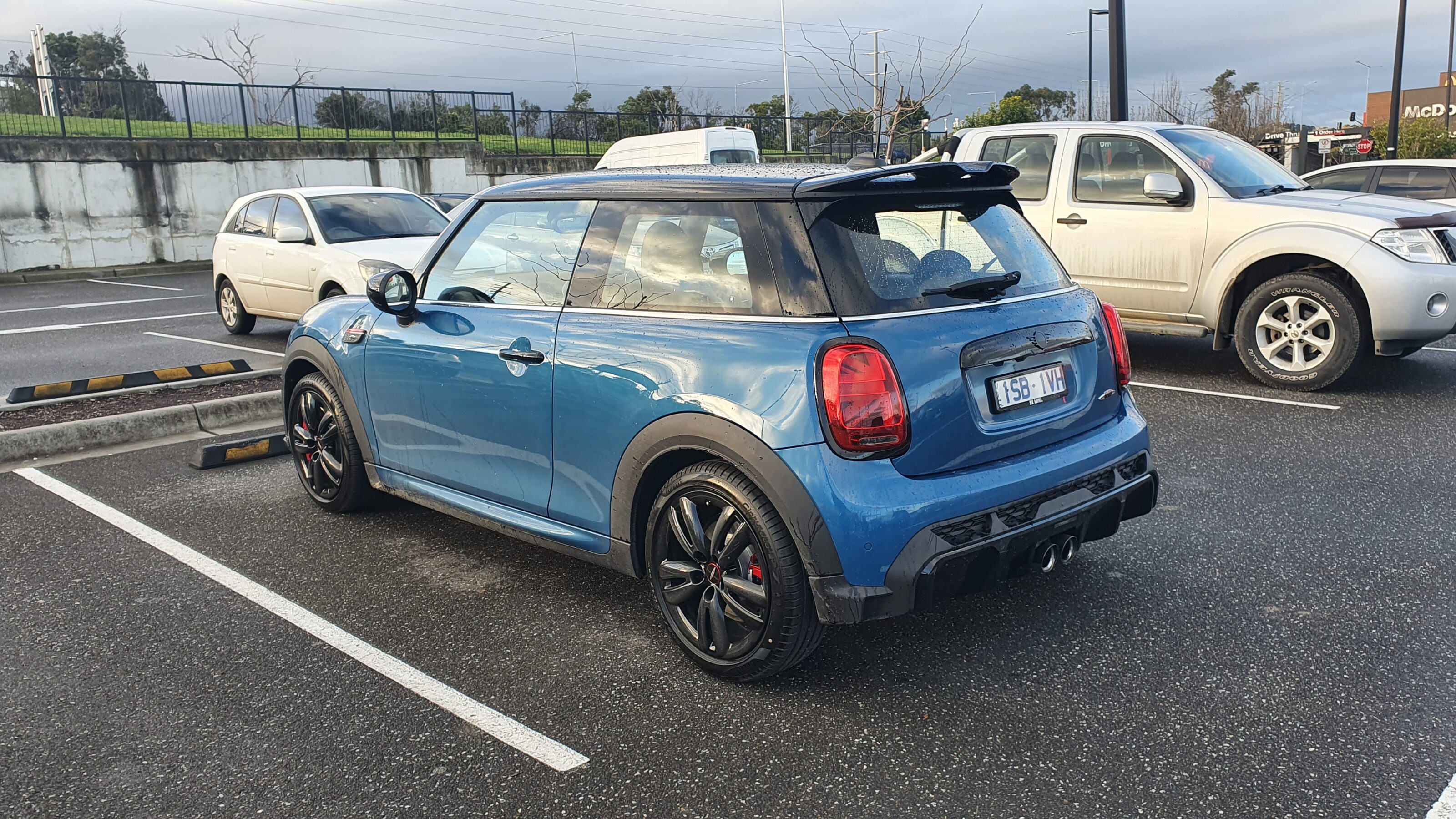
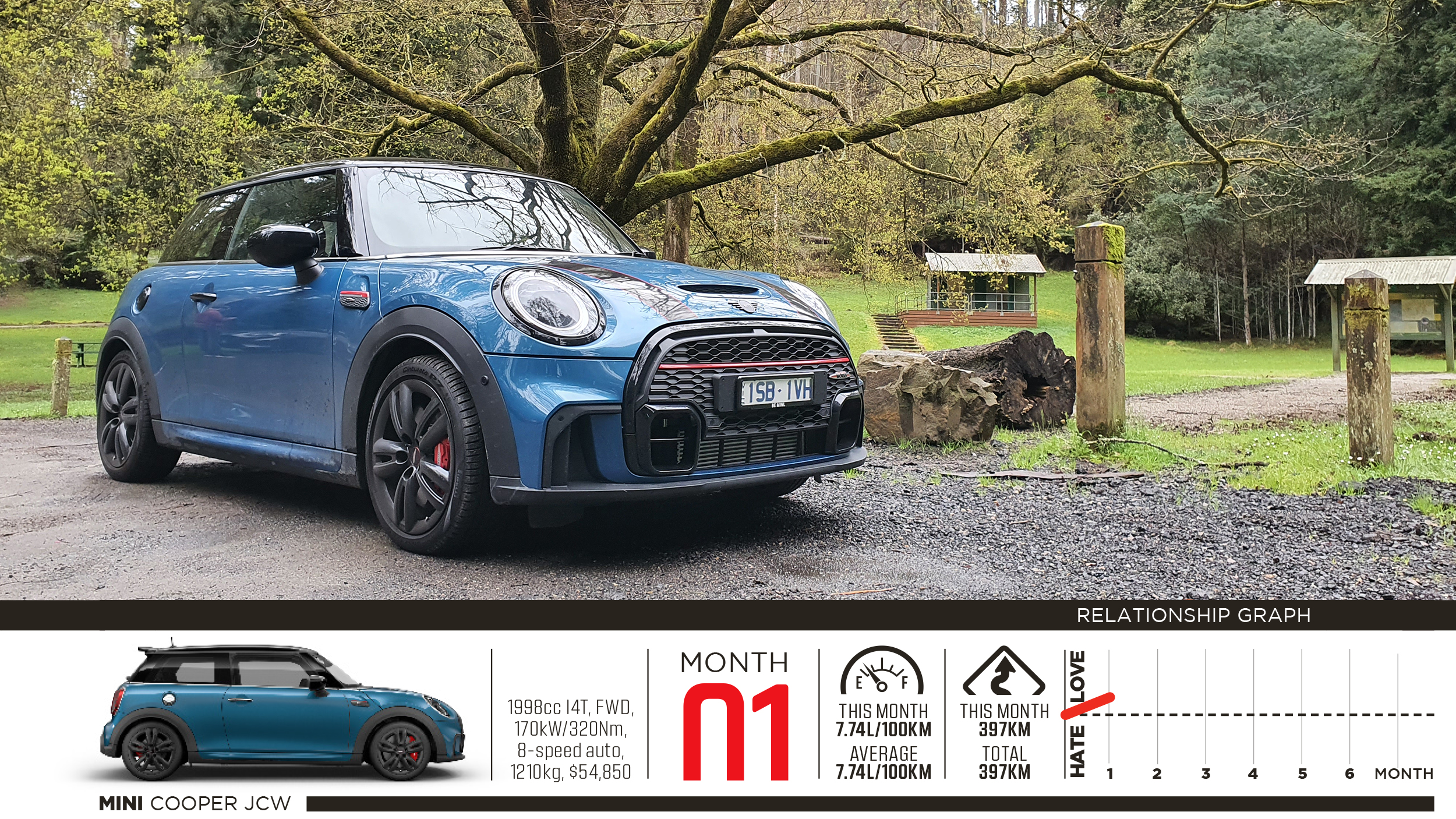
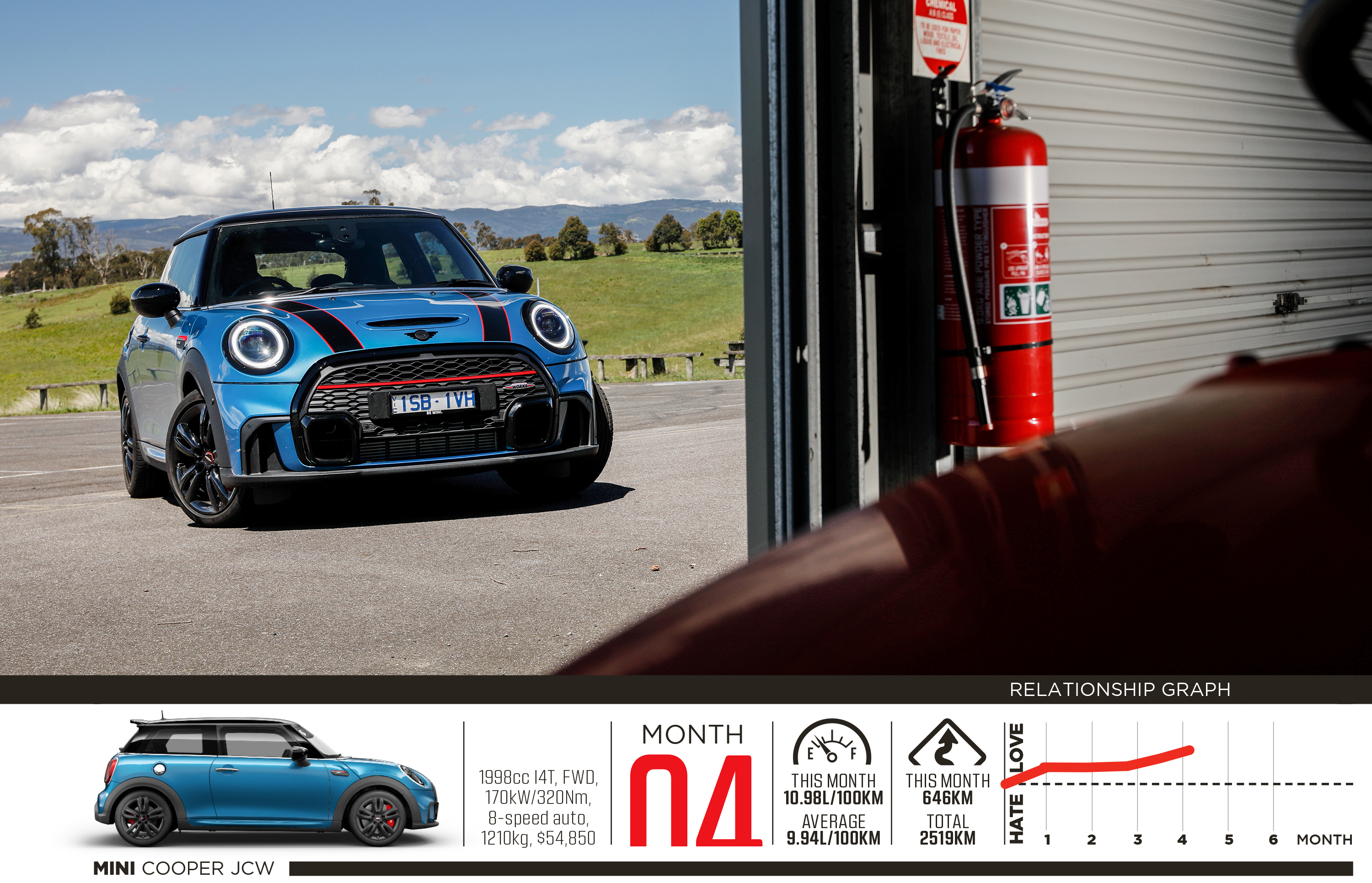
So the latest addition to MOTOR’s garage is an Island Blue JCW hatch, all 170kW and 320Nm of attitude balled up in a stem to stern length of 3872mm. As much as we like to park Minis next to the originals and claim that they’re huge these days, it’s worth noting that this three-door is still nearly 200mm shorter than a Ford Fiesta ST. It’s dinky.
Climb inside and you’re greeted with the usual Mini dinner plate fascia, metallic toggle switches and steering wheel with a rim so chunky it feels like you’re trying to strangle Craig Kelly. For a car that sails comfortably north of $50k, it’s quite surprising to find no electric seat adjustment, but I’d happily go without that for a seat which hunkers down good and low, which is exactly what the JCW offers.
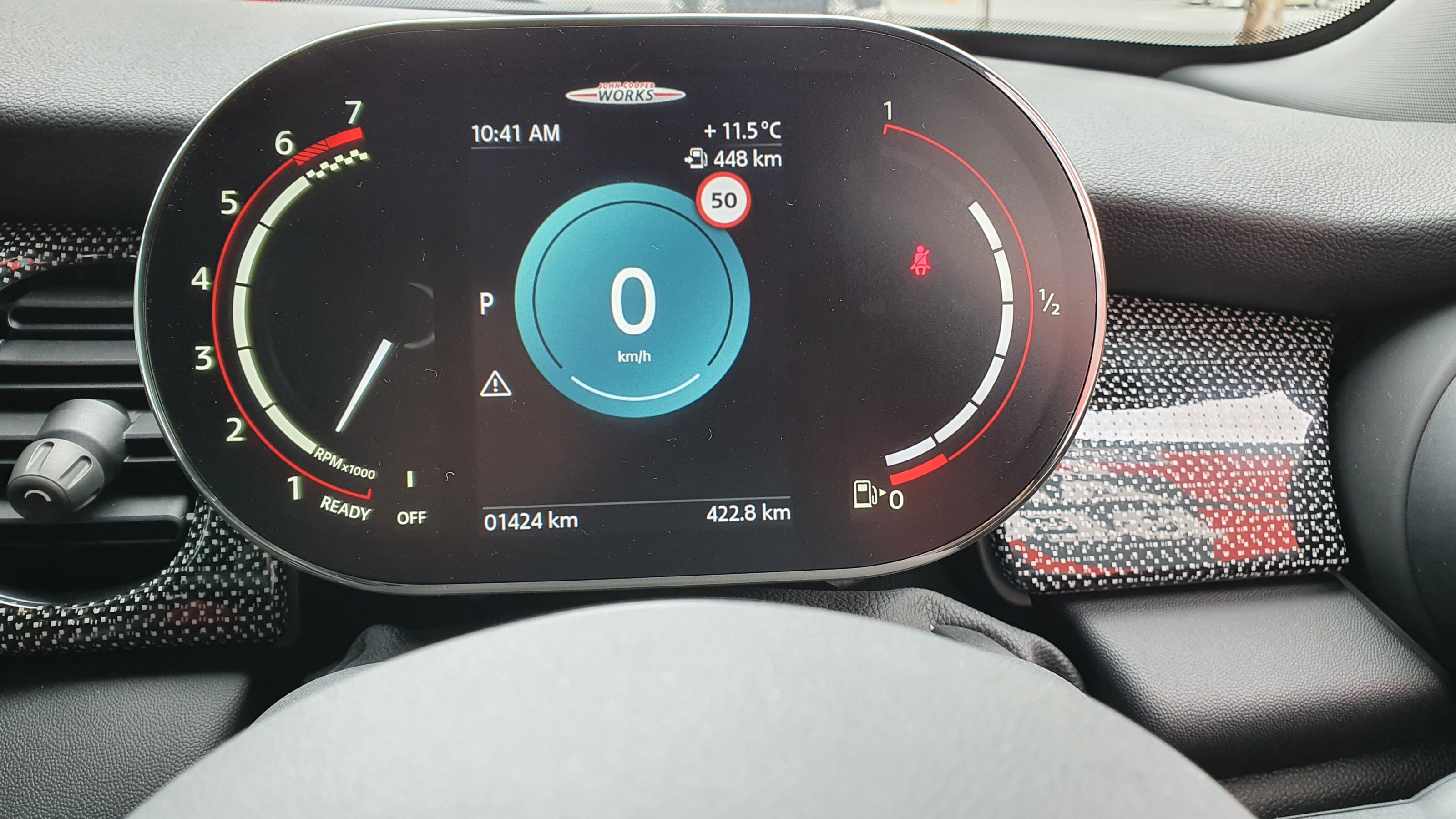
What I’m not so delighted about is no mirroring for an Android phone. Come on, Mini! As I write this 72.2 per cent of world smartphone users choose the ’droid with only 27 per cent opting for an Apple. I just don’t buy the line that BMW – and indeed Porsche – has trotted out in the past that target customers are typically Apple users. This situation will change, with Mini products introducing Android compatibility, which is ‘coming soon’ although no specific dates have been released.
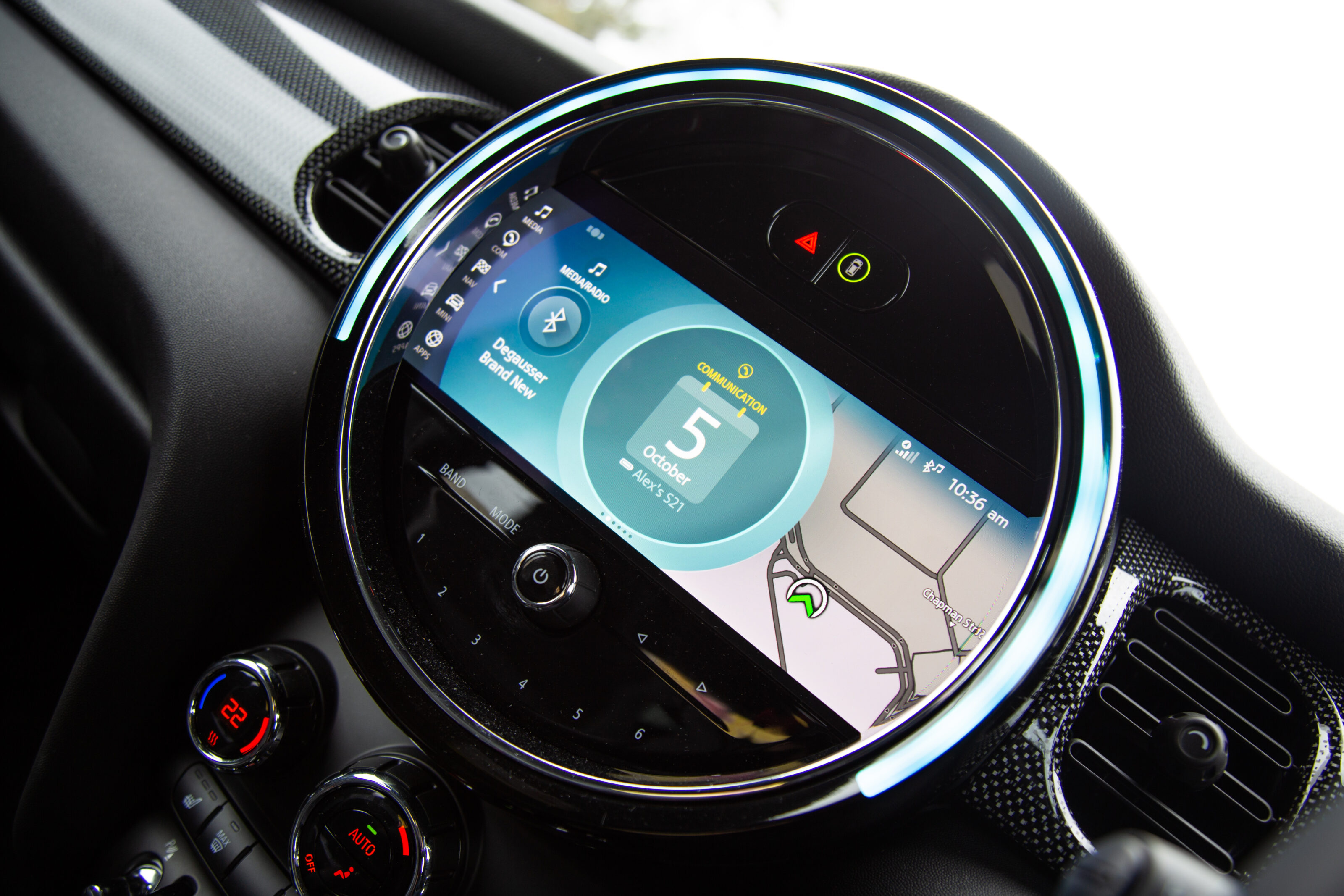
So, for the time being, you may have to interact with Mini’s proprietary widget-based infotainment system rather than Android Auto which, as ecosystems go, is fairly easy to get to grips with. Elsewhere, a new steering wheel looks slick, with a digital binnacle that moves with it when you adjust it for height, but the flush buttons on the wheel spokes are easy to touch with the heel of your hand, especially the volume up button on the right-hand spoke.
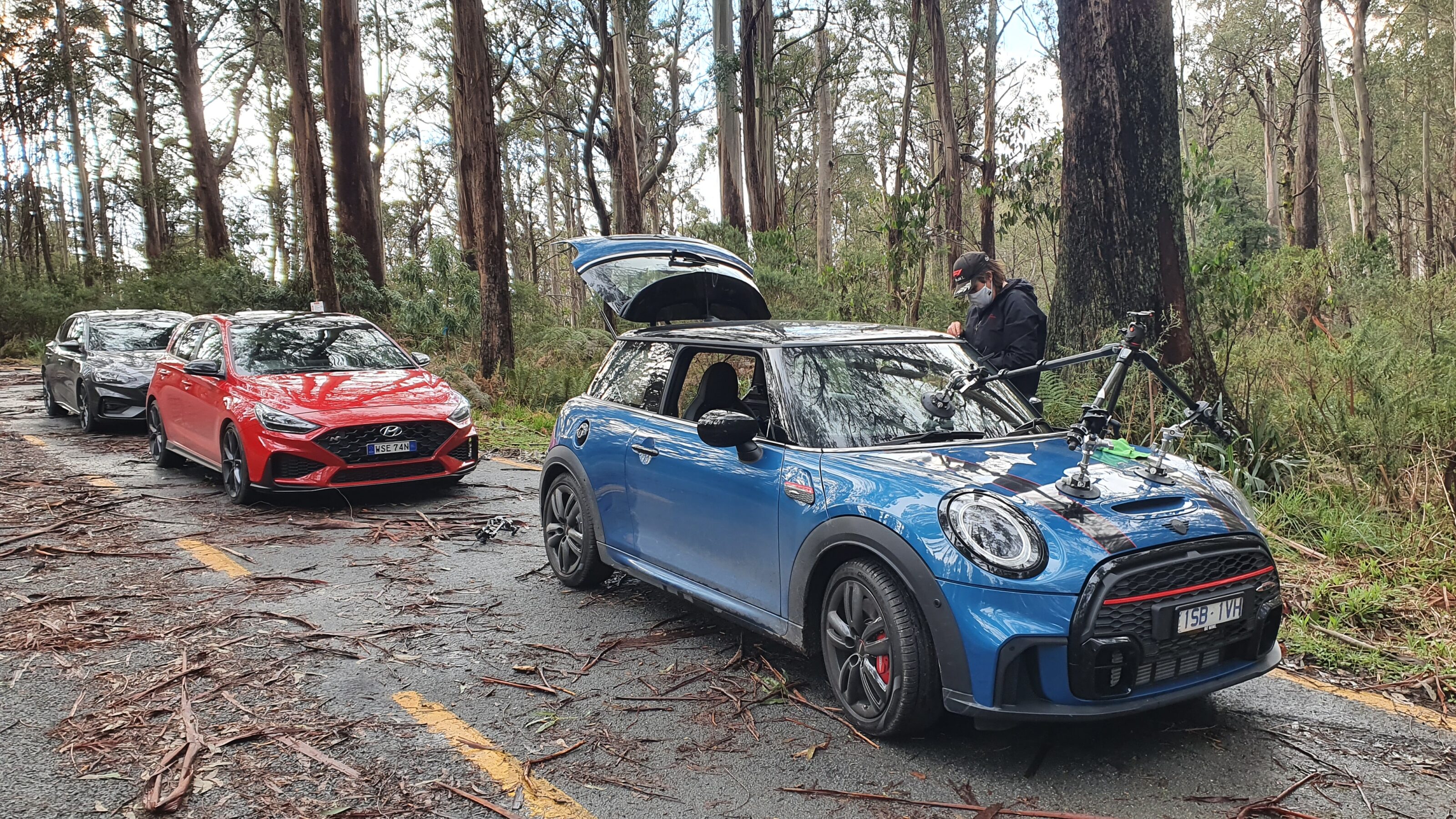
Having taken delivery of the car in one of Melbourne’s lockdown periods, it hasn’t clocked up that many kilometres. It’s largely been used for running to the shops for essential supplies with just the odd thrap up and down the back roads on the way to exercising. I’m only a temporary guardian and I’ll leave it to its eventual custodian to talk further about living with the way the car drives from next month.
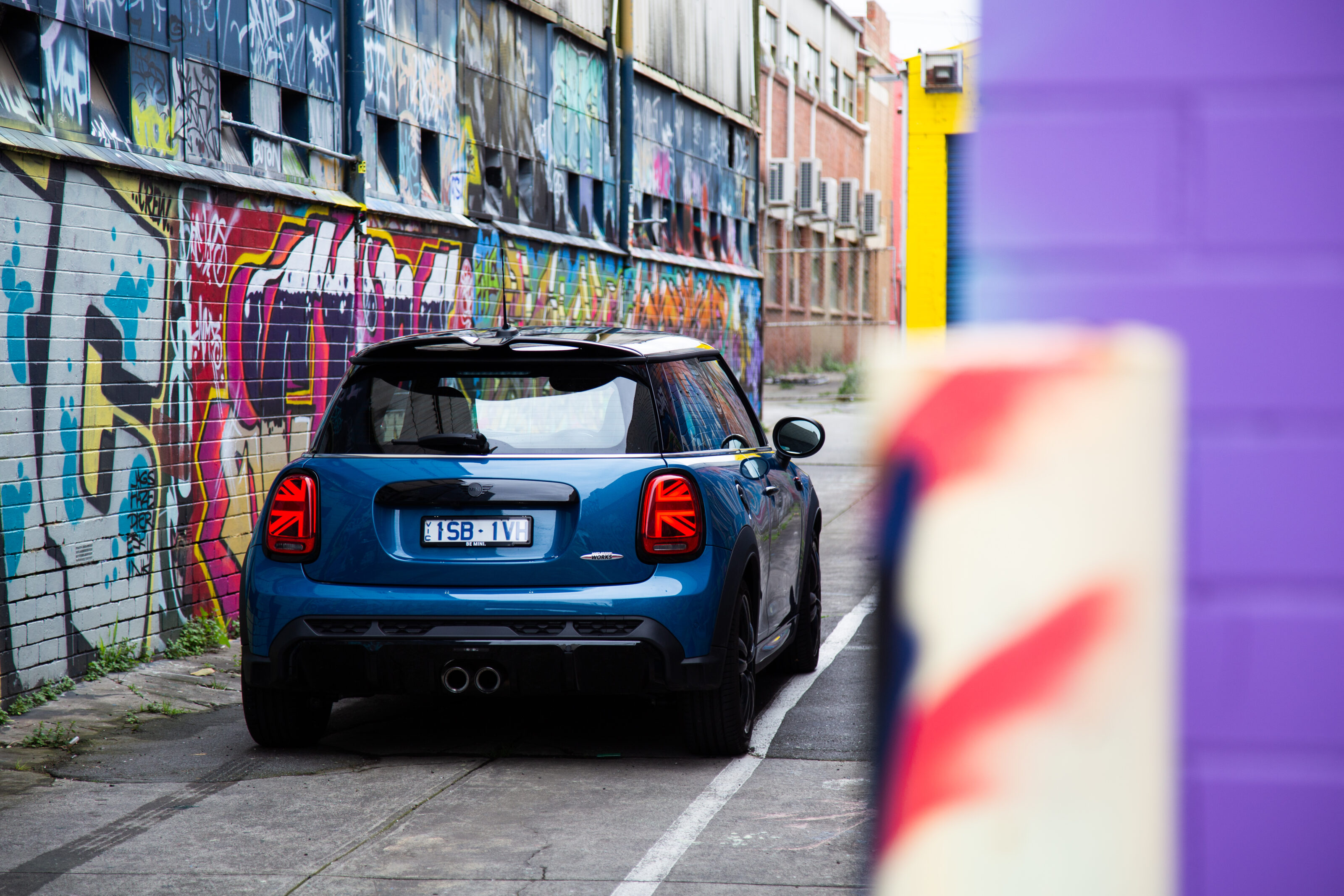
The styling has been updated for this year, and it draws a surprising amount of admiring glances. The rear is particularly distinctive with its Union Jack rear lights and the new jutting rear bumper assembly with a diffuser that’s about as functional as a Theranos minilab. Yes, the JCW is expensive for a vehicle of this size, but it’s one of those cars that is so densely packed with interesting design that it feels as if it can wear that price without appearing self-conscious. If the market will bear the price tag – and I’m guessing it will – then buyers perceive value here.
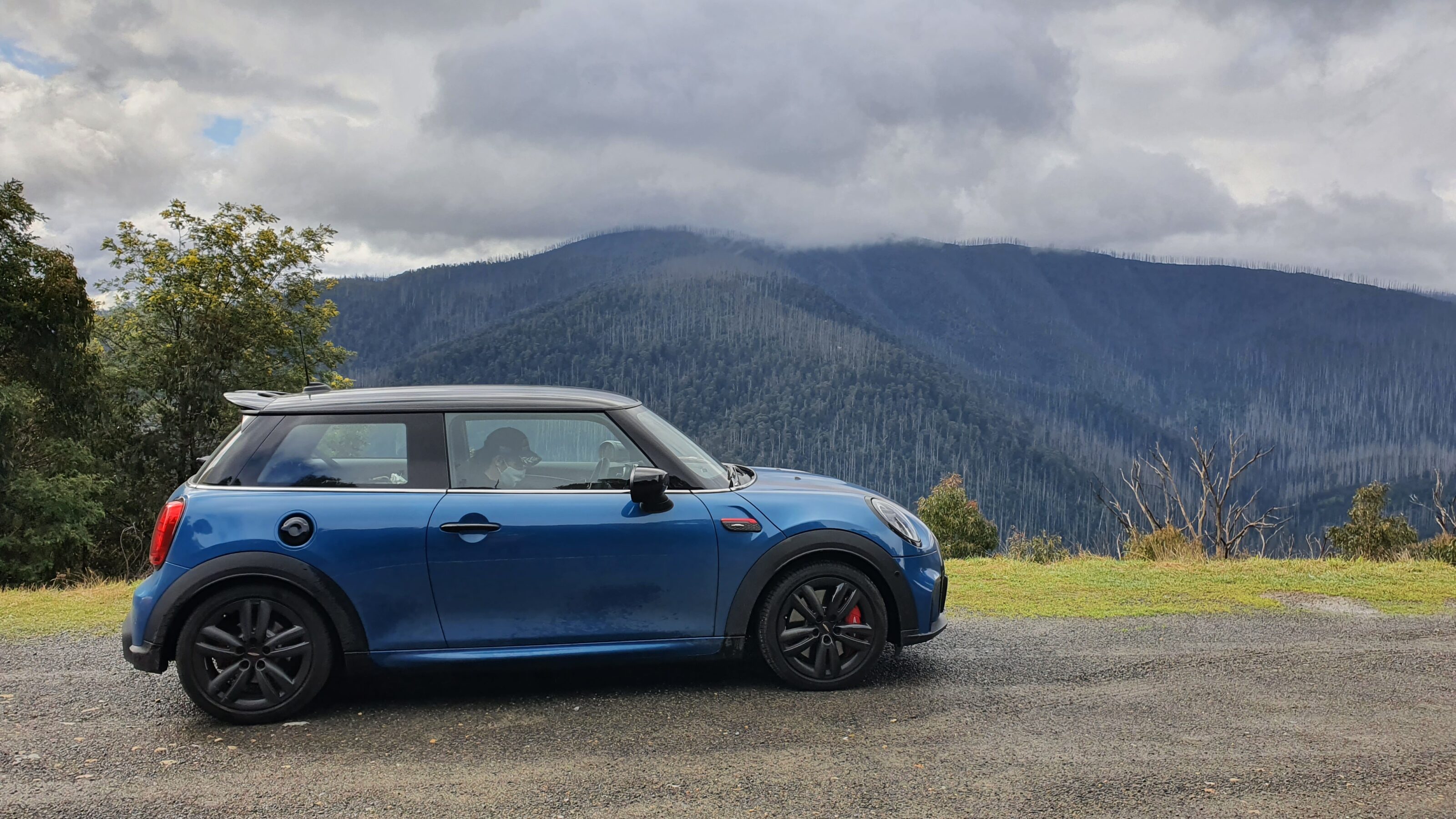
Lockdown might have scuppered a big drive in the car but that’ll come. Smartphone mirroring aside, the Mini Cooper JCW has created a punchy first impression. Now to see whether it has the substance to keep us entertained. – AE
Things we love:
- Surprise ‘n delight
- Hits hard
- Raises a grin
- Price tag
- Chubby wheel
- No Android Auto
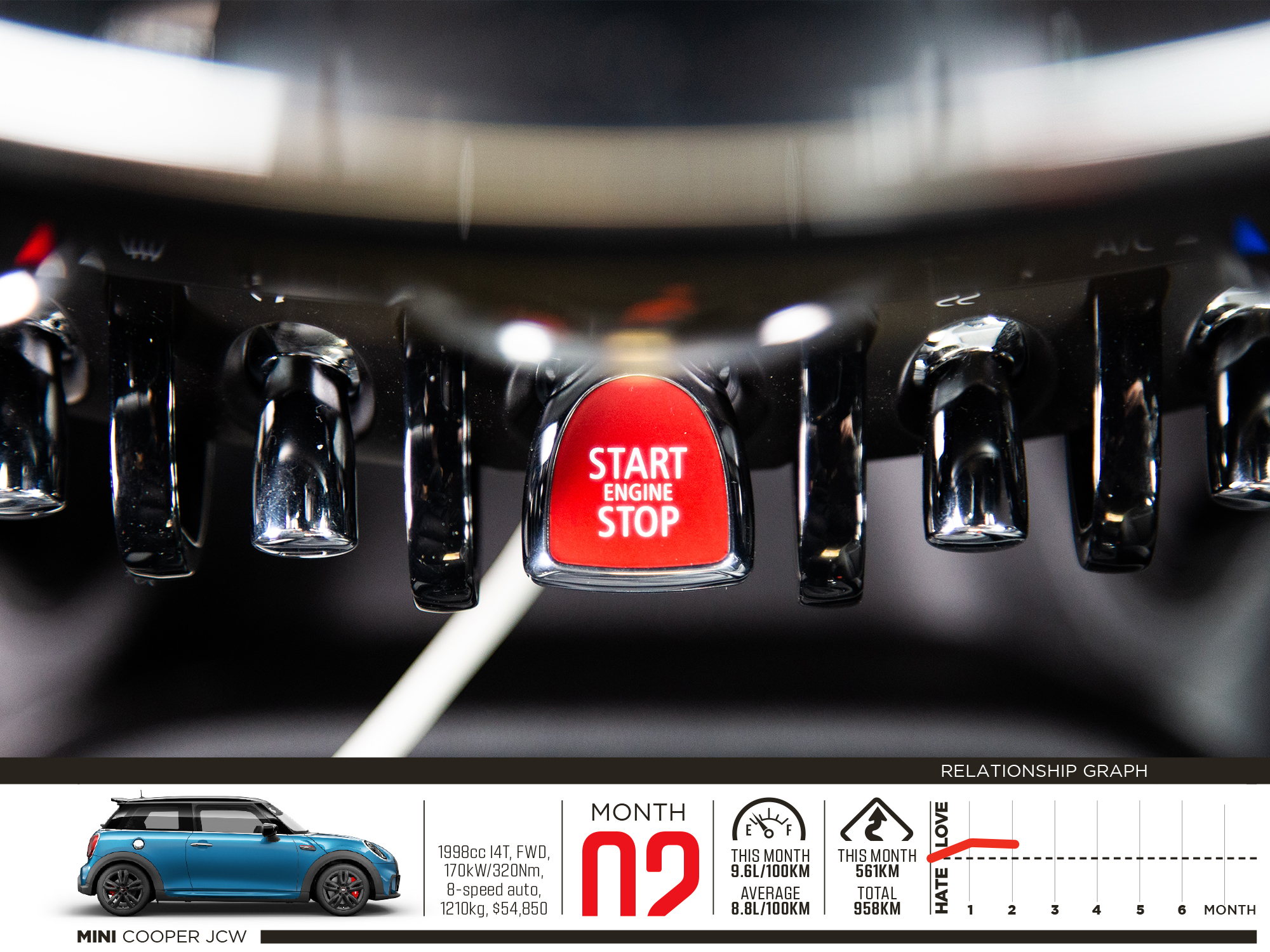
Month Two: On The Wrong Foot
Stylish icon has a painful sharp edge, due to user error
As MOTOR’s native state of Victoria slowly begins on its path out of the world’s longest lockdown, it’s natural for many of us, starting to emerge back out into the world, to be a little out of practice in the social department. How many of you, however, have ever fumbled that first ‘handshake’ with a car?
If you recall last month’s update, Editor Enright was the kind custodian of ‘my’ Mini which, due to Melbourne’s more stringent restrictions at the time, arrived at my doorstep some weeks ago.
It was kindly chaperoned by photographer Alastair Brook who selfishly still required a lift home. I opted for the passenger seat, taking the opportunity for a quick prod around the cabin. Dashtop? Soft-touch plastic. Two central cupholders, none in the door.
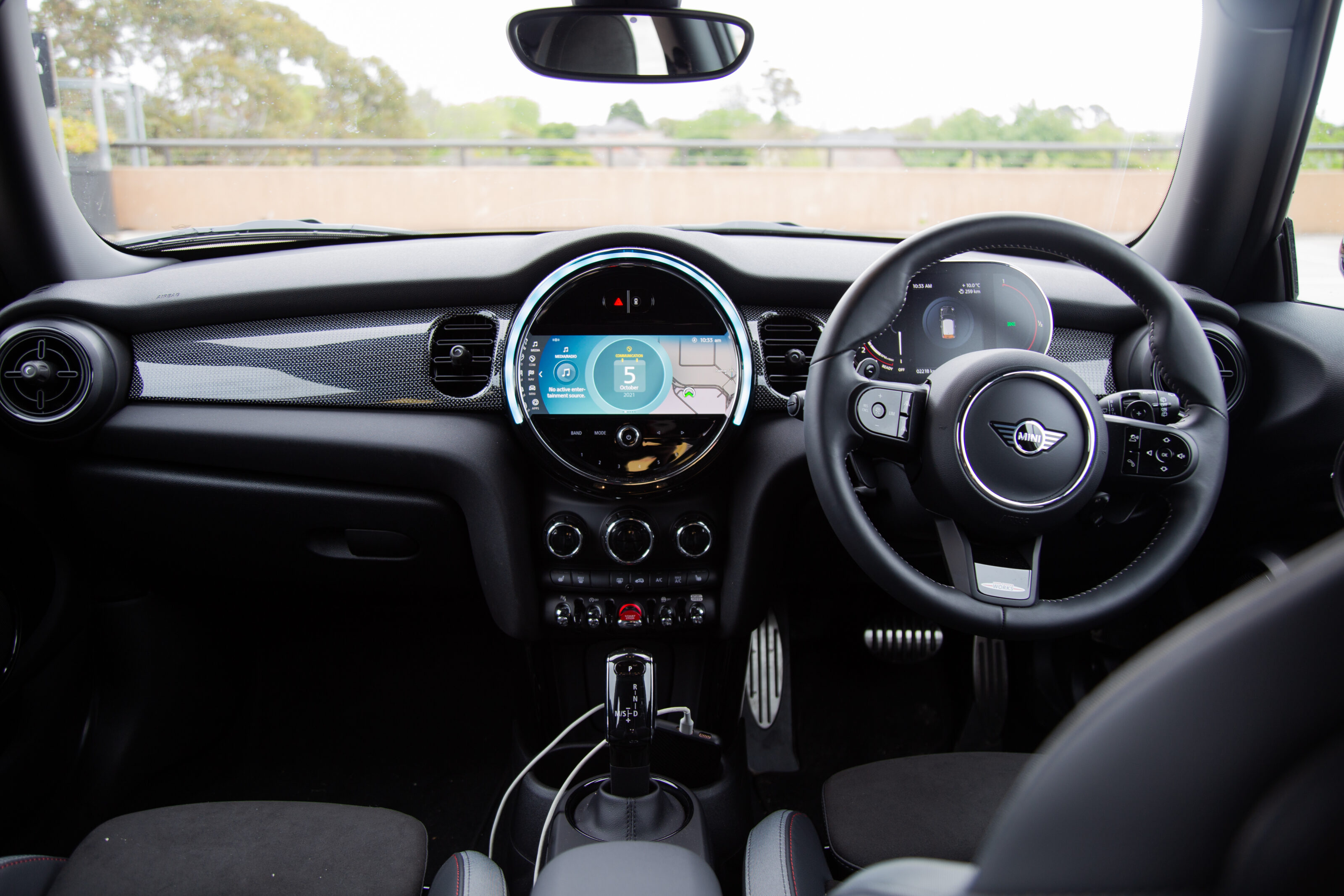
“I don’t think it has Apple CarPlay” says Alastair, as if to justify the presence of the car’s native infotainment screen.
According to the spec sheet, it does, but as I don’t have an iPhone – I can’t confirm. A YouTube tutorial, however, suggests there is a checkbox you must tick when you first pair your phone to enable the function. As Andy confirmed last month, us Android users are flat out of luck in the smartphone mirroring department. Which isn’t fun.
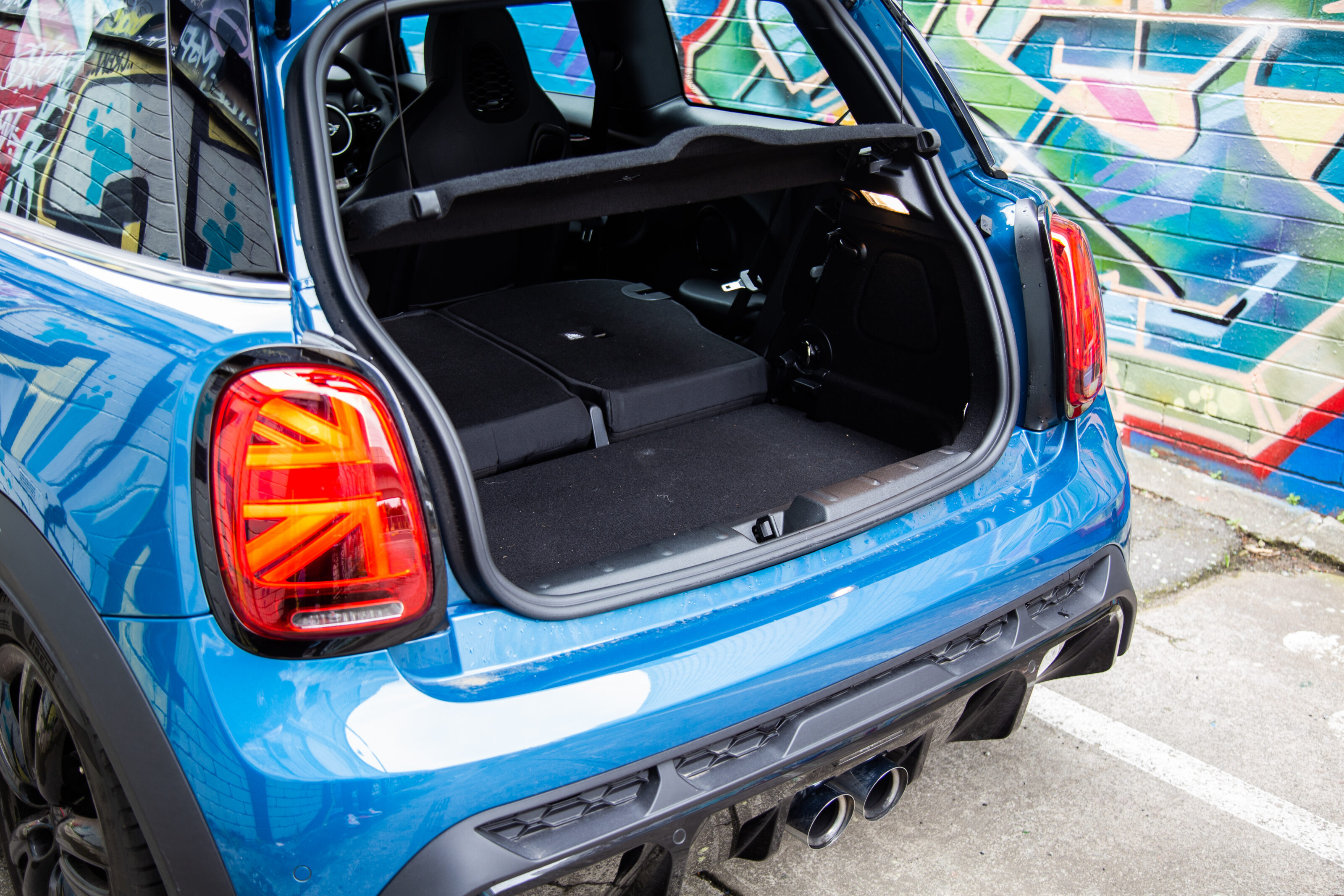
Upon arrival at Alastair’s abode, I helped him unload his various camera cases and equipment from the rear of the Mini. Peering into the now-empty 731-litres of cargo space, I opted to leave the rear seats down. I figured that since it’s a three-door Mini, and my domestic household consists of just myself, my girlfriend Mel and a small dog, permanent panel van mode is, at that point, one of the Mini’s leading attractions for me.
Having bid farewell to our photographer extraordinaire, key in hand, I turned back to the Mini and headed for the driver’s door. Here comes that handshake.
The Mini was parked next to a rather high kerb, forcing me to ‘step down’ one-legged into the cabin. In a moment of clumsiness and, in my defence, unfamiliarity with the car, I had unknowingly put my head on a collision course with the unexpectedly sharp corner of the side window.
Direct hit. Right in the ear hole. I fell into the seat, stunned that I’d fallen victim to what I thought must’ve been the only pointed corner on the whole car.
I’m happy to report that my time with the Mini JCW since has been nothing but pleasant, and I’ve found plenty more attractions since then.
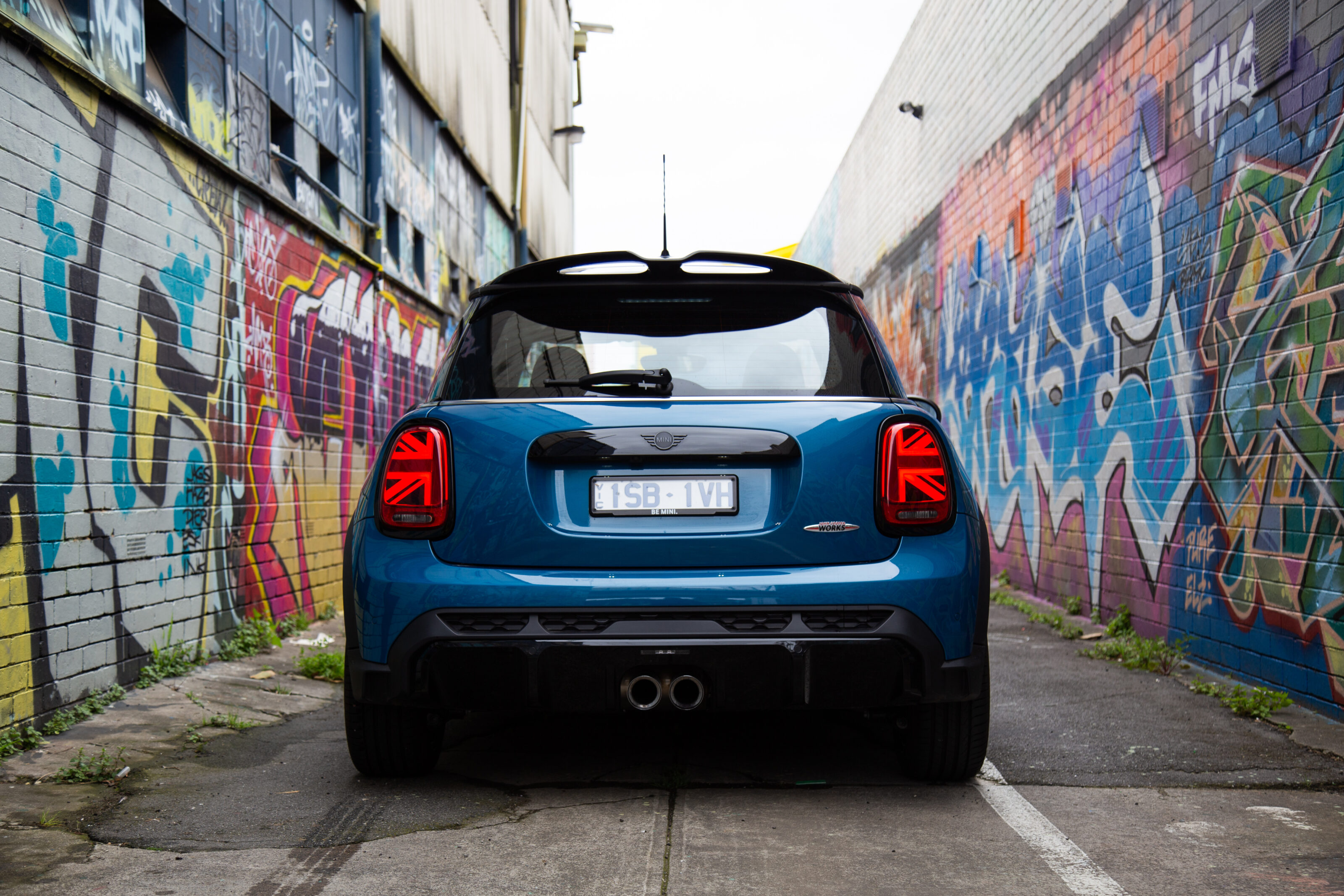
It’s nailing the X-factor section of the ownership experience, delivering a big visual impact thanks to its Island Blue hue, red highlights and various sporty black elements. There are plenty of details to soak in, from its chunky rear diffuser and central exit exhausts, to its rounded wheel spokes harking back to the 1960s-era Minilites.
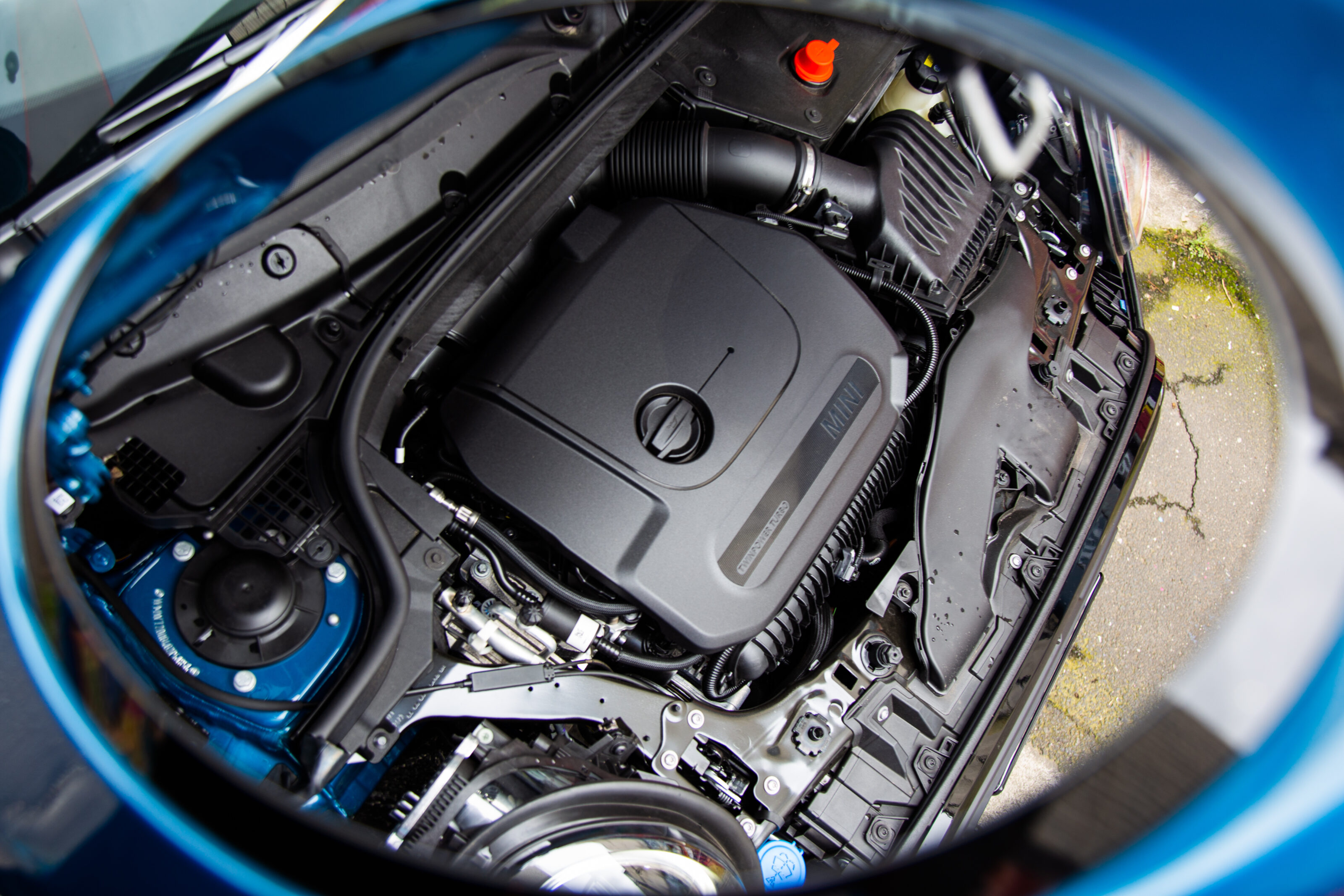
The rorty 2.0-litre turbocharged four-cylinder contributes much to the JCW’s pugnacious character. The BMW-sourced B48 belongs to the same modular family as the lovely B58 3.0-litre inline-six, and delivers 170kW along with a smile-inducing buzzing exhaust note that gets noticeably louder from 3000rpm. The twin-scroll turbocharger is quick to spool with an audible induction noise, and the exhaust delivers the slightest ‘blat’ on upshift near redline. I wish there was a little more aural payoff on overrun or on gear change, some pops and bangs certainly wouldn’t feel out of character, but some may prefer its honesty.
Thus far, driving has largely been limited to urban areas near home, but the hot Mini is making the most menial of errands and essential grocery trips feel like an occasion. Living on a major highway, the Mini is proving huge fun in zipping around my restricted radius.
BMW claims 6.1-seconds from 0-100km/h, and while we can’t yet attest to its validity (watch this space), it certainly feels as quick. Even more impressive is the mid-range response, with an effortlessly rapid lunge from 60-80km/h.
The steering has an inherent and welcome weight to it at low speeds, but it doesn’t ‘load up’ with pace and feels light at speed – at least in the default driving mode. It subsequently feels a little vague at highway pace and, on faster sweeping bends, I’ve noticed it wandering within the lane, requiring correction. Some more seat-time is needed, I think. A trip to the hills is high on the agenda, and the Mini feels eager to oblige. – AA
Things we love:
- Looks cool
- Makes you grin
- Sound on upshift
- Sharp windows
- Basic cabin
- Sound on downshift
Month Three: Dollars and Sense
JCW has character but the numbers struggle to add up
My girlfriend is not a car person. Where you or I might judge a car based on its power outputs, or the way it feels to drive, my better half simply judges cars on their cuteness.
I had kept the Mini’s impending arrival secret, knowing that a new Mini Cooper has always been her ‘dream car’. Needless to say, when the friendly face of the 2021 JCW Mini arrived home with me last month, she was ecstatic.
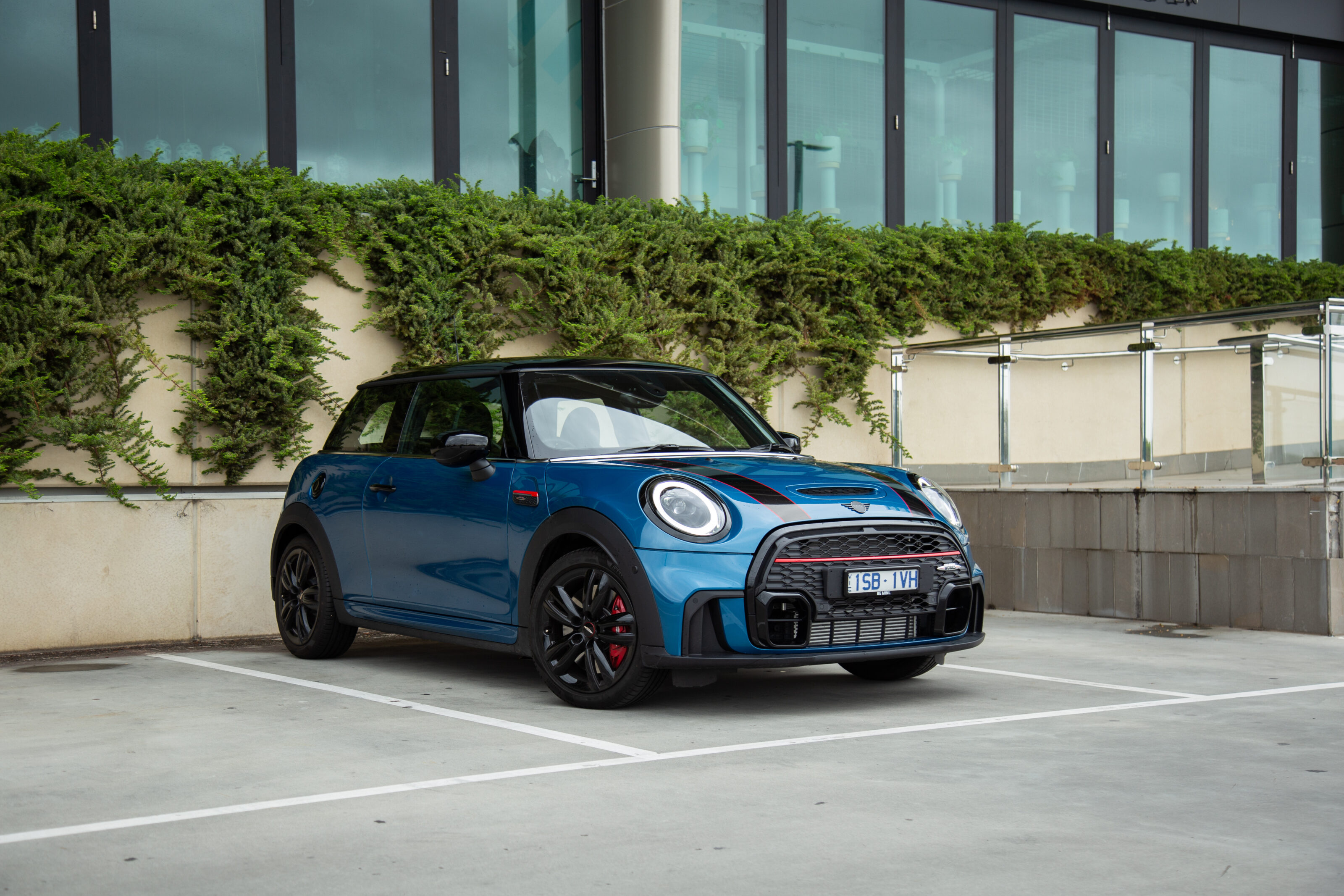
She, for one, loves the quirkiness of its design; namely its big eyes, and Union Jack tail lights. She’s less taken, however, with the firm ride and the lazy gearbox calibration that is slow to react, delivering a harsh kickdown and soaring revs when you squeeze on the throttle in Normal Mode.
With a few short drives to the shops under her belt, she too has keyed in to the Mini’s weird steering which is heavy and precise at low speeds, but growing somewhat vague and light at speed. Doughy on-centre steering at highway pace sees the Mini gently swaying within its lane, rarely tracking straight and seemingly requiring constant fine corrections which can be wearing.
It seems the lustre is beginning to wane on my partner’s lofty expectations of Mini living. And that speaks to a crucial question that’s been ruminating in the back of my mind ever since taking custody of the JCW Hatch: who is it for?
Its positioning, especially in pared-back ‘Essential’ trim, implies that the Island Blue bomber is reserved for the keenest of drivers. It eschews premium touches like the Harmon Kardon stereo, adaptive dampers and HUD, and opts for the go-fast necessities like fixed-rate dampers and big brakes with four-piston Brembo calipers.
There’s one crucial issue, however, and that’s on the account that cars like the Hyundai i30 N exist. Newer rivals, with fresh bones, bigger muscles, and the athleticism to leave the characterful Mini for dead, are all readily available for a lower buy-in.
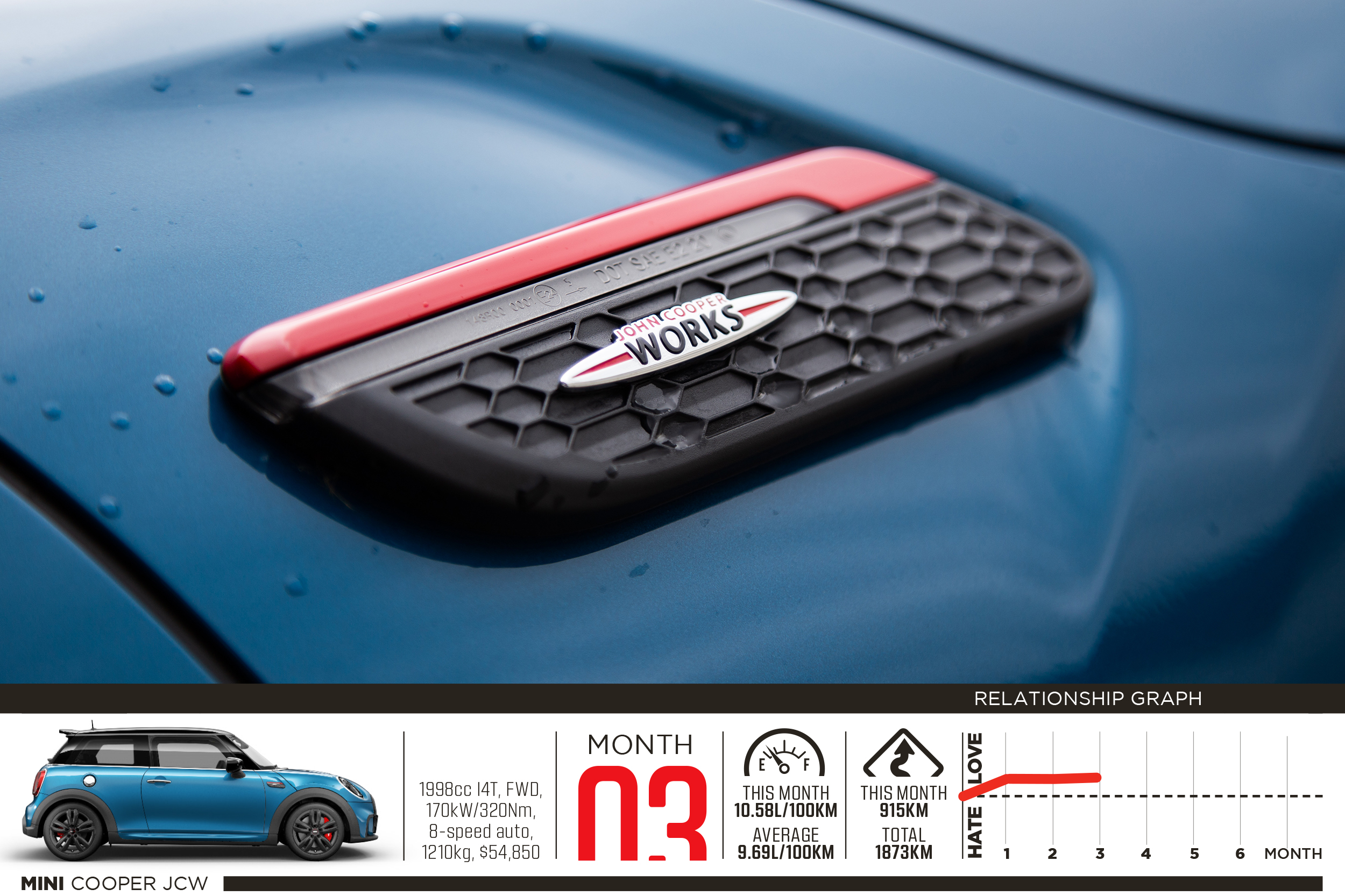
As tested, the JCW Mini ‘Essential’ comes in at $54,850, but opt for fully-loaded JCW Mini ‘Yours’ and you’re looking at a sticker price of $62,350. That can be hard to reconcile when compared to a flagship i30 N Premium DCT that comes in at $52,000.
Perhaps there is another way. Trent Guinco had recently spent some time in a new Mini variant, the Cooper S JCW Sport, and we took the opportunity to swap over temporarily. It looks virtually identical to the full-fat JCW but differs in a number of key areas.
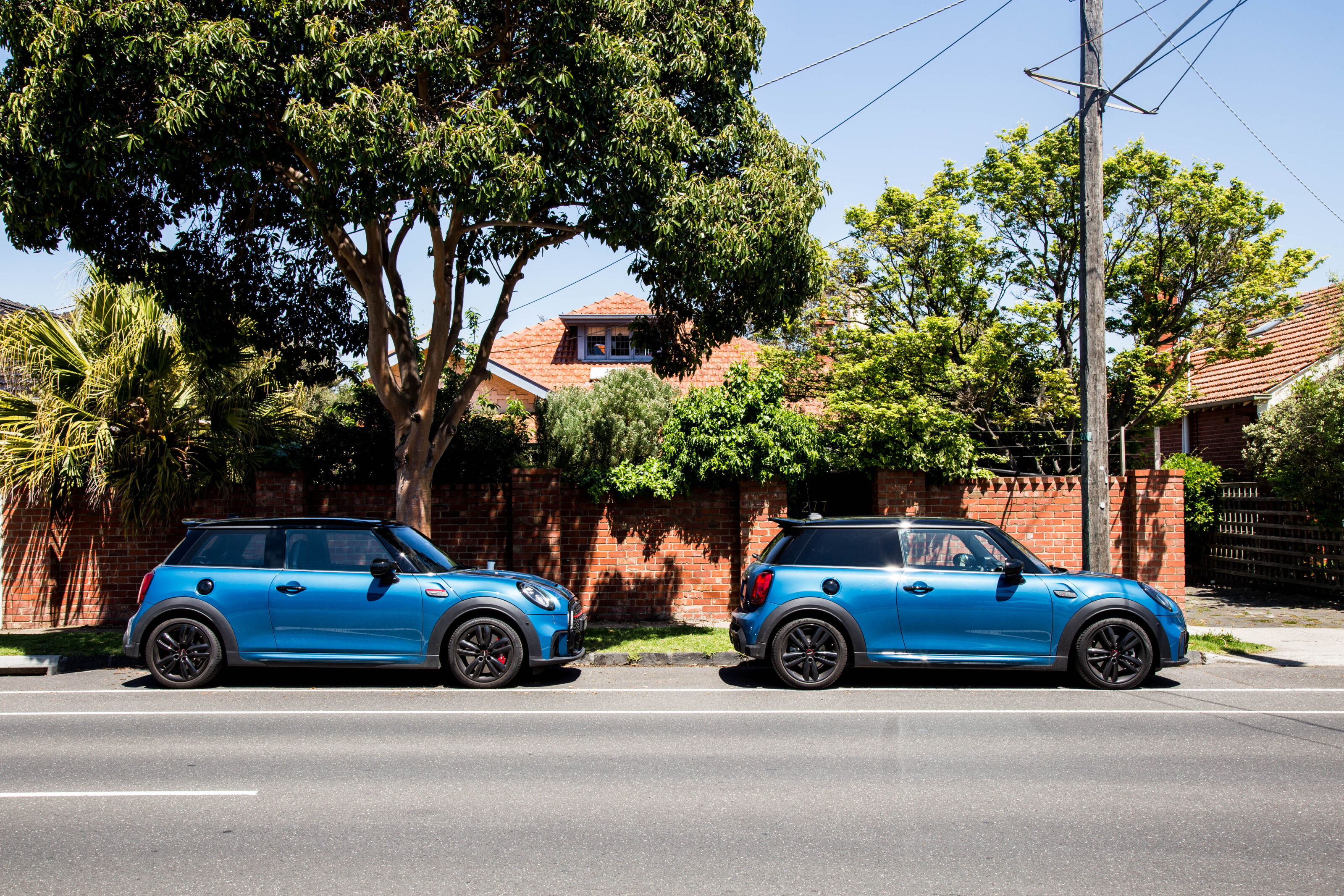
The crux is it’s essentially a Cooper S dressed up as a JCW. Gone are the big brakes, JCW-specific turbocharger and exhaust, and there’s a seven-speed dual-clutch mounted in place of the JCW’s eight-speed torque-converter automatic.
Trent and I hypothesized that perhaps there’s a torque limit to the twin-pack gearbox, as the Cooper S JCW Sport yields a 29kW/40Nm disadvantage to the full John Cooper Works’ outputs.
It’s a noticeably slower car from the traffic lights, with a quoted 0-100km/h of 6.7-seconds (as opposed to the JCW’s 6.1), but its standard-fit adaptive dampers, 12-speaker Harman Kardon stereo, adaptive headlights, HUD and sunroof do much to quell the true JCW’s day-to-day foibles.
Had the Cooper S JCW Sport offered a decent saving over our JCW Essential, I might have thought it to be a more compelling package, but there is negligible price difference between the two, the Cooper S JCW Sport costing $53,200. Which brings us back to the original question: who is it for?
The keenest of Sunday drivers may likely shop elsewhere but there are many people out there for whom the Mini is simply an aspirational purchase. BMW knows that there are plenty of buyers who will deem the design language, and sheer force of character more than enough to justify its asking price.
Put it this way: picture your dream car and imagine the pricetag it bears. Six-figures? Maybe seven? With the Mini, BMW has created a ‘dream car’, in almost any flavour you like, that costs less than $60,000. Whether it’s yours or not, that’s something to admire. – AA
Things we love:
- Character
- Wastegate noise
- Gutsy engine
- Fixed-rate dampers
- Harsh kickdown
- Pricey
Month Four: Farewell – Mini Big Day Out
JCW Mini is sent off on a high with a trip to Haunted Hills
Don’t look down, I tell myself, as the JCW Mini tops the crest marking the start/finish line at the Haunted Hills hillclimb track. Beginning the descent, I keep off throttle as the first off-camber left-hander looms into view through the windshield.
I’m not here to set a lap time. Instead, I’m simply noodling about to create some B-roll footage and photography for our crew littered around the track. They call for some sense of dynamism though, and with a few laps under my belt, I’m beginning to press on.
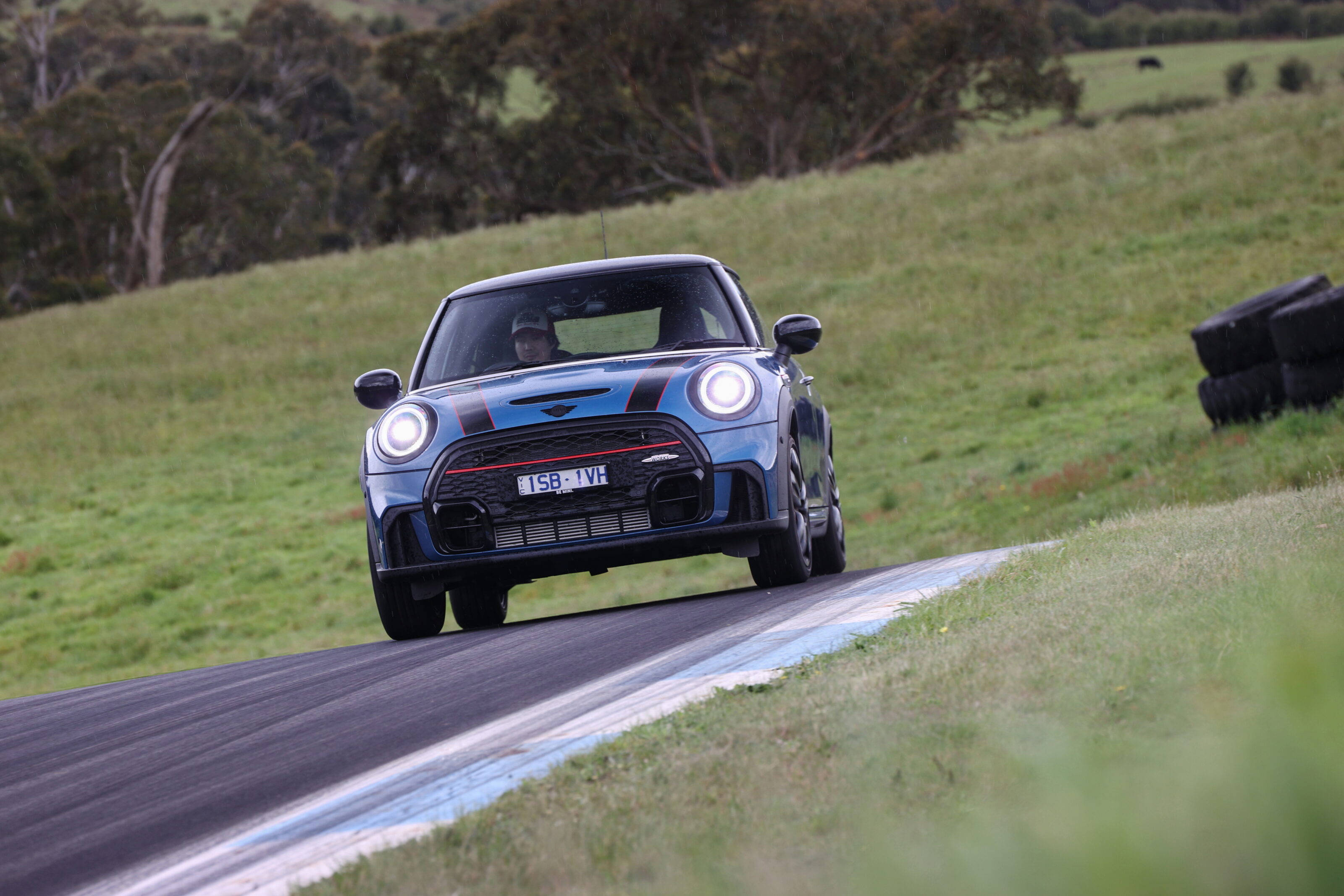
The front driver’s side wheel digs into the tarmac as inertia tips forward under ginger braking, and its 1210kgs of mass shifts to my side of the roll centre. For many, this corner commands caution. Haunted Hills isn’t a particularly difficult track, but the steep elevation, courtesy of Gippsland’s rolling greens, means that even a small off can carry very real consequences.
I feel the rear end get light. My knuckles tighten, hairs stand up and perspiration starts to bead my face as, for a moment, I’m second guessing as to whether I’ve scrubbed off enough speed. A moment later, the car settles firmly on its four wheels as the track angles right again, continuing its sinuous descent.
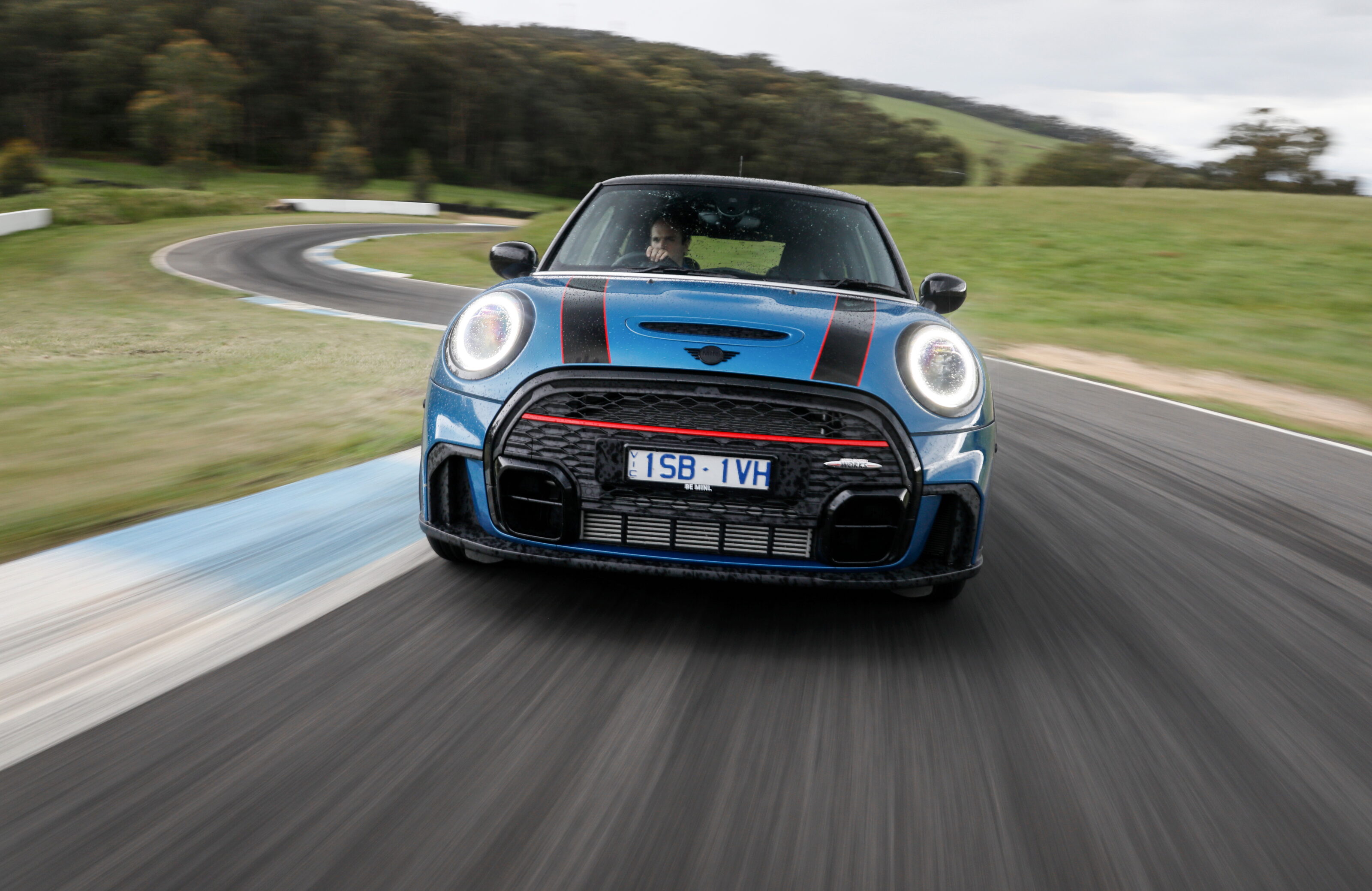
Head to MOTOR’s YouTube channel for a full JCW Mini track review, but for now, and carrying on from last month’s update, I can tell you that the JCW Mini isn’t an outright track car.
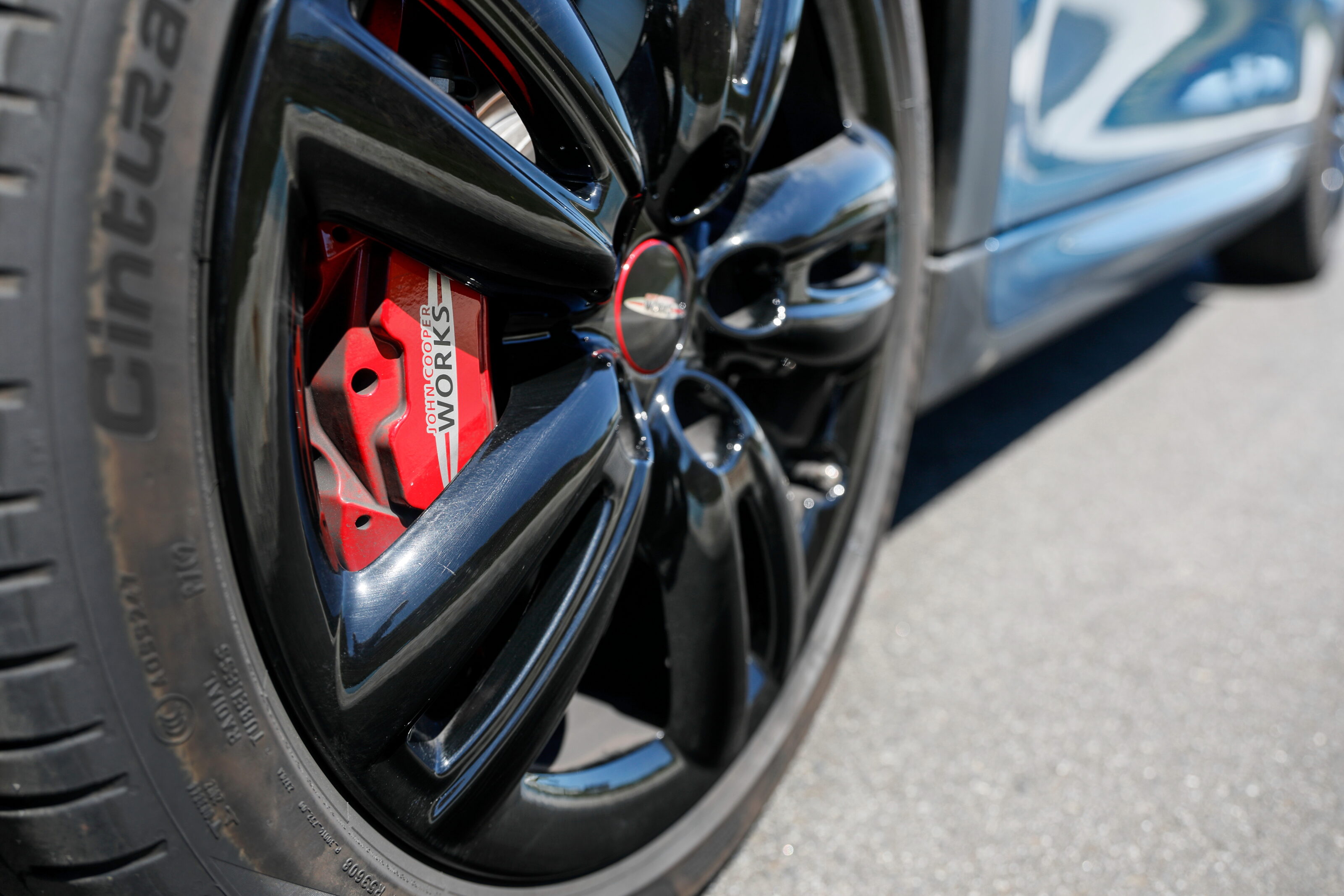
A strong understeer bias shines through, not helped a great deal by the Mini’s lacklustre Pirelli Cinturato P7 tyres. The square-set 205/45/17 runflat tyres are marketed as Pirelli’s first ‘Green Performance’ tyre (make of that what you will), and the front end is quickly overcome with the busy task of simultaneously managing drive, steering and braking departments.
There are dynamic gems if you go looking for them, however. You learn to drive through the understeer, predicting the scrub to the apex. Letting momentum carry you along the racing line to the correct side of the track, you simply wind off lock as speed is scrubbed and traction returns, squeezing on the power as the front contact patches signal that they’re ready.
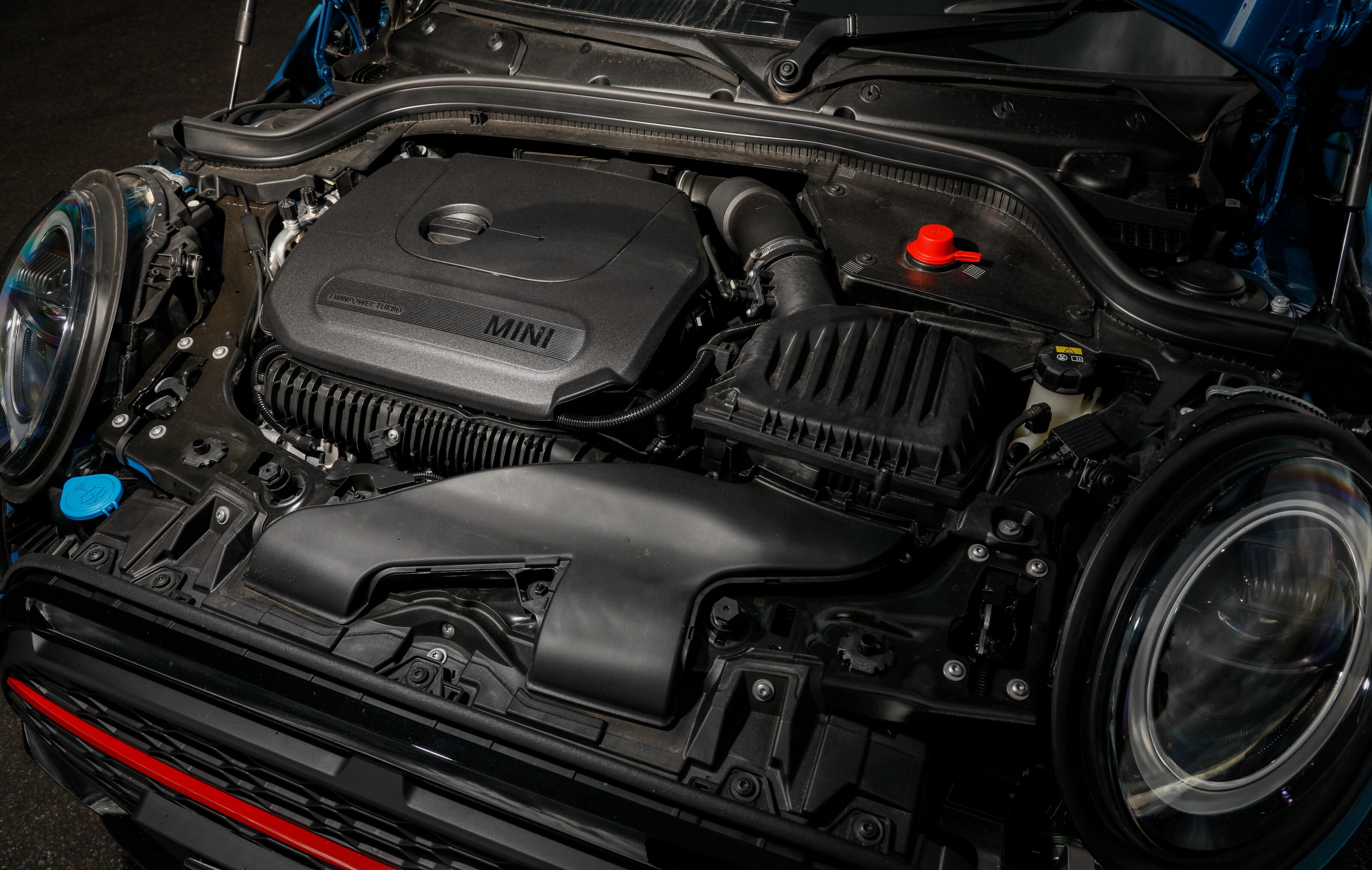
The 170kW B48 turbo-four is a peach, delivering an entertaining exhaust note with strong response, delivering a peak of 320Nm from low and pulling hard and fast up to about 6000rpm. Sharing its modular design with the bigger B58 inline-six, I’ve joked before about the Mini boasting two-thirds of a Supra engine. Jokes aside, there is a whiff of the Supra’s response in the effortless wave of mid-range torque.
Four-piston Brembo brakes were more than up to the task, biting strong and suffering little fading, if lacking a little in precision and transient feel.
One can’t help but think that an upgrade in rubber, and perhaps some suspension geometry tweaks, would elevate the JCW’s track-day chops with relative ease. Regardless, as an out-of-the-box package, the Mini’s slight foibles couldn’t diminish the grin on my face.
That’s been the overwhelming takeaway after BMW HQ recently called for our Cooper to return home. It’s costly, sure, and seems under-equipped compared to similarly-priced rivals; Apple CarPlay functionality still eludes the wider MOTOR team and my Samsung phone (just) fits in the wireless charger only if I take its case off.
Despite its quirks, the Mini was always a sight for sore eyes after a late night at the office, effortlessly slipping into my daily life, adding a huge dose of character and rarely failing to evoke a smile. The Mini simply does things its own way and has an uncanny ability to get under your skin. Against all expectations, I find myself missing that little blue guy. Until next time… – AA
Things we love:
- Brembo brakes
- Strong mid-range
- Fun factor
- Understeer bias
- OEM Pirellis
- Lacks tech of rivals
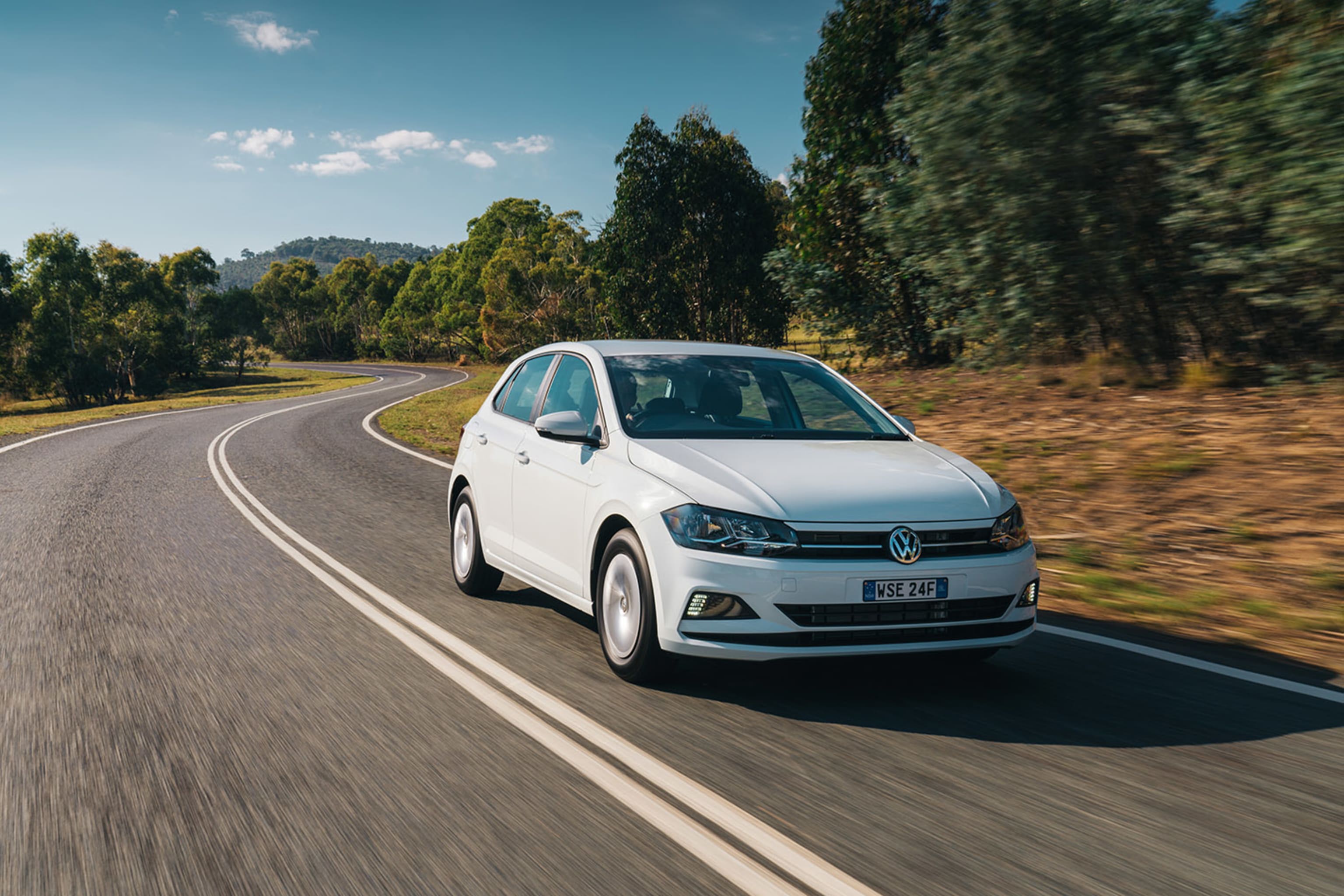
Volkswagen Australia is recalling 67 of its Polo hatchbacks as the sunroof could detach and cause an accident.
The issue affects MY21 vehicles only.
Due to a manufacturing issue, the sunroof frame may not have been bonded correctly to the body and could become loose and fall off the vehicle – posing serious risk of serious injury or death to vehicle occupants or other road users.
Owners of affected vehicles can contact their authorised Volkswagen Dealer to schedule an appointment to have the work carried out free of charge.
For further information, VW can also be contacted on 1800 504 076.
A list of VINs for the vehicles involved is available here.
The Chevrolet Bolt’s days could be numbered in the US, between recall efforts and General Motors’ upcoming plant retools.
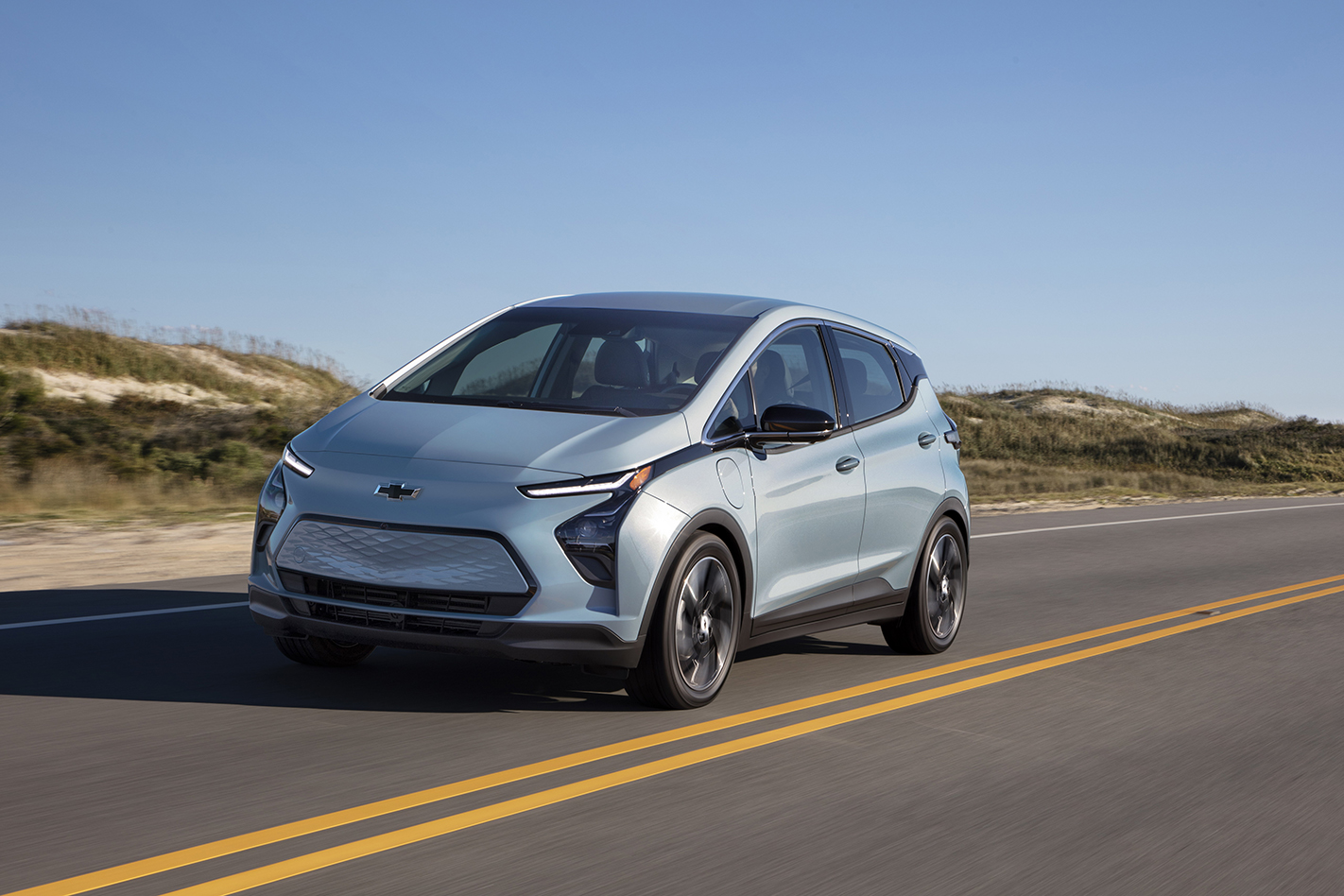
Introduced in 2016 following the warmly-received, Australian-built concept, the Bolt EV marked the first all-electric GM production car since the limited EV-1 in 1996. A slightly bigger Bolt EUV joined the range last year.
However, a battery fire in September 2020 prompted a National Highway Traffic Safety Administration investigation, which evolved into a recall for all 140,000 Bolts produced at a cost of almost US$2 billion (AU$2.83bn).
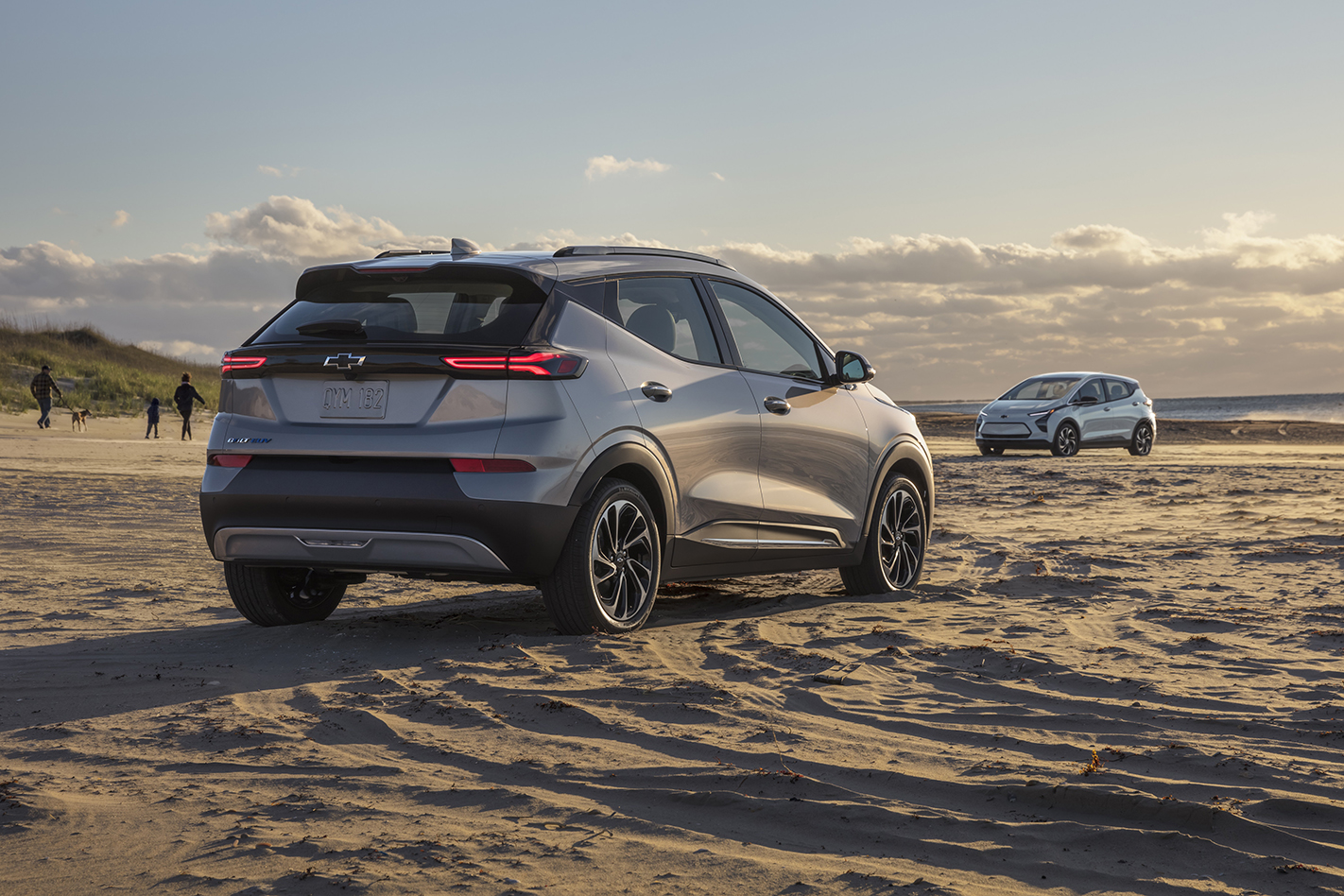
No Bolts have rolled out of GM’s assembly plant in Orion, Michigan, since last November, with the shutdown slated to last through February at least. In the last three months of 2021, just 25 cars were sold. GM has even been forced to buy back some Bolts from owners without an open space to store their cars, as advised by the recall notice.

The Bolt’s future has been thrown into further jeopardy by GM’s announcement that the Orion plant will be retooled for the upcoming Silverado and GMC Sierra EVs. The new models will use the brand’s fresh Ultium EV architecture, a system not used by the older Bolt.
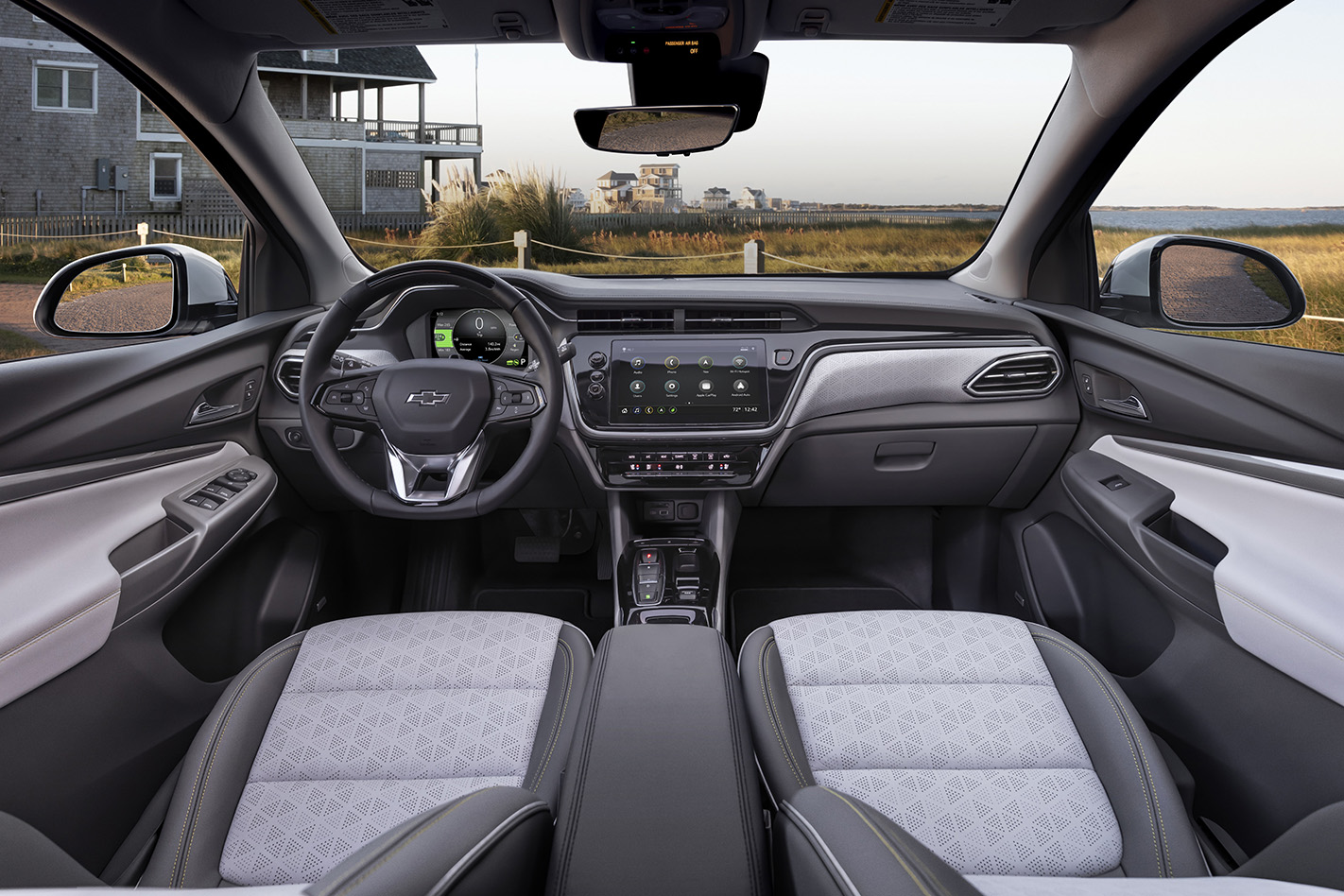
Speaking to CNN, a GM representative would reveal little on the Bolt’s fate.
“Production of the Chevrolet Bolt EV and EUV will continue during the plant’s conversion activities to prepare the facility for production of the Silverado EV and Sierra EV pickups. We are not disclosing any additional information at this time about Bolt EV or Bolt EUV production.”
GM has yet to confirm a timeline for when the retool will be completed.
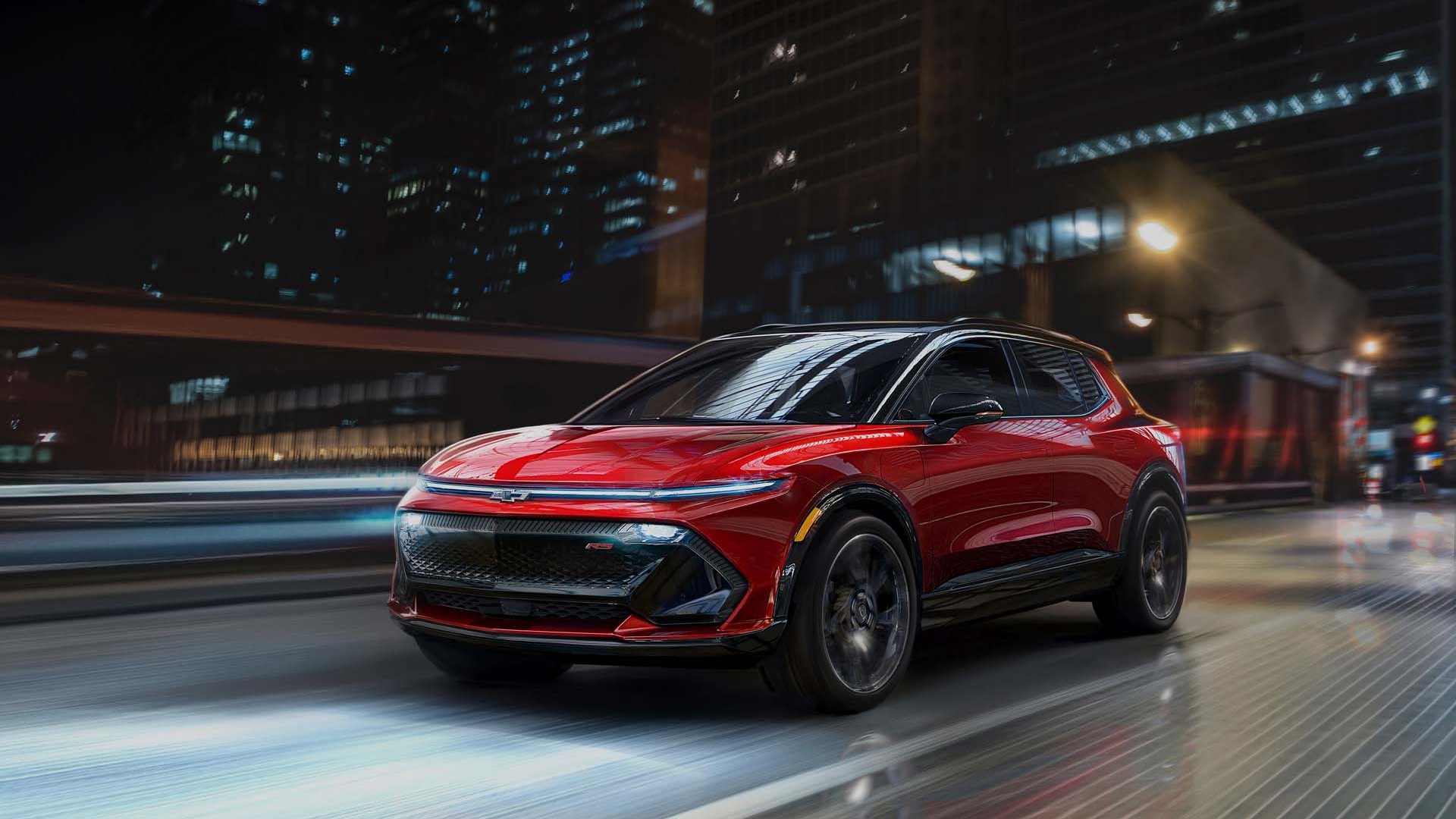
If the Bolt is discontinued in the near future, the Ultium-based Equinox EV could act as an indirect replacement. Built on more current technology, the Equinox is also larger than the Bolt and tipped to be cheaper, starting at US$30,000 (AU$42,452). Alongside a new Blazer, the Equinox is set to arrive in mid-2023.
GM plans to launch 30 new electric vehicles by 2025, two thirds of which will be available in the US market. It’s not yet known how many are expected to reach local shores.
The 2022 Porsche 718 Cayman GT4 RS has demonstrated the potential of synthetic fuels at an ice race in Austria.
Porsche showed off the new 718 Cayman GT4 RS and the Clubsport at the GP Ice Race in Zell am See, both of which were powered using synthetic fuel.
Made from waste food products, the biofuel is being developed in an attempt to help ensure the longevity of the internal-combustion engine – and potentially providing a more environmentally-friendly solution for areas of the world which do not have reliable electricity infrastructure.
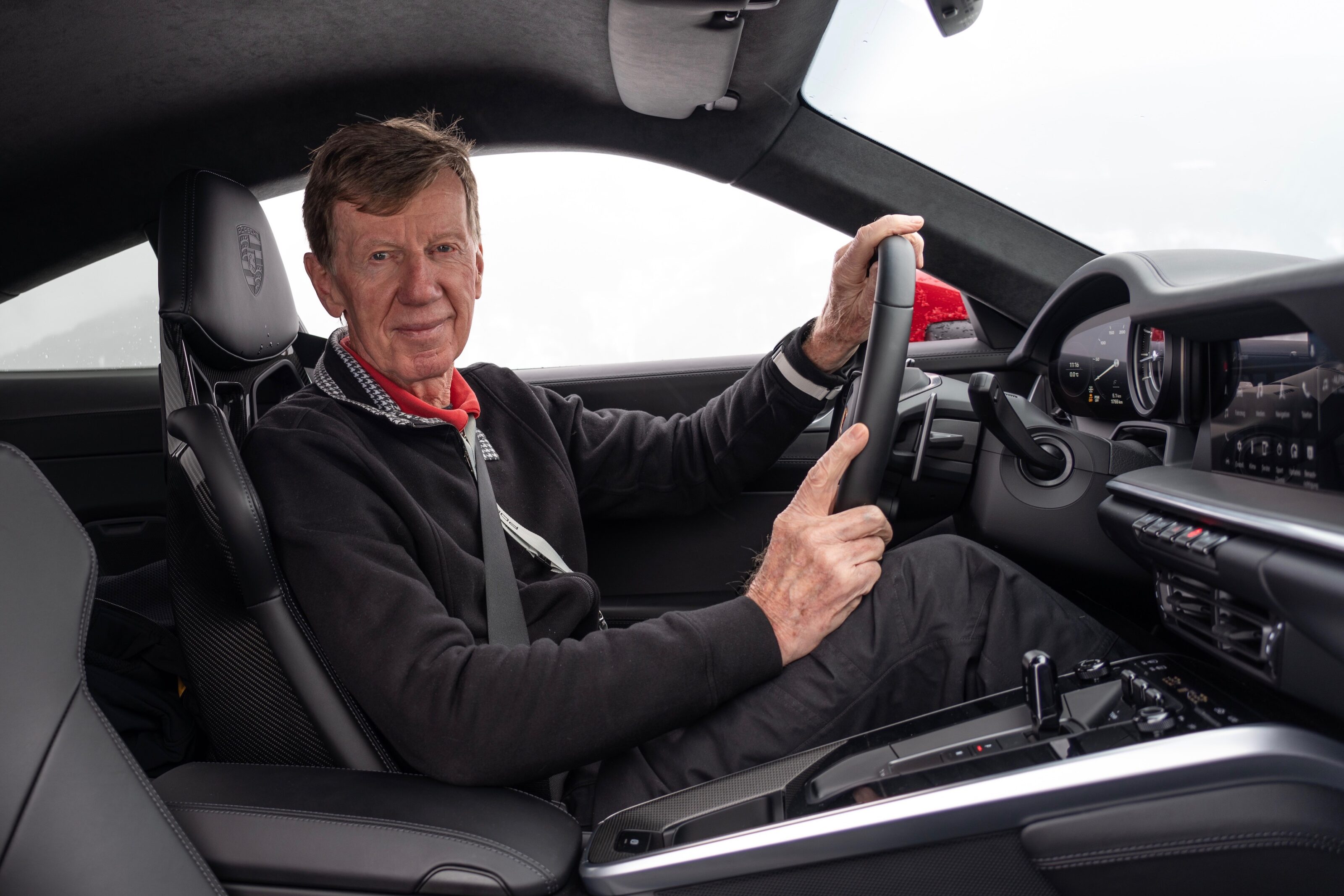
“We urgently need a solution for the sustainable operation of existing fleets,” rally legend Walter Röhrl said at the event.
“This goal can be achieved with green fuels, which are a sensible complement to electric vehicles.”
Created at the Haru Oni plant in southern Chile using wind power, the synthetic fuel is made by first producing hydrogen, then mixing it with CO2 taken from the atmosphere to create e-methanol, which is then synthesised into raw gasoline, and eventually processed into petrol at a grade suitable for modern engines.
Haru Oni expected to produce 130,000 litres of eFuel from this year, with Porsche in line to purchase the whole amount.
“It’s a great hope of mine that in the future I will be able to drive old cars without a bad conscience because I am running them on eFuels,” added Röhrl.
Volvo‘s EV offshoot Polestar has unleashed a rally-ready version of the Polestar 2 named the Arctic Circle Edition.
It is even more powerful and brings a host of upgrades that enable the 2 to drift silently across the ice, including new snow tyres and underbody protection.
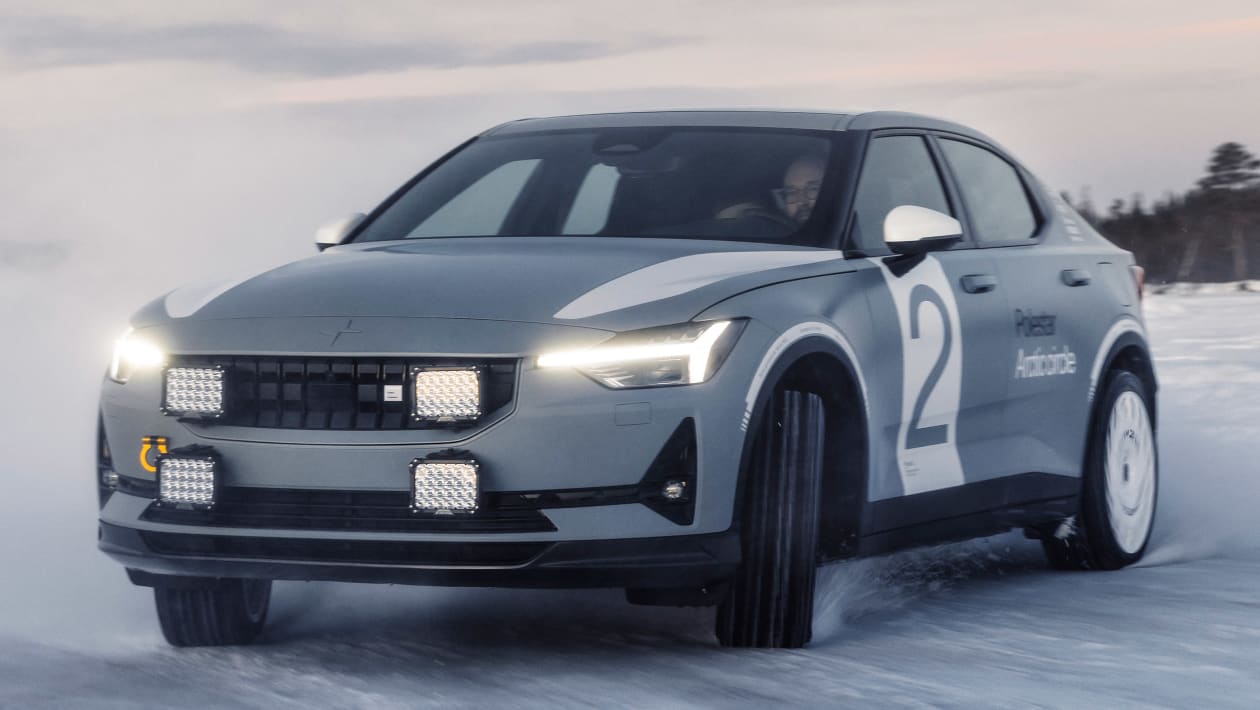
As cool as the Arctic Circle Edition is, it’s not slated for production and is instead a study of the potential Polestar’s 2 has. Underneath is the electric workings of the Long Range variant with 350kW of power being delivered to both front and rear axles, and 680Nm of torque. Helping to elicit maximum grip in slippery conditions is a new launch control system that can handle the power and torque boost.
Based on the 2, which is now on sale in Australia, the Arctic Circle looks rather similar outside, but with rally-ready equipment.
This includes; quad-LED floodlights in an unusual square arrangement, unique matte grey paint scheme, some minimalist livery, 19-inch OZ Racing lightweight alloys with studded snow tyres, underbody protection, and a yellow recovery hook. Inside are Recaro bucket seats trimmed in grey and gold, and the car has a carbon fibre snow shovel and recovery strap.
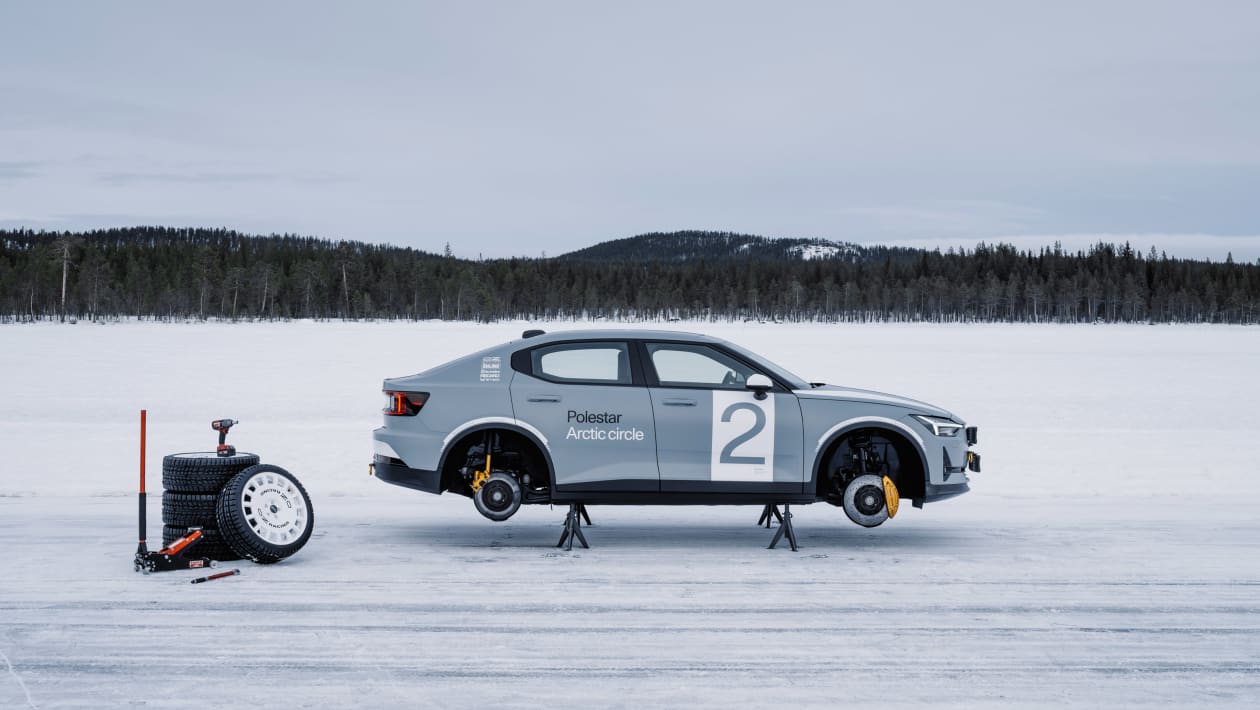
Helping the Arctic Circle carve up ice at speed is a new suspension system, featuring 30 per cent softer springs and 30 millimetre higher ground clearance via three-way-adjustable Ohlins dampers. Front and rear strut braces have also been added to add rigidity and the standard four-piston brakes are good enough for the job.
The unique model is in part the creation of Polestar’s chief chassis engineer, Joakim Rydholm, who is also a rally driver.
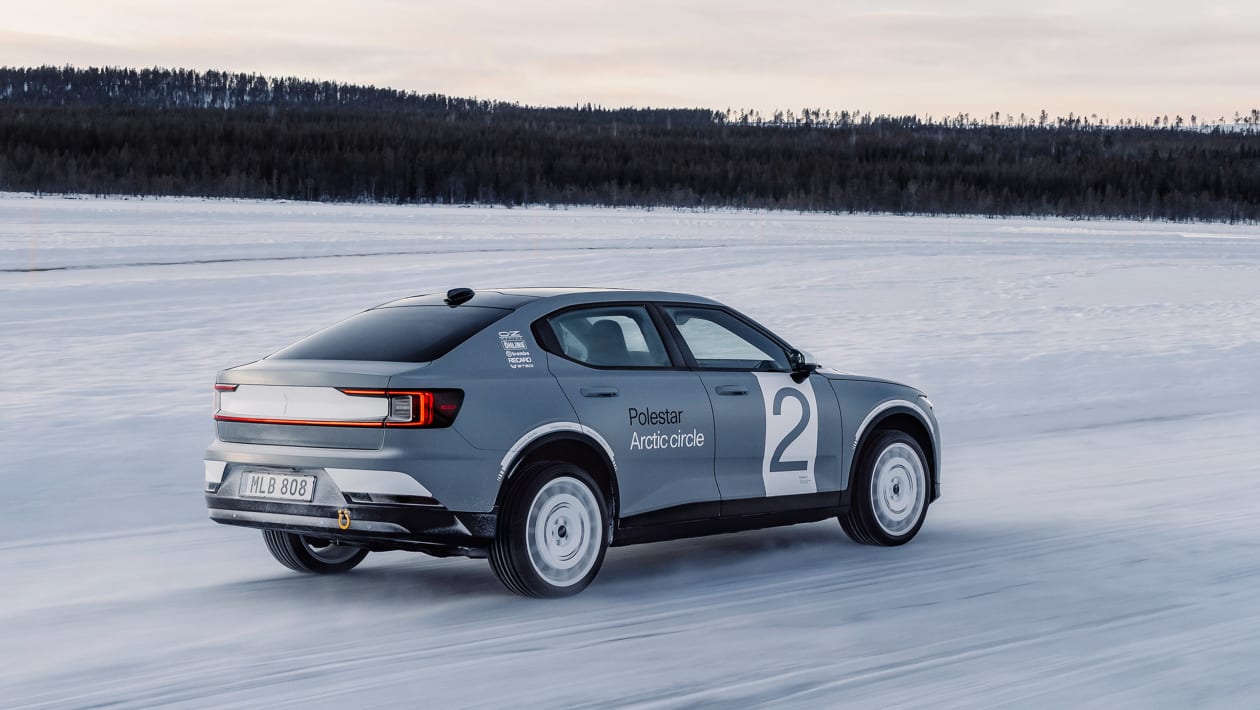
“I wanted to have more fun than usual with this car – really being able to push it in terms of performance and handling in a winter environment such as a frozen lake,” said Rydholm.
“The balance and predictability we have achieved with the raised ride height and specialised tyres are particularly noticeable when you enter a bend completely sideways, with a bigger-than-usual smile on your face, and in total control.”
While this edition is not hitting production, some of the upgrades might – such as the boost to power and torque, which could, in theory, be a future over-the-air upgrade from Polestar.
