
Snapshot
- Volkswagen signs with Perth-based Vulcan Energy Resources
- Electric vehicle production targeted at 2.2 million per year by 2030
- In-house production a step towards reducing overall emissions
Volkswagen is making good on its battery expansion plans, signing a lengthy contract with an Australian company.
Signing three new deals secure its supply of batteries into the future, it’s an important step in Volkswagen’s goal of producing batteries in-house and having the capacity to produce millions of electric cars every year.
Key to its new partnerships is a deal with Australian company Vulcan Energy Resources, based in Perth and operating in Germany. The new partnerships also see Volkswagen working with Belgian mining company Umicore, and US start-up 24M.
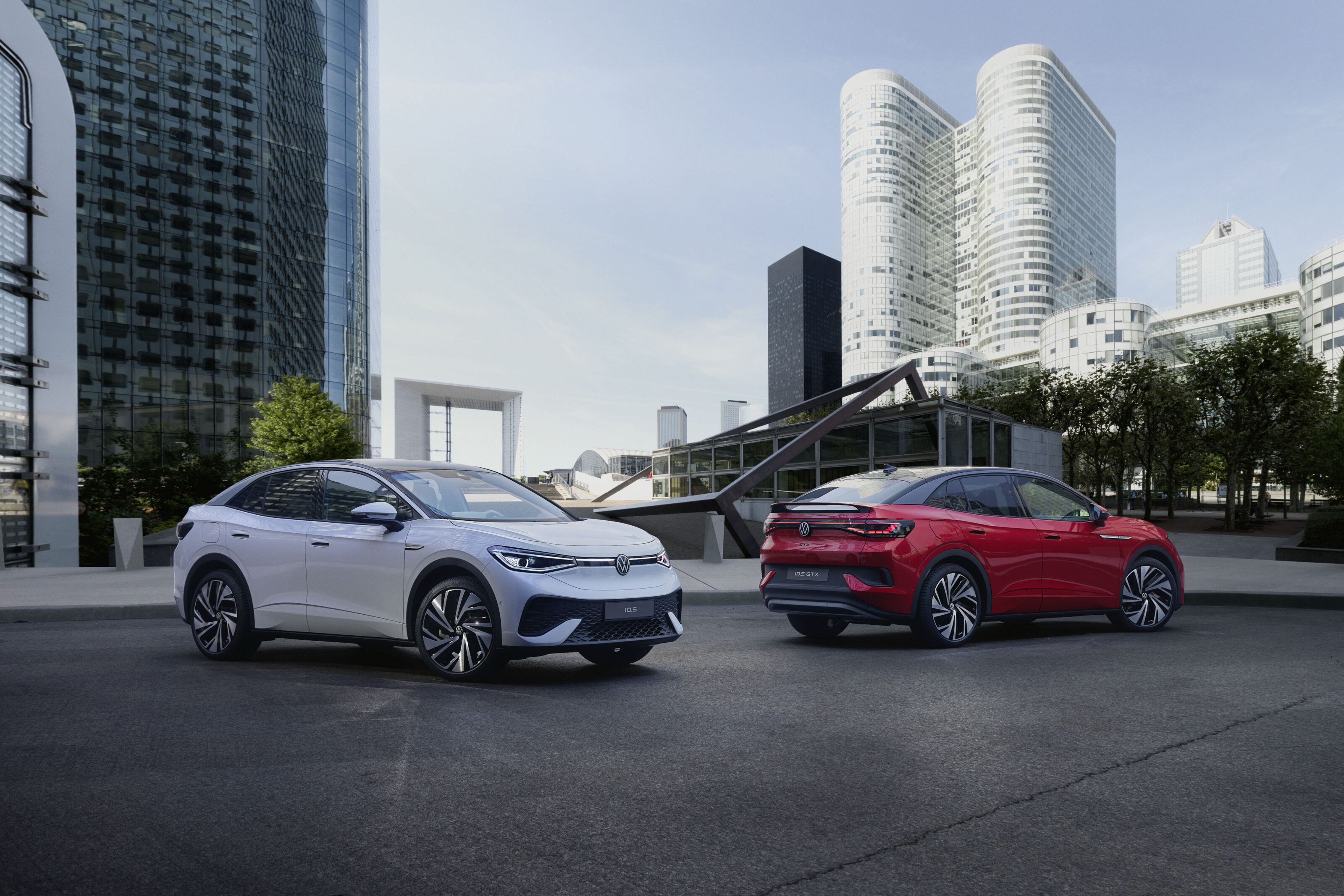
Volkswagen’s partnership with Vulcan Energy Resources is a long-term contract which secures a supply of CO2-neutral lithium. This ‘clean’ lithium helps address contention around the environmental impact sourcing rare earth metal causes.
While Vulcan’s headquarters are in Perth, the lithium will be sourced for Volkswagen from the Upper Rhine Valley which borders Germany, Switzerland and France. The deal will last at least five years before any extension is triggered, and given the importance on reduced emissions and sourcing clean materials for new cars, it could well go into the new decade.
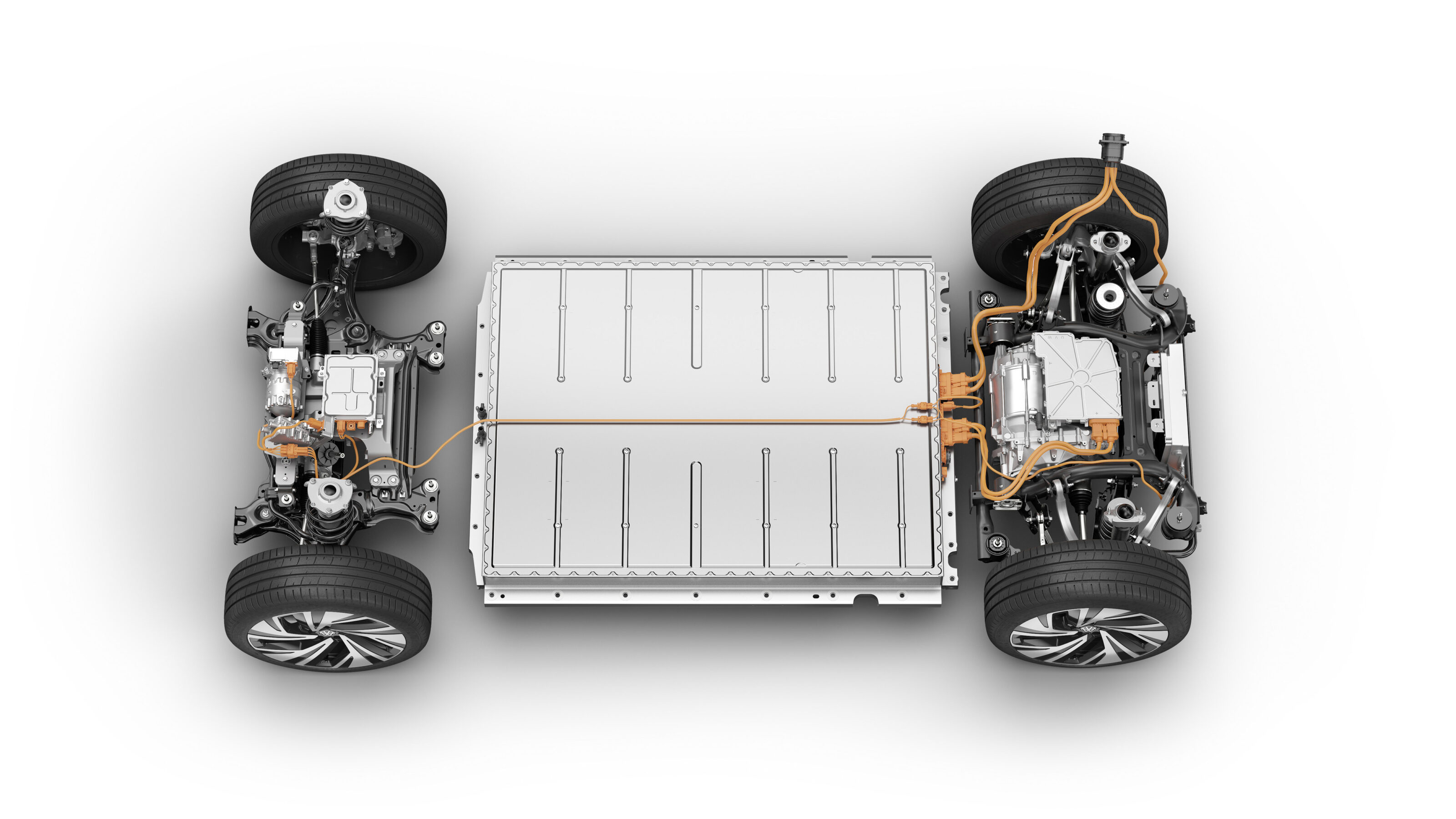
With the other two partnerships and a target of opening six new gigafactories to produce its own batteries this decade, Volkswagen believes by 2030 it will be able to achieve an annual production capacity of 2.2 million electric cars – but it will certainly need support from industry specialists.
Umicore, one of the new partners, is a specialist mining company which sustainably sources materials to produce battery cathodes, while lithium-ion production specialists 24M – based out of Massachusetts, USA – has breaking technology for a dry coating system during production which reduces the need for extra processing.
Most importantly, this new way of processing lithium-ion batteries reduces CO2 emissions and makes them easier to recycle, thus reducing the overall environmental impact from sourcing materials to constructing the car itself – which is how EVs without tailpipe emissions are beginning to be judged.
Snapshot
- Zero-star rating for all-electric hatch
- Removal of side impact airbag led to the poor result
- Zoe becomes just the third car to receive the score
The newly updated electric Renault Zoe hatch has scored the worst possible result for safety according to EuroNCAP.
Due mainly to its lack of head airbags, a damning zero-star mark was handed out by EuroNCAP after crash testing and evaluating the safety systems on offer in the new Zoe – a model which has been ruled out for Australia after the previous model was axed in 2020.
Since EuroNCAP and the Australasian New Car Assessment Program (ANCAP) partnered together, the local arm has followed the scores given by EuroNCAP.
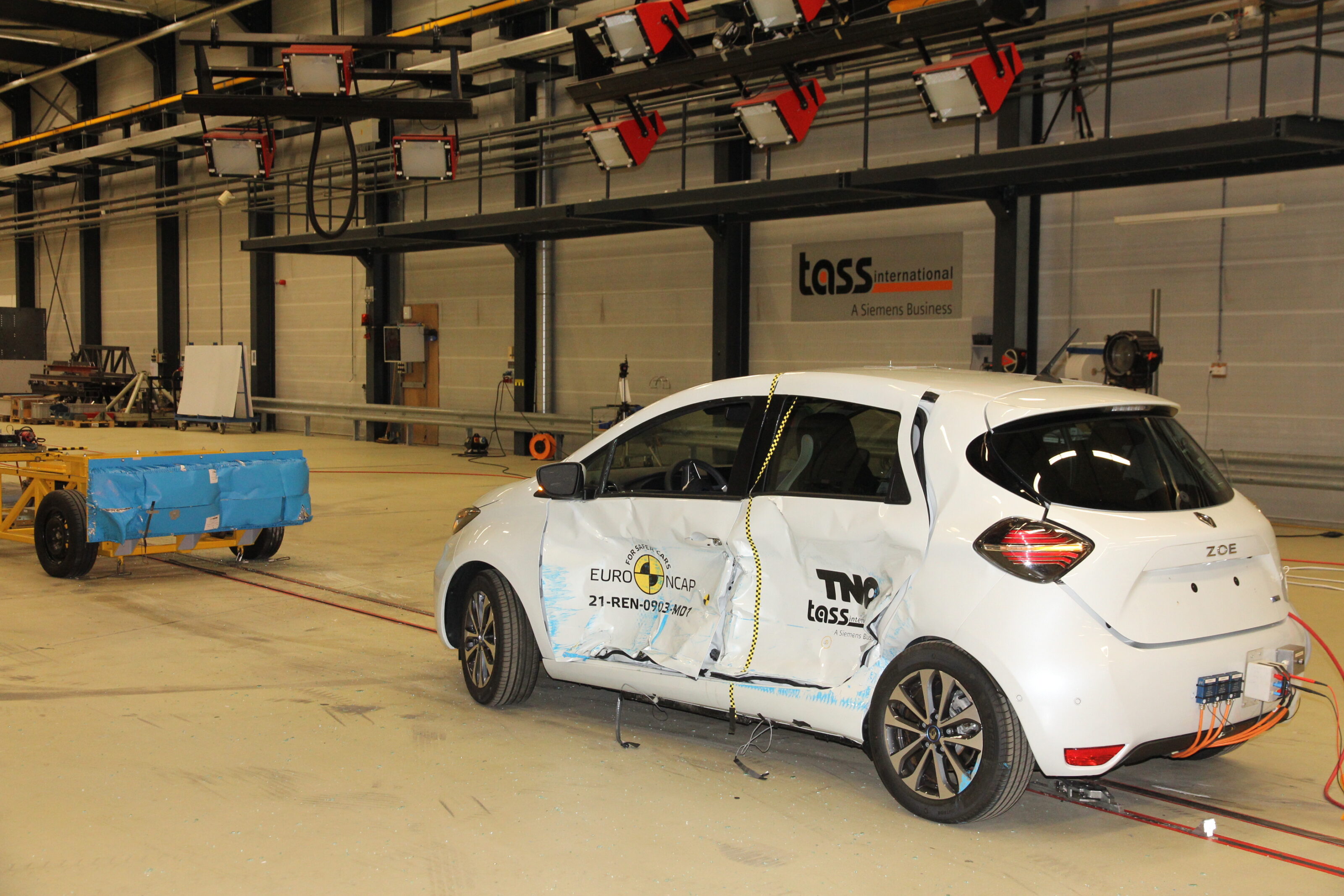
It’s a shocking result for Renault since the previous model achieved a full five-star rating in 2013. However, the testing criteria in 2013 was certainly a long way from what it is now.
In releasing its findings, EuroNCAP says the low score in the 2021 retest is due to various problems but the main defect comes from Renault’s decision to remove the airbag which would protect the driver’s head from side impacts.
This was highlighted in a performed side pole crash test when the pole directly impacted the head of the crash-test dummy. The test replicates the probable outcome if the car crashed on its side into an object such as a tree or pole, indicating the occupant would have severe head injuries as a result.
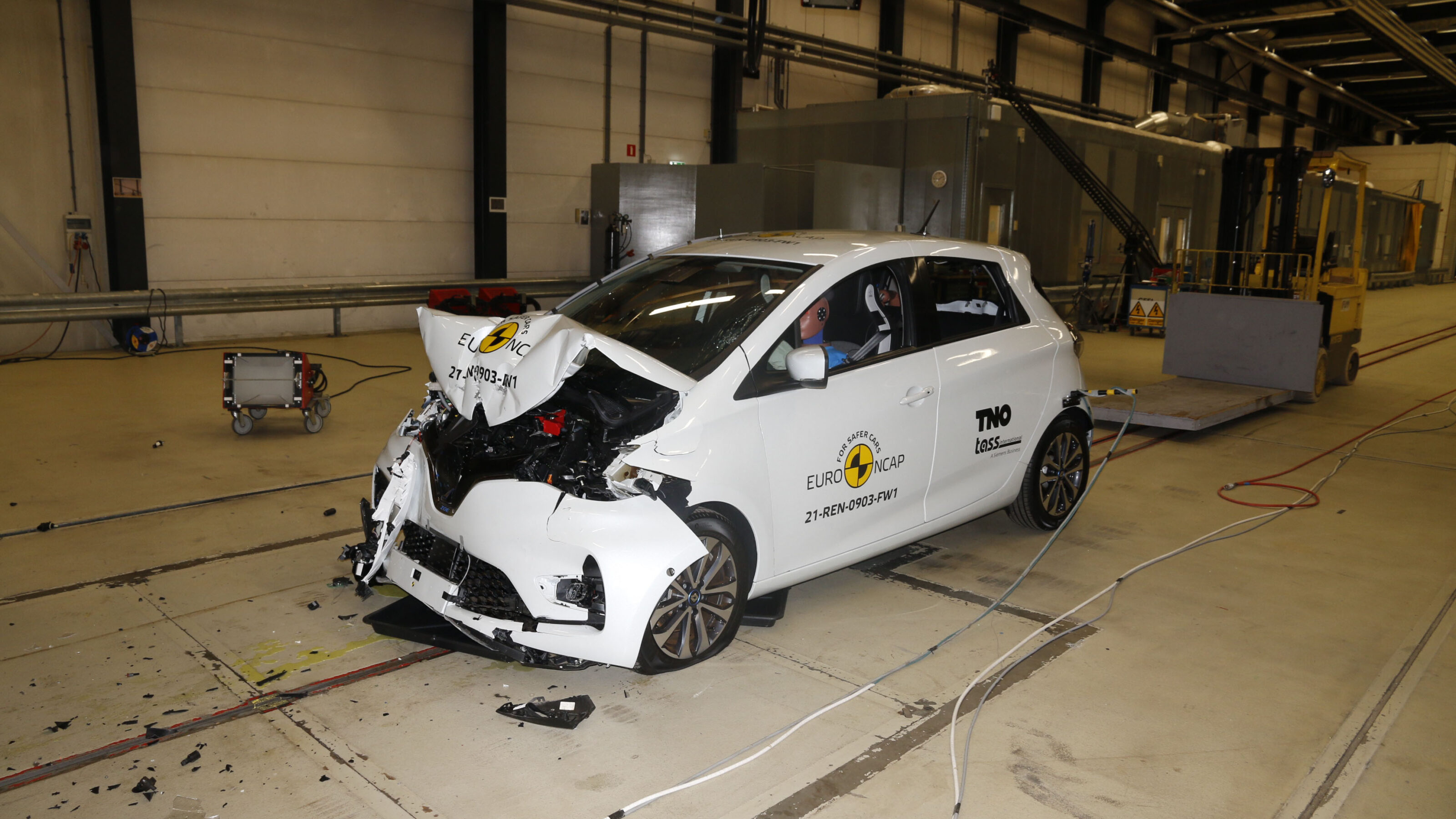
While Renault’s decision to remove the important airbags is likely the key factor in the rating, it does also highlight the extent to which EuroNCAP – and by extension, ANCAP – move the goalposts.
New criteria are added annually meaning it is hard to directly compare results from year to year, as a change of criteria can mean the loss of one or more stars instantly.
Not helping by any stretch was the lack of AEB and lane departure warning on the base model – another relatively new criteria which require both as standard.
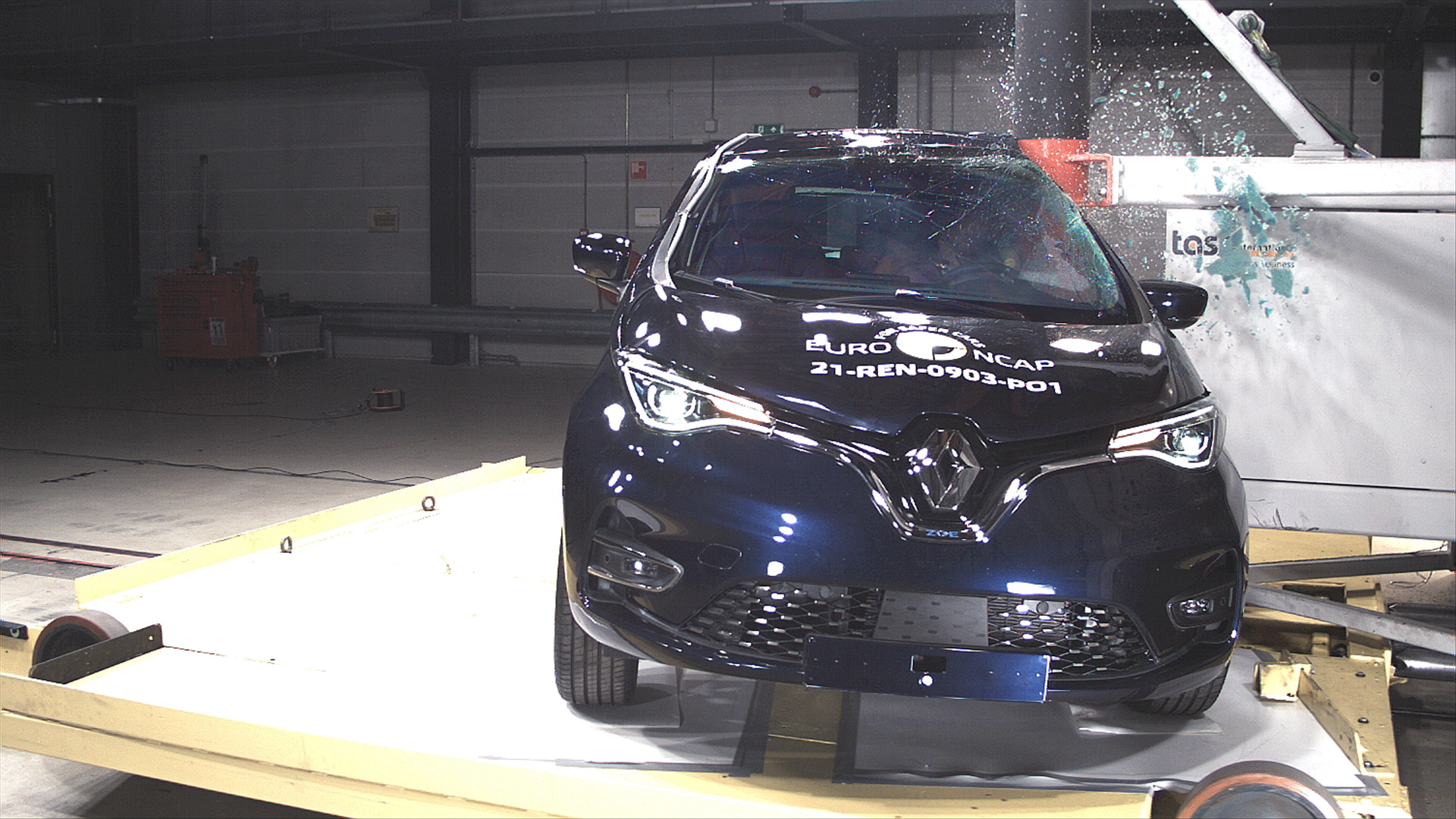
The starless score makes the new Zoe just the third car to ever score a no-star result from EuroNCAP. The other infamous models to achieve such a bad result were the Fiat Punto and Fiat Panda.
Meanwhile, there were promising scores from new cars inbound to Australia, such as the new BMW iX, which scored full marks, as well as the new Skoda Fabia, Nissan Qashqai, and the Genesis GV70, already on sale here.
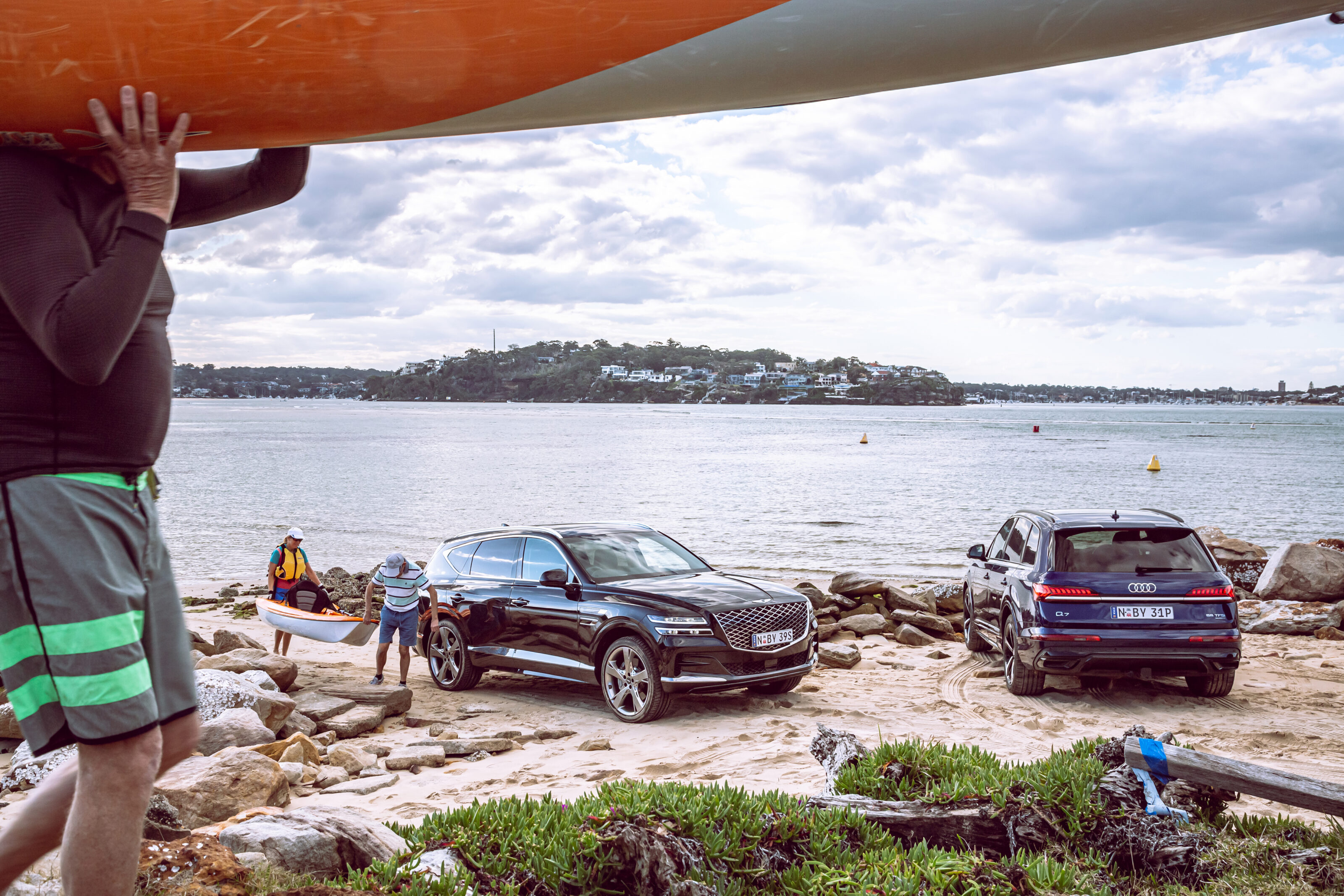
If bystander attention and commentary were Wheels ratings criteria, the Genesis GV80 would hose this comparison. Easily. It remains as relentless now as when the family hauling newcomer first lobbed just under a year ago, but with one crucial difference. There’s little ‘what is it?’, nor, ‘Is that a Bentley?’ aimed my way. Onlookers, by and large, now ask how it goes and if it’s any good.
The fledgling Korean luxury marque now looks to have one leg over one painful initial hurdle in Australia: brand recognition. It’s been a rocky introduction to this new Genesis renaissance, one stymied by a lack of metal on the ground to let local prospective buyers decide what they think of the GV80’s distinctive pitch. Getting any traction demands public reaction, be it fair or foul.
The Audi Q7? Not a peep from onlookers. Even though, as a return to petrol power and the first time in the seven-seater range’s second generation, the 55 TFSI fills an important hole as Aussie tastes continue to steer gently away from oiler passenger vehicles. Familiar, friendly and downright innocuous, nobody confuses the big Audi with a Bentayga, no matter how much incidental irony there is in the shared technical DNA.
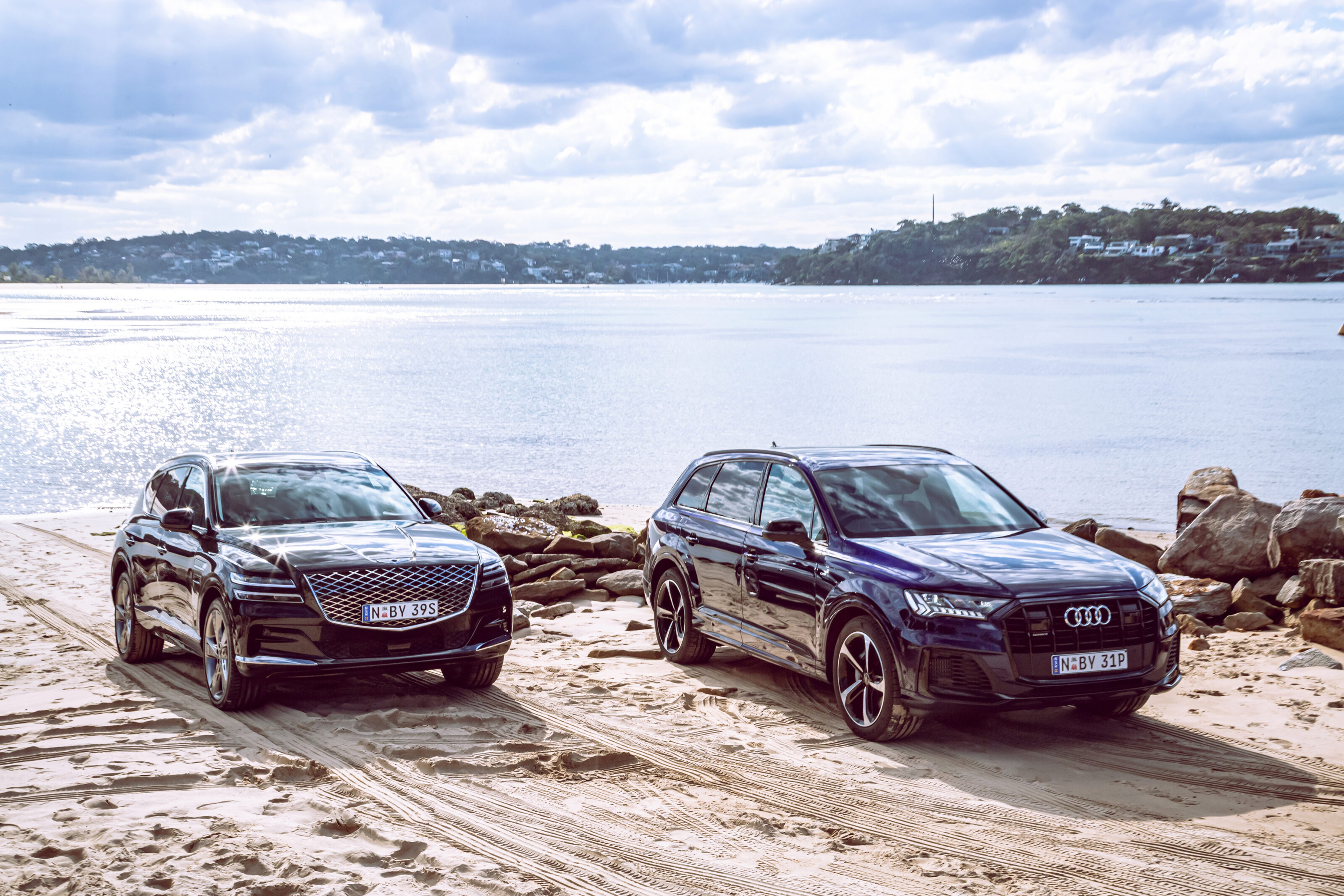
Bentayga, Porsche Cayenne, Volkswagen Touareg: what cannot be underestimated is the benefit the Ingolstadt machine enjoys from the combined front of big-family evolution, and luxury focused at that. It’s such company the Genesis’s fledgling competitor wants to almost desperately keep, but the question, seemingly on everyone’s lips, is how the GV80 really measures up.
Despite the privileged ownership experience Genesis touts, the GV80 still plays a value trump card: $108,600 for this flagship 3.5T AWD, with the $10,000 Luxury Package bumping that to $118,600. For all the brand’s bespoke ‘to order’ schtick, your only real option is matte paint ($2000).
Audi’s sole spark-ignition Q7 enters at $122,500, fulsome in kit and refreshingly lean on available options, though our tester still piles on an extra $8K’s worth of cost-optional paint, all-wheel-steering and trailer-towing addenda ($130,500). Either choice offers an identically spec’d diesel twin: parity outlay for the Audi 50 TDI; $5K thriftier for the Genesis 3.0D AWD.
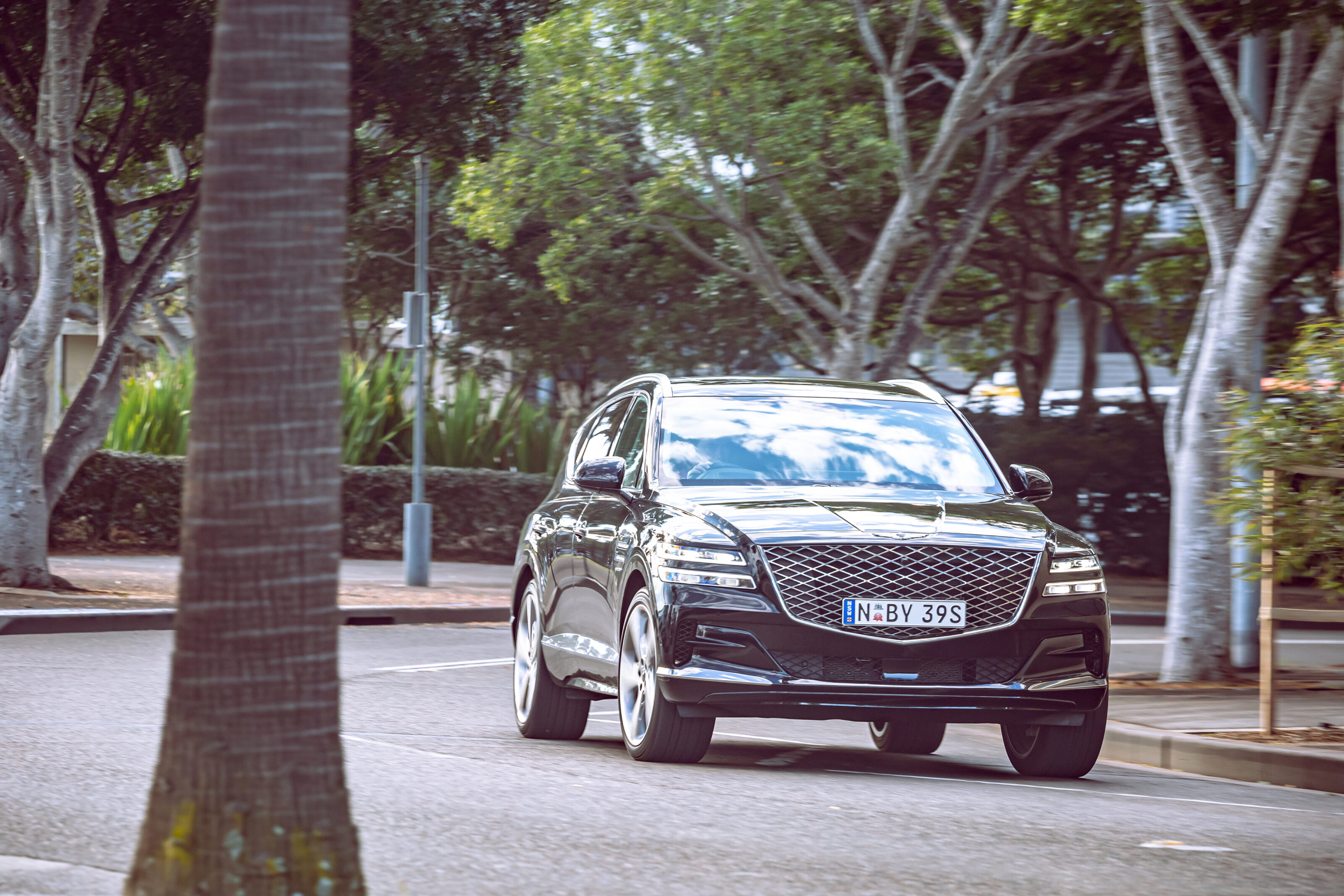
As it stands here, the GV80’s 3.5L twin-turbo V6 outpunches its rival’s 3.0L single-turbo unit, the Korean 279kW and 530Nm superior by 29kW and 30Nm. Downstream, both fit an eight-speed torque convertor auto, with the Audi plying permanent, continuously variable all-paw traction via a self-locking centre differential and monstrous 285mm 21-inch rubber.
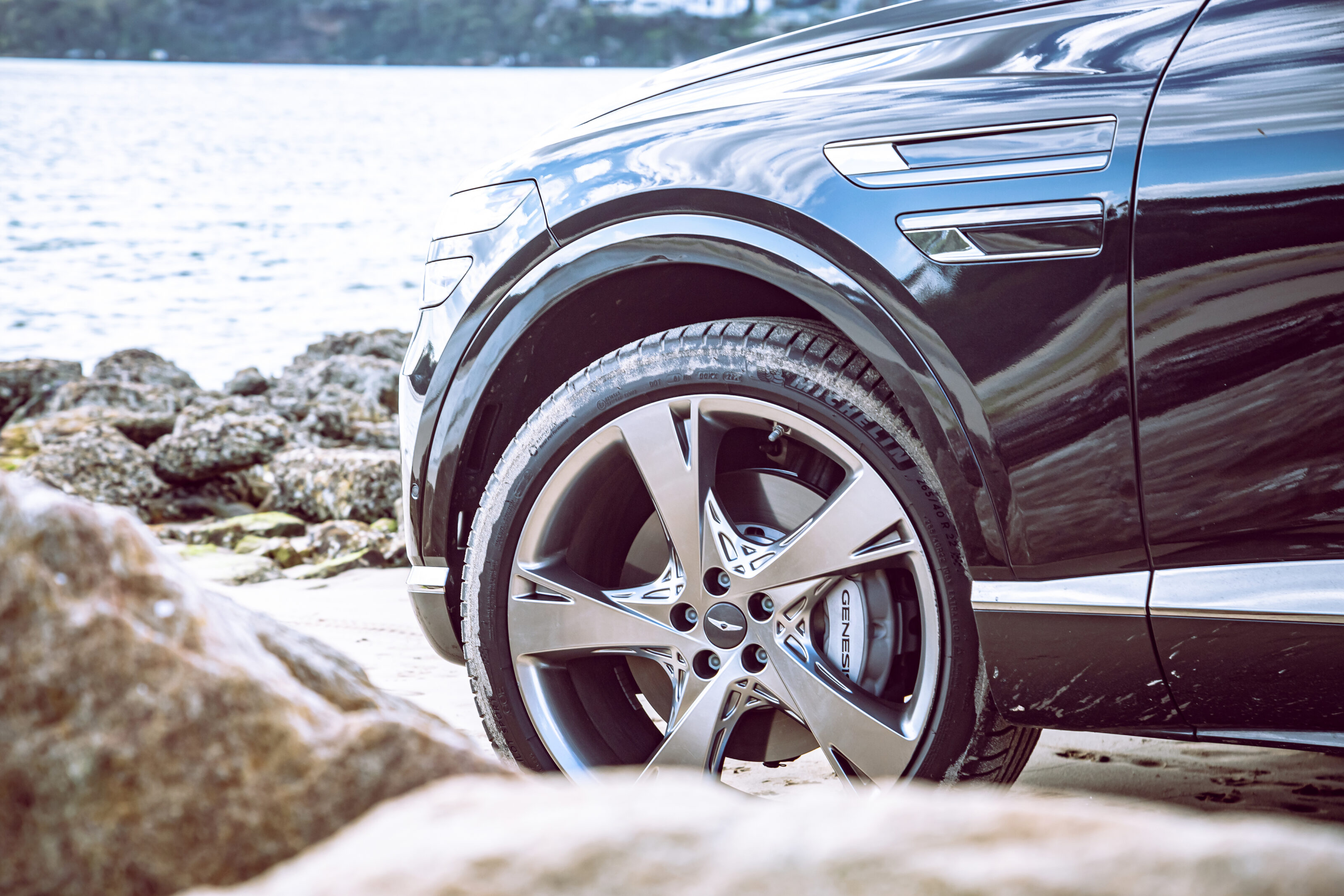
The Genesis favours a different format, with rear-biased, on-demand all-wheel drive, an electronically controlled mechanical rear LSD and narrower 265mm tyres on a larger 22-inch diameter.
The differences in format suggest, to a point, that the South Korean leans more toward dynamic alacrity than the German does. And, indeed, the GV80’s four-tenths swifter 5.5-second 0-100km/h suggests a keener performance bent. Audi has other S and RS offerings to stoke enthusiastic interest, but for Genesis, its GV80 is tasked with covering off a sporty base with what’s otherwise unabashedly a luxury proposition.
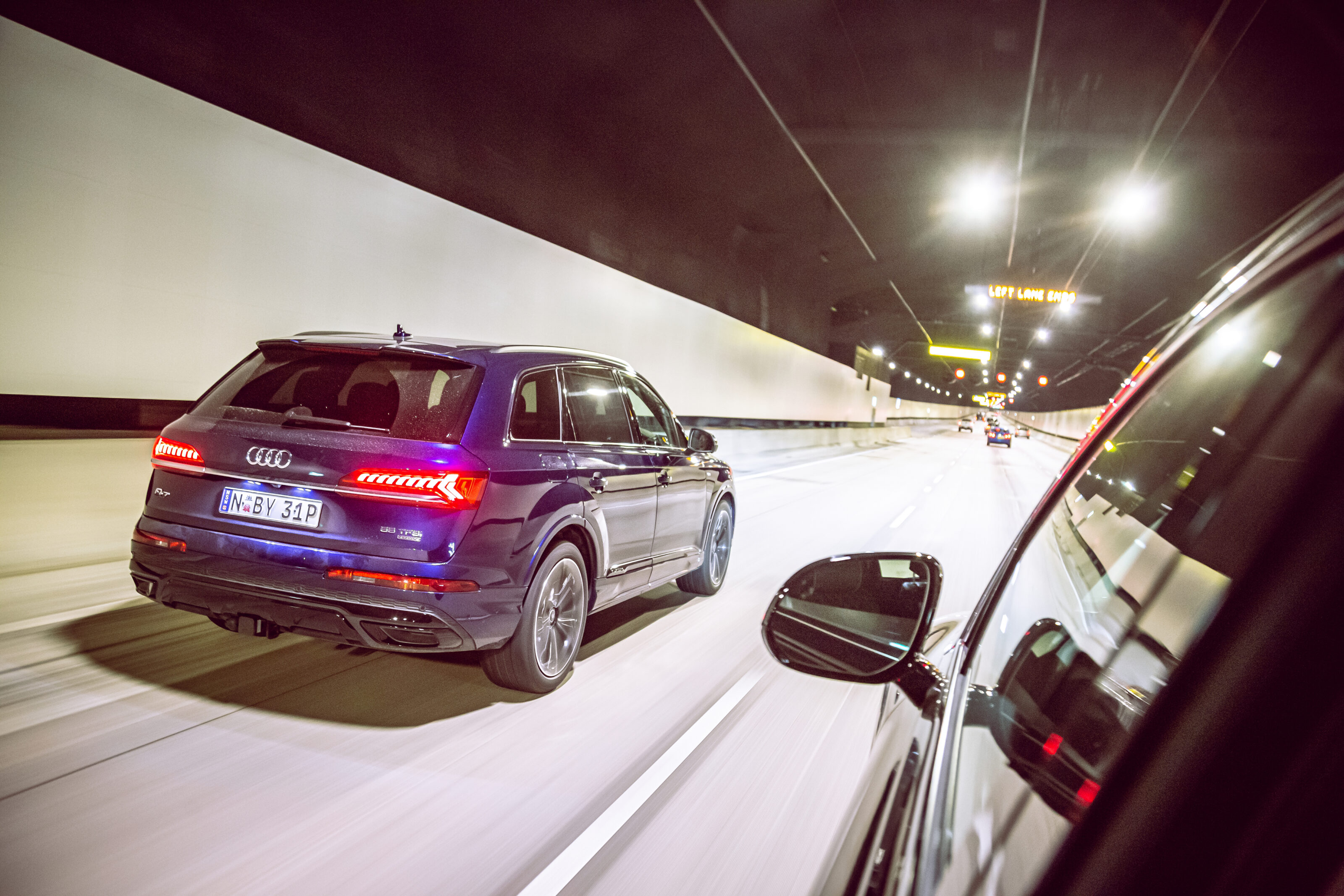
In reality, it’s the Q7 that comes across with more multi-faceted chops. Its air suspension is ride-height adaptive (by 90mm) and geared more toward terrain flexibility; its electromagnetic anti-roll is decoupling, and there’s more scope in its technical package for off-road adventure. Superior 3500kg braked towing, too, against the GV80’s 2722kg rating, regardless of whether you favour the petrol variants or opt for their alternative diesel doppelgangers.
The Genesis’s steel-sprung suspension isn’t short on smarts, notably the Road Preview camera-based bump detection tied to the adaptive damping. It also offers Multi-Terrain Mode off-road settings for various slippery and broken surfaces depending on how much adventure you’ll wager its modest ride height and Michelin Pilot Sport 4s might bear.
In their natural on-road habitat, it’s almost entirely the Q7’s way. Its air suspension is softly set with a modicum of float, but its bump compliance is superbly pliant while still maintaining enough damping to control t+he formidable body mass and iron out the body wobbles. It’s wholly resolved in Comfort, settling quickly and remaining surefooted, while Sport flexes the handling just so, particularly in containing body roll without succumbing to unruly sharpness in ride.
For its part, the GV80 rolls out plenty of plushness in its ride and handling balance, though isn’t quite so resolved overall. Despite its narrower footprint, it slaps more across sharp road imperfections, jolts more through the cabin and the body control is surprisingly wallow-y in its default Comfort setting, taking two or three vertical movements to settle on the straight, lolling and pitching about across more angular bumps.
Sport ups control but directly impacts compliance and, annoyingly, there’s no quick on-the-fly damper adjustment shortcut (unless you’ve preset Custom mode submenus deep in the touchscreen before you set off).
But the Genesis is a luxurious drive. The big six is crisp and quiet at a cruise, rewarding with faint and satisfying rort that becomes pure gusto when you activate Sport. It grabs peak torque from just 1300rpm and the linear undertow contends with 2.3-plus tonnes of upmarket extravagance without toil or hint of stress.
But the GV80 does like to drink, slurping well into the 13s across balanced driving against its 11.7L/100km/h claim, and rather sobering 16.2L ADR urban rating. There is some tarnish to its on-road sheen: some occasional powertrain thump and it’s easy to catch neutral swapping drive directions with its stiff-loaded rotary transmission controller.
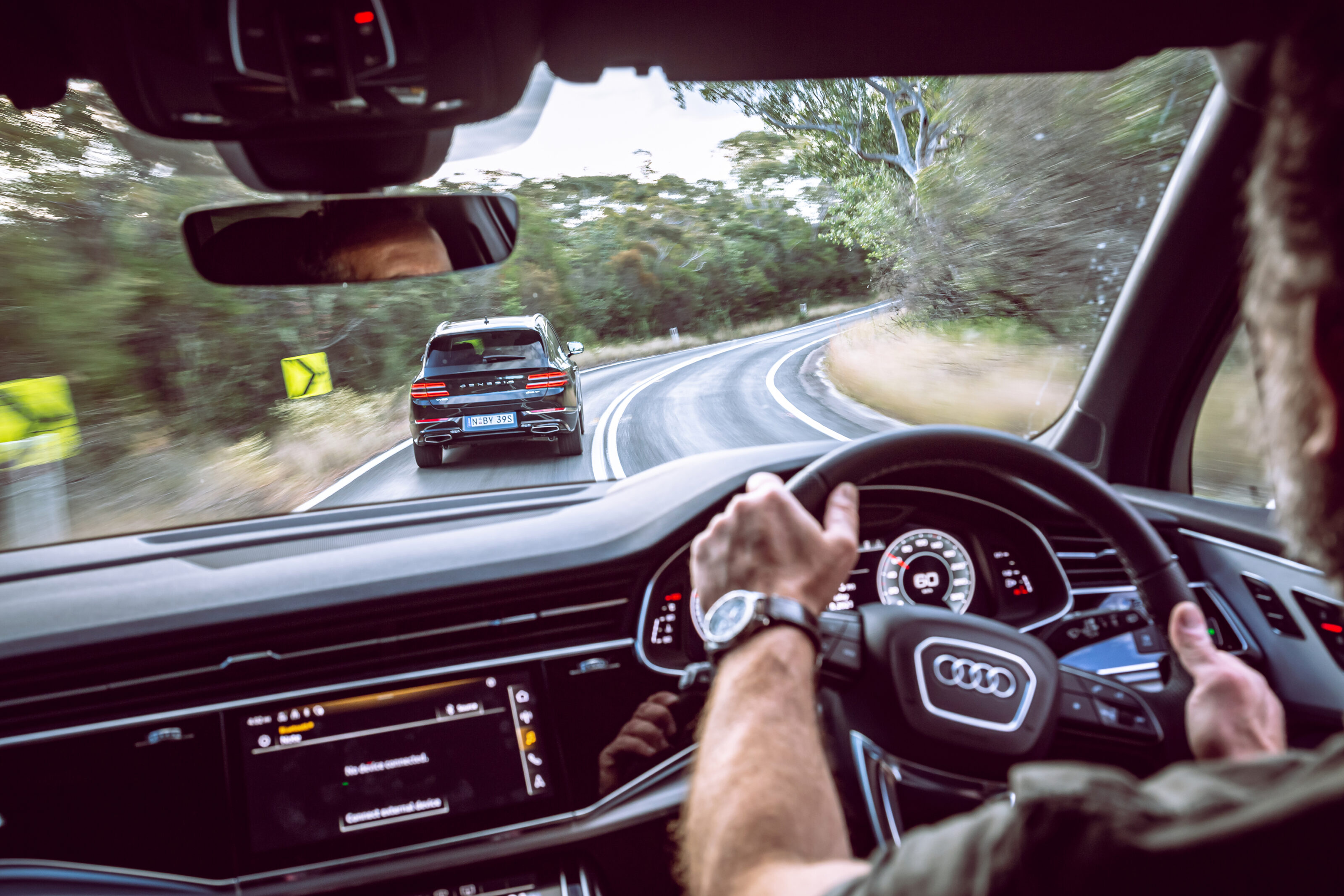
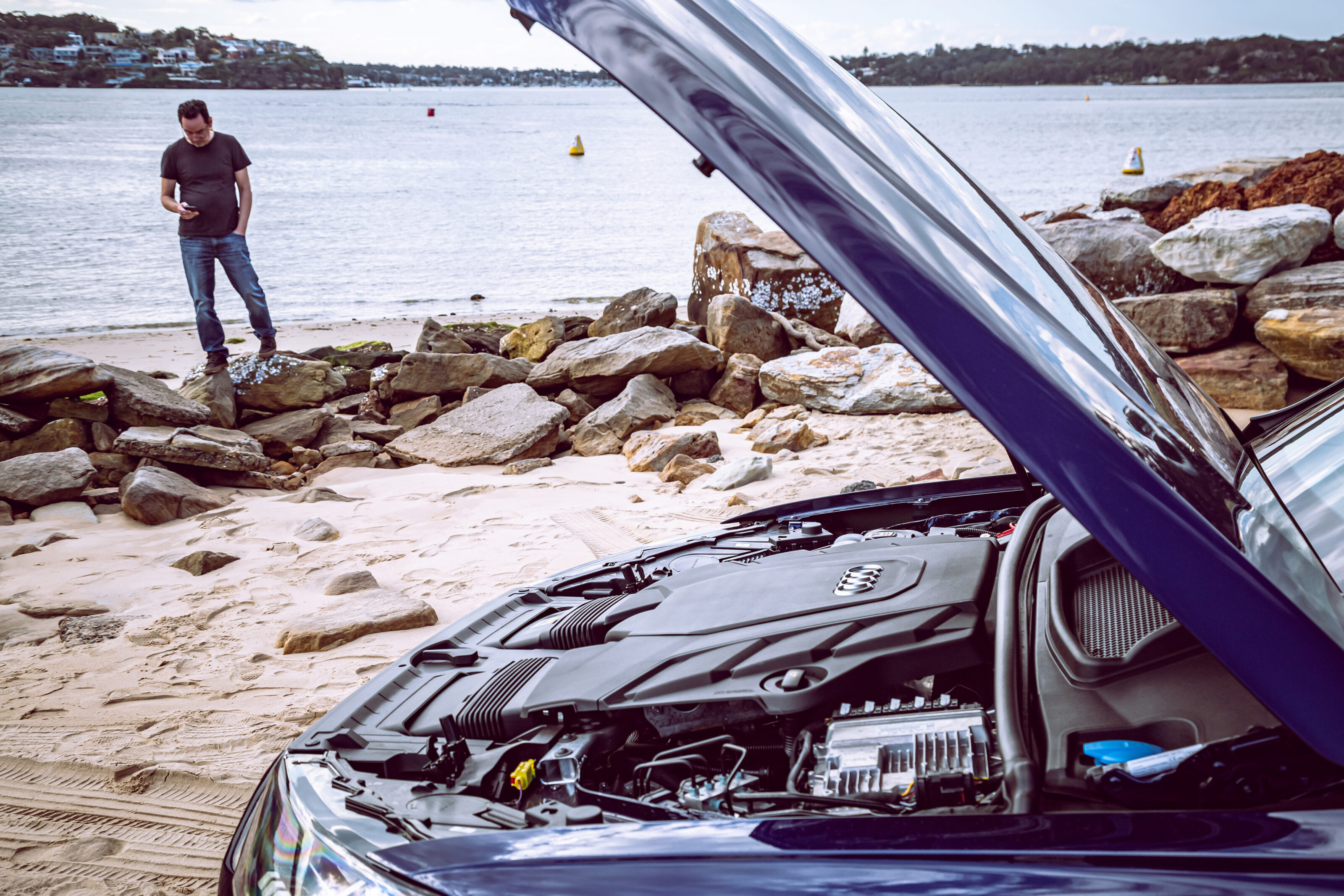
Audi advertises a superior 9.4L combined, presumably with wing, prayer and a whole lot of its 48-volt ‘mild-hybrid’ system’s engine shutdown sailing mode in play, which is very picky in activation. In side-by-side assessment, it proved more frugal than the Genesis, at 11.7L.
While less heroic on paper, the Q7 powertrain proves the quieter, more refined and more seamless operator at a leisurely clip, its handy time-honoured tap-for-Sport convenience liberating sharper initial response than its competitor can muster, despite the absence of any performance sheen to the soundtrack. And while it’s splitting hairs between two fine combatants, it’s the Audi that offers the more fittingly dignified progress and little more breadth of flexibility in doing so.
What the German machine lacks, for better or worse, is a sense of Genesis-like lightness. It feels heftier, despite its lighter weighbridge ticket, from the heft of the bank-vault- like doors to the effort required to steering at low speed. On that, the four-wheel steering pays big dividends during tight manoeuvring, the Audi seemingly chopping a couple of metres off the GV80’s broad 12-metre turning arc.
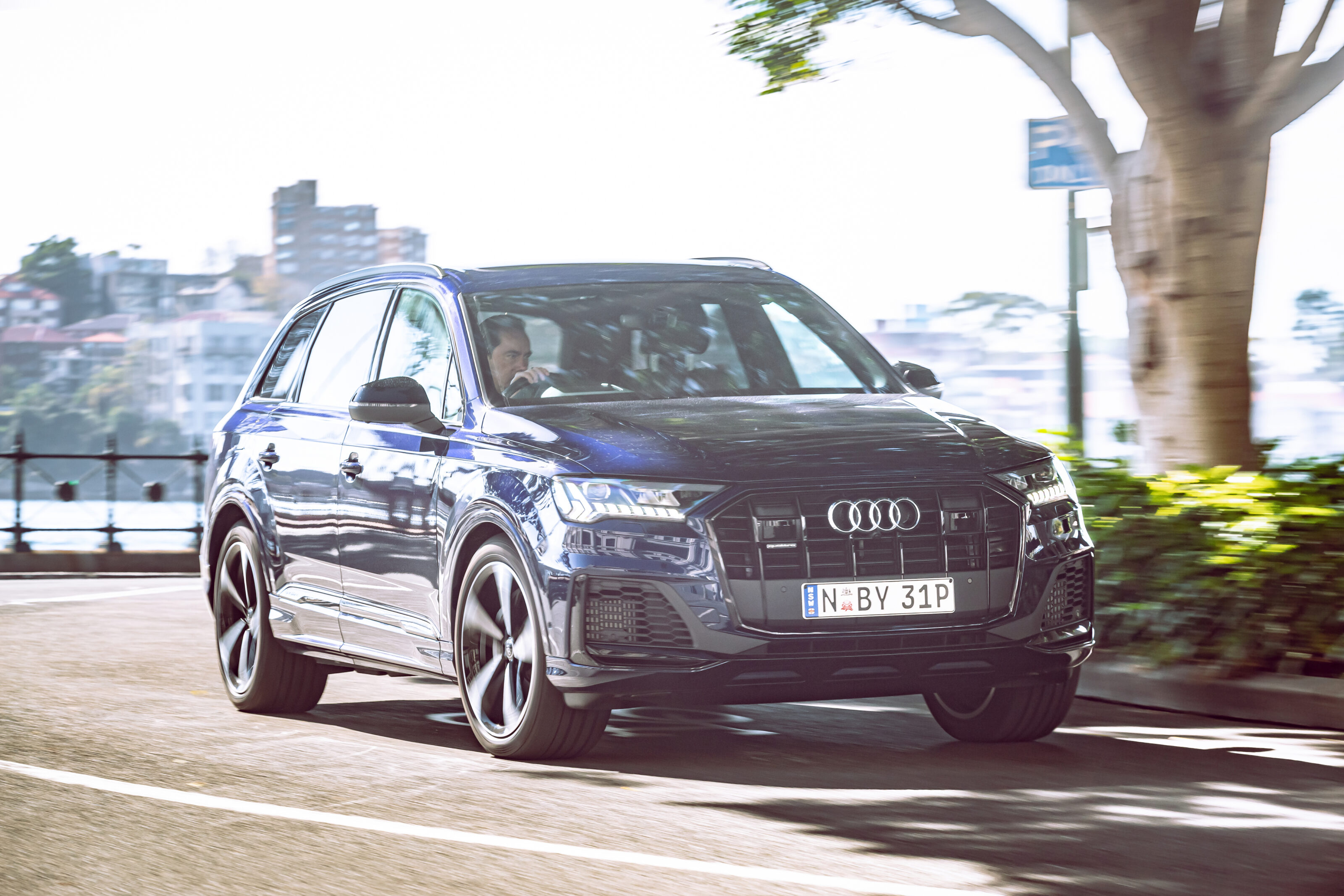
It’s a $2750 premium well spent. But neither machine is particularly tricky to park given each have exceptionally fine forward and reversing camera systems, though the South Korean’s bluff snout and broad hindquarters do make it the trickier of the two to judge and squeeze into tight spaces.
The GV80’s cabin is a more decisive luxury pitch than its polarising exterior and not short on glamour. It’s pleasingly streamlined in theme, the combination of two-spoke wheel, diamond-stitched Nappa leather, knurled switchgear and a litany of fancy and ornate detailing – such as HVAC control ‘rings’ – present a unique character dipped in convincing opulence. Minted in deep petrol blue, there’s a bona-fide first-class ambience to our tester. A tarted-up Hyundai it is not.
Much of its goodness is baked into the broader GV80 range, such as the 14.5-inch touchscreen infotainment, 21-speaker Lexicon audio, content-rich head-up display, 10 airbag fit-out and panoramic glass roof. The $10K Luxury bundle expands the features list to an exhaustive length, adding niceties such as novel three-dimensional 12.3-inch instrumentation, active road-noise cancellation, remote ‘smart’ parking via the key fob and (mostly) electric seat power through all three rows.
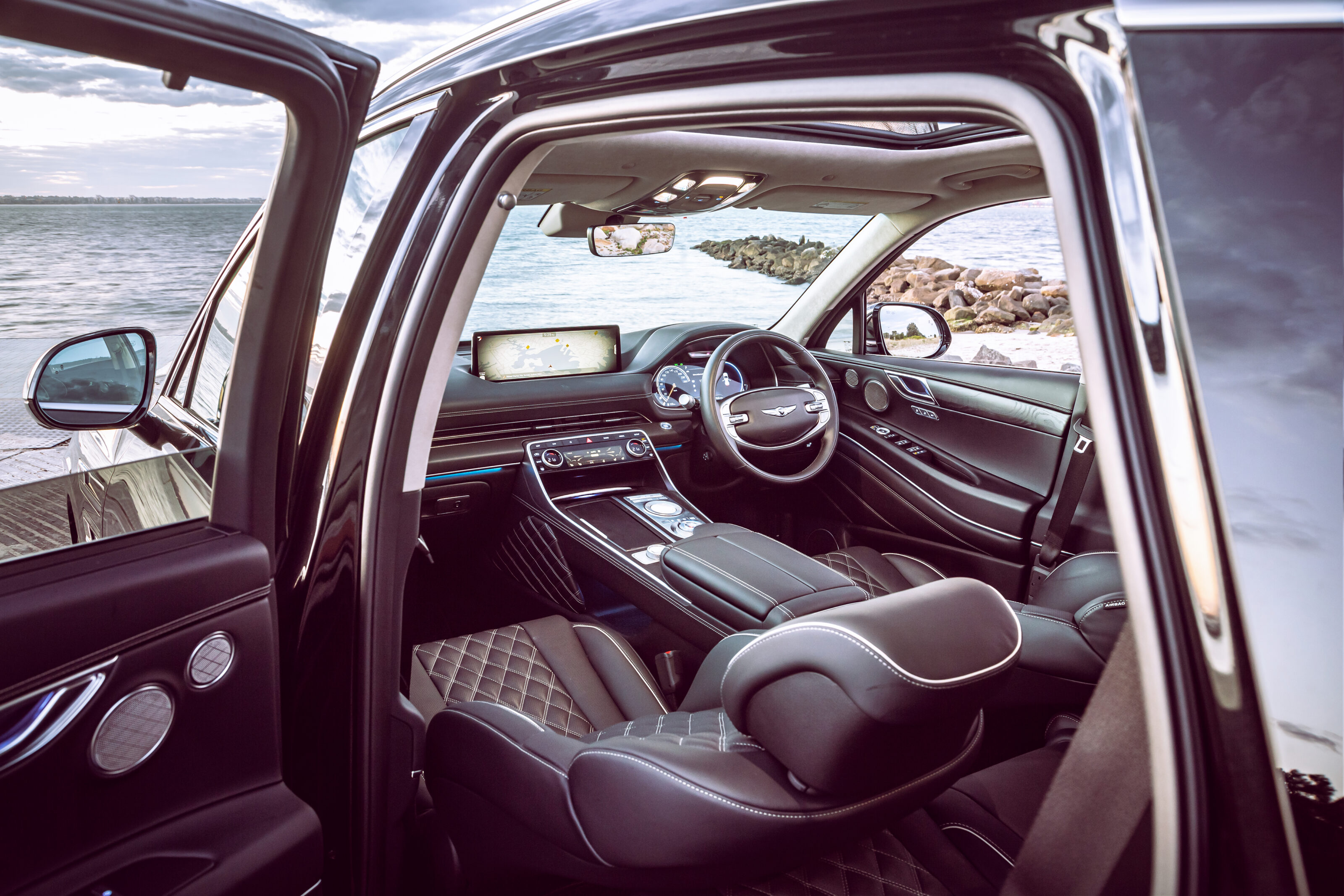
The Genesis brings a well-conceived package, with tilt and slide second row and one-touch access to row three, which is fitted out with air vents, audio speakers and even nifty intercom reception from the front row. It’s a tight fit for adults in the rear, but there’s enough middle row adjustment to service as a genuine seven-occupant prospect for long hauls.
The Genesis is not without its niggles. The touchscreen is beyond natural reach and its console controller demands excessive prodding, mirroring the taut transmission selector that annoying finds neutral too readily. And I’ll argue with supporters of the blind-spot camera system about this feature’s ultimate usefulness given the compromised clarity and sense of depth. Every restart, too, is met with some amount of fiddling to return settings to what they were prior to shut-down.
The Q7’s accommodation is fine pillar from a carmaker renowned for its cabin designs and smarts, plainer and more austere than the Genesis if hugely sophisticated and, in many ways, better resolved and more intuitive. For one thing, its glassy touchscreen goodness is simpler to use, easier to navigate and within easier reach than that in the GV80.
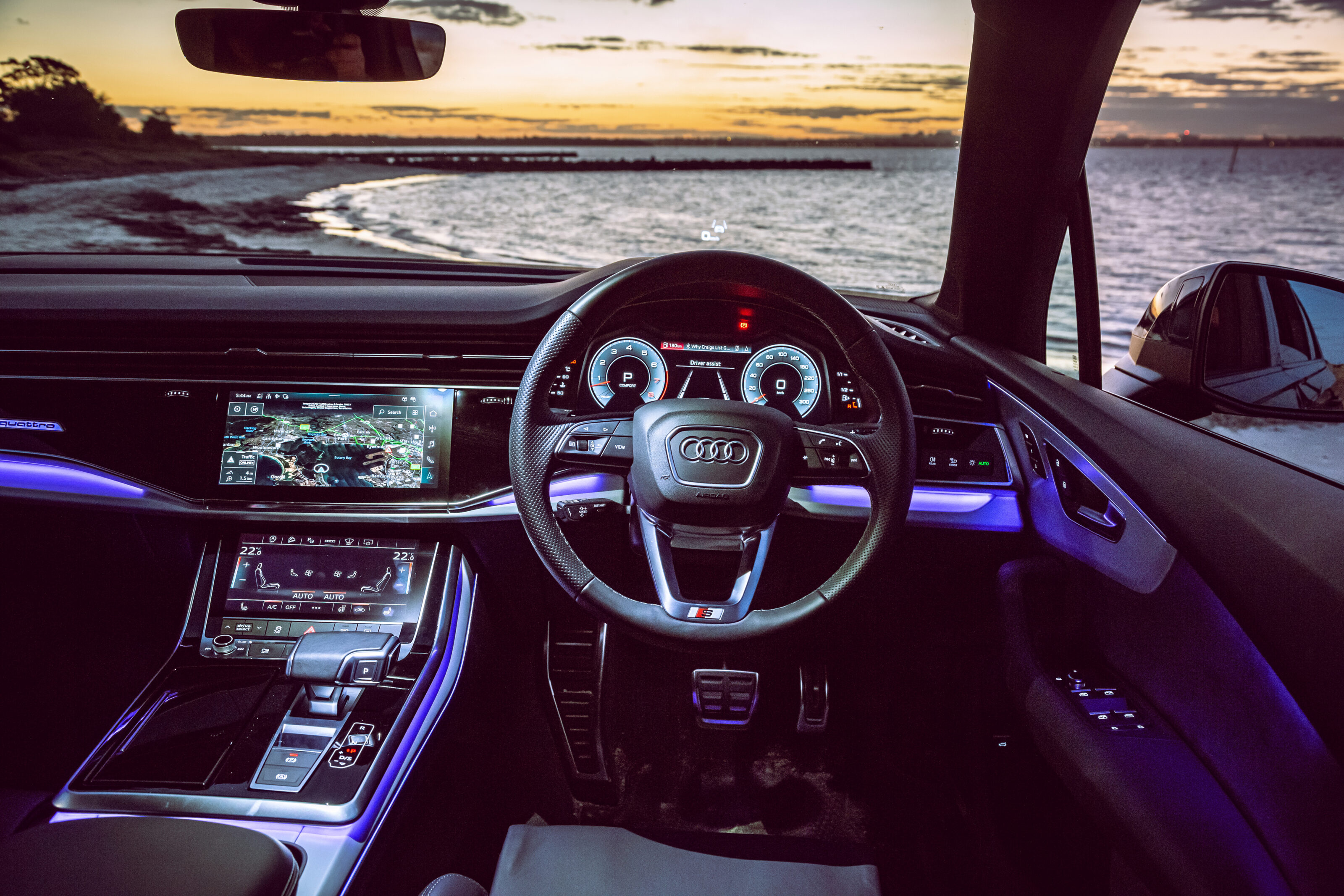
However, the downside of drawing so much feature control to the double-stacked touch surface brings a certain sensory overload once you throw the digital instrumentation into the mix. The big-screen effect will be a deal maker or breaker.
Digital display jewellery apart, the Audi’s richness is less about conspicuous trinkets and more about tactility and material variety together with an innate sense of solidity. Up front, at least, the Q7 also feels more substantial against the brighter and lighter ambience of its rival. Not that it lacks party tricks – especially the ambient lighting that’s downright spectacular experienced at night.
Its Valcona leather pews aren’t as opulent as the GV80’s seating but arguably balance support and comfort more naturally, complemented by gen-two Q7’s extremely flexible seating and a neat ‘tumble’ design for the row-two bench for easy third-row access. The middle pew also splits 40:20:40 and each section can be tilted and slid independently, whereas the Genesis adopts a 60:40 format. The big Audi’s brilliant packaging smarts is its strong suite, undoubtedly a benchmark for which newcomers, such as present company, surely must measure against.
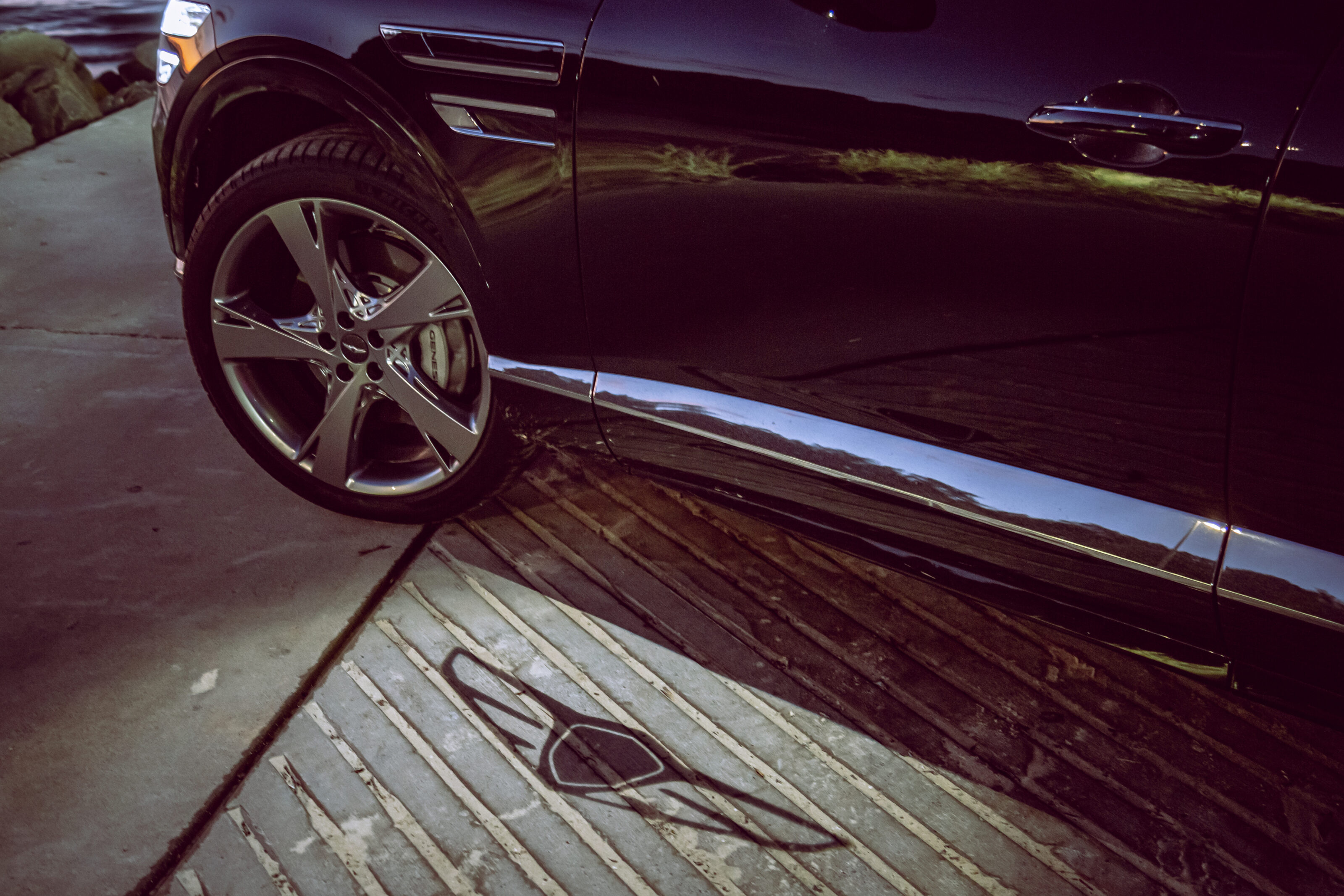
That said, as a complete package, the German stalwart doesn’t really steal the march on the Genesis for roominess and space in any area. It just feels that way. Its more liberal use of glass, including its long panoramic roof, gives the Q7 an airier ambience in rows two and three than its rival, letting more light in and offering rear passengers a superior view of the outside world, particularly for youngsters.
The 55 TFSI grade is lavishly loaded with features, eschewing the need for cost-optional packaged bundles rife in some of Audi’s humbler stock that can excessively balloon the outlay bottom line. Four-zone climate control with separate dedicated controls, 19-speaker Bang & Olufsen sound, a head-up display and a gesture-controllable tailgate are in for the price of admission, and the marques’ rather excellent Matrix LED headlights are standard issue.
The Q7 also offers wireless Apple CarPlay – the GV80’s is wired – and the latest MMI navigation plus infotainment format is slick, quick in response and highly intuitive in its interface, rebooting mirrored smartphone apps such as Spotify quickly, effortlessly and without the stuffing about demanded by its newcomer opponent.
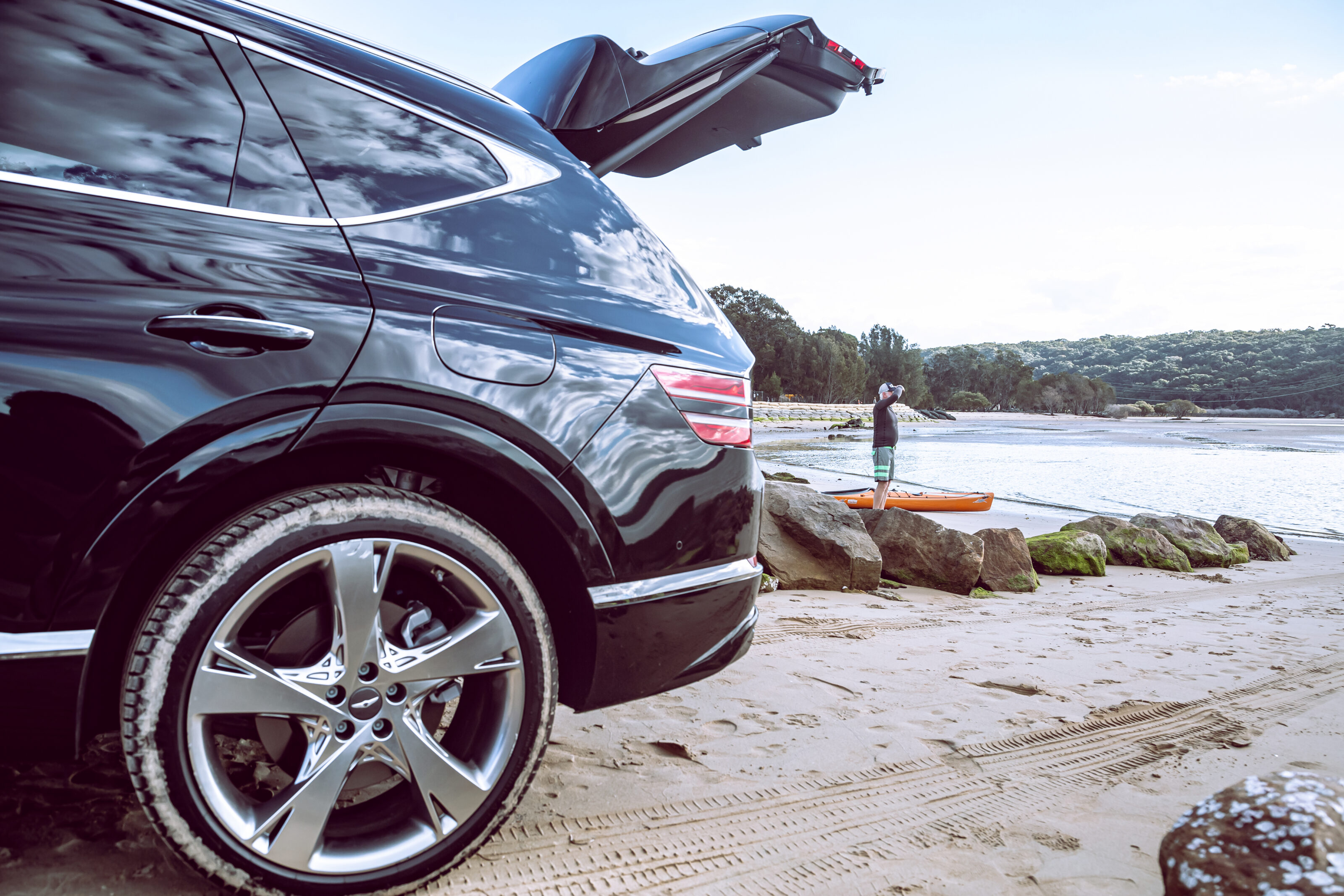
Both SUVs offer neat power folding 50:50-split third-row seatbacks, but as five-seaters the Audi takes the boot space victory with 770 litres against the Genesis’s 727 litres, though tailor-fit slide/tilt seat functionality in both makes any difference largely academic. Converted into surrogate two-seater vans for the Ikea run, the GV80 quotes a larger 2144-litre load area than the Q7’s 2050.
Each wears a five-star ANCAP rating and both brim with active safety and assistance systems, but in ownership it’s really Audi’s three-year warranty that appears shaky against the five years of surety offered by Genesis, complete with the dangling carrot of five years of no-cost servicing to entice buyers away from the usual European premium-SUV suspects.
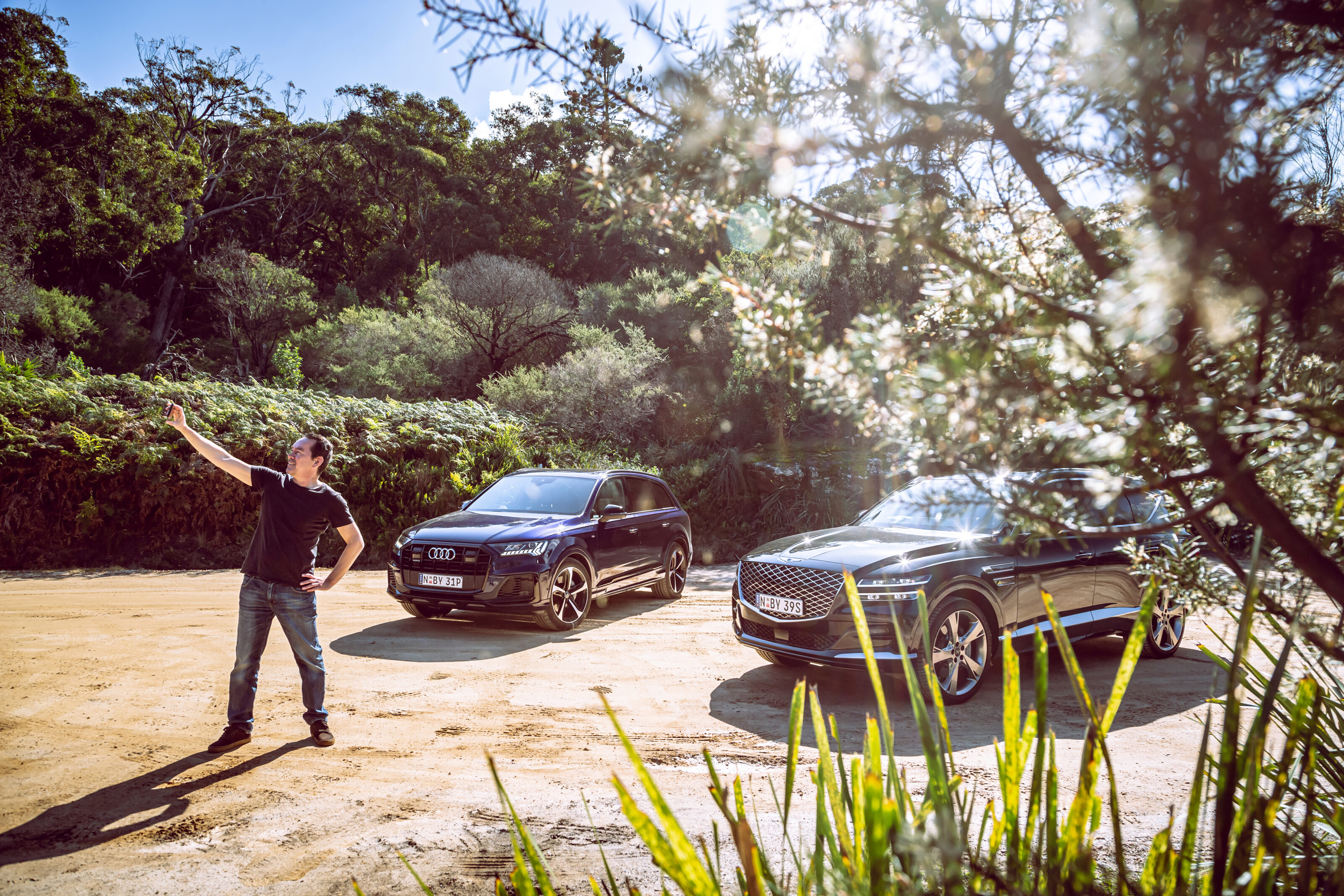
The Genesis GV80 deserves attention and needs more consideration than mere onlooker curiosity. Acceptance will possibly come if the distinctive family hauler lures bums into seats and plants its rubber on hot-mix more often.
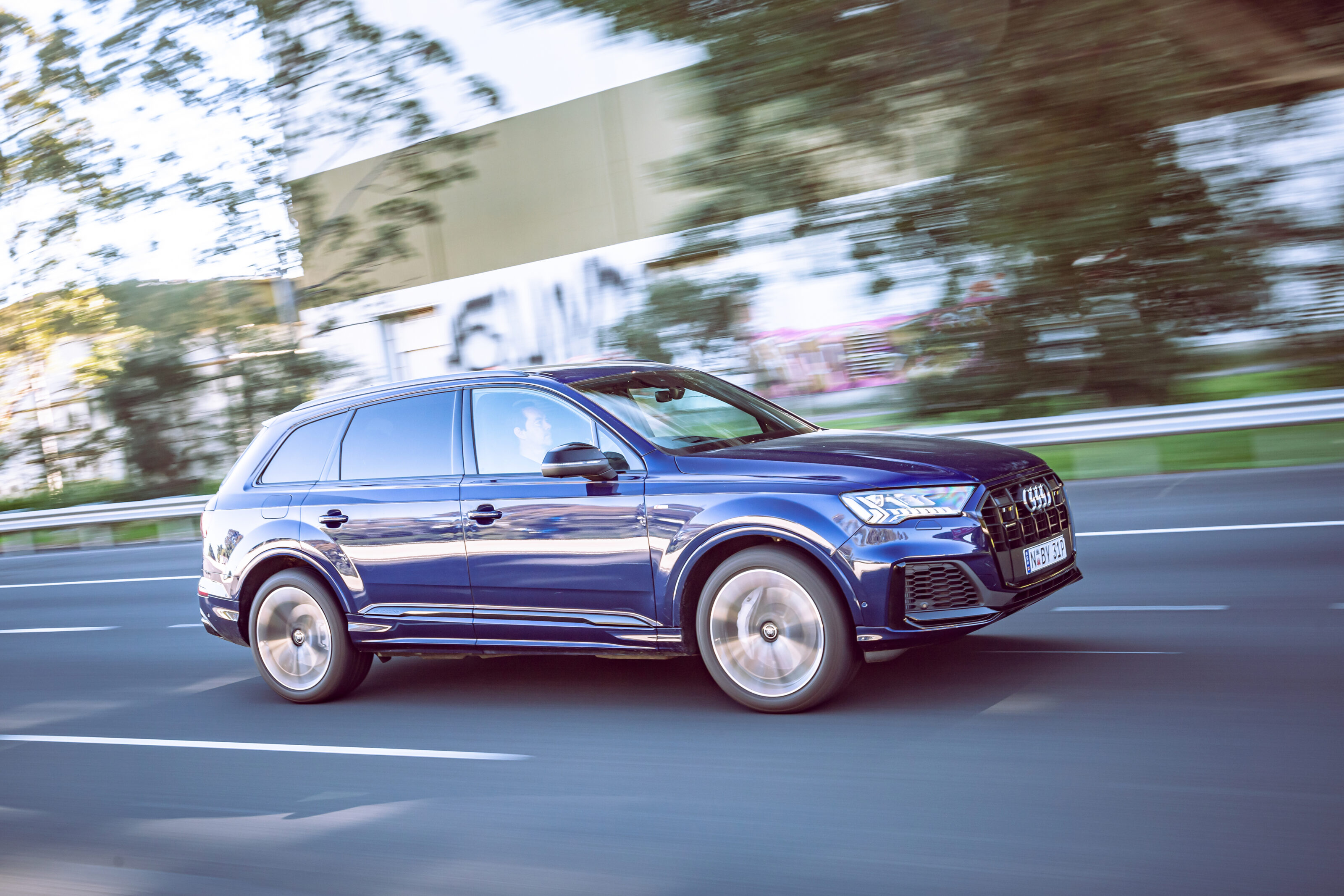
It’s highly impressive and likeable, piling on the x-factor in its own inimitable spin, conspicuously flaunting its upmarket vibe and measuring up nicely, in a good many crucial areas, against as seasoned and proven a prospect in Audi’s Q7. Its trick bag is deep and for sheer quantity of bells and whistles it looks compelling value, too.
Thing is, the newcomer falls a little short in execution: in powertrain, in ride and body control, in the friendliness of its user interface. Sporty leanings, it seems, have diminished some refinement, leaving the GV80 a little unpolished in areas that, for luxury motoring, really matter.
The Audi is more well-rounded, more comfortable and offers a shinier sheen with fewer chinks in its armour. Back to back, the Q7 clearly benefits from its longer evolution and owns the luxury SUV format more convincingly. And the range’s impressive return to petrol motivation comes without compromise or shortcomings.
Lean Burn
If you’re put off by the thought of burning through bulk ULP, both luxury SUVs can be had in similar high-spec trim with alternative diesel power. The Genesis D3.0 FR VGT fits an impressively silky 3.0-litre inline six outputting 204kW and 588Nm, featuring a single variable-geometry turbocharger and water-to-air intercooling.
Audi offers two versions of its single-turbo oiler V6 in the Q7; the 45 TDI tune bringing 170kW and 500Nm, or the higher-spec 50 TDI offering a superior 210kW and 600Nm, each paired with the company’s 48-volt mild-hybrid application.
Back to basics
High Street luxury a bit rich for you? The thriftiest choice in Audi’s large-SUV fold is the 45 TDI at $103,672, with the five-strong mainline Q7 range topping out with V8 oiler-powered SQ7 at $162,377.
More choice? Audi’s electric E-Tron fold offers both 50 and 55 variants in wagon and Sportback body styles. The more stylised Q8 range, from $128,972, brings four versions, including a diesel SQ8 and the mighty petrol Q8 RS at $208,377.
Genesis, for its part, offers a simpler four-variant stable, starting from $90,600. It comprises 2.5L petrols in two- or all-wheel-drive, 3.0L AWD diesel and 3.5L AWD petrol V6, any of which can be had with or without a $10K Luxury Package accoutrement.
SCORING
Audi Q7: 8.5/10
Genesis GV80: 8.0/10
Audi Q7 and Genesis GV80 specifications
The 2023 Mercedes-AMG E63 could adopt the company’s new four-cylinder plug-in hybrid powertrain, according to fresh rumours.
The UK’s Autocar is reporting Mercedes-AMG will offer the next-generation E63 with a 2.0-litre four-cylinder engine and plug-in hybrid (PHEV) technology – a powertrain which will produce more than 480kW when it debuts in the C63.
If true, it means AMG customers may have to step up to the brand’s GT 63 S E Performance if they want a V8 in a sedan body. The flagship GT 63 model was unveiled in September with a plug-in hybrid 4.0-litre twin-turbo V8 putting out 620kW and 1400Nm.
A four-cylinder engine also seems a curious choice in the large high-performance four-door segment, with suggestions the E63’s direct competitors are both going in entirely different directions.
While yet to be confirmed, it’s expected BMW will offer the next-generation M5 with a twin-turbo V8 with PHEV technology and as much as 560kW, while the Audi RS6 is said to be ditching its 4.0-litre twin-turbo V8 in the current model for an all-electric powertrain producing around 530kW.
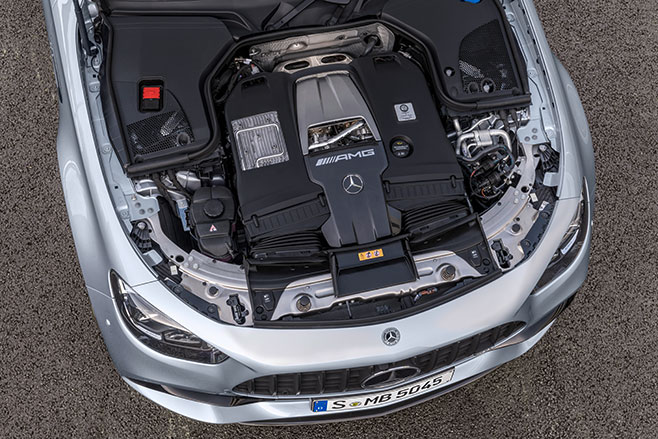
Despite rumours the E63 will halve its cylinder count, AMG boss Philipp Schiemer recently confirmed the V8 would be around for the next decade.
“I think for the next 10 years we will see the V8, for sure,” Schiemer said in an interview with Road & Track.
“We have a lot of customers who love their cars and I still think that we will see those people buying the [V8] cars for a long time.”
However, AMG’s assurances of a V8 continuing into the future are no guarantee the engine will find a home in the E63, with the brand potentially looking to spread development costs of its high-performance four-cylinder PHEV powertrain across multiple models.
The 2022 SsangYong Korando E-Motion will be considered for the Australian market, with an evaluation vehicle set to arrive early in the new year.
Revealed in June as SsangYong’s first fully-electric car, the Korando E-Motion offers up to 339 kilometres of driving range available from a single charge (WLTP cycle).
A single electric motor feeds 140kW and 360Nm to the front wheels, powered by a 61.5kWh lithium-ion battery pack sourced from LG Chem.
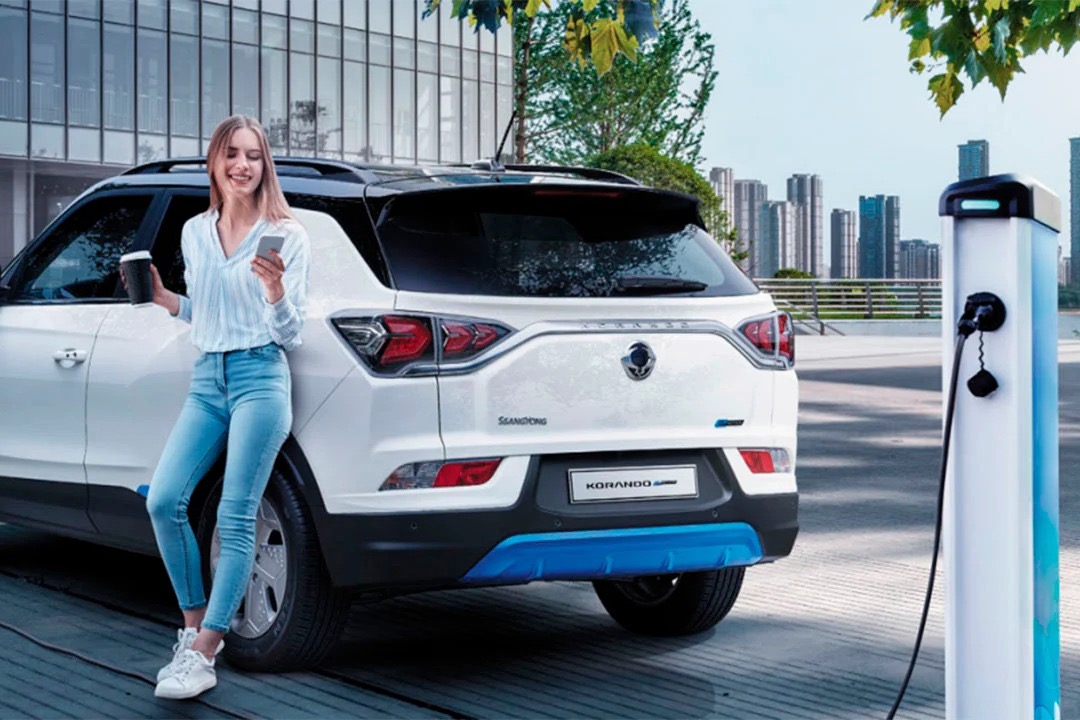
A spokesperson for SsangYong Australia confirmed to Wheels a vehicle is being brought to Australia for the company to “carry out assessment activities”.
In recent days, the Korean carmaker has announced the Korando E-Motion will be offered in European markets, with the model priced from €36,000 (AU$56,000) in Spain – or roughly on par with the Volkswagen ID.4.
The Korando E-Motion comes with LED headlights and tail-lights, a 12.3-inch digital instrument cluster, 9.0-inch infotainment touchscreen with Apple CarPlay and Android Auto, dual-zone climate control, wireless smartphone charging, heated and ventilated front seats, and a set of 17-inch alloy wheels.
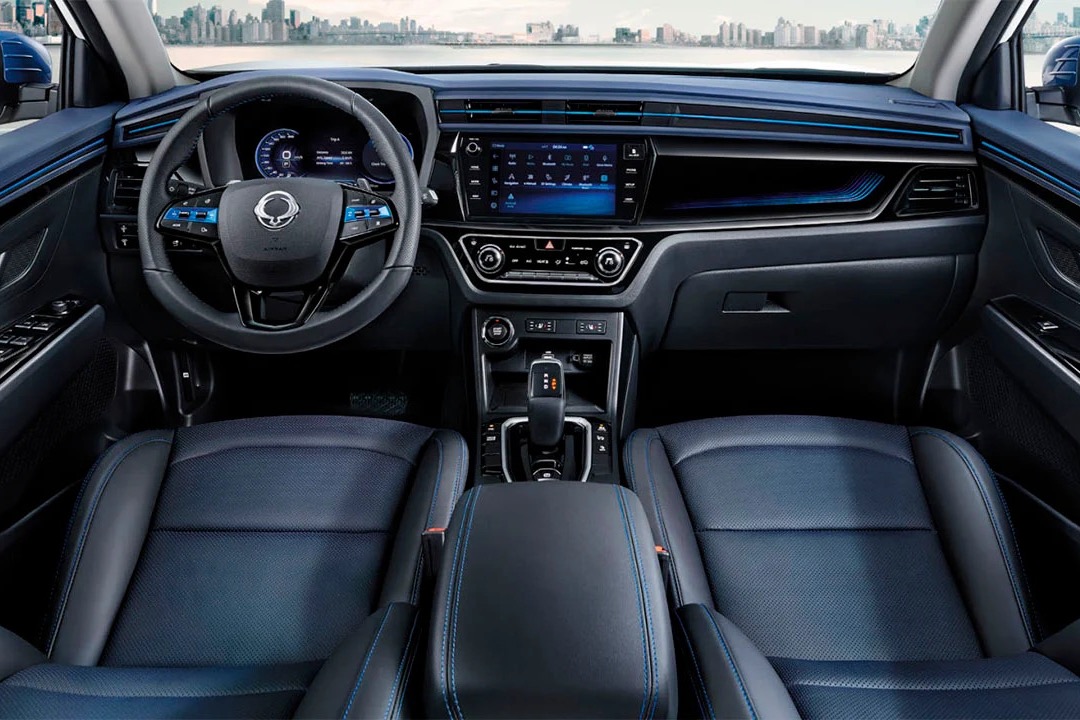
Adaptive cruise control, driver fatigue detection, lane-keep assist, lane departure warning, traffic sign recognition, and emergency braking with pedestrian detection are also available.
SsangYong says the E-Motion’s battery can be charged from 20 to 80 per cent in around 33 minutes, with a full recharge taking around 11 hours on a standard home wall-box.
With the 2022 SsangYong Korando E-Motion also set to go on sale in the UK from January, it confirms a right-hand-drive version is entering production, setting the stage for a potential Australian debut.
The very first 1965 Shelby GT350 R Prototype will be auctioned off next month.
Set to go under the hammer at the Mecum Auctions event in Kissimmee, Florida, in early January, this prototype – codenamed ‘R5002’ – was built under the supervision of Carroll Shelby and served as the basis for a total of 34 production units.
Created to push a ‘high-performance’ image for the Mustang, the Shelby GT350 R was designed to compete in the 1965 SCCA competition, dominating the production sportscar field during the contest – becoming the first Shelby model to win a race.
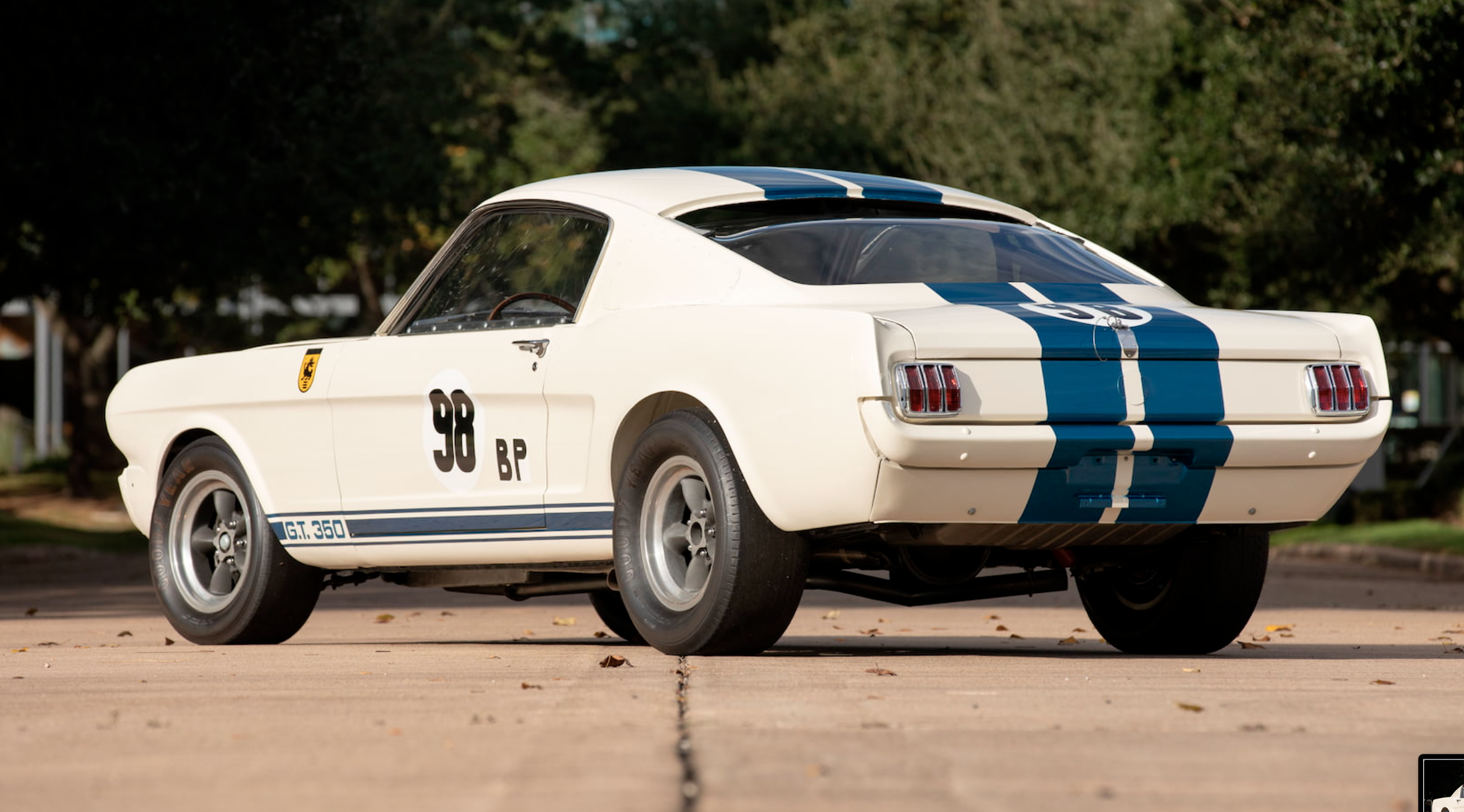
It was also tested extensively by legendary racing individuals, such as Ken Miles and Chuck Cantwell, in testing and development.
Nicknamed the ‘Flying Mustang’, from an iconic image of Miles getting all four wheels in the air during the race, the GT350 R helped in transforming the Mustang from – as the Hod Rod magazine put it – a “gentle little colt into a roaring, snorting stallion”.
Over the regular Shelby GT350, the race-orientated R received new suspension tuning, a modified 4.7-litre Ford V8, fibreglass body panels, an improved cooling system, and plexiglass windows.
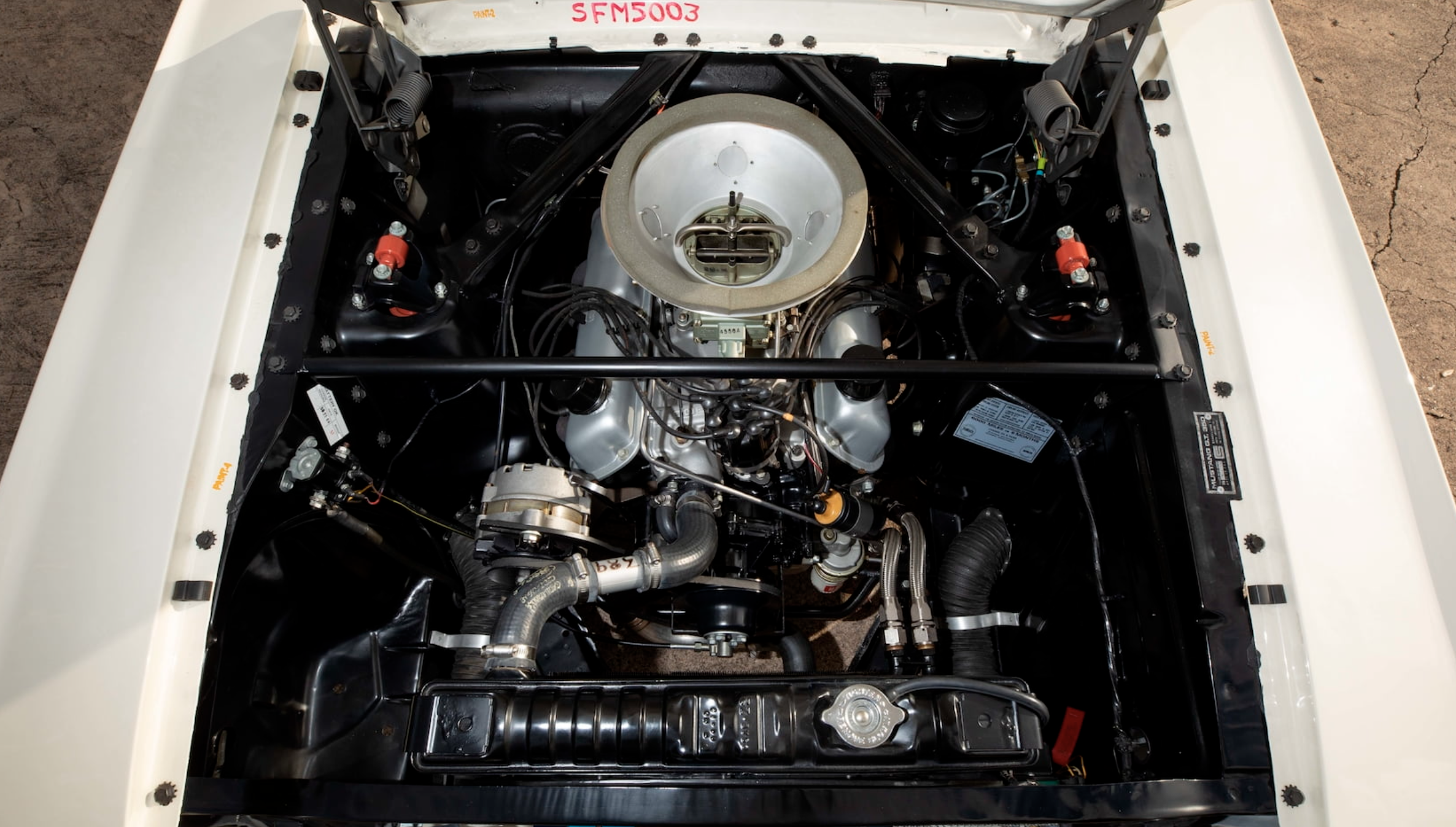
According to the vehicle’s documentation, the “test car – as is” was purchased by Bill Clawson, an engineer in the Ford Performance Division in Dearborn, Michigan, on March 31, 1966, for $4000.
Briefly lost, the R5002 was found in Mexico in 1989, before being placed on display at the Shelby American Museum in Boulder, Colorado, for 14 years. Antique collector John Atzbach then obtained the car in 2010, restoring it back to its original 1965 condition over a four-year period.
The Shelby GT350 R Prototype is expected to fetch a record-setting price when it goes up for auction between January 6 and 16, with the current record for a Mustang already achieved by this car when it was previously sold for US$3.85 million (AU$5.3m) in July 2020.
I’m looking for something good looking, that drives well and which will occasionally have to carry four people. I’ve whittled it back to the Audi S7 and Porsche Taycan. What’s the smart call here for $170K? – Trevor M
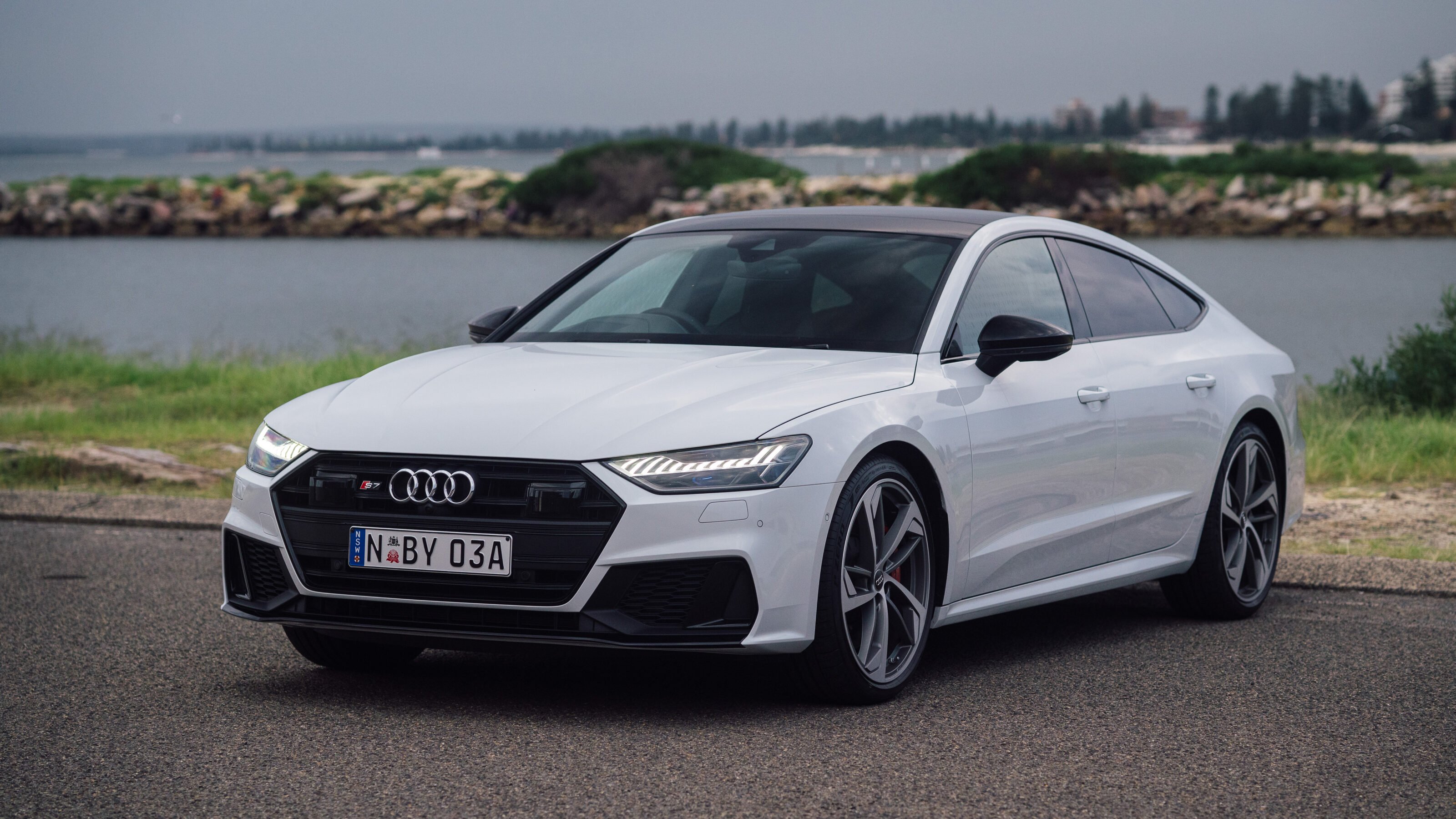
These are two very different vehicles, but both will fulfil the requirements brilliantly.
If you’ve come down to these two vehicles, we take it that you’re largely drivetrain agnostic. Much will depend on the level of involvement you’re prepared to indulge in.
The Audi is an easy thing to deal with and, for most situations, would be our recommendation. It’s a faster fire-and-forget sort of proposition.
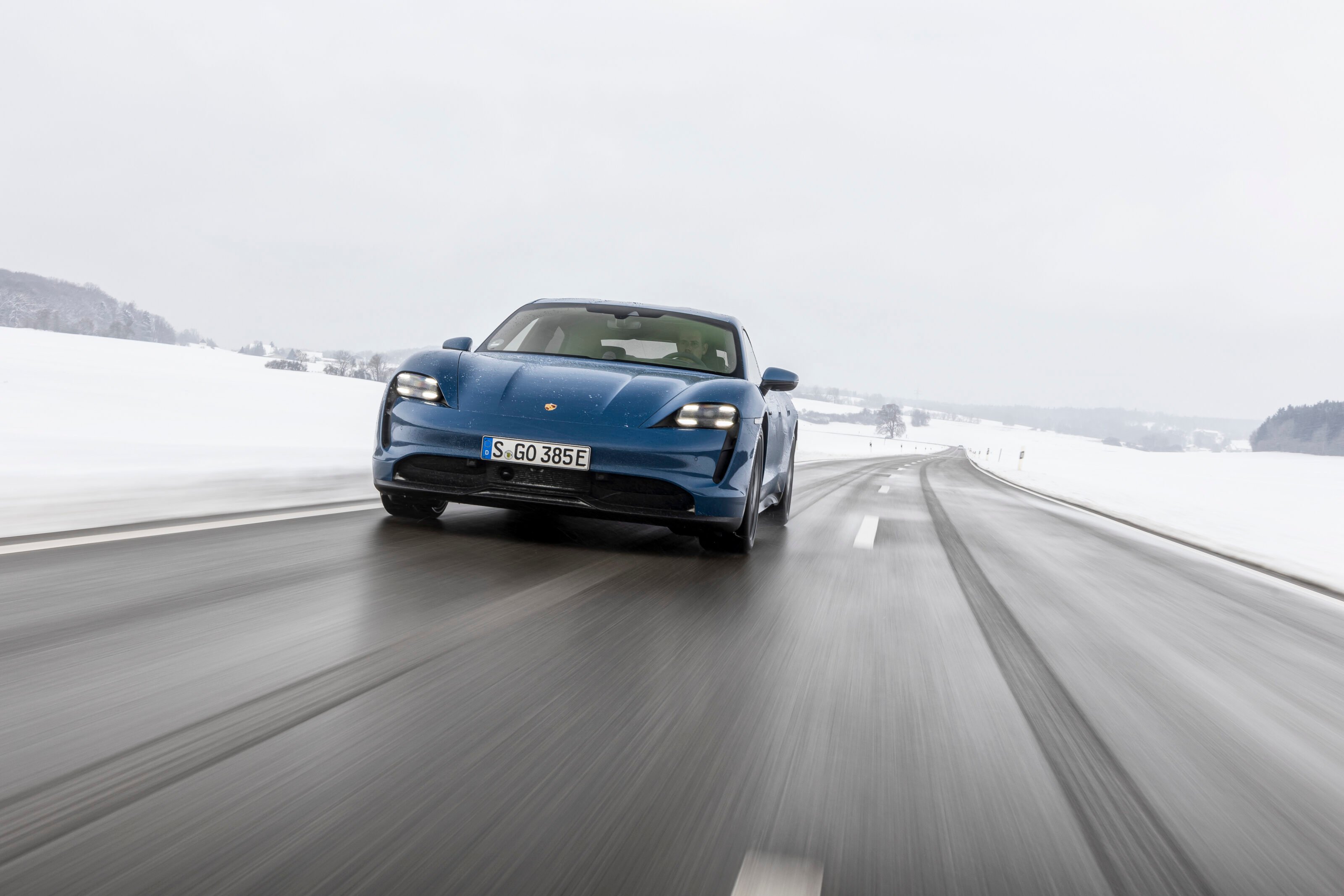
The Taycan has far more of an X-factor and if you want something that really creates some wow factor, it’s streets ahead of the dependable but ever so slightly dour Audi.
So there’s your answer. Choose the Audi unless your heart really can’t resist the exotic siren call of the Porsche. – AE
Audi S7 and Porsche Taycan specifications
UPDATE, January 2023: Kia EV6 GT driven in Australia
“This isn’t even my final form”, chuckled the 239kW & 605Nm EV6 GT-Line last year. Now we understand… see our first drive review of the flagship EV6 GT, including a track test, at the link below.
The story to here
Kia EV6 GT likely to cost close to $100,000
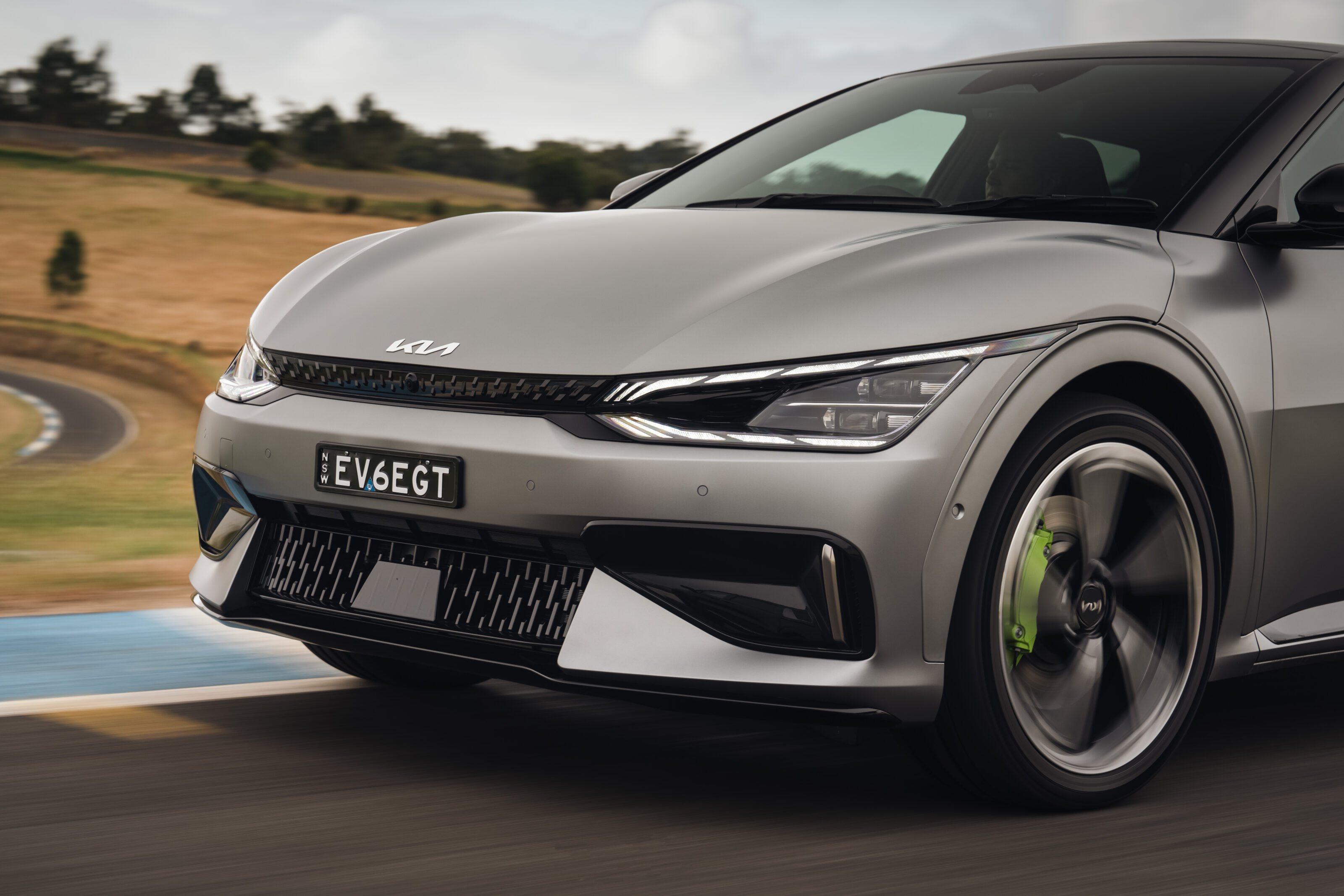
The 2022 Kia EV6 GT will become the most expensive car offered by the Korean carmaker in Australia, with a price tag set to fall close to $100,000.
Kia Australia has this week confirmed the local line-up for the brand’s first dedicated electric car. Pricing will not be announced until January ahead of the EV6’s February launch, but the company provided its first official cost indication for the flagship GT that will follow later in late 2022.
“There are dealers already taking deposits for [the EV6 GT] and it’s 12 months away,” said Kia Australia’s general manager of product, Roland Rivero. “Dealers are already guesstimating it will be around the $100,000 mark … but deposits are still coming through [from buyers].

“We would like to think we would offer it a little bit below that [price point] and are currently in negotiations with Kia HQ.
“We haven’t even driven that [GT] variant yet, but we’re pretty excited. The [regular] EV6 is the best Kia I’ve ever driven and if that’s any indication of what the GT will be, we’re off to something special that’s never been part of this brand before.”
In the EV6 range for Australia, the GT will sit above a mid-range GT-Line, offered with rear-wheel drive and all-wheel drive, and a rear-wheel-drive base model.
The dual-motor, all-wheel-drive EV6 GT produces 430kW and 740Nm. With a quoted 0-100km/h time of 3.5 seconds, it is the fastest-accelerating Kia production car yet.
Other EV6 variants also use a 77.4kWh battery, but are equipped with less powerful motors or use a single electric motor.
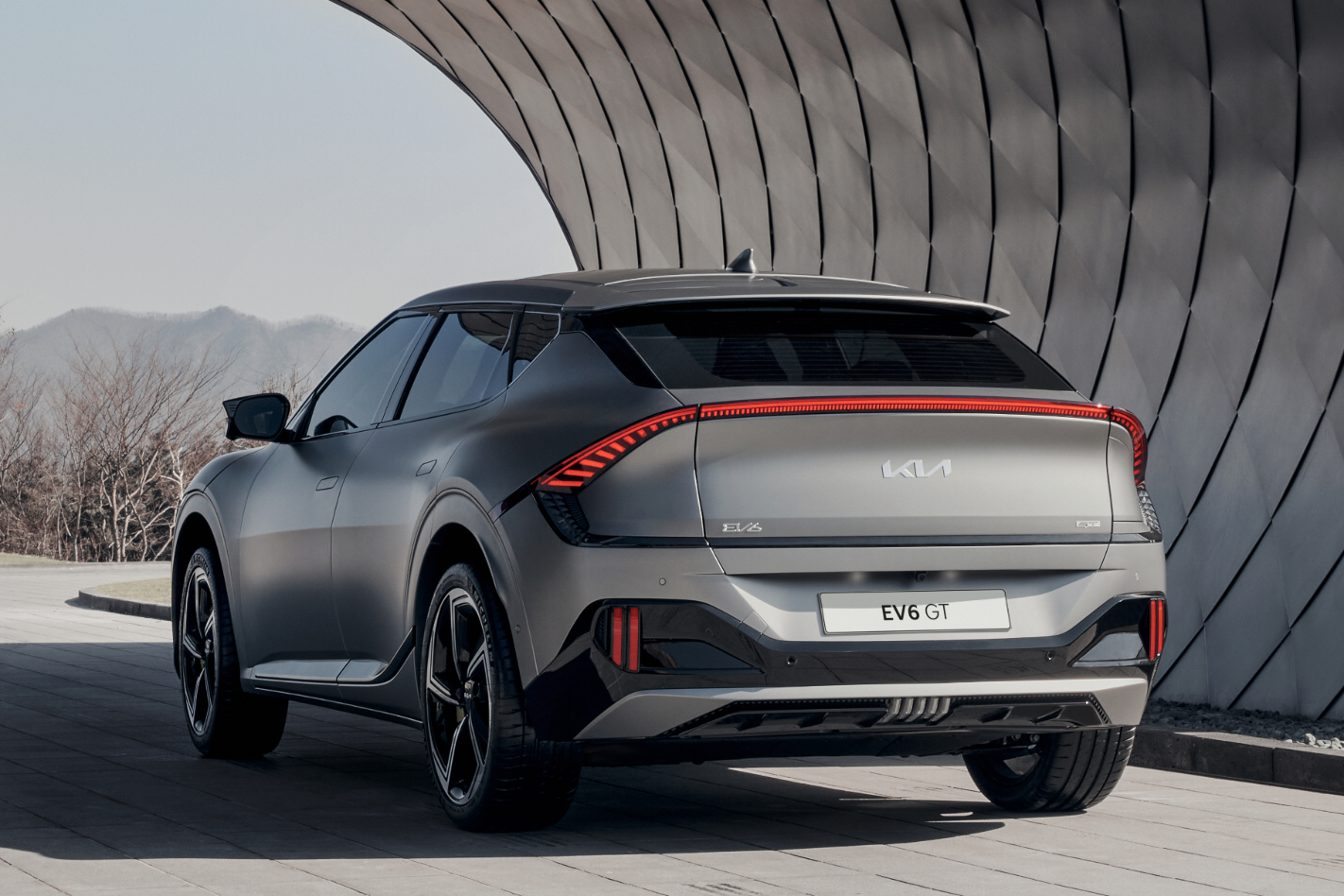
The 239kW/605Nm GT-Line AWD accelerates from 0-100kmh in 5.2 seconds, according to Kia. The time increases to 7.3 seconds for the rear-drive EV6, which will offer the longest WLTP-rated battery driving range – up to 528 kilometres.
Kia says a 58kWh battery version of the EV6 has been homologated for Australia in both short- and long-range form, but is not guaranteed to join the line-up.
Kia Australia says the EV6 has already achieved an unprecedented number of customer enquiries for a model, with 16,000 expressions of interest eclipsing the 12,000 for the pre-launch phase of the carmaker’s existing halo car, the Stinger sedan.
The company, however, is only able to offer 500 units of the EV6 in 2022 at this stage. It is pushing Korea for more supply, but even if successful, the maximum number isn’t expected to exceed 800 units.
Kia Australia has also indicated the EV6 range could generally be more expensive than its Hyundai twin, the Ioniq 5, that starts from $71,900 in rear-wheel-drive form.
The EV6 will be sold in Kia dealerships, whereas the Ioniq 5 is being sold online only.
The EV6 GT-Line is expected to the most popular variant in the range.
Kia’s current most expensive vehicle locally is the Sorento plug-in hybrid, which costs $79,300 before on-road costs.
While Kia Australia remains hopeful of the EV6 GT arriving by the end of 2022, it says it can’t rule out a delay into early 2023.
Hyundai’s equivalent of the EV6 GT, the Ioniq 5 N, has yet to be revealed officially, but has been regularly spied testing.
Meet Kia’s new halo car.
It’s not just that the all-electric EV6 is the first Kia in history designed from the wheels up to be battery-powered; the EV6 signals its virtues in other ways, too.
It looks dramatically modern. It has a roomy, well-finished interior. And it’s genuinely engaging to drive, with great steering, a confident chassis, and good performance.
One of 11 electric vehicles to be launched by Kia over the next five years, the EV6 is built on Hyundai Motor Group’s Electric-Global Modular Platform (E-GMP) and shares much of its hardware with Hyundai’s handsome Ioniq 5.
UPDATE, January 2023: Kia EV6 GT driven in Australia
“This isn’t even my final form”, chuckled the 239kW & 605Nm EV6 GT-Line last year. Now we understand… see our first drive review of the flagship EV6 GT, including a track test, at the link below.
Story continues…
That means the same battery packs and the choice of either single-motor rear-drive or dual-motor all-wheel-drive powertrain configurations.
But the Kia looks and feels a very different car to its Hyundai cousin. The Ioniq 5 has been designed to be the more comfort-oriented of these two E-GMP cars.
Just on 55mm lower overall than the Ioniq 5, 100mm shorter in the wheelbase, and with stiffer suspension, the EV6 is fundamentally an electric avatar of the Stinger, the sporty rear-drive Kia hatch that has no counterpart in Hyundai’s line-up.
The EV6 will initially be available in two trim levels – base and GT-Line – with a choice of 58kWh or 77.4kWh battery packs. Order the smaller battery and you’ll get a 125kW e-motor driving the rear wheels only, or a 173kW dual-motor setup and all-wheel drive.
Go for the bigger battery, and you’ll get 168kW in the single-motor version and 239kW in the dual-motor model.
The killer app in the EV6 arsenal will be the EV6 GT, which arrives later in 2022 with a 430kW dual motor powertrain that’s said to be good for 0-100km/h in 3.5 seconds and a top speed of 260km/h.
For the record, that’s more grunt, a quicker acceleration time, and a higher top speed than either Porsche’s Taycan 4S or Taycan 4S Cross Turismo.
A Kia that outperforms a Porsche? Yep.
Unless you need all-wheel drive, the single-motor GT-Line with the 77.4kW battery we sampled in southern England is perhaps the best all-rounder of the EV6 line-up, offering a good balance of performance and range plus high equipment levels.
With 168kW and 350Nm on tap to propel 1985kg, Kia claims a 0-100km/h time of about 7.0 seconds and a top speed of 185km/h.
Driving range, according to the WLTP test protocol, is 528 kilometres.
Those data points compare favourably with numbers for the single-motor, 77kWh battery Volkswagen ID4, an obvious rival to the Kia when it arrives in Australia sometime in 2023.
The ID4 has less power and torque – 150kW and 310Nm – and weighs 157kg more, so it isn’t as brisk as the Kia, taking at least half a second longer to get to 100km/h and able to go no faster than 160km/h. Claimed range for the ID4 is 10km more, however.
Where the Kia really stands apart from the Volkswagen, however, is the way it drives.
It starts with the steering. At 2.7 turns lock-to-lock, the EV6’s steering is sharper than the ID4’s (3.0 turns), and the effort strikes a nice balance between fluency and feel. More importantly, the relationship between steering inputs and the response from the front axle is resolutely linear.
The ride is firm, but not as relentlessly busy as that of the ID4. Front and rear spring rates that are stiffer than those on the Hyundai Ioniq 5 and are combined with thicker front and rear anti-roll bars, and what Kia calls ‘frequency selective’ dampers that feature an additional piston to adjust the amount of pressure on the rebound disc stack, allowing the rebound damping force to adapt dynamically to different input frequencies from changing road surfaces.
Kia says the shocks enable the EV6 to offer a slightly firmer, more planted ride when faced with lower frequency inputs, such as on a fast, winding road, and a more comfortable ride at highway speeds or over poor surfaces.
The EV6 changes direction crisply and consistently, its body motions tautly controlled. There’s much more grip from the front end than in the ID4, and you can use the instant-on torque to transfer weight to the rear axle and punch the car out of the corners. If you enjoy driving, this Kia has one of the most engaging EV chassis in the business.
The EV6 GT-Line comes standard with a comprehensive suite of driver aids, including lane keep assist, blind spot warning, forward collision warning, rear cross traffic alert, and intelligent LED headlights. What Kia calls Safe Exit Assist provides occupants exiting a parked EV6 a warning if a vehicle approaching from behind is detected.
Three drive modes – Eco, Normal, and Sport – can be actuated via a large button under the left spoke of the steering wheel. In simple terms, the modes change the weighting of the accelerator pedal, effectively encouraging the driver to make smoother and gentler inputs.
Six regenerative braking levels are offered, ranging from zero – which allows the EV6 to coast freely – to a mode that allows one pedal driving, the car slowing to a gentle halt the moment you lift off, and an auto mode. Drivers can switch between modes via paddles on the steering wheel.
We found the hot setup to be Sport mode, which allowed us to make the most of the powertrain’s instant-on response, with the lift-off regen dialled back to zero to enable the EV6 to flow effortlessly down the road.
You can click the left paddle once or twice to initiate just a hint of regenerative braking into open corners (the right paddle reduces the regen amount) or use the brake pedal to slow the car properly when needed. The brake system – discs front and rear, compared with the disc/drum setup on the ID4 – smoothly blends regenerative and mechanical braking.
Of course, the key question with any new EV is whether the real-word range stacks up against the promises on paper. Our time with the EV6 GT-Line suggests that driven without any due regard for saving electrons, you can expect a real-world range of 400km or better.
At the start of our drive, with the 77.4kWh battery topped up to 100 percent charge, the EV6’s electronic brain was predicting a range of 490km in Eco mode, 476km in Normal mode, and 460km in Sport mode.
After a 220km run through the south of England that included motorway cruising at 120km/h to 140km/h, some fast cut-and-thrust on empty two-lanes, and low speed running through villages and urban traffic, the readout showed a predicted range of 210km in Eco mode, 204km in Normal mode, and 200km in Sport mode.
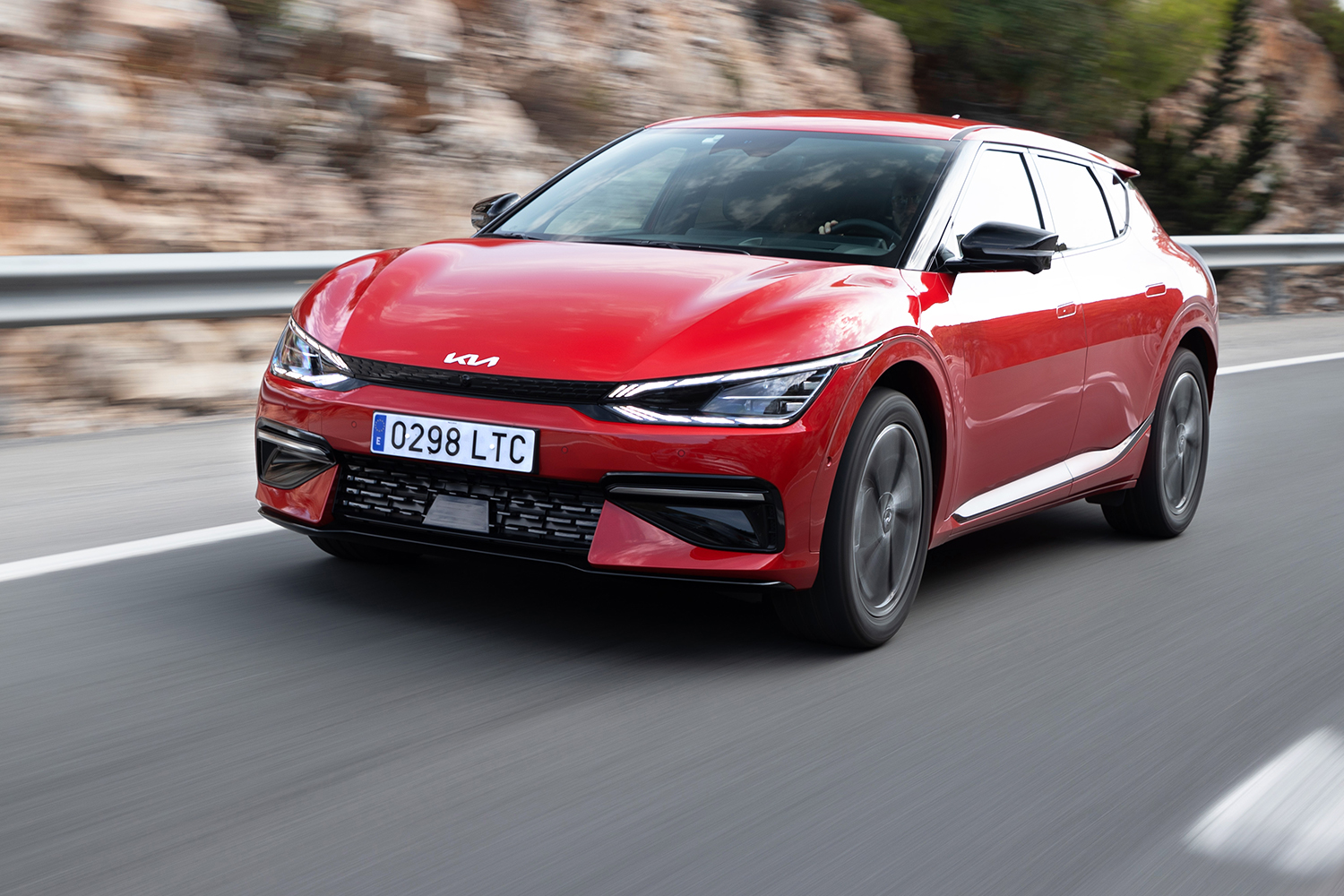
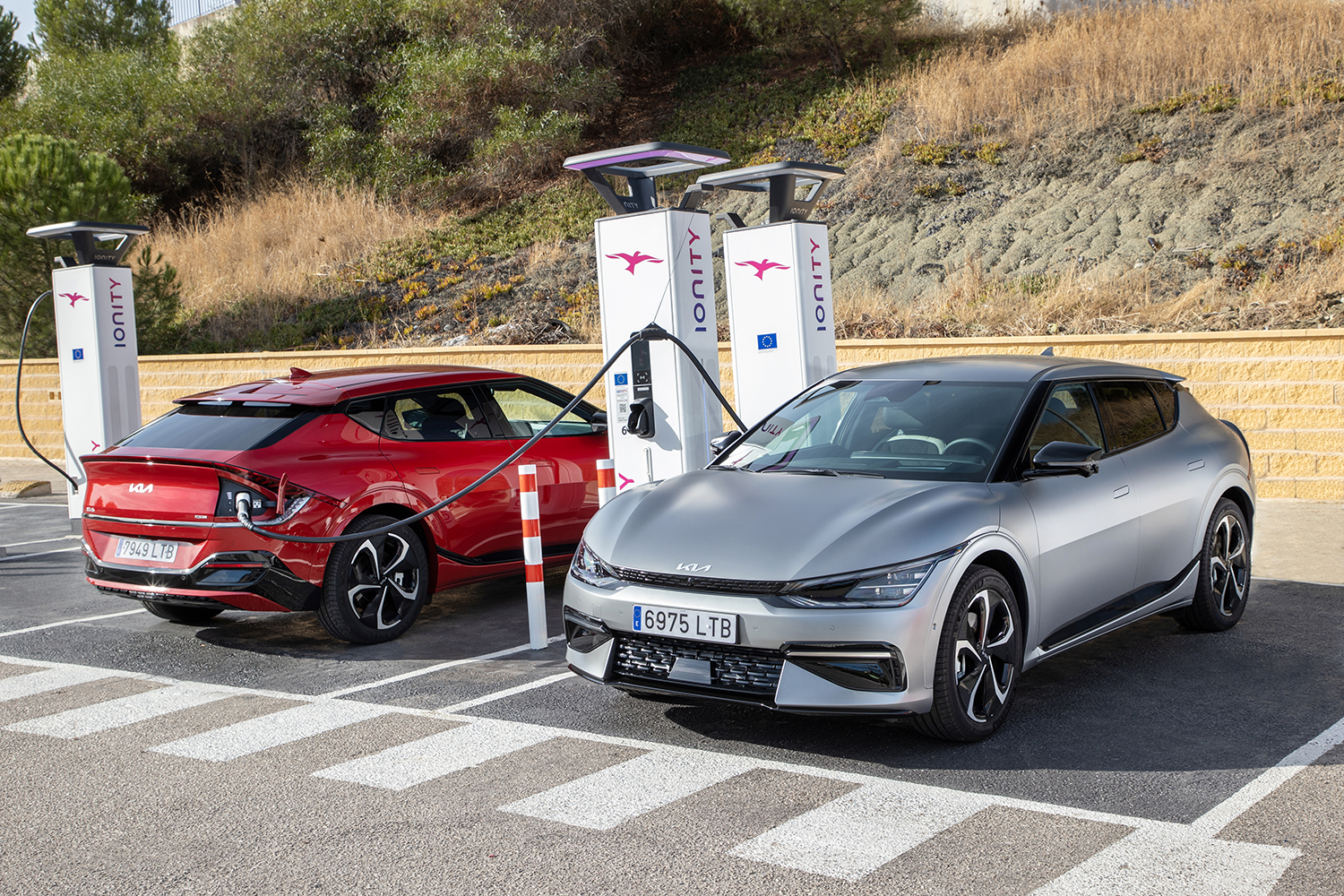
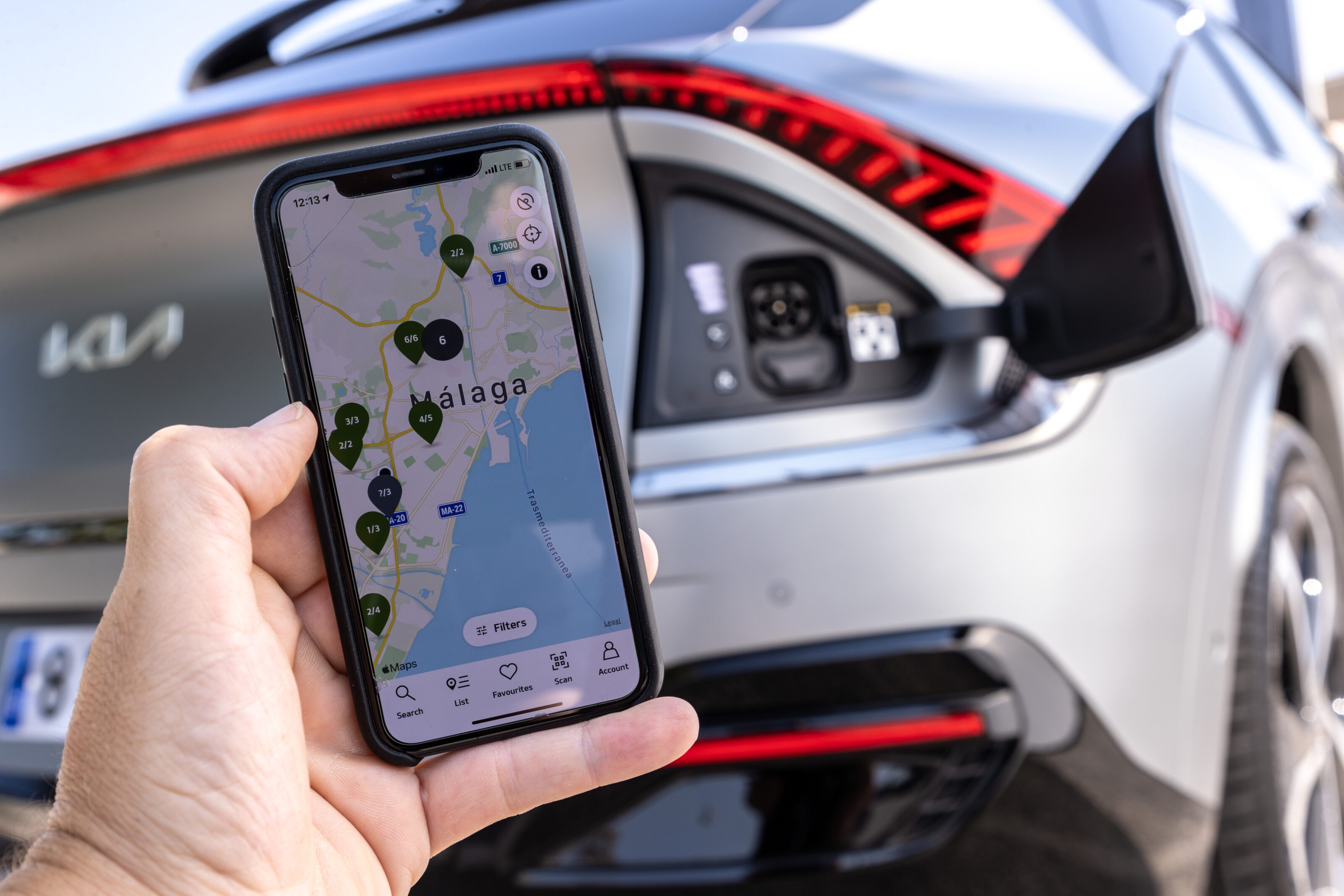
The EV6 offers 800V ultra-fast charging capability that, on a 350kW ultra-rapid charger, enables the battery’s level of charge to be boosted from 10 percent to 80 percent in just 18 minutes.
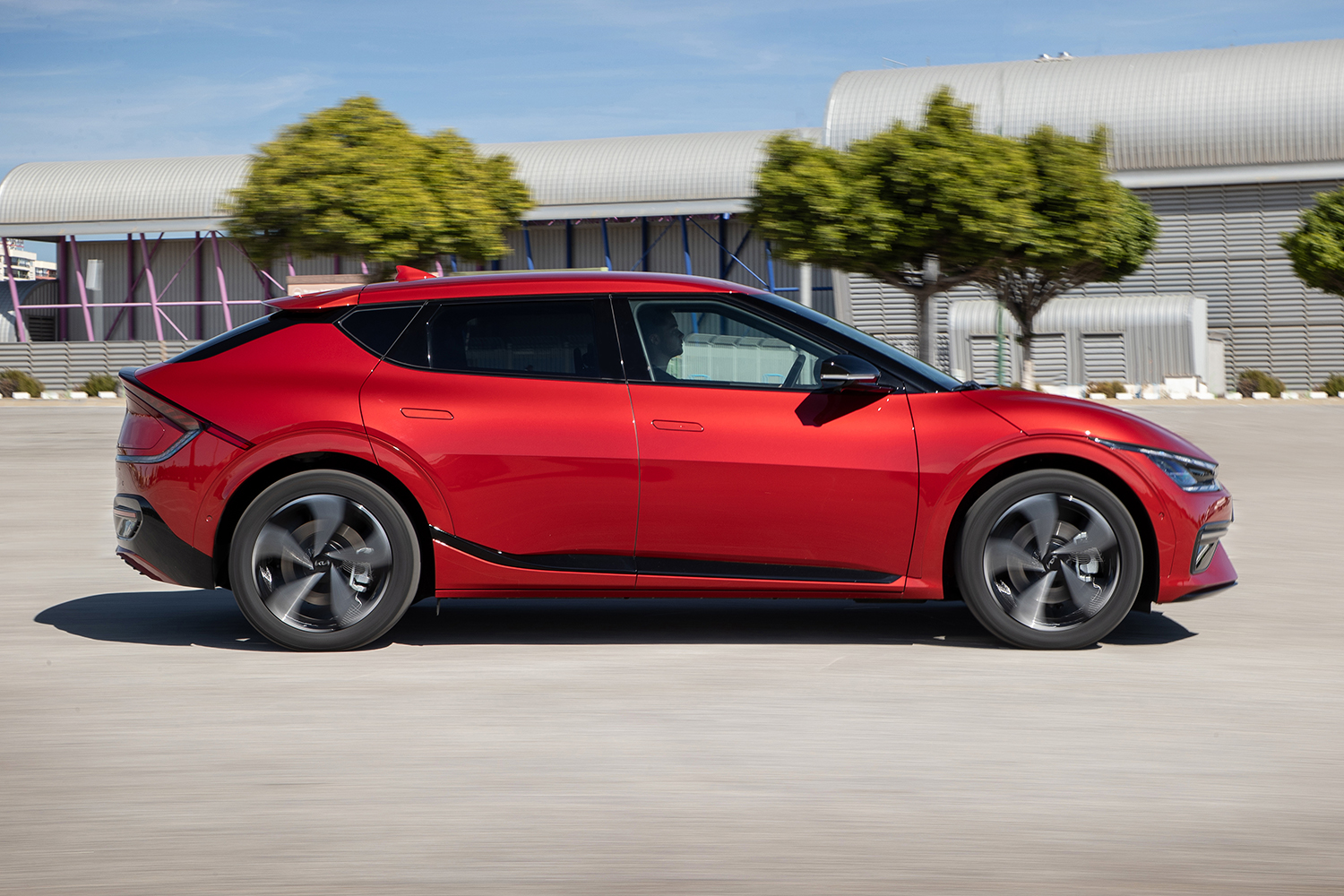
Like the Hyundai Ioniq 5, the Kia EV6 is a surprisingly big car. At 4695mm long and 1890mm wide it’s just 115mm shorter and 10mm narrower than the seven-seat Sorento SUV. But it also has a wheelbase that’s 85mm longer and a roofline 150mm lower.
These two dimensions anchor a striking road presence accentuated by the hips over the rear wheels, the rising beltline aft of the B-pillar, a rear light bar that sweeps up and across the tail of the car and is profiled like a spoiler, and an aggressively chiseled nose.
Standard 19-inch alloy wheels shod with 235/55 Kumho Ecsta tyres, the high H-point – you’re sitting on top of a battery pack, after all – the long roof and the rear tailgate are all standard SUV/crossover cues, but visually the EV6 looks much more car-like.
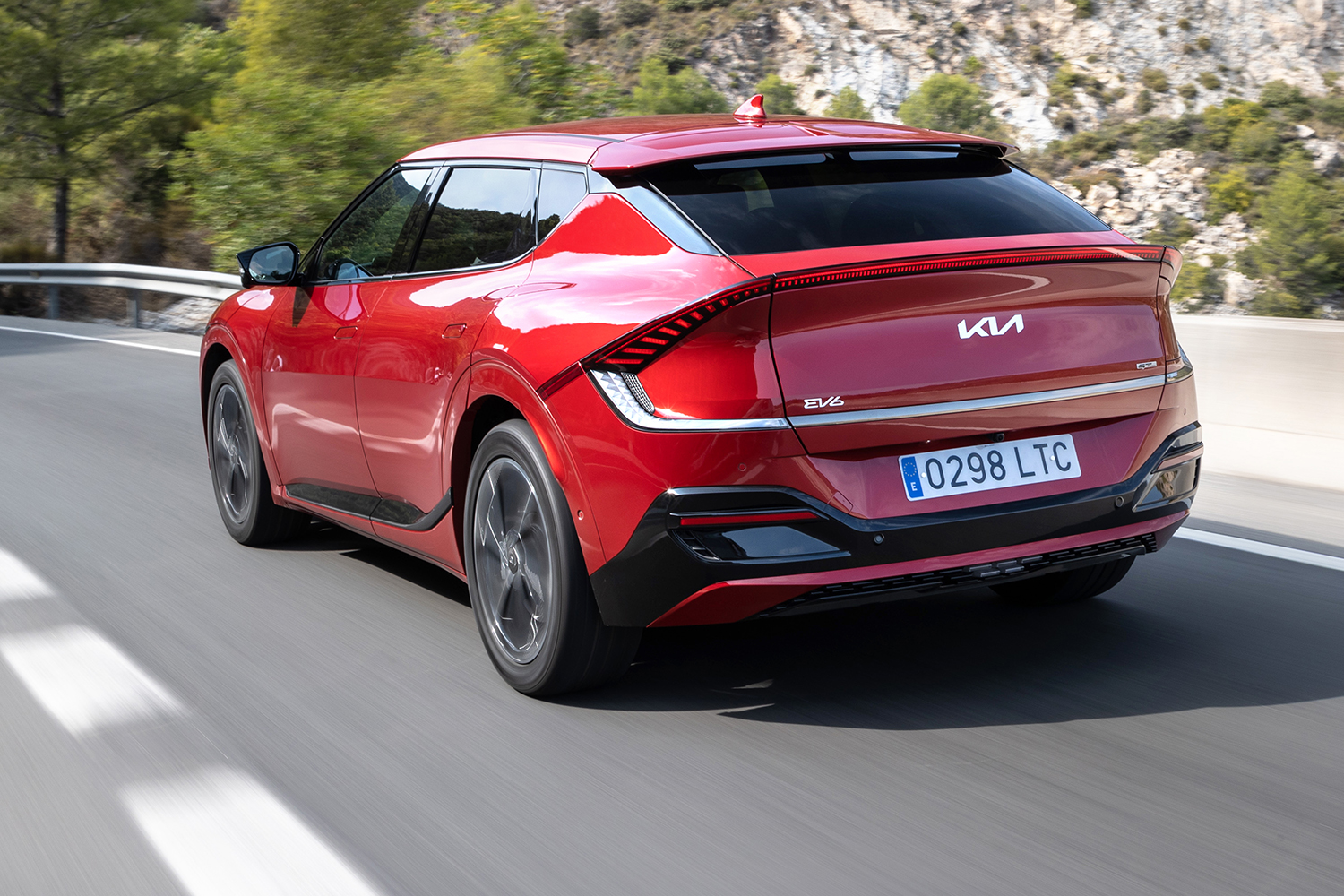
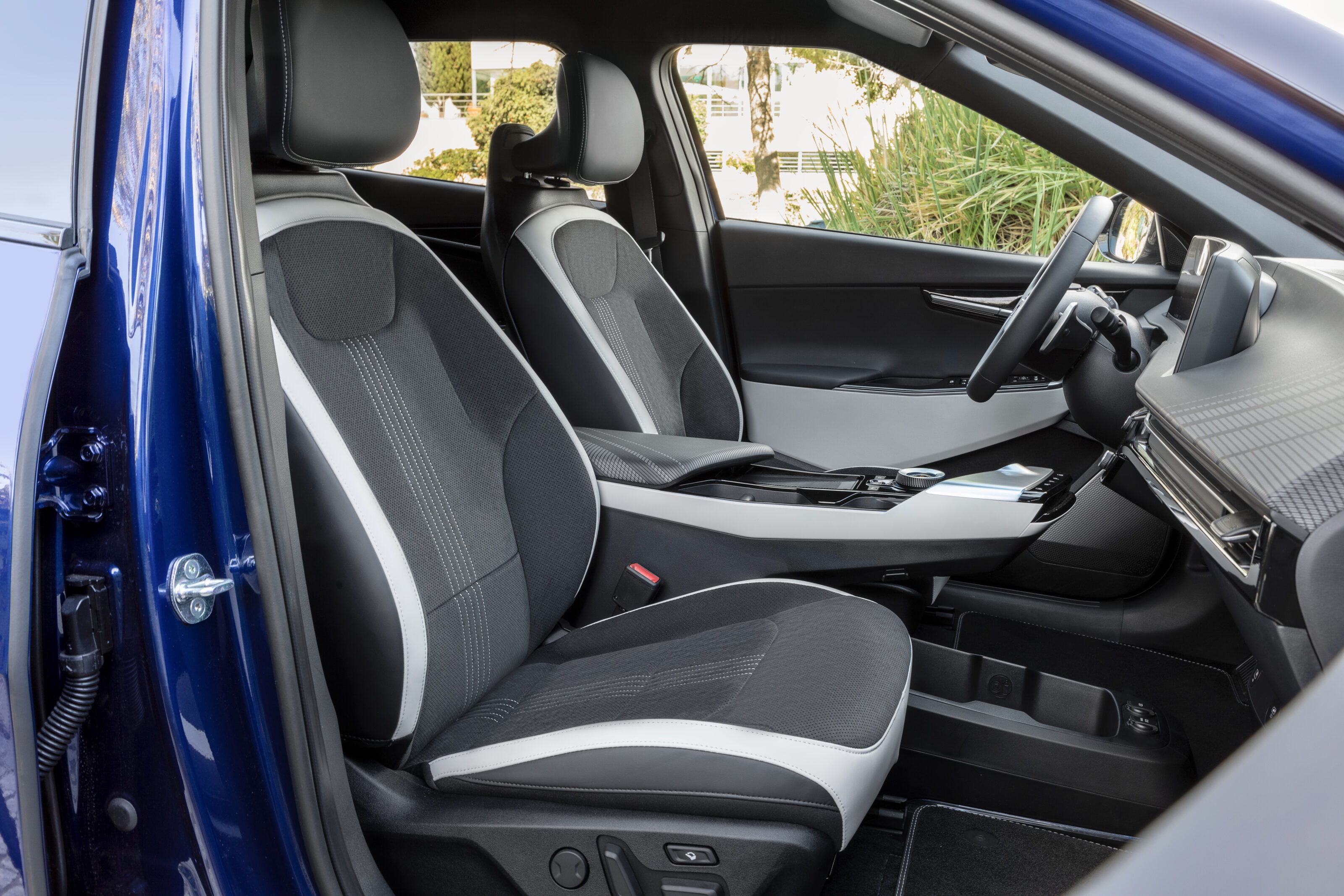
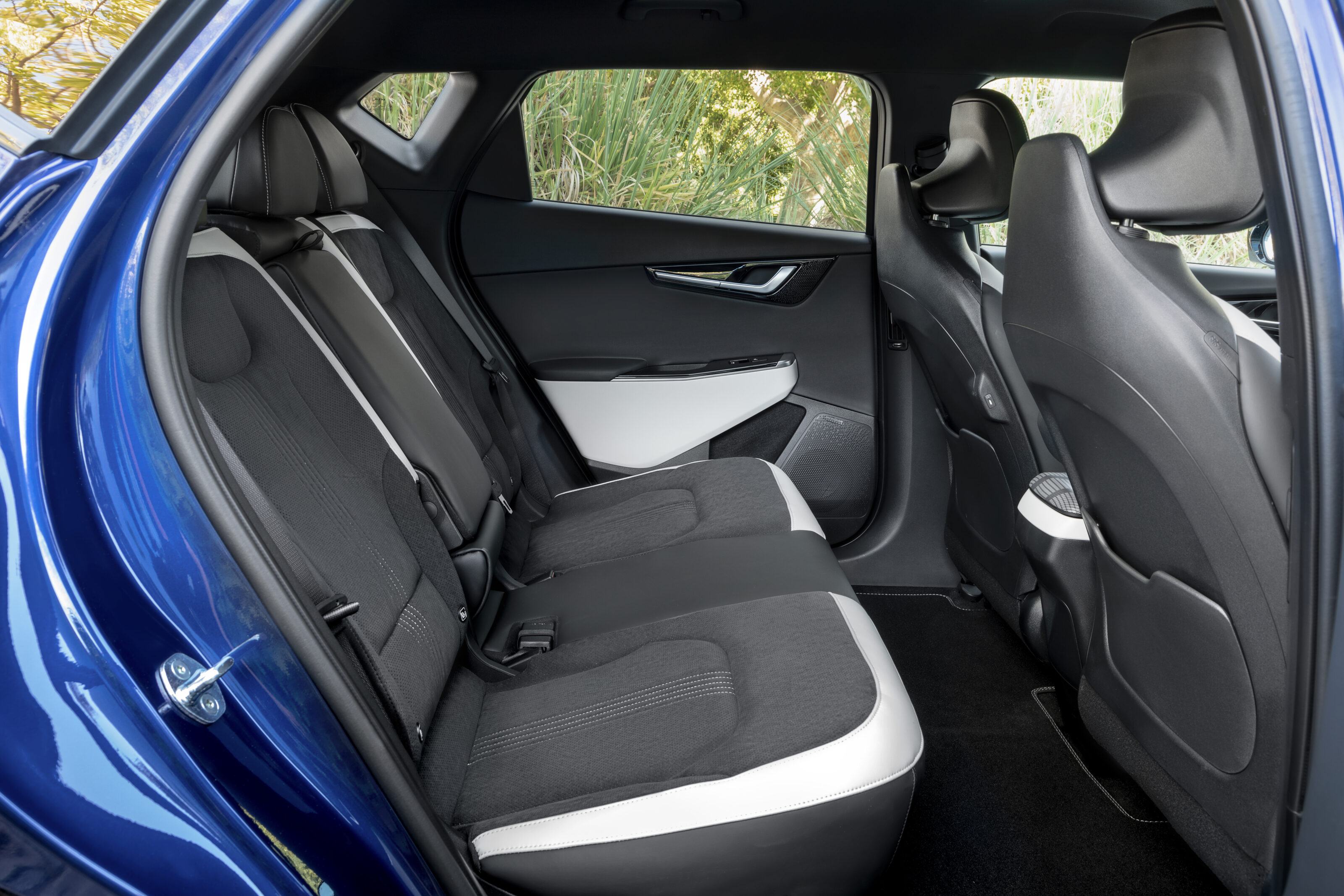
The interior is very roomy – rear seat passenger accommodation is excellent, though you must duck under that low roofline to get in and out. The front seats are supportive and well-bolstered. The seats are upholstered in vegan leather and suede, and the dash is clad in materials made from recycled plastic bottles.
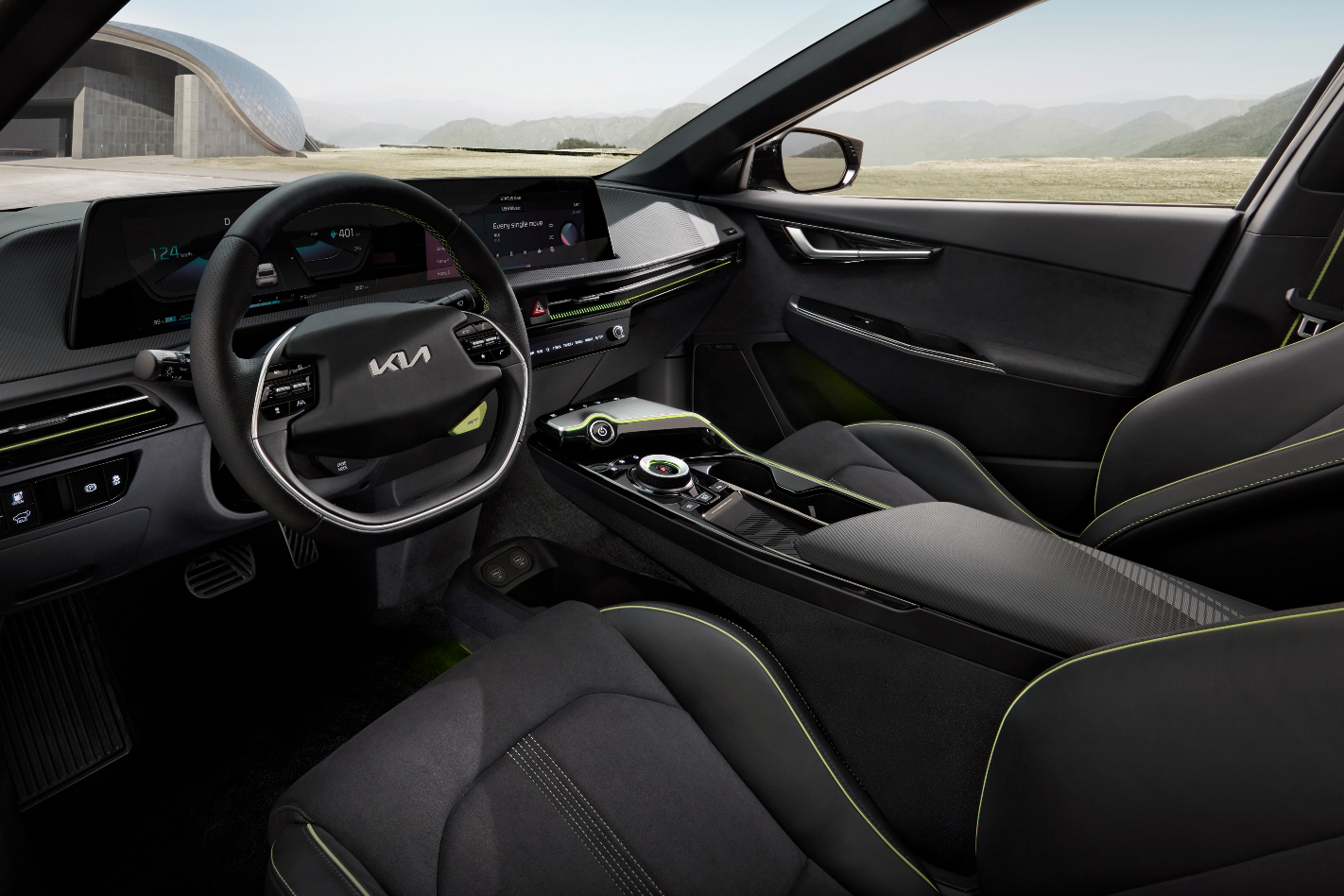
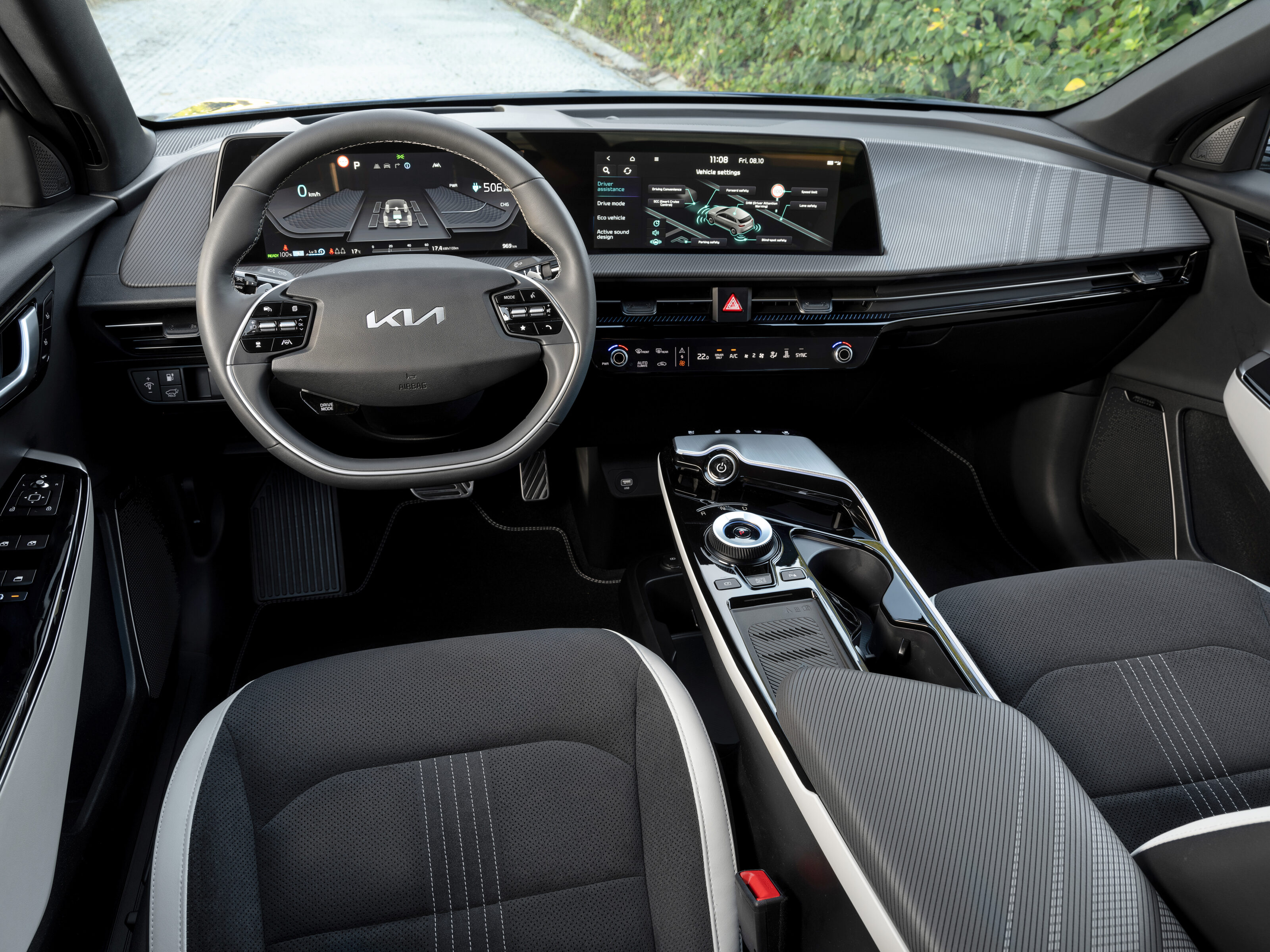
The view from the driver’s seat is dominated by a single screen that curves gently from behind the steering wheel across the dash to the centre of the car. The display in front of the driver comprises a digital instrument panel, while the centre display is a multi-function touch screen.
Not everything’s controlled by a screen – the EV6 still has light, wiper and turn signal stalks behind a steering wheel with mechanical rocker switches for functions such as adjusting cruise control speed on its spokes – stuff you can find by touch rather than taking your eyes off the road. The HVAC system is controlled by simple rotary dials, and forward and reverse gears are selected via large rotary controller on the cantilevered centre console.
VERDICT
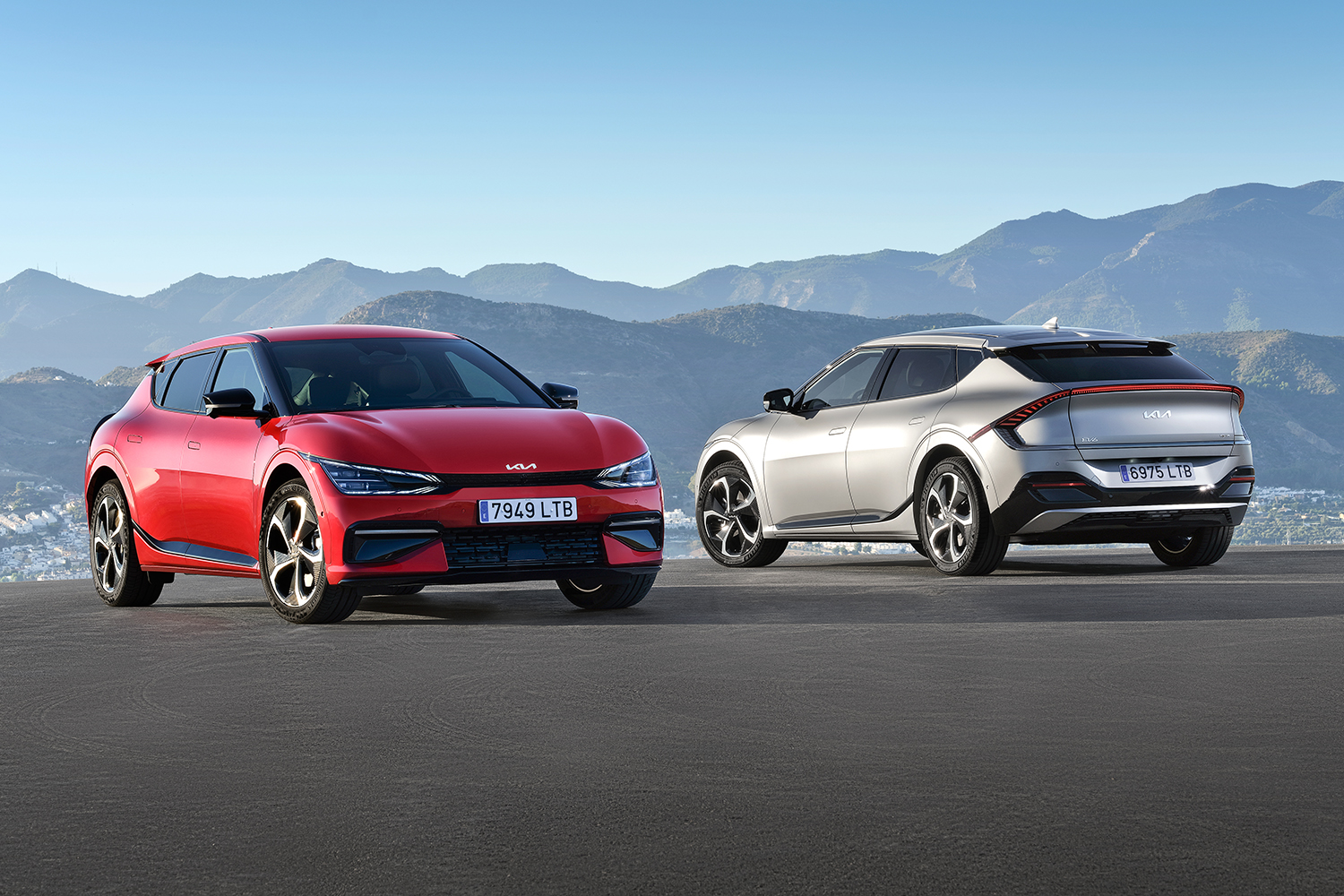
Kia’s transformation over the past decade has been breathtaking, each new model better designed and better engineered than the last, to the point where the Korean brand now offers compelling alternatives to the Japanese and European mainstream in almost every segment.
Dramatic to look at, laden with useful technology, and enjoyable to drive, the Kia EV6 has what it takes to win over buyers in what is shaping up to be one of the most hotly contested segments in the industry.
Neal Bates has rallied all over the world, so which event do you think is his favourite? Maybe New Zealand’s smooth, conveniently-cambered thoroughfares through lush green hills, or perhaps the challenge of Indonesia’s sweaty, slimy, clay-covered palm plantation roads? What about the challenge of beating the world’s best on Western Australia’s unique ball-bearing gravel during the WRC’s annual trek to Perth?
Nope, the answer is Rally of Melbourne. We’ll let the four-time Australian champion and motorsport hall of famer explain why: “I think the stages but more than anything the surface. It always had good grip and [was] also incredibly smooth.
But you look at the stages, there’s room to enjoy what rallying is all about: throwing the car into a corner, getting on the power and driving through the corner sideways. The stages really suited that style of driving and it was an absolute sprint rally, drive as fast as you can.”
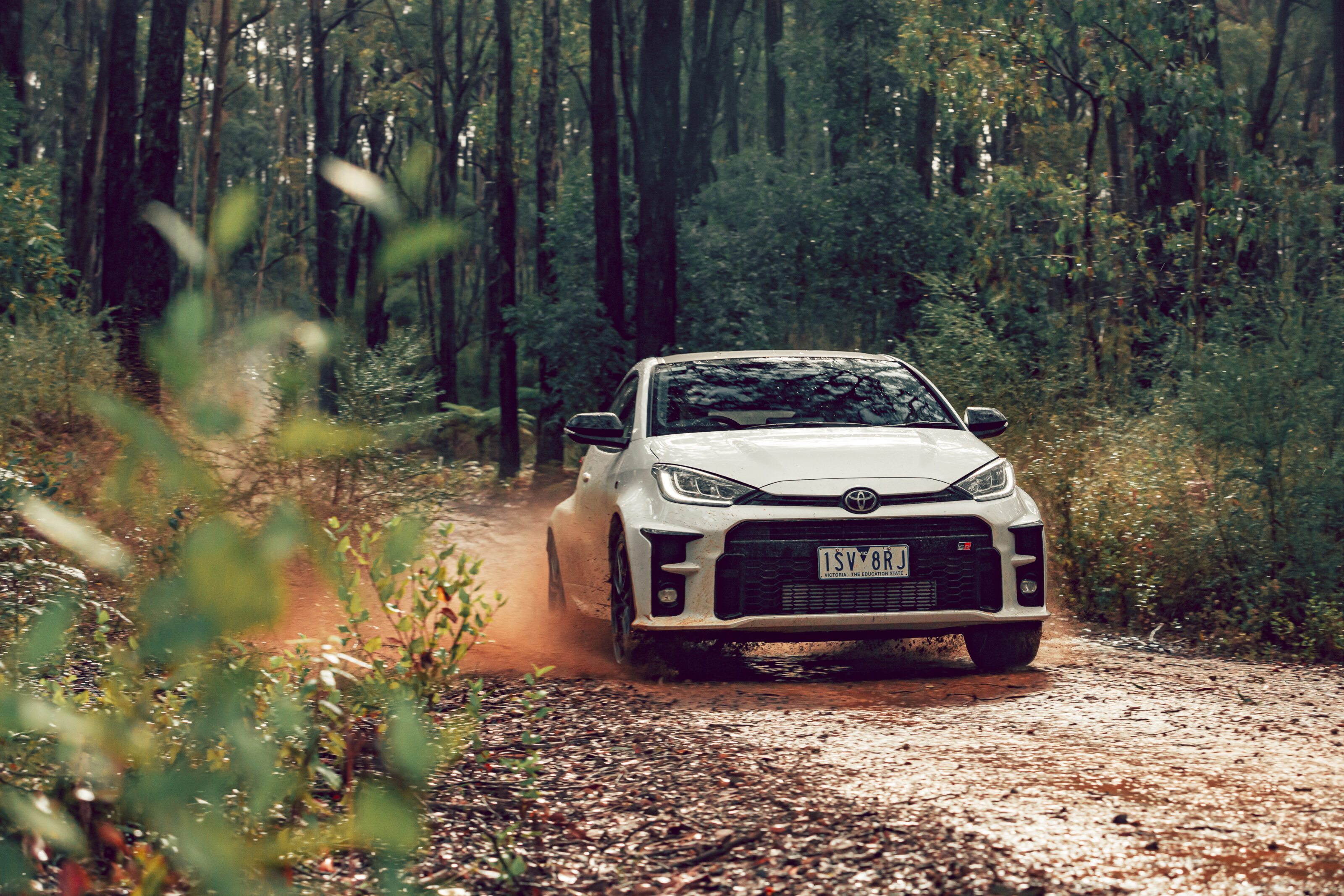
Such a glowing endorsement requires closer investigation, with old rally maps revealing the roads that Bates animatedly describes lie just an hour or so east of Melbourne’s CBD, surrounding the towns of Yarra Glen, Healesville and Marysville.
Our chariot of choice couldn’t be more obvious: the Toyota GR Yaris Rallye is the spiritual successor of the turbocharged, all-wheel drive weapons that helped Bates and his long-time co-driver Coral Taylor fill their trophy cabinets.
Here at Wheels we’ve heaped plenty of praise on the GR Yaris thanks to its stonking 200kW/370Nm 1.6-litre turbo three-cylinder engine, lithe 1280kg kerb weight, snappy six-speed manual and terrific brakes. Well, the Rallye is better in almost every respect.
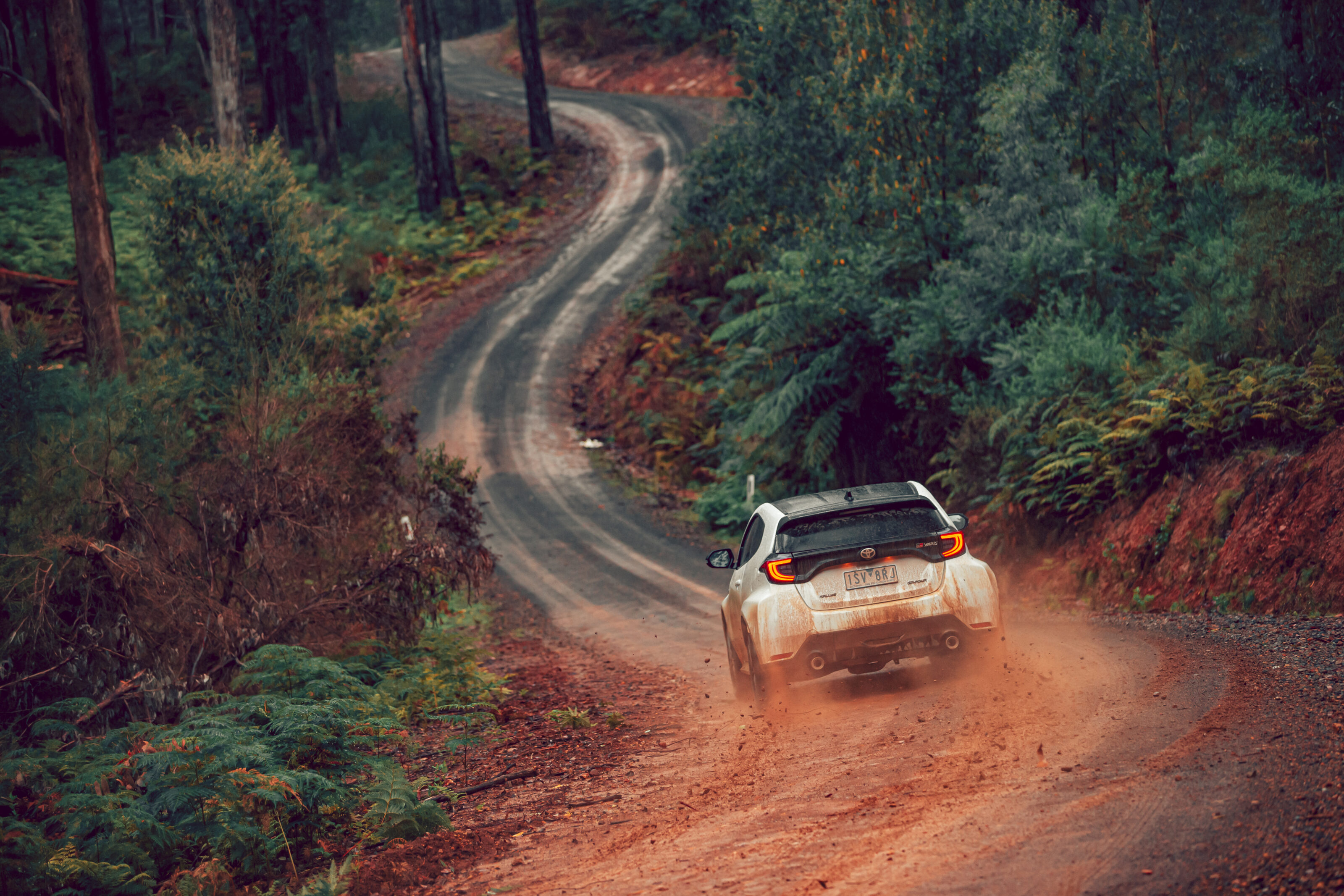
It is, understandably, more expensive. At $54,500 before on-roads, it commands a $5000 premium over the base car but justifies it with lighter forged BBS alloy wheels wrapped in Michelin Pilot Sport 4 S tyres, stiffer suspension bits and a pair of Torsen limited-slip differentials. Think of it as the STi to the base GR’s WRX.
The modifications are the final piece of the GR Yaris puzzle, but can the Rallye fulfil its promise as a true homologation special on the forest roads that made the likes of Bates, Peter ‘Possum’ Bourne, Ed Ordynski and Simon Evans legends of Australian rallying?
Trekking through Melbourne’s eastern suburbs to meet photographer Alastair Brook in our start point of Yarra Glen, the good news is the Rallye is no less liveable than the standard car; there’s no ride penalty and while it would be nice if the seat was mounted a bit lower, you become accustomed to the elevated perch quite quickly.
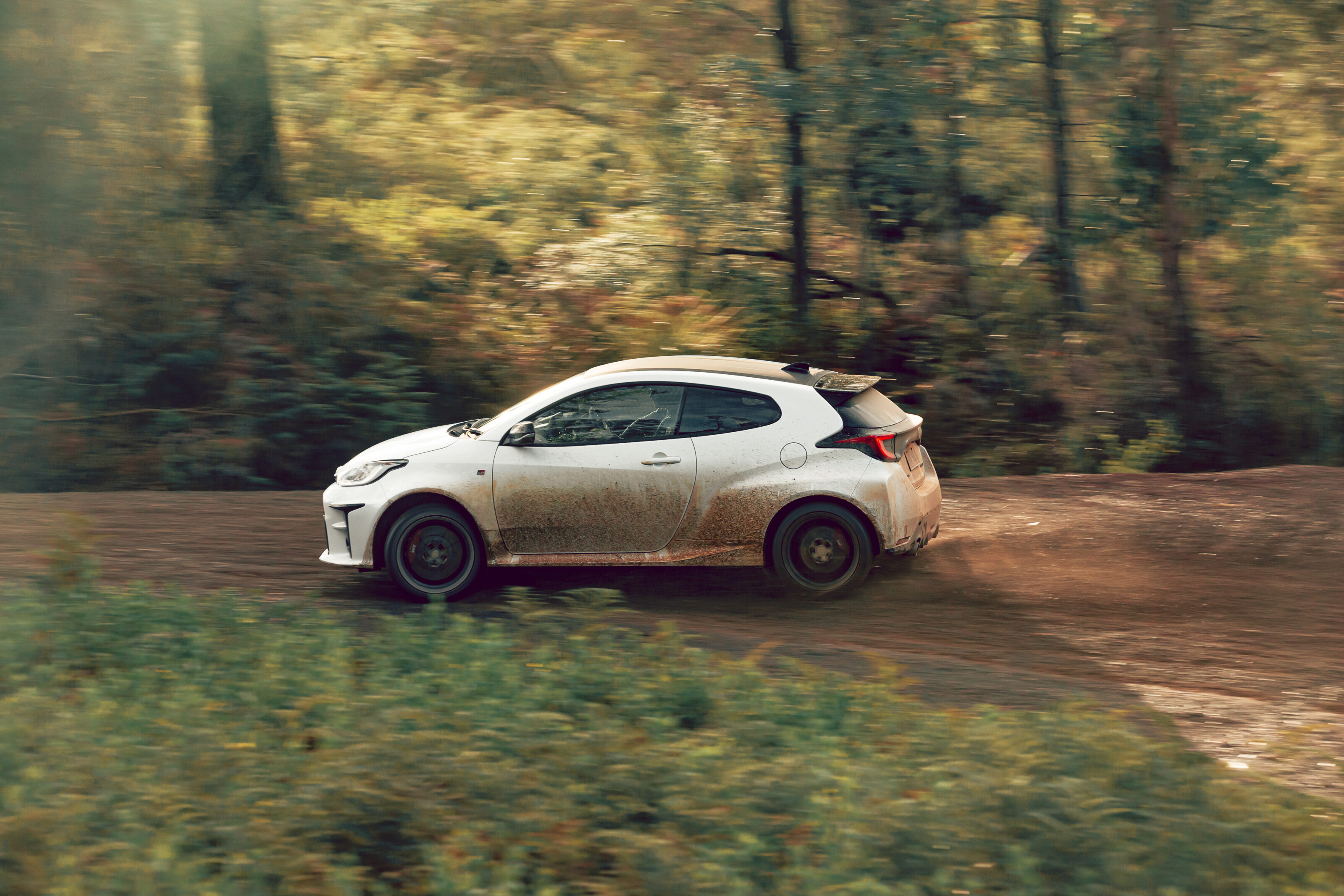
Rally Melbourne often based itself out of the Yarra Glen Showgrounds but crews didn’t have to travel far for their first taste of action. Just up a couple of kilometres directly north of Yarra Glen Steels Creek Road morphs into Mt Slide Road. Yes, the first stage of Rally Melbourne was called Mt Slide.
Not only was it named by a rally enthusiast it was clearly designed by one, too. It’s only short, just seven kilometres in length to the point where it joins the main road, but the fact that it’s less than half that as the crow flies should give you some idea of its sinuous nature.
“Mt Slide was just a magnificent uphill stage where you could throw it around and back it in,” says Bates. Obviously, the need to account for oncoming traffic and road regulations limits the extent of our throwing but Mt Slide is still a pleasure to drive.
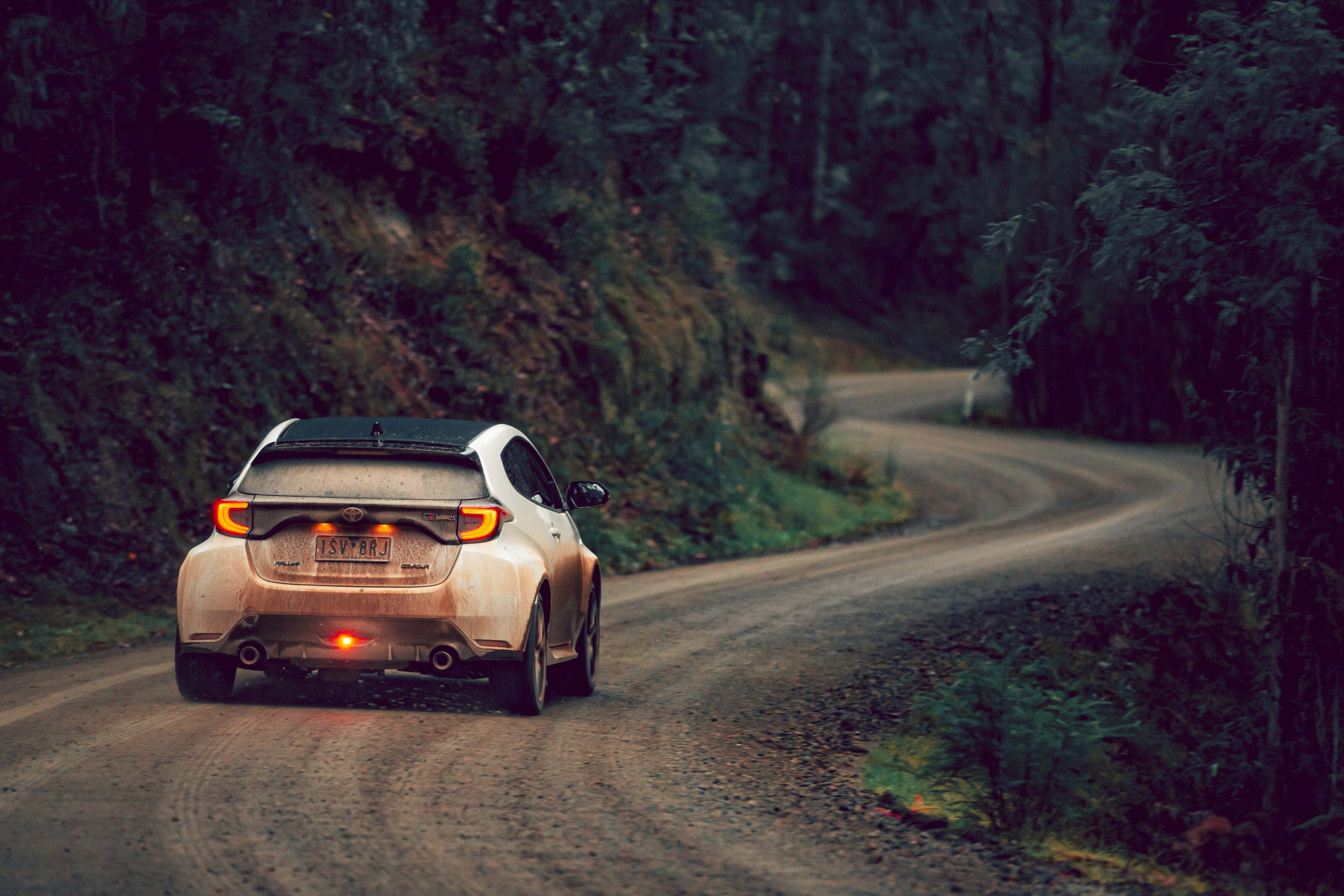
As Bates suggests the surface is smooth and hard packed. The corners are plentiful, a lot of them heavily cambered hairpins of various radii. Straight sections are few and far between, though in car footage suggests that doesn’t stop rally aces from hitting fifth gear in these sections. No thanks.
Having rejoined the black stuff our next stop is just 10km up the Melba Hwy. Great roads are often tucked away out of sight but the epic Marginal Road takes this to a new level.
At 100km/h on the main highway the entrance is literally a blink and you’ll miss it affair; a small gap in the forest, obscured from sight by trees on approach, is the gateway to this absurd 20km+ stretch of gravel road. A sign welcomes us to Toolangi State Forest and a makeshift carpark for trail bike riders is a welcome reminder that others enjoy being in the middle of the nowhere, too.
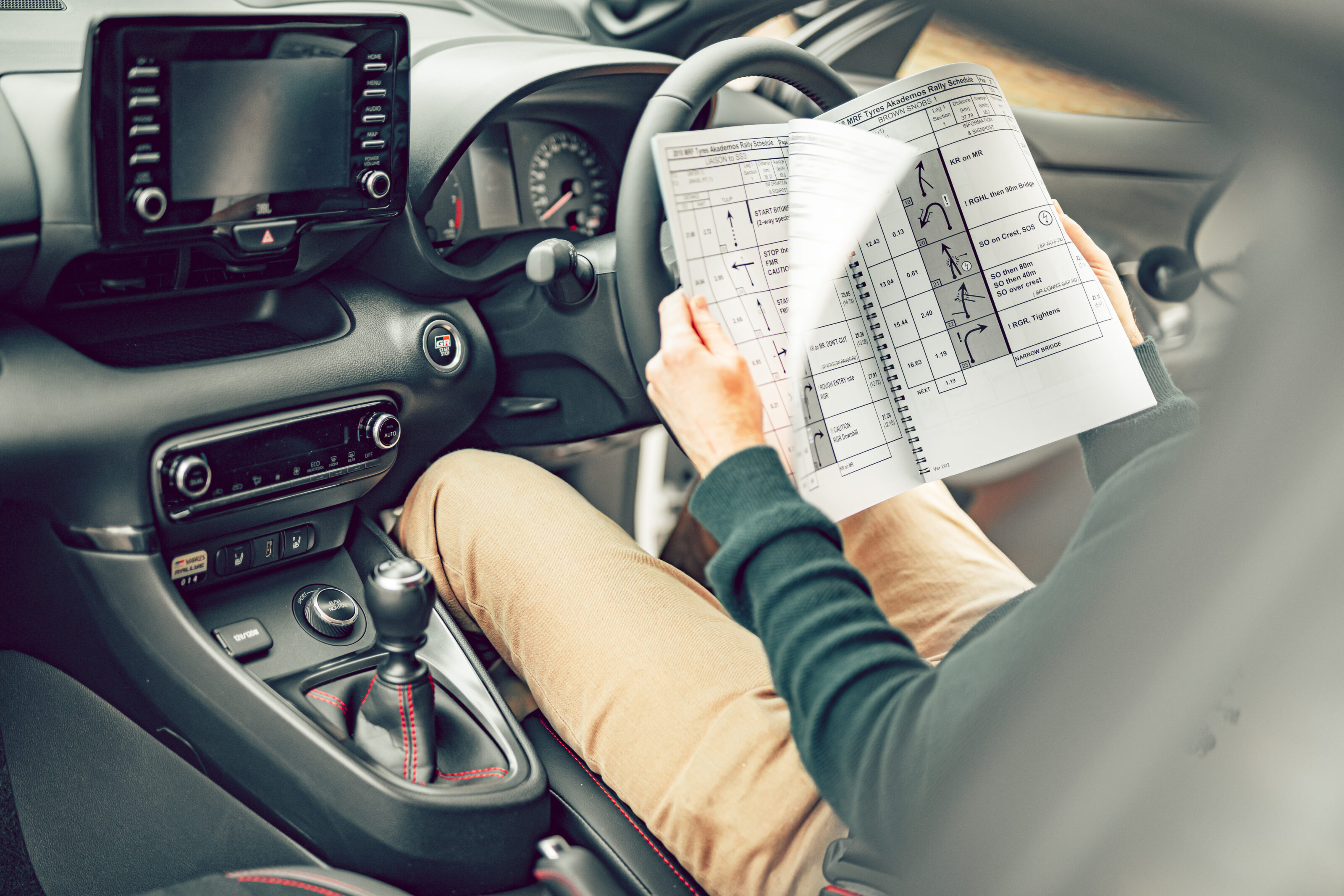
Marginal Road’s length meant it was usually, though not always, split up into two or more stages, but we’re driving it in its entirety. It begins in a similar manner to Mt Slide; a little rougher, slipperier and narrower, but a constant procession of tight turns that continue climbing, climbing, climbing up the side of the hill.
The thick green forest thins as we ascend thanks to recent bushfires leaving the trees blackened and the banks bare. Grip remains strong but random shiny patches frequently undermine any confidence.
Recent heavy rain has allowed water to gather in potholes and on the inside of corners but the Yaris is unperturbed, the Michelins scrabbling as they try to deploy 370Nm to the loose surface on corner exit.
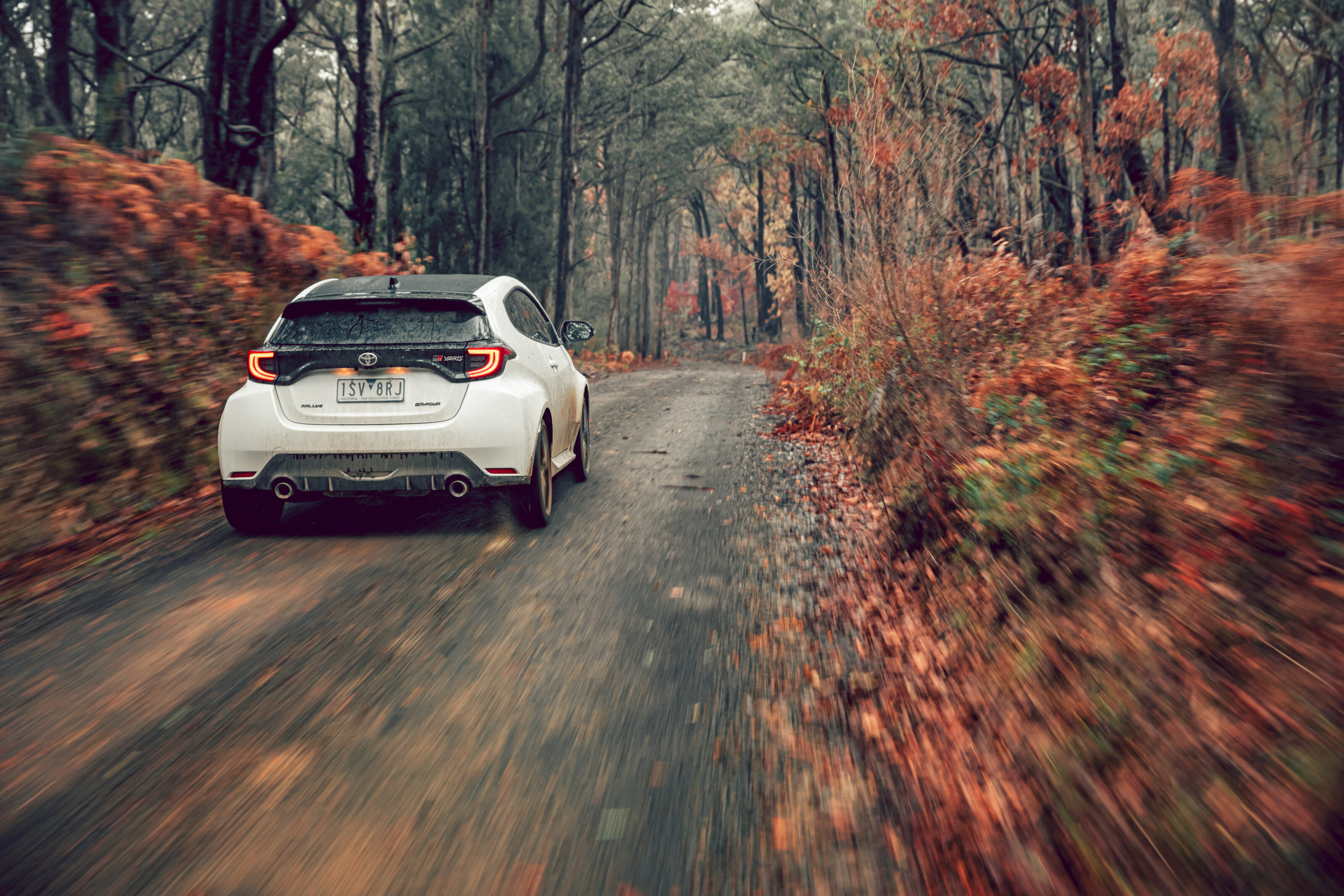
It’s here the Rallye’s limited-slip diffs prove their worth. Where the standard car’s open diffs would spin an unloaded front wheel and drag the nose wide, the Rallye distributes its power evenly across its axles with greater predictability. Toyota’s WRC drivers were brought in to help develop this aspect of the GR Yaris’s handling: “They have huge experience with differentials – it’s their main tuning tool,” Toyota’s European master driver Vic Herman told Wheels at the car’s international launch.
As the road crests the hill it flattens and becomes ultra fast. Sections like this are where rally drivers prove they’re different from mere mortals. The track isn’t straight, instead kinking this way and that, running the gauntlet between banks that reach right to the road’s edge.
In terms of outright speed the Rallye would give little away to front-running rally cars; for years inlet restrictors, usually between 32-34mm, have limited horsepower to around the 300 mark (224kW) so acceleration out of corners is roughly similar, especially as the GR Yaris’s standard gearing is very short.
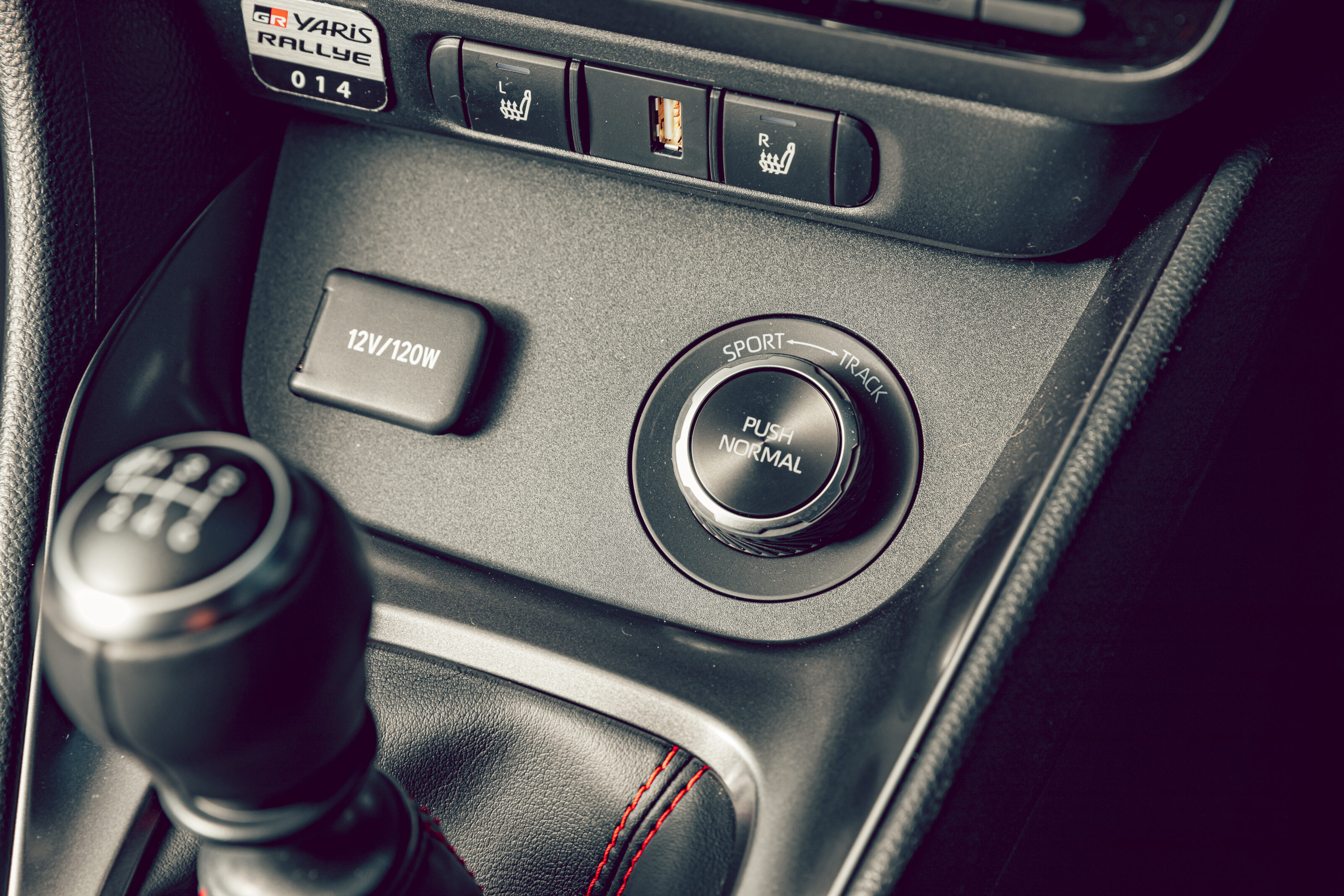
Where the road-going Toyota hot hatch misses out is in terms of grip, particularly under braking. The GR Yaris has monster brakes for a car its size, with 356mm discs at the front and four-piston calipers.
These are bigger than you’ll find on any rally car, their rotor size restricted by the need to use 15-inch rims, but brakes are only as effective as the tyres they’re attempting to slow and on gravel anything more than light pressure triggers the ABS as the road-biased Michelins struggle for purchase.
This is particularly the case on the fresh blue-metal surface that appears as Marginal Road descends. It would be a terrifying material to try and drive quickly on, as even at our reduced speeds the road beneath the wheels is constantly shifting, extending every braking distance and delaying every steering input.
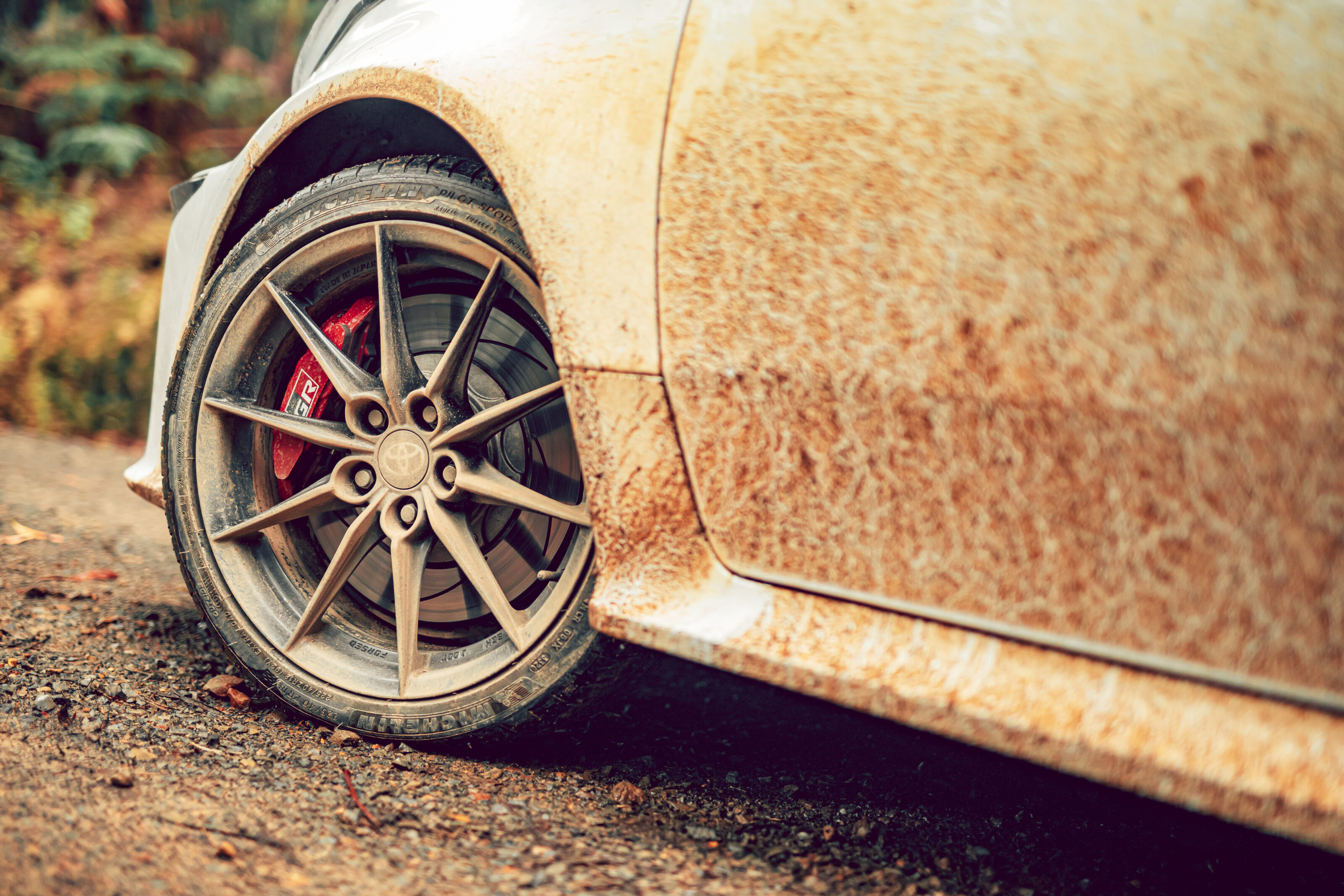
That said, the blue rocks are probably preferable to the wet clay that lies beneath, which experience suggests has all the adhesive qualities of a bar of soap in the bath. The road is also heavily crowned, to the extent that the underbody occasionally scuffs the ground.
Despite the road name remaining the same its nature continues to evolve. The surface improves once more but a couple of huge water splashes (checked for depth prior, of course) bring out my inner five-year old, Alastair requesting multiple runs to capture the rays of sunlight that are penetrating the trees and forming dancing patterns on the sheets of displaced water. Playing rally driver is fun!
An epiphany is also slowly forming. According to the VicRoads website any rural road with no posted limit defaults to 100km/h but triple figures is unachievable on the vast majority of these roads. Typically we’re doing little more than 60-70km/h but there’s always something to react to thanks to the highly varied road surface.
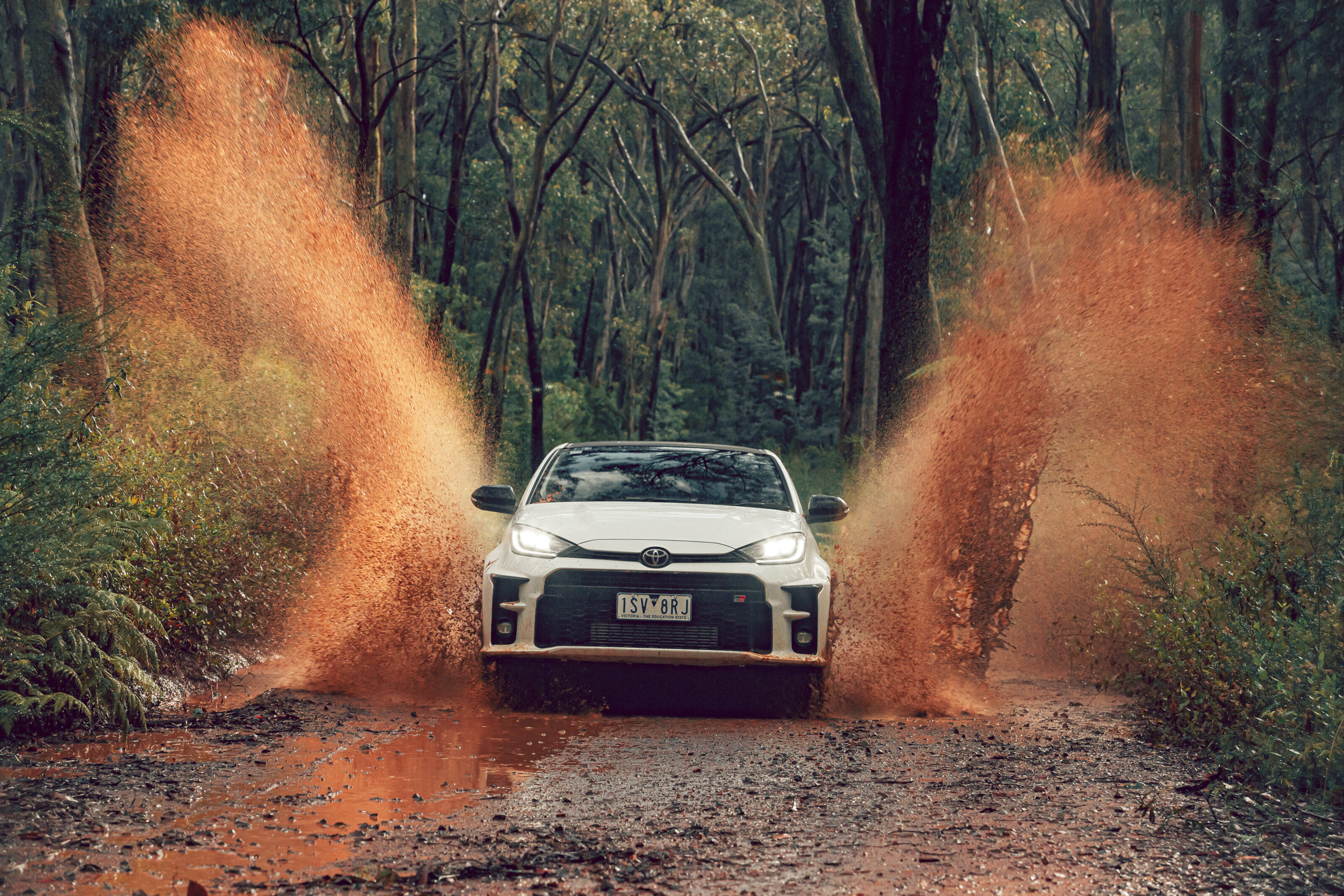
You’ve no doubt read reviews of the Mazda MX-5 or Toyota 86 or Alpine A110 that praise their refreshing lack of grip, allowing the car to feel more involving at sensible speeds. Well, it turns out there’s another way – if you can’t reduce the car’s level of grip, reduce that of the road it’s driving on.
Even at these slower speeds there are traps for the unwary. For around a kilometre the road ducks and dives over enormous mounds of earth like a tree-lined rollercoaster before entering a crossroads. The raised intersection looks innocuous enough but lifts the Yaris clear of the ground, simultaneously stopping my heart.
To be honest it was a pathetic amount of air, the wheels barely leaving terra firma, but at competition speed any crew that didn’t have at least a ‘caution’ in their pace notes may find themselves unexpected occupants of the international space station.
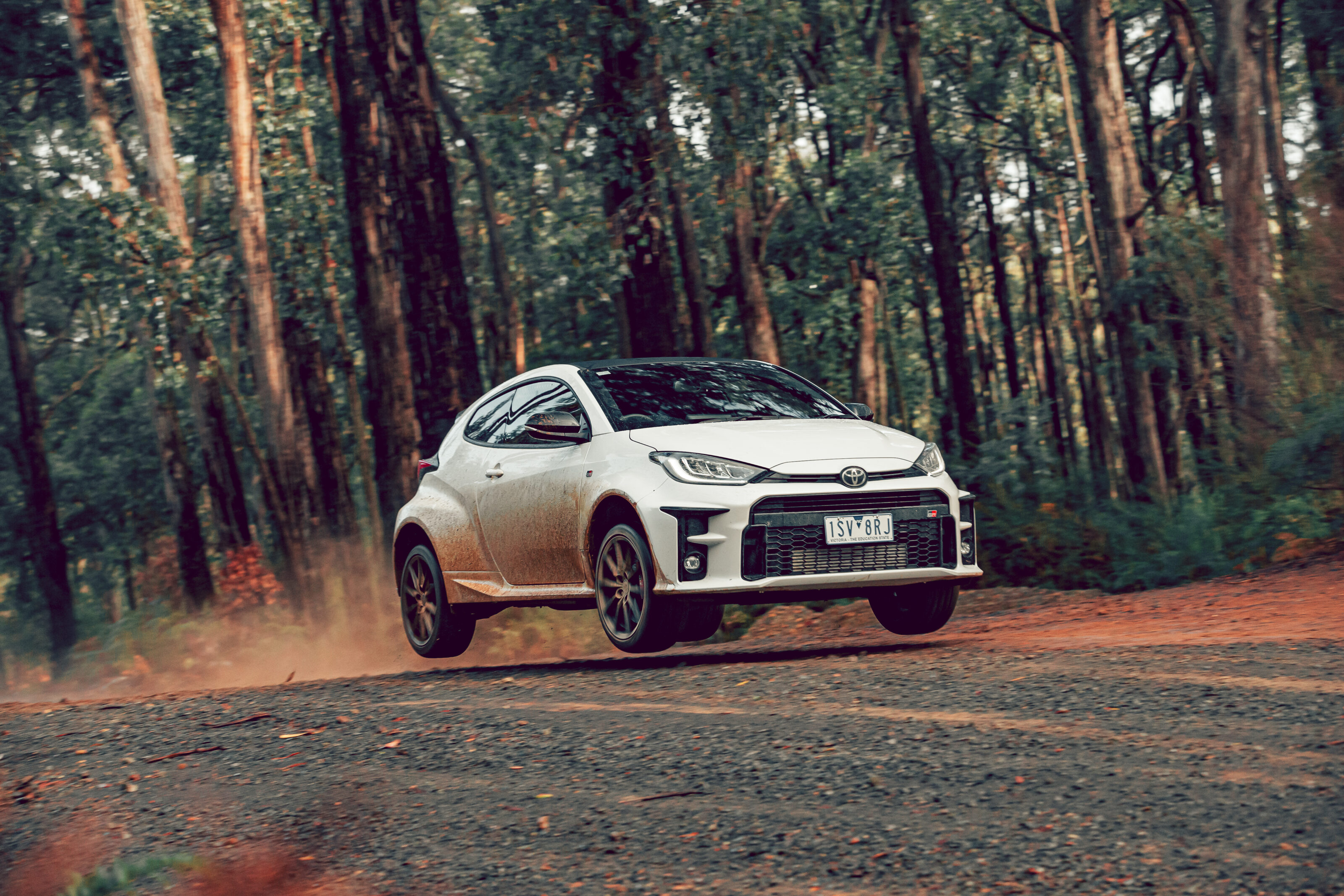
From here there are two route options: continue forward and join Murrindindi Rd, a wide, flat expanse that’s so smooth it would put many tarmac highways to shame, or turn hard right into the ominously titled Mt Despair Rd. We choose the latter, two grippy wheel tracks showing the way through the otherwise treacherously slippery deep gravel, hungry tree stumps situated on the apex of each corner ready to eat the inside wheels of the inaccurate.
The road is constantly changing but like Bates said the one constant is the hard-packed surface. Aside from the odd large rock there’s nothing to trouble the Rallye, even on its low-profile Michelins.
Having exited the forest, in a real rally we’d return to lunchtime service to change tyres and effect any repairs but today the only thing needing fuel is Alastair and I. Between us and our next stage is Myers Creek Road and the Black Spur, driving destinations in their own right but today relegated to mere transport.
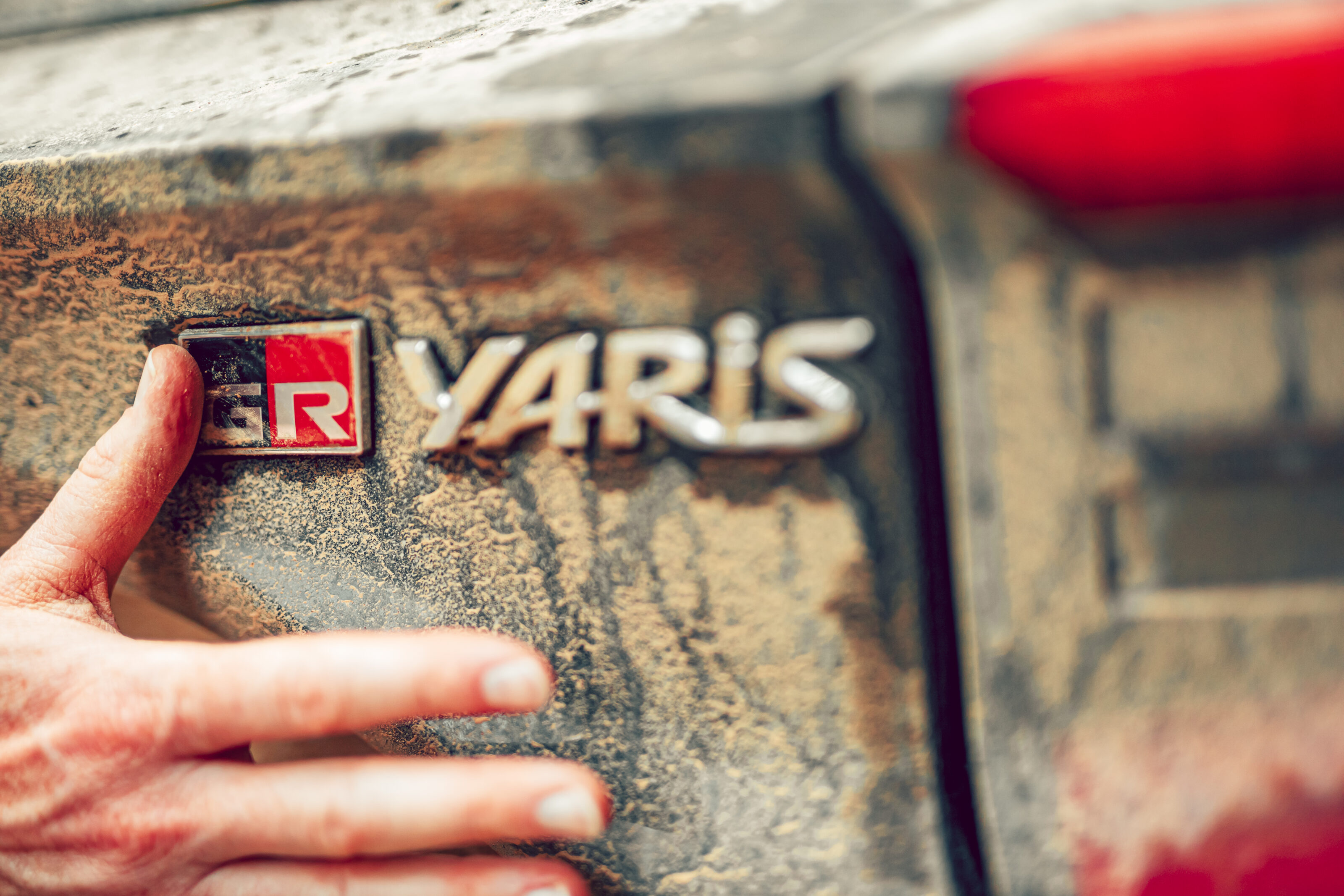
Nevertheless, it’s refreshing to have (relatively) consistent grip under the Toyota’s tyres for the first time today and the Rallye proves agile, grippy and very, very quick on these narrow, slippery back roads.
Just prior to entering Marysville we once again veer into the forest and immediately hit Paradise Plains Road. Driving Paradise Road would be a more apt title as if you’re a fan of slippery surface racing then this is the kind of road you/I/we dream about. Yeh, weird, I know.
Wide, fast and open with clear lines of sight– for as far as the encroaching fog allows, anyway – with stages like this it’s easy to see why Bates, among others, loved Rally of Melbourne. It’s like a gravel grand prix.
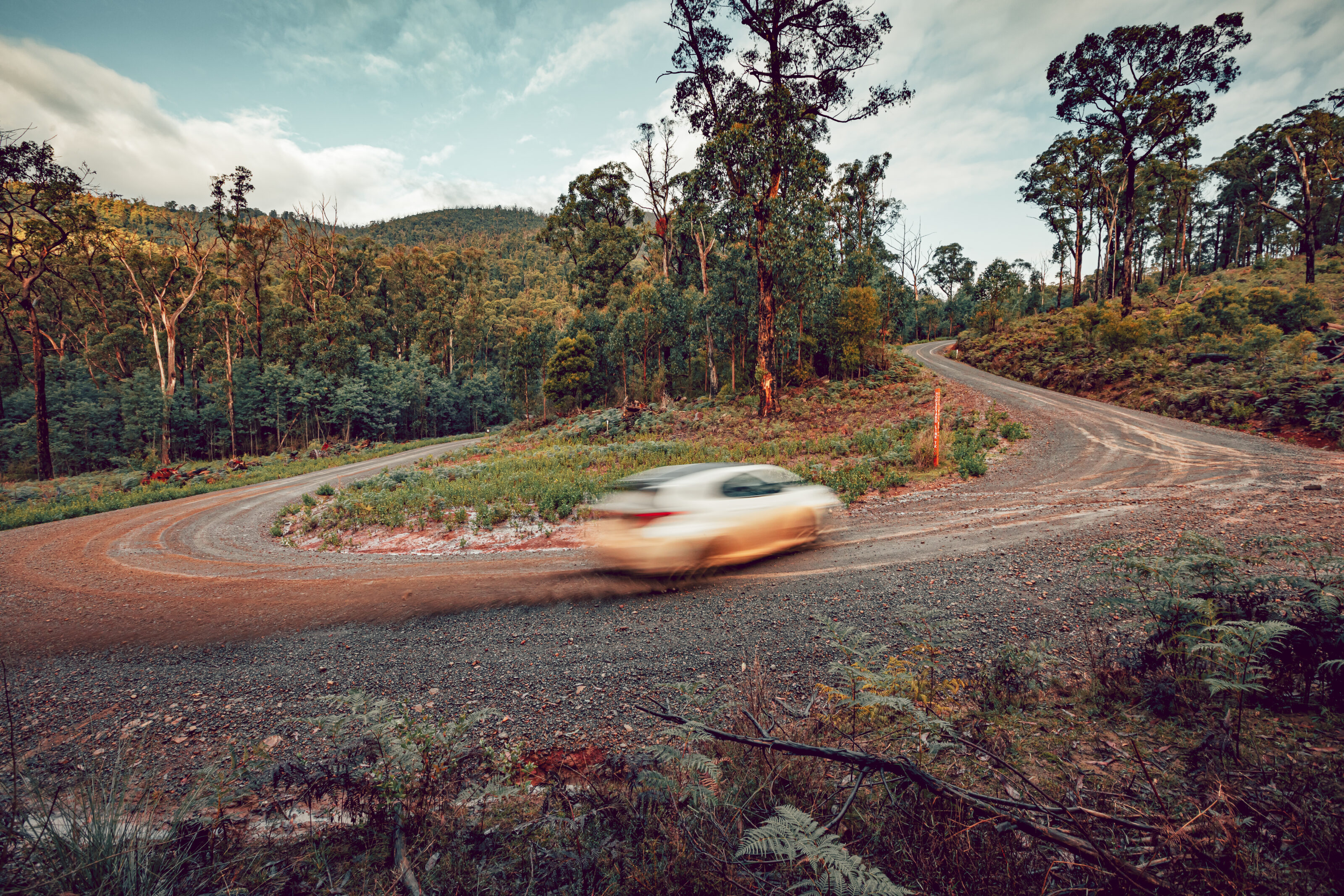
It’s a slightly sad state of affairs that 15-20 year-old Subarus and Mitsubishis still dominate state and even national rallies, as it’s a sign that no suitable production-based vehicle has appeared in the interim to become the rally weapon of choice. The GR Yaris Rallye may very well be that car; it just feels so comfortable in these surroundings.
My mind is whirring, figuring out how much (sadly theoretical) money would be required to turn Toyota’s hot hatch into a competitive rally car. In the grand scheme of things, not much: safety equipment, some underbody protection and a set of tyres would leave you with a very capable machine, judging by the grip and poise it has on these gnarly forest roads.
Be careful, though. Like a siren luring a weak-willed sailor, Paradise Plains is ready to ensnare any driver who drops their guard, with random patches of deep slush making the steering go light as all grip disappears.
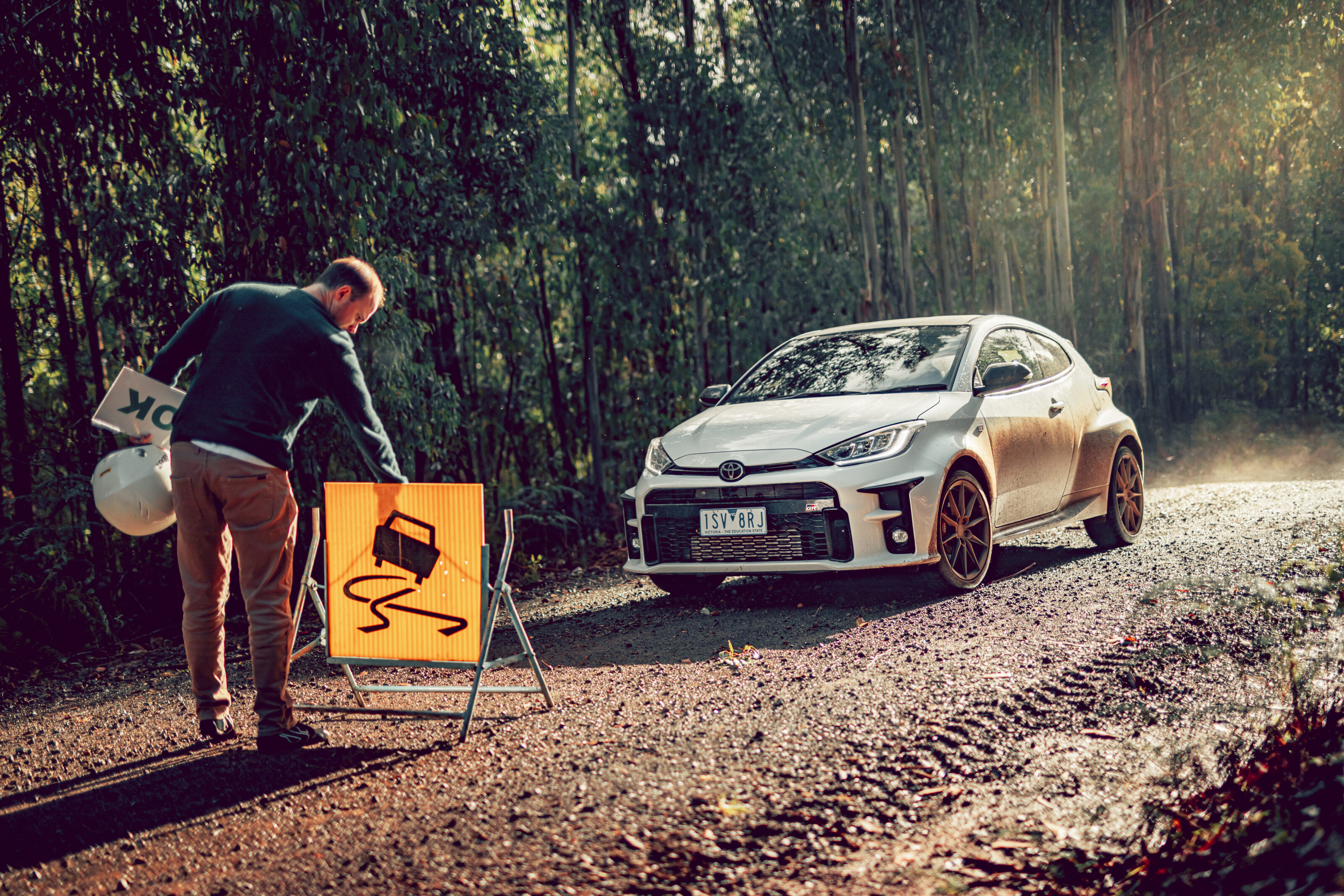
These patches become more frequent as a dusting of white begins to cover the landscape, like liberally applied icing sugar – snow. Victoria’s infamously capricious weather was often a feature of Rally of Melbourne: “We did it one year when it was quite heavy snow,” remembers Bates, “other years were incredibly dusty. There was a variation, but even when it was wet it still had incredibly good grip.”
Over the years Bates drove a wide variety of rally cars at Rally of Melbourne, despite being completely loyal to the Toyota brand – production-based Celica GT-Fours, screaming, naturally-aspirated Corolla S2000, homegrown Corolla GT-Four – but picking a favourite is easy: “My favourite car to drive, it would be crazy not to be, was the [Corolla] World Rally Car.”
And nowhere did he enjoy driving it more than on Acheron Way. “The two favourite stages would be Mt Slide and Acheron Way, just from the pure enjoyment of it. Acheron Way is incredibly flowing but a little bit technical.” Look on the Australian Rally Championship Facebook page and you’ll find Bates’ onboard footage from 2001 featuring his favourite car on his favourite stage.
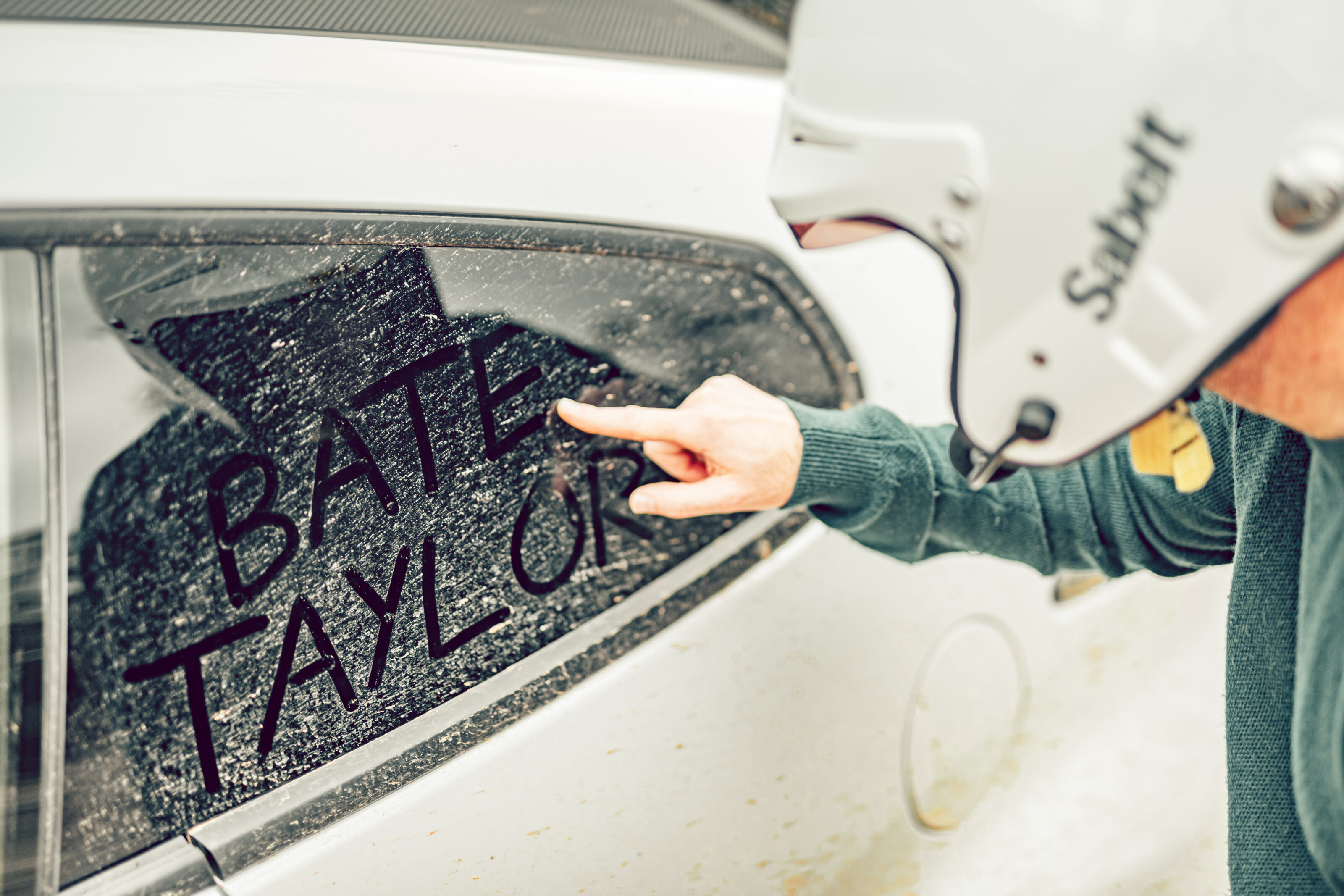
The footage doesn’t tally with the road I’m driving. Acheron Way is narrow and blind and full of tight turns with unforgiving undergrowth on both sides – where there isn’t steep drop-offs, anyway – and yet the scenery is a blur for Bates as he flicks the car from corner to corner, Coral Taylor calmly describing the road ahead. It’s both awe-inspiring and rather terrifying.
Bates crashed that morning but would fix the car and win the afternoon heat, while his Kiwi rival, Possum Bourne, had a terrifying accident in deep snow on the Ben Cairn stage, a road so precarious hang gliders use it as a launch pad.
I put it to Bates that his greatest win, however, came the year before in 2000. It was the true golden era of Australian rallying, with both Bates and Bourne in World Rally Cars, and in the morning heat the two were separated by just 17 seconds (in Neal’s favour) after 90.64km.
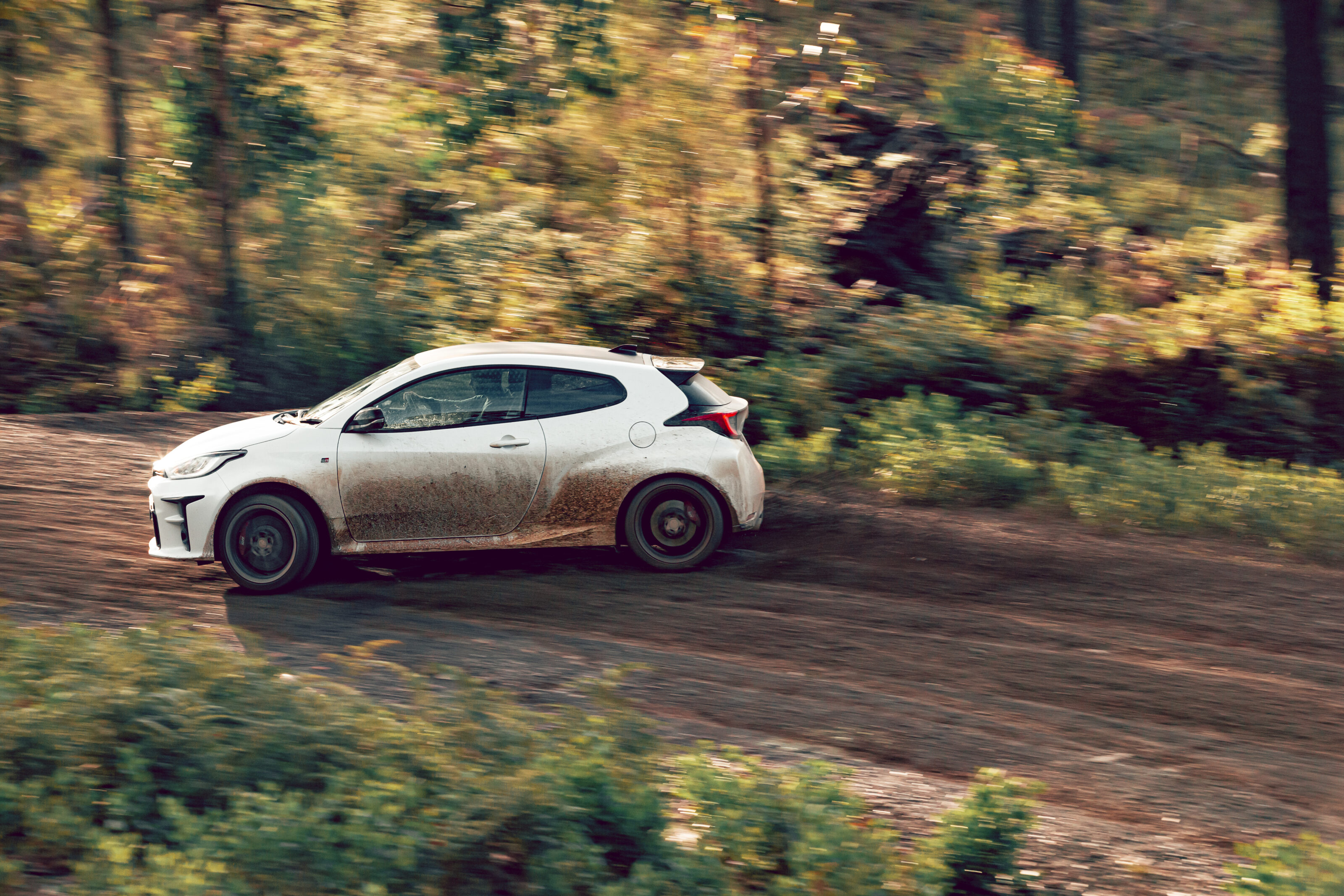
Those same 90.64km – many of which we’ve driven in this feature – were repeated in the afternoon and Bates’s winning margin was three seconds. Three. Through thousands of corners, hundreds of braking and acceleration zones, these two drivers at the top of their game were separated by 0.03sec/kilometre.
Bates, though, disagrees: “My best memory of Rally of Melbourne was the first time Possum ever ran in 1993 and it was the first rally I did with Coral. We had our ST185 [Celica GT-Four) that we’d built ourselves and he came with the Prodrive-built [Subaru] Legacy and we actually beat him. I remember driving through the service area and everyone was standing out on the road clapping. Everyone drove incredibly hard because of the nature of the roads: the grip level, the width of the road, it was on-the-edge, flat-out sprint rallying which is what I love.”
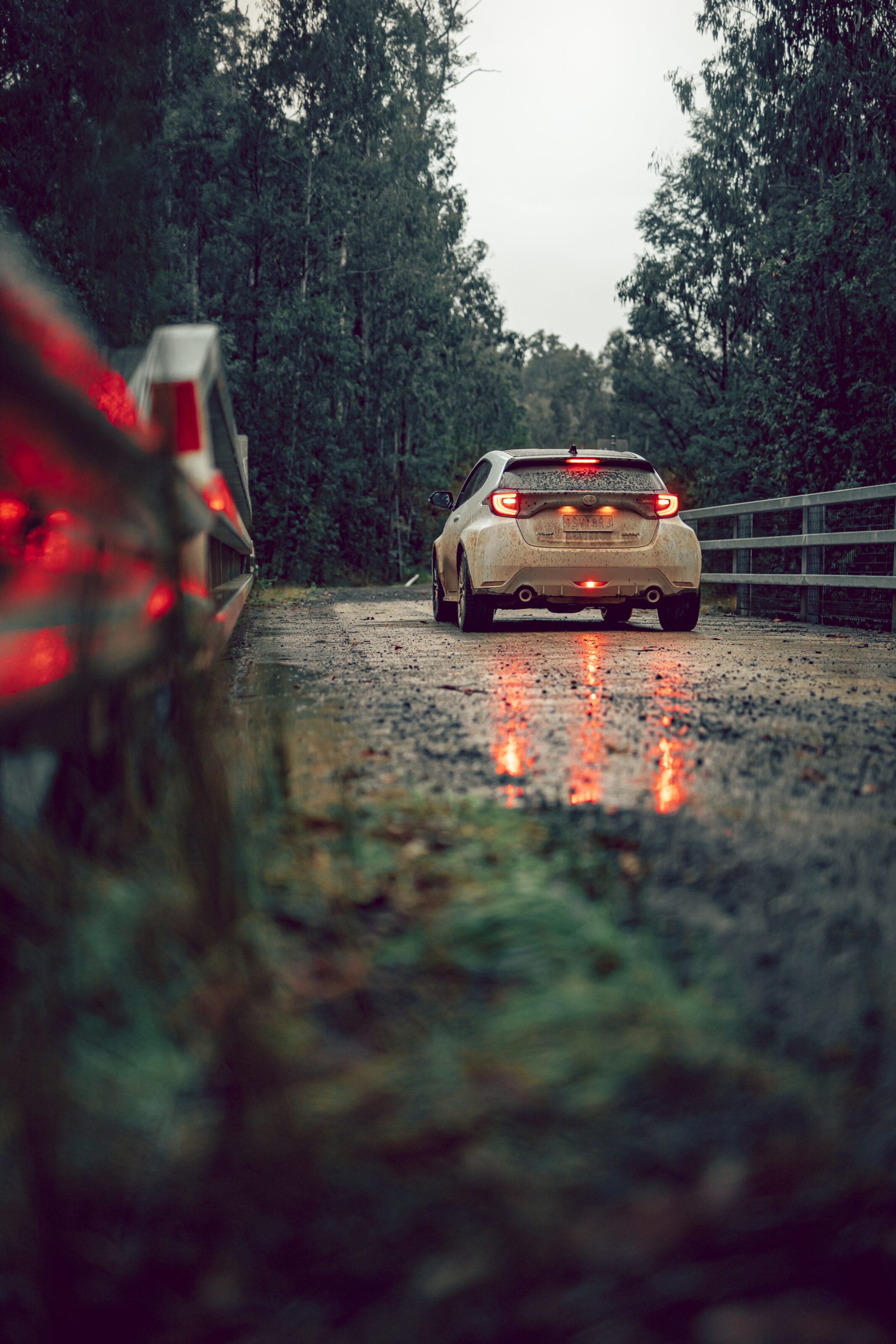
The roads, then, are a winner, but what of the Toyota GR Yaris Rallye? Is it a worthy successor to Toyota’s turbo titans that came before it, a true homologation special? Absolutely.
The proof comes in the fact that I’ve now spent quite a lot of time in both the base GR Yaris and this Rallye version on road and track and at no point have I enjoyed it more than I have today. It feels perfectly at home being punted through a forest and for a car called Rallye there’s really no higher praise.
Toyota GR Yaris Specifications
