
On a list full of worldwide brands the automotive segment is making waves – with not one but four manufacturers featuring in the top 20.
Released by consulting company Interbrand, the list compiles the top 100 global companies by brand value, an ever-moving metric which saw large swings in the wake of the global pandemic.
While technology companies dominate – taking up the top five spots – the top 20 is home to four automotive manufacturers, all sitting in the middle third of the overall standings.
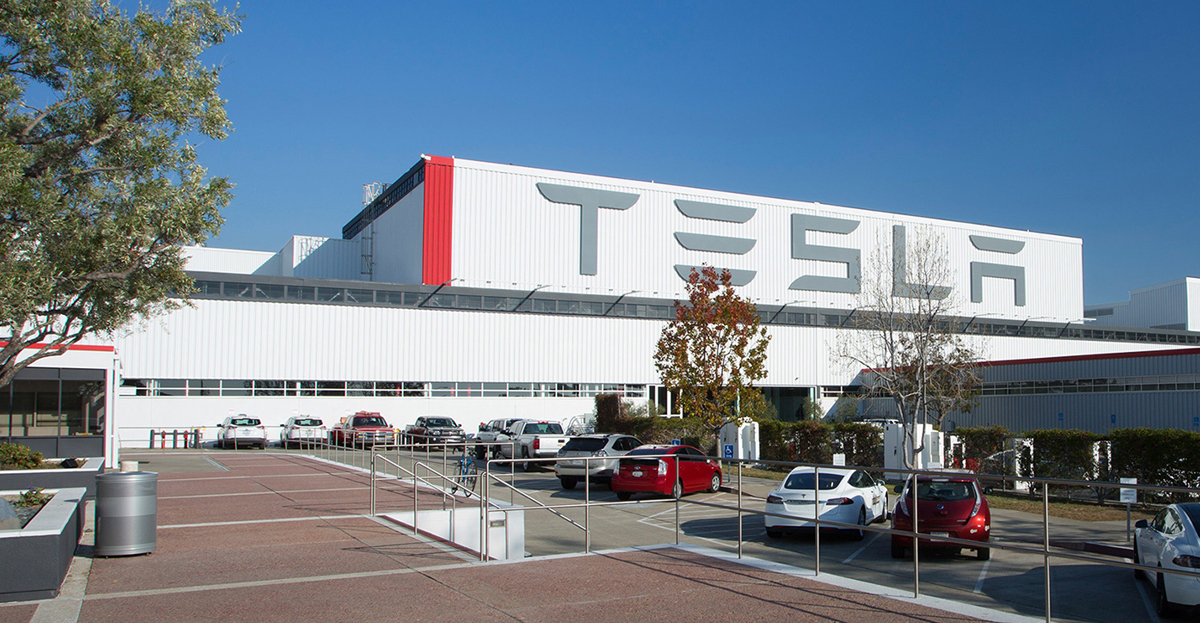
The biggest mover and shaker from the automotive industry – or any other in the top 20 – was Tesla, as the American electric vehicle and energy company recorded a 184 per cent increase in brand value over the previous 12 months, now worth an estimated US$36.77 billion.
Although Tesla’s percentage increase was the largest of all, its financial value is only the 14th highest, some eight places behind the leading automotive brand – with the world’s best-selling manufacturer unsurprisingly leading the charge.
Sitting at an estimated brand value of US$54.1bn (AU$71.8bn), Toyota’s 2021 result represents a five per cent increase over the year prior, allowing it to sit just ahead of Mercedes-Benz, which ranks eighth overall, valued at US$50.37bn (AU$66.85bn) with a three per cent increase above 2020.
Mercedes-Benz’s German rival BMW positioned itself between Nike and Louis Vuitton in 12th place, also going through a five per cent value increase to now be worth US$41.63bn (AU$55.25bn).
Stretching out to the top 50 brands, Honda (25th), Hyundai (35th), Audi (46th) and Volkswagen (47th) all make an appearance, although with 10 of the top 20 coming from the technology industry, it’s clear to see which companies made the most of the pandemic.
Sitting atop the overall rankings, Apple’s brand value of US$408.25bn (AU$541.86bn) is more than 160 per cent above its nearest competitor, with Amazon placing second at US$249.5bn (AU$331.15bn).
A new agreement could see Gippsland transform into the country’s centre for hydrogen technology.
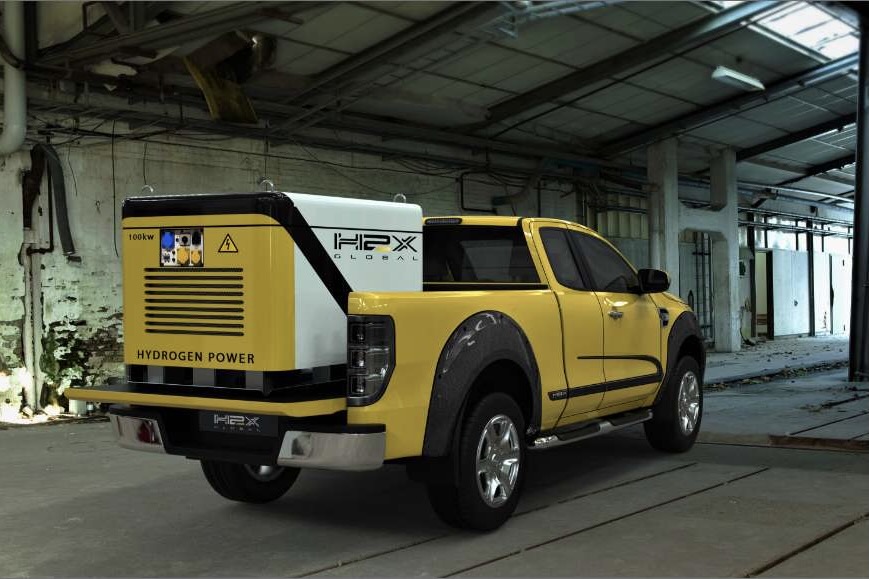
H2X Global, the Australian company transforming Ford Rangers into hydrogen-powered utes, has partnered with the Gippsland Circular Economy Precinct to lead the development of hydrogen fuel-cells, electrolysers, and power generators.
The announcement also outlines plans to manufacture hydrogen-powered vehicles in the Victorian region.
“This is a great opportunity for Gippsland to engage with hydrogen technology and provide new enterprises new jobs and training in support,” H2X Global founder and CEO Brendan Norman said.
“We aim to assist in establishing Gippsland as the world’s preeminent location of green hydrogen excellence. We are now investigating a number of manufacturing options including fuel-cell production and some vehicles.”
The Gippsland Circular Economy Precinct (GCEP) is a consortium of businesses seeking to bring jobs from the renewable energy sector to the area, as it begins the transition away from brown coal power generation.
The agreement follows the announcement of a trial program in March, in which the Loy Yang mine will produce coal-generated hydrogen for export to Japan. A carbon capture program run by the Victorian Government is said to store the CO2 underground.
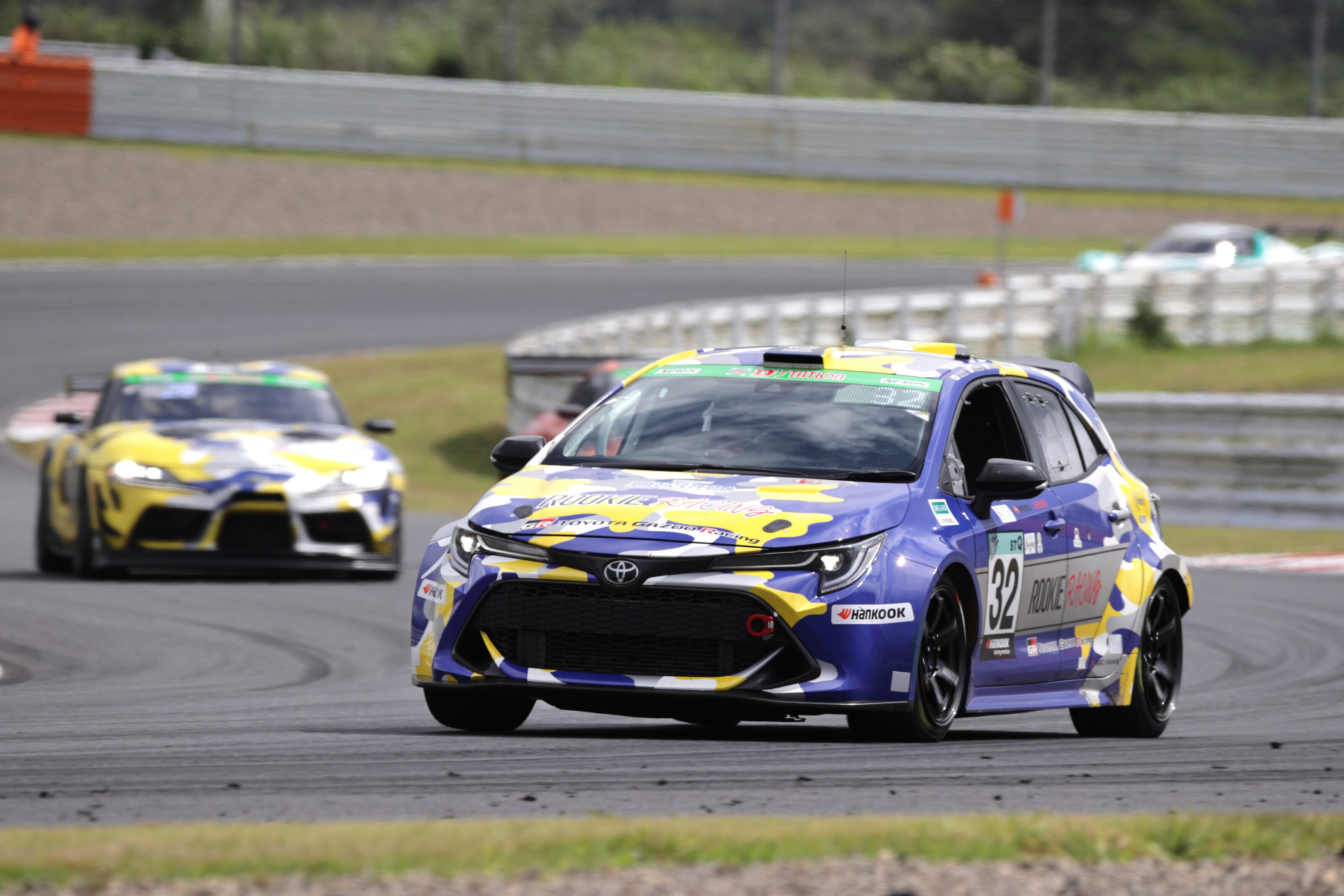
The pilot program will use 150 tonnes of brown coal to produce three tonnes of hydrogen gas, some of which has been used to fuel the hydrogen-powered Toyota Corolla racing car in the 2021 Super Taikyu Series in Japan.
Unlike hydrogen-cell vehicles, which convert hydrogen into energy to power electric motors, the Corolla uses a 1.6-litre turbocharged three-cylinder engine that burns hydrogen rather than petrol, and produces almost zero tailpipe emissions.
H2X will use hydrogen fuel-cells to power its three Ford Ranger-based models, with plans to manufacture the majority of the vehicles in Australia.
In June 2020, the company announced ambitious plans to build up to 20,000 hydrogen-powered vehicles in Port Kembla, NSW by 2025.
“With the development of many green energy projects in Australia at the moment, we have a unique opportunity to bring a significant manufacturing operation back into the country,” Norman said at the time.
Snapshot
- New C8 Corvette Z06 unveiled with world’s most powerful naturally-aspirated V8
- Uses a 5.5-litre, 499kW flat-plane crank engine that revs to 8600rpm
- Confirmed for Australia, more details to come mid-2022
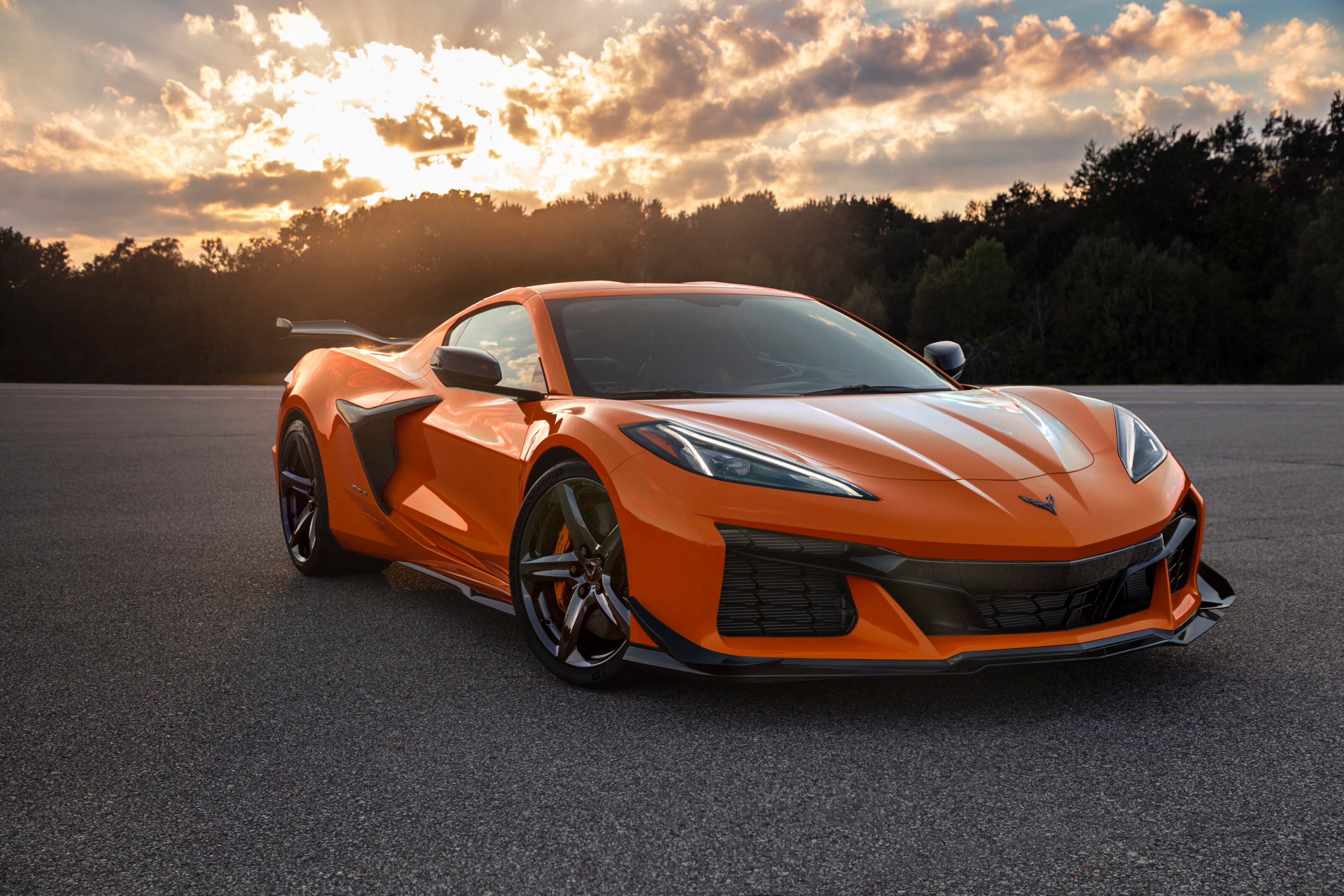
Chevrolet has finally unveiled the highly anticipated 2023 C8 Corvette Z06, housing a brand new flat-plane crank V8 that is the most powerful naturally-aspirated engine of its kind ever fitted to a road car.
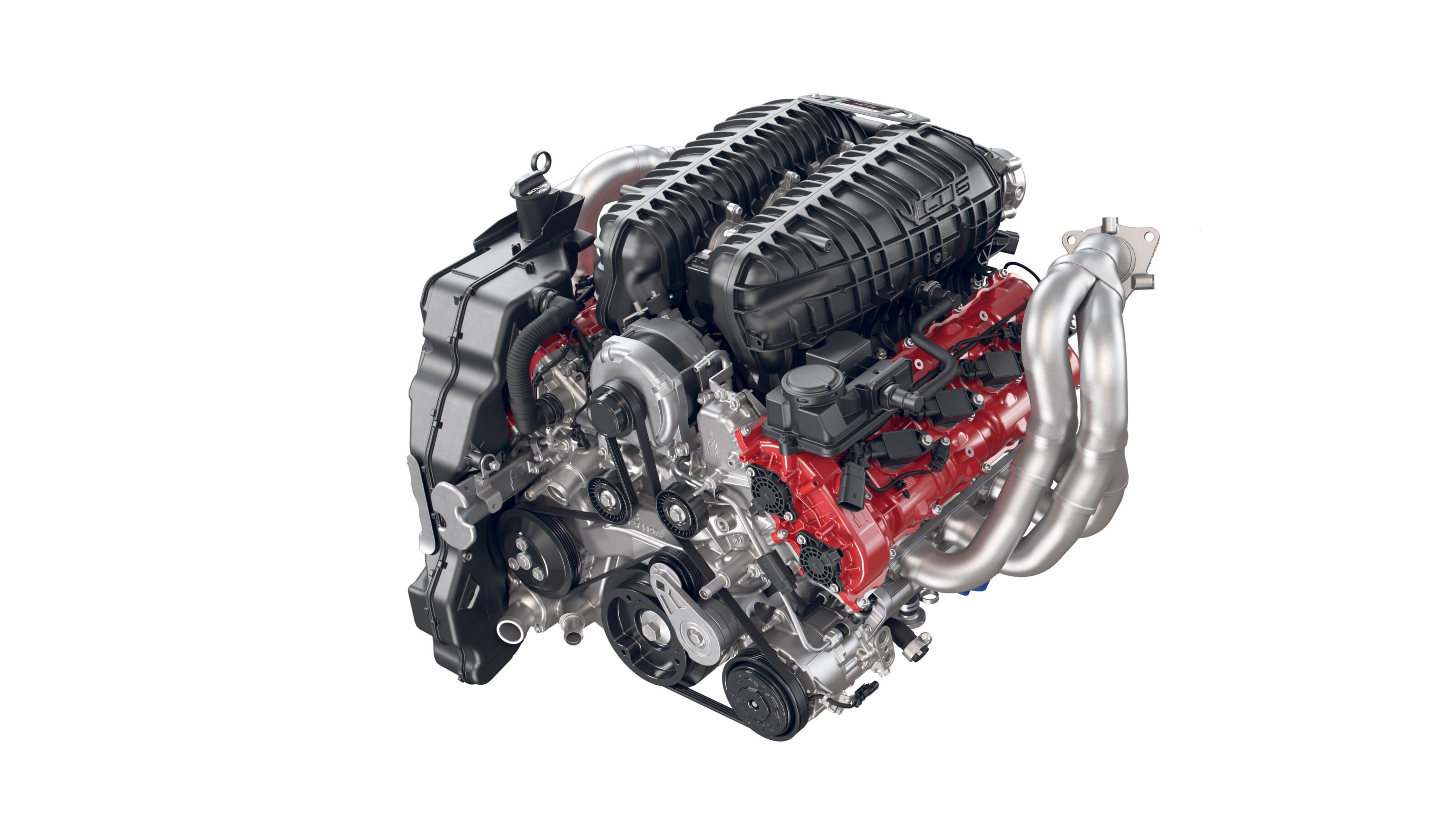
The new engine – dubbed the LT6 – is a 5.5-litre, double overhead camshaft (DOHC) dry-sump monster that screams to 8600rpm and has a maximum output of 499kW.
The LT6 is the first flat-plane crank, DOHC road-going production V8 in GM’s history. It utilises an aluminium block and heads, with forged pistons and rods – as well as a brand new split intake with twin 87 millimetre throttle bodies.
The hand-assembled mill’s official outputs are 499kW (670hp) @ 8,400rpm and 623Nm @ 6300rpm, helping launch the Z06 from 0-96km/h in just 2.6-seconds claimed.
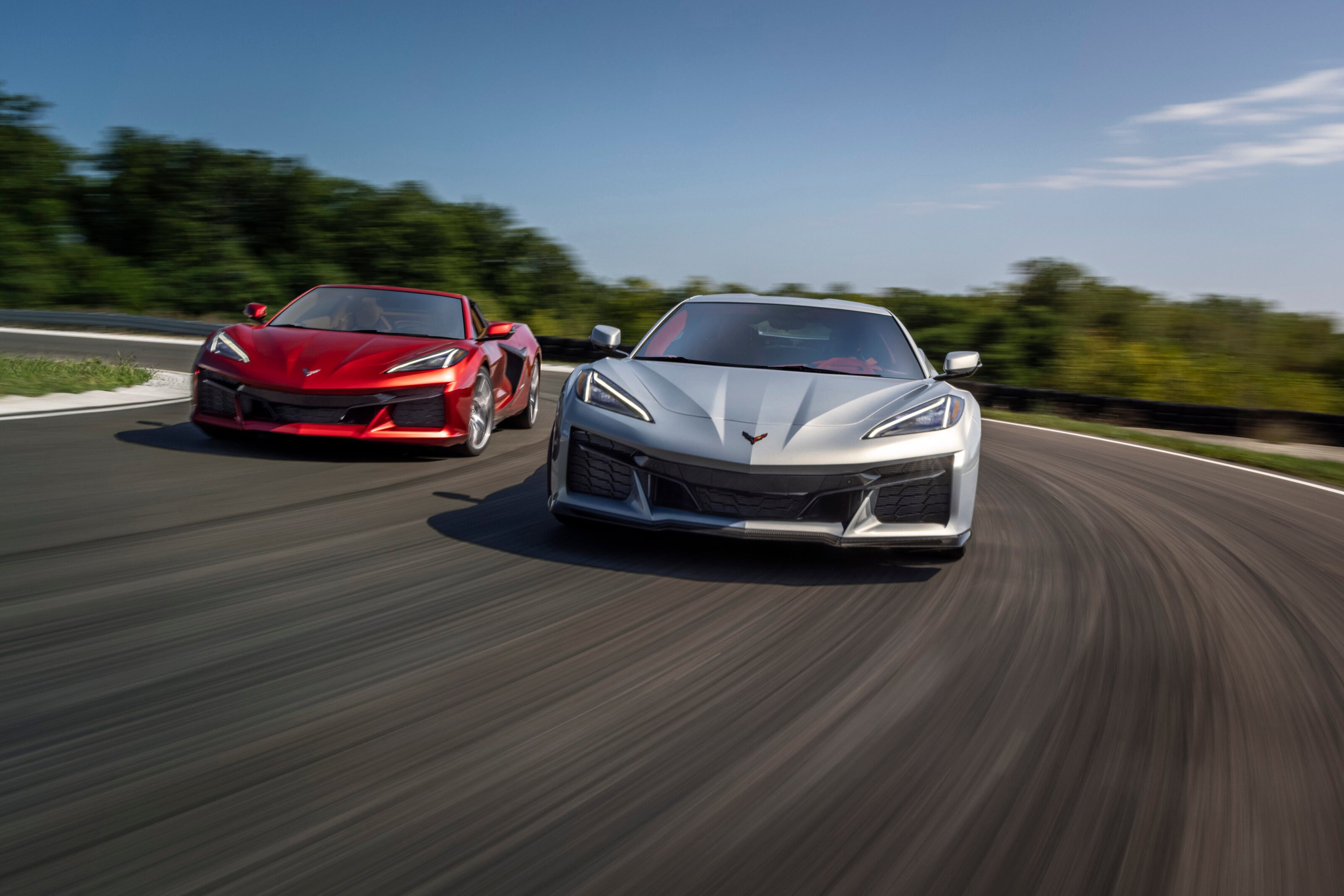
The only driveline option for the Z06 is an eight-speed dual clutch transmission, using a more aggressive 5.56 final drive ratio compared to the Stingray, and an electronically adjustable limited-slip rear end.
The exterior has been given a makeover to match the extra oomph, the Z06 sporting wider front and rear guards – which exceed the C8 Stingray’s by 9.4cm. New fascias to optimise cooling and aerodynamics, and a manually adjustable rear spoiler across all variants.
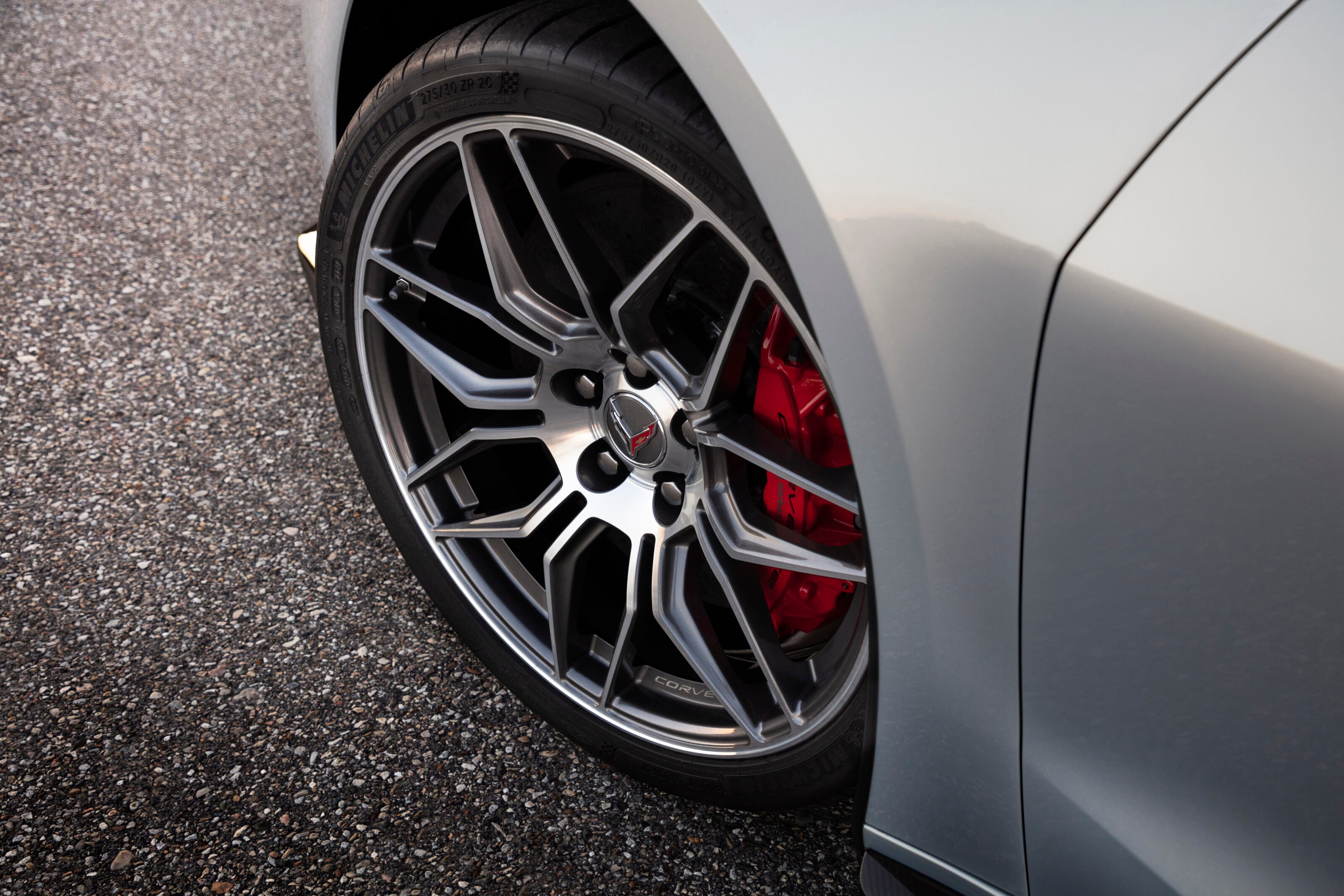
Sitting underneath those new wider arches are forged aluminium wheels measuring 20 x 10.0 inches up front and 21 x 13.0 inches in the rear, wearing standard Michelin Pilot Sport 4S tyres in size 275/30 R20 at the front and a whopping 345/25 R21 for the rear.
Inside those massive wheels are Brembo brakes, which are standard across all variants, using 370mm discs with six piston calipers at the front and 380mm rotors with four piston calipers at the back.
The Z06 range is offered in three trims levels – 1LZ, 2LZ and 3LZ – with hardtop and convertible versions available for each.
Along with the three main trim levels, owners can choose from the following:
| Twelve exterior colours |
| Seven wheel packages, including five finishes on the standard forged aluminium wheels and optional carbon fibre wheels (Z07 package) |
| Seven main interior colours |
| Three seat choices and six seatbelt options |
| Two interior carbon fibre trim packages, plus stealth aluminium trim option |
| Six available brake caliper colours. |
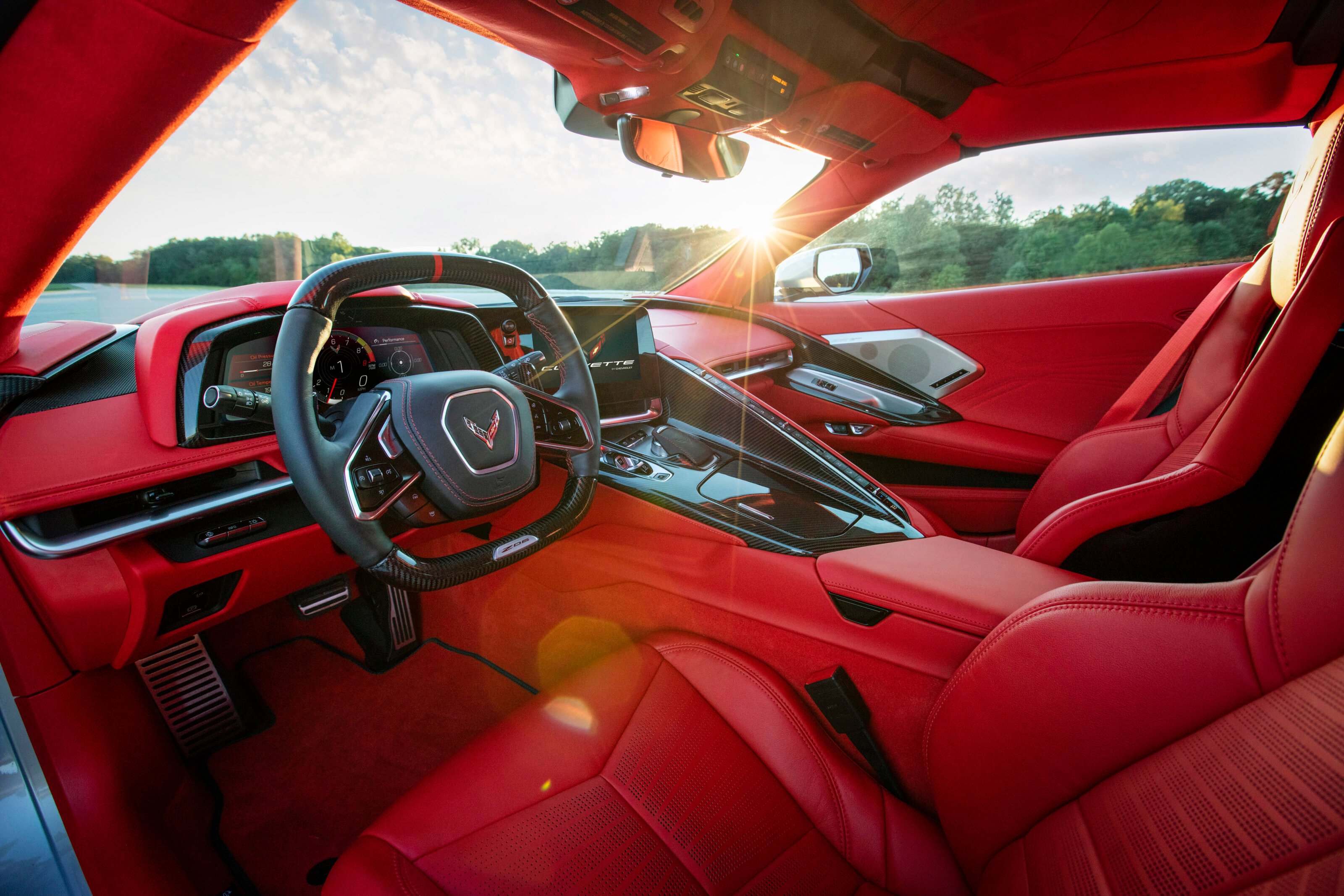
The real gem of the new Z06 range is the track-focused Z07 Performance pack. The track-oriented package includes:
| Carbon fibre aero package with larger front splitter, front-corner dive planes, a rear wing and underbody strakes for more downforce |
| FE7 suspension with specific magnetic ride control 4.0 calibration |
| Michelin Sport Cup 2 R ZP tyres developed specifically for the Z07 |
| Brembo carbon ceramic brake system featuring larger, 15.7-inch-diameter (398mm) front rotors and 15.4-inch-diameter (391mm) rear rotors |
| And the option of carbon fibre wheels, which reduce unsprung mass by 18.6 kilograms. |
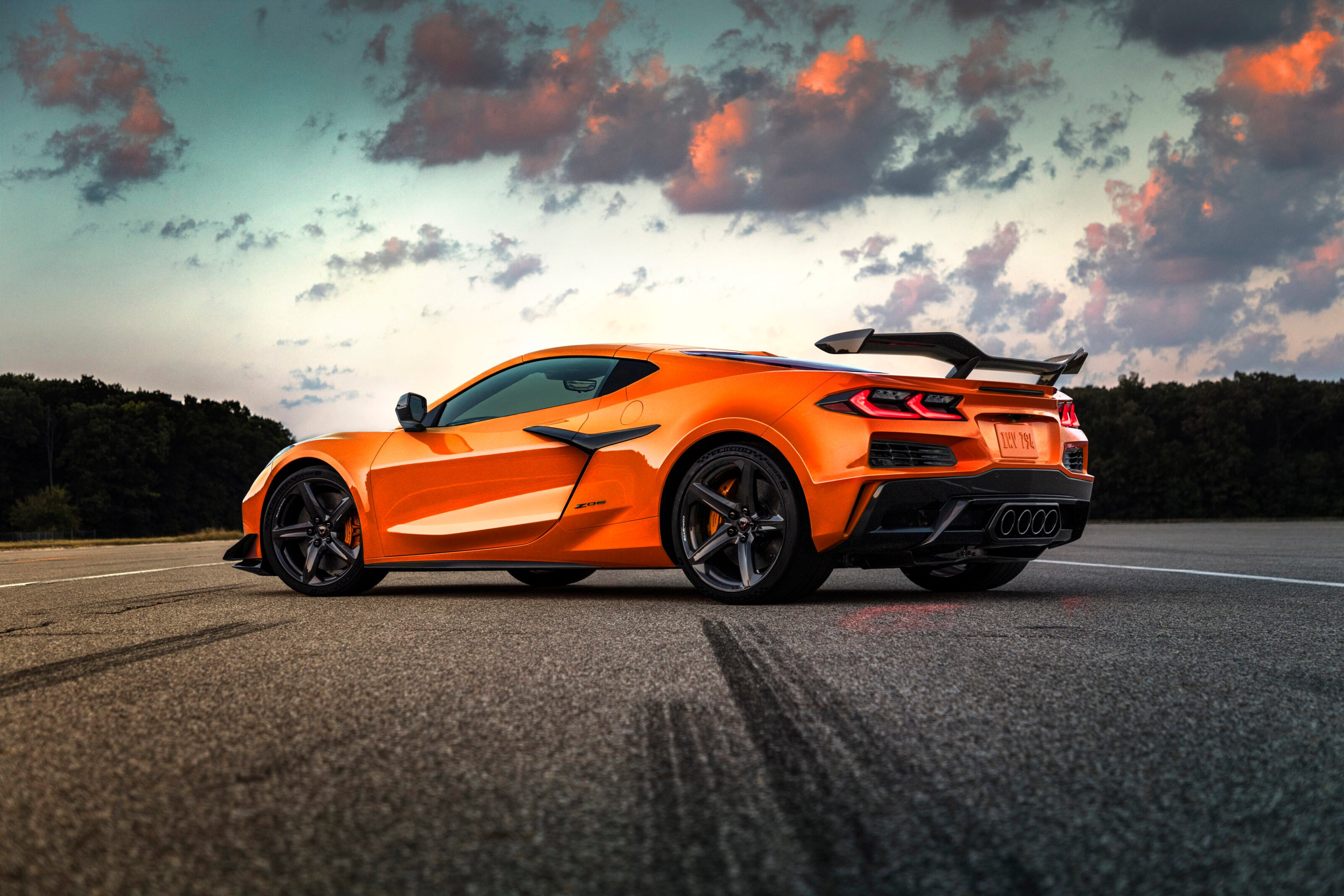
Pricing, fuel consumption and top speed figures are all still yet to be revealed for the new Z06, but Chevrolet says it will be available by mid-2022 in the US.
Following on from GMSV filing for a trademark of the Z06 in Australia in July, the maker has confirmed the fire-breathing Corvette will make it here eventually, with more details on a RHD version next year.
The Stingray has been on sale in the US for two years now – but despite this, the first shipment of C8s is still yet to make it to Australia, so we’re betting we’ll have to wait a while before we see a Z06 on Aussie roads.
Snapshot
- Huge leap forward in technology
- Built on new MLA-Flex architecture for ICE, MHEV, PHEV and full EV
- Australian pricing to start from $220,200
Other than redesigning a Porsche 911, the most difficult job in the automotive world is creating a new Range Rover.
Like a 911, the Range Rover is a vehicle with a past which defines its future; a vehicle with unique attributes that must today tiptoe a fine line between tradition and technology. Range Rover is its own benchmark. A new Range Rover must, by definition, be a better Range Rover.
The 2022 Range Rover, new from the wheels up, is the most luxurious and most technologically advanced Rangie in history. Depending on the region, and confirmed for Australia, it’s available with Amazon’s Alexa voice control. The on-board electronics, controlled by 69 individual ECUs, can be updated over the air like your smartphone apps.
NOTE: Full Australian pricing has now been revealed. So when you finish reading Angus’s story, head here to see local pricing and specs.
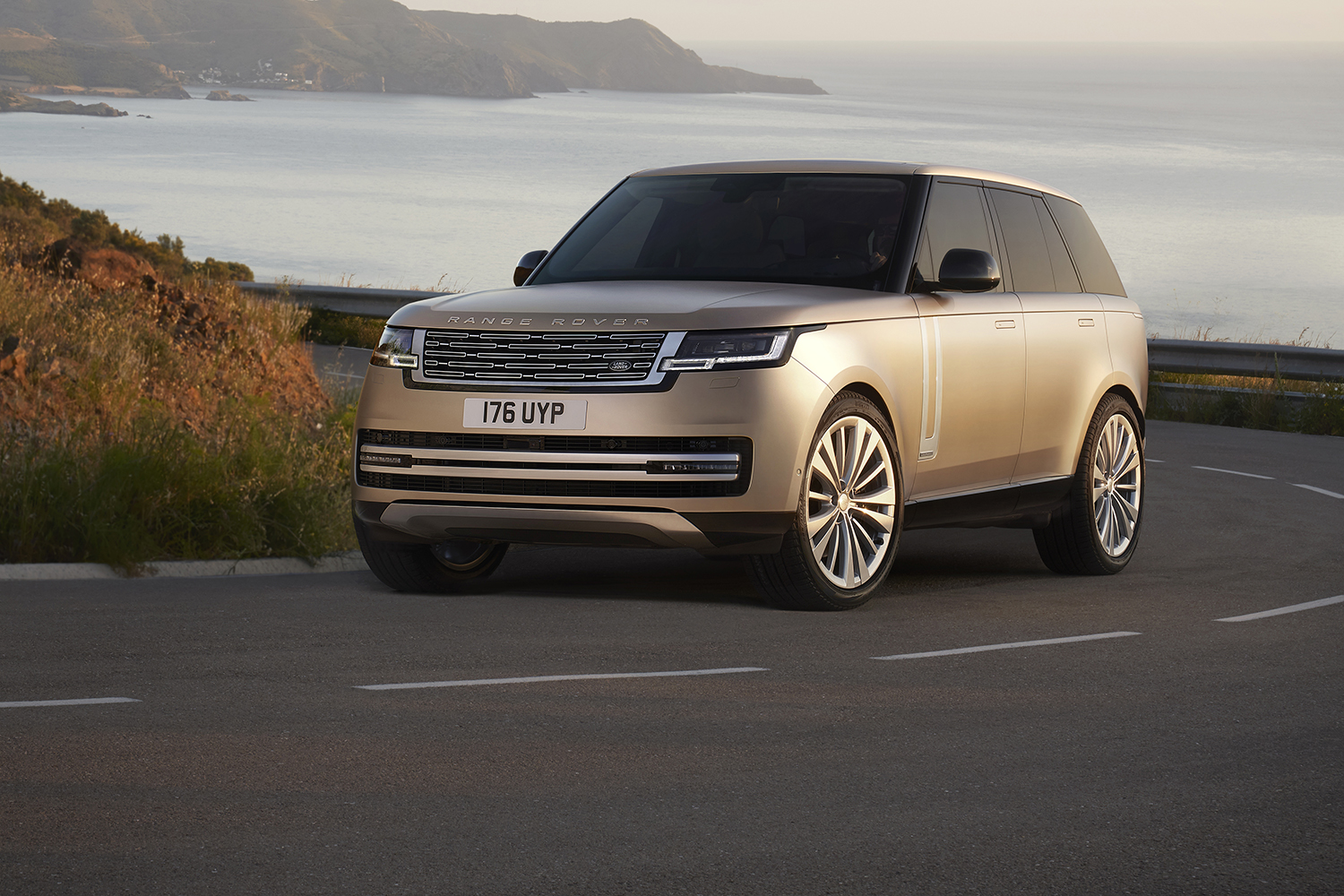
Rear-wheel steering is standard across the range. The top-spec headlights have 1.2 million individually controllable micro-mirrors, enabling them to throw light around 16 different objects at once.
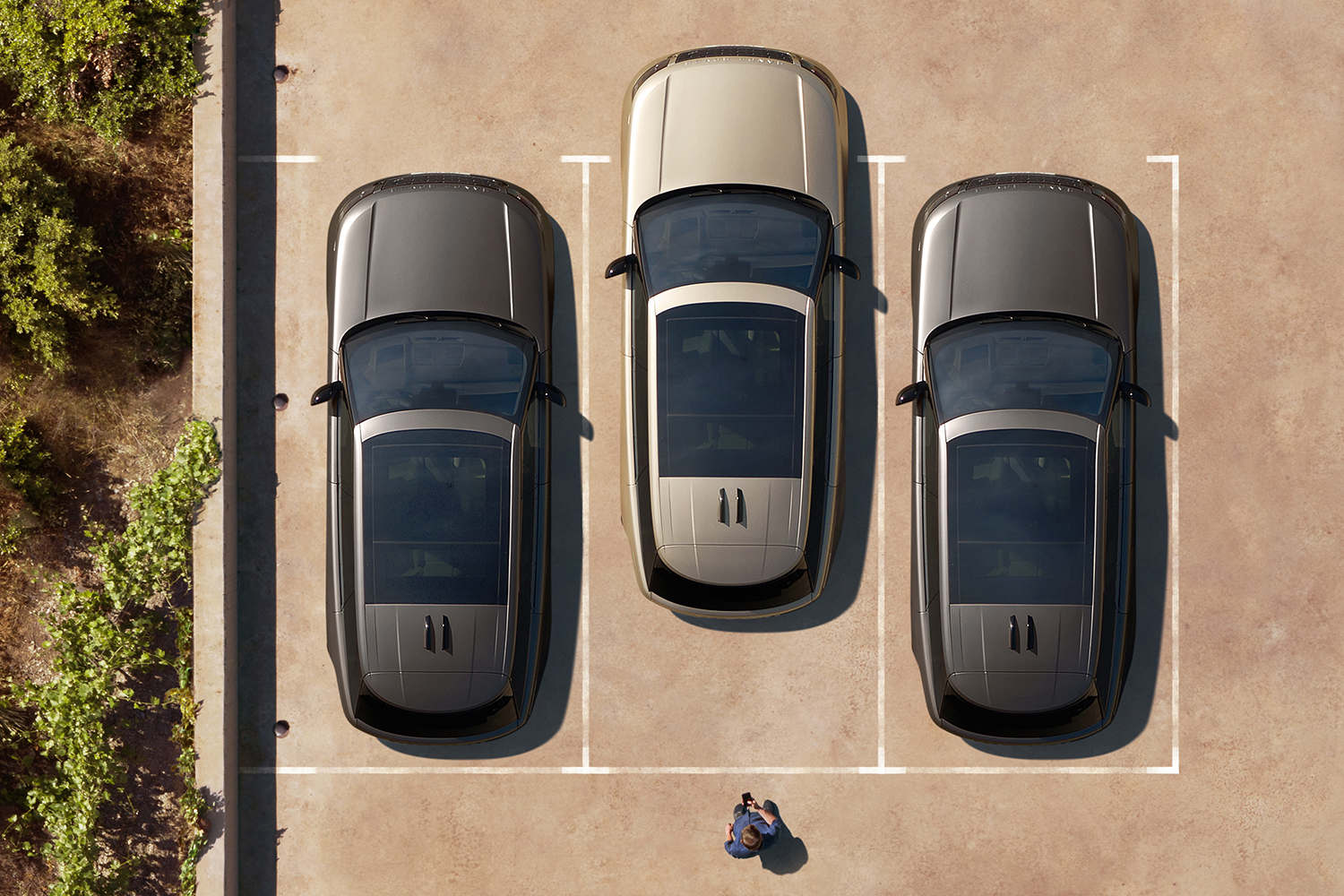
The new Range Rover can even park itself, sliding into narrow spaces while you stand outside and watch.
You can take it to the opera, cosseted in a sumptuously elegant interior, the top-spec noise-cancelling audio system hushing engine and road sounds, directions from the sat-nav projected directly into your line of sight by the head-up display.
Or you can pump up the air suspension to give a maximum 295mm of ground clearance and take it off-road – scrambling over rocky outcrops and wading through water 900mm deep, the central touchscreen showing obstacles hidden from view by the bonnet.
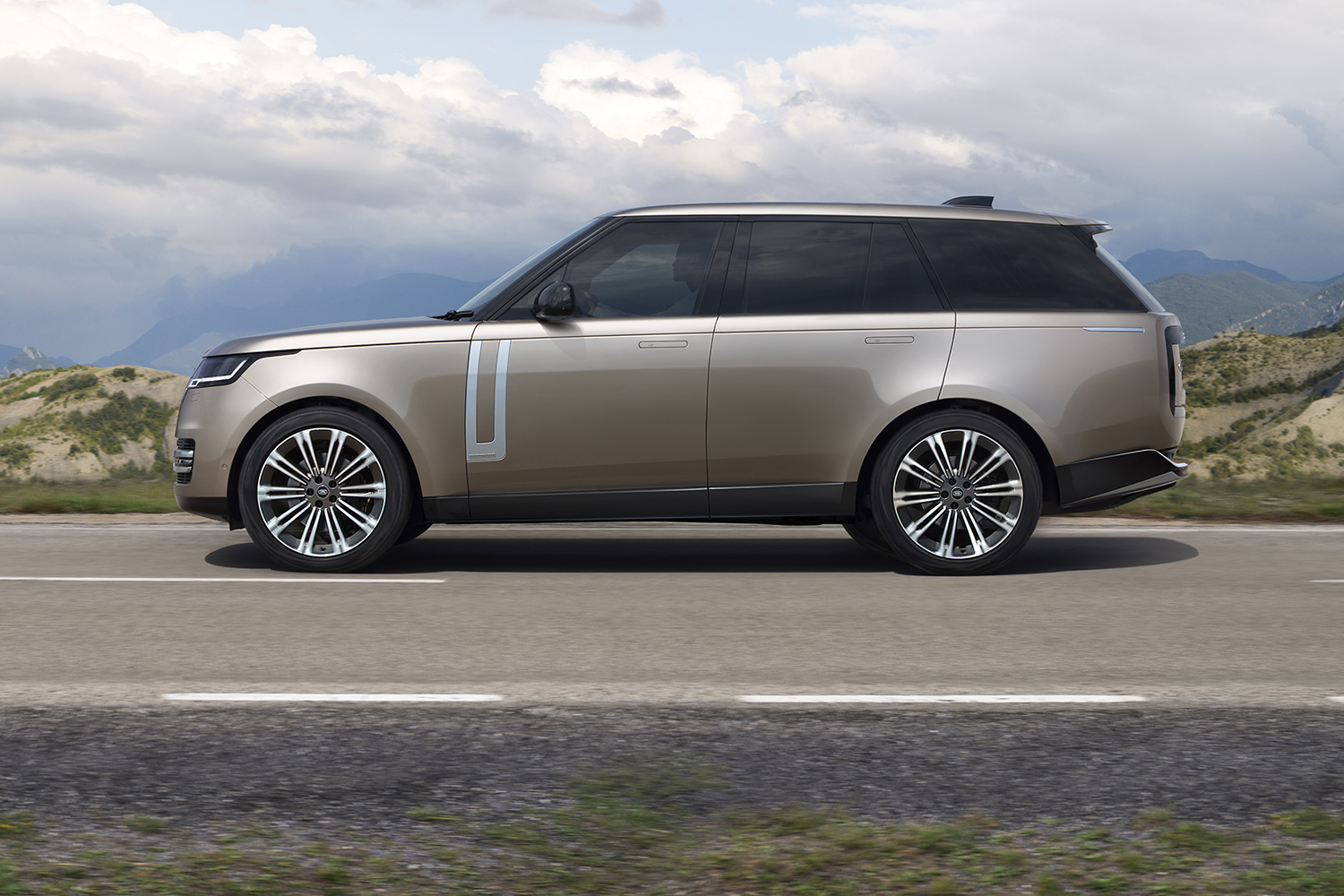
Unrivalled comfort meets unparalleled capability: At first glance this new Range Rover hits all the right notes.
Codenamed L460, the fifth generation Range Rover is built on JLR’s all-new aluminium intensive MLA-Flex vehicle architecture.
MLA-Flex has been designed to accommodate mild hybrid, plug-in hybrid, and full battery electric powertrains, and JLR’s powerful EVA 2.0 electronic architecture.
Torsional stiffness has been increased by 50 per cent compared with the outgoing Rangie, says vehicle line director Rory O’Murchu, while structural borne noise has been reduced by 24 per cent.
The L460 is also 52mm longer overall, rolls on a 75mm longer wheelbase, and has a 11mm lower roofline.
A new five-link rear axle not only packages a steering system that turns the rear wheels up to 7.3 degrees – in the opposite direction to the front set at speeds up to 50km/h to improve agility or in the same direction above 50km/h to ensure high-speed stability – but has been designed to also accommodate an electric motor.
The air suspension has Bilstein twin-valve active dampers and Land Rover’s first 48V active anti-roll system, with 900Nm of twist available within 200 milliseconds and up to 1400Nm in total. The system can be decoupled for off-road work, and its actuators used to push down the wheels to better follow the terrain.
Top-spec wheels on the latest model are massive 23-inchers, though Land Rover says careful attention to lightweight design, new alloys and flow-forming process means they weigh no more than the 22-inch wheels available on the current Range Rover.
No matter which wheel/tyre combination you choose, the overall rolling radius is 815mm, ensuring consistency of suspension performance on and off the road.
A new all-wheel-drive control system automatically cuts drive to the front axle between 35km/h and 160km/h to reduce mechanical drag by 30 per cent and improve fuel efficiency.
The system ensures there’s drive to the front axle when pulling away from a standstill, or if ambient temperatures drop below three degrees C, and, of course, when driving off-road.
The new model has the Terrain Response 2 drive mode system which debuted on the most recent Land Rover Defender. As before, all engines are coupled to an eight-speed automatic transmission with a two-speed transfer case.
2022 Range Rover: Australian details
NOTE: Full Australian pricing has now been revealed. So when you finish reading Angus’s story, head here to see local pricing and specs.
Australian-spec Rangies, starting from $220,200 for the Range Rover SWB SE D300 (before on-road costs), will be available with five powertrains:
Three mild hybrids (MHEV) and a plug-in hybrid (PHEV) featuring JLR’s Ingenium 3.0-litre turbocharged straight six in either petrol or diesel form, and a BMW-sourced 4.4-litre twin-turbo V8.
The V8-powered models will be badged P530. They’ll offer no electrical assistance, but deliver 390kW and 750Nm and can scoot to 100km/h in 4.6 seconds.
P400 signifies the petrol Ingenium MHEV powertrain with 294kW and 550Nm under the bonnet. The D300 and D350 badges mean diesel Ingenium MHEVs with 221kW and 650Nm, and 258kW and 700Nm, respectively.
The PHEV powertrain is perhaps the most intriguing one
Badged P510e, it features the 294Kw petrol Ingenium six combined with a 105kW e-motor, mounted between the engine and the eight-speed automatic transmission, that’s powered by a lithium-ion battery with a useable capacity of 31.8kWh.
Land Rover claims a pure electric driving range of 80km to 100km at speeds of up to 140km/h, and as the battery sits under the rear passenger compartment floor, low and between the axles, no negative impact on handling or load capacity.
With a total system output of 375kW and 700Nm, the P510e is said to be good for a 5.6-second 0-100km/h sprint while delivering a real-world driving range of about 640km. And with 50kW DC rapid charging capability, the battery can be topped up to 80 per cent charge in under an hour.
The powertrain line-up will be expanded in 2024 with the launch of the first ever all-electric Range Rover.
JLR sources are tight lipped on detail, but there will be e-motors front and rear to deliver the mandatory all-wheel-drive, and sophisticated control systems which allow capabilities such as infinitely variable torque split to ensure good handling on the road and good capability off it.
Outputs north of 375kW and 700Nm seem logical, along with a 500km or better driving range courtesy of a battery pack which looks to have around 100kWh capacity.
All this new hardware and software is wrapped in breathtakingly modernist sheet metal, styled under the direction of Land Rover design director Massimo Frascella, that retains traditional Range Rover proportions while stripping back superfluous surface detailing to an absolute minimum.
It’s a stunningly confident piece of work that makes the Bentley Bentayga look bling and the Rolls-Royce Cullinan boring. And the closer you look, the more impressive it is.
The grille echoes the form of the current Range Rover’s, but the detailing is much more elegant. Underneath it, inset into the smoothly surfaced bumper, is a broad vent that makes the car look wider and more planted.
The front fascia flows around to the bodysides in a smooth arc, making the new Rangie look sleeker than ever. Indeed, JLR claims it is the most aerodynamic version in history, with a Cd of 0.30 – a 12 per cent improvement over the outgoing model.
The super-clean bodysides are anchored by gloss black sills that rise towards the rear of the car and kick upward after the rear wheels, where their outer surface is then pulled wide of the sheet metal to almost cradle the bodywork at the extreme back of the car.
JLR chief creative officer Gerry McGovern’s obsession with reductive design is reflected in details such as the way the tops of the doors roll over to meet the flush side glass, without a visible seam or rubber seal, and the hiding of the D-pillar under the rear window.
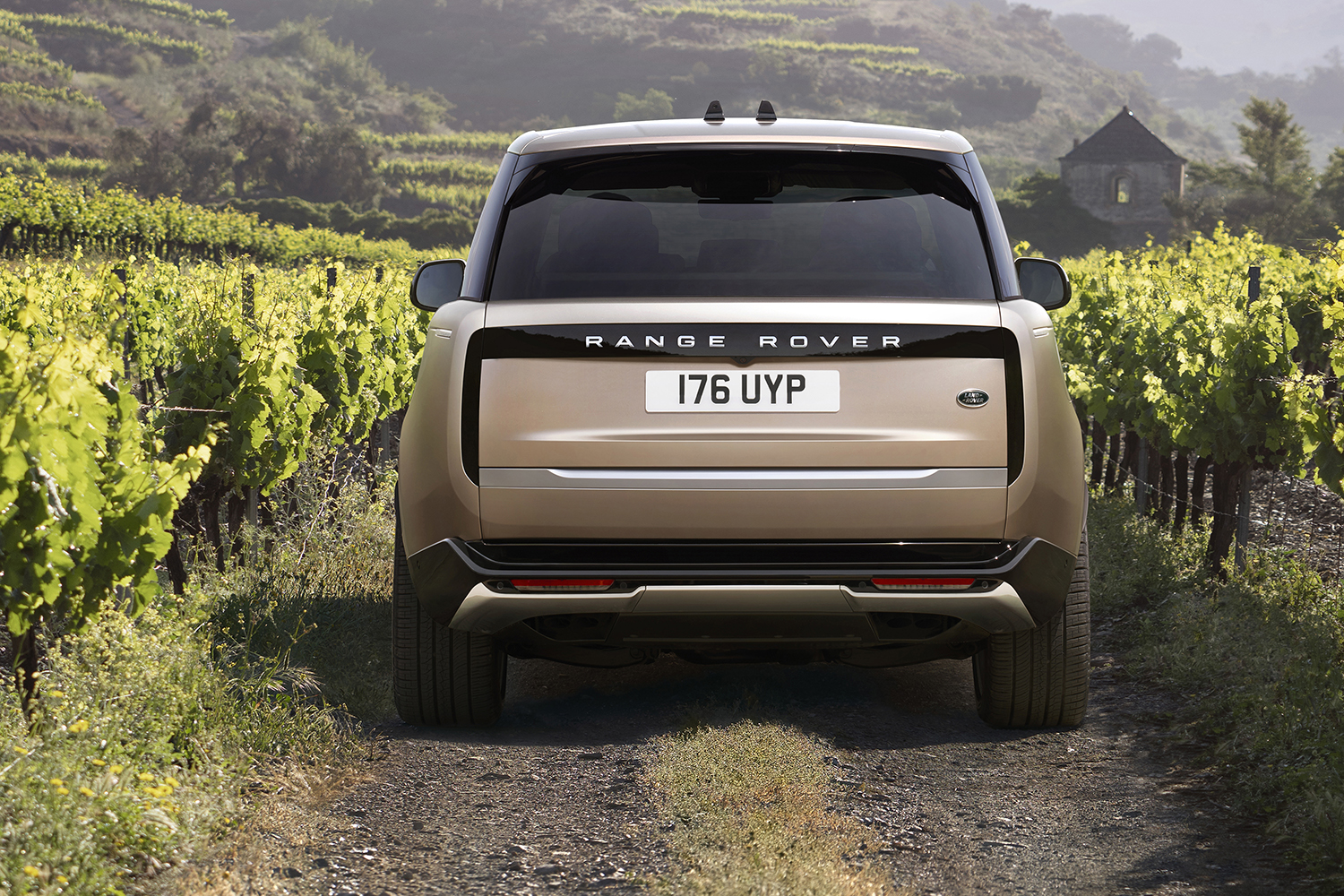
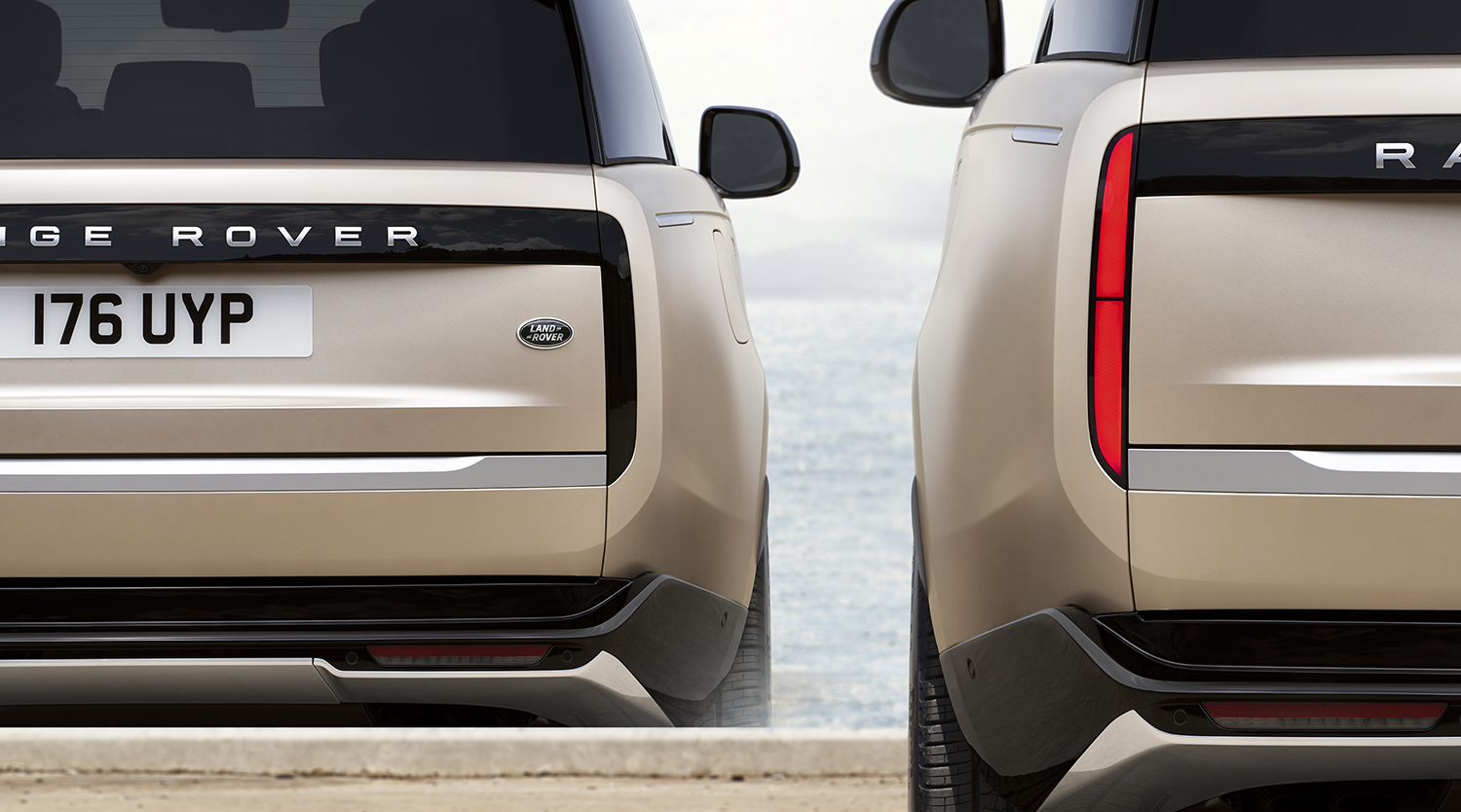
Where the new Range Rover makes its most dramatic visual statement is at the rear, where a pair of ultra-thin vertical tail-lights are hidden in a gloss black panel that stretches up and across the two-piece tailgate and is framed by a strong, squared off, almost Kamm-tail graphic. The rear indicators are hidden in the horizontal section of the black panel.
To deliver the necessary brightness through the black surface the LED tail-lights and indicators shine towards the front of the car before being turned 180 degrees and amplified through a series of prisms. JLR has a patent on the system, one of 125 patents covering new technologies on the new model.
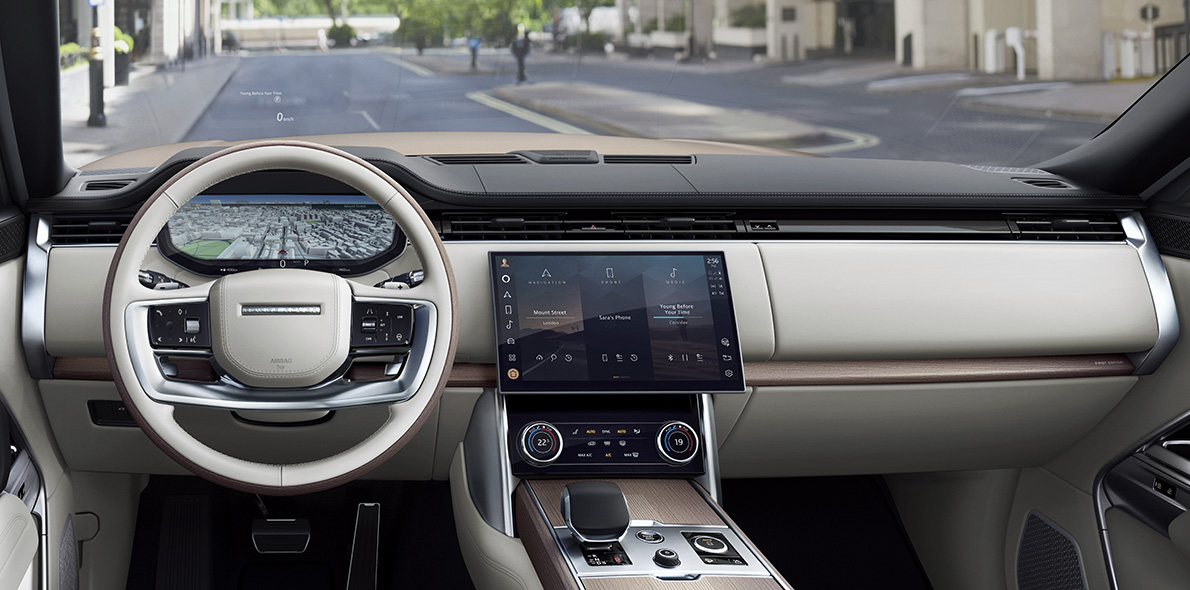
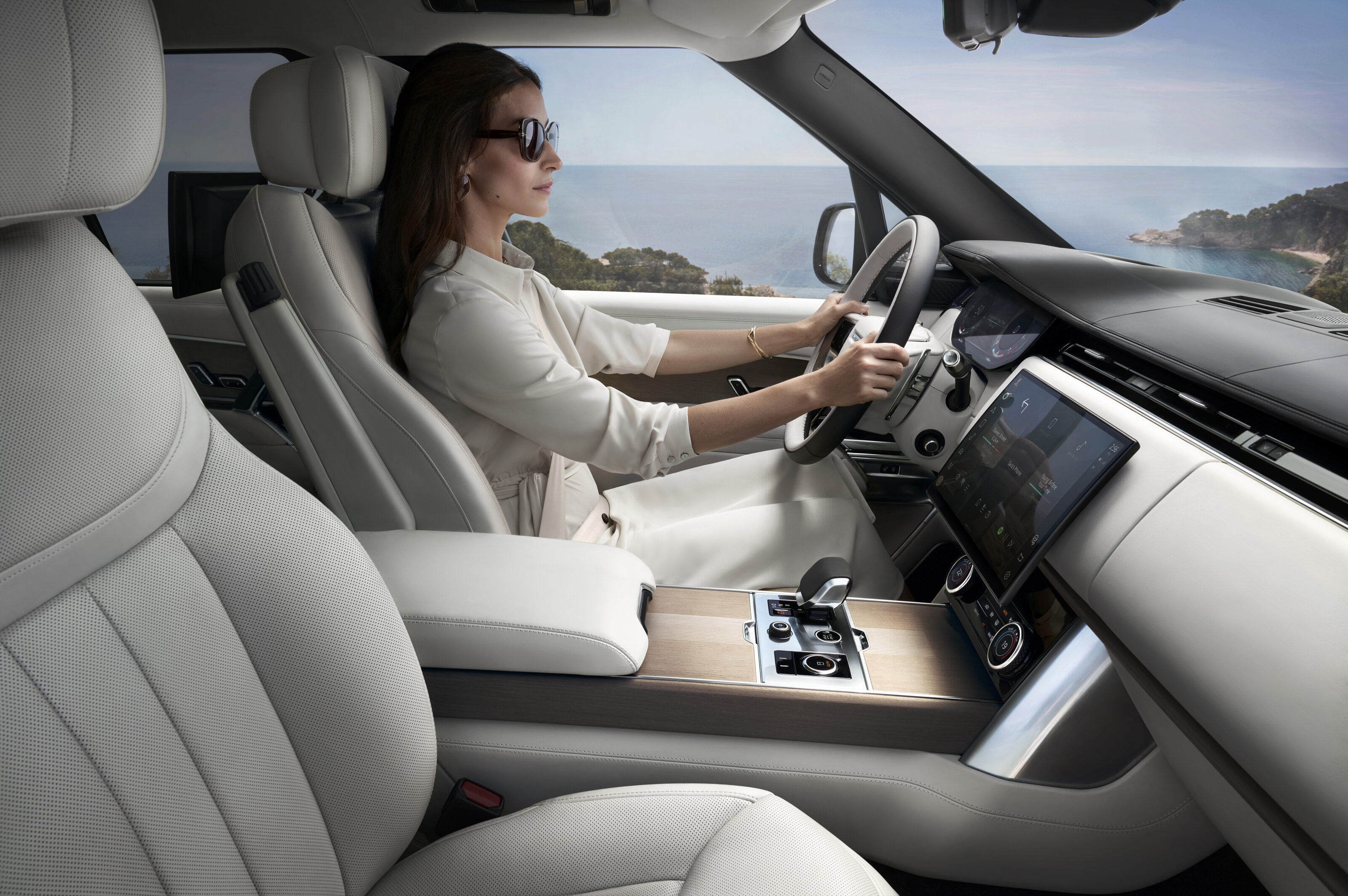
The crisp modernism of the exterior is carried over to the interior, with straight lines, clean surfaces, and switchgear reduced to a minimum. A new two-spoke steering wheel fronts a digital instrument cluster that’s been engineered as a semi-floating glass panel and a gently convexed 13.1-inch haptic feedback touchscreen floats above the centre of the dash.
The air vents are cleverly integrated into the overall horizontal theme of the fascia. It’s a supremely elegant and restful cabin.
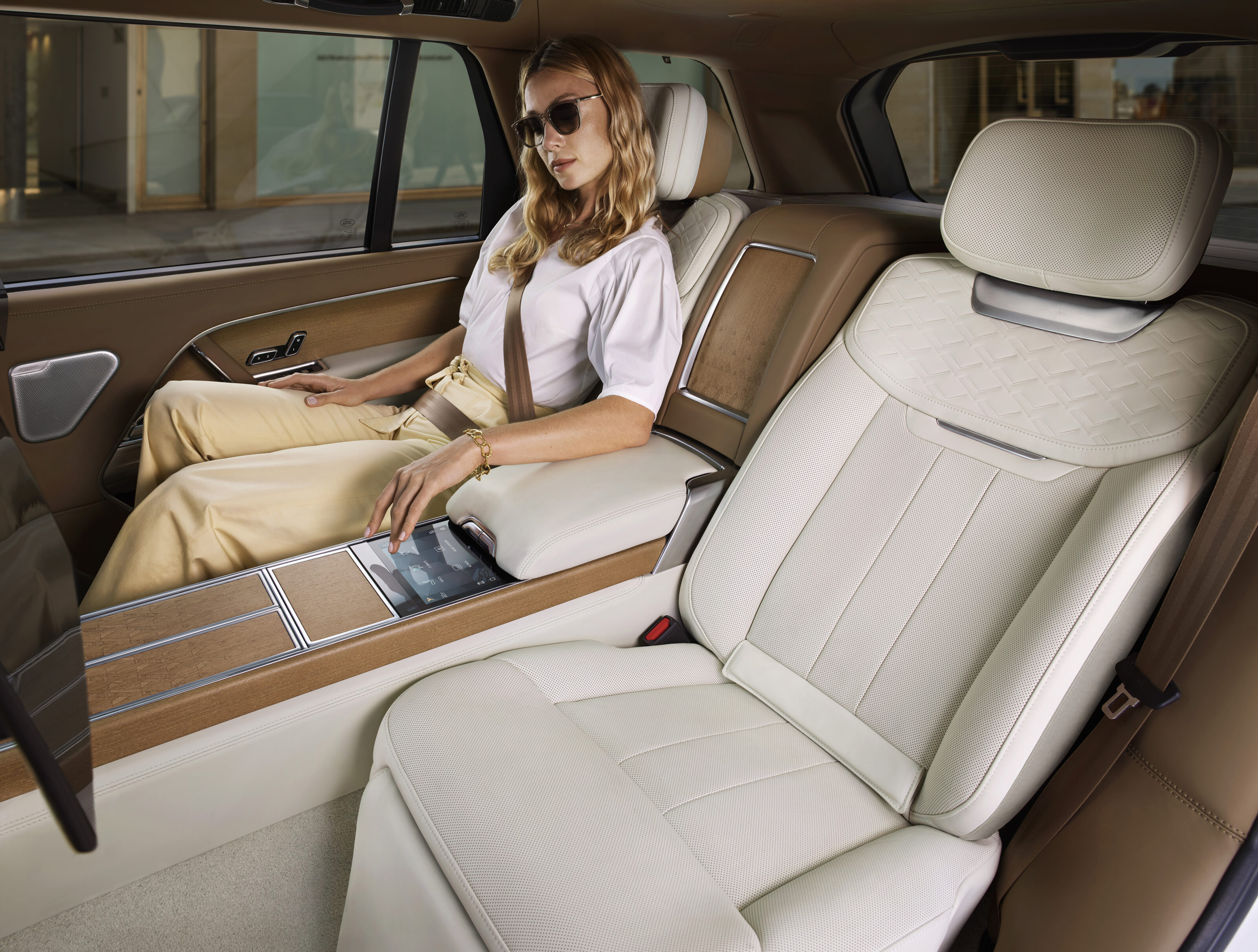
It’s comfortable, too. That 75mm increase in the wheelbase has delivered a 44mm increase in knee room behind the front seats. As you’d expect, they can be trimmed in traditional leather in a variety of colours.
Land Rover is also offering a near-aniline leather trim it says is softer and, because it requires fewer treatments and less artificial pigmentation, can be more efficiently produced – saving the equivalent of more than 42kg of CO2 per vehicle.
More eco-friendly, says the carmaker, are the Kvadrat remix wool blend fabric and the new Ultrafabrics material – which has similar tactile qualities to leather, but is 30 percent lighter and generates only a quarter of the CO2 in its production.
Gerry McGovern once said there’d only be a seven-seat Range Rover “over my dead body”. Well, Gerry’s still alive and kicking, but buyers will be able to order the new Range Rover with a third row.
Money talks: Americans, who buy more Range Rovers than anyone else in the world, kept asking for a seven-seater, and the new MLA-Flex platform gave Land Rover the opportunity to engineer the feature into the car from the outset.
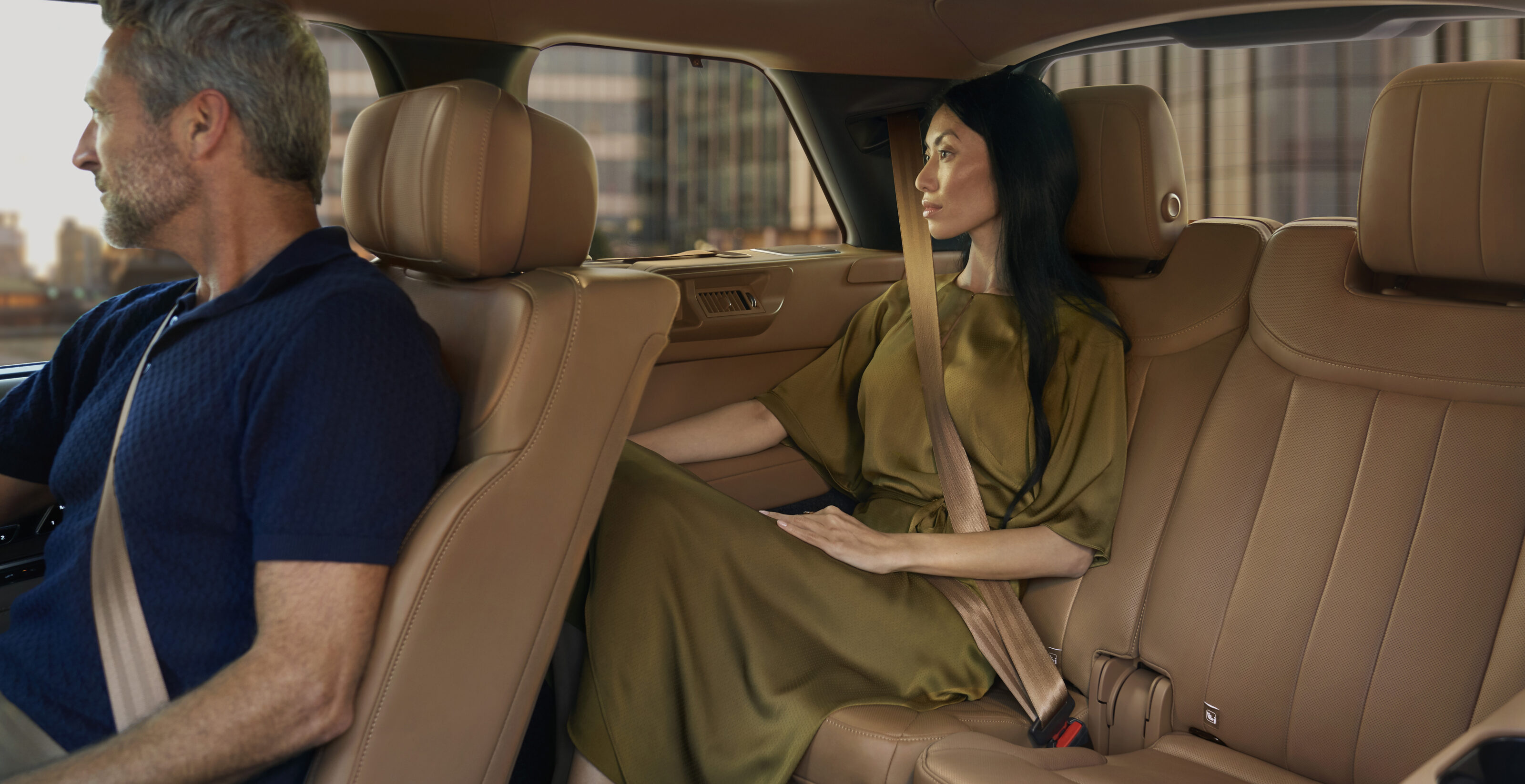
The seven-seat option is only available – for obvious reasons – in the long wheelbase model which, like the previous car, has an extra 200mm between the axles, and longer rear doors.
The execution is good: The second-row backrest tips forward and the squab slides forward in less than eight seconds to enable access, and there’s enough leg and headroom to accommodate moderately sized adults in comfort.
The hip point in the third row is 14mm higher than that of the second row to give the rear-most passengers better forward vision.
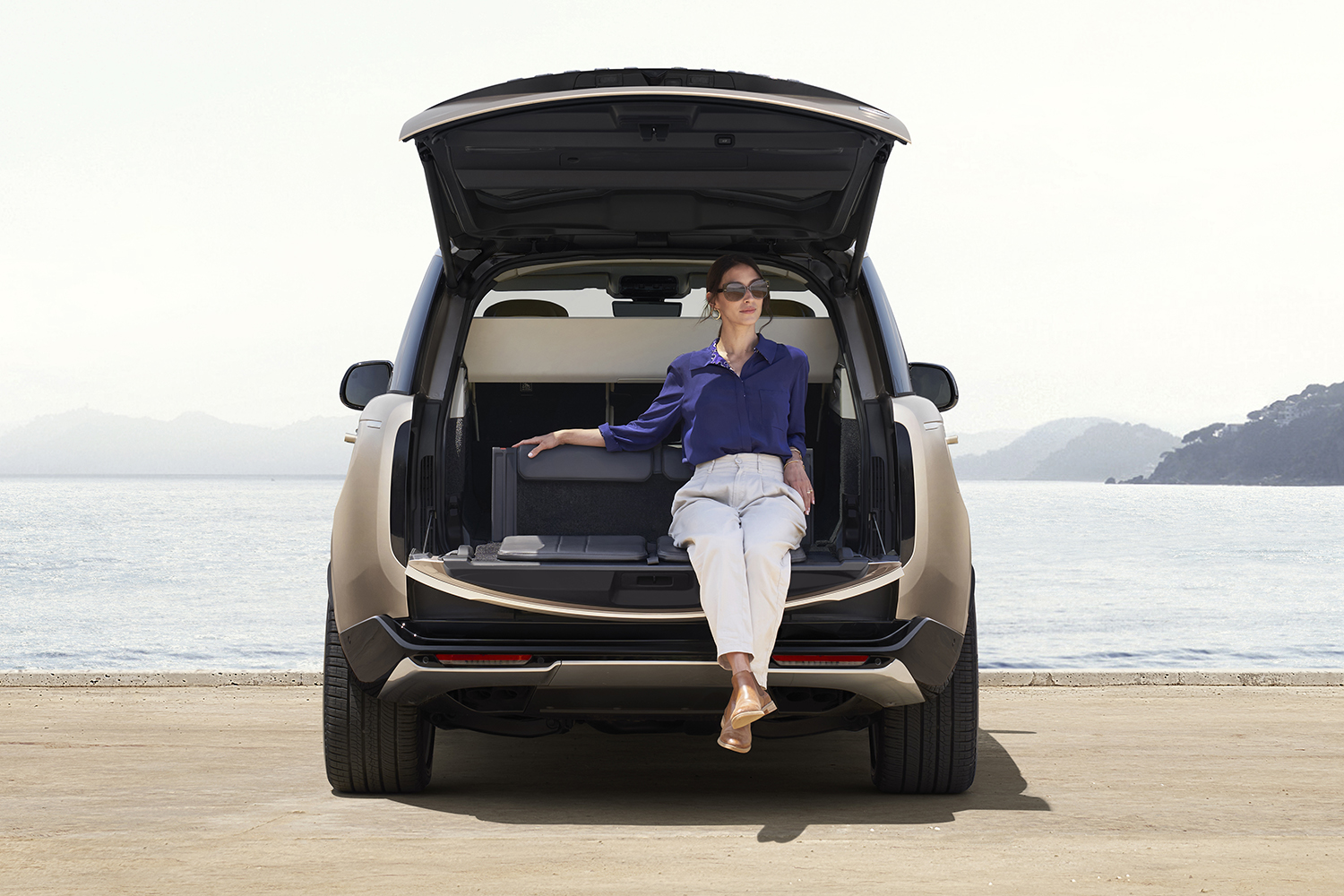
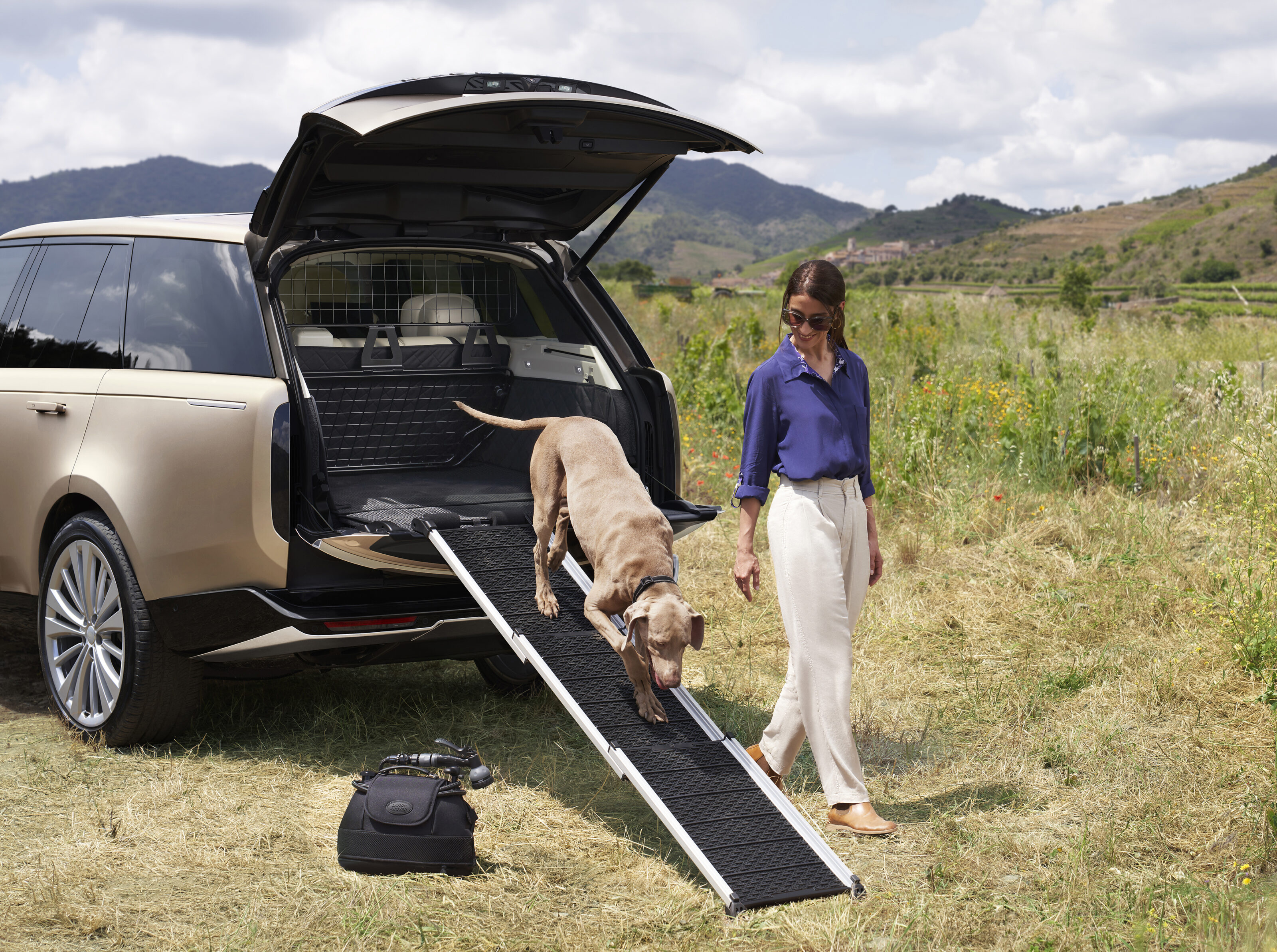
Tight shutlines disguise the fact the new vehicle still has its traditional split tailgate. Land Rover makes the most of that feature by offering an optional pack which adds leather cushions and backrests that can be fitted to the lower portion of the tailgate and downlights which shine from the upper tailgate overhead.
There are cupholders on the tailgate, and an app allows you to remotely control the audio system, directing playback to the rear-most speakers.
Land Rover has used British audio specialist Meridian’s excellent equipment for some years now, and the new Range Rover is available with one of the company’s most advanced automotive systems yet.
The 1600W Meridian Signature Sound System features 35 speakers, including a pair of 60mm speakers in each of the four main headrests, and has an active noise cancellation system which monitors wheel vibrations, tyre noise and engine sounds transmitted into the cabin and automatically plays countering frequencies.
Range Rover once owned the luxury SUV segment. Now everyone from Rolls-Royce and Bentley to even Lamborghini – and soon – Ferrari, wants a slice of this lucrative market.
To compete, Land Rover knew it had to push its flagship off-roader even further upmarket, offering high-style design and customer-facing technologies which prioritised comfort and connectivity, but without compromising the serious all-terrain capability underpinning the entire Range Rover brand.
We’ll reserve judgement until we’ve had a chance to get behind the wheel, but, on paper at least, the benchmark has set a new benchmark.
2022 Range Rover SV
For those who want a Range Rover with the lot
Top of the new Range Rover line-up will be the SV. Handcrafted at JLR’s Special Vehicle Operations, it will offer extra luxury features and the opportunity for customers to personalise their vehicles with unique paint and interior colours.
The SV variants will be identified by a differently detailed grille design, profiled front bumper with four fine trim bars across the full width vent, a laser-etched SV logo in the front door graphic panels, and a white ceramic badge on the tailgate. Engine choices include the 390kW twin-turbo V8, the 375kW PHEV powertrain, and the 258kW MHEV diesel.
SV buyers can choose from the standard Range Rover exterior colour palette or one of 14 additional colours in a special SV palette, which includes a range of satin finishes. And if they can’t find anything they like in that lot, the division will paint to sample, finishing the car in any colour they want.
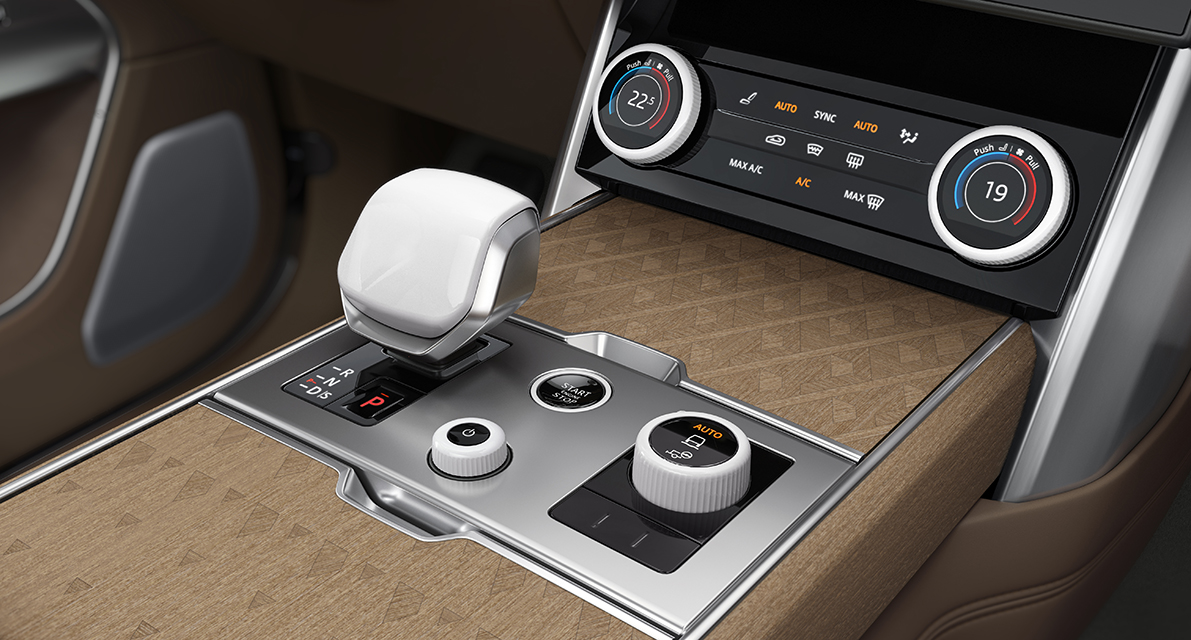
Interior upgrades include a ceramic finish on the shifter, Terrain Response controller, the audio volume control and the heating and cooling controls, unique SV graphics on the digital displays, and the availability of duo-tone colourways, with different options used on the front and rear seats.
Veneer choices include smooth white ceramics with an embossed mosaic pattern applied by hand, as well as anodised metal and selected woods with mosaic marquetry or seamless metal inlays.
All SV models are available with exclusive 13.1-inch rear seat entertainment screens, which are the largest ever fitted to a Range Rover. The rear seat entertainment system includes high-fidelity headphones specifically designed for the car.
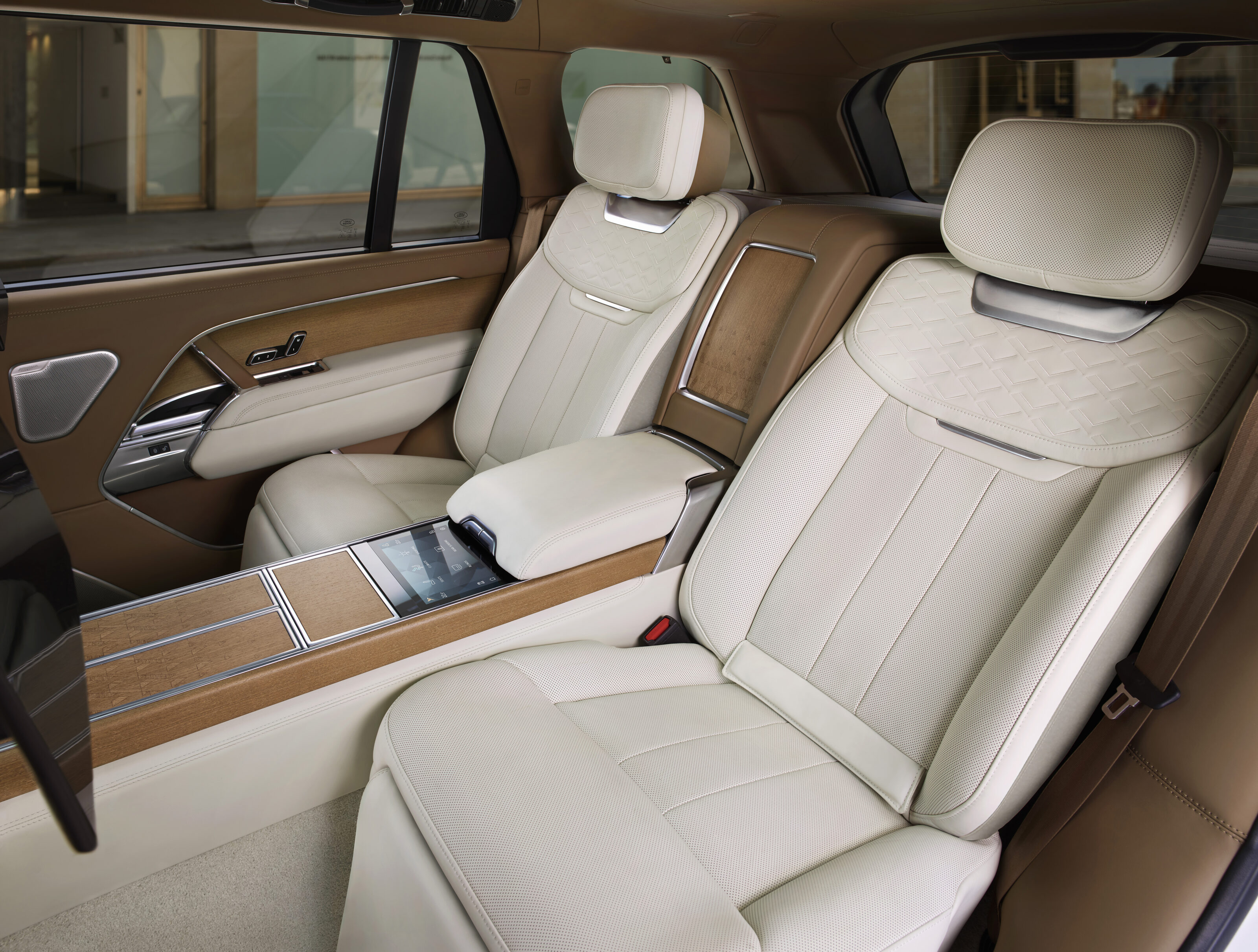
The SV Signature Suite option, available on long wheelbase models, features a console which runs the length of the cabin from front to rear that accommodates an electrically powered table which rises a single choreographed movement.
Its sculptural support is machined from a billet of aluminium, and the table can be turned to serve either of the rear seat passengers and extended by way of two folding leaves.
The Signature Suite also includes a refrigerator between the seatbacks that’s big enough for a bottle of champagne, which can be sipped from special SV-designed Dartington Crystal glasses.
Just what you need when you arrive at Birdsville in your Range Rover SV and find the pub’s run out of beer.
- Welcome: Bigger Fish to Fry
- Part 2: Room to Brood
- Part 3: Part 3: Precipitation Station
- Part 4: Time for a Change
- Part 5: Remote Dial Up
- Part 6: A Sizeable Whole
- Specifications
? You’re reading about an older model, here’s something newer
STORY CONTINUES
Welcome: Bigger Fish to Fry
Price as tested: $75,000 (MSRP) Fuel this month: 346km @ 11.6L/100km
What do you give the bloke who’s just handed back a large, seven-seater Korean SUV, in which he only ever managed to fill two of those seats at any one time?
Easy! Give him an even larger Korean SUV that seats eight.
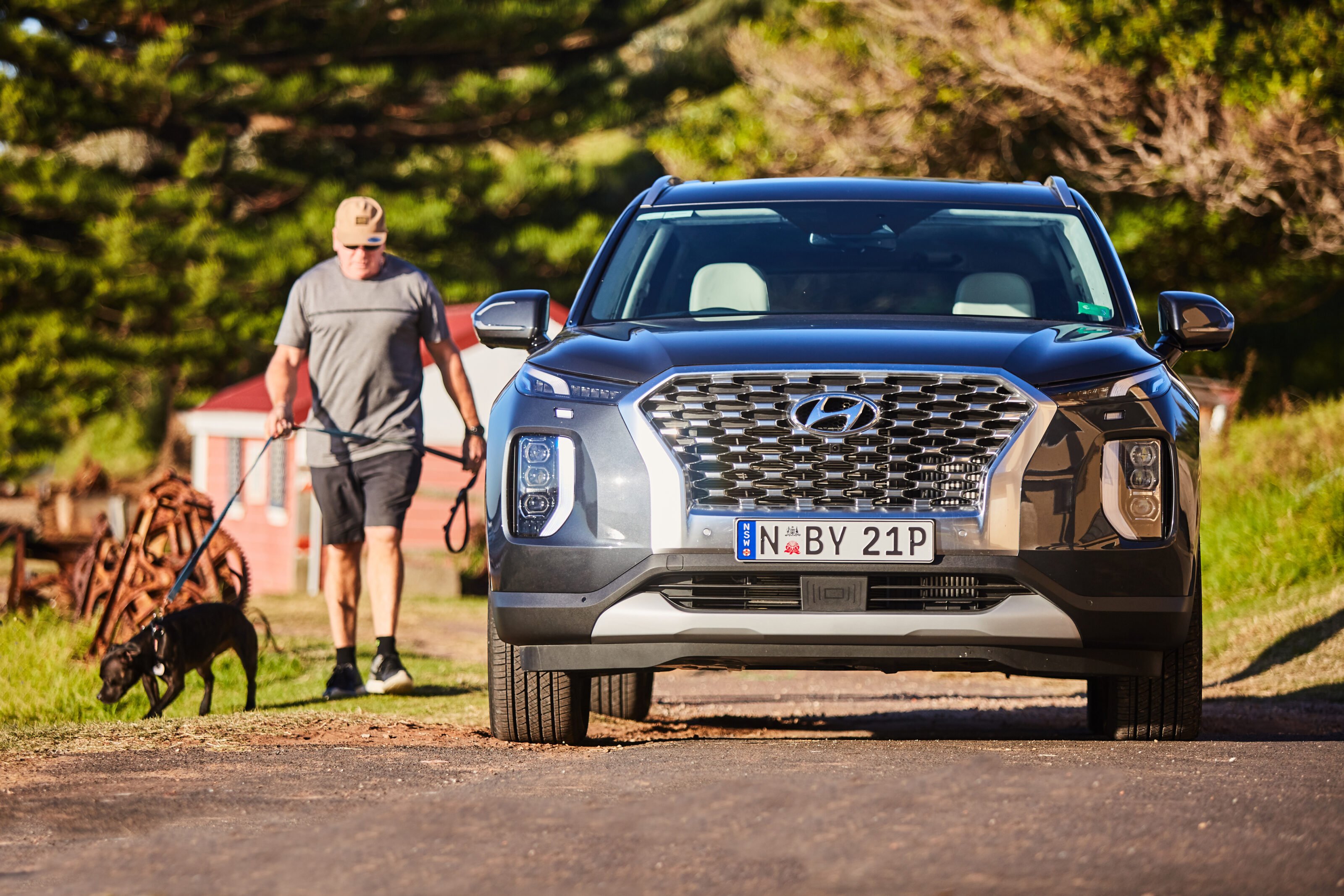
Not that I’m complaining, and the transition to this top-spec Palisade Highlander diesel will be instructive in terms of how it compares to that top-spec Kia Sorento I ran for the last four months.
No, the two are not eye-to-eye segment rivals due to the Palisade being slightly larger and featuring a three-seat third row (versus two in the third row for the Kia), but the model line-ups of both do overlap enough on price that they’ll surely be cross-shopped by some buyers for whom the third-row accommodation is not a dealer breaker either way.
In terms of price, there’s a fairly hefty premium attached to the extra size and additional rear seat of the Palisade. This range-topper, finished in Steel Graphite, is $75,000, so about $10K more expensive than the (same engine, and also AWD) Hyundai Santa Fe from the segment below, and about $13K dearer than the (again, same engine, AWD) Kia Sorento GT-Line I just vacated.
And no, you don’t get more equipment for your money in the Palisade. Straight away, I see the Palisade is missing a few features that are fitted to the Sorento, like a customisable digital dash, and controls for the front-passenger seat on the right-hand bolster.
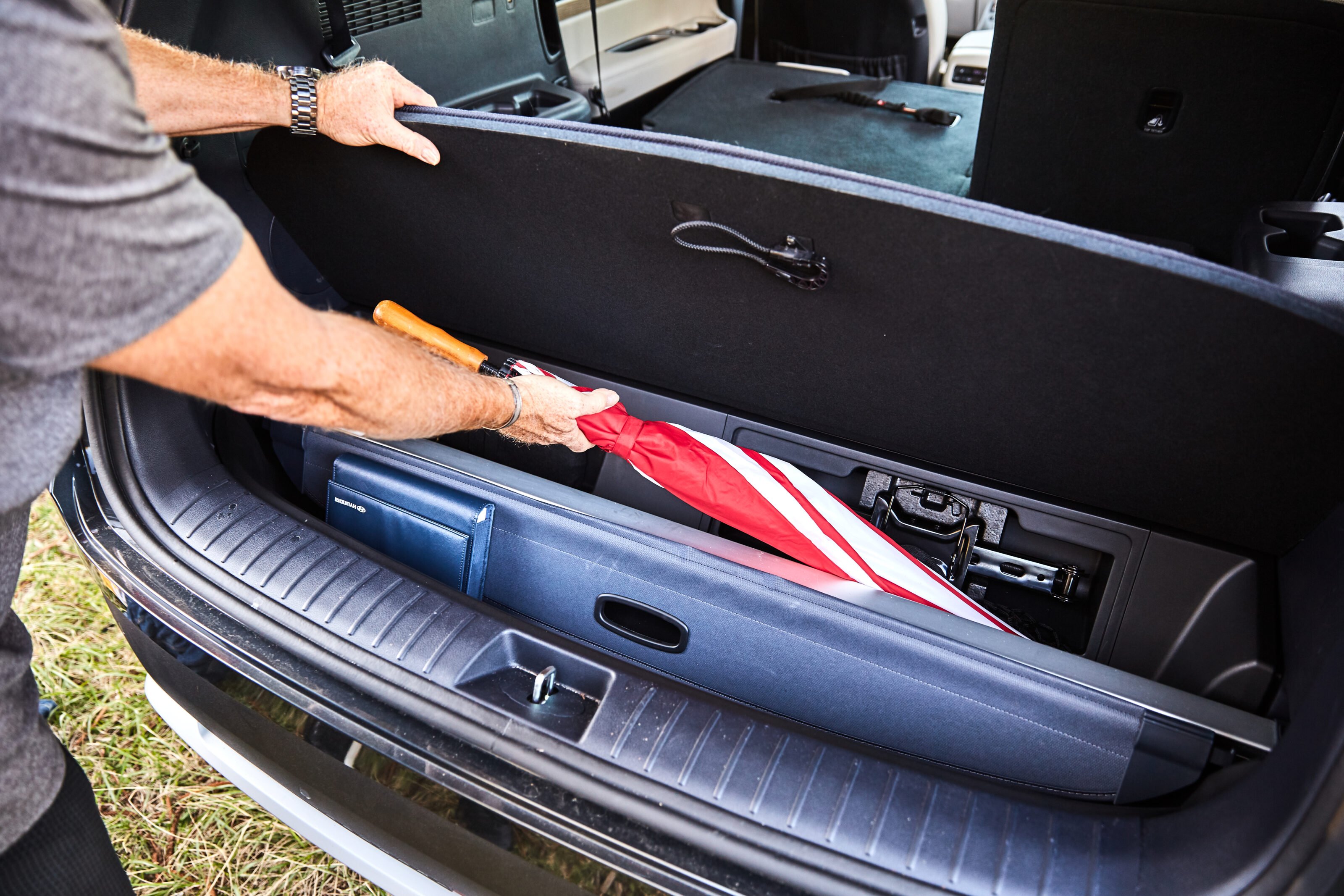
Neither is a big deal for me, and ample compensation comes with some of the other neat details I find. As I open the sub-floor storage compartment that houses the cargo blind, I see it also contains a rolled-up tailored floor mat that neatly unfurls to line the boot floor when the third-row seats are folded, stopping any boot debris from dropping through the gaps. The full-length compartment is also the ideal stash spot for an umbrella and picnic rug (if you’re me or Mary Poppins), or maybe a sawn-off shotgun (if you’re Roger Rogerson.)
Up front, the lidded centre console box is appropriately XL-sized, while ahead of this is a generous storage space that can be configured to hold two water bottles, or allows the bottle retainers to be retracted, leaving the space clear for more of your personal stuff. There’s also an under-console storage space which will probably end up as the receptacle for my partner’s handbag, or my handbag if I go back to the cross-dressing thing.
In terms of price, there’s a fairly hefty premium attached to the extra size and additional rear seat of the Palisade.
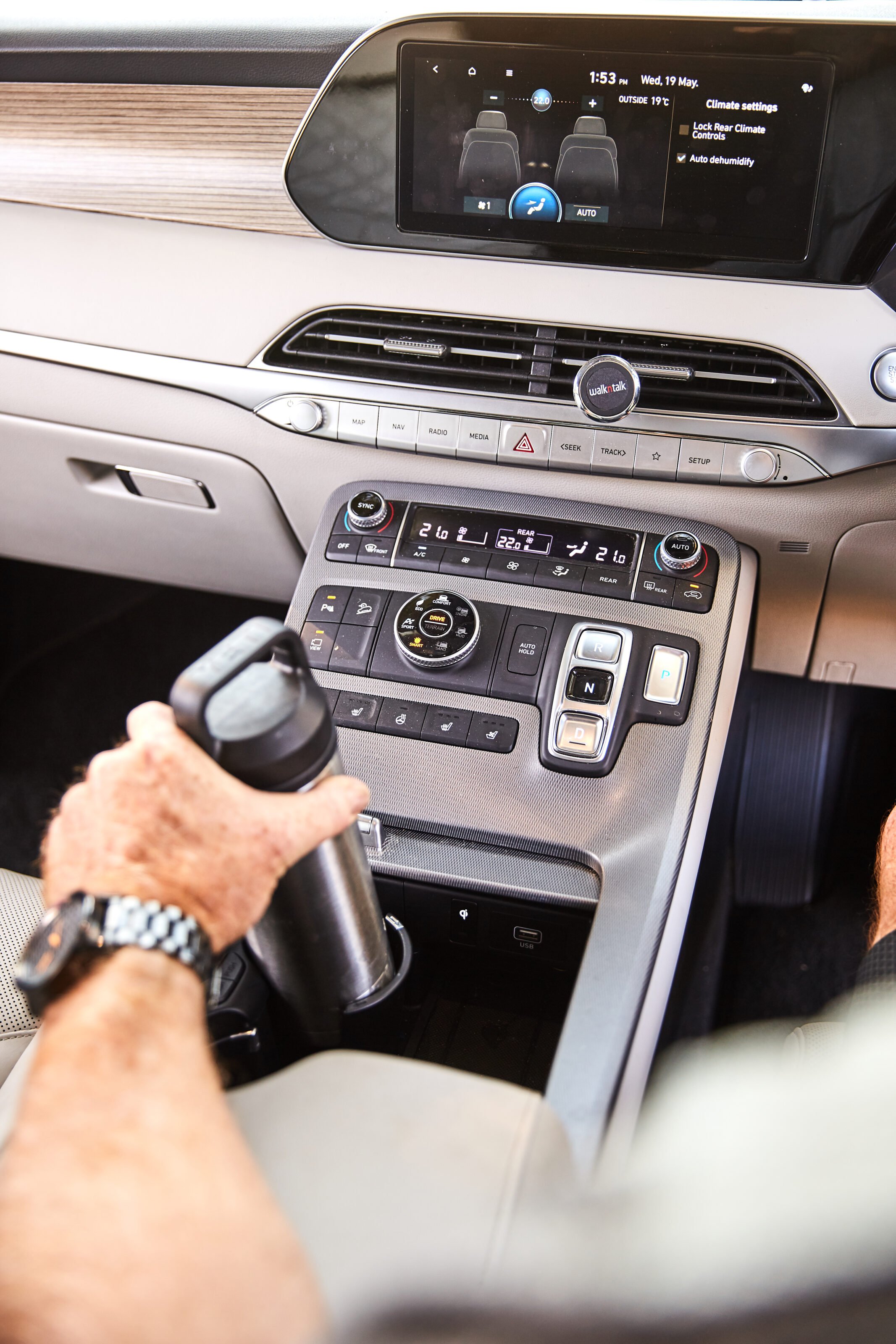
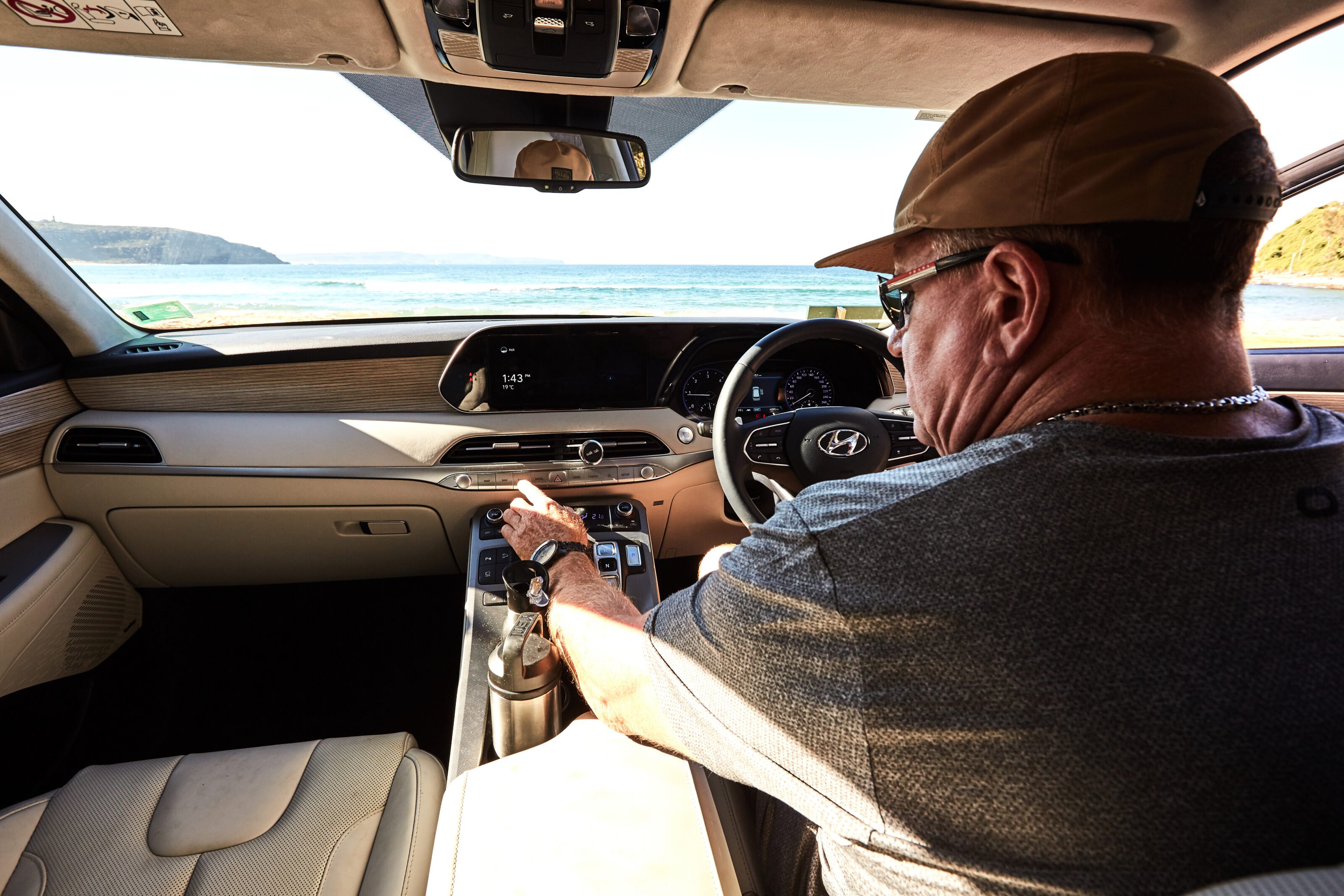
There’s no wireless CarPlay, but otherwise general functionality and user-friendliness gets a big tick, as does visibility and seating. The front seats have generous electric adjustment for under-thigh support, so instantly feel super comfortable.
Admittedly the cabin’s off-white shade of leather isn’t the most practical choice for a knuckle-dragger like me, so I’ll need bring my hygiene A-game.
Speaking of trim, the attempt at pale beechwood veneer around the dash and door trims looks as if it came straight from Faux Appliqués R US, but that’s a small, subjective gripe. Otherwise the sense of quality is overwhelmingly positive, as is the overall intuitiveness of all minor controls and menus.
So how does it drive? With a degree of cohesion and wieldiness you may not expect from something with its own postcode. More next month.
Part 2: Room to Brood
Fuel this month: 558km @ 11.2L/100km Total fuel: 898km @11.4L/100km
Okay, I was both a bit uncharitable and factually inaccurate last month when I suggested the Palisade is big enough to have its own postcode.
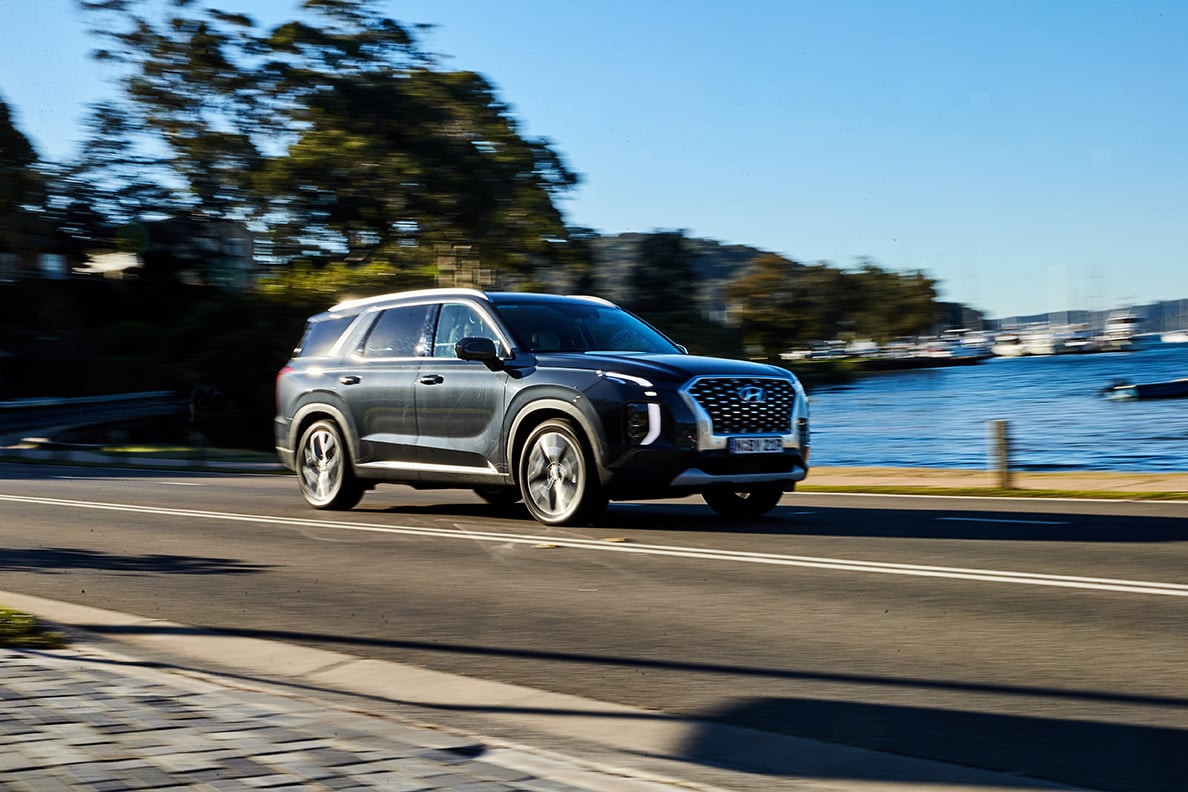
If we go to the tale of the tape, we see it’s 4980mm long, so yes, nearly 200mm longer than the Santa Fe from the class below, but nearly half a metre (!) shorter than the Rangers and Hiluxes which masquerade as family SUVs these days.
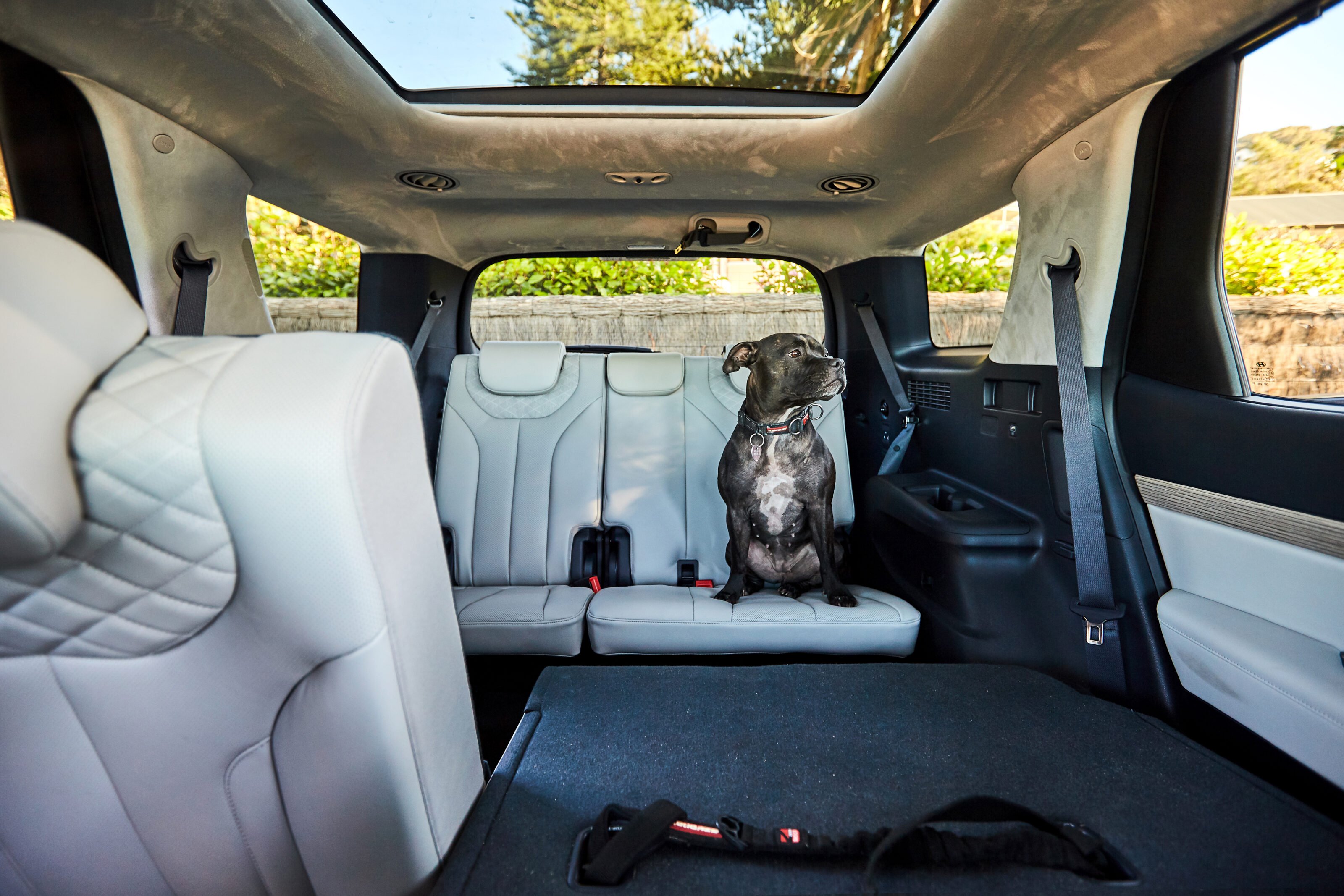
But having recently attempted to fold myself into the third row in the name of science – imagine a raw sausage being squeezed into a matchbox – I’m a bit unconvinced of the Palisade’s ‘eight-seater’ ability. Yes, there are three seatbelts back there, but I would have thought that kids small enough to fit three-abreast would surely need booster seats, of which you’re only going to be able to fit two. Hmm…
Thankfully this remains an entirely hypothetical scenario for me, leaving me free to keep both the third- and second rows folded, and use the massive load space for all my beach and barbeque gear, as well as a palatial transportation pod for my small dog. She rides tethered to one of the ISO-fix hooks of the reclined middle-row backrest, and seems to relish her self-appointed role of both navigator and emergency alert officer when she spots another dog out for a walk.
Having attempted to fold myself into the third row in the name of science, I’m a bit unconvinced of the Palisade’s ‘eight-seater’ ability.
In terms of the driving experience, two things have come as pleasant surprises. The first is engine NVH. This is the older iron-block version of the 2.2-litre turbo-diesel four used by Hyundai and Kia, yet it’s marginally quieter and less vibey at idle that the all-aluminium unit in the Kia Sorento I ran most recently. Still way louder and more coarse than the petrol alternative, but hey, that’s the trade-off for the torque and lower consumption.
Second pleasant surprise is how dynamically sorted the Palisade feels. This model hasn’t enjoyed local tuning of suspension or steering, yet the ride, body control and precision through the wheel all have real finesse.
My gripes list remains curiously short. Will try harder next month.
Part 3: Precipitation Station
Fuel this month: 941km @ 10.5L/100km Total fuel: 1839km @10.9L/100km
Took a day trip recently to visit a 200-million-year-old rainforest. It was a two-hour drive each way south of Sydney, and it reinforced two truths. Firstly, being immersed in an environment so ancient is an excellent way to feel less old. Secondly, while the Palisade is an excellent family tourer, there is, like most things in this world (apart from Peroni beer and the English Staffordshire Terrier) room for some improvement.
Disabling lane-keep assist is the first ritual every time I start the car. I find its incessant nibbling at the wheel nothing but a distraction, yet it’s incapable of consistently keeping you in your lane with any reliability if you’re inattentive enough to need it.
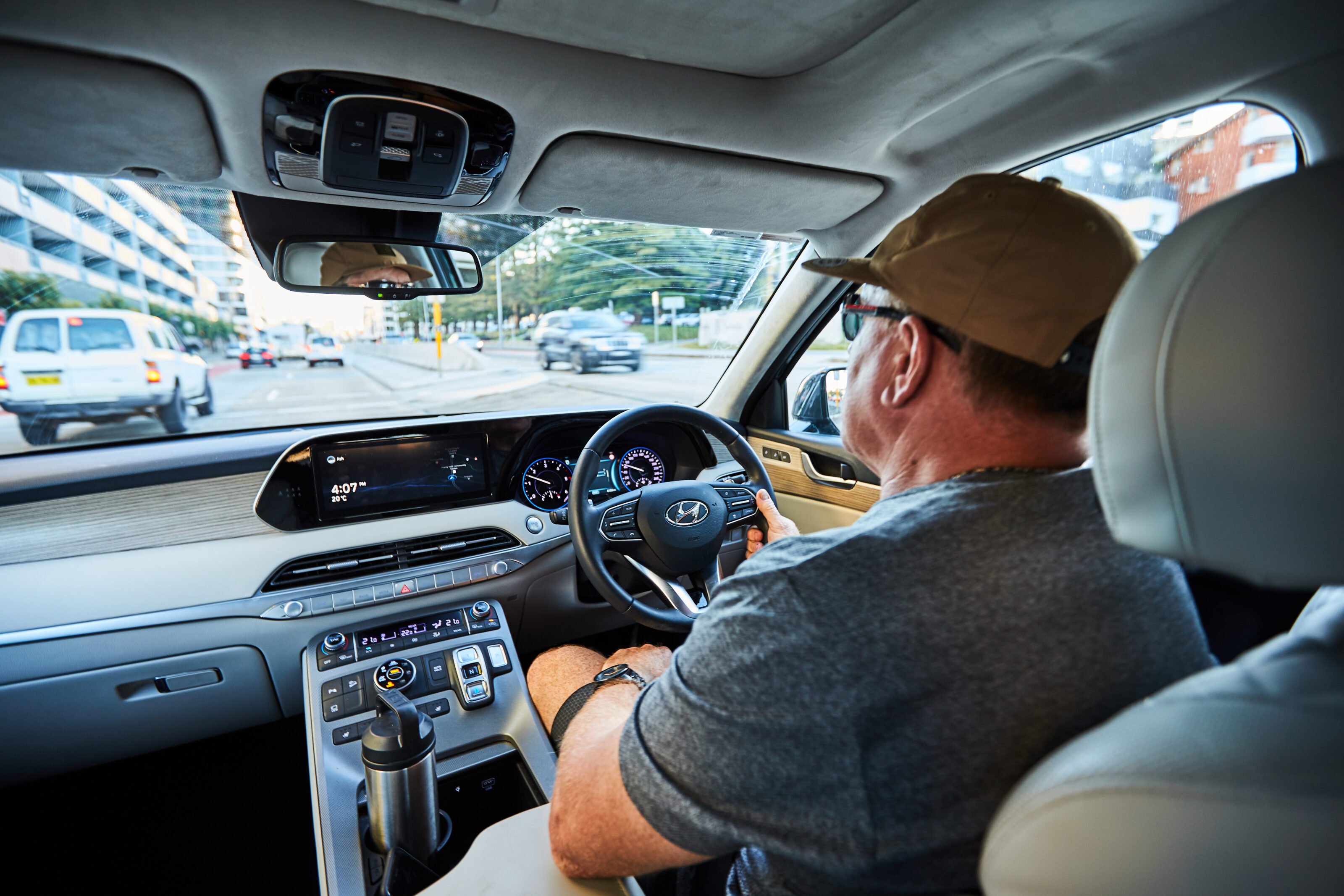
Fittingly, it started raining as we approached the rainforest of Minnamurra Falls, so naturally I had the wipers on their most sensitive auto setting. The screen quickly became wet enough to impede vision. “Oi, can I get a wipe, thanks?” I (accidently) said out loud.
My partner gave me the side-eyes: “Are you talking to the windscreen wipers?” she asked.
“Don’t be ridiculous, honey,” I shot back. “I’m talking to the rain sensor…” This car has a very different idea to me as to what constitutes ‘wet’, so I’ll have the sensor checked at service time.
Disabling lane-keep assist is the first ritual. I find its incessant nibbling at the wheel a distraction, yet it’s incapable of consistently keeping in lane.
Meanwhile, just to revisit the NVH subject I touched on last month: Yes, the 2.2 diesel has a slightly less vibey idle and low-rev coarseness than the newer unit in the Kia Sorento, but that’s kinda faint praise. Diesel fours really are the charmless sloggers of the engine world, even ones from the premium German brands, and this one is no different. It deals with the Palisade’s 2000kg load quite admirably, but you never rev harder than absolutely necessary.
Motorway cruising also reveals the Palisade’s sensitivity to surface changes. On hot mix it glides along almost noiselessly; the moment you hit a more coarse-grade bitumen, the noise levels leap. Likewise, ambient noise from trucks and motorcycles isn’t sealed out quite as well as I’d hoped. I suspect the vast glass roof is the primary source of decibel penetration. But hey, it does do a decent job of keeping out the rain.
Part 4: Time for a Change
Fuel this month: 635km @ 10.3L/100km Total fuel: 2474km @10.7L/100km
If the essence of good design is all about intuitive ease of operation without the need for an instruction manual, then things were off to a good start recently when the Palisade copped a puncture. Let’s face it, us blokes know that reading instructions is a sure sign of weakness, right up there with the inability to perform a humane spider removal.
I could see the spare wheel mounted externally underneath the rear of the car, so how hard could it be to whip it out from under there and bolt it on in place of the flat left front?
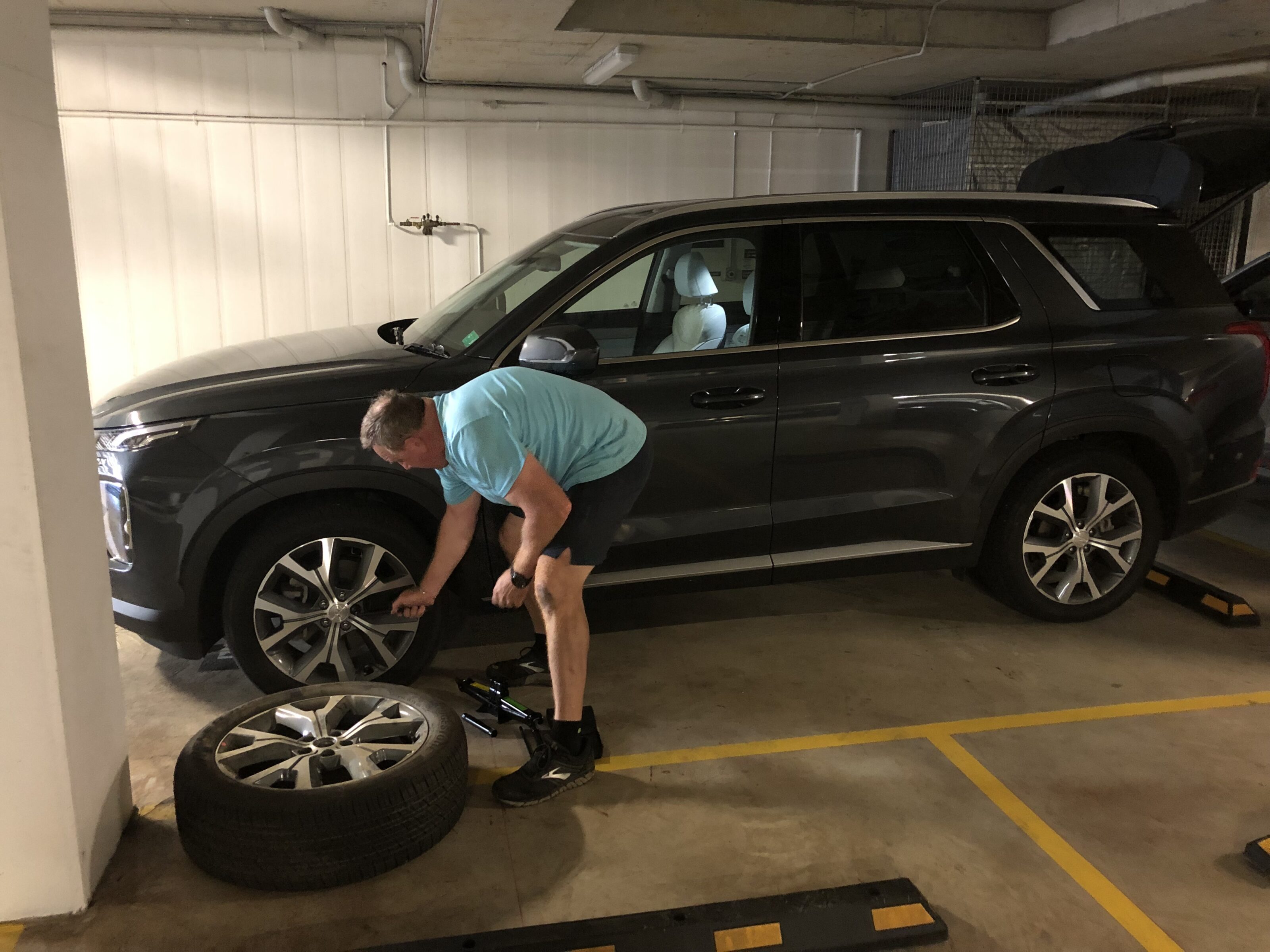
The answer was right there in the sub-floor of the cargo space: a small plastic cap with ‘spare tyre’ written on it. So I grabbed the tools and jack, and got to work. Whip the cap off with the screwdriver to expose a nut, slip over the socket tool, and turn. The spare is lowered via a cable; once at its lowest, it’s a bit of grubby faff to support the weight of the wheel with one hand while freeing the cable’s retainer plate to completely liberate the spare.
Next faff – jacking over two tonnes of SUV not especially keen to levitate off my car park floor. The scissor jack is a labour-intensive little bastard, and each turn nets only a few millimetres of raised body height. And because there’s so much suspension droop, the jack needs to be cranked to near its maximum to get fresh air under the tyre. That was a hard grind that came with a strong language warning. Getting the wheel off was no problem, but getting the spare back onto the hub required some heavy lifting and a bit more swearing, at which point I was questioning my once strong-held belief of run-flats being the work of a ride-ruining devil.
The scissor jack is a labour-intensive little bastard, each turn nets only a few millimetres of raised body height.
Anyway, less than 30 minutes later I’d finished the task with a glow of manly satisfaction, which lasted right up to the moment I climbed back into the car and went to reset the tyre pressure monitoring system (TPMS). The display blinked sullenly at me, refusing to take the reset command. A quick call to Hyundai explained why: the spare isn’t fitted with the clever valve that communicates with the TPMS, so I would have to bring the car in to have the repaired tyre and original wheel refitted.
That made me feel a tad deflated.
Part 5: Remote Dial Up
Fuel this month: 324km @ 10.0L/100km Total fuel: 2798km @10.5L/100km
My no-longer-teenage daughter jumped in the front passenger seat of the Palisade the other day, and cast her eye around the vast cabin as she paired her phone to the multimedia system with the ruthless, intuitive efficiency only a Gen Z can.
Once I’d convinced her to play some old-school hip-hop instead of her nu-school computer-generated ear floss, we settled in for the short drive to lunch.
In a rare moment of lifting her eyes from her phone, she spotted the drive mode selector and asked a reasonable question: “Hey dad, what does this thing do?”
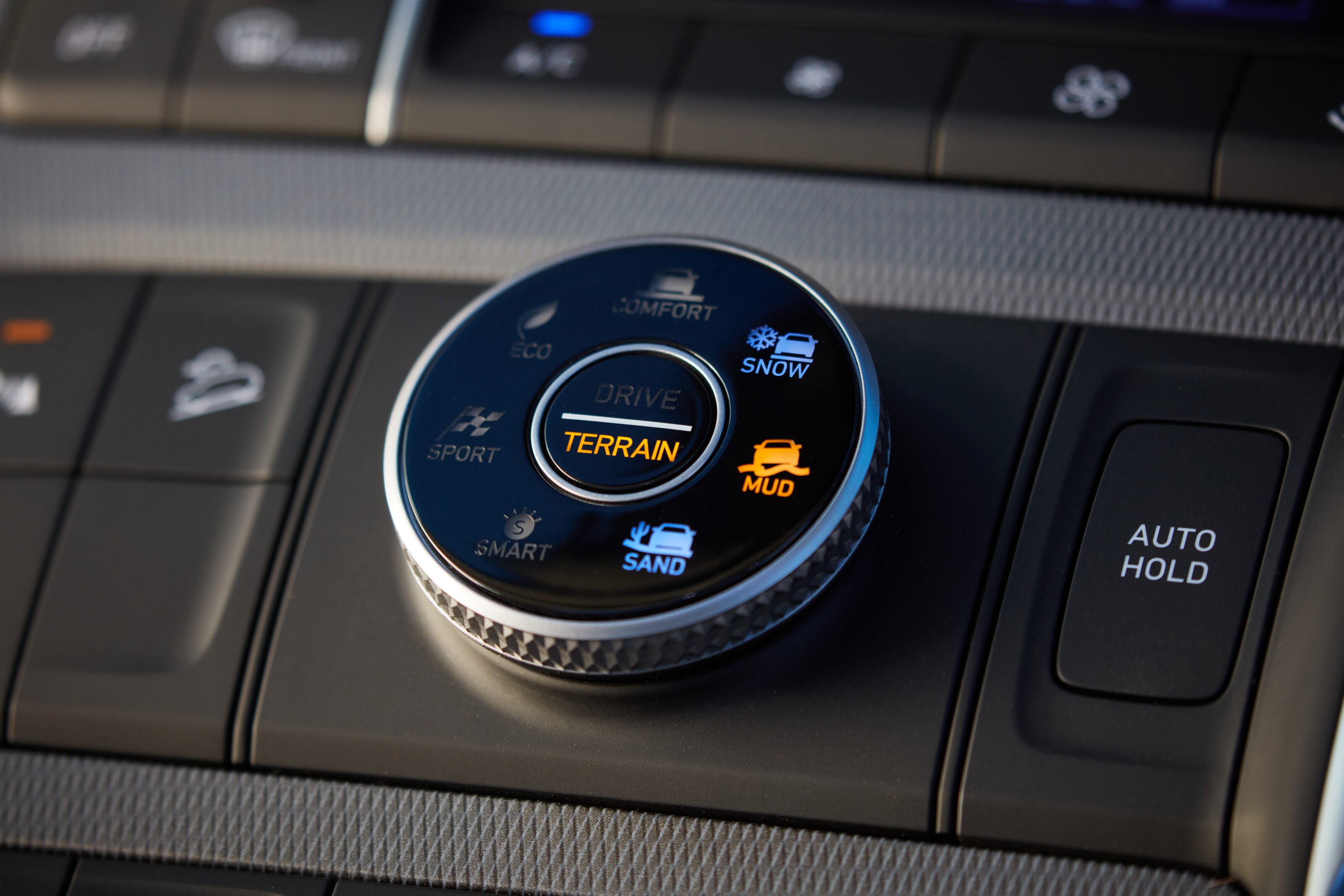
I sensed this was my big moment to impress her with my extensive knowledge of the Palisade’s seven different drive modes, and go into excruciating detail as to how each one is tailored for specific conditions, and how there are seven wondrously unique blends of throttle mapping, transmission calibration, EPAS assistance, and front-to-rear torque splits to enhance traction in even the most challenging conditions.
I didn’t, of course, because I would have bored her so rigid I would have had to carry her out of the car like a fence post. So I kept it simple: “Not as much as you may expect, honey.”
Which is a very abridged version of my experimentation of the drive modes, that, I must concede, hasn’t been as comprehensive as I’d have liked due to lock-down restrictions. Oh, and the perplexing absence of mud, sand and snow on the commute within my 10km-restriction zone.
I can attest that selecting Sand on a dirt track did bring a noticeable increase in rearward torque bias. But it’s not oppo-lock rallycross nirvana.
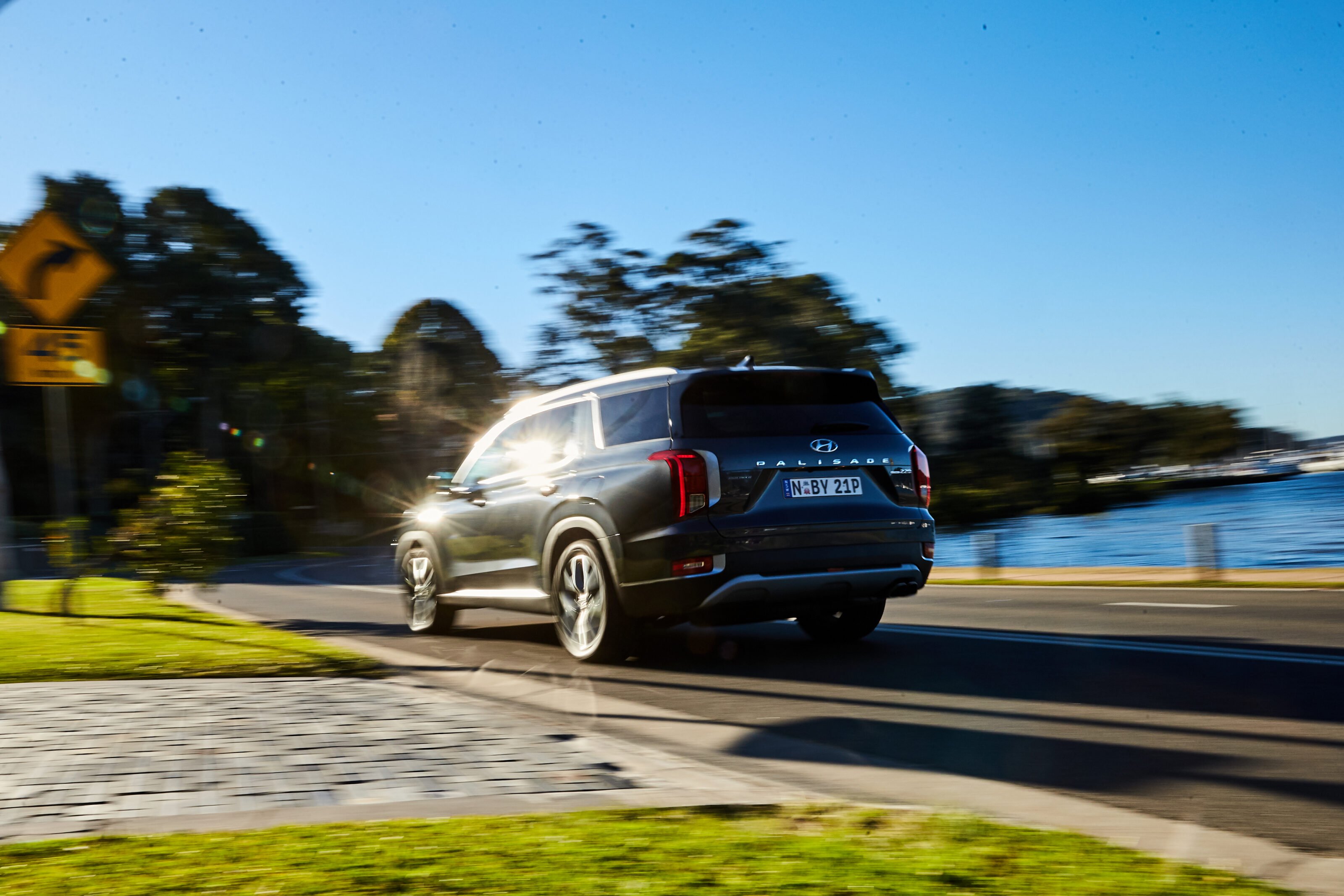
I’ll get further into the off-road stuff in a moment, but let’s first take a deeper dig at the four on-road modes: Eco, Comfort, Smart, and Sport. Having experimented with all of them, I struggle to notice any tangible difference between Smart and Comfort, even if the Palisade’s technical info assures me there is.
The difference between Eco and those two is also pretty subtle: a slightly softer throttle response and more languid, less eager calibration for the eight-speed auto, which becomes a bit too snoozy for my taste. I failed to record any economy advantage in Eco, but that’s probably down to my slight impatience with the transmission in this mode, where I find myself manually plucking the paddles to get the desired ratio and engine response. Your results may differ if you can soft-pedal the car in the manner in which Eco pretty much insists.
Which isn’t to suggest that I hoof the Palisade with a leaden right foot in my normal daily driving. I simply can’t because most of my neighbourhood is a 40km/h zone, and the main roads in my LGA are infested with both fixed cameras and mobile speed cameras devoid of warning signage. Which is part of the reason I tried Sport mode once, and haven’t returned to it since.
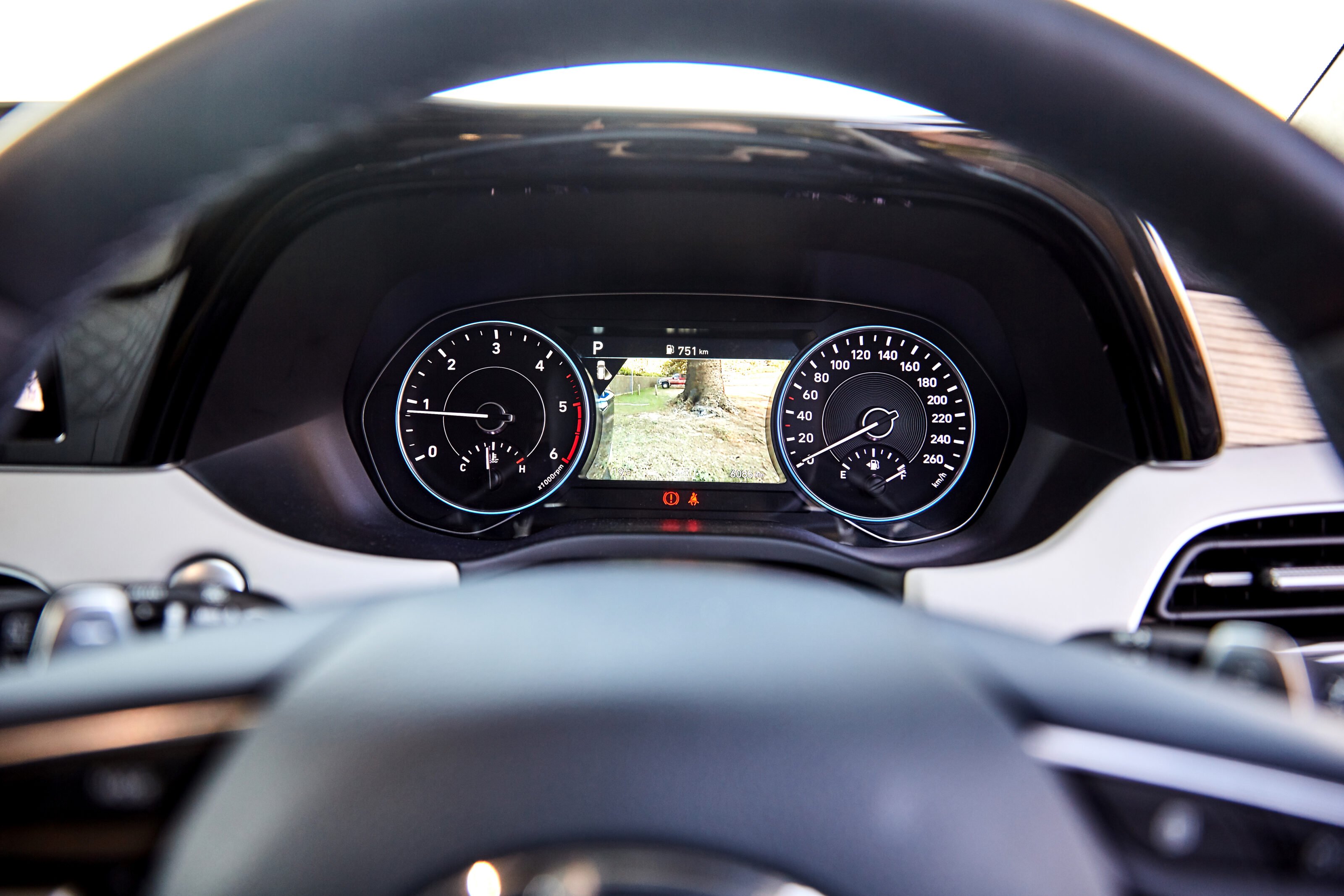
Yes, it makes the transmission usefully more eager to kick down with the slightest throttle prod, but the flipside is that it holds the shorter ratio long after your brief sporting moment has passed, so you revert to paddles to make an upshift to quieten the engine down and avoid a public flogging for exceeding the speed limit by 10km/h. Sport also adds weight to the steering, which, to me, at least, just makes it heavier and less feelsome, not more sporting. And don’t forget the Palisade is on passive dampers, so there’s no firming of the chassis tune when Sport is selected.
As for the off-road modes? Well, I can attest that selecting Sand on a dirt track did bring a noticeable and useful increase in rearward torque bias, which instantly gave the Palisade a much more planted and traction-enhanced dynamic character. But it’s not a instant ticket to oppo-lock rallycross nirvana. You need to switch off the ESC to make the thing move around to any meaningful degree, and the safety net remains there in the background and will intervene anyway if you try to get too sideways. As for Mud and Snow, I can’t pass judgment, but I suspect the difference between them in the real world, on those two surfaces, would be marginal, and the Palisade’s slippery-surface behaviour would be more greatly affected by tyre choice and pressure.
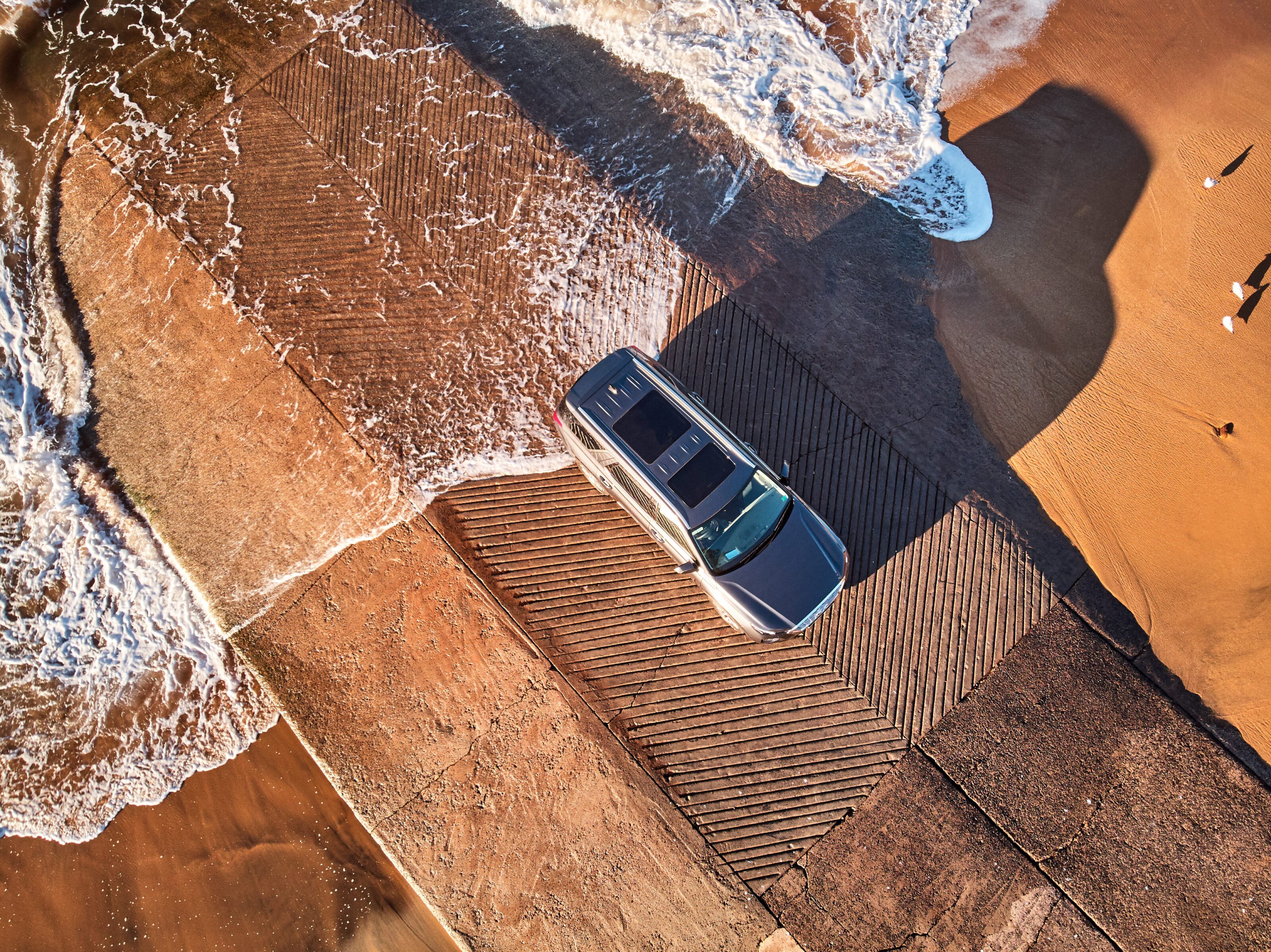
You can see where I’m going with this. I’m not alone in my theory that automotive marketing departments probably have more influence on the inclusion of multiple driving modes than the powertrain bosses.
If it came to the crunch, I suspect the Palisade really would lose little by having just two modes: on-road and off-road. But that sort of reasoning is also why I’ll never land a job in marketing.
Part 6: A Sizeable Whole
Fuel this month: 324km @ 10.0L/100km Total fuel: 2798km @10.5L/100km
My buddy Jay has been my best mate since we met in high school, so as with any long-term relationship, the occasional homicidal urge does have to be suppressed by both parties.
Like the other day when he was casting a critical eye over the Palisade. Jay likes cars, but he’s not an obsessive, and large SUVs don’t really blip his radar. “So how much?” he asked. “Seventy-five large,” I told him. He let out a low whistle.
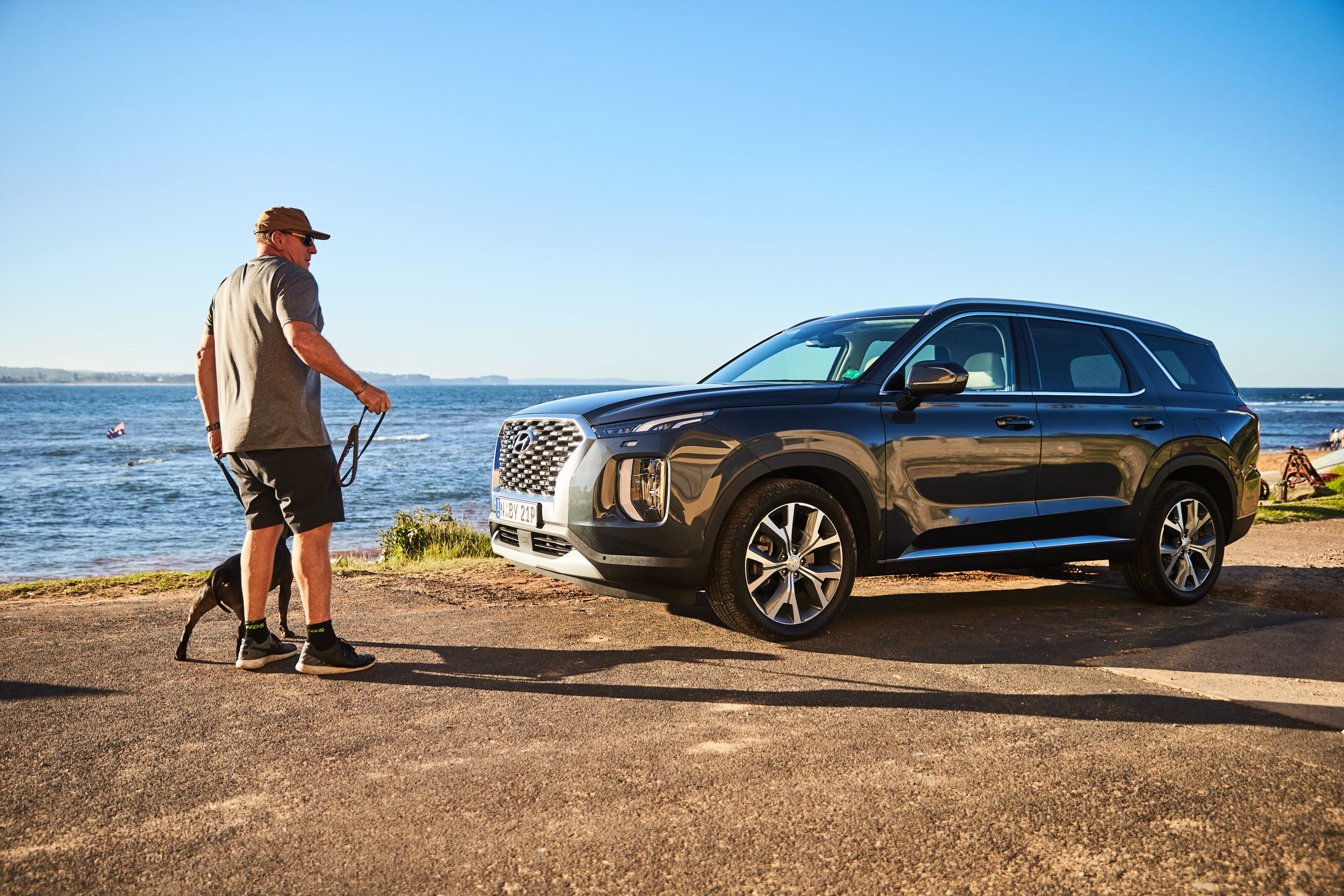
I had to explain there’s a hefty premium of around $10,000 for the Palisade’s extra size and eight-seater accommodation over the seven-seaters below it, like in-house sibling the Santa Fe Highlander, or Kia’s Sorento GT diesel. I also mentioned that the three-tier Palisade range now kicks of at $55,000, but Jay wasn’t really listening. “Still sounds like a very fat wedge for something that you don’t actually enjoy driving,” he sniped.
I didn’t slap him with my thong, even if he was hopelessly wrong.
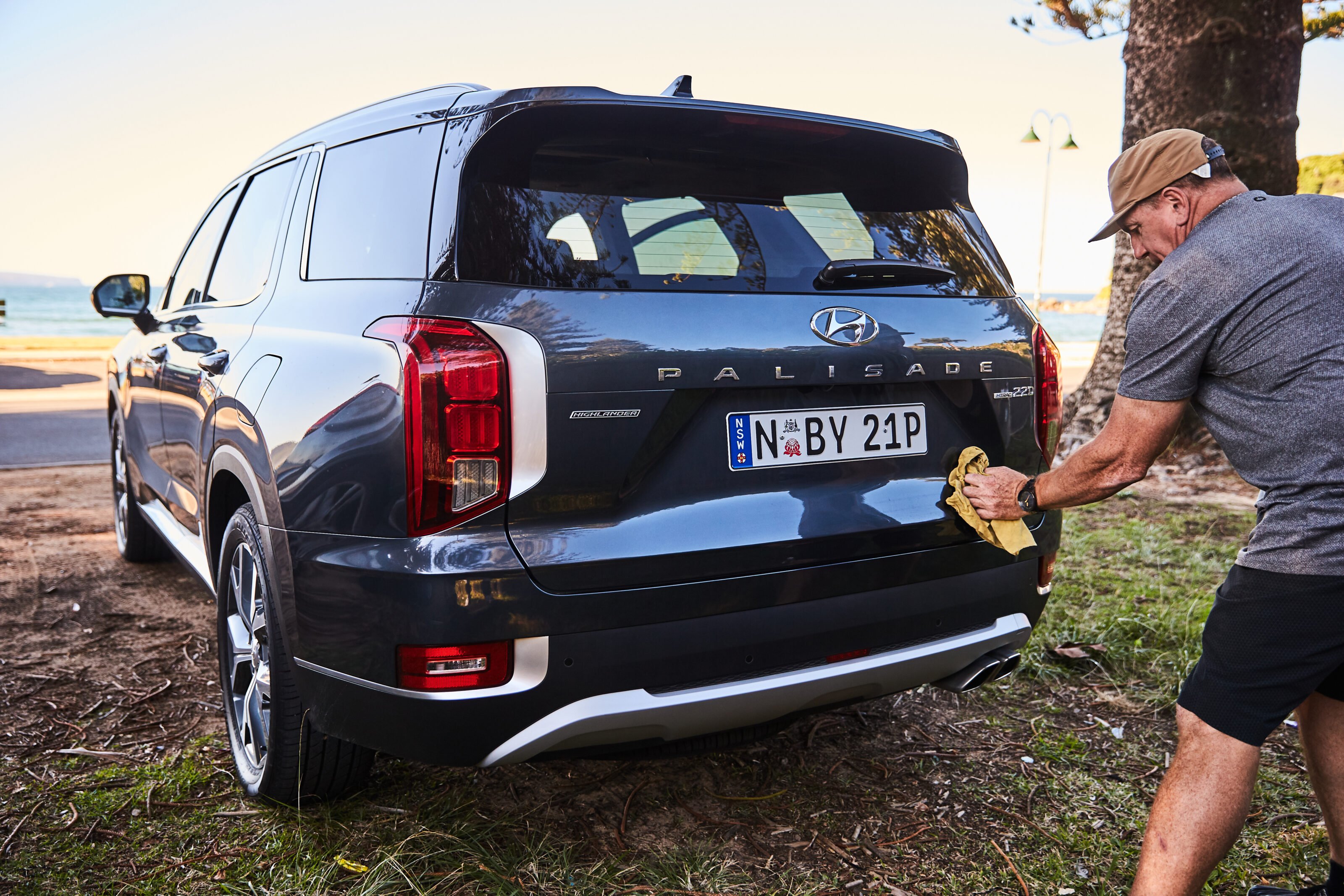
I can honestly say that I’ve absolutely enjoyed every drive in the Palisade, and not just because it provided a brief respite from the sameness of being in COVID lockdown for a chunk of the loan period. An SUV like this is proof that you don’t have to be driving the doorhandles off something low and sporty on a remote backroad for it to qualify as an enjoyable drive. Just soaking up the Palisade’s comfort, amenity and response to inputs was ample for me to always enjoy every outing in it. That, and the fact that I rate even an average drive as better than, say, completing your greatest-ever tax return.
But as the six-month mark rolls around and it’s time for the eight-seater to go back, here’s my wish list of jobs for the facelift.
An SUV like this is proof that you don’t have to be driving something low and sporty on a remote backroad for it to qualify as an enjoyable drive.
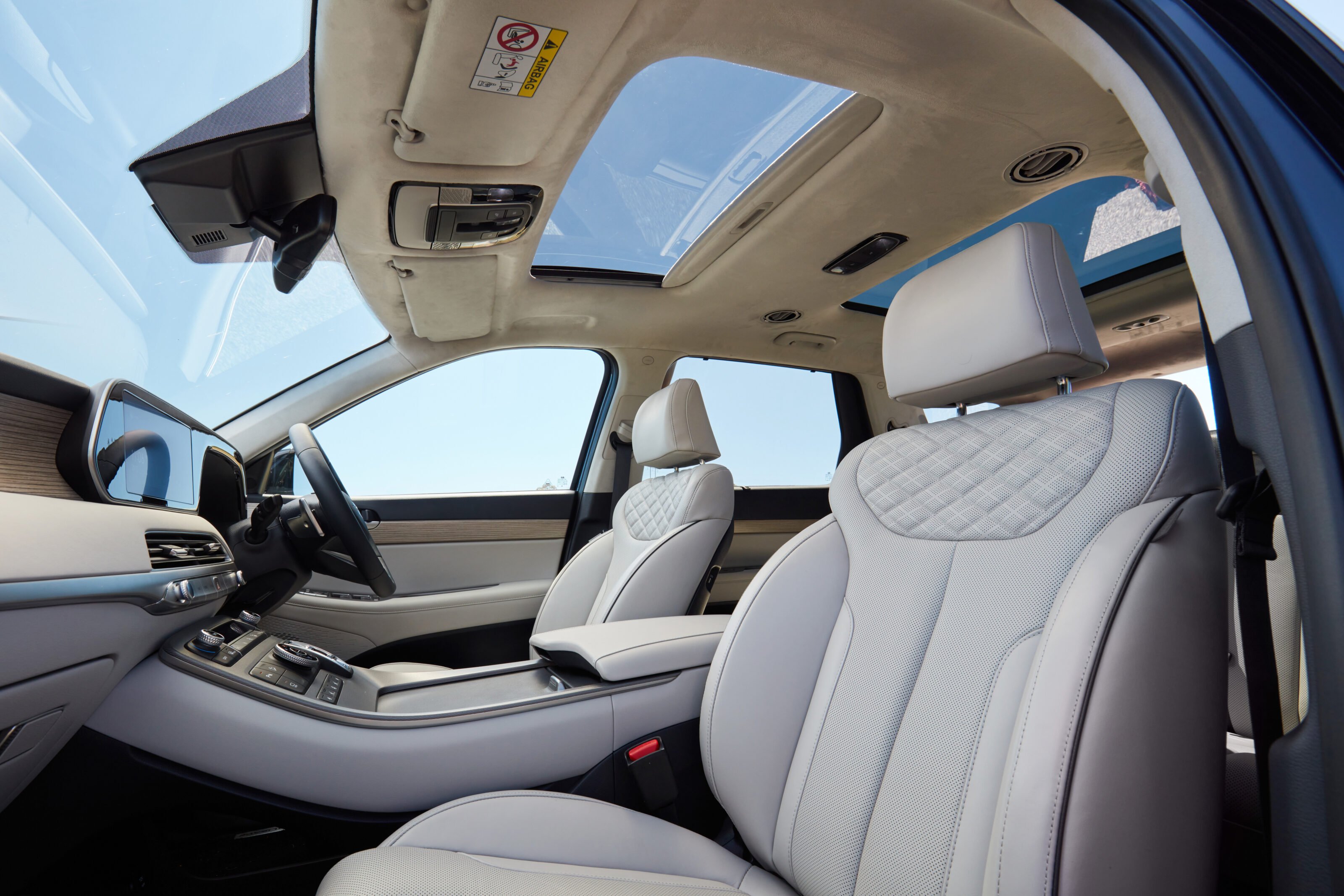
Firstly, the diesel engine. Oil-burners may be on the endangered-species list, and there’s no question the Palisade would be an even better thing as a turbo-petrol hybrid (currently not on the horizon.) But for as long as it’s offered with the 2.2-litre diesel, the main area for improvement (along with meeting next-gen emissions regs) is noise and vibration. Both are far from horrible, but some extra soundproofing to cut the clatter would be welcome, as would a better balance shaft or more sophisticated engine mounts to quell the high-frequency vibes at idle. In the petrol variant you’re barely away it’s actually running at idle, whereas the Palisade diesel’s decibel reading of 45db shows there’s ample scope to do better.
No gripes about the engine’s strength on the move, though, nor the calibration of the excellent eight-speed auto. It’s also frugal on a highway run, which drops the fuel burn to around 7.5L/100km, down from high nines around town.
The slightly laboured, unappealing engine note is really only evident in low-speed driving, and the obvious fix is to follow the sage advice of Michigan rockers MC5, and kick out the jams.
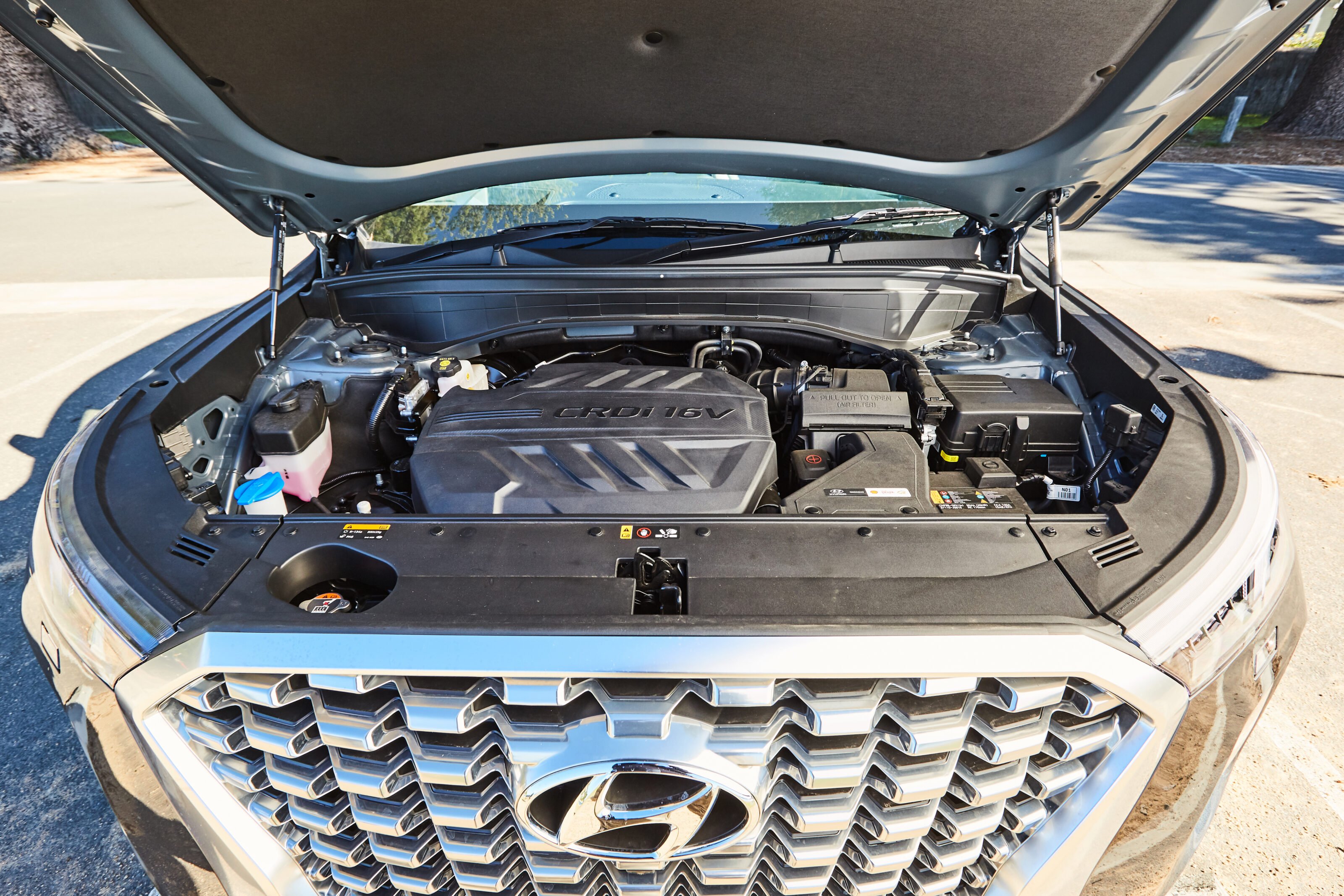
Which the Infinity audio system does mighty well, especially when fed high-resolution files, rather than relying on the slightly compressed-sounding DAB radio. The one caveat is that tracks with really intense sub-bass – and only when cranked up to near-concert-level volume – can cause a slight rattle in the front doortrims. My work-around was to cut an old beach towel in half and stuff each of the door bins, which solved the issue, but a minor redesign of the trims’ mounting system would be the proper solution and save a few towels.
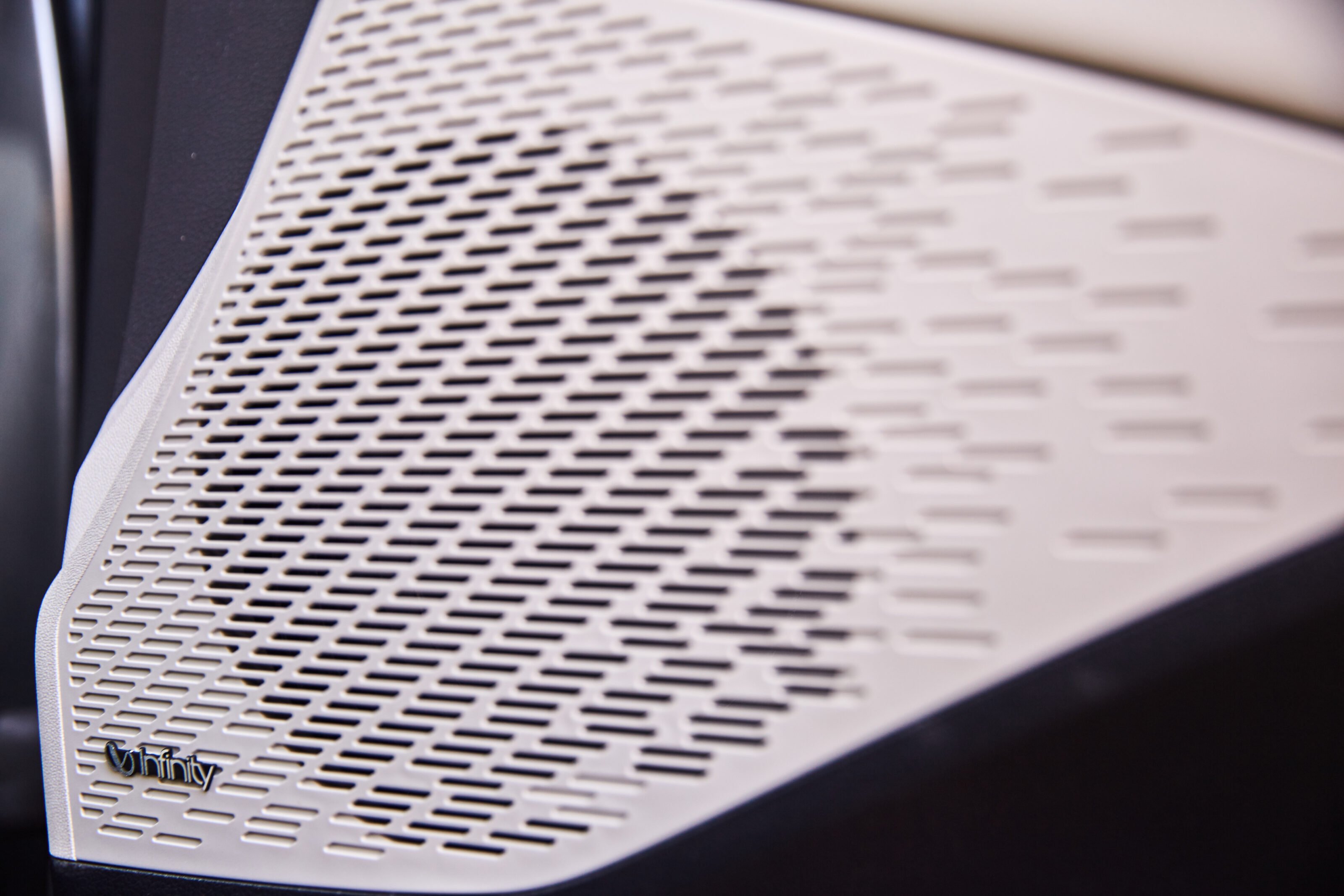
The rest are really just small gripes I’ve already touched on like the lane-keeping that I had to disable before each drive. Only one button press, sure, but I’d really like it to be part of the customised set-up specific to each driver, so the car would recognise me as a I jump in, and disable it while setting the seat and mirrors.
The other small but important thing that needs to function more reliably is the speed-sign recognition. It misreads the signs at least 30 percent of the time, often indicating you’re in a 50km/h zone when it’s actually 40km/h. Not to be relied on.
For a family that needs eight seats and doesn’t want a people- mover, Palisade really is in a class of its own.
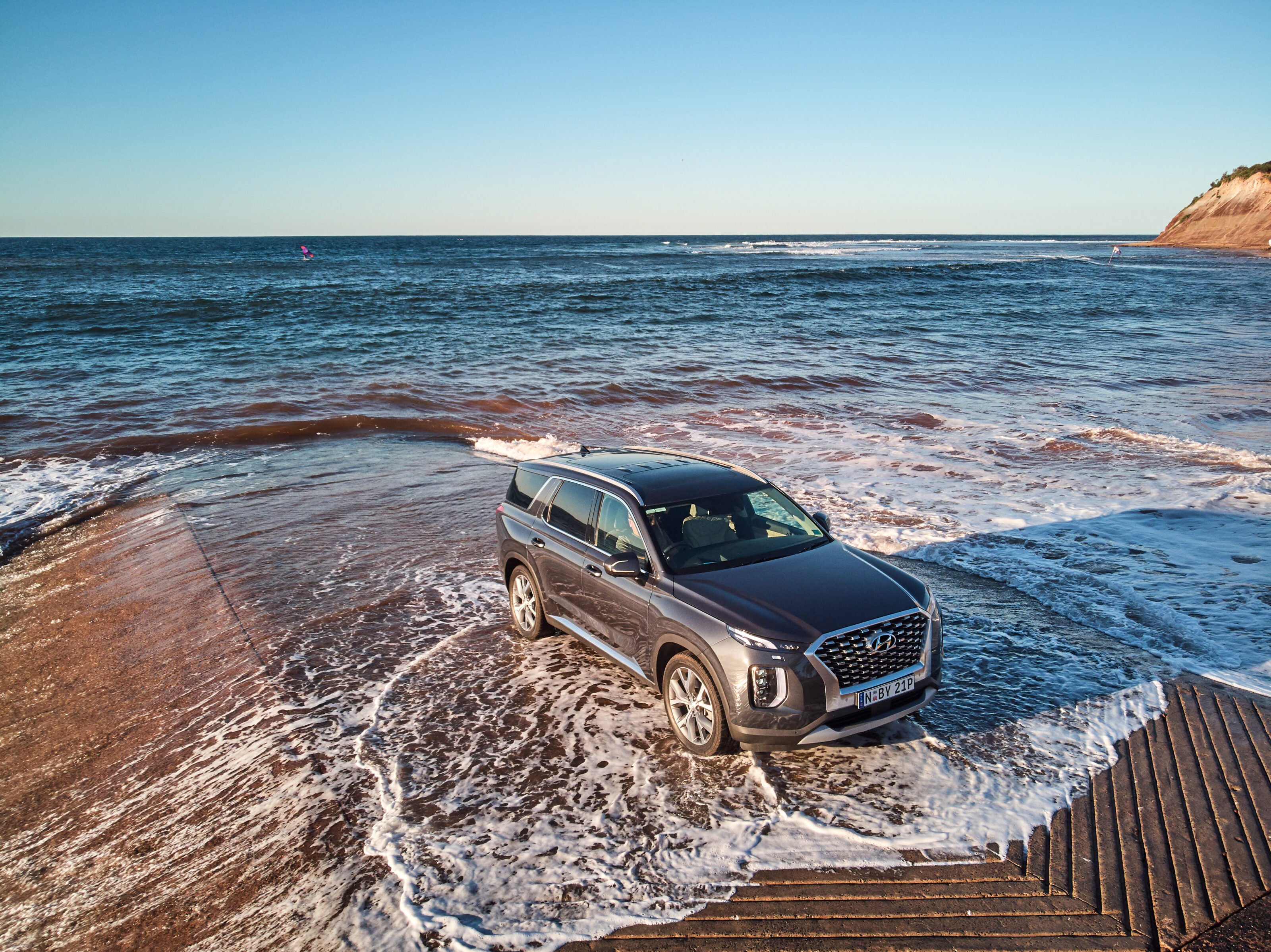
But for a family that needs eight seats and doesn’t want a people- mover, Palisade really is in a class of its own. Or, configure it as a seven-seater (two bucket seats in the second row are a no-cost option) to give walk-through access to the third row, providing a level of accommodation and versatility offered nowhere else. The fact Palisade won our large-SUV comparo against the Kluger and Mazda CX-9 (Wheels, Sept) pretty much says it all.
Share that with your mates.
2021 Hyundai Palisade Highlander specifications
| Engine | 2.2l 4cyl turbo diesel, dohc |
|---|---|
| Max power | 147kW @ 3800rpm |
| Max torque | 440Nm @ 1750-2,750rpm |
| Transmission | 8-speed automatic |
| Weight | 2069kg (AWD, 8-seat) |
| Economy | 7.3L/100km |
| Price | $75,000 before on-road costs |
Snapshot
- 6362 units affected
- Wider recall impacts 450,000 vehicles
- Just one death has been attributed to airbag rupture
Volvo’s worldwide airbag recall continues to affect more local models, with the V70 and XC70 now also under notice.
A total of 6362 units in Australia manufactured by Volvo between 2000 and 2008 are now also involved, joining the S60 and S80 which were put on notice earlier this month.
As with the other local and global recalls, this issue involves the potential for the car’s steering wheel airbag to project metal fragments if deployed in a crash, causing an increased risk of injury or death to the driver.
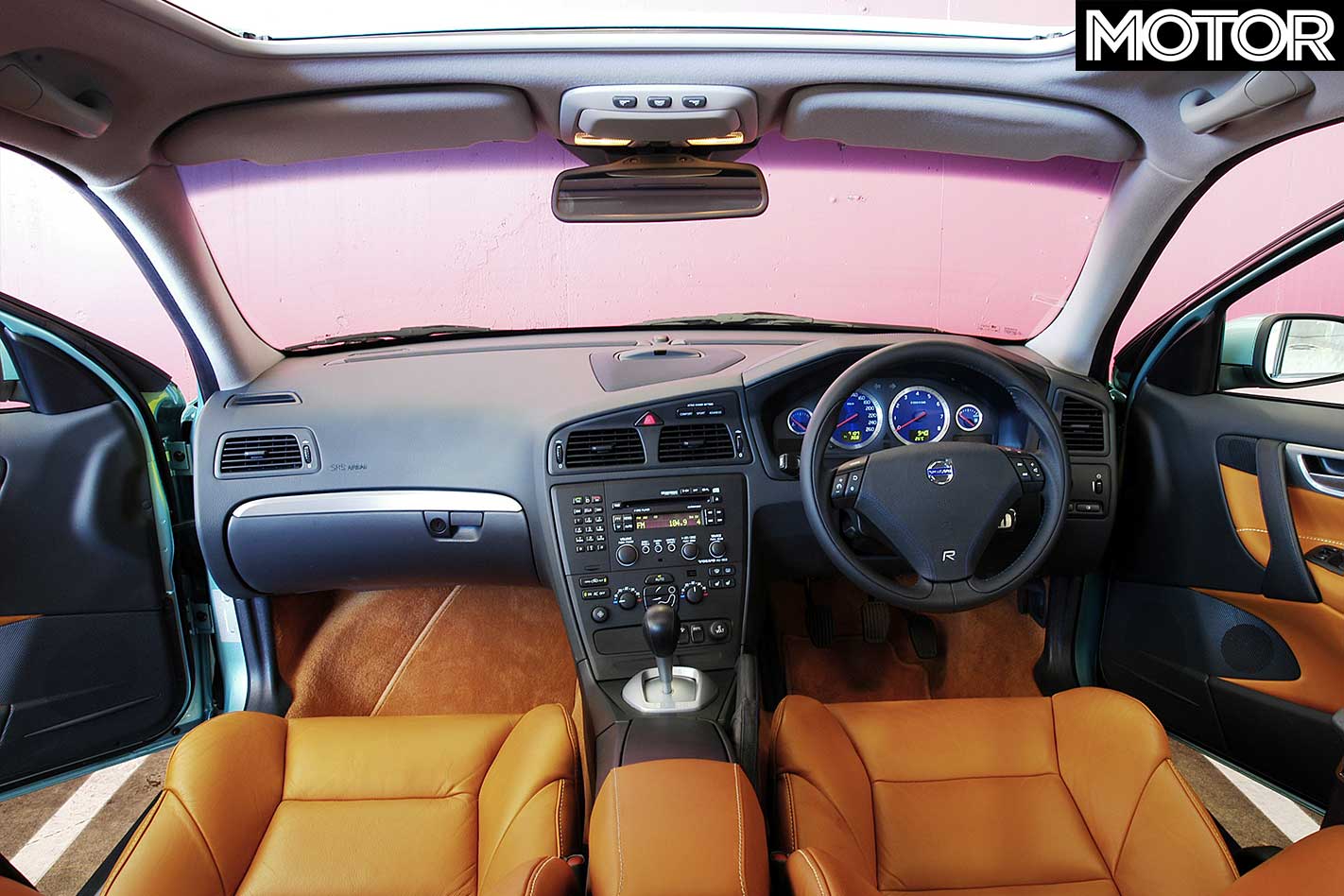
Volvo is offering to replace the potentially faulty airbags free of charge, asking owners to contact their nearest dealers to arrange an inspection.
If you’re unsure about whether your car is included under the recall, Volvo’s customer care hotline can be contacted on 1300 787 802 or by emailing [email protected]
A list of VINs for affected vehicles can be found here.
It’s that spicy five that gives the Audi RS3 a special flavour. With its handful of cylinders, the odd-number engine has a distinctive offbeat sound. It evokes the 1980s World Rally Championship glory days of the original Quattro, while also making the Audi stand out among the four-cylinder rabble-rousers of the all-wheel-drive hot hatch elite.
But this new RS3 may be the last of the line. Next year Audi must decide whether or not to invest in updating its turbo five-cylinder to meet the tough Euro 7 emissions standards coming in 2026 or 2027.
It won’t be easy, admits Steffen Bamberger, Audi Sport’s head of technical development. The measures necessary to meet Euro 7 are costly, complex and bulky, and will take five years to develop.
As the shift to EVs accelerates, this is a risky investment. And it’s one Audi might well decide it doesn’t want to make. But though its long-term future is uncertain, there are years of liveliness left in the high-power five.
UPDATE, August 5, 2022: New RS3 driven in Australia
The new-generation RS3 is finally in Australia. You can read our review here, and watch Inwood’s track and road drive in the video below.
The story to here
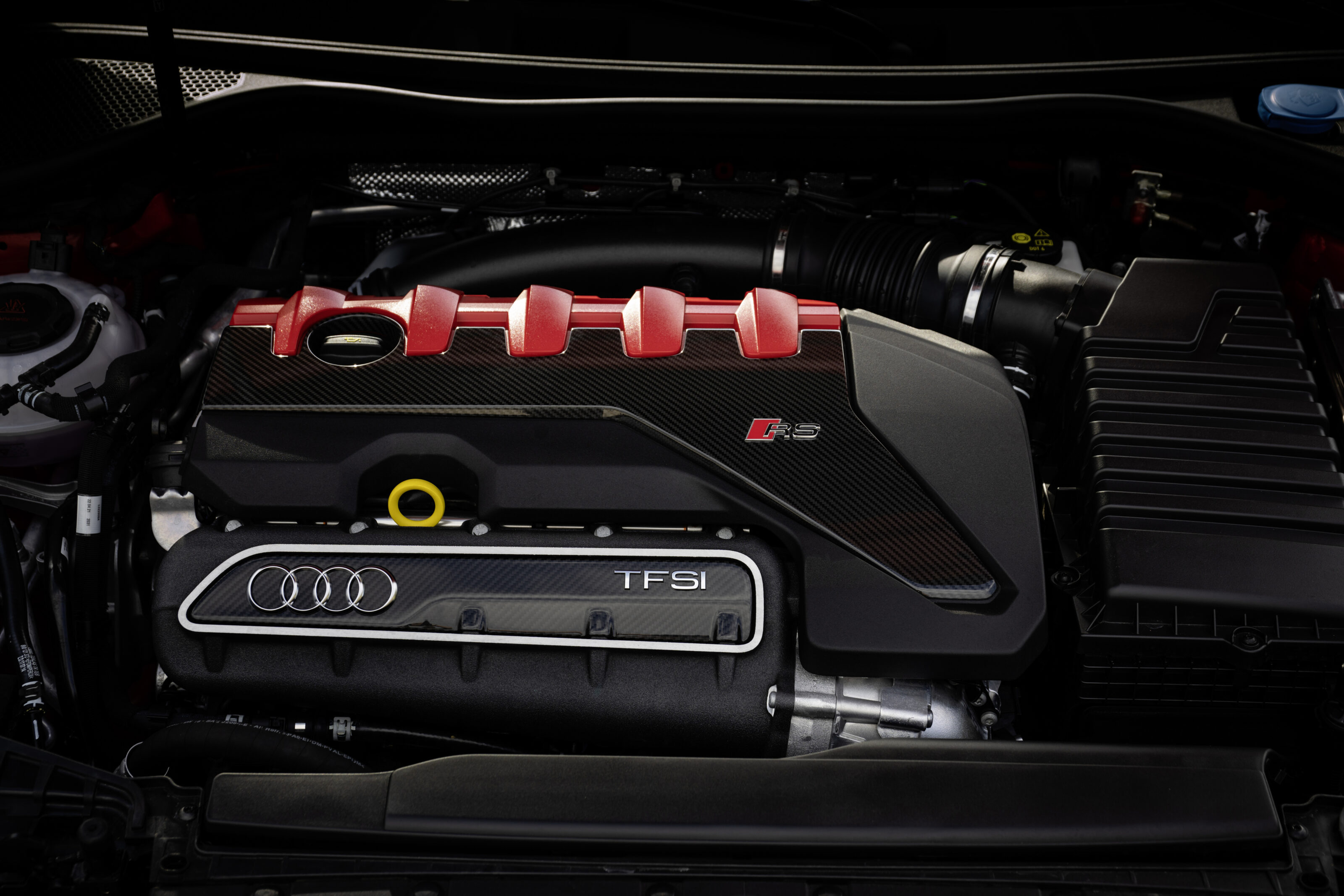
For third-generation RS3, Audi Sport’s engineers haven’t sought more power from the 2.5 TFSI. It remains at 294kW, but torque has been increased slightly to 500Nm, broadening the range of revs where max power is produced in the process.
While the transmission remains a seven-speed double-clutch, there are big changes aft of the Audi’s engine compartment. The new RS3 has a torque-splitting rear axle, with a pair of electronically controlled multi-plate clutches.
It’s the same sort of tech as first seen in the Ford Focus RS of 2016, followed a few years later by the current Mercedes-AMG A45 S. At a glance, the Magna Powertrain-supplied rear axle of the new RS3 appears almost identical to the unit in the A45 S.
As in the Ford and the Mercedes-AMG, one of the primary purposes of the torque-splitting rear axle is to enable drift mode. When Audi Sport surveyed RS3 customers during the planning phase for the new model, many asked for it.
But the Audi’s rear axle does more than facilitate the rapid conversion of expensive tyres into clouds of stinky smoke. There are safety and handling benefits, too. Cornering stability and traction are enhanced. The axle’s torque-vectoring talent also means drive can be selectively channelled to just one of the rear wheels, quelling power-on understeer or oversteer as required.
With both axle clutches locked, rear-end traction is maximised. Though engine power is unchanged, the new RS3 accelerates 0-100km/h in a claimed 3.8 seconds. This is a three-tenths improvement over the outgoing model and a tenth better than the A45 S, the Audi’s arch-rival.
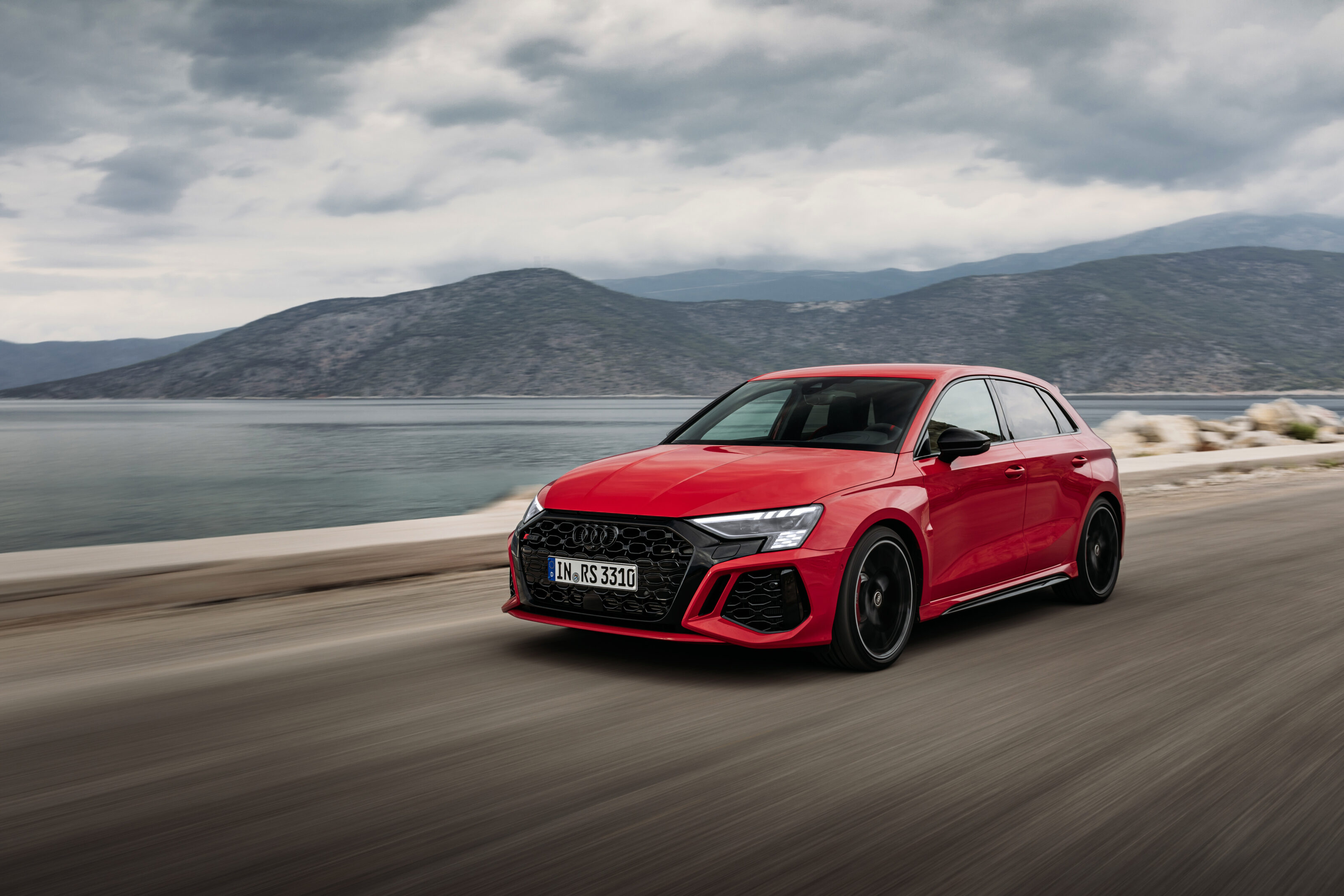
Chassis modifications follow a familiar RS3 pattern. Compared to the A3, front track is widened by 33mm, rear track by 10mm and ride height is 10mm than an S3, which in turn rides 15mm closer to the road than a regular A3.
The strut front suspension has RS3-specific knuckles that increase negative camber, while the multi-link rear suspension uses a stiffer mounting subframe and a firmer anti-roll bar that suits the characteristics of the torque-splitting rear axle.
One of the purposes of the torque-splitting rear axle is to enable drift mode. When Audi Sport surveyed RS3 customers, many asked for it.
In Europe, optional adaptive dampers are an alternative to the standard passive set-up. They are electro-mechanical, tech which Audi engineers say now offers a greater range of tuneability than the current RS3’s optional magnetorheological dampers.
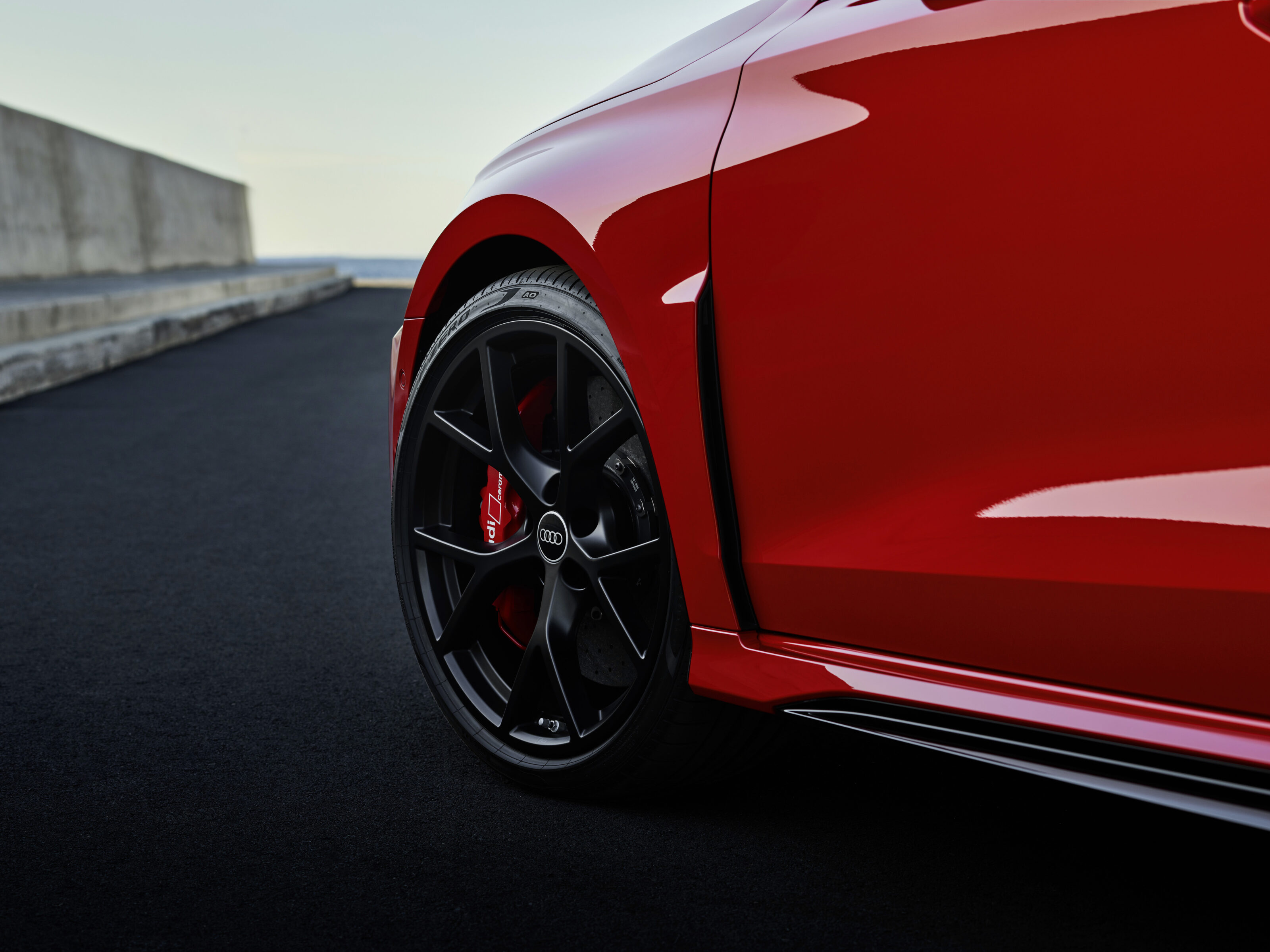
Bigger discs and new six-piston front calipers are the highlights of the brake system upgrades. There’s a carbon-ceramic brake package option and, for the first time, road-legal Pirelli P Zero Trofeo R semi-slick tyres can be ordered from the factory. As with the previous RS3, the new model’s 265/30ZR19 front tyres are wider than its 245/35ZR19 rears.
Along with the extensive hardware upgrades, Audi has made major changes to the car’s Drive Select system. The usual Comfort, Auto, Dynamic and customisable Individual modes remain. There’s now an extra Efficiency mode, which reduces power and torque. It could prove handy for drivers who find themselves low on fuel and far from a 98 octane pump.
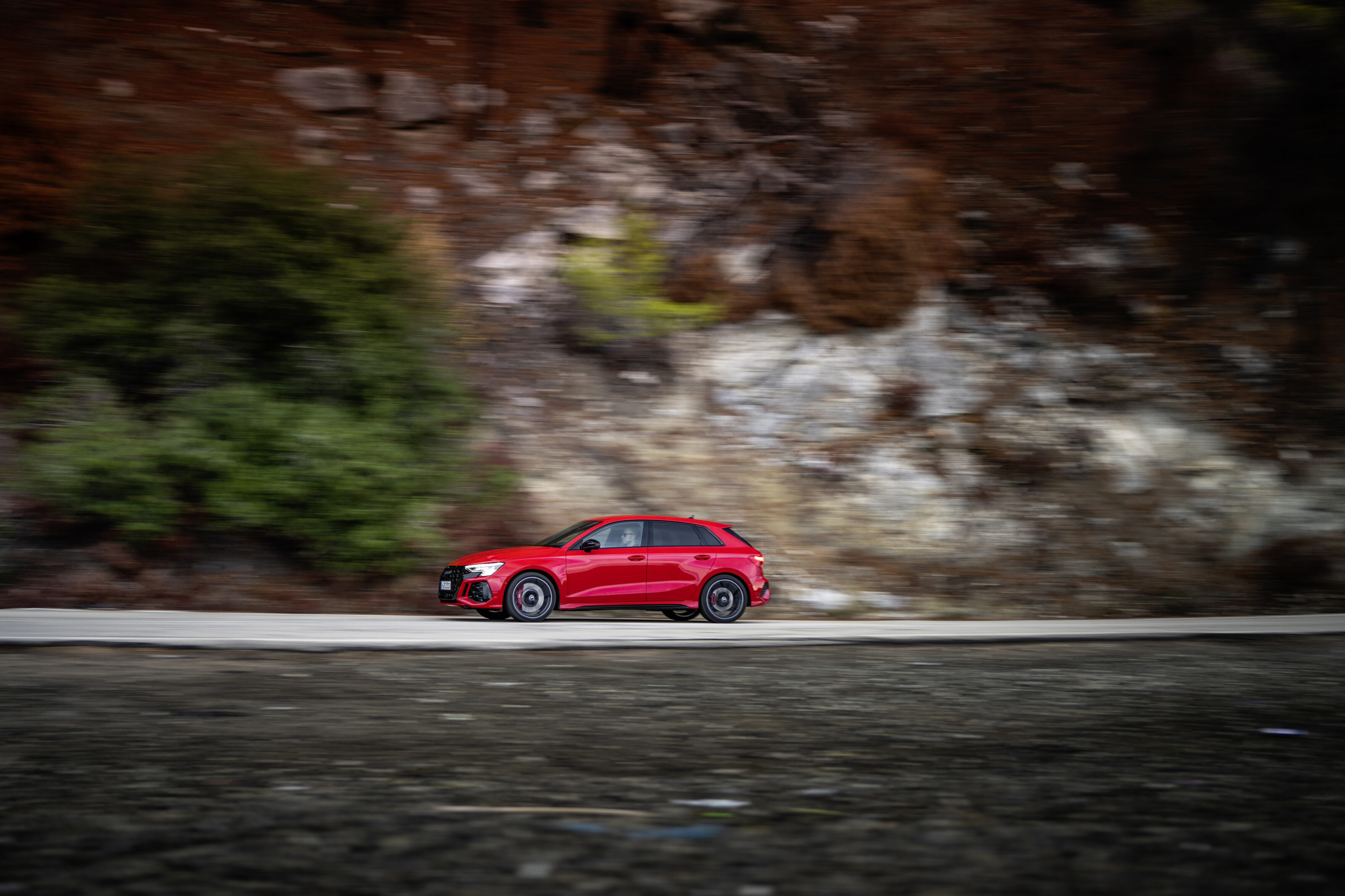
More important are the two new RS3-specific modes. One of them, RS Torque Rear, is drift mode by another name. The other, RS Performance, aims to optimise lap times. Within RS Performance, the driver has a choice between two set-ups, one for rough circuits like the Nurburgring and another for smooth tracks.
To burnish the RS3’s image ahead of launch, Audi race and development driver Frank Stippler set a compact category Nurburgring lap record in the car back in June. At a fraction under 7:41, the new RS3 is about five seconds swifter around the legendary German track than its predecessor.
Stippler drove a sedan for his record-setting lap. Both four-door and five-door Sportback versions of the RS3 went on sale in Europe in October. They’re scheduled to launch in Australia in the first half of 2022, although a first-quarter launch is anticipated. Expect the price list to open at around $90,000.
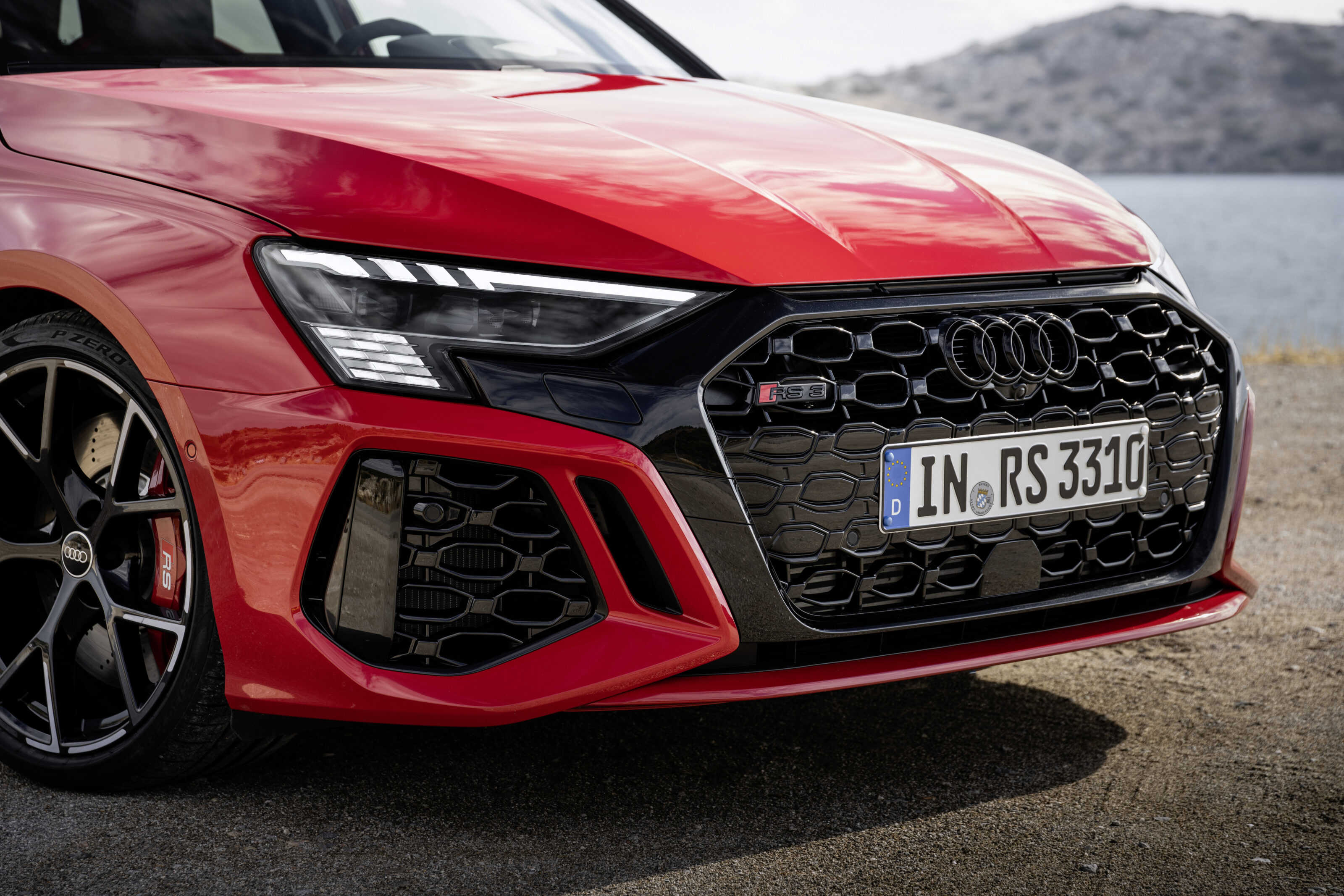
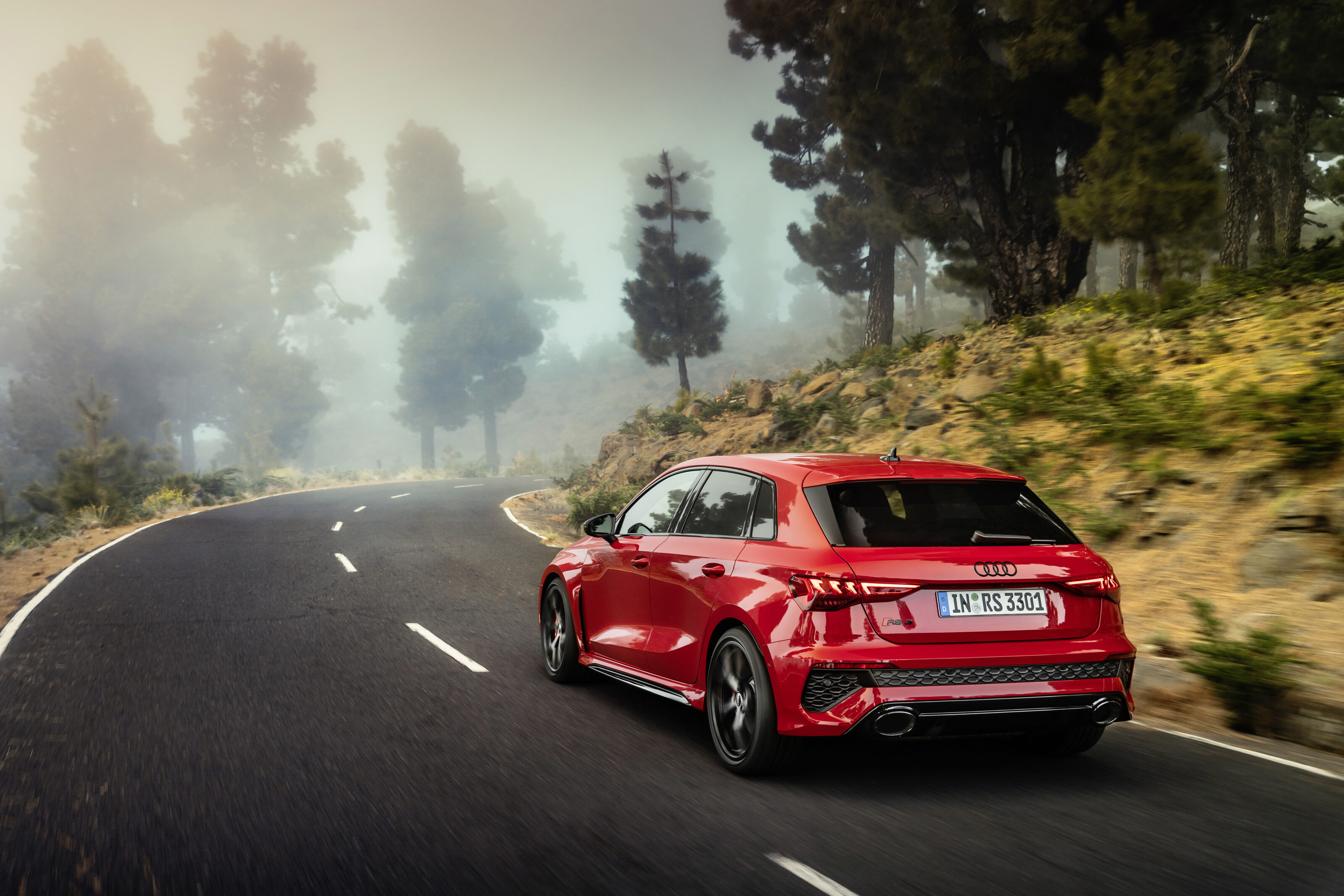
With flared guards to cover its wide-track front axle, black honeycomb grille, LED headlights, rear diffuser and an exterior colour palette seemingly inspired by Lamborghini, the RS3 isn’t designed for stealth.
The interior is excellent, adding plenty of premium tech and sporty substance to the Audi’s small-car practicality. Ahead of the snugly comfortable front seats, the instrument panel is a visual treat, especially with the optional body-colour accents across the centre of the face-level air vents. Both the centre infotainment touchscreen and the digital instrument cluster are deliciously crisp.
The optional Alcantara-covered flat-bottomed RS Design Package steering wheel is a delight, too. Its right-hand spoke includes an RS Mode button for instant access to the two new modes mentioned earlier.
At a fraction under 7:41, the new RS3 is about five seconds swifter around the legendary German track than its predecessor.
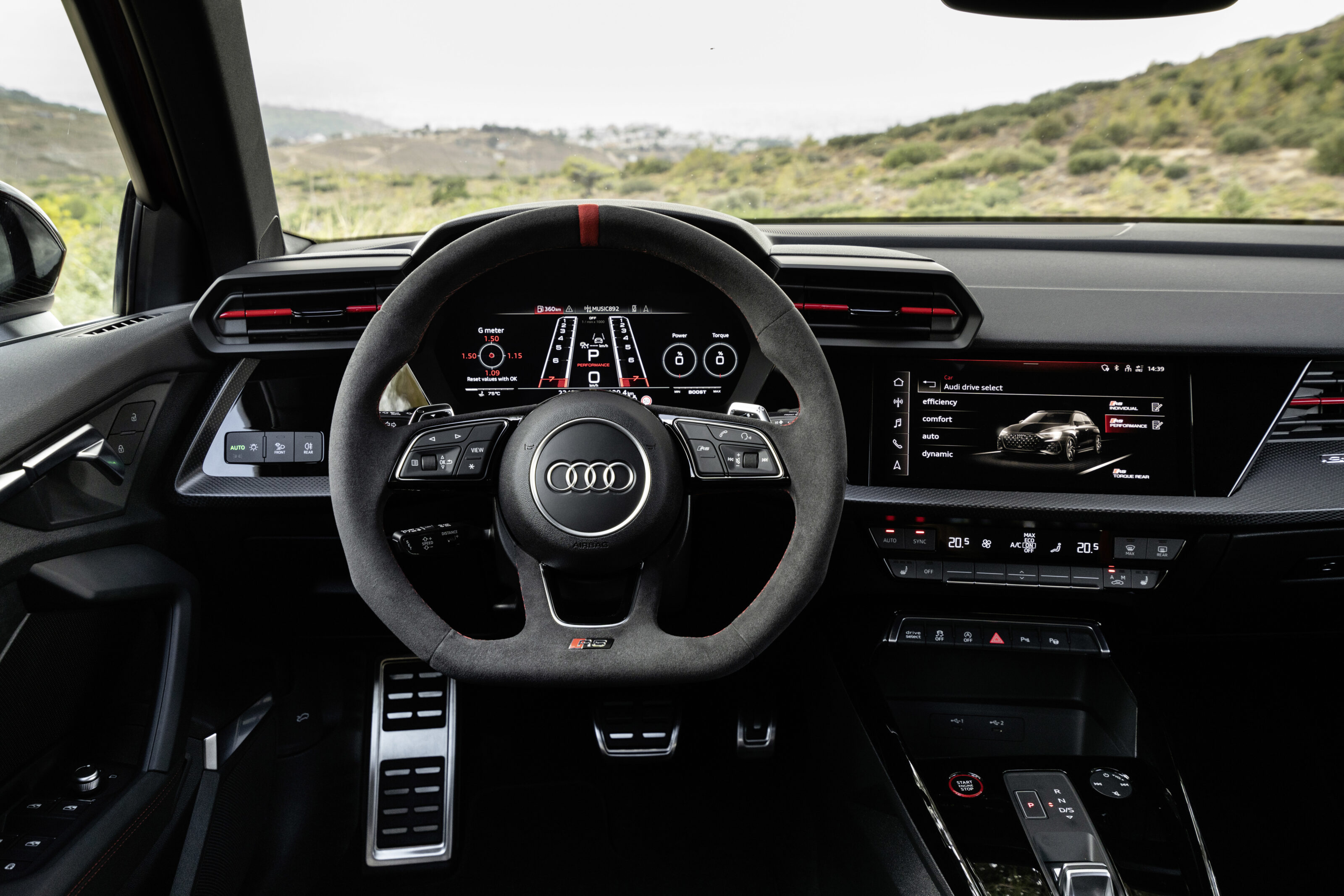
Selecting RS Torque Rear does indeed turn the RS3 into a drifter. It’s absurdly easy to get the Audi sideways, though circling and smoking with the elegance demonstrated by Frank Stippler proves impossible.
Audi chose Greece for the international press presentation of the RS. While the night-time drift-fest staged under lights in Athens’ deserted docklands was entertaining, the next day’s activities were more relevant.
The short racetrack outside the Greek capital hired by Audi was brutally lumpy in places. It highlighted the car’s strengths. In RS Performance mode, the Audi was both speedy and stable.
It shrugged off mid-corner bumps while accelerating hard and demonstrated determined resistance to the kind of gross understeer that had previously been a major handling shortcoming of the RS3.
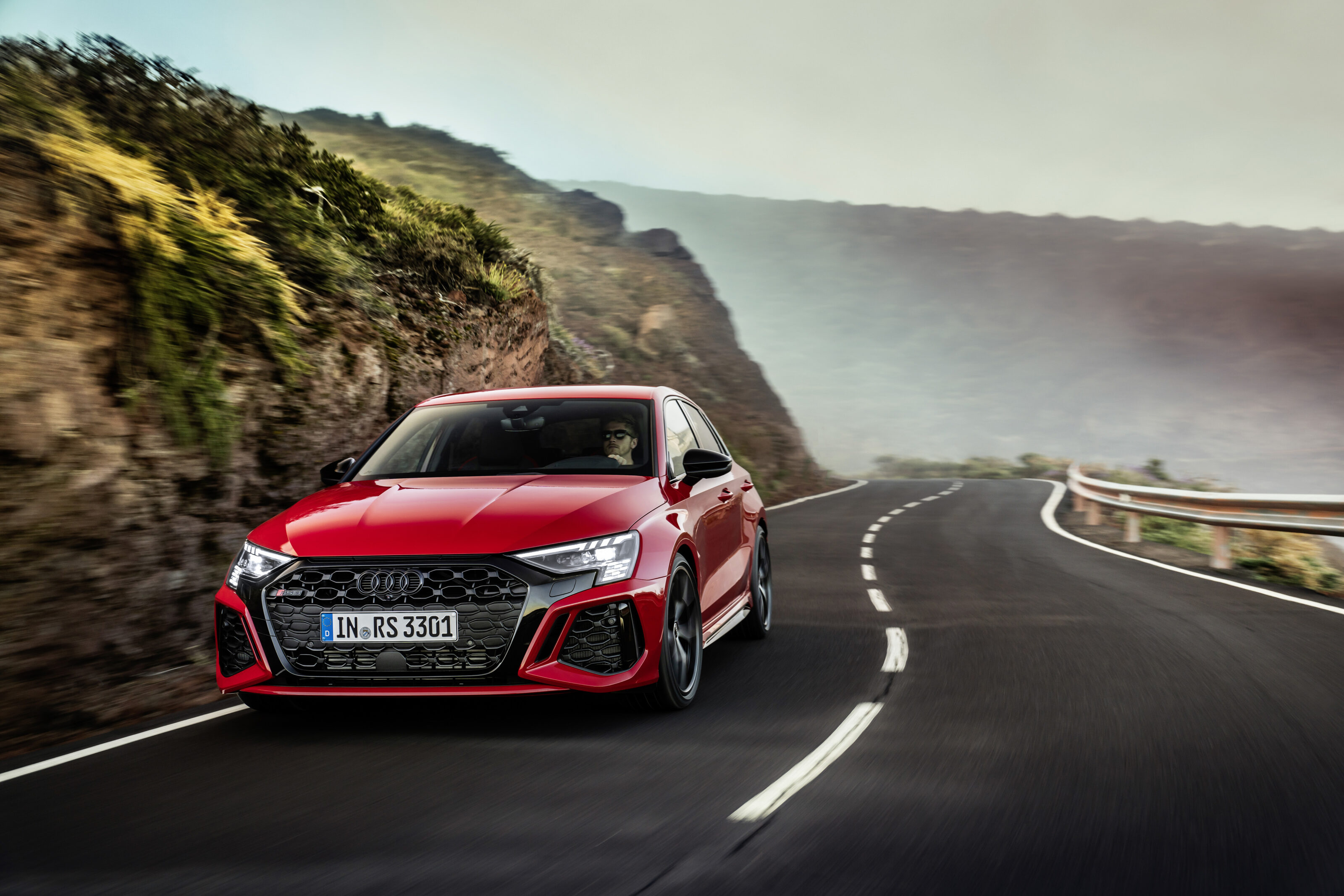
All the cars driven on the circuit had the optional semi-slick tyres and carbon-ceramic brake package. The brakes were truly impressive; fade-free, consistent and very strong, able to make the most of the Pirellis’ grip. The torque-splitting rear axle makes a real difference. You sense it aiding turn-in and balancing the car during full-blooded early-on-the-gas corner exits.
As ever, the engine is a gruff-voiced belter with great mid-range punch and top-end eagerness. The transmission control software does great work on the track, too, always delivering snappy, perfectly timed shifts.
While it awes, it falls short of awesome. Partly because of its precise but numb steering, the Audi feels hugely capable but vaguely clinical.
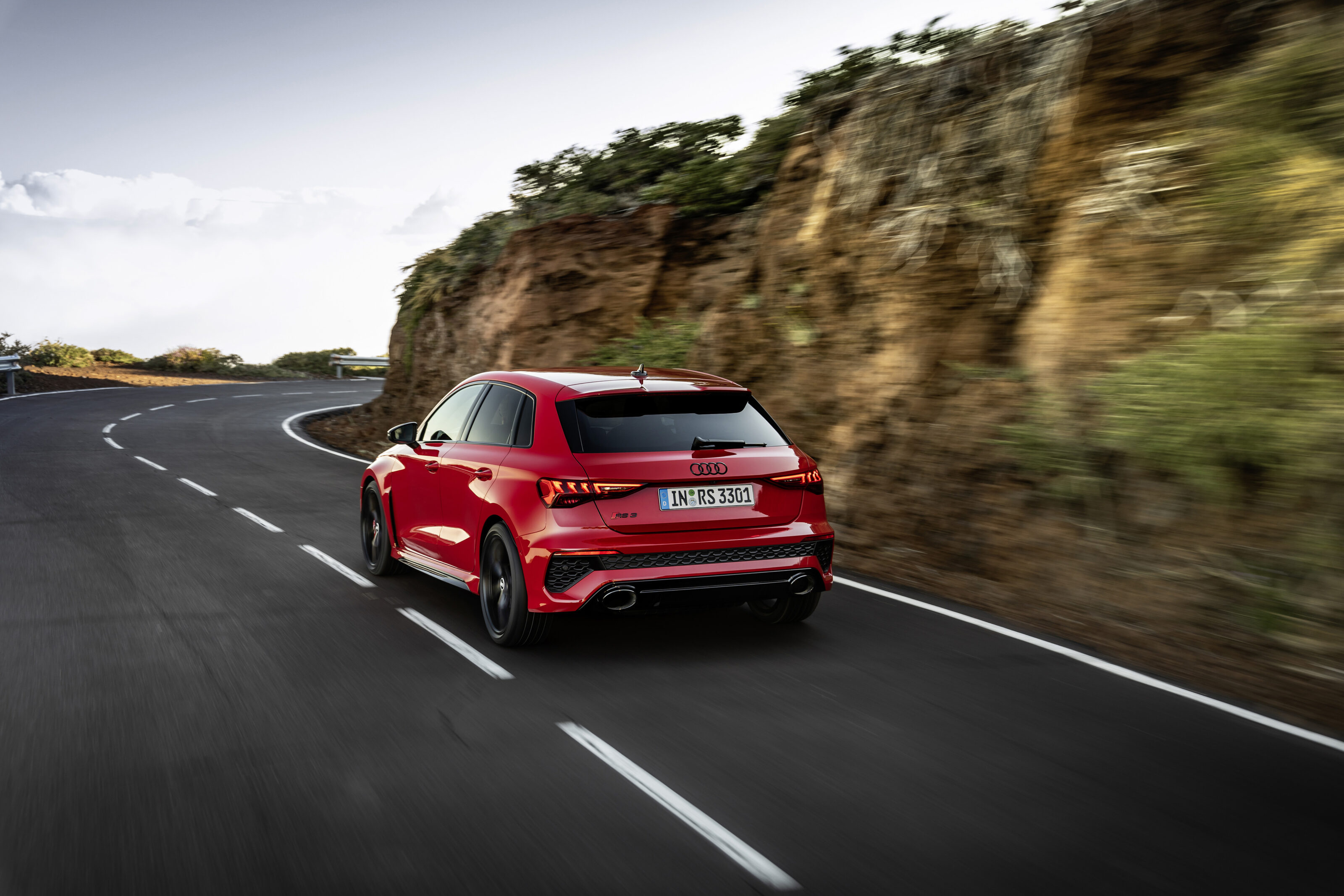
The understeer-killing qualities of the torque-splitting rear axle are as evident on the road as on the track. And tidier handling isn’t the only reason the new RS3 is a better day-to-day drive than the previous model.
Selecting Auto mode in the Drive Select menu reveals that the RS3, at least when equipped with adaptive dampers, can do comfy as well as sporty. Body motions are disciplined, but not harsh.
If harsh is what you want, try Dynamic instead. This mode is really only bearable on the smoothest of surfaces. The softer setting in RS Performance is probably a better choice than Dynamic for enthusiastic driving on typical Australian roads.
The torque-splitting rear axle makes a real difference. You sense it aiding turn-in and balancing the car during full-blooded early-on-the-gas corner exits.
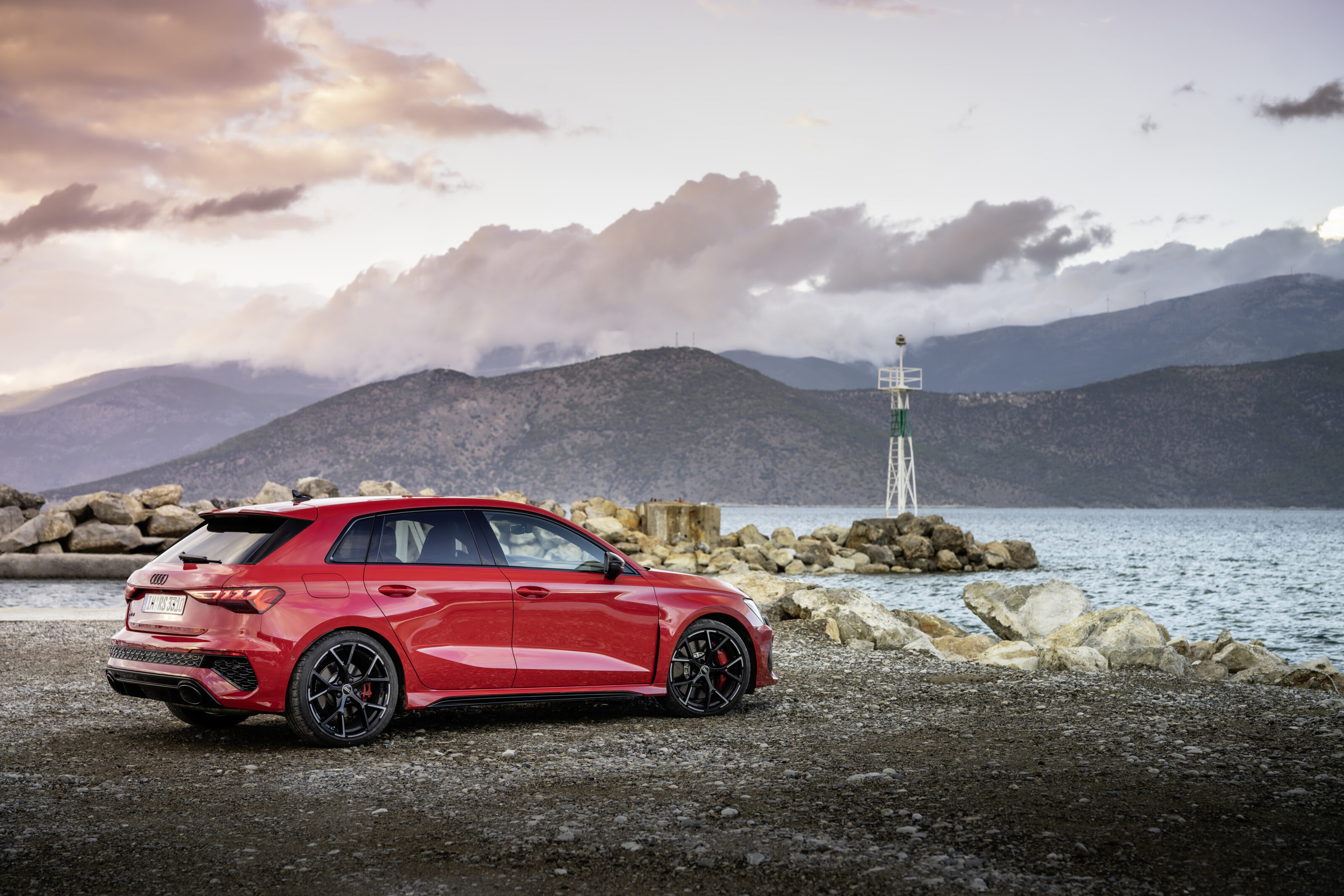
The new RS3’s improved ride, combined with the engine’s elastic mid-range muscle, mean it now does chill as well as thrill. It’s happy to not hurry, and will be an easy-to-live-with daily driver.
There’s room for improvement, though. At low speeds, there’s occasional clunky shunting from somewhere in the driveline. Also, the drivetrain calibration could be improved; throttle tip-in is too aggressive in day-to-day Auto mode and the transmission sometimes responds tardily to throttle inputs.
Despite these quibbles, the new RS3 does what any new car should do; improve on the model it replaces. This Audi brings advances in performance, handling and comfort.
It’s a better RS3, no question. And given the uncertain future of Audi’s five-cylinder engine, that could make it the best RS3 of all time.
2022 Audi RS3 Sportback specifications
| Engine | 2480cc inline 4, DOHC, 20v, turbo |
|---|---|
| Max power | 294kW at 5600 to 7000rpm |
| Max torque | 500Nm at 2250 to 5600rpm |
| Transmission | 7-speed dual-clutch and AWD |
| Weight | 1570kg |
| 0-100km/h | 3.8sec (claimed) |
| Economy | 8.3 to 8.8L/100km (WLTP Europe) |
| Price | $90,000 (est) |
Snapshot
- Australia on track to cut emissions by 30-35 per cent by 2030
- Official target is still 26-28 per cent
- No commitment specifically aimed at automotive industry
Australian Prime Minister Scott Morrison has outlined the details of his Government’s net zero by 2050 plan today – which does not include a commitment to phase out cars powered by fossil-fuels.
Speaking today, Prime Minister Scott Morrison and Minister for Industry, Energy and Emissions Reduction Angus Taylor revealed the country’s long-awaited net zero package.
The latest projections revealed Australia is on track to cut overall emissions by 30 to 35 per cent by 2030, but the PM said the official national target of a 26 to 28 per cent reduction would remain unchanged.
However, the Government’s plan did not go as far as to commit to a dedicated automotive CO2 reduction goal and has been panned by industry figures.
A spokesperson for Volkswagen Australia, which has been a long time critic of the Federal Government’s position on emissions, told Wheels: “This plan does not address the glaring anomaly whereby a nation of Australia’s wealth remains an automotive dumping ground for engines that our competitors cannot sell in other markets. The Government says that it will not enact change that impacts the taxpayer, but its inertia is already costing them.
“While almost all European cars currently on sale confirm to Euro 6, VW’s top 10 selling rivals continue to import to Australia Euro 5 engines that cannot be sold in Europe, where instead they sell many of the same models with Euro 6 engines.
“While Australia is yet to settle on official adoption date for Euro 6, which commenced in Europe in 2013 and prevails in developed markets, there is a very real danger that our country will continue to languish in Euro 5 at mid-decade. This would only result in a drastic diminishment in customer choice.”
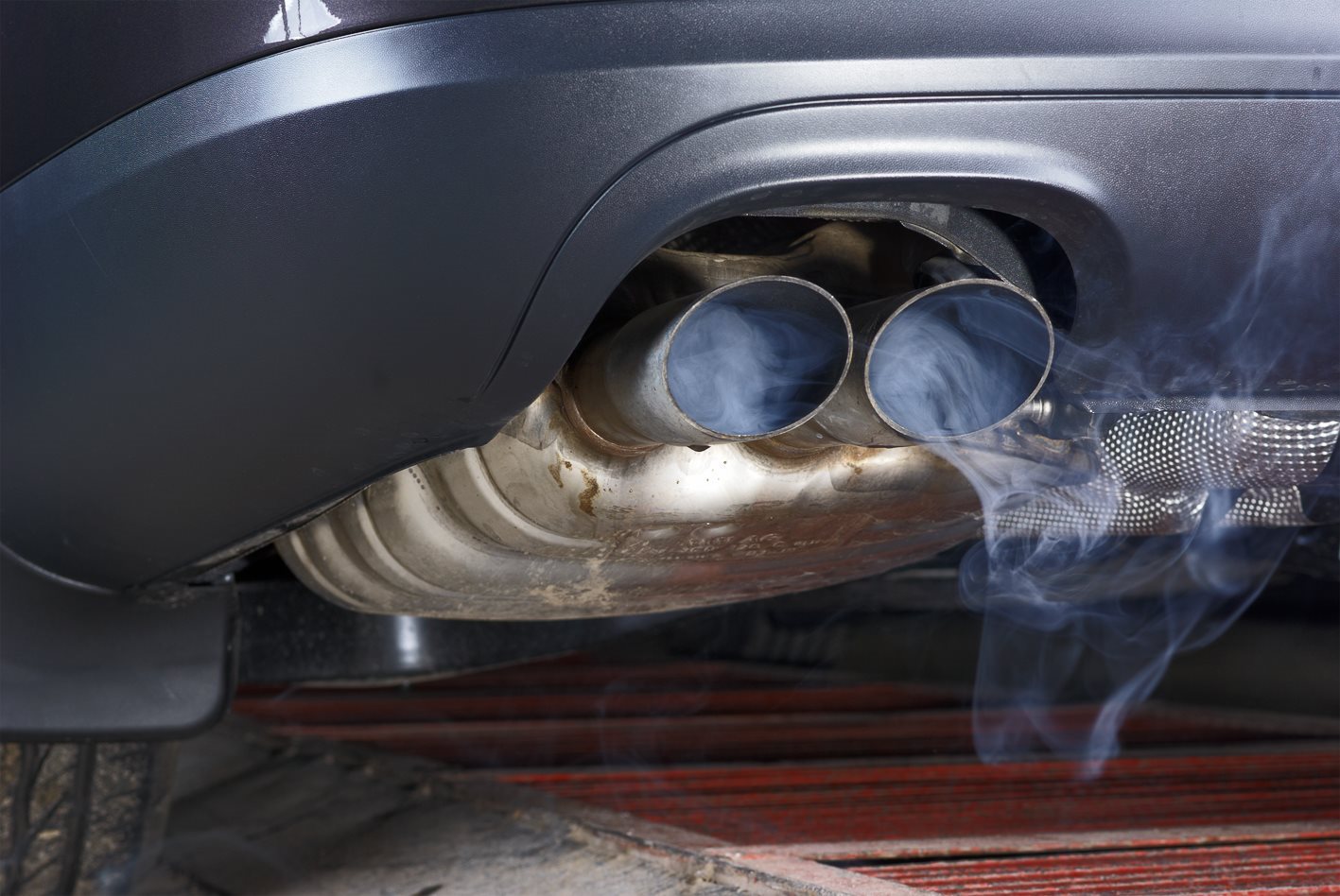
Tony Weber, Chief Executive of the Federal Chamber of Automotive Industries (FCAI), also said the Government should be sending a stronger message, and 2050 “is too far away”
“It is important that there is now an acceptance that we need to do something and adopting a 2050 net zero target is a good start,” Weber told Wheels.
“However, for the automotive industry, we want to send a message in the shorter term about the importance Australia places on reducing CO2 emissions – which is why we have already adopted our own voluntary reporting scheme.
“We have called on Government before to also mimic that target and mandate it to send a strong message to manufacturers’ HQs around the world that we want the best possible technology into the hands of Australians.
“2050 is three decades away, which is difficult for a car industry which works on car life cycles of [around] five years. It’s too far into the never never.”
Hyundai said the firm will work closely with governments at all levels to help tackle the issue of climate change in Australia.
“Hyundai is in progress to achieve carbon neutrality globally by 2045. In Australia, our aim is to introduce as many zero emission vehicles (ZEVs) to the market as possible and to be known as Australia’s most innovative automotive brand.
“Hyundai will cease the sale of internal combustion engine (ICE) vehicles in Europe by 2035, in line with that market’s stated direction, and we expect to cease the sale of ICE vehicles in major global markets by 2040.”
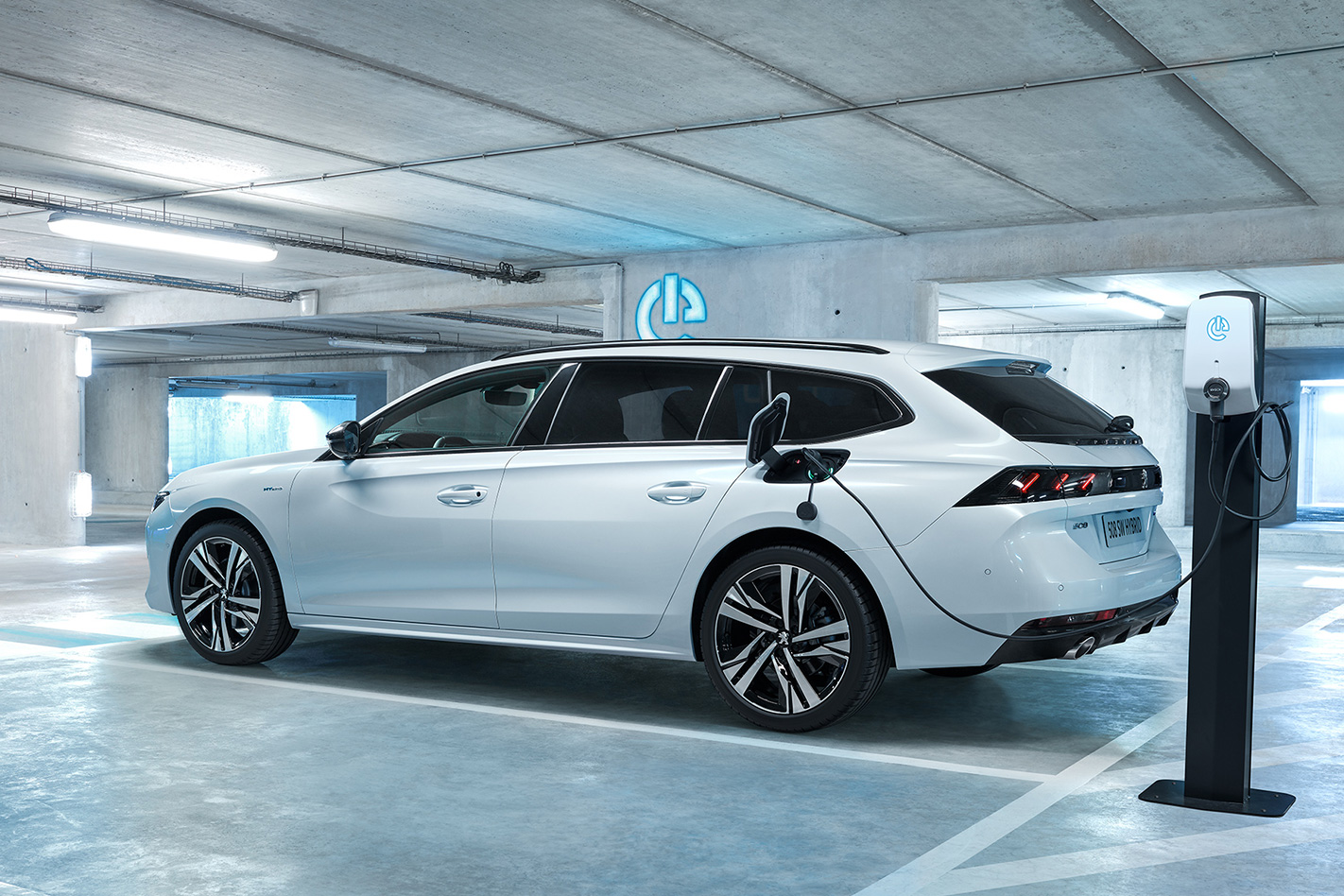
The Government explicitly noted during today’s reveal that its new plan focuses on “net zero, not absolute zero emissions” and stated reaching its goals does not necessarily require ending coal or other fossil-fuel consumption in Australia entirely.
Instead, the Government intends to use existing and emerging technologies, saying those will get the country 85 per cent of the way to net zero – the plan prioritising “clean” hydrogen and “ultra-low-cost solar”, as well as battery storage of renewable power and carbon capture.
“Australians understand and support the need to take action on climate change, so do I and so does this Government,” Morrison told media on Tuesday.
“Australians want a plan that gets the balance right…that doesn’t legislate or mandate.
“We have already achieved more than 20 per cent reduction in emissions since 2005…we’ll meet and beat the 2030 targets.”
On Sunday, the National Party agreed to the PM’s net zero by 2050 target following weeks of resistance – allowing Morrison to present his plan to the 2021 Climate Change Conference, also known as COP26, held in Glasgow from October 31.
The announcement follows a report released by leading think-tank the Grattan Institute earlier this week which made several bold recommendations on what Australia needs to do to meet the net zero target – which go much further than what came to light earlier today.
Grattan Institute modelling shows that introducing an emissions cap of 143 grams of carbon per kilometre for new light vehicles no later than 2024, with an aim of zero tailpipe gasses by 2035, could reduce Australia’s emissions by at least 40 per cent between now and 2030 (with a cap of 25g/km) – at virtually no cost to taxpayers.
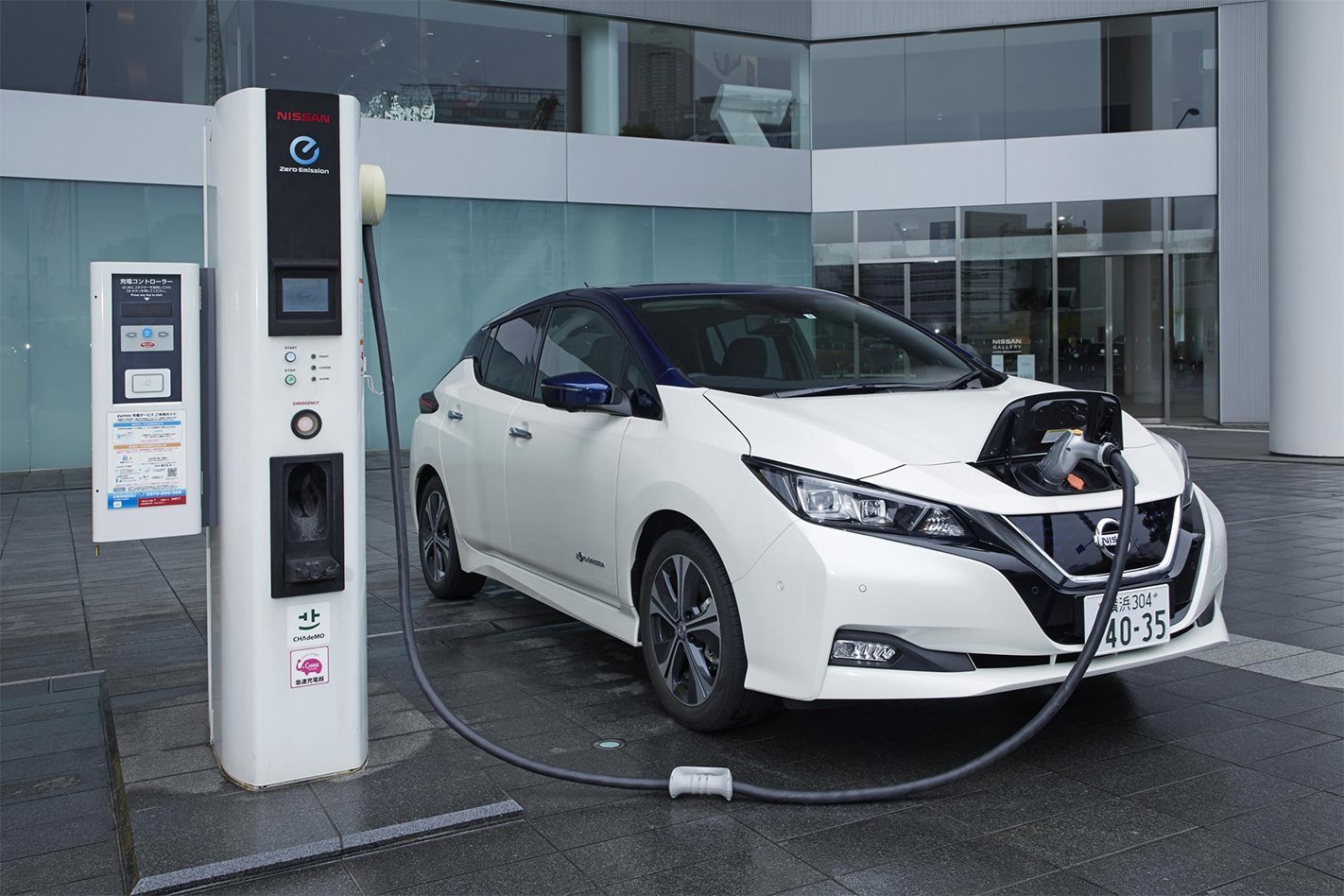
It said this would save drivers money – because zero-emissions electric cars are much cheaper to run than high-emitting petrol and diesel cars (with subsidies or rebates now available in most states and territories) saving owners at least $900 annually over the first five years – but warned that governments nationwide needed to also act to discourage driving by making public transport and cycling safer and more attractive.
They should impose congestion and per-kilometre charges on cars, make trains and buses as COVID-safe as possible, do more to separate cars and trucks from cyclists and pedestrians and consider lowering urban speed limits to 30km/h to reduce pollution and accidents, the modelling claims.
Other key recommendations included:
- Improving the quality of Australia’s fuel so that vehicles here can meet international pollutant standards – to start immediately for diesels and petrols by mid-2024 at the latest
- Adopting the Worldwide Harmonised Light Vehicle Test Procedure (WLTP) for vehicle emissions testing, and ensuring all new vehicles include on-board vehicle emissions monitors by 2024, with de-identified annual data released publicly
- Government funding for publicly accessible chargers that encourage substantial numbers of people to switch to electric vehicles
- State and territory governments should, by 2022, require landlords and vendors to disclose at the point of lease or sale whether their property has charging infrastructure for electric vehicles. The National Construction Code should be updated to require that new dwellings with off-street parking be ready for EVs from 2022.
Previously, with just weeks to go before a major climate summit in Glasgow, Treasurer Josh Frydenberg had backed a net zero target by warning that investors could take their money elsewhere if Australia was seen as lagging on climate action.
“Australia has a lot at stake,” he said during a virtual speech to business leaders, reported ABC at the time.
“We cannot run the risk that markets falsely assume we are not transitioning in line with the rest of the world.”
Australia has come under increasing fire from other developed countries and the United Nations in recent weeks and months for being one of the only remaining wealthy countries not to have committed to net zero, and for lagging behind in its goals to cut emissions in the short term too. Among those also facing heat are China, Russia and Saudi Arabia.
Before this policy was revealed, Morrison had only stated the Federal Government’s goal was to get to net zero “as soon as possible, and preferably by 2050”, and had been under pressure to lift Australia’s existing target set in 2015 of cutting pollution by 26 to 28 per cent by 2030 below 2005 levels.
Prior to now, Australia’s main trading partners, including the UK, US and EU have committed to net zero 2050, but we haven’t. Additionally, the UK has a goal of reducing emissions by 68 per cent by 2030 (including a ban on the sale of new ICE vehicles), the EU by 55 per cent and the US by 52 per cent.
The Climate Change Conference was established in 1992, and is now in its 26th incarnation, being held in Glasgow from October 31 to November 12. It was due to go ahead in December last year but had to be cancelled due to COVID-19.
It was set up as part of the United Nations Framework Convention on Climate Change (UNFCCC) and involves every country on Earth being treaty-bound to “avoid dangerous climate change”. This year it is expected to focus on the issues of climate finance, phasing out coal and nature-based solutions.
The most significant outcome from the series of summits in recent years has been the Paris Agreement in 2015 where it was agreed to hold global temperature rises to “well below” two degrees celsius above pre-industrial levels – while “pursuing efforts” to limit heating to 1.5C.
At the same time, countries also agreed to non-binding targets to cut – or in the case of developing nations, to curb the growth of – greenhouse gas emissions in the near term, by 2030 in most cases.
However, it was known that these national targets would be inadequate to meet the terms of the Paris Agreement, in fact they would result in three degrees celsius or more of global warming, and so it was decided countries would need to return to the table every five years with fresh commitments.
A recent study carried out by the Intergovernmental Panel on Climate Change, the world’s leading authority on climate science, found there is a vast difference between the damage done by 1.5C and 2C of heating, and concluded that the lower temperature was much safer – and that there was still a chance for the world to stay within the 1.5C threshold but that it would require concerted efforts.
American electric vehicle manufacturer Tesla has been forced to roll back its Full Self-Driving system after issues were reported with the latest software.
Having gone live earlier last month, some users praised the FSD system while some complained about minor issues while in operation – with the most consistent problem stemming from the vehicle randomly providing false collision warnings.
CEO Elon Musk took to Twitter to outline the company’s strategy, saying it would rollback from the most recent FSD 10.3 software to the more reliable 10.2, although 10.3.1 has also now been released.
Utilising beta testing by the public allows Tesla to gather a large quantity of data in a relatively short space of time, although this comes with an inherent risk as those using the system may be doing so in as yet unproven conditions – leading to a higher chance of problems occurring.
When the FSD beta initially went live, Tesla required all beta testers to sign a non-disclosure agreement in an attempt to protect itself from criticism online – however as a large contingent of users ignored the NDA, it was repealed just over a week later.
Prior to the release of FSD, Tesla’s Autopilot system had come under fire after a string of incidents in the United States, with more than 11 crashes involving parked emergency service vehicles occurring while Autopilot was engaged, triggering an investigation by the National Highway Traffic Safety Administration.
New rumours about the 2024 Mazda NE MX-5 have emerged, with a big performance jump on the cards.
UK publication Autocar suggests the next-generation MX-5 will use the mild-hybrid Skyactiv-X engine borrowed from the Mazda 3 and CX-30 SUV, all but confirming information leaked from the Japanese carmaker late last year.
In November 2020, Spanish publication motor.es revealed a technical drawing taken from the development section of Mazda’s second-quarter financial documents, showing an electric motor mounted between the engine and the transmission – a common mild-hybrid configuration.
The Skyactiv-X ‘M Hybrid’ engine found in the Mazda 3 and CX-30 use a 24-volt mild-hybrid system to deliver 132kW and 224Nm – roughly the same power as the current 2.0-litre MX-5 on sale, but offering a 9.3 per cent increase in torque.
The electrified engine would also be a significant increase over the 1.5-litre engine found on the base model MX-5, with 97kW and 152Nm.
In June, Mazda issued a statement to Motor1 confirming the MX-5 would eventually use some kind of electrified powertrain, in line with its plan to move all its models to electrification by 2030.
The use of a mild-hybrid powertrain would help to keep the MX-5 as light as possible – unlike traditional hybrid or plug-in hybrid vehicles that require heavy batteries and electric motors.
“We want to look at the best powertrain to keep the vehicle lightweight,” Mazda design boss Ikuo Maeda previously confirmed to Autocar, “but because of the diversifying requirements and preference, we need to explore various options.”
However, Maeda added that the roadster needed to be a car that “people can own without worrying that they aren’t being eco-friendly”.
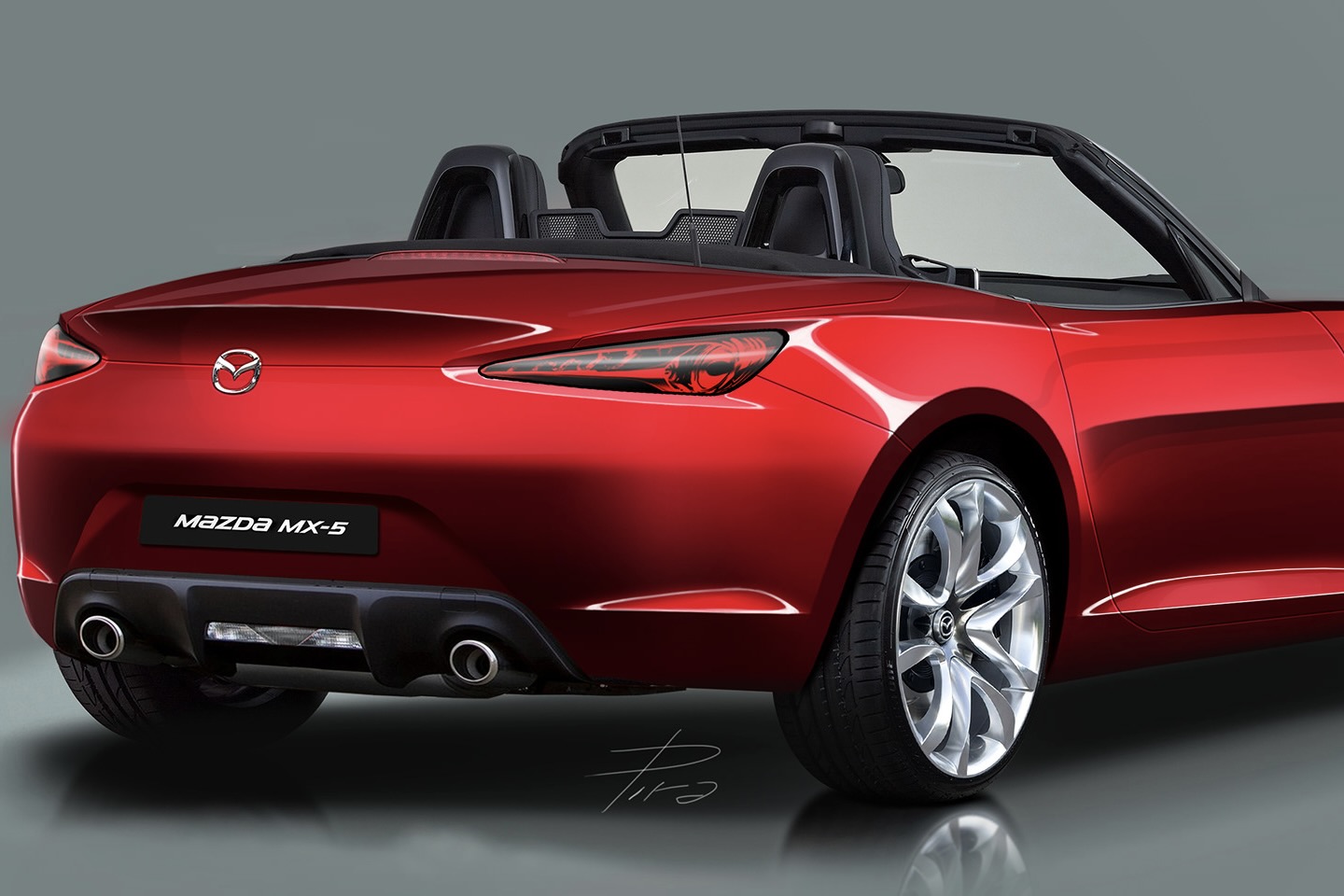
While official timing of the new-generation Mazda NE MX-5 has yet to be confirmed, it’s expected the vehicle will arrive in 2024, with these renderings by Italian artist Pino Nicola Pira providing a glimpse at what it could look like.
