
Calls for a more uniform approach to road user funding have emerged as part of a NSW Government inquiry into its proposed road user levy.
At present, the NSW Government has proposed that electric vehicles (EVs) and plug-in hybrids (PHEVs) should be charged per kilometre to account for the impact on road maintenance.
Currently, fuel excise on petrol and diesel contributes to general revenue collected by the Federal Government and distributed for federally funded infrastructure, including road maintenance. The system, currently, does not directly fund roads based on fuel excise revenue collected.

With EVs avoiding traditional fuelling, and PHEVs theoretically using liquid fuels at a reduced rate, the NSW government has proposed that new energy vehicles should be charged at 2.974 cents per kilometre for EVs (including hydrogen fuel cell EVs) and a slightly lower 2.379 cents/km for PHEVs.
The Victorian Government trialled a similar user-pays system, introduced in 2021. A two-year legal challenge eventually saw the charge deemed unconstitutional by the High Court of Australia, which found the charge functioned as an excise – a levy that can only be implemented at a federal, not state, level.
In order to avoid a similar outcome, the NSW inquiry is seeking alternatives that would allow the road user charge to come into effect.
Among the proposals, a universal road user charge, which would be based on vehicle weight and charged according to distance driven. This new charge would, however, take the place of fuel excise.
In that instance, fuel – taxed equally across the country – would become markedly cheaper in NSW unless all states and territories agreed to adopt similar systems. The change would then switch the federally collected revenue model to a state-based system.
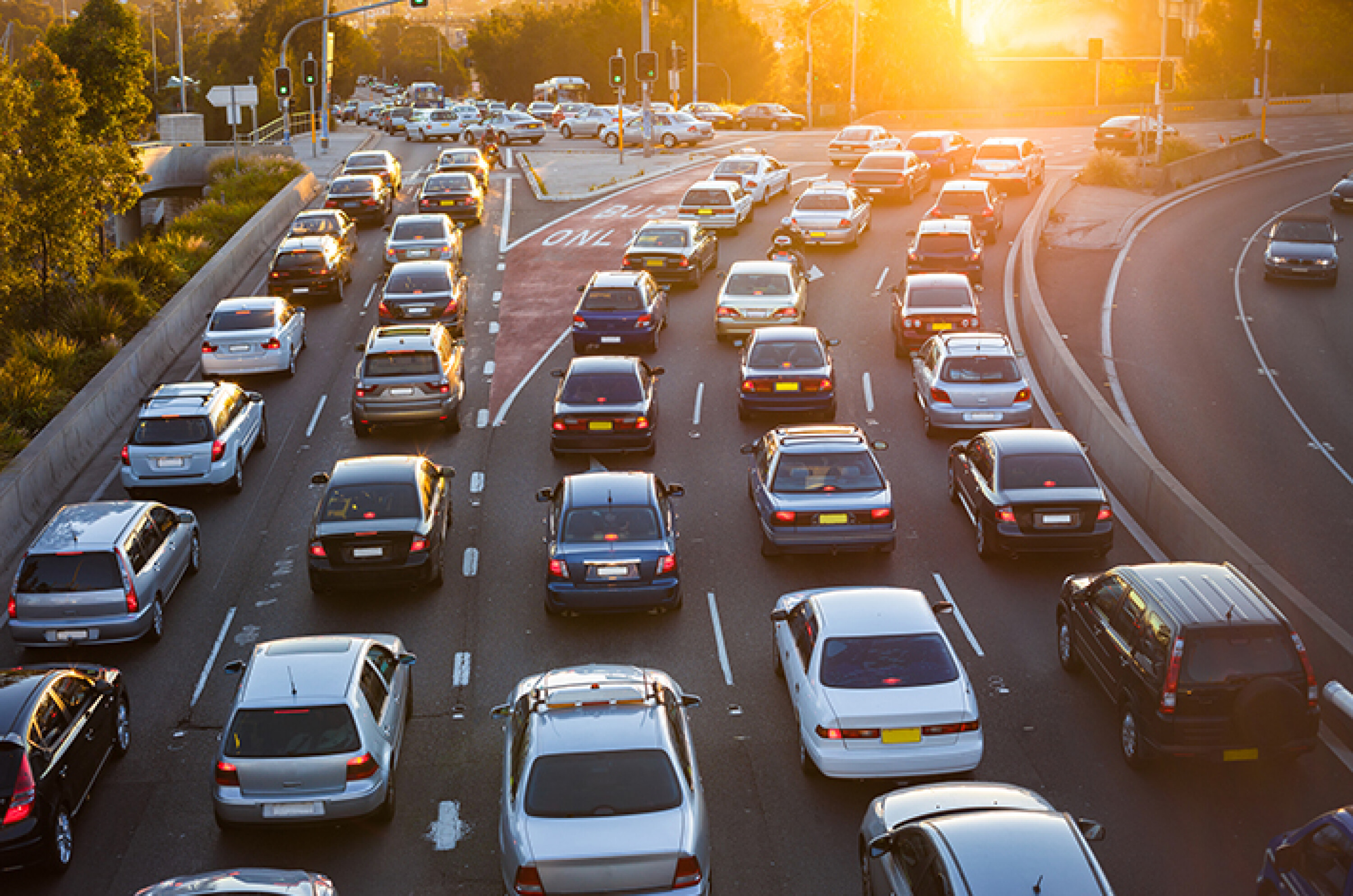
The proposal has the support of the NRMA, which sees a road user fee as a way to balance the road funding model without stifling EV adoption.
The Electric Vehicle Council, meanwhile, claims the opposite and has proposed that an EV user charge not be implemented until EVs make up 30 per cent of Australia’s national vehicle fleet. Currently, EVs represent around 2 per cent of vehicles nationally, with the proposed tipping point expected to take another 10 years.
At present, the NSW road user charge is proposed with a start date of July 1, 2027, but the inquiry is ongoing and set to resume from July 29, 2026.
To commemorate 75 years in the UK, Porsche has unveiled a limited edition version of the 911 GT3 with bespoke styling touches.
Based on the 911 GT3 with Touring Package, a 51-car run of the Earls Court 51 Edition model will be available to British buyers.
The design is a callback to Porsche’s original 356 model, resulting in the selection of the more toned-down styling of the GT3 Touring, not to mention its availability with a manual transmission.
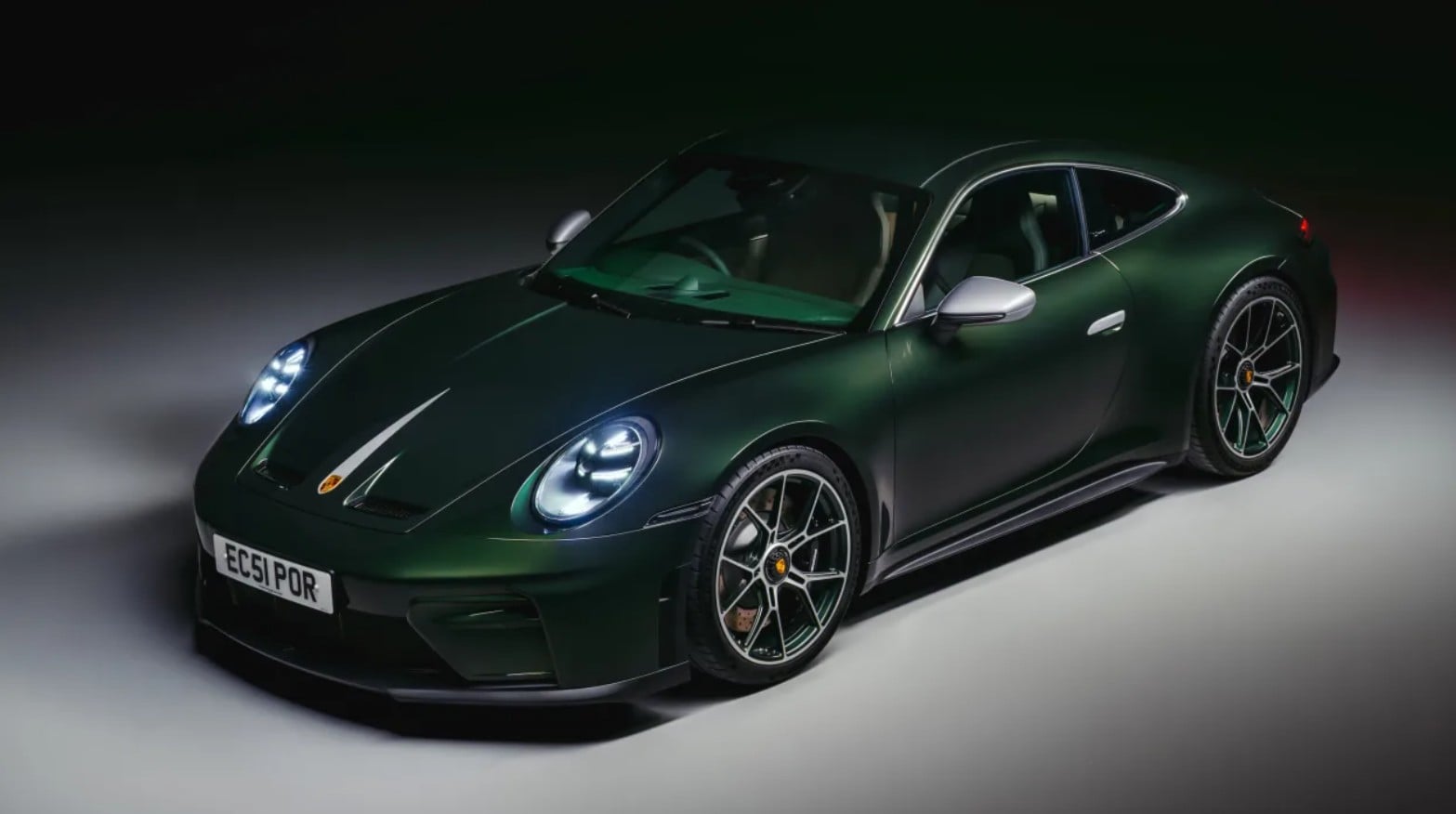
Another connection to the first showing of the Porsche brand at the 1951 Earls Court Motor Show is the choice of colour, with a uniquely developed Earls Court Green metallic connecting the modern car to one of the six 356s first presented at the motor show.
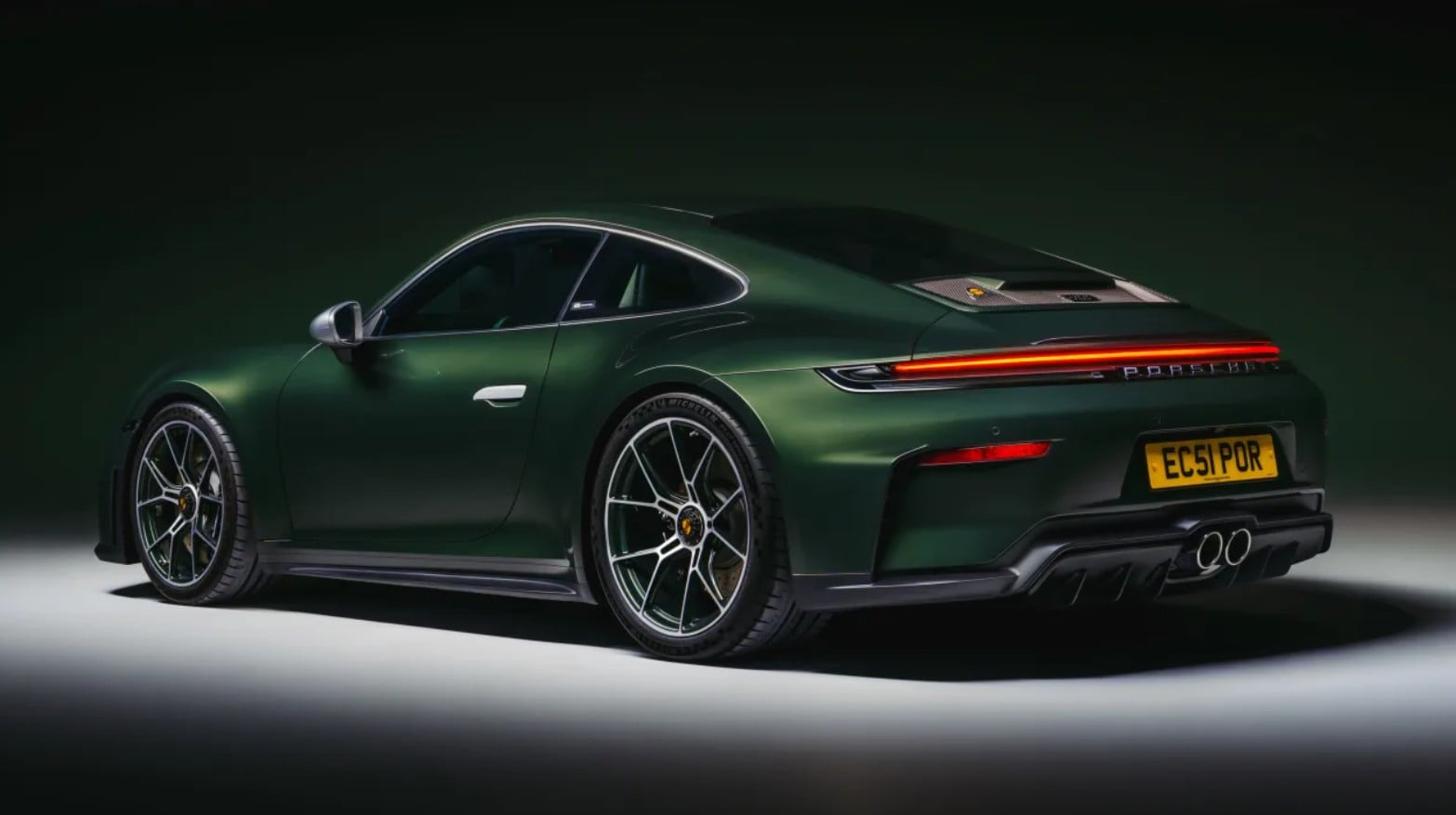
Other styling details for the GT3 Earls Court 51 Edition include bonnet stripes, door handles, and mirror caps in Brilliant Silver, ‘Earls Court 51’ badging on the engine cover and B-pillars, two-tone GT3 wheels in Earls Court Green with a painted Brilliant Silver facing, gloss black brake calipers, a body colour-matched front apron, special edition LED puddle lamps, HD-matrix LED headlights and a special indoor car cover featuresing the Earls Court Edition logo.
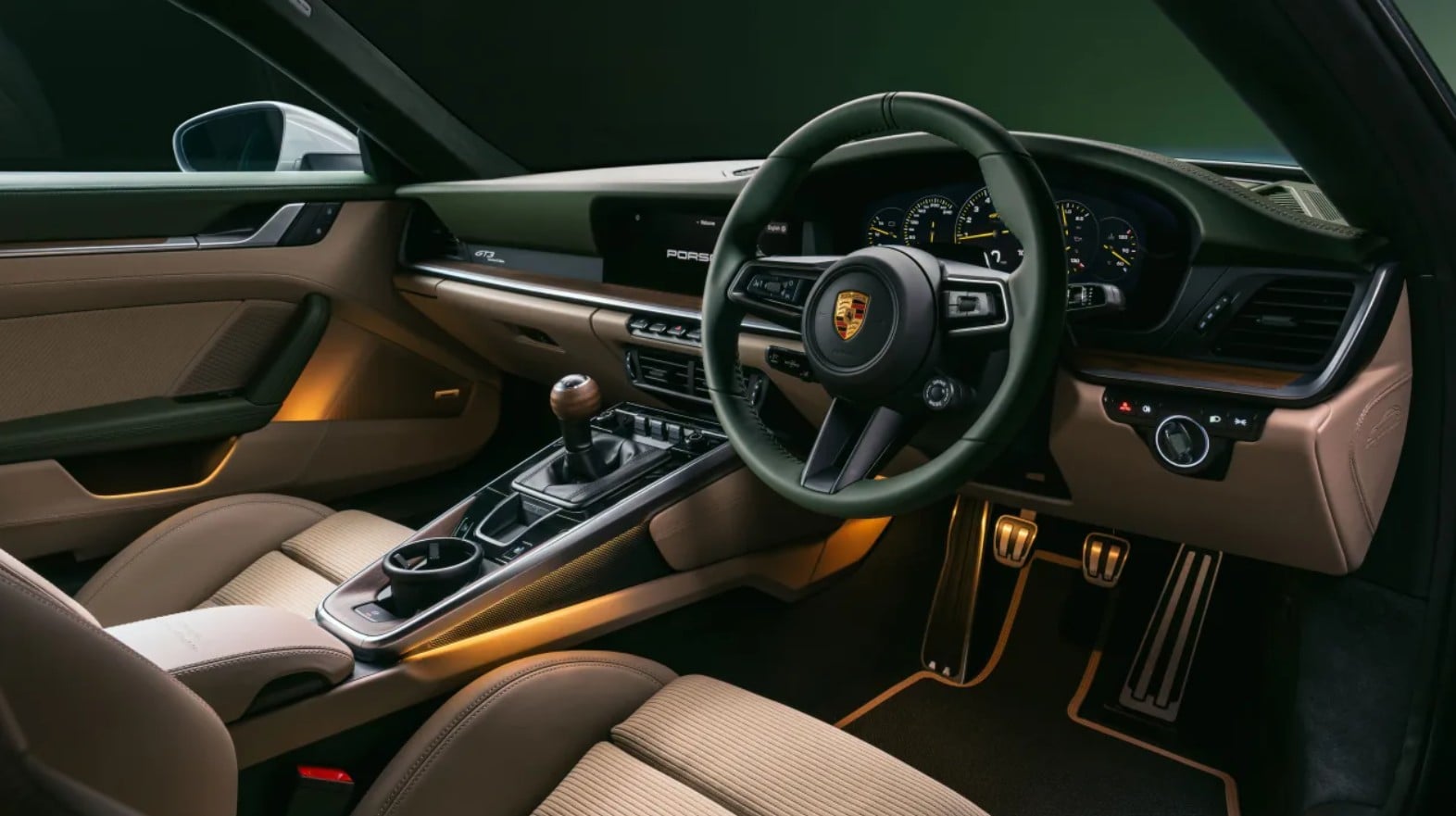
On the inside, Porsche has trimmed the Earls Court 51 Edition cars in Night Green and Chalk Beige leather, fitted adaptive sports seats with corduroy inserts and embossed Earls Court logos, and fitted wood dashboard trim with the ‘Earls Court 51 Edition’ motif.
Other interior changes include a matching Night Green owners manual sleeve, dashboard trim with an embossed 356 silhouette, Union Jack motifs on the sun visors, illuminated door sills with ‘GT3 Earls Court 51 Edition’ wording, and a wood-topped gear lever.
As well as the custom-configured vehicles, owners will also be presented with a Porsche Design Chronograph watch, featuring a dial inspired by the instruments from a 356, a matching Night Green Weekender soft bag, a 1:18 scale model of the 911 GT3 Earls Court 51 Edition, and a coffee table book detailing the development and build process for the special edition model.
Porsche Cars GB will also unveil a restored 1951 356, similar in specification to the cars presented in 1951.
The car itself has previously been displayed at Porsche’s UK head office and belonged to British racing driver Betty Haig. The left-hand drive model was first imported to the UK in the 1950s, finished in silver with a red leatherette interior.
Porsche has modified the car, now finished in Earls Court Green, with a Night Green and Chalk Beige interior plus a wooden gear lever and wood trim on the doors designed to align with the look of the anniversary special editions.
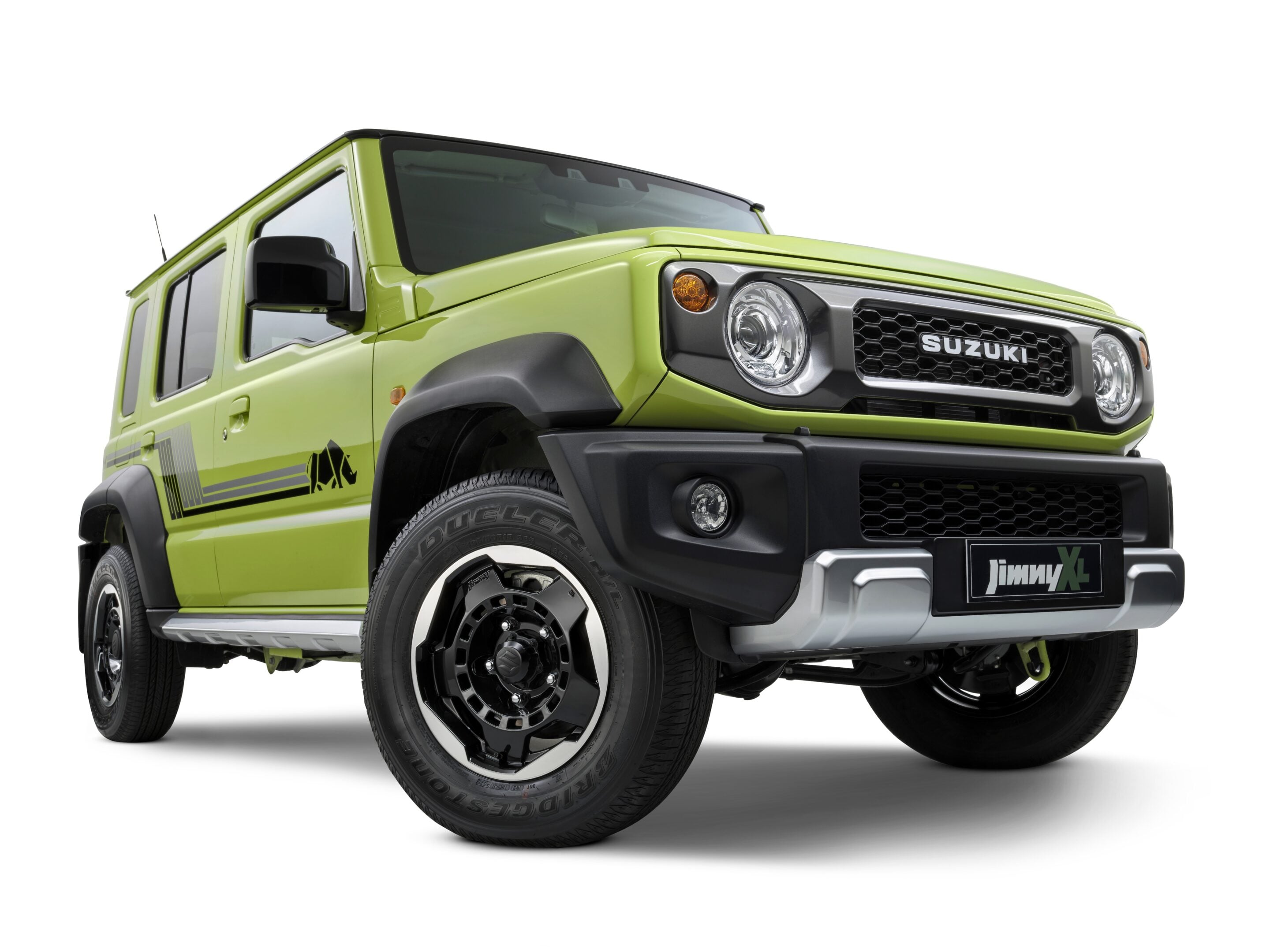
Suzuki Australia has announced a new special edition Jimny Rhino, which is now available to order in Australia. The Rhino is based on the five-door XL model and it adds a number of cosmetic upgrades compared with the standard model. Priced from $44,990 plus on-road costs, the Rhino asks $7500 more than the standard XL, and a full $13,000 more than the entry-level Jimny Lite.
The headline feature of the Rhino is the ‘Kinetic Yellow’ paint colour, which isn’t available on the regular XL, and is the only available colour option for the Rhino, paired with a black roof. There are unique decals on the sides of the Rhino, with “exclusive Rhino-themed side decals featuring a charging rhino motif accompanied by twin stripes that sweep rearward from the iconic Rhino logo.” The ‘サイ’ at the rear is the word rhino written in Japanese script.
Other exterior features include new 15-inch alloy wheels, satin silver side skirt and front bumper trims, a “heritage” front grille that’s available on other Jimny models as a dealer-fit accessory, mud flaps, a rhino badge on the rear and even LED puddle lamps.
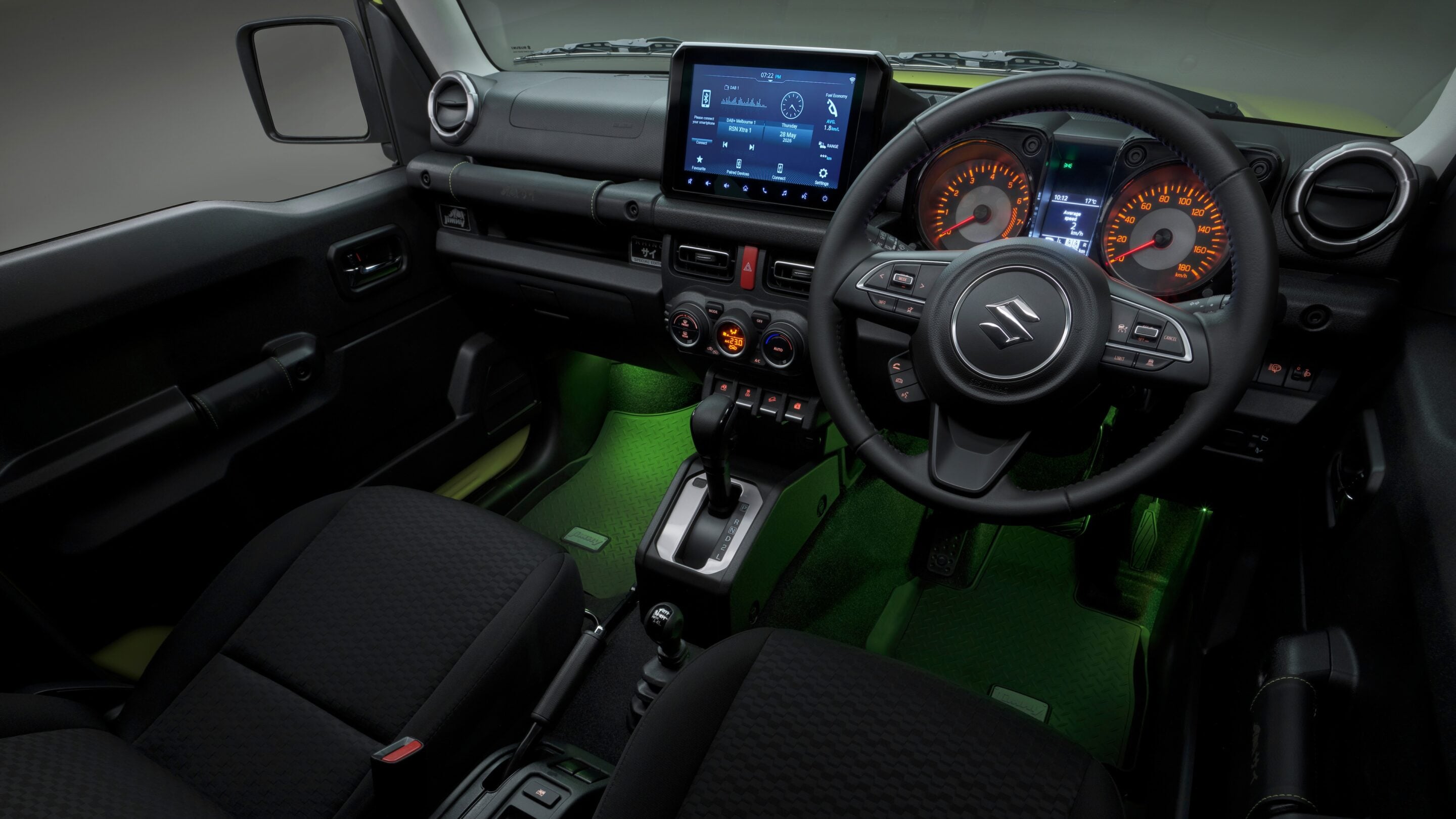
Inside, there are also upgrades to the Rhino, including black leather trims on the door handles and grab handles, a laser-etched Rhino logo and silver accents on the air vents and gearbox surround. Manual models also gain a retro-design shifter.
There is also LED ambient lighting — which can be set to the same Kinetic Yellow as the exterior colouring — as well as a four-speaker Pioneer audio upgrade and rubber floor mats.
Finally, each Jimny Rhino will also receive a ‘Rhino Go Pack’ with merchandise including:
- Rhino-branded metal key presentation case
- Rhino-branded key chain
- Bucket hat with Rhino Special Edition logo embroidered in Kinetic Yellow stitching
- Portable lantern with Rhino Special Edition logo in Kinetic Yellow
- Drink bottle with Rhino Special Edition logo
- Rhino-branded blanket
- Rhino-branded thermos tumbler
- Rhino-branded cooler box
- Portable Bluetooth speaker with Rhino Special Edition logo
- Rhino Rations: Koko Black 9-piece Dark Chocolate Pistachio praline box presented in a bespoke Rhino Special Edition branded sleeve
The Rhino’s new equipment is in addition to the standard features on the Jimny XL, which include dusk-sensing automatic LED headlights, remote central locking, heated/electric-folding mirrors, single-zone automatic climate control, a 9.0-inch touchscreen with wireless Apple CarPlay and Android Auto, autonomous emergency braking, lane departure warning and a reversing camera. The automatic also features adaptive cruise control.
Because the Rhino gives no mechanical upgrades to the standard Jimny, the 75kW/130Nm 1.5-litre naturally aspirated four-cylinder petrol engine remains unchanged, as does its part-time four-wheel drive system and either five-speed manual or four-speed automatic transmission options.
2026 Suzuki Jimny pricing (plus on-road costs):
| Lite 3-door 5-speed manual | $31,990 |
|---|---|
| Jimny 3-door 5-speed manual | $33,990 |
| Jimny 3-door 4-speed automatic | $36,490 |
| XL 5-door 5-speed manual | $34,990 |
| XL 5-door 4-speed automatic | $37,490 |
| Rhino 5-door manual | $44,990 (new) |
| Rhino 5-door automatic | $47,490 (new) |
The Suzuki Jimny Rhino is now available to order, except in Queensland and Northern New South Wales, where the company uses a different distributor.
A significant update for the Geely EX5 electric mid-size SUV has been revealed through the Chinese Ministry of Industry and Information Technology with updated styling, more power and even a switch to a rear-wheel drive drivetrain that replaces the current model’s front-wheel drive layout. It’s yet to be confirmed for markets outside of China, though given the popularity of the current EX5 in Australia, we’re expecting it to launch locally eventually.
Outside, the updated EX5 sports new front end styling with a new bumper design for a bolder and more characterful look. The side air intakes have been made larger than the current model, and a satin chrome finish has been added as well.
There are new alloy wheel designs in both 18- and 19-inch sizing, while the EX5 has also gained regular door handles to comply with new Chinese regulations banning the pop-out handles that feature on the current EX5. At the rear, the EX5 is largely unchanged, aside from the Geely name now spelt underneath the tailights.
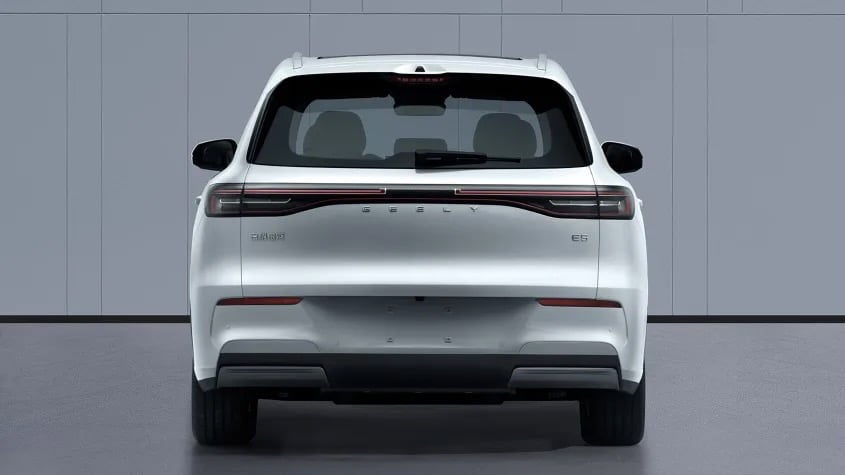
We can also spot a LiDAR sensor on the roof, which suggests that the EX5 will gain a Level 3 autonomous driving system in its home market, but that likely won’t spread to the Australian market.
Under the skin, the EX5 has gained a new 245kW motor, which is a lot more powerful than the current 160kW unit, and it’s now located on the rear axle and not the front. Geely is yet to confirm if the bump in power will improve acceleration, but the top speed has reportedly risen from 175km/h to 200km/h.
The Chinese documents did not confirm battery sizes, but the current EX5 uses 68kWh battery in Australia with a claimed WLTP range of between 450km and 475km. Smaller 50kWh and 60kWh batteries are offered in overseas market EX5s as well.
Geely Australia is yet to comment on the updated EX5 and if it will be sold locally, but we’d be surprised if we didn’t see it before the end of 2026.
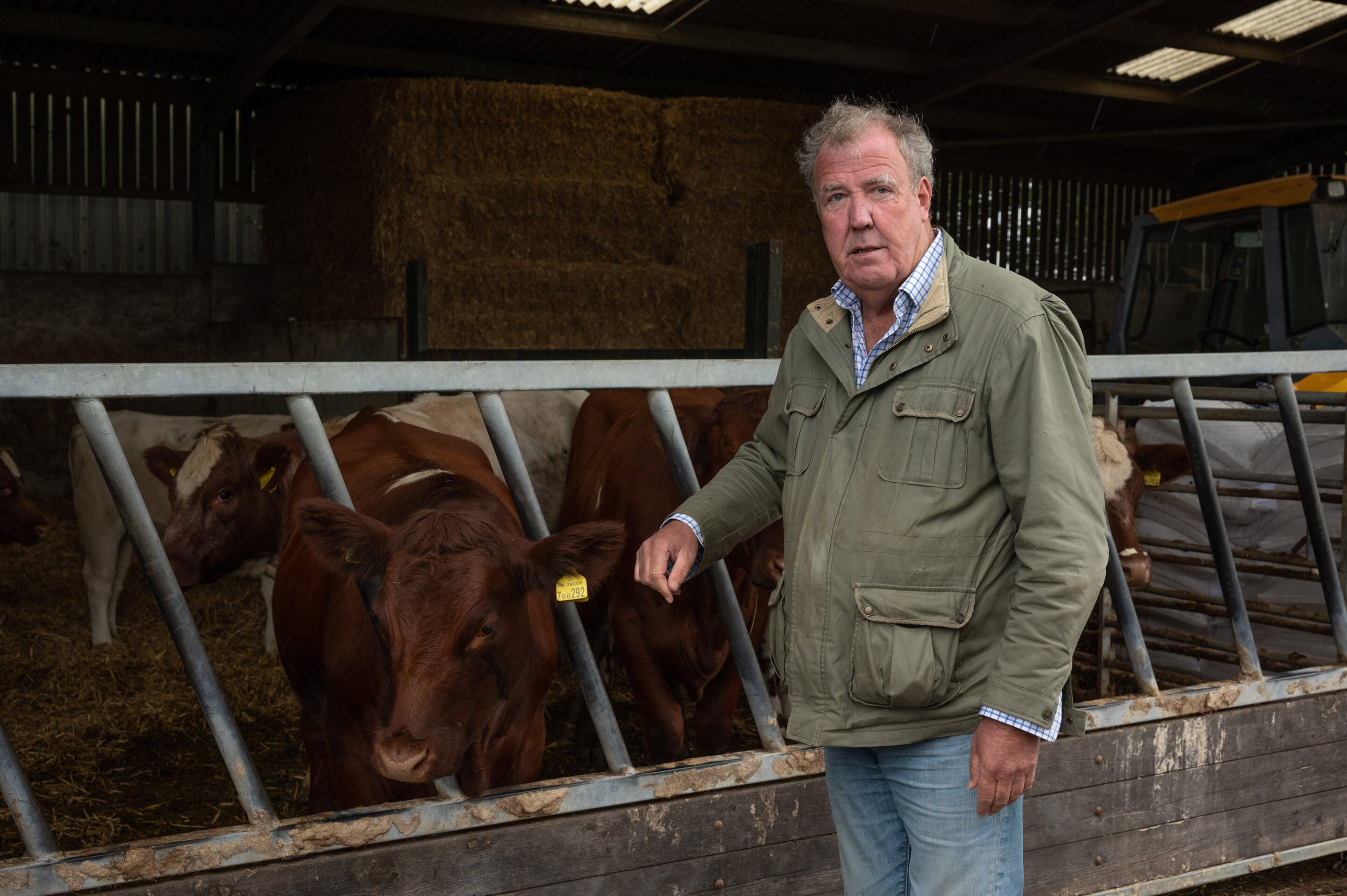
Jeremy Clarkson has revealed he has been diagnosed with cancer, with the former Top Gear and The Grand Tour presenter sharing the news during the latest season of Clarkson’s Farm.
The 66-year-old disclosed the diagnosis during an emotional conversation with farm manager Kaleb Cooper in one of the final episodes of the Amazon Prime series.
Clarkson explained that the cancer was discovered following medical testing earlier this year and described it as aggressive, although detected at an early stage.
“I’ve got cancer,” Clarkson told Cooper while discussing the year’s farming challenges.
According to Clarkson, doctors identified the illness after he underwent a biopsy following a medical examination. He said treatment would likely take place during a critical period on the farm, creating further challenges during an already difficult year.

The diagnosis comes after a series of well-publicised health issues for Clarkson. In late 2024, he revealed he had undergone heart surgery after experiencing symptoms linked to coronary heart disease, a condition he also referenced during the Clarkson’s Farm episode.
“So we started the year and I had coronary heart disease and ended it with me with cancer,” Clarkson said.
The television personality was recently the subject of the Wheels Interview, talking about the continued success of Clarkson’s Farm and his evolving relationship with motoring, farming and life away from television’s traditional studio environment. The series has become one of Amazon’s biggest global hits, introducing Clarkson to a broader audience beyond the automotive enthusiasts who first came to know him through Top Gear.
Clarkson said he had been aware of the diagnosis since May and was hopeful treatment would be successful, with further medical testing scheduled to monitor his progress.
Ahead of the release of the final episodes, Clarkson warned viewers they would be markedly different from the show’s usual tone.
“Ordinarily, we try to keep the show light and cheerful,” he said in a video shared on social media. “The final two episodes are a difficult watch.”
Clarkson’s Farm has become known for its mix of humour, agricultural challenges and personal moments, but the latest season is set to reveal one of the most significant challenges Clarkson has faced both on and off screen.
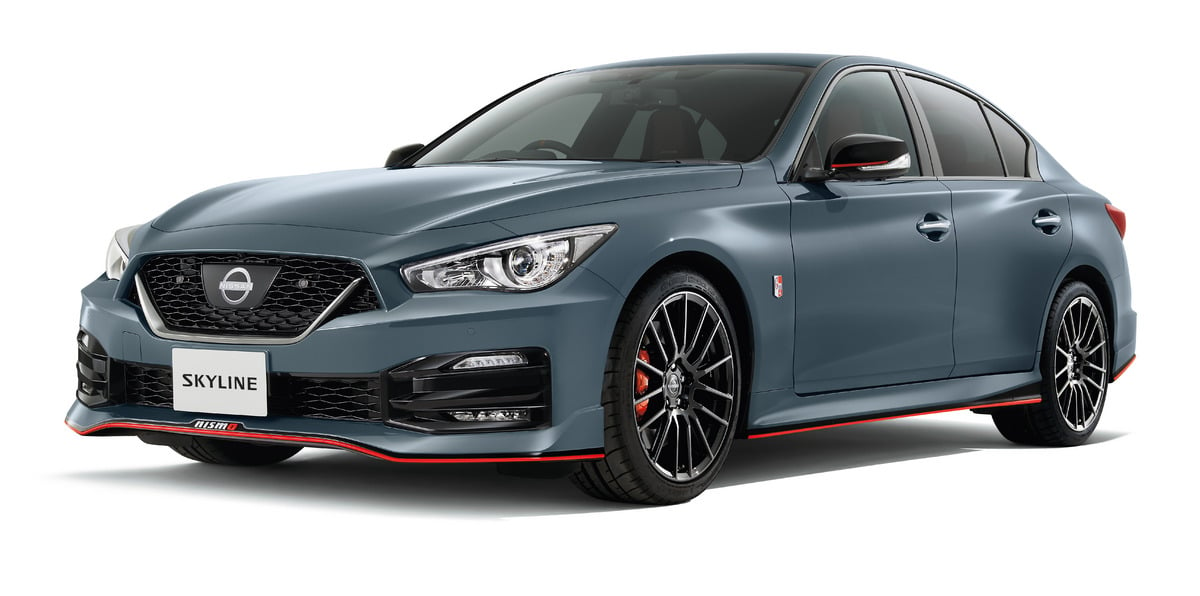
Nissan is set to adopt a dramatically shorter development cycle for its upcoming 14th-generation Skyline sedan.
The new Skyline, first announced with a teaser image in April 2026 (main), is set to be revealed as a production preview by the end of this year or early in 2027, according to Nissan CEO, Ivan Espinosa.
In an interview with Nikkei Asia, Esinposa revealed that the Skyline would be revealed during the coming Northern Hemisphere winter (December to February), thanks to an accelerated development cycle. To do so, design and testing have been overhauled with the use of emerging technologies.
“A big part of this is built on AI capabilities and the utilisation of new tools, more digital tools in the design phase, in the testing phase, in the manufacturing phase,” Espinosa said.
As part of a major restructure to return the brand to profitability, announced in 2025, Nissan pledged to trim average vehicle development timelines from 37 months to 30 months. In the case of the new Skyline, Nikkei Asia reports that the previous generation’s 55-month development has been cut to just 26 months.
Nissan’s accelerated development strategy stems from its joint venture program with Chinese automaker Dongfeng. The Nissan N7 sedan, with development led by Dongfeng, took just two years.
“China is, as of now, setting the industry standards of the future in terms of technology, in terms of cost competitiveness and in terms of development time,” Espinosa said.
The outgoing Skyline, which was sold in Australia as the Infiniti Q50 between 2014 and 2019 (below), has now been in production for 12 years – almost twice as long as a traditional passenger car model cycle.
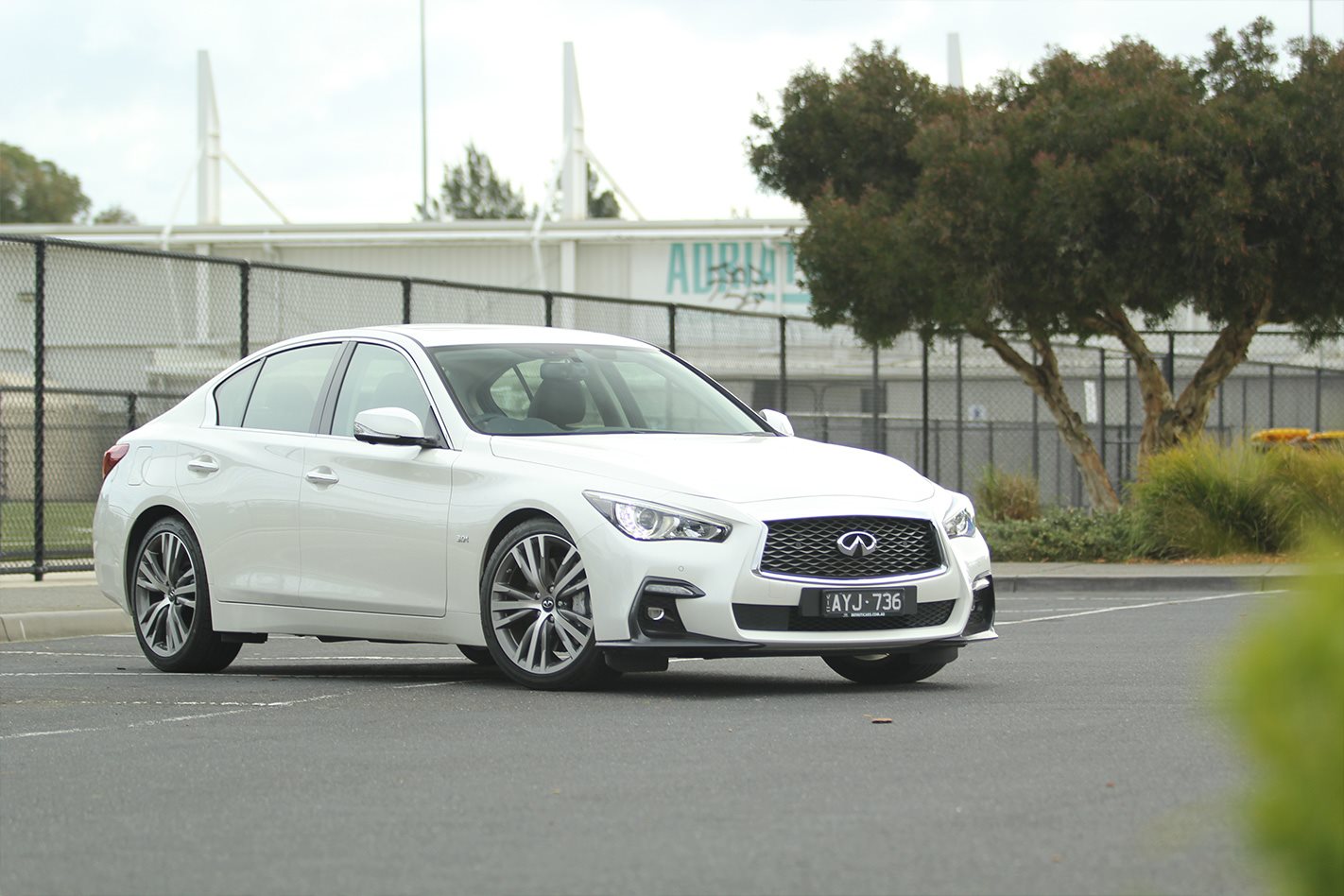
Its replacement is rumoured to adopt the twin-turbo V6 from the Nissan Z coupe, itself a development of the engine from the current Q50 Red Sport, bringing the possibility of a manual transmission, though it will likely be reserved for a flagship Nismo version rather than fitted across the range.
Although not yet fully revealed, Nissan has hinted that the new Skyline will take cues from models of the past, most prominent of which are the four circular tail lights seen through the model’s past iterations.
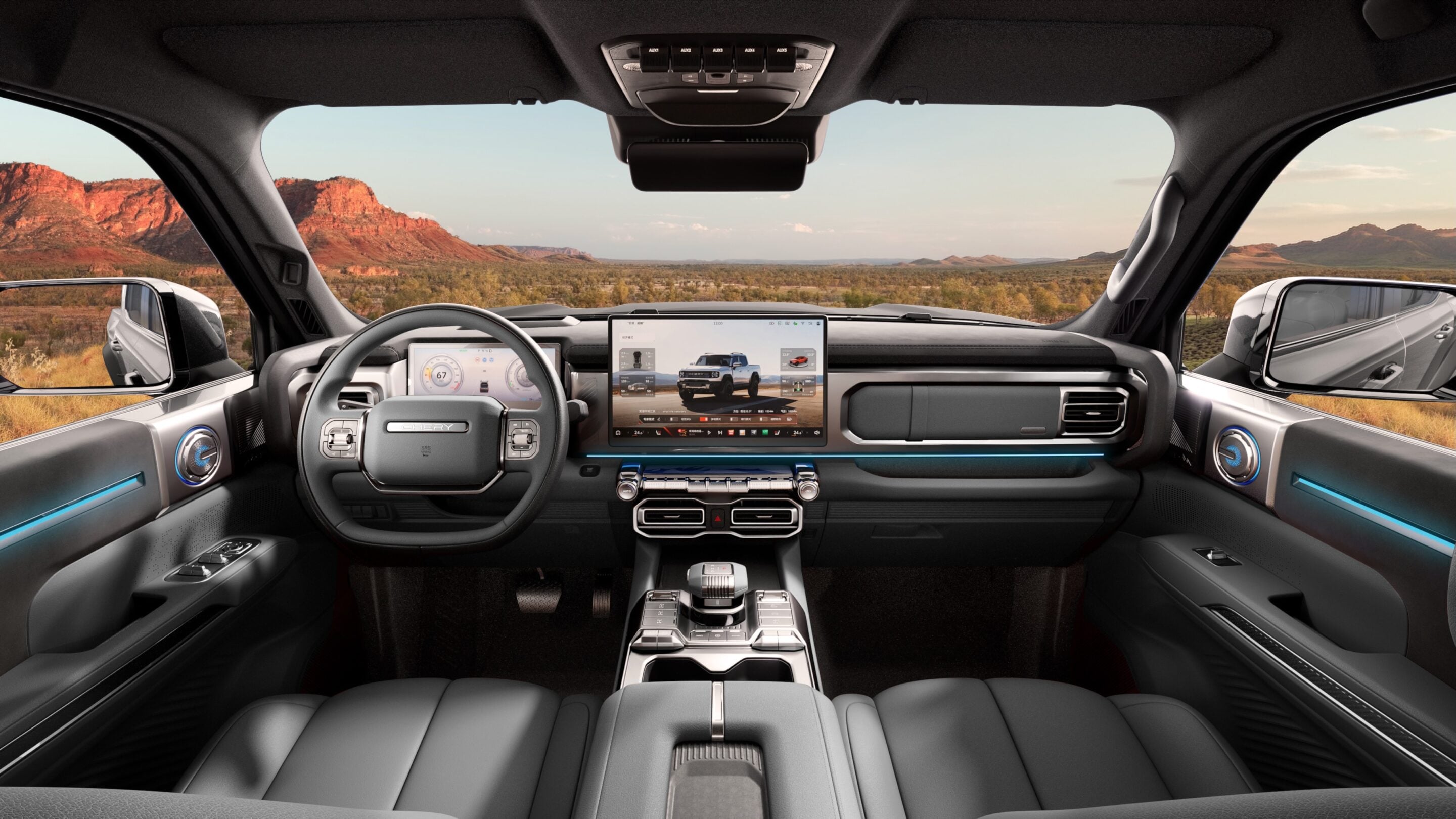
The name of Chery’s first Australian ute, formerly known as the KP31, has finally been revealed after a public competition to decide on a locally relevant moniker.
To be known as the Stockman, the name was submitted by Victorian Steve Kodikara, who will receive a free Stockman when it becomes available. The name received over a quarter of votes when the final eight names were put to the public to choose their favourite. The Stockman is due to launch in Australia before the end of 2026.
According to Chery, the name is inspired by the “resilience, dependability and hard-working spirit of Australia’s stockmen” and “reflects the characteristics Chery believes define its first ute: capability, endurance and versatility across a wide range of Australian conditions.”
“I’m incredibly honoured that Stockman was chosen from the thousands of entries submitted to title Chery’s new ute,” said Kodikara.
“I felt the name captured the spirit of Australia’s original workhorse and everything a ute should represent: reliability, capability and resilience. I’m glad it resonated with Australians, and I’m thrilled to see it become part of Chery’s story.”
“The response to this competition exceeded our expectations and showcased just how passionate Australians are about utes,” said Lucas Harris, Chief Operating Officer, Chery Australia. “Stockman stood out because it captured something uniquely Australian while reflecting the capability, reliability and innovation behind our upcoming ute. Steve’s submission brought the name to life through a compelling story, connecting Australia’s heritage with the next generation of ute technology.”
Stockman emerged from a shortlist that included Outrider, Orca, Ironbark, Bushwalker, Longreach, Ridgeback, Terra and Mate. It ultimately received more than 25 per cent of votes cast by over 12,000 Australians during the public voting phase.
As announced earlier in 2026 when it was revealed, the Stockman will be the first ute on the Australian new car market to offer a diesel plug-in hybrid drivetrain, with a petrol PHEV variant due later on.
More details about the Chery Stockman will be announced closer to its market launch in late 2026.
The 2027 Audi A6 allroad quattro has made its international debut, marking the fifth iteration of Audi’s SUV-styled crossover wagon.
Based on the 2026 A6 Avant wagon, the A6 allroad takes a more rugged approach with air suspension that sits 35mm higher than the regular A6 at its normal height. The adaptive system features 55mm of height adjustment, 25mm greater than the A6.
The A6 allroad also features beefier widebody styling, some 111mm wider than the car it’s based on and 84mm wider than the previous A6 allroad. The aggressive styling gives a strong hint at what Audi has in store for the high-performance RS7 Avant.
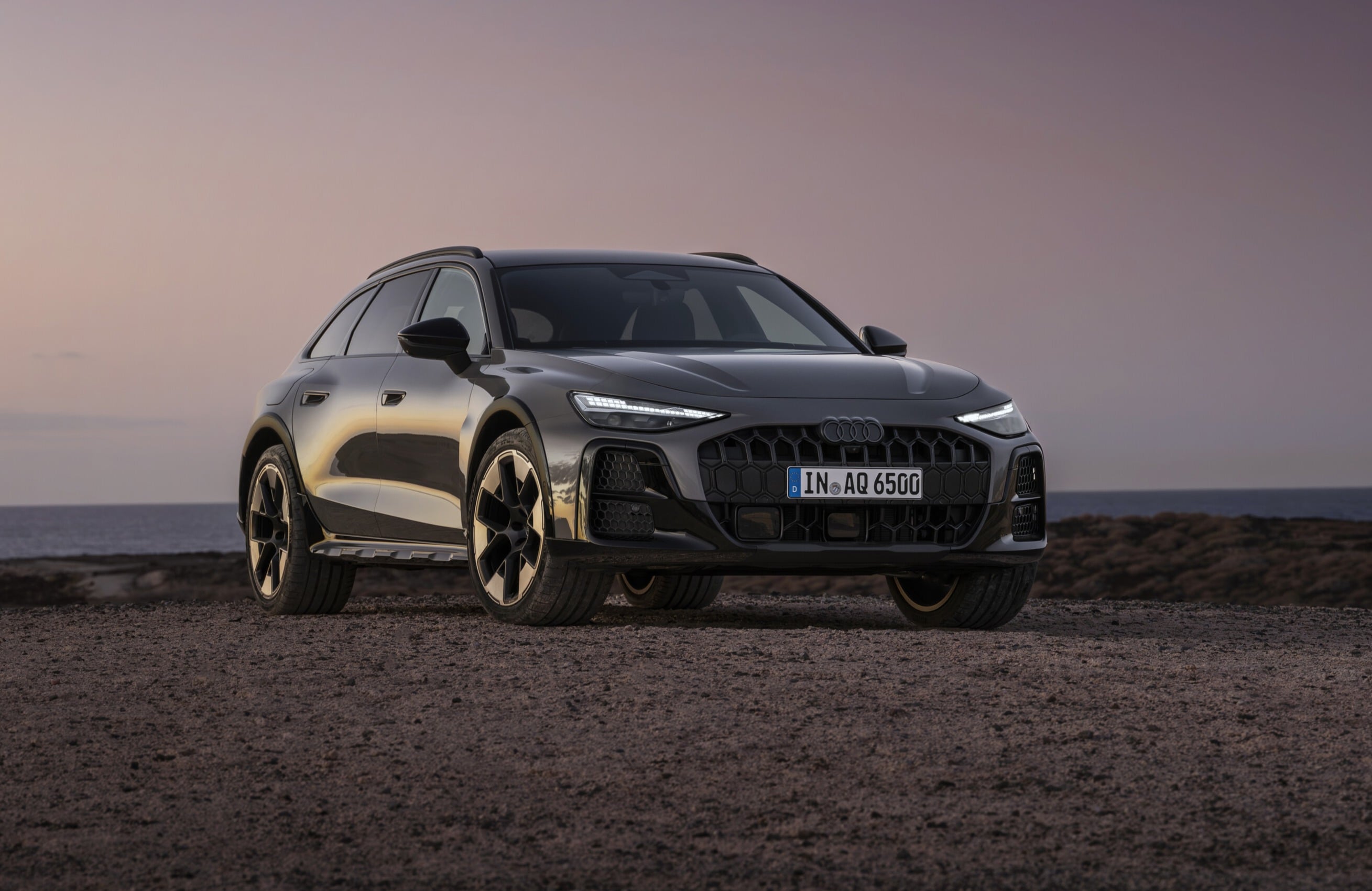
The off-road styling is further differentiated with slim wheel arch extensions, large bumper trims front and rear, and notched side sills available in black or with silver and aluminium highlights. Alloy wheels from 19 inches up to 21 inches are available with tyres ranging from 265/45 R19 to 285/35 R21 in size, the latter aimed at on-road dynamics rather than off-road traction.
From launch, two powertrains will be offered. The entry-level option is a 220kW/580Nm 3.0-litre turbo diesel V6 with mild hybrid, while plug-in hybrid will be optional on the allroad for the first time, with a 270kW/500Nm claimed combined output from a 185kW 2.0-litre four-cylinder turbo petrol and 105kW electric motor.
Acceleration from 0-100km/h in the hybrid takes a claimed 5.5 seconds, with up to 95km of WLTP electric-only range and fuel consumption from 2.6 to 2.9L/100km when fully charged or 7.2 to 7.7L/100km once the hybrid battery is depleted. The 3.0-litre V6 has a slightly quicker 5.4-second sprint to 100km/h and has a claimed fuel use of 5.8 to 6.4L/100km depending on specifications.
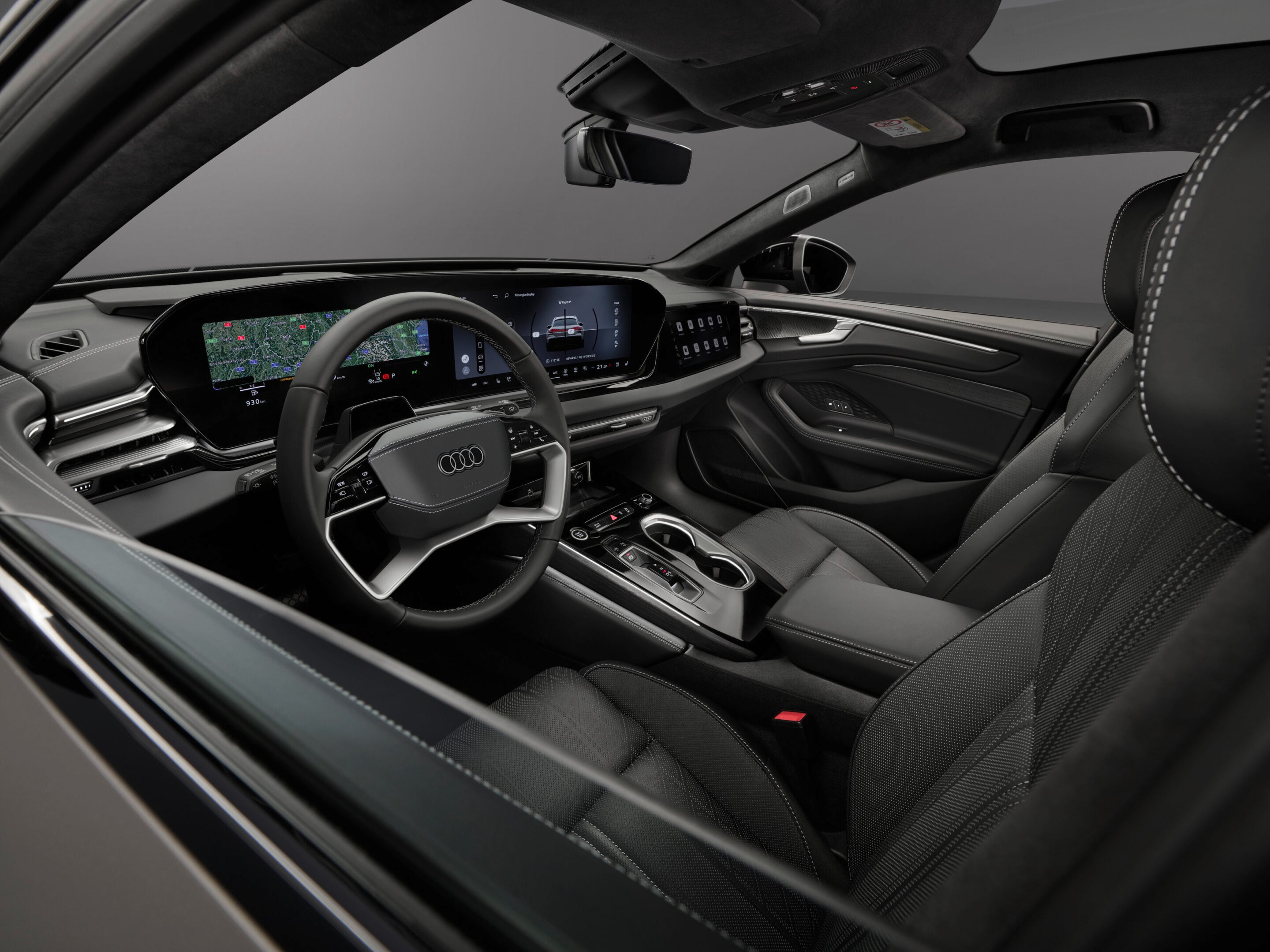
Audi has overhauled the steering for a more direct feel with a stiffer mounting path between the steering wheel and front wheels. The A6 allroad comes standard with progressive rate steering, and the plug-in hybrid features standard four-wheel steering, which is optional on the diesel.
Brake-by-wire with blended braking removes the physical connection between the brake pedal and brake booster to allow a greater range of regenerative braking for both the mild-hybrid and PHEV versions. Regenerative braking is used in most situations, with physical braking now reserved for emergency stops. Up to 25kW can be harvested by the mild-hybrid and 88kW by the PHEV.
The interior of the A6 allroad follows the design direction set by the regular A6 range, including an 11.9-inch digital instrument display, 14.5-inch infotainment, and an optional 10.9-inch passenger screen.
The system can be accessed via the touchscreen, capacitive buttons on the steering wheel, or through voice commands with ChatGPT integration. Outside of the navigation and infotainment, voice control also allows some driver-assist functions, like adaptive cruise control, to be engaged via spoken instructions.
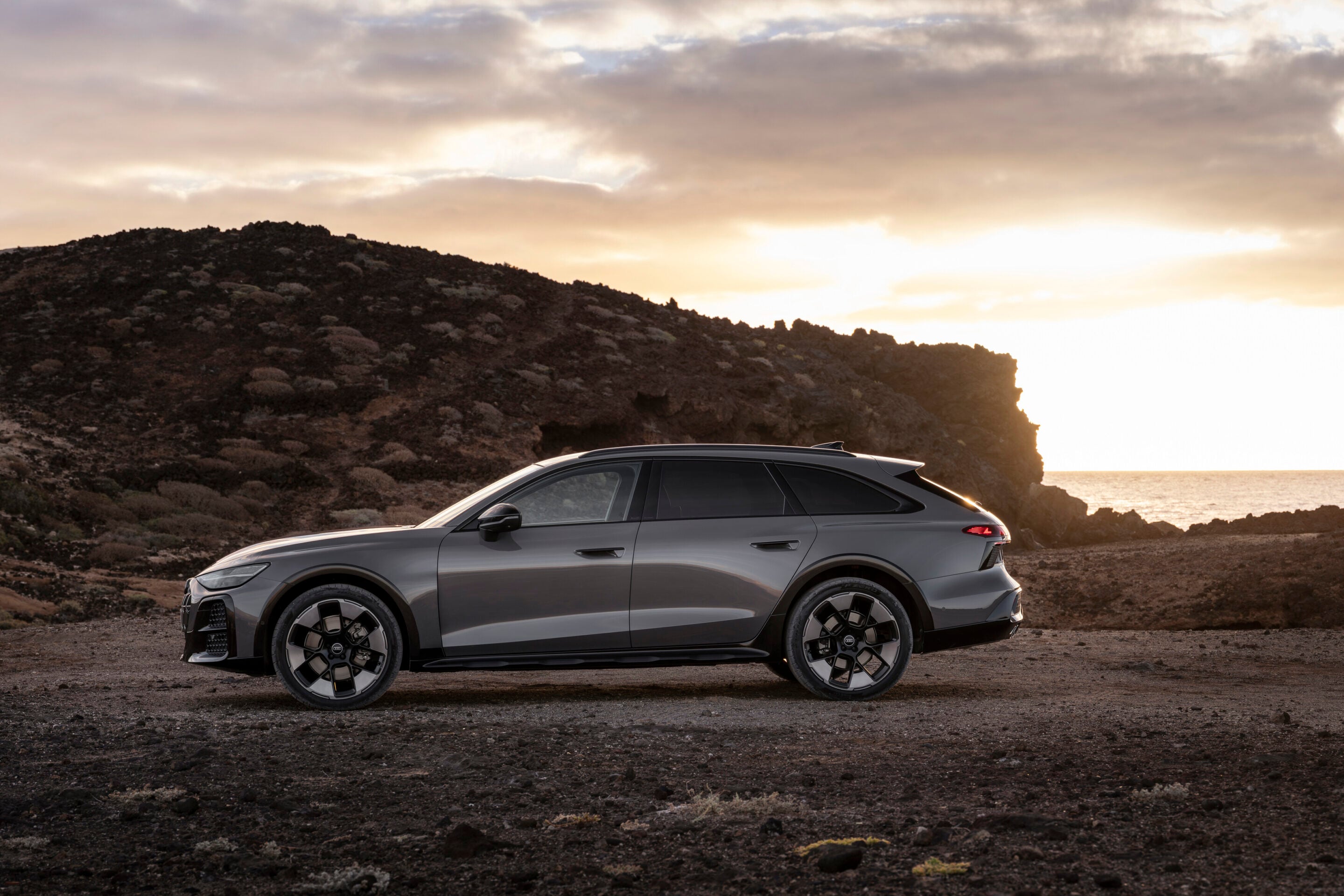
The A6 allroad comes with sport seats and available features including heating, ventilation, and massage, an electrochromatic panoramic glass roof, four-zone climate control, soft-close doors, and Bang & Olufsen 3D surround sound.
Audi’s matrix LED headlights include adaptive lighting that can adjust to weather conditions and illuminate an adjacent lane when merging, plus features lane-marking projections and dynamic start-up animations along with user-customisable running light signatures.
Cargo capacity of the V6 TDI model outranks the PHEV slightly, with between 466 litres and 1497 litres depending on rear seat position, which drops to 404L to 1423L in the PHEV. Towing capacity for the PHEV is also slightly lower at 2000kg, compared to 2500kg for the diesel.
Audi has not yet confirmed the new A6 allroad quattor for Australia, but says the model is under evaluation for the Australian market. Other new-generation models in the A6 range, including the A6 Avant and A6 e-tron sedan, are yet to launch in Australia.
Hyundai Australia has revealed a new special edition of its i20 N hot hatch called the Shadow Edition. The i20 N Shadow Edition is limited to just 100 units and is priced from $41,500 plus on-road costs, which is $3000 more expensive than the regular i20 N.
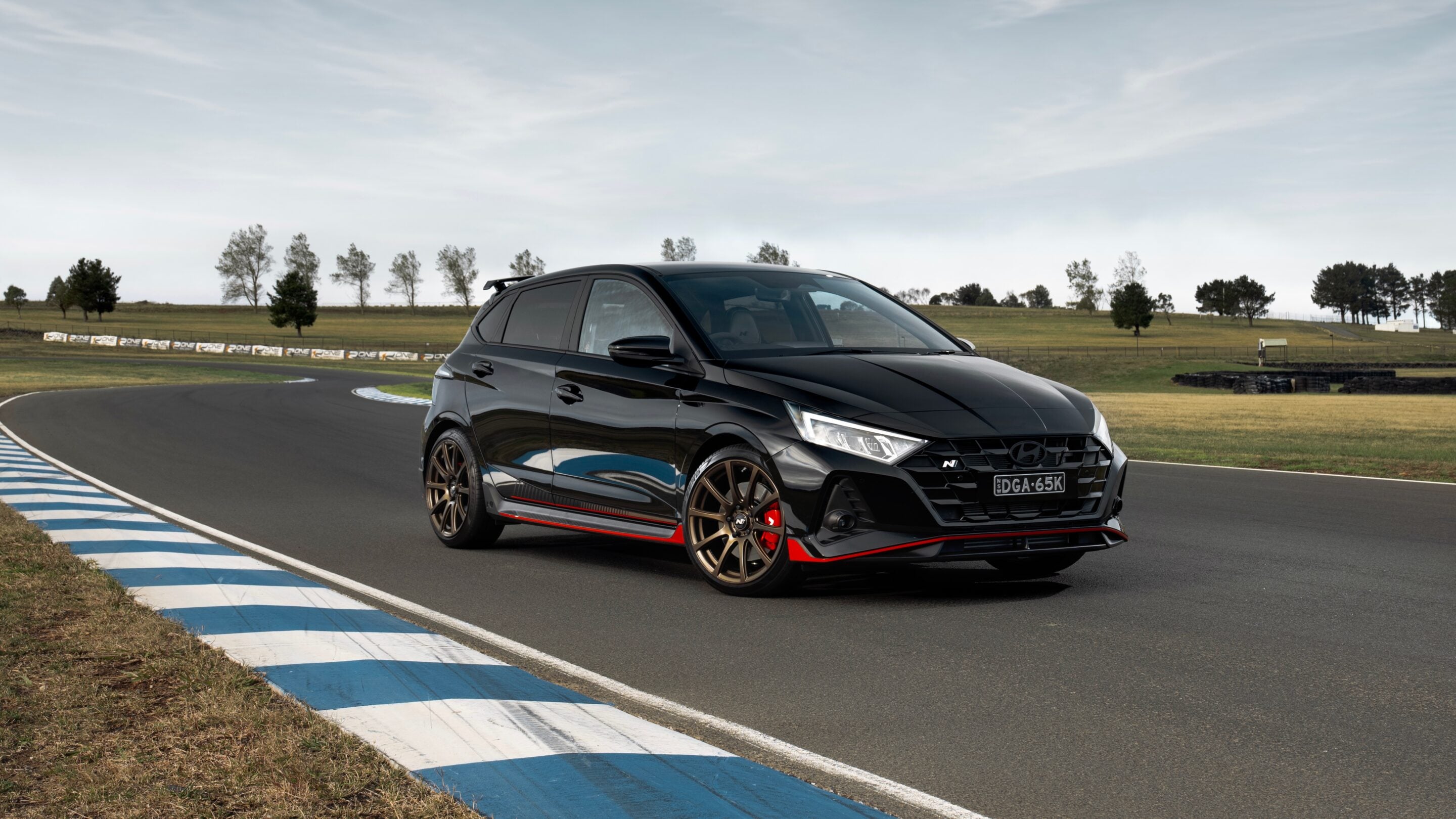
Created to celebrate the end of the current-generation of i20 N, the Shadow Edition adds a number of new features like a suede steering wheel, bronze alloy wheels and special detailing.
Above the regular i20 N (of which some units are still left in stock) the Shadow Edition adds matte bronze 18-inch alloy wheels, black wheel nuts and bronze lower door decals. The exterior paint is only available in either Atlas White or Phantom Black colours, with the latter adding $595 to the cost.
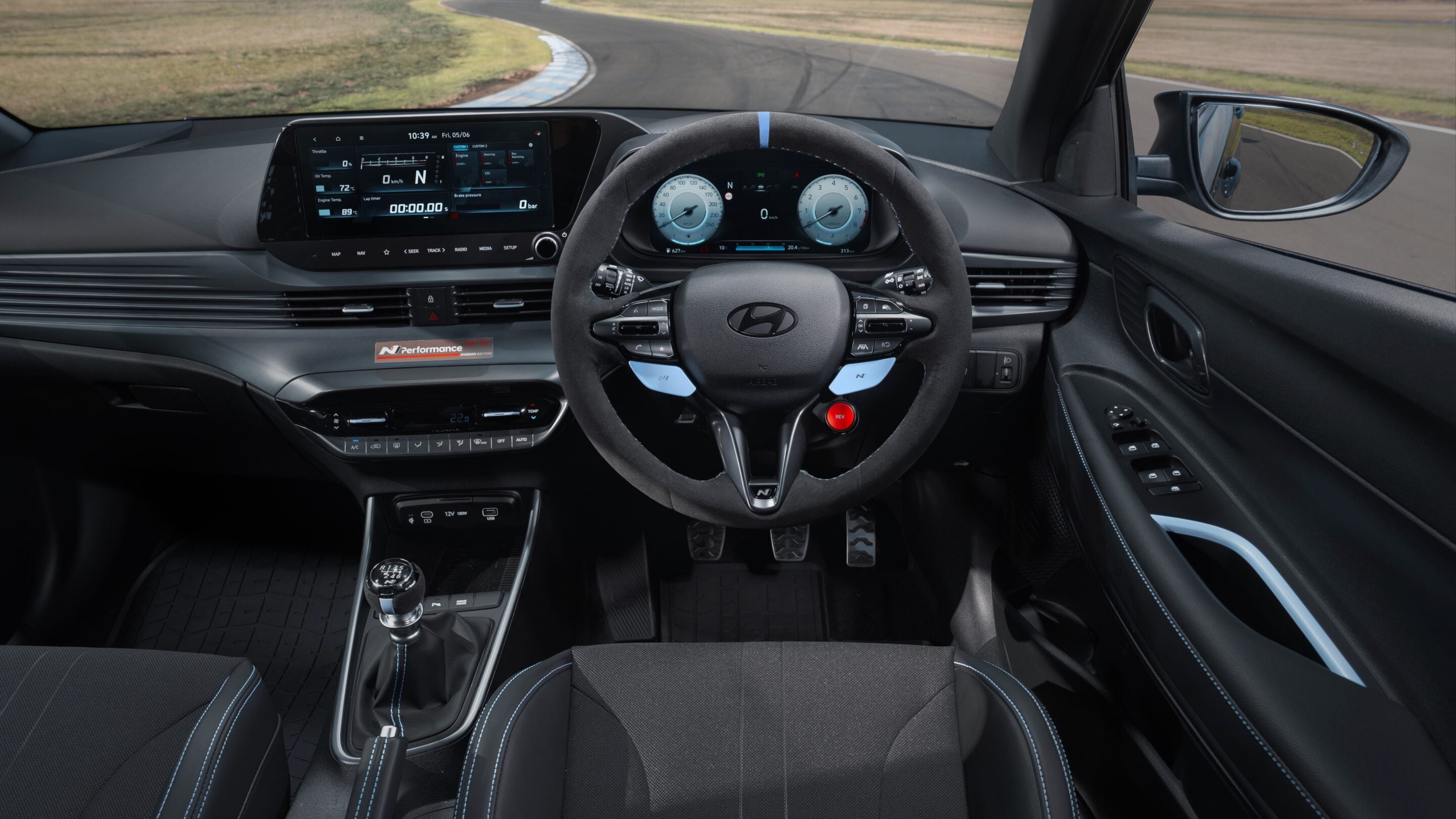
Inside, the Shadow Edition further adds a suede steering wheel rim and gear knob, a numbered plaque on the dashboard and unique rubber floor mats featuring the Pirelli P Zero tread pattern.
That’s on top of the regular i20 N’s standard equipment list, including automatic dusk-sensing LED headlights, sports seats with cloth and synthetic leather trim, twin 10.25-inch displays, single-zone automatic climate control, various N modes and safety features like autonomous emergency braking, adaptive lane guidance, blind-spot monitoring, rear cross-traffic alert and a reversing camera.
The 1.6-litre turbo-petrol engine is unchanged compared to the regular i20 N, making 150kW of power and 265Nm of torque. It’s mated to a six-speed manual transmission and power is sent to the front wheels. Combined fuel consumption is rated at 6.9L/100km and CO2 emissions at 157g/km.
Production for the current i20 N ceased earlier this year in March, and while the next-generation regular i20 has just been revealed, the N model is yet to debut. Its timing is yet to be confirmed, though the company has previously suggested that it will move to a hybrid drivetrain to meet emissions laws, which could cost it its six-speed manual transmission.
The Hyundai i20 N Shadow Edition is available to order now ahead of local deliveries commencing soon.
One in four or 25 per cent of Australian drivers warn other motorists about the presence of law enforcement by flashing their headlights despite the practice lying in a legal grey area.
That’s the finding from a survey of 1000 Australian drivers by financial comparison tool Money.com.au, which also found that 36 per cent only signal when there’s a genuine road hazard, like an accident, breakdown or animal on the road.
According to Money, it also found that 25 per cent regularly warn other drivers about speed cameras or police presence, 39 per cent never signal other motorists at all and among drivers who do signal, 66 per cent are aware the practice could be illegal.
Money‘s Head of Insights, Sean Callery, says the findings reveal a significant gap between what drivers consider common courtesy and what the law may allow. “Many drivers flash their headlights to help fellow motorists avoid a fine, and some see it as the Australian thing to do. But the irony is that the gesture itself could backfire because of this driver-to-driver courtesy. Drivers trying to save someone else from a costly penalty could find themselves on the receiving end of one instead,” he said.
“For some Aussies, there’s a stronger case for warning drivers about a hazard ahead than a speed camera. If alerting another motorist of an accident, a stranded vehicle or an animal on the road, many would see that as both a road safety benefit and a way to avoid potentially costly vehicle damage.”
Among drivers who signal other motorists, two-thirds are aware that the practice could be considered illegal in some circumstances. The remaining 34 per cent said they were unaware of the potential legal implications.
According to Money, while there’s no law that explicitly prohibits drivers from flashing their headlights to warn other motorists, the Australian Road Rules (ADRs) state that drivers must not use their vehicle’s lights in a way that dazzles or is likely to dazzle another road user. Drivers are also prohibited from using high-beam headlights when travelling within 200 metres of a vehicle ahead or an oncoming vehicle.
The survey also revealed differences between age groups. Millennials are the most likely generation to regularly warn other drivers about speed cameras or police presence, with 30 per cent admitting they do so. That’s compared with 27 per cent of Gen Z, 23 per cent of Gen X and 21 per cent of Baby Boomers.
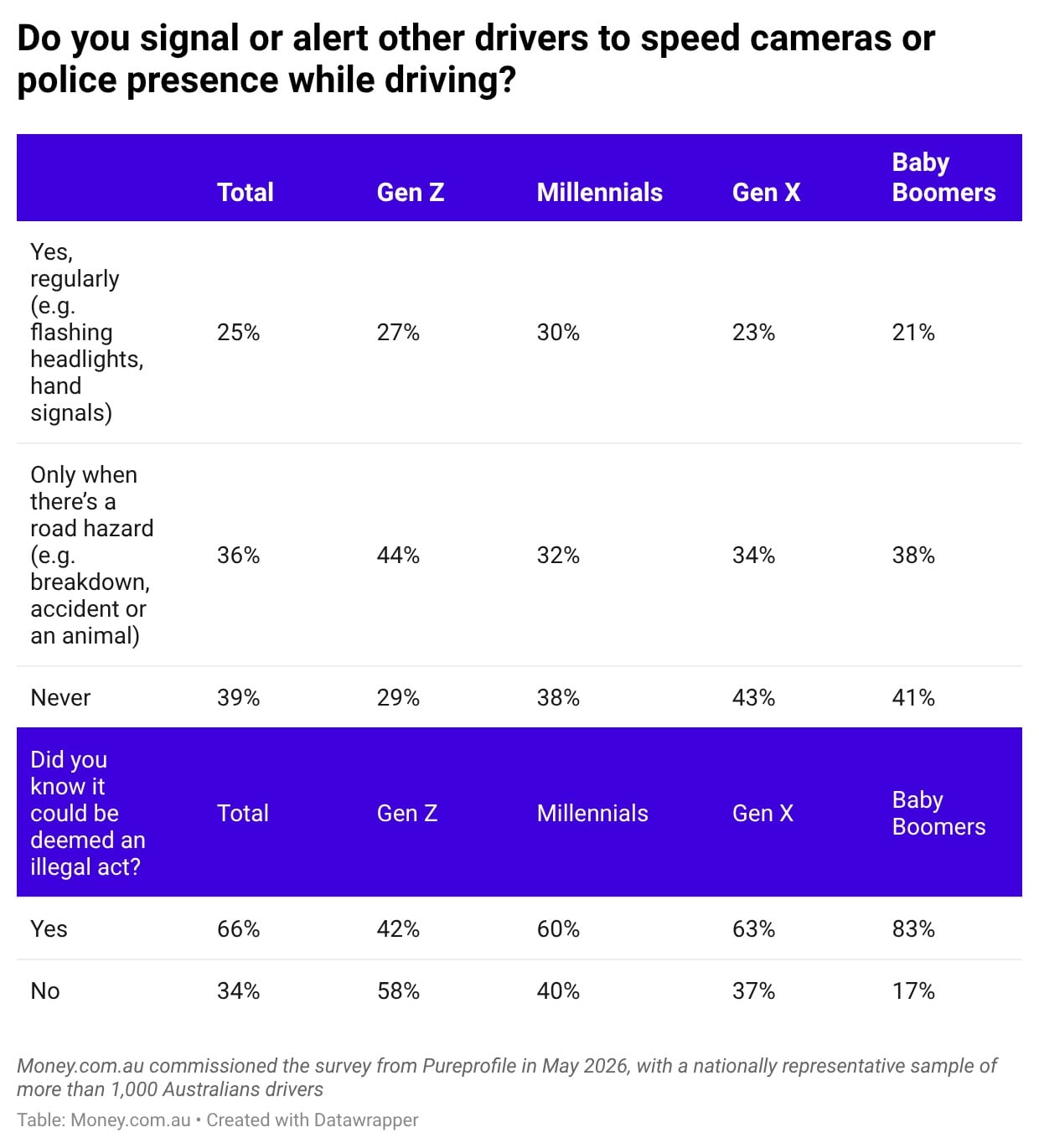
However, Gen Z drivers (44 per cent) are the most likely to use headlight flashes or other signals to warn fellow motorists about genuine road hazards rather than speed cameras or police presence. They are followed by Baby Boomers (38 per cent), Gen X (34 per cent) and Millennials (32 per cent). Gen X drivers are the most likely to keep to themselves on the road, with 43 per cent saying they never signal other motorists about speed cameras, police presence or road hazards. That’s higher than Baby Boomers (41 per cent), Millennials (38 per cent) and Gen Z (29 per cent).
The full results of Money’s survey can be found here.
