Features

Gallery 1
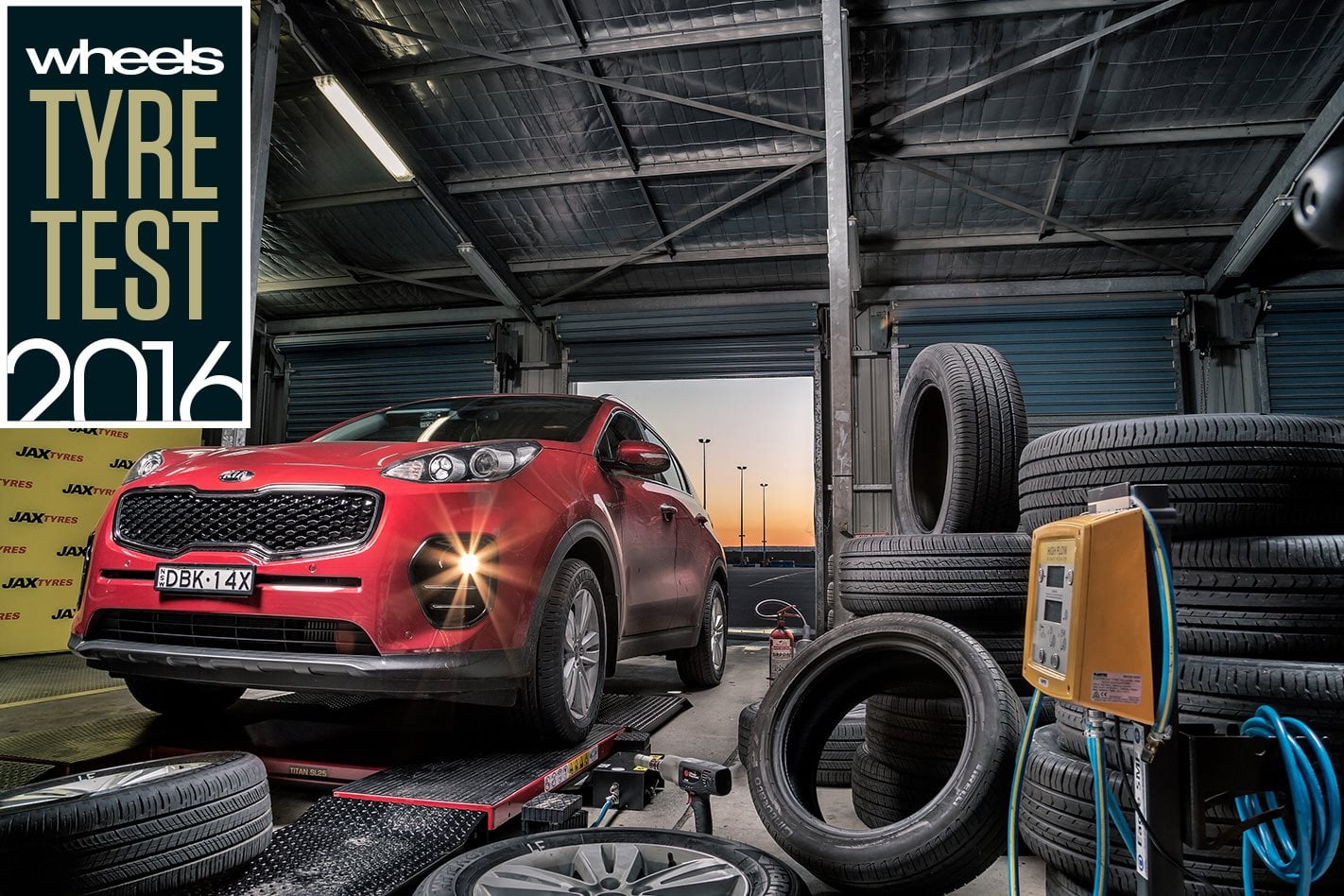
Tyres are not just black and round, they’re also a black art. But we’ve done the science to help pick the best replacement tyre for your SUV.
THE most effective handling upgrade you can give your sports utility vehicle is fitting a road-biased set of tyres in place of the all-surface rubber that carmakers specify as part of the light off-roading SUV promise.
And while the proliferation of the front-drive SUV has seen many makers take this measure into their own hands, the factory-issue boots on many soft-roaders still leave room for improvement.
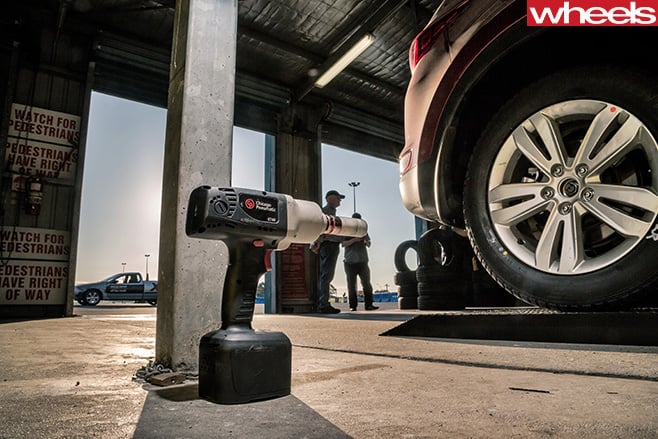
An SUV has a higher centre of mass than a regular sedan or wagon, but canny chassis tuning with electronic aids and safety systems means today’s breed is a decidedly safer – and more satisfying – steer than those of a decade ago. With a great set of tyres factored in, it’s a recipe for a safe family machine.
For those who see the value in putting a good quality product between their car and the road, which brand and pattern is best? The 2016 Wheels Tyre Test sets out to deliver the answer.
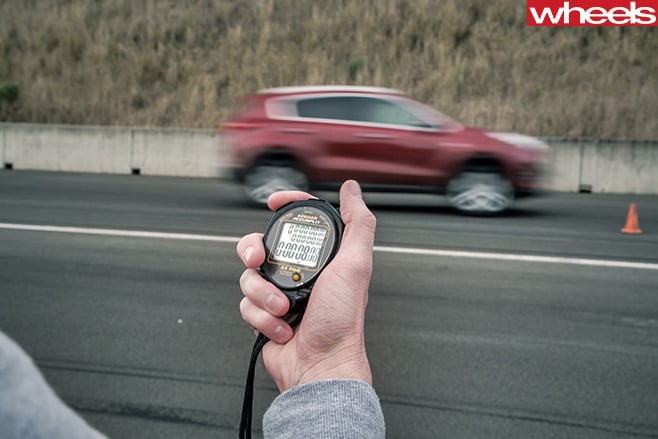
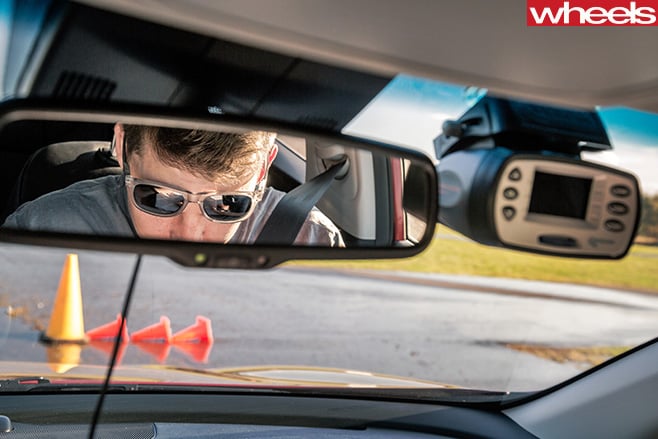
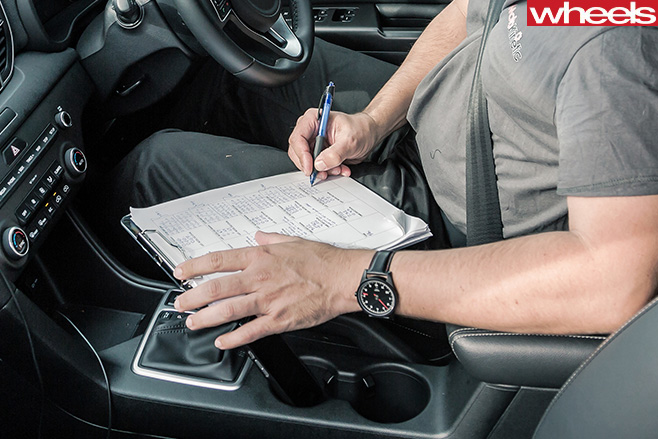
Loberto was flying blind, not knowing what brand he was on, which left him to provide insightful feedback uncoloured by brand perception or bias, while the stopwatches and Racelogic Performance Box spat out the data.
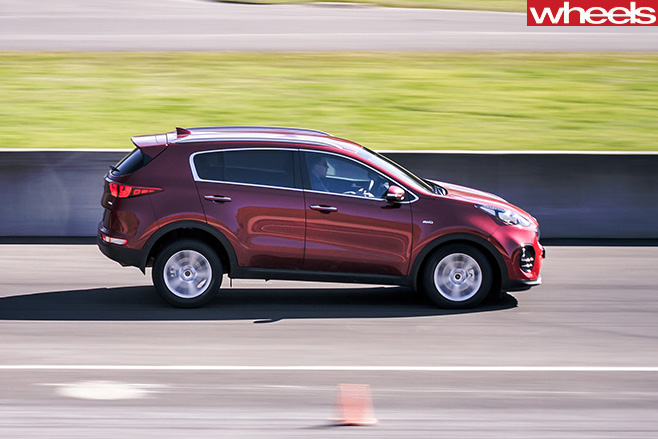
Testing began with a road loop to scrub the surface of the tyres and let us record a noise figure for each set. Loberto then rolled into the slalom and braking test elements at the grippy far end of the strip before taking to the handling circuit for a series of hot laps, and a second brake test, this time on a consistently wet surface.

We measured track temperature and logged the time before each run and the control tyre was deployed on a regular basis to gather data on track and vehicle evolution, if there was any.
The results and analysis for each brand and pattern in 225/60R17 apply broadly to the other sizes in the range.
The field
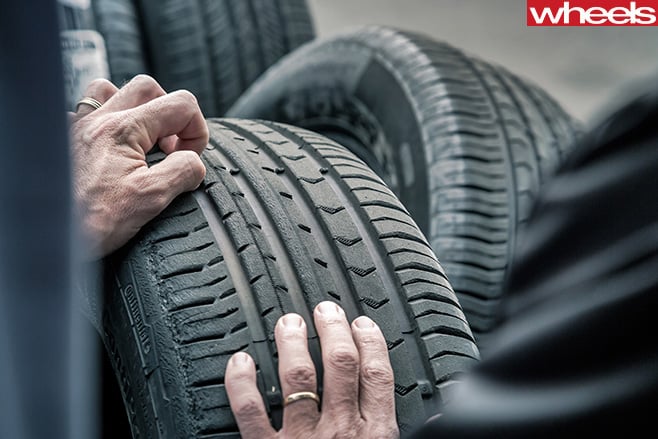
The car
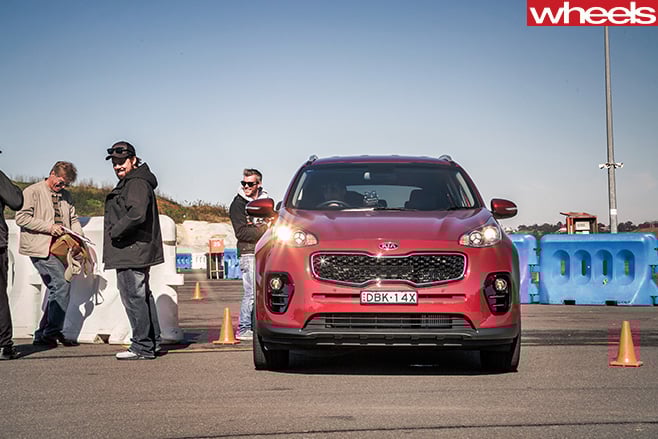
The driver
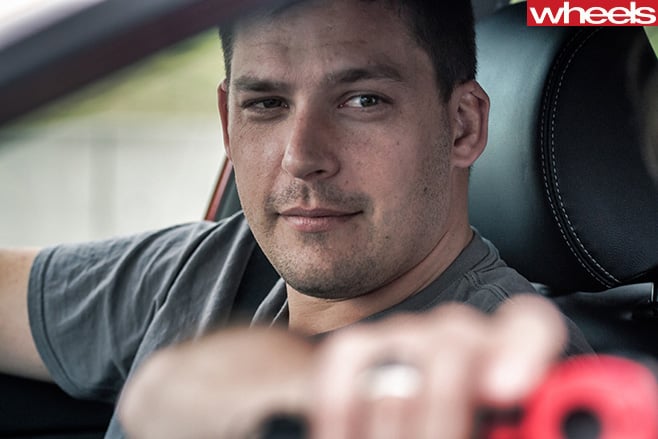
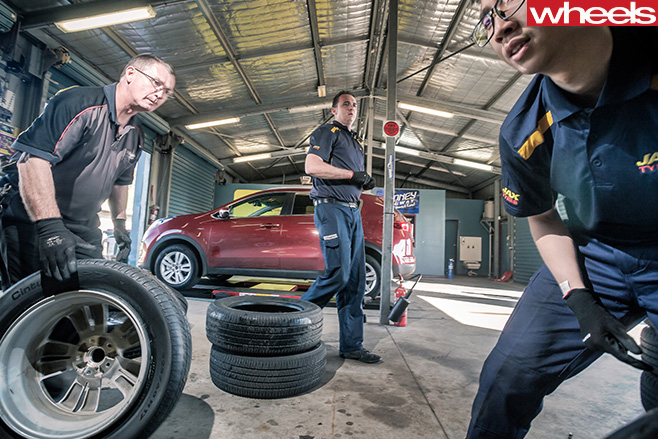
Jax Tyres and Eagle SMF
Ian Luff Motivation Australia
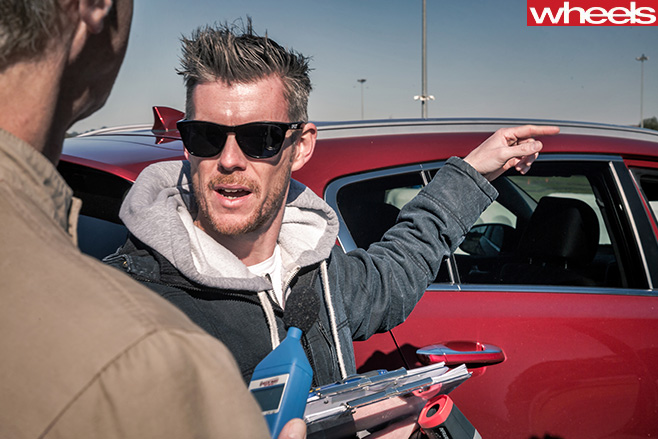
The ringmaster
SLALOM DRY
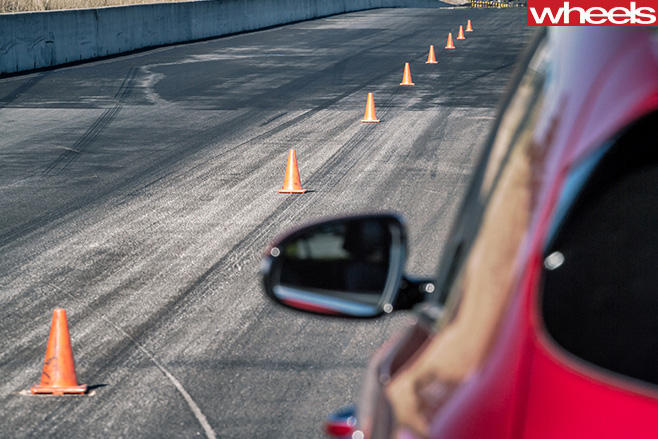
THE capacity to safely swerve around an obstacle – and recover from it – is at the core of tyre safety. On a quiet piece of Sydney Dragway tarmac, that obstacle is a witch’s hat, but on the road a child running out from the kerb or another driver’s ill-judged manoeuvre could provide the sudden need to change your car’s course.
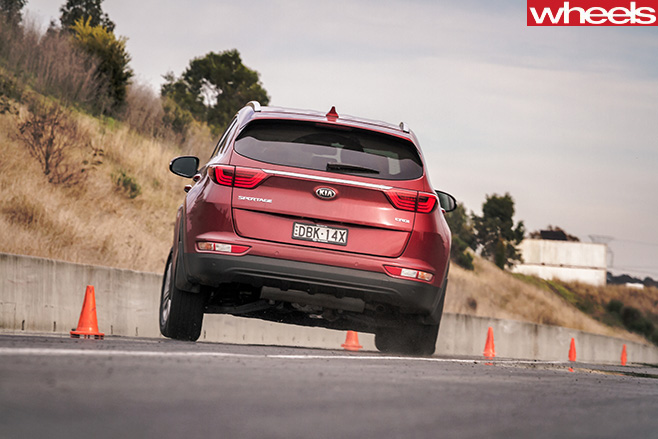
In this era of mandatory ESC, an oversteer moment following an avoidance manoeuvre is no longer; with ESC switched off, as it was for each test discipline, it’s encouraging that even our least polished players resist tail-sliding… most of the time.
The entry speed for the exercise is 60km/h, and we repeat the test until we have three consistent runs. As always, the car’s attitude provides more than a clue about each tyre’s performance, though the stopwatch is the arbiter – the quickest tyre through the slalom is the winner.
WINNER: Continental Premium Contact 5
Renato praises the Continental on first acquaintance. It’s first out of the blocks after the control tyre and exhibits demonstrably “better turn-in” and “less squeal” than the Hankook control, which is a decent performer in its own right. With the entire field through the test, a second run on the Conti helps put its performance into perspective: “Best feel and feedback,” comes the succinct summary. In terms of times, the Continental gets through the slalom a tenth quicker than the next-best (the Goodyear), 0.3sec quicker than the Maxxis in third, and 0.7sec – or about nine percent – quicker than the tail-enders.
BRAKING DRY
BEING able to perform a quick stop was once part of a skilled driver’s arsenal. Now it’s part of the car’s, because ABS means there’s little for the driver to do other than stand on the pedal.
However, the histrionics of the average ABS system means being familiar with how emergency braking feels – ideally at a defensive driving day like those run by Ian Luff – is an asset in a real crash-avoidance scenario. Thankfully Renato has done plenty of hard stops. So, with the driver removed as a variable and a car that pulls up with unfailing consistency, we can test tyres and nothing else.
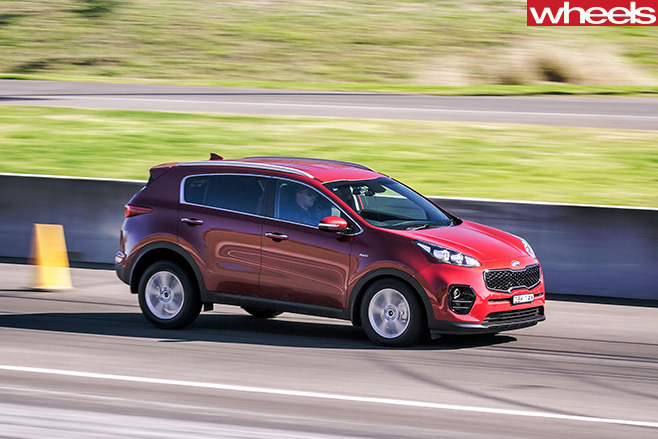
The measure of performance is stopping distance in metres, though we also log peak and average G, and stopping time. The stopping section certainly highlights stark differences in this critical area of tyre performance.
WINNER: Continental Premium Contact 5
“Brake confidence” on the Contis underlines their relatively short stopping distance, those at the other extreme “walked on ABS” (the Maxxis), while the Pirelli experienced “immediate ABS”. The capable mid-field don’t elicit specific comment, behaving predictably and recording stops within about a metre. The best-to-worst differential between the Continental and the Maxxis is 4.8m, or a bit more than a car length. That’s a lot. We know which we’d rather be rolling on if it all went pear-shaped. Even more impressively, the Conti pulls up a metre shorter than the next-best tyre (the Goodyear).
CIRCUIT LAP
IT’S an unwritten rule that testing tyres can’t be fun – it’s all about rigorous analysis – but it seems the Ian Luff crew missed the memo. The circuit layout they provided is much the same they use for driver training days, and more like a motorkhana than a device for punishing hapless tyre-test drivers.
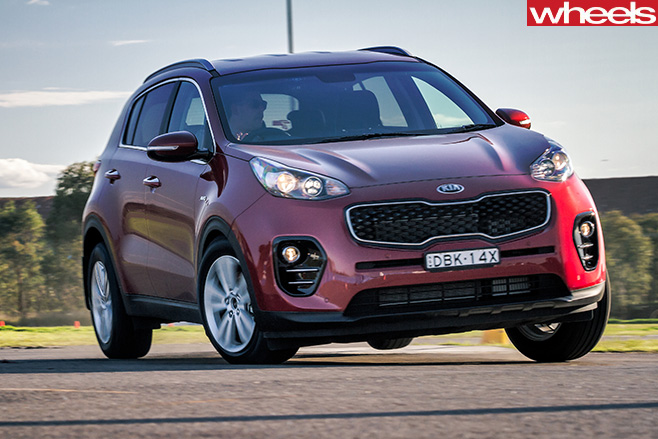
This year’s lap made the circle test redundant because the slalom and circuit laps provide all the lateral acceleration data we need to dissect a tyre. Three laps on each tyre also introduces heat into the equation, which we measure at the conclusion of each run. A lap contains a quick sweeper, a pair of hairpins, right then left, a short straight, a medium right and finally a chicane.
Time is the measure of performance (the average of three laps) and the results show less than a second covers the field. As it should be, the rank on the circuit is reflected by the overall rank – if you’re looking for a single indicative discipline, this is it.
WINNER: Continental Premium Contact 5
Having already proven to stop well and corner adeptly, the Continental was expected to triumph on the track. Renato quickly notes the Conti’s consistently crisp turn-in response, at least until the fronts get hot and he experiences mild understeer (though this could also be a side-effect of the extra corner speed they allow). In terms of peak lateral acceleration, the Continentals are equal-third with the GT Radial, behind the Goodyear (0.97) and Bridgestone (0.96), but over the course of a lap they ultimately help the Sportage get to the line faster.
MISMATCHED TYRES
IT’S not advisable to fit different tyres on the same axle – mismatched fronts, or mismatched rears, in other words – even if there isn’t a physical axle between them. It’s also less than ideal to fit different tyres at the front than the rear, or so we’re led to believe.
In either case, differences in grip and tyre circumference at each corner could have implications for the balance of the chassis, or the workings of the ESC or all-wheel-drive systems. But with 50 or so tyres lying around, we were in a position to experiment.
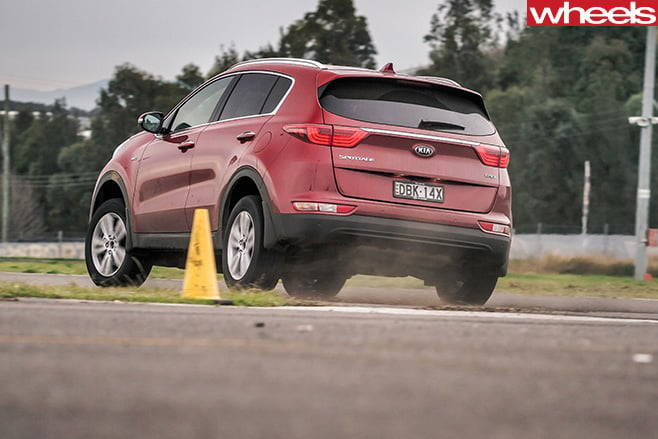
We didn’t know what to expect when Renato wheeled the Sportage onto the test circuit. Would the Kia handle diabolically, or would it be fine?
Well, if you consider the mix of tyres fitted, the fact its points tally would place it fifth overall perhaps isn’t a big surprise. However, the change in poise, and Renato’s feedback, suggest it’s worth avoiding mixing tyres.
Renato, unaware of the hijinks we’d gone to with the Kia, immediately noted that the car felt “inconsistent”, an observation he hadn’t made on any matched set. And we could see that the car didn’t stop straight in the brake test.
| Four-up wet braking | Wet stop | Extra stopping distance | Percentage increase |
| Average | 28.3m | 1.8m | 6.4% |
TYRE NOISE
TYRE noise invariably comes in a trade-off with ultimate performance; a tyre is often noisy because it has an aggressive tread pattern. High-grip, soft-compound tyres, on the other hand, can be a low-noise option, provided you’re not overly concerned with wear life. We’d like to measure wear life, but it’s difficult in two days of testing; it’s not that we don’t cause plenty, more that it’s done unevenly, in conditions that don’t represent normal road driving.
Measuring noise is quite straightforward, using an SPL meter set to store a peak figure in decibels over a straight section of coarse-chip road.
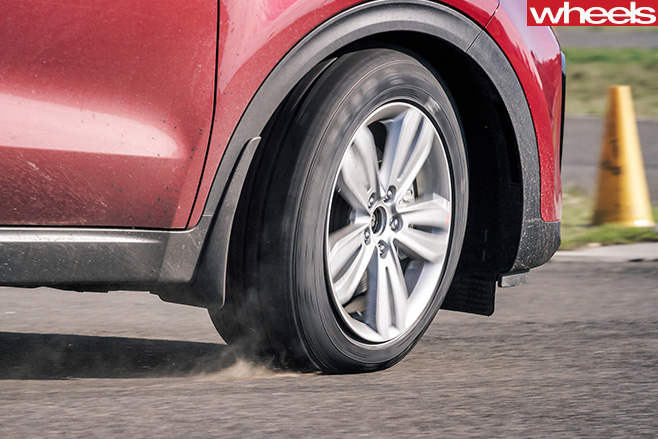
A hushed tyre can claw back ground on more performance-focused alternatives, though it’s scored at a quarter of the four dynamic exercises, so it doesn’t have as big a bearing on the final results. That said, you can apply your own weighting to tyre noise to arrive at your own outcome.
WINNER: Goodyear Efficient Grip
It stands to reason that the Goodyear Efficient Grip is a quiet tyre – fuel efficiency-focused tyres are designed for low rolling resistance, and one of the ways to do so is with a less-aggressive tread, which thrums up less noise. On the flipside, the aggressive patterns of some high-performance tyres, which can deliver big benefits elsewhere, convert some of their kinetic energy into noise. The Goodyear’s 68.5dB figure is 2.5dB less than the noisiest (Dunlop and Bridgestone), and on the non-linear logarithmic decibel scale that’s a more than noticeable difference in noise. The Kumho, Maxxis and Conti are quiet, too.
BRAKING WET
IF WE conducted just one tyre test discipline, it would be wet braking. Why? Because this is the area a tyre can really help the average driver get out of trouble. It’s where a tyre proves its worth when it goes wrong on the road. And while the average non-enthusiast might be reluctant to spend-up on tyres in search of crisp turn-in or tenacious traction, they might if they think they’ll save them in the rain.
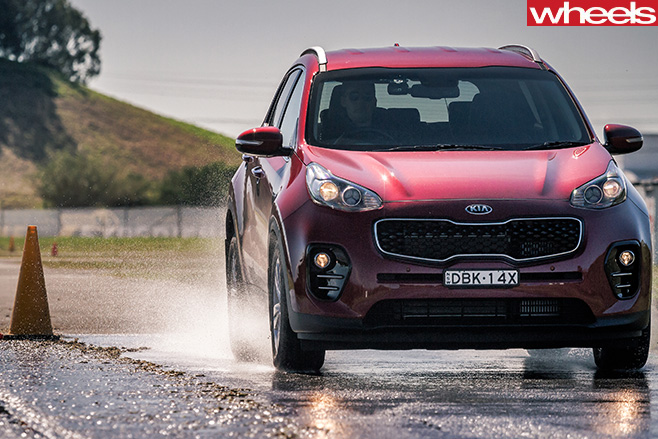
The test protocol doesn’t change for the wet test – Renato accelerates to 80km/h before standing on the left pedal – but the watered tarmac here is of a coarser chip than the dry road, which is more like hot-mix. We expected the unexpected, then, and we weren’t disappointed, our sole wet discipline mixing up the order more than any other.
WINNER: Continental Premium Contact 5
To complete a clean-sweep of the dynamic disciplines, the Continental stops shorter than all its rivals in the wet, just as it did in the dry. In fact, its average wet stop is little more than a metre longer than its average dry stop. The other big winners in the wet are the GT Radial (up three spots to snag another third place), Bridgestone (up a place to second) and Kumho (up two positions to sixth). The Dunlop is the disappointment, dropping four spots to eighth. To underline its dominance, the Continental stops 1.4m shorter than the second-placed Bridgestone and 3.5m shorter than the last-placed Maxxis.
FOUR-UP BRAKING
THOSE who think about their driving probably give at least a passing thought to stopping distances, and therefore their gap to the car ahead. Just as it does for the salty snack you just dropped on the floor, the old three-second rule applies to setting the space between you and the car in front; you’re leaving enough space to stop if you pass a roadside marker three seconds later.
But did you ever think that you might need a bit more room when you have a car-load of people and luggage on board?
So we need to count to 3.3 seconds to maintain a safe following gap with the boys along for the trip. Five-up with luggage, it wouldn’t be crazy for holiday-goers to count to four on the freeway.
| # | Slalom | Braking | Circuit | Tyre Noise | Total | |
| # | Time (sec) | Dry stop (m) | Wet stop (m) | Lap (sec) | SPL (dB) | Score/100 |
| Mismatched tyres | 8.03 | 26.00 | 27.40 | 28.51 | 70.00 | 94.5% |
OVERALL WINNER
Continental Conti Premium Contact 5
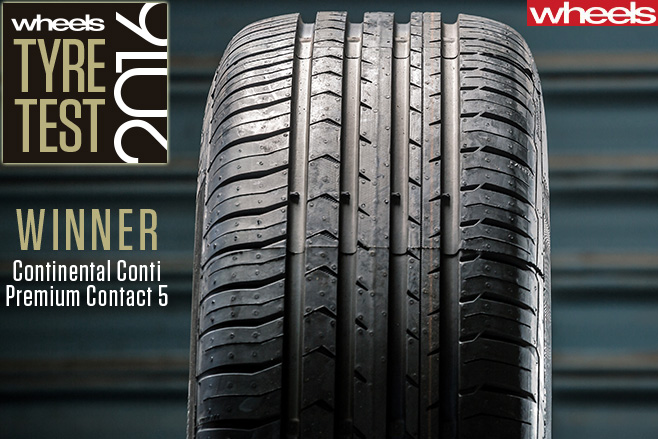
The only discipline the Conti didn’t win has zero safety or high-performance implications – tyre noise. And it hardly dropped the ball there, coming third just one decibel higher than the hushed Goodyear.
It’s almost impossible to fault the Continental’s performance, though part of the reason it performed better than its rivals was its lower treadwear rating. The 280 figure suggests it will shed tread more quickly than some of its rivals, which had ratings of up to 560.
At $241 a tyre in our chosen size, the Conti costs only $26 more than the average, and $62 more than our least-expensive contender (the Nexen, at $179), but less than the third-placed Bridgestone ($272). So it’s certainly within the realm of the OE-replacement options available on a realistic budget.
Make your own value call, but to us spending $248 extra over a set of tyres for almost 10 percent better performance across a range of driving conditions is wise buying.
Even if you’re not into hard cornering, the fact the Conti stops as much as a car-length shorter in the wet is alone worth the extra outlay.
Follow WhichCar/Wheels on Google
Click the button below to make WhichCar by Wheels a preferred source for your news.