
Classic Wheels

Gallery 1
First published in the November 1972 issue of Wheels magazine, Australia’s best car mag since 1953. Subscribe here and gain access to 12 issues for $109 plus online access to every Wheels issue since 1953.
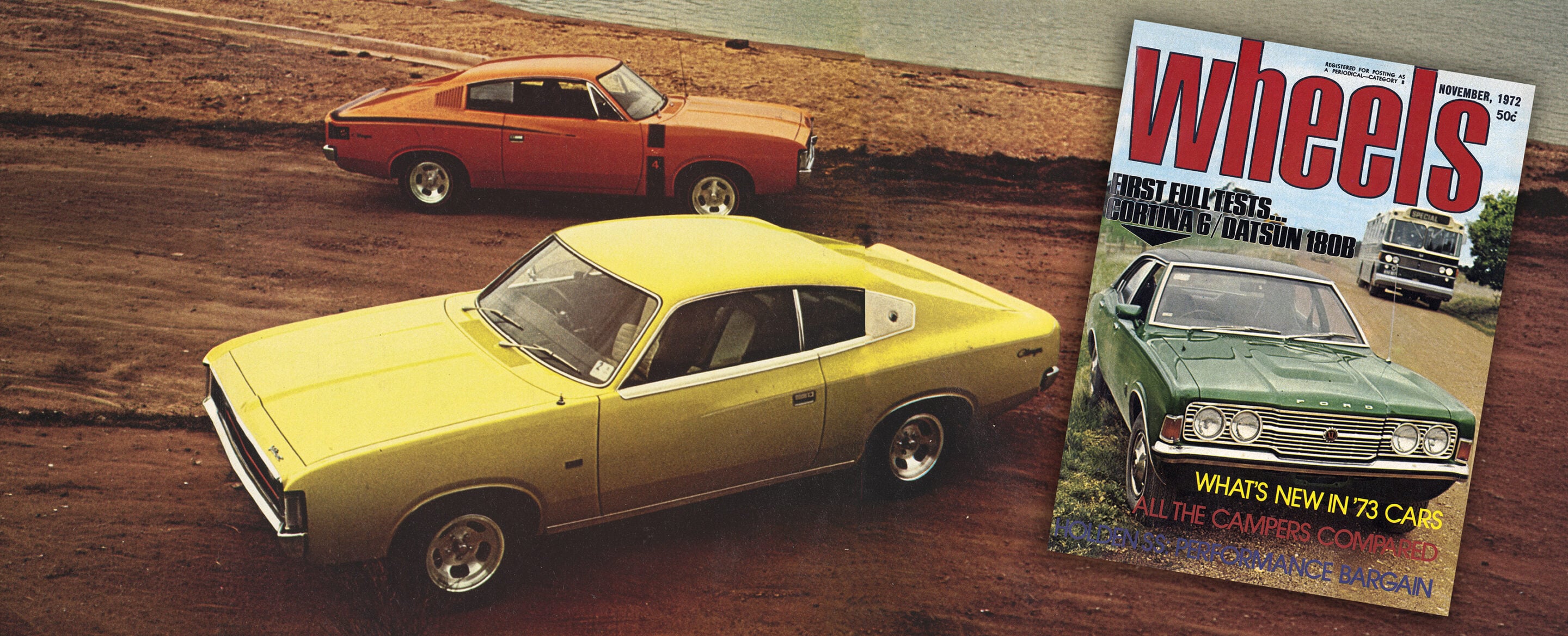
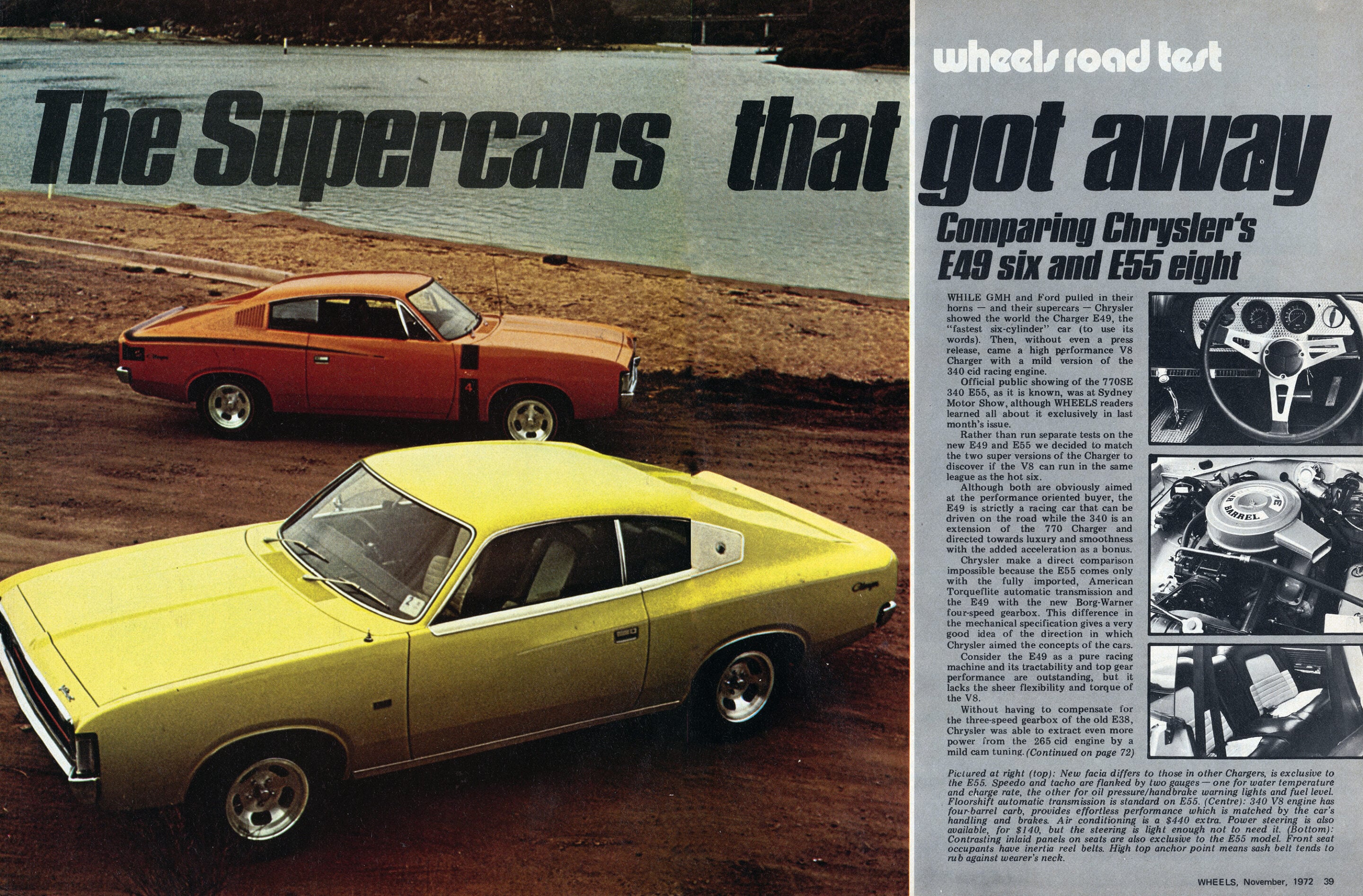
While GMH and Ford pulled in their horns – and their supercars – Chrysler showed the world the Charger E49, the “fastest six-cylinder” car (to use its words). Then, without even a press release, came a high performance V8 Changer with a mild version of the 340cid racing engine.
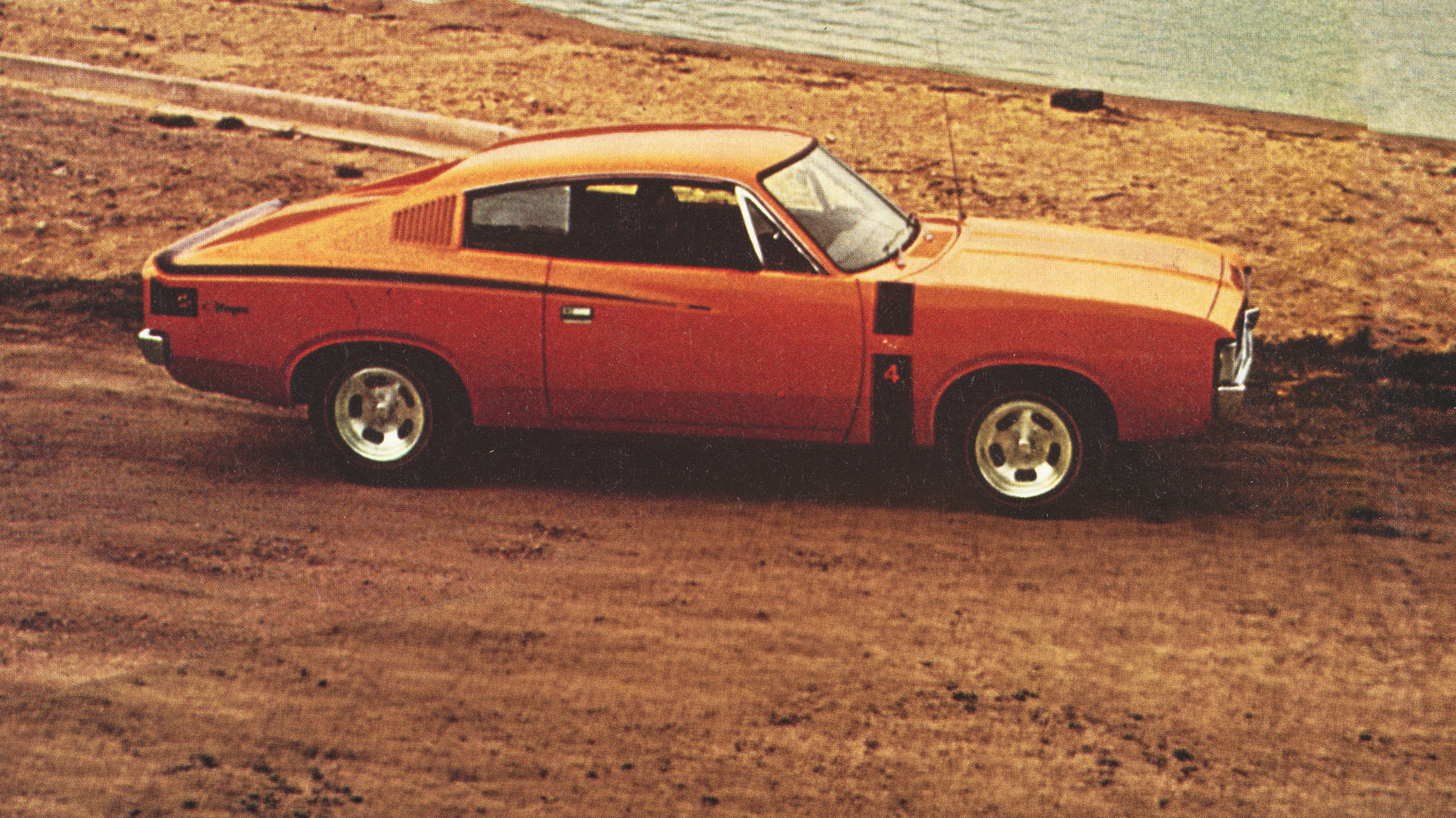
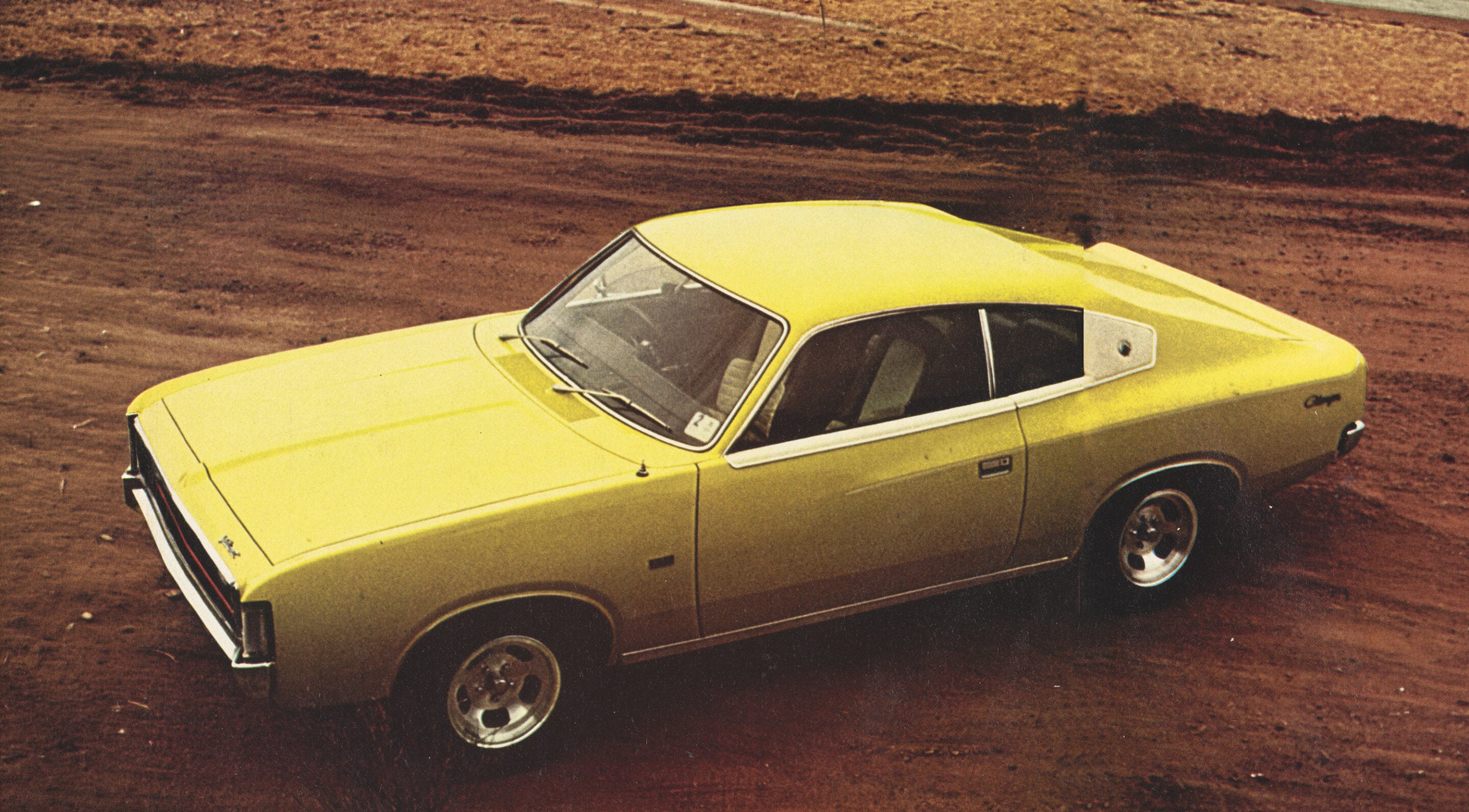
Official public showing of the 770SE 340 E55, as it is known, was at Sydney Motor Show, although Wheels readers learned all about it exclusively in last month’s issue.
2
Rather than run separate tests on the new E49 and E55 we decided to match the two super versions of the Charger to discover if the V8 can run in the same league as the hot six.
Although both are obviously aimed at the performance oriented buyer, the E49 is strictly a racing car that can be driven on the road while the 340 is an extension of the 770 Charger and directed towards luxury and smoothness with the added acceleration as a bonus.
Chrysler make a direct comparison impossible because the E55 comes only with the fully imported, American Torqueflite automatic transmission and the E49 with the Borg-Warner four-speed gearbox. This difference in the mechanical specification gives a very good idea of the direction in which Chrysler aimed the concepts of the cars.
Consider the E49 as a pure racing machine and its tractability and top gear performance are outstanding, but it lacks the sheer flexibility and torque of the V8. Without having to compensate for the three-speed gearbox of the old E38, Chrysler was able to extract even more power from the 265cid engine by a mild cam tuning.
Even so, the improvement in performance makes the E49 easily the fastest accelerating car made in Australia, quicker than the E38 by a significant margin.
One of the major reasons for the new car going so much faster is the lowering of the rear axle ratio from 3.23 to 3.5 and this has, of course, helped in the quest for street tractability. Such is the flexibility of the six that it will pull away strongly from just 1500rpm in top and go down to as low as 1000rpm before it starts to grumble.
Real go, however, begins at 3000rpm. That’s when the car shoots forward at an astonishing rate and you seem to spend more time changing up through the excellent four-speed gearbox than watching for the tacho to spin around to the redline.
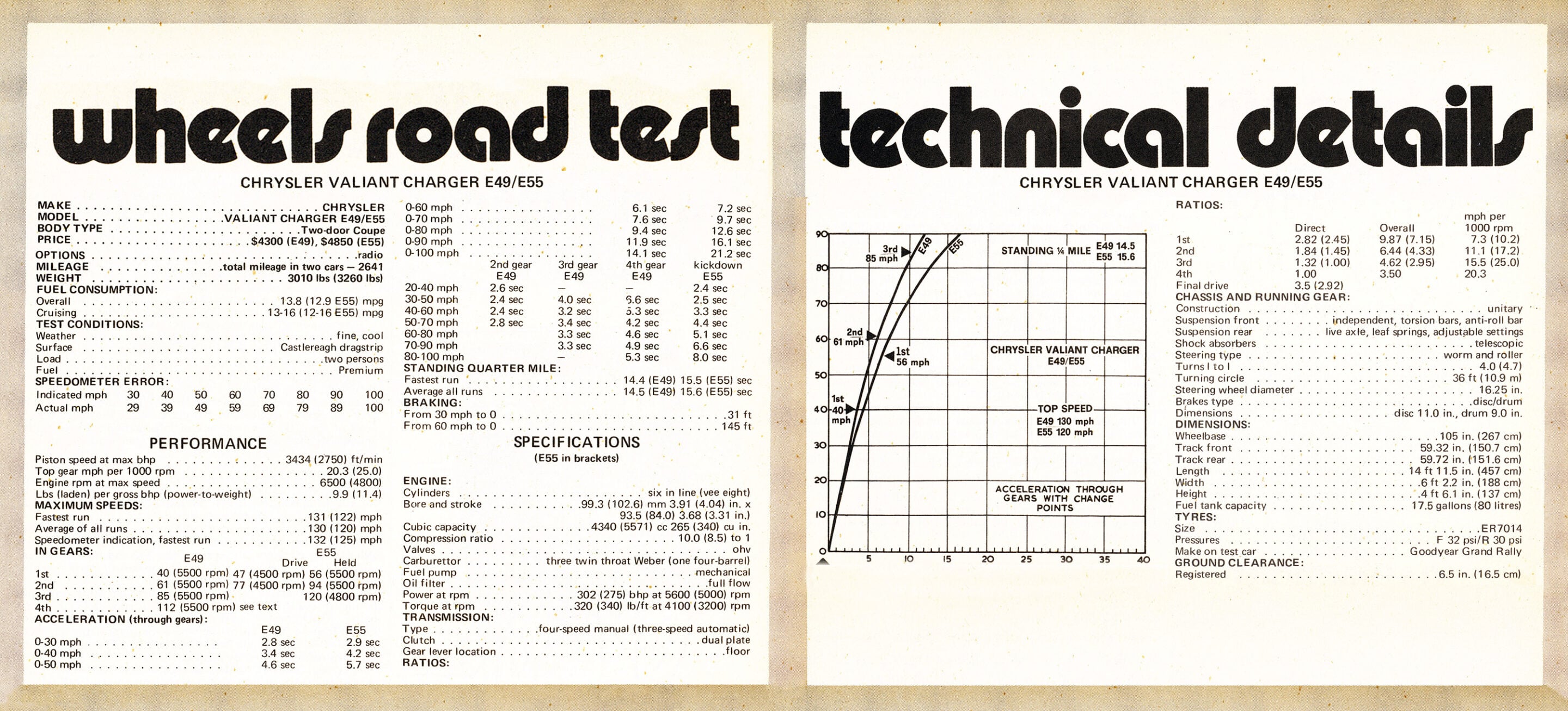
Maximum power of 302bhp is developed at 5400rpm and torque of 320Ib/ft at 4100 rpm. Chrysler’s tacho is redlined at 5000rpm but it is perfectly safe to go to 6000rpm although we picked 5500 for the change-up point when running the acceleration times.
At these revs the gear maximums are 40, 61, 85 with a top speed of 112mph so they are spaced almost perfectly for both track and road use and combine superbly with the torque of the engine.
The lower gearing has detracted from the car’s ability as a long-distance tourer – this is where the E55 comes into its own – but even so it will maintain 5000rpm in top gear with only a bit of gearshift rattle and wind noise intruding, and it will go beyond 6000rpm if you are game.
But high speed distance running was never really a forte of the old E38. Where the Charger is absolutely unbeatable is in winding mountain country. We don’t mean tight hairpin bends, although it is still horribly quick through these, but on fast, open sweepers and meandering switchbacks.
1
The raw, quivering power is instantaneously on tap and with a ratio for every conceivable situation the Charger just storms through and it would take a Ferrari Daytona with racing driver Jack Ickx at the wheel to stay with one.
There is never any doubt that it is a supercar but it is also an incredibly safe and sure supercar. Full power can be put through to the road at any speed above five mph without the driver being worried about the car going sideways and even in wet conditions it is possible to transfer at least three-quarters of the engine’s torque to the road surface and put up staggeringly quick point to point times.
It is only now that we have driven the Charger with the four-speed gearbox that we realise just how much better it is over the old three-speed unit, good and all that it was.
Cornering is as close to neutral as is possible and even using full power to exit a bend the tail doesn’t come round quickly. You feel the tail sit down in the corner and gently feed the wheel through your hands, millimetre by millimetre as you correct the change to a gentle power oversteer.
With the fully adjustable suspension, both front and rear, some of the old Chargers were incorrectly set-up from the factory and they understeered excessively but the latest test car showed us just how good they can be if they are properly tuned.
1
One area which still needs watching are the brakes. Both the test E49 and E55 came with power-assisted disc and in each instance the brakes could be made to fade badly after a couple of stops from 80mph. The poor quality linings used in the Chargers – and the same comment applies to the Falcon GT and Monaro GTS – should be corrected immediately if the manufacturers are serious about primary safety. Another problem on the E55 was rear wheel lock-up coming into a corner.
After the E49, the E55 seems almost slow in acceleration until you compare its performance with, say, a Falcon GT manual. It is quicker over the quarter-mile and has a similar top speed. Chrysler’s performance motoring department seemingly has something for everyone.
1
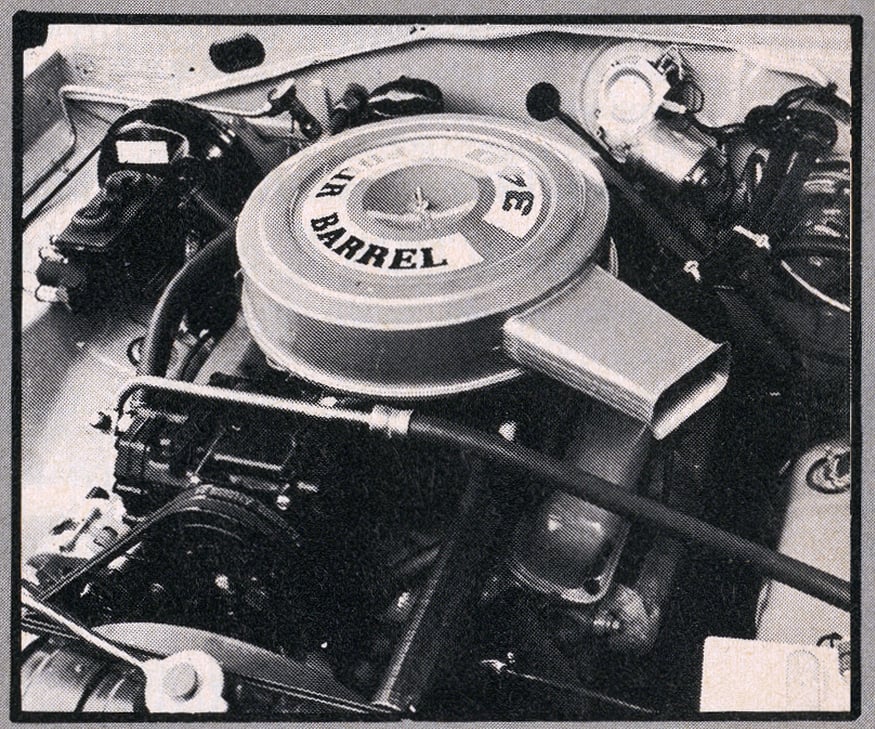
The E55 340 engine produces 275bhp at 5000rpm and 340lb/ft torque at 3200rpm and although it is fitted with a four-barrel carby the engine is limited by the use of a cam straight from the 318 engine and a restricted exhaust system which gives an exhaust note similar to a vacuum cleaner under hard acceleration. The idle is a subdued rumble, as expected from a hot V8, but this pleasant note disappears once underway. Thankfully the driver is never aware of the lack of a quality noise although pedestrians will be disappointed.
Certainly the 340 is an engine with an enormous development potential. Given even a mild blueprint with
improvements to the exhaust manifold and a hotter cam it would have a performance within reach, if not superior to, the E49.
As our acceleration charts show it is not far behind and gets to the ton in just over 21 seconds, quick in all but the fastest company, which includes the E49 – it takes just 14.1 seconds to reach the magic figure.
Where the six-cylinder car really created the speed sensation on the dragstrip the V8- required just a flooring of the accelerator, a chirp of wheelspin and a forward thrust by the car with the driver never aware that it is going as quickly as the 15.5 seconds quarter-mile time indicated.
1
Here it is one of those wonderful two-faced cars, which are quick without the noise and thunder, which go with the E49 and other similar GT cars. Chrysler offers you the choice.
Suspension settings are virtually identical although softer spring rates are used on the E55. Together with the 20:1 steering ratio, instead of the E49’s 16:1 ratio for a reduction in steering turns lock to lock of 4.7 to 4.0, this is the only change under the body. Even the seven inch wide ROH mags are standard on the E55.
Steering response and accuracy are good on both and it is only in tighter sections you begin to want the more direct ratio of the E49. The feedback of information is never really enough but both systems are a significant advance over normal Valiant steering.
When we first drove the E55 we thought it had a superb power steering set-up. A quick check under the bonnet proved otherwise but the beaut steering remained. It is light enough for any woman driver where the E49’s steering might become a little heavy in parking situations.
1
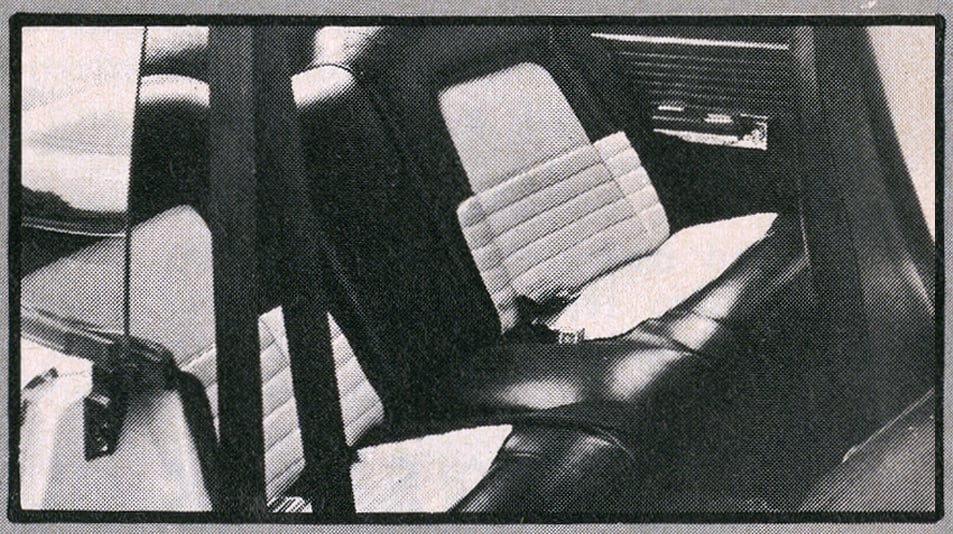
Chrysler’s new range of Chargers have cured many of the minor problems which inflicted the old versions, but a couple still remain. However, the seats of the E49 and E55 have been raised at the mounting points and this makes all the difference to the driving position for shorter drivers. It is now possible to see over the wheel and down onto the bonnet rather than through it and across, so visibility is much better. Also improved is the driving position – short drivers no longer have to hang on to the wheel for support but sit back and direct it. Tall people find it makes little difference to what was an already fine driving position. The tall bucket seats are still rated excellent with marvellous thigh, lateral and lumbar support. Only the short cushions could bring forth any criticism.
Ride in both is surprisingly comfortable considering their sheer roadholding ability. Joints in concrete or bigger than normal bumps bring on the traditional Chrysler thud but the firmness could never be rated overdone. The compromise on the E55, because of its wider market appeal, has been very successfully achieved, slightly in favor of handling.
1
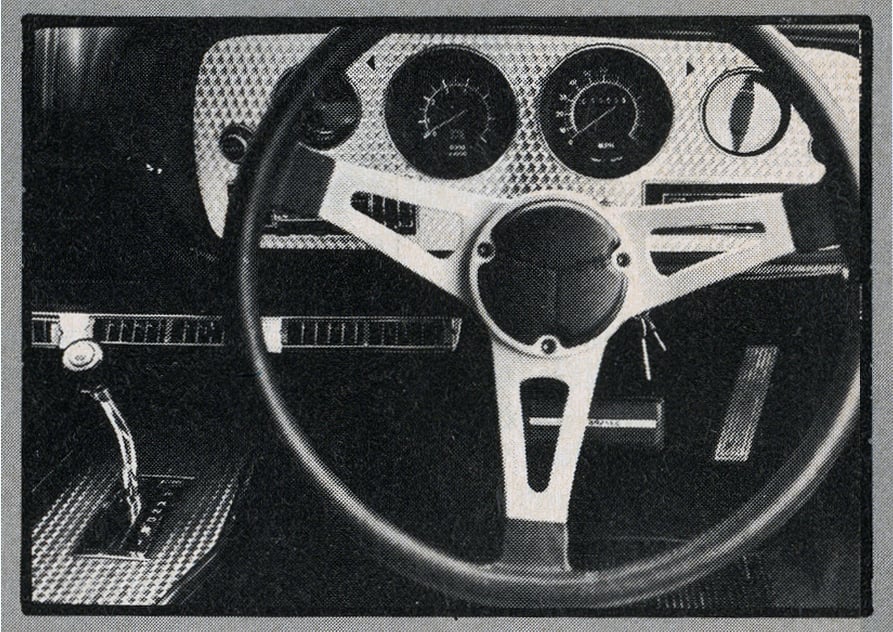
Small things like reflection in the right hand instrument panel of the E55, the position of the dipper on the floor, the seat belt location points, the pedals and the controls still leave a lot to be desired. But Chrysler has padded the entire area in front of the passenger so the cheap looking painted metal dashboard has disappeared.
So you have two fine performance machines. Which one? Well it depends on what you want. The E49 is a firebreathing Ferrari-style car while the E55 is more in the Mustang breed with fine looks combined with performance and the ease and comfort of automatic transmission, and even air conditioning, if you so desire.
Both are fine in traffic, although for crowded city areas there is no beating the automatic. To make a choice would be very difficult and we would rather chicken out and have both. One for commuting and the other for our favourite stretch of mountain country.
Follow WhichCar/Wheels on Google
Click the button below to make WhichCar by Wheels a preferred source for your news.

We recommend
-
 Classic Wheels
From the Wheels archive: Monaro GTS v Falcon GT
We headed to Mt Panorama in 1968 to test Ford and Holden's big bangers ahead of the Bathurst 500... and to declare a winner.
-
 Classic Wheels
From the Wheels archive: Illegal? Yes. Dangerous? No! Sydney to Perth in 29 hours
How we smashed our previous across-Australia record run by three-and-a-half-hours in an Alfa Romeo Alfetta.
-
 Features
From the Wheels archives: We find the fastest Australian car
In September 1977, Wheels settled the argument about what is the fastest Australian car once and for all.
