News
Gallery 1
Toyota has officially announced that its long-awaited V8-powered supercar will be revealed on December 4, marking the brand’s most exciting performance debut in over a decade. The new front-engined hyper GT will serve as the spiritual successor to both the legendary Lexus LFA and the iconic Toyota 2000GT.
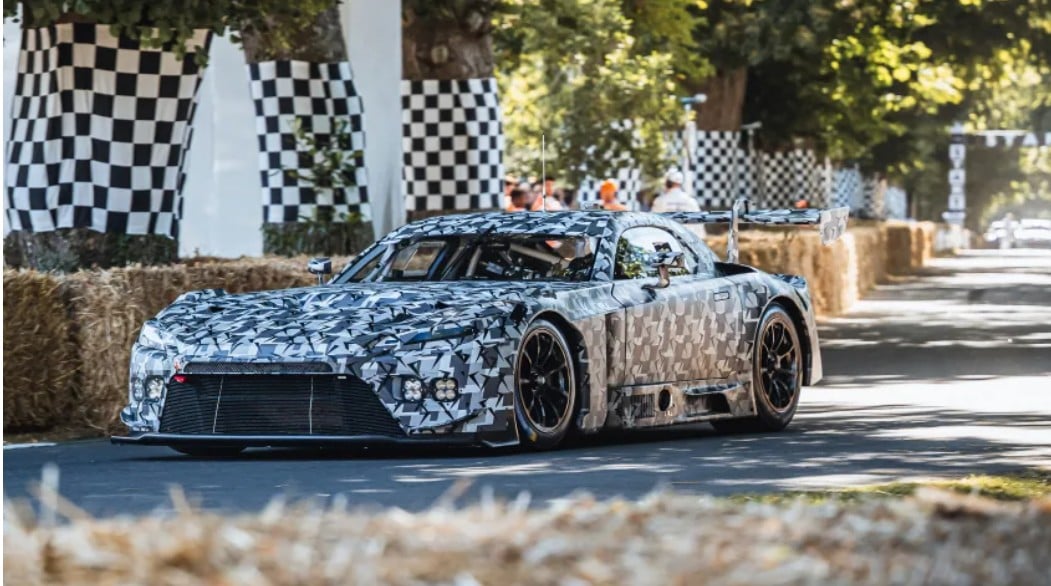
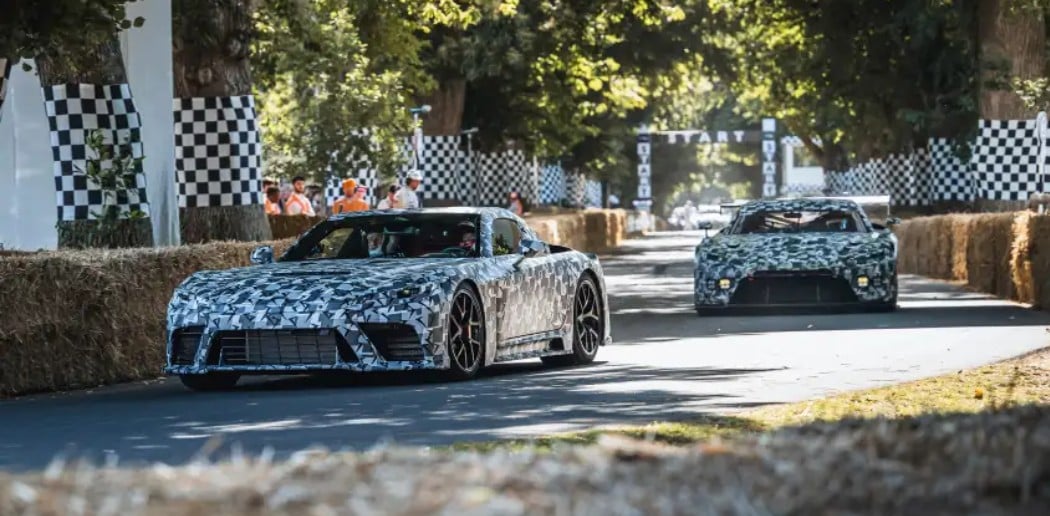
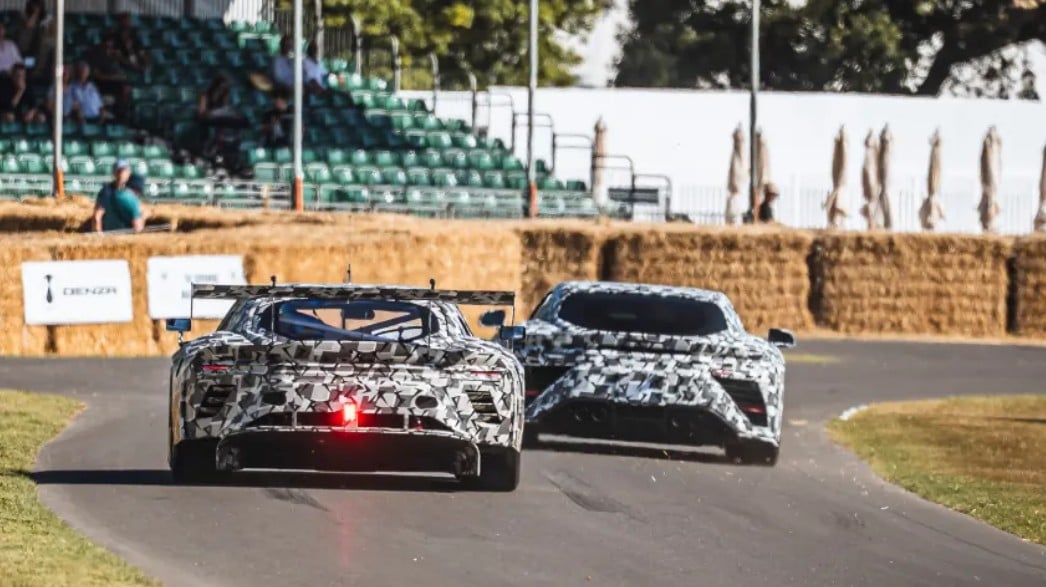
The program has been an open secret for months, with disguised prototypes making several public appearances – most memorably during the Goodwood Festival of Speed (below) – but now Toyota is finally set to pull the covers off officially.
Toyota has released just one official image so far, showing a partial front view that highlights a sleek LED headlight, sculpted bonnet lines, and a large, aggressive lower intake. However, sharp-eyed fans spotted a wider shot of the same car on trackside signage at Fuji Speedway, revealing more of the bodywork and confirming a GR (Gazoo Racing) badge on the lower grille.
1
That GR branding confirms the car’s development under Toyota’s motorsport division, though it’s still unclear whether the production version will wear a Toyota or Lexus badge.
While official details remain tightly guarded, Toyota has teased the car’s engine note in promotional clips leading up to the 2025 Tokyo Mobility Show – and there’s no mistaking the sound of a high-revving V8. Early reports suggest a twin-turbocharged setup, possibly paired with hybrid assistance in road-going form.
Output figures are still speculative, but insiders expect performance in line with rivals such as Ferrari and McLaren. That means a potential power figure north of 700 horsepower (around 520kW), ensuring this new halo car can hold its own among today’s top-tier supercars.
2
Judging from its proportions, the car’s front-mid engine layout places the V8 behind the front axle for optimal balance – a configuration reminiscent of the Mercedes-AMG GT. Power is expected to be sent to the rear wheels via a transaxle gearbox with a limited-slip differential and quick-shifting automatic transmission. Whether Toyota opts for a dual-clutch system or a more traditional automatic remains to be seen.
Lightweight construction will be key to performance. The body is rumoured to use carbon-fibre-reinforced materials, following in the footsteps of the Lexus LFA, which was famous for its advanced composite chassis when it launched in 2011.
Toyota isn’t just building this supercar for the road. The company plans to race the car in the GT3 category, competing against the likes of Ferrari, Porsche, Lamborghini, McLaren, BMW and Aston Martin. The road-going version will serve as the homologation model for Toyota’s GT3 entry – mirroring the development approach of the GR Yaris, which was designed in parallel with Toyota’s World Rally Championship program.
This alignment between road and race versions ensures that performance, aerodynamics, and chassis technology are developed hand in hand – a hallmark of Gazoo Racing’s engineering philosophy.
Whether the finished product carries a Toyota or Lexus badge, this car is poised to become the brand’s next flagship performance model, showcasing Toyota’s ambitions in both road and track performance.
With the official debut set for December 4, the countdown is on – and early indications suggest we could see the GT3 race version competing as early as 2026.
Follow WhichCar/Wheels on Google
Click the button below to make WhichCar by Wheels a preferred source for your news.

We recommend
-
 Reviews
2025 Toyota Corolla ZR Hybrid review: Is small still beautiful?
Old faithful proves there’s still plenty of life in the small car segment if the product is right.
-
 Reviews
Toyota Landcruiser 300 Hybrid first drive review: How does the electrified icon handle?
Hybrid tech comes to an off-road icon to provide more power, more torque and more refinement. What's not to like?