
Features

Gallery 1
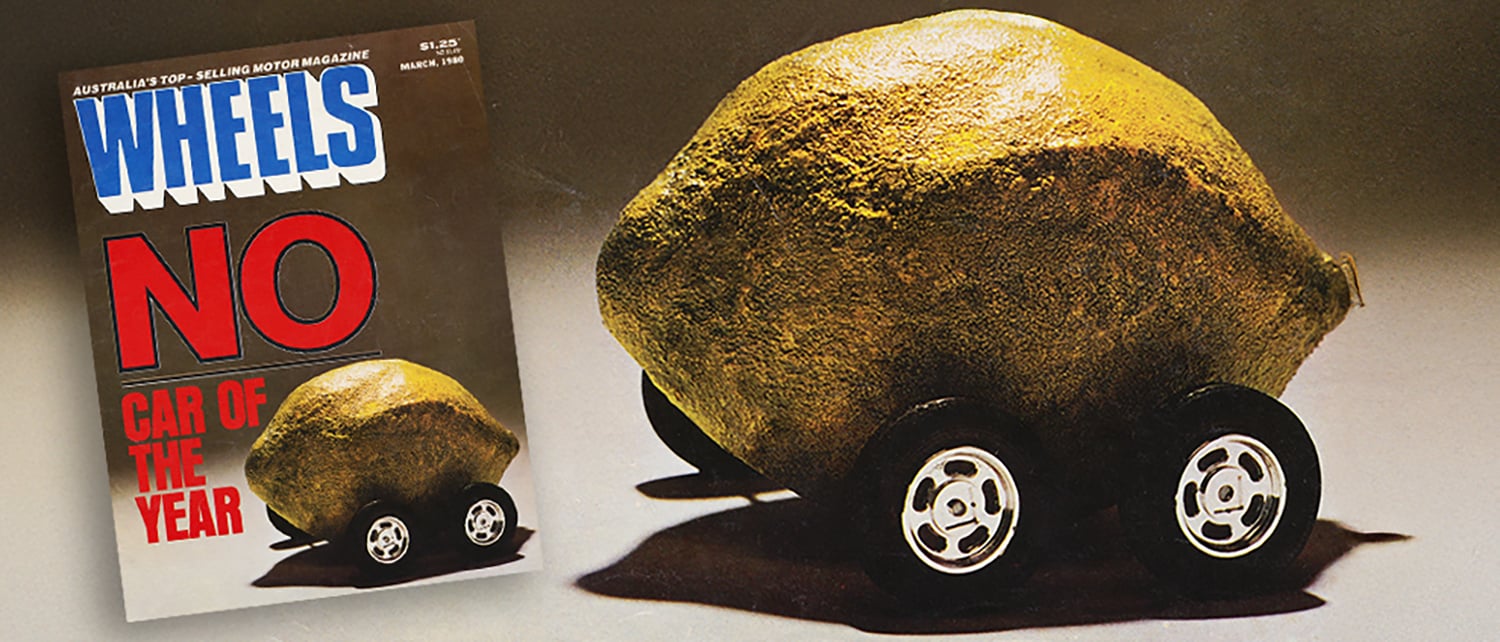
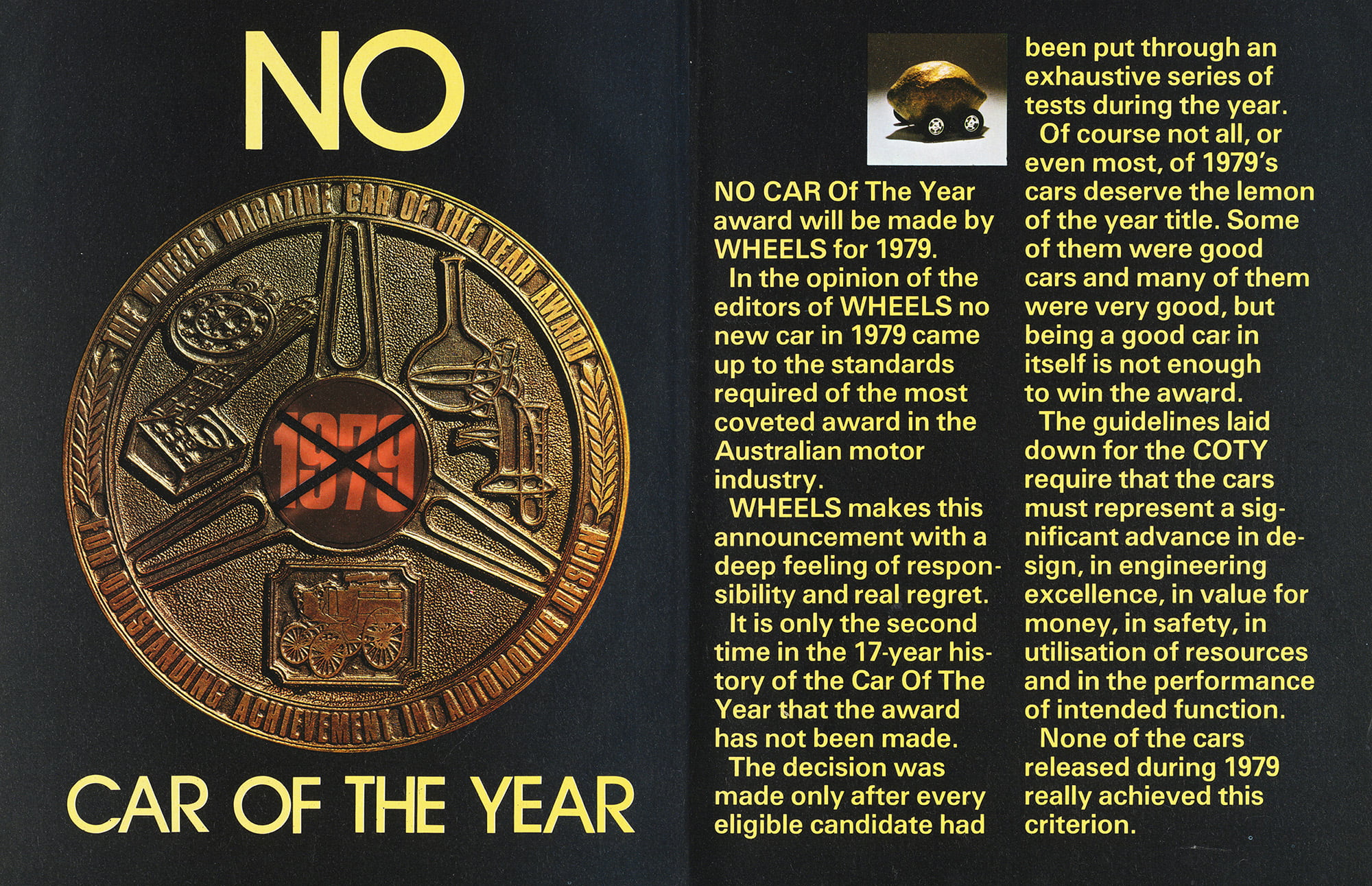
In the opinion of the editors of Wheels no new car in 1979 came up to the standards required of the most coveted award in the Australian motor industry.
Wheels makes this announcement with a deep feeling of responsibility and real regret.
First published in the March 1980 issue of Wheels magazine, Australia’s best car mag since 1953.
It is only the second time in the 17-year history of the Car Of The Year that the award has not been made.
The decision was made only after every eligible candidate had been put through an exhaustive series of tests during the year.
1
Of course not all, or even most, of 1979’s cars deserve the lemon of the year title. Some of them were good cars and many of them were very good, but being a good car in itself is not enough to win the award.
The guidelines laid down for the COTY require that the cars must represent a significant advance in design, in engineering excellence, in value for money, in safety, in utilisation of resources and in the performance of intended function.
None of the cars released during 1979 really achieved this criterion.
It was a year in which almost every major manufacturer produced new models or at least facelifts which incorporated significant engineering changes.
And yet none of the new cars fulfilled all the conditions to a sufficiently high standard to merit receiving the award.
A thorough scrutiny by the editors of Wheels of the 31 new models released in 1979 produced a short list of six cars – Alfasud Sprint, Ford Falcon, Honda Prelude, Mazda RX-7, Renault 20TS, and Subaru Leone.
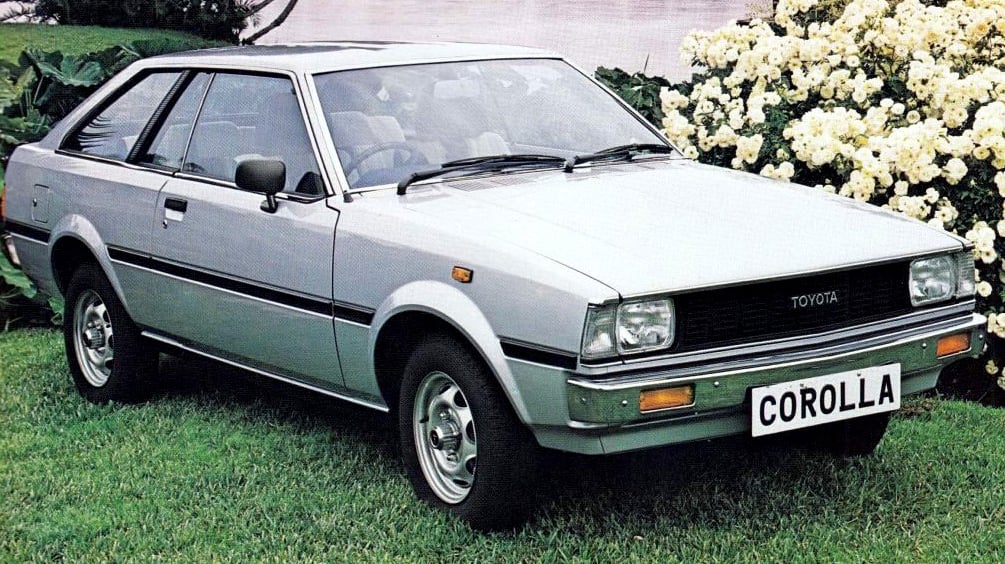
This list excludes some genuinely new cars like the Toyota Corona and T-18 (below) and Datsun 280C and Sunny because their faults became so obvious in our testing that they didn’t rate a mention on any serious rundown of candidates.
1
Most of the other models are either not sufficiently new to warrant inclusion despite the fact that they are good cars – the Jaguar 4.2 series III, Alfasud ti 1.5, BMW 528i, and Saab 900 Turbo – or variations on a theme which has previously won the COTY – Gemini TF, Commodore station wagon and Passat diesel — or facelifted or re-engined versions well-known (and therefore easily dismissed within the criteria of the award) models – BMW 323i, Scorpion and Sigma 2.6, and Lancer Hatchback, Datsun 200B, Fiat X 1/9, and Super Mira Fiori, Escort RS 2000, Peugeot 504 diesel, Porsche 924 Turbo and Volvo 242GT.
Finally there are the up-market long wheelbase versions of the new Falcon – Fairlane and LTD – which deserve attention but since they grew out of the Blackwood program cannot hope to overshadow the importance of the XD.
Before going through the short list and explaining why one of the top six didn’t make it, we should point out that we gave very serious consideration to the XD Falcon. It was the most important local car released during 1979 if only for the obvious reason that more people bought it than any other 1979 model.
Alfa Romeo Alfasud Sprint
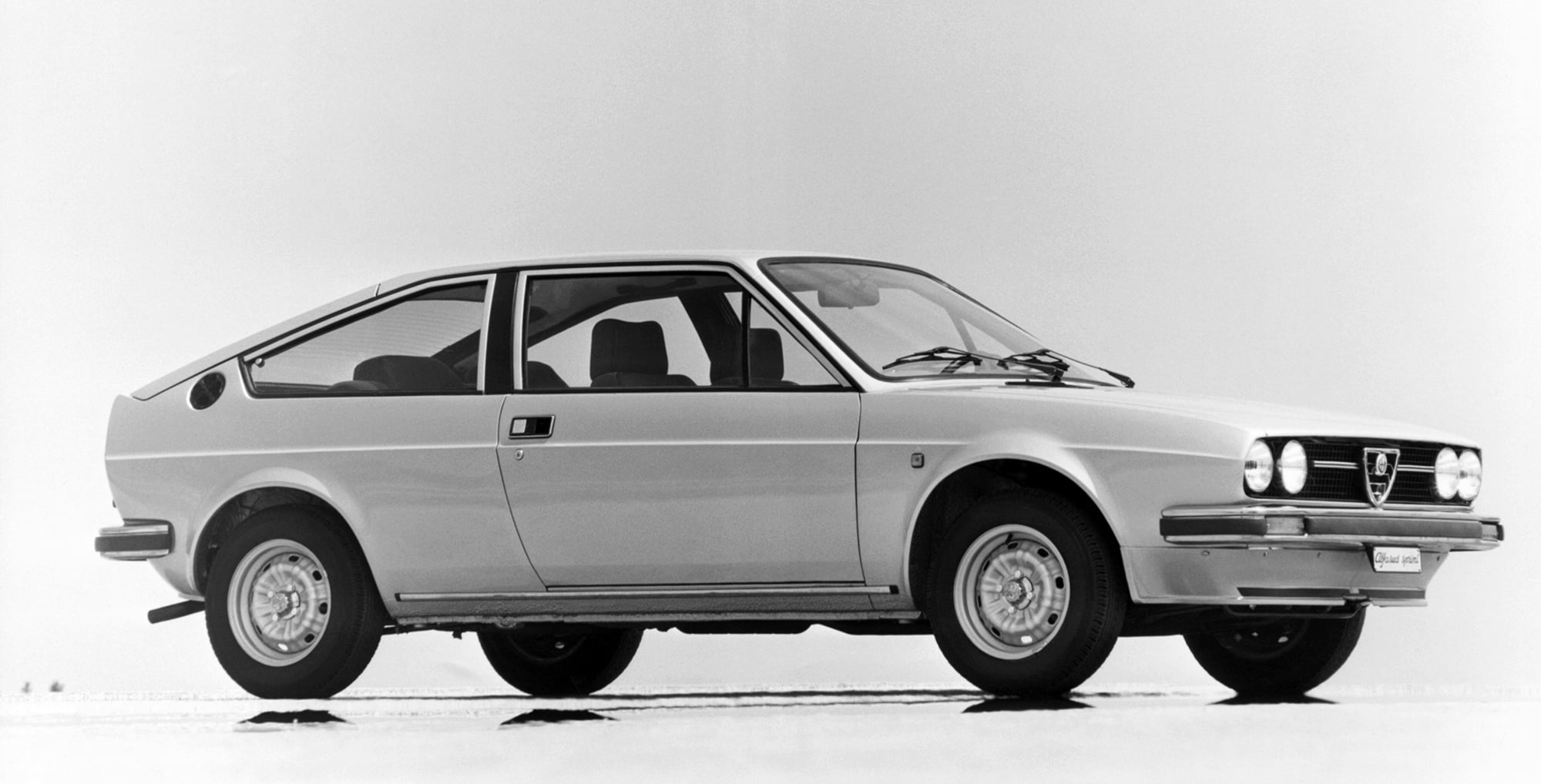
The Alfasud Sprint is the long awaited coupe variation which was recently named Car of the Decade by Car magazine in England.
Its beautiful body by Giugiaro who also designed the sedan – hides virtually unchanged Sud mechanicals so it retains the same brilliant dynamics we respect so highly from the sedan.
1
But it is considerably more expensive and doesn’t have the room of the sedan, which performs at least as well. Car Of The Decade? Perhaps, but a coupe version of the sedan isn’t enough justification for COTY despite its enormous driver appeal.
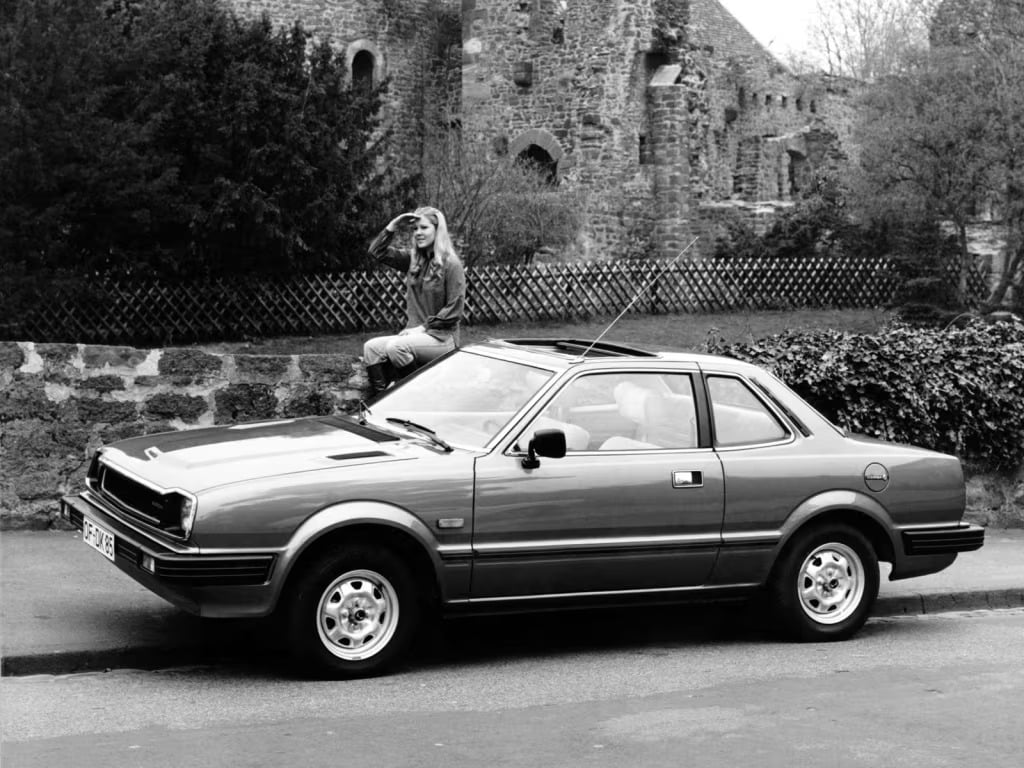
Honda Prelude
Much of the same comments apply to the little Honda sporty. Yes, it is a development of the Accord – which we named Car of the Year in 1977 – but doesn’t represent the technical advance we have come to expect from Japan’s most innovative car maker.
1
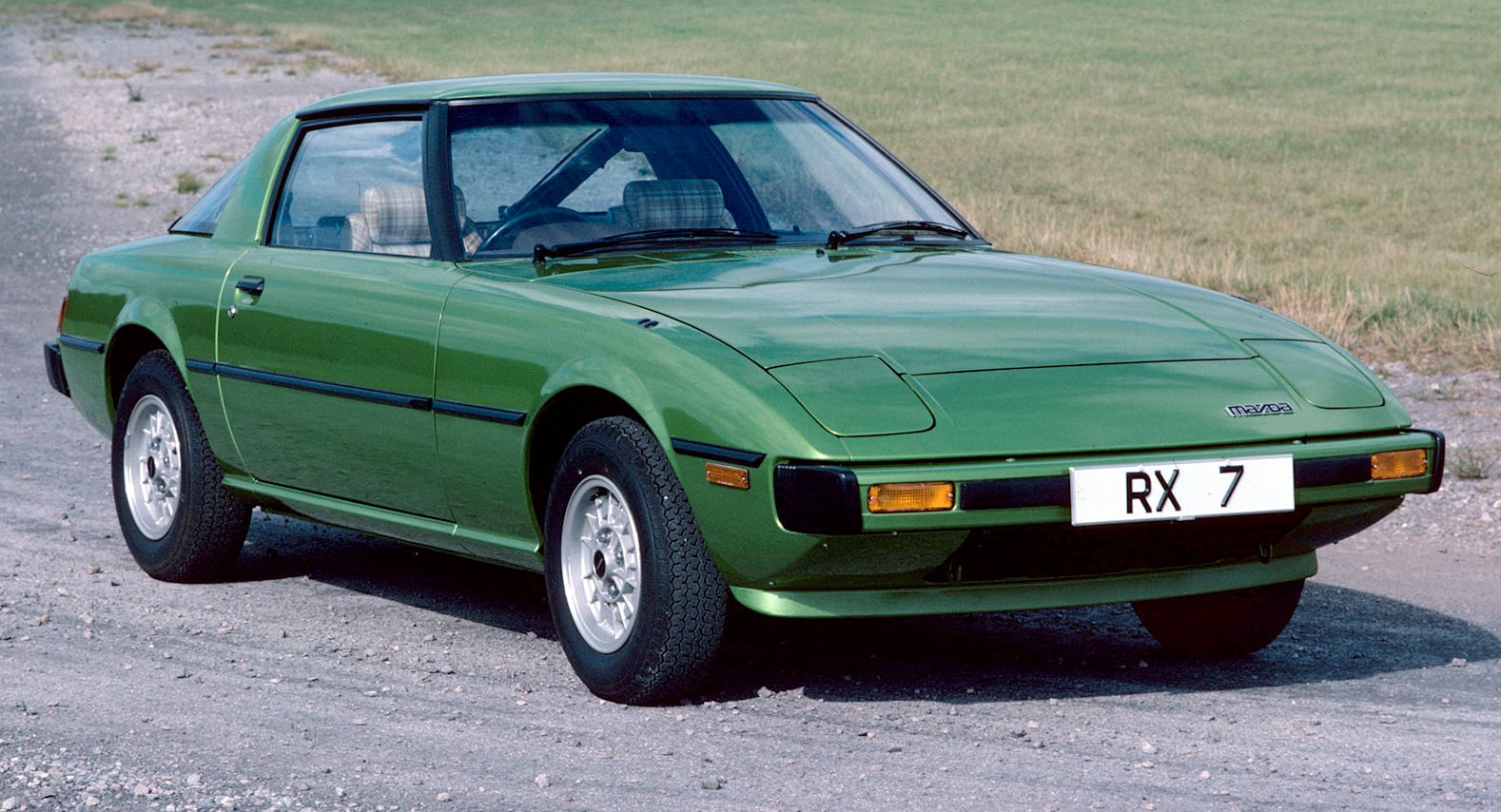
Mazda RX-7
A fine sports car that suits Australian conditions better than its obvious rival, the Porsche 924 (which is twice the price), the RX-7 proves the rotary engine has a future in specialist cars. But there are enough deficiencies in steering, brakes and clutch, and the seats to give R+Europe hope for the future. The Japanese have yet to master the art of dynamics.
1
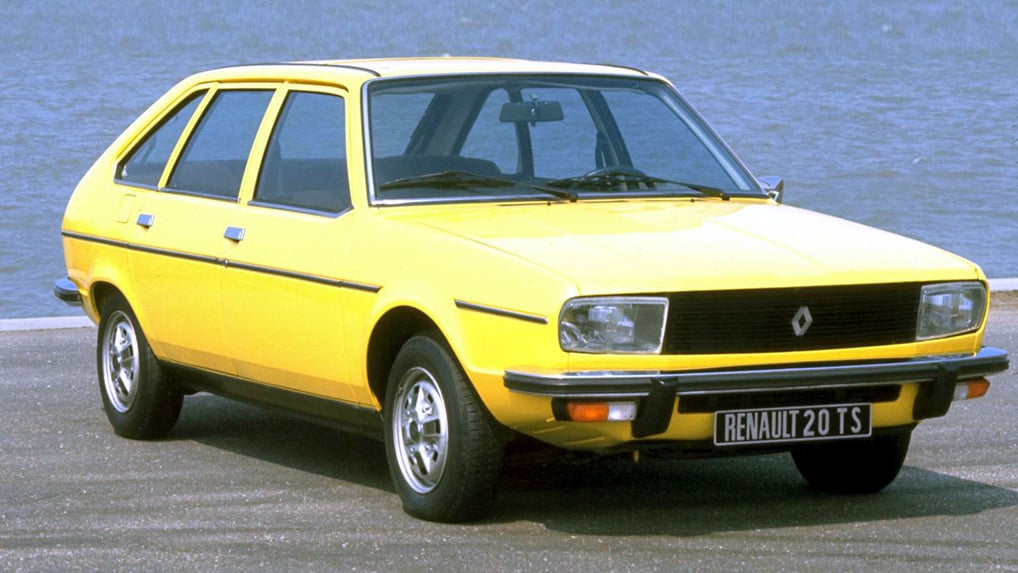
Renault 20TS
A high price takes the 20 out of the reach of those people who enjoyed its predecessor, the 16, and beyond even its logical competition from Europe. Which is a pity for it is a fine car, if mildly disappointing in its noise levels. Certainly its appearance is less controversial than the 16 but does it really do things that much better than the car which began the modern trend to hatchback bodies?
1
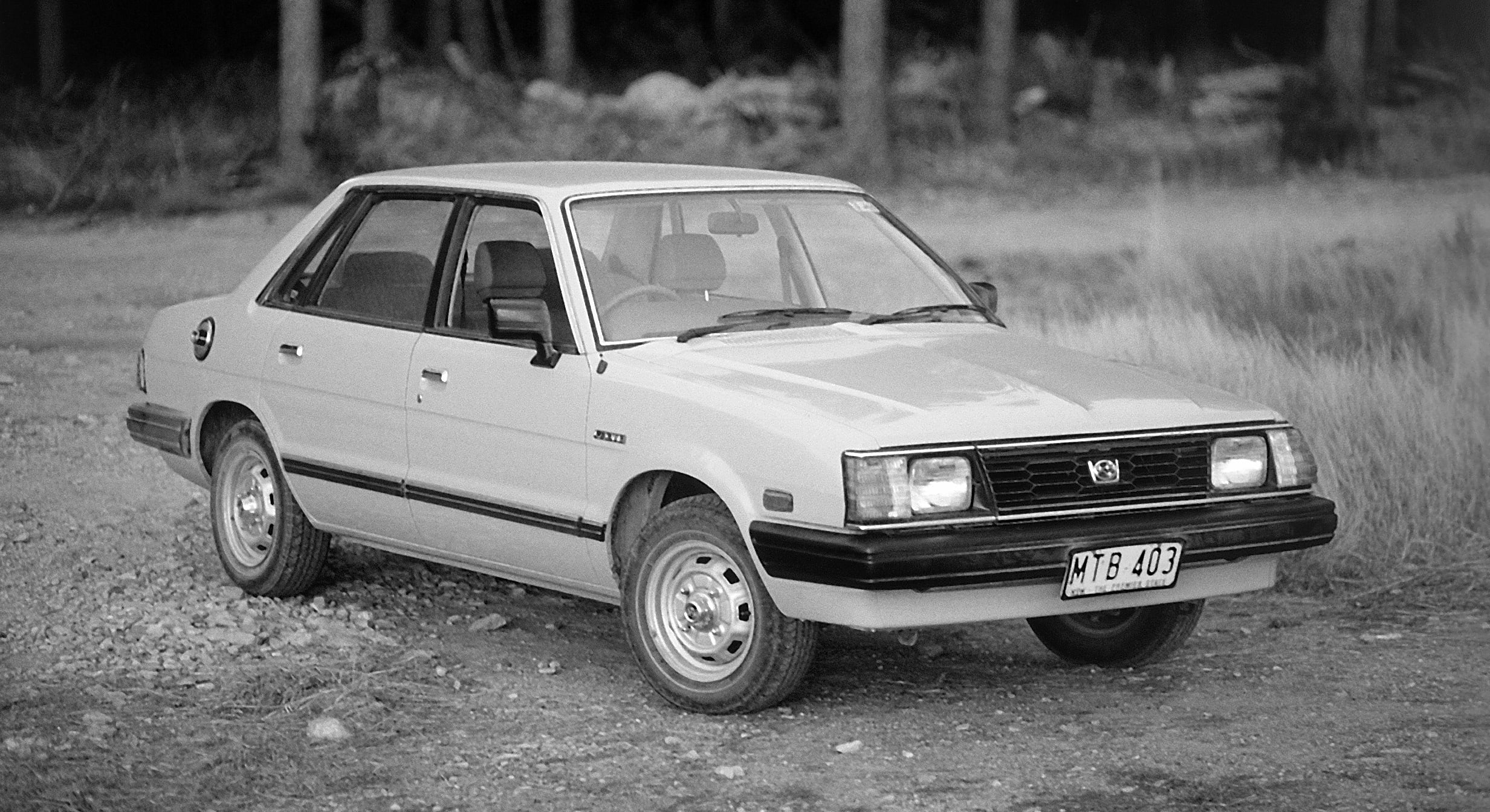
Subaru Leone
Great expectations thwarted. We always believed that if Subaru gave the car a new body it could become an excellent little car. Now that’s happened and the result still doesn’t work as well as it should for there are major flaws in the seats, performance, steering and its price is too high despite the recent price cuts.
1
Why the XD Fails
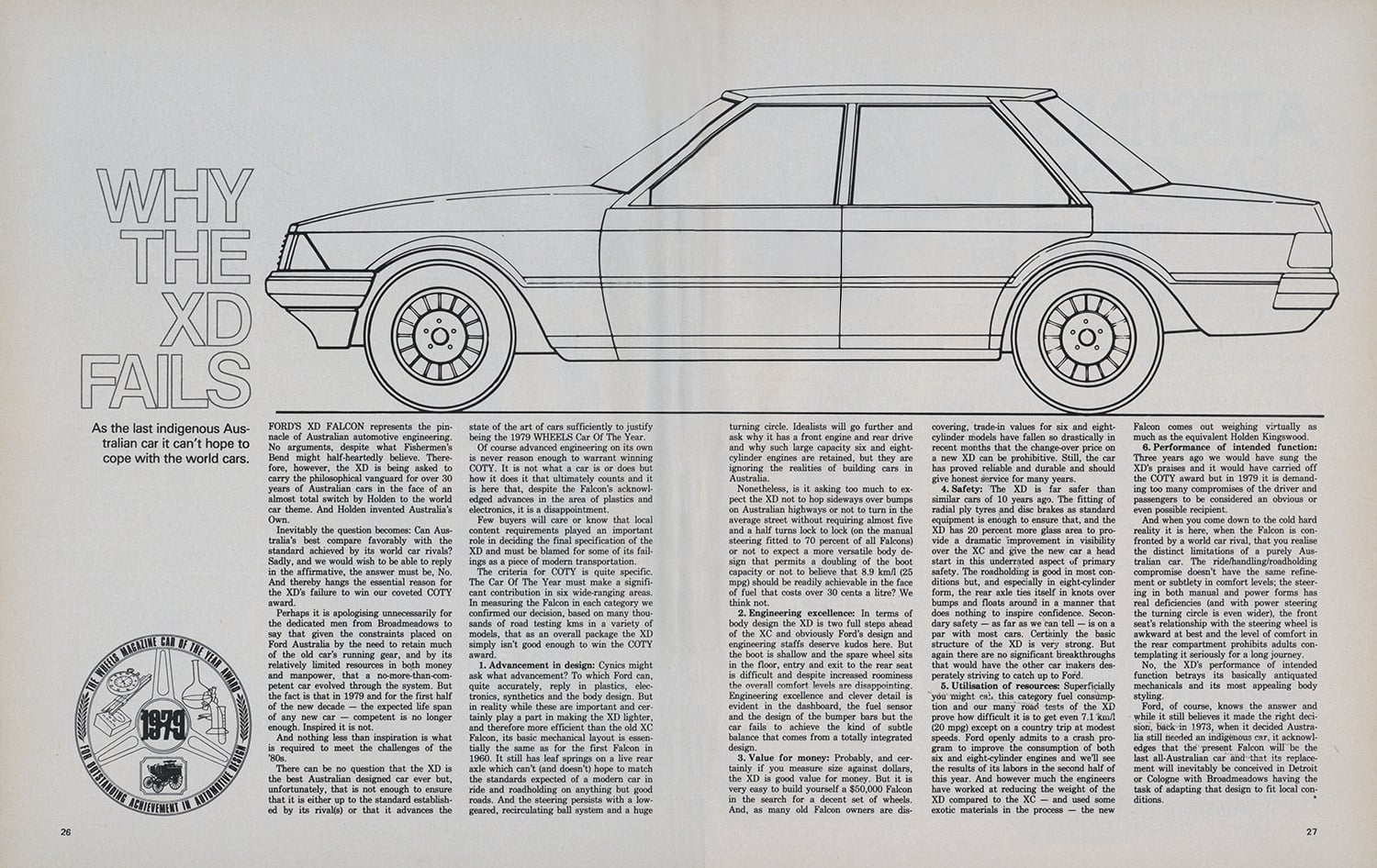
As the last indigenous Australian car it can’t hope to cope with the world cars Ford’s XD Falcon represents the pinnacle of Australian automotive engineering. No arguments, despite what Fishermen’s Bend might half-heartedly believe. Therefore, however, the XD is being asked to carry the philosophical vanguard for over 30 years of Australian cars in the face of an almost total switch by Holden to the world car theme. And Holden invented Australia’s Own.
1
Inevitably the question becomes: Can Australia’s best compare favourably with the standard achieved by its world car rivals? Sadly, and we would wish to be able to reply in the affirmative, the answer must be, No. And thereby hangs the essential reason for the XD’s failure to win our coveted COTY award.
Perhaps it is apologising unnecessarily for the dedicated men from Broadmeadows to say that given the constraints placed on Ford Australia by the need to retain much of the old car’s running gear, and by its relatively limited resources in both money and manpower, that a no-more-than-competent car evolved through the system.
But the fact is that in 1979 and for the first half of the new decade – the expected life span of any new car – competent is no longer enough. Inspired it is not. And nothing less than inspiration is what is required to meet the challenges of the ’80s.
There can be no question that the XD is the best Australian designed car ever but, unfortunately, that is not enough to ensure that it is either up to the standard established by its rival(s) or that it advances the state of the art of cars sufficiently to justify being the 1979 Wheels Car Of The Year.
Of course advanced engineering on its own is never reason enough to warrant winning COTY. It is not what a car is or does but how it does it that ultimately counts and it is here that, despite the Falcon’s acknowledged advances in the area of plastics and electronics, it is a disappointment.
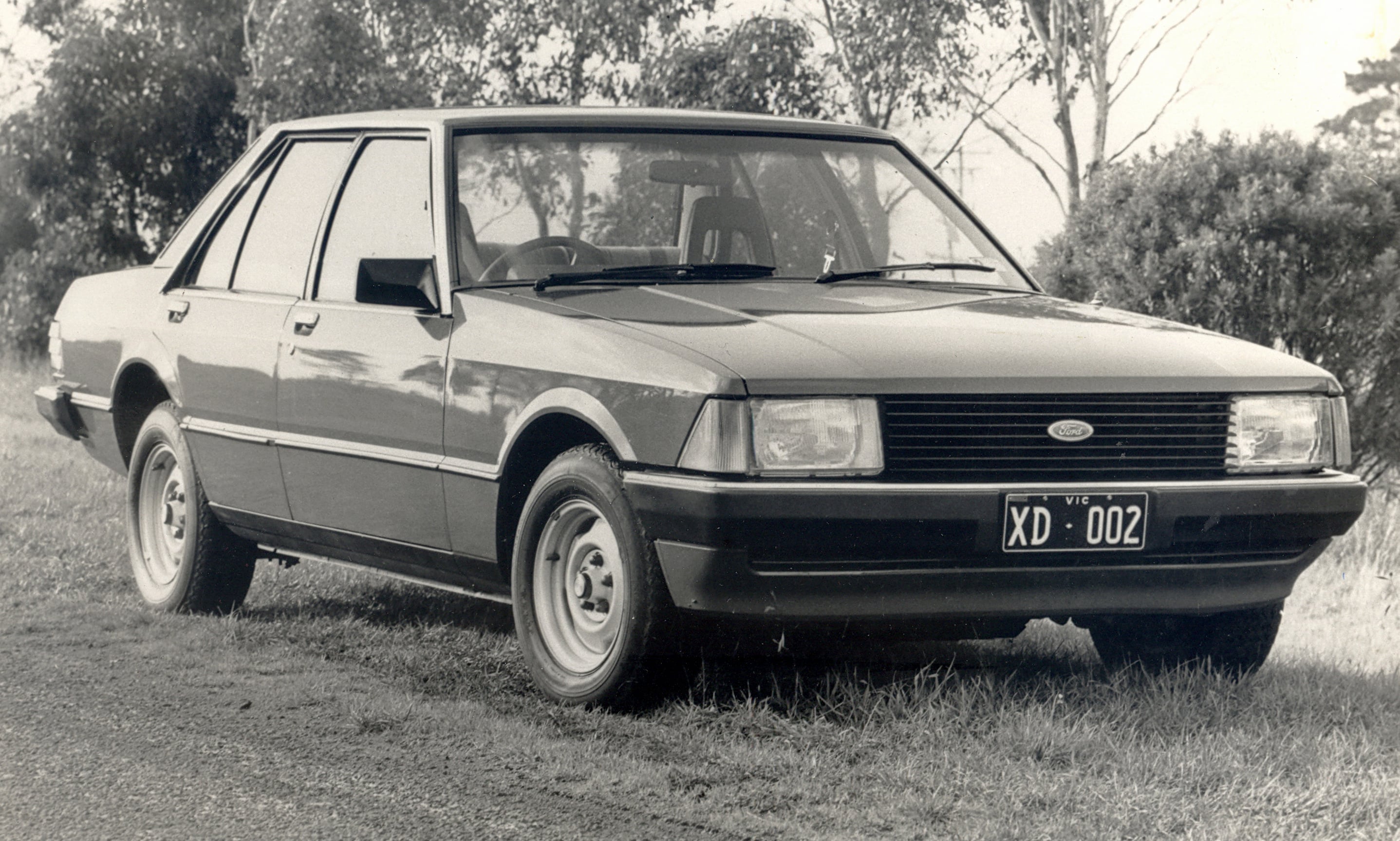
Few buyers will care or know that local content requirements played an important role in deciding the final specification of the XD and must be blamed for some of its failings as a piece of modern transportation.
1
The criteria for COTY is quite specific. The Car Of The Year must make a significant contribution in six wide-ranging areas. In measuring the Falcon in each category we confirmed our decision, based on many thousands of road testing kms in a variety of models, that as an overall package the XD simply isn’t good enough to win the COTY award.
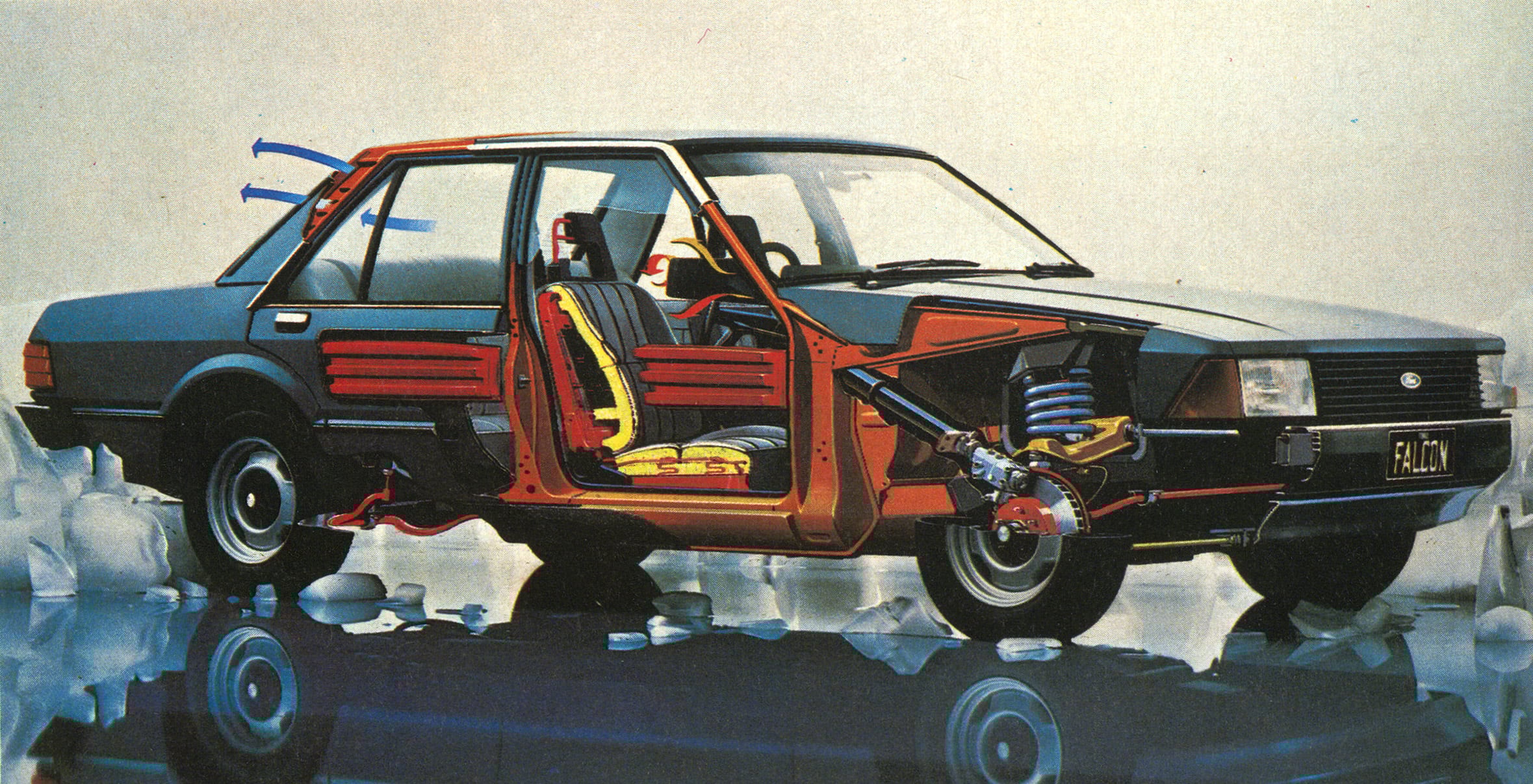
1. Advancement in design: Cynics might ask what advancement? To which Ford can, quite accurately, reply in plastics, electronics, synthetics and the body design. But in reality, while these are important and certainly play a part in making the XD lighter, and therefore more efficient than the old XC Falcon, its basic mechanical layout is essentially the same as for the first Falcon in 1960.
It still has leaf springs on a live rear axle which can’t (and doesn’t) hope to match the standards expected of a modern car in ride and roadholding on anything but good roads. And the steering persists with a low-geared, recirculating ball system and a huge turning circle. Idealists will go further and ask why it has a front engine and rear drive and why such large capacity six- and eight-cylinder engines are retained, but they are ignoring the realities of building cars in Australia.
Nonetheless, is it asking too much to expect the XD not to hop sideways over bumps on Australian highways or not to turn in the average street without requiring almost five-and-a-half turns lock-to-lock (on the manual steering fitted to 70 per cent of all Falcons) or not to expect a more versatile body design that permits a doubling of the boot capacity or not to believe that 8.9 km/l (25mpg) should be readily achievable in the face of fuel that costs over 30 cents a litre? We think not.
1
2. Engineering excellence: In terms of body design the XD is two full steps ahead of the XC and obviously Ford’s design and engineering staff deserve kudos here. But the boot is shallow and the spare wheel sits in the floor, entry and exit to the rear seat is difficult and despite increased roominess the overall comfort levels are disappointing.
Engineering excellence and clever detail is evident in the dashboard, the fuel sensor and the design of the bumper bars but the car fails to achieve the kind of subtle balance that comes from a totally integrated design.
3. Value for money: Probably, and certainly if you measure size against dollars, the XD is good value for money. But it is very easy to build yourself a $50,000 Falcon in the search for a decent set of wheels. And, as many old Falcon owners are discovering, trade-in values for six- and eight-cylinder models have fallen so drastically in recent months that the change-over price on a new XD can be prohibitive. Still, the car has proved reliable and durable and should give honest service for many years.
4. Safety: The XD is far safer than similar cars of 10 years ago. The fitting of radial ply tyres and disc brakes as standard equipment is enough to ensure that, and the XD has 20 per cent more glass area to provide a dramatic improvement in visibility over the XC and give the new car a head start in this underrated aspect of primary safety. The roadholding is good in most conditions but, and especially in eight-cylinder form, the rear axle ties itself in knots over bumps and floats around in a manner that does nothing to inspire confidence.
1
Secondary safety – as far as we can tell – is on a par with most cars. Certainly the basic structure of the XD is very strong. But again there are no significant breakthroughs that would have the other car makers desperately striving to catch up to Ford.
5. Utilisation of resources: Superficially you might call this category fuel consumption and our many road-tests of the XD prove how difficult it is to get even 7.1 km/l (20 mpg) except on a country trip at modest speeds.
Ford openly admits to a crash program to improve the consumption of both six- and eight-cylinder engines and we’ll see the results of its labours in the second half of this year. And however much the engineers have worked at reducing the weight of the XD compared to the XC – and used some exotic materials in the process – the new Falcon comes out weighing virtually as much as the equivalent Holden Kingswood.
6. Performance of intended function: Three years ago we would have sung the XD’s praises and it would have carried off the COTY award but in 1979 it is demanding too many compromises of the driver and passengers to be considered an obvious or even possible recipient.
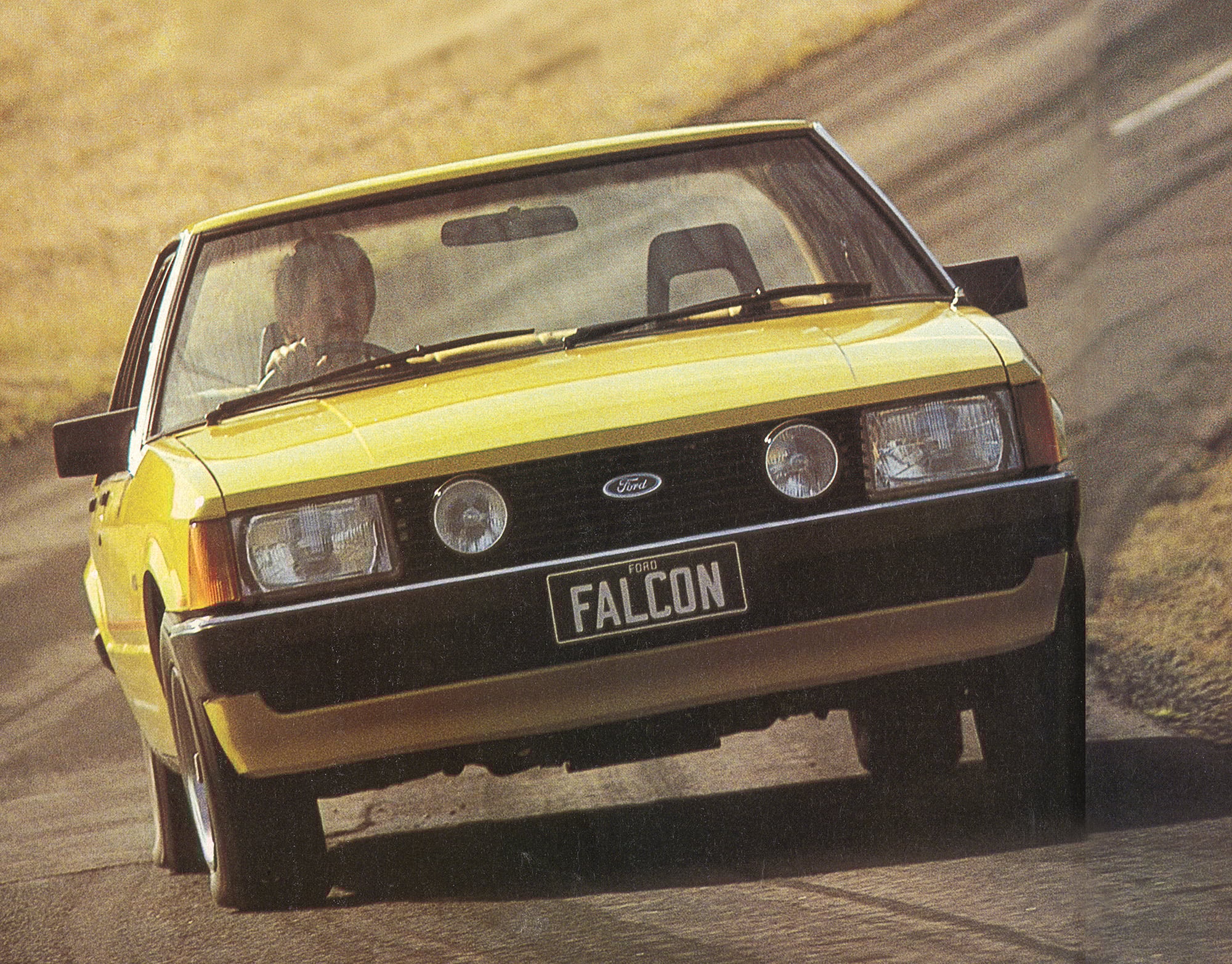
And when you come down to the cold hard reality it is here, when the Falcon is confronted by a world car rival, that you realise the distinct limitations of a purely Australian car.
1
The ride/handling/roadholding compromise doesn’t have the same refinement or subtlety in comfort levels; the steering in both manual and power forms has real deficiencies (and with power steering the turning circle is even wider), the front seat’s relationship with the steering wheel is awkward at best and the level of comfort in the rear compartment prohibits adults contemplating it seriously for a long journey. No, the XD’s performance of intended function betrays its basically antiquated mechanicals and its most appealing body styling.
Ford, of course, knows the answer and while it still believes it made the right decision, back in 1973 when it decided Australia still needed an indigenous car, it acknowledges that the present Falcon will be the last all-Australian car and that its replacement will inevitably be conceived in Detroit or Cologne with Broadmeadows having the task of adapting that design to fit local conditions.
Follow WhichCar/Wheels on Google
Click the button below to make WhichCar by Wheels a preferred source for your news.

We recommend
-
 COTY
COTYWheels Car of the Year: Every winner since 1963
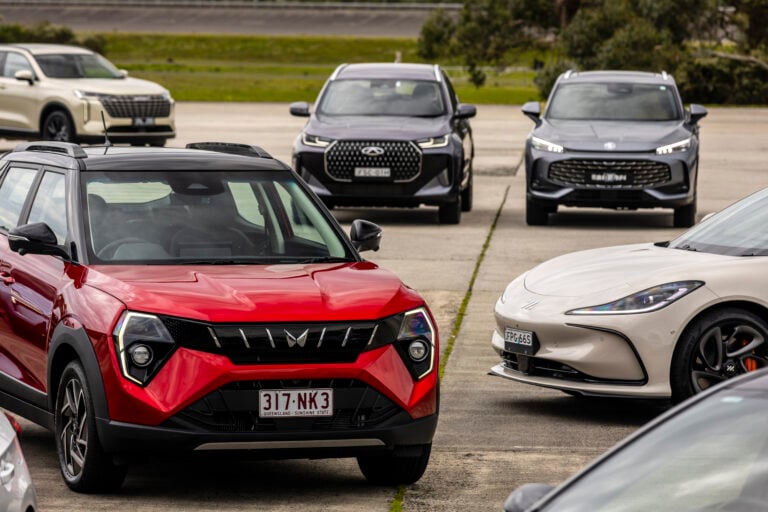
The honour roll for Australia's most prestigious and the world's longest running annual motoring award (some of the cars in this year's field, pictured).
-
 COTY
COTYRobbo’s 2025-26 COTY Notebook – and why the Honda Civic had to win
Esteemed former Wheels editor and 2025-26 Wheels Car of the Year judge Peter Robinson is famous for his fearless opinions – here are his notes on each of this year's COTY contenders...
