
Reviews


Gallery 1
8.4
/10
Score
Score breakdown
8.0
Safety, value and features
8.0
Comfort and space
9.5
Engine and gearbox
8.5
Ride and handling
8.0
Technology
Things we like
- Ferocious twin-turbo inline-six
- Daily drivability blended with track-focused performance
- Purists will love rear-wheel drive
Not so much
- We lament the demise of manual transmission but do love more torque
- Carbon-fibre bucket seats not great for long-distance touring
- Second row seats an afterthought
When BMW’s M Division slaps a CS badge on one of its models today, it immediately shouts to the world that this car is something special, a car that sits at, or near, the top of the model’s line-up.
But if you think the Competition Sport designation has been around only since 2017 – when it first appeared on the M4 coupe – then think again.
Those two little letters first appeared way back in the early 1960s, just as BMW was pivoting from its post-war slumber into the German Economic Miracle.
BMW’s Neue Klasse set the template for the future of BMW and sprinkled amongst its range of premium sedans, a smattering of stunning coupes vied for buyers’ attention. Wearing the ‘C’ (for Coupe) designation, BMW soon found there was a case in offering sportier versions and in 1965, the BMW 2000 CS (Clubsport or Coupe Sport depending on who you believe) made its debut.
3
Whatever the ‘C’ stood for in ‘CS”, then as now, the two-letter acronym meant something special, a sportier, more powerful version of BMW’s range of sporty coupes.
Which brings me neatly to the car we have here today, a car that represents the perfect distillation of what CS truly means – the 2026 BMW M2 CS.
The CS badge isn’t new to M2, the previous F87 generation benefiting from the Competition Sport treatment back in 2020. But with an all-new second generation (G87) M2 making its debut in 2023, it was inevitable that BMW M’s wizards would weave their CS magic into its small, two-door coupe.
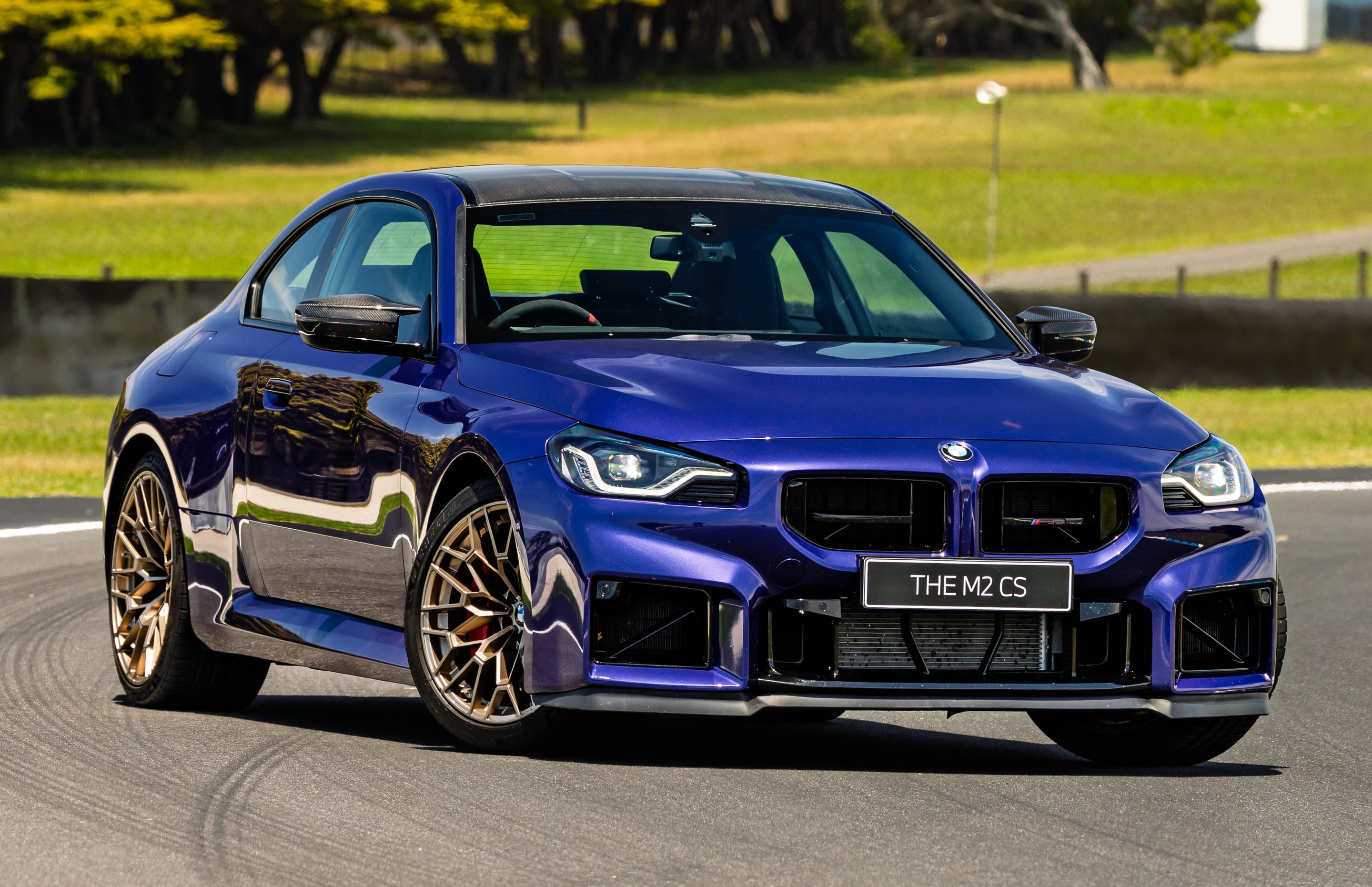
The recipe is simple enough. Engine outputs up, weight down, CS-specific tuning for the suspension and chassis and aggressive styling that matches the show with the go.
3
Having a CS badge on the boot and the grille does attract a hefty premium, no matter the M model. In the case of the BMW M2 CS, buyers’ bank accounts will be lighter to the tune of $172,900 (before on-road costs), some $45,600 more than the regular MS ($127,300). But you do get a whole lot more M2 for your money.
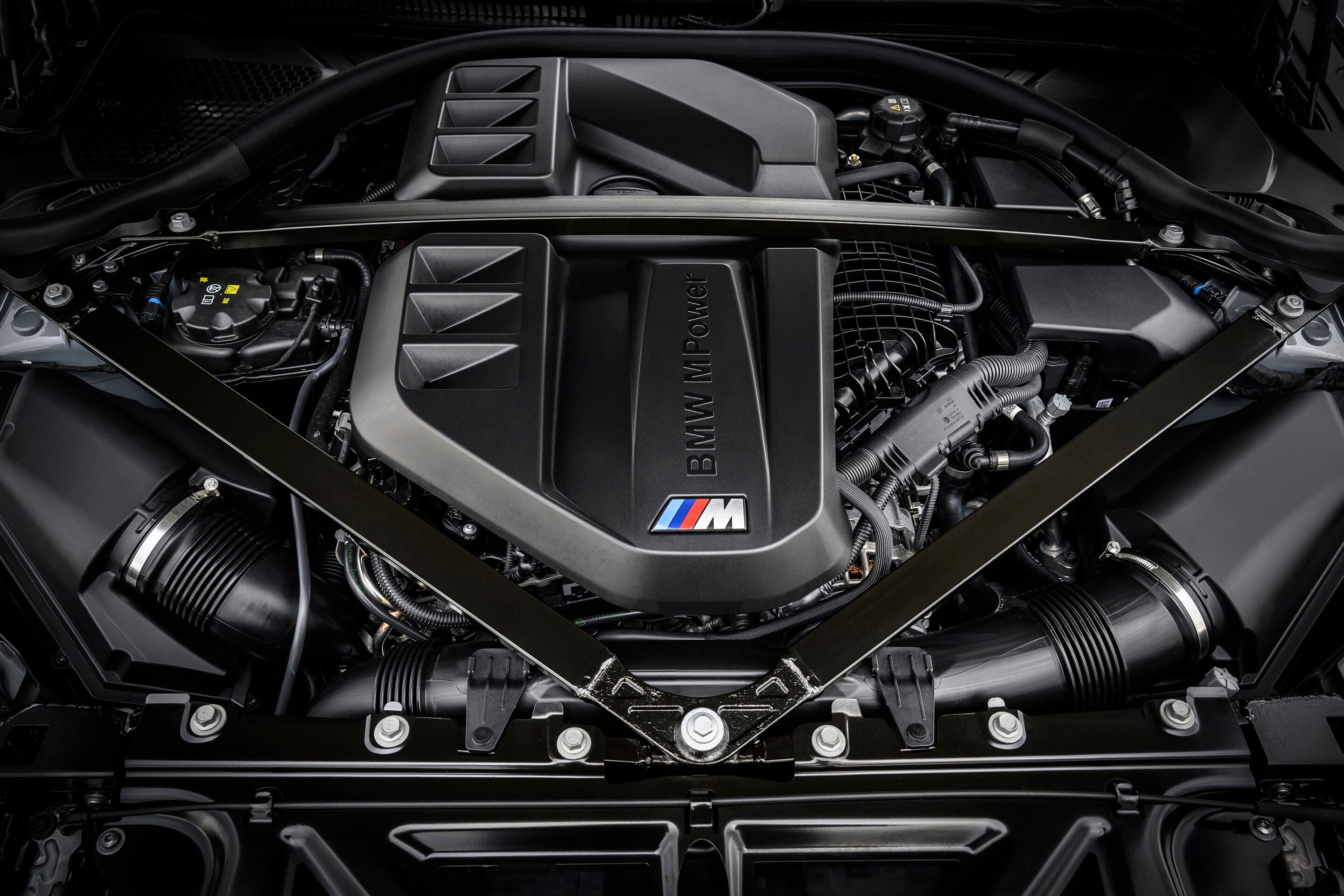
For starters the 3.0-litre twin-turbo inline-six might look familiar on paper but in this Competition spec it receives a significant power and torque boost, now at 390kW and 650Nm, trumping both the manual M2 (353kW/550Nm) and automatic M2 (353kW/600Nm).
It’s matched with BMW’s eight-speed Steptronic automatic transmission, sending drive to the rear wheels. There is no manual M2 CS available, and nor will there be, with M’s current six-speed manual gearbox – ZF GS6-L55TZ – rated to a maximum torque output of 600Nm. However, BMW engineers a safety margin, limiting torque to 550Nm for three-pedal M models.
The chassis has come in for some work too, with CS-specific engine mounts, CS-tuned dampers and springs, a lower ride height by 8mm, and CS tuning across steering, brakes, the rear diff and traction control.
1
The liberal use of carbon-fibre reinforced polymer (CFRP) inside and out has shaved 30kg off the regular M2’s kerb weight, the CS tipping the scales at 1700kg.
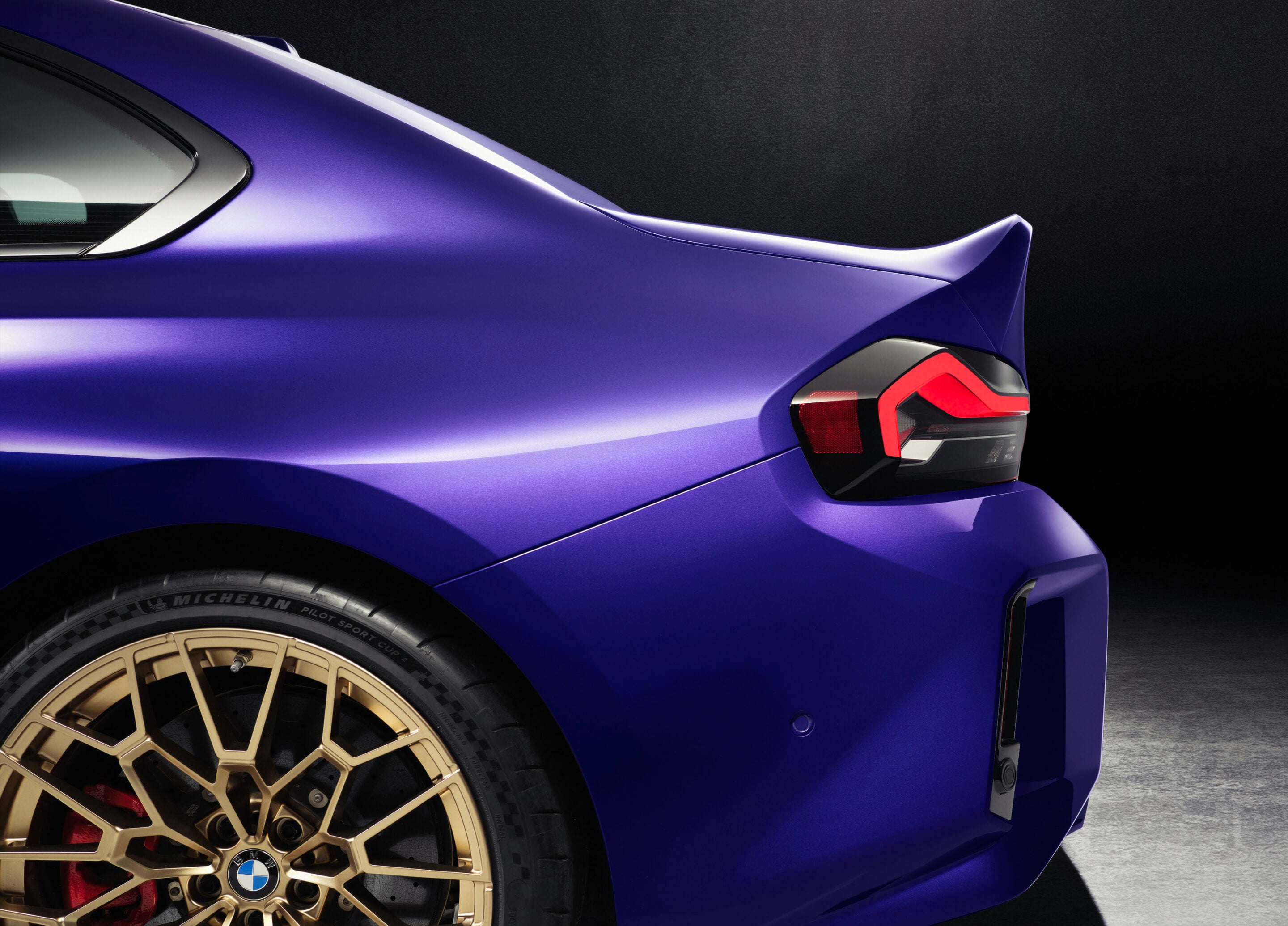
The big ticket CFRP items are the boot lid – complete with an integrated ducktail spoiler that distinguishes the CS from regular M2s – and roof as well as the mirror caps and rear diffuser.
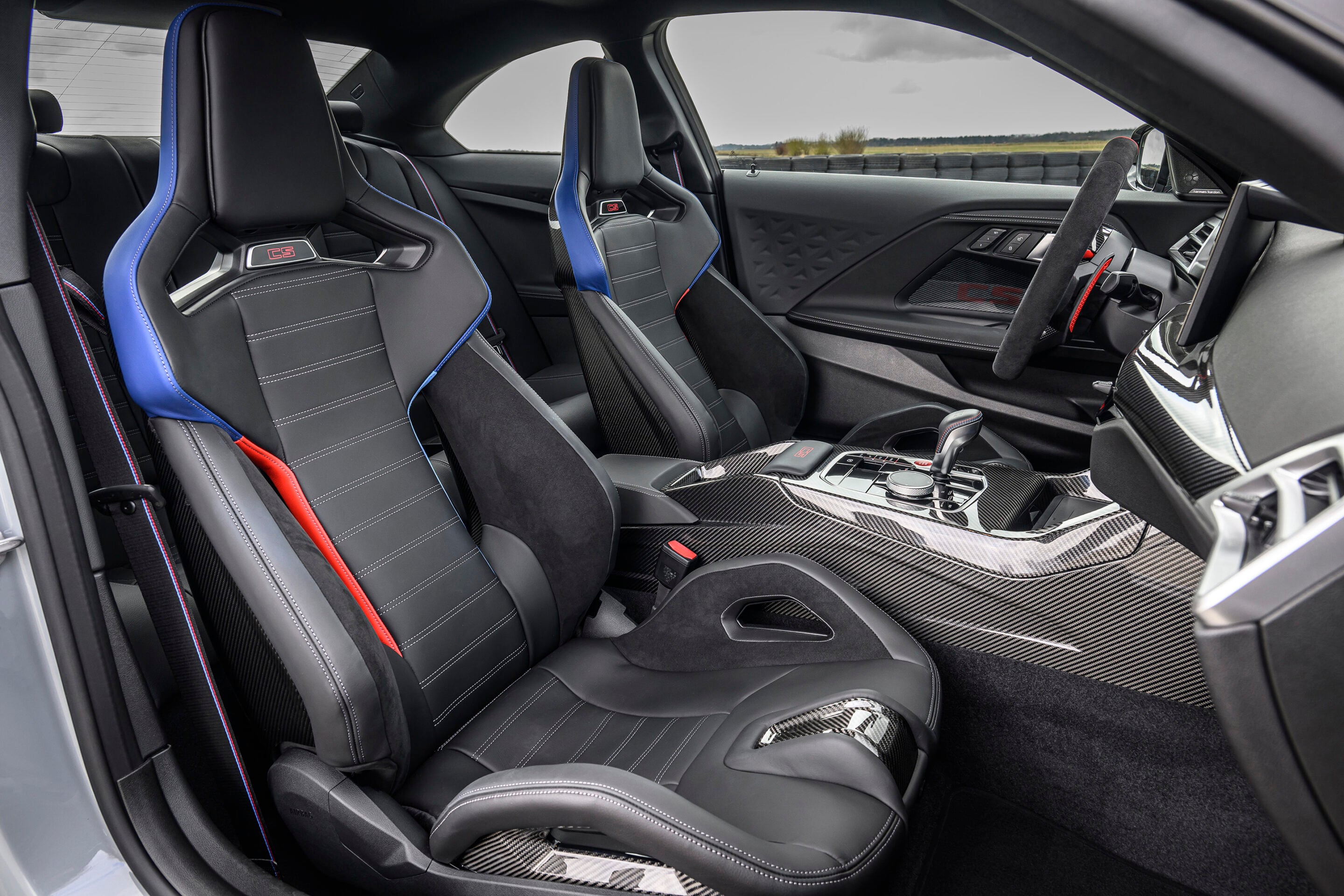
The carbon-fibre theme continues inside, the lightweight polymer liberally – and visibly – sprinkled throughout. Everything from the M bucket seats to the centre console and the dash shine with the glow of carbon weave in a cabin that blends a driver-centric sportiness with BMW’s typical premium flourishes, as do the illuminated CS logos on the seatbacks and door sills.
The carbon-fibre bucket seats – electrically adjustable – come standard and fit their hard shell firmly around your body, ideal for cutting laps on the race track but a little tiring for longer stints on the road. So too the offset pedal placement where the accelerator is positioned just a smidge too far to the right, close to the right-hand footwell needing a deviation from the ideal seating position. It’s a small thing, but when you’re blasting the MS CS around one of Australia’s most demanding race tracks, any distraction is unwelcome.
Tech heads won’t be left wanting with BMW’s large, gently-curved widescreen dominating the landscape. It incorporates a 14.9-inch infotainment display and 12.3-inch digital instrument cluster inside its single frame.
3
And BMW’s commitment to physical switchgear is a welcome one, with an array of buttons, switches and dials for a variety of the car’s functions, including the ability to access and manage the CS’s many and varied drive settings.
Practicality doesn’t take a backseat – the lack of cupholders in the centre console notwithstanding – with a usable (for short trips) second row and a generous 390-litre boot.
While premium and tech-laden cabins are all well and good, the star attraction of the M2 CS is in how it performs. To find out exactly that, we spent time behind the wheel on some beguiling stretches of rural backroads near Bathurst in NSW, and then on one of the world’s most revered race tracks – Mount Panorama.
There’s a sense of occasion as you fire up the menacing straight-six under the bonnet, its bark on start-up as intoxicating as it is spine-tingling. This is a truly special engine, one which defines the current breed of M cars and which, in this, a rear-wheel drive two-door perfectly encapsulates the brand’s original philosophy.
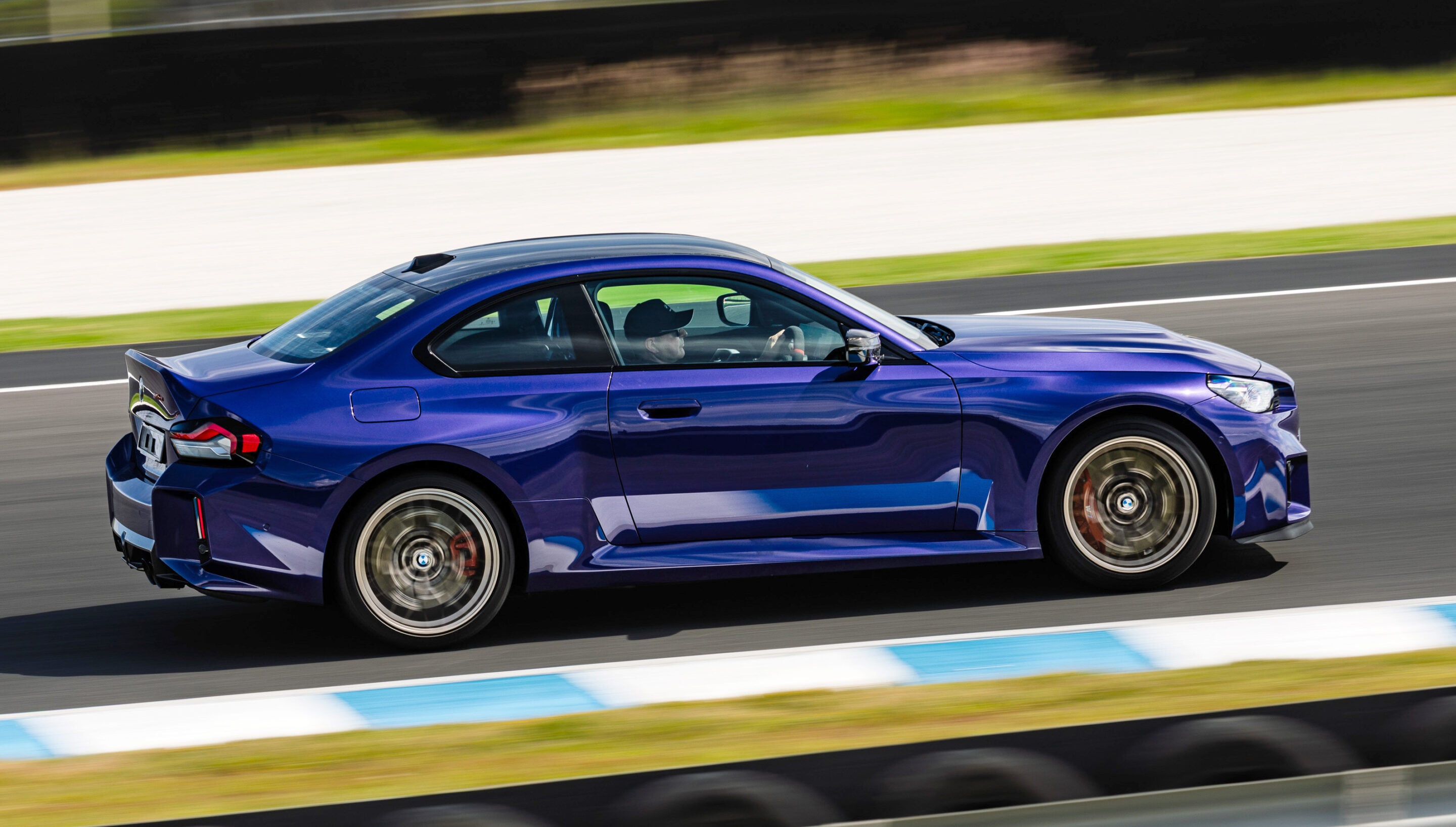
Certainly, the new G87 generation M2 CS is quicker than the model it replaces. BMW claims a 0-100km/h time of 3.8 seconds, 0.2s quicker than the older model. But the big improvement comes as that lusty inline-six is let off the chain, BMW quoting a 0-200km/h time of 11.7 seconds, 1.2s quicker than its predecessor. Top speed? Try 302km/h. Astonishing numbers, all of them.
2
The rural backroads of Sofala in NSW’s central-west are not the place to test BMW’s claims. But they do provide a decent canvas to find out how M’s smallest road-and-track brawler handles everyday life.
Certainly, the CS’s stiffer suspension setup is keenly felt, especially on the chopped up surfaces of country NSW where potholes and patchwork-quilt surfaces are the norm. And yet, despite the firm edge under wheel, the CS doesn’t feel like it’s too much for the open road. Yes, the ride is firm, but just on the right side of acceptable.
The M2 CS makes up for its uncompromising road holding with the characteristically heroic abilities of the growling straight-six under the bonnet. Punching out of corners is as effortless as the baritone rumble of the exhaust is enjoyable. Sure, its potential is largely wasted on Australian public roads, but there’s still pleasure to be found in linking a series of bends and corners together without breaking the speed limit bank.
Luckily for us, BMW also threw us the keys to the gates of Mount Panorama and it is here, unfettered by societal expectations, where the M2 CS and its distilled essence of the M badge, truly sparkles and shines.
3
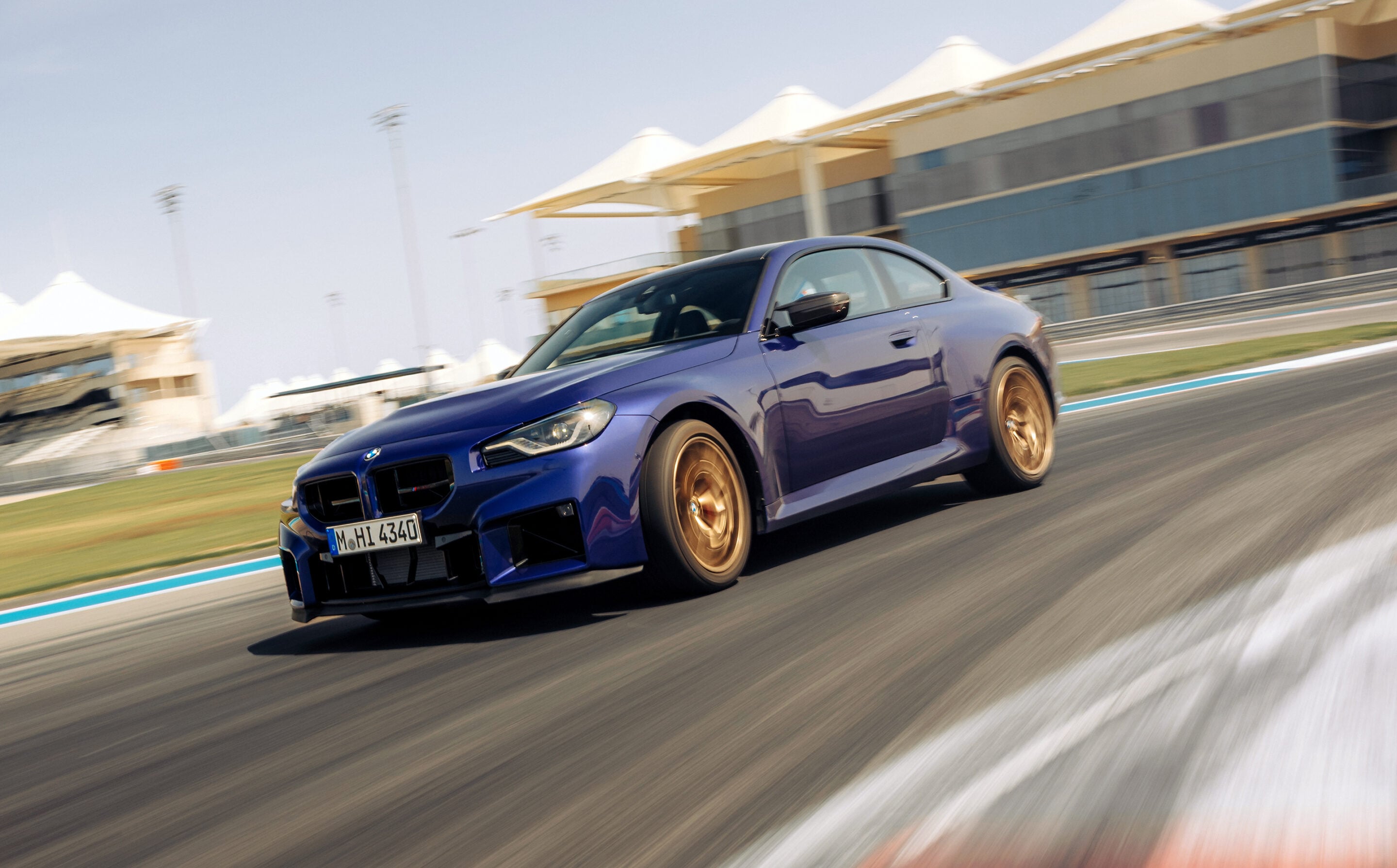
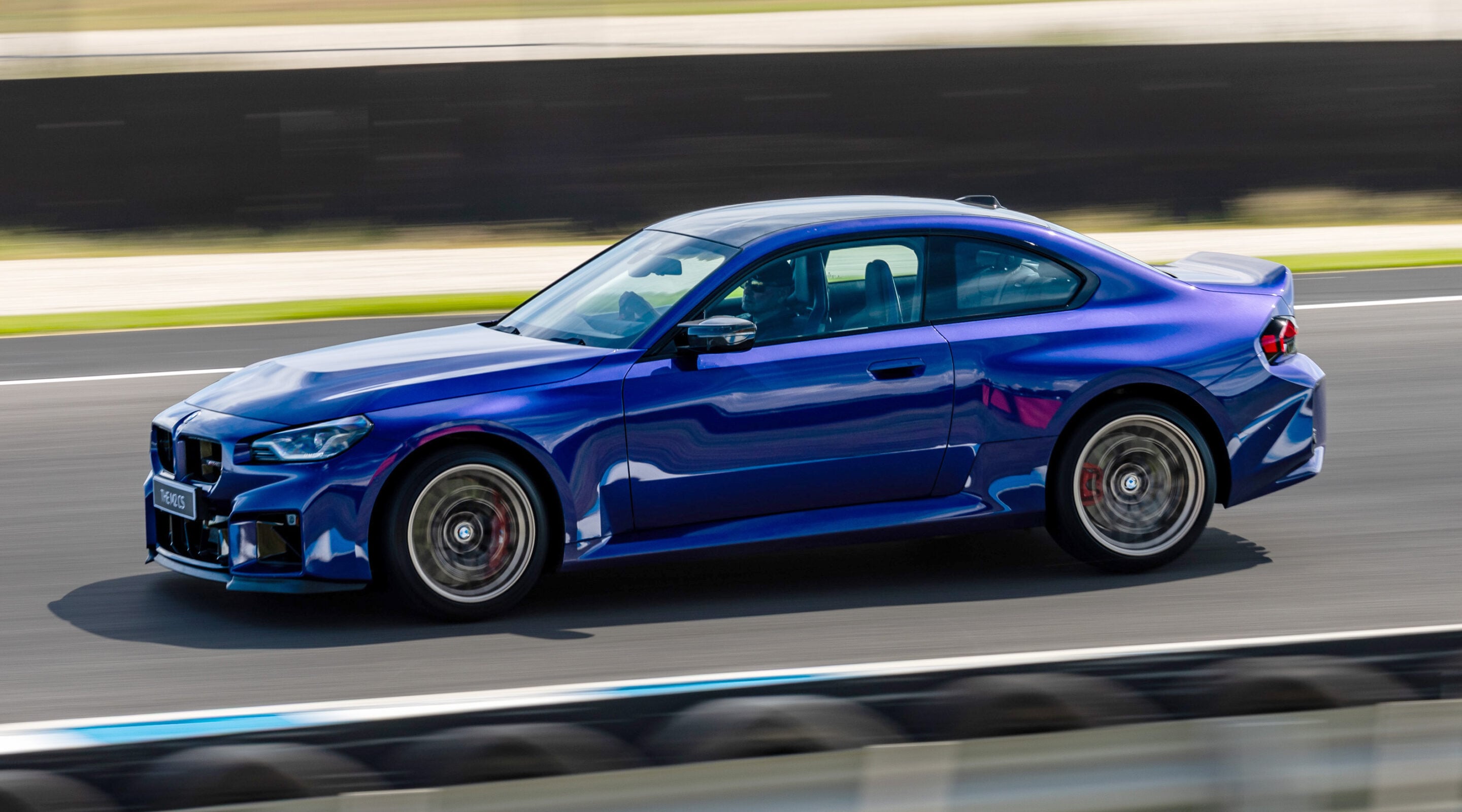
BMW protocol demanded that traction control was left – partially – on, but even then, the CS was more than happy to offer just a hint of tail-wagging when powering out corners. It never feels unwieldy, though. Instead, after a brief jig on its rear wheels, the M2 settles into its line with poise, purpose and plenty of power.
Full-throttle acceleration pins you back in your seat as the eight-speed automatic rockets through the gears, every shift nudging the 7200rpm redline while the S58 twin-turbo six-cylinder positively howls for its supper, relentlessly building speed even on Mount Panorama’s uphill sections such as the climb up Mountain Straight.
It’s not just about straight-line speed, of course, although there’s plenty of that to keep even the most hardened of speed junkies high on adrenaline. No, the M2 CS is so much more than a headline number.
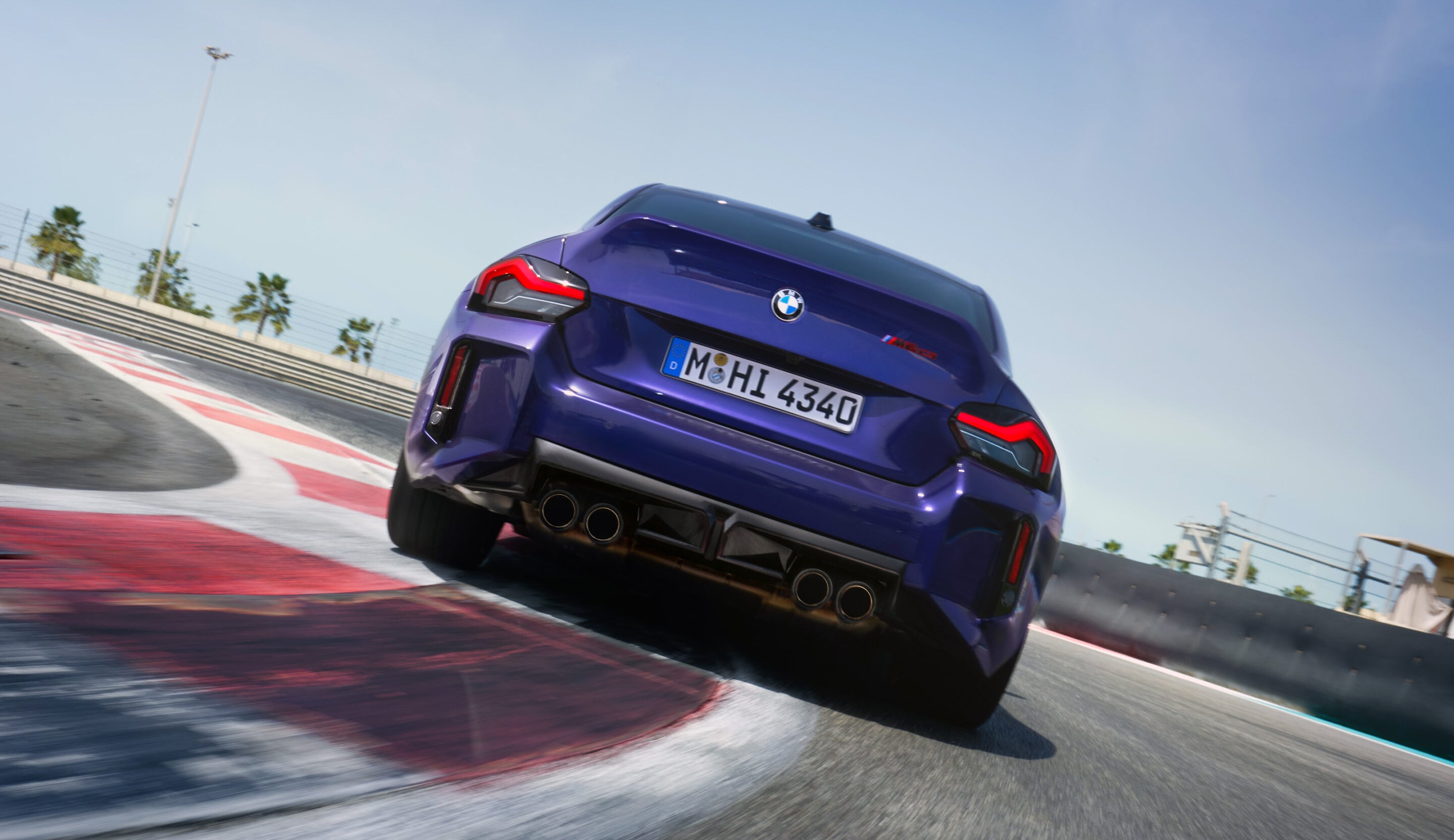
Throwing the deft little coupe at Mount Panorama’s series of challenging corners and bends showcases the engineering work that’s gone into the chassis. Yes, it can twitch a little powering hard out of corners, but for the most part, the CS remains remarkably composed, staying true to its line with poise and purpose.
1
The confidence builds then, and each successive lap is just that little bit quicker, a choreography of the sum of its parts dancing together to flatter and reward the driver in a way few cars can.
The eight-speed automatic does a fine job of selecting the right gear at the right time, while allowing the twin-turbo six its full head of 7200rpm steam. But using the paddle-shifters to chart your own ratio destiny is more rewarding still, short-shifting vital to extracting the best out of the CS on the uphill series of bends through The Cutting.
The brakes too – optional carbon-composite ($19,000) on our test car – do a commendable job of retarding speed, whether hard on the pins for big stops such as heading into Griffins Bend or modulating gently to settle the CS before turning in to the sweeper at McPhillamy.
They copped abuse too, at the hands (or feet) of a flotilla of guest drivers from the media, and yet remained as reliably solid at day’s end as they did on the first lap.
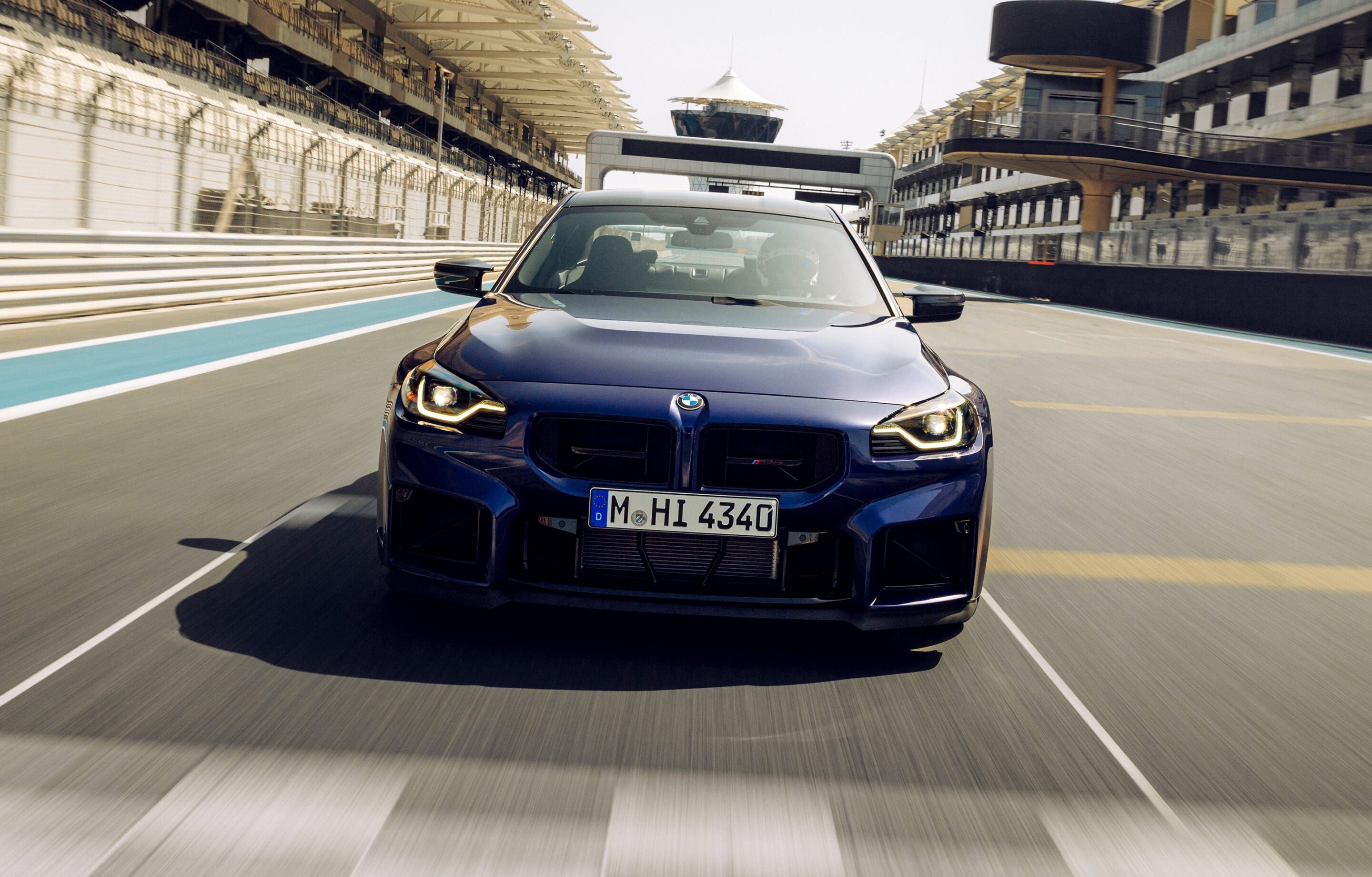
3
It’s testament to the approachability that has been engineered into the M2 CS. Having the confidence to pound out lap after lap at full tilt knowing the CS will unwaveringly do exactly what’s asked of it is so vital to being able to enjoy the driving, whether on the road or the track.
And while there might be bigger and brawnier M models in the wider catalogue, the G87-generation M2 CS captures – arguably – the very essence of the M brand in one, compact, rear-wheel drive package.
Specs
| Model | 2026 BMW M2 CS |
|---|---|
| Price | $172,900 (plus on-road costs) |
| Engine | 3.0-litre twin-turbo in-line six-cylinder |
| Peak power | 390kW |
| Peak torque | 650Nm |
| Transmission | Eight-speed automatic, RWD |
| 0-100km/h | 3.8 seconds |
| 0-200km/h | 11.7 seconds |
| Top speed | 302km/h |
| Fuel consumption | 10.0L/100km (claimed) |
| Fuel type/tank size | 98 RON unleaded/59L |
| Weight | 1700kg (kerb) |
| L/W/H/W-B | 4587/1887/1395/2747 |
| Warranty | 5yr/unlimited km (vehicle) |
| On sale | Now |
8.4
/10
Score
Score breakdown
8.0
Safety, value and features
8.0
Comfort and space
9.5
Engine and gearbox
8.5
Ride and handling
8.0
Technology
Things we like
- Ferocious twin-turbo inline-six
- Daily drivability blended with track-focused performance
- Purists will love rear-wheel drive
Not so much
- We lament the demise of manual transmission but do love more torque
- Carbon-fibre bucket seats not great for long-distance touring
- Second row seats an afterthought
Follow WhichCar/Wheels on Google
Click the button below to make WhichCar by Wheels a preferred source for your news.

We recommend
-
 Comparisons
Should you buy a 2023 BMW M2? New G87 vs OG F87 battle
Better in nearly every sense, is the latest M2 the enthusiast’s choice?
-
 Reviews
2023 BMW M2 review – Australian first drive
Another smash hit? Or a difficult second album? We deliver the verdict on BMW M’s smallest model
-
 News
NewsBMW M2 CS: More details revealed about sporty, higher-performance beast
BMW has unveiled an even faster version of its M2 sports coupe with more power and stiffness, yet also less weight.
