Reviews


Gallery 1
8.0
/10
Score
Score breakdown
8.0
Safety, value and features
6.0
Comfort and space
9.0
Engine and gearbox
9.0
Ride and handling
8.0
Technology
Things we like
- Sublime chassis, comfortable ride
- Zingy engine, wonderful gearbox
- Surprisingly well equipped
Not so much
- Tight cabin with little storage
- Pricing has increased a lot
- Flat seats lack support
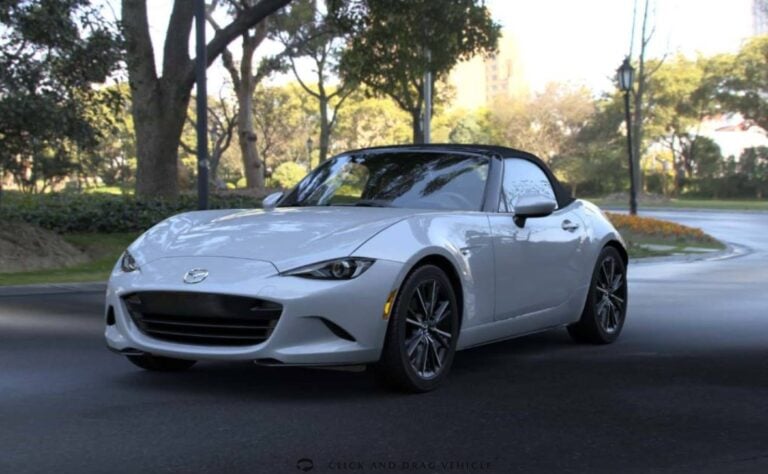
Do you sometimes despair about modern cars? You’re not alone. There’s an undercurrent of annoyance with almost every new car we drive thanks to everything from frustrating active safety features through to controls buried in touchscreens, and it feels like it’s only getting worse. Who made new cars so serious? There are a variety of answers, but there is one antidote: The Mazda MX-5.
Mazda’s iconic roadster is currently in its fourth generation with a fifth likely due in the next few years and as always, it proudly represents simple and fun top-down motoring for those who want it. It’s not without its faults, but the MX-5 is a sublime little roadster. Here’s why…
How much does the Mazda MX-5 cost to buy?
The 2026 MX-5 range kicks off at $42,640 plus on-road costs for the entry-level Roadster, stepping up to the $49,290 +ORC Roadster GT we’re testing here and the top-spec $52,290 +ORC Roadster GT RS. As before, both the traditional roadster and the folding targa top ‘Retractable Fastback’ MX-5 RF are available, with the RF priced from $53,790 +ORC.

4
Pricing for the 2026 MX-5 range is higher than ever before, and aside from the entry-level Roadster, all are comfortably above $50,000 once on-road costs are considered. Like many cars, the MX-5 isn’t as good value as it used to be. When the current ‘ND’ launched with 2.0-litre engines in late 2015, pricing started at just $34,490 +ORC for the entry-level Roadster 2.0-litre and the Roadster 2.0GT asked $39,550 +ORC. Is the same car with tweaks worth $10,000 more a decade later?
Regardless, the MX-5 Roadster GT is well equipped. Features include LED exterior lighting with Matrix adaptive high beam, black leather upholstery, a nine-speaker Bose sound system with speakers in the headrests, automatic climate control, an 8.8-inch touchscreen with wireless Apple CarPlay and Android Auto, and a reasonable suite of active safety features like autonomous emergency braking, lane departure warning, blind-spot monitoring, driver attention monitoring and a reversing camera.
Unfortunately in today’s market, competition to the MX-5 is also not as cheap or plentiful as, say, 10 years ago when the ND MX-5 was released. But there are still some options, including the Toyota GR 86 and Subaru BRZ twins, a slew of hot hatches like the Hyundai i30 N and Volkswagen Golf GTI, as well as the i30 Sedan N and Subaru WRX.
How powerful is the Mazda MX-5?
A 2.0-litre four-cylinder petrol engine is the only available engine in the Australian market MX-5, making 135kW of power and 205Nm of torque. Depending on model, both six-speed manual and six-speed automatic gearboxes are available – this is a two-seater sports car, so the manual is compulsory. What a wonderful gearbox it is, too, with its short throw, precise action and communicative clutch. Both Toyota/Subaru and Hyundai could learn a lot from the MX-5’s gearbox.
The 2.0-litre engine received a fairly big upgrade in 2018, making 17kW more power and introducing a higher 7500rpm redline to replicate the formerly-available 1.5-litre engine, which was slower than the original 2.0-litre but revved higher and sounded better.
As a result, the 2.0-litre engine became the default MX-5 choice and it’s a great donk: it sounds nicely mechanical with a lovely supercharger-like noise, revs cleanly to its 7500rpm redline and goes well too. Of course, 135kW isn’t a massive amount of power, but combined with the MX-5’s low 1070kg kerb weight, it’s more than adequate. Mazda Australia doesn’t claim a 0-100km/h time but overseas reports mention a 6.5-second mark, which isn’t exactly hanging around.

6
Mazda claims that the MX-5 will use 6.8L/100km of 95 RON premium unleaded on the combined cycle, which is fairly easy to achieve in combined driving. In pure urban driving, we achieved 8.6L/100km, which is just under the 9.1L/100km urban claim. Our test car had travelled less than 1000km, so its consumption would likely improve with more distance under its tyres.
What is the Mazda MX-5 like to drive?
Considering that’s the whole point of the MX-5, it’s unlikely to surprise you that it drives very well indeed. Modern cars are rarely this fun and it’s a great cleanse in an era where the driving experience in most cars is now dominated by safety systems. Importantly, you can feel every part of the MX-5’s driving experience, from the feelsome steering to the sharp throttle response. As a result, stitching it all together on a good bit of road feels like an achievement, adding to the likely already massive grin on your face from behind the wheel.
That’s not to say that it’s difficult to drive, because it isn’t. It’s had one of the best manual gearboxes in the world since its release, bar none, and the clutch is easy to get along with (unlike a GR 86/BRZ). I taught many people to drive a manual in my 2016 2.0 GT thanks to the aforementioned easy clutch and gearbox combination.
4
The ride is quite comfortable, rarely feeling firm, and the handling is great. It’s not free of roll, unlike a such as the i30 N, but that makes the driver further part of the driving experience and taming it feels like a win. Mazda wasn’t kidding when it said the MX-5 is one for drivers.
That said, if the driving experience is your key consideration, might I suggest upgrading to the GT RS. It costs $3000 more but adds important features like Bilstein dampers, stronger Brembo front brakes, a suspension front tower brace bar and a track mode for the stability control, which allows for more slip in corners. Doing so gets you a tauter MX-5 with better body control and higher cornering ability – plus, handsome BBS wheels replace the frankly hideous wheels that are now standard.
How practical is the Mazda MX-5?
It’s a two-seater roadster, so how practical could it be? You’re not going to be buying much flat pack furniture to take home in it, that’s for sure. Also, even if you’re on the shorter side, the MX-5’s cabin will be snug. That’s fine as it’s not meant to be a van, but just a smidge more practicality would make it an easier sell against more useable hot hatchbacks.
For example, the boot of the MX-5 measures just 130 litres (or, around half that of a Mazda2 that it shares showrooms with). That’s enough for a few duffle bags or a weekly shop to be wedged in, but good luck with anything more. Choosing the MX-5 RF coupe doesn’t make it any more capacious, unfortunately. A GR 86/BRZ or hot sedan/hatch is definitely better at carrying things, but that’s looking past the point of the MX-5.
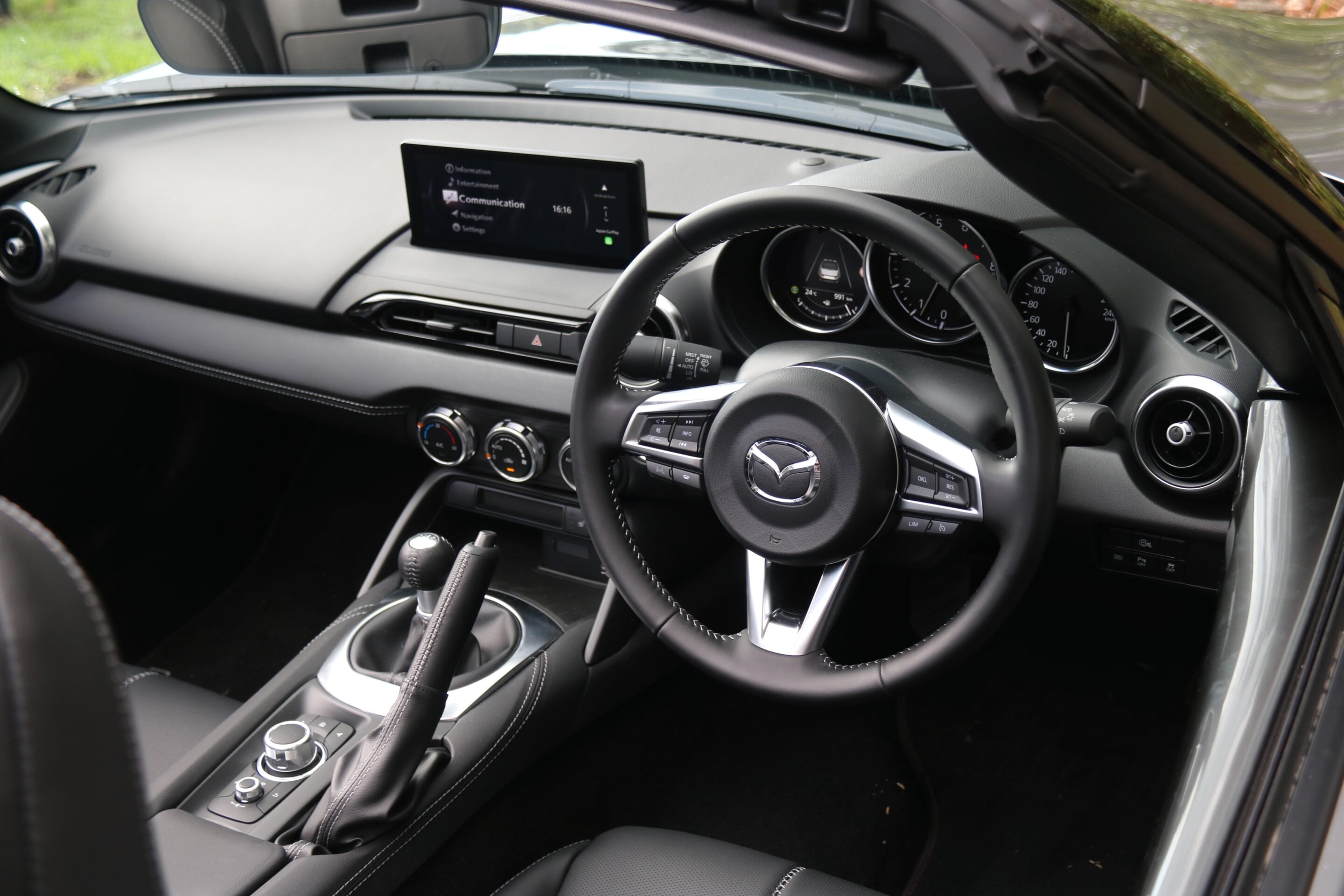
The cabin of the MX-5 has remained relatively unchanged in its 11-year life, but the basics are still fine: the quality is good, it’s easy to operate and the lack of storage is hilarious. Want to discover how much larger smartphones have become since 2015? Put yours in the phone slot in the MX-5’s centre console – my then-new iPhone fit just fine in my 2016 MX-5, but my newer and larger model? Nope.

4
As for other cabin storage, there’s a small cubby in the middle of the seats, one more behind each seat and a tiny tray between the seats. That’s it, not even a glovebox. The roof operation is more positive, however: press the handle in the middle of the seats, extend your arm, reach for the sky and pull the roof to the windscreen and lock it into place. The whole operation takes maybe five seconds at the most. Brilliant, Mazda.
So, some of the bits inside the MX-5 feel a bit old but still work well and a new 8.8-inch touchscreen from Mazda’s newer models like the Mazda3 was added in the ‘ND3’ update. It doesn’t operate much differently to the former 7.0-inch ‘MZD Connect’ unit in the pre-updated MX-5, still employing a control wheel in the centre console and a basic menu structure that’s easy to navigate, but it looks far newer and screen quality is much sharper than before.
Unlike the CX-60 and above SUVs, it can – thankfully! – be used as a touchscreen while using smartphone mirroring. Mazda, spread this to the rest of the range, please. The nine-speaker Bose sound system is also nicely punchy too – phone call audio pushed through them is actually quite useful.
What could be improved in the MX-5’s cabin are the seats, which have consistently needed a redesign since the ND generation’s release. In some overseas markets, Recaro sports seats are available and have featured locally in a few special editions, but we’d like to see them more widely available as the current seats are too flat and lack lateral support. While I’m moaning, a digital speedo would be a great addition, especially for taller drivers as the analogue speedometer sits an an odd angle.
What warranty covers the Mazda MX-5?
The MX-5 is covered by a five-year/unlimited km warranty with five years of roadside assistance. Its annual service intervals are every 15,000km (whichever comes first) and five years/75,000km of servicing costs an expensive $2797 or $560 per service on average.

4
Should I buy a Mazda MX-5?
If you’re coming from an older ND1 or ND2 MX-5, I would say probably not – yes, the ND3 is a definite improvement on previous models, but it’s also notably more expensive and the car is fundamentally the same. The lack of space, characterful engine and excellent driving experience remain as so, albeit tweaked slightly as Mazda does with its models so well.
However, there’s no denying that the MX-5 is a sublime sports car that makes you grin from ear to ear. It’s communicative from behind the wheel to make you feel part of every part of the driving experience yet also more than comfortable enough to easily drive every day. Importantly, it reminds you that cars can still be fun. I hope the MX-5 never loses that talent.
Mazda MX-5 specifications:
| Price | From $49,290 plus on-road costs |
|---|---|
| Engine | 1998cc four-cylinder petrol |
| Power | 135kW (@ 7000rpm) |
| Torque | 205Nm (@ 4000rpm) |
| 0-100km/h | 6.5 seconds (est.) |
| Top speed | 225km/h (est.) |
| Transmission | Six-speed manual, rear-wheel drive |
| Claimed fuel consumption | 6.8L/100km (8.6L/100km as tested) |
| Fuel type/tank size | 95 RON premium unleaded, 45 litres |
| Dimensions (L/W/H/WB) | 3915/1735/1230/2310mm |
| Boot size | 130 litres |
| Kerb weight | 1070kg |
| On sale | Now |
MX-5 Roadster GT standard features:
- 17-inch alloy wheels with a tyre repair kit
- Limited-slip differential
- Manual cloth soft-top
- Dusk-sensing automatic LED exterior lighting
- Rain-sensing automatic wipers
- Keyless entry with push button start
- Heated electric mirrors
- Electric windows with auto-down
- Heated leather seats with speakers in the headrests
- Single-zone automatic climate control
- 8.8-inch touchscreen
- Mazda Connected Services
- Wireless Apple CarPlay and Android Auto
- Satellite navigation
- AM/FM/DAB+ digital/internet radio
- Bluetooth calling and audio streaming
- 203W nine-speaker Bose sound system
- 2x USB-C charging ports
- Cruise control with braking
- Matrix adaptive high beam
- Auto-dimming rear mirror
- 4x airbags
- Autonomous emergency braking (forward and reverse)
- Lane departure warning
- Blind-spot monitoring with rear cross-traffic alert
- Driver attention alert
- Traffic sign recognition
- Rear parking sensors
- Reversing camera
- Tyre pressure monitoring
8.0
/10
Score
Score breakdown
8.0
Safety, value and features
6.0
Comfort and space
9.0
Engine and gearbox
9.0
Ride and handling
8.0
Technology
Things we like
- Sublime chassis, comfortable ride
- Zingy engine, wonderful gearbox
- Surprisingly well equipped
Not so much
- Tight cabin with little storage
- Pricing has increased a lot
- Flat seats lack support
Follow WhichCar/Wheels on Google
Click the button below to make WhichCar by Wheels a preferred source for your news.


We recommend
-
 News
NewsCould the next Mazda MX-5 be hybrid?
The replacement for the world’s most successful roadster is still a few years away, and Mazda is yet to firm up its plans for exactly how it will power the next generation MX-5.
-
 News
NewsSales of petrol cars drop sharply in the EU as hybrid, PHEV and electric surge
The rise in popularity of hybrid, plug-in hybrid and electric vehicles has seen petrol and diesel new car sales plummet in the EU
-
 News
NewsManual transmission on life support, says BMW M boss
BMW M chief Frank Van Meel admits the days of M cars with manual transmissions are numbered.