Classic Wheels

Gallery 1
First published in the November 1970 issue of Wheels magazine, Australia’s best car mag since 1953. Subscribe here and gain access to 12 issues for $109 plus online access to every Wheels issue since 1953.
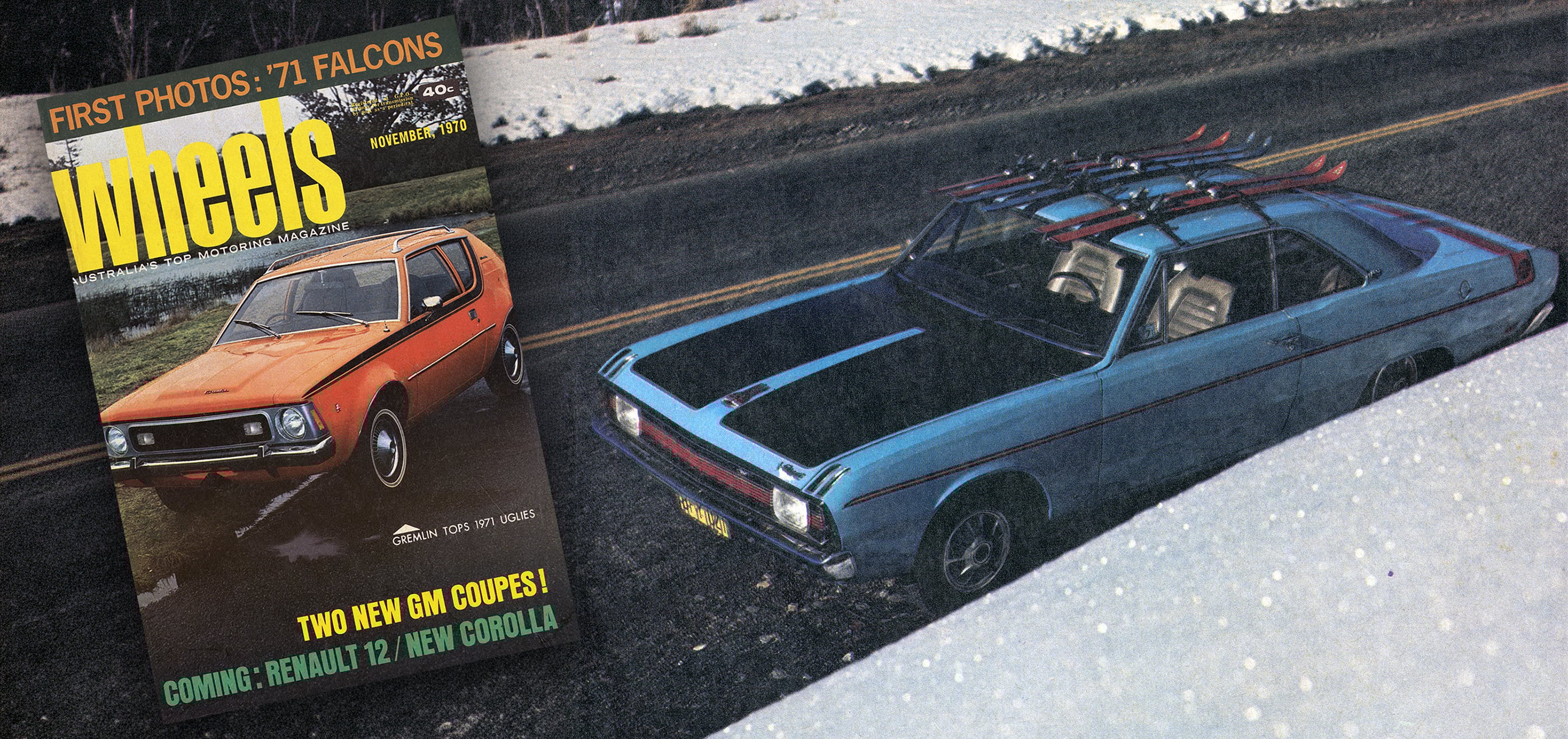
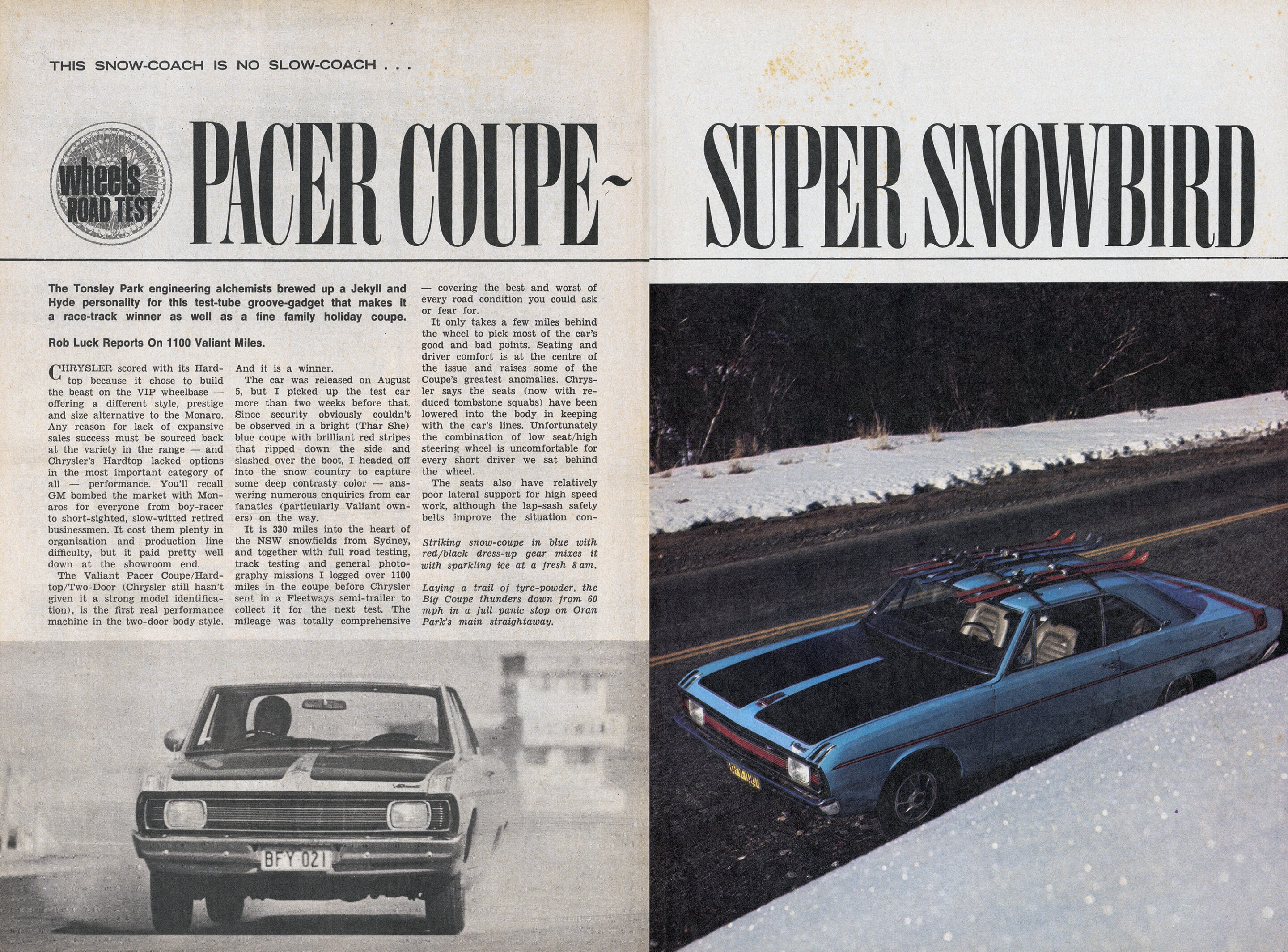
The Tonsley Park engineering alchemists brewed up a Jekyll and Hyde personality for this test-tube groove-gadget that makes it a race-track winner as well as a fine family holiday coupe.
Chrysler scored with its Hardtop because it chose to build the beast on the VIP wheelbase – offering a different style, prestige and size alternative to the Monaro. Any reason for lack of expansive sales success must be sourced back at the variety in the range – and Chrysler’s Hardtop lacked options in the most important category of all – performance. You’ll recall GM bombed the market with Monaros for everyone from boy-racer to short-sighted, slow-witted retired businessmen. It cost them plenty in organisation and production line difficulty, but it paid pretty well down at the showroom end.
1
The Valiant Pacer Coupe/Hardtop/Two-Door (Chrysler still hasn’t given it a strong model identification), is the first real performance machine in the two-door body style. And it is a winner.
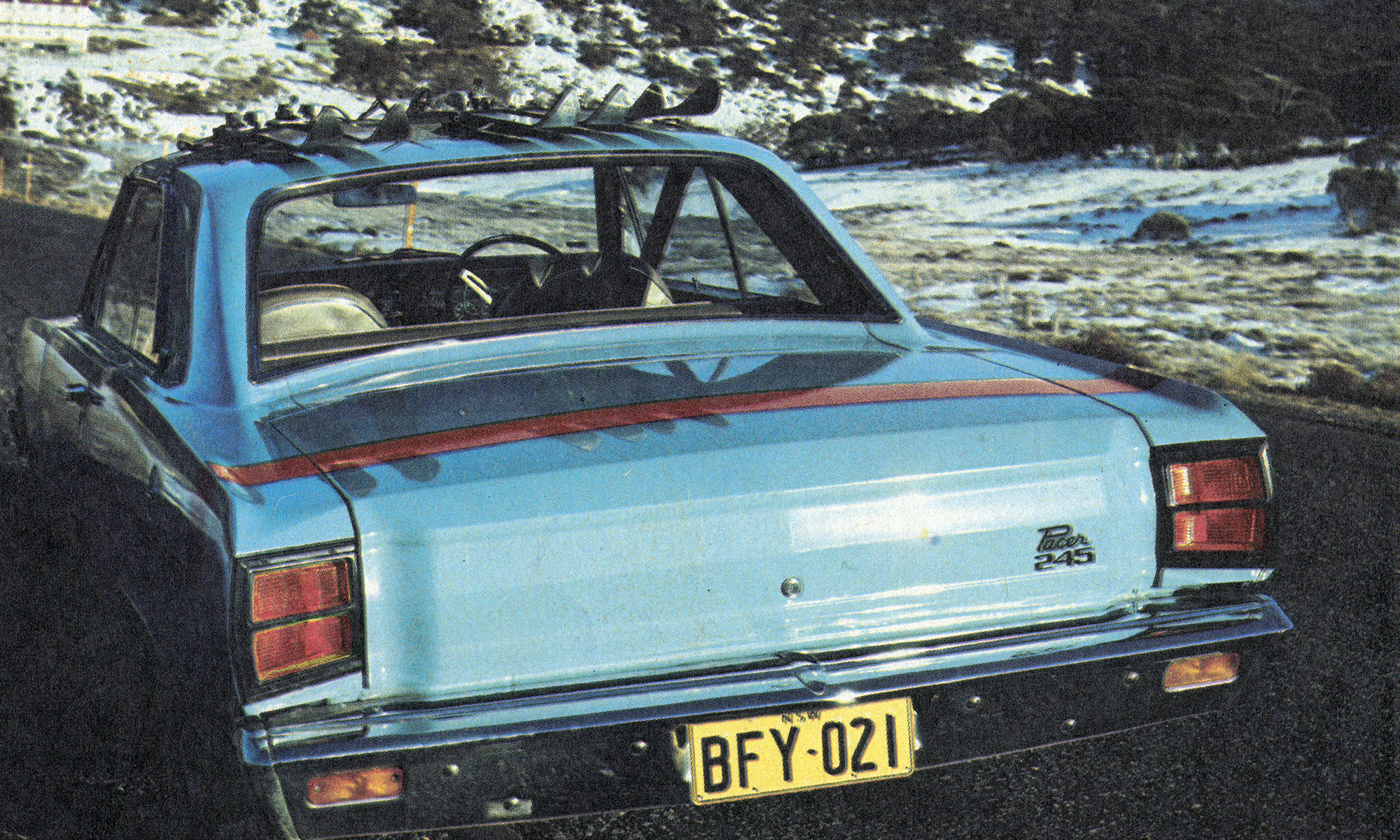
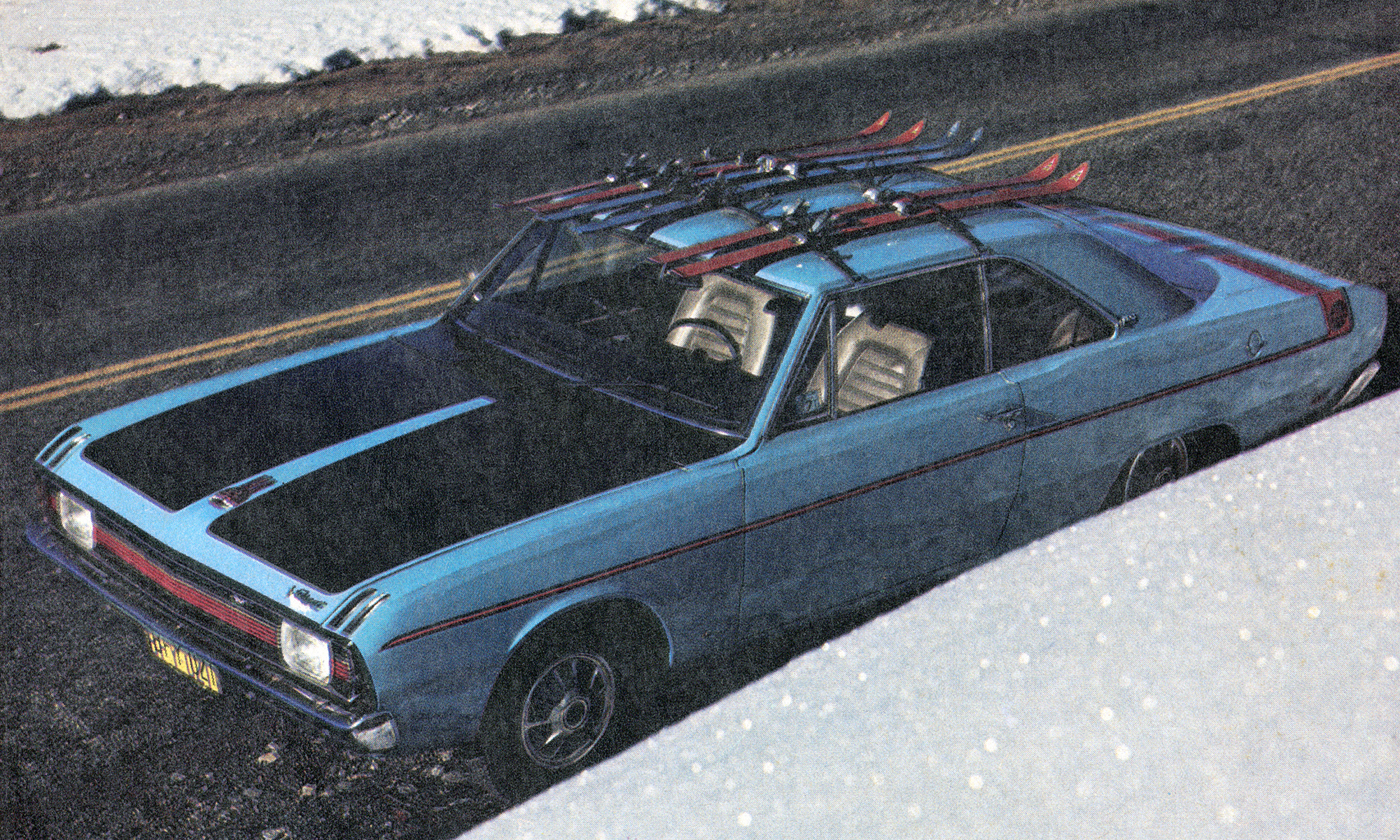
The car was released on August 5, but I picked up the test car more than two weeks before that. Since security obviously couldn’t be observed in a bright (Thar She) blue coupe with brilliant red stripes that ripped down the side and slashed over the boot, I headed off into the snow country to capture some deep contrasty colour – answering numerous enquiries from car fanatics (particularly Valiant owners) on the way.
It is 330 miles into the heart of the NSW snowfields from Sydney, and together with full road testing, track testing and general photography missions I logged over 1100 miles in the coupe before Chrysler sent in a Fleetways semi-trailer to collect it for the next test. The mileage was totally comprehensive covering the best and worst of every road condition you could ask or fear for.
1
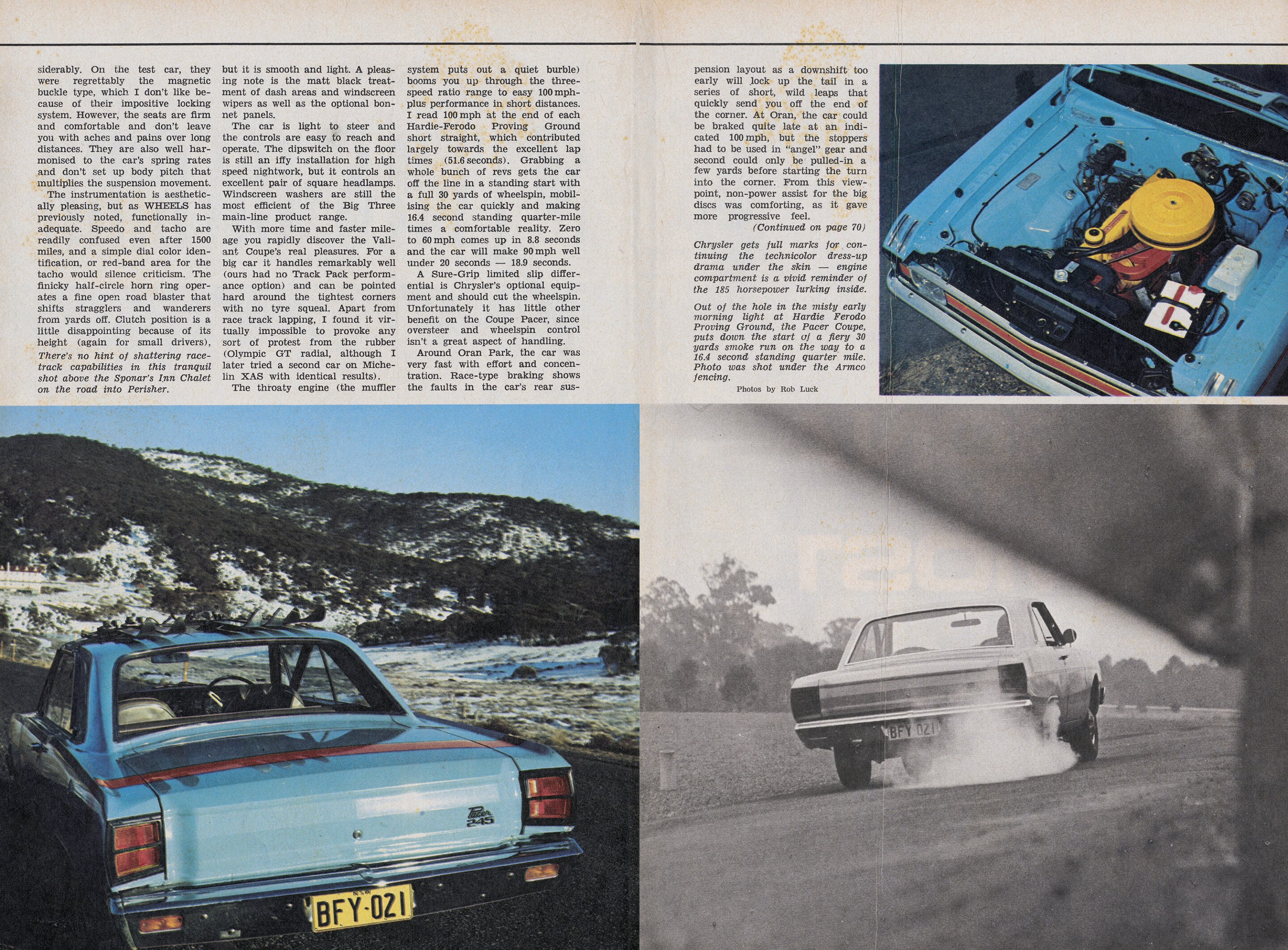
It only takes a few miles behind the wheel to pick most of the car’s good and bad points. Seating and driver comfort is at the centre of the issue and raises some of the Coupe’s greatest anomalies. Chrysler says the seats (now with reduced tombstone squabs) have been lowered into the body in keeping with the car’s lines. Unfortunately the combination of low seat/high steering wheel is uncomfortable for every short driver we sat behind the wheel.
The seats also have relatively poor lateral support for high speed work, although the lap-sash safety belts improve the situation considerably. On the test car, they were regrettably the magnetic buckle type, which I don’t like because of their impositive locking system. However, the seats are firm and comfortable and don’t leave you with aches and pains over long distances. They are also well harmonised to the car’s spring rates and don’t set up body pitch that multiplies the suspension movement.
The instrumentation is aesthetically pleasing, but as Wheels has previously noted, functionally inadequate. Speedo and tacho are readily confused even after 1500 miles, and a simple dial colour identification, or red-band area for the tacho would silence criticism. The finicky half-circle horn ring operates a fine open road blaster that shifts stragglers and wanderers from yards off. Clutch position is a little disappointing because of its height (again for small drivers), but it is smooth and light. A pleasing note is the matt black treatment of dash areas and windscreen wipers as well as the optional bonnet panels.
1
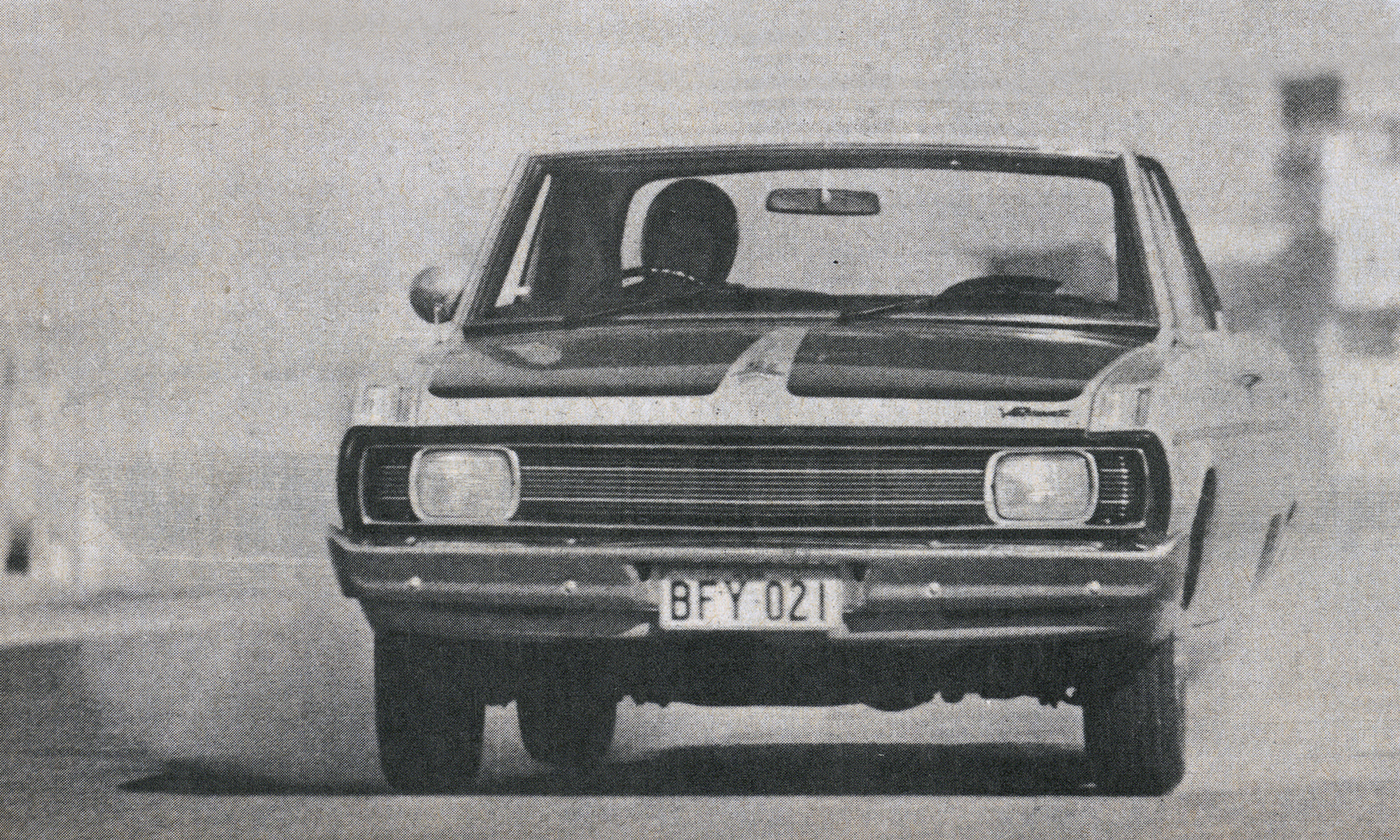
The car is light to steer and the controls are easy to reach and operate. The dipswitch on the floor is still an iffy installation for high speed nightwork, but it controls an excellent pair of square headlamps. Windscreen washers are still the most efficient of the Big Three main-line product range.
With more time and faster mileage you rapidly discover the Valiant Coupe’s real pleasures. For a big car it handles remarkably well (ours had no Track Pack performance option) and can be pointed hard around the tightest corners with no tyre squeal. Apart from race track lapping, I found it virtually impossible to provoke any sort of protest from the rubber (Olympic GT radial, although I later tried a second car on Michelin XAS with identical results).
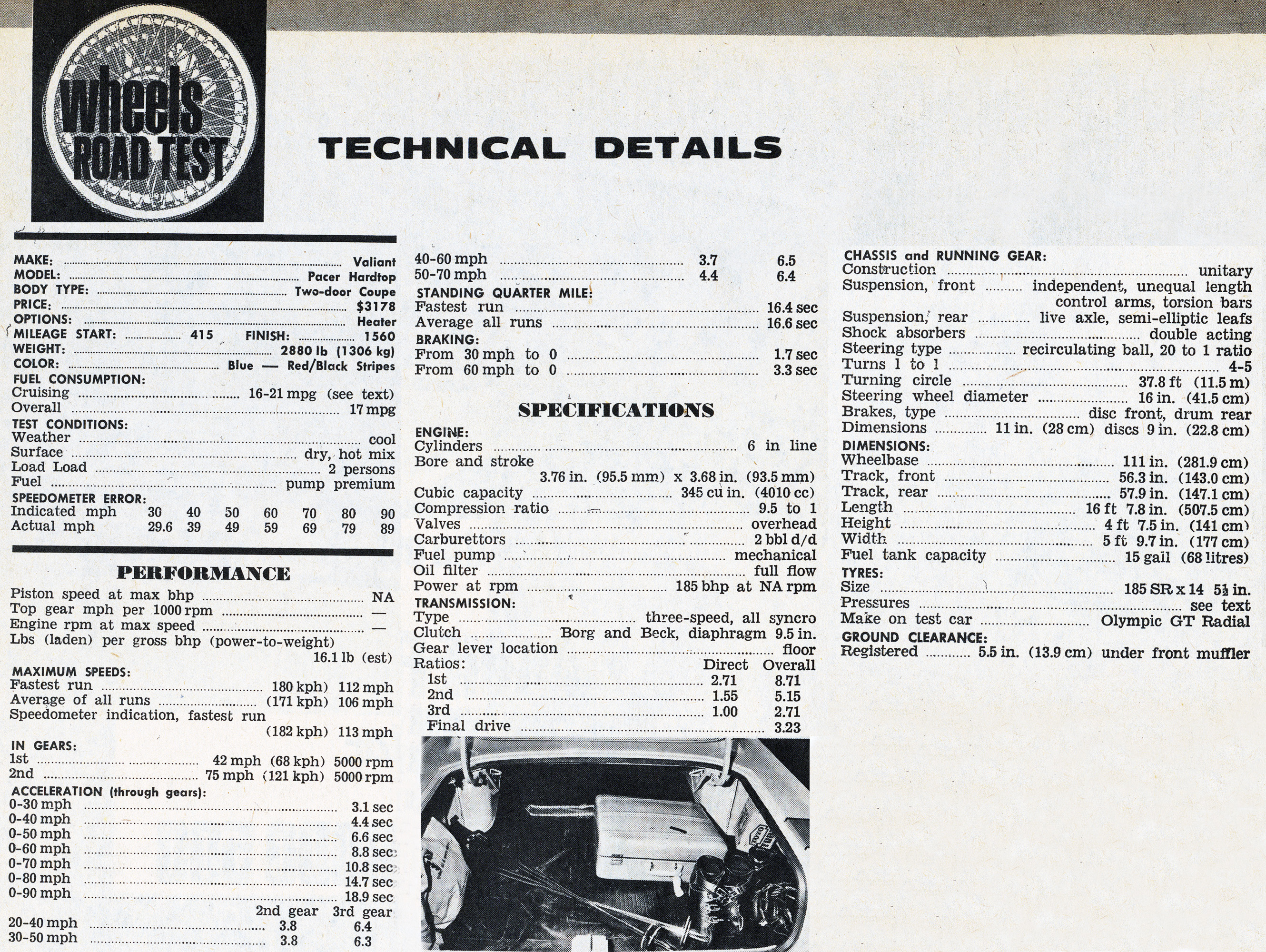
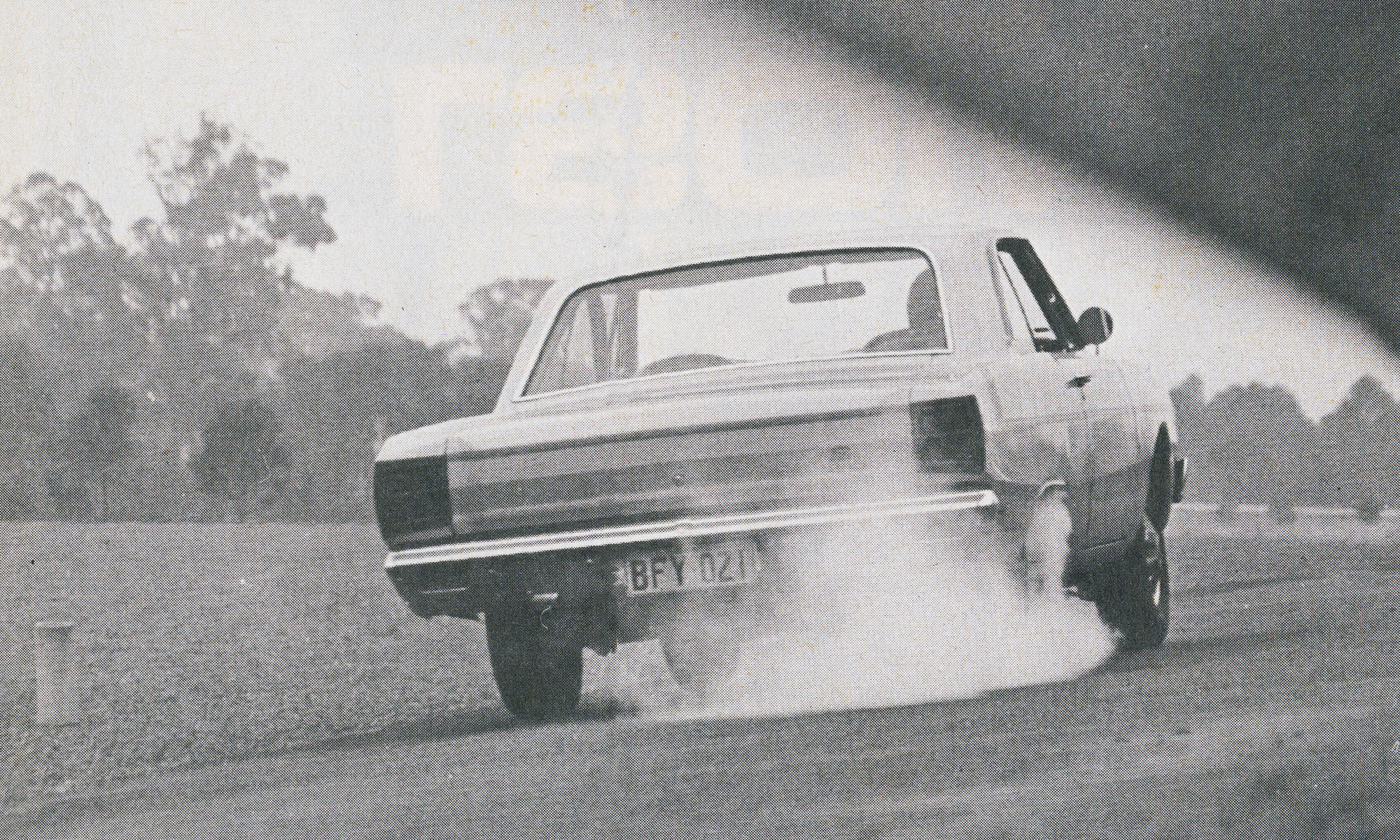
The throaty engine (the muffler system puts out a quiet burble) booms you up through the threespeed ratio range to easy 100mph-plus performance in short distances. I read 100 mph at the end of each Hardie-Ferodo Proving Ground short straight, which contributed largely towards the excellent lap times (51.6 seconds). Grabbing a whole bunch of revs gets the car off the line in a standing start with a full 30 yards of wheelspin, mobilising the car quickly and making 16.4 second standing quarter-mile times a comfortable reality. Zero to 60 mph comes up in 8.8 seconds and the car will make 90 mph well under 20 seconds – 18.9 seconds.
1
A Sure-Grip limited slip differential is Chrysler’s optional equipment and should cut the wheelspin. Unfortunately it has little other benefit on the Coupe Pacer, since oversteer and wheelspin control isn’t a great aspect of handling.
Around Oran Park, the car was very fast with effort and concentration. Race-type braking shows the faults in the car’s rear suspension layout as a downshift too early will Jock up the tail in a series of short, wild leaps that quickly send you off the end of the corner. At Oran, the car could be braked quite late at an indicated 100 mph, but the stoppers had to be used in ‘angel’ gear and second could only be pulled-in a few yards before starting the turn into the corner. From this viewpoint, non-power assist for the big discs was comforting, as it gave more progressive feel.
Power is optional, and women will probably need it, but the car still pulls up with relatively light pedal effort.
To break 60 seconds at Oran (59.5) I found a late-braking oversteer entry to the three major corners (CC, Robin Orlando and Energol) was essential. Aimed at the corner in oversteer the nose couldn’t be kept tight with lots of power loading the tail and keeping it floaty. Once the nose took over and the dreaded understeer set in, the car could only be got around by backing off and tightening up. Tyre pressures for successful fast lapping dropped from 45 all round to 45-38 (front/rear) without making the car a beast to handle. And the times are impressive – remember Falcon GT HOs and Monaro 350s up to 1969 vintage couldn’t break the minute in road test trim.
1
But most drivers will only want to explore the car’s road potential and they’ll mostly come back happy. The car was a delightful tourer and with the layback seats made an ideal sleeper for the co-pilot, keeping one team member always refreshed and ready for a driving stint during our long-distance
hikes. For summer conditions, the all-windows-down cockpit air conditioner is a marvellous exhilarant, and in winter and cold, the seals are tight enough to be draught and whistle-free.
Rear seat legroom is poor, and passengers there get uncomfortable on big mileages without breaks. The problem is a fairly steep rake to the roofline, and an enormous boot which encroaches forward into the passenger compartment.
Although striping generally tends to make a classy car look a bit ritzy, the Chrysler effort on the Pacer Coupe is acceptable to most tastes. It enhances the long lines of the car, emphasising the Dodge Charger-style sweeping panels and underlining most people’s impression of the car as a good looker. And don’t knock those stripes as being gaudy American – they’re basically a variation of the new Gordini stripes on the Renault 12.
1
I was rather disappointed to note Chrysler didn’t produce a special version of the Coupe for one of its two Bathurst class contenders, as the Coupe certainly looks far more impressive on the track and would have been popular with race fans. Although it weighs-in 80 or 90 lb heavier than the sedan in basic form a bit of simple lightweighting for the Bathurst cars could have eliminated the difference.
And that big Bathurst tank would have given the Coupe a far more acceptable cruising range – at our worst 16 mpg touring figure, the tank lasts only 240 miles, which isn’t good enough for Australian country motoring. At 19 mpg which is possible with lower top speeds and a gentle foot, the range looks a lot better.
Around town, using either first and third or second and third, you can bump fuel economy to better than 24 mpg and still keep ahead of the traffic. Using all three gears produces economy ranging from 16 mpg to a maximum 22 mpg.
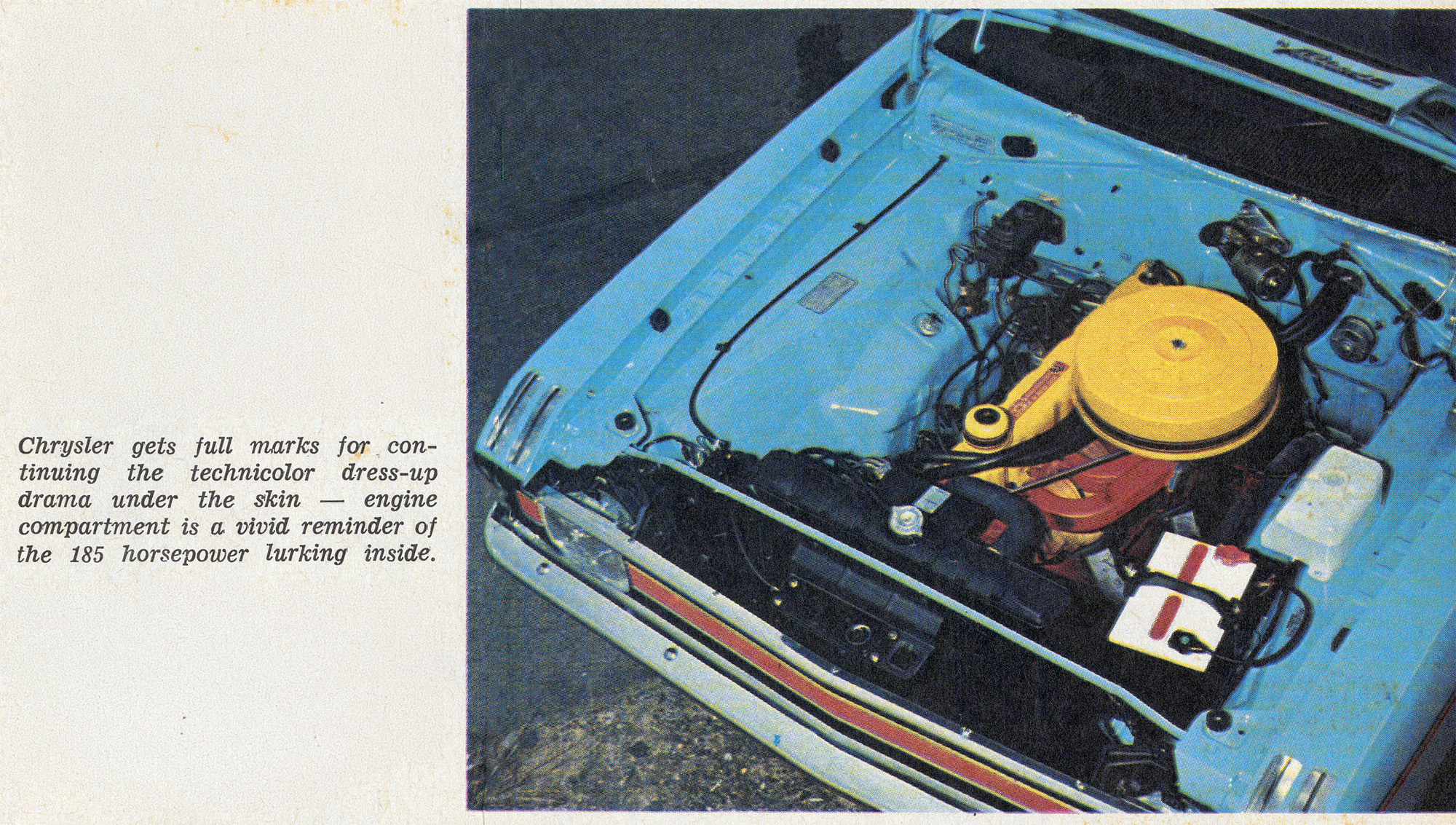
The engine is willing and torquey – and isn’t visibly troubled by the slightly heavier Coupe body, recording identical acceleration times to the sedan. Unfortunately Chrysler still doesn’t officially quote horsepower figures, but the regular Pacer sedan and Pacer Coupe produce pretty close to the 185 bhp mark. The Coupe retails for $3178, making probably the best value in the range.
1
Moving up the scale, the special edition Pacer sedan produced for Class C with 200 bhp from a modified camshaft and better manifolding, sells for the same as the Coupe – $3178. The Class D car rates 50 bhp above the standard car for about 235 bhp – and you’ll buy it at $3358. The 245 four barrel (400 cfm Carter) is beefed from the crankshaft (including special vibration damper) to the top end (ram-type alloy inlet manifold, low-restriction air cleaner). It has shot-peened con rods. A twin-disc diaphragm spring clutch and 35 gallon fuel tank also identifies the Bathurst cars.
Under highly favourable conditions which slanted the watches in the Valiant’s favor (slight downhill, tailwind) the four barrel rattled off 15.6 second quarters with minimal startline wheelspin – that’s well down on the Coupe’s best of 16.4.
But the Coupe puts down its respectable times with litte apparent effort, and this is the most significant feature of the car’s open road behavior. Our snow country marathon was logged in well under 24 hours from departure to return, without straining the crew. For those who’d like to exploit the last few weeks of a great snow season left after this issue hits the bookstalls, here are some basic guidelines…
1
For new-boys, hire gear is the wisest move. It gives you the opportunity to find out whether you’ll enjoy skiing, without paying heavily for the privilege.
There are numerous top ski shops around, and many – like the Kosciusko Centre – have hire centres in both Sydney and the snowfields. We got our gear from Ski Sports Australia in the Strand Arcade, Sydney, because owner (Dave Roebuck) and manager (John Tuxford) are old motor racing men and have special deals for motoring enthusiasts. They’ll hire you everything from ski pants and parkas to skis and boots, although you’ll have to buy a few small items – gloves (from $1.80 pair), goggles (from $1.50 pair), balaclava (if you need it), ski wax and so on. Hire fees are nominal and put you in good equipment. Ideally you’ll bolt your skis on top with Pirelli racks, which you can buy or hire, and a set of chains to stow in the boot for emergencies is essential (any hire shop – Kennards in Sydney).
Sydney snow enthusiasts can head into the slopes through Canberra, Cooma and Jindabyne. Ideal starting place is the Perisher Valley (you can drive in for the day, or park below the snowline at Sawpit Creek for longer periods). You can get instruction on the spot, and the bottom of the main T-bars is a bare few minutes from the roadway. The car also needs anti-freeze (two quarts for the Pacer) which lasts 12 months if your radiator doesn’t use water. Alternatively, you can drain the engine and fill up to restart.
The Pacer Coupe handled ice-covered roads without chains provided it was driven sensibly. We drove up many of the access roads to chalets for photography and didn’t once stop the car. A simple rule is to keep the car moving gently, don’t brake – just use the gears – and try to stop the car where a downhill start is possible. With chains you can afford to be more daring, but it’s best to keep to real roads or hard packed snow-cat tracks.
1
For those who think Australian cars mightn’t be too well suited to cold conditions, the Pacer Coupe has all the answers. It fired at the first hint of the starter motor catching and provided heater warmth in a few minutes. Brakes worked instantly (never pull the handbrake on – you can freeze the linings to the drum) and the car could be driven out on evening ice at moderate speed without drama.
Having proved the Pacer Coupe out as a fully fledged snow-bird I’d rate it as a very versatile six cylinder prestige sporting wagon. After all, there aren’t too many $3000 cars that will give you class wins in Series Production racing one weekend, and top pose value in the snowfields the next.
Follow WhichCar/Wheels on Google
Click the button below to make WhichCar by Wheels a preferred source for your news.

We recommend
-
 Features
From the Wheels archive: Ford's Monaro fighter
After years in the two-door wilderness, Ford threw down the gauntlet with the release of 1972's Falcon Hardtop.
-
 Classic Wheels
From the Wheels archive: Ford Capri – Mini Mustang or a Shetland Pony?
Wheels got an early taste of the European-designed and Built Ford Capri that would soon make its way to Australia.
-
 Classic Wheels
From the Wheels archive: Torana A9X vs Monaro 350 in a battle for the ages
Wheels' July 1978 issue saw Bill Tuckey pit the legendary Holden Monaro 350 GTS against The General's newest road warrior, the Torana A9X.