
Allroad version of A4 Avant wagon will debut Audi’s newest quattro all-wheel-drive system and come with a choice of engines when it arrives in September.
WHAT IS IT?
All-wheel-drive family wagon with extra ground clearance and look-tough visuals; same idea as the Subaru Liberty Outback, Škoda Octavia Scout, and VW’s Golf and Passat Alltrack wagons.
WHY WE’RE TESTING IT
Is a wagon with useful altitude a smarter choice than an SUV with perceived attitude?
MAIN RIVALS
Medium-size premium-brand SUVs, most likely. Audi’s own Q5 – for example – plus the BMW X3; imminent Jaguar F-Pace; Land Rover Discovery Sport; new Mercedes-Benz GLC and Volvo XC60.
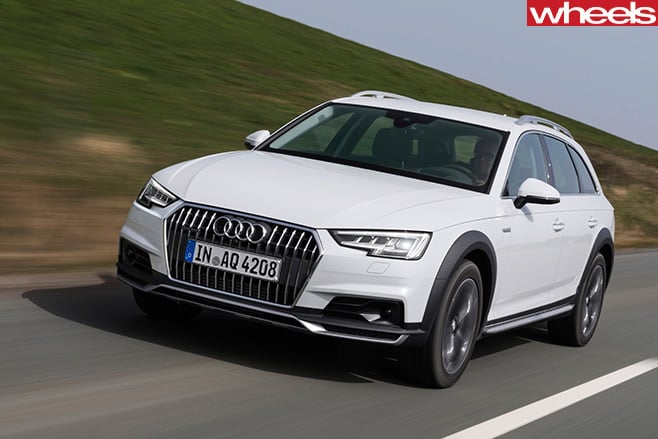
THE WHEELS VERDICT
Audi’s latest B9 generation A4 lifts Ingolstadt’s medium-size mainstay to new heights. The A4 Allroad quattro adds another 34mm…
PLUS: Turbo 2.0-litre petrol four; interior; refinement; comfort; space MINUS: Capable rather than involving to drive; cautious exterior design
THE WHEELS REVIEW
Audi’s new A4 Allroad quattro makes the company’s own Q5 seem flabby, slow and inefficient. Comparing versions of the raised all-wheel-drive wagon and SUV – both powered by a turbo 2.0-litre petrol four – highlights the Audi Q5’s shortcomings. It’s 180kg heavier, takes the best part of a second longer to accelerate from standstill to 100km/h, and burns around a litre more fuel every 100km.
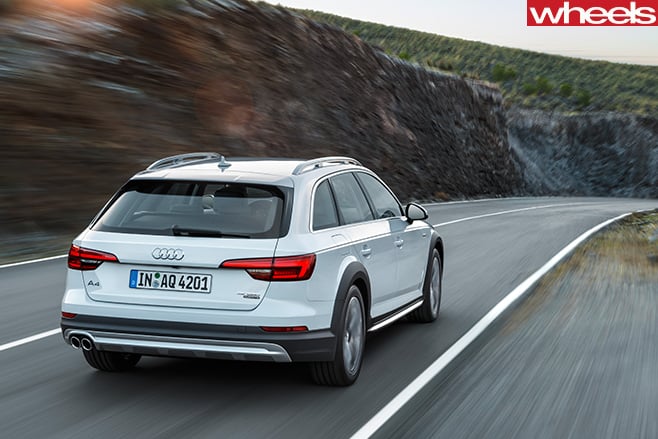
The arrival of a new A4 Allroad quattro in September could alter this appalling ratio a little. Like other members of the latest B9 generation of the A4, it’s built on Audi’s MLB Evo architecture. While the soon-to-be-obsolete B8 version of the A4 Allroad is imported only with a 2.0-litre turbo diesel engine, Audi will offer customers a choice with the new model.
The 140kW 2.0-litre turbo diesel of the outgoing A4 Allroad will be joined by a 185kW turbo 2.0-litre petrol-burner. Both are teamed with Audi’s S-tronic seven-speed double-clutch auto and quattro all-wheel-drive. But while both wear identical quattro badges on their tailgates, there are big differences in system hardware.
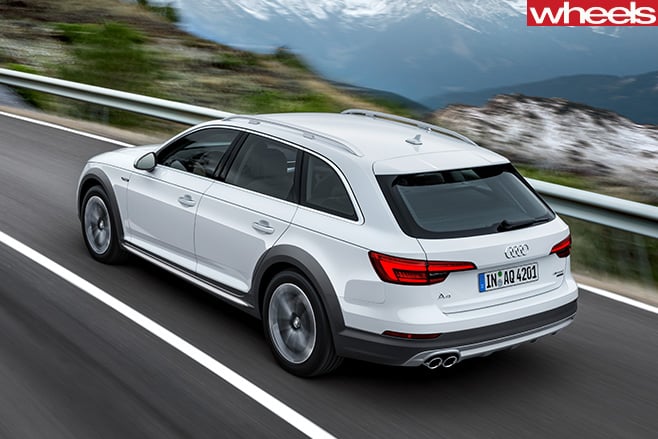
This spells is a reduction in drag in driving conditions when quattro traction isn’t needed. During straight-line cruising on dry bitumen, for example, the 2.0 TFSI Allroad drives only the front wheels, while the rear wheels spin only their axle half shafts.
It appears “ultra technology” is effective. Comparing the 2.0 TFSI Allroad quattro to an A4 Avant wagon with the same engine and transmission, there’s little difference in performance and consumption.
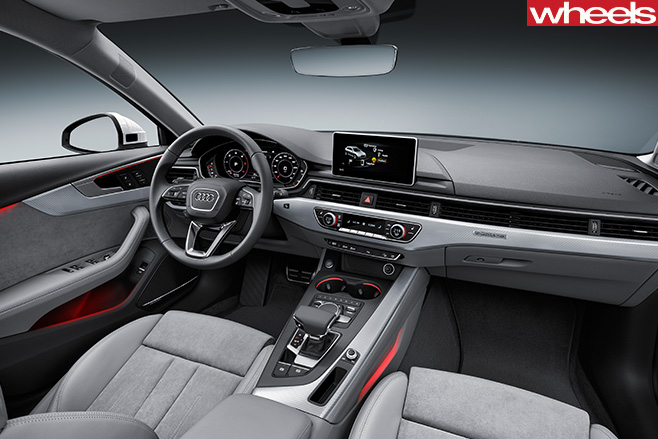
Best of all, the A4 2.0 TFSI Allroad quattro’s unique selling proposition – its extra 34mm of ground clearance – has little effect on handling. Which means, obviously, that it’s a better drive than its Q5 equivalent.
DOLLARS AND SENSE?
Audi Australia aims to price the new A4 Allroad quattro models around $75,000, around $2000 more than an A4 2.0 TFSI Avant quattro. Sounds like a reasonable premium, but price is one reason so many Australians prefer the Q5 instead. Four-cylinder versions of the SUV cost around $10,000 less than their Allroad equivalents.
SPECIFICATIONS
- Model: Audi A4 2.0 TFSI Allroad quattro
- Engine: 1984cc 4-cyl, dohc, 16v, turbo
- Max power: 185kW at 5000 to 6000rpm
- Max torque: 370Nm at 1400 to 4500rpm
- Transmission: 7-speed double-clutch auto
- Weight: 1655kg
- 0-100km/h: 6.1 sec
- Fuel economy: 6.7L/100km (European combined cycle)
- Price: $75,000 (estimated)
- On sale: September 2016
If you’re attending the annual Goodwood Festival of Speed next weekend, here’s what to expect. If you’re not going…here’s what you’ll miss.
This celebration of performance cars old and new, including those machines from different theatres of motorsport, takes place between June 23-26 at Lord March’s Goodwood Estate near Chichester – the theme this year being ‘Full Throttle – the Endless Pursuit of Power’. It specifically celebrates BMW’s centenary year as a manufacturer.
As well, 2016 marks the 100th running of the Indianapolis 500, the 50th anniversary of the big-banger Can-Am Series, and the 50th anniversary of Jack Brabham winning the world championship in a car bearing his own name. Expect these notable anniversaries to be part of FoS 2016.
Lord March loves his cars and he’ll open proceedings with the first run of the festival in a 1957 BMW 507, valued north of A$3million.
Grand prix machines from seven F1 teams are scheduled to power noisily up the Goodwood hill this year, some in the hands of past and present F1 drivers who’ve confirmed their attendance.
Mercedes-Benz, Ferrari, Force India, McLaren, Red Bull, Renault, and Williams will have a presence there.
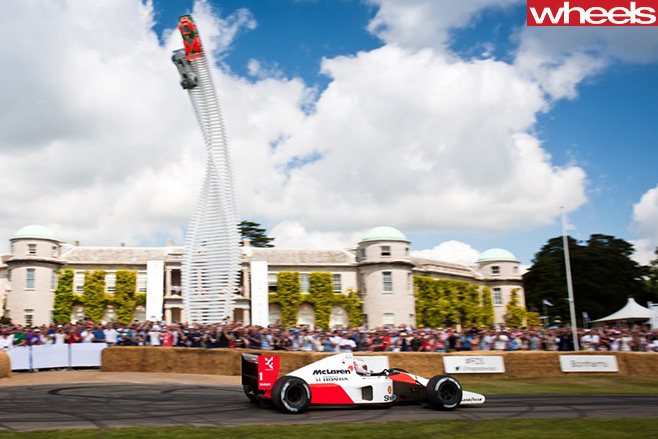
Among the star drivers are Mark Webber (fresh from Le Mans), Lewis Hamilton, Nico Rosberg, Jenson Button (showcasing the all-new Honda NSX), Stirling Moss, John Surtees, Jackie Stewart and Martin Brundle, who’ll be taking Button’s championship-winning 2009 Brawn BGP 001 for a blat up the hill.
Emerson Fittipaldi will tackle the climb in a Penske PC22.
Olympic cycling gold medallist and 2016 Le Mans racer Chris Hoy is another special guest along with AC/DC front man and car buff Brian Johnson.
Champions from Le Mans, Superbike, Monte Carlo, Isle of Man, 500cc motorcycling, Indy 500, British Rallying, BTCC, and NASCAR are part of the impressive roll-call.
Le Mans legend Derek Bell is driving the 1972 Mirage GR7, and the new Bentley Bentayga.
Giacomo Agostini will ride an MV Agusta; Aussie Troy Corser a BMW Kaczor R50S.
The festival this year is much about BMW, as the brand celebrates its centenary year, showing off not just the BMW brand but Mini, Rolls-Royce and BMW Motorrad. The bellowing BMW M4 GTS is set for a run up the hill along with its siblings, the M2 and BMW i8 Protonic Red edition.
The V8 Lexus LC coupe makes its UK debut at Goodwood, and will be accompanied by the LFA supercar, RC F, and GS F.
Soon for Australia, Maserati’s Levante SUV will show off its sporting inclinations on the hill, also joining the Ghibli and Quattroporte on the manufacturer’s stand.
To be revealed at Goodwood too will be the new Mercedes-Benz AMG GT R, a more powerful GT variant, wearing some new handling features such as active aero and rear wheel steering.
Highlighting its deep motor sporting history, McLaren has arranged the most extensive display of its models ever. There will be the track-only 570S Sprint, making its sporting debut on the famous hill alongside the road-going 570S coupe. Rounding off the line-up of current models will be two examples of the P1 GTR.
Some grand old Can Am and Indy 500 gear will also be present.
We want to know what you think! Take our reader survey and help shape the future of Wheels magazine and WheelsMag.com.au
Complete the survey and go in the draw to win:
- Major Prize: 1 x $500 Visa Gift Card
- Runner Up Prizes: 5 x $100 Visa Gift Cards”

Terms and conditions apply. The promotion commenced 00:01am (AEST) 22/06/2016 and closes 23:59pm (AEST) 26/08/2016. The promotion is open to Australian residents aged 18 years or over. The draw will be at 11:00am (AEST) 06/09/2016. Click HERE for full terms and conditions. Click HERE for our Privacy Notice.
Now there’s no mistaking me as a smart guy.
In fact, the only difference between me and, say, an automated forklift is the fact the automated forklift wouldn’t lose its keys every other 30 seconds.
But when the BMW coves tell me that the 4 Series range is the same as the 3 Series except the number of doors is reduced, I’m usually inclined to nod my head sagely and get on with finding my keys.
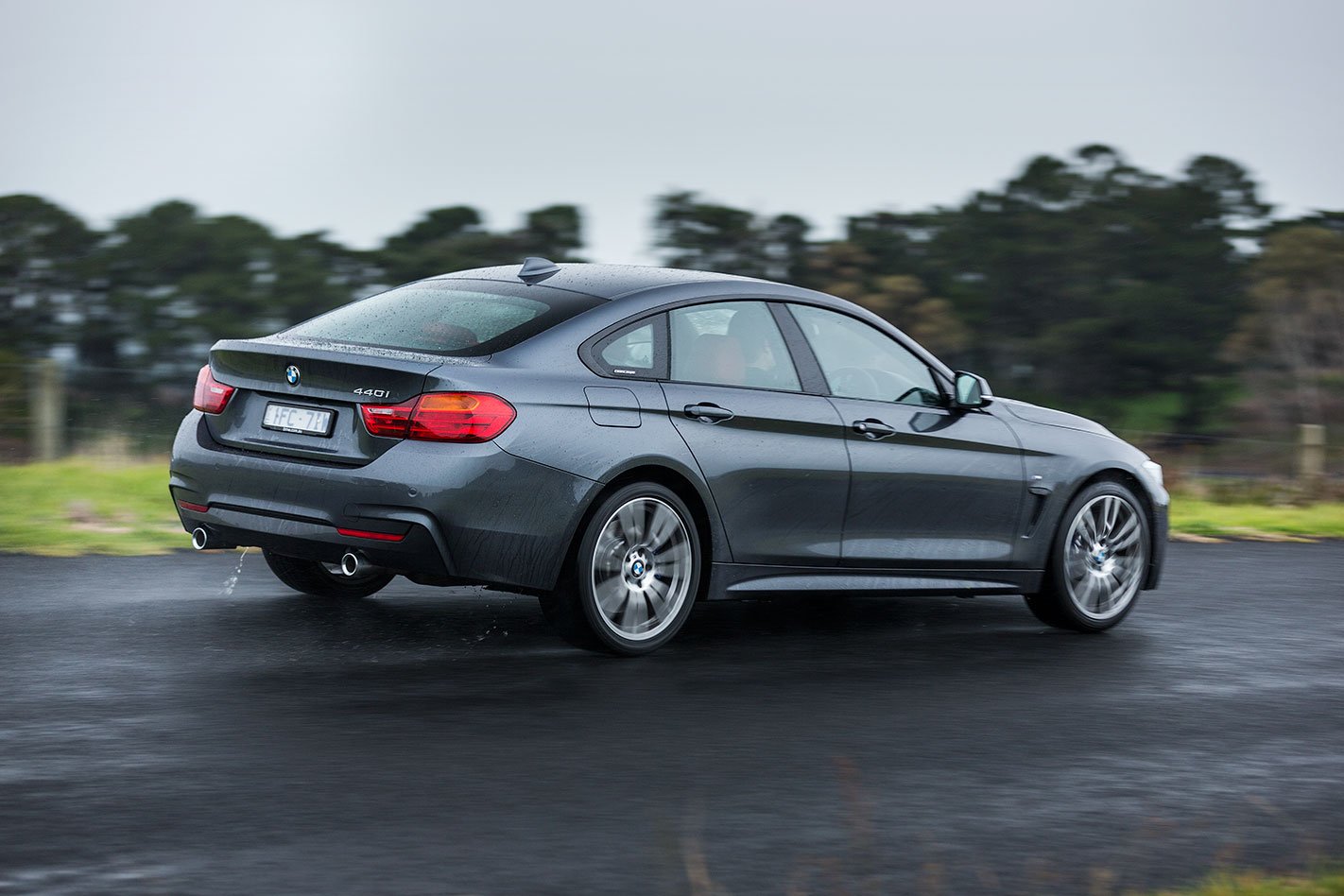
Semantics about doors aside, the F32 Gran Coupe is proving to be the go-to choice for 4 Series buyers. It’s got the same size boot as a 3 Series – and about two thirds of the space of a Touring wagon when you chuck the seats down – and the hatchback-esque tailgate makes loading a doddle. And those convenient rear doors! A revelation for back-seat passengers, let me tell you.
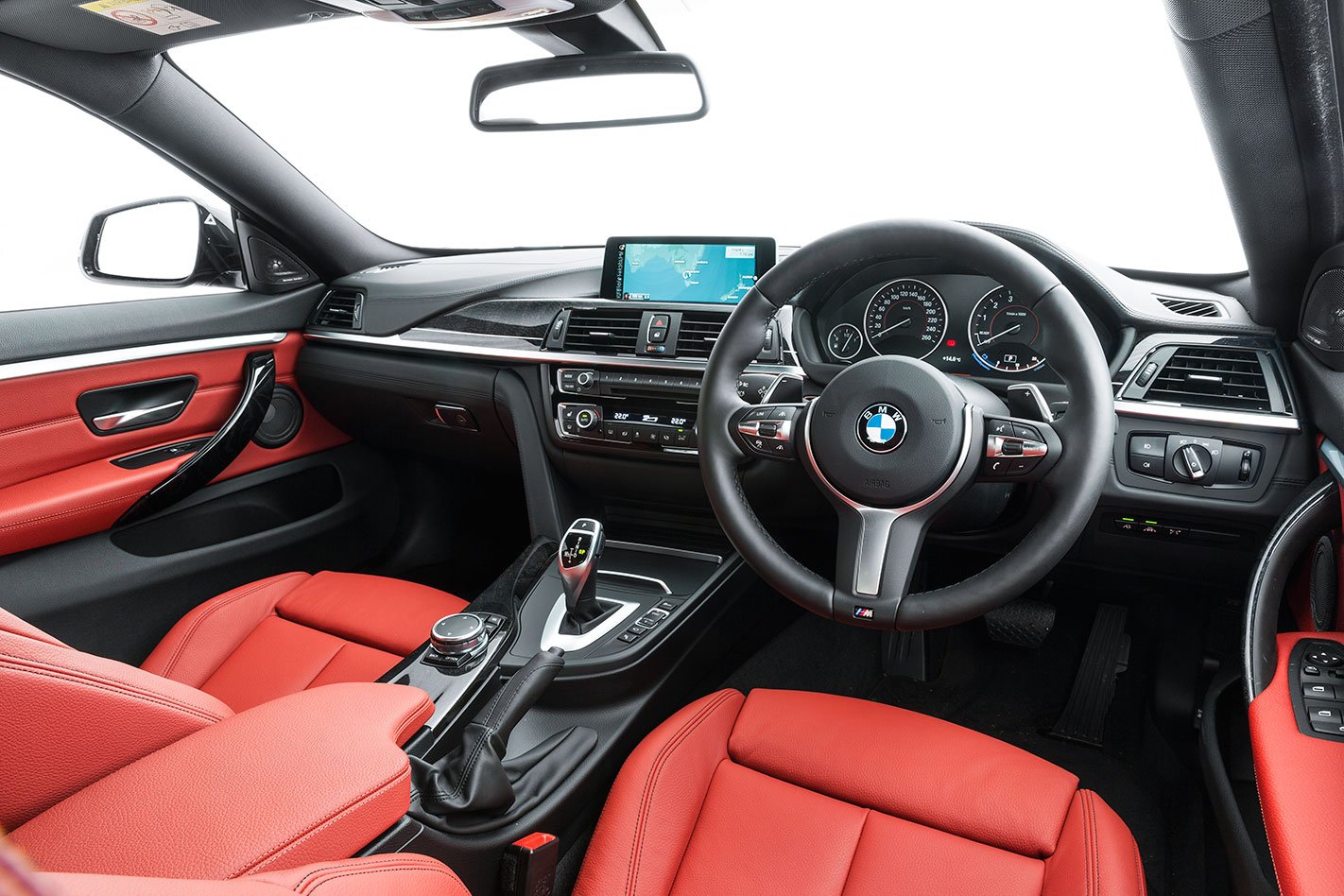
Rumbling up 240kW (15kW more than the 435i’s six-potter) and 450Nm (up 50Nm), it comes standard with a ZF eight-speed box (or a six-speed manual as a no-cost option), the M Sport package (10mm ride height reduction, 19-inch rims with 225/40 R19 front and 255/35 R19 rear run-flat tyres, adaptive dampers and other trim bits), variable-rate steering and an electric rear diff. Chuck in some supportive leather seats and you’ve got the recipe for quite a handy jigger.
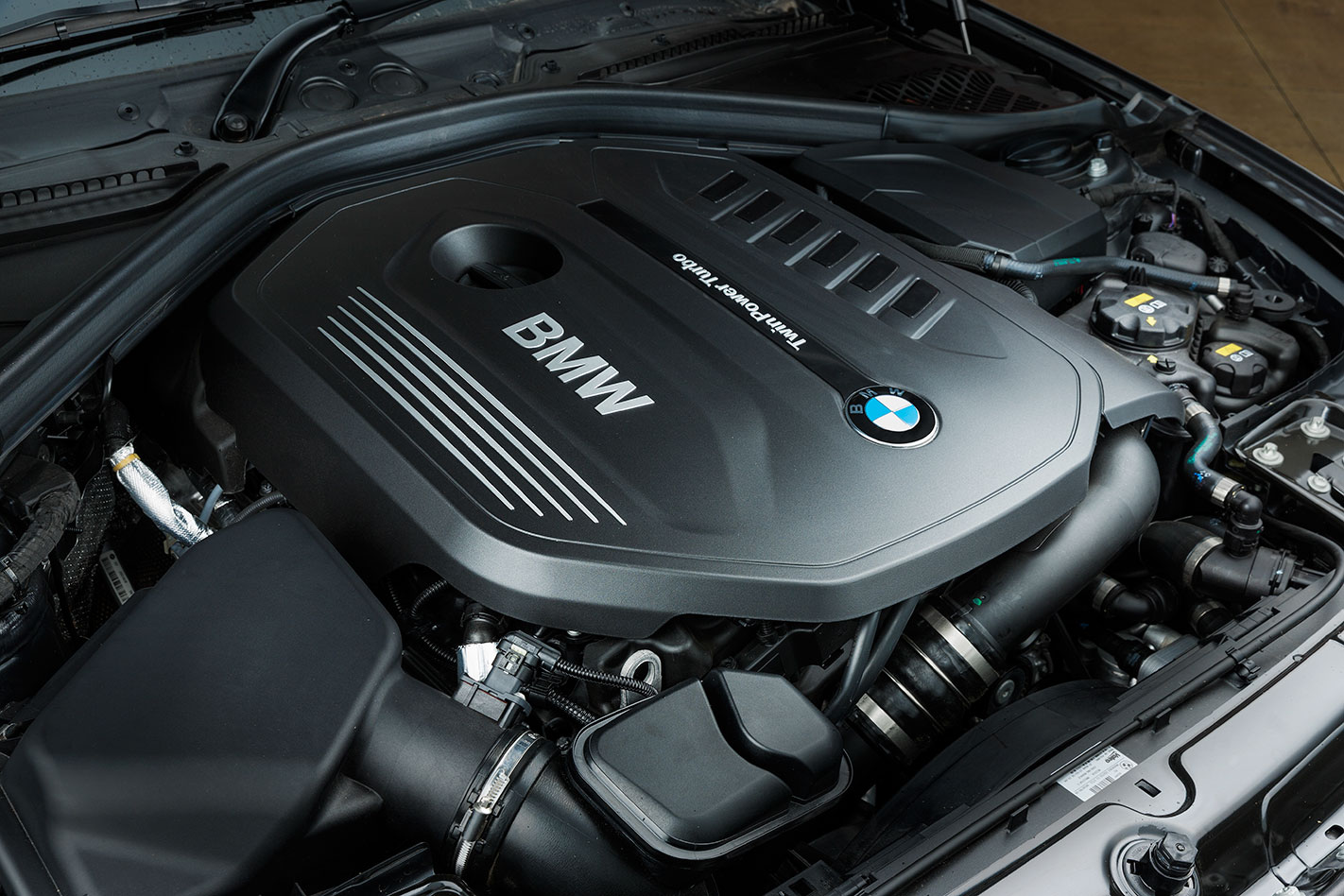
It’s polite, sedate even, when cruising around town, but likes nothing better than being given a nudge and bolting for the next postcode. It’s smooth and sonorous under the whip if not especially overt, but its torque comes on hot and strong from 1380rpm through to 5000rpm, delivering its best power at 5500rpm.
No, the drama lies in the chassis. It was fair chucking it down on our test route, so speeds were down, but the lack of feel and road engagement was disconcerting, to say the least. Those 19-inch runflats feel like lumps of pencil eraser when it comes to feedback, while the steering feel just wasn’t right anywhere in the motion.
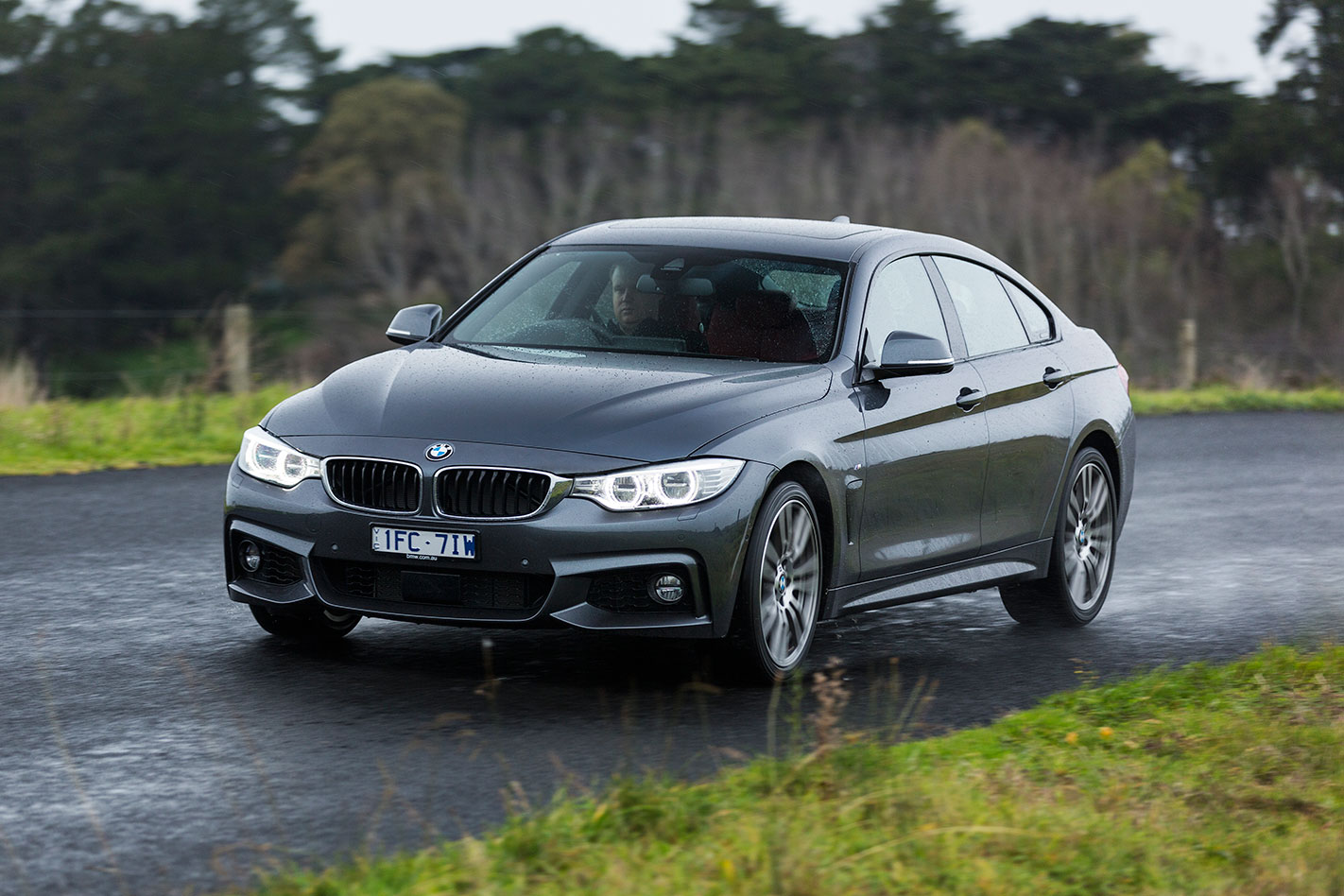
The feeling of remoteness from the helm is the thing that sticks, though. One of a rear driver’s inherent talents should be its steering… not here. No way. The 440i is a long way off the pace – at least in damp to teeming conditions.
Shame, really, because with about $13,000 more kit included as standard, and a pretty reasonable price cut of $10,000, the 440i’s $99,900 price tag is made more palatable by the Gran Coupe’s unusual take on life.
3/5
Like Cracking straight six engine, lots of car for the dollars
Dislike Suspension tune and steering feel out to lunch, run-flat tyre feel
Specs Engine: 2998cc inline-6, DOHC, 24v, turbo Power: 240kW @ 5500rpm Torque: 450Nm @ 1380-5000rpm Weight: 1750kg 0-100km/h: 5.1sec Price: $99,900
Though the four-ring brand has been selling its raised all-wheel-drive wagon in Australia since 2012, annual sales nationwide have only averaged 150 or so.
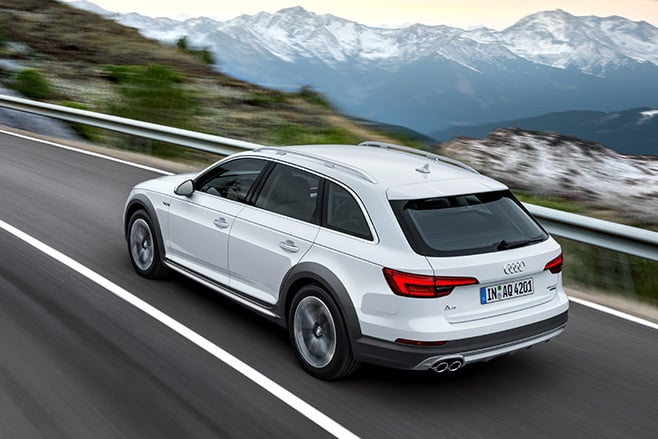
But from September this rate should rise a little. That’s because the new version of the A4 Allroad quattro will come with a turbo 2.0-litre petrol four-cylinder engine as well as the 2.0-litre turbo diesel that was the only option in the outgoing model. The 2.0 TFSI turbo petrol – with a little over 30 percent more power than the 2.0 TDI turbo diesel – should attract at least a few extra customers. Both are teamed with Audi’s S-tronic seven-speed double-clutch automatic transmission.
TELL ME ABOUT THIS CAR
The Outback-like A4 Allroad quattro makes sense for anyone considering a medium size SUV, but is reluctant to live with the performance, fuel consumption and handling compromises that involves. Compared to Audi’s own Q5 SUV with a similar engine, the A4 2.0 TFSI Allroad quattro is quicker, more fuel efficient, much lighter, and more agile. Yet it has a useful 34mm more ground clearance than a normal A4 Avant wagon.
Choosing the Allroad quattro over a regular A4 Avant wagon with the same drivetrain won’t cost a lot. Audi Australia aims to price both 2.0 TFSI and 2.0 TDI versions around $75,000 – only $3000 more than the A4 2.0 TFSI Avant quattro. On the other hand, the A4 Allroad quattro will cost substantially more than a four-cylinder Q5 SUV.
The A4 Allroad quattro, which is built on Audi’s latest MLB Evo platform and has the company’s latest driver aid and infotainment tech, is a better and classier car than the Q5. But that big price difference is a tough argument for the Outback from Ingolstadt to overcome.
STRENGTHS
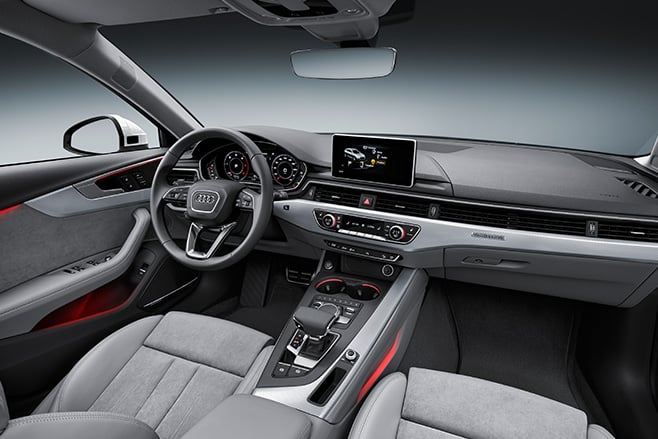
- Like other members of the latest ‘B9’ generation of Audi’s medium-size car the A4 Allroad quattro is a class act. Its cabin is one of the best in the business for both space and quality, and driver assist and infotainment tech content is impressive.
- The high-riding Audi A4 Allroad quattro drives much like a regular A4 Avant wagon. It’s a more car-like drive than an SUV, in other words. The raised suspension delivers a very comfortable ride, noise levels are low and the handling is safe and sound.
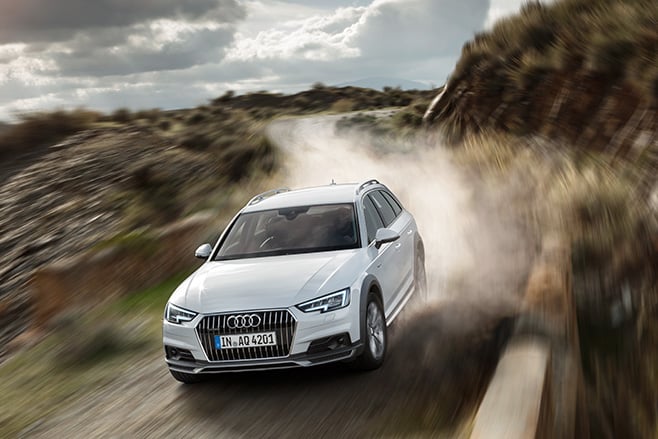
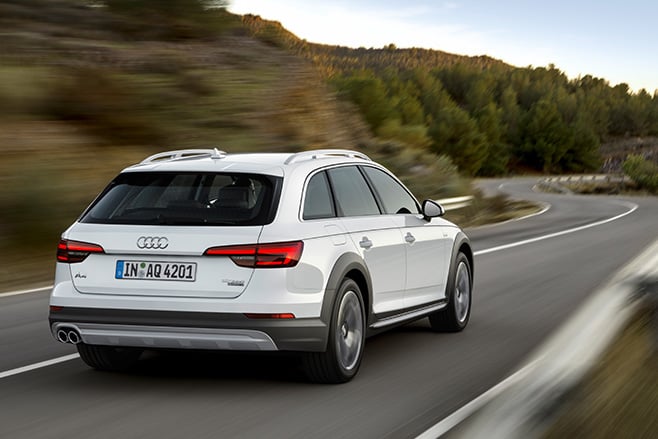
- Styling differences give the A4 Allroad quattro a distinct visual identity. These include dark coloured wheel-arches, standard roof rails and a grille with vertical instead of horizontal slats.
- To make the most of its extra ground clearance the A4 Allroad quattro’s Drive Select system gets an additional driver-selectable mode. ‘Offroad’ is designed to maximise traction from the quattro all-wheel-drive system.
WEAKNESSES
- Although Allroad treatment spices the visuals a bit, the exterior design of Audi’s new A4 has been justly criticised for being too timid. The basic shape is rather plain, and very similar to the outgoing model.
- That sloping tailgate reduces luggage space if you want to stack stuff high in the rear of the A4 Allroad quattro. And the 505-litre capacity below its cargo bay cover, while adequate, isn’t huge. There’s a little more space in the rear of Audi’s Q5, for example.
- Speaking of the Q5, the A4 Allroad quattro is sure to be around $10,000 more than the company’s medium-size SUV. If Audi Australia hits its $75,000 price target for the A4 Allroad, it will also be more expensive than a Mercedes-Benz GLC and line-ball with the entry model for Jaguar’s spacious and good looking F-Pace, due in Australia very soon.
- Audi Australia is fine-tuning the standard equipment list for the A4 Allroad quattro. Some of the car’s most attractive technologies – we’re thinking here of the brilliant Virtual Cockpit instrument display – may be available only as options.
ANY RIVALS I SHOULD CONSIDER?
The A4 Allroad quattro doesn’t really have any directly comparable competitor. There are other raised all-wheel-drive wagons (Škoda Octavia Scout; Subaru Outback and Volkswagen Passat Alltrack) on the Australian market, but they all cost much less than the Audi. Better instead to compare it with the closely related A4 Avant 2.0 TFSI quattro and other premium-brand wagons in the same class, as well as the broad range of similar size SUVs on offer. Of these, the new Mercedes-Benz GLC, and soon-to-arrive Jaguar F-Pace are the most worthwhile test drives.
- The new Audi A4 Allroad debuts an updated version of Audi’s well-known all-wheel-drive system. It doesn’t just have quattro, but “quattro with ultra technology”. Clutches at either end of the shaft that takes power to the rear wheels can be disengaged, isolating it from the rest of the drivetrain. On a dry road the shaft doesn’t move, and this saves a little fuel. The system goes into the turbo petrol version of the A4 Allroad for now, but is sure to be adopted for other quattro Audis in the future.
- Petrol power will be an option in the new A4 Allroad quattro. The current model, introduced back in 2012, has always come only with a four-cylinder turbo diesel. The new one, arriving in September, will come also with a turbo four-cylinder petrol engine.
- Both petrol 2.0 TFSI and diesel 2.0 TDI versions of the new A4 Allroad quattro will come with the same level of standard equipment.
- Compared with an A4 Avant wagon, the Allroad quattro has a useful 34mm more ground clearance. It also gains an extra ‘Offroad’ mode in its Drive Select options menu, designed to maximise the quattro system’s slippery surface traction.
- The wheel designs for the A4 Allroad quattro aren’t used on any other Audi A4 model.
- Audi Australia is evaluating whether to add a range-topping 3.0-litre V6 turbo diesel version to the A4 Allroad line-up after the September launch of the four-cylinder turbo petrol and diesel models.
It was the best of the rest in 2014. Can the Subaru Forester still hold the high ground?
WHAT IS IT? The Subaru Forester is a staple of the Japanese brand’s range, and combines a spacious interior with genuine off-road credentials in a well-engineered, sturdy and well-mannered package. It’s one of the brand’s best-selling models in Australia, and has benefitted from the sales swell of SUVs in this country.
WHY WE’RE DRIVING IT The Subaru has been given a mid-life makeover to stave off increasingly competent opposition.
MAIN RIVALS Nissan X-Trail, Renault Koleos, Mazda CX-5, Suzuki Grand Vitara, Toyota RAV4, Mitsubishi Outlander, Kia Sportage, Hyundai Tucson, Honda CR-V
THE WHEELS VERDICT The fourth-generation Subaru Forester has gained useful improvements for 2016, and it remains one of the class benchmarks even against younger rivals. Its ride and handling, driveline and packaging make it a well-mannered, practical SUV with rugged looks and abilities. Its toughest task will be fending off glitzier, fresher opposition.
PLUS: Well-mannered around town yet more than capable on the rough stuff; smooth, grunty engine; great fuel economy and safety levels; no price increase despite greater equipment levels MINUS: Doesn’t feel as fresh or edgy and much younger rivals; CVT hits a wall when asked to work hard; meagre changes for 2016 may not be enough to keep its head above water.
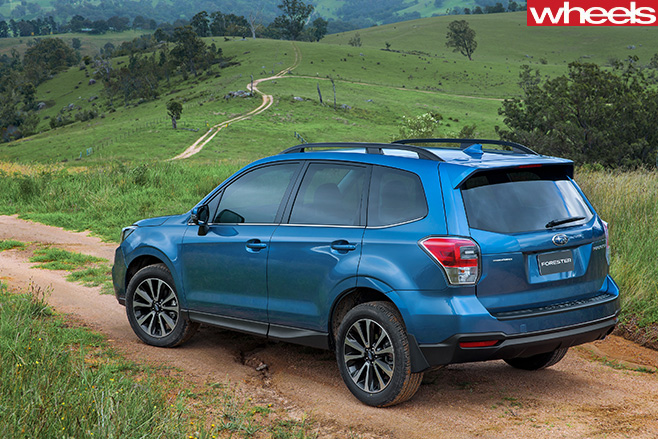
The Forester has to win over buyers of the new Hyundai Tucson, for instance, and an all-new Kia Sportage. What’s more, there’s been a new Nissan Qashqai and X-Trail to fend off, and more recently the Toyota RAV4 – the only nameplate in this class to pre-date the Forester’s 22-year legacy – has been given a nip and tuck for a more athletic, less awkward look.
While there’s no change in the Forester’s list price, which kicks off at $29,990 for the 2.0 i-L, there’s a raft of changes to help hone an already appealing package. For 2016, Forester has been given a fresh set of bumpers with LED daytime running lights, new grille and headlamps, and LED taillights. You may be hard-pressed to spot the difference unless the MY16 is parked alongside last year’s model, though.
The $39,490 Subaru Forester 2.5i-S version that we’re driving here is the mid-point of the range, and is expected to make up more than half of all Forester sales. In terms of extra fruit over the existing model, the i-S adds cornering headlamps and new DRLs, as well as fresh 18-inch alloy wheel patterns and a new engine cover for improved aerodynamics.
It’s the higher-spec Foresters that have had more kit added to the list. Most notably is that EyeSight, Subaru’s camera-based safety technology, has had its skillset broadened. While it was already standard on the CVT 2.5i-S, it now includes sway warning and anti-fatigue functions in addition to autonomous emergency braking and radar cruise control.
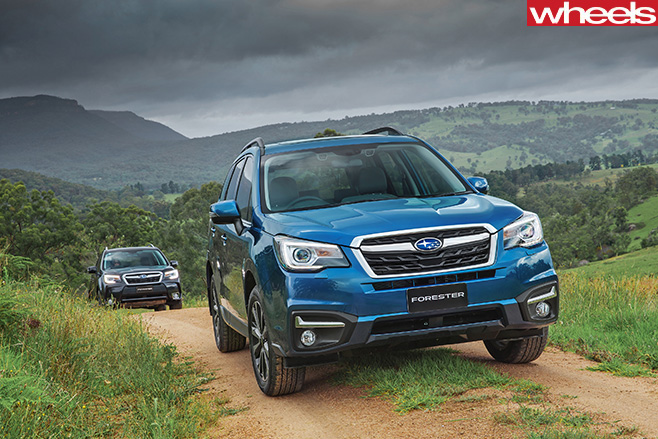
On the road, there’s also revised steering, with the electric system’s ratio changed from 15.5:1 to a quicker 14.0:1, meaning fewer inputs when cornering. On the wet, occasionally winding limestone roads of South Australia where we briefly tested the new Forester, the Subaru’s steering showed precision and was well weighted. It didn’t call for flailing arms to negotiate a potholed road. It also meant that it could storm a battalion of dips, ruts, crevices and man-size holes without the need for any additional driver input, as its composure and excellent ride managed the drama beneath with supreme efficiency. Head toss, vibrations and drama were all sheltered; the body control helping the wagon to sit flat and shelter its occupants from the harsh exterior environs.
On smoother stuff, the compliant ride is comfortable, and that composure means that mid-corner bumps don’t upset the Forester. The claimed improvements in noise, vibration and harshness were difficult to certify, as the rain on our rugged test route made an awful racket. We can say that the strong 2.5-litre engine is smooth, protesting only when you give it a gutful. The CVT will often hover at a noisy 5800rpm when climbing a steep, long hill. It’s better at slow speeds, and cruises quietly at 100km/h on the highway.
Add to this the fact that none of the Forester’s existing talents, from its durable cabin, overall ruggedness to its interior space and ‘non-negotiables’ such as full-size spare wheel, and you have a vehicle that’s highly compelling in its class. To top it off, prices haven’t moved an inch.
Is it chalk and cheese between the MY16 Forester and its predecessor? No. Yet Subaru’s changes have made what was an already capable, quality SUV even better.
SPECS Model: 2016 Subaru Forester 2.5i-S Engine: 2498cc 4cyl, dohc, 16v Max power: 126 kW@5800 rpm Max torque: 235 Nm@4100 rpm Transmission: CVT Weight: 1567kg 0-100km/h: 9.9sec (claimed) Fuel economy: 8.1L/100km Price: $39,490 On sale: Now
BEHOLD the next-generation Mini Countryman; sporting chunkier styling, significantly more space, and a welcome dose of extra pace, courtesy of the gang at John Cooper Works.
Spotted in actual JCW garb testing in final prototype form at the Nürburgring circuit in Germany, the 2017 Mini Countryman will be unveiled shortly, ahead of an anticipated Paris Motor Show global debut in late September.
Australian sales are scheduled for sometime within the first half of next year, as BMW strives to capitalise on the double-digit gains its British style brand has managed in the first six months of 2016.
Designed squarely to take on the upcoming Audi Q2, as well as the existing Mercedes-Benz GLA, Jeep Renegade, Fiat 500X, and Volkswagen Tiguan, the F60 Countryman adopts a chunkier and more geometric form, as it edges closer to more traditional SUV proportions. The tape measure is expected to confirm increases in all vital dimensions, including wheelbase and track widths, with cabin room and practicality benefitting most as a result.
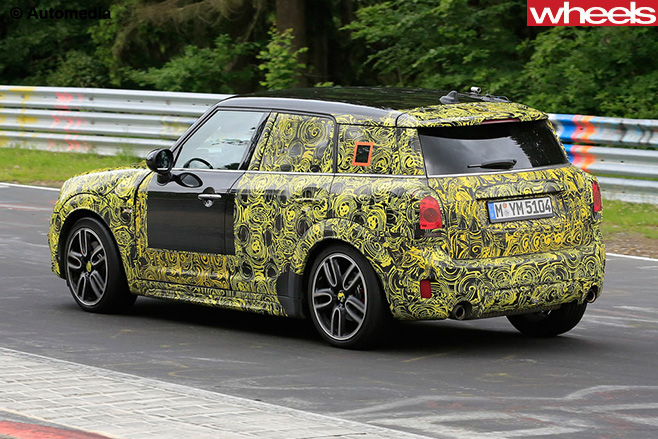
Engine choices are likely to emulate the rest of the UKL1-derived F56 Mini range, meaning that a 100kW 1.5-litre three-cylinder turbo petrol and diesel units will most probably power the base versions, while a variety of 2.0-litre four-cylinder turbos will take care of the up-spec cars. The Countryman JCW pictured here may be using the 170kW/320Nm version of the Cooper hatchback equivalent.
As before, a six-speed automatic driving either the front or all four wheels will also be available in lieu of the standard six-speed manual set-up.
The pricing strategy BMW adopts for its newcomer should be interesting, as every UKL1-based Mini since 2014 has launched costing up to 10 percent less than its predecessor. If that’s the case here, expect the base F60 Countryman Cooper 2WD manual to kick off at under $35,000, rising above $55,000 for the hotly anticipated JCW ALL4 AWD auto.
Have spy pics of your own? We’d love to see them. Just email them to [email protected]
Happy birthday to ‘The Kid’, Craig Lowndes, who turns 42 today.
One of Australian motorsport’s greatest ever talents, Lowndes is a six-time Bathurst winner, the winningest driver in V8 Supercar history with 104 race wins, scoring three titles and finishing second six times, which is where he finds himself in this year’s championship.
Here are some of the highlights from his long and successful career.
1994 – The Kid makes himself known
Bathurst 1994 was when the world really sat up and took notice of Craig Lowndes, with the then-20-year-old young fun passing veteran John Bowe around the outside into turn three. Lowndes would go on to finish the race in second, but it was a sign of things to come.
1999 – The Calder crash
Fast forward to 1999 and after an unsuccessful stint in Europe, Lowndes is back dominating the V8 Supercar championship. The path to his third title hit a slight hiccup, however, with this enormous accident at the Calder Park round, which wrote off the HRT Commodore and forced Craig to miss the next round through injury.
2006 – Tribute to Brock
Jumping camps to Ford in 2001 sadly brought little success, however a switch to 888 Racing quickly put Lowndes back on top. In one of the most emotional moments in Aussie motorsport history, Lowndes took his second Bathurst win just weeks after the death of his friend and mentor, Peter Brock.
2010 – Australian Safari win
Keen for something different, Lowndes managed to squeeze in time to race in the Australian Safari off-road race, winning at his first attempt in a V8 Holden Colorado.
2010 – Bathurst lap record
Twenty-ten proved to be a good year for Lowndes. Following his Safari win he headed to Bathurst on a mission, breaking the lap record in practice before winning his fifth Bathurst, this time with former HRT teammate Mark Skaife co-driving.
2011 – F1 at Bathurst, realising a dream
With Vodafone’s massive marketing budget sponsoring both the 888 Racing V8 Supercar outfit and the McLaren-Mercedes F1 team, the opportunity arose for Jenson Button and Lowndes to swap seats around Mount Panorama.
2015 – 100 race wins
Proving he has no plans to slow down, Lowndes became the first driver in V8 Supercar history to notch up 100 race wins at Hidden Valley last year and celebrated in style on the cool-down lap.
2015 – Sixth Bathurst win
With another victory in 2015, Lowndes joined Mark Skaife and Larry Perkins as the only people to have won Bathurst six times, with only Jim Richards (seven wins) and Peter Brock (nine wins) having enjoyed more success at The Mountain.
This onboard lap sums up everything that’s great about Lowndes’ driving. A great overtake, heaps of commitment and oversteer over the top of the mountain and then letting go of the steering wheel for a break down Conrod.
HONDA isn’t holding back in its assault on this year’s Pikes Peak Hill Climb event.
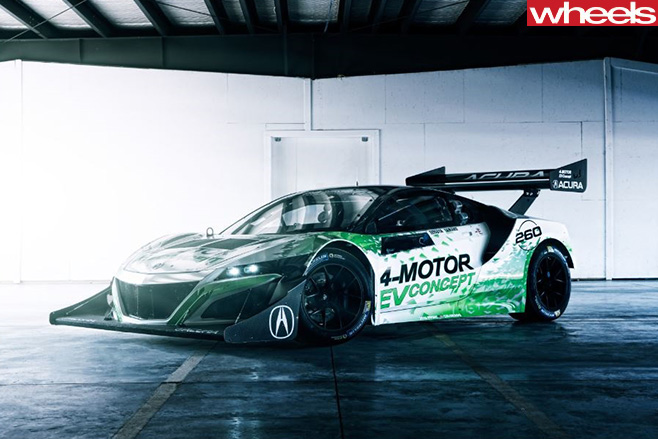
Along with the two NSX supercars we reported on last week, Acura (Honda’s luxury division in North America) will campaign an all-electric NSX-inspired concept in the 2016 Race to the Sky.
Driven by Tetsuya Yamano, the NSX EV Concept will compete in the Electric – Modified Class, and will have the same four-motor all-wheel-drive system that won last year’s Challenge Exhibition class. Except this time, the NSX EV Concept will be utilising three times the power.
“We’re honoured to be running at Pikes in this historical, anniversary year – an event respected by racing fans all over the world.”
By placing twin motor units on both axles, Honda has given the NSX the ability to achieve independent torque distribution to all four wheels. This will mean the car can turn harder and faster.
You can read more on this year’s Pikes Peak race in Peter McKay’s preview.
