
A LEAKED Federal Government plan to reinvigorate Australia’s car industry by investing $3 billion over the next five years as part of a joint venture with Toyota to create a new, sport-focused EV has drawn fire from Holden and Ford.
Prime Minister Malcolm Turnbull has hurriedly hailed the investment as part of his Innovation Nation building program and claimed that it would provide “continuity through change” for thousands of industry employees who were set to end up on the scrap heap as local manufacturing comes to an end in Australia.
Reports of the massive and unexpected investment emerged overnight, and appear to have leaked from the office of Wyatt Roy, the junior Minister for Innovation, or the junior Minister for Looking Young and Clever, as some of his more vindictive colleagues have dubbed him.
Images of prototypes of the new EV are expected to become available around noon today, but details of the extremely sports-focused design brief have emerged, which suggest the timing of the leak, on the same day that Tesla is unveiling its Model 3, might be no coincidence.
Little more is known about the planned EV.
Ford spokesman Chip Inarbit said management at the company’s Australian arm were left almost speechless by the news.
“Our board did want to make it clear, however, that an investment of $3 billion towards a company like ours that currently employs many Australians could have made an enormous difference to our continuing viability in the company and that Ford is saddened to see that the Federal Government, which was so unwilling to help the car industry over the past two years, has suddenly found some money to support a Japanese company that was already making the rest of us look slightly incompetent by continuing to post huge profits and never asking its country’s government for a bailout,” Mr Inarbit said.
Other reports that the Government was planning to chip in another $8 billion towards electric-car charging infrastructure over the next decade to help boost sales of the Toyota joint venture vehicle were denied by Liberal Party spokesman Christian Wright.
“Look, we have no plans to invest in charging points, but we will be investing heavily in the coal-fired power stations that will be needed to provide power for this new and innovative fleet of cars, jointly developed by our brightest minds and, some people at Toyota,” Mr Wright said.
“As our Prime Minister Tony Abbott said, last year when he was Prime Minister, coal is good for the world, and we’re doing our bit to make sure it not only remains the planet’s number-one clean energy source, but finds room to expand.”
Toyota spokesman Aiki Breikiart said he could not possibly confirm the existence of the EV, but said it would be the fastest two-door coupe with tiny back seats in the Toyota or Subaru ranges, and would accelerate from 0-110km/h in less than nine seconds, and then would go not 1km/h faster, because, as Victoria’s Traffic Accident Commission had helpfully pointed out, going quicker was not only illegal and deadly but pointless.
Charging time for the new Aussie Toyota, rumoured to be called the AC/DC, was “entirely reasonable” at around 14 hours from a normal 240V power outlet. Special fast chargers would be available, but only to prominent climate-change deniers.
A Holden spokesman, Brock Tatu, was too angry to speak yesterday, but did respond with an email best described as entirely unprintable.
FCAI insiders were unavailable for comment, as they were at a hastily convened corporate golf day sponsored by the petroleum industry.
Documents lodged by Subaru here in Australia have provided confirmation the Subaru Levorg will indeed feature the same 197kW/350Nm 2.0-litre turbocharged four-cylinder engine as the Subaru WRX.
That’s good news. What isn’t such good news for those who were hoping for a WRX wagon with a different name is the news Levorg will be offered with a CVT automatic transmission only.
Naturally, the Levorg will utilise Subaru’s symmetrical all-wheel drive system.
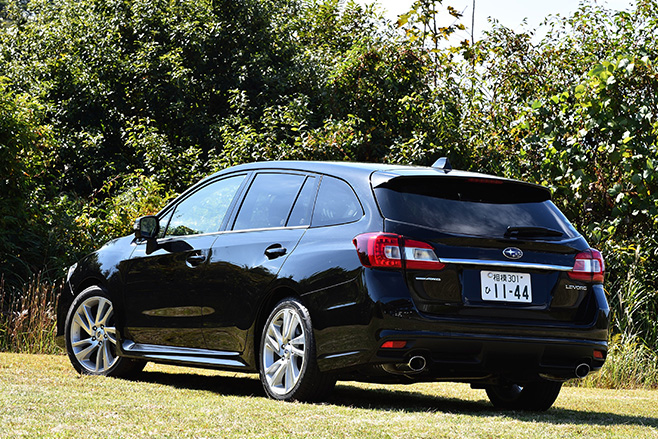
The Levorg sports wagon shares the front half of its panels and styling with the WRX sedan. Subaru believes it is a more natural follow-on from the fourth-generation Liberty GT, a car that garnered a strong fan base in Australia.
In other markets the Levorg is also available with a smaller 1.6-litre engine, though it seems Subaru has no plans to bring that to Australia yet.
Two spec levels are to be made available locally – GT and GT-S. Full details about the model grades is yet to be made available, though we can tell the entry GT model rides on 17-inch wheels, whereas the more generously equipped GT-S features 18-inch wheels.
Information about the Levorg’s standard equipment and specific differences between the variants is likely to be available soon, with an Australian launch expected around the middle of the year.
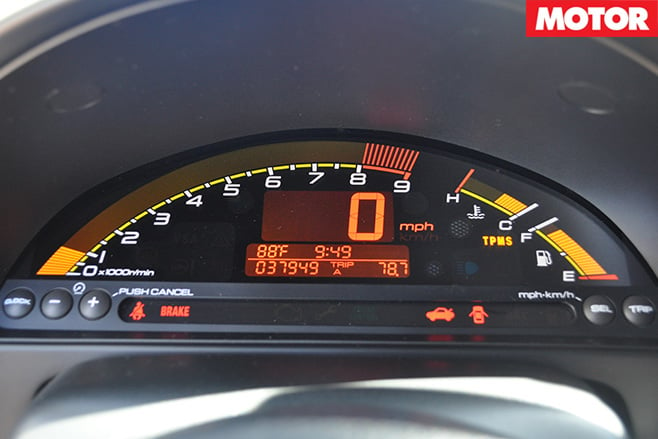
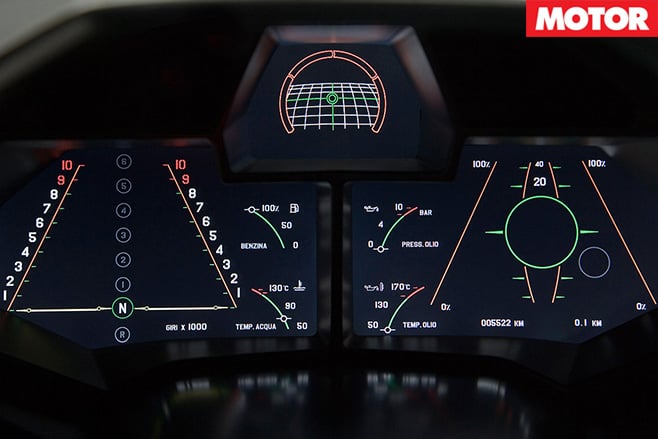
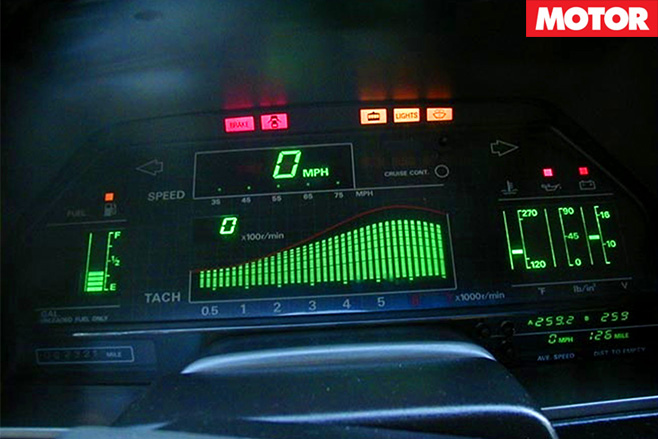
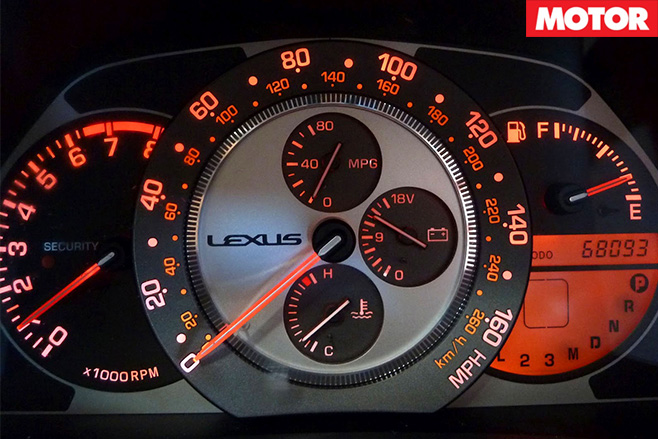
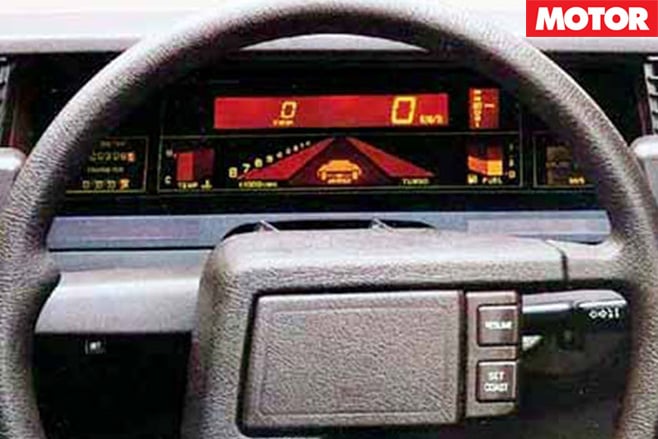
A good instrument cluster is like a good wristwatch. Sure, there are less extravagant ways to display speed, revs and the rest, but would you rather rock a Rolex or a Casio?
1. Ferrari 250 GT

2. Honda S2000
3. Lambo Reventón
4. Nissan 300ZX Z31
5. Lexus LFA

6. Pagani Huayra

7. Lexus IS200
8. Subaru XT
9. Ford GT

Seven seconds isn’t a long time in anyone’s language, even for those fluent in drag racing.
It involves a Lamborghini Huracan that’s visited Underground Racing, a North Carolina tuner outfit that specialises in cramming turbochargers into supercar engine bays.
Obviously UR didn’t hold back on this red example, because it devours the quarter mile in just 7.807 seconds – a new world record.
The car is also reportedly street legal, which makes Bugatti’s Chiron suddenly seem less impressive.
The fearsome speed comes as result of its twin-turbo package that has been squeezed to produce 1324kW– at the wheels – from the car’s V10.
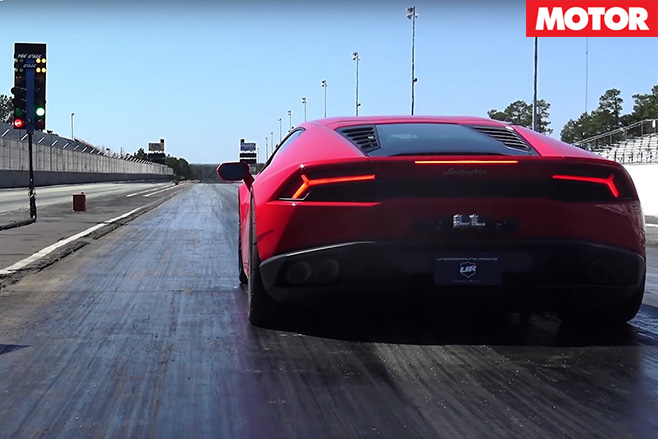
Nitto 19-inch drag radials also deserve credit for the time, helping the UR-built Huracan cross the finish line at 301km/h.
While the price of this car’s particular package isn’t listed, UR’s website states a Huracan with a warranty-backed 745kW at the wheels will cost US$99K. Plus the cost of your own 5.2-litre V10 Italian supercar.
Scarily, UR remark there’s more left in the red Huracan, and promise faster times with an ‘X Version’ setup of the car’s transmission.
Can it dip further into the seven second bracket? Watch this space.
The C250 badge denotes the most powerful of all the four-cylinder engines currently offered in the C-Class.
It’s also WhichCar’s pick of the model’s smaller engines for its responsiveness and competitive efficiency, though some direct rivals are both quicker and more economical.
If the C-Class looks like a junior S-Class on the outside, then the interior is also inspired by the company’s famous limo.
There’s excellent noise refinement when the C250 is on the move. However, for the kind of ride quality expected of a Mercedes it is important to tick the option box marked Airmatic – Benz’s name for air suspension.
Standard features include an active cruise control system that can operate even in stop-start traffic, sensors that can warn you of approaching vehicles when reversing out of a perpendicular parking spot, and semi-automated steering that allows temporary hands-free driving.
If you’ve got about $70,000 to spend on a compact executive car, the Mercedes-Benz C250 remains one of the more persuasive options.
Click here to read the full review on the Mercedes-Benz C-Class range.
How low can they go? Zero to 100km/h times that is. The Audi RS3 smashes the four-second barrier, so the new TT RS will dig deep into the threes.
Mules filmed belting around the Nürburgring confirm it shares the hyper hatch’s 2.5-litre turbo five-cylinder, though boosted outputs of around 300kW/500Nm will differentiate the $80K hatch and the $150K coupe.
Combine the extra power with 1420kg (30kg less than previous; 100kg less than RS3) and a seven-speed dual-clutch, and you have R8-scaring acceleration for less than half the price.
On March 10, 2016, Instagram user autogespot_spain posted a photo of an undisguised red next-gen Audi TT RS, complete with a silver front splitter and matching side mirrors.
This article was originally published in MOTOR February 2016.
A road safety campaign by New Zealand Transport Authority has gone viral for its unique approach to preventing drivers using their mobile phones whilst driving. No shock tactics, no judgement, just pure, hilarious awkwardness.
While shocking, heart-wrenching ads have been the mainstay of advertising campaigns for some time, the NZTA has teamed with Clemenger BBDO to create an oddball advertisement that’s already getting people’s attention.
With Lionel Ritchie singing Hello in the background, the ad features a series of drivers and their passengers from a windshield view. As the driver reaches down in response to a mobile phone’s alert, the passenger slides a palm-up hand across to cover the phone. The result is a comedic and uncomfortable hand-holding situation, playing perfectly into the palms of the advertisement’s tagline, “Put me first. Drive phone free.”
In Australia, using a phone while driving has overtaken people not wearing seatbelts as a major cause of fatal car accidents, and is up there with speeding and drink-driving. Simply touching a phone can result in hefty fines and demerit points. So maybe a hand-holding exercise makes more sense.
According to an adviser for NZTA Senior Education, Adrian Stephenson, “Research suggests driver distraction is likely to be a factor in 20-30 percent of crashes. However, the majority of young people still admit to using their phone for unnecessary tasks when they’re behind the wheel.
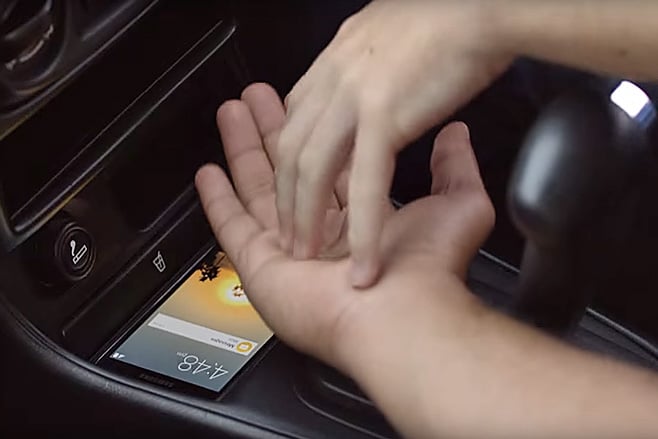
“While lots of overseas campaigns still use shock tactics, we realized we needed to take a different approach with young people if we had any hope of getting their attention.”
As you’d expect, it hasn’t come without resistance with some saying the ad plays on subtle cues of homophobia. But controversies aside, the ad sends the message loud and clear – it’s not only your life you’re risking when you choose to text and drive.
What do you think of the ad?
The fifth-generation Mercedes-AMG E63 will be available in both coupe and cabriolet bodystyles for the first time, a company insider has confirmed.
Mercedes-AMG will take advantage of a larger and more luxurious W213 E-Class coupe and cabriolet that will take the fight to the BMW M6 coupe and convertible.
“It’s in the program, the final sign off for that vehicle to go in the program is in the next month,” the source exclusively told MOTOR.
“It’ll be next year,” the source said of the release timing for E63 coupe and cabriolet. “Cars could be revealed before then, but it won’t be before the sedan.”
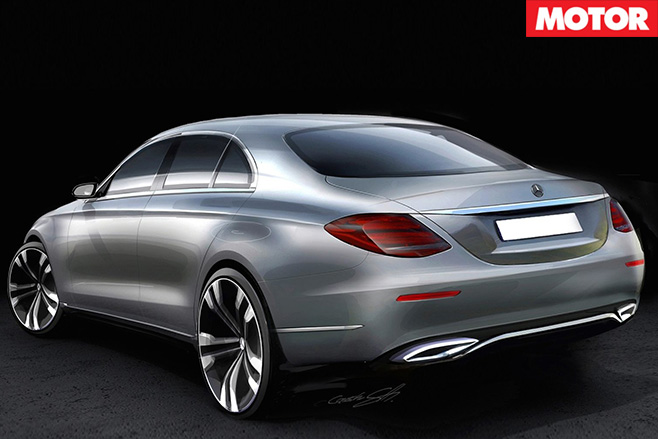
A void of $200,000 currently exists in the Mercedes-Benz two-door coupe range between the E400 and the entry-level S-Class coupe, the $318,610 S500.
The next E-Class coupe and cabriolet are destined to fill that void, with the 4.0-litre twin-turbocharged V8-engined E63 AMG versions primed to target the BMW M6 coupe that retails from $292,600. The outgoing E63 AMG sedan retails from $250,540.
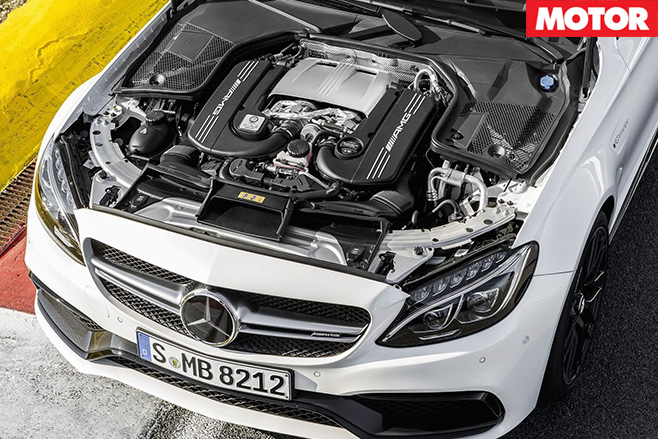
Currently, a rear-wheel drive E63 is offered only to right-hand drive markets because the Mercedes-Benz all-wheel drive system is only compatible with left-hook versions. Power to all four wheels will this time be made available for right-hook markets, reducing the chance of a future large AMG rear-driver.
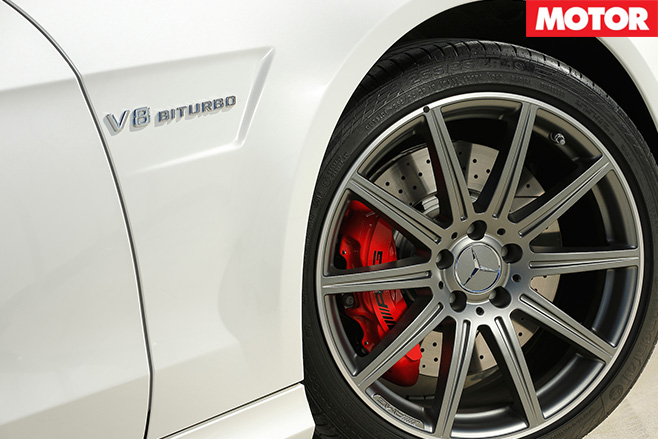
With sedan, coupe and convertible versions of the next E63, as well as the four-door coupe CLS63, Mercedes-AMG will have a real presence in the $200K-plus price bracket for those who can’t quite stretch to that $300K-plus S-Class.
At work or play, these are the utes Australians are buying in increasing numbers. We put ’em to the test, on the road and off it, to find the best.
AUSSIES are long-term utilitarians. It’s a lifestyle choice that can be traced back to 1932, when a farmer’s wife asked Ford Australia for “a vehicle to go to church in on a Sunday and which can carry our pigs to market on Mondays”. Ford responded with its 1934 ‘coupe utility’ and so began a trayed union now spanning eight decades.
Australia may have invented the ute, but today’s booming market segment is driven by imported dual-cab 4x4s from Thailand and Japan rather than our native rear-drive, sedan-based trayback heroes.
Toyota’s Hilux headlines the Aussie ute boom – it was the third-best seller outright in Australia last year – while the Ford Ranger and Mitsubishi Triton made the top 10, in fifth and seventh respectively.
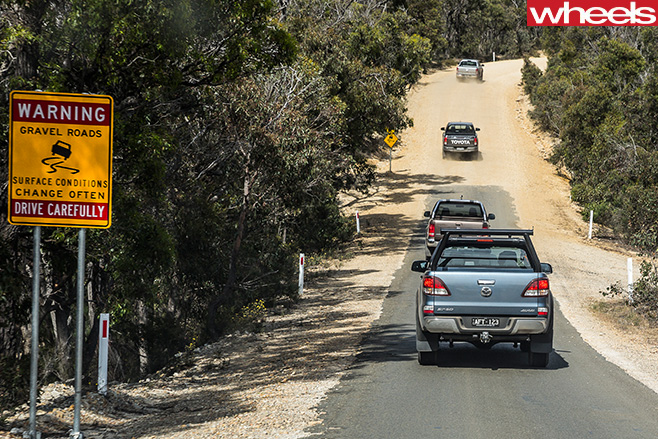
While the mining sector has contributed significantly to the ute’s popularity, private sales now account for a staggering 50 percent. Mums ’n’ dads are buying utes, too.
Meaning there’s never been a better time to review the Dual-Cab 4×4 class of 2016 than right now. Toyota only recently replaced the Hilux after 10 years, and we have a freshly minted Nissan Navara, a thoroughly reworked Mitsubishi Triton, and updated versions of the Mazda BT-50 and Ford Ranger. And a dual-cab Megatest wouldn’t be complete without Holden’s strong-selling Colorado, its Isuzu D-Max doppelganger, and the Volkswagen Amarok.
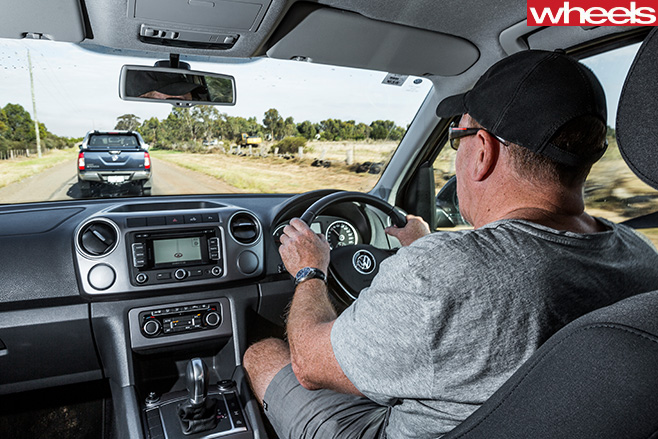
For the stultifying slog down the Hume from Sydney, Wheels was issued the Amarok – broadly regarded as the most comfortable of its type – and quickly discovered unladen ride quality busier than we’d tolerate in a car. The modern dual-cab ute may be more car-like, but it’s not really that car-like. Surely there must be more to its appeal.
Part of the attraction is that commercial vehicles purchased under salary sacrifice, or bought as a business vehicle, bring significant tax savings. Solid retained values approaching 70 percent are about as good as passenger cars get. Then there’s the macho ‘I go bush’ image, even if owners don’t venture far from their coastal Australian cities. If you do, the full low-down on the off-road credentials of these eight dual-cabs is on sister magazine 4×4 Australia’s website.
What’d we put ’em through?
OUR TEST base at the Melbourne 4×4 Training and Proving Ground provided almost every kind of terrain today’s ute buyer could throw at their rig. The most challenging set-climb – steep, slippery and lumpy – was right next to the facility’s conference centre, enabling us to sort them into an off-road pecking order from the outset. Normal and secondary bitumen roads as part of an on- and off-road loop tested ride quality, while unsealed roads tested stability-control systems. A bush-bashing element provided climbs and descents to test approach, departure and ramp-over angles, rutted trails to assess levels of articulation, and water-crossings to evaluate sealing as well as the siting of engine air intakes. The 4×4 Australia crew provided the critical view of some of the most experienced off-roaders in the country and, finally a straight private road became a dragstrip, on which we measured outright acceleration and in-gear response.
Stay tuned for the full review as we rank each contender in the Dual-Cab 4×4 ute mega test.
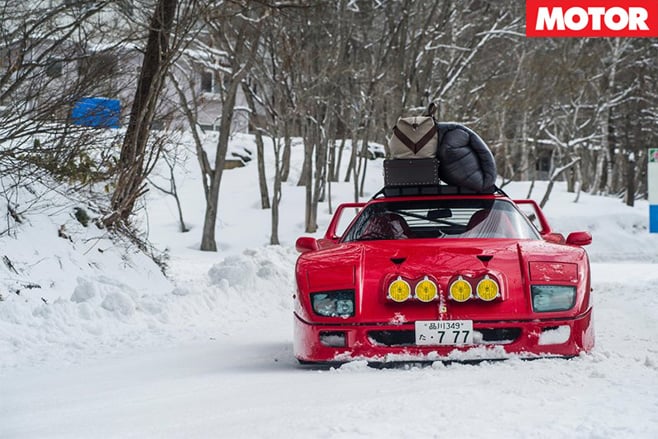
Red Bull has produced a video of a Ferrari F40 sliding its way up a snow park in Japan – and the howling 1987 twin-turbocharged V8 stallion looks born for the white stuff.
The production, of which 15 directors were involved, starts with the click of a cassette into the dashboard deck of an F40 followed by a grab of first gear in the H-pattern manual transmission.
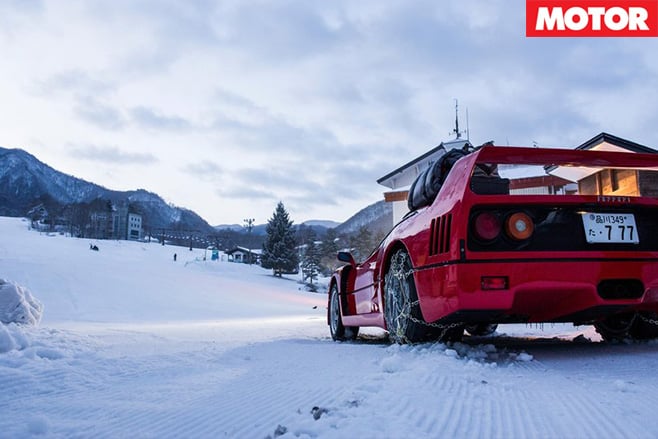
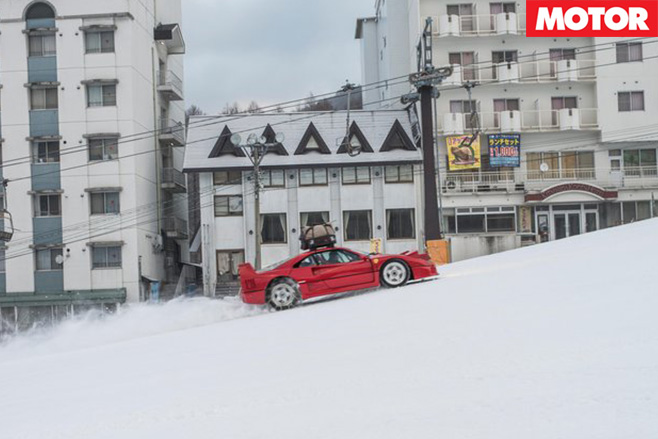
When dusk falls the quad yellow driving lights come ablaze and a fictitious campfire reached.
Photography: redbull.com/motorsport
