
A special edition Isuzu D-Max known as the X-Series has been released in Thailand, where the D-Max is built. The X-Series features bold new bumpers and decals, red interior accents and brand new 1.9-litre ‘Blue Power’ turbo diesel engine and six-speed transmissions.
Isuzu UTE Australia (IUA) has previously drawn on the X-Series special editions in Thailand for its local X-Runner models. The name change is necessary as X-Series is trademarked by BMW in Australia.
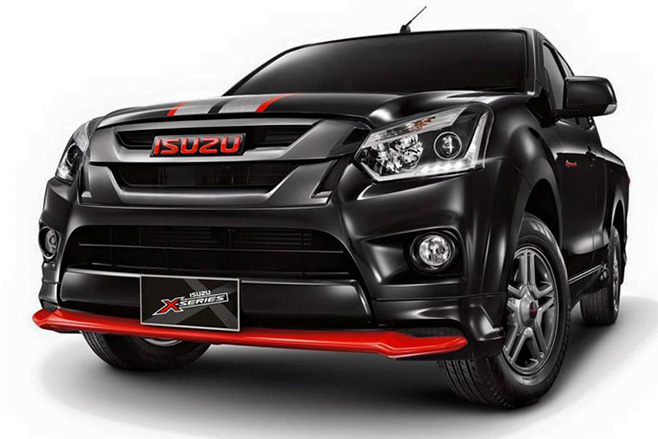
It is not a dead certainty that we will see the X-Runner return, though it seems likely given its success in the past.
“Isuzu UTE Australia will monitor the market response to this update,” said IUA’s assistant general manager of marketing & PR, Dave Harding. “Anything we do here is based on the requirements and the design of the local market.”
At the moment IUA only offers D-Max with a 3.0-litre turbo diesel engine and five-speed transmissions. Rumours suggest IUA is planning to update the D-Max range this year, and introduce the new 1.9-litre turbo diesel engine to sit under the current 3.0-litre variants, along with the new six-speed gearboxes. The D-Max X-Runner seems likely to be reintroduced along with these updates.
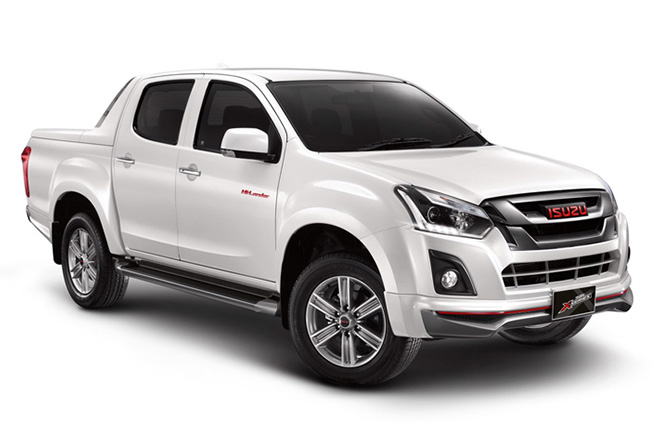
In the D-Max’s homeland the new 1.9-litre engine replaces a 2.5-litre turbo diesel previously offered. A new 3.0-litre ‘Blue Power’ turbo diesel has shown up on marketing material in Thailand hinting at a possible update there as well.
X-Runner special editions have been offered in Australia three times previously. The most recent version was released in March 2015 priced at $51,990, and included upgrades and visual enhancements from the X-Series.
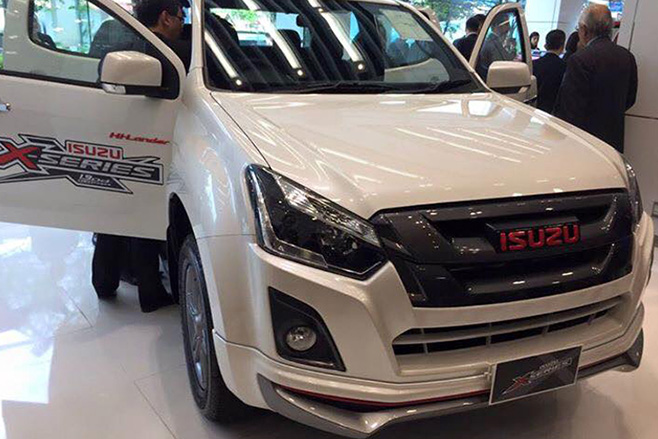
Space cab and double cab body styles are available in the D-Max’s homeland in two different spec levels called Speed and Hi-Lander. Speed models get black alloy wheels, more prominent red highlights and a sporty body kit. Hi-Lander models feature a sports bar around the tray, side steps and a six-spoke alloy wheel design.
The new X-Series is the most visually different yet, its striking front end featuring a revised headlight design and LED daytime running lamps on all models. Paint options are Siberian White or Australian Coal Black (seriously).
We will follow up any local D-Max X-Runner news as information becomes available.
In 2010, Ferrari launched its most extreme front-engine car ever. So bonkers it was that it couldn’t even be legally driven on the public road, nor could it be raced in any sort of professional series.
That car was the Ferrari 599XX, a track-only special of the already ballistic 599 V12 super tourer with less weight and more wing. Ferrari stripped a total of 270kg from the standard car and, as if that wasn’t enough, it then upped the power from 455kW to a head-banging 537kW.
To keep the thing glued to the road, a host of splitters, wings, vents and dive planes were moulded onto the 599’s body and slick race tyres fitted. The result was a shape that delivered 12 per cent more downforce, but crucially 15 per cent less drag.
Performance was on another level – 0-100km/h in less than 3.0 seconds and a Nurburgring lap time of six minutes 58.16 seconds – a record at the time for a production-derived car.
Now that the 599’s successor, the F12, has been around for a few years, it’s time Ferrari broke out the spanners and gave it the XX treatment.
As it stands, the F12 is a five-star car. We can only imagine how far an unhinged F12XX could take things.
LIGHT WEIGHT The F12XX will tip the scales at 1275kg before fluids, making it 250kg lighter than the standard F12. Weight savings include removing the stereo, rear seats, and sound deadening material. All panels and wheels are made from carbonfibre – a first for Ferrari.
THUMPING HEART The F12XX gets the same 6.3-litre V12 fitted to the FXX K track car. That means a massive 623kW output at a dizzying 9200rpm. The big V12 gets new camshafts and a redesigned inlet manifold compared to the ‘standard’ 545kW F12 engine.
THE VENT Scoops, vents and intakes help guide the air as efficiently as possible while improving downforce. The F12 boasts 123kg of downforce at 200km/h but at the same speed the XX generates over 300kg. At high speed, the rear wing automatically trims its angle to reduce drag.
SIDE PIPES As the F12XX doesn’t have to comply with any emissions or race regulations, it can produce as much V12 noise as it wants. The exhaust system – made of lightweight titanium – is piped straight from the engine to a pair of outlets just behind the front wheels.
STICKERS The F12XX rides on extra sticky Pirelli slick tyres which are also fatter than standard. They’ll take a little time to warm up, so fortunately the XX has Ferrari’s latest traction and stability control systems to stop you binning it on the out lap.
You’ll no longer need your imagination to picture Audi’s R8 without a roof or camouflage.
Thanks to an aloof handler occupied with his smartphone, Audi’s upcoming R8 Spyder has been spotted completely undisguised by automobilemag.com’s spy photographers, revealing the supercar’s second generation convertible variant in full production trim.
The shots confirm Audi will debut the Spyder in V10 form, with a badge on its front fenders proudly displaying that fact, although there are rumours a V6 variant designed for Chinese markets will follow in both the convertible and coupe variants.
More importantly, the photos also offer a concrete idea of how the productions car’s final look will inherently differ to the R8 coupe’s. Up front there’s little news, the car’s face is identical to its hard-roof sibling, wearing the same horizontal panes in its gaping side vents.
Whereas up back Audi’s tweaked its rear design to accommodate the folding cloth roof. Exclusively stowed in these shots, it’s easy to spot new redesigned louvres on the rear deck trailing each seat. Heavily vented, no doubt to cool the angry 5.2-litre V10, they’re joined together by a single mesh vent.
There’s also a new mesh grille bridging the rear tail lights, which should help pull air from the engine compartment, while the petrol filler cap has been moved from the B-pillar to the right rear haunch.
More details on the R8 Spyder’s launch are expected to be released at its expected official debut at the New York Motor Show, which kicks off at the end of this month.
For the full gallery of spy pics head to Automobile magazine.
LEXUS NX200t F-SPORT Score: 74/100
Price & Equipment | 16/20
Price parity underlines this stoush – just $83 separates their $63K price tags. The Lexus is better equipped, with LED headlights, adaptive dampers, a wireless induction mobile phone/device charger, blind-spot monitors, rear cross-traffic alert, and heated/cooled seats. The turbo-petrol NX also undercuts the NX Hybrid by $2500.
Interior & Versatility | 15/20
NX200t cabin is sportified in F-Sport spec, with specific trim, more supportive sports front seats, aluminium pedals, scuff plates, a perforated steering wheel covering, and different instrument dials that place greater emphasis on the tachometer. But NX’s smaller proportions translate to a less spacious rear compartment.
Performance & Economy | 15/20
First turbo Lexus runs a 175kW 1998cc four, with water-to-air intercooling, that can run on both Otto and Atkinson cycles. Musters 350Nm from 1650rpm, but in practice the auto prefers to drop a few ratios and tap into the smooth mid-range. It powers the relatively porky NX from 0-100km/h in 7.1sec – a lot quicker than the Hybrid.
Ride & Refinement | 16/20
Both wagons roll on 18s – the F-Sport NX gets broader boots than lesser variants – however the Lexus smooths bumpy roads better than its rival thanks in part to its standard adaptive dampers, which gives it Normal and Sport Plus modes. The NX contains coarse-chip tyre noise to a distant roar, which makes for a soothing ride.
Steering & Handling | 12/20
The NX’s RAV4 origins come through when you drive it with enthusiasm. It’s more capable than the Hybrid version, thanks to a unique suspension calibration, and switching the dampers does sharpen responses. The turbo’s crisp grunt helps too, however anaesthetised steering and over-reactive ESC limit the fun factor.
AUDI Q5 2.0TFSI QUATTRO Score: 75/100
Price & Equipment | 14/20
Despite being outdone by its Japanese rival, the Q5 is well-equipped, with eight airbags, tyre-pressure monitors, reverse camera, front/rear parking sensors, 10 speaker audio, sat-nav, and auto lights/wipers in common with the NX. But a blind-spot warning system adds $1250 and heated seats cost $800 extra.
Interior & Versatility | 16/20
Audi’s cabin quality is peerless, and the approach classy yet conservative, in contrast with the Lexus’s futuristic treatment. Lacks its rival’s power-adjustable steering column but matches it with an electric tailgate and more cargo space (540 litres, up 40) with the rear seats upright, or 1560 litres (up 15) when they’re folded.
Performance & Economy | 15/20
Venerable 1984cc VW/Audi turbo four offers 165kW from 4500-6200rpm and 350Nm from 1500-4500rpm, so it’s a close match. So close, in fact, that claimed acceleration and combined-cycle economy (7.9L/100km) are identical. Audi, too, drinks 95RON, but its 75-litre tank holds 15L more juice, which gives it the edge for touring.
Ride & Refinement | 15/20
The 235/60-shod Audi (the Lexus is on 55s) deals with bigger bumps better than it does small, sharp ones, however it rides with decent comfort on its fixed dampers (an adaptive system costs $2K extra). Tyre and suspension noise are similarly hushed, while Q5’s NVH suppression is on an equally high plane.
Steering & Handling | 15/20
We’ve never loved the Q5’s steering – it’s at the artificial end of the spectrum of electro-mechanical systems. But in this company, it’s preferable to what the NX offers. It’s beefier, with a better sense of connection, though we suspect this has more to do with weighting than real feedback making its way to the driver’s hands.
VERDICT
It’s a narrow victory for the Q5 by this measure, though you may come up with a different outcome, depending on your priorities. You may be swayed by factors such as Lexus’s enviable quality and reliability reputation, or its four-year warranty. An Audi is a more fashionable choice, and we reckon the Q5 is better-looking. They’re equally effortless for daily driving, with the lung capacity to stretch their legs on a country road. Officially, they use the same amount of fuel. We really like the brilliantly high-tech Lexus turbo-petrol mill, and it should sip on the open road. But the Audi has an impressive donk too, plus that larger fuel tank for potentially greater range. The identically priced Lexus is more generously equipped, but the Audi is a more satisfying car to drive, despite its considerable vintage, and that gets it over the line.
This article was originally published in Wheels December 2015.
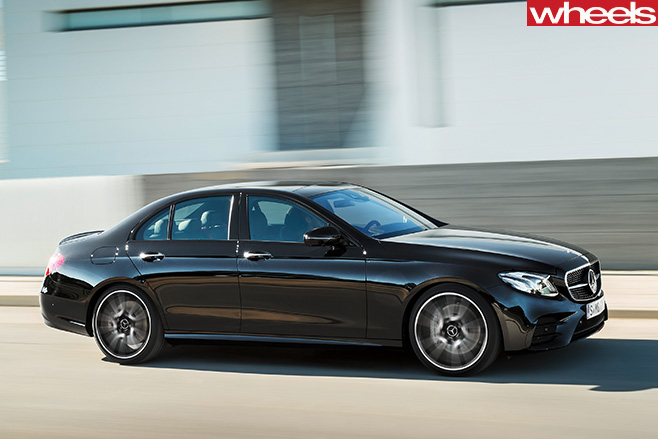
WE’VE only just driven the all-new 10th generation Mercedes-Benz E-Class, and now AMG has already revealed its first performance variant.
Dubbed E43, it’s set to make its public debut at next week’s New York motor show and fills the gap between the regular E-Class range and the bonkers AMG E63 due later this year.
It also boasts the most powerful version yet of AMG’s new 3.0-litre twin-turbo V6. Bigger turbochargers and more boost return 295kW/520Nm, which when paired with standard four-wheel-drive propel the E43 from 0-100km/h in 4.6sec. That makes it just 0.3sec slower than the current version of AMG’s full-fat E63 S.
It joins the recently confirmed Mercedes-AMG C43 Coupe and Mercedes-AMG C43 Convertible, the latter which made its debut at the Geneva motor show earlier this month.
As well as more grunt, the E43 scores a unique AMG four-wheel-drive system with a 31:69 front-to-rear ratio, bigger brakes front and rear, sharper steering and firmer AMG-tuned air suspension with three-stage adaptive dampers.
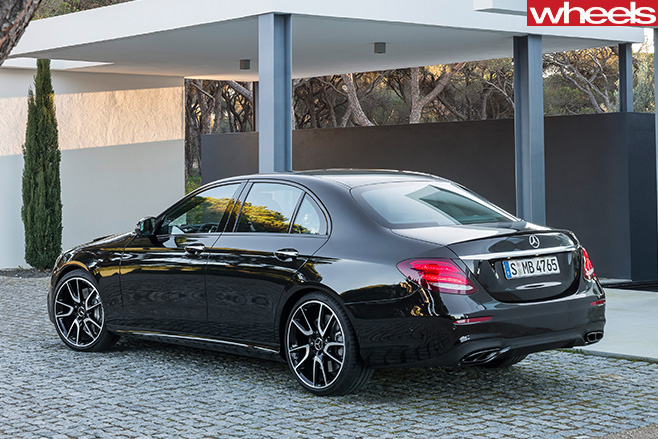
Visually the E43 scores a more aggressive front bumper, 19-inch AMG five-spoke alloys and twin, chrome plated exhaust pipes out back.
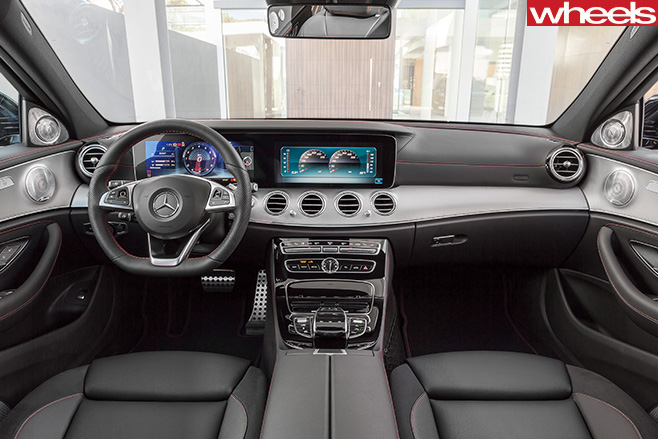
Inside there are AMG sports seats with greater bolstering, unique styling touches and a multifunction sports steering wheel wrapped in nappa leather with red stitching.
No word yet on official pricing, but expect a sticker price around $200,000.
IT’S all about 1s and 0s for Audi as it looks to implement a new electronics-focused product strategy between now and 2025.
The move will result in between “20 and 25 percent” of cars sold by 2025 being powered entirely or significantly by electricity.
“We will constantly expand our range of alternative drive systems and gradually electrify our model portfolio,” said Audi chairman Professor Rupert Stadler speaking at the brand’s annual press conference at its headquarters in Ingolstadt, Germany. “We are particular focusing on the plug-in-hybrid technology and on purely electric drive.”
An all-electric SUV, in-house developed apps and a move towards autonomous drive are key pillars of a renewed strategy to ensure the premium brand is positioned to take advantage of a consumer electronics-inspired move towards high tech cars.

“The ‘new premium’ is digitally connected, efficiently emission-free – and fully in tune with the urban lifestyle,” said Stadler of the multibillion-dollar investment in new technologies, plants and people.
“Already today, 90 percent of our innovations are based on electronics: sensors and digital assistants, resulting in more driving intelligence,” he said, pointing to predictive driver assistance systems and autonomous driving technology. “Vorsprung means utilising the potential of digitisation.”
Having hired 1600 specialists “with know-how in digitisation and electric mobility” throughout 2015, Audi is hiring another 1200 experts in battery and hydrogen technology, software and app development.

Audi is also looking at the broader mobility picture, with plans to develop an app tailored to the connected car and driverless transport.
“An app will be at the core of our new mobility offering,” said Stadler. “It will allow Audi customers to deliver the desired car to the desired place at any time by pushing a button. And that’s not enough: Our business model will range far beyond the car in the future.
“With a digital platform as the basis and with artificial intelligence, a multitude of new services will be possible.”
The GT12 – which was to be called GT3 until Porsche became uppity about the name – takes the V12 S as a base and makes it even more extreme.
Think of it as Aston’s answer to a 458 Speciale, only it’s more exclusive and expensive. Aston will only build 100, all of which are sold, at £250,000 (AUD$545,300) each.
The changes run deep to justify that cost, though, and they’re inspired by Aston’s own GT3 race cars. Hence the wings, the splitters and the (optional) paint finish. This is the lowest, widest Vantage ever, some 50mm wider than standard and fitted with lightweight carbonfibre bumpers, front wings, bonnet and (an optional) roof.

With the weight decrease comes a significant power increase. The standard V12 Vantage S makes 421kW, which is plenty for its chassis. The GT12’s 5.9-litre V12 receives magnesium inlet manifolds with revised geometry and a titanium exhaust system and now produces a walloping 441kW.
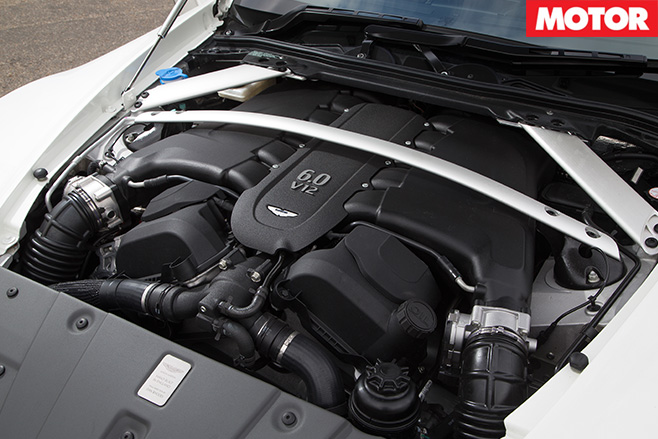
There’s certainly a lot of old-school charm about the way the GT12 fires up. The noise, unadulterated by turbochargers, is pure and aggressive.
There are three-stage adjustable dampers with Normal, Sport and Track modes, and there’s also a Sport mode for the powertrain that sharpens the throttle and gearshifts and makes more noise, more often. Leave both settings in their easy modes and the GT12 retains much of the charm that makes the V12 S so special.

What it’s like on a blistering race track is a verdict that will have to wait for another day, but on good roads it’s an extremely well-sorted car. The ride in Normal gives sufficient body control for sensible driving, but flicking through to Sport adds a spot of extra composure. Track is too firm for road driving, but the variations between modes aren’t miles apart, and that’s exactly as it should be.
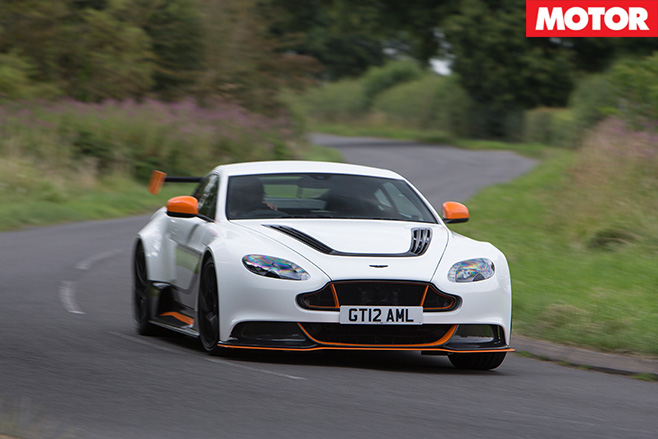
Trail the exceptional brakes into a corner and the nose stays firmly planted, and there’s fine mid-corner balance. On the way out of a bend, it’s the traction control, rather than the throttle, that dictates how quickly you’ll enter the next straight. Disable the electronics and it feels like there’s abundant opportunity to light up the rear tyres, but the throttle response and the noise, should you want, are truly spectacular.
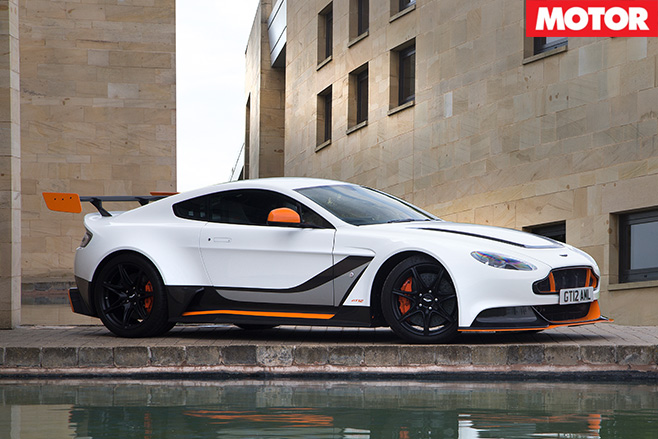
Put simply, the Vantage GT12 is a terrific driver’s car. It’s raucous and loud when you want it to be yet acceptable when you don’t. This is a sports/GT car right out of the old school, and it’s all the better for it.
4.5 out of 5 stars
Specs Engine: 5935cc V12, DOHC, 48v Power: 441kW @ 7000rpm Torque: 625Nm @ 5500rpm Weight: 1565kg 0-100km/h: 3.5sec (claimed) Price: Sold out Positives: Delicious V12 engine; sublime steering; aggression Negatives: Limited production run; outdated gearbox; huge price
Kids have been able to watch movies from the back seats for quite some time, but according to a leaked document showing Ford’s patented technology, everyone may be able to watch movies from inside a self-driving car soon enough.
Images are projected onto a roll-down display on the front windscreen via a projector mounted to the ceiling of a car. Thankfully, the in-car cinema would only work while the vehicle is in full autonomous mode or not moving.
We guess the in-car cinema would include online streaming (Netflix and chill anyone?), television and video games. Imagine playing Gran Turismo while in a car – it gives new meaning to virtual reality.
The US car-maker told US magazine Car and Driver, “As a technology leader, we submit patents on innovative ideas as a normal course of business. Patent applications are intended to protect new ideas but aren’t necessarily an indication of new business or product plans.”
So maybe we won’t be able to watch in-car movies any time soon, but we’re still one idea better than the Jetsons.
Free gelato – is there a more beautiful pair of words in the English language? It’s easy to spot a marketing gimmick, but if that gimmick means eating Gelato Messina for nix, we’re on board.
Holden is aiming to get more exposure for its Spark city car by opening Gelato Messina pop-up stores around the country and handing out free ice cream.
First time new car buyers aged between 20 and 29 are the Spark’s target market, but Holden thinks young people are less likely to wander into a dealership and connect with the Spark in the traditional style. So bringing the car to them is an approach that just might work.
Holden plans to have the Spark on display at each Messina pop-up. Visitors will get an up-close look and the chance to interact with the car without the perceived pressure of sales staff hanging around nearby.
The Holden Spark was recently given an overhaul, now sporting a sleekier appearance, more interior space and updated with Apple CarPlay and Android Auto mobile connectivity technology.
Look out for the Messina pop-ups in April. They’re opening in Sydney, Melbourne, Brisbane, Adelaide and Perth, and will run for around six weeks.
The A4’s cabin impresses with its roominess, tactile materials and impeccable fit and finish. All presented in an interior design of unrivalled modernity.
For an added touch of sophistication you can tick the option box for Audi’s ‘Virtual Cockpit’ which gives you arguably the world’s best instrument cluster.
An adaptive sports suspension is optional, though it may well be worth the investment because thus equipped, this A4 offers a comfortable ride and superb road holding.
In this spec, Audi’s mid-size executive car has never been more impressive to drive.
