
Two years ago my wife and I packed up and moved our lives from Sydney to Melbourne. Since then the Hume Highway has vaporised more hours of our lives than I care to count. It is a deathly boring commute, and one that we find ourselves doing several times a year.
The Hume is, for the most part, an extremely efficient way to travel a long distance. Efficient is another word for boring. It’s 800-odd-km of blacktop with two lanes in each direction; lanes that bypass every little town along the way rendering the road devoid of all character and charm. It may be the fastest way to get the job done (in a car) but it’s still a full day of point and click monotony, and life is too short for road trips like that.
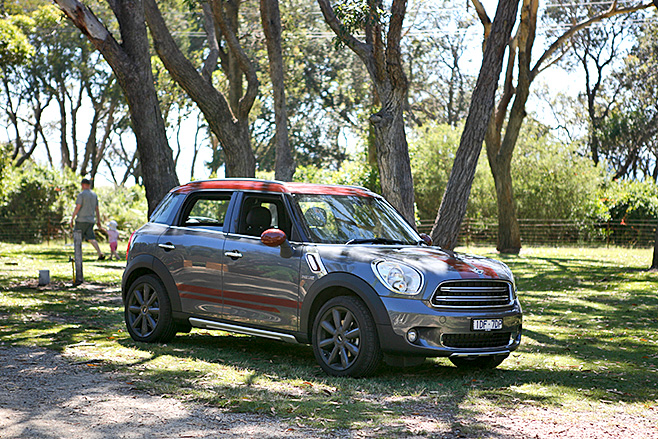
So on our most recent sojourn up the Hume to visit our families, the decision was made to spend an extra day travelling home. We wanted to drive as much of the coast road as possible, stopping along the way to soak in the sights. It was beautiful.
Day 1: Sydney to Scarborough
Setting off from Sydney’s north-western suburbs, we picked a route to the southern end of town that would get us out of the thick of things as quickly as possible. Part of taking the slow road home involves getting out of the hustle and bustle as a matter of urgency.
We were driving a MINI Cooper Countryman, a car that loves twists and turns, so I made it a high priority to take the route through the Royal National Park. Once you reach the outskirts of Sydney, signs appear for the Grand Pacific Drive. Following that little logo is your ticket to a gorgeous day or two on the road.
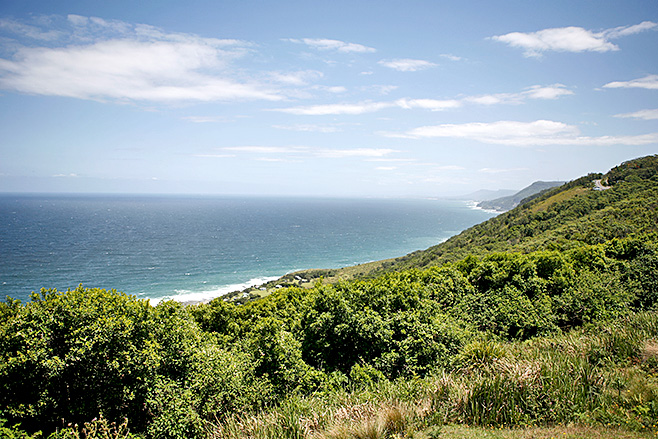
Breaking out from the greenery that is the Royal National Park you’ll soon arrive at Stanwell Park. The lookout point at the top of the cliff is worth stopping for. Hang gliders love the area so keep an eye out for anything colourful soaring overhead.
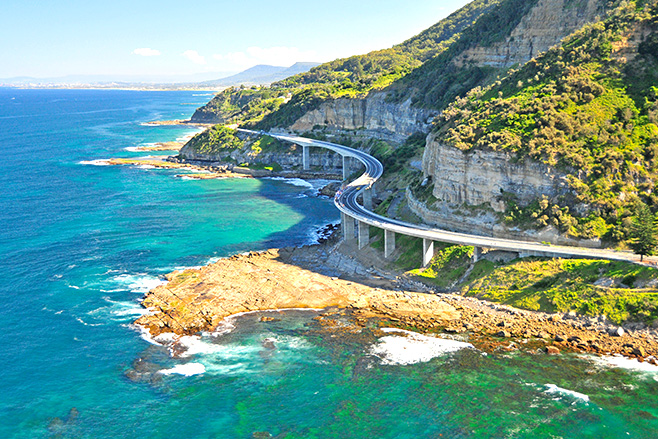
Hop back on the scenic route and the next landmark isn’t something by the side of the road, it is the road. The Sea Cliff Bridge has been made famous by numerous TV commercials and magazine photo shoots. It’s an utterly stunning monument and a magnificent engineering feat.
A bit further down the road is the now closed Imperial Hotel sitting in a prime location high above the water’s edge. It’s a beautiful old building that’s begging to be repurposed.
Next stop is Scarborough. If you’re anything like us, you’ll have left later than planned so the Scarborough Hotel is an ideal spot to stop for a tasty bistro lunch.
Day 1: Scarborough to Berry
Head out of Scarborough and you’re winding your way past the south coast’s stunning sandy shores. Coledale is a personal favourite with its beach-side campsites fronting right up to the surf. The sand is mere metres from the zipper on your tent. The Coledale RSL is another good food option if you’re feeling peckish.
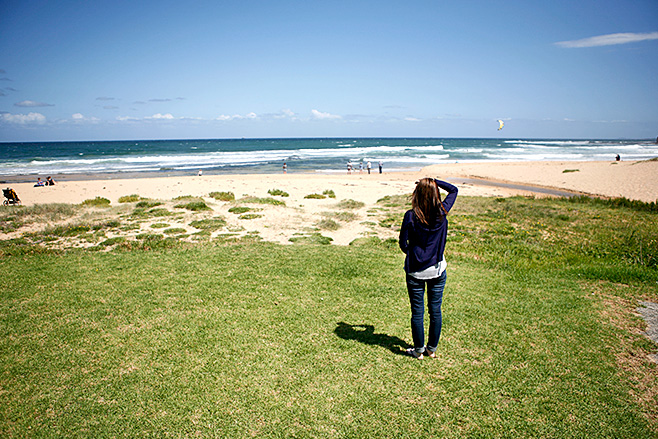
After passing Austinmer beach, Grand Pacific Drive moves away from the edge of the coastline to take you through Thirroul, home to a handful of very sweet coffee shops.
Wollongong is getting close by now and the traffic may start to reflect that. Wollongong is the best place to stop if you need to get any supplies that may be harder to find in quieter towns.
Out the other side of the ‘Gong the view over the water from Bombo and Kiama will be all the reward you need to say thanks to yourself for taking this route. What a gorgeous part of the world.
Before long you’ll hit Berry, one of the cutest towns on this whole drive, though not one that is equipped to deal with high volumes of holiday traffic. It was packed the day we drove in and I was glad to in the little Countryman and able to nab a small carpark on the street. The wait to get into Berry is worth it, if only to devour a couple of outrageously delicious donuts from The Famous Berry Donut Van. You can’t miss it.
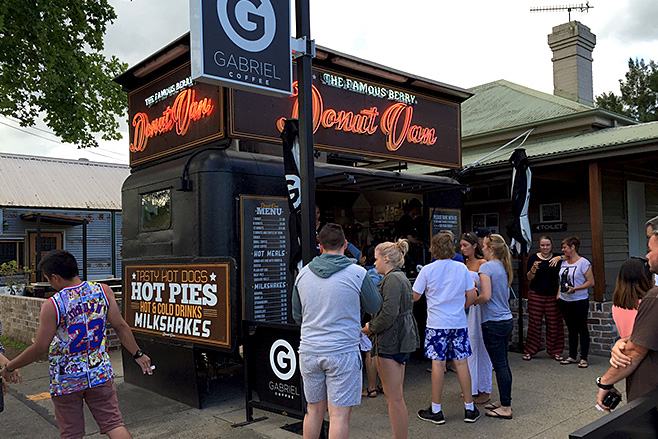
By 2018 Berry will be bypassed which is a shame. It will ease the long delays that often happen but we can’t help but think that once there’s a road around it, most will drive right by. My wife and I plan to make a point of stopping at Berry as often as possible.
Day 1: Berry to Bega
If you’ve stopped as many times by now as we had, you’ll notice that the day is starting to get away from you. We enjoyed most of the next leg from inside the car at 100km/h. We were trying to get to Bega at a reasonable hour to get a good night’s sleep. The MINI was more than comfortable to cruise at the speed limit with the AC blasting and the boot fully loaded with gear, including a timber double bed frame my old man surprised us with in Sydney! Yep, I was surprised by the boot size of the Countryman as well.
Nowra is one of the larger townships on the drive and the next major area of interest. It’s the centre of a big farming community and dairy industry. About 20kms south of Nowra the A1 Highway feeds you through a magnificent section of national park and state forest.
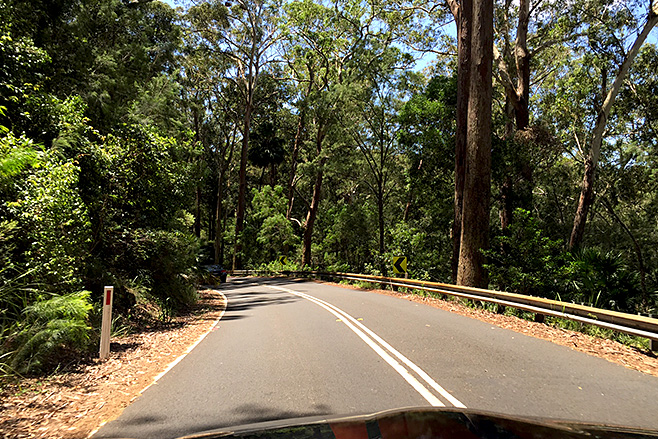
Take it in for a moment then ready yourself for more sprawling ocean vistas from Ulladulla, an extremely popular spot for holidaymakers in search of Vitamin D.
Follow the 100km/h single lane highway for another hour and you’ll land in Bateman’s Bay. Overtaking lanes on this stretch are sparse, so don’t get stuck behind a caravan leaving Ulladulla!
Batemans Bay was our dinner stop. We chose Thai food from Eat at Siam, a waterfront restaurant sitting above a pizza shop. Eating on the first floor balcony as the sun set over the water felt like a scene from a much more expensive restaurant. Recommended.
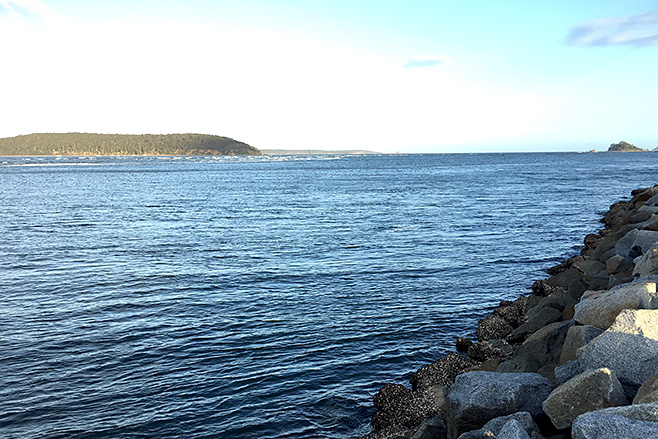
With our bellies topped up we waved goodbye to Batemans Bay and hit the uphill and downhill twists and turns to Bega. As the halfway point of this coastal trip between Sydney and Melbourne, Bega has a huge range of accommodation options. It’s worth planning in advance and finding a room early as the whole town books up fast in peak times.
Day 2: Bega to Eden
We woke up in Bega on a public holiday and the main street was a ghost town. Usually there is a choice of breakfast café options within walking distance of each other. We were keen on Red Café which caters to a wide range of dietary needs. Sadly, we couldn’t try any of them on the day we were there, so we hit the road to Eden.
The route to Melbourne takes a surprise turnoff outside Bega. The main road out of Bega continues to the coastline, but our path heads off to the right. Don’t miss the sign or you’ll end up in Merimbula, which actually wouldn’t be all that bad.
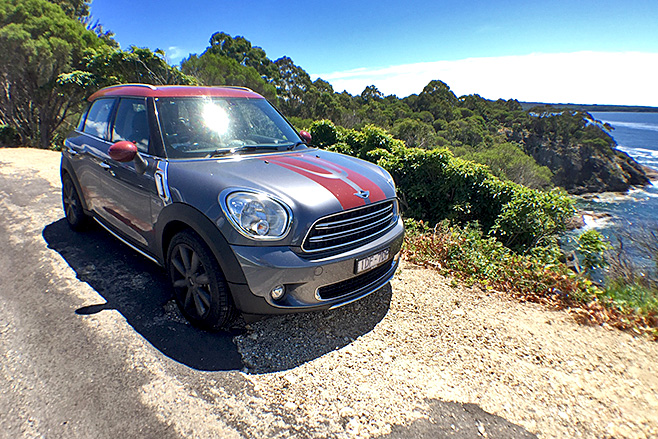
Getting to Eden takes you through quaint little Pambula, a tiny settlement with a nearby wetland area containing fresh water billabongs, walking and bicycle tracks and picnic areas.
Pretty soon you’re in beautiful Eden. The ‘Garden of Eden Caravan Park’ will let you know you’ve arrived. Hey, someone had to do it. Eden is a fairly significant hub on the far south coast, very nearly on the border but just inside New South Wales.
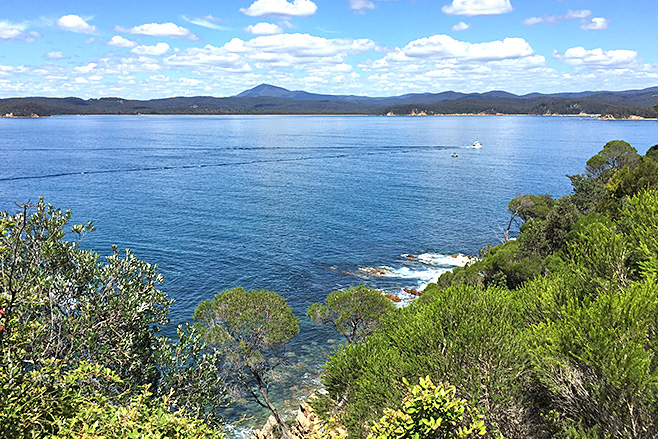
Spend some time in Eden. The headland lookout is truly breathtaking and known as a prime whale watching location. If you’re hungry, like we were, Sprout Café gets a big tick from us. The food is delicious and the coffee, made with local milk, is outstanding. It’ll be the coffee you think of most when you remember your time there.
Day 2: Eden to Lakes Entrance
Jump back on the tourist drive and follow the signs to Melbourne. This bit of the drive is a fair way inland compared to the road so far, but the thick bushland and forest is just as pretty to look at. If you’re a keen driver you will lap up this part of the journey. The road bends a line beautifully across the bottom corner of the country, and if you’re driving something that enjoys a spirited squeeze you will love the next stretch. Our MINI was perfect in its balance of long haul practicality and cornering prowess, approaching the road with the same level of enthusiasm as I did. Less than 50km from Eden is the state border.
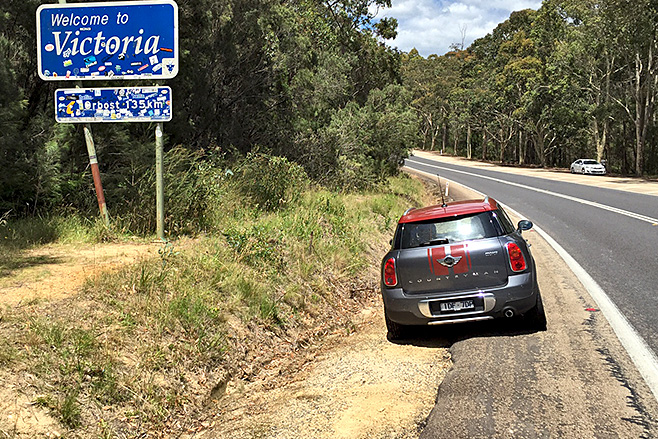
Not too much driving left now! Keep rolling to Cann River, from there you can choose to snake your way along the water’s edge some more by turning off to Cape Conran and Marlo, or you can continue on the A1 to Orbost.
This bit of the drive is where I realised how relaxing the coastal route had been compared to using the Hume. There are almost no big trucks at any point, especially in this south-eastern corner. I could count the number of heavy commercial vehicles on one hand. The only slow movers to contend with are the odd campervan or farmer.
It’s important to try and get your touring done during daylight hours. Kangaroos are more of a risk on this road at the best of times, but much more so at night. That’s not mentioning the fact the views are better and that driving during the day is less fatiguing.
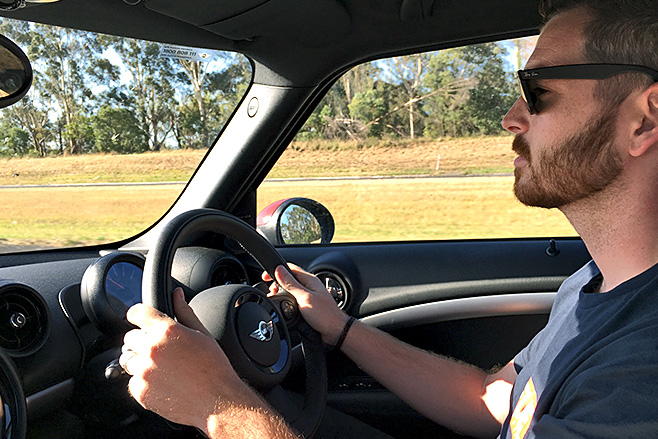
Regardless of which option you took above, the roads meet at Orbost and cross the Snowy River. A string of tiny, mostly abandoned hamlets lie on the road out of Orbost. The next town of significance is Lakes Entrance.
Lakes Entrance is an excellent stop. We chose to grab lunch here and do a little bit of seaside shopping. There is plenty of car parking and the park area near the water often has some sort of community event going on at the weekend.
Day 2: Lakes Entrance to Melbourne
If you have time, take a moment to enjoy the picturesque lookouts along the road toward the Gippsland area. Bairnsdale is the first major urban area in East Gippsland and a charming spot in its own right. It is home to two wildlife reserves that provide habitat for a varied selection of threatened fauna and flora species.
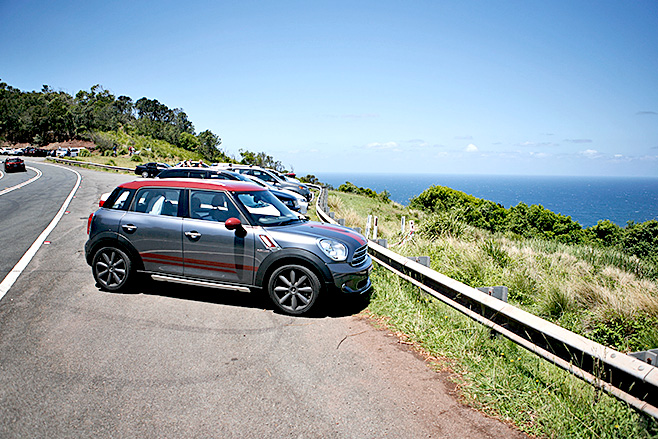
The A1 will feed you into Sale next. By now Melbourne isn’t too far away, and with almost 1000kms behind you I’ll bet you’re just about ready to be there.
From just outside Rosedale the single lane highway you’ve been following widens out into dual carriageway. But it doesn’t last for long. Stay the course a little longer and on the other side of Traralgon if opens up for the final stretch into Melbourne.
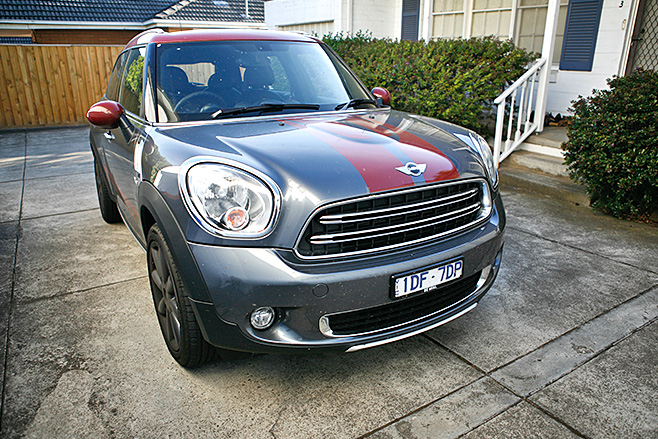
All up, taking the coastal road adds roughly 150kms and four hours of driving to the journey when compared to using the Hume Highway. Yes, it’s just too much to make it unfeasible for a single day of travelling, whereas the Hume can get you between Sydney and Melbourne in one (long) day. Trouble is, taking the Hume means missing out on all of what Australia’s south-eastern coast has to offer – which is a lot! We urge you to give the road less travelled a chance. It’s the better way to get where you need to go.
Progress is a funny thing. It creeps up on you inexorably, until one moment brings into sharp focus just how far things have moved forward.
Case in point: almost 10 years ago, MOTOR was behind the wheel of a Mercedes-Benz C-Class with 270kW and 510Nm, and yet today we’re steering another Merc mid-sizer, this time with 270kW and 520Nm.
Here, though, is where the progress comes in. Back in 2005, those numbers belonged to the C55 AMG, the biggest and baddest C-Class you could buy thanks to a 5.4-litre V8 that allowed it to hit 100km/h in 5.7sec while slurping 13 litres of premium fuel every 100km.
Today, those numbers are deemed fit only for the most junior of AMG’s models; the new C450 AMG 4MATIC. This is despite the 0-100km/h time being slashed to 4.9sec, fuel consumption to a mere 7.6L/100km and the power being produced by a 3.0-litre twin-turbo V6 rather than a naturally-aspirated V8.
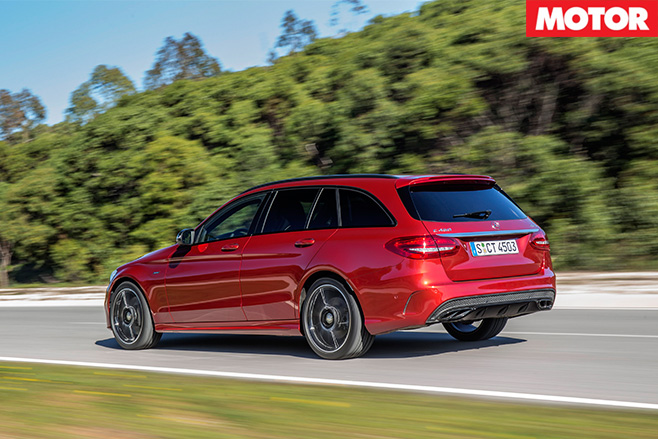
Why the long delay? The hint is in the name. The C450 AMG 4MATIC will be the first C-Class available in Oz with all-wheel drive, and the production of right-hook cars doesn’t begin for a while.
What’s a C450? It’s designed for those that want more than a C250, but aren’t quite ready to step up to the C63. It’s a similar approach to BMW’s ‘M Performance’ range or Audi’s S models – a sandpit Benz hasn’t played in until now.
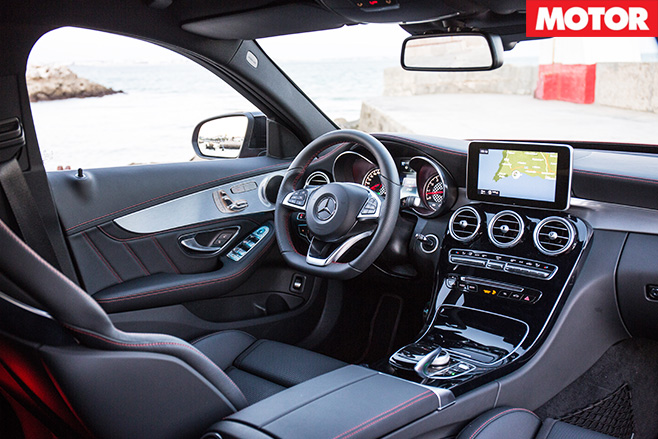
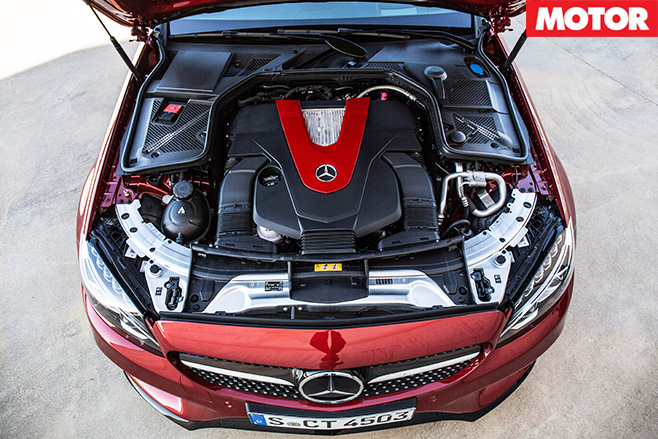
In this case AMG has taken the regular C400 (not sold in Oz), fiddled with the engine and transmission software, tweaked the all-wheel drive system and added a number of suspension bits from the C63, including AMG Ride control adaptive dampers, lightweight aluminium suspension components and C450-specific tuning including increased negative camber at the front.
From the first turn of the steering wheel it’s clear there’s a competent and engaging chassis underneath this pseudo-AMG. There’s strong grip, nudging gently into understeer when you approach the limit, but a lift of the throttle tightens the line beautifully.
It offers a surprising level of entertainment for an all-wheel drive C-Class wagon (the variant we drove). Rides reasonably well, too, thanks to the ability to alter the suspension (as well as powertrain and steering) through Eco, Comfort, Sport and Sport-Plus modes.
The 3.0-litre biturbo V6 sings a sweet tune, howling its way through the rev range, has a nice linear power curve and offers ample acceleration for most, thanks to AMG’s boffins fiddling with the software to liberate a little extra boost.
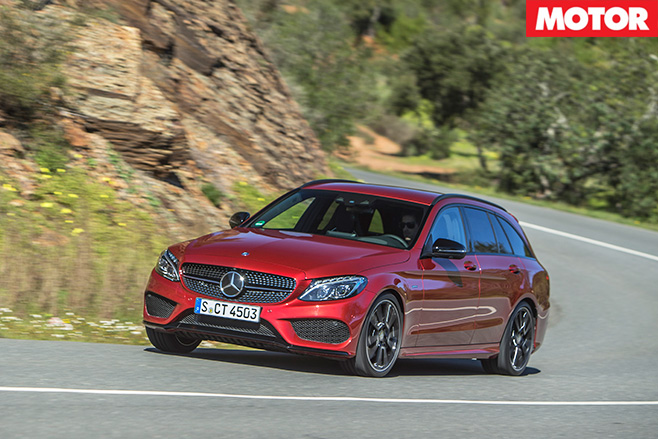
And that’s kinda the C450’s biggest problem: adding the AMG badge promises a level of excitement that, based on our admittedly brief first drive, it can’t deliver. It’s quick, comfortable and reasonably entertaining, but at the projected price point it’s going to be up against the BMW 435i Gran Coupe and Audi S4, stiff competition that offer greater driving thrills while lacking little in the way of comfort. We feel a comparo coming on.
3.5 out of 5 stars
Specs
Engine: 2996cc V6, DOHC, 24v, twin-turbo Power: 270kW @ 5500-6000rpm Torque: 520Nm @ 2000-4200prm Weight: 1615kg 0-100km/h: 4.9sec (claimed) Price: $110,000 (est.)
Autonomous cars are becoming a real thing of our future. Brands including Google, Tesla and Mercedes-Benz have created self-driving cars, where very little input is required from the driver.
No matter whether you’re a control freak or not, there’s something daunting about the concept of giving up all control to a machine. In the words of many parents, “A car is not a toy. Getting behind the wheel is one of the most dangerous things you’ll do in a day,” so you’d be forgiven for having some reservations about autonomous cars.
Recently, the driverless car concept hit a road block. Car safety standards are regulated based on human abilities to operate a vehicle, so after an enquiry from Google X (Google’s research and development facility), the National Highway Traffic Safety Administration in the United States has said they’ll give some flexibility to companies asking for an exemption from regulations. With the same cooperation from Australian regulators, and as the technology develops, these vehicles will one day become as much a part of our roads as stability control.
So how do they work?
Several systems of sensors and cameras work together to control the car. These feed into the vehicles computer analysis brain which processes the data to then apply the brakes, steering or accelerator.
The concept behind driverless cars is a positive one. In theory, these robotic vehicles will reduce accidents, improve emissions and take the pressure off in that pesky bumper-to-bumper traffic. But can we give up our human instincts and let it take control?
By the time we find out, we’ll probably be talking about flying cars.
Bigger, better looking, and with a striking Shooting Brake brother, the next-gen Panamera finally shapes up.
IT’S taking a while, but here is conclusive evidence that a Porsche Panamera Shooting Brake is set to join the range soon.
Out sometime after the G2 (for second-generation) series surfaces at the Paris Motor Show in October, the Panamera Shooting Brake – caught testing alongside its sedan stablemate – will most likely be dubbed a 2018 model. It resembles closely the Sport Turismo Concept that all but stole the 2012 French event.
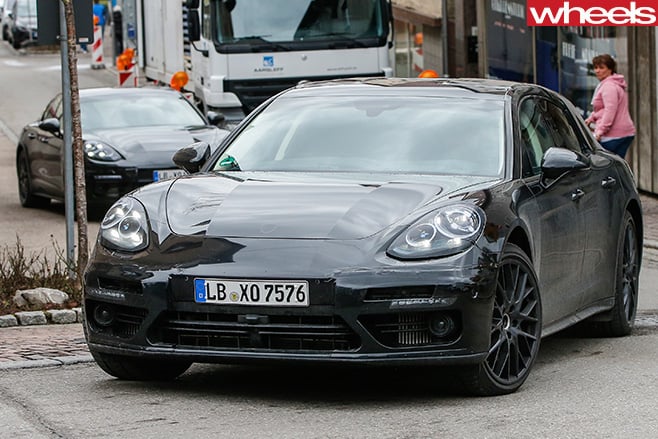
Featuring advanced composites in its construction, MSB is understood to be both lighter and stronger. It is also designed to accommodate electrification in hybrid as well as full PHEV plug-in electric vehicle mode, as alternatives to the range of new and/or revised twin-turbo V6 and V8 petrol and diesel units earmarked for the Porsche passenger car flagship.
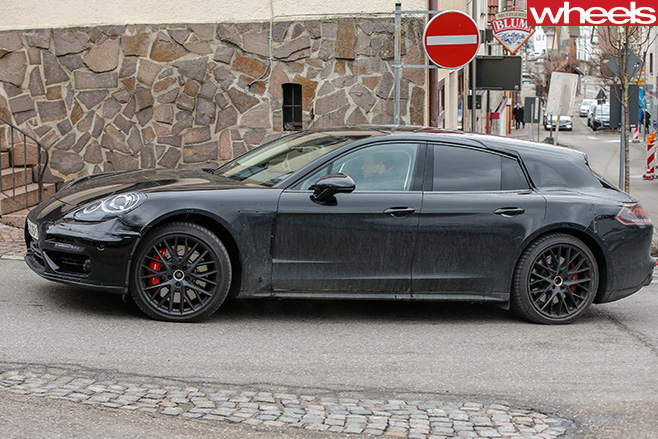
More importantly, a wheelbase stretch will see a welcome increase in rear-seat legroom, even though Porsche’s designers have made the next Panamera a little narrower than before.

At the other end of the spectrum, some reports suggest that a truncated two-door version of the G2 Panamera is under consideration as a latter-day Porsche 928 replacement, though whether the Germans have decided to go down the four-seater GT coupe path is unknown.
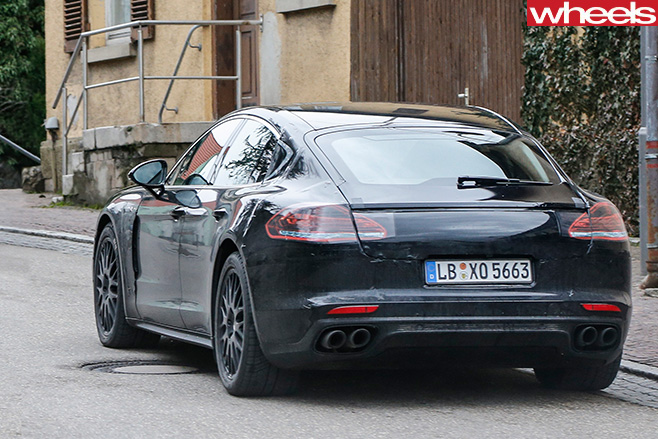
Have spy pics of your own? We’d love to see them. Just email them to [email protected]
Ford is adding a dash of supercar to its new XR6 Turbo Sprint with the addition of an Australian-made and developed carbon fibre air intake.
Designed by Melbourne engineering firm Premcar and built by Australian Defence Force supplier Quickstep Automotive, the new intake improves air flow for the 4.0-litre turbocharged six-cylinder engine.
Combined with other detail changes to the exhaust and calibration, it’s responsible for lifting the previous FPV F6’s 310kW/565Nm to 325kW/576Nm for the Sprint, or 370kW/650Nm on overboost.
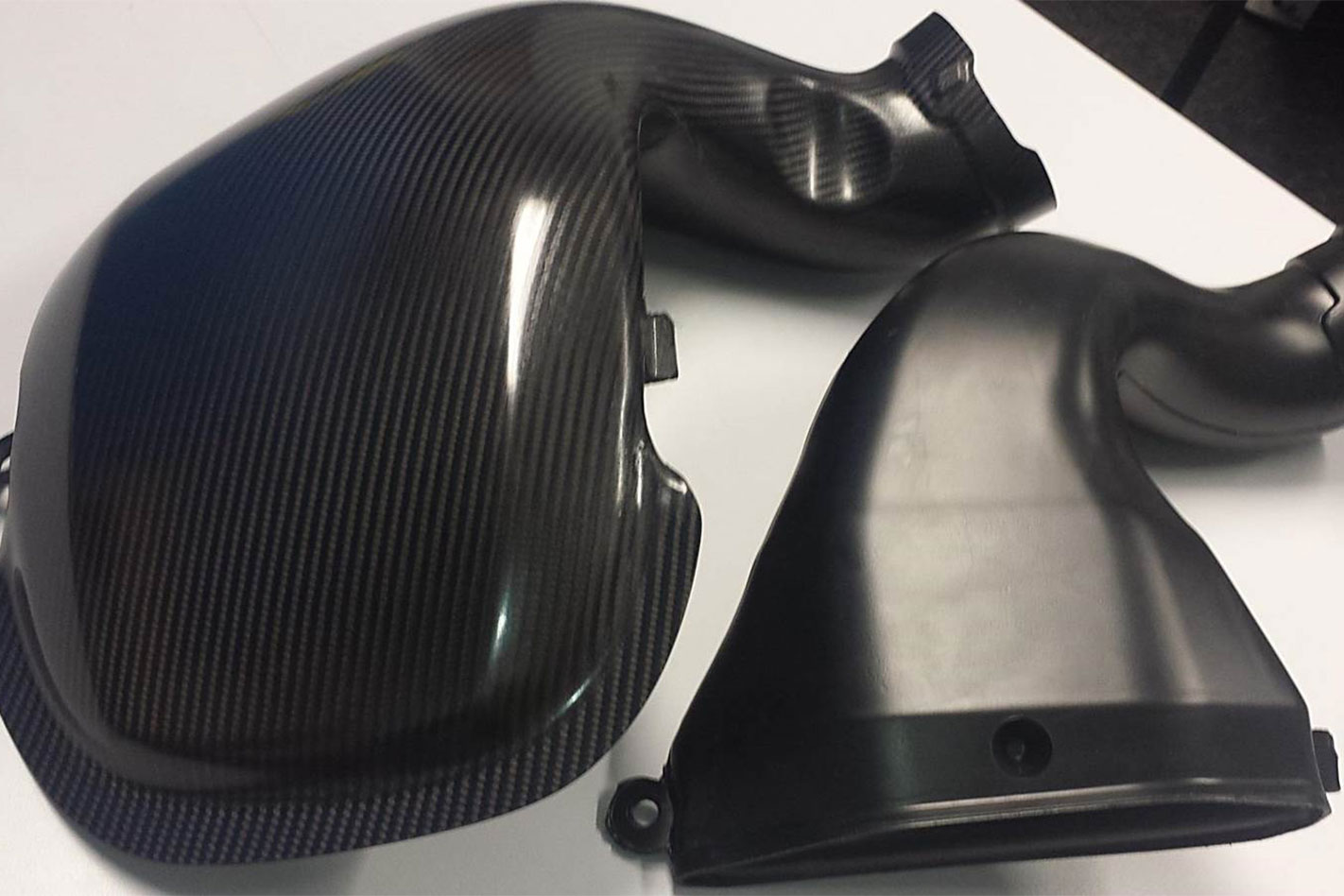
Other advantages are the resistance to changing shape under load or heat and an almost 50 per cent weight saving over the equivalent plastic item, though when the saving is 203g, we don’t reckon even Mark Winterbottom would be able to feel the difference.
Ford is keen to highlight initiatives such as this as evidence that it will continue to support local manufacturing expertise even when its own manufacturing facilities shut down in early October this year.
With companies like Quickstep Automotive and Geelong’s Carbon Revolution, who provide the carbonfibre wheels for the Shelby GT350R, it appears Australia still has a role to play in vehicle manufacturing.
You could view Bang For Your Bucks as a microcosm of the global evolution of affordable performance cars.
Through the 1990s and early 2000s, a period when Japan was the go-to nation for keen drivers on a tight budget, Mitsubishi and Subaru were almost omnipresent orientals on the top step.
Hot Lancers took the inaugural BFYB in 1994 (GSR) as well as the 2004 title (Evo VIII), Nissan’s 200SX rear-drive coupe proved Japan could deliver driving appeal beyond street-legal AWD rally rockets, while the most famous of those, the WRX – either in stock or STI guise – had an almost Schumacherian grip at Bang with five outright wins between 1998 and 2009.
Australians have long dipped into a wealthy pool of large performance sedans and utes, but it took the turn of the new century for the start of a local purple patch – and home soil heroes in the shapes of the HSV Clubsport R8 (2000), Holden Commodore SS (2006 and 2007) and Ford Falcon XR6 Turbo Ute (2008).
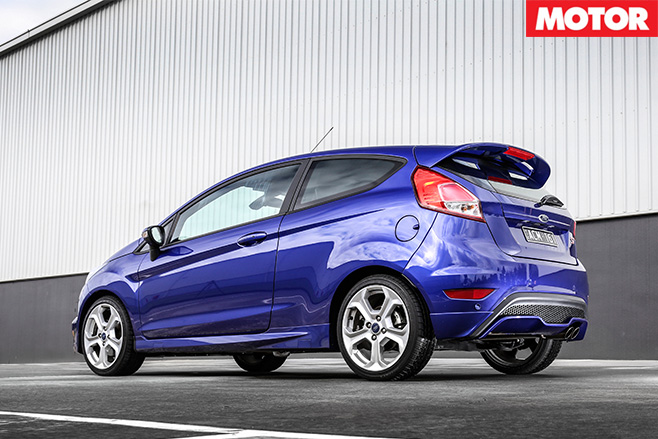
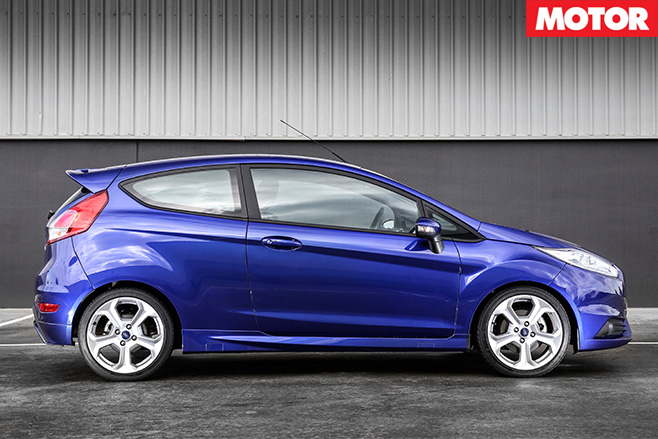
And if you’ve looked at the pictures on this spread, it’s probably not much of a secret that the ST has retained its title this year – extending an unbroken streak of hot-hatch wins to six, with the Polo GTI and Mini Cooper GP also achieving champion status beforehand.
Surely the punters’ favourite, the Falcon XR8 that’s effectively an FPV in (more affordable) Ford clothing, would stop the rot for performance sedans. Yet while it muscled its way to runner-up in the $50K-100K group, its challenge faded to seventh in the overall standings. Its only consolation was that it was the only non-hatchback in the top 10.
The judges’ views accounted for 20 per cent of a vehicle’s overall Bang Index, with their top-five comprising (in order) the Trophy-R, M135i, Fiesta ST, Golf R, and TT. The other 80 per cent came down to excelling in the Excel spreadsheets once all the performance data and price tags were keyed into formulas more cunningly complex than the calculations that got man to the moon.
Here, the extrapolated results brought the TT crashing back to earth – sixth out of eight $50K-$100K contenders, and 17th overall due to a second-lowest Price Index score (just ahead of the GLA45) counteracting an eighth place in the Bang Index. It was still the best-performing coupe, finishing ahead of the 228i (18th) and RC350 (dead last).
VW’s best R-badged Golf may not have fallen out of favour with the judges in its second year, though it did slip places both in its category (from first to fourth) and overall (from third to sixth) due to stiffer competition.
That still assured its position as the top-dog GTI, with the 208 GTi finishing fourth overall for the second consecutive year despite the 30th Anniversary edition using various mechanical tweaks rather than a Ouija board to invoke the ghost of Peugeot’s past.
The R-rated, R-badged Megane RS275 Trophy, which not unexpectedly transitioned from breaking Nürburgring records to topping the Winton timesheets, it could muster only fifth on the Bang scale, though, and an average Price Index left it sixth overall, and a spot behind the more junior RS.
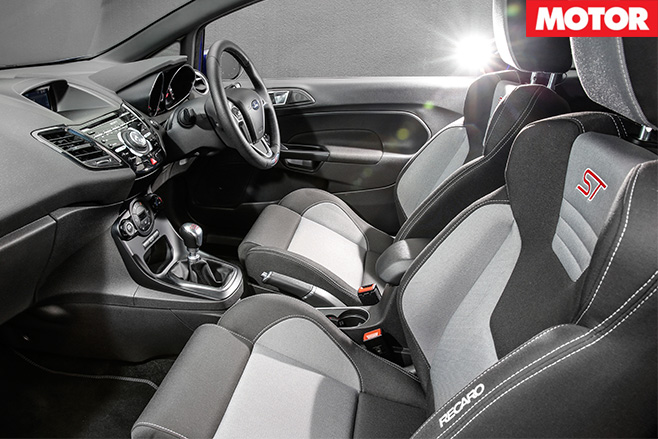
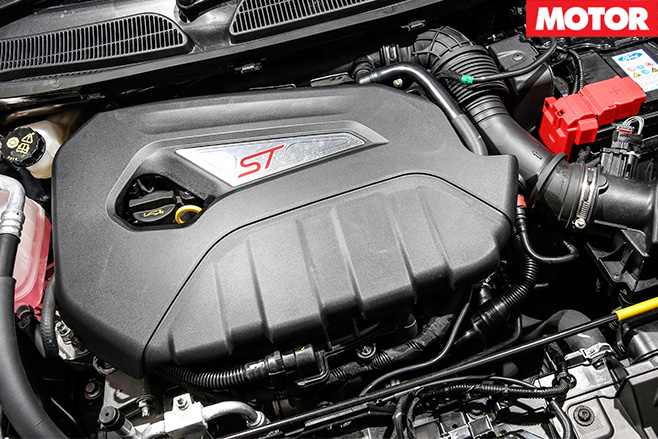
And our first hot Fiesta, the 2007 XR4, shone with its chassis but not its 110kW 2.0-litre. The latest ST fixed that by joining the charge of the (downsized) turbocharged light brigade, and taking what was already the best-handling city car in its class to create a new benchmark.
Ford Team RS also lowered the Fiesta’s centre of gravity by 15mm, revised spring and damper rates upwards, tweaked the torsion beam suspension, swapped rear drum brakes for discs, quickened the steering rack, and added electronically controlled brake-dabbing to limit inside-wheel slippage. The result is a highly entertaining pocket rocket that transcends its $25,990 price tag.
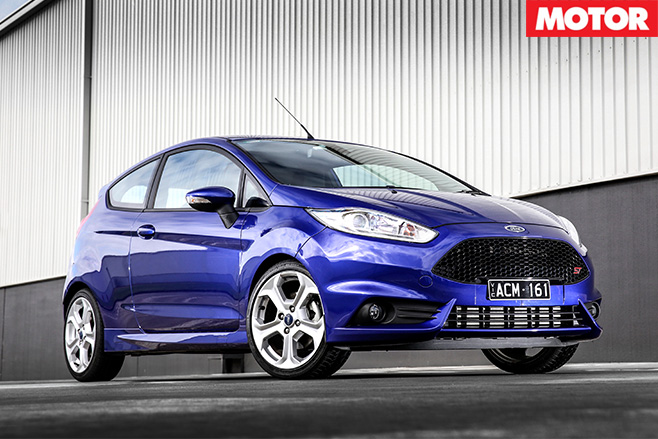
Its Price Index score actually dropped from 185.3 to 181.1 but quicker-than-last-year Driftbox times ensured that a Bang Index score of 95.7 more than compensated.
The result means European performance models now lead the intercontinental BFYB battle. But America’s Mustang and Japan’s MX-5 will be out to break the Euro-hatches’ stranglehold at Bang For Your Bucks in 2016.
We’re not sure if MashFeed, Buzzable, or whatever-named, list-obsessed websites have yet to feature a “10 Two-Parters You Should Piece Together Before You Die”.
If they had, such a version of these clickbaits would surely include Quentin Tarantino’s gory-ous martial arts flicks Kill Bill Volumes 1 and 2 (if only to watch Uma Thurman slashing baddies while squeezed into a striking yellow jumpsuit).
Then there’s Guns’n’Roses’ verbally vicious Use Your Illusions I and II albums, which dropped enough F- and C-bombs to possibly blitz records for the amount of profanities used on compact disc (hey, it was the ’90s).
And they could add Motor’s Bang for your Buck (which is far less violent despite the name). There was effectively a ‘To be continued…’ in our last issue, as we kicked off the first half of our 2015 BFYB coverage.
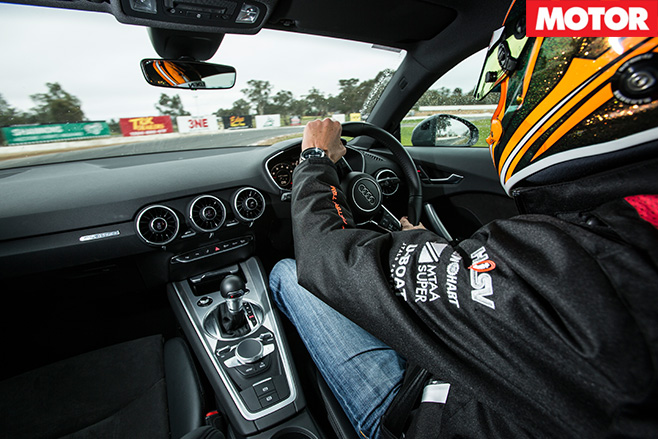
Bang for your Buck is one of Motor magazine’s biggest events – an annual mission to find Australia’s best-value sports car. Eligibility requirements are straightforward: a car simply needs to be new in some notable way, cost less than $100,000, and, well, be sporty.
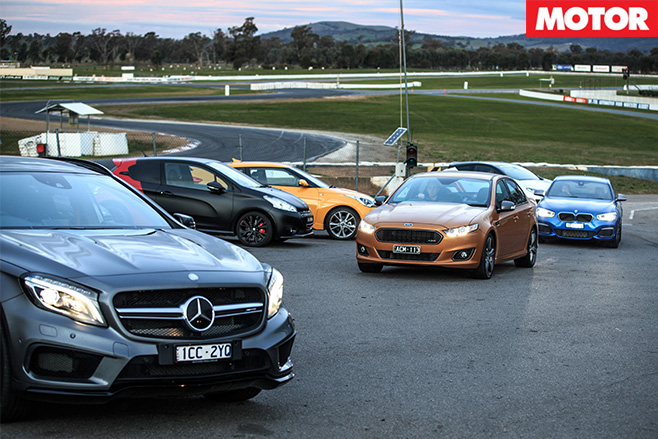
This gave us 22 toys – sorry, contenders – to play with, comprising 15 hatchbacks, three sedans, three coupes, and one SUV. Of the 11 brands represented, Ford had the most contenders with the Fiesta ST and a trio of Falcon XRs.
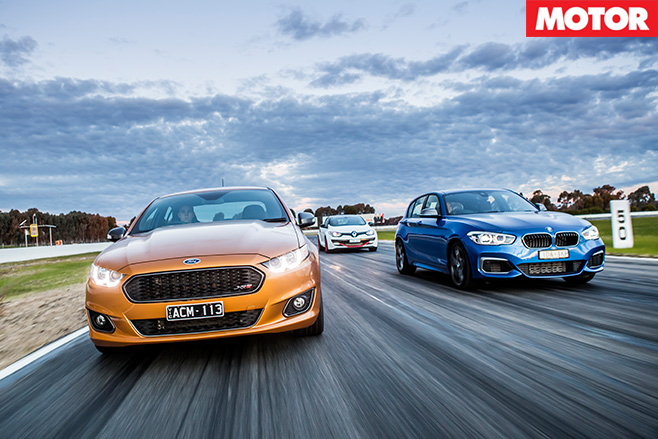
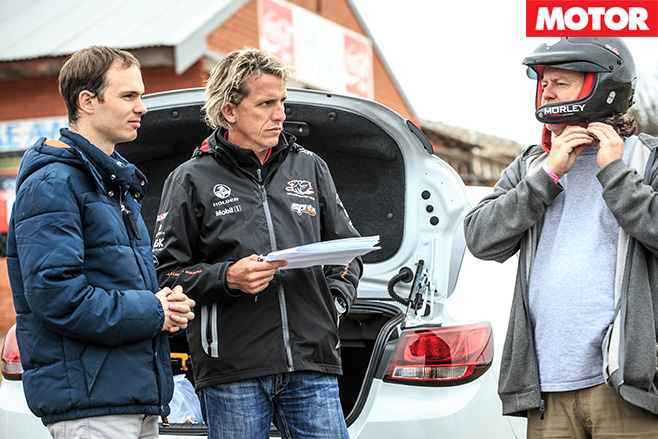
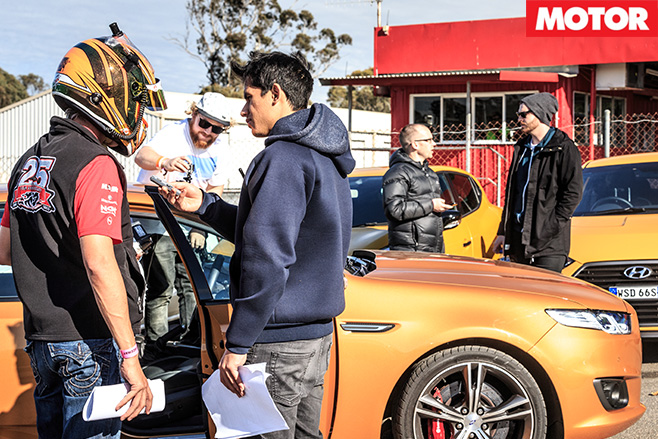
These were then split into two categories: $0-50K and $50-100K. Testing was conducted purely at Winton Raceway, with professional pedaller Warren “Wazza” Luff recording laptimes and apex speeds, while dep-ed Scott Newman took care of other key stopwatch stats such as 0-100km/h, 0-400m, and 80-120km/h.
This data accounts for 80 per cent of a vehicle’s Bang Index score, with the 20 per cent formed from the seat-of-the-pants assessment and rankings of our five judges.
It compensated for the misfortune suffered by Ford’s other ST – the Focus that DNF’d after an incorrectly secured intake hose blew off to leave a not-so-blown hot-hatch. The Fiesta’s victory reflected a generally strong showing from the smallest hot-hatches, with the Ford followed home by the 208 GTI 30th, Polo GTI and Clio RS.
This is not to suggest that cheeapness is key to winning BFYB. Think of the trend as having more to do with the greater prevalence of turbochargers among these pint-sized performers – boosting speed without the stickers heading too far north (if at all), and greatly improving the Bang/Buck ratio that’s more important here than power-to-weight ratios.
And while the results are mostly influenced by the data, it’s interesting that the top four almost exactly mirrored the judges’ subjective ratings – with just Polo GTI and Clio RS positions the other way around.
It was great to see the return of the Astra nameplate – a former winner in SRi Turbo guise – and the fastest of two versions, the VXR, finished a creditable fifth, with the GTC ninth. Two XR6 Falcons were also present, with again the quicker variant (Turbo) enjoying as much of a gap in the final ladder as it did on the track.
The Megane GT220 replicated its midway position in Renault’s small car lineup with eighth out of 14, while the fortunes of other contenders in the lower half of the table could be simplified by being described as suffering from either a shortage of Bang (XR6, Astra GTC, Veloster Turbo, 308 GT) or excessive Bucks (S1 and DS3).
BMW’s M135i and 228i may well be last of the brand’s compact rear-drivers, so we’ll be savouring them regardless of their results.
No BFYB is complete without some quintessential Aussie muscle, and Ford Australia’s Falcon XR8 – nee FPV GT – will be hoping to emulate the likes of the HSV Clubsport R8 (2000), Holden Commodore SS (2006, 2007) and the company’s own XR6 Turbo Ute (2008). Victory is even a formality, according to many on Motor’s social media channels.
Lexus’s new coupe, the RC350, is the lone flag-bearer for V6s and certainly looks sharp, but will have to drive the same way to better the 18th place achieved by its four-door twin, the IS350, in 2014.
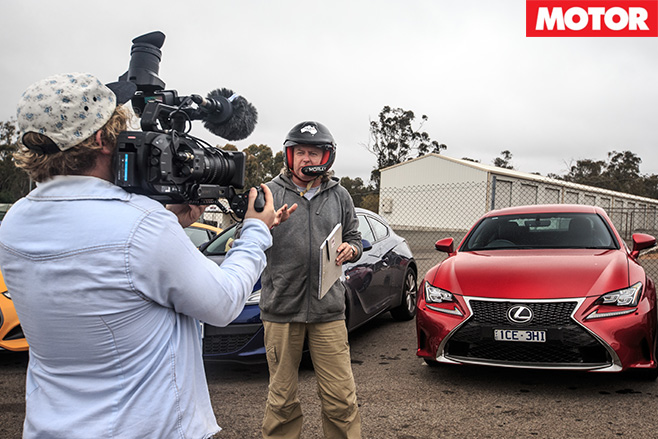
The heavy-hitters are capped off, still alphabetically, by two of the current hot-hatch greats: the Renault Megane RS275 Trophy-R, the hardcore version of the, er, hardcore Megane, and the Volkswagen Golf R that’s no longer a more expensive but less entertaining relative to the GTI.
A wider issue for the bigger hot-hatches is whether they can overcome recent history that has seen the more dimunitive members of the breed dominate the past four years.
We could list more questions, but let’s just get Part Two underway…
A surprise victory, and almost one that didn’t happen. When BMW first offered us a facelifted M135i for this year’s Bang for your Bucks we initially declined.
After all, for a facelifted car to be eligible for BFYB it must have a significant mechanical upgrade and an extra five kilowatts and a few cosmetic tweaks doesn’t cut the mustard.
Then the price was announced. With the new M135i having received a substantial $2500 price cut, it was accepted into the fold, as it was reasonable to assume that its sharp new $62,900 sticker would substantially alter its BFYB score compared to last time it was present in 2013 (when it managed fifth outright).
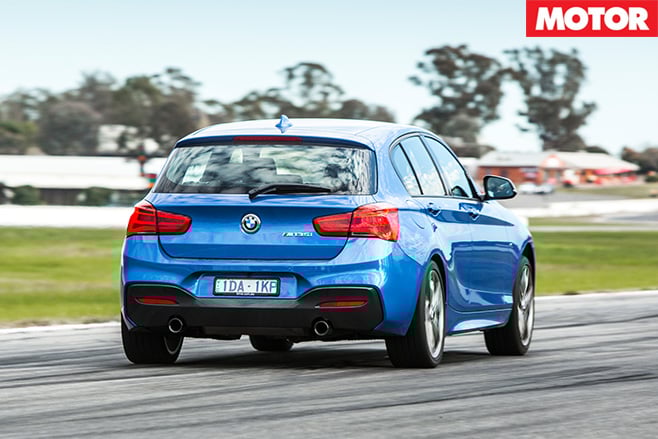
So it proved, and satisfyingly BMW’s pocket rocket won through sheer speed. Its 4.84sec sprint to 100km/h was the class of the entire field, and while it had to give best to Ford’s supercharged Falcon XR8 over the quarter mile, the M135i was the only other car to dip under the 13-second mark (the first time it’s done so in our hands), its 12.98sec at 177.57km/h good enough for second place.
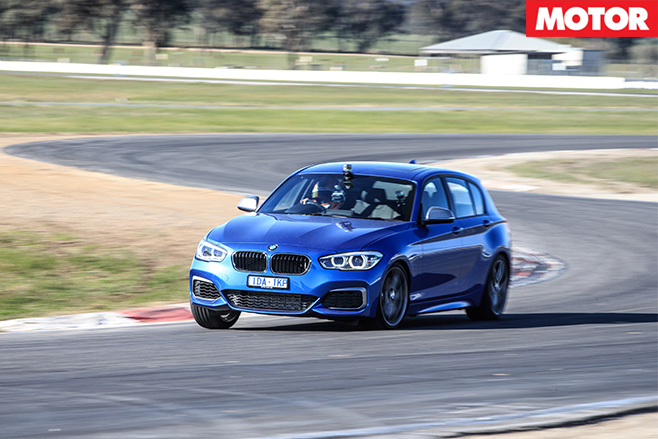
Similarly, it was one of only two cars to beat 1:40sec around Winton, its 1:39.8 just four-tenths slower than the hardcore Megane RS275 Trophy-R. And in every other category – from braking to corner speed to V-max – it was consistently at the pointy end, which speaks of a car that’s a jack of all trades, and coming close to mastering a few as well.
With 240kW and 450Nm from 3.0 litres and a turbocharger, the M135i almost looks a little underendowed these days – remember Audi and Mercedes-Benz are extracting more power and torque from significantly less capacity – however more power would be unlikely to improve the package until BMW sees fit to install a limited-slip diff.
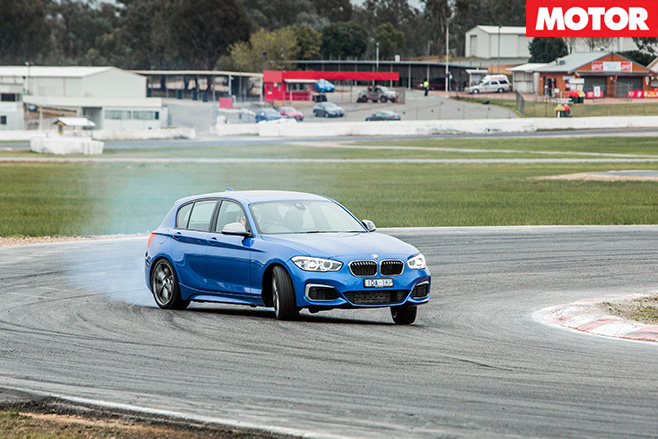
Disable DSC (BMW’s name for ESP) and its behaviour becomes scrappy, with the inside rear wheel spinning away power, resulting in messy half-slides. The M135i can be steered on the throttle, but it’s far from a pleasurable experience; more often than not drifts are a stilted, jerky affair as the open diff desperately tries to decide where to send the power.
It’s all the more frustrating as the rest of the dynamic package is so good. The Michelin Pilot Super Sport rubber offers plenty of grip and holds up brilliantly, the chassis is adjustable and transparent in its behaviour and the variable-ratio steering is sharp and accurate.
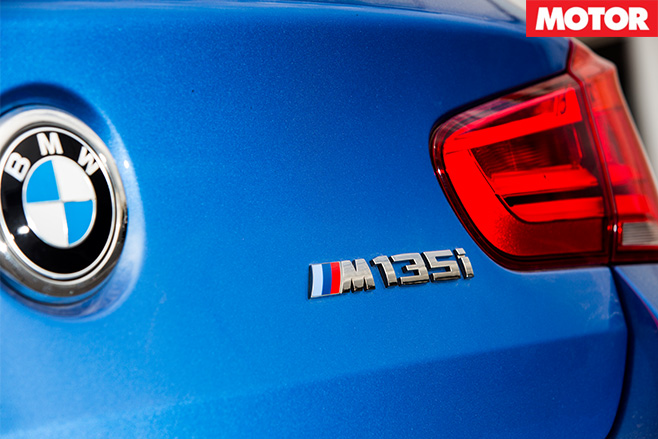
Its talents were reflected in the judges’ rankings, with Morley, DC and Luffy all placing it second, and it’s fair to say Jez and yours truly probably would’ve followed suit but for the lack of an LSD.
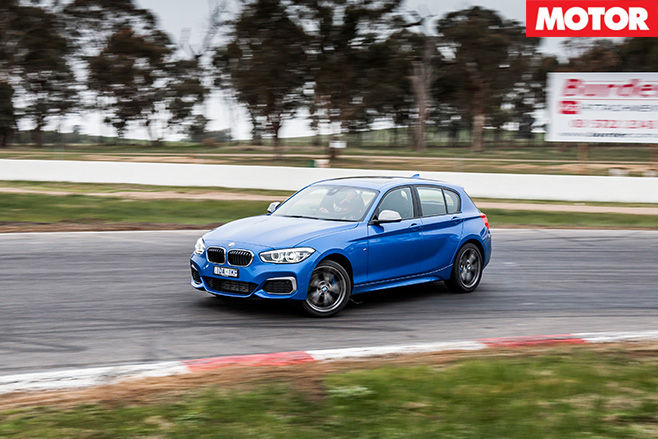
0-100km/h – 4.84sec (1st) 0-400m – 12.98sec @ 182.21km/h (2nd) Lap time – 1:39.8sec (2nd)
Overall Scoring
Bang Index – 146.8 Price – $62,900 Bucks Index – 105.6 BFYB Index – 191.4
Judges’ Rankings
Campbell 2nd – “Bit of a monster, really. Great grunt and grip and keen for a play.”
Morley 2nd – “Ball-tearing engine on a supple but accurate trolley. Hard to fault.”
Newman 3rd – “A serious weapon. Needs an LSD, but everything else is bang-on.”
Spinks 4th – “Shame LSD isn’t standard, but sweetly balanced and cracking in-gear pace.”
Luffy 2nd – “Such a great all-’round package. It gives you confidence to keep pushing on and it’s very neutral in both the front and rear. Ergonomically it does everything right. The only downside is that the brakes started to go after a couple of laps, but they still had a fair amount of feel. Just a fun car and a real sleeper – you don’t expect it to be as quick as it is.”
Yep, second place, Ford fans. You can uncross those fingers now – unless, of course, they’ve been crossed so long they’ll need a little surgical assistance.
We don’t blame the blue-blooded for putting bets on the big, burly XR8. It’s got the same 335kW, 570Nm 5.0-litre blown V8 as the old GT R-SPEC, same brakes and same suspension, but where the FPV was $76,990, the XR8 is $55K.
Same car, really, but $22,300 less. With that kind of grunt-to-dough ratio it’s an unbelievable bargain, never mind that it can wind out more like 375kW with its transient overboost function.
And at Bang For Your Bucks the XR8 came out swinging with some serious straight-line snot. Zero to 100km/h was disposed of in a very tidy 4.87sec, and while the big Aussie sedan was pipped to triple figures by the M135i, beyond that the Bimmer ate quad Falcon exhaust pipes.
As for, well, corners, unfortunately it’s not quite the talented apex dissector as it is the quarter mile hero. In its class, the big, 1861kg XR8 came second-last for braking, and while its turn nine apex speed was third best in class, its turn five apex speed was dead last.
The subjective experience tended to back this up. Driven in some sort of behaved manner the XR8 feels a bit unsure of itself on the circuit, and for this, the judges were merciless, ranking the XR8 collectively last.
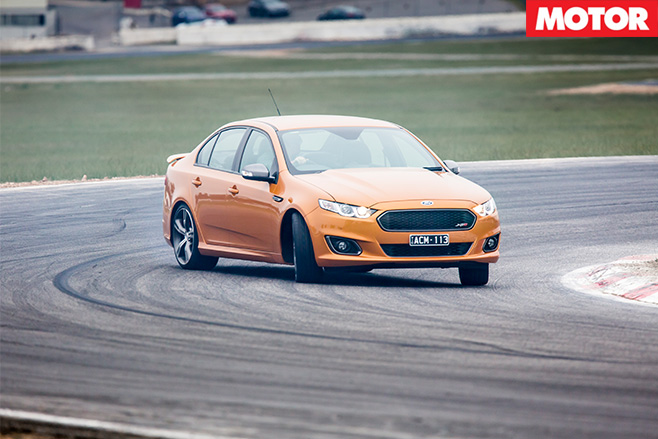
Despite its ballistic straight-line numbers, brakes and an ageing chassis let the XR8 team down, its fifth-fastest lap time relegating it to second in class.
That’s not to say the XR8 isn’t fun on a track. It’s got 335kW, two rear-driven wheels and a limited-slip diff. You don’t need to be Einstein to do the maths.
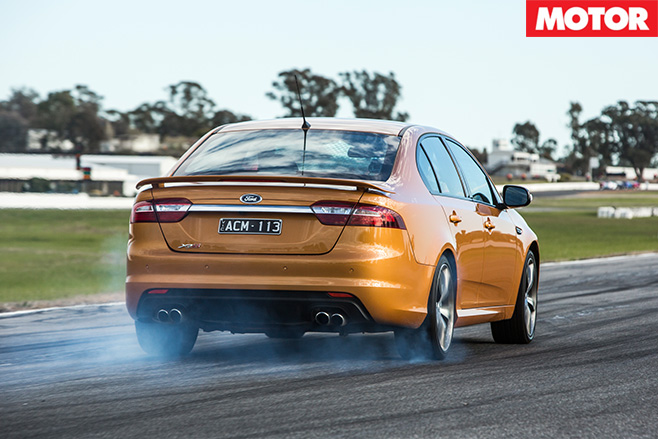
In fact, if drift angle was part of the Bang formula the XR8 might have won outright, such is its willingness to hold huge, smoky slides. It’s so friendly your nan could drift it. And when an XR8 finds itself on a track, this is the kind of activity it clearly prefers – because it’s good at it.
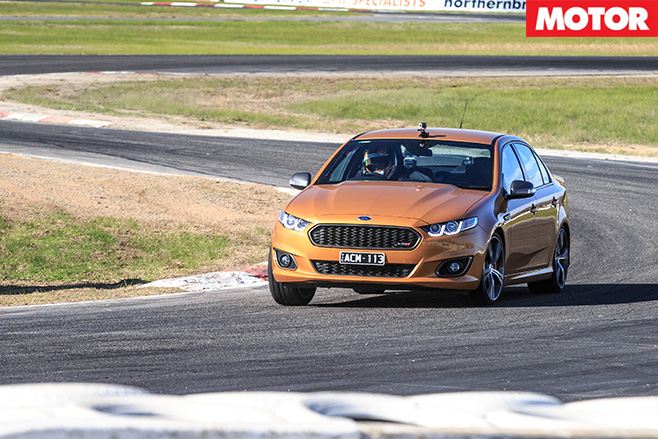
0-100km/h – 4.87sec (2nd) 0-400m – 12.86sec @ 182.98km/h (1st) Lap time – 1:41.6 (=5th)
Overall Scoring
Bang Index – 119.2 Price – $54,690 Bucks Index – 121.5 BFYB Index – 180.4
Judges’ Rankings
Campbell 6th – “Great grunt and noise. But on track, drifting is really its only particular talent.”
Morley 8th – “The engine is the start, finish and end to this final Falcon chapter.”
Newman 8th – “Ability to go sideways can’t compensate for alarmingly vague front end.”
Spinks 8th – “Drift on Demand a standard feature, but chassis finesse not available.”
Luffy 6th – “A surprise packet. The engine’s fantastic and has so much low-down torque. It almost feels like its initial damping is too stiff. Coming down the straight it’s quite bouncy over the smaller undulations, but once you load it up in a corner it’s quite soft and has that traditional heavy-front-engine rollover.”
Buying a Trophy-R could be a risky social decision. For a start, it has no back seat, but it’s also an easy target for the kind of mate who loves to give shit.
It’s got stickers like a Kmart mountain bike, looks like it’s wearing lipstick and then there’s the fact Renault charges an extra $9000 over a standard RS275, yet that one keeps the back seat, radio and air-con. And the brakes, engine and output (201kW/360Nm) are no different, either.
But tell your shit-giving mate to take a hike, because there’s a reason every judge voted the Trophy-R first in the $50K-$100K class: it’s utter, spine-tingling bliss on a track. In fact, we wish Renault would stop calling us about it and get the message. We’re not giving it back.
In the case of the Trophy-R, less truly is more. The deleted gear saves nearly 100kg over the base RS275, and like a big syringe it injects the 1284kg Trophy-R with a feeling of lightness so many new fast cars just don’t have.
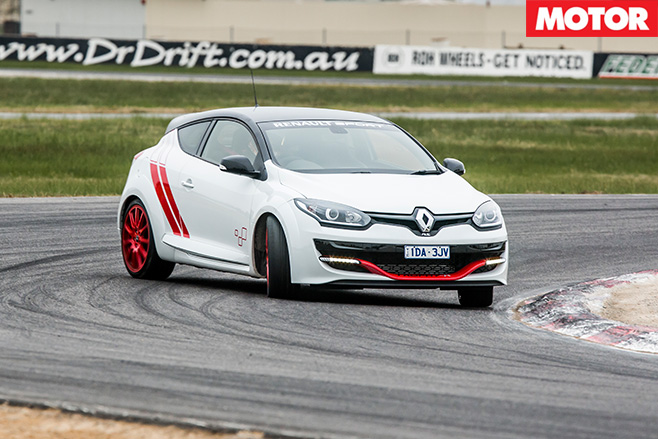
Having sunken into the Trophy-R’s revelatory fixed-back seats, you’re presented the option of the normal seatbelt or a full-on harness. Either way, roaring out of pit-lane you notice the front tyres grappling for grip as the 2.0-litre turbo hisses, pops and roars with induction noise; the note more crisp and richer thanks to the lack of sound deadening. This thing sounds angry.
The tyres need to be warmed first otherwise your eyeballs will pop out at the first corner. With a bit of heat in them, you begin to notice the Renault Sport engineers were on a mission to destroy all understeer. Initially the Trophy-R feels so oversteer-y it’s a little off-putting, but then you realise it doesn’t want to kill you, it just wants to play.
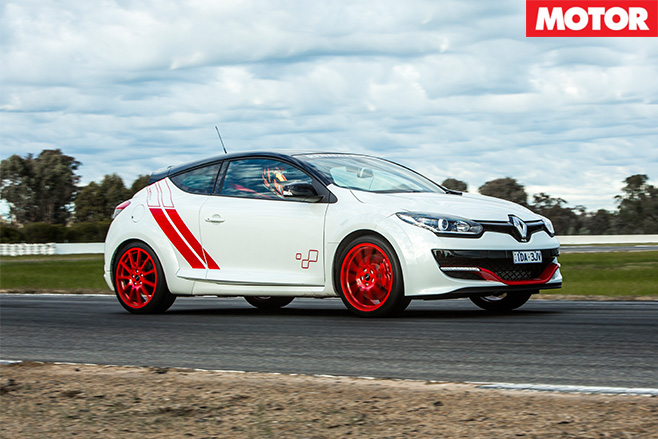
The Trophy-R is immensely engaging, predictable and satisfying to punt around a track. It’s fast, too, its 1:39.4sec laptime the fastest of the entire 22-car Bang field. Yep, this thing was P1.
But it was a case of grip over grunt, as the Trophy-R finished last in class for the 0-100km/h and 0-400m sprints. It clawed its way back to fifth for 80-120km/h, lap v-max and 400m v-max, suggesting it’s tricky to launch.
Around Winton, though, those sticky Michelins helped the Trophy-R score the fastest mid-corner speeds of the entire field at the turn five and nine apexes. Impressive. It was strong under brakes, too, second best in class.
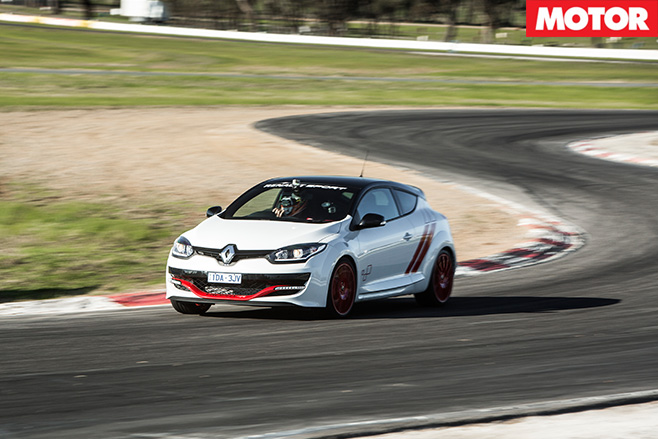
While the Trophy-R is in a much more junior league than either, it absolutely has the same kind of personality, in some ways making its $62K price seem like a bargain. It might be a risky social decision, but who needs mates when you have a Trophy-R? Not us. – DC
0-100km/h – 6.16sec (8th) 0-400m – 14.15sec @ 165.68km/h (8th) Lap time – 1:39.4sec (1st)
Overall Scoring
Bang Index – 110.4 Price – $61,990 Bucks Index – 107.2 BFYB Index – 163.4
Judges’ Rankings
Campbell 1st – “This and an empty racetrack is my kind of bliss. The best bum-dragger I’ve ever driven”
Morley 1st – “Just looking inside at the harnesses and race seats is enough to get you off on the right foot.”
Newman 1st – “Le grand fromage of hatches – absolute heaven on a circuit.”
Spinks 1st – “A must-drive for any sceptic of FWD performance.”
Luffy 1st – “So fast for a front-wheeler. You can throw it around or trail brake and it’ll respond. Great engine and you can brake later than the other cars. You just want to stay on track because you know there’s more potential to be unlocked. The ’box is a bit sticky between second and third, but as a fun everyday road car and an occasional track car, this thing’s a winner.”
