
It’s tough to enjoy driving a car around the streets these days.
Roads are packed with people pretending not to text their friends. Then, clear of the city grind, speed limits are so low you need to text friends to stay awake.
Meanwhile, cars are so capable it is nigh impossible to challenge yourself without being a hoon. We can get little frissons of glee through a perfect heel-and-toe, but isn’t it sad if that’s all we’re limited to enjoy?
It seems that if people ask whether you had a good drive, they’re really asking if you saw something nice out the window. But if you know the difference between an overhead cam and the guy who hosts The Block you must dream of answering with a monologue on the nuances of the deserted ribbons of tarmac you just obliterated.
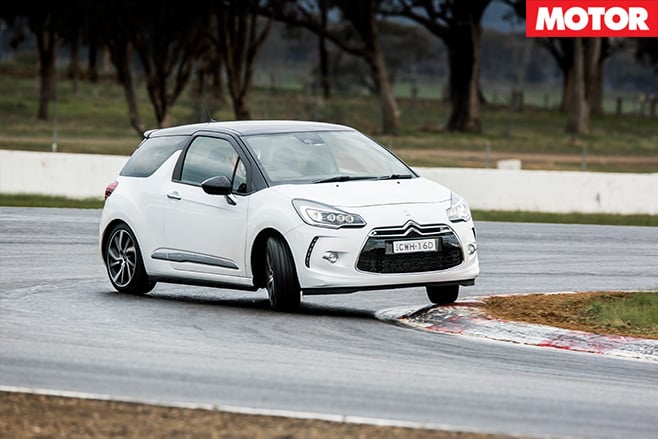
You’ll meet them online, too, in any forum you care for. No limited slip diff? I better not go! No braided brake lines? How could I even consider it!? That’s all rubbish, of course. The guys and girls who take to the track have a range of ability, and the most smiles are worn by those who take it the least serious.
It doesn’t matter what your car is either. I know a guy driving a clapped-out Peugeot 405… with moccasins on his feet. Another compatriot of mine picked up a Jellybean 121, and even though he doesn’t need to brake for turn one at Phillip Island, his helmet hides the widest grin of the whole paddock.
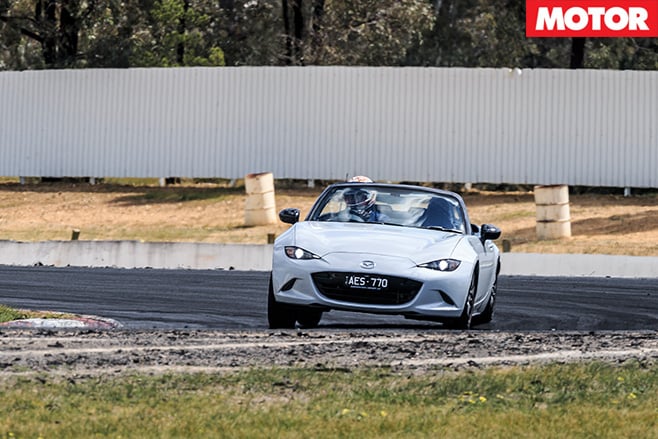
My point is you don’t need an inter-galactic-looking supercar to enjoy circuit driving. Even if your ride’s stock, the speeds it’ll see are legal in some parts of the world and surely within its limits. Just don’t treat it like a pair of Converses; do a reasonable number of fast laps before letting it recuperate on some slow ones.
Find a sizeable gap in the circulating traffic if it’s busy, or in between sessions you can find the nearest public road and try some cool circulating air. Then go back for another crack.
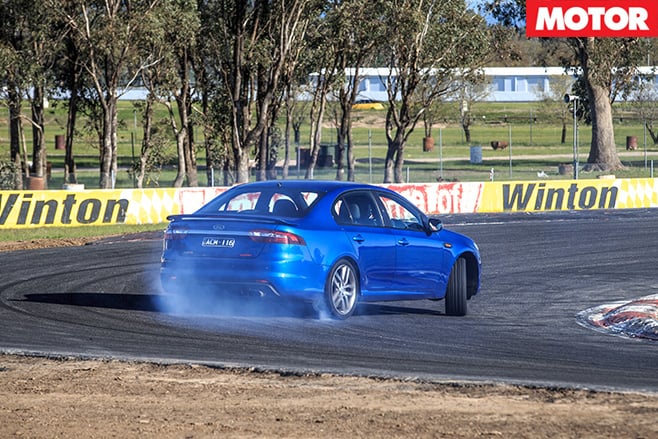
You can keep paddling in the kiddie’s pool if you want, but there is an ocean of fun which is far more rewarding to be discovered, and where Sergeant Plod can’t slap you in the giblets. Come on, driving pleasure awaits.
It is incalculable how much damage the G6E – and indeed the Falcon – brand copped once taxi ranks began filling with well-flogged versions of Ford Australia’s flagship sedan. Talk about a halo around your feet.
So the FG-X, the swansong range of Falcon’s 54-year heritage, has arrived. It’s not terribly different from the FG II (given a modest $102-million budget). And there’s a turbocharged luxury-performance variant that wants your interest despite the cabbie stigma.
What’s the golden dangling carrot? Well, firstly there’s the new ‘global’ Ford facelift that makes the G6ET so much stylistically fresher, on the outside at least. Secondly, there’s the value quotient: Ford has wiped almost $10K off the price of the old FG II version.
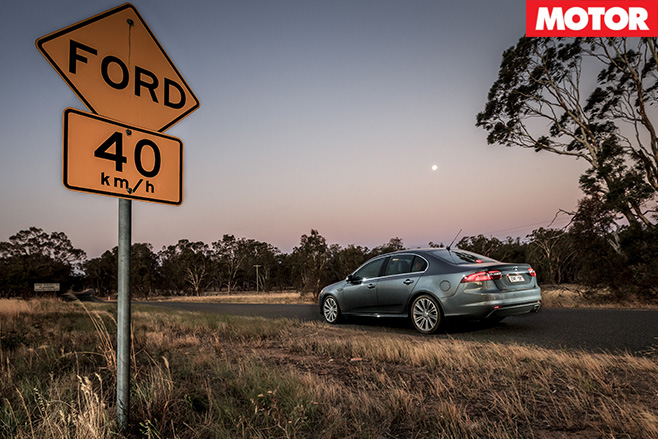
Frankly, it’d want to be given so little has changed under the new skin. There are no powertrain gripes, though – the carryover turbo 4.0-litre straight-six remains a tyre-shredding power house and it’s mated to the lovely ‘high-torque’ German-made (6HP26) ZF six-speed auto rather than the Chinese-made ‘low-torque’ (6HP21) auto the non-turbo Falcons get. So it’s got the same running gear as the XR6T auto.
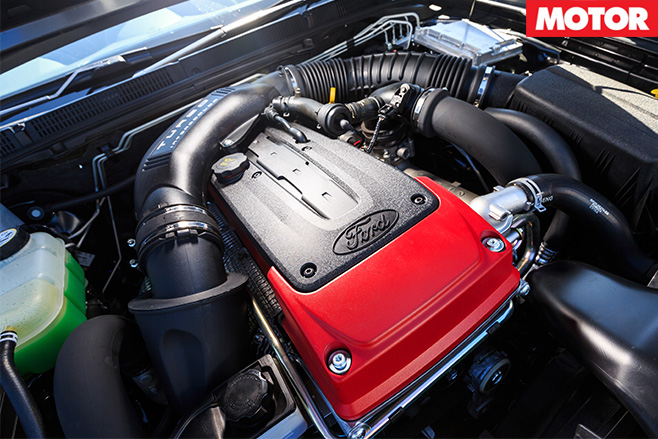
And know what? For the 95 percent of normal driving, it’s the suspension tune you’d go for on crook Aussie bitumen: supple, pleasant, but with purpose and plenty of grip and keenness when the tight corners arrive.
The hydraulic steering and modest – given kerb weight and outputs – braking package are ample rather than heroic, but that’s fine. If you prefer your Falcon track-ready, you’ll want ‘XR’ in the equation. However, if you want to bomb long distances in quiet comfort, forty-six-odd-thou won’t buy a nicer device in this size of vehicle.
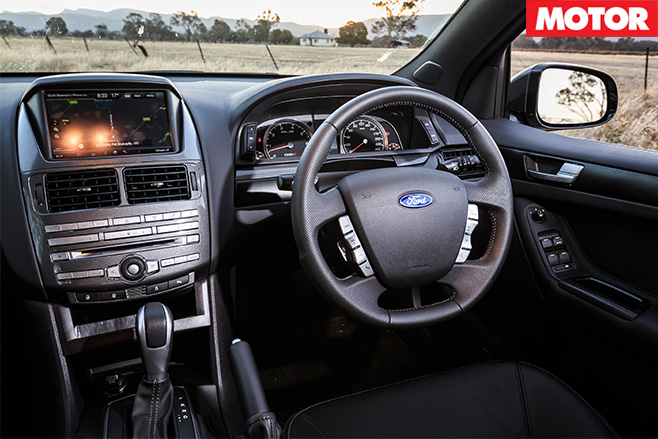
You do get the neat eight-inch ‘home’ touchscreen and swanky voice-activated Sync 2 functionality but, then, so does most of the FG-X range. Also across the range, the old cream-coloured ‘hero’ leather hue has been replaced by a caramel-coloured hide.
Would you opt for the G6ET over an XR6T or XR8? As a matter of taste, certainly. There are no complaints on how much performance or comfort this car delivers, though possessing a proper ‘premium’ feel is a bit of a stretch. Will the sharp new look and price-busting value wash away the taxi aftertaste? The jury is well and truly out on that one.
3.5 out of 5 stars
Specs
Engine: 3984cc inline-six, DOHC, 24v Power: 270kW at 5250rpm Torque: 533Nm @ 1200-5000rpm Weight: 1723kg 0-100km/h: N/A Price: $46,550
Made in Melboune and sent to the Geneva motor show, the Opel GT Concept could return to our shores as a production MX-5 competitor for Holden.
Although the GT Concept is designed in collaboration between GM’s design studios both here and in Russelsheim, Germany, the slinky one-off two-door was built locally and photographed atop Holden headquarters in Port Melbourne.
The GT Concept uses a front-mid-mounted 1.0-litre three-cylinder turbocharged engine with 107kW and 205Nm, powering the rear wheels via a “sequential” six-speed transmission operated by paddleshifters. It even gets a “mechanical” differential lock, which we home to mean of the proper limited-slip variety.
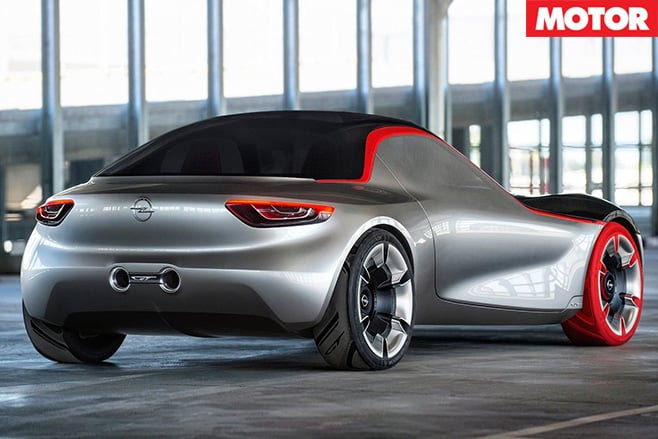
On paper it sounds like a turbocharged MX-5 and that’s clearly the philosophy General Motors’ European arm is going for.
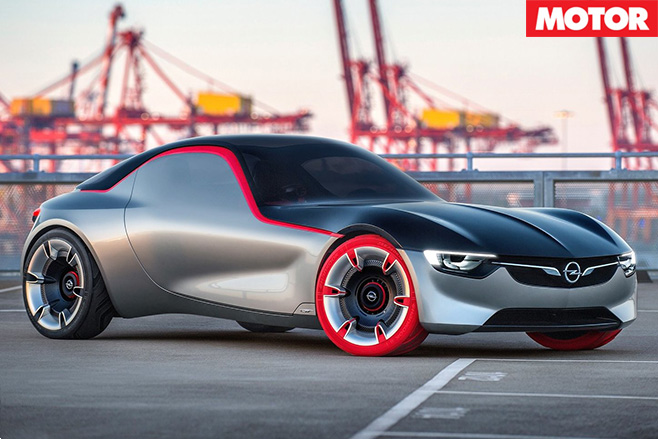
According to the brand, “The sportscar is avant-garde yet puristic, renounces everything that disturbs the pure form … breathtaking in its shape, reduced to the bare essentials, pure passion.” Sounds to us like it could have come from Hiroshima.
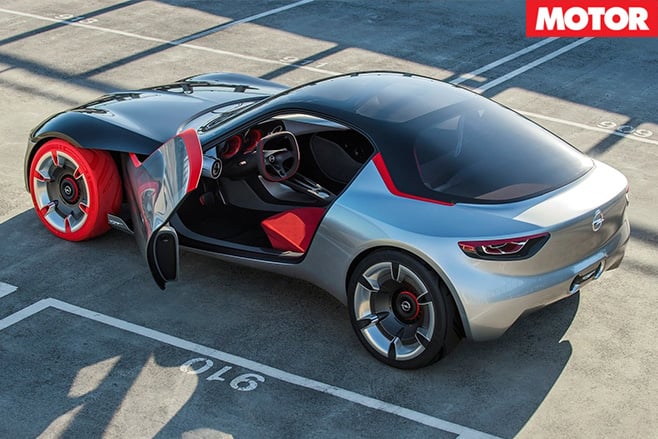
The front doors open ‘into’ the front guards, exposing the front wheelarches that pack a cheeky red-walled tyre design meant to evoke roller skates. The GT Concept is fluid in its form, with a red character crease drawing from the roofline towards the front wheelarch the highlight. The front grille and headlights look classically Opel/Euro-Holden in design.
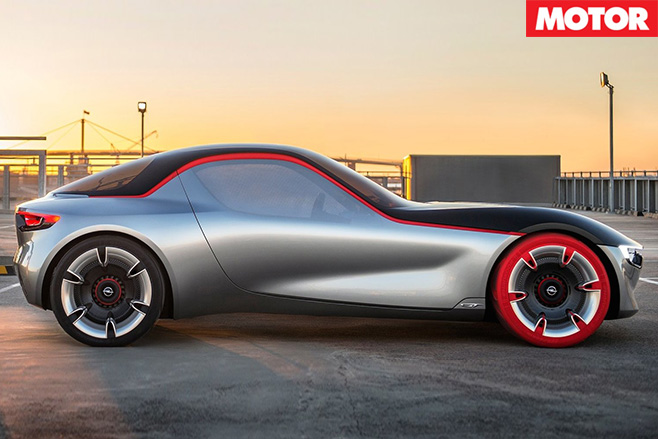
That’s handy for us in Australia when the next-generation Commodore will hail from Opel in Europe. Hopefully this rear-drive coupe will follow in production form and wear a Lion on its low nose.
The most elaborate game of musical chairs in memory has left a lot of V8 Supercars merchandise redundant.
YEP, we’re seeing lots of redundant V8 Supercars driver-merchandise following the longest, most elaborate game of musical chairs in memory.
For the 2016 season, only 12 drivers are staying put in the 26-car field. Loyalty is clearly a vastly overrated ideal.
The prolonged silly season means that while it’s the same old cars, the bewildering number of driver movements add unpredictability to the mix. A little.
After all, the V8 Supercars (at least until 2017 when engine rules change) tend to behave much like one another, such is this parity formula of same base chassis and minimum weight, similar engine output (from either quad cam or pushrod 5.0-litre V8s), and control Dunlop tyres.
That said, the human dynamic within teams does alter when there is a fresh bod in the driver’s seat.
So, after the crazy zigging and zagging of driver movements, where is everyone heading in 2016?
The arrival of the delightfully flamboyant, uncomplicated Shane van Gisbergen turns Triple Eight into a three-car triple threat in 2016. Craig Lowndes will drive a Caltex-backed Commodore while Whincup and SVG will race under the Red Bull banner. The Giz, often loose as a goose, has the potential to make the fastidious Whincup’s life quite uncomfortable, on and off the track. That will be fun to watch, as will be the way team owner Roland Dane manages his different charges. Lowndes gave himself a medical handicap in January by inelegantly falling off a motorcycle and busting a collarbone. But he says he’ll be fit for the opener.

Charlie Schwerkolt Racing has evolved into a one-car stand-alone operation with Triple Eight hardware for Lee Holdsworth. They’re also pulling ex-HRT crew chief Jeff Grech out of mothballs to run the outfit.
The changes within the Walkinshaw camp mean the new season will be the first since the 1990s that the two HRT entries are the sole focus at Clayton, a move that the drivers sense will be a huge positive. Certainly in recent years, with resources and attention split among four cars, HRT has not been able to consistently match the other factory Holden team, Triple Eight Race Engineering.
Driver-hopping between teams really went feral late last season when Fabian Coulthard was confirmed alongside Scott Pye at DJR Team Penske, a call that immediately triggered a lot of darting and weaving before the music stopped.
Slade re-emerged as the new driver in BJR’s #14 entry, replacing Coulthard. Tim Blanchard also switched to BJR from Lucas Dumbrell Motorsport for 2016, completing the Albury-based team’s something old/something new driver line-up. Jason Bright continues with the team for a seventh season while Blanchard takes over the #21 Holden previously campaigned by Dale Wood, who in turn has joined Nissan Motorsport.
The Dumbrell squad is yet to confirm who’ll line-up alongside Nick Percat for 2016.
Prodrive has the not inconsiderable benefits of continuity and class for 2016, with the new champ Mark Winterbottom (now backed by Bottle-o) and the lightning quick (and mended) Chaz Mostert sticking with Ford, his car set to carry Supercheap support.
But the Prodrive owners seemed out of love with David Reynolds. For reasons best known to Prodrive, the idiosyncratic Reynolds found himself very much on the outer as the 2015 season unfolded, and despite the 30-year-old challenging for the championship until van Gisbergen flicked him off the track at Phillip Island.
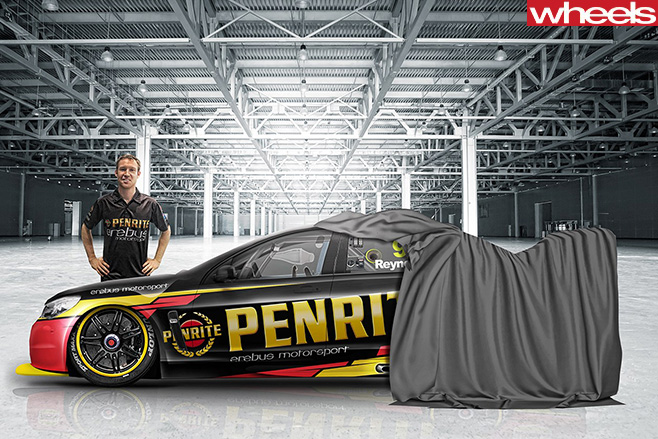
Prodrive still hasn’t confirmed who will drive the third Falcon but no-one is betting against young gun Cameron Waters, who is certainly deserving of a main-game seat alongside Winterbottom and Mostert.
Reynolds belatedly signed on with Betty Klimenko’s Erebus squad, which needed a quality driver to replace Will Davison, who has moved to The Giz’s old pew in the Tekno Commodore.
Back before Christmas, and after a cyclone of speculation, Klimenko felt inclined to issue a statement indicating she’ll run two cars in 2016, the second driver later named as Novocastrian Aaren Russell.
She also confirmed a team move out of the Queensland base to Melbourne. Reynolds can stay a Melbourne resident.
Erebus’s other major shock was the move to abandon AMG Mercedes power and go to Holden hardware, ending an uneasy relationship with the German luxury brand.
The two Commodores, purchased from Walkinshaw Racing as the Holden factory squad chose to tighten from four to two cars for 2016, are to be run independently by the Erebus crew, with no ongoing relationship with WR.
Klimenko will notice a massive difference in the cost of the GM V8 engines versus the pricy AMG Mercs.
Last season, speculation cranked up that Todd and Rick Kelly’s Nissan Motorsport would shrink from four Altimas to three when James Moffat was announced as taking David Wall’s place at GRM Volvo. But the Kelly gang then locked in Wood.
The only New Zealand team in V8 Supercars has also made a driver change, the Tony Lentino-owned Super Black team signing V8 Utes and Dunlop Series goer Chris Pither to replace Andre Heimgartner (who, let it be said, many observers thought did a strong job in his rookie year).
These are times of commercial struggle, though, with sponsors baulking at the combination of multimillion-dollar budgets and smaller free-to-air television numbers. The 2016 grid has lost major sponsors Jack Daniels (Nissan) and Pepsi (Prodrive Ford) while Tony Quinn’s Darrell Lea reviewed the worth and extent of its involvement with Tekno.
“The guys from Darrell Lea discovered that having a name on the race car is of some value,” Quinn explained to
Good to see, though, Plus Fitness jumping on board newbie Russell’s Erebus Commodore.
The 2016 calendar has expanded to 15 rounds (plus the non-championship grand prix weekend) with a round of the championship to be held on the streets of Kuala Lumpur. It’s hard to know why V8 Supercars Australia believes this jaunt to Malaysia will succeed where every other foray away from Australasia has failed dismally. At least the time zone does suit local telecasting. V8SA has four years to make it work.
On the weekend of the Sydney 500, the tabloids went into a frenzy about the vague possibility that Homebush could be dead meat as a venue after the (contracted) 2016 race, with the Central Coast mooted as a replacement. Crowds at the racing at claustrophobic Homebush have never been huge, and now someone has a better idea… Don’t ink it in just yet.
Now some predictions…
Whincup and van Gisbergen, who between them won the final three races at Homebush 2015, will give us some memorable intra-team duels and that ain’t (Red) Bullshit.
It will be “on”, too, between Winterbottom and Mostert.
Every V8 TV commentator except the very measured Neil Crompton will liberally throw around the word “awesome”. Count them. And may we politely ask why some are inclined to use “absolutely” when “yes” is perfectly acceptable?
SVG and Scott McLaughlan will be equally guilty of the chronic overuse of the term “cool”. Even when it’ is hot as blazes, like at the Clipsal and Homebush.
It’s early days yet but the championship is shaping as a desperate fight between the factory Fords and Triple Eight. The more things change, the more they remain the same.
On our wish list, too, is the hope that Davy Reynolds bounces back with cheek and pace, and gives Betty a win or three. The King and Queen of Kingdom Quirky could make a dynamite pair.
Holden could soon have an answer to the Car of the Year winning Mazda MX-5 and former winners the Toyota 86 and Subaru BRZ.
The Opel GT Concept has been billed as a vision for a future super-light coupe from Vauxhall and Opel.
Described as a “template for future sports cars” the GT Concept from General Motors’ European brands is thought to be barely bigger than the European GM Corsa supermini, and is targeted to weigh under 1000kg.
The Concept – which was built in Australia and photographed with the Melbourne skyline in the background – was built on a bespoke rear-drive platform and uses GM’s new, all-aluminium, 1.0-litre, three-cylinder turbocharged petrol engine.
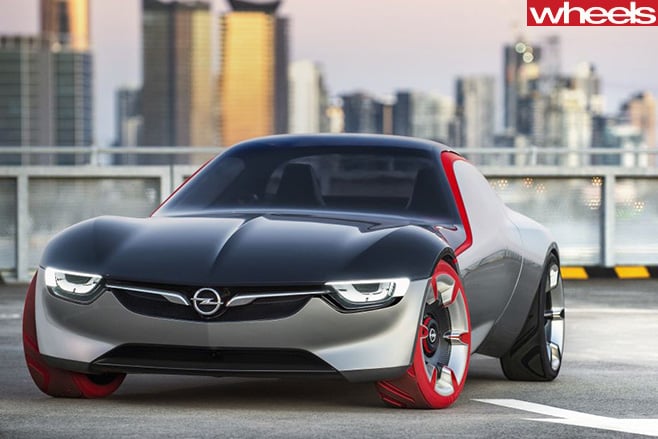
The unusual styling is described by GM Europe design chief Mark Adams as purebred, pared down, yet unashamedly avant-garde.
“It is dramatic, sculptural and full of innovations, which is our great tradition that we intend to continue,” Adams said.
“In the mid-60s Vauxhall and Opel created their own interpretations of a light-weight sports car – the XVR and the Experimental GT – both of which were thoroughly modern with dynamic sculptural form.”
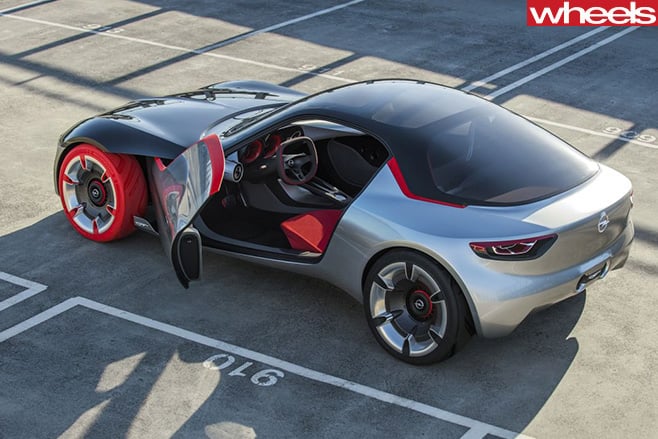
GM Europe has dug further into its back catalogue, saying that the GT’s “distinctive red tyres – mounted on rims with a ‘roller-skate’ design – are a reference to an iconic Opel motorbike from the 1920s – the Motoclub 500 – which sported red-coloured rubber.”
Beyond the official information, GM Europe sources say that while a bespoke rear-drive platform of the kind proposed here is highly unlikely to see production, this concept will be a serious intel-gathering exercise when it is unveiled to the public at the Geneva auto show in early March.

“Like the new (European) Astra, this car continues with the theme of making a car that is no bigger than it needs to be. One that is pared-down, light and no more complex than necessary.
“People have seen this in reality with the new Astra, which was smaller and lighter than its predecessor. [GM Europe] is going to continue in this direction of travel with future models.”

A Holden spokesman refused to discuss the origins of the one-off concept car.
However, as with other concept cars produced in Australia it had distinctive Melbourne buldings in the background of the handout media photography, a giveaway that the motor show star was likely produced locally.
However, it’s understood the Opel GT was designed overseas.
Following a brochure leak filled with juicy details, Jaguar has leapt on its front paw to officially confirm its range-topping F-Type SVR will debut at the Geneva motor show on March 1.
Engine output details will be revealed earlier, on February 17, though they’ve been leaked anyway. For now Jaguar is content to announce the F-Type engineered by its Special Vehicle Operations division will come as both a coupe and convertible, pack a titanium exhaust and deliver a 200mph (322km/h) top speed – up from the 186mph (300km/h) maximum of the F-Type R.
Jaguar has supplied images of the F-Type SVR, showing most notably a new side gill on the front guards, a more aggressive front bumper design and pop-up carbonfibre spoiler.
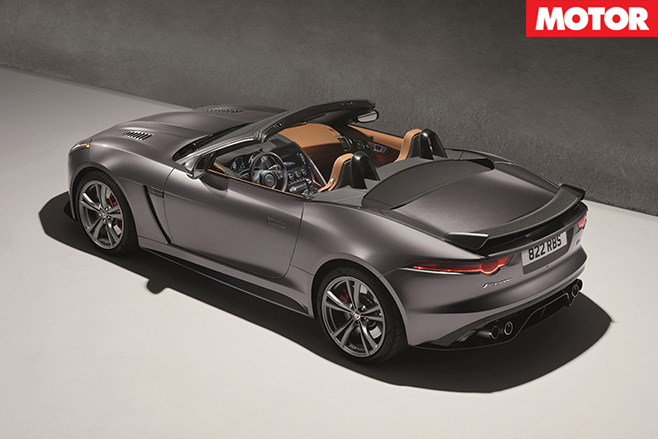
According to the brochure, the 5.0-litre supercharged V8 engine moves from 404kW/680Nm as in the F-Type R, to 423kW at 6500rpm and 700Nm between 3500rpm and 5000rpm.
Utilising an eight-speed auto and all-wheel-drive just like the R, the 0-100km/h sprint drops from a claimed 4.1sec to just 3.7sec for the SVR, though we’ve already clocked a 3.75sec from its lesser-powered V8 sibling.
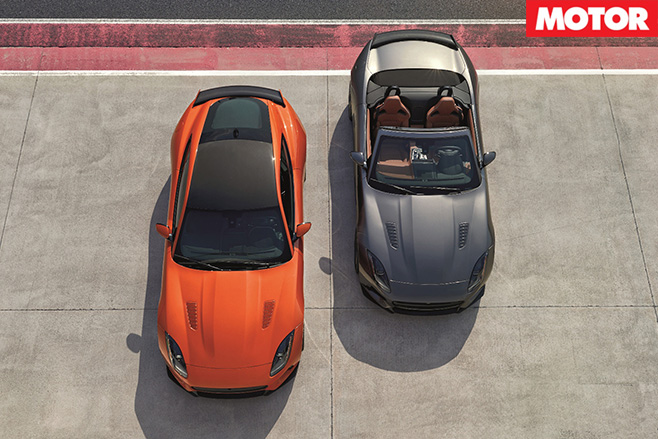
According to the brand, the first ever SVR-badged Jaguar, “is developed to exploit the two-seat aluminium sports car’s full potential while retaining its day-to-day usability.”
“Lighter, faster and more powerful, the new F-Type SVR takes performance, dynamics and driver involvement to a new level yet retains the comfort and duality of character inherent to all Jaguar cars.”
In Australia, the F-Type range currently tops out between $245,280 (coupe) and $260,980 (convertible).
Porsche’s new 718 Boxster has broken cover weeks ahead of its planned debut at the Geneva Motor Show.
The model – whose name revives nomenclature from Porsche’s history books, ‘718’ was a street legal racer in ’57 – debuts in two variants, the base 718 Boxster and more powerful 718 Boxster S.
Both models score brand new flat-four turbo engines, codenamed EA9A2, which also reintroduces the four-cylinder boxer to Porsche’s model range after almost 40 years.
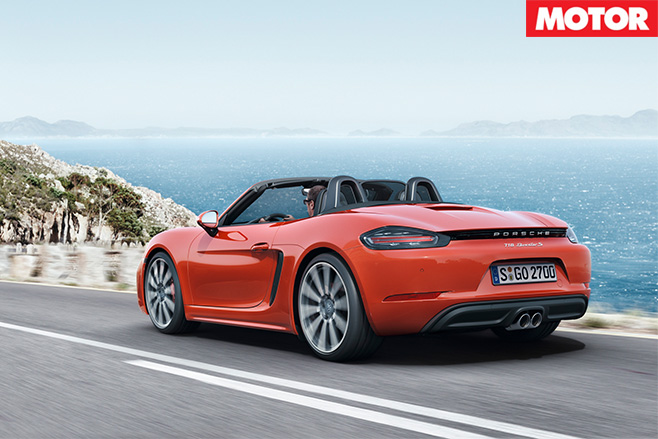
Both engine variants will be matched to a six-speed manual as standard, but Porsche quotes acceleration times for PDK and Sport Chrono equipped 718 Boxsters only, claiming the base car will pass 100km/h in 4.7 seconds and the S in 4.2.
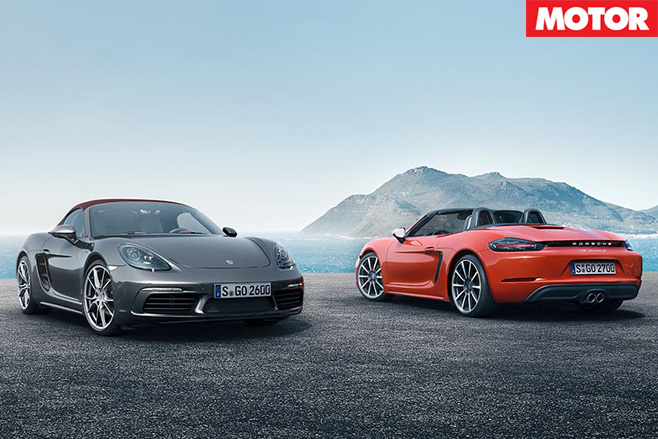
Porsche has tweaked the Boxster’s styling as well, opening up its front air intakes and redesigning the rear of the car around new LED tail lights. The base car scores new 19 inch wheels while the S gets 20s.
As for pricing, Porsche will peg the base 718 Boxster and S variants at $113,100 and $143,400 respectively.
The new 718 Boxster is expected to arrive Down Under mid-year.
The move to turbocharged engines has brought the biggest performance jump in the Boxster’s 20-year history.
It’s all about the numbers with Porsche’s updated Boxster, now known as the 718 Boxster and for the first time sporting four-cylinder engines.
There’s 25kW more power, up to 100Nm more torque, and fuel economy improvements of between 10.0 and 12.7 percent for this major refresh of the 981 Boxster that arrived in 2012.
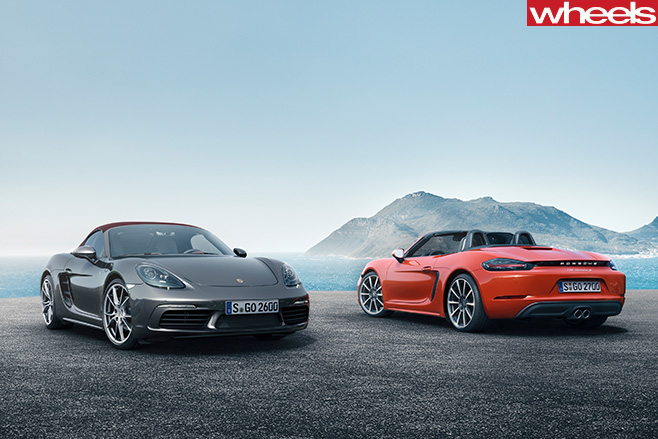
The facelifted Boxster maintains its mid-engine, rear-drive layout but eschews 911-derived six-cylinder engines for a new family of horizontally opposed four-cylinder turbos.
The new engines – a 2.0-litre for the 718 Boxster and a 2.5-litre for the 718 Boxster S – are related to the 3.0-litre six-cylinder twin turbo in the recently updated 911.
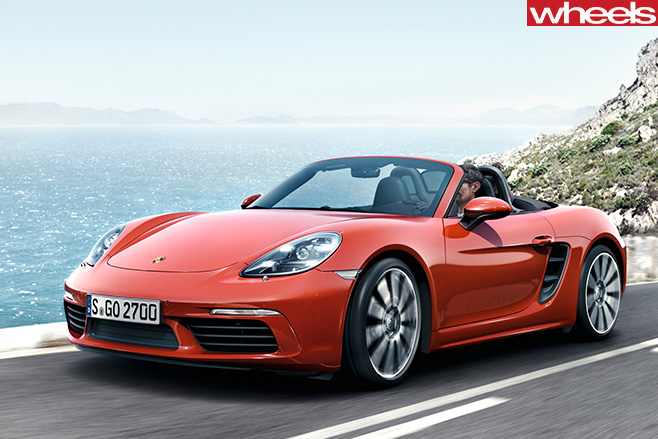
In the 718 Boxster it is a regular turbo, while in the 718 Boxster S it uses the same variable geometry turbine technology employed in the flagship 911 Turbo (such VTG turbos are common in diesel engines but they’re only used by Porsche and the upcoming Mazda CX-9 in petrol applications).
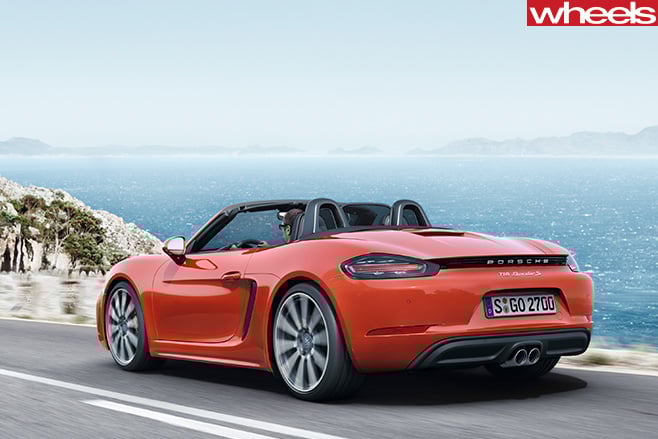
The Boxster S steps that up to 257kW and 420Nm for a 0-100km/h as low as 4.2 seconds, bringing it tantalising close to the hero of the Porsche lineup, the 911.
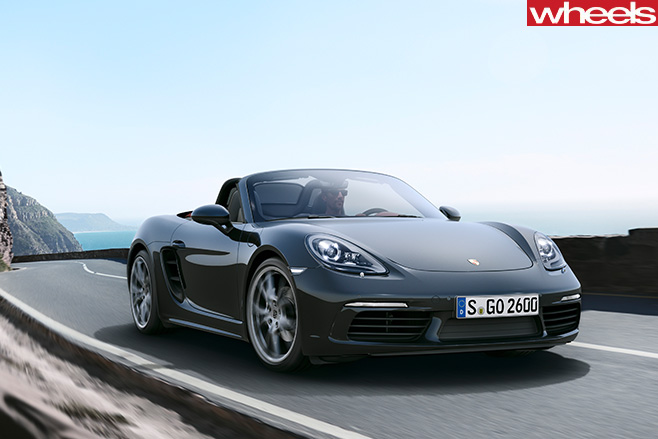
A six-speed manual is standard, while the seven-speed dual clutch auto costs extra, bringing a Sport Response button as part of the optional Sport Chrono pack. Sport Response pre-charges the turbo and gearbox for more instant response, such as when overtaking.
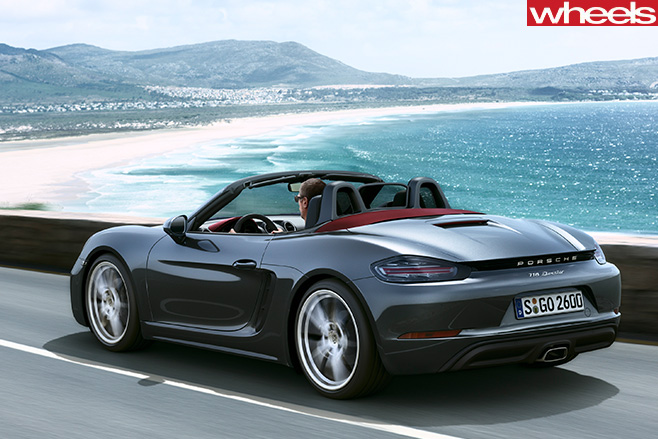
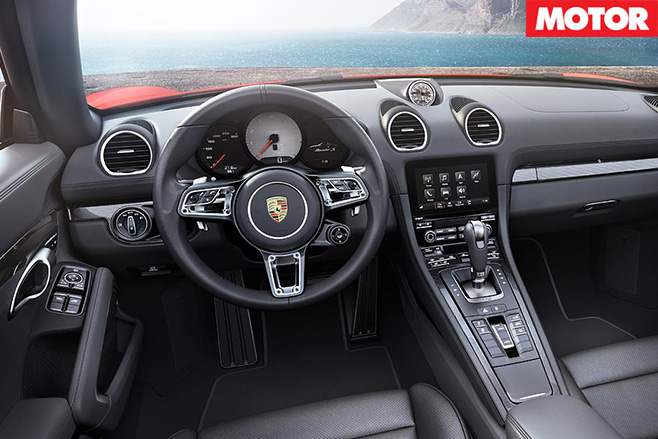
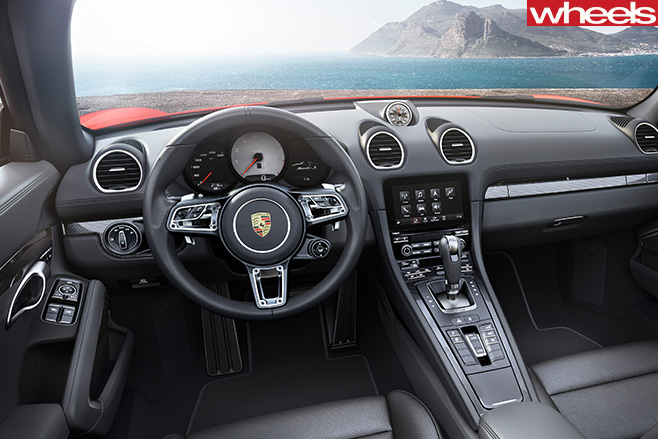
Inside the dash has been restyled and there is a new colour touchscreen with Apple CarPlay (but no Android Auto).
Porsche charges $4990 for the PDK auto transmission, however with the base Boxster it only costs customers $1333 extra because of the controversial luxury car tax rules; because the base Boxster auto slips in under the arbitrary 7.0L/100km fuel use figure its LCT threshold applies from $75,375, whereas the manual has the 33 percent tax applied from $63,184.
The new 718 Boxster arrives in Australia mid-2016.
The world record for furthest protruding eyeballs is 12mm, held by Chicago woman Kim Goodman. Since 2007 she’s been the undisputed champ of eyeball bulging but on this rainy October day in Ingolstadt, Germany, I’m pretty sure I could blow her into the weeds.
I’m nervously inserted into the passenger seat of Audi’s A3 Clubsport Quattro Concept. It’s raining so hard it feels like we should be boarding an ark, not blasting around Audi’s corporate 3.2km racetrack.
And as a hairpin hurtles at me through the windscreen, and bits of handmade, concept car Jesus handle ooze through between my clenched fingers, I wonder why I got into a car with an engineer whose name I don’t even know.
It’s fine, as it turns out, he’s only trying to tear a hole in the fabric of spacetime with me next to him, my eyes bulging from their sockets like barely-tethered ping pong balls, causing me to look like a caucasian Kermit the Frog.
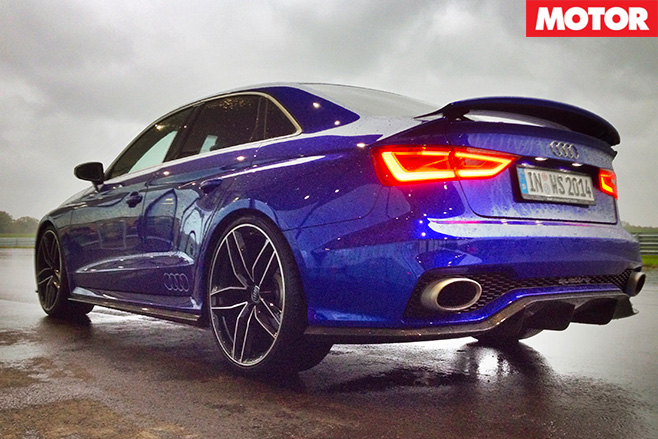
Audi built the A3 Clubsport for the Wörthersee Festival back in May and if you’re unfamiliar with this event, picture Oktoberfest but replace the girls in lederhosen with blokes in polo shirts. And swap the beer with red cordial.
Clearly Audi’s RS engineers have been chugging the stuff. The Clubsport Quattro Concept is an A3 sedan dunked in a vat of bubbling lunacy. Pumped guards hide 21 x 9.5-inch wheels all round, with 275/25 rubber, themselves orbiting massive 370mm carbon ceramic discs.
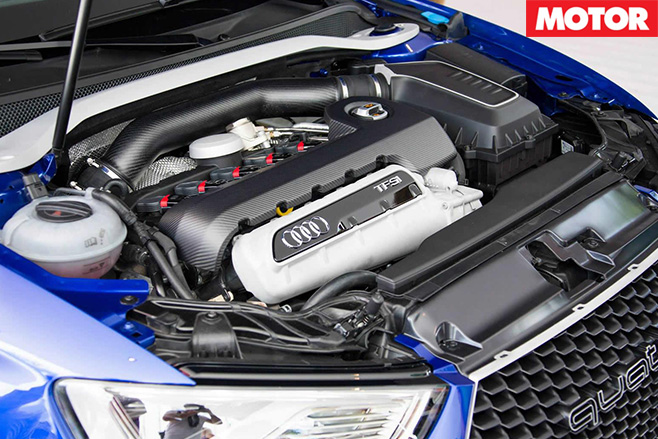
Meanwhile Audi’s replaced the carbs in the MQB platform-based concept’s diet with carbonfibre, the end result 1527kg. Which gives the A3 Clubsport Quattro concept a power-to-weight of 253kW a tonne. Or more than an R8 V10 Plus.
As I rumble out of pitlane I’m also wishing the thing had a snorkel. It’s raining like the world’s oceans have colluded to invade the lands. My inner monologue is simply: don’t crash the thing, don’t crash the thing. She’s a one-off concept car, after all.
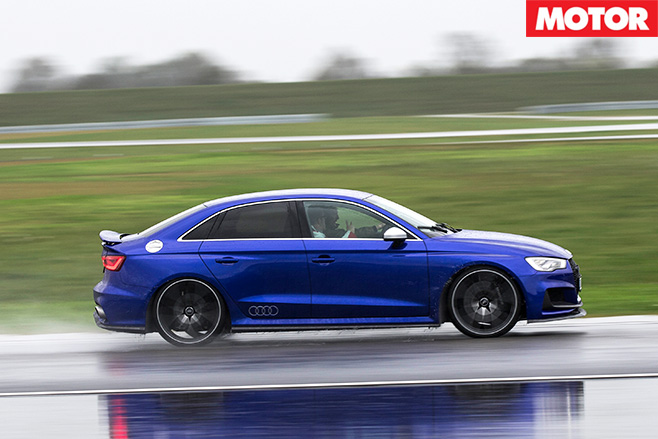
The A3 Clubsport summons its quattro system and squirms intimidatingly as it puts that awesome stomp through four relative postage stamps of rubber. Yet, aside from a sniff of all-wheelspin, even in these conditions traction ain’t a drama.
She’s fast. Full throttle, the turbos are snoozing until 2300rpm when suddenly the gods of acceleration hurl you towards horizon. First gear pins you to the seat. As you tickle 6900rpm the entire tacho turns tomato red like it’s forgotten to wear pants in public.
It’s your signal to pluck shift paddle and as you do, there’s a crisp, brief rumble as the S-Tronic slots Next Cog, all the while the thing seamlessly slingshots itself forward under your tremblingly-pinned right clog.
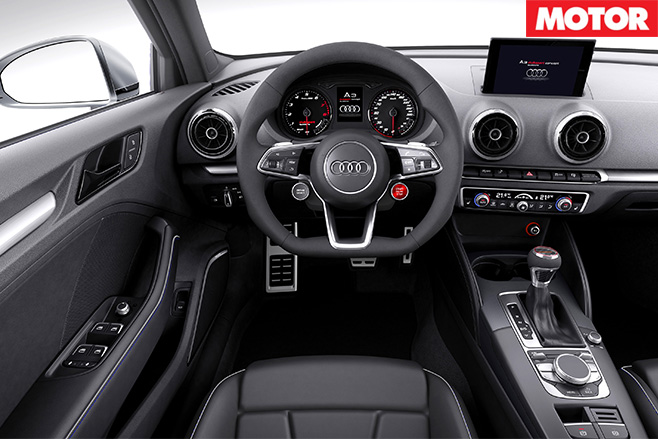
As a drenched hairpin approaches, I hit the brakes at normal pressure, but am surprised to feel my sternum bend around the seat belt. The pedal’s short in travel but not on bite or aggro.
Put an apex in the crosshairs and you’d be damned finding steering more eager if it was wearing a blue UNICEF polo shirt and haranguing people out the front of your local train station. There’s not much feel but the rack is quick almost like it’s 1.5 turns lock-to-lock.
If you kamikaze your corner entry you’ll understeer politely. Summon the throttle greedily and you can even squirm the thing sideways under power. Expect to cackle maniacally.
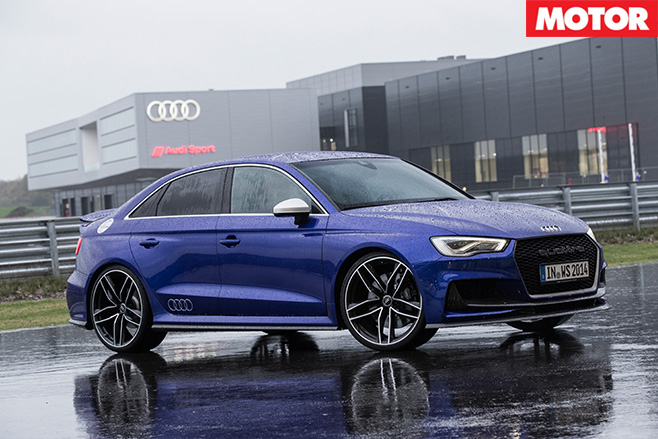
There’s even an airbrake. Not that we got to try it, but nail that terrifyingly sensitive brake pedal at 250km/h and the A3 Clubsport will sprout a large vertical spoiler off the bootlid to reduce stopping distances by around 12 metres. What a relief to know as you sail past those children playing on the autobahn.
And while its speed is startling, the whole experience and the way it seduces the driver is still familiar Audi RS.
Audi quattro GmbH boss Heinz Hollerweger is lobbying Audi’s corporate commanders to build the thing with RS3 badges. It’ll obviously be a little better behaved but still, Kim Goodman, you should be worried.
4 out of 5 stars
Specs
Engine: 2480cc inline-5, DOHC, 20v, turbo Power: 386kW @ 6900rpm Torque: 600Nm @ 2300-6000rpm Weight: 1527kg 0-100km/h: 3.6sec (claimed) Price: Call Audi for a quote. Be sitting down
Mercedes has facelifted its A-Class, responding to critics of its ride and interior finish. Has the premium hatchback improved?
WHAT IS IT? The 2016 facelift for the Mercedes-Benz A176 hatchback, which was the third Merc to wear the A-Class moniker and the first of these to successfully challenge the Audi A3 – by eschewing its predecessors’ uniquely progressive if somewhat dumpy packaging for something a whole lot sportier and spunkier.
WHY WE’RE TESTING IT The third-gen A-Class has always been a striking and stirring small car to drive fast on smooth roads, but an unforgiving ride and rattly interior bits really undermined what could have been a premium C-segment superstar. Now Mercedes has attended to these, so we’re keen to see whether the front-drive Mercedes-Benz A200 and A250 Sport 4Matic finally feel comfy on our harsh roads.
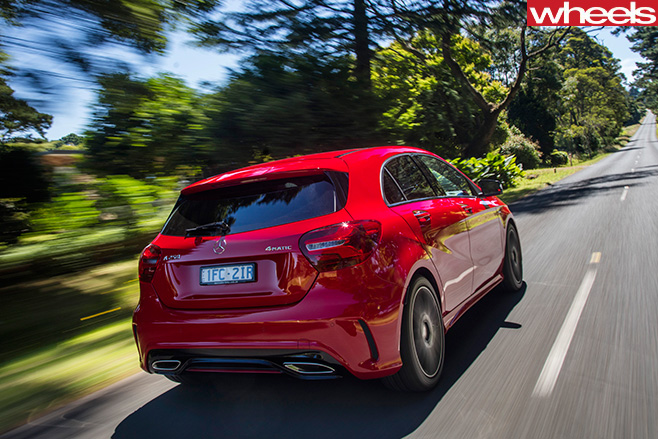
THE WHEELS VERDICT Finally we can wholeheartedly recommend the premium small car that, until now, had wowed us with its effortless performance and pretty styling but also left us wondering how anyone would be willing to put up with an agitated ride, squeaky plastics, poor rear-seat packaging and a tiny boot. Well, thanks to adaptive dampers and less cruddy plastics, two out of the four issues have been more-or-less addressed (though things still aren’t stellar). If you’re after a posh hatch with sparkling handling and strong performance, and don’t need to carry more than two adults, you might prefer the Three Pointed Star to the Audi A3 or BMW 1 Series.
PLUS: Styling, performance, dynamics, efficiency, safety, improved ride, great seats MINUS: Cabin squeaks still present, abundant tyre noise, rear packaging issues remain
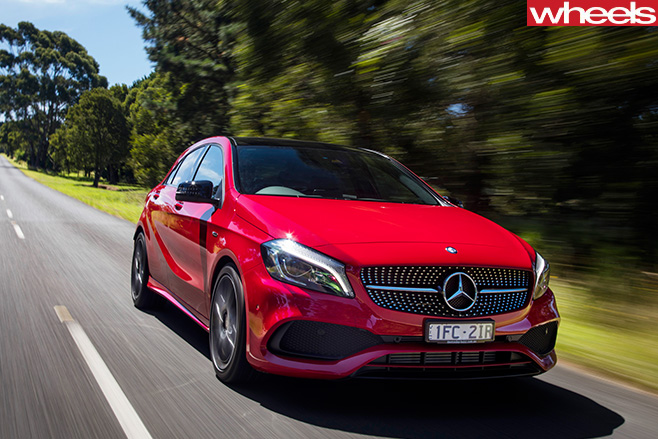
After 17 years and three generations of posterior-pummelling Mercedes A-Classes, the 2016 facelift (visually limited to a fresh grille, bumpers, and tail-lights) finally rides like a Benz ought to.
When released three years ago, Stuttgart’s reborn Audi A3-rival came tantalisingly close to setting segment benchmarks dynamically… until the first bump it crashed over shattered any illusion of “engineered-like-no-other-car” superiority. “Ouch!” we cried.
Ironically, relief comes from another sort of smarts. Standard-fitment adaptive damper tech – as part of what the company calls its Dynamic Select system – brings a new Comfort mode for a palpably cushier ride.
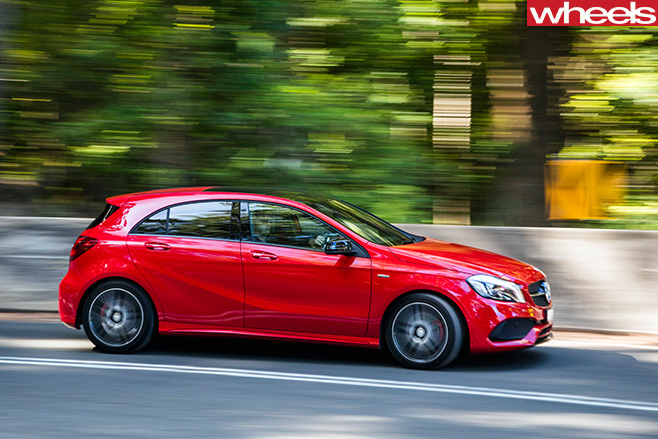
Aiding their prodigious progress is an even sweeter-shifting dual-clutch auto than we remembered. Top work, Merc.
Additionally, the extra tautness and body control that Sport mode brings enhances this A-Class’s already athletic dynamics, so that when a soft ride isn’t strictly de rigueur, this thing can rip through corners with involving agility and grip.
In baking temperatures, this tester preferred the 60kg lighter 1.6 A200 over its 2.0 AWD A250 stablemate, thanks to the former’s wigglier rear-end handling, offering a sort of passive rear-steer which made it a hoot stringing together high-speed corners. Granted, wet surfaces would likely elicit an opposite opinion.
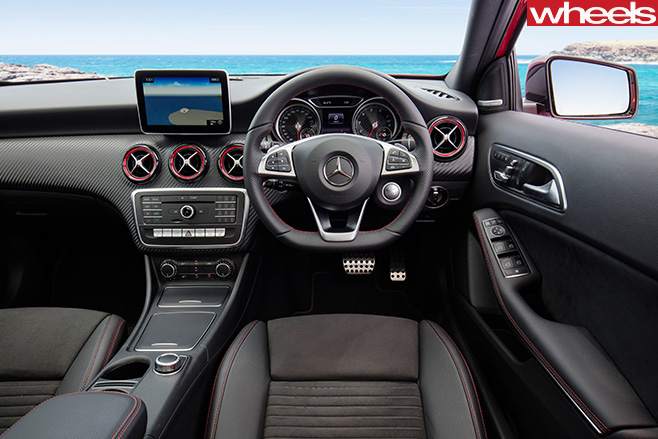
Making adaptive dampers standard has raised prices by between $1000 and $2300 depending on variant, with the base 90kW/200Nm A180 now starting from $37,200. But the kleiner Benz claws back kudos with more supportive front seats, a larger touchscreen, and less tacky trim (more on-brand but squeaks still escape), while Apple CarPlay headlines a multimedia upgrade. The 100kW/300Nm A200d diesel now costs $43,300.
Lastly, minor output rises (5kW and 15kW/25Nm apiece for the 160kW/350Nm A250 and 280kW/475Nm Mercedes-Benz A45 AMG respectively) and improved driver-assist braking round out what is now a far fiercer A3 foe. Rear-seat room remains tight, but no longer is this Benz a class of hard knocks.
SPECS Model: Mercedes-Benz A250 Sport 4Matic Engine: 1991cc 4cyl, dohc, 16v, turbo Max power: 160kW @ 5500rpm Max torque: 350Nm @ 1200-4000rpm Transmission: 7-speed dual clutch Weight: 1455kg 0-100km/h: 6.3s Fuel economy: 6.1L/100km Price: $53,500 On sale: Now
