
Since the birth of civilisation ghosts have scared the religious witless.
But for the spiritually cynical who think that, when you cark it, you have a big nap and get eaten by worms, ghosts are less terrifying than nothing on the TV other than The Bachelor.
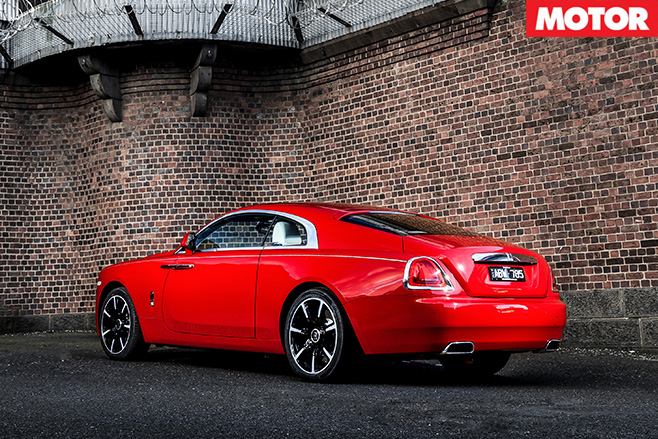
Rolls-Royce names its cars after the ghosts and ghouls of people’s nightmares but it’s never really had a car that could properly frighten you. That is, of course, until now – until Wraith.
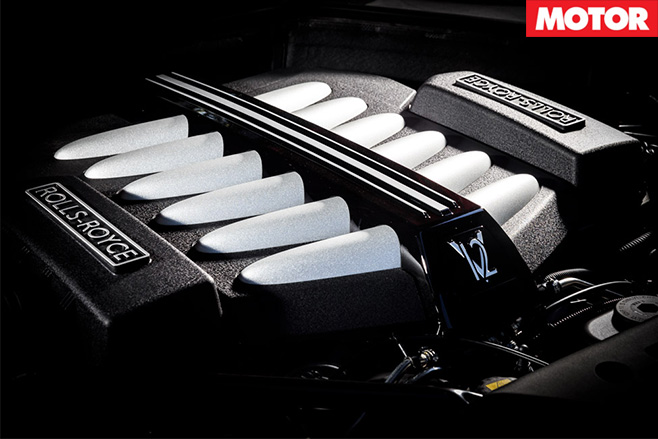
While there’s not much scary about a Ghost with two doors, a wider rear track and shorter wheelbase, there’s a few startling stats hidden in the spec sheet. Rolls has taken the Ghost’s 6.6-litre, twin-turbo V12 – related to that in the BMW 760Li – and given it a few extra ’erbs. Power is up from 420kW to 465 and there’s 800Nm to feast upon from (as we’re starting to grow accustomed to in this new turbo era) just 1800rpm.
More rationally-minded readers might argue, if you want something plush and fast with two doors, why not dabble in, for example’s sake, a bit of Mercedes S63 Coupe? It has 430kW and 900Nm and will nail 100km/h in 4.1 seconds. That beats the Wraith’s 4.6sec, and you’ll pocket around $250,000 to boot. You could buy a base 911 with that, or one of Clive Palmer’s cufflinks.
And if you must have a twin-turbo V12, the S65 Coupe is coming with 463kW, 1000Nm and still a $100K saving or thereabouts.

Once seated, press a button and the door swings shut, concealing you in a tomb-quiet, airy pit of buttery leathers and glossy woodgrains. The seats are firm and cosseting but cushion your backside so tenderly it’s like being wedged in a cloud. And then you look up.
Stitched into the headlining are 1340 fibre-optic LEDs. And they’re not placed at some peasant’s whim: Rolls has reproduced the exact night sky as seen above its Goodwood factory just past midnight on January 1, 2003 – the day the first car rolled out of this factory. Not kidding. It takes someone up to 10 hours to stitch it all together.

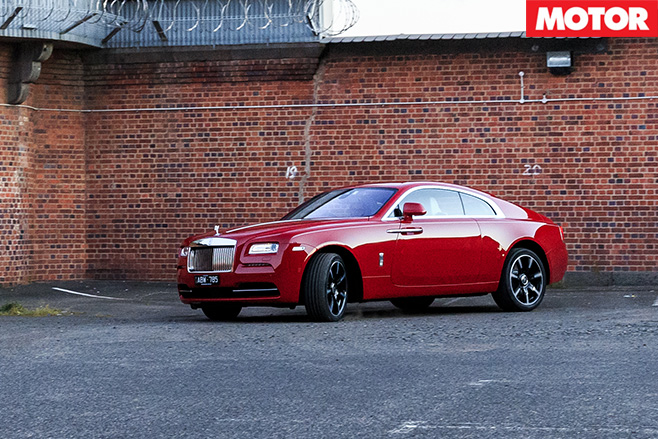
Of course, if the fact the Wraith comes in 45,000 colours wasn’t impressive enough, there’s one man who does the pinstriping on every Rolls using paint brushes made from the hair of squirrels. Mark Court has painted the “coach lines” on more than 2000 Rollers and is training his son to succeed him. Each pinstripe takes three hours to paint which means this red car here has spent 12 hours in his company.
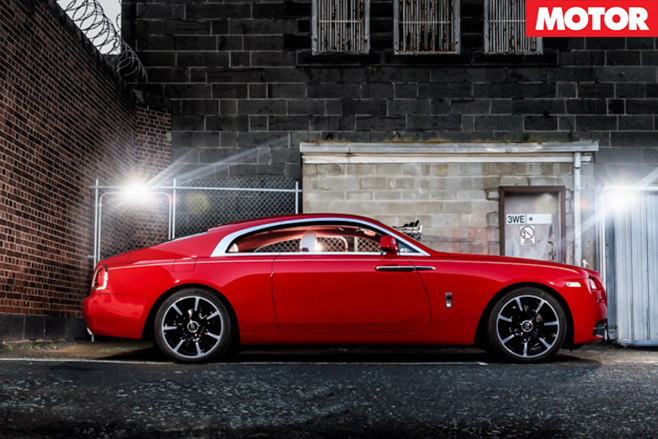
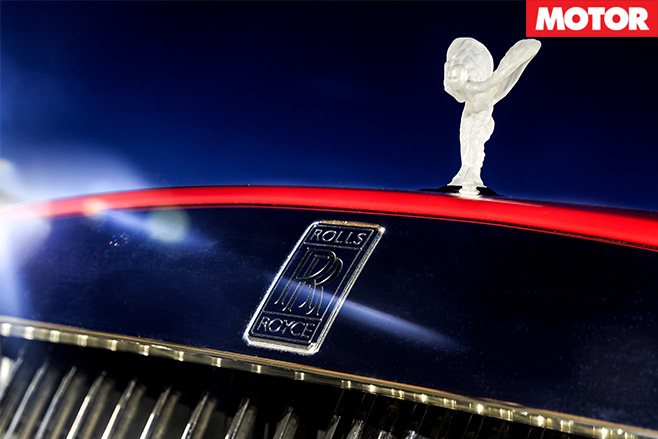
But there’s more. On the Wraith the Spirit of Ecstasy is sat further forward than other Rollers and at a unique-for-Wraith angle of attack. Then there are the Rolls-Royce emblems in the centre of the wheels which stay level and don’t rotate.
There’s a head-up display, night vision, full 360-degree parking camera, radar cruise control and a sound system that’ll give you more than tinnitus. It doesn’t feel like it’s all been nicked directly from a 5-Series, either – it’s familiar technology dipped in Rolls luxury.
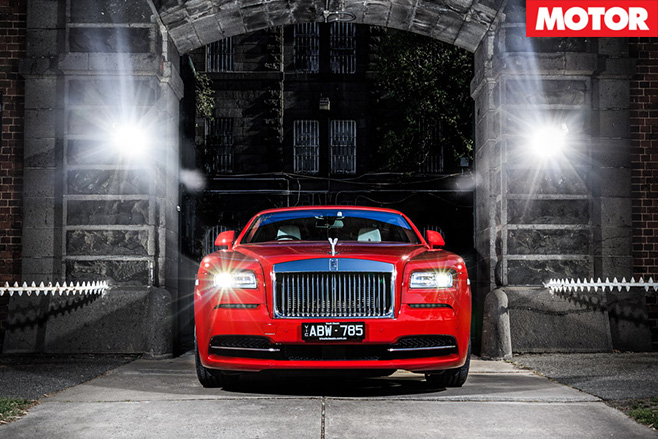
From the driver’s seat, the first thing you notice is the Wraith’s sheer size. You almost feel like you need binoculars to see the Spirit of Ecstasy poking up at the end of the bonnet. Looking through the rear vision mirror you need to squint to see where the car ends. The captain of the Queen Mary 2 would feel at home in the Wraith’s driver’s seat. She’s big.

The ride, meanwhile, is sublime. For a car with 40-profile tyres on 21-inch wheels, the way the Wraith rides like it’s suspended on a cushion of goose feathers is impressive. It compresses into long undulations like the shocks are each a metre long and filled with caramel. High-tempo bumps are nibbled away.
It’s just as well the government is unaware cars can ride like the Wraith, lest it cancels all funding for road maintenance and forces all new cars to be fitted with Rolls-Royce air suspension.
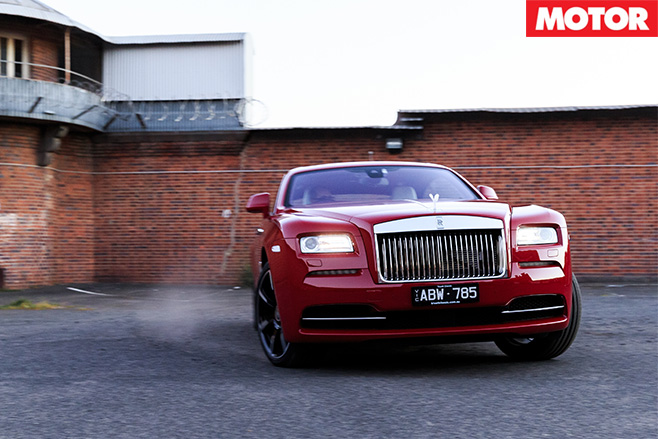
With 465kW it doesn’t punch you in the back like a car with launch control. Rather, it’s like getting hit in the boot by a ghostly tsunami, or like the way thrust builds in a jet on take-off. During full throttle the Wraith squats over its rear axle so hard that, at night, the self-levelling headlights have to tilt down so you can see where you’re going.
But the Wraith’s mid-range punch is its party trick. At 80km/h, full throttle is like lighting a pair of afterburners. Through the seamless eight-speed auto (which borrows its personality from BMW, surprise surprise) the thrust is relentless. By the time you hit 110km/h it’s only just starting to boogie. It makes you sad there are no autobahns in Oz.
Having wafted your way to your favourite road (invariably a bumpy back road in the middle of nowhere) you notice the Wraith has no sport button, which means those hovercraft-spec air suspension must handle 2.4 tonnes of cornering car all on its own.
There aren’t any steering wheel gear paddles, either, and just as well, because there isn’t a tacho. Instead, the Wraith comes with something called a Satellite Aided Transmission, which uses the navigation system to read the corner ahead and predict which gear will be most appropriate and hold a gear if it thinks it’ll need it for the next corner.
Although the suspension is unfussed by the bumpiest backroad, on the long, fast stuff the Wraith is immensely satisfying once you find your rhythm of braking hard, settling the car, turning gently, allowing the suspension to load, then getting back into the throttle and blasting to the next corner. You get used to the dive, roll and squat and it’s all easily manageable with nice, slow steering and pedal inputs.
That said, we can’t help but feel a pair of steering wheel paddles and a classy tacho in the head-up display could turn the Wraith from swift and satisfying to laugh-out-loud fun. But, then again, going fast is a capability of the Wraith – not its point.
It’s one of those cars you’ll remember in 50 years’ time. While its performance won’t frighten you speechless, you try going full throttle and counting to 10, then telling us there isn’t a ghost that gives you the willies.
ROLLS-ROYCE WRAITH
| Body | u00a0 | 2-door, 4-seat coupe |
| Drive | u00a0 | rear-wheel |
| Engine | u00a0 | 6592cc V12, DOHC, 48v, twin-turbo |
| Bore/stroke | u00a0 | 89.0 x 88.3mm |
| Compression | u00a0 | 10.0:1 |
| Power | u00a0 | 465kW @ 5600rpm |
| Torque | u00a0 | 800Nm @ 1500rpm |
| Power/weight | u00a0 | 197kW/tonne |
| 0-100km/h | u00a0 | 4.6sec (claimed) |
| Top Speed | u00a0 | 250km/h (limited) |
| Consumption | u00a0 | 14.0L/100km (claimed) |
| CO2 Emissions | u00a0 | 327g/km (claimed) |
| Transmission | u00a0 | 8-speed auto |
| Weight | u00a0 | 2360kg |
| Suspension | u00a0 | A-arms, air dampers, anti-roll bar (f); multi-links, air dampers, anti-roll bar (r)u00a0 |
| L/W/H | u00a0 | 5269/1947/1507mm |
| Wheelbase | u00a0 | 3112mm |
| Tracks | u00a0 | 1622/1668mm (f/r) |
| Steering | u00a0 | hydraulically-assisted rack-and-pinion |
| Brakes | u00a0 | 374mm ventilated discs, fixed calipers (f); 370mm ventilated discs, fixed calipers (r)u00a0 |
| Wheels | u00a0 | 21 x 8.5-inch (f); 21 x 9.5-inch (r) |
| Tyres | u00a0 | 255/40 R21 102Y (f); 285/35 R21 105Y (r)u00a0Continental ContiSportContact |
| Price | u00a0 | $645,000 |
| Price as tested | u00a0 | $753,423* *Twin coach line silver; 360-degree camera system; illuminated Spirit of Ecstasy; adaptive headlights; starlight headliner; seat piping in Consort Red; SoE inlays to monitor lid; front ventilated seats; R-R monogram to all headrests in Consort Red; comfort entryu00a0 |
| Positives | u00a0 | Unparalleled luxury; hairy-chested V12 power; unbelievable ride |
| Negatives | u00a0 | Driveru2019s Rolls Royce still far off being a u2018driveru2019s caru2019u00a0 |
So, what is it?
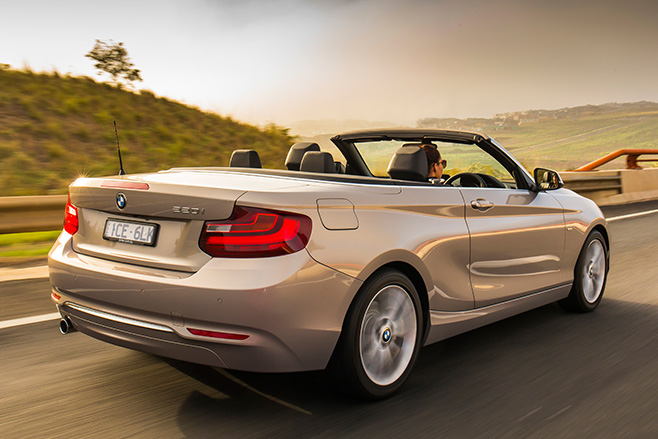
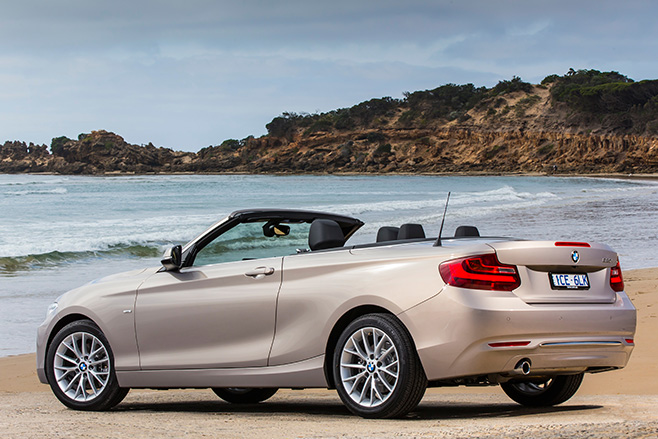
BMW likes to call ‘M’ the most powerful letter in the world, but in their range, it’s the number 2 that’s arguably developed the most moxie. The lovely, RWD 2 Series, currently lead by the M235i – at least until the M2 arrives – is a smaller, sweetly balanced alternative to brasher, larger Beamers. The 3-, 4- and 5- all bring assorted baggage to the table, weighed by their own image and tradition. The premium compact 2 Series just gets on with the very useable fun. And what’s more ‘fun’ than a convertible, eh? A monkey in a fez, and rollercoasters. That’s all.
Why should I care?
Because the hardtop M4 Convertible added too much weight to the base car, and this cloth-capped junior sibling doesn’t.
What’s new about it?
It’s grown compared to its forerunner, the BMW 1 Series convertible: 72mm longer, 26mm wider, and with its wheelbase stretched by 30mm. Mostly, though, it looks larger thanks to the sort of visual design trickery that Block couples apply to poky rooms, or manscaping applies to a hen’s-night stripper, with clean lines drawing the eye out to its flat shoulders. Also, it’s very hushed with the roof up – which you raise or lower in just 20 seconds at up to 50km/h; a 10-second, 10km/h improvement. That quiet is thanks to a lasagne-like five layers clever in-roof sandwiching. “You can be going 180km/h and have a phone conversation very easily,” one of the designers told us. “Er, zis probably only applies in Germany.”
That’s all fine. What’s it like to drive fast?
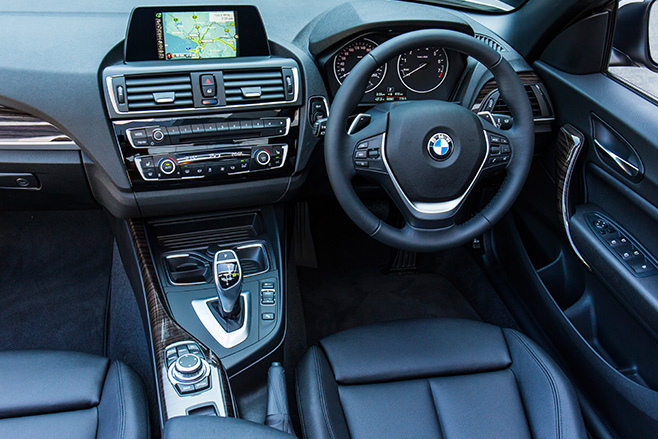
Unflappable. Its tortional rigidity is up by 20 per cent on the car it replaces, and bending strength greater by a tenth, mostly due to reinforcements in the rockers and cross-braces in the front and rear. The 2.0L in-line four engine is good for 180kW, but more importantly, the 350Nm arriving from just 1250rpm – channelled at launch via an insanely buttery, optional eight-cog auto – is a lovely, balanced package. Variable sport steering is typically, Bavarianly precise.
And driving from home to the office in the city?
Capable over any choppiness, with a useful two-golf bag boot (335L that drops to 280L with the top open). Although it’s still kinda noisy without the raiseable wind-blocker up, a thing which precludes putting anyone in the back, unless you despise them.
Is there anything bad about it?
Not particularly; it minimises most of the dynamic drawbacks inherent in top-down motoring (lost rigidity, hairdresser accusations), but you can’t do much about errant bird deposits. Although the $85,800 M235i, with its 3.0L straight six, will be a superior attack beast, if that’s your remit.
How much would I have to pay for one? And is it worth the coin?
$68,900. Yes. And the 220i entry level soft-top, starting at $54,900, is tempting too. But this is a nicely rounded package.
Would you take the 228i Convertible or an Audi A3 Cabrio, then?
Ingolstadt’s AWD has its admirers, and rightly so, but the 228i Convertible’s rear-wheeled, simple sports car charms add personality. And the BMW looks better, too.
Click here to find out more about the BMW 2 Series Convertible.
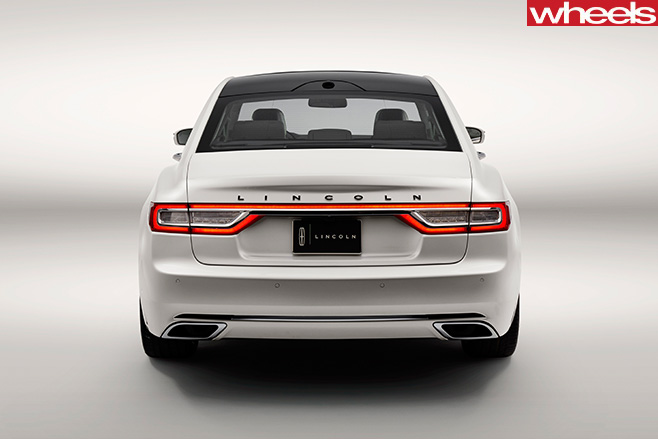
THE 2017 Lincoln Continental has been created to save the brand, and was designed by Australian Max Wolff
The flagship of the Ford-owned brand replaces the MKS, and reintroduces the famous Continental badge that’s been on hiatus since 2002. The new sedan is actually slightly smaller than the MKS, and will be built in the same factory as the Ford Mustang at Flat Rock, Michigan.
Part of that aim was the recruitment of Wolff, a graduate of Melbourne’s Monash University, who was tasked with revitalising Lincoln after a cataclysmic fall in sales. Part of a $USD1billion investment in the brand under then Ford boss Alan Mulally, it was Wolff’s job to create a design ethos, and the direction for the range of future products as it chases Cadillac. Lincolns, in contrast, were chastised as Ford products wearing fresh headlights and grille.
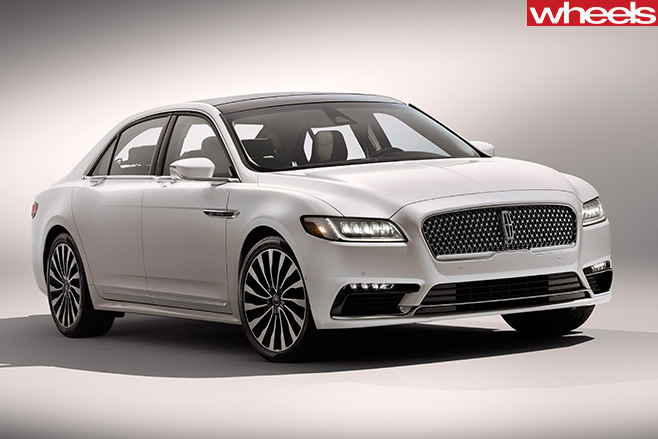
The brand’s peak of 231,660 cars in 1990 was a fond memory when Wolff arrived, with sales dipping below 100,000 in 2009. Last year, Lincoln sold 101,227 cars globally compared to Cadillac’s 277,868, with Cadillac’s 7.5 percent global growth pipping Lincoln’s 7.1 percent for the year.

The Continental is the spearhead, and will be joined an updated MKZ later this year that’s been wrapped in the new Continental’s design language and uses the same twin-turbo V6. It was shown at the 2015 LA motor show. A Ford Explorer-sized SUV is also rumoured to sit above the current Navigator, while there will still be room for a small SUV to sit below the MKC, which rides of the Ford Kuga (Escape in the US) platform.
Lincoln is not likely to come to Australia in the near future – if ever – even if General Motors moots bringing Cadillac here through Holden dealers.
The focus for Lincoln right now is China and North America. What will help Lincoln is that Ford CEO Mark Fields has announced that it expects a record pre-tax profit in 2016; a resource-rich parent company can only be good news for the brand.
Welcome to the glorious contradiction that is the Bentley Continental GT3-R.
It’s neither a road-going race car nor a homologation special, but at the same time, it’s no ordinary luxury grand tourer either.
What it is is the fastest accelerating, most focused road car Crewe has ever made, and just 300 GT3-Rs will be built in tribute to Bentley’s return to international motorsport after a decade away.
The Continental GT3, campaigned in the Blancpain Endurance Series, first broke cover at the 2012 Paris Motor Show and Bentley received so many expressions of interest that a road-going version was a no-brainer.
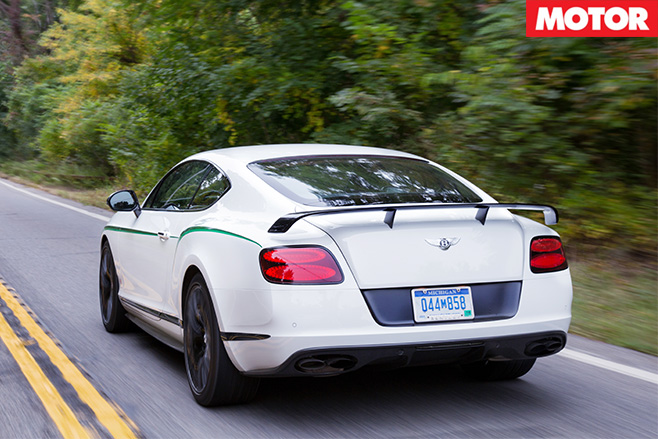
While the woofling twelve is capable of more power and torque, the Audi-derived bent-eight is more responsive and urgent and is also the basis of the engine used by the GT3 race car. With new turbos, a titanium exhaust and recalibrated ECU, it develops 426kW/700Nm.
That titanium exhaust clears its throat in spectacular fashion when you start the engine, with over-run crackles and pops that pique your interest. A 100kg weight loss and shorter final drive ratio makes this the only Continental capable of dipping under four seconds to 100km/h, and when you finally reach the bottom of the throttle travel, it feels fast, but not excessively so.
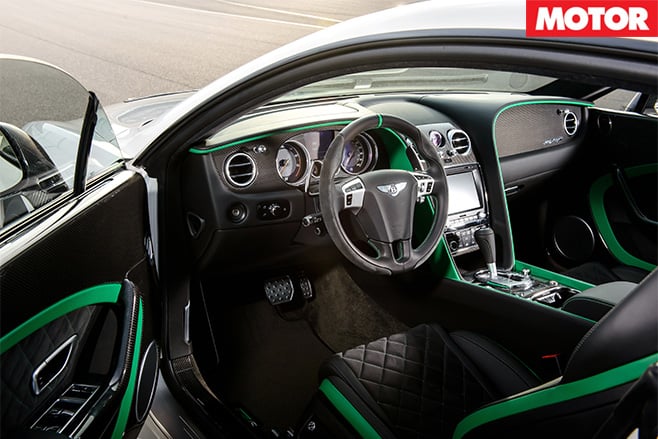
Inevitably, given that Bentley’s actual racing Continentals are little more than 1300kg, you wonder how much more weight could have been taken out of this car. But not for long, because the GT3-R dazzles you with its overpowering material richness, steadily laying waste to your cynicism.
Nobody does lavish material majesty quite like Bentley, and the GT3-R wouldn’t be nearly as appealing without its lacquered carbonfibre, knurled aluminium, yards of beluga hide and diamond-quilted alcantara. It could definitely be lighter – but I’m not sure it’d be worth the trade.
It’s still more a sporting GT than an out-and-out sports car, but it corners flat and level, there’s plenty of tactility to the steering and you can string apexes together with precision. Flick the transmission lever across to ‘S’ and the car feels keen and poised, with impressive throttle response, and it is possible to get the car moving around on a trailing throttle – just a bit, but enough.
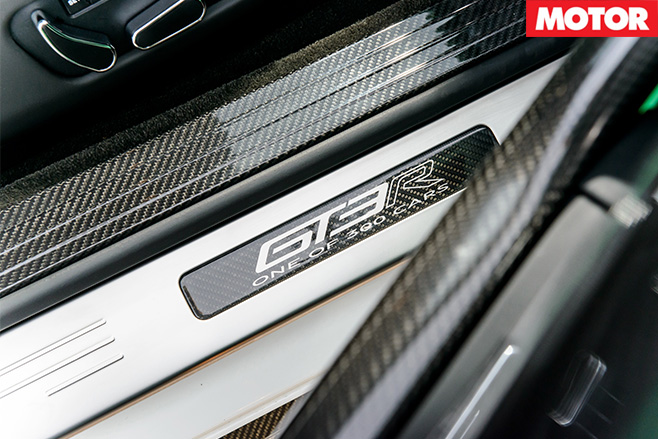
The trick to understanding this most sporting of Bentleys is not to dwell on the first three characters of that ‘GT3-R’ badge. To be frank, you can tell the name was conceived before the car, as it just doesn’t describe the finished product all that well. Perhaps that’s why Bentley claims ‘R’ stands for Road, not Race.
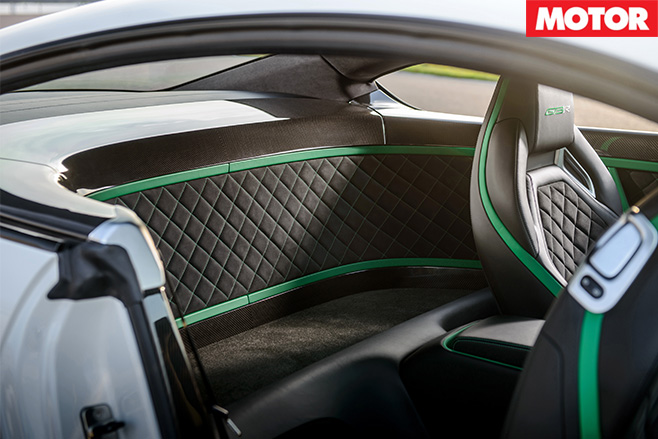
While local prices haven’t yet been confirmed, overseas the car carries a 70 per cent premium over the regular GT V8 S, putting Australian prices at around the $700,000 mark. A lot of money, but then, it’s a lot of car.
Specs
Engine: 3993cc V8, DOHC, 32v, twin-turbo Power: 426kW @ 6000rpm Torque 700Nm @ 1700rpm Weight 2195kg 0-100km/h 3.7sec (claimed) Price $700,000 (estimated)
All this stuff about your car being a reflection of your deeper self is, if you want to know the truth, a load of old cods.
What you drive is vastly more likely to speak of your budget than your belief system. It’s why people who have to move loads of kids drive people movers. It’s about arses, not aspirations.
That said, there are a handful of cars you will not see me riding in or driving. Dead or alive. It’s not that I have world championship levels of dignity, but even a grub like me has to draw the line somewhere.
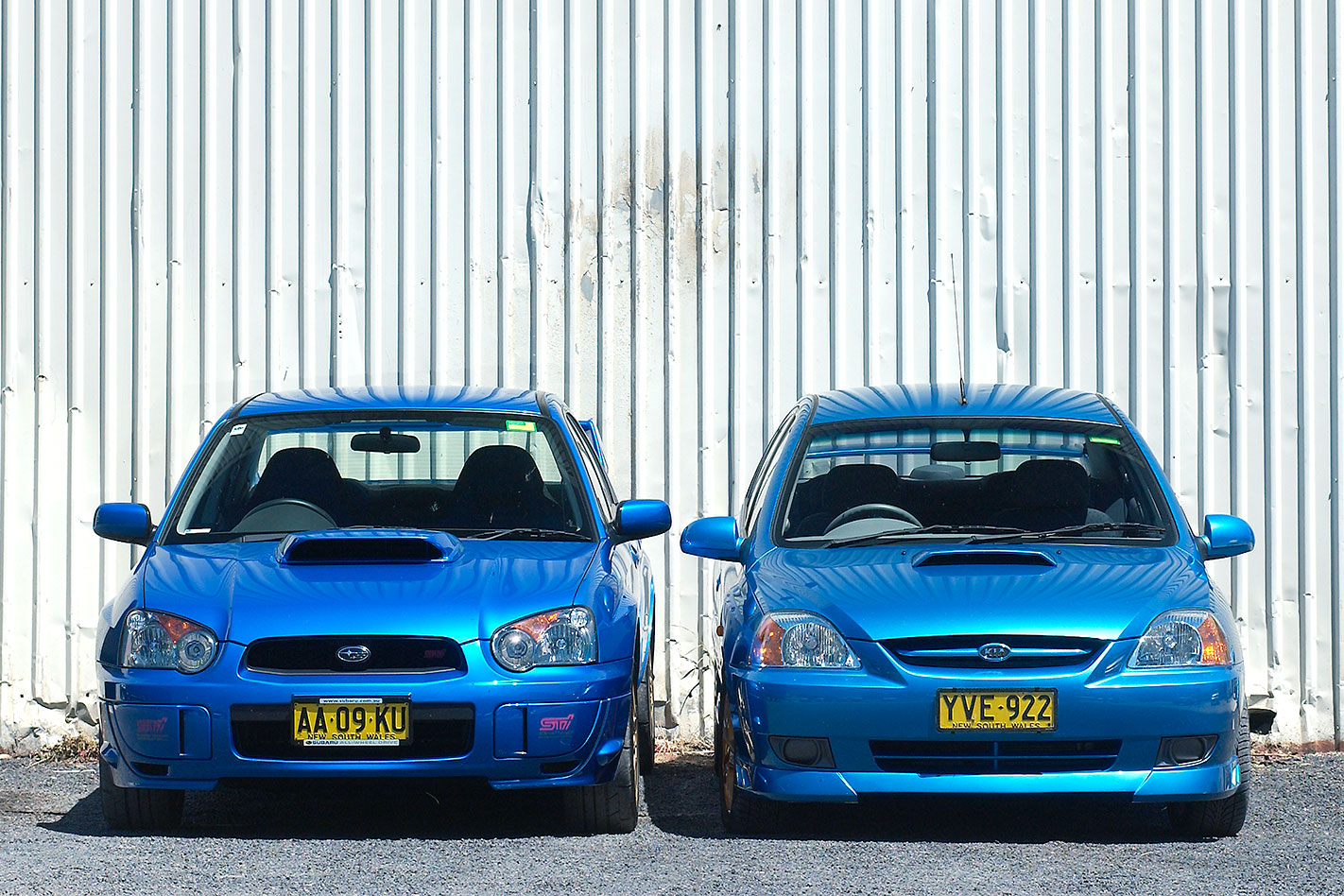
Do you remember that dreadful dealer-fitted option Kia offered on the Rio sedan about a decade ago? Sure you do; it’s the one that attempted to turn a Rio into a Subaru WRX, complete with front and rear wings and even a Rex-aping bonnet scoop (which didn’t extend through to the engine bay, but anyway).
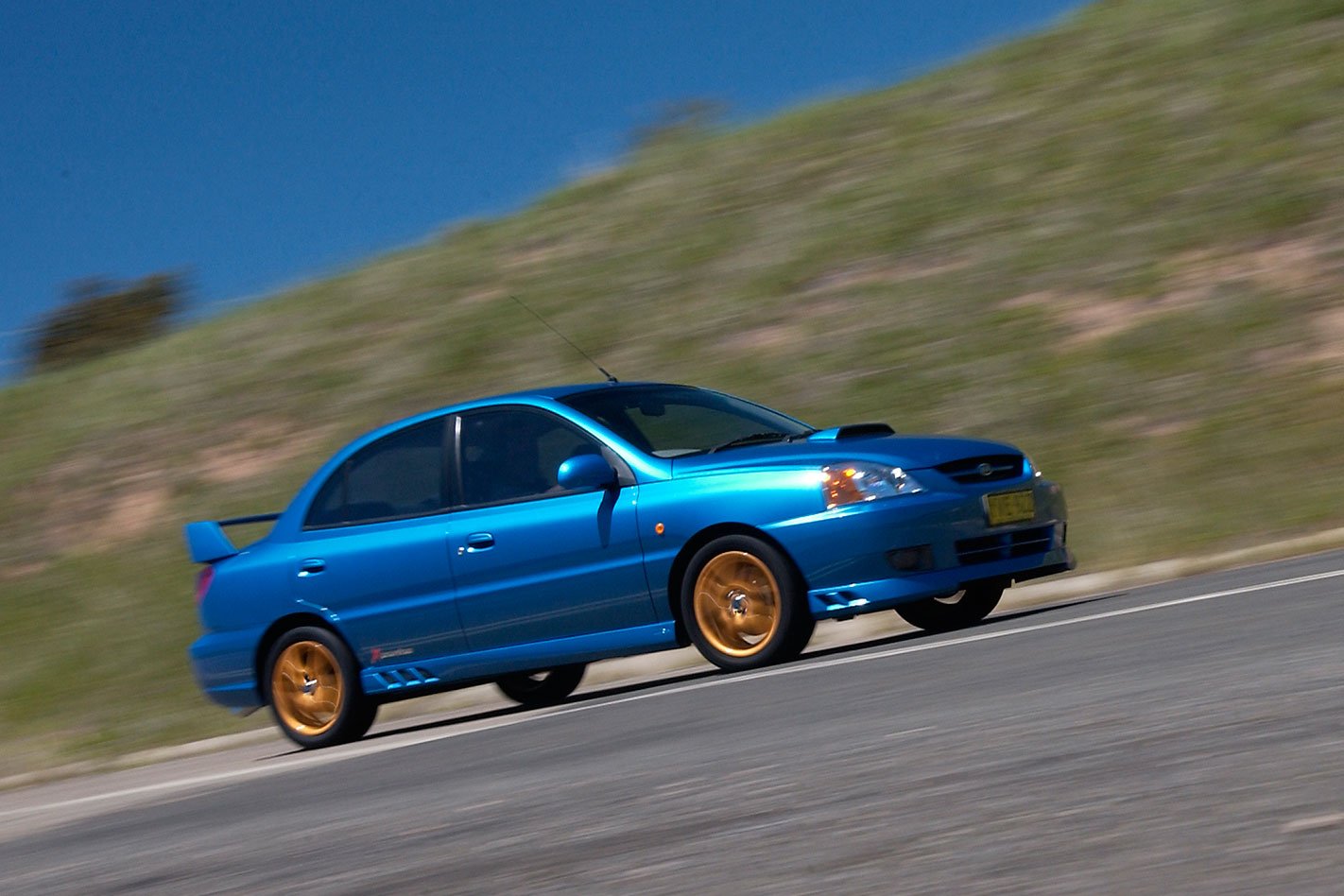
Thing is, while the dolts who bought them went happily about imagining observers assumed they were driving WRXs, in reality, the message they were sending out was the complete opposite. As in: “I’d really like a Suby Rex, but for (please circle one) fiscal/skill level/parole condition reasons, I’m unable to have the real thing. Please spit on me.”
You bought a Rio Sport-Pac for precisely the same reason those weird, tattooed kids who wear their caps backwards drive up and down the local shopping strip in their V6 Commodores with the windows down and doof-doof soiling the air at Dickensian-anvil-factory volume levels. Because nobody will let them into a nightclub.
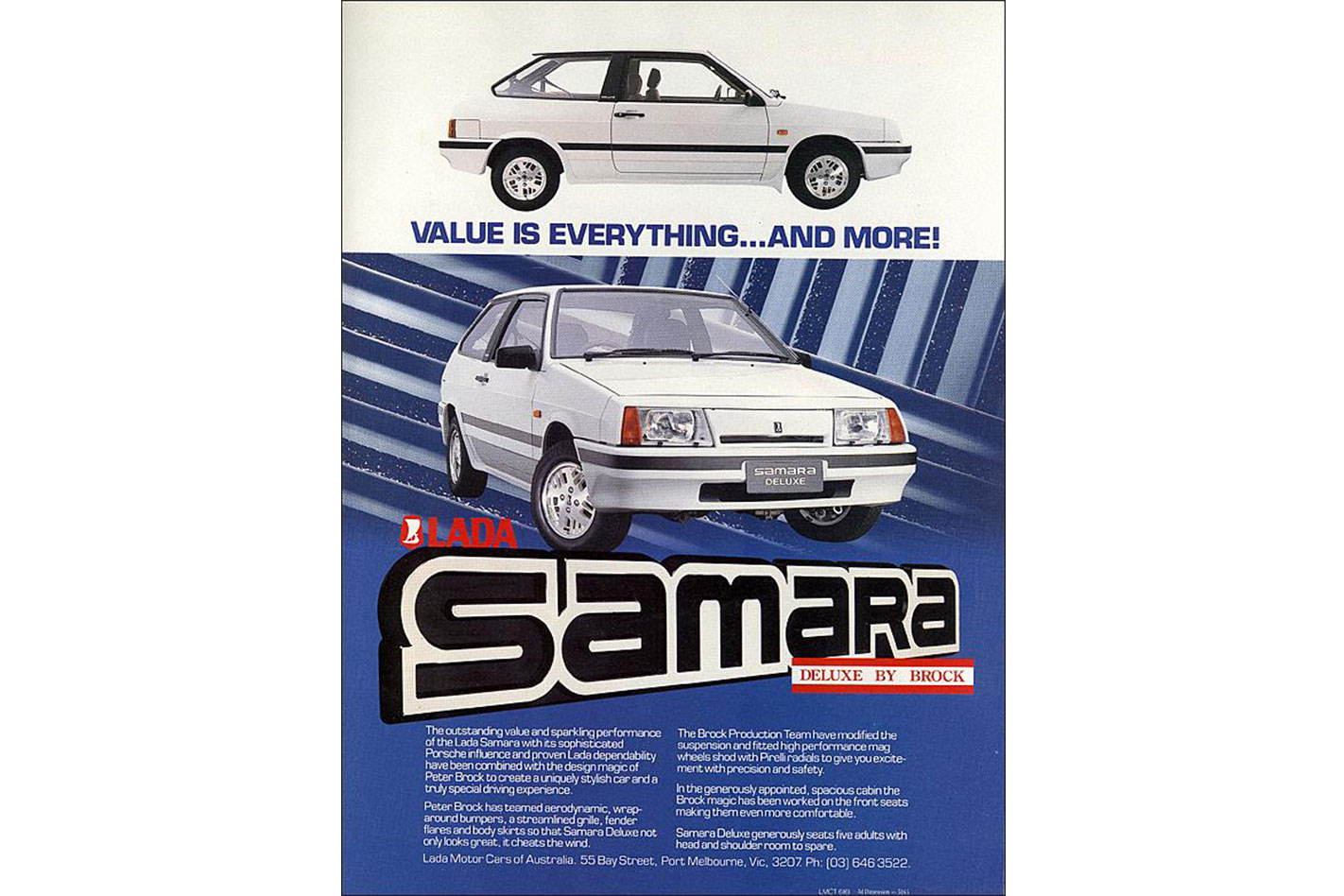
The other car I won’t be looking for on Gumtree in a hurry is a Lada Samara. In particular, the Brock Lada Samara. The standard car was awful; no question about it. But the Brock version had the smell of desperation about it, conceived as it was at a time when Peter Brock had just been cast out of the Holden family, HDT had imploded the same night and PB was keen (some would say too keen) to occupy his fertile mind and empty workshop.
BMW announced today it will build a faster, lighter, and more agile M3 and M4 with a new Competition Package it’s readied for the model.
Due to release this March, the Competition Package will raise the 3.0-litre twin-turbo inline-six’s power in all M3 and M4 variants from 317kW to 331kW.
Torque outputs remain at 550Nm, but BMW claims the newfound huff carves a tenth out of the car’s 0-100km/h sprint. A dual clutch equipped M3 sedan and M4 coupe are now claimed to hit triple figures in 4.0sec flat.
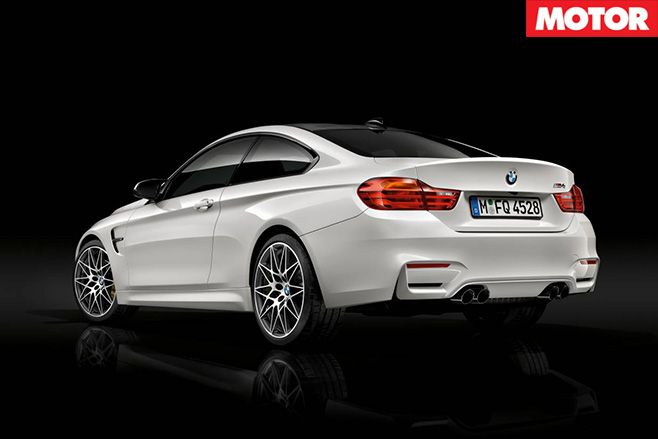
BMW’s pinched the gorgeous ‘666’ 20-inch wheels from the M4 GTS for the Competition Package. With them comes an extra 10mm in tyre width at the front and rear, now measuring 265mm up front and 285mm out back in the Competition Package.
‘New’ springs, adaptive dampers, and anti-roll bars are also said to have been used, and are complemented by a re-tuned stability system and M differential.
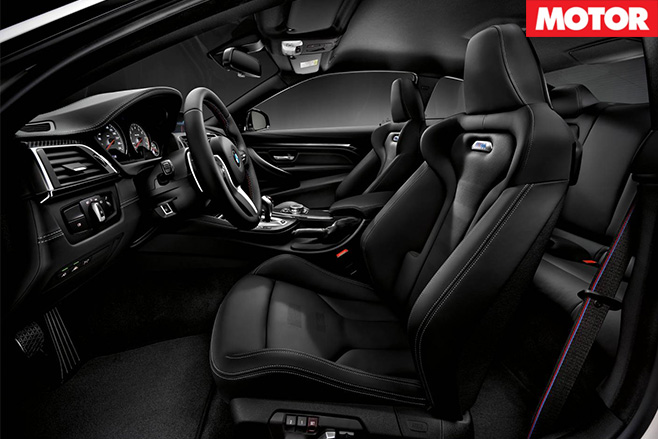
Style-wise BMW’s added ‘lightweight’ new seats, however whether they’ve ditched electric adjustment is not yet known. They’re matched to seatbelts streaked with thin stripes of the iconic M colours.
After the recent slash of the M3/M4’s price, we can imagine the competition package will help BMW offer a more premium variant for those discerning.
But as for how much more premium, BMW Oz is yet to say how much the Competition Package will add to the M3 and M4’s price, as while ‘very’ interested, it has not yet confirmed the pack for local cars.
MERCEDES-BENZ has Tesla in its sights. The German brand has confirmed it will launch its first all-electric model in 2018, tipped to be a large sedan to rival the likes of the Tesla Model S.
Likely to sit between its C-Class and E-Class in size, Benz’s first all-electric car will be have a range of 400-500km, will seat five, and will ride on a version of the company’s MRA (Modular Rear Architecture) platform.
Mercedes board members Dr Thomas Weber and Ola Kallenius confirmed to Wheels at the Detroit motor show that the first electric Mercedes-Benz would arrive in 2018.
Respected journalist Georg Kacher had previously reported that Mercedes planned to launch four electric cars in the near future – two sedans and two SUVs. However, Mercedes refused to speculate on other possible models.
Kallenius said the success of Tesla had accelerated Benz’s plans for full electric architecture.
“The case of Tesla shows there is an element of sexiness of the more higher segment of an electric car, so we made a decision to go into that as well,” he said. “In 2018 we will have a very exciting electric vehicle.”
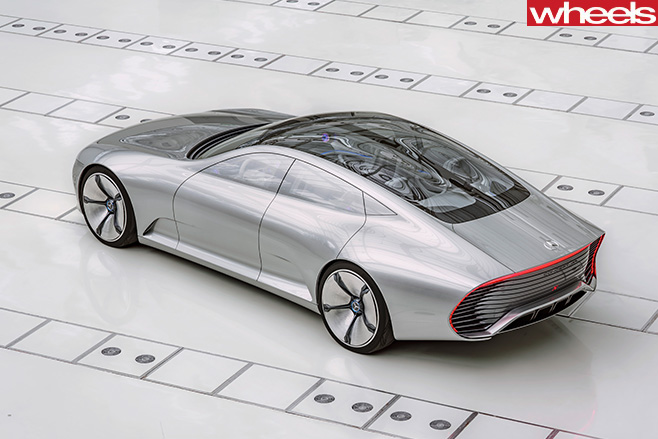
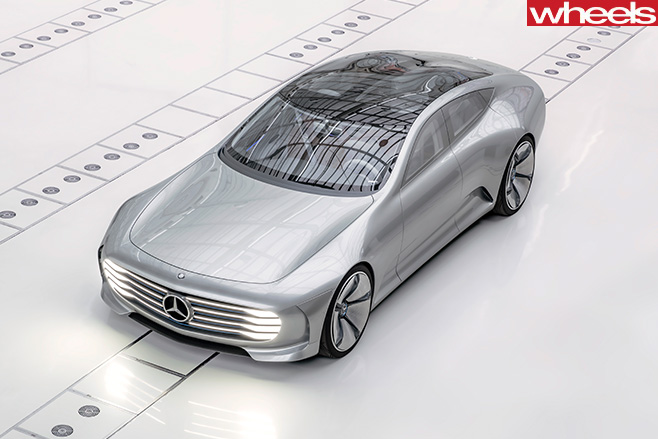
The electric Benz is expected to take design inspiration from the company’s Concept IAA, revealed at the Frankfurt motor show last year – and pictured on this page.
As for speed, Kallenius would not be drawn on whether the electric Benz would match the brutal performance of the Tesla Model S. With Ludicrous mode activated, the Tesla can hit 100km/h from rest in under 3.0sec.
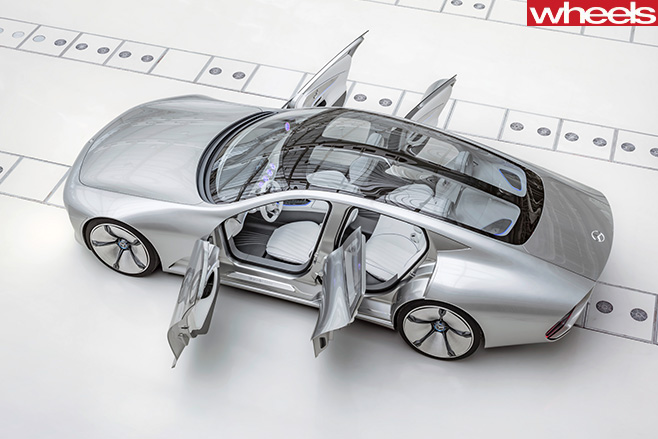
Kacher reports Benz is working on two electric drivetrains: one with a 300kW electric motor driving the rear axle, and a faster version with an extra motor propelling the front wheels.
But while Benz is pushing hard to bring an electric model to market, both Weber and Kallenius raised concerns about its volume and profitability.
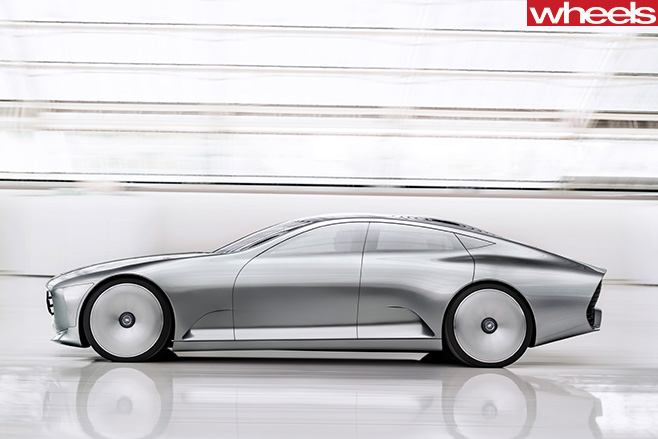
Weber added “On the EV side it seems to be hard to make money so far. The best example is Tesla. Overall their results from six years is not really favourable.”
Tesla built and delivered 50,580 cars in 2015, which is a drop in the ocean compared with the 1.87 million cars Mercedes sold over the same period.
No, sadly, it’s not the return to the WRC we all want but Subaru is channeling a bit of Volvo by entering a wagon in this year’s British Touring Car Championship.
The car will be run by Team BMR as part of a three-year deal and driven by former champions Jason Plato – who you might also know from his TV work on Fifth Gear – and Colin Turkington.
Subaru’s famed all-wheel drive system has been ditched, however, with race regulations forcing it to run in two-wheel drive and, happily, Team BMR has chosen the rears to do the dirty work.
Under the bonnet resides the 2.0-litre turbocharged flat-four with current BTCC racers punching out around 260kW.
The 2016 BTCC season kicks off at Brands Hatch on April 2-3.
The desire to go faster, be it on land or water, has been the reason for life and death for some.
Donald Campbell had broken the Water Speed Record (WSR) seven times before such compulsion – the same compulsion that drove Frenchman Gaston de Chasseloup-Laubat to the first ever Land Speed Record (LSR) of 39.245mph in 1898 – claimed his life.
At the time of his death, Donald Campbell left behind a legacy of seven successful WSR attempts, the title of being the only man to set the WSR and LSR in the same year, the first to officially break the 400mph barrier, and the record for the fastest LSR by a wheel-driven car.
One reason behind Donald Campbell’s success lay in his genes. His father Sir Malcolm Campbell had set the LSR nine times and the WSR four times during the golden age of record breaking in the 1920s and 1930s before passing away of natural causes in 1948, aged 63.
Three years prior to this incident, in 1964, he set five records in Australia. What more Donald Campbell had to prove to himself, his father, or the public, is difficult to imagine, as four of these records remain upheld to his day.
The WSR still belongs to Campbell, who travelled at 276.3mph across Western Australia’s Dumbleyung Lake. But it’s the LSR he set in July that year on South Australia’s Lake Eyre that captivates legend. It was an effort that, combined with the aforementioned WSR, made him the only man to do both in the same year, and it made Campbell the first to officially break the 400mph barrier and the last to hold the LSR in a wheel-driven car.
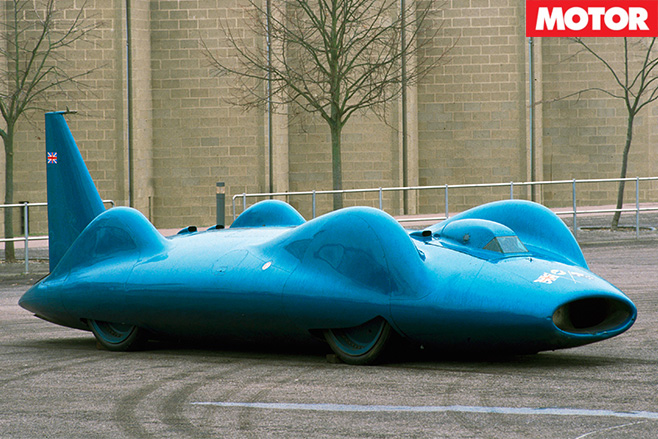
In 1960, on the Bonneville Salt Flats of Utah driving the Proteus Bluebird CN7, Campbell had a horrific crash at around 370mph. He was nearly killed, but as he recovered in his hospital bed he announced he would continue to try and achieve the holy grail of speed records. In effect, Bluebird and its 3016kW Bristol Siddeley gas turbine engine were totally rebuilt and included a massive trapezoidal tail fin to aid stability.
Campbell pencilled in 1962 as the year he would make his assault for the record, but due to unprecedented heavy rains on Lake Eyre everything was postponed 12 months. So in April, 1963, Campbell and his entourage descended on Muloorina, a homestead owned by Elliott Price and his family, which was to act as the base for the project.
Muloorina is some 750km north of Adelaide and an hour’s drive from the nearest town, the railhead at Marree. Lake Eyre is then a further hour’s hard drive over the desert track. There the Australian Army had been enlisted to construct a causeway on to the hard salt lake surface.
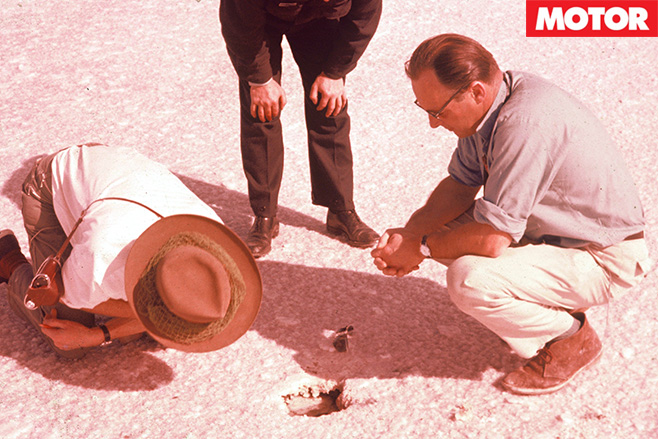
From April through to July, 1964, the Bluebird Project again encountered problems.
Campbell’s sponsors were getting flighty and, once again, the weather was against them. Constant rain reduced the salt’s hard surface to a soft slush and Bluebird’s driven wheels kept finding the muddy ooze below it.
Time and money were running out, and the endless delays started to wear down the resilience of everyone involved. Some even concluded Campbell was subconciously afraid to exceed the speed at which he had crashed four years previously.
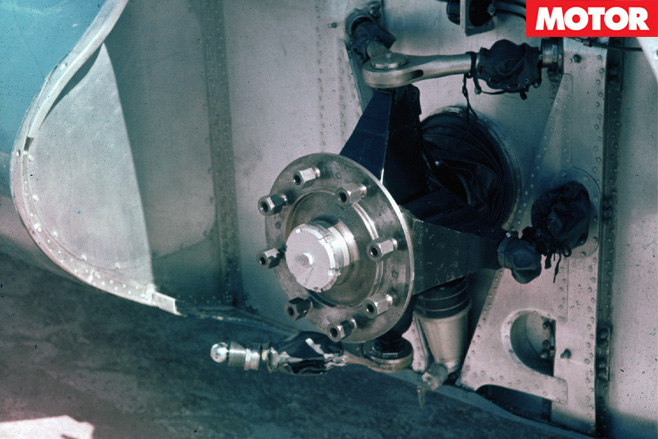
Campbell began to think the Lake was cursed, in line with the legend of the local indigenous Arabana people. And so interest shown by parties and advocates of the attempt, like Lex Davison and Bib Stillwell, slowly evaporated.
After everyone else had given up, Campbell alone continued to believe the record possible. He would set a new LSR or die trying, even though it seemed the entire attempt would expire like everything else in Lake Eyre’s harsh environs.
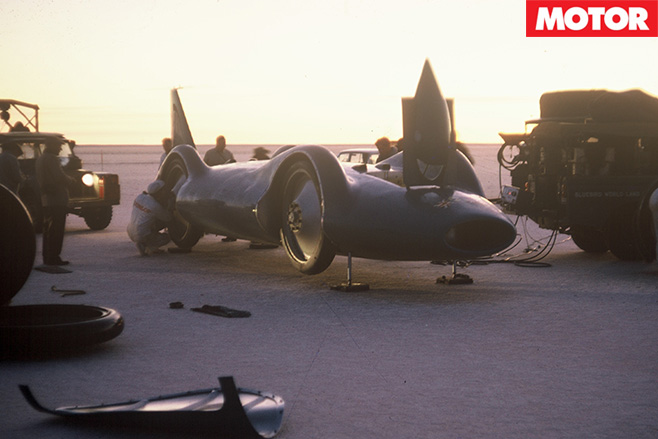
By the time Campbell broke the world LSR on Lake Eyre the Bluebird was already regarded as a dinosaur. The 1960s were the jet age and the age of space exploration.
His achievements, whilst acknowledged, were never regarded in the same light as those of his father and his contemporaries from the inter-war years, like Henry Segrave, JG Parry-Thomas, Ray Keech, George Eyston and John Cobb. All up it took Donald Campbell nine years – including the near fatal 1960 Bonneville attempt – before his success in Australia in 1964.
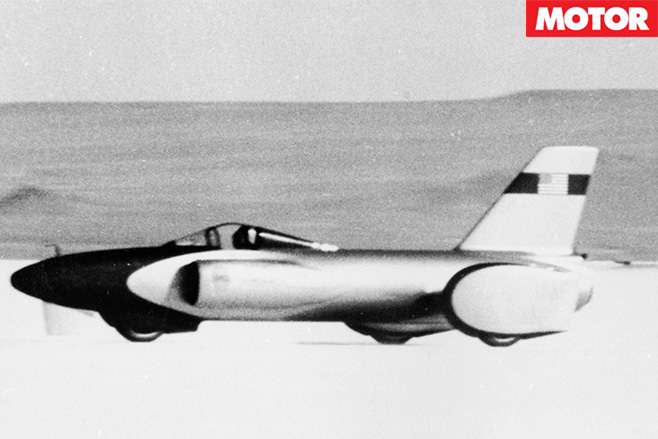
Campbell’s record was blown away in October, 1964, when the LSR record was broken five times by Americans Tom Green, Breedlove, and Art Arfons in the Green Monster, whose 536.710mph run put Campbell completely in the shade. The record was extended to 600.601mph by Breedlove the following year, before Garry Gabelich achieved 622.407mph in The Blue Flame five years later. This was beaten in 1983 with 633.468mph from Richard Noble’s Thrust 2.
Thrust 2’s ownership of the LSR record remained until September 1997 when Andy Green, an RAF squadron leader, went 714.144mph before he broke the sound barrier (Mach 1.0175) in Thrust SSC supersonic at 763.035mph. Green’s record remains standing but several syndicates around the world are looking to break the 1000mph barrier.
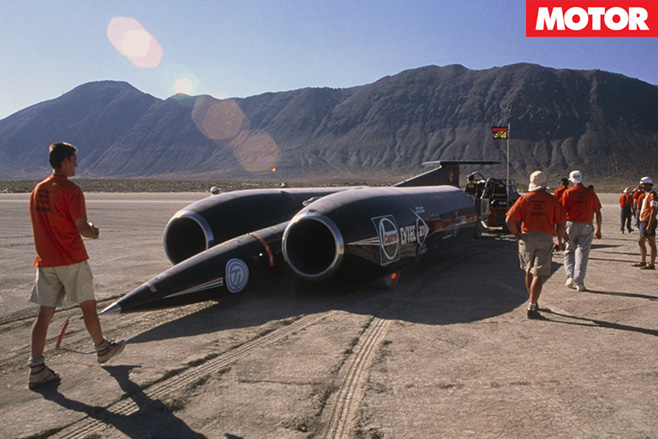
But the most promising candidate hails from Britain and the company that has held the LSR for 31 years. Bloodhound SSC is a project chasing something remarkable as it seeks to inspire a new generation with renewed enthusiasm for science, technology, engineering and mathematics.
With Andy Green on board the Bloodhound SSC weighs a whopping 7.5 tonnes and produces 100,669kW in what its makers describe as the ultimate jet- and rocket-powered car. That’s six times the power of a Formula 1 starting grid, so it’s no surprise the Bloodhound uses an F1 Cosworth engine just to power its fuel pump.
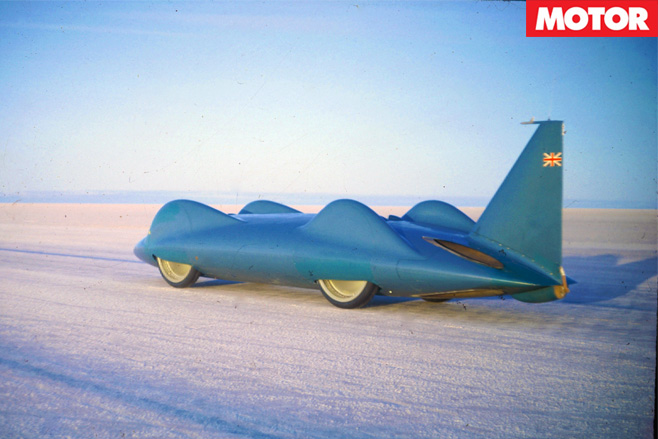
Wherever the attempt may be, the SSC will certainly leave its mark, and face its own unique and baffling challenges. If successful it will leave its imprint in record books and folklore, in hopes of lasting like the tracks Malcolm Campbell laid on South Africa’s Verneuk Salt Pan in 1929 with his Campbell-Napier Blue Bird. They’re still visible today.
COCKPIT Campbell’s office consisted of a large steering wheel, flanked by 10 dials, and two pedals, one for the brake, the other for the throttle
ENGINE The English-built Proteus 705 gas turbine engine produced 3016kW, but was making 3296kW on Bluebird’s record run
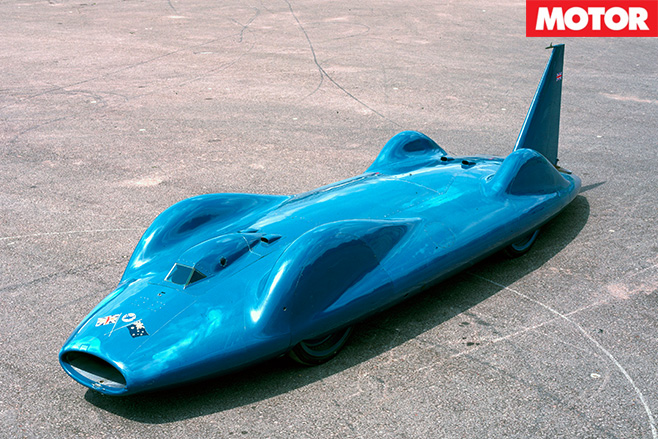
AERO After Campbell’s near-fatal accident on the salt flats of Bonneville, a large tail fin was added to improve stability
BODY Bluebird’s fuselage was constructed from aluminium. Sheeted, it measured 9m long and 1.5m high
TYRES Tyres were inflated with nitrogen to 100psi and mounted on 87kg steel wheels. Made by Dunlop, they were tested to 500mph
BRAKES In tandem with air flaps that spanned outwards from the rear, four disc brakes able to withstand 1200˚C were used
True Blue
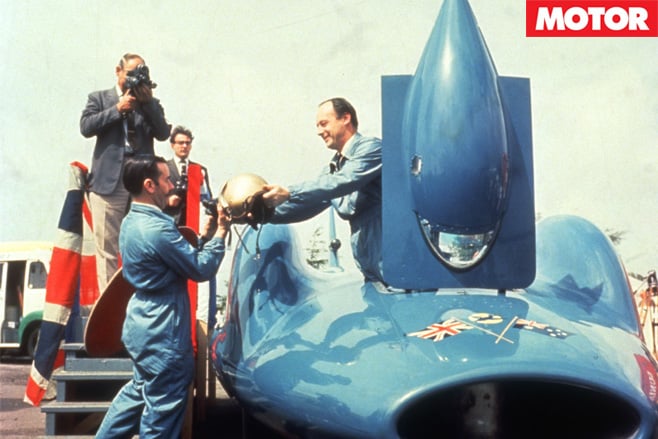
Both Jags wore the registration ‘DC 7’ and the colour of both cars was, of course, blue. The 150 carries that plate once again today, but of the whereabouts of the E-Type, sold by his widow, singer Tonia Bern, soon after his death, little is now known.
AUSTRALIA may have to wait up to seven years to get Hyundai’s Santa Cruz lifestyle utility, which Wheels revealed has been confirmed for production.
Wheels has learnt the significant development push and investment from Hyundai’s North American division almost certainly rules out any chances of the Santa Cruz being developed for right-hand-drive markets in its initial instalment, which could be as early as 2017.
While the Santa Cruz is ultimately being planned for export markets – “from our perspective it’s a vehicle that will be exported to other markets,” says Hyundai product planning vice-president Mike O’Brien – initially the ambitious Korean brand is keen to cement it in the US, where most sales will be made.
The prospects of a right-hand-drive model lie with a likely update around 2020 or – more likely – a second-generation Santa Cruz around 2023, at which time Hyundai hopes to have proven the concept and readied its development for a global market.
Additional development costs ensuring the Santa Cruz is suitable for a global market – including the significant cost of right-hand-drive models – mean the US will likely prioritise its home market.
Key to the concerns about making the Santa Cruz a ute for all markets from the get-go are its DNA and market positioning.
The Santa Cruz is a lifestyle ute that’s more about surfboards or mountain bikes than horse floats and gun racks. It’s designed to be friendly to drive on-road but with less space and a much lower load capacity than traditional American pick-up trucks.
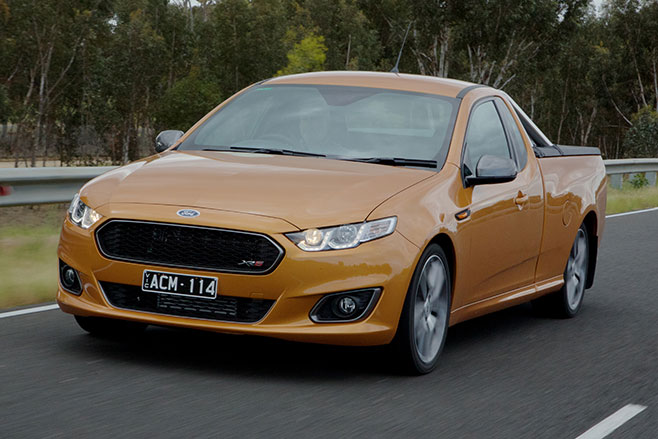
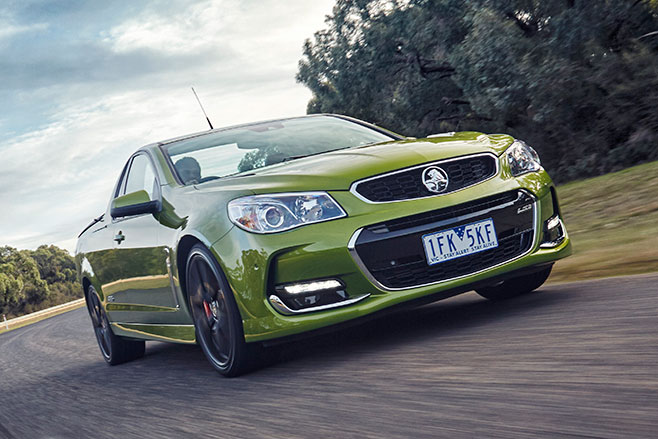
While the lifestyle ute concept is not new – Subaru previously offered the Outback-based Baja in America and locally we have the Holden Commodore and Ford Falcon – America has typically backed away from anything that isn’t big, brash and beefy when it comes to utes.
The Baja never got close to its sales targets and the Commodore Ute – also a stylish ute that’s more about driving enjoyment and lifestyle – has seen sales slide for more than a decade, with just 4936 sold in 2015, down from a high of 22,372 in 2004. Plans to export the Commodore to the US were also shelved as General Motors entered bankruptcy in 2008.
But O’Brien believes the Santa Cruz could start a trend towards lighter-duty utes that are more fuel-efficient and driver friendly.
“I can easily imagine the pickup market in the US bifurcating,” he says. “You can easily imagine in the future, true work trucks, heavy duty pickups. And the rest of the market, maybe they don’t need a vehicle to tow 5000 pounds (2.3 tonnes).”
Not that Hyundai is concerned about finding American buyers for the Santa Cruz.
“Fact is, there’s huge demand for a more affordable, open-bed utility product,” says O’Brien. “Not everybody’s hauling a gooseneck trailer with a head of cattle in it. Not everybody’s got a horse trailer. Not everybody’s hauling a thousand pounds of concrete. Some people just need the utility of an open bed.
“So we found out there’s this big market of people buying CUVs (crossover utility vehicles) that it’s not their first choice. They’re active people, kayakers, rock climbing, hiking, mountain bikers… They hate the idea that they put their dirty gear in the back seat of the SUV where the child seat goes Monday morning.
“At the same time, they seek something that works in their urban lifestyle, that’s easier to park, that’s easy on fuel economy, and they want something with a sportier image.”
O’Brien also highlighted women as a key target market for the Santa Cruz.
“Most market segments in the United States are split fairly evenly male-to-female, within a 10 percent range, except pickup trucks and supercars.
“Pickup trucks are 80 percent male buyers. It seems silly, doesn’t it, because men and women have the same needs. You want to go pick up a piece of furniture, Home Depot, etc, it’s not just men that do that. Women generally find maneuvering pickups too much, too hard to see out the sides, the back, and so women tend to avoid them.”
Younger buyers, too, will be on the Santa Cruz hit list.
“There’s this completely untapped market for millennials looking for something more than a CUV. They don’t need a full-size pickup and they don’t need the [fuel consumption] that goes with it.
“Most buyers, they just like the feeling of extra durability that comes with the extra ground clearance and bigger wheels. They like the command seating position. They don’t need body on frame.
“The Santa Cruz, I really believe that there’s a market that’s unmet at this moment.”
O’Brien wouldn’t be drawn on production details but admitted the Santa Cruz would likely run down a US production line, avoiding the 25 percent “chicken tax” applied to imported pickups.
While the original concept was based on the larger Santa Fe, the production car will use both the the mid-size Tucson SUV platform and drivetrains.
“Quite frankly we’re trying to do platform sharing to be a little clever with it,” says O’Brien. “To deliver a price but also deliver the potential for manufacturing flexibility.”
