
These three hatchbacks hit the sweet spot. But have Corolla and Focus improved enough to reel in the mighty Golf?
Can’t wait to see the final scores? Jump to the verdict now.
SCIENTISTS first coined the term ‘The Goldilocks Zone’ to describe the narrow distance band from a sun that can support life. Not too hot, not too cold, all that stuff. In our solar system, Earth is pretty much it. Let’s care more for her.
Similarly, the Golf class, as the C-segment is often described, has long been the car industry’s sustainable sweet spot, with the Volkswagen, Ford Focus and Toyota Corolla regularly duking it out for global best-selling honours.
Australia, of course, is no exception, though it’s the Corolla and Mazda 3 that battle for number-one status. Small cars rule, while their similarly sized SUV offshoots (the RAV4 and CX-5 respectively) back them up for outright popularity.
More power to Ford
Coincidentally, the Corolla, Golf and Focus have all undergone change during 2015, prompting this shootout. Does this market’s perennial underdog Ford have what it takes to challenge the class benchmark Volkswagen and the best seller Toyota?
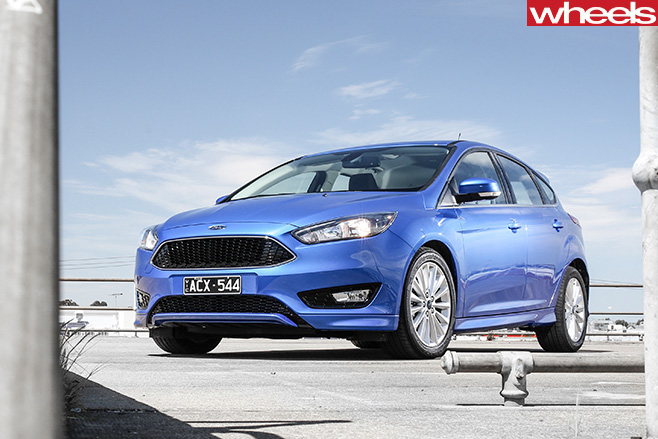
The results make it the most powerful mainstream small car in history. The sweet but toothless old 92kW/159Nm 1.6-litre base and mainstay 125kW/202Nm 2.0-litre GDi atmo units have given way to a 132kW/240Nm 1.5-litre ‘Ecoboost’ turbo tearaway, driving the front wheels via a six-speed manual or six-speed torque-converter auto. Both the problematic dual-clutch and the diesel have been binned.
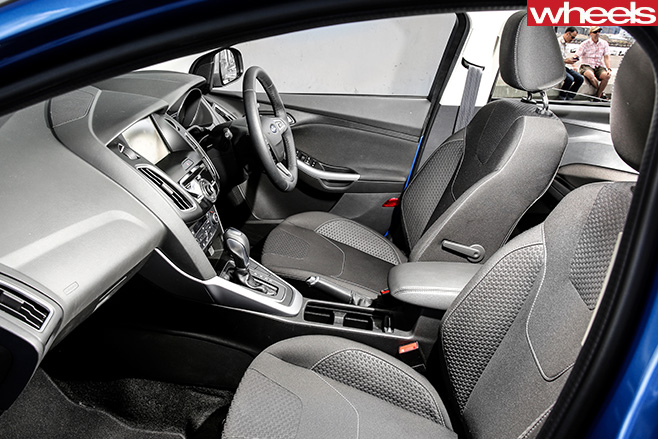
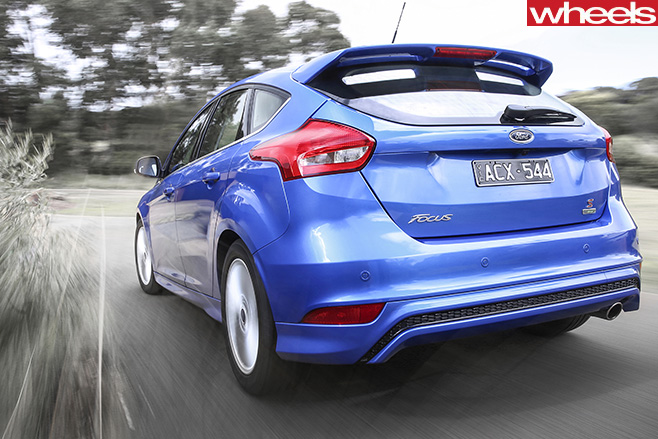
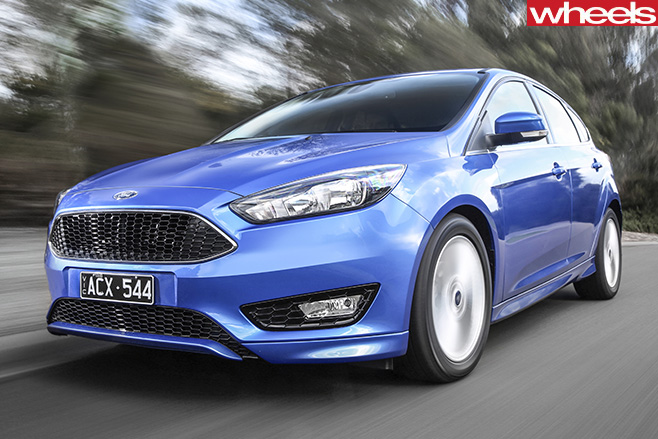
We’ve gone for the $27,490 Sport auto, which also brings to the table a bodykit, 17-inch alloys, “sports tuned” suspension, dual-zone climate control, keyless entry and start, folding mirrors, auto headlights and wipers, a ritzier lighting pack, a leather steering wheel, and this group’s only DAB+ digital radio. Three cheers for the grandson of Laser TX3.
Luck, for a change, is on Ford’s side. No stranger to controversy of late, Volkswagen is embroiled in a global diesel emissions cheating scandal that not only tarnishes the Golf but also threatens to derail the German giant. Mistrust hangs over our 2013 Car of the Year winner like the fumes from the brand’s so-called Clean Diesel TDIs. In which case, there’s never been a better time for rivals to capitalise on Wolfsburg’s monumental mistake.
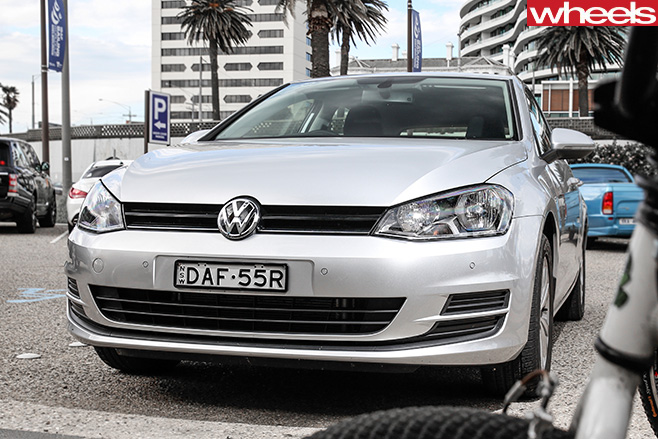
Of the trio, only the Golf also offers a range of driver-assist safety options such as Autonomous Emergency Braking (AEB) at our sub-$30K price point, further underlining Volkswagen’s tech savvy.
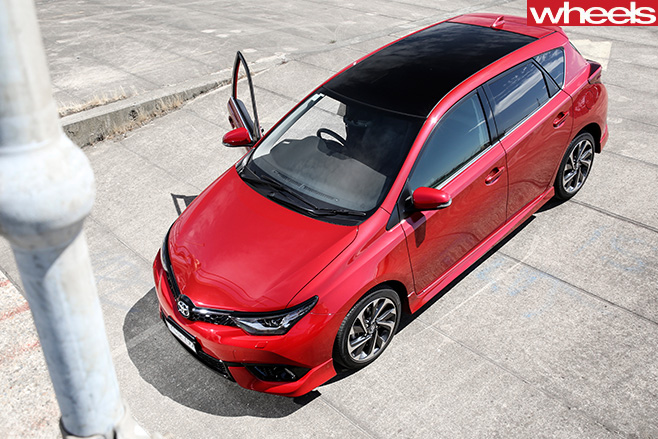
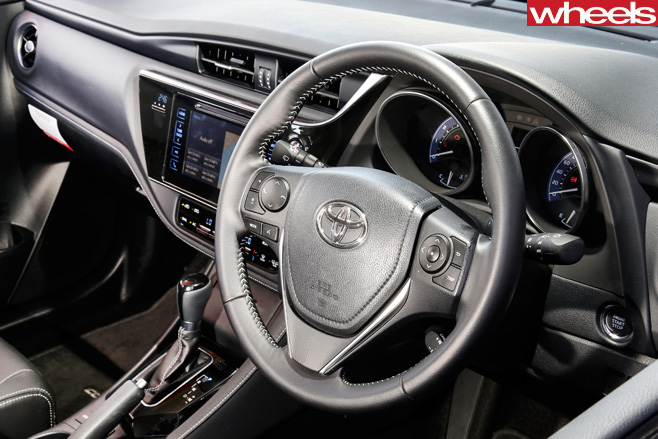
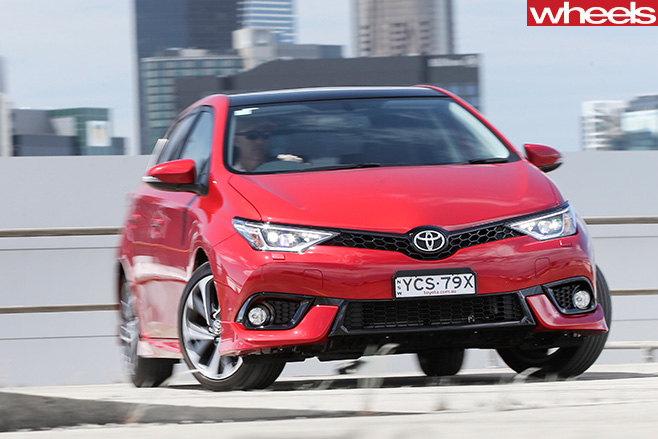
Toyota released the revised Corolla in June, springing a surprisingly effective nose and tail-light update on the three-year-old 11th-gen series, while also introducing a reshaped dash, prerequisite multimedia spruce with camera, smarter instrument dials, revisions to the steering and suspension, increased quietness, and an overhauled Continuously Variable Transmission promising handy fuel consumption cuts.
A tale of three autos
That’s right, folks – with CVT, dual-clutch and torque-converter trannies here, this is as much a test of small automatics as anything else.
Predictably, in this downsized turbo company the Toyota feels dated. The 2ZR-FE twin-cammer is tuned to feel terrifically responsive off the mark, with a fast and flowing torque delivery across most urban speeds, accompanied by a typically ultra-smooth CVT action. At 100km/h the tacho is barely touching 2000rpm. If only taxi journeys were this effortless.
At freeway overtaking speeds, Corolla’s engine starts to run out of puff (and refinement) as the others are streaking away. The numbers say it all. Ten-dead was the best we could coax to 100km/h, while 17.3sec to 400 metres is a whole second behind the hard-charging Focus. As with the rest of the group, the trannie shifts up even in manual mode, making the paddles seem a waste when the CVT is always calling the shots.
On paper, you’d expect the Focus’s 40kW and 40Nm advantage to obliterate the 92kW/200Nm Golf, but a 150kg weight penalty almost evens things up. We wonder how the Wolfsburg Kid would’ve fared with more than its barely run-in 1100km on the odo, against the Ford’s 5000km.
Rawer and rortier than either of its rivals at take-off, the latter’s lauded Ecoboost 1.5 charges energetically up through the gears. While the Focus seems faster and more frenetic than its disappointing 8.8sec 0-100km/h result suggests, a slight yet persistent gruffness does take the shine off its appeal somewhat. And that thumb-operated manual gearshift toggle feels as alien as ever to operate. Lose it, Ford.
Poise, discipline and composure
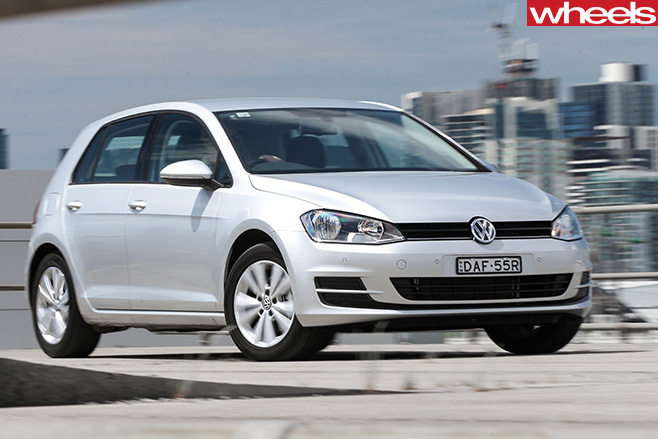
It also sets the handling and ride benchmarks, with consistent, precise and responsive steering that manages to skilfully filter out unwanted feedback without sacrificing feel. Backed up by an eager and agile chassis, the Golf corners with cracking poise and control, soaking up bumps with exceptional quietness (though the tyres are 16s compared to the 17s of the others). It’s an ultra-composed handler that never puts a single foot wrong dynamically.
And the Corolla? Aided by a set of quality Michelin 215/45R17 tyres, the ZR proves surprisingly fluid and flat in its handling composure, carving through corners in a safe and predictable manner. But there is a detached, steering-by-numbers sense to the Toyota’s dynamic dialogue, so you don’t ever feel as connected to the experience. And if the bitumen starts to deteriorate, so does Corolla’s comfort, with the ride becoming fidgety and unsettled, accompanied by plenty of road noise intrusion.
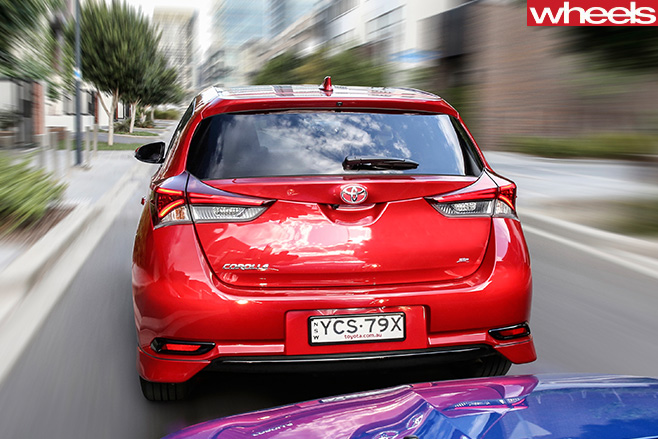
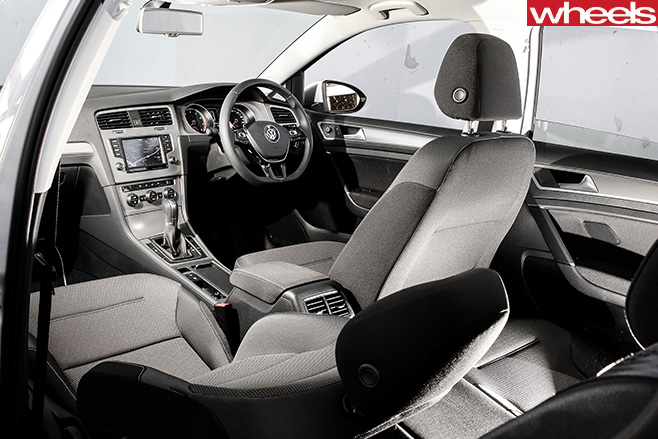
The rather funky Corolla, in contrast, is proudly Japanese-modern, simple to navigate and quite appealing from the front seat, but – like the spacious Ford – not in the Golf class as far as rear-seat accommodation is concerned. All have large and practical boots, with low loading lips, but only the Corolla includes a full-size 17-inch spare.
Is this as good as it gets?
Despite all the controversy surrounding Volkswagen, the Golf 92TSI Comfortline easily remains at the top of its game, perhaps the best all-round new-car buy in the world today. Three years on from its international launch, the Mk7 is still astoundingly complete, and remarkable value for money.
The facelifted Focus is a fine effort, with pricing and positioning reflecting Ford’s desperation to become relevant to Australian consumers again. What it lacks in polish is more than made up for in performance, dynamics, comfort, equipment levels, personality and charm. It has probably the best automatic gearbox from a long-term ownership proposition, but the LZ Focus is heavy, relatively thirsty and feels like it has merely caught up with the previous-gen Golf VI, rather than eclipsing the Golf VII.
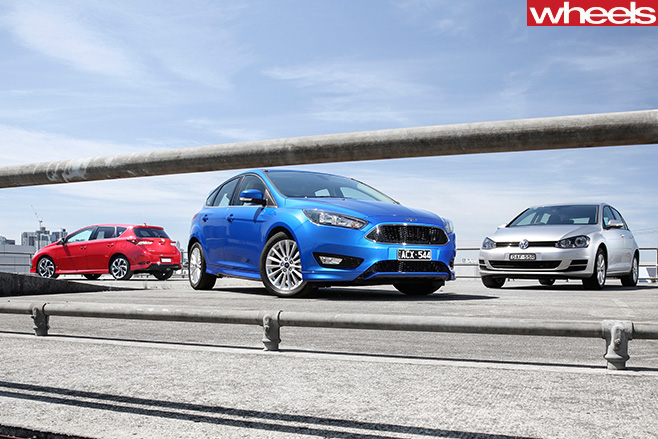
The latest Focus really is a cracker, though. Volkswagen, Toyota and others… you are on notice. Yet, despite the Ford’s driver appeal, Golf remains the small-car sweet spot.
Class of ’76
EVEN though several generations separate them, we reckon the Golf LS, Escort XL and Corolla SE of 1976 would have finished in about the same order as their descendents. The 55kW 1.6-litre VW cost $4358 ($25,600 today), the 48kW 1.3-litre Ford was $4015 and the 54kW 1.2-litre Toyota set you back $3779. All had four-speed manuals, but offered a three-speed auto for around $380 ($2230) more. Escort and Corolla were rear-drive, Golf FWD.
Verdict
 VOLKSWAGEN GOLF COMFORTLINE
Price as tested: $28,490 *Includes metallic paint ($500)
NCAP rating: 5 stars (Aus)
Fuel economy: 8.1L/100km (test average)
Acceleration: 0-100km/h: 9.1sec (tested)
Plus: Refinement; efficiency; performance; handling; ride; quality; packaging
Minus: Some DSG lag; no voice control; slightly underdamped fully loaded
Verdict: 9.0/10
 FORD FOCUS SPORT
Price as tested: $27,940 *Includes metallic paint ($450)
NCAP rating: 5 stars (Aus)
Fuel economy: 10.0L/100km (test average)
Acceleration: 0-100km/h: 8.8sec (tested)
Plus: Strong performance; sharp handling; comfy ride; warm-hatch feel
Minus: Thirsty; rear seat comfort issues; no driver-aid safety availability
Verdict: 8.0/10
 TOYOTA COROLLA ZR
Price as tested: $30,940 * Includes metallic paint ($450) and ‘Skyview’ glass roof ($1500)
NCAP rating: 5 stars (Aus)
Fuel economy: 8.5L/100km (test average)
Acceleration: 0-100km/h: 10.0sec (tested)
Plus: Ease and efficiency; improved interior quality; urban zip; reliability; resale
Minus: Firm ride; loud engine; flat front seats; short service intervals
Verdict: 6.5/10
It’s always nice to see old racecars rolled out of the museum and onto the track for a blast, for old times’ sake.
This time it was the 1999 Japan Grand Touring Championship-winning R34 Nissan Skyline GT-R, driven back then by French racer Erik Comas in the big boys’ GT500 class.
Anyone who’s ever played Gran Turismo will immediately recognise the legendary yellow and black livery of the Pennzoil GT-R.
Powered by a 2.7-litre racing version of Nissan’s RB26 straight-six, the 1200kg Pennzoil GT-R sent its 367kW to the rear wheels via a six-speed sequential gearbox. Bit different to the 206kW (or 243kW, depending on who you ask) all-wheel drive road car.
The car was rolled out at the 2014 Nismo Festival on November 30, but as this year’s Festival approaches (this Sunday) Nissan has only just released the footage.
Even with Nissan factory driver, 34-year-old Alex Buncombe, behind the wheel, it looked a bit of a handful around the damp Fuji Speedway track on cold tyres.
It was Buncombe’s first time in the car and you’re watching his first-ever flyer. Enjoy.
It’s a familiar tale to anyone brought up on a diet of clichéd martial arts movies.
This story was originally published in our July 2014 issue
The young upstart, full of hope and dreaming of a better life, bursts onto the scene, vanquishing all before him (it’s always a ‘him’) until the final showdown with the Grand Master, at which point there’s usually either a humbling defeat or an against-all-odds victory.
The ProCeed GT’s impressive showing against its obvious rivals made it clear we needed to cast further afield for some true competition. And while another boosted hot hatch, such as Renault’s new Sport Clio, might have made a little more sense, we could think of no tougher test than the sensei of the affordable performance car scene, the Toyota 86.
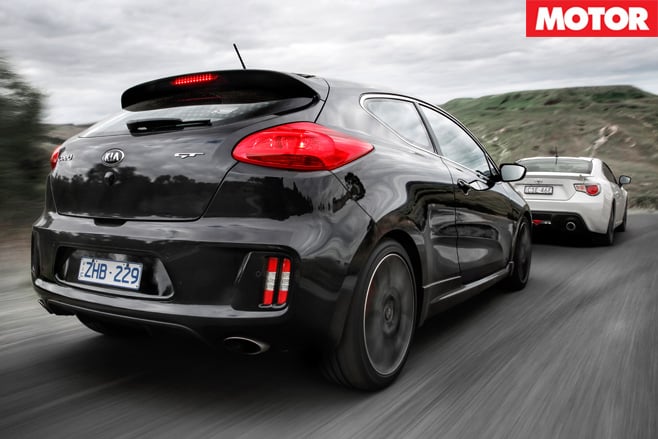
In contrast, the Kia’s driving position, which felt so low-slung and sporty in the context of its hatch rivals, suddenly feels a bit high and remote. The sensation fades after only a short time at the helm, but it’s a stark reminder the ProCeed has moved up a division.
Thanks to a twin-scroll turbo feeding air into the direct-injected 1.6-litre four, Korea’s new hero should at least have no trouble matching its Japanese foe in a straight line. Max torque of 265Nm is generated from just 1750rpm, so with peak power of 150kW arriving at 6000rpm, the ProCeed effectively has a 5000rpm powerband to play with.
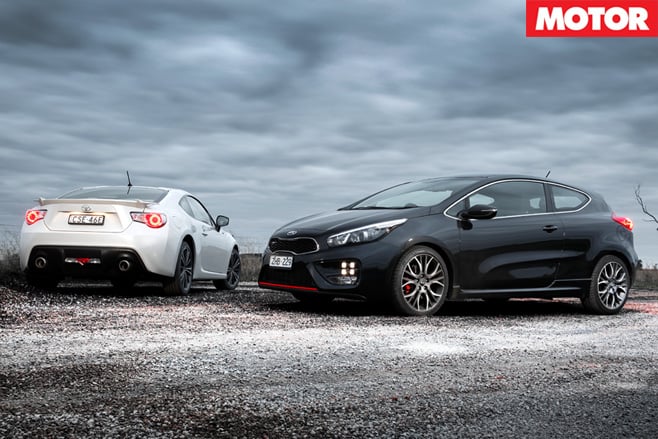
Having clocked 7.45sec to 100km/h and 15.34sec for the quarter mile in the five-hatch comparison, it should come as no surprise the Kia manages 7.47sec and 15.37sec this time around. It sure surprises us, though, thanks to heavy rain at the test track.
Despite the slippery conditions, it shoots off the line and actually records a higher terminal speed (149.36km/h) than in the dry (148.26km/h). Why? No idea, but with another 1500km on the clock since the last test, it’s possible the engine has freed up a bit.
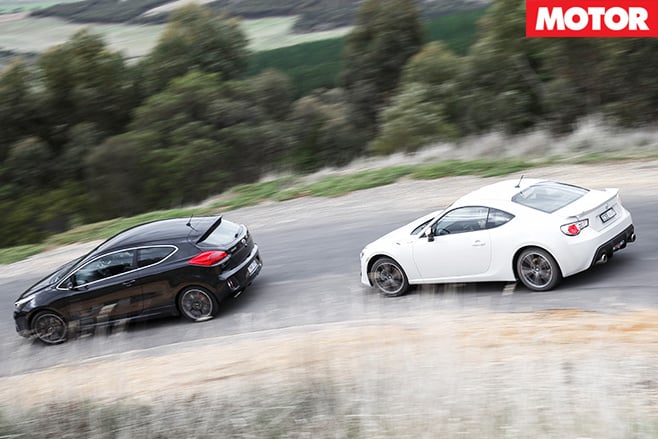
We’ve seen 6.9sec and 14.9sec from the Toybaru twins before, but the best it can muster today is 7.91sec to 0-100km/h and a 15.65sec 0-400m at 147.80km/h. And don’t point your finger at the wet surface. The 86 launches just fine, leading the Kia to 30km/h, but after that it just runs out of puff.
What’s more disappointing than the Toyota’s numbers is the way it delivers them. The 2.0-litre boxer has a strangely lumpy power curve, with an early burp of torque, then a hollow, lifeless mid-range before picking up again above 5000rpm. Its lack of punch is most obvious in its 80-120km/h times, the Kia’s 0.8sec advantage in third gear (4.6 vs 5.4sec) stretching to a substantial 4.1sec (9.0 vs 13.1sec) in sixth.
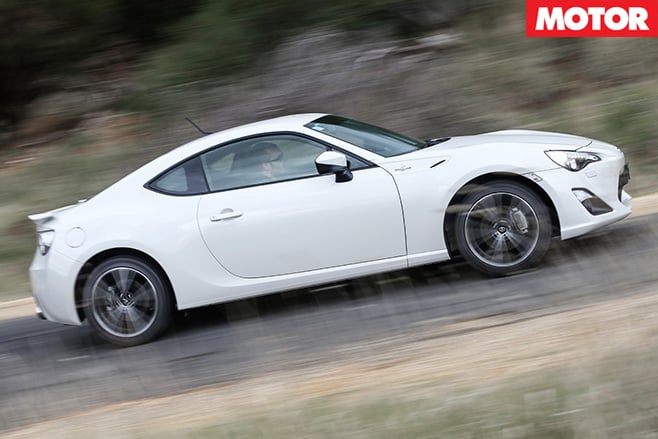
The 86 sounds okay, too, though when the tacho needle is kissing 7400rpm, it’s hardly the noise you’d get from something perhaps VTEC.
Of course, straight-line performance was last on Toyota’s list of priorities when developing the 86. As soon as the road begins to sweep and swoop, the rear-drive sportster comes alive. The electrically-assisted steering is perfect in its weight and response, feeding a clear stream of information to your fingertips about exactly how much grip is left in the front tyres.
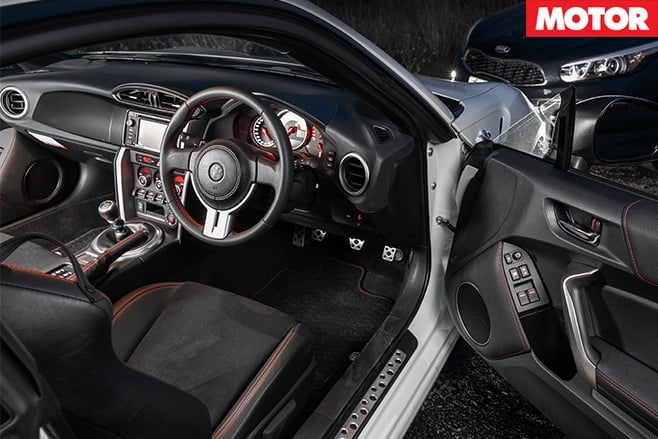
But can it actually be disabled? The presence of a yellow flashing light even with the systems off suggests not, but following further, highly scientific investigation at the test track – driving it on the lock stops – it appears ESP will subtly interrupt as soon as the car starts to slide, but drive through it and the electronics will leave you alone. Seems the wrong way around, but there you go.
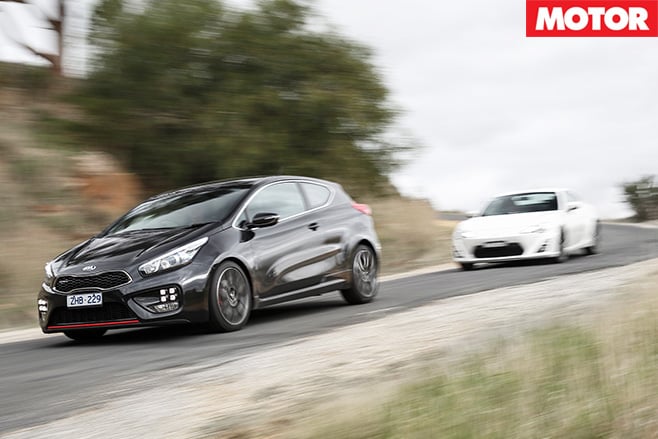
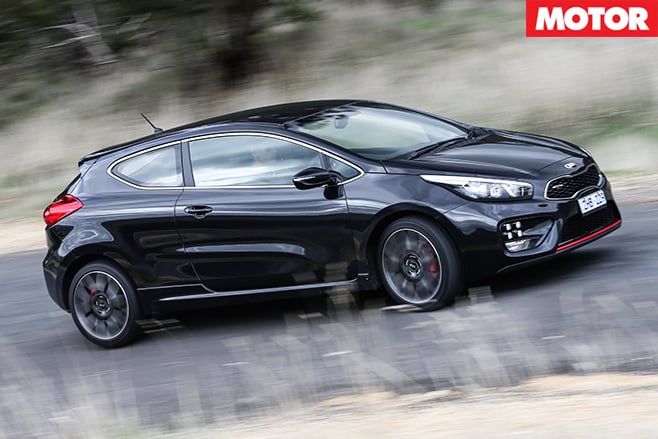
It is faster though, gaining ground not just on the straights but also under brakes and in the corners, too. It’s more planted, skipping around less than the Toyota on bumpy roads, and thanks to those grippy Michelin Pilot Sport 3s, the Kia digs into the surface yet still shuffles around enough to make you feel like you’re making a difference.
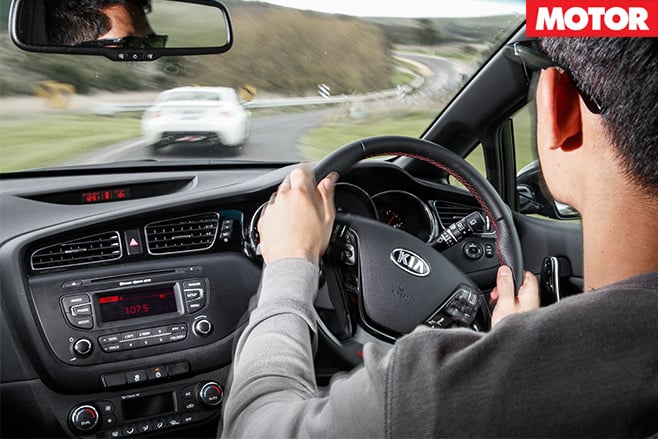
However, when it comes to the crunch, what costs the Kia most is while the 86 gets better the harder you drive it, the ProCeed starts to get scrappy. At its limit the front begins to wash wide as the inside front tyre struggles for traction.
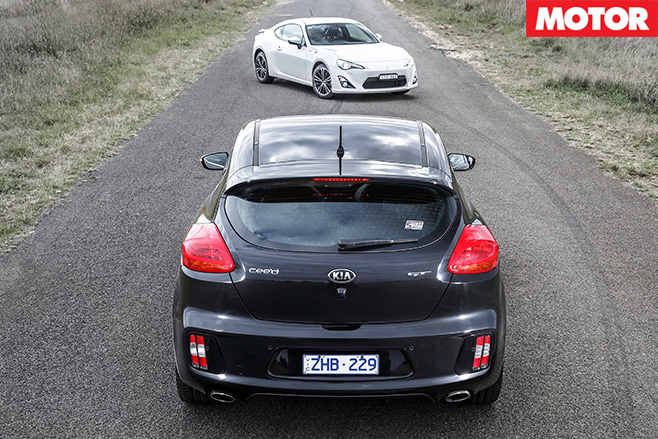
What’s even more amazing is we’re comparing a $30K Kia with a $35K Toyota and would be happy to drive away in either.
Supercars… who needs ’em?
Kia ProCeed GT
Engine: 1591cc inline-4, DOHC, 16v, turbocharger Power: 150kW @ 6000rpm Torque: 265Nm @ 1750-4500rpm Weight: 1373kg 0-100km/h: 7.47sec (tested*) 0-400m: 15.37sec @ 149.36km/h (tested*) 100km/h-0: 37.7m (tested*) Price: $30,585 (as tested)
4 out of 5 stars
Toyota 86 GTS
Engine: 1998cc flat-4, DOHC, 16v Power: 147kW @ 7000rpm Torque: 205Nm @ 6400rpm Weight: 1275kg 0-100km/h: 7.91sec (tested*) 0-400m: 15.65sec @ 147.80km/h (tested*) 100km/h-0: 37.9m (tested*) Price: $35,990
4.5 out of 5 stars
The plan was simple: “I’ll organise the finance, it’s your job to buy the car,” my wife told me.
In theory, it sounded like a great scheme. I could do the ‘manly’ thing of selecting the new car but the job was to find something that could deal with school drop-offs; handle Saturday morning sport shuttling with extra teammates along for the ride; have room to include the Labrador for beach trips without him sitting on top of the kids; and enough space for longer road trips to visit far-flung relatives.
I needed to find a car my wife could drive daily, and I would get to share it on weekends. So, it turns out I wasn’t really looking for something that would reinforce my manliness after all.
We’ve got three kids and we’re not planning on adding to the mob (I’ve had my first consult for the procedure that will make sure of that). So while we’re not growing in number, our kids are starting to grow up. At eight, nearly six and four, it won’t be long before all three will be at school full time; surely the day they stop spilling everything all over the car will arrive soon as well?
In the meantime, a dark leather interior trim was a high priority – wiping up spills seems more practical than rubbing it in.
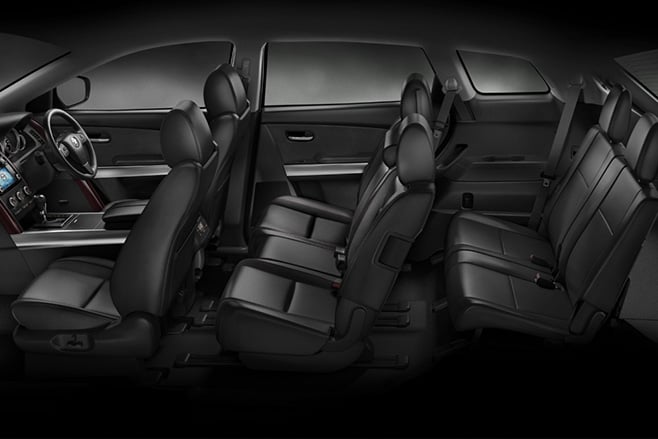
I was also keen on good fuel economy but wasn’t really excited by the ‘drives like a diesel truck’ experience. The need for seven seats was clear, but minivans and serious four wheel drives weren’t in the mix.
I also decided I didn’t want the same car my father-in-law has in his driveway, so that was one popular diesel SUV ruled out straight away (hence my ‘drives like a diesel truck’ comment). I probably could have tested something petrol, but that didn’t combat the appearance. It was out.
My wife also had one request. No minivans.
It seems Fiat understood my pain. “It’s the family car for those who don’t want to be just like everyone else” was the line that caught my attention for the Freemont, and I was interested. A mate had already bought one and bragged about the space and clever storage options. But then I tuned in to a Facebook conversation from a car-nut friend with a different opinion, and suddenly confusion set in. If you spend too long looking at the opinions offered via social media, it’s pretty easy to get lost in the to-and-fro of positives and negatives. Apparently, everything is complete rubbish and truly awesome at the same time. Slowly, one by one, I was ticking SUVs off the list.

Next came the second-guessing. Kia seemed to get good reviews, but was the Sorento big enough? What was Mitsubishi doing again? And still hanging around in the background was the Ford Territory (perhaps even the diesel model to satisfy my desire for some semblance of fuel economy).
But was there anything else I should have been looking at? For a week or two I tried to convince myself something more compact would work, so the Nissan X-Trail with a seven seat option got a look in.
But the boot space with the third-row seats up just didn’t cut it. I was getting desperate and started to think outside the box… what about an old Mercedes E-Class wagon? Reality check: service costs and settling for a much older model meant a quick budget blow-out. Next.
A bit of online research (on WhichCar of course), and a flick through a few comparisons and car reviews finally lead to a refined wish list: easy transition between a huge boot and a third row of seats; leather trim; a responsive and enjoyable driving experience; and decent fuel economy (with complete understanding we’re not comparing it with a Toyota Yaris).
Two cars ticked all the boxes – Toyota Kluger and Nissan Pathfinder.
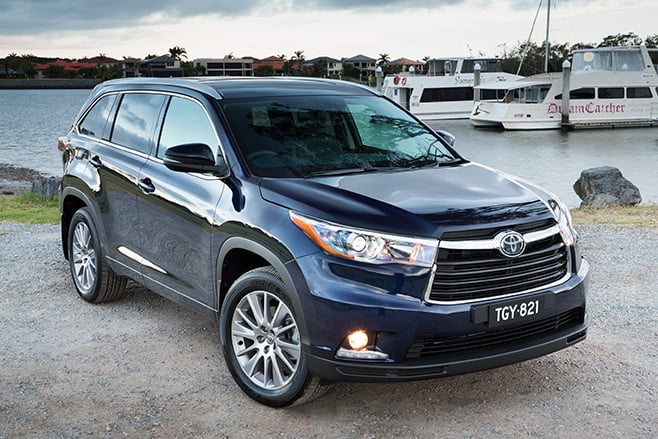
The only box that wasn’t ticked was price. The budget had been stretched out from my extremely optimistic $30,000, to a still-short-of-buying-a-new-version-of-either-option $45,000 (which also hoped for a $1000 trade-in for a Ford Focus my wife bought brand new when she finished uni more than 10 years ago).
The base models we could afford didn’t come with the leather interior we were hoping for. At this point I did what any husband would do. I gave up.
Only joking. It was time to talk to the local dealers.
I went to Nissan first. It was a good experience. I took a mid-range Pathfinder for a drive, one with the desired leather trim. I took the car home to make sure it would fit into our garage and was surprised with the result – the car clearly felt a lot bigger inside that it actually was. It was fractionally wider than the large sedan we already had, but not noticeably longer.
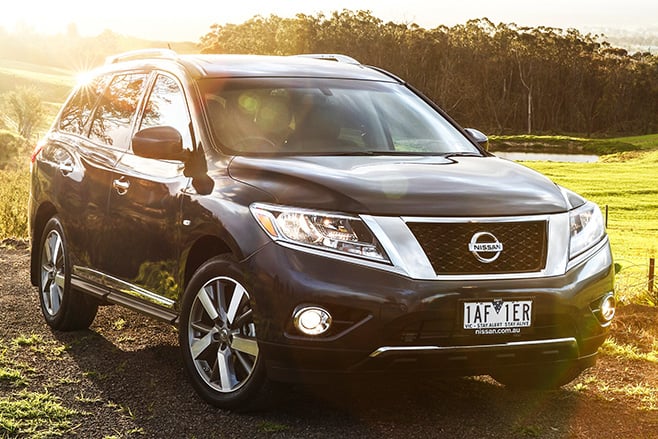
I returned the Pathfinder to the dealership and opened up about my budget. There were options for low-kilometer, mid-range models that could be doable if we waited for the right one to arrive. I tried hard not to show any emotion and drove down the road to a Toyota dealer to check out the Kluger. Pretty quickly the current model with leather trim was ruled out on price. There were options of a previous model Grande (top model with all the bells and whistles) but those in the price range were older and had a lot more kays on the clock than I really wanted.
So, the path to finding the right car for us took us back to Nissan. In mid-November the old Ford Focus was traded for a silver Nissan Pathfinder ST-L that had done 16,000km. I got a great deal on a tow-bar and we still came in below our budget. We’re all happy with it – our eldest even gave it 10-out-of-10.
I’m really happy with the way it drives, both in and out of the supermarkets car park, through the school ‘kiss and drop’ and out on the highway. It’s still too clean for me to even think about loading the Labrador in the back for a trip to the beach. But the three kids will have that problem sorted out soon, no doubt.
We’d all love an HSV, AMG or 911 in the driveway, but the realities of life, or budget, often mean settling for something further down the food chain.
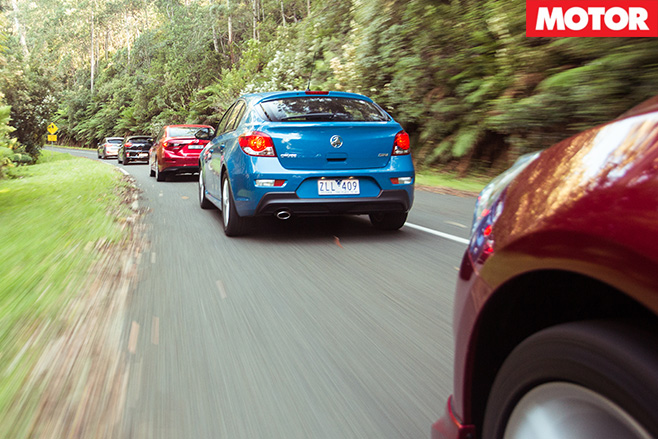
That’s no excuse for abandoning the enthusiast church, of course. Quite a few manufacturers now offer warmed-up versions of their humble hatchbacks, so we’ve gathered together five examples (okay, one’s a sedan) to find out if any are able to serve up champagne motoring on a beer budget.
Some unfamiliar names, at least to the pages of MOTOR, pop up at this end of the market. Hyundai and, in particular, Kia, are in their infancy when it comes to performance metal, and each is taking a different approach.
How times change.
Joining these two Seoul mates is another car with a strong Korean connection, the Holden Cruze SRi. Primarily designed and engineered by GM Daewoo in South Korea, the global reach of Holden’s locally-assembled hatch allows it to be offered for a bargain basement $23,140. Cheap and cheerful? We’ll see.
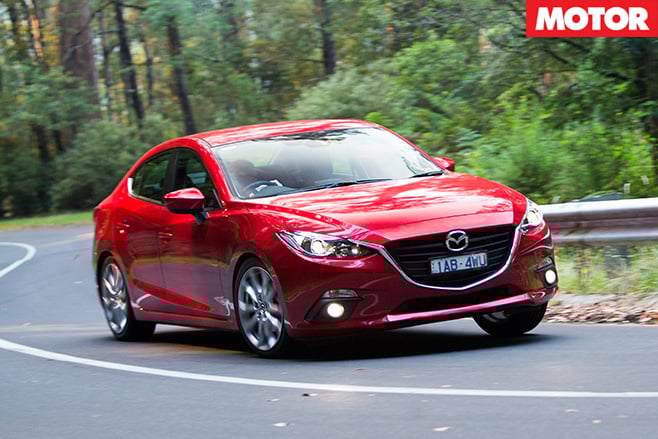
Meanwhile Mazda’s been playing in the warm hatch sandpit longer than most, starting with the SP20 back in 2001, but the latest SP25, sharply priced at $25,190, is a classier, more grown-up effort – but behind the wheel, does it still know how to entertain?
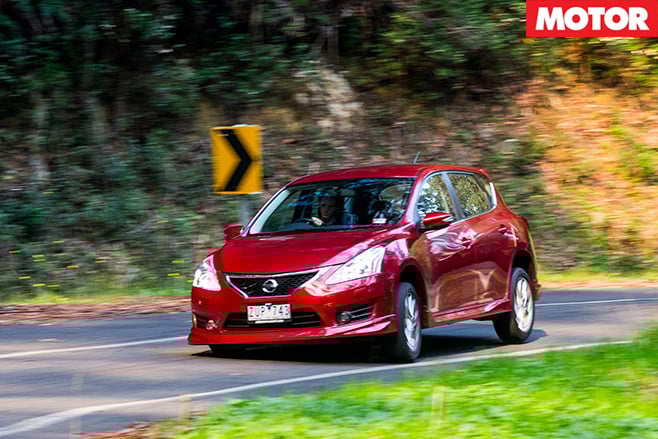
The Pulsar’s 1.6-litre direct injection turbo four offers a handy 140kW/240Nm, with a broad spread of power and great response. A pity, then, that it sounds like a dying sewing machine. Still, with close gearing, a quick shift and just 1304kg to pull, it’s good enough for 0-100km/h in 7.8sec and a 15.56sec quarter.
Only the Kia is faster, and that’s as much down to its superior traction as its extra 10kW/25Nm.
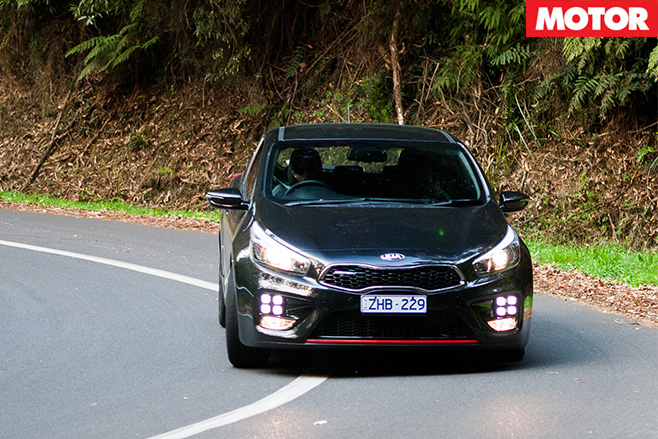
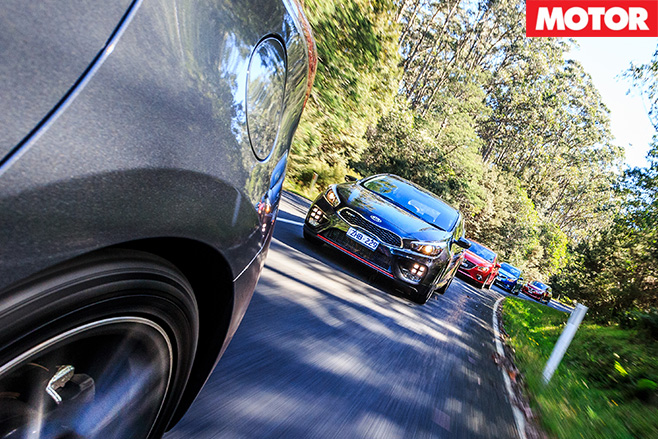
Kia’s 1.6-litre direct-injection ‘Gamma’ turbo four favours torque over top-end heroics, with a strong, linear power curve and 80 per cent of its 265Nm peak on tap from 1500rpm.
Sadly, it sounds far better outside than from within and while I personally have no problem with the light, reasonably precise gearshift, not everyone is a fan.
Proving that adding a turbo doesn’t automatically make for a drag strip weapon is the Cruze.
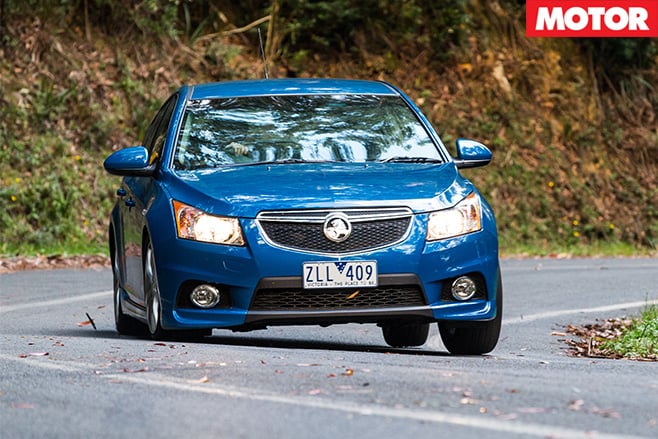
The Hyundai is little faster but more rewarding, thanks to its 129kW/209Nm 2.0-litre atmo four revving out to almost 7000rpm, though it needs every rev to give its best. Even then, 0-100km/h in 8.55sec and a 16.18sec quarter mile is nothing to crow about.
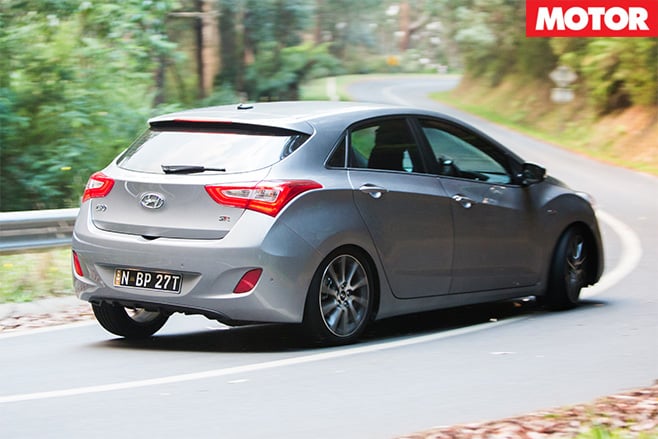
Nowhere is this more evident than the Hyundai’s boredom-inducing 19.6sec 80-120km/h time in sixth gear – we almost ran out of drag strip. For reference, the Kia and Nissan dispatch the same increment in around nine seconds.
With its ‘big block’ 138kW/250Nm 2.5-litre four, the Mazda feels much stronger, so its relatively lacklustre figures (8.39sec 0-100km/h; 15.95sec 0-400m) come as a surprise.
The extra capacity is a curse as much as a blessing, the SP25 torching its tyres if attempting a launch at any more than 2000rpm. Away from the drag strip, however, the Mazda’s atmo donk comes alive, with plenty of grunt and throttle response the turbo cars can only dream of.
Chugging down the 98RON like it’s O-week are the Kia (10.1L/100km) and Cruze (10.6L/100km). There’s a certain irony this push to forced induction is aimed at reducing fuel consumption, yet in the real world it’s having precisely the opposite effect.
The moment the road deviates from the straight-ahead, the pecking order gets turned on its head. All five have their own strengths and weaknesses, and while you might think down here in sub-$30K land the driving experience will be separated only by levels of blandness, each has its own character.
Standing tall on its skinny 205/50 R17 Continental rubber, the Pulsar looks like it’s up on tiptoes before a wheel has turned. You sit high with the wheel slightly offset to the left, a wheel you’re left clinging desperately to thanks to the front seats’ lack of lateral support.
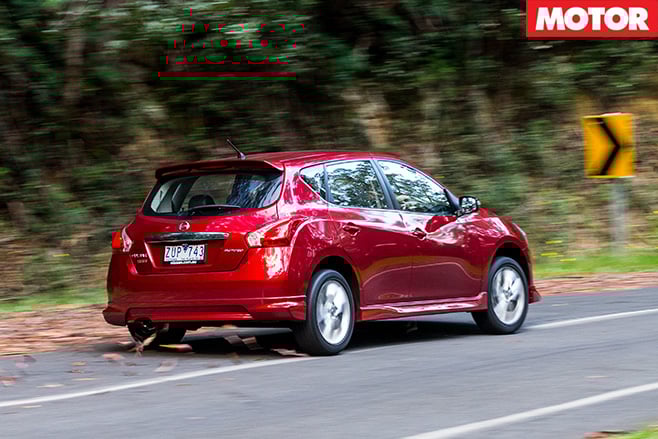
It’s very difficult to get a sense of what the car is doing and if you do overcook it, the ESP usually seems to be in the middle of a siesta. Add in that it feels faster than all else here and you’re left with the impression this is an engine crying out for a more capable chassis.
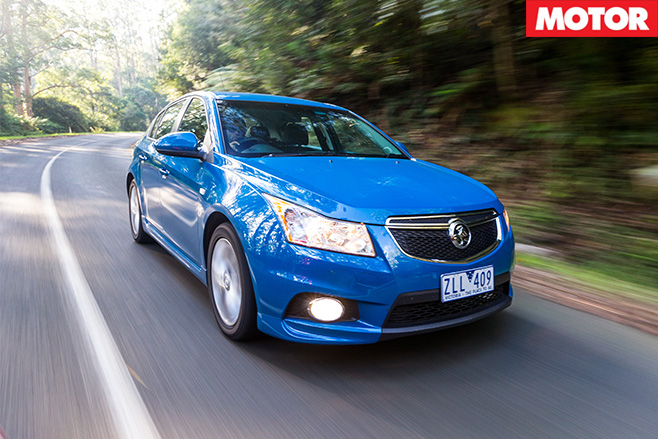
The steering is very sharp off-centre – almost too sharp – but once acclimatised you begin to enjoy the way the Cruze pivots through a corner using all four tyres rather than leaning on the fronts. Grip levels are high thanks to sticky Bridgestone Potenza RE050A tyres and the compliant chassis feels expertly tuned to local roads.
Trouble is, you’re too often driving the Cruze with your right foot welded to the firewall, hoping an extra 30kW will materialise if you concentrate hard enough.
A similar problem afflicts the i30 SR. There’s genuine fun to be found in the Hyundai’s handling, but its lack of poke means it’s definitely a car best enjoyed downhill.
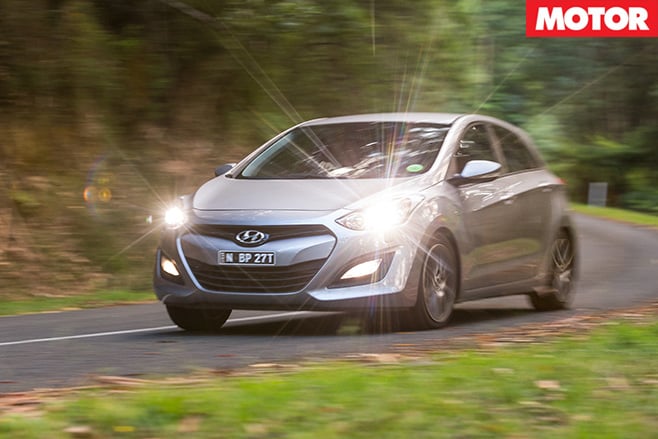
Just how much of a handicap the standard rubber is becomes abundantly clear the moment the heavens open. Leading the pack through Victorian back roads, the first damp corner encountered is a long, sweeping left-hander. Taken at a brisk but far from breakneck 100km/h (the posted speed limit), the front instantly washes wide, quickly joined by the tail trying to overtake.
I slow immediately following this heart-stopping moment, convinced there’s oil or diesel on the road, only to be met by quizzical looks from the others who negotiated the corner with little difficulty. Further investigation uncovers that the i30 SR must be driven with extreme care in the wet, even at a pace that leaves, say, the SP25, completely unruffled.
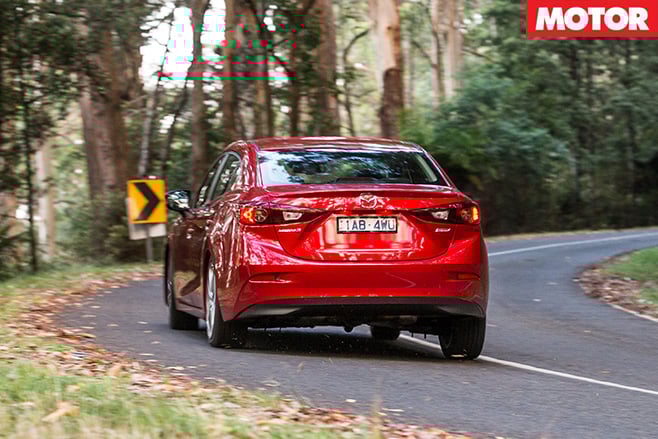
You can more or less drive the wheels off it, largely untroubled by ESP. Only the brakes stand out as inadequate, a certain enthusiastic editor pulls up with four bonfires lit under its wheelarches. Little wonder Mazda upgraded the stoppers for the Albert Park celebrity race.
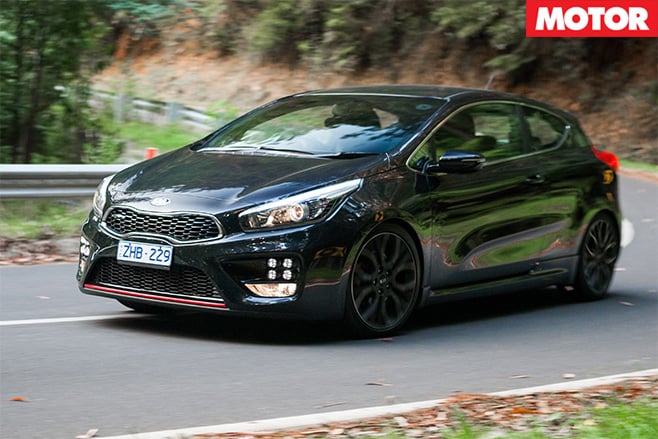
As opposed to the Korean-built, torsion-beam equipped i30 SR, the Euro-built ProCeed arrives Down Under (the only market other than Europe to receive the car) with a multi-link rear end, which gave Kia’s local handling wizard, Graeme Gambold, more scope to fiddle. Whatever he did, it worked.
The ProCeed is firm but compliant, the steering nicely weighted and the fitment of proper tyres – in this case Michelin Pilot Sport 3s – pays dividends in every area, improving braking, cornering and traction. It’s not hugely playful in the manner of a Fiesta ST, but still leaves every other car here in its dust on our chosen test road.
Inside, the Kia continues to impress.
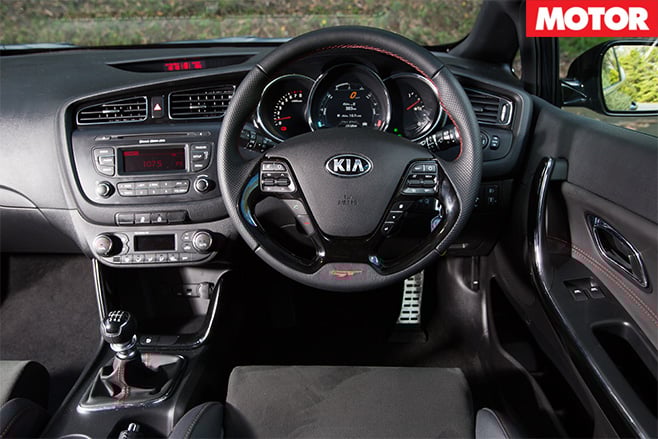
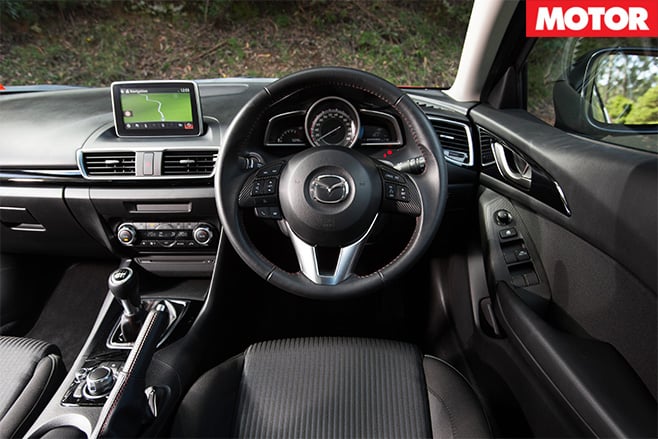
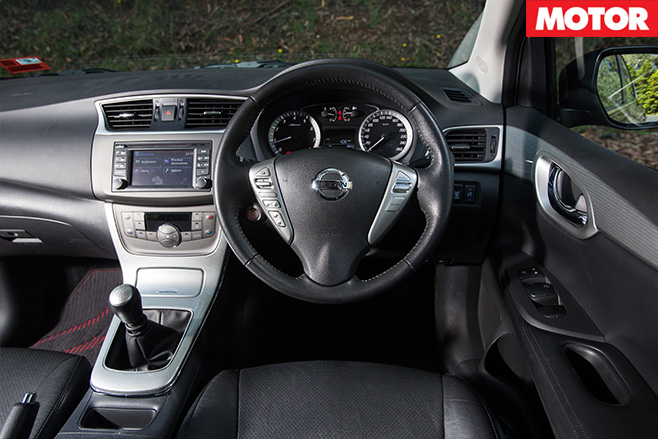
There’s plenty of kit (though at a higher price than the Mazda, Hyundai and Holden), but the plastics are hard and scratchy and it doesn’t feel particularly well put together. Editor Dylan says it reminds him of a Singapore taxi.
Had we had a mechanically identical SRi-V on this test (we could have had one, but it would have been automatic) rather than the cheaper, sparser SRi, the Holden and the Hyundai would be a close match. Virtually identical in equipment levels, the Cruze offers arguably the stronger case with its cheaper $26,490 sticker, though that’s assuming you can live with the colour scheme.
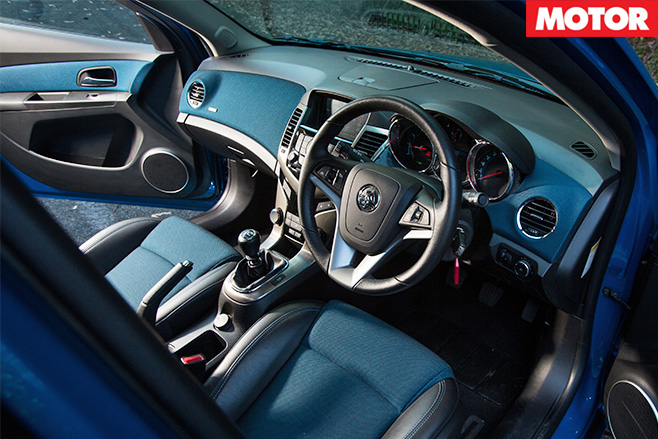
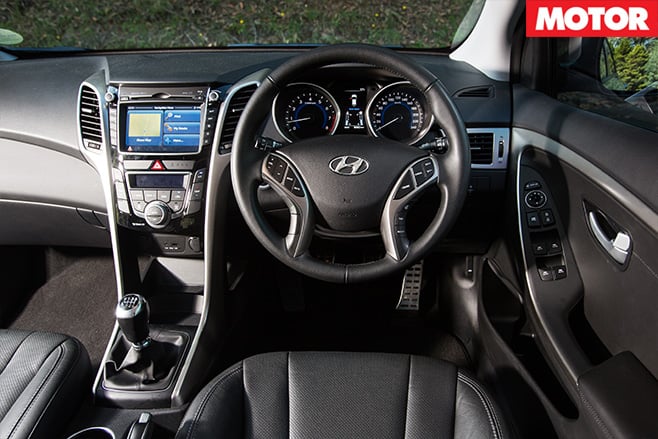
It’s fast and spacious, so if you have to move a lot of large objects in a hurry, perhaps the Pulsar is the car for you. But I doubt it. It feels cheap, sounds awful and its sub-par dynamics mean it’s just not that much fun to drive.
Next up is Holden’s Cruze SRi, though for almost polar opposite reasons to the Pulsar. Holden’s local engineers have created a car with a fine ride/handling balance that feels well suited to Aussie roads.
Trouble is, any fire in the chassis is extinguished by that wet blanket of an engine, and its performance barely qualifes as tepid, let alone hot. Yes, it’s cheap, but so is taking the bus.
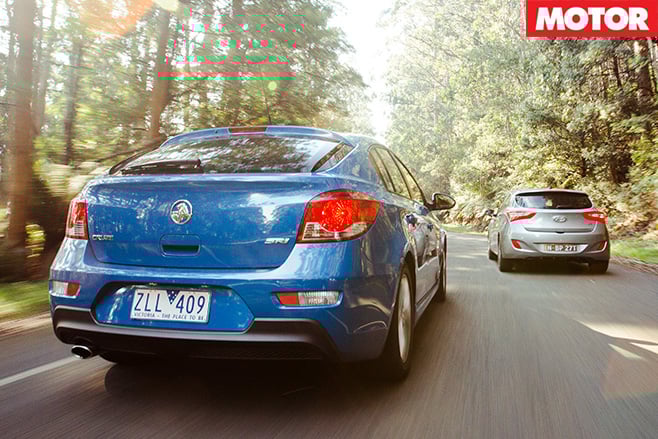
This leaves Mazda’s new SP25 in the runner-up spot. It looks and feels so normal it’s almost like Mazda made it fun to drive by pure accident. If you have a non-enthusiast partner or parent who is looking for something sensible that you can occasionally steal for a twisty-road thrash, then the SP25 is that car.
Take the best bits from all four cars – say, the i30’s playful chassis, the Pulsar’s gutsy engine, the Cruze’s grippy tyres (and price) and the SP25’s interior and overall polish – and you’d have quite a car. It might even be good enough to challenge the car that wins this test by an avalanche, the ProCeed GT.
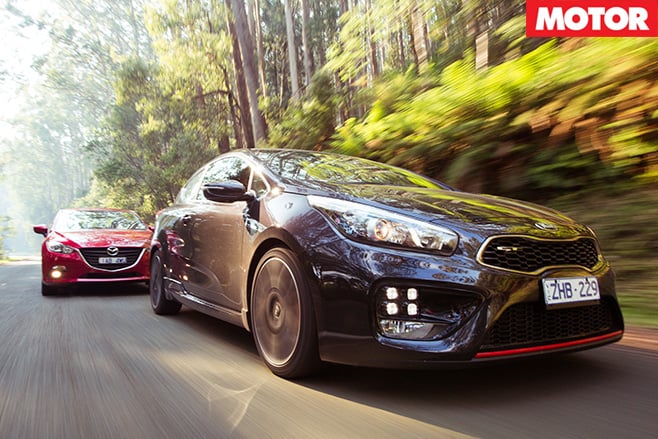
In fact, such was the Kia’s winning margin, we thought we’d organise it a much harder test.
If ever there was a car where how it drives is completely beside the point, it’s the new Mercedes-Maybach S600.
Previously preserved for the plutocrats, the new Maybach is much more closely aligned with the S-Class on which it is based, in both price and positioning.
The earlier Maybachs, dubbed the 57 and 62 in reference to their length, began at $1million and went up from there, whereas the new model starts at a much more egalitarian $449,000.
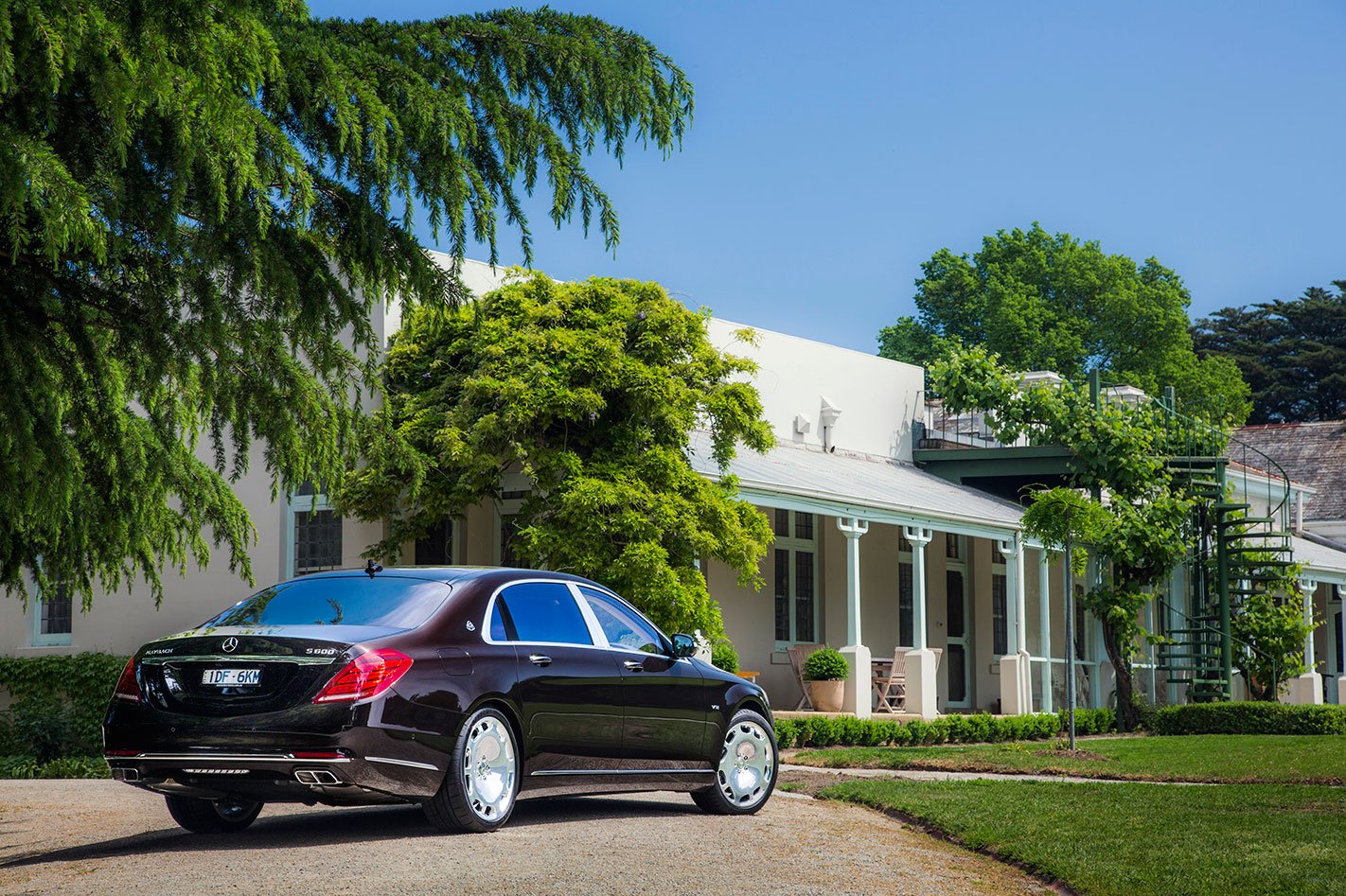
The premium buys you an extra 20cm of length, resulting in a car 5453mm long and with a gargantuan 3365mm wheelbase. The extra metal adds 300kg to the S600’s 2110kg kerb weight, the 0-100km/h sprint now taking 5.0sec.
But this is not a car for sprinting. Floor the throttle and the Maybach’s displays indecent haste, but the V12’s appeal lies more in its inherent smoothness and near-silent operation.
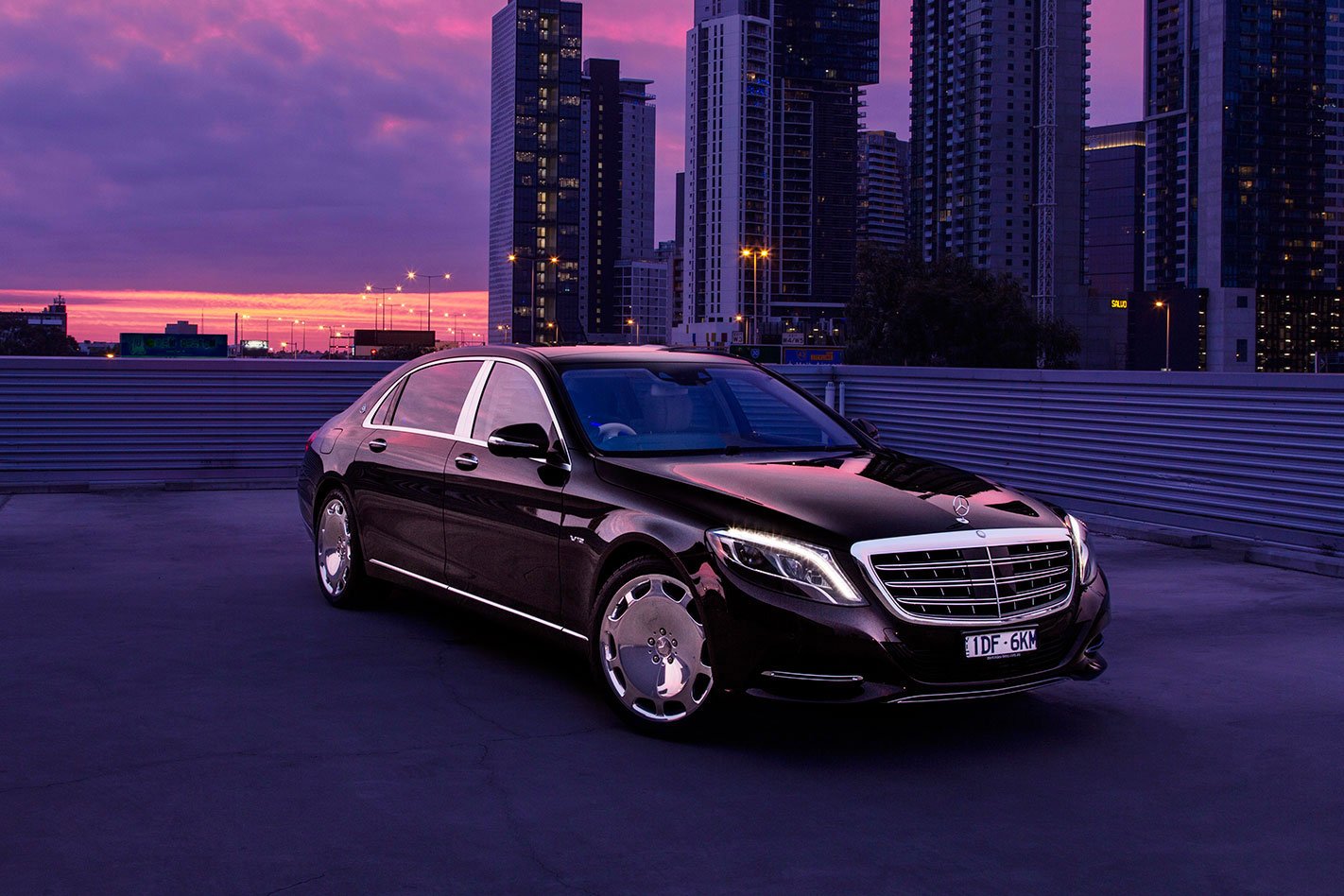
You can’t help but drive the Maybach smoothly. Everything about the car – the serene ride, the slow but linear steering, the tomb-like noise levels – encourages driver restraint, to the point that blasting Metallica’s ‘One’ through the Burmester 24-speaker stereo brings an attack of the guilts.
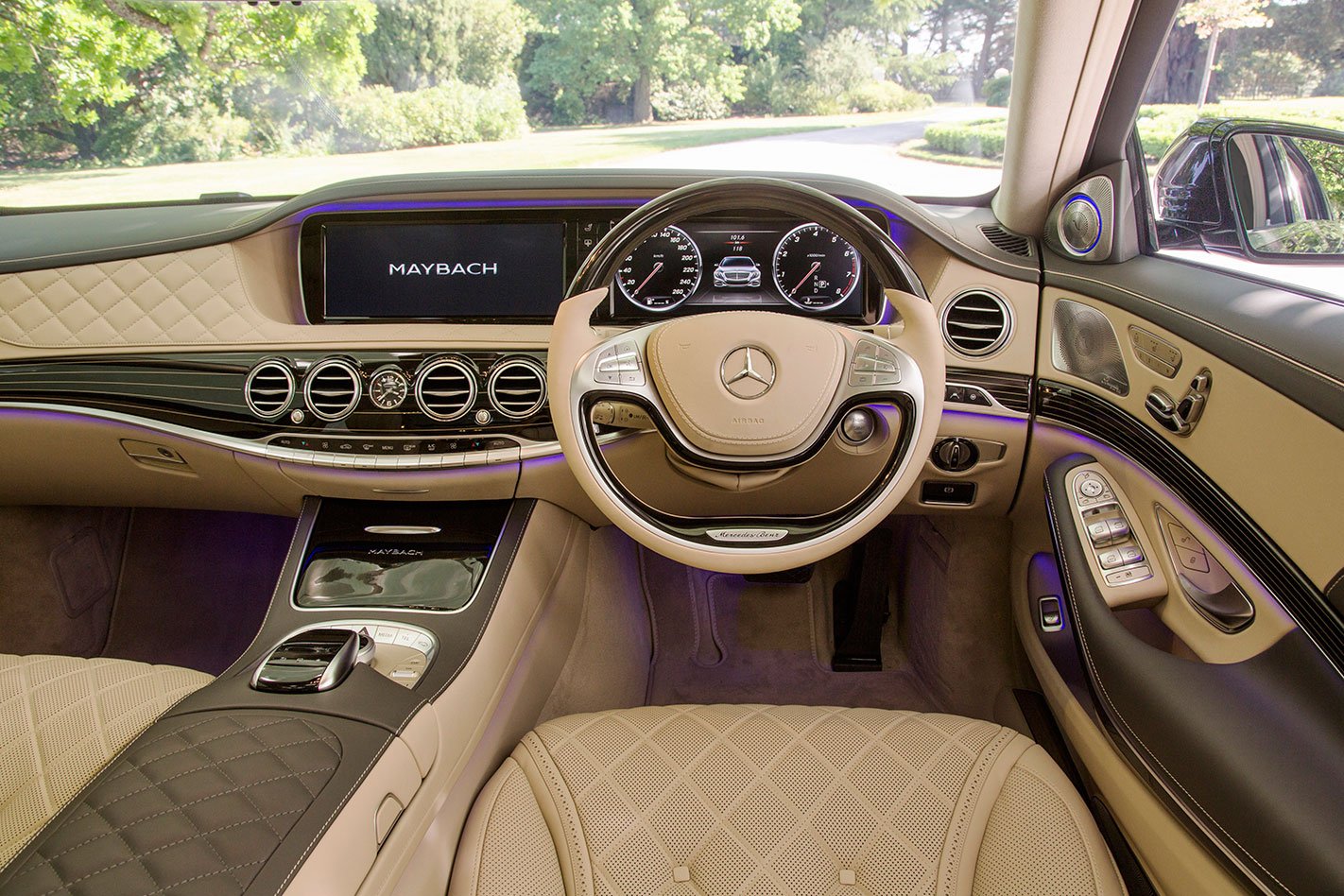
Bar extra helpings of diamond-quilted leather and some Maybach-specific trim options, up front the interior is fairly standard S-Class fare. That’s high praise in itself, as the current S-Class has arguably the best production car interior in the world, but it’s in the back that the Maybach displays its true talents.
The front passenger seat can even be moved forward to allow the passenger-side rear occupant even more space. All the better to enjoy some chilled champagne, or don the custom headphones and enjoy a movie.
One small complaint is that there should be a separate remote to adjust the ventilation controls, as with the seat reclined they are a long way away, though as problems go that’s a first-class, never mind first-world, one.
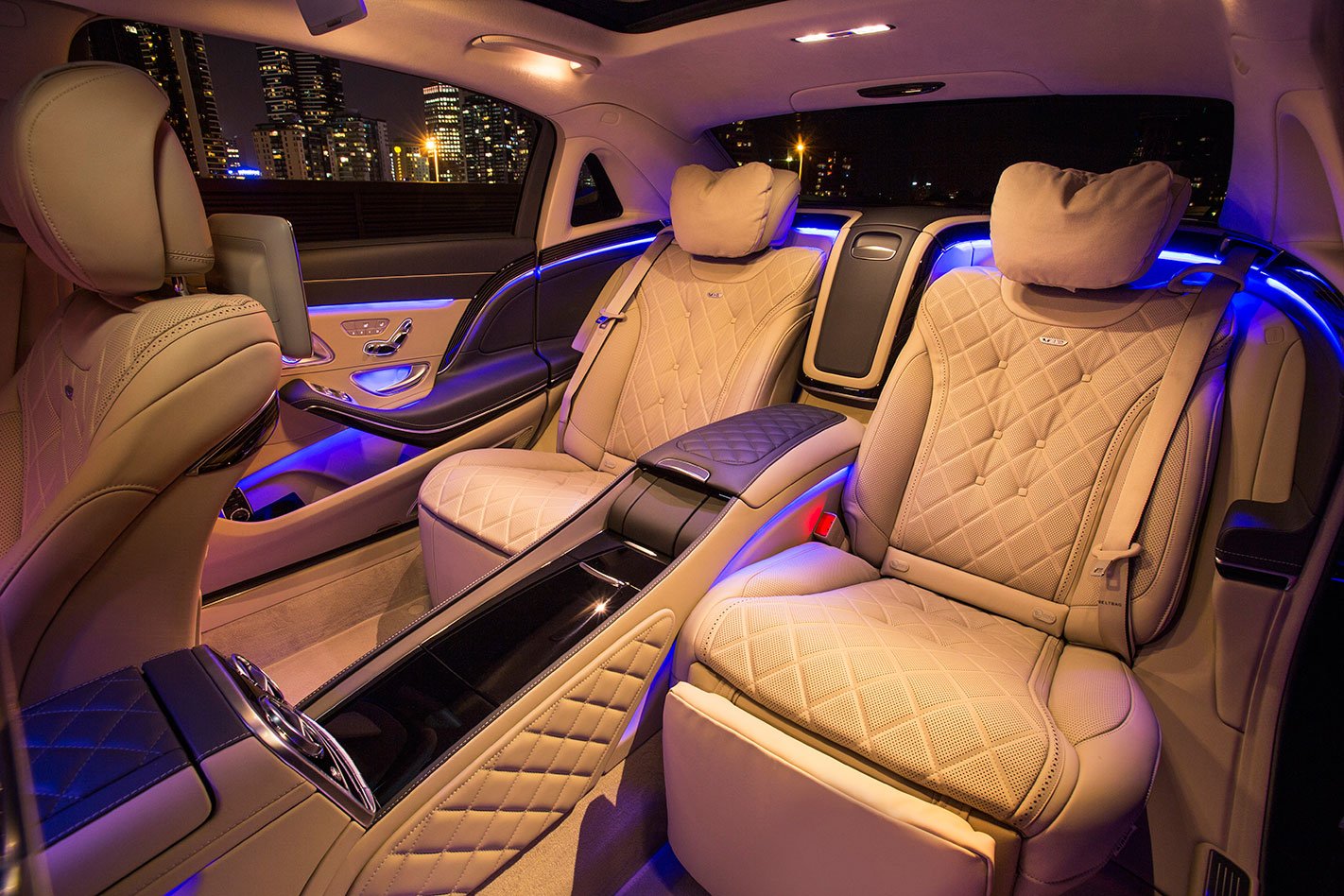
Given the relatively small premium over the equivalent S600, we can see why, as no other car can match the Maybach’s rear-seat opulence, however MOTOR-heads will probably find more to appreciate in the tyre-smoking 430kW/900Nm S63 AMG.
4.5/5
Specs Engine: 5980cc V12, DOHC, 36v, twin-turbo Power: 390kW @ 4900-5300rpm Torque: 830Nm @ 1900-4000rpm Weight: 2408kg 0-100km/h: 5.0sec (claimed) Price: $449,000
Kia has axed its oddly-named and slow-selling Pro_cee’d GT from the Australian market.
It’s unlikely many MOTOR readers will shed tears at this news, but car enthusiasts should as, grammatical crimes aside, the Proceed GT was a very welcome entry into the warm/hot hatch market from Kia.
Granted, it wasn’t giving the likes of the Renault Sport Megane too many sleepless nights, but thanks to the efforts of Kia’s local dynamics teams the Aussie Proceed was an entertaining steer on both road and track.
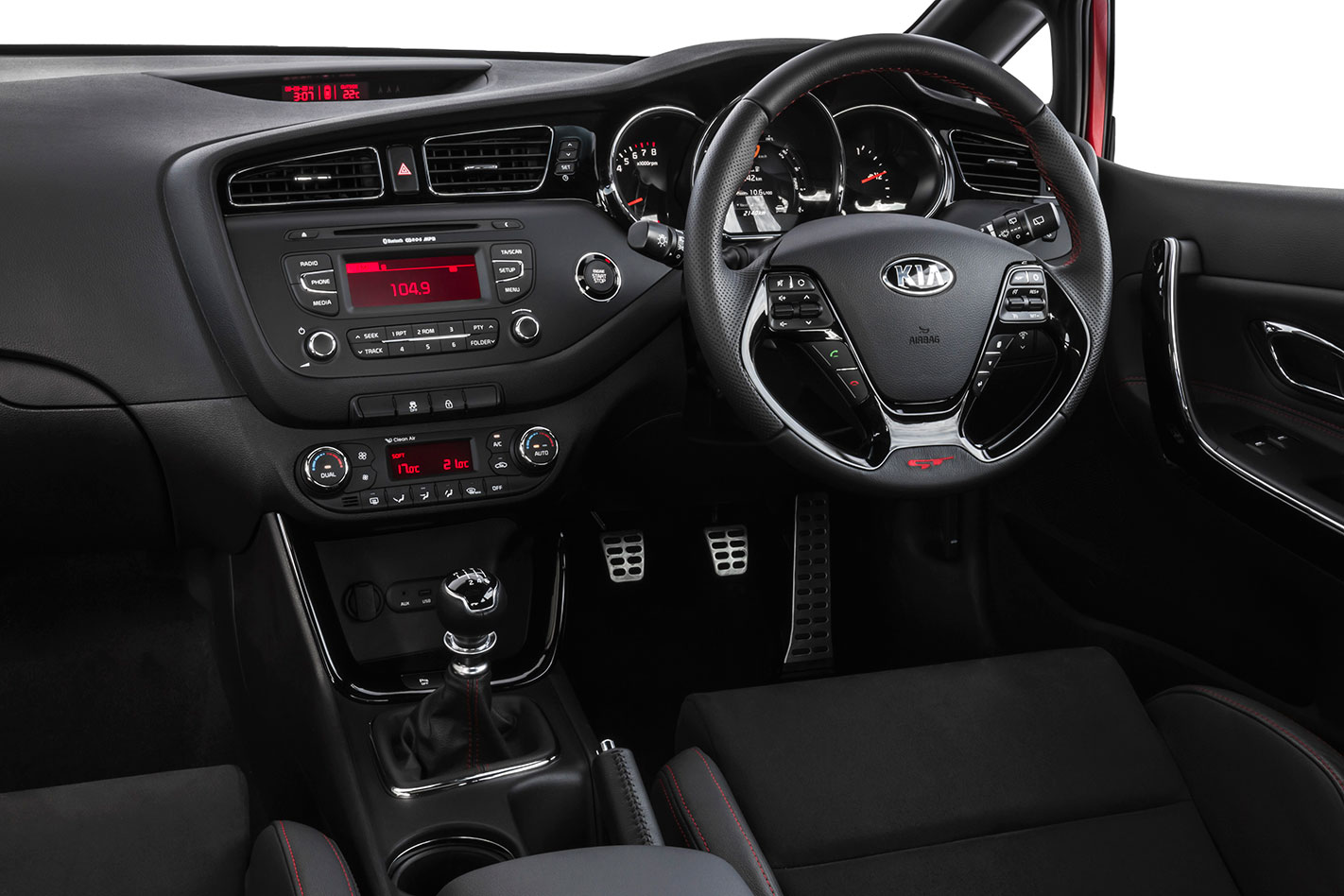
It lost, but it ran Toyota’s golden child far closer than we expected.
So where did it all go wrong? Part of the problem was undoubtedly public perception; was the market ready for a Kia performance car?
The biggest issue, however, was the lack of an automatic or dual-clutch variant for manual-allergic Australian buyers.
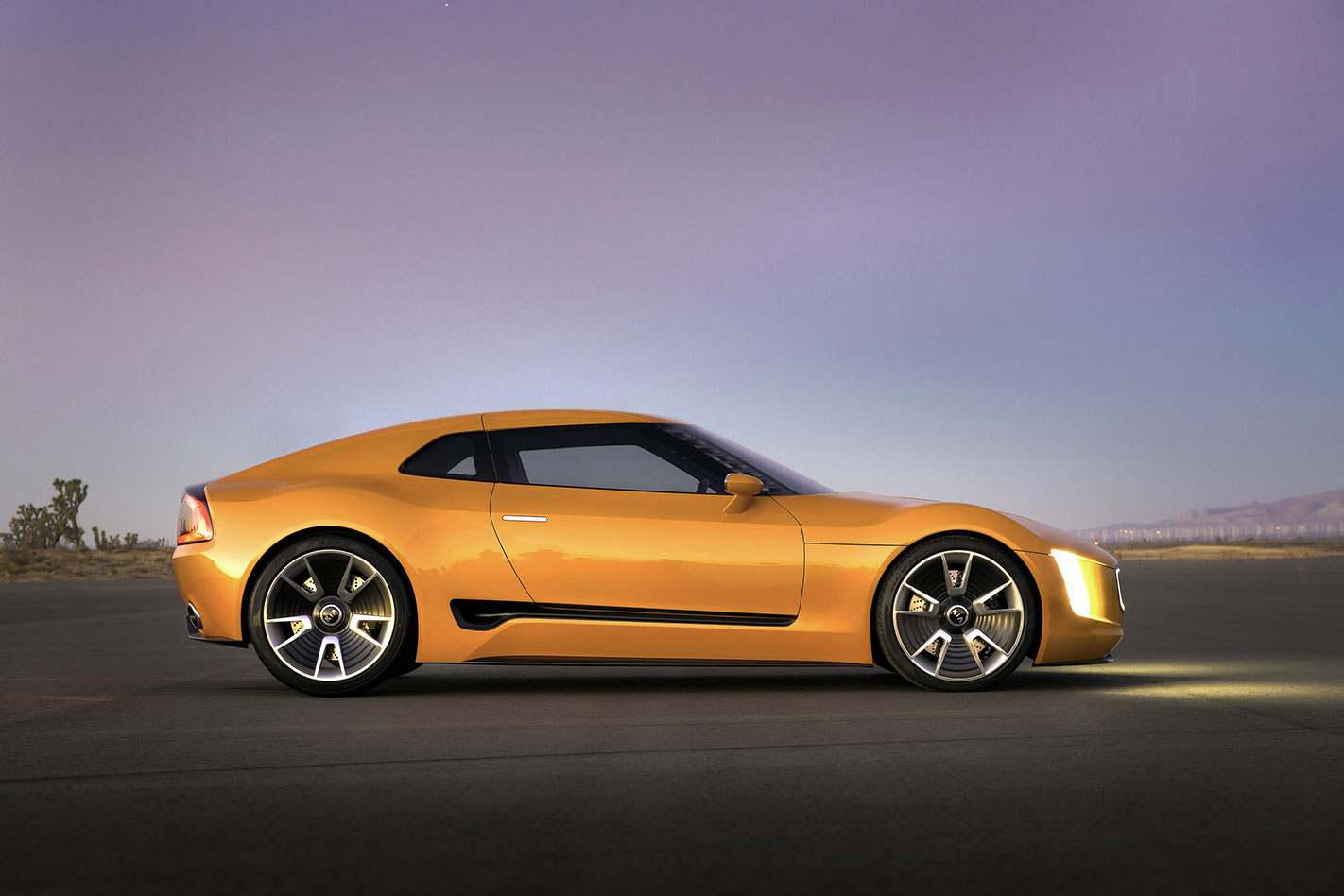
The Proceed’s departure leaves the new 180kW/350Nm turbocharged Optima GT and the 150kW/265Nm Cerato Koup Turbo as the only Kia models with enthusiast appeal.
Of course, this would easily be remedied if the fabulous GT4 Stinger (above) were to get the green light.
The Peugeot 308 GTi will arrive locally in February priced from $44,990 for the 184kW version and $49,990 for the 200kW grade.
Those are the figures fans of the fiercest French hot-hatch this side of the Renault Sport Megane have been waiting to hear.
The target for this fashionable five-door is obviously the Volkswagen Golf GTI, though the manual-only 308 GTi will have to forfeit some sales to its DSG-driving German foe.
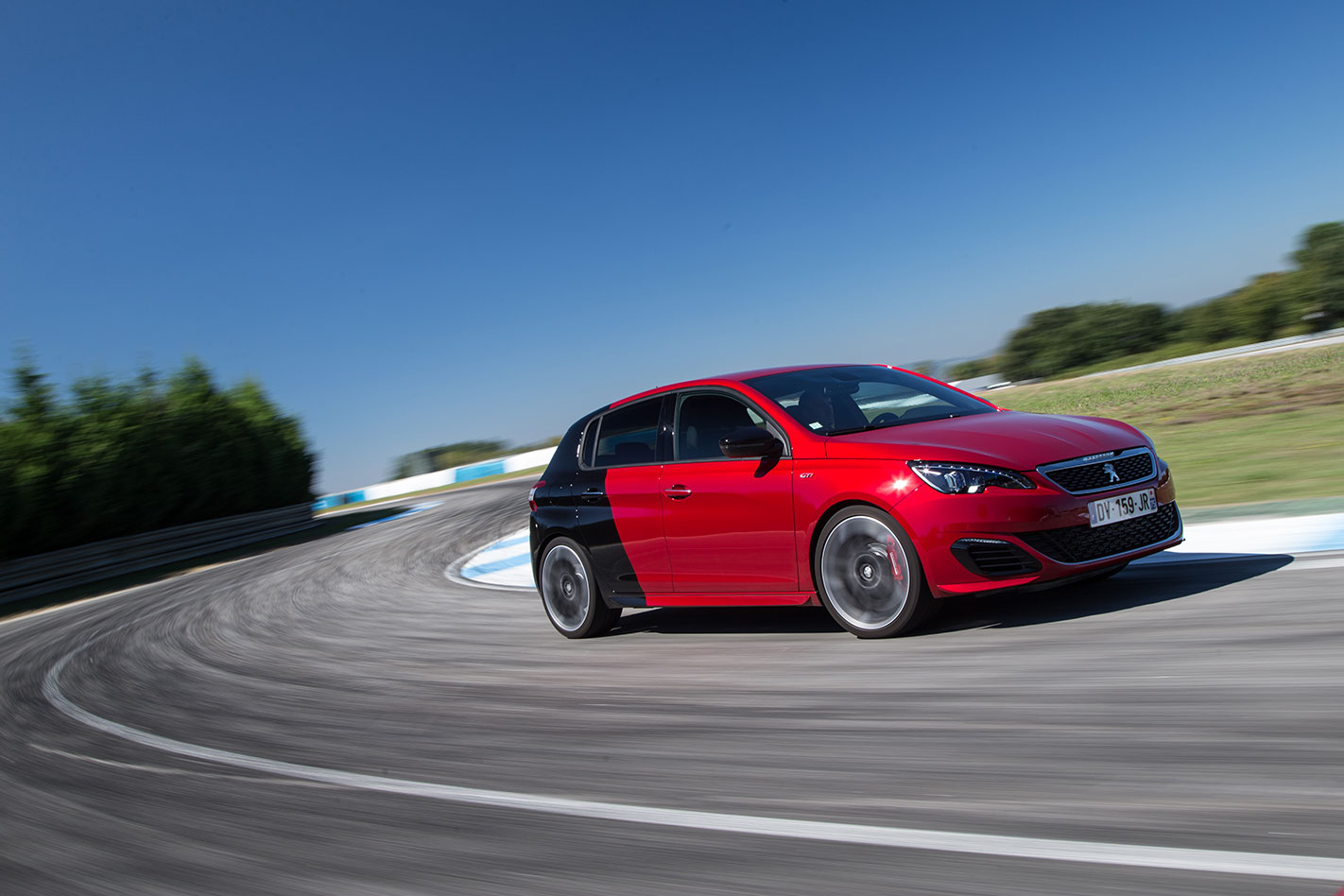
It packs 184kW and 330Nm from its 1.6-litre turbo four-cylinder, however, where the 2.0-litre VW makes 162kW/350Nm.
A slight torque deficit is no matter, because the Pug is lighter (1205kg plays 1313kg) to deliver a claimed 6.2-second 0-100km/h that is three-tenths faster.
As with its main rival, 18-inch alloy wheels are standard, however Peugeot also includes full LED headlights (bi-xenons are optional in the VW) and possibly other extra equipment – full details will be revealed early next year.
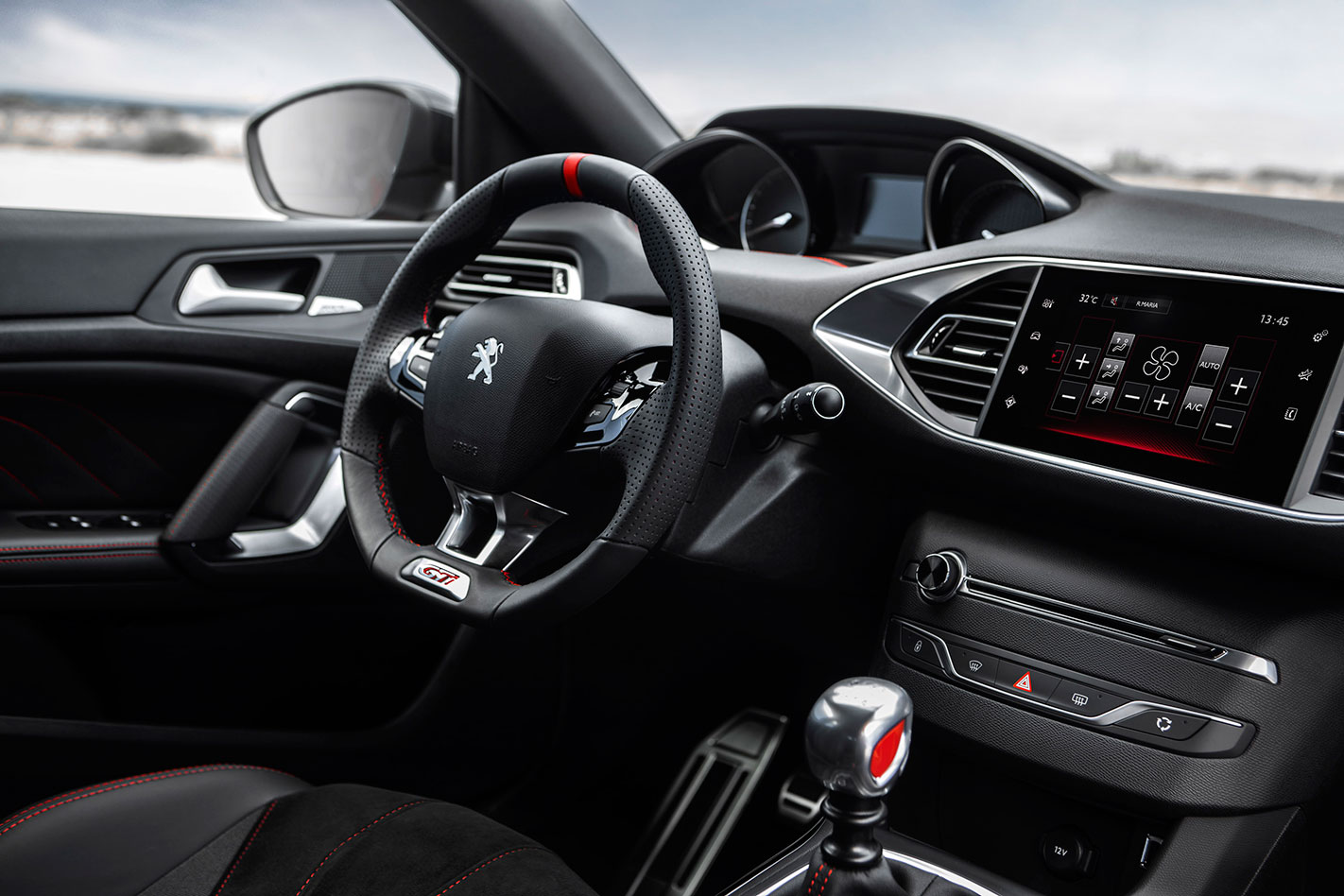
Peugeot may have placed drawing paper over its rival ‘Performance’ specification, because the 308 GTi 270 likewise adds a Torsen mechanical limited-slip differential, part-leather trim and larger 19-inch alloy wheels.
Torque is unchanged but power moves to 200kW and the 0-100km/h claim lowers to 6.0sec flat. That hike is more sizeable than that of the Golf GTI Performance, which moves from 162kW to 169kW with unchanged torque and a 6.4sec 0-100km/h.
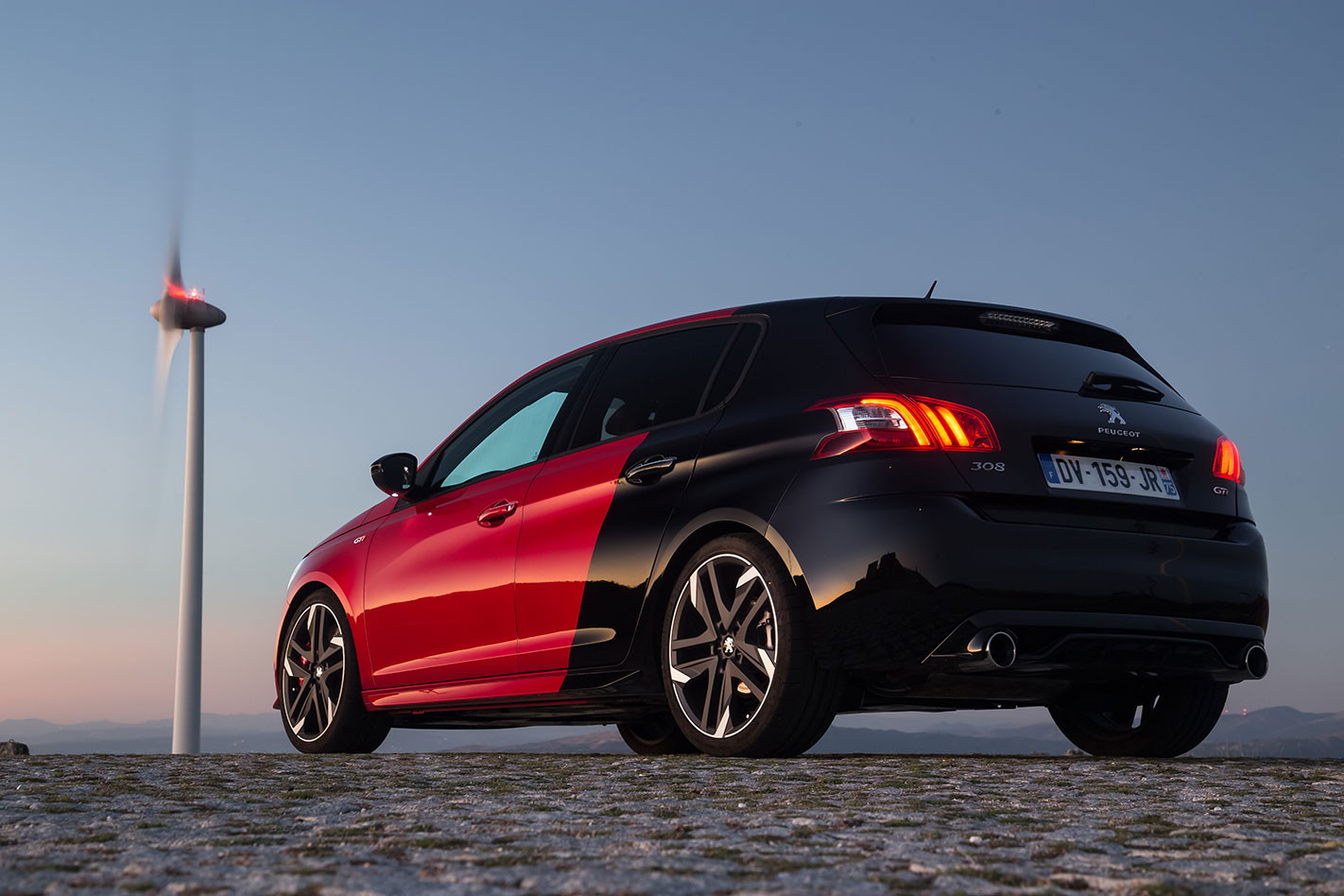
We drove the Peugeot 308 GTi at its international launch and came away impressed.
However, we placed a big caveat over the expected $45K to $55K pricing. With the two-tier range arriving in the lower half of that range, it will only make that inevitable comparison test between that GTI and this GTi all the more interesting.
So, what is it?
The new Mondeo is a window into Ford Australia’s Falcon-less future; positioned as, “The flagship car in the showroom”, and likely to be the biggest conventional car in the blue oval range once Falcon production finishes in October next year.
More than 4.5 million Mondeos have been sold globally since the nameplate debuted in 1993, and this all-new, fourth generation model is offered across three spec levels (Ambiente, Trend, Titanium), as a hatch or wagon, with a choice of two turbo petrol engines, and a single turbo diesel.
As the name implies, it’s again intended for world markets (badged Fusion in North America), comes loaded with technology, and sits at the leading edge of Ford design.
Why should I care?
Given its historical success in high-volume fleet sales, Toyota’s Camry dominates the local medium car segment, with Mazda’s 6 in a distant second, heading a gaggle of contenders fighting over share in a segment gradually diminishing in the face of Australian new car buyers’ on-going SUV love affair.
But Ford says it isn’t content with the Mondeo knocking off the Mazda6 for ‘best of the rest’ status. It’s taking aim at the mid-size Camry mother-ship, and claims to have pulled out all stops on dynamic performance, standard features, and value-for-money to take a crack at it.
What’s new about it?
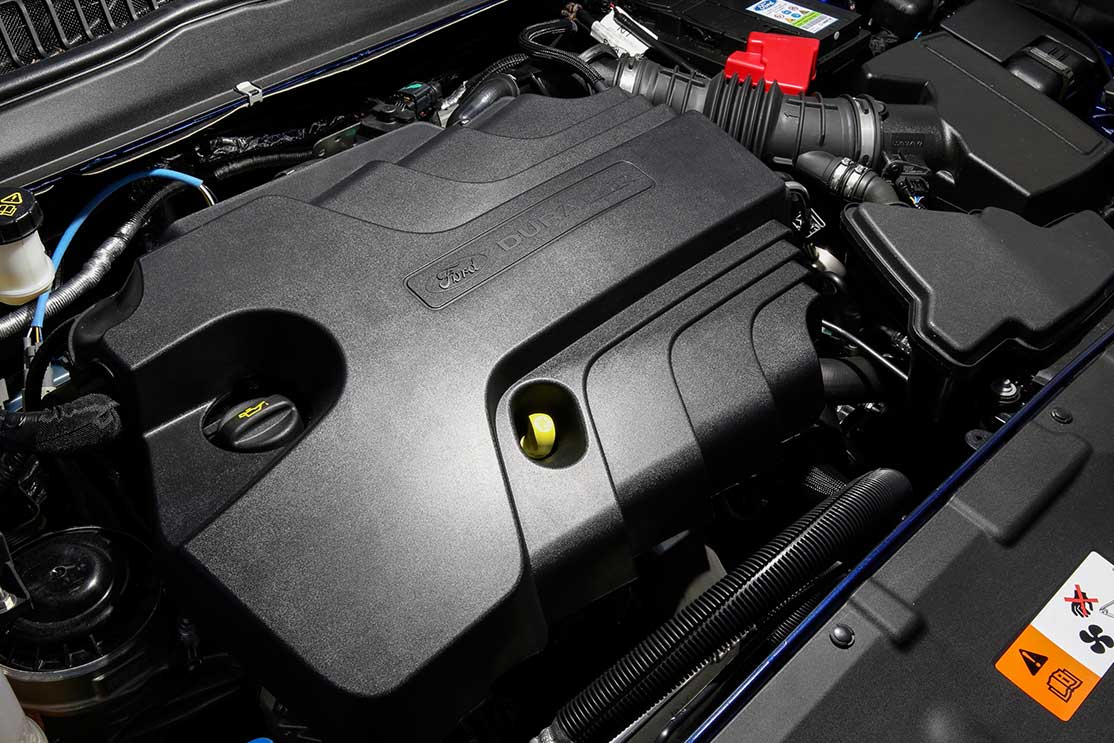
The new Mondeo might share the same wheelbase measurement as its predecessor, but that’s largely where similarities end. Even ‘carry over’ elements like the 2.0-litre TDCi turbodiesel have been substantially upgraded, and the car introduces several market firsts.
Chief among them is ‘Pre-Collision Assist with Pedestrian Detection’ which uses data collected from a windscreen-mounted camera and radar in the bumper to recognise pedestrians on either side of the road. The system is then able to sense if a pedestrian is likely to step in front of the moving car, giving the driver an audible and visual warning if and when they do.
If the driver doesn’t respond, the system pre-arms the brakes (reducing the gap between pads and discs), and if there’s still no driver response the brakes are applied automatically.
Ford’s Inflatable Rear Seatbelt tech is also standard across the range. In a crash the belt behaves like an airbag, rapidly expanding to disperse impact forces across a body area five times broader than a conventional belt.
Plus the ‘MyKey’ feature recognises different keys for the same car, allowing specific vehicle setting for alternate keys. For example, parents can program a key that limits top speed, reduces maximum audio volume, disables the radio until the seatbelts are fastened, or prevents deactivation of the driver assistance safety tech.
That’s all fine, what’s it like to drive fast?
A lengthy launch drive in and around our nation’s capital gave us the chance to sample all model variants and engine types. And the short story is the new Mondeo is brilliant.
Ford has managed to combine sublime handling and dynamic response with silky smooth ride comfort and impressive performance. The competition should be worried.
This car simply eats up open road kilometres, its supple suspension, helped in no small part by a new ‘Integral Link’ set-up at the rear, absorbing irregularities as well or better than cars several rungs higher up the prestige ladder.
A base 149kW/345Nm version of the 2.0-litre turbo petrol engine is only available in the entry-level Ambiente, and it combines sharp acceleration with impressive refinement. Shifts from the standard six-speed auto are fluid, while steering response and feel are exceptional.
The Ambiente hatch runs on 16-inch alloys shod with 215/60 tyres, and the wagon steps up to 17s and 235/50 profile rubber. Cornering grip is tenacious, the front end sticking to a chosen line even under extreme pressure, with the back end remaining secure all the way through.
Ford has used seven different types of steel in the Mondeo depending on the requirement for strength and/or lightness. Close to two thirds of it is high strength, and the tailgate on the wagon is magnesium! The resulting strength and torsional rigidity delivers outstanding overall body control, even on the base car.
The 132kW/400Nm turbo diesel, matched with a six-speed dual clutch gearbox (with paddle shift) is torquey and refined, but can’t match the urgency of the 177kW/345Nm top-spec petrol. It’s the pick of the drivetrains, and although it produces the same peak torque number as the lower powered version, that maximum is available earlier and lasts longer (2700-3500rpm v 2300-4900rpm).
Ford claims 0-100km/h in 7.9secs for the 177kW petrol and 8.6secs for the diesel, adding a tenth to both numbers for wagon versions.
And driving home from the city?
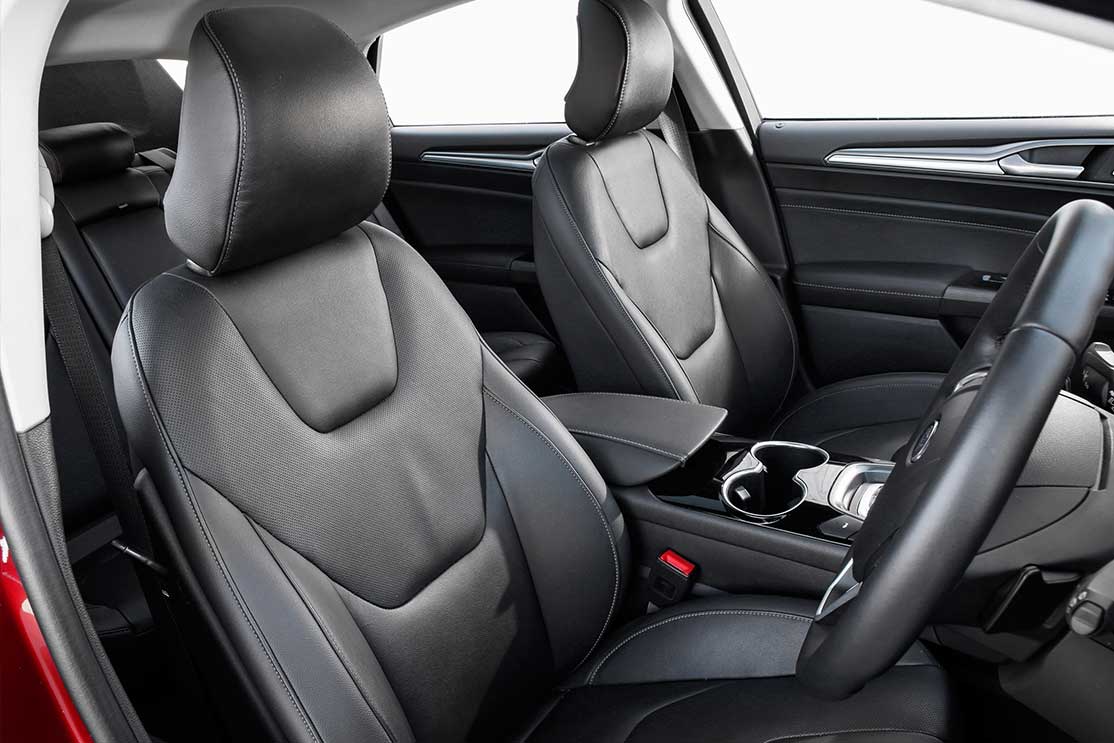
The Mondeo is a full five-seater with plenty of head, shoulder, leg and foot room in the rear. The front seats are supremely comfortable, and the rears offer a generous amount of sculptural support.
Cabin design is restrained and premium, with an eight inch colour infotainment touch-screen prominent in the centre console. Switchgear is neat and minimalist, yet all models feature music and phone connectivity down to six decimal places, including two USB ports, an SD card slot, RCA cable inputs and Bluetooth streaming. Noise suppression is excellent, with normal conversation effortless at all times.
Ford’s SYNC2 system provides voice command functionality for everything from sat-nav or air-con instructions to music choices and phone calls.
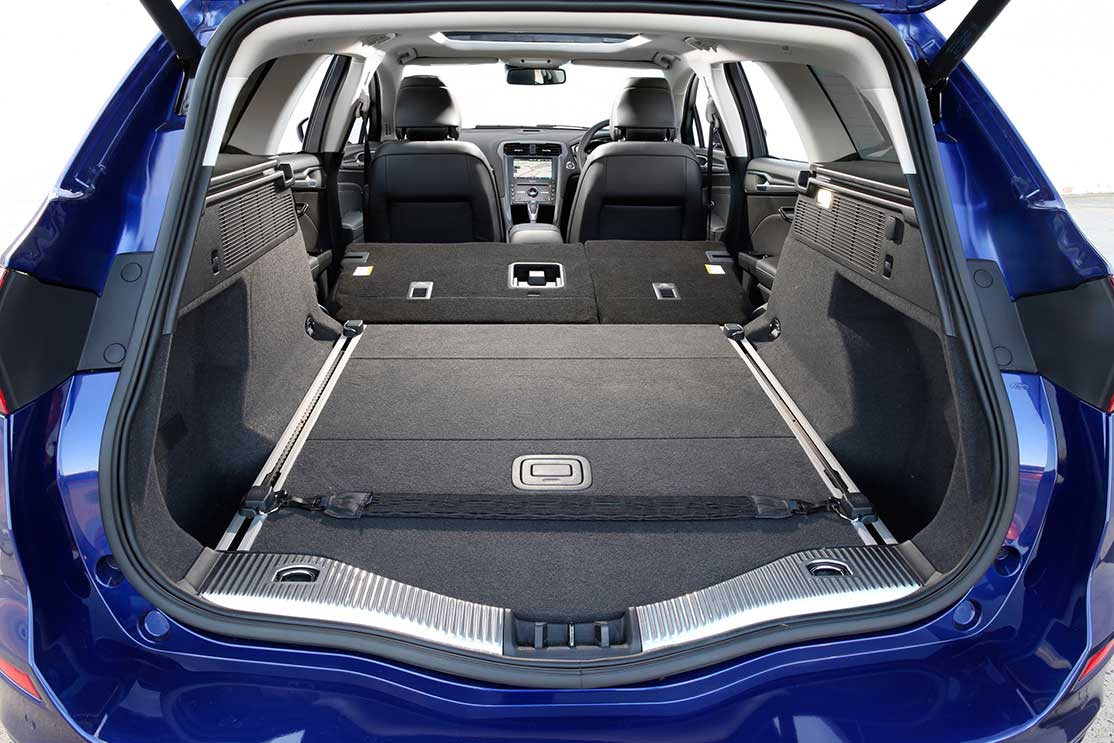
Cargo space is generous in hatch and wagon, with the rear seat folding close to flat in both. The wagon also picks up load-levelling suspension as standard.
Anything bad about it?
The top-spec Titanium rides on 18-ich alloys which look great, but ride compliance isn’t as sweet as the Trend on 17s. And at the other end of the range, rear seat passengers in the Ambiente miss out on an arm rest and dedicated air vents. Pennies have definitely been pinched there.
How much would I have to pay? And is it worth it?
Pricing starts at $32,790 for the Ambiente petrol, reaching up to $49,340 for the Titanium diesel.
All models feature an impressively long standard equipment list including: MyKey (with Emergency Assistance, which attempts to connect with emergency services in the event of a crash where an airbag deploys or the emergency fuel pump shut off triggers), SYNC2, the eight-inch hi-res infotainment screen, digital radio, dual-zone climate-control air, sat-nav, cruise control, Inflatable Rear Seatbelts, alloy wheels, and Hill Launch Assist.
The Trend adds auto-fold exterior mirrors, keyless entry, adaptive cruise, heated and 10-way power adjustable front seats, rain-sensing wipers, partial leather trim and a rear view camera.
Then the Titanium cops front and side skirts, adaptive suspension, adaptive LED headlights, panoramic roof, leather-faced sports seats, heated rear seats, power reach/rake steering column, and aluminium pedal covers. Plus on the safety front, Blind Spot Detection Pre-Collision Assist with Pedestrian Detection, Enhanced Active Park Assist, Lane Keeping Aid + Assist (LKA), Lane Departure Warning (LDW) and a Driver Impairment Monitor (DIM) which uses a forward-facing camera to monitor the vehicle’s position in the lane, warning the driver to stop, revive and survive if it senses inappropriate wandering.
Ford expects Mondeo sales to be split equally between the three variants, with roughly 70 percent hatch to 30 per cent wagon. All deliver sharp value for money.
Would you take the Ford Mondeo or Mazda6?
The new Mondeo’s arrival demonstrates yet again how quickly the car game moves on. Its dynamics are class-leading, performance is strong, and value-for-money is hard to beat. It’s the Ford by a short half head.
PLUS
- Style. Penned by a European designer, the Tucson’s good-looking exterior gets the thumbs up.
- Driveline. The feisty 1.6-litre turbo motor and efficient seven-speed dual clutch transmission pair nicely together. A 2.0-litre turbo-diesel (and six-speed auto) is also available with even more grunt.
- Seats. Up front, the Highlander features the luxury of heated and cooled seats. Once you’ve tried them, you won’t go back.
- Tailgate. Power tailgates are becoming the norm these days, but not all are created equal. The Highlander’s ‘Smart Boot’ will automatically open, hands-free, if you stand at the rear of the car for more than three seconds with the key on you.
- Safety. The Highlander has a laundry list of safety features including auto emergency braking, blind spot detection, lane change assist, downhill brake control, tyre pressure monitoring, parking assist, rear view camera and more.
- Interior. For all the style of the exterior, the Tucson’s interior plays it very safe. It’s not bad, but it’s a little on the bland side. Having said that, it is very spacious and will tick boxes for a lot of people.
- Services. Next to its competitors, the Tucson has more frequent service intervals. It needs an oil change every six months/7,500kms. Compare that to the Ford Kuga at 12 months/15,000kms or the Mazda CX-5 at 12 months/10,000kms.
