
VOLKSWAGEN Golf GTI, Golf R and Skoda Octavia RS buyers may be reimbursed for extra fuel costs if the factory is found to have manipulated test results quoted in Australia.
VW Group Australia managing director Michael Bartsch made the offer yesterday as he revealed that the high performance, turbo petrol Golf R and the turbodiesel Skoda Octavia RS TDI had joined the popular Golf GTI hot hatch on the list of Australian delivered, 2016 model cars that may have cheated emissions tests.
The three current Australian models were named at the weekend by Volkswagen Group in Germany as among a big range of European delivered cars for which carbon dioxide emissions – and fuel consumption – had been understated, through the manipulation of mandated test conditions.
However, the German head office was yet to inform its Australian importer whether the understated figures appeared in Australian model certification, Bartsch said.
Bartsch said the key question locally was whether the cars had gained Australian compliance under the manipulated Euro 6 testing, or whether cars sent here had been tested independently and accurately under Australia’s older Euro 5 standard.
“Until we have that answered, we don’t know whether we have an issue here or not,” he said.
He emphasised that even if the tests of Australian cars had been manipulated, the results would affect only the quoted official fuel consumption and CO2 emissions figures. It was not expected there would be any effect on performance.
If it turned out that fuel consumption quoted in government mandated testing was lower than it should have been, VW would likely reimburse Australian customers for real fuel costs incurred as a result.
“I still have to liaise with my colleagues in Germany. But I think the principle is that we would hold ourselves accountable for customers being no worse off as a consequence of a representation made by the company,” Bartsch said.
He also emphasised that Volkswagen Group’s admission at the weekend that it had provided “implausible” test data for CO2 emissions on 430,000 of its 2016-model cars globally had arisen from its own efforts to get to the bottom of its Dieselgate scandal.
After the US Environmental Protection Authority confronted it with independent pollution results, VW Group revealed in September that a staggering 11 million of its diesels had been fitted with engine control software that cut emissions when tested.
In real-world driving, the diesels emitted nitrogen oxides – a smog component linked with breathing problems in city residents – at between five and 40 times the permitted level, the EPA found.
The test-cheating software had been used on 1.6-litre and 2.0-litre EA189 turbodiesel engines fitted to a big range of vehicles produced since 2008, VW Group said.
An internal probe has since uncovered separate efforts to manipulate fuel consumption and CO2 emissions tests for many current petrol and diesel models – reportedly not through the use of cheating software, but by overinflating the tyres of test cars and taking other steps designed to decrease fuel use.
Bartsch, who moved from vice-president of Infiniti America to take the helm of VW Group Australia only a month ago, said he was not in a position to know whether the latest revelations represented the final instalment of the emissions saga that has shaken Volkswagen Group – briefly the world’s biggest car maker – to its core.
He acknowledged that the scandal had affected Australian sales, and said there was also a lesson for Volkswagen in Australia on the importance of keeping its customers informed.
“First of all, 2015 was progressing to be an incredibly strong year for us. It will remain a record year for us. But not as good as it could have been,” he said.
“Secondly I think we have to acknowledge that there are always lessons to be learnt from situations like this, and the lesson that we are learning from this – is to keep the lines of communication open as much as possible, between Volkswagen Australia and our customers.”
There was a lot the Australian importer could learn about explaining to customers why it had taken so long for information to come out of Germany, Bartsch said.
“For example, there are some 1200 different engine management configurations that have to be tested with regard to the diesel emissions crisis and that all takes time.
“The big challenge we have here is that prudence and thoroughness, and the time that comes with prudence and thoroughness, on the VW Wolfsburg side, can too readily be interpreted as tardiness on our side. And it’s simply not the case.”
VW Group brands in Australia have announced they will recall nearly 100,000 cars fitted with the EA189 diesels so as to ensure that emissions comply with Australian law.
However, they are yet to detail the timing of the recall, or to explain what will be changed and how the cars will perform afterwards.
Asked whether Australia would follow VW in the US in offering affected diesel owners a financial sweetener to restore faith, Bartsch said it was too early to say – because VW in Germany was yet to explain what the recall would do.
“I think first of all you have to acknowledge that the US market is very different from Australia’s,” he said.
“We’re a global brand but we have to find local solutions. My responsibility will be to determine what we can do to hold the good faith of our customers.
“But I can only do that when I know all the details, which includes what are the details of the solution for fixing the fundamental problem.
“I still don’t know that, but I will know it by Christmas this year.”
A round of applause for Lamborghini, please.
Just as the currrent crop of supercars was all looking a bit sensible, Lamborghini has gone and pulled the front driveshafts out of its Huracan, creating the LP 580-2.
To get the bad news out of the way first, the LP 580-2’s carryover 5.2-litre V10 doesn’t quite have as much power as in its all-wheel drive sibling, 426kW/540Nm being 23kW/20Nm down.
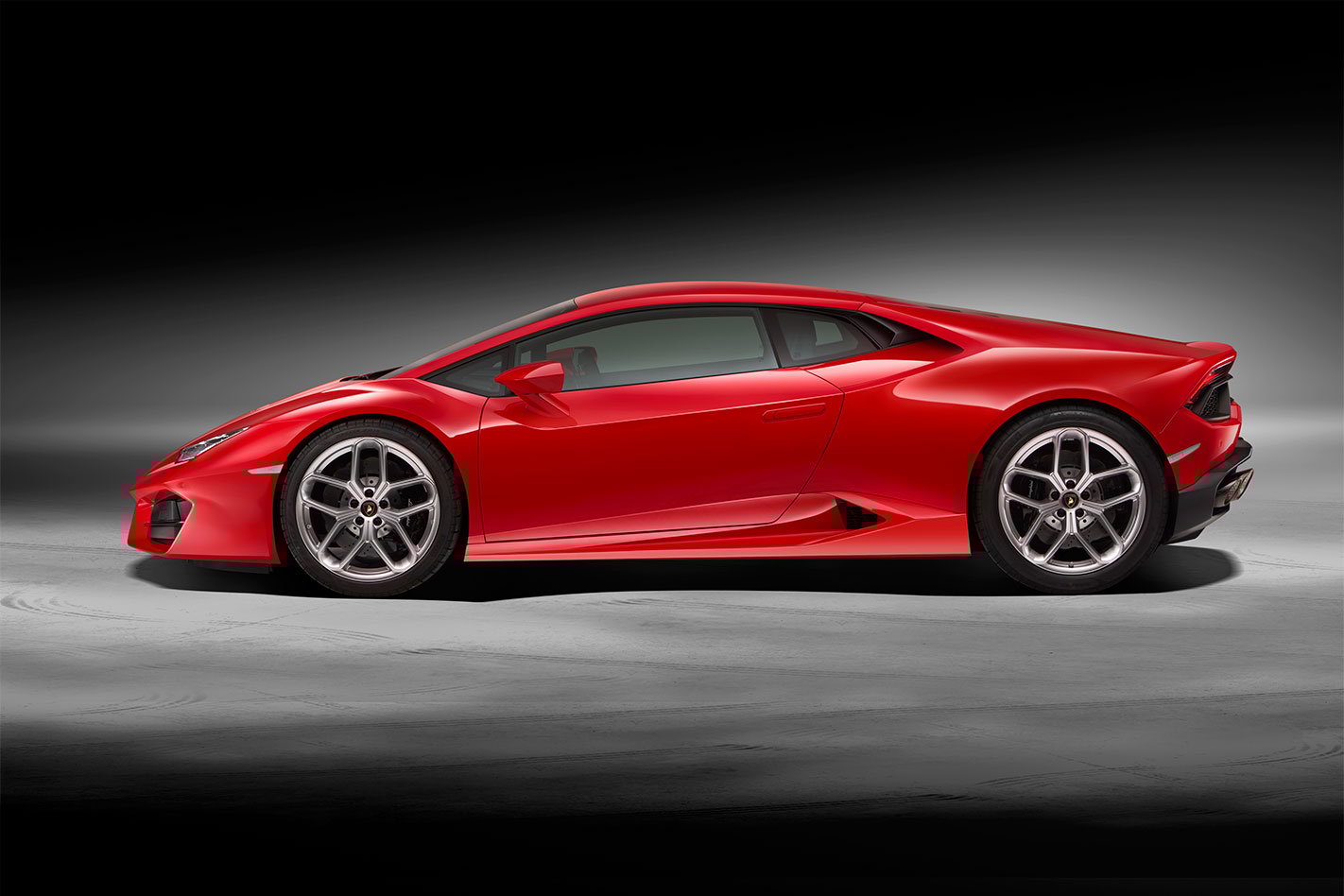
The seven-speed ‘Doppia Frizione’ (dual-clutch) gearbox is also shared and combined with launch control allows this new Huracan to hit 100km/h in 3.4sec, 0.2sec slower than the LP 610-4, largely, we expect, thanks to the lack of traction.
Sending drive exclusively to the rear promises to have a major effect on the Huracan’s handling; the regular car has quite incredible levels of grip and traction, but we suspect the rear-driver will be a bit more of a handful.
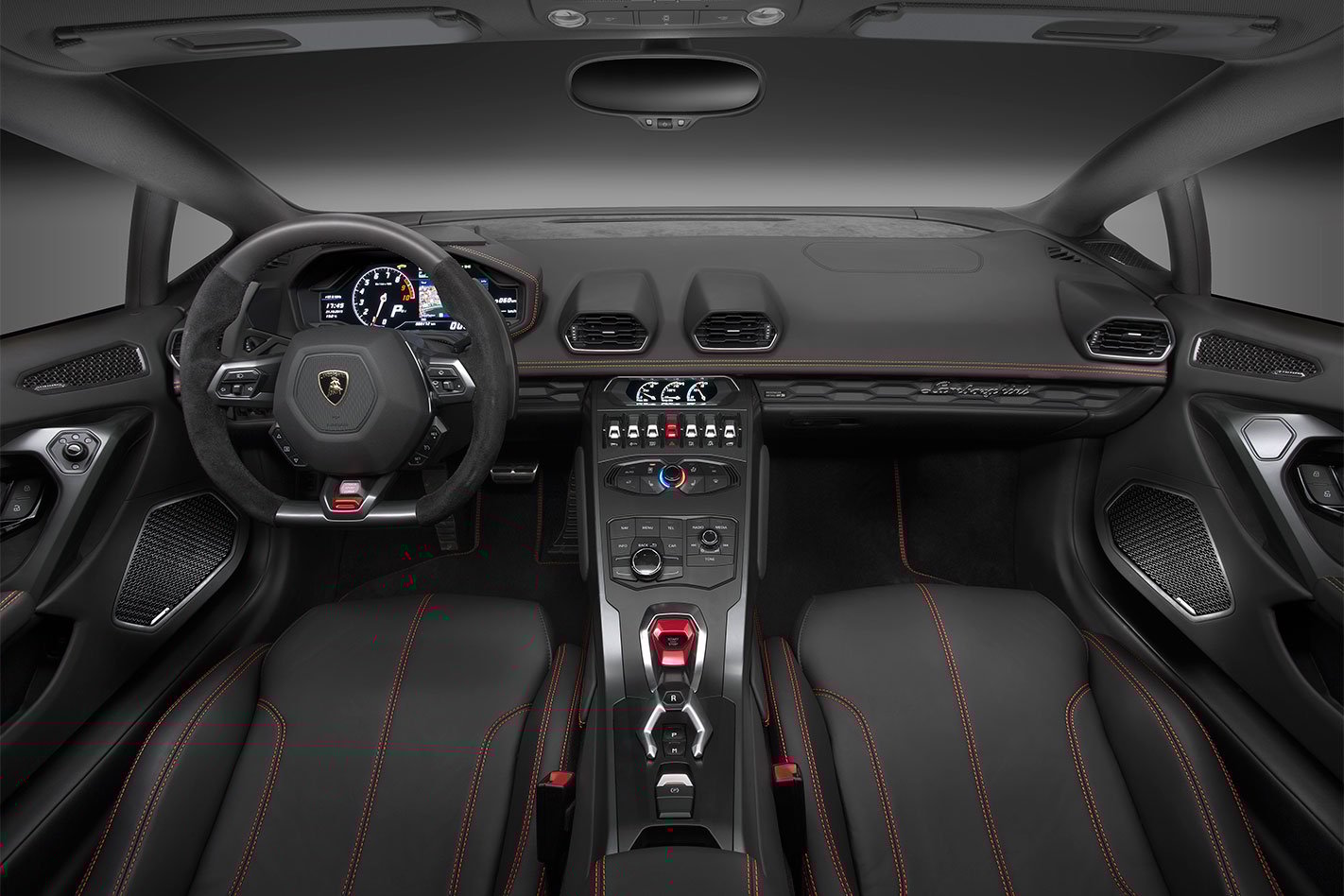
Somehow, we don’t think the engineers had to try very hard to make a 426kW rear-wheel drive mid-engined supercar constantly oversteer, but there you go.
Best of all, however, is the price. Ok, so you’re still going to be looking at a massive amount of money, but based on the recommended European pricing the new LP 580-2 could be the cheapest Lamborghini to land in Australia in decades.
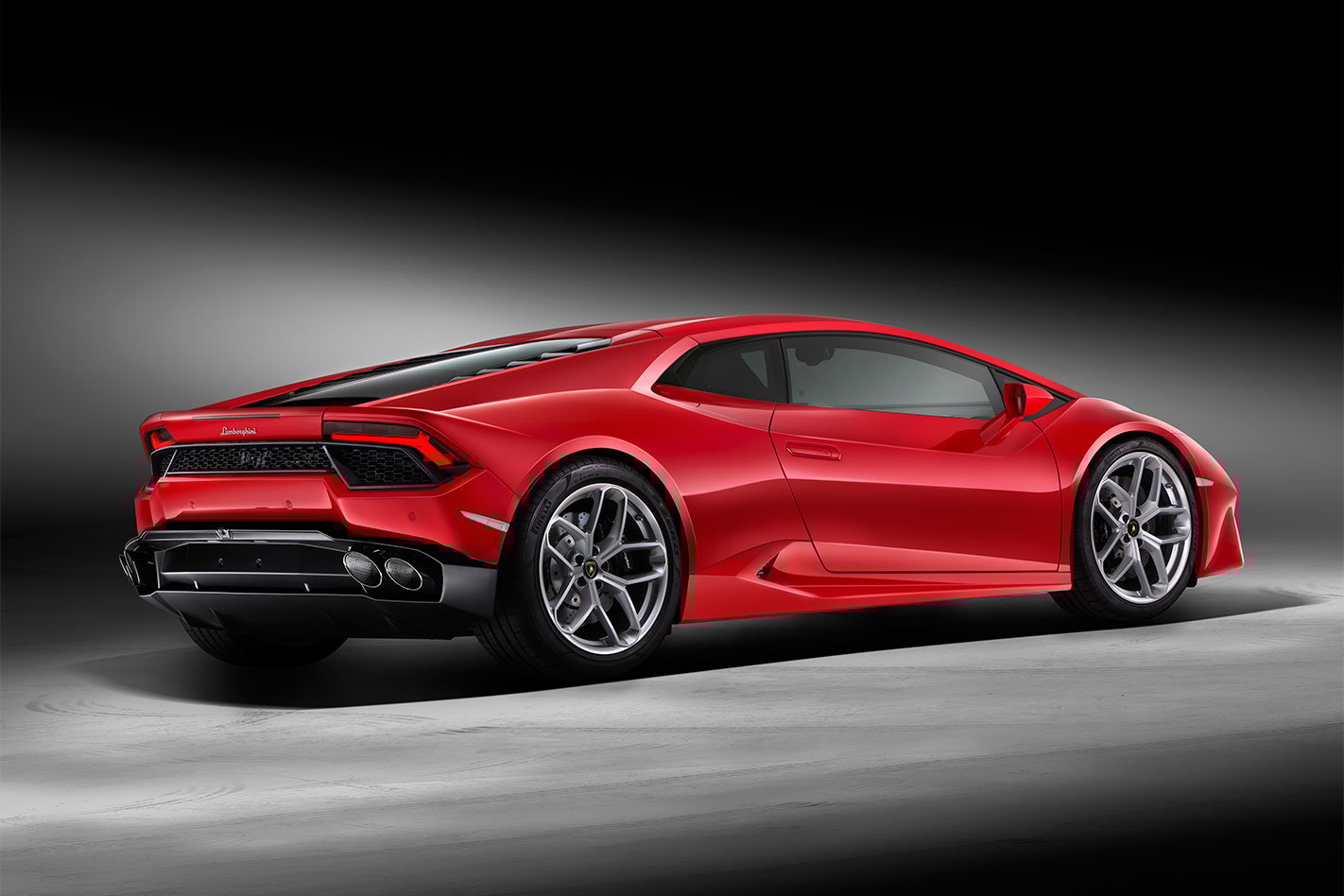
Regardless of price, however, in prioritising fun over pure speed the new Huracan is a car to be celebrated. The last rear-drive Lambo we drove – the Balboni Edition of 2010 – was wonderfully terrifying, just like a supercar should be.
We’ll bring you a first drive as soon as we can.
Let’s play a quick game of word association: muscle.
If your mind doesn’t immediately conjure an image of a bellowing American (or Australian) V8s and tortured rear tyres, then maybe these German takes on a classic theme are more for you.
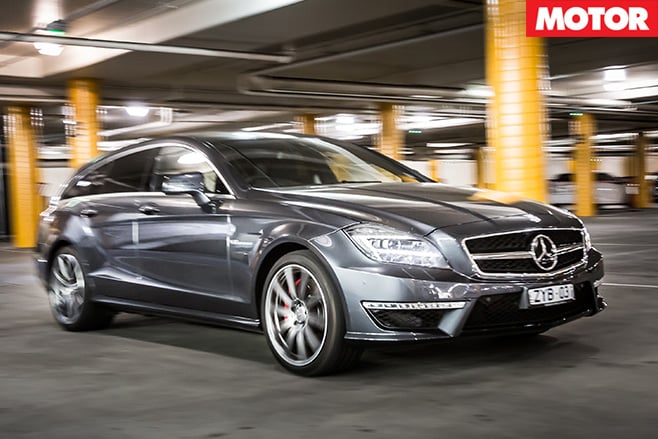
In the love-it-or-hate-it Nardo Grey corner, we have the latest Audi RS7 Sportback. In the Tenorite Grey (metallic) corner, it’s the two-breath special from Affalterbach, the Mercedes-Benz CLS63 AMG ‘S’ Shooting Brake.
Both are vehicular niches in design, the RS7 based on the A7 four-door ‘coupe’ which was created to compete with the regular CLS and BMW’s 6 Series Gran Coupe. As if to go one better, Mercedes decided to throw a roofline extension and tailgate onto its already distinctive CLS to create a wagon, adopting the more romantic ‘Shooting Brake’ nomenclature to suit its rarefied status. And rarefied it is, the tested example coming to $265,145.
On paper, this may seem a tad expensive when looking at the $238,500 Audi asks for an RS7. But incredibly, a handful of options boosts the tested Sportback to $277,800 – significantly more than the AMG.

It’s that last package which holds the most interest, as it replaces the standard-fit ‘air’ suspension with steel springs, adds ‘dynamic ride control’ variable damping, dynamic steering, and an upgraded limiter which allows for a 280km/h top end.
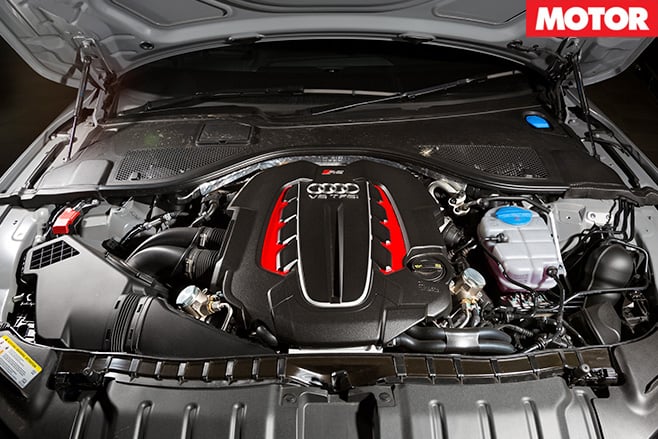
The 1995kg RS7 is powered by the same 4.0-litre twin-turbocharged V8 found in the RS6, with its turbochargers and exhaust system located within the ‘Vee’. The turbos can boost to 1.2-bar, helping the engine achieve a 412kW power peak from 5700-6600rpm. This is backed by 700Nm of torque, spread thick and even from 1750rpm all the way to 5500rpm.
Mammoth 21-inch cast aluminium wheels are wrapped in 275/30ZR21 rubber (Continental SportContacts on this example) and braking is taken care of by funky lightweight ‘wave design’ internally vented discs. They measure 390mm at the front and are clamped by six-piston calipers. Ceramic brakes are optional for $20,940.

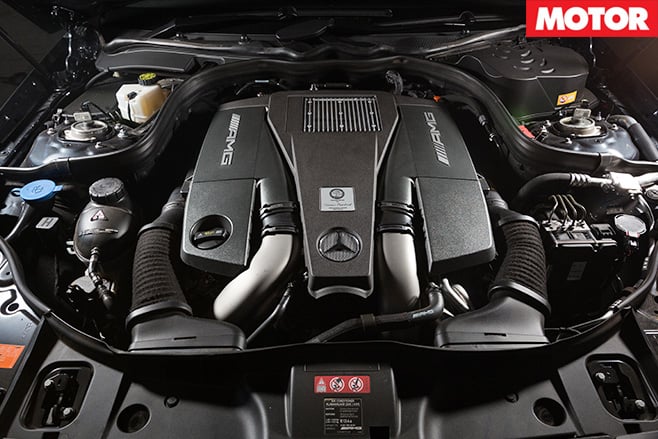
Displacing 5.5 litres and also twin-turbocharged, the eight-pot Merc produces peak outputs of 430kW at 5500rpm and 800Nm from 1750-5000rpm. The ageing seven-speed
AMG Speedshift MCT, an auto transmission that uses a ‘wet’ multi-plate clutch and does without a torque converter, is employed, and can be shifted – like the Audi – via paddles behind the steering wheel.
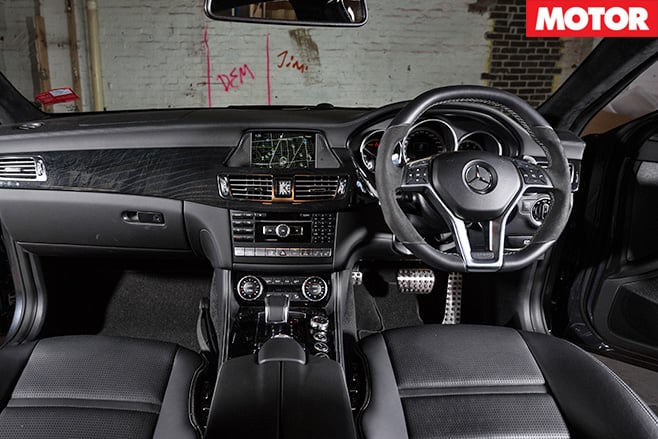
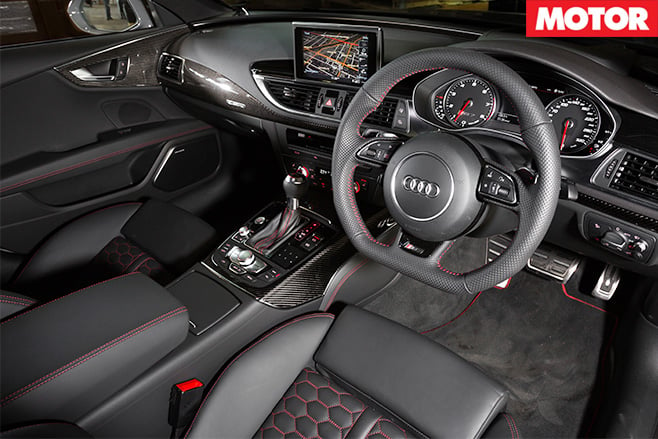
The CLS63 S retains an interior of appreciable quality, though its layout and busy centre stack age it against the clean modernity of the RS7. Nevertheless, the AMG drips fine breeding, from its leather-topped dash and infinitely adjustable heated and cooled Nappa leather seats to its alcantara-trimmed steering wheel and superbly tactile alloy shift paddles.
The Audi’s 8.0-inch multimedia touchscreen is also an inch larger and easier to navigate. But that’s enough spec-sheeting. Let’s fire these animals up.
The ageing gearbox feels like a dual-clutch in this regard, converting throttle position into forward motion with a delay not present when a torque converter – like in the Audi – is equipped. Selecting sport (or engaging first gear manually) reduces this ‘lag’ and reveals the mighty biturbo V8’s potency more readily.
The 1955kg Benz can make rapid progress without ever awakening the turbochargers, all to the accompaniment of a restrained V8 backbeat. Find an opportunity to stretch your right foot, however, and there’s a momentary pulse of anticipation before the full force of 1.0-bar boost is felt. At this point the sophisticated German turns decidedly old-school, squatting on its arse as it delivers an 800Nm kidney punch to the cabin’s occupants.
Punching out to the redline in manual mode, the CLS63 builds speed so quickly you have to request an upshift at around 6000rpm, lest the engine head-butt the 6500rpm limiter before the change arrives. It’s an altogether intense experience.
Despite giving away 100Nm at its peak, the RS7’s acceleration is just as vivid, albeit deployed in a completely different way. The Audi’s combination of quattro grip, near lag-free power delivery and a more intuitive gearbox means the RS7 can live by the classic Aussie mantra: get in, sit down, shut up and hang on. If you can live with the accelerative G, you can achieve blisteringly consistent full-throttle runs in this car, though the sound being piped through to the cabin sounds oddly artificial.
Along these lines, the Audi’s widely variable drive mode settings also feel contrived, though it has come a long way from the similar system employed in earlier RS models. That being said, there is not one mode which offers the right mix of control and response on Australian roads.
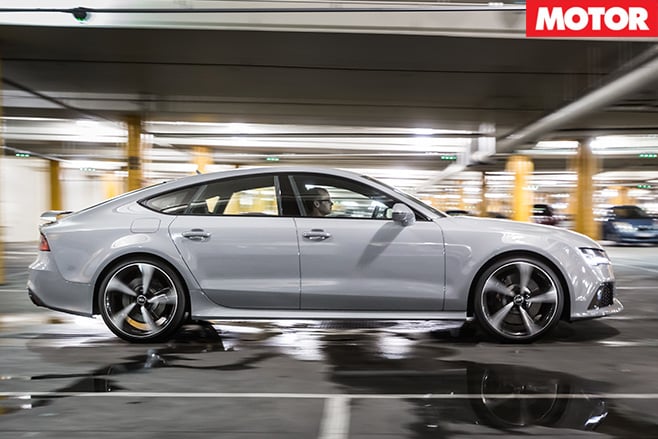
Complementing the Audi’s incredibly linear power delivery is its ample traction, which allows you to pin the throttle hard and early, the quattro system perceptibly shifting drive to the corners that can dig in the hardest at any given time. It’s a pity when the next corner arrives, braking isn’t as impressive. The RS7 has a firm, unresponsive brake pedal that requires a firm shove for real retardation, making it difficult to nuance your corner entry speed.
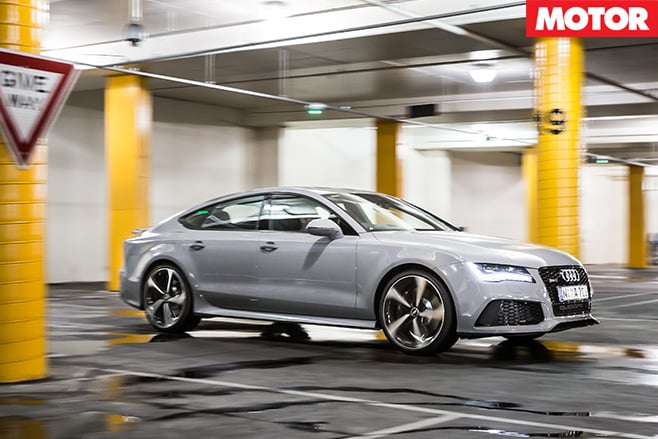
Given the Audi’s ability to devour such roads, the even more powerful, rear-drive AMG should have its work cut out to keep up, but in practice the brakes performs admirably.
Even in its hardest damper setting, the AMG has a more resolved ride than the comfort mode in the RS7. It enables you to focus on the driving line rather than potentially unsettling surface bumps. What’s more, when driven with throttle sensitivity, the Merc finds a level of traction which leaves something like a BMW M6 gasping in exhaust gas.

In essence, both these vehicles have taken the muscle car theme and lifted it to an incredibly sophisticated level. That the AMG has achieved this while retaining more of the genre’s traditional roots has to be applauded, but it’s the more complete, modern Audi that takes the gong. It’s a bona fide V8 muscle car for the 21st century – just keep an eye on those option boxes.
| u00a0 | u00a0 | Audi RS7 | u00a0 | Merc CLS63 S AMG |
| u00a0 | u00a0 | 4 out of 5 stars | u00a0 | 4 out of 5 stars |
| Body | u00a0 | 4-door, 5-seat sportback | u00a0 | 4-door, 5-seat wagon |
| Drive | u00a0 | all-wheel | u00a0 | rear-wheel |
| Engine | u00a0 | 3993cc, V8, DOHC, 32v, twin-turbo | u00a0 | 5461cc, V8, DOHC, 32v, twin-turbo |
| Bore/Stroke | u00a0 | 84.5 x 89.0mm | u00a0 | 98.0 x 90.5mm |
| Compression | u00a0 | 10.1:1 | u00a0 | 10.1:1 |
| Power | u00a0 | 413kW @ 5700-6600rpmu00a0 | u00a0 | 43OkW @ 5500rpm |
| Torque | u00a0 | 700Nm @ 1750-5500rpm | u00a0 | 800Nm @ 1750-5000rpm |
| Power/weight | u00a0 | 207kW/tonne | u00a0 | 220kW/tonne |
| Consumption | u00a0 | 9.8L/100km (claimed) | u00a0 | 10.6L/100km (claimed) |
| CO2 Emissions | u00a0 | 229g/km (claimed) | u00a0 | 248g/km (claimed) |
| Transmission | u00a0 | 8-speed auto | u00a0 | 7-speed auto |
| Weight | u00a0 | 1995kg | u00a0 | 1955kg |
| Suspension | u00a0 | multi-links, coil springs, anti-roll bar (f/r)u00a0 | u00a0 | A-arms, coil springs, adaptive dampers, anti-roll bar (f); multi-links, air springs, adaptive dampers, anti-roll bar (r) |
| L/W/H | u00a0 | 5012/1911/1419mm | u00a0 | 5000/1881/1436mm |
| Wheelbase | u00a0 | 2915mm | u00a0 | 2874mm |
| Tracks | u00a0 | 1634/1625mm (f/r) | u00a0 | 159 6/1626mm (f/r) |
| Steering | u00a0 | electrically-assisted rack and pinion | u00a0 | electrically-assisted rack and pinion |
| Brakes | u00a0 | 390mm ventilated discs, 6-piston calipers (f); 356mm ventilated discs, single-piston calipers (r)u00a0 | u00a0 | 360mm ventilated discs, 6-piston calipers (f); 360mm ventilated discs, 4-piston calipers (r) |
| Wheels | u00a0 | 21 x 9.0-inch (f/r) | u00a0 | 19 x 9.0-inch (f); 19 x 10.0-inch (rear) |
| Tyres | u00a0 | 275/30 ZR21 (f/r) Continental SportContacts | u00a0 | u00a0255/35 R19 (f); 285/30 R19 (r) u00a0Pirelli P Zeros |
| Price | u00a0 | u00a0$238,500 | u00a0 | $265,145 |
| Price as tested | u00a0 | $277,800* *Carbon Styling Package ($8500); Exclusive Design Package ($13,900); Bang & Olufsen sound System ($12,000); Dynamic Package ($4900) | u00a0 | $265,145 |
| Positives | u00a0 | Mind-numbingly fast; incredible traction; feels super expensive | u00a0 | Brilliant chassis balance; great ride; sledgehammer engine punch |
| Negatives | u00a0 | Pricey with options; Drive Select fails to convince; brakes a bit numb | u00a0 | Slow-witted gearbox; looks strange from some angles |
Now, more than ever, there’s a rich selection of everyday hatchbacks with stonking dynamic aptitude, yet all are pint-sized enough to park anywhere, squeeze down city alleyways and keep fuel costs in check. Supercars be damned, here are five affordable hatches across a range of budgets, all of which have genuine driver appeal and will still put a smile on your dial, even if you’re only driving to work.
FORD FIESTA ST – $25,990
The Fiesta ST is a veritable performance bargain. It’s the cheapest car here, a fact that has helped it win MOTOR’s Bang For Your Bucks trophy two years in a row. More than that, it’s one of those cars that just feels right, thanks in part to the generous range of adjustability in the steering wheel and seating positions. Drop into the bucket seat for the first time and you’re able to fine tune the ergonomics to your heart’s content.
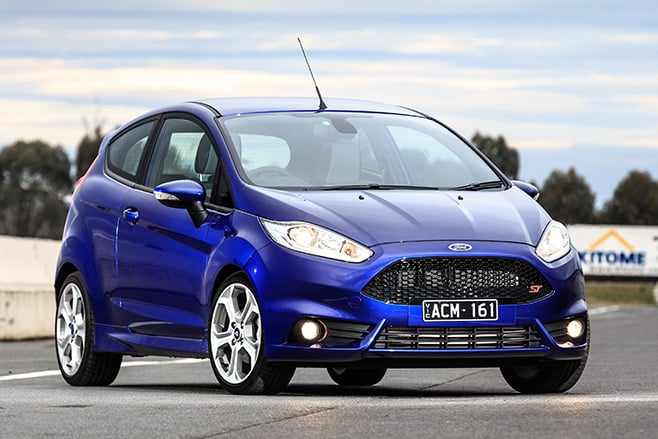
Ford has powered the ST with a 1.6-litre turbo four-cylinder engine making 134kW and 240Nm. Moderate numbers on paper, but plenty in the real world. It’s a willing motor and sounds great as it reaches the top end of the tacho. Front-end grip is impressive, and when combined with the well-tuned steering it will have you telling your friends about how ‘chuckable’ your little Fiesta is.
Ford only offers the ST with a manual gearbox. That’s not a bad thing in our books as grunty hatchbacks are way more fun that way. Sadly, gearshift feel is only okay in the ST but not so bad as to detract from the whole experience. The sporty suspension is expectedly firm, happily though it deals well with lesser, high tempo bumps and remains comfortable over all but large knocks.
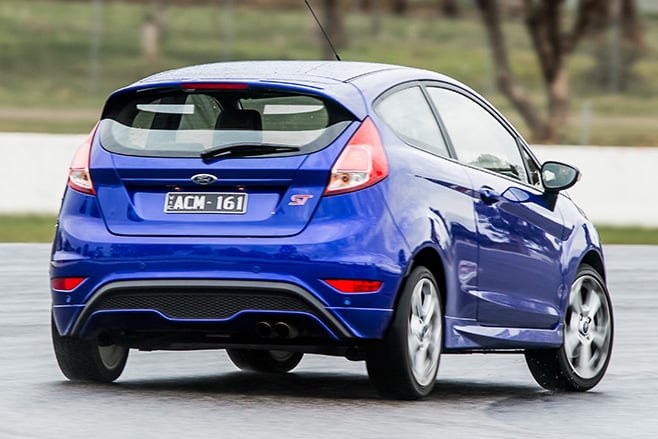
Exterior styling of the Fiesta has been called ‘catfishy’ in recognition of that wide-mouth grille up front. It’s not for everyone, but we wouldn’t call it ugly. We do think the Fiesta’s interior styling could do with a rethink, and if you’re a gadget freak you may be left underwhelmed by the infotainment system, or lack thereof. There’s no sat nav, and the small screen is not very easy to use. But the ST isn’t really that kind of car. It’s brilliant fun to punt around, and it’s the ST’s driving charisma that’s really appealing.
Click here to read the full review on the Ford Fiesta.
VOLKSWAGEN POLO GTI – $27,490
DIYers rejoice! Volkswagen has heard our cries and put a manual gearbox back into the Polo GTI. VW’s DSG automatic gearboxes are lightning quick, but for driving fun in a little pocket rocket like this, there’s nothing better than a clutch and a gearstick. That said, if you can’t live without an auto in traffic and this is to be your everyday car, you can option your Polo GTI with a DSG for an additional $2,500. Having a choice of gearboxes is one thing the Polo has going for it over the manual-only Astra, Fiesta and 208 GTi.
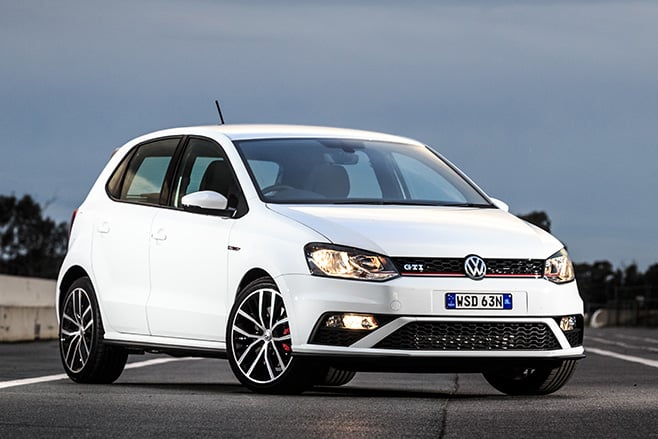
The Polo’s interior is the smartest of the five. The others fall a little short of the GTI’s premium materials and build quality. The front seats are great, especially trimmed in GTI tartan, and like the Fiesta there’s good range in the driving position, though it’s a little tight around the knees compared to the ST.
Satellite navigation isn’t standard, but is available as part of Volkswagen’s ‘Driver Assistance Package’ that includes parking sensors and other safety aids. On the plus side you do get a reversing camera for nix.
Dynamically the ace up the Polo GTI’s sleeve is its engine. Jumping in size over the previous generation you now get a 1.8-litre turbocharged four-cylinder petrol engine with boatloads of torque, especially in manual versions which get an extra 70Nm of the latter: 141kW and 320Nm, and boy is it quick. There’s a well of boosted shoving power on tap across a fat chunk of the rev range.
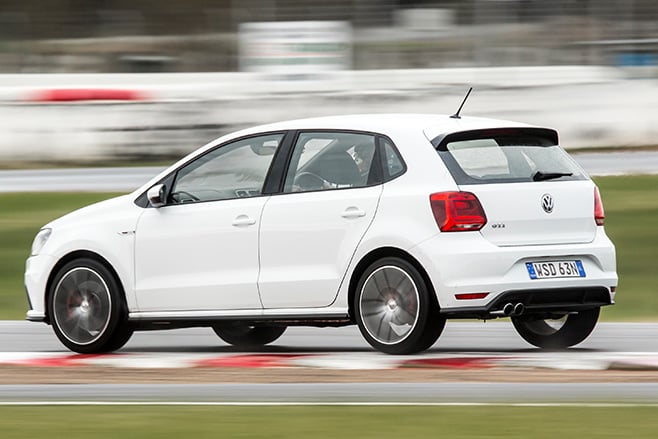
The GTI’s braking ability stood out as above average. Its electrically-assisted steering is quick but soft in feel, lacking feedback compared to the ST. We also found the ride to be jittery.
In typical VW fashion the Polo GTI looks handsome in a very safe and unlikely to offend way. A little more character would be a welcome addition and earn the Polo a few more points on our ledger. However, VW’s brand of austere design has drawn an army of fans, and an understated hatch with muscular performance does have its own unique appeal. It may be exactly what you’re looking for.
Click here to read the full review on the Volkswagen Polo.
RENAULT CLIO RS – $29,490
Of the five cars we’ve picked, the two French entries are by far the most characterful. First up is the Renault Clio fettled by RenaultSport, a branch of revheads who have built bonkers little missiles on Renault’s behalf for decades. The Clio is one of the most popular RenaultSport models and there are good reasons for that.
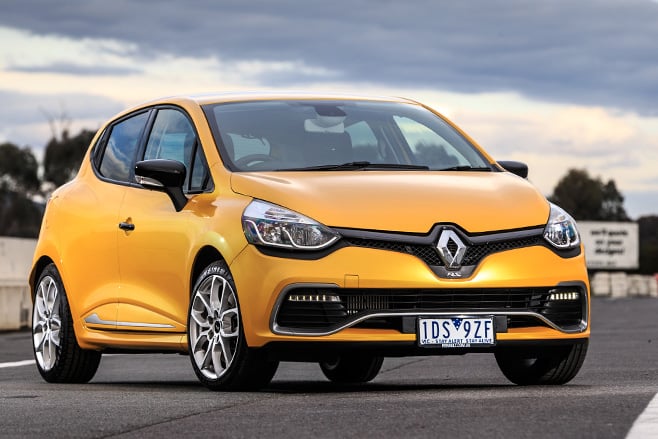
Power comes from a 1.6-litre turbo four-cylinder engine making 147kW and 240Nm. As far as seat of the pants driving fun goes, the Clio gives its more powerful counterparts a run for their money. It sounds brilliant with its rorty induction growl, and it pulls like a puppy on a leash, always eager to get to the next corner, hoping to be lobbed in faster each time.
It should be mentioned the Clio RS is available exclusively with a six-speed dual-clutch automatic gearbox, so it does lose points there from a driver involvement perspective. That said, the auto will be seen as a practicality advantage by some, as will the five door configuration (though the back seats are tiny), and flipping the paddles when in manual mode is still good fun.
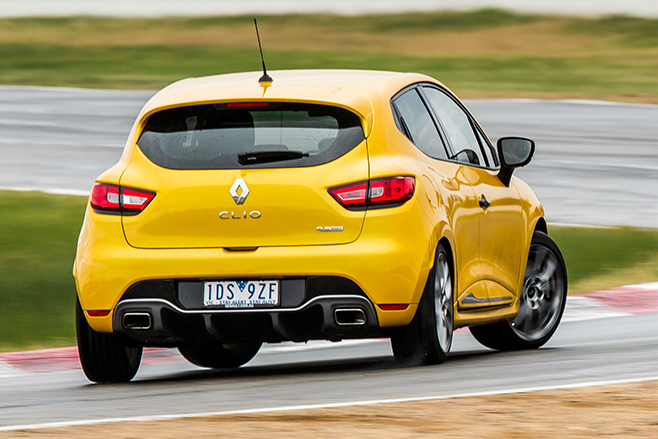
It’s all French quirkiness inside with red seatbelts, rally-esque centre marker on the steering wheel and lots of not-so-discreet boy racer inclusions like the chime from the dash when you near the rev limiter. Tech specs are good with satellite navigation as standard and a quality display.
Where it lacks the outright performance of the Polo GTI it takes back some ground with its personality and fun factor. With all its charm, the Clio RS is a great option and will especially suit those who find the Polo a little too plain.
Click here to read the review on the Renault Clio RS.
PEUGEOT 208 GTI 30TH ANNIVERSARY – $35,990
Yes, the Peugeot 208 GTI 30th Anniversary is a wild looking thing. If it’s too much, you can option yours with a regular coat of duco, or there’s the normal 208 GTI that does away with the in-your-face paint job as well, but we quite like the quirky nature of the 30th Anniversary exterior. It suits the off the rails performance upgrades over the normal GTI.
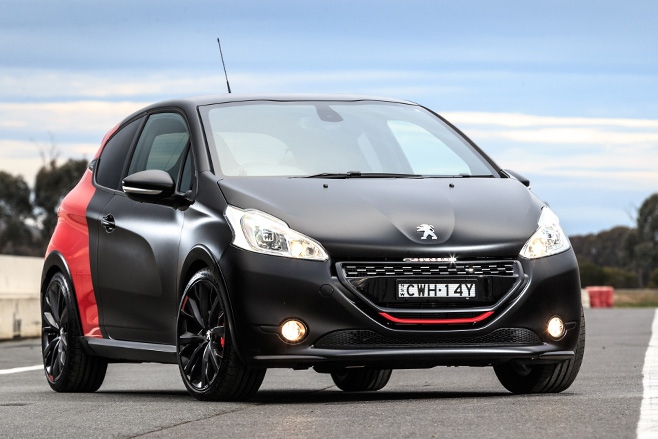
Power gets a subtle boost to 153kW and 300Nm. It’s a fast little bugger, however most of the GTI 30th’s enhancements are found in the suspension, brakes and tyres. It’s stiffer and lower than the regular GTI, with revised geometry and wider tracks front and rear. Brakes are bigger with Brembo calipers on the front, and super sticky Michelin Pilot Super Sport tyres are standard. It looks tougher as a result, and the driving experience is altogether better.
The GTI 30th feels the most focussed of all five. It’s a highly engaging experience with super pointy steering and a standard Torsen limited slip differential that works really well on a racetrack. That diff’ is a big selling point if you ever plan to try your hand at casual circuit days. With all that in mind, this car may be too much for every day. How much of its solid ride you can handle on the way to and from work is something to consider.
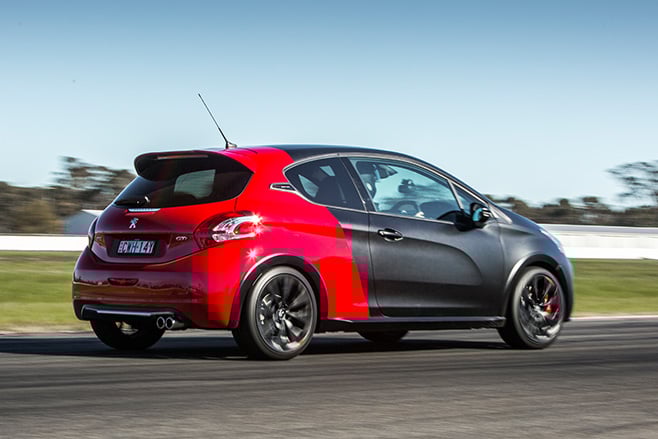
Standard equipment inside the Peugeot is good with standard satellite navigation and a high resolution screen. The dash cluster is unusually located up above the (very small) steering wheel. We recommend sitting in one to see if it works for your seating position. For some the dials will be hidden behind the top rim of the steering wheel. Those who find the narrow seats of the Fiesta and Clio a little on the tight side, the Pug’s more accommodating pews should feel better, while still offering good cornering support.
As in the other Frenchy talked about here, the GTI 30th has its fair share of eccentricities like red floor mats, uniquely styled dials, oh, and did we mention that paint? This is a hot hatch that may prove to be too over the top for some, but those thrill-seekers who ‘get’ the 208 GTI 30th Anniversary will welcome the return to form for Peugeot.
Click here to read the review on the Peugeot 208 GTi.
HOLDEN ASTRA VXR – $39,990
The Astra nameplate has a long and varied history in Australia. The current model is imported from Europe, so it’s a closer relative to the other four hatches on this page than you might think. The VXR variant is the hottest Astra on offer from Holden; in fact as hot hatches go it’s as searing as the ground of the beach car park in summer.
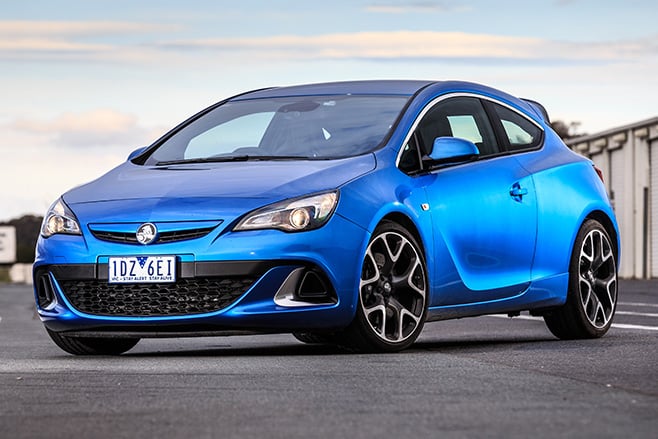
The Astra VXR is the most powerful of the five hatches we’ve picked and only comes with a manual gearbox for maximum driver engagement. Its 2.0-litre turbocharged four-cylinder engine makes 206kW and a mighty 400Nm, so if outright pace is what thrills you, this car has you covered.
It has very tricky front suspension that separates the damper from the steering to reduce torque steer. You’ll thank the clever engineers who developed this when you delve into the VXR’s brawn. Steering turn-in is keen, and the chassis feels composed and able to deal with all those kilowatts.
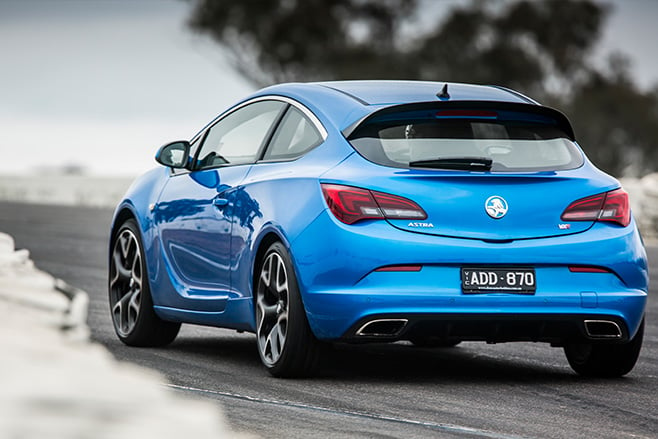
Stylistically we think the Astra VXR is one of the best looking hatches out there. It has an imposing stance sitting over huge 20-inch wheels. There are lots of attractive design details, though it does have quite a long front overhang and low ground clearance which will punish careless parkers.
You’ll have to part with near on $40k to own a VXR, making it the most expensive of this bunch, but the spec for the money is excellent. You get all sorts of included equipment like sat nav, leather seats, performance brakes, LED taillights and more. Some elements of the car – the interior in particular – feel a little cheaply made, but with all that grunt and the Astra’s capable chassis, you’ll get over it quickly.
Click here to read the full snackable review on the Holden Astra.
Five things will spin around in your head like a whirlpool after a generous blat in the new Jaguar F-Type Coupe R.
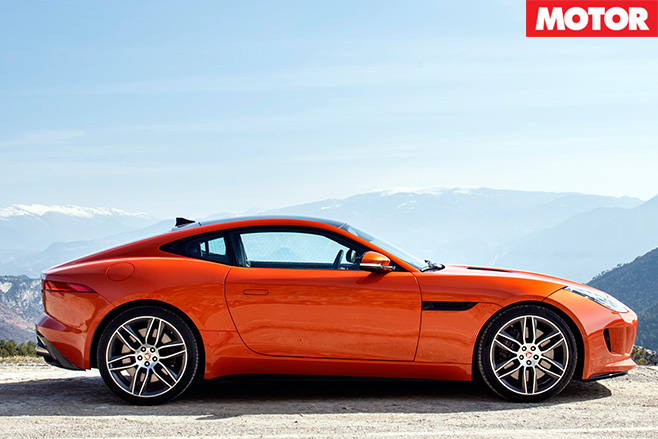
One, the looks. Unless you’ve just thawed out from a long and forgettable hibernation, you’d very much know the F-Type coupe is the lidded version of the F-Type convertible. And, while there’s the eye of the beholder and all that malarkey, if your eyeballs don’t fizz pleasantly as they drink up the F-Type Coupe, particularly that arse, you might just have a disease.
Two, the acceleration. There are three rear-drive F-Type Coupe models – two supercharged V6s, one supercharged V8. The middle-sibling Coupe S, with 280kW and 460Nm, will hit 100km/h in 4.9 seconds. Spritely, except you’ll be dragged off at the lights by a Mercedes A45 AMG, which costs a fair bit less, and that’s not really on.
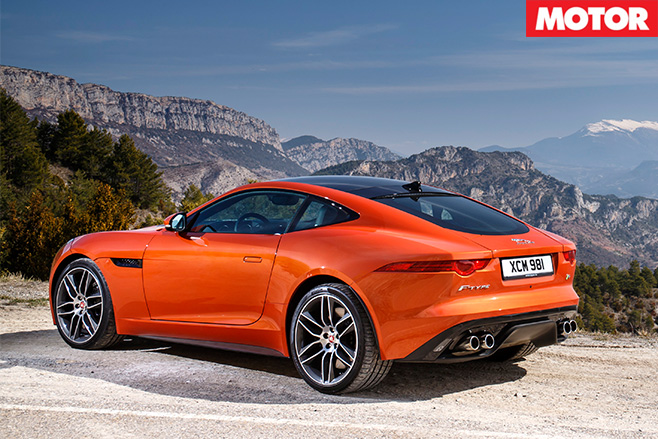
Even 80 per cent throttle will embarrass most other cars. And full throttle is an event you build yourself up to – it’s like the curtains opening and the show starting. It compresses innards and frightens passengers. Able to hit 100km/h in 4.2 seconds, the F-Type Coupe R is legitimately feral.
Three, the sound. Zero to 100km/h in 4.2 seconds is quick, but on paper, it won’t rob you of your breath. But the Coupe R feels like it’s doing 0-100km/h in 3.5 seconds simply because of the noise.
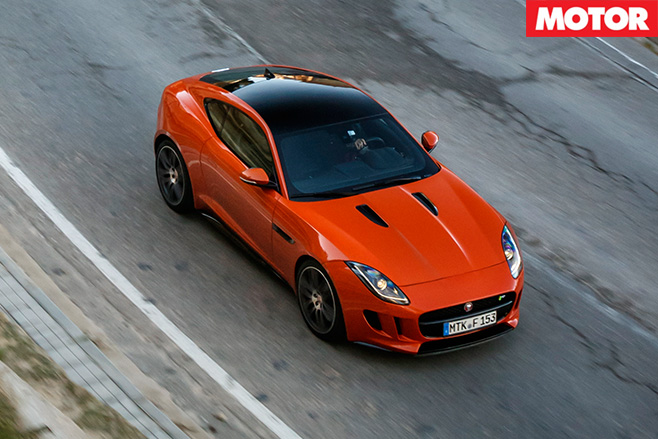
Point number four, the handling. The F-Type Coupe is certainly more jaguar than cheetah: it changes direction like a rugby league winger rather than a ballerina. As the loading of the car swaps across its roll axes, be it cornering or braking, you become aware that all those muscles are hidden under a few love handles.
We’ll explore its rivals later, but for comparison’s sake, the V6 F-Type weighs 244kg more than a PDK Cayman S. The V8 F-Type weighs 265kg more than a PDK 911 Carrera. But more pressingly, at 1.9 metres wide, the F-Type feels physically large – it makes narrow roads feel like footpaths and its corners never seem to fully shrink around you.
And lastly, we finally arrive at point number five: the ESP button. In the F-Type Coupe R you push it as readily as you’d push the ‘eject’ button in a helicopter. At some stage in the future, holding down the ESP button in an F-Type Coupe R will void life insurance and indeed, when pressed, an ‘are you sure?’ prompt should come up in the centre screen simply. It’s not a button to be pushed by the inexperienced.
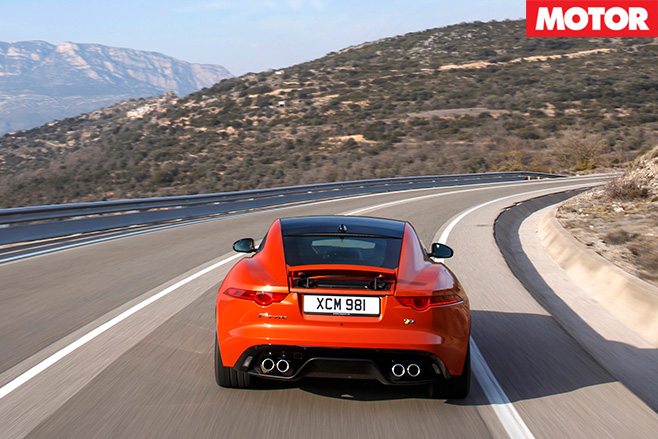
When we were there, in the V8 F-Type Coupe with the optional carbon ceramic brakes, it was raining like all the world’s oceans had colluded with the sky in an attempt to take over the lands.
You know what it’s like to drive on wet bitumen, but of course there’s a rubbery racing line on a racetrack and at Motorland Aragon, in the wet it’s like a coating of ghee and ball bearings. Unfortunately, too, the racing line tends to be the safest and quickest way around the circuit.
In the V8 F-Type coupe, with its electronic rear diff that can swap from fully open to fully locked in just 200 milliseconds, it’s hilarious fun. Once you’re comfortable with the car, as you pick up the throttle on corner exit and become familiar with how much rear grip you have, you can start getting cheeky: applying throttle more generously, the F-Type Coupe R will predictably wriggle sideways and it’s always easy to catch thanks to steering that’s pleasantly fast. You never need to move your hands from nine and three.
Funny that, because the F-Type Coupe R is fitted with the quickest steering of any Jaguar, ever. And it’s possibly the one thing we weren’t super impressed with. YouTube celebrity Chris Harris – and occasional MOTOR contributor – said the steering was better than a 911.
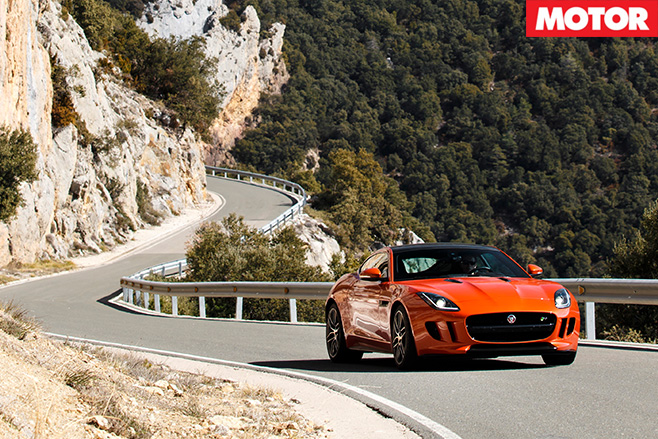
When the big F-Type Coupe starts to understeer, you’ll feel it through your bum as much as your hands. Steering numbness is an affliction particularly peculiar to modern sports cars but it seems a little too far gone in the F-Type Coupe. Jaguar engineers, go drive a Toyota 86.
Of course, it’s interesting that it’s far easier to get the F-Type Coupe to oversteer than it is to understeer. Barrel into a tight corner too fast and in a situation where you’d expect the nose to push, the F-Type, through the electronic wizardry otherwise known as torque vectoring, grabs at the brakes on the inside wheels, tucking the nose back into line.
It gives you confidence to carry more entry speed knowing you’re not going to wedge yourself in the outside guardrail. You can even pick up the throttle earlier and more aggressively than you might first think – the nose will stay reasonably gripped up.
But given the chance to flog an F-Type Coupe around Monaco or Monza, you’d head to Italy. For a start, it’s worth noting the F-Type Coupe is the most torsionally rigid Jaguar ever made and it feels tighter and stiffer than the convertible, which can occasionally feel like all its bushes are made of marshmallows.
And show them off it will: the gearbox is a sweetheart, delivering with a solid paddle pluck either a loud crack and a new gear on upchange, or on downchange a delicious and accurate throttle blip. It doesn’t feel like it’s made by Tag Heuer like a PDK, but it’s still a great gearbox.
We confess we’re fixating on the V8 version a little unfairly (wouldn’t you?) but it remains to be seen whether the blown V6, with less of a lump over its front axle, falls more in the handling Goldilocks Zone than the V8 (like the droptops).
We got to spank the V8 in the dry but it was pissing down when we drove the V6. It felt sweet but we’ll wait until we’ve driven them back-to-back in the dry in Australia before we can confidently make a call.
Back to the V8. The standard brakes are more than sufficient, but for those readers wearing straitjackets, you can get it with carbon ceramic items which, with 398mm front discs, and like most carbon brakes, are fairly overkill.
But when you’re hammering down a 1.7km straight on a soaked Spanish racetrack, it’s easier to keep the throttle pinned and kiss 260km/h knowing the second you hit the left pedal, the ‘chutes are really going to open.
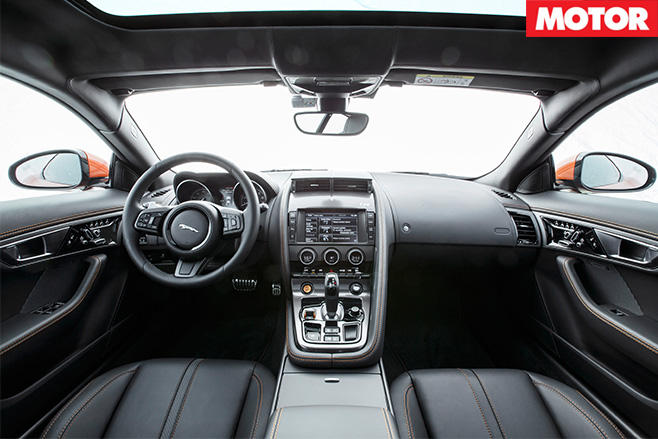
It’s a nice car to sit in, even if the cabin isn’t quite as there as some of its rivals. And the whole interior is almost let down by an infuriating user interface for the centre screen entertainment system, which is about as easy to navigate as the Roaring Forties.
So. You want one. Maybe you’re the kind of person who’s always wanted a 911 but there’s just something about them you don’t like. The big Jag finally offers up a worthy alternative and certainly it’s priced to lock horns with Stuttgart’s army (see breakout for F-Type Coupe pricing and specs).
Certainly if you had $120K to spend on a two-door sports car with a roof, you’d consider the entry-level F-Type Coupe – and the base PDK Cayman, or maybe you’d stretch to $135K for an Audi S5.
But it becomes murkier with the big boy F-Type Coupe R. Of course, just seven grand separates the lidded V8 Jag from the PDK 911 Carrera, but we’re talking $220K territory here. The Jag has a ferocious power advantage – it has 147kW more than the Porsche – but it also must lug an extra 265kg, meaning it only just beats the Porsche to 100 – 4.2 seconds versus 4.6.
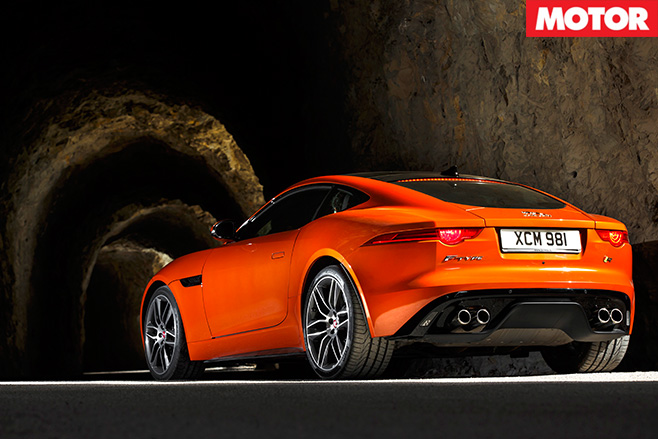
But we assume not a lot of people will want to do that, hence why they’re considering the F-Type Coupe. It might win silver at the Handling Olympics to the 911’s gold, but they’ll be getting a sweet car to drive. And a lot of people won’t care much when they see the F-Type Coupe in the flesh and feel their eyeballs tingle as they drink it up. Particularly, well, that arse. Look at it.
4 out of 5 stars
Specs
Body: 2-door, 2-seat coupe Drive: rear-wheel Engine: 5000cc V8, DOHC, 32v, supercharger Bore/Stroke: 92.5 x 93.0mm Compression: 9.5:1 Power: 405kW @ 6500rpm Torque: 680Nm @ 2500rpm-3500rpm Power-to-weight: 243kW/tonne 0-100km/h: 4.2sec (claimed) Top Speed: 300km/h (claimed) Consumption: 11.1L/100km (claimed) Emissions: 259g/km CO2 (claimed) Transmission: 8-speed automatic Weight: 1665kg Suspension: A-arms, coil springs, adaptive dampers, anti-roll bar (f) A-arms, coil springs, adaptive dampers, anti-roll bar (r) L/W/H: 4470/1923/1321mm Wheelbase: 2622mm Tracks: 1586/1628mm (f/r) Steering: electrically assisted rack-and-pinion Brakes: 380mm ventilated/drilled discs, 6-piston calipers (f); 376mm ventilated/drilled discs, 4-piston calipers (r) Wheels: 20 x 9.0-inch (f); 20 x 10.5-inch (r) Tyres: 255/35R20 (f); 295/30R20 (r) Pirelli P-Zero Price: $219,600 Positives: Frightening acceleration; delicious exhaust note; look at it Negatives: Feels big – more bull than ballerina; numb steering; bits of the interior
Things started out badly when Charley Boorman was late for the first day of Celebrity Challenge boot camp.
No less than four people walked up to me, shook my hand and told me how much they loved my work. I’m not deluded enough to fall for this, and after the fourth time (Catriona Rowntree) I figured they were mistaking me for Charley.
Okay, so maybe I look a bit like Charley (he has more facial hair, I’m taller) but the confusion continued when people asked me about travelling the world on a motorcycle, which Charley and I have both done. Independently, I should point out.
And we’ve both done television (granted, he’s done way more) so you can see how a quick ‘whaddyabeenupto?’ could lead to a whole heap of confusion.
Fortunately, Charley was a good sport about it and once he’d walked up to me and asked, “How’s it going, Charley?” I knew he was cool. Phew, because I imagine most celebs don’t appreciate impersonators. Even accidental ones.
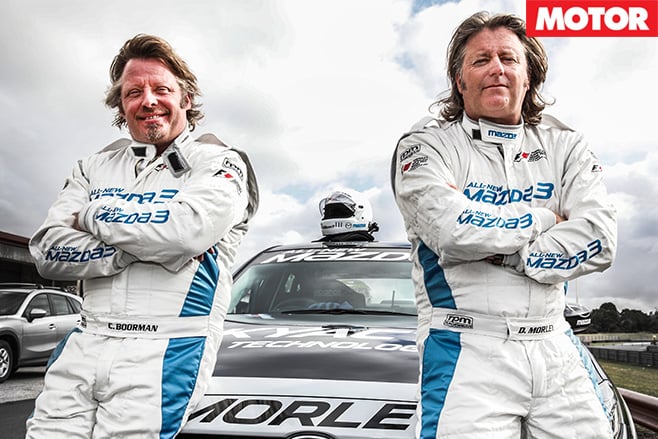
This is why the annual celebrity race at the Australian Grand Prix is a complete panel beater’s delight. Throw in the fact celebrities don’t become celebrities by being the shy retiring type and the yearly carnage-fest is understandable.
Less fathomable is Mazda’s decision to back up again this year and supply 20 brand new 3s for the celebs to tear up in front of a sometimes bewildered Albert Park crowd. But according to Mazda’s PR frontman, Steve Maciver, sacrificing a few 3s to the entertainment Gods makes financial sense. The TV exposure alone is worth squillions and then there’s the Facebooking and Tweeting celebs use as their main form of communication.
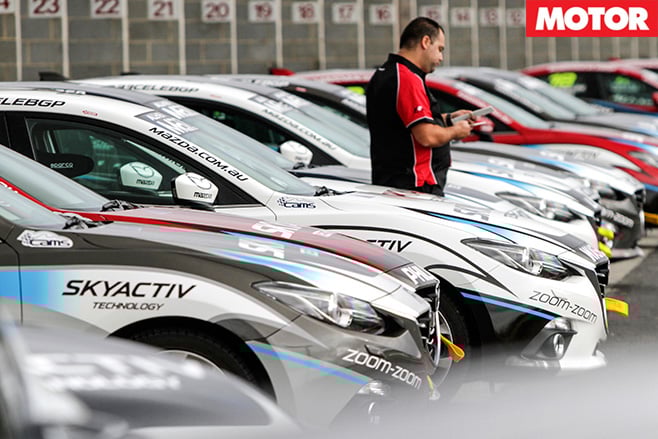
Our head driving instructor is none other than Mark Skaife and, having done this before, one wonders why he’d be so keen to front up and put his reputation on the line again. But he seems to genuinely enjoy the challenge of taking a bunch of newbies and turning them into race drivers.
Early on day one, there’s a bit of brow furrowing in Skaife-Land as it becomes apparent there’s some seriously dodgy driving going on. The initial braking exercise (from 60km/h in a straight line) reveals many of the class of 2014 are like the rest of us. As in, they fail to pull in the ABS and brake before they’ve crossed the white line that marks the braking zone.
“This is what worries me about drivers these days,” Skaifey tells me privately. He continues, “There’s no understanding of what a modern car can do because we’re never allowed to do it. Morley’Don’t speed and don’t drink drive is all we hear. And then you see somebody who doesn’t know to jump on the brakes hard in an emergency stop and you hope it never happens to them for real.”
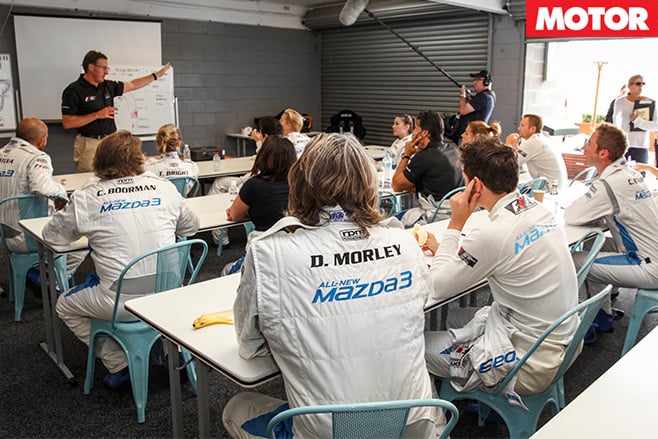
By day two, the celebs have moved on to putting a string of corners together and Skaifey is using terms like understeer and oversteer.
Questions from the floor start out innocently enough and include gems such as, “How fast can you go before the car will roll?”. But, don’t go thinking this crowd is a bunch of dummies.
They’re world champions, Olympic gold medallists, top-shelf entertainers and canny business folk (and me). Rather, it’s a case of people who are very good at what they do professionally being thrown into a technical pursuit fair and square at the deep end.
Celebrity chef Adam D’Sylva is my first victim after the day-two chat. It sounds like a dumb question, but Adam is wise to it: How does driving a car fast on a racetrack relate to running a busy restaurant?
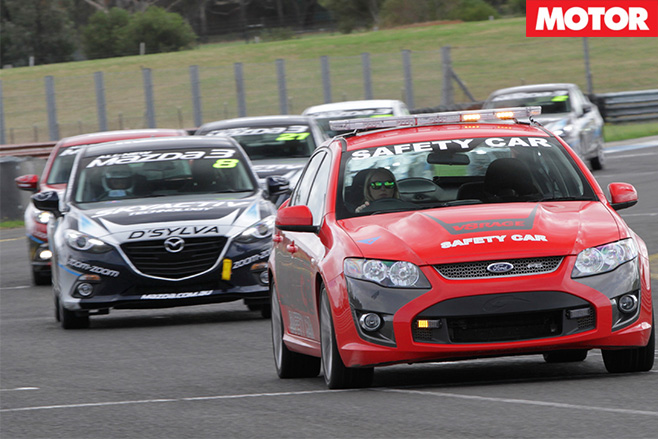
TV presenter Sam Mac is a bit more philosophical, likening the pressure he feels on the track to a performance in front of a big audience.
“I’d rather go on air with half-a-million people watching than slamming on the brakes and trying to hit an apex. It’s all very foreign to me. Actually, the idea that they’re having me drive at Albert Park at the GP is pretty amusing. It’s also a potential insurance risk.”
By and large, however (and it’s always the way with a group of people that includes sportspeople) the competitive spirit is coming to the surface.
Even non-sports folk are discovering a side of themselves they were previously unfamiliar with. Former Miss Universe Australia, Scherri-Lee Biggs, in an unguarded moment assesses her own aggressive on-track behaviour: “I’m shocked. That’s not how I am in life”.
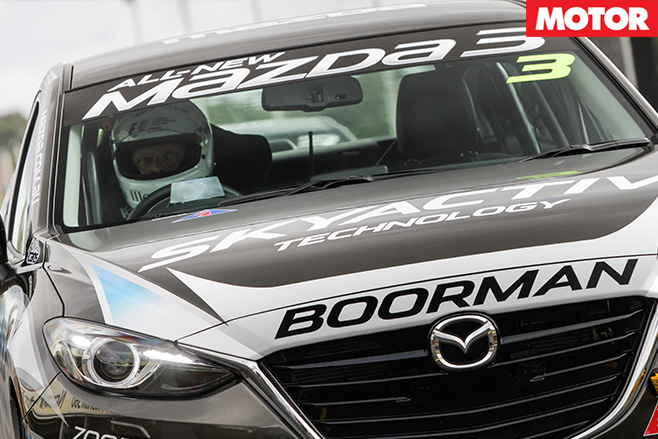
How’s it going, I ask him. Nothing. Just a shrug of his shoulders. “Who can say,” he replies enigmatically.
Then: “Who’s fast in your group?” he asks surreptitiously.
The competitive spirit clearly runs deep and is never far from the epidermis.
Sweet, disarmingly honest, gold medal snowboarder Torah Bright backs it up later. After telling me she doesn’t feel too much pressure because motorsport is not her job, “But I kind of want to win this,” she adds in almost a whisper. She’s not kidding.
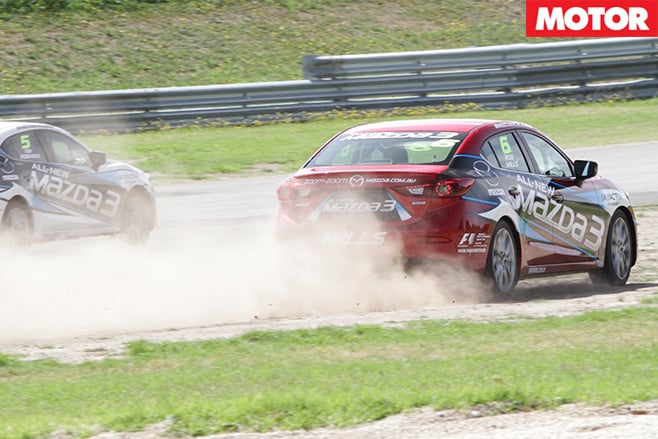
And fear. I ask Torah Bright about the differences between standing at the top of a snowboard run and launching out of pit lane in a Mazda 3.
“Oh, standing at the top of a run is much scarier,” she admits. “With jumps, you’ve got a distance to clear. And if you don’t, you’re blowing out knees.” She says it casually. I’m nearly sick.
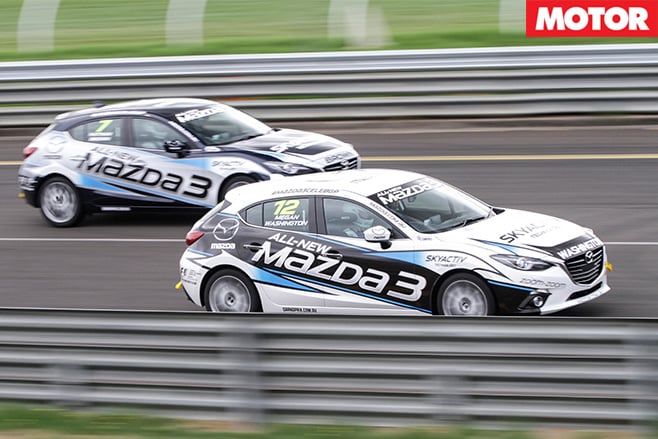
The final day is crunch time at Sandown. Two practice races will pit us against each other. Blow it here and you won’t be handed a CAMS licence to compete at the GP. And by now, with their lives three-days deep in becoming a race driver, that’s not an option for this bunch of career overachievers.
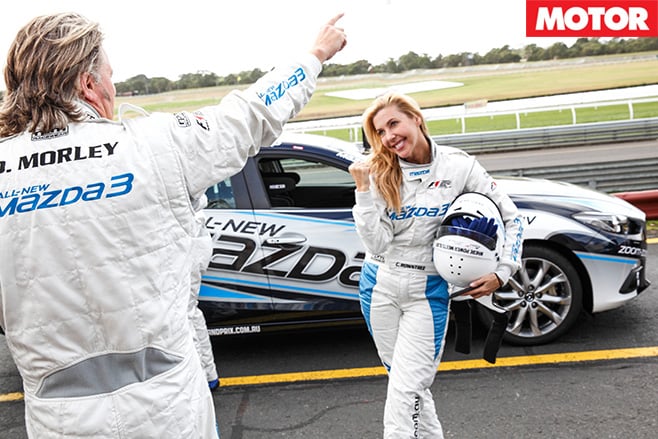
By the end of it, there isn’t a single celeb who hasn’t earned their CAMS competition licence, but here’s the big surprise: There’s also not a single celeb here that I haven’t enjoyed spending three days with. And I mean that. I honestly expected a bunch of handfed brats with pouty bottom lips and Botox track marks. But they drove hard and raced tough.
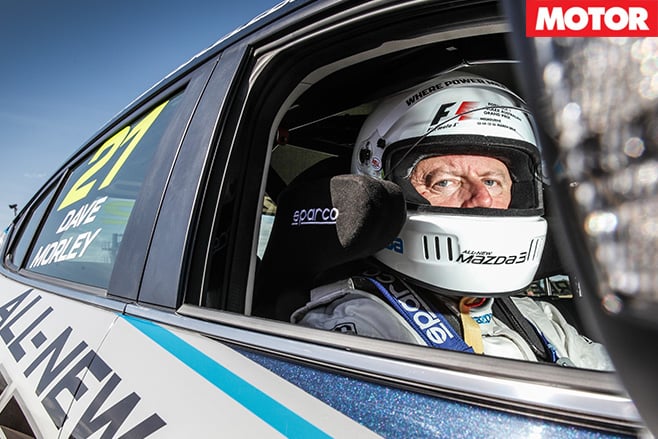
Raw talent
The Mazda 3s were as stock as you’ll ever see on a racetrack. Starting with an SP25 model, Mazda provided an equal number of sedans and hatches. The hatches were about 6kg heavier but had slightly better aero. They were all six-speed autos, too, because as Skaifey pointed out, that’s one less thing to teach the celebs.
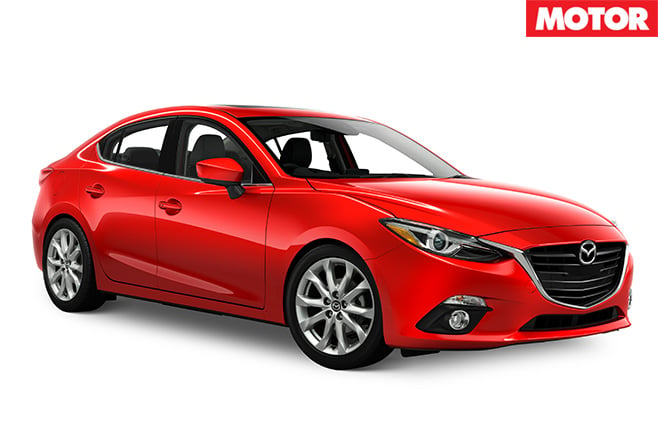
The only mechanical change was a front brake upgrade to a four-pot caliper and an aftermarket rotor. Even so, it was brakes that proved the undoing of some celebs. But you can’t criticise a road car for dodgy brakes when it’s being driven on a race circuit by a group of people with no mechanical sympathy.
If you’re a fan of Japanese-flavoured, rally-bred, all-paw turbo fun that asks for reasonable money, the latest Subaru WRX STI is your guy. More so than the regular Subaru WRX.
Why? Despite drawing heavily from older powertrain tech, the new STI not only has more weapons in its speed arsenal but its well-proven oily bits feel far more evolved than those – the FA engine, redesigned six-speed – found in the ‘normal’ Rex.
More capacity, proper differentials front and rear, a trickier centre diff, more hard-core handling package and better brakes and grip are just some of the advantages. One seat-of-the-pants sprint up Victorian back country twisties confirms Subaru’s old tech obliterates its new, the STI measurably quicker and more focused.
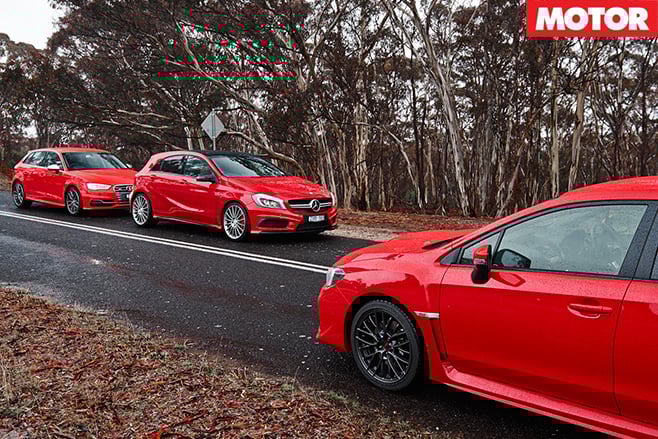
As we’ve harped on for some time, Germany has now stolen the small-car, turbo-four, all-wheel-driven march. Specifically Audi, the originator of quattro performance, and Mercedes-Benz, who rocked up virtually yesterday with its manic A45 AMG and raised the bar way up yonder.
But in the absence of a full-monty RS version of Audi’s ‘3’ range best suited to a proper challenge on the trumped-up Merc, the new S3, here in five-door hatch form, is Ingolstadt’s strongest challenger.
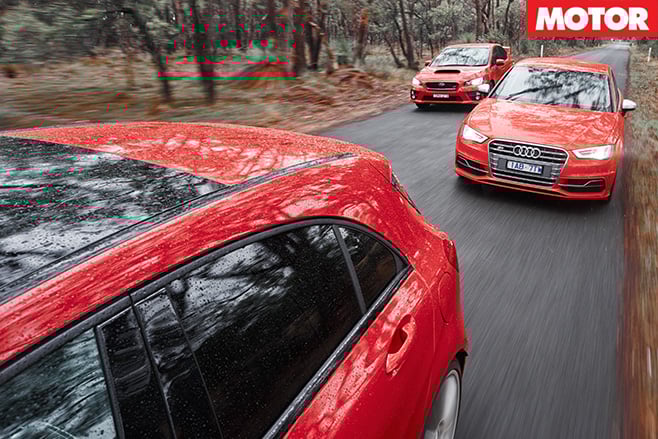
It sure wins the stats war. Its 265kW (at 6000rpm) and 450Nm (between 2250-5000rpm) from just 2.0 litres of capacity is astonishing and makes the Audi’s 210kW (at 6500rpm) and 380Nm (from 1800rpm) from the same capacity look a little underdone and the STI’s 221kW (at 6000rpm) and 407Nm (at 4000rpm) from 2.5 litres look positively lazy. And, boy, they’re distinctly different units in character. Doubly so when you throw transmissions into the equation.
Despite its lofty peak-torque point, the larger-capacity STI is all low-to-mid range punch, its urgency flattening off towards its 6700rpm redline. On the go in the lower of the revised six-speed manual’s ratios, response is lively, its tractability urgent.
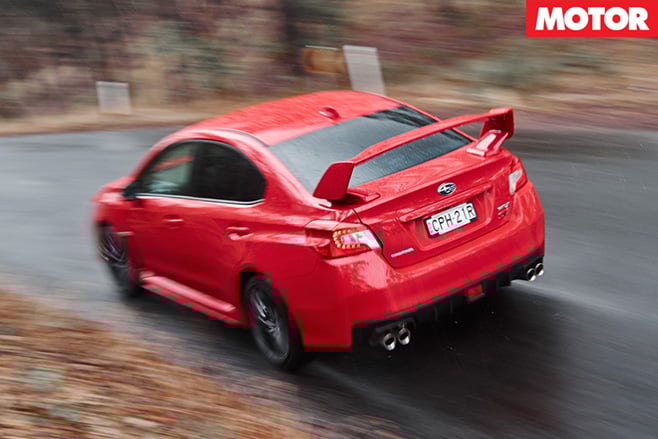
And while this would have to be the quickest-shifting and most positively gated STI ’box yet, its ratios aren’t as keenly matched to its engine’s output curves, demanding concentrated gear-rowing to keep the EJ on the boil. Sink the boot in taller gears while cruising and the STI is easily caught snoozing.
Both Germans have excellent dual-clutch gearboxes, with tightly-stacked forward ratios (six for S3, seven for A45), super-fast and super-clean upshifts and completely intuitive shelf-shifting calibrations that never seem to catch the engines off guard.
Unlike the Merc, you can have your S3 as a conventional six-speed manual, but having driven both types back-to-back the DSG is a much quicker device.
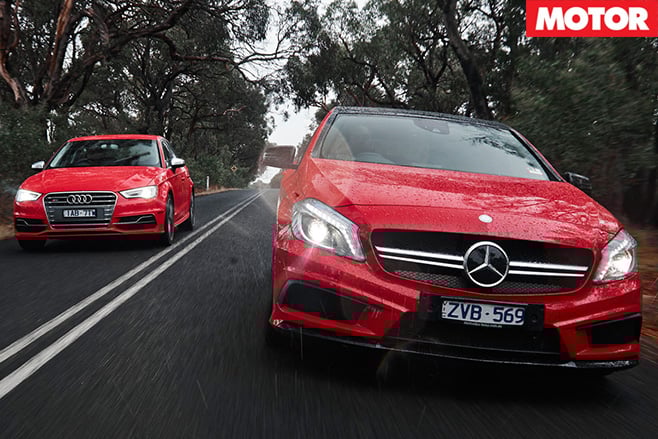
The STI’s short-comings quickly become apparent on the strip. Dial up launch control on the S3 and it marches, fuss free, to 100km/h in 4.9sec, hitting 400m in 13.2sec. Again and again, no voodoo or trickery required.
Launching the STI with all the sympathy of an axe murderer gets it off the mark a little quicker, but by 60km/h the S3’s in front, and the Subie manages just 5.6sec to 100 (not helped by needing a shift to third at 90km/h) and is half-a-second behind (13.7sec), with a slower terminal speed (164.0km/h plays 168.6), at the 400m mark.
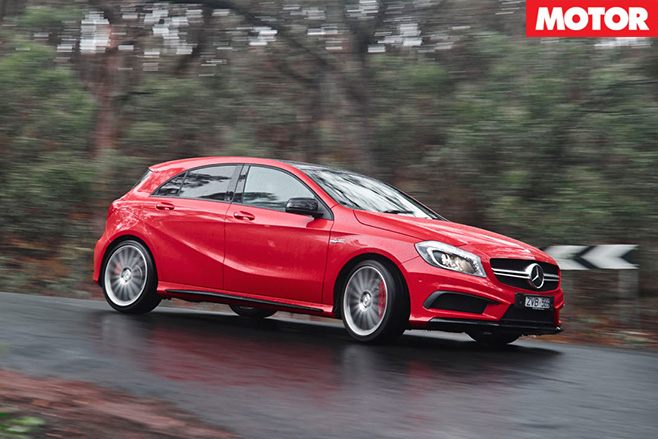
From the breath-taking initial shove off the line to the shotgun-like bark on full-throttle upshifts, everything about the AMG suggests exacting precision in getting the task done.
But it’s suddenly the S3 that’s become the comparo’s dark horse and the STI’s biggest threat in getting relegated to last place for sheer pace. Even for rolling acceleration, the STI can merely match the less powerful Audi (both 3.4sec) for 80-120km/h, the Merc a full 0.4sec swifter on the move.
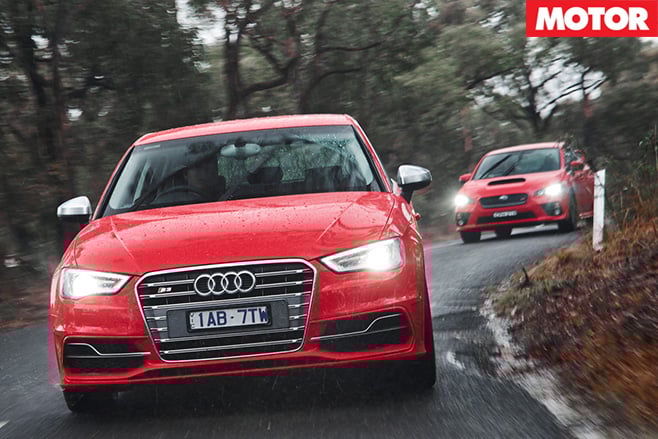
Throwing corners into the equation only amplifies just how different in character these three are. And it becomes much clearer that, while they share commonality in drivetrain layout, each aims to appeal at quite different sets of buyers.
On looks alone – hell, on rear wings alone, though it’s now a deletable option – you might peg the STI as aimed firmly at the youth set, but it’s probably more the case of older buyers young at heart, those to whom Subaru’s rally heritage and traditions speaks the loudest. So do the Si-Drive modes that govern (mostly) the engine’s throttle mapping, as does the ability to manually select front- or rear-drive bias if the driver so chooses.
Then there’s rally-bred mechanical diff package front and rear, techy torque vectoring (complete with a real-time torque read-out in the centre dash display), and good old-fashioned hydraulic steering with a new super-quick rack ratio. The STI, then, wants to engage the driver with its myriad go-faster geekery, encouraging them to play with dials, prod buttons and experiment with settings.
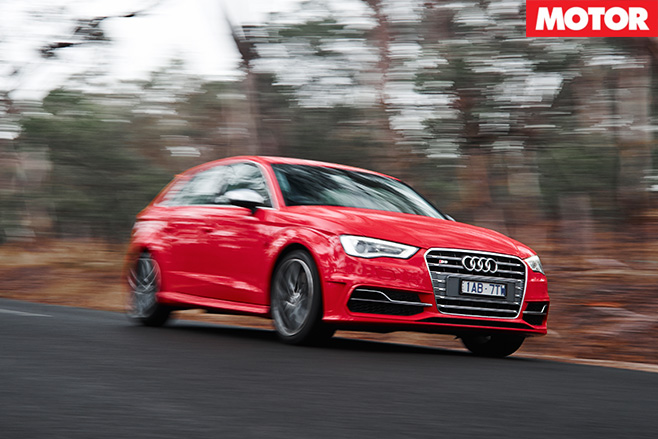
The AMG? Simpler again. Select Sport or Manual from a button on the centre console and aim it for the horizon. Both German cars use essentially front-biased all-wheel-drive systems with a high level of electronic governing, most of it out of the direct control of hands-on driver discretion.
Compared with the Subaru, their handling characters are much more prepackaged from the factory, their calibrations dictated by teams of lab coats rather than the whims of the pilot on the fly.
From the first corner, you notice vast differences in steering. The old-school hydraulic STI steering is urgent and heavily weighted off centre, positively cumbersome at low speed. But dive towards the apex and resistance lightens up, perhaps too much, and the nose suddenly feels airy and distant.
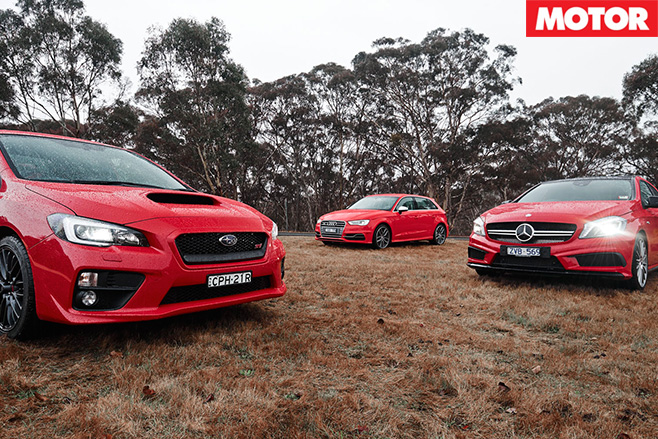
Manually winding the centre diff to a rear-bias offers a mild, grin-inducing oversteer state under full noise and there’s certainly plenty of oh-so-joyous Subaru balance in the mid corner with a constant throttle.
But up the pace and it’s easily upset by torque shuffling around all four corners of the chassis, the all-paw system feeling much more reactive than proactive when dancing around at the edges of adhesion. Fun? You bet.
But the grip available from the fattest tyres here (245mm) is surprisingly modest. And the Subie is left bucking and shimmying around in corners as either German comes looming up in the rear-view mirror.
The Audi’s heavier Dynamic steering mode doesn’t add much feel. Nor does it need to. The S3 has much more clarity and linearity in its front end and can be more accurately and confidently placed.
Better yet, its quattro system shuffles torque to each wheel where and when it’s needed with more finesse. Less theatrics, more pace. Of the three here it’s certainly the most composed, the easiest to punt hard, and the best car for modest driving skills.
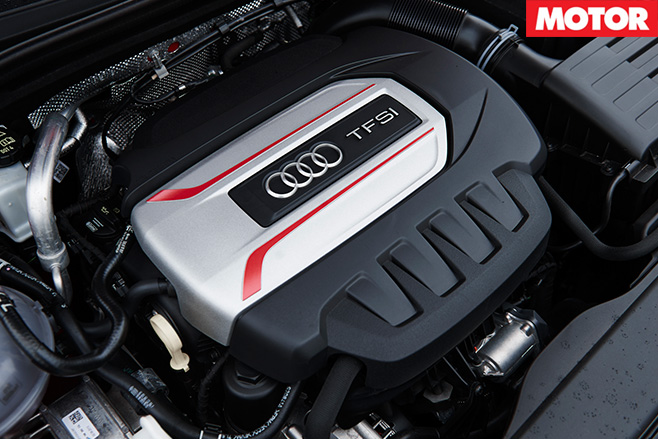
Thing is, the Audi is only really lively on lift-off – it takes lateral weight shifts, rather than a firm throttle prod, to get that tail moving. A more rearward torque bias and a fatter rubber footprint would inject the S3 with some welcome fun factor.
The AMG is the tightest, tautest and edgiest car of the three. And ‘edgiest’ doesn’t mean edge of disaster either. In fact, quite the opposite. The steering is crisper and offers a tad more precision than the Audi, its front end immensely grippy.
And it takes extreme foolhardiness to get the thing to understeer; few other cars out there with 235mm tyres – whatever the driven wheels – point with such precision.
That hunkered-down feeling of tightness continues to the mid-corner and corner exit. It feels the most agile in direction changes and the most willing to adjust its line.
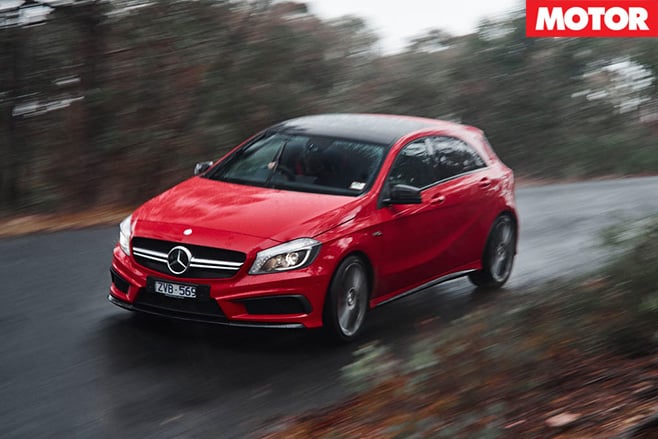
The A45’s are so robust, powerful and brimming with feel that you can dive much deeper into corners, regardless of camber or surface. The Audi’s stoppers are very handy too, and both Germans seem to sit flatter when turning in under brakes.
Braking from 100km/h to rest in torrential rain, the STI’s four-pot fronts gave it the slight edge over the single-piston Audi, stopping in 39.6m versus the S3’s 40.6m. As for the Merc, it appeared to ignore the wet, its huge four-piston front jobbies bringing the A45 to a halt in just 35.5m. Add easily the most sport focused seats of the three and one verdict is clear: if going fast is your game and money is no object, the A45 is the tool for the job. Easily.
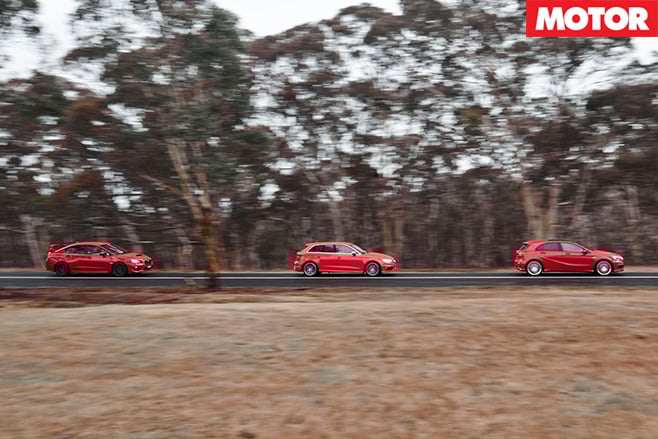
The AMG isn’t hard to live with, but the S3 strikes a superior balance between comfortable normal driving manners and on-command rocketship ability. And while the AMG is the acceleration king, the S3 isn’t left behind by much. There’s fair argument the AMG is worth its lofty price-tag, but there’s an equal one that the S3 is something of a bargain.
Despite its sharp new price, the STI can’t quite convert its $10K benefit into superior all-round value. Inside, the Audi is two rungs above the Subaru in every way: beautiful heated electric seats versus cheaper mechanical pews; premium infotainment/sat-nav with dial centre-console interface versus clunky ’00s-esque touchscreen arrangement; real alloy versus fake plastic… the list goes on.
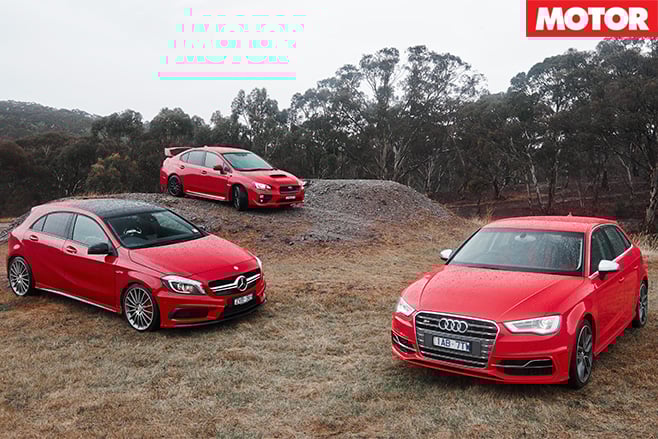
It mightn’t scream heroics like its rivals, but the S3 is a bloody hard car to fault. And the car this judge grabbed the keys to when the dust settled. Nice job Audi.
| u00a0 | Mercedes-benz A45 AMG | u00a0 | Subaru WRX STI | u00a0 | Audi S3 |
| u00a0 | 4 out of 5 stars | u00a0 | 4 out of 5 stars | u00a0 | 4 out of 5 stars |
| Body | 5-door, 5-seat hatch | u00a0 | 4-door, 5-seat sedan | u00a0 | 5-door, 5-seat hatch |
| Drive | all-wheel | u00a0 | all-wheel | u00a0 | all-wheel |
| Engine | 1991cc inline-4, DOHC, 16v, turbo | u00a0 | 2457cc flat-4, DOHC, 16v, turbo | u00a0 | 1984cc inline-4, DOHC, 16v, turbo |
| Bore/stroke | 83.0 x 92.0mm | u00a0 | 99.5 x 79mm | u00a0 | 82.5 x 92.8mm |
| Compression | 8.6:1 | u00a0 | 8.2:1 | u00a0 | 9.3:1 |
| Power | 265kW @ 6000rpm | u00a0 | 221kW @ 6000rpm | u00a0 | 206kW @ 5100-6500rpm |
| Torque | 450Nm @ 2250-5000rpm | u00a0 | 407Nm @ 4000rpm | u00a0 | 380Nm @ 1800-5100rpm |
| Power/weight | 179kW/tonne | u00a0 | 145kW/tonne | u00a0 | 143kW/tonne |
| Consumption | 12.8L/100km (tested) | u00a0 | 13.0L/100km (tested) | u00a0 | 10.2L/100km (tested) |
| CO2 emissions | 304g/km (tested) | u00a0 | 309g/km (tested) | u00a0 | 243g/km (tested) |
| Transmission | 7-speed dual-clutch | u00a0 | 6-speed manual | u00a0 | 6-speed dual-clutch |
| Weight | 1480kg | u00a0 | 1525kg | u00a0 | 1445kg |
| Suspension | struts, coil springs, anti-roll bar (f); multi-links, coil springs, anti-roll bar (r) | u00a0 | A-arms, struts, coil springs, anti-roll bar (f) multi-link, coil springs, anti-roll bar (r) | u00a0 | A-arms, struts, coil springs, anti-roll bar (f); multi-links, coil springs, anti-roll bar (r) |
| L/W/H | 4359/1780/1417mm | u00a0 | 4595/1796/1476mm | u00a0 | 4324/1785/1404mm |
| Wheelbase | 2699mm | u00a0 | 2649mm | u00a0 | 2631mm |
| Tracks | 1557/1561mm (f/r) | u00a0 | 1529/1539mm (f/r) | u00a0 | 1535/1511mm (f/r) |
| Steering | electrically-assisted rack and pinion | u00a0 | hydraulically-assisted rack and pinion | u00a0 | electrically-assisted rack and pinion |
| Brakes | 350mm ventilated/drilled discs, 4-piston calipers (f); 330mm ventilated/drilled discs, single-piston calipers (r) | 330mm ventilated discs, 4-piston calipers (f); 315mm ventilated discs, 2-piston calipers (r) | u00a0 | 340mm ventilated discs, single-piston calipers (f); 310mm ventilated discs, single-piston calipers (r) | |
| Wheels | 19 x 8.0-inch (f/r) | u00a0 | 18 x 8.5-inch (f/r) | u00a0 | 18 x 7.5-inch (f/r) |
| Tyres | 235/35 ZR19 97Y Dunlop Sport Maxx (f/r) | u00a0 | 225/40 R18 97W Dunlop Sport Maxx (f/r) | u00a0 | 225/40 R18 92Y Continental ContiSportContact5 (f/r) |
| Price | $74,990 | u00a0 | $49,990 | u00a0 | $59,900 |
| Price as Tested | $74,990 | u00a0 | $49,990 | u00a0 | $62,350* Metallic paint $1050; 5 twin-spoke wheel design $500; Audi Design Select red trim $900u00a0 |
| Positives | Incredible performance, brilliant chassis, awesome brakes | u00a0 | Handling balance and adjustability; sharp new price | u00a0 | Cracking drivetrain; brilliant interior; the everyday choiceu00a0 |
| Negatives | Pricey, lacks some everyday comfort, thirsty | u00a0 | No quicker than the last car; doesnu2019t move the game forward | u00a0 | Conservative looks; needs a bit more fun factor |
Wild rear-drive hero bringing its 527kW V8 thunder Down Under.
First published in the June 2015 issue of Wheels magazine, Australia’s most experienced and most trusted car magazine since 1953.
LOOK out HSV, AMG and M: Dodge is about to bring America’s most potent performance car, the Dodge Challenger Hellcat, to Oz in 2016. Even better, the next-generation four-door Dodge Charger Hellcat could also arrive Down Under in 2018, making for a formidable two-pronged V8 line-up.
The 527kW Challenger Hellcat, which could carry a price tag under $100K, is billed as the most powerful muscle car to roll off a US production line. It packs a bigger V8 punch than anything from Mercedes AMG and BMW M, and boasts almost 100kW more than HSV’s mighty 430kW GTS flagship, also powered by a 6.2-litre supercharged V8.
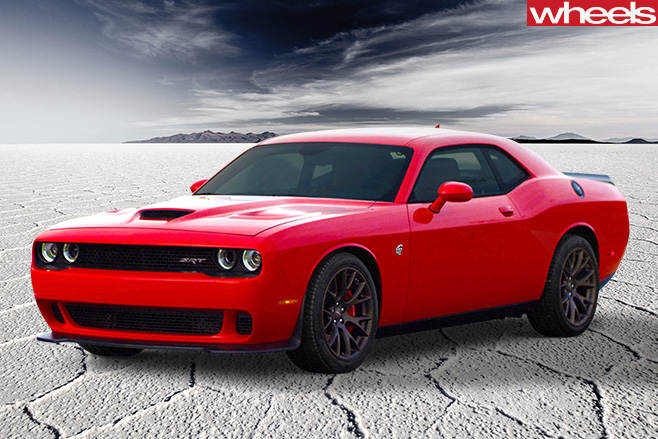
Wheels understands FCA Australia CEO Pat Dougherty is heading to America in late May to plead the case for the rear-drive monster, which can hit 100km/h in less than four seconds and cover the quarter-mile in a Ferrari-like 11.2 seconds.
“The Dodge Challenger is one of the world’s most iconic vehicles, so of course we’re interested in bringing it to Australia,” Dougherty told Wheels. “We’ve done our market analysis, and we believe there’s an appetite here for a car like the Challenger.”
Dougherty is believed to have asked visiting US-based product planning chief Stephen Bartoli, who came to Oz in March, for the Hellcat hero for Aussie showrooms. However, he’s cautious of pre-empting factory right-hand-drive production. “While there is absolutely nothing confirmed, it’s certainly something we are looking at, and will continue to look at,” he said.
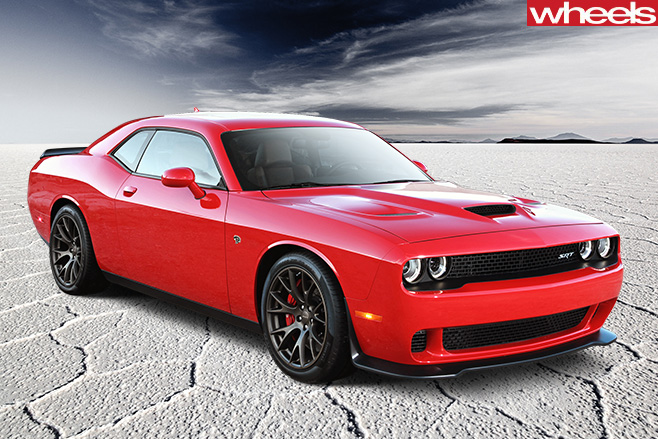
Far from waiting for the next-gen Challenger, FCA is pushing for the current car, launched in 2008 and updated in 2014.
Dealers are said to be desperate to get hold of what would be a low-volume car – prices could crack $100,000 for the Hellcat – but a crucial image-builder for a brand that has receded in recent years as FCA focused its efforts on expanding and growing Jeep and rebuilding the Fiat and Alfa Romeo brands. It’s part of a plan to position Dodge as a performance king in a market where power sells.
“I’ve always said I’d be looking at some of the terrific FCA product from around the world, and potentially mounting a case to have certain vehicles built in right-hand drive,” Dougherty said. “Steve Bartoli’s recent visit was a key part of that plan.”
The move makes sense as Ford and Holden wind down Falcon and Commodore production, which will likely see the end of affordable rear-drive cars.
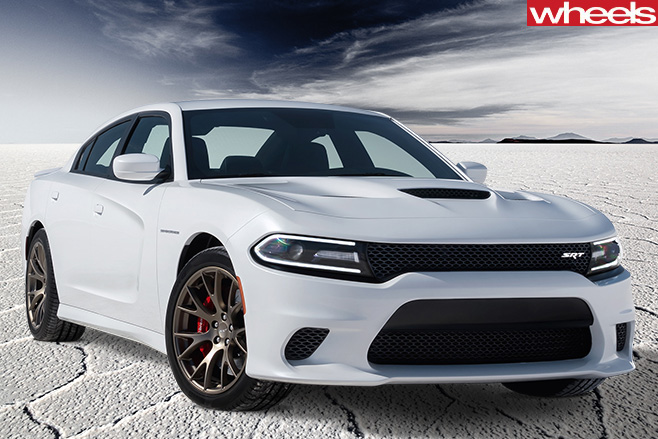
Fiat Chrysler global COO Mike Manley was cautious when asked in January about the Hellcat’s prospects for Australia.
“You could argue that the vehicle would sell itself. But there’s a whole host of things that would come with it, not ignoring just the engineering work that [goes] into creating a right-hand drive. I have no idea, by the way, if that Hellcat engine would package in right-hand drive. Packaging would be the very, very first thing [we] have to look at. Then you have all the homologation; you have to support that vehicle.”
FCA has since built a strong case for the iconic muscle cars, one Dougherty will expand on face-to-face with US execs.
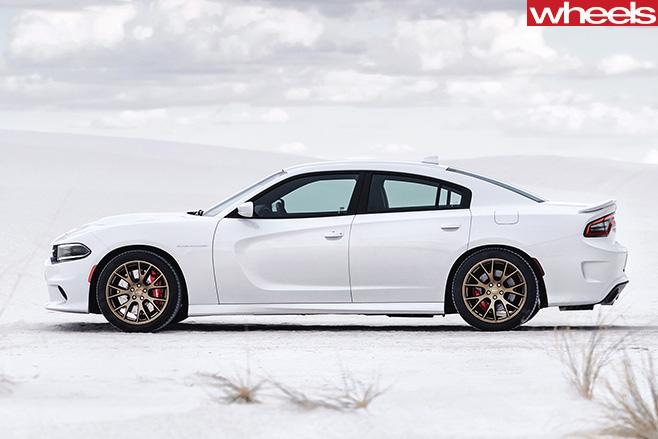
Adding weight to his pitch is that the Charger name still resonates in Australia, with the “Hey Charger” marketing catchcry still recognised four decades later.
While the V8s will steal the publicity limelight, V6s will form part of the Dodge mix, appropriate given it was a six-cylinder that put the Valiant Charger on the performance map. But lovers of performance will no doubt want the Hellcat with its supercharged Hemi V8 delivering 881Nm on top of its ferocious 527kW.
The Challenger will likely adopt the iconic Charger nameplate (see breakout) when it lands here. In April, FCA registered the Hellcat name with the Australian government’s IP Australia website, following on from an ‘application for assignment’ for the Charger nameplate it already has rights to.
Local demand is unlikely to be an issue judging by the success of HSV’s GTS. Since arriving in October 2013, the $95K performance hero has accounted for about one in three HSV sales, with approximately 2000 sold.
The Hellcat ups the ante and would add American heat to a performance market long dominated by Holden, Ford and higher-priced Europeans.
Hey Charger?
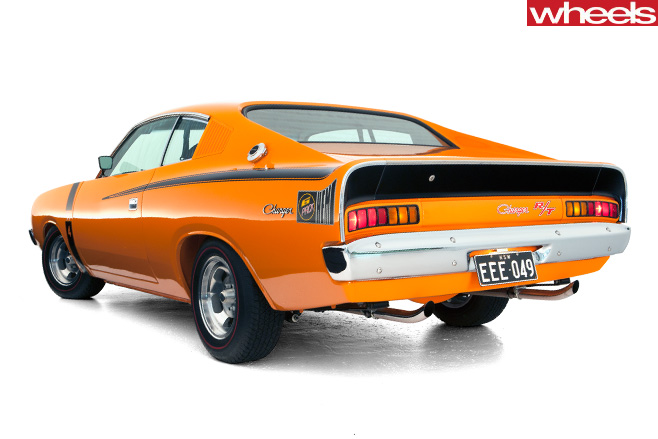
Chrysler hasn’t sold one here since 1978, but it made such an impact when it launched in ’71 – it won Wheels’ COTY – that it’s no surprise they’ve been increasing in value for some time now. Especially the hot R/T E38 and E49 versions (above), as well as the rare V8 E55.
Arguably the best car to never win Bathurst, the Charger had a stellar racing career across the Tasman in New Zealand.
While later versions became detoxed, over-stuffed old man’s cars, decades of menacing, suitably modified Chargers have wiped that image clean.
Challenging name game
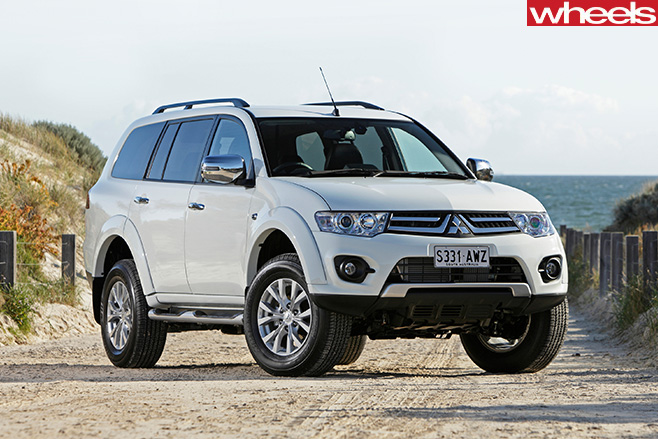
Mitsubishi says it has no intention of handing over the name to Dodge: “We’re planning on retaining the Challenger nameplate in Australia,” spokeswoman Shayna Welsh told us.
An obvious alternative would be the equally evocative Charger nameplate, but that may not be possible if we also get the four-door Dodge of the same name.
FCA has had the Charger name trademarked with IP Australia since 2002, having first lodged an application in 2000. It was renewed in 2010 and two ‘applications for assignments’ have been lodged this year, adding weight to the possibility it would soon be used.
Throwing an extra spanner into the works is the revelation that Mitsubishi will use the Pajero Sport name for this generation of its Triton-based SUV, shelving the Challenger name indefinitely.
Dodge also has older names it could fall back on – Caliber, Avenger and Nitro, for example.
FCA Oz chief Pat Dougherty is reluctant to talk names for now, telling Wheels: “If and when [it] gets approved we’ll start looking at alternatives. At this stage there are a number of things that need to be satisfied before we go there.”
Time for a new one, then!
Decision time at Dodge Oz
Dodge have other models in the States that could be considered fpr the Australian market. Here’s the basic rundown.
DODGE DART Alfa Giulietta-based small car that would fit nicely in a performance-focused portfolio, especially once SRT models land.
DODGE CHARGER Current generation unlikely as it could clash with Chrysler 300. All-new 2018 model is under consideration for Australia.
DODGE VIPER Forget it. 8.3-litre V10 is placed on an angle to fit, so conversion to RHD is a huge task. Pricing (more than $200K) likely kills it.
DODGE DURANGO Based on Jeep Grand Cherokee and unlikely to duplicate that model’s success, so expect it to be left on the sidelines.
DODGE JOURNEY The only Dodge currently on sale here gets a rework in 2016. Expect sporty SUV styling and an SRT hot-shot version.
DODGE GRAND CARAVAN Currently sold in Australia as the Chrysler Voyager, but its set for the the Dodge chopping block come 2016.
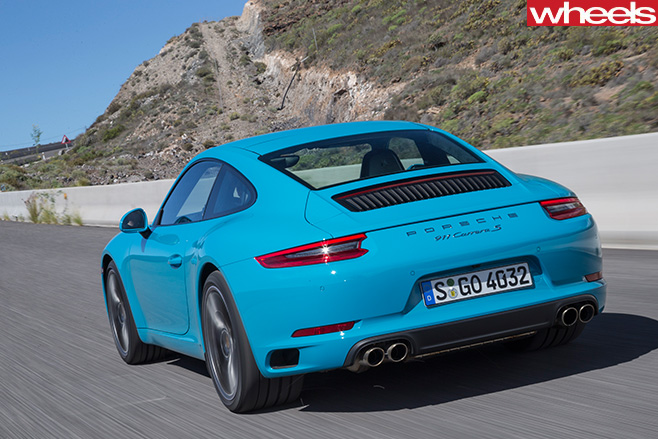
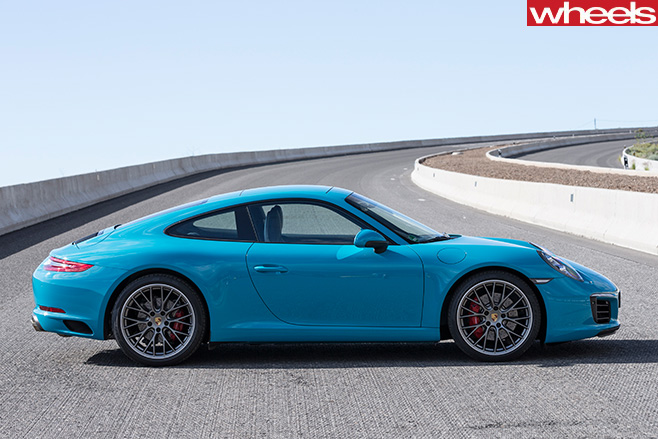
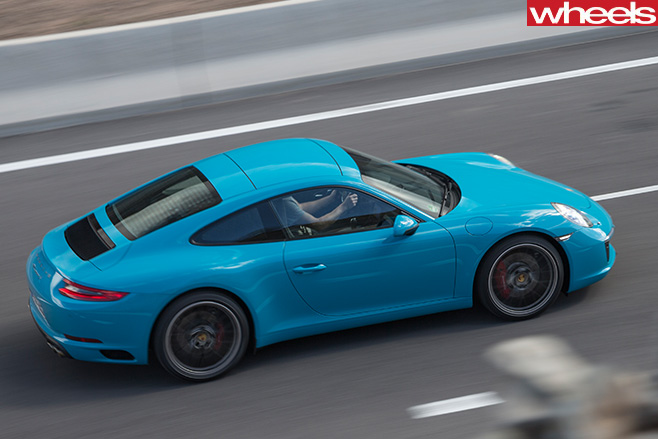
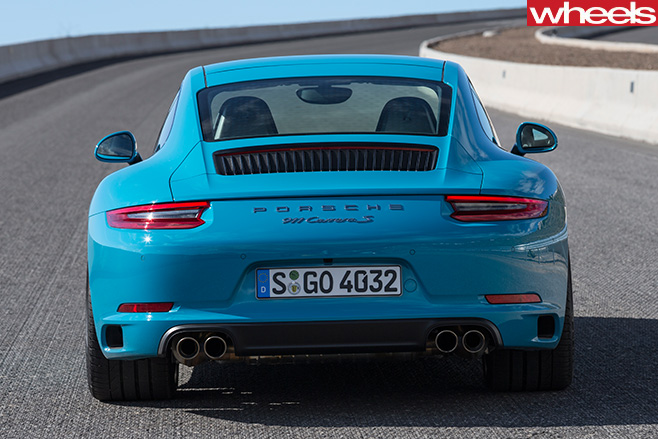
The Porsche 911 Carrera and Carrera S will ditch their high-revving 3.4- and 3.8-litre naturally aspirated boxers and switch to a smaller boosted engine.
The mostly new twin-turbo 3.0-litre flat six is more powerful than ever and more efficient than before.
WHAT IS IT? The latest version of Porsche’s rear-engine and rear-drive 2+2 sports car icon, due to go on sale in Australia next March.
WHY WE’RE TESTING IT To find out if Porsche’s new engine is truly 911-worthy. This is an important question. After its intro in the basic Carrera and Carrera S coupe and Cabriolet, the new twin-turbo 3.0-litre will eventually power almost every model in the extensive 911 line-up.
MAIN RIVALS There are alternatives to the 911, rather than direct rivals. The shortlist could include the bottom end of the mid-engined Audi R8 line-up and the front-engined Jaguar F-Type. But Porsche’s own Cayman will also appeal to the kind of driver who appreciates the 911.
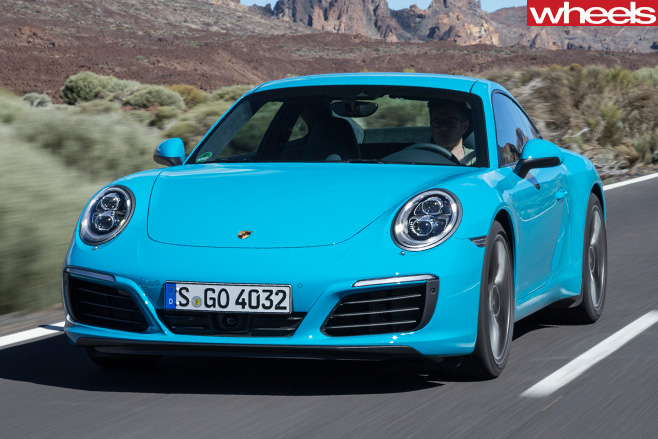
PLUS: Power and precision; handling and ride; brakes and steering; engineering excellence end-to-end MINUS: Really expensive options, and too many of them; Cabriolet too obviously lacks stiffness of the tin-topped 911
THE WHEELS REVIEW IT’S where the engine is, not what the engine is, that makes the 911 what it is. So while next year’s Carrera and Carrera S will have a boosted boxer six, the mostly new 3.0-litre twin-turbo engine doesn’t alter the fundamentals of the driving experience one little bit.
That’s because, as ever, the engine is aft of the rear axle. The consequently butt-biased weight distribution accounts for the 911’s unmistakable dynamic flavour; the twerky way it rides road heaves and dips, and its clenching rear-end grip accelerating out of slow corners, for example.
It could have been more. According to director of boxer engine development, Thomas Wasserbäch, the engineering rule of thumb when turbocharging an engine is that it adds around 30kg. Porsche shaved weight where it could to cut this almost in half. The overall weight of the new Carrera and Carrera S is up only 20kg compared to the cars they replace.
The horizontally opposed layout of the 911’s six demands a short piston stroke, explains Wasserbäch. Otherwise it would become too wide to fit. The 3.0-litre twin-turbo has a new crankshaft with a 76.4mm stroke, 1.1mm shorter than in the existing 3.4- and 3.8-litre atmo engines. The 3.0-litre’s 91.0mm bore is 6.0mm less than the 3.4-litre and 11.0mm less than the 3.8-litre.
While the 3.0-litre’s crankcase is an evolution of the closed-deck design used in Porsche’s current atmo engines, its cylinder heads are completely new. The key change is a relocation of the direct fuel injectors close to the centre of the cylinder bore, very near the spark plugs. Making space for both injection and ignition hardware meant widening the angle between inlet and exhaust valves.
The static compression ratio of the 3.0-litre is 10:1, high for a turbocharged engine. Porsche chose this combination of capacity and compression, says Wasserbäch, to provide more immediate response to the throttle than a smaller engine with larger turbochargers could ever be made to deliver. Similar thinking is to be seen in the recent twin-turbo V8s of AMG and Ferrari.
Similar to those engines, Porsche’s new twin-turbo six is a revver. The 3.0-litre spins to 7500rpm, only 300rpm less than the atmo engines it supersedes.
But the turbo-fattened torque curves of both versions of the new 3.0-litre means the power difference is even greater at low and middling engine revs. Porsche takes advantage of this with the calibration of the optional PDK seven-speed dual-clutch gearbox. Earlier upshifts further magnify the inbuilt efficiency advantage of the smaller turbo engine.
Naturally, the new engines achieve lower consumption in the European combined cycle test. But they also deliver better efficiency on the road. According to Wasserbäch, Porsche’s real-world testing indicates consumption 0.5 to 1.0L/100km lower than the current non-turbo engines in typical driving conditions.
So, in pretty much every measurable way the 911’s new engine is an improvement. But do the metrics mislead? Is the twin-turbo 3.0-litre actually a less engaging, less satisfying experience than today’s atmo engines?
Not at all. But the new engine does subtly alter the car’s character…
Most of our time at the international launch was spent in a Carrera S with PDK, the most popular 911 version in Australia. The 309kW engine has a lot of low-rev muscle. Easy-to-access thrust never made any car worse, and the 911 is no exception. The flexibility comes at practically no cost to the twangy top end expected from a 911 Carrera S. You really don’t miss the extra 300rpm of the atmo engines. What is different is that the twin-turbo 3.0-litre is a more able engine when taking it easy. It’s happy, and deceptively fast, even when driven lazily.
Less satisfying was the Carrera S Cabriolet with optional sports exhaust (central pipes are the visual giveaway). Top-down and with the switchable exhaust flaps open, the new engine was hoarse, verging on coarse, at low revs. It sounded better with the exhaust flaps shut, in fact. The whine of the turbos is clearly audible in the roofless 911, as are the entertaining crackles and pops the sports exhaust emits when going hard.
The twin-turbo 3.0-litre brings perhaps even more change to the appearance of the 911 than the way it drives. Supplying the pair of intercoolers buried inside the rear guards dictated a complete redesign of the car’s rump. Most obvious of the changes is a bold new air intake grille. Behind this is an active spoiler, which also guides ambient-temp air over the air-to-air intercoolers. Once passing through the intercoolers, air exits through ducts sited in a low-pressure area in the bumper, just aft of the rear wheels.
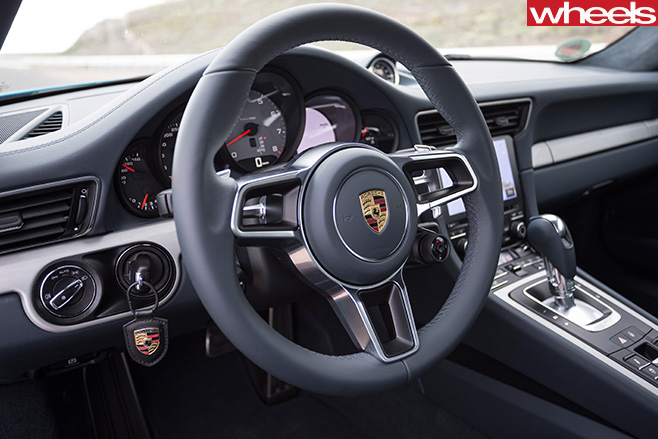
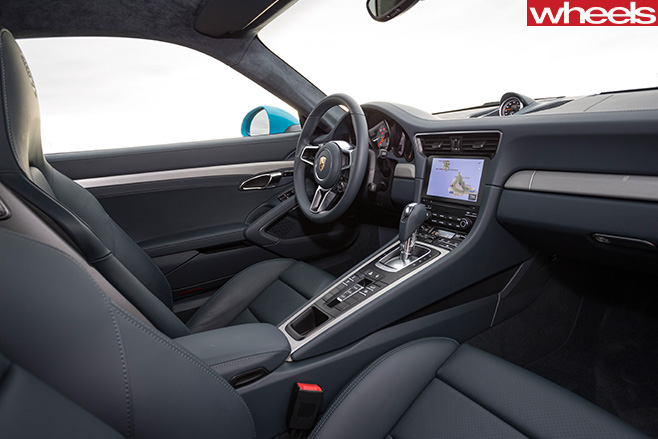
There are changes for the 2016 Carrera and Carrera S unrelated to the new engine, too. Porsche’s PASM adaptive damping system, with a ride height 10mm lower than before, becomes standard. There’s a lovely new standard sports steering wheel, and an improved infotainment system. The car also gains some tech familiar from much less expensive Volkswagen Group cars, notably automatic post-collision braking. These extras go some way towards justifying higher prices. The new 911 Carrera is $217,800 and the S is $252,800. Choosing the Cabriolet versions increases these prices by $21,500. Adding PDK costs $5950, Sport Chrono Package $4790 (with PDK) and sports exhaust $5890.
Prices like these mean the new Carrera and Carrera S will remain as exclusive as ever. But they are also as desirable as ever. The twin-turbo 3.0-litre is a properly Porsche engine that’s right at home in the 911’s legendarily loony layout.
SPECS Model: Porsche 911 Carrera S with PDK Engine: 2981cc horizontally opposed 6, dohc, 24v, twin turbochargers Max power: 309kW at 6500rpm Max torque: 500Nm at 1700 to 5000rpm Transmission: 7-speed dual-clutch automatic Weight: 1460kg 0-100km/h: 3.9sec (claimed) Fuel economy: 7.7L/100km (European Combined Cycle) Price: $258,750 On sale: March
SYDNEY
Short trip – Hunter Valley
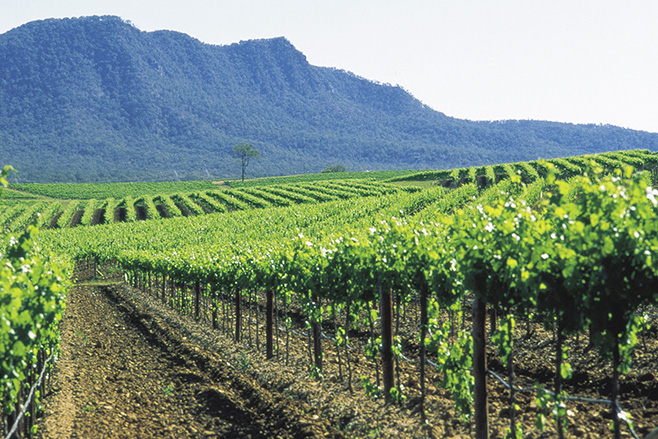
Heading up to the Hunter Valley is a favourite Sydney weekend getaway. But the busy M1 does put a bit of a dampener on things – no one wants waste precious weekend time stuck in traffic. A solution; take the old Pacific Highway. Before the track was beaten into a major freeway, the Pacific Highway north of Sydney was a twisty, windy woodland highway. Jump off at Berowra and follow the old road north. It’s a favourite for car and bike enthusiasts alike, so it’s also a hotspot for the boys in blue (watch your speed). But with this many twists and turns, it’s far more enjoyable. A stop at Pie in the Sky is a must, before taking the road to Wollombi and the namesake tavern on the T-intersection for another bevvy, then around the back of Broke to the Hunter. Though it’s no longer than a three hour drive, you’ll need a wine by day’s end!
A bit longer – The Snowy Mountains
In Summer, heading off to the snow may not be foremost on everyone’s minds – which is exactly what makes it a great destination. A brilliant stretch of road which is closed off during the winter months is the Kanchoban trail, linking the Snowys from Jindabyne over to Albury. Do it on the way to or from Sydney, and be sure to scale Mt Kosciusko while you enjoy the summer chalet getaway in Thredbo or Perisher.
MELBOURNE
Short trip – Reefton Spur/Lake Mountain
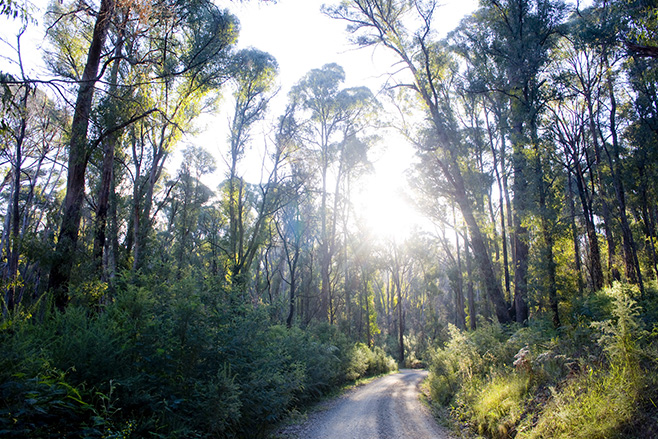
In the holidays, one great drive you do not want to touch is the Great Ocean Road, unless you want to take in the scenery at about 40km/h. It’s extremely busy with all kinds of motorised vehicles, in particular the dreaded caravan squadrons. Instead, head up to Marysville and take in the Reefton Spur, or run up and down Lake Mountain’s access road for an extra thrill. These roads are utilised by tarmac rallies for a reason; cambered twists and turns and amazing scenery that ranges from rainforest to the grey skeletal gums left behind by the 2009 Black Saturday bushfires. Inject some money into the Marysville economy by visiting the bakery and lolly shop there – it’s been rebuilt, bigger and better, and the lollies in particular are belly-rubbingly good.
A bit longer – Tasmania
We know what you’re thinking – this is nowhere near the Melbourne. But the trip starts bang in the centre of Port Melbourne, on the Spirit of Tasmania ferry, so it totally still counts. As an added bonus, you won’t find banked-up holiday traffic at this destination.
The big red barge has been overhauled recently with new furnishings and a better bar and restaurant (the important bits), and depending on your options it can be cheaper than a flight – plus you have your own car and gear with you.
Tasmania is a driver’s daydream and a foodie’s delight; fresh produce, wines, cheeses, chocolate, and well-fed livestock. The roadside offerings from farmers are typically better than the most hipster joint in the metros, and half the price. They line the amazing, winding mountain roads and pastoral stretches used by the Targa Tasmania rally, which circles into and around the island in five days. It can be done on a budget, and it can be done in a short amount of time, but let’s be honest, you may as well take the time to enjoy it.
ADELAIDE
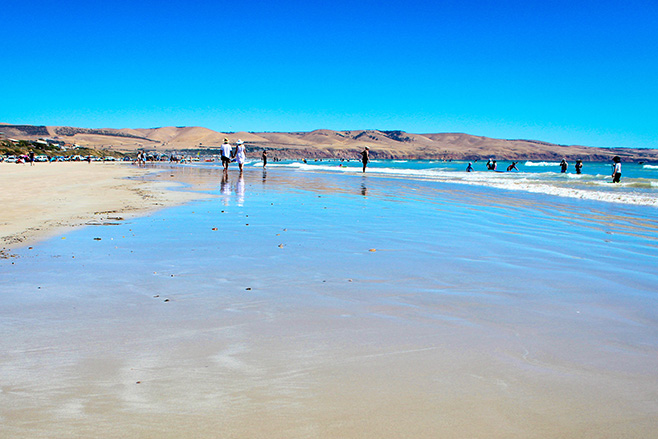
Short trip – The Adelaide Hills
The only downside to a tour of the Adelaide Hills is the fact you have to drive after visiting the many wineries… Find a designated driver (sucker!) and begin with morning tea at Stirling, a sleepy and stunning little town just off the highway, before tripping across the top of the hills through Mt Lofty, Echunga, and Hahndorf for the wineries. You can then head through apple country and the twisted roads of the Basket Range, and then over to Gumeracha for afternoon tea at the Big Rocking Horse, or come back by the old freeway for some stellar tarmac.
A bit longer – Fleurieu Peninsula
Given it’s only about an hour away from Adelaide, you can still do the Fleurieu in a day. And the use of the Southern Expressway makes it even quicker to explore the beautiful beaches or McLaren Vale for lunch at a winery. If you have an off-road capable car, be sure to visit the vehicle-friendly Silver Sands beach in the afternoon, before taking the return trip, or drive up into the hills around Clarendon for a scenic and more lively drive home.
PERTH
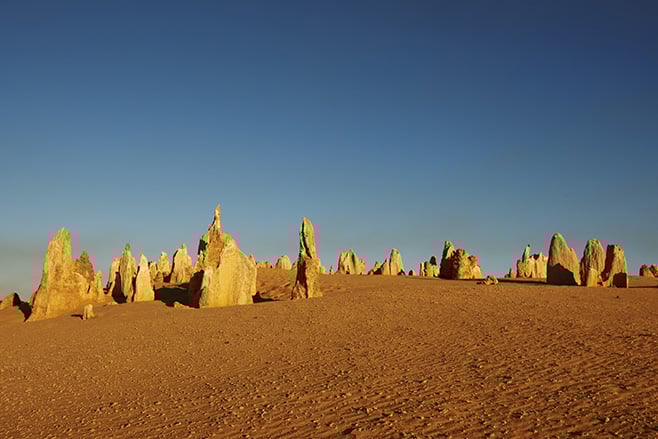
Short trip– Kalamunda
Less than an hour out of Perth is Kalamunda, with its fast coastal-style roads and views, pitted with tighter windy sections and weekend wine tastings. Stop in Kalamunda for a refill at the many cute cafes and bakeries before taking in the short but sweet zig zag drive, a set of switchbacks which wind up Goosebery Hill and towards national parklands with great bushwalks if you need to stretch your legs.
A bit longer – Indian Ocean Drive
The Indian Ocean Drive is one of those breathtaking scenic routes you won’t forget in a hurry. The rumours of it being an amazing spectacle are true, with the Coral Coast mirroring your drive; you’ll pass sights like the Pinnacles desert and Sea Lions near Cervantes and Jurien Bay. And if you’re starving for food, you could always stop for a lobster at the cray farms all just 200km out of Perth.
BRISBANE
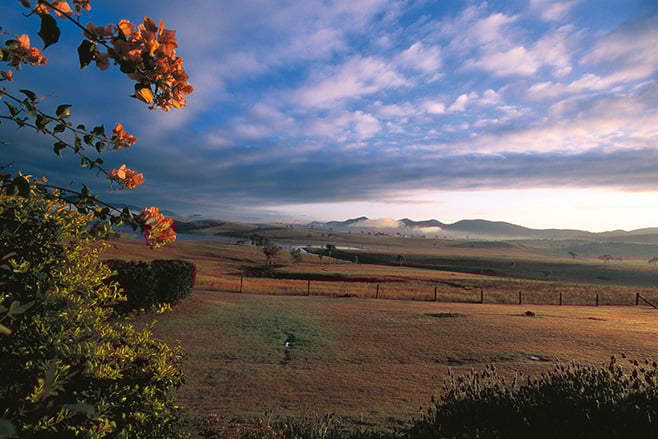
Short trip – Mt Glorious and/or Mt Nebo
Heading west out of Brisbane is the drivers’ mecca of Mt Glorious. Starting at Samford along the imaginatively-named Mt Glorious Rd, your first stop is bound to be Cloverlea Cottage on the crest of the mountain before deciding whether to tackle Mt Nebo, or continue over the back of the mountain. For the latter, a winding trip down leaves you with a decision at the T-intersection: turn left and wind back behind the range to Esk, or right to the twists and turns along the western bank of Somerset Dam.
A bit longer – go anywhere
Queensland is known for its beautiful coastal travel. Drive south for an hour on the Pacific Motorway and you’ll find yourself in the popular Gold Coast. Keep going for an extra 30 minutes and you’ve crossed and boarder for a more relaxed lifestyle in Byron Bay. Travel two hours east and you’ll find yourself on island time in North Stradbroke Island for some aqua fun; go diving, snorkelling or just general relaxation.
Then you always have the choice of your northern drive being two hours away from the wonderful Sunny Coast. But why just stop there, drive another 35kms and you’ll end up in Noosa. There there’s always the option of heading out West, but that’s probably not our best advice for the heat of the summer months and one best saved for the middle of the year… it’s a desert out there.
