
What is it?
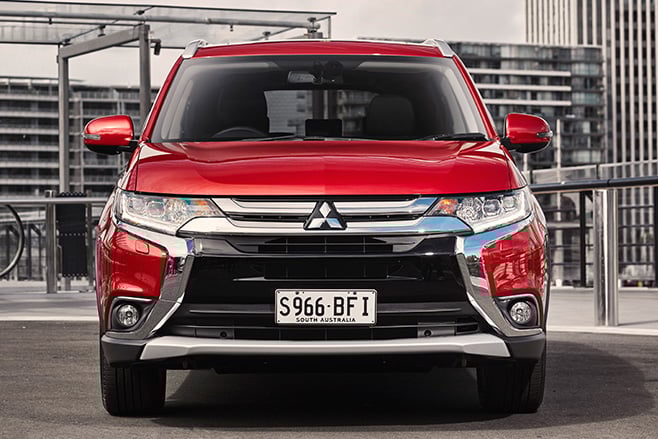
The updated version of Mitsubishi’s family SUV. The outgoing version was a bit pants, so Mitsu’s given it quite the going-over, including a new more stylish exterior: that new nose is called the “dynamic shield”, and it really does make the new model look a bit more special. (Mitsubishi says “exterior appeal is a key driver in this segment”, so if you don’t care about anything except how it looks, you can basically stop reading now.)
There’s three spec levels (LS, XLS and Exceed), three engine types (two petrol, one diesel) and three transmission types (manual, CVT and auto), which adds up to a total of eight variants to choose from: see the end of this review for all eight with pricing. For this road test, we only drove the 4WD petrol XLS with the CVT box, and the 4WD diesel XLS with the auto box.
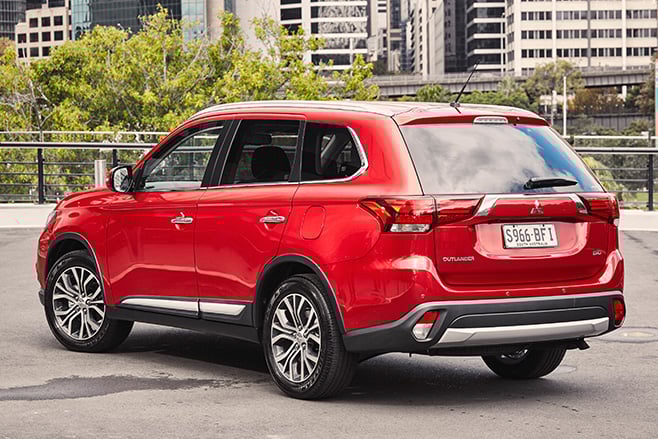
All the new Mitsubishi Outlander variants get new 18in alloy wheels, which (to our eyes at least) look like interlocking wine glasses. Or maybe we were just thirsty at the time.
Mitsubishi’s also spent a lot of time on the NVH equation, with 39 “improvement points” over the last Outlander – and it really is smoother, quieter and more refined inside.
At this point, there’s no new Outlander PHEV, the hybrid electric version – the PHEV remains the same as it’s been since it launched a year ago.
What’s it like to drive fast?
Find yourself some open road and the Outlander is willing to dial itself up if you give it the berries, but there’s no point pretending this is a sporty ride – it isn’t. It’s a family hauler. Tip it into bends at speed and it grips well enough, but it feels weighty and it’s clear the ride has been designed for comfort, not speed. That’s not an insult – if you’re in the market for a seven-seat 4WD, chances are you’re not looking to go racing in it.
But overtaking requires some planning – neither the 2.4-litre petrol XLS (with 220Nm) nor the 2.2-litre diesel XLS (with 360Nm) are beasts of acceleration, though the torquier diesel is better at it. Boringly, we got stuck behind an L-plater and then a pensioner in a LandCruiser on the twisty stretch of National Parks road in Kuring-gai Chase north of Sydney, and the Outlander is not the machine you want for lightning quick overtakes.
What about the commute home?
It’s a fine companion for the traffic slog. The seats are comfy, if nothing flash – all manual adjustments in all models except the top-spec Exceed – there’s enough head- and legroom for adults front and back, there’s a decent amount of storage space. It’s quiet inside, even at freeway speeds, and at commuting speeds it’s an easy and compliant drive.
The diesel did get a bit rumbly and grumbly at slow speeds, but nothing too intrusive.
Anything bad about it?
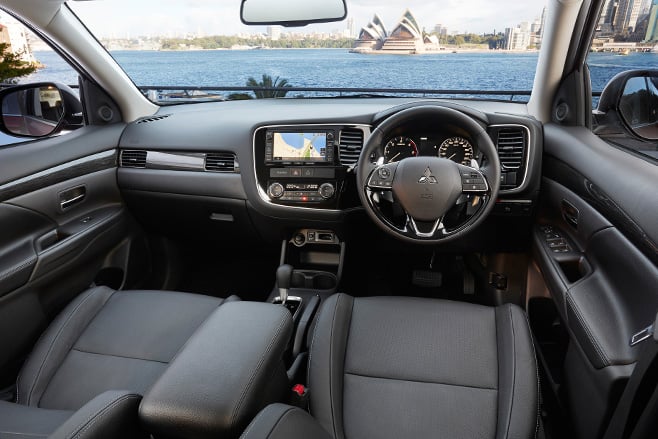
The infotainment system remains as clunky as ever. Honestly, Mitsubishi ought to bump that right up their priority list of things to fix – it’s not intuitive, the sat nav looks like a video game from the Eighties, connecting Bluetooth is a pain, and it simply looks and feels outdated. The infotainment system is one of the most used features in any car, especially a family car – so why would you want this old clunker of a system in there?
What’s it cost? And is it worth the money?
The 4WD petrol XLS we drove is $36,490, and the 4WD diesel XLS is $39,490. Both are a reasonable buy for the price – especially if you want seven seats. The entry-level LS (2WD with a manual ’box) starts at $28,490, but forgoes the third-row seating – you have to step up to at least the 4WD XLS to get the seven-seat option. All variants get reversing cameras, reverse parking sensors, hill start control, keyless entry, rear air-con ducts and a fairly generous helping of other fruit.
But the Outlander is perhaps best labelled competent, not outstanding. Competent is fine. Competent gets the job done. But it’s not at the level of some of the competition.
Would you take this or a Mazda CX5?
Depends on whether you want seven seats or not. If you have a massive family, or coach a kids soccer team, or run an Uber service for circus midgets, the Outlander’s pop-up third row of seats is perhaps a clincher. But all things considered, we’d opt for the Mazda, which just feels a bit more premium inside.
MORE: Mitsubishi Outlander Range Review MORE: Mitsubishi Outlander Specs, Range & Price
Looking for rubber with a great blend of grip, progression and longevity? We put popular tyres from Continental, Dunlop, Goodyear, Michelin and five other brands to the test.
TREAD ALERT
POPULAR perception suggests that the average consumer considers tyres a ‘grudge purchase’, often enquiring “Which is the cheapest?” at the sales counter.
Hearteningly, however, Wheels’ tyre industry sources say that enthusiast buyers are more likely to have an idea of what they want, and are generally prepared to pay more for a tyre that offers a superior level of safety and performance.
That’s great, but the challenge is identifying the best tyre. How do you do it, beyond choosing one from a brand name, with a higher price tag?
That’s where the Wheels Tyre Test comes in, with a series of tests designed to sort the grippy from the slippy.
Our testing program was held on the skid pan and skid circuit of Sydney Motorsport Park over two days – dry testing on day one and wet testing on day two.
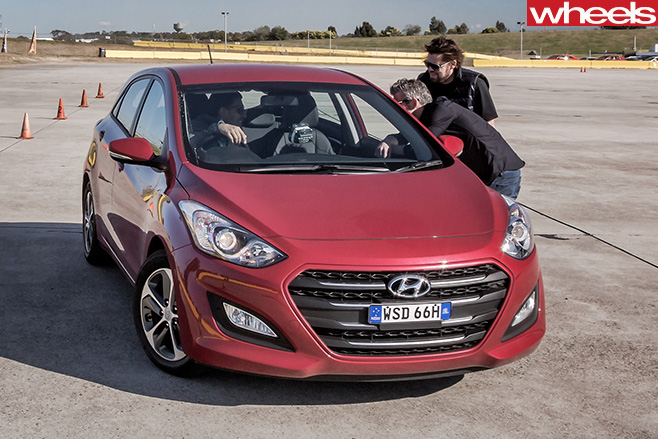
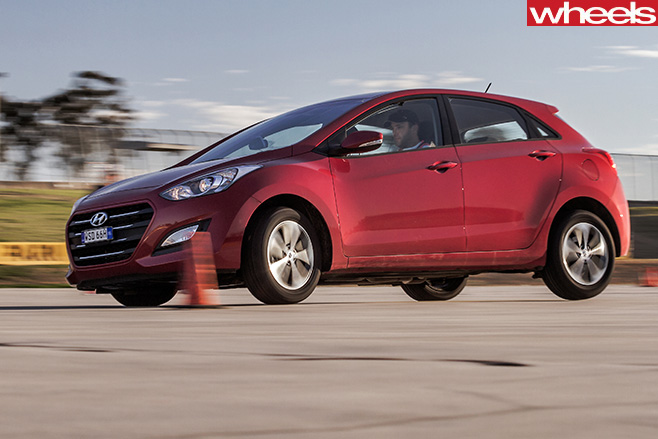
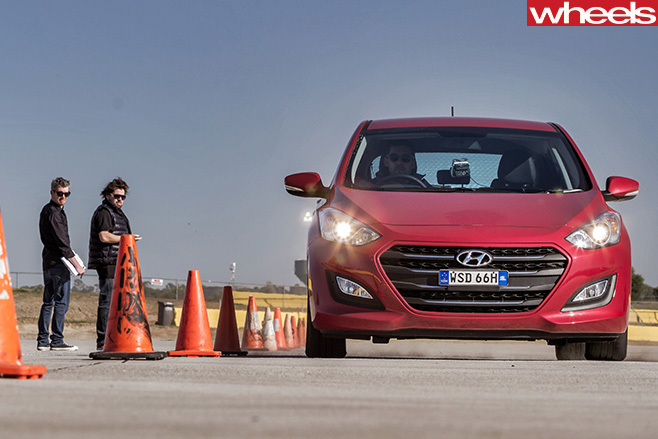
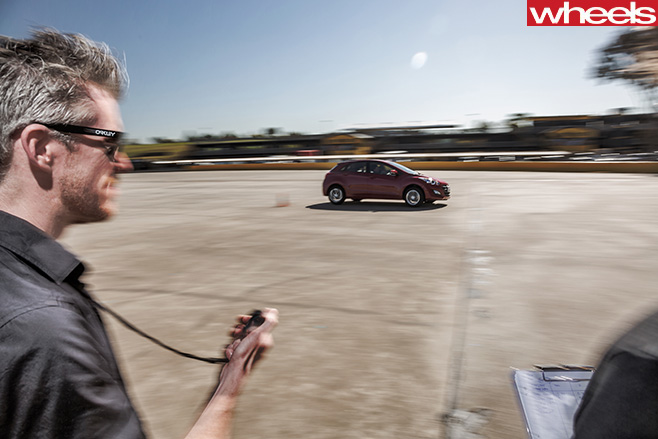
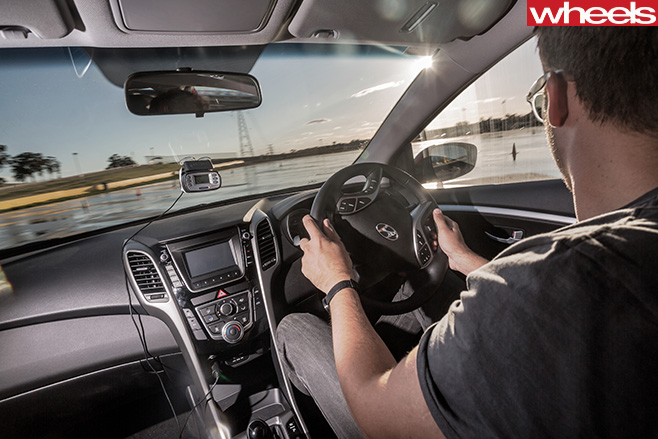
Race driver and engineer Renato Loberto drove the Hyundai i30 for each ‘blind’ test – he didn’t know which brand was fitted to the car.
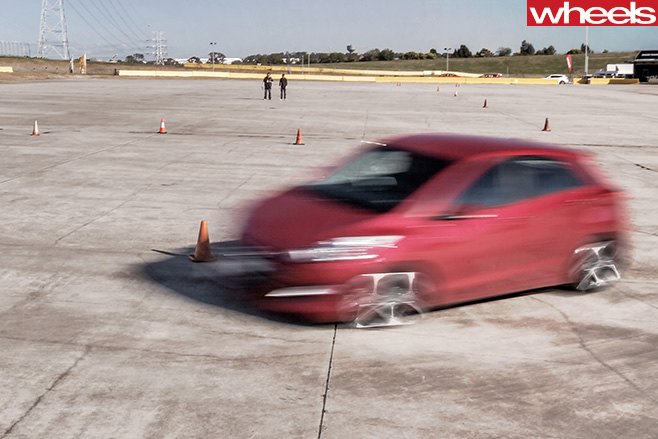
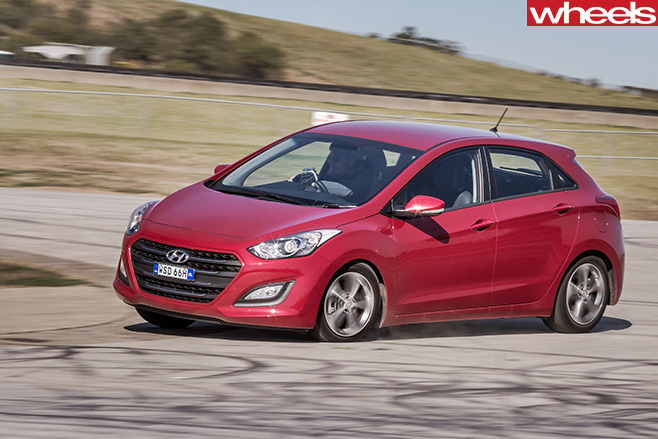
Each set of tyres was put through the same regime. A public road loop kicked off each test, serving two purposes: to scrub in the surface of the tyre and provide the opportunity to take a tyre noise reading on a section of coarse-chip road. Back on the skid pan, Renato hit the slalom, cornering test and brake test (in that order) before taking to the skid-circuit for a series of hot laps.
On the second test day, we repeated the slalom, cornering and braking tests with the skid pan’s irrigation system set to wet, for a total of eight test disciplines.
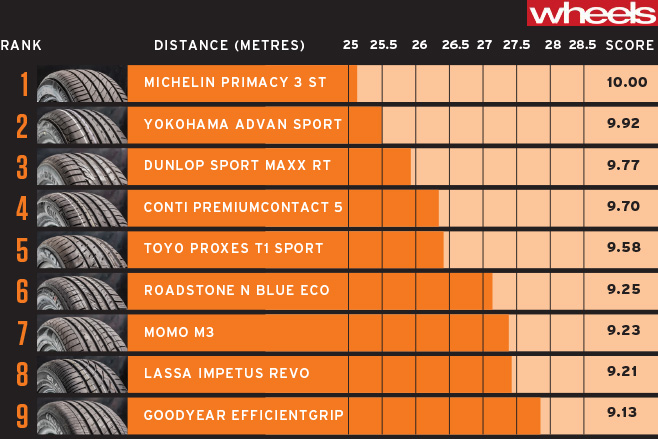
Each discipline was scored out of 10 with the exception of the noise test. So, 20 points for the slalom tests (dry and wet), 20 points for the cornering tests and 20 points for the braking tests, plus 10 points for the skid circuit hot-lap and five points for the noise test.
The winner at each discipline took the full tally of points, while the rest of the tyres were prorated based on their proximity to the winner. Totals were out of 75 points, but we’ve presented them as percentages for clarity.
Tyre temperature was noted before each run and a control tyre run was completed at the beginning, middle and end of the day to ensure that potential variables such as vehicle performance, water coverage (on day two) and track temperature weren’t evolving as tests went on.
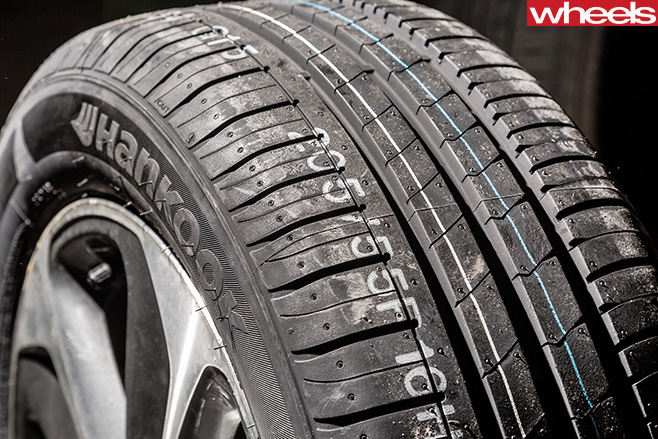
Although we’ve chosen a particular 16-inch tyre – because it’s a popular seller – the tyre models represented are available in a range of other sizes, and our results are applicable to each of them, too.
The field
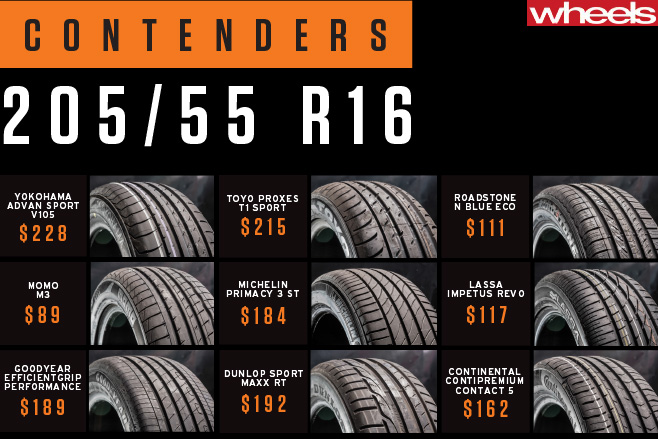
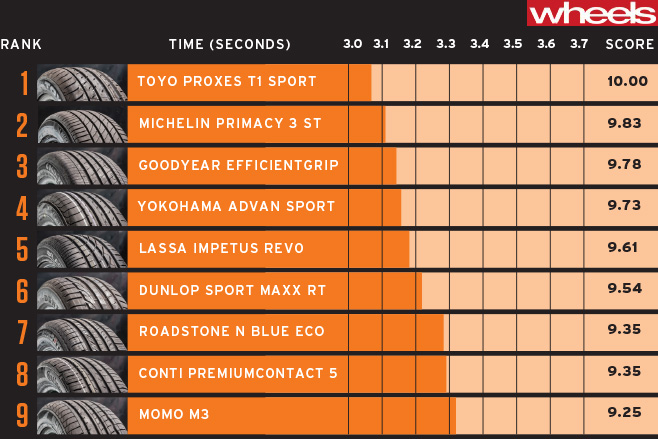
We tested the Continental ContiPremium Contact 5, Dunlop Sport Maxx RT, Goodyear EfficientGrip Performance, Lassa Impetus Revo, Michelin Primacy 3 ST, Momo M3, Roadstone N Blue Eco, Toyo Proxes T1 Sport, and Yokohama Advan Sport V105.
The car
The driver
The pit crew
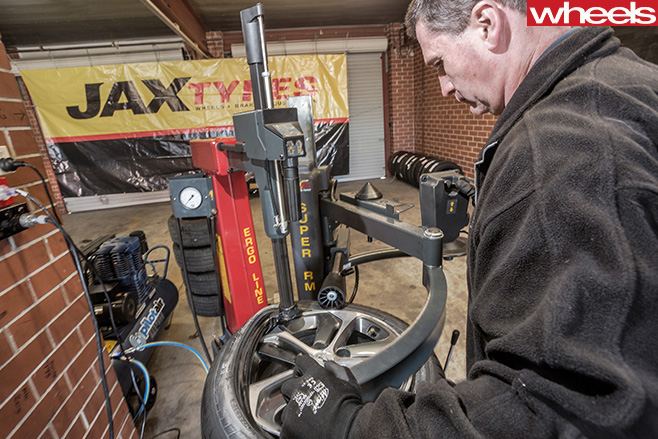
The Wheels Tyre Test involved stripping and fitting some 25 sets – 100-odd tyres in total – and it was all in a day (or two’s) work for the team. Thanks, fellas, we couldn’t have done it without you.
The ringmaster
SLALOM DRY
CIRCLE DRY
BRAKING DRY
CIRCUIT DRY
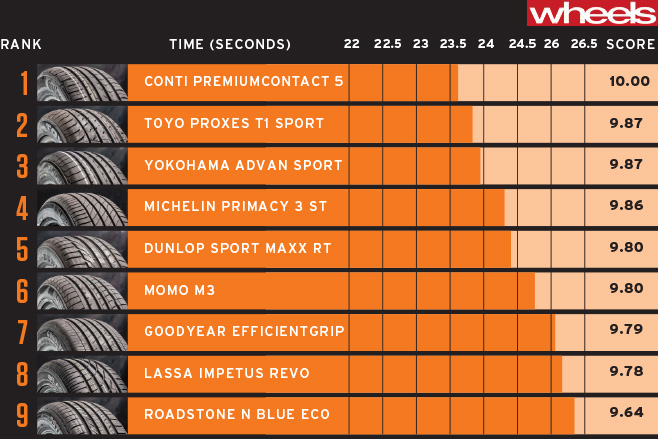
SLALOM WET
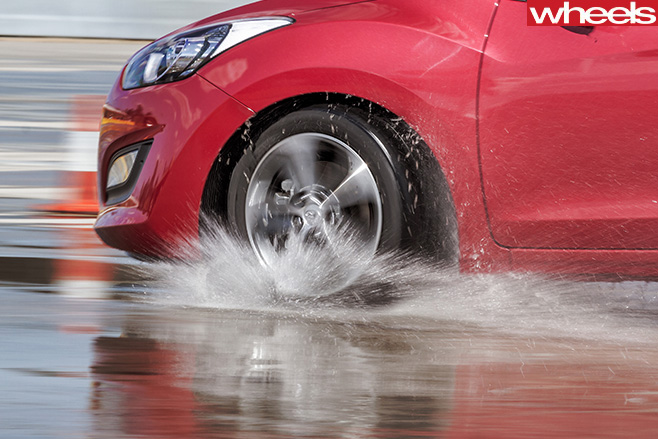
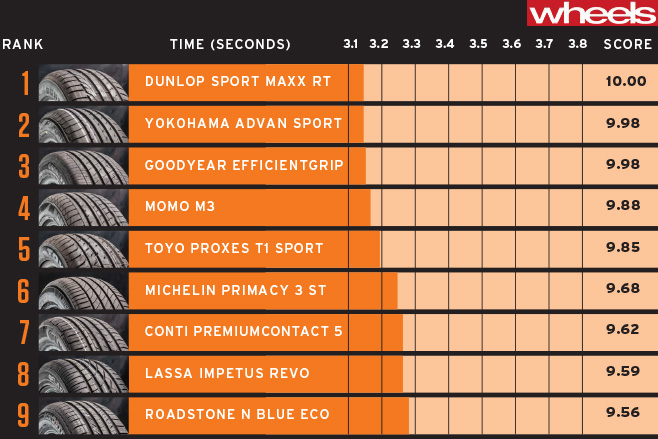
CIRCLE WET
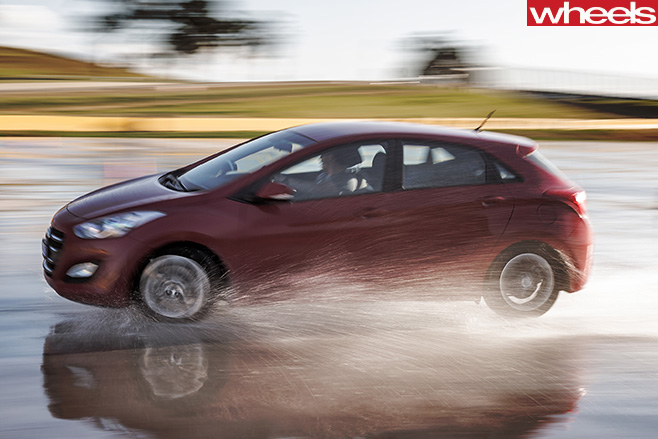
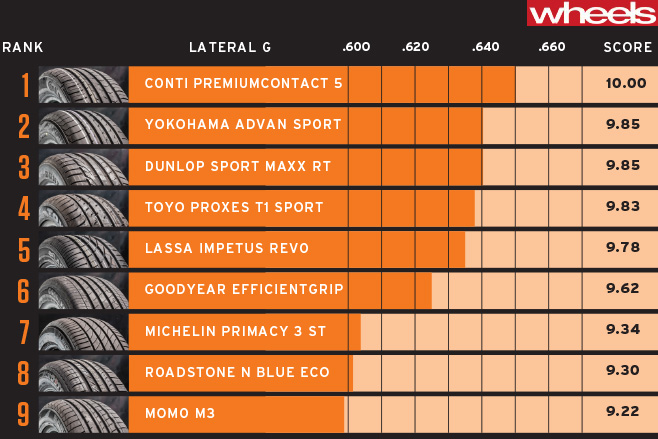
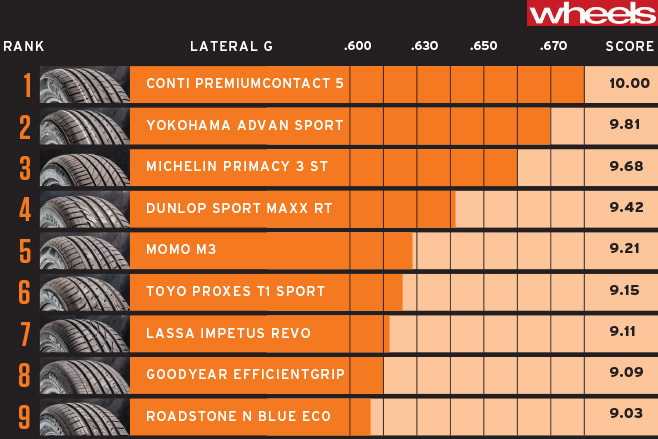
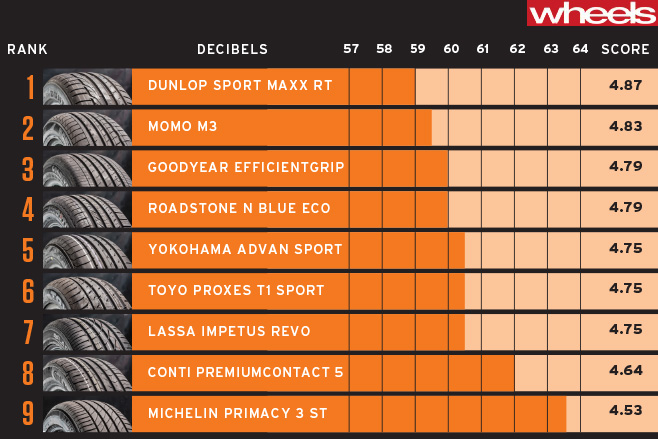
LOGICALLY enough, the Continental ContiPremiumContact5 mustered less outright grip in the wet than the dry – about five percent less in round figures. However, it still hung on tenaciously for the quickest average lap around the circle and a 0.649g figure that topped all other tyres in this discipline. This makes the Continental the outright slalom-test gold medallist, having topped the timesheet during the dry iteration, too. Like the Continental, the Yokohama, which took second place, is a great tyre in terms of its transient grip on both wet and dry surfaces. In the wet the Dunlop is just as good, though. Its time, lateral g (and, therefore, score) were identical to the Yokohama’s, down to 14 decimal places.
BRAKING WET
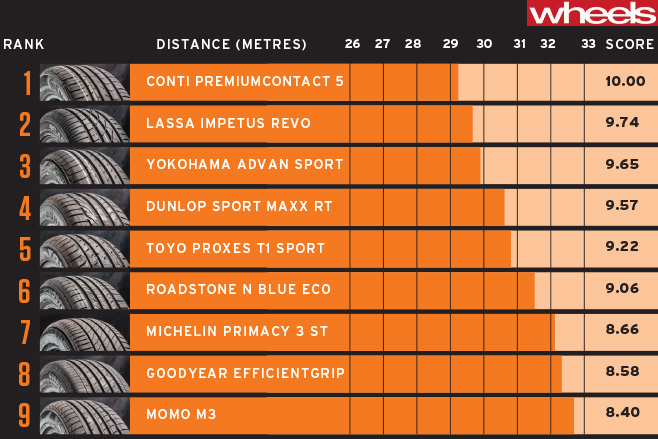
TYRE NOISE
OVERALL WINNER: YOKOHAMA ADVAN SPORT V105
The Yokohama Advan Sport V105 didn’t win any discipline outright, but it was right at the pointy end at almost every one of them, securing four silvers, just for starters. Then there were the two thirds and a fourth; its worst result was sixth – equal sixth, as it turns out – in the noise test, which counts for little if you’re focused on safety and handling. The Yokohama was the class of the field, and put in its best showings in the dry cornering and braking, and the slalom in both wet and dry conditions.
Interestingly, if you consider only the results of the dry tests, the Yokohama would still win, though if you took only the wet test results it would be pipped by the Continental, which took the silver overall. Conversely, the Continental falls to third if you consider only dry test results. Like the Continental and the Yokohama, the Dunlop (third overall) offers a great mix of dry and wet weather performance. It drops to fourth if you look at only the dry test results. One last look at the dry-only and wet-only results reveals that the Michelin lost out because of its leaning towards dry performance. Second across the dry tests, it slipped to eighth in the wet; it finished fifth overall.
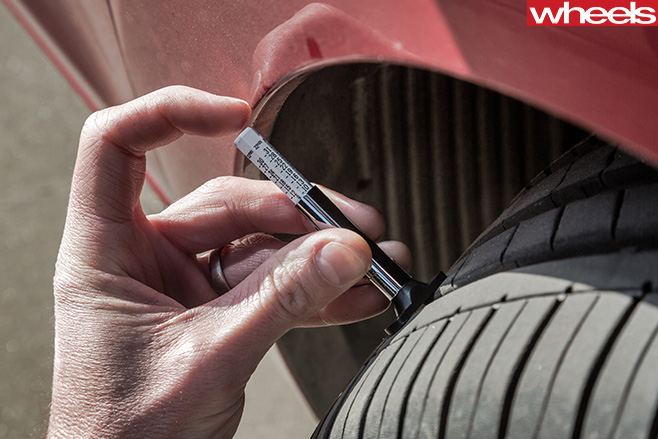
Shockers? Well, even the last-placed Momo M3 performed far better than the set of worn, yet legal tyres tested, which were diabolical in the wet. The message: Make sure your tyres have plenty of tread and, if you can, buy a good brand such as those standing tall on the Wheels Tyre Test 2015 podium.
Underinflated underperformer
Does bigger mean better?
Pump up the jam?
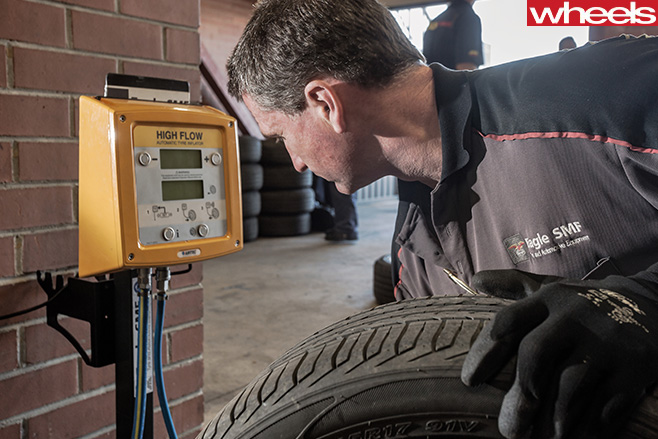
Wear – do you geddit?
IT’S SOMEWHAT disquieting that walking among us are those who think a 6.2 litre, LS3 V8-engined Series II Commodore (304kW) or an HSV Clubsport (325kW) isn’t quick enough.
These people might also have considered the latest, supercharged, LSA-engined Clubbies (400kW), or the 430kW HSV GTS, and felt that they were a bit gutless, and that a 400m time beginning with a twelve was unacceptably lethargic.
If too much power merely represents a solid start, and you can rustle up $26,000, then Walkinshaw Performance Products’ W547 upgrade pack for LS3-engined Commodores and Clubsports is about the most cost-effective way we can think of to distort the facial features of a driver and four passengers.
“With the launch of VF II it makes sense for WPP to release one of its most exciting W Series packages yet,” said General Manager Tony Harris.
“It’s not necessarily about the power and torque. It’s really about how well the package is put together and how well it drives, which in turn is based on how well it’s been engineered,” he said.
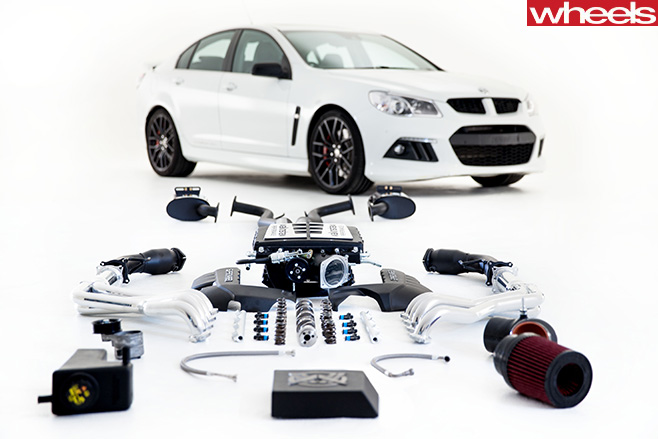
No performance figures have been quoted by Walkinshaw, and the kit doesn’t include any upgrades to braking and suspension. You might want to consider that at a later point, after witnessing the effects of having more power at your disposal than a third-world dictator with oil rights.
Aside from the WP230 Eaton supercharger, the kit contains a water to air intercooler, a special cold air intake, a camshaft and valve spring ugrade, ceramic coated headers, and a dual active cat back exhaust. The driveline is warranteed by WPP.
The first 50 customers will receive a special launch edition of the W547 package which includes the WP230 Supercharger finished in look-at-me yellow and an invitation to attend a ride day in a V8 Supercar, presumably so that you can laugh at its pathetic power output.
The upgrade package is available to order now and will arrive with authorised resellers from the start of November. So now you know where to look if home-grown humiliation of BMW M5s and Mercedes E63 AMGs is your kind of fun.
The just-launched Mercedes-Maybach S600 has in one month almost eclipsed the six-year local sales tally of the previous Maybach range.
Mercedes-Benz Australia has confirmed its 12-unit allocation of the V12-engined and most opulent version of the new S-Class is exhausted. Place an order now, and Sir won’t get a Mercedes-Maybach S600 until early next year. By comparison it took the Maybach brand six years and a whole range to shift just 13 units here.
Where the previous Maybach cost at its peak $1.15 million, however, the new Mercedes-Maybach is something of a bargain at $448,610 plus on-road costs.
What may be more surprising is that the Mercedes-Maybach S600 – claimed to be the world’s quietest production sedan – isn’t the only half-million-dollar S-Class to sell out. Another five units of the even pricier $489,610 Mercedes-AMG S65 L have been tallied. This after Benz Australia initially decided not to import that model, but backflipped due to demand.

With a 5.453-metre length and 3.365m wheelbase, the Mercedes-Maybach S600 extends 20cm beyond a long-wheelbase S-Class (including S65 L) in both measurements.
It doesn’t quite reach the respective 5.723m/3.39m of the previous Maybach 57, let alone the even longer Maybach 62, though the overseas-only Pullman version has that covered.
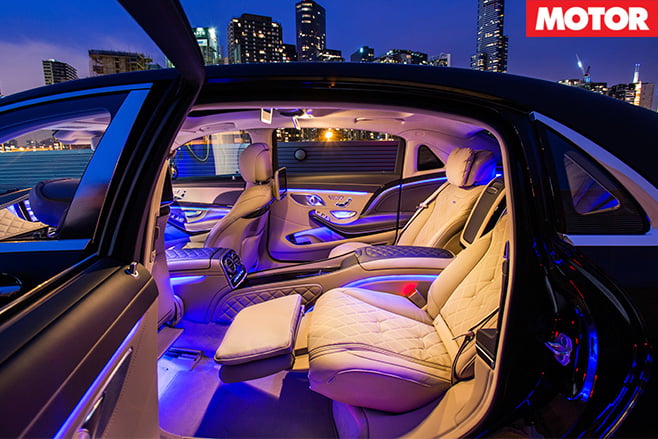
The company says the new model, “Melds the perfection of the Mercedes-Benz S-Class with the exclusivity of Maybach.”

“Providing both prestige and exclusivity, it is aimed at customers for whom status is important.”
Not as exclusive as the last reborn Maybach, to be sure, but Mercedes-Benz is no doubt enjoying the new model’s relative initial success.
Depending on your point of view, the fast station wagon is either automotive perfection, or as pointless as ordering a Diet Coke at McDonalds.
Its detractors will argue there’s no point giving a family car head-banging performance, as you’ll simply end up with a spouse that wants a divorce, children floating in a sea of vomit and a dog that looks like it’s been three rounds in a tumble dryer.
For those on the other side of the ledger, fast wagons provide hope. They prove petrolheads needn’t be punished for procreation, that needing space for prams and baby seats doesn’t mean spending the rest of your driving days in a beige people mover.
Fast wagons allow you to not only have your cake and eat it too, but hit 100km/h in less than five seconds while doing so. No prizes for guessing which viewpoint we subscribe to – fast wagons bloody rock.
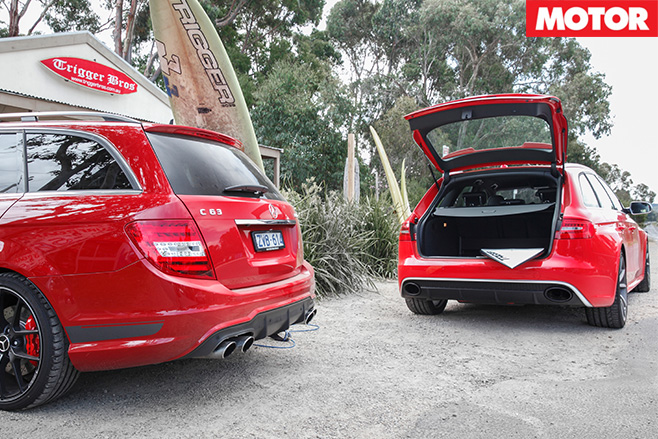
AMG has already confirmed the next C63 will be turbocharged, and it’d be a brave punter that bet against Audi following BMW’s lead in downsizing to a force-fed six-cylinder for the next generation of RS models.
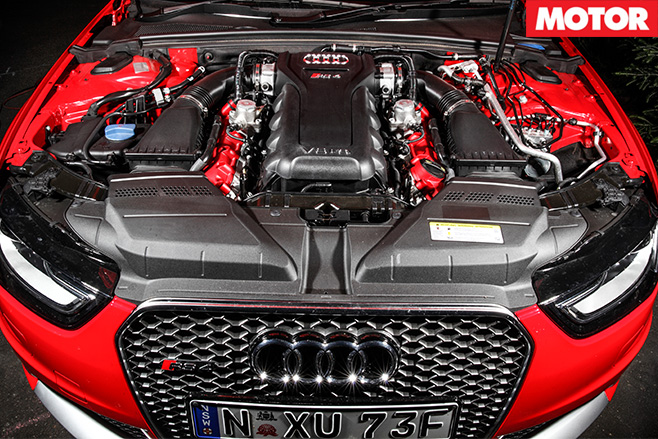
Which will be a crying shame, as the 331kW/430Nm 4.2-litre unit in the B8 RS4 is a work of art. How the boffins from Ingolstadt managed to get an undersquare engine to rev to 8250rpm only they know, but the advantage of the long-stroke layout is great low-end response – you could never exceed 5000rpm and still cover ground seriously quickly.
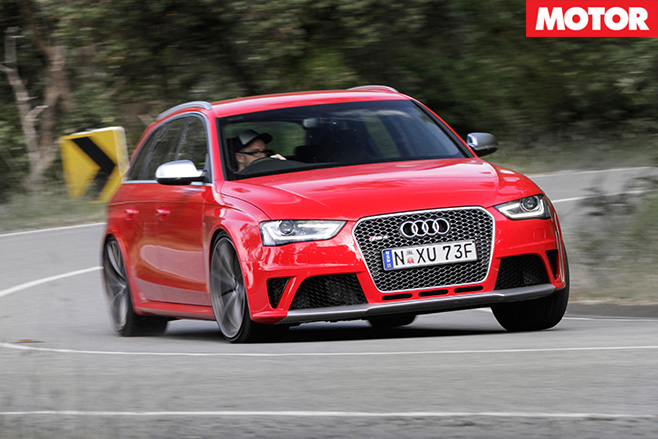
Unfortunately, our performance figures were recorded while Victoria was baking in a summer heatwave, and the Audi seemed to suffer most from the 35-degree plus temperatures. If you’ve ever entered a sauna and found it almost impossible to breathe, then you have some idea of the conditions these cars were facing.
Despite using launch control, the RS4 bogs down off the line, costing it a couple of tenths, before recovering to hit 100km/h in 4.93sec and through the quarter in 13.08sec at 173km/h. Each successive run was a tenth slower, suggesting the cooler the conditions, the better it’ll do against the stopwatch.
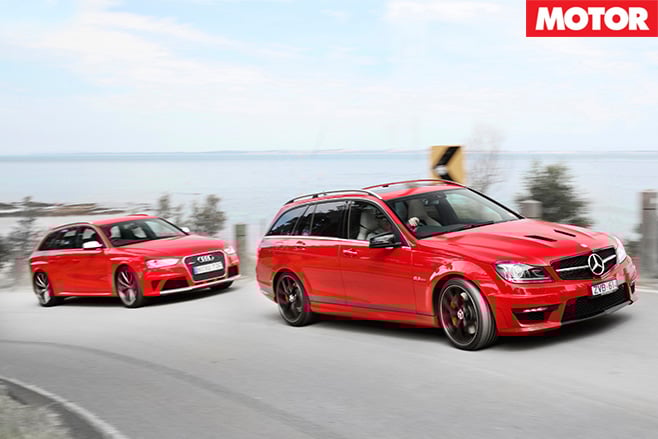
Of course, a regular C63 is pretty handy in a straight line.
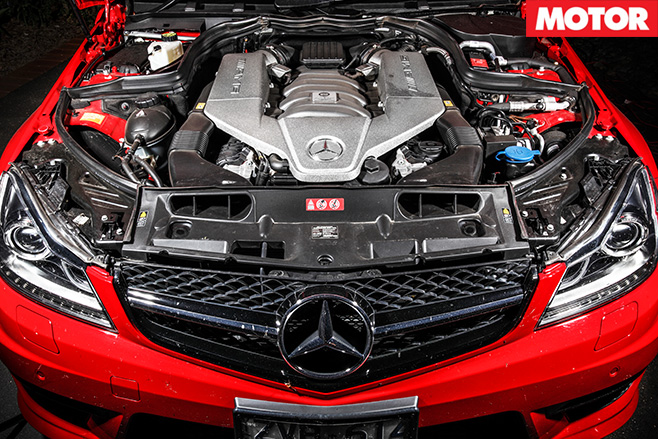
Adding the Performance Pack just makes it more impressive and the new ‘Edition 507’ upgrades make it borderline psychotic. Forged pistons from the SLS, new connecting rods and a lighter crankshaft have reduced inertia and lifted outputs to 373kW/610Nm. The mods give the Merc’s 6.2-litre V8 the top-end to match its monstrous mid-range.
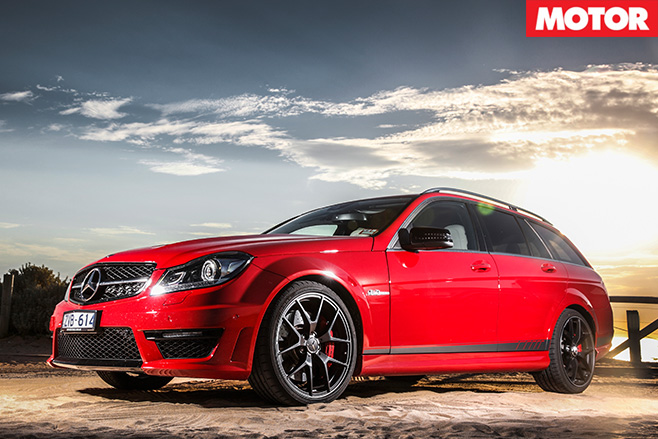
The lack of a proper diff also robs the handling of some predictability, which is all the more frustrating considering the rest of the package is so good.
Initially the Merc feels quite soft, diving under brakes and rolling in corners, but the balance of the chassis and communication through the steering gives you the confidence to throw this family wagon around like a 500hp Toyota 86.
In contrast, the Audi isn’t interested in options; it simply wants to get down the road as quickly as possible. With all its settings in ‘Comfort’ it bobs along serenely, engine burbling away quietly, but switch the systems to ‘Dynamic’ and the whole car stiffens, like you’ve filled its fuel lines with Red Bull.
Body roll is banished, occupant comfort ignored, the RS4 dealing with bumps by simply pummelling them into submission.With 265/30 ZR20 rubber all ’round, it has huge reserves of grip, and the optional sports differential banishes the understeer that dogged Audis of old.
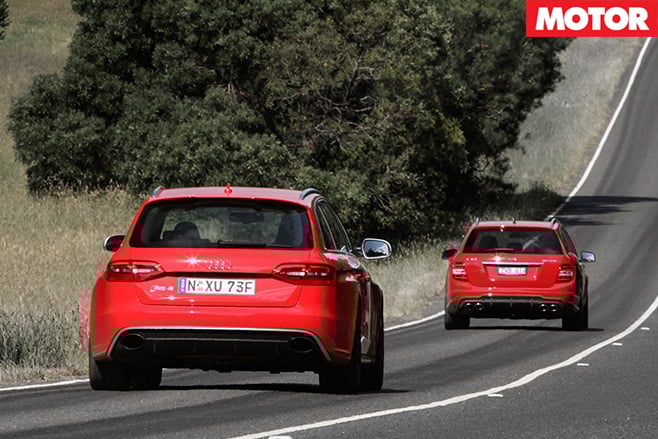
But while the Audi’s limits are high, finding them is more difficult – you’re never quite sure how much grip is left in the front end. Its variable-ratio steering is super fast at just 2.2 turns lock-to-lock, but turn-in isn’t as sharp as the Mercedes and it’s more difficult to place on the road.
Part of the problem is that while the RS4’s Drive Select system offers a choice of steering and suspension modes, none of them are quite right. In Comfort the steering is alarmingly light but the added weight in Dynamic makes it feel like you’ve run out of power steering fluid. Similarly, setting the dampers to Comfort translates into too much body roll in the bends, but switching to Dynamic makes the ride almost intolerable.
The C63’s set-up would provide a good benchmark. As mentioned, its hydraulically-assisted steering is beautifully communicative, while the fixed rate damping is superb. It’s on the firm side, sure, but it filters out most of the annoying road imperfections and keeps the hefty 1795kg kerb weight under strict control.
The Mercedes doesn’t have it all its own way, though. Despite similar on-paper specs, the Audi’s brakes are superior in power and feel, and its dual-clutch gearbox feels a generation ahead of the C63’s occasionally recalcitrant wet-clutch auto, the DSG’s lightning shifts making it the perfect partner for that incredible V8.
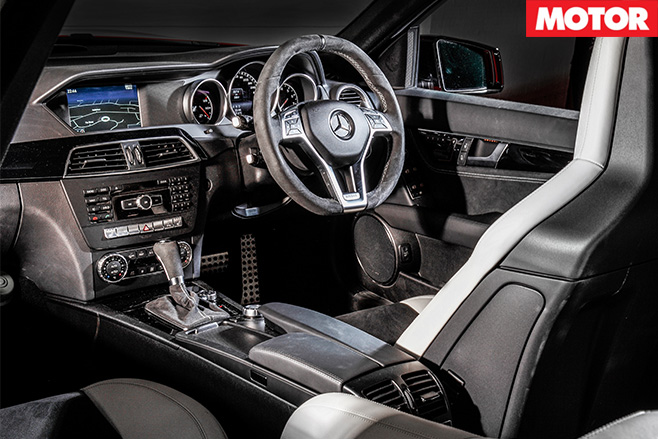
Agricultural isn’t a word you’d use to describe the Audi’s interior, though. Despite being based on a humble A4, everything you see and touch feels and looks expensive and the low-slung driving position is spot-on.
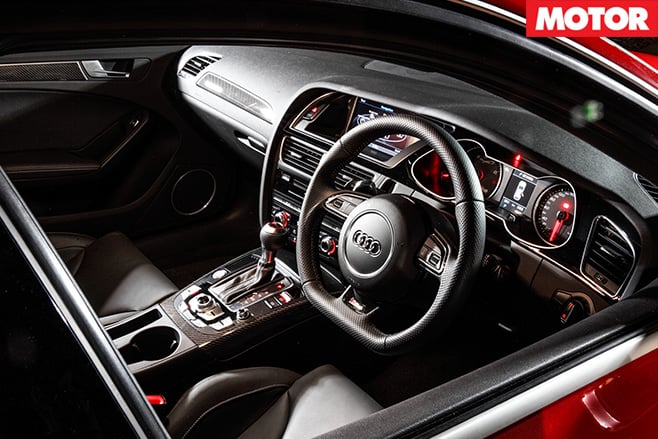
Looks, of course, are subjective, but to my eyes the Audi gets the nod here as well. To the uninitiated it looks just like another Audi wagon, but you’ll receive knowing nods of appreciation from those who’ve spotted the pumped guards and signature silver door mirrors.
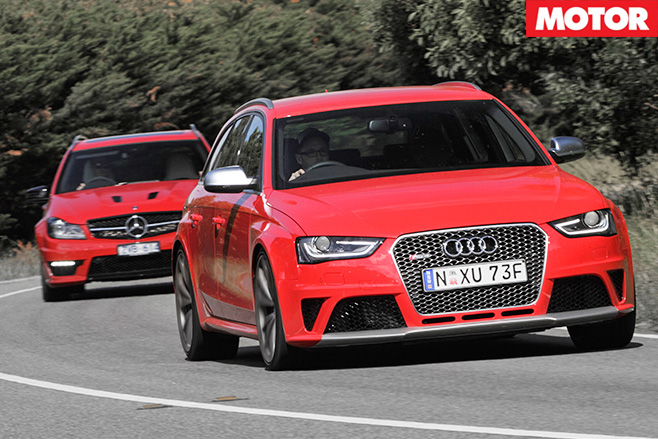
So having traded blow after blow, which one takes the title? The RS4 is mind-blowingly capable and you’d never, ever tire of the way that V8 screams towards redline, but driving it hard quickly becomes an exercise in ‘how fast can I go?’ rather than ‘how much fun can I have?’ It’s impressive, but fails to reach the dizzying heights of its predecessor or, indeed, its bigger brother, the RS6.
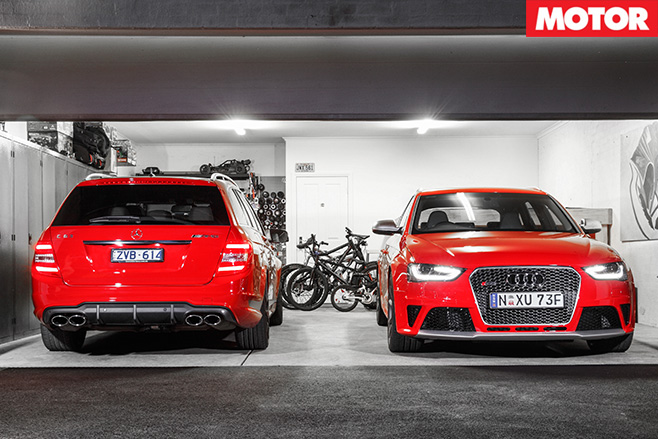
The doyen of sports commentary, Bruce McAvaney, would call it ‘special’. We’d call it bloody awesome. Think of it like this: if the RS4 is Sebastian Vettel, then the C63 is Mark Webber. One is undoubtedly faster and probably technically better, but I know which one I’d rather share a beer with.
It may look real, but this two-door HSV Gen-F2 GTO Coupe is the brainchild of Melbourne-based photographer Leigh Kelly.
Inspired by our Sweet Dream com-gens, Kelly’s mind wandered while editing a photoshoot of HSV’s new Clubsport R8 LSA.
According to Kelly: “I’ve always been inspired by your in-house concept designs. I took this inspiration and imagined a VF GTO coupe from a photo I shot of the new LSA R8 today. Enjoy!”
We do, Leigh, and we reckon plenty of customers would as well. Sadly, the tooling costs make it an impossibility, but the idea of a 400kW/671Nm GTO Coupe returning at around $90K with a 430kW/740Nm GTS Coupe as HSV’s new $105K flagship has us misty-eyed and salivating in equal measure.
What do you think of this two-door HSV?
FORMULA 1: Texas big for Lewis, a three-time champ
AMID tears under the helmet, Mercedes’ Lewis Hamilton secured his third world driver’s championship in the best possible way, winning a memorable US Grand Prix in Austin from his title challengers Nico Rosberg and Sebastian Vettel.
But Rosberg gifted Hamilton the title in Texas with a bad error that handed the Briton the lead in the closing stages of a race that had many plot twists, safety cars, and plenty of incidents – only 12 of the 22 starters reached the finish.
A few torrid arm-wrestles resulted in damaged cars.
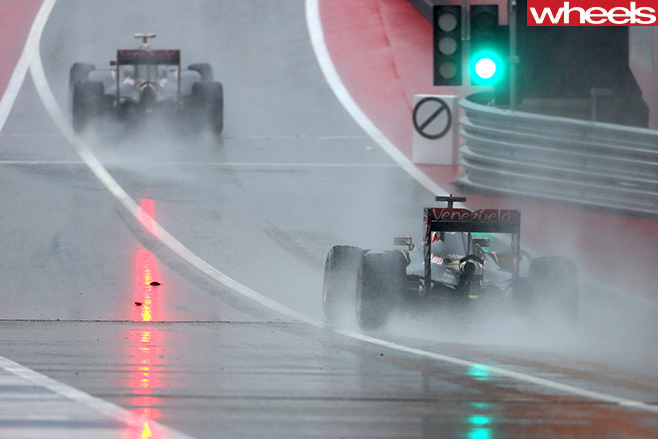
When the cars went out for the race, on intermediate tyres, it was the first time the drivers had experienced anything like a drying line.
Hamilton bumped Rosberg off line in the first corner, allowing the two Red Bulls past, with the Russian pushing hard to close on the lead Merc.
With a patchy grey line forming, the teams were busy calculating when their drivers should switch from the fading inters on to slicks.
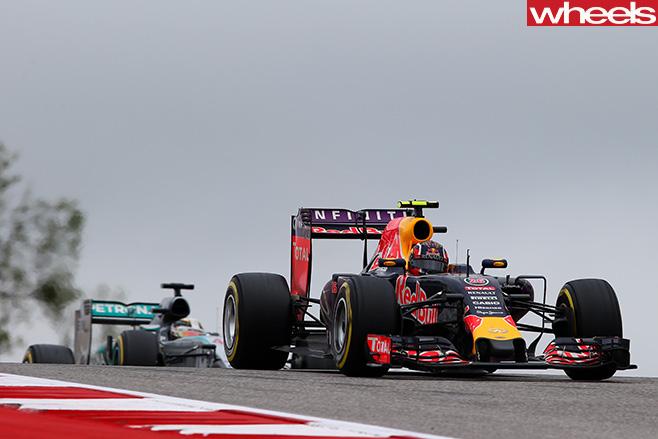
But the Mercs and Vettel’s Ferrari showed their normal superior pace in the dry and soon pushed our man back.
Kvyat showed plenty of flight but his race ended in the barriers.
Both Williams also retired as did Kimi Raikkonen after he fired off and damaged a brake cooling duct.
Ricciardo, struggling with a damaged car, ultimately grabbed 10th and a single championship point from McLaren’s Fernando Alonso on the final lap.
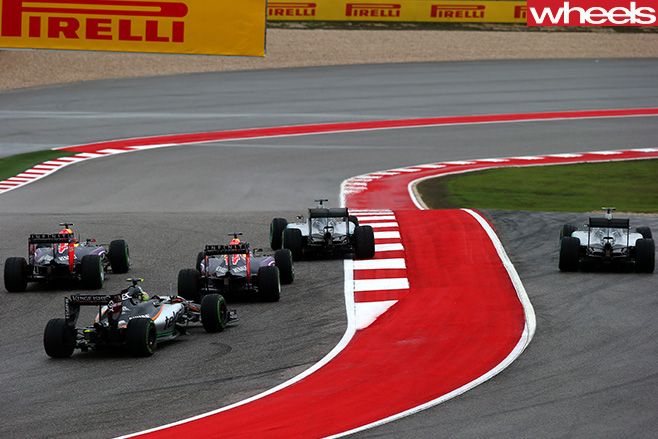
But that’s what you do if you want to be world champion.
MOTOGP: Rossi sanctioned after bizarre Malaysian race
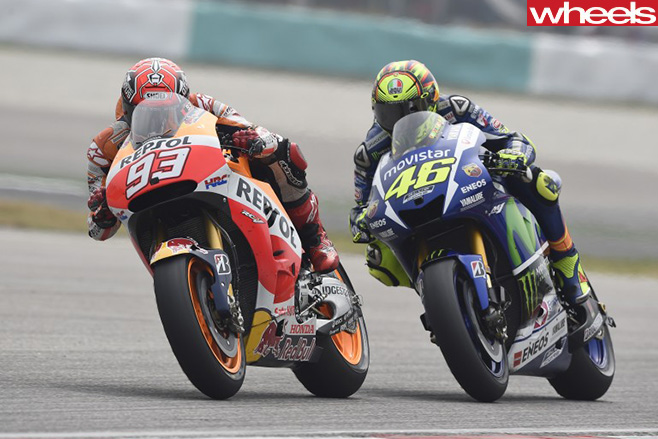
Those who thought that was the end of it were very wrong.
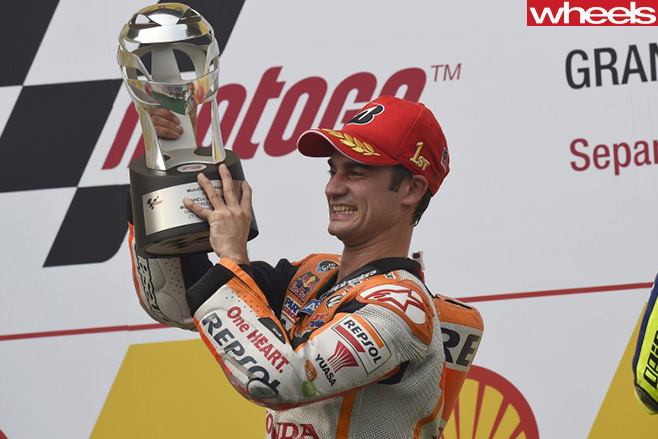
The back-in-form Dani Pedrosa continued with his sparkling pole-winning qualifying pace to dominate the race from flag to flag.
But a stunning early race scrap between the feuding Rossi and Marquez means history will barely acknowledge Pedrosa’s brilliant performance.
Six laps in, after some red-hot exchanges, Rossi and Marquez’s ferocious duel for third turned bizarrely nasty.
As the pair leaned on each other through turn 14, Rossi appeared to twice turn his head to look at Marquez, who was hanging on around the outside.
The bikes came together, and Marquez hit the deck, a sad conclusion to what had been an enthralling struggle.
A post-race sanction by officials allowed Rossi to keep his points from Sepang but punishment came with a rear-of-grid start in the decider at Valencia in two weekends’ time.
V8 SUPERCARS: Courtney’s Gold Coast fairytale
HRT’S James Courtney scored a hugely emotional victory in Sunday’s 300km leg of the Gold Coast 600, while a day earlier a head-shaking mistake by a crew member cost V8 Supercars Championship leader Mark Winterbottom a likely bag of valuable points at the business end of the season.
Craig Lowndes went into the weekend 399 points in arrears and left the Gold Coast with the margin back to 258 points.
Courtney, racing for the first time in over two months after being hurt by flying debris in Sydney, showed true grit.
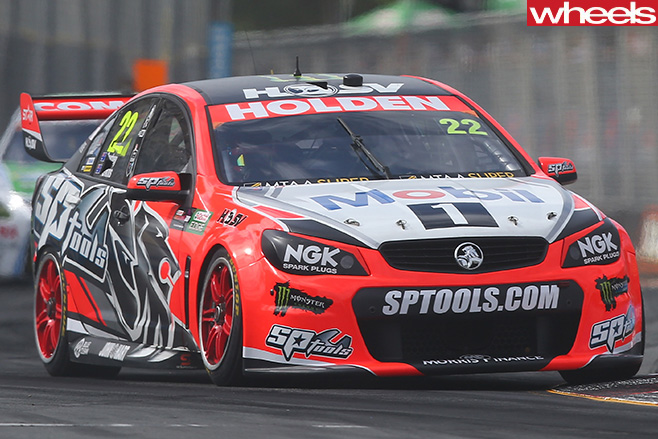
Saturday first…when unfathomably, at the first pit stop, Winterbottom was released straight into the side ofGarth Tander’s HRT Commodore leaving pit lane, causing extensive suspension damage to his Falcon FG X. He also had to bear a long wait for repairs plus a penalty before finishing in 24th place.
But if Winterbottom was initially less than thrilled – there was a report of a helmet thrown in disgust – he later wasn’t blaming anyone, taking the view that the Prodrive team takes both its knocks and successes with equanimity.
“You don’t crucify someone; you have a chat and try to eliminate the problems and then do what we do best,” Winterbottom said.
But this wasn’t the only talking point.
How about the colour switch by 2015 part-timer Russell Ingall? At Sandown and Bathurst he raced with HRT; two weeks after the 1000r he was back wearing blue, deputising for Chaz Mostert aboard a Prodrive Falcon with young gun Cameron Waters.
Also dominating the pitlane chat was gossip on the silly season driver moves. One firm switch for 2016 is the jump by Will Davison from Erebus Mercedes to Tekno, replacing the Triple Eight-bound Shane van Gisbergen.
Others heading out of their current teams at the end of the year are Walkinshaw’s Tim Slade (tipped to land at BJR), and Nissan’s James Moffat (to GRM Volvo). And maybe Prodrive’s David Reynolds. So plenty of drivers with a lot to prove…
Pole both days went to New Zealanders. Shane van Gisbergen was quickest on Saturday and then raced off with his first win of the year from an impressive David Reynolds, who fought tenaciously to keep Lowndes at bay.
Impressive too were the co-drivers, Jono Webb, who opened an early lead despite being under the weather, before handing over to the Giz. Dean Canto also did his usual solid job for Reynolds, as did Steve Richards for Lowndes
The punters were also entertained by the vigorous mid-race scrap between HRT team-mates Garth Tander and Courtney, the latter showing no problems with his tender torso. They finished fourth and fifth on Saturday.
Sunday started well for Scotty McLaughlin. His third pole of the year, edging Lowndes, van Gisbergen, Jamie Whincup, Winterbottom and Scott Pye (also with a rib injury to deal with).
Steve Richards took an early lead in the Red Bull #888, but a clever call by HRT to bring in the Courtney/Jack Perkins Commodore off schedule for a drink of fuel put them in the box seat.
An enterprising second was the Nissan pair of Rick Kelly/David Russell ahead of Tander/Warren Luff, who banked their second podium of the weekend.
Lowndes/Richards had to settle for fourth, with Saturday winners van Gisbergen/Webb fifth.
Winterbottom, who with Steve Owen finished 11th, was candid about his Gold Coast races. “It was an average weekend – I can’t really sugar coat it,” he said.
“We need to bounce back. The other team has got momentum and we’ve halted. We didn’t make mistakes on track and I’m proud of the way Steve and I had a run but there’s other areas that we need to tidy up. We’ll go home and we’ll work hard.”
WRC: Ogier crash hands Mikkelsen maiden win
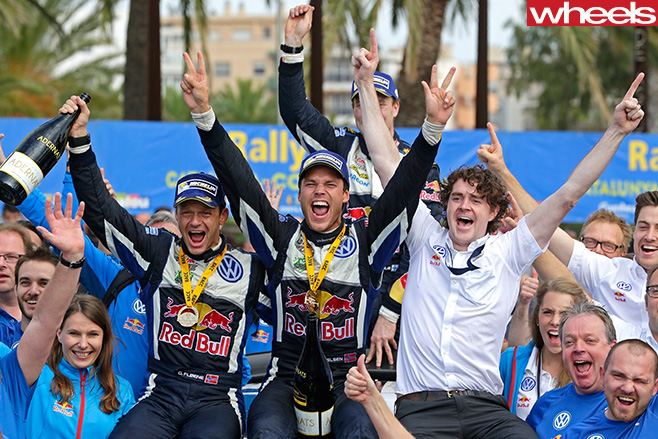
In a hugely dramatic ending to a captivating event, the popular Mikkelsen and co-driver Ola Floene finished the last stage to hear they had managed to pinch second place from Jari-Matti Latvala after a fierce final day fight.
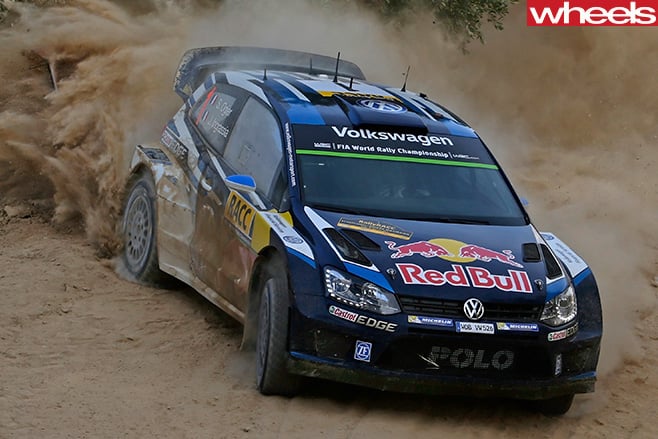
Mikkelsen was initially stunned into silence as he grappled to comprehend that Ogier had made a rare error.
But he soon got to celebrate his first WRC win in 64 attempts.
“It was absurd because Ogier never makes mistakes so when they told me I didn’t believe it. It was a big surprise, and although it’s not the way I want to win a rally, we’ve been so close so many times that I feel I really deserve this one,” said 26-year-old Mikkelsen.
The eventual winning margin over Latvala was 3.1sec, with Dani Sordo taking the final podium place for Hyundai, a further 18.1sec back.
ARC: Eli takes title number three
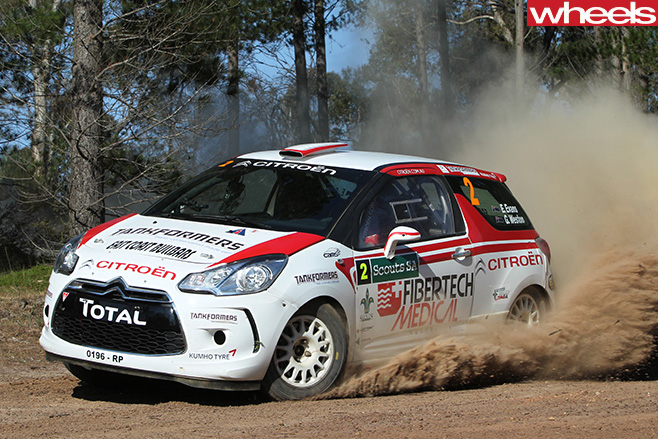
Evans needed only to finish third or better to keep the title out of reach of Molly Taylor. After the day’s 12 stages he had done the deed with a flourish, winning the heat by 25.7 seconds ahead of second placed Steve Mackenzie and Taylor, who’d dropped time with an engine issue and a blown strut top.
Taylor admitted to trialling a tyre combination she hadn’t ever run previously on the Renault Clio. “It was really taily to begin with, but I worked out what to do and it was much better on the second two thirds,” she said.
“Unbelievably fast, the fastest roads in Australia, and the biggest white gums on the edge of them you’ve ever seen,” Taylor’s co-driver Bill Hayes remarked during a tense Saturday.
Taylor held second early but slipped to third as she continued to struggle with the engine cut problem she began to experience yesterday afternoon in her Renault Clio. “Every time we change from second to third it just dies; it’s incredibly frustrating!” she commented.
The day was about Eli Evans and his third Australian championship.
“It’s my third championship now with Glen (Weston, co-driver). It’s a pretty proud moment. This year with Citroen, it was a whole new challenge, I hadn’t driven the car at the start of the year. To be standing here right now winning the championship is something Glen and I worked hard to earn and I feel like we’re deserving winners,” he said.
F1: Jolyon Palmer to race for Lotus
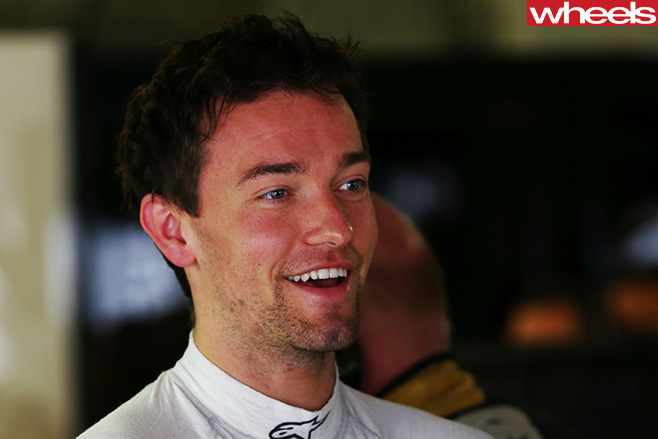
While Lotus’ future ownership remains problematical, the second-generation driver now knows what he’ll be doing next season.
Palmer, 24, has driven for the team in the majority of this season’s Free Practice 1 sessions, this year following an outstanding GP2 campaign in 2014 where he won the championship in dominant fashion.
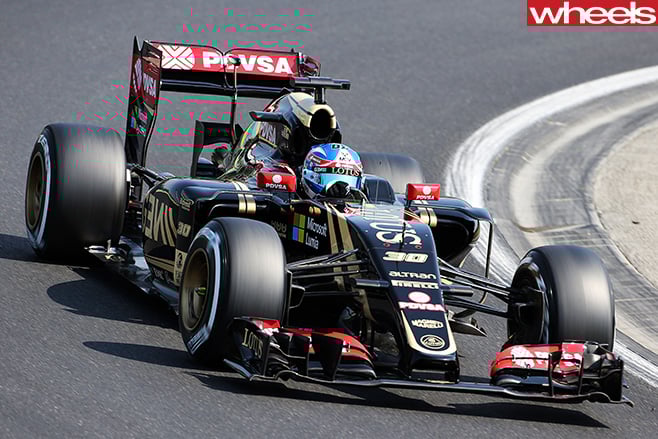
“As well as having a great future ahead of him behind the wheel, Jolyon is an intelligent and highly marketable asset to the team.”
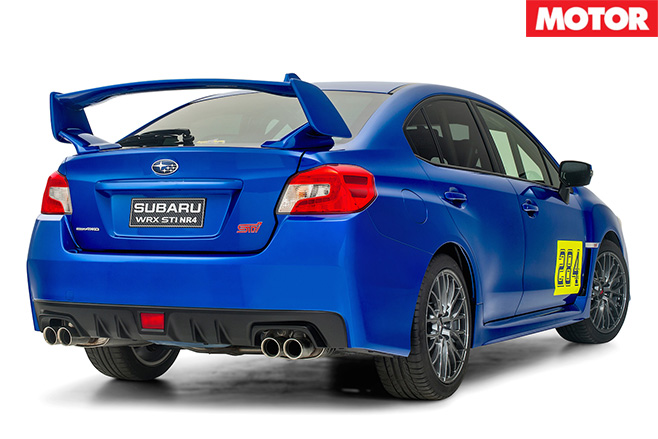
It isn’t an official motorsport program, but call it one for the fans – the Subaru WRX STI NR4 is available now for punters to buy and race.
Possum Bourne Motorsport has taken the Japanese domestic market WRX STI NR4 then developed three packages and many options for levels of motorsport ranging from club to international.
The STI NR4 uses a 227kW/422Nm 2.0-litre twin-scroll turbocharged EJ20 engine in place of the older 221kW/407Nm 2.5-litre unit in Australian production models.
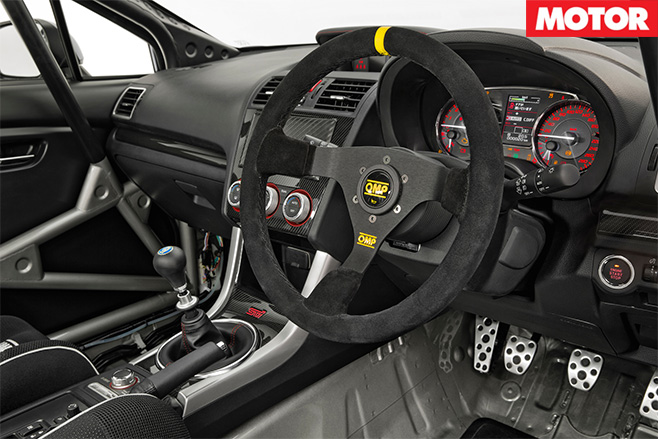
The first-tier package – which will require around $80,000 – is for club-racer types with changes including an FIA-approved rollcage, sound deadening and airbag removal, OMP steering wheel and winged seats with six-point harnesses and a fibreglass door panel, radio panel, rear parcel tray and foot tray set.
By the third tier it all gets serious, with chassis seam welding, axle pegs and other body welding prep designed to tighten up the WRX STI NR4. Seat tubes replace the runners from the same brand and Recaro winged seats with Sabelt six-point harnesses and Sparco steering wheel surround the driver.
The sky is (almost) the limit when it comes to mixing and matching individual options. A six-speed manual is standard, but there’s also a choice of five- or six-speed dog box or sequential shifting transmissions.
Filter through engine options – HP stainless downpipe, forged shortblock, head package and ECU reflash or dedicated MoTeC M1 ECU – then select a stainless steel exhaust system.
Choose from an uprated limited-slip differential, heavy-duty driveshaft, an electronically programmable centre differential, uprated sway bars, adjustable arms and Reiger suspension kits.
There are also gravel options and tarmac options for the exterior.
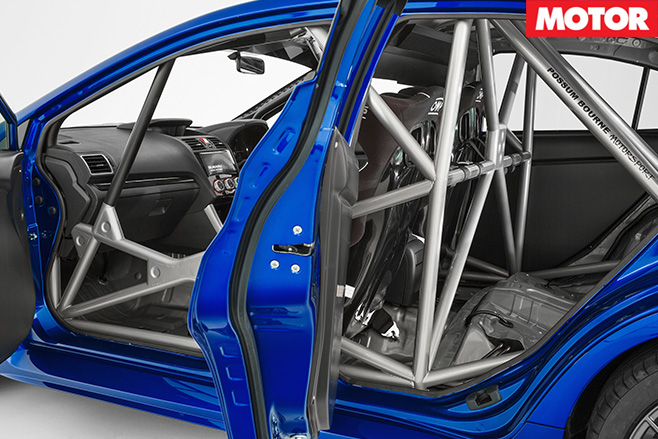
The first WRX STI NR4 has been built, in Subaru Blue of course, for display at Subaru’s interactive dealership in Docklands, Melbourne. It is also available in white and a further eight have already been sold through select STI dealerships.
So, what is it?
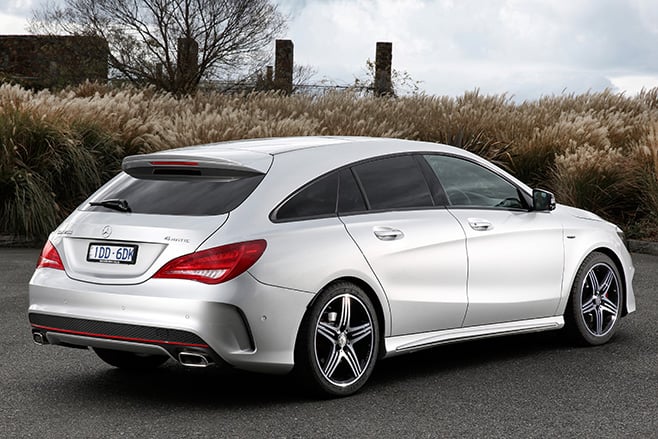
Even if they won’t admit it, younger siblings want to impress their big brothers or sisters, and the Mercedes-Benz CLA is no different. The mid-size CLS is the glamour puss of the Merc passenger car range; the sleek four door having been joined by the striking Mercedes CLA Shooting Brake wagon in late 2012. And the mini-me CLA has been jumping out of its skin to follow suit.
Offering petrol and diesel engines, as well as a fire-breathing AMG flagship… just like the CLS, it’s no surprise Benz’s baby four door coupe has also morphed into a Shooting Brake variant, with the same flowing lines and beautifully balanced stance as its larger stablemate.
Of course, the usually front-drive CLA claims cheeky bragging rights with all-wheel drive on performance models, while the CLS retains rear drive only.
Why should I care?
This compact wagon offers a classy alternative to the SUV contagion sweeping the prestige and luxury markets, with conventional car comfort and dynamics combined with genuine load-lugging practicality.
What’s new about it?
The Brake’s wagon profile, delivering the extra cargo space, is the only fundamental change from the coupe. And on the subject of carrying capacity, if you have to cart a bunch of one litre milk containers, 495 of them fit in the back with rear seats up (595 with the rear bench in the more upright ‘cargo’ position), and 1,354 squeeze in if you load to the roof with the rear seats folded.
Merc also claims rear headroom is increased by four cm, and we can confirm access to the back seats is easier thanks to larger door apertures.
What doesn’t change is the model range, starting with the 200 (1.6-litre 115kW/250Nm FWD turbo petrol four), followed by the 200 CDI (2.1-litre 100kW/300Nm FWD turbo-diesel four), then the 250 Sport 4MATIC (2.0-litre 155kW/350Nm AWD turbo petrol four), and topped by the 45 AMG 4MATIC (2.0-litre 265kW/450Nm AWD turbo petrol four). Standard gearbox is a seven-speed dual clutch, with the racy ‘Speedshift’ version in the 45 AMG featuring three shift modes, a double-declutching function and ‘Race Start’ launch control.

That’s all fine, what’s it like to drive fast?
A launch drive program over semi-rural roads north-east of Melbourne offered the opportunity to swap through each model in the range, and first impressions of the entry-level 200 are dominated by the quality of its ride and comfort of its front seats.
Zero to 100km/h in a claimed 8.7secs isn’t exactly sizzling, but it’s not lethargic either. The 200 has enough grunt for comfortable cruising, while others further up the performance food chain do the quicker point-to-point stuff. Electro-mechanical steering delivers excellent feel and response.
Cue the 200 CDI diesel’s extra torque, which boosts mid-range punch, but less power means it can’t carry it through to the top end. And in terms of refinement, the price paid is more noticeable turbo lag and (not particularly appealing) engine noise.
Which leads to the 250 Sport, which for $14k more than the base petrol 200 brings more urgent performance (0-100km/h in 6.8secs), and thanks to lower and retuned AMG suspension as well as Merc’s excellent 4MATIC all-wheel drive system, also delivers brilliant power down and determined drive out of quick corners; all accompanied by dramatic exhaust pops and spits with the gearbox in sport mode.
And then there’s the wonderfully bonkers 45 AMG, with its screaming 2.0-litre, twin-scroll (M133) turbo four delivering 0-100km/h in 4.7secs, which is only two tenths slower than the 65kg lighter A45 AMG hatch. If you need to carry people and stuff fast, this is your compact wagon.
And driving home from the city?
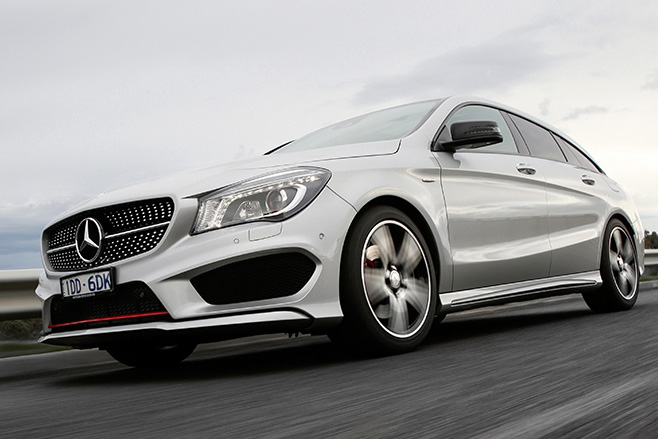
As with other body variants sitting on Merc’s MFA (modular front architecture) chassis, the 250 Sport is the sweet spot of the range. Calm and comfortable on the city commute, it’ transforms into a smile-inducing back-road blaster at the flick of a dual clutch Sport switch.
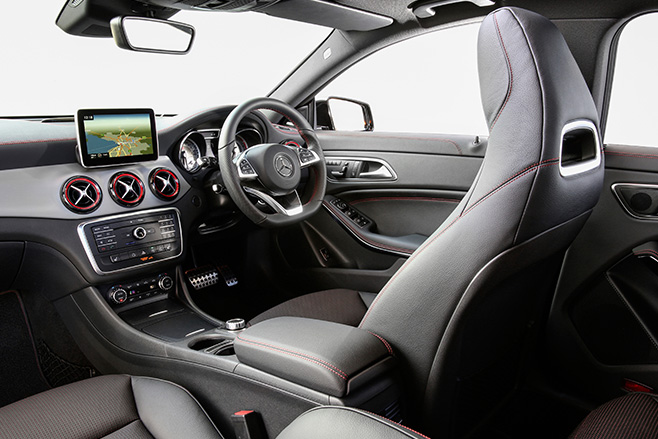
The dash layout and instrumentation on all models is clean and clear (the tablet style infotainment screen is a particular stand out), but the 250’s interior has a brighter, more premium feel.
Anything bad about it?
Finish quality on the base 200 models isn’t as good as we’d expect in an early $50k car. Sharp-ish edges around some interior moulded parts are a letdown, as is the use of hard plastics around the cabin, and the uniformly dark grey colour scheme in the 200 is mass market plain.
How much would I have to pay? And is it worth it?
Pricing starts at $52,400 for the 200 petrol, stepping up to $52,900 for the diesel equivalent, then $66,400 for the 250 Sport 4MATIC, and the top shelf is occupied by the 45 AMG 4MATCI at $89,900.
Standard equipment on all models includes the ‘Audio 20’ infotainment system with eight inch TFT colour screen and eight speaker audio, sat-nav, dual-zone climate-control air (with vents to the rear), rain-sensing wipers, 18-inch alloys, ‘Active Parking Assist’ plus ‘Parktronic’ proximity sensors front and rear, bi-xenon headlights with LED daytime running lights, and the ‘Easy-Pack’ electronic tailgate.
The 250 Sport chips in with heated front seats, ‘Keyless-Go’, AWD, the AMG suspension set-up, a panoramic glass sunroof, ‘Intelligent Lighting’, and perforated front brake rotors. Then, aside from its mental drivetrain, the 45 AMG features leather-trimmed AMG performance seating, trickier infotainment with digital radio and a bigger screen interface, as well as Harman Kardon audio, 19-inch AMG rims and hi-po brakes. Lots of performance and lots of equipment. In fact, a decent value equation across the board.
Would you take the Merc-Benz CLA Shooting Brake or BMW 2 Series Active Tourer?
The BMW’s interior is brilliant, but as a driver’s car, the Merc’s on pole.
Click here to find out more about the Mercedes CLA-Class Shooting Brake.
Australian brother/sister pairing Brendan Reeves and Rhianon Gelsomino have secured second place in the DMACK Trophy one-make series held as part of last weekend’s WRC Rally Spain.
Reeves and Gelsomino took over the car vacated by American Will Hudson at short notice, a huge local fundraising effort allowing the pair to compete in their first World Rally Championship event since Rally Spain 2012.
Despite having driven the Ford Fiesta EcoBoost only once prior – winning the 2WD class at the New England Forest Rally in America in July – Reeves was immediately on the pace, winning the opening super special stage.
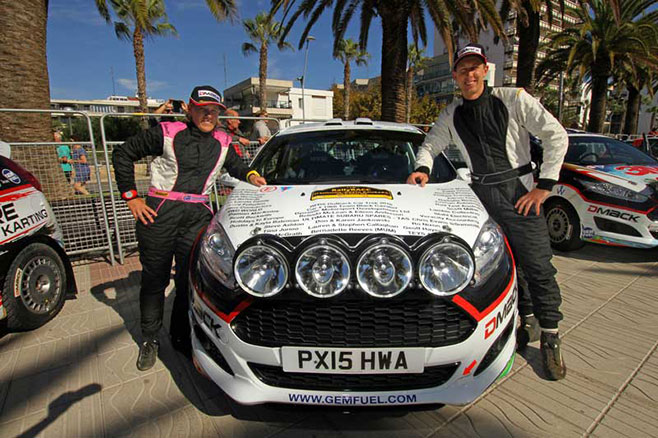
Having consolidated third place, Reeves was promoted to second following an error by Tom Cave on the final day, a position made certain with the cancellation of the final stage thanks to a heavy accident for VW WRC driver Sebastien Ogier.
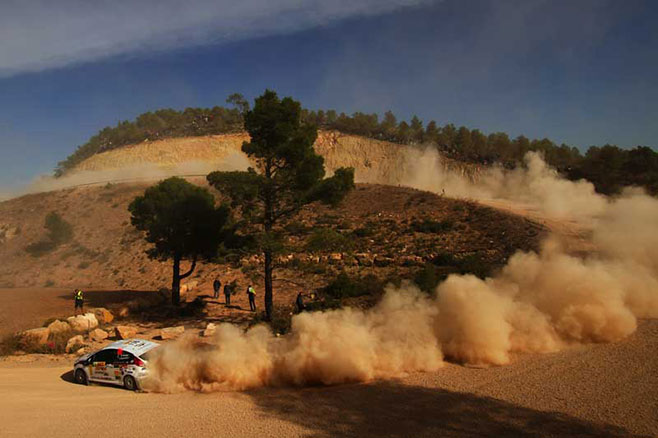
“We don’t know our competition yet [or] the final details but it’s certainly going to be an amazing opportunity,” said Reeves. “I’ve never driven an R5 before but I’m certainly looking forward to it and will work as hard as I can to best prepare for the shootout.”
