
Ladies and gentlemen, the Mitsubishi Lancer Evolution X has left the factory – for good.
Mitsubishi has begun building Final Edition variants of its Lancer Evolution X, an act which signals one of the rally world’s greatest protégés entering its death throes. Mitsubishi will not succeed it with an Evolution XI, rather saying a hybrid SUV will replace it in ‘spirit’.
With the nameplate being able to boast a lineage, both literally and mechanically, all the way back to 1992, the Final Edition treatment is designed to celebrate its innings by modifying the last 1000 Lancer Evolutions with a bump in power and specification.

The camera crew have also pulled a couple of the workers aside for a chat, but their soft words are for deaf ears, as it’s all in Japanese.
All you really need to know is 150 of the cars that shuffle through those robot-laden factories will be destined for Australia.

A moment of silence for a legend, please.
SATURDAY. It never fails.
This story was originally published in our February 2004 issue
The edginess sets in at Lithgow and nags like an unscratched itch until, on the outskirts of Bathurst, the words come into view, etched in the distant hill. ‘MOUNT PANORAMA’, they say, this year supplemented with ‘AUSTRALIA’ for the benefit of travellers prone to overshooting.
And those words focus the feeling, as they always do, into an irrational excitement. I just love this place.
Hope Street, Brilliant Street. The roads of Bathurst, first European settlement beyond the Dividing Range, exult in our conquest of this vast land. And, beyond the city, they form a circuit, part altar, part anvil, on which we thrash the Living Lights out of our companion in the enterprise, the automobile, to celebrate.
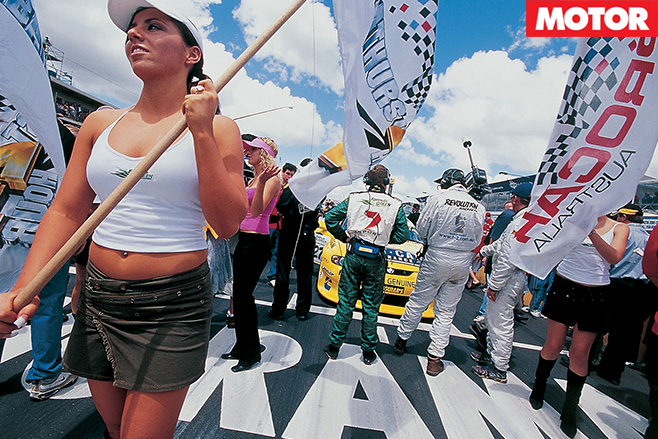
Okay, it is to moderation what Tyson is to romance, and the limit’s still one liver per customer, but you can behave on the other 364 days.
Accordingly, my entire provisioning consists of good wines, great cheeses and an overflow of olives. The only hope ref scurvy is that the advance party in MOTOR’s mountaintop Winnebago, Editor Taylor, his father Roger and editorial assistant Marcus (Herman) Hofmann might have thought to bring something fresher and greener than newly minted beer with them.
Taylor proudly displays the wreckage of maybe two whole animals and an apple in the fridge. No worries, then.
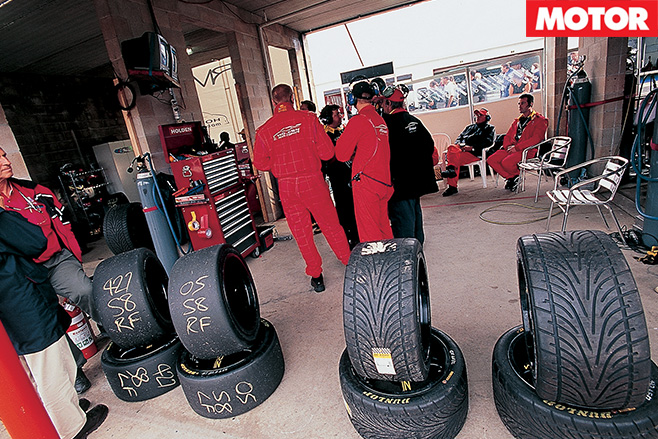
Lamborghini is in, following Meaningful Discussions with the Procar lads, which went, reportedly, Q: “What freedoms do you need to run?” A: “Get your pen out.” And the Mosler’s owner/driver, Martin Short, fell asleep on the plane with his contact lenses in and has been blind until yesterday, when he finally got to see the circuit clearly. And wished he hadn’t.
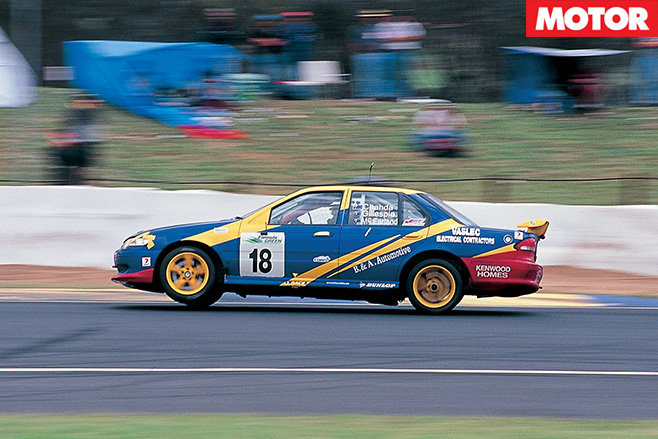
Unchanged, however, is the Monaro’s pre-race dominance and Holden PR ‘Plastic’ Pemberton’s thoughtfulness in ensuring that each visiting team receives a three-page Kangaroo Risk Assessment document, complete with diagrams, photographs, stats (Skippy = 100kg etc) and a map of roo-risk areas, which, surprisingly, occur everywhere one might wish to pass and/or go fast.
Thus enlightened, I return to the mountain, a venue many times more populated than at last year’s inaugural event but still retaining its unique ambience.
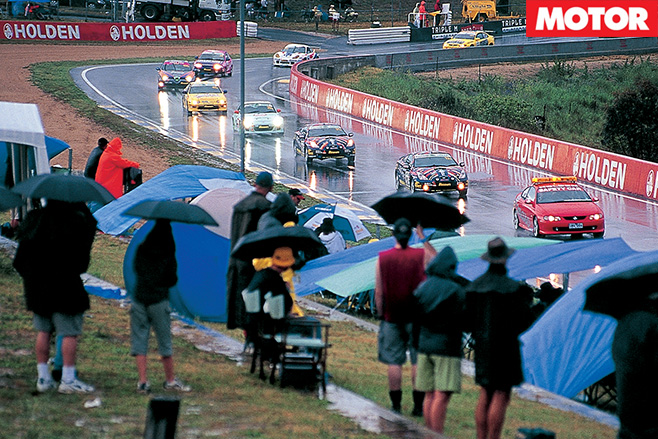
Sure, there’s a ‘BOOZE, BOOBS OR BURNOUT’ tollgate on the access road, but that disperses when Mister Plod queries its niceness and all is at peace until 2pm, when the field fires off like songbirds released and swamps the hillside with racket.
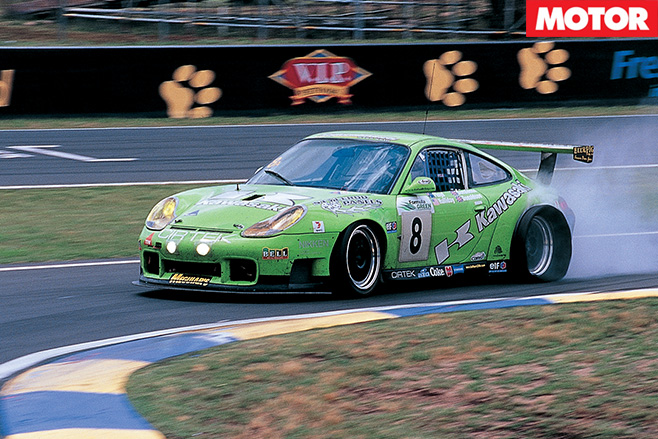
The early hours are fun as everyone who suspects they might not make the full program takes a crack at Looking Twinkly for their 15 minutes’ worth. Accordingly, the Morgan blats around boldly for about that long before settling down to a quiet smoke and the Lambo alternates between hairy-chested lunges and long limps as its tyres explode like party balloons.
Father Taylor and Herman have somehow scored tables and televisions for outdoor viewing of the Rugby World Cup final, and I’ve got the bries ripening, wines uncorked and anchovy olives doused with oil, herbs and balsamic vinegar, when Taylor (M) makes us all look like pikers by scoring a ticket and an Audi RS6 and, promising a midnight return, departs to Sydney to watch the match live.
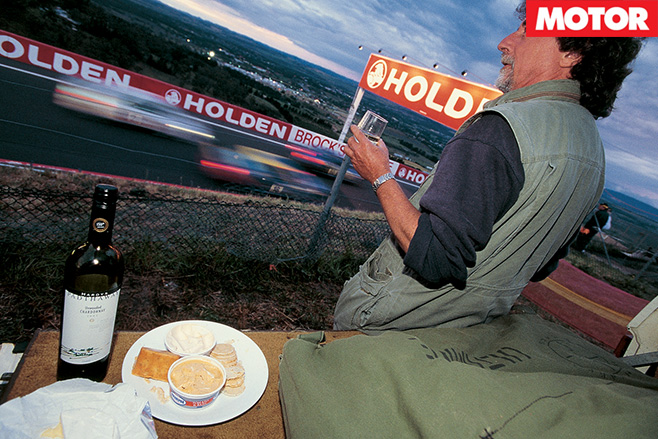
Numbers at our Hertz-supplied Chapel o’ Chow swell as the game begins; readers and friends join us, among them founder and owner of the whole 24 Hour shebang, Ross Palmer, happy to leave his creation for a wee while and take refreshment at Ground Level. Just like Bernie does.
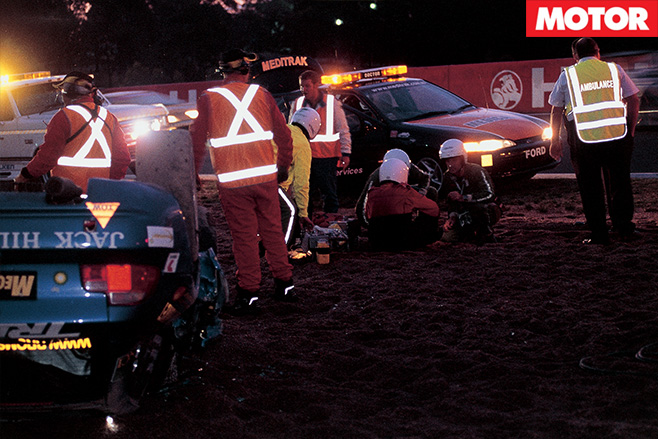
The delicacies soon match the drinks in range and bravery and include an avocado-based experiment, which Father Taylor proclaims would put a horn on a jellyfish. I have no idea what that means, but such is the pleasure of the company and entertainment that we are only momentarily disturbed by an impressive THUMP from the circuit, followed shortly by the sparkle-arkle of safety car and emergency services.
Perched on top of a starlit hill straked by rocketing lights and demon shrieks is where… and within a sip or three of the rugby’s conclusion I return to their study, wandering down to the impressive crowd at Skyline to continue MOTOR’s cutting-edge coverage. An authoritative “Does anyone here have a clue what’s happening?” should, I believe, assure the most fastidious among them that nothing will escape our notice.
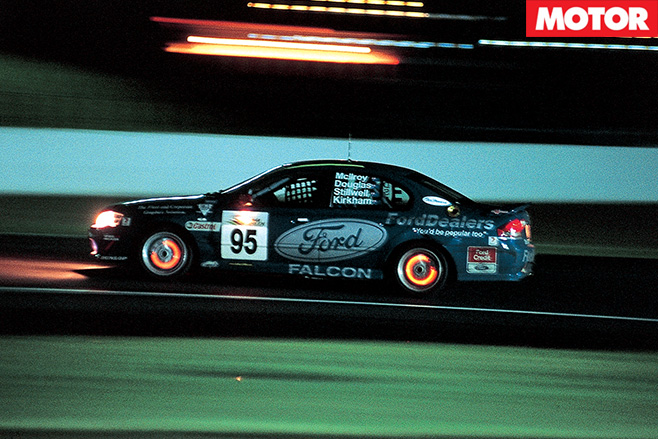
I had retired when the rains returned last night, and the sound most remembered before sleep was the deep, dieselly rumble of the Holdens’ unstoppable progress.
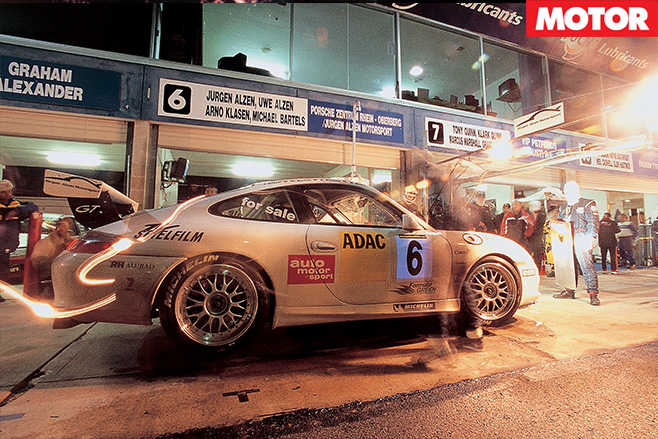
Okay, they’ve stretched the coupes’ small-block Gen IIIs and scratch-built a lot of the underpinnings, but we’re still talking pushrod-engined, homebuilt heavyweights with the frontal area of a barn and a centre of gravity a yard high that have outrun credible efforts from the raceworks of BMW, Porsche, Lamborghini and Ferrari to lead by 10 laps before breakfast. Impressive.
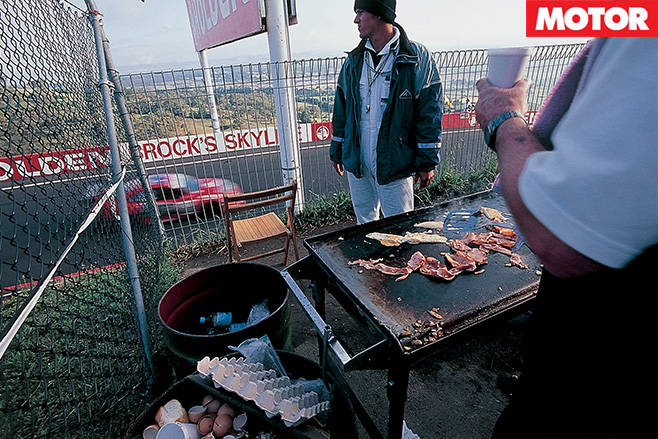
Ditto breakfast, which involves the sainted partnership of barbecue and bacon drenched in maple syrup. Similar civilisation is crackling on campfires all across the top as the crowd rises and, trust me, I have seen very much worse at dawn on The Mount. So have both police and ambulance on site, who report a virtual absence of overnight custom. Whatever next? Family restaurants and rides on the 24 Hour Skyline? Probably.
Out in pitlane, the living dead slump like upholstery and stare glass-eyed at monitors amid the pitiful detritus, bent and spent, of once perfect motorcars that now rage, battered, into another day. And if the chase is all but futile, a new tension now takes the crowd. Surely a Monaro will win… but which one?
Last year’s winning Pretty/Tander/McConville/Richards squad? Or will the race be awarded to the crowd-favourite 05 car, with Murphy, Bright and Kelly, headed by Peter Brock?
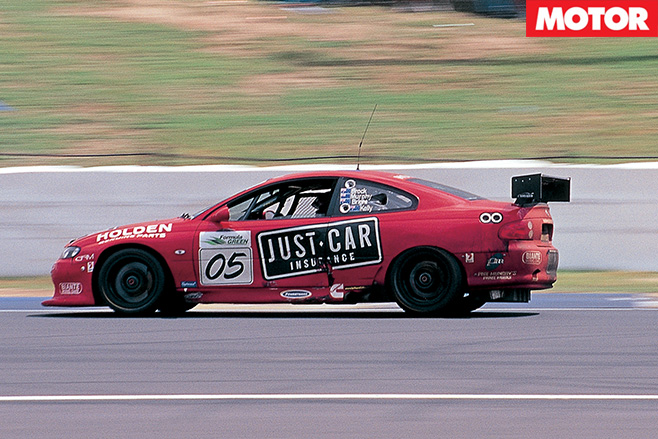
By the middle of the day, Brock is matching the #427 sister car driven by the son of his once-partner, Jim Richards, and the bullet-quick young Steven has been known to go head to head with his own father at some cost to the coachwork, so you can be sure Brock’s getting no favours.
At the last change, Murphy takes the 05 car and Tander the 427, which, despite minor diff surgery, is back in the chase. Running nose to tail, 12 laps ahead of the third-placed Porsche, they have nothing left to prove. Which is why Garry Rogers’ decision, with three laps to go, is astonishing. Trusting his drivers implicitly, he unleashes them to race to the finish, to risk everything, to determine a genuine winner. And that wonderful, crazy, sporting call both honours the race and provides it with an extraordinary climax.
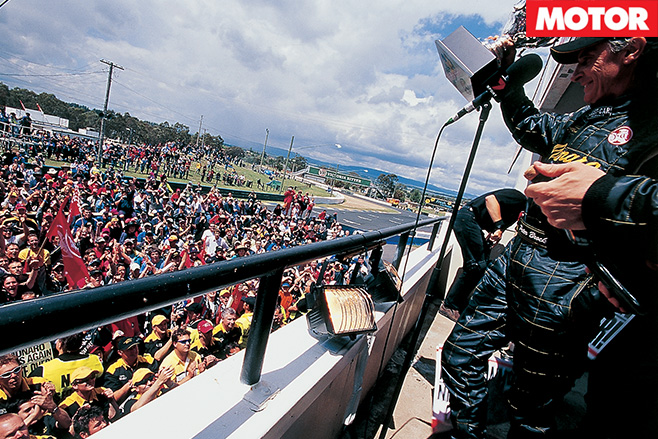
In one of the great finishes, all breath is suspended until the cars flash past the line, 0.3 of a second apart, and the crowd erupts in a roar of relief and release for the four men who’ve driven 05 to victory… and for Peter Brock, cheered once again as a champion.
And, on the tape, high and heady with irrational excitement, is my own voice, joining them.
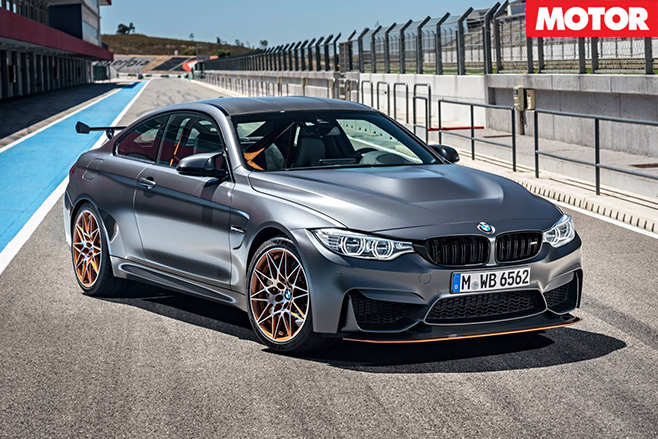
Specification for the BMW M4 GTS reads like a run-sheet for how to beat the competition at the sports coupe game that has put the M Division under increasing pressure.
Designed to celebrate 30 years since the birth of the M3 (yes, we know, it is called M4) the GTS follows the badging of the previous, E92 iteration as track-focused limited edition, this time of 700 units worldwide.
It may be all party poppers and licks of orange paint, but when Mercedes-AMG announced a 3.9sec 0-100km/h for its new C63 coupe, things became serious. The M4 GTS now claims 3.8sec 0-100km/h.
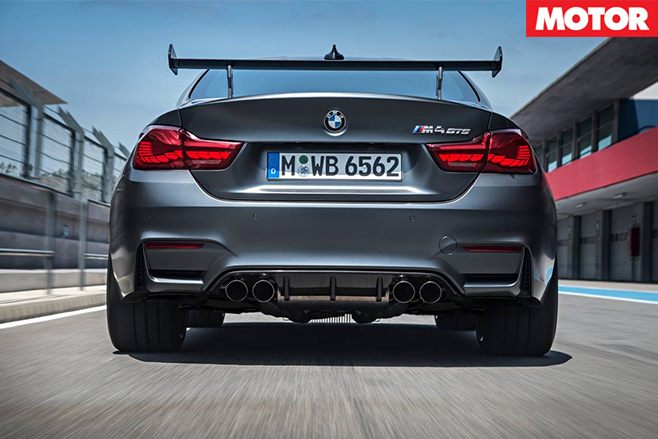
The M Division has used ‘water injection’ technology to raise the boost pressure of the 3.0-litre twin-turbocharged six-cylinder without affecting cooling. A five-litre water tank sits in the boot of the M4 GTS sprays tiny amounts of vapour into the intake manifold chamber to cool temperatures by up to 25 degrees. The tank needs to be refilled at every racetrack fuel tank refill, or every fifth fuel tank refill during harder driving.
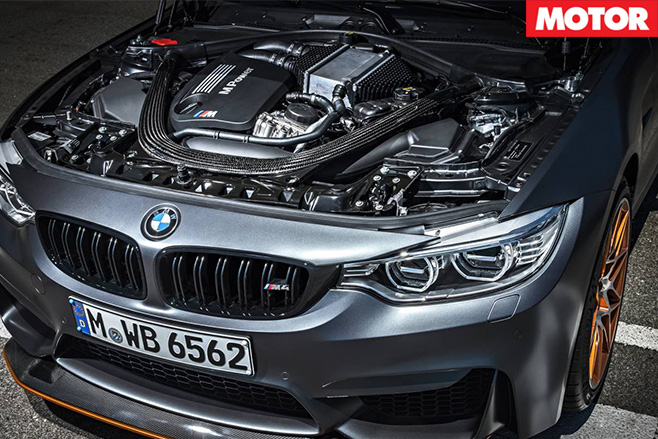
Carbonfibre reinforced plastic is used to saturation point, with the bonnet saving 25 per cent mass, and front splitter, adjustable rear spoiler, instrument panel bracing tube, rear diffuser and propeller shaft all made of the strong, lightweight material.
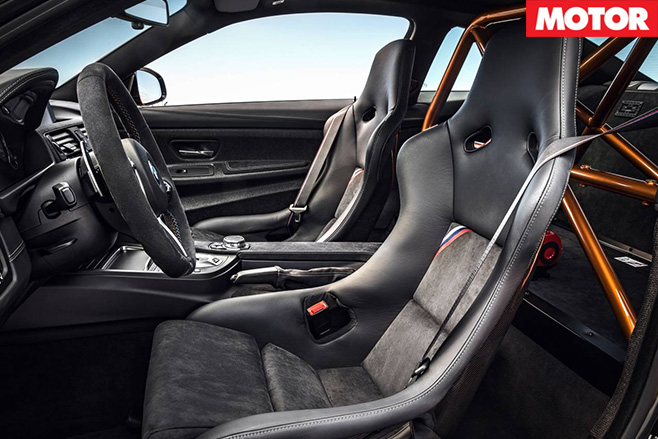
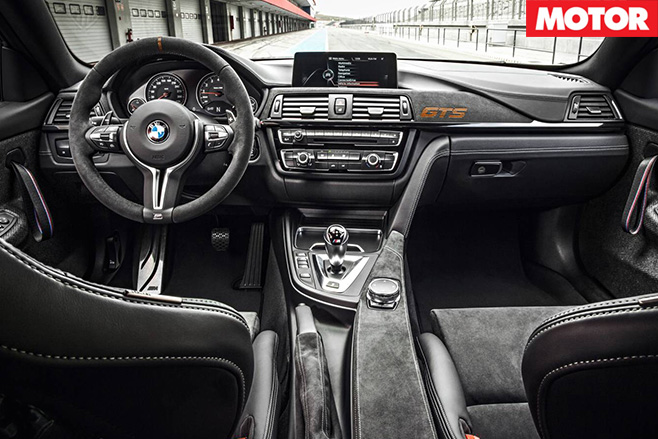
M bucket seats with three-point harness and door trims with pull straps each weigh half their respective units in the regular M4 coupe, while an Alcantara-clad centre console sheds 30 per cent weight.
Finishing off the weight saving is a 20-per cent-lighter titanium sports exhaust that meets with three-way adjustable coilover suspension and carbon ceramic disc brakes to round out the major chassis changes. Tweaks to the electro-mechanical steering are said to deliver “no elastic section” in the column.
Particularly in matte grey with that big wing, subtle splitters and vaguely retro multi-spoke wheels in orange, the M4 GTS looks like a fitting continuation of some of the great limited edition models such as the M3 CSL.
Sometimes birthday candles can sting you…
It’s tough being the younger sibling. The Porsche Cayman is – always has been – a benchmark sports car, yet it seems no review is complete without mentioning how good it would be with a 911 engine in it.
Well, with the arrival of the new Cayman GT4 we can now find out. The first mid-engined model from Porsche’s motorsport department, the GT4 headline change over the regular Cayman range is the installation of the 3.8-litre flat-six from the soon-to-be-superseded 991 Carrera S.
The result is 283kW at 7400rpm and 420Nm from 4750-6000rpm, 33kW/40Nm more than the 3.4-litre Cayman GTS. Attached exclusively to a six-speed manual gearbox, this propels the GT4 to 100km/h in a claimed 4.4sec and on to a 295km/h top speed.
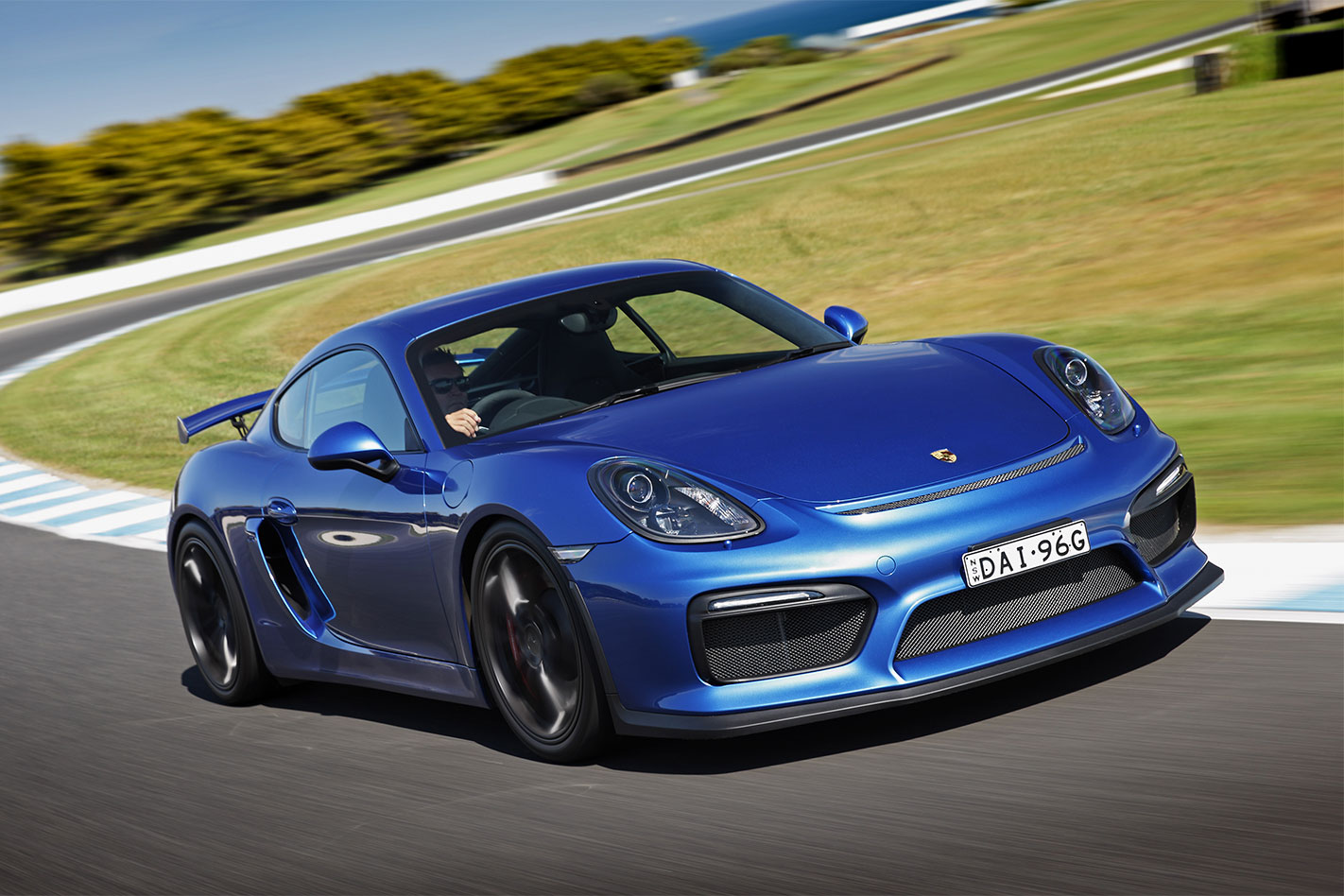
Our first taste of the GT4 took place exclusively at the Island, but even on its wide, flowing nature the larger engine’s edge was blunted somewhat by extraordinarily long gearing. Second gear stretches to 133km/h and third gear 184km/h and the car actually struggles to pull in third on the uphill stretch out of Siberia.
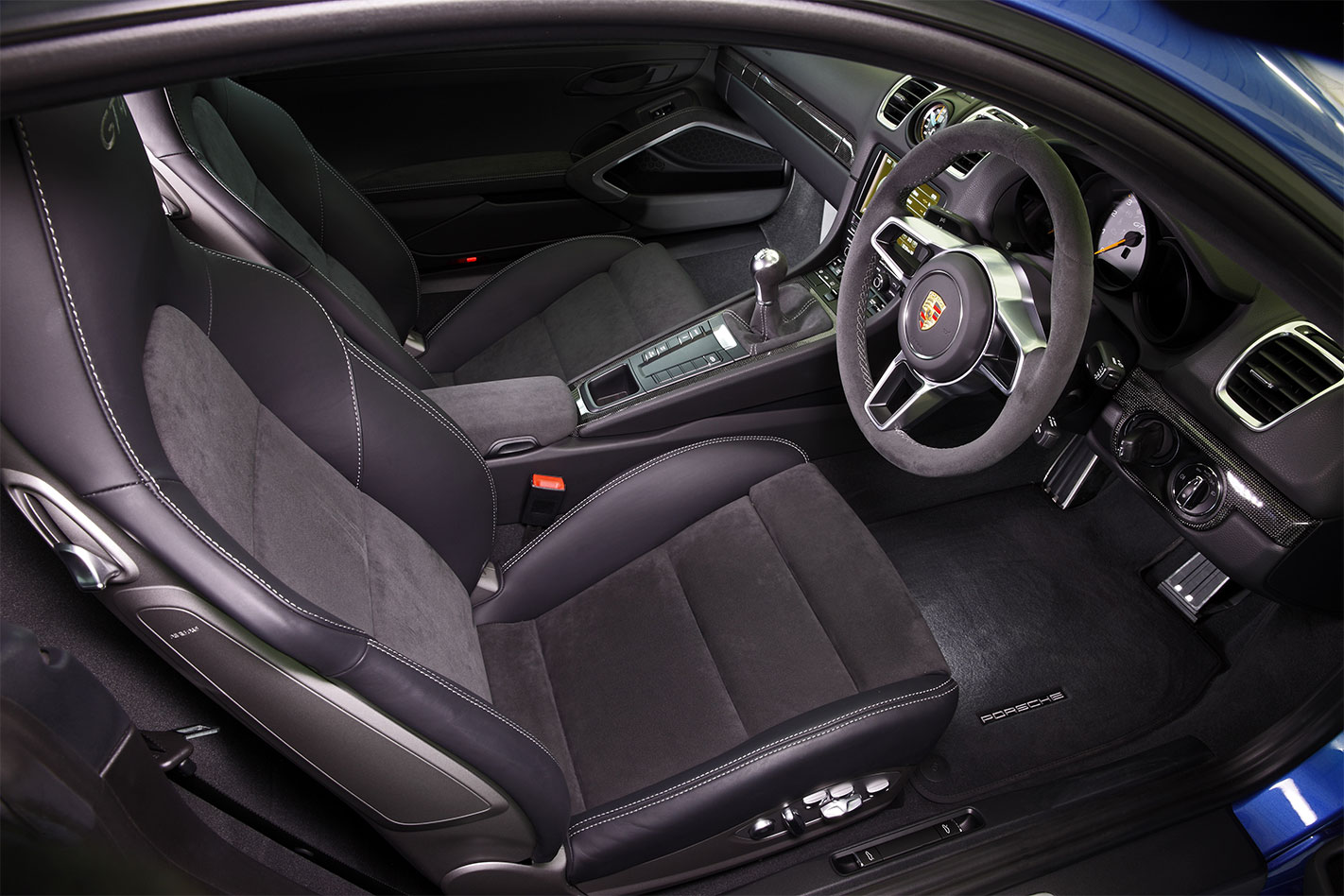
Shorter gearing would allow both more frequent access to the engine’s howling top end and more opportunity to use the superb six-speed ‘box. The shift is nigh-on perfect and now incorporates a throttle-blip function on downshifts – purists will hate the idea of it, but it works brilliantly and allows you to really lean on the enormous brakes.
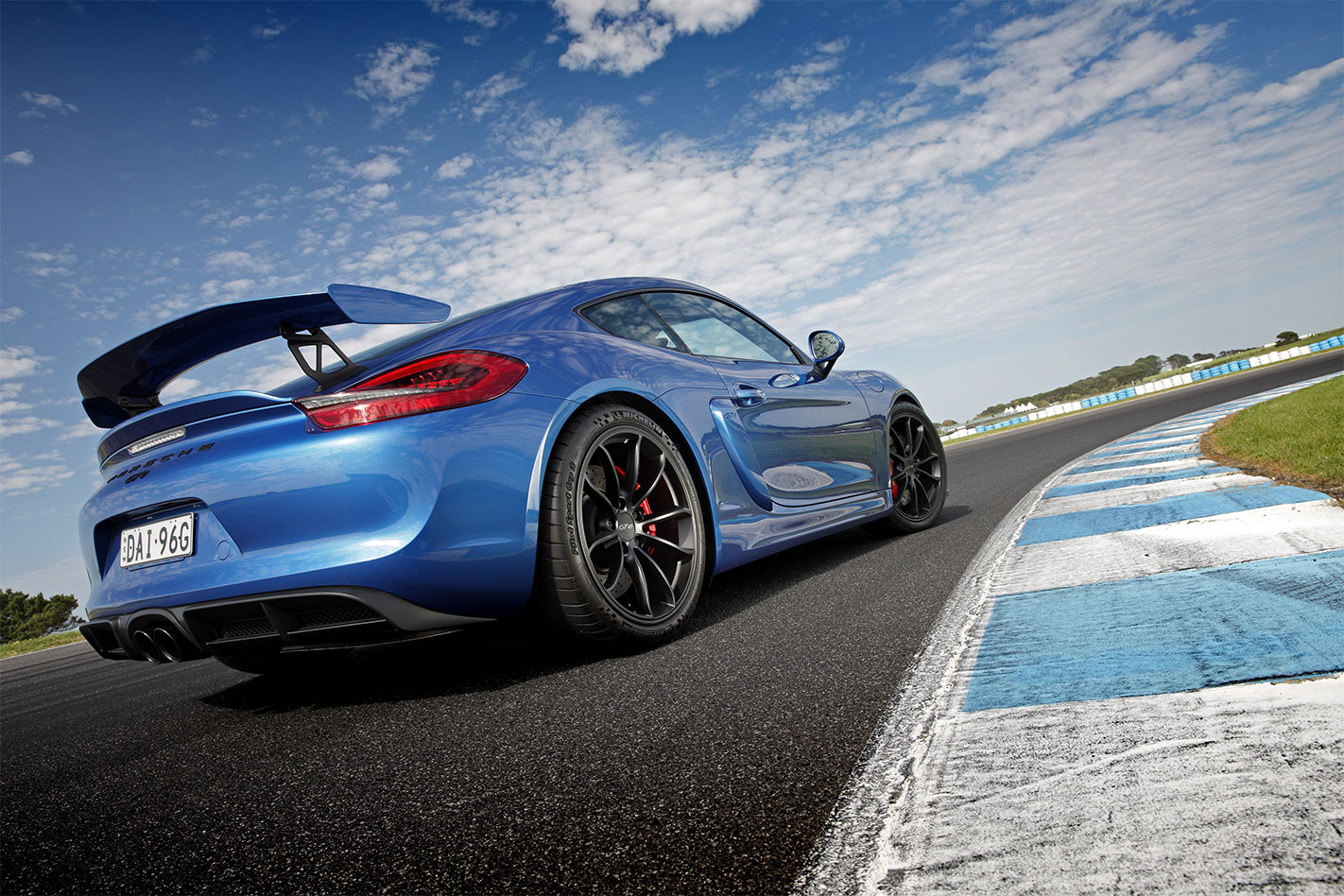
Making the most of the extra stopping power are Michelin Pilot Sport Cup 2 tyres – the same rubber used on the likes of the Ferrari 458 Speciale – measuring 245/35 front and 295/30 rear.
This is not to say the GT4 is in any way difficult to drive. Its more conventional weight distribution makes it easier to drive fast than the 911 GT3, however should you lift or brake at the wrong point the rear will still try and overtake the front. Overall, though, it sets a dynamic benchmark – on circuit at least – that few other production cars could hope to achieve.
Whether this on-track excellence translates to the road remains to be seen, though it’s difficult to imagine anything other than perhaps ride quality tripping it up. Gearing aside, the only real issue with the Cayman GT4 is a very heavy clutch; not a problem on track, but it might prove wearing for those planning on using their new toy on a daily basis.
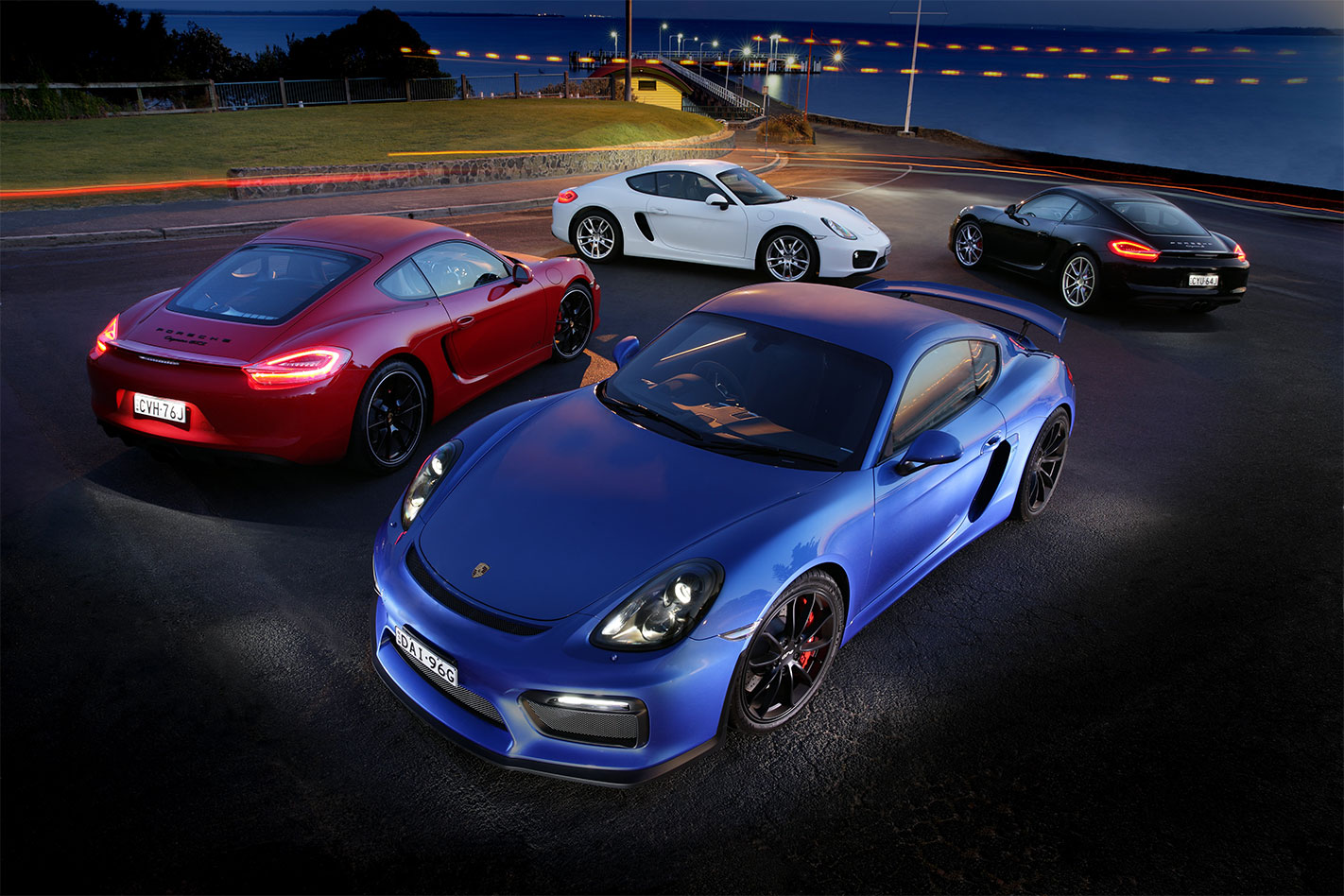
To put it another way, it offers at least 90 percent of the 911 GT3 experience for two-thirds the cost, which in a bizarre way makes it a bargain as well as brilliant.
5/5
Specs:
Engine: 3800cc flat-6, DOHC, 24v Power: 283kW @ 7400rpm Torque: 420Nm @ 4750-6000rpm Weight: 1340kg 0-100km/h: 4.4sec (claimed) Price: $189,900
The Peugeot 308 GTi is France’s answer to the Volkswagen Golf GTI. How will this capable hot hatch measure up when it arrives early next year?
WHAT IS IT? Hard-charging performance version of the 308, easily the best Peugeot launched this century. It’s five-door and six-speed only, but Australia will take both the 184kW and 200kW versions of the 1.6-litre turbocharged engine developed for it by Peugeot Sport.
WHY ARE WE TESTING IT? It won’t reach Australia until next year, probably arriving in February. The international launch, staged recently in Portugal, was a chance to see if Peugeot’s new-found confidence and competence extends into hot-hatch territory. There was quality time on both road and track, but only in the 200kW top version with its Torsen differential, bigger front brakes and a larger wheel and tyre package.
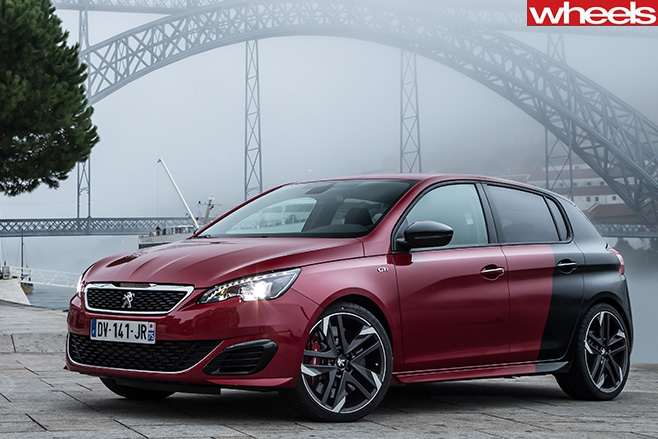
PLUS: Engine, grip, handling, ride, interior quality, front seats, stealth (without coupe franche paint job) MINUS: Rubbery manual, no auto, polarising steering-wheel/instrument layout
THE WHEELS VERDICT France produces an alternative to the Golf GTI… for some. While the 308 GTi has power and poise, its (likely) prices and the lack of an automatic option will limit its appeal in Australia.
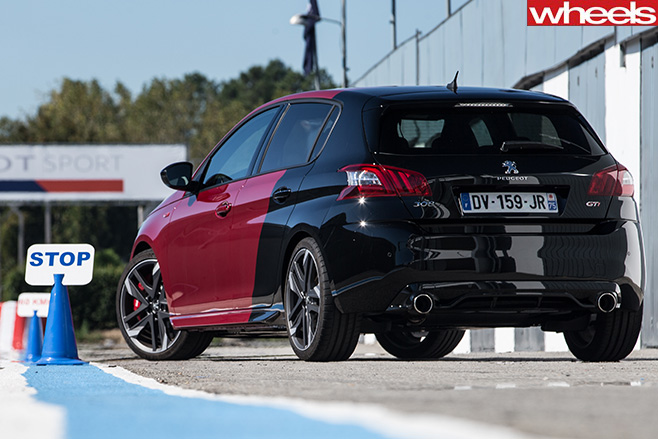
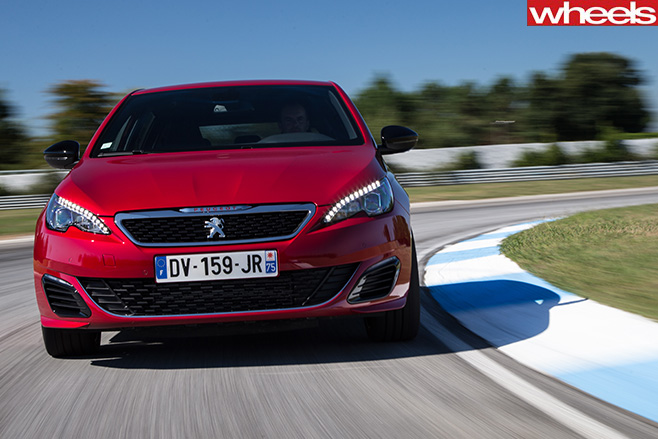
THE WHEELS REVIEW WITH THE tachometer swinging into the zone between between 6000rpm redline and 6500rpm cutout, it’s time to hit the brakes. Hard. Four-piston calipers chomp on the new 308 GTi’s big ventilated front discs, dragging the speedometer needle swiftly down from 170km/h or so. Slap the six-speeder back to third, and thread through the slow, tightening right at the end of the straight before aiming at the first of the following left-hander’s two apexes. Now begin to feed the 1.6-litre turbo some throttle. The Peugeot’s Torsen differential and beautifully smooth chassis-stability electronics convert pedal pressure into authoritative acceleration.
This is Stage Two of Peugeot’s introduction to the 308 GTi. Yesterday was spent on public roads, weaving through vineyards and attacking squiggly mountain roads inland from Porto. So we already knew one side of the car’s character. Its ride is reasonably civilised for something so corner-capable. The boosted engine is torquey, effortless. And the car’s all-round refinement is inviting.
This is an important point, Peugeot insists. Although hot hatches are usually part of a multi-car stable, they are also the most frequently used. The company cites research that shows 61 percent of hot hatches sold are a household’s primary car.
For starters, the 308 GTi will be produced only with a six-speed manual gearbox. The car’s potent engine produces more torque than the six-speed Aisin-made automatic employed in lesser 308s can handle. Ask when an automatic might be ready for the GTi and the evasive answers indicate it’s years away, at best.
Second, the GTi seems sure to cost more than the GTI. With the Peugeot’s arrival in Australia scheduled for sometime in the first quarter of 2016, importer Sime Darby is still some way from finalising prices, but the official line is $45,000 to $55,000. This means that the least expensive Peugeot 308 GTi will be priced higher than a basic Golf GTI manual, and the most expensive version of the French challenger could cost more than a Golf R.
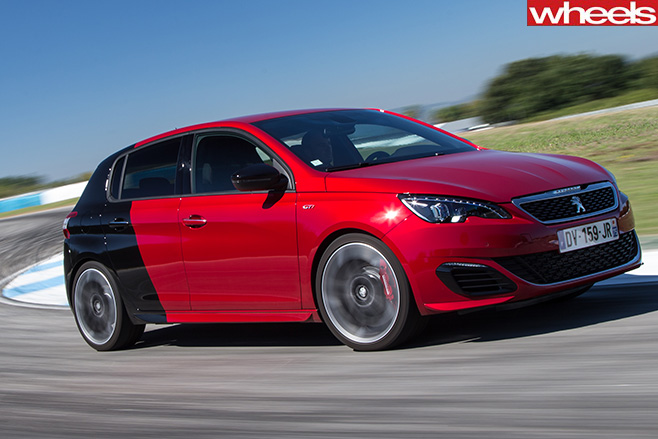
Both versions of the engine are mechanically identical, according to Peugeot Sport. It’s software that makes the difference, removing a slice from the right-hand end of the torque plateau of the low-power variant. StilI, its 184kW claimed maximum is a handy 22kW more than the base GTI and 15kW more than the GTI Performance. If Peugeot’s 0-100km/h claim for the car is proven correct, the basic 308 GTi will be quicker than both.
Because the 308 is a relatively light car for its size, and because the GTi is front-drive, the 200kW also has a better power-to-weight ratio than the all-wheel-drive Golf R. While it will never have the traction to beat the Volkswagen in standing start acceleration, the powerful Peugeot can deliver similarly thrilling rolling acceleration. At least in the dry…
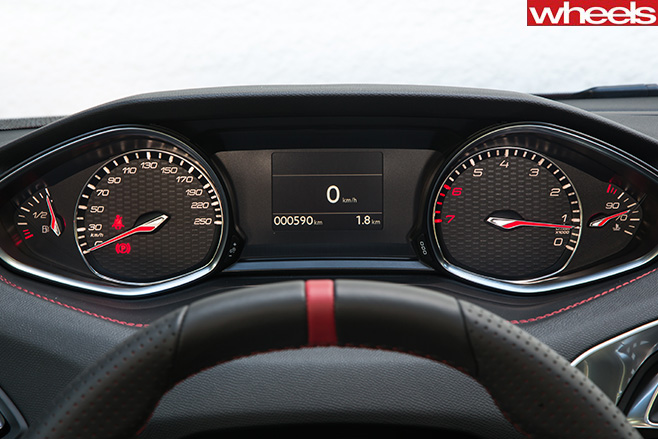
Hitting the Sport button in the 308 GTi’s centre console activates an amplifier and speaker to relay some engine-bay audio into the cabin. It sounds synthetic and contrived. Peugeot Sport says a flappy-valved exhaust system was considered too expensive for the 308 GTi. Other changes invoked by the Sport button are sharper throttle response and a reduction in steering assistance levels. Both are nicely judged: the steering doesn’t become stupidly heavy, just a little more meaty, and the Sport throttle map simply makes the car feel more feisty.
Again for reasons of cost, the GTi is not equipped with variable dampers. It also retains a torsion-beam rear-end, just like the standard 308. But Peugeot Sport seems to have pretty much nailed the sweet spot with the choices they made. Though the car rolls very little and is understeer-resistant at sane-ish public-road cornering velocities, the firm suspension rounds road surface impacts quite nicely. There’s a real sense of discipline, but it’s not the harsh kind.
More serious is the rubbery feel of the manual shift. Gearbox internals are toughened for the GTi, but the shot-peening and annealing treatments do nothing to improve its action. A car like this deserves something that feels oily and slick, quick and precise.
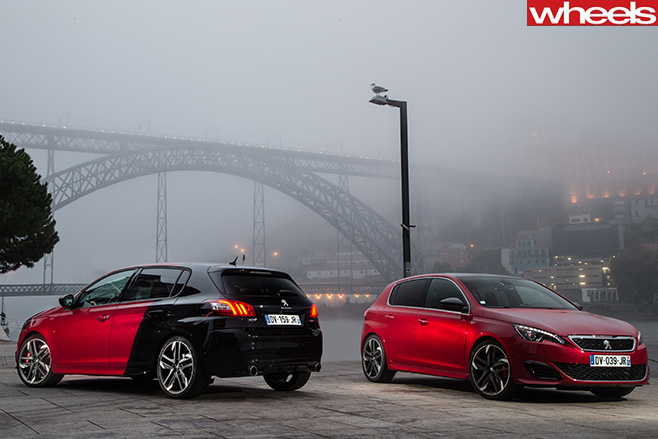
The 308 GTi’s quiet visuals are attractive. There are new front and rear bumpers, a twin-tipped exhaust, but no shouty spoiler. But the clean and conservative shape of the 308 looks especially fine when sitting a little lower and with wheels and tyres that fully fill its arches.
There’s no lapse in tastefulness inside, either; some red stitching here, a little shininess there. Leather and Alcantara cover the sports front seats fitted standard in the 200kW 308 GTi. These are excellent, blending comfort and support. The Peugeot’s simple dash is classy, but as in every other 308 the novel arrangement of steering wheel and instruments will not suit everyone.
But no one will dispute that a variety makes the automotive world a richer and more engaging environment. And the new 308 GTi certainly adds a welcome soupcon of French flavour to the hot-hatch class. While it lacks what’s needed to be a truly threatening Golf GTI rival, it certainly presents an alternative.
SPECS Model: Peugeot 308 GTI Engine: 1598cc in-line 4-cylinder, dohc, 16v, turbocharged Max power: 200kW at 6000rpm Max torque: 330Nm at 1900 to 5500rpm Transmission: 6-speed manual Weight: 1205kg 0-100km/h: 6.0sec (claimed) Fuel economy: 6.0L/100km (European combined cycle) Price: $52,500 (estimated) On sale: February 2016 (estimated)
Porsche is set to introduce a track-only version of its hardcore Cayman GT4 called the Clubsport at the Los Angeles Motor Show next month.
While based heavily on the road car, the racer will be 40kg lighter at just 1300kg and use Porsche’s seven-speed dual-clutch gearbox rather than the six-speed manual.
Other small detail changes include the front suspension. The GT4 road car shares its front suspension with the 911 GT3, but the GT4 Clubsport upgrades this componentry to GT3 Cup car specification.
The interior is pared back with the removal of the passenger seat but a bolt-in roll cage and six-point harnesses both come standard.
While the Clubsport isn’t expected to be road registerable, speculation persists that a more extreme ‘RS’ version of the Cayman will be introduced in an attempt to meet the demand for this new GT model.
Speaking at the Australian launch of the Cayman GT4, spokesman Paul Ellis said that while Porsche Australia currently held 140 orders for an allocation of “less than 100 cars, he was hopeful that all customers who had put money down would have their order filled.
Ellis said that having never made a mid-engined GT model before, Porsche was very cautious with its sales projections for the hardcore Cayman, caution that has proved unnecessary with customers clamouring to own this new entry-level motorsport model.
In other new Porsche GT news, the Australian order books on the new GT3 RS are closed with order totalling twice Australia’s allocation of the most extreme 911 variant.
HYUNDAI has snared another month at top of Australia’s bestseller list, as strong September sales sustained the new car market’s record-breaking pace for the year to date.
After gaining the top sales spot in June with a similar move, the Korean carmaker reintroduced sharp driveaway pricing for its i30 small hatchback, helping it to move 4490 units for the month and outstrip both the second-placed Mazda 3 small car (3558) and the third-placed Toyota Corolla (3530), the 2014 title holder.
Once again, it was the SUV segment providing all the heat in the market in September, VFACTS data released this week shows.
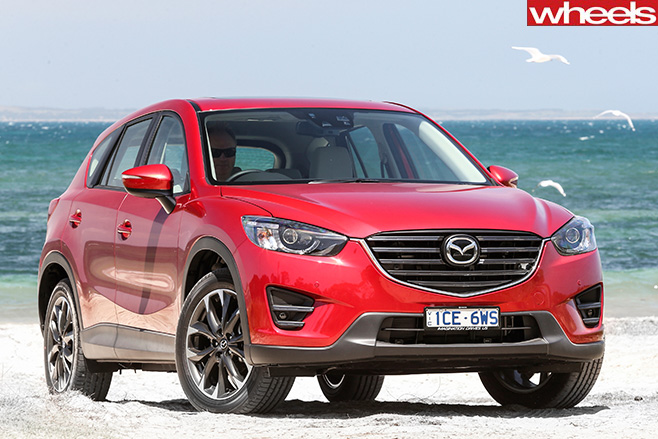
Sales of the high-riding hatches and wagons have climbed from one in five vehicles sold in August to one in four last month. However, showing up the fractured nature of the segment, only two SUVs – the Mazda CX-5 and Toyota RAV4 – showed up in the list of top 10 passenger cars.
Toyota led the market with 16,594 sales, growing the size of its share by 0.4 percent compared with August to claim a 16.4 percent foothold.
Mazda reclaimed second spot with 10,864 sales for a 10.7 percent market share, with Holden narrowly regaining a berth in the top three with 9326 sales, pushing ahead of Hyundai on 9311 sales and the same 9.2 percent market share.
Toyota’s market dominance came mainly on the strength of the locally made Camry mid-sizer (2522) that out-sold the Holden Commodore (2348), and clearing its showrooms of the old version of the Prado off-roader (1667) to make way for a smaller engined, more fuel-efficient one. The Altona-made Aurion large car, built alongside the Camry, continues with its slow sales pace of slightly more than one car a day (276).
However, as much as it gained with some models, supply issues related to rear-drive base models meant Toyota lost out with the Hilux (2004), causing it to slump to third spot in the trade ute segment behind Mitsubishi’s Triton (2020) and the facelifted Ford Ranger (2471) – the Ranger topping the ute category for the second month in succession.
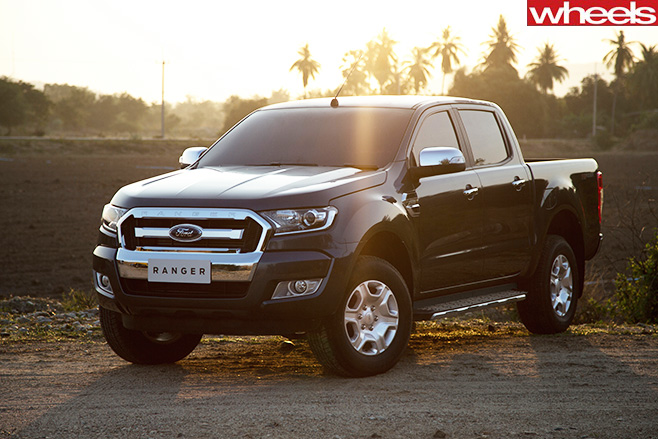
Mitsubishi had a very good month, with its ASX small SUV (1042), Challenger large SUV (556) and Pajero full-size off-roader (543) which, along with Triton, all performed strongly for the brand.
Ford, meanwhile, continues to lose ground, with its share of the market falling 0.2 percent to 5.7 percent month on month. Falcon sedan sales (562) improved ahead of the start of the 12-month countdown until the carmaker’s October 2016 factory closure, while the Territory SUV (612) lost some traction. The Ranger accounted for one in three sales for the brand.
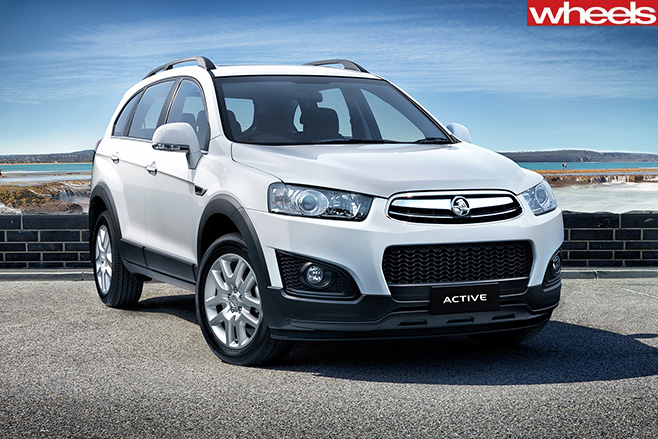
Over at Holden, SUVs including the Captiva 5 (668) and 7 (1051) helped bolster numbers, while the locally made, Commodore-based Caprice large saloon (239) spiked ahead of a refreshed model due later this month. The locally made Cruze hatch and sedan tread water at 1516 sales.
All the luxury players gained ground apart from Lexus, which fell slightly to 676 sales compared with August’s 708.
Mercedes-Benz pushed 3381 new cars out its showroom doors, up from 2956 last month on the back of strong A-Class and E-Class sales, BMW jumped from 2202 in August to 2408 as its small 1 Series and 2 Series range, and the X3 small SUV rolled out the door, and Audi grew marginally from 1901 to 2048 sales on the back of its all-new Q7 large SUV.
Top 10 passenger cars for September
| Rank | Model | Sales |
| 1. | Hyundai i30 | 4490 |
| 2. | Mazda 3 | 3588 |
| 3. | Toyota Corolla | 3530 |
| 4. | Toyota Camry | 2522 |
| 5. | Holden Commodore | 2348 |
| 6. | Mazda CX-5 | 2321 |
| 7. | Volkswagen Golf | 2085 |
| 8. | Toyota RAV4 | 1663 |
| 9. | Mazda 2 | 1522 |
| 10. | Holden Cruze | 1516 |
Top 10 brands for September
| Rank | Brand | Sales |
| 1. | Toyota | 16,594 |
| 2. | Mazda | 10,864 |
| 3. | Holden | 9326 |
| 4. | Hyundai | 9311 |
| 5. | Mitsubishi | 6937 |
| 6. | Ford | 5823 |
| 7. | Nissan | 5242 |
| 8. | Volkswagen | 5124 |
| 9. | Subaru | 3621 |
| 10. | Honda | 3595 |
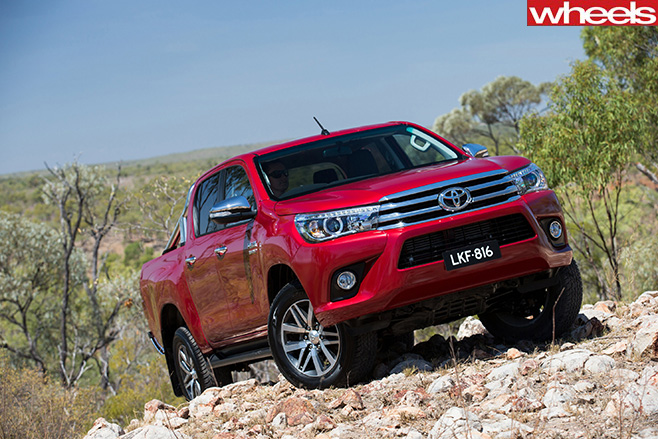
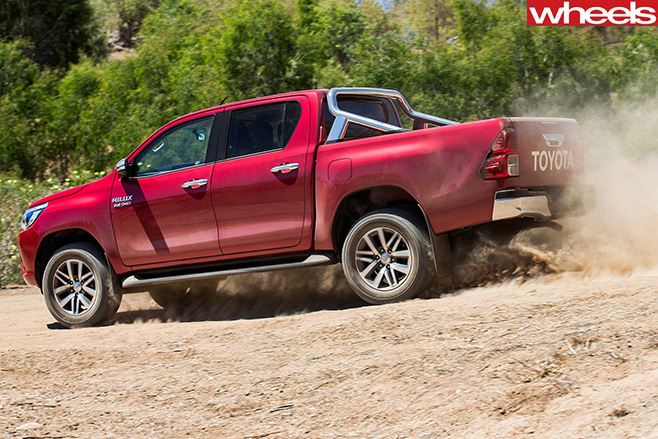
THE new Hilux – only the Toyota sticker across the tailgate is carried over – looks set to become the first ute to outsell every traditional passenger car over a full year.
The previous model was the best-selling four-wheel drive and had claimed the overall crown in particular months – and there is a good chance the eighth-generation Hilux will go one better.
The Hilux’s rise from a work truck favoured by farmers and miners to a car that outsells the Holden Commodore, Mazda3 and even Toyota’s own Corolla is down to increased demand for dual-cab utes and dominance in its segment no rival has come close to.
Toyota says it will sell more than 40,000 Hiluxes in 2016, putting it within firing range of the two cars currently ahead of it on the annual sales charts – the Corolla and Mazda3.
“It’s always based on availability out of the plant in Thailand,” says Buttner, indicating demand for the new arrival won’t be an issue. “We’ll certainly get our 40,000 [sales].
“We always try to push the pale … if there’s upside there we’ll fight tooth and nail to get availability out of the plant to satisfy whatever we have in demand.”
Helping the Hilux is the fact that its model range has expanded. The cheap and cheerful Workmate 4×4 has returned, giving tradies a cheap four-wheel drive option. And Toyota has followed the likes of the Ford Ranger, Mazda BT-50 and Mitsubishi Triton with “Hi-Rider” models, which have the off-road look and higher ride without the expensive 4WD hardware.
In all there will be 31 variants covering 2WD and 4WD (75 percent of sales are expected to be 4WD). There are two petrol engines (a 2.7-litre four-cylinder and a 4.0-litre V6), two diesel engines (new generation 2.4 and 2.8-litre four-cylinder turbo-diesels), auto and manual gearboxes, and three grades – Workmate, SR and SR5.
Mazda3 sales are down 10.8 percent for the first 8 months of 2015, a result of a shift in buyer preferences, predominantly to small SUVs such as Mazda’s own CX-3 (Mazda predicted the 3 would get caught in the crossfire).
Corolla sales are also down 2.9 percent for 2015, although Toyota says that’s partly due to supply constraints with the updated hatch.
However, the Corolla will come under increased competition in 2016 from new small-SUV arrivals, among them the production version of the C-HR concept – Toyota’s answer to the Mazda CX-3, Honda HR-V and upcoming Jeep Renegade – which could be on sale by the end of the year or early 2017.
Buttner admits the Hilux “could” get to number one but he says the focus is not on achieving the milestone, although he says the brand is happy to take it if it happens.
“We don’t mind which car is number one, so long as we’re selling the volume,” he says.
Click here to read the full range review of the Toyota Hilux.
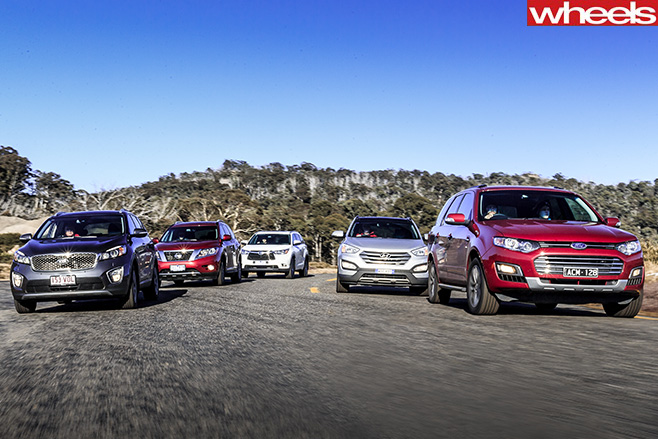
Got a big family? Here are five seven-seat SUVs designed to move you.
First published in the September 2015 issue of Wheels magazine, Australia’s most experienced and most trusted car magazine since 1953.
Can’t wait to see the final scores? Jump to the verdict now.
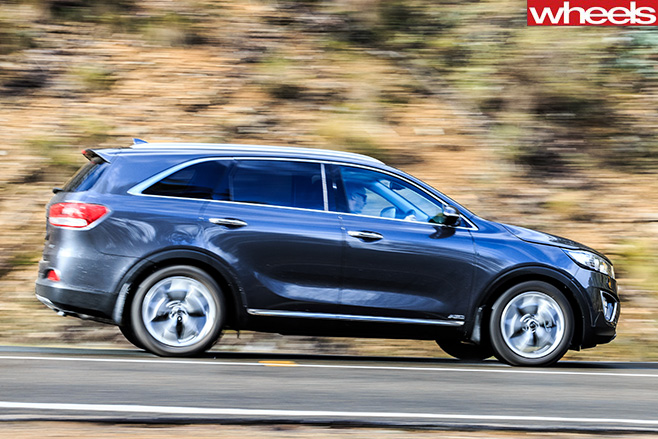
THE realisation hits at the exact moment I lose the feeling in my fingers; we’re admiring a Kia. At first I dismiss our migration towards the Korean SUV as a need for communal warmth, given that it’s dawn and we’re ankle deep in snow, but the furtive glances at the Kia’s chiselled grille and Batman-esque tail-lights betray the real reason. We’re here because the Sorento looks fantastic.
The people’s favourite
Doing so means trumping the most popular people-lugger here, Toyota’s Kluger. In the sales race, the Kluger is a behemoth, its 6780 sales in the first half of this year monstering this group’s next-biggest seller, Ford’s evergreen Territory, by more than 2000 units.
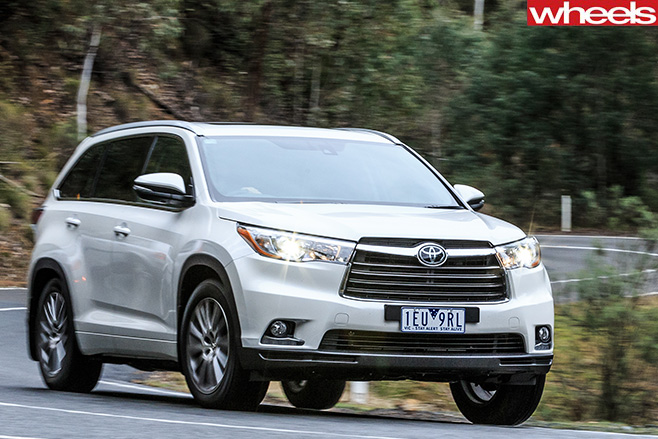
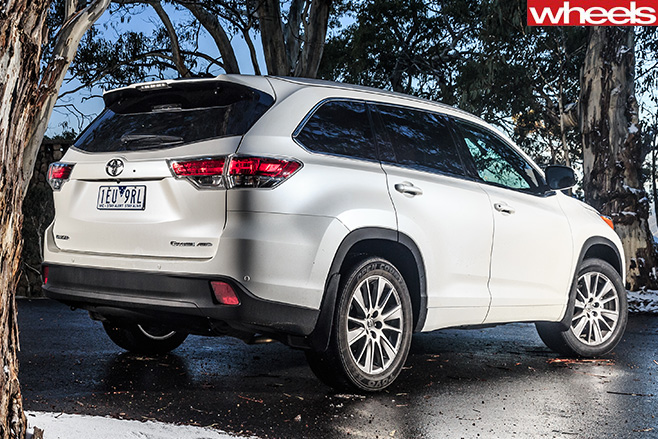
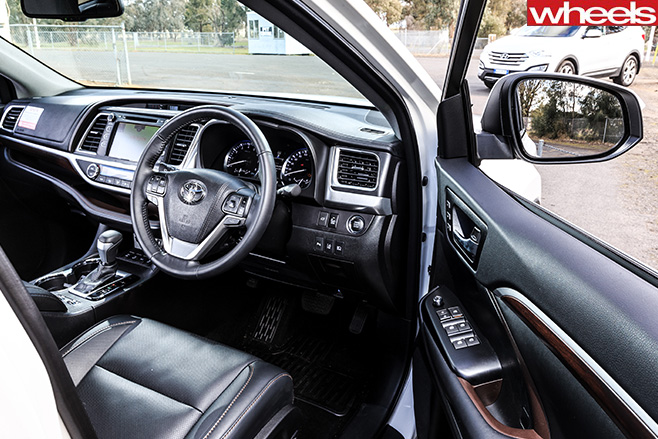
Grande spec adds a suite of equipment extras including adaptive cruise, lane departure, blind spot detection, LED headlights, bigger 19-inch wheels and a nine-inch roof-mounted entertainment system. This might sound impressive in isolation, but for a car nudging $70K the Kluger only matches what the two Koreans offer as standard at more than 10 grand less.
Hybrid philosophy
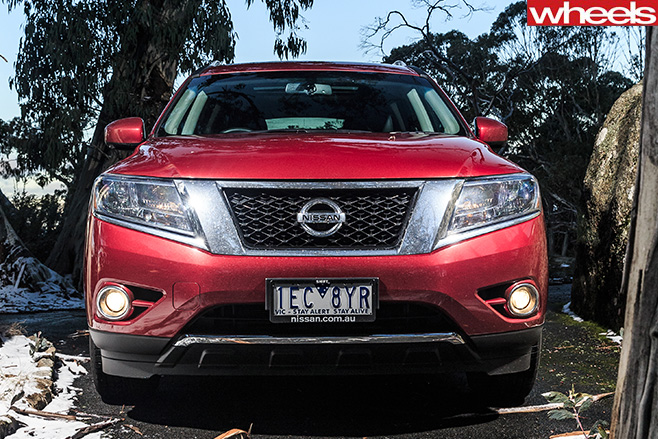
That’s a caveat that can’t be applied to the Nissan. Like the Kluger, the Pathfinder is now made in America but is the only SUV here without a local suspension tune. It also represents a drastic change in philosophy.
Where the previous Pathfinder was based on a ladder chassis and boasted off-road credibility, this new model is now a fully fledged urban SUV with monocoque construction, petrol-only engines and even the option of front-drive variants. Also worth mentioning is that, while the Pathfinder feels new on Aussie roads, this ‘new’ generation has been on sale in the US since 2013.
Traditional Aussie
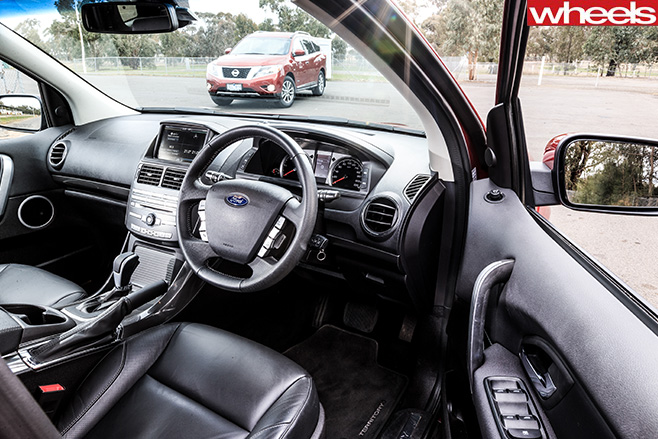
All of this means the Pathfinder is a showcase of futuristic tech and it makes sliding into the Territory something of a time warp with its dated interior and ageing 2.7-litre V6 diesel lump.
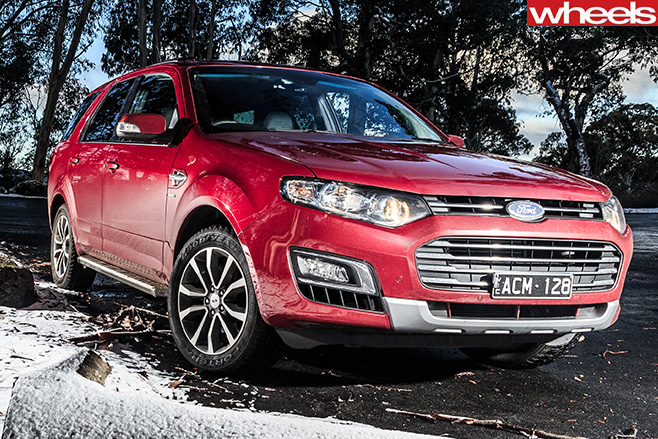
Also front and centre is the Territory’s undeniable Aussie DNA. The first (and still the only) SUV to win Wheels COTY, the Territory is renowned for its crisp dynamics and superb body control.
Power to move you
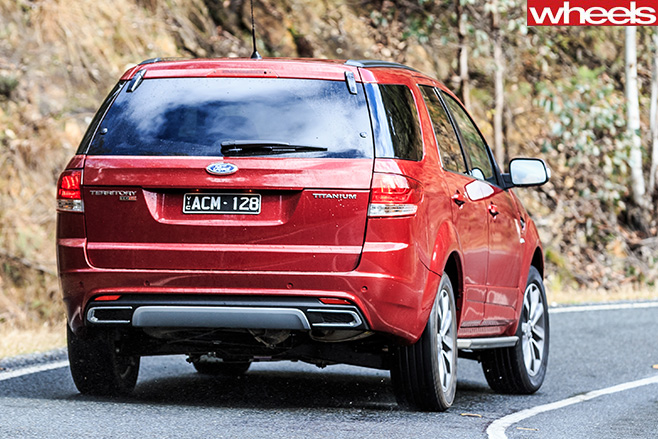
If only the engine was so convincing. The 2.7-litre turbo-diesel is frustratingly laggy from standstill and not what you’d call rapid on the move, either, with an 80-120km/h time that’s nearly a second slower than the other diesels here. Tall gearing engineered for efficiency rather than performance magnifies the oiler’s laziness and means the Territory often feels a gear too high on tight, twisty roads. Add in a noise that’s clattery and unrefined and the Land Rover-sourced diesel is the weakest of the trio in this test.
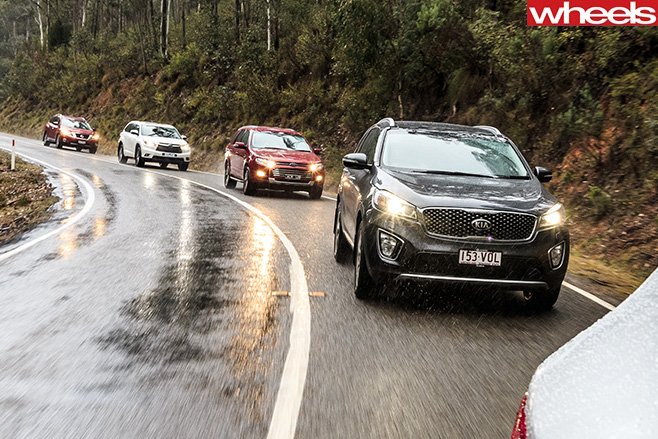
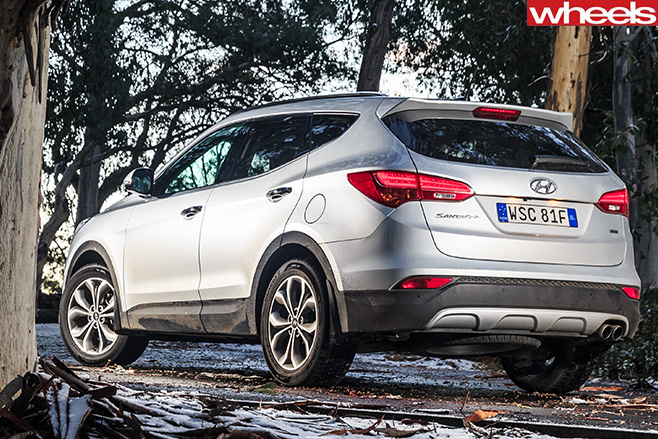
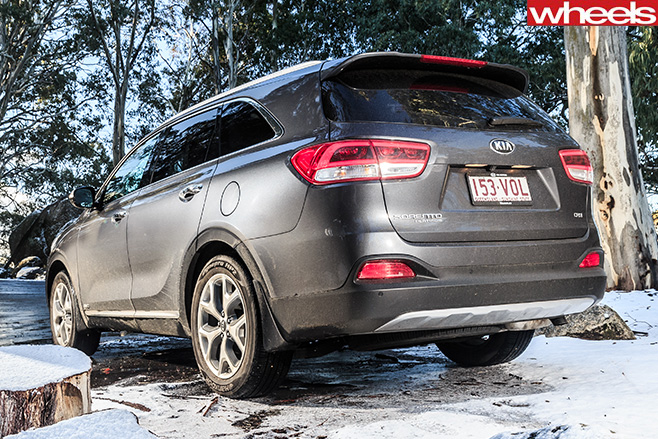
Yet, as sporty as it is, even the Santa Fe is decimated by the Kluger in a straight line. The beefy Toyota is the quickest car here thanks to its muscular 201kW/337Nm V6, which is wonderfully linear and sounds good, too. But such petrol-powered performance comes at a price, literally, with the Kluger drinking 13.3L/100km on test while the frugal diesels sipped just 9.3 (Sorento), 9.4 (Santa Fe) and 10.4 (Territory).
Turn and turn about
In terms of dynamics, the Kluger stays true to traditional Toyota values, meaning safe, predictable and an overeager electronic nanny that intervenes before you can fully exploit the potential of either the chassis or the engine.
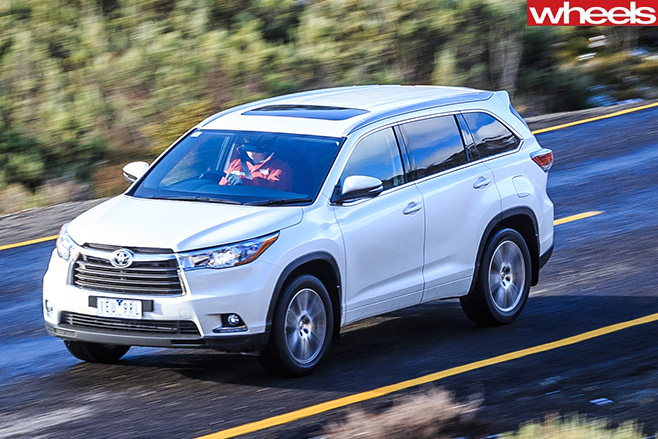
Sadly, the Pathfinder has no such saving grace. While the Nissan’s hybrid drivetrain is zingy, engaging and surprisingly quick (only three-tenths separate it and the Kluger over the quarter), things unravel when you throw its nose at a corner.
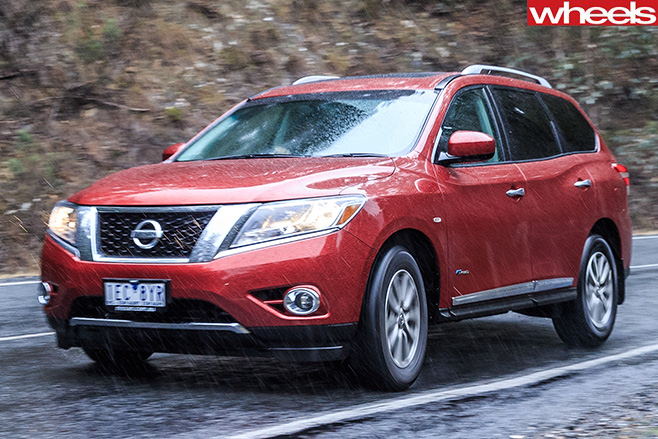
Brakes that struggle to contain the Hybrid’s power and 2073kg weight are another weakness and cement the Nissan’s place at the bottom of the dynamic pack.
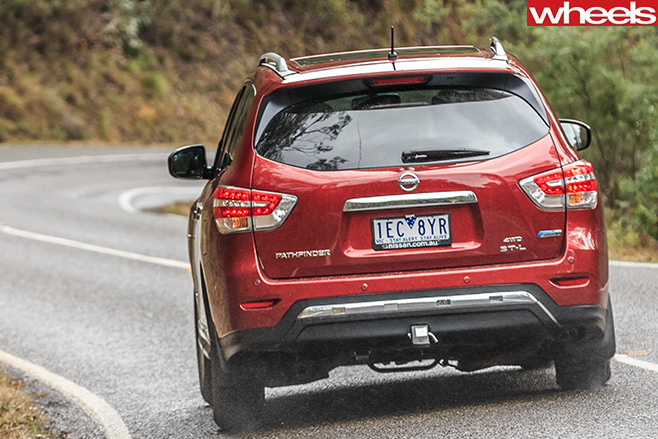
Our fuel figure of 12.1L/100km looks steep on paper, particularly against the thrifty diesels, but our test route’s heavy emphasis on country driving failed to exploit the Hybrid’s potential economy benefits. The Nissan’s petrol-electric tech is designed to shine in stop-start city traffic.
Inside dope
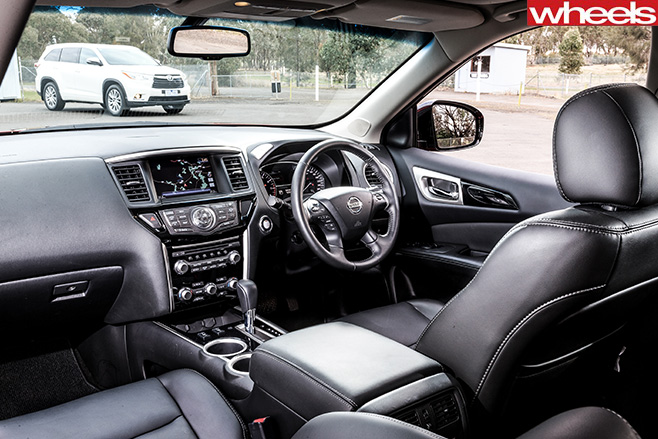
Where the Pathfinder does claw back some ground is the flexibility of its interior. Each car here boasts a 60/40 folding second row, but the Nissan’s one-touch design is the only one that conveniently flips up the bottom cushion to increase the distance that the middle row can slide forward. It’s a clever system and means the Nissan has the best access to the third row. There’s also plenty of space for third-row passengers, who are additionally spoilt with air vents, cupholders and, crucially, excellent vision.
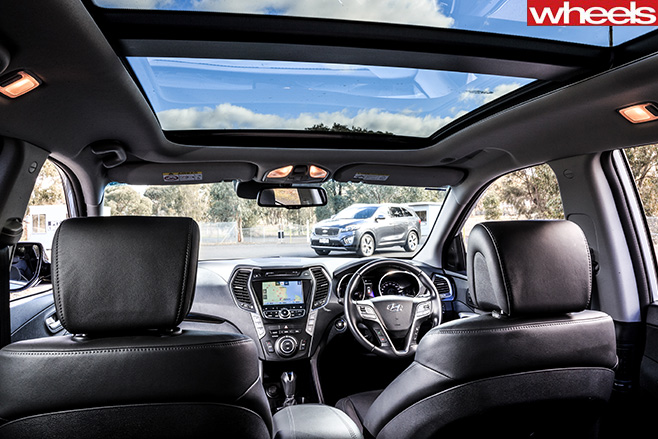
Things are decidedly more upmarket in the Hyundai and Kia. Both boast premium-feel interiors with comfortable leather seats, one-touch third-row access and a middle bench with 40/20/40 configurability. They also bristle with an armoury of standard equipment: reversing camera, electric tailgate, panoramic roof, lane assist, front and rear parking sensors, auto lights, LED running lights, cruise control, heated seats, sat-nav and auto wipers.
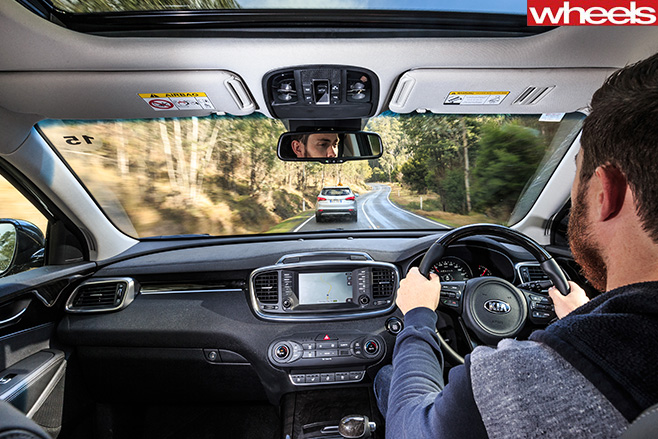
Second-row passengers in both Koreans have the luxury of heated seats, but the Kia’s lower window line means it’s the stronger choice for those who plan on lugging passengers in the back. The Hyundai may have comfortable seats and air vents with fan control back there, but its third-row visibility is atrocious.
It’s inside where the Territory betrays its age most. Mismatched, scratchy plastics dominate an interior that even in this range-topping Titanium spec feels meanly equipped. Like the Nissan, there’s no electric tailgate, and the Ford has none of the surprise-and-delight features found in the Sorento, Santa Fe and Kluger, like blind spot detection, lane assist, heated seats or glass roof. The steering wheel buttons don’t illuminate at night.
So, which pleased us most?
Sitting still, the Territory therefore lacks the showroom sizzle of its competition, a negative that could cause buyers to walk away from what remains a truly great Australian road car. With excellent seats, a spacious second row big enough for three adults, superb vision and supple ride, the Territory’s still the best grand tourer of this group.
There are faults, though. Despite its space and equipment, the Kluger’s interior design is heavy-handed and its execution also lacks finesse. Compared to the Sorento’s premium Euro-inspired interior, the Kluger’s cabin feels like an economy car dressed in electronic tinsel. A prime example is the Grande’s chunky roof-mounted DVD system, which feels cheap and is mounted so low that middle passengers are inclined to hit their heads.
It’s a frustrating result for the Nissan given that the Hybrid does hold real appeal. Its front seats are supportive and comfortable, vision for front and second-row passengers is excellent, and for a car built to carry seven it has the best third-row access. Sticky Continental rubber and a drivetrain that promises efficient city driving and is responsive, seamless and dynamic are other strengths. It’s just a shame the Pathfinder’s execution is so hit and miss. Compared to the polished, all-round ability of the Koreans, the Pathfinder feels half-baked. And in this company, that doesn’t cut it.
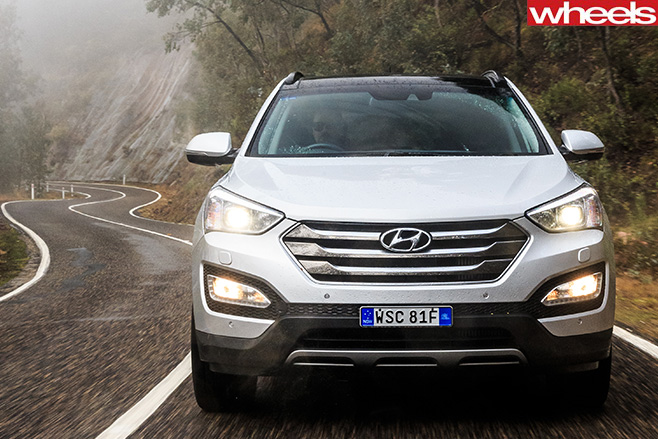
Separating the Territory and Santa Fe is harder. On paper the Korean car has the edge thanks to its equipment, efficiency, four-year/unlimited-kilometre warranty and $53,240 price tag, which is $3500 less than the Ford’s. Its sporting focus and sharp dynamics also impart an unexpected sense of fun. But if the Santa Fe is an SUV that focuses on the driver, the Territory is a car for everybody, a grand tourer capable of hauling five adults in comfort.
There are faults with the Territory. The interior plastics are truly dismal, the diesel is agricultural and the third row is clumsy and really only suitable for occasional use. A question mark also hangs over the value of the range-topping Titanium, which for a $6000 premium over the mid-spec TS offers only negligible gains such as leather, chrome trim, sidesteps and a roof-mounted entertainment system. The cheaper $50,490 TS AWD diesel or $42,240 rear-drive TS petrol are better buys.
Hotter Hyundai
IF YOU want a Santa Fe with an even sportier feel, Hyundai has you covered. A harder, tauter, more athletic SR variant was launched last month, boasting H&R performance springs and bigger (340mm front, 302mm rear) Brembo brakes. It also rides on unique OZ Racing wheels wrapped with stickier Michelin Latitude tyres, but power remains unchanged at 145kW/436Nm. More performance equals more cash, with the SR costing $59,990.
Edgy replacement
THE SUV tipped to replace Territory at the end of 2016 is the Edge, which debuted in North America this year.
Touted as Ford’s most advanced SUV to date, it shares underpinnings with the new Mondeo and bristles with tech features including front and rear cameras, self-parking capability and adaptive steering.
A glaring difference is the Edge only seats five, so those wanting a third row will need to look at the new Ranger-based Everest (see First Drive this issue). A stretched seven-seat Edge does exist, but Ford says it is strictly a China-only variant. For now.
Still being debated is whether Ford will rebadge the Edge as a Territory given the name’s local heritage and reputation, or start afresh.
Yank tanked
IN NEWS smacking of irony, Nissan has axed production of the American-made Pathfinder Hybrid for the US market due to lacklustre demand. So does this mean the Hybrid will get bonked on the head here as well? Absolutely not, says Nissan Australia. Hybrid production will continue unchanged for overseas markets and Nissan Oz says it remains a core part of its Pathfinder line-up. Currently the Hybrid makes up 6.5 percent of local Pathfinder sales.
Verdict
KIA SORENTO PLATINUM
Price as tested: $56,585 *Includes: Premium paint ($595)
NCAP rating: 5 stars (Aus)
Fuel economy: 9.3L/100km (test average)
Acceleration: 0-100km/h: 9.5sec (tested)
Plus: Handsome design; interior ambiance & equipment; punchy diesel; warranty
Minus: Second-row vision; body roll when pushed hard
Verdict: 8.0/10
FORD TERRITORY TITANIUM AWD
Price as tested: $57,240 *Includes: Prestige paint ($500)
NCAP rating: 5 stars (Aus)
Fuel economy: 10.4L/100km (test average)
Acceleration: 0-100km/h: 10.0sec (tested)
Plus: Handling & agility; superb body control/ride; seats; Aussie DNA
Minus: Interior plastics; compromised third-row; agricultural diesel
Verdict: 7.0/10
HYUNDAI SANTA FE HIGHLANDER
Price as tested: $53,835 *Includes: Metallic paint ($595)
NCAP rating: 5 stars (Aus)
Fuel economy: 9.4L/100km (test average)
Acceleration: 0-100km/h: 9.2sec (tested)
Plus: Strong drivetrain; hot-hatch handling; comfortable, well-equipped interior
Minus: Firm, uncompromising ride; interior a step behind Sorento
Verdict: 6.5/10
TOYOTA KLUGER GRANDE
Price as tested: $67,680 *Includes: Metallic paint ($550)
NCAP rating: 5 stars (Aus)
Fuel economy: 13.3L/100km (test average)
Acceleration: 0-100km/h: 7.9sec (tested)
Plus: Creamy-smooth V6; local steering and suspension; interior space
Minus: Design that lacks elegance; feels American; V6 thirst
Verdict: 5.5/10
NISSAN PATHFINDER HYBRID ST-L
Price as tested: $57,985 *Includes: Metallic paint ($495)
NCAP rating: 5 stars (Aus)
Fuel economy: 12.1L/100km (test average)
Acceleration: 0-100km/h: 8.0sec (tested)
Plus: Zingy drivetrain; smooth, intuitive CVT; clever design of second and third rows
Minus: Anaesthetised steering; sloppy body control; interior feels cheap
Verdict: 5.0/10
MORE THAN 90,000 diesel cars sold in Australia contained software cheats to help them pass emissions tests, Volkswagen Australia’s parent company has admitted.
Late today, Volkswagen Australia said its website would allow all owners to enter their vehicle’s 17-digit code to confirm whether it is among the 77,149 VW and Skoda-badged vehicles affected.
Meanwhile, Volkswagen Group luxury brand Audi Australia also released a statement saying it had identified 14,028 diesel-engined vehicles affected by the emissions rort.
Audi-badged cars affected include the A4 sedan and A5 coupe, and the Q5 mid-size SUV.
Volkswagen Australia said its parent company had confirmed numerous models containing the cheat software were sold here.
“[Volkswagen Group Australia] is taking action following confirmation from the head office of the Volkswagen Group that certain diesel vehicles sold in Australia were fitted with software that can affect their emissions during a dynamometer test,” the company said.
“Volkswagen Group Australia takes this issue extremely seriously and is continuing to gather all the facts from our head office to support any rectification plans in Australia,” the company’s Australian managing director, John White, said.
“We understand the disappointment and frustration felt by our customers, dealers and partners in Australia and apologise for any inconvenience this may cause.
“We are doing everything possible to fix the problem and will be making further announcements in the near future.”
However, the statement from Volkswagen it did not say whether the software cheat, which recognised if the car was being officially emissions tested and automatically kicked over into a low-pollution mode, was also used to set Australian emissions ratings for the vehicles sold here.
The scandal does not scoop up any of Volkswagen Group’s petrol-engined cars, or its best-selling model, the Golf hatch and wagon.
It was believed all the cars were taken off sale after a meeting on Friday with the Australian Competition and Consumer Commission and the Department of Infrastructure and Regional development.
Last week, the ACCC said the Volkswagen investigation was “a priority” for the consumer watchdog.
“We are very concerned about the potential consumer and competition detriment from this alleged conduct,” said ACCC chairman Rod Sims.
The setting up of a website for Australian customers comes a fortnight after Volkswagen Group made the shock announcement that it had fitted up to 11 million diesel cars globally with “defeat” software that allowed them to cheat exhaust emissions tests.
Number of vehicles sold by VGA in Australia affected by the diesel emissions issue, per brand:
Volkswagen Passenger Cars – 54,745 cars affected Golf (2009-2013) Polo (2009-2014) Jetta (2010-2015) Passat CC (2008-2012) Volkswagen CC (2011-2015) Passat (2008-2015) Eos (2008-2014) Tiguan (2008-2015)
Skoda – 5148 cars affected Octavia (2009-2013) Yeti (2011-2015) Superb (2009-2015)
Volkswagen Commercial Vehicles – 17,256 cars affected Caddy (2010-2015) Amarok (2011-2012)
