
By 2008, and the third-gen Impreza, the insect-, legume-, and animal-derived nicknames were gone. According to Ian, the GH (hatch), and to a lesser extent the GE (sedan) are known, less endearingly, as the ‘ugly betty’ or ‘fat betty’, at least to those who own something else.
But that didn’t put off club member David who, in 2009, finally bought his first new WRX. “The first time I found out about the Rex was back in 1994, and I looked at the brochure and I’ve gone, for the price, which was about 40 grand, it just seemed to me the best bang for your buck,” he says.
“The only thing was in my circumstance I just had to wait 15 years to actually get one. Through all the stages of the Rex from the classics to the GD versions, and then through into the modern versions, I always wanted one. That never changed.”
Fortunately for buyers like David, the 2009 base price of $39,990 was exactly the same as that of a MY97, despite specifications, standard safety and convenience equipment lists that had grown far more generous. This meant value went through the sunroof (one of the few options).
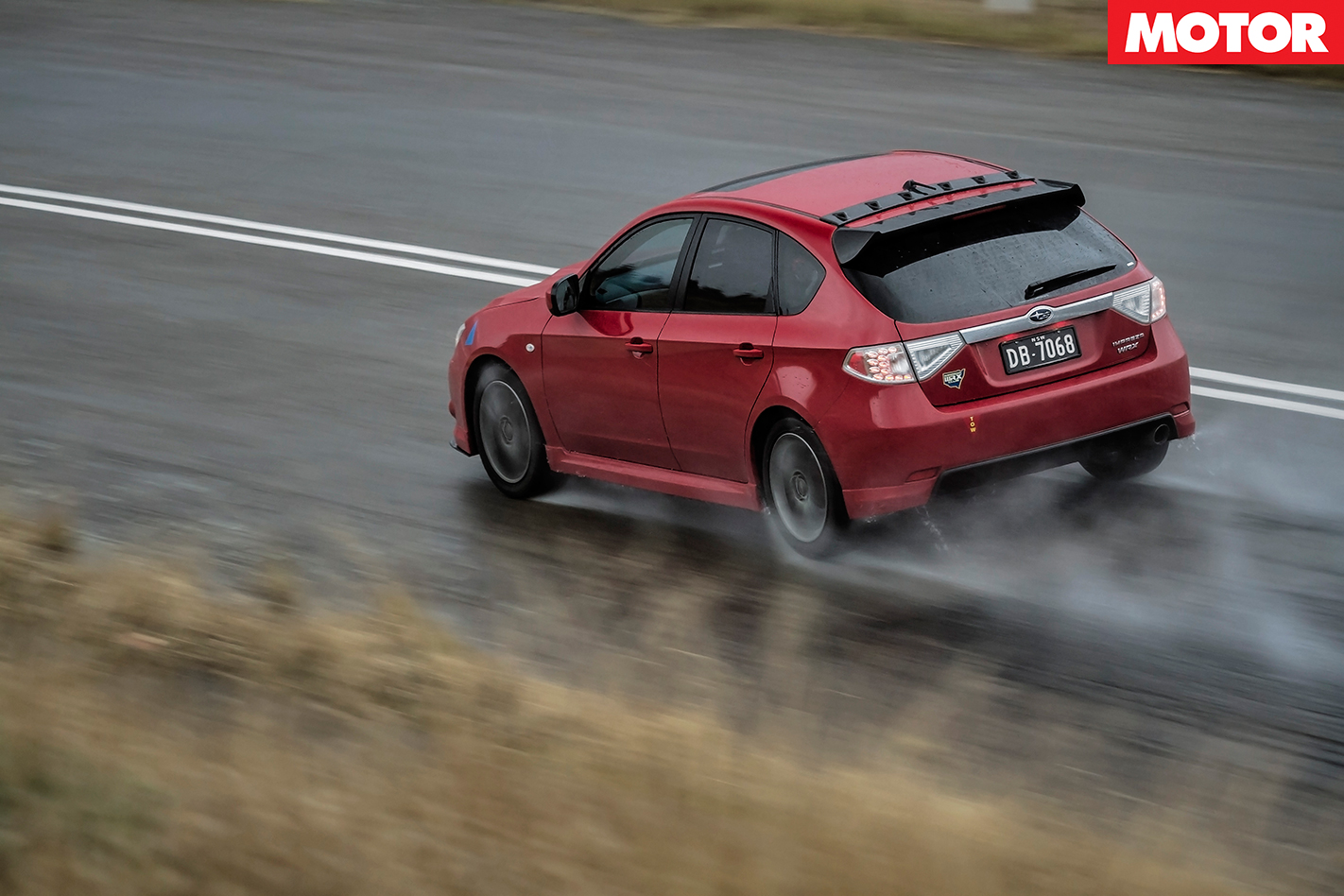
For starters, compare the one-star first-gen’s virtually non-existent list of standard safety gear with the five-star current generation’s full suite, which includes six airbags and electronic stability control. Even the power and torque outputs – 195kW and 343Nm sound familiar? – suggested STi pace for WRX money.
However some, including, well, me, initially thought the MY08 was like the bug-eye all over again – a WRX that didn’t look or go like one.
Okay, so the aesthetics were a matter of taste, and a set of aftermarket alloys helped, but the frameless door glass was gone forever.
Beneath the skin, the new strut front, double A-arm rear suspension was set-up to be softer than the average WRX enthusiast would expect. Subaru had changed focus – the third-gen WRX didn’t target the average WRX enthusiast, but a new breed of buyer who might otherwise buy a Euro such as a Golf GTI.
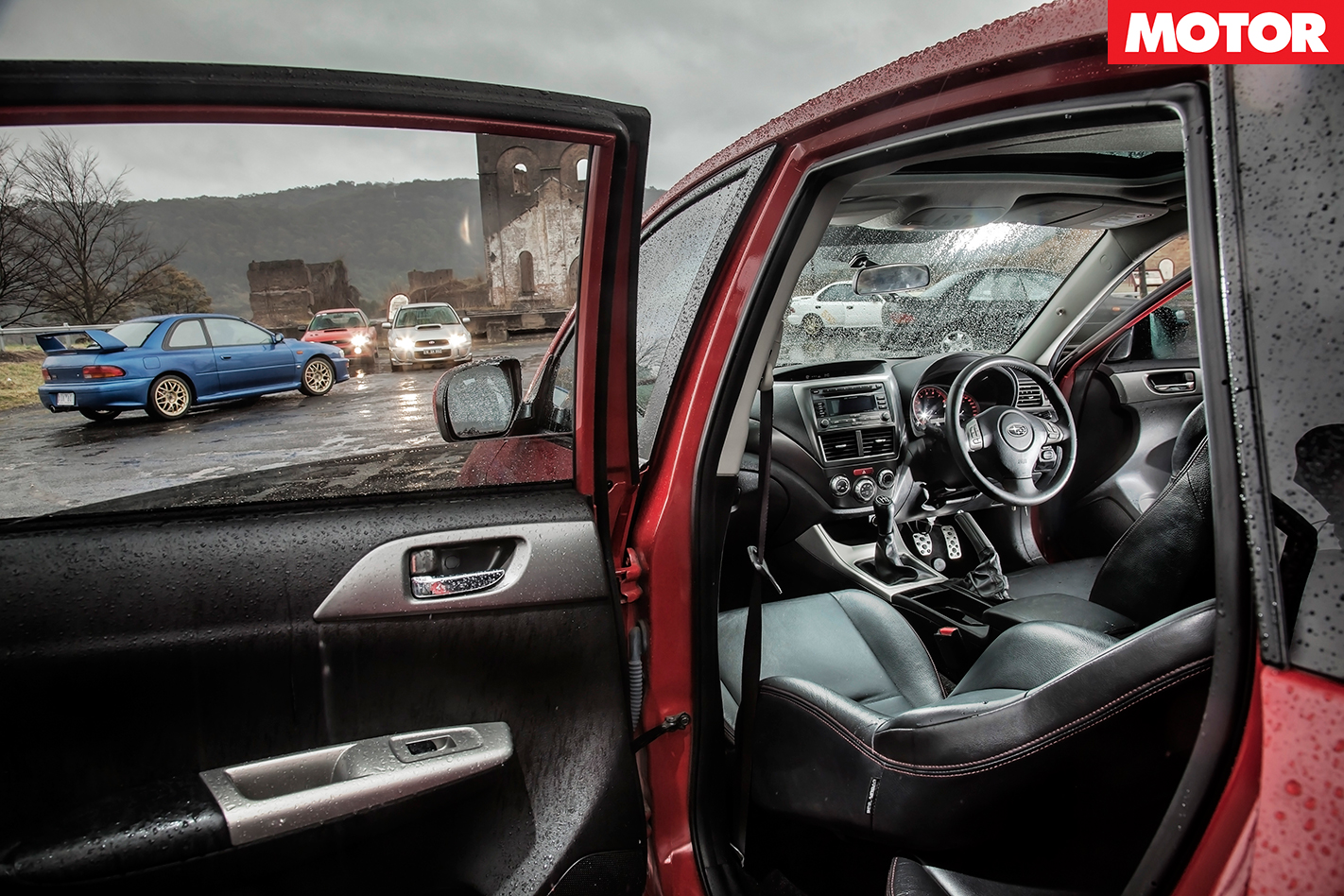
But despite the shift in priorities, the WRX remained quick – high-fives for its 0-100km/h sprint deserved a high five – and meant it was still the champ in the traffic light grand prix.
A hasty MY09 update – see, bug-eye – brought suspension revisions that restored some of the trademark WRX driver appeal. It still felt a bit soft, but was more effective on the track, where it was quick enough to help the WRX to its fifth Motor BFYB gong.
By many measures, Subaru had been successful in broadening its Rex appeal, without alienating diehard fans. But there was an ingredient missing – the rubbery responses meant it just wasn’t as much fun as the earlier WRXs on a sinuous backroad, even if it could cut the times on the circuit.
David’s mods to his MY09 address the weaknesses of the standard car with far greater success than Subaru’s. Feel-less steering and body float? Banished, with a full Whiteline suspension kit to BC Racing coil-overs. Wooden-feeling brakes? Fixed, with an AP Racing upgrade.
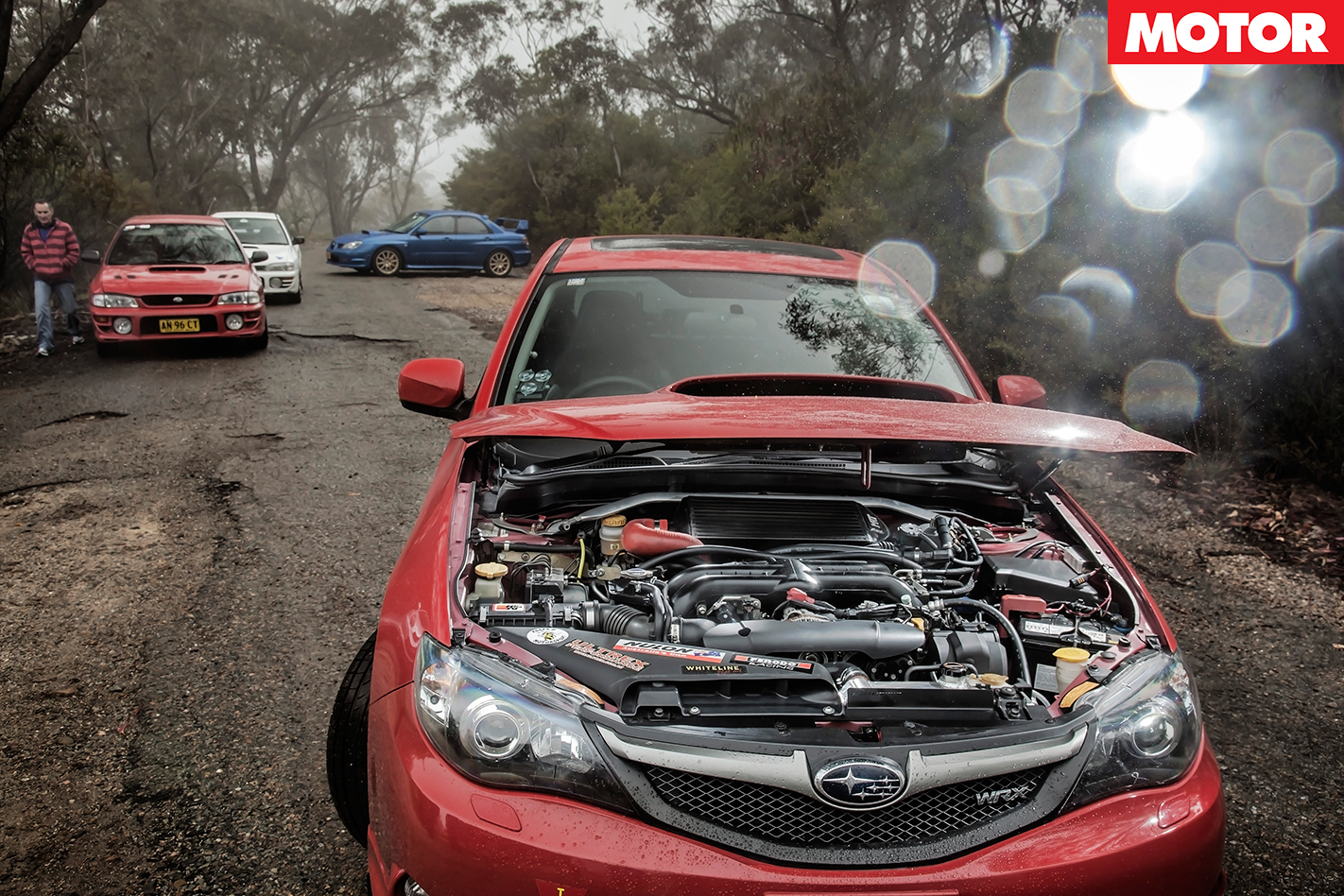
There was little wrong with how it went, but a full exhaust, larger top-mount intercooler and a tune give it more grunt, and a set of forged pistons addresses the common ring-land failure mode of the stock cast items in highly stressed modified applications. Yet, despite the work done, David’s Rex remains well-mannered and easy to drive for those times he’s not doing 1:09s at Wakefield.
Subaru’s second facelift borrowed the pumped arches of the 221kW, wide-body third-gen STi hatch – a true weapon that always felt the way the WRX should have – and brought further, subtle suspension updates, such as firmer rear sub-frame bushes and wider wheels. For the STi, the update introduced a sedan option and, for the first time, an automatic transmission.
Club president Evan reckons this third and final iteration of the third-gen WRX – nicknamed the ‘hammerhead’, after the gills on the front guards – offers out-of-the-box performance, and has a strong following in the club.
However, MY94 owner Jim hasn’t been tempted. He reckons next year’s all-new MY15 WRX could be the fitting present for the 21st anniversary of his first Subaru. Let’s hope that, like Jim, the next Rex stays true to its roots.
Subaru WRX Celebration: Introduction
Subaru WRX Celebration: 1st generation
Subaru WRX Celebration: 2nd generation
With the arrival of Fuji Heavy Industries’ heavier, more refined, and, well, slower sophomore effort, enthusiasts were quick to conclude that Subaru had gone soft, and that was if they could get past the styling.
The ‘bug-eye’ polarised, but those who weren’t put off by the dopey gaze of the goggly headlights discovered a more mature, quieter, roomier and safer Rex. A short drive was all it took to sense that comparing the new car’s body rigidity with the old one’s was like chalk and cheddar – the structure felt strong even if, thanks to the extra weight, bottom-end performance no longer did.
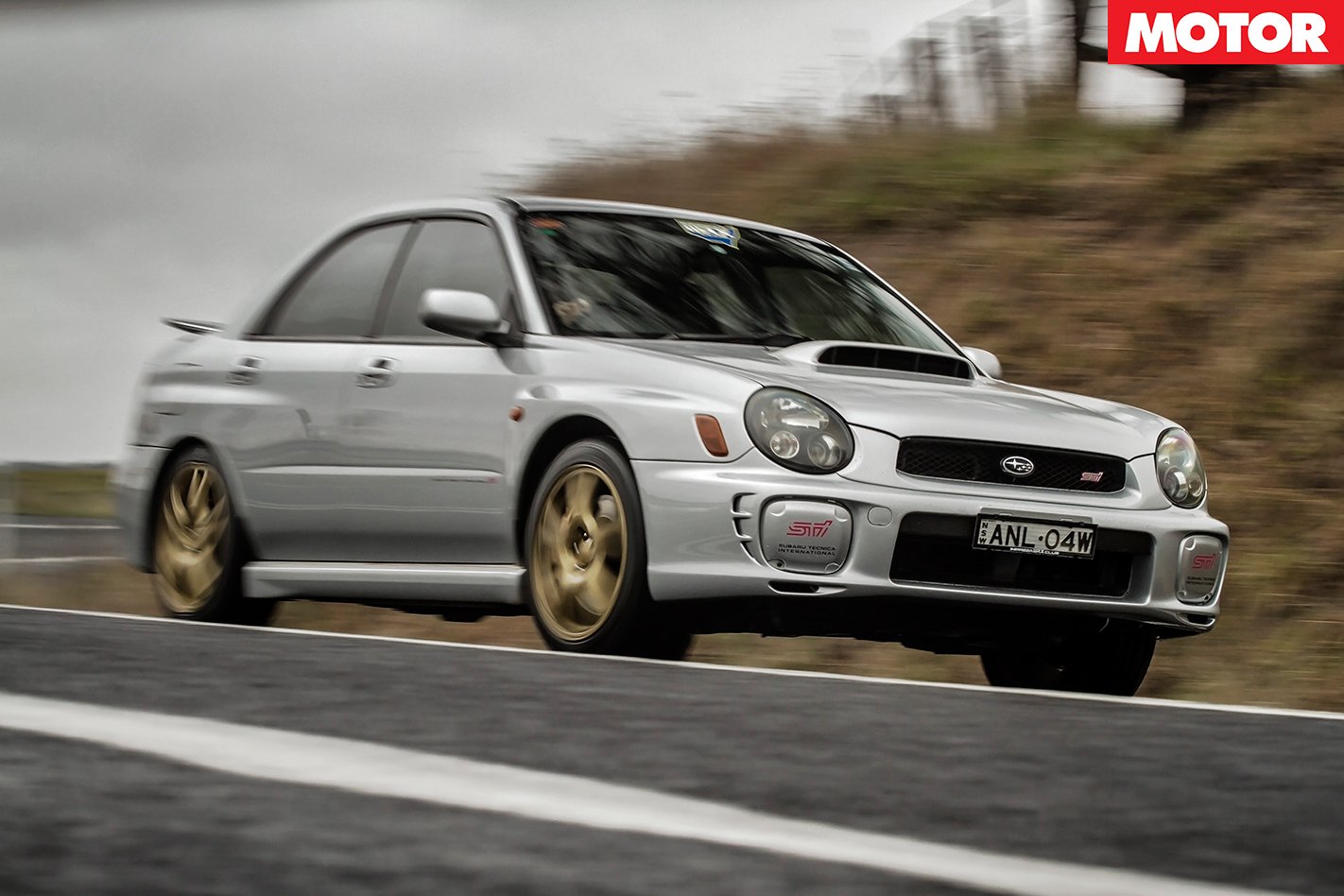
The WRX piled on around 150kg in the transition from GC to GD. Meanwhile, power remained the same as that of the outgoing MY99-00, at 160kW, and peak torque, while available 400rpm earlier, was up by a mere 2Nm.
The STi, which became a regular part of the line-up, had a crack at fixing the performance and aesthetic shortcomings, though it was slightly down on power and torque compared with the version 5 and 6, at 195kW and 343Nm, and there was only so much bolt-on body bits could do.
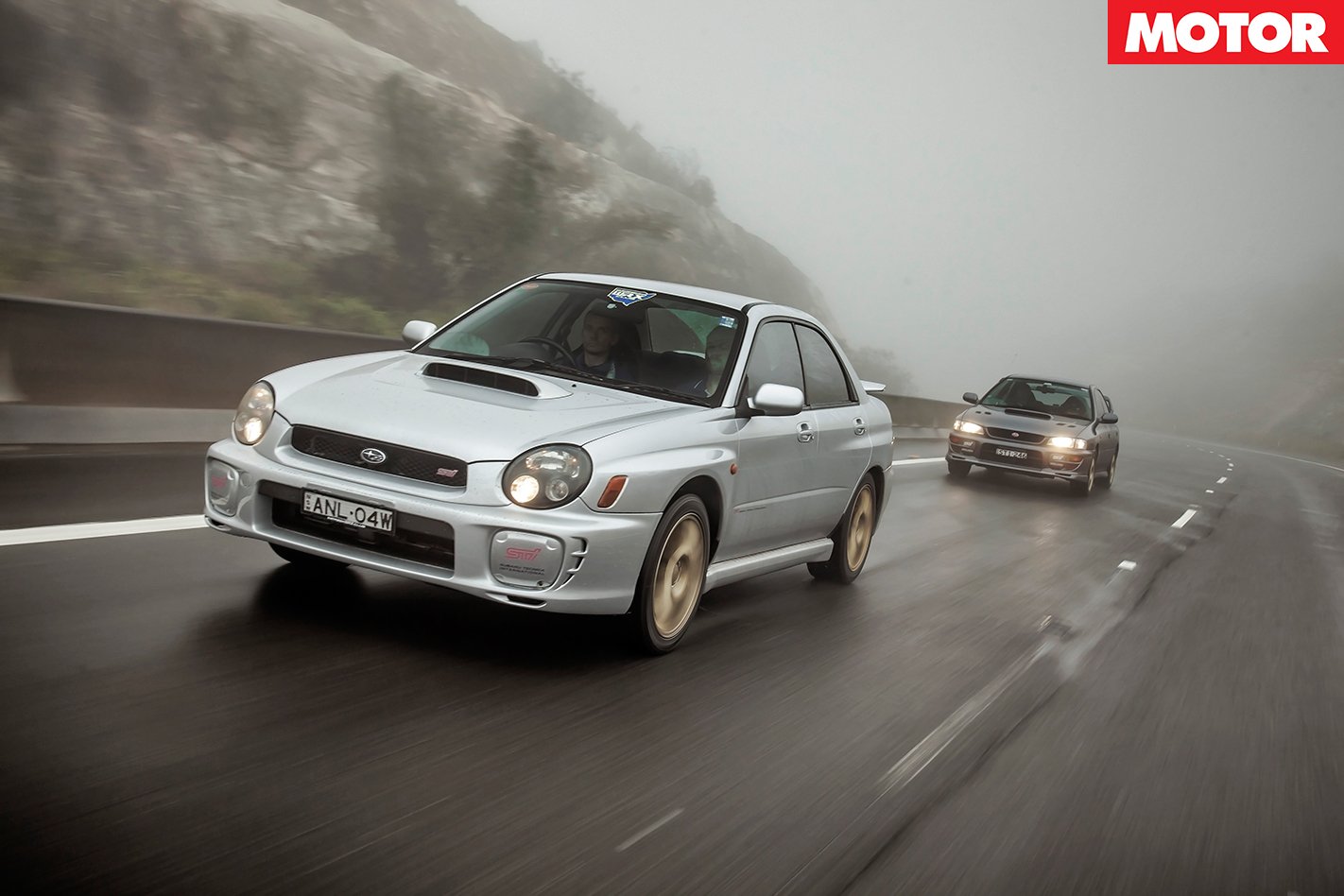
That said, Evan McNeill’s borrowed, bog-stock bug-eye STi represents the value sweet spot in our line-up – mid-teens for this tidy example complete with a six-speed and Brembos sounds like explosive bang-for-buck to us.
Low-end shove certainly isn’t a bug-eye STi strength, but once in the go-zone, the closely stacked six-speed ’box helps keep it there. Up top, the boxer beat is muffled, but the engine feels potent, if less than rev-happy. Easy mods to the intake and exhaust, together with a tune and a bit more boost, would tap the potential of the existing turbo and intercooler, which is precisely how the plan goes for this soon-to-be-track car, together with some modifications to the suspension.
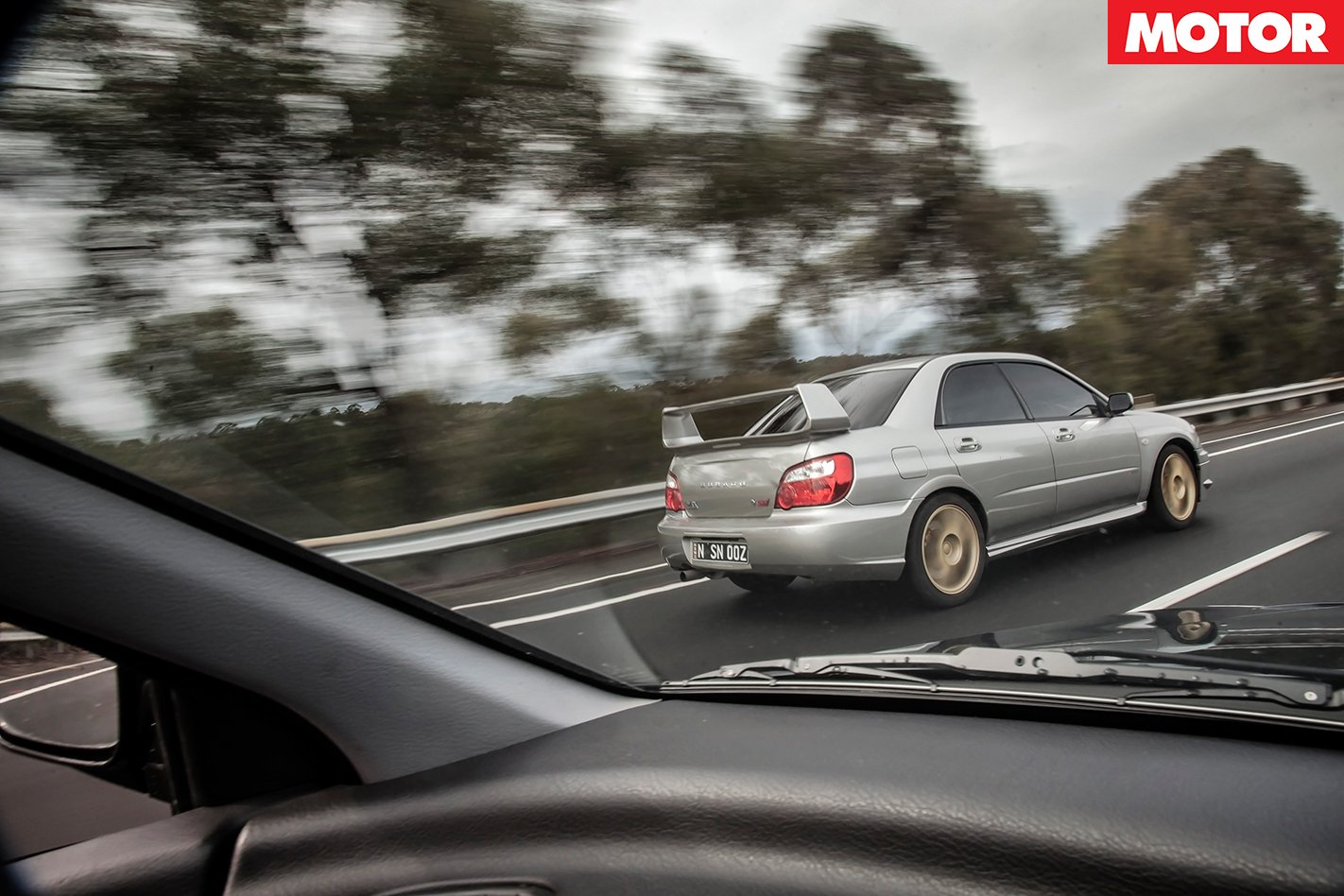
As it is, there’s far less of the noise, vibration and harshness that came standard in earlier STis, though the ride is busier than in a base-spec bug, and the major controls react, rather than merely responding to driver inputs.
For many, though, the Rex returned to form – and good looks – with the MY03 facelift, which delivered the more popular ‘peanut eye’ frontal styling, and engine upgrades – including variable inlet-camshaft timing – that brought back its trademark punch.
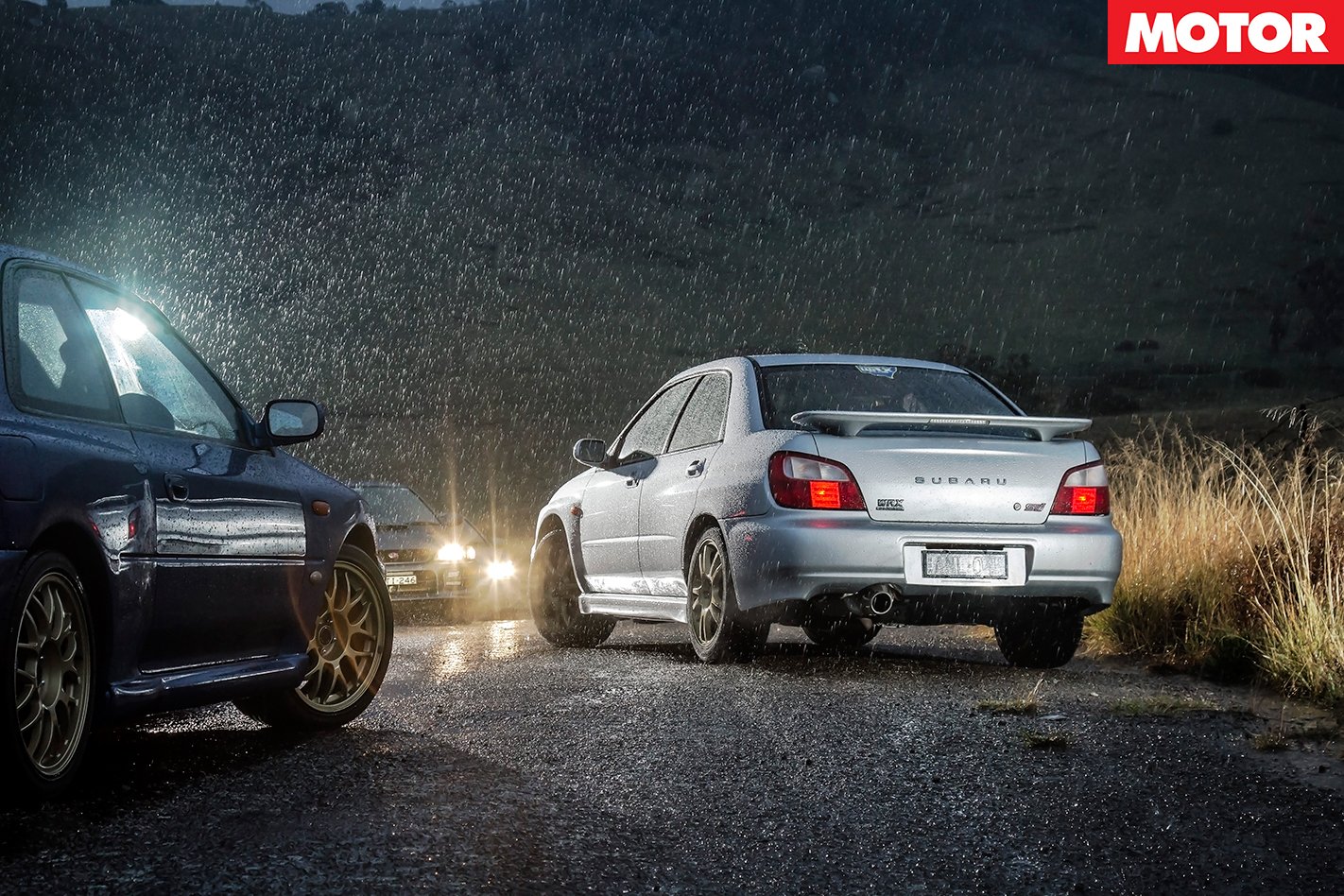
It was this series that tempted club member Craig from his first Subaru, and dream car, a Liberty RS Turbo. Six Subies in, he still craves peanuts.
“Subaru started for me back in the days of Colin McRae in the World Rally Championship, watching him drive the Legacy RS, growing up in high school, I always wanted one,” says Craig.
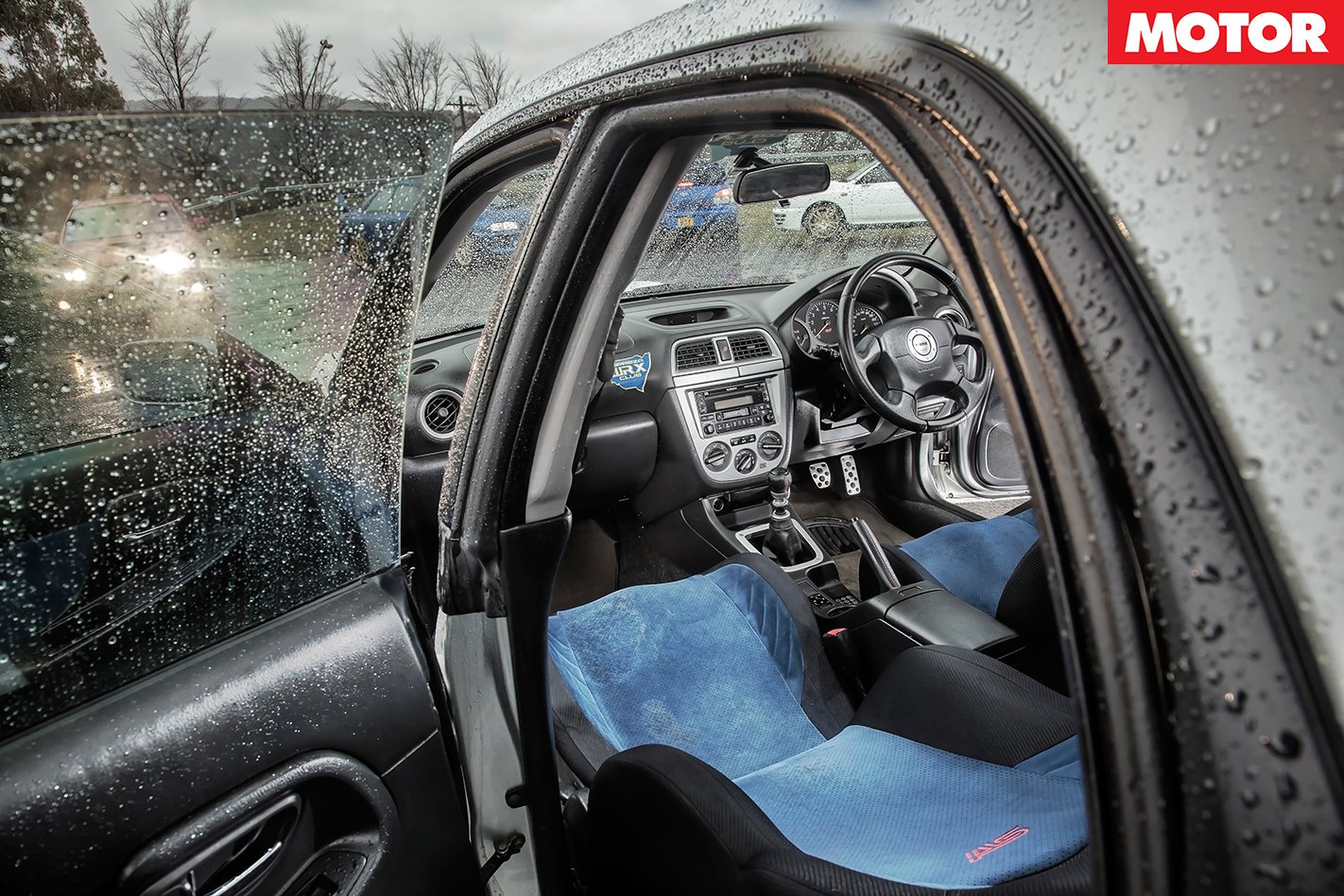
After working his way up with a succession of brand-spanking Subarus, which included MY04 and MY05 hatches, a Forester GT, and a MY11 WRX, he went in search of a track car.
“Of all the cars you can choose to drive on track, on paper the 2005 STi is probably the most reliable in terms of the fact that it’s the last of the forged 2.0-litre engines, and the first of the DCCD (driver controlled centre differential) models,” he explains. “And, not only that, also with the MY05 came the wider hubs and bigger wheel bearings.”
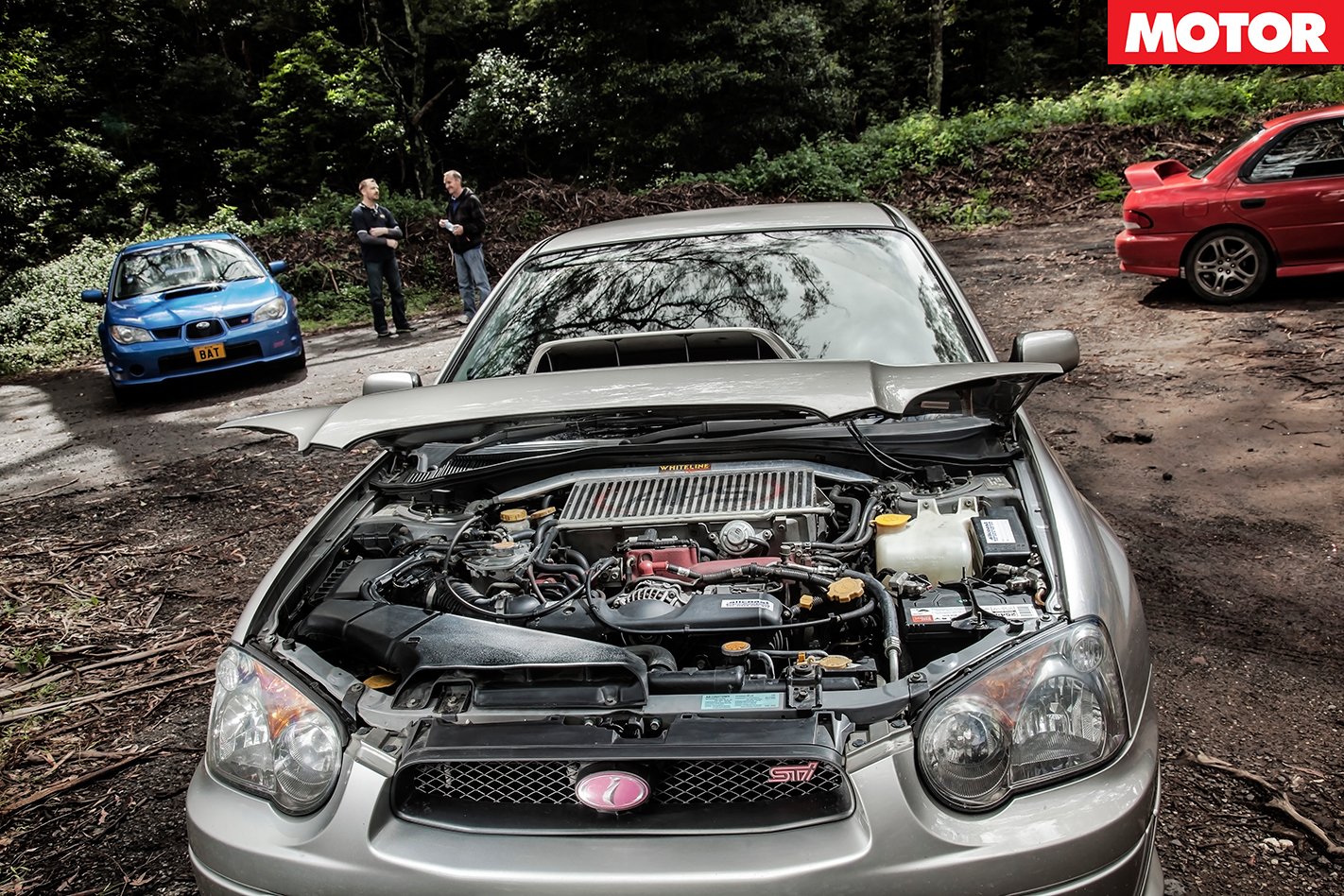
Craig bought his STi as a 60,000km, one-owner car with all the mods already done, which include an exhaust, a larger top-mount intercooler, a flash ECU tune, uprated anti-roll bars, upgraded brake rotors and pads, and coil-overs. Just 18 months on, it’s got 92,000km on the clock and from a quick drive I know exactly why he’s racked up the kays so quickly.
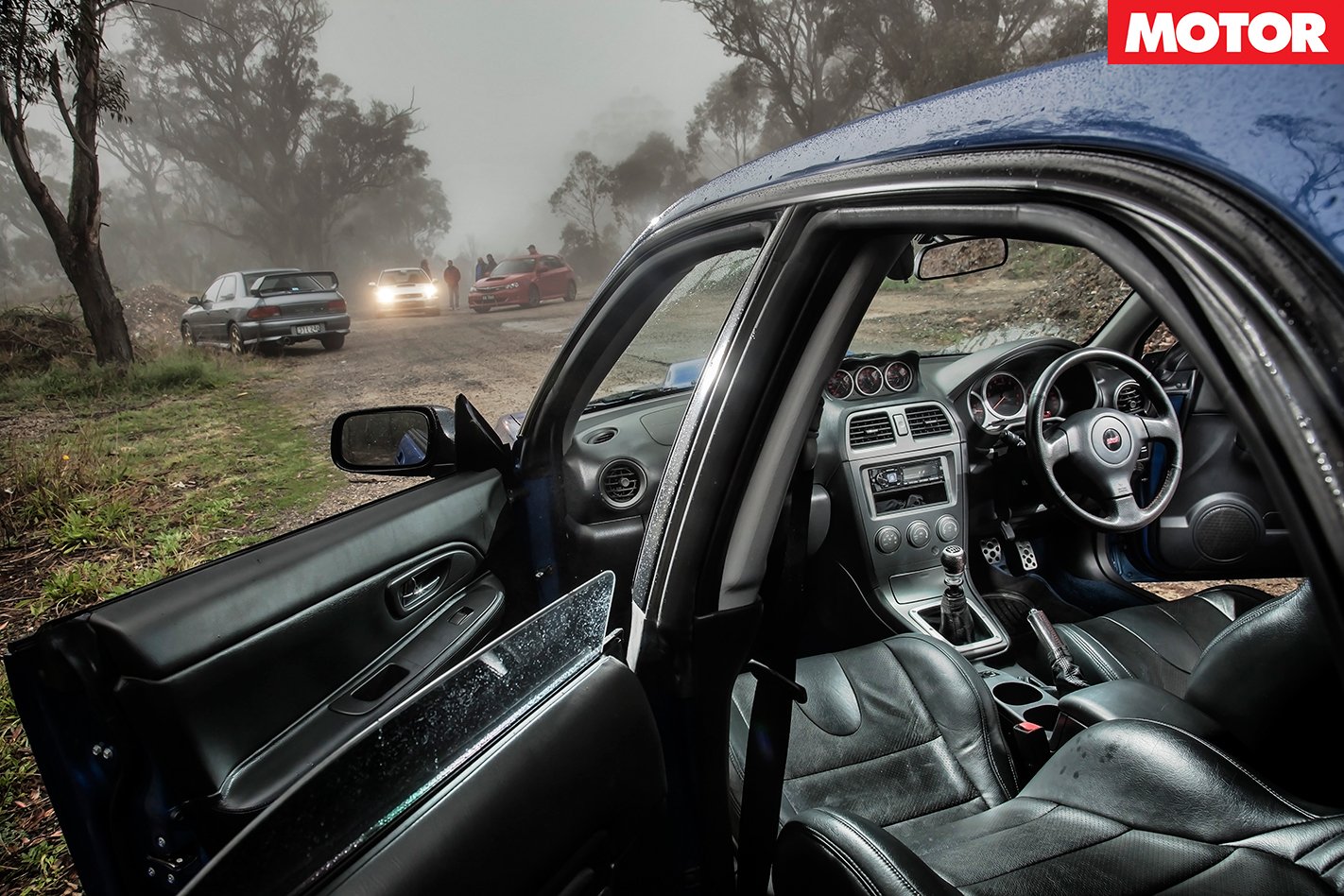
More than any Impreza here, its steering feels intimately connected and precise – a genuine highlight – and its front-end feels unshakably planted. There’s an initial delay while the 2.0-litre turbo engine winds up, but when boost hits it’s like a lit firecracker all the way to the shift light. The middle pedal is responsive and powerful, and the electronically-adjustable coil-overs offer a decent ride/handling compromise on the mid-range setting dialled up for the road.
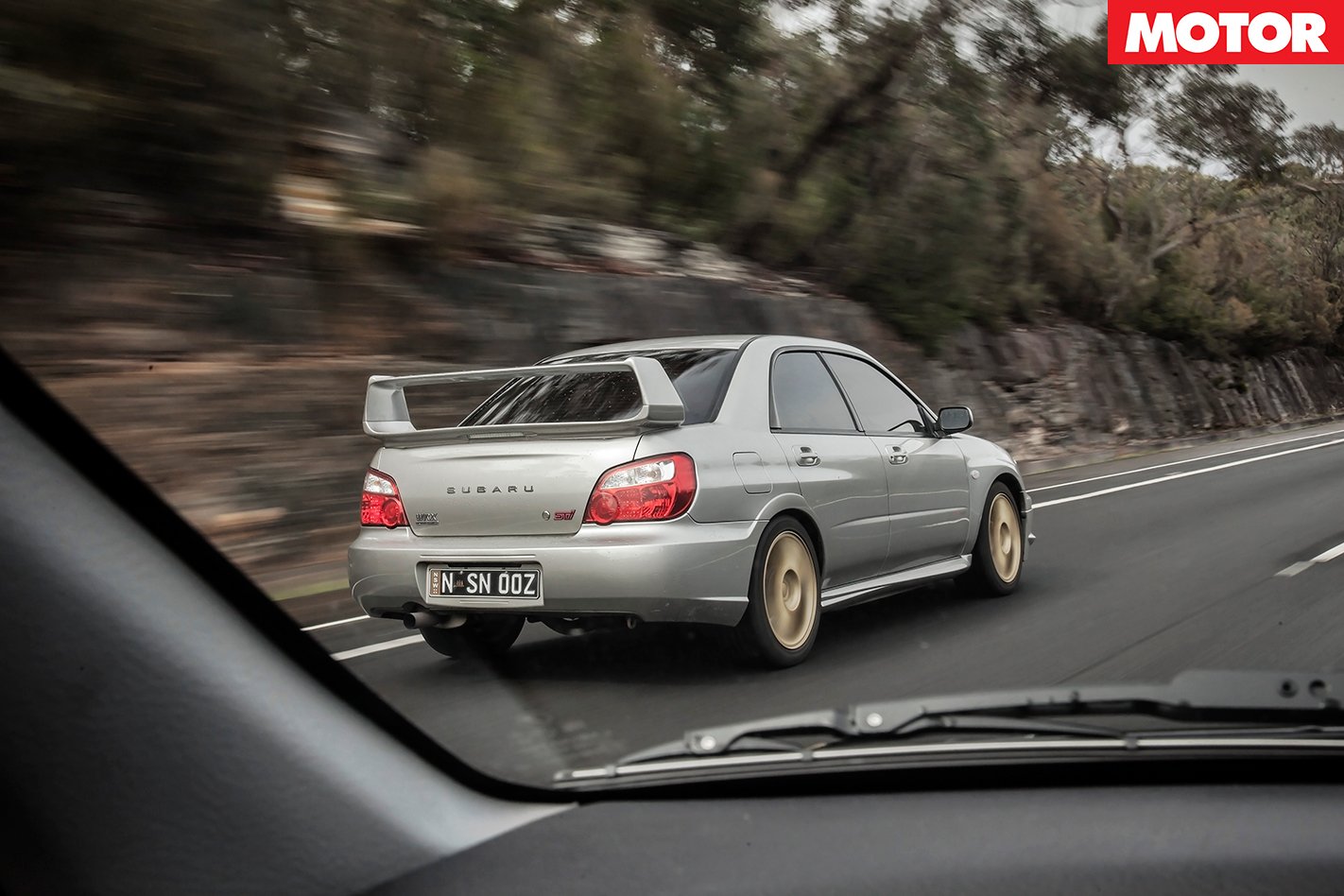
As was the plan, Craig’s spent plenty of time lapping the Sydney Motorsport Park circuit at Eastern Creek, where he holds the club lap record for the model, at 1:49sec. He’s also clocked 1:08s at Wakefield Park.
A facelift on, first impressions of the MY06 are that, with its 2.5-litre engine, it brings back classic WRX bottom-end punch. And, in Ian’s lightly tweaked STi, the top end continues to drive the big-block point home.
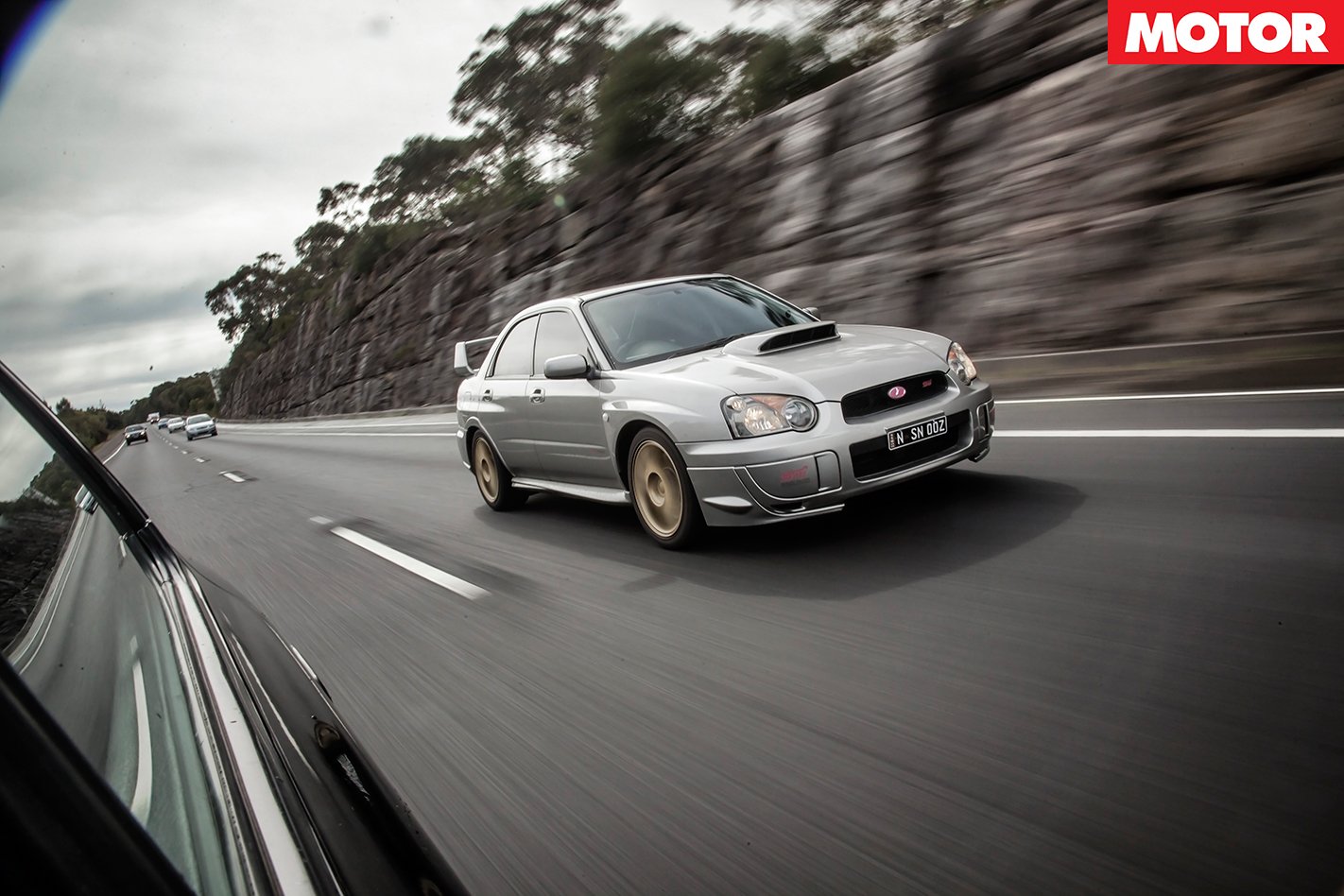
When it first appeared, some criticised the 2.5-litre for trading the 2.0’s high-rev kick for flexibility. Sure, there’s less of a ‘power band’ than in early cars, but the thick, broad spread of torque makes the last of the second-gens effortlessly quick and difficult to fault for day-to-day duties. And, while Craig cites the later STi’s lack of forged pistons as a valid durability drawback for a car that’s going to hit the circuit, on the road it’s unlikely to be much of an issue to most owners.
Just as in the MY05, the way the chassis moves through corners is far more fluid than in earlier STis, though the ride in Ian’s newly acquired car is a fraction fidgety on 100,000km-old dampers and upgraded STi springs.
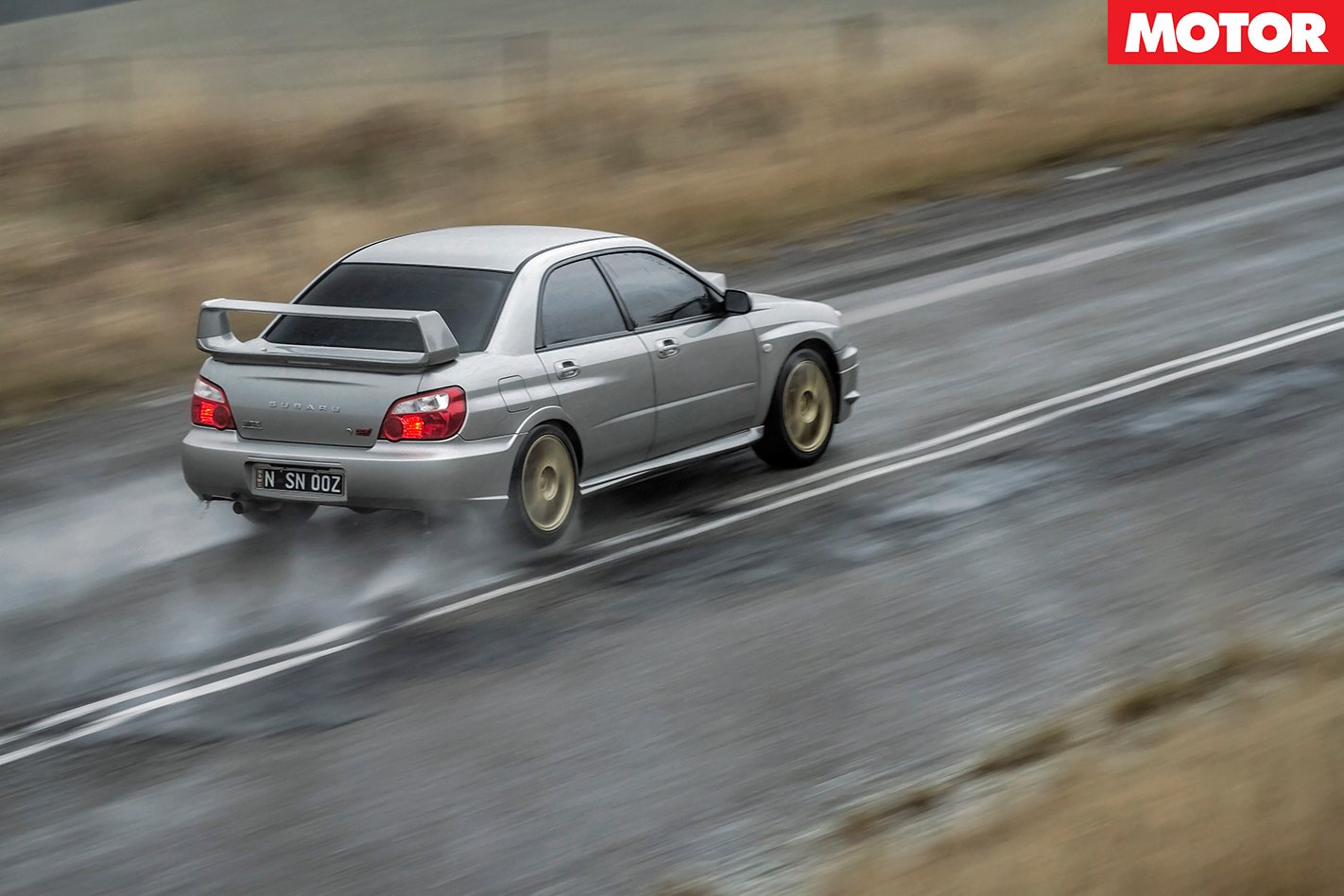
The engine, with modifications limited to a cold-air intake and a turbo-back exhaust, delivered a 202.8kW at the wheels at a club dyno run the day before. That’s hugely impressive when you think back to Jim’s heavily modified 2.2-litre MY94, which has about the same peak power, but not near the all-rev oomph.
Of his Subaru beginnings, Ian says that he “always admired the brand, but I was a V8 man before this and I’d always had V8 Holdens. I stepped out of a VN Group A into a small four-pot Corolla SX, and then an opportunity came up to get into the MY00 and I thought, ‘well, I’ll give it a try’. I had that for three years and then stepped into the MY04.”
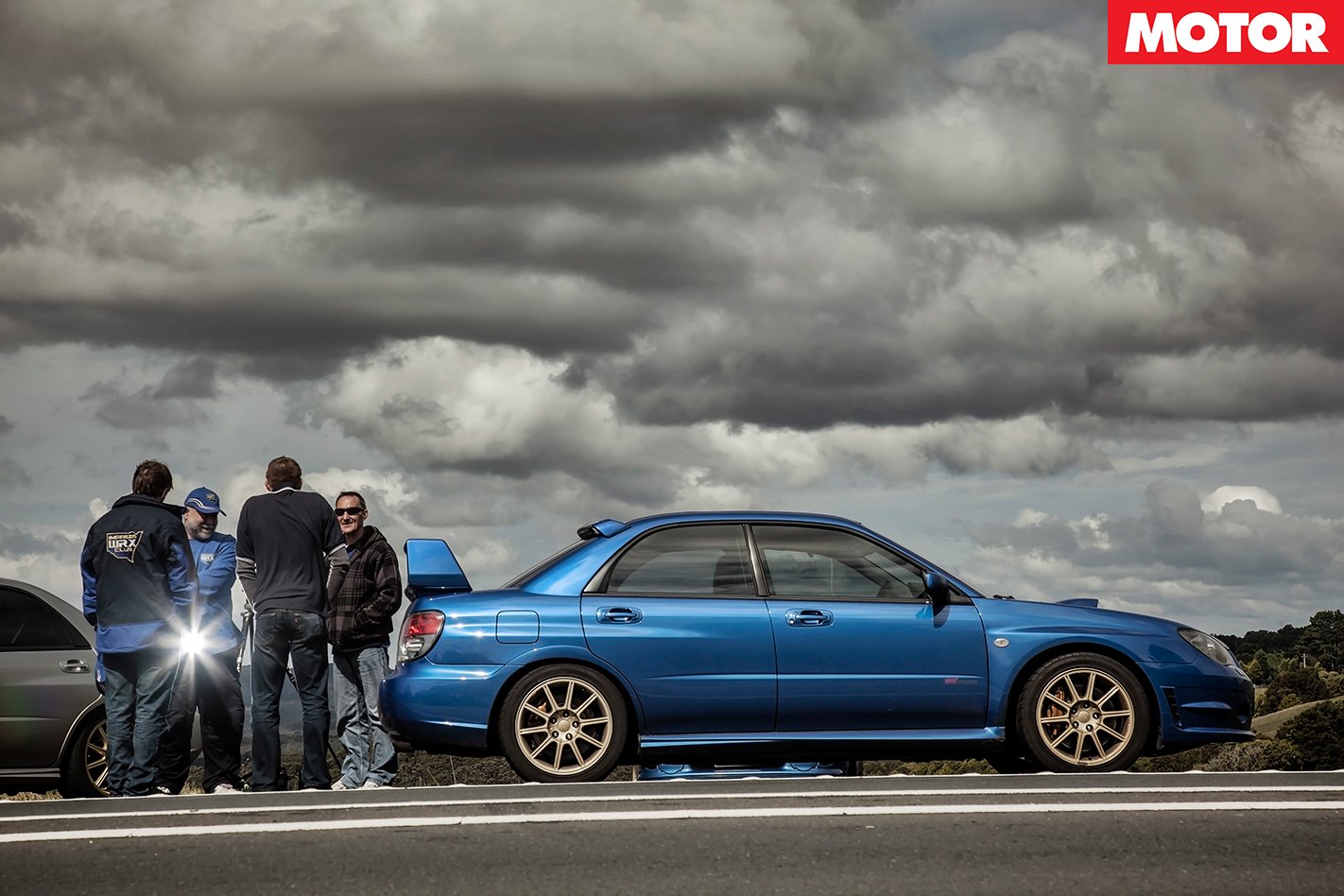
Ian’s wife still owns the 235,000km, 178kW-at-the-wheels modified MY04 – “never had to crack the engine; never had to touch the gearbox” – and you get the impression their garage will forever have a pair of Subies in it.
But what was it they called the MY06-07? Owner Ian says ‘hawkeye’ is his preferred shorthand, but less favoured nicknames include ‘koala nose’ and ‘pig nose,’ which probably isn’t quite what Subaru had in mind when, in a nod to its aviation beginnings, it penned the wings ’n’ propeller grille for the second-gen send-off.
Subaru WRX Celebration: Introduction
Subaru WRX Celebration: 1st generation
Subaru WRX Celebtration: 3rd generation
Volkswagen has announced a plethora of options will be made standard for multiple models as part of an imminent MY16 update.
Said to arrive in local dealerships within weeks but available to order immediately, the higher-spec MY16 models see the much of VW’s stable now equipped with upgraded media (a bigger 6.5-inch touchscreen plus enhanced mobile connectivity) and a rear-view camera as standard, while GTI and R variants in Polo and Golf form receive even more fruit.
Adjustable dampers as part of a Sport Select Suspension system have made their way on to the Polo GTI, promising more dynamic depth from the hot-hatch but also meaning buyers of the new Polo GTI (which only debuted this April) with single mode damping have narrowly missed out.
What the Sport Select Suspension package does is not only electronically adjust the Polo’s damping between two stages via a single button, but also modify the steering, sound actuation and throttle response.
Further upstream VW has injected more luxury in to the Golf R’s package. On top of the 6.5-inch screen and upgraded media connectivity the Golf R and other models gain, its seats are now stitched in ‘Vienna leather’ while the front items will also be heated.
VW’s Golf GTI and GTI Performance will feature keyless access, entry and engine start as standard, while the GTI welcomes Bi-Xenon headlights as well.
The Scirocco R, however, has had only its media upgraded to VW’s ‘Discover Media’ system.
Price wise, VW tells MOTOR the Golf GTI will shed $1000 and the Golf GTI Performance $2000, while the Polo GTI, Scirocco and Golf R prices remain unchanged.
Get your free weekly report from the world of fast cars – subscribe to the MOTOR newsletter!
Buy any of the following magazines at a participating Coles Express store and receive a FREE small coffee!
- Unique Cars
- Wheels
- Street Machine
- Motorcycle Trader
- Deals on Wheels
- 4×4 Australia
- Australian Motorcycle News
- Motor
- Australasian Dirt Bike
Buy any of the following magazines at a participating Coles Express store and receive a FREE small coffee!
- Unique Cars
- Wheels
- Street Machine
- Motorcycle Trader
- Deals on Wheels
- 4×4 Australia
- Australian Motorcycle News
- Motor
- Australasian Dirt Bike
SOME of the thirstiest, most expensive cars on the market should be slightly cheaper from today following an increase in the threshold at which the controversial luxury car tax is applied.
The point at which the 33 percent tax is applied has been raised from $61,884 to $63,184 – a total of $1300 or just 2.1 percent.
It should make some cars $390 cheaper than they were yesterday (the tax is applied before GST is added).
However, the ruling does not make “fuel-efficient” luxury vehicles – those using less than 7.0 litres of fuel per 100 kilometres, according to the government-derived fuel figure – more affordable.
The threshold at which the LCT kicks in on those cars is still $75,375 – the same as it was in 2010.
For that reason, the tax won’t impact the majority of luxury cars sold – most of which already comfortably duck under the government’s definition of a “fuel-efficient vehicle”.
All but one model in the current Mercedes-Benz C-Class range – the best-selling luxury car on the market – is unaffected by the tax change. As is most of the rival BMW 3 Series line-up.
Even the popular diesel-powered SUVs such as the Audi Q5, BMW X3 and Land Rover Discovery Sport receive no benefit from the recent tax change, along with most luxury models priced below $100,000.
It’s not until you get to more powerful models – including high-performance V8 models such as those from Mercedes-AMG and BMW M – that the luxury tax will be reduced.
The brand that pays luxury car tax on more models than any other brand – Toyota – also stands to benefit with its V8-powered Landcruiser and some versions of its Prado off-roader.
However, that’s only if the manufacturer or dealer passes on the savings.
Mercedes-Benz says it is not adjusting its recommended list prices, arguing the list price is “an indicative price – the maximum you will pay”.
“What price you negotiate with the dealer is up to you,” said Mercedes-Benz senior manager of corporate communications David McCarthy.
However, BMW will be passing on the modest LCT tax savings, so a $185,900 BMW X5 M is now just $185,510. Bargain.
In the past, Toyota has passed on the tax savings; Wheels is seeking comment whether the same will apply this time.
One vehicle expected to be close to the current LCT fuel-efficiency limit is the upcoming Mercedes-Benz C350e Hybrid, which can run purely on electricity for up to 31km and has claimed fuel use of 2.5L/100km – about one-third that of many mid-sized cars.
“We will not be penalising people for buying it,” Benz’s McCarthy said, hinting that it would just scrape under the $75,375 limit.
“But if you option a panoramic sunroof, the government wants a third of it.”
Cars are the only item with a specific luxury tax. Boats, planes, jewellery and other luxury items all miss out on the hefty impost.
The Federal Chamber of Automotive Industries and luxury carmakers have been campaigning for years to have the tax removed or revised.
Wheels is awaiting a response from treasurer Joe Hockey’s office.
Sign up here to receive the latest round-up of Wheels news, reviews and video highlights straight to your inbox each week.
A hyper-hybrid hatchback from Peugeot is officially in prototype testing phase following its reveal as a motor show concept, hinting at future production.
In an unusual move, Peugeot’s global managing directing Maxime Picat has used Twitter to post photos of his boss, Peugeot CEO Carlos Tavares, driving a partially camouflaged 308 R HYbrid.
“Looks like #Peugeot308RHYbrid is ready to move!” read the tweet from Picat. “Today our CEO Carlos Tavares enjoyed its radical performance!”
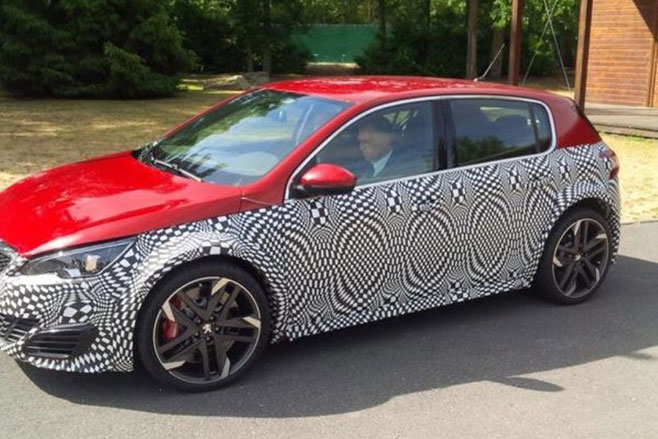
The two accompanying pictures posted by Picat show Tavares first approaching then driving off in the red prototype, which looks far less radical than concept car shown at the Shanghai motor show earlier this year.
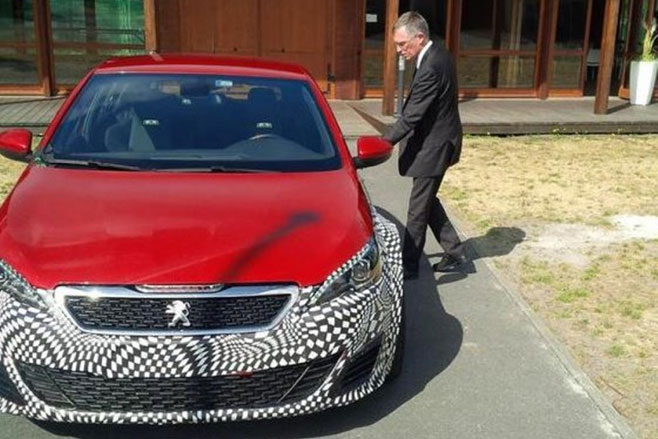
On the outside the prototype looks little different to the production 308 GT and 308 GTi, with a similar grille, basic front bumper and alloy wheels. Look closer, however, and bulging wheelarches and monster front brakes give clue to what lies within.
Peugeot widened the tracks of the 308 R HYbrid Concept by 80mm compared with regular 308 models, and it scored four-piston 380mm front/290mm rear disc brakes.
The radical concept utilises an all-wheel drive system with two 85kW electric motors, one powering the front axle and one the rear, supported by a 201kW 1.6-litre turbocharged four-cylinder engine.Combined outputs are a staggering 373kW and 730Nm, good enough for a claimed 4.0-second 0-100km/h.
If those figures come close to what the production prototype has in store, then we’re sure the Peugeot CEO really did enjoy some radical performance.
A production Peugeot 308 HYbrid R will more realistically challenge the German hegemony of Volkswagen Golf R (206kW/380Nm), Audi RS3 (270kW/465Nm) and Mercedes-AMG A45 (as of this week 280kW/475Nm), as well as the Ford Focus RS (257kW/470Nm).
What is clear is that a future ultra-fast French hatchback is continuing in testing, and if the managing director’s excitement is anything to go by, this one won’t be let through to the keeper. Game on.
Pic credit: @MaximePicat
The Lamborghini Aventador LP 750-4 Superveloce will add another word to its spaghetti-long model designation – roadster.
All 600 units of Aventador LP 750-4 Superveloce hard-top have been sold, so the Italian brand has confirmed it will chop the roof off its flagship supercar for another 500-unit run worldwide.
A speedy run it will be, too, with the Superveloce delivering an extra 37kW from its 6.5-litre V12 engine to now produce 552kW at 8400rpm and an unchanged 690Nm at 5500rpm.
Kerb weight of the hard-top falls by 50kg to 1525kg, while the 0-100km/h dash tumbles by a tenth to 2.8sec. In case you were wondering, 200km/h comes up in 8.6sec and 300km/h in 24sec on the way to a “beyond” 350km/h top speed.
You’d better hold onto your hat in the Superveloce Roadster. While exact figures are yet to be announced, the roof-removed LP 750-4 is 50kg heavier and a tenth slower than its hard-top sibling, which, erm, should make the SV Roadster exactly as fast as the LP 750-4 hard-top.
The Superveloce will also add pushrod-style suspension with magnetic dampers, 20-inch front/21-inch rear tyres (up from 19s/20s) and monster 400mm front/380mm rear carbon ceramic disc brakes.
A wilder wing and bigger bodykit completes the picture of a Lambo with more hardcore and less metal above the driver’s head.
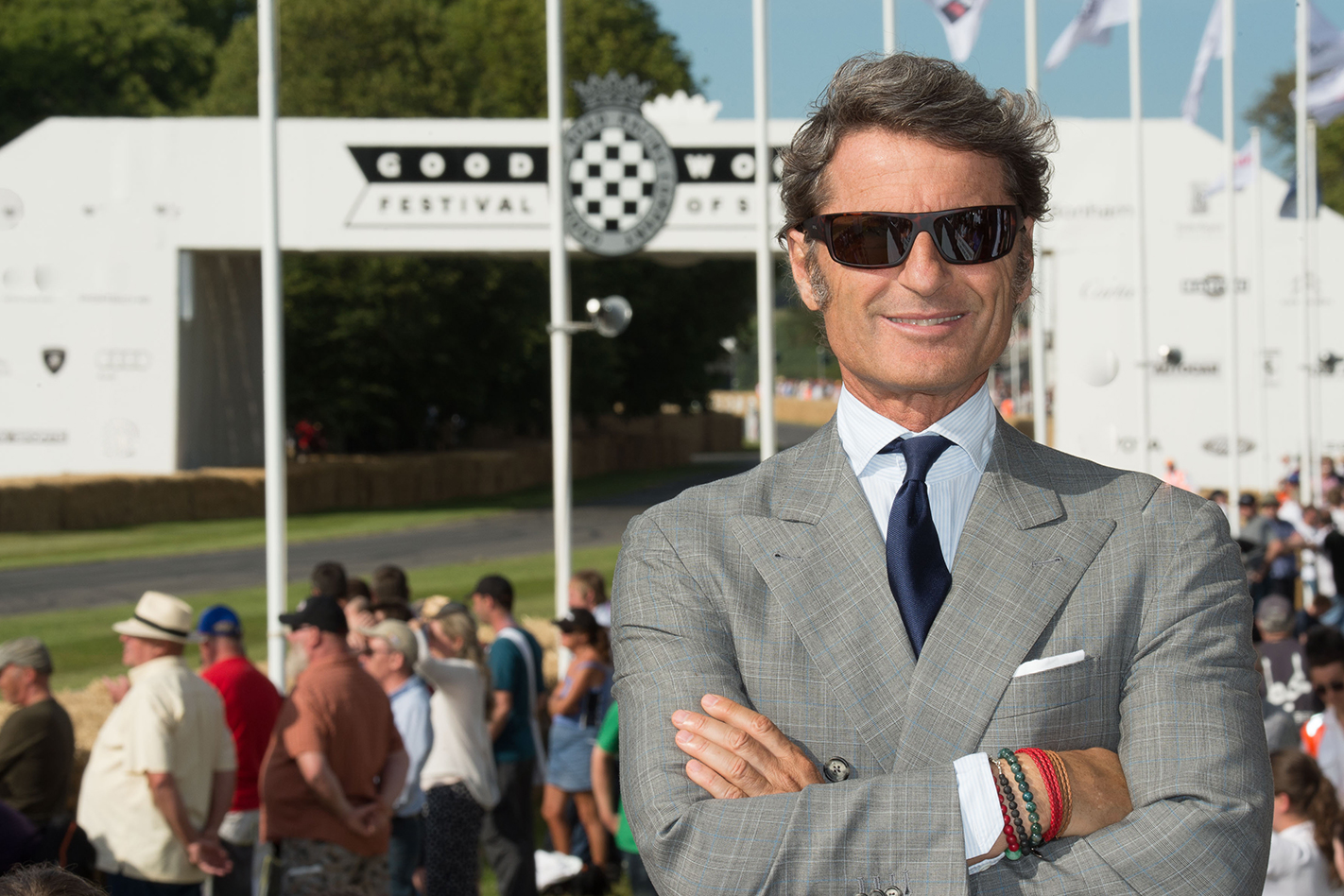
Lambo boss Stephan Winkelmann made the announcement at this week’s Goodwood Festival of Speed in the UK, describing the Superveloce as, “the most pure, sports-oriented and emotional incarnation of a Lamborghini.”
While the company is taking orders for the roadster now, Lambo’s latest speedy supercar will first step out in public at the Frankfurt motor show in September.
Get your free weekly report from the world of fast cars – subscribe to the MOTOR newsletter!
AFTER years of yearning, Mercedes-Benz Australia will finally have a compact SUV to challenge the prestige compact SUV market dominance of BMW X3 and Audi Q5. The Mercedes-Benz GLC successor to the (left-hand-drive only) GLK, revealed recently in Germany, will be built in right-hand drive, and therefore will get the chance to compete head to head with rivals from BMW and Audi in Australia.
The until-now gaping hole in Mercedes-Benz Australia’s SUV portfolio has been something of a sore point for MB Oz – and Germany acknowledged it by making a special call-out to Australia, New Zealand and the UK during the launch presentation.
“It almost got to the point where we didn’t want to talk about it any more,” Mercedes-Benz Australia spokesman Jerry Stamoulis told Wheels at the launch of the GLC in Stuttgart. “It’s not just abut the volume. It’s about the customers in this segment that we could not offer a vehicle to. We don’t like letting people down. It’s been frustrating but it’s a good time to launch it as well.
“Everyone knows at the top management how much we wanted this car. We won’t produce the volume the UK and other markets will. But this has the potential to be our best-selling SUV. It has a broader appeal across a wider range of buyers. It opens up the demographics.”
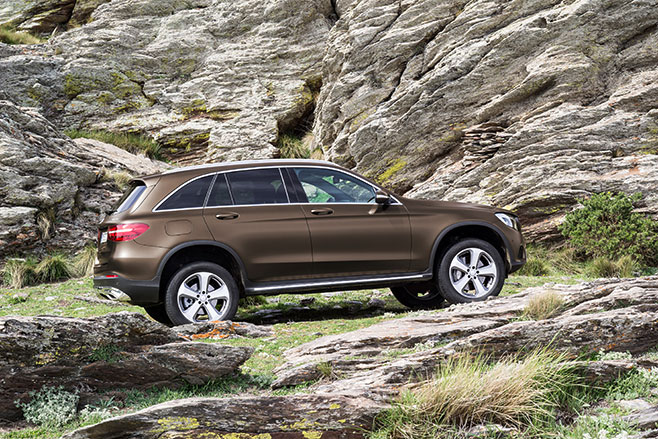
The GLC SUV is built on the C-Class’s MRA platform, and sits above the GLA and below the new GLE, with prices starting from around $65,000 for the GLC250, available with either a 155kW/350NM 2.0-litre turbo-petrol or a 150kW/500Nm 2.1-litre turbodiesel engine.
Mercedes Australia is also weighing up the possibility of taking the GLC220d, which has the same 2.1-litre turbodiesel in a gentler – yet no more fuel efficient – 125kW/400NM state of tune. But questions remain over whether this model can fit comfortably above the GLA range without stealing sales.
A higher performance GLC 450 Sport AMG will also form part of the launch lineup, its 3.0-litre twin-turbo V6 good for 245kW and 480Nm, making it considerably more powerful than the other models.
All Australian-spec GLC models will be all-wheel drive.
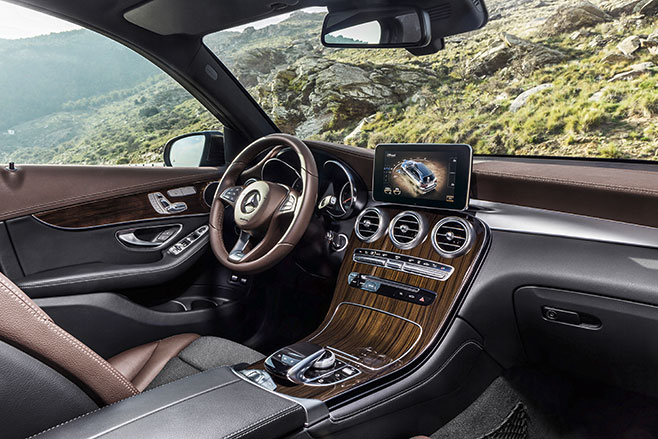
The biggest performance bang will have to wait until 2016 when the GLC 63 AMG hits town. This particular model is still not officially confirmed by Mercedes-Benz, but promises to deliver blitzkrieg performance from the same 4.0-litre twin-turbocharged V8 engine as the current C63 sedan with which the GLC shares its platform.
Two states of tune are possible, 350kW in the ‘standard’ GLC63 and 375kW in the S version; the latter of which is likely to be favoured by Mercedes-Benz Australia.
This car would give Mercedes-Benz a big advantage over its rivals, because BMW’s X3 does not have an M variant, and Audi does not currently offer an RS Q5.
Don’t expect much change from $160,000.
Australia is also a chance to see a plug-in hybrid version of the GLC, dubbed the GLC350. This model carries the same 155kW/350Nm 2.0-litre, four-cylinder turbo engine as the C250 but adds an 85kW electric motor and battery pack good for around 30km of pure electric range.
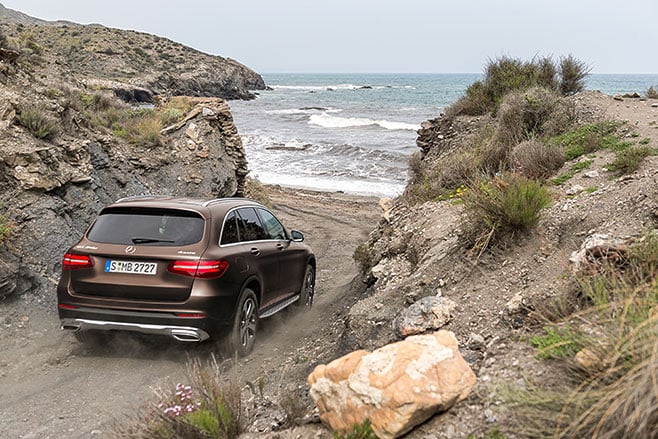
The GLC measures 4656mm long and 1890mm wide, meaning it’s marginally bigger than its Audi and BMW rivals.
As usual, Australian cars will come well-specified, and have safety features such as auto emergency braking. Customers may be able to option an offroad package, though take-up is likely to be minimal.
Mercedes-Benz Australia is bullish about the GLC’s potential Down Under.
“We always want to be the leader in the segments in which we compete,” Stamoulis said. “At the same time, it all comes down to whether we can get the allocation we need, and the model range we need.
“We don’t play to finish second.”
Stamoulis says Mercedes-Benz does not believe the GLC SUV will steal sales from the C-Class wagon, despite wearing a similar price tag engine for engine.
“Never say never, but if there is a vehicle the GLC could take sales from it’s more likely to be GLE than C-Class wagon.
“We think and hope that more people will come from other brands.”
Sign up here to receive the latest round-up of Wheels news, reviews and video highlights straight to your inbox each week.
What is dark, angrier looking than a jabbed wasp nest, and bullet-fast up Lord March’s driveway?
Judging by footage below from the weekend’s Goodwood Festival of Speed, we’d say the answer is Nissan’s recently revealed Juke-R 2.0 concept.
Serving as a successor to the original 2011 Juke-R, where Nissan dropped the Juke’s body on the guts of a GT-R, the new Juke-R 2.0 was unleashed at the Goodwood FoS hill climb to celebrate five years of the road model.
But don’t let its ‘2.0’ fool you. The new mutant Juke is everything its predecessor was and more, featuring a redesigned exterior – parts of which are carbon fibre – and new power from its Nismo (!) GT-R drivetrain.
At its core is the twin-turbo 3.8-litre V6 from the 2014 Nismo GT-R, which means GT3-spec turbochargers help it flex 447kW worth of muscle, or 85kW more than the old car, harnessed by the Nismo’s all-wheel drive layout.
Needing to feed and cool its monstrous heart, Nissan has performed significant face surgery on the Juke R 2.0, enlarging its front bumper’s cooling intakes and repositioning the bonnet’s ‘exhaust cowlings’.
Lights front and rear are borrowed from the updated road-going 2015 Juke, as are the fenders, however the side sills that bridge the huge wheel flares are redesigned and also carbon fibre.
Performance wise, all of this translated to a 57.21sec sprint up Goodwood’s hillclimb course with Jann Mardenborough at the tiller, almost eight seconds slower than the actual Nismo GT-R managed in 2014, and 10 seconds afar from Alex Buncombe in Nissan’s GT-R GT3 car. However, Nissan UK claims that the 57.21sec run would place the Juke third place in this year’s supercar class if it weren’t a concept.
While the car’s not for sale, Nissan didn’t mind selling a few of the original Juke-R to supercar collectors at a hefty price. And time will reveal if the Juke-R 2.0’s frightful performance will have the same sort of people again swinging fistfuls of cash for their own road-going monster Juke.
Get your free weekly report from the world of fast cars – subscribe to the MOTOR newsletter!
