
The torquiest new car available on the Australian market will make a speedy arrival next month priced at $730,000.
The Bentley Mulsanne Speed will land (presumably with a big thud) packing 1100Nm from its 6.75-litre twin-turbo V8 engine; and all that torque will be thrown at the rear wheels at just 1750rpm.
The monster four-door limo gets to 100km/h in 4.9 seconds on its way to 305km/h and gulps 14.6L/100km on the combined cycle.
Yet the torque games for the upper-crust Brit brand won’t end there, as it also readies to deliver the most twist of any production SUV available.
The VW Group has just announced a brand new twin-turbo 6.0-litre W12 with the same 447kW as the Mulsanne’s twin-turbo 6.75-litre V8, except with ‘only’ 900Nm.
The W12 will feature “an oil circuit suitable for off-road use with a switchable oil pump”, indicating preparation for use in the Bentayga SUV.
A Bentley source recently indicated to MOTOR that the Bentayga is likely to launch with the new W12, before the V8, diesel and hybrid models arrive later in the model cycle.
Bentley claims its new off-roader “will be the most luxurious and most powerful SUV in the market”, sitting above the base Continental models in price, suggesting a price point in the mid-$400,000s or above.
A recent teaser video showed the first glimpses of the new interior (see image gallery), while Bentley has confirmed that the final car looks nothing like the controversial SUV concept shown at the 2012 Geneva Motor Show.
Production of the Bentayga will kick off in November.
The new W12 will also appear in Bentley’s current models, and it claims that the fastest variant will do the 100km/h dash in “less than four seconds”.
Currently even the quickest Benter on sale locally, the 820Nm W12 Continental GT Speed, will ‘only’ do a 4.2 second sprint. Another 80Nm should help it limbo into the threes.
Although the fresh W12 offers similar outputs to the engine in current models, the changes are designed to rip the dozen-cylinder format closer towards 21st century emissions standards without chopping down the pots.
The engine now gets a combination of Audi direct injection and Bentley port injection, cylinder deactivation that can shut off a whole side of the cylinder bank to effectively make it a big-six, stop-start tech and ‘adaptive engine suspension’ to quell the vibes.
It is also claimed the most efficient model with the W12 will consume 10.8L/100km, a sizeable improvement when the current thriftiest twelve-potter (also the GT Speed) glugs 14.5L/100km.
Downsizing, Sir? What downsizing?
Get your free weekly report from the world of fast cars – subscribe to the MOTOR newsletter!
Australian engineering group Premcar has created a 320kW/700Nm weapon of a Ford Falcon XR6 Turbo, based on ex-police vehicles.
Using second-hand ex-police cars as a base, Premcar then adds adjustable suspension, jointly developed by Premcar and Melbourne firm Shockworks, along with 19-inch forged FPR TSW Wheels wrapped in Kuhmo 91S tyres measuring 245mm up front and 275mm at the rear.
A revised intake, free-flowing exhaust and tweaks to the engine calibration liberates around 320kW/700Nm from the 4.0-litre turbocharged inline-six, with an engine oil cooler and transmission oil cooler added for extra durability.
Formed by the group known as Prodrive Australia when the Prodrive company decided to exit Australia in 2012, Premcar offer engineering services in Australia and China.
Premcar engineering director, Bernie Quinn, explains the logic behind the new project: “We basically needed something for the guys in the workshop to do between projects.”
“New South Wales Police Packs cars get Brembos, bigger oil cooler and are quite inexpensive for what’s in there. The police turn them over at 80,000km, they’re still under warranty.”
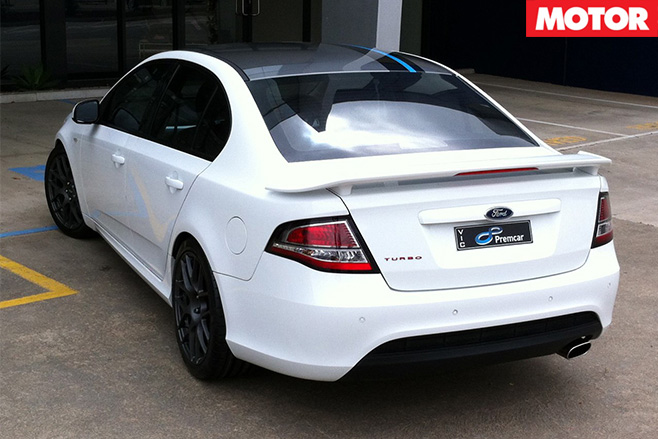
As they’re based on second-hand vehicles, the cost of the Premcar Turbo is extremely low, with Quinn estimating the price at between $35,000 and $40,000 as a turn-key package, including the donor car.
The good news is that there is no reason why the modifications can’t be performed to any XR6 Turbo, though using the ex-police vehicles as a base is the most cost effective way to do it.
The package is also extremely flexible, with the three current owners adding roll cages, video Vbox capability and more to make their cars true track weapons.
Quinn is happy to accommodate individual owners’ needs, though he admits he “hasn’t fully worked out how we’d do the non-turn-key option.”
For Australian performance enthusiasts starved of fresh metal, the Premcar Turbo offers a massive amount of performance for the money, along with the peace of mind that it is developed by the very people that handled local fast Fords since the first Falcon XR6 in 1992.
We’re itching to get behind the wheel and hopefully will have a road test for you in the near future.
AT KULGERA, 286km south of Alice Springs, 1814km from Darwin and almost 16 hours and 1500km since leaving Adelaide, we needed a drink. It was soon after eight in the morning, the sun was eyeball-piercing bright but not yet too hot, and the genuine, all-Australian Big Sky was all around us.
Only the rambling roadhouse, set on so many acres of flat dirt, got in the way. We had survived! The big ‘roos at dusk the previous evening, the 900km of corrugated dirt road, the thunderous road trains which you follow for a couple of km with zero visibility before overtaking in a rainstorm of rocks, the suspension-cracking flood ways, the cows, the … All were behind us. And we went into the Kulgera roadhouse, thought about the Sunday-afternoon-drive of a journey (bitumen!) that lay ahead, ordered our drinks and played Space Invaders.
There were two surprises to contemplate that bright morning. The first was that expedition planner and leader Matt Whelan, veteran of many an Australian motoring marathon, blasted the Mother Ships on the haunted fish tank as if there were no tomorrow (he practises on a machine at the office, the cad), and the second was the car. We had just completed the most demanding drive that I, certainly, have ever done, and we had completed it without one worry, complaint or misgiving. What was this car that had been averaging about 100km/h over the dirt, that had been as surefooted as we could have wished, that had been quiet, comfortable and roomy enough to allow each of us fairly undisturbed sleep? A Commodore, a Falcon, perhaps? Maybe an Alfa, or BMW or Jaguar?
The car that had taken us to Kulgera so swiftly and securely, and the car that would go on to reach Darwin, 3262km from Adelaide, in 30 hours for a stops-and-all average speed of 110km/h, was none of these. It was a medium-sized, medium-priced Japanese sedan intended for taking the kids to school as much as anything else. But as this hard, long drive showed – and as WHEELS‘ other reports on the car, including the comparison in this issue, have reinforced – the Datsun Bluebird is no ordinary Japanese car.
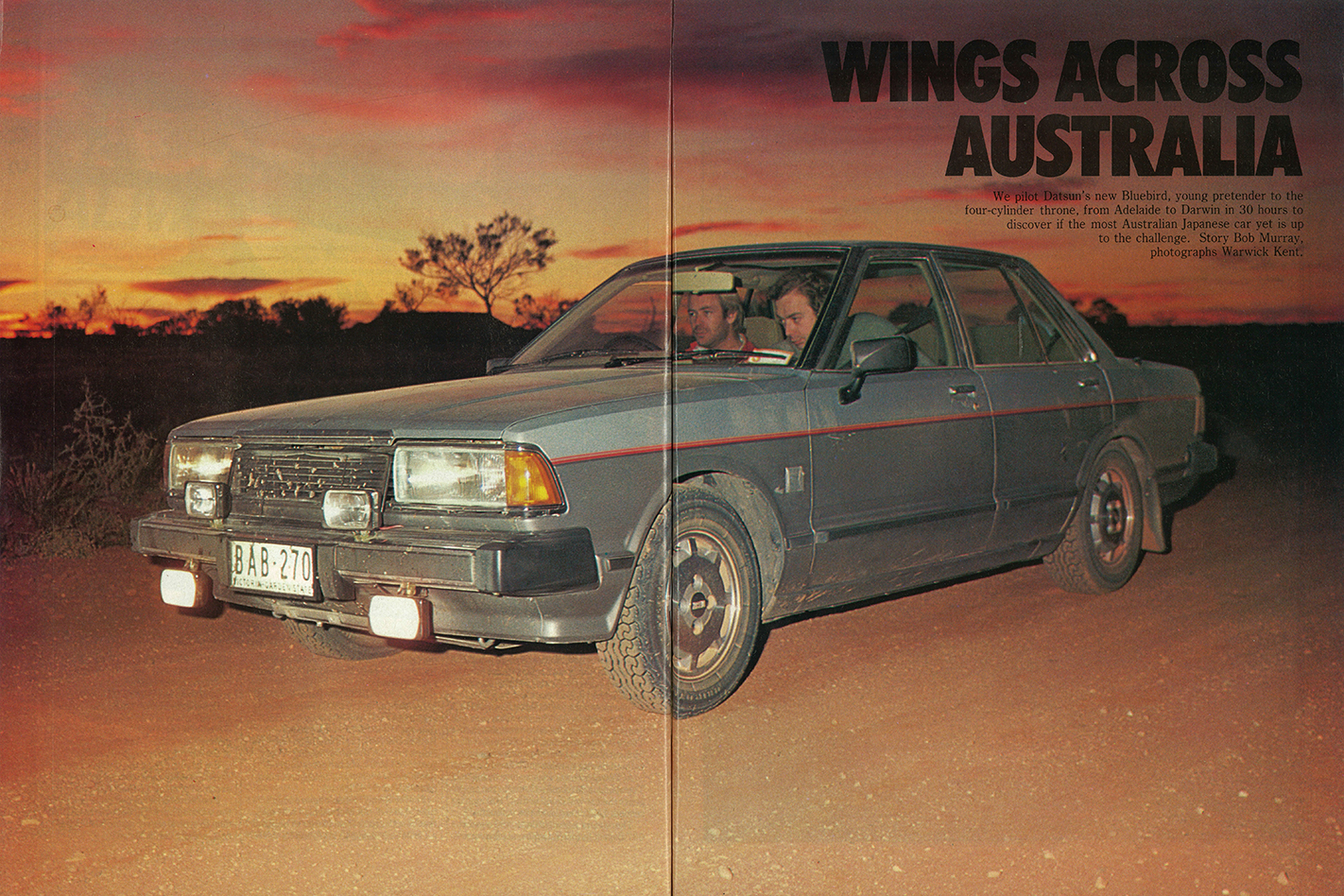
It’s 85 percent Australian for one thing. Only the body panels, five-speed gearbox for the top model and the rear axle are shipped to Nissan’s Clayton plant from Japan; the rest, including many locally designed parts like the legroom-boosting seats, are sourced in Australia. It’s the first time that Nissan here has gone for 85 percent local content with car number one. Usually – as in the 200B’s case – it starts at around 70 percent, working up to the magic figure with monthly increments. It’s not hard to imagine how such a policy could upset the Australianisation of a car. With the Bluebird there was no such risk, for the car was re-done in one hit, after many months and kilometres – some prototypes ran for 240,000km – of testing on the very roads in the middle of Australia that we were to attempt on the Adelaide to Darwin run.
We hadn’t done Adelaide to Darwin before, and the choice of the trip as a proving run for the most important new car to be introduced in Australia this year – Datsun is quite clear on the Bluebird’s intention: it is to become the country’s top-selling four-cylinder car – was straightforward enough, though there were variables to consider. Like the weather. With the amount of unsealed road on the way rain would have spelt an unacceptable extra hazard. We had to check petrol availability. We had to work out a schedule that would optimise 1 average speeds for each section (Whelan to the rescue). And we had to have a car. Datsun was 100 percent behind the trip from the start. Unstinting efforts on the part of PR man Don Alexander secured for us a Bluebird LX sedan with the five-speed and optional, and very comforting, power pack. Plus a boot load of the most common spares, two spare wheels and tyres and jerry cans for extra fuel and water. Plus the services of a fully-staffed and equipped workshop, ready to check the car and change wheels, at Alice Springs, the half-way point.
We had considered having long range fuel tanks plumbed in, but time was against us; so the $9750, electric-everything Bluebird that we set eyes on for the first time amid the churches of Adelaide was exactly the car you will buy -with the exception of radiator and sump guards, four driving lights and sticky tape over the badges of this “still secret” car. To the man walking his kids in the I Adelaide park: yes, this is your new 200B. We met at Sydney airport. Whelan, Warwick Kent – the bloke who took these ace pix – and me, on Friday, May 1, the day after my birthday, and the day after Matt was up all night finishing his new magazine, Your Computer. It was very definitely the morning after the night before. In Adelaide we checked into the poshest hotel we could find (thanks, Kerry) with the aim of getting our heads down while Warwick, who is never less than 100 percent, did the shopping. Dried fruit (30 hours later, only the prunes were left), devon, dry biscuits, pumpernickel, fruit cake, salami, flavoured milk and bottles of tonic water. Whelan had his own supply of tucker: on these occasions he subsists on a diet of Marlboro, Cocoa-Cola and Arnott’s arrowroot biscuits. In between trips to the well-stocked refrigerator in the hotel room, it took two hours to work out this shopping list.
We left Adelaide at 5.20pm local time, an hour and a half behind schedule and in the middle of the (thankfully light) Adelaide rush hour. Port Wakefield, Port Pirie and Port Augusta for fuel was the first leg, and we did this 311km stretch in not-quite-three hours for an average of 120km/h. We had watched the sun go down over Adelaide, and at Port Augusta as we pumped in 38.8 litres (to give 8km/l or 22.6mpg) it was quite dark. Exactly according to plan.
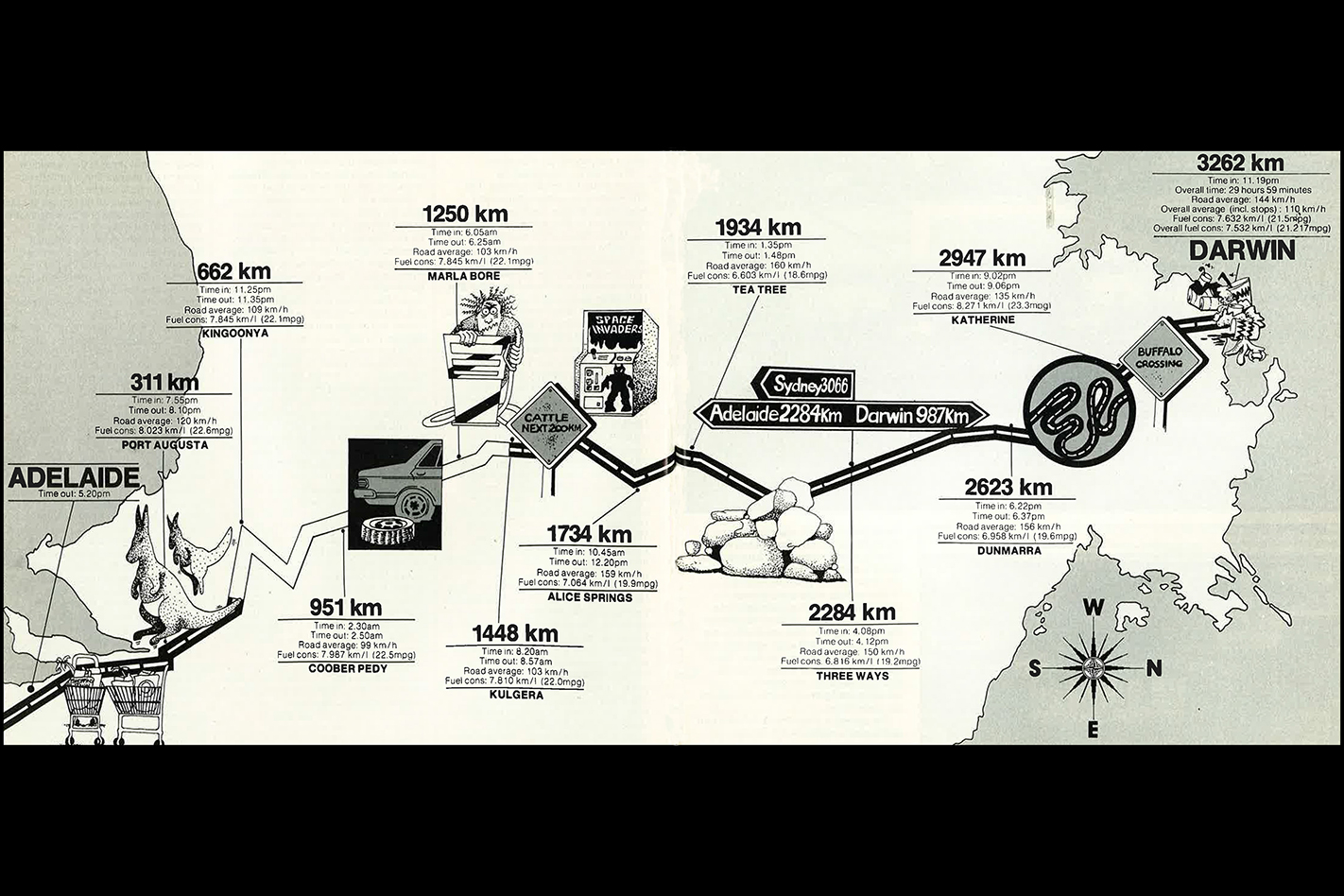
Now this plan was Very Clever. It involved leaving Adelaide at a time that would put us at the start of the dirt at nightfall, so that most of the rough stuff would be despatched under cover of darkness. There would be animals, sure, and there would be grumpy roadhouse owners who would be only too happy to relieve us of five bucks’ service charge for being woken at three in the morning in order to sell us some fuel. But with our extra lights we would be able to post average speeds not all that far adrift of the speeds we could expect if the currant bun were high in the sky: leaving the precious daylight hours for the good, bitumen roads later on when we would drive pedal to the metal and need every ounce of visibility. The occasional sleeping cow, insomniac wombat or somnambulistic ‘roo looks a lot better through the Ray Bans at 160km/h …
I saw my first kangaroo on the fast road from Port Augusta to Woomera. My first live ‘roo. We knew they were around for every few hundred yards there would be parallel strips of black rubber on the road, and a few feet after they had stopped, just as suddenly as they had started, there would be a patch of red.
Then there they were, standing at the side of the road watching us, waiting till we, too, had insufficient distance to stop securely before moving. We drove round the ‘roos a couple of times, and one, hypnotised by our lights’ beam, raced us up the road, but we didn’t hit one, nor even come scarily close to hitting one. I am eternally grateful.
At Woomera the bitumen ran out.
Several thousand suspension-pounding corrugations and about four corners later we were at Kingoonya, and it didn’t matter that beneath the Datsun’s wheels were dust and rubble. We still had a frightening distance to go on the dirt, but our spirits were up and even at this early stage the car’s superiority was clear to one and all; it wasn’t, after all, going to be a spine-jarring, bum-numbing, headache-inducing nightmare of a journey in just another poorly suspended Japanese car.
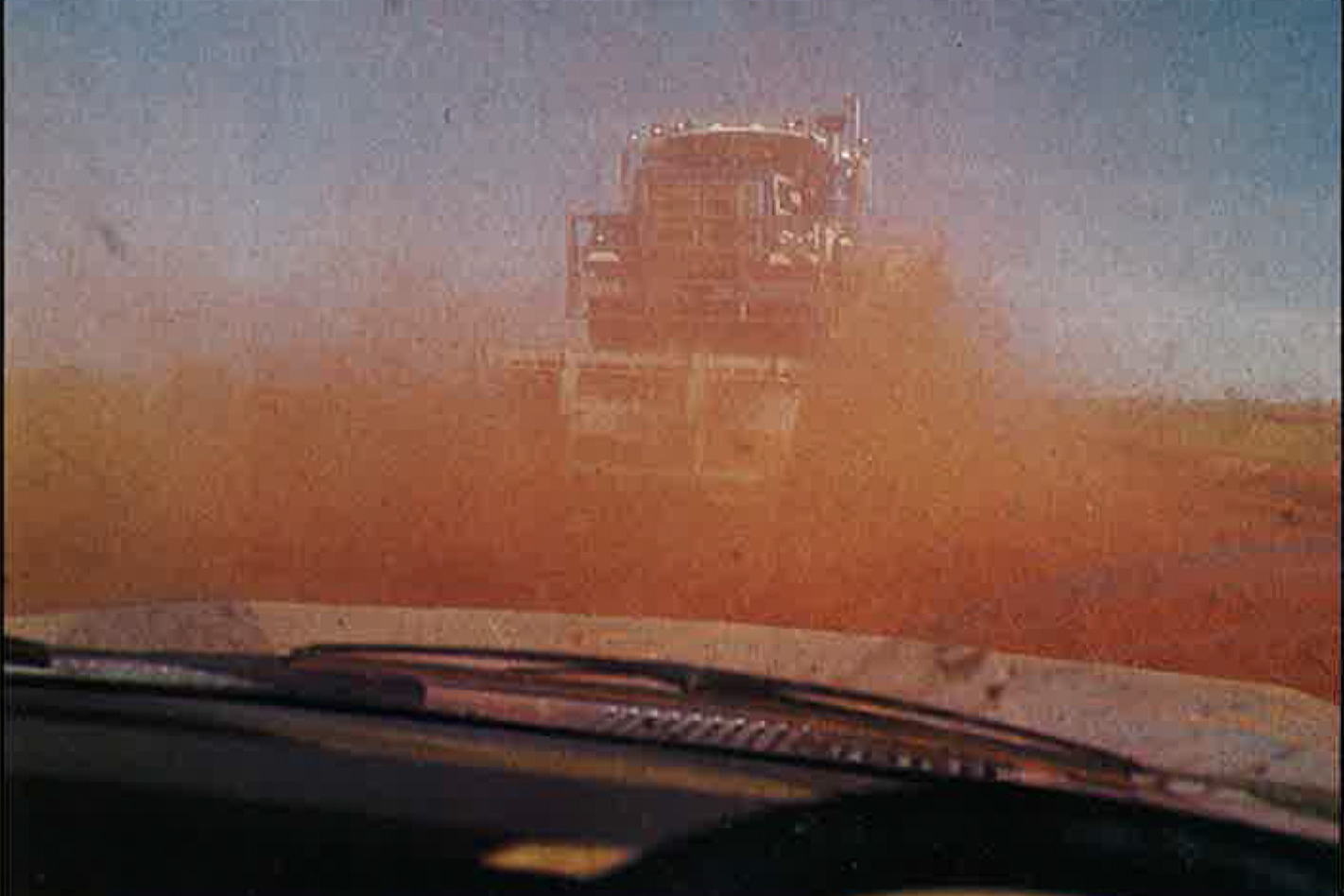
In between the road trains and the corners were the grids and the floodways.
I was instructed in a driving technique known as the Floodway Flick. Now there’s not much call for this in Sussex, but Matt and Warwick were patient and they explained all, emphasising that if the car was to reach Darwin without the front shockers sticking up through the bonnet we just had to meet any ridges in the road sideways. Gives the front suspension a better chance and makes it easier to do something drastic the other side if the road does something silly, like an abrupt U -turn, they explained. It was okay when the road surface was predictable but too often there were dead animals to drive around, or huge potholes, or bits of truck tyre, or dips full of soft sand, which all added to the … er, fun.
So there we were, travelling sideways for much of the time, often in the dust and stones wake of a roadtrain that would crush a car without the driver realising it, trying to avoid all sorts of tyre-popping debris and attempting to drink Coke and eat arrowroot biscuits, while the whole time keeping an eagle eye out for suicidal animals lurking in the bushes. London’s Hyde Park Corner in the rush hour comes close to this, but, gee whiz, that drive takes the biscuit.
At Kingoonya we turned right, one of only a handful of turn-offs. We arrived at 11.25pm and were away again with an extra 44.75L on board (average speed since Woomera, 98km/h; fuel consumption, 7.8km/L or 22.1mpg) 10 minutes later. We drove on over the dirt to BonBon, Mt Eba, Ingomar and Coober Pedy to post near-identical speed and consumption figures. There was less traffic now – a roadtrain, coach or car every hour instead of every 30 minutes – but the road was as surprising as ever, and we didn’t have enough visibility at the 120km/h-plus speeds that would be needed were we to up substantially our average. So we sat on 100 or so.
After filling up courtesy of one of the aforementioned sleepy-eyed roadhouse owners (it was now 2.30am) we zoomed past the handful of buildings that make up the visible Coober Pedy without hearing or seeing one clue to the thriving community below us. What a fascinating place this underground mining town must be, and I craned to see at least something to tell the oldies. But through the rear window there was only a swirling cloud of red dust, and ahead there was only a very lonely, mysterious darkness that shrouded the road that stretched for 450km into the distance to the border between South Australia and the Northern Territory and the start of the bitumen.
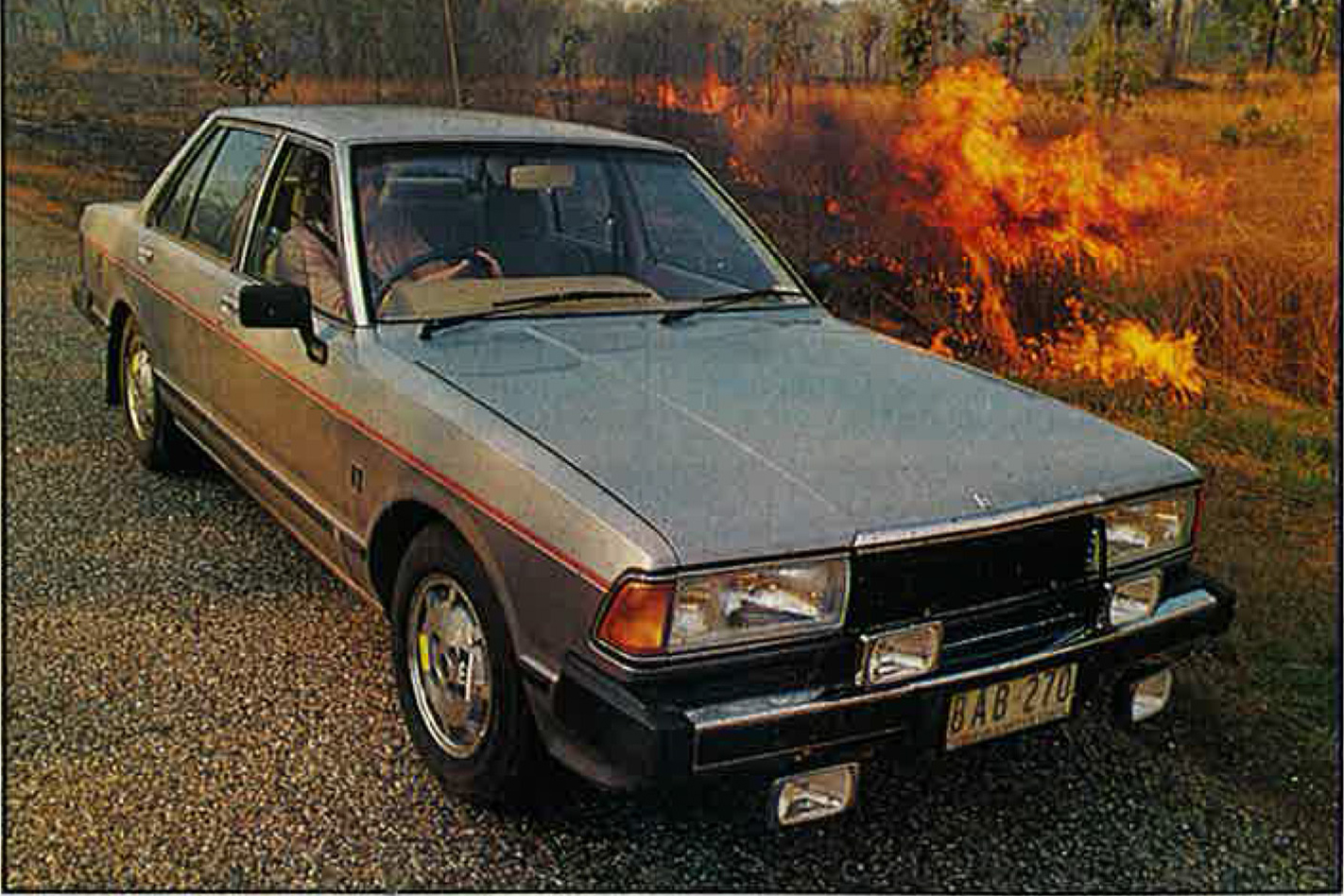
Before our next fuel stop at Marla Bore, 299km from Coober Pedy, we had our first flat. Matt was driving and he spotted it almost immediately – something that I, later on the return leg, was to realise as being a very difficult thing to do, as we manhandled a multi-holed, wheel chipped, red hot remnant off the rear axle. But Matt had picked this one early and it was changed easily. There was some dust in the boot but we expected that; short of being airtight, there had to be. There was dust in the car, too, we noticed that’s no reflection on the sealing or air conditioning, since we had inadvertently left a window open as a road train went by – a fine, red powder that lay in every crevice, coated every flat surface. It was in our hair, behind our fingernails, and on our salami and pumpernickel. But it didn’t matter. Not much, anyway.
We averaged 103km/h to Marla Bore and, with the help of a spectacular dawn, (look at those pix) another 103km/h to Kulgera. We stopped for a train and we stopped to let Warwick do his stuff, and, on the last section of dirt, we hit two floodway dips that I expected would crack the car clean in half. Floodway Flick to the rescue. I saw both of them far too late and the Bluebird, that poor Bluebird, went over them far too fast. I had braked hard to the last possible moment, I had twitched the car sideways and I had got hard back on the power to bring the nose up. But it was still a big crash, and I expected to see the shockers poking up through the bodywork at any moment. Once we had landed (gulp), and were fishtailing off up the road, we scanned the dirt behind us for the odd wheel or axle we might have left behind.
We saw the heat shimmering off the bitumen for about a km before the dirt ran out. We fixed our eyes on it: a solid, black line that spelled 160km/h and an end to the inescapable dust and corrugations. Then we were on it, and we rode in a Rolls-Royce all the way to Kulgera and the cold beer and the Space Invaders.
We were disappointed with the Kulgera to Alice Springs average speed for, at 159km/h, it was one kay less than it should have been. We made up for it on the stretch from Alice Springs to Tea Tree, however, when, full of hamburgers and new vigour, the accelerator pedal was clamped mercilessly to the floor for 200km and one and a quarter hours – exactly 160km/h and, surprisingly for a modern car, exactly 160km/h showing on the spot-on speedo. The needle of the big “econometer” at this stage was resolutely in the red, showing zero economy. That wasn’t quite true, for the car returned 6.6km/l (18.6mpg), the poorest consumption figure of the trip, though not unacceptably so.
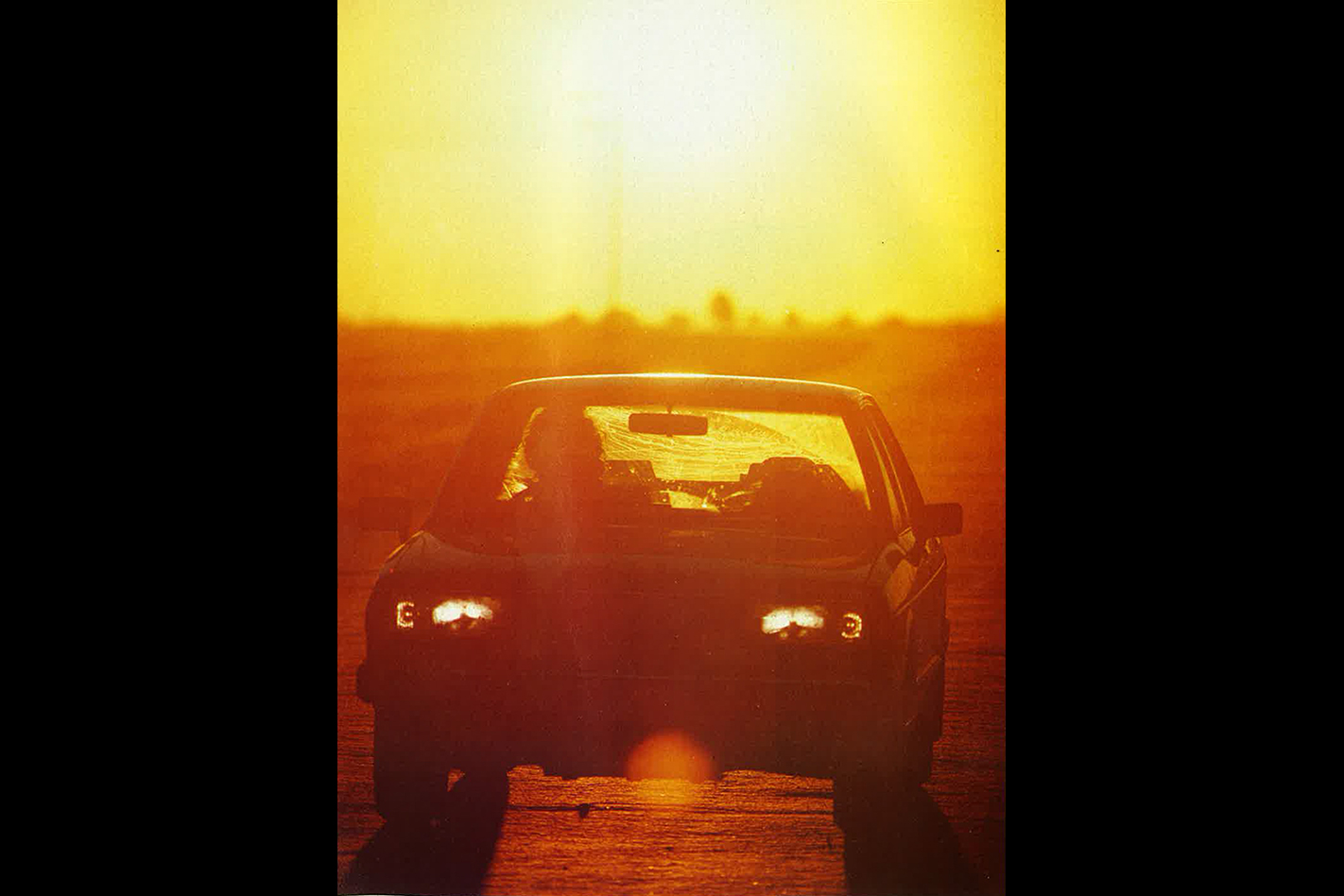
We arrived in Alice shortly before 11am and headed straight for the Datsun where a great bunch of blokes who had sacrificed their Saturday morning were waiting to check the car. Was there anything wrong with it, they asked? It hadn’t struck us before but, after looking at one another and scratching our heads, we realised: there was nothing wrong with the Bluebird. It had worked, and gone on working despite terrible odds, to our complete satisfaction. The car went up on a ramp and I expected to see the most awful damage to its underside, but there were only a couple of gouges in the sump guard as testimony to its thrashing. Apart from that, the paintwork-hiding dust and the two screws, one from a sun visor and one from the air conditioning that had fallen out, the car could have been driven to the garage from one block away.
With new wheels and tyres beneath us and all the fluid levels checked we aimed the Bluebird north on the narrow strip of road, with gravel run-off areas either side for passing, and watched the kilometres flash by. Over the Tropic of Capricorn to Aileron, Tea Tree, Barrow Creek, Wauchope and the spectacular Devil’ s Marbles rock formation soon after. To Tennant Creek, Three Ways (where we would turn left for Sydney on the return), Elliot, Dunmarra, Daly Waters, Larrimah, Katherine. There was the occasional sidetrack where the road was being worked on, and there were a few twisty bits, too, most of which the Bluebird would happily take flat out, but generally the road was fairly smooth, very straight and very fast. It was narrow, though, and in a car with poor stability and sloppy steering would have no fun at all. We had no such worries.
Suddenly we realised the pace we would have to set to reach Darwin by 11.20pm, the 30 hour mark. We hadn’t thought of the trip as being any sort of race or record breaking attempt, merely a long, fast drive with no unnecessary stops, the odd game of Space Invaders apart. But now it seemed that 30 hours was a reasonable target to aim for, and we went for it. At the garages one of us put in the petrol, one paid for it and filled in the log, and the other cleaned the windscreen and the lights (by now the mesh radiator guard looked like a lepidopterist’s prize exhibit).
At Katherine a very determined Matt took the wheel after a commanding stint by Warwick and we left the roadhouse four minutes after arriving and scorched past the “Danger – Water buffalo on road” signs for the last leg to Darwin, a beer, a shower and bed.
At 11.19pm, 29 hours and 59 minutes (it’s true, it’s true!) and 3262km, 2026 miles, since Adelaide, Matt drove one very dirty Bluebird into Darwin. We looked at the palm trees, gazed towards the Timor Sea and drove around town for 20 minutes looking for the centre, till we realised we were in it. The brass band that should have been there to welcome us had obviously got lost, we reasoned. It was too windy for a firework display and the Mayor, we supposed, was elsewhere engaged. It would have been nice, however, if somebody, anybody had said well done chaps! Welcome to Darwin.
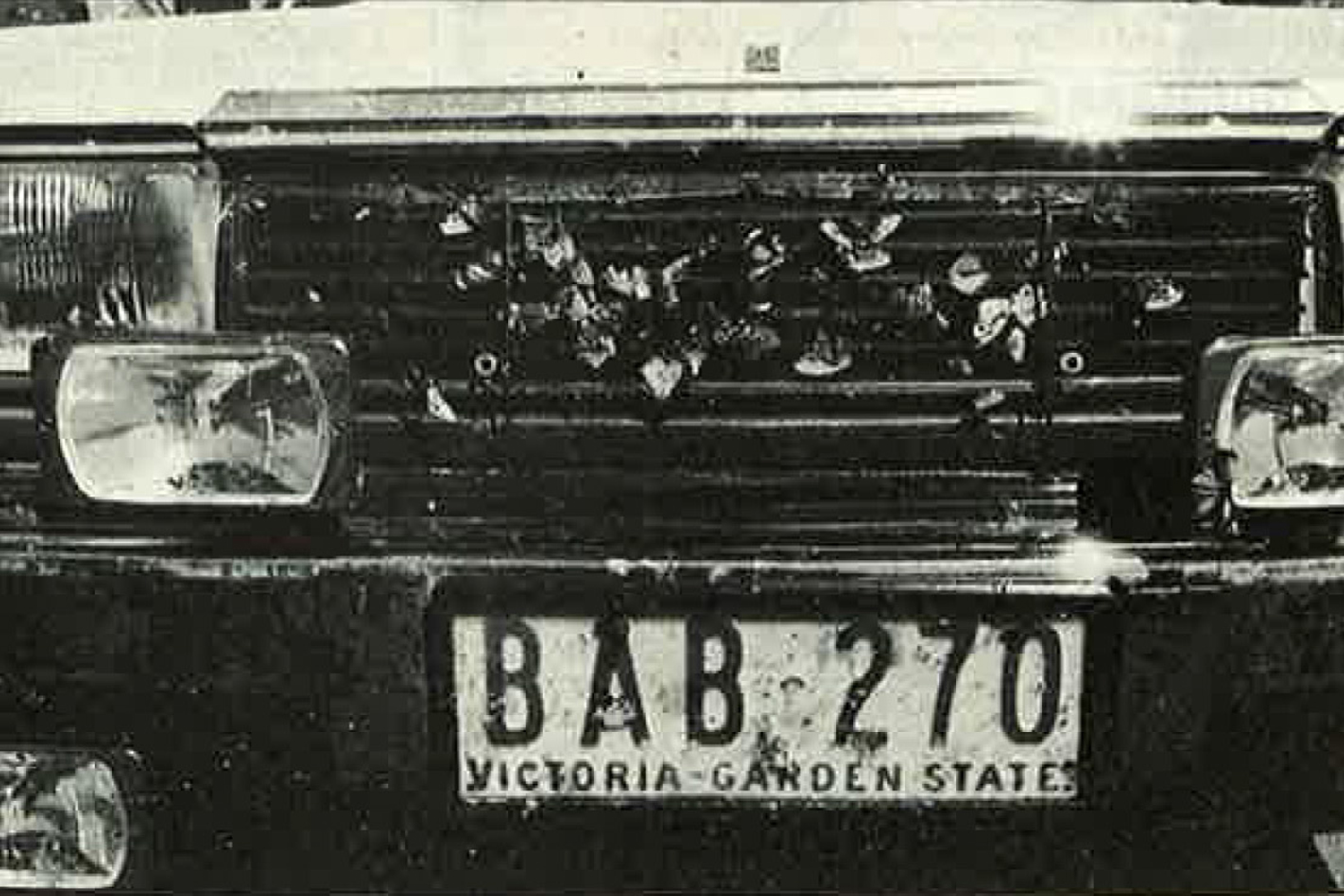
We took ourselves off to the motel at Fannie Bay. We saw the bay, but of the other there was no sign.
The next day we put Matt Whelan and the two Tequila Sunrises inside him on an aeroplane for Sydney, and Warwick and I set course for Katherine again, and our overnight stop. From there we went to Three Ways, turned left, and reached the mining town of Mount Isa in time for dinner. From here, incredibly the biggest city in the world with an area the size of Switzerland, with sunshine for 360 days a year and with Australia’s biggest thirst for beer, we took the only partly sealed Landsborough Highway to a charming town called Longreach.
We left Longreach at 8.30 in the morning and we reached Sydney, 1800km away, at 11pm. We hadn’t intended to do the journey in one go, but we reached Bourke in good time, went on to Nyngan, thought what the hell and cruised through Dubbo and Orange, and then at Bathurst we saw a Highway Patrol car and knew we were home.
If we had harboured any doubts about the car that last journey would have shattered them. Comfort, quietness, security – all the important things about a car that allow you to travel long distances safely and enjoyably were evident with every kilometre. Yes, the engine feels a little gutless in the mid ranges; yes, the drivetrain still lacks the refinement of a good European car; yes, the car moves around on bumpy straight roads, and, yes, headroom in the front is tight. But, really, these criticisms are to salve the motoring writer’s conscience; we do, after all, have to earn our living and criticise something.
It’s not anywhere near being perfect, but, by heaven, the Datsun Bluebird is a good car. You may think this story is more about a journey than a car, but you would be wrong, for it is all about the car. All about a car which all three of us enjoyed; a car which any one of us would be willing to take on that same journey again tomorrow. I think that’s probably the best thing I can say about the Bluebird.
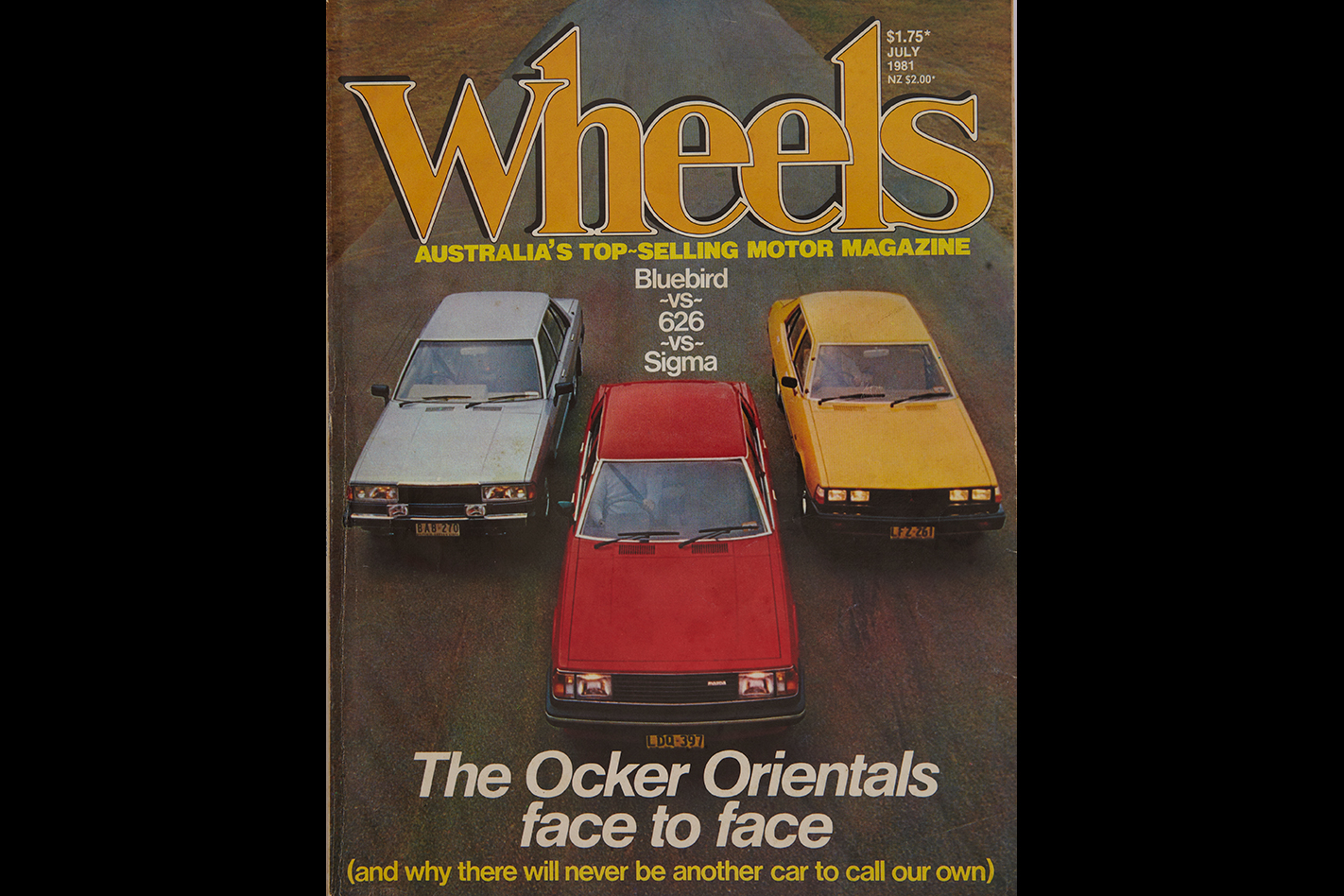
‘Wings Across Australia’ originally appeared in the July 1981 edition of Wheels.
When it comes to sheer acceleration no production vehicle with four wheels can match the Bugatti Veyron.
However, as a drag race organised by Super Street magazine revealed, things are different when you include vehicles equipped with handlebars.
Known as the Ninja H2R and built by Kawasaki for circuit use only, the Ninja H2R is said to be the fastest production bike in the world. And while the 240kW/165Nm from its supercharged 1.0-litre(!) engine might not sound like much to a supercar enthusiast, those outputs have to motivate only 216kg.
That’s 1046kW per tonne. A figure the Veyron would need 1974kW to match, or 1079kW more than its quad-turbo W16 produces with a ‘Super Sport’ tune.
Numbers are numbers, though, and the disparity on paper could change when translated to the real world; would a Veyron’s grip advantage and aerodynamics give it a fighting chance against the H2R?
Luckily, Super Street’s video gives us the chance to find out…
Get your free weekly report from the world of fast cars – subscribe to the MOTOR newsletter!
Toyota Australia wants a replacement for the TRD HiLux and reckons the new generation chassis can handle more grunt.
Tradies with a performance bent apparently loved the 225kW supercharged V6 model that was developed locally by the Toyota Racing Division (TRD) and launched in 2008.
The hi-po ute was a rough-and-tumble example of more engine than chassis, but in some ways it was ahead of its time.
With the 2016 HiLux – the first fresh generation of the top selling ute in a decade – the company has in development prioritised a huge increase in body rigidity, steering response and chassis refinement.
Car-like behaviour is what new ute customers apparently want, and that plays into the hands of those wanting a sportier ute offering.
At the same time, the ute market is enjoying a boom at the upper end of the pricing realm – meaning $50K-plus, right where the old TRD HiLux was positioned.
“It’s one of those things that has grown dramatically and continues to do so,” says Toyota Australia executive director marketing and sales Tony Cramb of the expansion in popularity of pricier utes.
“That’s exactly where we’ll be going with [new HiLux] and that’s not only the growth in our sales, that’s also the growth in the market.”
So will there be a performance HiLux replacement?
“There’s always calls for that actually, there appears to be a latent demand for something like that,” tells Cramb
“It’s calls from the market, from the customers who talk about such a thing. I think the HiLux TRD was really well accepted actually and so we understand there’s a demand there for small volume of a variant like that.”
Toyota Australia has been pushing those messages to Japan, and says if a performance version were to become available it would “absolutely without question” import it to this country.
Even though the brand reckons the new chassis is right up to the task of handling more power than the 4.0-litre petrol V6 and new 450Nm turbo-diesel four-cylinder range toppers deliver, Cramb cautions that there is no performance variant on the cards yet.
“We’re constantly talking to TMC about different model lineups but it all becomes a question of engineering resources and how to apply it,” he adds.
When the Commodore and Falcon performance utes go the way of the dodo inside three years, there could be an opportunity for Toyota there. Would you be interested in a TRD HiLux replacement?
Click here to read the full range review of the Toyota Hilux
Get your free weekly report from the world of fast cars – subscribe to the MOTOR newsletter!
The first all-new Toyota Hilux in a decade fires back at the Ford Ranger and Holden Colorado with loads of new spec and 3500kg towing capacity
THE prime position of the Toyota Hilux as Australia’s most popular ute looks set to be strengthened thanks to a raft of specification upgrades that the all-new model will bring when it goes on sale in October this year. It’s a shot across the bows of its facelifted Ford Ranger and updated Mitsubishi Triton competition, as well as the new Nissan Navara.
Most importantly, Toyota has addressed the glaring shortfall of the current Hilux by ramping up the maximum tow rating to 3500kg from the current model’s 2500kg, and therefore matching its main rival, the Ford Ranger, and others including the Holden Colorado and Mazda BT-50.
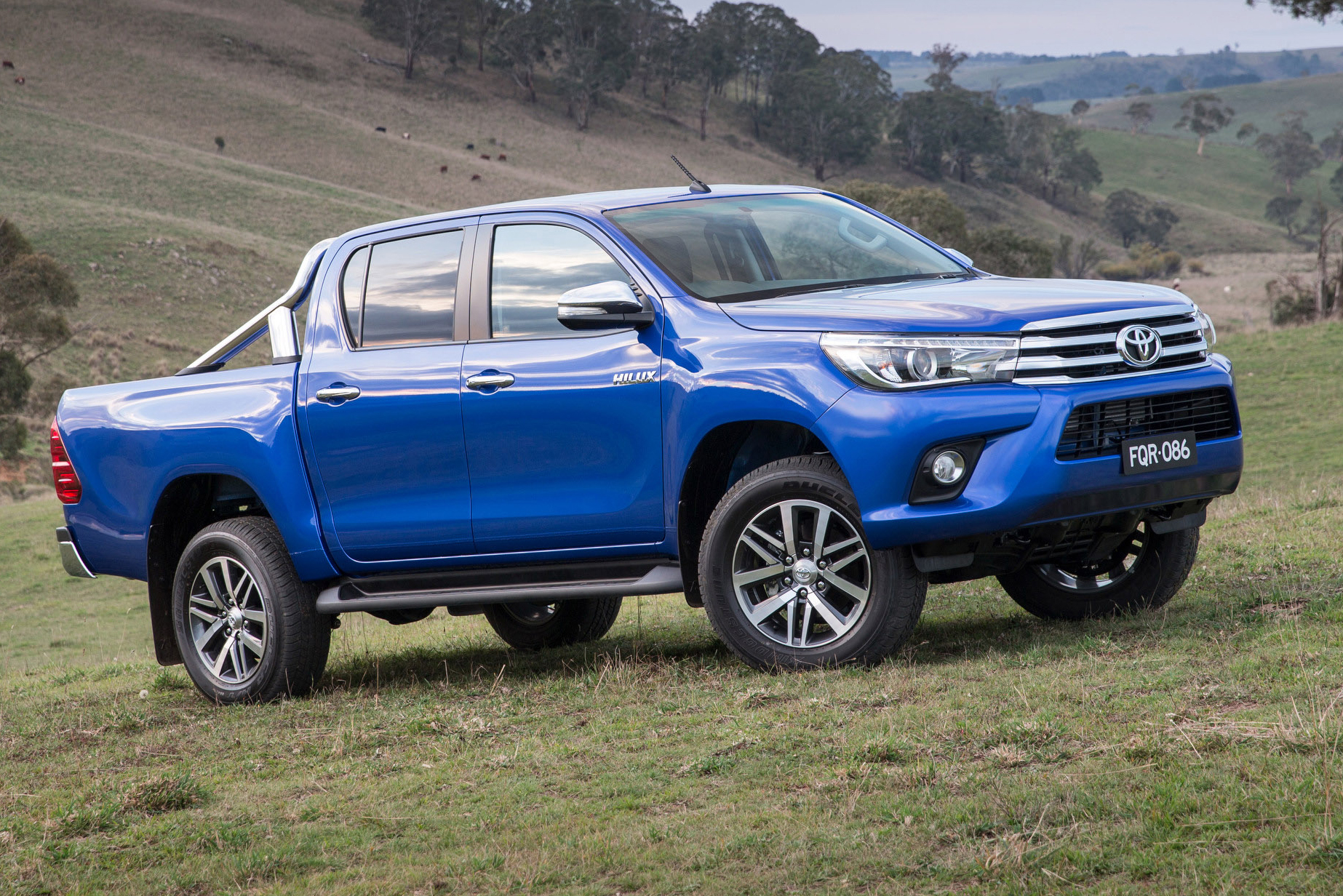
The new Hilux also brings safety upgrades right across the range for all variants, including the single-cab models, with no fewer that seven cabin airbags, as well as a reversing camera and electronic stability control, which is currently not mandated for light-commercial vehicles such as the Hilux. Toyota expects all variants to achieve a maximum five-star ANCAP safety rating when tested.
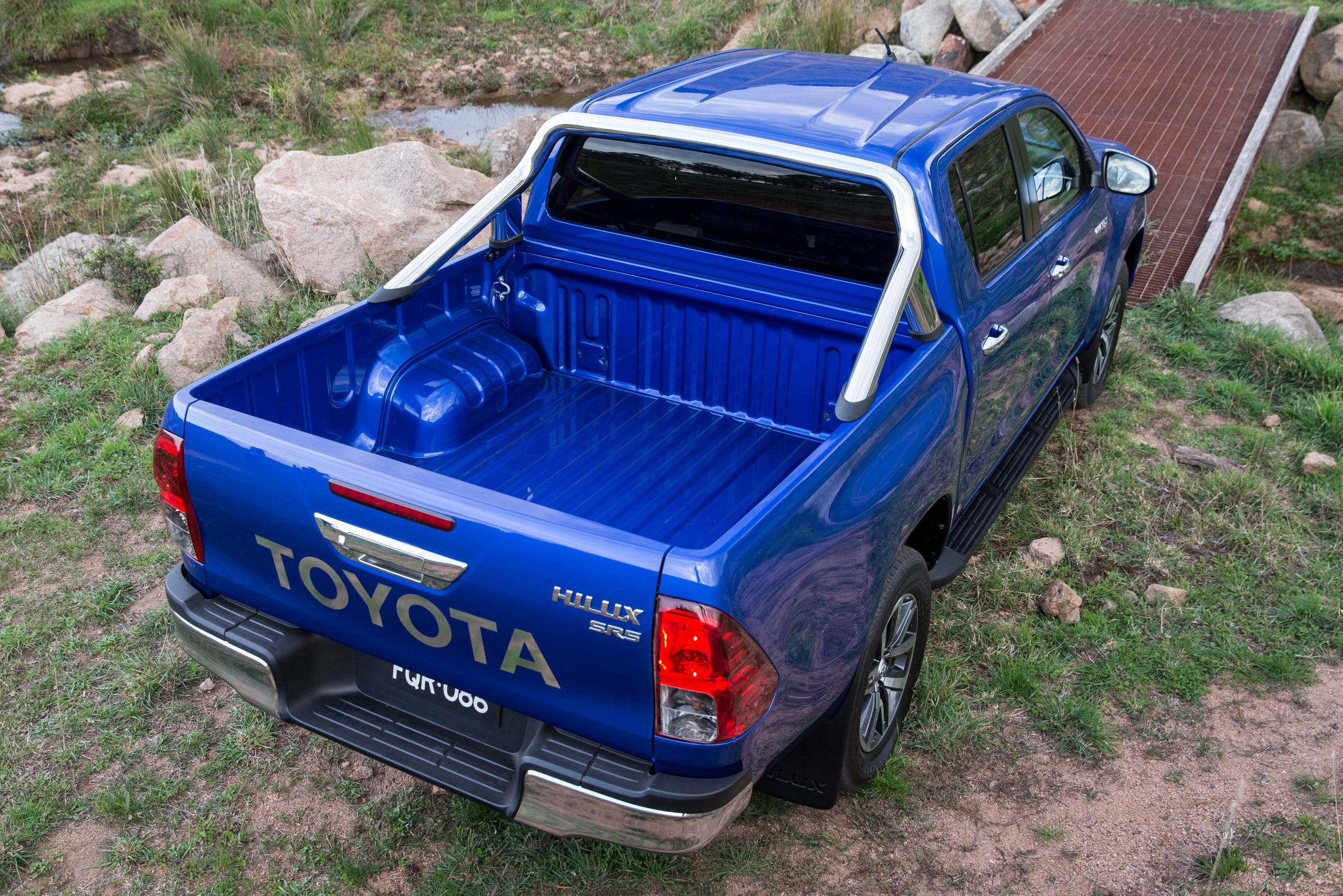
The new Hilux will go on sale with no fewer than 31 guises, nine more than currently offered with most of the model-range expansion through extra 4WD and dual-cab models, an area where the market is expanding. Dual-cab 4WD utes are now default family vehicles, having overtaken 4WD wagons in popularity.
As well as offering both 2WD and 4WD, the new Hilux will come with the choice of three cabins; single, extended and double, and in three equipment grades, Workmate, SR and SR5.
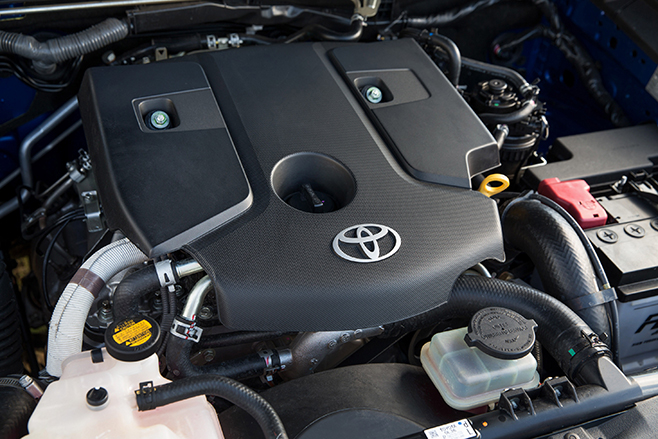
The current 4.0-litre petrol V6 will also be carried over in a limited number of 4WD models while 2WD models will be available with an all-new 110kW/400Nm 2.4 litre diesel and a revised version of the current 2.7-litre four-cylinder petrol engine.
While Toyota has shown the new model with a static reveal, the interior of the Australian-spec Hilux has not yet been shown.
Stuck to the front cover of the May 2004 issue of MOTOR was a CD-ROM. For our younger readers, a CD-ROM was basically a crappier version of a DVD, a relic of a time when Facebook was restricted to a handful of US Ivy League colleges and the best game you had on your phone was Snake (and it was good!).
Anyway, on that CD-ROM were teaser videos from that year’s Performance Car of the Year, and amidst all the skids and smoke one video stood out above all the others. It was of a small grey blob slowly emerging through shimmering heat haze, travelling flat-out down an airport runway. Then the noise begins.
It starts as an indistinct buzz, but grows in intensity and volume until its high-decibel wail mimics an incessant air-raid siren. It was this video that indelibly burned the E46 M3 CSL into my teenage consciousness, yet 10 years on the key to that very car sits in my hand.
Why is it here? Well, we’ve decided to take the worn-out cliché ‘don’t meet your heroes’ and throw it in the bin. We plan to revisit some of the greatest cars from MOTOR’s history and see whether time has caught up with them or if they can still teach the new crop a thing or two. As always, correspondence is welcome, so let us know your nominations.
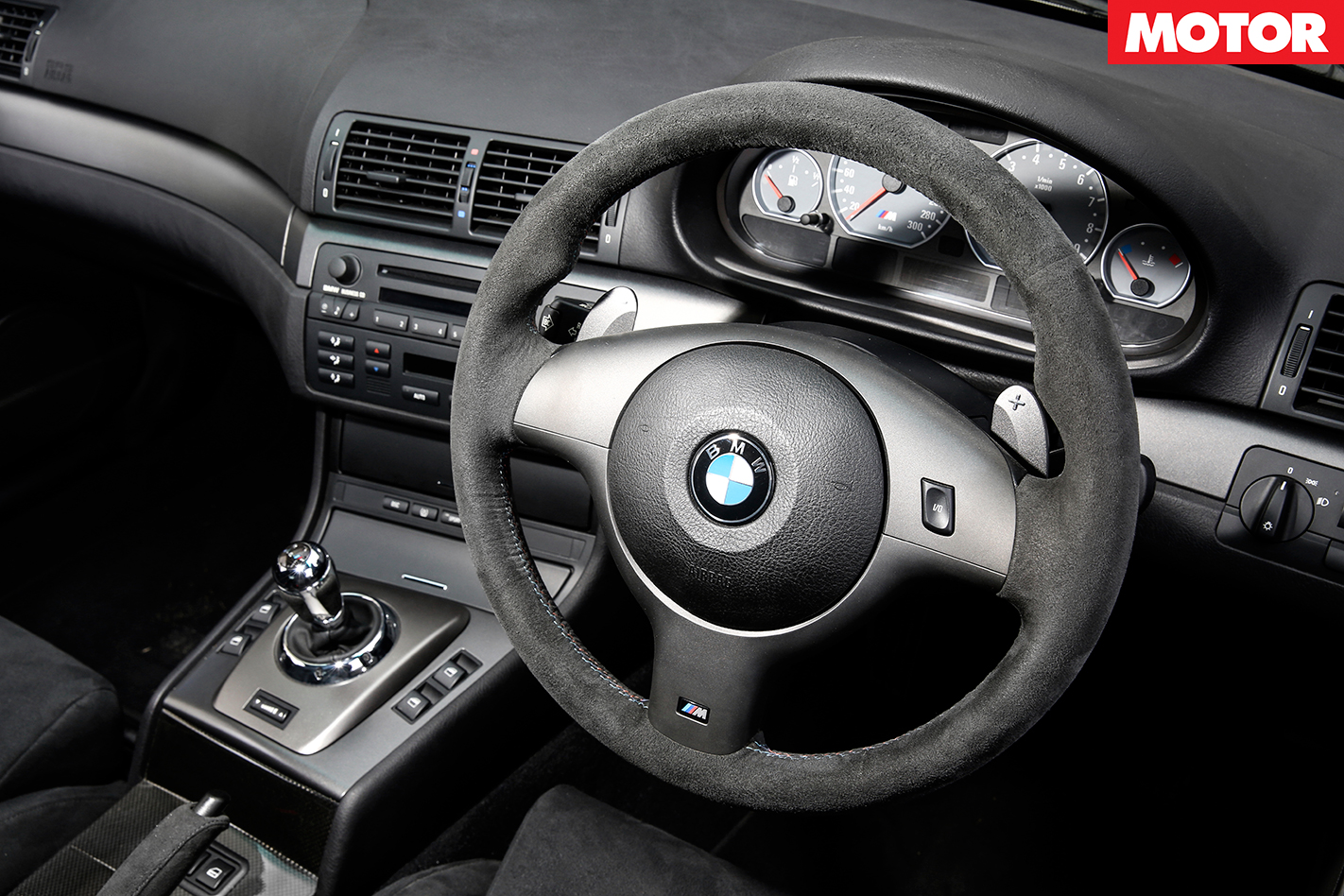
The M3 CSL came second in PCOTY 2004, just pipped by the phwoar-factor of the then-new Lamborghini Gallardo, but the fact we’re driving the original press car proves we’re not the only ones with a soft spot for the CSL. Regardless of how rare or expensive they are, once their publicity duties are done most press cars are simply sold on to waiting customers – there’s little place for sentimentality in the cut-throat automotive business.
Twenty-seven CSLs made it to Australia through official channels, but only 26 made it to customers. CSL BM3 remained at BMW HQ, making occasional display appearances or, once in a blue moon, being re-registered to venture out into the real world. Thankfully, today is one of those occasions.
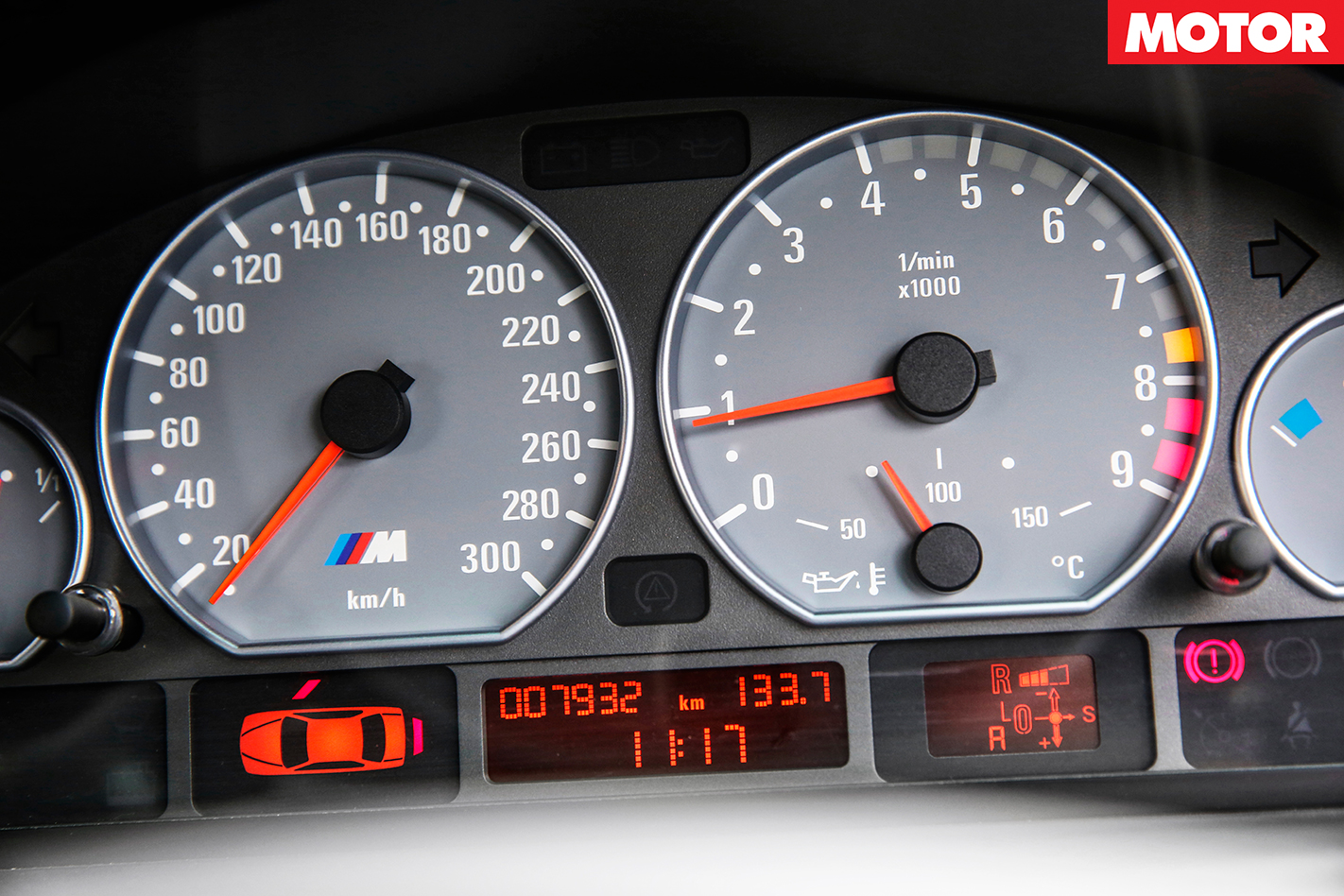
Despite having done the press rounds, including appearing in MOTOR three times, the CSL shows less than 7800km on the odo when we pick it up. It looks small. Parked next to a new X5 that is perhaps unsurprising, but a check of the dimensions shows the E46 is within a whisker of an M235i, merely 44mm longer, 6mm wider and 39mm lower.
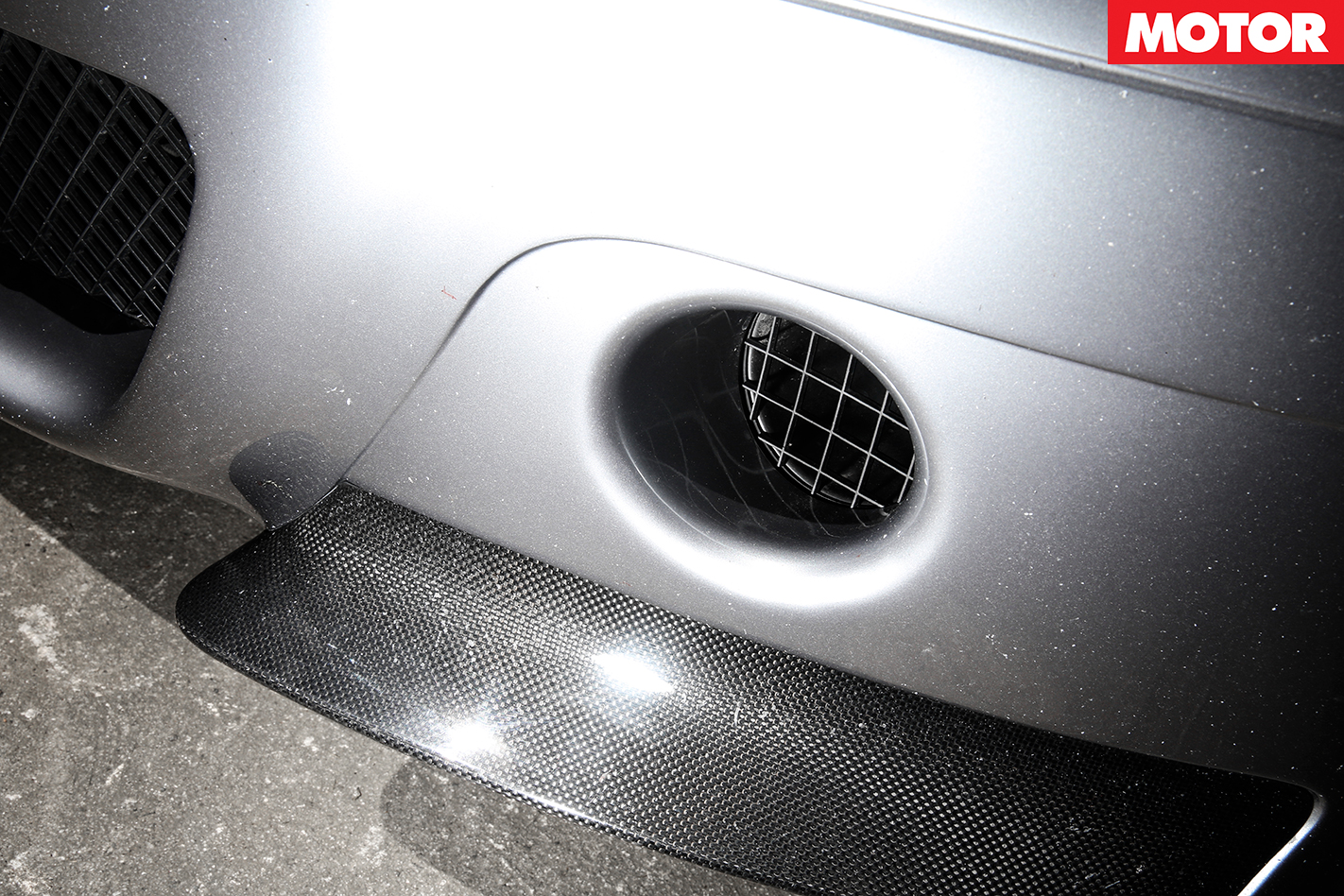
It also looks remarkably subtle. It may have exuded hardcore menace in its day but we’ve become so used to outrageously flared guards, bodykits and fancy black weave that the CSL’s trick carbon fibre roof, front splitter and the asymmetric hole in the front bumper (which we’ll come back to) barely register on the aggression scale.
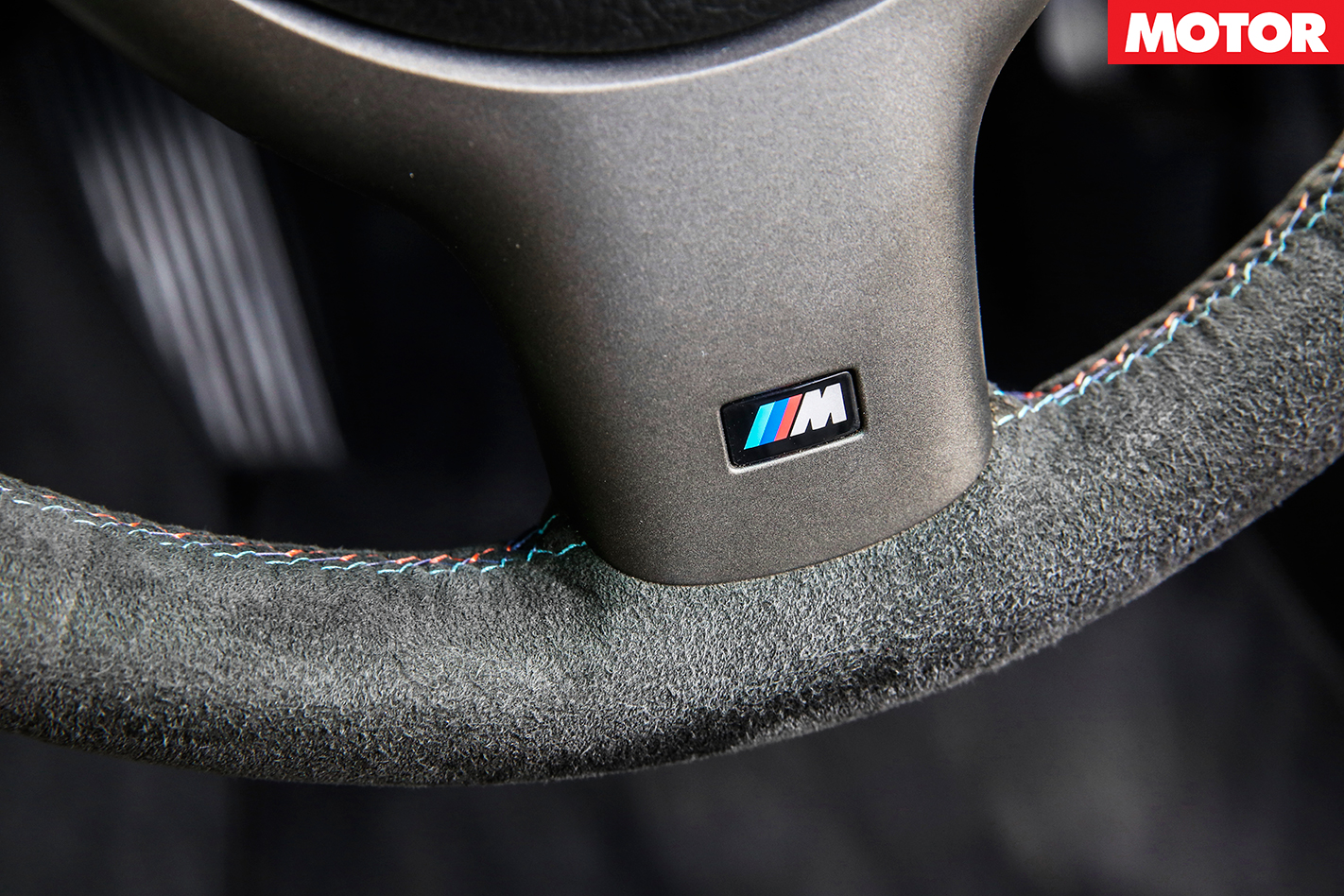
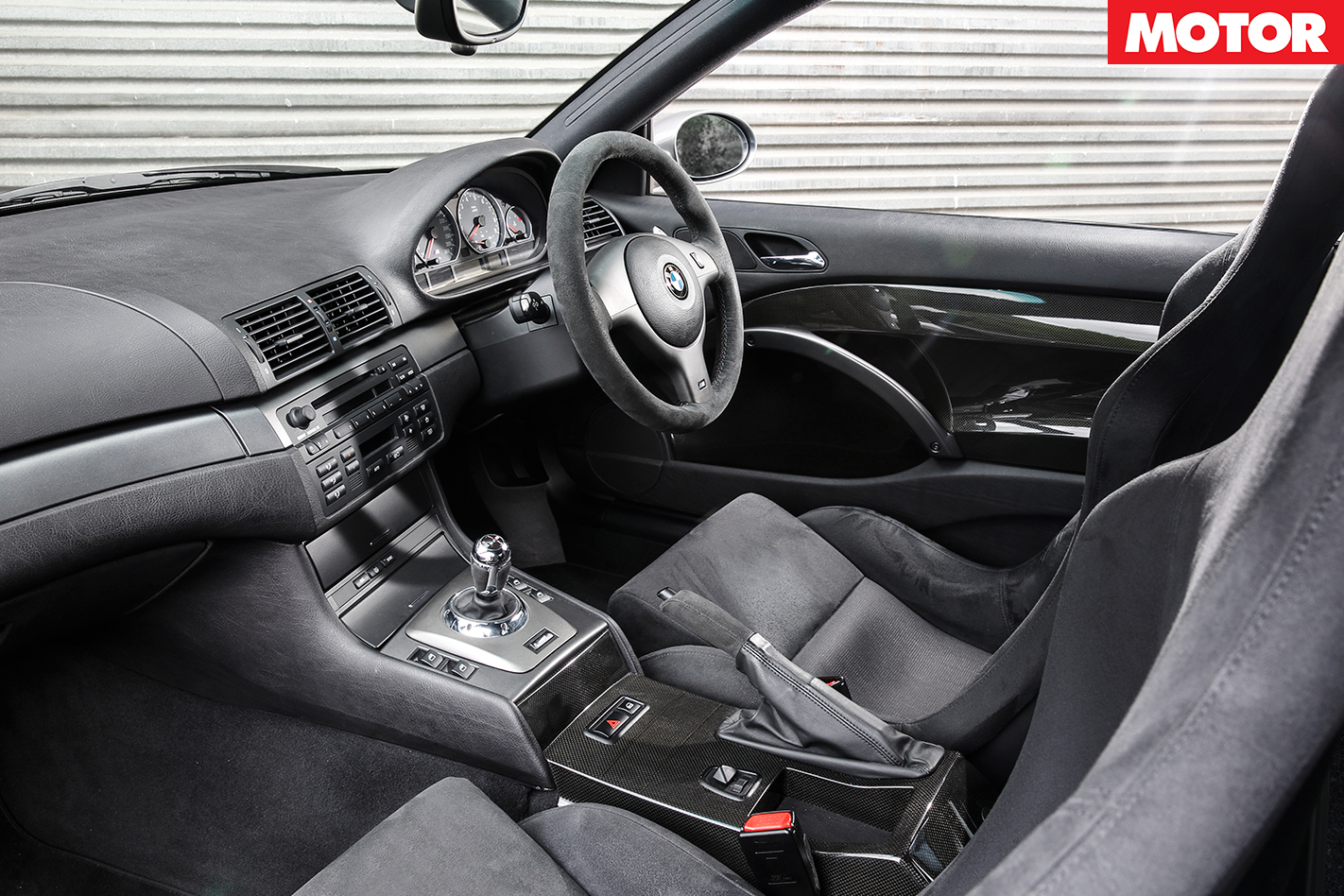
The biggest difference between a regular E46 M3 and the CSL, though, can’t be seen at all. Thanks to a severe diet, the CSL cuts a whopping 110kg from the kerb weight of a regular M3. Some of the thanks have to go to those lightweight body panels, but the interior is even more extreme.
Carbon fibre adorns the door panels and centre console; manually-adjustable, fixed-back, fibreglass-shelled buckets sit in place of the standard electric items, the boot floor is made of fibreboard and the stereo and air-con were no-cost options (both thankfully fitted to this car).
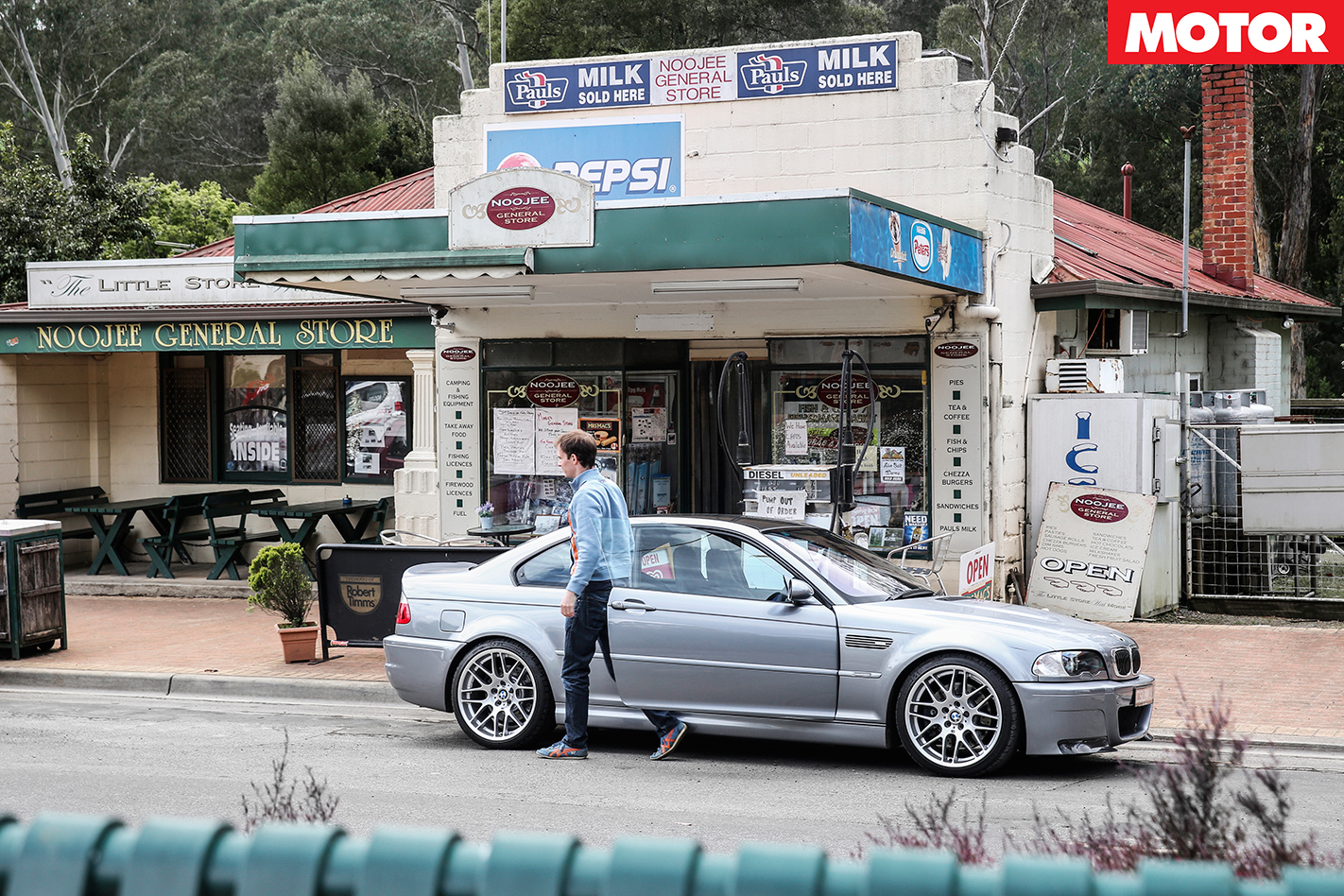
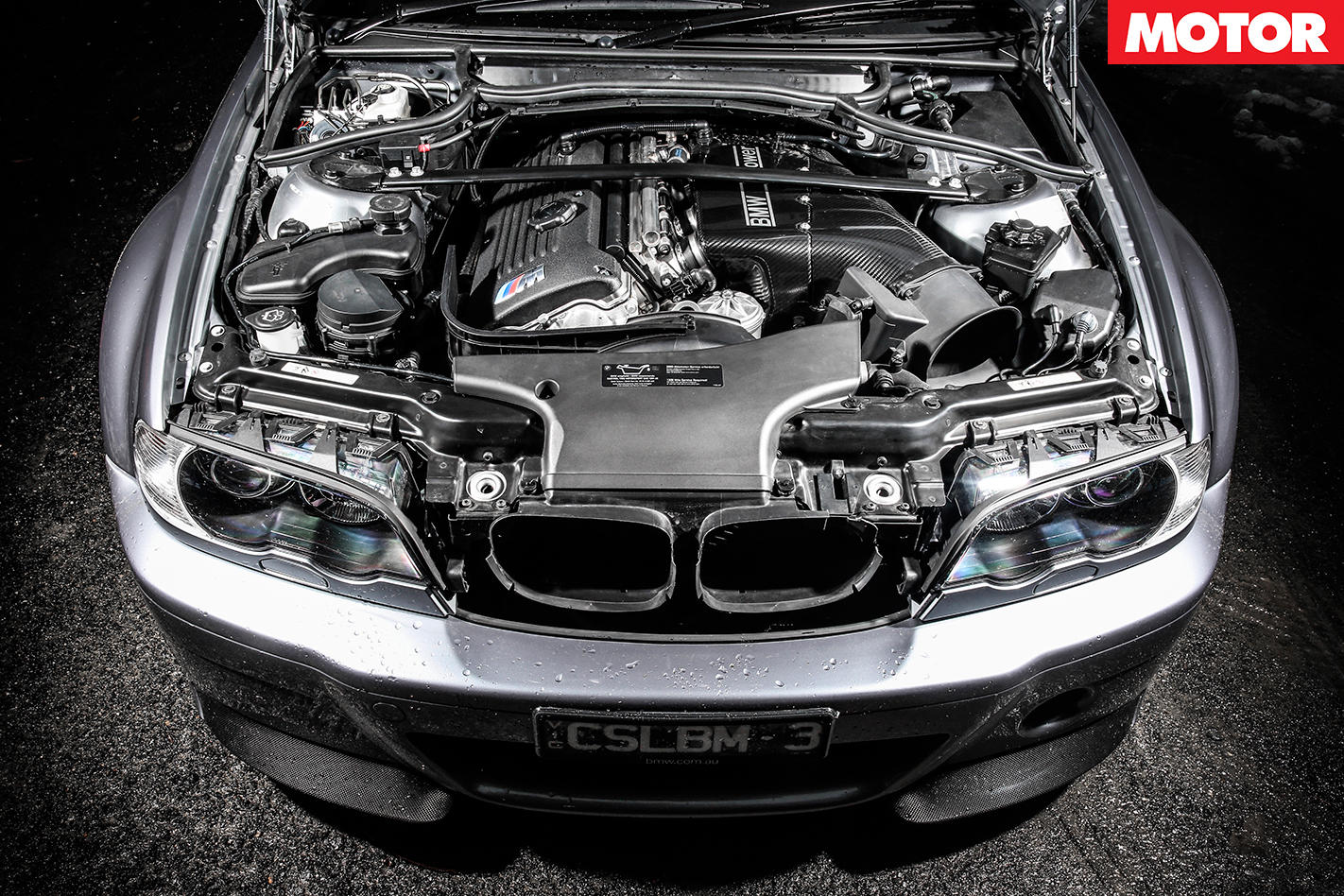
It wasn’t just about taking stuff out, though. Slightly different cam profiling and the mother of all carbon-fibre intake manifolds boosted power by 13kW to 265kW at 7900rpm; the steering rack ratio was quickened from 15.4:1 to 14.5:1; springs and dampers were both modified and larger brake rotors were fitted front and rear. Oh, and if you produced a CAMS C3 circuit licence BMW would up the speed limiter by 30km/h to 280km/h.
Then there were the tyres. Wrapped around lightweight 19-inch BBS alloys were extreme Michelin Pilot Sport Cups measuring 235/35 up front and 265/30 at the rear. Never before had such uncompromising rubber been fitted to a production car. Customers who ticked the ‘Cup tyre’ box were required to sign a disclaimer stating they understood the tyres probably wouldn’t work in wet or cold conditions.
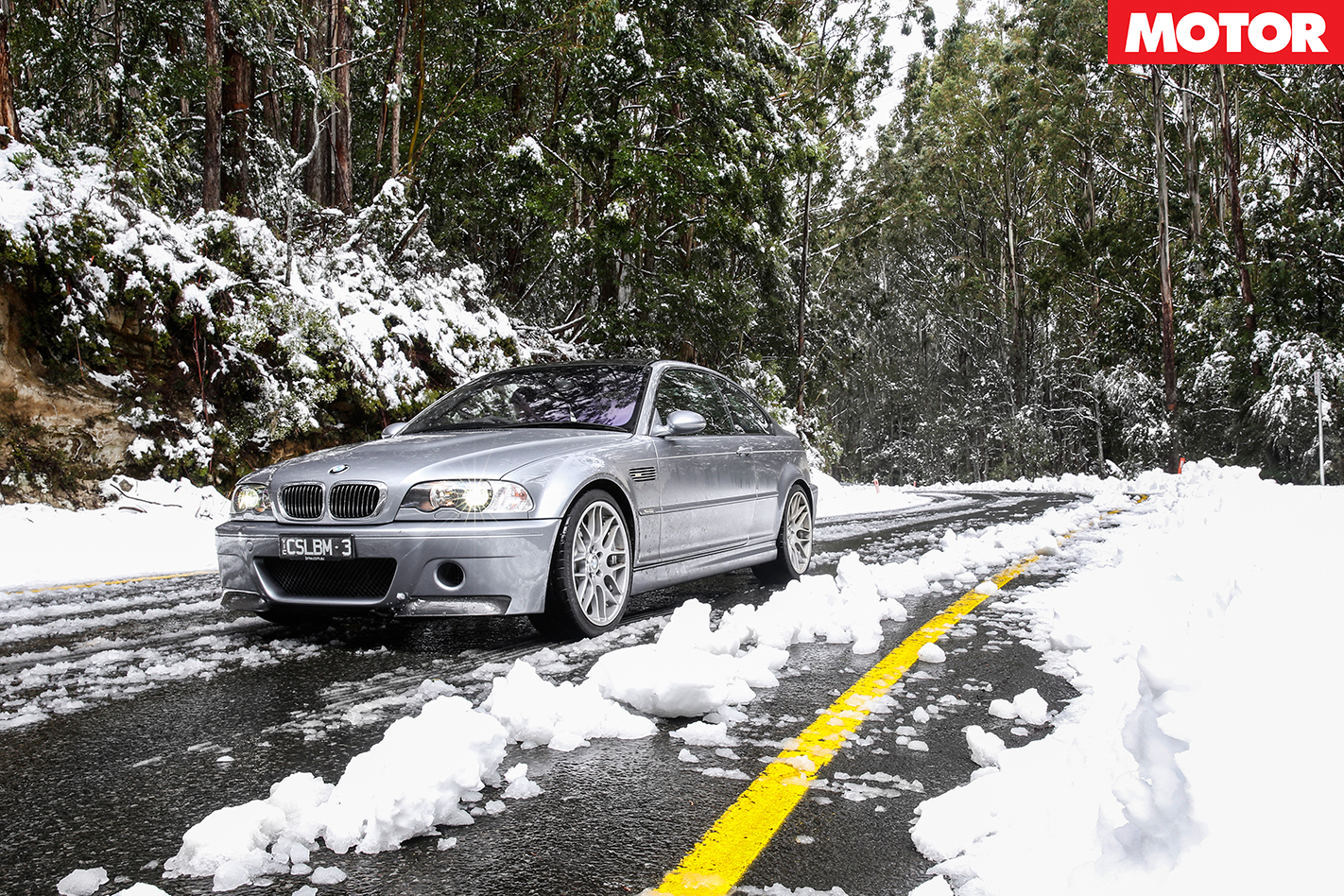
A decade on, the super-sticky rubber has been replaced by more conventional Michelin Pilot Super Sports. While it’s a shame not to be able experience the CSL in its raw, unadulterated original form, a threatening sky means the more conventional Super Sports lower the heart rate somewhat.
Ironically, the first part of our journey, snaking through outer Melbourne’s morning traffic, could be the CSL’s toughest test. As a hardcore driving tool it should do the maximum attack stuff standing on its head, but what about the everyday commute? The steering is heavy at parking speeds but lightens on the move (just as it should) and the low-speed ride is firm but not particularly uncomfortable. But what of the dreaded SMG? Well, at the risk of getting a clip around the ear from Morley, it’s fine.
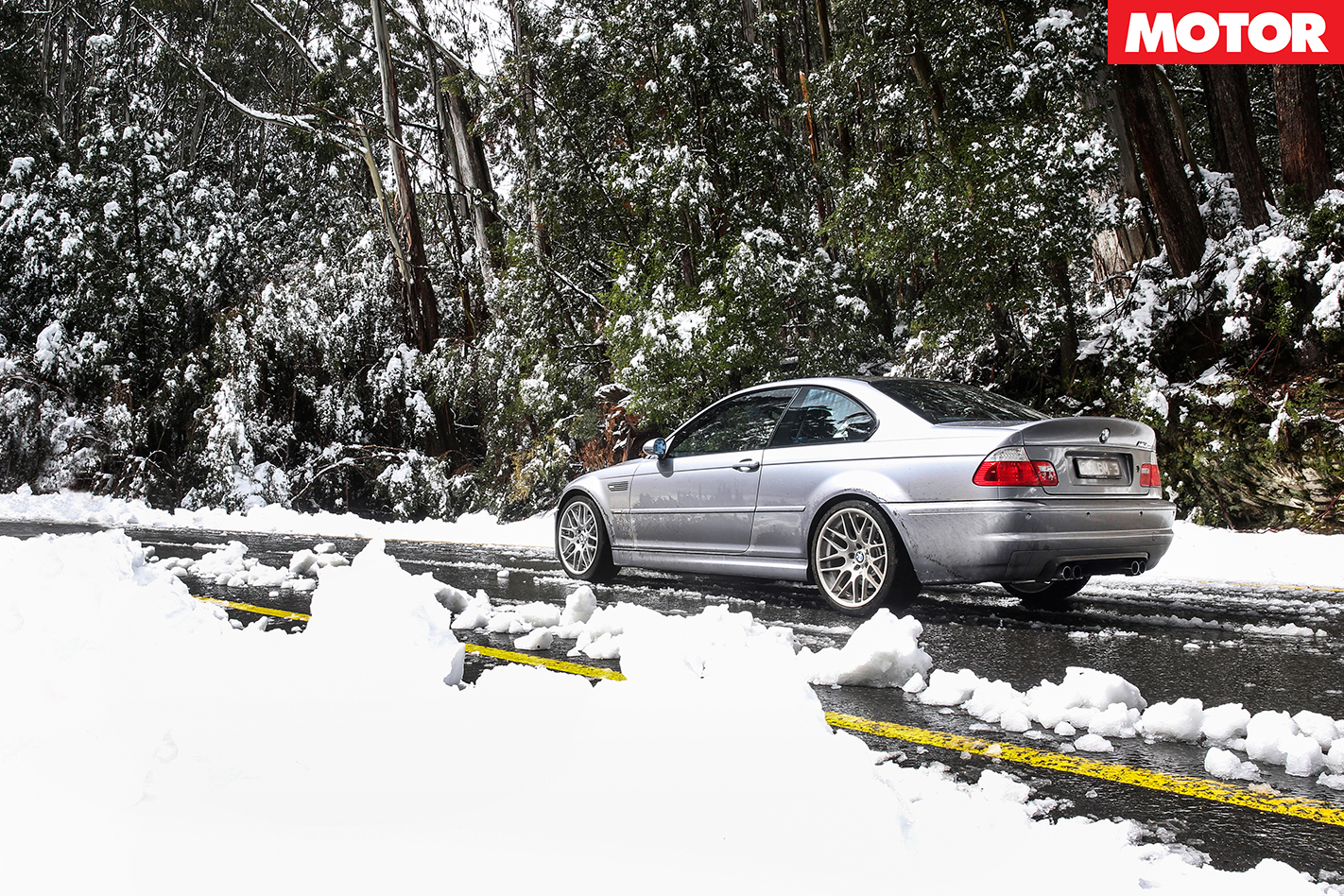
Sure, it lacks the instant shifts of a dual-clutch or the slurring smoothness of a good automatic, but treat it for what it is – a manual gearbox with a computer taking care of the clutch – and progress is pain-free. The key is to feed the throttle in smoothly from rest and make sure it’s made a gear selection before applying extra power. Then again, you could make the argument that if you’re going to drive it like a manual, why not just have a manual? And you’d have a good point.
Once clear of the city, the speed limit lifts to three figures and the road begins to twist and turn. Now we find out if the spectacles are rose-tinted or crystal clear; it doesn’t take long for the first impressions to start filtering in.
It’s immediately apparent that grip levels have come a long way in 10 years. Obviously, without its race-bred original tyres the CSL won’t have the grip it once had, but even so, this isn’t a car in which it’s difficult to find the limits, front or rear. Attempt to take a corner in the M3 CSL at the same speed as you would in, say, the new M4, and you’ll find yourself upside down in the crash barriers faster than Pastor Maldonado.
The incessant strobing of the DSC light means it’s also time to trust in the M3’s famed chassis balance and go it alone. It seems strange in the OH&S world we now live in that one simple press of a button can disable everything, but the simplicity is welcome. On dry roads traction is plentiful, though at high rpm power oversteer is there for the taking.
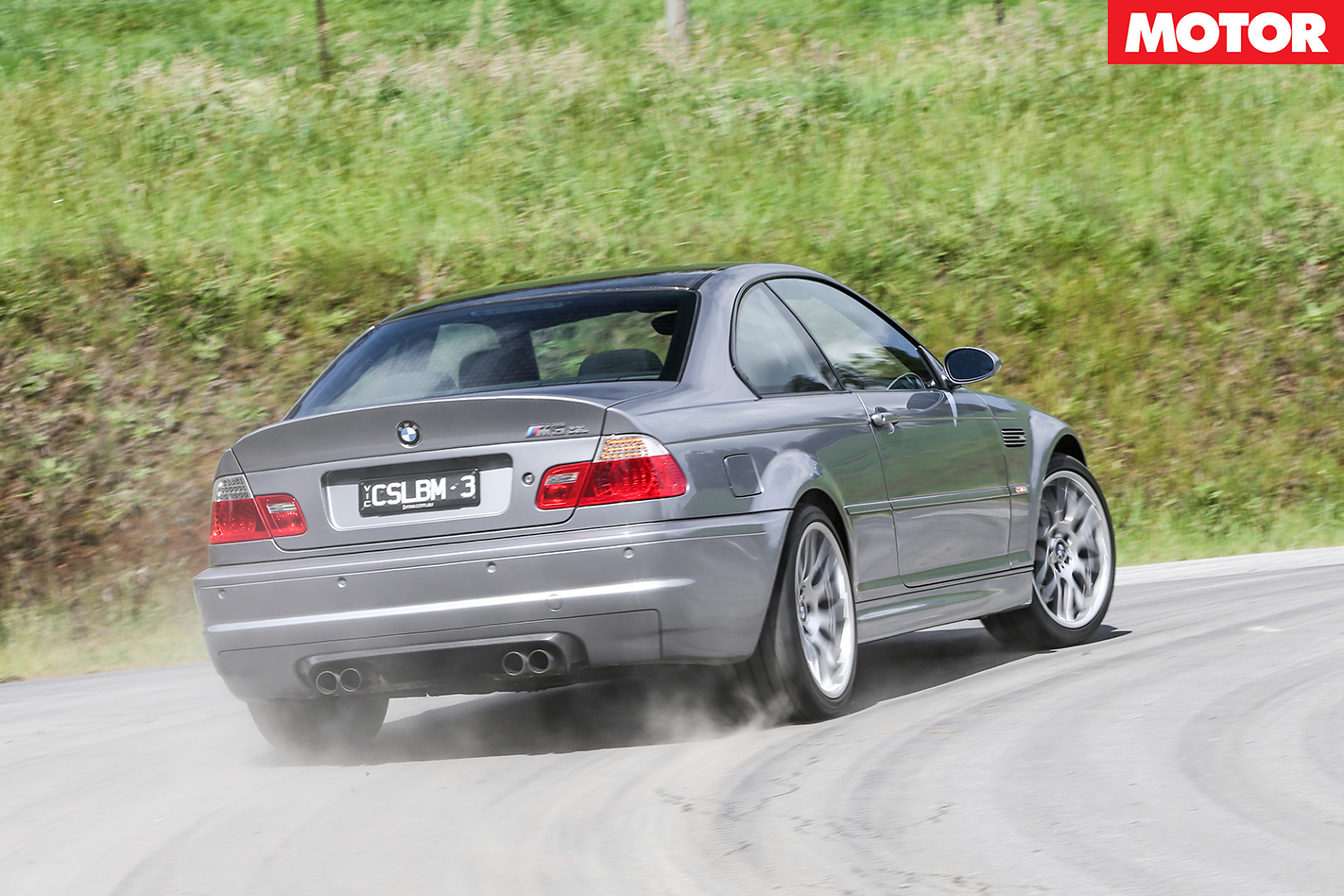
As we move further into the mountains, the weather closes in, the roads become damp and the game changes. There isn’t a whole lot of communication from the front-end; road tests of the time put this lack of feel down to the semi-race rubber, but even on more road-biased tyres you only really sense understeer when the front tyres start to judder and slip wide.
In the wet wheelspin is never far away, but it’s not the vicious flare-ups caused today’s over-torqued turbo monsters, more a slight over-rotation of the rear wheels as the engine howls into its power band. Of course, give it a healthy dose of throttle and you quickly see why no E46 M3 test was complete without the obligatory drift shot.
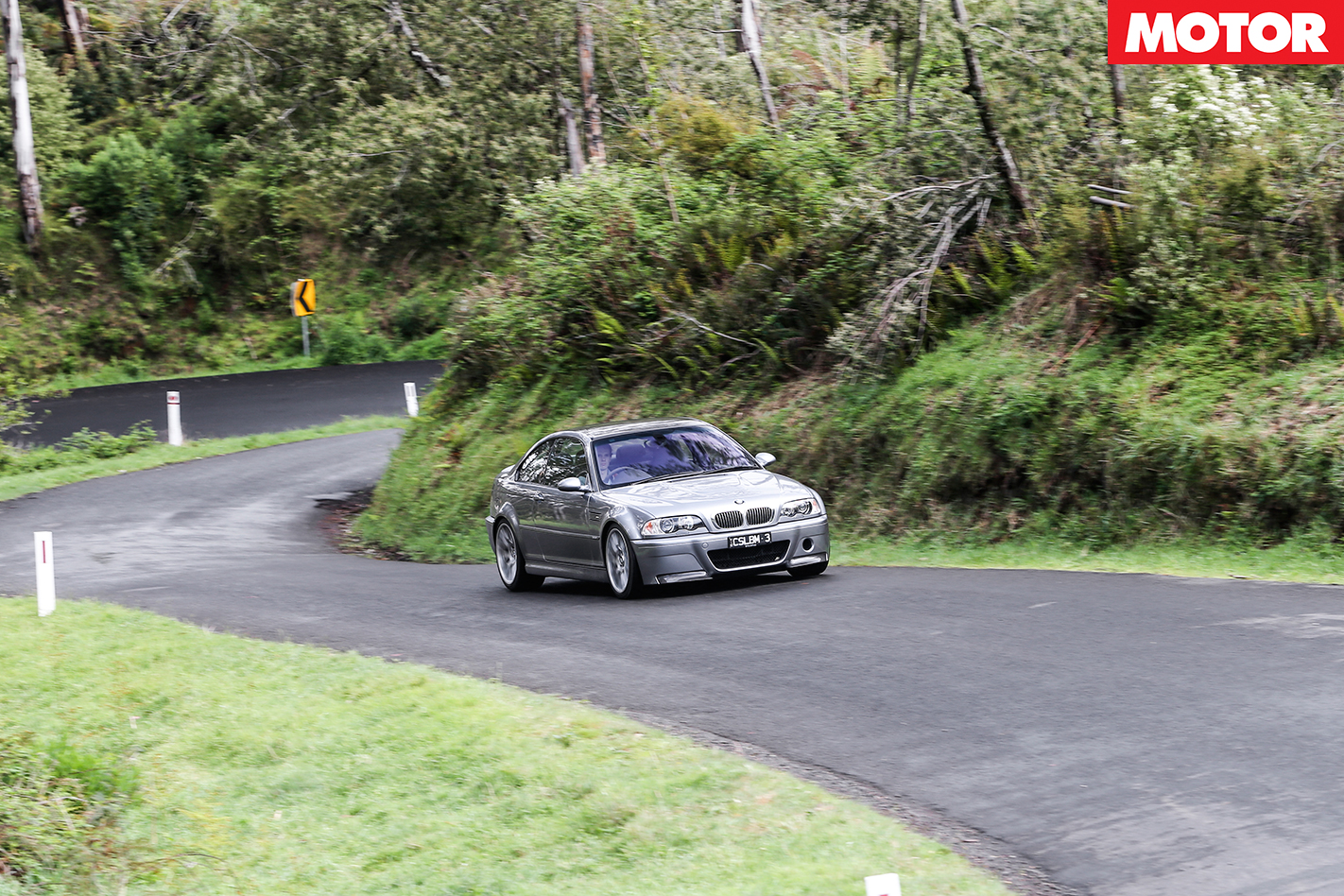
At no point, though, does it become a problem – you can exercise minute control over the CSL like you’ve possessed it with The Force. Key to this control is the synaptic connection between your right foot and the engine. It allows you to meter out exactly the amount of power you need and play the wonderful S54 3.2-litre straight-six like a musical instrument. Which, in a manner of speaking, it is.
Drop to low revs in third, floor it and CSL reveals its party trick, slowly changing in timbre and increasing in volume as the tacho needle sweeps around to the 8100rpm cutout. Back in ’04, Stephen Corby described it as sounding like “a Formula One car with a sore throat” and it’s a description upon which I can’t improve. No ‘sound symposer’ is required when that tennis ball-sized hole in the front bumper is feeding litres of air into the bucket-sized air intake.
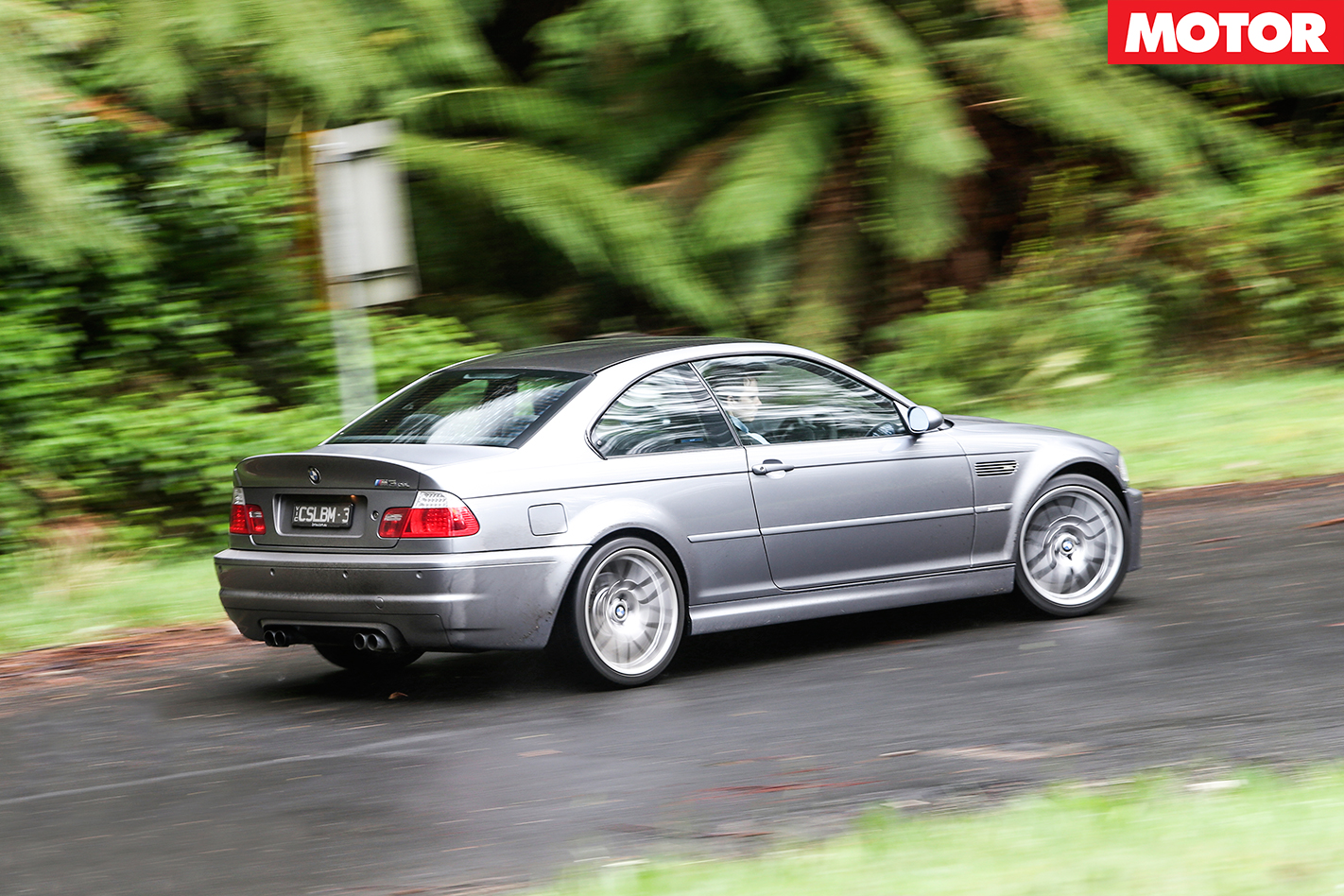
With a full day’s driving to build confidence, the CSL finally has a chance to show what it can do in the dry and over the next 15km burns itself into my subconscious for another reason: by being one of the finest cars I’ve ever driven. It has that knack of rewarding you the better you drive, yet also making you feel like a hero by responding to exactly what you ask of it.
Certain allowances do have to be made, though. With the car loaded up mid-corner, any bump will crash through the car into your spine with a force that varies from uncomfortable to wince-inducing.
Never having driven a standard E46 M3, there’s also a nagging suspicion that despite all the praise, the regular car may be just as good? But then I remember the CSL was seven seconds faster around Eastern Creek than the standard M3. Even if the Cup tyres were worth two or three seconds a lap, that’s a big difference.
Some of you may question the relevance in driving a 10-year-old car, but the CSL is a stark reminder that, while cars become faster, more comfortable and capable – ‘better’ in a purely objective sense – there’s an intangible magic that’s being lost along the way.
With a carbon tub, bare-bones interior and no power steering, some would argue that the Alfa Romeo 4C is already as hardcore as the German film industry.
Not us. We reckon there’s room for an even more extreme version, a GT3-inspired track day special that takes full advantage of the 4C’s ultra-stiff carbon credentials and mid-engined layout.
It’s the perfect project for Alfa Romeo’s new ‘skunkworks’ division, a small engineering team headed by two senior Ferrari staff and created to give Alfa back its performance edge.
The team is dedicated to developing advanced, innovative engines and unique technical solutions, and the 4C is the perfect base on which to practise their craft.
The standard 4C weighs 895kg (dry) and is powered by a 1.75-litre turbocharged four-cylinder with 176kW and 350Nm.
Its no-frills specification means there isn’t much we can do about the former, but there’s scope for improvement in the latter.
The 4C’s biggest frustration, though, is its handling, an area where it should excel. Inconsistent steering response and unresolved on-limit behaviour frustrate, with understeer the order of the day on track. Easily fixed, we reckon, and this is how.
Engine: Alfa has already confirmed a 221kW version of its 1.75-litre turbo four is in development, so that’s a no-brainer to power the 4C GT3. Expect around 400Nm of torque, and the 0-100km/h time to drop from 4.5 seconds to 3.8.
Suspension: The 4C’s rear MacPherson Strut suspension was a cost saving measure and is far from ideal. Extensive re-engineering would be required for it to accept a similar double-wishbone arrangement at the front, but the extra precision would be worth it.
Wheels/tyres/brakes: Rims, a half-inch wider at both ends, wear Pirelli P Zero Corsas – 10mm wider at the rear (245/35R19), while the fronts are up 20mm (225/35R18) to kill the 4C’s on-limit understeer. Floating rotors are coupled with six-pot calipers up front and two-pot calipers at the back.
Steering: Our first addition would be electrically-assisted power steering. Controversial? Perhaps, but it also allows finer tuning of the front-end and gives more predictable steering responses. And, electrical assistance keeps weight gain to a minimum.
Body: Thanks to its carbon tub, a lighter 4C is near impossible. In fact, there’s every chance the R would end up heavier with an aero kit. However as most 4Cs are nudging 1000kg with options like a radio and air-con, the R would sit around 950kg with fluids.
Get your free weekly report from the world of fast cars – subscribe to the MOTOR newsletter!
French maker’s sub-brand has set the firm goal of targeting Audi as it looks to mirror the German premium maker’s success, including its huge profit margins
PEUGEOT-CITROEN (PSA) wants its DS range, now a stand-alone premium brand, to specifically target Audi in plans announced last night at a gala brand launch in Paris’s Tuileries Gardens. By 2020 Citroen’s current DS line-up will have morphed into six new global models to completely separate DS from Citroen.
The new model range includes the replacements for today’s DS3, DS4 and DS5 which are to be joined by two SUVs, one large and one small, aimed at the Audi Q3 and Q5, plus a very top DS9 sedan set to take on the Audi A7/A8.
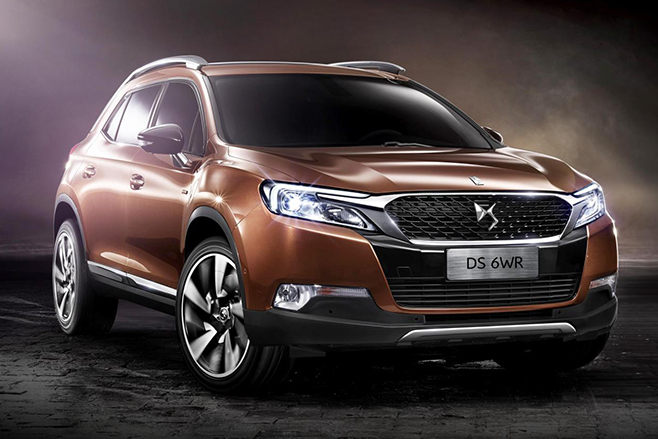
DS admits that the hugely ambitious global plan targets Audi because PSA needs the profits generated by a premium brand, if it is to survive long term, seeing DS’s relationship to Citroen in the same way Audi relates to Volkswagen.
DS brand CEO Yves Bonnefont, told Wheels, “Premium cars take just 10 percent of global sales, but generate 50 percent of the profits. DS is profitable now, with 70 percent of our customers coming from mainstream brands who want premium [cars].”
Says Eric Apode, Vice President of Product and Development, quoting the same numbers, “We have no option, we must have success, it could take 10 or 20 years. We are here for a long time.”
Citroen Australia admits that in the short to medium term Australia’s Citroen dealers will only offer dedicated DS areas in their showrooms, starting from a brand launch in early 2016 built around the facelifted DS5 (now minus Citroen’s double-chevrons), an automatic version of the recently revised manual-only DS3 and possibly even the DS3 Racing, a hot-hatch rival for the VW Golf GTI.
It’s a massive task: YTD (end of April) DS sold just 81 cars (compared to Audi’s 7196) in Australia. Bonnefont refuses to reveal how much developing DS has cost or how much the brand will spend in the next five years. Cadillac plans to spend $A16 billion between now and 2020 to revive GM’s luxury brand in an attempt to achieve the same goals. Since DS began in 2010, 550,000 cars have been sold, one in four in China. Bonnefont says it was only after the success of DS in China, where two unique DS models are sold, that Citroen started to think about creating a new brand.
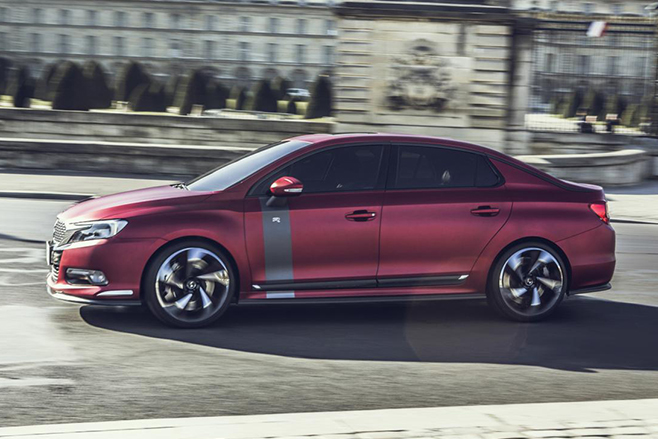
The new DS models won’t come from totally new, bespoke platforms but will continue to share their architecture with Citroen and PSA models, though Bonnefont insists they won’t merely be derivatives of Citroens and are to be developed as stand-alone models relying heavily on unique styling, more advanced technologies and personalisation to compete, and justify the premium prices.
Apode says, “Our platform strategy continues, but we are developing specific engines, with more power and torque, and new transmissions for DS. We may share a platform, an engine and many of the mechanical parts because it makes sense for a group of our size to look for synergies, but at the same time we don’t want to have any dependency to limit our product strategy. So the DS product strategy is not related to the other two brands.”
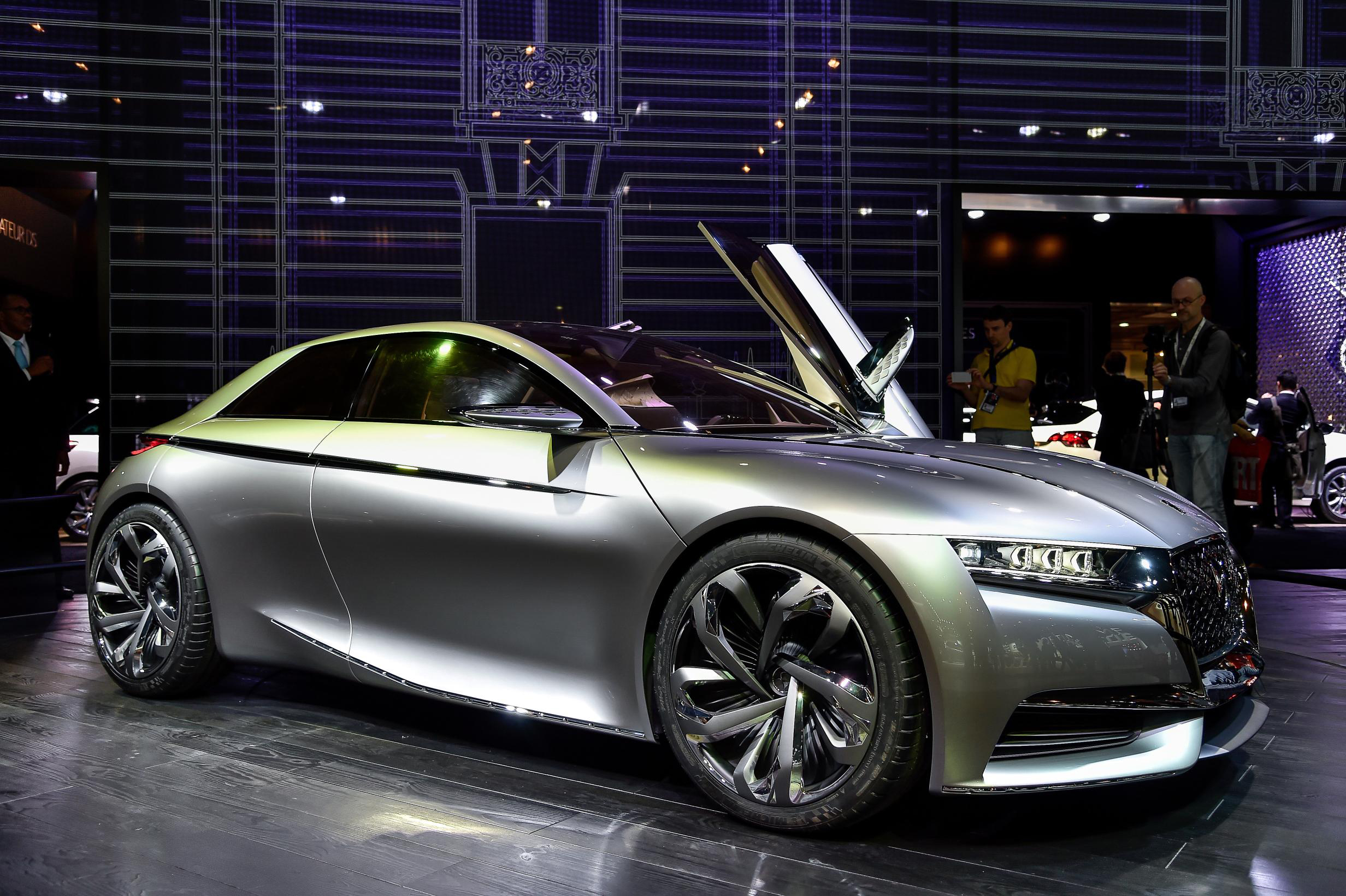
In future, it’s believed the DS range will move up to around 200-220kW, but no further. “We are not interested in brutal power,” Bonnefont claims. There are no plans for a DS sport scar or a GT that revives the 1970s Maserati-powered SM.
The first two all-new models arrive in 2018.
Under PSA’s new platform policy, just two architectures will form the basis for all future models. The new B and entry level C-segment platform called Common Modular Platform (CMP) will be used for 10 new models including the small SUV, while the new EMP2 platform (Peugeot 308 and Citroen C4 Picasso) replaces the old PF1 platform used on the DS5. The EMP2, built in five different wheelbase lengths each separated by 55mm, will underpin the larger models, including the 4WD SUV with independent rear suspension in place of the 308/Picasso’s torsion beam on every DS variant. The Divine concept, unveiled at the 2014 Paris show, is expected to form the design inspiration for the new DS4.
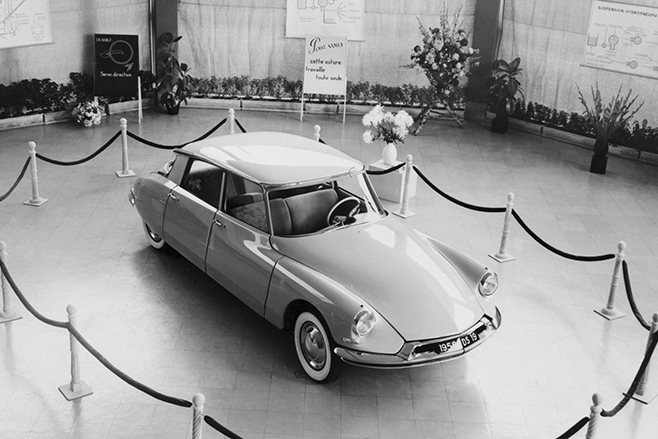
The DS brand’s official launch, built around the 60th anniversary of the original DS19 unveiling at the 1955 Paris motor show (even if it’s six months early) allowed Bonnefont to refute suggestions that Citroen’s famous Hydractive system will be further developed and not eliminated as has been rumoured.
“[It’s] Not as you know it, but we are working on something that gives us a competitive edge, it will appear in a few years.”
Sign up here to receive the latest round-up of Wheels news, reviews and video highlights straight to your inbox each week.
For those of you classified as generation X or Y, chances are this car needs no introduction.
Announced by its iconic orange hue and complimenting Modern Image vinyl job, it’s the car central to a flick that started it all: a seven-movie long Hollywood film franchise that’s grossed almost four billion dollars at the box office in total. And last weekend it was for sale.
This 1993 Toyota Supra from the original The Fast and the Furious film was sold at Mecum’s Indianapolis auction, fetching a final figure of US$185,000 in the process.
Several were built, this example being the particular Supra from the movie’s climatic drag race scene and still features its authentic Bomex bodykit, sizeable APR wing, custom roll cage, NOS/Holley nitrous tanks, modified fuel cell and basic racing interior.
Despite the pretensions of its modifications, the ‘10-second’ car Paul Walker’s character, The Busta, was promised all those years ago by co-star Vin Diesel was far from that.
In fact, this Toyota Supra, and its naturally aspirated 3.0-litre 2JZ-GE inline six, are no more potent than the day it left factory doors.
But provenance trumps performance. And its ticket price, which translates to AU$234,563, not only reflected its history as the screen partner to the tragically killed Paul Walker, but also its part in helping tattoo the franchise in to pop-culture vernacular.
While it won’t be the last Paul Walker car for sale, not many other stunt cars will present the opportunity to own one of the firsts.
