
Sebastien Loeb has conquered the world’s rally stages, now he’s attempting to do the same to the world’s racetracks.
The nine-time World Rally Champion is in his second season in the World Touring Car Championship, a series which, let’s face it, isn’t exactly high on everyone’s ‘must watch motorsport’ list.
In an attempt to sex up the series, the WTCC will be staging a race this year at the Nurburgring Nordschleife – yep, the full 22km track nestled in the Eiffel mountains.
The footage here is from onboard with Loeb during the recent test session.
The WTCC cars may be front-wheel drive with only around 250kW or so, but it doesn’t stop them carrying plenty of speed, and there’s always the pleasure of watching one of the greatest drivers ever to have lived work his magic.
Oh, if you’re in a hurry, skip to around 1:50, which is where Loeb leaves the Grand Prix track and joins the Nordschleife proper.
Get your free weekly report from the world of fast cars – subscribe to the MOTOR newsletter!
Unless you’ve been living under a rock, you’ll have heard about Nissan’s radical new Le Mans car, the NISMO GT-R LM.
Unlike its more traditional LMP1 rivals from Porsche, Toyota and Audi, which are all mid-engined and rear-wheel drive, Nissan has developed a front-engine, front-wheel drive challenger.
Initially, it’s believed Nissan wanted to make the GT-R LM all-wheel drive, with the circa 410kW 3.0-litre twin-turbo V6 driving the front wheels and electric motors driving the rears.
However, continued teething problems have meant that Nissan seems now to be committing to front-wheel drive.
It’s a radical approach for a company whose best result at the 24-hour French classic is third, achieved in 1998 with the far more conventional R390 GT1.
The video above features Nissan’s engineers and drivers explaining the thinking behind the courageous engineering decision, but all the talk will mean nothing come the second weekend in June.
Get your free weekly report from the world of fast cars – subscribe to the MOTOR newsletter!
PLUS
- We couldn’t talk about the Carnival without bowing down to its abundance of space. The boot is big, and by big we mean massive. Even with all three rows set up, it’s worth singing about. So just imagine what you could do with all that space once you put the back seats down.
- With all that space comes storage. Storage galore. 10 cup holders, seriously! I guess this makes sense when you consider what this bus is in its prime when transporting an army of children!
- The seats are versatile. You can do whatever you like, almost. Three rows, two rows, side seats with a catwalk down the centre. Just another day in the Carnival.
- Kia may have dropped the ‘Grand’ from the name and left it at just ‘Carnival’ but we’re loving the new SUV-ish styling. With the boxier front, it looks more like your average SUV – from the front anyway. The side and back still look like a bus, but trust us, it’s better.
- The safety features included in the top spec models are impressive: Blind spot monitoring, active cruise, lane departure warning and forward collision warnings. So if price is no object, then you’ll be rapt.
- It’s more refined, it’s boxier and it has space. But you can’t put a dinosaur in a tutu and pretend it’s a ballerina. It looks better, but a bus is still a bus and the Carnival still drives that way.
- Parking. It’s not like we didn’t know parking a car this size would be hard.
- The price. Being so big, you want all the beeping and alerts you could ask for in a car, just so you can park the darn thing. But on a family’s budget, the Platinum (which comes with all the bells and whistles) is a bit of a tough ask!
- The suspension works a treat when the vehicle is loaded, but unladed it’s a bit firm – meaning you feel the bumps.
Click here to read the full review on the Kia Carnival.
PLUS
- Efficiency. We talk about it a lot when it comes to cars. But with the cost of fuel going up and up and up, it’s hard to ignore it. And when an SUV is claiming a fuel range of 4.8L/100km, you know you’ve got yourself a winner. In car talk, that’s really, really good!
- Insert Coco Chanel quote about style here. Yep, the CX-3 has one thing almost every woman looks for in a car, style. In car talk, they call it “styling”, and what they mean is something different to most of our perceptions of ‘stylish’ but basically, the car looks good, which is a big thumbs up from us.
- It’s small for an SUV. None of this big, obnoxious, soccer-mum business — no one is going to hate you for driving this beauty.
- Starting at a pretty decent entry price, we’re not surprised at the popularity of this Mazda. For what you get (as in all the equipment), it’s A-grade.
- With an SUV you expect space, but while the CX-3 beats the Mazda 2 slightly in space in the back, it doesn’t quite do it for us when compared to others in its league.
- Road noise. Basically, this is car-speak for the annoying noise tyres make when they roll over the road, and in some cars this is worse than others. Like in the CX-3. We’re sorry for bringing this to your attention; you won’t be able to avoid it now.
- The All-Wheel Drive models are better than the lower-priced Front-Wheel Drive. Not quite a deal breaker but you know we’ve got to find something to complain about.
- The diesel versions are a bit slow off the mark. If you’ve ever driven a diesel, you’ll know this is standard compared to a petrol engine, but it’s just that little bit more obvious in a CX-3, so in this case, it’s a con.
PLUS
- Price-tag. Starting at just $12,990, the Suzuki Celerio is one of the cheapest new cars available, with low running costs to match.
- Spacious interior. It can comfortably fit four adults and has pretty decent boot space at 254-litres – that’s a lot of shopping bags.
- Did we mention low running costs? Recording a fuel efficiency figure of 4.7 litres per 100km, the Celerio can drive the full length of Melbourne’s Chapel Street about 22 times. That’s a lot of Chap laps.
- It’s got a simple interface so there are no scary buttons staring you down. We also don’t mind the polka-dot interior that Suzuki seems to have taken straight out of Minnie Mouse’s styling book.
- It moves well. If you plan on taking this car out on a dodge-and-weaving course, you’ll probably do a’ight.
- It’s not the most attractive car. Is the word ugly too harsh?
- It is most comfortable surrounded by the concrete jungle. Long distance driving is not the Celerio’s thing.
- It’s four-star ANCAP rating. Okay, so it’s probably much safer than its reputation suggests but this rating does nothing for its, well, ratings.
- It has a slight delay when you apply power, so if you’re planning on lining yourself up at the lights, you’ll lose against any other car – don’t pretend you don’t like simulating a race to the speed limit!
- Did we mention the exterior wasn’t great? But beauty is only skin deep, as they say; it’s what’s on the inside that counts, right?
Click here to read the full review on the Suzuki Celerio.
THE Audi RS 6 Avant‘s template of all-wheel drive chassis, wagon practicality and reassuringly over-endowed powerplant is one that ought to have spawned a crop of imitators, but few feel willing to stage a head-on challenge. The latest car’s been treated to a raft of detail changes, with the styling sharpened, interior tech rebooted and some retina-melting all-LED headlights.
WHY WE’RE TESTING IT We rarely need too much of an excuse to get behind the wheel of an Audi RS 6 Avant, so a soaking wet Phillip Island circuit provided the perfect opportunity to assess the new infotainment system, acoustic glazing and uprated USB ports.
MAIN RIVALS BMW X5 M, Mercedes-Benz ML63, Porsche Cayenne Turbo
THE WHEELS VERDICT The RS 6 Avant’s big draw might be all the blood and thunder big numbers, but Audi long ago realised that the novelty of these superlatives soon wears off. Delivering the haymaker punch, while still retaining everyday liveability, has kept three generations of RS 6 customers coming back. This update focuses on the latter, which is why the RS 6 remains a subtler proposition than many give it credit for.
PLUS: Grip, pace, transmission, finish, improved technology MINUS: Options pricing, overzealous brake booster, potential for licence cremation
THE WHEELS REVIEW QUICK. Name one Audi that’s a clear and unambiguous class leader. Given the amount of metal Audi shifts every year, it’s a surprisingly tough task. You’d have a solid case for the RS 6 Avant, and not just because neither Mercedes nor BMW fronts up in Australia with a direct and credible rival. Even if an M5 Touring existed or the E63S 4MATIC hauler were imported, both would have their work cut out to depose Ingolstadt’s winged wagon.
The 412kW 4.0-litre twin-turbo V8 has been left largely unchanged, but then this was an engine good enough to muscle in on the mighty W12 in the Bentley Conti GT, so it’s something very special. More industry best practice comes in the shape of the ZF eight-speed automatic transmission, which feels like a hot-tub of Astro Glide between engine and differential. This one gets a super-tall eighth gear to improve highway consumption to synch with the clever cylinder-on-demand technology which turns your RS 6 into the world’s laziest 2.0-litre V4 when you dial back the aggression.
At this juncture, its normal procedure to bemoan a lack of steering feel or chassis feedback, opining that AMG or BMW M would do these things a lot better, and while launching the RS 6 on a race circuit might serve to throw these shortcomings into sharper focus, the truth is, they don’t really matter. The RS 6 is a road car, and Audi realises that the joy of this vehicle is its sheer utility, never lapsing across that frontier where involving merely becomes wearing. As before, 0-100 in 3.9 seconds is there for the taking, wet or dry, accompanied by a battery of crackles and pops on the overrun.
The facelift sees a beakier-looking grille, sharper bumpers and what Audi calls “Matrix LED” headlights. The infotainment system’s been treated to a new engine, in this case an Nvidia Tegra 30, and there’s even a USB port that detects when a phone has been plugged in and then automatically jacks up the power from the usual 500mA to 1.6A to facilitate swifter charging. There’s also an acoustic glazing film applied to the front windows and screen that drops wind noise by 8dB.
Audi will certainly attempt to upsell you to the Dynamic Package Plus, which includes carbon ceramic brakes, dynamic steering, RS sports suspension plus with Dynamic Ride Control, and the speed limiter wound up to 305km/h, relieving you of an additional $25,840 in the process, but in truth the RS 6 doesn’t need any of this kit unless you plan to stretch its legs on track. Which, having done so, is enjoyable but still feels faintly cruel with more than two tonnes to brake, steer and accelerate. Even with the ceramics fitted, a couple of laps saw the slightly neurotic brake booster punch the pedal right up to the top of its travel as it detected fade. Measuring your braking inputs is tricky when robbed of that customary inch or so of dead travel.
Dynamic subtlety, adjustability and tactility still aren’t a big RS 6 Avant drawcard. Instead, it majors on being a car that’s always there for you in any condition, delivering so much and asking for so little in return. Apart from that $229,500. That could be a sticking point.
SPECS Model: Audi RS 6 Avant Engine: 3993cc twin-turbo V8, dohc, 32v, cylinder-on-demand Max power: 412kW @ 5700rpm Max torque: 700Nm @ 1750rpm Transmission: 8-speed automatic Weight: 1950kg 0-100km/h: 3.9sec Economy: 9.6L/100km (combined) Price: $229,500 On sale: Now
TOYOTA Australia has announced one of its biggest recalls ever affecting 181,000 cars to fix a potentially faulty airbag inflator.
However the parts on the affected cars – all of them imported – won’t be available until early 2016.
The recall affects various Echo, Yaris, Corolla, RAV4 and Avensis Verso models produced between 2003 and 2007.
It is an extension of the airbag inflator-related recall announced in 2014 as part of a worldwide campaign affecting components produced by supplier Takata. That recall helped make 2014 the biggest year on record for vehicle recalls, as revealed exclusively by Wheels.In a statement released today Toyota said there had been no injuries from the potentially faulty parts, which can result in the airbag and inflator firing incorrectly, injuring occupants.
“These recalls are due to the potential that, depending on the vehicle, either the driver’s or passenger’s airbag inflators may be susceptible to moisture intrusion over time,” said the Toyota statement. “If this happens, this could potentially make the inflator assembly prone to rupture during an accident, increasing the risk of injury to the occupant.”
Due to the scale of the recall Toyota says it may not begin replacing parts until early 2016.
One issue delaying the repairs is the scale of the production of replacement components; the latest recall affects 5 million Toyotas globally as well as millions more from other brands.
Once produced, the components then must be sent by ship because they are explosives and are not allowed to be air-freighted, further increasing the time it takes to get to dealers.
Toyota has opened a hotline for concerned customers.
“If people have any concerns we ask them to contact their dealer or call can call 1800 987 366 and we’ll work something out with them,” a Toyota spokeswoman told Wheels.
The recall is expected to impact other brands that were affected by previous recalls affecting Takata components. That includes Nissan, which is expected to announce a recall for various models that would be an extension to the airbag recall announced in 2013.
More information will become available on the Australian Competition and Consumer Commission’s Recalls.gov.au website.
| Model | Build dates | Number recalled |
|---|---|---|
| Echo | 1 July 2003 – 25 October 2005 | 27,444 |
| Yaris (various) | 19 August 2005 u2013 30 March 2007 | 44,812 |
| Corolla (various) | 9 May 2003 u2013 1 March 2007 | 75,119 |
| RAV4 | 31 July 2003 u2013 25 October 2005 | 28,945 |
| Avensis Verso (various) | 23 May 2003 u2013 30 March 2007 | 4615 |
Scary, bumpy, dusty, muddy, uncomfortable, washing and Wolf Creek. These are the words used to describe four-wheel driving by people who have never ventured off the beaten track.
But ask anyone who has taken a 4WD off-road, how they feel about it and you’ll be met with words like exhilarating, fun, freedom, and adventure.
Sometimes, leaving your world of hotel stays and chauffeured trips behind can open your mind to a world you never knew existed. We know that pooping in a hole, living out of a vehicle and going a day or two without a shower may not sound like a very relaxing holiday, but there’s another side to off-road sojourns you may have never considered.

For the most part, Australians are adventurous. And why wouldn’t we be when we don’t have to pull out a passport to travel from one side of the continent to the other? From coast to mountains, or rainforest to desert, Australia’s diverse terrain will bring out the explorer in you as you discover its endless hidden treasures. A high and low range capable vehicle is one of the best ways to do this.
While statistics suggest men are the prominent gender to drive large 4WDs (eg Toyota Land Cruisers), luxury 4WDs (eg Range Rover Sport) are more popular amongst middle aged females. Adding to that, one in five women take an interest in four-wheel drives and read magazines like our very own 4X4 Australia (Emma 2015), while one in four women think the ability to go off-road is an essential car attribute (AustraliaScan 2015). So why then, do we still put 4WDing into the ‘manly men’ basket?
There are plenty of people out there who don’t mind running their tyres through a bit of mud, but drive through any city on a weekend and you’ll be met with large SUVs that have never tasted dirt or met nature, except for the Guano (fancy word for bird droppings) gracing the windows.
The biggest misconception of 4WDing is its ‘roughing it’ stereotype, but this mode of travel doesn’t have to mean improvised toilets and bathing in the ocean – although you won’t quite experience anything as freeing as fully reconnecting your soul with nature.
Take a recent trip to the world largest sand island, Fraser Island, Queensland, as an example. We travelled with a group of ladies from all over Australia, and with our trusty Toyota FJ Cruiser we cruised through a two day ‘women only’ training course with Australian Offroad Academy (check out the ladies only weekends), drove from east to west, south to north, and found our way through paradise’s 4WD only tracks. Sure, there were bugs, dirt got in our nails, hair got greasy and there were probably a number of snakes, spiders and dingoes within meters of us at any one time (although, we didn’t actually spot any), but there were no tents, sleeping bags, or feme-wipes.
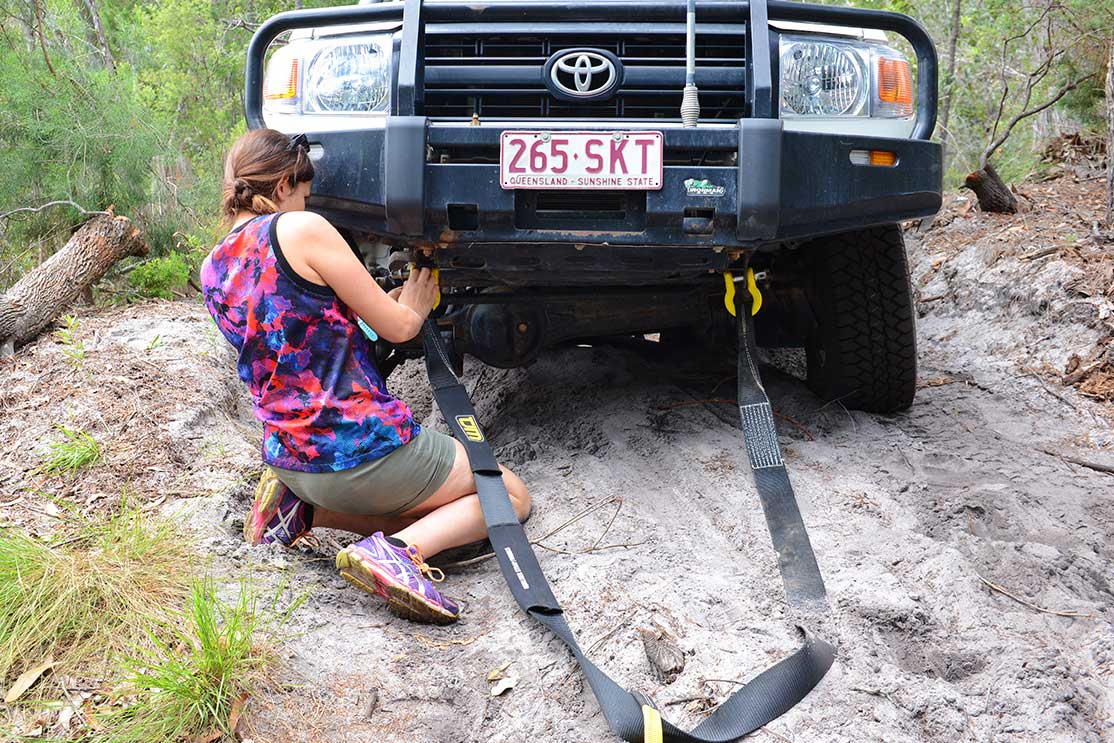
Instead, we got to experience the other side of 4WDing – sleeping in Kingfisher Bay Resort, with access to electricity, TVs, aircon, cocktails and pools! But we barely used any of it. The luxuries on offer were so unimportant compared to the beautiful surroundings and destinations of the island; they may as well have not existed… except for the cocktails, we’ll hold on to those for the end of the day, thank you very much.
Travelling with a group of 11 other girls, we saw places that would make even the most glamorous travellers drool. Lake McKenzie, Eli Creek, Valley of the Giants, Pelican Bank, Lake Wabby and so much more – there’s a reason the Butchulla people, the traditional land owners, called this place K’gari (pronounced Gurri), which roughly translates to paradise.
At the end of the trip, two of the girls loved it so much, they went out and purchased 4WDs, and the rest of us boarded the barge off the island, heavy-hearted as we left the a place we had fallen head over heels for.
That’s the thing about having the capability to head off the beaten track – it’ll get you to places that even your dreams would struggle to imagine. Sure, the road may be bumpy, steep or wet, and you’ll spend hours on end in the confined space of a vehicle, but it’s all worth it for the pot of gold at the end of the rainbow – that moment when you reach a destination so spectacular and remote, your words will escape you and all you can do is breath. Where the skies are clear, the tranquility is whimsical and the only signs of people are the footprints left behind. It’ll get you to the places you feel nature become part of your very being and steal a piece of your soul.
4WDing allows you to push boundaries, explore every inch of the earth and reconnect with life beyond metropolis. As the old quote goes, “life begins at the end of your comfort zone”, so tie up those driving boots and send your 4×4 to its natural habitat. And hey, it’s not like you have to give up your luxuries all together… now, where are those cocktails?
OUR PICKS ON THE BEST 4WDS FOR BEGINNERS
What stands out?
The Elantra is the sedan version of Hyundai’s best-selling model, the i30 hatch. It has a different dashboard layout and comes only with a petrol engine. The Elantra has a pleasant and comfortable cabin, and lots of equipment for the money. The car covered in this review was superseded by an all-new Elantra in March 2016.
What might bug me?
You might find the steering feels a bit dull and lifeless.Filling it with fuel: it uses more than some alternatives.
What body styles are there?
Four-door sedan only. (The hatchback and wagon versions are called the i30.)All Elantras are front-wheel drive.The Elantra is classed as a small car, lower priced.
What features do all Elantras have?
Rear parking sensors, Bluetooth connectivity, cruise control, heated exterior mirrors, and touchscreen control of cabin functions (5.0-inch screen for the least costly Elantra, the Active, and a 7.0-inch screen for the rest).There are also front foglights, which improve vision in foggy conditions and make your car more visible to others in fog and rain.Six airbags: two directly in front of the driver and passenger; one each side of the front occupants; and a curtain airbag on each side protecting the heads of front and rear occupants.Electronic stability control, which can automatically control a skid or slide. All new cars must have this feature.All Elantras get a full-sized spare tyre.All have a five-year warranty (two more than most rivals), with no limit on kilometres travelled in that time.
Which engine uses least fuel, and why wouldn’t I choose it?
A 1.8-litre four-cylinder petrol engine is the only engine available in the Elantra. It is most fuel-efficient with the manual gearbox, using a claimed average of 6.6 litres/100km. Choose the auto transmission and consumption is 7.1 litres/100km.The manual and auto transmissions both have six ratios.
What key features do I get if I spend more?
The Active is the only Elantra available with a manual transmission. The more expensive models – Elite and Premium – come standard with the auto.Choose the Elite and you’ll get headlights that come on automatically at night, a reversing camera, and satellite navigation with the bigger touchscreen. There are also 16-inch aluminium-alloy wheels (nicer looking than the 15-inch steel wheels on the Active).The Elite has dual-zone air-conditioning, which allows the driver and front passenger to set different temperatures. Automatic windscreen wipers come on when water is detected on the screen. A smart key unlocks the car without the need to take the key out of your pocket or bag.The most costly model, the Premium, comes with bigger, 17-inch wheels, and wider tyres with a lower profile, which quicken the steering response and add grip. Seats are a mix of real and fake leather and are heated. The driver’s seat adjusts electrically. There are air-conditioning vents for the rear passengers.
Does any upgrade have a down side?
Each step in the model range brings tyres that are larger in diameter and lower in profile, which ride a little more roughly. They could also cost more at replacement time.White is the only standard colour: all other colours cost extra.
How comfortable is the Hyundai Elantra?
There is an elegant sweep to the Elantra’s dashboard and well laid-out controls, with the audio system placed high on the dash and the ventilation controls lower down, surrounding a big adjuster for fan speed.Various shades of grey make for a conservative presentation, but it’s nicely put together to give it a quality appearance. The instruments and radio screen are illuminated in a distinctive blue hue.The smaller, monochrome display on the Active has larger buttons surrounding it, while the Elite and Premium get a full colour screen that is easier to read and looks more elegant. The touchscreen can be quite bright at night and it dims on a separate electrical circuit from other instruments.The seats are comfortable, although more side support would be appreciated to help keep occupants located better when cornering.There is good vision, and at highway speeds the cabin is quiet.However the 1.8-litre petrol engine is short on urge when you first press the accelerator pedal, and it gets noisy if you drive it hard.
What about safety in an Elantra?
With six airbags and stability control, the Elantra has a good level of safety.However it is not available with more advanced crash avoidance features, such as automatic emergency braking.The Elite and Premium get additional safety features, such as a reversing camera for better rear vision. Their automatic headlights and automatic windscreen wipers can act quicker than the driver might.(To see a full list of the safety features on any model, select the car and look under the features tab. Safety-related features are listed in red.)The Australasian New Car Assessment Program (ANCAP) has rated the Elantra’s safety at five stars.
I like driving – will I enjoy this car?
The 1.8-litre petrol isn’t overloaded with power but it is willing to rev, something that works well for those prepared to push it harder. It’s helped by the six-speed automatic gearbox, which shifts smoothly.The steering has a system called FlexSteer, which allows you to choose between a lighter and heavier feel. The middle Normal setting is the best for most situations. However the steering feels remote, and does not inspire confidence on roads with lots of twists and turns.That said, through corners the Elantra is quite capable. While a large bump can upset its poise, generally it recovers quickly.The extra grip from the wider tyres on the Premium not only adds to driver confidence but also generates a more immediate response to movement of the steering wheel.
How is life in the rear seats?
There is good leg room in the rear of an Elantra. The tapering roof line eats into head room, but that only becomes an issue for people over about 185cm tall.Only the Premium model gets air vents in the back, to better circulate air and cool the cabin.The base of the centre seat sits noticeably higher than the outer two, so that it feels unnaturally high and doesn’t have any side support – it is up to the other occupants to stop the centre person from sliding around.
How is it for carrying stuff?
The Elantra gets a large boot that stretches deep into the car. Those looking to carry more can fold the 60-40 split-fold seats.For smaller items, the luggage nets on the Elite and Premium are great additions because they stop small items (or a couple of shopping bags) from rolling around in the boot.Up front there are large pockets in the doors, cupholders in the centre console, and another covered console just ahead of the gear lever which is handy for storing valuables out of sight. The deep centre binnacle is also handy for larger items and small bags.
Where is it made?
The Elantra is produced in South Korea.
What might I miss that similar cars have?
Active safety features such as automatic emergency braking and active cruise control, which are fitted to some Mazda3s for example.Other cars you might consider include the Toyota Corolla, Mazda3, Honda Civic, Holden Cruze, Ford Focus, Volkswagen Jetta, Subaru Impreza and Kia Cerato.
I like this car, but I can’t choose which version. Can you help?
We like the Elantra Active. The addition of the larger colour touchscreen and a reversing camera, among other features, make it worth the extra spend.
When did Hyundai update this Elantra?
This Elantra went on sale in 2011 and a ‘Series 2’ update arrived early in 2014. An all-new Elantra arrived in March 2016, bringing a bigger and more responsive engine, a quieter cabin, more appealing steering and ride, and Apple CarPlay.
The covers have been whipped off the Volkswagen Golf GTI Clubsport at Worthersee, the largest annual VW and Audi meet in Europe.
Designed to celebrate the 40th anniversary of the Golf GTI, the Clubsport boasts 195kW of power – up 26kW on the Golf GTI Performance production car – with an overboost function providing an extra 10 per cent of power for short bursts.
A more aggressive front bumper with honeycomb mesh and prominent side gills, rear diffuser and a roof-edge spoiler round out the major exterior changes. Volkswagen claims the latter two provide “significantly improved levels of downforce” that “move the Golf GTI Clubsport into the realms of motorsport driving dynamics”. Think of this as the Porsche Cayman GT4 of Golf GTI grades, then.
It should mean the production Golf GTI Clubsport (or Edition 40 as it may be known) would have a different focus to the range-topping Golf R.
The current 169kW Golf GTI Performance weighs 1364kg and claims a 6.4-second 0-100km/h, compared with the all-wheel drive 206kW Golf R’s 1435kg/5.0sec respectively. With 195kW, but retaining lighter front-wheel drive, the Golf GTI Clubsport should get closer to the flagship of the range’s time; though there is no word yet on torque or transmission choice.
Volkswagen is calling the Golf GTI Clubsport a “near-production concept car” indicating that it will be available to purchase in time for the 2016 40th anniversary. The previous Golf GTI anniversary model, the Mark VI Edition 35, received a similar power increase from 155kW to 173kW.
Volkswagen Australia says it’s too early to know what a production version may look like, or whether it would offer the car here, though the concept has been shown in three-door guise – a bodystyle not imported to this country. Pricing would likely need to sit between the $48K GTI Performance and $52K Golf R.
Get your free weekly report from the world of fast cars – subscribe to the MOTOR newsletter!
