
THE big-selling Ford Ranger surfaces in Thailand with a fresh cabin, improved engines and advanced driver assist tech to match a new-look snout
The Ford Ranger facelift pick-up has been revealed in Thailand today ahead of its Australian release at the end of July.
The revised Ranger line-up features improved engines, better refinement, segment-first safety and greater convenience features in order to battle the segment-leading Toyota Hilux and the Nissan Navara.
While the more truck-like nose with flatter headlights and F-Series truck-style grille was previewed late last year – and seen in Wheels‘ spy shots while testing in Oz – a completely restyled dash from the upcoming Everest seven-seat wagon replaces the chunky original from 2011.
The XLT is the lone Ranger to surface at the Bangkok International Motor Show, with the rest of the bestselling range to be unveiled later.
While final specifications and details for the Australian market are yet to be announced, diesel engines gain idle-stop to help cut fuel consumption by up to 20 per cent in some variations, assisted by the adoption of electric rather than hydraulic power steering.
The volume-selling 2.2-litre four-cylinder turbo-diesel rises in power and torque slightly, to 118kW and 385Nm respectively, while the 147kW/470Nm 3.2-litre five-cylinder turbo-diesel’s outputs remain unchanged, despite boasting improved efficiency.
More sound-deadening material and higher-quality cabin materials also promise a quieter and more refined travelling experience, aided by retuning of the suspension to boost comfort levels.
For the first time in its class, the Ranger adopts car-like advanced driver aids including adaptive cruise control, lane-keeping assist, Driver Impairment Monitor and front and rear parking sensors, upping the safety ante for the Australian-designed and engineered tradie favourite.
Finally, the new-look dashboard gains a large central touchscreen with Ford’s SYNC2 voice-control and connectivity technology, as well as a TFT screen in the restyled instrument cluster.
The cabin makeover also includes different switchgear, air vents, dash trim, seat material and 240-volt charger as Ford updates the one-tonne pick-up in preparation to take on the next-generation Hilux, Navara and Mitsubishi Triton also due this year.
The Ranger is the best selling vehicle in the Ford range, ahead of the Focus, and comes following the annoucement that Ford Australia boss Bob Graziano will retire next month.
Pricing is expected to change little, ranging from just under $20,000 to about $60,000 for the flagship Wildtrak.Click here to read the full range review on the 2015 Ford Ranger.
Sign up here to receive the latest round-up of Wheels news, reviews and video highlights straight to your inbox each week.
Design- and tech-savvy Audi A6 sedan and Audi A7 Sportback gain a sportier look, upgraded infotainment, revised powertrains and greater value for money.
WHAT IS IT Audi’s entrant in the premium C-segment category is doing good business in Australia, with sales up by 25 percent last year. This handsome mid-life facelift should equip the A6 (and its semi-coupe A7 Sportback sibling, plus sporty S-badged variants) with the required smarts to leapfrog the BMW 5 Series and rein in the strong-selling Mercedes-Benz E-Class and CLS-Class.
WHY WE’RE TESTING IT Restyled lights, bumpers and wheel designs are merely the garnish; new transmissions, a new engine and a greater emphasis on sporting appeal are the substance. At the entry level, a more powerful 1.8-litre turbo-petrol four tied to a seven-speed dual-clutch gearbox replaces the old A6 2.0TFSI with ‘Multitronic’ CVT, while at the top end, the S6 quattro and S7 quattro see their 4.0-litre turbocharged V8s boosted to 331kW.
MAIN RIVALS BMW 5 Series, Jaguar XF, Lexus GS and Mercedes-Benz E-Class are the A6’s main competition, though the Hyundai Genesis Ultimate and Infiniti Q70 Premium are fully equipped alternatives to an entry-level A6. The A7/S7 Sportback has just one direct rival – the Mercedes-Benz CLS.
THE WHEELS VERDICT Beautifully finished and competitively equipped, the A6 argues a strong case for itself, particularly the biturbo TDI quattro and the rapid S6, both of which have a genuine X-factor. Likewise the A7 and S7 Sportback variants, packaging the same drivetrains into a striking liftback-coupe shape.
The entry-level 1.8-litre front-drive A6, on the other hand, is comparatively uninspiring, but from a non-enthusiast’s perspective, it’s a far-from-stingy entry ticket to classy, four-ringed luxury.
PLUS: Build quality and finish; excellent biturbo diesel; rapid S models; slick 1.8TFSI MINUS: Base A6’s measly front seats; uninspiring front-drive dynamics; ageing appearance
THE WHEELS REVIEW ENTERING middle age with nary a visible wrinkle sounds like an impossible dream, but Audi’s A7 Sportback has managed to pull it off.
Broad and muscular, yet also subtle and svelte, this striking liftback-coupe still has the star power that its more conservative A6 sedan sibling lacks. In fact, the A7 (and the sportier S7) is such a goddamn looker that we doubt its beauty will ever fade.
New headlights and tail-lamps – LED at both ends on most models, with super-tech Matrix LED units optional up front – and sequential indicators (which Audi calls ‘dynamic’) are what people will notice first, followed by a standard S-Line exterior package, even on the entry-level A6.
But it’s the mechanical reshuffle that legitimately sets the 2015 A6/A7 apart.
For $79,900, the least expensive A6 gets a completely new drivetrain. Gone is the old 132kW/320Nm 2.0-litre turbo-petrol four with ‘Multitronic’ CVT transmission, replaced by a new 140kW/320Nm 1.8-litre turbo-petrol unit tied to a new-generation seven-speed dual-clutch ’box.
It’s a super-sweet engine that operates with slick efficiency, and it’s no slouch. Despite an 11 percent decrease in emissions (to 133g/km) and an excellent fuel-consumption average of just 5.7L/100km, Audi claims the 1.8TFSI will hit 100km/h in 7.9sec, which is impressive for such a big front-driver.
The 1.8TFSI drives well, with a quiet and reasonably absorbent ride on 18-inch wheels, and decent adhesion, but this is no driver’s car. Steering that feels a little too distant from the action, combined with a relatively inert chassis, means the 1.8TFSI is more about refinement and driveway presence than driver reward.
The front seats are measly (though three other types are optional) and the 1.8’s silvery door and dashboard inserts look surprisingly econocar for an Audi at this level.
Move up the ladder and things quickly improve.
The heavily re-engineered 3.0-litre turbo-diesel V6 – now with 160kW/500Nm in the single-turbo version, as featured in the super-frugal ‘TDI Ultra’ versions in Europe – gets standard quattro all-wheel drive standard for strong off-the-line performance and a sizeable improvement in dynamic ability.
With 60 percent of drive fed to the rear, but up to 85 percent capable of going there, the quattro A6 and A7 TDIs ($99,900 and $115,400 respectively) are far more involving to drive than the front-drive 1.8, and they’re quick, too, with 0-100km/h in 6.6sec, backed by 5.1L/100km fuel claims.
But by far our favourite variant in the facelifted ranges is the 3.0-litre bi-turbo TDI quattro ($124,900 for the A6 and $144,900 for the Audi A7 3.0 TDI Quattro). Producing an impressive 235kW, backed by a chunky 650Nm available from 1400-2800rpm, the bi-turbo TDI is a closet performance car.
To handle all that torque, the bi-turbo gets an eight-speed torque-converter auto instead of a seven-speed dual-clutch, and the bi-turbo is a seriously swift and slick piece of Kraut craftsmanship if you also tick the options boxes for adaptive air suspension ($4160) and the sports rear differential ($2245) that transfers drive between the rear wheels for enhanced turn-in.
There’s even an active exhaust that fills the otherwise hushed cabin with a rumbling growl (if you nudge the auto into Sport mode) to accompany its 5.0sec 0-100km/h time, which isn’t too far adrift of the 4.4sec claimed for the newly uprated S6 and S7.
So, while the boosted V8 range-toppers remain unbeaten for sheer performance, presence and interior class (with the possible exception of the polarising tartan-tinted ‘carbonfibre’ inlays), a smartly optioned bi-turbo is almost as good for tens of thousands less.
Obviously, the frameless-doored A7 and S7 Sportbacks command a premium over the A6s on which they’re based, and they weigh slightly more as well, but as a piece of slick automotive sculpture, that sheetmetal appeal is hard to ignore.
Be liberal with Audi’s extensive options list and equipment packages, starting with the removal of the anachronistic walnut trim inside A6/A7 TDI quattro models, and you have one hell of a suave sports-luxury machine.
SPECS Model: Audi A6 1.8TFSI Engine: 1798cc 4cyl, dohc, 16v, turbo Max power: 140kW @ 4200rpm Max torque: 320Nm @ 1400-4100rpm Transmission: 7-speed dual-clutch Kerb weight: 1570kg 0-100km/h: 7.9sec (claimed) Economy: 5.7L/100km Price: $79,900 On sale: Now
V8 Supercars: The Marcos puzzle
THE whole thing has a certain, almost disturbing, strangeness. Why would a former two-time V8 Supercar champion – who has been away racing for nearly a decade in the planet’s top flight tin-top championship – announce his return to the local series, and then after only three weekends of competition suddenly step down for an undefined period.
Yes, Ambrose’s results have not been spectacular, but we hadn’t expected him to return and conquer. Suggesting a dose of reality, he pre-empted modest results before the season started, insisting it would take time to return to competitiveness. After all, the game had moved on and his DJR Penske team was handicapped by running just one car.
While pleading for time to get on the pace, did Ambrose inwardly believe he would come back and immediately be fighting at the pointy end?
Yet to stop after just two outings this year is mystifying, more so remembering that Ambrose qualified in the top 10 for one of the Clipsal 500 races in Adelaide… better than he and the team promised and publicly anticipated. Maybe he considered that an aberration.
At Albert Park, Ambrose was wrecked in the first of four heats so we all knew his weekend was shot to pieces. The races were meaningless anyway.
Coming home and getting to grips with the new-generation V8 racers was never going to be a quick and easy process, and perhaps he now doubts if he has the commitment and drive to stomach the punishment of hauling the DJR Team Penske to the front in V8 Supercars.
Why, though, did Ambrose choose to step down just before his home race at Symmons Plains? He was the ‘face’ of that race.
Will he in fact return to the team later in the year? Has he driven his last V8 Supercar race? He claims he needs time to get up to speed in the new-generation cars, but how does he expect to do this by standing down? The heart of the battle is the best environment to sharpen skills.
May I say here that I have no doubt that Marcos would have worked his way back to regular competitiveness. He knows how to race. He’s both a natural talent and a thinker. He is only 38, younger than Craig Lowndes and Jason Bright, and a mere seven months older than Garth Tander.
After nine years racing in the biggest motor sports show in the US – and the biggest ‘touring car’ circus anywhere – perhaps Ambrose found coming back to Australian V8 Supercars a little hokey, a comparative backwater.
Ambrose has lived for racing. And every year NASCAR handed him about 38 weekends of dramatic, big-time racing. Contrast this with Supercars’ 14 championship weekends plus the nothingness of the GP meeting.
In Australia, there is a requirement for stars like Ambrose to be front and centre at a myriad of corporate commitments through the season, with no relenting on race weekends. There is also the press stuff, which he has always struggled with. Ambrose loosened up somewhat in the US – he had to – but is still uncomfortable with our more brutal press probers.
When the team announced Ambrose had asked to be “temporarily relieved” as the team’s driver, the actual duration of his absence from driving was not mentioned, although it was suggested he would be available to partner Scotty Pye in the three enduros.
To unclutter his thoughts and attempt to find resolution to the issue, Ambrose has taken off into the Aussie outback for his version of a Tassie walkabout.
While it’s anyone’s guess what Ambrose will decide, his call to step down increased the odds of him not racing full-time again.
It must have been an enormously difficult call for this proud man to walk away – and upset a team controlled by the most powerful man in American sport. If Roger Penske is a gent who doesn’t take lightly to being shunned, Ambrose might struggle to secure a drive again in North America – should he want to continue racing.
Maybe the motivation has gone. He doesn’t need the bucks; Ambrose is very well off after years in the Sprint Cup. He is a family guy, too, and maybe his priorities have shifted.
So many questions; so few answers. The only potential source of a full explanation sits in that complicated zone between Ambrose’s ears
Formula One: German GP apparently a goner
IT SEEMS it’s not enough for Formula One to create a frighteningly expensive and technically difficult set of engine rules that has handed one team an advantage that appears set to turn the world championship into a Silver Arrows romp this year. To a dodgy soundtrack of droning and flatulence…
Now the orchestrators of the F1 calendar look hell-bent on destroying more of the sport’s rich heritage. With the season already underway, it’s highly unlikely we’ll see a German Grand Prix this year – and it’s anyone’s guess whether it will ever be reinstated to the calendar.
The long-running event-sharing agreement between the Nurburgring and Hockenheim has evaporated because neither wants to host the GP and accept the increasingly onerous financial imposts.
The last time Germany disappeared from the calendar was in 1960, a decade after the commencement of the F1 world championship. Before F1, the race’s history stretches back to 1926. Only Belgium and Italy have held races for longer.
With stars like Sebastian Vettel and Nico Rosberg, and the championship-winning Mercedes team to the fore, if Germany can’t have a GP then something is very wrong in Bernie World.
Ecclestone does operate to a strange set of priorities, with profit at the top and what’s good for the sport much further down the list.
F1’s fan base is in Europe, and so is the bulk of television viewers. But France, where the sport started, was unceremoniously dumped seven years ago, with little chance of it returning.
Bernie Ecclestone doesn’t hold much of a brief for tradition or history. If a promoter can’t or won’t agree to his ever-impactful and alarming financial demands, he has no compunction in changing his attention to someone who will.
In recent years, GPs have been held in places with no notable racing heritage, including Turkey, Korea, India, Bahrain, Russia and Abu Dhabi. Next year that epicentre of motor sport, Azerbaijan, will hold an F1 race.
Turkey was actually one of Herman Tilke’s better track designs. But no-one attended, so Bernie quickly boned it.
Bahrain continues to be part of F1, despite human rights issues.
This year the Indian Grand Prix was cancelled for the second consecutive year following disputes between the FIA and the Uttar Pradesh government.
After being removed in 2014, the poorly attended Korean Grand Prix was scheduled to return this year, but that didn’t happen.
Hyped up, too, has been the Grand Prix of America, originally planned for 2013 at a street circuit in New Jersey. It has been delayed for a third straight year.
Alarmingly, Ecclestone has indicated he will not renew Italy’s deal when it expires next year, citing disastrous commercial outcomes. No-one except Bernie believes a calendar without Monza is acceptable.
Though the traditional circuits pull big crowds, they struggle to make enough money to offset the fees Bernie charges for his circus. Some, like Australia, could not survive without government assistance.
Yes, crowd numbers were way down at recent German GPs. Maybe the Germans, a smart bunch of people, know when they are being gypped. Perhaps it’s just not enough to watch Mercedes trundle around at the head of the pack.
A warning, perhaps, for all who host grands prix?
F1: Sauber resolves saga with van der Garde
GIEDO van der Garde’s case against the Sauber F1 team has been resolved, after the warring parties – with lawyers at 20 paces – finalised a settlement.
The Dutchman took to court claiming Sauber had reneged on a contract for him to race with the Swiss team in 2015. He reportedly had paid Sauber eight million euros ($11.1m) last year.
The legal fight between the two parties continued in the Supreme Court in Melbourne in the days leading to the Australian GP. The court ruled in favour of van der Garde, but both parties agreed to settle the dispute leaving Sauber to go with its plan of running Felipe Nasr and Marcus Ericsson at Albert Park.
Sauber has subsequently ended the case by agreeing to pay van der Garde €15m ($20.9m), a sum that will hit the embattled team hard.
Van der Garde concedes his F1 career is likely over, but in a statement declared: “My future in motorsport has not finished: on the contrary, I see this as a new beginning. I will sit down with my management in the coming weeks to discuss my future plans.
“I would love to take part in the WEC and the Le Mans 24 Hours in an LMP1 car. Former Formula One drivers do very well in this series. We also have our eye on other series such as the DTM in 2016 and beyond.”
And it’s not all bad news for the team. Sauber performed unexpectedly strongly in the AGP, overcoming its distractions to score points (and money), rookie Nasr mightily impressive in finishing fifth, and Ericsson eighth among 11 finishers.
The team is consequently third in the constructors championship, just one point behind Ferrari and ahead of Williams and Red Bull.
F1: Vettel up close and personal… with Mercedes
SOME light press conference banter between German rivals Nico Rosberg and Sebastian Vettel in Melbourne might see the Ferrari driver making a visit to the Mercedes garage in Malaysia this weekend.
When Lewis Hamilton and Rosberg insisted that they hoped their team might be put under some pressure by its rivals this season, Vettel wryly commented: “Be honest. Do you really hope so? Seriously? You finished 30 seconds ahead of us and you hope it’s going to be closer? So you hope you slow down? Is that what you’re saying?”
Back came the Rosberg rejoinder: “I hope that you can give us a challenge because it’s important for the sport and for the fans. And I do think about the show. Half of me – or a part of me – thinks about the show because I want to give people a great time at home watching on TV or at the track. If you do come a bit closer, that would be awesome for everybody.”
“First suggestion,” replied Vettel, “if you don’t mind, I think your garage becomes public for Malaysia and everyone can have a look. No? I’m joking.”
But Rosberg was happy to keep the dare going. “You can come if you want; we can invite you,” he said.
“Okay, thank you for the invite… I’ll come.” laughed Vettel
“Friday, Malaysia… okay,” confirmed Rosberg.
“Engineers’ room? Debrief, I’ll be there,” smiled Vettel.
On Tuesday, there were further developments when Rosberg confirmed via Twitter that the ‘invite’ still stands. He wrote: “I spoke to Toto and Paddy about an invitation for Sebastian and they are easy with it. Dear Seb, this is the official invitation to join our debrief Friday 16.00 at Sepang. See you there, don’t forget your notebook! :)”
INDY LIGHTS: Matt Brabham makes St Pete return for Andretti
MATT Brabham will return to Indy Lights with Andretti Autosport for the first event of the 2015 season at St Petersburg in Florida on March 27-29.
The arrangement sees the Brabham and Andretti names come together once again after a successful first Indy Lights season in 2014 and clinching the Pro Mazda Championship together in 2013.
Brabham has had a great deal of success at St. Petersburg in the past. He dominated both races in the Pro Mazda Championship in 2013 to start his record-breaking championship year, which saw him take 13 wins, including seven in succession.
In the 21-year-old’s first Indy Lights race there last year, he qualified third and was pushing for second before a brush with the wall dropped him to ninth.
Though the current arrangement with Andretti is initially just for this weekend, Brabham hopes it may lead to a full campaign.
“Having won both races at St Pete in Pro Mazda and being quite strong there last year, I’m confident of hitting the ground running,” Brabham said. “It’s a great track and I love street courses, so we’ll be aiming to be in the mix. It’s a brand new car this year, so there is a bit to learn.”
The Indy Lights Championship consists of 16 rounds at 10 events supporting the IndyCar Series. St Pete will be the first event with a new-generation Dallara Indy Lights chassis.
ARC: Evans number one seed for ARC. But which one?
TWICE national champion Eli Evans, in his first outing as Citroen Australia’s lead driver, will head the 2015 Australian Rally Championship field ahead of brother and four-time ARC champ Simon Evans, who makes his ARC return at the wheel of Eli’s former Honda Civic Type R.
The opening round of the ARC, the Quit Forest Rally in WA, fires up this coming weekend with 22 entries and a return to a fully seeded running order.
The change will see the Outright 2WD, National 4WD and Classic Rally Challenge competitors starting in their seeded order, and the top 10 alone features an incredibly diverse range of cars.
The Evans family feud will be one of the highlights. But not the only one.
South Australian flyer Henry Nott will start fourth in his recently acquired Mitsubishi Lancer Evo IX, ahead of young gun Steve Mackenzie’s front-drive Ford Fiesta ST and Mark Pedder’s newly imported Peugeot 208 ‘Maxi’ car.
WA teen Dylan King lines up eighth in a Subaru Impreza WRX, against vastly experienced local Doug Tostevin in a similar Impreza, while the final place in the top 10 goes to Toyota’s Neal Bates, with four Australian titles to his name, in the first of the Classic entries.
The strength of the field is obvious with a scan of the entry, with Adrian Coppin and Tony Sullens both in Citroen DS3s, the return of Molly Taylor in Scott Pedder’s championship-winning Renault Clio R3 and Ashlea James’ first foray of the year in his new VW Polo.
The Quit Forest Rally gets underway on Friday with the first of two runs around the 2.66km Busselton Super Special Stage, before continuing across two full days of competition in the forests around Nannup.
Ford has increased production of its XR8 sedan, following higher than expected customer demand.
Initially, just 1200 vehicles were scheduled to be built, but as customers clamour to purchase the last locally-produced V8 Ford, the Blue Oval has lifted that number to 2800 vehicles.
As well as guaranteed future classic status, it appears local buyers can’t go past the combination of a 335kW/570Nm 5.0-litre supercharged V8 for just $52,490 in manual form.
“We’re very proud of the work that’s gone into the XR8,” said Ford’s General Manager of Marketing, David Katic. “It’s an important halo to the FG X Falcon range and we wanted to deliver the ultimate handling performance machine for customers and they clearly love it.
“We have been buoyed by the amazing customer interest and demand for the XR8. It’s been a runaway success and our dealers have been asking for more.”
The increase in demand for the XR8 is a rare good news story for Ford’s embattled local operation, with Falcon sales struggling and conjecture as to whether the factory will remain open until the October 2016 cut-off date.
Get your free weekly report from the world of fast cars – subscribe to the MOTOR newsletter!
Fans of modern rallying know that while the sport itself is very exciting, the cars don’t quite fire the imagination like those of yesteryear.
Fed up with his “boring” home-built Subaru rally car, New Zealand youngster Alex Kelsey decided to build his own dream rally machine, based loosely on a Peugeot 207.
Powered by a 3.5-litre V6 from a Formula Renault 3.5 single-seater, Kelsey’s ‘MC2’ is a fire-breathing weapon that is claimed to dash from 0-200km/h in just over seven seconds.
For those interested in the technical side of things, this interview with Kelsey goes into great detail about the build and all the various parts involved.
Kelsey is obviously an extremely talented engineering mind, and given he drives this weapon on all sorts of surfaces in the New Zealand Rally Championship, he’s quite a handy driver, too.
The current 1.6-litre WRC regulations might be popular with manufacturers, but we know what fans would rather watch.
Get your free weekly report from the world of fast cars – subscribe to the MOTOR newsletter!
Too much choice can be overwhelming.
It’s like when you’re in a restaurant with an enormous menu; the breadth of choice is so bewildering that you always end up just ordering a steak or a chicken parmigiana.
Bentley faces a similar conundrum. It estimates that it offers around 1.3 billion different specification combinations, yet the vast majority of its customers still choose white/silver/black cars and similarly safe trim colour choices.
In order to help its customers think outside the square a little, Bentley invited media to sample the new ‘Bentley Studio’, a computer programme that is able to form what is essentially a personality profile of the customer, which then allows Bentley’s sales team to suggest certain colour and trim combinations individually tailored to that customer.
It works like this: the program flashes up two icons at a time showing different scenarios. It might be a picture of the beach and a picture of the forest, or a picture of a restaurant and a picture of a picnic, and the customer simply has to tap which scenario appeals more to them.
The program then collates the selections and displays your ‘profile’, which consists of three different groups: things you said yes to almost immediately, things you deliberated over for a moment, and things you said no to immediately.
This information gives the Bentley sales person insight into a customer’s like and dislikes and, from there, suggest certain colours for the exterior and interior.
For example, a customer might show a strong predilection for the outdoors, in which case perhaps some natural tones like blues, greens and browns will be suggested. If the customer is of a more modern predisposition, silvers and whites might be more to their taste.
Bentley is hoping to take it one step further with facial recognition technology that can absorb customers’ reactions to certain colours or textures.
Apparently, it works. Bentley’s lead exterior designer, David Fearnley, tells the story of a gentleman who originally wanted a black car, because he’d always had black cars. Through this process and following a number of suggestions and consultations with Bentley staff, he ended up taking delivery of a light blue car, and was, by all accounts, very happy with his selection as it better reflected his own personal taste.
It might sound a bit like science fiction, but it’s an interesting insight into how keen premium car manufacturers are to deliver a unique customer experience; we’d expect other manufacturers to develop similar programs in the near future.
Get your free weekly report from the world of fast cars – subscribe to the MOTOR newsletter!
JOHN MALCOLM FRASER, Australia’s Prime Minister, lists fishing and photography as his recreations in Who’s Who In Australia. He really should have added cars.
For John Malcolm Fraser is an enthusiast who loves Lancias, knows Bugattis and reads WHEELS. And it was as an enthusiast that JMF drove Australia’s biggest and most expensive car – Ford’s LTD Silver Monarch – not so much because we asked him to but rather because he was interested.
For 23 minutes, early one September morning, Australia’s Prime Minister drove the LTD around Canberra and talked cars, not LTD cars but European cars and especially Lancias, while the Mercedes-Benz 450SEL – registration number C1 – and its driver waited at the Lodge.
Perhaps we should begin at the beginning because it’s not every day that a Prime Minister goes road testing for a motoring magazine. Our idea had been to test the LTD between the Lodge and Parliament House, Canberra. There seemed little point to putting the plush super-Ford through our regular testing procedures, except for purely academic purposes.
Where better to evaluate it, we decided, than between the Prime Minister’s home and Parliament House. After all, Ford had been only too keen to push the idea that the PM should be driving an Australian car when it released the LTD.
And since the government bureaucrats and politicians buy more LTDs than anybody else, Canberra seemed the perfect location for our story. It made a great deal of sense.
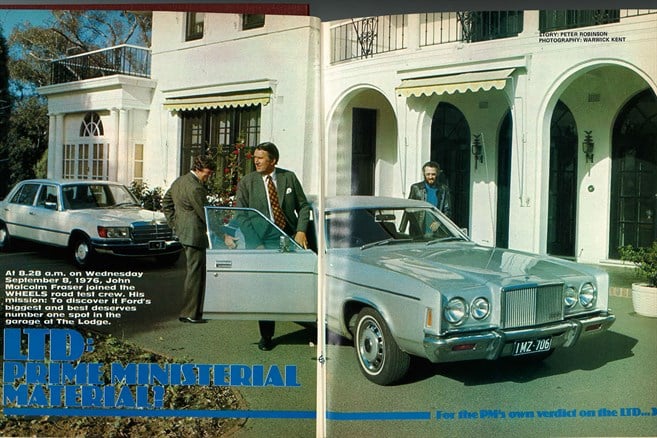
Then we became more ambitious and decided that what we really needed was a photograph of the Prime Minister’s Mercedes-Benz with the LTD outside the Lodge. Surely, if we waited long enough one morning when parliament was sitting the Benz would roll out and we could capture the two cars on film.
Wouldn’t that be great, we thought. Then, by following the PM to Parliament House, we could describe how the LTD felt from the back seat at 60 km/h along the State Circle or sideways in the apex of the corner at the back of Parliament House.
To try and find out about what time the PM might leave the Lodge in the morning we tried ringing a contact in the press gallery only to be told he had resigned to join the public service. Why not try the PM’s Press department, somebody suggested. Why not indeed?
The response was hopeful. “Ah, WHEELS, yes I know, it goes straight into the PM as soon as it arrives.” So we told the man our idea and asked if he would try it out on Mr Fraser. We even suggested that if the PM would like a change from the Benz then we would drive him to the House and that if he wanted to drive there would be no problems. Well, we reasoned it would help the story if we could get some comments from the Prime Minister about the LTD. It was about
then that we began to wonder just how we would explain to Ford if the LTD happened to be run into by another car with the PM at the wheel. But it all sounded rather like a Walter Mitty fantasy.
Unfortunately, the week we intended taking the LTD to Canberra clashed with the school holidays and Mr Fraser was down on the farm with his children so we postponed the trip until the following week and wrote a letter to the PM’s Press office outlining our idea, never really expecting it would come off.
We rang Canberra again the next Monday only to be told that Mr Fraser was in Wilcannia and that the subject of the LTD had yet to be raised in his presence. We tried again on Tuesday and didn’t even get through to the press secretary and simply got a message that he still hadn’t had a chance to talk to the PM about our idea.
So we left a few telephone numbers in the vague hope that something positive might happen and confirmed with the photographer that it was Canberra come-what-may the next morning and that the original idea was still a bloody beaut anyway.
At 9.15 on Tuesday night the phone rang in the middle of Warship. “Tell them, if I can drive it, it’s on” was the relayed message. If we turned up outside the Lodge at about 8.15 the next morning then we could only get to take the PM for a drive but he wanted to drive. It was that easy.
Thick fog slowed us down on the way to Canberra in the early hours of Wednesday but we made it in time to wash the LTD, check out the Lodge and clean out the car.
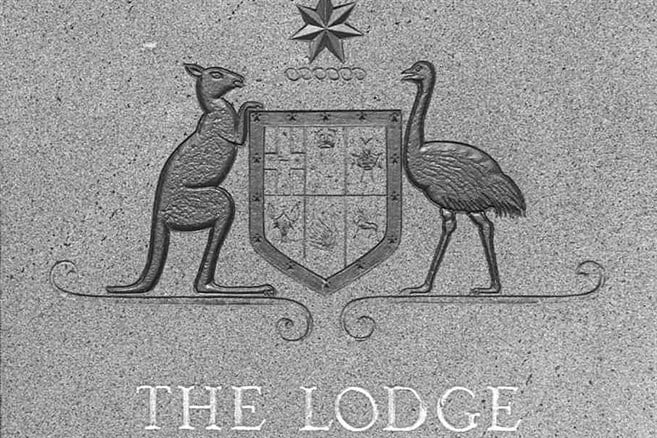
The big silver beast and its occupants must have been obvious because Mr Fraser’s press officer recognised the LTD parked in Canterbury Crescent, at the back of the Lodge, while we loaded cameras and waited for the appointed time to roll around. The press man stopped, said yes it was still as planned and we followed his Cortina around to the front entrance and told the security guard who we were.
“The man really likes cars,” we were told; “he wanted to drive Allan Moffat’s Falcon at Sandown but they won’t let him because he doesn’t have a licence and the security blokes were a bit anxious. But he is going to do a lap with Moffat driving.”
It was the first we’d heard of the Prime Minister’s much-publicised two 200 km/h laps around Sandown Park which were to make the front page of most newspapers around the country the next Monday.
Our conversation had turned to Lancias when the guard shouted from his hole in the white brick wall, “you’re to take the car up to the front”. We couldn’t believe our good fortune- the story was getting better all the time.
The wrought iron gates opened and the LTD quietly slipped down the drive of the Lodge, around the small garden in the centre of the apron and parked in front of a large, white rambling home with wisteria growing along one balcony and a strange but attractive blend of native trees and shrubs and English blossoms in the garden. It seemed unpretentious, even modest, and somehow very Australian.
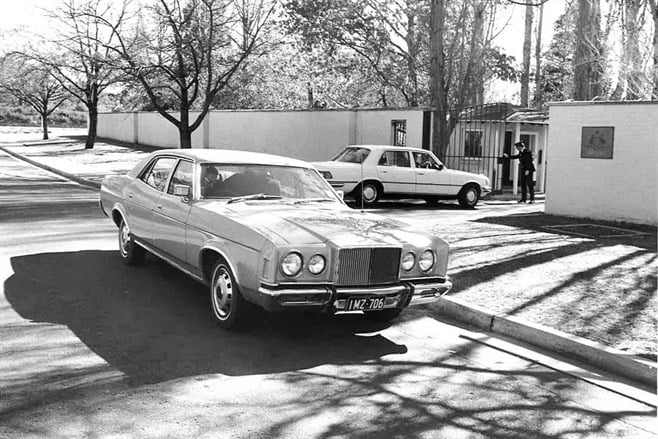
What wasn’t Australian was the white Mercedes-Benz 450SEL parked at the side of the Lodge, but then that was what this trip was all about, wasn’t it?
We decided the Benz should be in the photographs and suggested it be parked in front of the Lodge but still behind the LTD of course.
The· German limousine showed 41,146 miles on the odometer. “No, we don’t want him to get rid of it,” was the driver’s – they are drivers in Canberra and not chauffeurs – answer to the obvious question. “It still has the smell of Gough about it you know, but in the present economic situation he won’t get rid of it, it wouldn’t look good.
“Yes, it is a very good car, but it needs to be taken out on to the highway every so often and given a big stick. It doesn’t like too much city running.”
“Has Mr Fraser driven it?” we asked. “No, but I think he would like to.”
Then two security men drove up behind the Benz in a black XA Falcon and rather spoiled the photograph we had in mind so we asked if they could park the Falcon around the corner. Our request was granted without complaint. A couple of minutes later the iron front door of the Lodge opened and Australia’s Prime Minister stepped outside into the spring sunlight.
John Malcolm Fraser is a very large man – taller and heavier than he appears on the small screen – with very big, strong hands that squeeze you tightly when you shake hands. There is, in his appearance, still a touch of the look of a man who has spent plenty of time under a country sun and is just a little uneasy in a suit.
Introductions over and the Prime Minister walks around the LTD. “This is the latest model” – it’s more a statement than a question – and he opens the back door and asks, “Has it got more room than the old one?” as he slips inside to do his own test of the rear seat room.
We’re a bit taken aback. Imagine questioning the amount of space in the huge LTD with its vast wheelbase and seemingly endless leg room.
“No, I don’t think so,” is the plaintive reply, “Isn’t there enough room?” There is no need for an answer, the Prime Minister’s head is touching the headlining.
“There isn’t enough room in that either!” and he waves an accusing finger at the Benz, “It looks like a big car, even in short wheelbase form, but really hasn’t got as much room as a BMW.”
What follows is a discussion about the relative leg and head room in various continental and Australian cars. None of them came out particularly well, with the possible exception of the BMW.
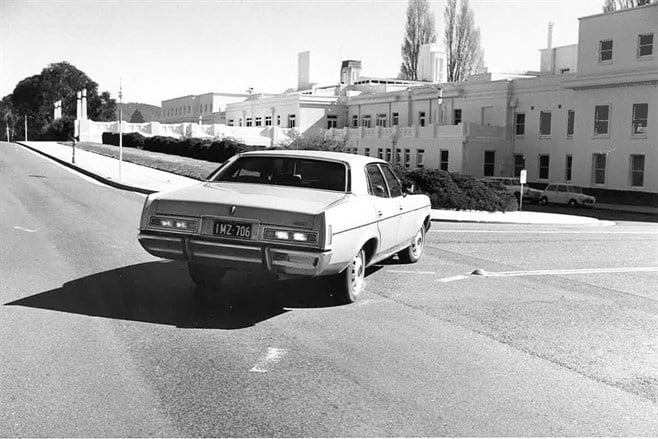
“We’re going for a drive” – it isn’t a question. The keys are in the ignition and the only person to move towards the driver’s seat is the Prime Minister. So, with security man behind him, photographer in the left hand back seat and the editor of WHEELS in the front passenger’s seat the Prime Minister attempts to find a comfortable driving position. Without having to check the front seat back is wound down to an almost semi-reclined position. Thinking he obviously likes to get well back from the wheel and knowing how he likes Lancias, we comment that he really must like a straight-arm driving position.
“It’s not that,” comes the brisk reply, “I just want to give my head some room.” The engine starts easily, mirrors are checked and adjusted to suit, the transmission engaged and the LTD gently moves down towards opening gates. The guard salutes and the Prime Minister waves a greeting as he winds the car around to the left and into three lanes of traffic moving west along Adelaide Avenue.
It isn’t long before the Prime Minister begins fidgeting with the air conditioning controls which are located on the front edge of the central armrest between the two front bucket seats.
“Are you hot?”
“Yes …”
The air conditioning is set to deliver a small stream of coolish air; instead it is blasting forth with air that has the occupants of the car sweating. Various combinations of the three controls are tried amid much cursing, under the breath, by the front seat passenger but nothing stops the intake of hot air.
Finally we give up and decide the only course is to turn off the fan and at least reduce the amount of hot air to a minimum and at the same time suggest that everybody open the electrically operated windows.
By this time the LTD has gone left into Hopetoun Circuit and is beginning to pull up Grawler Crescent. Our polite conversation comes to an end as the Prime Minister flattens the accelerator and the big car lunges forward. But with four adults on board and the air still going, the performance isn’t exactly sparkling and he says so. We quote the LTD’s acceleration times and talk about the car being so quiet that it is deceptively quick but he doesn’t seem too impressed.
We swing into Melbourne Avenue and begin talking about the power steering. “It’s not as light as I thought it would be but it’s still an easy car to drive,” and we decide the man has handled the variable ratio power steering very well and not been worried by it first time out, as most drivers are.
A woman in a Corona pokes its nose out of Empire Circuit on our right and the PM waves her through with a flourish as he brakes gently. From that point on the LTD is to be forgotten till the very end of our drive.
We ask about his Lancias. His enthusiasm is obvious and immediate. We learn that the Flaminia, at present under restoration at Nareen, is a 1966 2.8 litre sedan and that he also has a 2000 Flavia sedan in Canberra. Why does he like Lancias. For their performance, steering ‘and above all their roadholding. No, the 2000 doesn’t have fuel injection because the carburettor engine is easier to service but, yes, it does have the five-speed gearbox.
And yes, the gearchange does take some getting used to with its very narrow gate but it is, we are told by the PM, much freer after 15,000 miles. A small green Lancia sedan speeds past and a dispute begins as to whether or not it was a Flavia or a Fulvia. WHEELS is proved right and the Prime Minister wrong when we pull up alongside it at the lights.
We talk about Bugattis and he asks about the Type 101. “That was the post-war sedan that was made until the mid-’50s,” we reply, as we desperately tried to remember our Bugatti history.
‘”53 or ’54,” he corrects us.
“I know where there is one,” he quietly admits as if he doesn’t really want to let the secret out.
“Why don’t you buy it?” we ask.
“They want lots of money,” is his simple reply, and it strikes home that even Prime Ministers don’t have limitless amounts of money.
The initial, understandable reserve, indeed shyness, is on the wane.
“I also know where I can get a new Flaminia engine. There’s a stock pile in Italy and Lance Milne is going to get me one. The trouble is if I’ve got three engines I’ll have to get another car. He has also found a Zagato-bodied Flaminia and wants to bring it back, but can’t because of the quotas.”
It seems the factory has sold off all its Flaminia spares to various dealers around Turin and Milne has located the one with the complete engines. He asks if we know if Stewart Murdoch has finished the restoration of his 1914 Delage Grand Prix car. We don’t and admit we should. He tells us it once belonged to Lex Davison and was the first car to have desmodronic valve gear. It is the only one left in the world.
Somehow the conversation switches to modern cars, perhaps because we hadn’t displayed the knowledge we should have about the oldies, although we did mention the Issota E’ranschini 1.5 Grand Prix designed by Bugatti that belongs to Lynden Duckett in Melbourne. It turns out the man looks after the Prime Minister’s mother’s car.
“Have you driven the new Gamma?” he asks.
Not yet, not yet, but we hope to early next year and an appointment is made for the Prime Minister to spend a couple of hours in the Gamma outside suburban Canberra.
It soon becomes obvious that he also has an intimate knowledge of the present European car scene. We talk about the new Peugeot 604. “Will they sell any Volvos when it comes on to the market?” It’s a question that is answered with a smile.
We compare the Peugeot with the Renault 30, which uses the same engine, and he is surprised that Renault won’t be importing the 30TS because of the quotas and that it has a very different and more sporting character than the 604.
We mention that a V6 Alfa is also on the way and he appears very interested. The Prime Minister has never owned an Alfa but respects them and says, “Tony Street has a Sud ti and loves it”.
By now we’ve been driving around Canberra without really going anywhere and without spending much time thinking about the LTD, Lancias and Bugattis being far more interesting.
He asks what the time is and we give him a read out from the digital clock in front of the passenger. He heads the LTD back towards Parliament House. We talk about having a Prime Minister who is also an enthusiast and he says, “Well, at least we got the import duty removed on cars over 30 years old. Now I’ll have to buy a car that’s under 30 years old, I suppose …” He smiles and the reserve falls away even further.
We don’t get the chance to show him that the LTD is a quiet car at 140 km/h and doesn’t have the wind noise that seems to plague most XC Falcons and that (or all its size it can be hustled along country roads at a fair rate or knots, only bouncing sideways on the worst of bumps in the apex of a corner and can be stopped with astonishing ease.
The LTD slides into his spot at one side of Parliament House. The Benz is there waiting for him, along with a smattering of press photographers and journalists.
“It’s quieter than the old car. It’s rather a nice car,” he decides as we come to a stop but we know his heart isn’t in the comment. He says it feel tight but wonders how it will be after 20,000 miles because the LTD he is driven around in when in Melbourne has become loose in the suspension and rattles a bit. We suggest he wouldn’t have the same problem in the Benz and he says not now, but they did with the early ones. Somehow we get the impression he doesn’t think the Benz is the ultimate car either.
We say goodbye and confirm a date for the Gamma drive and he says it’s one car he will take out and drive properly.
It’s 8.51 am and we’ve finished our job and got what we came for. We fiddle with the air conditioning controls and finally get the temperature lever to work, go off and have some breakfast and head back to Sydney convinced that Australia has a Prime Minister who has very good taste in cars and equally convinced that the LTD is not John Malcolm Fraser’s kind of car.
I’m sorry Ford, but he won’t be spending his money- as opposed to the tax-payer’s money – on an LTD. Not while there are still Lancias in this world.
LTD: Prime Ministerial material? was first published in Wheels in December, 1976
What is it?
It’s the 458 Speciale, a hardcore, track-focused, powered-up, lightweight version of the Ferrari 458 Italia.
What’s different?
A surprising amount, to be honest. When you’re starting with a car as good as the 458, you’d forgive Ferrari’s engineers for fiddling around a bit, adding some stripes and knocking off early for some fettucine carbonara and vino, but almost every part of the car has been modified in an attempt to unlock more speed.
The 4.5-litre naturally-aspirated V8 scores more aggressive cams, revised pistons and conrods, optimised crank geometry and a new carbon fibre intake manifold. Compression increases to a wince-inducing 14.0:1 and the result is 445kW/540Nm, the former produced at an incredible 9000rpm.
Thanks to a 90kg diet, which mainly consists of stripping everything out of it (including the carpets, and definitely the sound deadening) the Speciale sprints to 100km/h in 3.0sec, passes 200km/h 6.1sec later on its way to a 325km/h top speed.
It’ll lap Ferrari’s Fiorano circuit 1.4 seconds faster than the mighty Enzo, thanks in part to the extra power, in part to mighty carbon-ceramic brake discs measuring 398mm up front and 360mm at the rear with six-piston calipers at both ends, and in part due to the updated chassis electronics.
These include the incredible Side Slip Control (SSC), which effectively allows you to drive like a complete hooligan, safe in the knowledge the electronics still have your back should you overcook it in $550,000 worth of Italian supercar.
Well, that all sounds pretty good – what’s it like to drive?
Beyond words, it really is. That’s the only accurate description because as long as you’re on a twisty road, for the first 10, 50 or 500 kilometres all you’ll do is laugh with sheer incredulity that driving can be this good. Buy one, hire one, steal one – whatever you do, drive a Speciale hard at least once in your life.
Okay, in day-to-day existence the constantly blaring exhaust and ever present road noise could become tiresome, but that said, with the dampers set to ‘Bumpy road’ mode the ride would shame many a luxury car and that highly-strung V8 is happy to bumble along in seventh at 80km/h.
You could commute in a Speciale – we would – but the real magic happens when you get beyond city limits.
The engine is a phenomenon. With incredible response, a brilliantly linear surge of power and a seemingly unending appetite for revs – forget 9000rpm, it feels like it could rev to 14,000rpm. It’s incredibly fast, of course, but never feels in the least bit scary or intimidating; it always feels like your right foot is in control.
It even sounds good. In fact, it sounds sensational. It may be sacrilege to some, but the truth is Ferrari’s V8s haven’t sounded particularly great for a while now; ever since the 355 there’s been a bit too much flat-plane blare. The Speciale fixes that, from the inside at least. It’s attached to a seven-speed dual-clutch ‘box that is only rivalled by Porsche’s PDK.
The Speciale’s greatest trick is how easy it is to access the performance. Mid-engined Italian supercars with nigh-on 600hp are meant to be edgy and intimidating, but the Speciale feels like a Cayman – only friendlier and so much faster.
The steering is ultra-quick but after only a short while its alacrity becomes an advantage as you ‘think’ your way through bends. It feels incredibly agile, which gives you confidence to throw it around. Now, this confidence is largely a byproduct of the SSC system; knowing that there is an electronic guardian angel there should you run out of talent makes a big difference.
In short, in terms of an exhilarating driving experience, it is the best we here at MOTOR have ever encountered.
Can it really be that good?
Yes, it can, though perhaps the Speciale won’t be for everyone. Those that want a 458 but only wish to spend a small fraction of their time at maximum attack might be better served with the regular model.
For our money, though, given the Speciale asks for such a small premium (relatively speaking, as $24,583 is less than five per cent of the purchase price), we’d gladly trade a bit of refinement for the extra aggression.
With the release of the new twin-turbocharged 488 GTB, the 458 Speciale is probably the last naturally-aspirated V8 Ferrari will ever produce. This leaves it as a high water mark and a guaranteed future classic from the crew at Maranello.
Five stars
Read the full review on the Ferrari 458 Speciale and two other N/A superstars, the Lexus LFA and Lamborghini Aventador, in MOTOR’s March issue. Available in digital format on Zinio.
Specs Engine: 4497cc V8, DOHC, 32v Power: 445kW @ 9000rpm Torque: 540Nm @ 6000rpm Weight: 1385kg 0-100km/h: 3.0sec (claimed) Top Speed: 325km/h (claimed) Price: $550,000
Get your free weekly report from the world of fast cars – subscribe to the MOTOR newsletter!
Available for order since last October, the fastest and most hard-core Abarth, the Biposto, is set to hit local road and track.
Here are 10 facts about the most extreme interpretation of a Fiat 500 serious money can buy:
1) The ‘Biposto’, or ‘two seats’ in Italian, is essentially a watered-down version of the 151kW/300Nm 695 Assetto Corse race car that took class honours at 2014’s Bathurst 12 Hour enduro.
2) At 140kW/250Nm, the 1.4-litre turbo four is 8kW up on the old 695 Tributo Ferrari thanks to a specific intake, front-mounted intercooler, and a dual-stage exhaust with titanium tail pipes supplied by famed MotoGP supplier Akrapovic.
3) Tipping the scales with a dry weight of just 997kg, its maker claims the Biposto will march to 100km/h from a standstill in just 5.9sec and top out at 230km/h.
4) Only around a dozen examples will be available to the Aussie market, each finished in an exclusive textured matte grey finish and wanting for a frosty $65,000, a $20K premium over the supplanted top-dog 595 50th Anniversary. That is, until you start ticking the option boxes…
5) Unlike the six-speed sequential Assetto Corse race car, the Biposto gets a conventional five-speed manual gearbox. However, a H-pattern manual with dog-ring engagement – for clutchless upshifts – can be optioned for an eye-watering $15,000…
6) The handling package is, by road car standards, pretty extreme: motorsport specialists Extreme Shox produce the suspension hardware, which offers adjustable damping and ride height, while both electronic (braking-activated) Torque Transfer Control and a self-locking limited-slip diff send drive to the front 18-inch OZ Racing wheels shod with 215/35 R18 rubber.
7) Braking, at least at the Biposto’s pointy end, is serious indeed: floating ventilated 305mm discs clamped with four-piston Brembo calipers.
8) A ‘Special Kit 124’ option, at around $5000, adds a twin-bulge aluminum bonnet – in homage to the classic Abarth 124 – together with a host of detail pieces made of lightweight titanium such as wheel centre caps and bolts and water, oil and fuel caps.
9) Add another $9000 to the budget and you can add the ‘Carbon Kit’ which, as you no doubt imagine, introduces carbonfibre to the mirror caps, interior door panels, dash fascia and rearview mirror.
10) While a titanium roll bar is standard, you can stretch the Biposto’s pricepoint to six figures by adding a ‘Track Kit’ which, for around $7000, adds a digital race data logger, carbonfibre shelled seats, four-point Sabelt racing harnesses and, why now, your own complete Abarth factory driver’s racing suit and helmet that can be inscripted with your name.
Get your free weekly report from the world of fast cars – subscribe to the MOTOR newsletter!
GRIZZLE the dog launches himself through the Ford’s open driver’s door, jumps over the console and instantly assumes his customary position on the passenger seat. It’s not his master’s Lancia Flaminia or the Mercedes-Benz GL, but the dog takes for granted that the boss is about to depart.
“That’s it, Grizz – take over.” The hair is now silver and the walk has slowed, but the deep, commanding voice of Australia’s 22nd Prime Minister is unmistakable. “I think he likes the car already,” says Malcolm Fraser, smiling at the antics of his beloved Border Terrier.
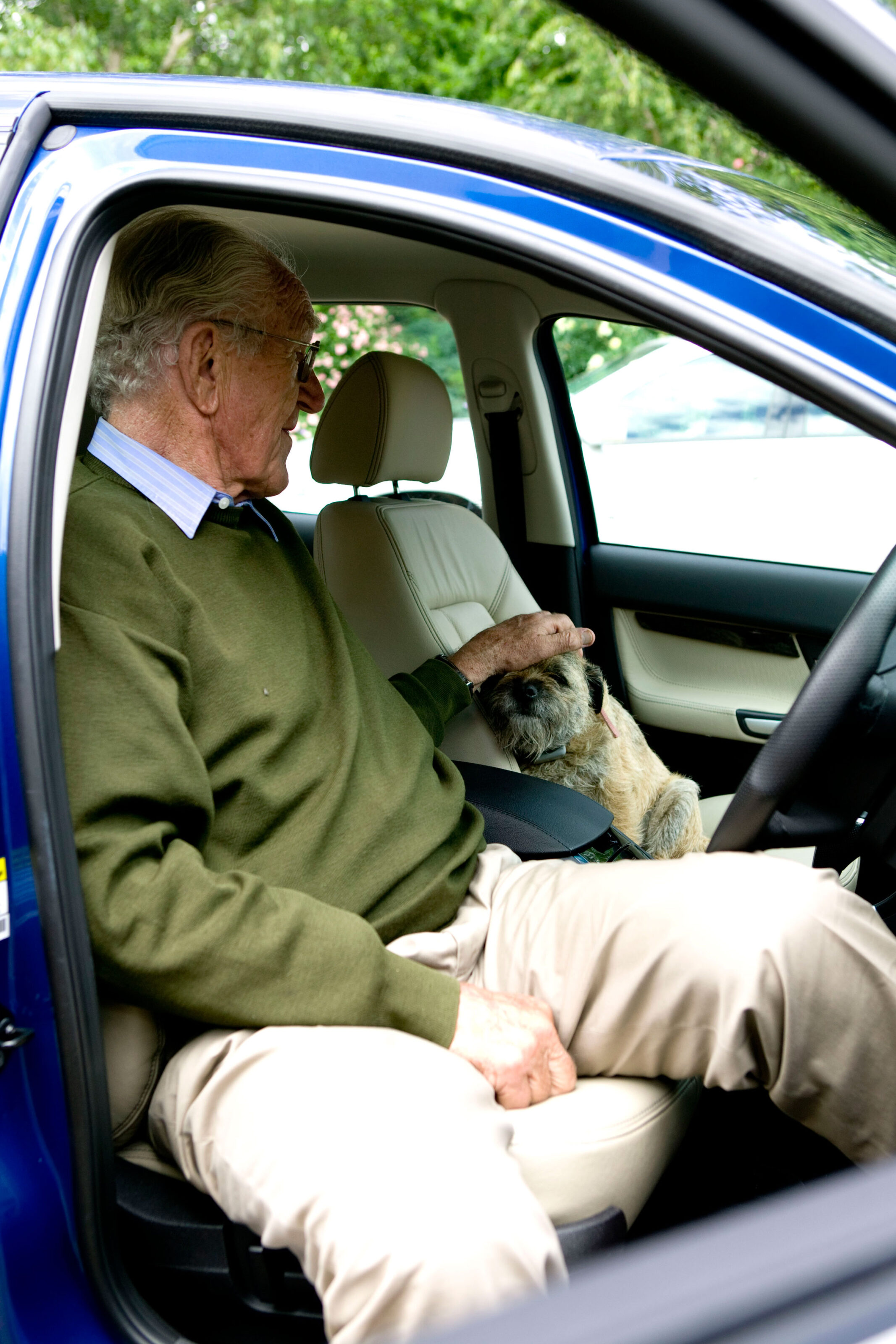
To commemorate the end of the Ford Fairlane – after almost 41 years of continuous local production – and to revive a celebrated Wheels story, photographer Ellen Dewar and I have arranged for the former Prime Minister to drive one of the last Fairlanes built.
Thirty-one years earlier, Prime Minister Fraser tested the new LTD for Wheels. Now in busy ‘retirement’ on his property on Victoria’s Mornington Peninsula, a more relaxed and friendly Fraser is clearly in the mood to talk cars, politics, American history and, as a keen amateur photographer, to get Dewar’s expert advice on Nikon digital camera lenses. Fraser, a car enthusiast since he fell in love with (but couldn’t afford), a Lancia Aurelia while at Oxford university in the early 1950s, also wants me to steer his rare and beautiful, Pininfarina-styled 1966 Flaminia 2.8 sedan. One way or another, it’s going to be a memorable day.
After coffee and a chat, the conversation turns to the big Ford. And why it’s been dropped from the local line-up. “Any global corporation that competes in Australia can’t expect to be separate from the world,” Fraser says. “They must fit into the world and be able to compete on the domestic and export markets.
“If we’re going to be competitive with China and India, we need a better educated population.”
Geo-political lesson over, we return to the more mundane.
“One of the problems with the Fairlane has been a lack of legroom in the front,” explains the 1.93-metre tall Fraser, who prefers to ride up front. “The seats didn’t suit my back.”
Terry Comb, his regular Commonwealth driver, arrives in a WM Statesman, now the car of choice for politicians. Comb, a committed Holden man, is nonetheless persuaded to experience the Fairlane from the back seat. Grizzle, who has been asleep on the Fairlane’s back seat, has lost his chance for a ride and is left behind.
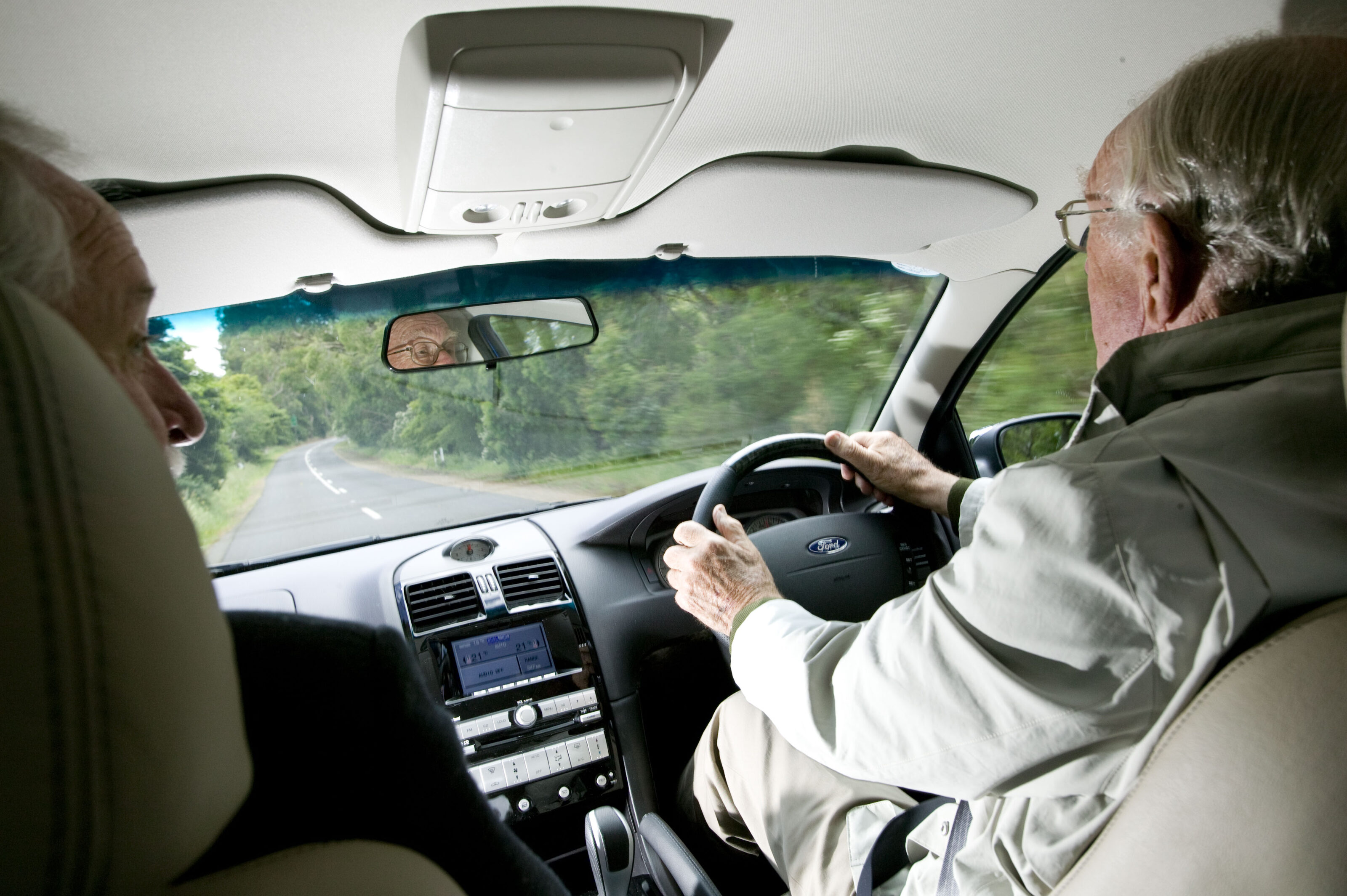
After collecting his driver’s licence, Fraser slides in behind the wheel of the big Ford, once easily Australia’s best-selling luxury car, and we depart. After adjusting the steering wheel and tilting the power-operated cushion, long-legged Fraser is finally comfortable, his head well clear of the roof lining.
“They must have changed the seats; these are much better,” declares the former PM.
Down the long driveway he is already analysing the car, and accelerating hard after turning on to the bitumen road. “Got a lot of lift, hasn’t it? It would be easy to lose your licence in this thing. What’s it like on gravel?”
To answer the question, we’re soon belting down a loose-surfaced dirt road. Head back, one arm outstretched to the wheel and the other holding the gear selector, Malcolm Fraser is relaxed, enjoying the task and the chat.
“I don’t have to do anything to keep straight.” He sounds surprised and impressed, then jumps on the brakes. The Fairlane stops true, without any brake pedal stutter. “The ABS is discreet.”
Intrigued by the technology in his new Merc GL, he has been experimenting with the ESP on this same road. Predictably, the Ford gets a full-throttle take-off. The Fairlane lunges forward, wheels spinning, but tracking perfectly. He tries again, this time there’s no hint of wheelspin, just rapid forward motion. “Not bad, not bad.”
Both men want technical details on the V8 engine – 5.4-litres, sohc, 230kW – and approve of its burbling exhaust note. Comb may be red at heart, but that doesn’t stop him criticising the Statesman. Both men dislike the Holden V6’s induction roar. “It sounds like a chaff cutter,” claims Fraser. Comb also reckons the WM’s suspension is too soft, with an excess of body roll. Neither has driven the tauter WM Caprice, which answers this criticism. They agree that the more expensive Holden doesn’t seem to be on the Government car list.
By the time the Fairlane is parked, Fraser is waxing lyrical. “I think this is a very impressive car; lovely to drive. It’s well balanced and goes much better than I thought it would.”
He turned 78 in May, but Fraser still likes a speed. Earlier, he’s admitted that while still PM, Holden persuaded him to spend time in a blue-printed VB Commodore, the suspension and steering specially tweaked.
“There were no speed limits then and it would pull maximum revs in top gear. That car was beyond reproach.”
He admits to achieving unmentionably quick times in the Commodore between Melbourne and Nareen, the family’s former country property. On a recent garden tour of Italy with wife Tamie and his sister, who lives there, Fraser’s one extravagance was to hire a Mercedes S-Class and driver in Tuscany. Nobody much worried about speed on the autostrada, until Tamie noticed they were going “a bit fast”. The speedo needle hovered over 220km/h.
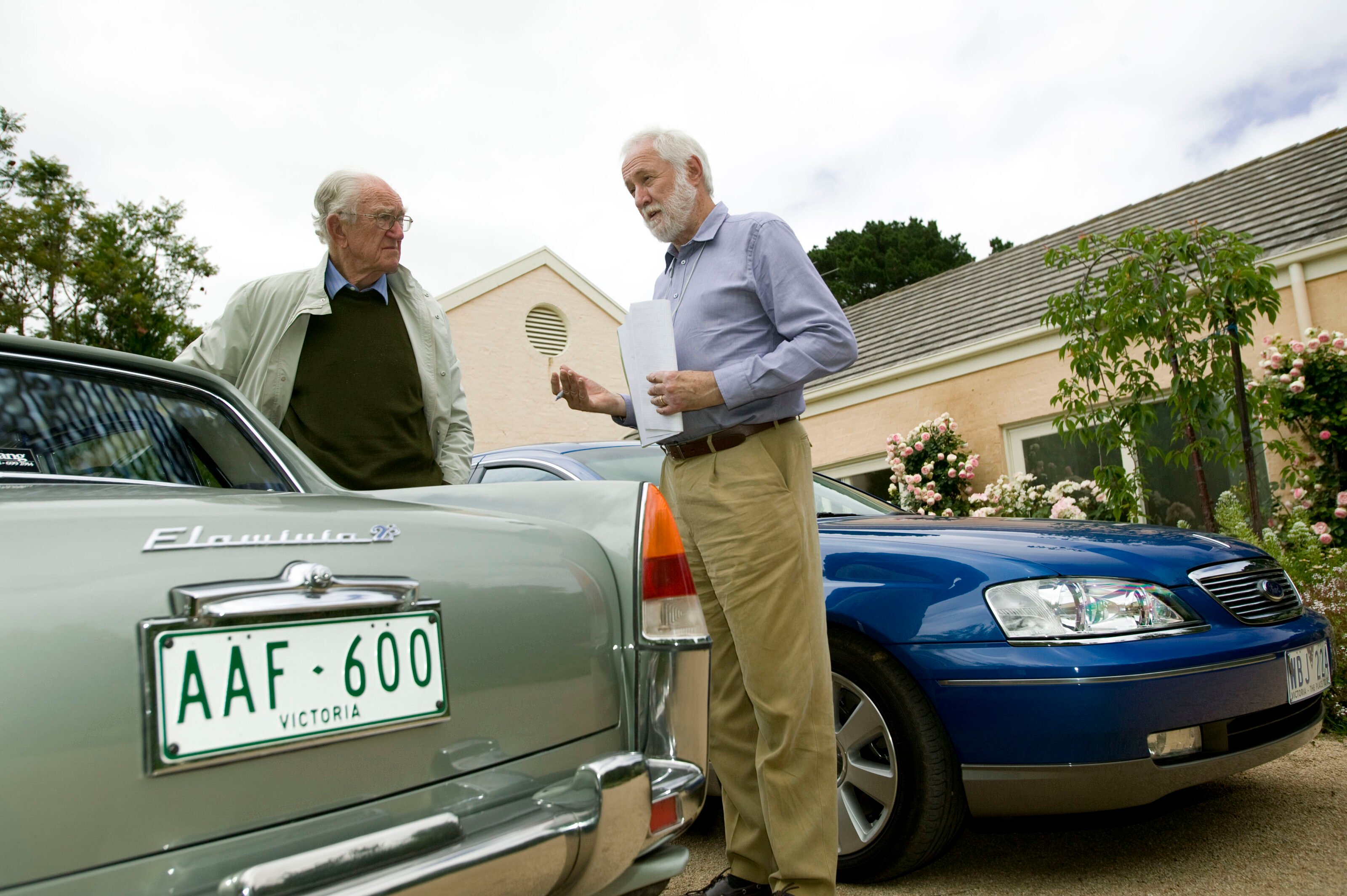
Time for the Lancia, a beautifully engineered car that’s powered by what was the world’s first production V6 automotive engine. Fraser slides behind the wheel and cranks the engine over. After a few seconds it splutters for an instant, then fires up, sucking through the Weber carby.
“You might think I went up here this morning to make sure it would start for you,” he says. “But I didn’t. That’s the way the Lancia always starts.”
After an engine rebuild and body restoration, the Flaminia now has the satisfying patina that comes with regular use. The engine was rebuilt 5000km ago, but while showing us the car, Fraser discovers a couple of bubbles of rust on the leading edge of the bonnet. He’s not happy.
After lunch at a local cafe, it’s my turn. For a 42-year-old car, the Lancia is a wonder. After sliding my legs around the FB/EK Holden-like dog-leg of the wrap-around windscreen, I pull out the choke (remember them?) turn the key and the V6 is alive. The oily feeling column gear change slides between the gears, the overall gearing is low (“the coupes were higher geared for maximum speed”) and, with the strong bottom-end torque, provides old-fashioned top-gear flexibility. The loudest noise is from the engine fan, another giveaway to the car’s age, the brakes are heavy, visibility in every direction is fantastic. The Flaminia is ageing gracefully.
“I don’t think I’ll ever sell it – though never is a big word. I’ve put too much into it, really,” Fraser confesses. Where I ask, did this passion for cars – and especially Lancias – come from?
In early ’50s England, the next best thing to an expensive Lancia was a Jowett Javelin, an advanced British sedan powered by a flat-four engine. Fraser knows his stuff. “The Javelin’s handling balance was second only to the Lancia and helped me earn a reputation as a driver. I took the Jowett on an Oxford university car club event during one winter. I remembered to let a little air out of the tyres to help the grip on the slippery roads. MGs were climbing over the stone walls on one corner and I hoped I wasn’t going to follow on the black ice. I didn’t touch the brakes and somehow made it.”
The Jowett company failed, and a few years after returning to Australia, Fraser bought his first Lancia. Later came a Super Sport Zagato Flaminia with the trademark double-bubble roof, a 1.6-litre HF Fulvia and a Flavia 2000 sedan, Tamie’s much-missed wheels in Canberra. “I don’t know why I sold it,” Fraser admits in sorrow. “Lancias always had the sort of road holding and braking balance that interested me.
“I know where you can get a very good Gamma coupe for $15,000,” he adds. It’s more an invitation to join the small band of Australian Lancia-isti, but the Gamma, developed by Fiat after the Italian giant paid one lira for Lancia in 1969, has an appalling reputation for reliability. It’s only then I dare own up to having sold my 1.3-litre Fulvia coupe before returning to Australia. It’s too painful to reminisce, so I change the subject to SUVs.
Why does he drive one? Easy, today, the Frasers pull a boat. He has done his research. After 400 metres in a BMW X5 the ride was “too stiff and harsh”; the Landcruiser’s diesel V8 “noisy” and the cabin doesn’t have enough leg room up front; nor is he impressed with the air suspension on the Mercedes ML. Having tried all the big SUVs, Fraser chose a Merc GL320 CDI. He insists on demonstrating the power-operated third-row seats that fold neatly into the floor and the spacious driving position, and he enjoys the 3.0-litre diesel’s responsiveness. The other car in the household is Tamie’s bright yellow Audi A3, the replacement for an Alfa 164.
After four hours of driving and chatting, we depart. The Fairlane sets off for Sydney – averaging 9.3L/100km up the Hume – and I’m left to ponder Ford’s failure to establish export markets for this car. This decision, confirmed by Dearborn, forced Broadmeadows to cancel development of the luxury sedan at FG styling proposal stage. Fraser’s right: if Australian car manufacturing is to continue long term, our cars must be designed and engineered for export in significant numbers.
Farewell Fairlane was originally published in the June 2008 editon of Wheels
