
The R35 GT-R has always struggled to wed two seemingly opposing ideals: GT, the long-haul luxury missile. And R, the lap time-mauling, physics-twisting animal.
But now that Nissan has created its halo Nismo GT-R for those who scoff at things like ride comfort and luxury, it’s allowed Nissan to explore more of the GT side of the GT-R with its MY14 update.
Once upon a time, the GT-R felt like it had tensed biceps for springs and solid rods for shocks. That’s changed with the new car.
For MY14, Nissan has revised the GT-R’s front swaybar spring rates and electronic damping control to “reduce load fluctuations between the four wheels”. The goal was for the suspension to be better at keeping tyre and bitumen kissed together, but it’s also resulted in a better ride.
It’s also quieter thanks to new active noise cancellation in its Bose stereo (fairly common tech in new cars these days). Nissan has even revised the placement of sound deadening to reduce driveline whine.
It’s all very grown-up, indeed – and it works. The GT-R now rides over city streets in such a way as to not incur the chagrin of any non-enthusiast passengers.
And for low-speed stuff, Nissan has also adjusted the brakes to make them less aggro, and the steering to be lighter. The result? A GT-R that’s much easier to live with.
There are cosmetic changes, too. The MY14 scores new headlights, and tail-lights incorporating two sexy, solid rings of red. Meanwhile you can have your GT-R in a new crimson exterior red, or with an ivory leather interior (either good or ghastly depending on your tastes).
To drive, the GT-R is as berserk as ever. Full-throttle is frightening in the wet. It’ll wriggle like it’s rear-wheel drive with wheelspin in first and second gears. I drove the MY14 in the wet and if I’m honest, it was more frightening than enjoyable.
Unless its standard Dunlop SP Sport Maxx GTs – which look like semi-slicks – have a bit of heat in them, it’s difficult to feel the limit (and feel confident) belting along a twisty Aussie backroad.
It also still feels a bit too stiff to properly deal with a bumpy Aussie road at speed. These are things not normally an issue, unless you’re in a 1740kg car with 404kW, that does 0-100km/h in 2.7 seconds. We’ll have another go in the dry and get back to you.
So… elephant in the room. Where the hell is the MY14 Nismo, Nissan Oz?
MY14 NISSAN GT-R Engine 3799cc V6, DOHV, 24v, twin-turbo Power 404kW @ 6400rpm Torque 628Nm @ 3200-5800rpm 0-100km/h 2.7sec (claimed) Weight 1740kg Price $172,000
4/5
Meet Ferrari’s latest ultra-exclusive offering to its ultra-wealthy clientele, the F60 America.
Built to celebrate Ferrari’s 60th Anniversary in North America, just 10 of these F12-based Targas will be produced, reportedly priced at around A$3.6 million. The price, however, is irrelevant, as keen US collectors have already snapped up all 10.
While mechanically standard, the F60 America’s roofless construction allows even better access to the wailing 545kW/690Nm 6.3-litre V12. For those rainy days, a cloth roof, useable up to 120km/h, provides protection from the elements.
Aside from the twin buttresses sprouting from the rear deck, the biggest styling changes are on the car’s flanks, with a diapason (literally, tuning fork) design theme.
Inside, the unusual asymmetric cockpit features a red driver’s environment, including seats, door trim, dash top and centre console, but the passenger side in black, apparently inspired by historic Ferrari competition cars.
Unusually for such a resolutely Italian company, a stylised American flag resides on the centre of each seat and backrest.
The stripes are homage to the North American Racing Team, which campaigned Ferraris in the ’50s and ’60s. One of 10 Ferrari 275 GTB/4 NART Spiders sold for a staggering US$27.5 million in August 2013.
While we’d rather have a standard F12 and pocket the $2.8mil, these one-offs are an increasingly popular way for high-end manufacturers to satisfy the exclusivity desires of their most well-heeled customers while also significantly boosting their bottom lines.
We drive the most powerful ute in Australian history – the 430kW HSV GTS Maloo – as well as Ford’s new Mustang, the Lexus RC-F and BMW’s eco-loving i8 supercar. Oh, and Bathurst legend Craig Lowndes lets us loose in his own Red Bull Racing V8 Supercar.
Wheels’ annual Gold Star cars reveals the best-value new models on the market to take the headache out of shopping for your next car, while we also put the Mazda 3, Holden Cruze, Alfa Giulietta and Hyundai i30 in a room and lock the door…
Want more? Download the Wheels app, or pick up the November 2014 issue at your news stand.
HOLDEN is leading the charge in Australia with the autonomous car – but the problem is they’re not meant to be.
More than 9000 versions of the Holden Barina small car and Barina-based Holden Trax compact SUV have been recalled after the discovery that a worn ignition barrel could crank the engine if the key was left in it in the “off” position. That means that if left in gear with the hand brake on softly, the car could shuffle forward with no one behind the wheel.
Holden said it has issued the recall notice after logging five cases of vehicles driving themselves away automatically.
A spokesman for the company told Wheels that automatic versions of the Barina and Trax were not affected by the self-starting problem.
According to Holden, the safety recall only affects certain 1.6-litre versions of the Barina up to three years old, and 1.8-litre versions of the Trax up to two years old, and only models fitted with manual transmissions.
“If, when the vehicle is parked, the ignition key is left in the cylinder, the manual transmission is left in gear and the park brake is insufficiently applied, the vehicle starter motor may crank and the vehicle may move unintentionally,” Holden said.
“This condition cannot occur if the key is removed from the ignition key cylinder when the vehicle is parked,” it said.
Holden said there had been no injuries relating to the recall, and owners would have the barrel replaced for no charge.
The Holden recall is unrelated to another sweeping its US parent company, General Motors. However, that recall – which has already been linked to almost 30 deaths – relates to worn ignition barrels that switch off the vehicles’ engines, cutting power and switching off the airbags.
Meanwhile, more than 3000 Colorado 7 large SUVs will revisit Holden workshops after owners discovered seatbelts in the third-row seats didn’t like the vehicle being parked on a slope.
According to the recall notice, retractor lock sensing mechanisms for the seatbelts freeze up the belt if the Colorado is parked on a slope that’s angled between nine and 12 degrees, preventing the passenger from using it until the vehicle moves to flatter ground.
Once again, Holden will replace the seatbelt mechanism free of charge for affected owners.
Craig Lowndes came so close to victory at the Bathurst 1000 last weekend. The marathon Great Race held more twists and turns than the Mount Panorama circuit itself.
One thing most of us mere mortals will never find out is what it takes to pedal a proper V8 Supercar. But in the lead up to Australia’s flagship race, Wheels got to do just that.
Red Bull Racing dropped Wheels editor Glenn Butler into the bull ring with half a million bucks of Craig’s own V8 Supercar. How did he do? Watch the video to find out.
Read the full story and see more behind the scenes photos in the November issue of Wheels magazine, available on iPad now and in stores this week.
Owning a Porsche Panamera Turbo S in Australia is like owning a lion and keeping it permanently locked in a cage.
It’s a powerful and ferocious beast that deserves to roam free; driving it within the stifling confines of Australia’s speed limits, it feels shackled, bored even. A trip to Heathcote Raceway drag strip graphically illustrates the problem.
The Panamera Turbo S takes just 4.41 seconds to pass the national speed limit (110km/h for everyone not in NT), having hit 100 in 3.82. The quarter mile vanishes in 11.82sec at 192.39km/h and extracting this performance couldn’t be easier: simply hit the ‘Sport Plus’ button, press your left foot firmly on the brake, mash the accelerator into the carpet then release the brakes.
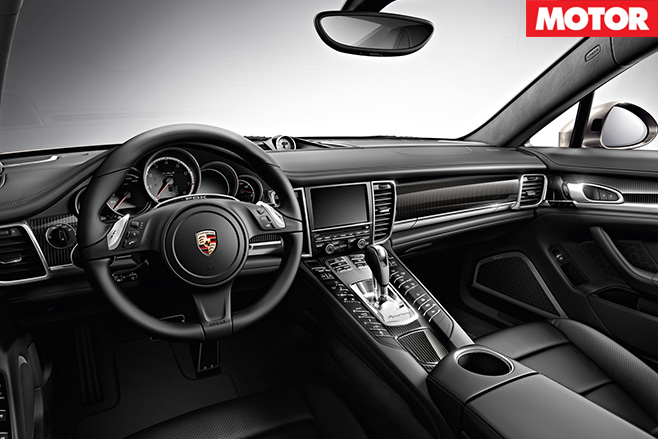
Don’t think that the Panamera Turbo S is a one trick pony, however. On the highway it wafts along silently, air suspension isolating occupants from the road’s undulations, the 4.8-litre twin-turbo V8 dropping to idle on downhill sections as the seven-speed PDK ’box engages its ‘sailing’ mode to save fuel.
Switch to ‘Sport’ and the exhaust bellows like a grizzly with a toothache, the gearbox wakes up and body control tightens without sacrificing the ride. Attack a sequence of corners and you sense that if it could, the Turbo S would simply raise an eyebrow – “is that all you’ve got?”
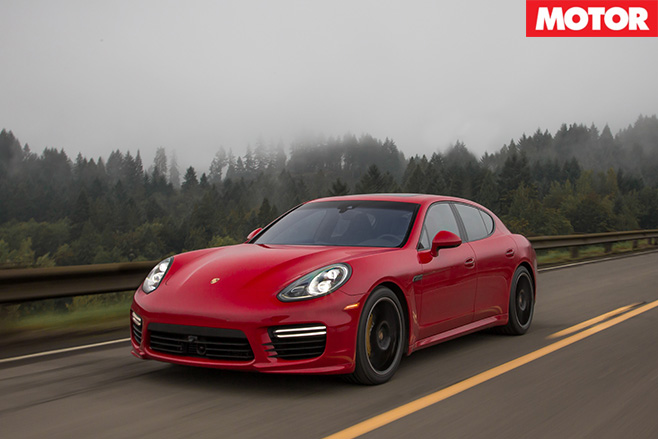
At first the Turbo S’s $444,600 ($469,800 as tested) seems absurd; how can it cost twice a (more powerful) BMW M5? While undoubtedly pricey, the Panamera’s composure and feedback elevates it above both the traditional super sedans and price rivals such as the Bentley Continental Flying Spur or Aston Marin Rapide.
What the Panamera lacks is the bespoke feel of the Bentley and Aston. It’s beautifully built, and all the creature comforts are present, but it majors on function rather than flair. Is it reasonable to expect a bit more of a sense of occasion at this price point? Regardless, the Turbo S is an incredible achievement in defying the laws of physics, but if you buy one, just remember to let it out of its cage every now and again.
Specs: Engine 4806cc V8, DOHC, 32v, twin-turbo Power 419kW @ 6000rpm Torque 800Nm @ 2250-4500rpm* Weight 1970kg 0-100km/h 3.8sec Price $444,600 *overboost
4.5 stars
Mercedes wrapped up its first F1 constructors’ title at last weekend’s Russian GP thanks to Lewis Hamilton and Nico Rosberg securing the team’s 11th 1-2 of the season, however securing that title has cost an incredible A$595 million, internal documents have revealed.
The figures, reported by UK paper The Independent, show that Mercedes lifted spending by 17 per cent this year, with the majority of the increase being accounted for by the complex new 1.6-litre turbocharged engines. Engine spending increased to A$245 million, tripling the team’s engine costs compared to three years ago.
Another A$46 million lines the pockets of Hamilton and Rosberg, as we reported earlier this year, which leaves $304 million for developing the remainder of the car and operational expenses.
While there’s no doubt this year’s figure is bloated by the need to develop the complicated new hybrid powertrains from scratch, F1’s shrinking audience and the difficult of securing sponsorship has led to renewed talks about controlling costs.
However, as Mercedes’s 2014 efforts prove, the top teams will always spend whatever they need to to ensure championship success.
SUDDENLY you’re doing double the speed limit. How it happened is almost a mystery because the Bentley GTC V8 S is so smooth. But with an extra dose of heat unleashing 389kW/680Nm from its 4.0-litre twin-turbo V8, Crewe’s powered-up GT drop-top has enough grunt to skew an election and stare down rivals from the Aston Martin Vantage V8 S Roadster to the Porsche 911 Turbo S Cabriolet.
This Bentley makes Sydney house prices look reasonable. Handing over $446,000 gives you a ticket into the V8 S club. The S adds $39K over the pleb version (and 16kW), putting it within $3500 of the even more potent 423kW/700Nm W12. But our test car added another $11K for its stunning Kingfisher Blue paint, $17K for Mulliner gear (delectable 21-inch alloys and quilted leather seats) and almost $18K for Naim audio, massage front seats and a rear-view camera as part of the ‘Premium’ spec. The cost of all these options would buy you a decent hot hatch.The V8 S isn’t for hot-hatch lovers, though, it’s for a driver who demands instant gratification and sensory overload. Beyond its cosmetic skirts and sinister detailing, the S delivers balance, poise and grace in spades.You feel all 2295kg at slow speeds, but at a gallop the hunched, almost gothic-looking convertible belies its weight, distracting you with a raw-edged V8 bellow and the smoothness of its eight-speed auto. The classic ‘wave of torque’ is a truism here as you bask in the cabin’s blend of old-fashioned elegance – the chrome trumpets to operate the air vents, the mandatory Breitling clock – and soak up the V8 timbre with the roof down, or enjoy its subtle surge with the roof up.There’s not a squeak, rattle or rubbing between surfaces with the roof on, and the refinement is consistent with the drivetrain’s silkiness. Add all-wheel-drive roadholding and the stopping power of huge carbon-ceramic eight-piston brakes and the touring capability of the V8 S verges on the sublime.You’re reminded of its weight on swift changes of direction and you need to have the gearbox in S mode to take the doughy edge off the throttle, but the compliant, comfy air-suspension ride (even in its firmest setting) and the warm liquidity of the V8’s delivery strike a superb balance between ultimate luxury and athletic performance.
The V8 S feels a little dated inside – and you have to pay extra for a reversing camera, unlike a Falcon buyer – and the S-Class outdoes it for dazzle, but that badge, the confidence of the design and the V8’s bellow makes the W12 simply for the boastful.
The V8 S is the thinking man’s GTC, if half a million for a drop-top is worth thinking about.
Bentley Continental GTC V8 S Engine: 3933cc V8 (90°), dohc, 32v, twin-turbo Max power: 389kW @ 6000rpm Max torque: 680Nm @ 1700-4500rpm Transmission: 8-speed automatic Kerb weight: 2295kg 0-100km/h: 4.5sec (claimed) Price: $446,000 On sale: Now
V8 SUPERCARS: Crazy wheels on the Mountain
IT WAS a contest for the ages, a mad, unpredictable Bathurst 1000. There were crashes galore; an hour of suspended action while repairs were carried out to the track surface; a controversial call to give Craig Lowndes a drive-through penalty that ruined his race; an agonising late-race glitch that took pacesetter Shane Van Gisbergen out of contention; and a final lap drama hitting a fuel-starved Jamie Whincup.
Not to mention Chaz Mostert/Paul Morris coming from last on the grid to finish first. The duo didn’t lead on any of the 160 laps, but quite extraordinarily hit the front when it counted, less than half a lap from the chequered flag, to give Ford Performance Racing a stunning second consecutive win.
The Ford odd couple – young tearaway rookie Mostert in only his second Bathurst 1000 start, and veteran part-timer Paul Morris – landed a remarkable victory ahead of James Moffat and Taz Douglas, who gave Nissan its first V8 Supercars success in Australia’s biggest domestic motor race. Yesterday marked the return to the Bathurst podium of the famous Moffat name, 30 years after papa Allan last stood there.
Third were tall timbers Nick Percat and Oliver Gavin for Walkinshaw Racing.
There were several hard-luck tales. Tekno’s Van Gisbergen led the field on a merry dance and looked to have the race at his mercy, when he stalled in the pits after his final fuel-only stop and couldn’t restart the Holden.
Then, just seven laps from home, Lowndes was sensationally penalised for tapping Ford’s Mark Winterbottom into a spin after Frosty ran wide. The debate continues whether this was a rough call and there was some support for the officials to wait until after the race to impose any sanction.
With the laps running down, Jamie Whincup held sway from the hard-pressing Mostert, the young charger benefitting from a top-up while the defending V8 Supercars champ was in fuel conservation mode.
Entering the final lap, and with his ears ringing from his race engineer Dave Cauchi’s dire warnings about using too much fuel, Whincup had his mirrors full of FPR Falcon.
Mostert knew the Holden was running on empty. “The last five laps all I could think was, ‘cough, you bastard, cough’,” he said.
Exiting Forrest’s Elbow, the Red Bull Holden faltered, and Mostert swooped to the front. Whincup’s gamble had failed.
The winning car started from the last row (alongside Whincup) due to a penalty for overtaking under red flag conditions during qualifying on Friday.
Morris, 46, showed that patience and opportunity can land a Bathurst classic win late in a driver’s career. He was a surprise choice as co-driver at FPR but now has his name on the Peter Brock Trophy.
His late-career win came 17 years after he crossed the line first in the 1997 AMP Bathurst 1000 for super tourers but was disqualified afterwards.
Volvo’s Scott McLaughlin took the lead early and stayed up front with some consistent laps, until he got in the marbles duelling with fellow Kiwi Van Gisbergen and ended in the wall.
The race, the longest in Bathurst 1000 history at seven hours and 58 minutes, was stretched by the one-hour stoppage to repair damaged bitumen at turn two, and a total of 10 safety car interruptions.
After the tumultuous day, Whincup continues to top the championship points table.
2014 Bathurst 1000 1 Chaz Mostert/Paul Morris (Ford) 2 James Moffat/Taz Douglas (Nissan) 3 Nick Percat/Oliver Gavin (Holden) 4 Will Davison/Alex Davison (Erebus AMG Mercedes) 5 Jamie Whincup/Paul Dumbrell (Holden) 6 Mark Winterbottom/Steve Owen (Ford) 7 Todd Kelly/Alex Buncombe (Nissan) 8 Rick Kelly/David Russell (Nissan) 9 Fabian Coulthard/Luke Youlden (Holden) 10 Craig Lowndes/Steven Richards (Holden)
DRIVER CHAMPIONSHIP POINTS 1 Jamie Whincup – Triple Eight: 2547 points 2 Mark Winterbottom – Ford Pepsi Max Crew: 2250 3 Craig Lowndes – Triple Eight: 2208 4 Shane van Gisbergen – Tekno: 2096 5 James Courtney – HRT: 2096
V8 SUPERCARS: Ford to go…or will it stay?
MARKETING reasons and money – not any emotional attachment – will be the ultimate consideration for Ford on the passionate topic of whether it withdraws from V8 Supercars racing.
Along with the Holden brand, Ford is a foundation member of the category. The whole V8 Supercars ‘thing’ was built around the traditional rivalry between the two tribes. Red versus Blue.
After a slow start, but propelled by lots of hype, V8 Supercars racing took off, and much of the appeal came from those brutal battles between Falcon and Commodore.
But any two-make form of racing always comes with attendant hazards, principally the disastrous outcome if one brand elects to depart.
Loyalty exists among V8 Supercars spectators, but never believe the same of the car makes involved. People who have been around the car makers for a long time understand that every big move they make is ultimately related to selling cars.
The motoring landscape in Australia has changed dramatically in the past two decades – and will continue to evolve to meet the demands of consumers, and the needs of the planet. Stating the bloody obvious, sales of big family sedans have nose-dived, and versatile SUVs and ever-better/safer/efficient/comfortable small cars are now preferred by buyers.
Recent speculative media reports (conspicuously devoid of quotes from any sources), were designed to bring pressure to bear on Ford Australia to reverse its (still unconfirmed) call to head for the V8 Supercars exit.
Ford gave the last Falcon model, the FGX, a preview gallop around Mount Panorama during the Bathurst 1000 carnival and no doubt it will bathe in the spotlight surrounding the Chaz Mostert/Paul Morris victory, so it still believes in the value of the racing connection. While the Falcon will cease production in October 2016, V8SA continues to lobby Ford to stay in V8 Supercars, as does Ford Performance Racing and DJR Team Penske.
The speculation that Ford is getting out of racing is interesting in light of the emphasis the local arm will be placing on the sporty Mustang when it goes on sale here next year. There has been ongoing debate too that V8 Supercars would open up the category to two-door cars like the ’Stang and GM’s Camaro.
Without any confirmation of ongoing factory backing from Broadmeadows, FPR and DJR Team Penske will use the new-model FGX Falcon in the 2015 V8 Supercars Championship.
But both Ford squads are only planning one year ahead at this stage, with Ford Australia unprepared to make a call until the end of this season.
Both teams will join forces to homologate the FGX, which they aim to improve in some key areas where the present Falcon V8 Supercar is seen as hurting – rear aero and panel weights.
Penske is the second-largest auto dealership group in the world, with 327 retail automotive franchises across 42 different brands, including Ford. Roger Penske may well have thoughts on using DJR Team Penske to introduce a new brand to the category from 2016.
FORMULA ONE: Merc one-two; Red Bull seven-eight
LEWIS Hamilton has extended his lead in the F1 drivers championship by winning the inaugural Russian Grand Prix ahead of Mercedes team-mate Nico Rosberg in front of a proud Vladimir Putin.
The dominance by the flying Mercs secured the constructors title for the team.
Hamilton, who started from pole, has now won the last four GPs on the trot and his ninth of the season, helped by Rosberg locking up in turn one and damaging his tyres.
Rosberg was forced to pit for fresh tyres on lap two, setting the stage for a great fightback from 20th to second at Soichi. He covered 52 laps on the same set of tyres.
Impressive Finn Valtteri Bottas took third for Williams after setting the race’s fastest lap. Red Bull’s Daniel Ricciardo and Sebastian Vettel were seventh and eighth respectively.
Ricciardo, who started seventh, had a tough opening few laps after yet another poor getaway. “The first few laps were pretty hectic and we lost a few places at the start. We will have to have a look at that; it’s nearly the end of the season now, but we haven’t had many good starts so that’s a bit frustrating,” he said.
“Starting the race, the tyre was already blistered, it had quite a bit from qualifying, so it wasn’t looking too healthy and the first stint made it worse. I could see it starting to come apart, so we had to pit quite early. Then on the prime, the tyre lasted well and we had good pace and could match Alonso, but couldn’t get past.”
Before the start of the race, the 21 drivers stood silently on the grid in a tribute to Jules Bianchi, critically injured a week earlier in Japan.
With 100 points available from the final three races (with double points in Abu Dhabi), Hamilton on 291 points leads Rosberg by 17.
Next: The US GP in Austin.
FORMULA RENAULT 1.6: Aussie De Pasquale closes on title
AUSTRALIA’S reigning Formula Ford champ Anton De Pasquale needs to grab a few points from a busy three-race finale at Zandvoort next weekend to bag the Formula Renault 1.6 Championship in his first foray abroad.
A dominant win and a hard-earned sixth at Spa Franchorchamps last weekend has eased De Pasquale’s lead out to 73 points.
He has now won seven races and finished on the podium a further three times in 12 starts.
In qualifying, De Pasquale’s failure to get the much-needed aerodynamic tow from a car ahead cost him dearly, relegating him to his lowest qualifying of the year, starting in positions three and nine for the weekend’s two races.
But De Pasquale converted his third grid slot into a crushing 9.5sec win in the first race at Spa, leaving his opposition floundering.
The wet second race was more problematic for De Pasquale, and his wets eventually wilted under the torture of pushing hard from further back on a damp track.
Keeping his mistake-free season intact, De Pasquale banked sixth-place points and is looking almost unstoppable in his title bid.
MOTOGP: Lorenzo wins; Marquez takes the title
YAMAHA’S Jorge Lorenzo yesterday dominated at the Twin Ring Motegi for the second year in a row, taking a slick 2.7sec victory at the Grand Prix of Japan.
But second-placed Marc Marquez claimed second to wrap up the 2014 MotoGP Championship.
Valentino Rossi also continued his strong recent form to take the final podium slot.
The win means Lorenzo equals five-time 500cc world champion Michael Doohan’s record of 54 victories in his GP career, the difference being that Mighty Mick took all of his triumphs in the premier class.
MOTO3: Miller’s title hopes dive further
JACK Miller’s Moto3 title hopes have taken another hit, with a last-lap mistake at Motegi costing the Queenslander a handful of places and a bag of points.
Spain’s Alex Marquez won the race in Japan, extending his world championship lead to 25 points.
Miller led for much of the frantic race, and heading into the last lap was part of a bunched pack of six all chasing the win.
At the end of the back straight, amidst the jostling and late braking, Miller and Danny Kent both ran wide, then narrowly avoided coming together as they regained the track.
Miller finished fifth, 1.2 seconds behind Marquez. He’ll be going all out to redeem himself next weekend at Phillip Island.
It’s time for V8 Supercars to wake up to reality and accept that change is not such a bad thing. The sight of dozens of throaty V8s thumping around Mount Panorama is still a fantastic spectacle.
But today’s Bathurst 1000 also sets a new record – that of the least number of competitors lining up to complete 161 laps of Australia’s most revered circuit. Gone are the days of 50-plus cars snaking around the last corner of the track as the start grid stretches back up the mountain.
These days the costs of building and maintaining a V8 Supercar and the lack of relevance to most roads cars means there are one of the lowest levels of factory supported teams ever – just five. And that’s despite the 2013 introduction of the much hyped Car of the Future cars that were supposed to diversify the field and reduce costs.
This week a newspaper reported that Ford has already made up its mind on its future in Australian motorsport. While the reported 2015 exit may be premature – Wheels understands Ford will make 2016 its final V8 Supercar season – there’s enough smoke to suggest the rumours might lead to fire, despite denials from Ford a decision has been made.
There’s every chance Ford’s decision won’t be in isolation.
Volvo may have raised its image with its multi-million dollar investment in the sport, but sales have hardly soared to Mount Panorama-like heights as a result. Just as Volvo entered the Aussie series its head office in Sweden was proudly declaring it would only be building three- and four-cylinder engines and that V8s were irrelevant and unnecessary.
Similarly, Nissan’s V8 Supercar involvement does little to support the vehicles it’s selling on the road. It’s the V6 turbocharged GT-R that is the brand’s performance king, with the only V8 in its line-up reserved for the slow selling Nissan Patrol.
Mercedes-Benz made it clear V8 Supercars were not the way it wanted to build the image of its high tech AMG hero range.
So instead of holding on to the past – the V8 category hasn’t changed that much since 1993 – it’s time to bring back some diversity.
Australia’s top motorsport category has shown in the past that variety can be good. Remember when six-cylinder Toranas proved a thing or two about power to weight? And a Mazda RX-7 driven by an opinionated Canadian shook up the V8 establishment? Just look at out Top 50 Bathurst moments and you’ll see the diversity of the race’s history.
Not to mention the Group A era when everything from Jaguars, Ford Sierras and Nissan GT-Rs at least created some respite to the Ford versus Holden mine-is-bigger-than-yours banter. Just because they’re not V8s doesn’t mean they can’t be spectacular.
As we’re seeing with road cars, smaller engines, batteries and new technologies are changing the way performance is delivered. Ultimately, we don’t care how or what makes it goes fast – just that it does what it says on the box.
So let’s give the punters a bit more than the Vegemite sandwiches they’ve chewed on for 20 years and at the same time give manufacturers a reason – an incentive – to again get behind Australian motorsport in a big way.
That way maybe we could still have the Ford versus Holden battles that have shaped Australia’s race tracks. As well as Audi, Mazda, Nissan and whatever other brands decide to use motorsport as a marketing tool.
