
Snapshot
- Honda HR-V, CR-V and Accord pricing up
- HR-V e:HEV L hybrid hit hardest with a $2000 hike
- CR-V medium SUV range up between $100 and $300
Honda Australia has increased pricing for the HR-V, CR-V and Accord from August 1, 2022.
However, buyers who signed a contract before the start of August will be price protected, with the original drive-away pricing to be honoured upon delivery.
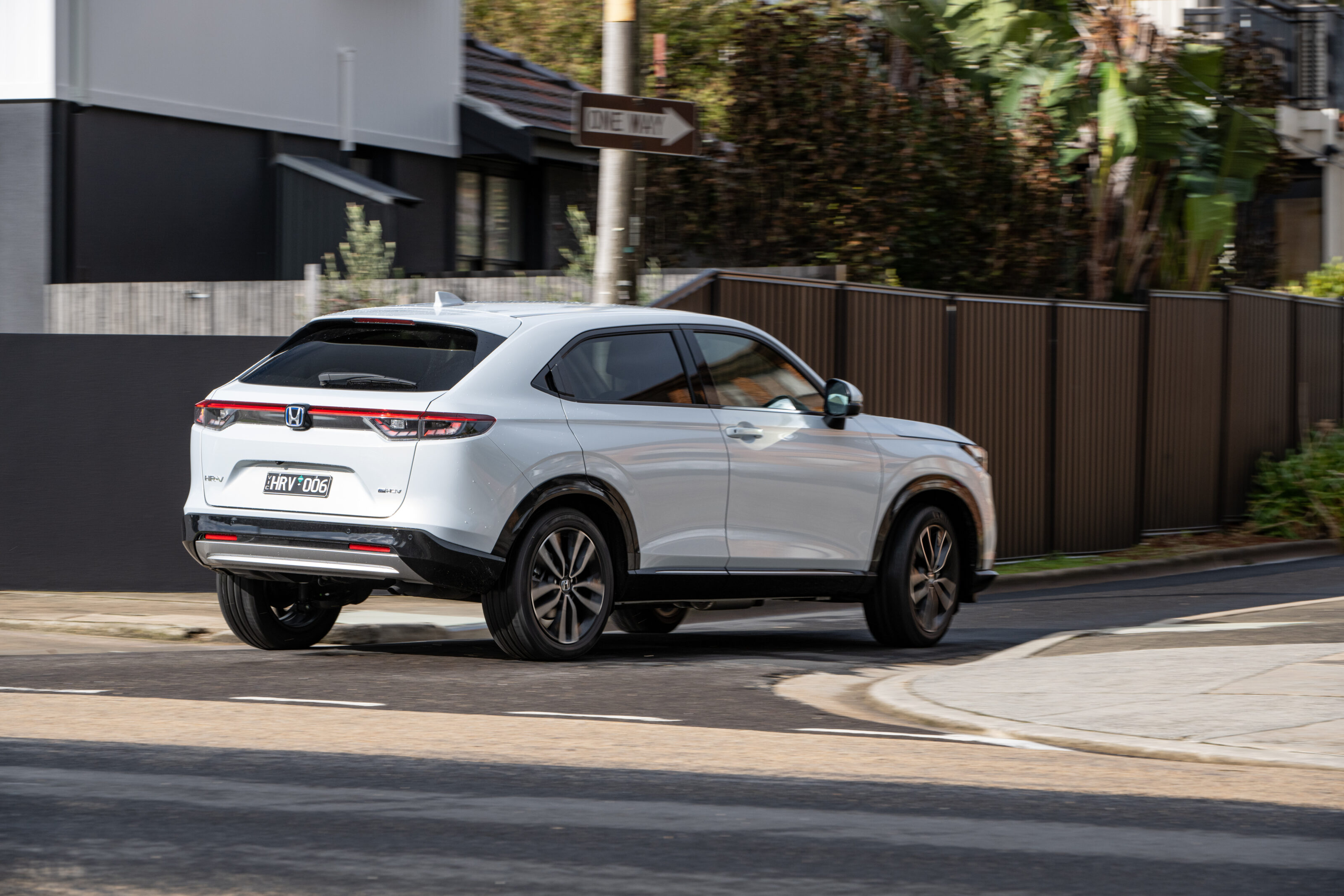
The recently-launched HR-V e:HEV L hybrid is hit hardest, receiving a $2000 price hike – after it arrived locally in April, at $45,000 drive-away.
It is now priced from $47,000 drive-away, with the entry-level petrol HR-V Vi X remaining unchanged at $36,700 drive-away.
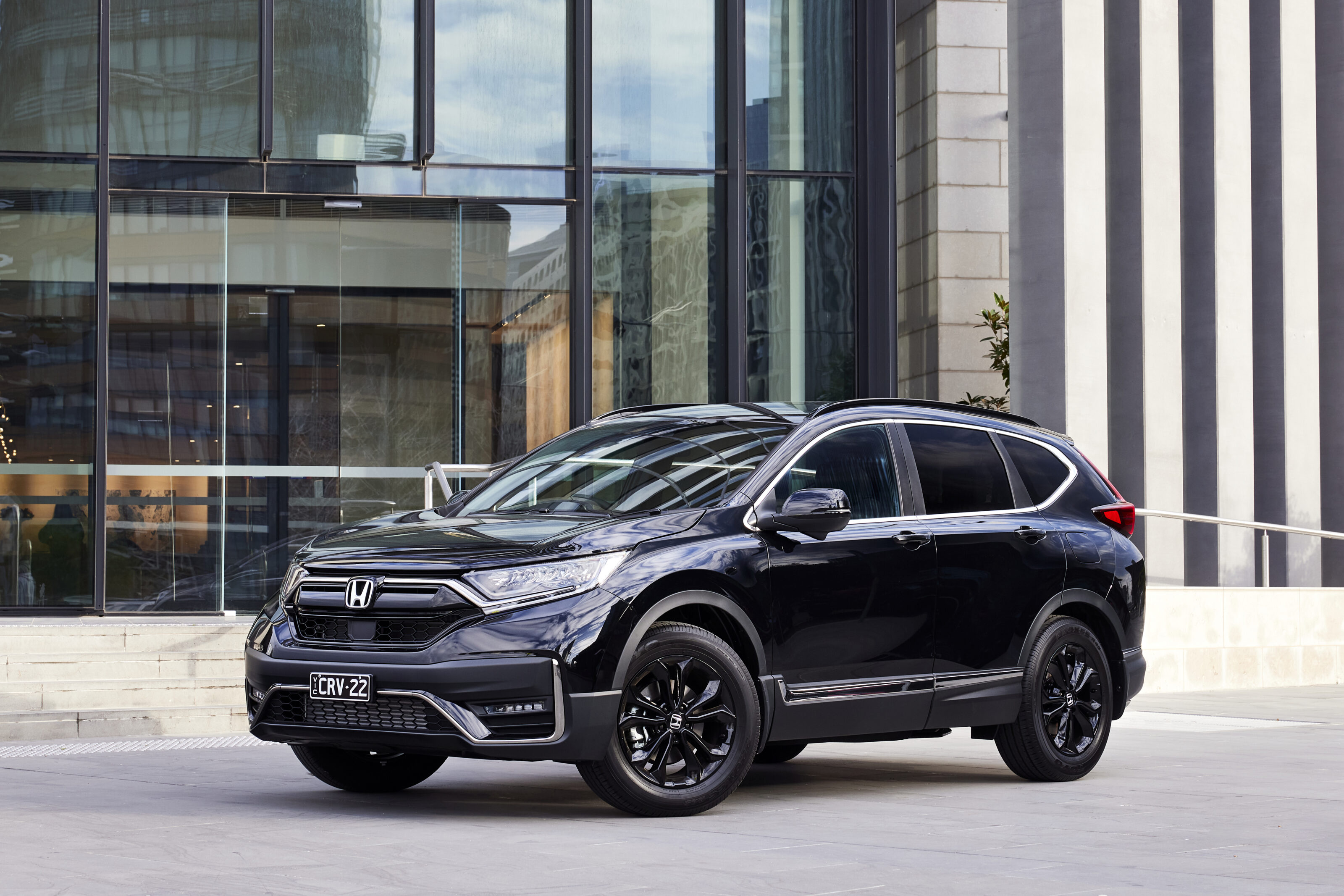
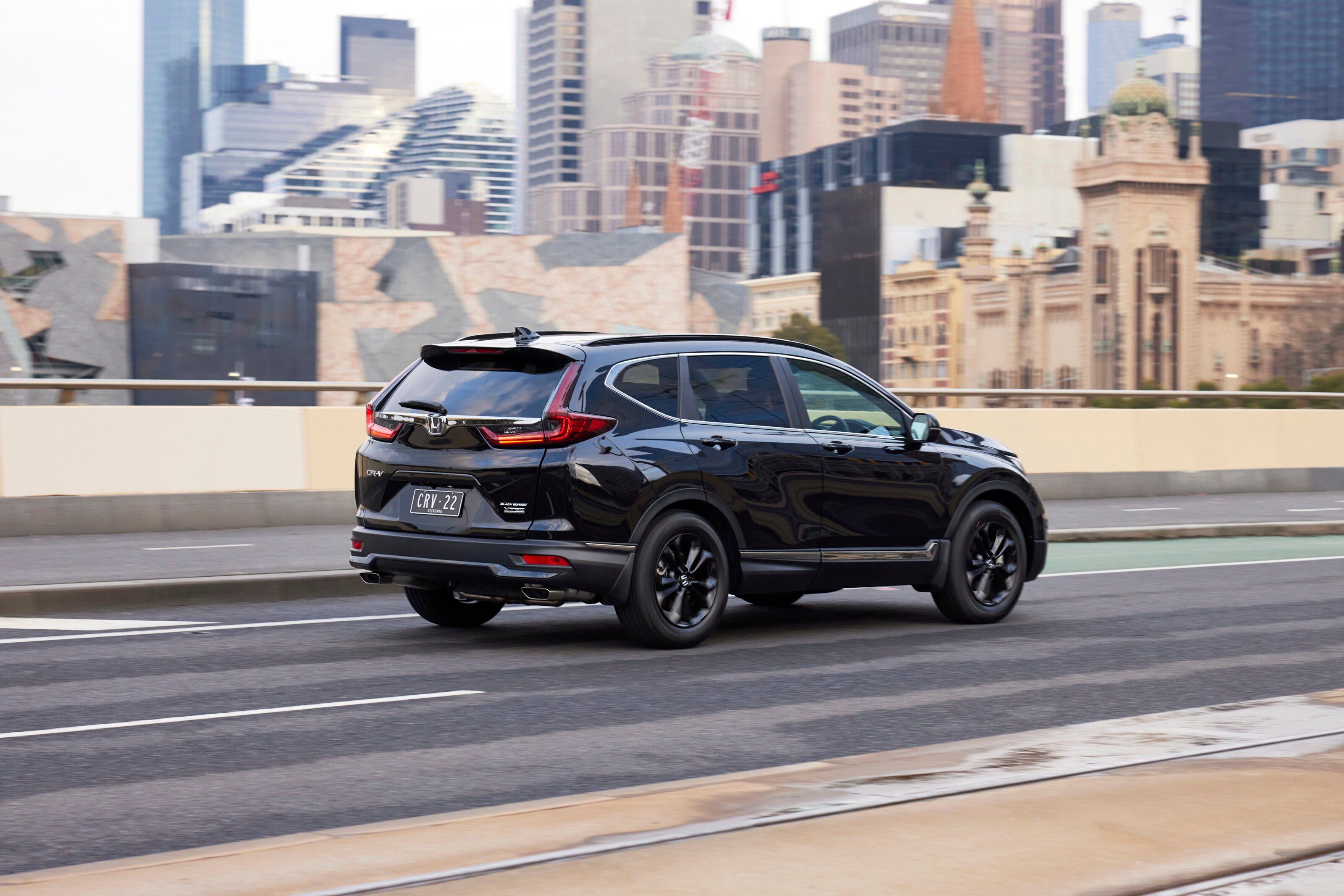
Meanwhile, the CR-V medium SUV is between $100 and $300 dearer – excluding the recently-announced VTi 7 +Luxe special edition. However, the also-new Black Edition has increased by $300.
Pricing for the slow-selling Accord sedan has also increased, with the petrol model up by $500, to $57,900 drive-away – and the hybrid variant subject to a previous $1500 price increase in July, to $61,900 drive-away.
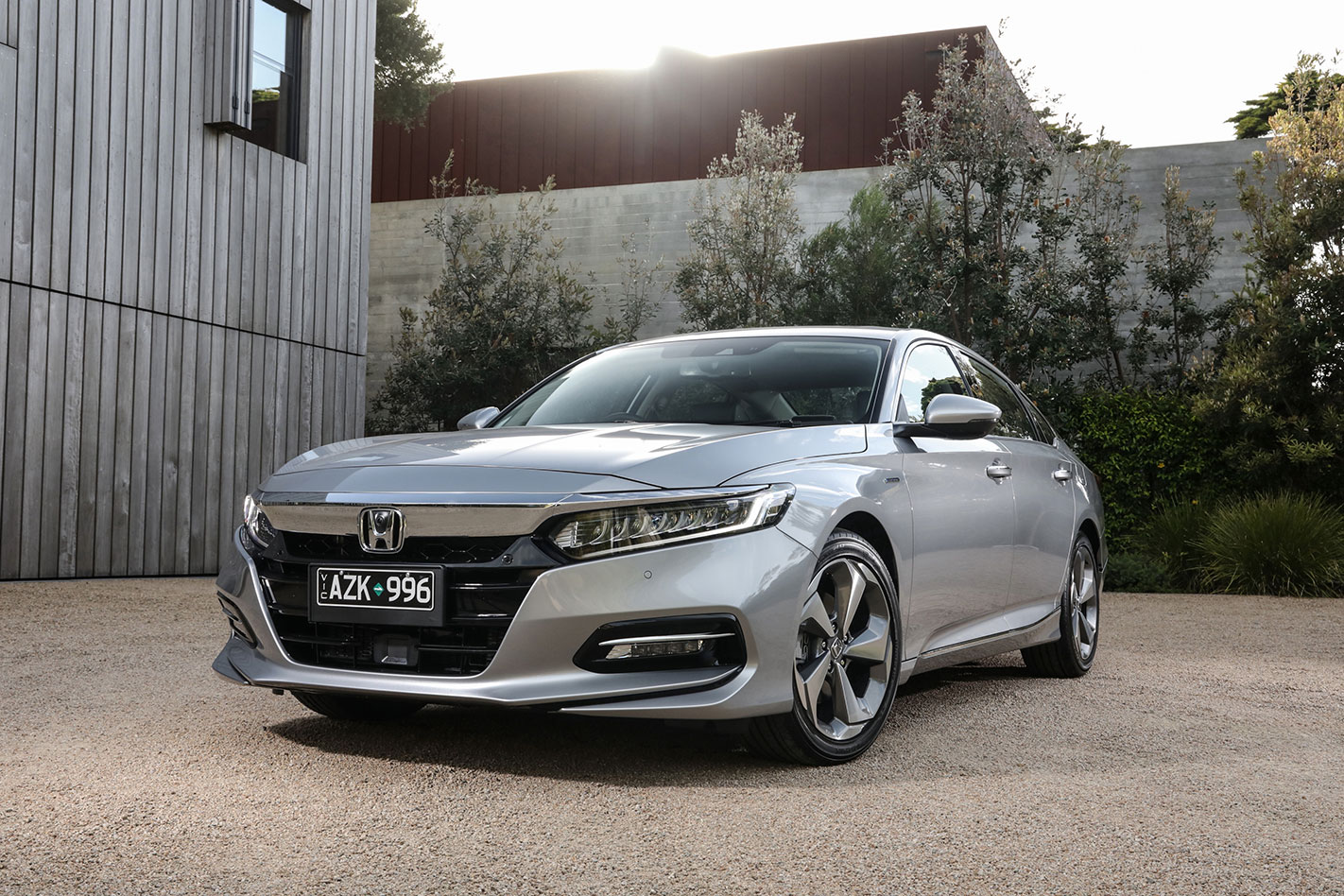
A spokesperson for Honda Australia said hybrid versions of the HR-V and Accord are subject to wait times of around 10 months, due to a “build-up of customer orders”.
As such, examples of the HR-V e:HEV L set to be delivered in Australia before the end the year will be handed over at the $45,000 drive-away launch price, pending accessories and other extras.
“A number of models/grades in the Honda line-up received pricing adjustments as of August 1, which are reflective of the current market conditions, with demand continuing to exceed forecast production levels and the global supply chain continuing to be impacted by parts shortages, rising raw material and energy prices, and other logistics challenges,” said Honda Australia in a media statement.
“Honda’s price protection policy will apply to any contracts signed prior to the change, where the vehicle is yet to be delivered. This means there will be no change for customers who signed a contract prior to August 1 – the drive-away price will remain unchanged at the pre-price-rise level.
“It’s also worth noting, with a build-up of customer orders resulting in extended lead times on a number of vehicles, such as HR-V hybrid and Accord hybrid (both currently at 10 months), recent price changes would only come into effect on vehicles to be delivered well into 2023.”
The price increases for the HR-V, CR-V and Accord represent the first significant price increases since Honda Australia introduced its fixed-price ‘agency’ business model on July 1, 2021.
Honda currently sells four vehicles in Australia – the Civic, Accord, HR-V and CR-V.
It will introduce a Civic e:HEV hybrid in the coming months and the Type R hot hatch in early 2023. The hatchback line-up is currently limited to the single-variant VTi LX, which remains priced at $47,200 drive-away.
The local arm will also introduce the ZR-V medium SUV, which recently debuted in Japan, to slot between the HR-V and CR-V next year. A larger, new generation of the CR-V was unveiled overseas last month, but it won’t arrive in Australia until mid-2023 at the earliest.
2022 Honda HR-V pricing
| Model | Pricing |
|---|---|
| Vi X | $36,700 (unchanged) |
| e:HEV L | $47,000 (+$2000) |
2022 Honda CR-V pricing
| Model | Pricing |
|---|---|
| Vi five-seat | $35,900 (+$300) |
| VTi five-seat | $38,900 (+$100) |
| VTi 7 seven-seat | $40,900 (+$200) |
| VTi X five-seat | $41,900 (+$200) |
| VTi 7 +Luxe seven-seat | $43,700 (unchanged) |
| Black Edition five-seat | $44,900 (+$200) |
| VTi L five-seat | $46,200 (+$200) |
| VTi L7 seven-seat | $49,500 (+$300) |
| VTi LX AWD five-seat | $53,600 (+$200) |
2022 Honda Accord pricing
| Model | Pricing |
|---|---|
| VTi-LX petrol | $57,900 (+$500) |
| VTi-LX hybrid | $61,900 (+$1500) |
Time passes with great speed in these trying times. I was utterly convinced that the brand new Volkswagen Caddy I drove and immediately became very fond of was just a few months ago. It was, in fact, November 2021. I guess six months of persistent rain will do that to you.
One reason I mention this unseemly passing of time is that when we first drove the new Caddy, VW told us that the California would be along shortly. As supply chain yada yada yada you get the picture.
I know the California isn’t a new concept, even if the name is new – it used to be called the Beach here and amusingly (and for no doubt copyright-related reasons), Life Tramper in other markets, but to put the idea into such a capable package was intriguing.
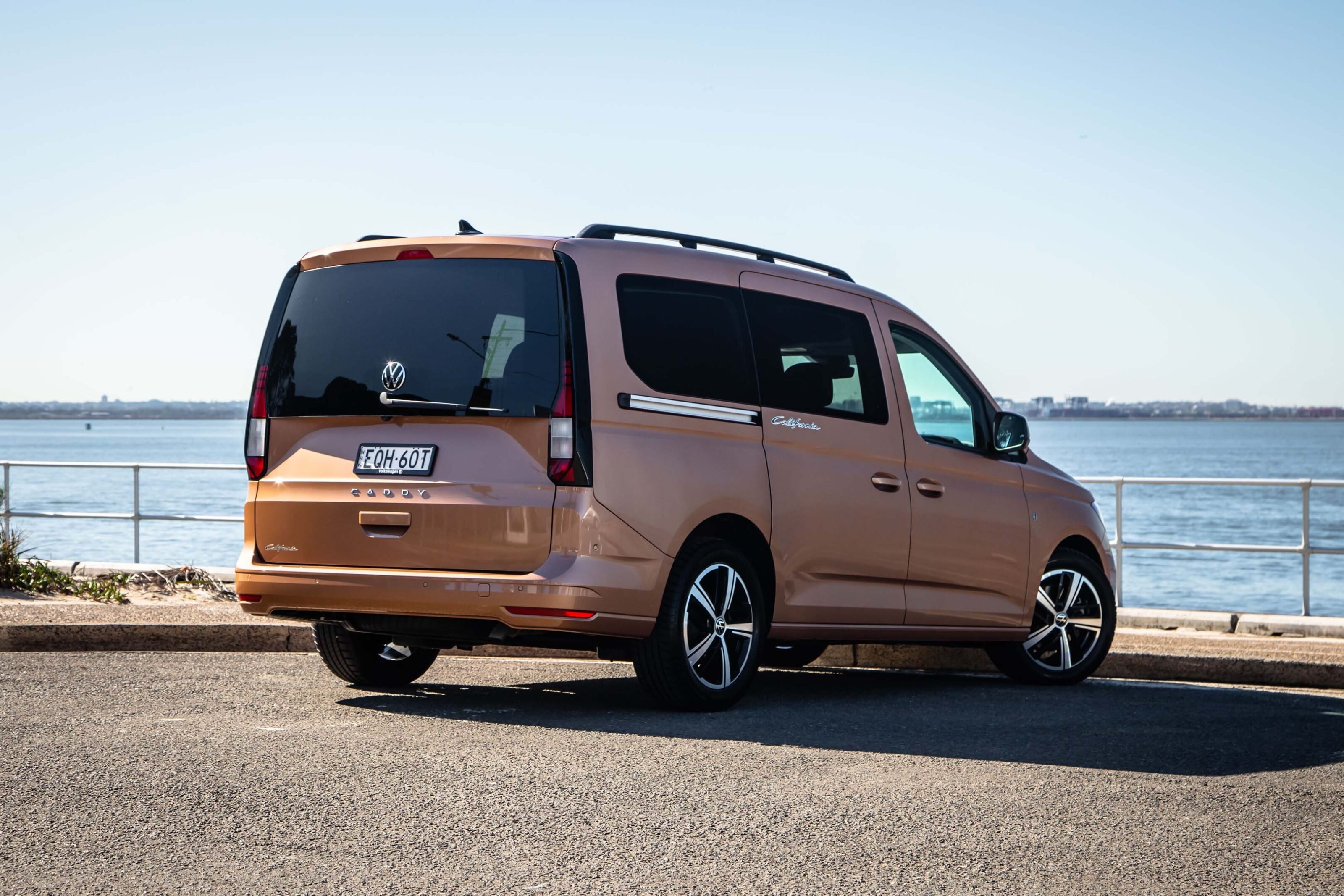
Based on the long wheelbase Caddy Life Maxi, the California ships with five seats and sleeping accommodation for two in a fold-out bed and, if they’re small enough, room for a couple of patient kids underneath. It’s a mini campervan, in other words, but a lot more versatile than that sounds.
Pricing and features
For $57,690 before on-road costs, you’ll find yourself in the diesel TDI 320 version of the Caddy California, $1900 more than the 1.5-litre turbo-petrol.
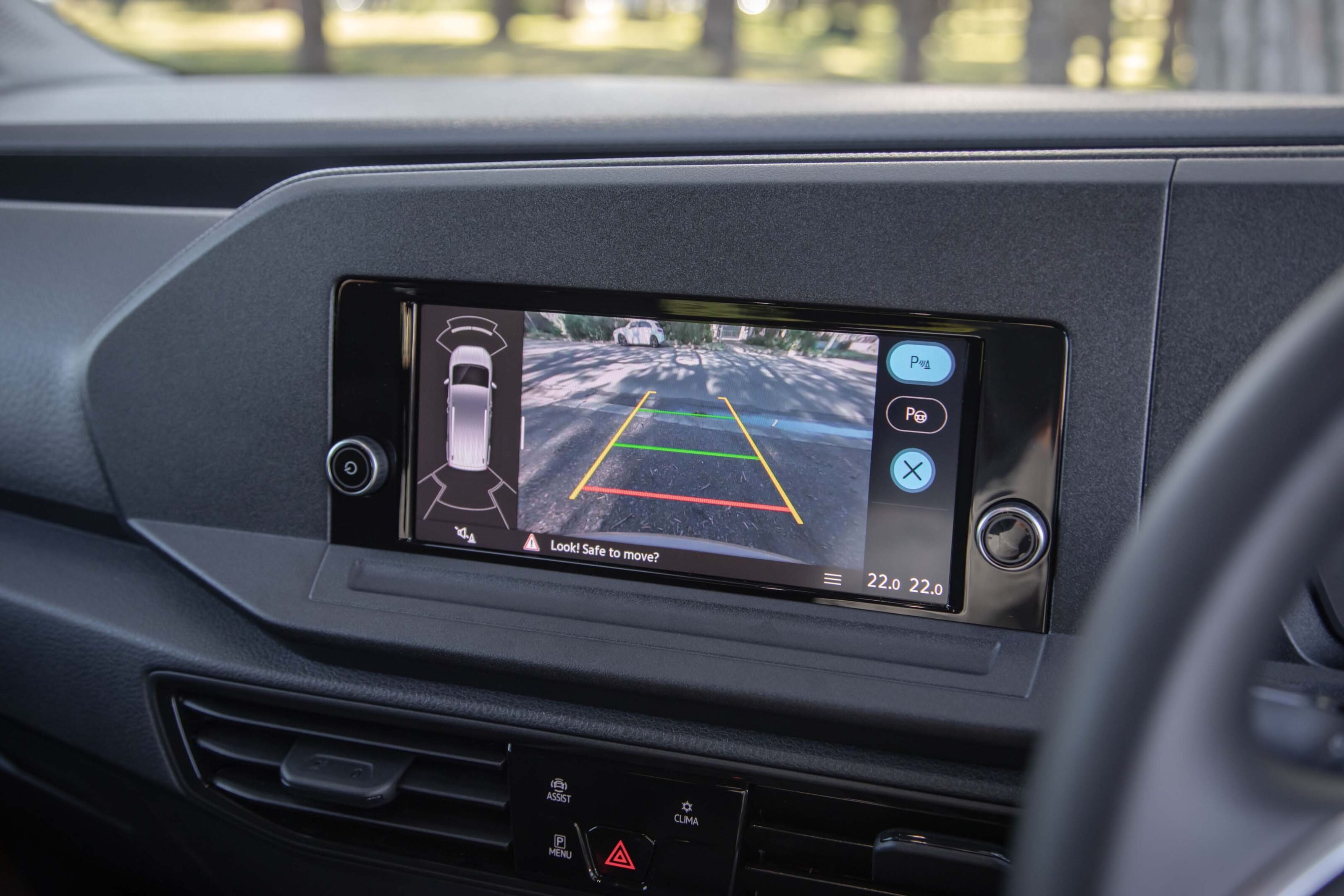
You get 17-inch alloys, a six-speaker stereo, dual-zone climate control, reversing camera, keyless entry and start, front and rear parking sensors, adaptive cruise control, auto halogen headlights, leather steering wheel trim, auto parking, heated and folding door mirrors, power front windows, cloth upholstery and a full-size spare.
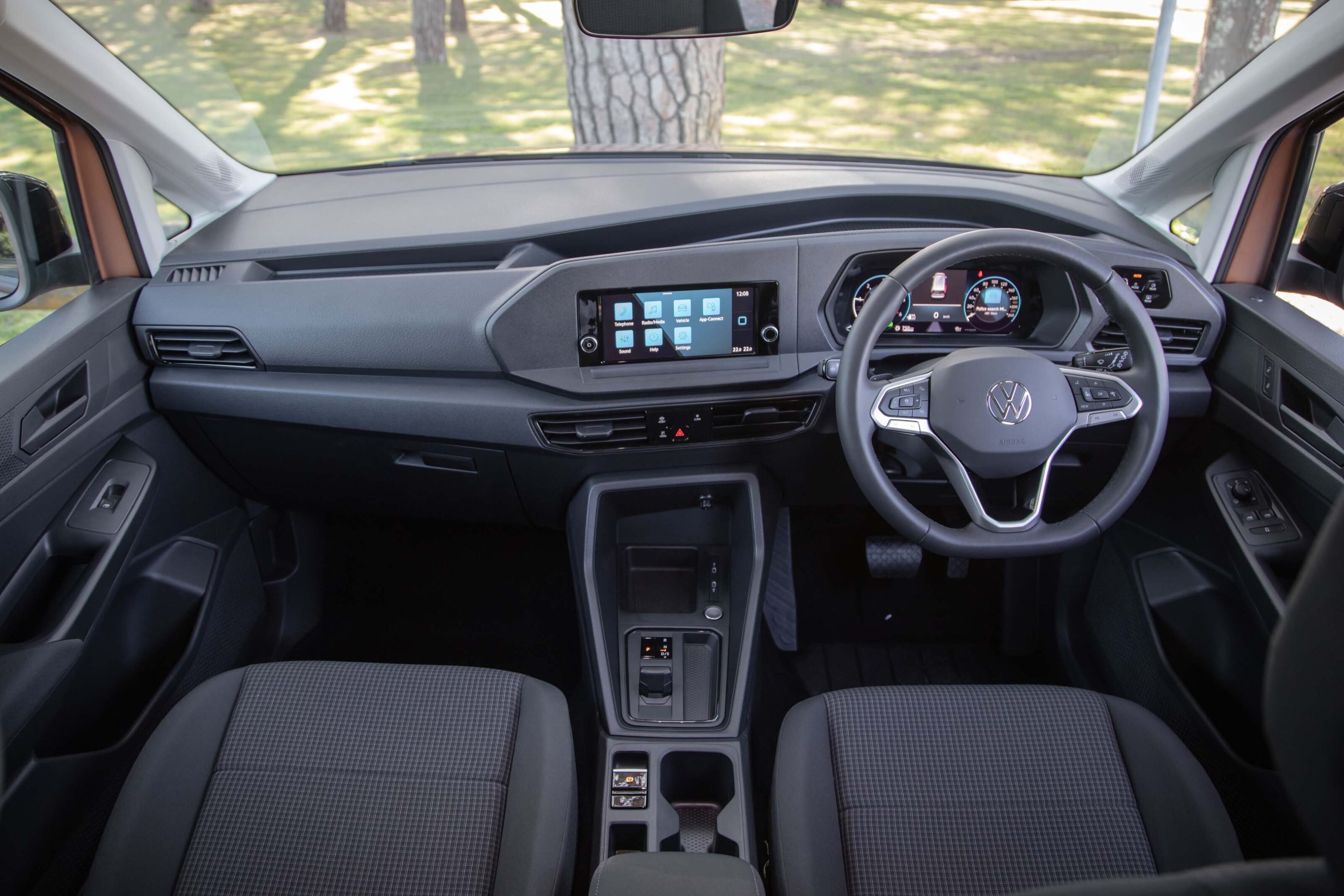
VW’s latest media system – straight out of the Golf – runs on an 8.25-inch touchscreen. It’s not very popular with some users but familiarity will make it easier to use.
I will confess to not liking on-screen sliders, so maybe reverting to big targets you stab to go up and down things like volume and temperature would be in order. The system features Apple CarPlay and Android Auto as well as DAB+ digital radio and the two USB-C ports will connect your phones.
The California has six airbags (including curtains that cover the second row), stability and traction controls, seat belt warning lights for all passengers, post-collision braking, forward auto emergency braking (low speed with pedestrian and cyclist detection), driver fatigue detection, rear parking sensors, reversing camera, rear cross-traffic alert, lane change assistance, blind-spot monitoring, and junction assist.
The back seat has three top tether anchors and two sets of ISOFIX points.
Slightly annoyingly, LED headlights are a hefty $2020, sat-nav is $1660 and metallic paint a not-inconsiderable $1115, with just two of the 12 colour choices being freebies.
Cherry Red is $305 for some reason. Less annoyingly, a huge sunroof is $1420, the usefulness of which will shortly become apparent.
You can also pay a modest $75 for two extra 12-volt outlets.
Naturally, the options don’t stop there and there is of course a very active aftermarket accessory business supplying all sorts of cleverness to extend the camper lifestyle vibe, in some cases quite literally with a clever tent that encloses the rear with the tailgate open.
Comfort and space
Space is the California’s thing. While the Caddy Cargo is all about, well, cargo, the California is based on the passenger-carrying version known as Caddy Life. VW has tossed out the third row (as in the Crewvan) and then loaded up with a double bed.
Unlike the Crewvan, the interior is carpeted instead of either plastic or plywood floors, ensuring it’s warmer in winter and quieter all the time.
The bed collapses into the space behind the back seats and can be completely removed without much difficulty. Continuing that theme, the rear seats can also fold, tip and come out altogether. To deploy the bed you just have to fold the seats down.
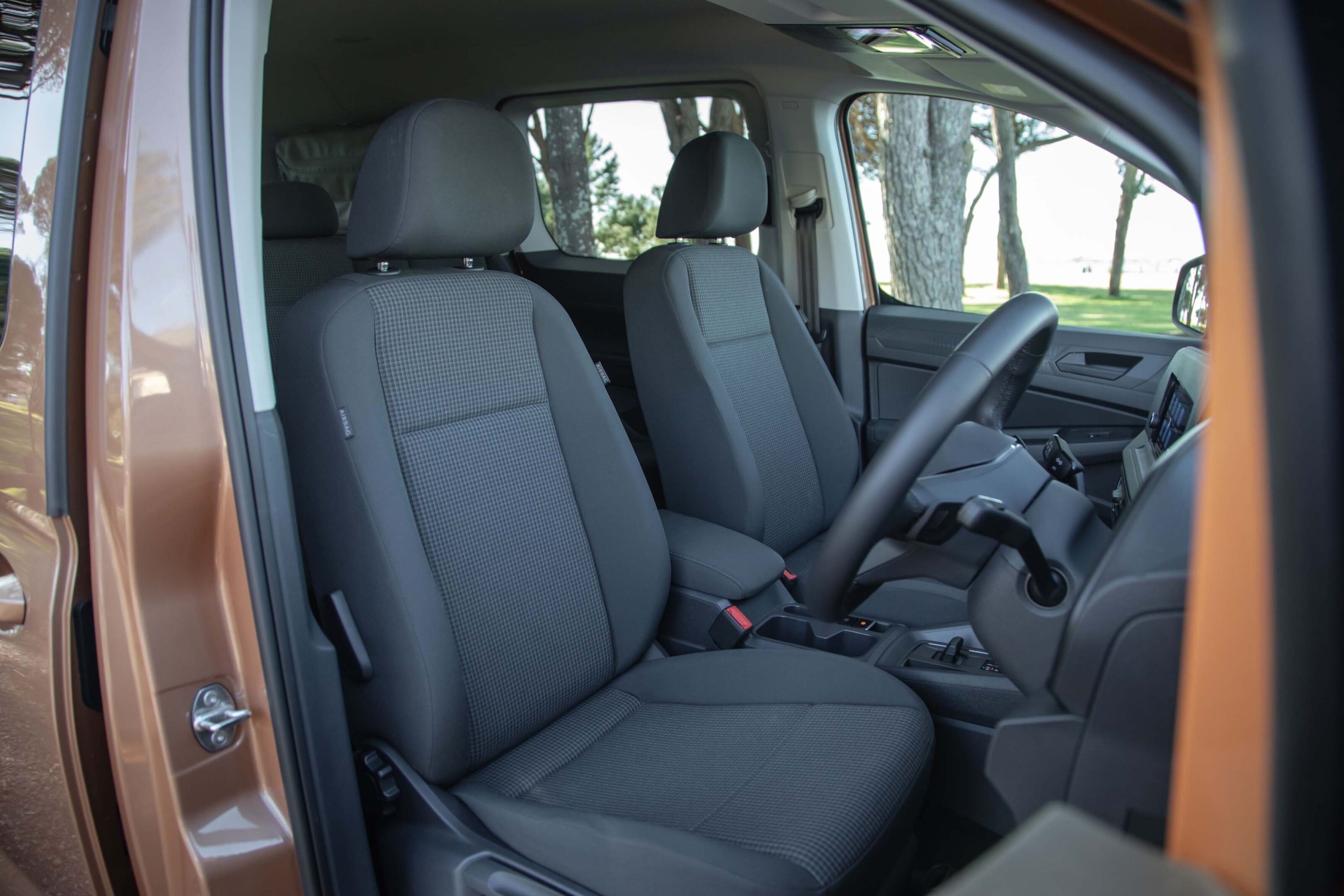
You also have to slide the front seats and crank the backrests forward. Not super-slick, no, but hardly an imposition. I failed at deploying the bed on my own but smug photographer Sam declared he managed it without trauma.
Once you have the seats all arranged correctly, you need to half unfold the bed and extend the legs that slot into place in the b-pillar. It’s very easy with two people but you can do it on your own if you’re cleverer or more patient than I am.
Unfolded and in place, it’s a pretty decent-sized double bed. It sits high up in the cabin (which is 1230mm floor to ceiling), level with the windows, which is handy because the rear glass is filled with zip-up storage bags.
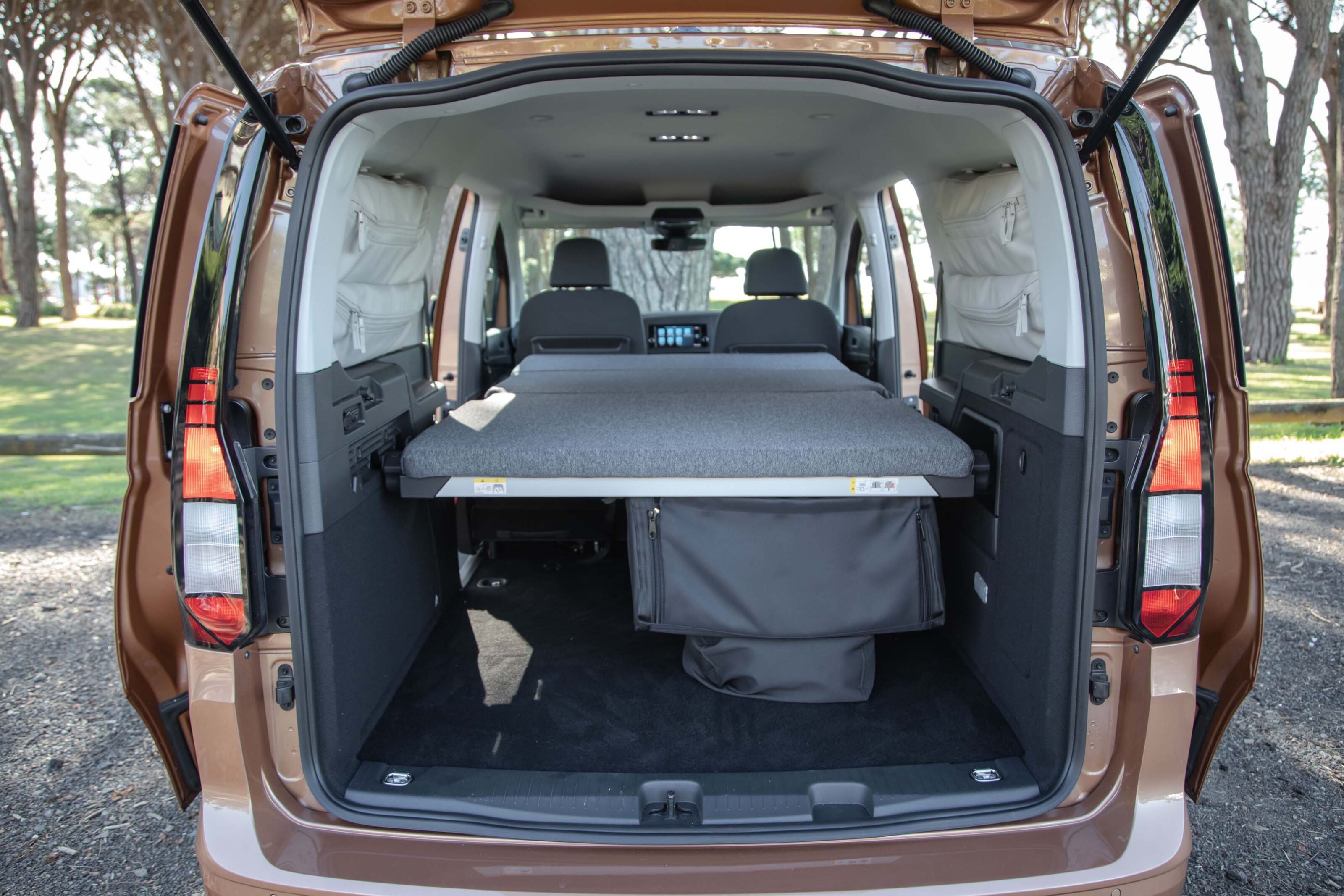
Beneath the bed is a rigid storage bag that swallows two camper chairs and a surprisingly sturdy table. Velcroed to the bottom is a set of curtains for the windows set in the sliding doors on both sides.
One of the Caddy’s less appealing features is that the rear windows don’t open and therefore ventilation could be a problem, so thank goodness for the AirCare function in the climate control.
Also in the bag under the bed with the table and chairs is a pair of ventilation grilles that fit in the front door windows, allowing you to lower them by about 15 centimetres and get some air in. That’s going to be quite useful if you’ve got two or three folks sleeping in the vehicle with non-opening windows. The grilles even have fly screens in them.
If you really want to go for the full under-the-stars without all that pesky tent nonsense, you can spec the huge glass sunroof, which would be a real treat. You’ll be warm, reasonably comfortable on the mattress and modestly sprung bed frame (which is kind of like a sofa bed) and yes, I’m writing this on the weekend of the 2022 Splendour in the Grass debacle.
Once you empty out the rear space of both bed and doors you have 3105 litres, which is quite a bit I think you’ll agree. With the seats back in and the bed stowed, you have a still-useful 446 litres.
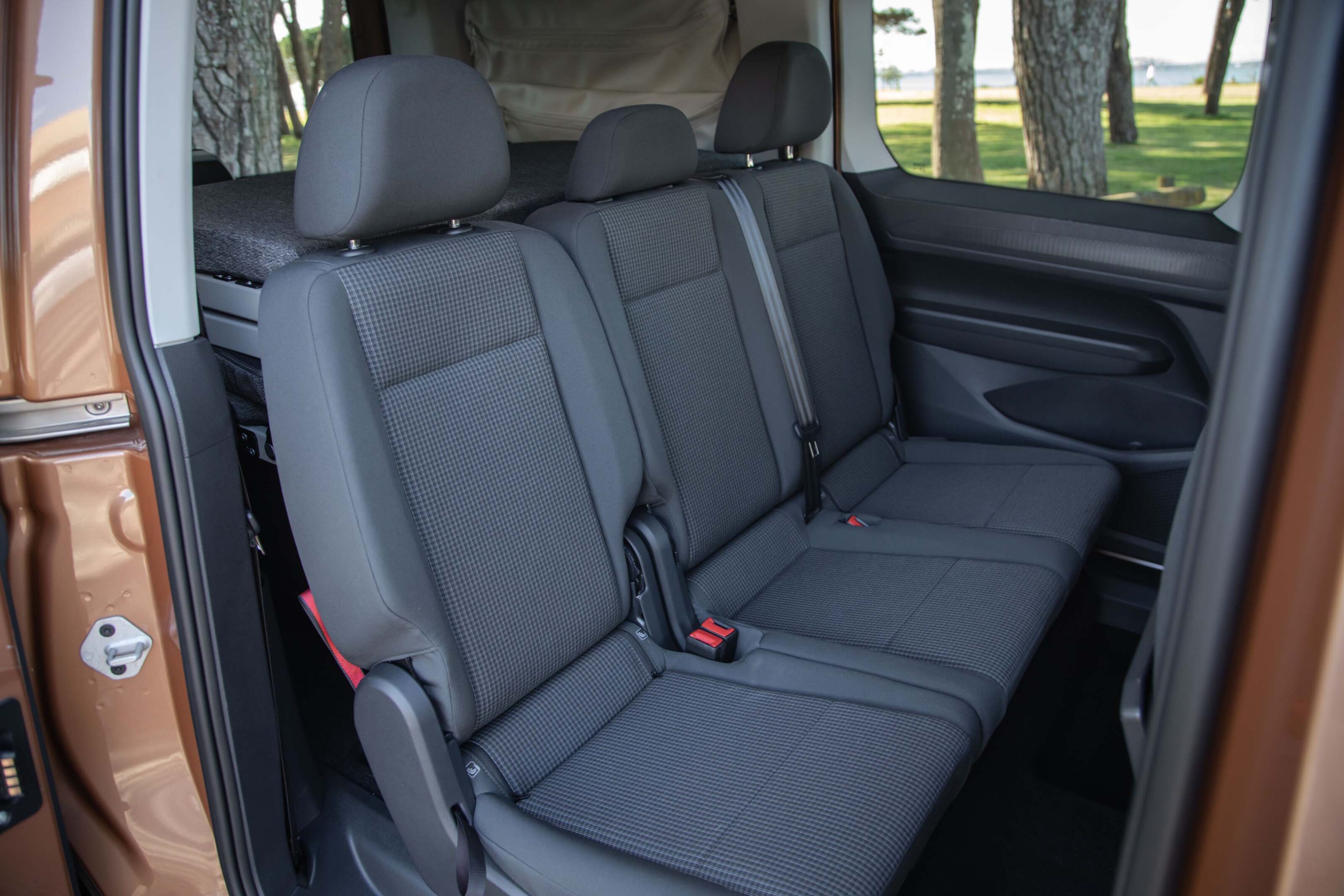
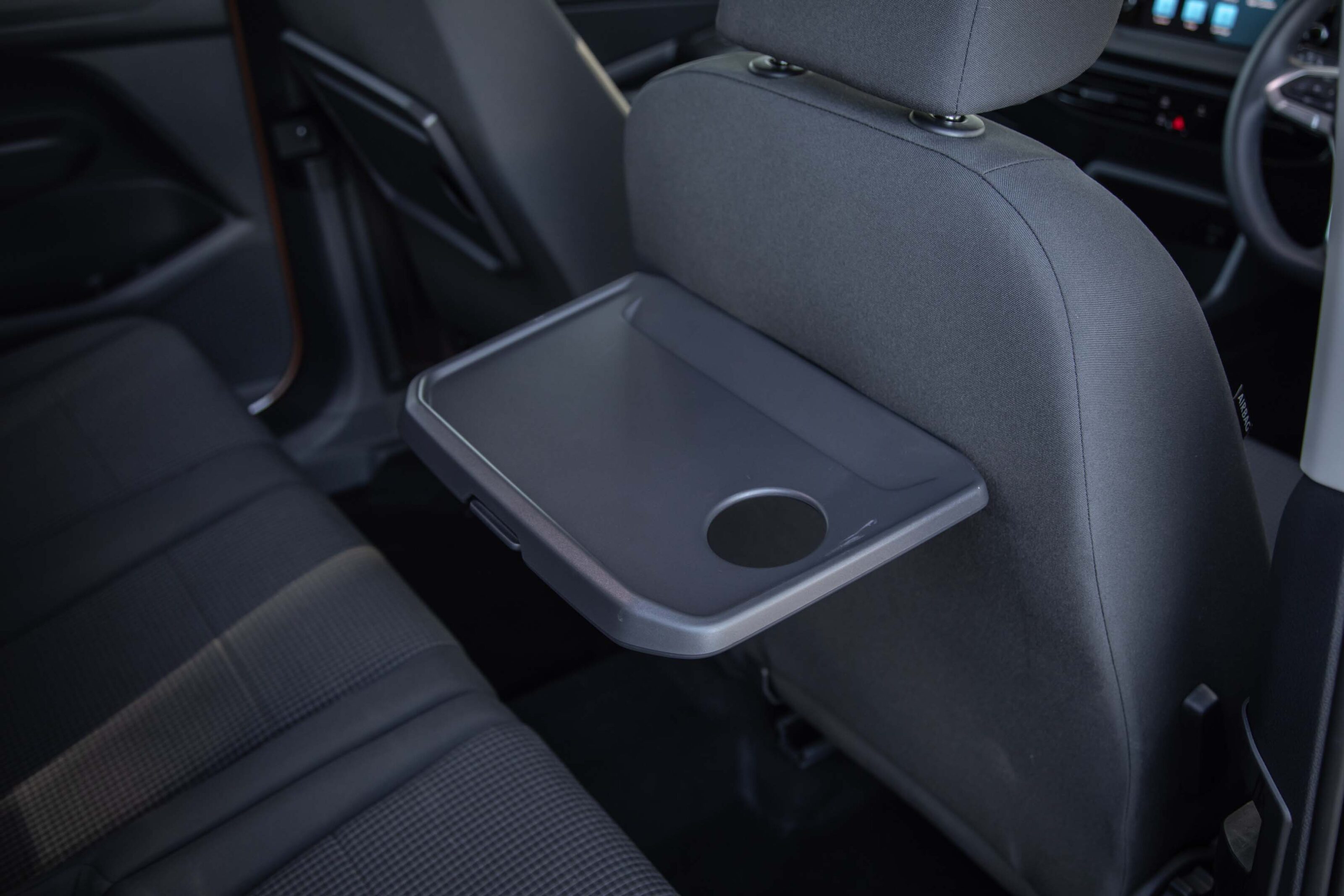
The back row of seats has reasonable legroom, excellent foot room owing to the flat floor and the soaring roof means heaps of headroom. Kids will love the airline-style tray tables with very small cut-outs for cup holders. They won’t love the lack of armrest or vents, though. Both the front and rear doors have bottle holders and quite large pockets.
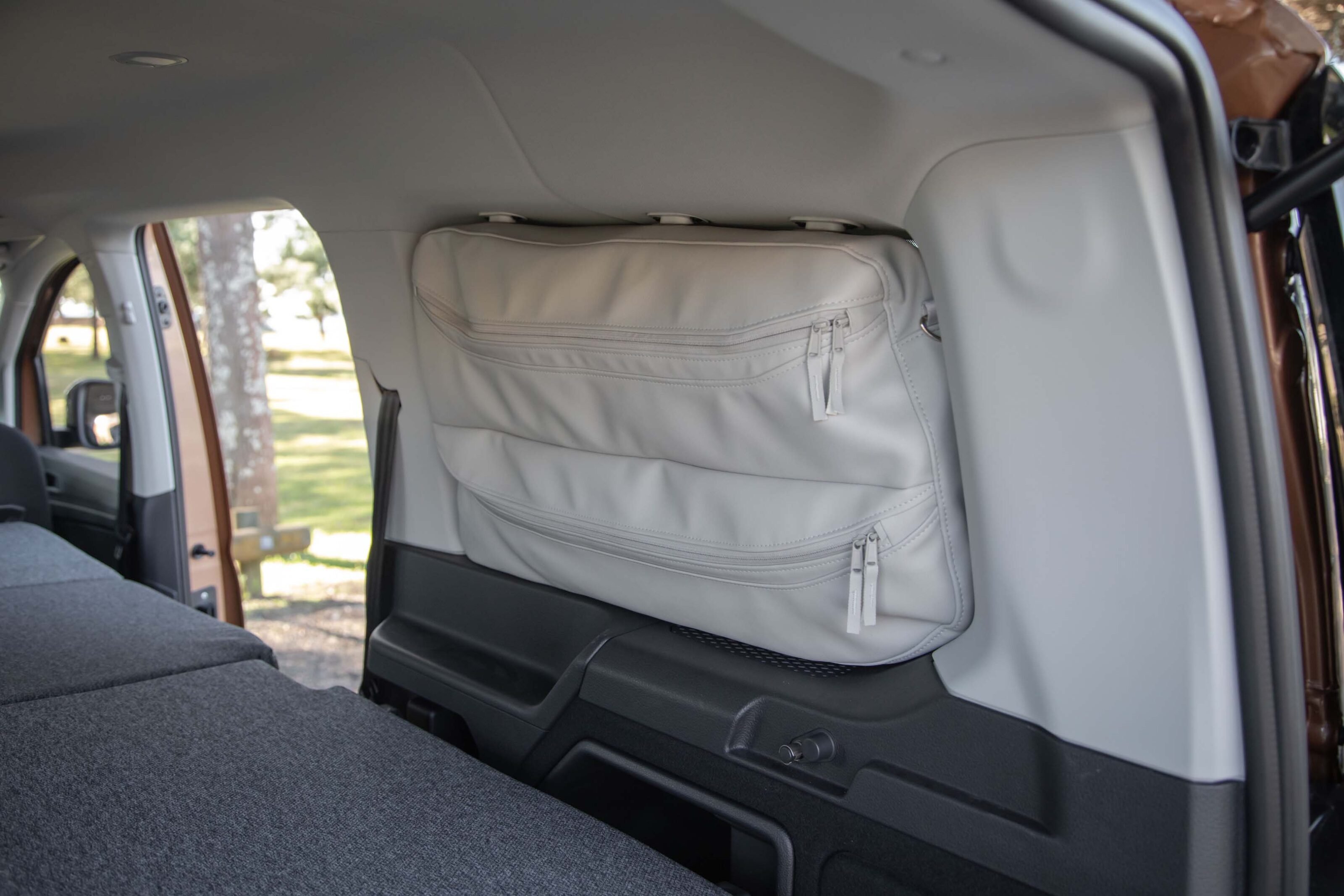
Up front, you get a huge amount of storage. If you don’t have the sunroof there’s a very handy gallery storage over the windscreen. Over the dashboard is a broad, open tray that widens over the instrument panel where you could toss all manner of devices, papers or whatever your work or play day requires.
The only disappointment – and it’s to be expected really – is that the materials are the same as the basic Caddy. There’s nothing explicitly wrong with them, it’s just a bit dark and rugged feeling.
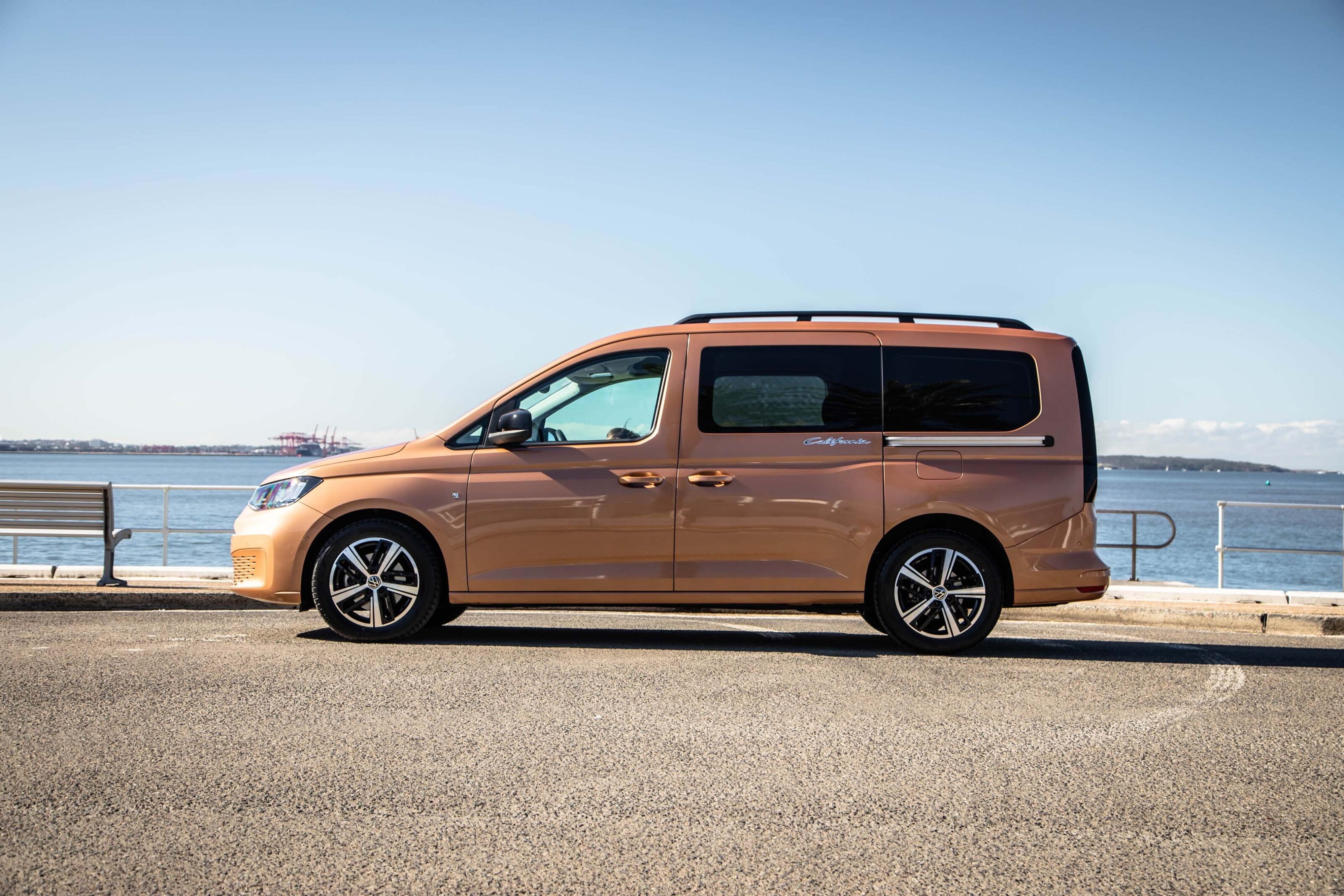
While it’s quite possible this car is the consummate all-rounder for the working-camping type, it would be nice if the California had a splash of colour to go with the fairly naff California script running down the doors.
Most impressive about the California is that everything can come out and it can fulfil its possible primary duty as a load-lugging work machine. You can leave the seats in and it can be a family car with a gargantuan boot. Or anything in between.
On the road
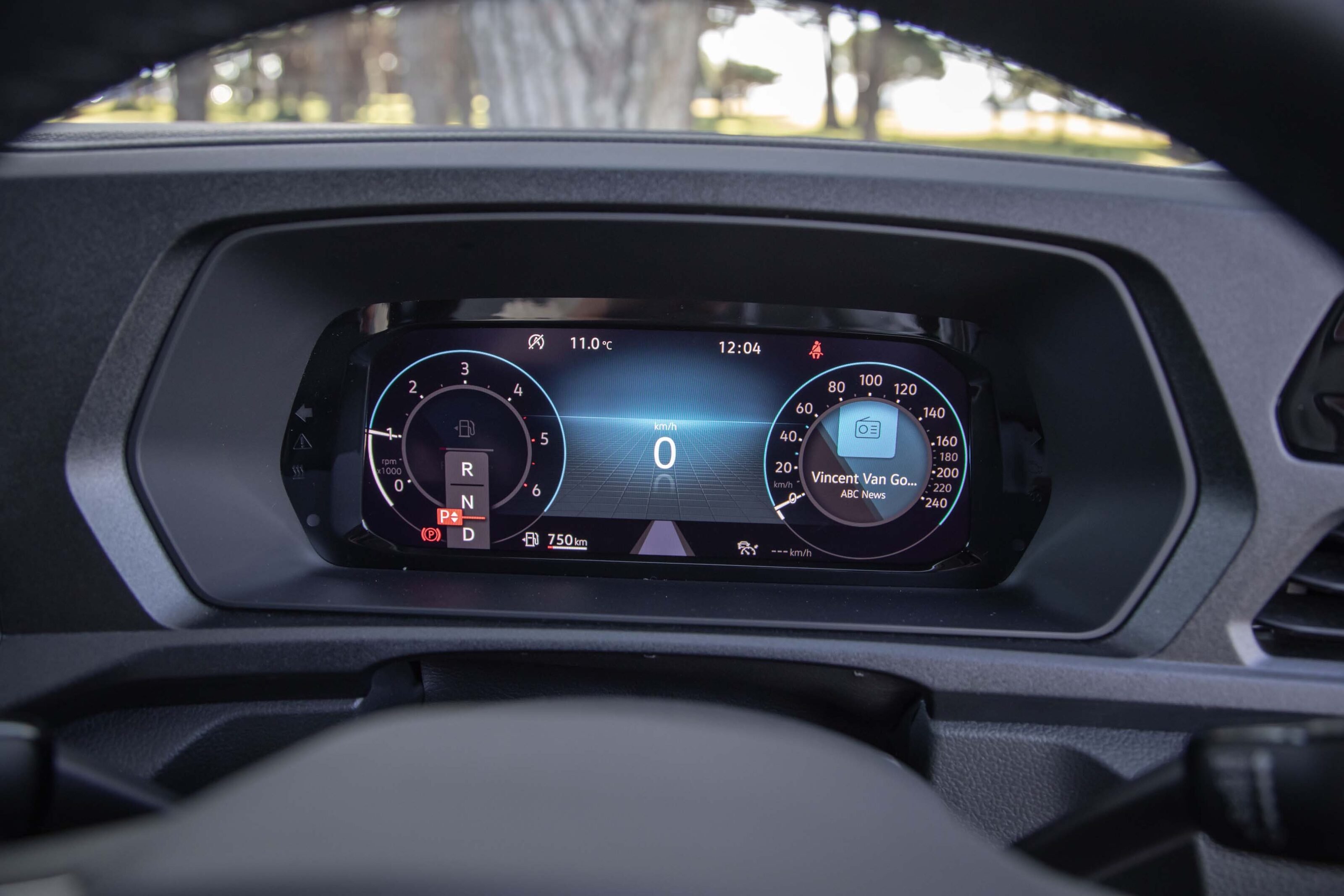
The thing that struck me most about the Caddy when I had it last year was just how nice it was to drive. This fifth-generation van draws heavily from Golf VIII, right down to the stubby little gear selector.
The MacPherson strut front end is familiar but to save space and both lower and flatten the floor, the rear is held up by a Panhard rod set-up that sounds like it could be a handful but absolutely isn’t.
Ride quality on the Caddy is so unbelievably plush for a van – no doubt helped by the long wheelbase – that speed humps and other urban road accoutrements are mere pimples on the spotty behind that is Sydney’s road system.
Vans aren’t supposed to be like this. But here we are.
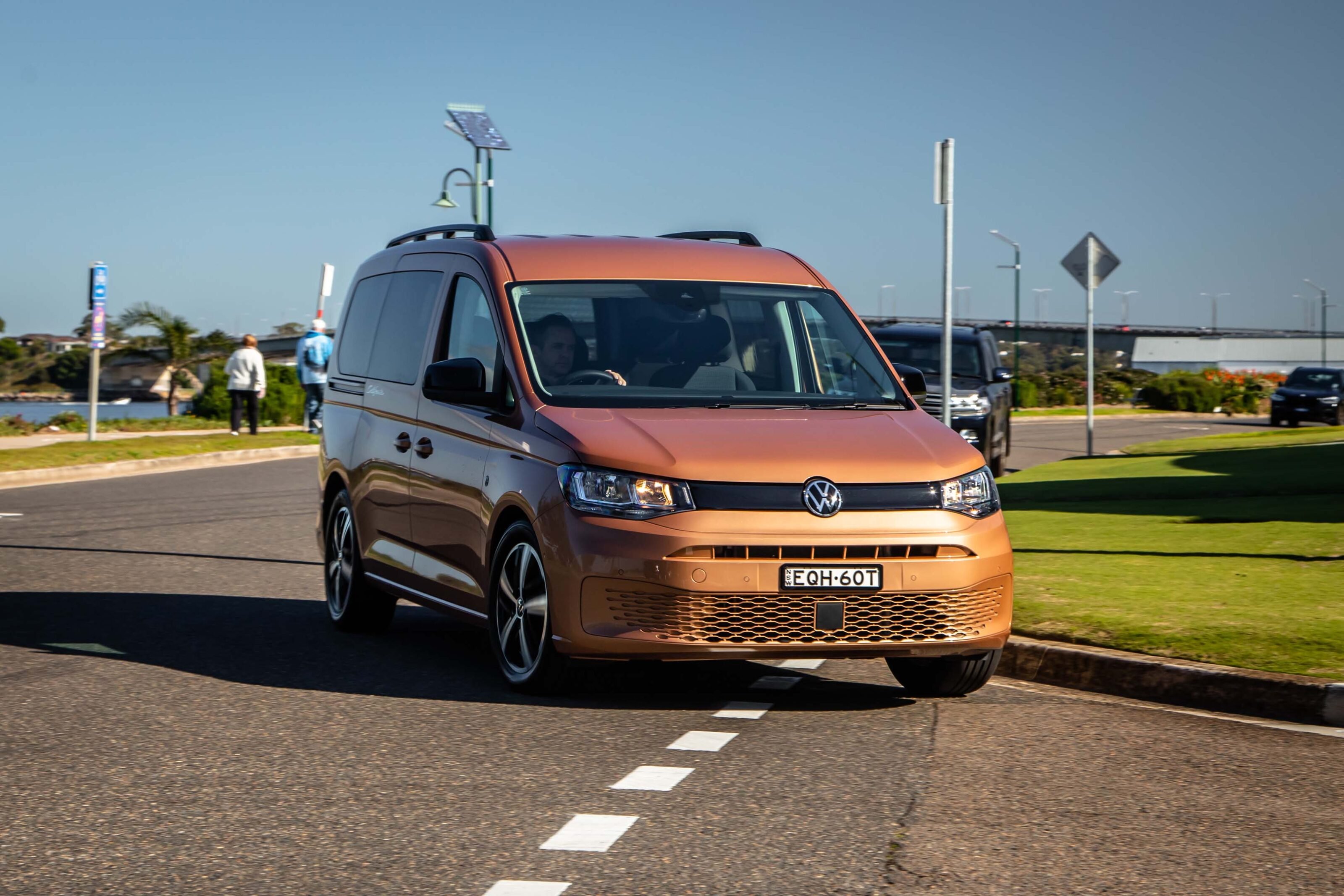
The vision forward out of the Caddy is IMAX-like, with a massive windscreen ensuring you can see all before you.
You sit quite low for a van and you feel lower still because the roof is so high, so you feel like you’re driving a tall hatchback. The steering has enough feel for you to know what’s going on but is appropriately light for its intended purpose as an urban warrior.
A 2.0-litre turbo-diesel engine spins up 90kW and 320Nm, driving the front wheels via a seven-speed DSG dual-clutch gearbox.
While the 90kW figure is hardly going to rouse the boy racer within, its torque output means it’s a very easy car to move around in, with just light pressure on the throttle getting the surprisingly chunky 1700kg machine on the move.
It’s a bit grumbly and you definitely know you’re driving a diesel, but the trade-off is strong performance and quite reasonable fuel economy. The claimed ADR combined-cycle consumption of 4.9L/100km feels like a proper lab figure, while I managed 6.4L/100km in mostly city driving over the few days I had it.
Ownership
Like VW’s passenger car range, you get a five-year, unlimited-kilometre warranty on the Caddy California along with 12 months’ roadside assist.
At the time of writing, the only Care Package available – this is VW’s pre-paid servicing program – was five years but, unusually in this difficult car-buying environment, offered for the price of three years. This may change at the end of September 2022 (according to the website) but you can’t argue with five years of servicing for $1500.
The site says that you’re basically getting two services for free and saving $1448 over the five years. It’s not often I say this about VW servicing, but that’s a bargain. Service intervals fall every 12 months/15,000km and if you service at VW, you get another 12 months of roadside assist.

VERDICT
The Caddy California was everything I expected it to be – a good idea packed into a very good van. While it doesn’t have everything a larger camper van might have, it’s got everything you need for a quick escape for two adults and two small kids. Spend some more money on aftermarket supplies and you could easily take older kids with you and sleep in comfort.
It’s the versatility of the California that’s most impressive. It can be a comfortable workhorse during the week, carrying big loads with ease and simplicity, then you can bunk off into the hills or to a beach somewhere and relax in it with just a few moments’ setup time. I can even see owners just using it as a comfortable place to hang out in the bush for a picnic.
The TDI is absolutely worth the extra, too. While it’s still a diesel, it’s a good one and is usefully more powerful than the only slightly-cheaper petrol.
All it needs is all-wheel drive for accessing more challenging places and it will be near perfect. Or an electric drivetrain.
2022 Volkswagen Caddy California 320 TDI specifications
Snapshot
- 2023 Audi S8 pricing and features for Australia
- Updated performance flagship priced from $273,400, up $13,523
- Revised look; new digital matrix LED headlights
The updated 2023 Audi S8 is now available to order in Australia, with a revised look and new technology – and a price rise.
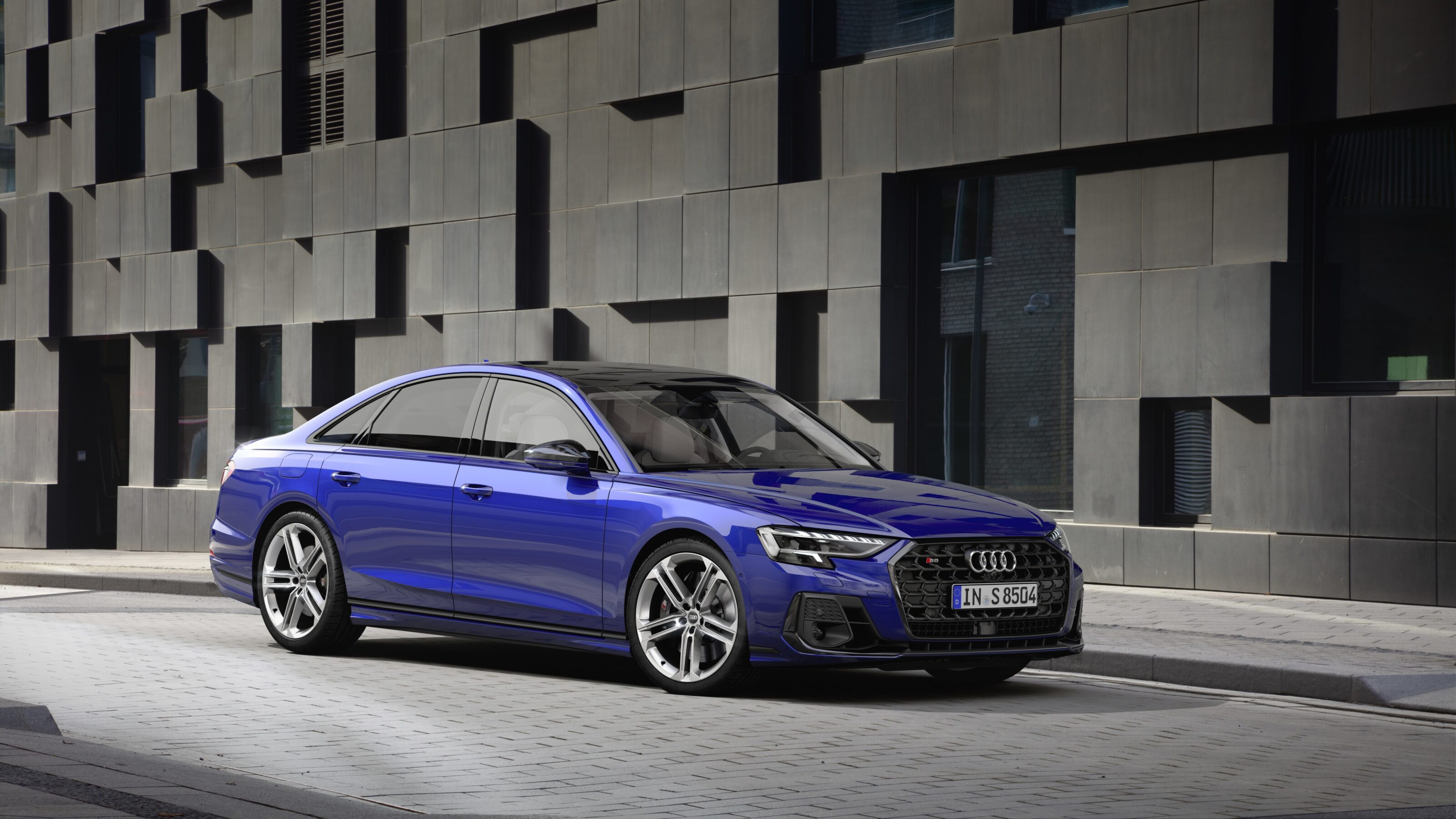
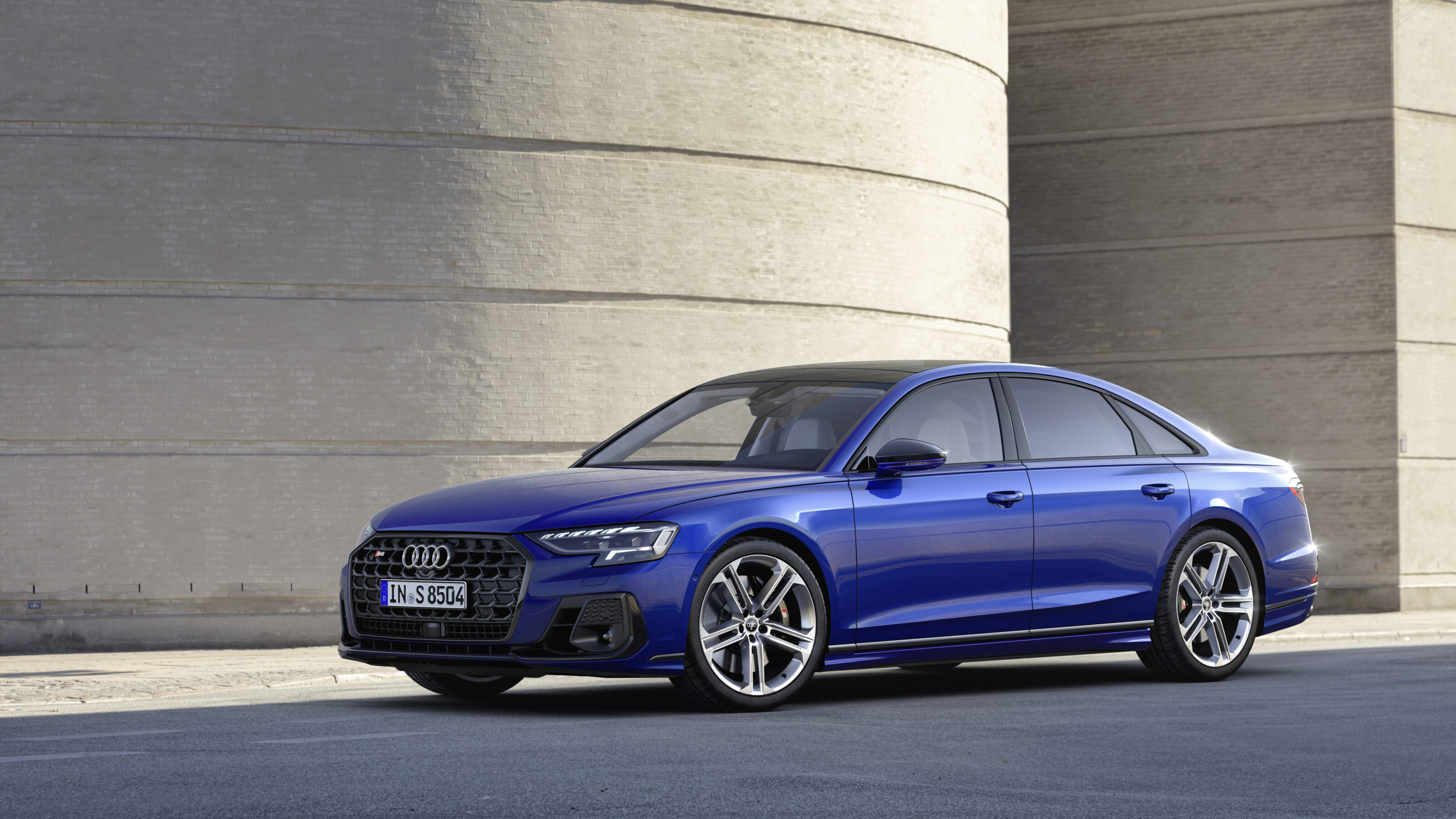
Priced from $273,400 before on-road costs – $13,523 higher than the pre-facelift model, last available locally in 2021 – the refreshed S8 gains updated matrix LED headlights and a revised front and rear look.
Audi Australia has confirmed the range-topping, V8-powered S8 will be joined by the less-expensive ‘standard’ A8, with local details expected before the end of the year. It is likely to be available in ‘50 TDI’ guise, with a carry-over V6 diesel engine and the option of a long-wheelbase variant.
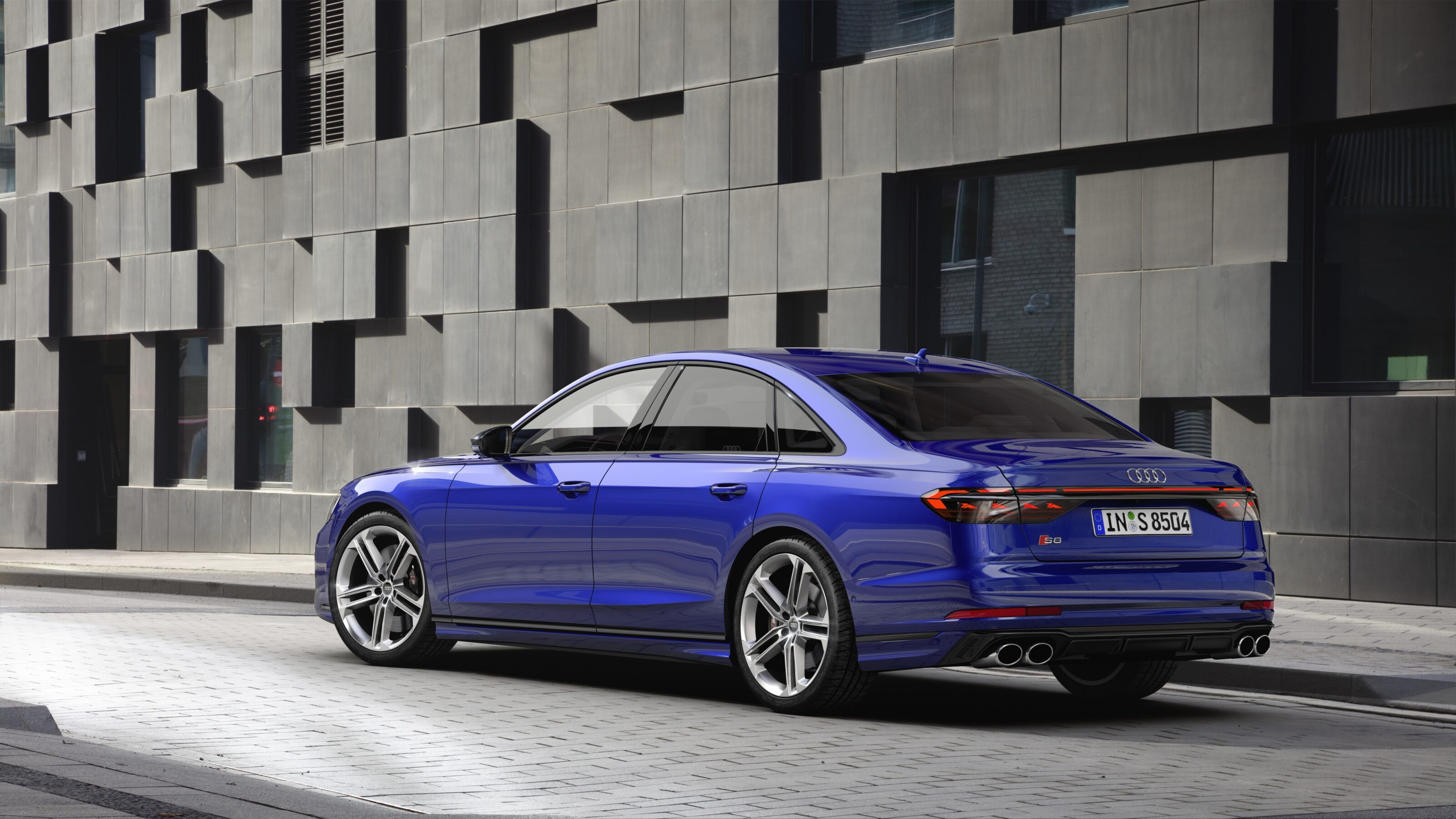
As a facelift to the fourth-generation A8 and S8 flagship sedan, first launched in 2017, the updated model features styling updates to the front grille and lower elements of the front bumper, along with digital OLED tail-lights.
The new advanced digital matrix LED headlights, which debuted on the E-Tron S electric SUV, have approximately 1.3 million micromirrors in each unit, allowing for the lights to be controlled with maximum precision.
According to Audi, the digital micromirror device used to control the S8’s matrix headlights is similar to the technology used in many video projectors.
“This makes several new functions possible, including advanced coming/leaving home sequences, glare-free high-beam and lane, orientation, and marking lights for highways,” said Audi Australia.
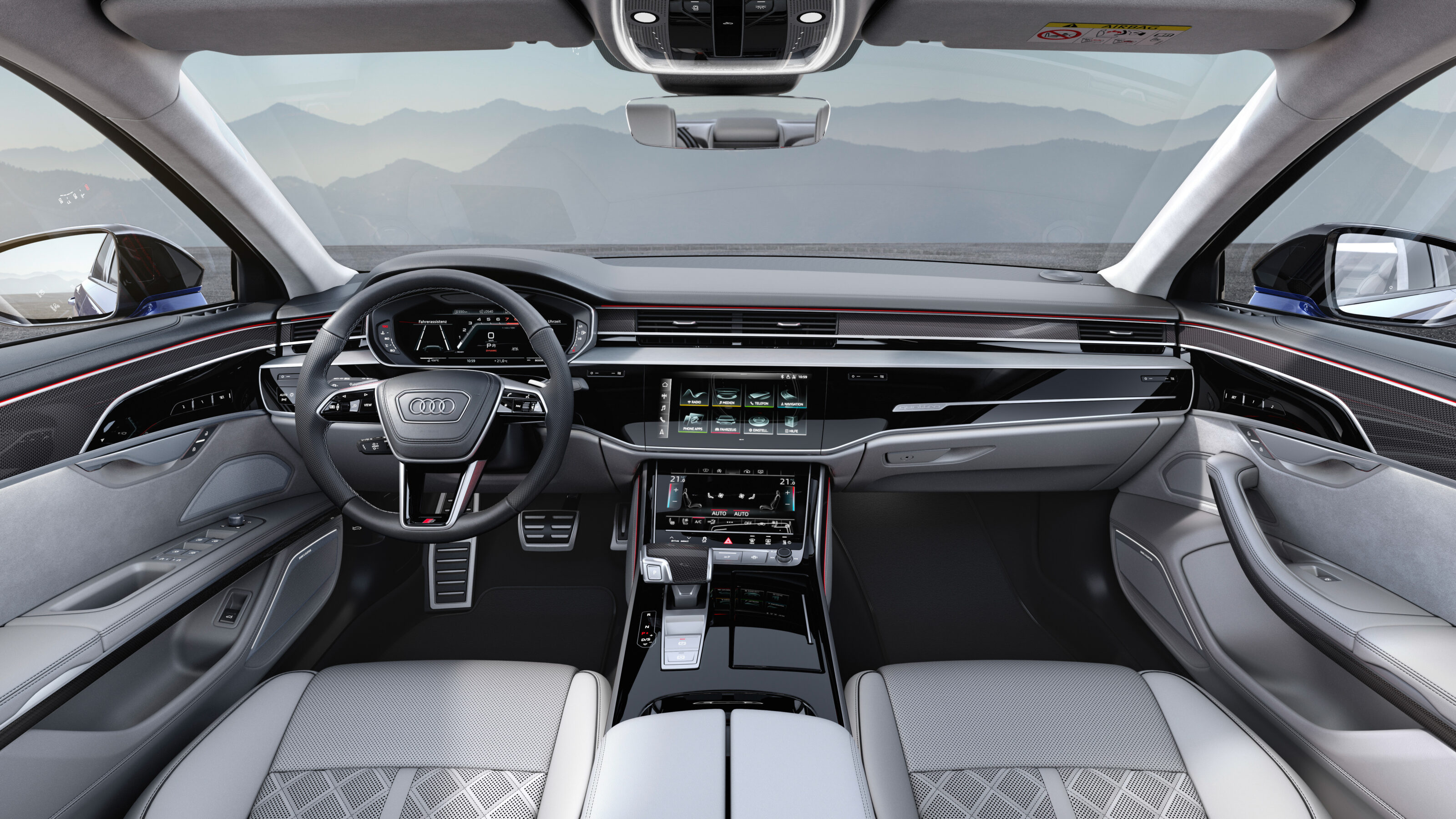
In addition, a night vision system, digital TV support and the previously-optional 23-speaker, 1920-watt Bang and Olufsen 3D audio system is now fitted as standard, replacing the outgoing 17-speaker setup.
The 2023 Audi S8 is on sale now in Australia, with the regular 2023 Audi A8 range due in local showrooms by the end of this year.
NOTE: Audi Australia is referring to the facelifted S8 as a model-year 2022 vehicle; however, most vehicles launched in the second half roll into the new model-year.
2023 Audi S8 Australian pricing
Prices exclude on-road costs.
| Model | Pricing |
|---|---|
| S8 TFSI V8 | $273,400 |
2023 Audi S8 features
Engine, drivetrain and fuel economy
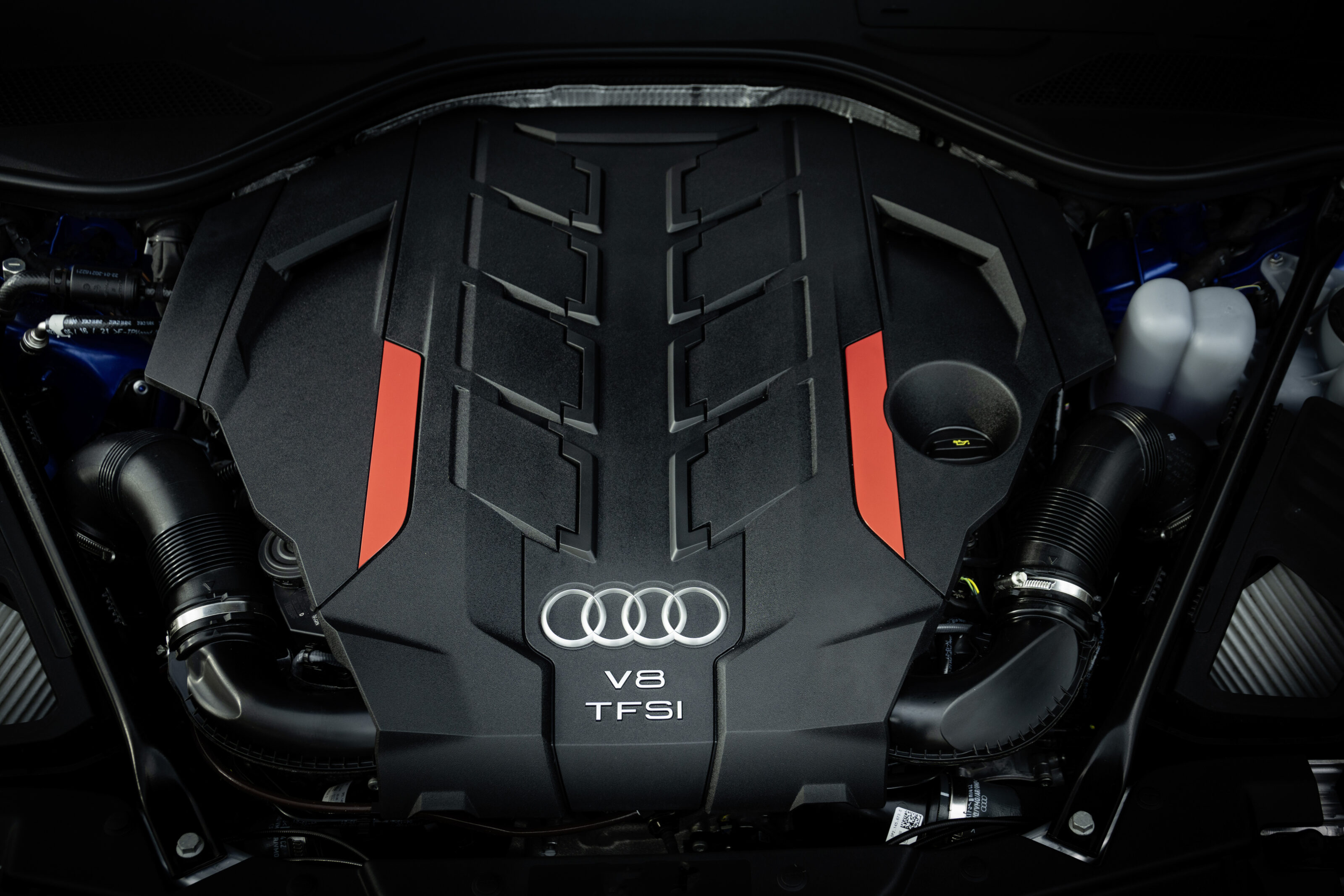
The range-topping Audi S8 is powered by a 4.0-litre turbocharged petrol V8 producing 420kW of power and 800Nm of torque, with a claimed 0-100km/h sprint time of 3.8 seconds.
It is matched with a 48-volt mild-hybrid system, which is claimed to save up to 0.8 litres of fuel per 100km, in conjunction with the S8’s cylinder deactivation and an auto stop-start system.
Power is sent to all four wheels through an eight-speed torque converter automatic transmission and Audi’s quattro all-wheel-drive system.
Fuel economy figures can be found in the table below:
| S8 TFSI V8 | 10.5L/100km |
Safety
The Audi A8 and S8 have yet to be tested by ANCAP.
Ten airbags (dual frontal, front side, rear side, side curtain, and centre) feature across the range.
Each variant includes the following active safety equipment as standard:
Dimensions
The Audi S8 has a wheelbase of 2998 millimetres, and is 5179mm long, 1945mm wide (2130mm including the exterior mirrors) and 1474mm high.
Warranty and servicing
As per the wider Audi range, the S8 is covered by the brand’s newly-introduced five-year, unlimited-kilometre warranty, along with a roadside assistance program initiated by scheduled dealership services.
Service packages of up to five years are offered, at a cost of $3990 for five years in pre-facelift guise.
Availability
The updated 2023 Audi S8 is now available to order in Australia.
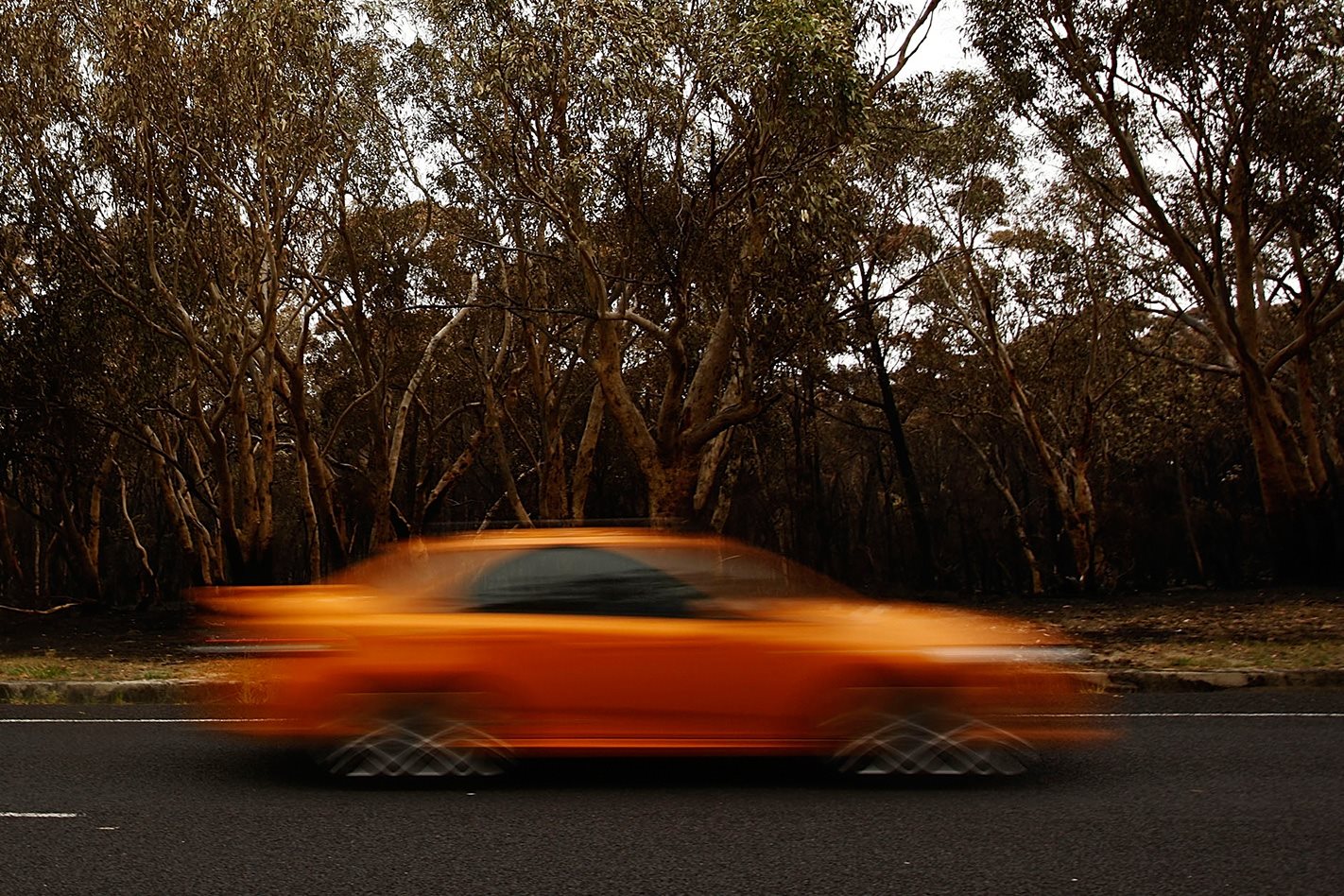
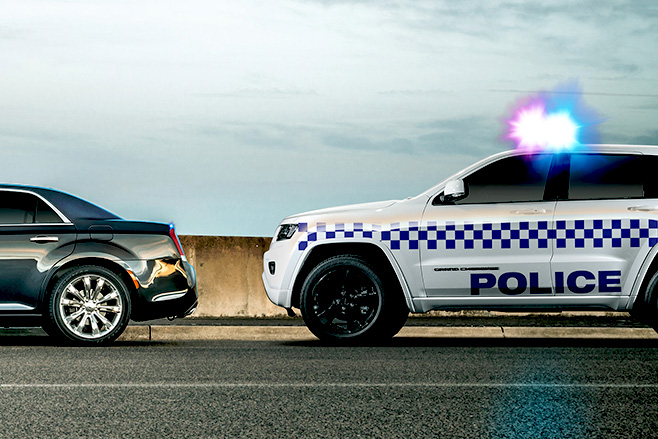
Almost half of Victorians admitted to flouting speed laws last year, despite it contributing to 30 per cent of deaths on state roads.
According to the Transport Accident Commission’s (TAC) latest Road Safety Monitor Report, which quizzes more than 2500 Victorians on their road safety behaviours and attitudes as a proportion of the entire population, the state has experienced the highest level of intentional speeding since 2016.
Speed remains a key factor in Victorian road trauma too – contributing to around 30 per cent of deaths each year, and 25 per cent of serious injuries.
Sadly, so far this year, 147 people have been killed on Victoria’s roads, compared to 130 at the same time last year.
“We know the majority of Victorians do the right thing, but it is unacceptable that there are still a small number of people who willingly put themselves and others at risk,” said Minister for Roads and Road Safety Ben Carroll.
“It is deeply concerning to see so many lives being lost on our roads, and we can’t sit by and accept it – we are pleading with anyone thinking of partaking in risk-taking behaviour to heed the warning and slow down.”
More drivers admitted to intentionally speeding in 60km/h zones last year (42 per cent versus 39 per cent in 2020) or 100km/h zones (45 per cent versus 40 per cent the year before).
The report also uncovered that people viewed speeding as less dangerous than most other high-risk driving behaviours, such as drink driving and driving while using a mobile phone.
Forty-five per cent of those surveyed admitted to driving while feeling drowsy, and 29 per cent said they had used their phone illegally behind the wheel at some point over the last three months – however the latter has dropped substantially from 37 per cent in 2016, as has the number of people who have confessed to being over the blood-alcohol limit which is now at four per cent.
The findings come as the TAC launches the second wave of an advertising campaign targeting risk-taking behaviours, like speeding, in a bid to reduce the number of people being killed and seriously injured on our roads.
“Our research shows us that attitudes to road safety have improved over the years, but it is concerning that an increasing proportion of motorists still value saving a few minutes over their lives and the lives of others,” said Transport Accident Commission CEO Joe Calafiore.
“If you think going just a little bit over the speed limit is safe – think again. The evidence is clear that even small increases in speed can make a big difference in how seriously we are injured in a crash, or whether we survive at all.”
UPDATE, August 15: Australian pricing revealed
Australian pricing for the Maserati Grecale has surfaced online, thanks to a dealer bulletin shared with Wheels Media. Get the full story at the link below.
The story to here
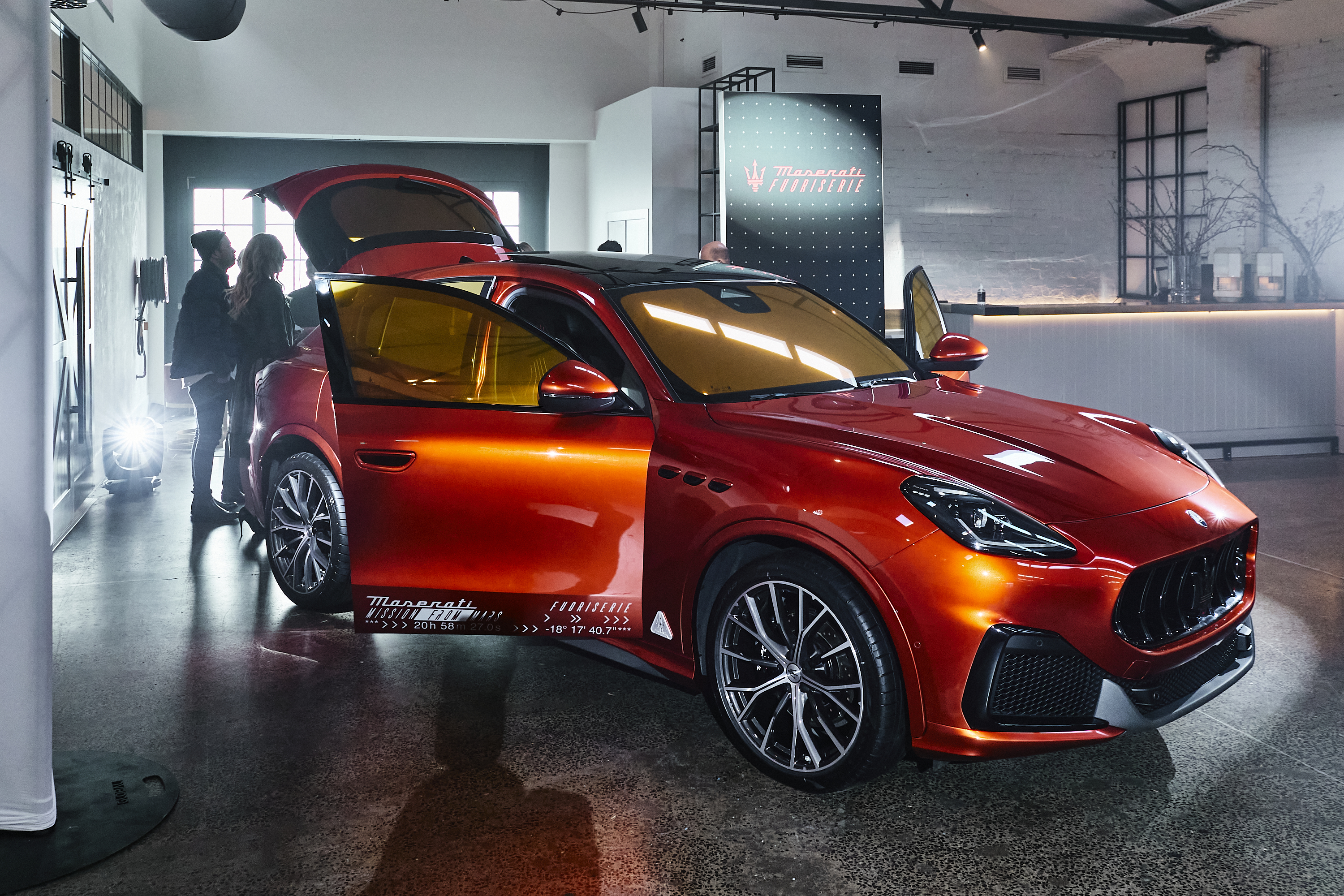
Three customised Maserati models have landed in Australia for a series of VIP previews, marking our first glimpse of its Grecale medium SUV locally.
The arrival of the cars is part of a relaunch of the Italian carmaker’s global Fuoriserie customisation program locally and includes the Grecale Fuoriserie Mission from Mars, Levante Fuoriserie and Ghibli Trofeo Fuoriserie.
“Fuoriserie elevates the relationship between Maserati and its family of owners to an even greater, more personal level,” said Grant Barling, General Manager of Maserati Australia.
“We feel privileged to offer our customers an even greater opportunity to individualise their vehicle. We’re seeing growing interest from clientele in the Fuoriserie program – it allows them to express themselves even more boldly, confidently and in a genuinely bespoke manner.”
Through the program, all Maserati owners have a choice of colours and other personalisable trim options, such as carbon fibre and varying wheel sizes.
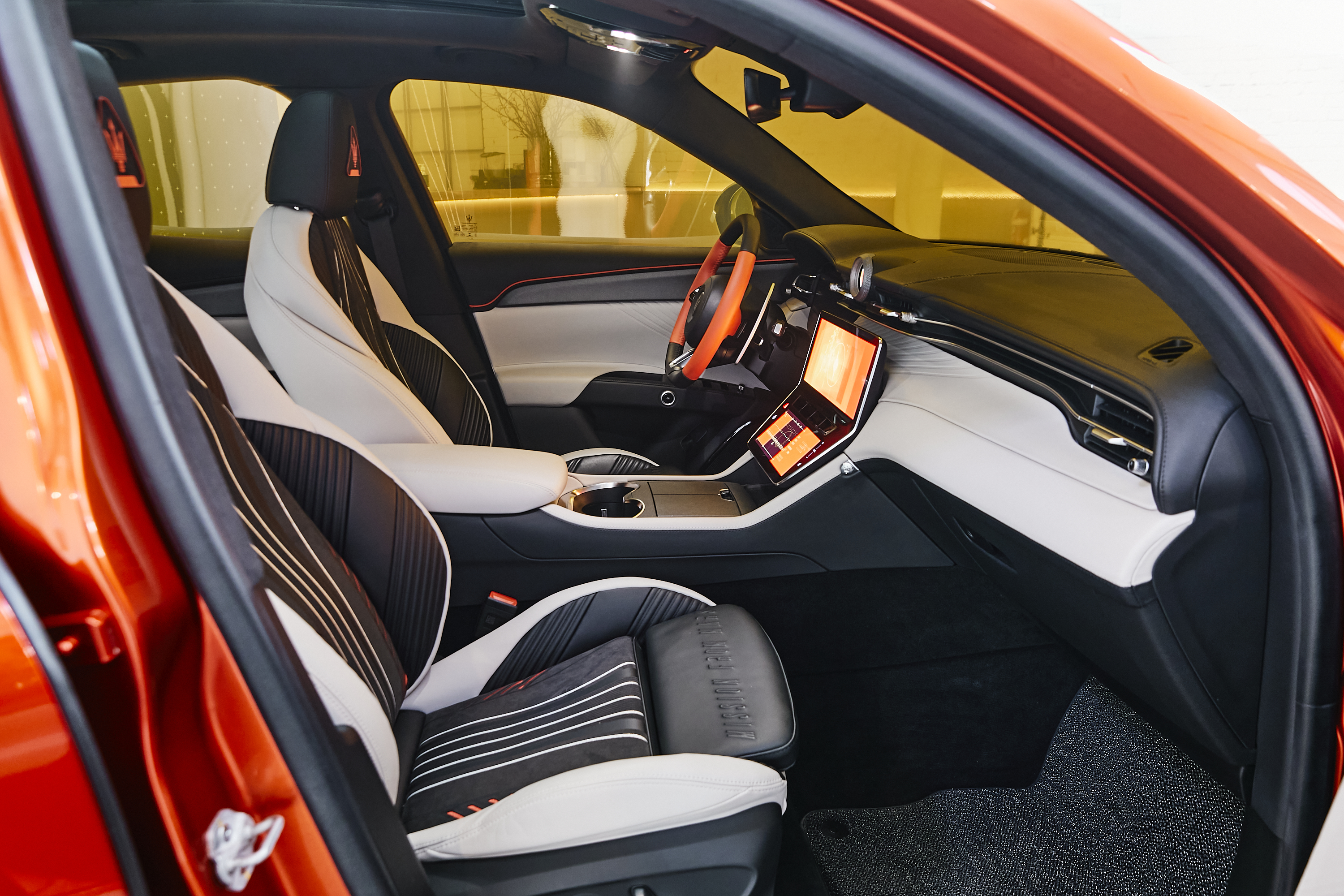
For the Grecale Fuoriserie Mission from Mars, a special textured metallic paint, inspired by mineral dust and metal erosion, is used on components inside and out.
The exteriors are painted in a multi-layered galactic orange, which is reminiscent of molten metal, on top of a futuristic – and almost frosted – orange-red resin, complemented by special grey-tyred vortex wheels.
Inside, there’s a 12.3-inch screen, the largest ever seen in a Maserati, and the ceiling is covered in stars.
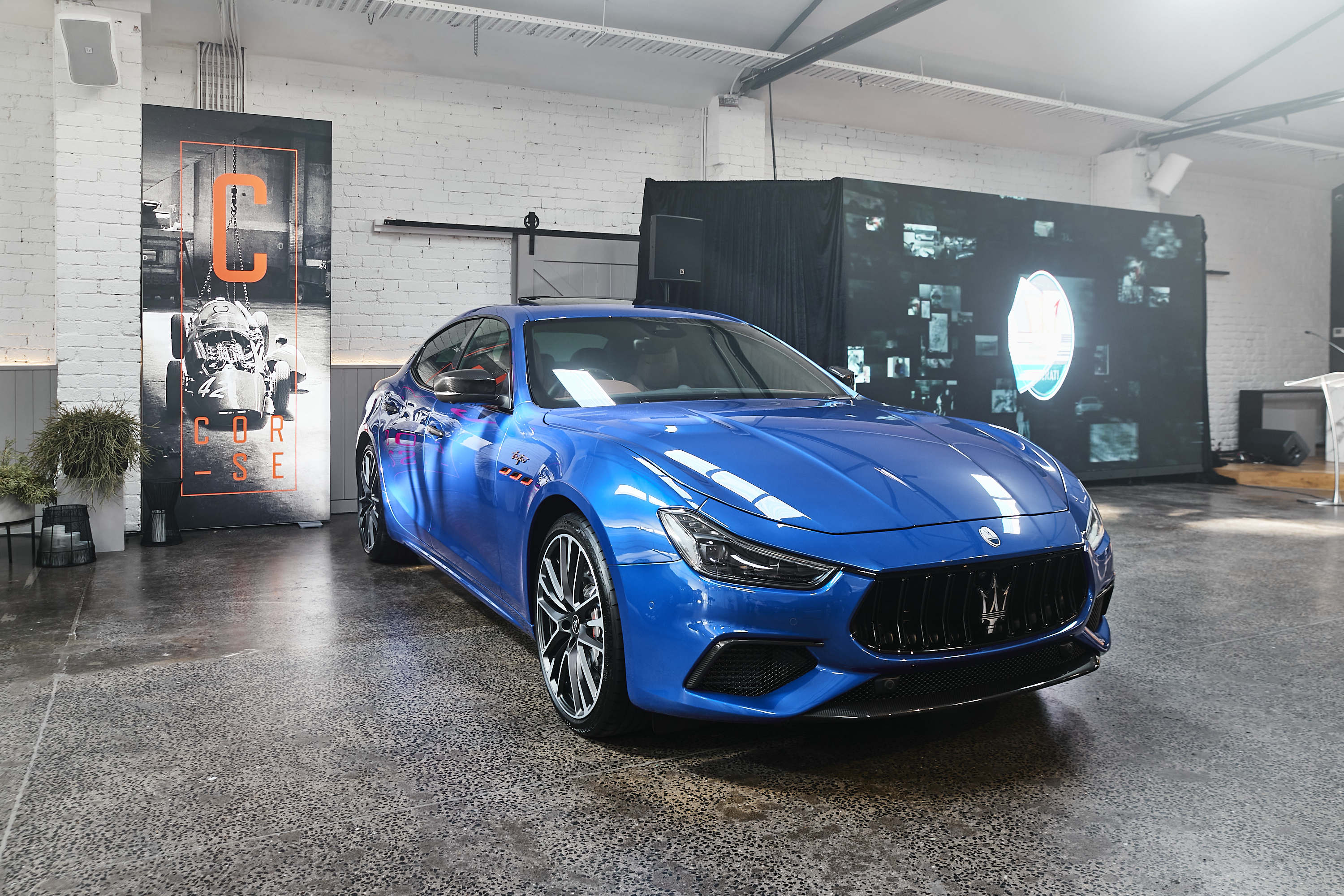
Meanwhile, the Ghibli Trofeo Fuoriserie boasts a Blu Inchiostro exterior, harking back to the heritage of Maserati – blue being a primary colour for Bologna, the city where Maserati was founded in 1914 – and a Couio Tan Pieno Fiore leather interior.
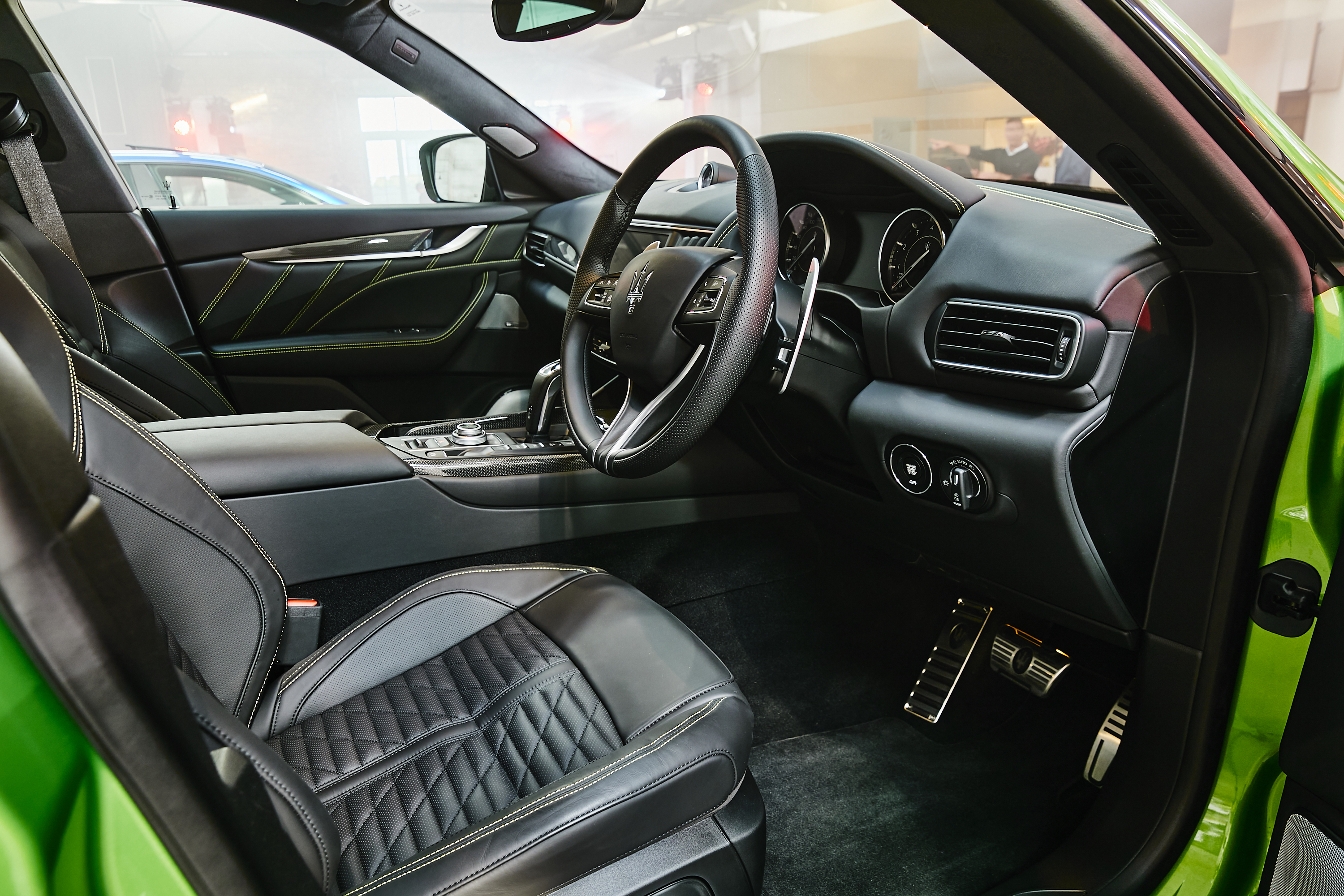
The Levante Fuoriserie, designed to appeal to younger buyers, has an urban green exterior paintwork with hints of metallic gold that show up in sunlight.
The three Fuoriserie vehicles have a fleeting visit in Australia before continuing a voyage around Asia Pacific, with local pricing and timings for first customer deliveries of the Grecale set to be confirmed in coming months.
While full specifications will be announced closer to the car’s arrival, the Italian brand has revealed the electric Folgore will also be coming to our shores, which will be fitted with a 105kWh battery and a 400-volt system – enough to give the SUV a driving range on par with its petrol-powered counterparts.
Though yet to be confirmed, twin electric motors mounted on each axle are expected to send around 400kW and 800Nm to all four wheels, making it the most powerful Grecale within the stable.
The Grecale Folgore will be one of the very first battery-powered Maserati models to hit the market when it arrives in late 2023, with the new-generation GranTurismo also launching with an all-electric Folgore variant around the same time.
Tesla’s autonomous driving system is under scrutiny after non-regulatory tests published this week appeared to show repeated failures to detect child-sized dummies.
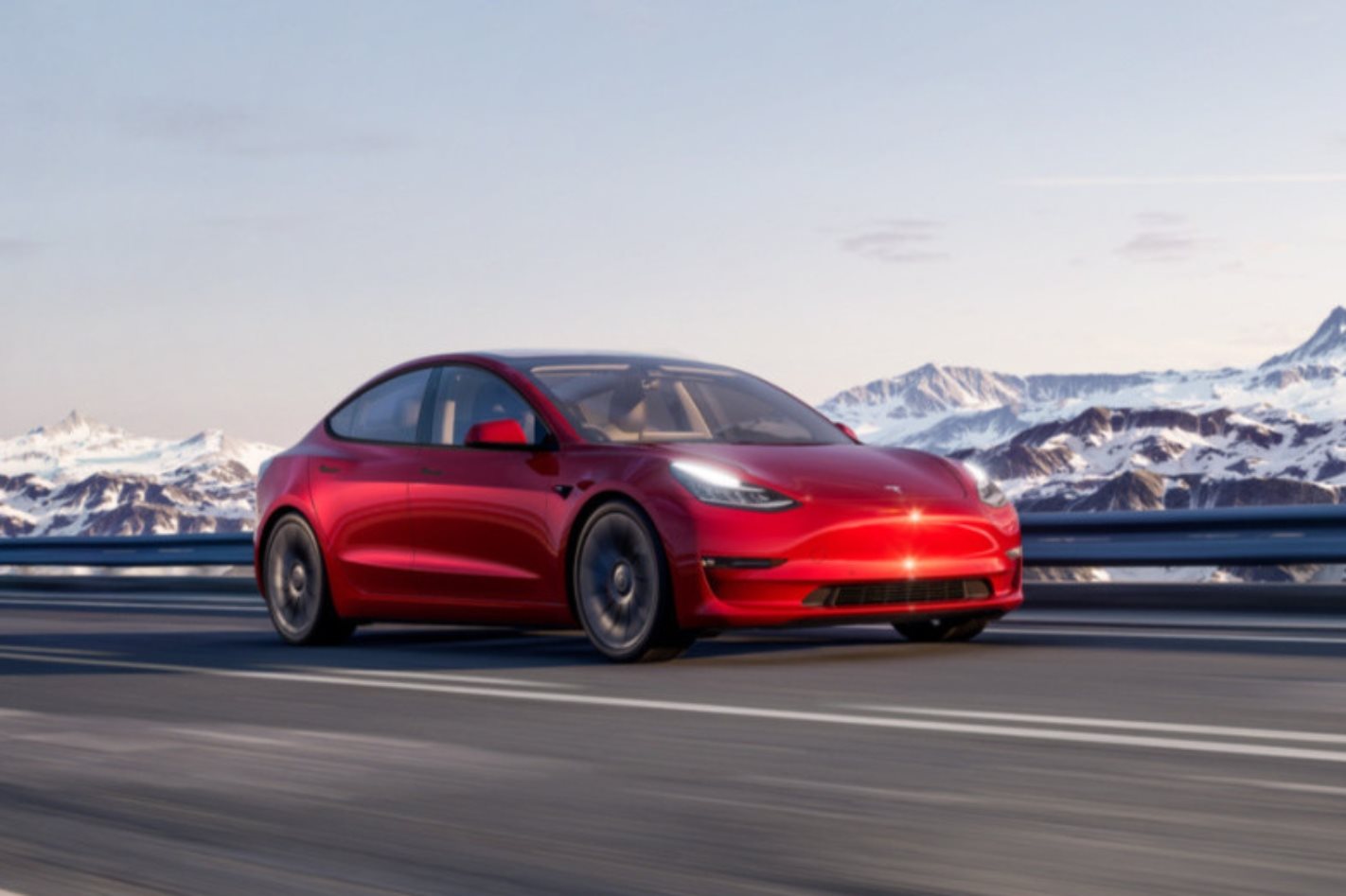
In research conducted by safe-technology advocacy group The Dawn Project, a 2019 Tesla Model 3 reportedly running the latest version of the brand’s Full Self-Driving (FSD) beta – released in June – repeatedly hits a stationary, child-sized object in the middle of a racetrack.
The claims form part of an ad campaign set to air across the United States, calling for the public to pressure Congress into banning Tesla’s autonomous driving technology.
Funded by California tech CEO and notable Tesla critic, Dan O’Dowd, the advocacy group has been actively testing Tesla’s autonomous driving software since 2021.
O’Dowd attempted to run for Senate earlier this year, with a sole platform to ban Tesla’s self-driving technology.
The test was completed at the Willow Springs International Raceway in California, with the vehicle given 110 metres of straight track between two cones with a small mannequin placed at the end.
At a set speed of 40 miles per hour (64 km/h), the professional driver was told to keep their hands off the steering wheel and only brake if contact is made with the object.
The 32-second video appears to show three instances of the Tesla failing to stop for the mannequin, with two attempts to deviate from the object – and deceleration in each attempt, but not enough to prevent an impact.
Further vision released by The Dawn Project verifies FSD was activated during the tests; however, WhichCar has reached out to the advocacy group for comment on the number of tests completed as its critics claim FSD it was not active at the time and the test results are “inconsistent” with what’s shown in the video.
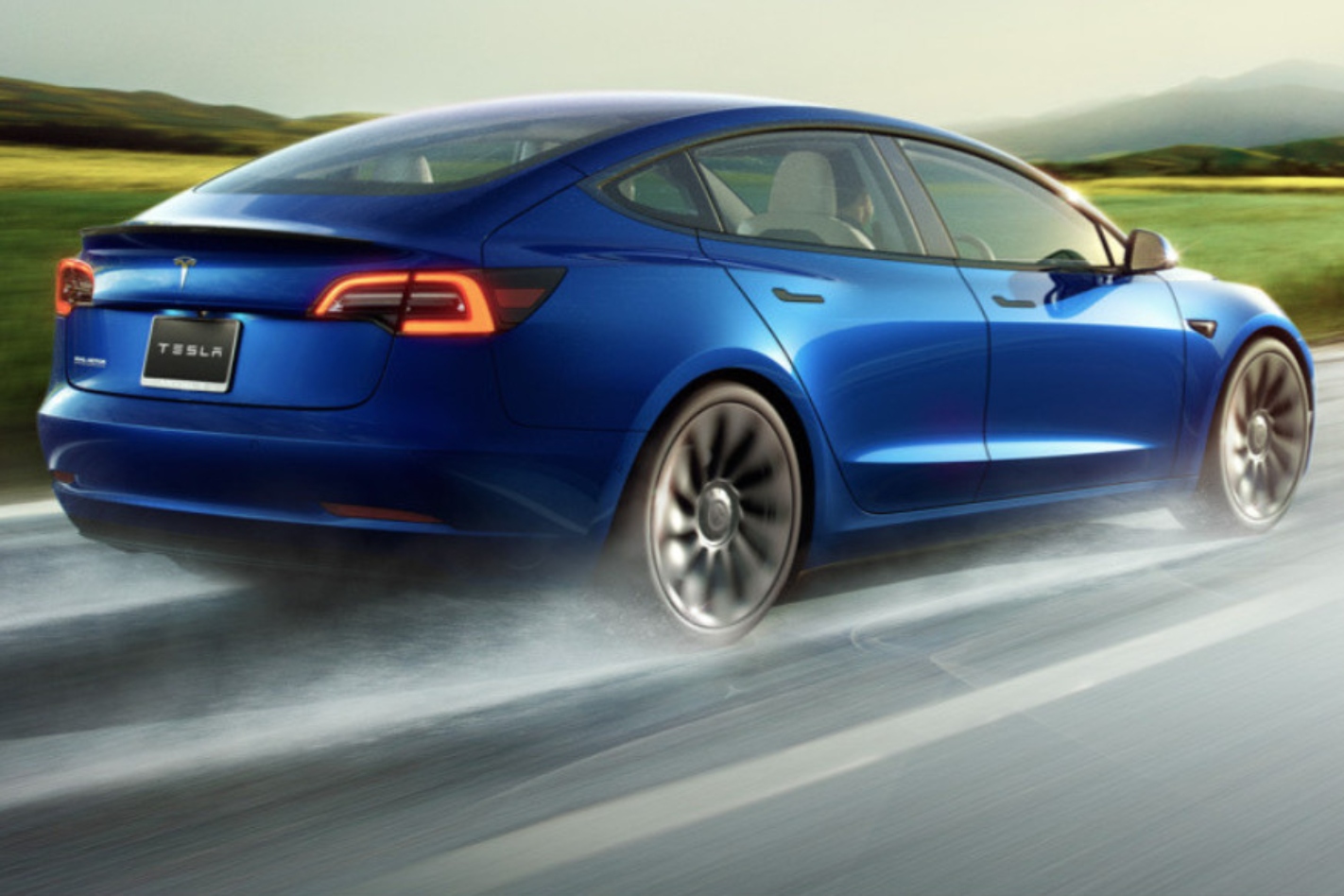
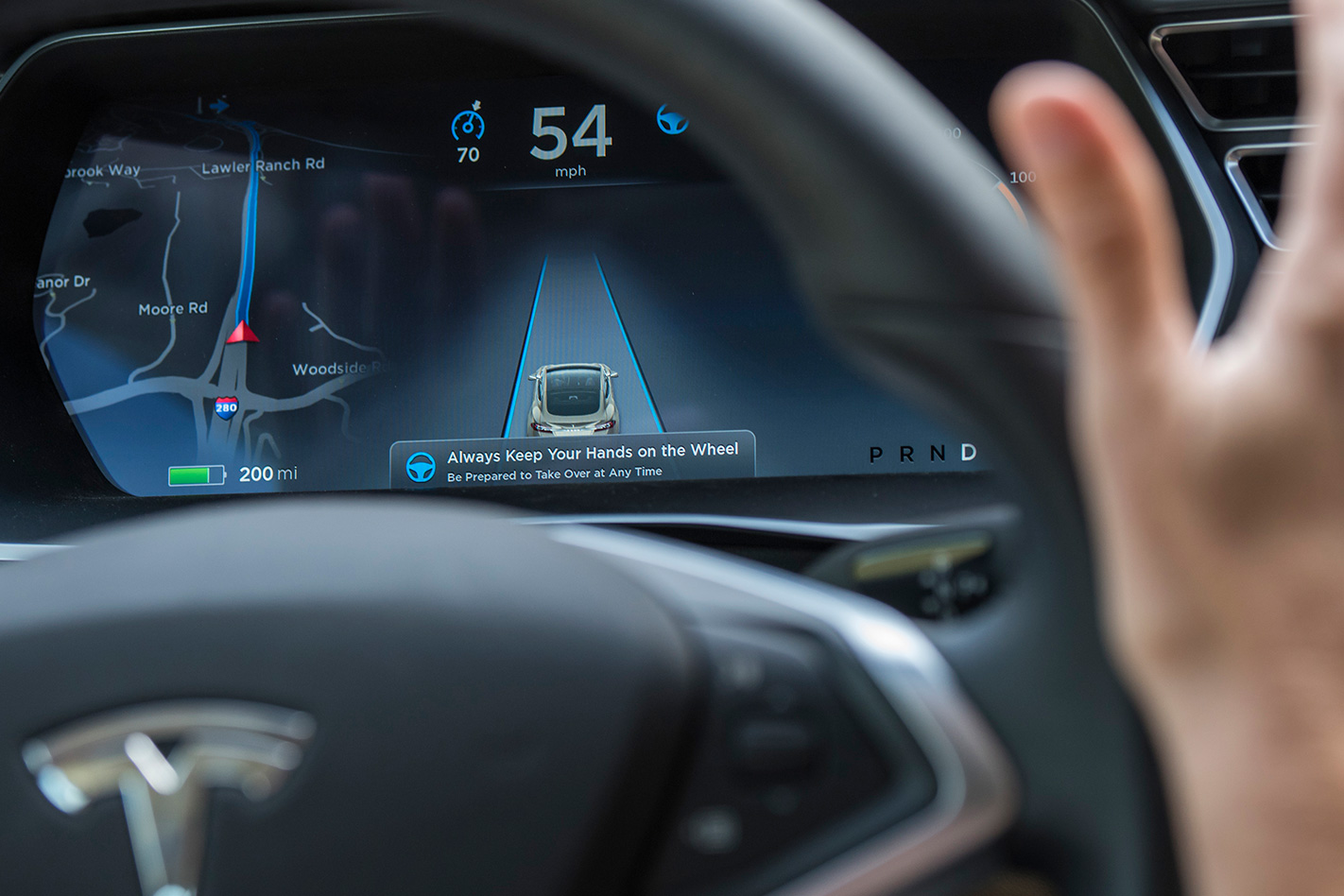
In all three attempts published, the Model 3 repeatedly warns the driver to keep their hands on the steering wheel.
The test driver, Art Haynie, said the vehicle appeared to “start to stagger as if lost and confused, slow down a little, and then speed back up as it hit and ran over the mannequins.”
Haynie has worked for several carmakers, including Porsche, and is also a professional pilot and driving instructor.
Tesla has not publicly responded to the claims.
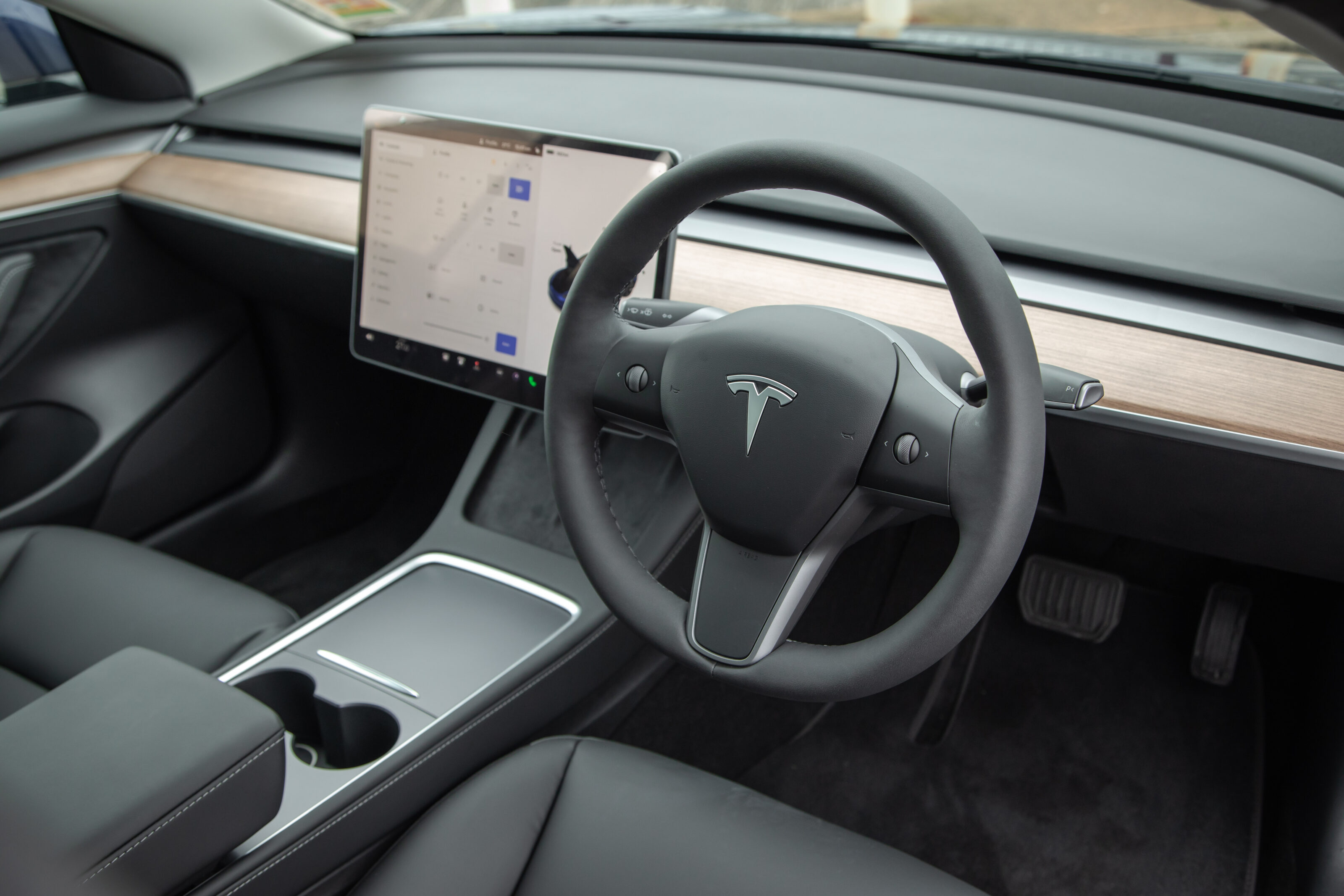
Despite the name, Tesla states its Full Self-Driving system – which remains in beta – is not designed to replace licensed drivers, instructing them to “keep their hands on the wheel and be prepared to take over at all times.”
According to the American carmaker, more than 100,000 vehicles are currently using the Full Self-Driving beta program.
The Dawn Project claims the test was “designed to simulate a realistic life-and-death situation in which everyday motorists frequently find themselves: a small child walking across the road in a crosswalk.”
It notes the racetrack environment was chosen to ensure there were no other variables, such as moving or parked vehicles, weather, signage, buildings or shadows.
Of note, the independent test was not conducted with the oversight of a regulator, which means it was not subject to identical testing standards.
During testing by safety authority Euro NCAP in 2019, the autonomous emergency braking in the Tesla Model 3 successfully braked for vulnerable road users at 30 km/h and 60 km/h; however, the vehicle was not operating in Autopilot or Full Self-Driving mode.
A further video released by Twitter user Taylor Ogan this week shows a Tesla Model Y failing to stop for a child-sized object, even without FSD or Autopilot activated.
The video reportedly showcases the brand-new Tesla Model Y hitting the mannequin, while a 2022 Lexus RX450h equipped with Luminar’s Iris LiDAR system successfully prevents a collision.
A number of Tesla investors and advocates have claimed that the Tesla Vision system is sophisticated enough to detect ‘cardboard’ obstacles on social media. The mannequins are made of foam and fabric.
The electric carmaker has previously faced trouble in Germany, with a Berlin court banning the use of the ‘Autopilot’ term to market semi-autonomous driving functions in 2020.
In addition, the Autopilot system was reportedly blamed for a recent incident in Melbourne involving an alleged hit and run. The incident was said to have been the first time Victorian major collision investigators had been confronted with a case involving assisted driving technology.
Snapshot
- FCAI advocating for range of tech, recommending own voluntary standard
- Carmakers divided over whether they support FCAI or want full EV push
- EV summit coming up could be a gamechanger
Calls have been made for unity over an ongoing row between a peak industry body and electric vehicle campaigners on the best way forward to lower Australia’s auto emissions.
Volkswagen Group Australia’s (VGA) Managing Director, Paul Sansom, made the plea after in-fighting broke out between various sectors of the car industry earlier this week.
“While gratefully acknowledging FCAI’s advocacy on such important topics as improving the fuel standard, it has a very difficult job because it is a broadchurch with a wide membership,” Sansom told ABC radio.
“Companies such as ours will be pushing to drive the changes that we need in order to see more EVs [in Australia]. Other manufacturers will hold a different view. What I would say to the FCAI is that division on this topic is going to make the journey even harder. We need to find some unity.”
On Monday, a report in the Sydney Morning Herald claimed that the Federal Chamber of Automotive Industries (FCAI) has been launching a campaign behind closed doors which would delay Australia’s transition to EVs.
According to the news article, the FCAI is lobbying policymakers to adopt rules that would preserve petrol and hybrid cars well into the future, and to adopt its existing, voluntary emissions scheme as the national standard.
Since then, Wheels has spoken to several manufacturers about their own standpoints, with one telling us that it supported the FCAI’s stance on Australia transitioning to zero emissions through a range of technologies rather than full EVs – describing some climate campaigners’ rhetorics as “militant”.
Meanwhile, Volkswagen said it “will be campaigning to have stronger standards”.
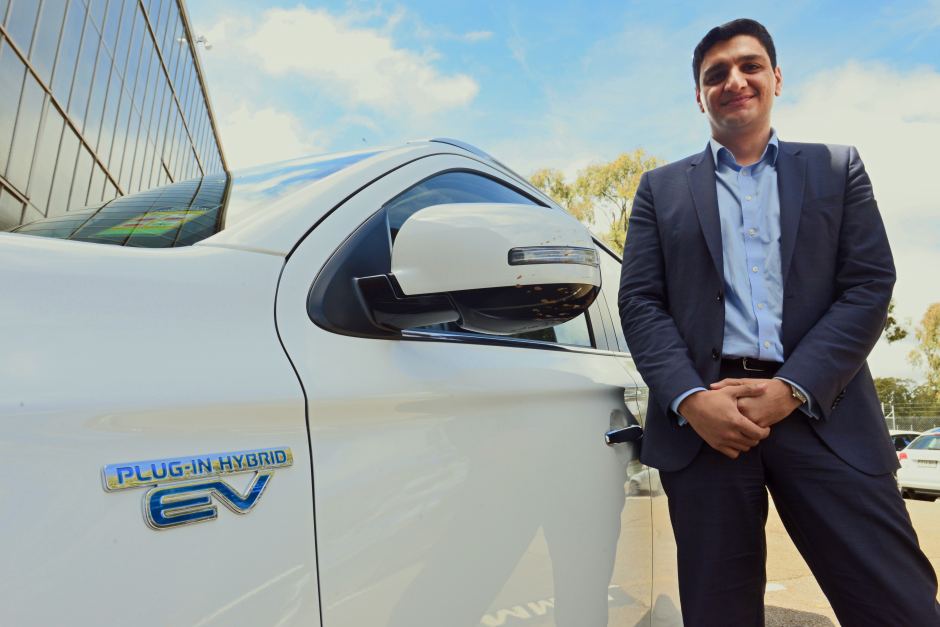
Sansom mantains that with a tough emissions standard, which is in line with Europe and the UK, companies like VW will be able to bring in more electric models in large volumes and price parity will not be far behind.
“The market [in those places] had to adapt, quite frankly. Lobby groups had their say, but ultimately it was the Government that enacted legislation. Today you see in the UK and most European countries the very rapid adoption of electric vehicles because those standards have to be met,” the boss added.
“When we have those standards in Australia we will get the supply to meet demand. One in two of our customers are looking at EVs for their next vehicles.
“By 2030, half of the vehicles we produce will be battery-electric (BEVs). By 2040, we won’t be selling anything but BEVs.”The FCAI has not publicly responded since the furore broke on Monday, but previously has gone on record saying: “Our members recognise the need to combat climate change. In the absence of federal leadership in 2020 we established our own voluntary scheme that sends a message to manufacturers’ head offices that Australian motorists want the best low emission technologies.
“Any reduction target must be broad based and focused on reducing CO2, not picking certain technologies over others. Our zero-emissions future is ultimately full electrification.”
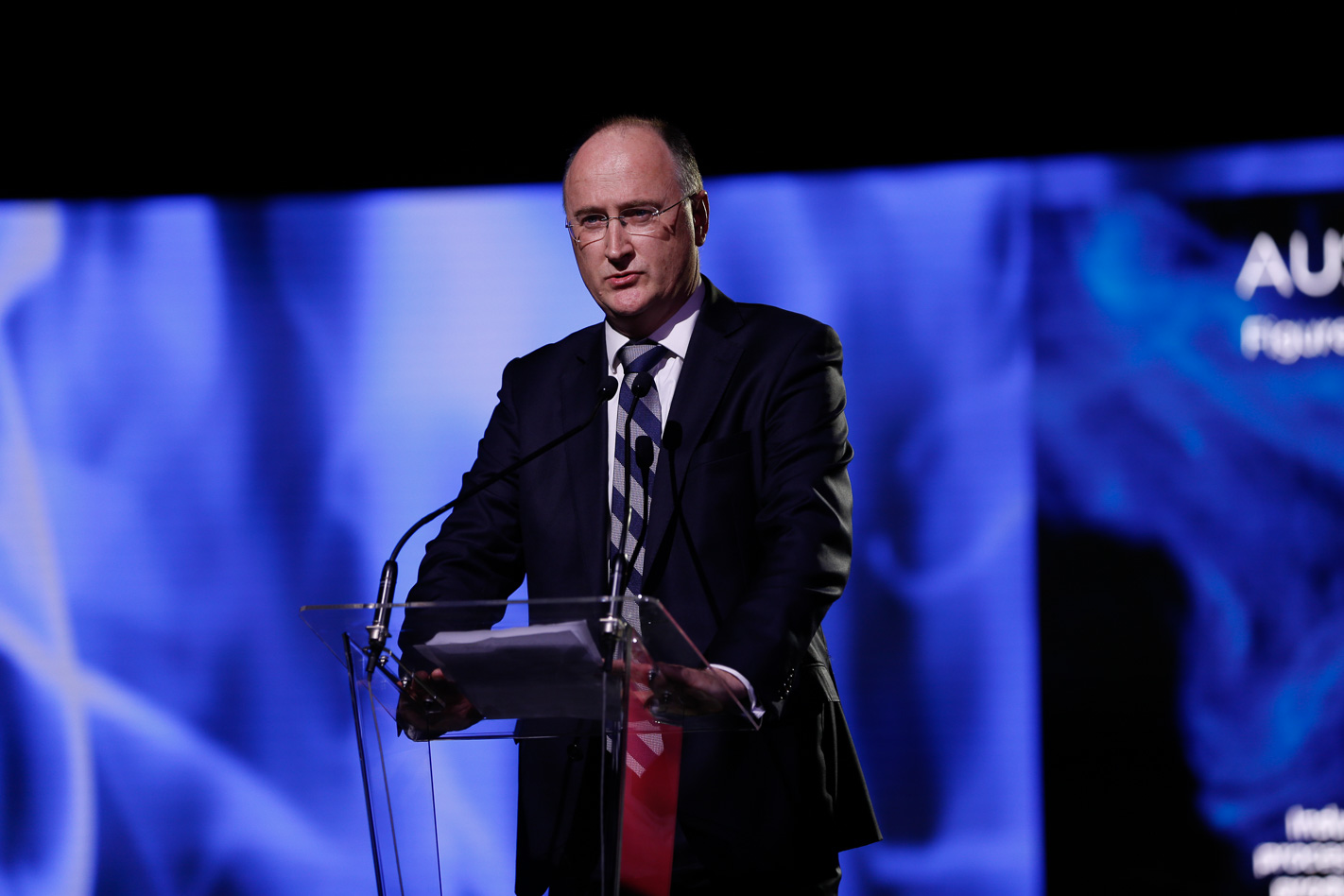
But while the FCAI has not brought its voice back into the fray, others have been filling it.
“The only fuel-efficiency standards that will make a difference are standards in line with those that exist in the US and Europe,” said Electric Vehicle Council (EVC) chief executive Behyad Jafari, also tweeting “as Australia starts a fresh effort to reduce emissions and drive electric vehicle uptake, it’s important the bad actors are called out” in a thinly-veiled dig at the FCAI.
On the other side of the debate, Motor Trades Association of Australia (MTAA) CEO Richard Dudley said the time for cheap pot shots and airing “facts of convenience” is over.
“Rather than ‘call out’ organisations as ‘bad actors’ for providing Australian consumers hard facts, perhaps groups like the Electric Vehicle Council and others can explain to Australian consumers and 70,000 automotive businesses employing more than 370,000 why industry facts are wrong,” Dudley said.
“Two weeks ago, the MTAA facilitated a historic summit of 10 leading automotive industry associations to determine national positions as together we face mobility’s most critical crossroad.
“Industries received and considered global international and domestic research and analysis, providing an unassailable picture of what is coming down the new EV pipeline for the next 10 to 15 years. Research and analysis not from one but several respected global independent sources, which all essentially come to the same conclusions – which the industry agreed to.”
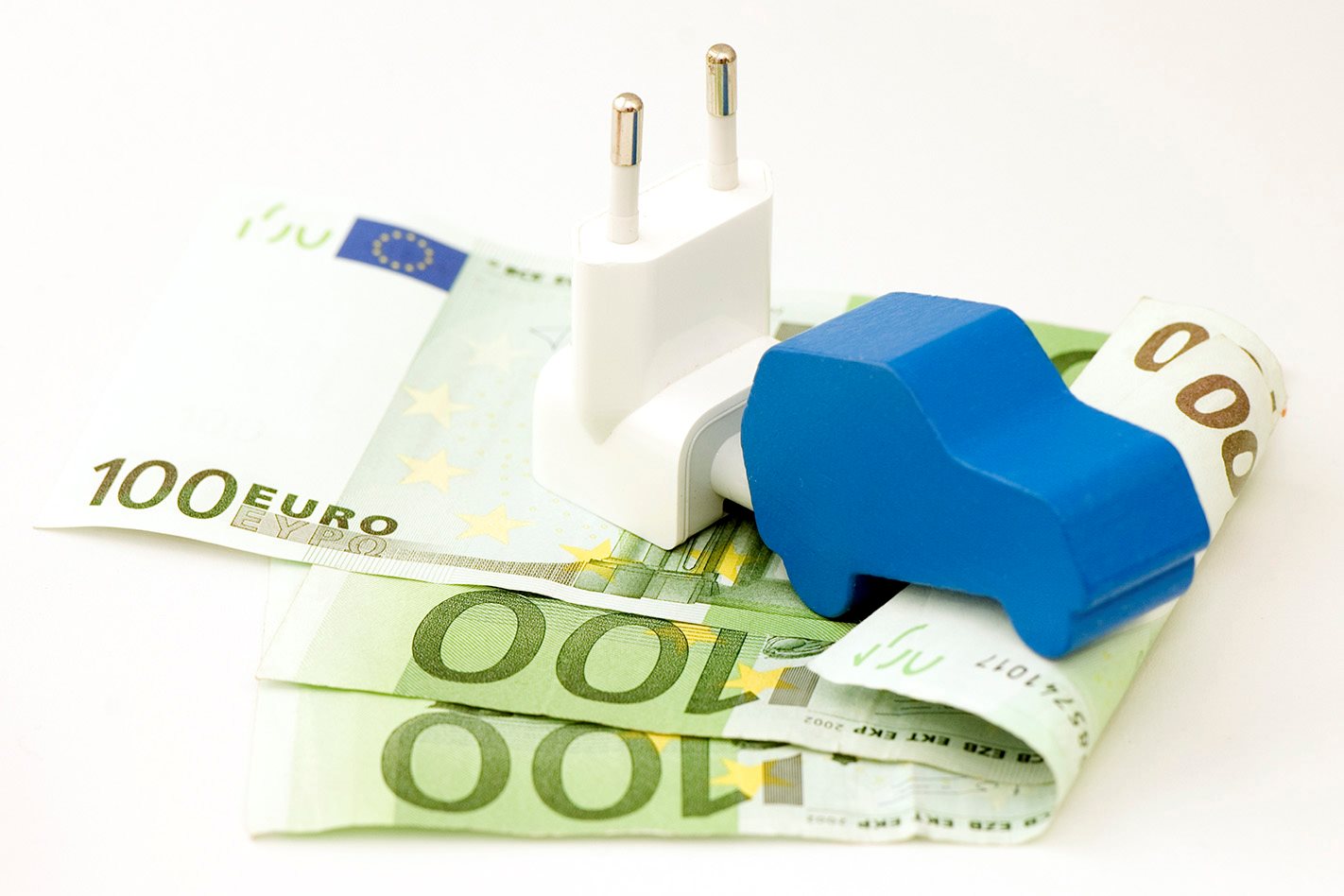
Like the FCAI, the MTAA believes a federal emissions target is long overdue – but anything that is developed or announced in the near future should focus on a CO2 goal rather than EV sales targets, recognise Australian consumers’ desire for at-home charging and the subsequent public charging infrastructure requirements, as well as the people and skills required to still service, repair, and maintain both an electric and the legacy fleet.
Also key, according to the organisation, is consistent and targeted subsidies and incentives, as well as tariff and taxation reform.
Owners of Hyundai N performance vehicles can now access an updated Track Maps feature that covers 16 race circuits nationwide.
N Track Maps was introduced on the Kona N SUV in late 2021, allowing the driver to record lap times automatically via a dedicated widget on the central touchscreen.
Initially limited to Sydney Motorsport Park, the update now adds other famous Australian racetracks including Hidden Valley (Northern Territory), Symmons Plains Raceway (Tasmania), Queensland Raceway, and The Bend (South Australia).
The only obvious omission on the list is Victoria’s Phillip Island.
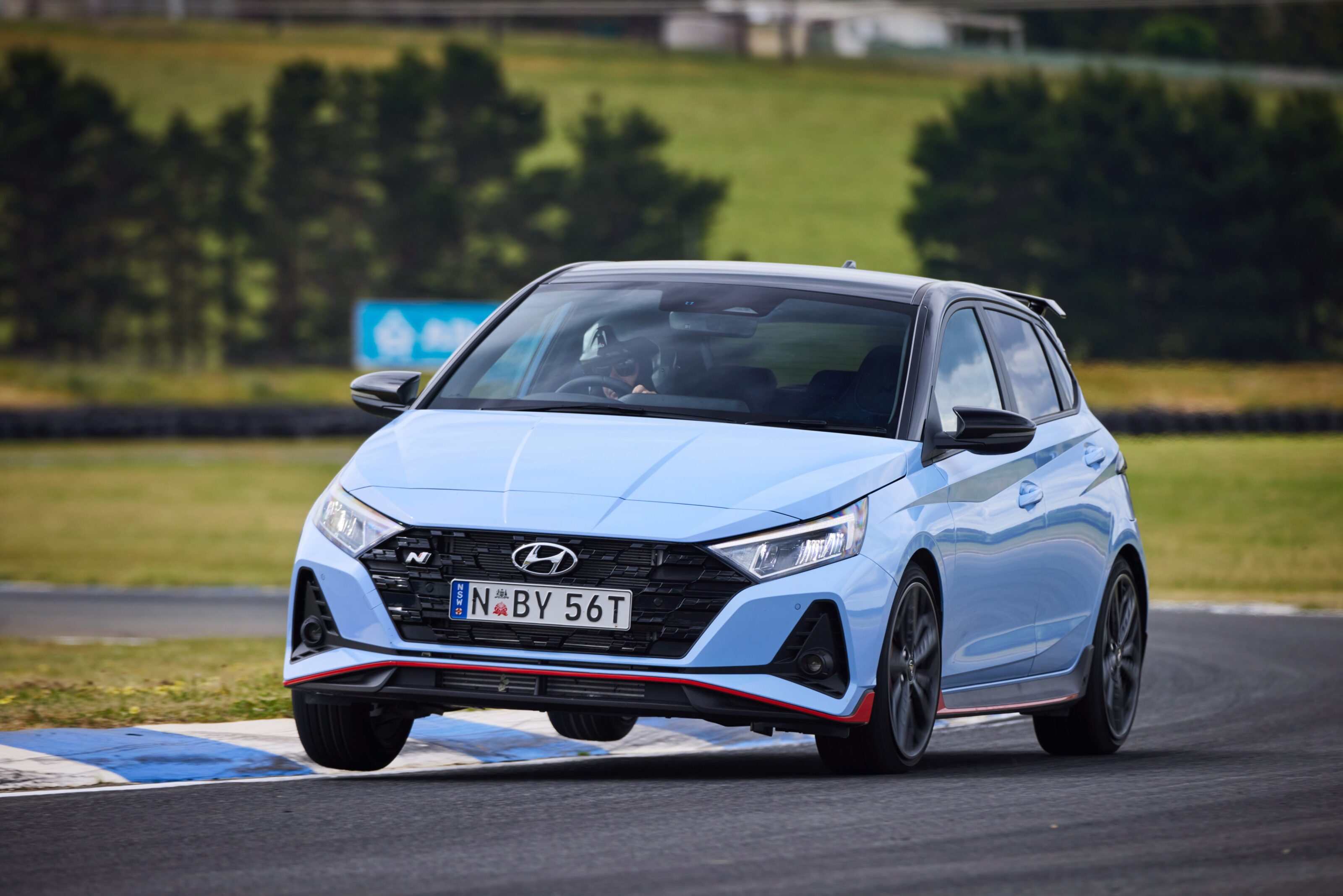
Hyundai’s updated N Track Maps feature is now available for download for the i20 N compact hatchback, i30 Sedan N, and Kona N. The update is not available for the i30 N hot-hatch, which was the company’s first N model in 2017 and features older hardware.
N Track Maps also caters for the multiple, smaller circuit layouts where available at main racetracks.
The widget engages when the vehicle approaches the vicinity of one of the supported tracks.
Hyundai Australia spent months taking one of its N cars to each of the tracks – and sub-circuits – to perform multiple laps so it could data capture GPS locations, measuring the extremities of track limits and noting start-finish lines.
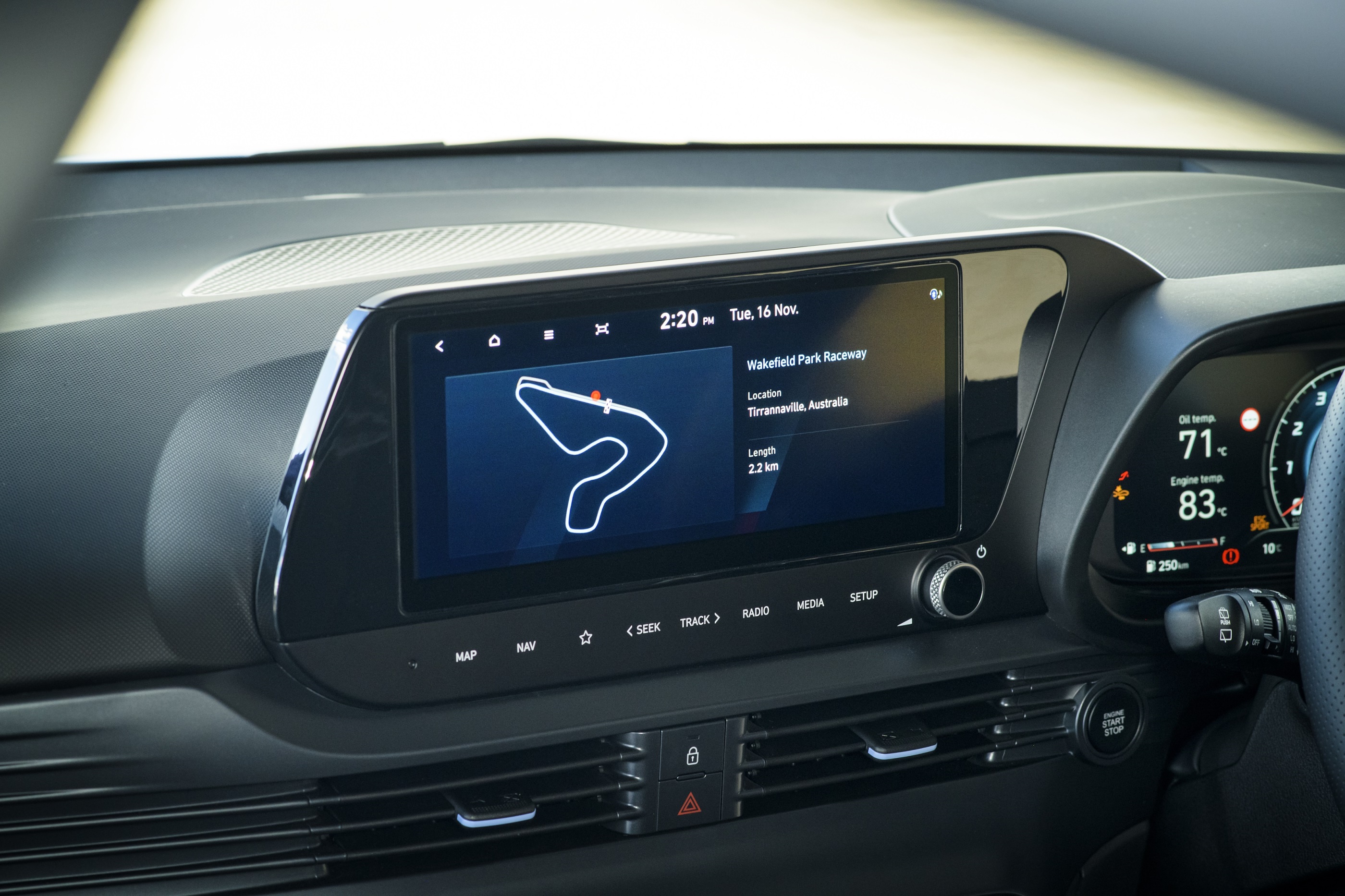
Track Maps shows the position of an N vehicle on the track on the multimedia screen, and it automatically starts the lap timer – also shown in the driver display – every time the car crosses the start-finish line. All lap times are logged.
Owners can download the updated Track Maps software for free online at update.hyundai.com. The update can be simply downloaded onto a USB device that is then uploaded into the N vehicle’s navigation/multimedia system.
The full list of compatible racetracks is listed below.
| Racetrack | Layout |
| QLD | |
| Lakeside Park | Lakeside Park Circuit |
| Morgan Park Raceway | Circuit B |
| Circuit D | |
| Circuit E | |
| Circuit K | |
| Queensland Raceway | Clubman Length |
| National Circuit | |
| Sportsman Circuit | |
| Sprint Circuit | |
| NSW | |
| Sydney Motor Sport Park | Amaroo (South) Circuit |
| Brabham Circuit | |
| Druitt (North) Circuit | |
| Gardner GP Circuit | |
| Wakefield Park Raceway | Wakefield Park Raceway |
| NT | |
| Hidden Valley Race Track | Hidden Valley Raceway |
| SA | |
| Mallala Motor Sport Park | Mallala Motor Sport Park |
| The Bend Motorsport Park | East Circuit |
| GT Circuit | |
| International Circuit | |
| North Circuit | |
| South West Circuit | |
| West Circuit | |
| TAS | |
| Baskerville Raceway | Baskerville Raceway |
| Symmons Plains Raceway | Symmons Plains Raceway |
| VIC | |
| Sandown Raceway | Sandown Raceway |
| Winton Motor Raceway | Club Circuit |
| National Circuit | |
| WA | |
| Collie Motorplex | Collie Motorplex Long Circuit |
| Collie Motorplex Short Circuit | |
| Wanneroo Raceway | Long Circuit |
| Short Circuit | |
| Supercars Circuit |
If by some incredibly unlikely set of circumstances and unbelievably good fortune, you managed to sneak into Hyundai’s heavily guarded Namyang proving ground, avoiding detection as you took the keys to a still-completely-disguised prototype, before making your way to the exit gate, I should imagine it would be a matter of seconds before the South Korean government ordered a missile strike on you.
Having visited the impressive 330-hectare site before, I recall the security was almost as memorable as the organisation, infrastructure and facilities.
And yet, this is exactly the situation in which I find myself. The car in question is the IONIQ 6 and it’s two days before the car’s official reveal at the Busan Motor Show. Despite this, I’m being waved through the main security gate and out onto public roads.
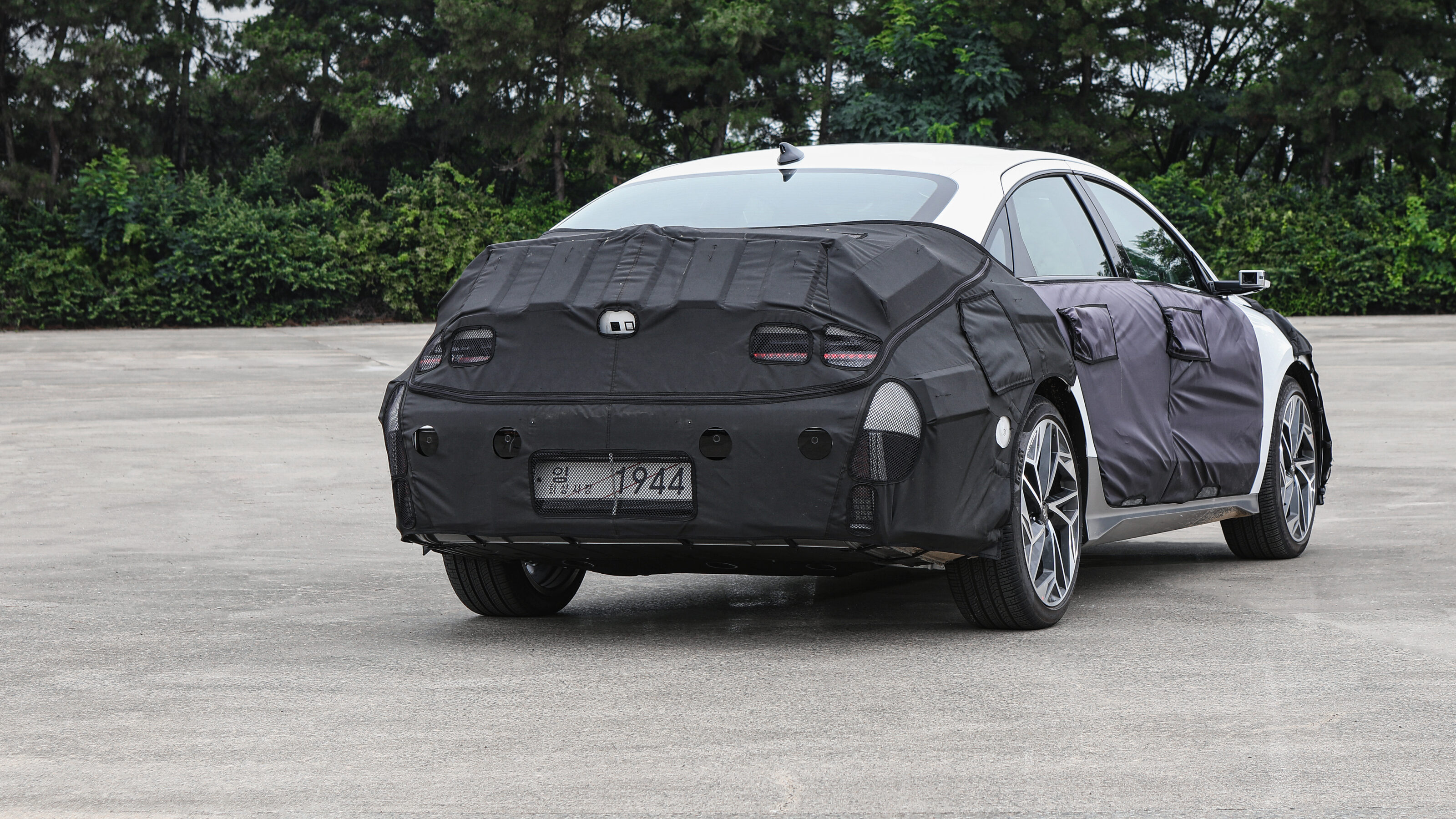
For the next few kilometres, I feel like one of Hyundai’s own test engineers, piloting a still largely enigmatic car that won’t hit Australian shores until 2023 and, at the time of writing, still hadn’t given up all of its secrets.
What is known is that the IONIQ 6 has a lot in common with the IONIQ 5 family foray, including the E-GMP electric platform, choices of rear- or all-wheel drive and pricing that will also align, within a range somewhere between $60,000 and $80,000.
But the second model in Hyundai’s new electric-only family takes the baton from the 5 and advances the EV cause even further. That’s why I’m in South Korea feeling like I just jailbroke a prototype. Performance has improved slightly over the IONIQ 5, with the most potent version capable of doing the zero to 100km/h dash in 5.1 seconds – a tenth faster.
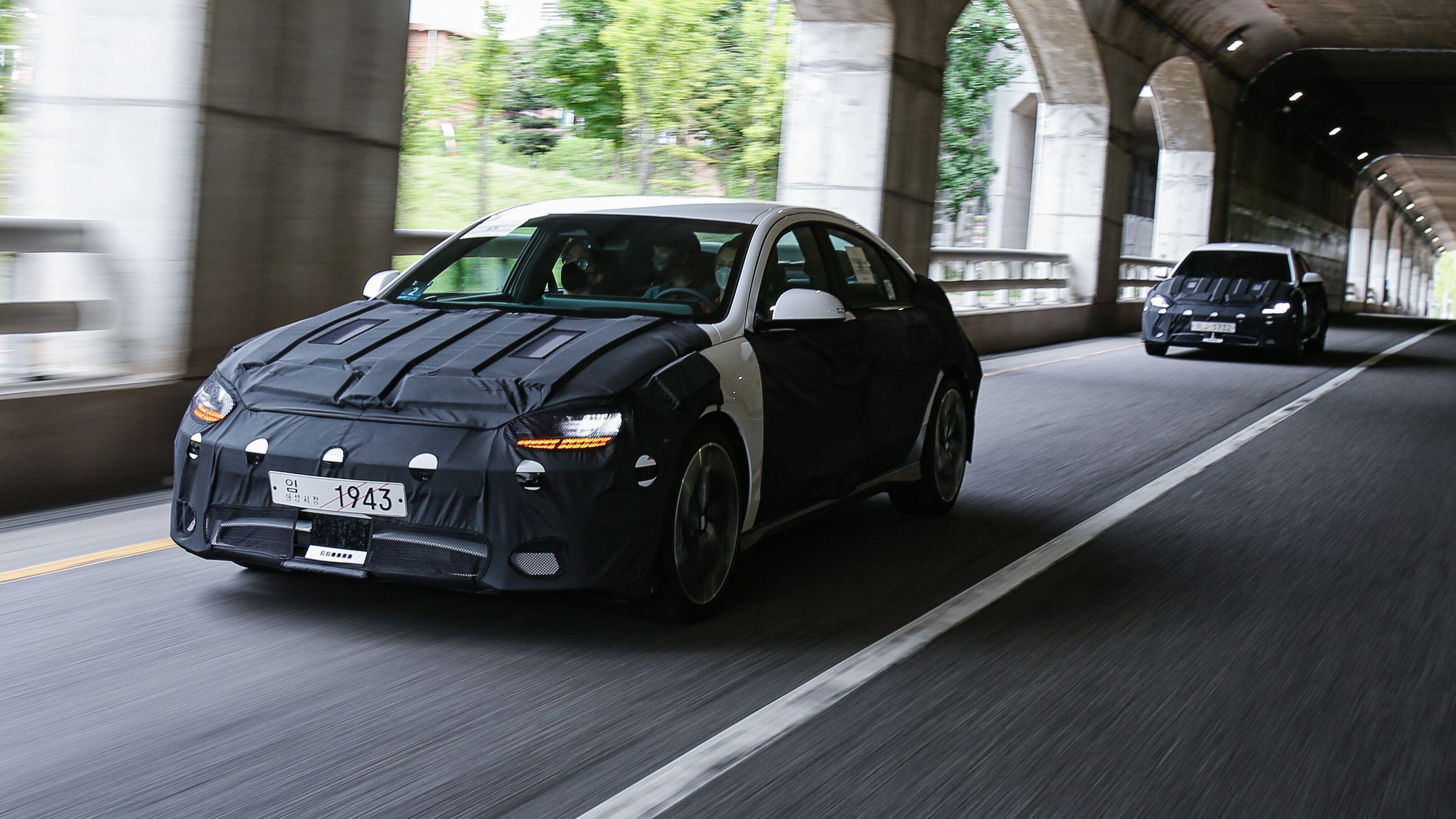
On the varying roads around the Namyang facility there are only a few opportunities to test the force of full throttle, but nor do I really want to. That’s because Hyundai claims the latest IONIQ drivetrain has made significant improvements to efficiency.
So it’s with a more gentle foot that I negotiate the short test route to see if the claims are correct.
Like the IONIQ 5, regenerative braking is offered in four levels. In the least intrusive, coasting on overrun fails to get close to the claimed figure of better than 14kWh per 100km, with a disappointing 18kWh/100km result.
But on the return journey, the maximum ‘i-pedal’ mode is engaged for full single-pedal driving. With aggressive deceleration now possible and the brake pedal not once required, the arch-profiled sedan’s efficiency dramatically improves.
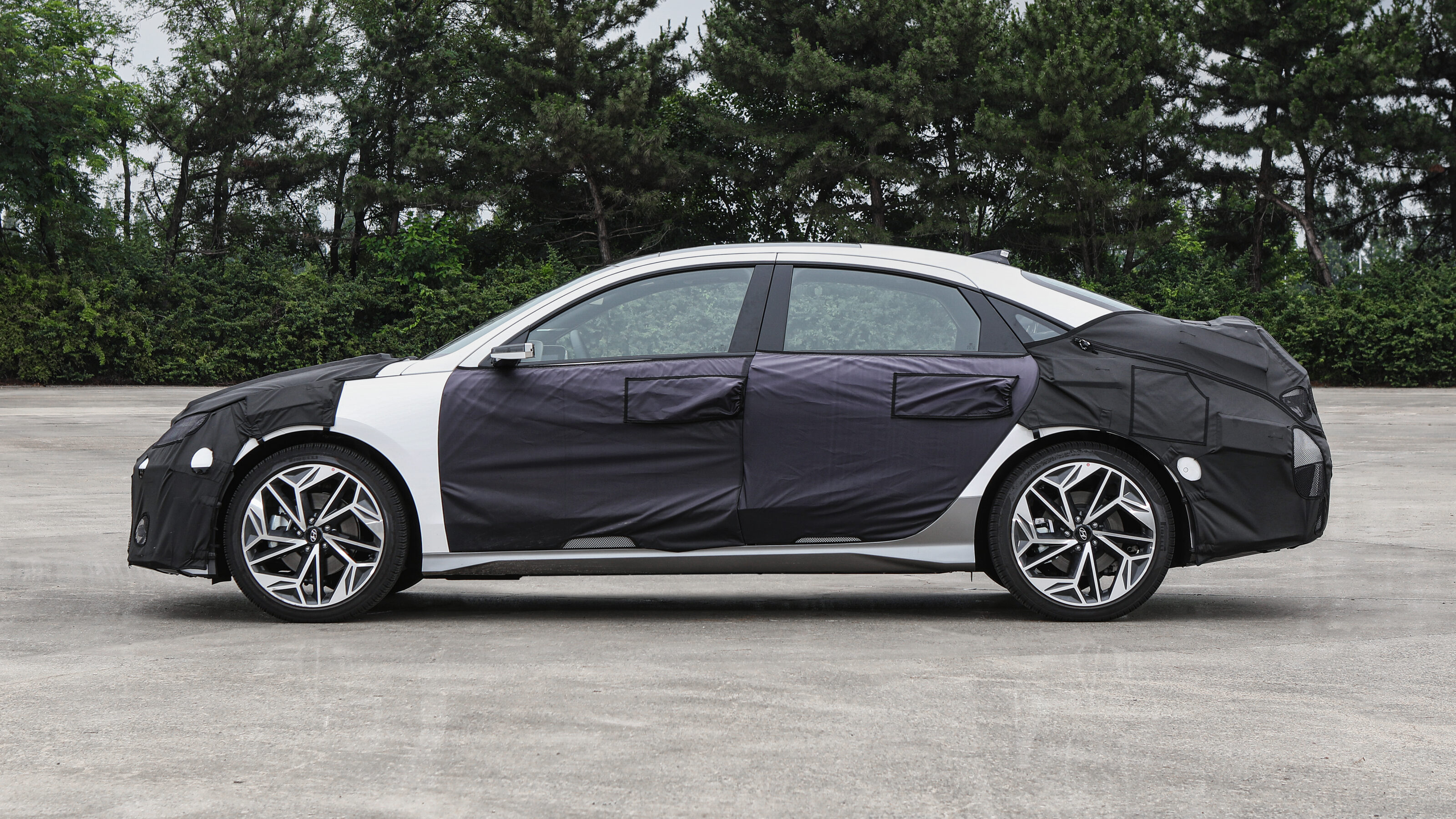
With i-pedal engaged, and despite some traffic and a complete lack of local knowledge, the IONIQ 6 reports an impressive 14.3kWh/100km.
It seems Hyundai’s lengths to build a more efficient powertrain are paying dividends but it wasn’t easy. Firstly, Hyundai’s insistence on referring to the IONIQ 6 as an “electric streamliner” isn’t without truth.
With a drag coefficient of just 0.21cd, it’s one of the slipperiest cars ever made and its specially developed tyres are dedicated to the model, reducing losses even further. During my time with the car, not once did the levels of traction suggest the rubber was compromising on grip or feel to save a few electrons.
Then there’s the power management system itself. Its inverter and cooling system has been refined, minimising the amount of energy that all EVs inherently waste in the journey from battery to wheels. The result is a car that can go up to 610km – one of the longest ranges of any EV – from a 77.4kWh battery, which certainly isn’t the largest in the game.
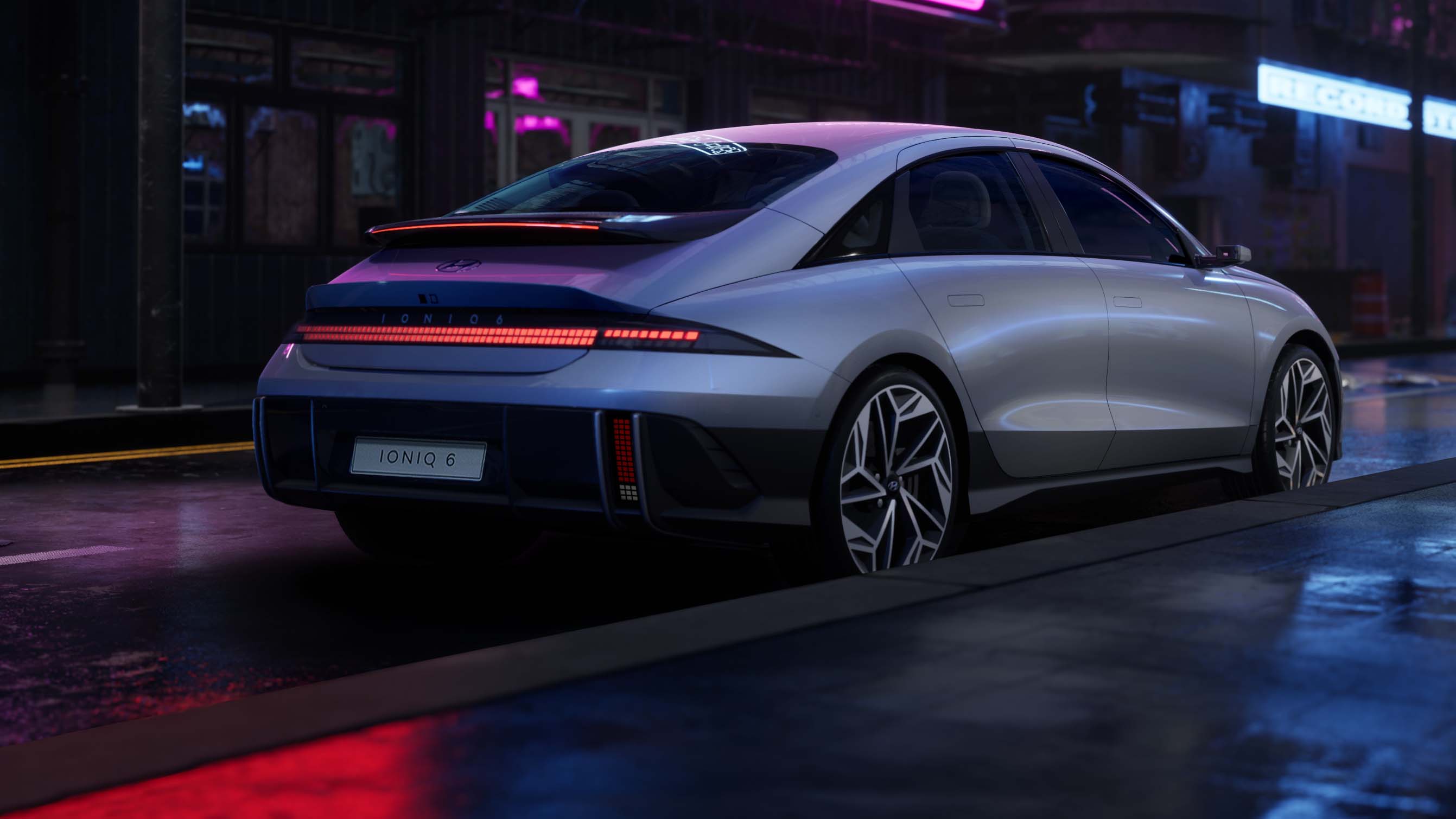
The result is a car that can go up to 610km – one of the longest ranges of any EV – from a 77.4kWh battery, which certainly isn’t the largest in the game.
While our car didn’t quite make the claimed efficiency figure, it’s worth mentioning that it did come close and it was achieved even when fitted with the larger 20-inch wheels (not the more efficient 18-inch versions), the standard side mirrors (not the digital units required for the lowest drag) and while wrapped in a disguise that certainly wouldn’t have helped aerodynamics.
Hyundai’s vigil to get the most out of every electron pumped into the battery is admirable and the gains will increase with each new arrival to the line-up including its next model – the IONIQ 7 large SUV.
With its various lumps and cloths fixed about its exterior, the prototype IONIQ 6 was giving little away regarding its design, but this first meeting did offer a glimpse at where Hyundai is taking its EV family’s interior styling.
There’s certainly a similarity between the IONIQ 6’s cabin compared with the IONIQ 5, including the expansive digital displays and use of cool, high-quality materials.
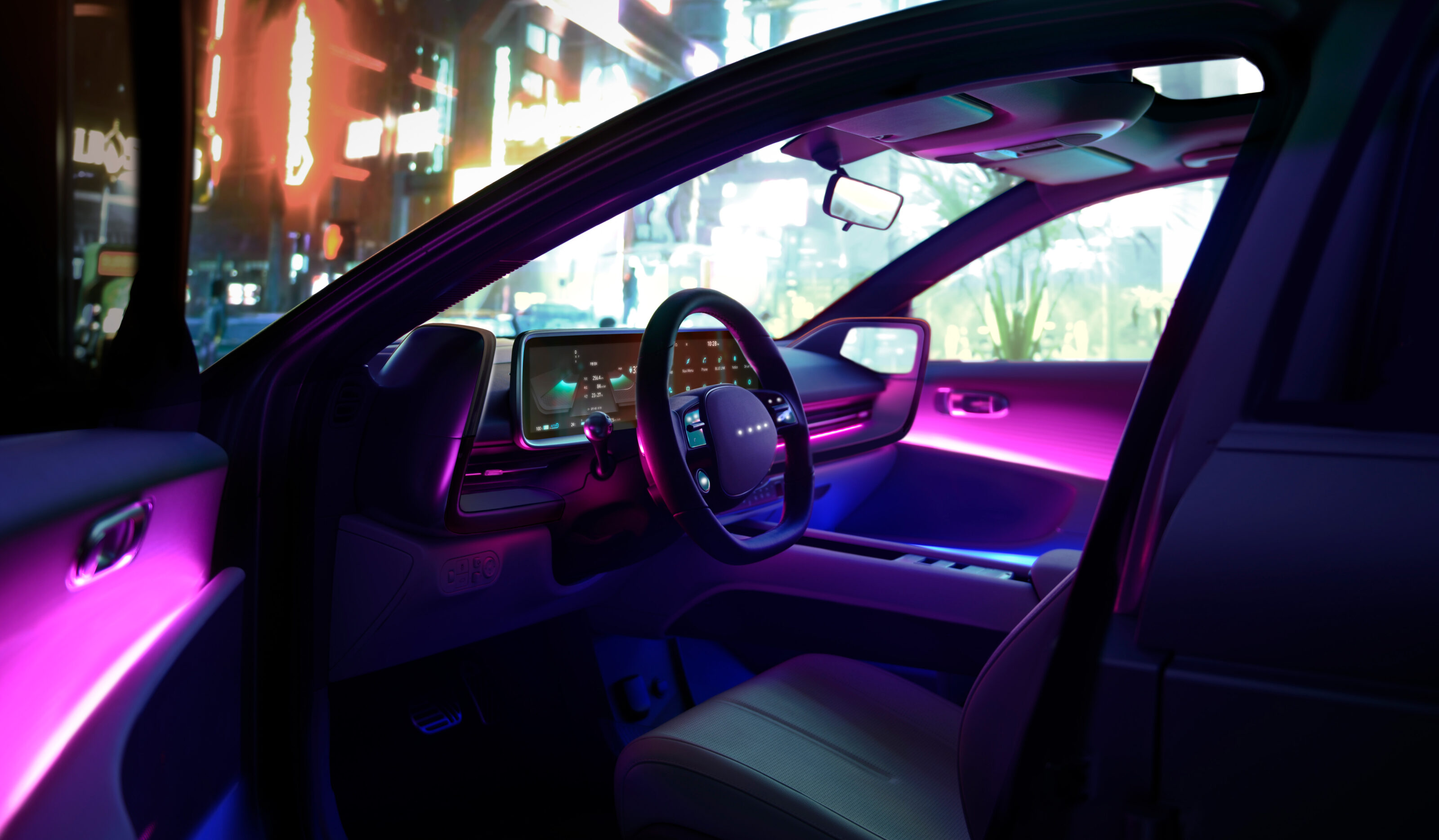
My fingertips particularly enjoyed the unusual waxed cotton material that was almost reminiscent of a new Driza-Bone and was one of eight different textures and colours I counted about the cabin.
The four dots on the steering wheel centre represent an H in Morse code and are illuminated, indicating the state of charge according to their colour.
In place of the unusual sliding centre console from the IONIQ 5 is a marginally more conventional flying beam that retains the masses of storage space beneath – much like the Hyundai Palisade.
The rest of the interior feels very much like the IONIQ 5, with a surprising amount of space in the second row and firm but comfortable seating, while ride quality is the same – firm but comfortable.
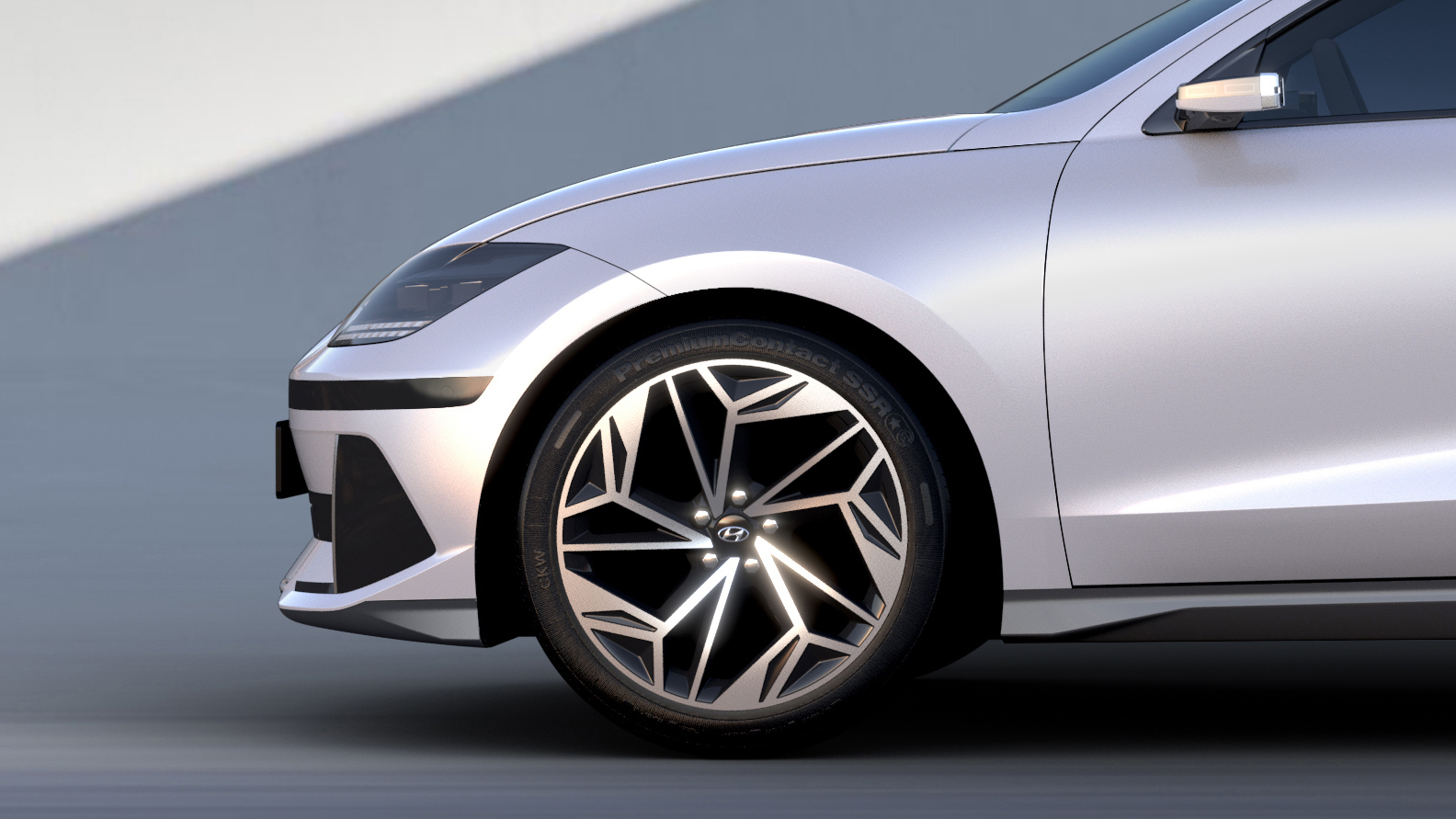
The rest of the interior feels very much like the IONIQ 5, with a surprising amount of space in the second row and firm but comfortable seating, while ride quality is the same – firm but comfortable.
Small fins at each end of the dashboard resemble the wingtips on a Dreamliner and house the screens for the digital door mirrors when fitted, and the built-in dash cam is another clever touch, offering potentially no-claims-bonus-saving technology with both front and rear views recorded.
Our brief trip didn’t include any roads to effectively test dynamics but the general composure of the IONIQ 6 feels improved over the 5, with some of its floaty nature dialled out in favour of the more focused character you’ll find in a Kia EV6. More time, distance and variety would have been great but at least this leaves more to look forward to exploring when it arrives next year.
Before I know it, the closely watching lead and sweep cars are herding me back toward the Namyang Proving Ground security compound and the mysterious car slips back behind closed doors – it’s the only time I’ve felt more comfortable inside the fences of a top-secret development facility compared with the outside world.
I used to think that Porsche Miami Blue was my favourite car colour but now I think it might be sheets of black fabric with sponge cubes glued underneath.
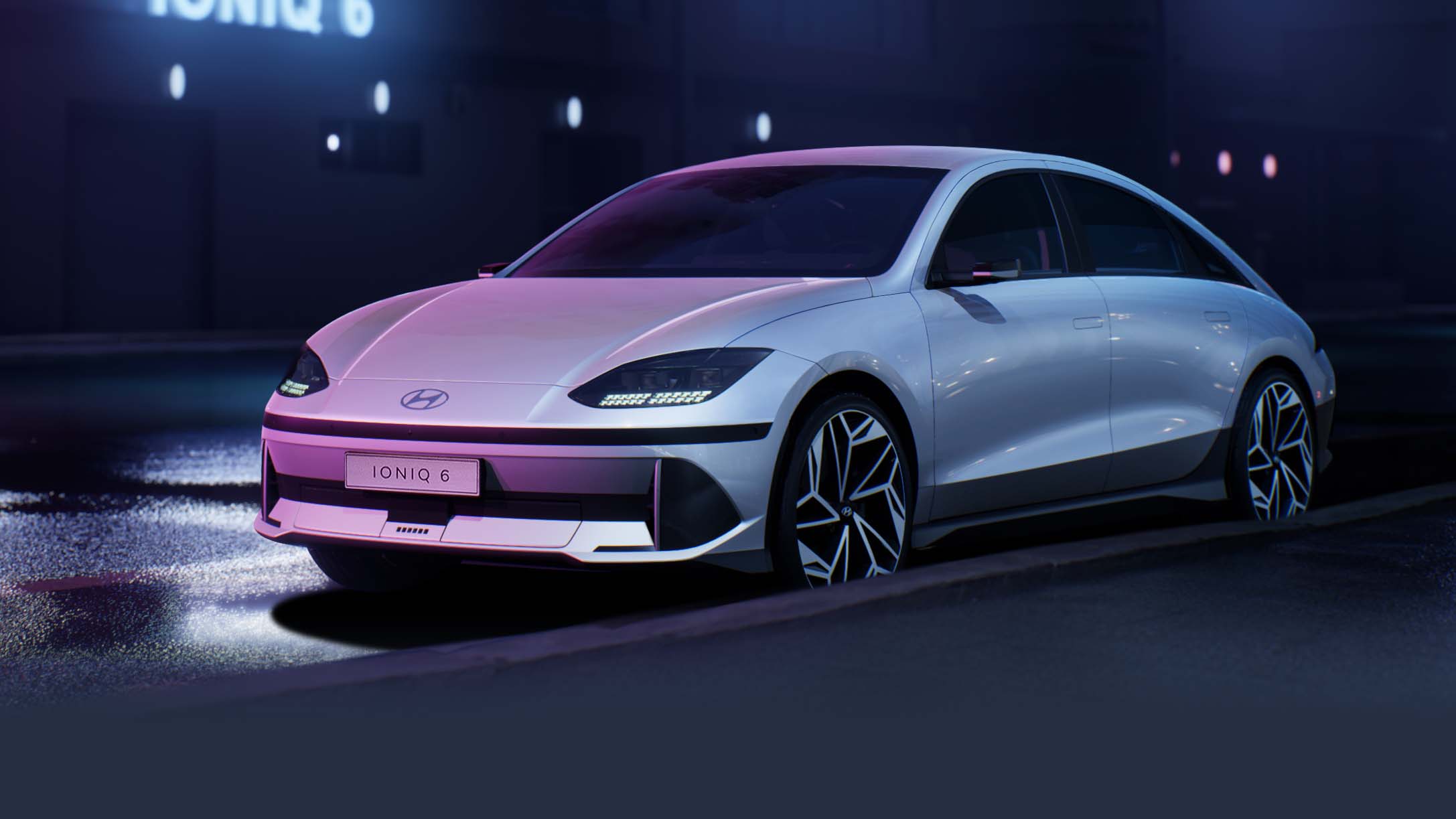
PRE-LAUNCH VERDICT
My brief lap in Hyundai’s latest EV has left me wanting much more. First impressions of this intriguing EV are encouraging and resoundingly positive, but a real-world road test appears to prove one of the most important and interesting truths surrounding electric transport.
The path of progress in the EV world is not simply a matter of building increasingly large batteries to boost range and performance. That strategy leads to a world full of very heavy electric cars that expend much of their energy simply hauling the mass of cells.
Instead, the IONIQ 6 proves that efficiency is the key and using the available energy more wisely leads to a much brighter electric future and is the silent way forward.
Snapshot
- 2022 Audi RS3 available in two body styles
- Five-cylinder turbo only 0.2 secs slower than RS6
- Priced from $91,400 plus on-road costs
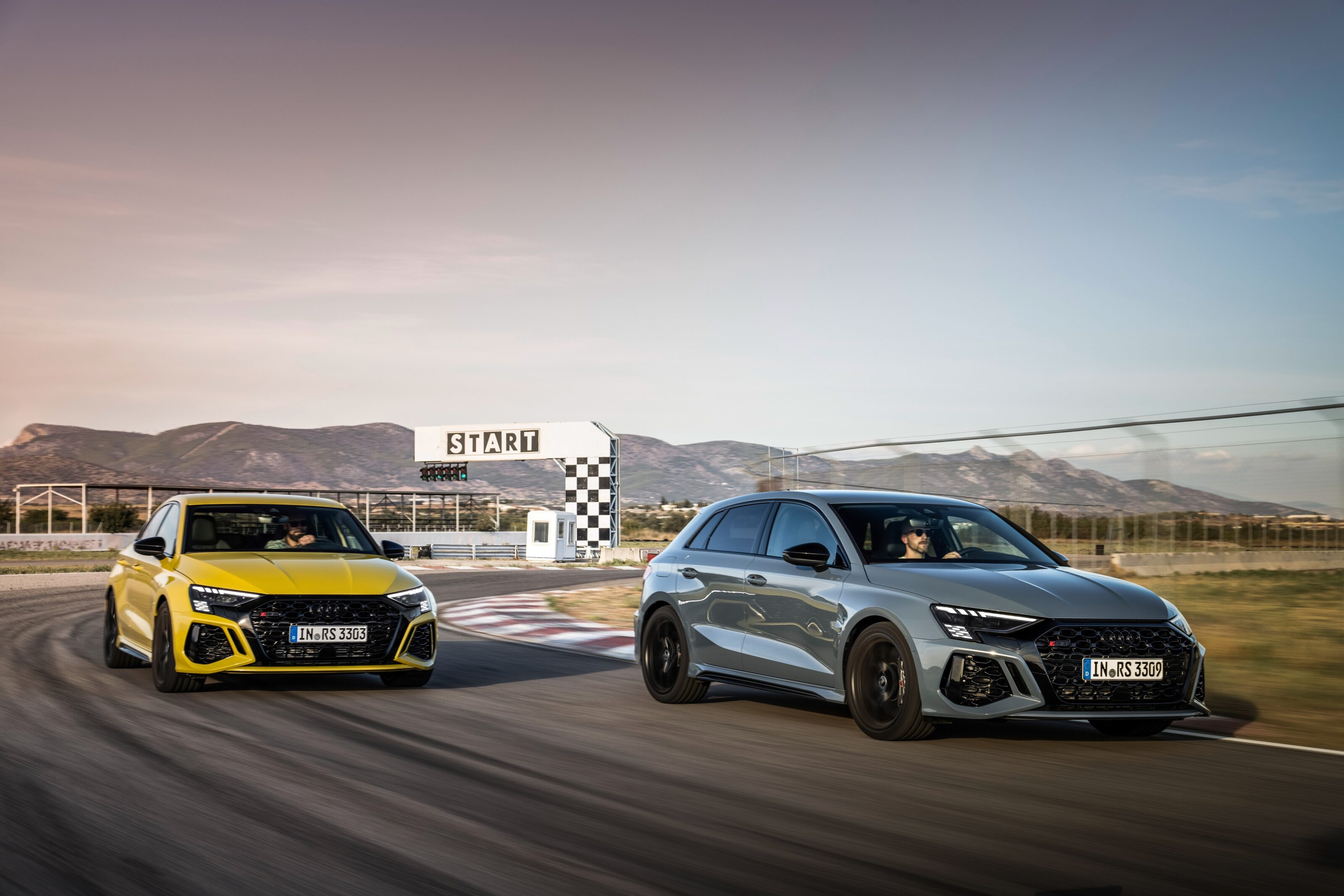
The 2022 Audi RS3 has arrived in Australia in both sedan and Sportback wagon bodies, priced from $91,391 before on-road costs.
Audi will offer the new RS3 with its 2.5-litre turbocharged five-cylinder engine, sending 294kW and 500Nm exclusively through a seven-speed dual-clutch S-Tronic automatic transmission to all four wheels.
New gear ratios help to send the RS3 to 100km/h from a standstill in a claimed 3.8 seconds – just 0.2 of a second slower than the twin-turbo V8 RS6 – on the way to a limited top-speed of 250km/h.
“The predecessor to the all-new RS 3 Sedan and RS 3 Sportback enjoyed incredible popularity in Australia since first arrival in 2015,” said Paul Sansom, Managing Director of Audi Australia.
“The unique combination of looks, driving performance and of course, that iconic Audi five-cylinder engine, proved to hit a real sweet-spot with Australian performance car buyers. Incredibly, for many months throughout its lifetime, more than every fourth A3 vehicle we delivered was an RS 3 Sedan or Sportback.”
UPDATE, August 5, 2022: New RS3 driven in Australia
The new-generation RS3 is finally in Australia. You can read our review here, and watch Inwood’s track and road drive in the video below.
The story to here
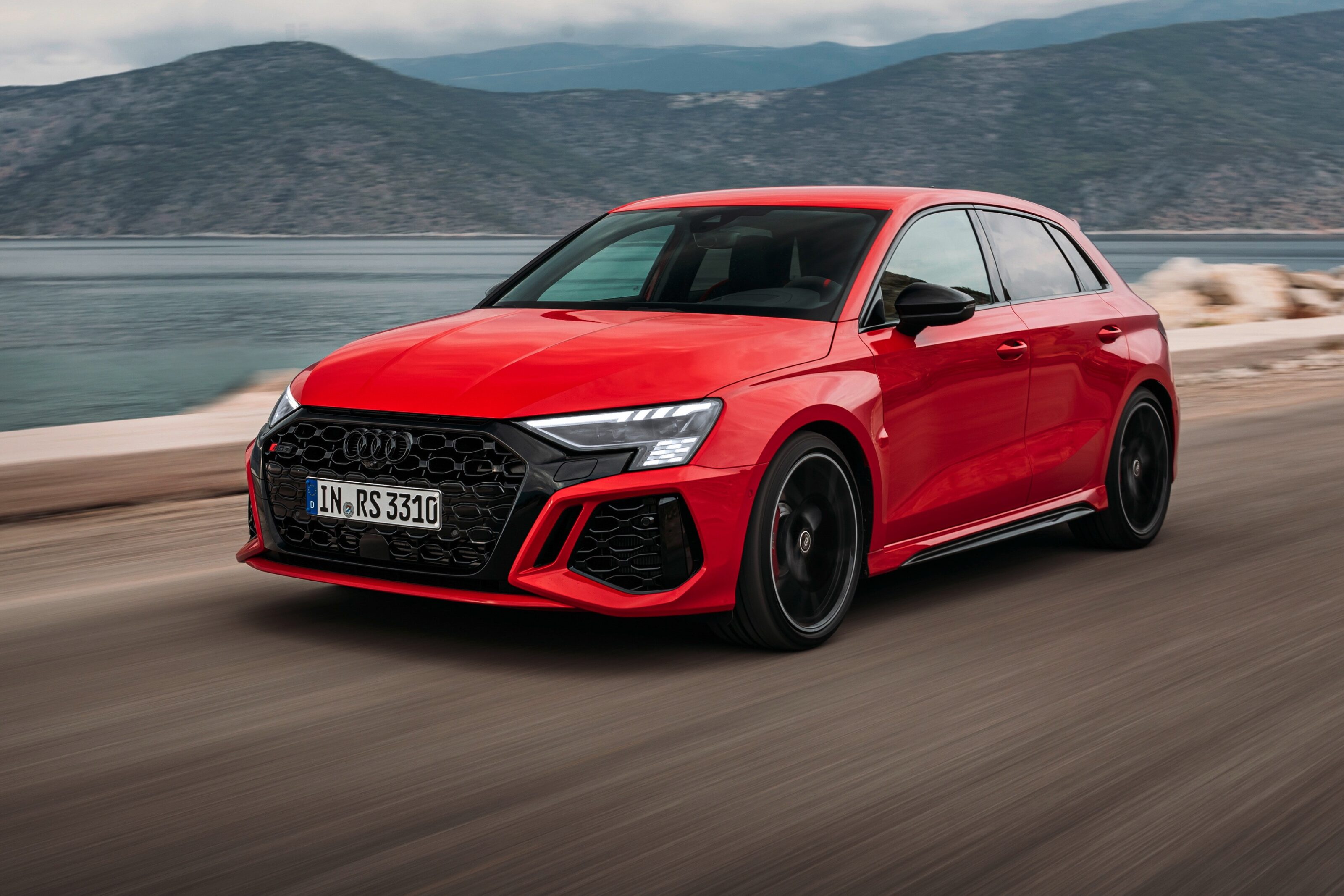
Making its debut is the new ‘RS Torque Splitter’, which electronically controls torque across the rear wheels, helping to increase car control during cornering and minimising understeer and oversteer.
The trick rear differential also enables a new ‘drift mode’, allowing owners to enjoy powerslides when at the circuit.
Everything is brought to a stop thanks to 375mm six-piston brakes at the front, and 310mm brakes at the rear. Buyers can option 380mm carbon-ceramic front rotors for improved braking performance under track conditions.
Hiding the brakes are a set of 19-inch cast alloy wheels clad in a choice of either Pirelli P Zero Trofeo R semi-slick tyres or or road-oriented P Zeros, with wheel track increased by 33mm, improved camber, and ride height 25mm lower than the Audi A6 on which it’s based.
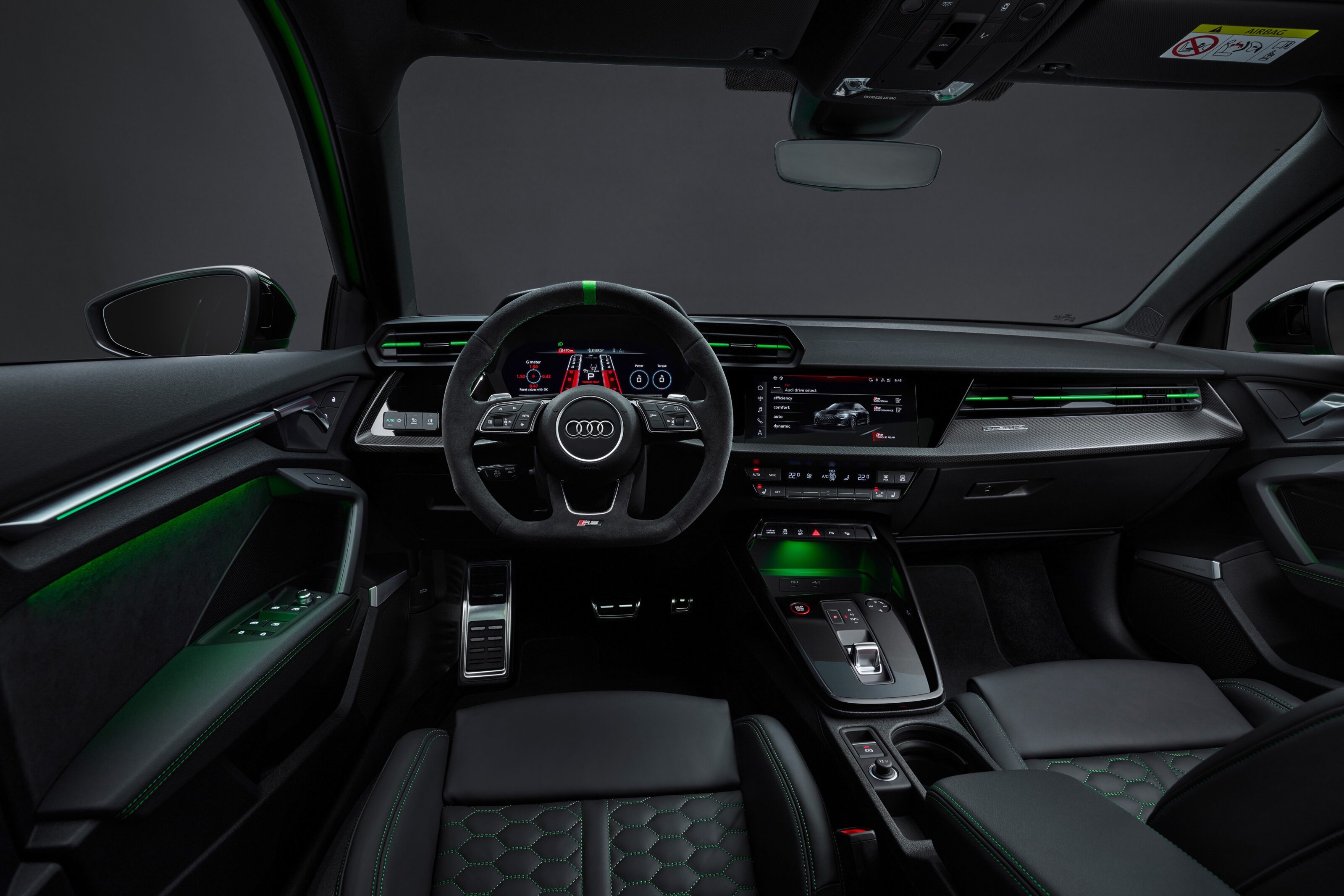
As a party trick, the vehicle’s darkened LED matrix headlights can spell out ‘R-S-3’, while an RS sports exhaust is fitted as standard.
Inside, the driver is greeted with a 12.3-inch Virtual Cockpit Plus digital instrument cluster, complemented by a head-up display, while a 10.1-inch touchscreen looks after infotainment duties – and can also display a shift light when driving in manual mode.
Music is piped through a 680-watt 16-channel Bang & Olufsen premium surround sound system with subwoofer.
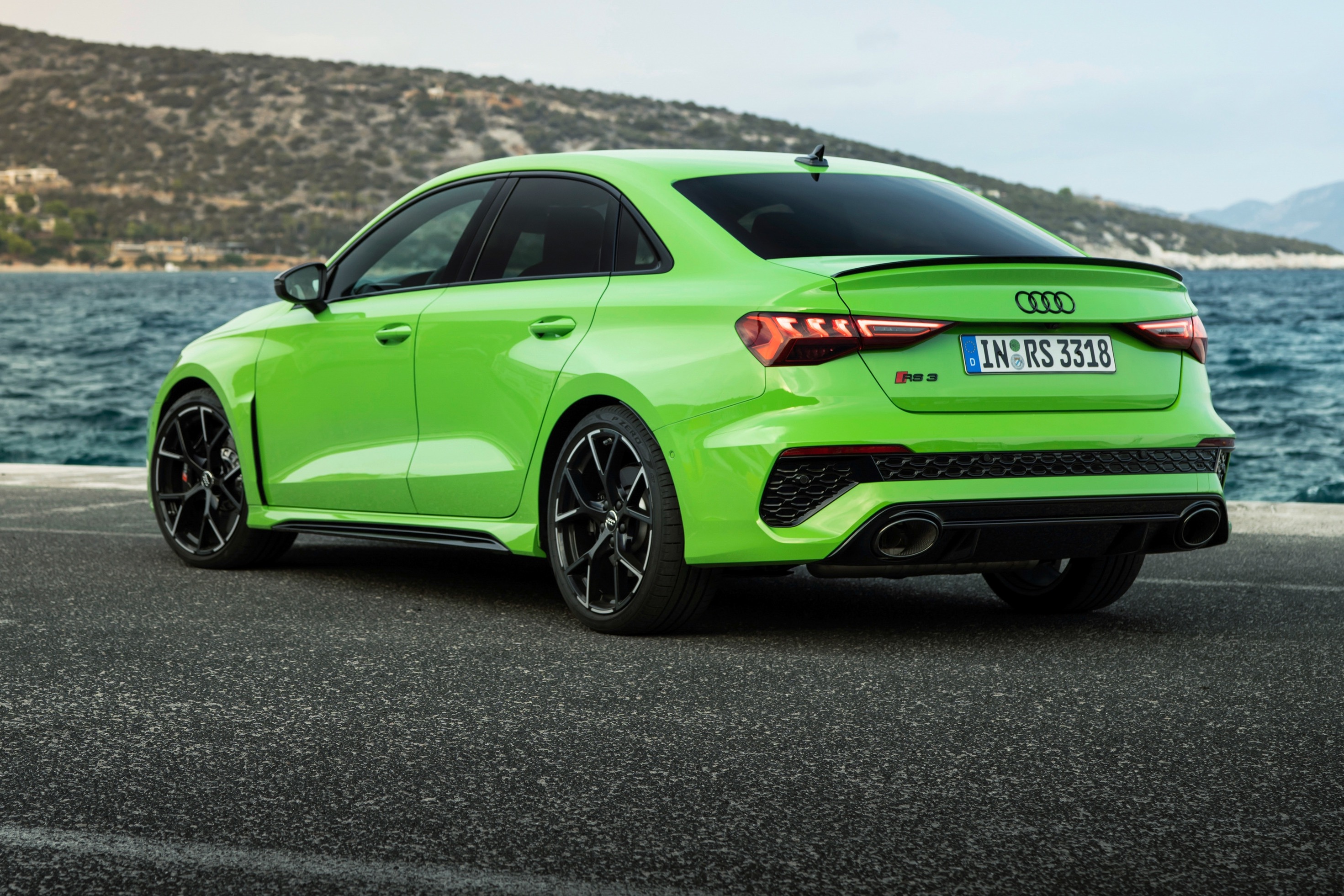
2022 Audi RS3 Australian pricing
| Model | Price |
|---|---|
| Audi RS3 Sportback | $91,391 |
| Audi RS3 Sedan | $93,891 |
Note: Prices exclude on-road costs.
Features
| Automatic wipers |
| Matrix LED headlights including LED daytime-running lights |
| Headlight washer system |
| Radar cruise control with stop and go |
| Black exterior styling package |
| Heated power exterior mirrors with auto-dimming and memory |
| Hands-free electric boot |
| Keyless entry and start |
| Rear tinted glass |
| Roof rails in black (not available in combination with sunroof) |
| Electric heated front sport front seats nappa leather with massage |
| Split folding rear seat backrest (40:20:40) with centre armrest and cupholders |
| Frameless auto-dimming interior mirror |
| Ambient lighting |
| Dual-zone automatic air conditioning |
| Sport leather steering wheel with paddle shifter |
| Stainless steel pedals |
| 12V sockets in the rear centre console and luggage compartment |
| Audi Connect Plus Navigation with live parking, weather, fuel prices, and traffic |
| Audi Connect Plus Security with car finder with remote lock & unlock |
| Emergency call |
| Online roadside assistance |
| 12.3-inch Audi Virtual Cockpit Plus digital configurable instrument cluster |
| Colour head-up display with navigation |
| Wireless smartphone charging |
| 10.1-inch infotainment touchscreen with void control, digital radio, Apple CarPlay, and Android Auto |
| Bang & Olufsen premium surround sound system with subwoofer |
| Head up display u2013 in colour with speed, navigation and assistance information |
| 19-inch alloy wheels. |
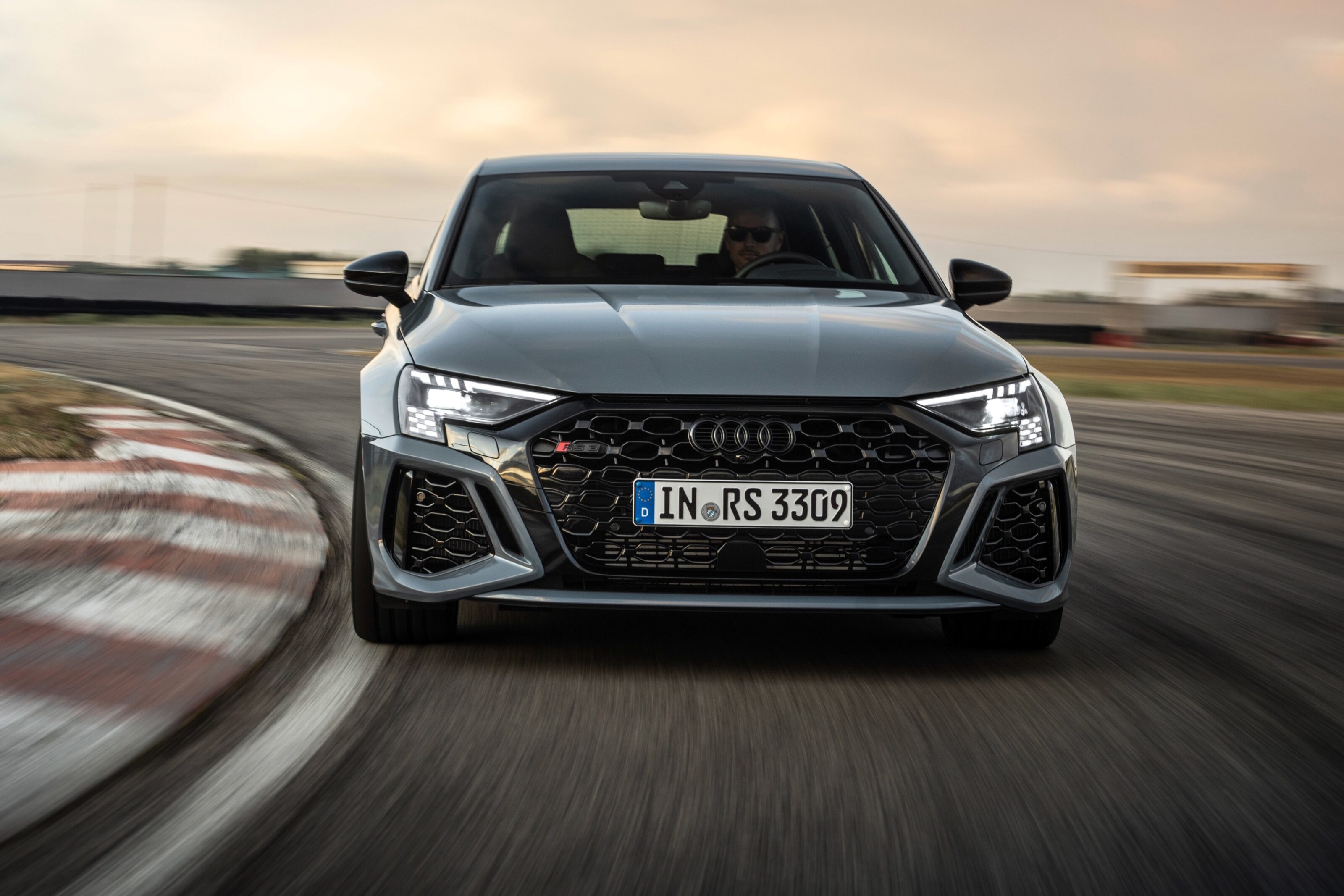
Buyers can option an RS Design package in either red or green for $2150, which adds:
| Alcantara steering wheel with 12 ou2019clock market and contrast stitching |
| Black seat belts with colour edging |
| Coloured Dinamica synthetic suede seat shoulders |
| Contrast stitching on floor mats |
| Coloured air vent accents. |
The optional $2000 Matte Aluminium Styling Package adds:
| Front spoiler, rear diffuser, window trim finished in matte aluminium |
| Gloss black honeycomb front grille |
| Aluminium exterior mirror covers. |
The Carbon Package can be optioned on the Sedan for $6300 or the Sportback for $7400, adding:
| Carbon inlays |
| Carbon roof spoiler |
| Black Audi rings and badging |
| Carbon exterior mirror covers. |
The optional $13,000 RS Dynamic Package Plus adds:
| RS carbon-ceramic brakes with red/blue/grey callipers |
| Speed limiter increased to 290km/h. |
Safety
The RS3 comes standard with:
| Emergency assist |
| Lane change warning |
| Rear cross traffic assist |
| Rear exit warning |
| Lane departure warning |
| Park assist |
| Front and rear parking sensors |
| 360-degree parking cameras |
Warranty and servicing
The RS3 is covered by a five-year/unlimited-kilometre warranty, and Audi also provides a 12-year manufacturer warranty for bodywork against corrosion perforation for new vehicle.
Five-year service plans can be purchased at any time during the first 12 months of ownership for a cost of $3580. Two-year Audi Advantage packages can be purchased in addition, including full factory warranty, two years of scheduled servicing and twp years of roadside assistance beyond the initial warranty period for $3800.
These packages can be purchased back-to-back, giving owners the option to include the cost of warranty, servicing and roadside assistance for up to nine years at the time of purchase.
Availability
The 2022 Audi RS3 is available now, though Audi says it’s enjoying unprecedented demand for the latest generation of its iconic hyper hatch and which means it’s effectively sold out until late 2023.
Find out more about supply of the RS 3 here.
