
Mazda RX-7 Limited – Advertised December 2003
For many years it remained possible to buy well equipped RX-7s like this one for about $10,000. Then the market rose and if you look at your Japanese Value Guide from 2015, an S3 Limited of Condition 1 quality would at that time cost $16,500.
Three years later the price had surged to $37,500 and, after recent gains, we see excellent cars nudging $50,000. These original-shape RX-7s are good fun, easily tweaked for added performance and have enough inclusions to make them liveable. However, they aren’t so rare as yet that people should be panicked into paying excessive prices.
Then: $11,500. Now: $45,000-50,000
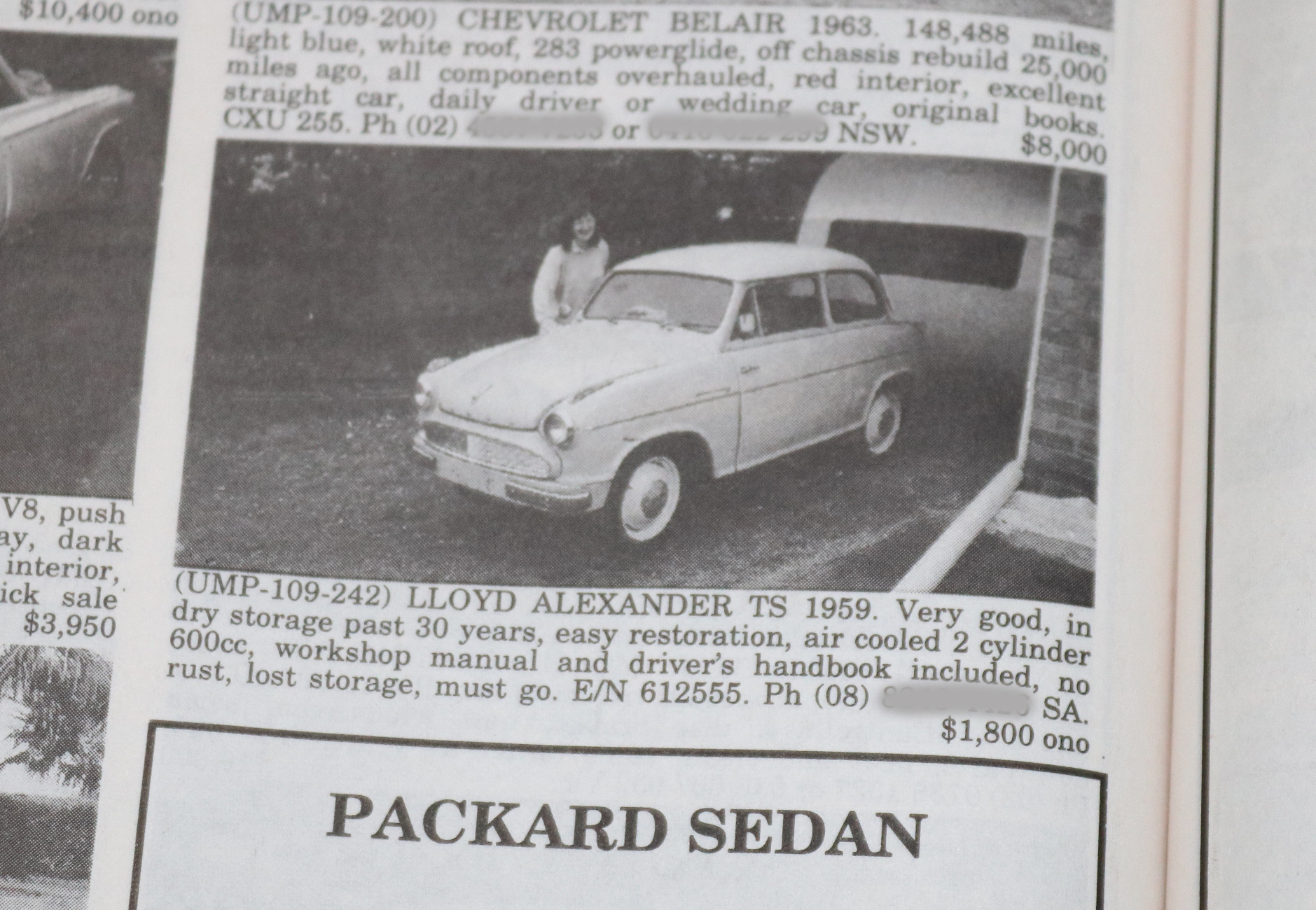
Lloyd Alexander – Advertised October 1999
AKA Lloyd Hartnett, these twin-cylinder, German-sourced microcars were promoted by former Holden boss Sir Larry Hartnett after his own project based on the French Gregoire went belly up. The Lloyd deal was better for all concerned though, with Borgward supplying kits in the same way Goggomobil did for Bill Buckle.
The cars were assembled in Brisbane to boost local content and keep prices down. Around 3000 Lloyds were built, with sedan or station wagon bodywork and an electrifying 18.5kW of power. Arrival of the BMC Mini killed demand, but some survive.
Then: $1800. Now: $10,000-12,000 (restored)
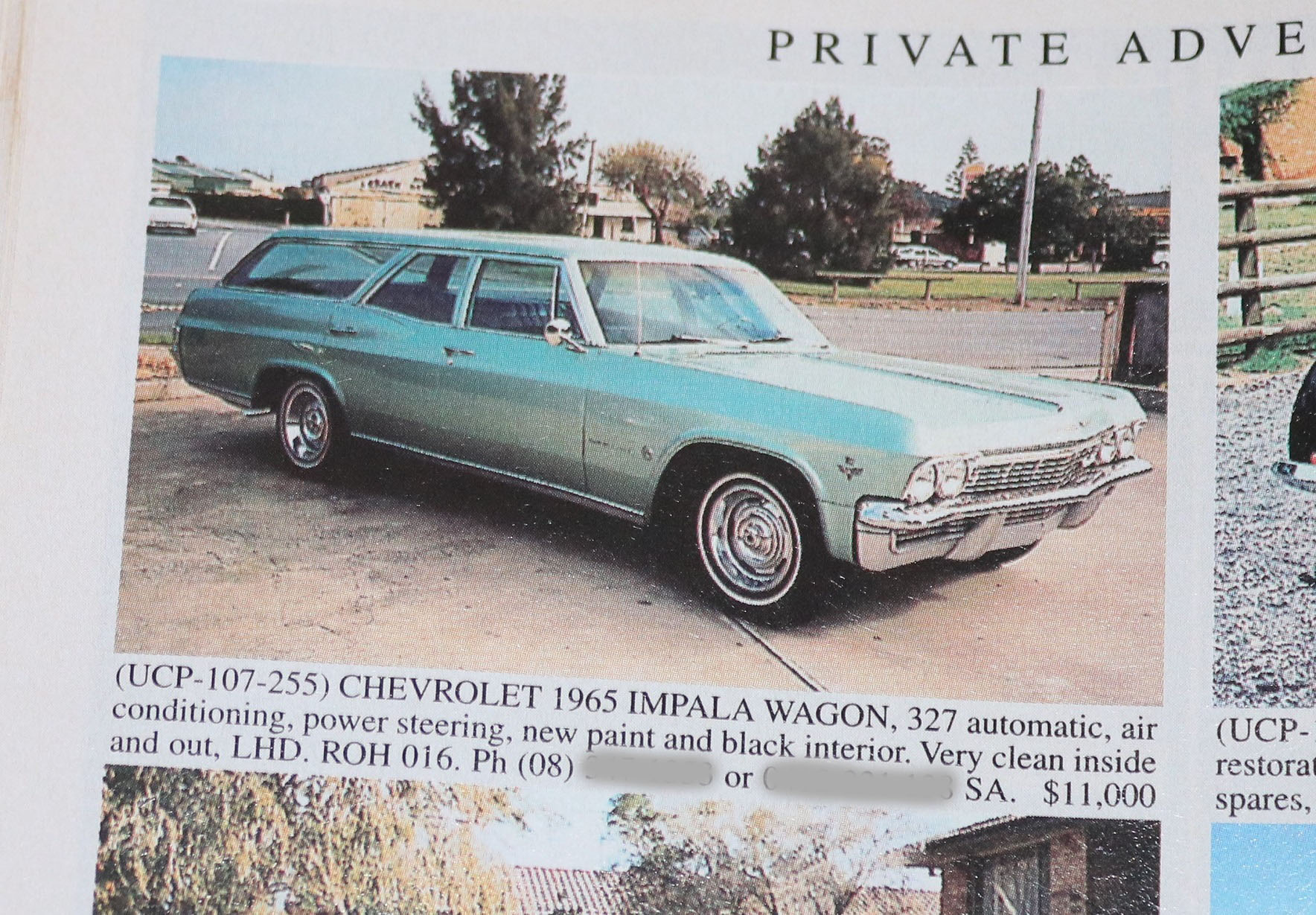
Chevrolet Impala wagon – Advertised October 1997
If you wanted to look like the Brady Bunch or Griswolds on vacation, then $11,000 wouldn’t have been too much to spend on this impressive Impala wagon. It was presumably a fairly recent arrival that hadn’t been converted and keeping it that way would be a smart move.
A few of these eight-seat Impalas had been imported when new, but those cars by 1997 would have been scarce and hardly any would look like this. Checking overseas listings revealed that these wagons and are hard to find even in the USA but not too costly to buy. Dealers have good ones available at US$30,000.
Then: $11,000. Now: $45,000-50,000
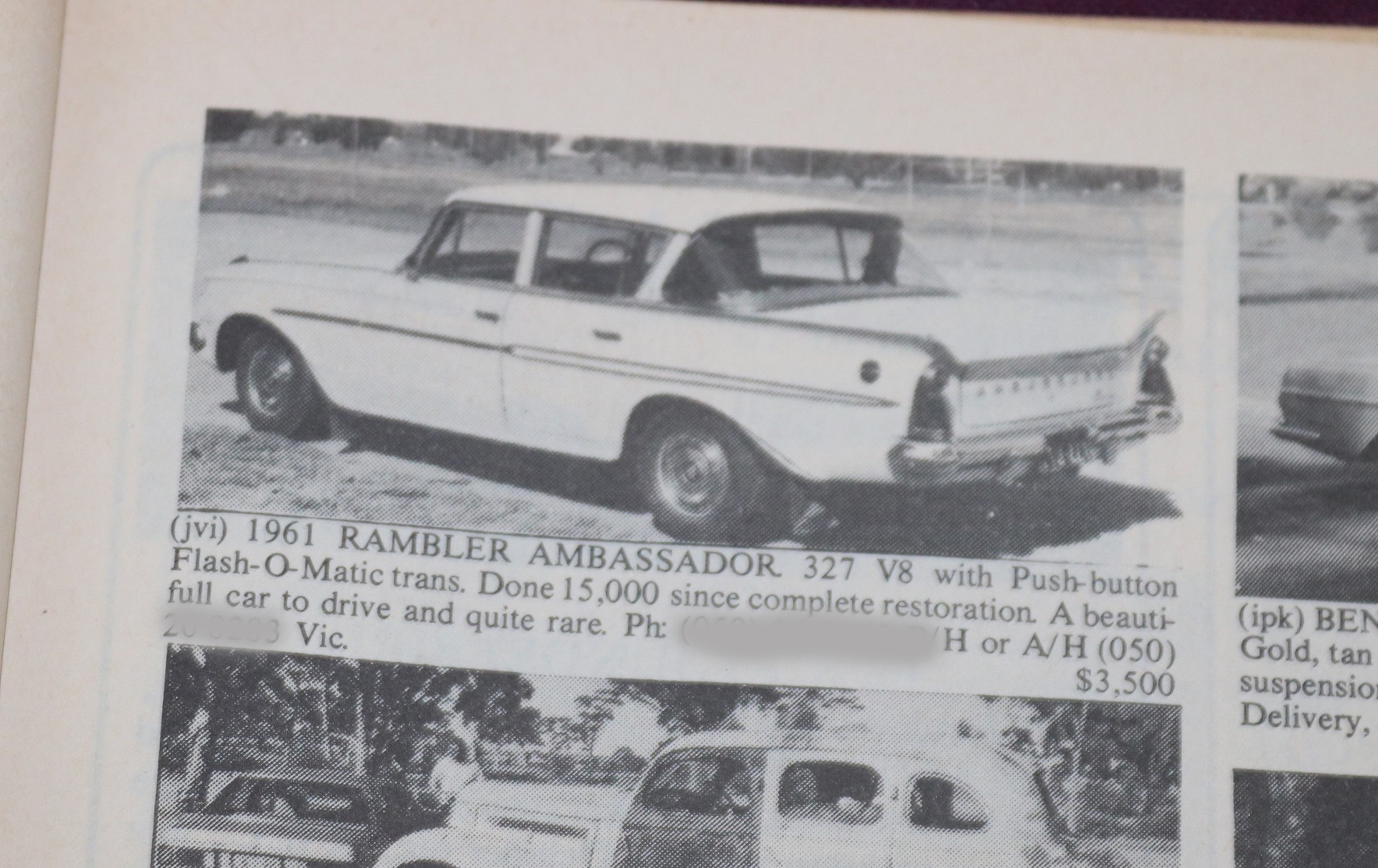
Rambler Ambassador – Advertised September 1986
Ramblers from the 1960s were viewed in some circles as Australian rather than American, principally because they were assembled in their thousands by Australian Motor Industries and sold to various arms of government including the Police. This one looks to have led a gentle civilian life and with a splash of new paint was ready for a new start.
With care, it should survive until today, just not at the money being realised by Chevs and big Fords of similar age. Certainly, a car worth preserving due to its unique style and links to AMI; for many years Australia’s most prolific automotive assembler.
Then: $3500. Now: $16,000-18,500
From Unique Cars #464, April 2022
Originally published at our sister site, Unique Cars
UPDATE, October 2022: Electrified GV70 on sale in Australia
The Electrified GV70 is now on sale in Australia, and we’ve finally driven the proper production model. Get our full story at the link below, or continue reading Curt’s pre-production story here.
Story continues…
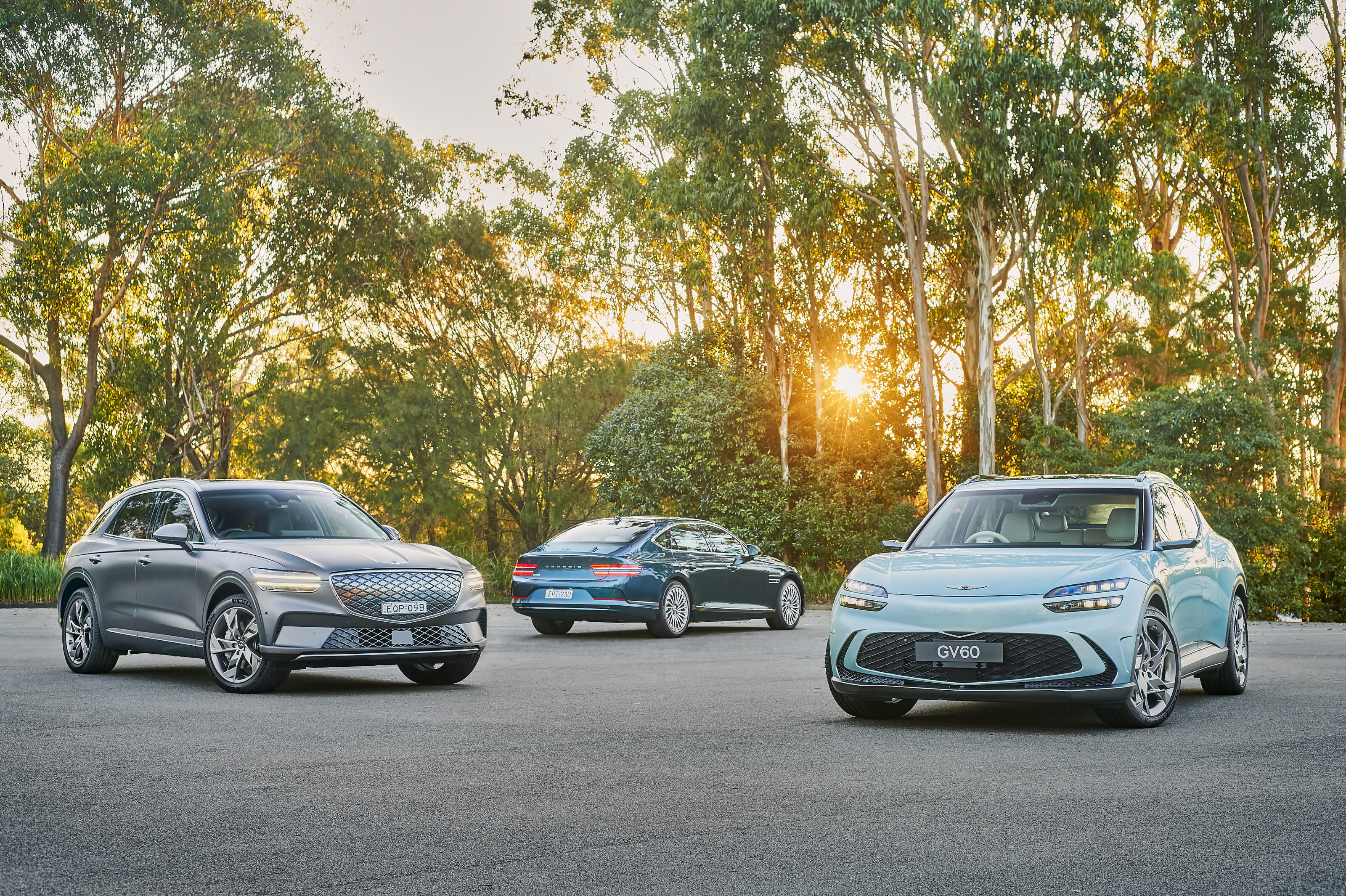
For all of the slog of its progressive brand-building and range broadening in Australia, Genesis is about to lob its foray into full electrification with a larger thump. Three EV models – including the 2022 Genesis Electrified GV70 tested here – will launch during Q3, each distinctly different in positioning and pitch.
The Electrified G80 four-door limousine, the clear niche offering, embraces Genesis heritage the strongest. Meanwhile, the newcomer GV60 nameplate, with its Ioniq 5-related E-GMP electric platform, serves as the conspicuously forward-thinking figurehead.
And so to our Electrified GV70 test subject, the practical, sensible, more broadly appealing and arguably most palatable of the EV trio. And an amalgamation of an existing and familiar family-hauling formula with a sizeable enough electric performance kick up its backside to foist it into flagship status in range, well above its very feisty twin-turbo six-cylinder AWD kin.

Of the three-prong Genesis electric assault, it’s perhaps most important that the ‘eGV70’, for brevity, hits its mark truest.
This is the prototype. But there’s no camo, shrouded features or gruelling R&D rash. And bar its suspension spec and analogue instrumentation – a digital cluster will come as standard – what you see of our test vehicle is pretty much what customers will get.
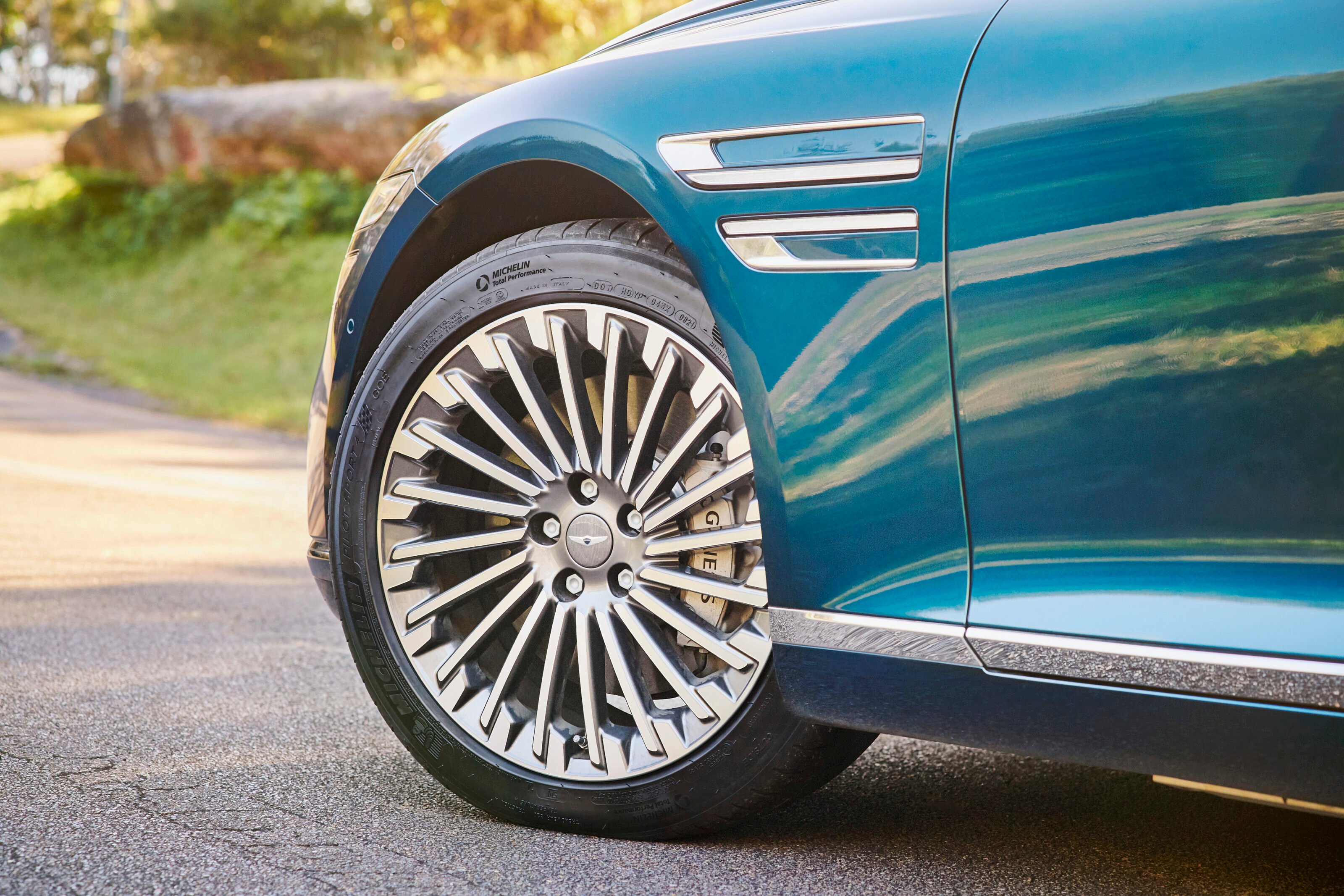
The eGV70’s grille is sealed, its tail shaves redundant tailpipes and the design of its 20-inch rolling stock is unique. But otherwise, there isn’t so much as a suggestion of electric branding or even badging. Trainspotting apart, it looks like any ICE variant at even a long glance. Clearly, familiarity is a key drawcard.
Elegantly straightforward is the Electrified branding prefix, strongly suggesting the technical make-up: The existing ICE-centric DNA converted for electric, right down to the existing GV70’s RWD/AWD platform. The truth isn’t quite so simple as the architecture was futureproofed for EV facility from the get-go.

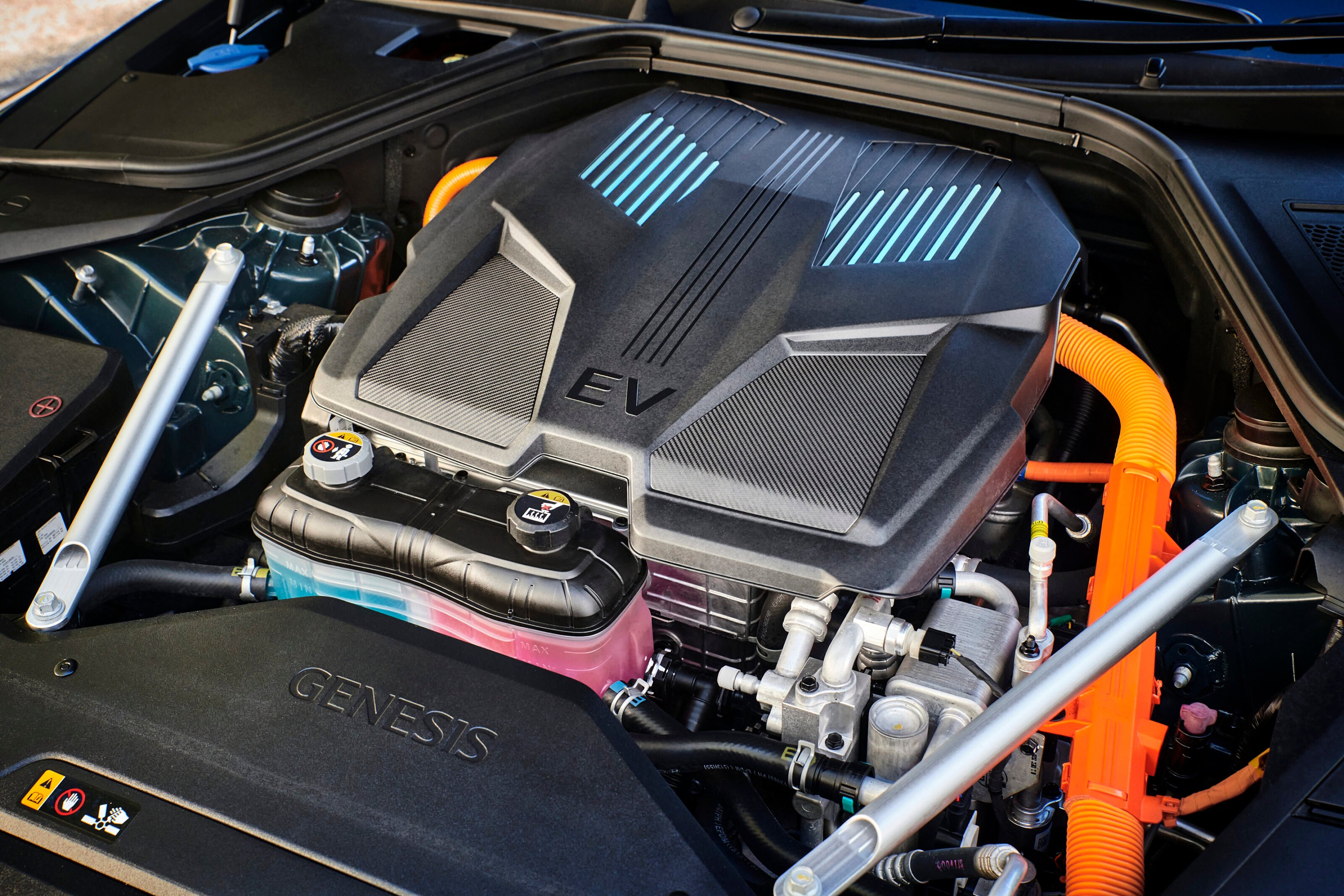
And the slim 77.4kWh battery laid between the axles facilitating the 800-volt electric system and its dual-motor drive present some major engineering differences.
There ought to be tangible differences, too. At 2310kg tare, it’s over a quarter-tonne heavier than its 3.5TT AWD twin. But at 360kW and 700Nm, it’s measurably more potent. And its 4.5-second 0-100km/h claim for Aussie spec, while slower than the 4.2 claimed in some markets, is six-tenths quicker than internal combustion’s fittest offered locally.
So far so fine. But the big hurdle the eGV70 must negotiate is the same for any electrified formula applied to an established ICE-based format: perception. Or, more specifically, countering the stigma that technical applications of its ilk are inferior, cobbled-together patch jobs compared with machinery hewn of EV-platform purity.
And so much of negotiating that hurdle neatly and cleanly lies in the tangible experience, beyond much else.

Pricing and features
At the time of our prototype drive, Genesis was still evaluating final pricing – as in not telling – if suggesting it’ll land between $105,000 and $115,000 for what will be a single trim and spec. At most, it’ll be around $30K up on the 3.5T AWD Sport. At least, it’ll sit about $15K beyond the all-you-can-eat Luxury-optioned turbo-sixer.
The latter figure is a fairer measure, given the eGV70’s single spec will load in Luxury-grade features and appointments that are cost options further downstream in the ICE-powered GV70 range.
Confirmed are goodies such as Road Preview camera-based electronically adaptive steel sprung suspension, a 12.3-inch digital instrument cluster, 14.5-inch HD touchscreen, ‘Ergo motion’ massage function for the 18-way electric front seats, 16-speaker Lexicon audio and a panoramic glass roof, to cherry-pick some of the juicier indulgences.

Some regions offer signature Electrified interior detailing that includes fancy, soft-lit Mountain Graphic Mood Lighting door panels, fog brushed aluminium highlights and a mix of Nappa leather and 30 per cent wood fabric trim. It remains to be seen if these frills make it Down Under.
Extended leather appointment (dash, console, door trim), three-zone climate, a hands-free tailgate and other regular GV70 niceties will undoubtedly migrate to the local-spec electric flagship.
While the eGV70 will fit a “full suite of safety features,” according to Genesis Australia, the current five-star ANCAP rating is for four-pot ICE variants only, doesn’t apply to the electric newcomer and it is, at the time of writing, unrated.

On the road
Let’s jump to the big question of the eGV70’s main drawcard: How does it drive? And in very short summary, it does exactly what a fine EV should. At least at the helm.
Dual motors, one per axle, each plying individual peaks of 180kW and 350Nm for a total of, you guessed it, 360kW and 700Nm. But that’s reserved for Boost mode, which is accessible for a maximum of 10 seconds, from a standstill or on a roll, via a push of a button at the bottom of the steering wheel rim.
Otherwise, the drive system defaults to 320kW and 605Nm as default peaks though, says Genesis, it’s not that simple. Outputs do vary between its selectable Eco, Comfort and Sport modes, with exact figures unconfirmed at the time of our prototype drive. But all will be revealed at the production version’s debut.

Whatever the stats may be, the lift in enthusiasm and throttle response is quite marked when cycling through mild-to-wilder presets, offering a nice, wide breadth of driveability for most on-road situations. At least, that is the underpinning sense when sampling the prototype in the confines of a tight and twisting off-street test loop, with its short straights, zero run-off and no margin for misadventure.
Even in Eco, response is immediate, torque fulsome and on command, if tempered with a nice roundness that makes it a doddle to control motion accurately at low speed. But bury the throttle and the flat plane of unrelenting thrust it drums up is surly enough for even the trickiest on-tap overtaking or merging demands.
It’s wholly quiet, too, bar a faint and pleasing low hum as its soundtrack – apparently, this sonic accompaniment is adjustable to taste.
Comfort mode is perhaps the apt label for the eGV70’s happiest default mood. It’s wonderfully progressive in part-throttle modulation then dials up precise and downright heady acceleration in perfect concert with right foot application.

Pinned, the pace it suddenly builds verges on antisocial. And the torquey undertow feels so unstressed and ever-present that it almost completely masks the SUV’s considerable heft. Yes, there are two hotter drive settings you can access, but the real depth in quality is that Comfort is so broadly flexible and cooperative that Sport could be considered almost unnecessary.
Sport really gets the eGV70’s hustle on and on our tight test track, we spent more time gathering the SUV up for looming corners than we did digging much into its intoxicating thrust. Still, it’s docile and obedient enough for around-town driving, for those accustomed to carving holes through traffic.
But Sport mode is perhaps best served as a proper back-road attack mode, where it certainly delivers more than ample and satisfying pace, even if it deserves some sort of added sonic fanfare to complement the fiery velocity.
Just why the Boost button isn’t within a thumb’s reach with two hands firmly at nine and three on the wheel is a headscratcher. Because, thus armed, the instant hit of additional peak output when you mash the loud pedal is enough to send the front axle shimmying and scrabbling in wheelspin as the SUV pins you hard into fine Nappa leather.

Quick? Damn right it is. Genesis puts the front axle scrabbling down to pre-production calibration but, frankly, I like it. It adds a sense of occasion, focuses the driver’s attention and maintains a planted, grippy rear end for optimum thrust. No downsides, really.
And, like all fine EVs, the eGV70’s instantaneous roll-on thrust is damn impressive and downright addictive. Ten seconds of Boost mode mightn’t sound like much, but given triple figures arrive well before five seconds from a standstill you’ll rarely (legally) want for a longer duration.

Sport, and its torque delivery, masks the SUV’s 2.3 tonnes best. But it’s also surprisingly lithe in handling character. Most of the heavy EV hardware is set low, axle to axle, and the low centre of gravity is matched well with a flat stance, ample grip and surprising agility.
The steering is crisp and direct and, at least on this tight test track, the point-and-shoot pace is downright impressive. Less clear, though, is how much the considerable lateral inertia weighs against its dynamic talent once you up the corner speed in a more flowing environment.
Complementing the breadth of drivability talent are the well-judged, adjustable regeneration modes. At its lightest, the eGV70 seems to almost freewheel with no perceivable ‘motor braking’ whatsoever. Cycling through light to heavy settings presents large, useable steps of regeneration, the middling setting perfectly calibrated for balanced driving.

And its strongest i-pedal setting decelerates assertively enough for brakeless one-foot convenience in any peak-hour situation you might imagine – a feature absent in the likes of Audi’s e-Tron S.
Recharge claims are competitive enough for the current state of EV play, with a best-cast of 10 to 80 per cent battery capacity in “around 20 minutes”, Genesis says, for its 77.4kWh battery and 400V/800V multi-charging system when using a 350kW DC ultra-rapid charging source.
Range is “450 kilometres plus,” says Genesis. We’ll test the accuracy of these claims in the real world once the production version lobs in a few months.
Ditto the Road Preview adaptive electronic control suspension, the familiar steel-spring strut front and multi-link rear design of the ICE versions in an Australianised tune not fitted to our prototype, comprising a specific component spec sourced from the global Genesis menu from a test programme conducted in and around Sydney.

Space and comfort
“The cabin is essentially the same as the ICE GV70s,” I’m told by Genesis in my introductory walkaround of the Electrified version.
Sure enough, bar some EV-centric content in the largely analogue not-for-Oz instrumentation and the inconspicuous Boost button, I’m hard-pressed to notice any difference at all.
The transmission control is the familiar rotary type used for petrol power – though the ‘transmissions’ are single-gear reduction drives on each axle – and the paddleshifters function to adjust the regeneration up and down, as is becoming customary in EV-land.
Hopefully a few little bespoke EV touches, such as the tricky Mountain Graphic Mood Lighting offered overseas, will bring a bit of surprise and delight to the production spec. There will be three interior scheme choices (as well as nine paint colours plus four optional matte hues) to choose from.

As sampled, the prototype’s cabin continues the fine, upmarket form of the ICE GV70. It’s welcoming and – that word again – familiar, nothing ‘E-weird’ and no learning curves required.
If you’re after a conventional vibe and ambience, one bereft of concept-car-like showboating and conspicuous new-school EV window dressing, then you’ve come to the right place. The V2L – or vehicle to load – functionality is handy and the eGV70 offers both cabin and exterior connectivity.
One compromise to the eGV70 packaging is that it loses 39 litres of boot space, dropping luggage capacity to 503L thanks to a slightly raised floor shelf.

Ownership
As yet, Genesis hasn’t released any details for warranty and servicing for any of its forthcoming electrified offerings. But given that a privileged ownership experience is a big part of the Genesis pitch, it is hard to imagine a flagship EV would offer slimmer credentials than their more affordable ICE counterparts.
Currently, Genesis offers five years of unlimited-kilometre warranty on regular GV70s. And it also throws in five years of free servicing and roadside assist as well. Then there’s Genesis You, the company’s free valet service for metro Sydney, Melbourne and Brisbane while your vehicle is being serviced.
Question marks? Will Genesis offer free periodic DC fast-charging as its premium contemporaries do? What’s the warranty on the high-voltage aspects of the package? And will its EVs be part of its guaranteed future value program enjoyed by its ICE variants? We’ll find out at launch.

VERDICT
I’ve driven a few prototypes over the years and this eGV70 is easily the most well-sorted sample. It might be pre-production, it mightn’t be final spec. But holistic execution of the driving experience is polished enough that Genesis could simply copy and paste it into showroom form.
Impressive is just how natural and organic EV motivation feels in what has been, until now, an ICE format with a platform that worked a treat with an internal combustion driveline.
And yet electrification fits the GV70 so neatly that you sense it was always meant to be. And according to Genesis, that was certainly the case.
A dedicated EV platform? It certainly doesn’t want for one.
Its strength is that it does feel oh-so familiar. For a combination offering as much output as Mercedes-AMG C63 S in a package weighing as much as a 300 Series LandCruiser, it’s still distinctly a top-line GV70 in character. Just quicker. And quieter.
If there’s any shortcoming, it’s the same as virtually any EV; it would neat to add some sort of synthetic sonic drama to match the sort of pace they drum up when called to march. One you could switch on or off, depending on the user’s whim.
https://www.facebook.com/WheelsAustralia/posts/8200201860005400
2022 Genesis GV70 specifications
It’s no surprise that Genesis chose its G80 executive sedan to debut its EV aspirations, in creating the Genesis Electrified G80. After all, the G80 is a natural successor to what was once the Genesis, the four-door luxury Hyundai model, well before its namesake became a standalone luxury brand. Call it fitting continuity.
Nor should it raise eyebrows that the simply named Electrified G80 first lobbed at the Shanghai motor show, over a year ago, as the marque’s introductory foray into the Chinese market, where big luxury limos remain sizeable business.
It’s no secret that here in Australia, where the SUV is the meal ticket, that the G80 and other large luxury sedans have, ahem, niche appeal, to put it charitably. So it’s of little wonder that the local arrival of ‘eG80’, for brevity, is timed to align with the Q3 launch of an electric version of the GV70, the Korean marque’s biggest-selling model, and the smaller GV60, the forward-thinking crossover technically twinned with Hyundai’s Ioniq 5.
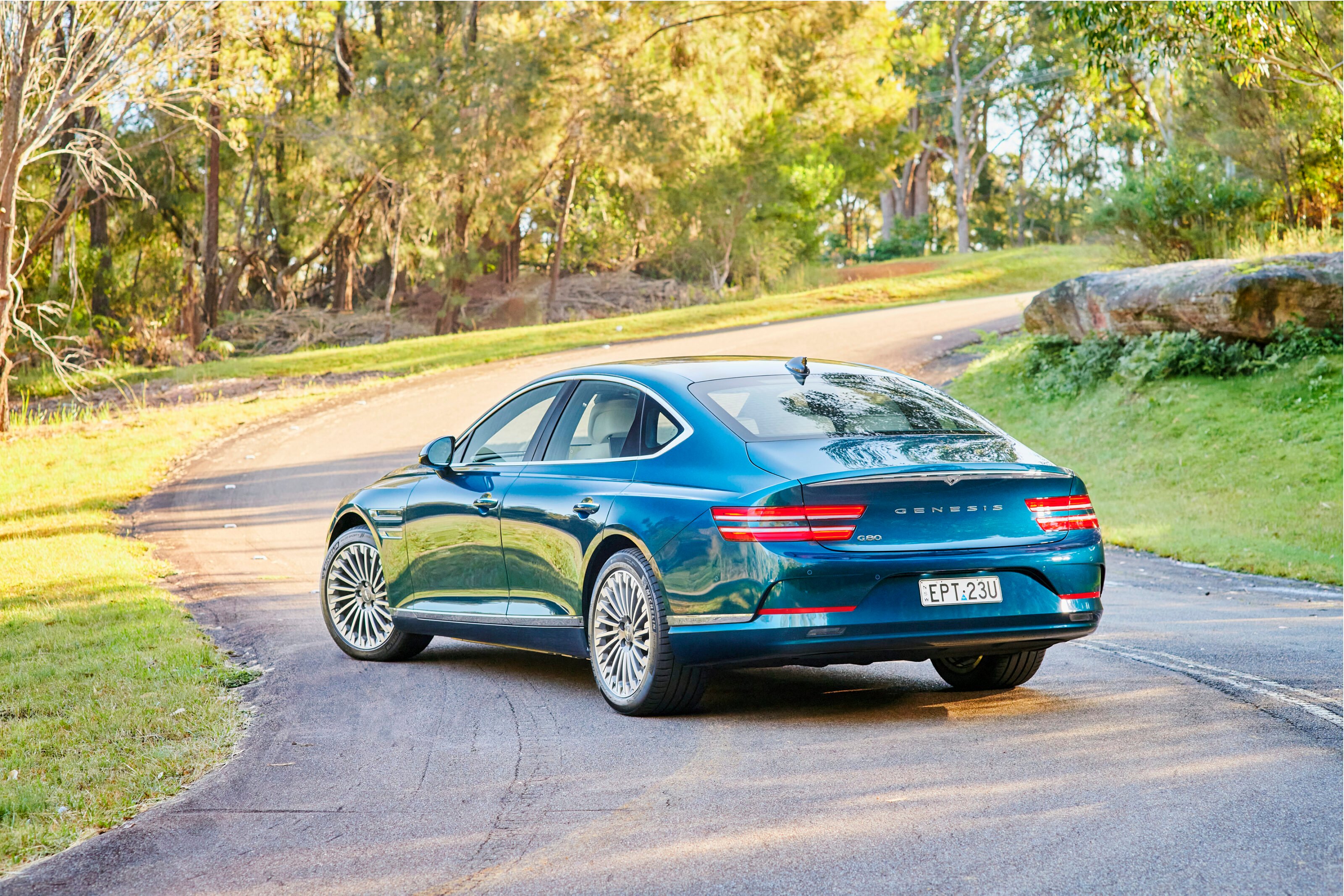
It’s very short odds on betting that, of the Genesis electric newcomers, the eG80 will be the unicorn on Aussie roads. That’s no foul: exclusivity has its rightful place. And exclusive it most certainly will be because, at around $150K, the new electric limousine will be all the Genesis very good money can buy.
Genesis Australia rolled out the “prototype” version tested here, for local media to sample at an off-street facility, months ahead of local release. But it’s no camouflaged R&D hack.
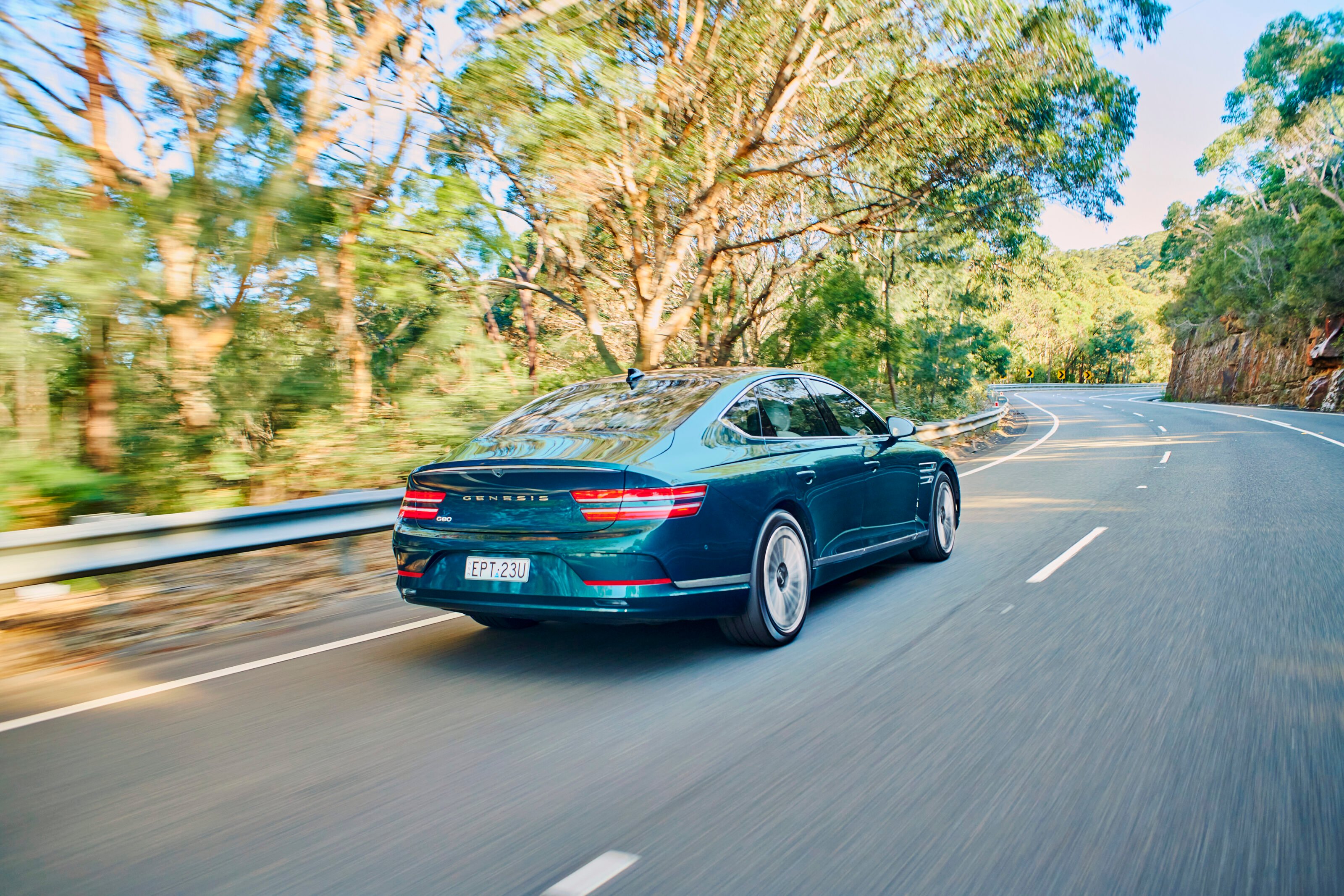
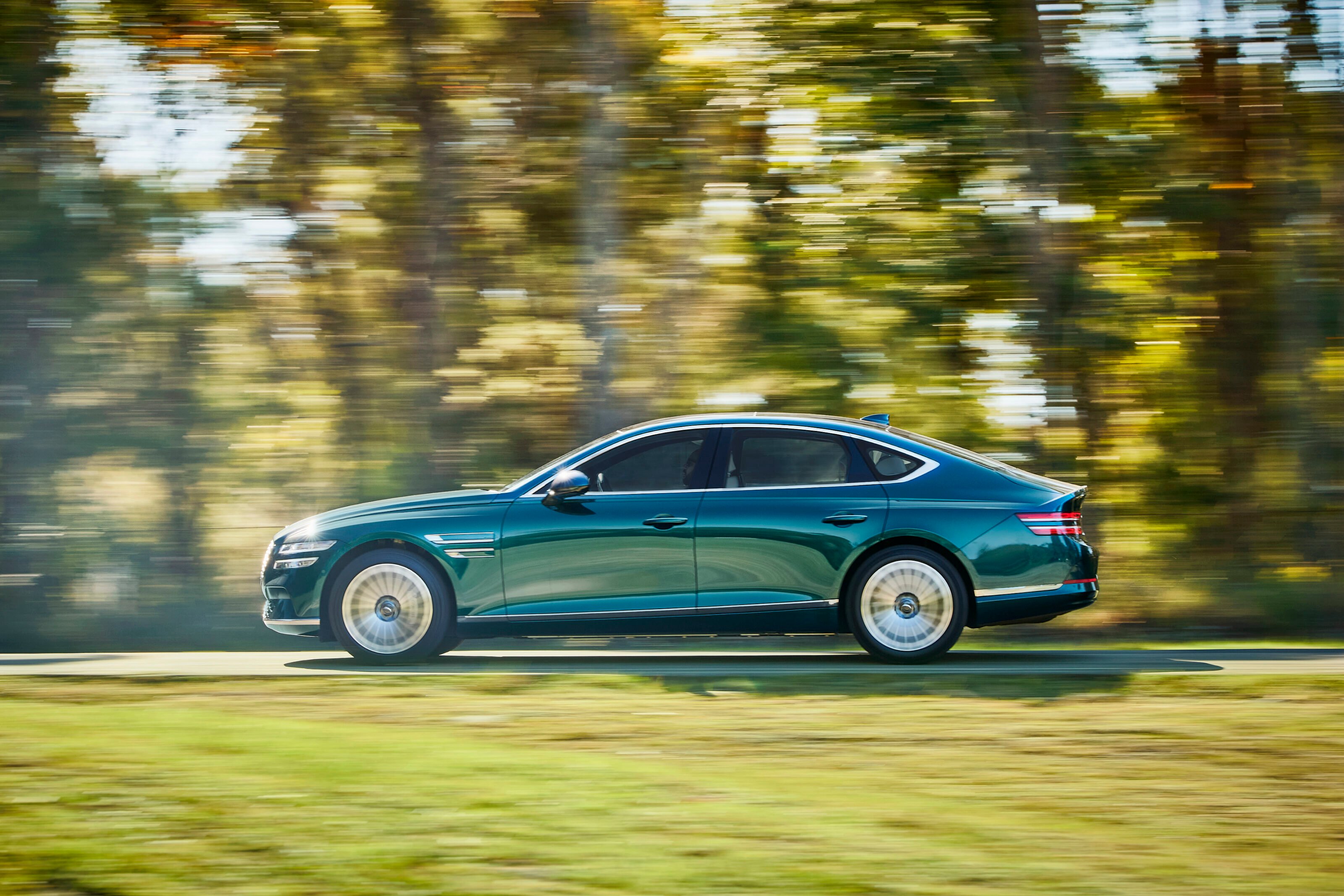
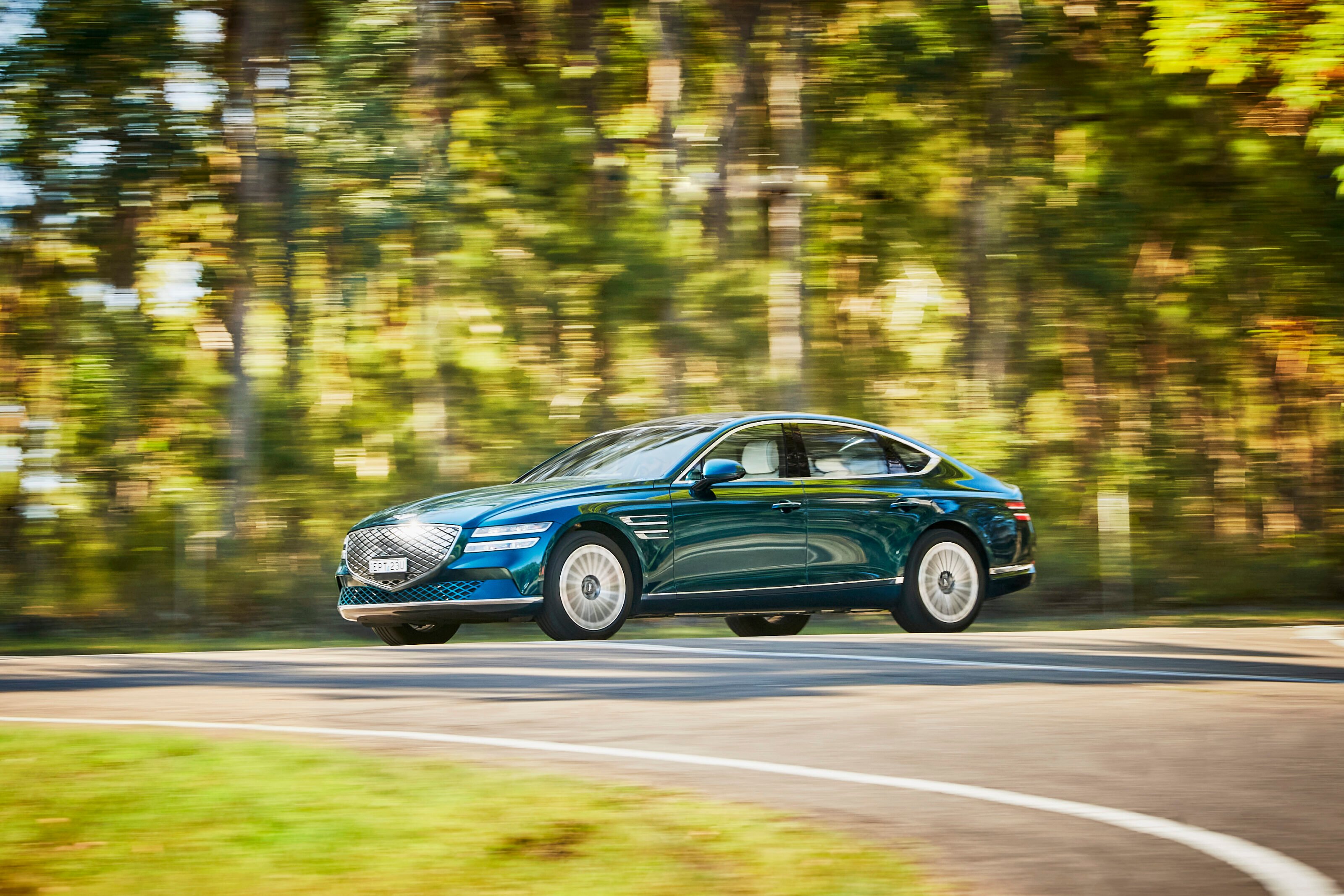
From its shiny Electrified-exclusive Matira Blue paintwork to its fetching ‘forged wood’ interior inlays, our subject looks about as production-ready as it could be. And it feels as much, too, if the driving experience is anything to go by.
Pricing and features
While the figure is yet to be finalised, the eG80 will arrive in one lofty variant trim that Genesis expects to price somewhere between $140,000 and $150,000. That’s a significant fiscal lunge beyond the G80 3.5T AWD’s $102,000, let alone the 2.5T RWD’s tip-in point of $86,000. In comparison, the all-you-can-eat six-pot Sport Luxury ICE version wants for $121,000. All prices before on-road costs.
Clearly, the eG80 isn’t positioned to be a palatable choice for limousine hire car companies, even if EV drive might, in theory, fit the bill well. Not that there’s isn’t broad enough scope for an eG80 of vastly humbler, more affordable specification than the launch variant will offer.
Right now, the electric Genesis has few large four- or five-door sedan EV competitors and it will undercut the most affordable Porsche Taycan, the RWD, that wants for $156,300 before on-road costs and options.
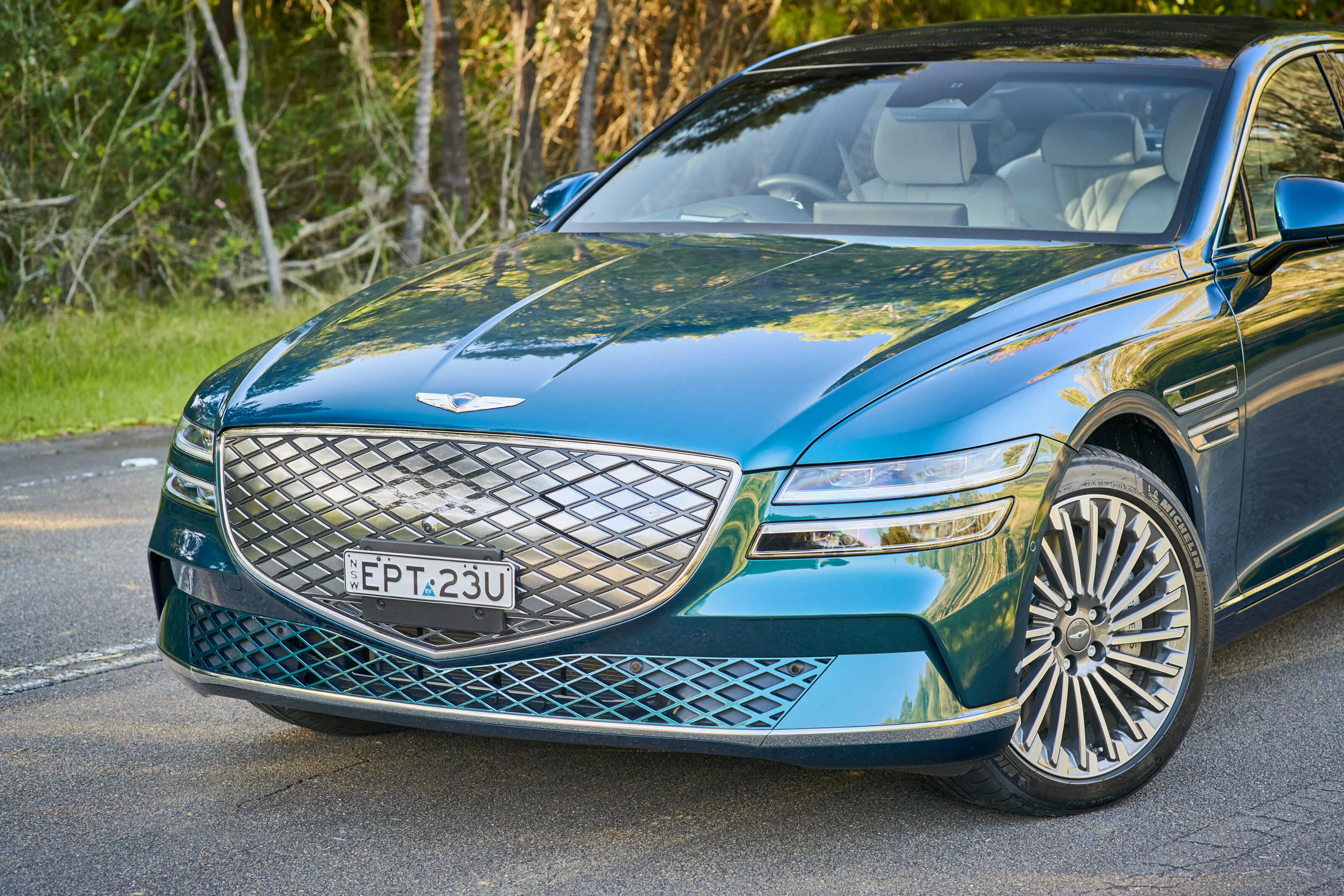
As the clear flagship of the G80 range, the Electrified promises features and equipment currently offered in high Luxury trim, plus some EV exclusives, as demonstrated in our prototype test car.
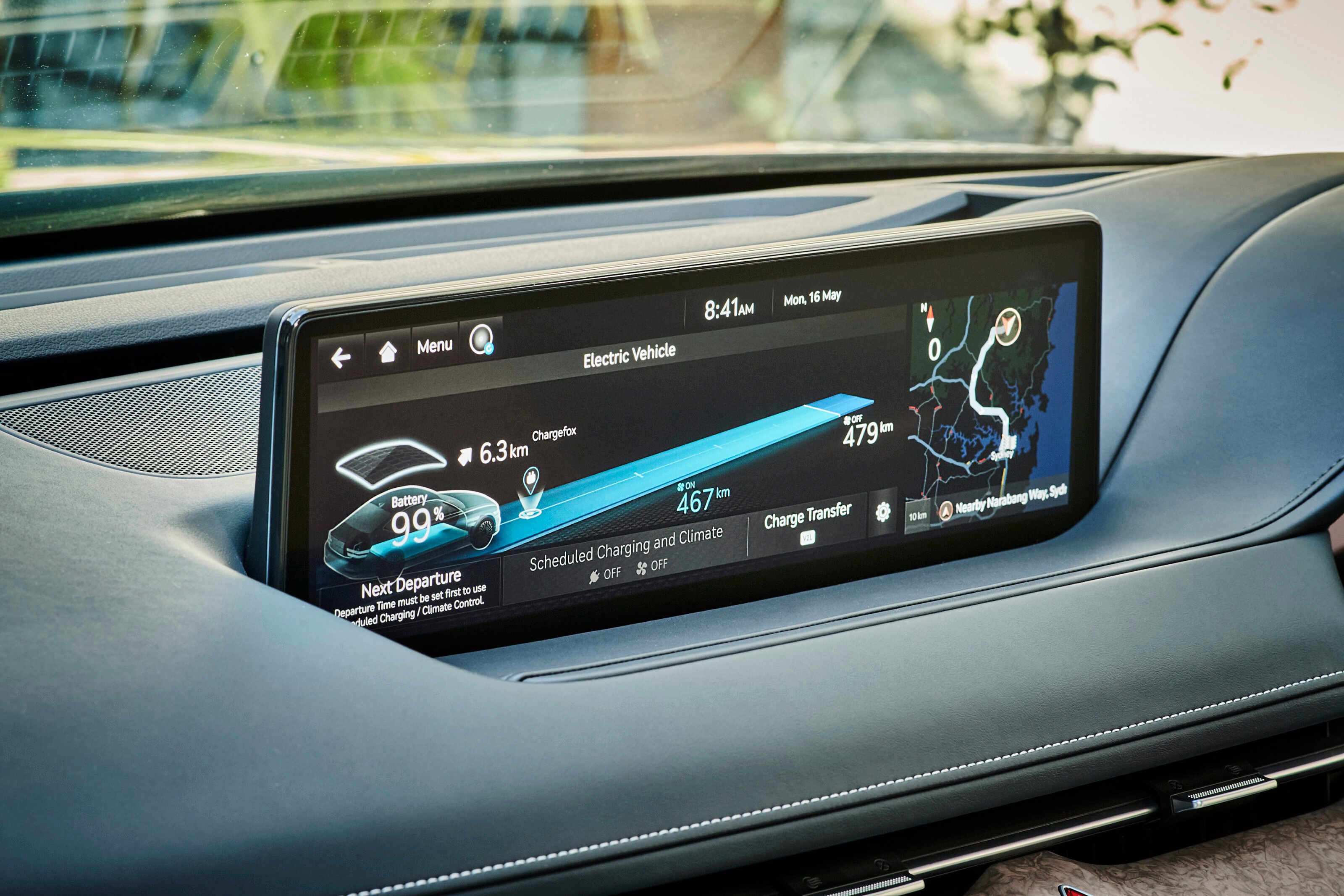
Some of the confirmed features include Road Preview camera-based adaptive damping, 12.3-inch 3D digital instrumentation, 14.5-inch multimedia with augmented reality navigation, an Ergo Motion massage driver’s seat, bio-processed Nappa leather trim (ala Ioniq 5), recycled forged wood trim inlays, 21-speaker Lexicon audio and a solar panel roof to help trickle charge the battery pack when the car is stationary.
From its Matrix LED headlights to soft-close doors, the form guide suggests it’s stacked with features, though the finalised local spec is yet to be revealed.
Despite being the priciest of the three-pronged Genesis debut EV foray, the eG80 brings a less-powerful dual-motor drive system than will be offered in the Electrified GV70 or the higher grade of two GV60 variants to be sold here. Each of the sedan’s axles adopts 136kW and 350Nm motors for a 272kW and 700Nm total system output, whereas the SUVs will offer 360kW and the same torque peak.
However, the sedan boasts a larger 87.2kWh battery (playing 77.4kWh) for a superior range of “500 kilometres plus”. Its 800-volt charging architecture, accessed via a hidden port in the grille, allows an 80 per cent charge using 350kW DC fast charging of “around 22 minutes”. A full charge using a standard 11kW system is expected to take around nine hours.
The eG80 also features the nifty vehicle to load (V2L) feature that can draw 3.6kW from the battery to power appliances on the go, though unlike the GV70 that offers an in-cabin facility, the sedan only has an exterior socket.
Comfort and quality
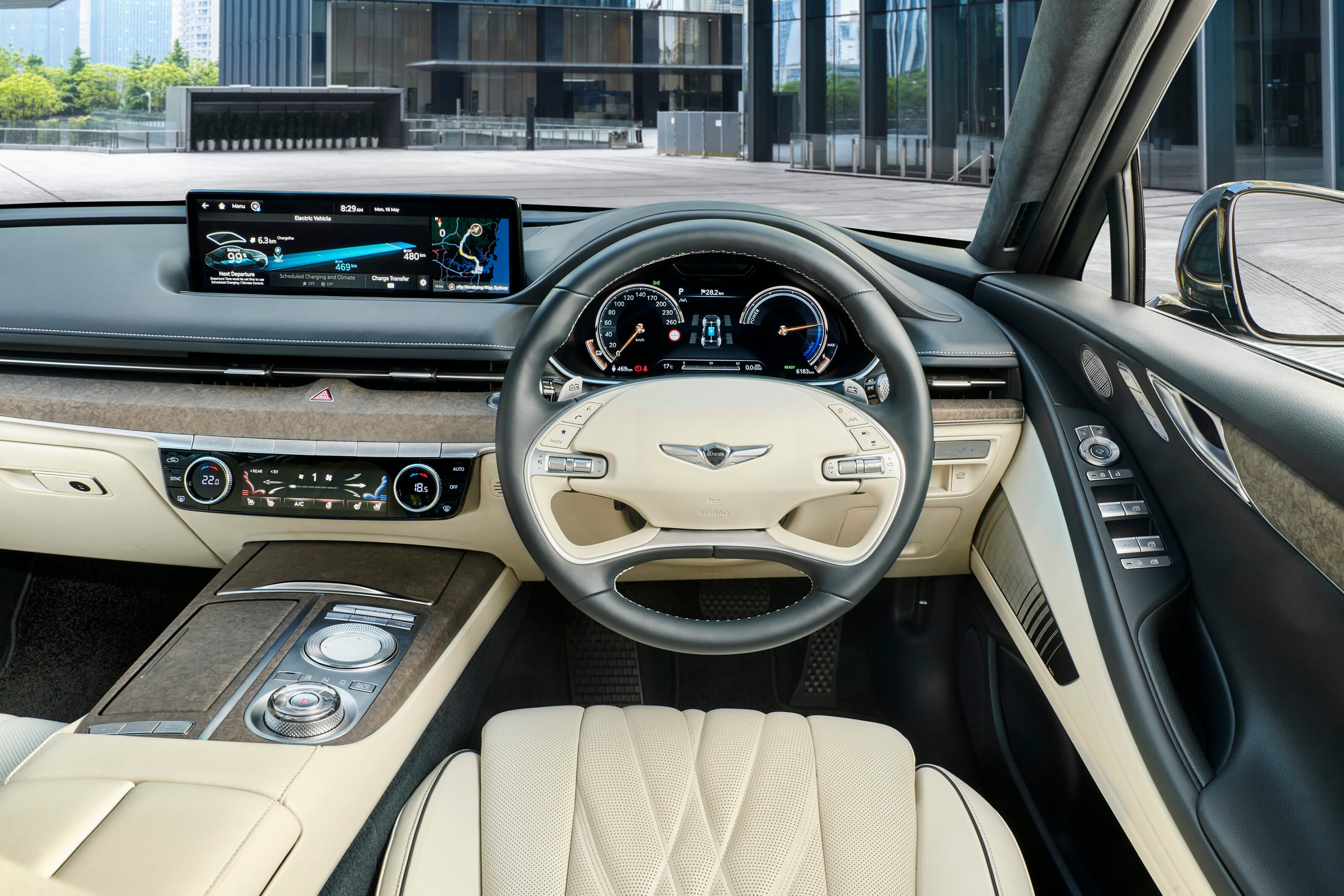
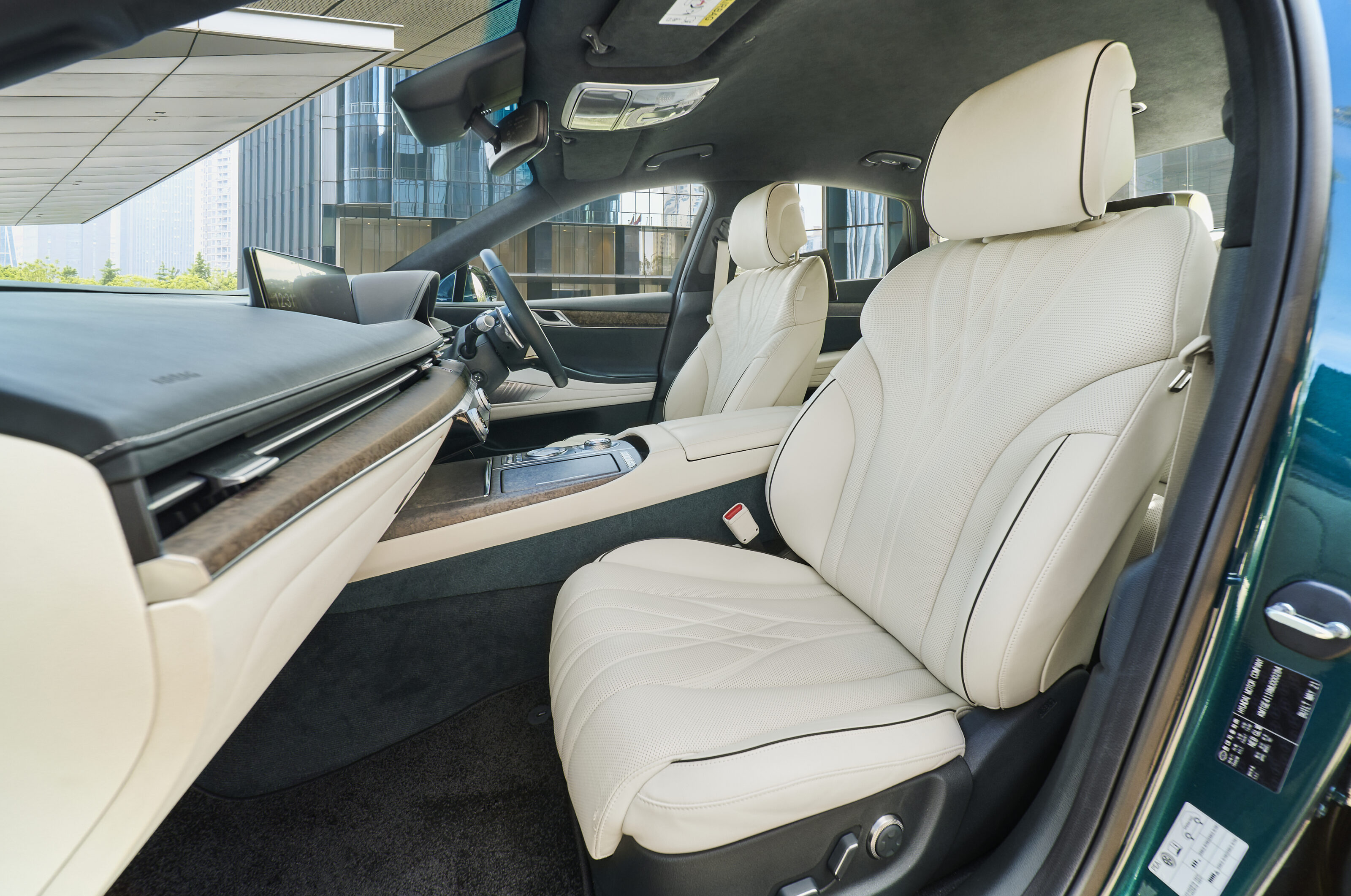
Climb inside and the eG80 is lavish and opulent, pulling few stops to create the grandest impression both in presentation and sheer breadth of window dressing.
There’s nothing ‘prototype’ about the cabin. Execution and the sense of craft is superb, a complex array of surfaces and material textures that come together cohesively and under close scrutiny, managing to pull off a flamboyant wow factor while just avoiding being gauche or too over the top.
The core design is typically clean and crisp, minted in an inimitable style that is unmistakably Genesis. If it does draw inspiration from more established premium marques, it’s hard to pick. Overall, its key elements, even the overtly jewellery-like areas such as the 3D driver’s screen or crystal-like console controls, are neatly integrated.
It feels as first-class as it looks, with a proper suppleness to the seat hides. It seems considerable effort has gone into touchpoint tactility and a nice solidity to all of the controls, without a hint of parts binning anything from mainstream Hyundais.
The seating is superb, relaxed enough to fit the limousine bill yet supportive and cosseting enough for a bit of sporty adventure, complete with active bolsters that present a rib-hugging party trick once you delve into the racier drive modes.
Bar some EV-centric content in the 3D digital instrumentation, the format in its usability is thoroughly conventional. The paddleshifters serve to adjust regeneration force up and down, though even the transmission controller is the same as you find in ICE G80s.
Regular stock also gets a row-two arm-rest console array that mirrors the look and feel of that up front when used as a four-seater, though the jury is out as to whether this will port into the Electrified version.
Instrumentation and multimedia are clearer and more fuss-free to use than many often-complex German approaches, but there are some superfluous touches, such as the blind-spot camera system that, while meaning well, is a little unnatural to use. Infotainment offers quick responses from its pleasingly simple interface – although, at a huge 14.5 inches, it’s so large that designers have been compelled to locate it just out of convenient arm’s reach.
Given the clear limousine leanings, it’s unsurprising that row-two accommodation is as richly appointed as up front, though due to some hidden electric architecture the eG80’s rear outboard seating positions don’t recline like they do in the petrol versions. That said, for a categorically large sedan, the amount of rear spaciousness feels closer to S-Class-rivalling upper large.
Still, the slim battery pack located between the axles does raise the floor a little, though not by enough to realistically impact cabin roominess, particularly headroom.
There’s no sunroof, as the solar panel roof is standard fitment. Other compromises creep in elsewhere, as the eG80 doesn’t offer interior V2L appliance power as fitted to the eGV70 SUV and the boot size has been reduced from the regular G80’s 424 litres to 354L for the EV version.
On the road
So the priciest of the Genesis electric debutant EVs is the slowest in acceleration credentials: officially four-tenths down on the eGV70 and nearly a second behind the performance promised for the high-power version of the GV60.
And yet at 4.9 seconds claimed, the Korean electric limo is not hanging about.
The 272kW and 700Nm on tap is more than ample for a machine of this size and luxury leanings. In fact, for something with virtually no performance pretensions, just how enthusiastically it swings its stick and seemingly effortlessly piles on pace initially takes some driver recalibration.
Different drive mode presets each bring a noticeable hike in response as you scale upward from mild to wild. But crucially, the Eco setting offers a nice throttle pliancy ideally attuned to leisurely cruising and stop-start doldrums where a limo typically ought to shine. Squeezing the throttle is akin to rolling up the acceleration volume and while it’s still quick in Eco if you give it the berries, there’s just more flexibility under the right foot.
As I discovered in the eGV70 prototype drive, the EV package is most at home in Comfort mode, one so broadly capable that you may never see a need to reach for the drive mode controller. It’s either placid or urgent, depending on the driver’s whim, if more precise and alert than in Eco, more confidently masking the sedan’s mass and inertia.
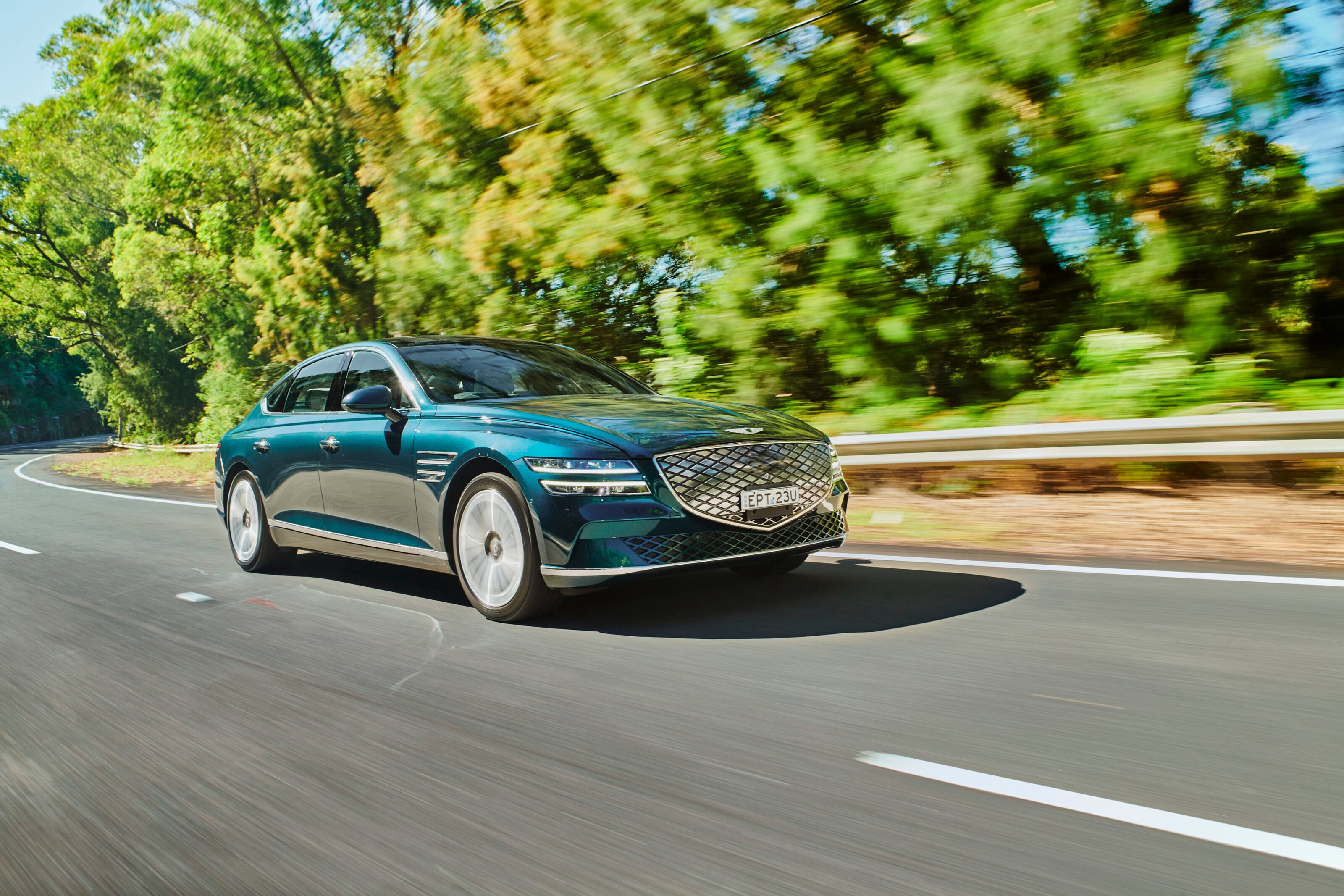
Sport properly uncorks its Hyde, of course, and a couple of flat-pinned launches, instantaneous in response and surly in thrust, makes you question what on-road situation you’d really need more herbs than what’s offered. It piles on pace quickly and deceptively, thanks mostly to an almost absent soundtrack, and the roll-on torquey punch is, in typical EV manner, utterly obedient and downright addictive.
Against its EV kin, the eG80 trades outright pace for improved range. And having sampled just how much pace it can deliver, there’s a fair argument that a luxo-cruiser such as this could do with less output and even more range to bolster its outright grand touring chops.
The available regeneration settings are as broad, polished and downright useful as the drive modes. In its lightest, there’s virtually no perceivable drag from the motor-generators at all.
And it shuffles through progressively stronger regen ‘steps’ to a proper one-pedal mode, aka ‘i-pedal’, with aggressive enough retardation that the brake pedal is redundant at lower urban speeds. The brake feel, too, is quite natural, with only a hint of that strange granular vibe you find in some EV machinery.
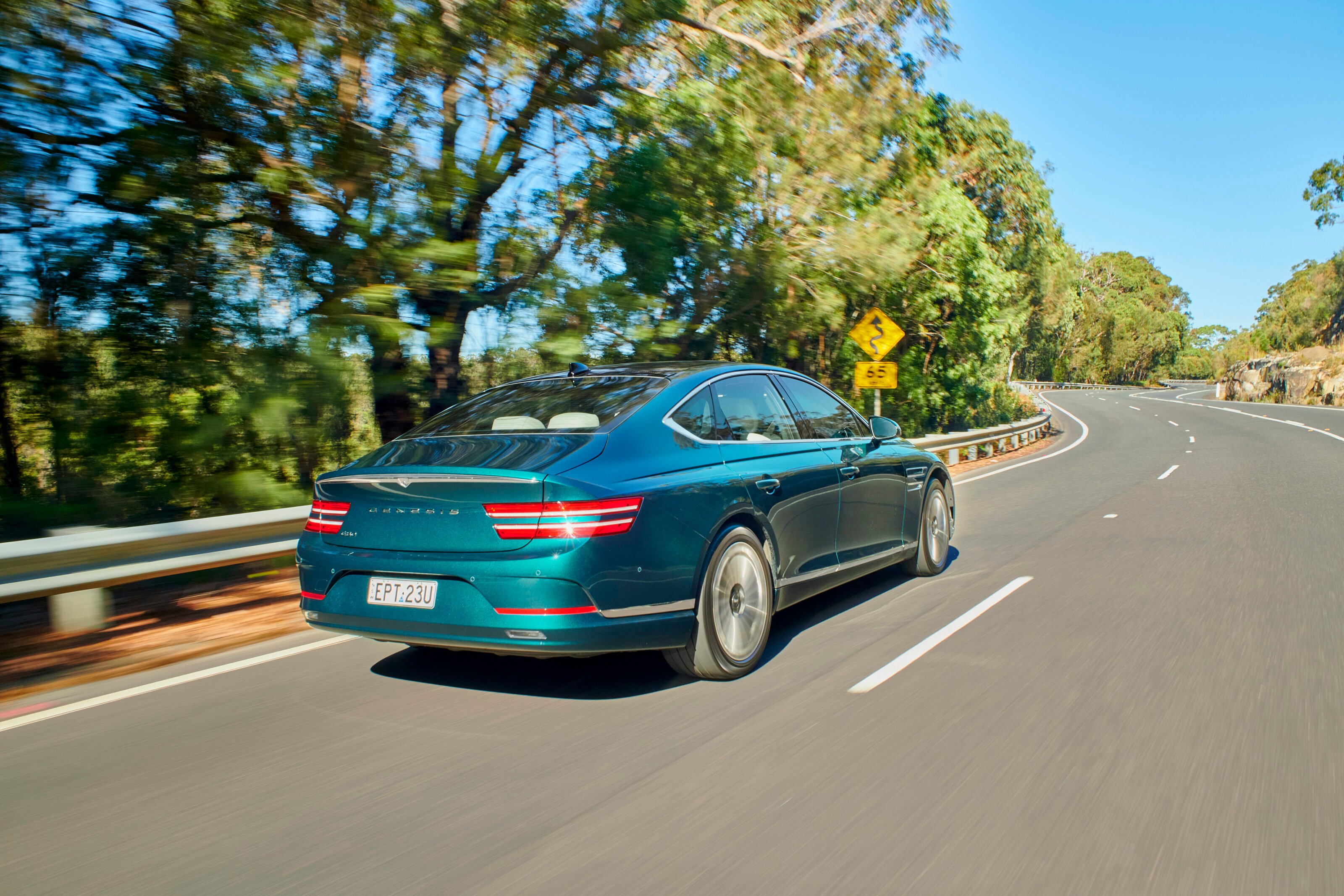
Genesis promises that its chassis is friskier than one might imagine, though at the short off-street road loop where I’m allowed to sample the prototype the corners are too tight and there’s not enough safe run-off to test that claim.
The Road Preview active steel sprung suspension, which uses a forward-facing camera to read the road and filter out nasty bumps with continuously variable damping, feels nicely compliant as default and fairly firm for a limo.
This prototype doesn’t fit the ‘local tune’, or at least the hardware and software spec cherry-picked from the global Genesis suspension menu derived from local Aussie testing. But it feels tauter and more focused than I remember of the ICE-power G80 Sport.
Clear and direct steering, a flat stance and enough grip to counter its considerable inertia – much of which is low in the chassis and neatly between the axles – mean the eG80 has the making of a decent corner carver, if in a chassis with a wheelbase that doesn’t inherently favour fun-filled agility.
We’ll have to wait for the Aussie spec on local roads to properly assess the limo’s dynamic mettle.
Ownership
Genesis hasn’t revealed warranty and servicing terms for its EVs, but you can bet its priciest offering will get all the bells and whistles.
Currently, Genesis offers five years of unlimited-kilometre warranty on its ICE vehicles, with five years of complimentary servicing and roadside assist. Plus, the Genesis You program offers a free valet service for metro Sydney, Melbourne and Brisbane while your vehicle is being serviced.
What is unknown is whether Genesis will offer a period of free DC fast-charging – as most premium brand rivals do – or to what extent it warranties the EV batteries.
VERDICT
If our prototype drive is much to go by, the eG80 delivers exactly what’s expected from what’s clearly positioned as a more traditional luxury figurehead for the Genesis brand, in the local absence of its G90 range-topper. That it packs new-school electric motivation is a glove-like fit.
What it might lack in outright performance among EV-dom’s increasingly dull appendage-measuring habits it absolutely compensates for in class, dignity and polished execution.
And given its pricey, electric four-door sedan proposal lands on the fringes of today’s Aussie motoring radar, you can likely add ultra-exclusivity.
Sure, it’ll probably be vastly outsold by the more sensible (and quicker) eGV70 and technically slicker (and quicker still) poster boy GV60. But that’s not really the point of the eG80’s existence nor its inclusion in the local line-up.
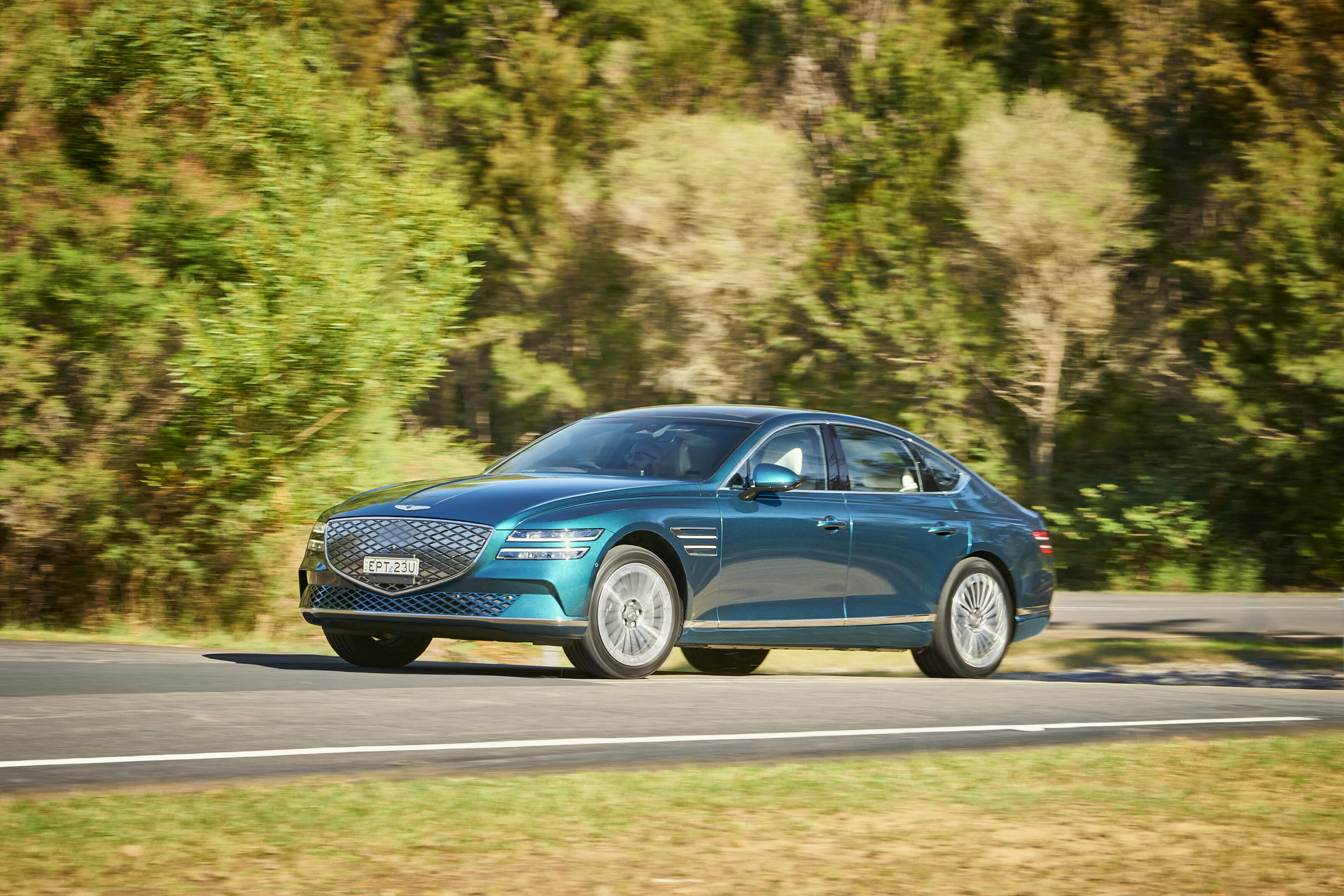
It’s a statement of sheer luxury indulgence electrified. That it’s not built upon bespoke underpinnings mightn’t bother the private buyers attracted to the cut of its jib, though its price and positioning will surely deter hire car operators tempted to go electric.
There’s probably a place for a cut-priced, fat-trimmed Electrified G80 as a school formal rental or airport shuttle, with lower power and longer range.
But not yet. Lobbing three debut EV models at once to stake its electric claim is probably biting off as much as the fledgling Korean luxury marque can chew right now.
2022 Genesis G80 specifications
Snapshot
- Alpina launches updated B3
- Based on recently facelifted BMW 3 Series
- Prices increase alongside power and torque improvements
The luxury cousin to BMW’s 3 Series has been updated, as Alpina gives its B3 sedan and wagon a facelift.
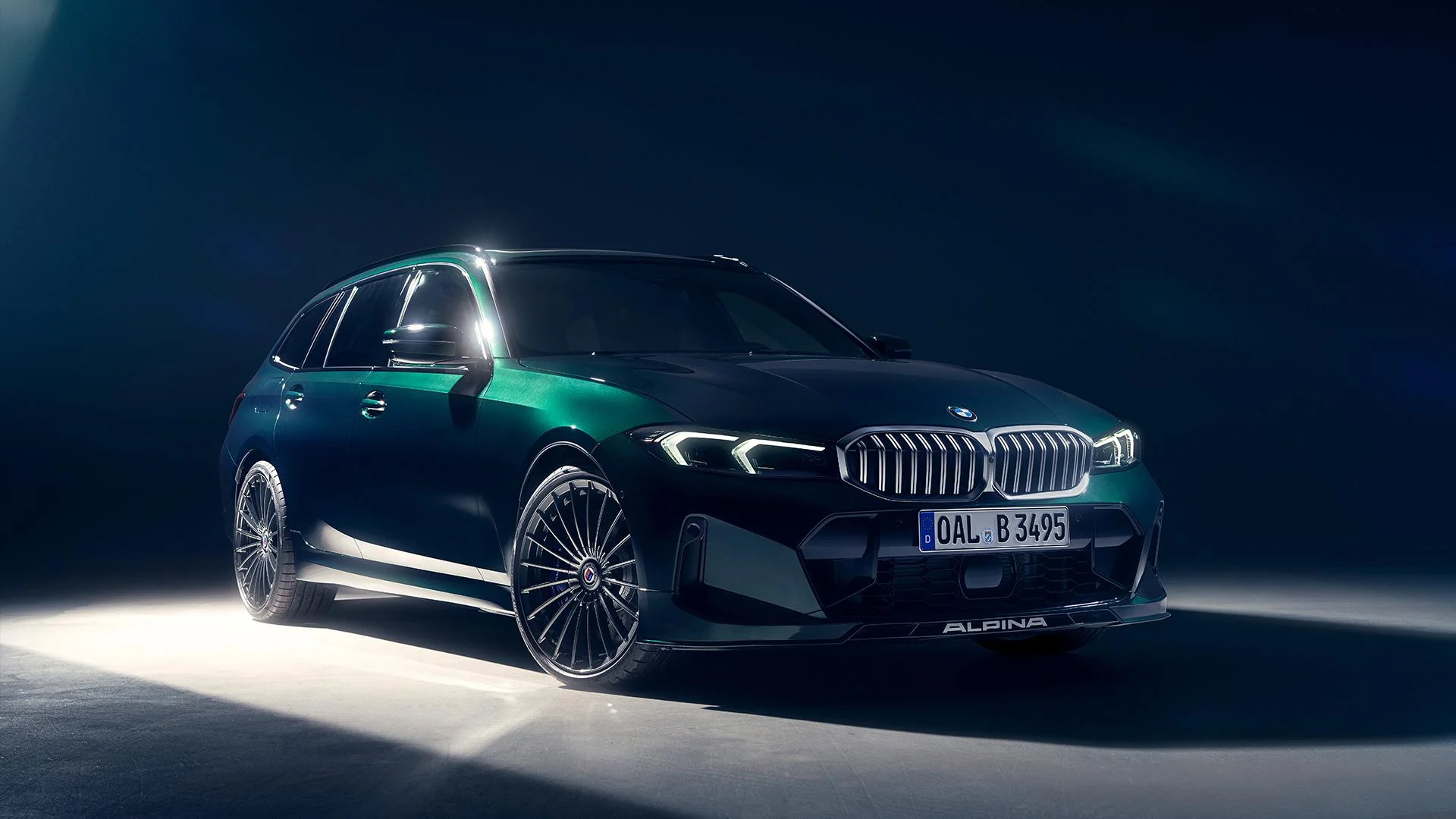
Coming just after BMW handed the 3 Series a facelift last week, Alpina’s B3 has undergone a mild update for 2023, with the new model now making more power and torque than before from its S58 engine.
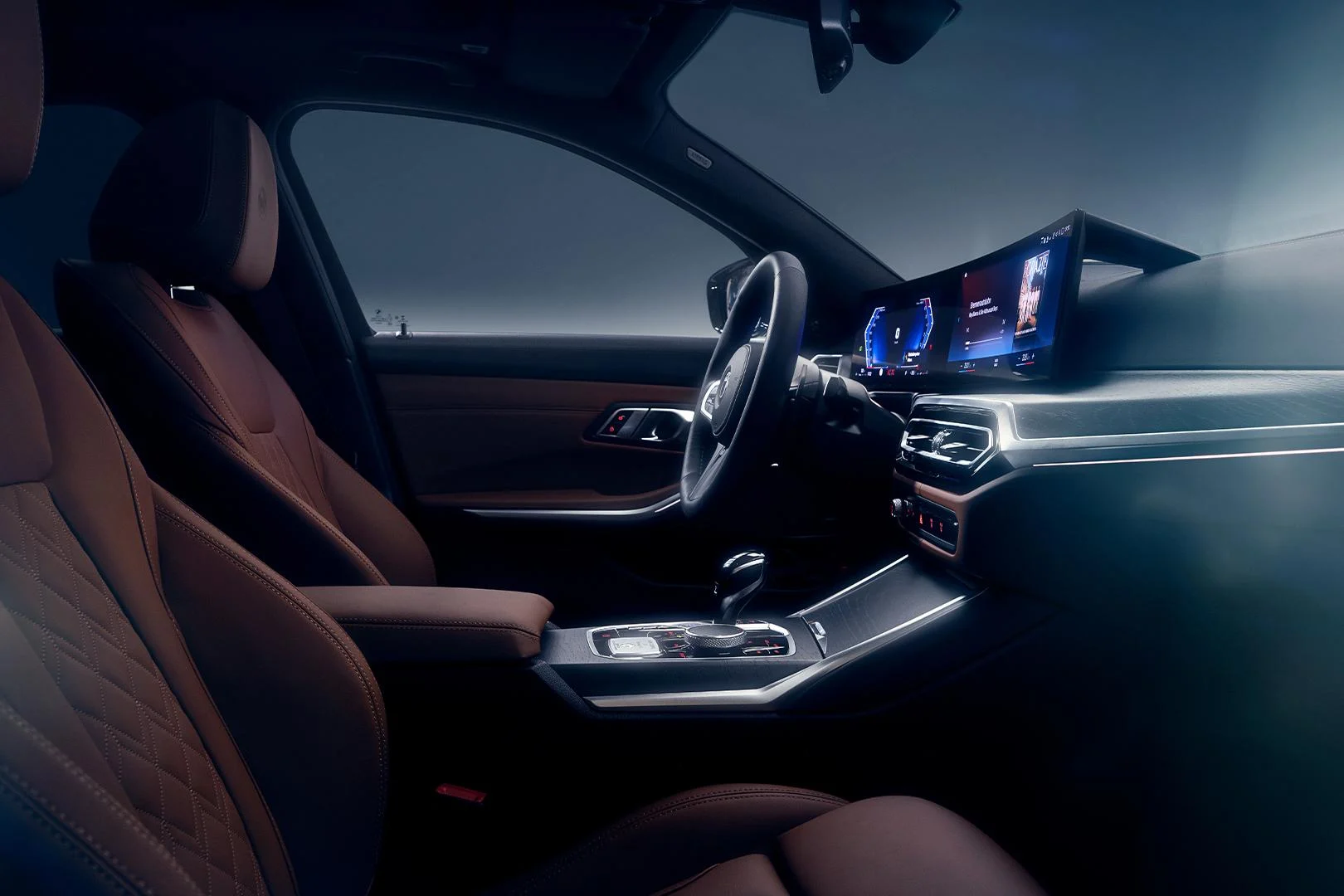
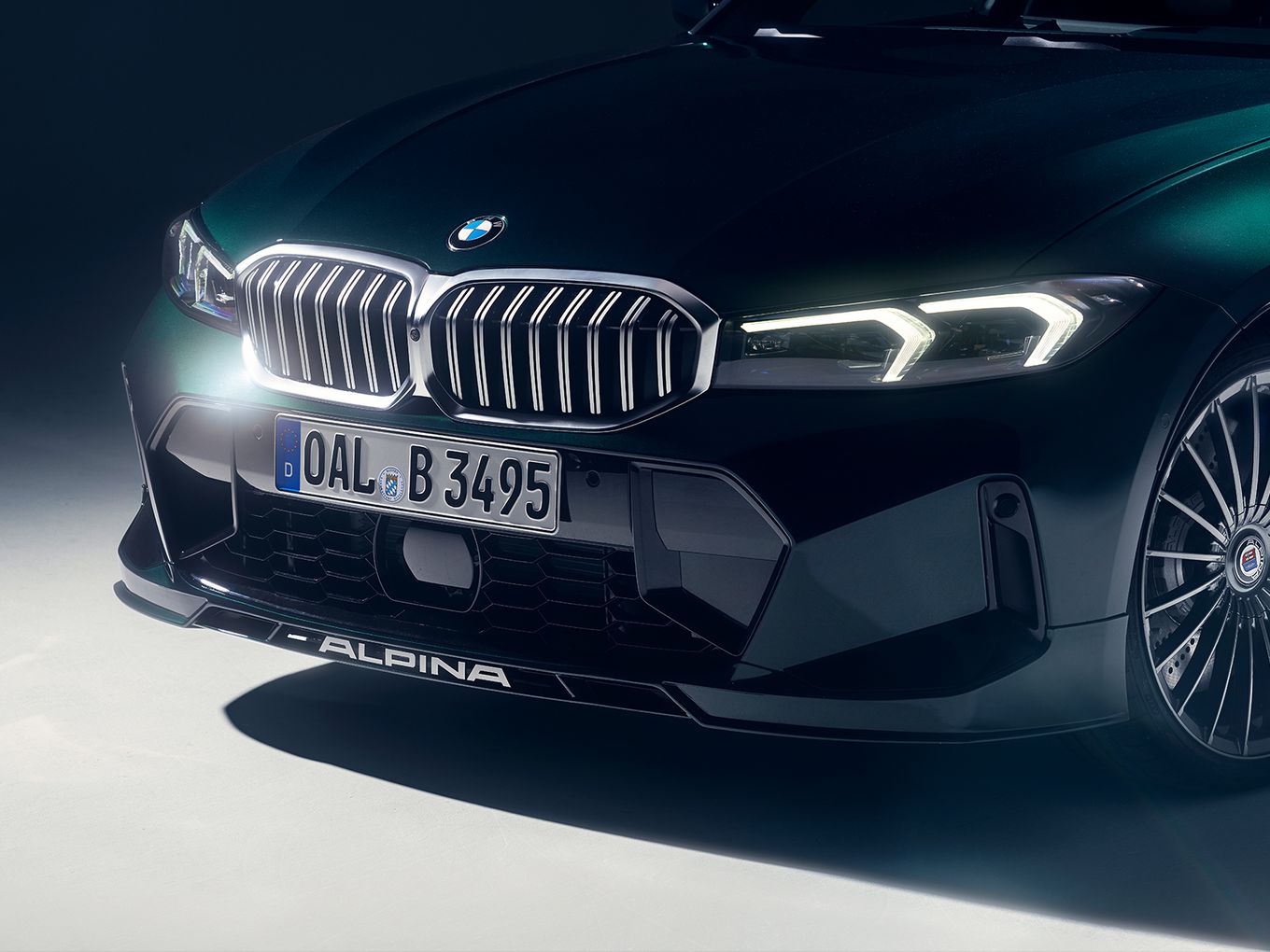
On top of the exterior cosmetic changes to the front bumper and LED headlights, the B3 also now scores the 14.9-inch curved infotainment screen which first debuted in the iX and is rolling out amongst other BMW models.
Pricing
Appearing on Alpina’s Australian configurator, both the B3 Saloon (sedan) and B3 Touring (wagon) are listed with prices of $152,900 before on-road costs, bringing the two body styles in line for the first time.
Prices exclude on-road costs.
| Model | Price |
|---|---|
| Alpina B3 sedan | $152,900 (+$10,000) |
| Alpina B3 wagon | $152,900 (+$7000) |
Features
| 19-inch Alpina design wheels |
| Extended front lip and rear spoiler |
| Alpina exhaustu00a0 |
| Power tailgate (wagon only) |
| Active guard plus |
| Three-zone climate control |
| Backrest width adjustment |
| Comfort access with smart opener |
| Connected package professional |
| 12.3-inch digital dash |
| 14.9-inch infotainment screen |
| Satellite navigationu00a0 |
| Apple CarPlay/Android Auto |
| DAB radio |
| Harmon Kardon sound system |
| Auto-dim rear mirror |
| Live cockpit professional |
| Heated front seats with electronic adjustment |
| Heated steering wheel |
| Head-up display |
| Adaptive cruise control |
| Dynamic stability control (DSC) including dynamic brake control (DBC) and dynamic traction control (DTC) |
Engine, drivetrain and fuel economy
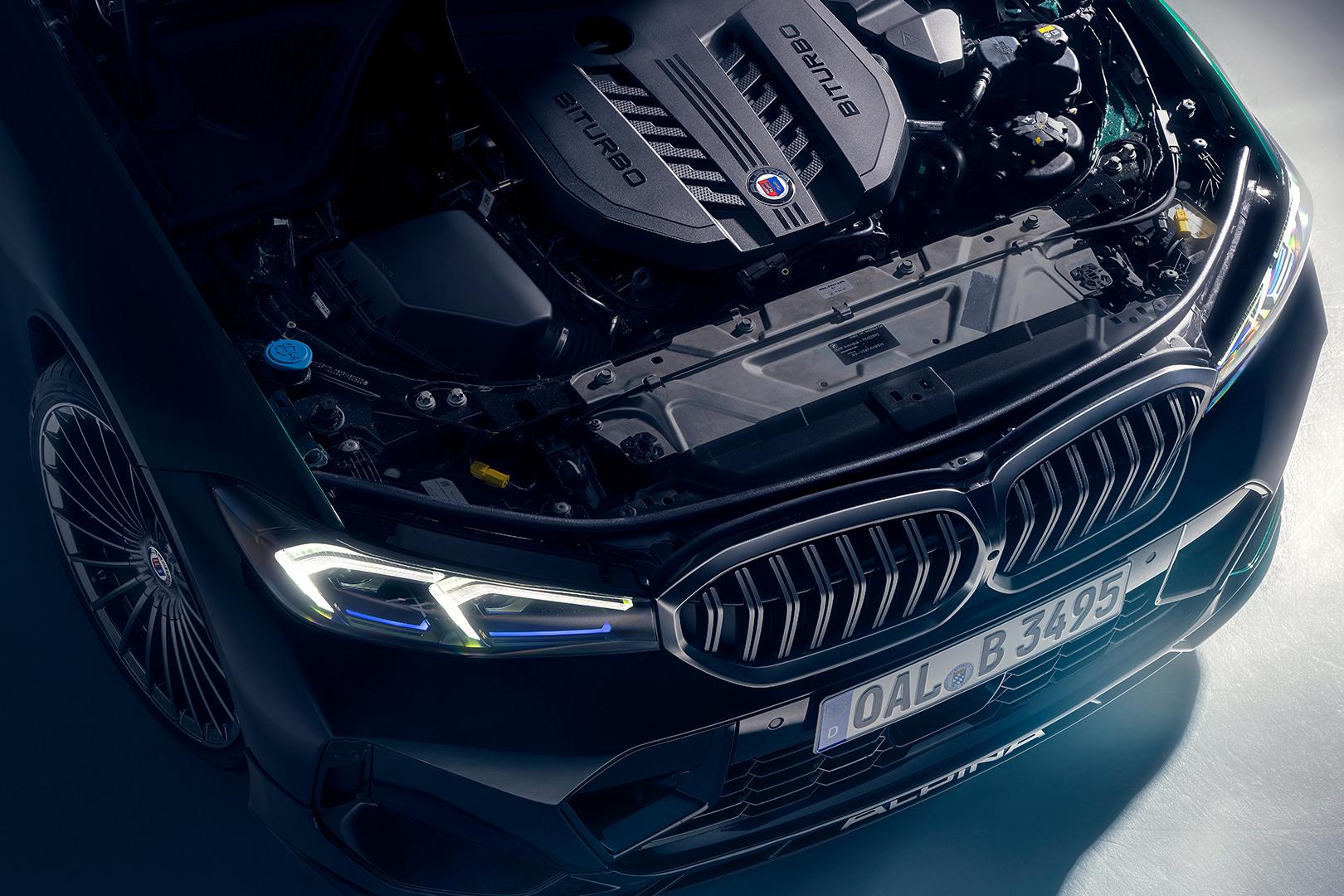
The mechanicals of the latest B3 are unchanged aside from a revised exhaust, allowing the S58 3.0-litre twin-turbo straight-six to now churn out an impressive 364kW of power and 730Nm of torque – up by 24kW and 30Nm respectively over the outgoing model.
We had both the B3 and its hardcore BMW M3 counterpart at this year’s MOTOR Performance Car of the Year test, with the S58 in each car showing completely different characteristics.
Drive continues to be sent to all four wheels through an eight-speed, ZF-built torque-converter automatic transmission, while Alpina also says the B3 features a sports differential on the back axle.
Fuel consumption is also the same with both variants recording 10.1L/100km on the combined cycle, bumped up from 9.9L/100km in the 2022 B3.
Sprint times from zero to 100km/h stand at 3.6 and 3.7 seconds for the sedan and wagon respectively, pushing each variant on to a top speed of over 300km/h.
Availability
Expect the Alpina B3 to arrive in Australia towards the end of 2022 or the start of 2023, as BMW anticipates its updated 3 Series to land in the fourth quarter of this year.
Earlier this year, BMW officially acquired Alpina with plans to bring the luxury marque under its umbrella, eventually moving all operations in-house from 2025.
Tesla is rolling out its latest over-the-air update to its Australian models, boasting a new feature which provides more accurate driving range calculations.
The newest Tesla update (2022.16.0.2) adds Navigation Energy Prediction, a function which gives drivers a more realistic calculation of the vehicle’s driving range when using online navigation by incorporating forecasted crosswind, headwind, humidity, and ambient temperature information.
First discovered by Teslascope, the update was first noted on a Model 3 in New South Wales before popping up across the expanded range of Model S and Model Xs around the world.

The update also introduces new capabilities within the vehicle’s driver profiles, with media player accounts, such as Spotify, now featuring the ability to be linked to individual drivers.
Tesla’s recent updates follow on from a recent roll-out to prevent a fault with the Model 3 where its infotainment system’s central processing unit (CPU) would overheat while the vehicle was being fast-charged, with the issue rectified via another over-the-air update.
Despite its position as the most popular electric vehicle in Australia last year, Tesla is currently facing the prospect of no more vehicle deliveries until the start of July, owing to a number of supply chain issues including shutdowns at its Chinese plant thanks to ongoing lockdowns in Shanghai.
Snapshot
- BMW and Mini reportedly moving to agency sales model in Europe
- BMW has previously trialled direct sales with the i3 and i8 last decade
- No plans to introduce the agency model in Australia
A switch to an agency sales model is on the cards for BMW and Mini, per international reports.
According to Automotive News Europe, BMW and its subsidiary Mini are considering a move away from the traditional sales model of dealerships being run as franchises, instead following in the footsteps of Mercedes-Benz by implementing direct sales.
By doing so, the manufacturer takes ownership of the dealership and its inventory, with an implementation of fixed prices across the network now becoming commonplace, as we’ve seen in Australia with both Honda and Mercedes-Benz within the past 12 months.
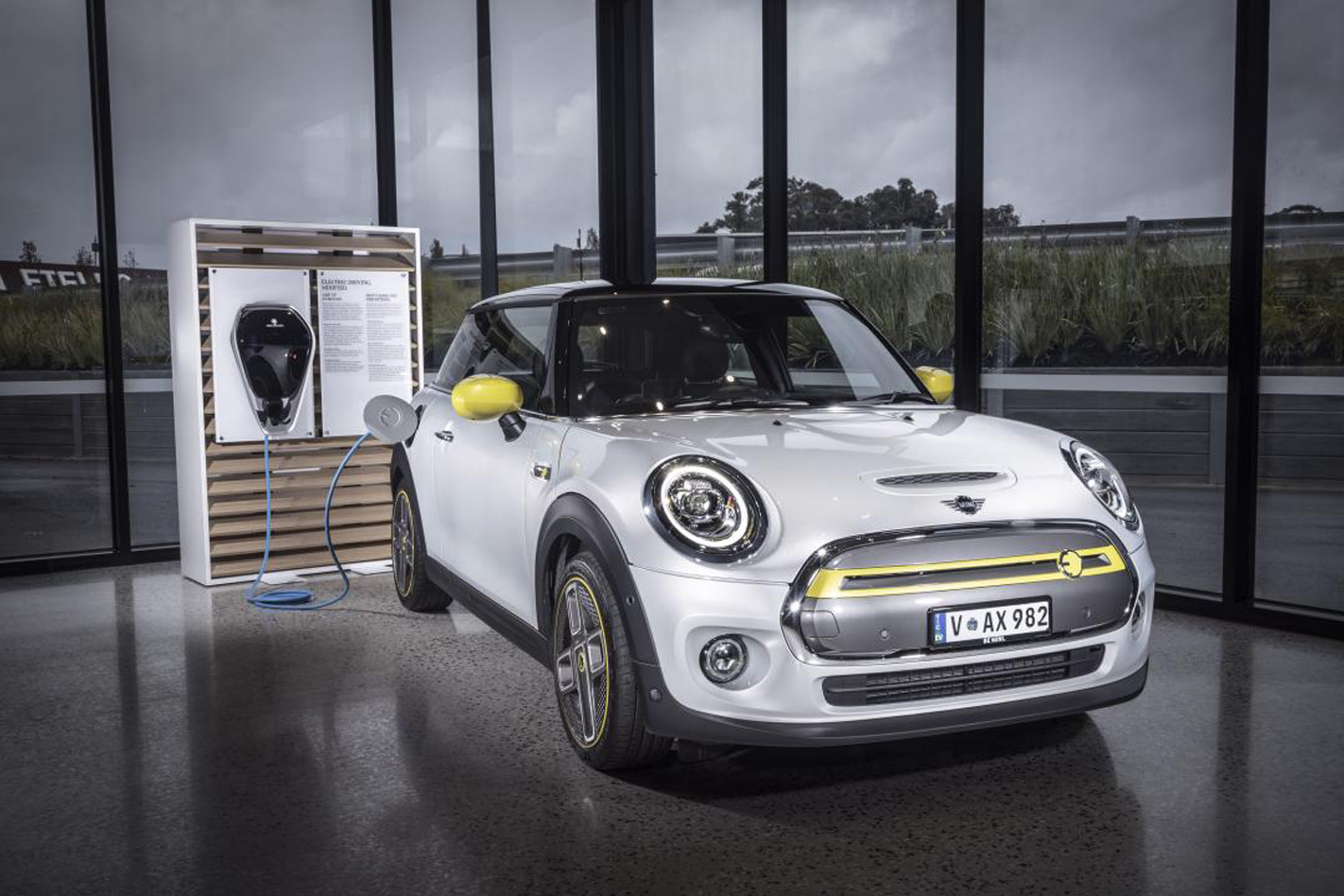
BMW Group’s sales and marketing boss, Pieter Nota, told ANE the manufacturer is currently liasing with its European dealer network to implement the model, having first trialled it at the launch of the ‘i’ electric vehicle sub-brand in 2013.
“We are currently talking with our European dealers about a move to a genuine agency model,” said Nota.
“If we will move to the agency model, this time it will be for the entire range.”
Reports from Autohaus magazine earlier this year stated the BMW Group’s authorised dealer system would be moved aside in favour of the agency model from 2024, first for the lower-volume Mini brand and followed by BMW in 2026.
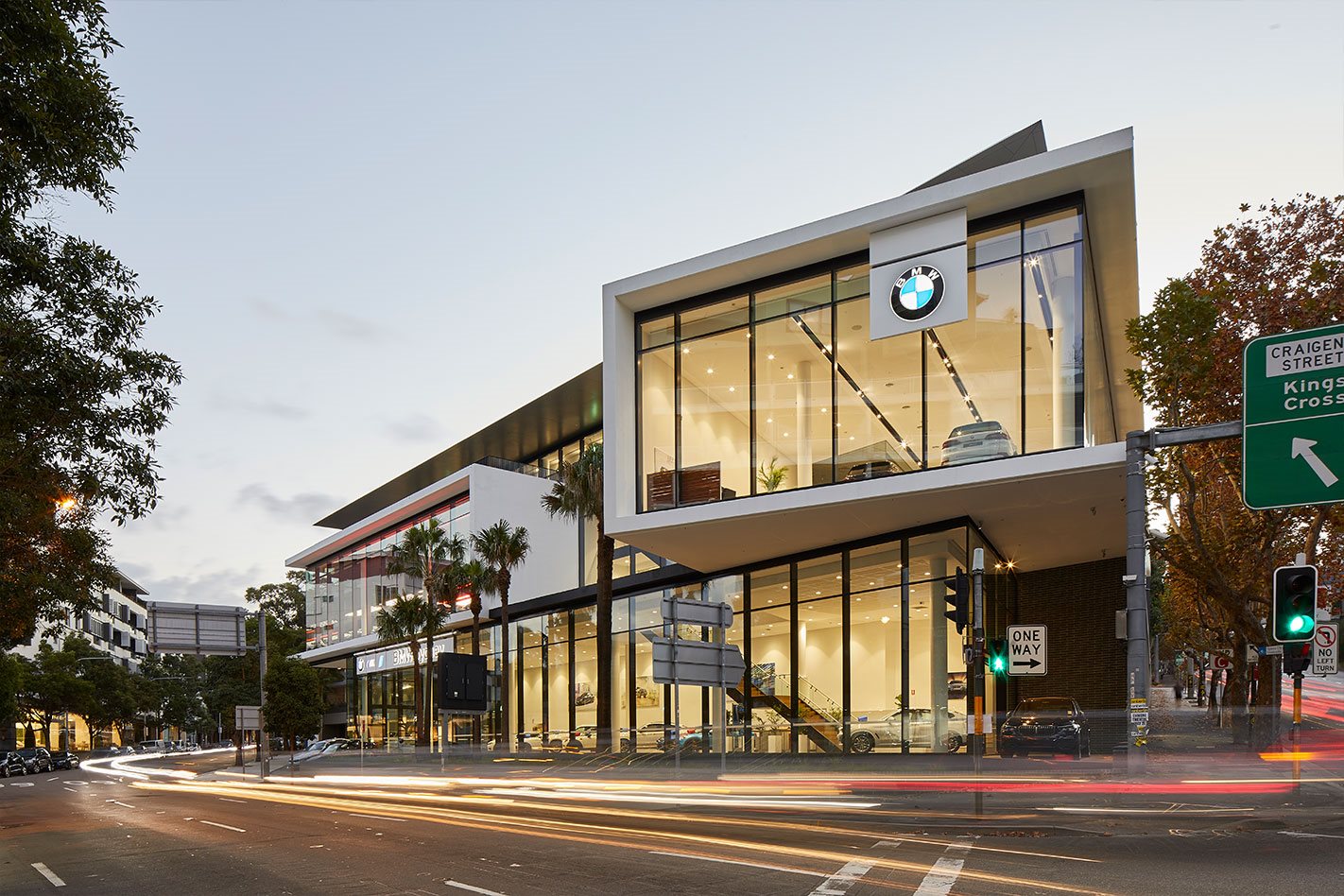
The Australian arm of the BMW Group has told WhichCar it has no such plans to introduce an agency model locally, saying it is sticking with its current sales setup for the immediate future.
“Together with our dealer partners, BMW Group always strives to offer its customers the best premium experience,” said a BMW spokesperson.
“With customer expectations changing, digitalisation increasing and the online sale of vehicles expanding, BMW Group sees the future of Europe as a direct sales model.
“This is currently being developed together with dealer partners who will continue to be the backbone of our company’s sales success.
“The focus is on Europe and there are no current plans to change the existing sales model in Australia.”
Mercedes-Benz is understood to be the biggest mainstream manufacturer investing in the agency model, with the German carmaker planning to cut around 10 per cent of its worldwide dealerships in the coming years, while expecting 80 per cent of sales to come from direct sales by 2025.
Mitsubishi’s 2022 Outlander significantly raised the bar for the brand when it was released late in 2021.
The old seven-seater was the flagship of the company’s range, selling at a rate of knots despite ageing hardware and a very ordinary driving experience.
It helped that it was cheap and, for a good part of its existence, just plain better than its obvious competition, the risible Holden Captiva. The better seven-seaters were bigger and significantly more expensive, so good value and a seemingly endless series of facelifts kept it going for a decade. And, to be fair, the plug-in hybrid was quite good.
We’ve covered the new Outlander in its flagship Exceed as part of our garage fleet, and the Aspire AWD featured in a comparison earlier this year where we suggested it was the sweet-spot of the range based on price and spec.
But is it worth saving $2500 with the FWD Aspire we have here?
UPDATE: Outlander Range Review
Looking for more detail on the wider Outlander line-up? See our full Outlander range review at the link below!
Pricing and Features
What do you get for your spend?
A quick disclaimer before we go on. Due to the world being on fire/flooded/flooded and on fire for the best part of three years now, the MY22.5 Outlanders are going to be slightly less, shall we say, feature-rich owing specifically to the dearth of semiconductors.
Some Outlanders are harder-hit than others; the third-from-top-spec Aspire will only lose the digital dashboard but won’t share the price increases of the Exceed and Exceed Tourer. The car I had for the week was an MY22 so still had the digital dashboard but that’s the worst of it.

The Aspire’s $41,490 plus on-road costs (or $2500 more for one with all-wheel drive) gets you 20-inch alloy wheels, dual-zone climate control, front and rear parking sensors, adaptive cruise control, reversing camera, leather steering wheel and shifter trim, power tailgate with kicky-foot gesture control, heated and folding door mirrors.
There’s also auto headlights with automatic high beam, 12.3-inch fully digital dashboard (not available on the MY22.5), 10.8-inch head-up display, combination fake suede and fake leather interior, power driver’s seat adjustment, heated front seats, silver roof rails, LED fog lamps, auto wipers and a space-saver spare.
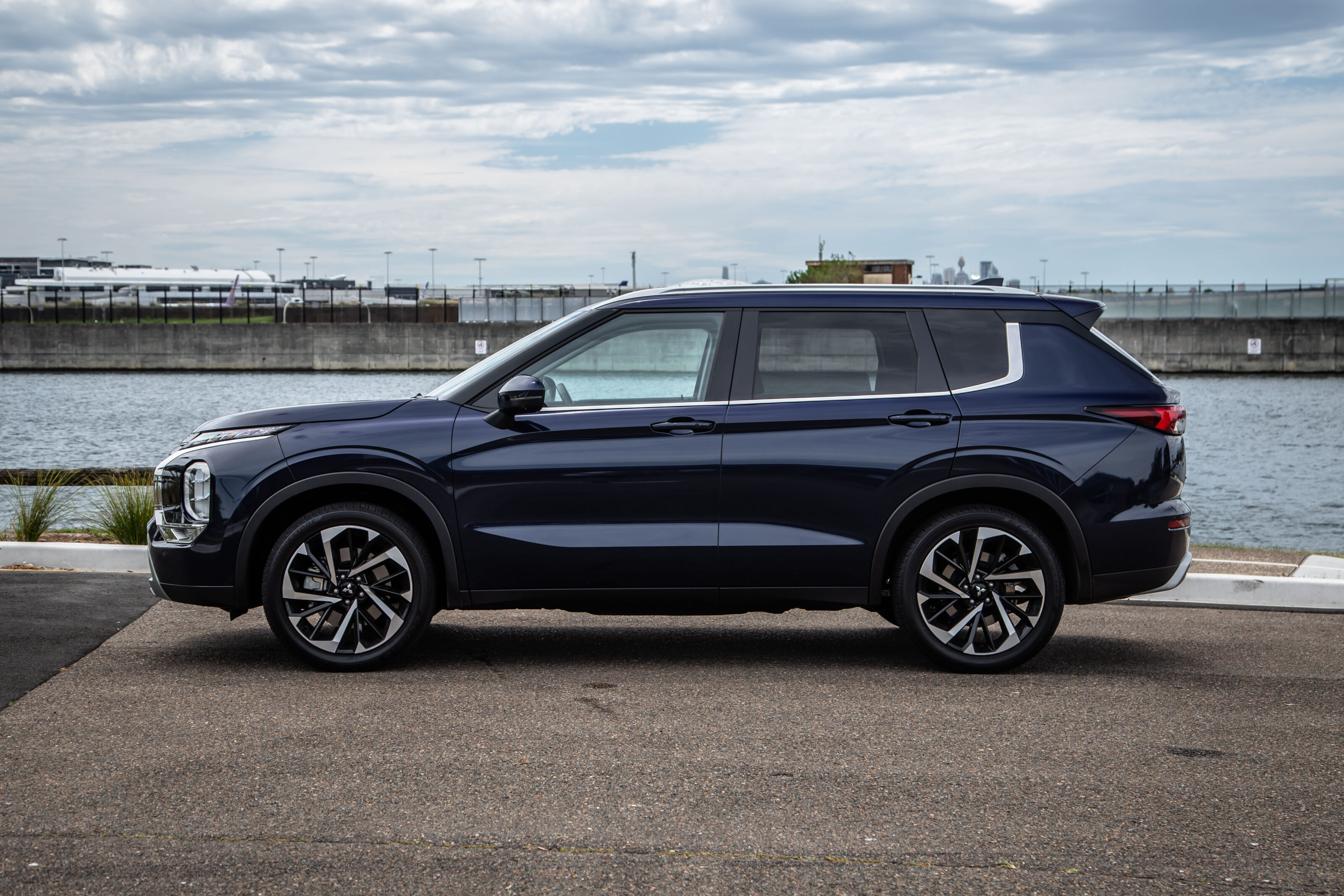
Due to the world being in chaos, the MY22.5 Outlanders are going to be slightly less feature-rich, owing specifically to the dearth of semiconductors
Mitsubishi’s fairly ordinary media system appears on a 9.0-inch touchscreen but does have wireless Apple CarPlay and USB Android Auto. The touchscreen hardware is good – snappy, big and easy to look at. The basic software looks super old and blocky and could do with either being junked altogether in favour of Android Automotive or having some real money spent on it to make it look modern.
The Outlander’s five-star ANCAP rating, awarded in January 2022, comes courtesy of eight airbags, including a driver’s knee bag and a front centre airbag (to prevent head clashes in a side impact), the expected braking and stability controls, forward auto emergency braking (AEB), forward collision warning, reverse AEB, reverse cross-traffic alert, lane departure warning, lane-keep assist and speed sign recognition.

Its forward AEB system works at high and low speeds and features pedestrian avoidance.
There are seven available colours – white, sterling silver, titanium, cosmic blue, white diamond, black diamond and red diamond. White is free, metallic and pearlescent paints are another $740 and prestige paint (anything with ‘diamond’ in the name) is $940.
Comfort and Space
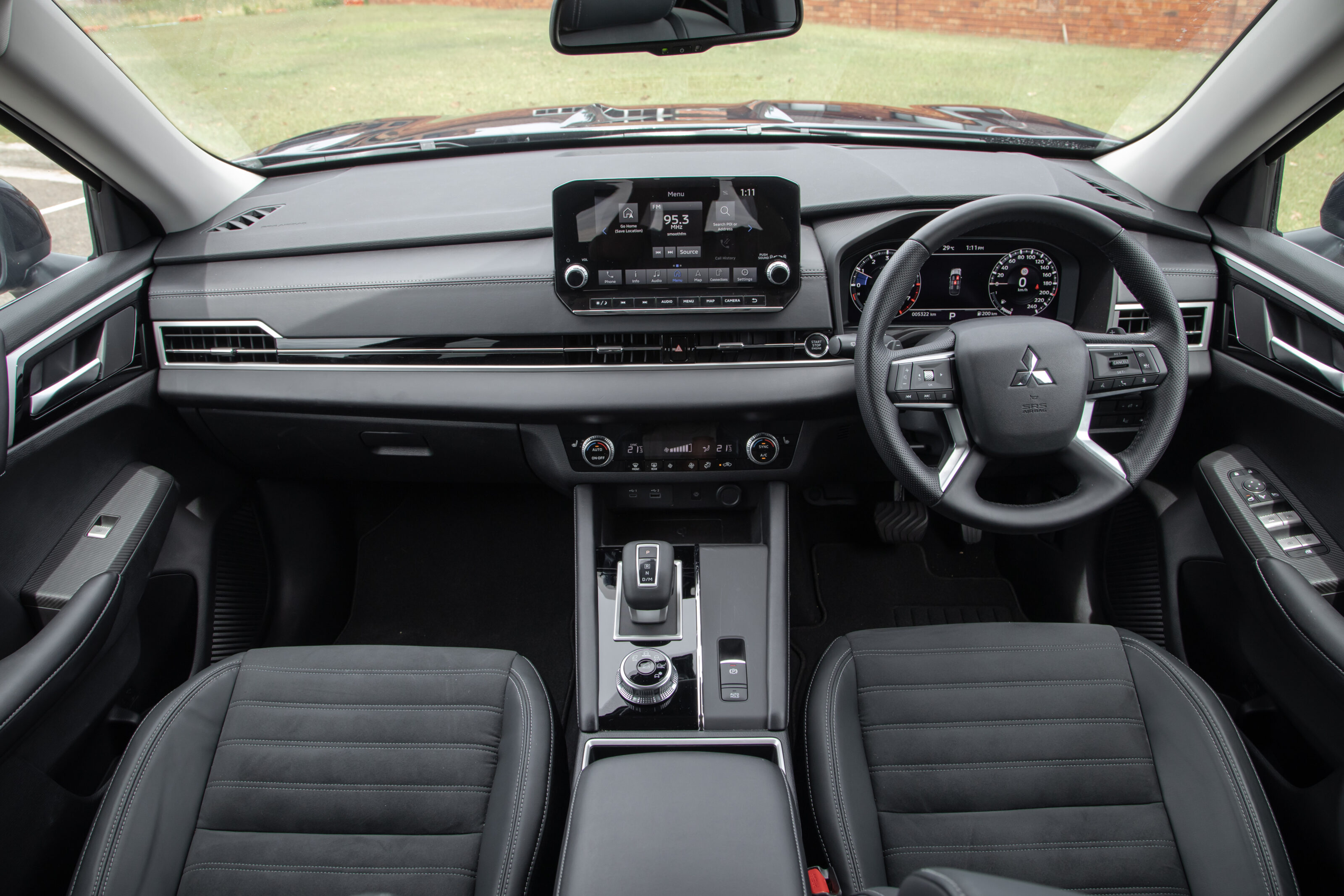
This new Outlander is a much bigger beast than the old, narrow, constrained Outlander. Perversely, it’s a much less comfortable seven-seater but vastly more comfortable and spacious as a five-seater. Mitsubishi probably saw this criticism coming and calls the Outlander a “5+2”, meaning they know that we know that the third row is now nearly unusable. Most 2+2s have virtually unusable second rows, so the approach checks out.
First, the good stuff – this is a terrific cabin. Lots of much better materials, comfortable seats, some interesting textures and design features and lots more thoughtful touches. The front seats are extremely comfortable and the driving position is excellent while also having plenty of adjustment. The Aspire feels more spacious than the more expensive Exceed variants because the sunroof isn’t there eating headroom.
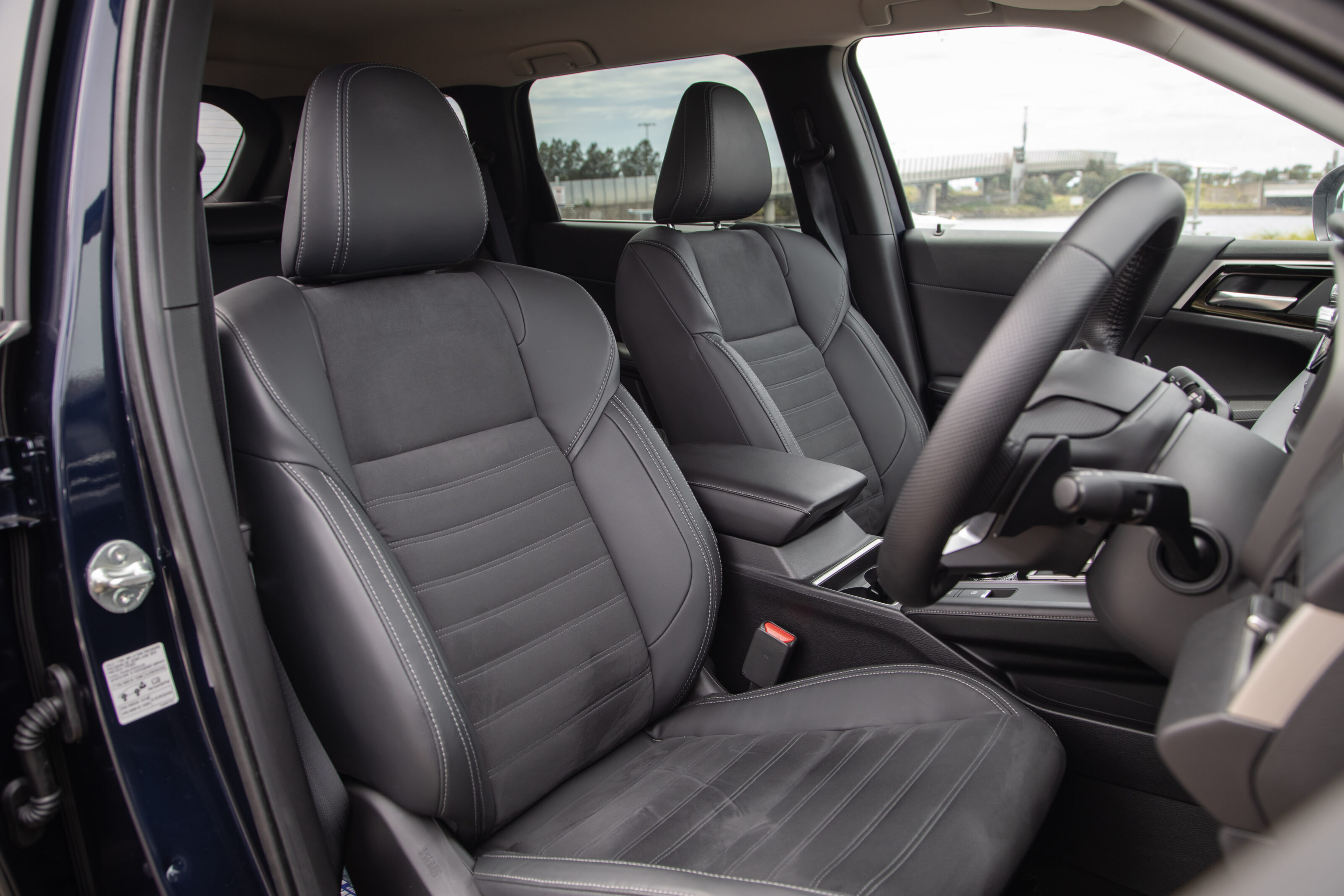
That translates to a more useful second row than both the old car and the current Exceed. The rear seats do sit fairly high so that extra head space means six-footers will be much happier back there. On top of that, there are rear air vents, one of my favourite things. The doors are big, too, so it’s easy to get people, including babies in capsules, in and out.
Front and middle rows each have two cup holders and a bottle holder in each door. The cup holders in the rear are ridiculous – there is no armrest so you have to fold down the central section of the 40:20:40 split-fold seat to access them.
This is a terrific cabin. Lots of much better materials, comfortable seats, some interesting textures and design features and lots more thoughtful touches

The boot is a reasonable 478 litres, which is good for the segment but then this is a significantly larger car than most of its rivals. With the seats folded, you have 1461 litres to play with. If you go for the base-spec car, you only get another seven litres of capacity in exchange for losing the third row of seating.
As is well-documented, that third row is close to useless. The seats aren’t very comfortable, with low backrests and silly detachable headrests that live under the boot floor but you always forget to remove them so they’re in the way. You have almost no legroom with the sliding centre row in its rearmost position but moving it doesn’t improve things to the point of regular usability. It’s almost like the company just wanted to hang on to its mid-size seven-seater crown without thinking who might actually fit. Even the Mazda CX-8 has a better third row, if only just.
On the Road

Possibly the most disappointing thing about the new car is the tired old drivetrain. As I will always say, however, nobody in this segment really cares much about what’s under the bonnet because if they did, we wouldn’t have a bunch of naturally-aspirated engines between two and two-and-a-half litres dominating the engine bays of mid-sized SUVs.
Anyway, Mitsubishi has seen fit to make the old 2.4-litre four-cylinder slightly bigger to 2.5-litres, stick with the automatic continuously variable transmission (CVT) and, in the AWD versions, send power to the wheels via the dubiously motorsport-connected S-AWC system.
The front-wheel driver tested here obviously misses out on the S-AWC, but in most conditions, you won’t miss it. If you fancy taking the Outlander off-road, spring for the AWD.
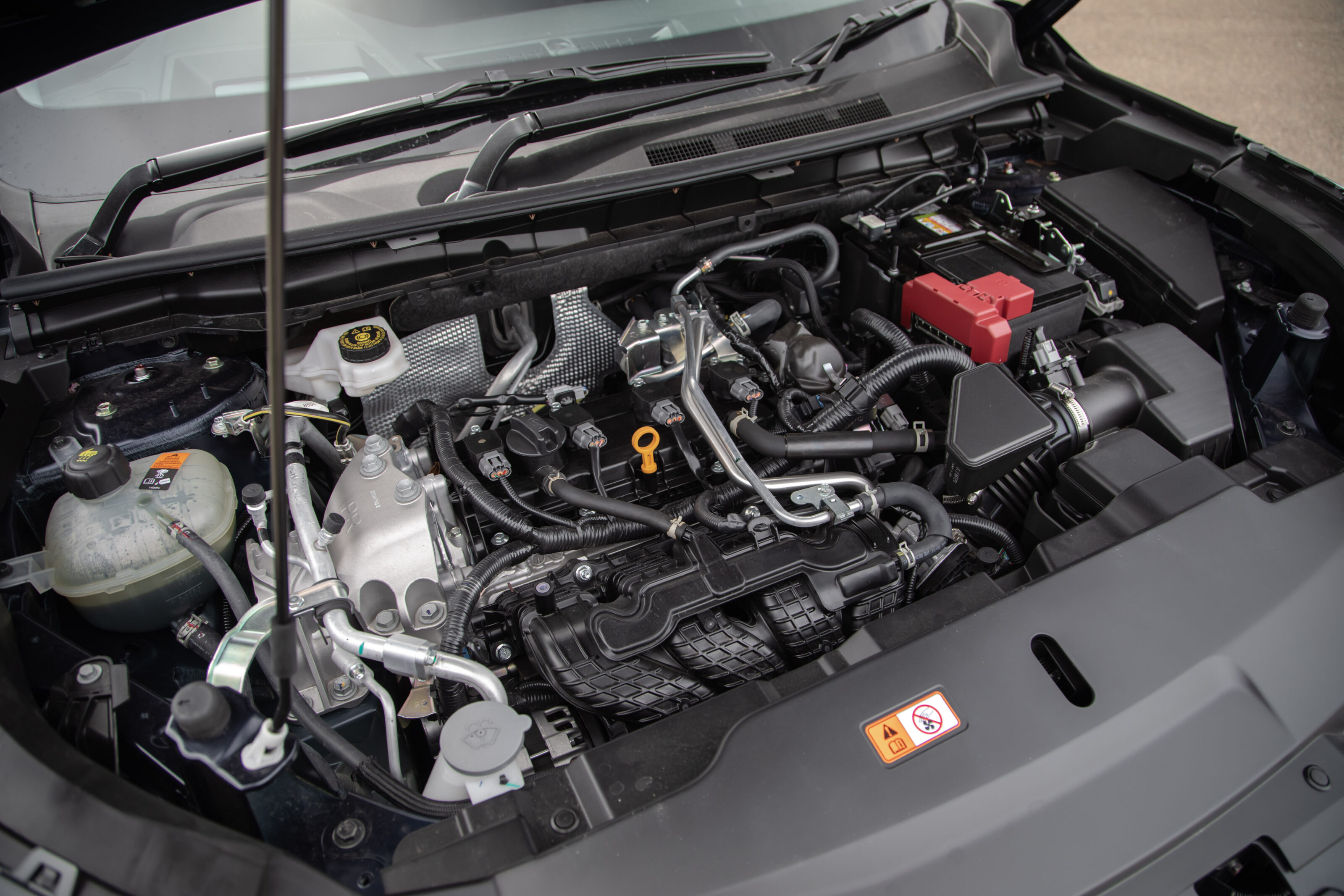
A PHEV is on the way and that is admittedly a much more interesting driveline but it will be fascinating to see if it brings the kind of amazement and amusement it did in the old car given how incongruous it was.
The 2.5 musters 135kW at 6000rpm and a fairly modest 245Nm at 3600rpm but at least the CVT is the right transmission to make the most of those figures, including the 1760kg kerb weight, a hefty jump of 200kg on the old car.
You do feel that weight, but not so much in the way the engine pulls it along. The Outlander was never an especially fast car but the CVT is an improvement over the previous version and I rarely felt the need to pull a fake gear with the plastic paddles.
Most of the time it’s fine, plush even. There’s a clear bias towards comfort, so cornering brings body roll and braking yields a reasonable amount of pitching

Like the Exceed, the choice of 20-inch alloys is a solid design choice but they may not help the ride too much. Most of the time it’s fine, plush even. There’s a clear bias towards comfort, so cornering brings body roll and the squishy brake pedal a reasonably amount of pitching. Certainly not in an “I’m gonna be sick” way, but definitely reminiscent of its Nissan cousins.
The Outlander on 20s does not like surfaces such as the concrete panels found around Sydney or unven tarmac. In these conditions, the ride gets a bit cranky, which is weird given its general softness.
Its tyres, while big, are full-on “eco” spec (hard for long life and with low rolling resistance) and are noisy around corners. My wife, who is not a hoon, got plenty of faint but unwelcome squealing around roundabouts.
Another surprising improvement – and one that puzzles me given the engine isn’t exactly the last word in technology – I got a repeat of the Exceed’s real-world 8.4L/100km figure from a few weeks ago, well within shouting distance of the combined-cycle number of 8.1L/100km. A comforting relief in these $2 per litre times.
Ownership

Mitsubishi offers a generous – if a bit terms-and-conditions-apply-ey – 10-year/200,000km warranty. If you, like most Australians, cover fewer than 20,000km per year, you’re going to love this warranty, especially if you keep the car for such a long time. You do have to service each time at a Mitsubishi dealer and if you don’t, kiss goodbye to ten years and say hello to five years/unlimited km, which is still alright, really.
The servicing is pretty cheap most of the time, costing just $199 for seven of the 10 services in the fixed-price regime. Service six is $499 and service 10 is $799, neither of which reach the heights of, say, the Tiguan Allspace. You need to return to the dealer every 12 months or 15,000km.
VERDICT

The new Outlander is worthy of a test-drive, and we still think the Aspire is the pick of the range.
The Exceed’s extras don’t really help (unless you really need the digital dashboard that used to be in the Aspire), especially given the headroom-munching sunroof.
There’s really nothing amazing about the Exceed that isn’t in the lower model and you’ll save decent coin if you’re willing to go without a third zone in your climate control, a couple more speakers and some leather.
It’s the buyer’s call on whether all-wheel drive is worth the extra spend.
2022 Mitsubishi Outlander Aspire FWD specifications
| Body | 5-door, 7-seat medium SUV |
|---|---|
| Drive | front-wheel |
| Engine | 2488cc naturally-aspirated four-cylinder |
| Gearbox | continuously variable transmission |
| Power | 135kW @ 6000rpm |
| Torque | 245Nm @ 3600rpm |
| 0-100km/h | 10.5 secs (claimed) |
| Bore/stroke (mm) | 89 x 100.0 |
| Compression ratio | 12.0:1 |
| Fuel consumption | 8.1L/100km (claimed) |
| Front suspension | struts, coil springs, anti-roll bar |
| Rear suspension | multi-link, coil springs, anti-roll bar |
| L/W/H | 4710mm/1862mm/1745mm |
| Wheelbase | 2706mm |
| Towing | 1600kg (braked) |
| Front brakes | 350mm ventilated discs, single-piston calipers |
| Rear brakes | 330mm solid discs, single-piston calipers |
| Tyres | 255/45 R20 101W Bridgestone Ecopia |
| Wheels | 20 x 8.0-inch alloys |
| Price | $41,490 + on-road costs |
The 2022 Maserati MC20 Cielo has been revealed, with the new convertible version’s price tag set to eclipse that of its coupe stablemate.
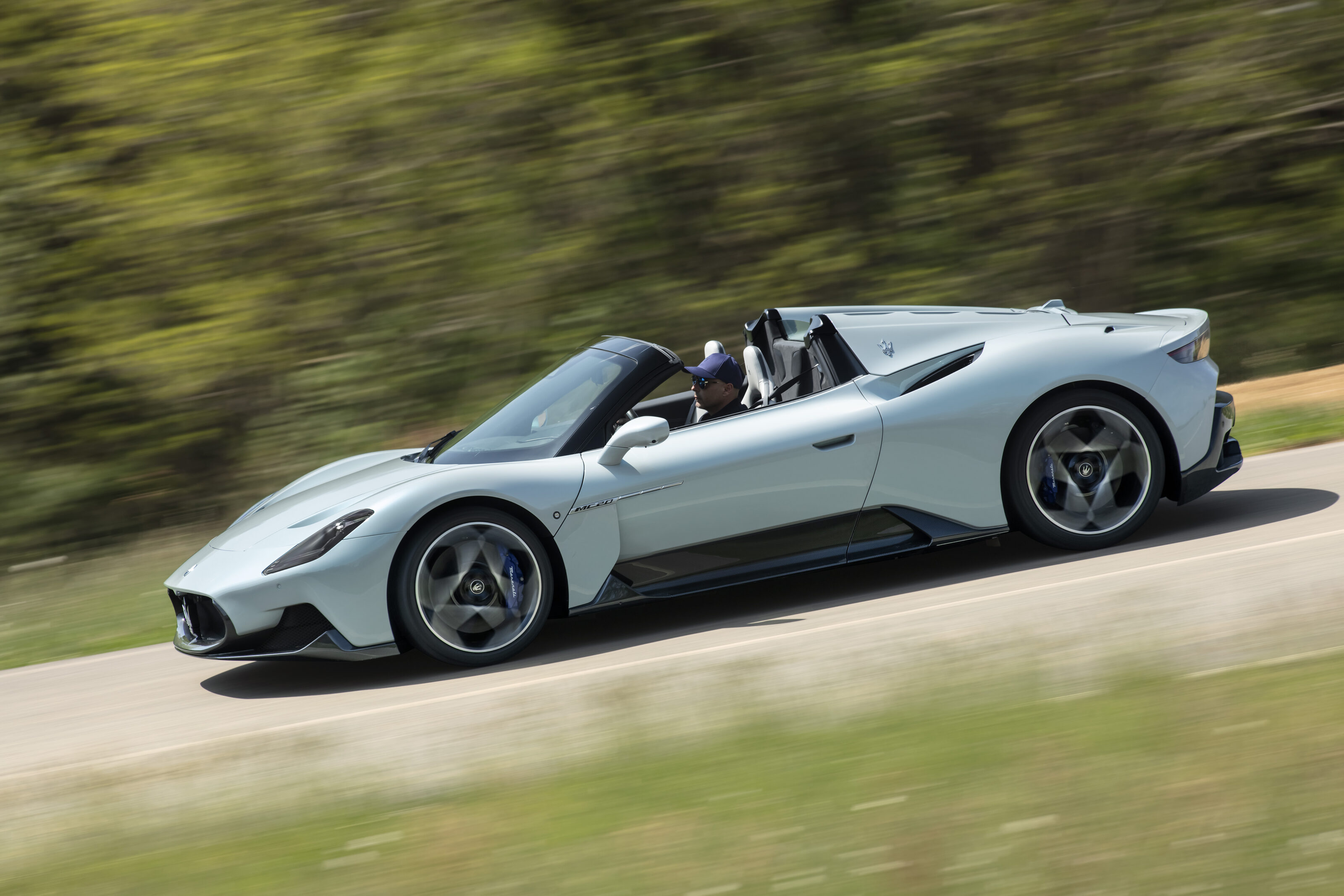
The glass roof of Maserati‘s new MC20 convertible does more than just retract in 12 seconds flat. It can also switch from clear to opaque in an instant.
To highlight the fact this super-spider has something other species lack, Maserati has come up with a new designation. The MC20 Cielo (Italian for ‘sky’) was officially revealed overnight in Maserati’s home town of Modena.
The MC20 Cielo will also be built in Maserati’s small assembly plant in Modena. It will arrive in Australia in the middle of 2023. While exact specification and pricing are yet to be fixed, expect the open-air MC20 experience to cost more than the $438,000 coupe.
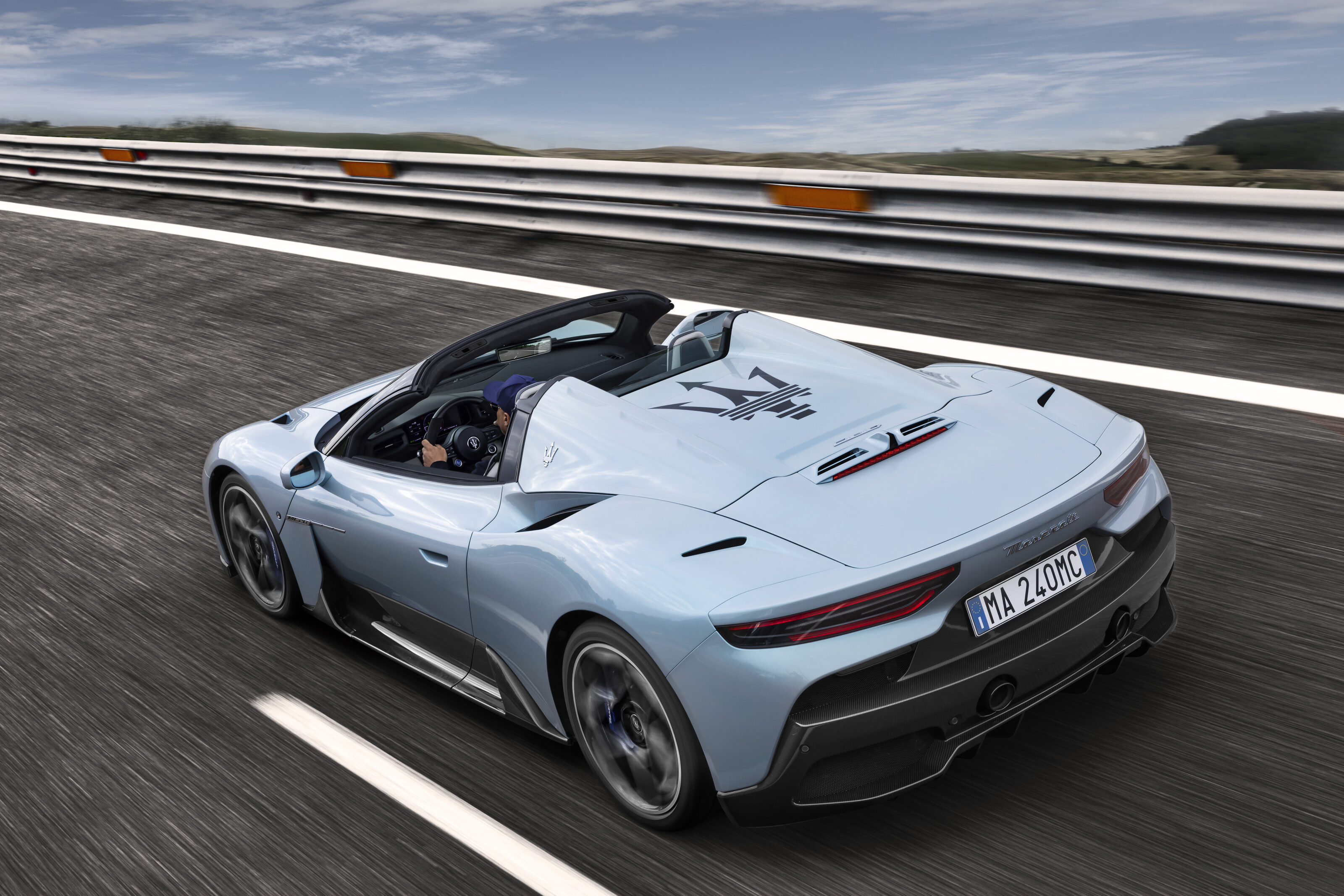
Cielo is the second instalment of Maserati’s supercar-revival trilogy. It follows the MC20 coupe launched last year. Still to come is the promised EV version, which is sure to be quicker than either of its internal-combustion engine siblings.
Still, the performance of the MC20 Cielo isn’t going to disappoint. It has the same Maserati-manufactured twin-turbo 3.0-litre V6 and eight-speed Tremec-made double-clutch transmission as the coupe, yet weighs only 65 kilograms more.
Maserati’s 0-100km/h claim for the rear-drive convertible is “approximately 3.0 seconds”, making it only around one-tenth slower than the hardtop. The 463kW Nettuno engine, with its patented F1-Style pre-chamber combustion system, can push the Cielo to a similar 300km/h-plus top speed.
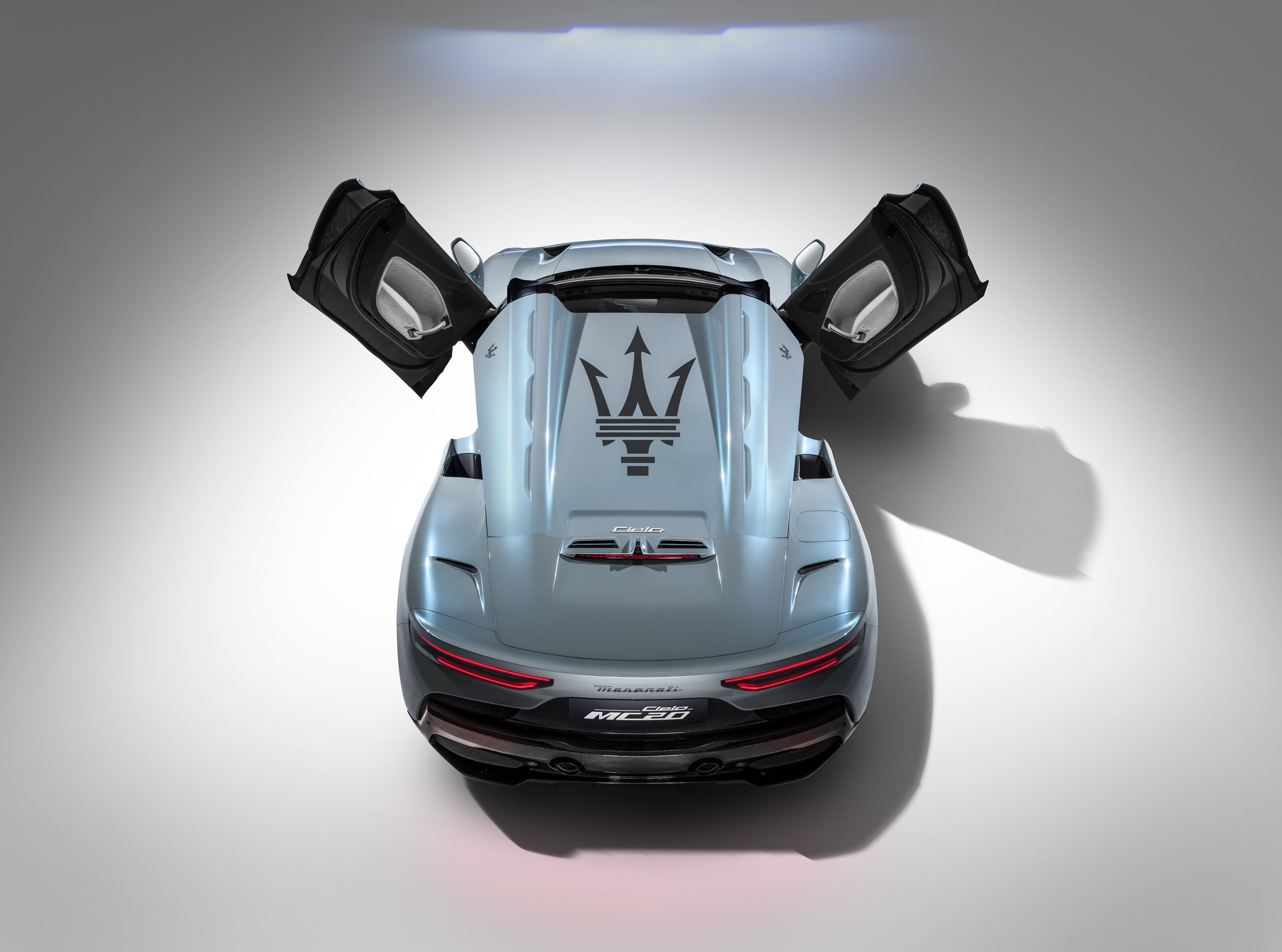
According to Maserati, careful engineering of the MC20’s carbon-fibre central body structure is the reason for the Cielo’s minimal weight gain compared to the coupe. With alterations to the number of carbon-fibre layers and their orientation in key areas, exactly the same design provides the basis for all three MC20 versions.
And this means the Cielo has the same upward-opening butterfly as the coupe. While there are changes to the exterior carbon-fibre body panels, Maserati says the clean and elegant shape of the convertible generates similar downforce to the coupe.
Though the retractable glass roof has an area of more than half a square metre, the Cielo’s storage space – 150 litres in total, shared between rear and front compartments – is unchanged, too. Developed in partnership with specialist Webasto, the polymer-dispersed liquid crystal tech that allows the roof to switch between opaque and clear works in a wide temperature window; from -30 to +85 degrees celsius.
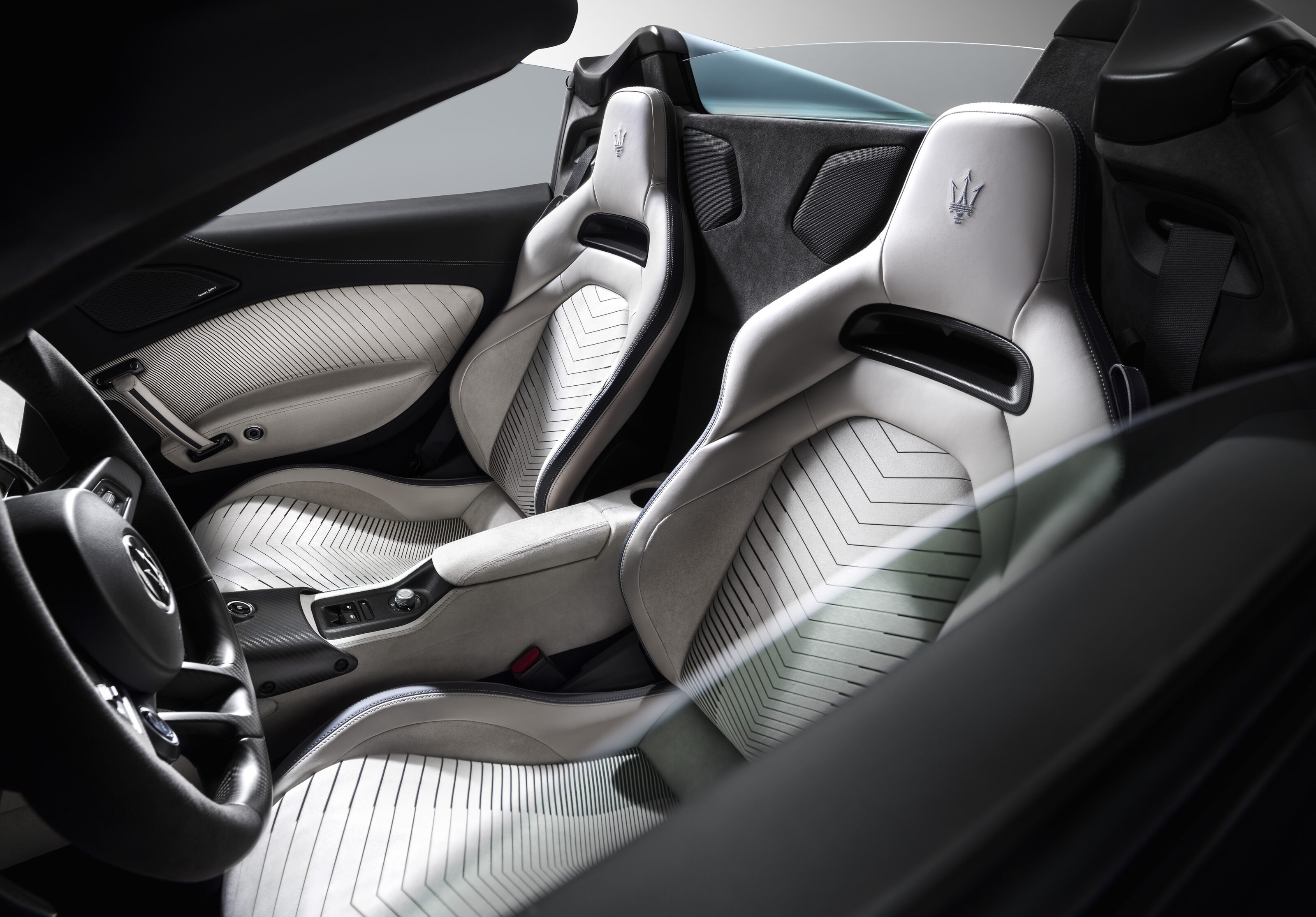
The interior of the Cielo retains the minimalist look of the MC20 coupe, but there are some changes. On the central tunnel, the drive mode selector dial becomes a digital touch device that glows a different colour for each of its five settings. And the low-mounted, landscape-oriented 10-inch central touchscreen features the latest generation of Maserati’s Android Automotive-powered infotainment tech.
There are some major upgrades to the MC20’s active safety arsenal, too. The Cielo introduces autonomous emergency braking, traffic sign recognition and a 360-degree view camera. All these are certain to be adopted by the coupe and coming EV.
Convertibles account for around one-third of super sports car sales globally, Maserati estimates. The arrival of the Cielo means the long-lived brand can at last tap this high-margin market.
Kia Australia is recalling examples of its Soul hatchback after a defect was found with its front airbags.
The issue affects 379 cars made between 2013 and 2015 and applies to all model variants.
According to the Department for Infrastructure, which issued the notice, a manufacturing issue means the airbag control unit (ACU) may not deploy the front airbags in the event of a crash – which could cause serious injury or death to occupants.
A list of VINs for the vehicles involved can be found here.
Owners are advised to contact their local Kia dealership to schedule an appointment to have the ACU software updated, free of charge.
Alternatively, Kia can be contacted on 131 542 or [email protected]
Snapshot
- Expedition begins in 2023
- Two Ariyas taking part, one modified and one in support
- Chris Ramsey to lead the team
The 2023 Nissan Ariya is set to become the first electric vehicle to drive all the way from the North- to South Pole.
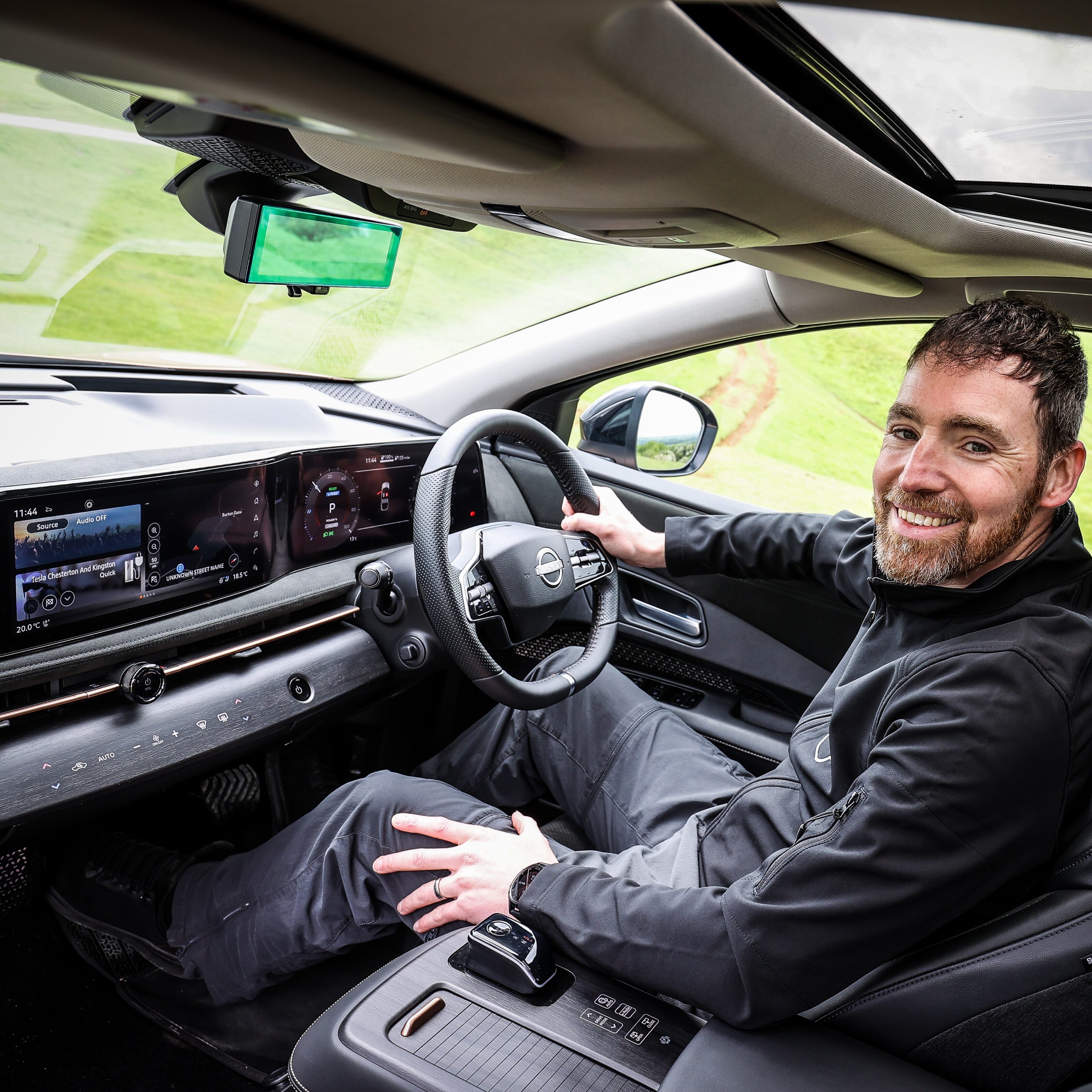
Nissan has announced it is teaming up with British adventurer, Chris Ramsey, to undertake the world’s-first all-electric driving adventure between the two poles.Departing in March 2023, the daring expedition will see Ramsey and team in a Nissan Ariya e-4ORCE travel more than 27,000 kilometres across the world – with predicted temperatures ranging from -30⁰C to 30⁰C.
Ramsey will be the first person to drive from pole to pole in a vehicle of any type, as he makes his way from the Arctic through North, Central and South America, before crossing into Antarctica – taking on some of the world’s most extreme terrains, including; snow, mountain climbs and desert dunes.
“We’re proud to announce our partnership with Chris Ramsey and the Pole to Pole expedition team,” said Nissan’s Executive Vice President, Asako Hoshino.
“With e-4ORCE control technology providing enhanced stability and traction on a variety of surfaces, we know the Ariya will be the perfect partner for Chris and his team on their challenging all-electric journey.”
In preparation for the freezing Arctic and Antarctic conditions, Ramsey’s Ariya e-4ORCE will be modified with a more rugged custom exterior fit for the trek, gaining upgraded wheels, tyres and suspension. A second, unmodified, Nissan Ariya e-4ORCE will act as a support vehicle throughout the Americas.
E-4ORCE is Nissan’s most advanced all-wheel drive technology that manages power output and braking performance for smoothness and stability. According to the carmaker, the system traces the intended driving line over a variety of road surfaces, including wet and snowy roads, without the need for changes in driving style or input.
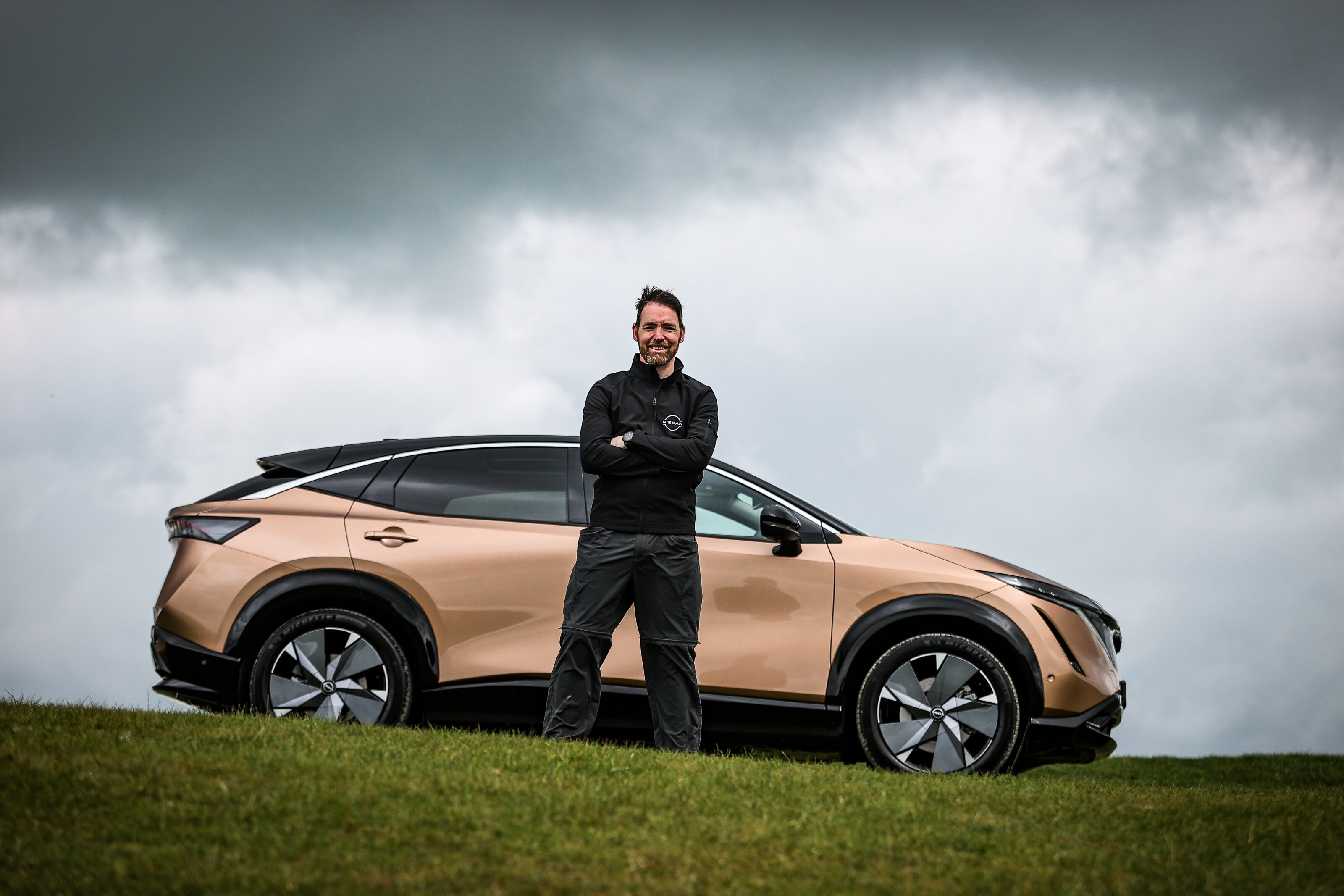
This isn’t the first all-electric expedition for Chris Ramsey. He’s been adventuring in EVs for more than a decade. In 2017, he and his wife Julie became the first team to complete the Mongol Rally in an all-electric vehicle. The pair travelled in excess of 16,000 kilometres over 56 days in his own Nissan Leaf.
“Our mission is to show that electric vehicles can tackle the harshest of environments – from the bitter cold of the poles to the hot and humid jungles of South America, and illustrate they are exhilarating to drive whilst meeting the daily demands of drivers around the world,” added Ramsey.
The arrival of the long-awaited Ariya EV crossover on local shores, however, has recently pushed back until at least 2023.
It was hoped that the Ariya, which is Nissan’s second dedicated EV after the Leaf, would arrive locally this year to take on the likes of the Tesla Model Y and Polestar 2. But global production delays due to the semiconductor shortage, and Australia’s position as a lower-priority market for EVs, means the Ariya’s arrival timing has blown out until next year.
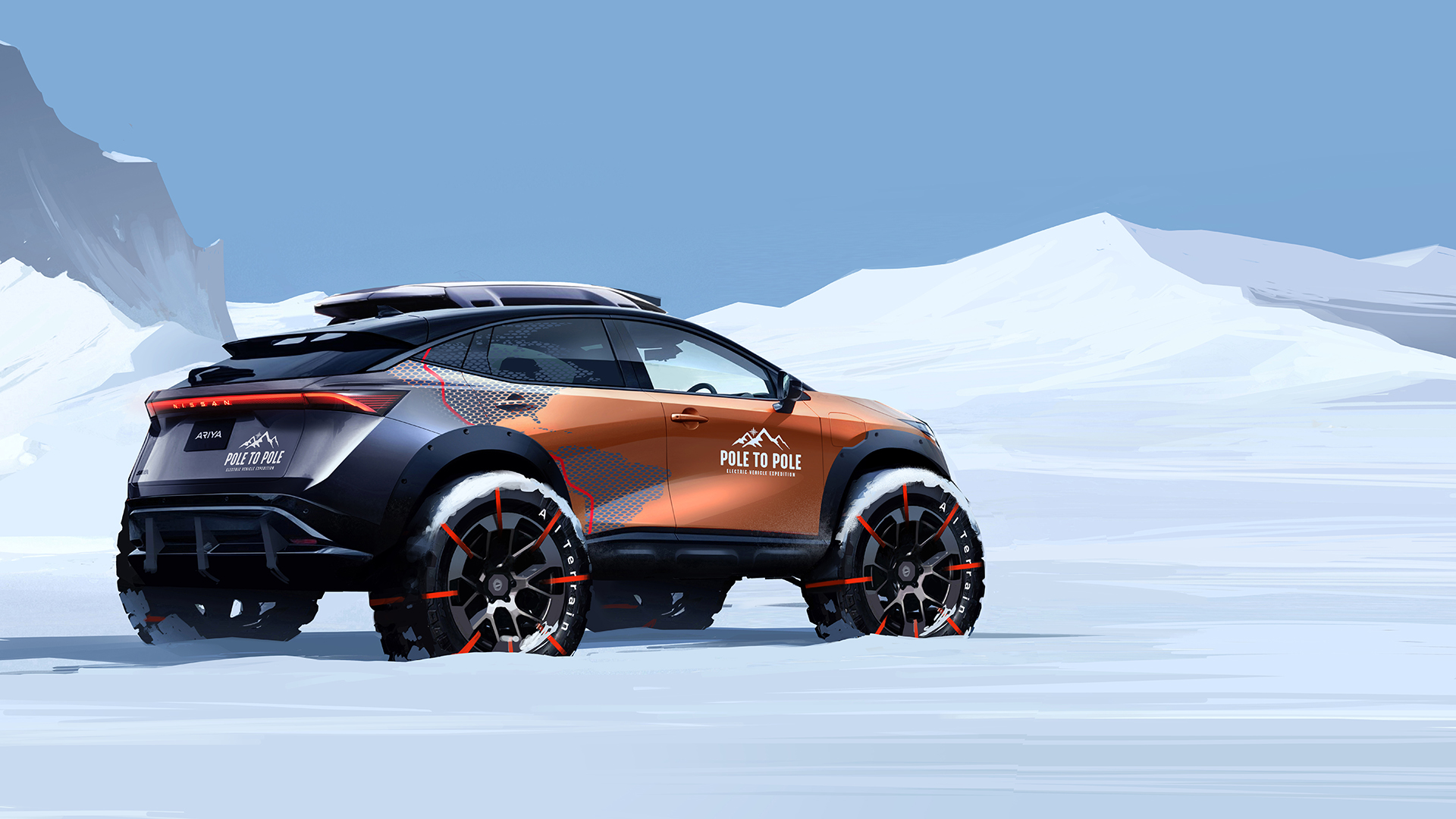
Exact specifications are still being finalised for local showrooms, but the model will be offered globally with a choice of 63kW and 87kW batteries, the latter allowing a single charge trip of more than 500km. The most potent version will also do the zero to 100km/h dash in a respectable 5.1 seconds.
What’s more, a choice of front- or four-wheel drive will be offered, allowing a choice between more affordable and performance variants.
Nissan has long been a pioneer in the electric space, and globally it has committed that 50 per cent of its sales will be either hybrid or full-electric by 2030. The strategy, known as ‘Ambition 2030’, will see Nissan invest ¥2 trillion (AU$21.6 billion) over the next five years – which will include 15 new electric models.
