
Ola Källenius is making sense. The Mercedes-Benz chief and chairman of the board of management of its parent company Daimler, isn’t the type to emit hot air. Instead he’s talking hydrogen, explaining why it’s trucking wonderful stuff.
The serious Swede doesn’t put it quite so colourfully, but he’s firmly convinced that the gas’s obvious role in our decarbonised future is as a fuel for high-mileage, heavy-duty, electric-powered freighters of the road. “For long-haul – through Europe, or the USA, Australia – hydrogen as an energy source is a logical bet,” he says.
He already has money in the game. In April 2021, Daimler Truck entered a joint venture with Volvo Group to speed the introduction of hydrogen fuel cells for long-distance trucks. The new company, Cellcentric, is aiming for production from 2025.
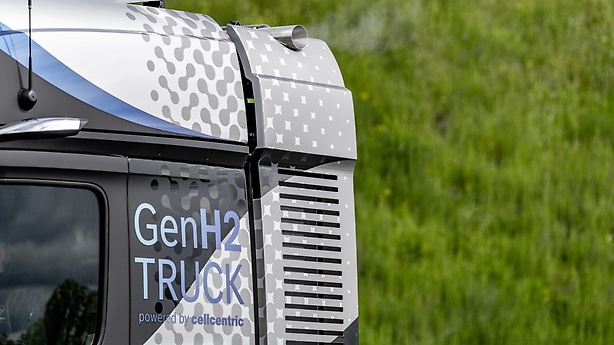
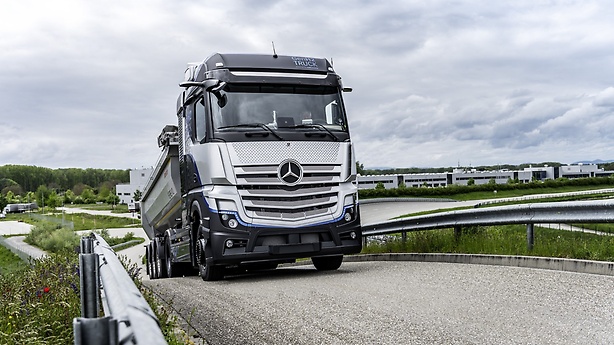
Källenius is close to this project. Another of his roles is as chairman of the supervisory board of Daimler Truck, a group which includes Mercedes-Benz, Freightliner, Western Star and Fuso among its six brands. The objective, he says, is to develop a system capable of powering a 40-tonne semi through an energy-intense 1000km working day.
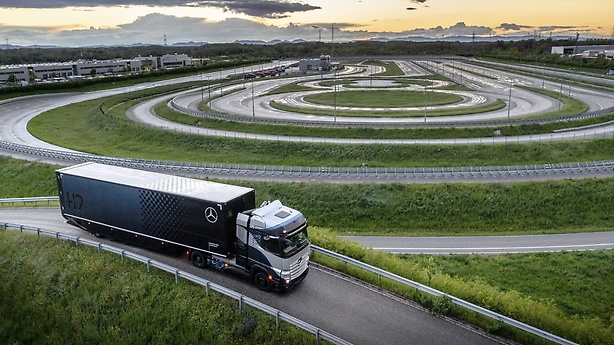
“We think it’s much more pragmatic, much more realistic, that the fuel-cell case is in a business where you need an enormous amount of energy to solve the problem.” The energy density of high-pressure hydrogen tanks is superior to lithium-ion battery packs, he notes. They can also be refilled much more quickly. Both factors make them a logical choice for heavy haulage.
Some will be deeply disappointed that Mercedes-Benz doesn’t see hydrogen fuel cells as right for cars. There are plenty of people keen to embrace electromobility who view hydrogen fuel cells as the obvious answer to the shortcomings of batteries.
I get it. I’ve driven hydrogen fuel-cell vehicles and they’re good.
The first was a Toyota Highlander FCHV (Fuel Cell Hybrid Vehicle) sometime in the noughties in California. Based on the US-market version of the Kluger, its tanks held 6kg of hydrogen, enough to drive around 500km.
Then there came a Honda FCX Clarity, driven in Germany last decade. This Accord-size sedan was happy to cruise at its electronically limited 160km/h top speed on the autobahn, leaving nothing more than a mist of water in its wake.
Most recent of my hydrogen highs was in a Mercedes-Benz GLC F-Cell, back 2019 and again in Germany. The electric compressor that pumped air into its fuel-cell stack looked like a giant turbocharger, and sometimes sounded like one.
And I recall engineers telling me that filling its tanks took only three minutes.
The GLC F-Cell was a low-volume experiment. The few hundred that were made were rented to selected customers in German cities where hydrogen was available. Then, in 2020, came news that Mercedes-Benz was shutting down its program to develop hydrogen fuel-cell passenger vehicles. Honda had put its program on hold months earlier.
The German car maker cited the high costs of producing hydrogen fuel-cell cars compared to battery-powered vehicles as the main reason for the decision. But Källenius thinks there’s an even bigger issue with hydrogen. It’s the lack of existing infrastructure to supply the fuel.
For trucks, though, it’s different. “The infrastructure question can be solved in a more pragmatic way,” he says “Because you would only need, in the first instance, fuelling stations alongside the highway network. Whereas, for personal use cars you need it everywhere.”
And electricity is already everywhere. Källenius says that 95 percent of charging of Mercedes-Benz EVs is done at home.
“You have your wallbox. Every time when I leave my home to drive, I’m actually leaving with a full vehicle. In effect, I live at the gas station, right?” The same can’t be said about that other gas, hydrogen…
Snapshot
- 5586 Rolls-Royce vehicles sold last year
- Represents a 49 per cent increase over 2020 levels
- Ghost served as the best-selling model
Luxury automotive brand Rolls-Royce has recorded its best ever year of sales, bouncing back from a tough 2020 to reach a new peak.
Across the 12 months of 2021, the Goodwood-based manufacturer recorded 5586 vehicle sales internationally, a 49 per cent increase over the lockdown-ridden year prior and the highest in its 117-year history.
Driven largely by the Ghost – its most ‘affordable’ model at a starting pice of just over $600,000 in Australia – Rolls-Royce set new sales records in China, the Americas and the Asia-Pacific region, the former two of which accounted for roughly 30 per cent of sales alone.
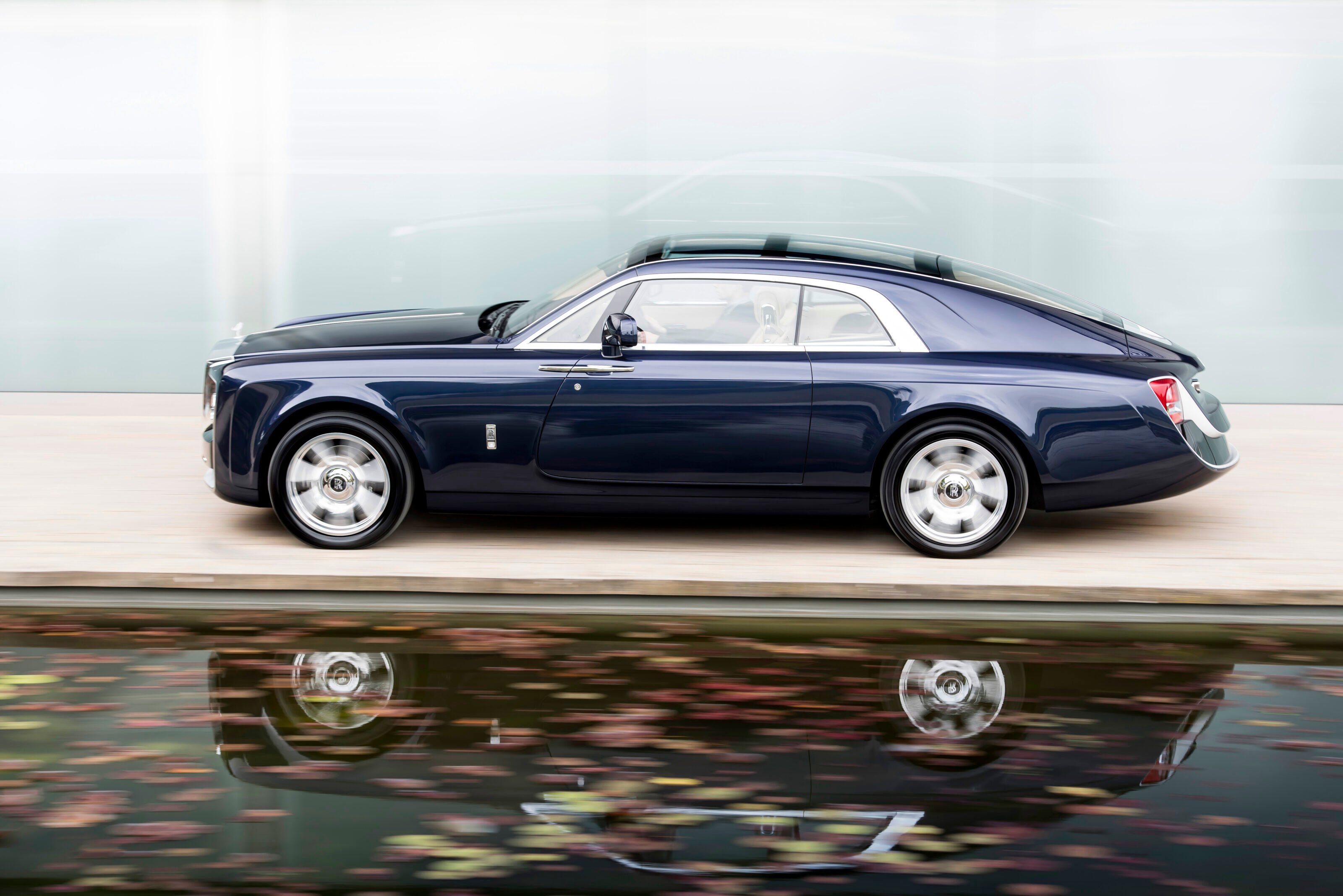
Its bread-and-butter vehicles such as the Cullinan and Phantom are still popular, with the order books for both filled until the third-quarter of next year, while Rolls-Royce’s bespoke, coachbuilt creations also remain in high demand.
CEO Torsten Müller-Ötvös said 2021 was a strong year for the manufacturer as it looks to push forward into the future.
“This has been a truly historic year for Rolls-Royce Motor Cars,” said Müller-Ötvös.
“In the past 12 months, we have recorded our highest-ever annual sales, launched the latest addition to our Black Badge family, stunned the world with our coachbuilding capabilities and made huge strides into our all-electric future.
“As always, it has been made possible by the dedication and commitment of the extraordinary people at the Home of Rolls-Royce, our international team and our global dealer network. I wish to extend my thanks and congratulations to each and every one of them: it is my privilege and pleasure to work alongside them every day.”
The British marque also teased its first electric vehicle last year, planning to launch the Spectre in 2024 as it moves to a fully-electric model line-up by 2030, likely using technology from parent company BMW.
Tesla has given the 2022 Model S a minor update, facelifting its flagship model while also adding convenient technology tweaks which could benefit all markets.
According to Electrek, the updated Model S was revealed in Taiwan, featuring more powerful matrix projector headlights as well as a Model 3-esque rear end, deleting the piece of trim which would usually sit over the numberplate to create a smoother, sleeker finish.
While the front-end changes have been rolled out on recent Model S units delivered in North America and show up on Tesla’s Australian website, it’s the first time the tweaks have been seen outside of the electric vehicle manufacturer’s home market, as well as being the debut for the new rear-end.
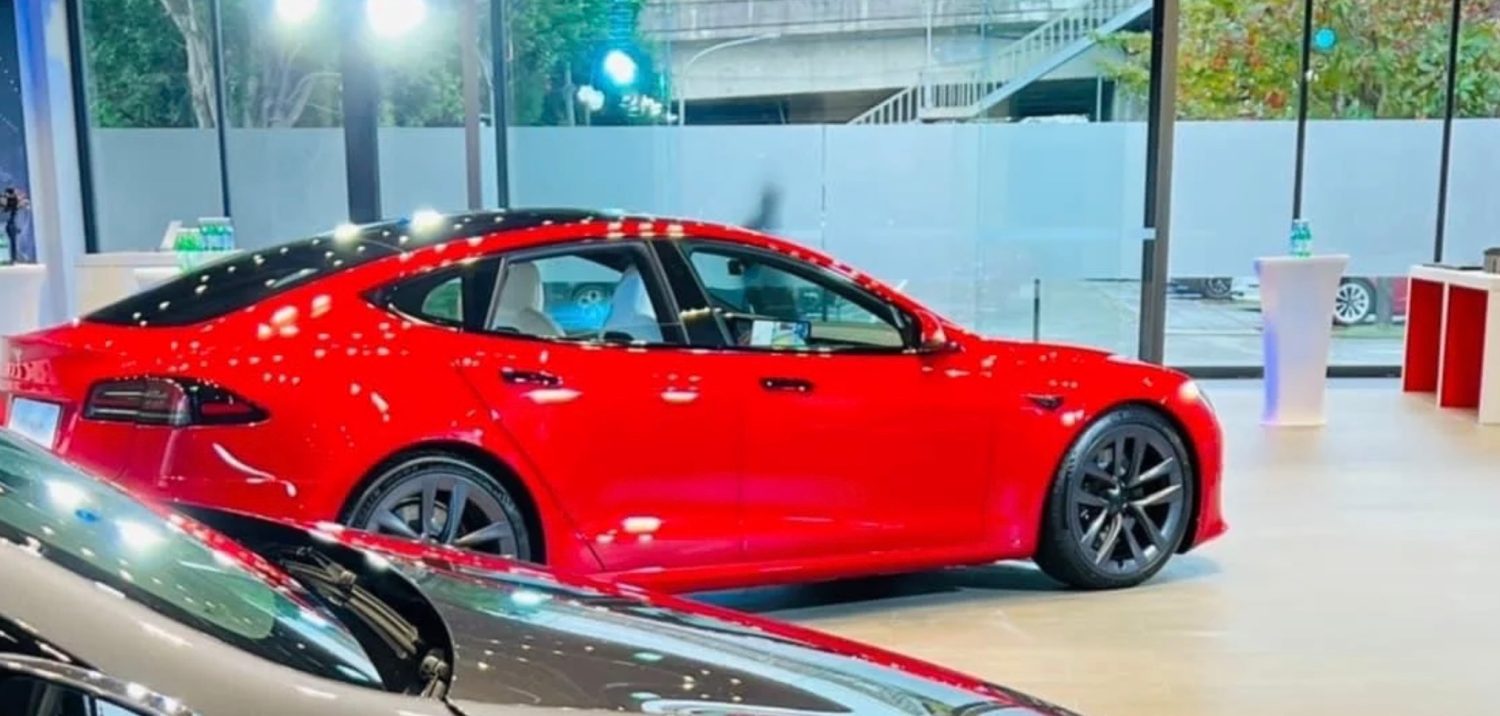
The 2022 changes are more than skin deep, with CCS charging ports now standard on the Model S and Model X SUV, bringing them into line with what is becoming the uniform third-party charging socket.
Model 3s have been able to charge via CCS for a few years now while the V3 Superchargers in Europe switched over to CCS recently, with the Model S/X changes meaning the models can now be charged at more third-party charging stations as Tesla also prepares to open its charger network to other makes of EVs.
It’s not known when the 2022 Model S will arrive in Australia with the small changes, as Tesla continues to throw its weight behind Model 3 production to keep up with supply, both locally and in international markets.
UPDATE, January 12, 2022: The sale of SsangYong to a consortium led by electric truck and bus manufacturer Edison Motors has been finalised, but for the lower price of US$255 million (AU$354 million).
The new investors had originally submitted an offer of US$260 million (AU$360M), but adjusted the bid to the lower amount following a more comprehensive review of SsangYong’s troubled financials.
The sale was expected to go through before 2021 came to a close – a year after the Korean carmaker first filed documents to the Seoul Bankruptcy Court.
The story to here
October 27, 2021: SsangYong may have found a new owner, with a consortium made up of an electric vehicle manufacturer set to lead the company into a new era.
Edison Motors, a maker of electric trucks and buses, heads a group of investors comprised mainly of private equity companies – which put forward a successful offer of approximately US$260 million (AU$350m) according to Nikkei Asia.
SsangYong named the Edison Motors consortium as the preferred bidder in the Seoul Bankruptcy Court earlier this week. The carmaker has been under receivership since April, as authorities sought to help the debt-ridden company find a new owner following Mahindra & Mahindra’s decision to sell its 75 per cent stake.
Despite the turbulent times, SsangYong has been pushing ahead with the development of its future electric cars, with a prototype of its battery-powered J100 four-wheel-drive caught testing on South Korean roads back in July.
“We are going to be a company beyond Tesla Motors in 10 years,” Chairman of Edison Motors Youngkwon Kang told The Korea Post in 2020.
“One of our strategies is focusing on the performance and design of the car that the consumers want.”
It’s understood Edison Motors and SsangYong will sign a memorandum of understanding this month, with the aim to settle the acquisition before the end of 2021 – a year after the Korean carmaker first filed documents to the Seoul Bankruptcy Court.
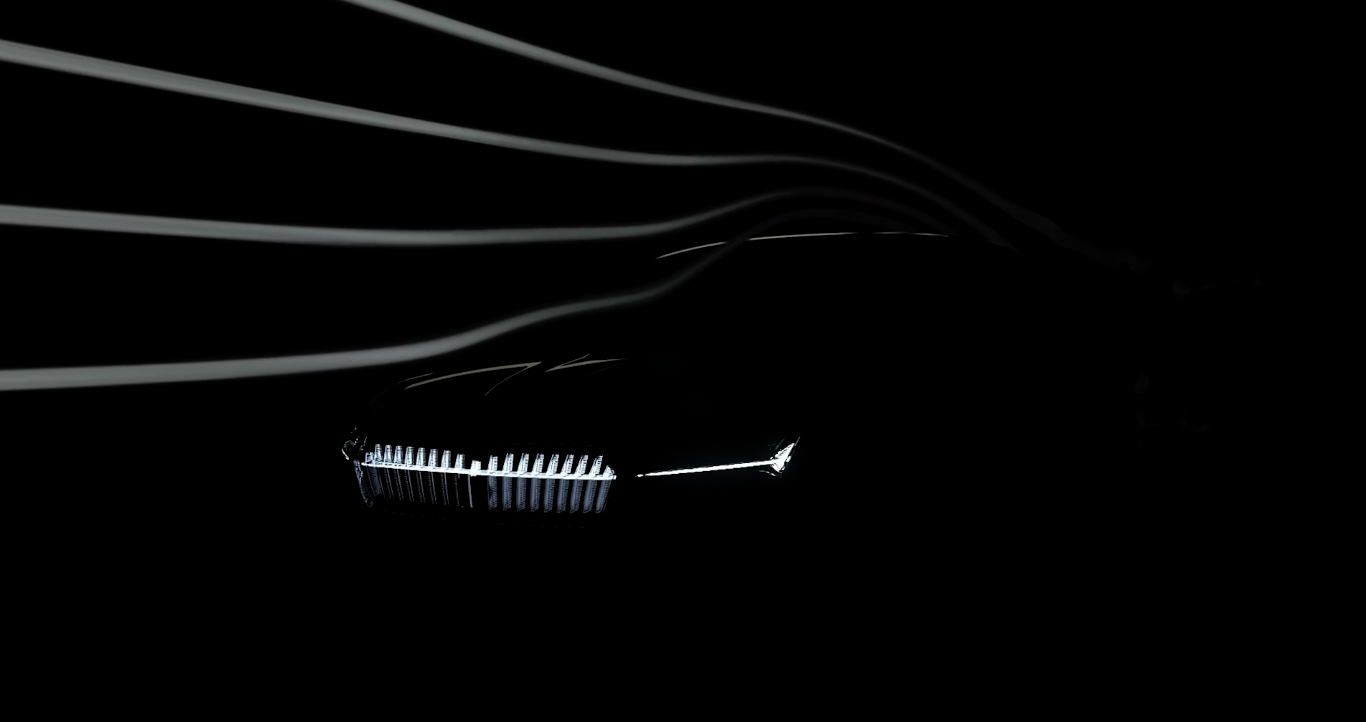
UPDATE, January 12, 2021: We’re now less than a month away from Skoda officially revealing the new Enyaq Coupe iV, but that hasn’t stopped the Czech manufacturer from giving out more teasers of the electric SUV.
Sketches of the “sportback” coupe show a similar roofline to that of the Volkswagen ID.5 – as expected, given the two cars are based on the same platform.
While we’ve previously seen camouflaged shots of the Enyaq (below), the design sketches highlight its striking, angular front end as well as the sharp side profile – although it’s unlikely to ride on wheels as big as those pictured.
The story to here
December 16, 2021: Skoda has announced it will reveal the new Enyaq Coupe iV on January 31, 2022.
Officially breaking cover for the first time, we’ve already seen what the sportback SUV looks like in camouflage (further below), but not as a production-ready vehicle – although its design will likely blend the Enyaq with Volkswagen’s recently-launched ID.5.
The Czech manufacturer has boasted its new electric model has a class-leading drag coefficient of 0.234cd, allowing the Enyaq to potentially extend its driving range beyond that of its ID.4 cousin.
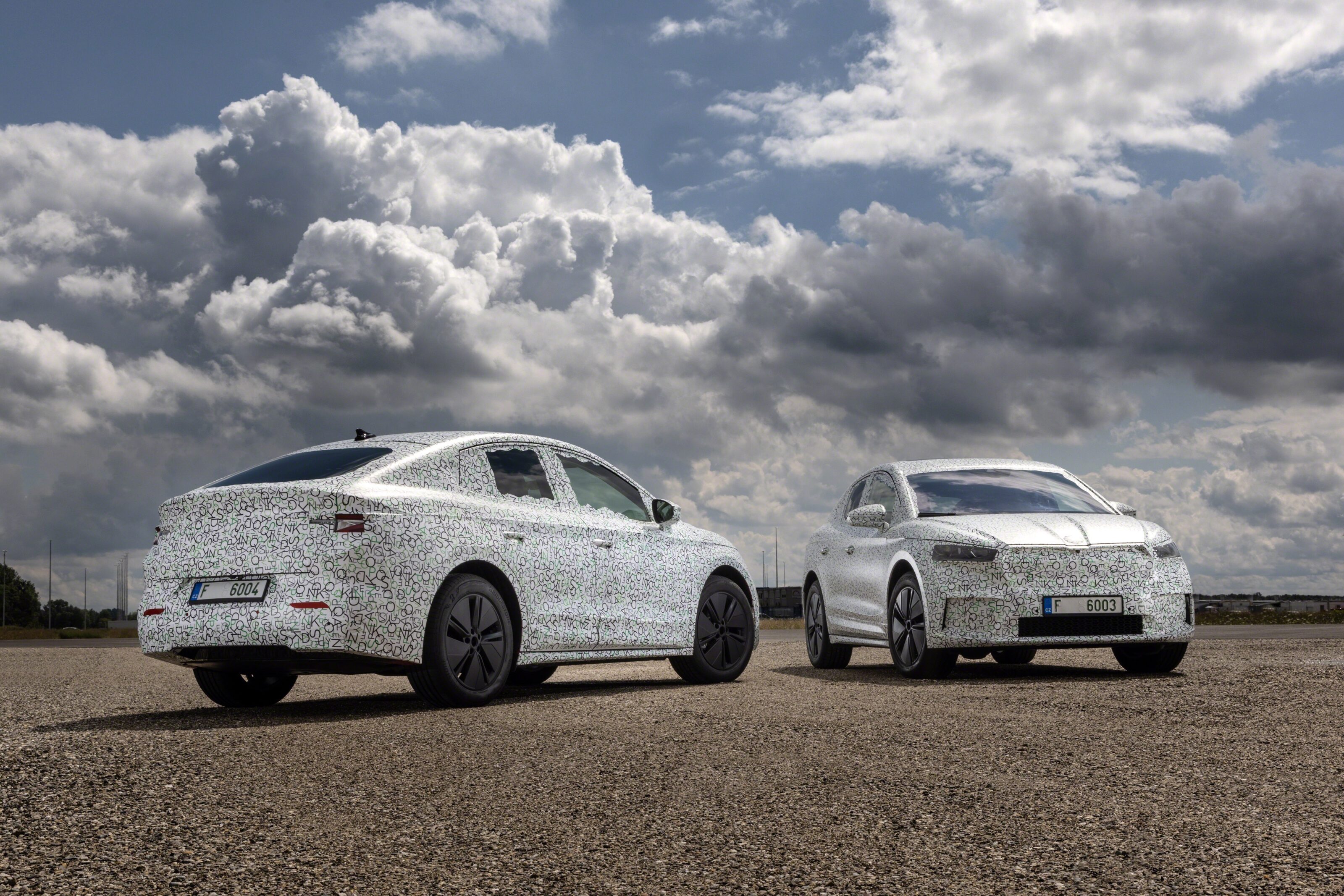
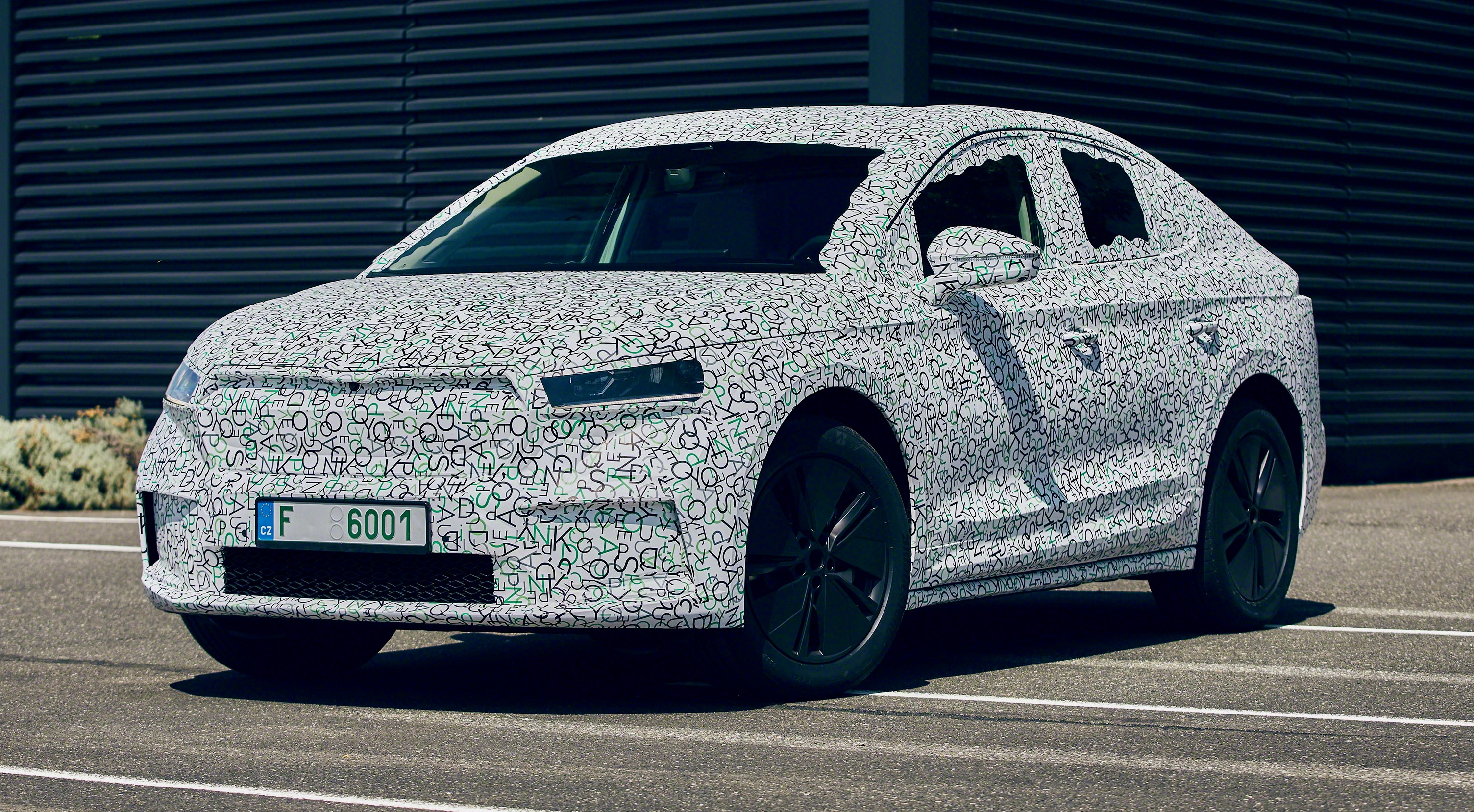
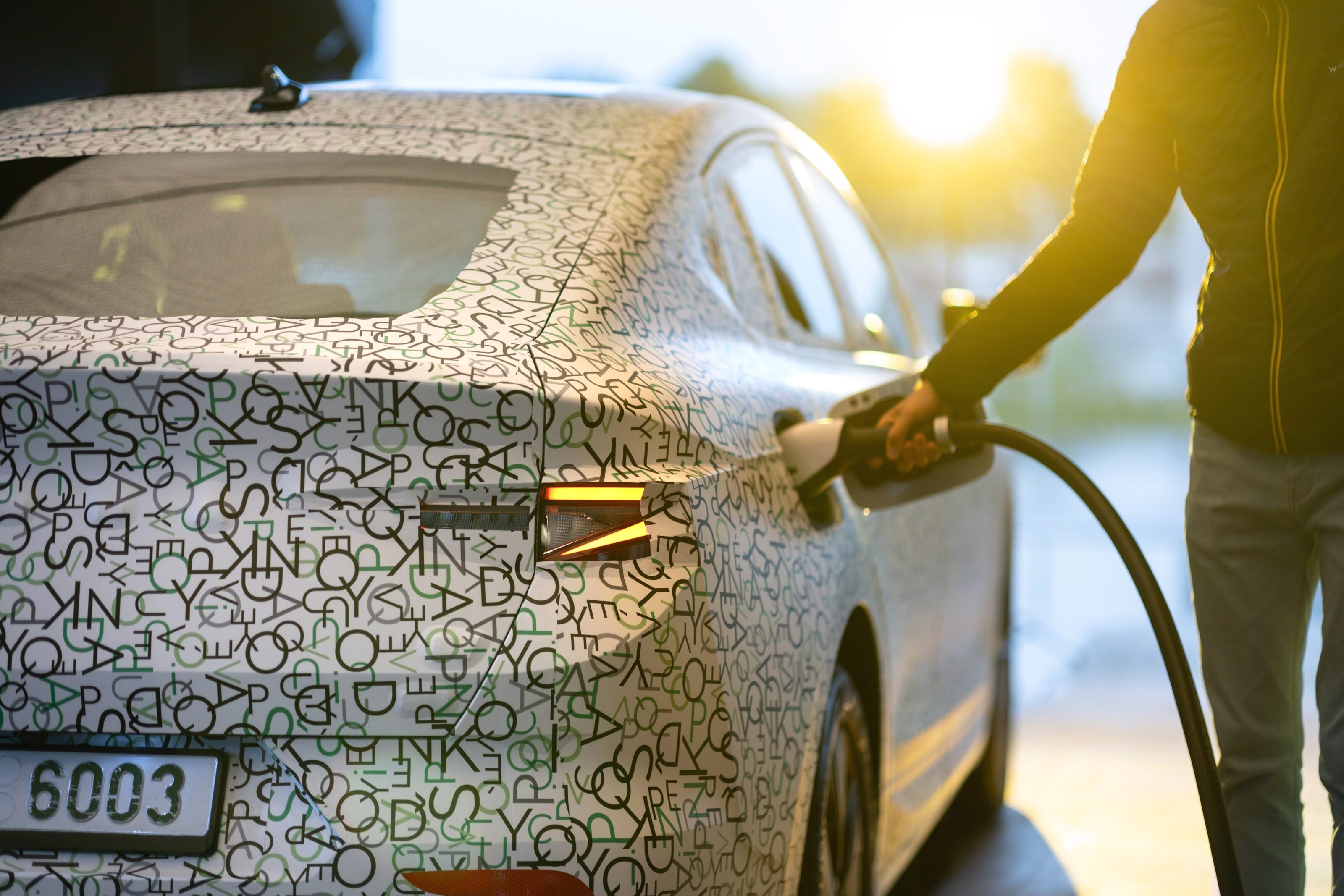
September 7, 2021: The 2022 Skoda Enyaq Coupe iV has been teased in camouflage ahead of its unveiling.
As a derivative of the Enyaq iV SUV – the first all-electric vehicle from Skoda – the new Coupe will offer greater levels of aerodynamics thanks to its sleek body.
Skoda claims the Enyaq Coupe gains around 24 kilometres more driving range over the standard Enyaq (WLTP test cycle) when optioned with the larger battery, up to 534km in total.
Buyers can choose either a 62kWh battery variant, powering the rear wheels with a 132kW electric motor, or an 82kWh version with dual electric motors offering all-wheel drive and peak power of 195kW. A 150kW rear-wheel-drive version with the larger battery is also available, and provides the best driving range.
Like the regular Enyaq, optional fast-charging capability is expected to allow the Coupe to reach 80 per cent of charge from 10 per cent in 38 minutes at at rate of 125kW.
Both models are underpinned by the MEB electric vehicle architecture – the basis for many Volkswagen Group battery-electric vehicles from the Cupra Born to the Audi Q4 E-Tron.
Inside, the Enyaq Coupe will largely carry over the interior from its larger sibling, offering a 13.0-inch infotainment screen as standard. The driver gets a 5.3-inch digital instrument cluster – and a head-up display with augmented reality will also be available as an option.
Despite being wrapped in camouflage, the exterior styling of the Enyaq Coupe is also expected to be familiar – sloping roofline aside.
While a spokesperson for Skoda Australia wouldn’t say whether the Coupe was under consideration for a local release, the Czech carmaker is hoping to bring the regular Enyaq iV electric vehicle (EV) to Australia in the future.
“As the [Munich motor show] is [demonstrating], demand for EVs is surging in Europe where those factories are located,” the spokesperson told Wheels.
“The business case for a right-hand-drive market at the end of the global supply chain is a tougher sell.”
The 2022 Skoda Enyaq Coupe iV is expected to go on sale in Europe in early 2022. Stay tuned to Wheels on Facebook, Instagram, and Twitter for any local announcements.
Snapshot
- New SL due in 55 and 63 forms, AMG only
- Australian debut set for second-half 2022
- SL 55 tested here: 350kW, 700Nm, 3.5sec to 100km/h
Everyone loved the new SL at first sight. Gary the God-botherer and graffiti artist in his ramshackle caravan perched on a hill near Desert Shores. The tanned ageless retiree at the wheel of a bleached-black S55.
The poker-faced valet who made the $10 tip disappear with the ease of a seasoned casino croupier. The young surfer dude and his two nymphettes in San Clemente. The highway trooper who flagged us down at 55 in a 55mph zone just because she could.
We also got loads of thumbs-up from hikers and bikers of all ages. The homeless Trumpists at Bombay Beach. Sean the uniformed immigration officer from El Centro near the Mexican border, who knew full well that the gleaming steel blue roadster was not Checo and Conchita’s Trojan horse taxi to the promised land.
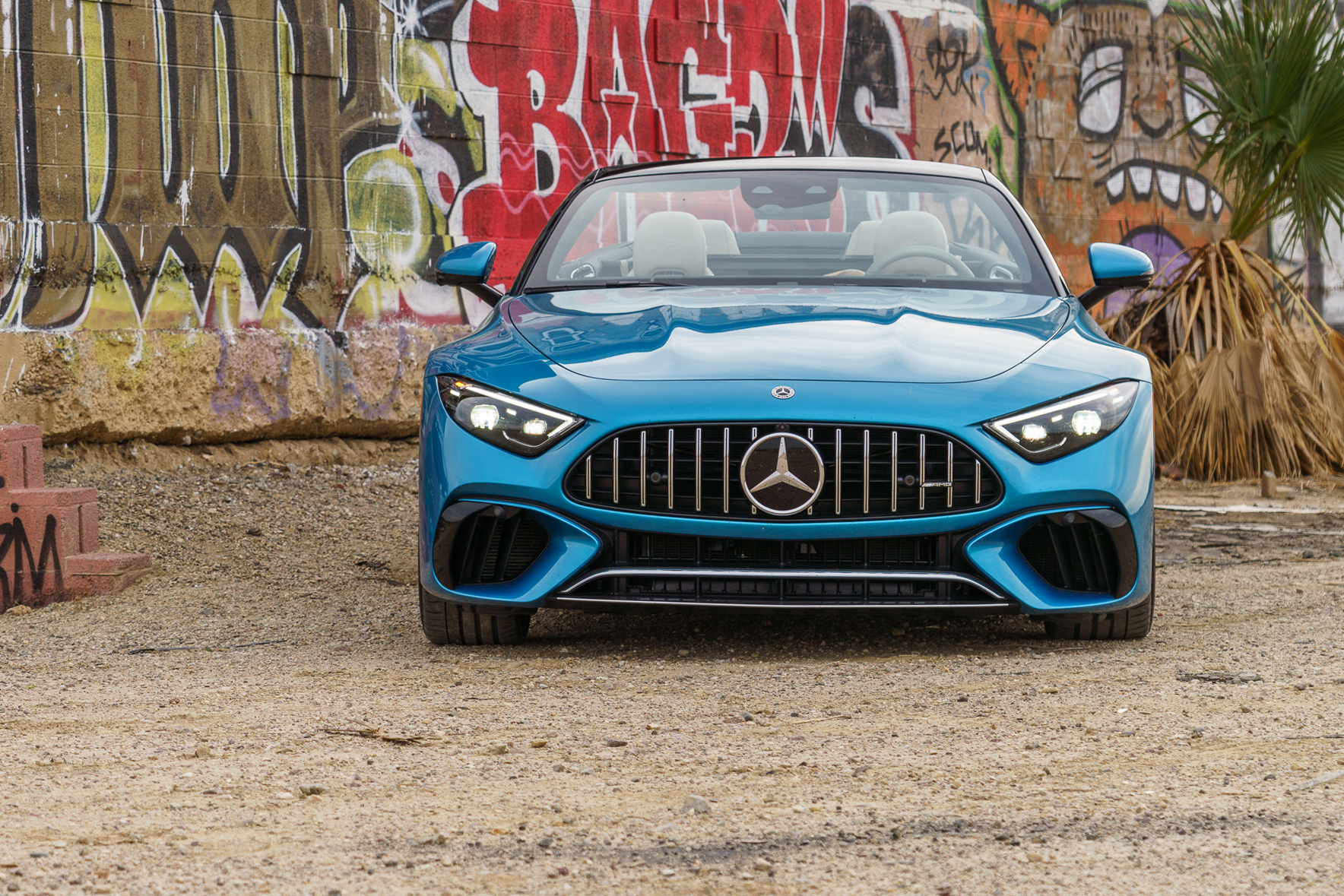
They all fell for a car bound to alter the brand’s long-running glide-and-grunt balance by moving the new ragtop a couple of notches deeper into sports car territory. The R232 was, after all, developed by AMG, not Mercedes-Benz.
It introduces an advanced multi-material architecture which is stiffer and significantly lighter even though the end product is 180 kilograms heavier. Why? Because it comes standard with four-wheel drive, active sway bars, rear-wheel steering and a fancy five-link front suspension.
The test car´s carbon-fibre brakes and 21-inch wheels cost extra. Jochen Hermann, who runs the Affalterbach tech show, describes his latest baby as a much more dynamic proposal which can for the first time challenge the Porsche 911. But can it?
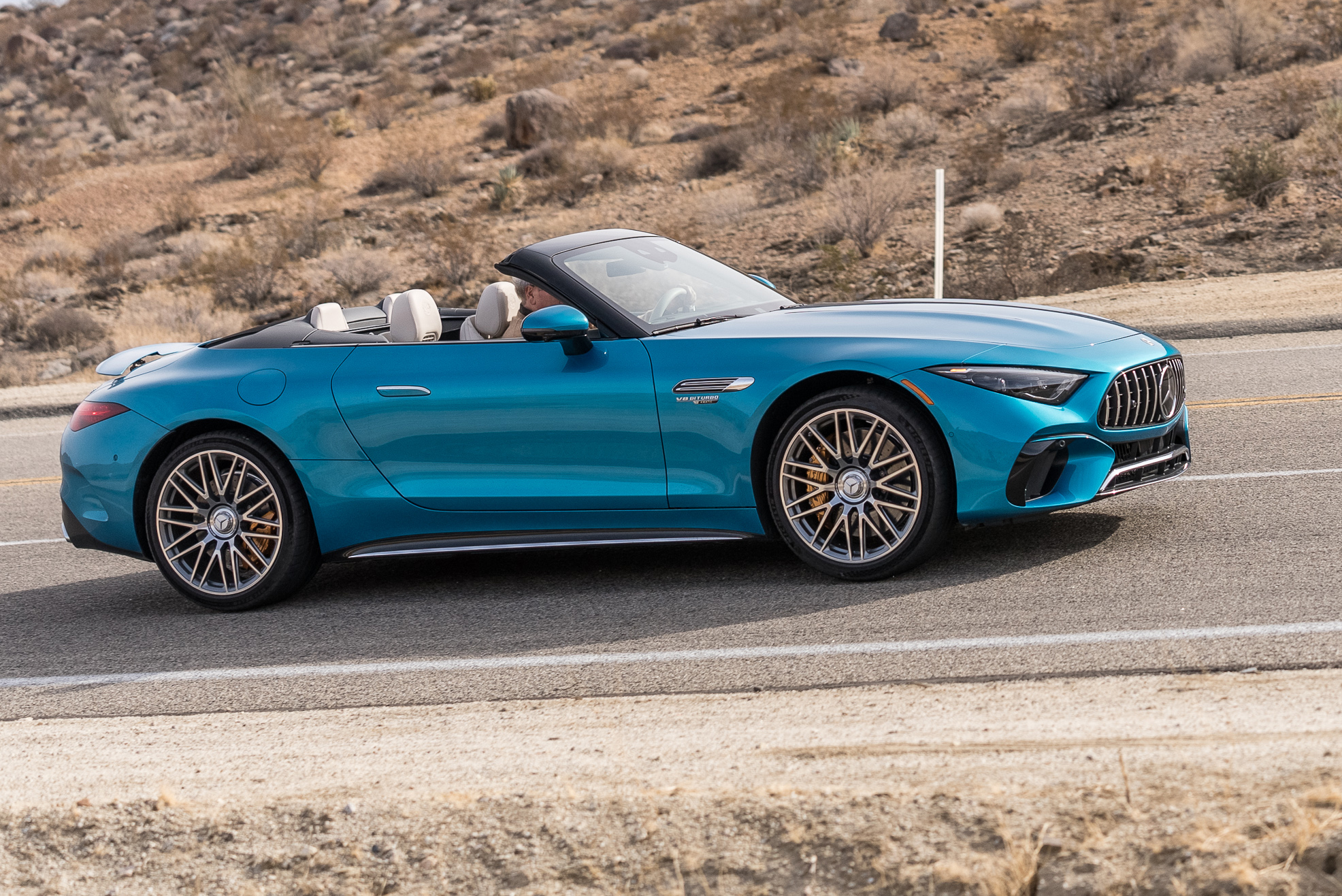
The round rear end certainly pays subtle homage to that other Swabian sports car icon and the performance is on a similar level. The latest SL even gained two token rear seats, but they are better suited for a couple of soft bags than for toddlers.
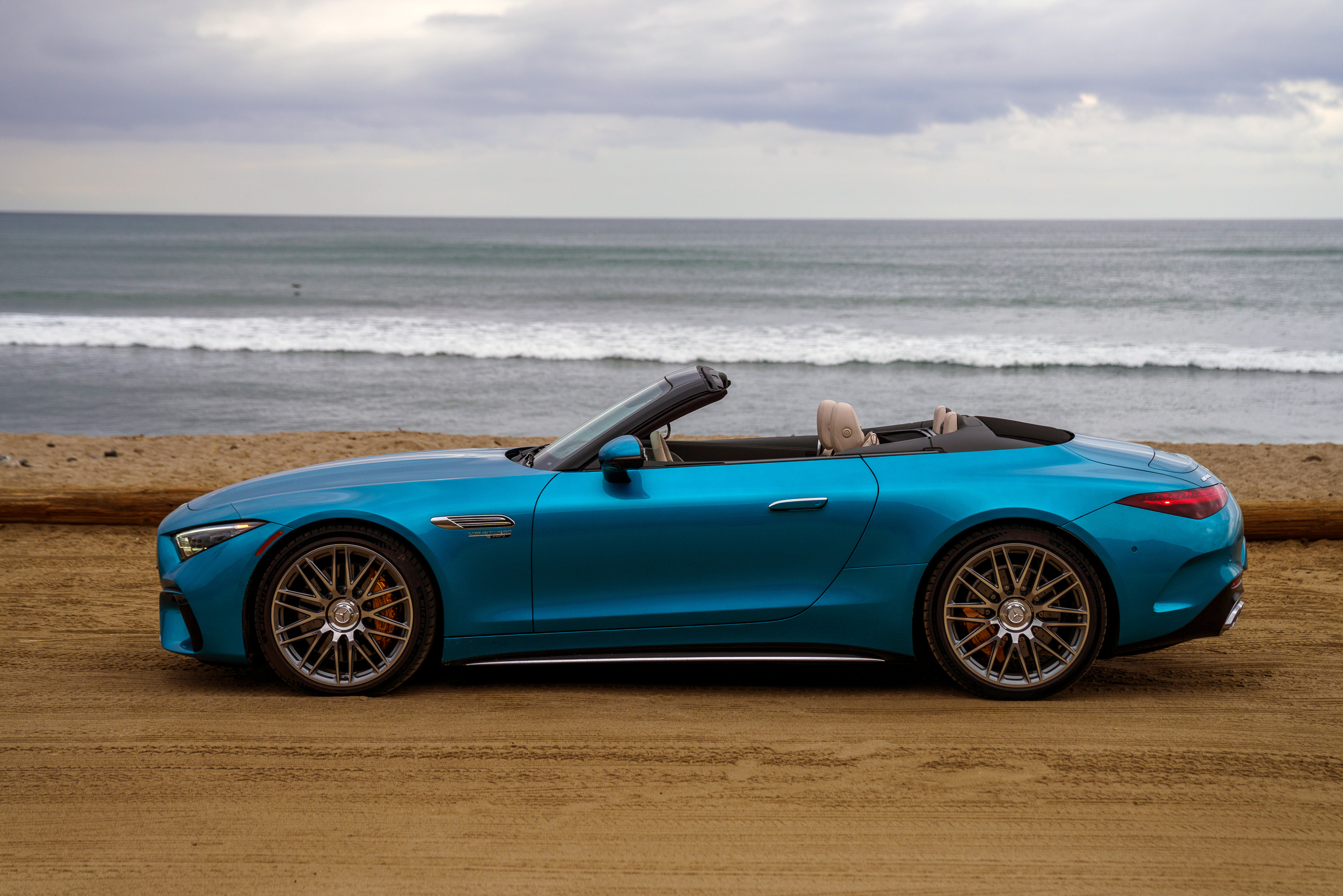
Down by the sea in Newport Beach, where roaring Lambos keep racing whirring Teslas between sets of traffic lights on streets paved with gold, the new SL instantly belongs. It looks cool and classy, from some angles even sexy. It radiates the right mix of fresh bling and trad brand identity.
It is without a doubt the latest must-have member of a fast-expanding model family. Here in Rolexdom and Guccitown, this novelty value does not pass unnoticed. At the filling station, people ask questions like,”Is the fabric roof superior to the retractable hardtop?” and, “Has the power output gone up?”
Yes, and yes again. Predictably, no one cares about electrification, fuel consumption or asking price. After all, we’re in Southern California where it never rains except this morning and the day after.The Pacific coast between Santa Barbara and Dana Point is home to the rich and very rich who seem to work at night so they can spend the day in exercise-and-relax mode. A flawless physique and a spot-on livery are the prime entry tickets to this laissez faire community, so the SL fits perfectly, no questions asked.
Twenty miles inland however, where scorching heat triumphs almost all year round, the demographic mix changes radically as a handful of landlords command battalions of immigrant farm workers in a much rougher social climate.
On the LA to Phoenix flight path, we join the direttissima to the location of the opening scene of John Krakauer’s Into the Wild near Lake Henshaw. From there, the route heads via Borrego Springs to the biologically dead Salton Sea – the largest lake in the State of California – which was generated early last century in the wake of a massive overspill from the Colorado River.The road that cuts through the Anza Borrego desert is lightly trafficked but in poor condition. Although the Active Ride Control – a combination of steel springs, adaptive dampers and hydraulically-adjustable anti-roll bars – foam-fills the deepest potholes and tames the worst transverse irritations, the droning low-section 20-inch tyres mar the low to mid-speed ride. Apart from the artificially amplified flap-operated sports exhaust, road noise and suspension thump are the only persistent acoustic intrusions.
The soft-top is hush quiet when closed, the wind force tamed by the excellent drag coefficient of 0.31. The Burmester sound system plays an unwavering first fiddle even when the V8 feels like boosting the volume of the back-up choir. Still in the comfort zone, we must also mention the supportive massage seats, the heated door panels and armrests, the standard neck warmers and extensive online connectivity.
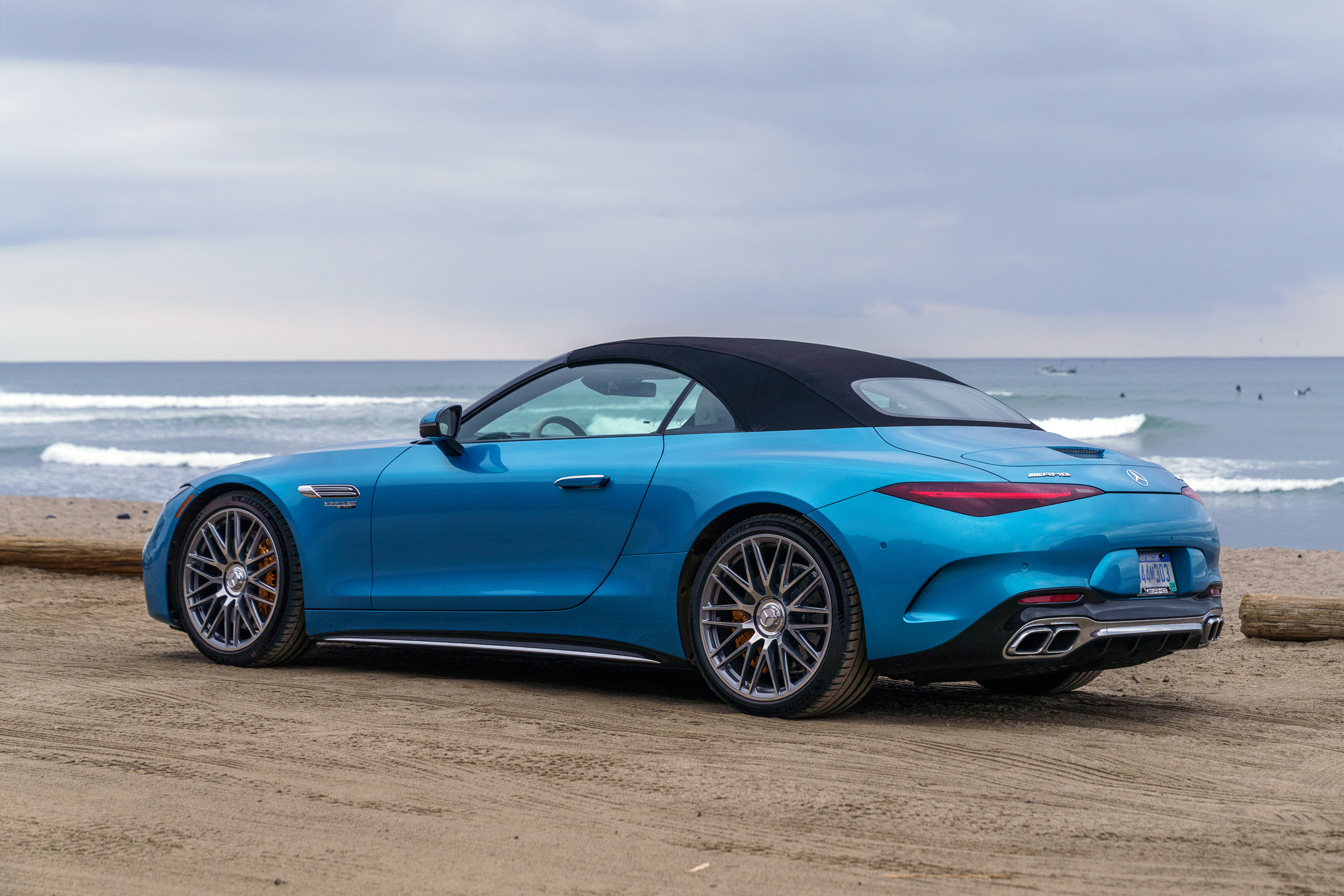
It’s the packaging that creates more confusion than consent. After all, the new SL boasts a pair of bonsai rear seats which automatically make the boot volume shrink to 213 litres with the top down. The previous model could swallow a much more useful 485 litres with the roof up.
Marketing tells us that more space behind the front seats topped the owners’ wish-list, so Mercedes duly obliged. Since the S-Class soft-top, the SLK and now also the AMG GT coupé plus roadster have all been discontinued, the SL is the sole remaining high-end open-air Benz.
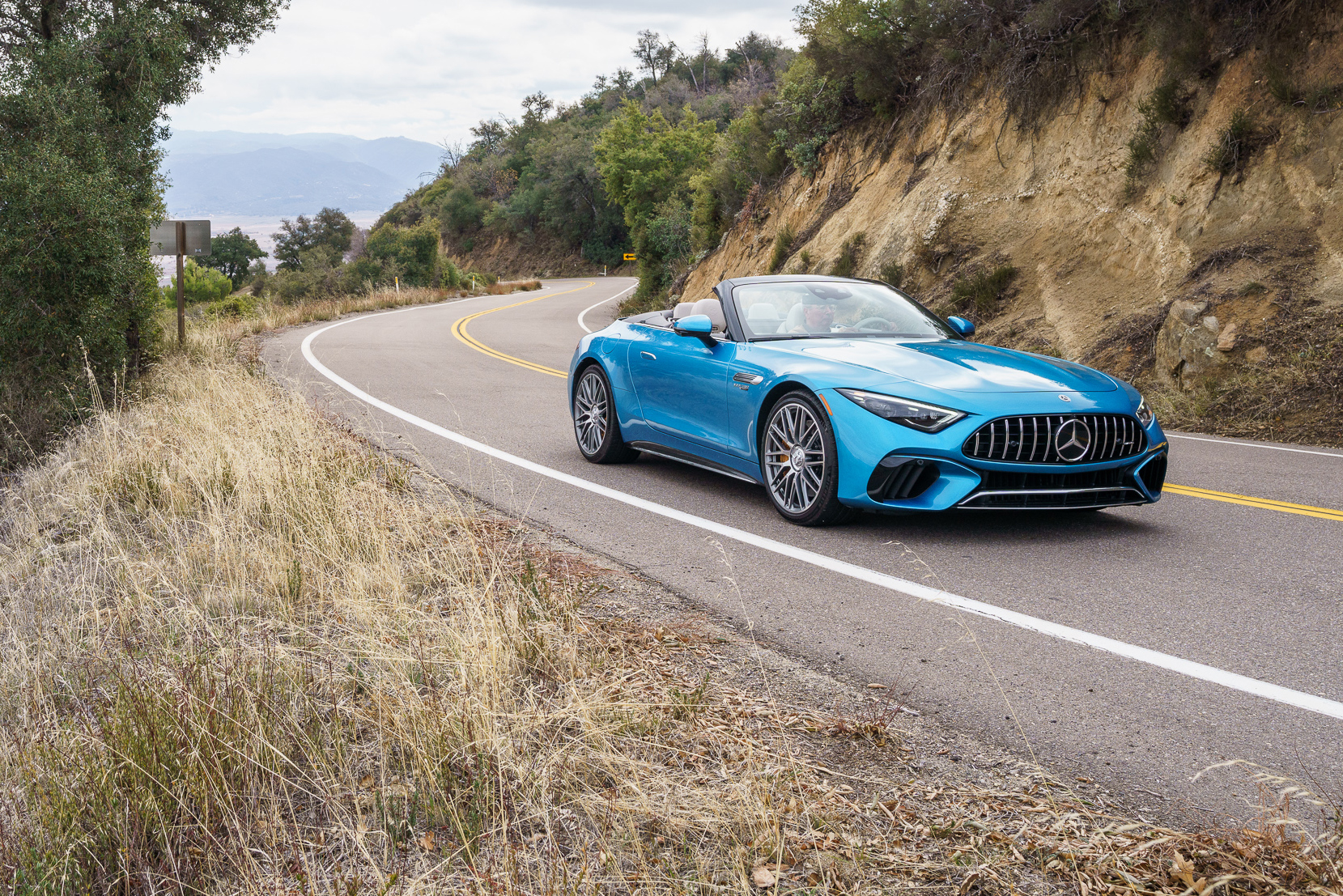
Its sole future internal rival, the 2023 CLE, replaces the C-Class and E-Class convertibles, is also a 2+2. A slightly narrower, shorter, sportier and even more driver-focused SL might have been a more compelling option.Two more hours into a murky day, we´re ripping tarmac on the awesome C and D roads which meander from the Santa Rosa to the Vallecito Mountains. While the pale-faced snapper in the passenger seat is fighting nausea, the driver locks in his favourite settings: nine-speed transmission in manual and Sport, Dynamic Select in Race, AMG Dynamics in Pro. ESP remains active but is now on the longest available leash.
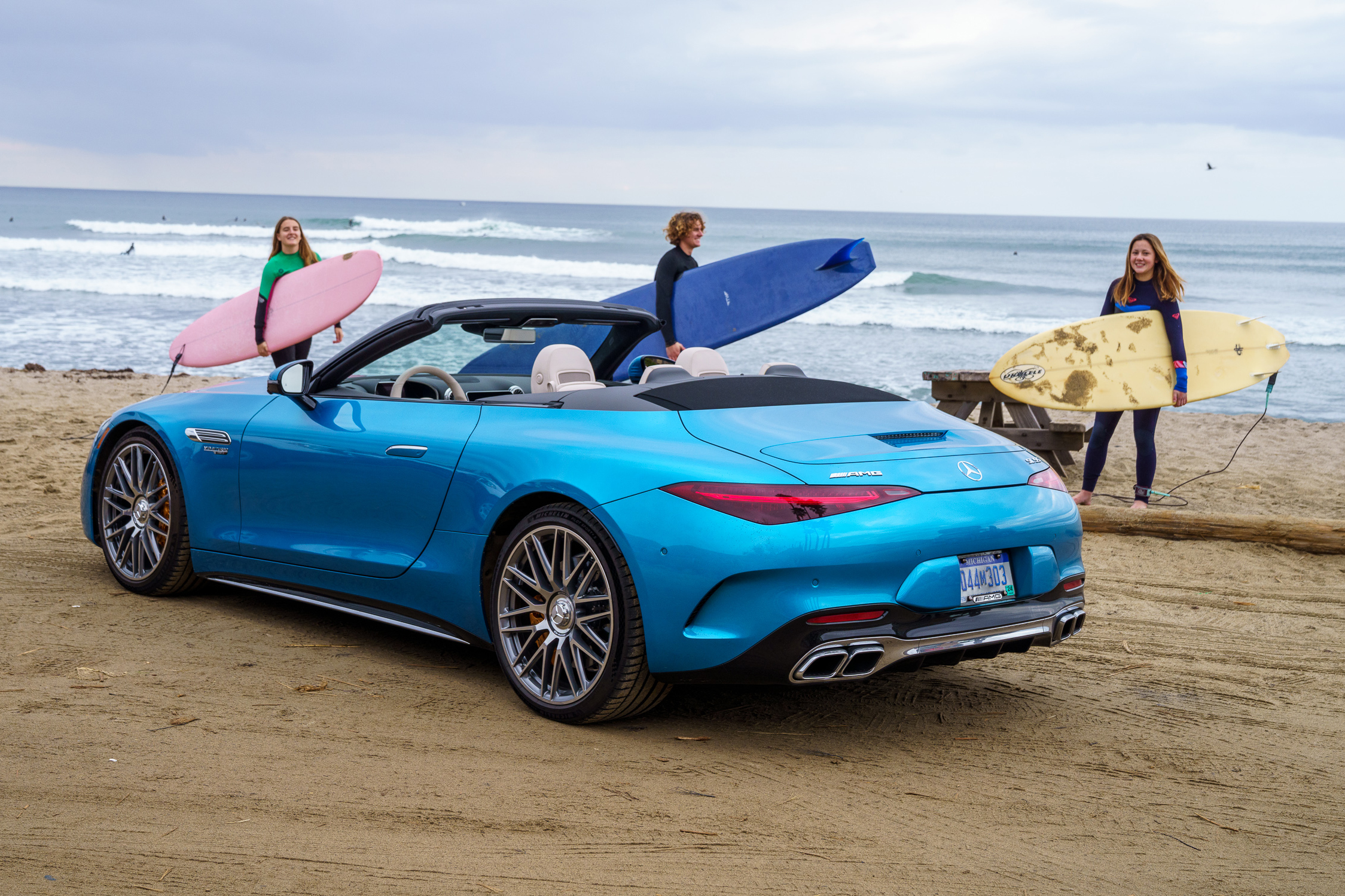
Race activates the fastest shift speed, the quickest steering response front and rear, the tautest damper setting and the most rapid throttle action. Most of the blind corners, crests and dips are third-gear stuff. But when second is mandatory, the short gearing and the high rev level can delay the execution for a couple of awkward moments which leave you with rather a lot of momentum to be swiftly washed away.
Although there are nine ratios to choose from, the wet take-off clutch and the aggressively spaced three bottom gears clearly favour instant low-end acceleration kicks over mighty mid-range punches.After 360km and the third distance-to-empty warning, we fill her up in the middle of nowhere at a cash-only petrol station and convenience store where Alfredo’s yummy chicken burrito easily beats the taco bar at the Parker hotel. Back on the road, this morning´s irritating initial impression is back in fresh force. Case in point is an odd stickiness which ties the steering to the straight-ahead position.
As soon as you consciously wind on a little bit of lock, this chewing-gum effect alerts the front wheels and creates an interdependent yet inconsequential indifference. This lane departure prevention type of robotic double handshake recedes as soon as the turn-in angle increases, and it does not show at all through corners.
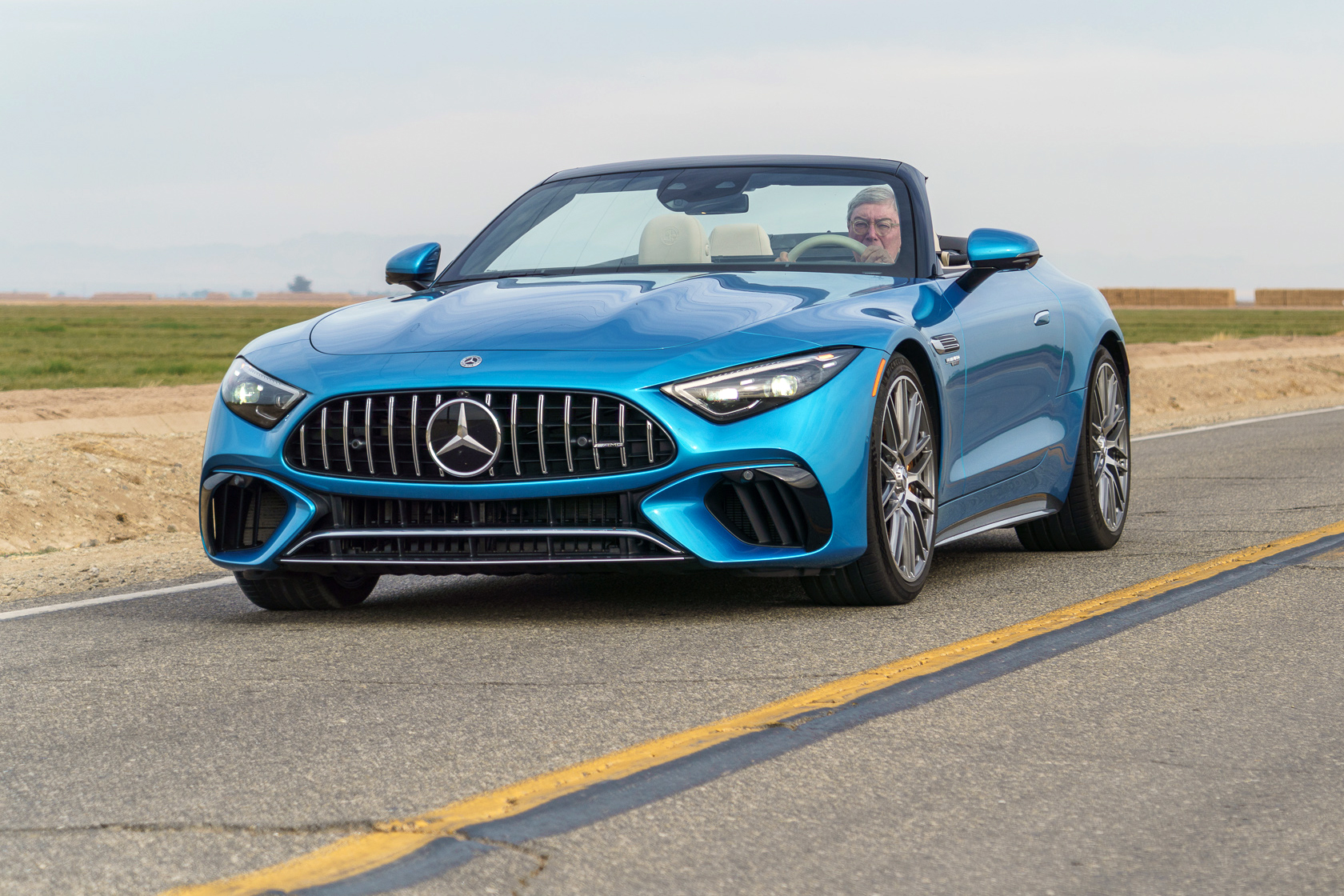
The wider the bend, the more intriguing becomes the interplay of steering, rear-wheel steering, 4Matic Plus and throttle. The combined feedback, the progressively changing torque bias and the momentary brake interaction at the limit are reassuringly 3D haptic and precisely measured. Nice.Looping through El Centro, cheers and whistles follow the hyperblue Mercedes from turn to turn. Now and then, streetwalkers step forward to offer their wares. At the traffic lights, stooped beggars mingle with wiry dope sellers and juvenile windscreen cleaners – is this where they filmed Soylent Green?
With the exhaust playing King Kong v Godzilla at every blip of the throttle, the SL enjoys playing the head-turning outlander in this grid-pattern arena owned by pneumatic low-riders, tricked-up Mustangs and Camaros and wide-body Japanese boomboxes running on nitro.
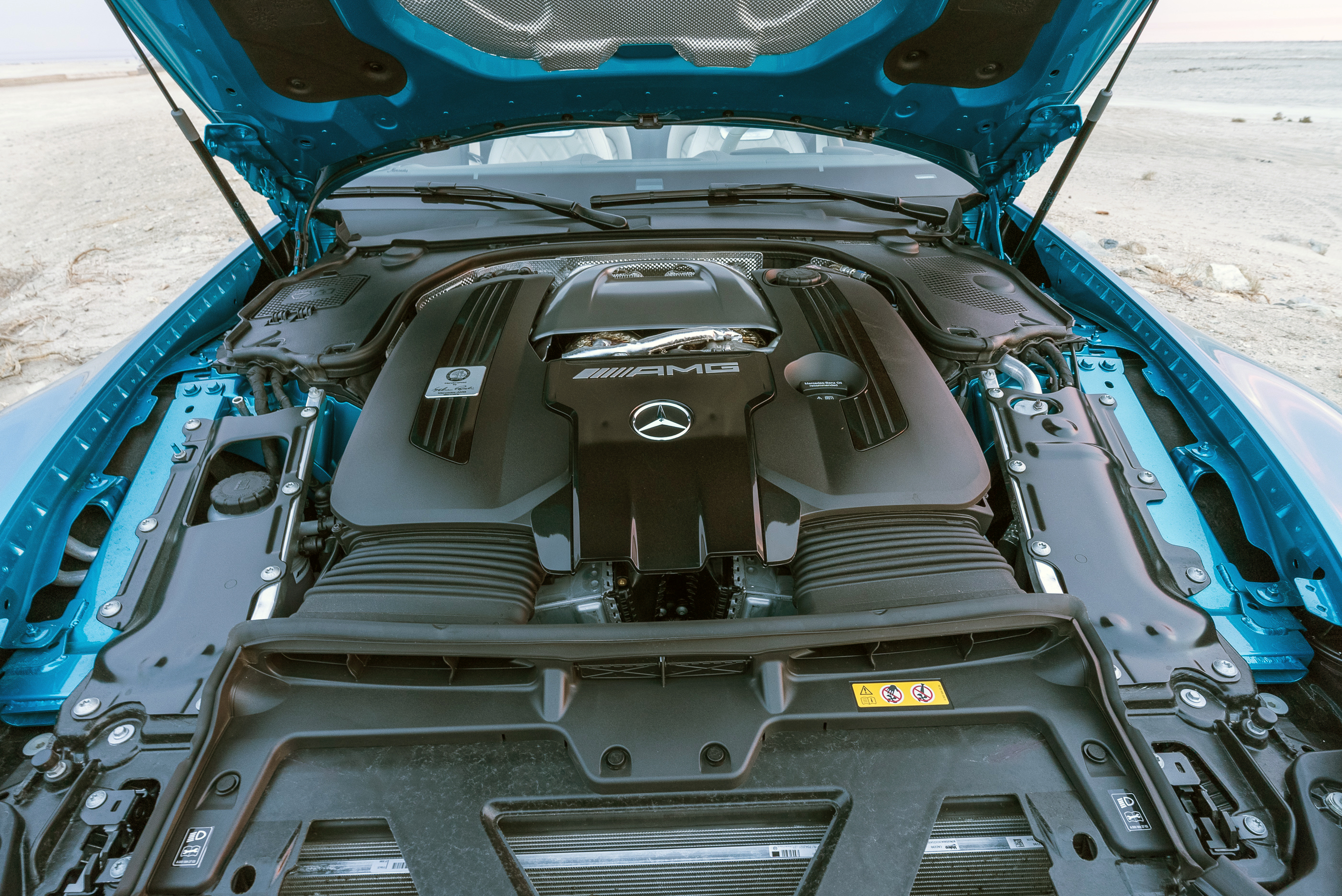
Although the 4.0-litre twin-turbo V8 fitted to the SL55 AMG musters a relatively unexceptional 351kW (436kW in the SL63), its 700Nm of torque are plenty to complete the 0-62mph sprint in 3.9 seconds. The top speed is an equally adequate 298km/h.
While the completely unelectrified SL55 shows zero ambition to drastically reduce its CO2 footprint, the future plug-in e-performance models will add between 112 and 152 electrically generated kilowatts to the table.
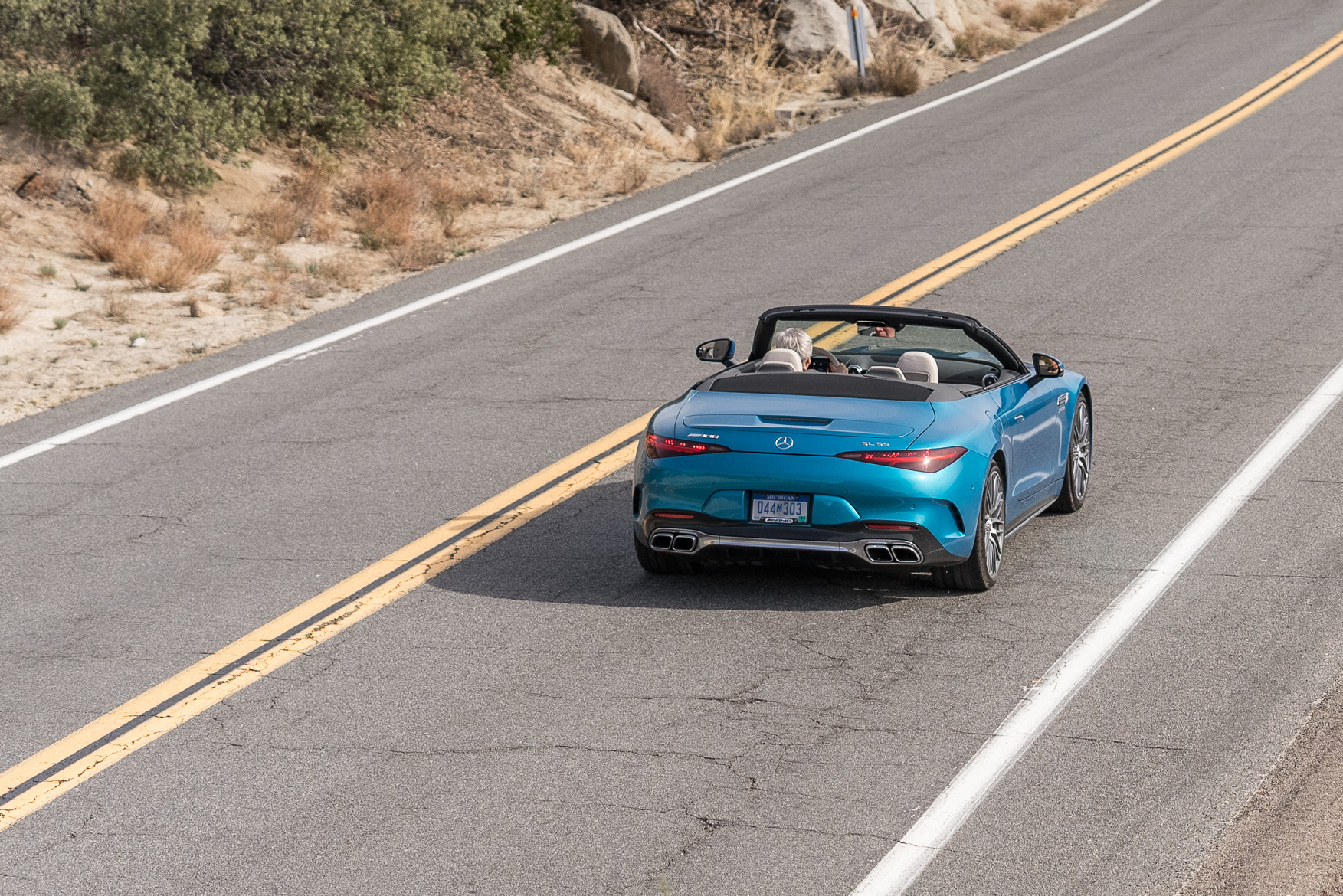
Within one and the same day, we keep diving into and resurfacing from three different Californian mindsets, not seldom done in rapid succession. Most of the way, young, educated and healthy positive thinkers are in the minority. Instead, the new normal is the hard-hit middle class which is struggling to maintain a standard of living and the matching facade.
Also growing in number is the grey army of disillusioned desperados who ride the downhill spiral to homelessness and addiction. About 160km south of Palm Springs – dreamtown of well-off Boomers who like to go to bed with a large Scotch and their favourite seven iron – we travelled through dilapidated places like Calipatria, Slab City and Bombay Beach, where the dole queues are longer than the Grand Central freight trains calling at toxic lithium mines and mushrooming fertiliser factories.
Deprivation and hopelessness are omni-present in these outcast, skid row dwellings where people live in makeshift houses or forever grounded trailer homes. Most roads that fork off the 23 end in foul-smelling ghettos down by the water. At dusk, the lake radiates an eerie fluorescent blue.Ten hours after breakfast and five since lunch, the ambitious eye-catcher still leaves no stone unturned to please. Seat massage on? Okay then. Perhaps a coffee break? You can’t possibly call this coffee.
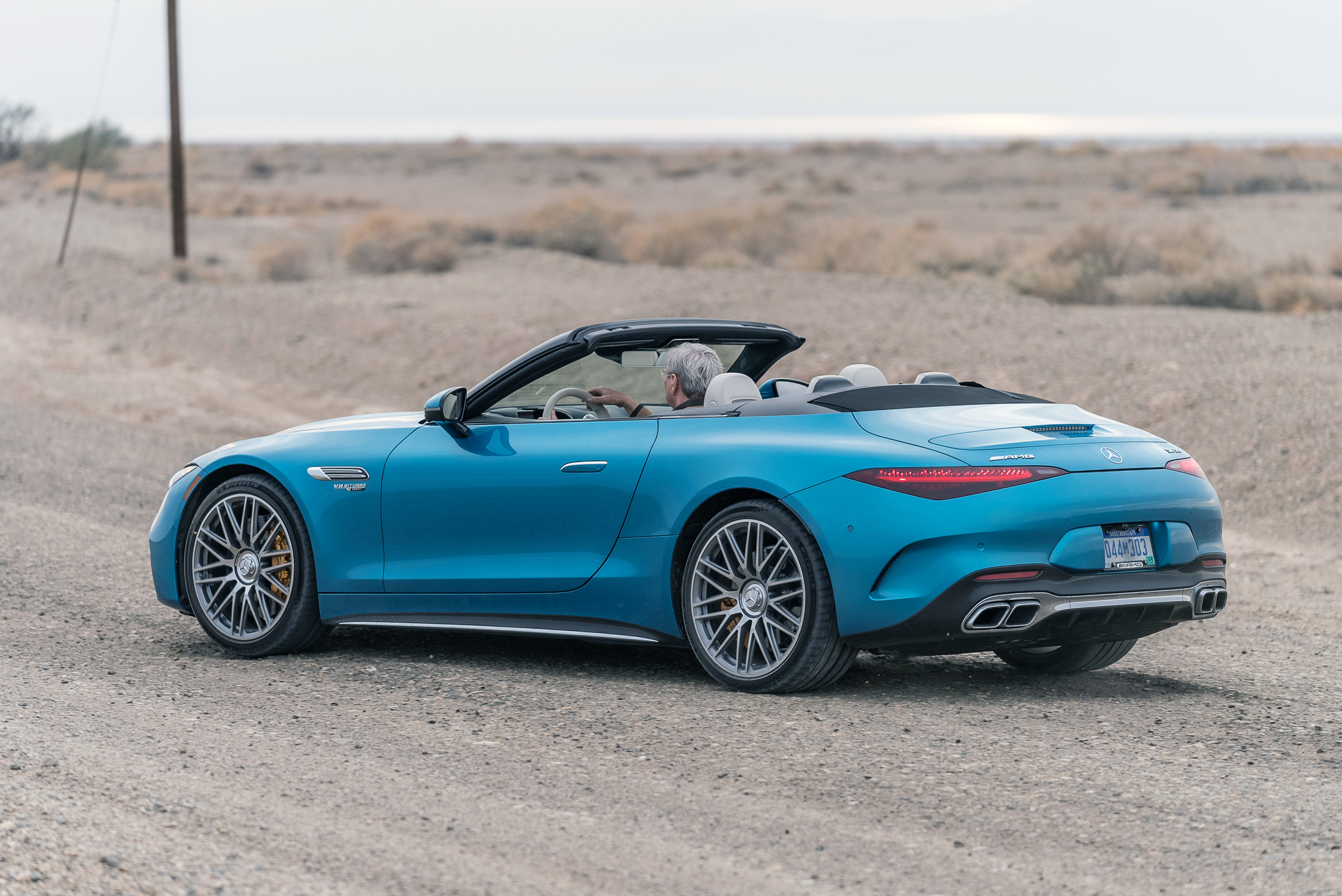
A tourist attraction too good to be missed? Let’s check out Salvation Mountain where a small community of dropouts, eternal hippies and nationalist contrarians follow their own rules, jurisdiction and religion.The Land of the Free stands back with a frown on its face and lets them prevail. We watch and shiver, also because the seat heaters, Airscarf and wind deflector are struggling to keep the crew warm now that the sun has finally set. Closing the soft-top is a two-touch affair that’s over and done in 15 seconds at up to 55km/h.
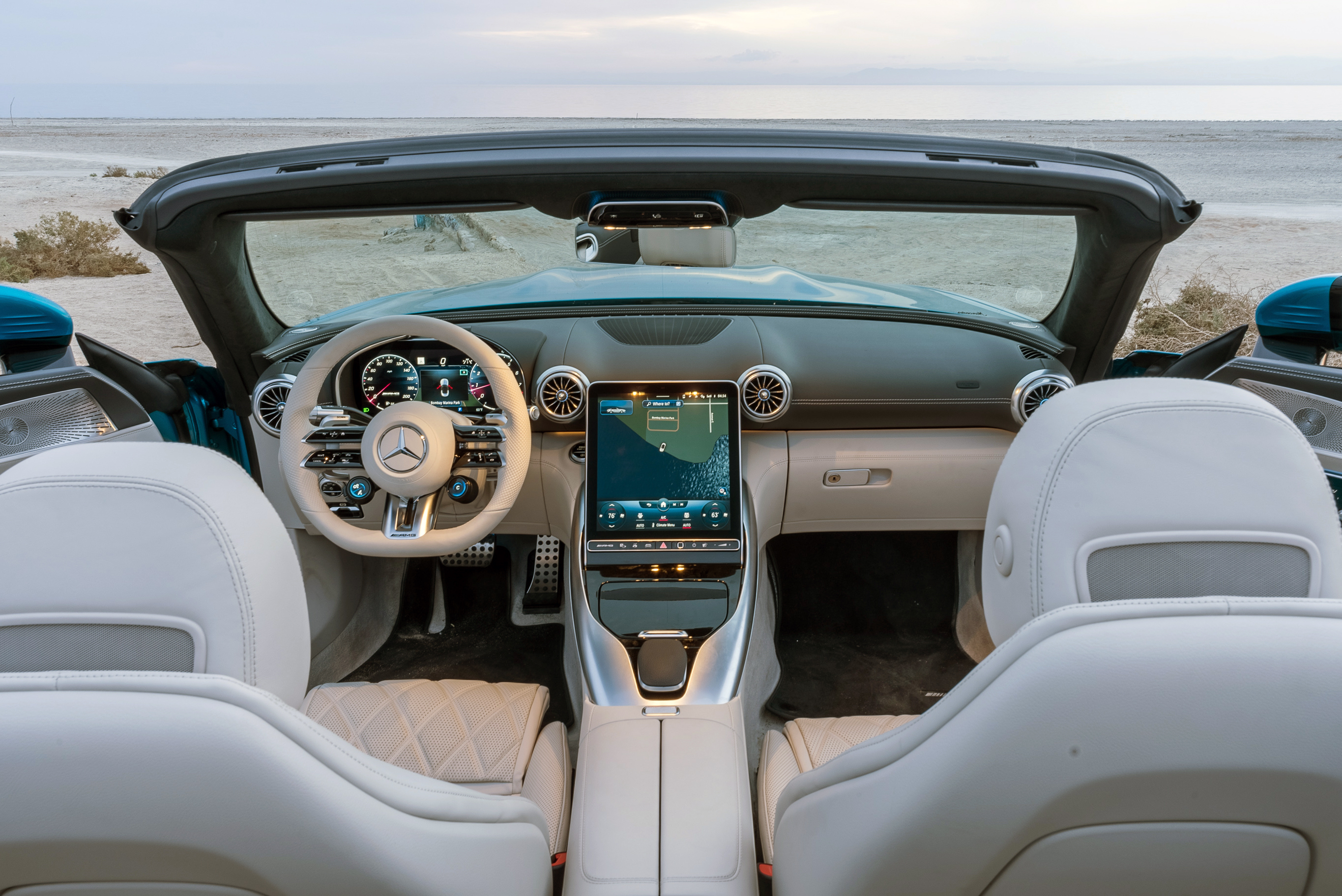
The fabric stack weighs 21kg less than the folding hardtop. Like in the 911, the foremost segment doubles as flush-fitting cover when open. The glass rear window is heated, but the huge three-quarter blind spot needs a seventh sense to avoid disappointment.In a car that sets out to blend so many different traits, idiosyncrasies are almost forcibly the rule, not the exception. Take, for instance, the controversial hyper-analogue cockpit layout which converts the SL´s centre stack into a Tesla clone.
That upright, XXL tablet-style main monitor looks Walmart generic. It rides on an unnecessarily wide and unpadded transmission tunnel It’s crammed with a host of redundant functions, most of which can be accessed via the overloaded, ultra-sensitive capacitive four-spoke steering-wheel. The large main monitor is electrically adjustable in inclination, but not in reach or tilt.
Other key elements of this overkill cockpit are the eight different mode-dependent and colour-coded instrument graphics, the rainbow ambient lighting, the busy head-up display, the distracting night-vision feature and the augmented reality sat nav aids which pop up as blue arrows on the big screen at every turn-off point, intersection and roundabout.
Add to this voice and gesture control, the two multifunction rotary knobs on the steering wheel, the glut of MBUX services, the army of assistance systems and connectivity services, and all you wish for is a leave-me-alone button or a reduce-to-the-max filter.The 111 heading toward Indio is dotted with enough elevation changes, surface variations and different radii to check out how the active aero system, dubbed Airpanel, works. Hidden behind the grille and the lower intake aperture are two sets of selectively blocked horizontal and vertical louvres which control the airflow, thereby reducing drag and front axle lift, or enhancing the cooling performance. The rear spoiler can assume five different positions to maximize the directional stability or to make the car even more slippery above 160km/h.
Last but not least, AMG is offering a lightweight carbon-fibre venturi-effect aero wedge mounted below the front bumper which increases the downforce in two steps. In combination with the stiffer body (the rigidity improvements range from 18 to 40 percent), the re-engineered suspension and the new active engine mounts, the self-adjusting nose cone speeds up the turn-in, consolidates the front tyre grip at high slip angles and takes the sting out of last-minute mid-corner braking manoeuvres.
There are more and more mental notes piling up on the final approach to Palm Springs, which is SL heartland the way marketing used to know and love it before global warming and Tesla changed the world order. Let’s briefly run down the list point by point.
Through the twisties we tackled in early afternoon, it would have been nice to deactivate ASR and ESP separately and in this order, Ferrari-style. Another useful Ferrari inspiration is to engage neutral by pulling both shift paddles simultaneously.
In the SL, coasting is only available in the Eco programme which feels as if the patron saint of the anti-destination league had added half a pint of liquid Valium to the screen washer reservoir. We have yet to unearth the true potential of the Master set-up which can only be activated with ESP off.
None of the minders knew what exactly separates Master from Professional (Advanced and Basic are the remaining two settings of the Performance programme), but there was talk of a particularly loose rear end keen on exercising various drift modes, AMG GT-style.The cabin ambience at night is vaguely reminiscent of a Manhattan cigar lounge with a Keith Jarrett impersonator at the piano, the whole scene glowing in fifteen different shades of blue. Or red. Or amber.
The nicely crafted interior certainly looks as digitally advanced as an expensive smartphone, but unless you have a knack for touching, swiping and zooming through life, the software plays coy before revealing its full potential, which includes one of the most sophisticated voice control systems. By the end of the day, the language processor had even learned to decipher my Austro-Bavarian sing-song.
Disappointments? The most blatant anti-climax were the sub-standard US-spec headlights which simply do not compare with the adaptive multi-pixel matrix beams.. In stark contrast, the short light cone of the export version shone unevenly and was blotted with two offside dark patches – another needless step back enforced by the NHTSA.The very last leg of the 12-hour journey was spent driving in a rush-hour convoy with part-time hair & make-up artists, multitaskers sending and answering text messages, take-away munchers and distracted Netflix streamers glued to their dash-mounted iPads.
Cruise control set at 10mph over the limit, these absent-minded drivers on auto-pilot could not care less about vehicle dynamics, so very few of them objected to a blue convertible speedily threading its way to the head of the centipede, which it never reached.
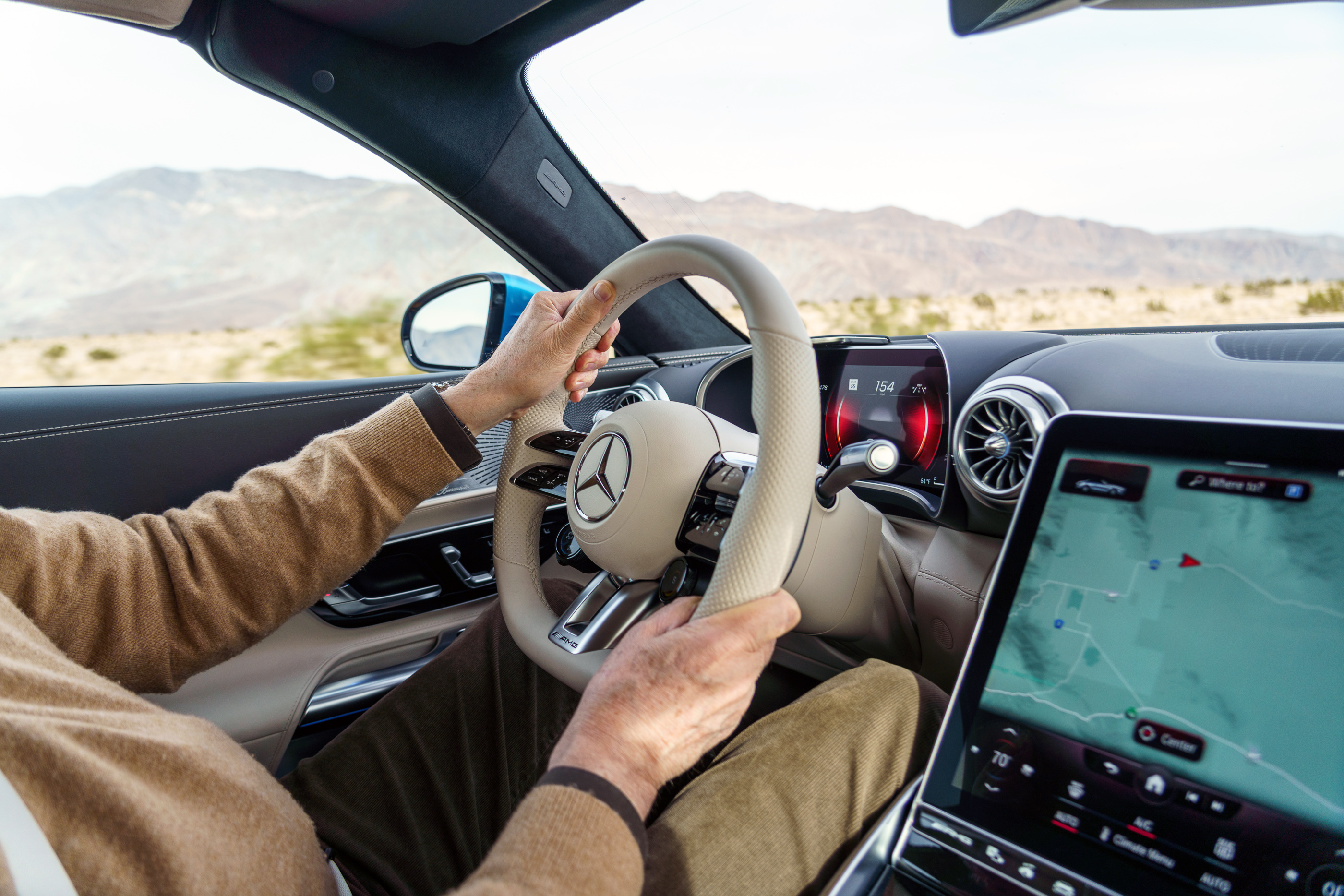
When the Palm Springs exit beckoned, it had started raining again, and although the digital speedo showed 49 in a 35mph zone, the lone cop on the prowl could not be bothered to step out of his 25-degree highway patrol car comfort zone.
The final challenge of the day was the owner of a triple-black Lexus LC500 who asked three crucial questions: How much is a fully loaded SL55 AMG? How does it compare? Could the tester be tempted to buy one?
This writer is speculating on a $175,000 price range – but we’ll know for sure when details are announced in the first quarter of 2022.
As far as potent luxury cruisers go, the previous-generation Bentley GTC is perhaps the smarter choice . As open-top sports cars, any Aston, Porsche or Ferrari is the more involving drive. The new SL is more of a highly accomplished middle-ground effort.
Flashback
This is a rare moment. The Tech Talk section of the magazine is where we get to geek out on the latest and greatest advancements in the automotive world – diving deep on cutting-edge batteries, brilliant new materials, or innovative manufacturing techniques. However, unfortunately that often means the trusty internal combustion engine – motoring’s century-plus year old warhorse – goes unloved unless there’s a new electrically-assisted turbocharger, or lab-created fuel.
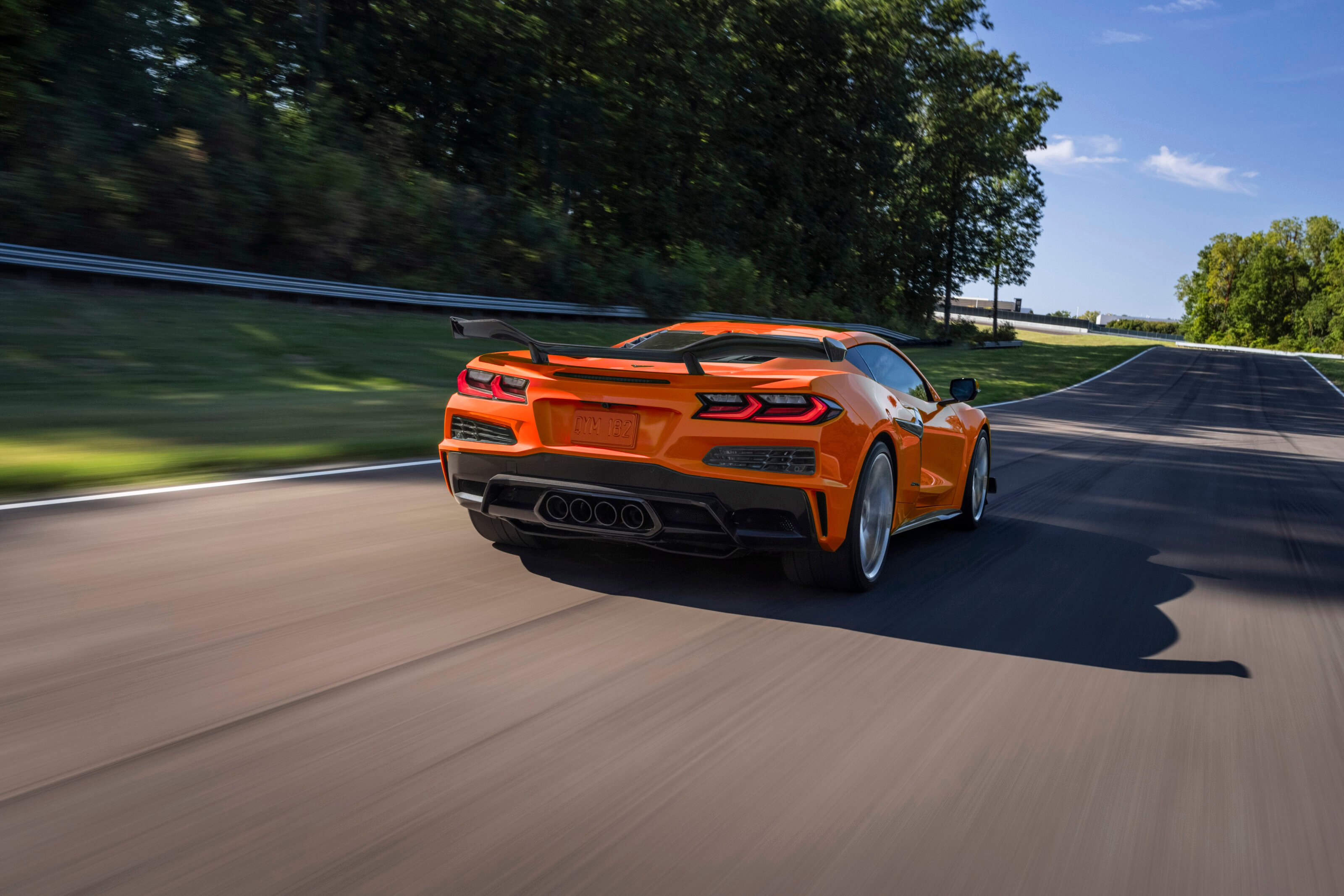
Not this month. Thanks to Chevrolet we are breaching new ground with good old fashioned natural aspiration. That’s right, this is the art of making more power than ever before with atmospheric air pressure, regular 98 RON fuel, and eight combustion chambers. The subject is the 5.5-litre dry-sumped flat-plane crank double overhead cam, four valve per cylinder, atmo V8 nestled amidships in the newly revealed C8 Corvette Z06.
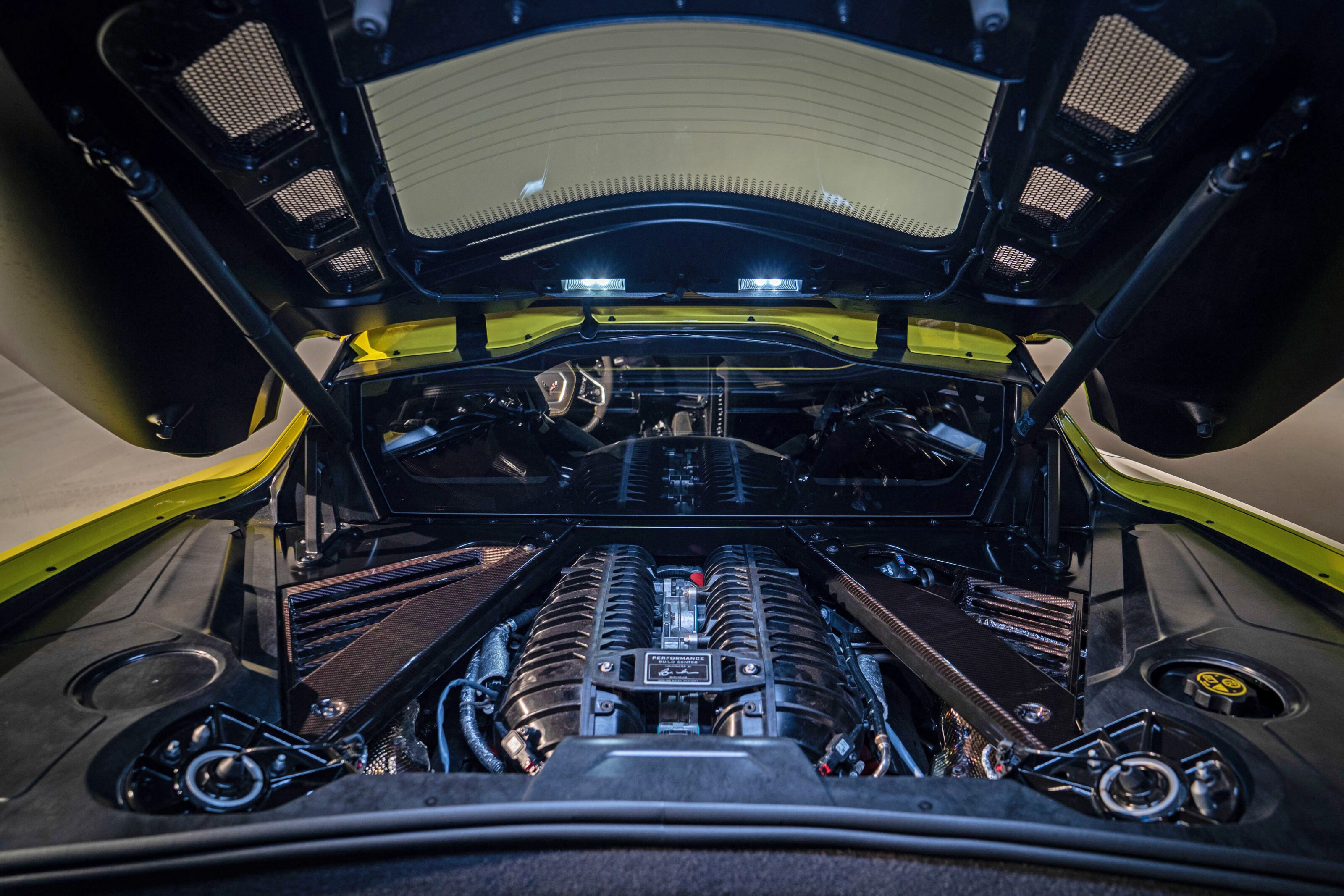
It is the most powerful naturally aspirated V8 ever put into production, with the headline figures being 499kW @ 8400rpm, and 623Nm @ 6300rpm. Codenamed LT6, this engine confidently usurps the previous record holder – Mercedes-AMG’s 464kW, 6.2-litre M159 from the SLS Black Series. Making the LT6’s power figures all the more impressive, is the fact that they outstrip the LT4 from the C7-generation C06. Despite being a larger capacity (6.2-litre), and using forced induction, the LT4 only managed to send 485kW @ 6400rpm to the rear wheels. To be fair to the supercharged engine, it also unleashed 881Nm on the rear tyres from just 3600rpm.
Key to the LT6’s power advancement is clever air management, with the dry-sumped unit capable of inhaling more air than its 5.5-litre swept capacity would first have you thinking. Engine power is inherently linked to how much oxygen can be combined with fuel in the combustion chambers. This is where the LT6 stands tall, huffing down O2 with a nearly unrivalled ferocity from non-forced induction engines.
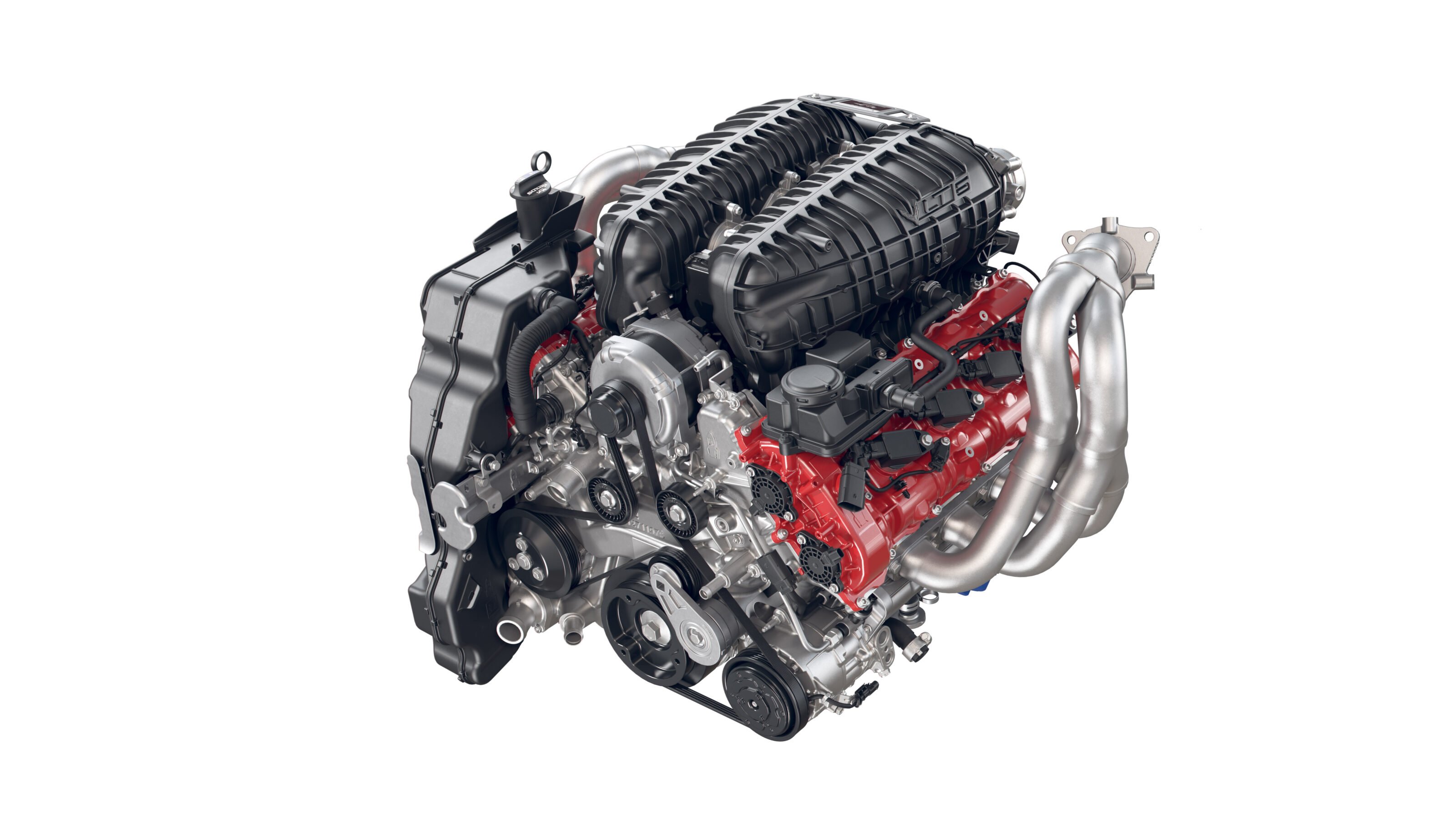
Feeding the engine is an 11-litre intake manifold, fed by two 87mm throttle bodies, with four trumpets mirrored on each cylinder bank. For context, the previous C7 Z06 had just a single 87mm throttle body. The really clever design though is the three central valves that separate the two intake plenums. Chevrolet engineers open and close the trio of valves in a variety of combinations across the rev range to take advantage of the Helmholtz resonance effect – what you would know as the heavy buffeting when lowering a single window in a car at highway speeds.
When an inlet valve in a combustion chamber closes, it causes a pressure wave to travel back up the inlet tract. The three valves between the plenums allow this fast-moving pressure wave to ram extra air into the cylinder that is about to fire on the opposite cylinder bank. In effect, Chevrolet has tuned the intake to act as a resonance supercharger with the waste air, increasing intake pressures without parasitic supercharging or turbocharging. As a result, between 2000-5800rpm the LT6 has a volumetric efficiency higher than 100 per cent.
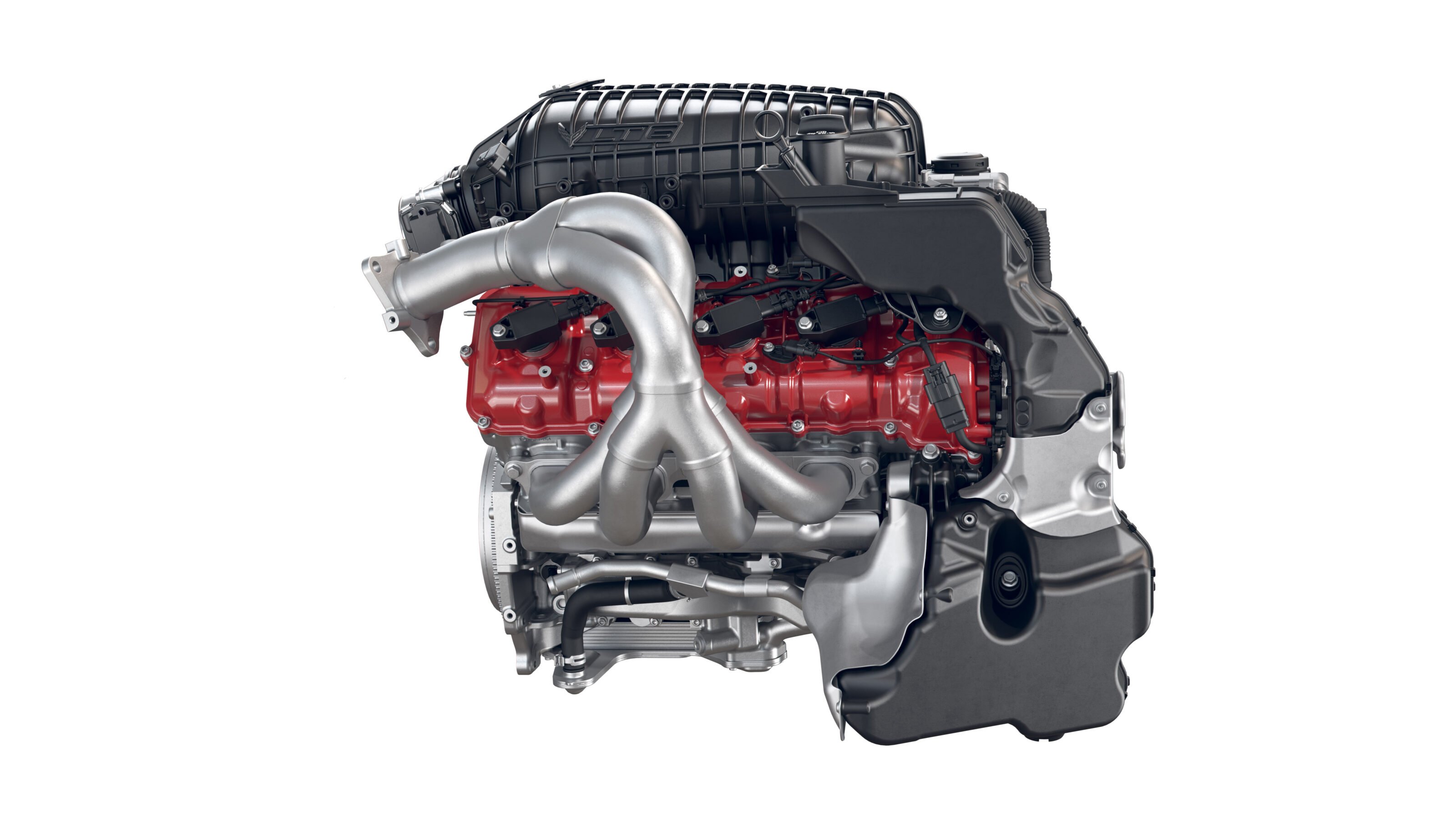
The hunt for extra air even involved moving the injector in each cylinder to the exhaust side of the combustion chamber, instead of the intake. This allowed for larger intake valves which measure 42mm in diameter, compared to the exhaust side’s 35mm. The injector placement also helps aid emissions by improving air and fuel mixing at highway and urban driving speeds. The intake valves are constructed of titanium for weight saving, while the exhaust valves are sodium-filled for heat dissipation, and there is no hydraulic component to the valve train at all. There are mechanical lifters, while dual springs allow for improved valve control.
Along with the extra air, the ability to rev higher than any Corvette engine before it is a central tenet of the LT6’s design. Engineers were fanatical about reducing the rotating and reciprocal mass within the engine. A lightweight forged steel crankshaft is utilised, along with forged titanium connecting rods, forged aluminium pistons, and hollow camshafts. By virtue of the flat-plane design, the crankshaft doesn’t require counterweights, further reducing mass.
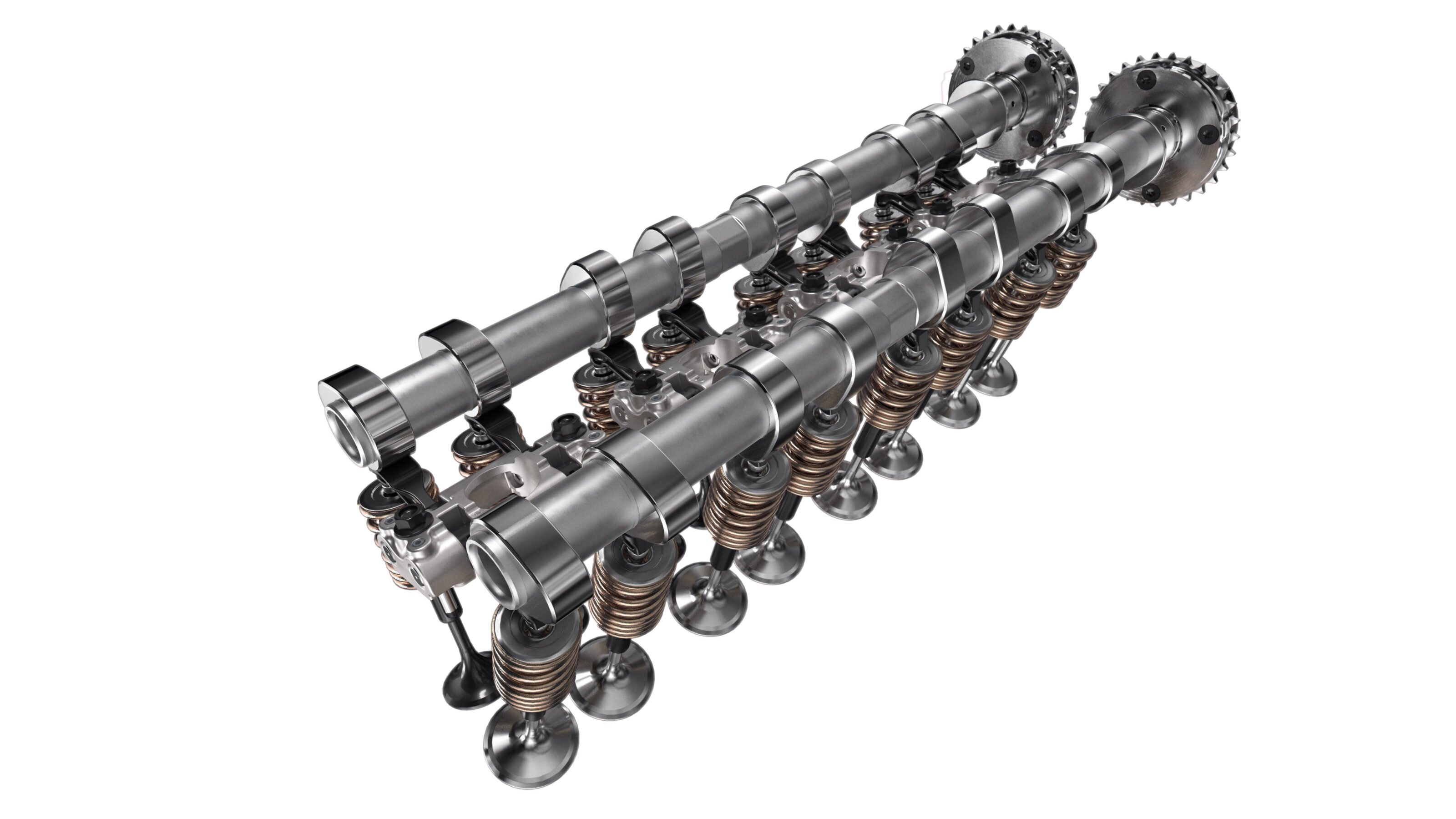
The block itself is aluminium, and while the bore spacing is Chev’s traditional 4.4-inches, the cylinders themselves are 104.3mm by 80mm. The large bore and short stroke is key to the high-revving nature of the engine. In fact, the bore:stroke ratio (1.3:1) is higher than that of the Ferrari 458, and Porsche GT3 (1.16:1 and 1:25:1 respectively).
As is traditional with every Corvette engine, each LT6 is hand built at Chevrolet’s Bowling Green plant in Kentucky. While the unit is only available in the Z06 at the moment, we wouldn’t bet against it being offered as a crate unit in the not too distant future. On an unrelated note, has anyone got an unwanted MX-5 chassis laying around that we could borrow?
Four Fast Facts
To the Moon
There is a hidden Easter egg in the LT6. Keen observers have noted that small rocket ships have been moulded into the engine block castings. This is a nod to the projects original codename, Gemini, which it shares with the US space program. Atmo V8s aren’t rocket science, but it’s a nice touch..
BMEP for your buck
If you want to get super nerdy about comparing naturally aspirated engines, we need to use Brake Mean Effective Pressure (BMEP) – effectively a complicated measure of internal combustion chamber pressure. All you need to know is the higher the BMEP, the better. The Aston Martin Valkyrie’s Cosworth-built 6.5-litre naturally aspirated V12 revs to 11,100rpm and produces 735kW/740Nm. It has a BMEP of 14.5 bar at peak power, and 13.1 bar at peak torque. Z06? Exactly the same, just without the million-dollar price tag.
Acoustic perfection
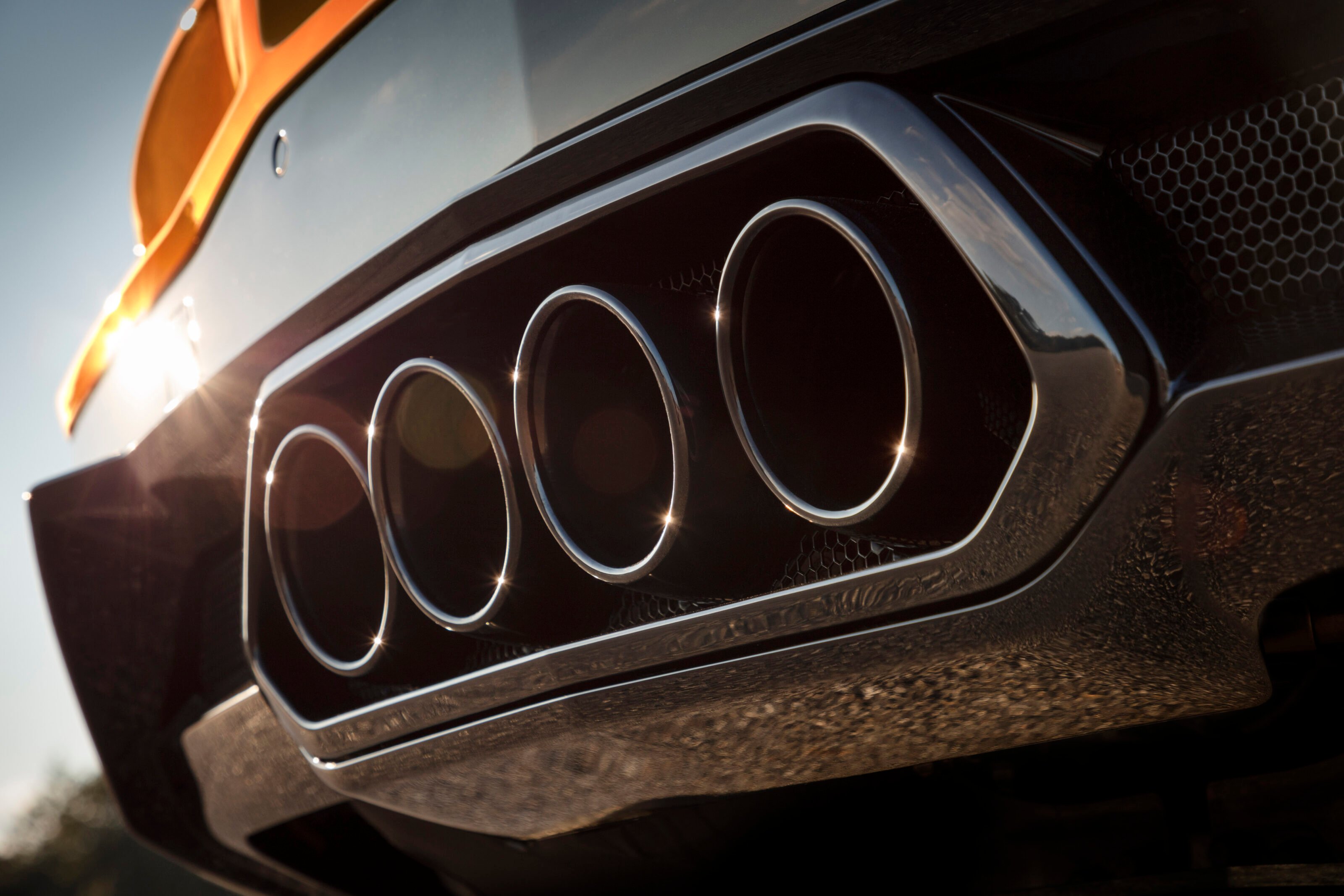
Chevrolet’s solution to the hot side of the engine is to fit the LT6 with a pair of equal length 4-2-1 headers on each cylinder bank. Not only does the flat-plane crank design give an even alternating firing order, it provides the thrilling, shrill engine note akin to that of Ferraris of old. The Z06’s exhaust is anything but burbling and lazy.
In the uncanny valley
Mid-mounting a relatively large capacity V8 engine resulted in a number of packaging challenges for Corvette, particularly when its customer base still demands a rear trunk that can accommodate a set of golf clubs. As a result, the LT6’s starter motor has been placed directly underneath the intake manifold, and the alternator placed within the cylinder banks. Hot-vee? Not when it comes servicing time.
Tesla is gearing up to expand its Chinese factory, with production output expected to increase for its most popular electric vehicle – the Model 3.
An Environmental Impact Assessment uncovered by Troy Teslike on Twitter and reported by Teslarati shows the US carmaker will grow its Shanghai facility from 6000 workers to 9000 initially, with 19,000 employees eventually expected at the plant.
While the report states the additional factory workers are for a new production line, some commentators have suggested a more accurate translation points to a new production shift, with the Model 3 the most likely candidate.
The text below is from the Environmental Impact Assessment of Giga Shanghai expansion. It says they will add 3,000 employees to a production line that currently has 6,000.
— Troy Teslike (@TroyTeslike) January 6, 2022
Source PDF: https://t.co/TfhQrUB7hw
See page 243 of the PDF file = page 226 printed on the document. pic.twitter.com/3TLAKUH42i
Tesla reportedly delivered more than 936,000 electric cars in 2021 – an 87 per cent increase over the previous calendar year, when it recorded its first profits on the back of 500,000 sales.
According to Australian Tesla vehicle tracker VedaPrime, 10,000 Model 3s arrived on our shores in 2021 – or roughly the same amount of total vehicles sold by Tesla from 2014 to 2020.
Tesla has been teasing the prospect of a cut-price vehicle – thought to be called the Model 2 – which is being developed by its Chinese research and development centre, but indications are this vehicle won’t enter production until 2024 at the earliest.
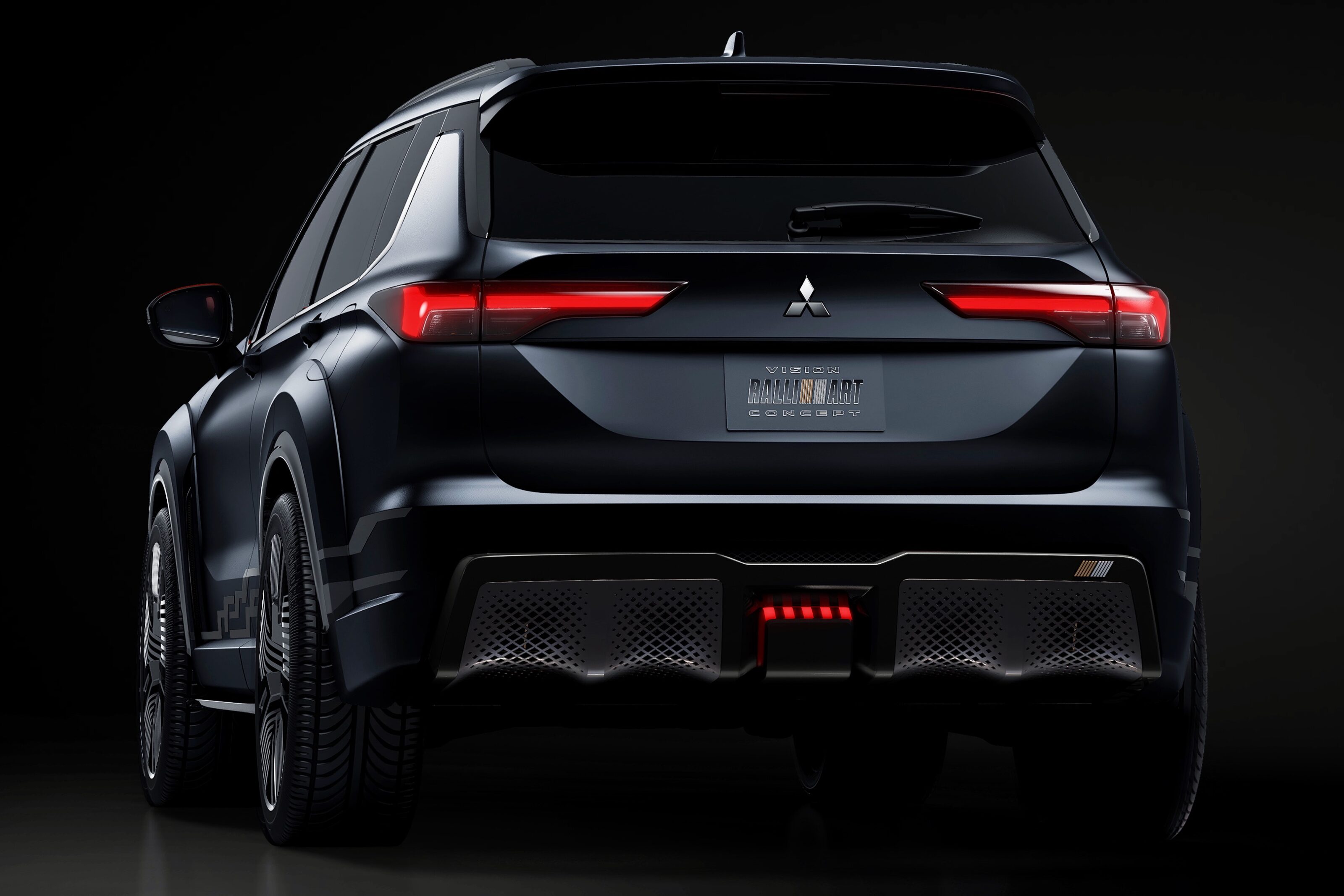
The Mitsubishi Vision Ralliart Concept has been unveiled just days before it’s displayed at the Tokyo Auto Salon.
While Mitsubishi hasn’t provided any technical details about the Vision Ralliart Concept, the performance SUV is based on the Outlander PHEV (plug-in hybrid), upgraded with a “higher motor output, sportier four-wheel control tuning and enhanced battery capacity”.
The concept was created with the theme of “the next era, the next adventure,” and features a blank grille, body kit, wheel arches, widened track, matte black paint, side decals, Ralliart badges, and brushed gunmetal grey exterior trim replacing the Outlander’s chrome brightwork.
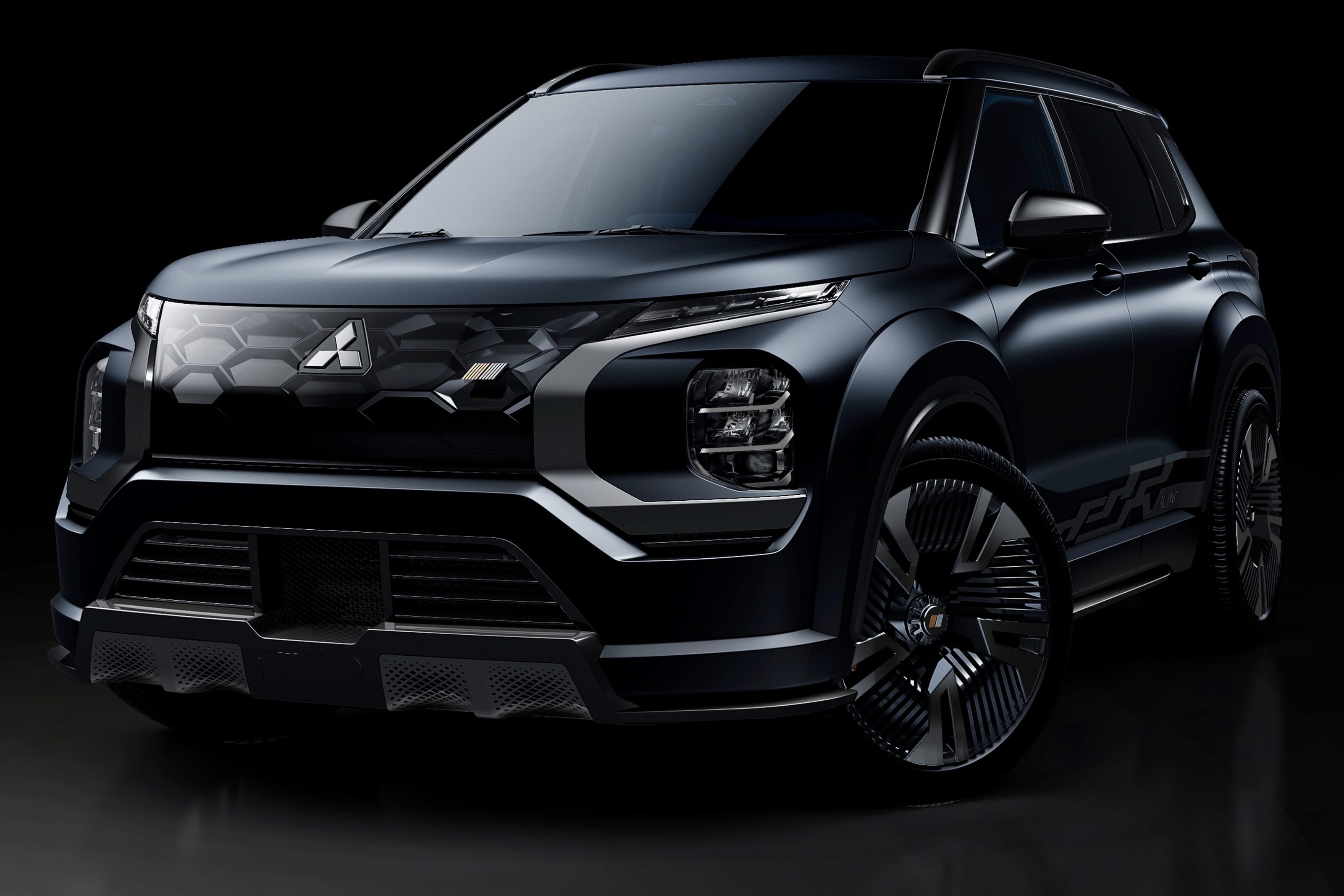
Large six-pot brake callipers have been added to help contain the “powerful torque” of the electric motors, hidden behind 22-inch wheels.
“Although it is a concept car, customer feedback on Vision Ralliart Concept will be used in future development of Mitsubishi vehicles,” the company said at its unveiling.
It’s not clear at this stage whether the concept is a precursor for a production model, but the Japanese carmaker has been open about its desire to bring back the Ralliart performance arm.
“The Ralliart brand has strong heritage here in Australia, with the nameplate being associated with high performance and motorsports,” a spokesperson for Mitsubishi Australia told Wheels in November.
“Mitsubishi Motors is considering some exciting initiatives around the Ralliart, and we at [Mitsubishi Australia] can’t wait to see what the future holds.”
Key Points
- 2022 MX-5 range to feature 2.0-litre engine only
- Low sales lead to 1.5-litre’s demise
- New suspension leads to better cornering for updated model
UPDATE, January 11, 2022: Pricing for the updated 2022 Mazda MX-5 has been confirmed.
Our original story has been amended below to reflect this news.
The story to here
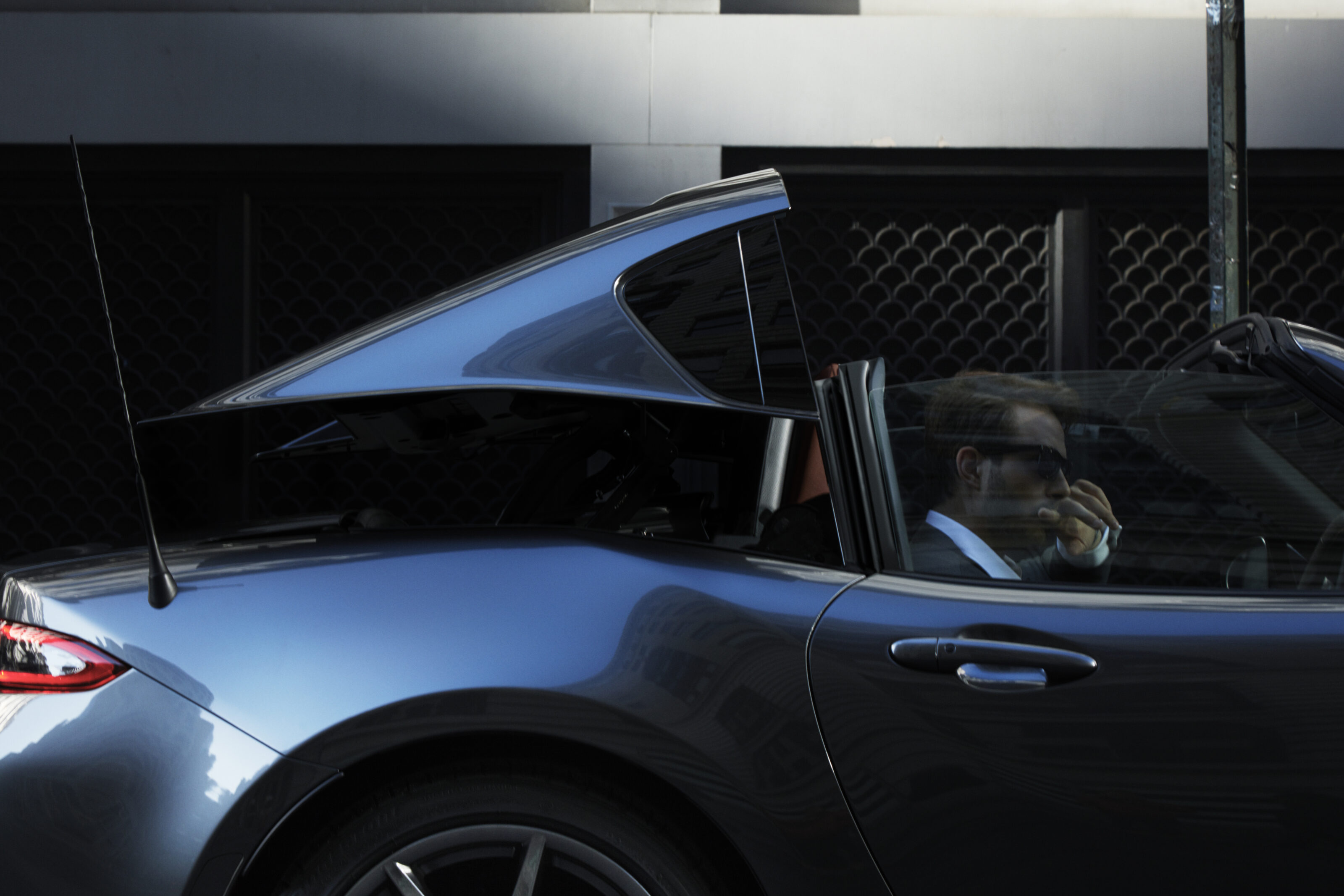
December 16, 2021: Mazda Australia has given the fourth-generation MX-5 a mid-life update, ushering in new technology while simultaneously ending the entry-level grade’s time in showrooms.
Since the ND generation’s last update in 2018, the Roadster has been sold with a choice of two four-cylinder engines – a 2.0-litre unit developing 135kW/205Nm and a cheaper, smaller 1.5-litre powertrain which produced 97kW/152Nm.
Unfortunately for the latter, it has now been dropped from the line-up, with low sales locally attributing to its demise, leaving the 2.0-litre SkyActiv engine as the only available source of power across the MX-5 Roadster and RF range.
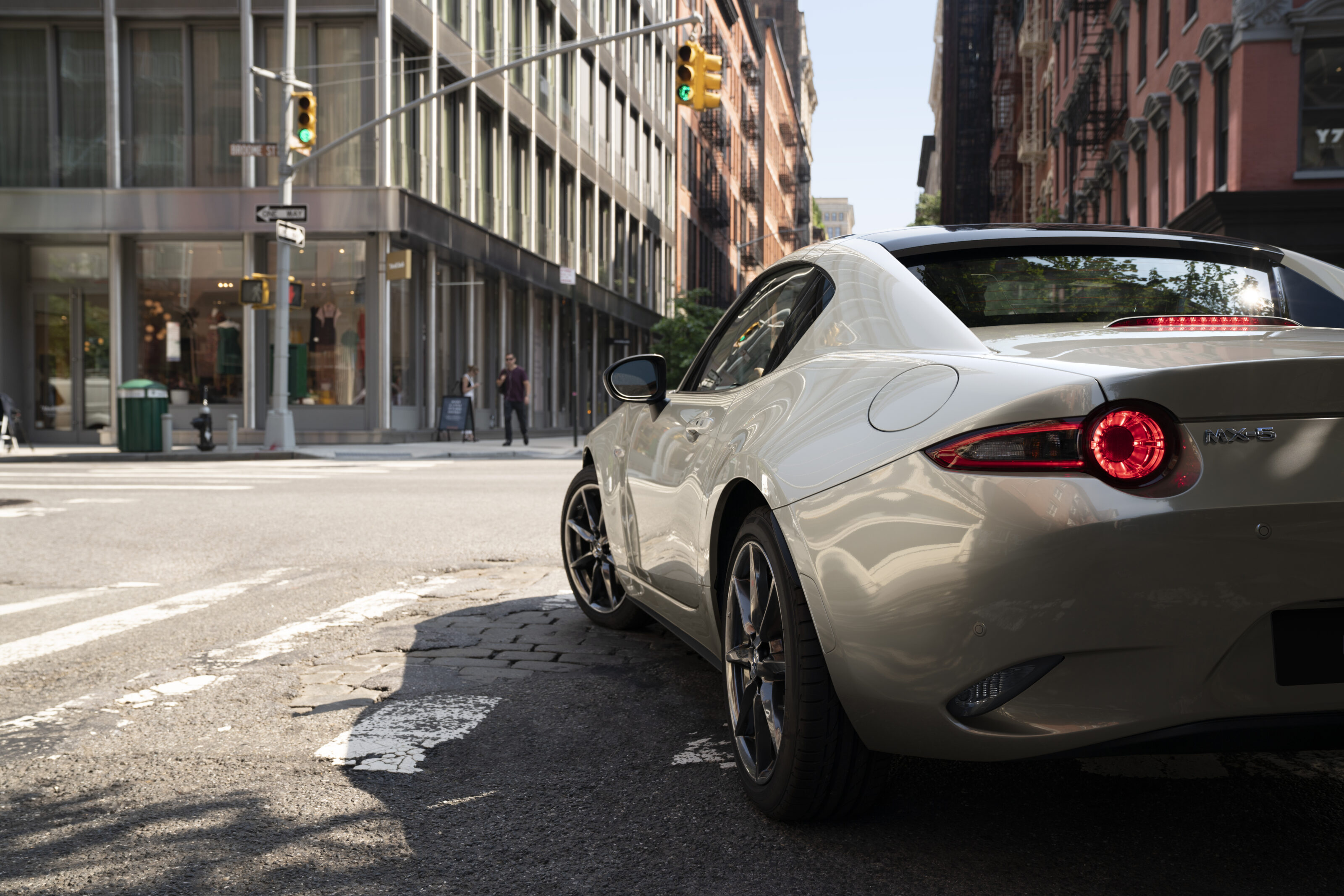
However, Mazda has been adding equipment to the popular sports car to keep it fresh, as the 2022 update gains Kinematic Posture Control (KPC) technology, something which the Japanese manufacturer believes will strengthen the MX-5’s cornering abilities.
The KPC system applies a small amount of braking force to the inner rear wheel when the car is cornering, getting progressively stronger as the cornering loads become higher, aiming to suppress roll and keep the car settled in all circumstances.
With the departure of the smaller engine and the addition of KPC, all MX-5 variants are now fitted with safety equipment such as driver attention alert (DAA), lane departure warning (LDW), rear parking sensors, smart city brake support-rear (SCBS-R), auto-dimming rear view mirror and LED daytime running lamps as standard.
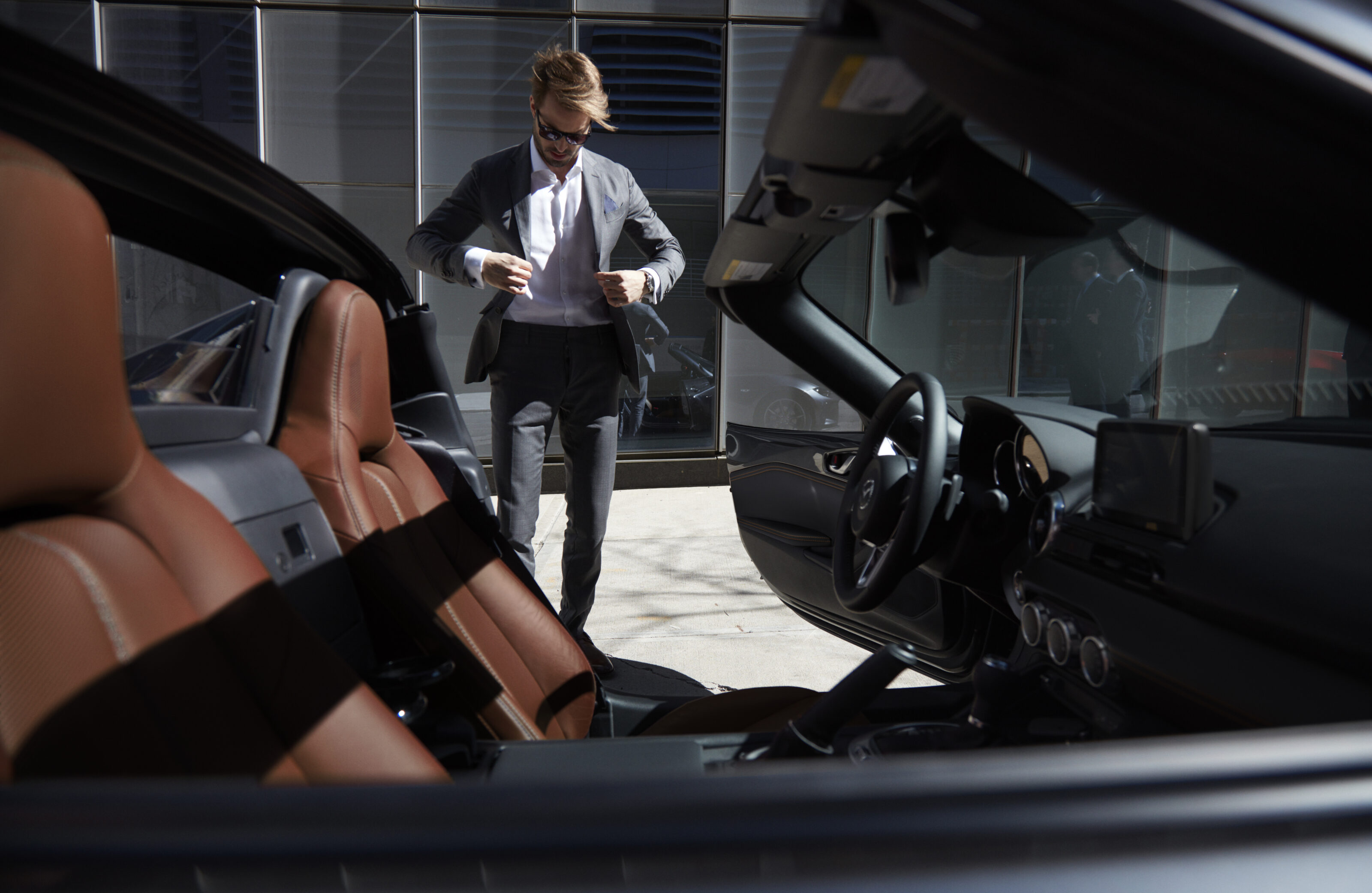
In addition to this, Mazda now offers Platinum Quartz metallic as a new colour on the MX-5 as a no-cost option, with the RF GT also available with a Terracotta leather interior for the first time.
With the exclusion of the 1.5-litre variant from the updated MX-5 range, Mazda has confirmed the line-up will start at $37,690 before on-road costs for the base 2.0-litre – a $1600 increase over the previous entry price. In addition, other MX-5 variants have risen by between $300 and $600.
2022 Mazda MX-5 Australian pricing
Prices exclude on-road costs.
2022 Mazda MX-5 features
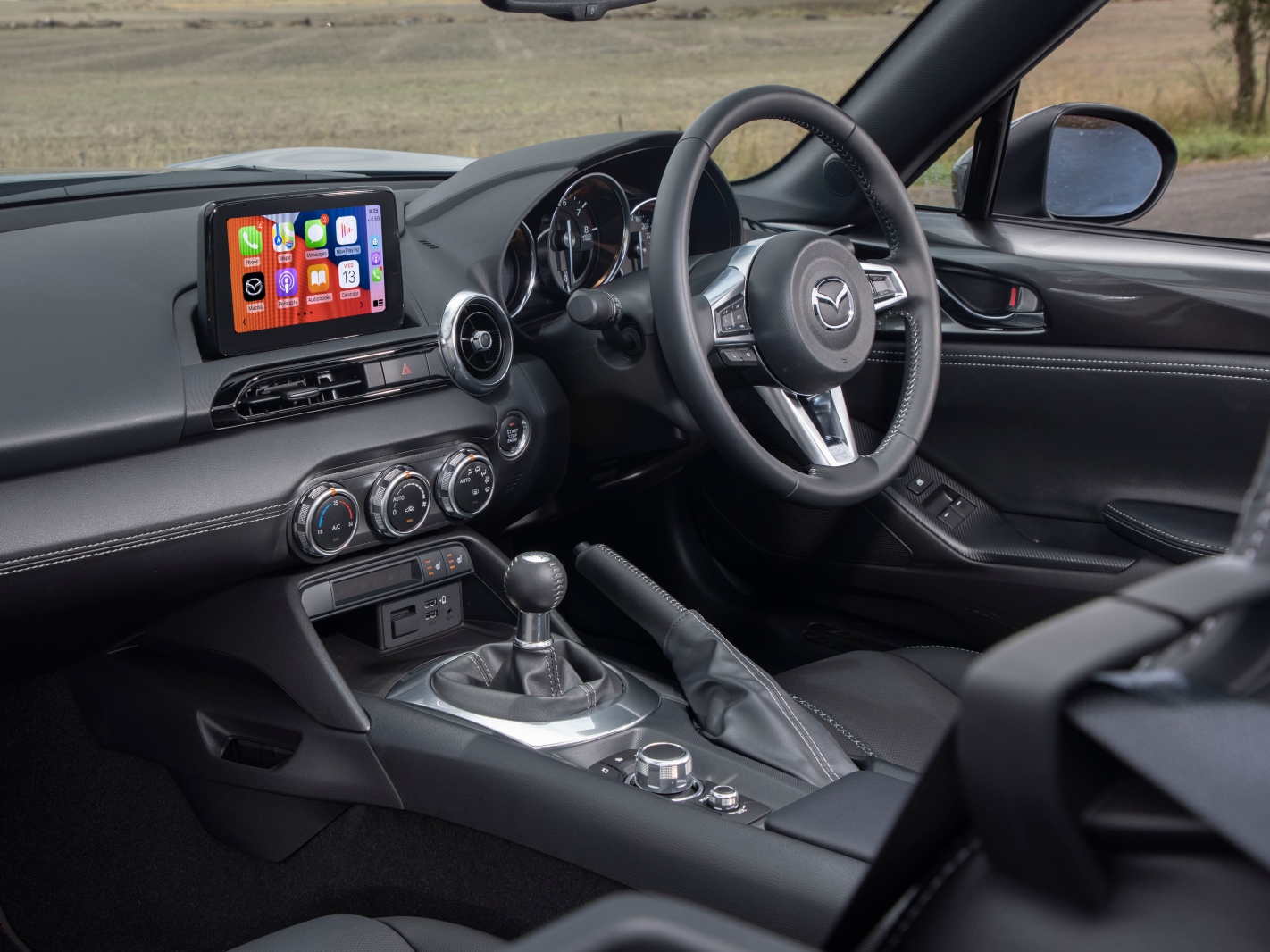
MX-5
MX-5 GT
MX-5 RF GT Black Roof
MX-5 GT RS
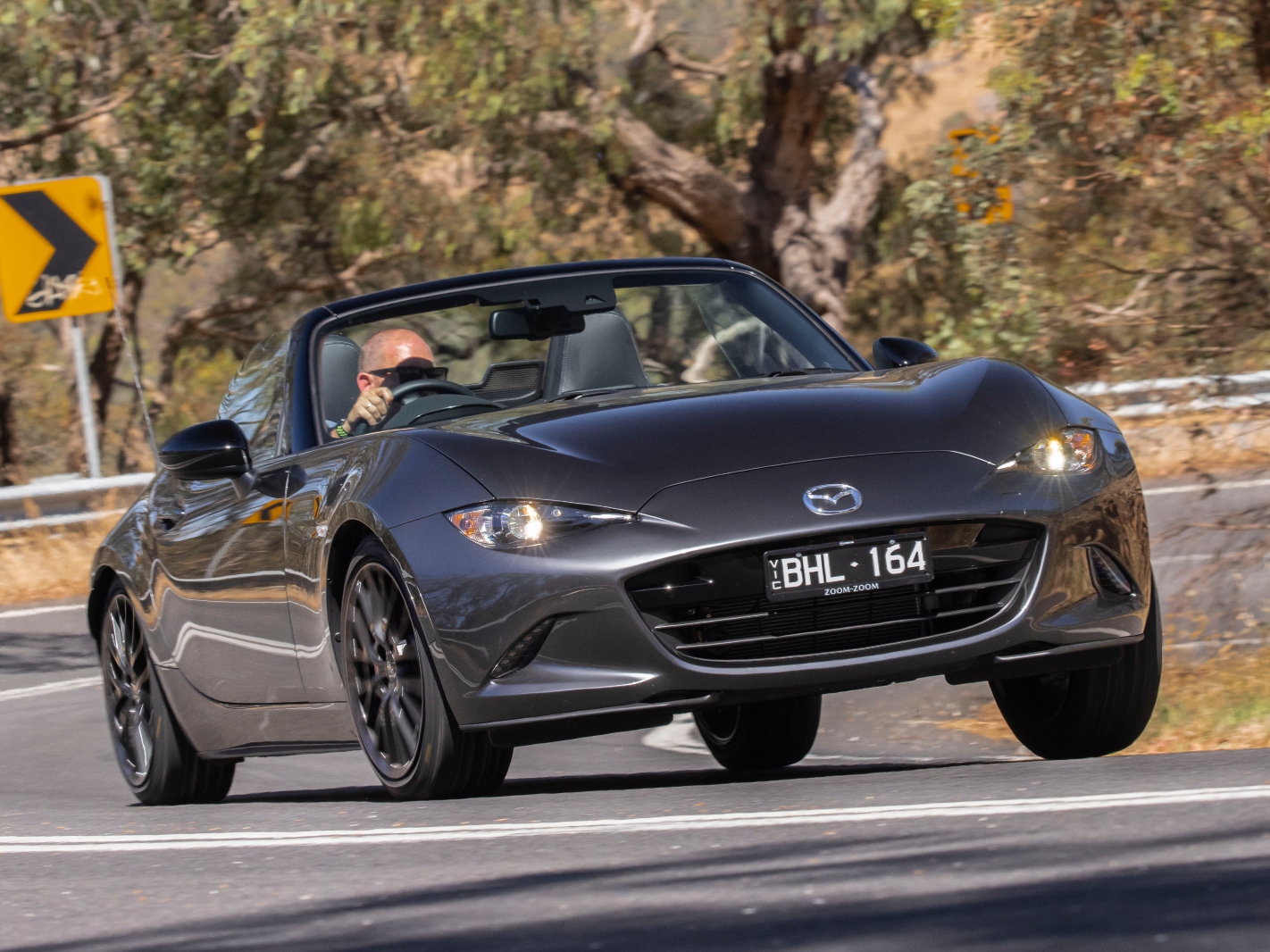
Engine, drivetrain and fuel economy
As mentioned above, for 2022, the MX-5 will be powered exclusively by a 135kW/205Nm 2.0-litre naturally-aspirated petrol engine.
A six-speed manual or automatic transmission is available across the range, excluding the manual-only GT RS flagship.
Combined fuel economy figures can be found in the table below:
Safety
Every variant of the Mazda MX-5 is covered by a five-star ANCAP safety rating based on testing conducted in 2016.
Six airbags (dual frontal, side chest and side curtain) are standard.
For 2022, the entry-level Roadster has picked up extra active safety equipment, with each variant now featuring:
- Autonomous emergency braking (forward/reverse) with pedestrian detection
- Lane-departure warning
- Driver attention alert
- Blind-spot alert
- Rear-cross traffic alert
- Traffic sign recognition
- Rain-sensing wipers
- Reversing camera
- Rear parking sensors.
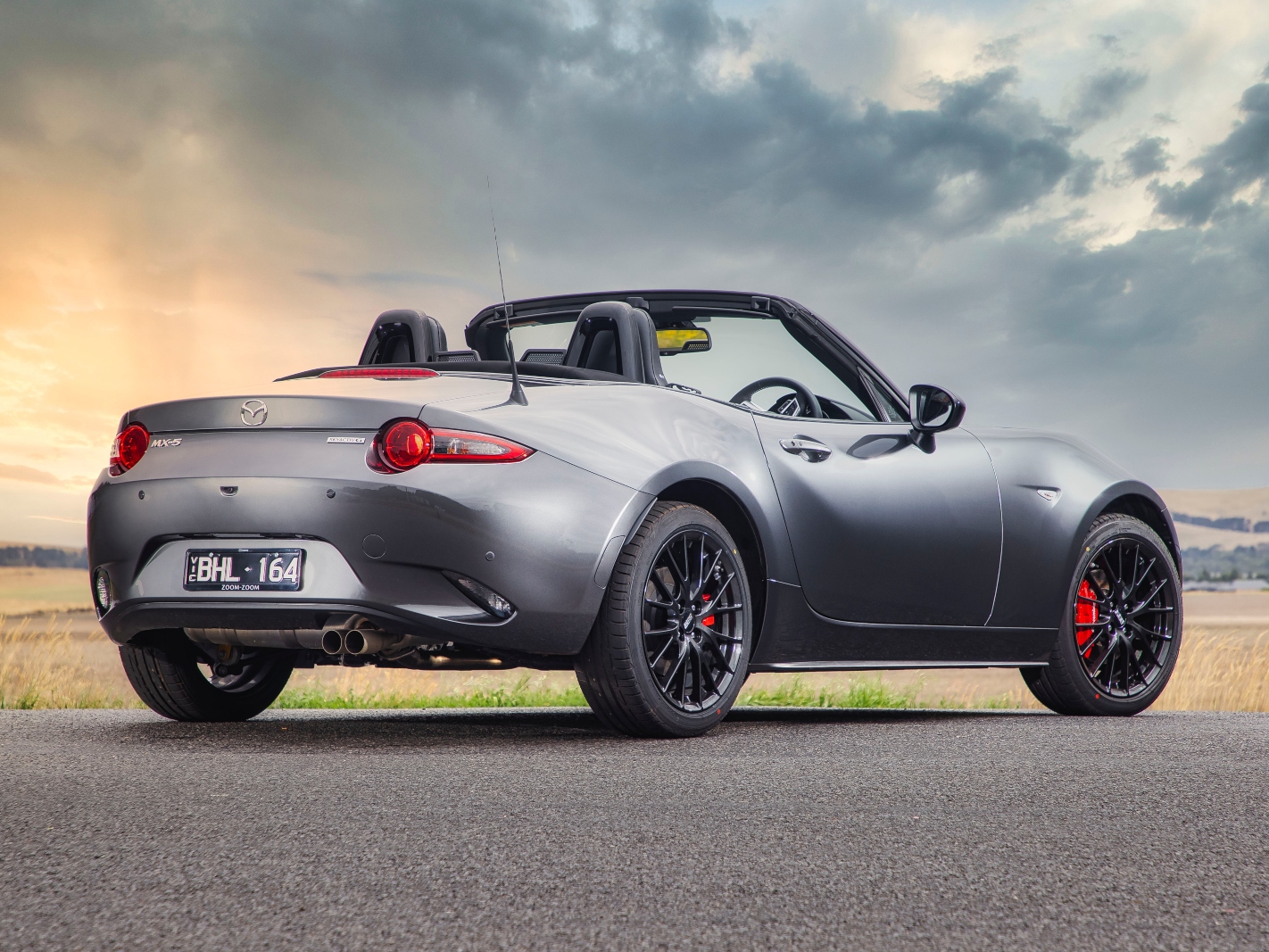
Warranty and servicing
As per the wider Mazda range, the MX-5 is covered by the brand’s five-year/unlimited kilometre warranty, along with a five-year roadside assistance program.
The service schedule for the MX-5 is 12 months or 10,000km, whichever occurs first. Capped priced servicing is offered on the MX-5, covering the first five-years or 50,000 kilometres.
Availability
The updated 2022 Mazda MX-5 is expected to arrive in local showrooms in the coming weeks.
