
Fifty million examples sold globally, over half a century on local terra firma and the most popular passenger car in Oz. Despite what little introduction is required for the Corolla nameplate, the price-busting Ascent Sport Hybrid Hatch version – the cheapest petrol-electric offering in Toyota’s stable – deserves a thorough dissection.
Toyota’s exponential growth of hybrid popularity – it recently clocked over 200,000 sales locally – makes this entry hatchback iteration crucially important, given Corolla sits, historically, as the marque’s third most-popular petrol-electric choice behind the Camry and RAV4.
Why might you be drawn to the thrifty hybrid five-door? As ‘my first hatch’. As a fuel-miser runabout. As a cheap-to-buy-and-run daily driver. As a thrifty ride-sharing, pizza-delivering ally. Or as a fleet special even though Toyota continues to nudge its popular small car more towards private buyers.
Toyota dropped the old ‘base’ configuration in the twelfth-generation Corolla’s recent introduction, and while the Ascent Sport Hybrid Hatch might appear to be positioned further upstream its true mettle inevitably rings truer in what goodness it offers, not just in equipment but in the everyday experience.
Let’s see how it fares.
RELATED READING
Looking for more details on the wider Corolla range? Our full range review has everything you need to know.
Pricing and Features
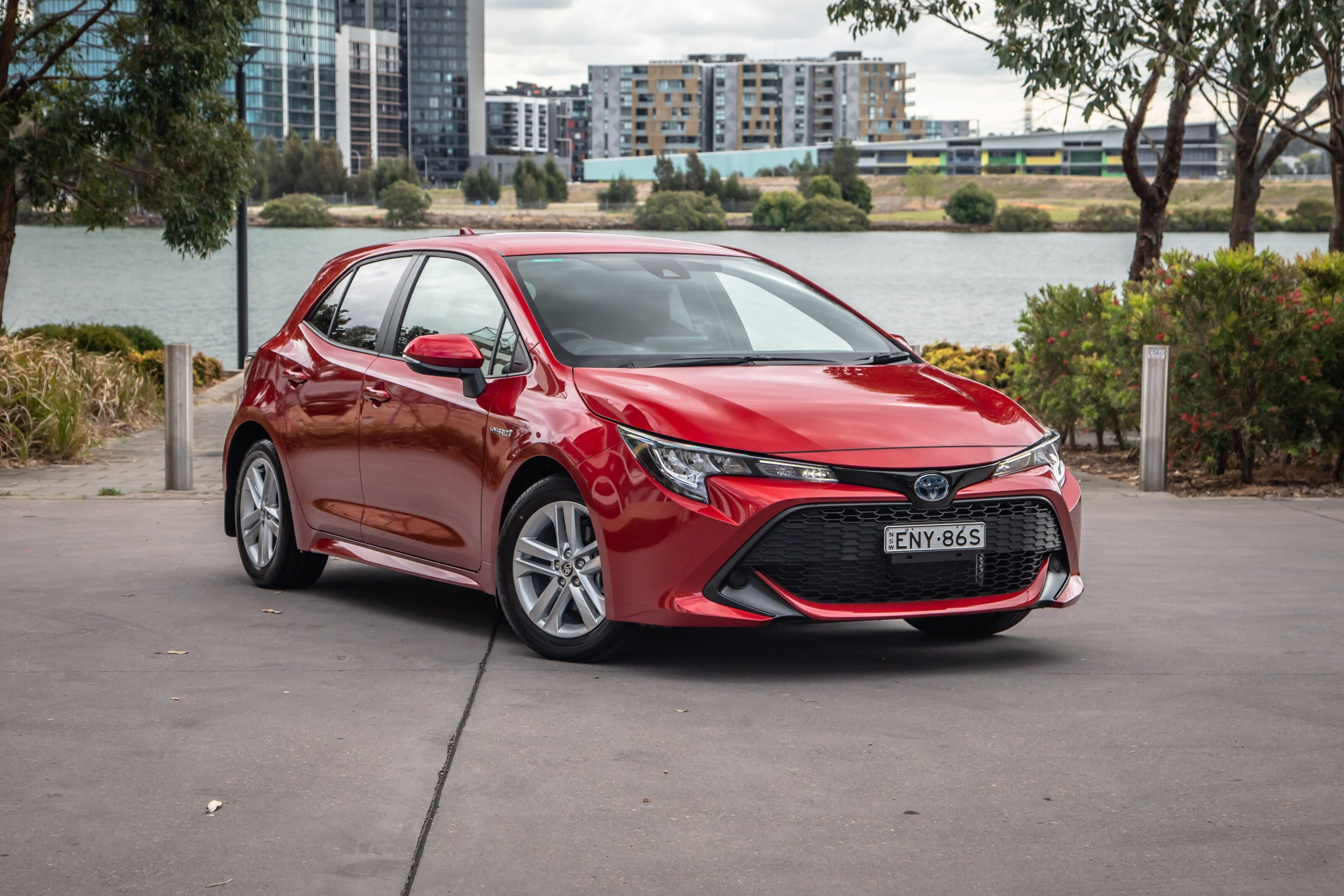
At $27,395 before on-roads, the Ascent Sport Hybrid commands a two-grand premium over the petrol automatic version in either hatchback or sedan guises. This undercuts the smaller Yaris hybrid by $1735 (list) given the smaller Toyota enters the petrol-electric fray at middling SX grade.
Unsurprisingly, the base Corolla’s equipment suite runs lean in some areas though it does offer quality gear, some of which is feel-good stuff that drags the Ascent Sport out of the poverty pack doldrums, others more worthy, particularly in terms of safety to augment those ‘my first car’ credentials.
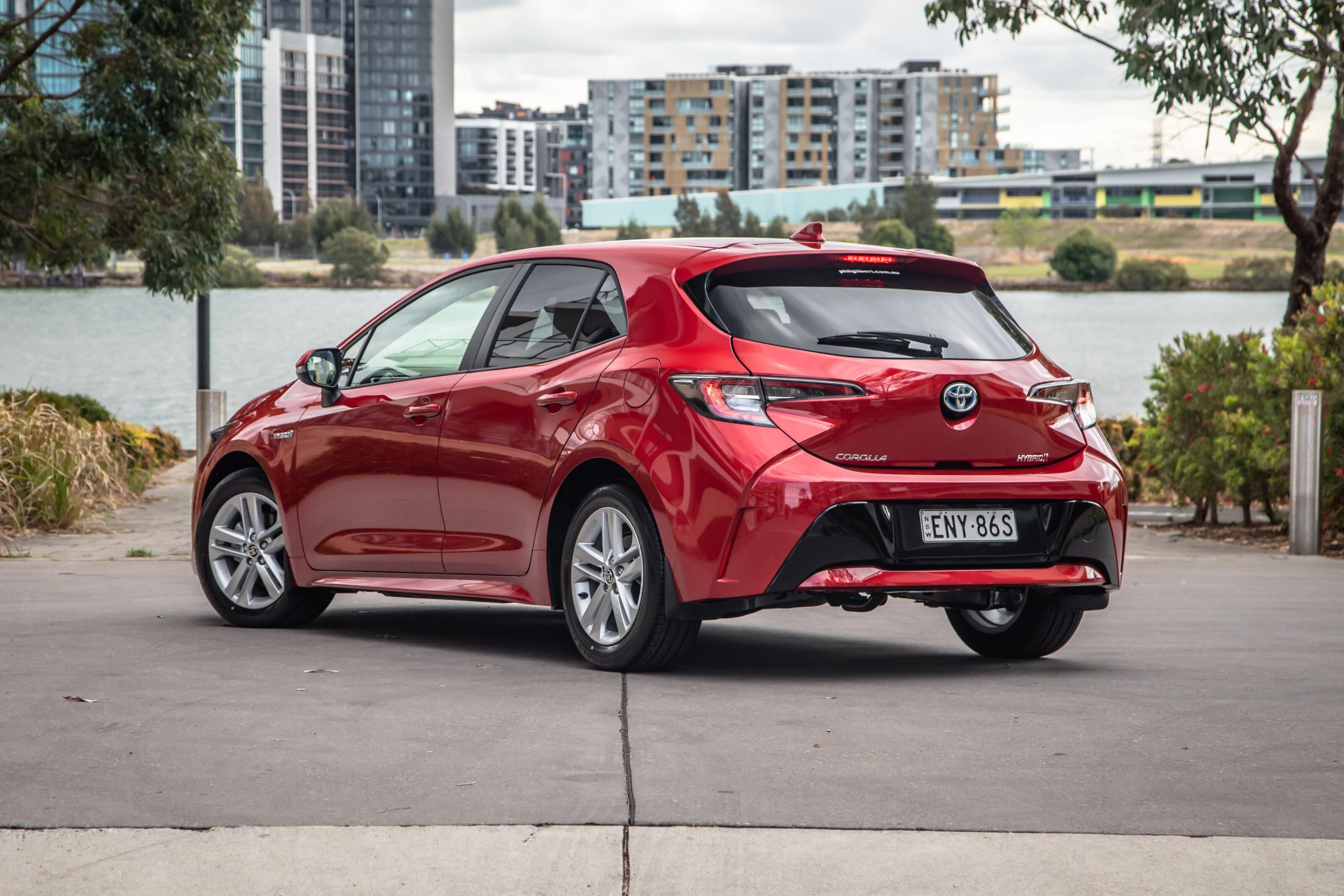
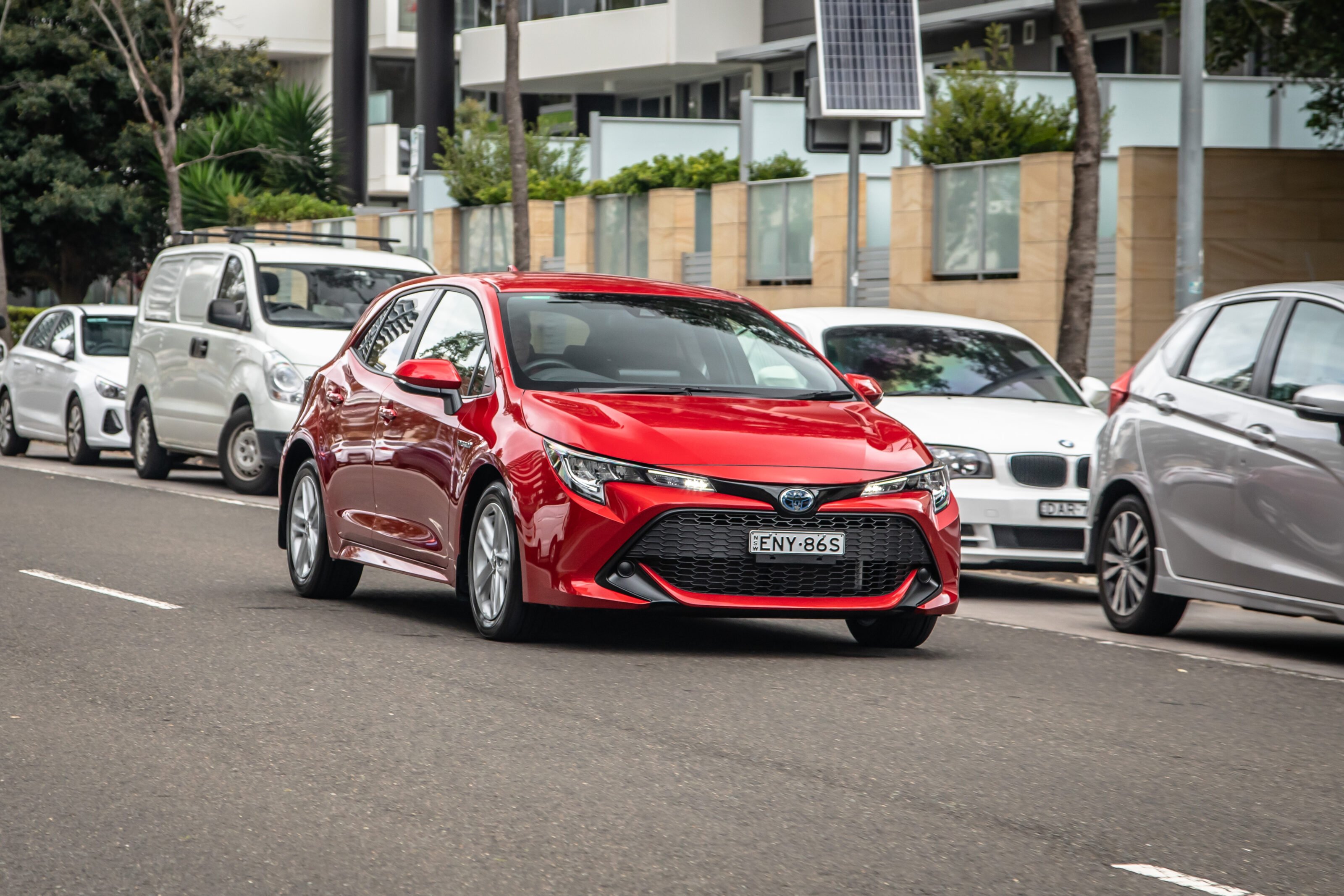
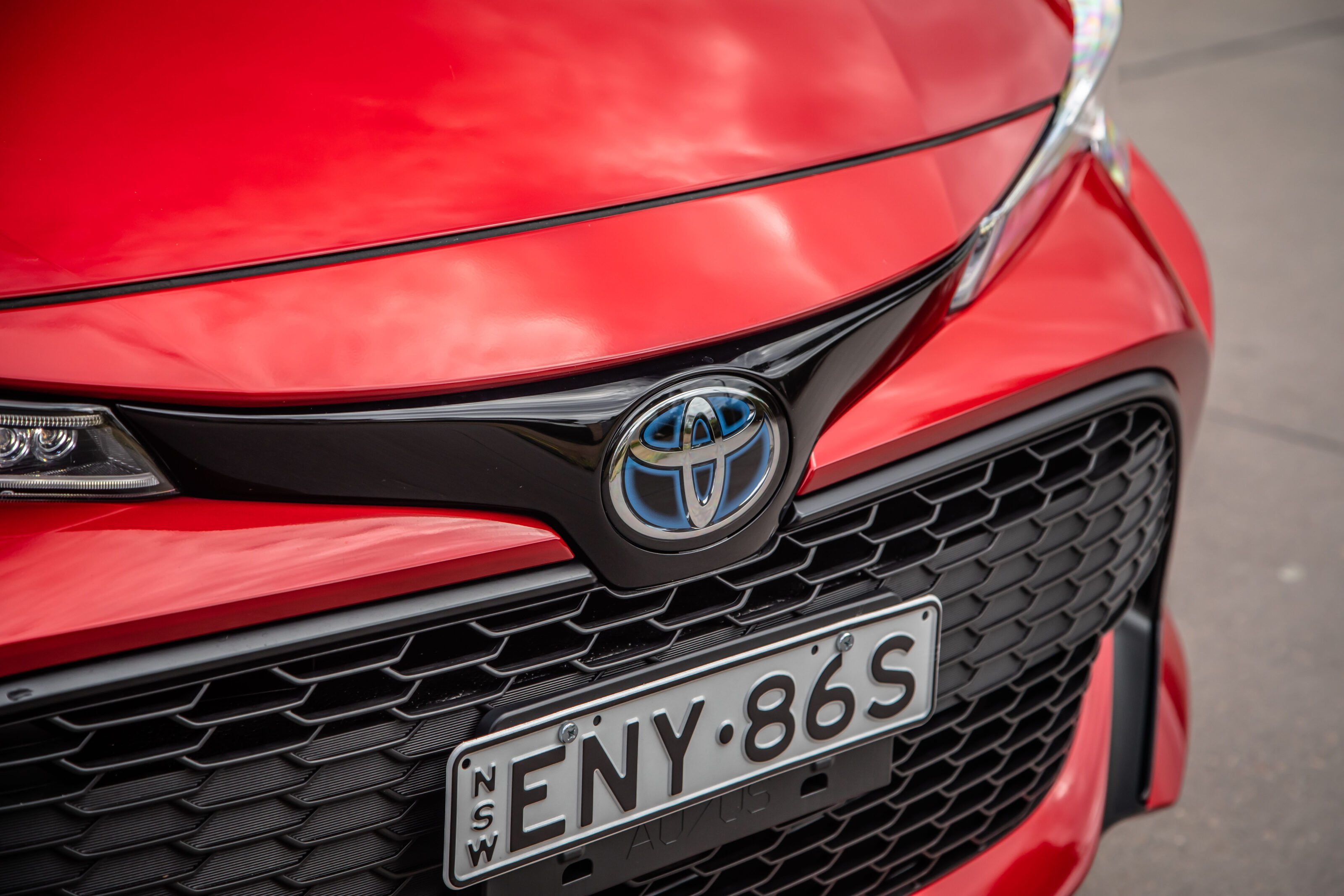
The hatch version fits 16-inch alloy wheels, bi-LED headlights with auto high-beam, LED DRLs and taillights, heated and power-retractable mirrors, a guided reversing camera, electronic park brake, remote entry and adaptive cruise control. No slumming it here, perhaps short of the conspicuously absent rear parking sensors.
The cabin fits seven airbags, a 4.2-inch colour driver’s screen with digital speedo and dual-zone climate control rather than manual air-con. Nice. Infotainment is a reasonably large 8.0-inch touchscreen format offering Apple CarPlay and Android Auto mirroring, though its slim feature set means you have to pay an extra $1000 for sat-nav and DAB+, which are bundled into an options package that also includes rear privacy glass. On that, premium paint wants for an extra $595.
The five-door was awarded a five-star ANCAP rating dated 2018, with the base version fitting a rudimentary Safety Sense suite that includes all-speed autonomous emergency braking with pedestrian and daytime cyclist detection, lane departure warning, lane-tracing steering assistance, road sign assist and audible ‘danger zone’ warnings.
Walking up to the Corolla SX Hybrid adds a further $3400 to the list price ($30,795 + ORC) and adds key safety inclusions such as blind-spot monitoring, rear cross-traffic alert and parking support brake – ostensibly reversing AEB – plus front and rear parking sensors.
Comfort and Space
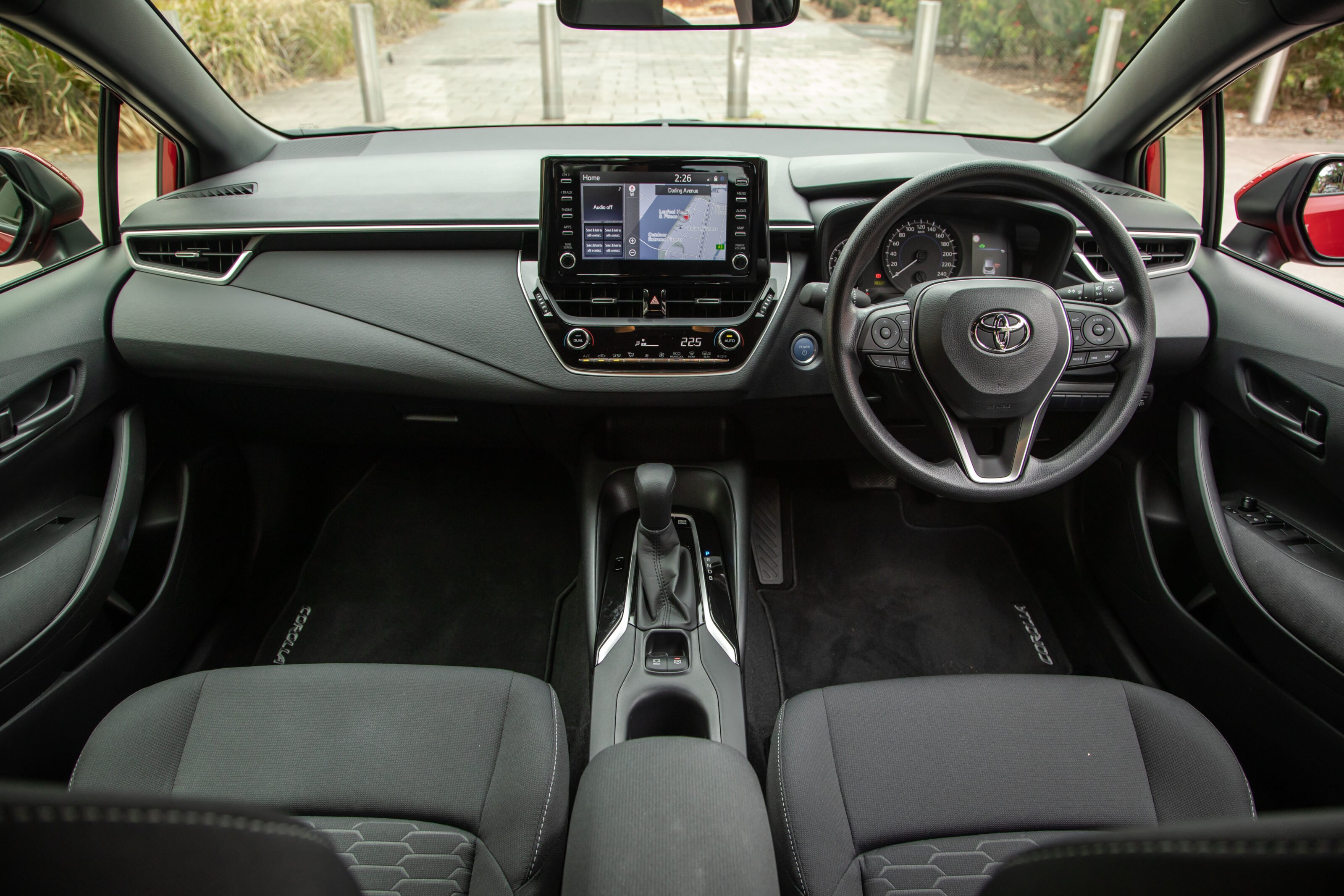
You’ll really want to like, or at least tolerate, grey plastic. The Ascent Sport cabin drowns in it.
The absence of colour and limited garnish helps make the entry hatch broadly palatable and largely inoffensive. Like the hardy cloth trim and absence of electric seat adjustment, it’s not out of place in the humble space this Ascent Sport occupies. It’s just quite joyless, the sweet relief of colour and interest brought by the driver’s display and infotainment screen a distraction from the cheap-looking – and feeling – surfaces that, with cursory inspection, appear a little slapped together in areas.
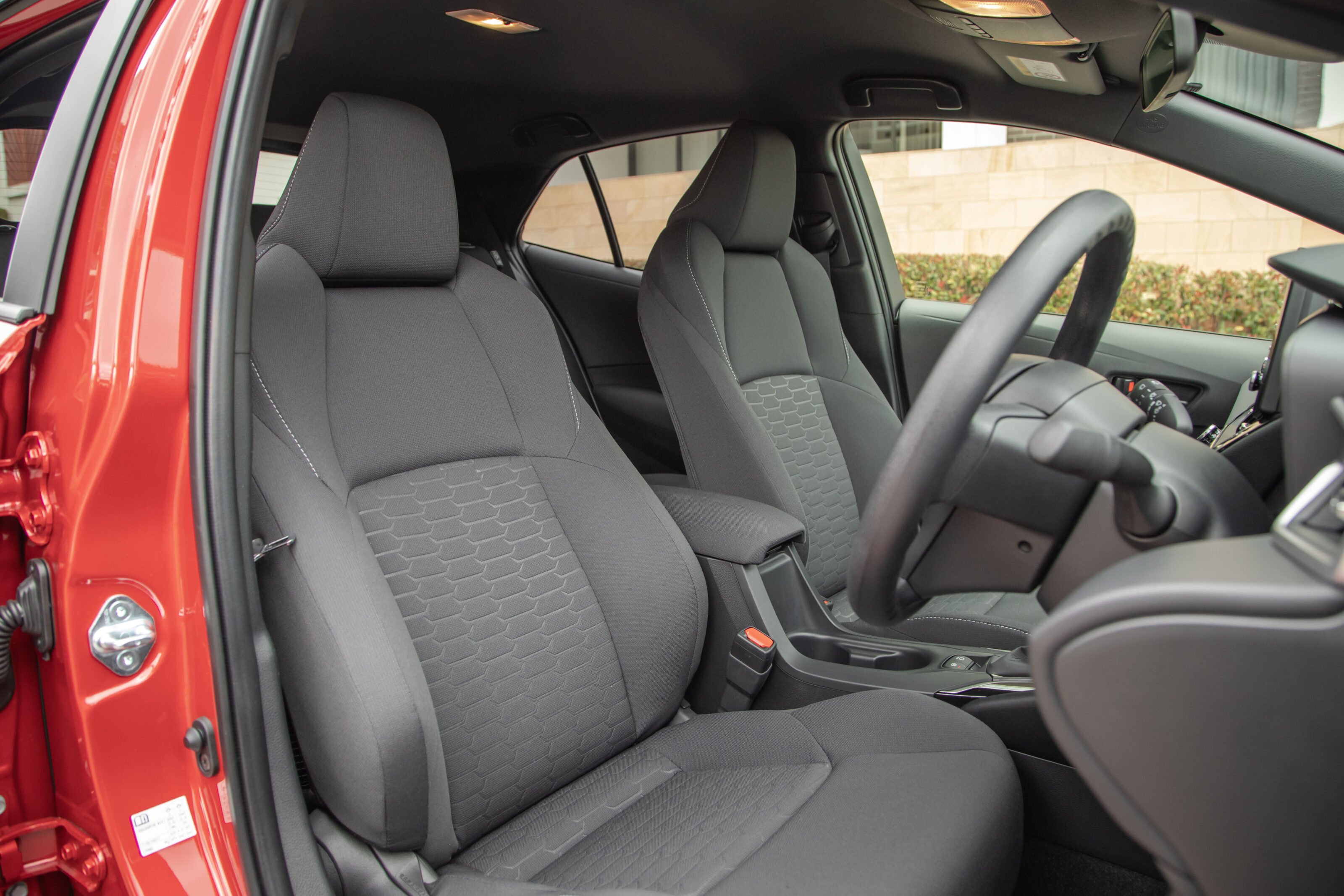
The core design is pleasing enough, its shapely and contemporary dash pleasingly minimalist and its controls and features easy to read and intuitive enough to negotiate. Cost-cutting hasn’t robbed a certain sporting essence, from seat positioning to ergonomics that seep through the twelfth-gen Corolla’s basic DNA. And yet the vinyl steering wheel rim, sole USB port, hard-surfaced cubbies that rattle your personal effects and the absence of any second-row creature comforts are regularly reminders that you’ve bought on a relative budget.
The Corolla hatch interior is, though, reasonably well packaged, properly comfortable and natural – at least for front occupants – as well as quite resolved in format. Nothing too weird, more or less everything in its appropriate place. The lack of real character is compensated for with basic, easy-to-use clarity.
Cost-cutting hasn’t robbed a certain sporting essence, from seat positioning to ergonomics that seep through the twelfth-gen Corolla’s basic DNA.
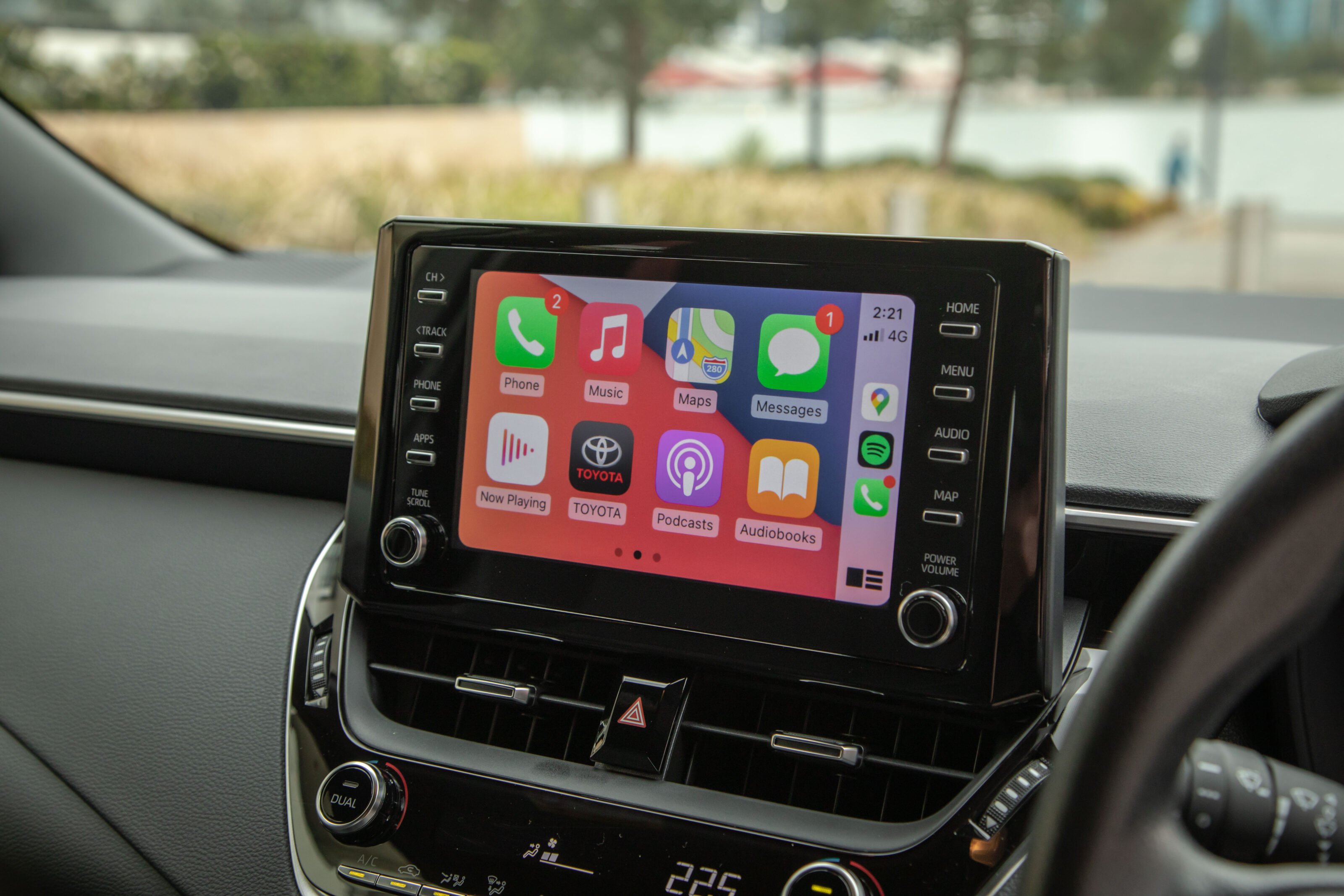
The infotainment system, though, leaves much to be desired, sprouting proudly from the dash top and its thick frame housing shortcut buttons that are handy only once you’re familiar with the layout because the labelling is so dim.
Its content is slow, clunky, arduous to navigate and there’s precious little of it outside of our test car’s optional sat-nav, which looks to be graphically and functionally dragged into service begrudgingly from some era of yore. Even the large-view reversing camera, which is terribly grainy, adds a passé vibe and conspires to a dated ambience at odds with the Corolla’s contemporary pitch, particularly with its exterior styling.
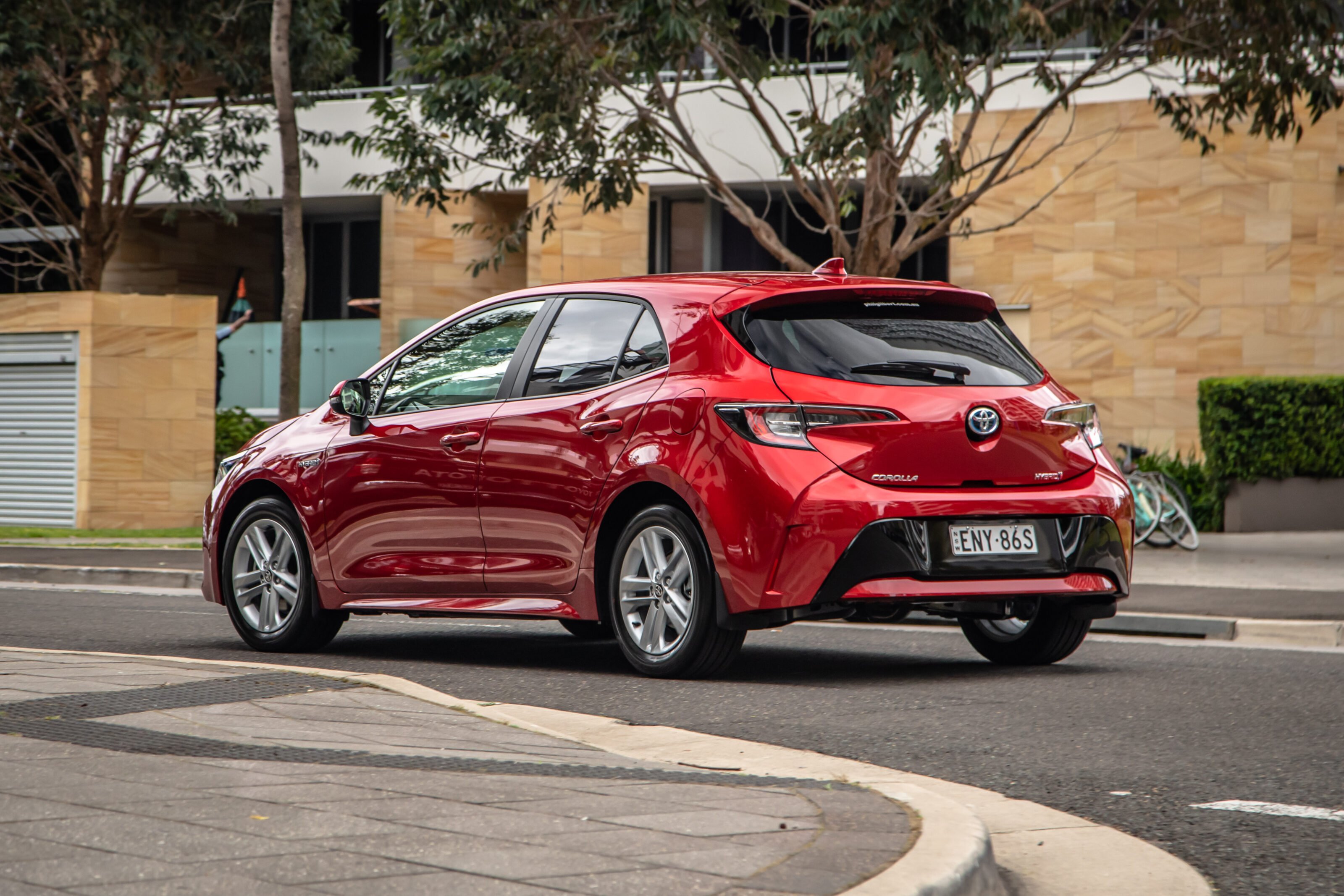
In fact, the Japanese five-door’s stylised form has claimed a large scalp in the form of boot space. At just 217 litres, it’s paltry against segment competitors, albeit no smaller in volume than the petrol version (which features a larger 50-litre fuel tank against the hybrid’s 43L) and offering a space-saver spare housed in a cradle that looks large enough to accommodate a full-sized wheel.
On the Road
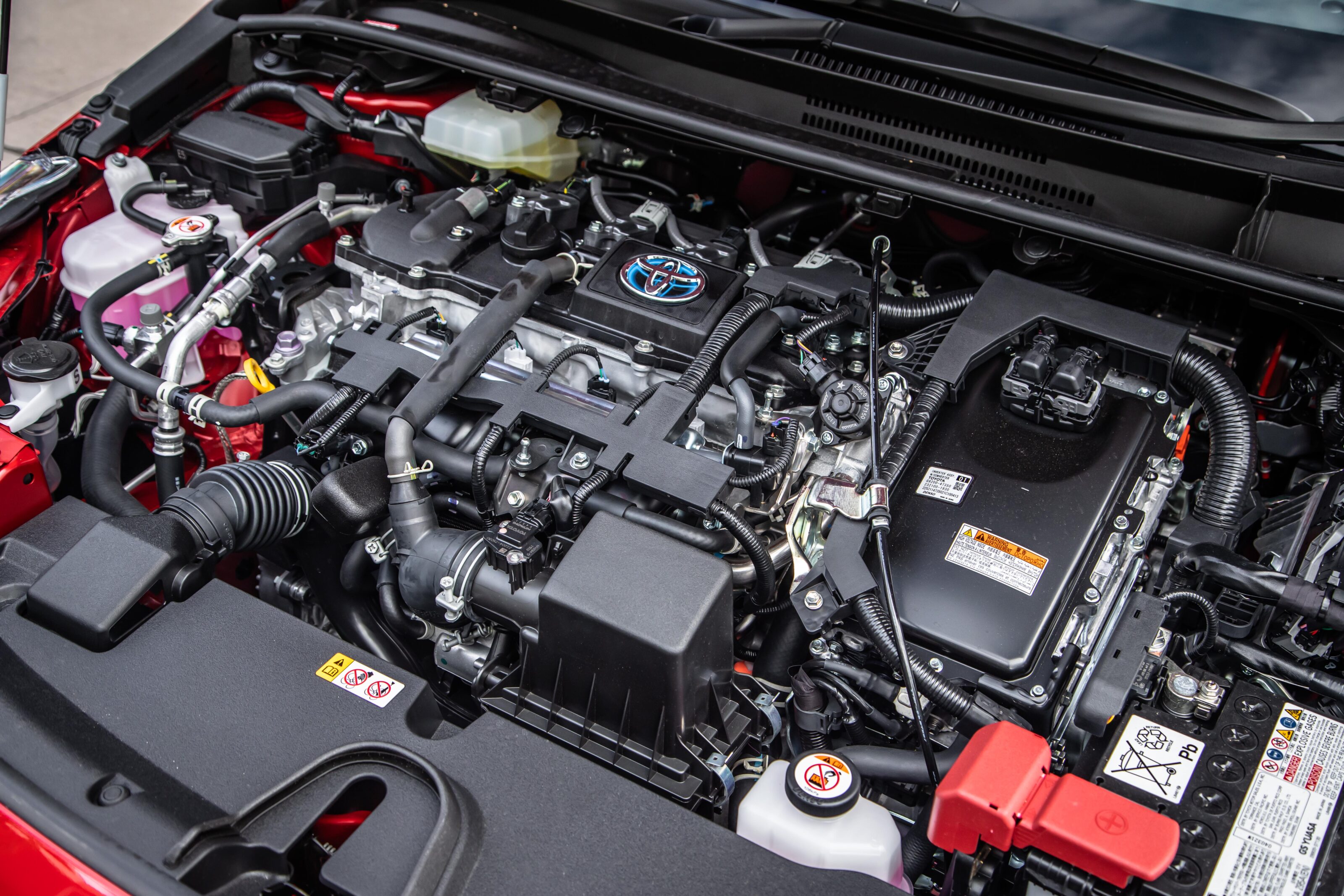
The Corolla’s hybrid powertrain is a curious if well-worn cocktail adopted in various global Toyota models, combining the 2ZR-FXE 1.8-litre naturally aspirated Atkinson cycle petrol four producing 72kW and 142Nm, paired with an electric motor good for 53kW and 163Nm. Toyota generally advertises the internal combustion outputs on official literature, though total system power is said to be 90kW.
Marrying the two power units is a clever e-CVT, a dual-input planetary gear design – one quite different to the widely adopted belt-drive/conical-pulley CVT set-up – providing series or parallel drive plus direct electric drive when demanded. It’s familiar in functionality to the great many Toyota and Lexus hybrid owners and users, if no less tricky because of it.
Some of the old patchy drivability and notchy transition between power units seem to have been ironed out in the Corolla’s application, its e-motor torque immediate in response as ever, a little lustier than I remember of older petrol-electric designs, with petrol power seemingly less strained when called to even moderate action. It’s a nicer, if mildly evolved synergy, politer in action and less transitional across the broad scope of driving inputs and road speeds.
Toyota’s closed-circuit, nickel-metal hydride-based systems have long plied their most rewarding efficiency dividends around town, at low speed or in stop-start driving, rarely returning much love on the open road. But this Ascent Sport is the first of its ilk where I’ve noticed a tendency to drop into EV mode quite so regularly flat running on a light throttle at motorway speeds.
Does it make a difference? In terms of refinement and comfort, yes – even if the base hatch is prone to drumming up enough tyre noise to send you diving for the stereo volume knob. In the proper guts of city driving, it returned an impressive 4.4L/100km against its combined 4.2L claim. Bravo. But I was somewhat surprised that out on the open road, it almost stubbornly refused to dip north of the threes.
I’d long pegged Toyota’s hybrids efficiency as quite conditional and situational. This Corolla, though, demonstrates frugality with an impressively broad, real-world approach that I don’t recall its forebears offered quite so confidently.
There are attempts to overcomplicate matters. You can toggle between Eco and Sport drive modes, the only meaningful return being a bit more noise without much extra bite. Then there’s the dedicated EV mode, which simply deactivates and fire the engine into service the instant road speed creeps above 40km/h… pretty much exactly like its default hybrid mode does anyway.
Where this generation really, conspicuously upped Corolla’s game was in the ride and handling balance afforded by its TNGA platform, leveraging a deftly tuned suspension calibration. And that goodness that was quite the revelation on my first introduction to this twelfth-gen Corolla runs deep in the base version, its 16-inch rolling stock not doing styling many favours but bringing an extra sheen of sidewall compliance compared with the 18s fitted further up the range.
The ride is good, not perfect. It gets caught jolting a little on sharp-edged road imperfections and there’s some faint suspension noise but on balance, as a buck-banging runabout, the general on-road comfort punches above its weight.
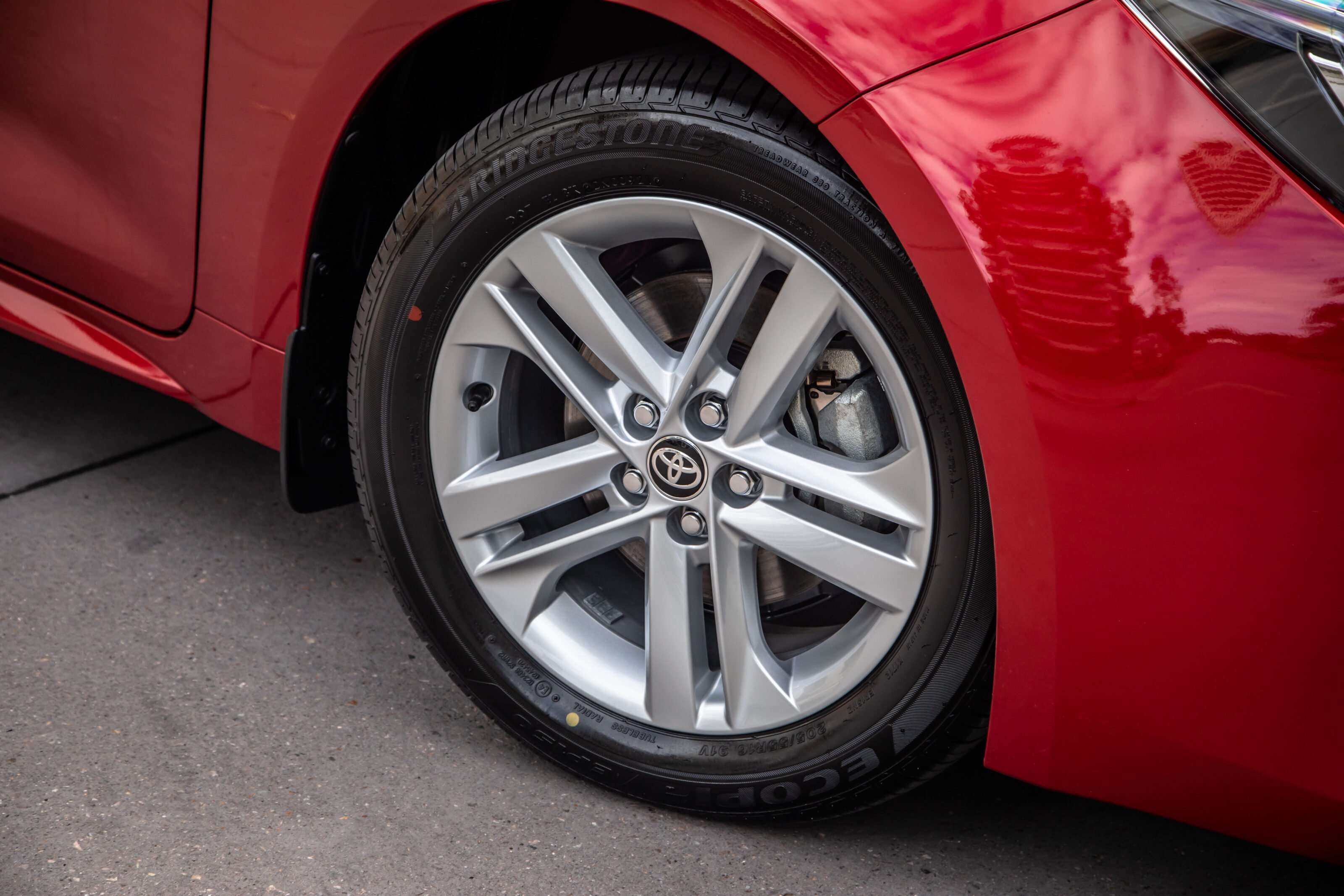
Handling is fine enough; cooperative, reasonably light on its rubber feet, direct enough in pointing in the desired direction and generally task free. In fact, it’s quite a decent machine to spend long stints in the saddle, which bodes well in the faithful service of delivering paying passengers or hot food. If there’s much of a gripe it’s braking, the Corolla’s electro-regen protocols, directly or by association, bringing with them a slightly unnatural and granular feel to the left pedal.
It’s quite a decent machine to spend long stints in the saddle, which bodes well in the faithful service of delivering paying passengers or hot food.
Ownership
Toyota’s five-year/unlimited-kilometre warranty is industry-standard fare these days but it’s the servicing and support from the brand’s huge dealer network that are big drawcards. The Corolla’s capped-pricing program currently wants for $205 per visit across the first five years of ownership, with intervals of 12 months or 15,000km.
Add in that the hybrid’s frugality is 91 RON friendly and it makes for some properly cheap running.
Verdict
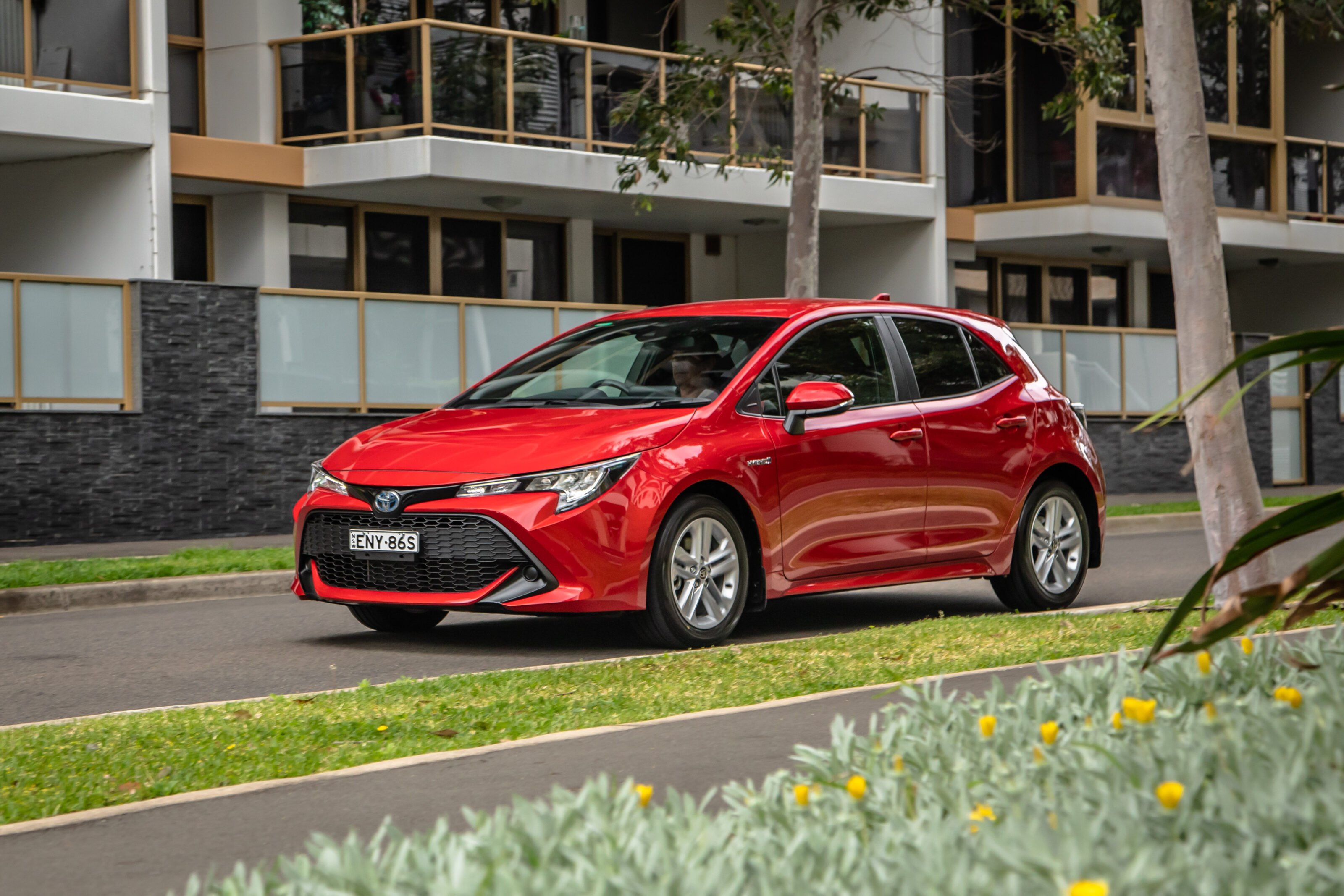
Toyota, its local arm, brand loyalists and gearheads alike might cringe at the ‘appliance’ reference when describing a Corolla. But at ground level for the world’s most popular passenger car, in a guise focused on wallet-friendly running, it certainly fits the bill perfectly.
As it turns out, the Ascent Sport Hybrid Hatch is an ideal appliance and then some. Very much to a strength.
Its rudimentary nature and trim frills rob very little from what’s a solid and likeable, safe-as-houses proposition. It’s quite a fine thing to drive and, importantly, its efficiency chops are much more than mere lip service. That it doesn’t wear its eco sensibilities on its sleeves and, given you don’t need to plug it in, requires low effort for its economy returns.
Llittle wonder, then, that Toyota’s particular approach to green-tinged motoring is so popular and widely accepted.
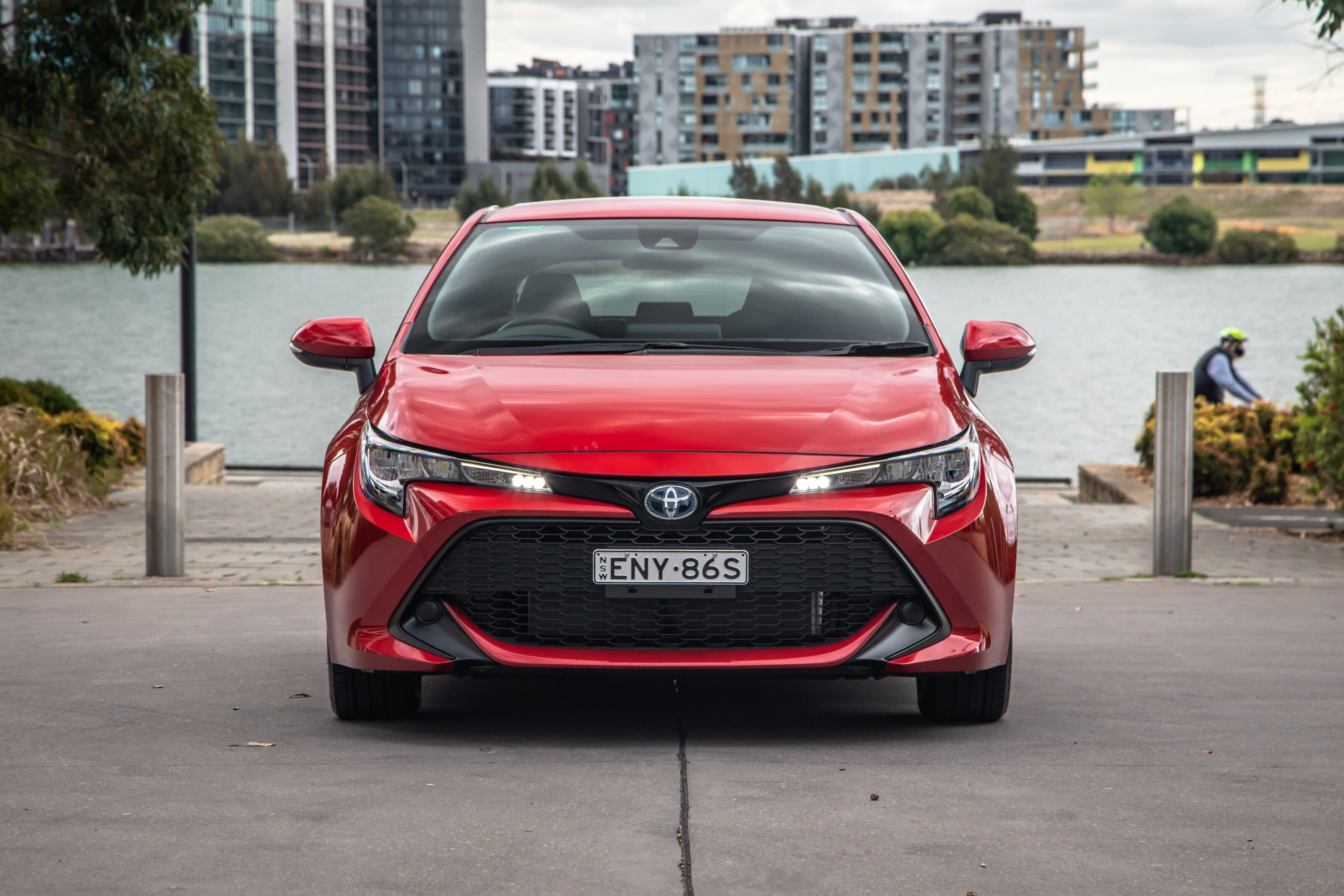
Its rudimentary nature and trim frills rob very little from what’s a solid and likeable, safe-as-houses proposition.
Toyota’s small five-door is, though, a little compromised for packaging and outright practicality. And at over $32K for our tester’s configuration parked up in your driveaway, the price is getting up there.
Further, the entry variant’s relatively basic active safety fit-out makes the more elaborately furnished mid-range SX appear the better option for young and inexperienced drivers. The petrol SX is only marginally pricier than the base hybrid if you’re willing to forego petrol-electric motivation.
RELATED READING
Looking for more details on the wider Corolla range? Our full range review has everything you need to know.
Automotive dealers could benefit to proposed changes to the Australian Consumer Law, with a larger onus set to be put on the manufacturers.
The aim of the changes, currently under consultation by the Treasury, is to make it easier for buyers to get help if their car is faulty, and to shift repair or replacement costs from the dealer to the manufacturer.
The Government says updating the law will both give more power to consumers to get compensation from dealers who fail to provide a remedy in the event of product issues, while also punishing manufacturers which don’t reimburse their dealers when things go wrong.

“The consumer guarantees are automatic statutory warranties that ensure consumers can seek a refund, repair, or replacement when there is a problem with something they buy,” said Assistant Treasurer Michael Sukkar.
“For example, the consumer guarantees require products to be of acceptable quality, fit for purpose and match their description.
“Consumers often face difficulties in obtaining a refund, repair, or replacement because there is currently no penalty for suppliers who refuse to provide a remedy.
“The options being consulted on would provide stronger incentives for businesses to comply with their obligations under the Australian Consumer Law and make it easier for consumers to obtain a remedy.”

Australian Automotive Dealers Association (AADA) CEO James Voortman said the organisation supports the proposed changes, saying the middle man is often affected the most when remedy is required.
“New car dealers are very much focused on providing their customers with a first-class experience and we welcome the Government’s efforts in trying to ensure compliance with consumer guarantees,” said Voortman.“It is encouraging that the regulation impact statement has identified options to strengthen supplier indemnification. The ACCC’s market study into the new car industry highlighted the issue of manufacturers not indemnifying their dealers.“Too often dealers, which are the suppliers under the ACL, are the meat in the sandwich caught between the customer and the manufacturer of the vehicle when there is a request for a remedy.“Motor vehicles are a high value purchase and require ongoing maintenance which is often conducted through the dealer network. Dealers often suffer significant financial loss by replacing or refunding a vehicle only to be told they will not be indemnified.”
The Federal Chamber of Automotive Industries (FCAI) however, believes there are already strong provisions in place – although it isn’t against taking these further and is evaluating its own response.
“We acknowledge the Federal Government’s announcement that it will consider future steps that might be necessary regarding consumer guarantee and supplier indemnification provisions,” said a spokesperson.
“And we support appropriate actions from governments to protect the rights of consumers in Australia. In this regard, Australia already has significant provisions in place under Australian Consumer Law to support and protect customers.
“We will work with our members to consider the review being undertaken by the Treasury and appropriate next steps.”
The consultation process between Treasury and stakeholders will be open for the next 60 days, closing on February 11, 2022.
A wall-mounted charger for Mini’s electric vehicles has been recalled in Australia, due to the unit not meeting local standards.
Thirty of the Mini HV Wallbox Gen II (with charging socket) units have been placed under recall by the Australian Competition and Consumer Commission, all of which were sold between 2020 and 2021.
Affected chargers have the part number 61 90 2 472 423 printed on the side label and must be replaced by BMW as they don’t meet certification and labelling requirements which must be used in Australia.
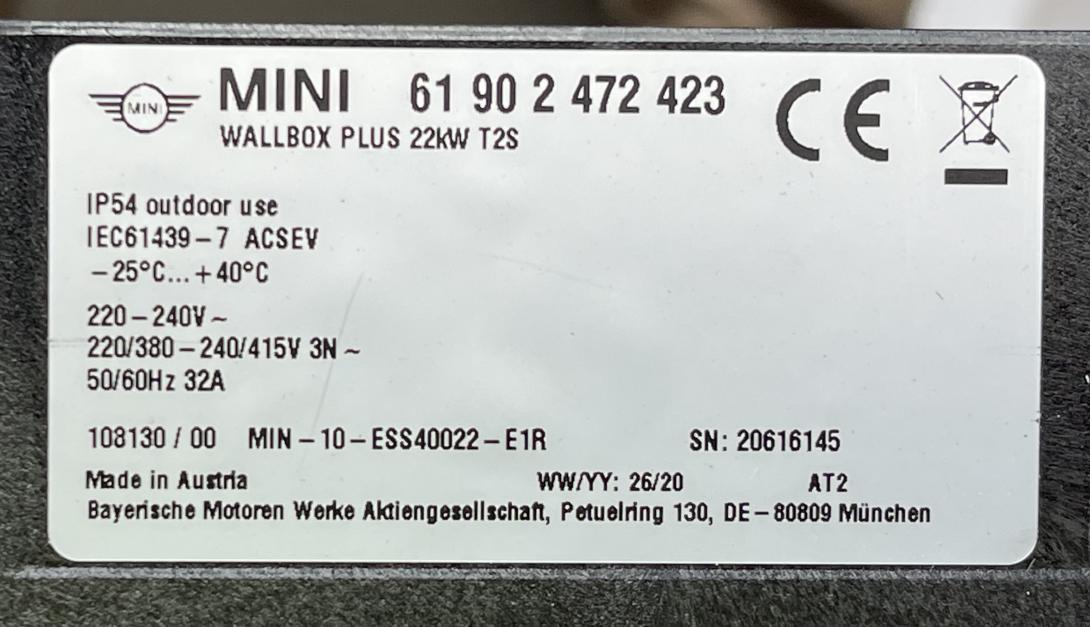
Those who have the charger in question are encouraged to contact BMW Australia to arrange a replacement unit, with the manufacturer offering to organise a licensed electrician to uninstall the old charger and refit the correct one.
BMW Australia can be contacted via phone (133 269) or email ([email protected]).
March 2024: Solterra driven in Australia
It’s Subaru’s first EV and its most expensive model, but can the Solterra trouble big-name rivals that include the Tesla Model Y?
The story to here
November 2022: Subaru’s first dedicated electric vehicle has been unveiled, with the covers finally coming off the Solterra in Japan.
Key Points
- Solterra to be available as front and all-wheel-drive
- Specs identical to Toyota’s bZ4x
- International launch to come next year
Developed as part of a joint venture with Toyota’s BZ4X, the Subaru offers features which are identical to its cross-engineered cousin – with a choice of front and all-wheel drive power delivery available.
In fact, the addition of front-wheel drive to the Subaru line-up makes the Solterra its first FWD since the late-1990s’ Liberty, and only the second two-wheel-drive offering from the manufacturer this decade after the BRZ – also developed alongside Toyota’s 86.
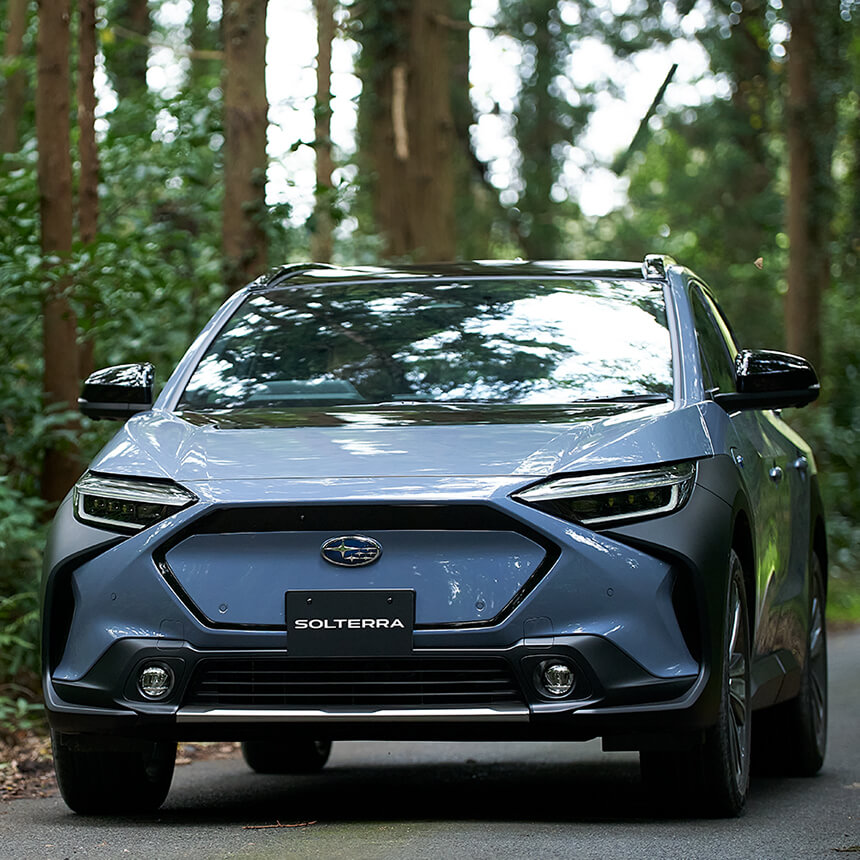
In the case of the front-wheel-drive Solterra, a single electric motor on the front axle provides 150kW, while the all-wheel-drive variant makes use of two 80kW motors, one for each axle, to develop a total of 160kW.
Battery capacity stands at 71.4kWh for both variants, while the lighter, front-wheel-drive enjoys around 530 kilometres of driving range – around 40 kilometres more than the AWD version.
While the AC charger has a maximum output of 6.6kW, the DC fast-charger’s 150kW output will allow the battery to be taken from a 0-80 per cent state of charge in roughly 30 minutes.
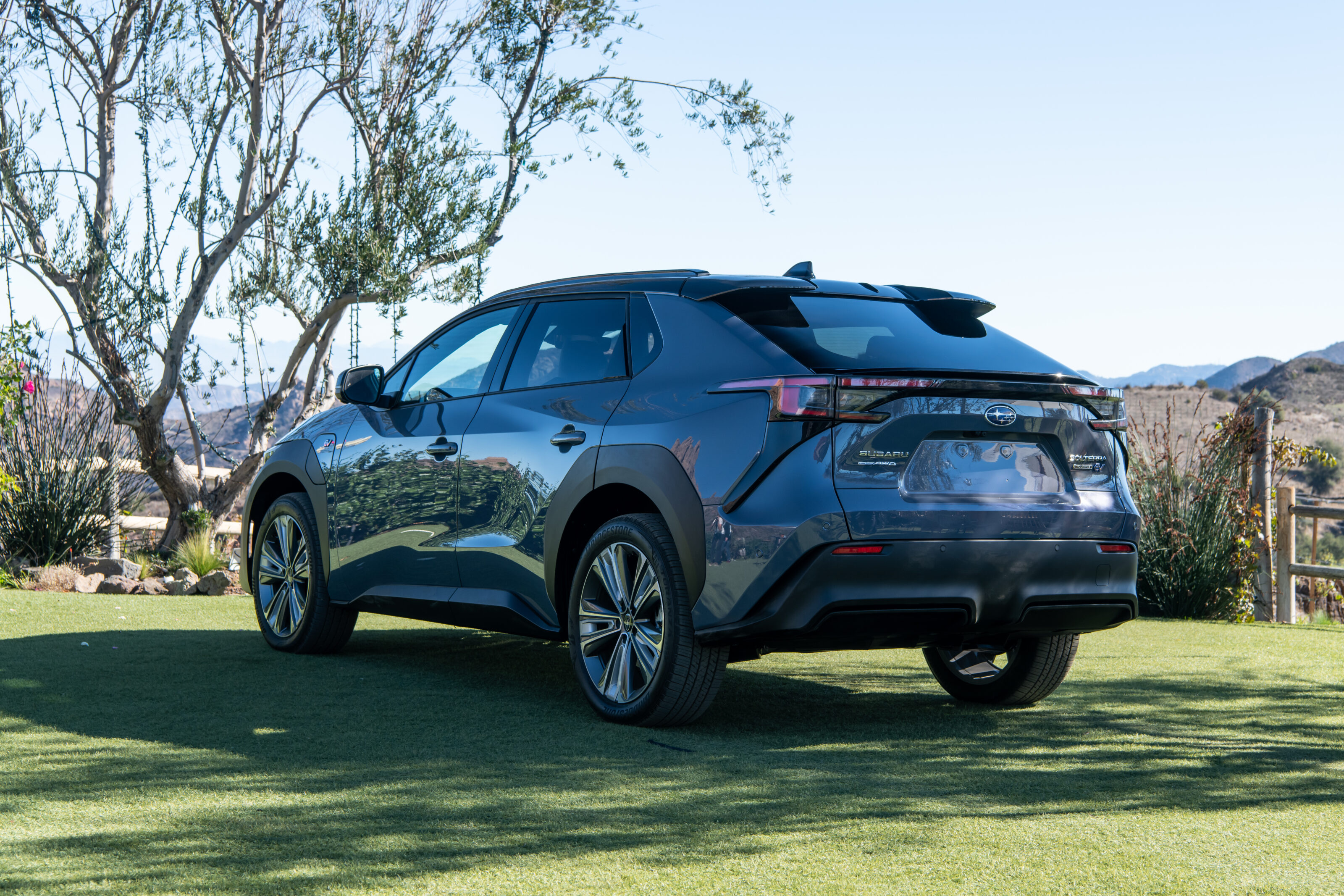
Exterior dimensions remain identical to the BZ4X – 4690mm in length, 1860mm wide and 1650mm tall with a 2850mm wheelbase – making it larger than the Forester, but shorter, thinner and lower than the Outback.
Tipping the scales at 1930kg in single motor guise and 2020kg when equiped with dual motors, Subaru hasn’t provided a weight difference between Solterras equipped with a fixed, panoramic glass or solar roof, with the latter option featuring the ability to provide a small charge to the battery pack.
Subaru’s design language is prominent at the front of the Solterra with its grille reflecting the other models in the manufacturer’s line-up, while a choice of 18-inch or 20-inch (AWD only) wheels will set it apart from Toyota’s offering.
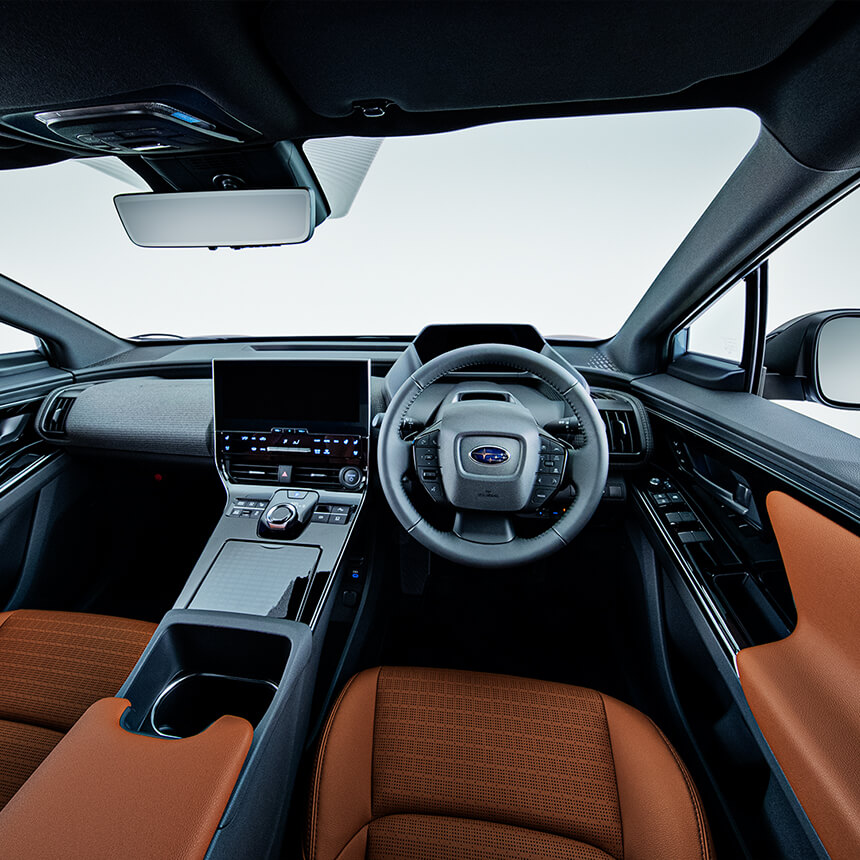
Thankfully the Solterra has ditched the BZ4X’s ‘yoke’ steering device, instead opting for a mundane, but functional, wheel alongside a digital dash and horizontally-mounted infotainment screen.
Subaru has said the Solterra will launch internationally by the middle of 2022 for Japan, the United States, Canada, Europe and China – although Subaru Australia’s general manager, Blair Read, says the local arm is talking with the global operations to assess whether it will be available here.
“The Solterra heralds a new era for the Subaru brand and its global reveal stirs great anticipation and excitement as we see the next expression of Subaru Corporation’s commitment to electrification,” said Read.
“Whilst Subaru Corporation are yet to confirm a timeline for the Solterra in Australia, we are working very closely and future electric projects form part of ongoing dialogue between Subaru Australia and the factory.”
Toyota is to implement a subscription service for remote start functionality in the United States.
First reported by The Drive, Toyota will soon begin to charge owners with 2018-onwards vehicles equipped with Connected Services an annual fee of up to US$80 (AU$113) or US$8 (AU$11) per month to continue using some systems.
One of those impacted is the remote-start function, activated by the proximity-based RF key fob, something which is currently free but will incur the subscription fee once Toyota’s trial runs out.
The free trial itself has caused minor confusion, as it’s unclear whether it applies from the date of the vehicle’s purchase or from the start of 2022, with some models given a three-year trial whereas others are covered for the next decade.
In addition to the remote start system, Toyota’s Safety Connect SOS system and Destination Assist will also be covered under the subscription, while Apple CarPlay and Android Auto remain as free items.
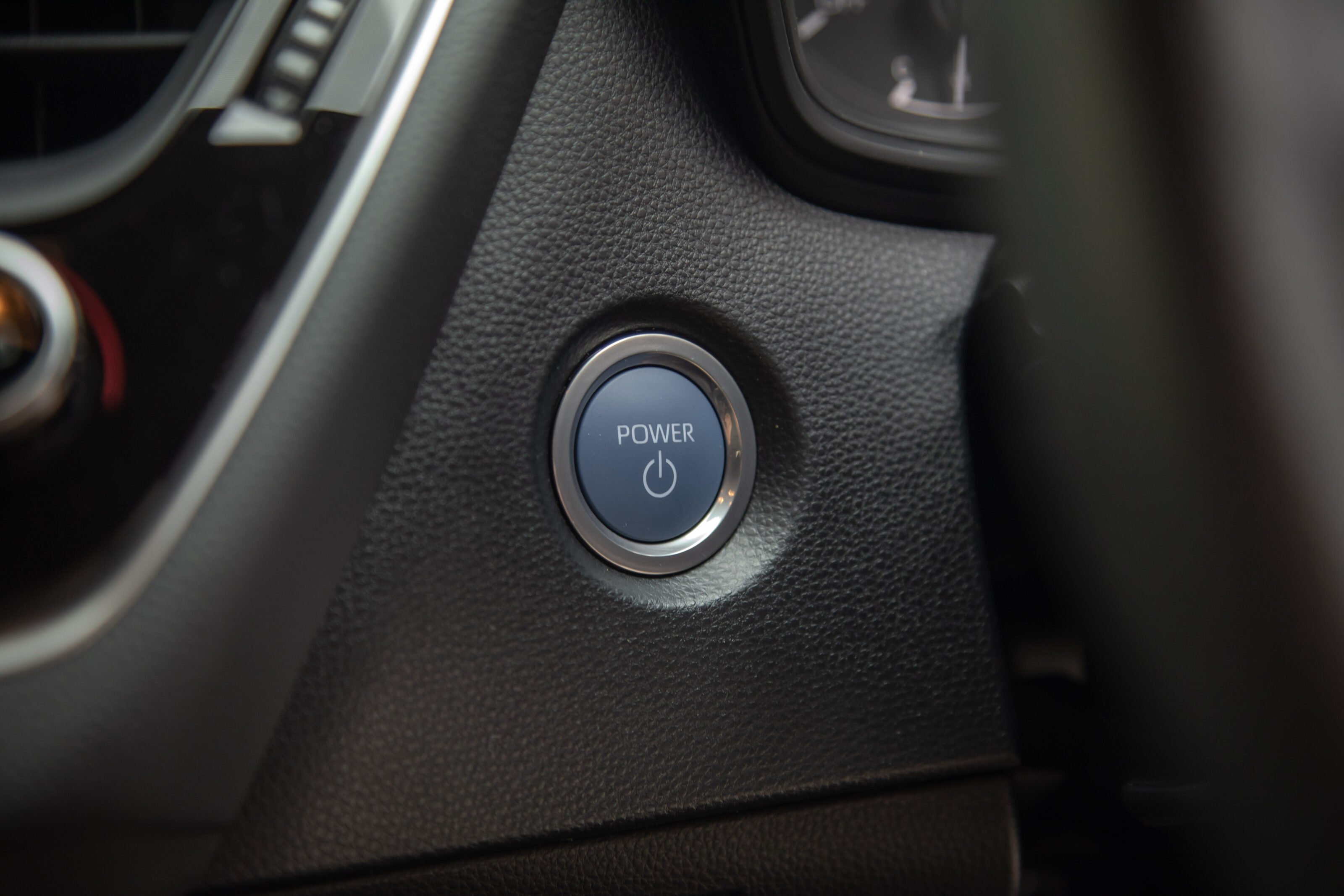
Owners will still be able to use their remote key to access their Toyota vehicle and turn it on via the push-button start, with the ability to remote start becoming the only key-related function dropped when it goes to a subscription model.
Toyota isn’t the first company to propose or implement subscriptions in its vehicles, as the likes of Mercedes-Benz, BMW and Tesla have all done the same for various technologies.
UPDATE, 5:00 pm: Wheels has obtained additional information regarding the 2022 Mazda CX-5 facelift.
The original story has been updated to reflect this below.
The story to here
A leaked dealer bulletin has outlined local specification details for the updated 2022 Mazda CX-5.
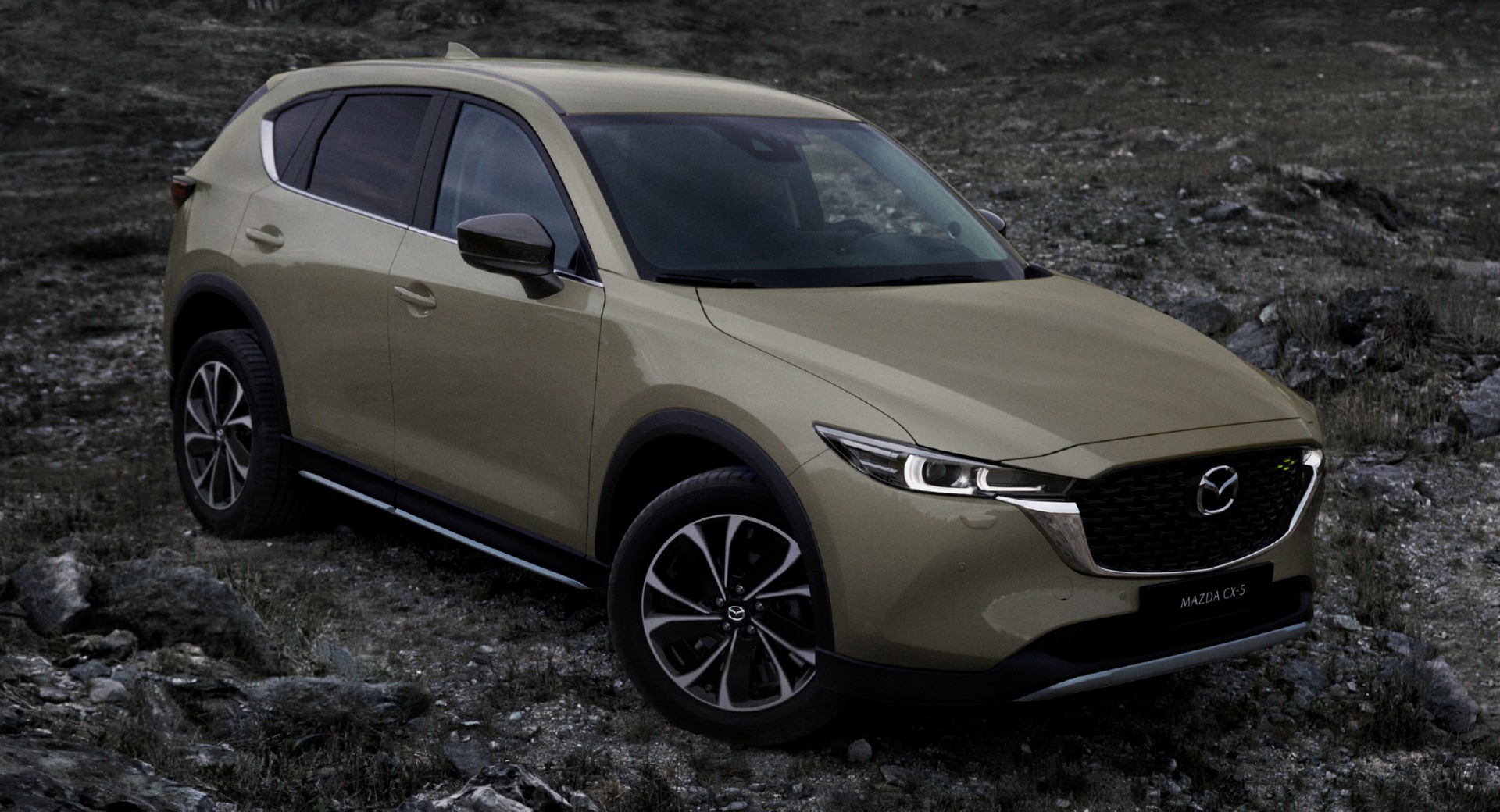
Scheduled to arrive locally in March, the 2022 CX-5 – first revealed in September – has received an external facelift that will also bring additional technology and safety features to the popular mid-size SUV.
According to the documents seen by Wheels, the revised model will also sport a rejigged line-up – with a new Touring Active variant added, the GT and several AWD trims culled from the range, and a new powertrain option included.
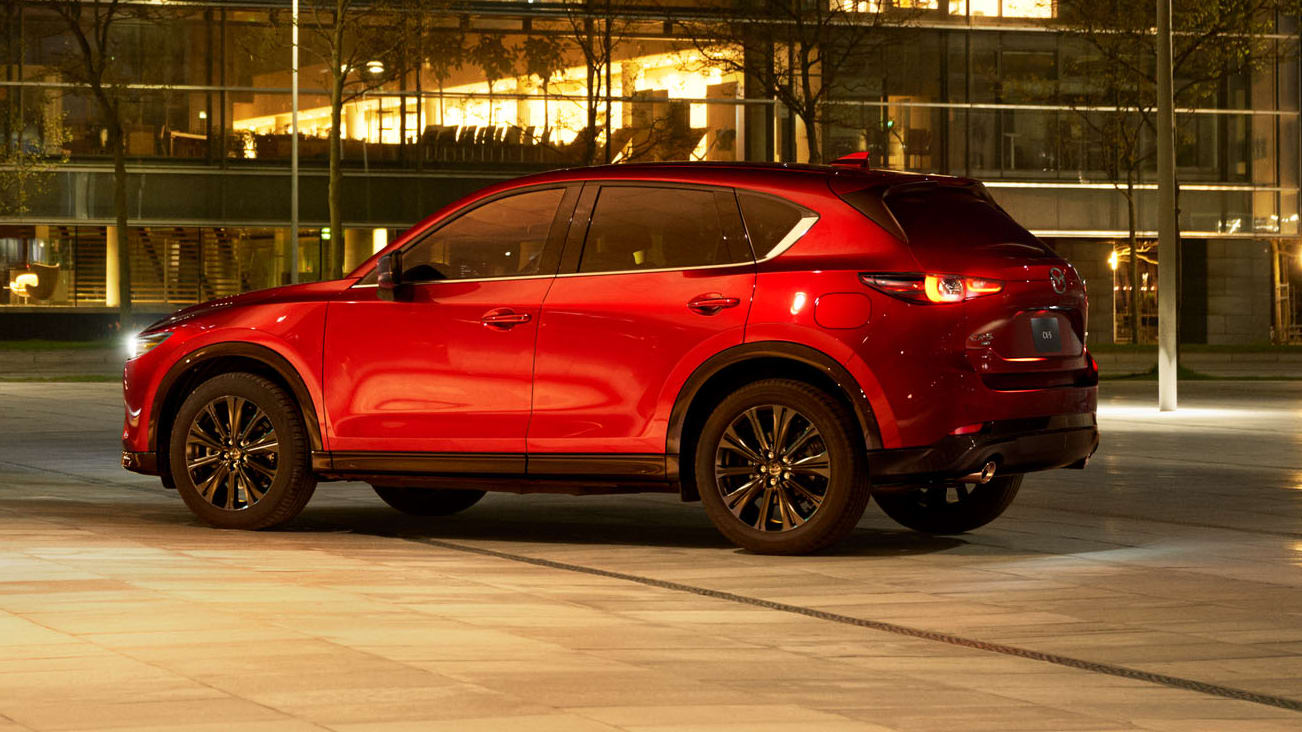
Like the outgoing CX-5, engine options will comprise of naturally-aspirated 2.0-litre and 2.5-litre petrol mills, as well as a 2.5-litre turbo-petrol and 2.2-litre twin-turbocharged diesel.
However, the Maxx Sport 2.0-litre petrol FWD will be axed in favour of the 2.5-litre engine – now available in front-wheel-drive guise for the first time in the CX-5’s local history.
In addition, several all-wheel-drive variants are facing the axe, with low customer sales reportedly behind the decision.
These discontinued options are the Maxx petrol AWD, Maxx Sport diesel AWD and Touring diesel AWD.
The entry-level 2.0-litre – limited to the base Maxx variant – can still be chosen with either a six-speed manual or automatic transmission, with the latter gearbox standard across the remainder of the mix.
Mazda Australia is yet to confirm official pricing for the facelifted CX-5, however, Wheels believes increases of up to $2000 can be expected due to the additional standard equipment.
The documents confirm the 7-inch semi-digital instrument cluster currently exclusive to the flagship Akera will become standard fit, while the windscreen-projected head-up display will also be available across the range – in an identical move to the CX-30 line-up.
Full-LED headlights and tail-lights are also set to be available across each variant.

Other range-wide changes include; updated alloy wheel designs, steering and dynamic enhancements, NVH improvements, a new ‘S-shaped’ seat structure, the integration of fog lights into the headlamps, and an even-thinner space-saver spare wheel to cater for a newly adjustable rear cargo floor.
Petrol all-wheel-drive variants will also pick up the brand’s Mi-Drive switch with Sport and Off-Road driving modes.
The colour range is also set to change, with zircon sand metallic replacing titanium flash mica.
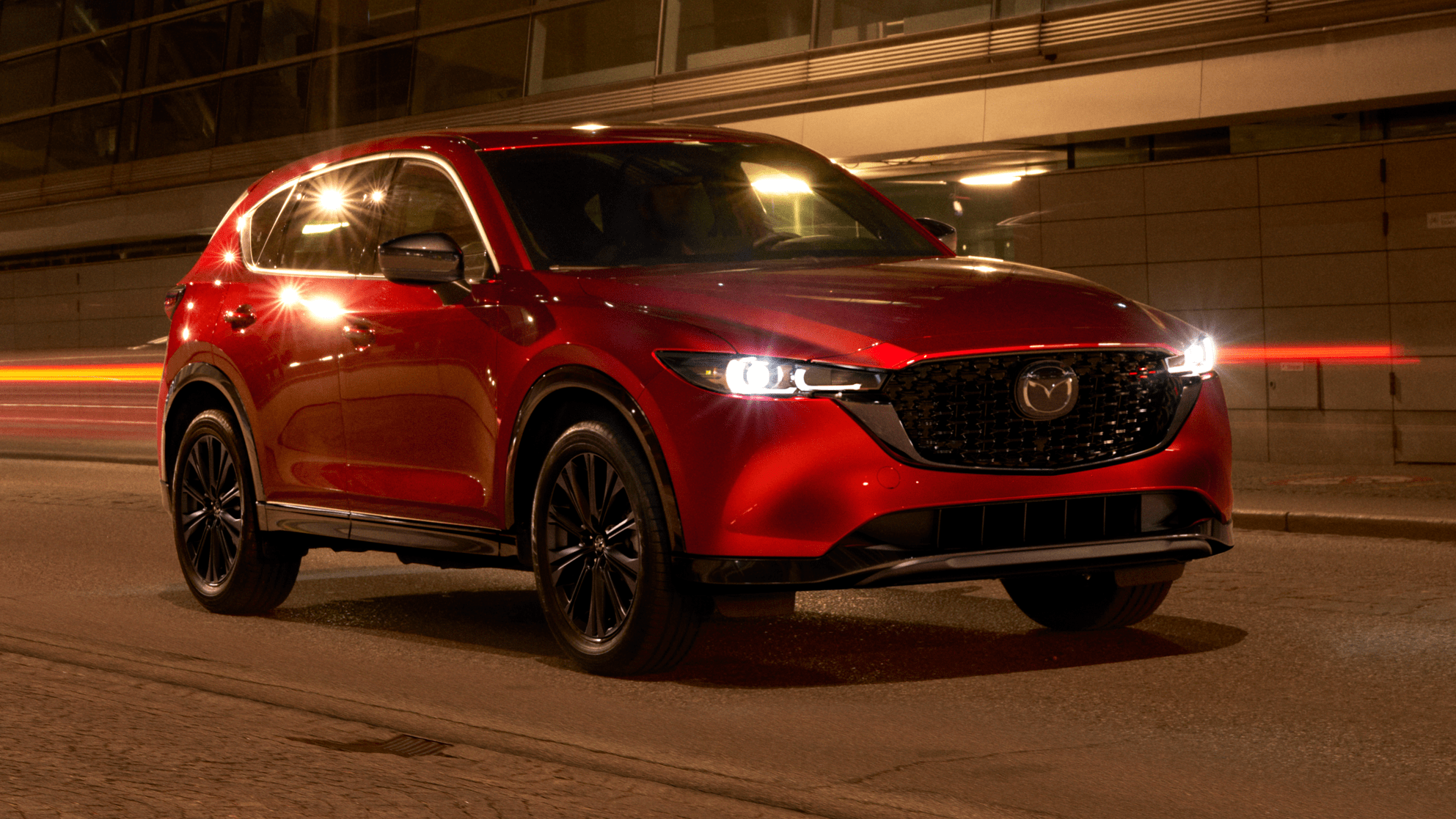
The current infotainment setup, consisting of the 8-inch unit on the Maxx, Maxx Sport and Touring (and likely Touring Active) running older software and the larger 10.25-inch widescreen on the GT SP and Akera using Mazda’s latest system, is expected to carry over for another year.
Traffic sign recognition – currently available on the Touring and above – will filter down to the Maxx Sport for the new model-year.
A wireless phone charger and reversible cargo floorboard are available in Touring grades and higher, while the newly-added Touring Active variant features unique styling enhancements.
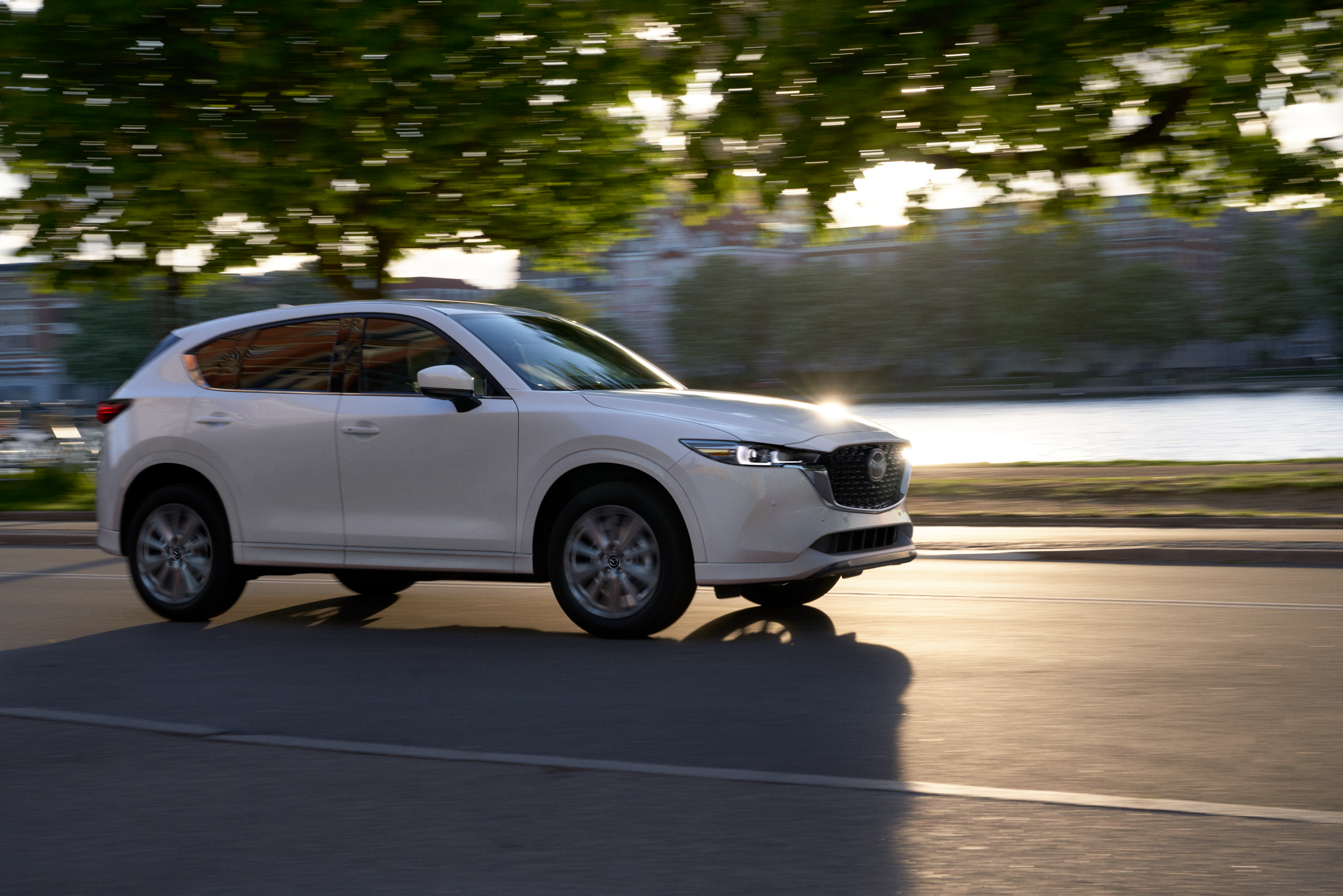
The chunkier body kit on the Touring Active includes silver trim on the front and rear bumpers and side skirts, in addition to lime green accents on the front grille, seats and air vents.
A diesel engine is optional on the Touring Active, alongside the naturally-aspirated 2.5-litre petrol.
As mentioned, the familiar GT variant has been discontinued for 2022 – with the optional turbo-petrol engine now limited to the GT SP and Akera.
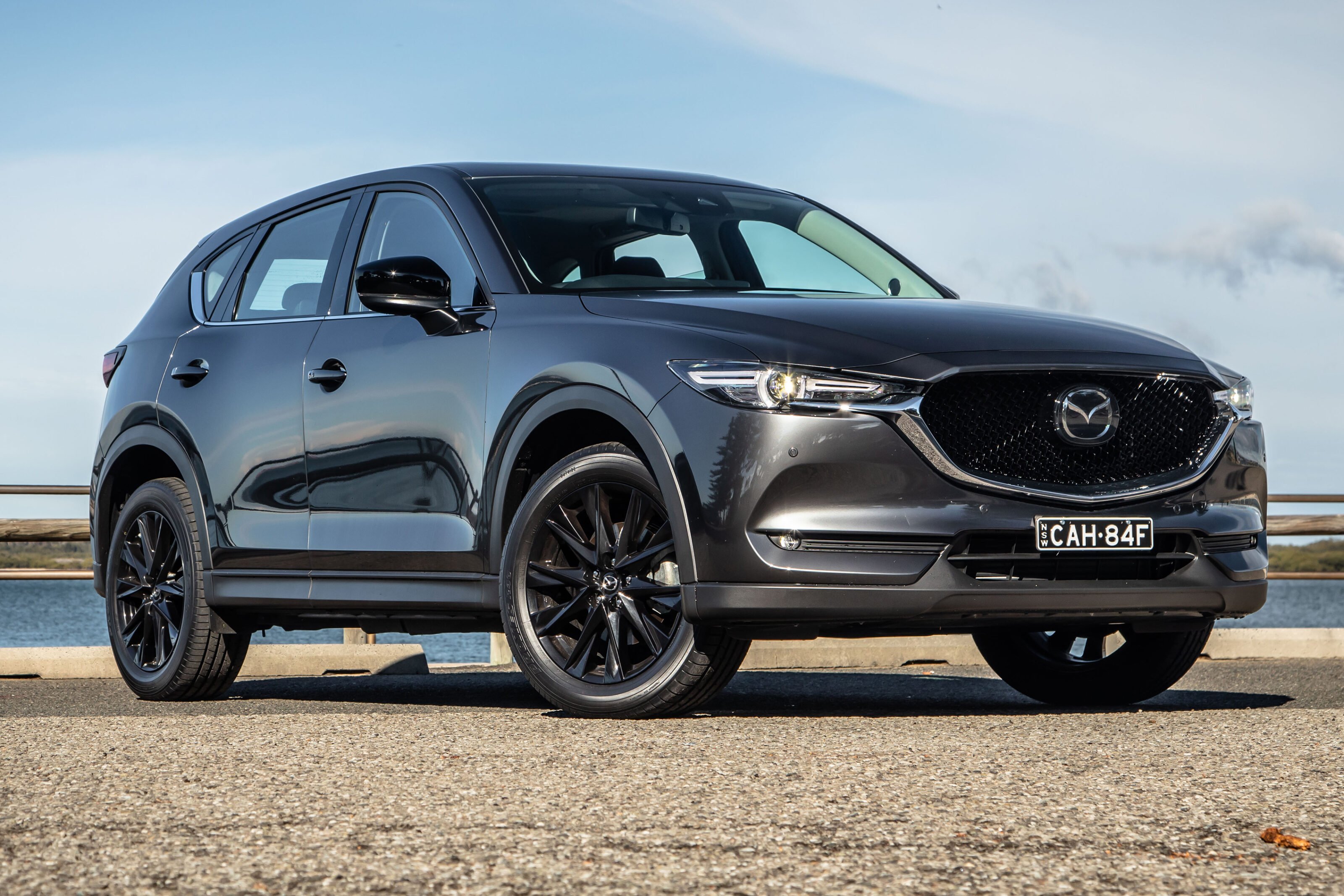
New additions for the blacked-out GT SP variant – added to the range earlier this year – include; a hands-free power tailgate, traffic jam assist, LED interior lights, black headlining, larger exhaust tailpipes and a red grille accent.
Mazda had already confirmed prominent gloss black wheel cladding and lower bumpers will be added, while black leather seat trim with red stitching will replace the outgoing suede/leather combination.
Finally, the range-topping Akera will gain body-coloured wheel cladding and lower bumpers for a more luxurious look, as well as improved adaptive LED headlights with 20 segments, up from 11 – in addition to the new equipment listed above.
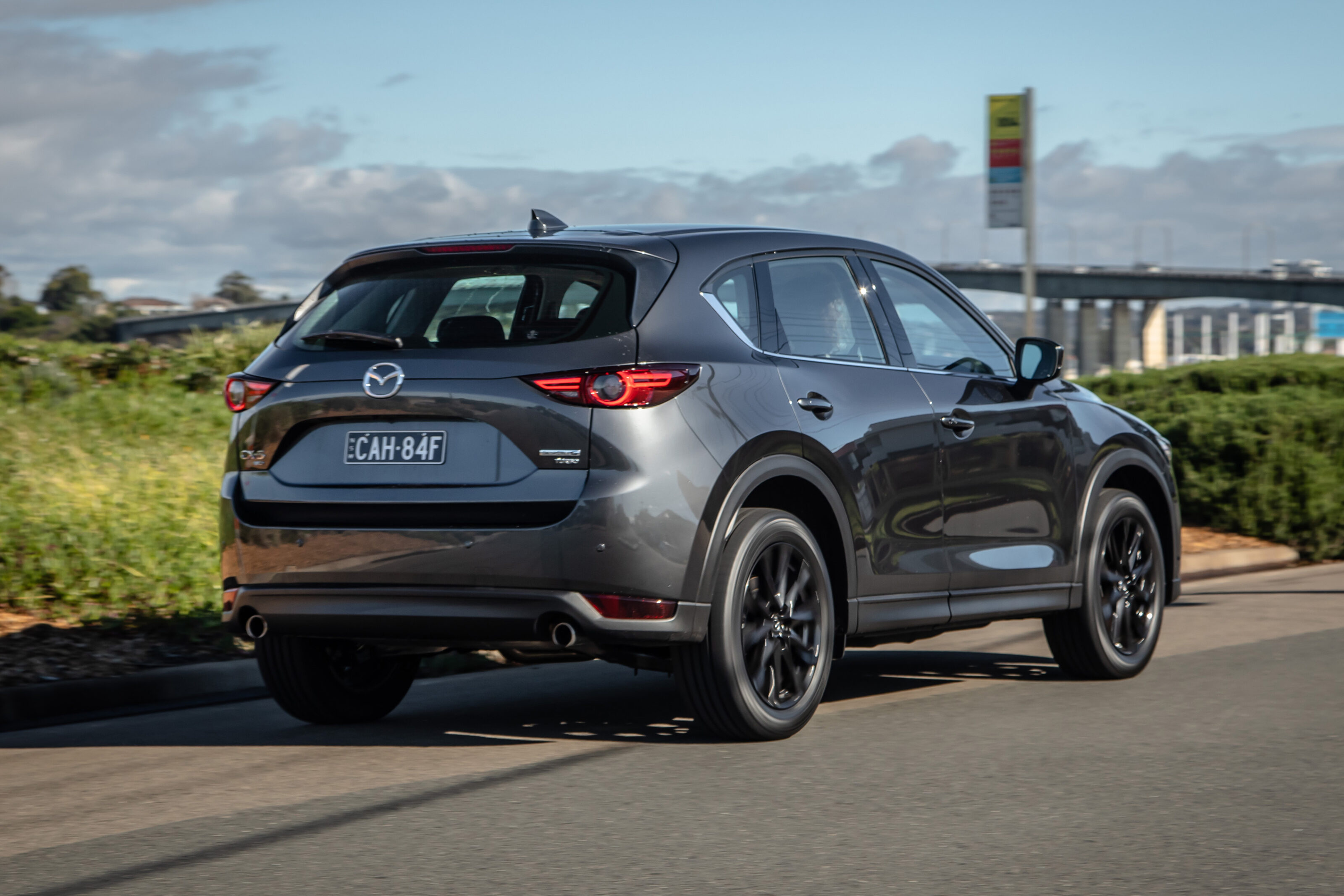
The facelifted Mazda CX-5 is expected to touch down in Australia in March 2022, although buyers hoping to purchase a turbo-petrol model could face delays due to a reported parts shortage.
Mazda Australia was unable to confirm the leaked details, however a spokesperson told Wheels the firm “looks forward to sharing more around the CX-5 in the new year”.
2022 Mazda CX-5 range:
Cable stalk buckle seat belts manufactured by Australian company Hemco have been recalled, sparking a search to track down the 4743 units.
The Australian Competition and Consumer Commission (ACCC) initially issued the recall in November, requesting parts beginning with ‘1766’ be returned to Hemco due to the buckle and anchor potentially separating.
Given the seat belt buckle is an aftermarket unit, it’s not clear as to how many vehicles it has been installed in, with the 4743 units recalled likely to be the total number sold rather than the number of cars they’re fitted to.
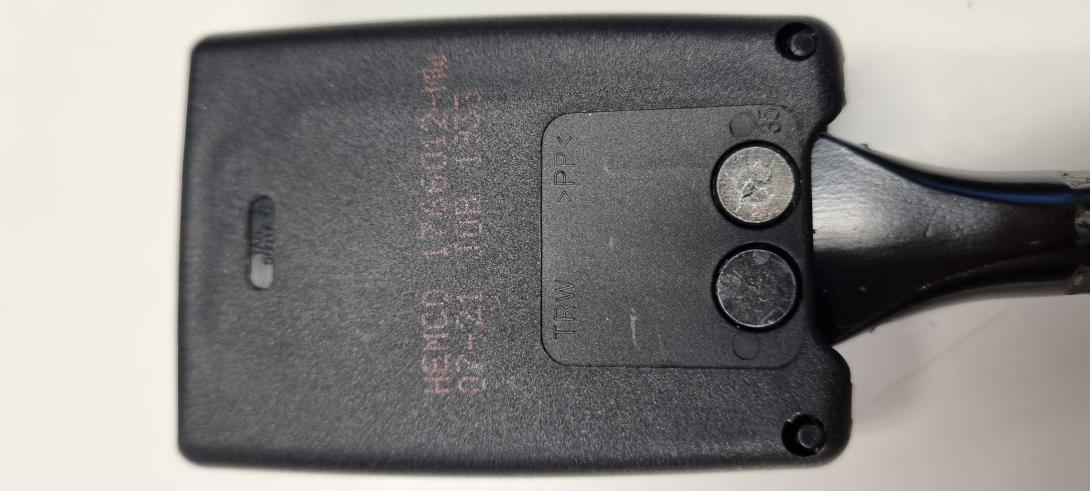
The ACCC recommends for anyone who has had a Hemco seat belt fitted this year to contact their mechanic so the vehicle can be safely towed to be rectified, otherwise a mobile technician can be sent out.
Anyone who believes they may be affected but needs more information can contact Hemco Industries on 1300 065 057 or [email protected].
The 2023 BMW X8 could still be on the cards, according to fresh reports.
Earlier rumours suggested BMW’s recently-unveiled XM could have been badged as the X8, but now an article in Germany’s AutoBild magazine suggests the X8 will be arriving as a coupe SUV based on the X7.
While the XM will remain as the company’s performance flagship – and its first standalone BMW M model since the original M1 – the X8 will sit below it as a coupe, as with other evenly-numbered models in the range.
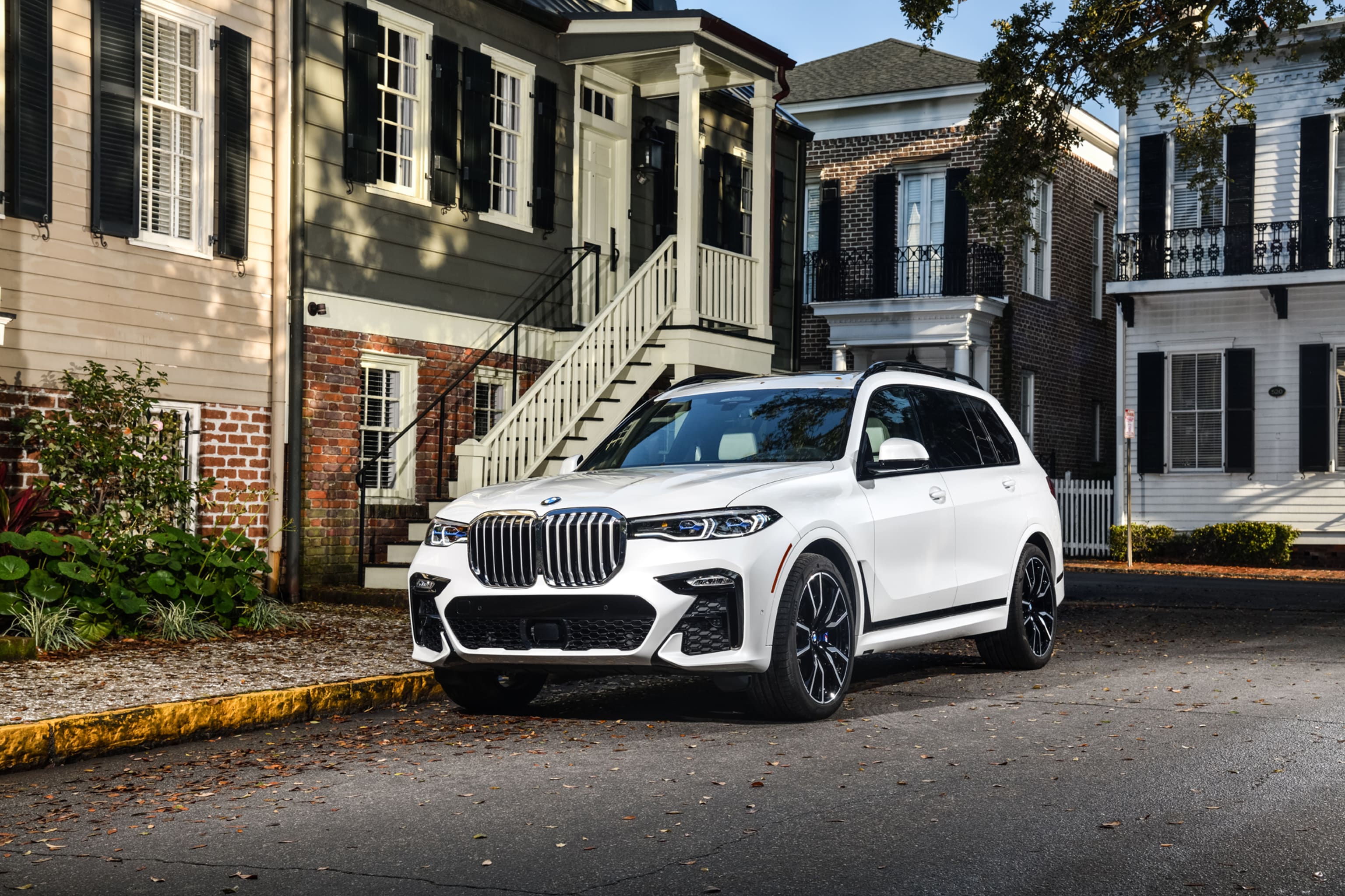
The X8 is said to be launching with three powertrain options, with the base model expected to be an xDrive40i variant – though it’s possible the Australian market could see the model mimic the X7, with the xDrive30d opening the line-up.
BMW has yet to confirm the X8, or even hint at such a model, but the addition would make sense: all BMW SUV wagon models have a sloped-back sibling, except for the X7.
The publication suggests the X8 will hit the market next year, but as BMW has yet to provide a teaser or concept of the model, if it did come to fruition, it’s likely an X8 would follow some time after the XM’s arrival in late 2022.
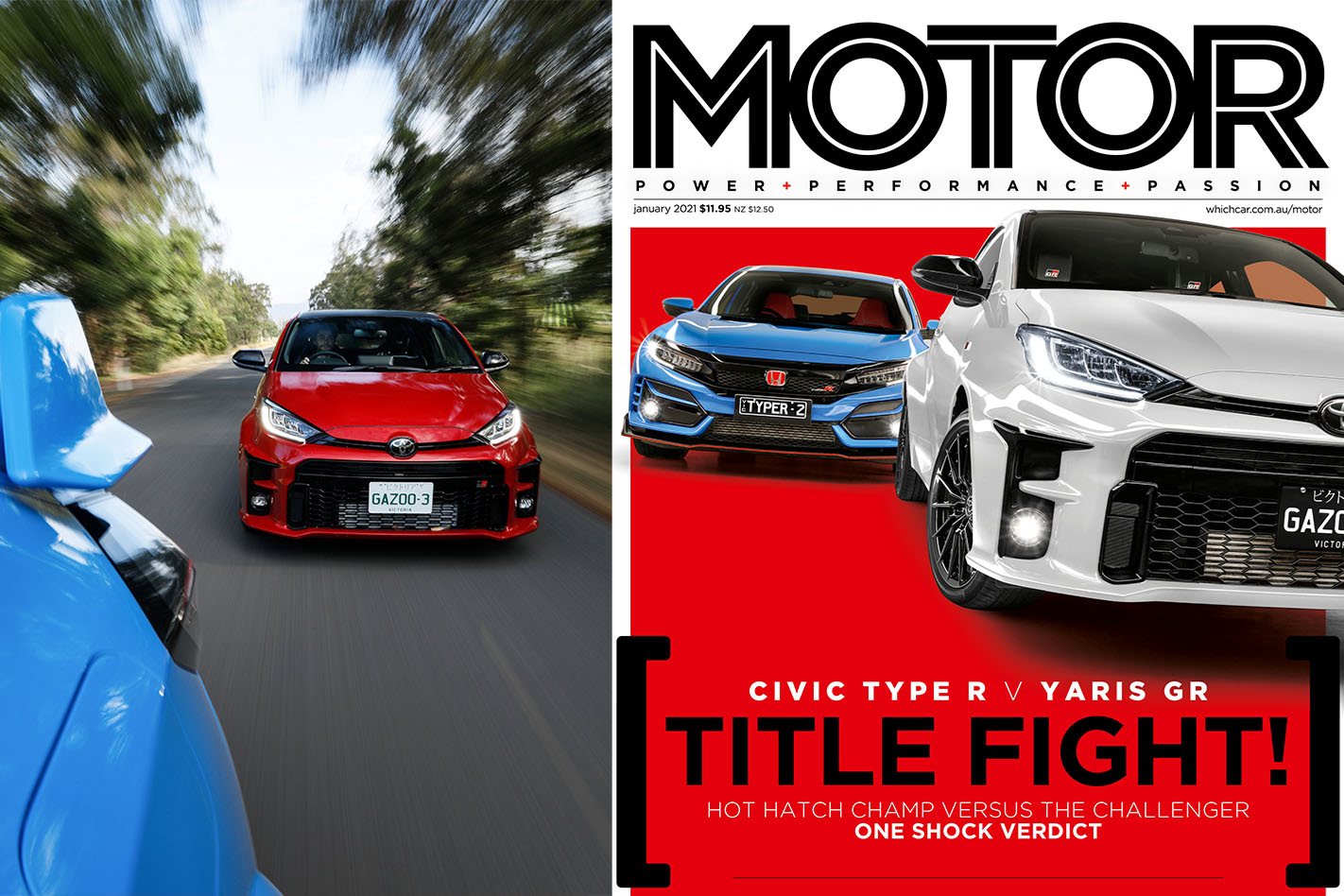
They’re back. MOTOR’s annual awards give us a chance to recognise the vehicles, the technology, the events and the people that really stood out during the past year. No, this isn’t the Performance Car of the Year awards. Instead it’s something a little more modest in its aspiration, offering a tip of the hat to excellence recognised by the MOTOR team in the last twelve months. And what a twelve months it‘s been.
Aside from the obvious global pandemic which has shredded vehicle launch schedules, there have also been the catastrophic semiconductor supply chain issues that have further sprung a spanner into the works. By most measures 2021 ought to have been a disaster, but a combination of ingenuity and dogged determination has seen a number of bright spots.
Unable to get to any of the overseas launches, we deported Dan Gardner back to Europe to report for us and we’ve struck a deal with Georg Kacher, possibly the world’s best-connected motoring writer – to bring you all the performance cars that matter. Kacher’s just sent us his list of 2022 launch invites and, boy, have we got a treat in store for you.
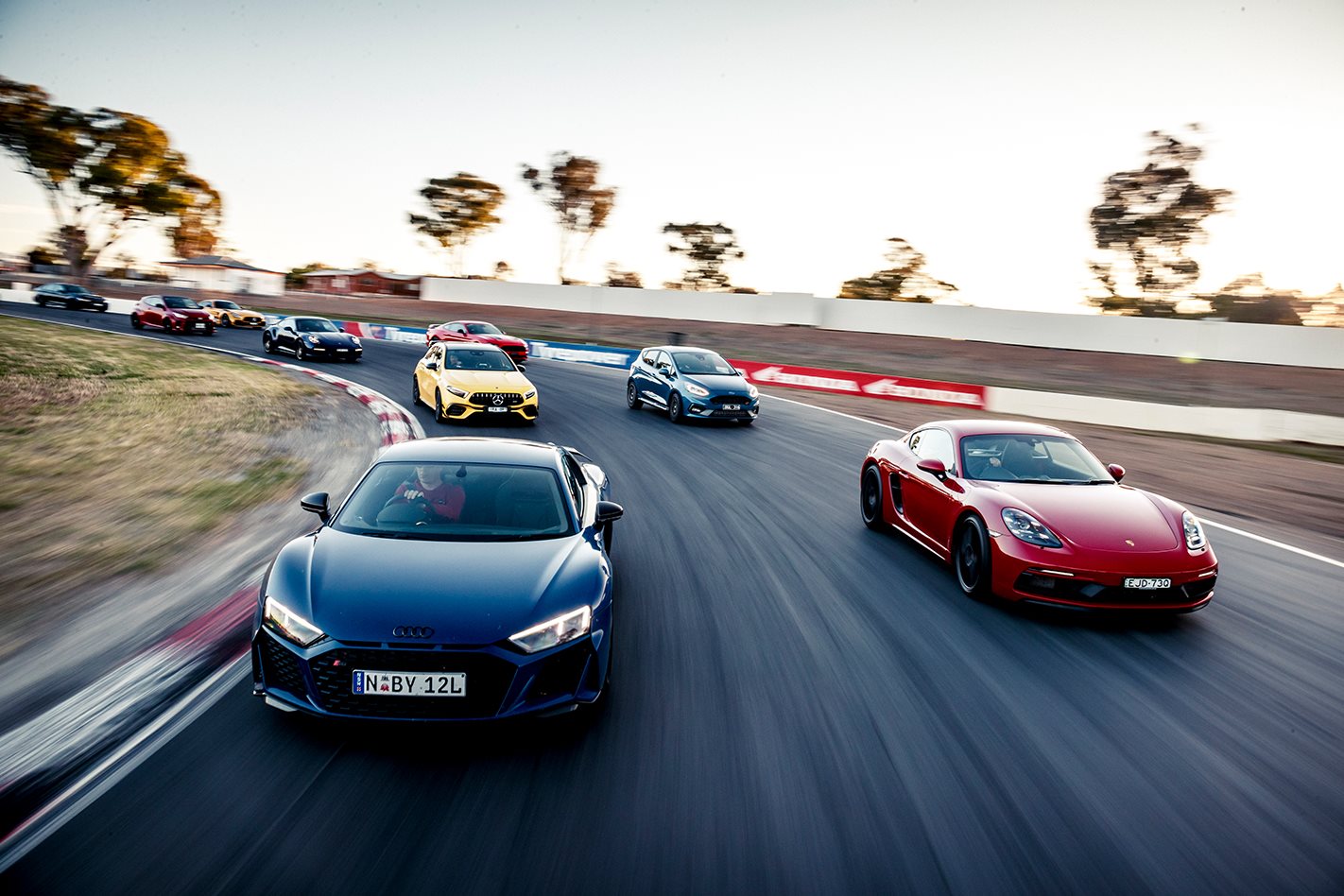
As the year draws to a close, the taps are just starting to open on a whole backlog of postponed new vehicle launches, so we reckon 2022 is going to be one for the ages. Therefore we kick off these awards with something of the delayed gratification – the cars we’re just itching to drive next year. We’d also like you to get involved. Let us know whether you agree or if you think there’s something that we’ve missed.
Our year kicked off with Performance Car of the Year, with Mercedes-AMG taking out its first victory with the astonishing GT R Pro coupe. Since then there’s been a bunch of new cars that will be lining up at PCOTY 2022, which is in the final planning phase.
Over the next week we will be revealing the winners of Best Design, Sweetest Sound, Most Exciting New Car, Most Dynamic Manufacturer, Biggest Personality, Biggest Innovation, Biggest Controversy, Best Race Car, and Gutsiest Racing Move. Make sure to check in regularly to keep up to date!
In the meantime, a little retrospective on an occasionally bewildering but never boring year. Thanks for sharing the ride with us.
The UK Government is backing a project that could see hydrogen-powered planes go mainstream, providing Sydney to London flying with just one stop and at the same speed and comfort as current planes.
Shown for the first time, the FlyZero project uses hydrogen as the plane’s fuel, which is itself inherently lightweight and energy-packed, but produces no CO2 emissions when burned.
The Aerospace Technology Institute (ATI) says that in comparison to traditional jet fuel, hydrogen has around three times the energy density per kilogram. Next to a traditional battery such as those found in an EV, it has 60 times the energy density.
Cyrogenic fuel tanks are required for storing the hydrogen at around -250 degrees celcius when in flight, located in one large rearward and two forward fuselages. The fuel is used to power turbofan engines that use hydrogen combustion to spin.
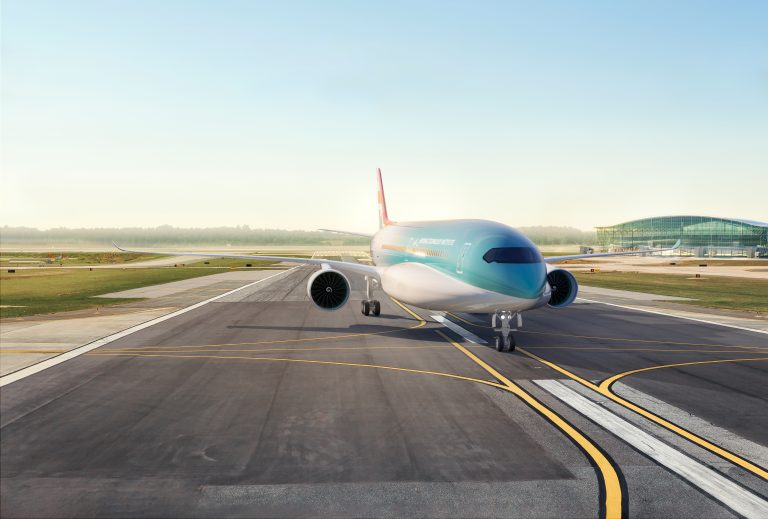
The range makes it capable of flying almost 10,000 kilometres (quoted at 5250 nautical-miles) – which is good enough to fly across the world with only one stop, or non-stop from Beijing to London, for instance.
In comparison to a Boeing-737 or Airbus A320, the FlyZero concept is slightly larger and has a longer range. Its design, which is similar to those aircraft with a 54-metre wingspan, means it will be able to use existing airport infrastructure and terminals if it does go into service. Seating capacity is for 279 passengers, slightly less than the Boeing 777 which can hold 296.
The UK Government is investing more than $7 billion in the program, which ends in 2026, but there are some challenges to overcome before it can go mainstream on the tarmac, including sourcing and fuelling hydrogen at a reasonable price – which the ATI says could happen by the 2030s.
“The Aerospace Technology Institute’s pioneering research highlights the potential for hydrogen in realising zero-carbon global connectivity,” said Jet Zero Council CEO, Emma Gilthorpe.
“This ground-breaking green technology looks set to play a critical role in decarbonising flight and through the work of the Jet Zero Council, the UK aviation sector is exploring all avenues to ensure we protect the benefits of flying for future generations while cutting the carbon cost.”
