
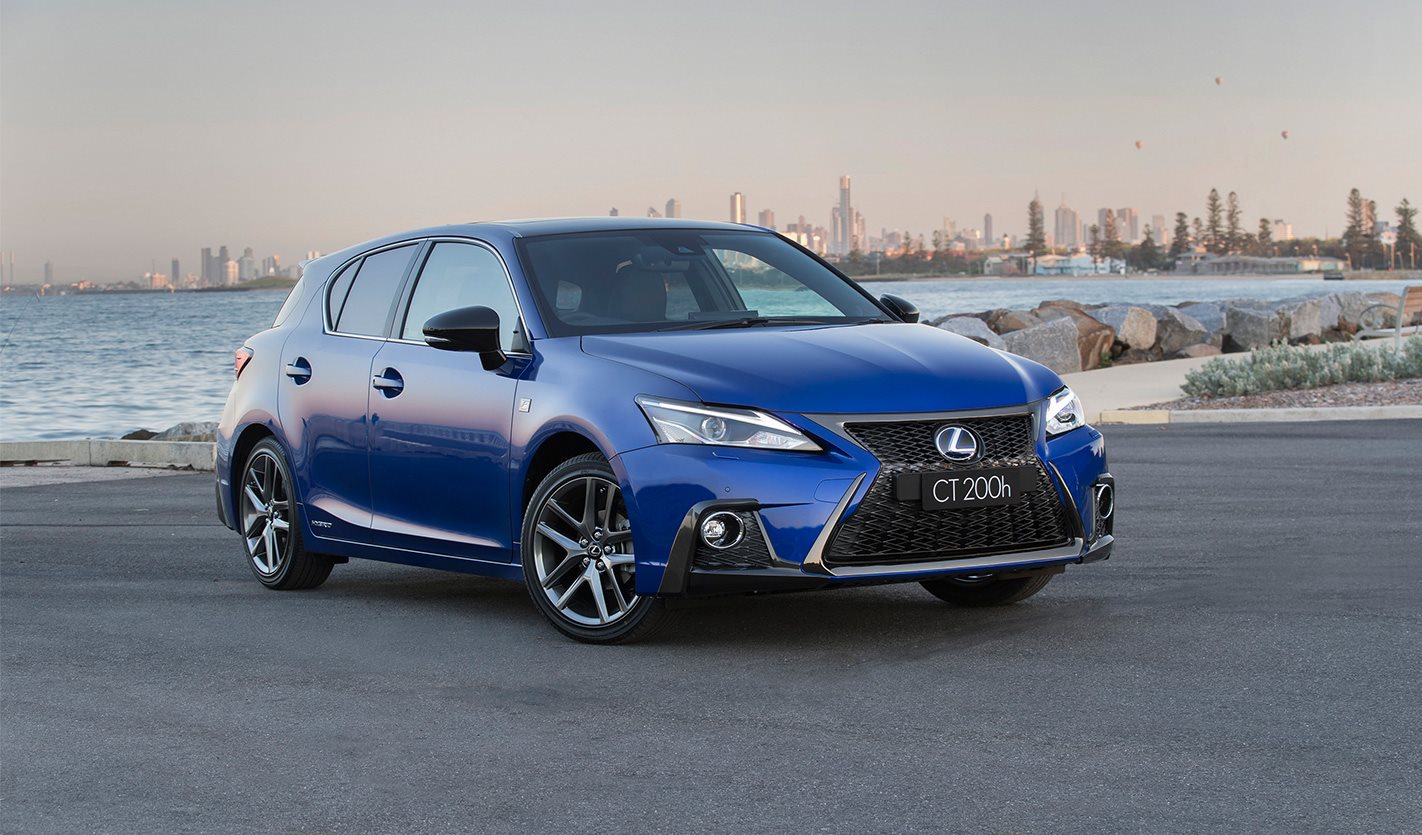
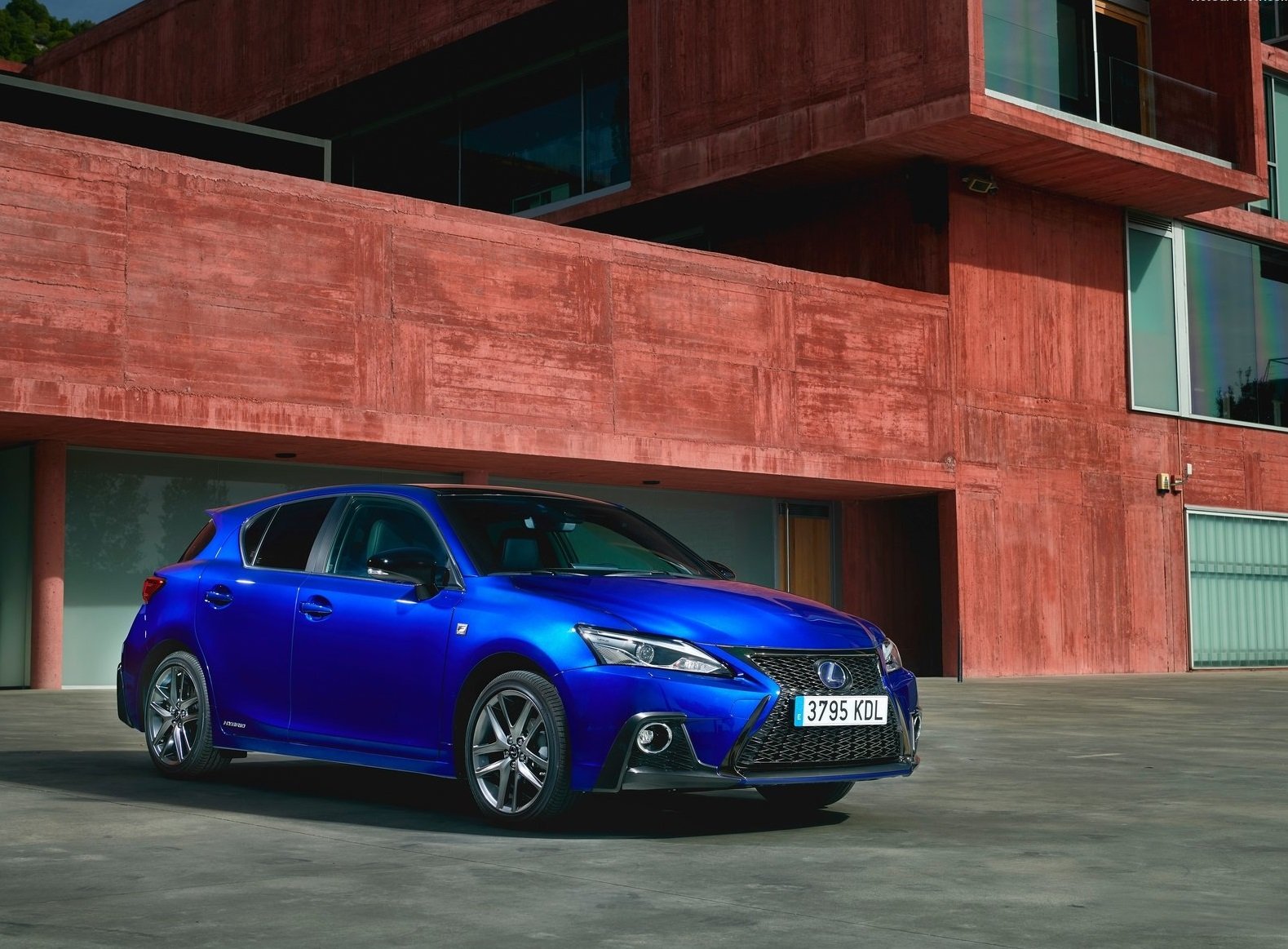
Lexus Australia has issued a recall for two of its CT200h vehicles produced for the Australian market due to a potential fuel tank leak.
The two cars were produced between June 18 and 29, 2020.
According to the Japanese carmaker, the fuel tank on these vehicles is susceptible to leakage if the weld between it and inlet pipe were to peel.
There is the possibility that the resin weld between the fuel tank and inlet pipe may be insufficient because of improper maintenance of the welding machine at one of the marque’s plants in Japan.
Under these conditions, fuel leakage may occur when the tank is full or during refuelling, leading to an increased risk of fire in the presence of an ignition source.
There are no advanced warnings that this may have occurred – however if welding surface peeling does develop, there may be evidence of a fuel vapour smell or leak when the tank is full or whilst filling.
Lexus says it has not received any reports of this happening in the Australian market, but its dealers will replace the potentially faulty tanks with new ones free of charge.
Repair time is expected to take approximately 3.5 hours. However, based on the dealer’s work schedule, it may be necessary for the owner to make the vehicle available for a longer period, with alternative transport support available if needed.
Lexus Australia will contact the owners involved by SMS, email and mail to their last known address.
For further information, owners can contact their local/preferred dealer or the Lexus Customer Assistance Centre on 1800 023 009 (Mon-Fri 8.00am-6.00pm AEDT) quoting their Vehicle Identification Number (VIN).
VINs for the affected models range from 2364745 to 2364957 – though it is worth noting this also covers cars not made for the Australian market and only two will fall within these numbers.
UPDATE, November 18: A GMSV spokesperson has confirmed to MOTOR that there are in fact three registered RHD C8 Corvettes in the country.
Along with the blue and grey hardtops pictured below, the spokesperson confirmed there is also a third red C8 Stingray which is a convertible currently in the hands of GMSV that has been seen on public roads.
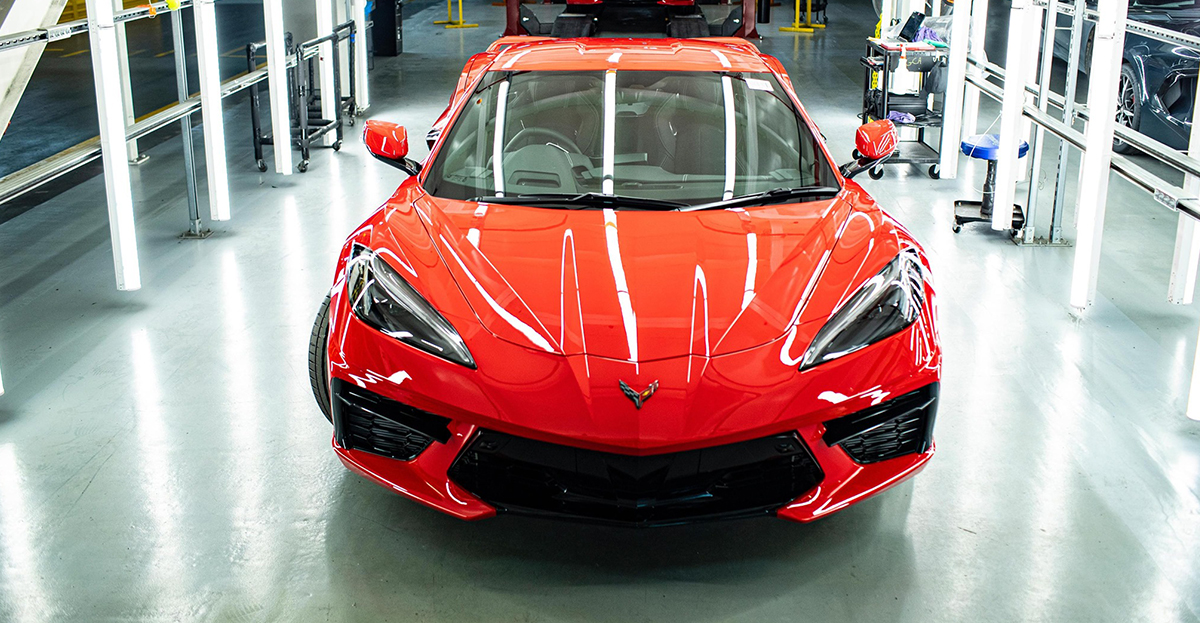
The coupes are fully optioned 3LT variants, and will be used as demo vehicles by GMSV before eventually being sold.
The spokesperson confirmed that while shipments of RHD C8 Corvettes are on their way to both Australia and New Zealand, no specific date for customer deliveries could be specified at this time.
The story to here
November 17: Two right-hand drive, un-camouflaged C8 Corvettes have been spotted on Australian roads for the first time, with a pair of C8s visiting a Holden museum in regional Victoria.
On Tuesday, the Holden Trafalgar Museum posted photos of the C8s on its Facebook page, captioning them with: “Two of the all-new C8 Corvettes visited THM today! Brought along by the management team of GMSV. The only two registered examples in Australia.”
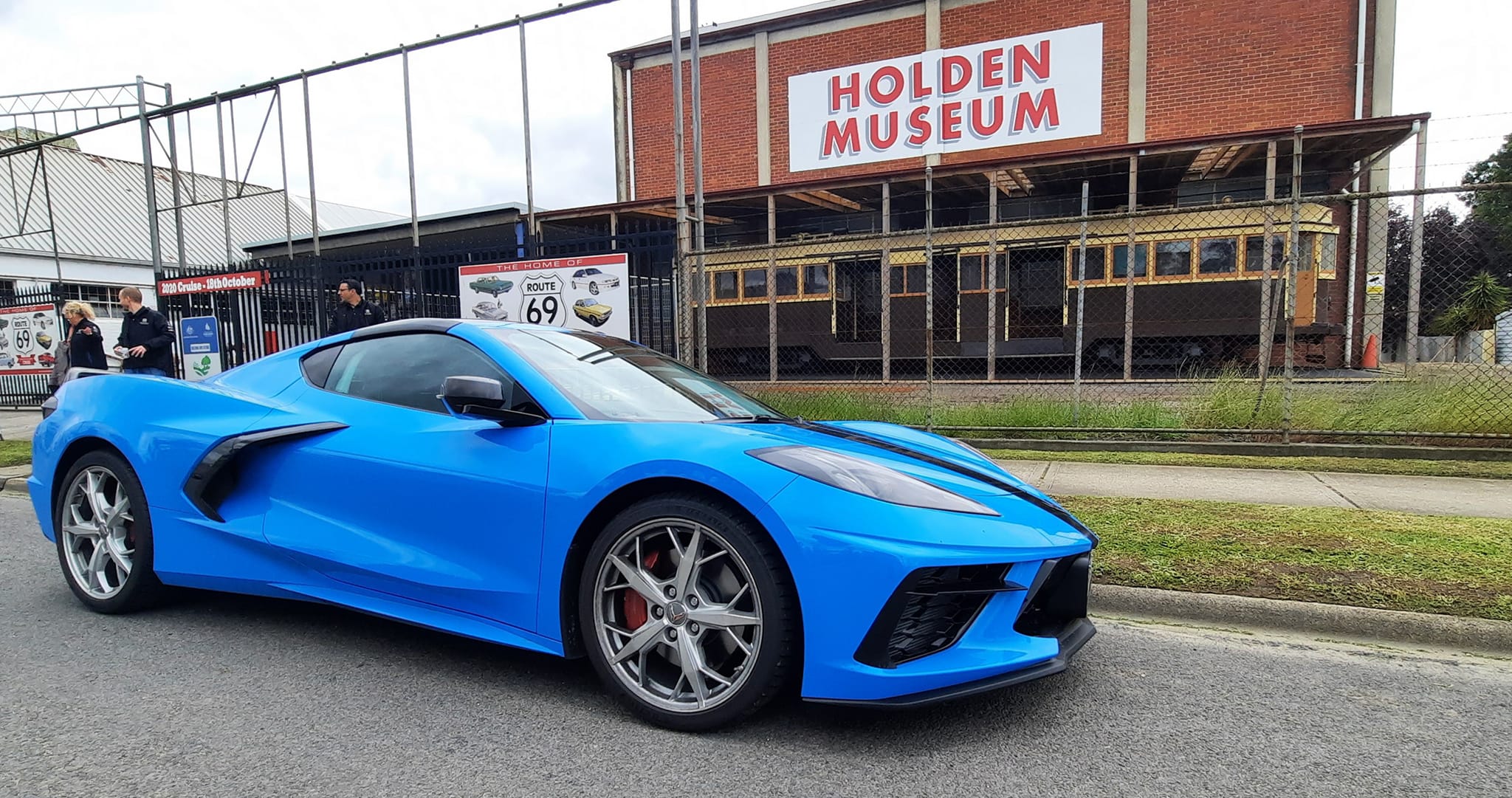
While a left-hand drive GMSV C8 Stingray did perform on track demonstrations at The Bend in the hands of Craig Lowndes earlier this year at a Supercars round, this is the first time right hand drive C8 Corvettes have been spotted publicly in Australia.
The C8 Corvette has been a long time coming for the Australian market, with the car first debuting in the US in 2019 and Australian models promised soon afterwards.
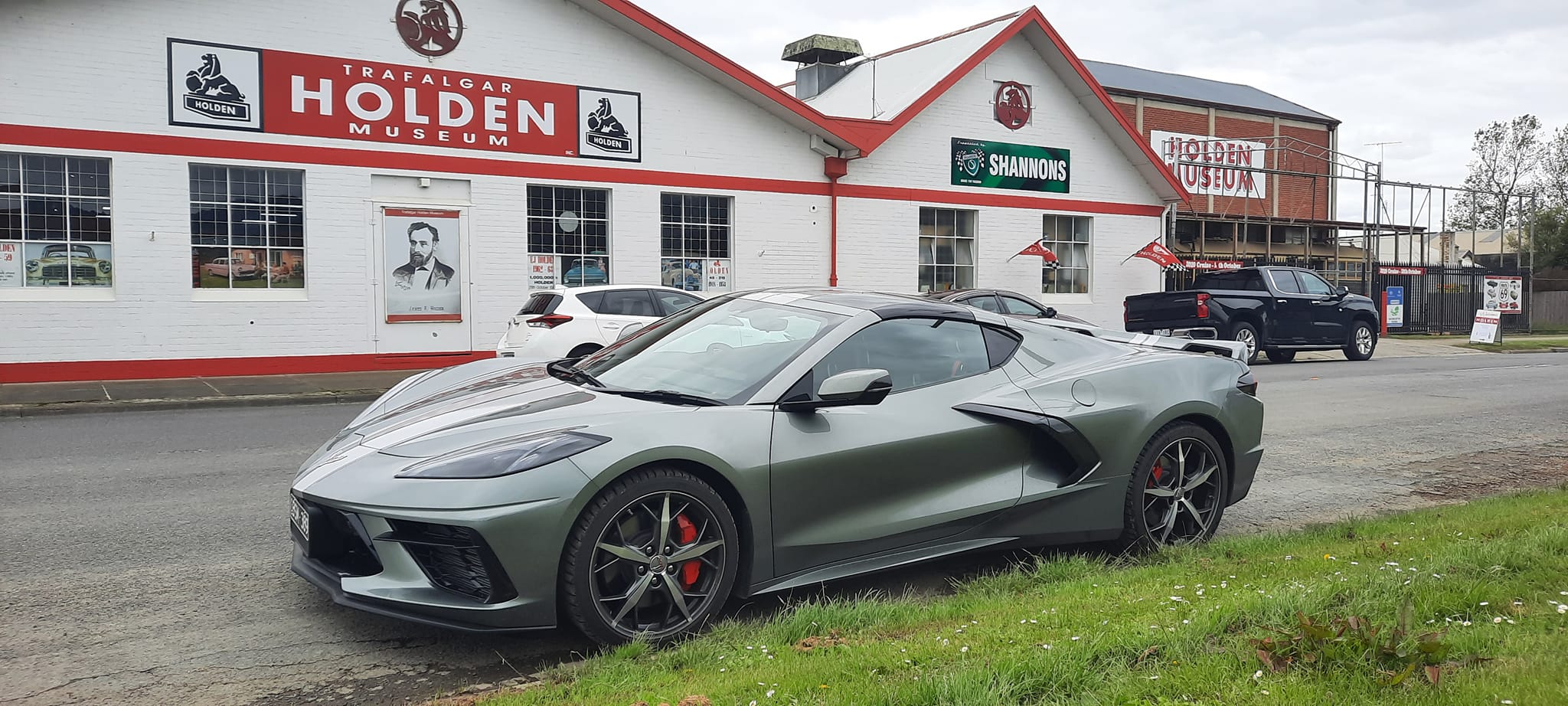
Unlike the Silverado and former Camaro range imported and converted to RHD by GMSV, the Corvettes are built in a RHD layout in the US before being shipped to Australia to be sold through GMSV dealers.
Production for RHD C8s commenced in late September, with images first being leaked back in August this year on the production line overseas.
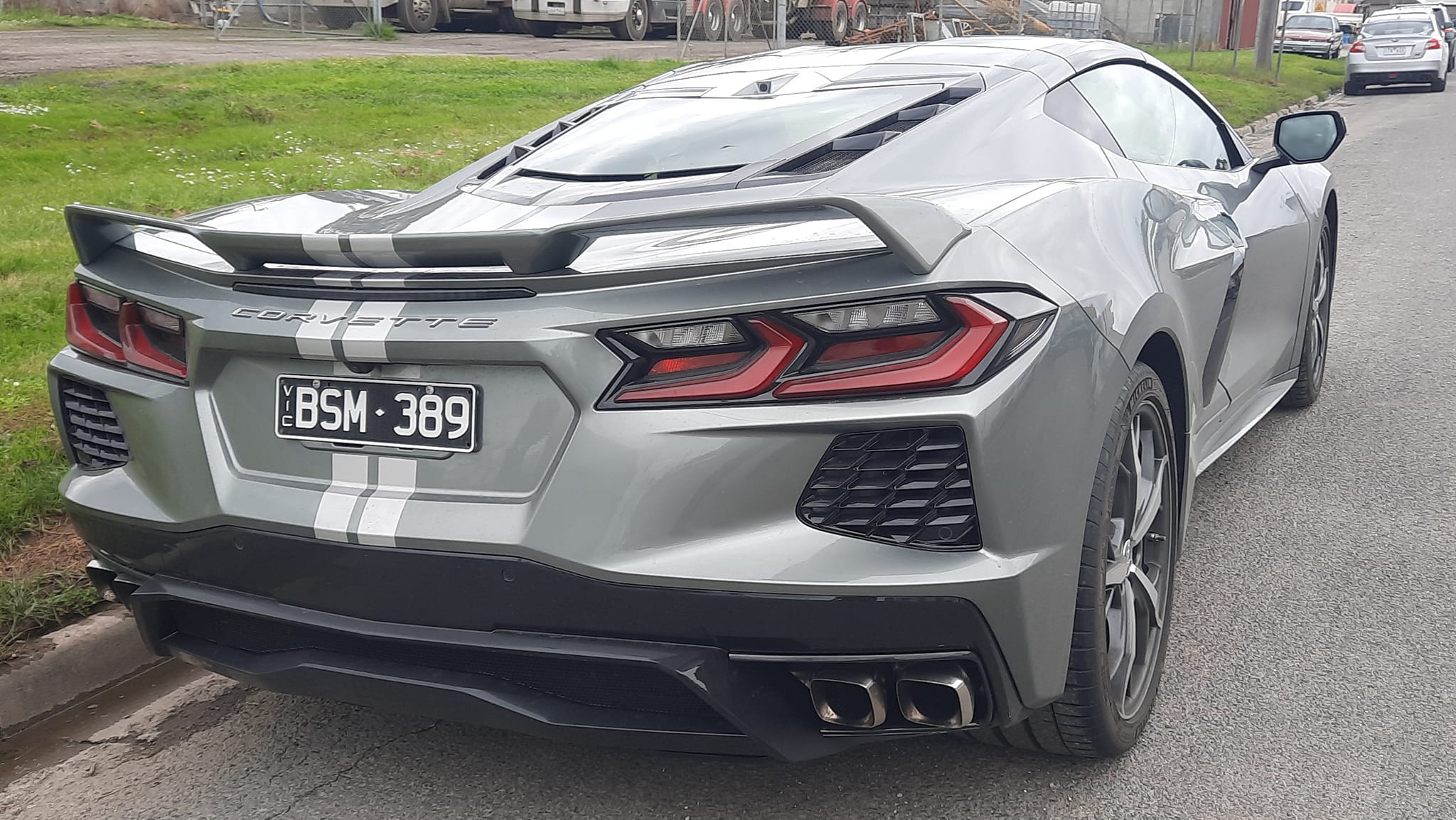
GMSV did confirm to MOTOR recently that the first shipments of C8 Corvettes destined for customers should arrive in the country by the last quarter of this year.
MOTOR has contacted GMSV about the two RHD C8s spotted yesterday for comment.
The 2023 BMW XM will be initially revealed as a concept car later this month, with the company teasing a shadowy image of the new performance SUV.
BMW has confirmed the XM will be the first dedicated model from the company’s M division since the M1 went out of production in 1981 – BMW M’s very first vehicle.
The image was posted across the company’s social media accounts with the caption: “The BMW Concept XM – high performance, electrified.”
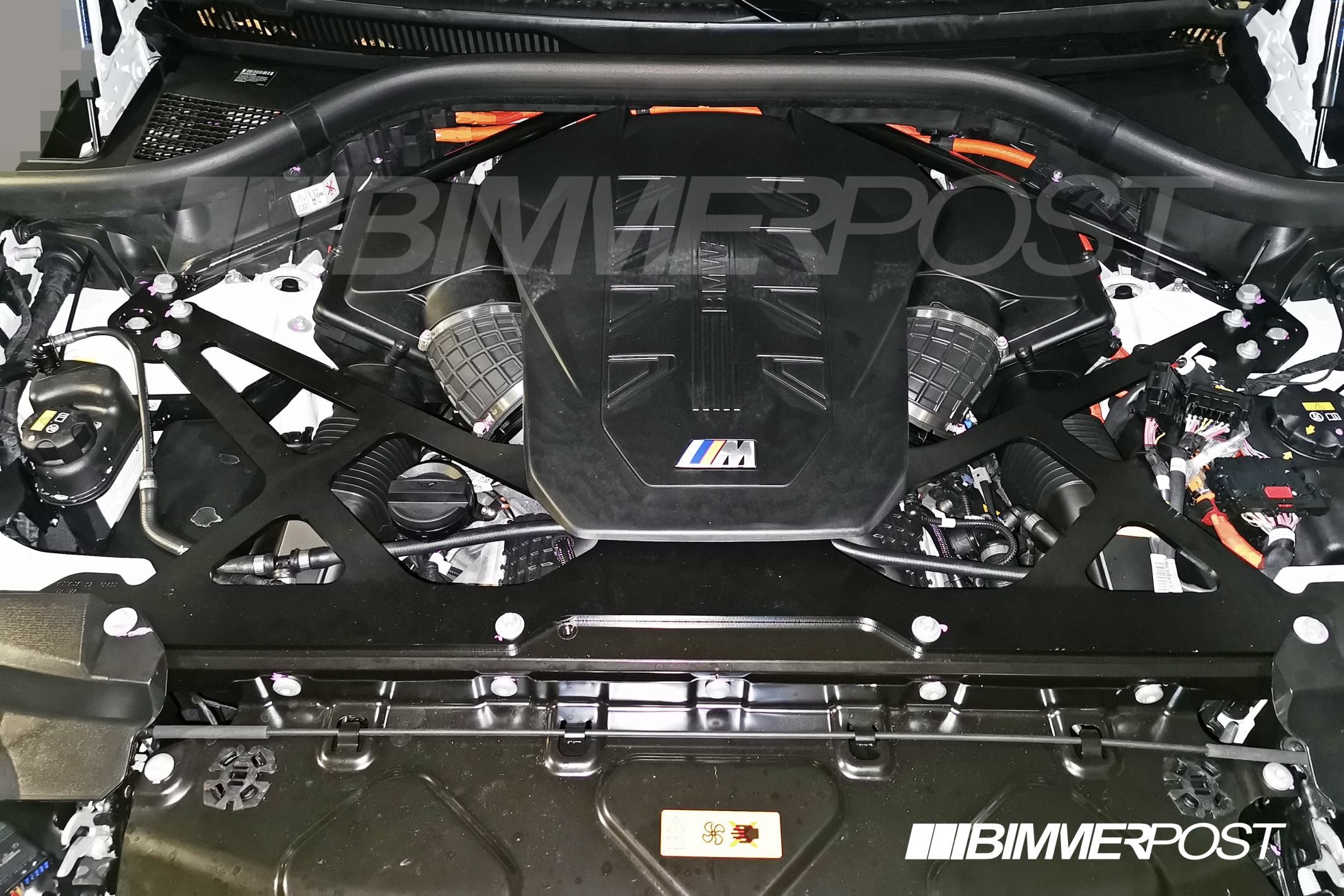
Earlier this month, a leaked photo posted to forum Bimmerpost appeared to show the XM’s new engine – with evidence pointing to a V8 with some kind of hybrid assistance.
Rumours suggest the XM will share its powertrain with the next-generation BMW M5, with a plug-in hybrid twin-turbo V8 said to deliver as much as 560kW.
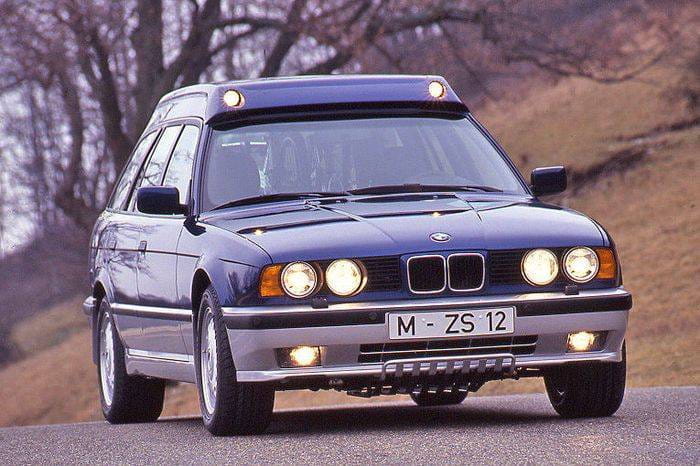
The teaser image shows the concept SUV with a large illuminated grille outline, triangular shapes echoing the new 2 Series, and roof-mounted spotlights – potentially a throw-back to the unusual BMW E34 530iX Enduro Touring (below), the carmaker’s first luxury off-road prototype from 1993.
The teaser post says the new XM is the “most expressive statement in almost 50 years of BMW M. A unique X for the M brand, displaying the new front-end design of the BMW luxury class.
“Stay tuned for the new luxury face of BMW.”
The concept version of the 2023 BMW XM is due to be fully unveiled on November 29.
Key Points
- e-C4 under evaluation
- News comes as petrol-powered model launched
- Electric variant already available in Europe
Citroen Australia is considering bringing an electrified version of its freshly-launched C4 to Australia, possibly as early as next year.
At the virtual launch of the new C4 this week, General Manager Kate Gillis told media the e-C4 was on the cards.
“It’s on the table at the moment…it’s definitely being evaluated for the market, [but is] not confirmed at this stage.
“We’ll be able to share more with you in the near future.”
Product Manager for C4, Daniel Khan, added the firm would be able to reveal more “next year”, suggesting the model could work its way to our shores late 2022 or early 2023.
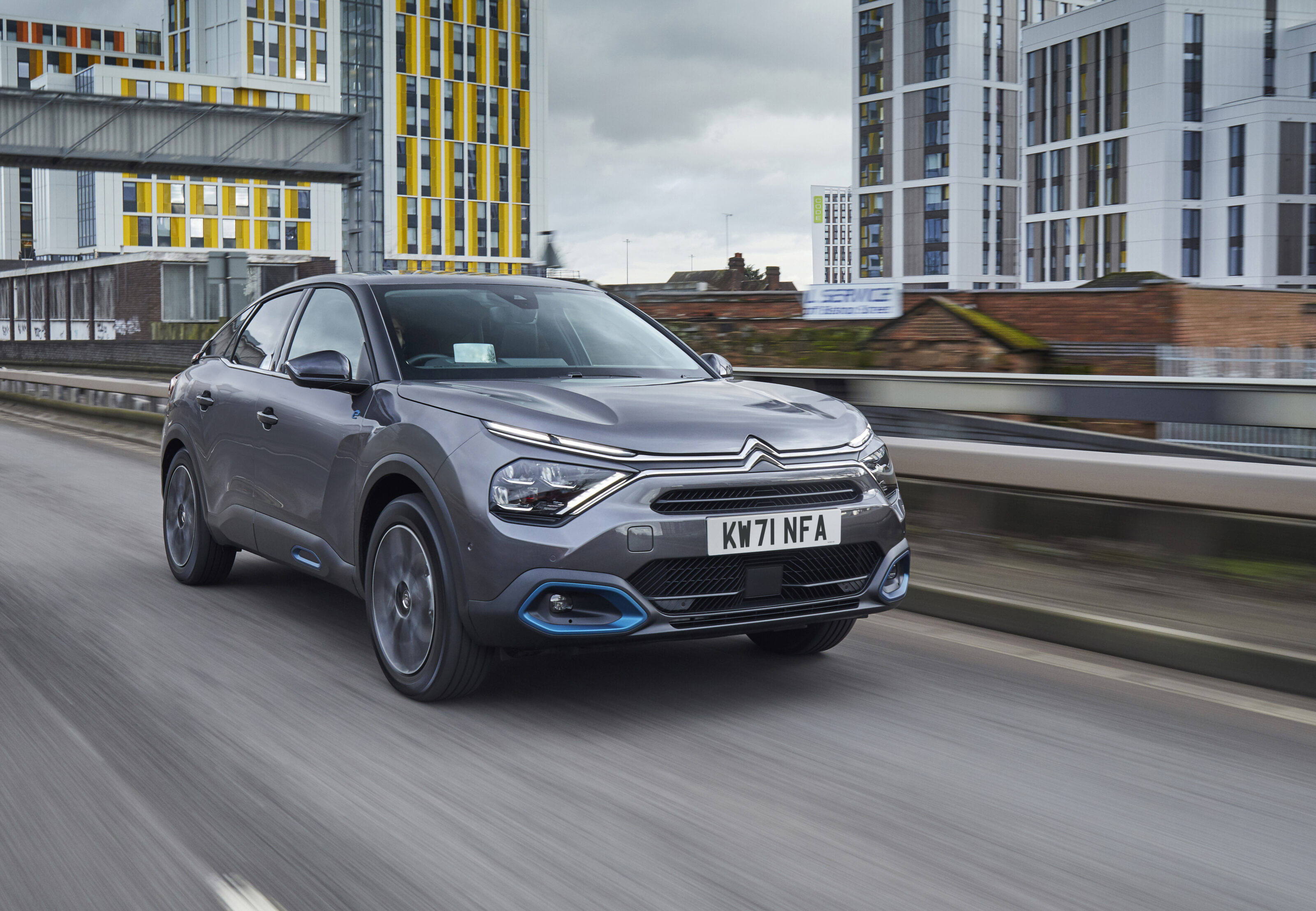
The electrified C4, which is already available in Europe, makes 100kW/260Nm from a 50kWh lithium-ion battery and an electric motor at the front.
It has a driving range of 350 kilometres (WLTP), and uses a 100kW fast charger to top up from 0-80 per cent in 30 minutes. An optional 11kW three-phase home unit takes five hours.
If it were to come to Australia, the e-C4 would be the first fully-electric offering from the manufacturer to land here. Expect it to arrive at a premium over its internal combustion-engined sibling however, with UK prices starting from $54,120 before on-road costs.
In European markets the brand offers the E-Spacetourer, E-Berlingo, E-Dispatch and E-Relay, as well as the Ami EV and C5 Aircross plug-in hybrid. However all of these are currently ruled out for us.
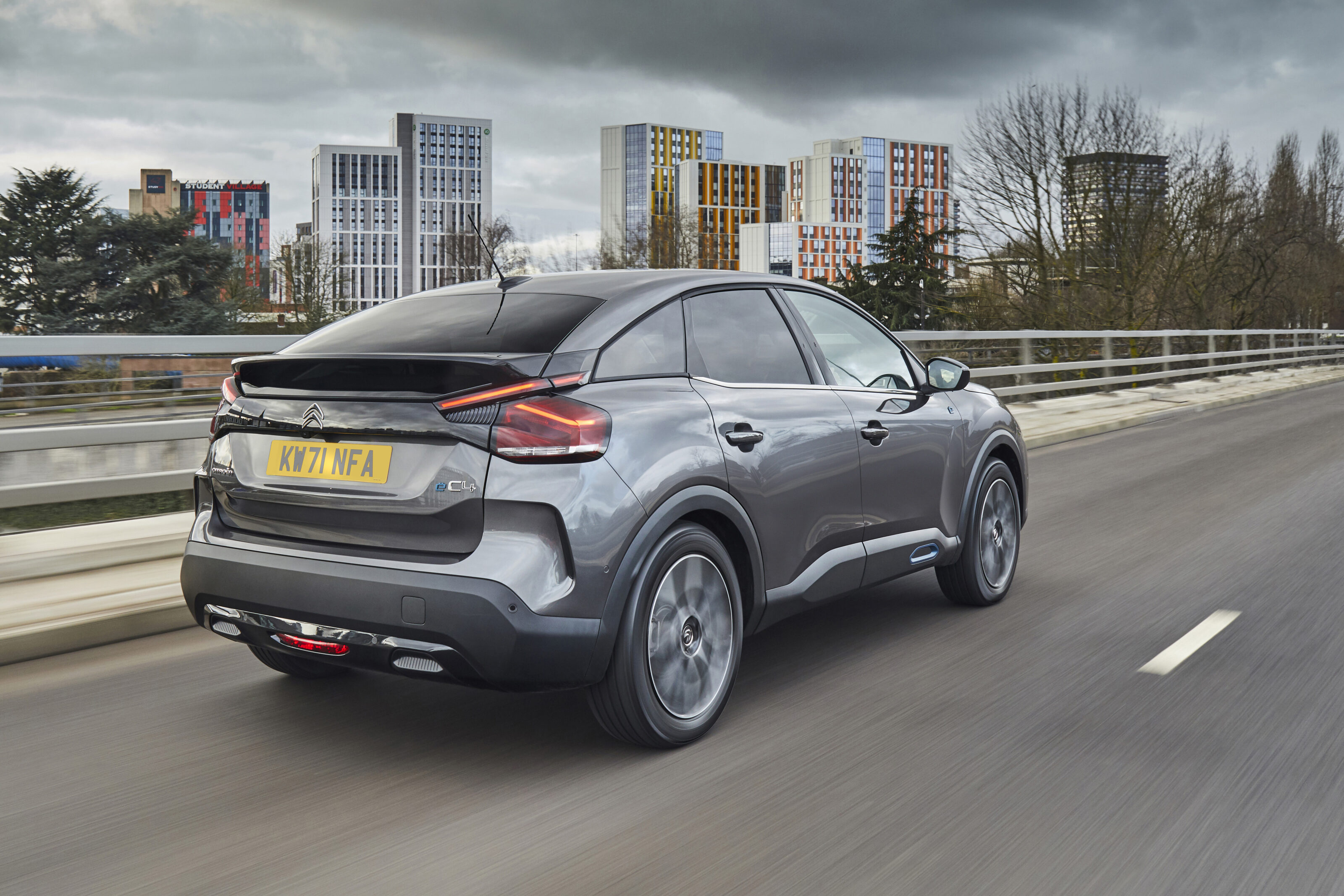
The news comes off the back of the arrival of the new petrol-powered C4 today, priced from $37,990 MLP (before on-road costs).
From launch there is initially only one variant – the top-spec Shine – which features the 1.2-litre turbo-petrol PureTech three-cylinder engine making 114kW of power and 240Nm of torque, also found in sister-brand Peugeot’s 2008 GT Sport, mated to an eight-speed automatic transmission.
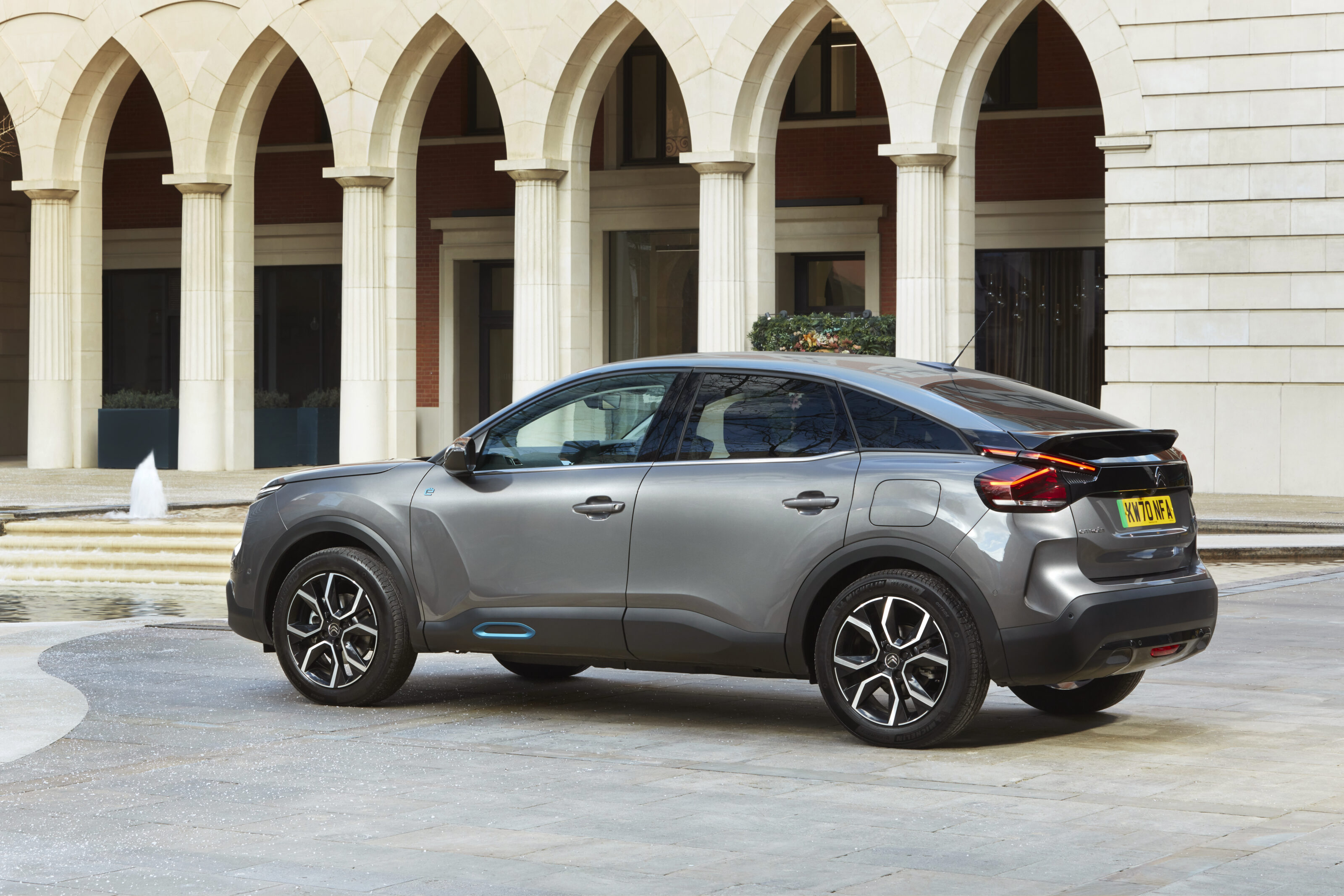
Boss Kate Gillis also said the 2022 Citroen C5 X has been confirmed for Australia, with a plug-in hybrid (PHEV) variant also potentially on its way.
The petrol model will be arriving locally in the third quarter of next year.
No further details about pricing or specification have yet been confirmed, other than to say a PHEV version is “still being evaluated”.
“We are very excited about the C5 X coming to Australia and are planning that car at the moment. We’re concentrating on getting the spec right. The PHEV is on the table for evaluation, but more detail will be available closer to launch,” Gillis said.
Key Points
- New C4 joins Australian line-up
- 1.2-litre turbo-petrol makes 114kW/240Nm
- On sale now for $37,990 MLP
The all-new 2022 Citroen C4 has arrived in Australia – bringing the nameplate back into the brand’s line-up.
Following the recent loss of the C3 Aircross and C4 Cactus from its range, Citroen has high hopes for the new C4 – making great efforts to emphasise its focus on comfort, both on the inside and through its improved suspension.
The model will join the C3 and C5 Aircross on sale Down Under, with the C5 X due to join them from the third quarter of next year. An electrified C4 is also said to be under consideration for our market.
“The new C4 Shine is the perfect addition to our model line-up with its stand-out style, strong equipment list and, of course, its Citroen Advanced Comfort features broadening its appeal,” Citroen Australia’s General Manager Kate Gillis said.
“Its design is original and stunning, and coupled with its impressive versatility and unrivalled comfort, the C4 will really appeal to the discerning Australian small car buyer.”
2022 Citroen C4 Australian pricing
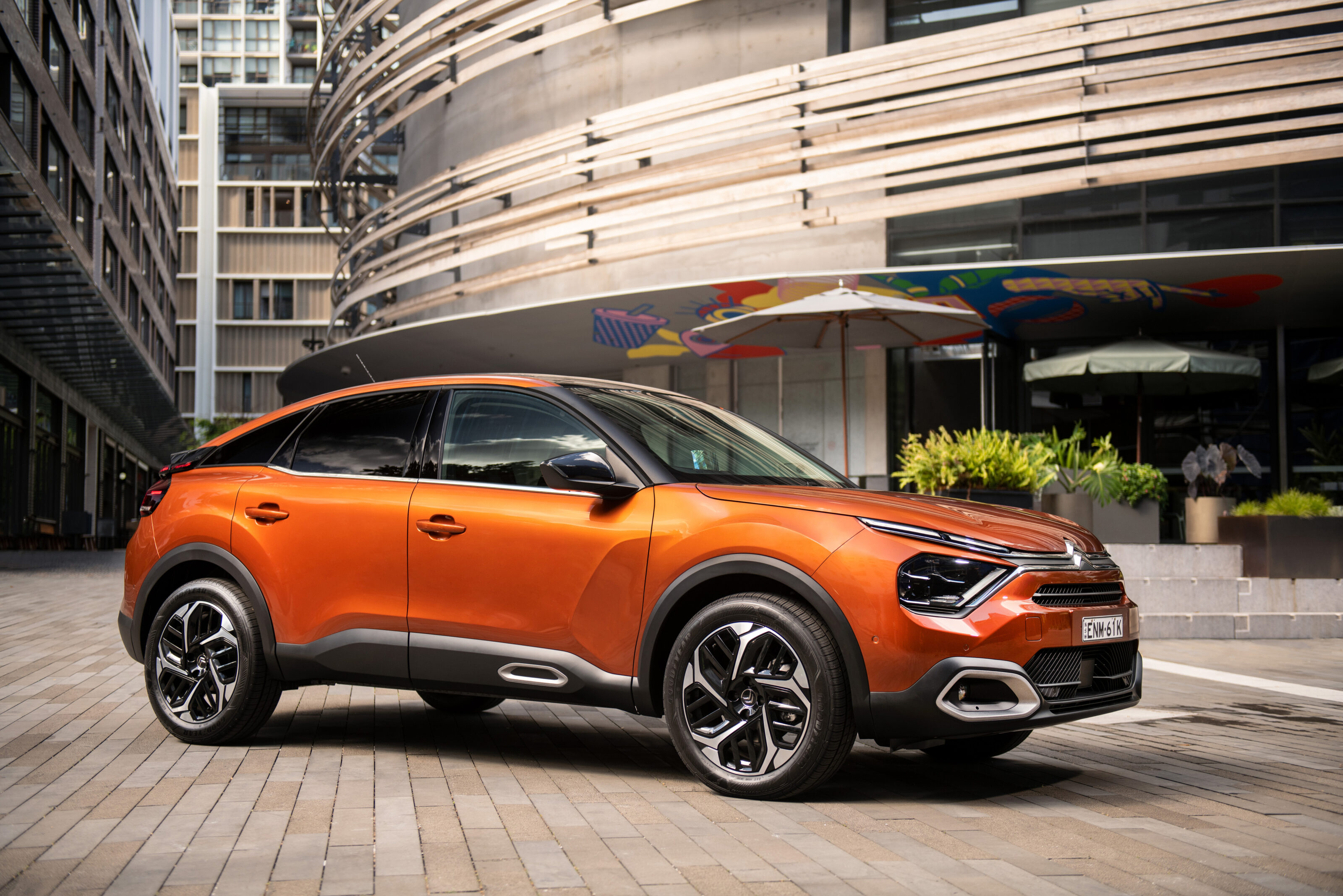
The 2022 Citroen C4 is priced from $37,990 MLP (before on-road costs), with just one ‘Shine’ variant available from launch.
There are no costed optional extras, aside from a choice of six metallic paint colours at $690 and a sunroof priced at $1490.
Design
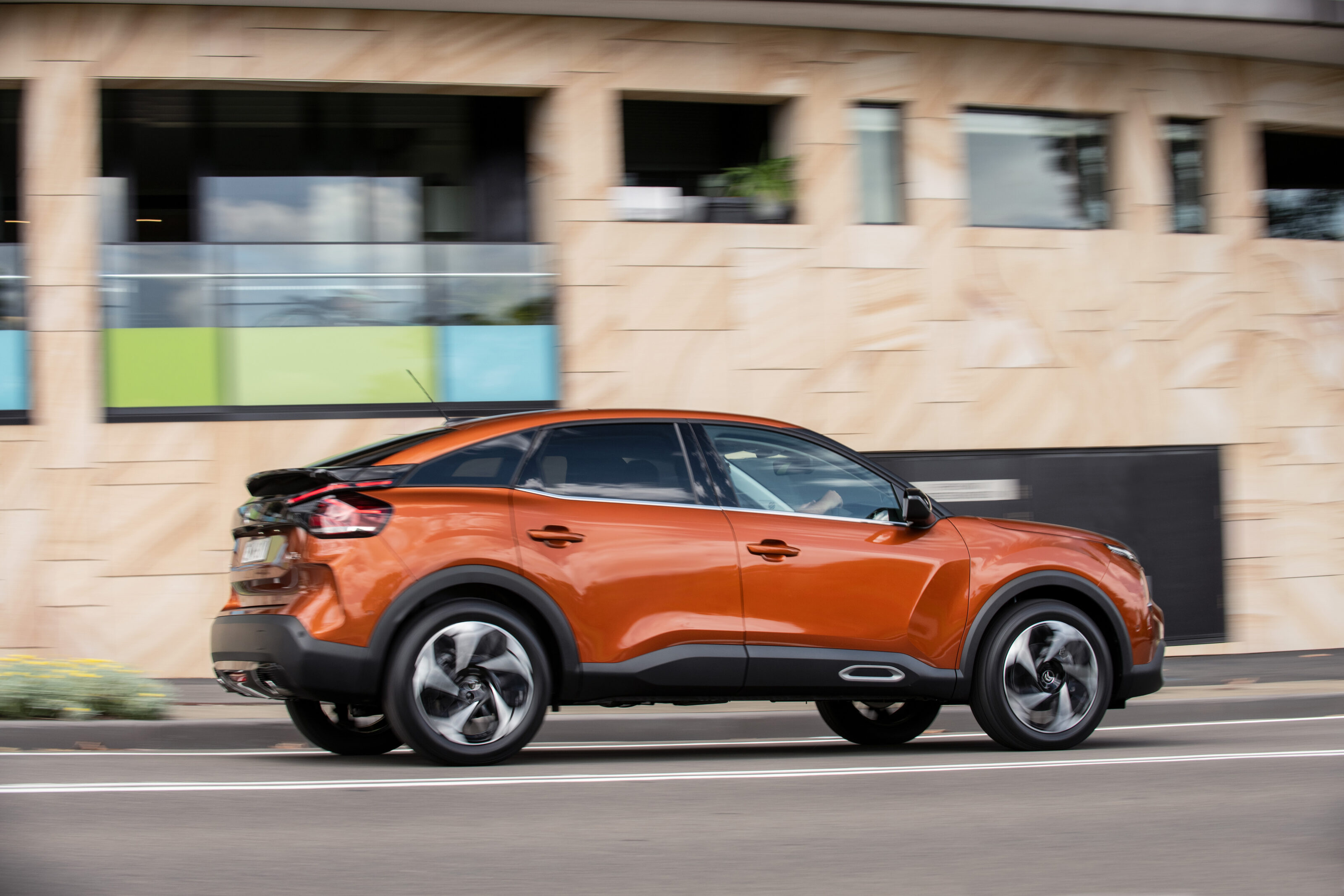
The front-end, with its V-shaped LED signature lighting, incorporates Citroen’s new aesthetic styling.
Influenced by the CXPerience, Ami One and 19_19 concept cars, the C4’s design uses Citroën’s front-end signature with double-stage headlights and chrome chevrons stretched across the front of the car, extending upwards to the daytime running lights and down to the headlights.
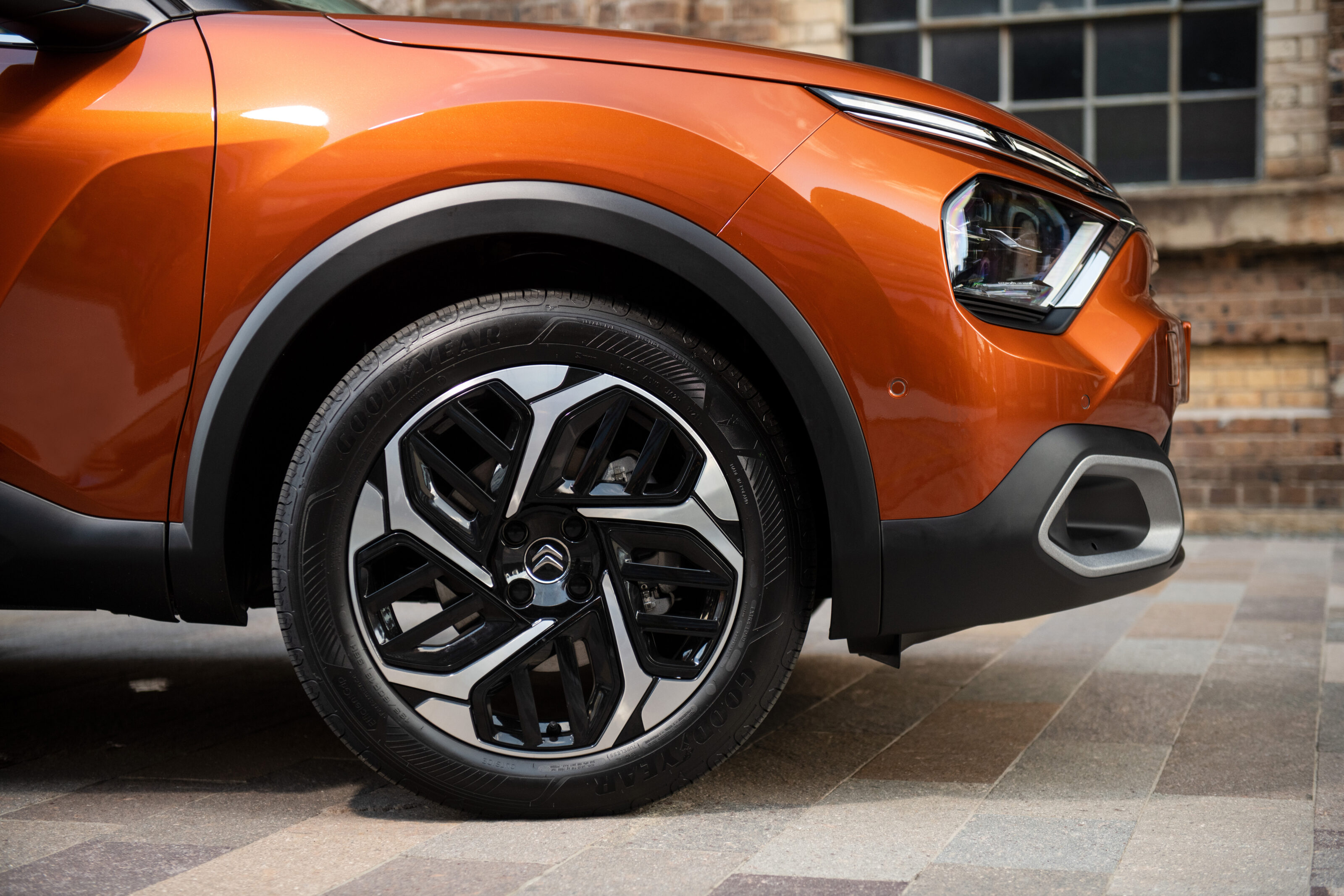
A high, horizontal bonnet line gives the new C4 a more robust appearance than in previous generations, and is underscored by a front bumper using a matte black lower skirt for durability. The air intake grilles use the macro chevron pattern first seen on the Ami One and 19_19 concepts.
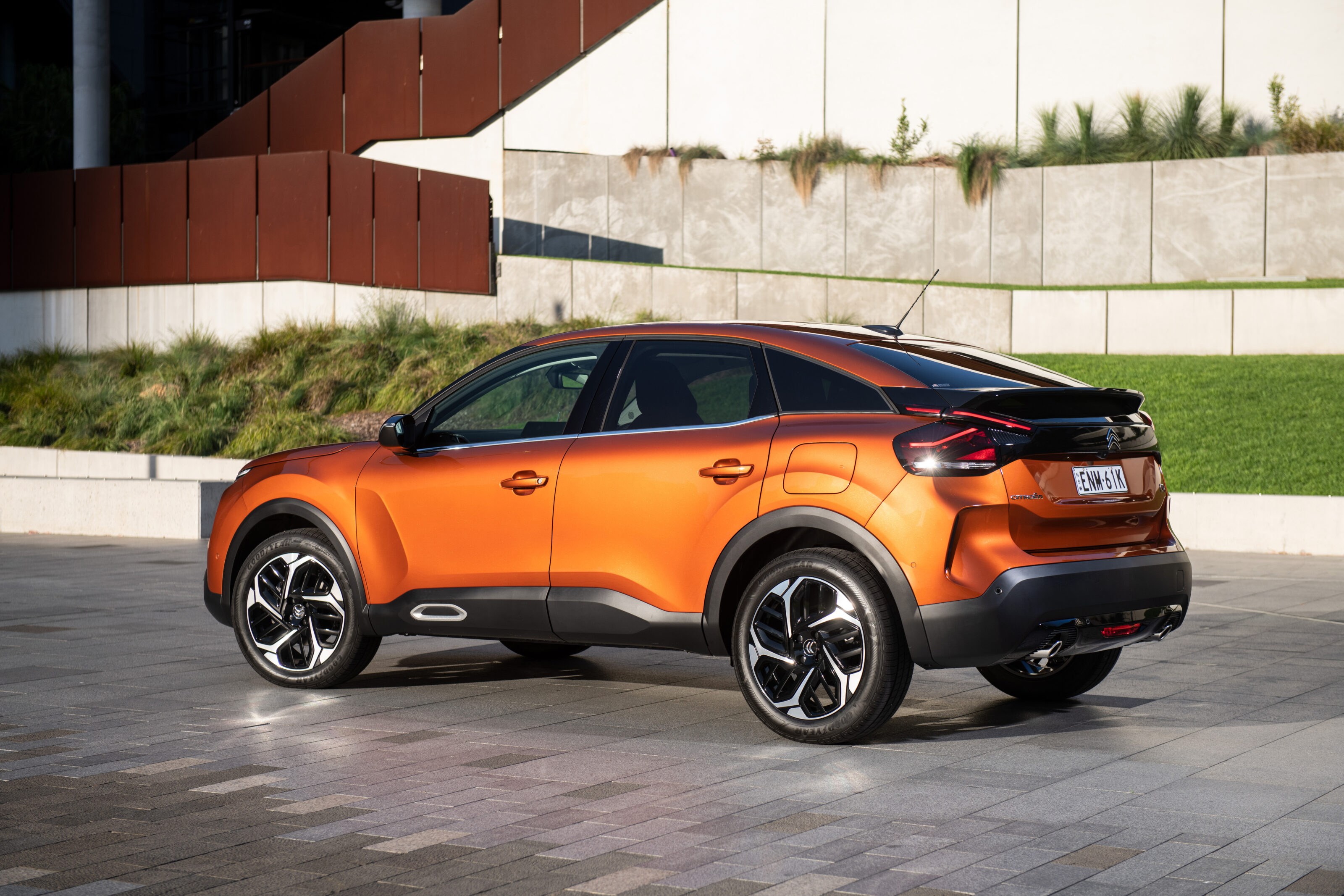
Matte black wheel arches, linked to the front and rear bumper skirts and Airbump with coloured inserts, highlight the body shape – while also reportedly providing protection. The roofline, combined with the sloping rear window and prominent spoiler, also add to the new C4’s aerodynamics.
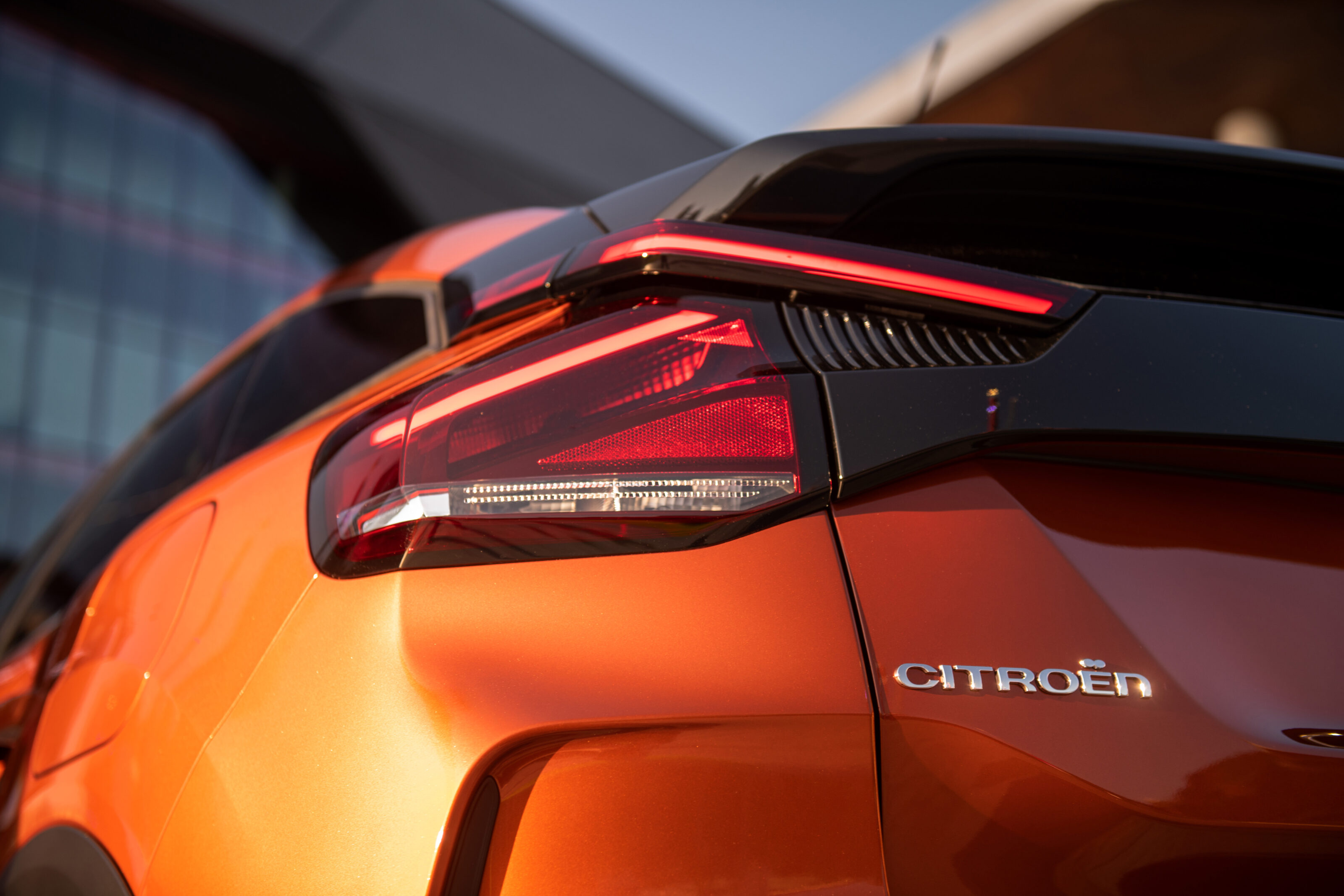
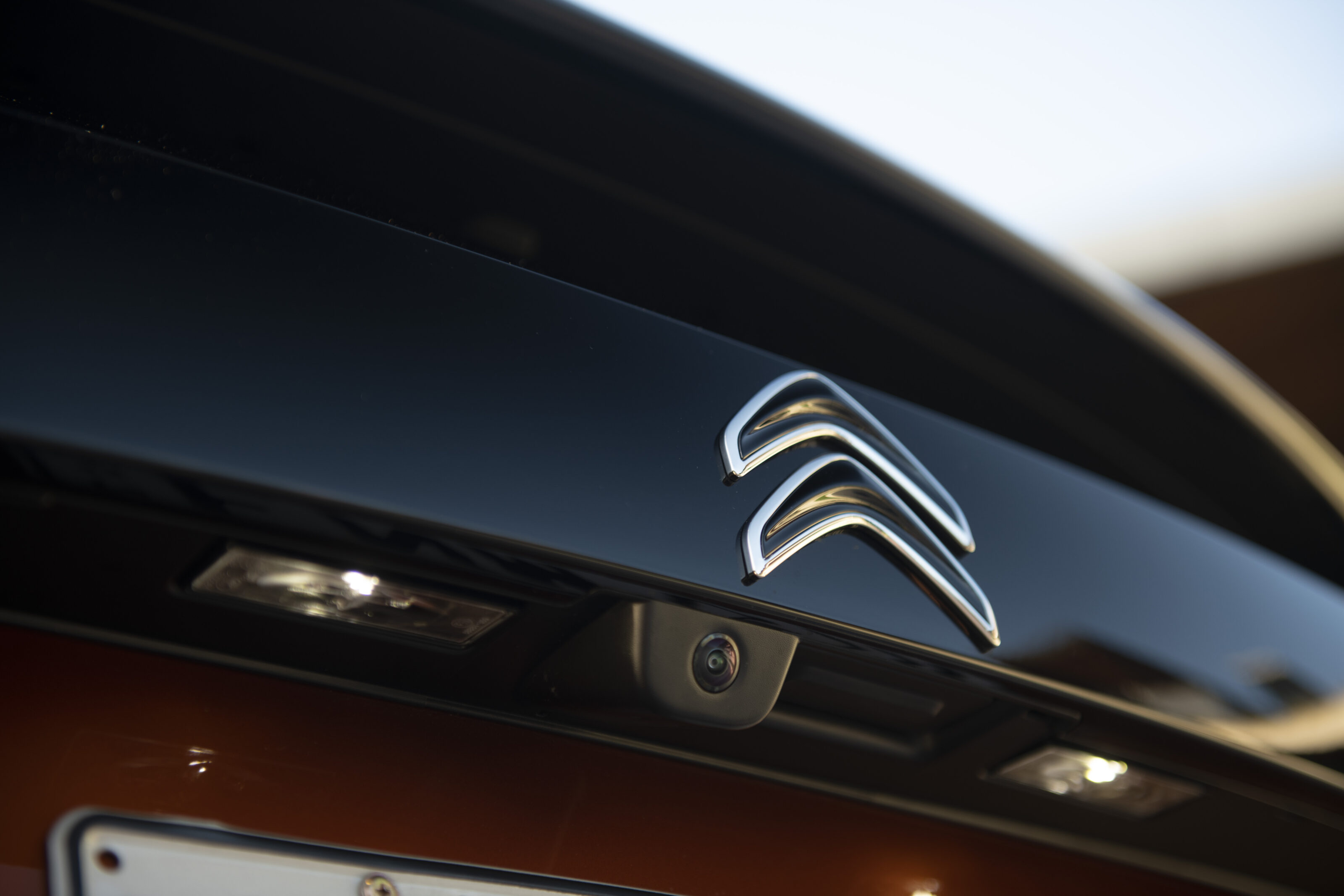
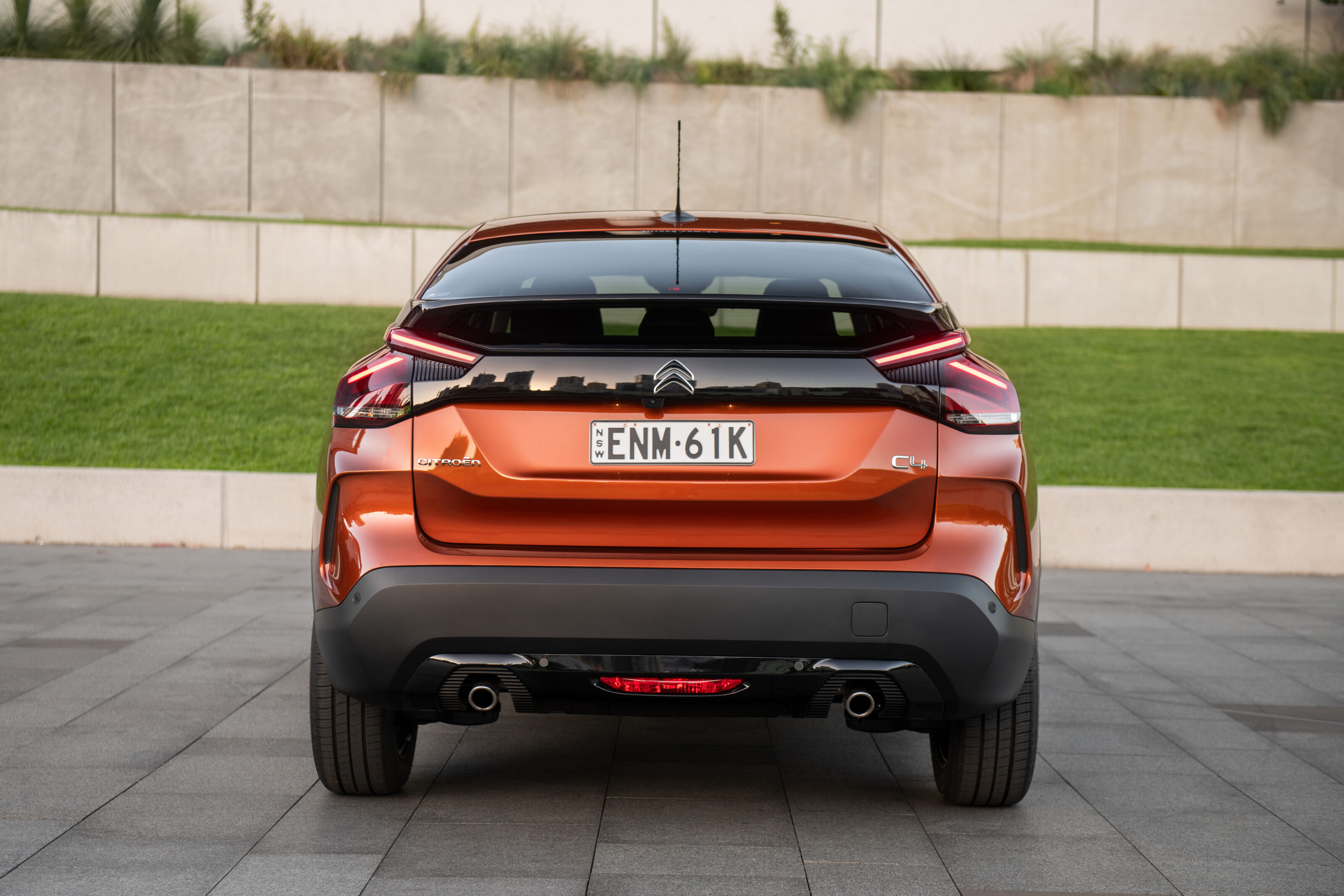
The rear end design is said to have been inspired by the 2004 C4 Coupe, while the V-shaped LED rear lighting signature has come from the Ami One and 19_19 concepts. Mirroring the frontal design, its tail-lights are linked by a glossy black strip.
The bumper skirt, matte black for protection and durability, has a gloss black trim surround for the chrome exhaust pipes – while two outer air scoops are connected by a styling line on the hatch.
The C4 also wears 18-inch Aeroblade alloy wheels shod in 195/60 R18 rubber.
Features
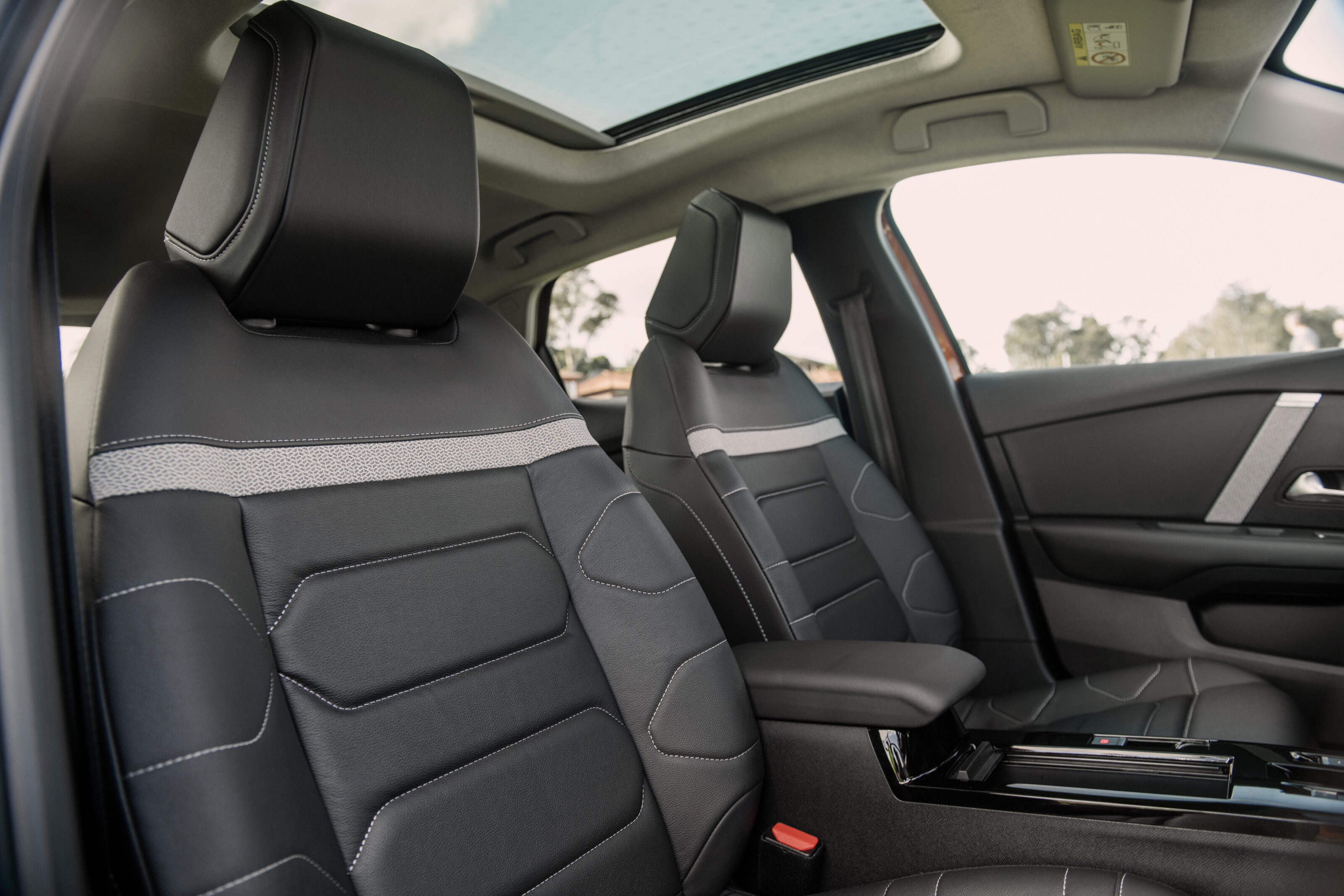
The new C4 has a hype black interior with Siena leather, zephyr grey stitching and black leather-effect materials.
Citroen’s Advanced Comfort seats, initially introduced to the range on the C5 Aircross, also feature, made from 15mm of high-density foam to add softness and support for long journeys and to prevent the seats from ageing prematurely.
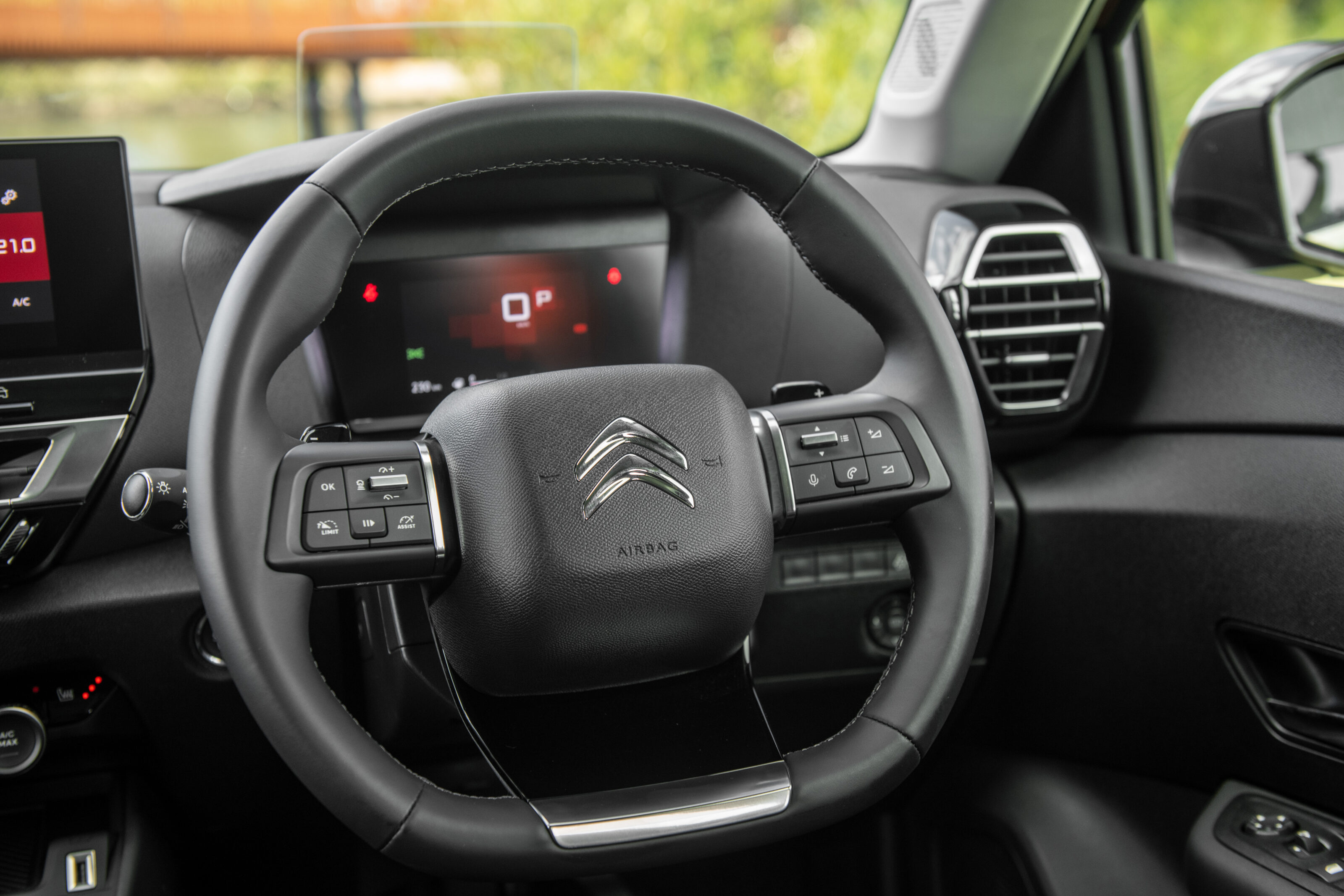
It’s also got a slush-moulded dashboard top, wrapped front door panel strips and soft armrest trim – with high-gloss black accents surrounding the air vents, steering wheel, instrument panel, air-conditioning fascia, infotainment controls and centre console.
The instrument panel is highlighted by white ‘mood lighting’, giving it a floating effect and is complemented by a large, colour head-up display showing essential driving information.
The latest generation C4 still has physical controls for climate control functions – using a combination of chrome wheels and glossy black push buttons, which Citroen says are easier to adjust on-the-go and therefore are safer.
Though strangely it then opts for a new e-Toggle gear shifter, acquired from within the Stellantis family, which takes the place of a traditional lever for the eight-speed automatic transmission. Offering three positions for selection of reverse, neutral or drive, it also has two backlit push buttons – ‘P’ to activate parking mode and ‘M’ to select manual driving mode.
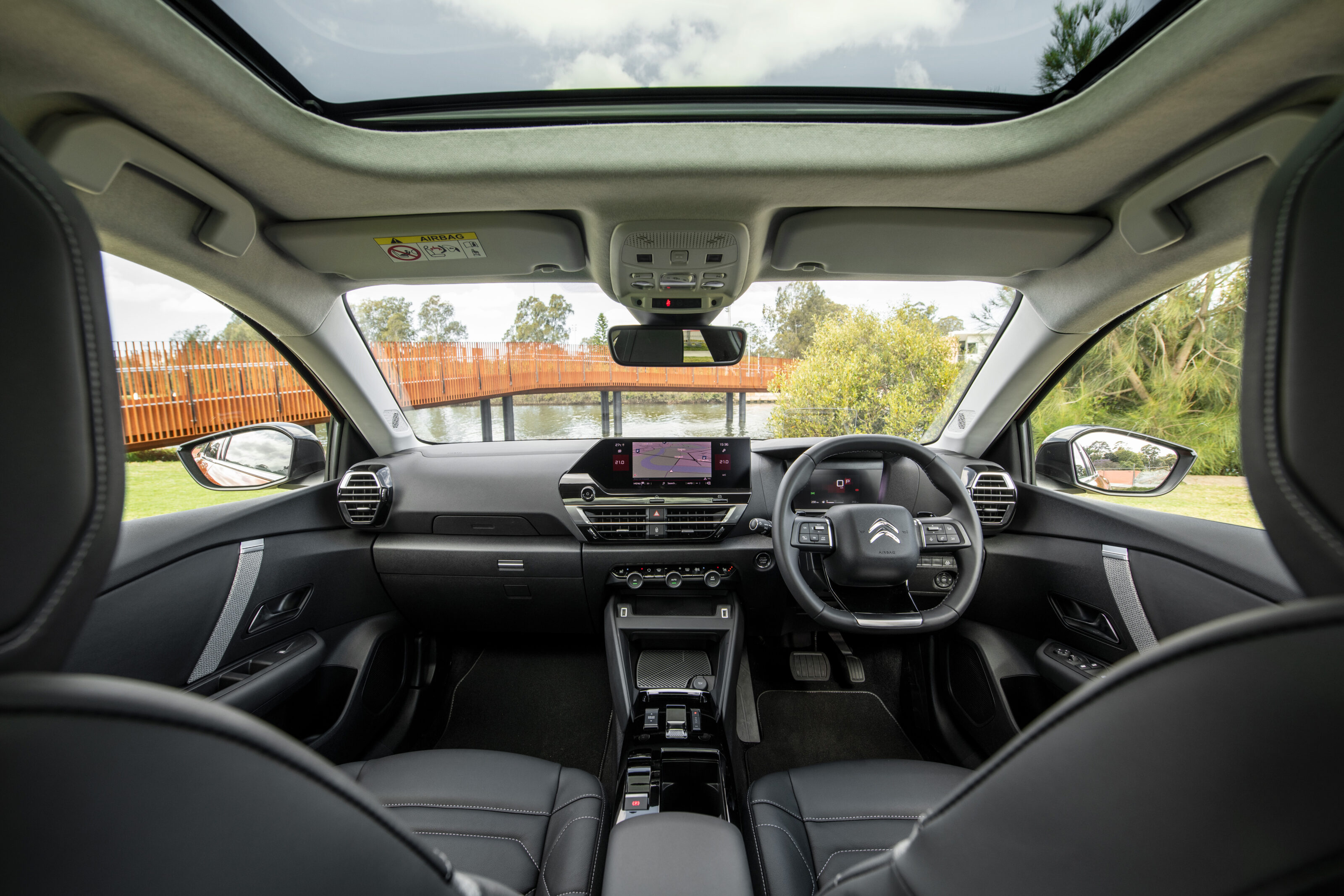
Arriving with just one variant, there are few options available for the C4, however it has a healthy standard features list – which includes:
| Front row electrically adjustable and heated seats |
| Massage function for driveru2019s seat |
| 5.5-inch digital instrument panel information cluster |
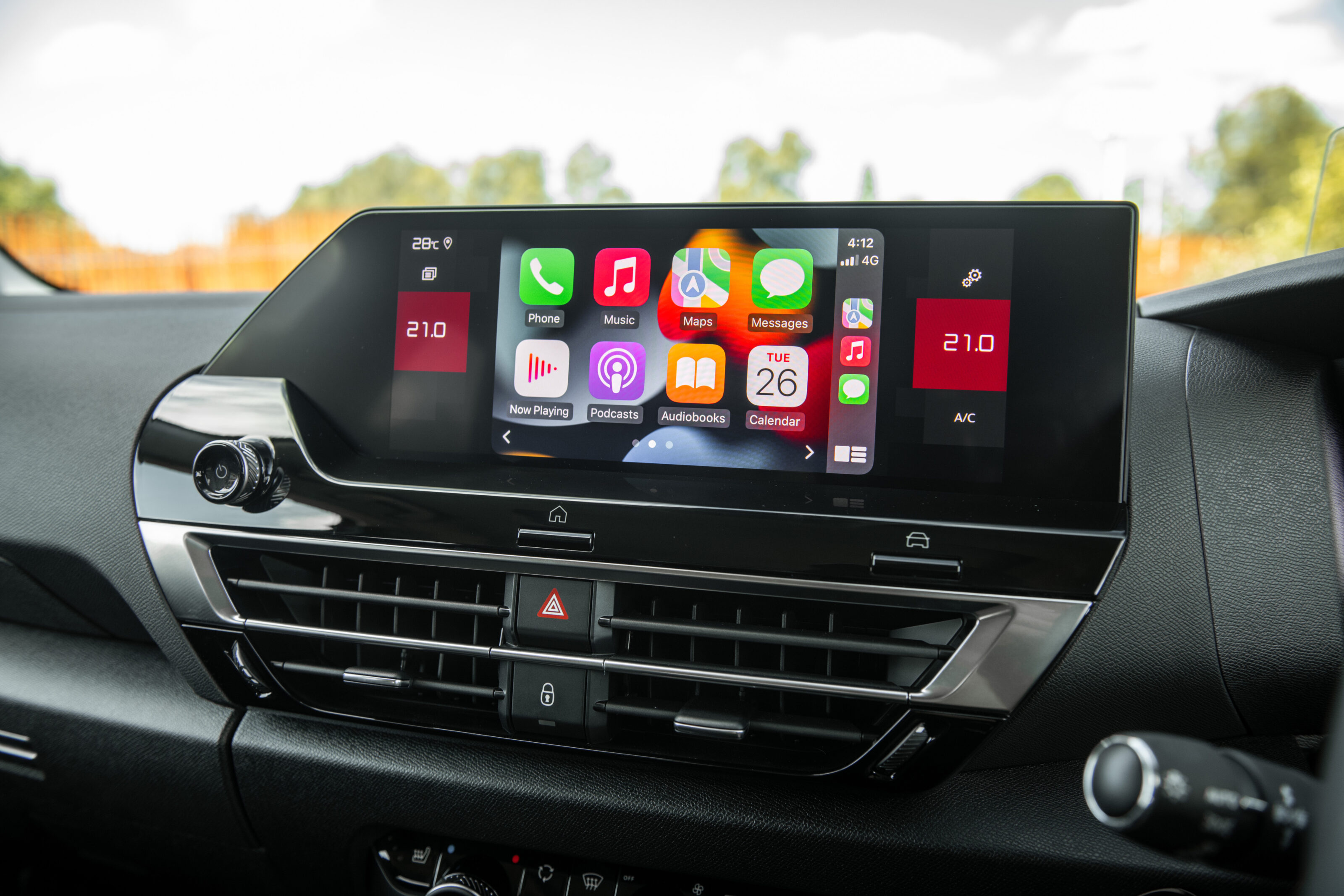
| 10-inch central touchscreen |
| Six-speaker audio with DAB digital radio and Apple CarPlay/Android Auto |
| 1×12-volt power outlet (front row) |
| Electrically adjustable, heated and power-folding exterior mirrors |
| Dark-tinted rear-side windows |
| LED headlights with automatic dusk-sensing |
| LED daytime running lights in u2018Vu2019 signature |
| LED front fog lights with static cornering function |
| Courtesy puddle lights |
| Rain-sensing front windscreen wipers |
| Bluetooth |
| Colour head-up display |
| 3D navigation |
| Automatic electronic parking brake |
| Lateral parking sensors |
| Reversing camera |
| Static cornering function |
| Hill start assist |
| Rear air vents and USB charging. |
Polar white paint is the only standard colour, with six metallic choices – Iceland blue, pulse orange, elixir red, steel grey, platinum grey and obsidian black – all costing extra.
In addition to multiple pockets of space littered throughout the cabin, boot space is rated at 380L with the seats up, or 1250L with the second row folded down.
Rear seat elbow width is 1,440mm, shoulder width is 1,380mm and knee room is 198mm – the latter being something Citroen claims is class-leading.
Engine, drivetrain, suspension and fuel economy
From launch there is initially only one variant – the top-spec Shine – which features the 1.2-litre turbo-petrol PureTech three-cylinder engine making 114kW of power and 240Nm of torque, also found in sister-brand Peugeot’s 2008 GT Sport, mated to an eight-speed automatic transmission.
It is 4355mm long, 1800mm wide, 1525mm high and has a wheelbase measuring 2670mm, with a gross vehicle mass of 1765kg.
Fuel economy is rated at 6.1L/100km (combined).
The new C4 utilises Citroen’s ‘Progressive Hydraulic Cushions’ suspension system for added comfort.
The suspension works in two stages, depending on load. Firstly, the spring and shock absorber control vertical movements together with no assistance from the eight hydraulic stops. These stops, however, gave engineers greater freedom in its clearance, providing a “magic carpet ride” effect to give the impression the car is gliding over any surface irregularities.
Then secondly, the spring and shock absorber work in conjunction with the hydraulic compression or rebound stops to gradually slow suspension movement, avoiding jolts at the end of travel.
Whereas a traditional mechanical stop releases part of its absorbed energy, the hydraulic stop absorbs and dissipates this energy, eliminating bouncing.
Safety
The new C4 boasts a host of improved safety features compared to its predecessor, including:
| Active safety brake |
| Collision risk alert and post collision safety brake |
| Blind-spot monitoring system |
| Active lane departure warning system |
| Adaptive cruise control |
| Coffee break alert |
| Driver attention alert |
| Extended traffic sign recognition and recommendation |
| Anti-lock braking (ABS) |
| Electronic stability program (ESP) |
| Front seatbelt pre-tensioners |
| Six airbags |
| Forward collision warning |
| Speed limiter function. |
The C4 has not yet been tested by ANCAP.
Warranty and servicing
The Citroen C4 comes with the firm’s five-year, unlimited kilometre warranty, five-year roadside assistance and five-year Service Price Promise program.
Servicing for the new C4 starts at $429 for the first check at 12 months/15,000km, with the highest cost coming in at $598 for the 4th year/60,000km. The total price for the first five years is $2485.
Availability
The 2022 Citroen C4 is on sale now.
October 2024: Ioniq 7? Nope!
With confirmation this week that Hyundai will move the Seven to production as the Ioniq 9, we’ve updated the title of this story.
You can read more about the Ioniq 9 at the story linked below.
2022: Hyundai Seven concept revealed, is this the Ioniq 7?
The 2023 Hyundai Ioniq 7 has been revealed in concept form, simply named the Seven.
Hyundai revealed the Seven at the AutoMobility motor show in Los Angeles, previewing the brand’s future three-row electric SUV.
Just as the Hyundai Ioniq 5 and Kia EV6 are closely-related models under the skin, the Seven is believed to be a twin to the Kia EV9 – also unveiled in concept form at the auto show – underpinned by Hyundai Motor’s E-GMP battery-electric architecture.
As with the Kia, Hyundai says the Seven can offer more than 480 kilometres of driving on a single charge – suggesting the concept may be using the 77.4kWh battery pack found in the lighter and more aerodynamic Kia EV6, which can achieve 528km on the WLTP test cycle.
The Seven’s ultra-fast charging capabilities mean the electric SUV can be recharged from 10 to 80 per cent in as little as 20 minutes using a 350kW charger.
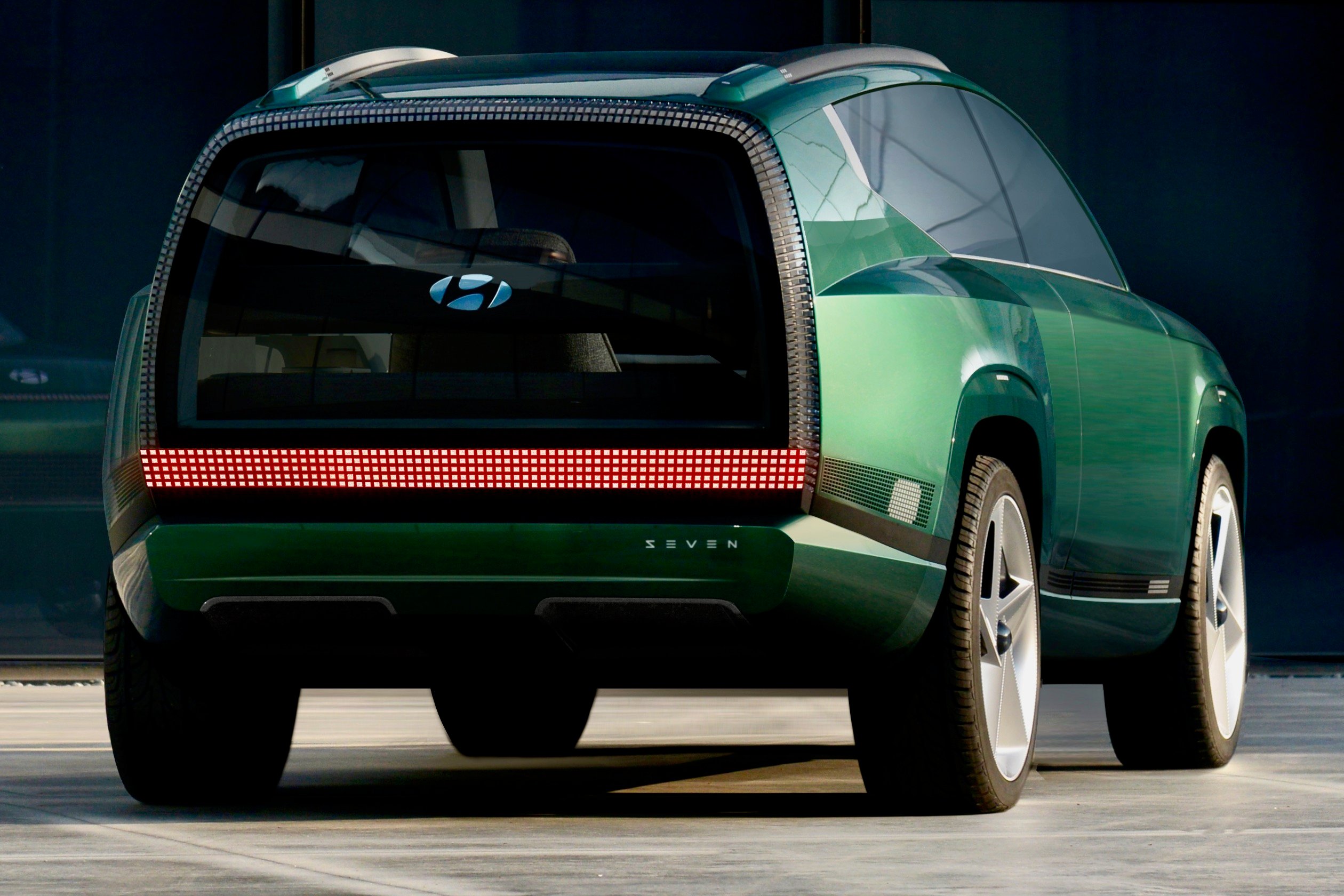
Outside, the Hyundai concept has adopted a similar look to the Staria people-mover, with a single strip of LED daytime-running lights and dot-matrix LED headlights, following the futuristic lighting found on the Ioniq 5.
A continuous bar of LED tail-lights is replicated at the back-end, with additional lights bordering the rear glass tailgate.
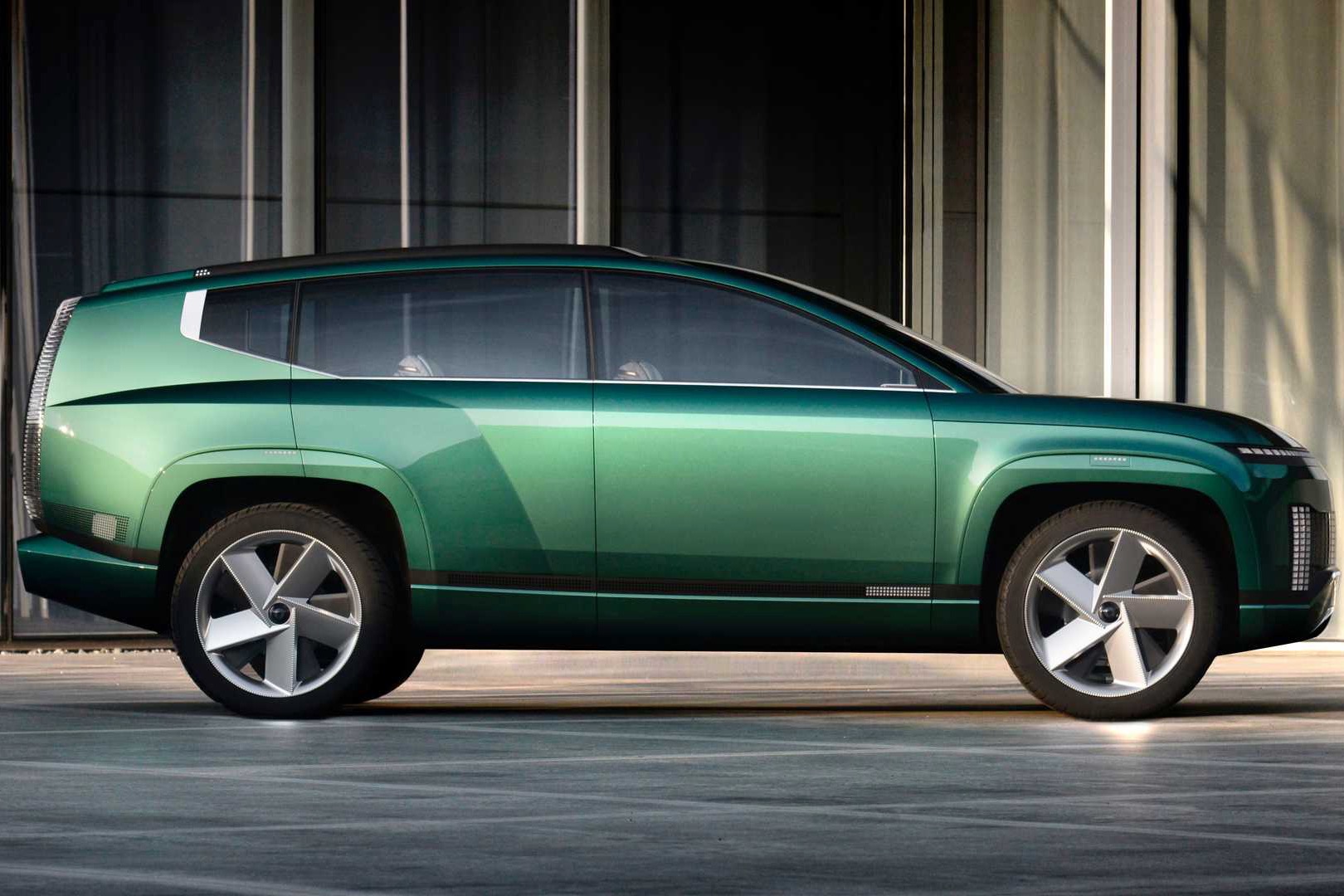
The large alloy wheels feature active aerodynamics, with flaps which can deploy or retract to prioritise brake cooling or reduce vehicle drag.
In concept form, the pillarless design and rear-hinged back doors allow the Seven to open up the cabin and reveal its lounge-room atmosphere. The first two rows have a single rotating captain’s chair, while the rear of the pod has an L-shaped chaise sofa.
But while the concept incorporates an unconventional lounge-style seating arrangement, its 3200mm-long wheelbase would allow the Ioniq 7 to accommodate three rows of seating when it reaches production.
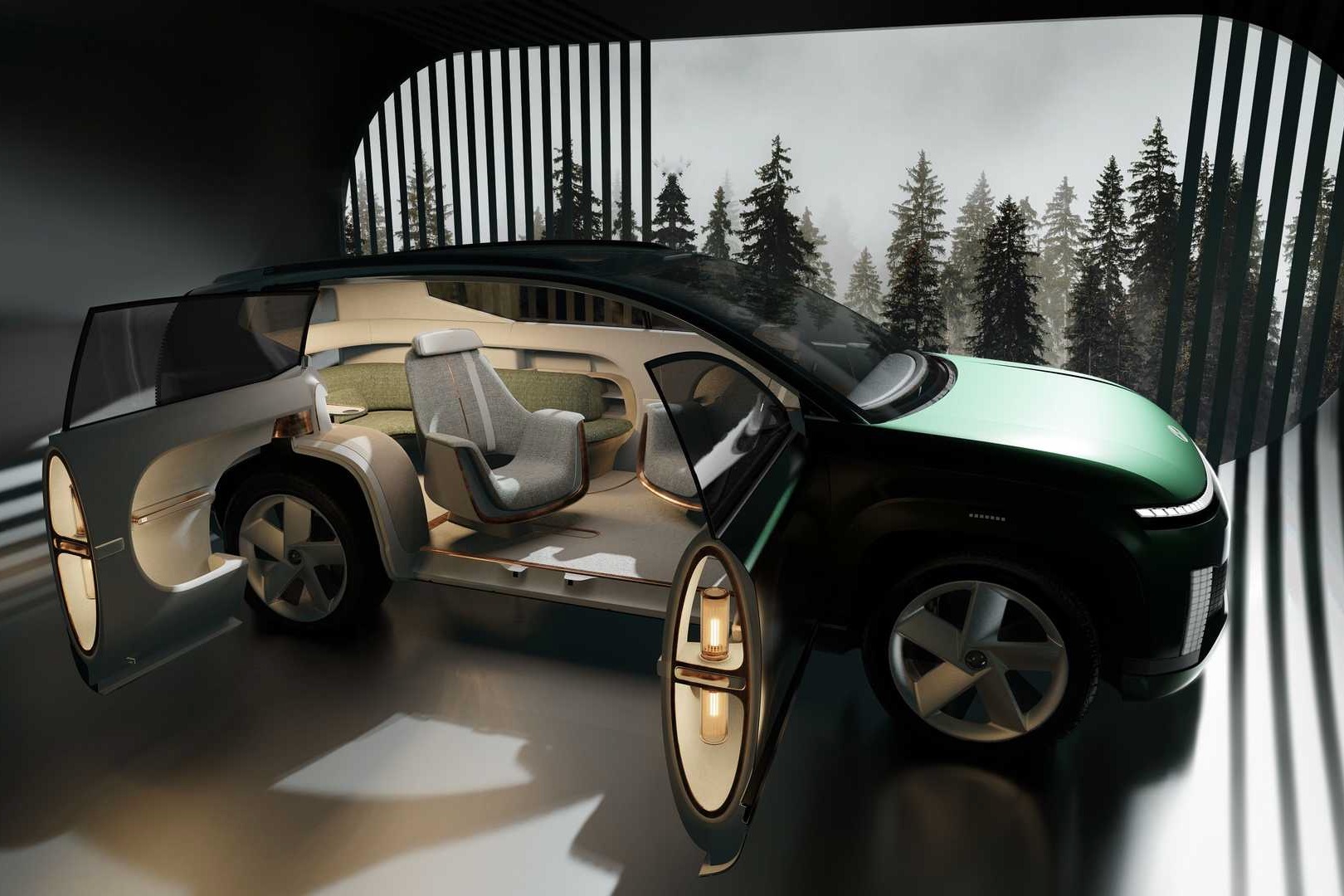
A built-in mini fridge and a shoe compartment have also been added, with the latter designed to “refresh passengers’ footwear”. Above, a panoramic glass roof can “display content based on passengers’ tastes,” suggesting it has some kind of digital projection capability.
Expect the overall shape of the concept to continue into the production version, which may arrive earlier than originally suggested.
While earlier reports had the Hyundai Ioniq 7 arriving in 2024, a story from newspaper The Korea Times today has the model launching in 2023 – which means we could see a road-going version unveiled as early as next year.
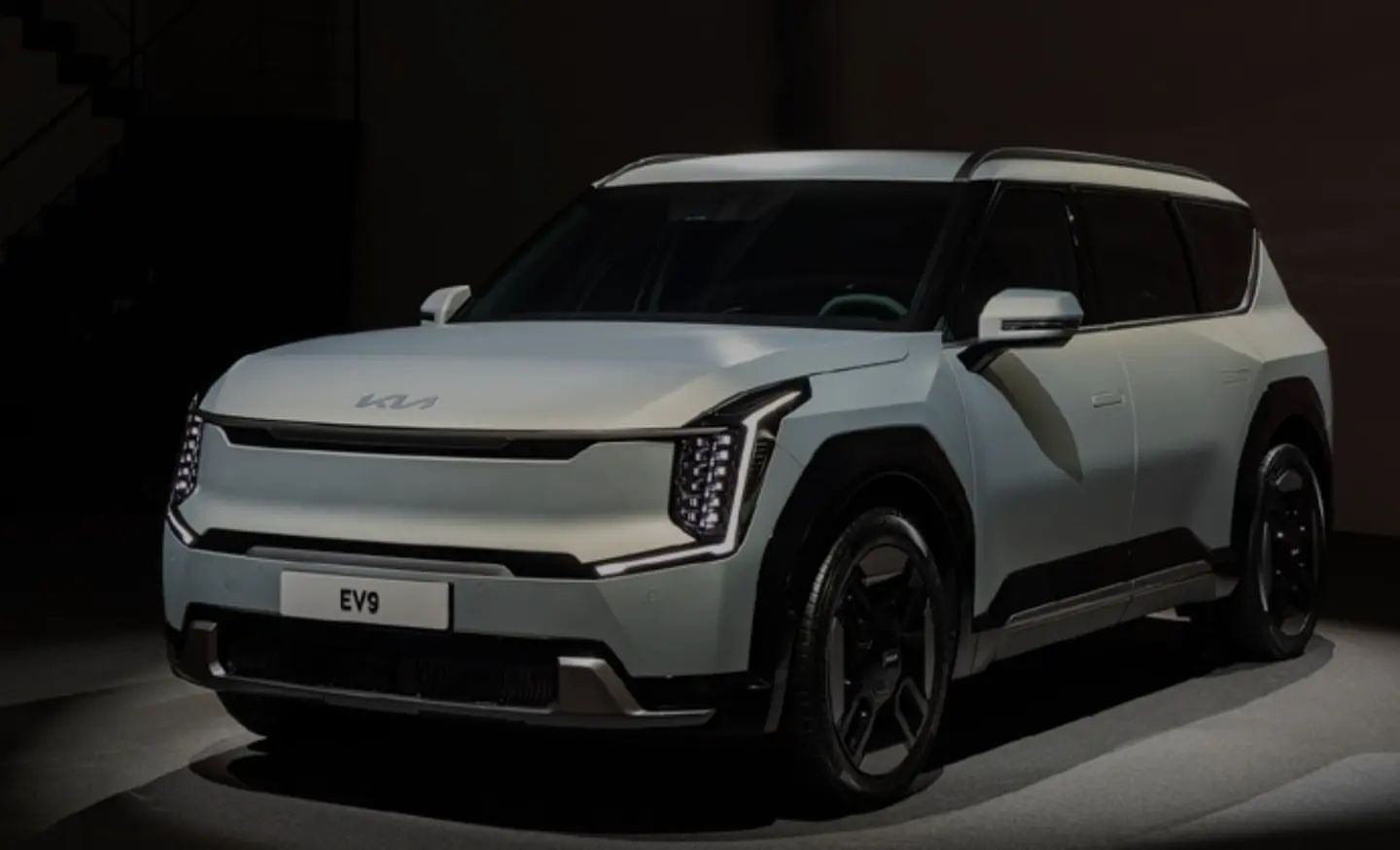
UPDATE, March 2023: EV9 leaked!
The upcoming Kia EV9 has surfaced in online social media, offering a first clear look at official marketing shots. Get the full story at the link below.
The story to here
The Kia Concept EV9 has been unveiled at the AutoMobility motor show in LA.
The concept provides our best look at what we can expect when the production version of the EV9 joins Kia’s line-up next year, adopting the brand’s new ‘Opposites United’ design language.
Like the recently unveiled Kia EV6, the production version of the EV9 will be underpinned by the E-GMP electric architecture, also shared with the Hyundai Ioniq 5 and forthcoming Ioniq 7 large SUV.
While exact details of the car’s battery-electric powertrain have not been outlined, Kia says the Concept EV9 offers a driving range of up to 482 kilometres on a single charge, suggesting it could be using the larger 77.4kWh battery pack found in the EV6.
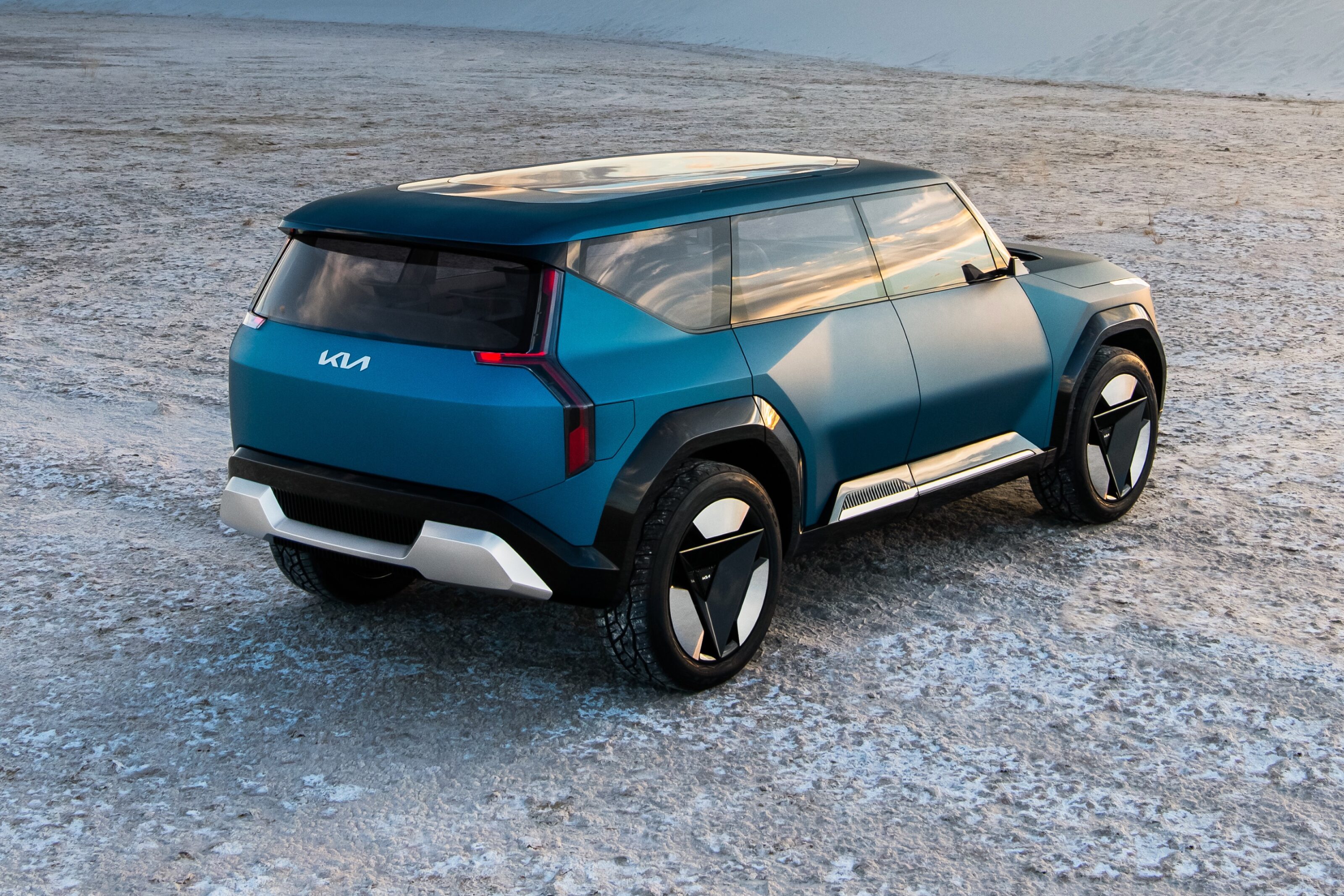
The Concept EV9 comes with 350kW ultra-fast charging technology, allowing the battery to replenish from 10 to 80 per cent in as little as 20 minutes – with recharging helped by solar panels on the bonnet vent area ahead of the windscreen.
The large SUV sits atop 22-inch alloy wheels, and measures in at 4930mm long, 2055mm wide, 1790mm high, running on a 3100mm wheelbase. These numbers make the EV9 both longer and wider than a brand-new Toyota LandCruiser 300 Series GX fitted with a snorkel.
The EV9’s surfaces are dominated by blocky geometric patterns, with large square and triangular shapes mixing to create a muscular but purposeful body. While the production version is likely to soften, the vehicle shares none of the flowing lines found on its smaller sibling.
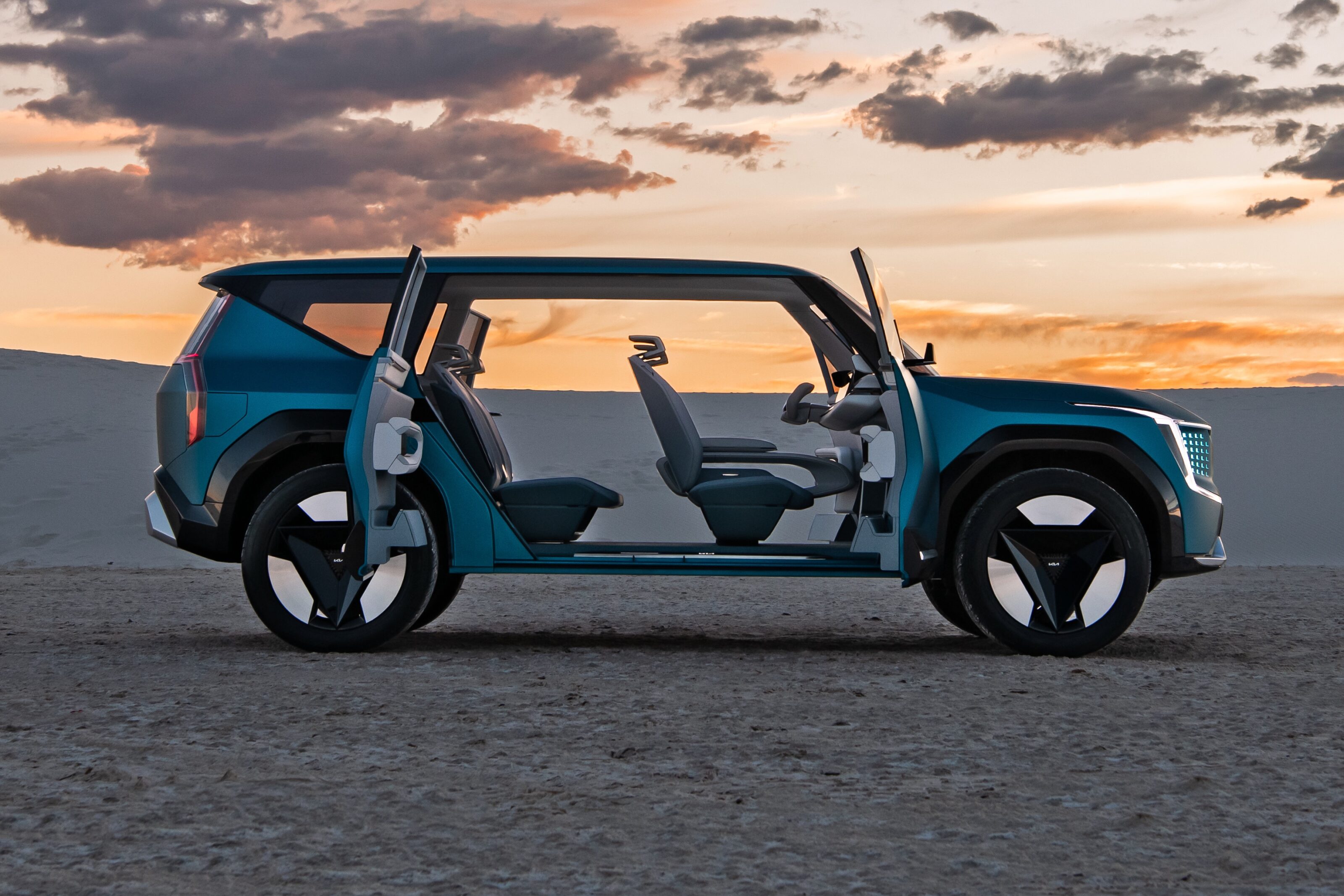
Hidden behind the grille panel is a “star cloud pattern display”, which fades into the LED daytime-running lights and headlamps.
To aid aerodynamics, Kia has designed retractable roof rails, which can be raised by the touch of a button to allow roof cross bars to be fitted. Side mirrors have also been swapped for cameras to reduce drag and improve driving range.
Inside, occupants are greeted with a 27-inch ultra-wide display connecting to the car’s infotainment system, and doubling as the driver’s digital instrument cluster.
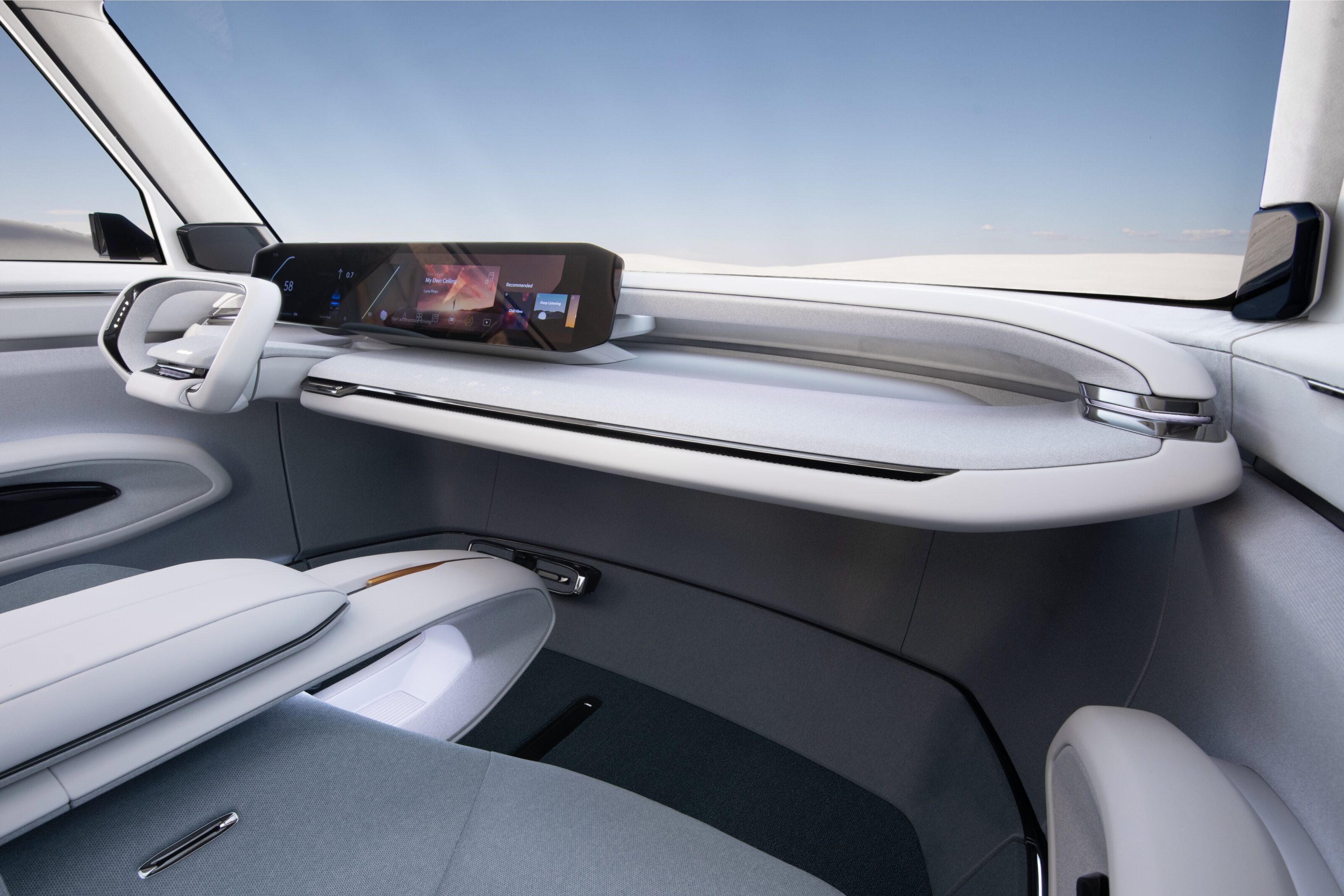
When the vehicle is parked, Kia offers ‘Pause Mode’. This turns the first-row seats around to face those in the third row, with the second-row seats transforming into a table.
‘Enjoy Mode’ turns all three rows of seats around and opens the rear tailgate – allowing those inside to enjoy their surroundings, or the local drive-in.
The concept will heavily influence the 2023 Kia EV9, which is expected to arrive in late 2022.
How many 4×4 dual-cab utes never see low-range, never experience a real load in their teeny-tiny trays, and how many rear seats remain cold and devoid of wear?
The reality is, many buyers don’t need the extra diff, or five seats, and yet so many pay the premium.
There is an alternative, it’s just buried deep within our fourby-obsessed psyches. Australia forgot about the once ubiquitous 4×2 ute, somewhere along the way, as our 4×4 dual-cab obsession took over.
If you’re a tradie, fleet buyer, or you just want a dedicated work ute; a 4×2 might just be the perfect solution.

Isuzu’s entry-level D-Max 4×2 SX is one helluva workhorse at a smidge under 30 large in manual guise, and this base-spec ute now gets plenty of the tech you’d expect to be reserved for higher-end models.
The model we tested is a two-seater single-cab, automatic, work-ready D-Max 4×2 SX ute, that’s just that; utilitarian. But it does score the full suite of safety technology, something Isuzu now includes across all D-Max model variants.
It’s a proper work ute, this, scoring that peach of a powertrain the D-Max is known and loved for, with a tad more grunt than the outgoing model and loads more safety tech. We’ll get back to safety in just a sec.

Isuzu’s long-serving 4J engine has been overhauled as part of the ground-up redesign of the 2021 D-Max line-up, but retains its agricultural characteristics – or charm, depending on who you ask.
The motor offers familiar driveability and the same rugged boisterousness of the old donk, but with more nudge thanks to a new variable geometry turbocharger. In fact, aside from the oiling system, most of the engine is new; from the block to the pistons, even the fuel injection system.
While Australia is one of only a couple of countries to get the three-litre 4JJ3 option, Isuzu’s commitment to overhauling it for 2021 puts into perspective how popular this motor is Down Under.
Isuzu’s long-serving 4J engine has been overhauled but retains its agricultural characteristics – or charm, depending on who you ask.

Whether towing, loaded to the brim, or running around town empty, the wide torque spread keeps you moving without much right-foot enthusiasm needed; maximum torque is offered between 1600-2600rpm and a good portion of that twist is on tap right off idle.
It just so happens that at the time of writing, Isuzu Ute Australia has announced a frugal 1.9-litre Euro VI diesel engine option, for lower-end D-Max models like the 4×2 SX model we tested.
We’re pushing to get our hands on the budget-friendly 1.9-litre SX model the moment it lands in Australia, so you can hedge your bets we’ll snag the first drive.
Rest assured, though, the 4JJ3 will remain an option across the entire range, for those in favour of its cubic motivation.

The Aisin-sourced six-speed automatic in the D-Max does its job but would feel a little under-cogged if forking out $20,000 more for a higher-spec model, like the X-Terrain. Again, it’s a work ute, it does what it says on the box.
For around town and when towing, an automatic is nice to have, but we’d be opting for the manual if spending our hard-earned. It’s a work ute, so learn to live with a gear stick and you’ll save plenty of cash – we’ll get to just how much cash you’ll save, a bit later.
Isuzu canned the low-rider model option for 2021, so all 4×2 D-Maxes are now high-riders, with ground clearance to boot and, if it means anything to you, unless a keen eye spies the naked front axle it looks just like you’re in the exxier 4×4 model.

Now, let’s talk safety. The entire D-Max range oozes with trick safety tech, right down to the base-spec model we tested.
The safety system, dubbed Isuzu’s Intelligent Driver Assistance System (IDAS), incorporates autonomous emergency braking, adaptive cruise control, turn assist, forward collision warning, post-collision braking, misacceleration mitigation, lane departure prevention, blind-spot monitoring, rear cross-traffic alert, and reversing camera. Try saying that without taking a breath!
The only mildly annoying safety feature was the misacceleration mitigation, which had a habit of flashing up when merging, changing lanes, or in driving scenarios requiring slightly more haste than the car in front. In saying that, though, we’d rather have it and not need it, than need it and not have it; particularly if loaded up or towing.
The entire line-up also scores a five-star safety rating, no doubt helped along by the inclusion of eight airbags within the cabin.

You don’t get a huge array of colours in base-spec with just five basic options, a couple of those metallic, but you’ll fork out $500 more for the fleck.
From the outside the SX isn’t quite as menacing as the higher-spec models, but the front-end looks loads tougher than previous-gen models.
There’s no denying this is a work ute, with budget-spec steelies, alloy tray, and little in the way of aesthetic premiums.
As mentioned, though, until you take a peek at the undercarriage, you’d be hard-pressed differentiating the 4×2 from the 4×4. We see this as somewhat of a value add, because within the ute segment, the ‘bigger is better’ mantra rings true.
You’ve got to ask whether a work ute is going to last, for decades, being thrashed by unapologetic apprentices and workers – this D-Max appears as though it will.

Inside the cab, hard-wearing plastics make up the bulk of the dash and trim, while vinyl floors make for easy cleaning – not quite a ‘hose her out’ work-ute interior, but definitely one you’d have no issues wiping down.
A seven-inch touchscreen infotainment system with Apple CarPlay and Android Auto plus plenty of steering wheel controls sorts out the entertainment side of things and despite a few quirks, the system works well.
More than one USB outlet would be handy, and the volume control buttons are a bit awkward when on the run due to their small size, but using steering wheel controls gets you by.

Now, it’s a work ute, so let’s talk numbers.
In terms of vehicle dimensions, the D-Max ticks all the boxes. Overall height is 1790mm, meaning pretty much any underground car park is a goer.
The turning circle comes in at an adequate 12.5m, not the best but certainly not the worst in its class.
Ground clearance is a strong point for high-ride utes, and at 235mm the 4×2 SX is on par with most 4×4 utes. This is an undeniable benefit for a work ute, accessing job sites and urban environments that might have a low-ride option scraping and bottoming out.

The massive heavy-duty alloy tray on the D-Max we tested measures up at 2550mm, with loads more space than dual-cab trays that sit around the 1500-1600mm mark.
The massive tray, available in a variety of steel and alloy options right up to mine-spec depending on required strength and intended use, is the biggest perk of the single-cab option.
While most style-side trays don’t afford enough space between the wheel arches for a full-size pallet, the heavy-duty alloy tray on the SX we tested will fit not one, but two.

Gross Vehicle Mass (GVM) comes in at 3000kg, which with a kerb weight of 1695kg, leaves a pretty impressive 1305kg payload. Unless you want to jump into the light-duty truck segment, anything over a tonne is a luxury, so the few hundred extra kegs are handy if you’re regularly operating up near GVM.
A Gross Combination Mass (GCM) of 5850kg nets you a healthy 3500kg braked towing capacity, and 750kg for an unbraked trailer.
The massive alloy tray measures up at 2550mm, with loads more space than dual-cab trays that sit around 1500-1600mm. It is the biggest perk of the single-cab option.

So, how’s it drive? We spent three weeks and about 900km in the D-Max and it saw a pretty mixed bag of use.
It acted as a motorcycle transport rig, for a not-for-profit custom bike build, which it handled with ease. We also threw a pallet in the back, because that’s a non-negotiable.
The D-Max also saw plenty of day-to-day city use with a mix of highway and stop-start traffic driving, it even acted as a makeshift ambulance for an impromptu hospital visit – the person in question was thankfully fine!

We got a final fuel-use average of 9.1L/100km across the few weeks, compared with Isuzu’s claimed 8.0L/100km, but we made a point of driving it like a work ute. It certainly wasn’t babied and the manual would have no doubt sipped a bit less diesel.
It feels a little mean, calling it bulky and rough around town when unladen, because it’s a work ute and it’s certainly better than most. But any alloy tray ute with a decent payload is going to feel more compliant with a bit of cargo.
Around town, it felt every bit as good as higher-spec D-Max dual-cab models, but the typical banging and clanging of an alloy tray over bumps is something you’ve got to get used to.

The move to electric power steering is probably the most noticeable change from the outgoing models, and it’s a positive one as the older D-Max had pretty heavy hydraulic steering, which was great at highway speeds but hard work around town.
Hats off to Isuzu who managed to dial in the electric steering setup to feel just right at low speeds, but it still firms up nicely once triple digits come around.
The move to electric power steering is probably the most noticeable change from the outgoing models, and it’s a positive one.

Isuzu claims the D-Max has largest front brakes of any one-tonne ute option, and we had no complaints with the anchors, providing good feel and feedback from light to hard braking.
Double wishbone suspension up front keeps body roll in check, but it’s a high-ride ute with a heavy donk, so it still wallows and rolls an expected amount.
The rear felt better than the outgoing model, which Isuzu says is due to a lighter and stronger three-leaf setup. The harshness of the leaf springs settled nicely with anything more than a few hundred kegs in the tray, so a typical tradie toolbox would undoubtedly improve the ride.

When it came to loading a pallet on the back, Isuzu Ute Australia hooked us up with a 4JJ3 crate motor weighing about 350kg including the lumber.
While it was nowhere near the 1305kg payload, the weight up back made a considerable difference to ride quality across the day of loaded testing.
We didn’t get a chance to throw a trailer on and tow-test the D-Max, but having towed extensively with the previous generation, right up near maximum GCM, this motor loves it. The 4JJ3 pulls like a train, which is certainly an attribute you want if you’re putting a ute to work.
The motorcycle, a custom-built Yamaha TW200, looked like a children’s bicycle when chocked hard against the headboard. The massive tray could easily accommodate two or even three motocross bikes with plenty of space for gear – having squeezed two bikes onto a dual-cab for many years, I’d prefer this tray any day of the week.

We had no complaints about comfort or driving ergonomics, with steering wheel rake and reach adjustability, and seats that off-memory felt better than previous models.
In terms of value, the as-tested price of this D-Max 4×2 LX automatic was $44,133, with the heavy-duty alloy tray and towing extras to the tune of $2,350. Which certainly isn’t bad, for a capable work ute.
However, the pricing dilemma for us is that the manual scores a special drive-away offer of $29,990, a nearly $10,000 discount, before add-ons or extras. The automatic unfortunately doesn’t receive the early-bird discount, so comes in at $41,783 before any boxes are ticked at the dealer.
If that doesn’t reinforce the manual as being the ideal option, you still can’t go wrong with the self-shifter – just know you’ll pay for it, to the tune of $11,793.

All models boast a six-year/150,000km warranty, seven-year capped-price servicing and roadside assistance, and trips to the service department come along every 15,000km or 12 months.
Isuzu claims a 12 per cent lower capped price servicing cost compared with the old models, quoting a seven-year servicing cost of $3373 across the range.
Considering the 4J engine has been in operation for more than a decade, parts availability and aftermarket support is pretty hard to beat. Even though this engine has seen a redesign, the architecture and inherent simplicity remain – a plus for prospective owners looking for reliability and replacement parts that won’t break the bank.

The D-Max sits second on the Australian 4×2 sales ladder to the Toyota HiLux WorkMate, available in only low-ride configuration. But in our eyes the D-Max is a frontrunner due to its high-ride appeal and grunty 3.0-litre engine.
If you’re a solo tradie, looking to upgrade your fleet, or even just want a real Bunnings-ready ute for the weekend, the D-Max 4×2 SX is an enticing option.
We can’t wait to get our diesel-hungry hands on the light-sipping 1.9-litre D-Max, the moment it lands in Australia. If it’s anywhere near as good as this, it might just knock the HiLux WorkMate off its perch.
2021 Isuzu D-Max 4×2 SX specification
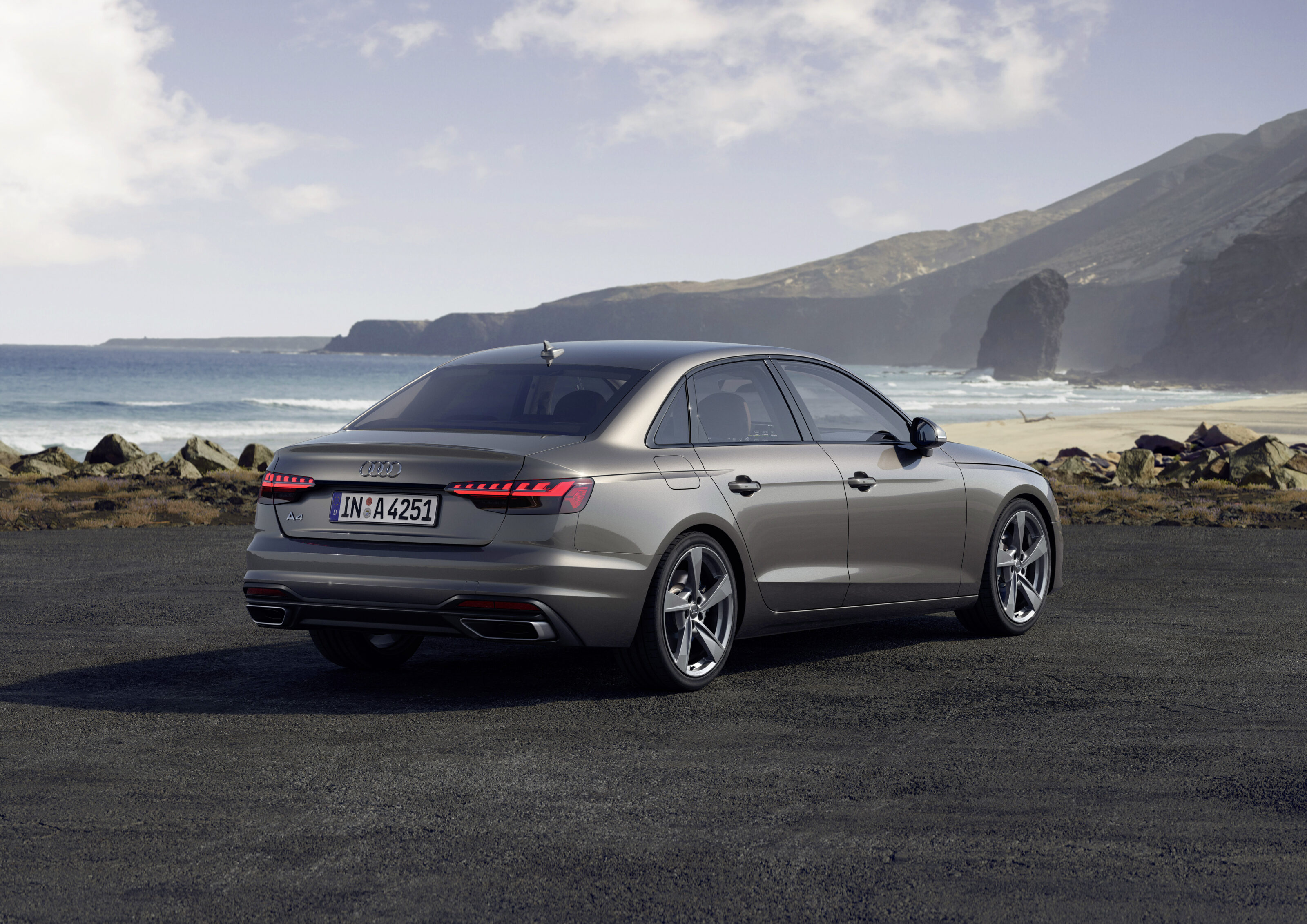
Until last week I was absolutely certain that I wanted an Audi A4 45 TFSI quattro. But then a mate of mine let me drive his Alfa Romeo Giulia Veloce and suddenly the Audi seemed a bit, well, sensible. Should I let my heart rule my head on this one? – Mitch C
You know that thing about getting the advice you want depending on who you ask?
While the Audi A4 is a swift and beautifully finished car, there’s no getting away from the fact that the rear-drive Alfa Giulia Veloce feels that much more alive.
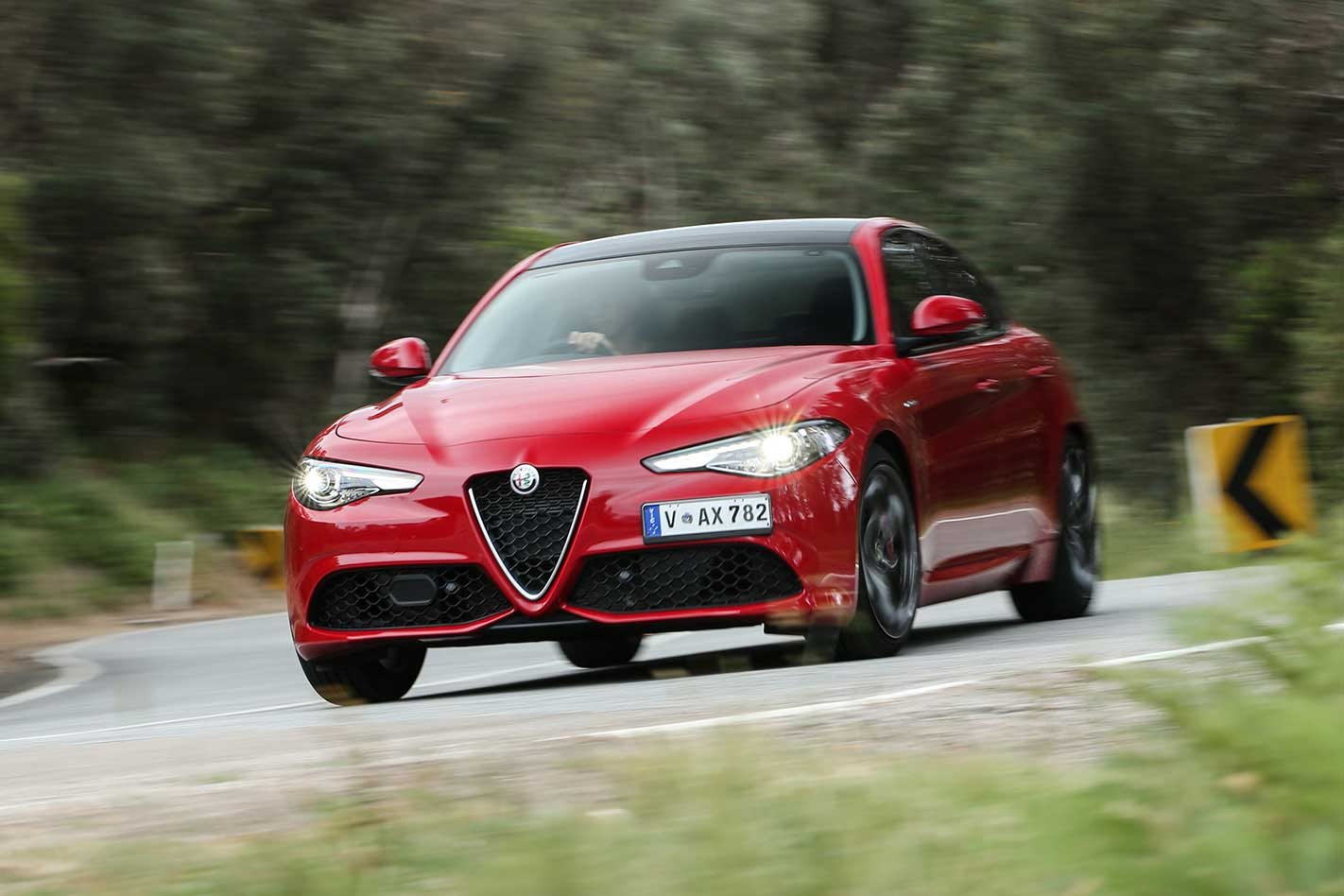
Without abandoning all semblance of common sense, residuals between the two aren’t any different according to Glass’ and the Italian car’s eight-speed auto ’box would give us far fewer durability concerns than the Audi’s seven-speed dual-clutch.
Plus you get five years of warranty on the Giulia and a mere three on the A4.
The Audi’s buld quality is hard to resist though and, looking at sales figures between the two models, I’m aware that this is outlier advice, but if you value driving, you have your answer already. – AE
Alfa Romeo Giulia and Audi A4 specifications
A 2023 Audi RS6 E-Tron is said to be in development, as the brand transitions towards an all-electric future.
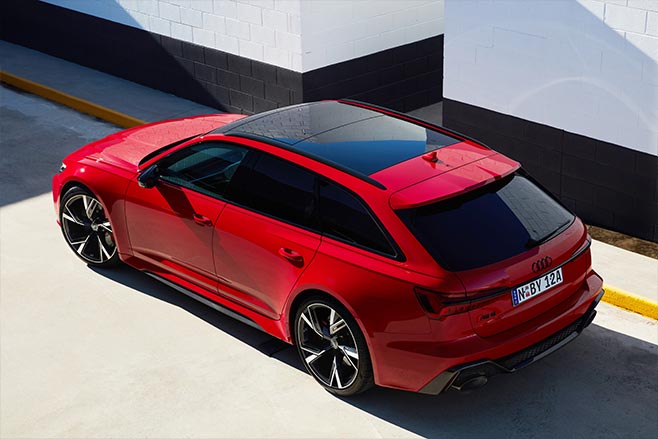
British publication Autocar reports Audi is currently working on a battery-powered RS6 E-Tron – with the high-performance model expected to offer outputs equal with the current Audi RS E-Tron GT.
In numbers, it puts the RS6 E-Tron in the realm of 440kW to 475kW (the higher figure being available as a short ‘overboost’ function in the RS E-Tron GT) – or roughly on par with the current RS6, which produces 441kW from its 4.0-litre twin-turbo V8.
However, in a recent conference with Australian media, Audi spokesperson Josef Schlossmacher said we could expect more power from its electric platform in the future, but stopped short of naming the RS6 as the beneficiary.
“I can’t exactly tell you whether we will have a 530kW version in a production car, or whether it will be 520 or 540 [kilowatts]. But something like that is really the future, especially for the [large car] class,” Schlossmacher said.
With a move from petrol to electric, a healthy power increase could help win over customers reluctant to embrace the new technology.
It’s a different strategy than is being taken by the BMW M5. BMW is pursuing the electrification of its petrol engines, while Audi is looking to switch directly to battery power.
Evidence is stacking the M5 will be moving to a plug-in hybrid twin-turbo V8, with rumours it could deliver as much as 560kW. If true, an electric RS6 will need to offer similar performance figures to remain competitive.
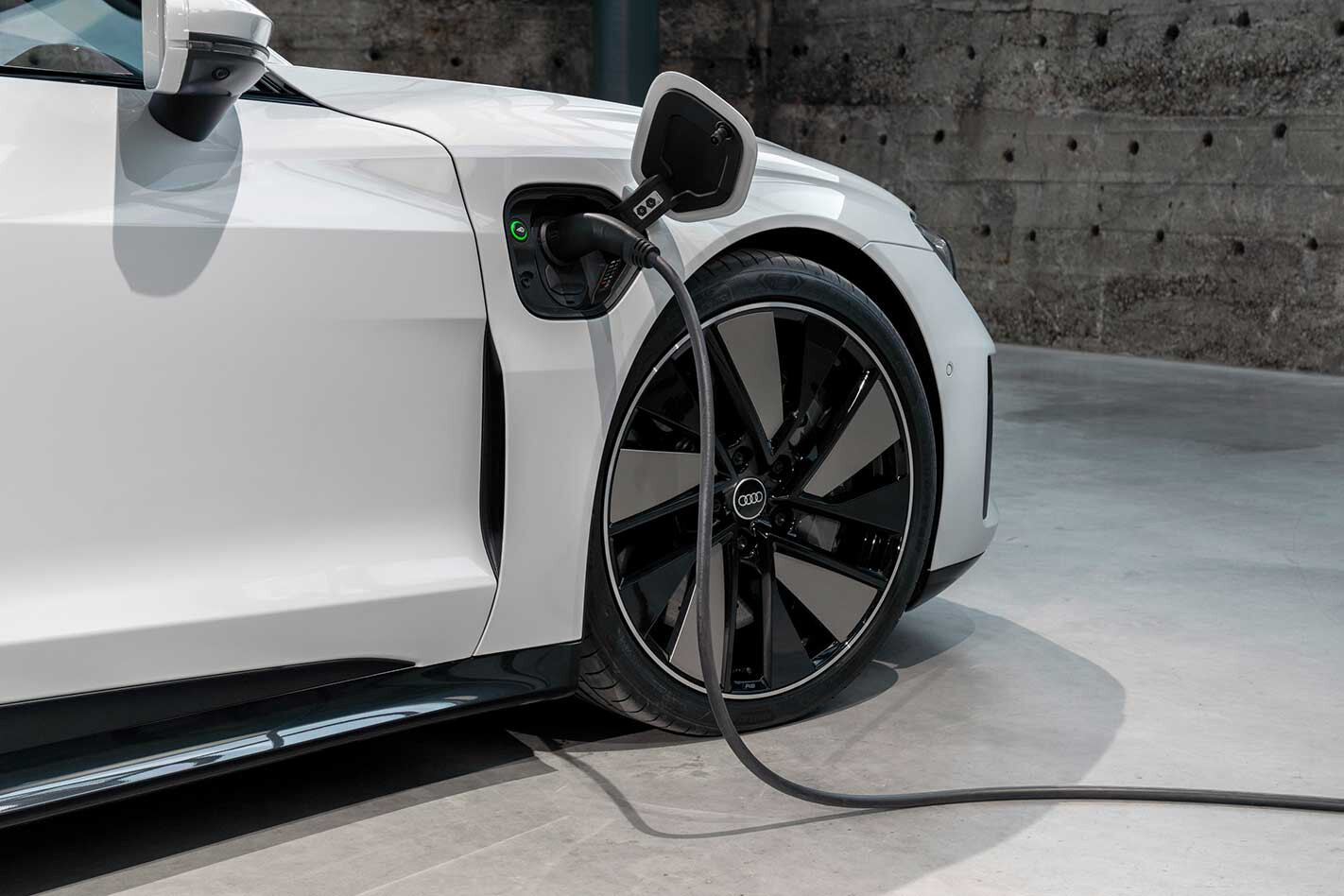
Audi’s RS division also has to be wary of stepping on the toes of Porsche – its cousin within the Volkswagen Group family – and vice versa, but arch rival BMW M has no such concerns.
The RS6 is expected to be one of many electrified models to be introduced within the RS line-up, with the brand planning to have more than 50 per cent of its high-performance models being either plug-in hybrid or fully electric as early as 2024.
