
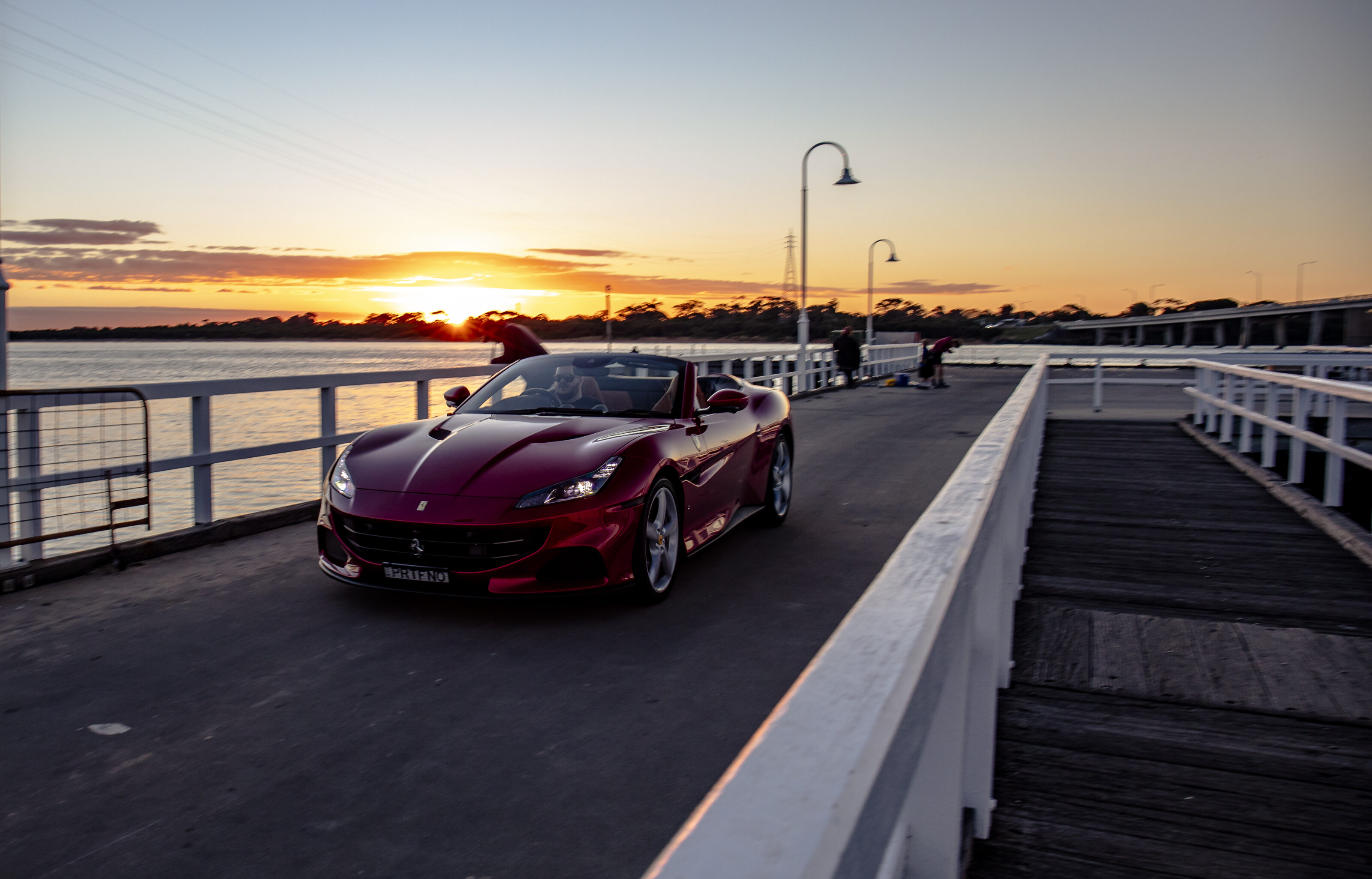
The sun is performing its daily party piece as it makes its final approach to the horizon. Tinges of orange and yellow fill a sky dotted with the odd wisp of altostratus. The coastal Victorian town of San Remo is doing a poor impression of the Italian Riviera but in a pandemic world where overseas travel has been made virtually impossible, this is as close as I’m getting to a beach in Sanremo anytime soon.
For a fleeting moment, in the former fishing town that gains its name via Ligurian influence, I can dream of an alternate life of wanderlust. The weather is playing the ultimate game of smoke and mirrors because, despite the gin-clear visibility and lowering sun, it’s bitterly cold. The in-car read out displays 12 degrees, but the wind-chill factor is making me question its legitimacy.
It’s this kind of deception that’s almost unwittingly bestowed upon the Ferrari Portofino. Ironically, the cheapest, ‘entry-level’ Ferrari requires the most work to sell. Its ethos and design brief comes across as contrived to purists; a model born purely out of necessity to lure new money to the brand. A cynic could claim it’s a lifestyle GT for posing instead of a driving tool that burnishes the badge rather than only borrowing from it.
Even the marketing bumf seems to work that little bit too hard to convey its legitimacy. Yet, now with an M designation, or Modificata in Ferrari-speak, there is a new narrative. The story now turns to its dynamic ability as the plot moves away from mere aesthetics and badge hierarchy.
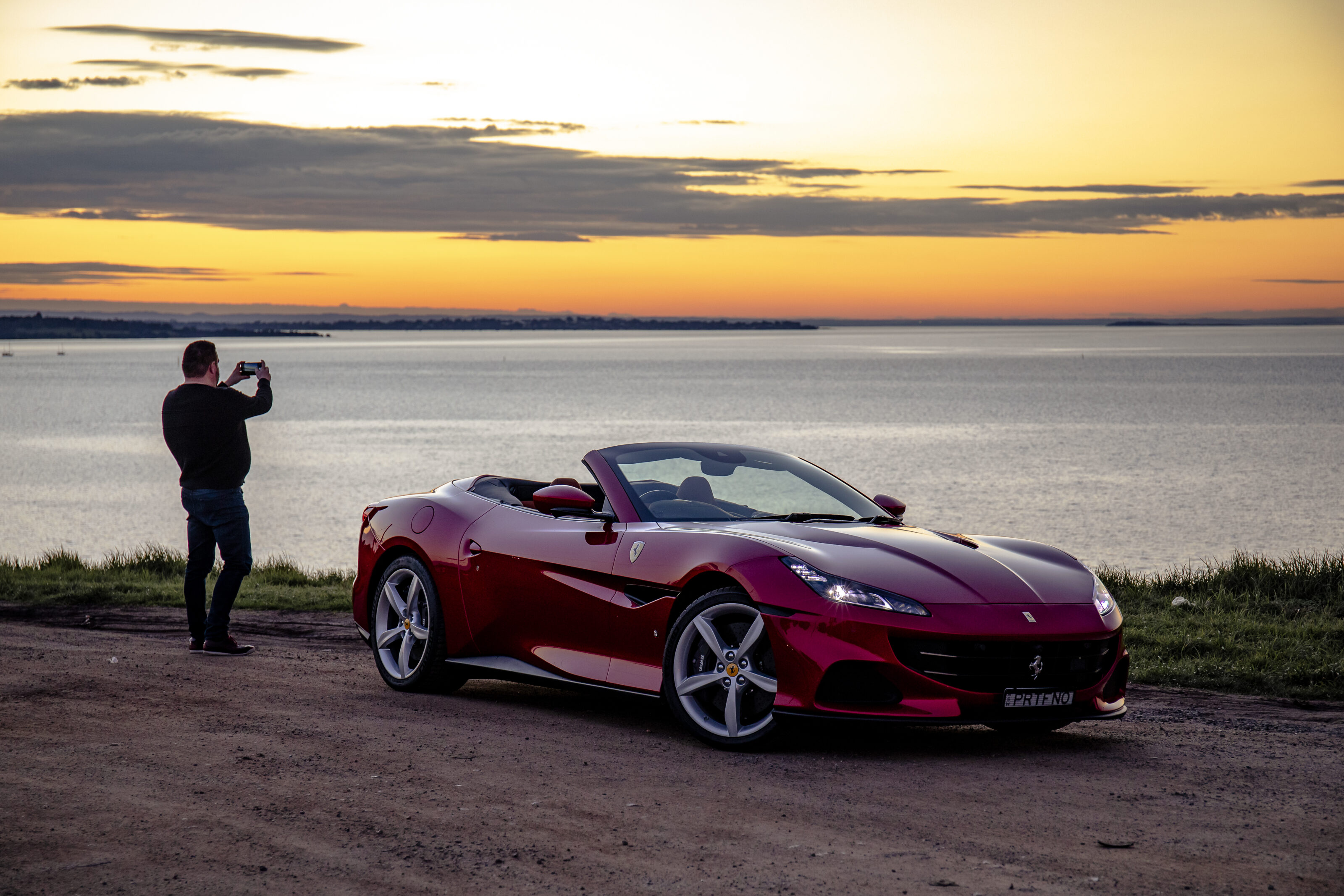
It’s why I find myself, many hours earlier when this road trip starts, trundling along the Bass Highway in single-digit temperatures. I’m in search of the more challenging ribbons of tarmac nestled within west Gippsland.
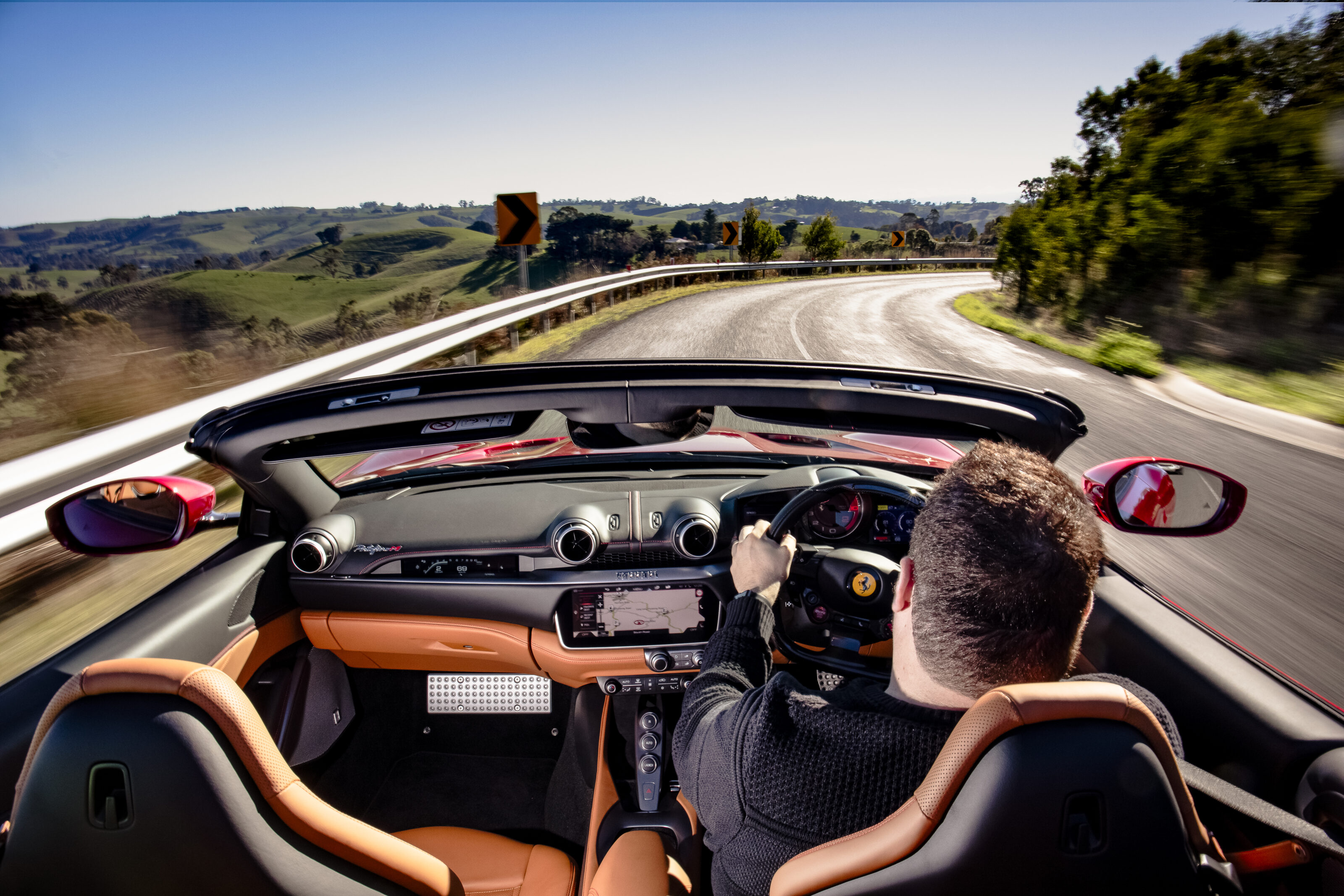
Cruising at 100km/h, folding hard top in place, I’m staggered by the ride quality. The manettino dial gains two new modes, being Wet and Race, but for now it’s firmly in Comfort. And it’s hard not to question how some luxury manufacturers can’t master the level of bump absorption Ferrari has with its magnetorheological damping.
The addition of Race mode shouldn’t be glossed over. It’s the first time Ferrari has endowed a GT convertible with such focused parameters. The mode allows greater liberties and a newfound aggression from the 3.9-litre twin-turbo V8. The revised F154BE unit now comes in at a heady 456kW and 760Nm thanks to new cam profiles and revised turbochargers.
Yes, you’re reading that right; more than 600 horses for a ‘base’ car. Not that I’m massaging its 7500rpm cut-out, trundling along at 1550rpm. At least I’ve braved the six-degree temperature to drop the roof in. It’s made easier by the optional neck heater that gently wafts hot air through the heated leather seat.
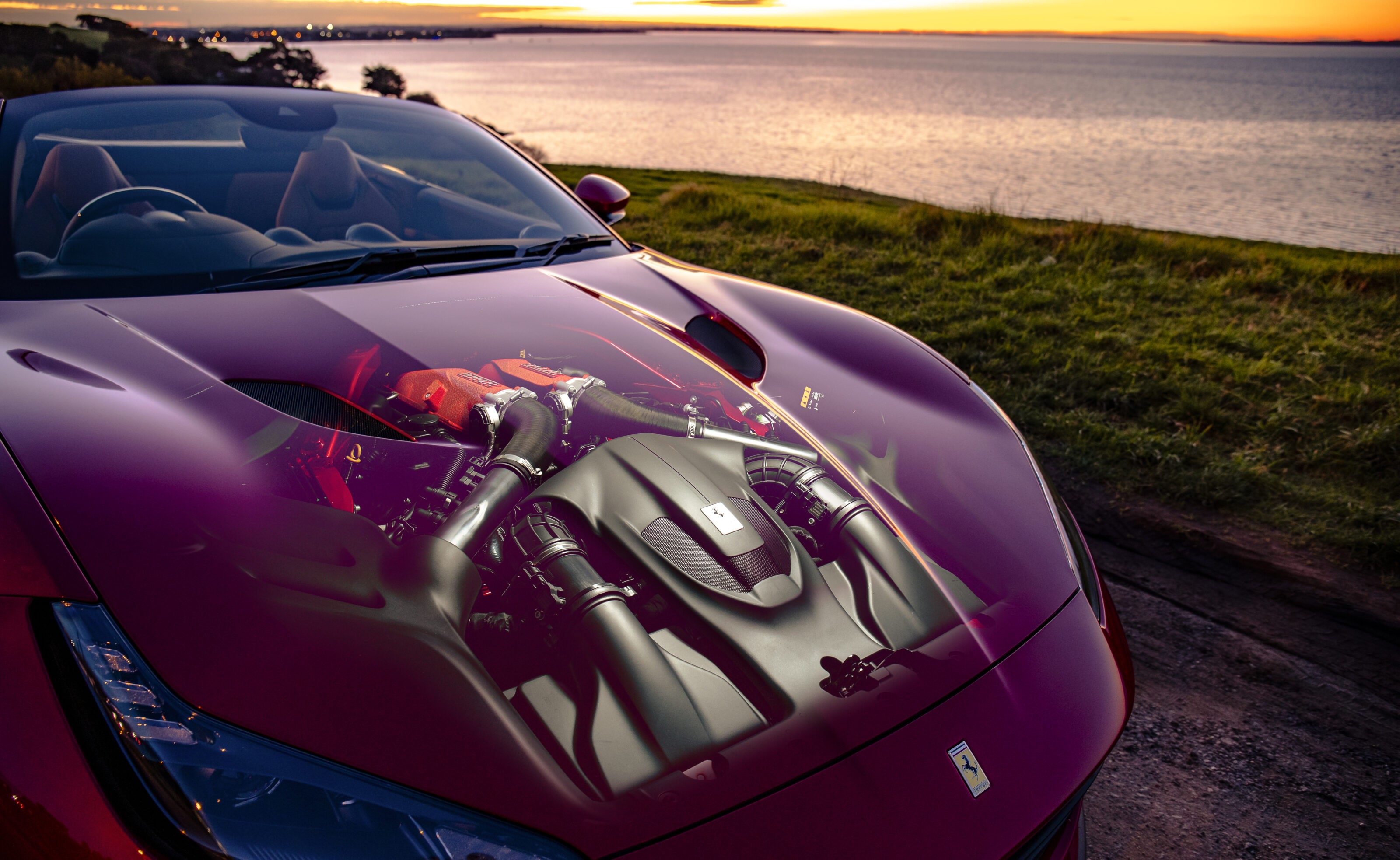
“The revised engine now comes in at a heady 456kw and 760nm … Yes, you’re reading that right; more than 600 horses for a ‘base’ car”
Fuelled and parked at a servo outside Lang Lang, the Rosso Portofino hue – a $22,000 option that’s a shade less overt than Rosso Corsa – suits the car. With the fog lifting faster than the thermometer, the soon-to-be-warming rays bring out the vibrancy in the red, which matches well with the tan-coloured leather innards.
Photographer Ellen Dewar, arrives and promptly states, “I thought it was a convertible” such is the coupe-mimicking cohesiveness when the roof is in place. With a sunset deadline looming and fading winter light a concern, it’s finally time to head off on the 87km route encompassing some of Gippsland’s best, and most challenging, driving roads.
I gallantly agree to keep the roof down. Ellen wants to take advantage of the drop-top’s handsome silhouette. This isn’t a Roma with more headroom and according to Ferrari, it only shares 30 per cent of its structure with the two-door, two-plus-two coupe.
McDonalds Track takes us to Nyora which, somewhat fittingly, is where ABC TV show Something in the Air used to be filmed.
“Turn around, I’ve seen something” radios Ellen. It’s a Pony Club sign. Nice one.
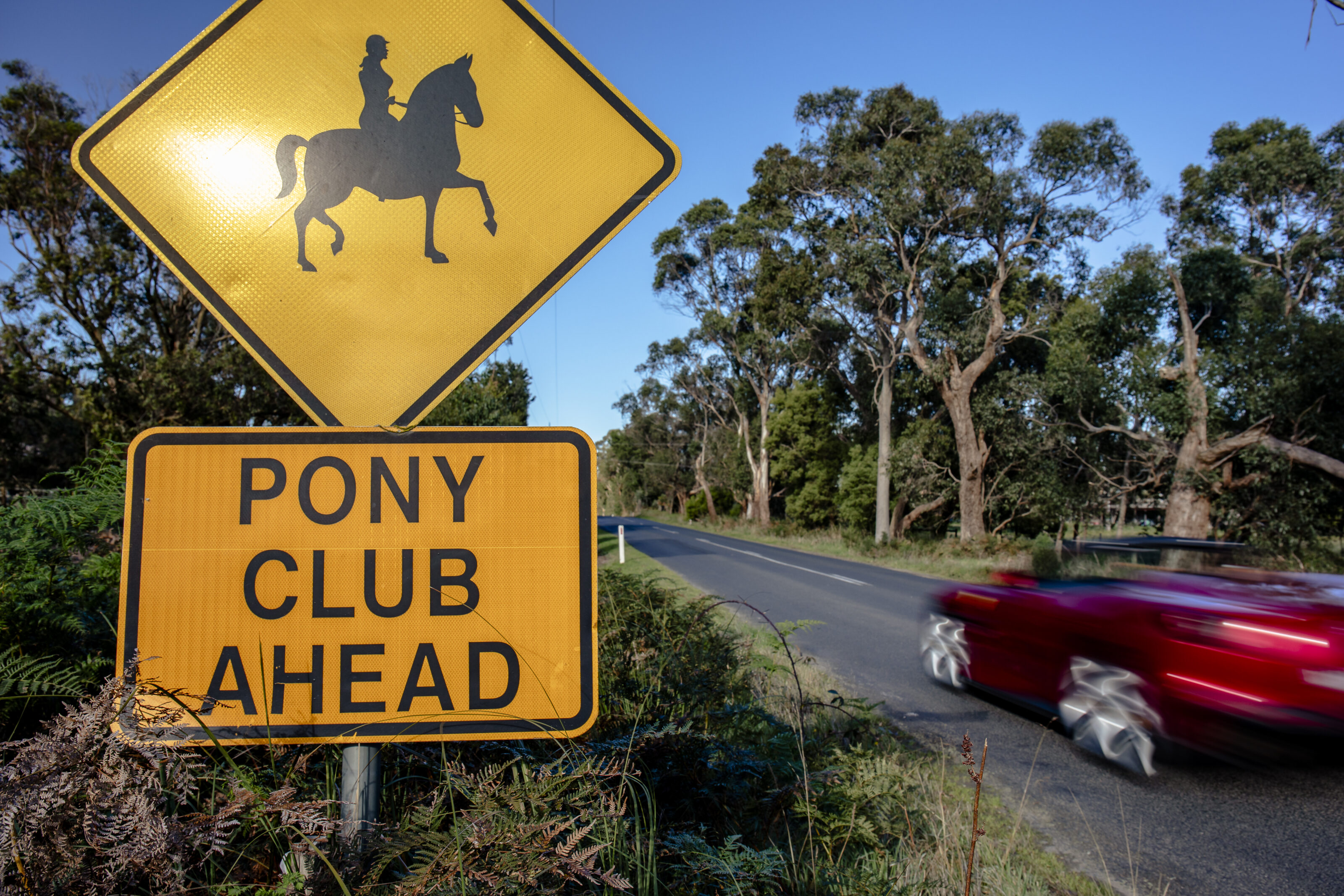
Raw figures are often hard to fathom, yet underfoot, the Portofino M feels every bit as quick as its numbers suggest. Zero to 100km/h takes 3.45 seconds. And for those sticklers for details, you’ll know that’s 0.05sec faster than the usurped model. Attaining 200km/h from rest requires 9.8sec and it’ll go on to more than 320km/h. Quick doesn’t really cover it. The ‘baby’ Fezza has entered a different performance realm.
Tied to a new eight-speed dual-clutch gearbox, which differs from SF90 by having longer ratios and a mechanical reverse gear, it’s rapid-fire. Top gear is for economy, but due to the Variable Boost Management system that feeds in torque through higher gears, traction is a feasible construct. The relentless way in which the Portofino M eviscerates the road ahead is utterly intoxicating.
Yet, it’s not just in a straight line. A short and sweet section of Lang Lang-Poowong Road becomes a winding test bed for the Portofino M’s dynamic wares. It’s filled with twists and turns as well as elevation changes and differing cambers in the road. A third-gear left-hander rises on approach, then plunges at the apex before climbing steeply on exit. It’s rewarding to get right.
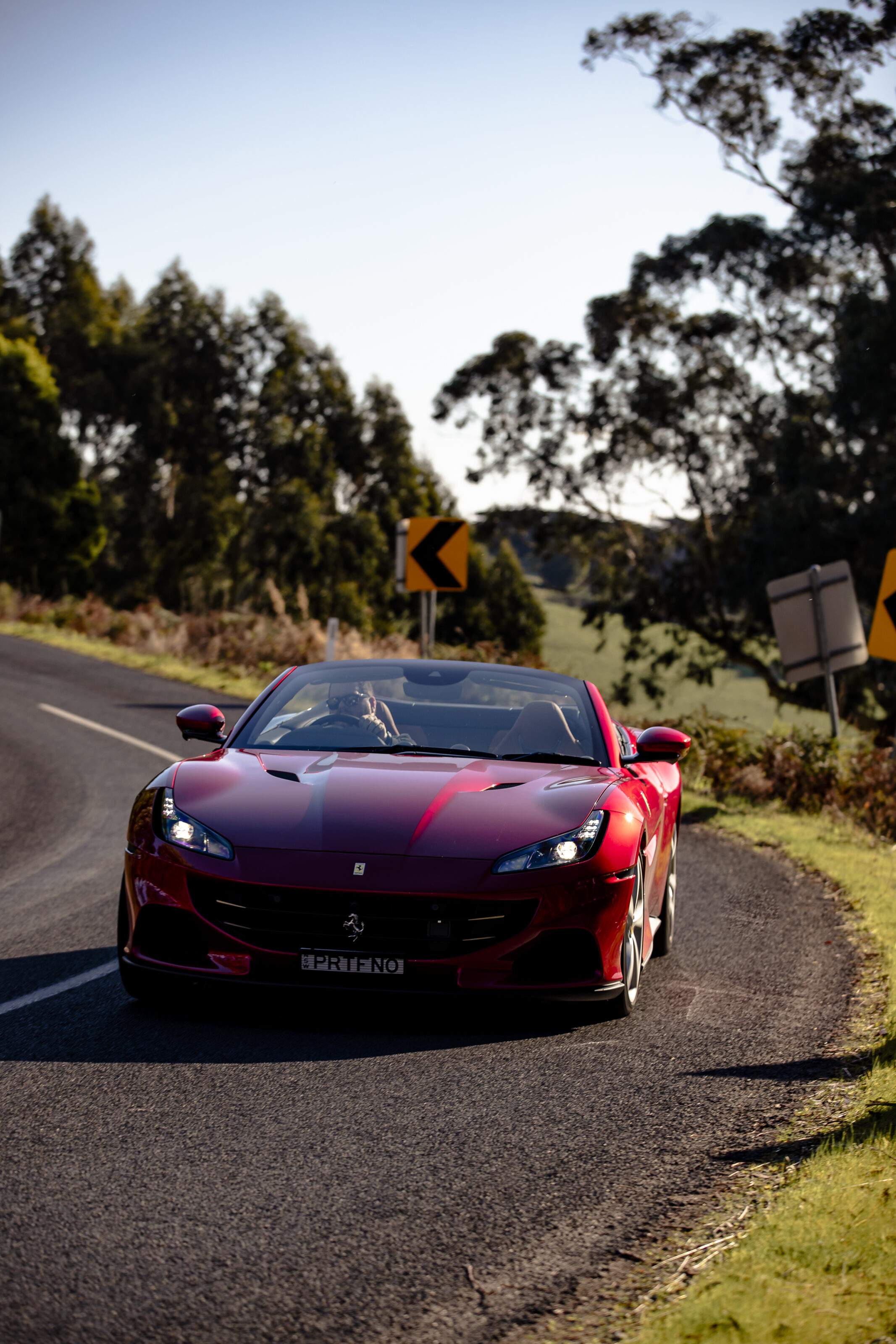
That’s something I don’t accomplish at the first attempt as the super quick steering has me placing the car on a tighter trajectory than the actual apex. That’s rectified with a rapid release of lock, allowing the front 245-section Michelin Pilot Sport 4S tyres to dig in and the chassis to compose itself. My driver error reveals the forgiveness in the platform, one that is long devoid of the scuttle-shake and chassis-flex ills that maligned the California.
Take two. And this time I get it right. The rise is enough to unsettle the Portofino M, yet it naturally uses its travel and with the right amount of lock, the front axle keys into the apex. Fully compressed with downward vertical and lateral forces, the car is being asked a lot of questions. Because of the reactive and light steering, there’s a delicacy required to attain a natural flow through mid corner. From there the rear axle accepts an early throttle application, finding plenty of purchase. The 90-degree, 3855cc boosted V8 blasts the Portofino M up the incline, disdainful of the sweeper it has just conquered.
I think Ellen senses my enjoyment and asks for a few more run-throughs – for photography purposes, of course. Accessing the redline on the centrally mounted tacho seems incongruous with the serenely quiet countryside. Yet, the noise at high revs coerces me to continue breaking the peace. Due to stricter emissions laws the Portofino M now runs a particulate filter. However, Ferrari removed the rear silencers to reduce back pressure and changed the geometry of the entire exhaust (with bypass valves) so that the flat-plane crank V8 retains its voice. When you’re on it, there’s no cause for aural concern.
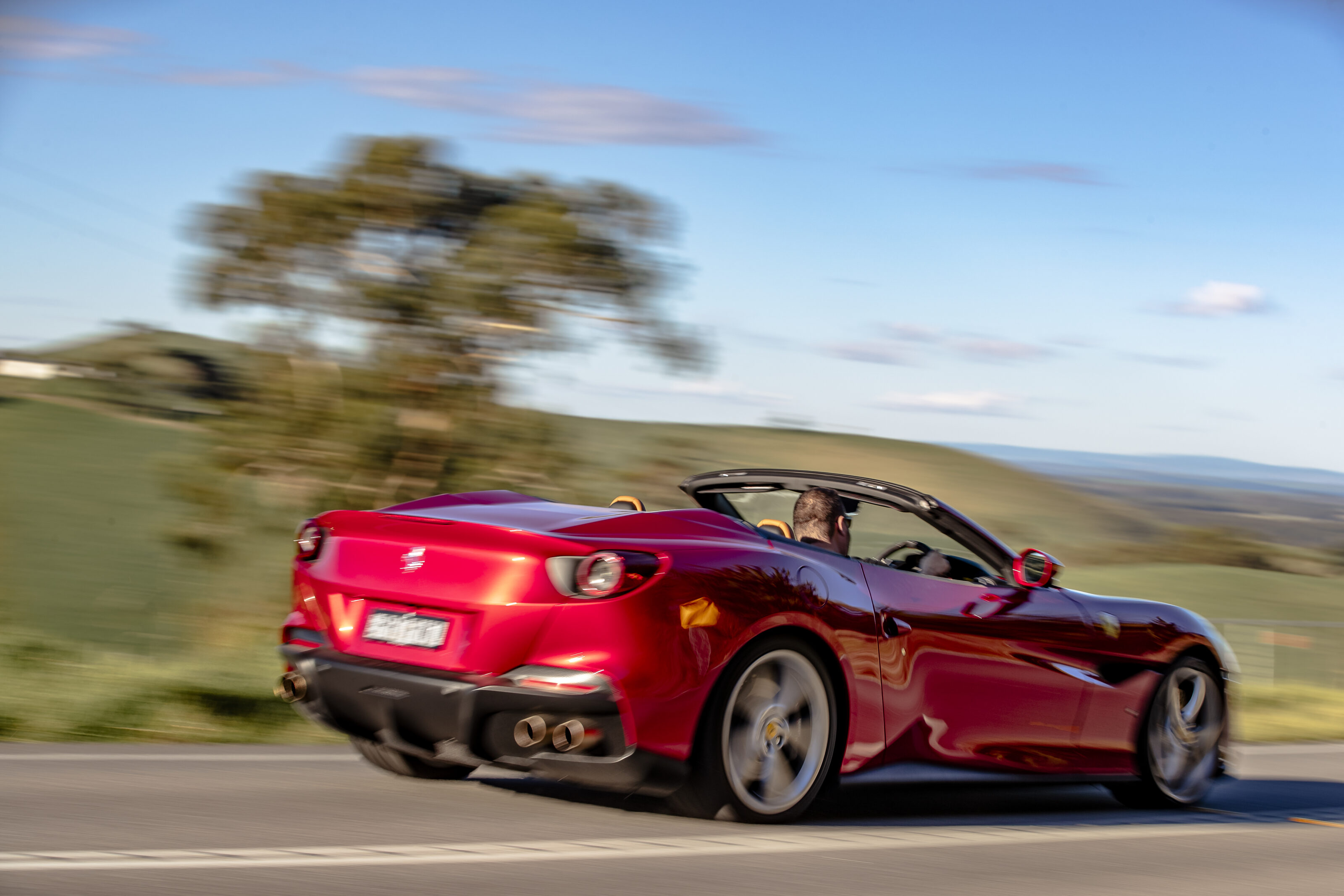
The fact that Poowong recorded 360 residents in the 2016 census isn’t lost on me as I scoff down my peanut butter Vita Wheats – Covid means a packed lunch. I can only imagine the thoughts running through the tradie’s mind parked across the road.
His perplexed facial expressions reminded me that I’m not really the target market for a $438,500 super GT – especially one with an extra $125k in options. But then, with this much performance that can be harnessed, who now really is? Does its bigger brother make it redundant? Or in this fiscal league, do you go the whole hog and buy the $536,888 F8 Tributo Spider? Maybe wait for its 296 successor?
Money is something acutely lacking in country towns. In a time-poor world, highways that now bypass them in the name of traffic efficiency have rendered communities like Bena forgotten pit stops. Blink and you’ll miss it, especially since the South Gippsland Highway bypass rendered it non-essential in 2008. Which is a shame because Bena is quaint. South Road offers up true country scenery and another chance to fully test Ferrari’s Bumpy Road mode – it passes.
Rolling countryside with loads of clear vision is a highlight of this part of Victoria. Fresh air and farm life aplenty, too. The weather is really turning it on now as the temperature almost cracks 20 degrees – which is rare for a Victorian winter. I should be trundling along and leaning into the GT side of the Portofino M. However, Ellen wants ‘spirited movement’ through a 90-degree right-hander for the camera. Okay, if I must…
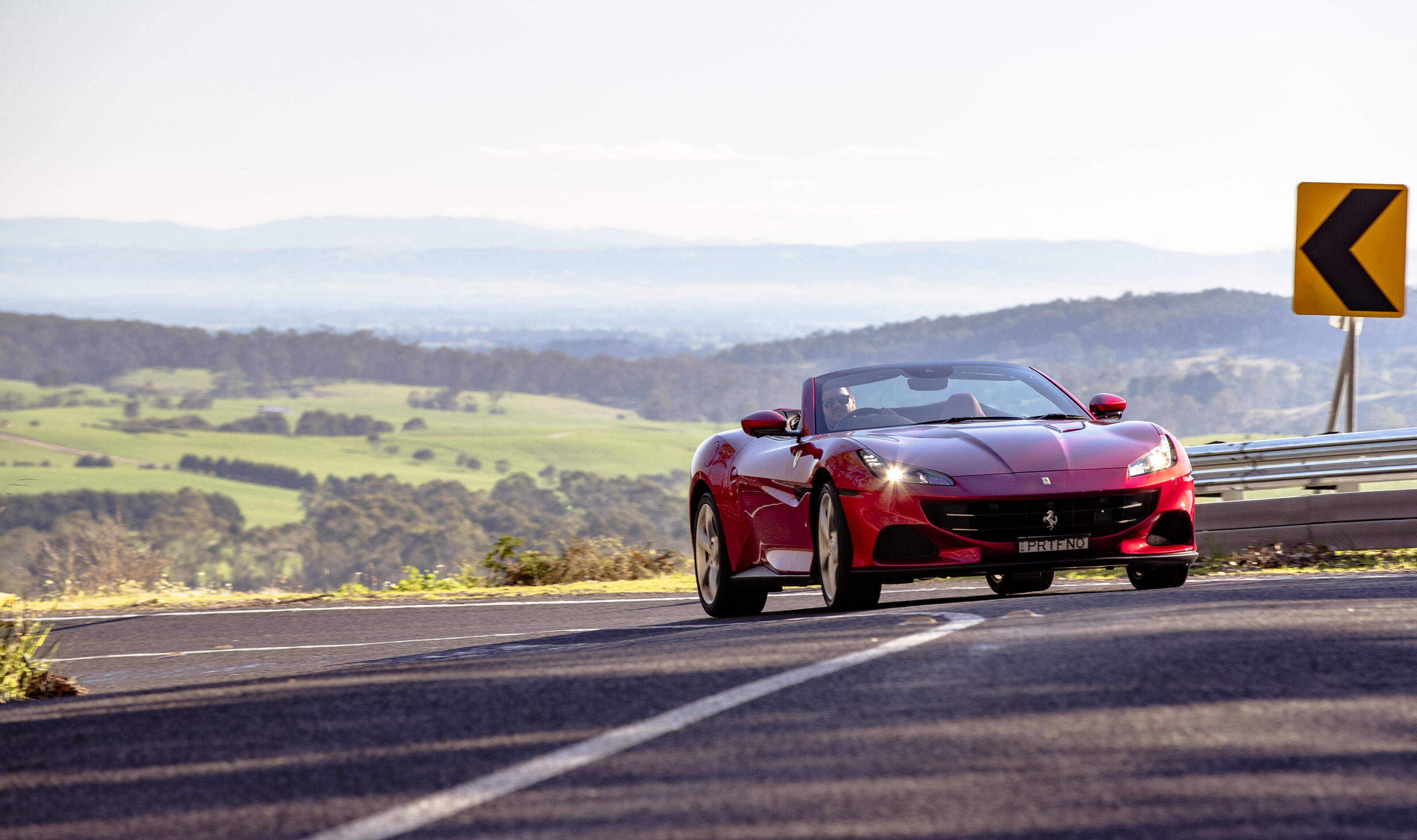
Arrowing down a straight stretch of Bena-Kongwak Road, I hit the anchors, slapping the left column-mounted paddle as the ’box changes down the ratios with heavy throttle blips. The brake pedal is progressive and offers feel as the calipers clamp down on the standard-fit carbon-ceramic discs.
With all the weight transferring forward, the rear squirms and the car feels alive. Given the front-engine, rear-wheel-drive layout, the Portofino M rotates naturally, and the rear 285-section Michelins allow for plenty of throttle percentage on the way out. By now I’ve built up a working rapport with the M and the manettino dial resolutely remains out of Sport mode. In that mode, it feels too hamstrung by the electronic nannies. A tale that maligned the original Portofino.
It’s not that Race mode needs a warning label yet, as a driver, you do need to be engaged. And it might sound stupid, but for a rear-drive car the Portofino M feels very rear-driven. Under heavy throttle in Race mode, some remedial input is required to stay in a straight line. In corners, this translates to frequent jabs of yaw.
Something I found on Kongwak Road; that moment where an unintentional part-throttle slip requires immediate assessment. With confidence in the car, I decide not to lift as it transitions into a drift. It isn’t a lurid slide, the onlooking cows would have seen better, but it feels almost poetic from behind the wheel.
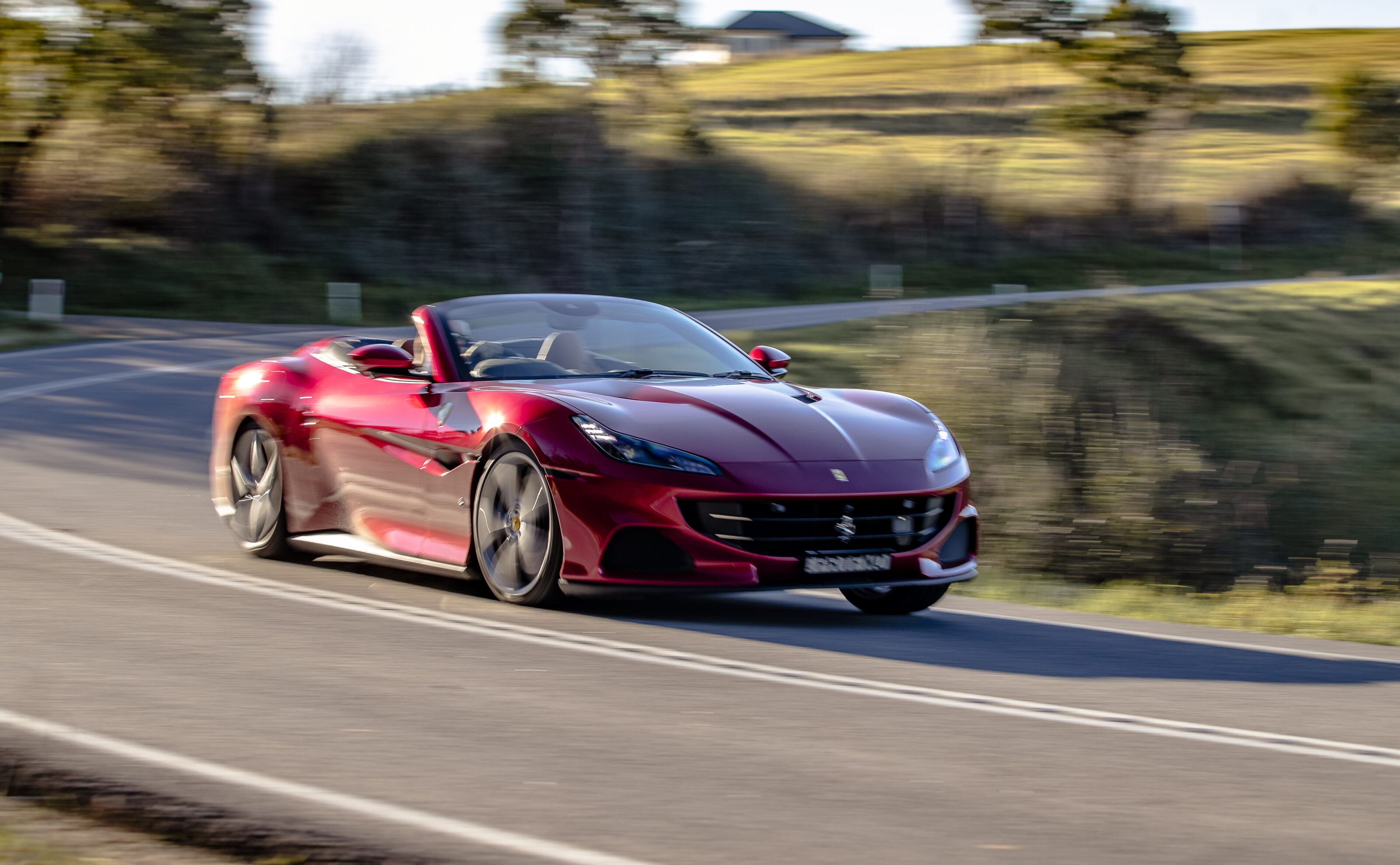
It’s as if Ferrari now believes the Portofino M isn’t writing dynamic cheques its chassis can’t cash. Proof is found in not only Race mode, but the fact it gains Ferrari’s E-Diff3, Side Slip Control 6.0 (SSC), F1-TCS, SCM-E Frs and the Ferrari Dynamic Enhancer (FDE). This is where the drop-top is at its rawest. The electronics allow freedom to explore the limits of adhesion without totally unshackling the leash. It’s fun with a reassuring safety net.
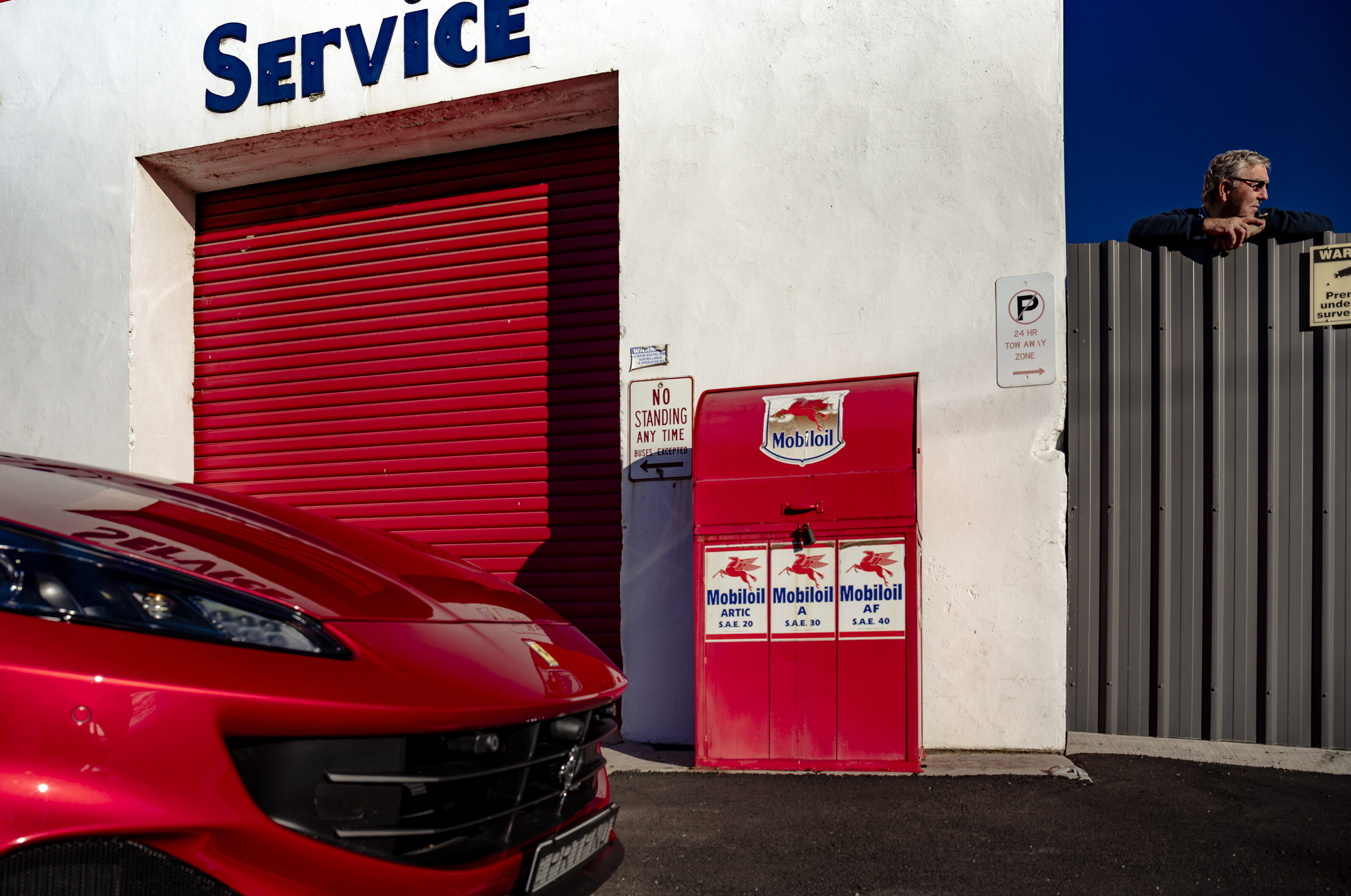
The road into Kongwak signifies the last of the meaningful corners. And it’d be rude not to enjoy them. Ellen has told me to pull over at a charming old petrol station with the instructions “you can’t miss it”. And I don’t. I’m greeted by the owner who’s popped his head over the fence to see what he’d heard in the distance.
I doubt anything so technologically advanced has ever passed through the garage. His reaction is one of inquisition, moderated by disbelief that a Ferrari is in his forecourt. Taking off he suggests I “have fun”. I chuckle to myself because with daylight running out, I don’t have time to explain how much I already have. Mother Nature’s clock waits for no one.
From there it’s an undulating straight road bombing south to the ocean. The tempo drops and it’s here that my main gripe with the Portofino M is proving hard to shake. At cruising speeds with the roof in place and the dual-clutch box schlepping in eighth gear at 1550rpm, the exhaust drone grates. Badly. It’s not a nice sound and you’ll need to crank up the JBL stereo to drown it out.
Acoustics aside, the straight stretch also gives me an opportunity to fathom the comfort the Portofino provides. The new slim-backed seats are supportive and relaxing, while the material quality has improved throughout the cabin. Okay, it might not feel as vault-like as a Bentley Continental GT Convertible, but the Ferrari also weighs ‘only’ 1664kg.
In an age where minimalist, touchscreen-heavy interiors have become the norm, the Portofino is largely old-school and is festooned with buttons. And you can’t forget the steering wheel, which is wonderfully tactile in hand yet it does away with column-mounted stalks for the turn signals, wipers, and headlights. However, what initially seems an ergonomic nightmare becomes fairly intuitive with familiarity.
The 10.25-inch colour display juggles part of the climate controls as well as the infotainment and smartphone mirroring. An optional 7.0-inch touchscreen also sits before the passenger – so choose them wisely. The back seats are only really there for additional luggage space over the 292-litre boot when the roof is stowed, joyriding young kids being the exception. Sauntering through picturesque Kilcunda it’s hard to imagine ever travelling with more than one person anyway.
Arriving at San Remo causes a stir, as any Ferrari should. Snapper Ellen and I have returned to civilisation and don’t we know it. After a quick clean in what can only be described as a cyclonic car wash it’s straight onto the boardwalk. With some convincing, Ellen allows me to edge the almost $565k cabrio onto the wooden pier.
Idyllically, the San Remo Bridge sits in the background. Built in 1971, it used to be a shoddy, dangerous wooden structure. Now it’s physically sound concrete and forms the gateway to Phillip Island. Or, more importantly, the home of one of Australia’s most picturesque and challenging race tracks. I smile and recognise that some 10 hours ago I’d not have even remotely considered what lap time the Portofino M would achieve. And yet, with the knowledge attained via Gippsland’s tarmac, it now seems a more than reasonable contemplation.
The ‘base’ Ferrari is confident in its identity. The iconic Italian brand wouldn’t endow it with a Race mode and M nomenclature if it didn’t think it has the prowess to back it up. The Portofino M has matured into a proper Prancing Horse with performance credibility and a true duality of talent. It stands in its own shoes with conviction rather than pleading for acceptance. The smoke-and-mirrors factor is now intertwined in an unjust public perception, rather than its DNA. Contrived? Not a chance.
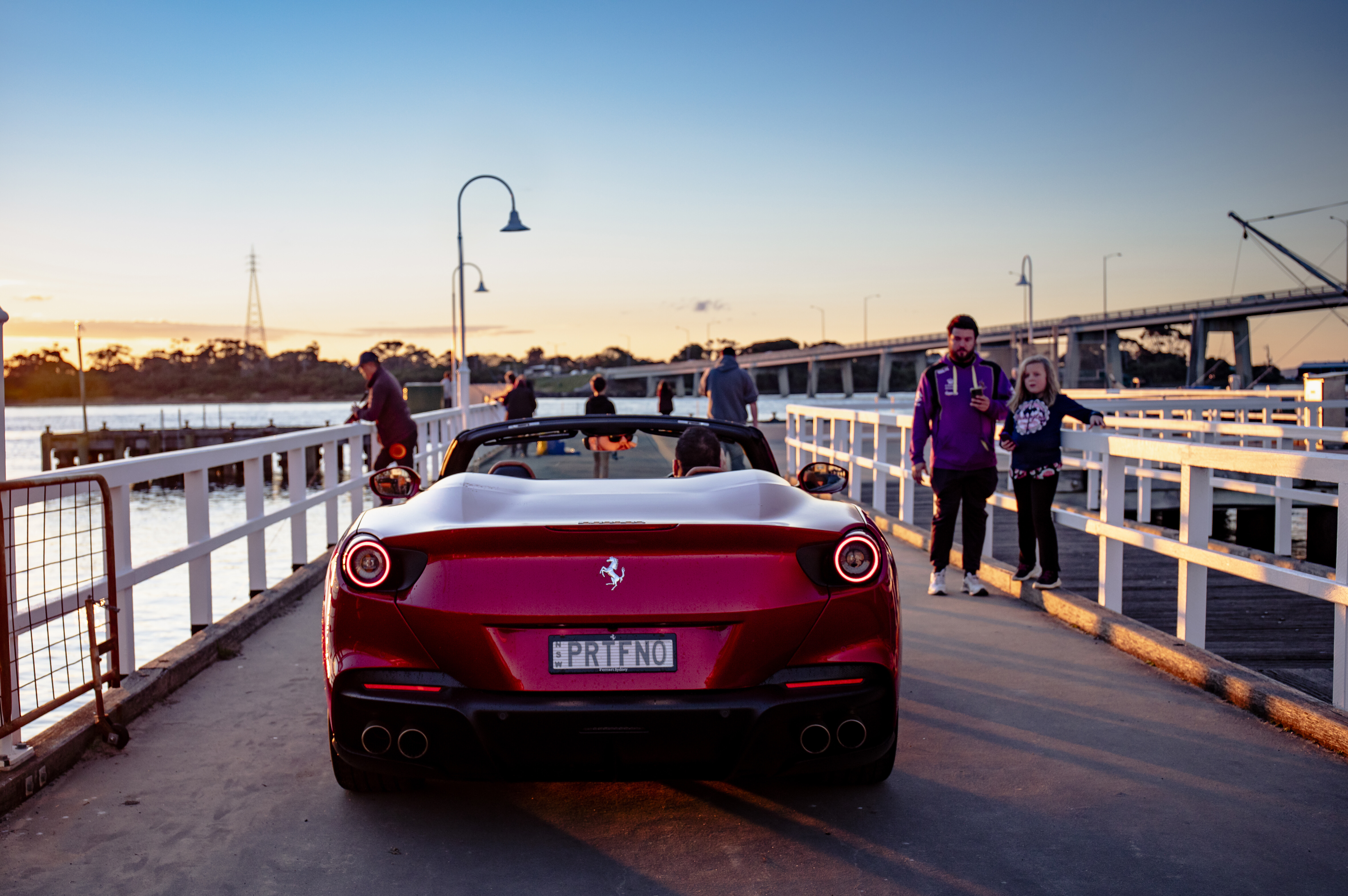
Children don’t care for philosophical musings. And the way in which their eyes open and their smiles widen is proof that the cavallino rampante still has a magic that captivated us when we were their age.
Golden hour in San Remo is fading fast. Ellen is capturing angles like a crazed Italian motorist. And the kids are ignoring the preening pelicans on the beach and snapping pictures of the Ferrari. It’s flamboyant, yet organised chaos. Dad nods approval over his flake and minimum chips. The fact we aren’t on the Italian Riviera couldn’t be starker, but the fanfare is valid. With the Portofino M, the entry-level Ferrari finally deserves its place in the sun.
Poowong to San Remo
87 Kilometres
Starting near the ex-Holden proving ground at Lang Lang, there are fuelling options off the Bass Highway. Duck to Loch for a bite to eat and stretch your legs at Cape Horn lookout. End the day with a bevy at the Westernport Hotel in San Remo or with fish and chips by the water.
2021 Ferrari Portofino M specs
| Body | 2-door, 2+2-seat convertible |
|---|---|
| Drive | rear-wheel |
| Engine | 3855cc V8, DOHC, 32v, twin-turbo |
| Bore x Stroke | 86.5 x 82.0mm |
| Compression | 9.45:1 |
| Power | 456kW @ 5750-7500rpm |
| Torque | 760Nm @ 3000-5750rpm |
| Power/Weight | 274kW/tonne |
| Transmission | 8-speed dual-clutch |
| Weight | 1664kg |
| u00a0Suspension | independent double wishbone, coil springs, anti-roll bar, adaptive dampers (f); multi-links, coil springs, adaptive dampers, anti-roll bar (r) |
| L/W/H | 4594/1938/1318mm |
| Wheelbase | 2670mm |
| Tracks | 1633/1635mm (f/r) |
| Steering | electrically assisted rack-and-pinion |
| Brakes | 390mm carbon-ceramic discs, 6-piston calipers (f); 360mm carbon-ceramic discs, 4-piston calipers (r) |
| Wheels | 20.0 x 8.0-inch (f); 20.0 x 10.0-inch (r) |
| Tyres | 245/35 ZR20 (f); 285/35 ZR20 (r) Michelin Pilot Sport 4 S |
| Price | $438,500 ($563,489 as tested) |
| Pros | A u2018properu2019 Ferrari; engine performance; sorted dynamics |
| Cons | Exhaust drone at cruising speeds; expensive options |
The Kia Carnival enjoys the kind of segment dominance that might persuade every other car manufacturer to give it a miss. Introduced as a fourth-generation model as recently as last year, it currently accounts for three in five people-mover sales.
Even Toyota has abandoned the Carnival’s territory, ditching the purpose-built, once-loved Tarago for the much costlier Granvia that’s based on the HiAce van.
And affiliate company Hyundai had seemingly given up, allowing its iMax people-mover to toil for 14 long years – its dearth of safety and tech features particularly glaring in recent times.
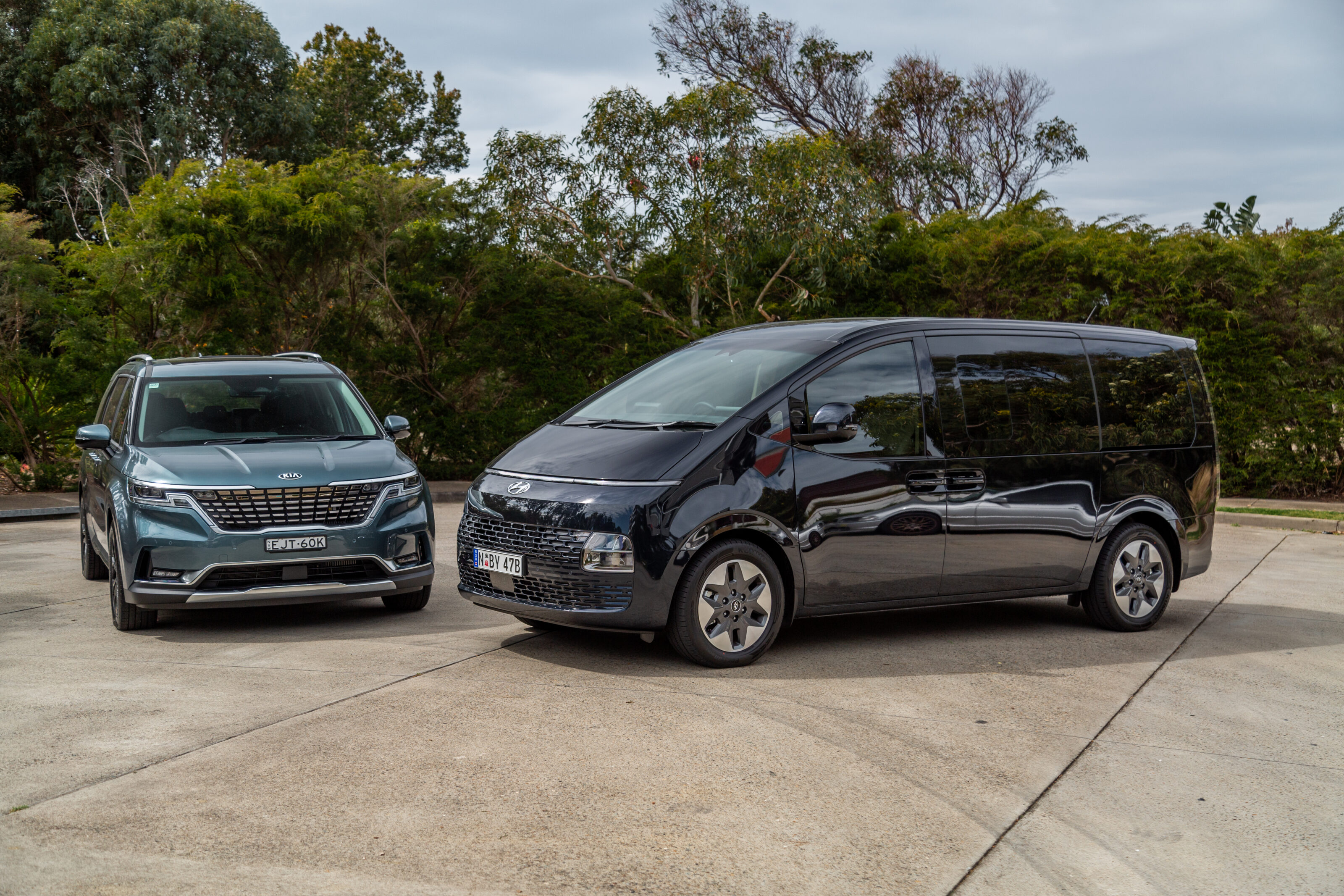
But Hyundai is back in play with a new MPV contender that, like the Carnival, aims to deliver eight-seater practicality in a vehicle design that’s more interesting than your typical multi-human transporter.
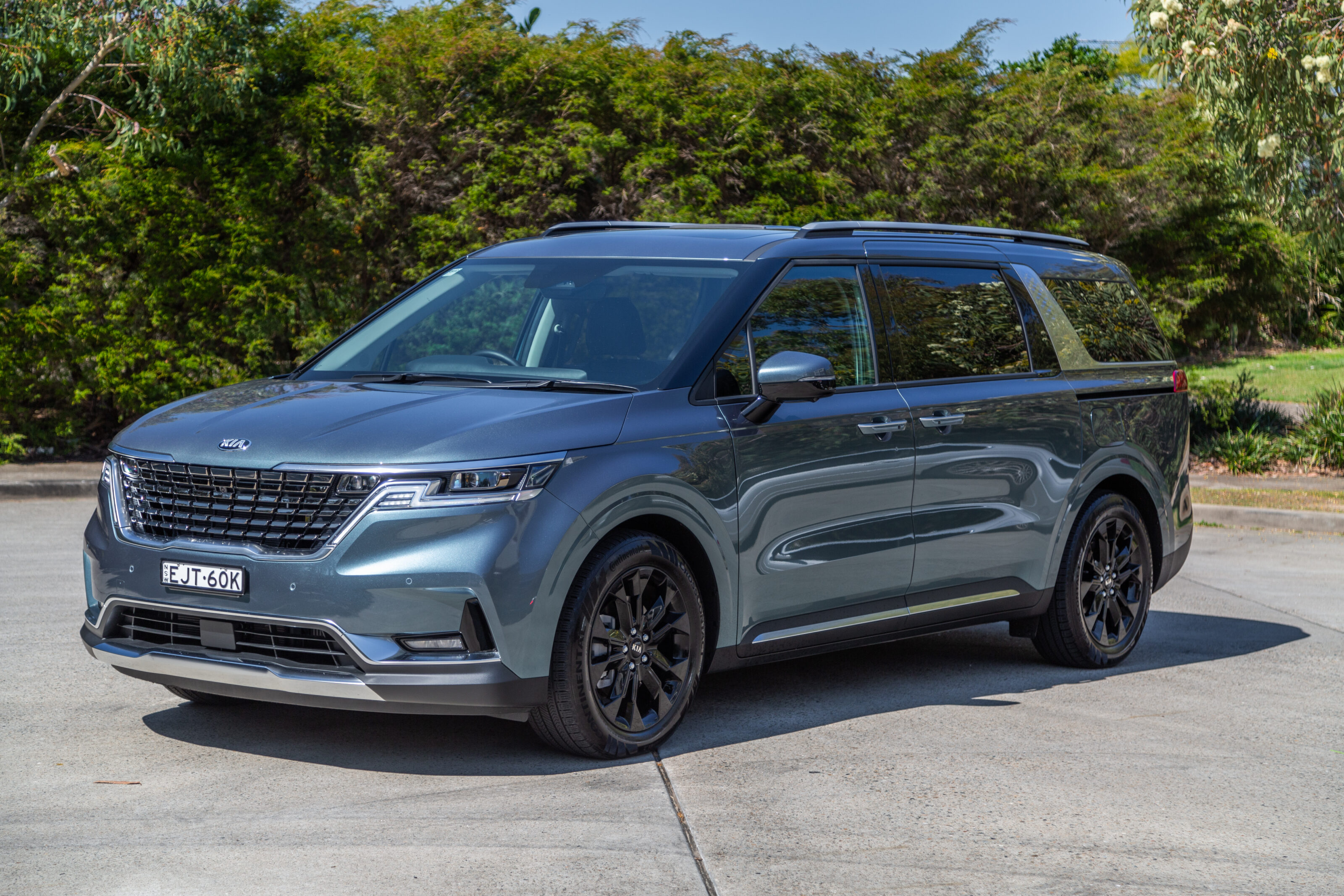
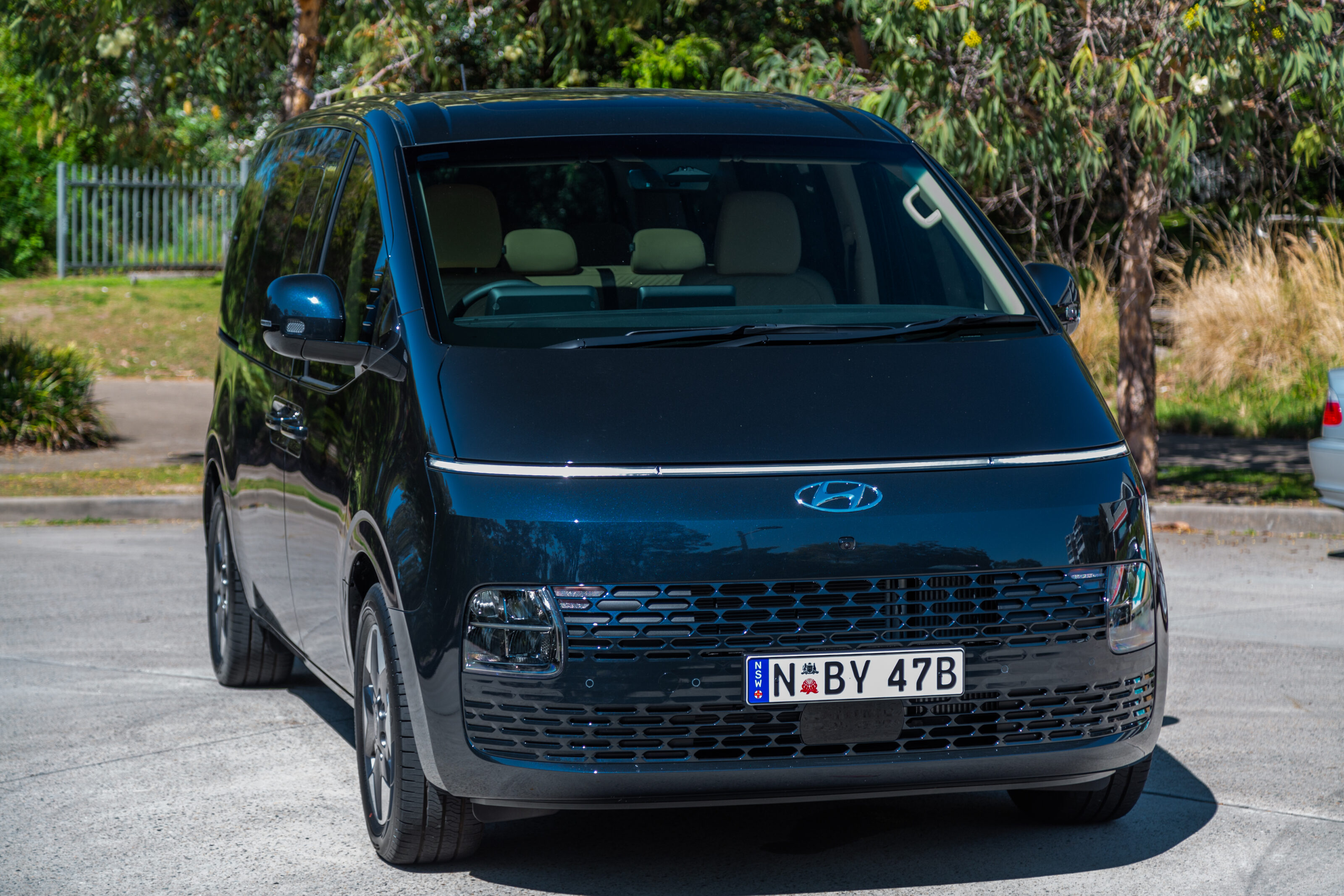
The futuristically styled Staria looks like Robocop’s helmet from the front; remove the wheels and you could almost envisage it whisking a Starfleet crew off to a rendezvous with the USS Enterprise.
A sleekly curved silhouette and deep panoramic windows create a visually arresting design that otherwise follows the iMax with van-like proportions. And there is a commercial-van spin-off – with the Staria-Load that replaces the iLoad.
And it is the van that’s spun off the people-mover this time. The Staria has switched to the Carnival’s front-wheel-drive, passenger car platform that’s also shared with the Sorento and Santa Fe SUVs.
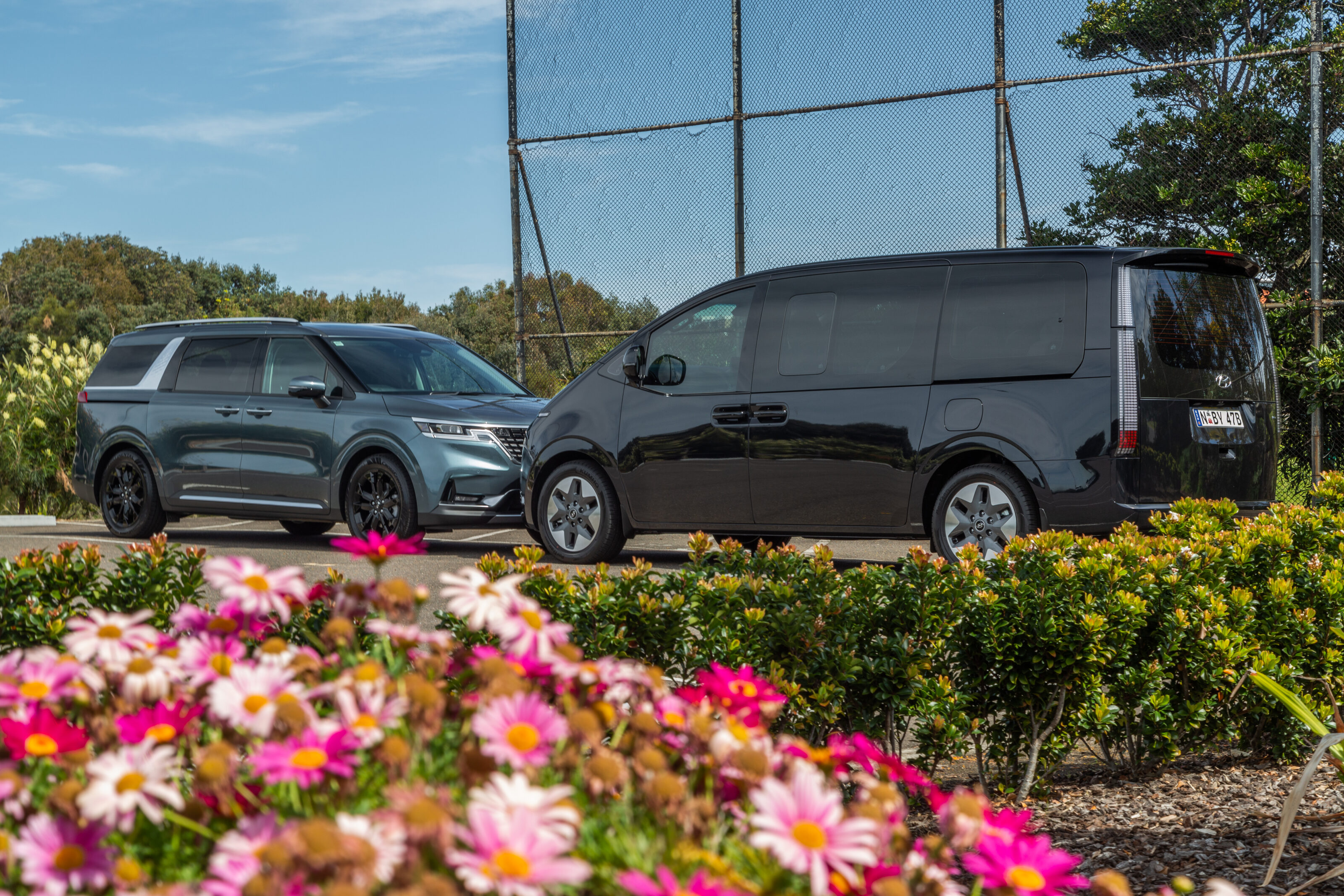
It takes a big car to make the Carnival look relatively small, and the Staria does achieve that feat.
At 5253mm nose to tail, it’s about 14cm longer; at 1990mm ground to roof, it’s nearly 22cm taller. (The Staria is still slightly shorter than a long-wheelbase VW Multivan, though.)
As with the third-generation model, the Carnival fuses various body styles – wagon, SUV and MPV. Many would say successfully.
The Staria looks like Robocop’s helmet; remove the wheels and you could envisage it whisking a Starfleet crew off.
Pricing and features
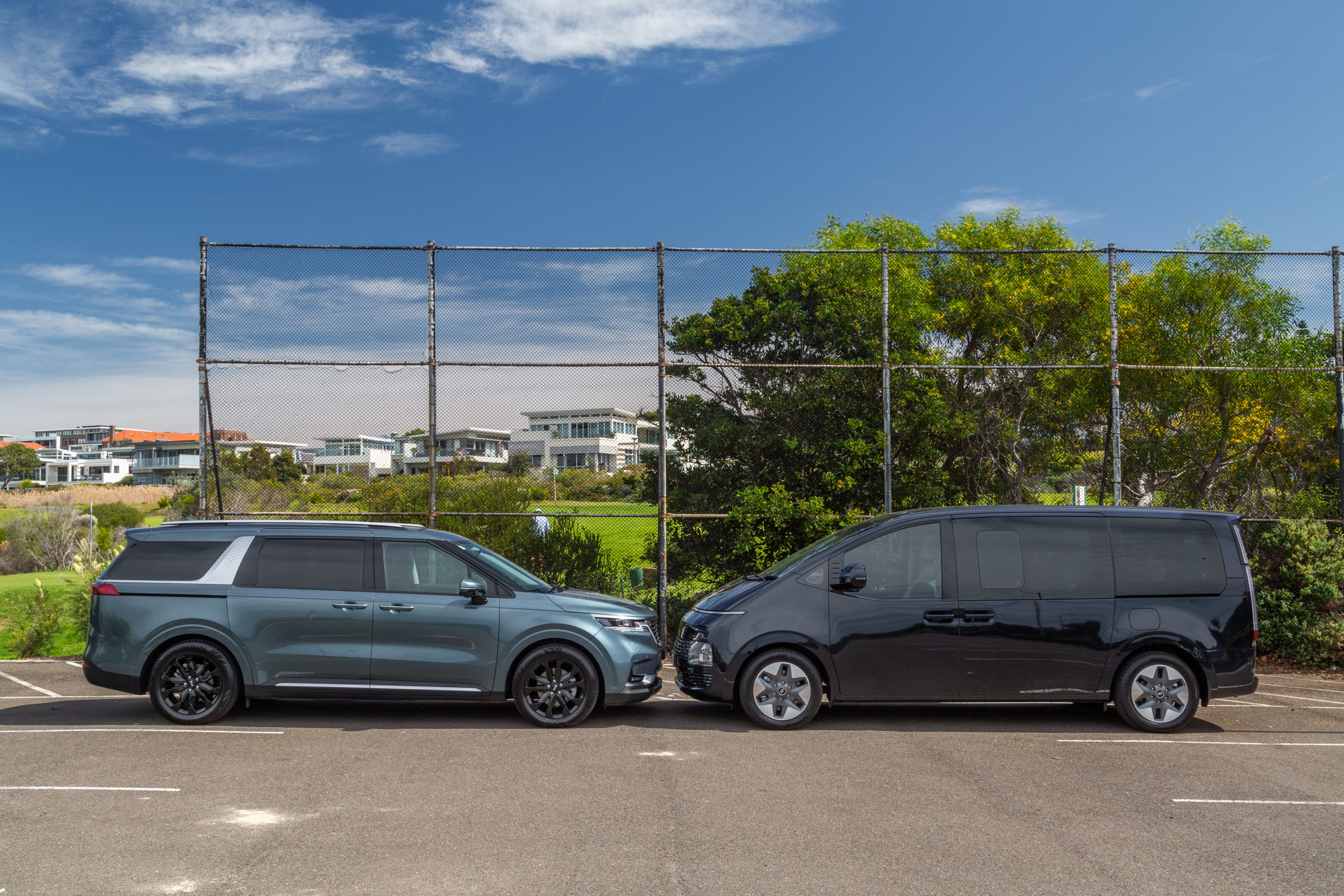
We have both vehicles here in range-topping guises that are becoming increasingly popular with buyers. That’s Highlander for the Staria and Platinum for the Carnival. And each is powered by a four-cylinder turbo-diesel rather than a cheaper V6 petrol.
The Hyundai Staria Highlander diesel costs $66,500, or about $69,500 with on-road charges added. That gives it a slight saving on the Kia Carnival Platinum diesel, which carries a $66,980 RRP but has slightly more expensive on-roads to cost $70,790 drive-away.
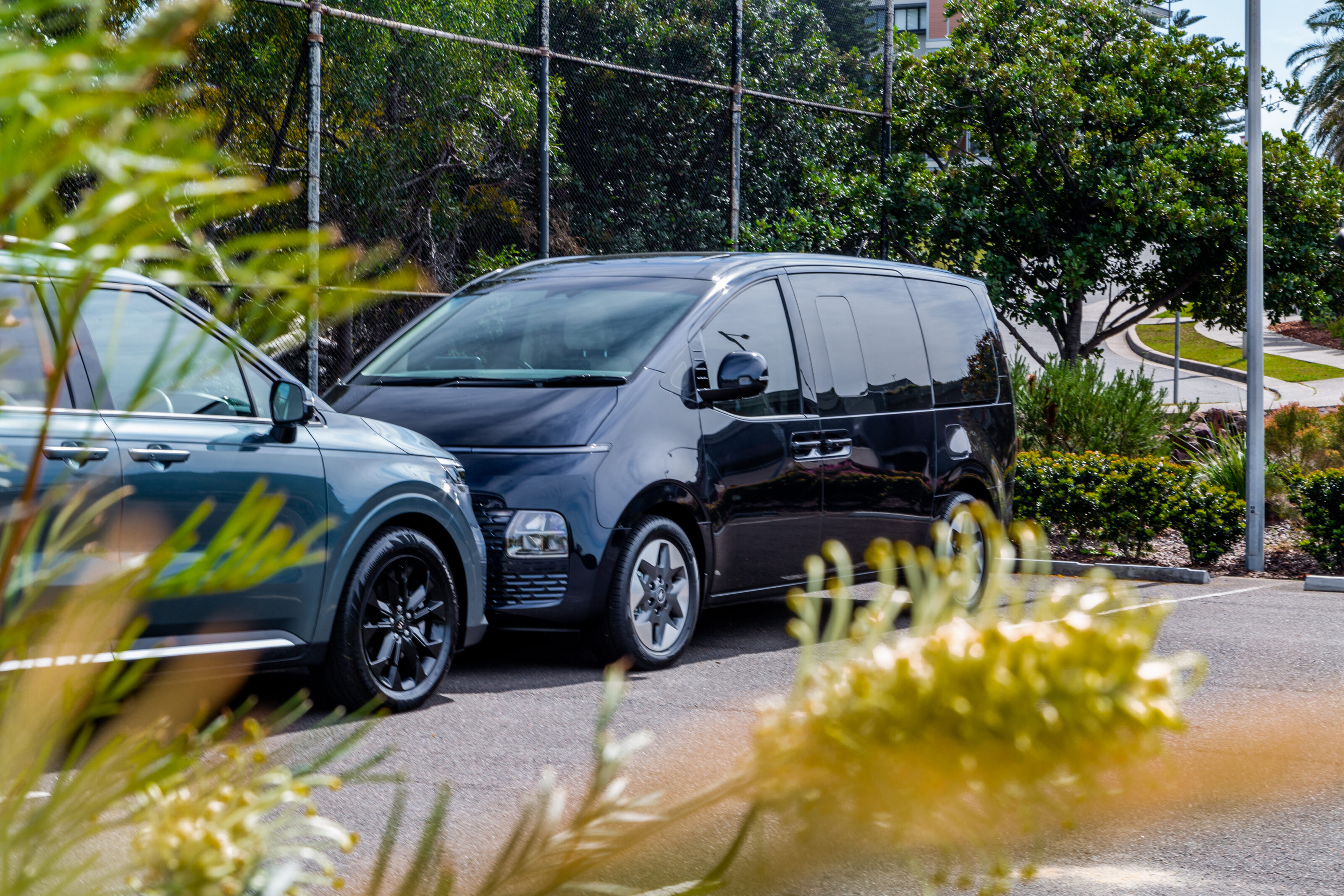
As would be expected at this price point, each flagship model is comprehensively equipped. There are some spec differences, a key one of which is that the Staria diesel comes with a part-time all-wheel-drive system where the Carnival’s diesel powers the front wheels only.
Most manufacturers charge several thousand dollars as a premium for AWD, so there’s already a value advantage for the Hyundai.
All Staria models wear the same 18-inch alloy wheels, but the Carnival Platinum is fitted with the biggest wheels in the range: 19 inches.
Leather-appointed seats are found in both vehicles.
Safety
The Staria has yet to crash-tested by ANCAP, though eyebrows would be raised if it didn’t match the maximum five stars achieved by the related Carnival.
Both vehicles include curtain airbags that fully extend to the third row – unlike the car makers’ seven-seater SUVs, the Kia Sorento and Hyundai Santa Fe, which cover the third-row glass only.
The airbag approach at the front of the cabin differs. The Kia is equipped with driver’s knee protection; the Hyundai features a front centre airbag designed to inflate in the event of a nasty side impact to prevent the heads of the driver and front passenger coming together.
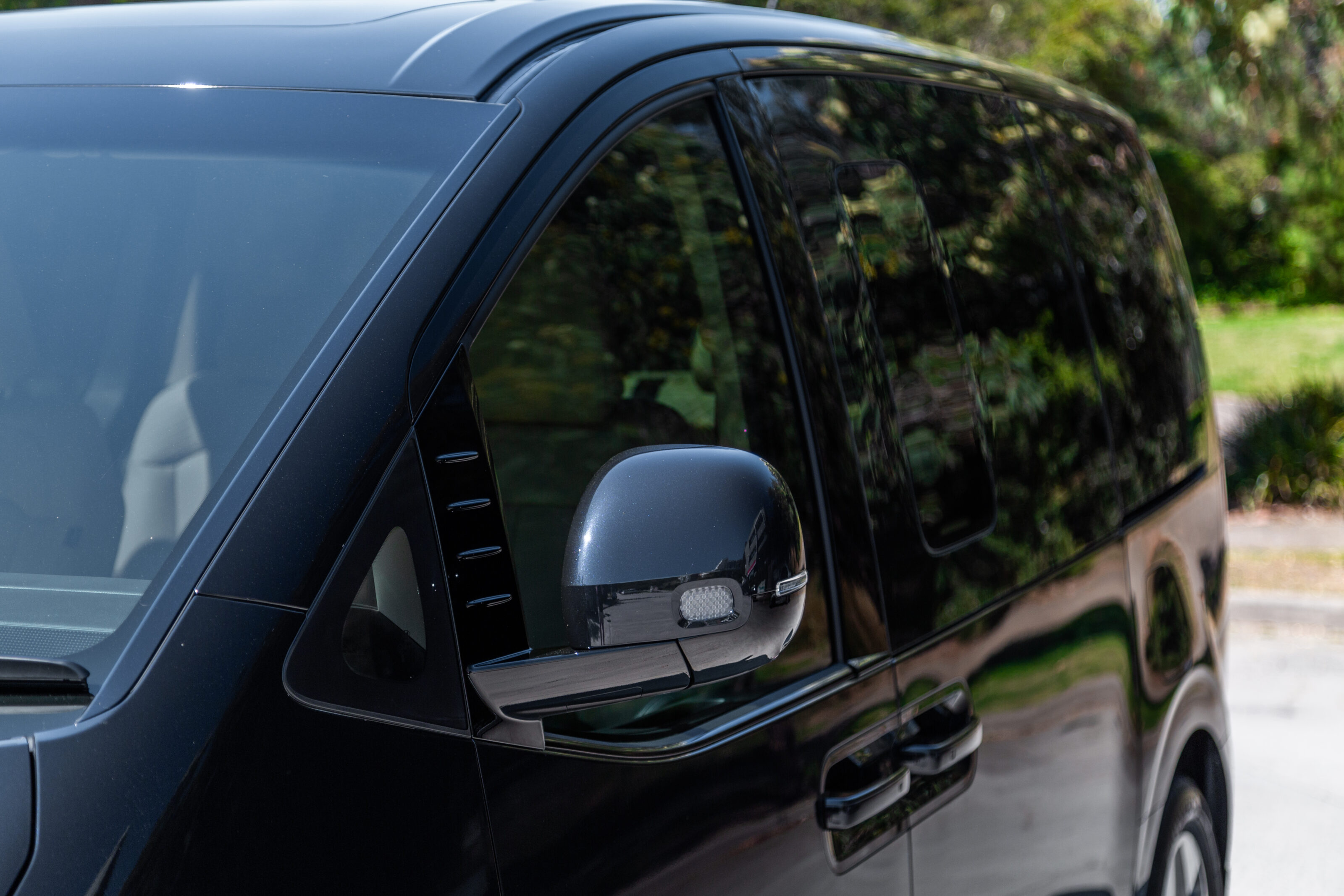
Safe Exit Warning and Assist are also standard on both vehicles, which not only flash if the rear doors are about to opened with traffic approaching but auto-lock them, too.
Driver aids are also prevalent. The models share features such as adaptive cruise control, various lane-assist systems, lead-vehicle depart notification, auto high beam, blind-spot and rear cross-traffic monitoring, fatigue alert and speed limit notification. The Staria adds a blind-spot monitor in its driver display.
Each comes with LED headlights, DRLs and foglights. For parking assistance, there are front/rear sensors as well as surround-view cameras. The Staria’s 360-degree monitor adds a 3D effect.
Infotainment
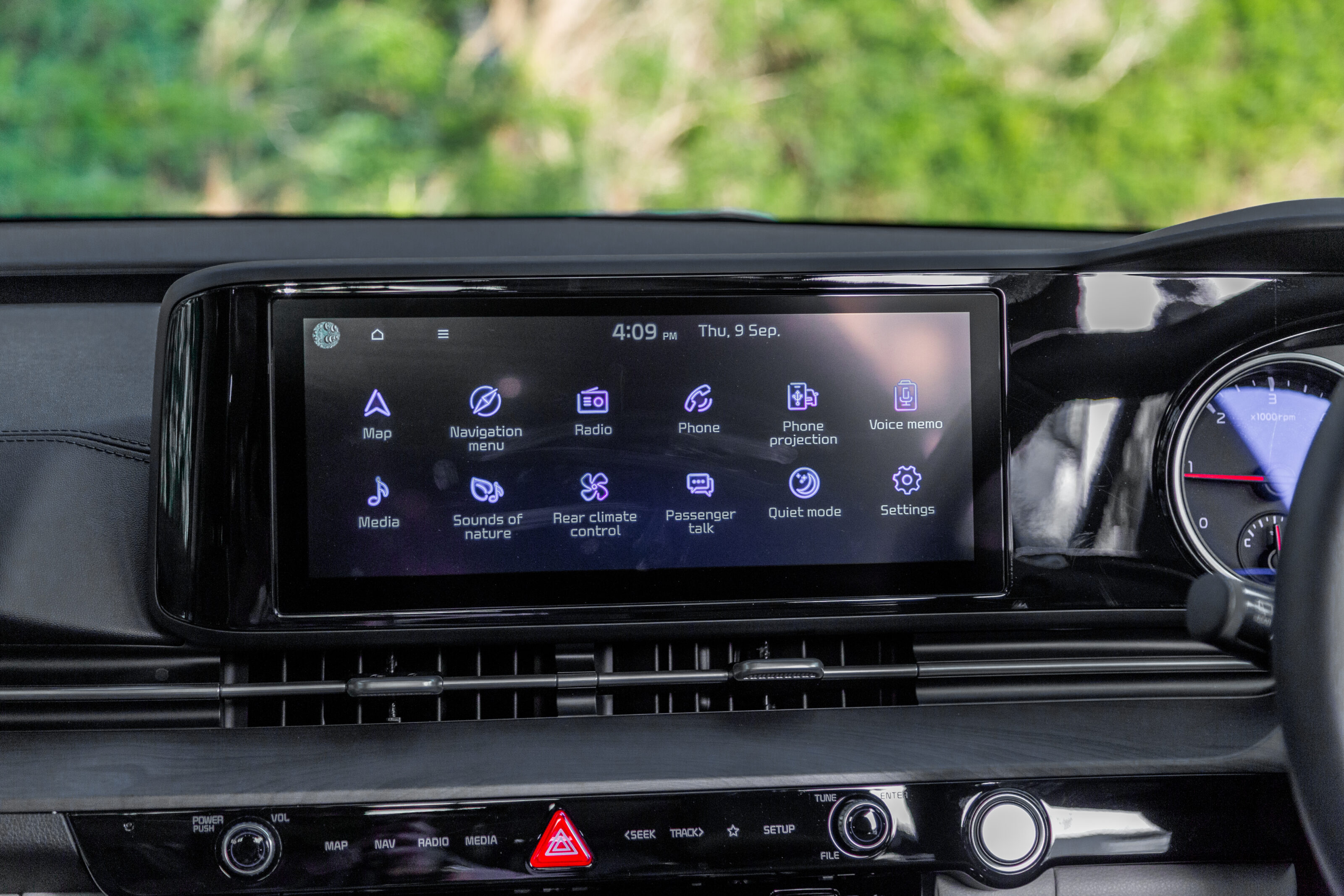
Touchscreens are a good size in both vehicles, though larger in the Carnival: 12.3 inches versus 10.25 inches. (Base models in both cases come with smaller, 8.0-inch touchscreens.)
They share the same software and (simple) functionality, however, the presentation differing slightly in terms of graphics.
Apple CarPlay and Android Auto are included (wirelessly connected only in base models, though), as are digital radio and the ability to pair two smartphones simultaneously.
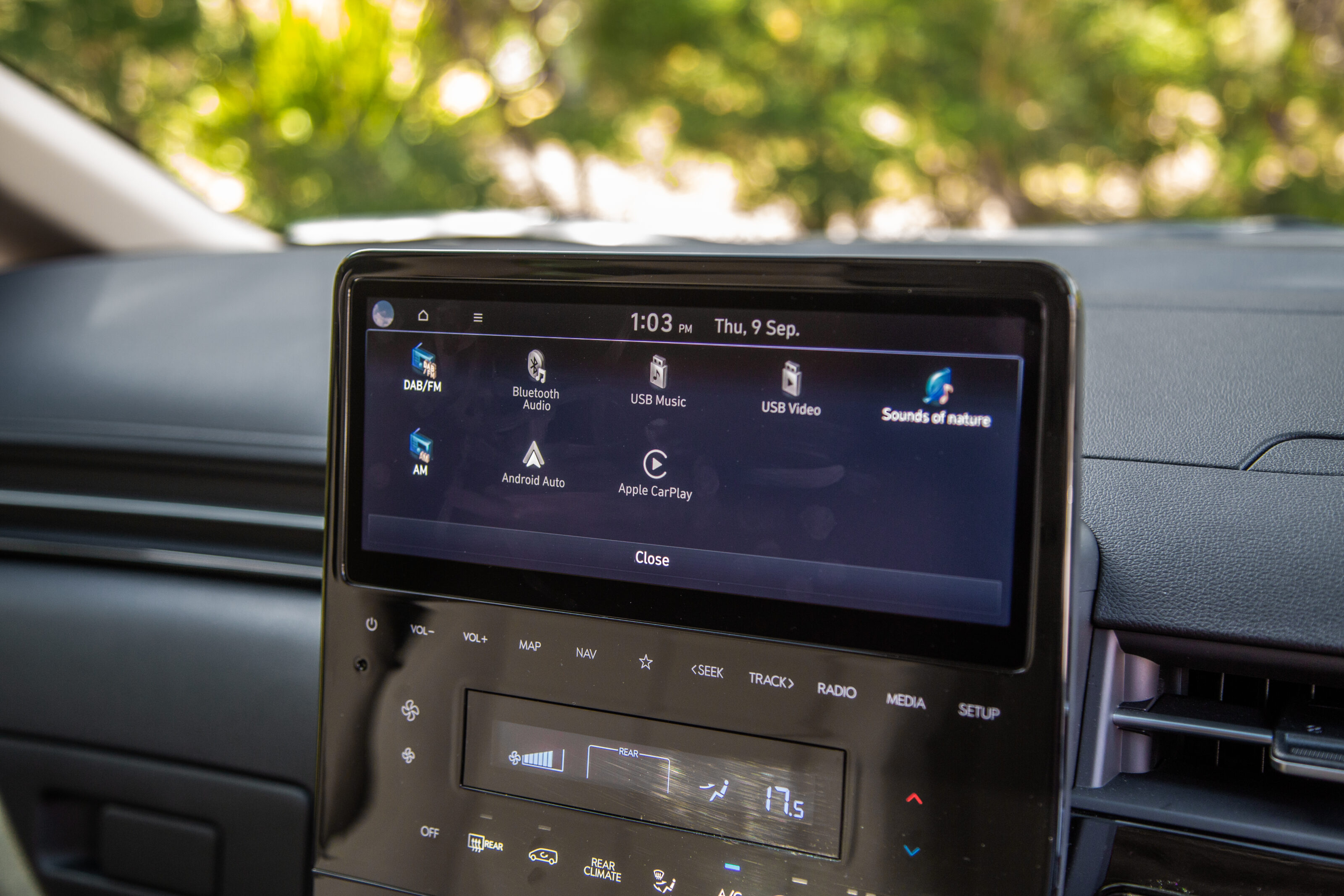
Wireless smartphone charging is standard in all Staria models but limited to the Platinum in the Carnival line-up.
Strangely, the Highlander Staria misses out on a branded audio system, sharing a basic six-speaker setup with other grades. The Platinum Carnival brings a range-exclusive 12-speaker Bose system including surround sound.
The Staria has yet to crash-tested by ANCAP, though eyebrows would be raised if it didn’t match the five stars achieved by the related Carnival.
Boot space
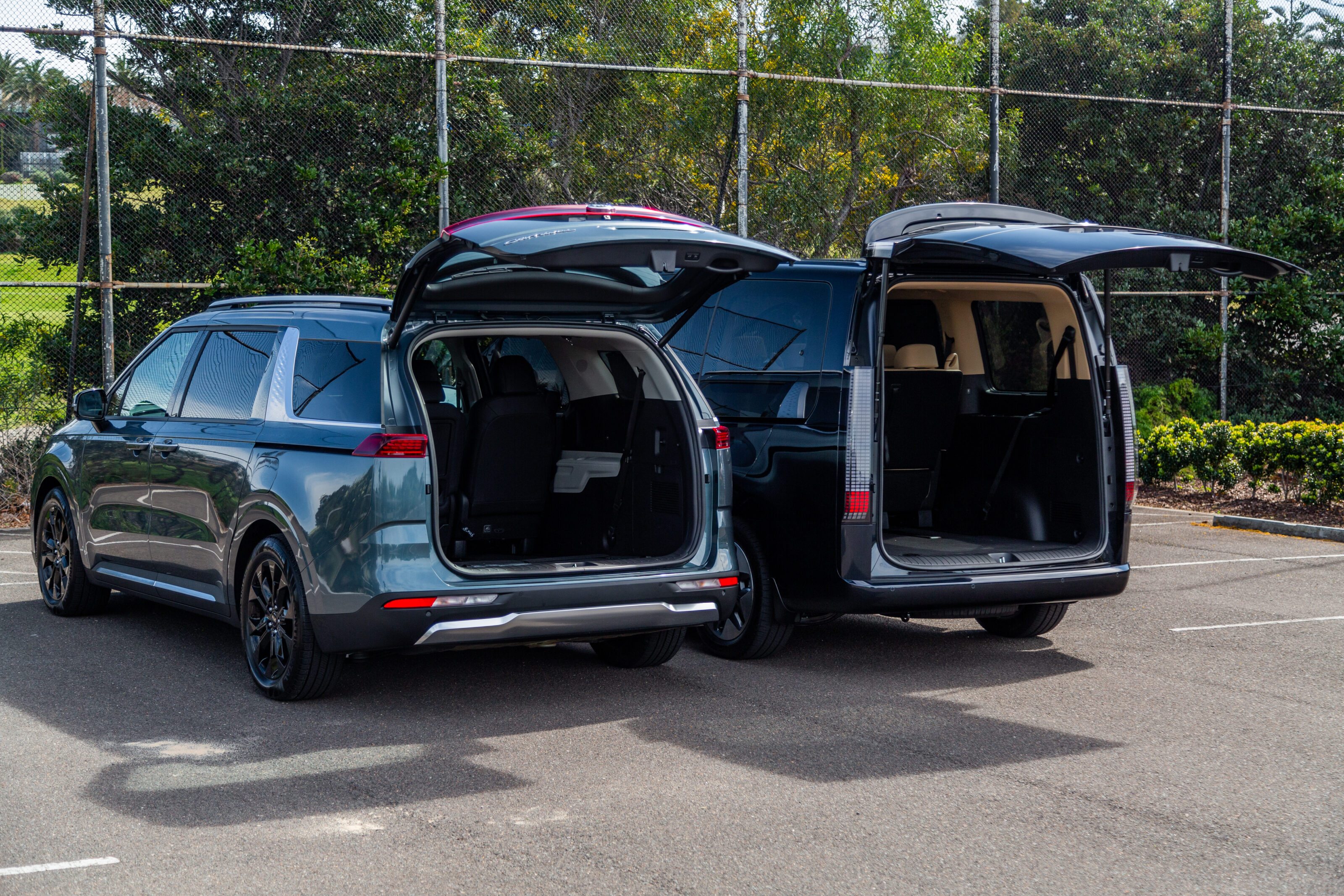
One of the obvious reasons to choose one of these people-movers over a multi-seater SUV is luggage capacity when all seats are in use. Both the Carnival and Staria excel here, albeit in different ways.
Kia opts for a deep boot where Hyundai has a flat cargo floor but plays to the Staria’s dimensional advantage.
Quoted figures point to a sizeable advantage for the Staria – 831 versus 627 litres – yet even the Carnival’s boot makes it both a viable airport shuttle and practical holiday transport for a large family.
Cargo space can be expanded, again in quite different ways. The Carnival’s rear seats – divided into a 50-50 arrangement – push-fold down cleverly into the floor. It creates a whopping volume of 2785 litres behind the second row.
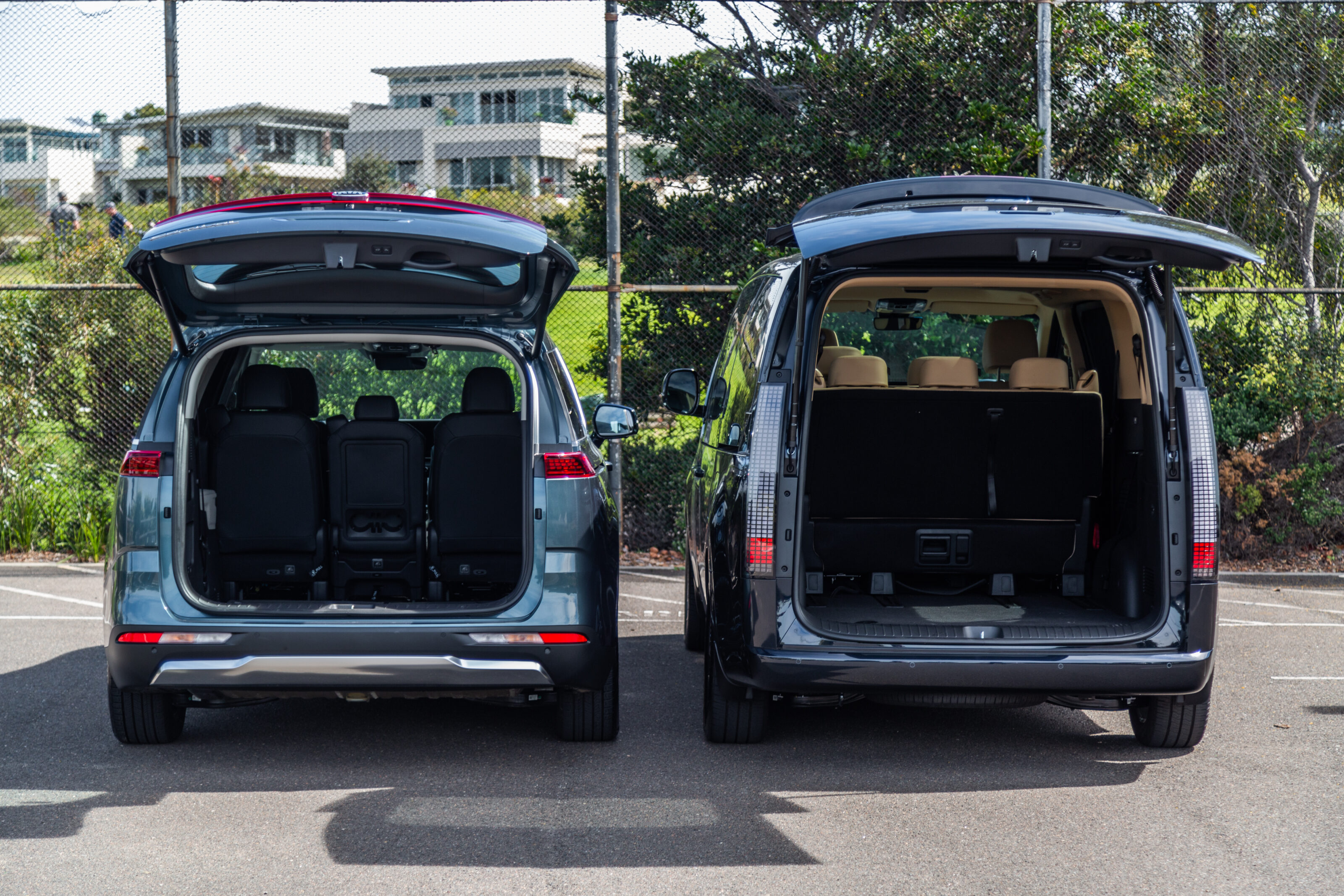
The Staria can’t even match half of that, managing 1303 litres through limitations to its third-row versatility. The seats can’t be removed, as in a Multivan; instead, levers can be used to flip up the third-row cushion so the one-piece seatback can be pushed forward to lock up against the back of the second row.
Auto tailgates with hands-free open and close (when the keyfob is in your pocket) are standard in both instances.
(PS: You won’t find spare wheels under the boot floors – they’re under the vehicles: directly under the boot area with the Carnival; between the axles on the driver’s side with the Staria.)
Third row

Higher-spec versions of the Carnival and Staria feature hands-free electric sliding doors and tilt-slide second-row seats, which help create easy access to both sets of rear seats.
Other commonalities for the Platinum and Highlander are ceiling vents, LED reading lights, storage trays and USB ports, and window blinds.
You’ll also find more space in the third row than your average seven-seater SUV.
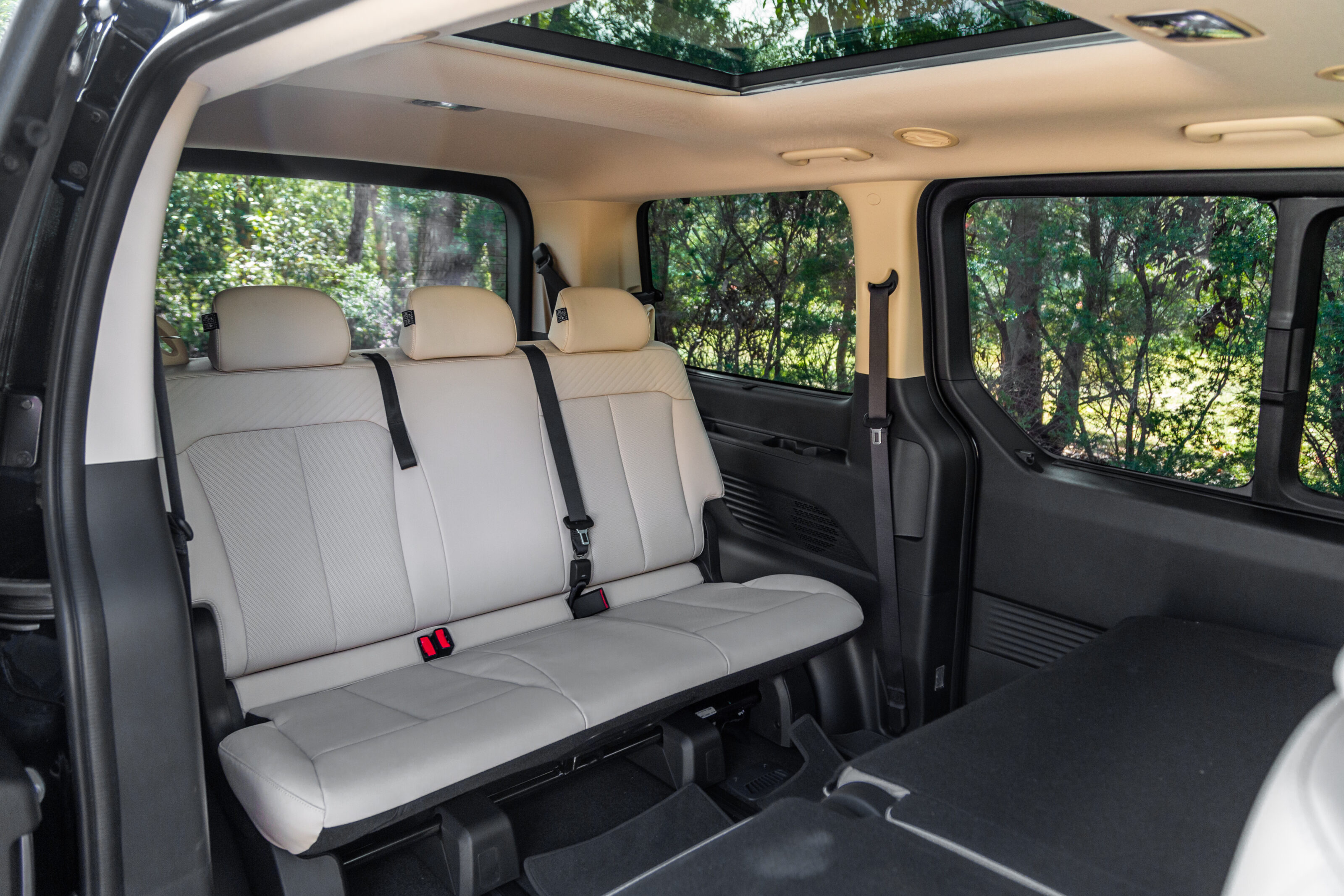
There’s significantly more headroom in the Staria; an inherent advantage delivered by its much taller roofline.
And while three adults can fit across in both vehicles, the middle adult will be more comfortable in the Hyundai thanks to extra shoulder room. The Staria’s seatback also incorporates a regular seatbelt where the seatbelt must be pulled down from the ceiling in the Carnival and will be felt on the neck more by some passengers.
Yet the Kia’s third row is ultimately the more versatile; certainly for parents. Where the Staria’s third row fails to offer any kind of child-seat anchorage, the Carnival features both ISOFIX and top-tether points in the outboard seats.
Second row
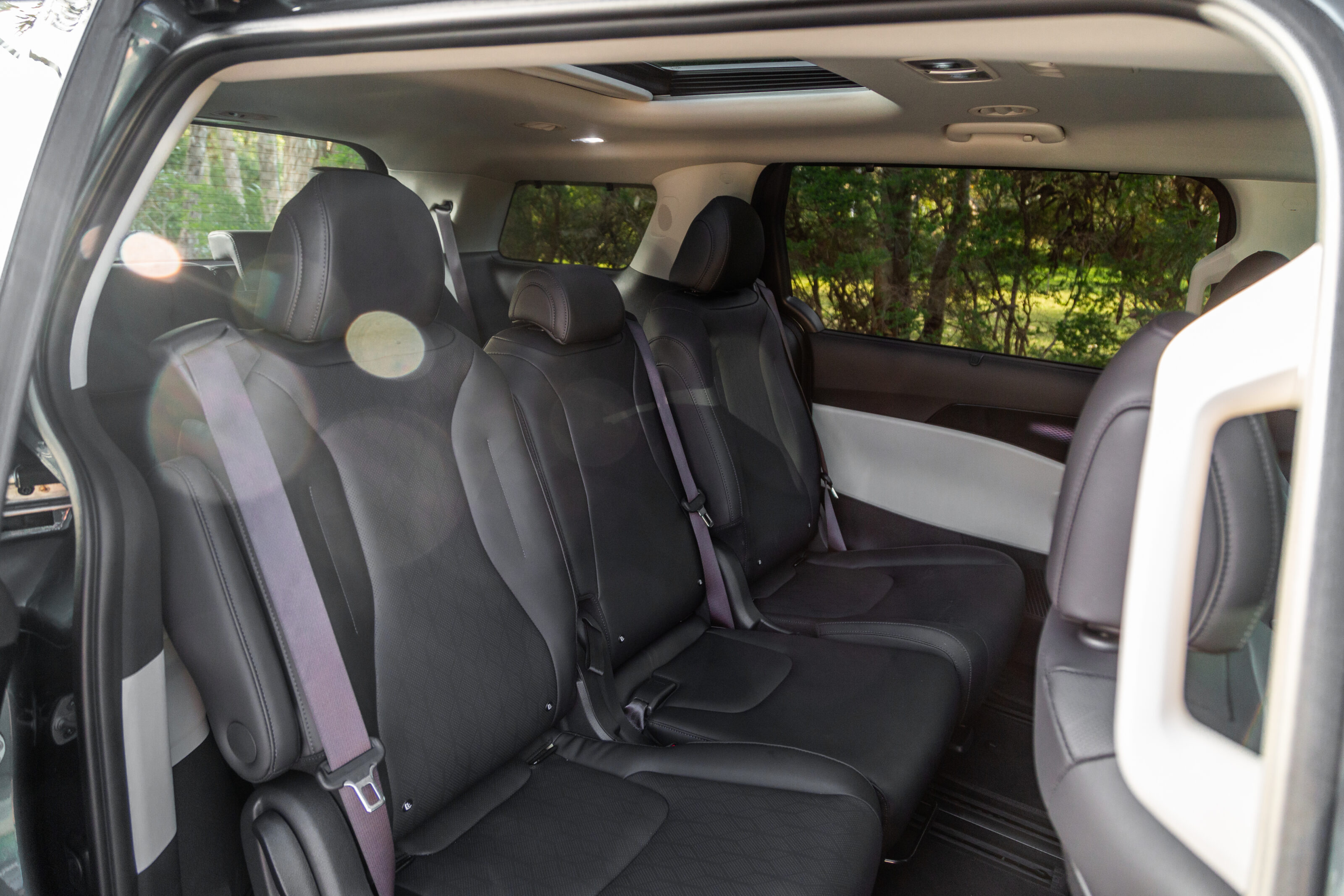
Adults and kids alike should cherish the middle rows on offer here. Legroom is in abundance even when the sliding seats are brought forward to allow more knee space for third-rowers.
The Carnival’s trio of seats move individually where the Staria’s slide in a 60-40 split.
There’s recline adjustment all round, though only the Kia provides fold-down outer armrests for the outboard seats.
Another useful trick in the Kia is a super-flexible centre middle seat: it can be flipped 180 degrees to face third-row occupants, it can be slid forward to bring a child closer to the parents up front, or the seatback can be folded down to create a table with cupholders. It can also be removed completely to create a walk-through to the third row.
In both vehicles, ISOFIX points feature in the outer seats and top-tether anchors across all three seats. Importantly, ISOFIX-fitted child seats allow the outer seats to move forward without a seatbelt hindering third-row access.
All but base models add climate control for the second row. The Carnival Platinum has heated outboard seats as an exclusive both in the range and in this comparison.
Dual sunroofs are standard in these top-spec models. The rear glass sunroof opens only in the Carnival.
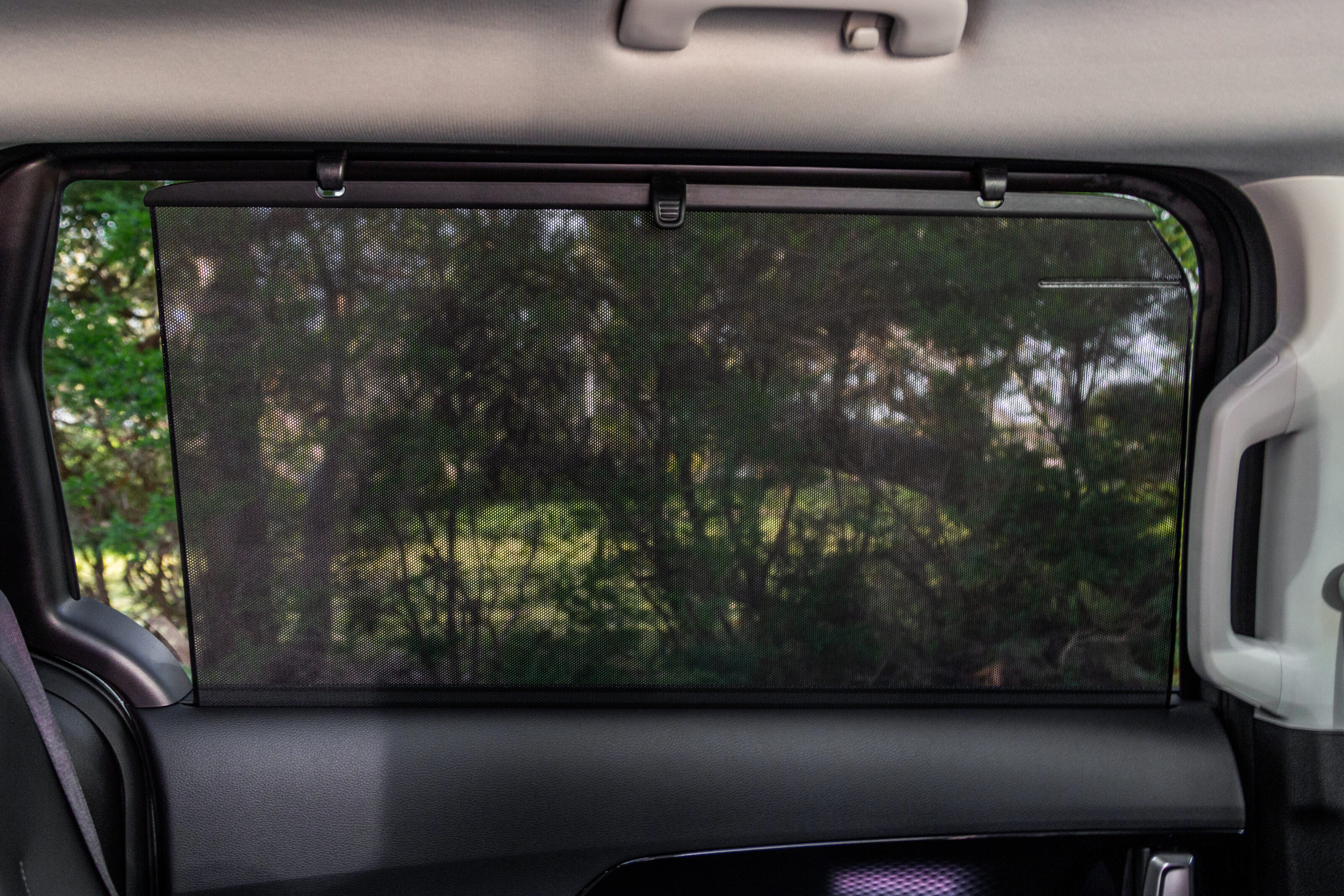
Both models come with second-row window blinds.

The Staria’s side windows aren’t as deep and panoramic as the exterior design promises, with the view partially interrupted by an integrated flush sliding window (or a pop-latch window in the base Staria). The Carnival’s windows rise and lower in a conventional fashion.
Second-row passengers in the Carnival and Staria are treated to plentiful storage, with the Hyundai offering that bit more with its storage drawer that pulls out of the rear centre console, dual rather than single door bottle-holders and seatback pouches that incorporate neat little individual net pockets for smartphones.
The Staria’s side windows aren’t as panoramic as the design promises, with the view partially interrupted by an integrated sliding window
Front cabin
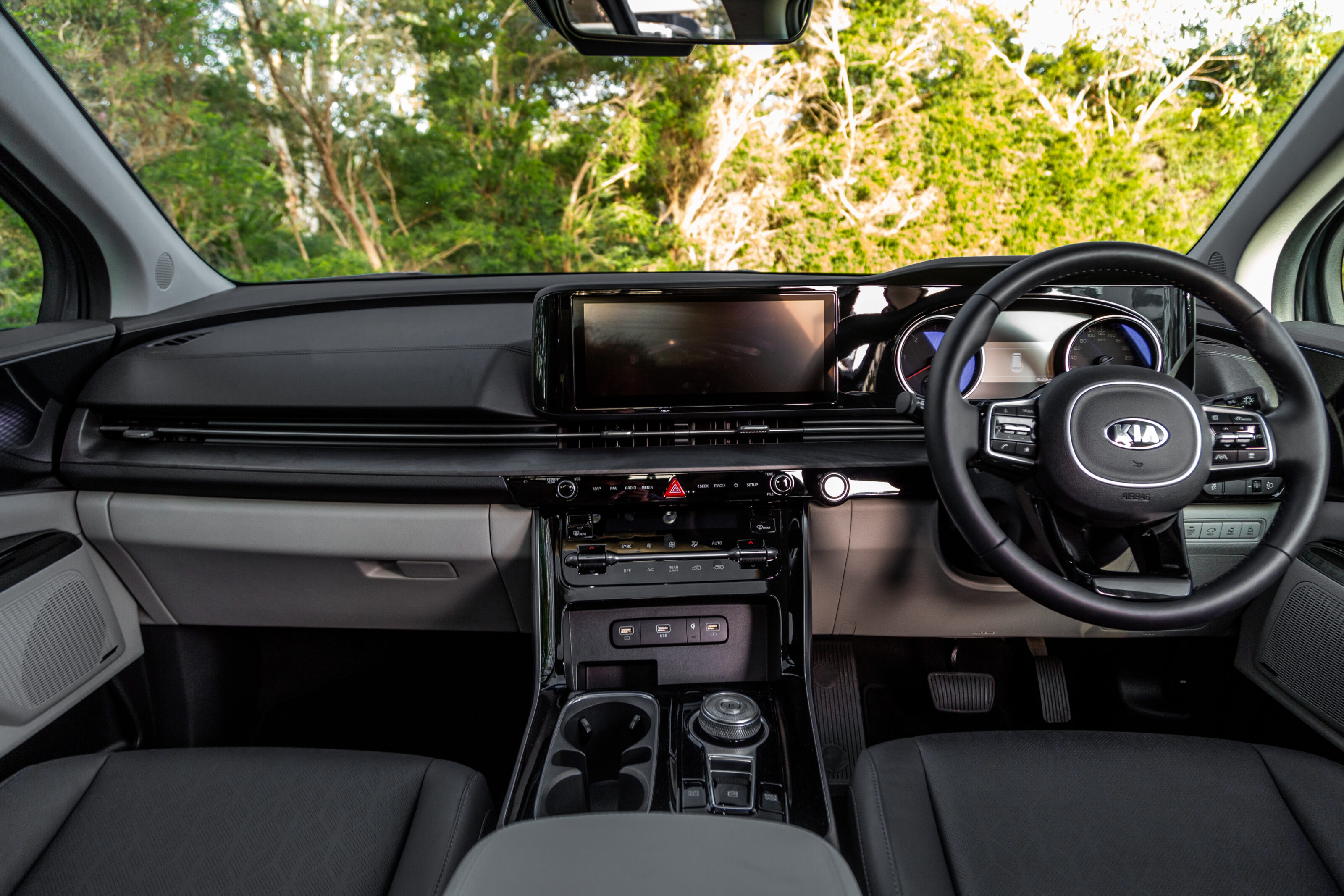
The Carnival’s driving position is slightly more upright in relation to the Sorento but still has more in common with an SUV than either a passenger car or van.
There’s a wide range of electric adjustment for both front seats and their general comfort is complemented by heating and ventilation functions (and a heated steering wheel). Cabin ergonomics are excellent, too, with key controls clearly labelled and easy to reach.
A huge, wide centre console box doubles as a centre armrest.
Storage is otherwise unremarkable, particularly the door pockets that are narrower and shallower than ideal. The Platinum is also the only Carnival to feature a wireless charging smartphone tray.

You climb into the Staria’s front seats, marking an immediate difference. The seats provide a more elevated view, though they’re not as comfortable as the Carnival’s – even more upright, lacking both lateral and under-thigh support, and no armrests of any kind.
There’s no escaping the feeling that you’re driving a van-style vehicle, further emphasised by the walk-through gap to the front passenger seat and a greater prevalence of hard plastics compared with the Carnival.
This seat also surprisingly misses out on electric adjustment, though both seats match the Carnival Platinum for heating and ventilation.
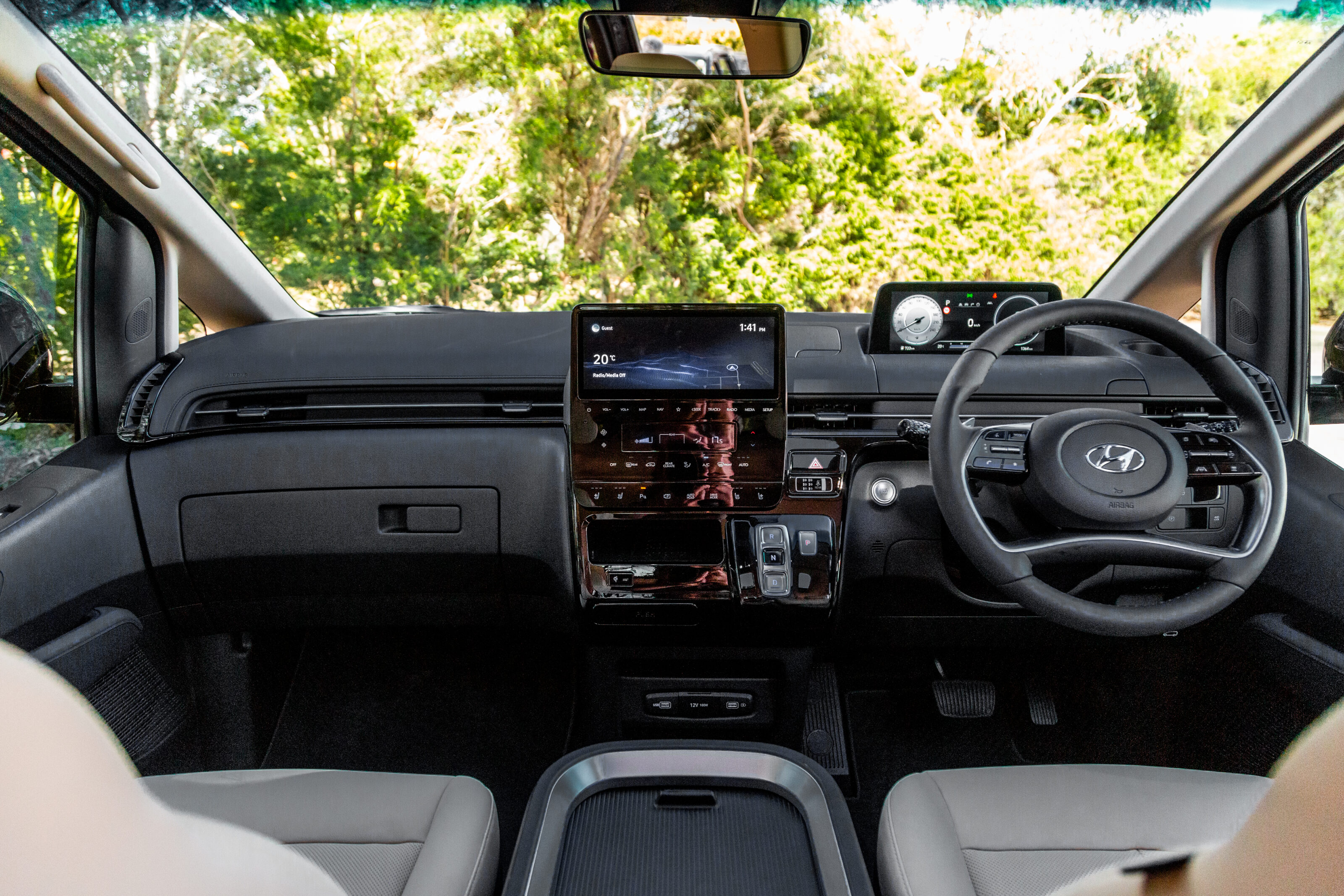
The Staria excels for front-cabin storage, however. There’s a large centre storage box with a sliding lid and internal cupholders, with additional cupholders for front occupants (pop-out for the front passenger; integrated into the dash for the driver).
A wireless charging slot is standard on all models, while the Highlander gains extra lidded dash compartments over other grades.
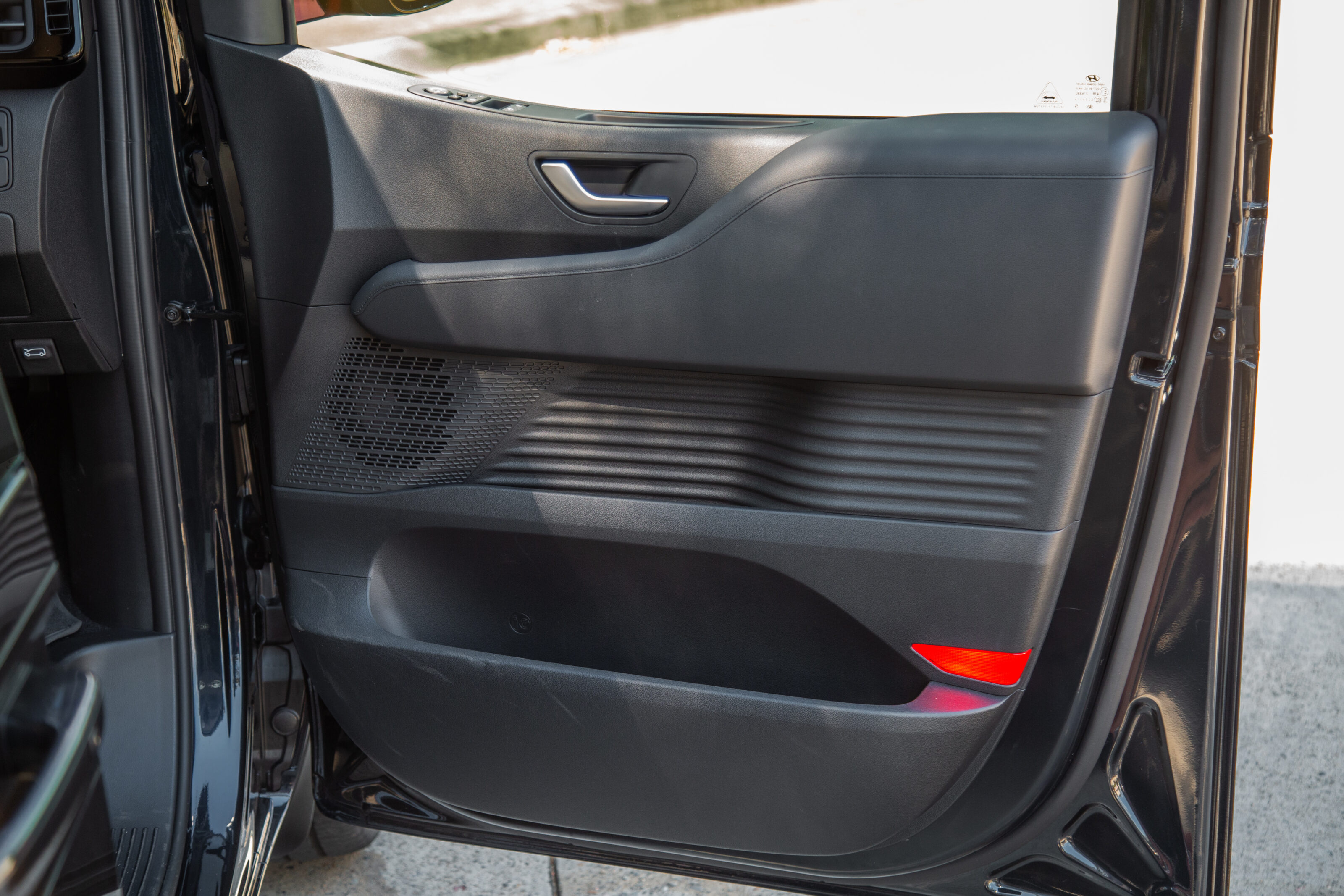
The Staria’s front doors are particularly clever, with four layers of storage ranging from a shallow tray on the upper door card to generously sized lower compartments.
Hyundai’s people-mover also provides some extra technology.
The Highlander version of the Staria is equipped with a 10.25-inch digital driver display that is meant to be coming to the Carnival Platinum sometime soon.
And the Hyundai will delight parents with its Passenger View Monitor, which when selected via the touchscreen uses a ceiling-mounted camera to provide a feed of the second and third rows. Watch out, naughty kids!
The Carnival’s driving position is slightly more upright in relation to the Sorento but still has more in common with an SUV than either a passenger car or van.
Hyundai Staria vs Kia Carnival: How do they drive?
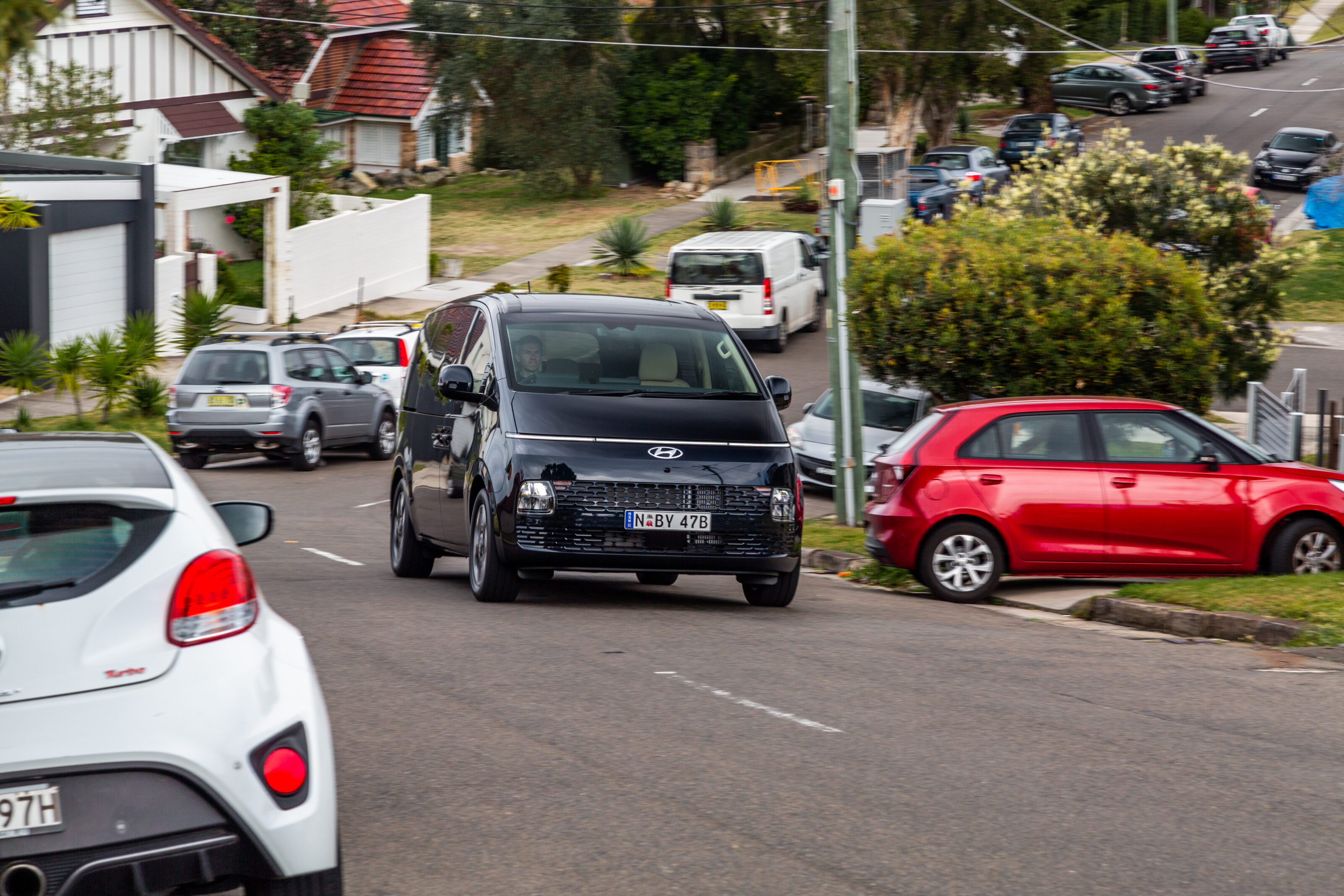
Reflecting their front seat setups, the Kia Carnival and Hyundai Staria feel different behind the wheel despite sharing key components and a platform – more SUV-like and more van-like, respectively.
However, the steering is slower in both cases compared with the manufacturers’ seven-seater SUVs, so even the Carnival isn’t as effortless to manoeuvre around town or drive on a windy country road compared to the Sorento.
The Kia’s steering has a vague patch around the straight-ahead position that makes it feel less precise than the Hyundai’s on straighter roads such as freeways.
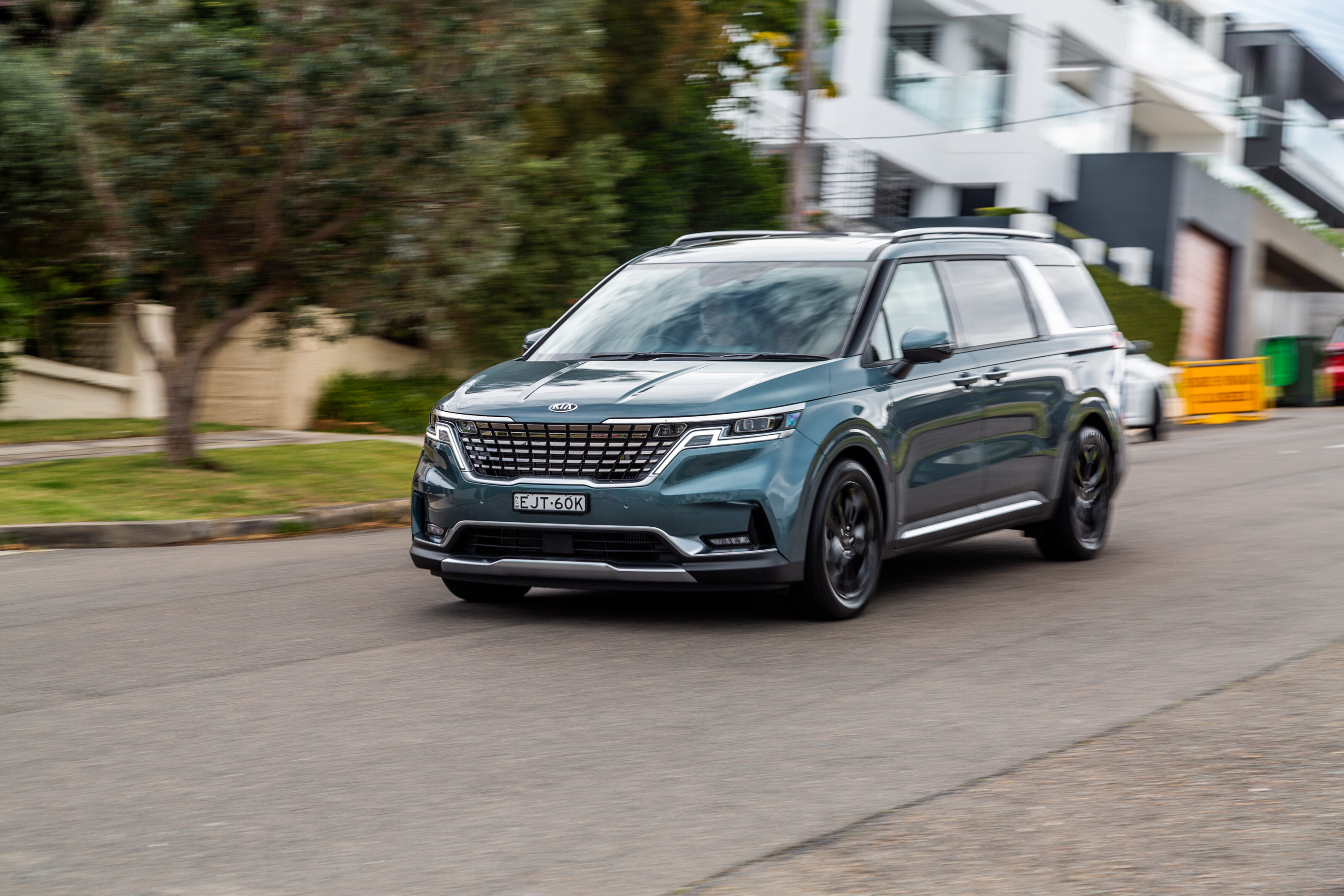
Turning circles are better than expected for two long vehicles. Find a parking space of sufficient size and sensors galore, 360-degree cameras and light steering make the task of slotting into it easier. The sliding rear doors are also helpful in car parks, too, of course.
Vision out is good in both, too, with the Staria the pick courtesy of its higher seating, vast windscreen, and large side mirrors. It also gains extra blind-spot assistance via a video feed in the digital instrument cluster.
Both people-movers ride with a good level of comfort. The Staria’s suspension tends to be upset more by rougher roads with just a driver, settling better over bumps when a family of four was aboard. The Carnival is pleasantly compliant regardless of occupant numbers and is generally smoother than the stablemate Sorento Platinum that also wears big, 19-inch wheels.
All-round refinement is a clear win to the Carnival. It produces less wind noise at higher speeds and less road noise on coarser surfaces.
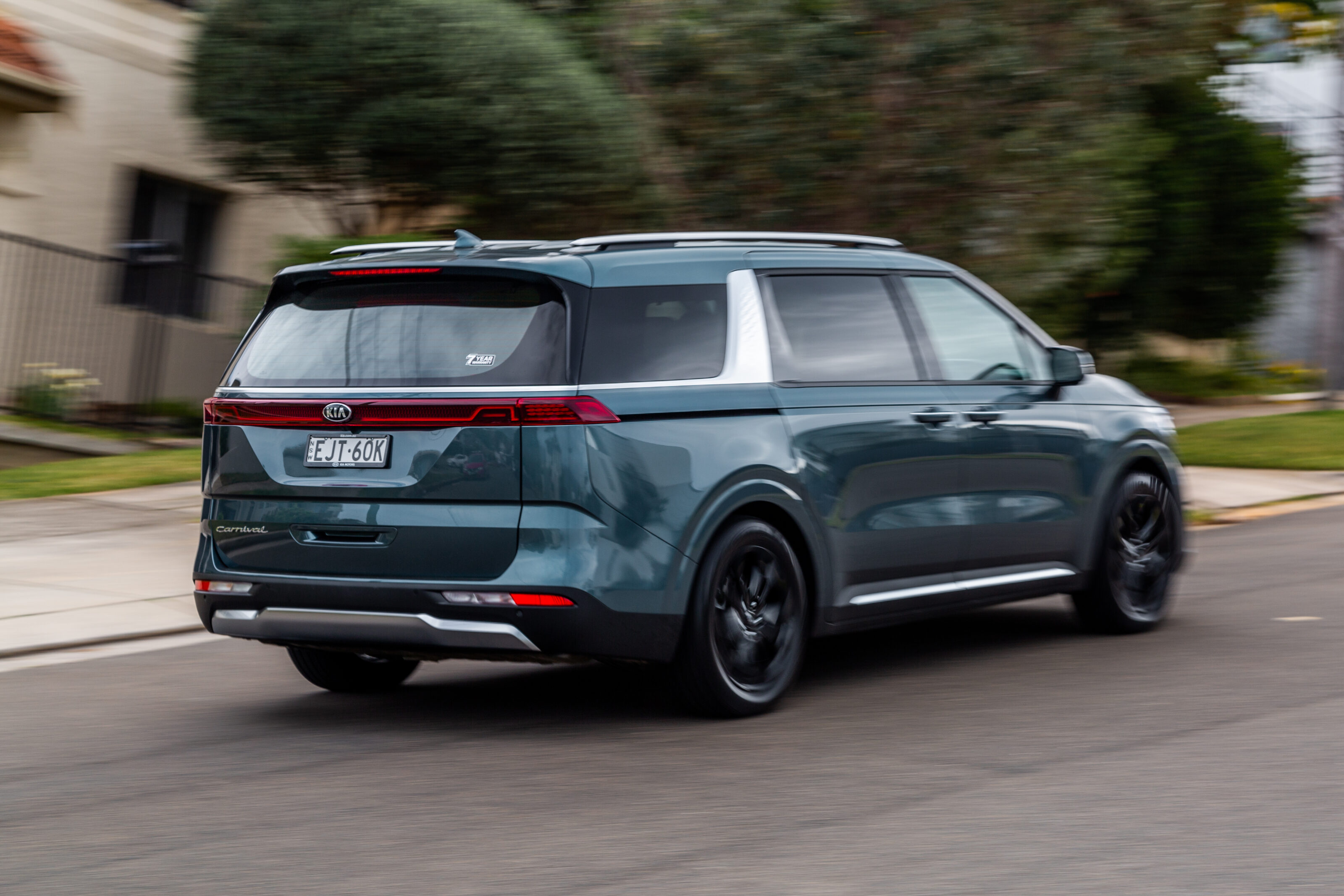
And while these two people-mover protagonists share a related diesel engine (and eight-speed auto), it’s quieter in the Kia. Traditional diesel clatter is more obvious in the Staria at idle and low revs, while the 2.2L is noisier under load.
The Kia also offers stronger acceleration, and its auto is better at coping with steep hills where the Staria can fumble a downshift.
Although the Carnival produces slightly more torque – 440Nm versus 430Nm – the key difference is weight. Where the Kia registers 2134kg on the scales, the Hyundai is nearly 200kg heavier, at 2325kg.
That contributes to a gap in official fuel consumption, too, with the Carnival quoted at 6.5 litres per 100km against the Staria’s 8.2L/100km.
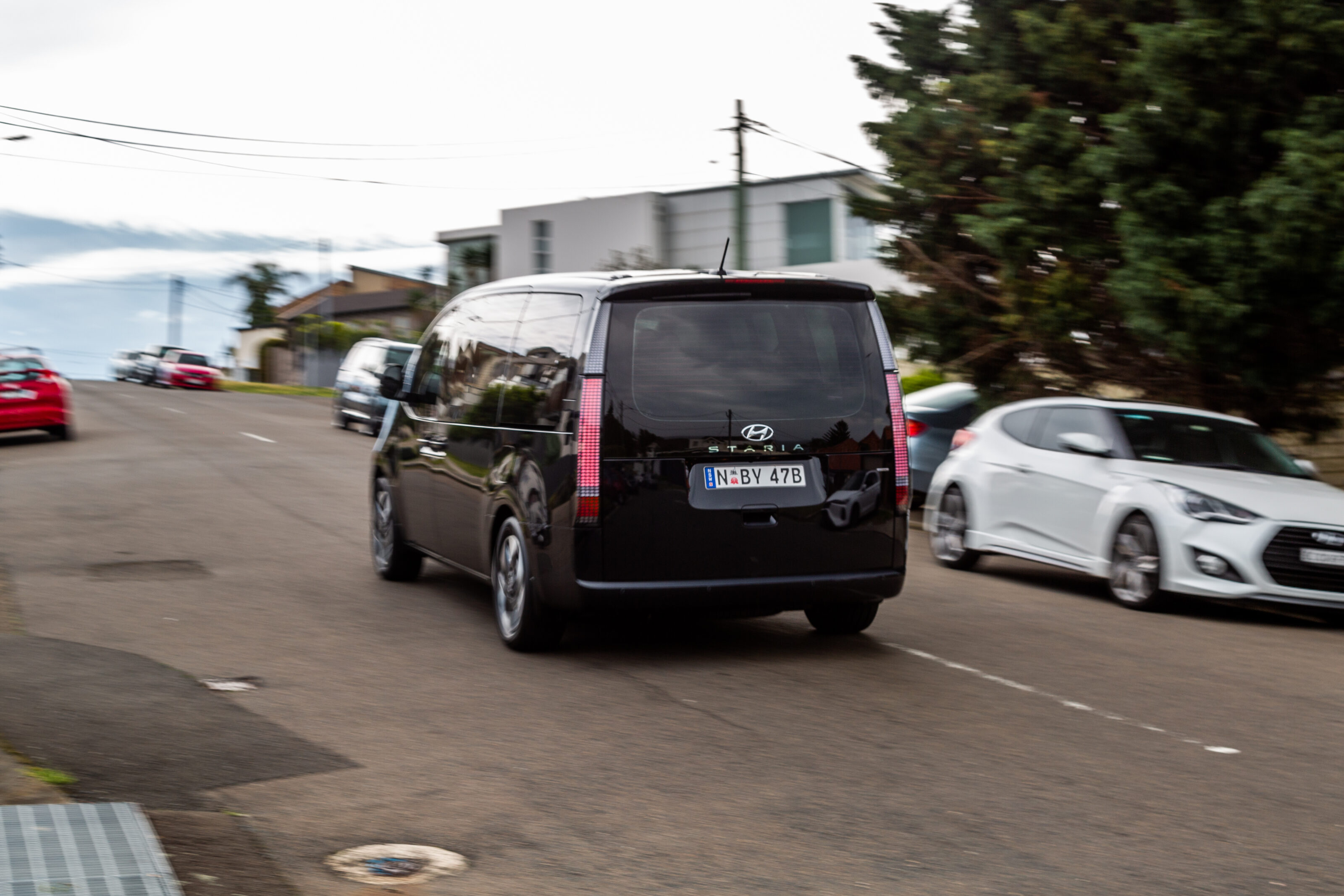
There will be buyers happy to trade off performance and consumption deficiencies for the benefits of the Staria diesel’s all-wheel-drive system. And in the dry at least, the Staria won’t spin up its front wheels like the Carnival if trying to accelerate quickly out of a junction.
The Staria has a higher braked towing capacity, rated at 2500kg compared with 2000kg for the Carnival. It’s not a straightforward advantage, however, as the Hyundai’s towball rating is a relatively low 100kg where the Kia’s is 200kg.
Gross vehicle weight is another factor to consider for both towing and carrying people. The figure is 2876kg for the Carnival Platinum diesel and 3040kg for the Staria Highlander diesel.
Deduct the kerb weights from these numbers and you’re left with 715kg (Staria) and 742kg (Carnival) for people and luggage. Or an average weight of 92.8kg per passenger for the Kia compared with 89.4kg for the Hyundai.
Ownership
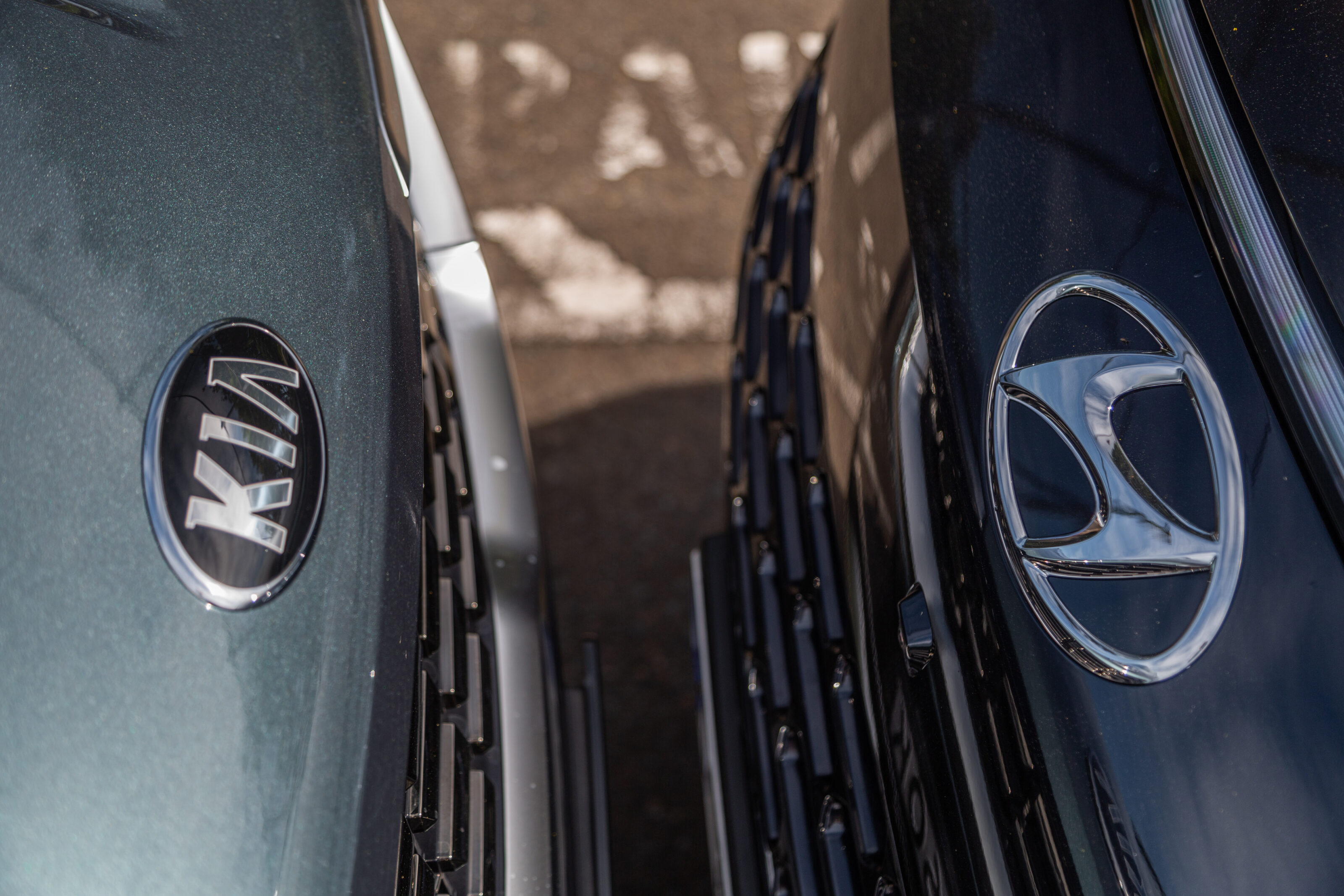
Kia’s now-famous seven-year warranty gives Carnival owners an extra couple of years of peace of mind over those who purchase a Staria. It also helps make the Carnival an attractive proposition for second-hand buyers as the warranty passes on.
Servicing intervals for both vehicles are the industry standard 12 months or 15,000km. Maintenance visits for the Carnival currently cost $1382 for three years, $2573 over five years, and $3767 if kept for the full warranty period of seven years.
The Staria is cheaper to service, with pricing capped at $360 for each of the first five visits. That’s a total of $1080 over three years or $1800 over five years.
Roadside assistance is renewed with each factory-endorsed service.
VERDICT: Kia Carnival or Hyundai Staria?
The Staria brings Hyundai bang up to date in the people-mover segment, bringing technology and a driving experience significantly better than the iMax.
There’s also fantastic space for adults in any of the rear seats, while all-wheel drive on the diesel gives buyers a rare option in the category alongside a 4Motion VW Multivan.
The anti-bland futuristic styling also ensures there’s nothing boring about the way it looks, even if it may polarise opinions.
In many ways, the latest Carnival is simply an updated version of the third-generation model introduced in 2015. Yet Kia was wise not to tinker excessively with a hugely successful formula because this is a people-mover that absolutely nails its brief with an outstanding combination of interior space and seating versatility for big families (or big fleets).
And that the Carnival’s design more closely resembles an SUV than any other competitor certainly doesn’t hurt its cause.
All-wheel drive on the diesel Staria gives buyers a rare option in the category alongside a 4Motion VW Multivan.
RATINGS
| u00a0 | Hyundai Staria Highlander Diesel | Kia Carnival Platinum Diesel |
|---|---|---|
| Safety, value, features | 8.5 | 8.5 |
| Comfort and space | 7.5 | 9.0 |
| Engine and gearbox | 7.5 | 8.0 |
| Ride handling | 7.5 | 8.0 |
| Technology | 8.5 | 8.0 |
| OVERALL SCORES | 7.8 | 8.5 |
Staria vs Carnival: Specifications
| Model | Hyundai Staria Highlander CRDi | Kia Carnival Platinum CRDi |
|---|---|---|
| Body | 5-door, 8-seater MPV | 5-door, 8-seater MPV |
| Drive | On-demand AWD | FWD |
| Engine | 2.2-litre 4cyl turbo diesel | 2.2-litre 4cyl turbo diesel |
| Transmission | 8-speed auto | 8-speed auto |
| Power | 130kW @ 3800rpm | 148kW @ 3800rpm |
| Torque | 430Nm @ 1500-2500rpm | 440Nm @ 1750-2750rpm |
| Bore/Stroke (mm) | 84.5/96.0 | 83.0/99.4 |
| Compression ratio | 16:1 | 16:1 |
| 0-100km/h (claimed) | Not available | Not available |
| Fuel consumption (comb.) | 8.2L/100km | 6.5L/100km |
| Weight | 2325kg | 2082kg |
| Suspension | Front strut/Rear multilink | Front strut/Rear multilink |
| Length/Width/Height (mm) | 5253/1997/1990 | 5115/1995/1775 |
| Wheelbase (mm) | 3273 | 3090 |
| Boot space (7 seats) | 831L | 627L |
| Boot space (5 seats) | 1303L | 2785L |
| Brakes | 345mm/325mm | 325mm/325mm |
| Tyres | 235/55R18 | 235/55R19 |
| Wheels | 18-inch alloy | 19-inch alloy |
| Price (before on-road costs) | $66,500 | $66,980 |
The covers have been taken off. The technical details have been revealed. It’s finally time to get behind the wheel of the new Toyota GR 86. And we’ve got some questions that need asking. Luckily, we have a race track and access to a first-gen 86 to get all the answers we need to deliver you a sound verdict.
We cut lose to see if the new 2.4-litre Boxer has enough fight to keep up with the competition and see if it’ll still have naysayers crying for more grunt. Then it’s time to delve right into the experience to see if the 86 retains the uncompromising philosophy of old. Have a read to see just what Toyota did to improve an icon.
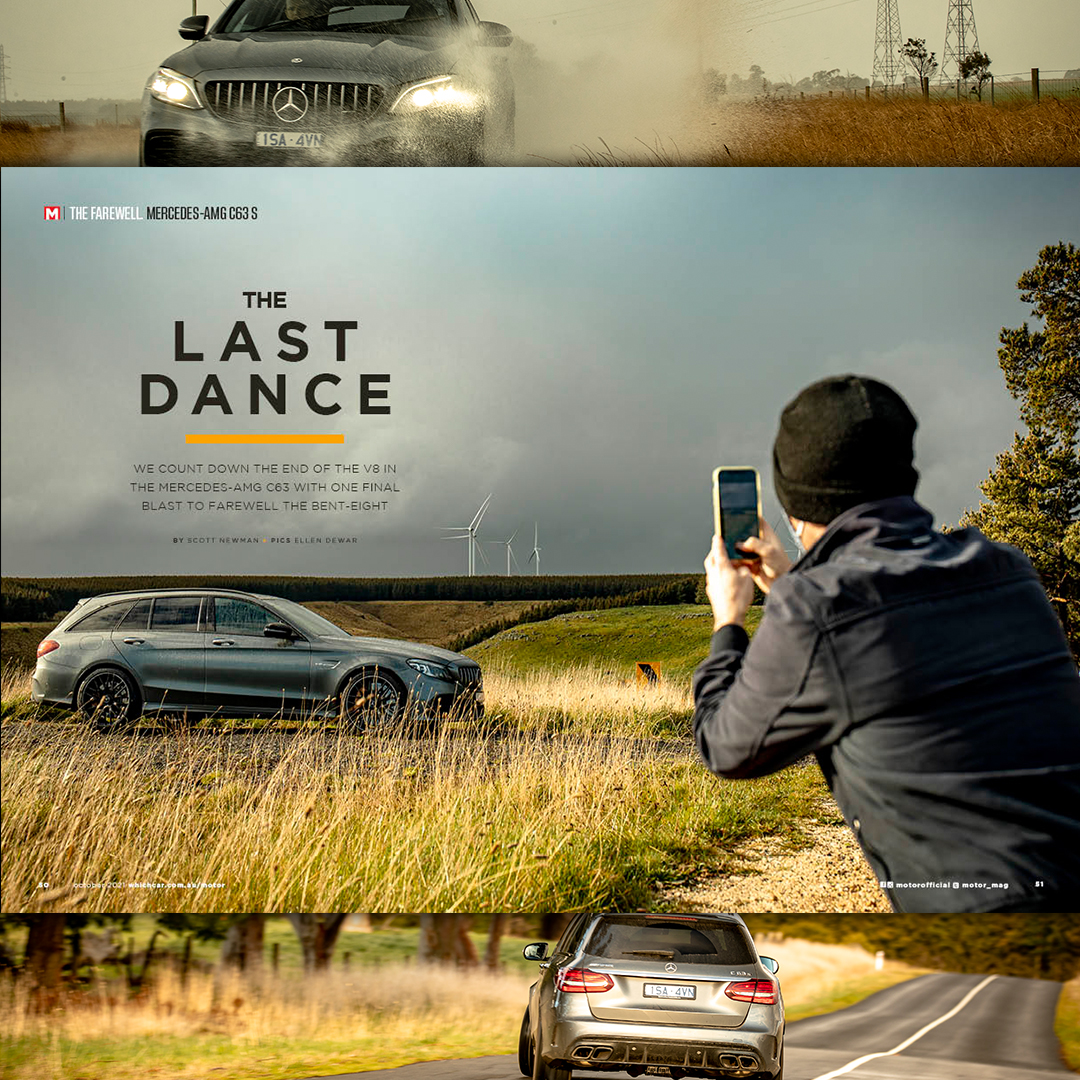
As one door opens, another one closes. And this time it’s the use of the 4.0-litre twin-turbo V8 in the Mercedes-Benz C63 S. We take a M177-powered C63 S Estate for one last blast to take a look back at the history of the iconic nameplate ahead of its switch to four-cylinder turbo (with hybrid assistance) grunt. A familiar soundtrack is soon to be lost from the C-Class.
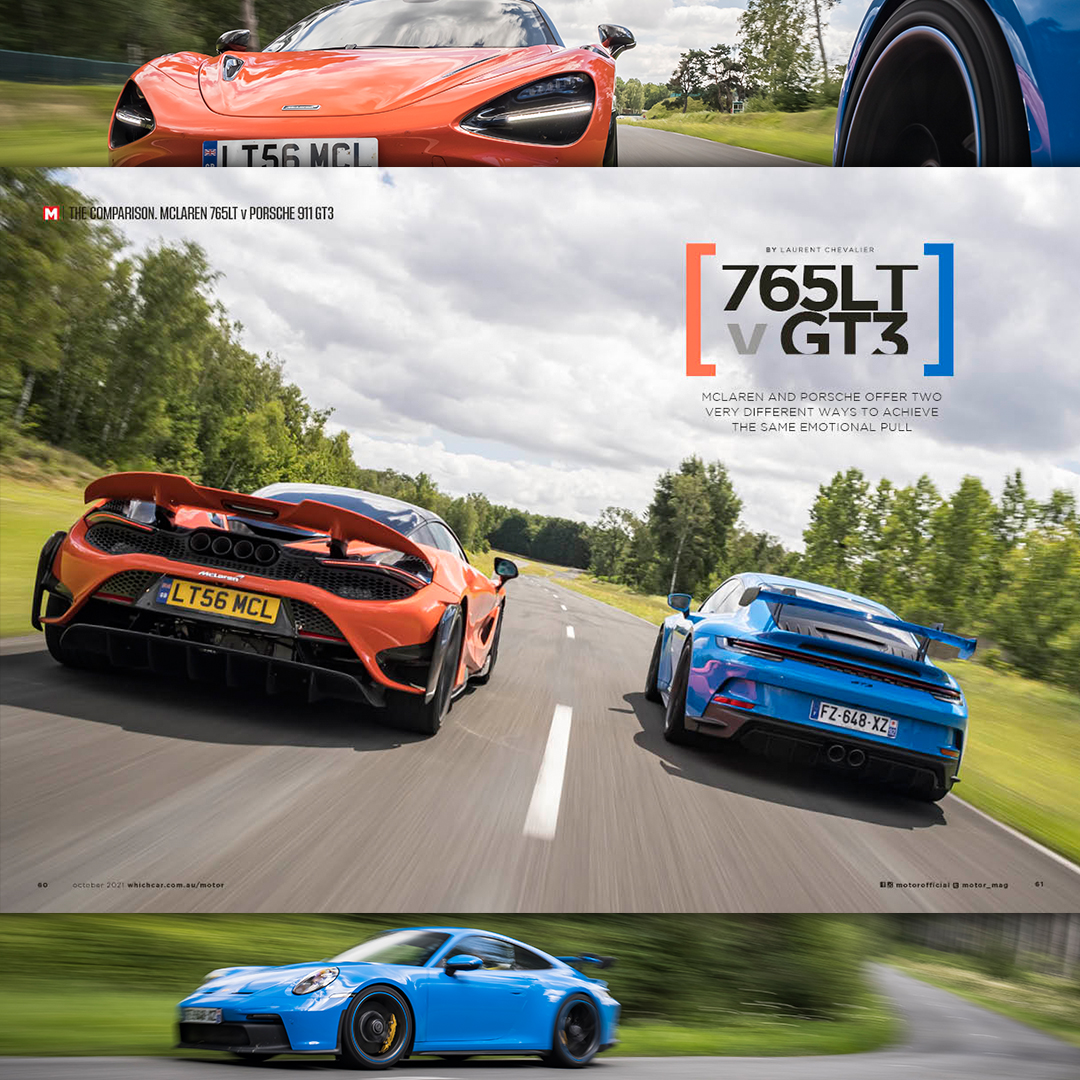
While not direct competitors, the 992 Porsche 911 GT3 and McLaren 765LT have a lot in common. It’s all about the sensations behind the wheel. And we don’t need to be asked twice to drive two of the most involving supercars of the moment in bright sunshine on amazing European roads.
That’s exactly the opposite of the weather we got when driving Jag’s updated F-Pace SVR. And while its made the go-fast SUV a little more liveable, it’s safe to say it remains happily unhinged. Kirby and snapper Alastair take the SVR to Skenes Creek Road in the seventh instalment of our road series. Things get a little muddy.
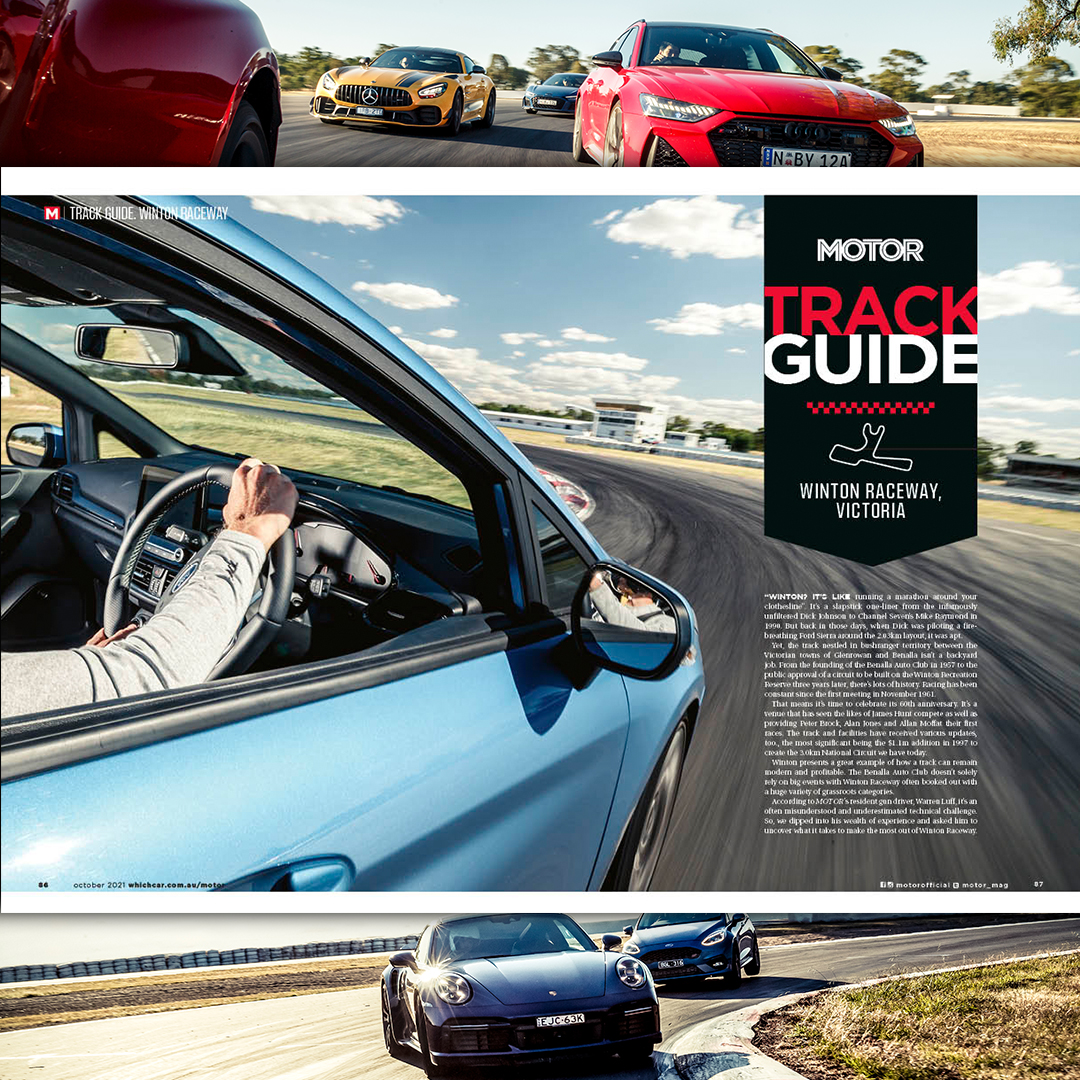
In the October issue we kick start our new track guide series with expert tuition this month from our gun driver, Warren Luff. Celebrating its 60th anniversary this year, the little race track in country Victoria is often underrated as a technical challenge and for its grin-inducing fun. See how to get the best out of it.
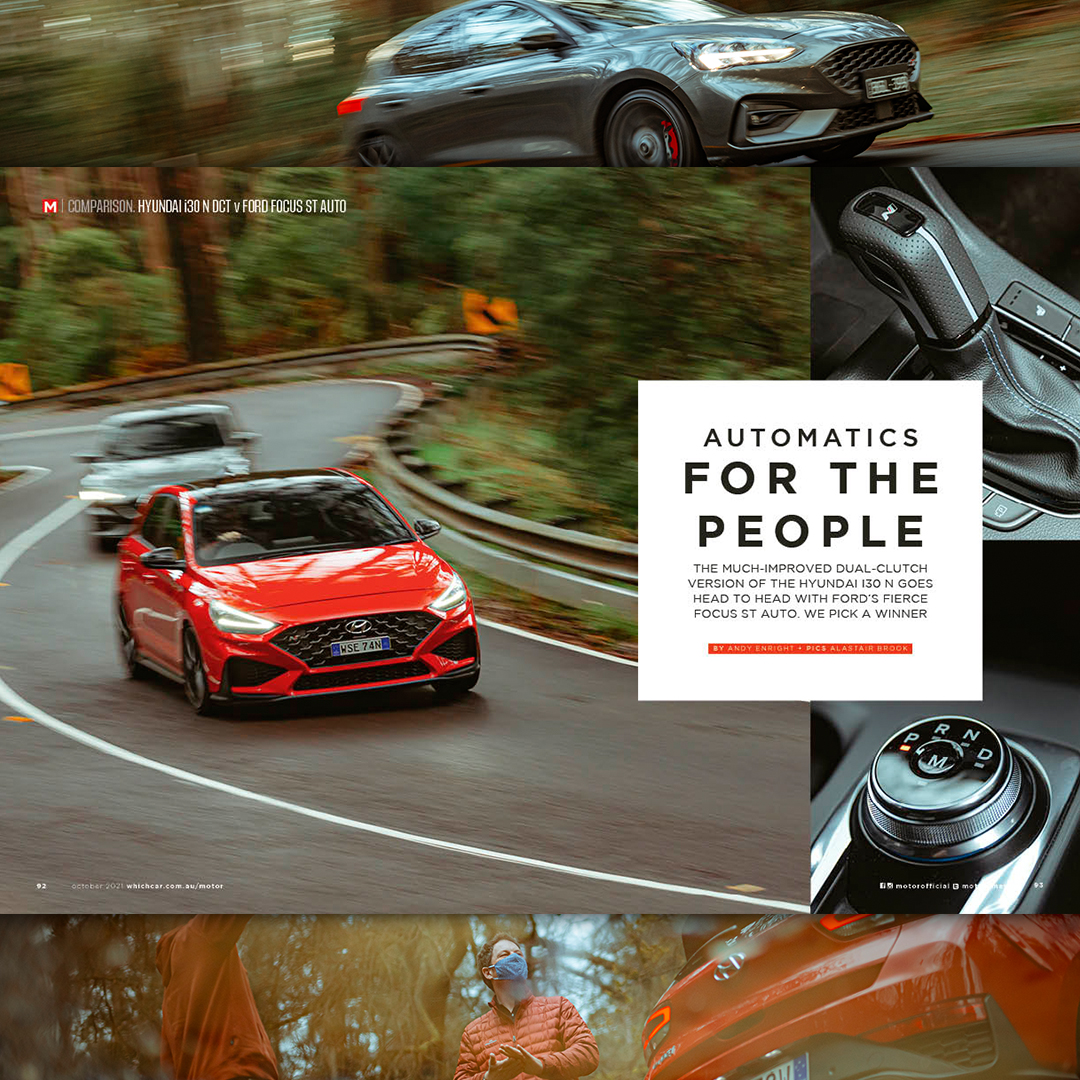
With its track warranty, a hot hatch you might want to take to the track is the Hyundai i30 N. It’s been heavily revised with more grunt and mechanical upgrades. However, the focal point is the new eight-speed dual-clutch gearbox. Is it the default choice? We put it up against the hot Ford Focus ST to find out.
Elsewhere in the mag we rate the top 10 unlikely driver’s cars. And yes, there are some surprises in there. We plot our own Nismo version of the upcoming Nissan Z in Sweet Dream and uncover the highs and lows of the 996 Porsche Carrera in Icon Buyer.
Other than that, we reveal the next-generation WRX in all its glory and highlight its nuts and bolts, as well as farewell the Lexus LS500 F Sport from the MOTOR garage.
You can find the October edition of MOTOR Magazine in stores, or get them delivered straight to your door at motor.subscription.com.au
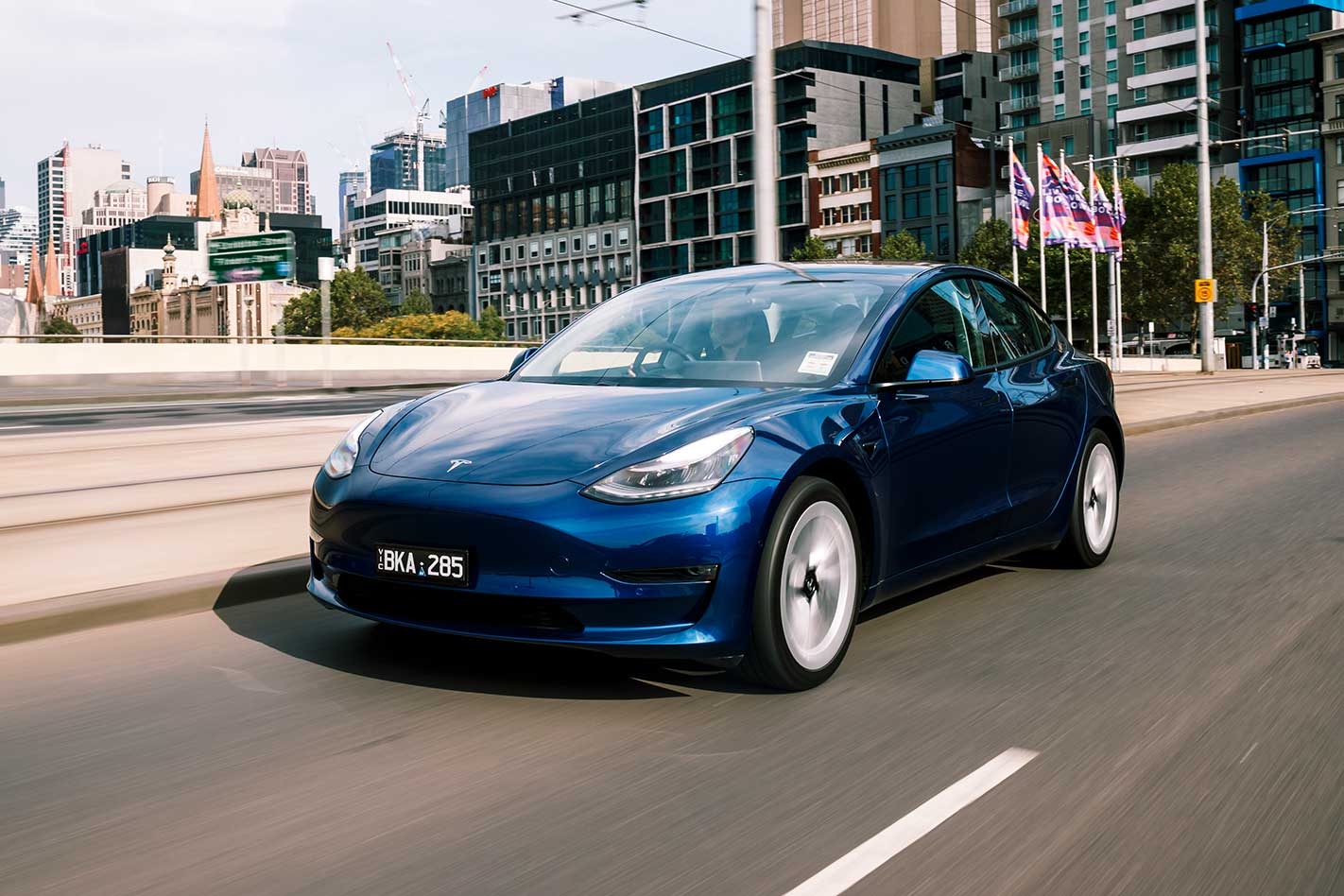
World-leading chipmaker Samsung is in the box seat to win a contract with Tesla to produce chips for the manufacturer’s next generation of vehicles.
According to reports from The Korea Economic Daily, sources inside the industry have said the technology company will beat Taiwan Semiconductor Manufacturing Co. (TSMC) to make Tesla’s Hardware 4 (HW 4.0) chips.
Essential to the operation of Tesla’s autonomous driving systems, the current HW 3.0 chips used in the Full Self-Driving (FSD) Computer are also produced by Samsung, meaning the company has experience meeting Tesla’s demands.
“Tesla and Samsung’s foundry division have been working on the design and samples of the chip from the start of this year. Recently, Tesla decided to outsource the HW 4.0 self-driving chip to Samsung. It’s virtually a done deal,” an insider source told KED.
With Samsung planning to make the chips at its plant in Hwasung, the company will adopt a seven-nanometer processing technology –yielding a higher production volume and stable functioning of the chips in FSD vehicles.
Earlier this month, Tesla announced it is considering a cut-price, fully-autonomous vehicle, which it aims to introduce by 2023, most likely to be used as a fleet vehicle for ride-sharing services.
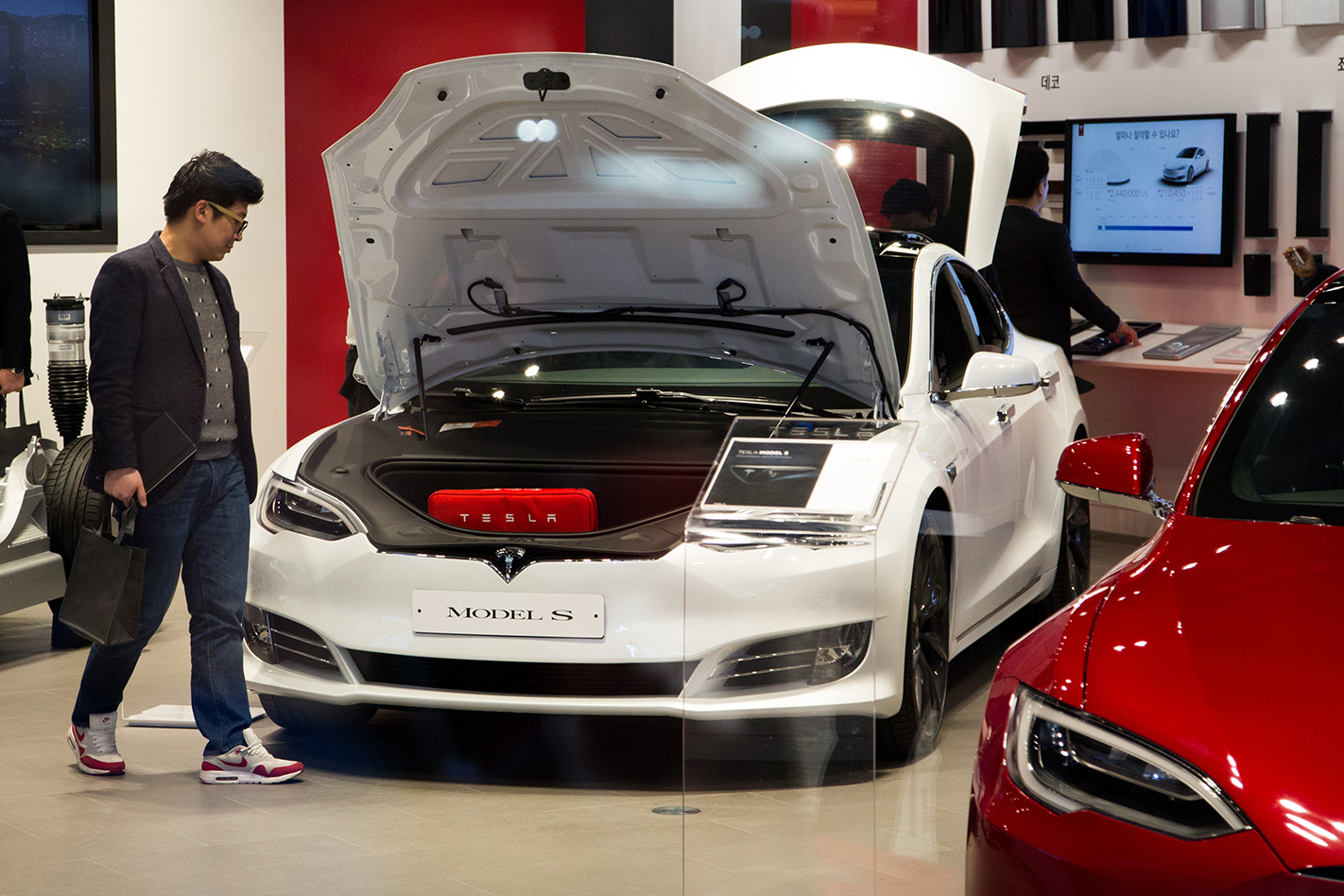
Tesla China is reportedly suing a customer for ¥5.05 million (AU$1.08 million) for defamation, following comments the man is claimed to have made on social media.
According to the South China Morning Post, Han Chao allegedly called the electric carmaker a “rogue company” following an earlier lawsuit in which he was awarded more than ¥1 million (AU$213,000) from Tesla.
On September 17, a Chinese court ruled that a second-hand Tesla Model S he had purchased was fraudulently advertised as not having been in any traffic accidents, when it was later discovered the vehicle’s bodywork had been repaired.
Following comments he made boasting of his legal win, Tesla China began defamation proceedings against him.
The company reportedly issued a statement defending the move, saying: “Han has been spreading his words through a series of online and offline actions…leading the public to have a negative impression of Tesla, causing damage to the company’s reputation.”
Han responded on Chinese social media website Weibo, writing: “Do you mean to say, even though you need to pay me more than ¥1 million in compensation, even though I am the victim – I cannot say a bad word about you and need to pay ¥5 million as a price?”
It’s not the first time the company’s Chinese arm has been accused of silencing its critics. In June, the Financial Times reported Tesla had threatened legal action against Chinese bloggers – with a number of public apologies issued following the threats.
The original article in the South China Morning Post was picked up by website Teslarati, which appears to have since deleted the post.
Snapshot
- More than 1.7 million counterfeit parts confiscated by Daimler in 2020
- Nearly all fake parts aren’t ADR compliant
- FCAI launches Genuine is Best campaign
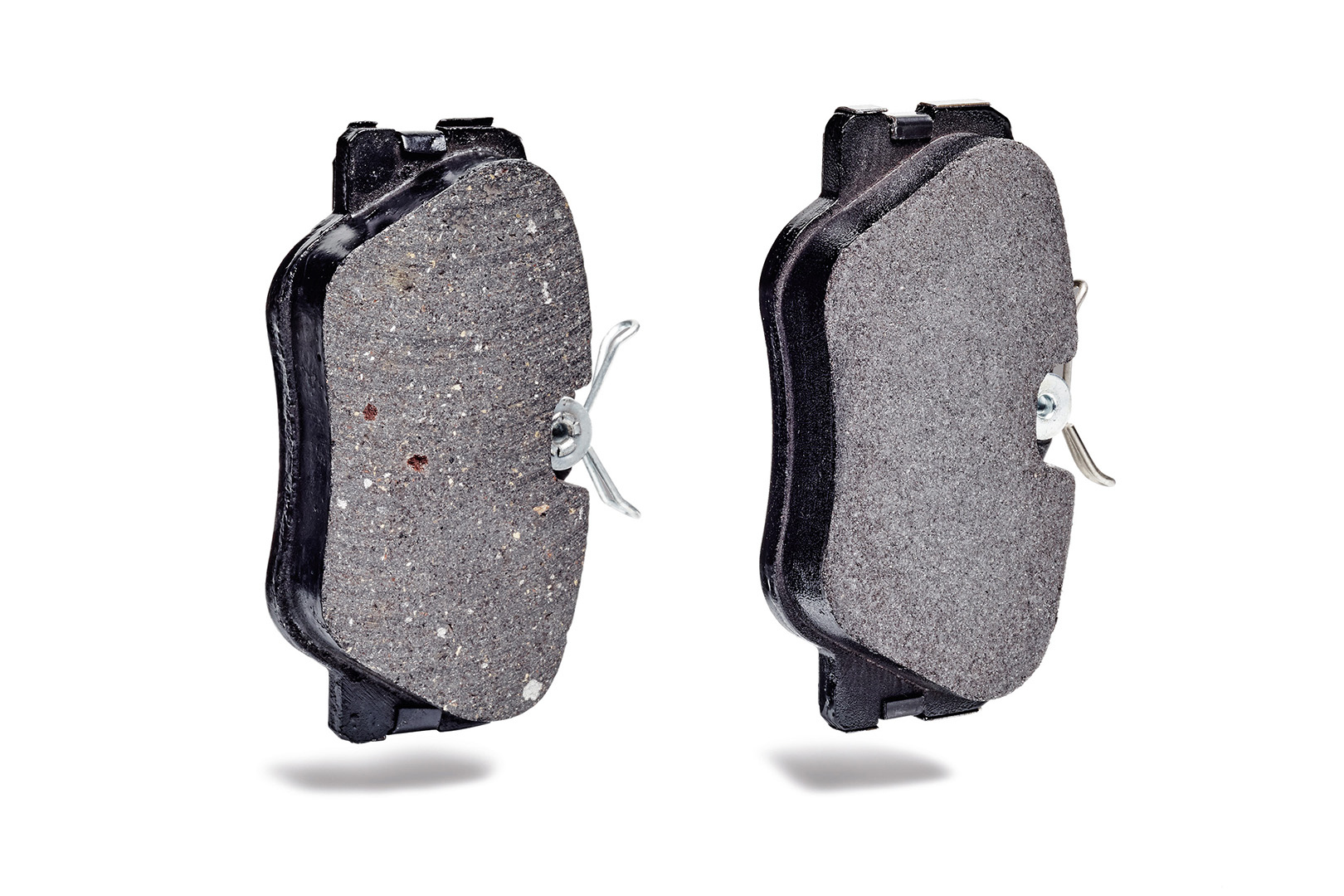
A staggering 1.7 million counterfeit car parts were intercepted and confiscated by Daimler last year, leading to renewed calls for greater awareness how to spot fake components.
The German automotive company believes the number of non-genuine parts found for sale online is higher than pre-pandemic levels, with its head of Legal Product Intellectual Property, Florian Adt, saying the firm has had to implement new strategies to tackle counterfeiters.
“Over 1.7 million counterfeit Daimler products were confiscated in 2020,” said Adt.

“We initiated and supported over 550 raids by the authorities. This is a slight increase compared to the previous year – despite the challenges posed by the pandemic.
“We have adapted our brand protection strategy and increased our activities to combat counterfeiting in online trading. All in all, we were able to have 138,000 fake products removed from online platforms. This is around three times as many as during the same period before the pandemic.”
The Federal Chamber of Automotive Industries (FCAI) has established its Genuine is Best campaign in association with the Australian Border Force to crack down on counterfeit parts infiltrating the country, with Chief Executive Tony Weber saying the increased rate of fake parts is worrying for consumers.
“With over 1.7 million counterfeit parts confiscated by a single brand in 2020, automotive manufacturers worry that Australian motorists do not understand the safety risks associated with fakes, nor the conditions under which they’re likely produced,” said Weber.
“Car manufacturers spend years developing quality parts to the highest standards, in line with Australian design and safety rules. Data from trade association Unifab indicates counterfeit parts achieve higher profit margins than illegal drugs.
“This indicates fake goods are being manufactured by organised crime syndicates, likely linked with human trafficking – and under poor working conditions.
“Australian motorists cannot purchase counterfeit parts without putting themselves, their passengers and other road users at risk.”
Earlier this month the Australian Border Force intercepted a hoard of counterfeit Toyota parts, all of which were ordered by local customers who were unaware they were non-genuine.
The local arrival of Audi’s E-Tron GT has been delayed to 2022, Audi has confirmed.
Revealed to the public earlier this year, the low-slung, four-door electric vehicle was initially slated for a mid-late 2021 landing in Australia, but this has now been amended – with Audi’s local arm stating the launch will not now occur until next year.
No specific timing has been released, although Audi won’t want the E-Tron GT to lose much ground in the sales race to its Stuttgart sibling – the Porsche Taycan. Both vehicles are built on the J1 platform, but with slightly different dynamics to reflect each brand.
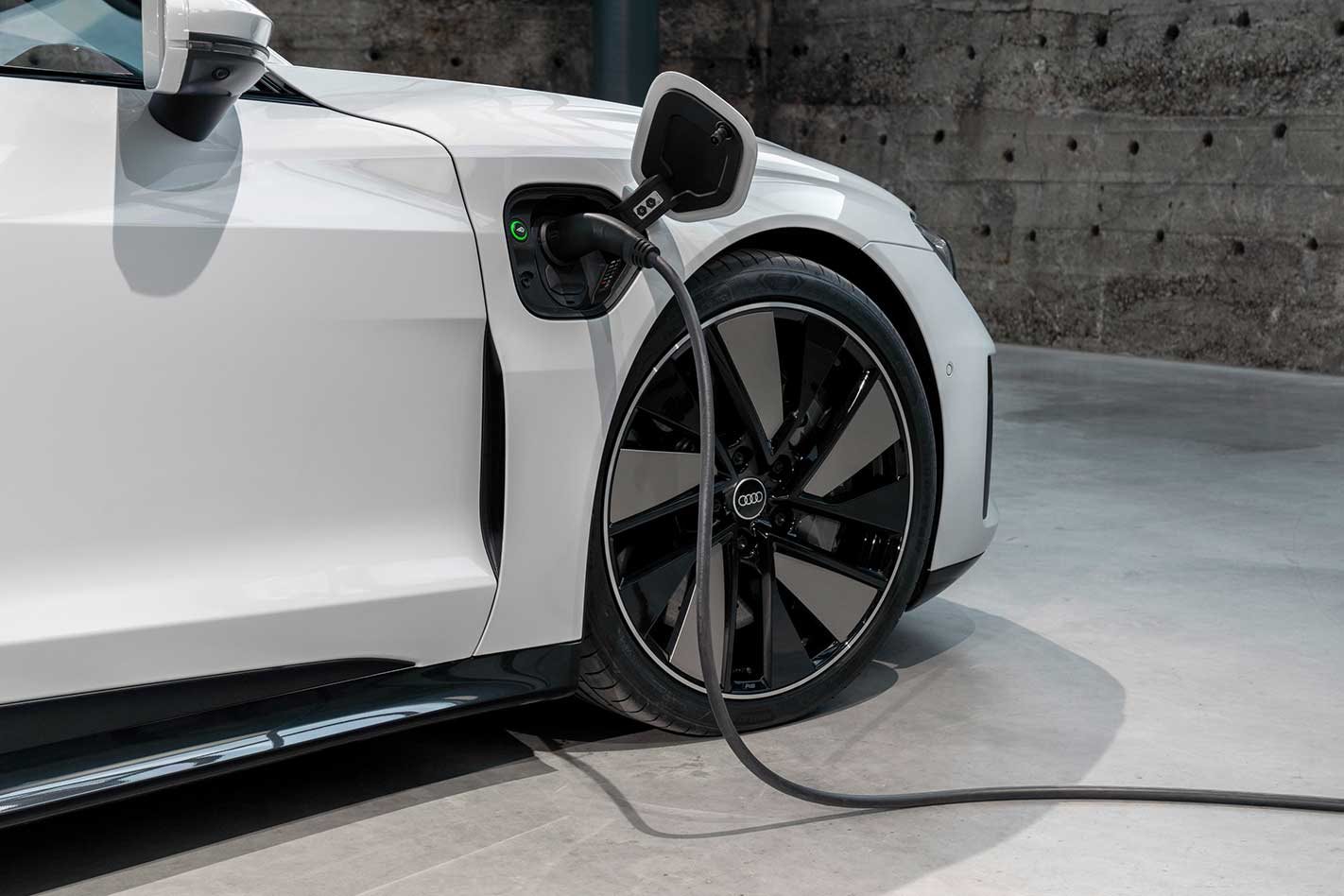
With an 85.7kWh battery pack under the floor, both the standard and RS variants of the E-Tron GT have a driving range of more than 400km, while power and torque sits at a punchy 350kW/630Nm and 440kW/830Nm respectively.
In Europe, the E-Tron GT is on sale from €99,800 (AU$160,700) or €138,200 (AU$222,600) for the RS variant, with no Australian pricing confirmed as yet. Comparatively, the equivalent Taycan 4S and Taycan Turbo retail for $194,700 and $276,300 locally before on-road costs.
The 2022 Mercedes-AMG C63 S E Performance has been filmed undergoing testing in Germany.
As announced in March, the next C63 will move to a turbocharged four-cylinder plug-in hybrid powertrain, with Mercedes-AMG confirming it will produce more than 480kW – a healthy bump over the current model’s 375kW twin-turbo V8 engine.
The video, shot in and around the famous Nürburgring circuit by YouTube channel CarSpyMedia, provides our best preview of what the new electrified C63 will sound like.
Given the 2.0-litre four-cylinder engine is a highly-tuned version of the unit found in the AMG A45 S hot hatch, it should be no surprise the two models share a similar exhaust note.
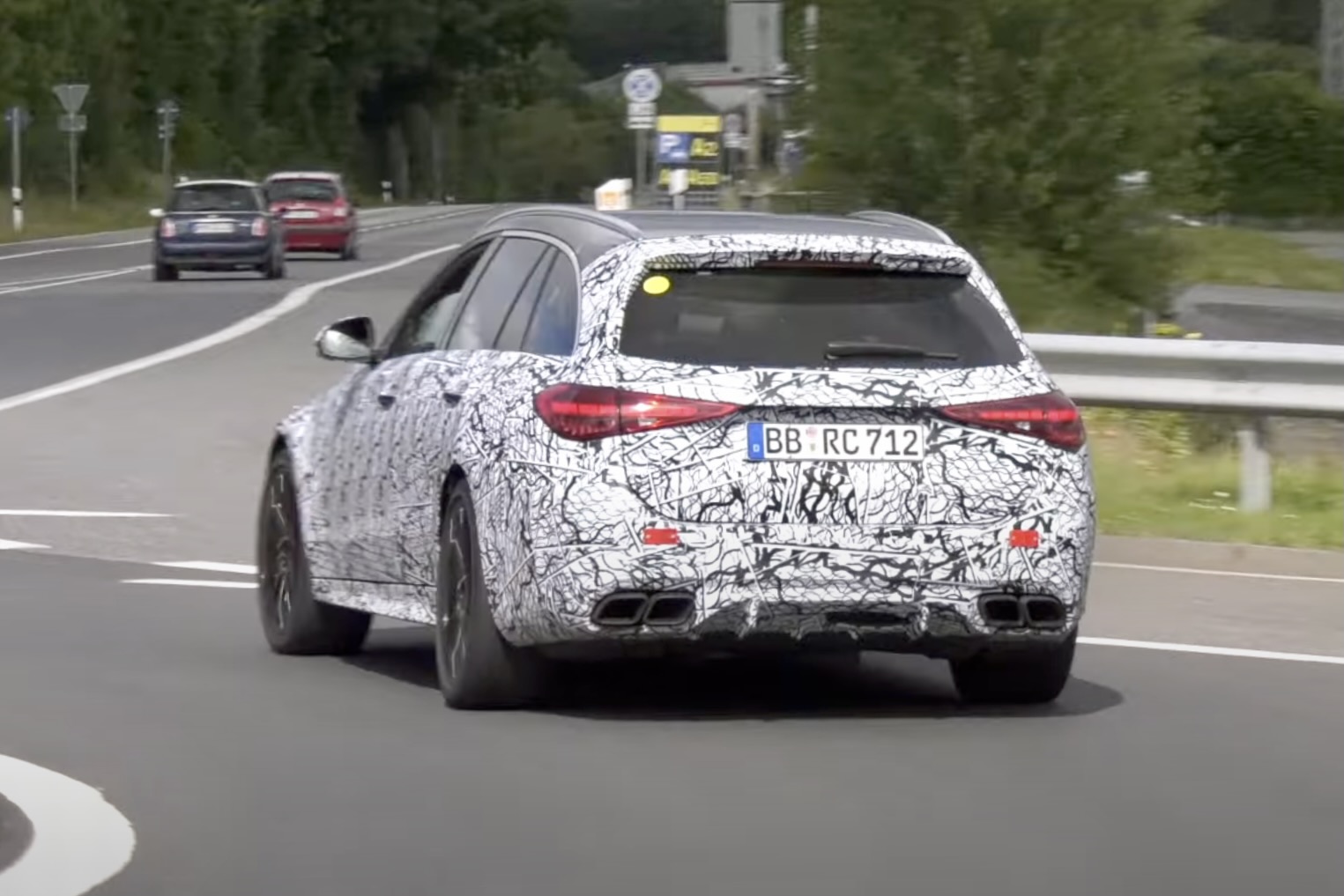
With the petrol engine producing more than 330kW on its own, the extra performance will be supplied from a 150kW/320Nm electric motor powering the rear axle.
“Our concept is rather new and focused on getting performance into a hybrid powertrain,” head of electric powertrains Jochen Schmitz told MOTOR’s sister publication Wheels back in March.
“[We wanted to prioritise] racetrack usage and stuff like that into this hybrid system. Many of the well-known parallel P2 hybrids aren’t focused on performance, they’re more focused on [driving] range or other stuff, so it was on us to go this new way completely on our own.”
What do you think of the sound of the new four-cylinder AMG C63? Let us know in the comments section below.
Earlier this month, Hyundai showed off a camouflaged sports car with an unusual powertrain and a familiar shape.
Hyundai calls it the Vision FK. Previewed at the company’s Hydrogen Vision 2040 showcase, the coupe features a mid-mounted hydrogen fuel-cell, allowing a claimed 0-100km/h sprint time in under four seconds.
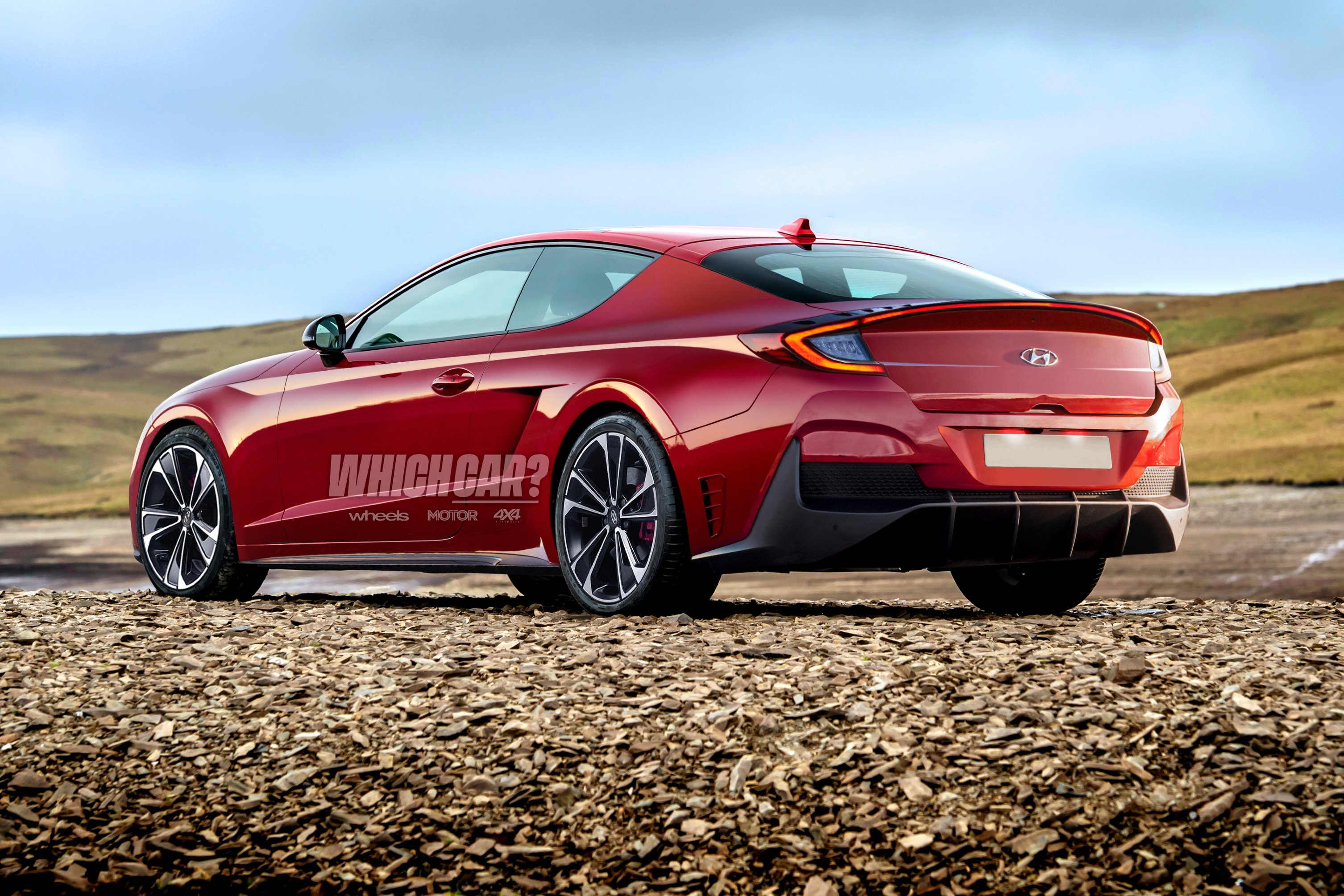
Artist Theo Throttle has used the concept car to provide a glimpse of what a production version could look like, and we’re calling it the 2023 Hyundai Tiburon.
The Tiburon name harks back to the company’s earlier coupe model, but the styling takes inspiration from more modern stablemates such as the Veloster and Sonata.
Hyundai Motor Group has been one of the more exciting stories in the automotive industry over the past decade, with the car giant aggressively going after segment leaders Toyota and BMW while pursuing new avenues – such as alternative fuels.
One of those surprises came from Hyundai subsidiary Kia releasing the Stinger in 2017 – a rear-wheel-drive four-door liftback with a range-topping 3.3-litre twin-turbo V6 producing 274kW and 510Nm.
Reports out of South Korea earlier this year suggested the Stinger is due to end production at the end of 2022, to be replaced by the fully-electric EV6 as the brand’s performance flagship.
While Kia is looking beyond the Stinger, Hyundai may not be completely done with the its capable rear-wheel-drive chassis just yet. The Vision FK appears to be a heavily revised, two-door version of the Stinger – only with a mid-mounted hydrogen fuel-cell.
With battery tech reportedly coming from electric hypercar maker Rimac, of which Hyundai is a stakeholder, the Vision FK is said to produce up to 500kW and offer a driving range of 600km.
If Hyundai did offer a production version along the lines of the Tiburon seen here, it’s likely a lower power output would accompany the vehicle, aimed as a comfortable sports car – but leaving enough space for a high-performance Tiburon N model.
Given the Vision FK concept car was shown in a camouflaged vinyl wrap, there’s more than a passing chance the vehicle is destined for production.
Would you be interested in a hydrogen-powered sports car from Hyundai? Let us know in the comments section below.
I have always liked the B9 Audi A4, from the second I clapped eyes on it and drove it around the NSW South Coast at its launch. Packed with the good stuff, beautifully built and properly elegant, the 2.0-litre turbo four Quattro is a genuinely lovely executive sedan. I reckon it’s the first A4 to really take it to the 3 Series and C-Class without relying on Quattro as a selling point.
The RS4 and RS5, both based on the A4, are also excellent and grab all the headlines. And quietly getting on with the job of go-faster sports sedan is the S4, which has kind of faded into the background a bit while the high-performance RS cars crackled and popped their way into our hearts and driveways.
The B9 S4 has been a bit of an unknown to me because getting a go in one has never quite worked out. But the luck fell my way (okay, an editor decided it was time) and the S4 and I spent ten days together.
Pricing and Features
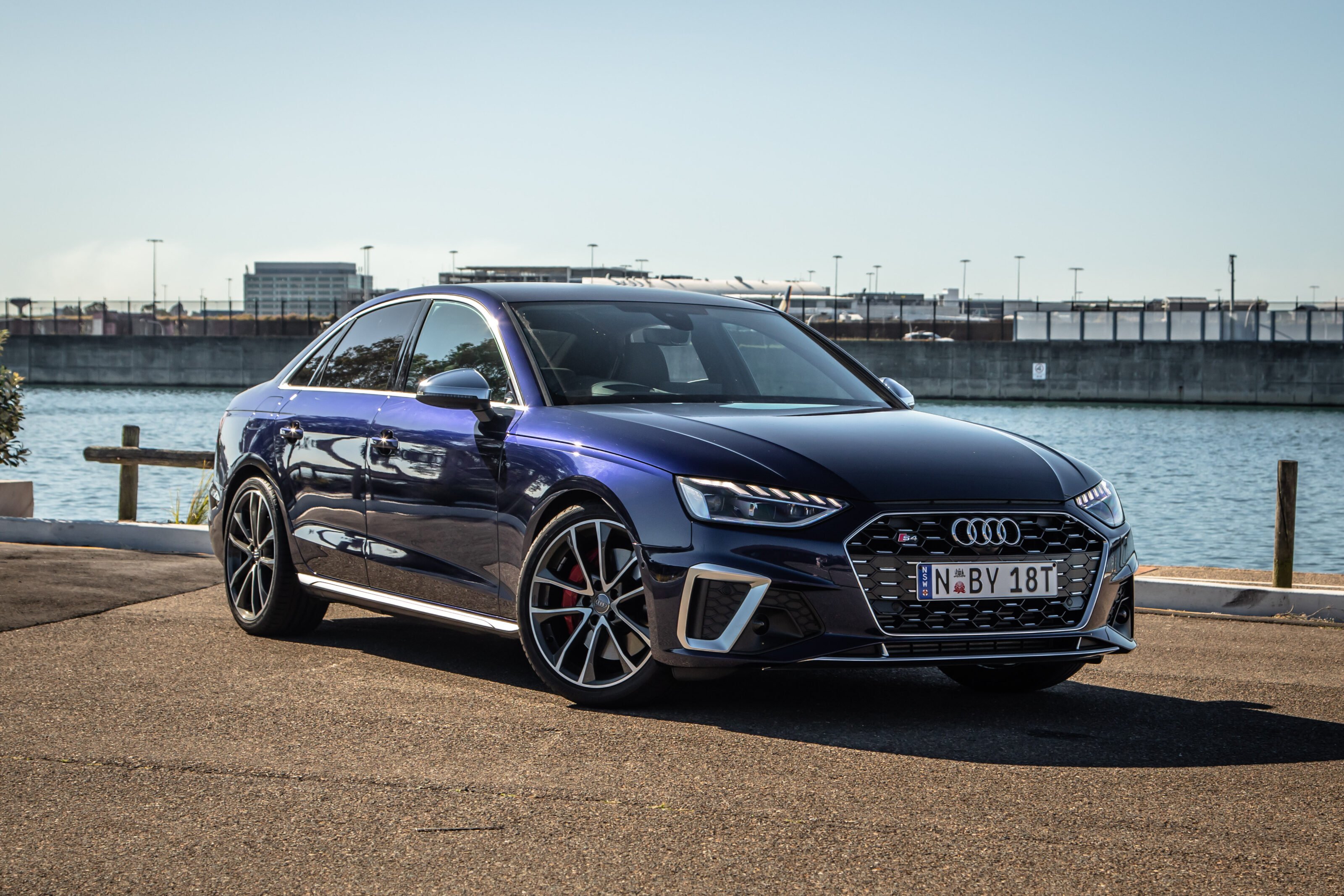
Like the rest of the A4 range, the S4 is nicely loaded from the get-go and lines up pretty well against its BMW M340i xDrive rival.
You get 19-inch alloys, a 12-speaker stereo, auto LED headlights (with auto high beam), keyless entry and start, Nappa leather, powered and heated front seats, three-zone climate control, ambient lighting, power everything, virtual cockpit digital dash, around-view cameras, adaptive cruise (with stop and go plus traffic jam assist), and wireless phone charging.
The 10.1-inch MMI touchscreen is as lovely as ever and powers a thumping B&O 3D-branded sound system, with Apple CarPlay, Android Auto and DAB. You get USB ports up front and another two in the rear, which is nice, too. The MMI system also hosts Audi Connect Plus, which is some clever Google integration to help you find things (petrol, food, toilets etc.) as well as connect up to a mobile app to find your car and/or troll your kids who probably aren’t legally allowed to drive it anyway.

Technically the five-star ANCAP rating doesn’t apply to the S4 but does to the four-cylinder A4, so take from that what you will. Also worth noting that ANCAP is now time-boxing ratings for three years.
Given the A4 was last assessed in 2015, the rating is getting on a bit. For what it’s worth, the US IIHS rates the A4 as a top safety pick and those guys crash cars hard and often.
You get eight airbags, ABS, stability and traction controls, forward AEB (up to 85km/h), forward collision warning, lane-keep assist, lane departure warning, blind-spot monitoring, collision avoidance assist that can help steer you away from trouble, around-view camera, reverse cross-traffic alert, reverse AEB and pre-sense that preps the car for a stack if it thinks you can’t avoid it, including from behind.
Like the rest of the A4 range, the S4 is nicely loaded from the get-go and lines up pretty well against its M340i xDrive rival.
Comfort and space
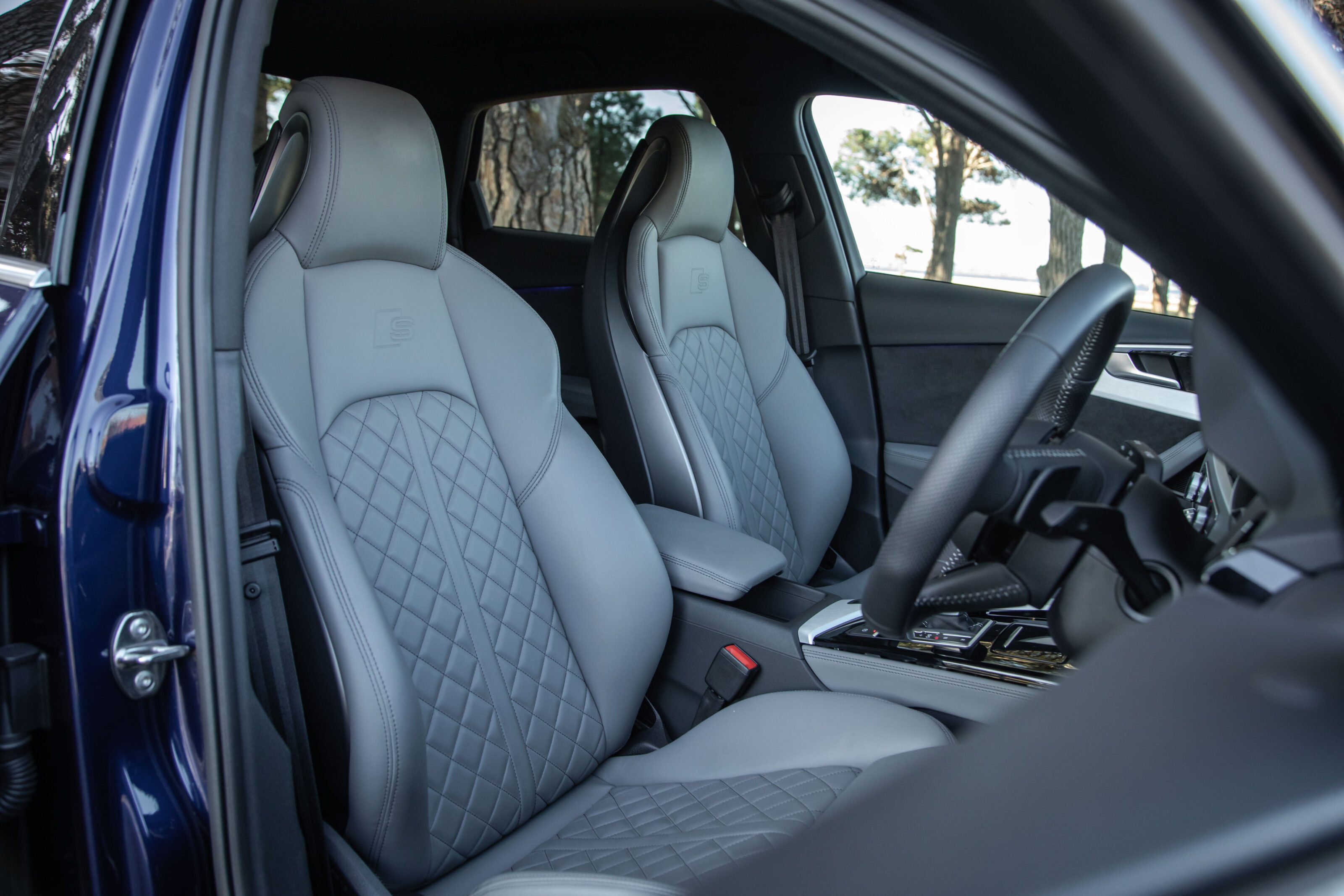
Being a mid-sized all-wheel drive German sedan, there is much that is familiar between this and its rivals. The three Germans seem to agree on certain things like boot space (430 litres), adequate head, leg and knee room in the back seats and very, very comfortable driving positions.
It’s all very sensible and even the interlopers from Japan and Korea stick to the script but with their own local translations to differentiate them.
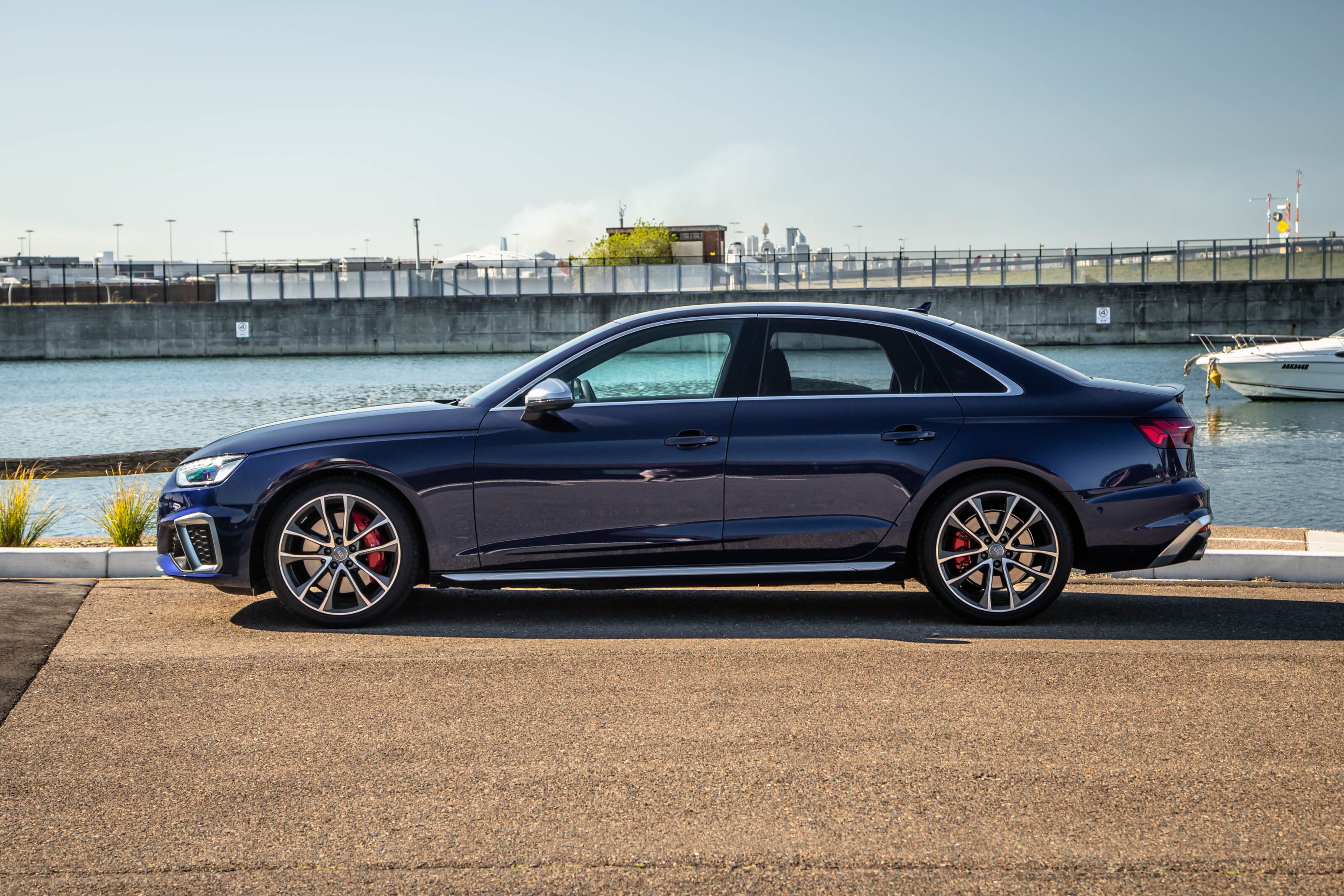
Priced a tick over a hundred grand, the S4 throws in some very nice Nappa leather for the seats, wheel and shifter while also lavishing the dash and other parts with tactile brushed aluminium in a matte finish. Which is always – to my eyes and fingertips, anyway – preferable to carbon or piano black trim.
The front seats are also heated and being sportier versions of the regular Audi chairs, very supportive, adjustable and heated for those cold mornings like we’ve recently had (except if you’re north of, say, Brisbane).
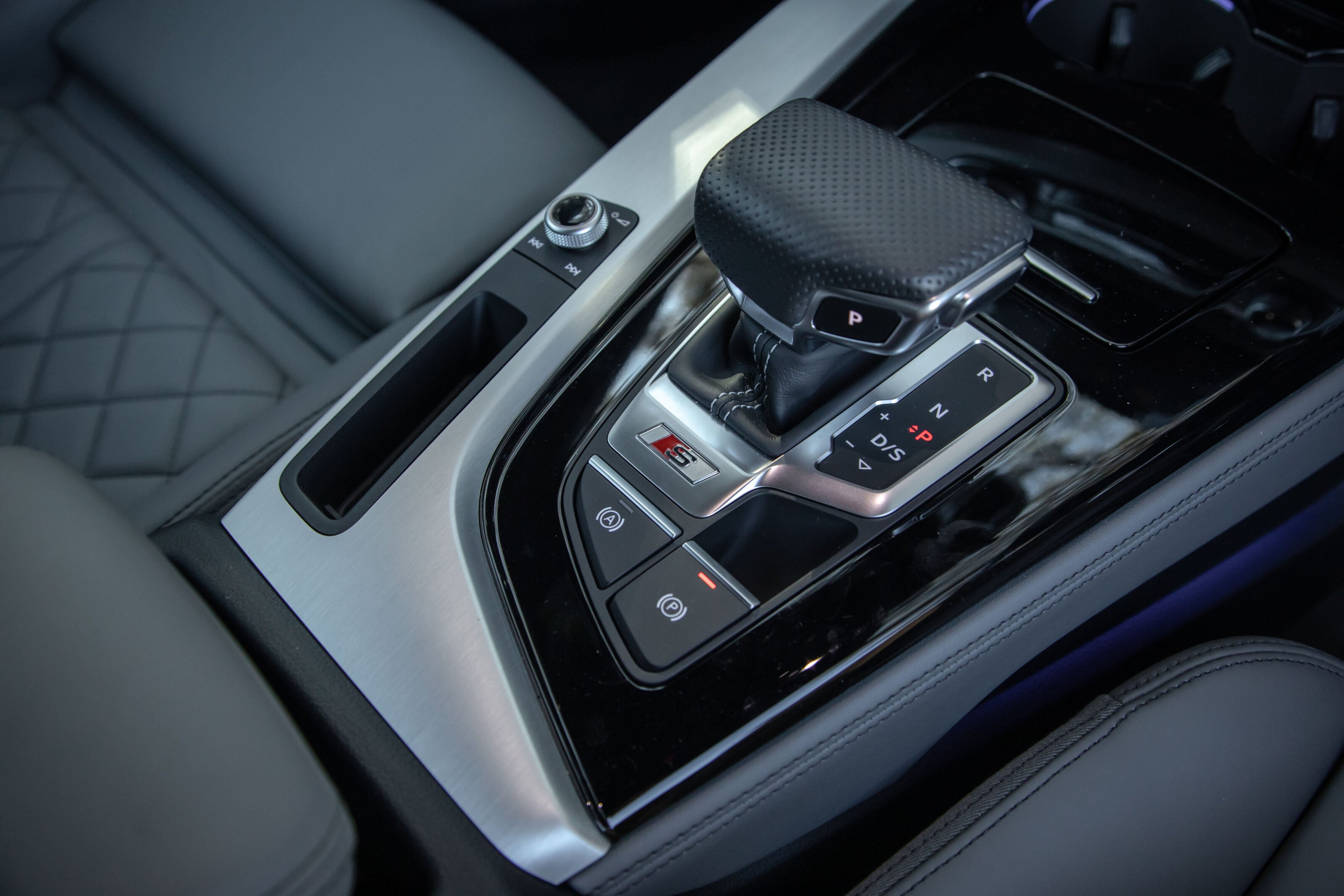
The back seat is comfortable for people up to six feet tall so long as the driver or front passenger doesn’t set the seat at “extra lanky” but here in the Audi, the footwells are a bit cramped if you’ve got three across the back. The middle passenger does sit astride a hefty transmission tunnel, so beware of that if you’re regularly carrying three.
Front and rear rows score a pair of cup holders while each door has a bottle holder. There’s somewhere for your key and your phone goes under the armrest on the wireless charging pad, although you’ll still need a USB cable for Apple CarPlay and Android Auto, rather spoiling the effect.
The S4 also goes without the double screen layout of its bigger SUV cousins but I am and will remain a fan of the really nice touch-sensitive climate controls.
On the road
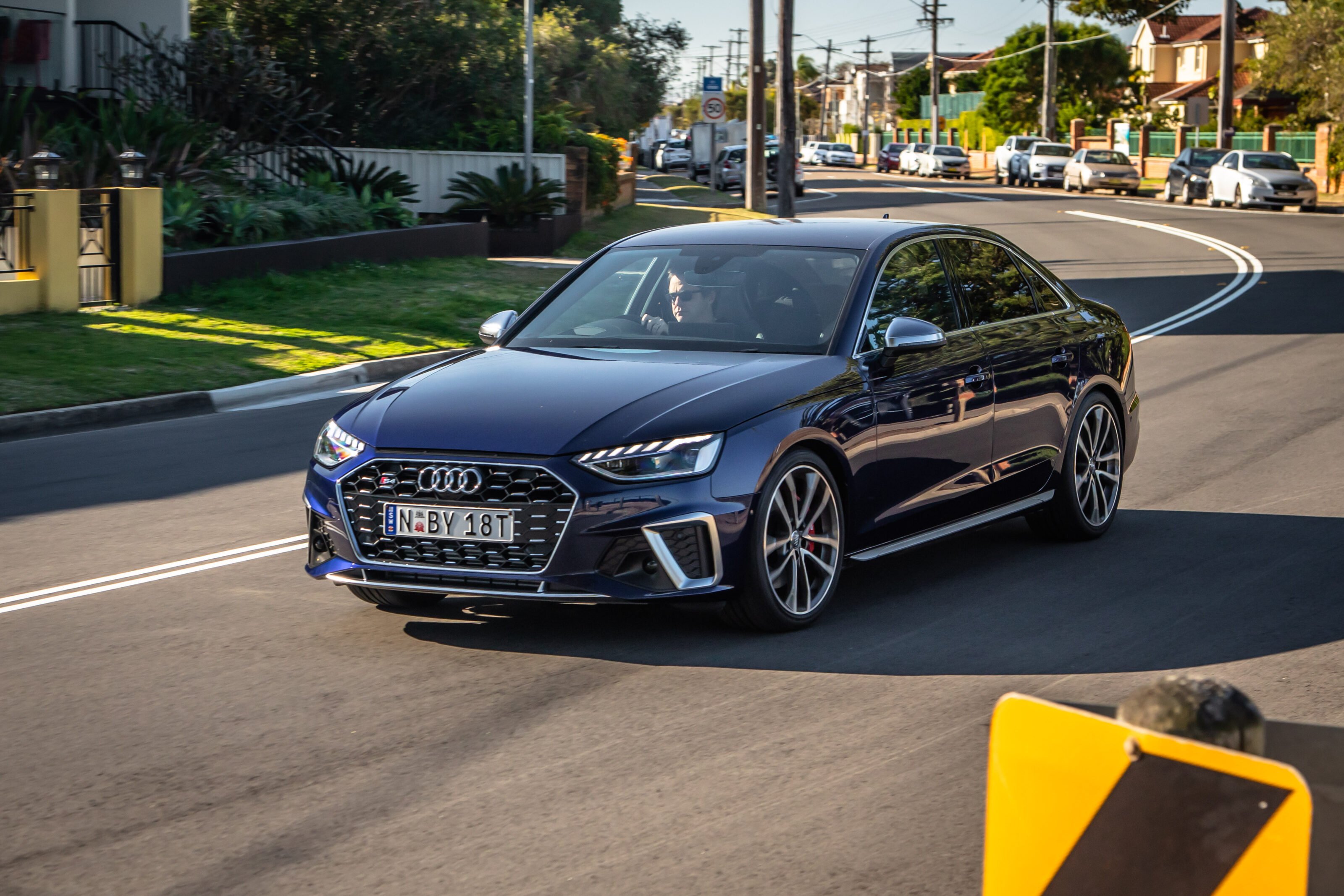
The engine is Audi’s lovely 3.0-litre turbo TFSI with a honking 260kW from 5400rpm to 6400rpm and a walloping 500Nm between 1370rpm and 4500rpm. The bi-modal exhaust is mainly to change from near-silence to muted burbling and that’s okay by me. Power goes to all four wheels via an eight-speed ZF automatic.
Zero to 100km/h arrives in an impressive 4.7 seconds and better still is the mid-range punch from that 500Nm. The ZF finds a gear, puts the engine in the sweet spot and you’re off. I had to pull of some dark country road overtakes in this car, and they were effortless and pucker-free.
Well, I say effortless – one has to be very careful with the speeds the S4 attains as you power along on the other side of the road. The brakes are more than up to the job, which is entirely unsurprising given they’re gigantic.
The usual lashings of aluminium are onboard and the MacPherson struts up front and multi-link rear end aren’t hugely different to the standard car, which is pretty handy in its own right. The S4 rolls on a new set of 19-inch alloys and you can choose between a few designs without being charged more.
The adaptive damping is obviously more aggressive in Sport mode, with uprated springs to suit. There’s no wholesale change, just a subtle, useful amping up. Even in the hardest setting, your jimmies will remain unrustled.
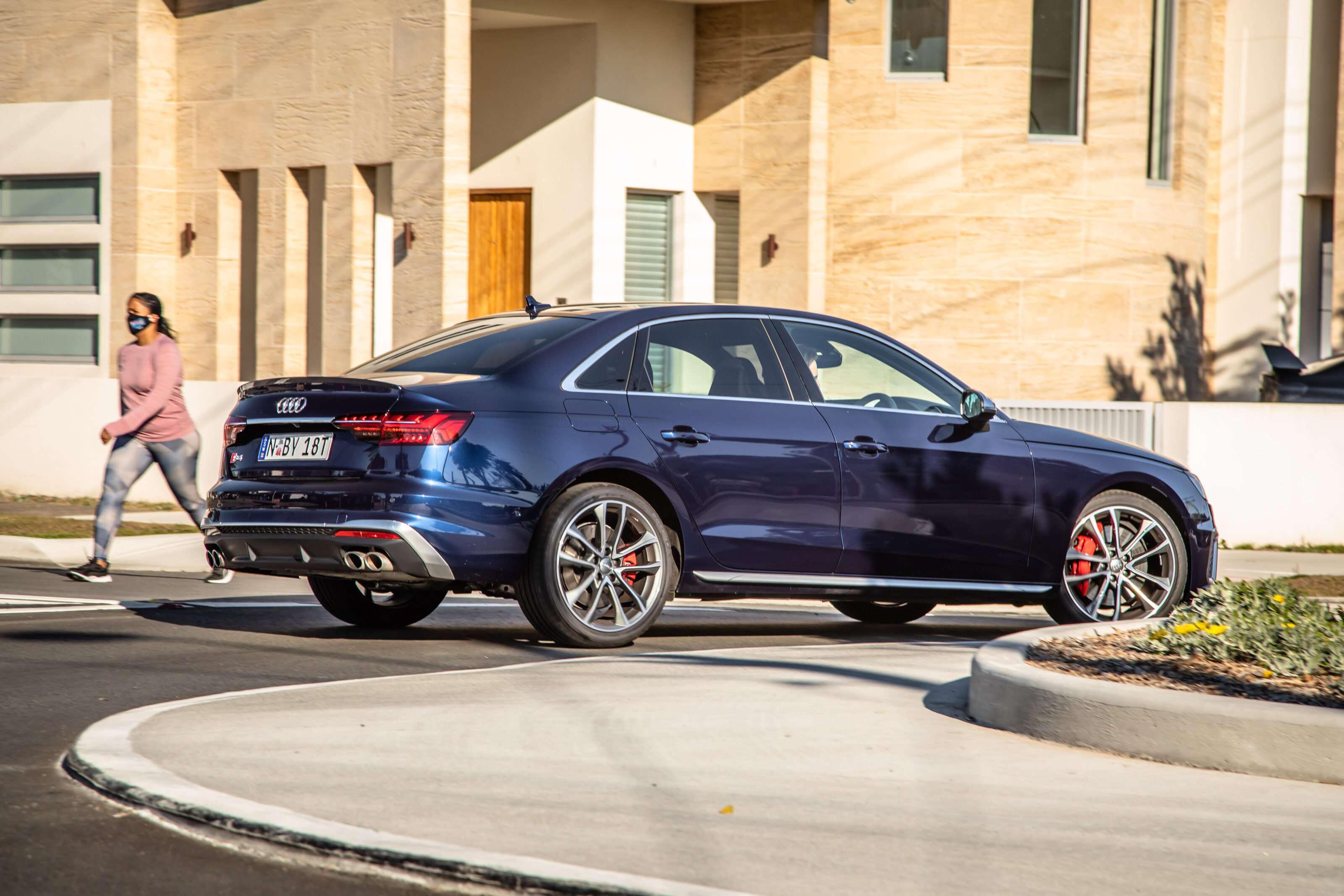
It’s a proper all-round car, like any good sleeper. The steering is light but lets through enough information to let you know the real story on the ground but doesn’t try and test your strength.
You find yourself appreciating the way you can throw it through a set of corners without constant little corrections, a function of good tyres and geometry as much as it is about the well-sorted Quattro system.
The S4 will, eventually, push but you get lots of information back from the front tyres and the electronics quietly step in if you don’t. It goes about its business quietly but with devastating effectiveness, hauling you out of corners with a smoothness and refinement that only a German six-cylinder can while still launching you at the horizon at improbable speeds.
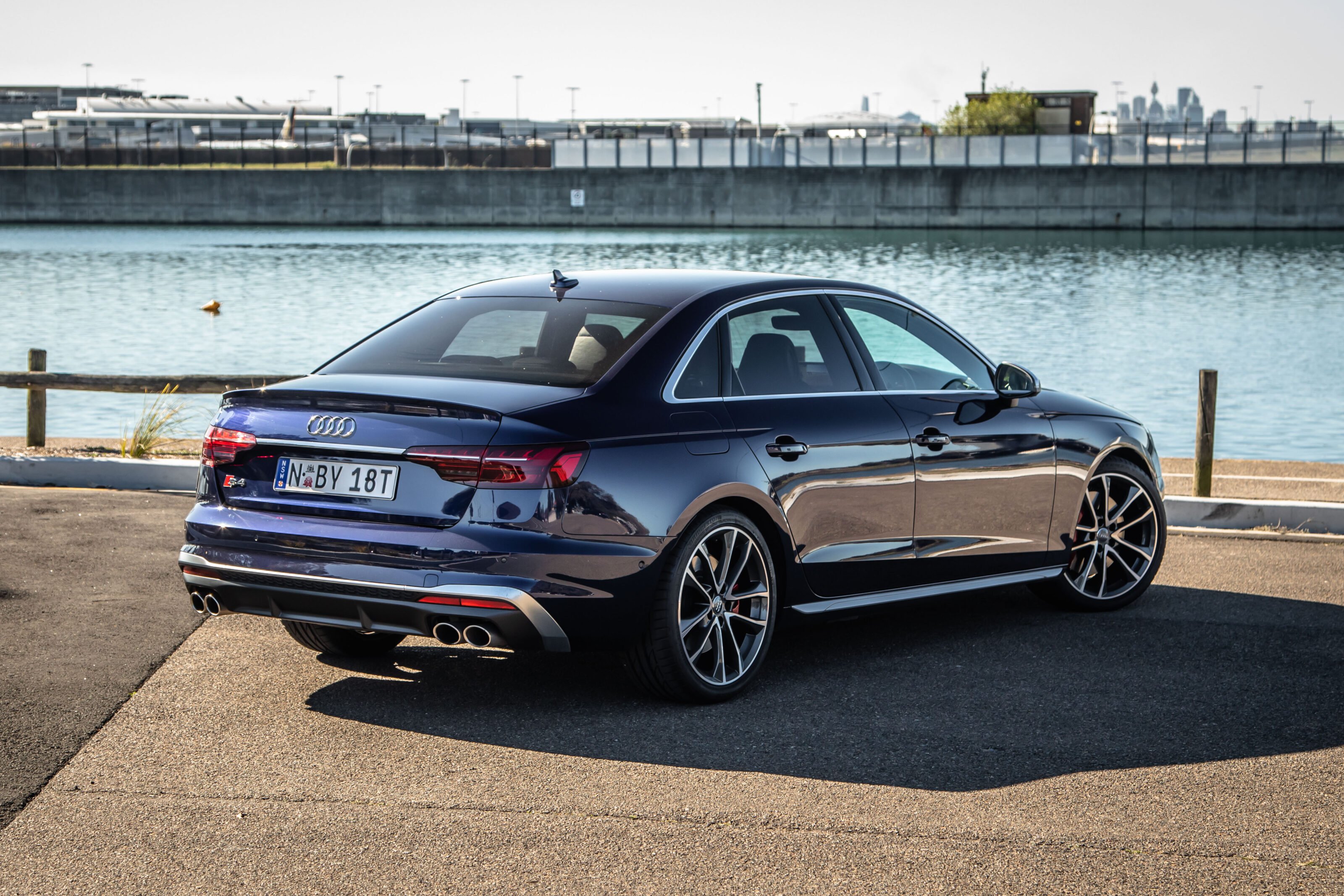
Nobody sees the S4 coming because it doesn’t make a big deal about its abilities when it blows by. Passengers declare it “a nice car” until you plant your foot or fail to slow as much as they think you should for corners.
It goes about its business quietly but with devastating effectiveness, hauling you out of corners with a smoothness that only a German six-cylinder can while launching you at the horizon at improbable speeds
Ownership
Sigh. I hate being a broken record, but a three-year warranty for a $100,000 car is not long enough. Same goes for BMW.
It’s not long enough because cheap Kias have a seven-year warranty and expensive Mercedes – including AMG – have five years, along with almost everyone else, including Jaguar and Land Rover. And yes, the Lexus warranty is too short at four years, too.
On the bright side, servicing comes at reasonable intervals and doesn’t cost much more than the four-cylinder cars, which is also rather lovely. If you pre-pay for five years (see?) you’ll pay $2950, or less than $600 per year. That’s pretty good for a rocket like this.
2021 Audi S4 specifications
Verdict
Only Audi can do – with this much success – what it does with the S4. While I love the RS cars, they can sometimes miss the mark, like the slightly doughy new RS6 or the sometimes just too much RS4/RS5 pairing. That’s not a criticism, I’m all for just too much all the time, but sometimes you want the option to take it a bit easier.
Lean athleticism over sheer power, you might say.
This is the kind of fast car you’d own if you don’t want anyone to know you own a fast car. Fast, elegant and terribly discreet, the S4 won’t garner any attention even in these heightened policing times. While the B9 A4 has been around for a long time now, it’s ageing extremely gracefully, with the updated interior from the 2019 refresh and its subtly altered sheetmetal.
Loaded with tech, an almost-sensible price and a huge amount of performance, it scarcely feels like a step down from the considerably more expensive RS machines.
| Body:u00a0 | four-door sedan |
|---|---|
| Drive: | AWD |
| Engine: | 3.0-litre turbo V6 |
| Transmission: | eight-speed automatic |
| Power: | 260kW @ 5400-6400 rpm |
| Torque:u00a0 | 500Nm @ 1370-4500rpm |
| Bore stroke (mm): | 84.5 x 89.0 |
| Compression ratio:u00a0 | 11.2 : 1.0u00a0 |
| 0-100km/h:u00a0 | 4.7 sec (claimed) |
| Fuel consumption:u00a0 | 8.6L/100km (combined) |
| Weight: | 1765kg |
| Suspension: | MacPherson struts front/multi-link rear |
| L/W/H:u00a0 | 4770mm/1847mm/1404mm |
| Wheelbase: | 2825mm |
| Brakes:u00a0 | 350mm ventilated disc front / 330mm solid disc rear |
| Tyres:u00a0 | 245/35 R19 Bridgestone Potenza |
| Wheels:u00a0 | 19-inch alloy wheels ( spare) |
| Price:u00a0 | $99,900+ ORC |
