
Think Volkswagen and you probably think ‘sensible’. Sensible cars like the Polo, Golf and Tiguan in sensible colours like silver, white or grey bought and driven by sensible people.
By and large, you’re correct. But every now and then a moment of madness bursts forth, like a jet of lava erupting from a usually dormant volcano.
From oddball models to bizarre engine combinations, to celebrate these frissons of excitement here are our Top 10 weird Volkswagens, presented in chronological order.
1967 Volkswagen Country Buggy
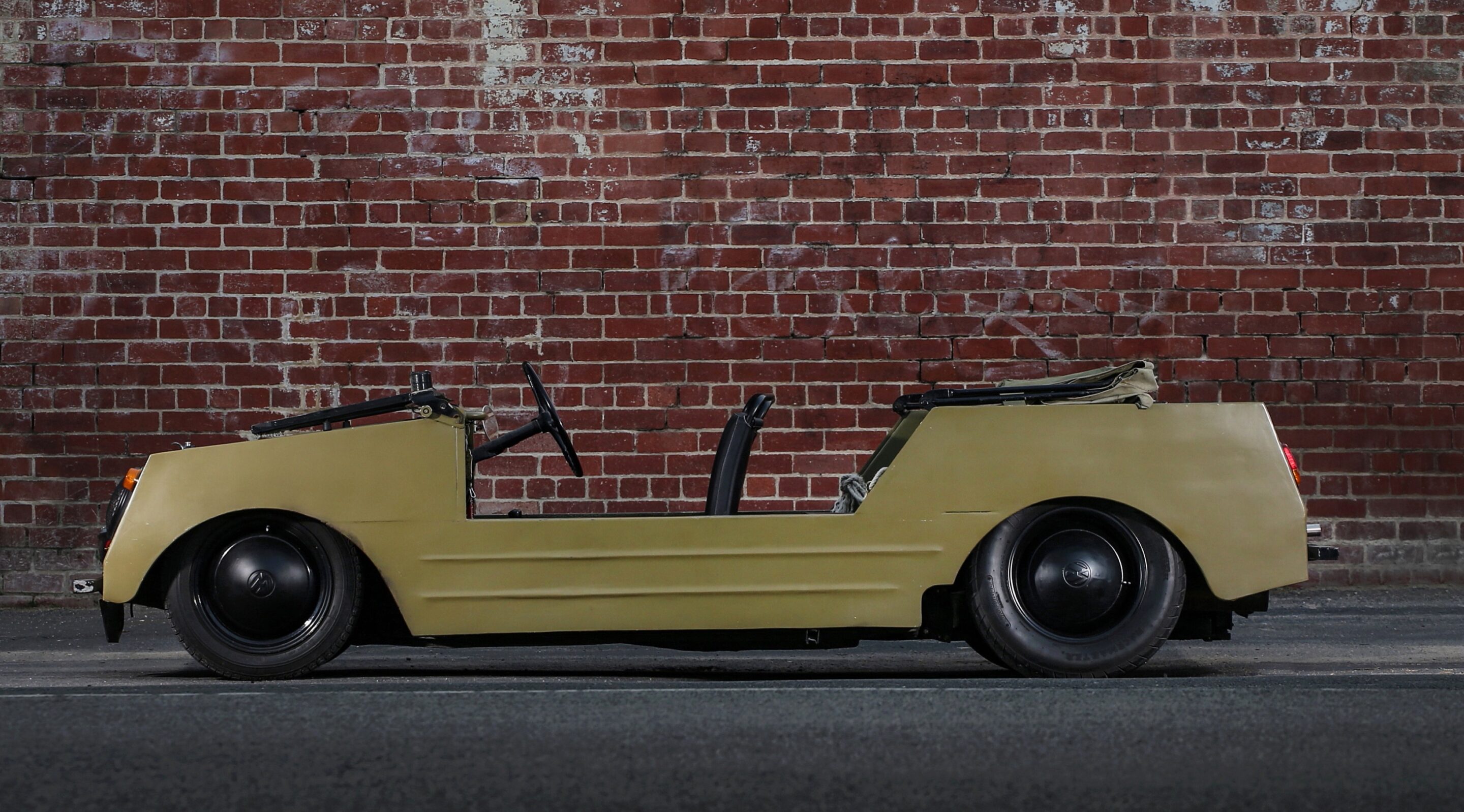
A little local flavour to start. A project originally intended for the Australian army, who requested an amphibious four-wheel drive vehicle, given the Country Buggy ended up as a rear-wheel drive that couldn’t float, the army never ordered any.
Three prototypes covered more than 50,000km of testing to ensure they could handle Australian conditions, but in the end fewer than 2000 were built, including CKD kits and exports.
If you see one driving around Melbourne, there’s a strong chance it’s longtime friend of Wheels, photographer Cristian Brunelli.
1972 Volkswagen SP2
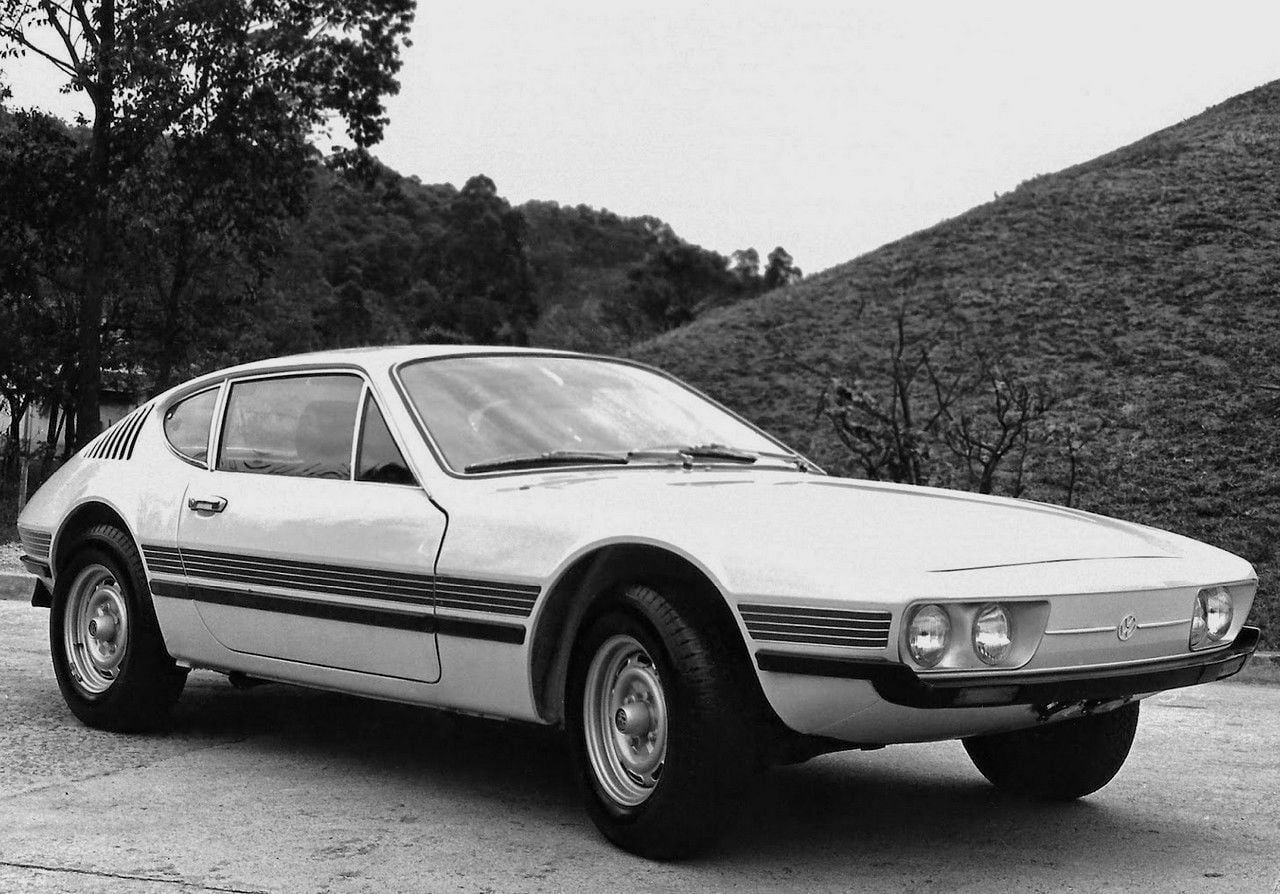
For many years Volkswagen Brazil has acted almost as its own entity, much as Ford Australia did, and that includes the creation of one of the brand’s few sports cars.
Designed, developed and built in South America, the SP2 is a terrific looking car, though sadly the go didn’t match the show as it was powered by a 48kW 1.7-litre four-cylinder for a quoted 0-100km/h time of around 15sec.
While not a huge success, more than 10,000 were built between July 1972 and December 1975.
1978 Volkswagen Iltis
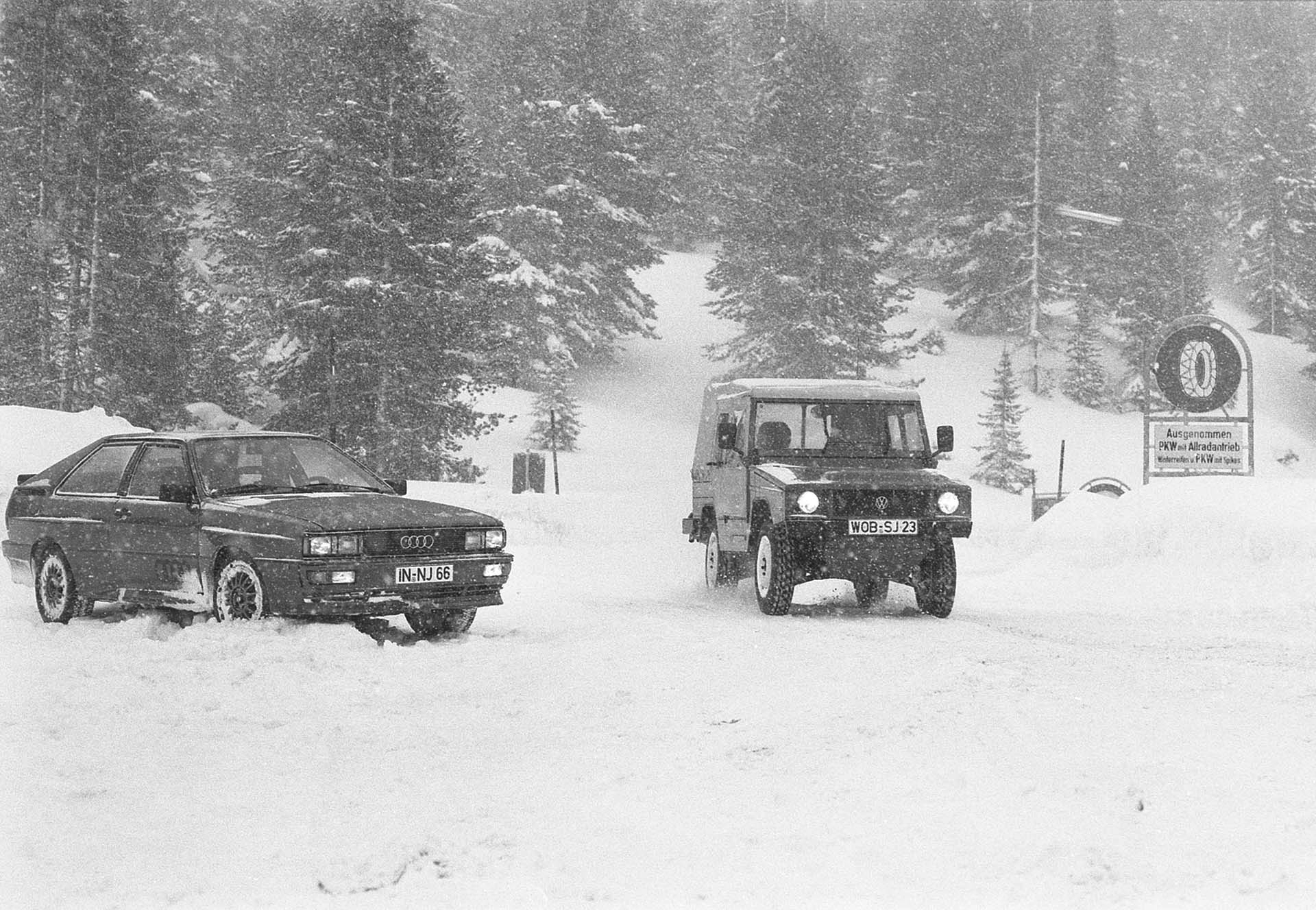
The VW Iltis is most famous for donating its four-wheel drive system to the prototypes of the original Audi Quattro, but ironically this rugged military off-roader tasted motorsport success first, winning the 1980 Paris-Dakar Rally.
Once again, the German military was after an amphibious four-wheel drive, but with that project continually delayed the Iltis was conceived as a cheaper and simpler stopgap for troop transport and the like. A civilian version was also made, but only 181 are said to have been built.
1998 Volkswagen Bora V5
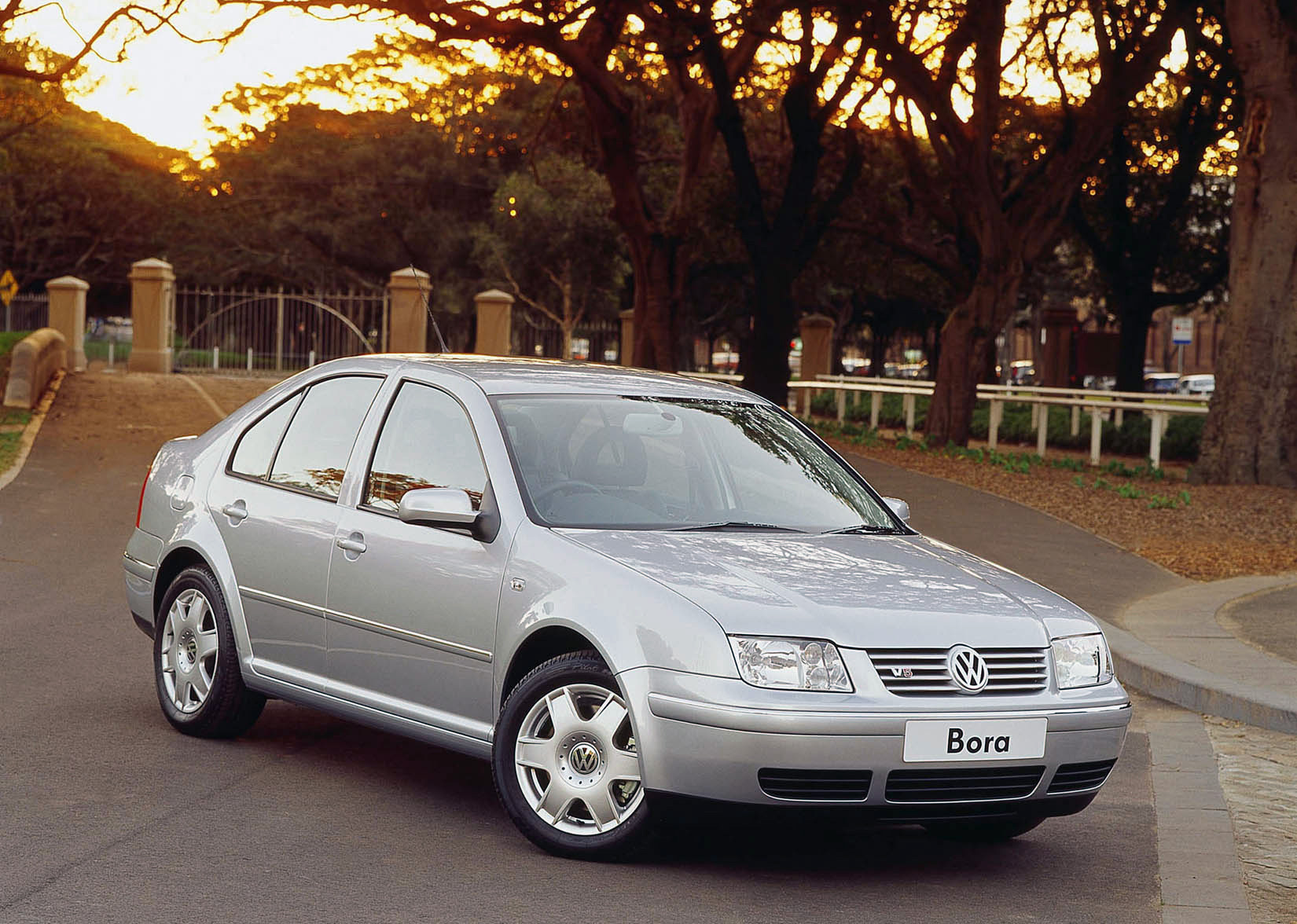
For a while, Volkswagen seemed hell-bent on offering every conceivable engine configuration. One of the weirder ones was the VR5, a 2.3-litre five-cylinder with a very narrow 15-degree vee, which allowed it to be as short as a three-cylinder and have a single inlet and exhaust manifold.
It was offered in a number of cars, but we’ve chosen the Bora as it adds some intrigue to an otherwise pleasant but unremarkable small sedan. Initially offered as a 10-valve with 110kW/209Nm, it was updated in 2000 with 20 valves and variable valve timing for 125kW/220Nm.
2001 Volkswagen Beetle RSI
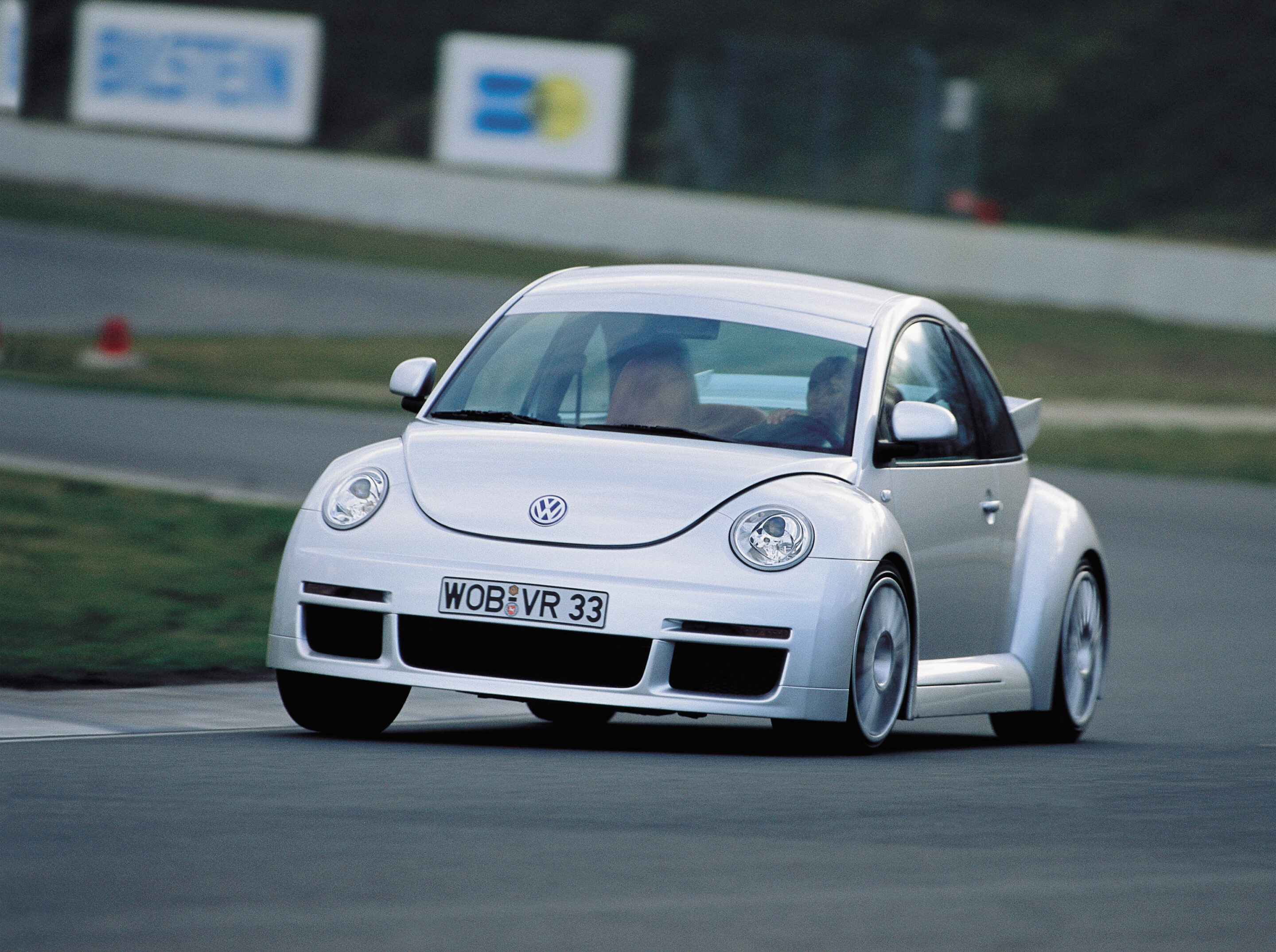
In an effort to butch up the New Beetle, Volkswagen came up with the wild RSi, which wedged in a 3.2-litre V6 with 165kW/320Nm, a six-speed manual gearbox, all-wheel drive and that motorsport-inspired body kit.
Just 250 were built, all in left-hand drive, and they cost a fortune (around AUD$125,000) but that didn’t stop Volkswagen Australia entering one in Targa Tasmania, where it crashed into a bus stop. It also converted another to right-hand drive, so where is it now?
2001 Volkswagen Passat W8
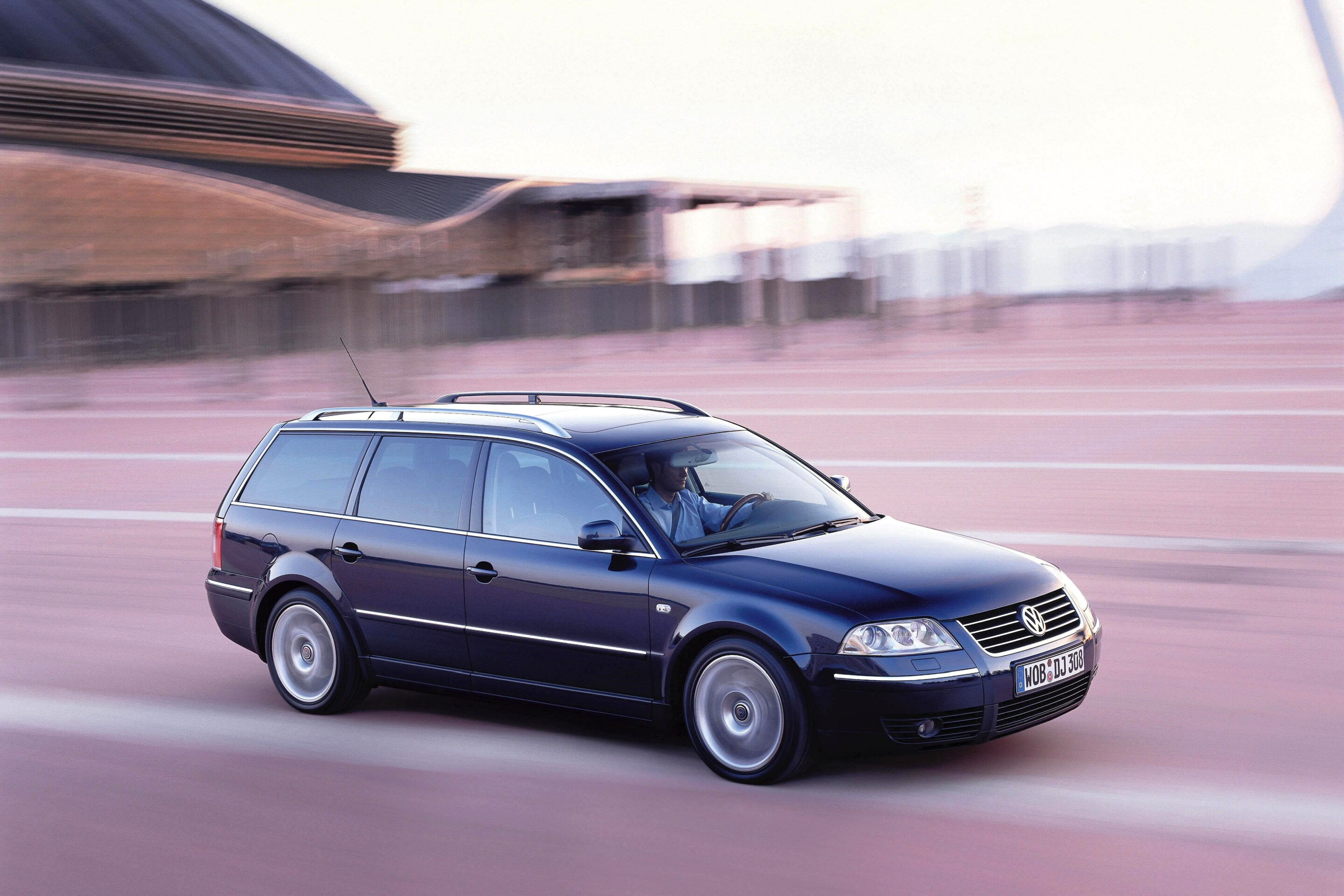
Another one for the “weirdo engine” files. A bit like the smaller Bora, the B5 Passat was a competent but otherwise forgettable sedan, except when it was facelifted and a 4.0-liter W8 was introduced as the flagship engine.
Two narrow-angle V4s joined by a common crankshaft, it produced 202kW/370Nm,m but buyers weren’t that keen, with only around 11,000 being built over its three-year lifespan. The Holy Grail? A wagon with the six-speed manual, with 100 or so said to exist.
2002 Volkswagen Phaeton W12
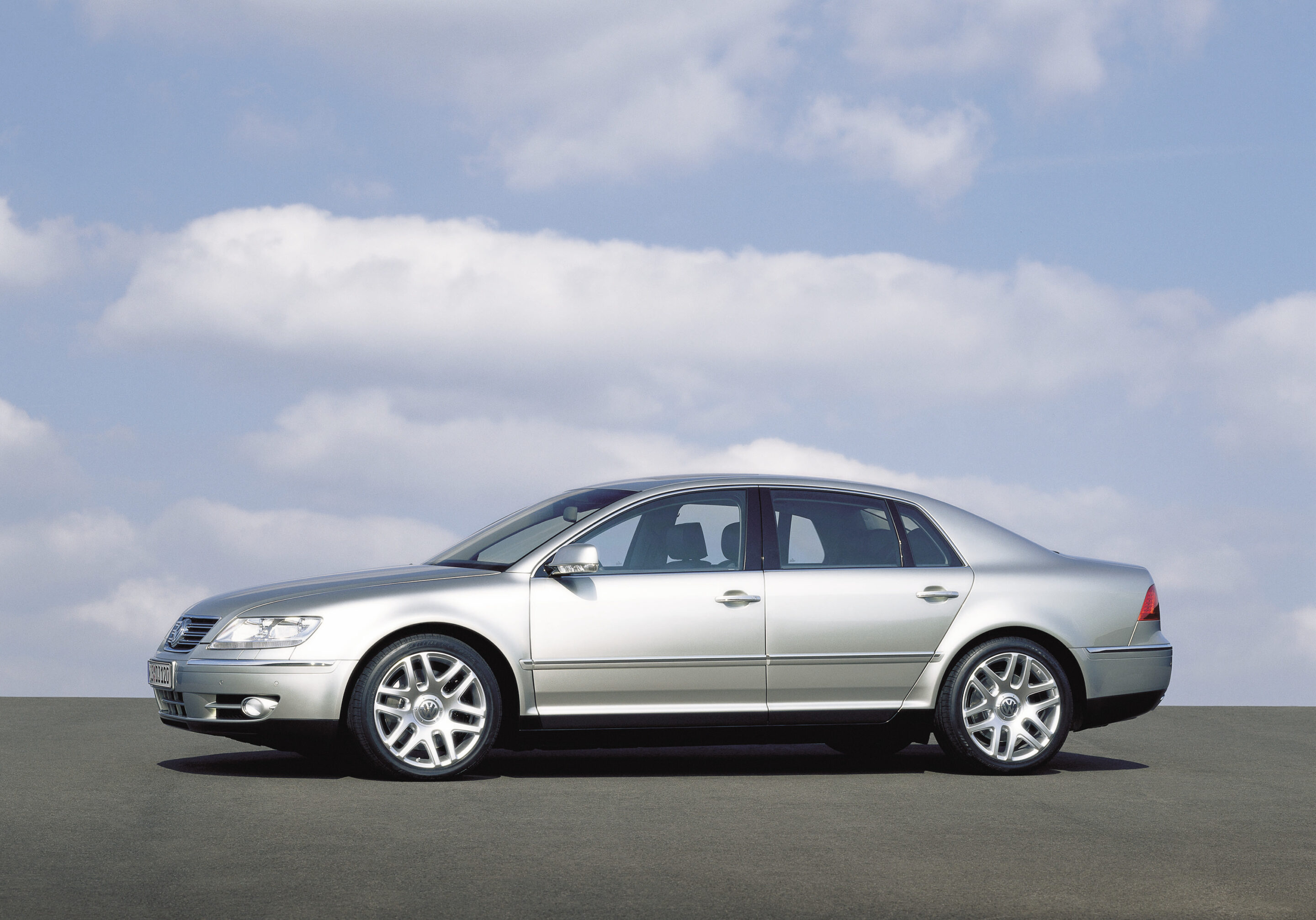
Never do things by halves. If you’re going to try and build the best car in the world and make it a giant VW sedan, you might as well give it a preposterous engine in the form of a 309kW/550Nm 6.0-litre W12.
Like the W8, the W12 was made up of two narrow-angle V6s on a common crank and the added smoothness of the W layout was a fine fit for a car with extreme luxury pretensions. While it wasn’t popular with VW buyers, in twin-turbo form it became a mainstay of the Bentley range for two decades.
2008 Volkswagen Touareg R50

The fact you could get the first-generation Volkswagen Touareg with a 5.0-litre V10 turbodiesel was weird enough (though they also made W12 versions!), but then things got really kooky when a high performance Touareg dubbed the R50 was revealed at the 2007 Australian Motor Show.
Only the third VW to be given the ‘R’ treatment, it developed 257kW and a thumping 850Nm, the latter making it a popular towing choice for well-heeled motorsport enthusiasts. Sadly, when the second-gen Touareg arrived, the V10 disappeared.
2014 Volkswagen XL1
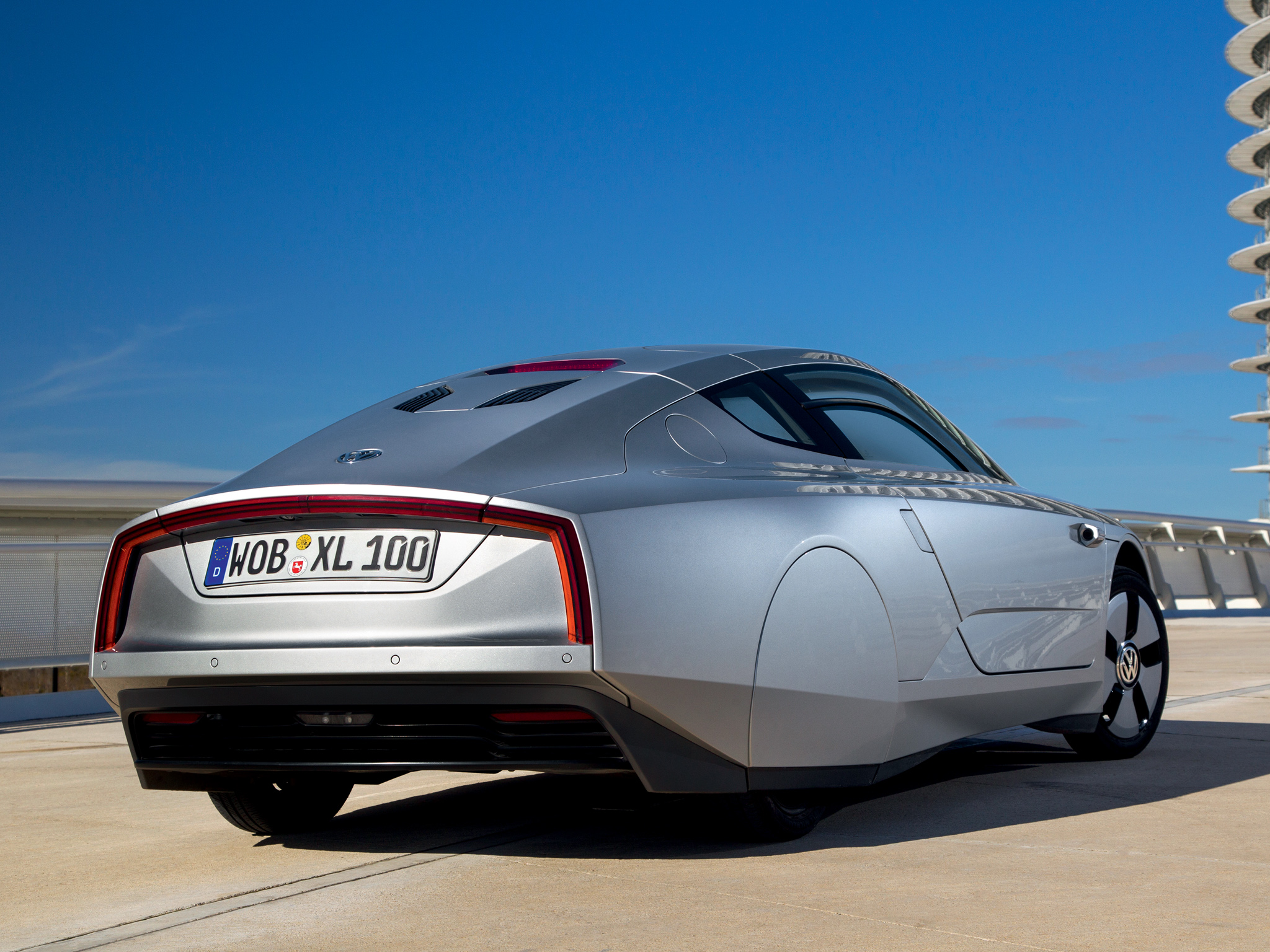
Bugatti Veyron? Pah. The Volkswagen Group’s greatest engineering challenge of the 2000s was “The One-Litre Car”, which could travel 100km on one litre of diesel. After a couple of concepts, the production XL1 appeared in 2013.
Carbon-bodied, exceptionally aerodynamic and with a two-cylinder electrified diesel engine, the XL1 was rated at 0.9L/100km on the combined cycle. With just 250 built it’s twice as rare as a Veyron, though at €111,000 it was about the same price as a Porsche 911 Carrera S.
2025 Volkswagen Saveiro
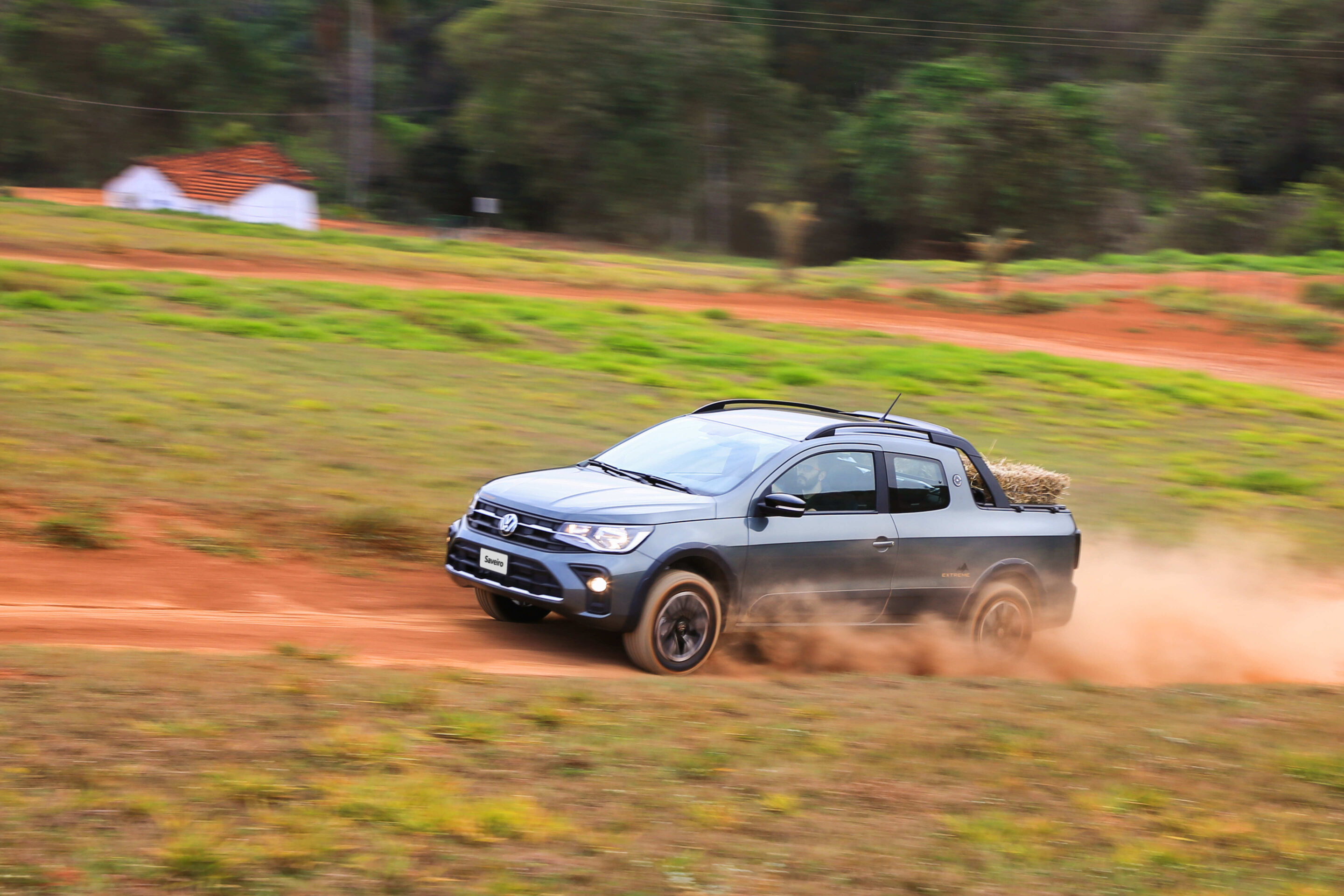
Another creation of Volkswagen Brazil, the Saveiro is a light ute built off the Gol small car (yes Gol, not Golf). First introduced in 1982, the Saveiro has been a staple of the lineup in developing markets until the present day.
Available as a single-, extended- or double-cab (though still with two doors), it has a useful payload of around 700kg, though with an 88kW 1.6-litre four-cylinder and front-wheel drive, we’re not sure it would be tempting Aussies out of their Amaroks.
Call it the law of unintended consequences.
This is the story of how the legendary Lancia Delta HF Integrale came into being, but before we get there, it’s worth reminding ourselves how and why that car earned such iconic status.
When Lancia set out to build its no-holds-barred 1980s Group B rally weapon in the shape of the Delta S4, it never quite met expectations. Despite this twincharged mid-engined silhouette car’s fearsome 368kW power output, it was beaten by Peugeot and Audi in the 1985 season and by the dominant Peugeot 205 T16 again in 1986.
Henri Toivonen’s fatal crash at the Portuguese round of the world rally championship in 1986 put an end to Group B. For the format that was to succeed it, Group S, Lancia had already developed an advanced prototype, the ECV (Experimental Composite Vehicle). The apex of rallying took a step back in terms of power and technology, adopting the Group A ruleset, which required an all-wheel drive production car base.
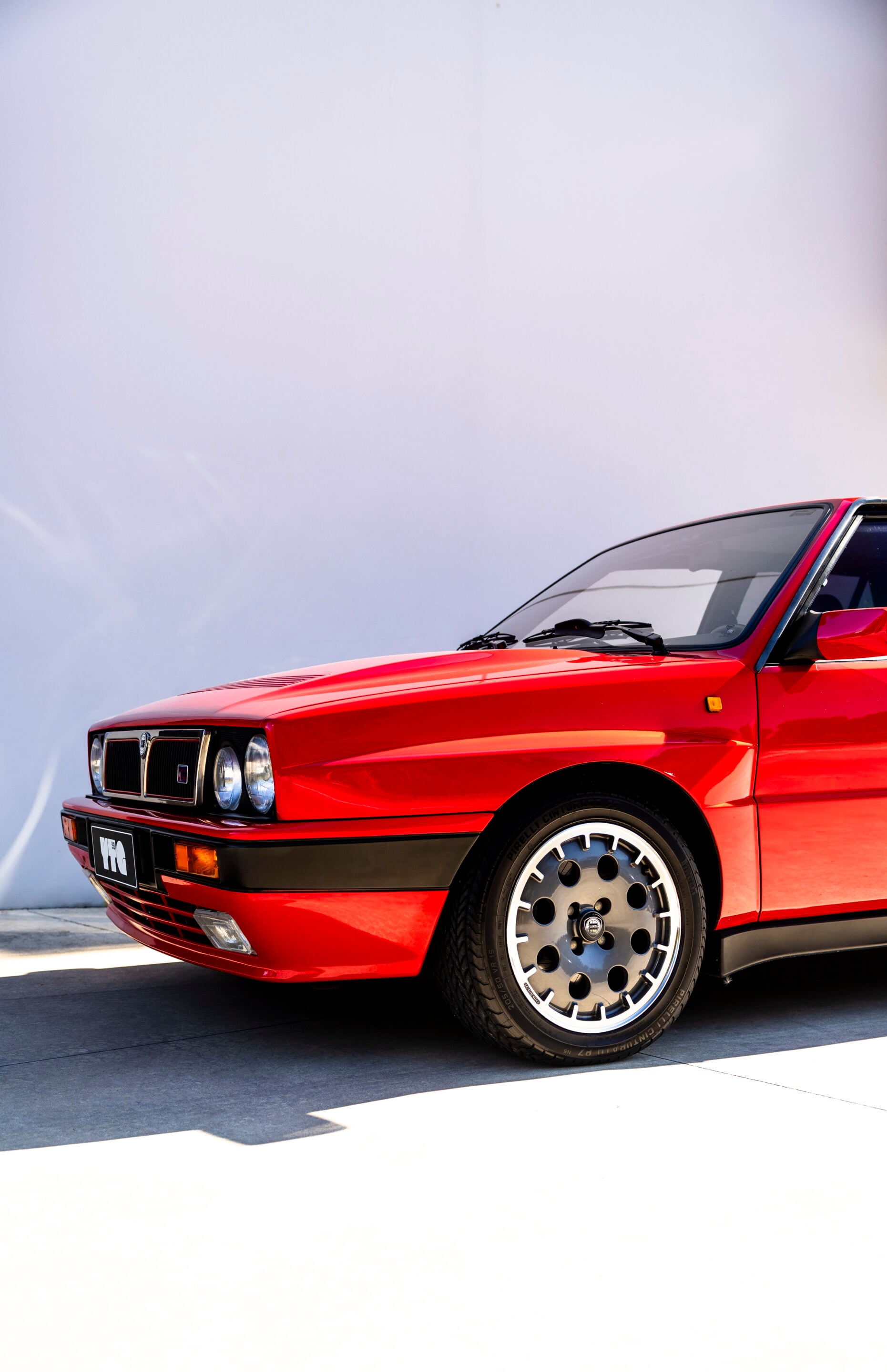
Fortunately for Lancia, it had exactly that. The Delta hatch was introduced in 1979, a crisp Giugiaro-penned five-door that featured a version of the existing Fiat Ritmo’s chassis, plugging a gap below the Beta in Lancia’s line-up that had previously been served by the Fulvia Berlina. Saab pitched in with the development, helping with rustproofing, the ventilation system, the tailgate design and the split-folding rear seats.
In return, it would get a badge-engineered version for Nordic markets, dubbed the Saab-Lancia 600, which wasn’t particularly successful and was quietly withdrawn in 1982, just two years after launch. Elsewhere, the Delta’s reception was a good deal warmer, having captured the 1980 European Car of the Year crown. However, the company was slow to realise quite what it had on its hands as the basis for a rally car.
After all, Lancia had already ventured down the wrong route once in its Group B challenge. Desiring a latter-day Stratos, it developed the rear-drive Rally 037 in conjunction with Pininfarina, Dallara and Abarth when all of its competitors accepted that all-wheel drive was the only viable way forward. Amazingly, the 037 did win the 1983 manufacturers’ world title, at the hands of two rallying legends: Walter Röhrl and Markku Alén. It would prove the last time a rear-drive car would ever claim rallying’s most prestigious award.
Its replacement, the Delta S4, was perhaps the most extreme special stage car to enter Group B. Work began on this project in April 1983, with initial tests showing that it was already a massive four seconds faster than the 037 around the 2.2km La Mandria test track. The Delta S4 was unveiled in December 1984, with homologation granted on November 1, 1985. We know its rallying palmarès.
Hindsight shows that the Delta was a smarter engineering concept than the 205 T16, but the Peugeot was a better technical execution in practice. That’s as maybe, but FISA’s knee-jerk reaction to Toivonen’s crash in the Delta S4 Portugal had the unintended effect of suddenly putting Lancia in the box seat.
Adapting the 1986 Delta HF 4WD road car to the new Group A rules wasn’t particularly difficult, and Lancia’s task was made easier by Peugeot dipping out of the championship. The French were furious at the decision to ditch Group B, stating publicly that they would never build a Group A racer since the ruleset made no sense to them. Instead, Peugeot directed efforts into the 905 sports car prototype racer to enter in the Endurance Racing World Championship. Audi also found itself at a competitive disadvantage to the flyweight Delta in an era where power was capped at a notional 300bhp (224kW) by a 34mm turbo restrictor and there was no minimum weight limit.
With the likes of Markku Alén, Miki Biasion, Bruno Saby and that year’s world champion, Juha Kankkunen, at the wheel, Lancia romped to the 1987 title, scoring 140 points with runner-up Audi a long way distant on 80. The following season opened with the Delta HF 4WD rally car again looking hard to beat, winning the first two stages in Monte Carlo and Sweden, but Lancia had something even better waiting in the wings.
For the Portuguese event in March, the Italians rolled out the Delta HF Integrale, arriving on the gravel a full six months before the production version would be launched to the public. Lancia won every round of the 1988 World Championship bar Corsica, where the Integrale finished second. Miki Biasion claimed the driver’s crown and, in the form of the Integrale, a rallying dynasty was born. Lancia would go on to win rallying’s top award for manufacturers every year up to and including 1992. The Delta’s rallying dominance saw its sales leap by 42 per cent in its home market in the first half of 1987 and helped burnish the appeal of the Integrale road cars.
These started with the Integrale 8v. Compared to the outgoing Delta HF 4WD, the Integrale initially didn’t seem night-and-day different. The engine was a carryover item, and could still trace its genesis back to the Aurelio Lampredi-designed Fiat twin-cam unit. For the Integrale, it was fitted with new valves, valve seats and water pump. A bigger air cleaner, cooling fan and larger radiators were fitted too, alongside a larger capacity Garrett T3 turbocharger.
The Integrale was a bucket list car for the rally team’s engineers. They wanted more tuning headroom, less weight, bigger brakes, a stronger chassis and suspension and a wider track. They got the lot. Only ever sold in left-hand drive form, the ’Grale never officially came to Australia, but that didn’t stop it being a target for importers looking to sidestep the red tape.
It also means that it’s one of the few modern classics we’ve covered in this series that was never treated to a Wheels drive story.
It did figure at number 13 on Peter Robinson’s list of the 50 Greatest Cars Of All Time, in the July 2011 issue of the magazine, and that’s quite the recommendation. Robbo praised “the urgency of its responses and an ability to go exactly where it was pointed at speeds that staggered the senses,” finishing up with, “I still want one.” Interestingly, a number of other cars that existed within the Delta’s competition periphery were also featured in that rundown, including the Peugeot 205 GTI, the Audi ur-Quattro and the Toyota Celica, so perhaps the Eighties really were the era of peak rally car.
Given that many car model lines are facelifted at three years old and replaced at seven, it’s unusual that the Integrale 8v first appeared when the Delta shape was already eight years old. It’s also instructive to appreciate that when pitched against the ur-Quattro, the Integrale offered a similar level of performance at almost half the price.
Drive the two rivals back to back and the Integrale feels more alive, with more communicative steering and crisper turn-in. The Audi is a more civilised thing, ultimately quicker, and has more in the way of presence. Its five-cylinder engine is also far more characterful than Lancia’s four. It feels considerably better screwed together than the lightweight Italian. If you had to take one for a blat just for the fun of it? Integrale every time.
Another oddity about the Delta Integrale is that when it comes to modern classics, the original is usually the most valuable. Successive generations tend to dilute the original formula and are worth significantly less. The exception to this rule usually points to a homologation car – think BMW E30 M3 or Mercedes 190E 2.5-16 – and the Integrale is no different. The original 8v cars are the most affordable and they do have their adherents.
With ‘just’ 136kW to call upon, the original Integrale will scuttle to 100km/h in 6.4 seconds in pretty much any weather condition, and modern tyres extend its capabilities beyond anything we experienced in the late Eighties. Some prefer the way the lighter turbocharger spools up lower in the rev range, although compared with later models the 8v runs out of puff a bit above 5000rpm.
That first Integrale sent power from the front transversely mounted engine through a five-speed transmission to all four corners via an epicyclic centre differential. This delivered a nominal 56 per cent front, 44 per cent rear torque split, with a Ferguson viscous coupling varying the front to rear split as required. At the back was a Torsen rear differential, which could apply a further torque split left and right. Lancia balanced the effective gearing of the larger 15-inch wheels with a shorter final drive ratio compared to the HF 4WD.
The brakes were also uprated to 284mm ventilated front discs, augmented by a bigger master cylinder and servo. The front springs, struts and dampers were uprated and the body clothed with blistered wheel arches to accommodate the wider 195/55 rubber.
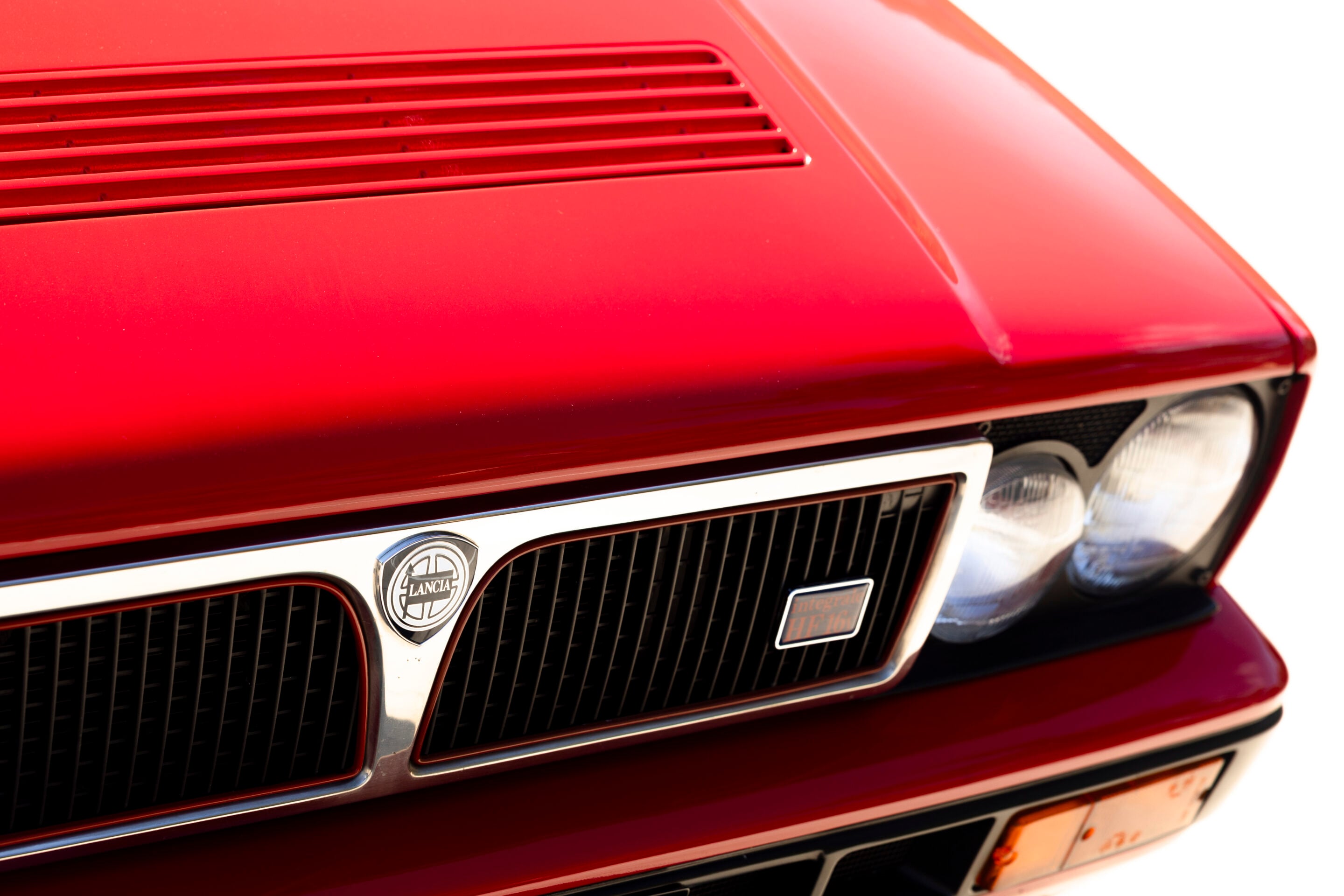
A louvred bonnet, wraparound bumpers, new driving lights, faired side skirts and body-coloured mirrors also featured. But better was to come.
Competition afforded Lancia a massive advantage in the development of the Integrale. Rather than relying on a planned product development schedule or feedback from customers, Lancia was bombarded with forensic feedback on the performance of the Integrale at every rally stage. More than that, it was also harmed with all of the intelligence it gleaned from rival competitors. This allowed for a rapid prototyping and test cycle, with the result that the Integrale 8v was in market for a mere 22 months.
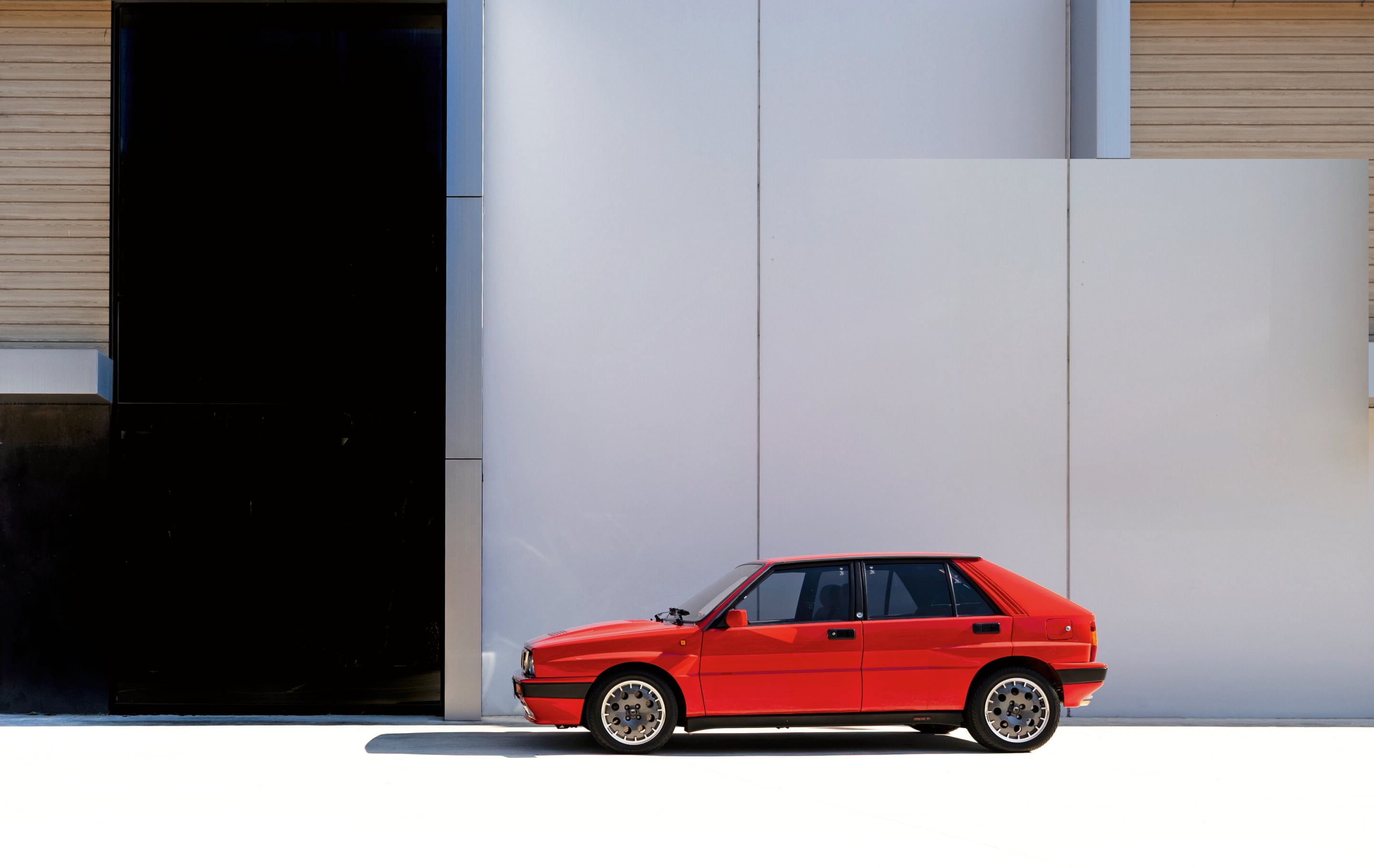
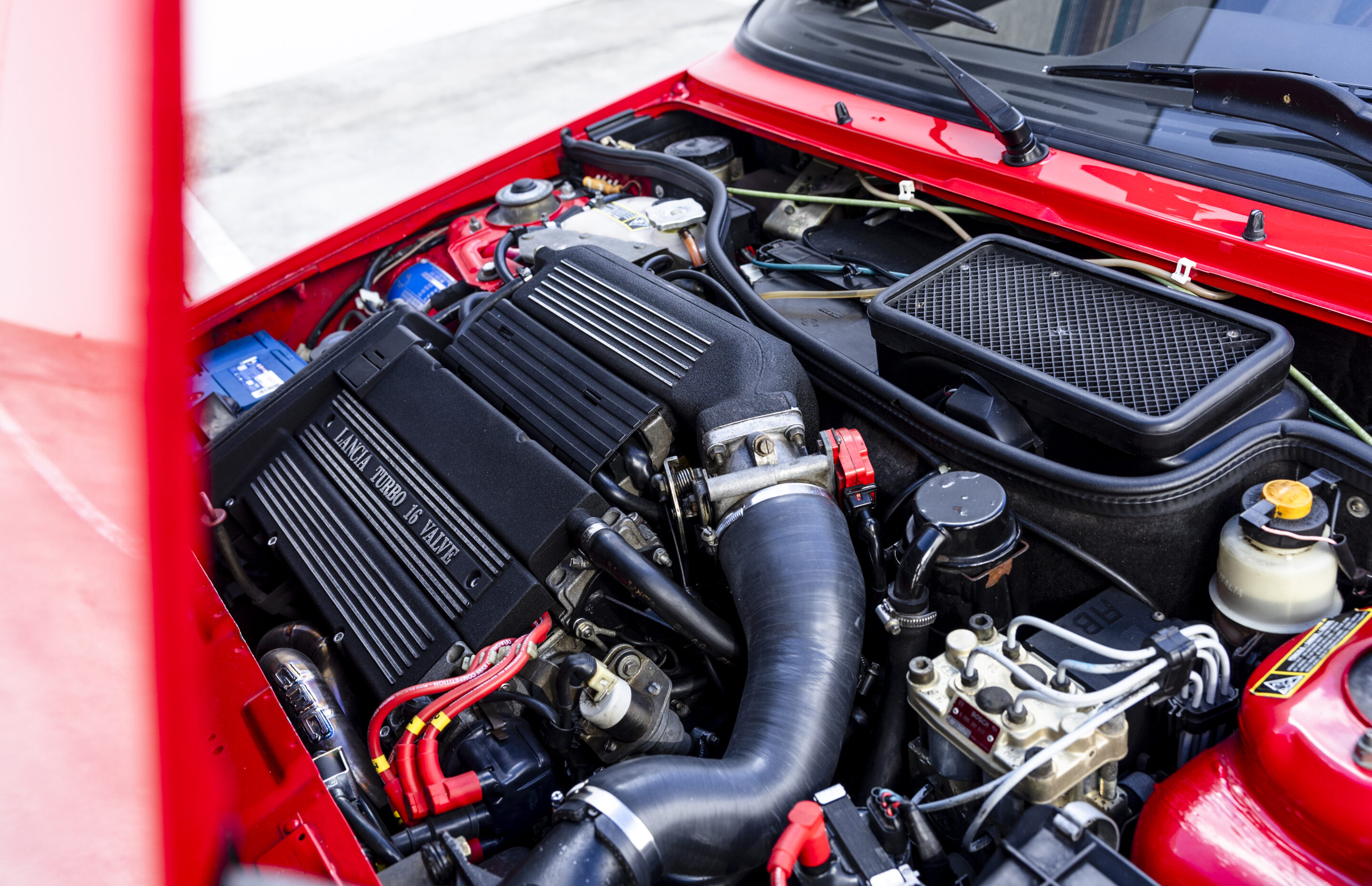
Its replacement was the car you see here, brought to you by our friends at Young Timers Garage, the Integrale 16v. At the tail end of 1988, Toyota began campaigning the Celica ST165 as its rally weapon, with its 16-valve 3S-GTE engine co-developed with Yamaha. In the capable hands of Carlos Sainz, Juha Kankkunen and Kenneth Ericsson it started to score regular podiums, and won the RAC Rally. Lancia needed a 16-valve head on the Integrale to deliver more power at the top end. It also switched the hubs to feature a five-stud pattern, the bonnet was reprofiled to accommodate the taller cylinder head design, the wheels became wider again and the front/rear torque split was changed to a more taily 47:53.
Introduced at the 1989 Geneva Motor Show, the Delta Integrale 16v lifted peak power to 147kW
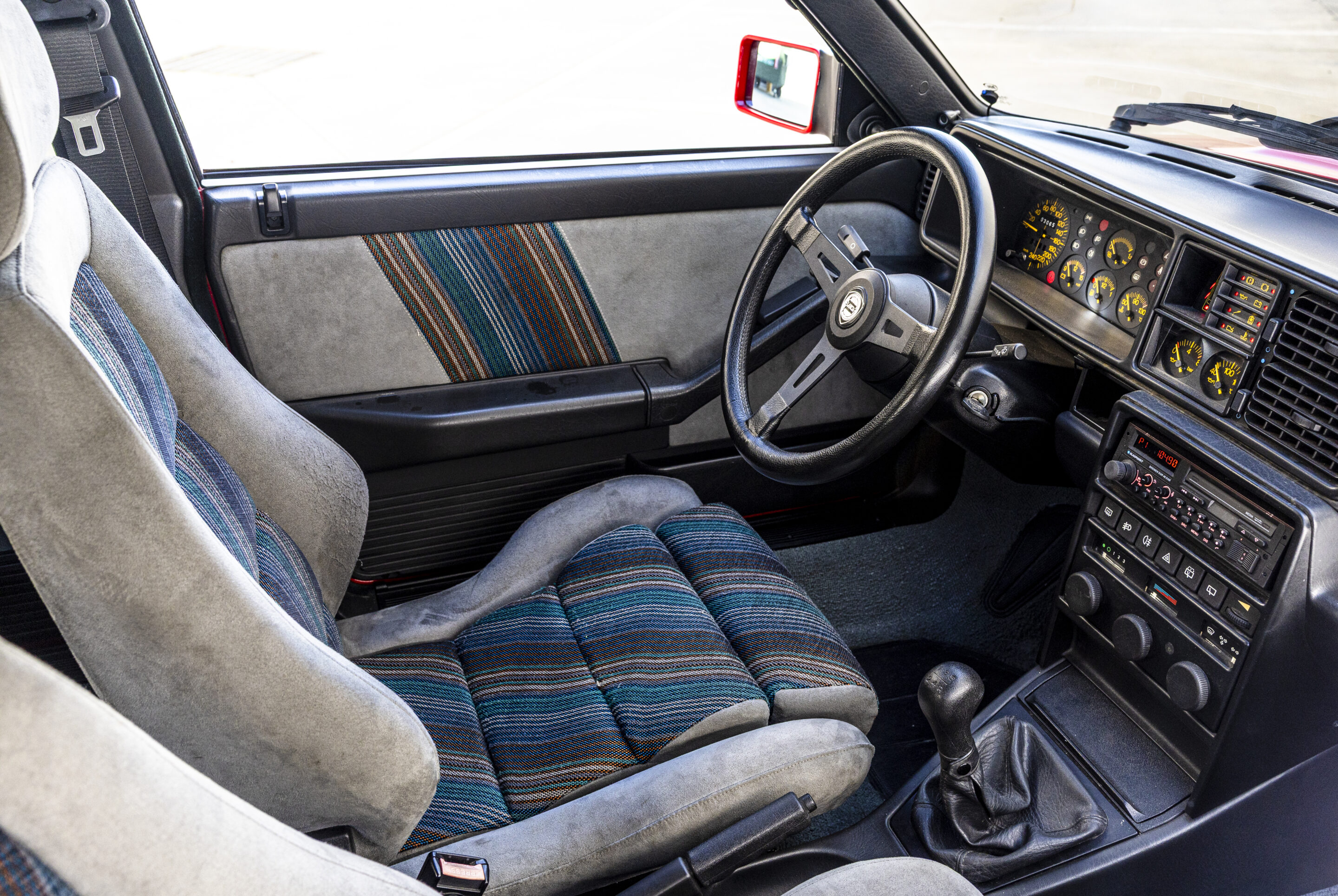
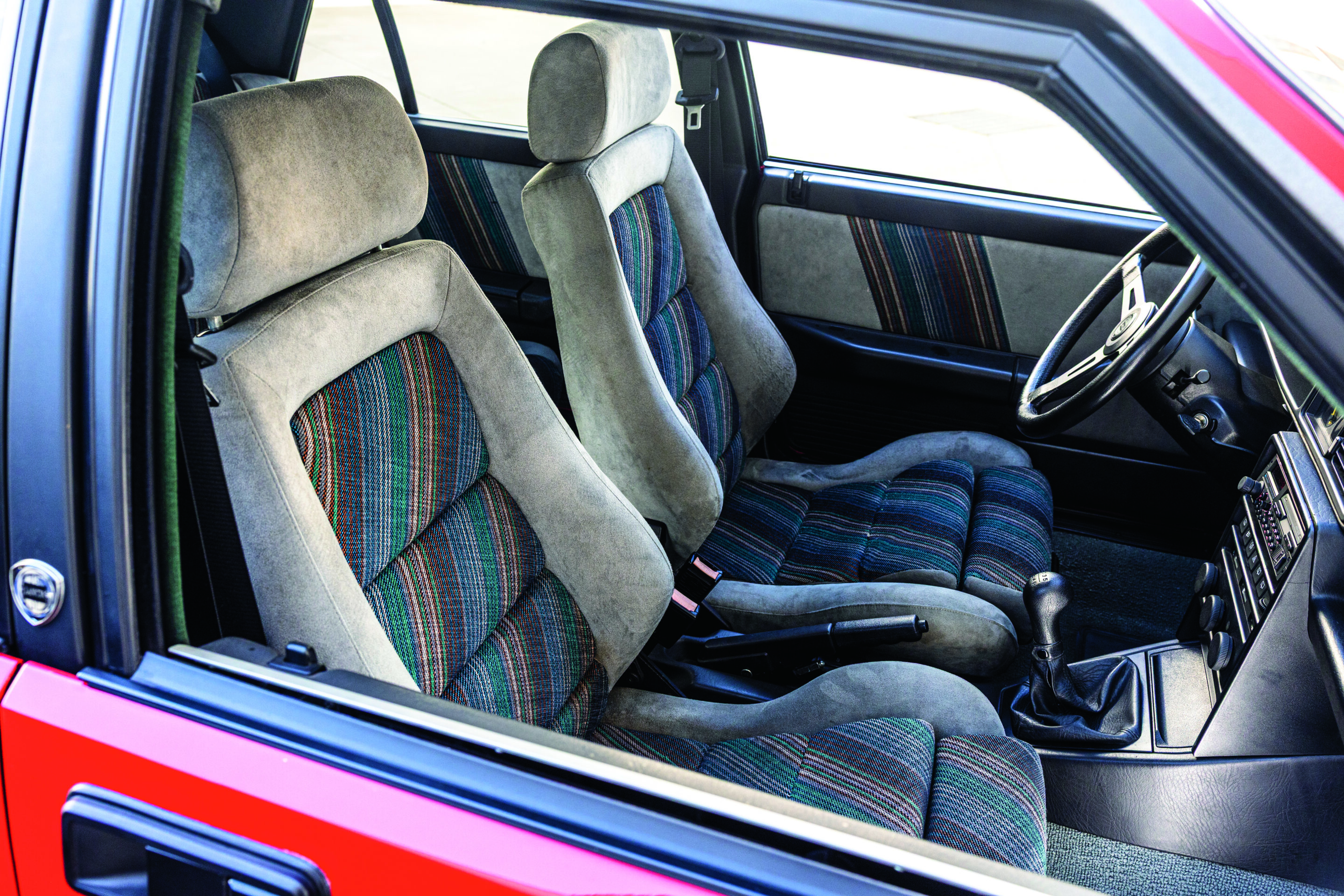
(a neat 200PS) and could sprint to 100km/h in 5.7 seconds. The engine came in for a number of tweaks aside from its better breathing, with bigger injectors, a next-gen intercooler, and an updated Garrett T3 turbo. The model had a mid-life update in 1990 with a revised interior featuring dark grey Alcantara with diagonal stripe contrast velour. Recaro seats were offered as an option, available in dark grey or green Alcantara or perforated black hide.
In many regards the 16v is the sweet spot when it comes to Integrale buying. It’s that little bit more modern and capable than the early cars and many of the niggling issues have been ironed out. The 16v is also considerably more affordable than the subsequent Evolution models.
These were properly special and came about because of an entirely unexpected turn of events. Lancia quit rallying. Although the Delta Integrale Evolution was shown at the 1991 Frankfurt Show, Lancia’s factory interest in rallying ended that year, the Integrale 16v having claimed both the driver’s championship, with Juha Kankkunen claiming his third championship, and the manufacturer’s crown, the latter for the fifth time on the bounce. Instead Fiat diverted its motorsport focus to Alfa Romeo and the development of the 155 touring car. What was there left to achieve with Lancia? Quite a lot, as it happens.
A contract was agreed with a number of privateer teams to campaign the new Evolution model in 1992. If Lancia was out of the game officially, then unofficially it was still diverting plenty of budget both to the development of the Delta Evolution and to Jolly Club, who took up the reins of Lancia’s WRC development program from the start of 1992, albeit with cheques still coming from Lancia and the workshop still being the existing Abarth facility. The 1992 season would see the marque claim its sixth consecutive manufacturers’ title. And it would be Lancia’s last, that baton then being passed to Toyota and, subsequently, the epic dust-up between Subaru and Mitsubishi.
The Delta Evolution road car was something very special. Power lifted to 154kW at 5750rpm, and the steering rack and an accessory oil cooler fitted. The control arms of the suspension were now massive box sections and the front strut towers were raised and braced. Bigger Brembo brakes, chunkier Speedline alloys shod in 205/50 rubber and a freer-breathing exhaust were standard with Bosch six-way anti-lock brakes, a metal sunroof and air conditioning available as options.
It also looked the business, with the even wider box arches now consisting of a single complex pressing rather than being welded on. The beadier projector headlights give it a meaner squint, there’s an even bigger bonnet bulge with additional venting and a three-position roof spoiler. It’s a serious piece of kit. From late 1992, assembly of the Evolution was contracted to Maggiora, who moved into Lancia’s old Chivasso plant. The Evolution was the last of the Deltas to taste success in rallying.
Its successor, the Evolution II was never homologated as a rally car. Its role was to be a beautiful send-off to the Delta Integrale. Now fully catalysed, the engine nevertheless lifted peak power to 158kW and torque to 314Nm, courtesy of a Marelli ECU and new Garrett turbocharger. It was also treated to 16-inch alloys, standard Recaro high-back seats, a leather Momo steering wheel, an aluminium fuel cap and a cylinder head finished in red. The Evo II was only ever offered in three colours, buyers getting a choice of white, red or dark blue, contrasting with a beige Alcantara interior.
True Delta aficionados will know that there was a one-off Evolution III model, handcrafted by Maggiora and finished in violet. It’s called the Viola as a result, wielded 174kW and featured a host of driveline updates. As vanity projects go, it’s a beauty.
In all, Lancia built 44,926 Delta Integrales. By any measure you choose, the Integrale was a massive success. Its legacy is unimpeachable. More than three decades have passed since Lancia walked away from world rallying and it’s still the most successful manufacturer in the sport’s history and the Delta remains the most successful rally car of all time. We may never see its like again. Hail to the chief.
Car supplied by Young Timers Garage
Along came a spider
We’ve covered the one-off Evo III, but the Delta Integrale Evo and Evo II were also offered in at least 11 limited edition models as Lancia really tried to milk the formula. The most unusual Integrale of the lot, however, was the Delta Spider Integrale, a two-door drop-top gifted to Fiat president Gianni Agnelli in 1992. This convertible featured a shorter wheelbase than the five-door hatch, and the body was braced and stiffened. Agnelli drove it until his death in 2003 whereupon it was put on permanent display at the Museo Nazionale Dell’Automobile in Turin.
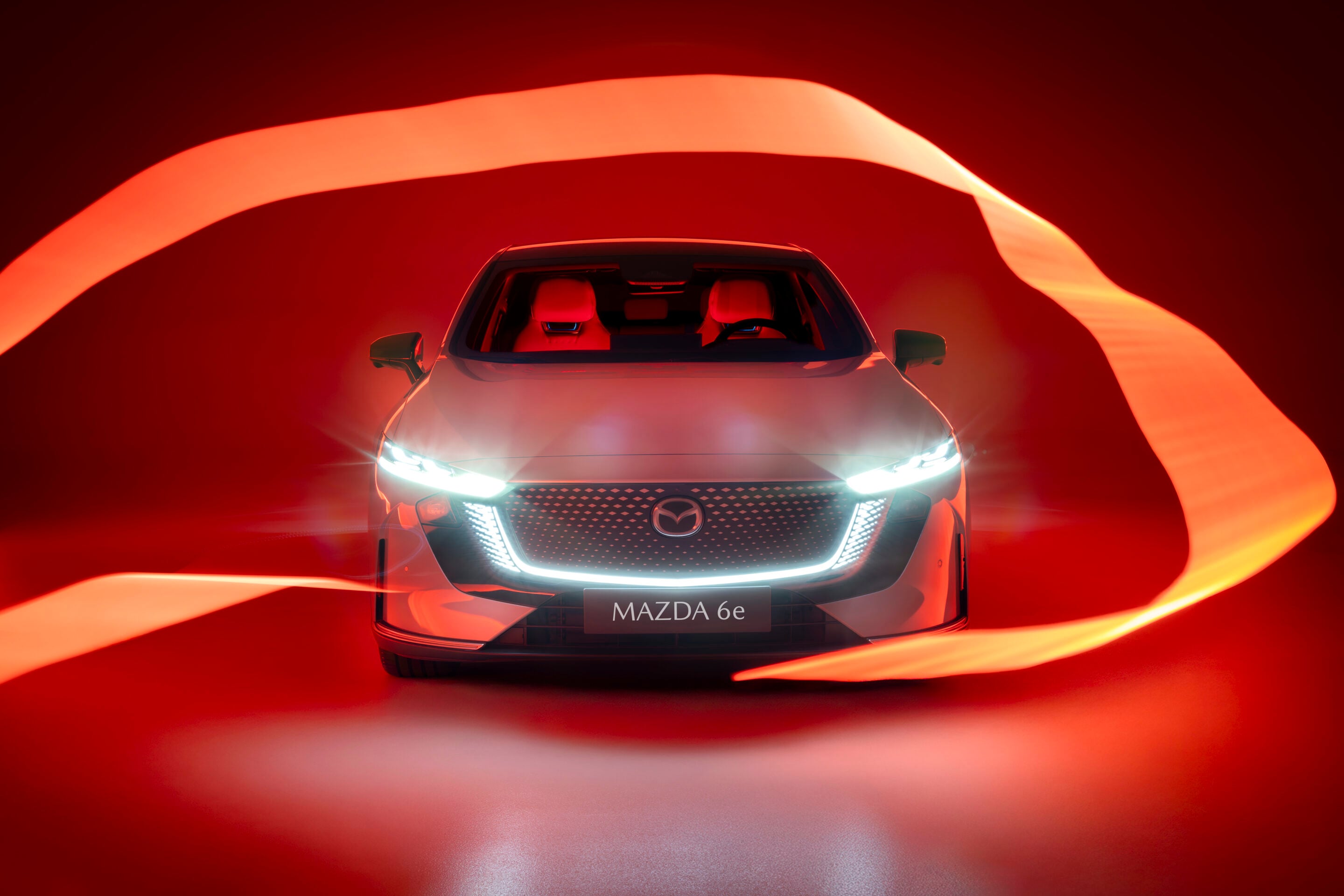
The Mazda 6 sedan was a car loved by Aussie buyers, and not long after the announcement that sales of the sedan would end, Mazda has announced the launch of the new, fully-electric Mazda 6e. Australian media had the chance to look at a pre-production version of the new electric sedan at the launch of the G25 variant of the Mazda CX-60 SUV.
Speaking to journalists, Mazda Australia Managing Director Vinesh Bhindi said the manufacturer was excited to be able to offer the Chinese-built 6e sedan to Australia buyers. “Our partnership with China is long-standing, 20 years,” he said. “With any model like this, we need to confirm that it is a global car and it is available in RHD.”
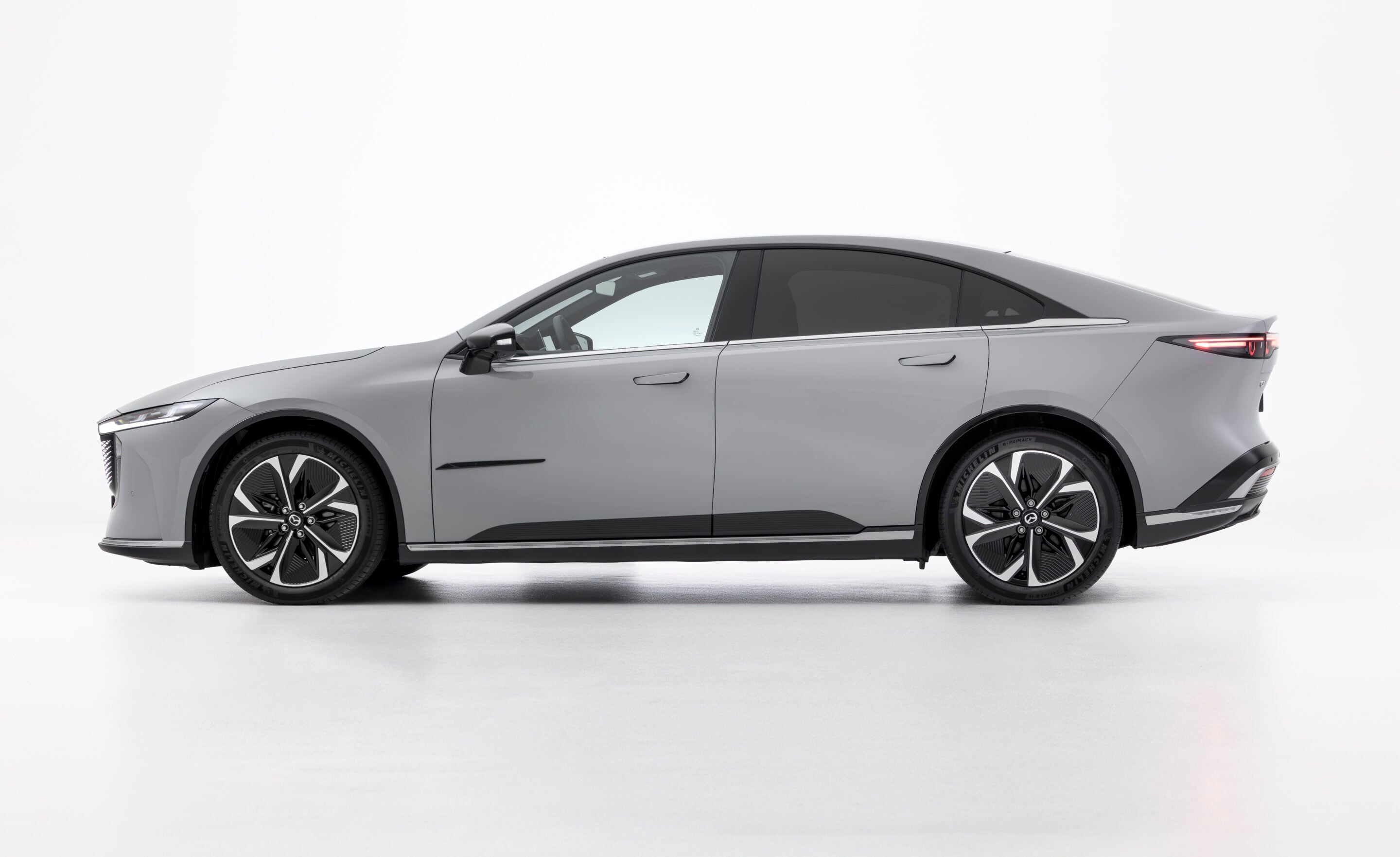
With that confirmation, Mazda Australia took the launch of the new engine variant for the CX-60 as the opportunity to announce the impending arrival of the 6e. And it believes that the 6e can build on the strong foundation of the previous Mazda 6. “We don’t think this will be a niche offering from Mazda,” Bhindi said. “We have a strong customer base from the Mazda 6 and customers interact with us to ask when the next 6 is coming, or to say, I prefer a sedan over an SUV.”
Jarrod Gieschen, Mazda Australia Director of Sales and Marketing reckons the time is right for Mazda to offer a fully electric sedan, with buyers ready to make the transition. “The timing of the launch of our first mainstream electric vehicle is perfect,” he said. “Early adopters have jumped in, but we plan to appeal to everyday buyers, with a Mazda-focused experience, the support of a highly engaged dealer network, head turning product, and delivering everyday electric as we call it.”
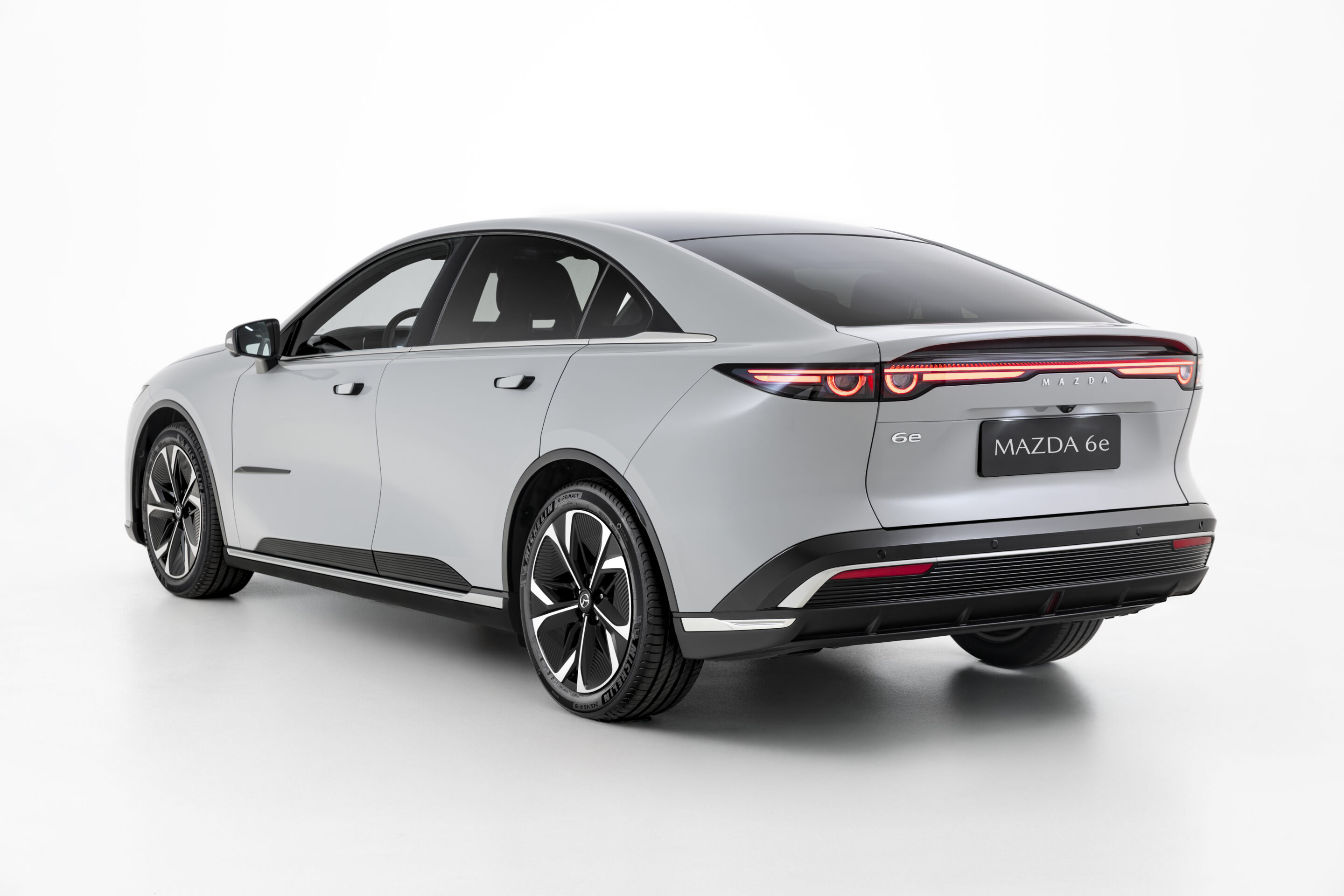
With that promised sub-$55,000 starting price, the early specification details also look promising – a 78kWH LFP battery pack, charging capability from 30 to 80 percent in 15 minutes, a 500km WLTP-claimed range, and RWD with a 190kW motor.
Daniel Wakelam, National Manager and Product Strategy was keen to emphasise the importance of the 6e when it launches in 2026. “This is a very important car for Mazda Australia and we’ve been looking forward to confirming it for quite some time,” he said.
“We are proud of our commitment to offering a breadth of choice for buyers and the 6e will be one of Mazda’s finest cars. It’s a natural successor to the iconic Mazda 6.”
Wheels by WhichCar will have more detail on the 2026 Mazda 6e as soon as it is available.
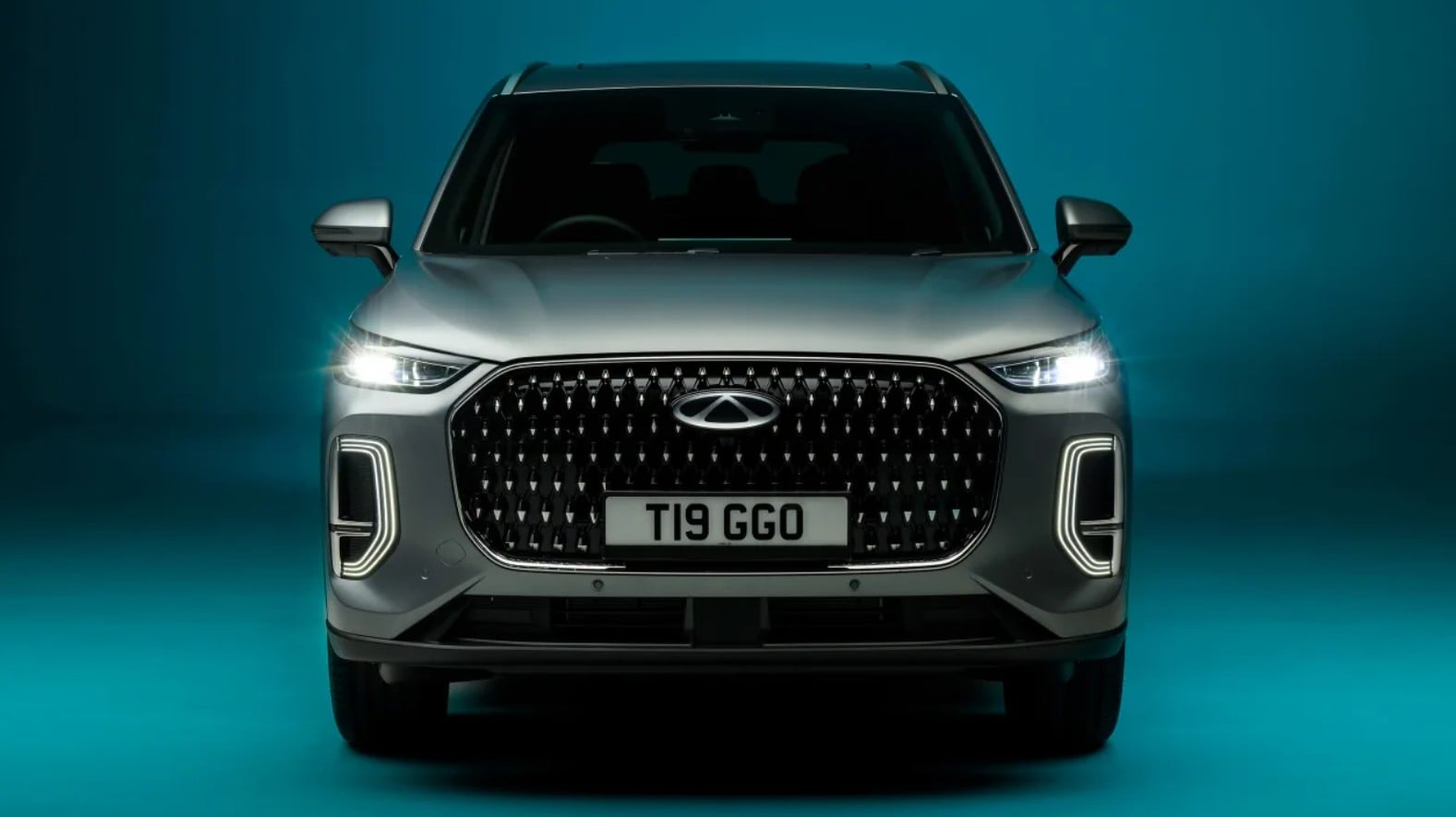
Chery is preparing to launch its flagship Tiggo 9 Ultimate AWD CSH variant in Australia at a price of A$59,990 before on-road costs, marking its highest-end model yet in the local market. The large seven-seat SUV arrives exclusively as a plug-in hybrid all-wheel-drive model and positions itself against rivals such as the Toyota Kluger PHEV and Kia Sorento PHEV.
Powering the Tiggo 9 is a 1.5-litre turbocharged petrol engine combined with three electric motors – two at the front and one at the rear – delivering a combined output of 315kW and 580Nm of torque.
According to Chery, the SUV offers a pure electric range of up to 170 km (based on the NEDC cycle) thanks to a 34 kWh battery, while the total driving range reaches up to 1250 km. Rapid DC charging supports up to 71 kW, enabling 30-80 per cent re-charge in an estimated 18 minutes. Vehicle-to-load (V2L) capability of 6.6 kW allows the SUV to power external devices such as camping gear.
Visually, the Tiggo 9 follows Chery’s contemporary design language, with a wide grille, slim LED headlights and C-shaped daytime running lights up front. The side profile features flush door handles and 20-inch alloy wheels, while the rear includes a full-width LED lightbar and bold CHERY lettering across the tailgate.
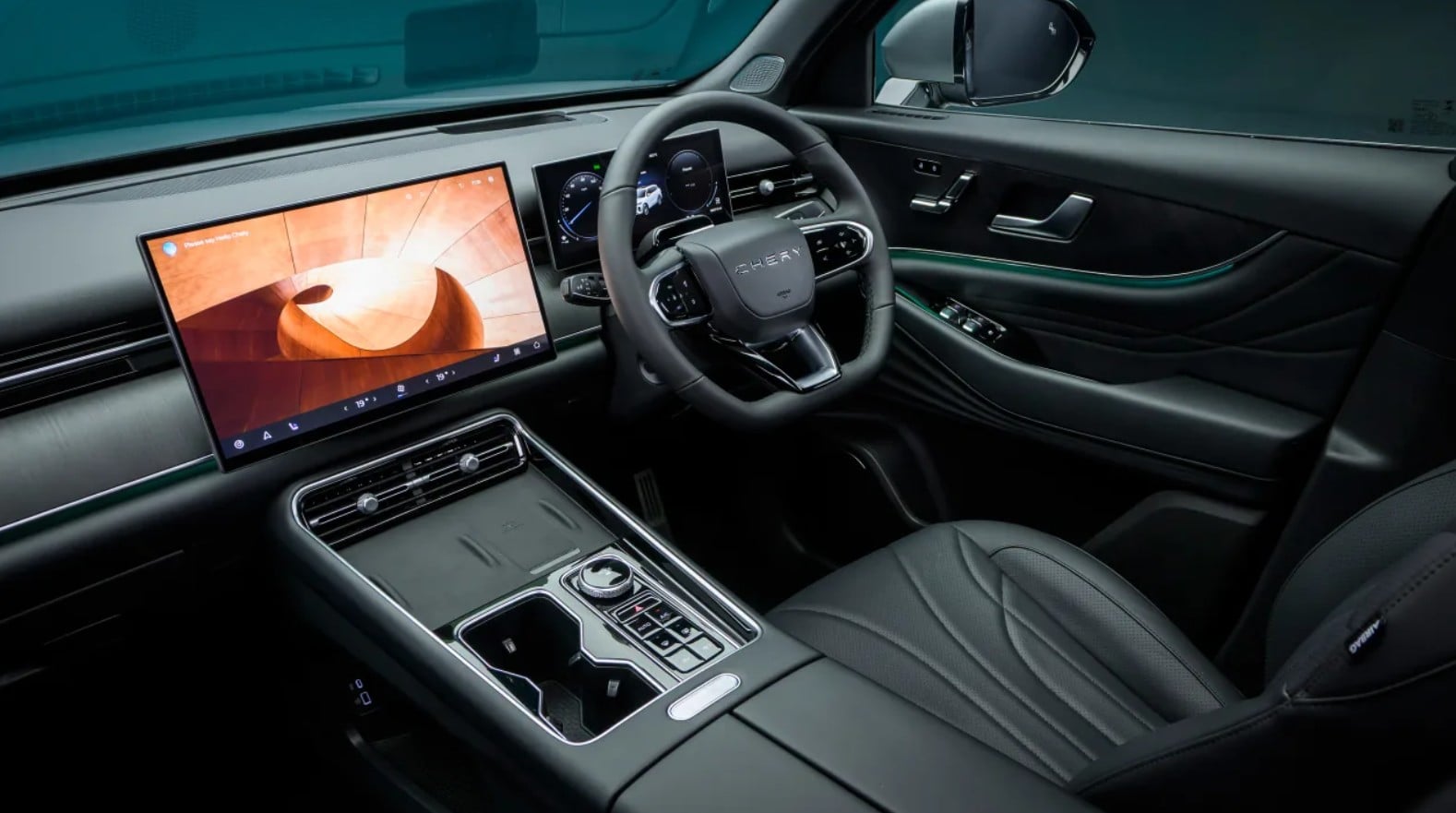
Inside, the Ultimate AWD CSH variant features heated and ventilated leather seats for all rows, a 14-speaker Sony audio system, 540-degree surround cameras, automatic parking assist, and a 1.3-metre panoramic glass roof. The 15.6-inch central touchscreen runs on a Qualcomm Snapdragon 8155 chipset, complemented by a 10.25-inch digital cluster and head-up display, all compatible with Apple CarPlay, Android Auto, and over-the-air (OTA) software updates.
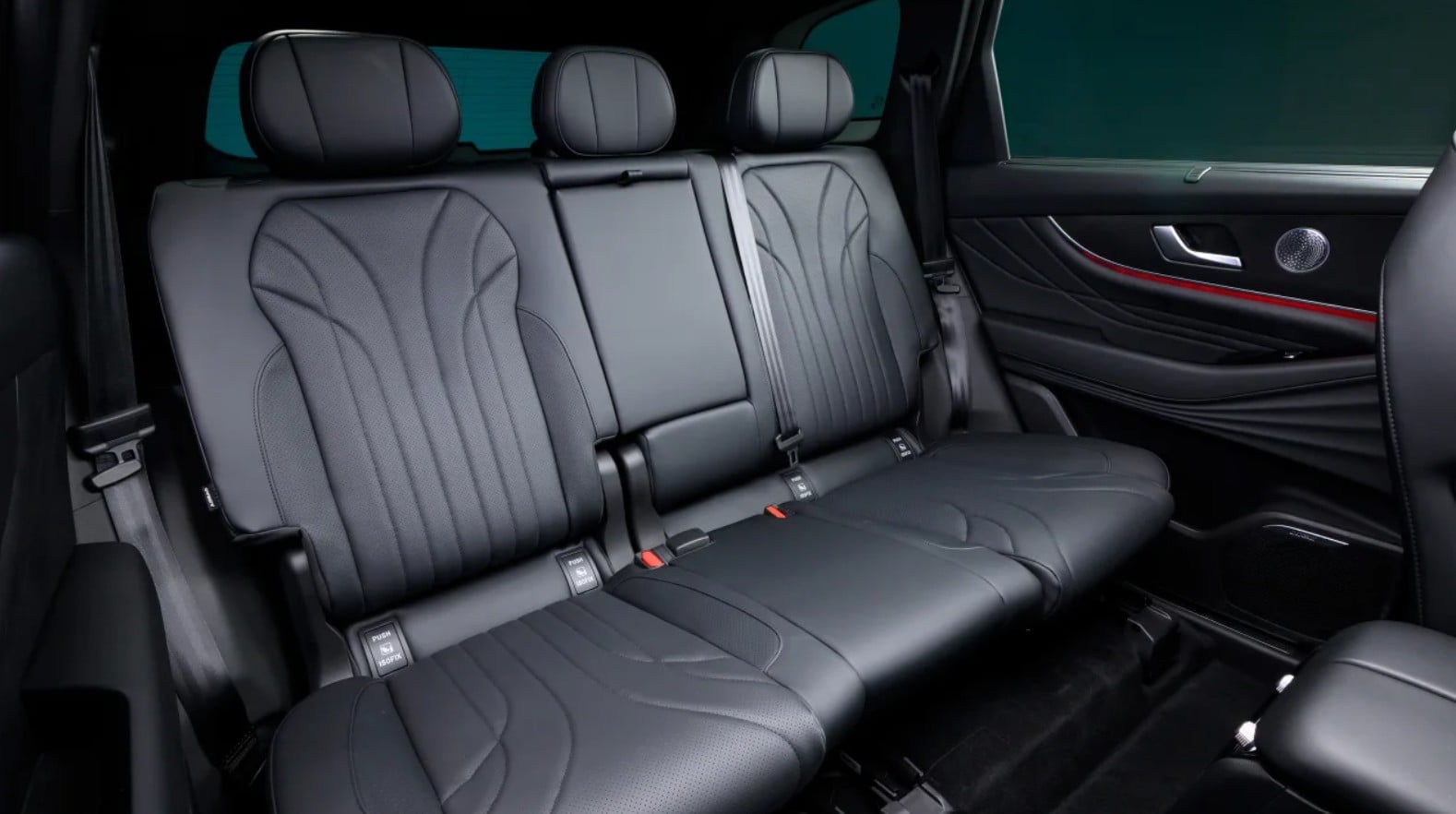
Practicality hasn’t been overlooked. Chery says the Tiggo 9 offers a true seven-seat layout, with electronically adjustable middle-row seats and flat-folding rearmost seats, opening up to 819 litres of cargo space, or 2021 litres in two-seat configuration.
With its mix of premium features and advanced hybrid technology, the Chery Tiggo 9’s price will make it a serious threat to rivals such as the Toyota Kluger Hybrid, Kia Sorento PHEV and Hyundai Palisade.
Ahead of early 2026 deliveries, Ford Australia has announced pricing and specifications for the updated Ford F-150 range. Introducing exterior and interior updates, the latest F-150 also introduces new features across the range and a new Platinum model at the top of the range.
The F-150 range sees revised exterior styling with new alloy wheel designs across the range, as well as new lighting units and grille designs. The F-150 Lariat and Platinum feature a new tailgate with three different ways to open that makes it the only pick-up in its class to offer a 100-degree fully opened integrated swing gate and, according to Ford, can be opened using one hand or key fob.
As with the pre-updated model, the F-150 continues to offer both short- and long-wheelbase forms, but unlike before, they’re priced at parity and not $995 apart. The F-150’s 4500kg braked towing capacity remains, but Ford has improved both its GVM and GCM to up to 3360kg and 7410kg respectively. Payload has also improved to up to 878kg in the XLT long wheelbase.
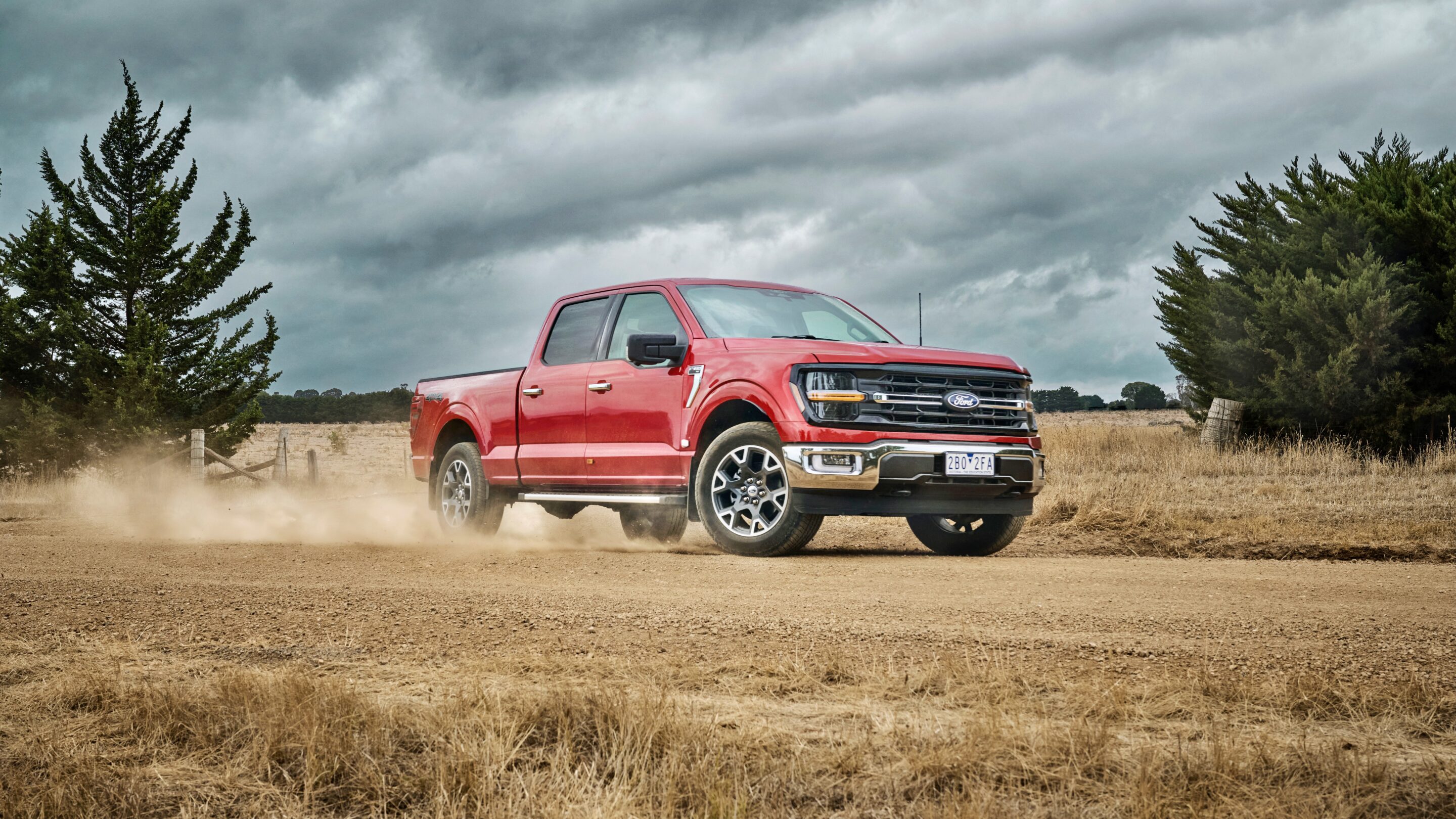
The updated Ford F-150 range continues to be powered by a twin-turbocharged 3.5-litre V6 petrol engine making 298kW of power and 678Nm of torque. That uses a 10-speed automatic with part-time 4×4 on the XLT and full-time 4×4 on the Lariat and Platinum. Ford is yet to announce fuel consumption and CO2 emissions figures, but the pre-updated model’s 12.5L/100km and 290g/km respective ratings are unlikely to change much.
The entry-level F-150 XLT, priced from $114,950 plus on-road costs, now includes features such as LED exterior lighting and larger 12-inch touchscreen and digital driver’s displays as standard.
The Lariat has added a new 20-inch alloy wheel design and a 14-speaker Bang & Olufsen sound system, while the Platinum has introduced new features such as multi-way adjustable front seats with massaging.
2026 Ford F-150 pricing (plus on-road costs):
| XLT | $114,950 |
|---|---|
| Lariat | $143,950 |
| Platinum | $163,950 |
2026 Ford F-150 XLT standard features:
- 20-inch alloy wheels
- Automatic reflector LED headlights
- 360-degree camera
- Tailgate with flexible step and work surface
- Chrome door handles
- Cloth exterior trim
- 12-inch touchscreen
- 12-inch digital driver’s display
- Multiple USB-C and USB-A ports
- Autonomous emergency braking (AEB)
- Blind-spot monitoring with cross-traffic alert
- Automatic post-impact braking
- Automatic reverse braking
- Tyre pressure monitoring

Lariat model adds to XLT:
- LED projector headlights
- Rain-sensing wipers
- Heated and auto-folding mirrors
- 20-inch alloy wheels
- Powered tailgate
- Foldable e-shifter
- 14-speaker Bang & Olufsen sound system
- Automatic climate controlled front seats
- Adaptive cruise control with stop and go functionality
- Adaptive lane guidance
- Evasive steer assist
- Intersection assist
- Front parking sensors
- Wireless phone charger
- Rear heated outboard seats
- Memory for the driver’s seat, mirrors and pedals
- Twin-panel sunroof
- Ambient lighting
- Pro Access Tailgate
Platinum model adds to Lariat:
- Gloss black exterior highlights including the wheels, badging and grille surround
- Adaptive dampers
- Power-deployable side steps
- Multi-folding hard tonneau cover
- 360-degree camera with extra rear views
- Black leather trim
- ‘Plush’ front seats with multi-way adjustment and massaging
- Platinum badging
The updated Ford F-150 range will launch in Australia in early 2026.
The Australian motorsport community is in mourning following the death of Garry Rogers, a revered figure whose passion, humour and larger-than-life personality helped shape the sport for more than half a century.
Rogers, aged 80, passed away on Thursday morning, reported 7 News Australia.
A former driver turned car dealer and later legendary team owner, Rogers was best known as the founder of Garry Rogers Motorsport (GRM) – a team that became synonymous with opportunity, innovation and the distinctively Australian spirit of racing.
The team confirmed the sad news in a heartfelt statement that captured the essence of their founder’s approach to life and motorsport.
“Today we’re mourning the passing of our founder and leader Garry Rogers. But more than that we’re celebrating his incredible life,” GRM said.
“His mantra was always to press on and get on with things, and that’s exactly what we will be doing. Garry was an amazing man with a deep love for his family, his horses and his motorsport. He lived a fast life, but always had time for his family, his kids and his grandchildren. He put others first and was generous with his time and in so many other ways.”
The team added that Rogers was a proud supporter of the Fred Hollows Foundation, and encouraged fans wishing to honour his memory to contribute to the cause.
Garry Rogers’ career began behind the wheel long before his name adorned pit garages and transporters. Born in Melbourne in 1945, he developed an early passion for cars that quickly evolved into competitive racing. In the late 1960s and 70s, Rogers became a familiar face in touring cars and open-wheel racing, competing against the likes of Bob Jane and Allan Moffat.
But it was his second act – as a team owner – that cemented his place in Australian motorsport history. Founding Garry Rogers Motorsport (GRM) in 1980, he built one of the most respected and enduring teams in the country, giving countless young drivers their first chance to make a name for themselves.
His philosophy was simple: “If you’ve got talent and the right attitude, I’ll give you a go.” And he did.
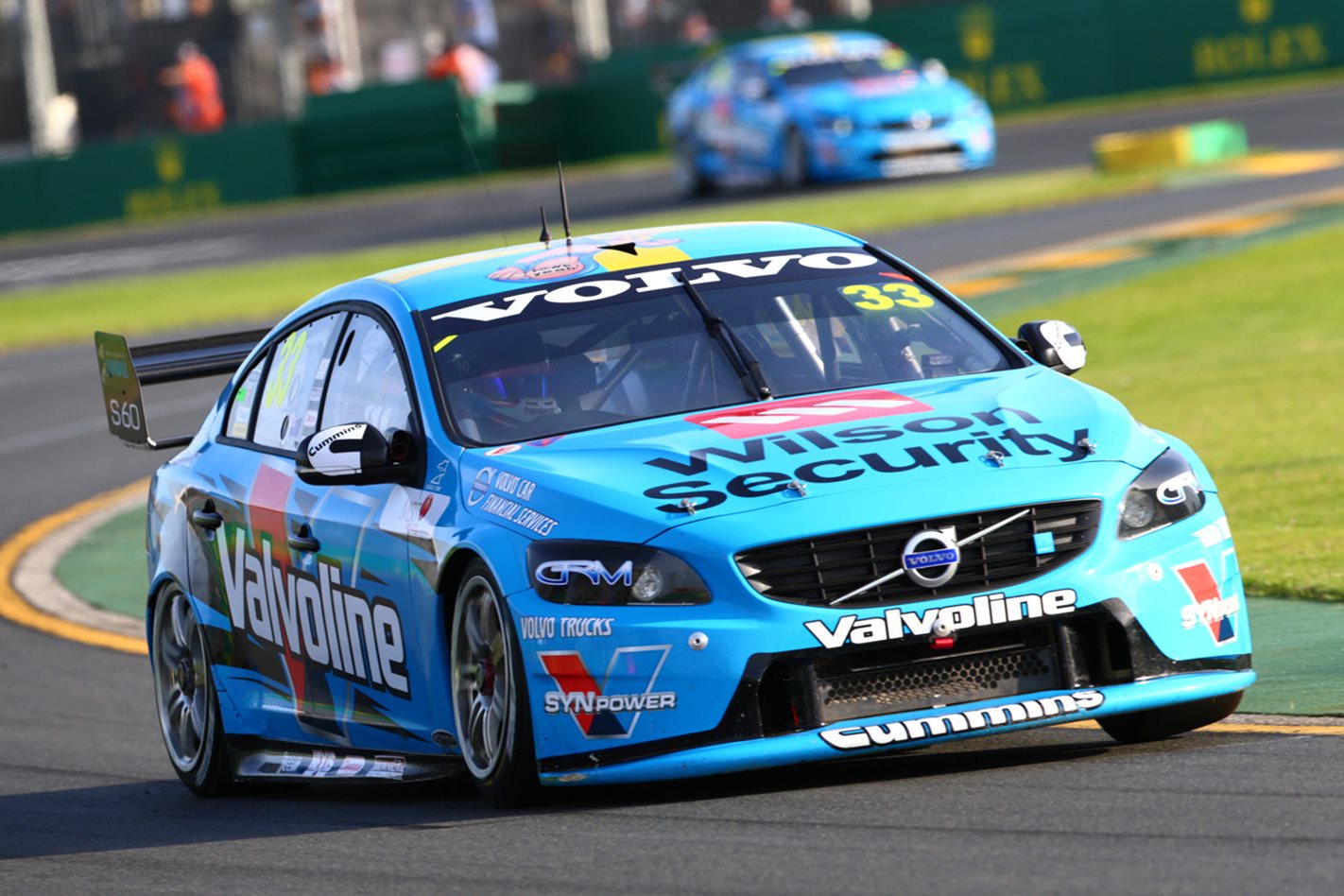
Rogers launched the Supercars careers of Garth Tander, Jason Bargwanna, Steven Richards, Lee Holdsworth, and Jamie Whincup, among others. His knack for spotting potential helped shape the next generation of Australian racing champions, none more so than Scott McLaughlin, who made his full-time debut under the GRM banner before going on to win multiple Supercars titles.
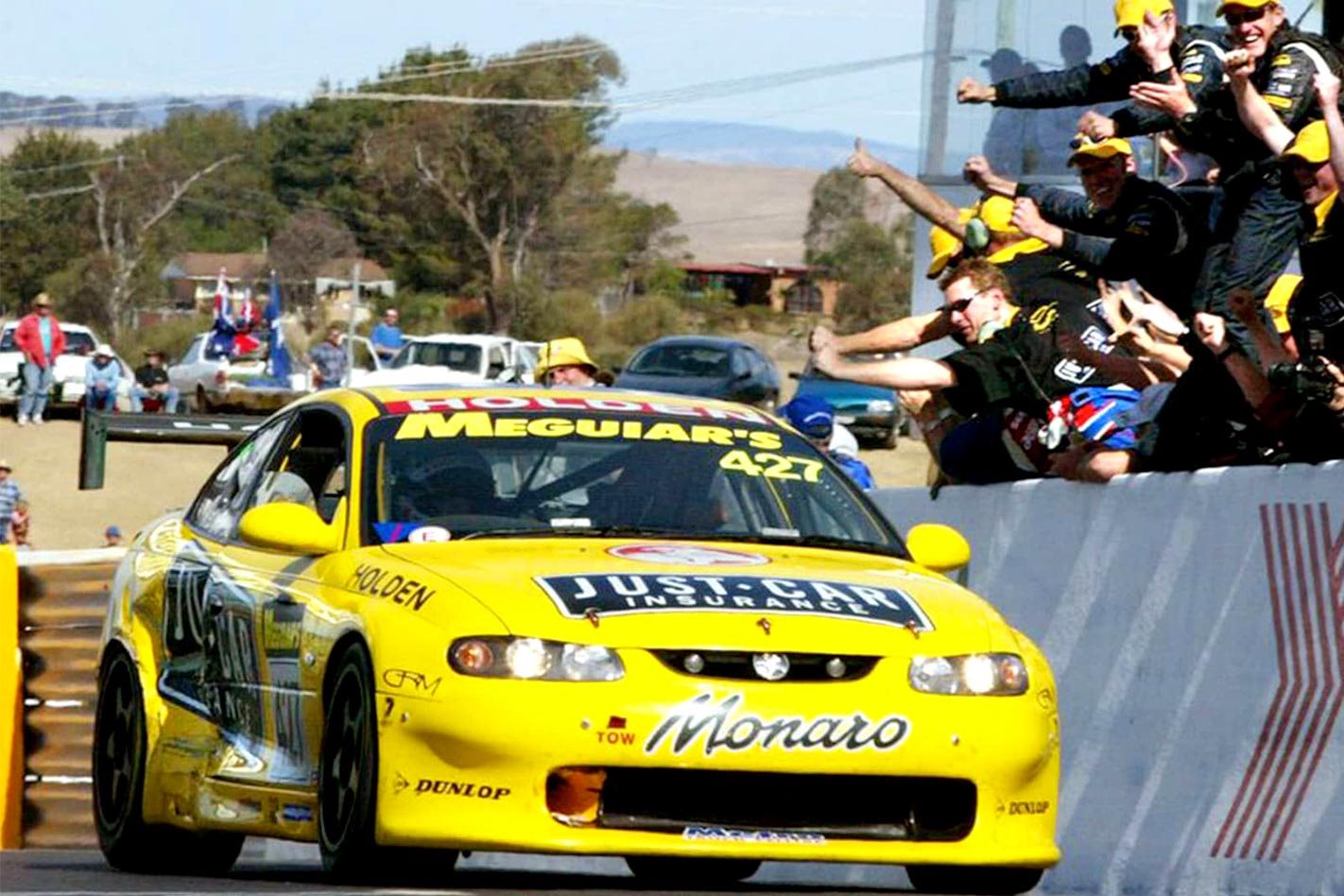
Rogers’ crowning achievement as a team owner came in 2000, when Tander and Bargwanna piloted the GRM Holden Commodore to victory at the Bathurst 1000 – Australia’s most prestigious motorsport event. The win was a landmark moment that elevated GRM’s standing from a respected privateer outfit to a top-tier Supercars force.
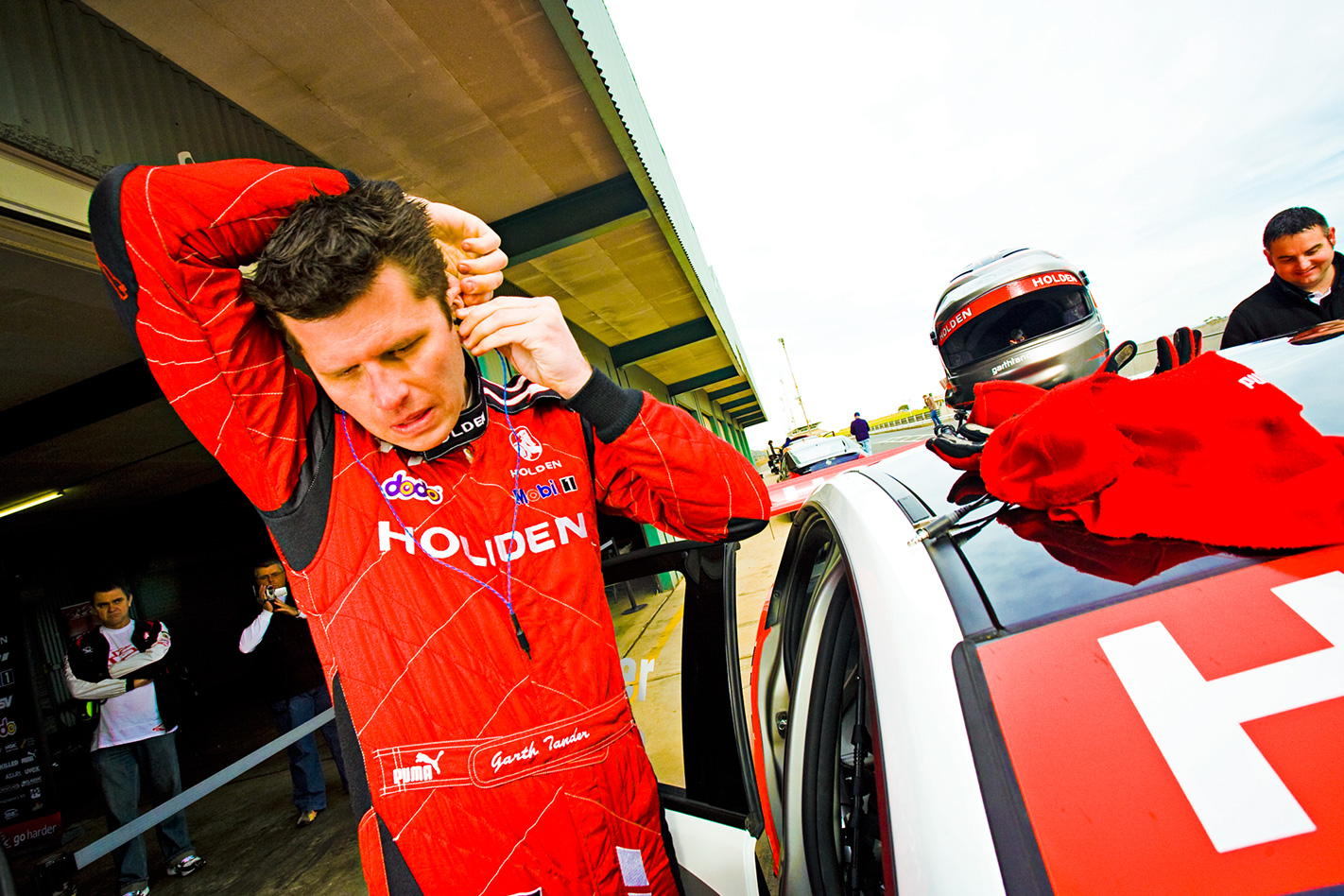
Recalling his time under Rogers’ mentorship, Tander paid tribute to the man who gave him his break in professional motorsport.
“A sad day for Australian motorsport,” Tander wrote. “A titan of the industry that knew how to have fun while being as hard as nails. Learnt so much from this bloke, that I still use today. RIP GR.”
Fellow driver Scott McLaughlin also posted a tribute, which started: “Gaz – You were a tough bugger but you taught me how to be myself, to be comfortable with the media and the fans, to drive a race car without getting distracted by little things out of my control, to never give up.
“If it wasn’t for Garry Rogers I wouldn’t be where I am today, he gave me and so many others a shot to make it, good or bad. He loved a Jameson, fair to say I’ll have a couple for you today. Gonna miss ya, but I know you would be telling me, “Scotty If it wasn’t for Garry Rogers I wouldn’t be where I am today, he gave me and so many others a shot to make it, good or bad. He loved a Jameson, fair to say I’ll have a couple for you today. Gonna miss ya, but I know you would be telling me, “Scotty – stop with the soppy crap and get on with the job right, good” stop with the soppy crap and get on with the job right, good.”
To those who knew him, Garry Rogers was far more than a team boss – he was a showman, a mentor and a man unafraid to speak his mind.
The outpouring of grief was immediate and heartfelt. Former Boost Mobile boss Peter Adderton, a long-time supporter of the sport, reflected on Rogers’ enduring influence.
“We lost a legend today. I’ve had a long history and a great relationship with Garry, going back to the Super Touring days. Personalities like his are rare in the sport now. As far as I’m concerned, he embodied everything that was right about Aussie motorsport – tough, fair, outspoken. We will all miss you, mate.”
The Supercars Championship also acknowledged his enormous contribution, describing him as “a cornerstone of Australian motorsport, whose influence extended far beyond the track.”
After exiting the Supercars Championship at the end of 2019, apart from a farewell Bathurst wildcard entry the following year, Rogers remained active and passionate about the sport. His attention turned to emerging national series including TCR Australia, Trans Am, and the S5000 open-wheel championship.
Through these ventures, he continued to nurture young Australian talent while promoting affordable and competitive forms of racing.
In particular, Rogers was instrumental in bringing the S5000 category – featuring powerful, V8-powered open-wheel cars – to life. His enthusiasm for innovation and development in motorsport was undiminished, even into his later years.
Away from the track, Rogers was a devoted husband, father and grandfather, known for his sharp wit, generosity and down-to-earth nature. Despite his success and fame, he remained proudly humble, preferring to talk about his team and drivers rather than himself.
GRM’s tribute captured the spirit of the man perfectly: “He lived a fast life, but always had time for his family, his kids and his grandchildren. He put others first and was generous with his time and in so many other ways.”
His wife Kaye, son Barry, and daughters Michelle and Krissie were by his side through his five-decade journey in the sport. In recent years, Barry has taken the reins of GRM, ensuring his father’s legacy continues to thrive.
Few figures have influenced Australian motorsport as profoundly as Garry Rogers. Over the years, he built a reputation not only as a team owner but as a mentor, innovator and entertainer, shaping the careers of drivers who would go on to become household names.
Whether it was the thrill of victory at Bathurst, the roar of an S5000 grid, or simply a laugh shared in pit lane, Garry Rogers’ presence loomed large — and his absence will be deeply felt.
His team’s message perhaps sums it up best: “Garry’s mantra was always to press on. That’s exactly what we’ll do — with the same passion, determination and love of motorsport that he showed every single day.”
A racer, a mentor, a showman — and a legend whose impact will continue to inspire Australian motorsport for generations to come.
Ferrari has unveiled the official 2026 calendar for the Ferrari Challenge Trofeo Pirelli Australasia, confirming another thrilling year of world-class racing set against some of Australia’s most spectacular backdrops.
Now the youngest member of Ferrari’s global single-make racing family — which also includes series in Europe, North America, the UK and Japan — the Australasia championship has quickly established itself as a highlight of the motorsport calendar since its debut.
The Ferrari Challenge embodies the brand’s racing DNA, combining the intensity of track competition with the camaraderie and exclusivity that define the Ferrari lifestyle. The series attracts a diverse grid of gentleman drivers, collectors and emerging racing talents, all united by a shared passion for performance and precision.
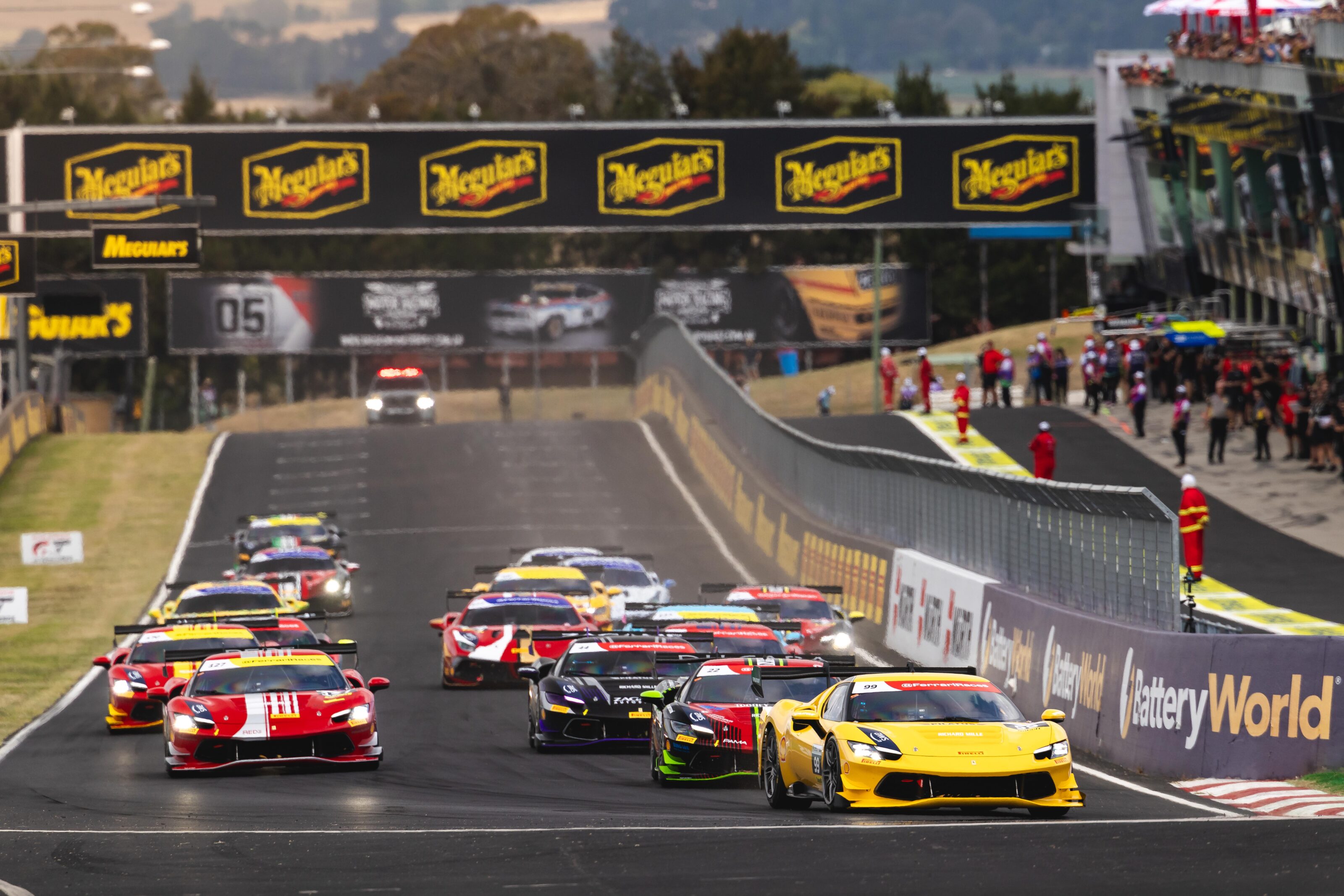
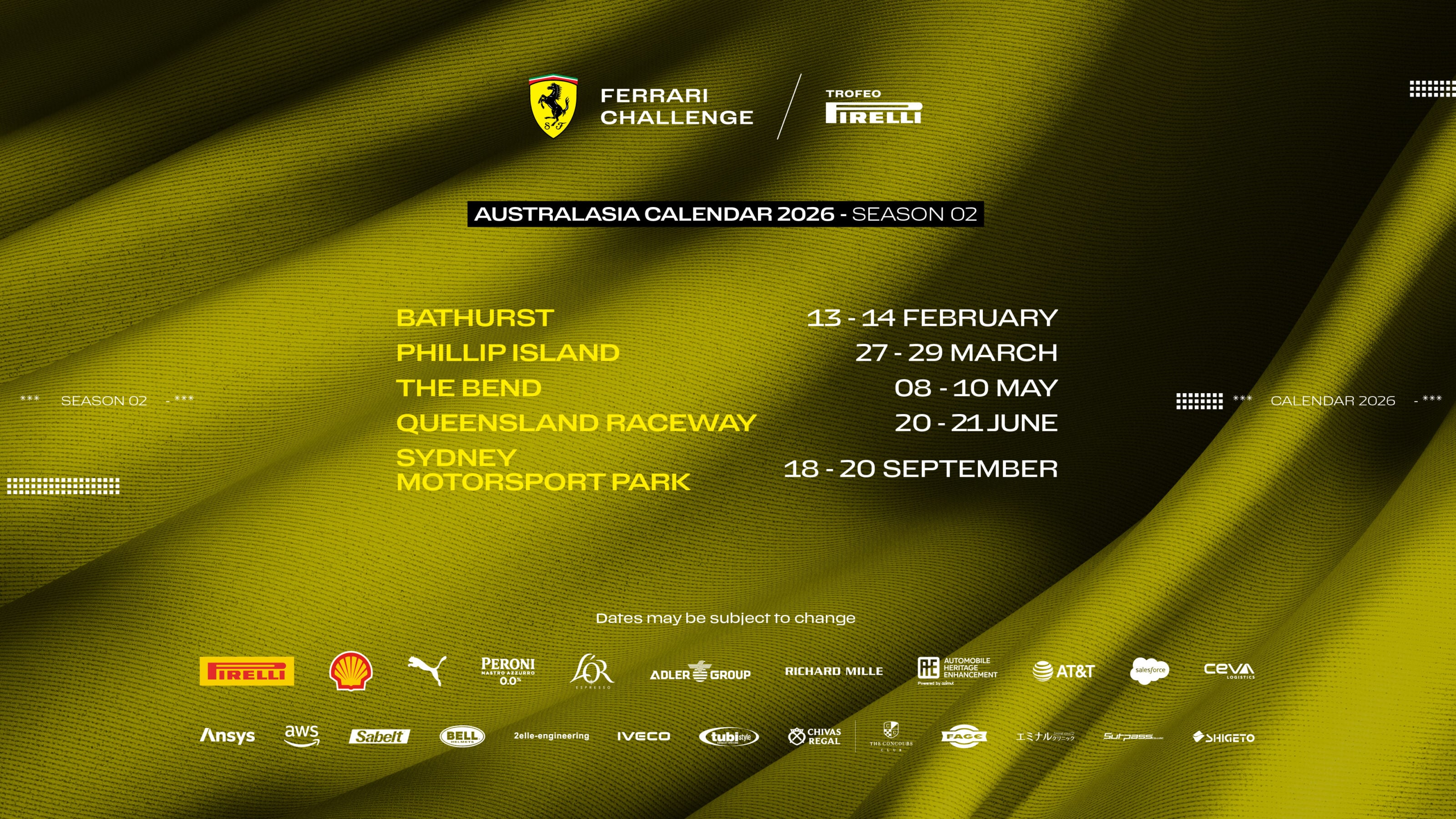
The 2026 season will feature five rounds, each chosen for its technical demands and iconic status in Australian motorsport. The campaign opens at the legendary Mount Panorama Circuit in Bathurst from 13–14 February, where Ferrari drivers will tackle one of the world’s most challenging and exhilarating racetracks.
From there, the championship travels south to Phillip Island on 27–28 March, where sweeping coastal corners and high-speed sections promise dramatic racing. The action then shifts to The Bend Motorsport Park in South Australia from 8–10 May — one of the country’s most advanced circuits — before moving to Queensland Raceway from 20–21 June, a fan favourite known for its flowing layout and close battles.
The season finale takes place under lights at Sydney Motorsport Park from 18–20 September, ensuring the 2026 series concludes in spectacular fashion.
Each event pairs intense on-track competition with the brand’s renowned hospitality and lifestyle experiences, offering participants and guests a true taste of the Ferrari world.
Ferrari says the upcoming season will continue to reflect its global racing spirit — “a perfect balance of elegance, performance and passion” — while further cementing the Australasia series as one of the most prestigious motorsport championships in the region.
2026 Ferrari Challenge Trofeo Pirelli Australasia Calendar:
- Bathurst – 13–14 February
- Phillip Island – 27–28 March
- The Bend – 8–10 May
- Queensland Raceway – 20–21 June
- Sydney Motorsport Park – 18–20 September
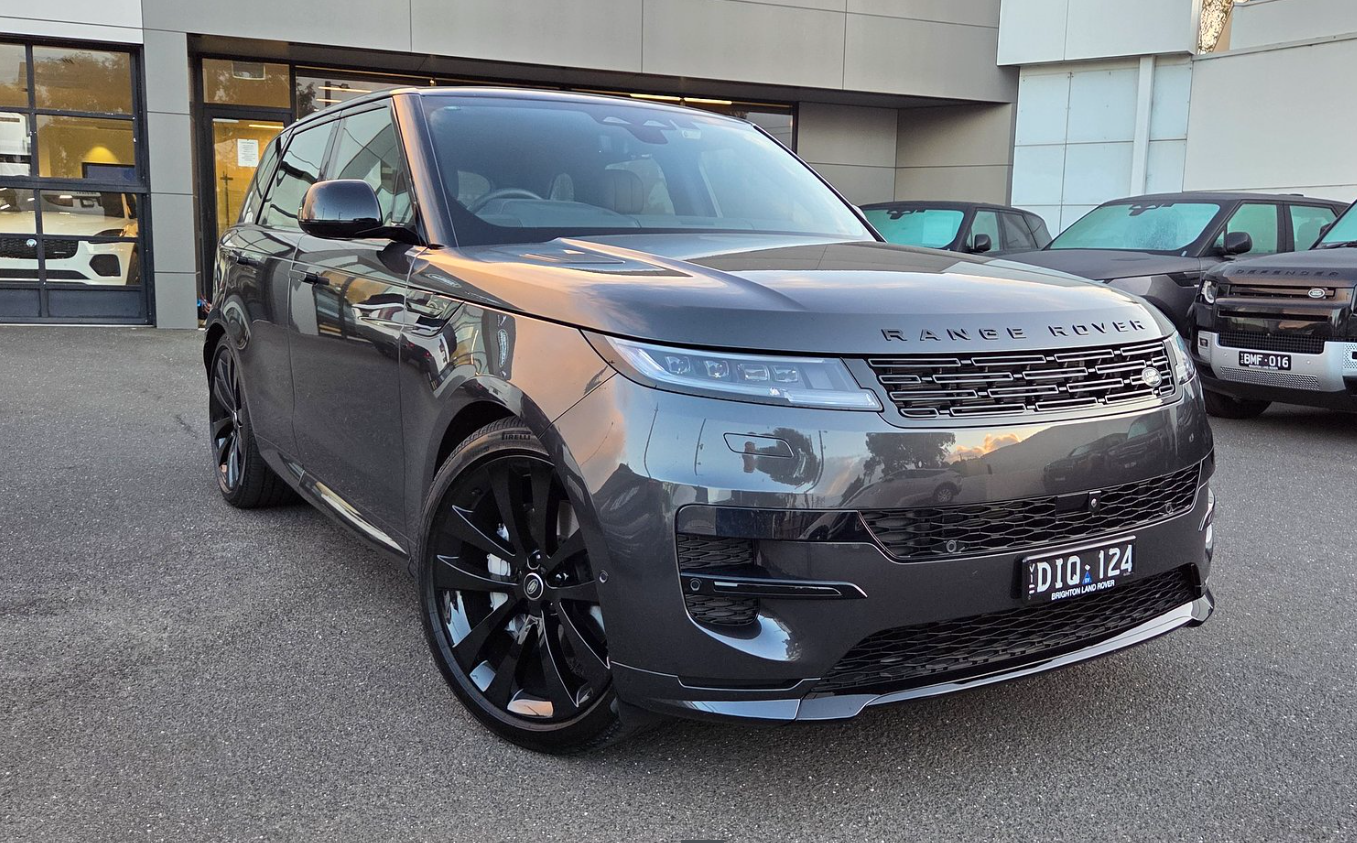
Jaguar Land Rover (JLR) has been confirmed as the victim of one of the most expensive cyber attacks ever recorded, with experts estimating losses exceeding A$3.7 billion. The ransomware assault, which paralysed JLR’s production systems for more than a month, has been labelled the costliest cyber incident in British history, surpassing previous breaches at major retailers M&S and the Co-op.
According to the Cyber Monitoring Centre (CMC), a global non-profit that tracks and assesses cyber events, JLR likely lost between A$3 billion and A$3.9 billion, with the most probable figure sitting around A$3.6 billion. During the height of the disruption, analysts say the company was losing roughly A$95 million each week, leading the CMC to rate the event a “Category 3” on its five-tier impact scale – a major systemic threat.
Production was halted in early September following what JLR described as a “cyber incident” on August 31, 2025, forcing more than 30,000 workers at factories in Solihull, Halewood, Wolverhampton, and several overseas sites to stay home. The company’s internal IT systems were taken offline immediately to contain the breach, which crippled vehicle assembly operations and delayed global deliveries.
JLR CEO Adrian Mardell admitted it had been “a challenging quarter,” confirming that the firm’s wholesale volumes fell by nearly 25 per cent and retail sales dropped by 17 per cent during the shutdown period. “Since the start of September, we have worked with retailers to prioritise the delivery of our world-class vehicles to our clients,” Mardell said.
While JLR is expected to shoulder about half of the total losses, analysts warn the wider supply chain of smaller parts suppliers may have absorbed much of the remaining impact, with some at risk of collapse. The UK Government has offered a A$2.8 billion emergency loan, though JLR instead opted to launch its own cash-up-front program for suppliers in early October to keep production materials flowing.
Security researchers say the incident underscores the vulnerability of modern manufacturing. “A single IT breach can bring an entire billion-dollar production line to a standstill,” said Dray Agha, Senior Security Manager at Huntress. Experts are now urging major automakers to bolster “network segmentation” – isolating factory systems from wider business networks – to prevent a repeat of such devastating single points of failure.
After six weeks offline, JLR began a phased production restart on October 8, but cybersecurity analysts warn the brand could face lingering financial and reputational fallout well into 2026.
Mini, the iconic British now-BMW-owned premium small car brand, loves to try new ideas. Since it was relaunched for the modern era back in 2001, we’ve seen it expand from the three-door hatchback form it’s known for multiple times with cars like the Paceman, Clubman and Countryman.
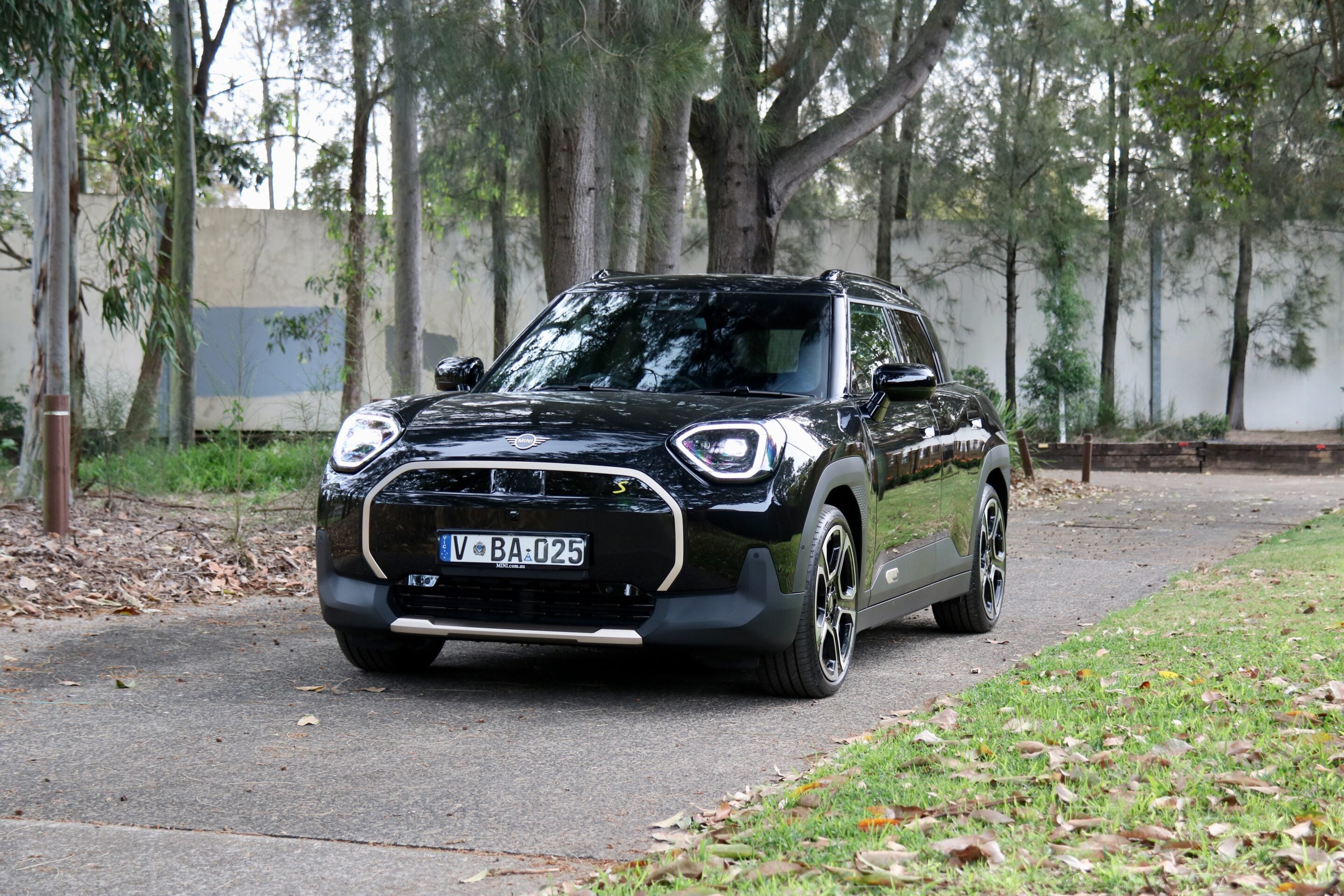
The latest is the Aceman, which is the taller five-door version of the electric Cooper, sitting below the Countryman SUV. How does it measure up to rivals, given the $60K-plus price tag?
Price and equipment:
2025 Mini Aceman pricing (plus on-road costs):
| SE Favoured | $60,990 |
|---|---|
| JCW Favoured | $65,990 |
Mini Aceman SE Favoured standard equipment:
- 19-inch alloy wheels with a tyre repair kit
- Dusk- and rain-activated all-LED lighting
- LED front and rear daytime running lights
- Rain-sensing automatic wipers
- Black roof, mirrors and roof rails
- Auto-dimming/auto-folding exterior mirrors
- Keyless entry with push button start and automatic walk away locking
- Digital key functionality
- Panoramic glass roof
- Dual-zone automatic climate control
- Synthetic leather upholstery
- Electric front seats with driver’s memory and massaging
- Heated front seats and steering wheel
- Head-up display
- 9.4-inch circular OLED touchscreen with live services
- Wireless Apple CarPlay and Android Auto
- Augmented reality satellite navigation with live traffic
- AM/FM/DAB+ digital radio
- 315W 10-speaker Harman Kardon sound system
- Wireless phone charger
- 4x USB-C charging ports
- 2x charging cables
- ‘Mini Experience’ modes that change the interior lighting, touchscreen and driving dynamics
- Interior camera
- Automatic parking
- Aceman SE Favoured safety features:
- 9x airbags
- Autonomous emergency braking
- Adaptive cruise control
- Adaptive lane guidance
- Lane keeping assistance
- Auto high beam
- Blind-spot monitoring
- Rear cross-traffic alert (with braking)
- Safe exit assist
- Driver attention monitoring
- Traffic sign recognition
- Front and rear parking sensors
- 360-degree camera
The Aceman is unrated by ANCAP, but was given a five-star Euro NCAP rating earlier in 2025 with scores of 83 per cent for adult occupant protection, 87 per cent for child occupant protection, 77 per cent for vulnerable road user protection and 79 per cent for safety assistance.
Interior, practicality and bootspace
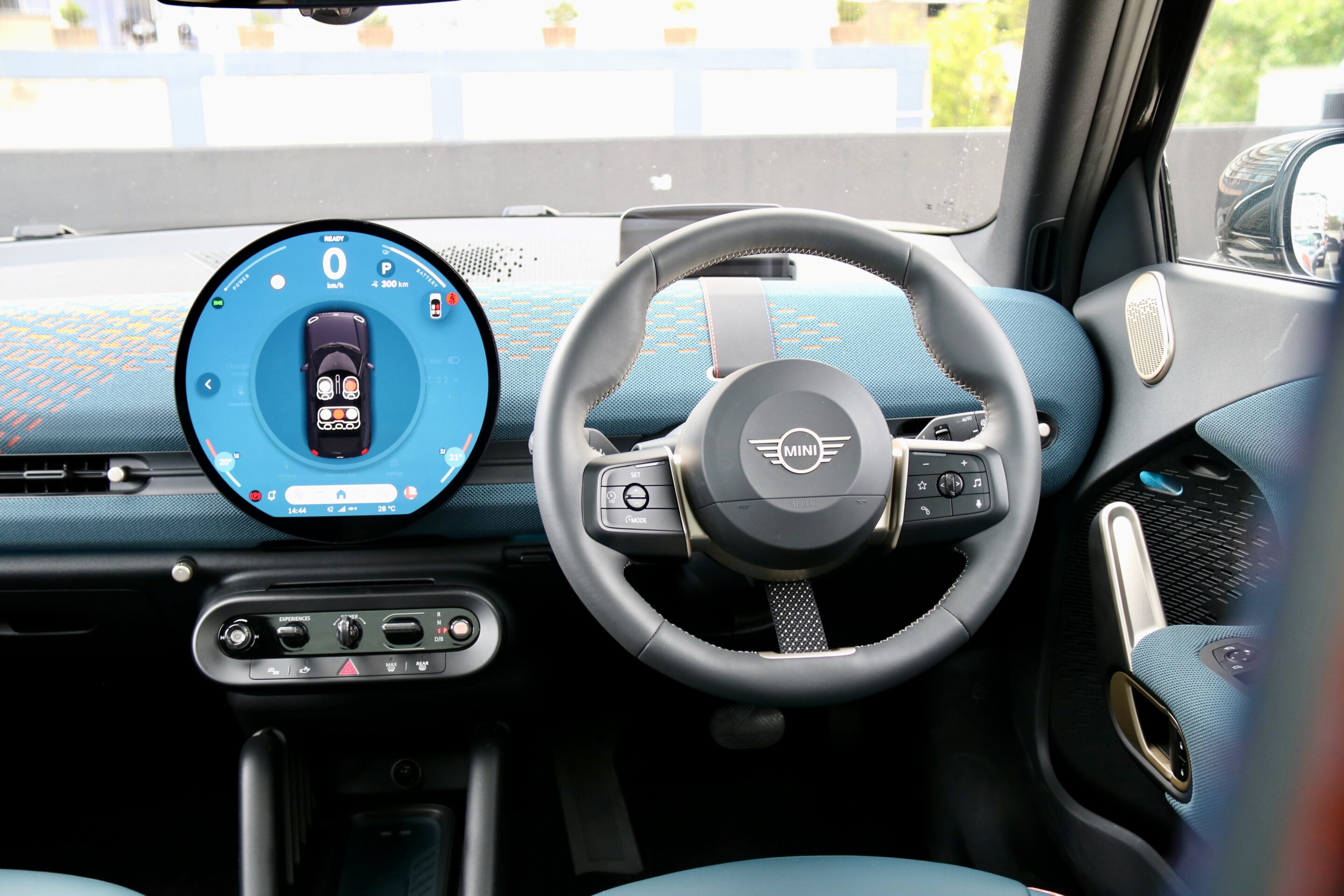
The cabin of the latest-generation Mini products will immediately feel familiar to anybody who has experienced a modern era Mini with a huge circular display in the centre of the dashboard. It’s synonymous with the Mini brand, though the cabin is more minimalist than previous models in line with the latest BMW products, such as the X3.
The cloth trim on the dashboard adds visual appeal, as does the lovely petrol blue synthetic leather upholstery, but beyond the cloth trim and funky details such as the cute central storage box, the materials are less impressive with plenty of hard plastics that feel cheaper than the Aceman’s $60,000+ asking price would suggest.
The 9.4-inch touchscreen runs the latest ‘Mini OS9’ software accompanied by a cute dog voice assistant named Spike. It’s well featured and the graphics are sharp and colourful, but the layout is initially confusing and familiarisation can be slow. The ‘Mini Experience’ modes offer some character and change the main screen with views such as a classic Mini speedometer.
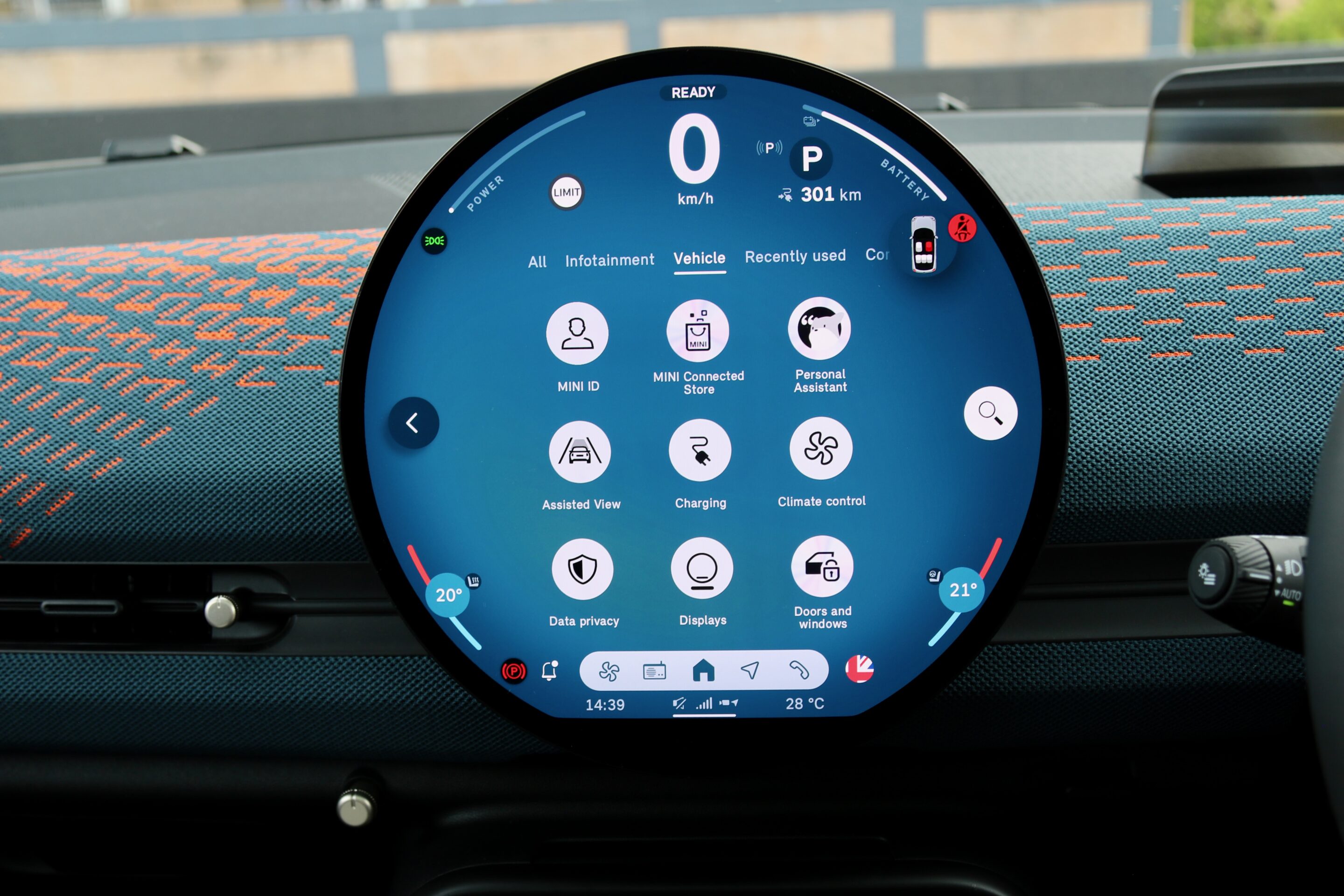
As with many modern cars, the majority of the Aceman’s functions are controlled through the touchscreen, with button functions limited to the volume, experience and gear selectors, hazard lights and front and rear demisters. The touchscreen offers no haptic feedback so quick changes, such as lowering or raising the temperature, can take two or three presses while driving. Not ideal.
Front seat comfort is excellent, with plenty of electric adjustment for both seats, though covered storage is limited to just the tiny box between the seats. Open storage is more effective, with big door bins and a massive centre console, including a wireless charger and two USB-C ports. The driving position is great, though the tiny flip-up head-up display forces you to look too far down – a proper HUD located higher would be great.
The rear cabin of the Aceman is larger than the five-door Cooper hatchback, but hardly commodious. The two average-sized adults will fit fine with just enough headroom and legroom, and the standard panoramic roof adds light to an otherwise snug cabin. Map and door pockets feature, as does one cupholder and two USB-C charging ports, but no air vents or central armrest.
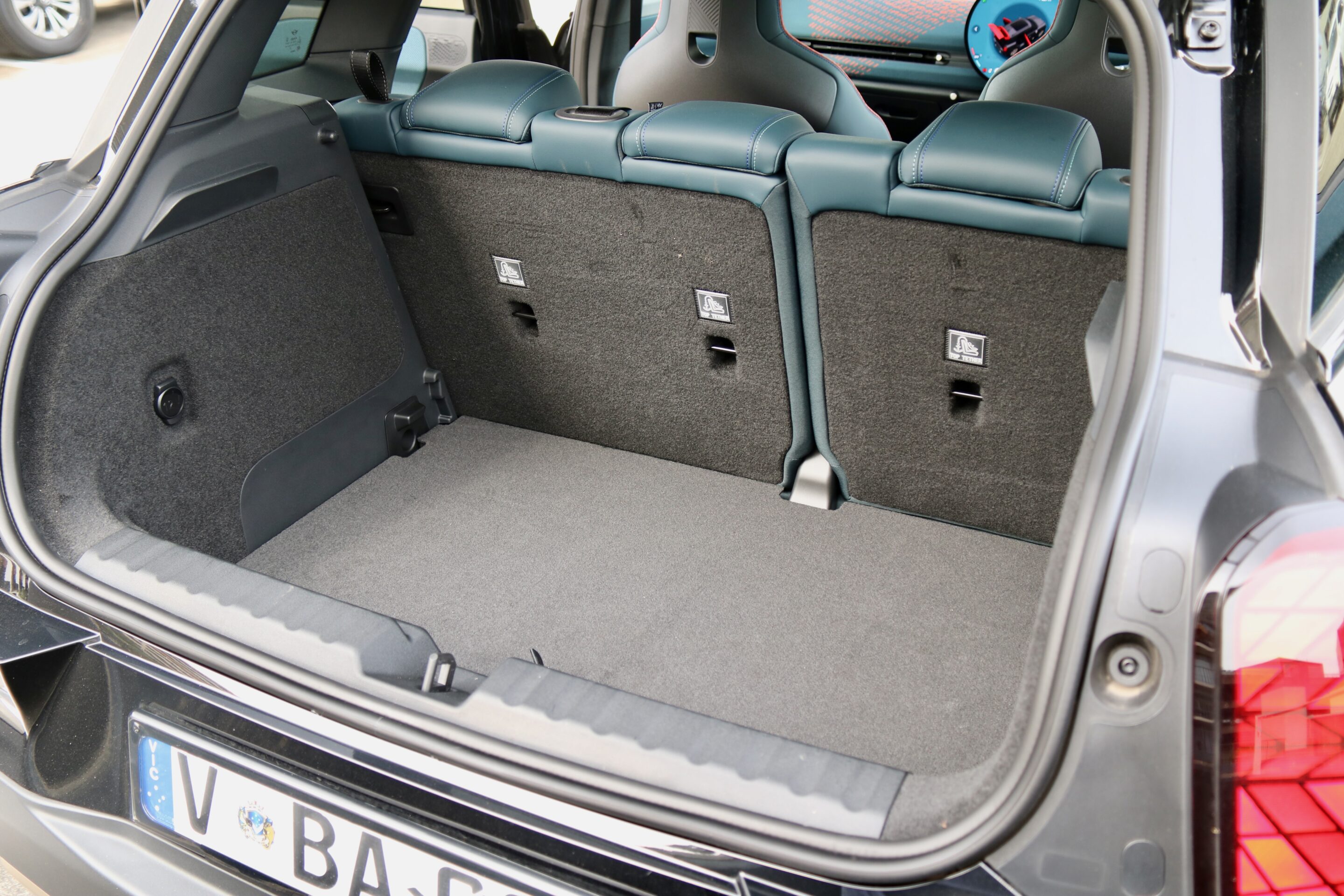
The Aceman’s boot further illustrates its positioning in the Mini range, wedged in between the Cooper and the Countryman at 300 litres with the seats up and 1005 litres with them folded. Handy touches include a dual-level boot floor, under-floor storage for the charging cables and a 12V socket. Features that you’d expect for the price, such as an electric tailgate or a spare wheel, aren’t available.
Range, charging and efficiency
Under the body of the Aceman SE is a 49.2kWh lithium-ion battery that’s good for 406km of range on the WLTP cycle. That powers a front-mounted 160kW/330Nm electric motor, which propels the Aceman SE to 100km/h in a claimed 7.1 seconds and a top speed of 170km/h – it’s appropriately punchy for its intended audience.
The claimed WLTP efficiency is 14.4kWh/100km, and we achieved a slightly higher 15.9kWh/100km rating in mixed driving. DC fast charging up to 95kW allows for a 10-80 per cent charging time in as little as 31 minutes, though a higher peak charging speed would be good considering that it’s aimed at city dwellers and many likely won’t have access to overnight charging, instead relying on public chargers.
On the road
As is the reputation of Mini products, the Aceman is quite fun to drive. It feels agile and sharp despite its porky 1710kg kerb weight, and it proves that EVs can be a good time from behind the wheel. On the flip side, thanks to its standard 19-inch wheels and firm suspension, it’s also quite firm around town and even the smallest of bumps can be felt. If you’re no stranger to the Mini brand that will feel familiar, but newcomers might be surprised at just how much of the road you feel in the Aceman.
The drive experience is otherwise quite refined with little in the way of road noise and its active safety features are excellent, providing assisted but not overbearing coverage when driving. The adaptive lane guidance is particularly well tuned, while we also really like the 360-degree camera, which looks great on the huge central touchscreen.
Service and warranty
The Mini Aceman is covered by a five-year/unlimited km warranty with five years of roadside assistance and eight years/160,000km of warranty coverage for the battery.
Mini offers two ‘Service Inclusive’ pre-paid service packages: four years for $1500 ($375 per year) or six years for $2225 ($371 per year). Like related BMW models, the Mini Aceman doesn’t have set service intervals and the cars will decide when they need servicing.
Verdict: Should I buy a Mini Aceman SE?
There’s no denying that the Mini Aceman SE will appeal to a specific customer base, one that is looking for a premium small car and doesn’t mind its smaller dimensions and higher asking price.
That’s nothing new to the Mini brand, but the Aceman takes that specific appeal further by being powered by electricity. Its range and charging stats are nothing special in today’s market, yet there’s also less ‘Mini-ness’ in that there’s no personalisation beyond colours – no coloured roof or stripes choices, and no options either.
However, those who can get beyond those quibbles will find a small SUV-like EV that’s great to drive, reasonably practical, packed with character everywhere, loaded with standard features and surprisingly quick. Choice is a great thing and while there may be more practical, longer-range and better value alternatives, with Mini, if you know, you know.
Mini Aceman SE rivals:
Specifications
| Model | Mini Aceman SE Favoured |
|---|---|
| Price | $60,990 plus on-road costs |
| Peak power | 160kW |
| Peak torque | 330Nm |
| 0-100km/h | 7.1 seconds (claimed) |
| Top speed | 170km/h (claimed) |
| Battery | 49.2kWh lithium-ion |
| Driving range (WLTP claimed) | 406km |
| Efficiency (claimed/as tested) | 14.4kWh/100km, 15.9kWh/100km |
| Peak DC charging speed | 95kW |
| 10-80% peak charging time | 31 mins |
| Dimensions (length/width/height/wheelbase) | 4079/1754/1514/2606mm |
| Kerb weight | 1710kg |
| Bootspace (seats up/down) | 300 litres/1005 litres |
| On sale | Now |
BYD is set to expand its Australian line-up with the launch of two new all-electric models – the ATTO 1 and ATTO 2 – to be officially unveiled on November 13, with customer orders opening later in the month.
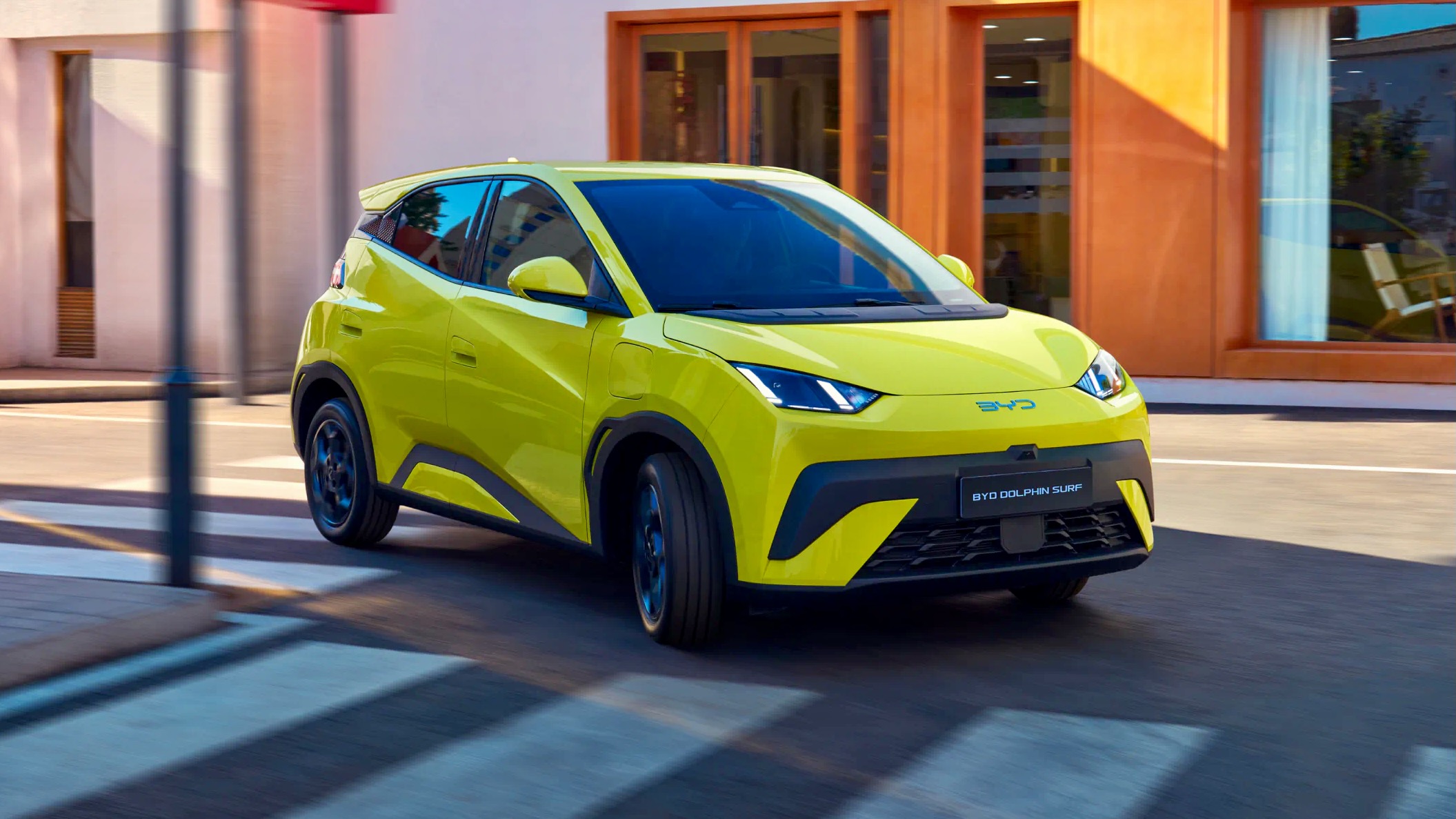
Leading the charge is the BYD ATTO 1, which is tipped to become Australia’s most affordable electric car. starting at around the $25,000 mark for the Essential model. Compact, efficient and city-friendly, the ATTO 1 brings BYD’s acclaimed Blade Battery technology to a broader audience. This lithium-iron-phosphate battery system is widely recognised for its outstanding safety, longevity and energy density.
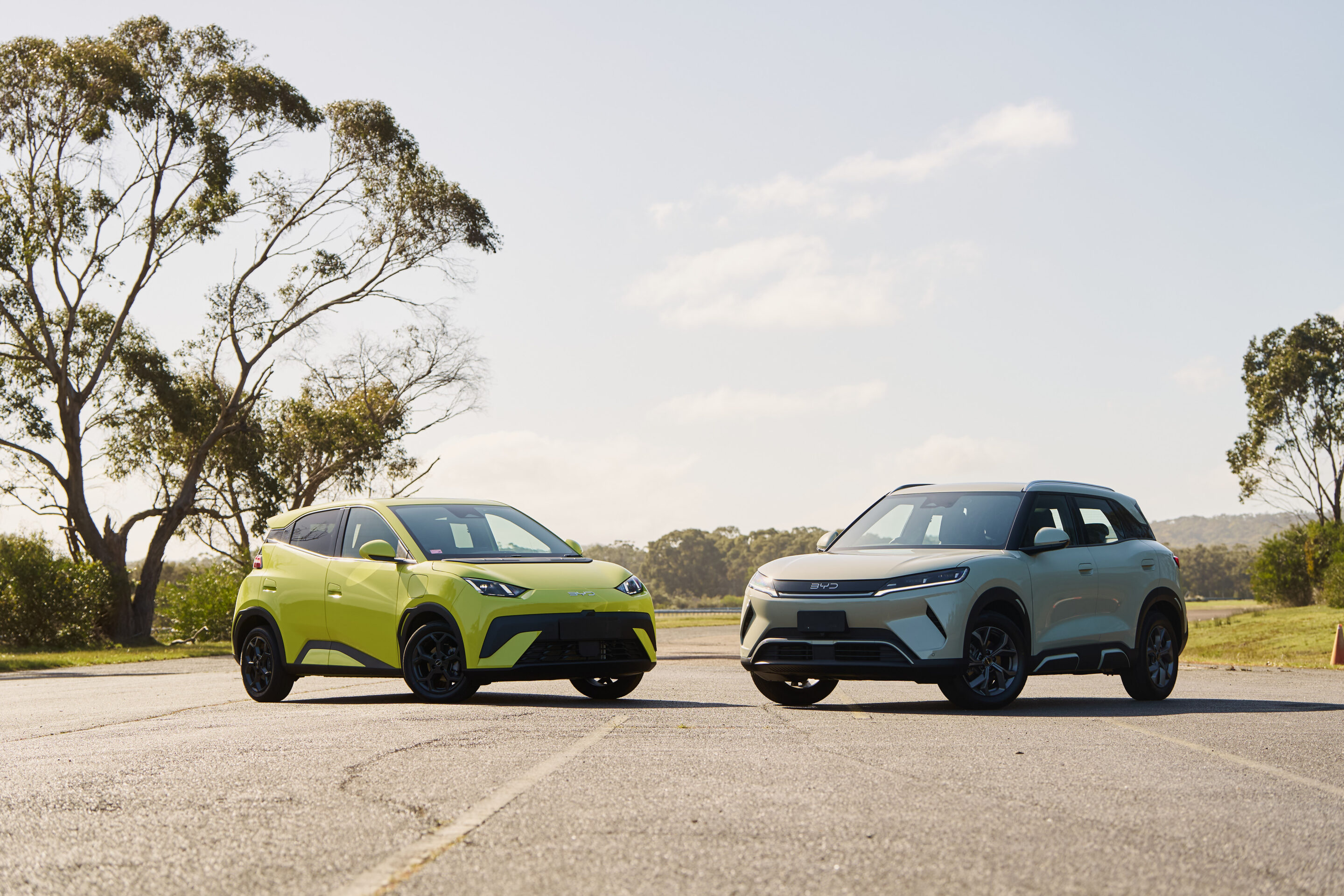
Known overseas as the BYD Dolphin Surf in Europe and BYD Seagull in China, the model has already surpassed one million global sales, and its international success includes being crowned the 2025 World Urban Car of the Year and named one of TIME Magazine’s Best Inventions of 2025.
Two variants will be offered locally: the Essential (65kW/175Nm, 30kWh battery, up to 220km range) and the Premium (115kW/220Nm, 43.2kWh battery, up to 310km range WLTP) – the latter expected to sell from around $30,000. Both drive the front wheels and support DC fast charging from 10–80 per cent in just 30 minutes. Standard features include a 10.1-inch touchscreen, wireless smartphone integration, six airbags, and a 360-degree camera.
Above it sits the BYD ATTO 2, a compact SUV combining performance, practicality and refinement. Powered by a 130kW motor producing 290Nm of torque, it uses a 51.3kWh Blade Battery for up to 345km (WLTP) of range. Fast charging replenishes 10–80 per cent in around 39 minutes.
Two versions – Dynamic and Premium – will be available, the latter adding premium touches such as heated and ventilated front seats, 12.8-inch rotating display, power-adjustable seating, and an eight-speaker sound system. Cargo capacity extends up to 1320 litres, complemented by BYD’s advanced DiPilot driver-assist suite.
“Our goal has always been to bring advanced EV technology to the masses,” said Stephen Collins, BYD Australia COO. “With the ATTO 1 and ATTO 2, we’re delivering exceptional value – not just in price, but in innovation and everyday usability.”
Expressions of interest for both models are now open, marking another step in BYD’s rapid growth in Australia’s booming electric vehicle market.
