Classic Wheels

Gallery 1
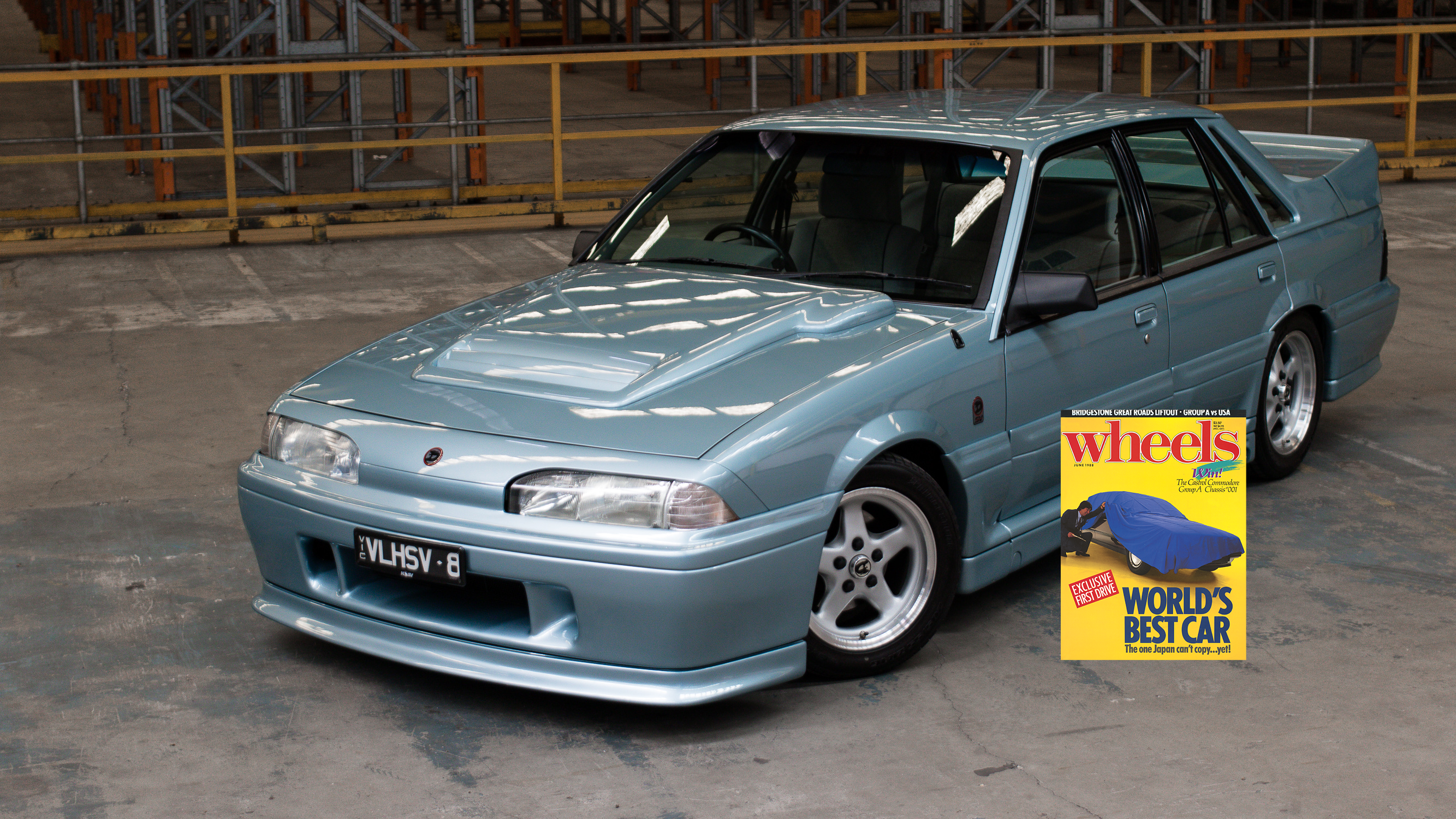
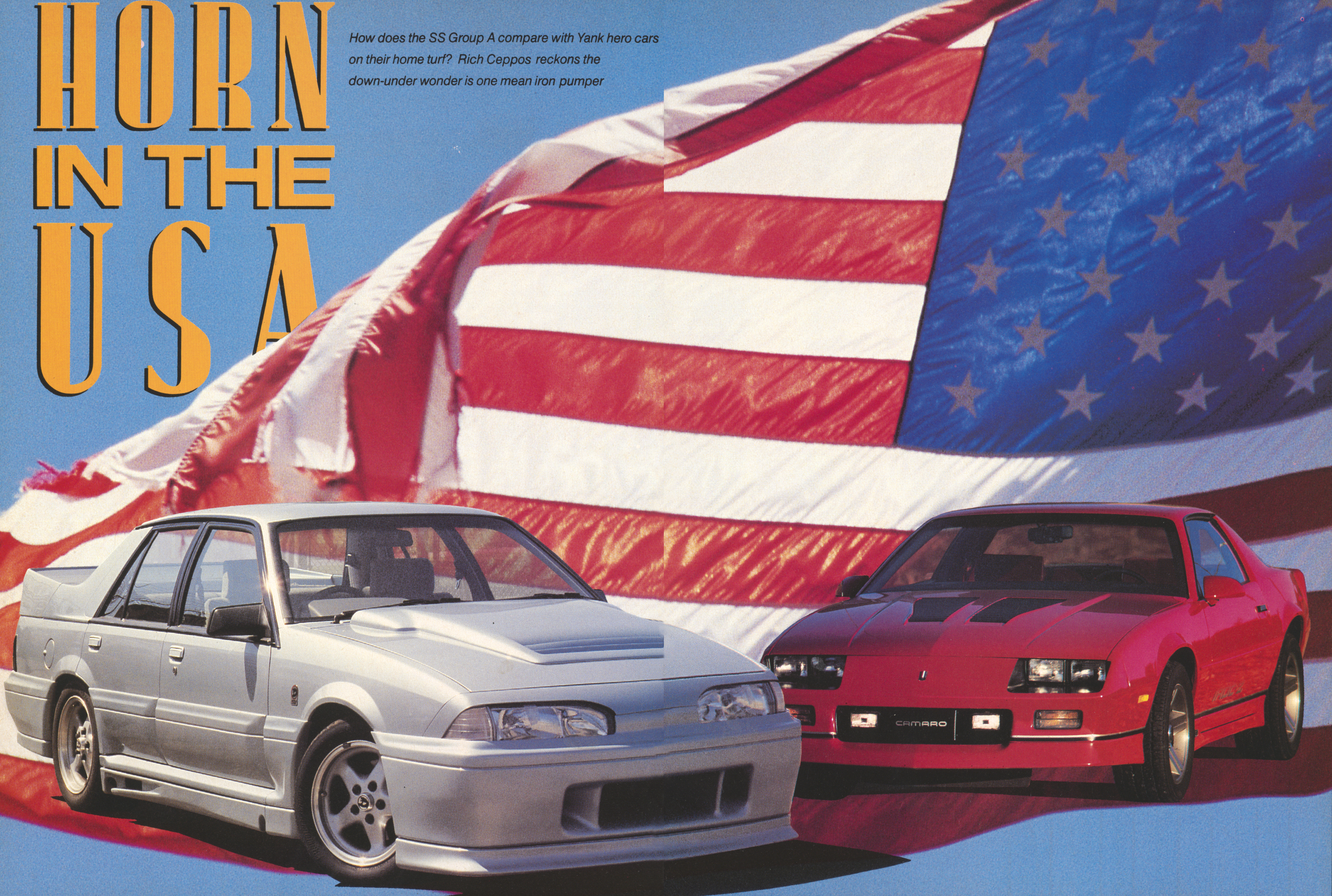
When Holden shipped an SS Group A to the States for GM promotional purposes in 1988, the crew at Car And Driver magazine jumped at the chance to put it up against their Mustang GT, Camaro IROC-Z and Corvette. The Commodore did Australia proud…
First published in the June 1988 issue of Wheels magazine, Australia’s best car mag since 1953. Subscribe here and gain access to 12 issues for $109 plus online access to every Wheels issue since 1953.
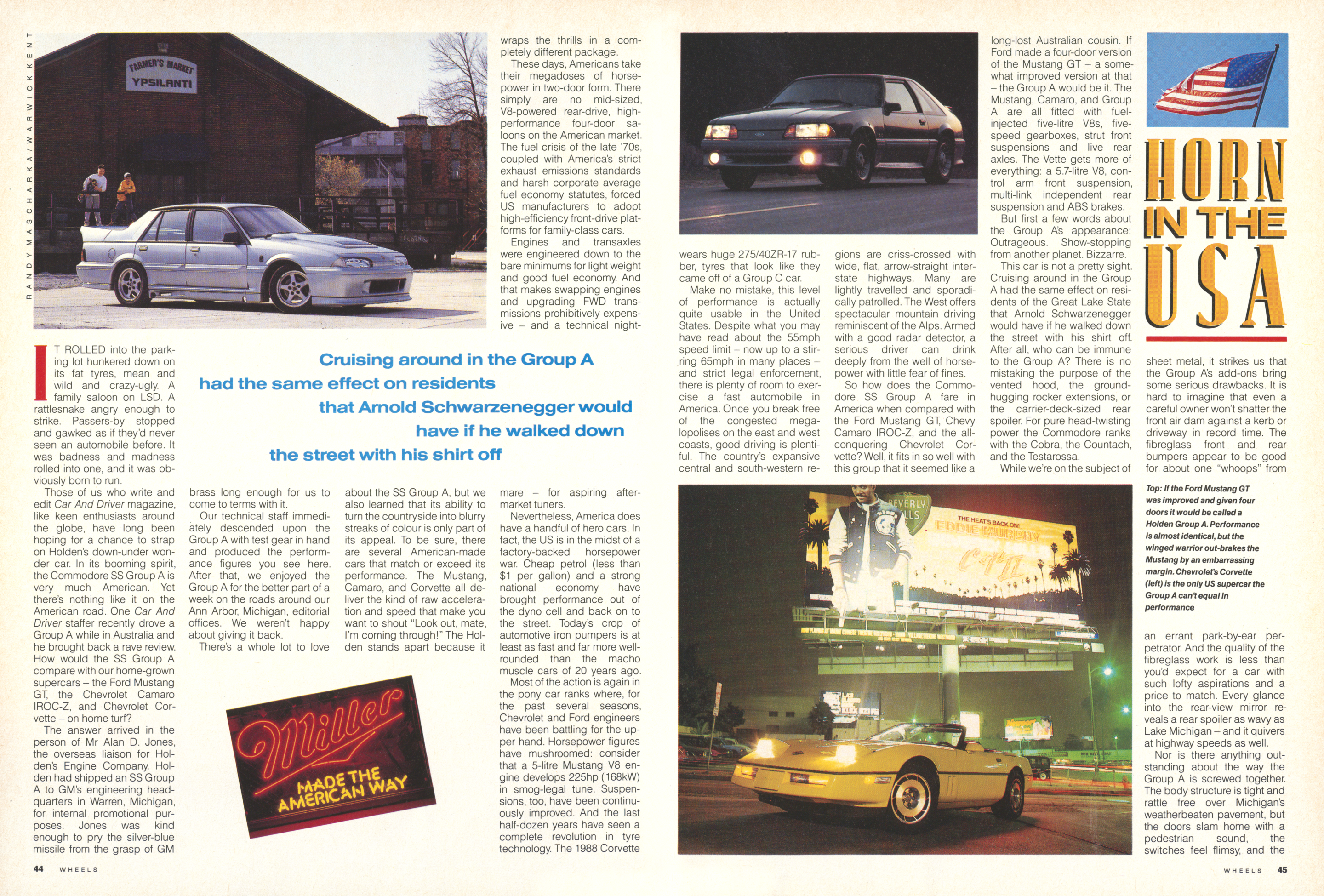
IT ROLLED into the parking lot hunkered down on its fat tyres, mean and wild and crazy-ugly. A family saloon on LSD. A rattlesnake angry enough to strike. Passers-by stopped and gawked as if they’d never seen an automobile before. It was badness and madness rolled into one, and it was obviously born to run.
1
Those of us who write and edit Car And Driver magazine, like keen enthusiasts around the globe, have long been hoping for a chance to strap on Holden’s down-under wonder car. In its booming spirit, the Commodore SS Group A is very much American. Yet there’s nothing like it on the American road. One Car And Driver staffer recently drove a Group A while in Australia and he brought back a rave review. How would the SS Group A compare with our home-grown supercars – the Ford Mustang GT, the Chevrolet Camaro IROC-Z, and Chevrolet Corvette – on home turf?
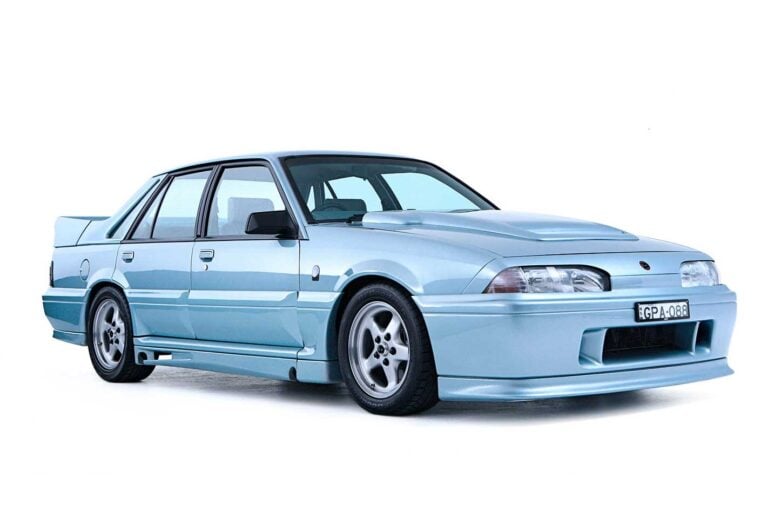
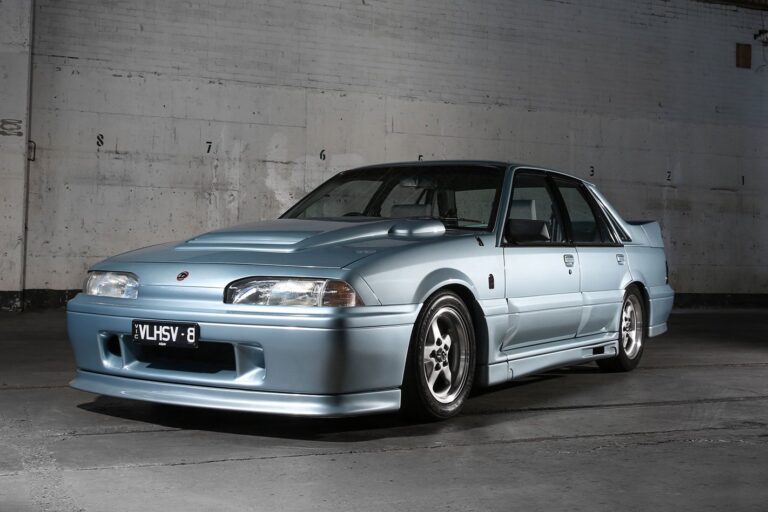
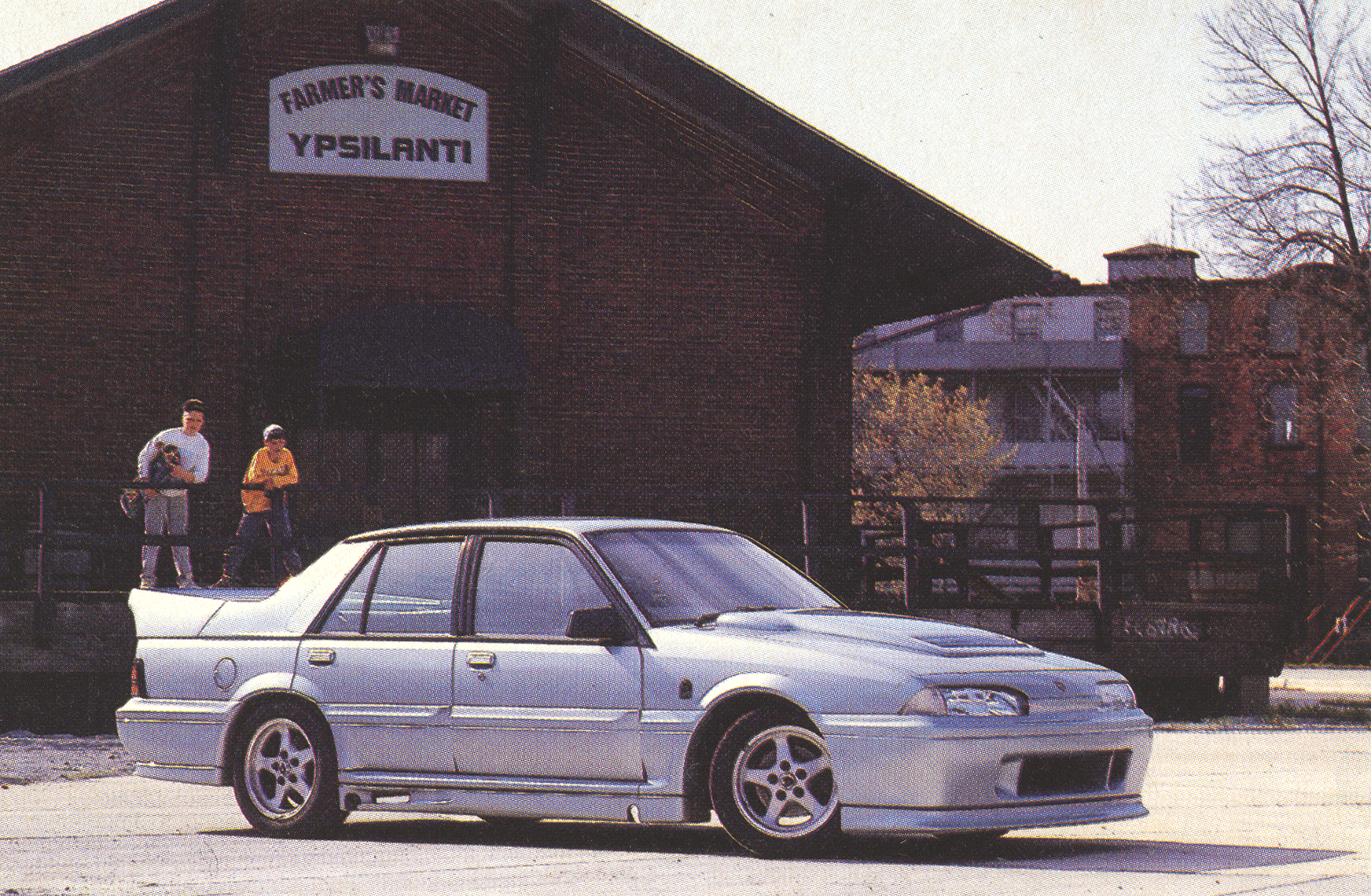
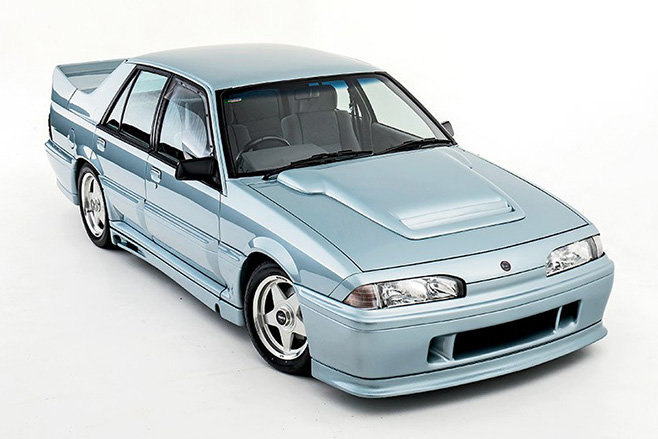
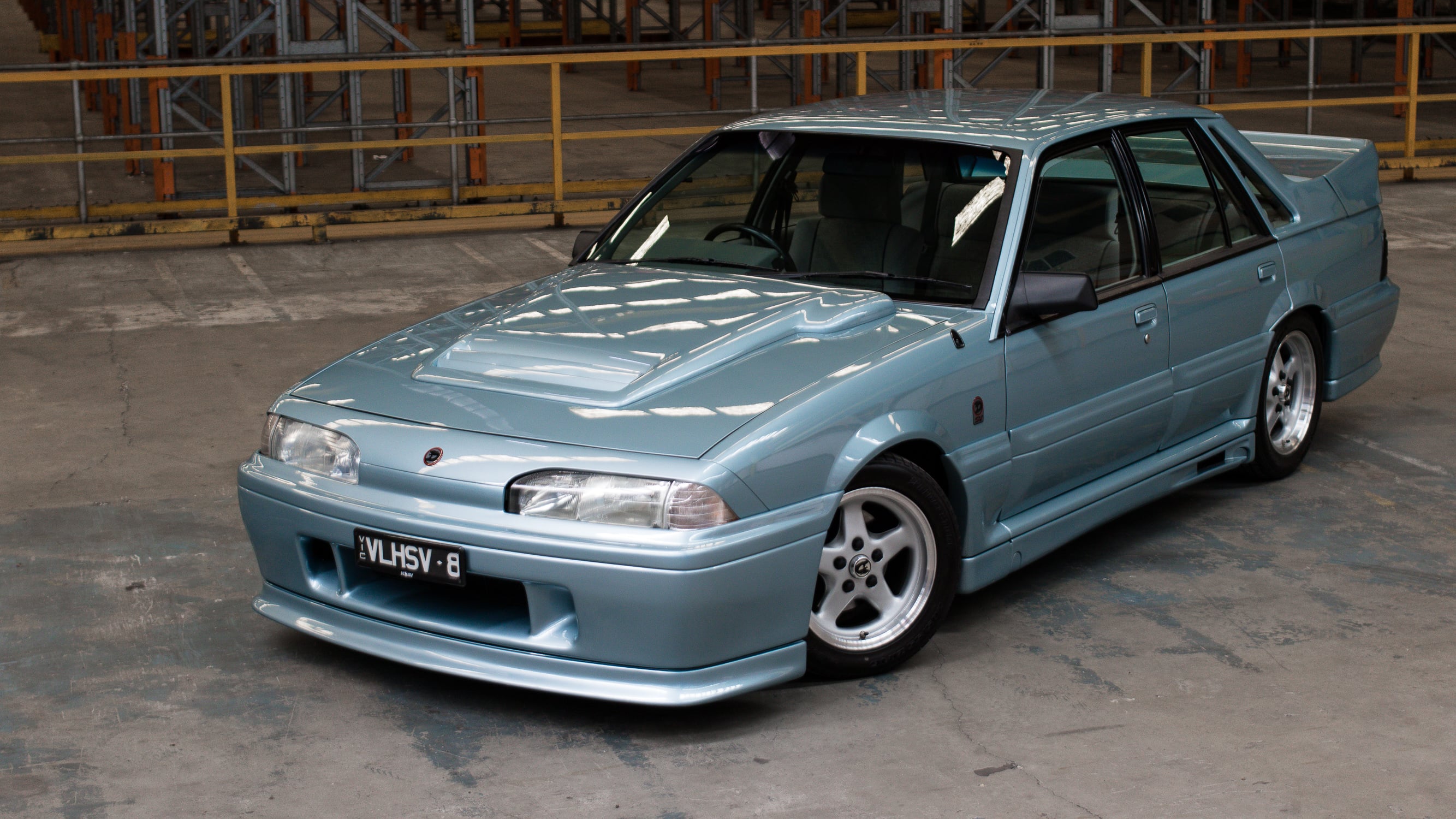
The answer arrived in the person of Mr Alan D. Jones, the overseas liaison for Holden’s Engine Company. Holden had shipped an SS Group A to GM’s engineering headquarters in Warren, Michigan, for internal promotional purposes. Jones was kind enough to pry the silver-blue missile from the grasp of GM brass long enough for us to come to terms with it.
Our technical staff immediately descended upon the Group A with test gear in hand and produced the performance figures you see here. After that, we enjoyed the Group A for the better part of a week on the roads around our Ann Arbor, Michigan, editorial offices. We weren’t happy about giving it back.
There’s a whole lot to love about the SS Group A, but we also learned that its ability to turn the countryside into blurry streaks of colour is only part of its appeal. To be sure, there are several American-made cars that match or exceed its performance. The Mustang, Camaro, and Corvette all deliver the kind of raw acceleration and speed that make you want to shout “Look out, mate, I’m coming through!” The Holden stands apart because it wraps the thrills in a completely different package.
1
These days, Americans take their megadoses of horsepower in two-door form. There simply are no mid-sized, VS-powered rear-drive, high-performance four-door saloons on the American market. The fuel crisis of the late ’70s, coupled with America’s strict exhaust emissions standards and harsh corporate average fuel economy statutes, forced US manufacturers to adopt high-efficiency front-drive platforms for family-class cars.
Engines and transaxles were engineered down to the bare minimums for light weight and good fuel economy. And that makes swapping engines and upgrading FWD transmissions prohibitively expensive – and a technical nightmare – for aspiring aftermarket tuners.
Nevertheless, America does have a handful of hero cars. In fact, the US is in the midst of a factory-backed horsepower war. Cheap petrol (less than $1 per gallon) and a strong national economy have brought performance out of the dyno cell and back on to the street. Today’s crop of automotive iron pumpers is at least as fast and far more well-rounded than the macho muscle cars of 20 years ago.
Most of the action is again in the pony car ranks where, for the past several seasons, Chevrolet and Ford engineers have been battling for the upper hand. Horsepower figures have mushroomed: consider that a 5-litre Mustang VS engine develops 225hp (168kW) in smog-legal tune. Suspensions, too, have been continuously improved. And the last half-dozen years have seen a complete revolution in tyre technology. The 1988 Corvette wears huge 275/40ZR-17 rubber, tyres that look like they came off of a Group C car.
1
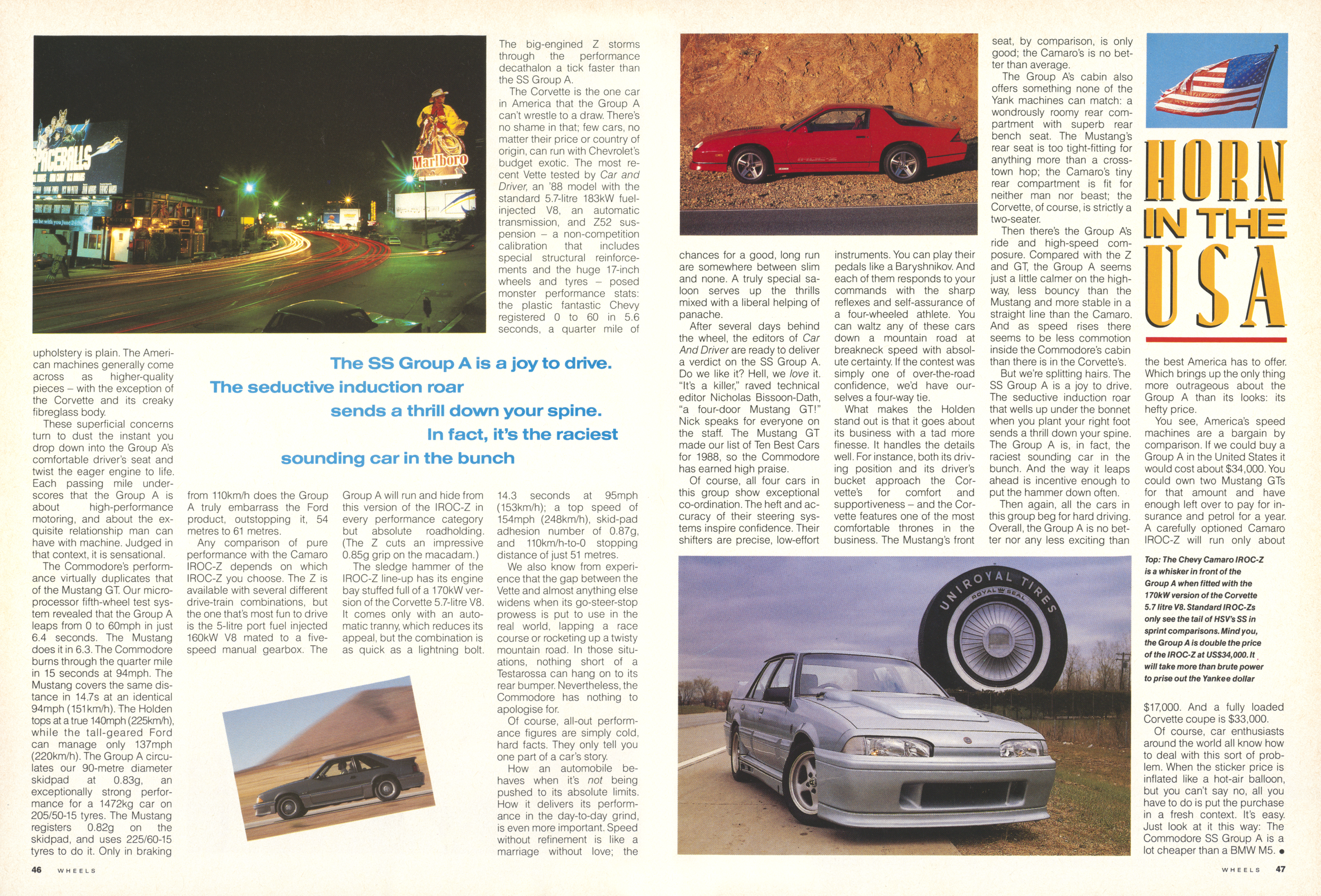
Make no mistake, this level of performance is actually quite usable in the United States. Despite what you may have read about the 55mph speed limit – now up to a stirring 65mph in many places – and strict legal enforcement, there is plenty of room to exercise a fast automobile in America. Once you break free of the congested megalopolises on the east and west coasts, good driving is plentiful. The country’s expansive central and south-western regions are criss-crossed with wide, flat, arrow-straight interstate highways. Many are lightly travelled and sporadically patrolled. The West offers spectacular mountain driving reminiscent of the Alps. Armed with a good radar detector, a serious driver can drink deeply from the well of horsepower with little fear of fines.
So how does the Commodore SS Group A fare in America when compared with the Ford Mustang GT, Chevy Camaro IROC-Z, and the all-conquering Chevrolet Corvette? Well, it fits in so well with this group that it seemed like a long-lost Australian cousin. If Ford made a four-door version of the Mustang GT – a somewhat improved version at that – the Group A would be it. The Mustang, Camaro, and Group A are all fitted with fuel-injected five-litre V8s, five-speed gearboxes, strut front suspensions and live rear axles. The Vette gets more of everything: a 5.7-litre VS, control arm front suspension, multi-link independent rear suspension and ABS brakes.
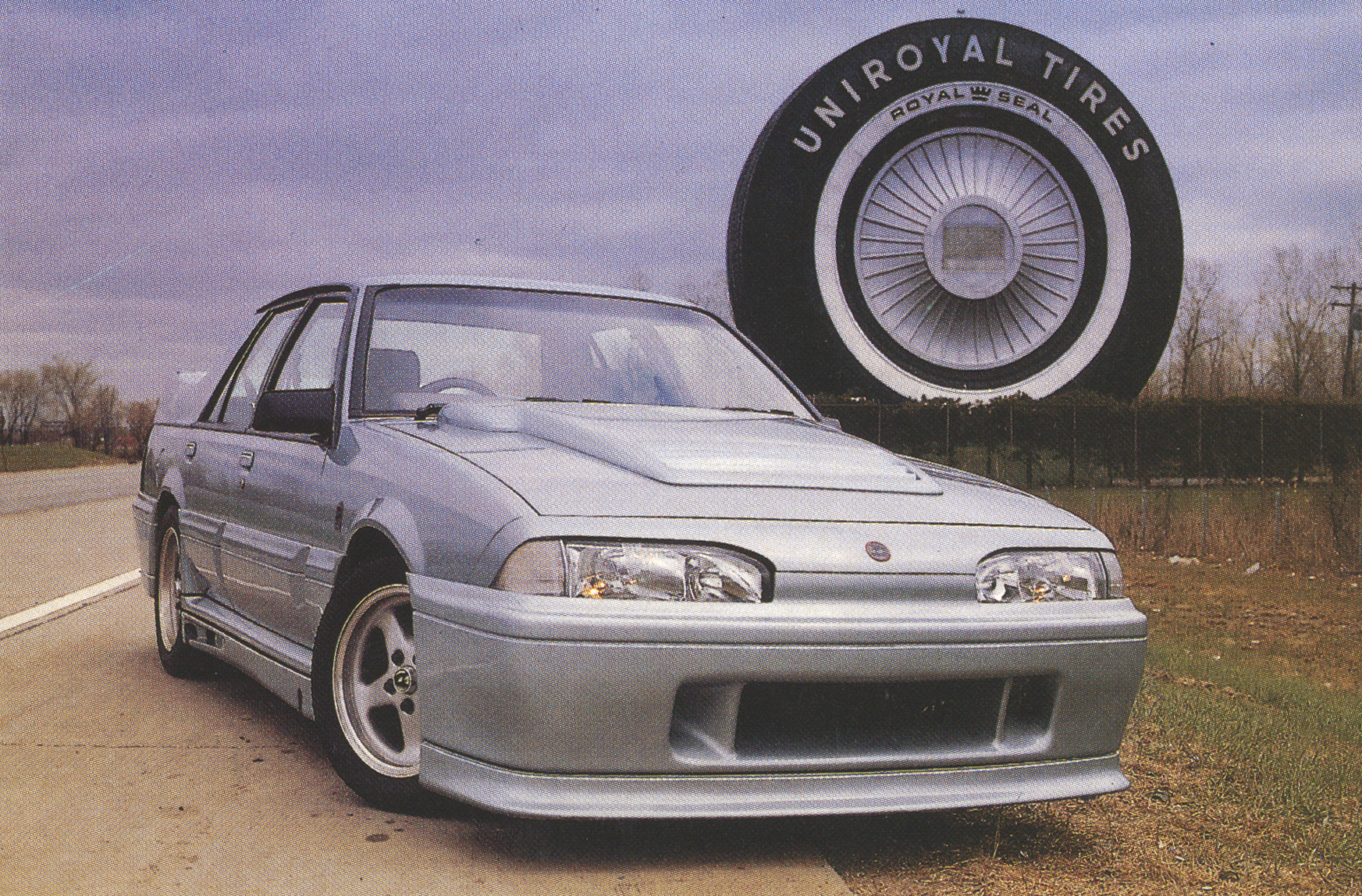
But first a few words about the Group A’s appearance: Outrageous. Show-stopping. From another planet. Bizarre.
2
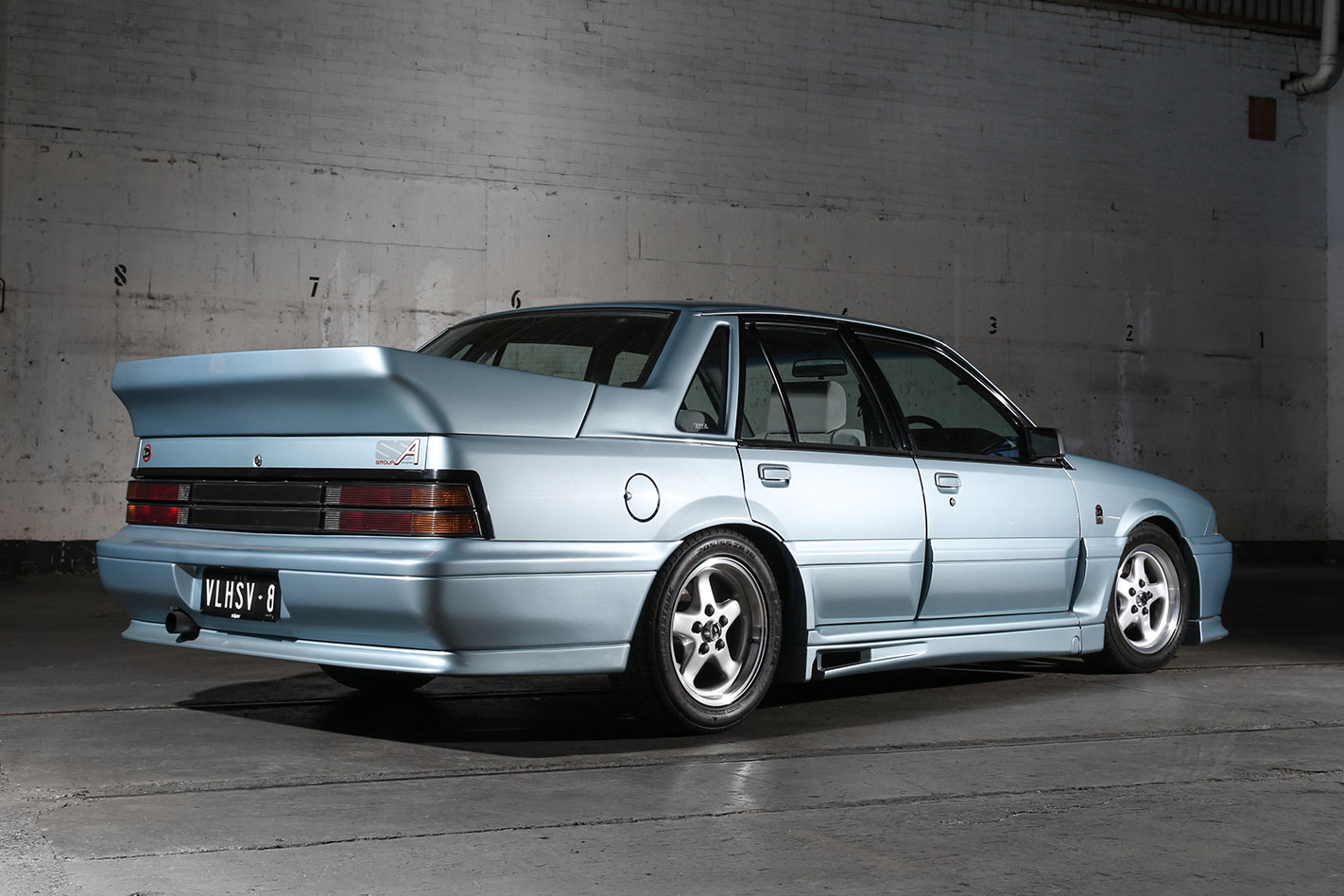
This car is not a pretty sight. Cruising around in the Group A had the same effect on residents of the Great Lake State that Arnold Schwarzenegger would have if he walked down the street with his shirt off. After all, who can be immune to the Group A? There is no mistaking the purpose of the vented hood, the groundhugging rocker extensions, or the carrier-deck-sized rear spoiler. For pure head-twisting power the Commodore ranks with the Cobra, the Countach, and the Testarossa.
While we’re on the subject of sheet metal, it strikes us that the Group A’s add-ons bring some serious drawbacks. It is hard to imagine that even a careful owner won’t shatter the front air dam against a kerb or driveway in record time. The fibreglass front and rear bumpers appear to be good for about one “whoops” from an errant park-by-ear perpetrator. And the quality of the fibreglass work is less than you’d expect for a car with such lofty aspirations and a price to match. Every glance into the rear-view mirror reveals a rear spoiler as wavy as Lake Michigan – and it quivers at highway speeds as well.
Nor is there anything outstanding about the way the Group A is screwed together. The body structure is tight and rattle free over Michigan’s weatherbeaten pavement, but the doors slam home with a pedestrian sound, the switches feel flimsy, and the upholstery is plain. The American machines generally come across as higher-quality pieces – with the exception of the Corvette and its creaky fibreglass body.
3
These superficial concerns turn to dust the instant you drop down into the Group A’s comfortable driver’s seat and twist the eager engine to life. Each passing mile underscores that the Group A is about high-performance motoring, and about the exquisite relationship man can have with machine. Judged in that context, it is sensational.
The Commodore’s performance virtually duplicates that of the Mustang GT. Our microprocessor fifth-wheel test system revealed that the Group A leaps from 0 to 60mph in just 6.4 seconds. The Mustang does it in 6.3. The Commodore burns through the quarter mile in 15 seconds at 94mph. The Mustang covers the same distance in 14.7s at an identical 94mph (151 km/h). The Holden tops at a true 140mph (225km/h), while the tall-geared Ford can manage only 137mph (220km/h). The Group A circulates our 90-metre diameter skidpad at 0.83g, an exceptionally strong performance for a 1472kg car on 205/50-15 tyres. The Mustang registers 0.82g on the skidpad, and uses 225/60-15 tyres to do it. Only in braking from 110km/h does the Group A truly embarrass the Ford product, outstopping it, 54 metres to 61 metres.
Any comparison of pure performance with the Camaro IROC-Z depends on which IROC-Z you choose. The Z is available with several different drive-train combinations, but the one that’s most fun to drive is the 5-litre port fuel injected 160kW V8 mated to a fivespeed manual gearbox. The Group A will run and hide from this version of the IROC-Z in every performance category but absolute roadholding. (The Z cuts an impressive 0.85g grip on the macadam.) The sledge hammer of the IROC-Z line-up has its engine bay stuffed full of a 170kW version of the Corvette 5.7-litre V8. It comes only with an automatic tranny, which reduces its appeal, but the combination is as quick as a lightning bolt. The big-engined Z storms through the performance decathlon a tick faster than the SS Group A.
3
The Corvette is the one car in America that the Group A can’t wrestle to a draw. There’s no shame in that; few cars, no matter their price or country of origin, can run with Chevrolet’s budget exotic. The most recent Vette tested by Car And Driver, an ’88 model with the standard 5.7-litre 183kW fuel injected V8, an automatic transmission, and Z52 suspension – a non-competition calibration that includes special structural reinforcements and the huge 17-inch wheels and tyres – posed monster performance stats: the plastic fantastic Chevy registered 0 to 60 in 5.6 seconds, a quarter mile of 14.3 seconds at 95mph (153km/h); a top speed of 154mph (248km/h), skid-pad adhesion number of 0.87g, and 110km/h-to-0 stopping distance of just 51 metres.
We also know from experience that the gap between the Vette and almost anything else widens when its go-steer-stop prowess is put to use in the real world , lapping a race course or rocketing up a twisty mountain road. In those situations, nothing short of a Testarossa can hang on to its rear bumper. Nevertheless, the Commodore has nothing to apologise for.
Of course, all-out performance figures are simply cold, hard facts. They only tell you one part of a car’s story.
How an automobile behaves when it’s not being pushed to its absolute limits. How it delivers its performance in the day-to-day grind, is even more important. Speed without refinement is like a marriage without love; the chances for a good, long run are somewhere between slim and none. A truly special saloon serves up the thrills mixed with a liberal helping of panache.
3
After several days behind the wheel, the editors of Car And Driver are ready to deliver a verdict on the SS Group A. Do we like it? Hell, we love it. “It’s a killer,” raved technical editor Nicholas Bissoon-Dath, “a four-door Mustang GT!” Nick speaks for everyone on the staff. The Mustang GT made our list of Ten Best Cars for 1988, so the Commodore has earned high praise.
Of course, all four cars in this group show exceptional co-ordination. The heft and accuracy of their steering systems inspire confidence. Their shifters are precise, low-effort instruments. You can play their pedals like a Baryshnikov. And each of them responds to your commands with the sharp reflexes and self-assurance of a four-wheeled athlete. You can waltz any of these cars down a mountain road at breakneck speed with absolute certainty. If the contest was simply one of over-the-road confidence, we’d have ourselves a four-way tie.
What makes the Holden stand out is that it goes about its business with a tad more finesse. It handles the details well. For instance, both its driving position and its driver’s bucket approach the Corvette’s for comfort and supportiveness – and the Corvette features one of the most comfortable thrones in the business. The Mustang’s front seat, by comparison, is only good; the Camaro’s is no better than average.
The Group A’s cabin also offers something none of the Yank machines can match: a wondrously roomy rear compartment with superb rear bench seat. The Mustang’s rear seat is too tight-fitting for anything more than a crosstown hop; the Camaro’s tiny rear compartment is fit for neither man nor beast; the Corvette, of course, is strictly a two-seater.
Then there’s the Group A’s ride and high-speed composure. Compared with the Z and GT, the Group A seems just a little calmer on the highway, less bouncy than the Mustang and more stable in a straight line than the Camaro. And as speed rises there seems to be less commotion inside the Commodore’s cabin than there is in the Corvette’s.
5
But we’re splitting hairs. The SS Group A is a joy to drive. The seductive induction roar that wells up under the bonnet when you plant your right foot sends a thrill down your spine. The Group A is, in fact, the raciest-sounding car in the bunch. And the way it leaps ahead is incentive enough to put the hammer down often.
Then again, all the cars in this group beg for hard driving. Overall, the Group A is no better nor any less exciting than the best America has to offer. Which brings up the only thing more outrageous about the Group A than its looks: its hefty price.
You see, America’s speed machines are a bargain by comparison. If we could buy a Group A in the United States it would cost about $34,000. You could own two Mustang GTs for that amount and have enough left over to pay for insurance and petrol for a year. A carefully optioned Camaro IROC-Z will run only about $17,000. And a fully loaded Corvette coupe is $33,000.
Of course, car enthusiasts around the world all know how to deal with this sort of problem. When the sticker price is inflated like a hot-air balloon, but you can’t say no, all you have to do is put the purchase in a fresh context. It’s easy. Just look at it this way: The Commodore SS Group A is a lot cheaper than a BMW M5.
Follow WhichCar/Wheels on Google
Click the button below to make WhichCar by Wheels a preferred source for your news.