UOTY

Gallery 1
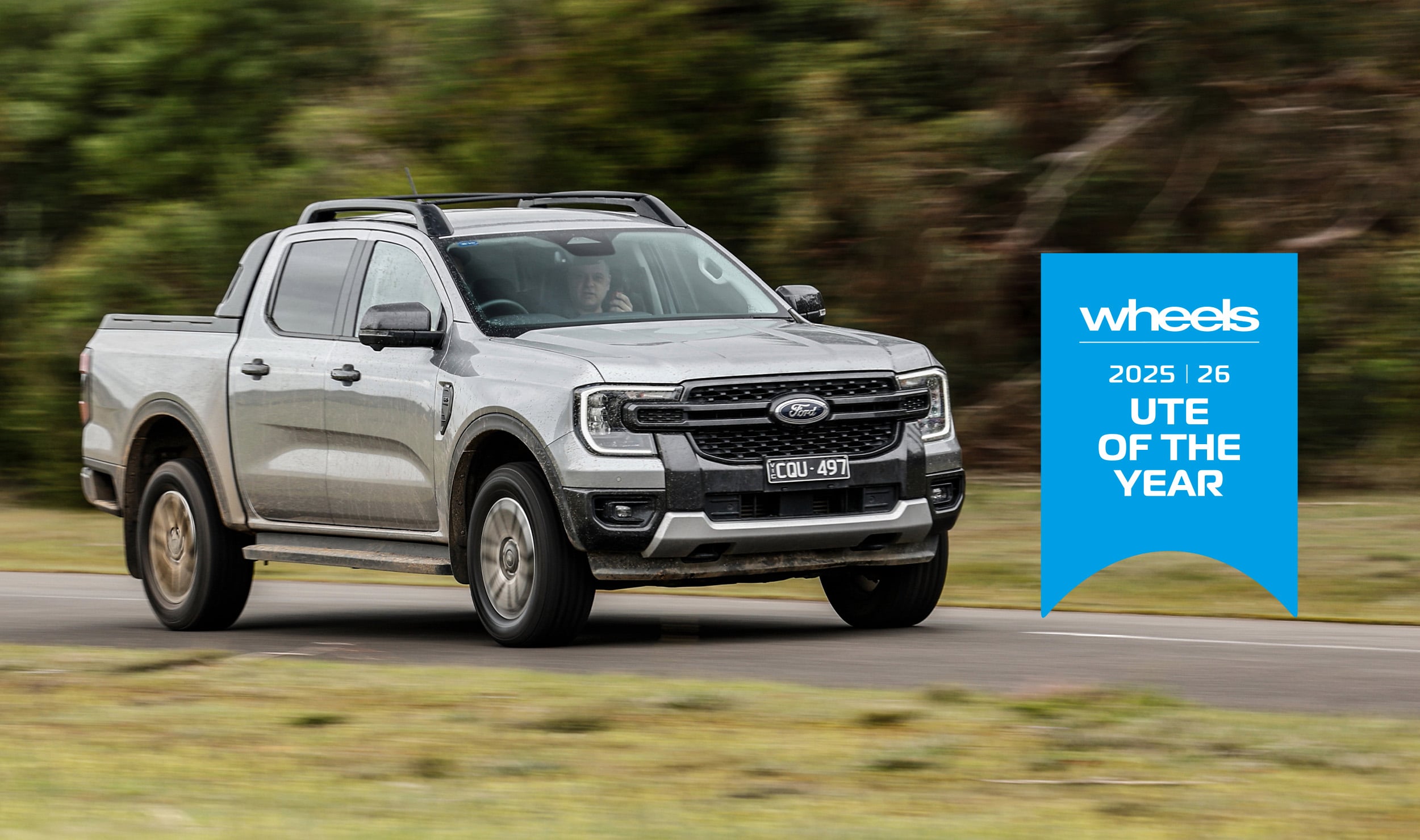
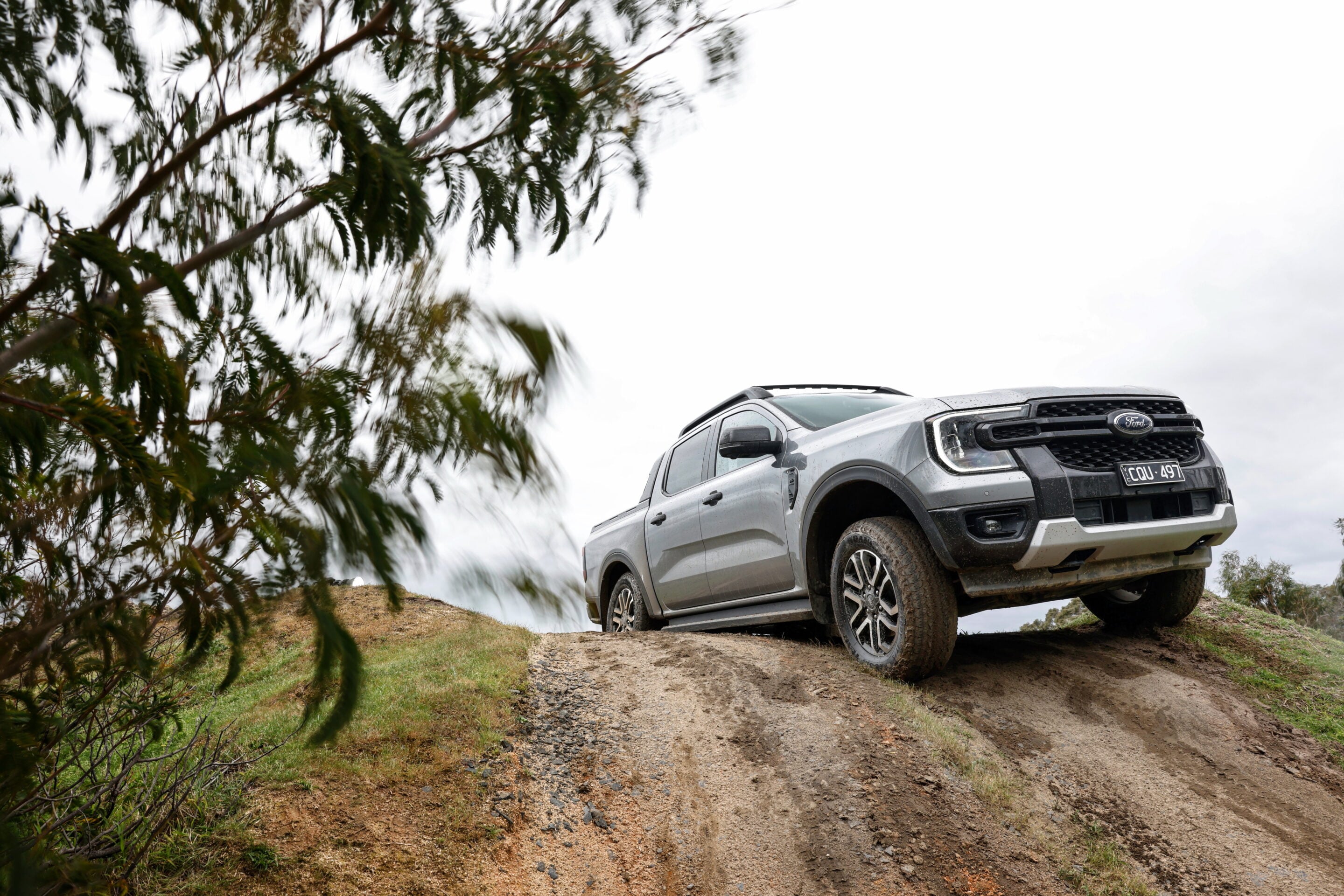
It’s a bit hard to know what’s left to say about the Ford Ranger. As the vehicle that has played leap-frog with the mighty Toyota HiLux for the number-one overall spot in the new-car sales race for the last couple of years, it’s proven itself the only dual-cab capable of giving the Toyota some showroom grief. Others have tried, but the Ranger has actually done it.
So there must be something to it, right? True, and from the very moment you jump into the Ranger in V6 form, hit the start button and set sail, there’s a feeling of solidity and – yes, dammit – refinement that is not just unexpected but actually, even in isolation, better than average for a dual-cab ute.
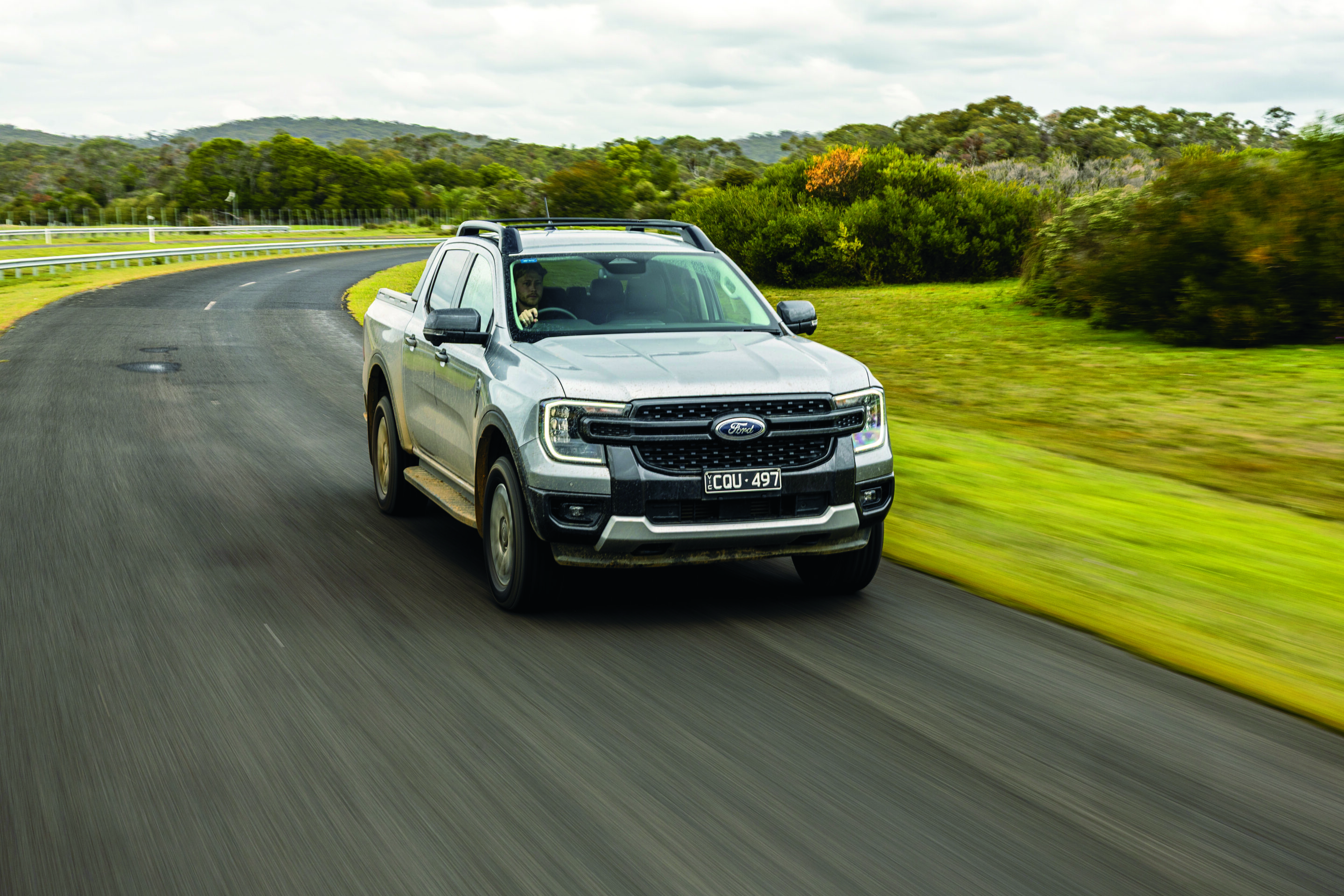
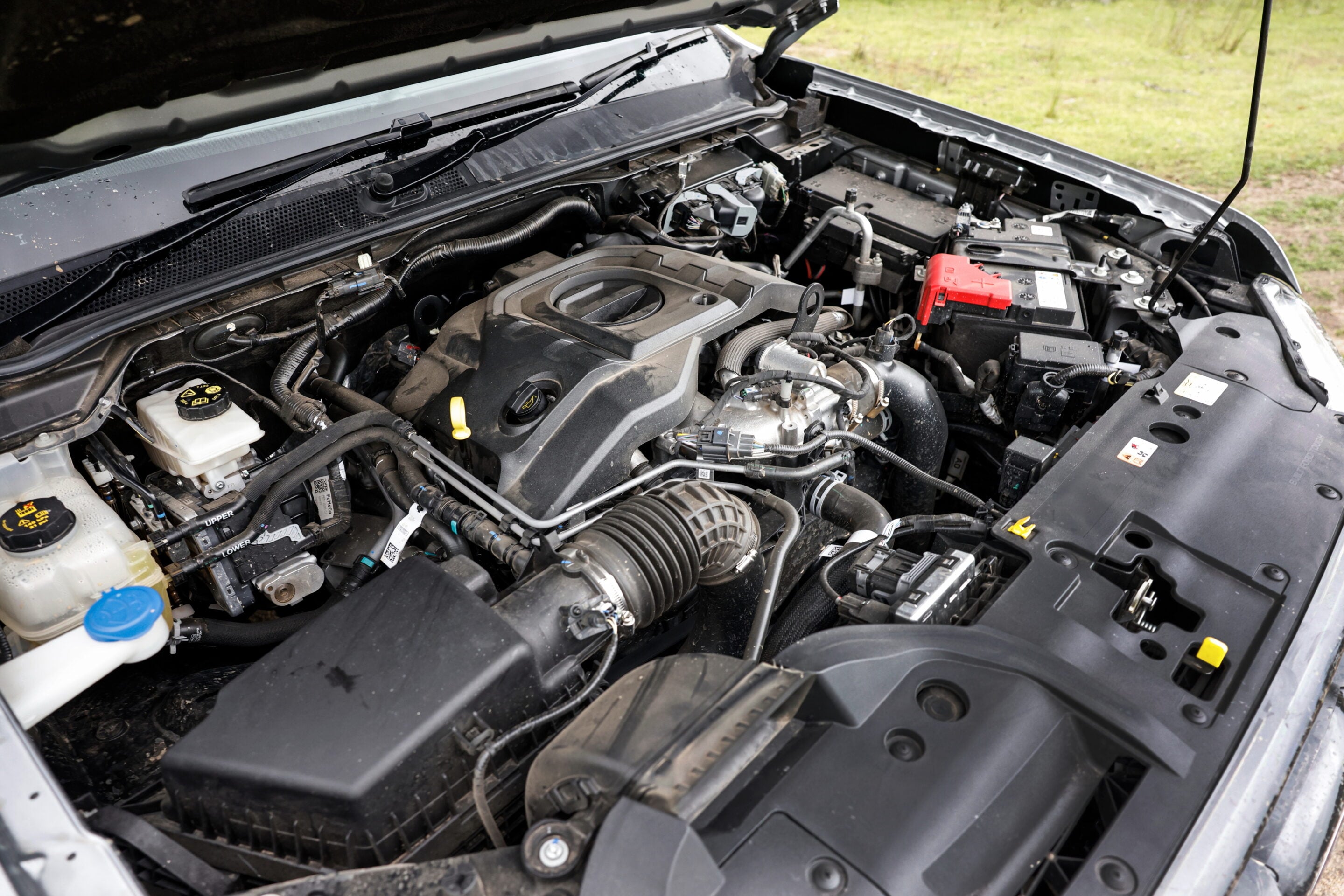
That starts with the engine, of course, and while the three-litre V6 served as the auxiliary engine on The Ark, the years haven’t wearied it. It trumps the diesel competition for bald numbers with 184kW and a meaningful 600Nm of torque, but on the road, the difference feels even more than that.
3
That’s probably partly because the V6 never seems to raise a sweat. It just motors out into the traffic, you dial up your cruising speed and that’s that. All taken care of. And all the while, it’s so much smoother than the four-cylinder competition that you’d almost swear the Ranger’s powerplant was drinking petrol, not diesel. Sounds like an exaggeration? It’s really not.
The 10-speed auto is your friend, too, skipping multiple gears when it can afford to and slotting the precise cog when it needs to. Even so, you get the feeling that the depth of ability of the V6 means the Ranger would survive with a six- or even five-speed transmission.
Mind you, less than the full 10 gears would probably mean the Ford’s fuel economy would take a hit, and that’s not something it can really afford. On paper, it’s about half a litre per 100km thirstier than the main rivals, but in reality, the disparity is probably closer to a couple of litres, and making use of those 600Nm will soon make a mark on the contents of the 80-litre tank.
The Ranger’s four-wheel-drive system also wins it plenty of friends, particularly those who spend time with something heavy hitched up to their dual-cabs. The Ranger, you see, sports something that all serious tow-cars should have, and that’s a drive mode that allows for four-wheel-drive in high-range, even on dry bitumen. The magic is all in the centre differential, but on a damp road (or even that bone dry one) where lesser vehicles are forced by mechanical politics into two-wheel-drive, the Ranger can steam along with all four tyres driving and, crucially, gripping.
2
This is not just an added safety margin for those in the Ranger, but for everybody else sharing the road with it. And even when you’re not towing, the opportunity to use four-wheel-drive on the road in, say, light drizzle or a rainstorm is not to be underestimated. It works like a fresh piece of sandpaper on gravel, too.
And while we’ve deliberately downplayed towing in our judging criteria, it’s worth mentioning that the Ranger also boasts the excellent towing package that gives guidance to the driver for hitching up (via the cameras) the chance to check all brake lights and indicators without leaving the driver’s seat (via technology) and even a trailer-sway-avoidance function (via sheer genius).
The Ranger also addresses probably the biggest single bitch regarding dual-cab utes; ride quality or, more specifically, the lack of it. Both primary and secondary ride quality is better than average and the Ranger seems to glide over stuff that has many of the others bucking and lurching along at the same pace.
The ride is very well damped and there’s little intrusion into the cabin of nasties like suspension or even tyre noise. And across our test track’s offset-undulation section, which had some of the utes here either waddling or even twerking at 25km/h, the Ranger was far more controlled. No, it wasn’t as good as the all-independently sprung BYD, nor the Cannon Alpha with its enormous wheelbase, but definitely way better than average. A metaphor for the whole Ranger V6 experience, perhaps?
1
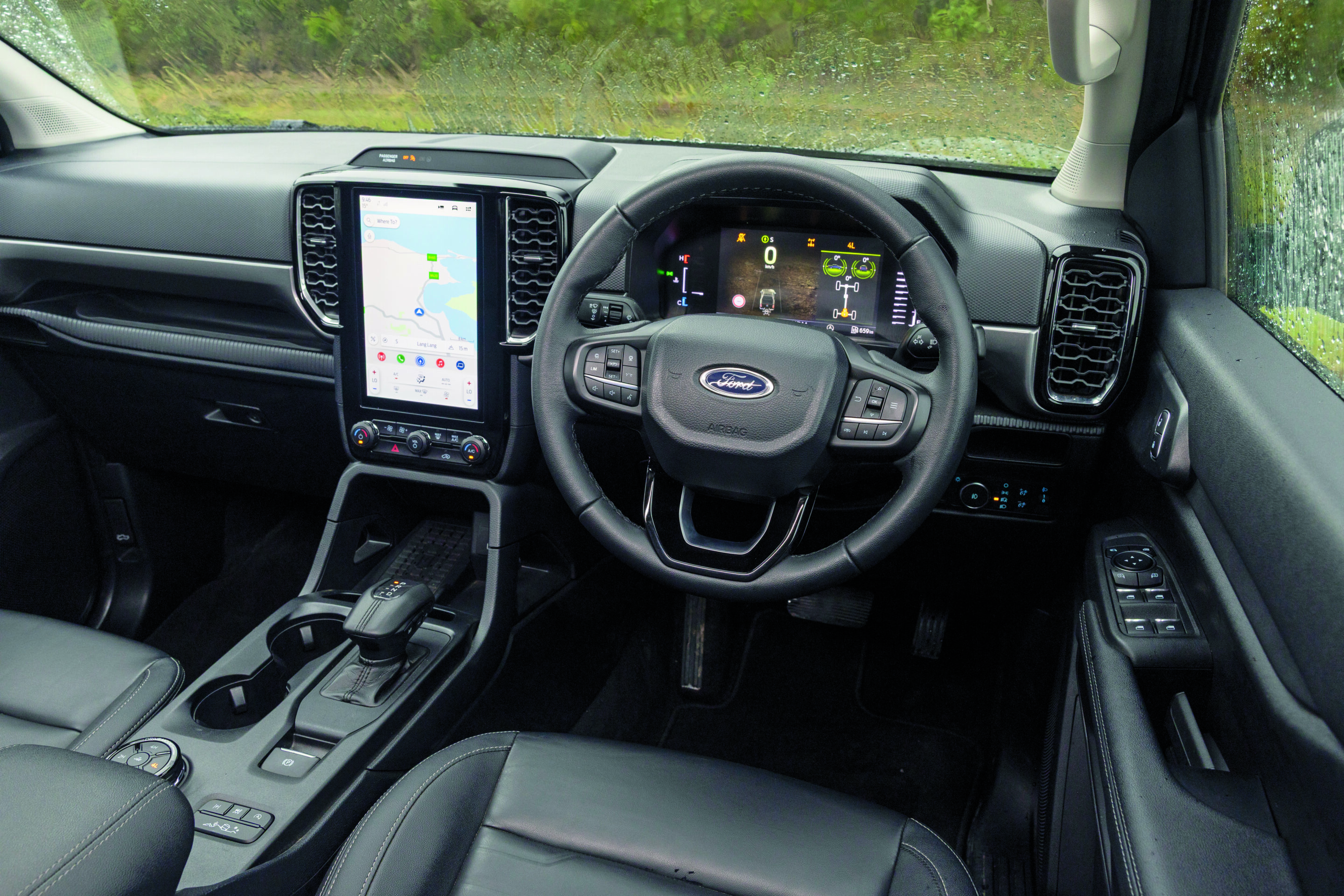
Inside, the cabin shows real evidence of some clever thinking in the layout (those door handles, for instance, are brilliant) and there’s tech aplenty. You can count on Ford’s Sync connectivity system with a 12-inch screen, wireless phone charging, lots of charge points, a power-socket in the tray (why don’t they all have this?), heated front seats and dual-zone climate control.
But the big, burly Ford lost marks when we put it through our equivalent of the dreaded moose-test; a swerve-and-recover exercise that tests agility and stability in equal measures. Frankly, the Ranger did pretty poorly here, both in terms of long stopping distances and gratuitous understeer both on tip-in and the crucial change of direction. The reason probably has a fair bit to do with the All Terrain tyres fitted to our test car, and while other utes here had more road-oriented rubber, the Ranger’s off-road emphasis (and Ford’s marketing department, presumably) demands the more compromised A/Ts.
Beyond that, however, the safety story is a pretty strong one with a five-star ANCAP rating, predicated upon driver assistance gear including blind-spot monitoring, rear cross-traffic assistance, autonomous emergency braking, tyre-pressure monitoring and active cruise-control. Even better news is that things like the lane-keeping assistance and distracted-driver monitoring stuff is calibrated properly so that it works without constituting its own distraction.
4
Trent Nikolic summed it up neatly: “Ford’s Ranger has set the standard in this segment for close to a decade,” he said. “Ford’s determination to update, fettle, improve and offer new sub-segment models is the way forward for any manufacturer wanting to compete. Of our top three, if you want to head off-road or do long distances, the Ranger is the pick.”
At $71,590, the Ranger V6 is far from cheap and towards the top of the pricing tree of this bunch. But it surely makes the dearer ($73,000) Isuzu D-Max X-Terrain (among others) look pretty lame by comparison.
Specs
| Price | $71,590 (MSRP) |
|---|---|
| Body | Dual-cab, five-seat ute |
| Drive | Dual-range 4×4, incl. auto mode |
| Drivetrain | 3.0-litre V6 turbo diesel |
| Power | 184kW @ 3250rpm |
| Torque | 600Nm @ 1750-2250rpm |
| Transmission | 10-speed automatic |
| Consumption | 8.4L/100km |
| Kerb weight | 2276kg |
| 0-100km/h | NA |
| L/W/H/W-B | 5370/1918/1886/3270mm |
| Payload | 1004kg |
| Warranty | 5yr/unlimited km |
| Safety rating | 5 star ANCAP (2022) |
2025-26 Wheels Ute of the Year
Follow WhichCar/Wheels on Google
Click the button below to make WhichCar by Wheels a preferred source for your news.