Features
Gallery 1
Two days before a planned trip up and over the Stelvio Pass we learn that we’d managed to pick the exact weekend of the 200th anniversary celebrations for the famous road, Italy’s highest and the third highest in Europe.
That news had ‘recipe for disaster’ written all over it, and commonsense should have told us to change our plans and create another route – but the Stelvio Pass is something special. It’s universally known by even those not even interested in cars as one of the most spectacular roads to drive on earth. As such, we don’t even bother coming up with a Plan B. Traffic jams, 200th anniversary celebrations or not – the famous pass has too much pull.
Our chosen steer for the occasions? Well, we pick a SUV. Ahh yes, SUVs and the Wheels reader, what do I even say here – there’s some love, some hate and thankfully a fair dose of commonsense.
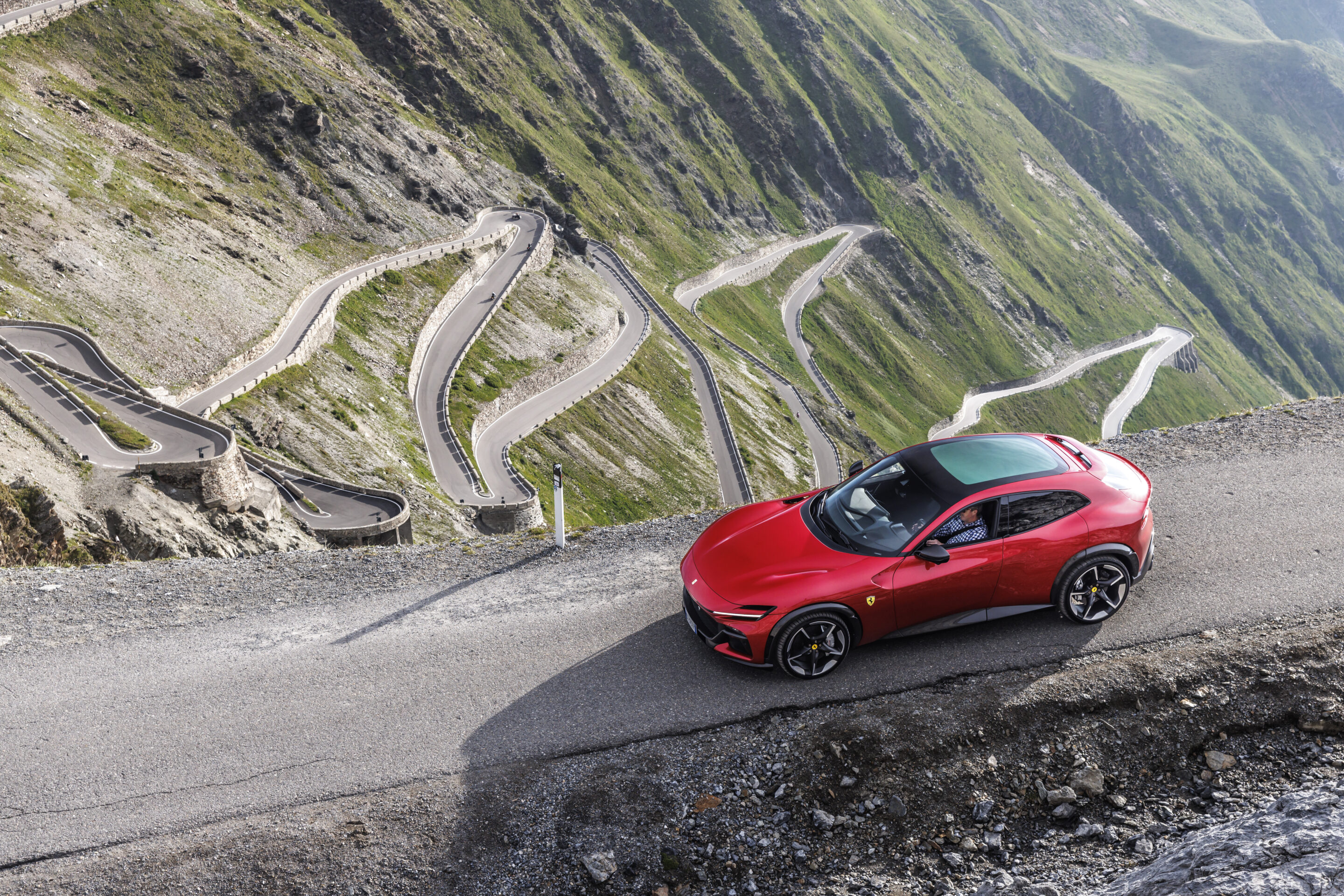
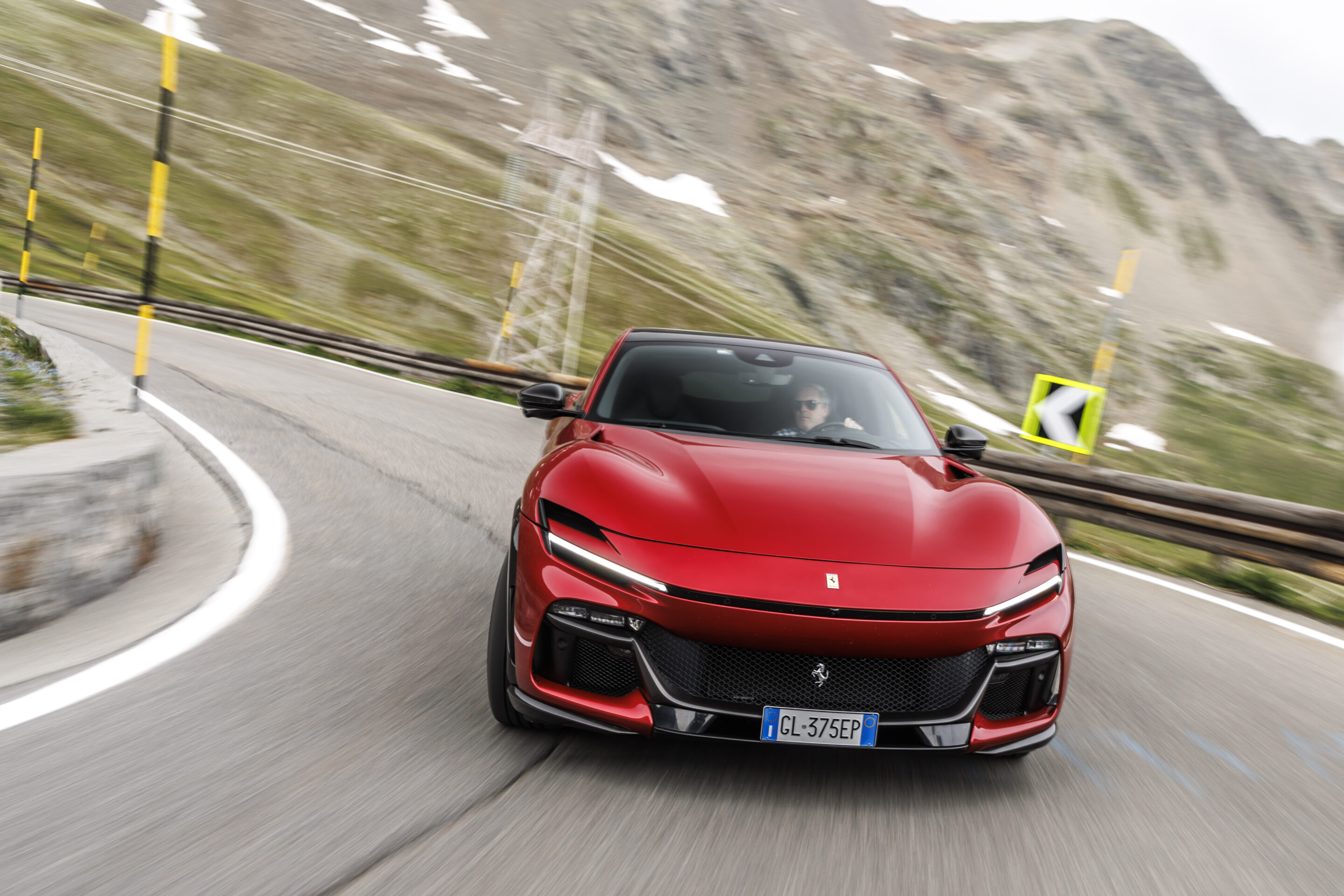
Then again, this isn’t any normal SUV. Sitting somewhere between performance four-seater sedan and, well, an SUV, is the Ferrari Purosangue. Yes, it’s a significant departure from what we know a Ferrari to be. It’s by no means Ferrari’s first production AWD vehicle (that was the FF of 2011) but it is their first play at producing something so high sitting on the road. Not that the brand refers to the Purosangue as an SUV. Ferrari insists that it’s a four-door, four-seater sports car. With a 6.5-litre naturally aspirated V12 producing 533kW, you could say they have a point.
1
The proportions are generous, but the footprint isn’t overly excessive. Compared with rivals, it measures 130mm less in length than Lamborghini’s Urus and sits more than 30mm shorter than Aston Martin’s DBX. Its width, however, surpasses both, giving the car a planted, muscular look that’s reinforced by compact overhangs. Standing 1589mm tall, it rides nearly 100mm lower than those competitors. In fact, it looks more Porsche Macan-sized to my eyes – which is no bad thing.
For a four-door, four-seat machine, the figures are staggering: 533kW is delivered at 7750rpm, with 80 per cent of its 716Nm torque (573Nm) available from just 2100rpm, while peak torque is achieved at 6250rpm. The V12 sits in a front-mid position within the wheelbase, paired with an eight-speed dual-clutch transmission mounted at the rear axle, which channels power rearward and also works with a revised PTU (borrowed from the AWD GTC4 Lusso) that drives the front wheels.
The gearbox shares its seven lower ratios with the SF90 Stradale and 296 GTB, while the final eighth gear is tuned for cruising. Although there’s no hybridisation in the system, the engine and transmission can disengage to allow the car to coast.
This engineering layout achieves a 49:51 front-to-rear weight balance. The performance claims are equally aggressive: 0-100km/h in 3.3 seconds and a top speed beyond 310km/h. Kerb weight is 2180kg.
Beneath the skin lies a fresh aluminium structure offering 30 per cent greater torsional rigidity and 25 per cent more beam stiffness than the GTC4’s platform, all while shedding weight. Each wheel is managed by an advanced suspension set-up developed in partnership with Multimatic, the same engineering firm that collaborated with Ferrari on the SF90 Assetto Fiorano, the 296 GTB Assetto Fiorano, and the GT3 racer derived from the latter.
2
The system combines a conventional spring with an adaptive damper that incorporates Multimatic’s innovative ‘True Active Spool Valve’. By integrating a 48-volt electric motor into the hydraulic damper’s spool valve, significantly higher levels of force and frequency response are achievable than with standard adaptive or semi-active solutions. As a result, roll stiffness can be varied seamlessly, allowing the body to drop by 10mm under load, and eliminating the need for traditional anti-roll bars altogether.
Ferrari has also refined its all-wheel-drive architecture, evolving the system used in the GTC4 Lusso with new control software derived from the SF90. Complementing this is the independent four-wheel steering innovation first seen on the 812 Competizione.
So, to recap, this is no ordinary SUV…
To complete our crossing we also have something a little more traditionally Ferrari in tow in the form of a 12 Cilindri – a car Andy Enright drove back in March. Between the two of us we have 24 cylinders and 1143 kW and 1434 Nm of torque. Plenty enough to be noticed. To add to the fun, the day before departure we discover that the roads would be closed at 9am sharp. Anyone who has experienced European bureaucracy knows 9am sharp could also mean 7am. So we set our alarms early and depart our hotel at 6am.
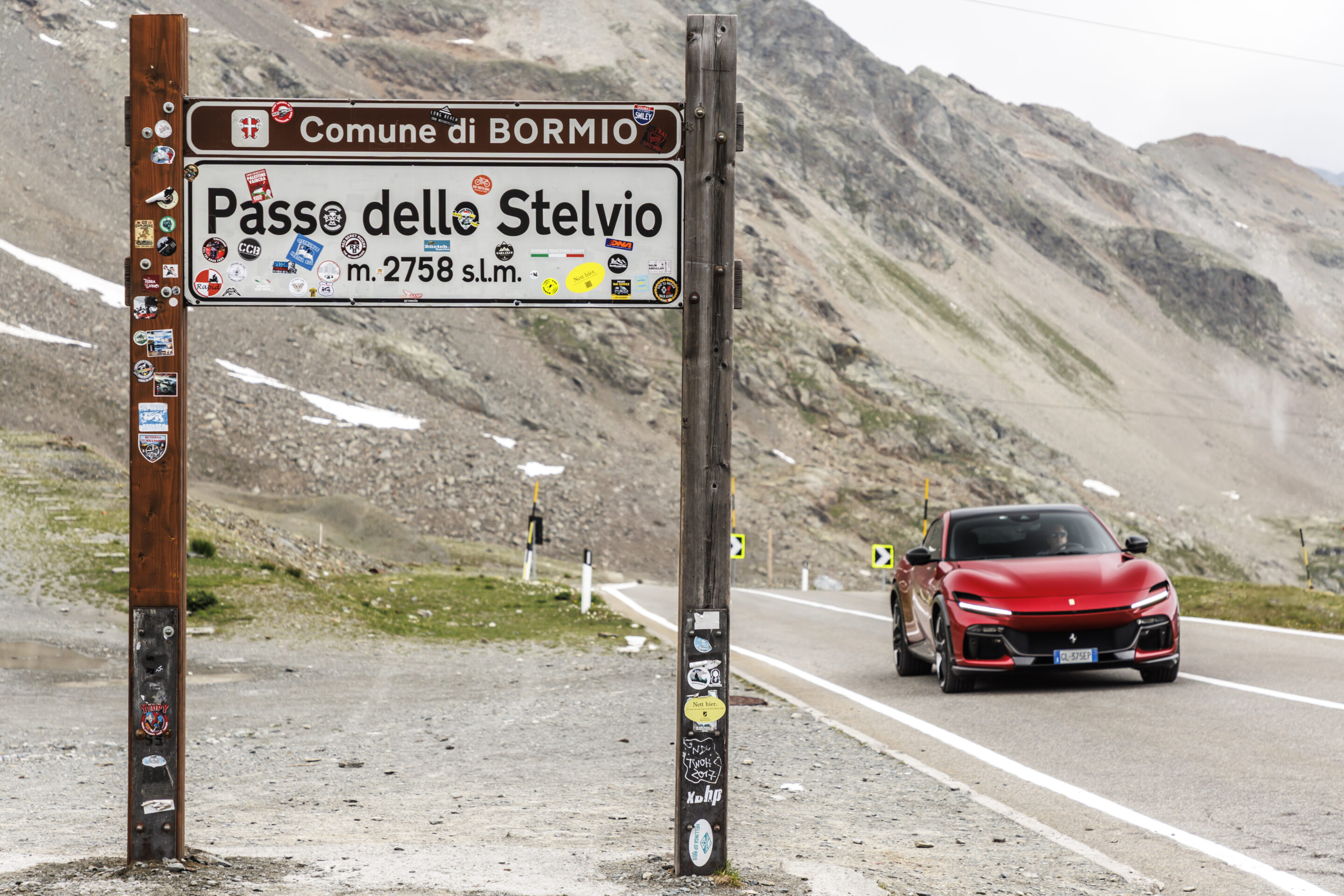
The Stelvio Pass starts almost as a non-descript turn-off just outside of the northern Italian alpine town of Bormio. In fact, there’s next to nothing to indicate that by turning onto it you are about to be treated to one of the most – if not the most – picturesque roads known to man. I’ve been lucky enough to have been here a few times before, yet every time is just as impressive as the time before – it certainly doesn’t lose any of its capacity to awe, in fact it gets better. Just like your favourite driving road, you begin to know what to expect as each corner approaches. Sadly, if you pick the wrong day (say perhaps the upcoming 200th anniversary of its opening), you could find yourself in a 20-kilometre long traffic jam behind Dutch caravans and large guys on Vespas. Regardless of the state of the traffic, it’s certainly not the fastest way to get from Italy to Germany, but it’s hands down the most spectacular.
From my perched position in the Purosangue I’m looking down at the 12 Cilindri with envy. Am I wishing I was guiding it via rear wheels instead of my all four? Well, at first, yes. But once we hit a bunch of hairpin turns not even wide enough for a Abarth 695 I’m more than happy to be where I am, because our added height gives the advantage to the Purosangue.
Unfortunately as we start our climb we discover the local police are just ahead of us, meaning the fun appears to be over before it even starts… however this is Italy, so while they don’t pull us over with a warning to behave, they appear to encourage us to go for it by pulling over and letting us pass. Only in Italy.
1
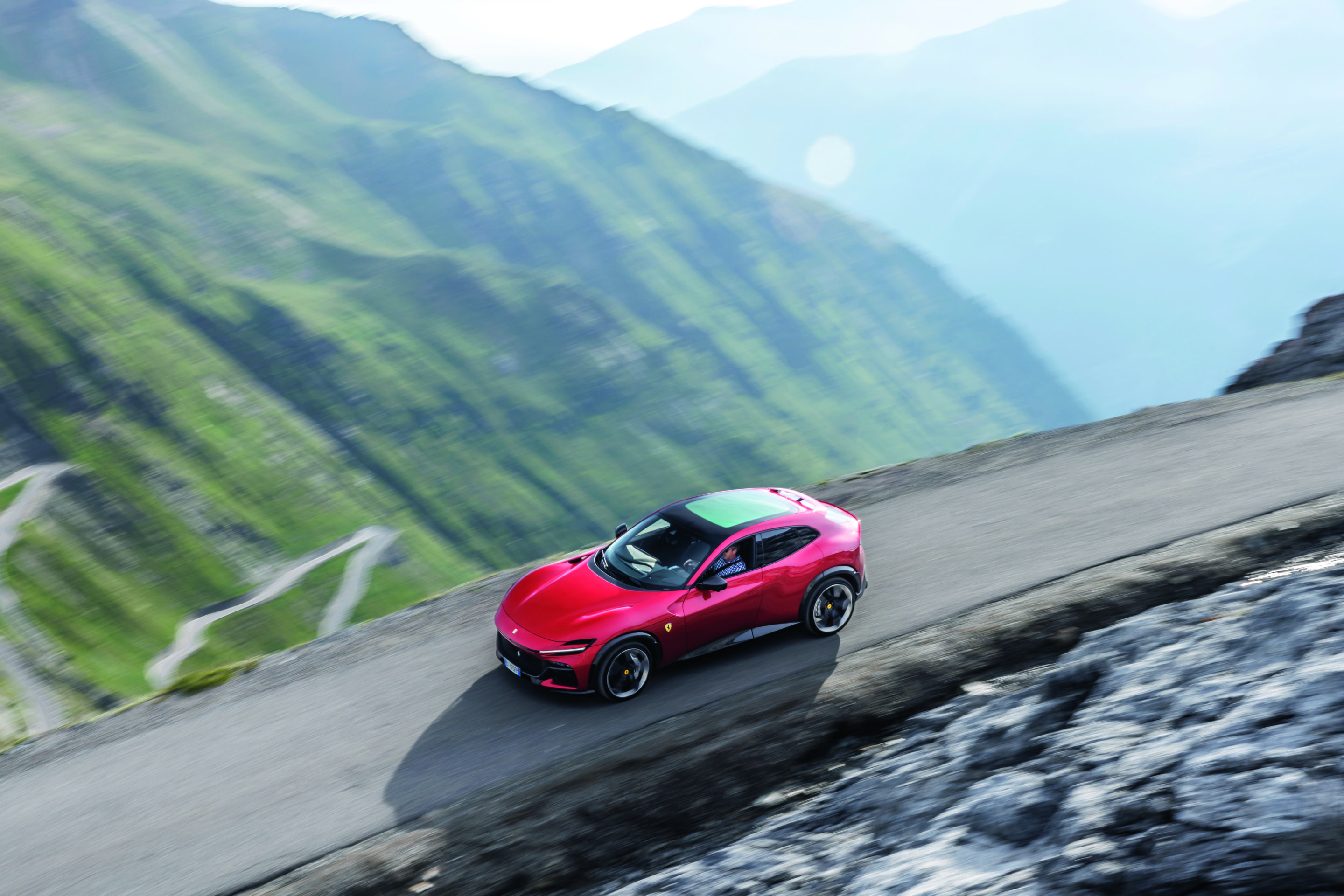
Full of confidence from what we take to be a Carabinieri ‘green light’, we simply floor it. Wow. Besides a few rather blind one-lane tunnels, this is the definition of a driver’s road. Used regularly for Giro d’Italias, it’s definitely been resurfaced since I was last here. Does that matter to the all-wheel drive Purosangue? Not at all, it’s made to absorb all that is aimed at it – the fresh road surface just heightens the impression of the genuine four-seater as more performance sports car than SUV.
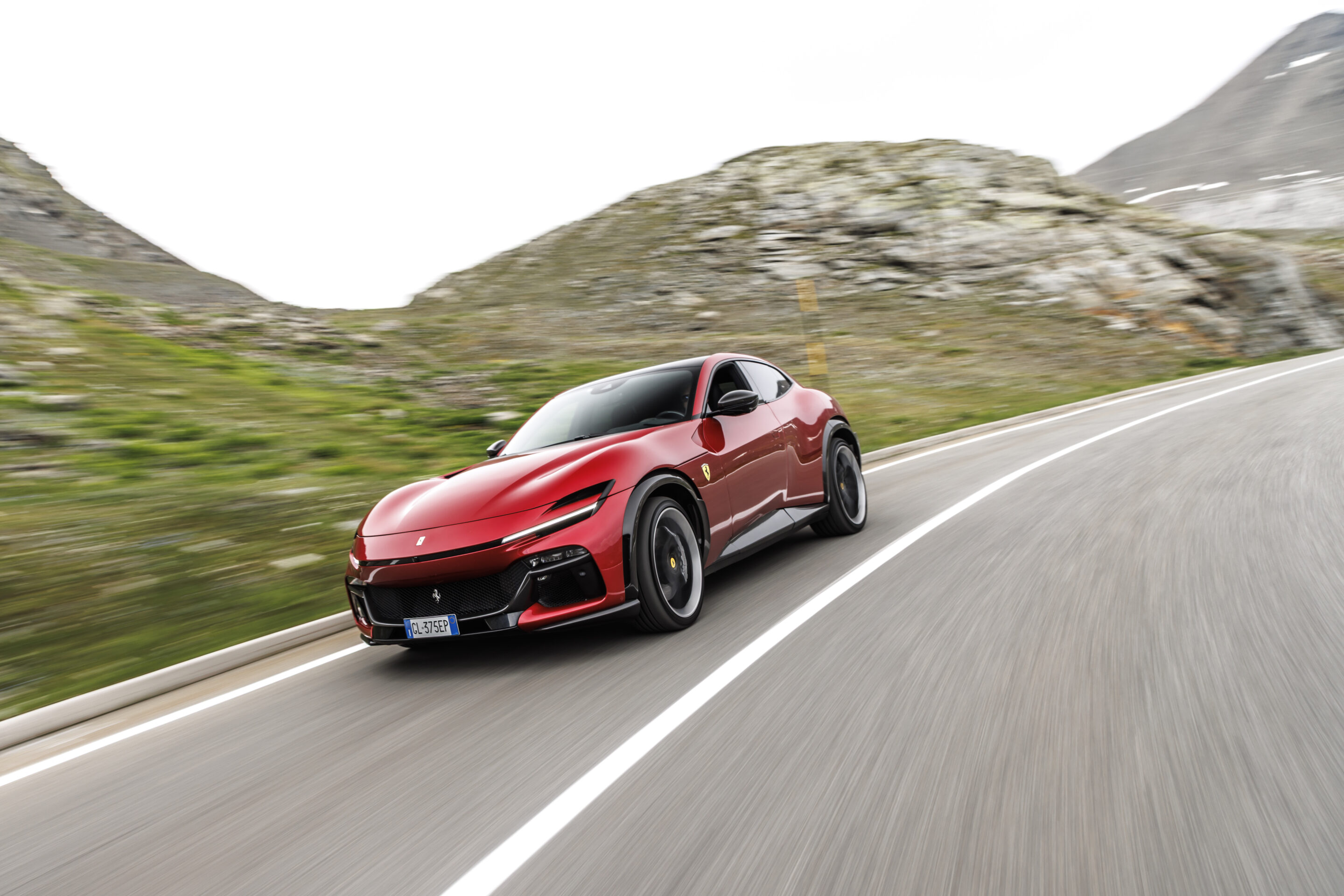
The Purosangue leans into corners reserved for the likes of an ultra-light Lotus 7 with such surefooted commitment it really shouldn’t make sense. It just holds the road.
And the noise. Dear Lord, does it sounds good, and that occurs long before any of the change-up lights start to appear on the top of the steering wheel. The fact it grabs gears as hard as any top tier sports bike at full flight defies belief – push it hard and it punches you back into the seat on every upshift… and it just keeps surging forward. If you find a road long enough, it will top out at 311 km/h. The Purosangue feels like it’s designed to lift off from the end of a runway.
Even though we aren’t getting airborne today, we still manage to cover the 21 kilometres and 1632-metre elevation from Bormio to the top of the pass scarcely 25 minutes after leaving our hotel garage in Bormio. I have a chuckle to myself when I realise that I was still fast asleep in bed less than 45 minutes ago. We all get to the top and look at each other a little speechless. We find ourselves, in fact, on the literal and emotional top of the automotive world… and to our surprise the place is empty. The gamble has more than paid off.
From here we can see far into the distance, taking in the incredible peaks of Switzerland, Austria and Italy all at once. But there’s precious little time to take in nature – at least, no time to take it in while sitting still. An empty Stelvio Pass never happens so we quickly make the decision to take advantage of the empty pass by doing what comes naturally – driving.
1
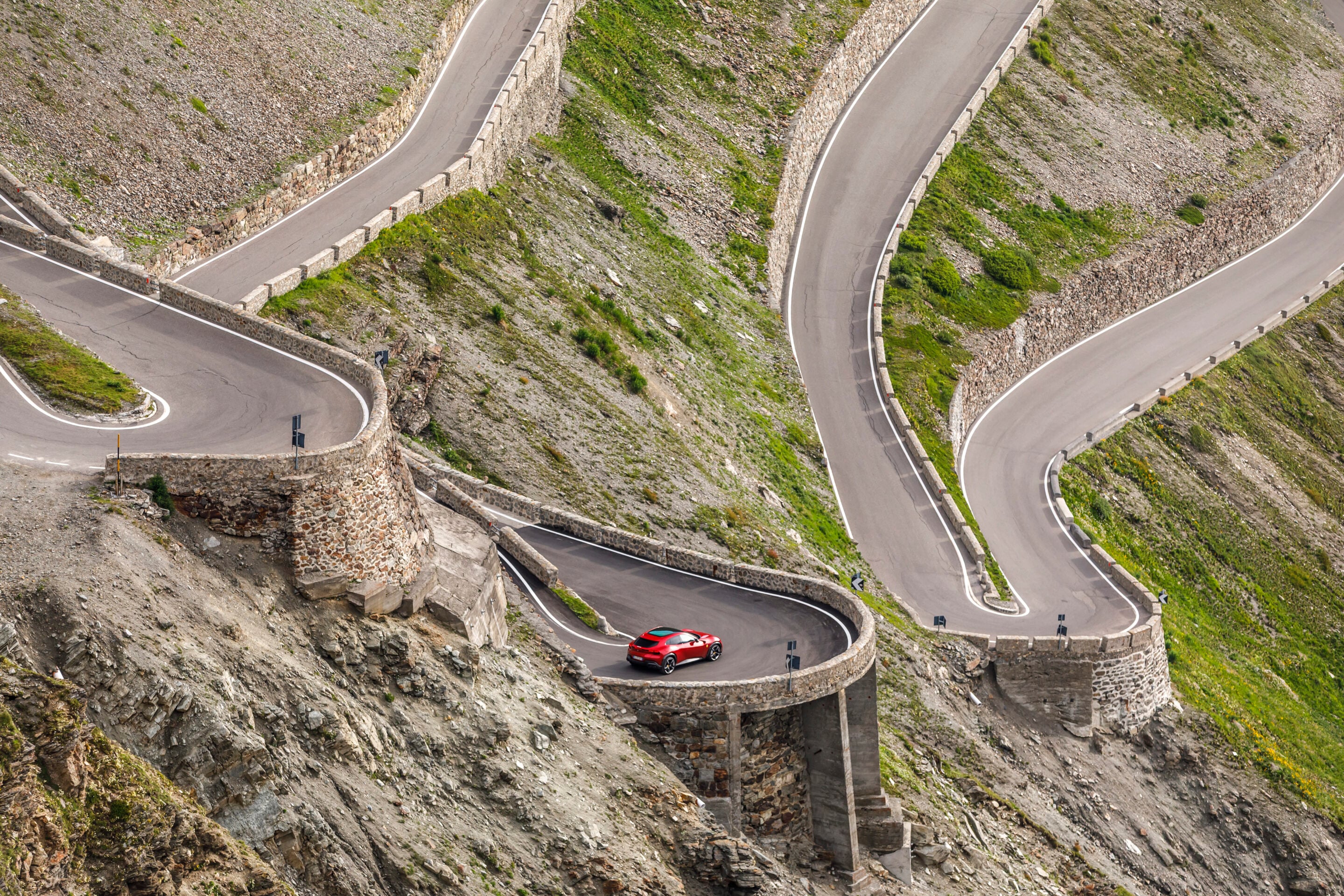
Now for a reality check. While they make for some incredible images, those famous 48 hairpin turns you see in these pictures are actually a bit of an anticlimax to drive. In fact, they can be downright stressful as the vast majority need to be taken blind. The southern side of the pass is the pick for rapid driving. It’s just as tight in places, but a clear line of sight is with you (minus those tunnels) pretty much the whole way up. All of the car-to-car tracking images you see here are on that side of the pass. By accident, however, we discover a trick to the ‘famous’ hairpin side of the pass.
While taking the images you see here, I had Ferrari Australia’s PR head Ryan Lewis on the phone, acting as both guide and translator for our photographer. From his position 500 metres above Ryan, he became my ‘spotter’ (just like the blokes in NASCAR have) advising if there was any traffic approaching from the opposite direction. Now we’re talking. Hard through the gears, the Purosangue comes into its own on the short straights between each of the 48 hairpins, only this time I can commit to using the full width of the road to carry speed into, and thus out of, each one. The Purosangue just holds the road – period.
Childish comments like ‘it corners on rails’ don’t belong here – because it doesn’t need them. With its massive Michelins superglued to the road, this Ferrari redefines what a performance SUV – and a performance four-seater – is all about.
When I reach the bottom I sadly have no choice but to turn around and climb the pass all over again. The noise bounces back and forth through the valley, potentially setting off an avalanche in some distant part of Austria. I can hear Ryan, a good kilometre and a half away and above, laughing at the spectacle.
It’s tempting to stay here longer – for a clear Stevio Pass is something I’ll never likely experience again, but our deadline approaches to get off the pass before it’s closed on us and we are stuck up here for the rest of the day. If we don’t get over, we have to go back the way we came, missing some incredible roads ahead.
We get through the closing of the pass with three minutes to spare, and only then because our photographer Lorenzo waves his arms around in true Italian style to make the official at the pass move a barricade erected ahead of schedule.
1
As we leave I just want to take the Purosangue on a cross continent blast, and am secretly hoping we receive an emergency call from Ferrari HQ saying both cars are required at the Silverstone GP and need to make the Channel train in eight hours. No such call comes. It’s time to head back to Maranello the long way.
Money no object, would I have a Purosangue in the garage? You betcha, I would. I’ll go one further. If I were only allowed one car (or let’s live large and say I happened to live in Monaco, did a lot of cross-continent driving and only had a single parking spot), the Purosangue would be the only car I’d have in the garage. Period.
One criticism – and I’m being seriously picky here almost for the sake of it – the steering wheel has a bit of an annoying scrolling function required by your right thumb for the menu that’s void of feel and never seems to achieve the same result twice. Let’s be honest though, all cars have a quirk like that and if I lived with the car longer than the 48 hours it was ‘mine’, I would have mastered it.
Recently becoming a father has changed my view on pretty much everything in the world. So much so that the only thing that would make the experience of driving a Purosangue over the Stelvio Pass that touch more complete would be looking in the rear view mirror to see my daughter, already a little rev head, in a baby seat looking back at me.
It’s easily the most accomplished car of any configuration – rear, front, four wheel or upside down drive – that I’ve ever driven. Ferrari has thrown everything at the Purosangue. Sure, it’s a departure from what a Ferrari ‘should be’, but they have managed to show everyone else how to play their own game on an entirely different level.
Pick-up and drop-off
In theory, a fully fuelled Ferrari Purosangue could get you the 277 kilometres from Sydney Airport to Canberra Airport in 54 minutes. Adding some reality to an unrealistic scenario, you could (also in theory) drop someone off at check-in and be at the arrivals gate at the other end before they have even left the tarmac. Yes, there are plenty of cars on sale now that can do that, but none will do it with three other passengers and their luggage in tow like a Purosangue.
Follow WhichCar/Wheels on Google
Click the button below to make WhichCar by Wheels a preferred source for your news.

We recommend
-
 News
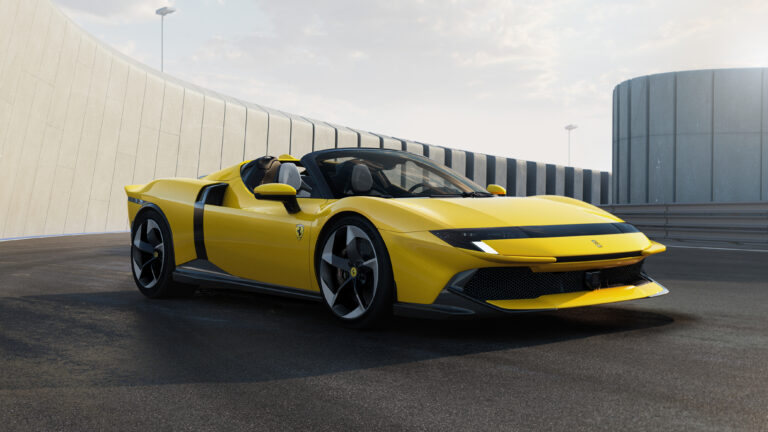
NewsFerrari 849 Testarossa Spider: Open-air flagship revives an iconic name
Ferrari’s new halo Spider revives the Testarossa name with V8-hybrid power, e-AWD torque vectoring and everyday refinement.
-
 News
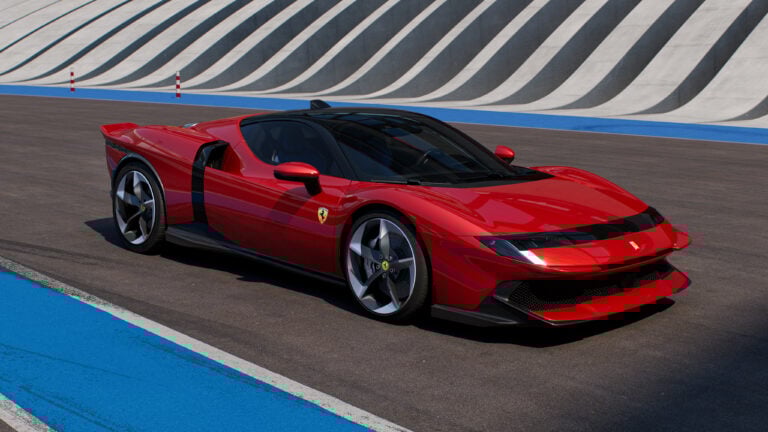
NewsFerrari revives Testarossa name with new 849 hybrid supercar
The hybrid plug-in flagship revives an iconic name with 1050 cv, cutting-edge aerodynamics, and design inspired by Ferrari’s racing heritage.
-
 News
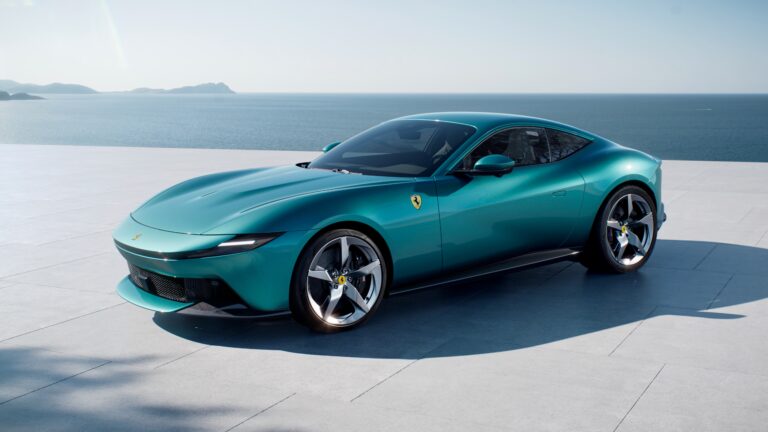
NewsFerrari Amalfi: Stunning sports coupe replaces Roma in brand's line-up
The Ferrari Amalfi has been revealed as the brand's new entry point with updated styling, a revised interior and even more performance.