
BMW has opened the SUV floodgates, revealing pricing and specification for a wide variety of new X5 and X7 variants, including a new four-pot diesel X5 that sneaks in under the $100,000 mark.
As it stands, the X5 range is a six-cylinder-only affair with 30d and M50d looking after diesel customers, while the 40i is for those who prefer petrol propulsion. The incoming variants however, will add both four- and eight-cylinder energy to the large SUV line-up.
A new 25d will introduce a four-cylinder diesel to the range as well as a new, more accessible entry point with its $99,900 price tag. It packs a 170kW/450Nm 2.0-litre four-cylinder turbodiesel under the bonnet, and can hit 100km/h from zero in 7.5sec. BMW has not yet released claimed fuel consumption figures.
It’s fitted as standard with 20-inch wheels and run-flat tyres, synthetic leather upholstery, keyless entry and go, heated front seats, a surround-view parking camera, head-up display and wireless smartphone charging.
For efficiency focused buyers there is also an X5 45e at $129,900, which teams the 3.0-litre turbocharged petrol engine with an 83kW electric motor for impressive combined outputs of 290kW/600Nm.
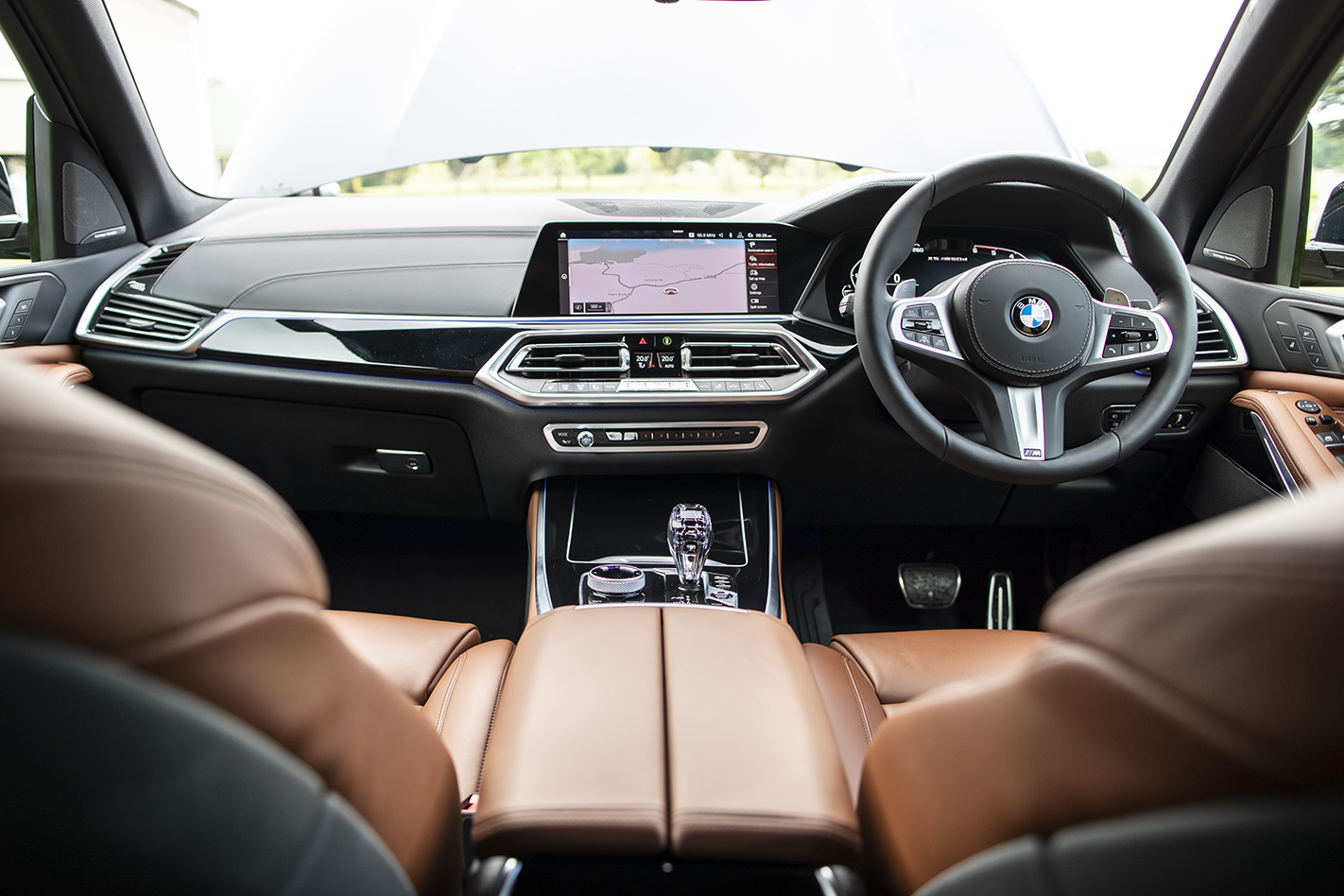
The grunt enables the X5 45e to hit 100km/h in a hot-hatch busting 5.6s while the 24kWh battery pack allows for a real-world electric-only driving range of 60-65km, double that of the previous-generation X5 40e.
In addition to the features of the X5 25d, it adds the M Sport package as standard, adaptive air suspension, leather upholstery, a panoramic sunroof and adaptive LED headlights.
For those who don’t need to stretch to the forthcoming X5 M – or simply don’t want to wait – the $151,900 X5 M50i uses a monstrous 4.4-litre twin-turbo petrol V8 producing 390kW/750Nm. This is the same engine used by the $272,900 M850i and propels the X5 to 100km/h in just 4.3sec.
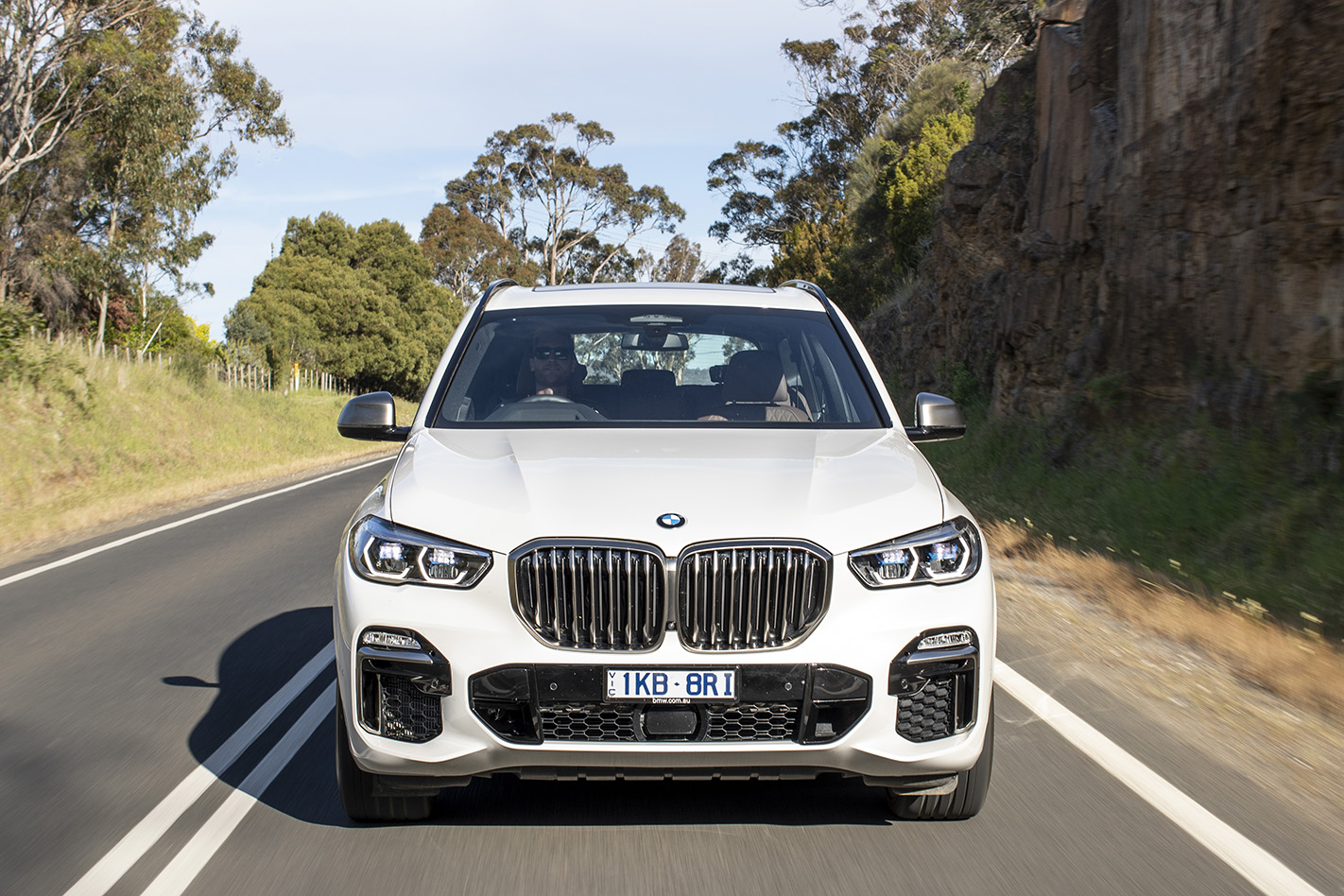
Its standard equipment is extensive, including 22-inch wheels, an M Performance exhaust, M Sport differential, bigger brakes, metallic paint, adaptive M suspension, rear-wheel steering, laser headlights, leather instrument panel, soft-close doors, heated cup holder, lumbar support, four-zone climate control and a 16-speaker Harmon Kardon surround-sound audio system.
The same engine is also being offered for the X7 as part of the SUV shake-up. An X7 M50i will set you back $171,900, though the seven-seater’s extra size slows the 100km/h sprint to a still-impressive 4.7sec.
BMW intends to continue its SUV onslaught, with the refreshed X1 and all-new X6 also due to land locally before 2019 is through, although the German giant has not yet detailed the treats destined for its small SUV and coupe-profiled X5 fraternal twin.
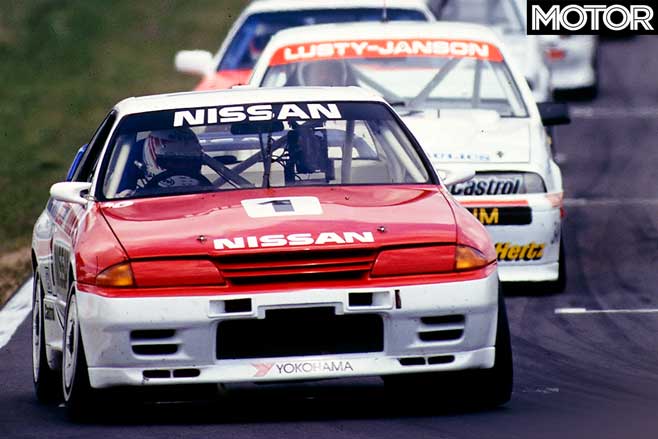
According to Mark Skaife, while the R32 GT-R racer was the class of the field, it still wasn’t easy for he or Richo to extract its full performance once it was fully sorted.
The full interview with Mark Skaife, Fred Gibson, and Paul Beranger can be found in the September 20019 issue of MOTOR Magazine, on sale now.
“It was the most technically advanced touring car of the day by a long margin,” Skaife says. “But it was hard to drive. Its outright pace was similar to today’s Supercar, but with a smaller tyre and no aero. I mean, it would have had lift.
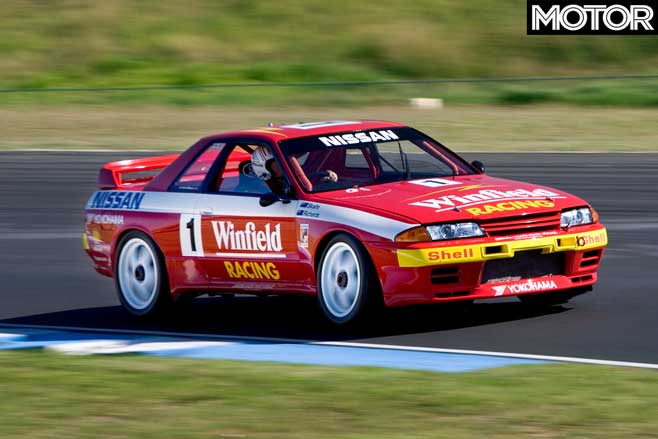
“And when it was finally handicapped to 1500 kilograms, it was a big, heavy car with small tyres and no aero. It was a real handful. In the slow stuff the car was obviously great, but in the fast stuff it was wild.
“Its big advantage was in the wet, especially at places like Mallala, Amaroo Park and Winton (tight, twisty tracks).
“When it rained, the thing was just a weapon.”
But even in the wet the GT-R couldn’t defy the laws of physics. Richards was on slicks when he crashed while leading Bathurst in ’92, running out of grip in the flooding downpour and triggering the red flag that stopped the race.
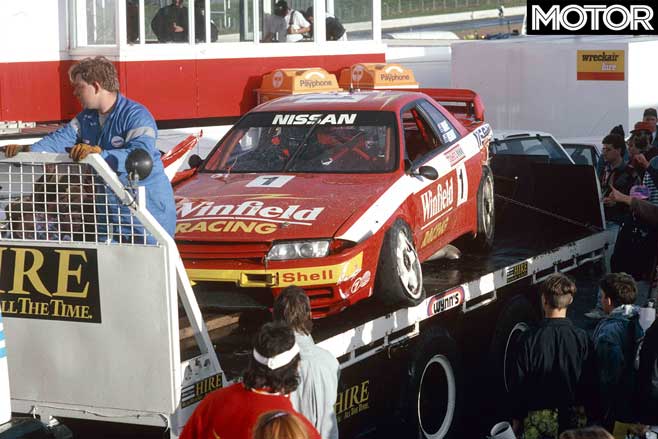
In those days, the result was decided by the positions on the lap before the cancellation, handing victory to Richards and Skaife. The controversial finish enraged the fans, who had been incited by Dick Johnson’s claim that he and John Bowe should have been the winners in their second-placed Sierra because they were still actually running when the race was declared.
When Skaife raced the GT-R in Japan
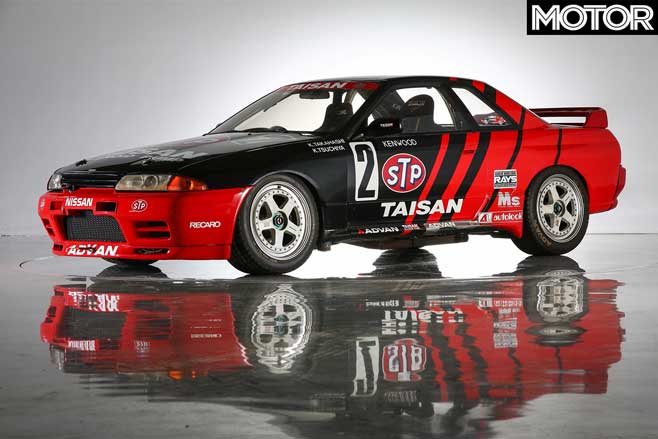
Mark Skaife found out just how good his locally produced Group A R32 GT-R was when he raced a Japanese customer car in 1991.
While Gibson Motorsport had been ‘dissuaded’ by Nismo from entering races in Japan and Macau, Skaife secured drives with the semi-factory Taisan team, co-driving with Keiichi Tsuchiya. They finished third in the ’91 Fuji 500, but Skaife failed to finish the Guia classic at Macau.
He recalls that the exercise confirmed the superiority of the Australian-developed GT-R, which deviated so much from the Japanese version.
“It was good for us to go and drive because we actually ended up putting our (Australian Holinger) gearbox in it and a few other things.
“It highlighted just how good our car was in comparison. The difference was massive – (the Japanese car) was just not in the same league.”
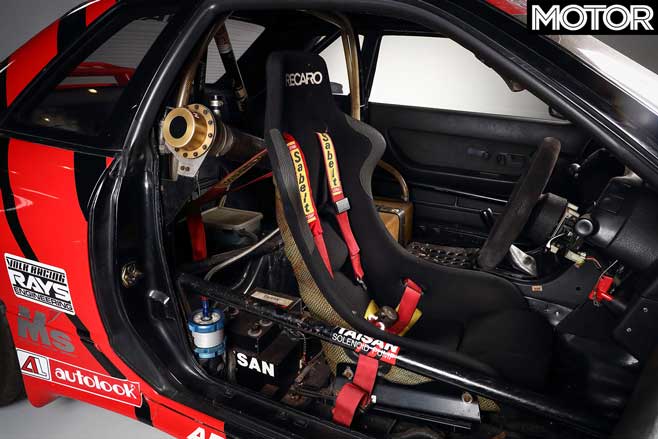
So impressed was the Japanese team, it considered buying a Gibson car, but the move was blocked by Nismo.
“That would have shaken the establishment up,” Skaife smiles ruefully.
Australia’s category-killing Godzilla was the ultimate expression of Group A, the last international touring car category to rely on wild homologation special road cars. No four-wheel drive, computer-controlled Ford Sierra Cosworth RS500 or BMW M3 Evo would follow. Group A was replaced by 2.0-litre Super Touring, while Australia went with local V8s.
If you’ve ever seen one of those reality shows that portray day-to-day police work, then you’ll have an idea of what the inside of the average patrol car looks like.
In many cases, the compromises that police forces are forced to make to fit equipment to their respective cars render them uncomfortable and impractical at best, and technically illegal at worst.
But a joint development between computer giant Fujitsu and Kia‘s Australian office is set to shake up the world of law enforcement.
In essence, Fujitsu had an idea to marry some of its vehicle ecosystem products into a police car, in order to try and reduce the complexity and costs of building a typical police rig as well as improve safety for the officers who use them.
Most popular police stories
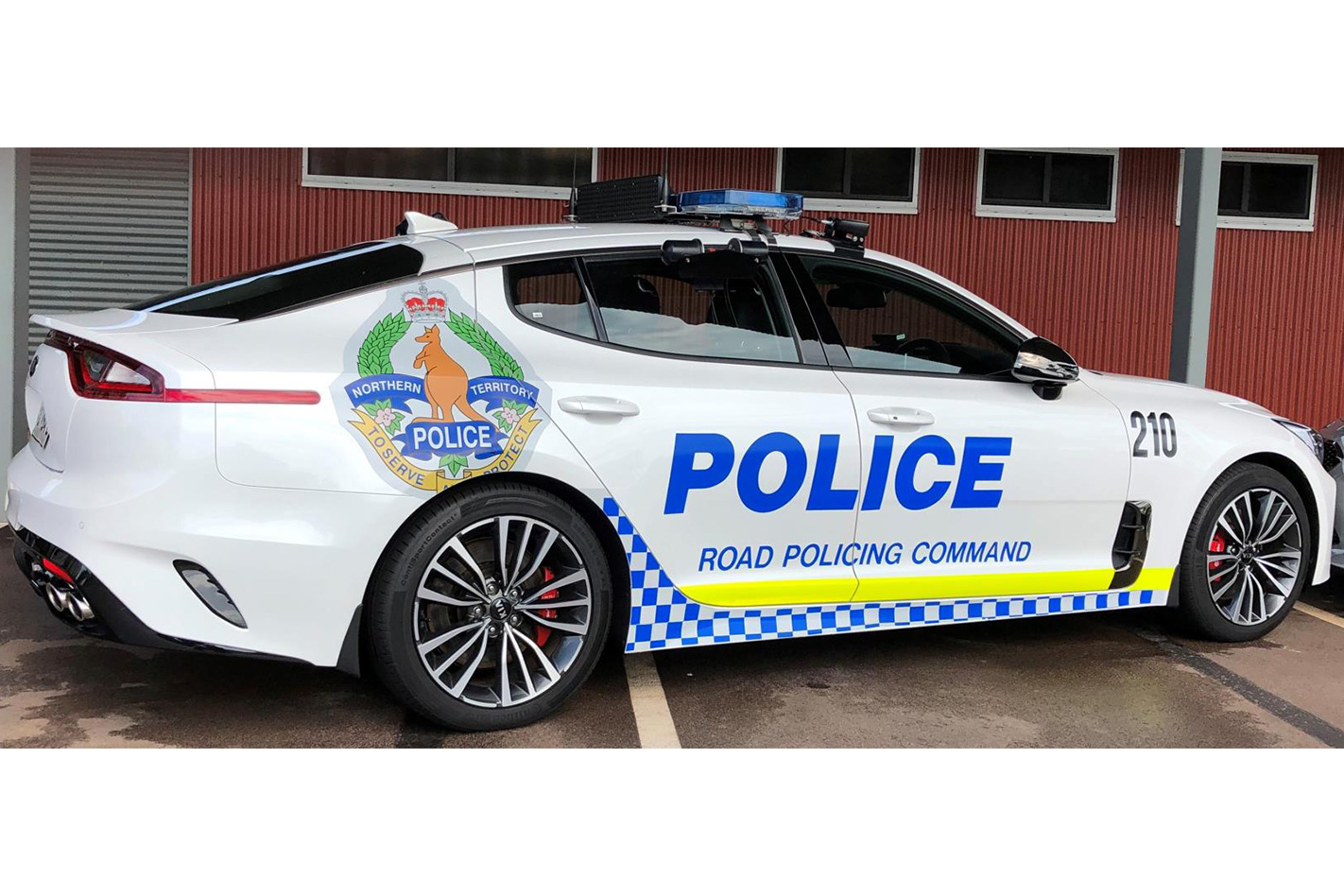
- Kia Stinger for NT police
- ZB Commodore shines at Victorian academy
- 1981 Holden Commodore VK police car restored
Adding equipment that sits in front of airbag panels, for example (below), or directly over the ventilation ducts are common issues when it comes to equipping a modern police car.
As well, officers are required to log onto multiple systems dozens of times or more in a shift, as well as learn the intricacies of sometimes highly complex systems, all while conducting sometimes dangerous operations.
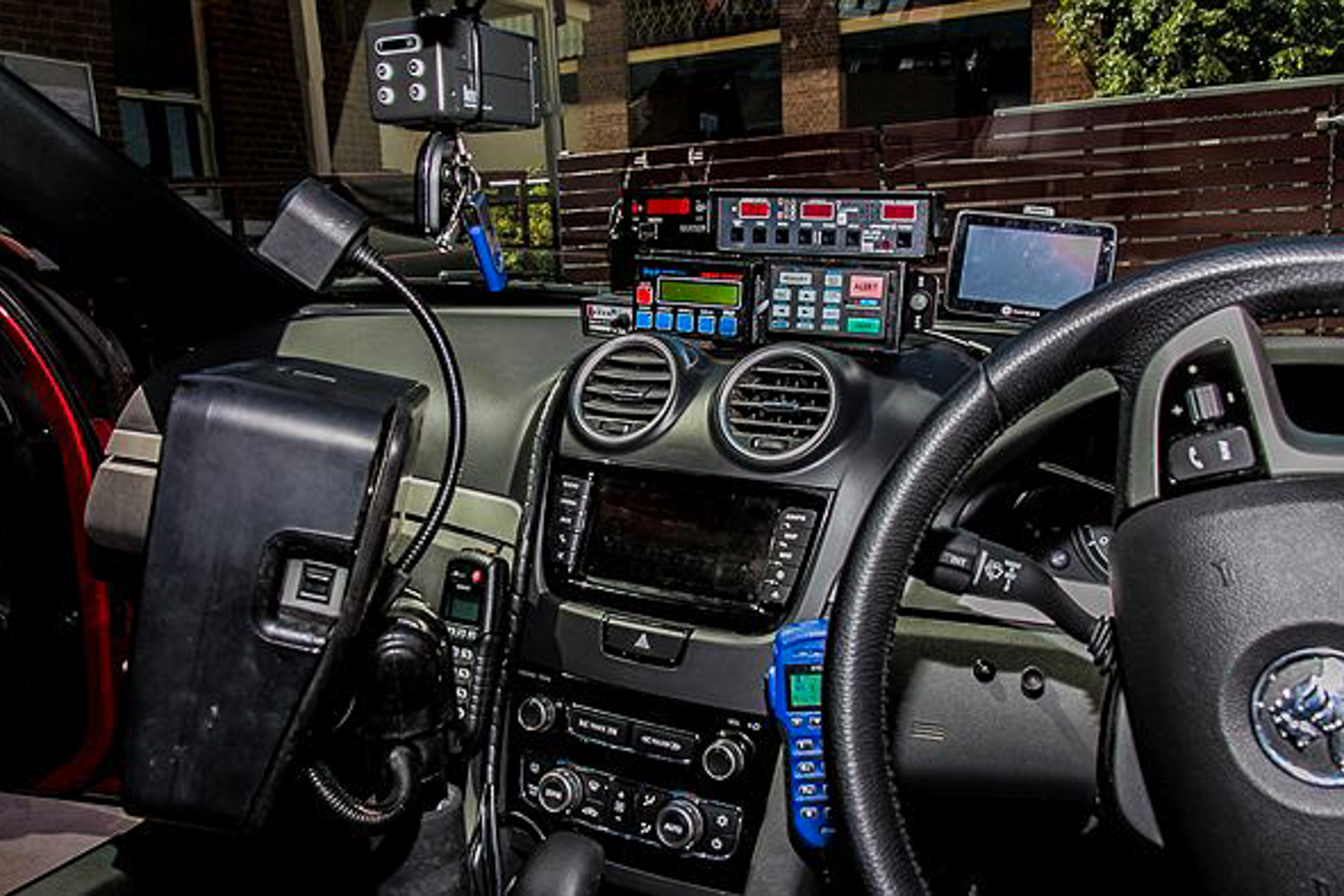
Hamer revealed that he and the company had been chasing the wider car industry for more than five years to offer a potential solution in the form of a greatly simplified operator-to-vehicle interface.
“We hit everyone, but we got no response,” Hamer said. “After we talked with Kia, an hour later, they called us and said ‘what colour car do you want?’ They get it.”
For its part, Kia saw the upside straight away. “The development of this ground-breaking technology and its potential for integration into a wide range of Kia product highlights the outside-the-box thinking that Kia has always embraced,” Kia’s chief operating officer Damien Meredith said.
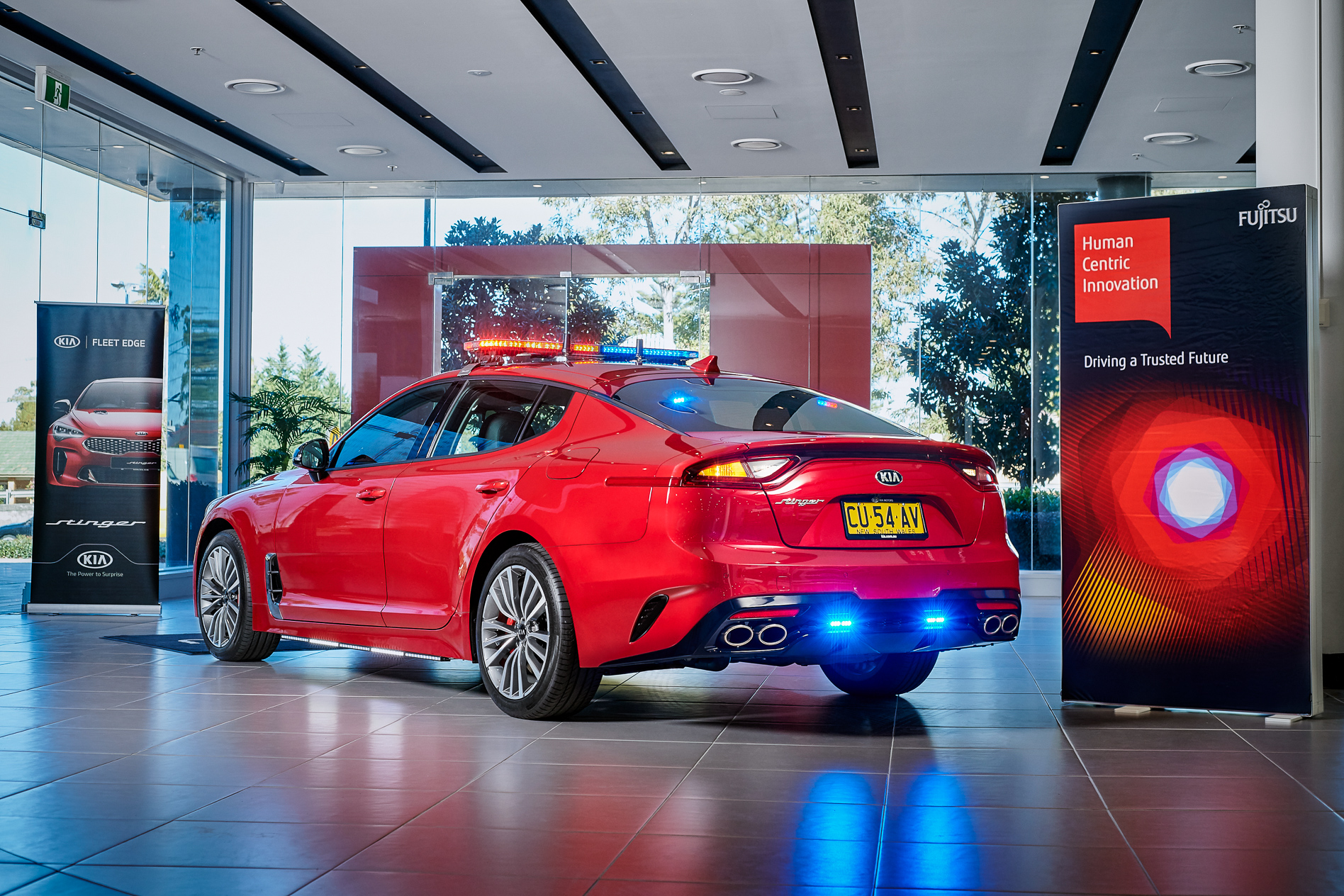
A black Stinger was chosen, and it was built at Kia Motor’s HQ in Sydney in collaboration with Kia and Fujitsu technical staff.
It’s no coincidence; the Stinger is already in use in three states and territories as a fully-fledged highway patrol vehicle.
Hamer said that one of the disadvantages of equipping new police cars is the length of time the build takes, as well as the modifications that need to occur. He cited an example where Victorian police force technicians are forced to drill 30mm holes in the carbon fibre roof of a BMW X5 in order to mount a lightbar and aerials to the vehicle.
“We don’t even void the warranty,” said Hamer. “No more pulling cables out and mounting everything with tech screws. We can distil nine or more cables into one umbilical that runs through a channel and into a waterproof connector that Kia adds to the car.”
One element of the new build is the use of biometrics. By using a biometric scanner, which references seven million data points on a police officer’s palm, up to eight logins are eliminated, and it could even control items like onboard weapons and evidence lockers.
“Even identical twins don’t have the same palm ID, and you can’t even chop off a person’s hand to use it,” deadpanned Hamer.
The top of the Stinger’s gear shifter has been replicated and replaced as a palm reader, which can be read on either hand. Three programmable buttons have also been moulded in for easy access to key systems like radios and sirens.

Not only can the reader log an officer into criminal databases, but it can also set seat and mirror positioning in any bio-reader equipped patrol car. “If you steal a cop car, double encryption means you can’t steal data by stealing a police car,” confirmed Hamer.
Fujitsu is currently working directly with Kia to add a generic waterproof connector that will allow a light bar array to be added in 10 minutes, not over multiple days. As well, the number of aerials can be greatly reduced to further simplify installation.
A six-week install could be reduced to two weeks; “that’s our target,” said Hamer
Another area where Fujitsu has streamlined the cockpit is by tapping into the Stinger’s heads-up display to replace the Doppler radar that we all love to hate.
Aboard a typical police car, an audible Doppler radar tone is a constant accompaniment to an officer’s shift, as it’s the change in tone that acts as an alert to a speeding car, and by law, officers can’t actually look at the current radar display while their car is in motion.
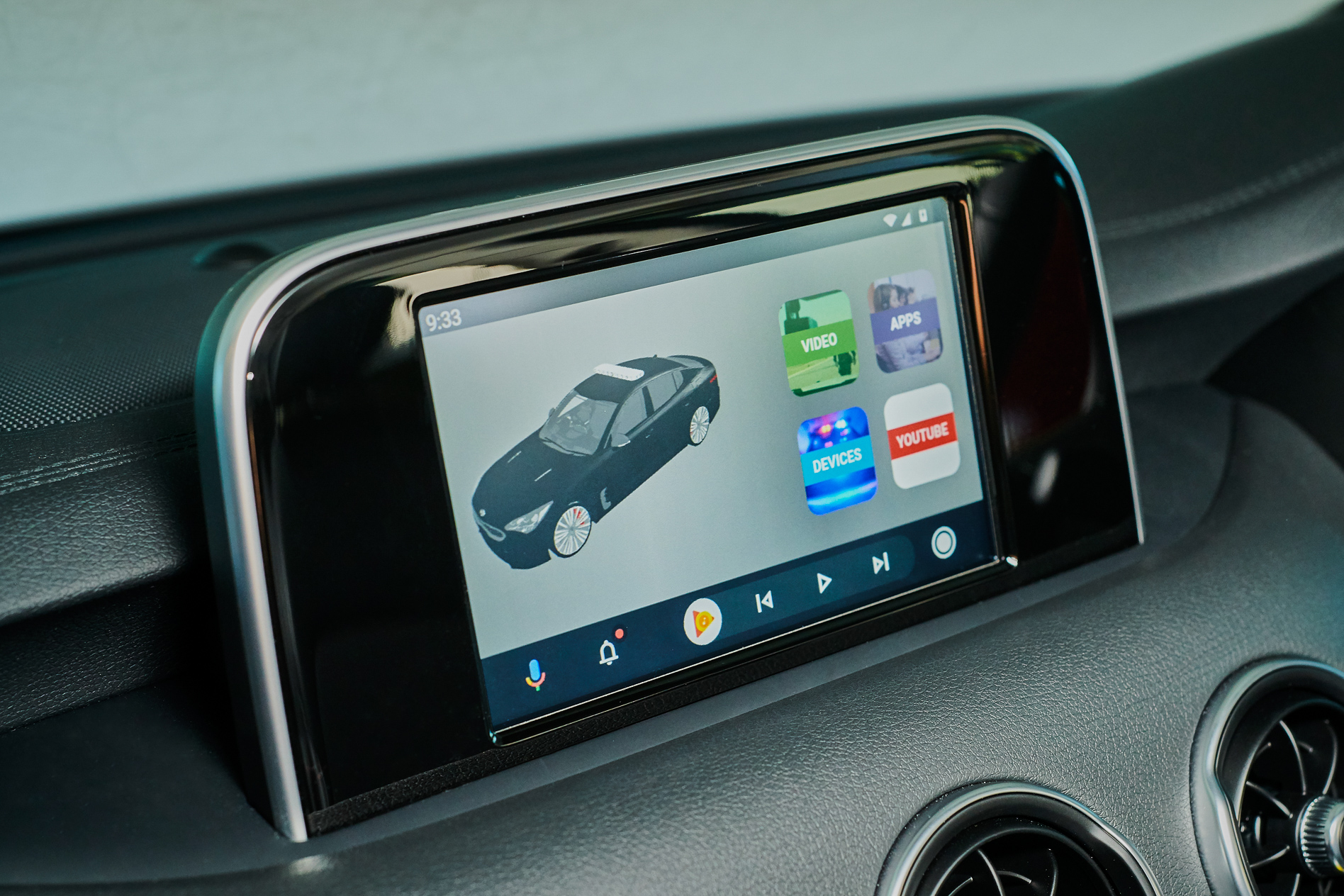
Fujitsu has figured a way to take a feed from the car’s radar and add it in into the LDC heads-up display, which can then project the speed of an offending car in the display, then flash up a digital profile of the car itself on the car’s infotainment screen.
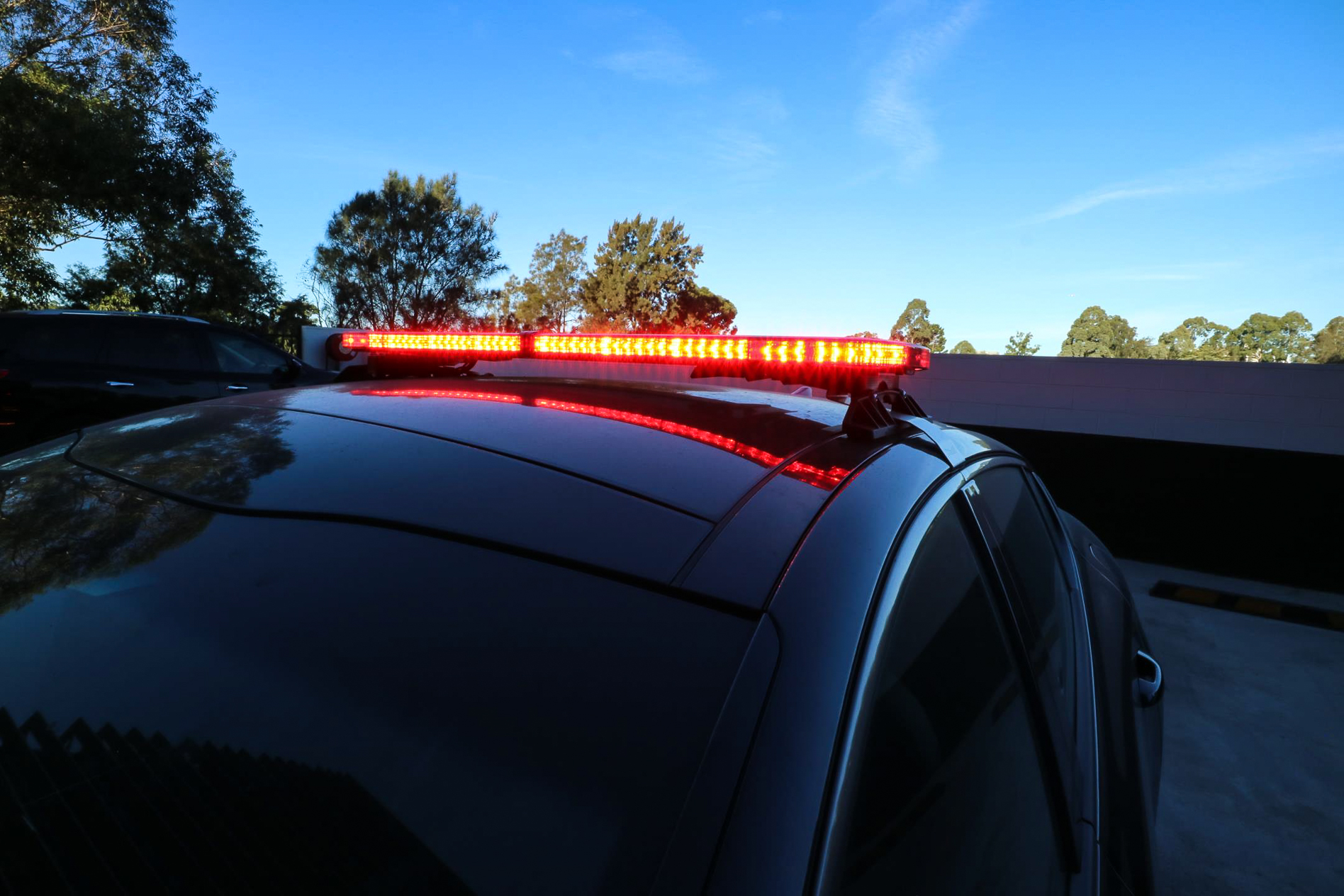
It’s also stripped down the complex lightbox control unit, which enabled police to vary intensity and sound levels of light bar, as well as adding extra features like side-strip lighting to help visibility in intersections and strobing white LEDs that don’t silhouette officers and can disorient a perp who might be aiming a weapon at the cop car.
Many functions that required the use of a large laptop have also been inserted into the operating system of the multimedia touch screen, all thanks to Android Auto.
Another interesting advance is in the area of number plate detection. There’s a trend towards stealing and substituting plates, and the current number plate recognition system will only trigger on a plate that’s been reported stolen.
But if the plate hasn’t been missed, it can be used on another car for nefarious purposes.
One example is a petrol station in Victoria that loses $20,000 a month in stolen fuel, according to Hamer, and police have reportedly suggested that servos take fuel theft claims under $100 directly to insurers.
The Fujitsu system, however, can actually marry the plate with the known vehicle type logged in a state’s rego database, thereby detecting a dodgy plate fitment.
This is the tip of the iceberg when it comes to the potential of this system. The red car you see here is the second generation car, and the first was displayed at an international law enforcement convention that was held earlier this year.
“Police forces from other countries could believe what they were seeing,” said Hamer. “They were asking ‘how can you guys have developed this stuff here?’ It’s incredibly exciting stuff, and there’s a lot of potential here.”
It’s not only in the area of electronic integration that police forces are benefitting from original equipment suppliers to the automotive industry.
Tyre maker Continental supplies Kia with the high-performance ContiSportContact 5 tyre as standard and it’s become the tyre is the preferred tread of choice for several of the law enforcement agencies that use the Stinger, not least because of a unique and very clever sealing technology on the underside of the tread face.
Known as ContiSeal, the thin membrane acts to quickly seal a puncture as it occurs, minimising pressure loss at the time of an impact.
ContiSeal-equipped tyres are also fitted to cars like the Volkswagen Tiguan range, and the company has just manufactured its 15-millionth ContiSeal-equipped hoop.
Kerry Packer was a lot of things, but did you know the legendary media tycoon was also an R32 Skyline GT-R fan-boy?
Sister magazine Wheels was doing a supercar test at Eastern Creek in 1991 with race ace Kevin Bartlett driving a Honda NSX, BMW M5, Ferrari Mondial and Skyline GT-R. KB mentioned it to his mate KP, who happened to own the magazine.
As the crew were setting up, a helicopter landed on the infield and out stepped the big boss. Kerry and young son Jamie spent hours lapping the track in the NSX and GT-R before heading back to their chopper. As he departed, Packer asked editor Phil Scott if he could pull some strings and secure two GT-Rs.
Long-time Wheels contributor Michael Stahl included a brief re-telling of the event in his book Kerry Packer: Tall Tales and True Stories.
After sampling the cars he got ready to depart in his ex-US Army ‘Huey’ chopper. He pointed to the Nissan.
“Get me one of those cars,” he called out.
“Nah, f–k it. Get me two. One for James.”
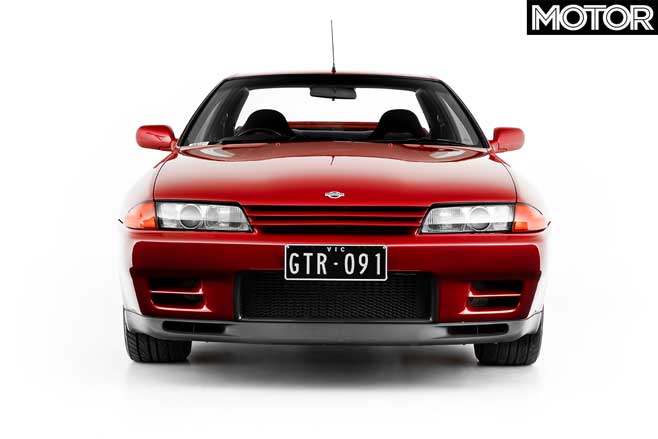
Scotty made the call immediately. Packer then cancelled his order for a pair of NSXs with a miffed Rick Damelian.
The Skyline, of course, won the comparison test, with Wheels calling it “Handling Nirvana.”
Packer kept two R32s in the ACP car park in Castlereagh Street – silver and red, from memory – and they looked stock.
But Kerry had KB make modifications to each car, leading to much speculation about the amount of horsepower they were, um, packing.
There’s a new catchphrase being bandied around the boardrooms of Nissan’s Tokyo-based headquarters these days and it’s all part of a new thrust by the company to be at the forefront of automotive technology by the start of the nineties.
This feature was originally published in Modern MOTOR’s August 1989 issue
Called “Project 901” for “nineties-number one” the phrase denotes a body of design ideas behind N issan’s drive to displace Honda as Japan’s most advanced car manufacturer. The new Skyline range, including the fire-breathing hi-tech Nissan R32 Skyline GT-R version, as revealed exclusively in last month’s Modern MOTOR, is the spearhead.
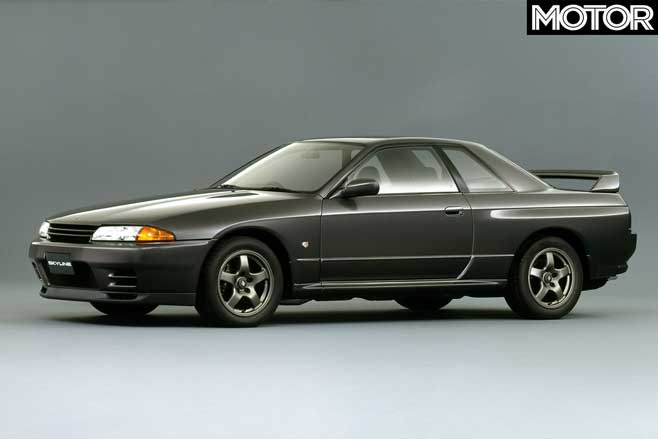
Young Japanese automotive graduates now consider Nissan the up-and-coming force, as opposed to the previously popular Honda, and are virtually queuing at the door of the company’s Atsugi Technical Centre for a chance to work on the 901 project.
We at Modern MOTOR had an inkling something very special was in the pipeline when Editor, Barry Lake, was presented with a wry smile by the company’s number one Australian driver, Jim Richards, as an answer to future model expectations. What we didn’t count on though was the advanced state of the company’s vast array of technological nous – the new GT-R is by far the most advanced touring car to come out of Japan.
Unlike previous Skyline models this car is of a completely new design. Gone is the archaic square-edged styling and in its place is a svelte and attractive car that outwardly appears European. It also packs enough technological muscle to make even the biggest Japanese sumo wrestler run for cover.
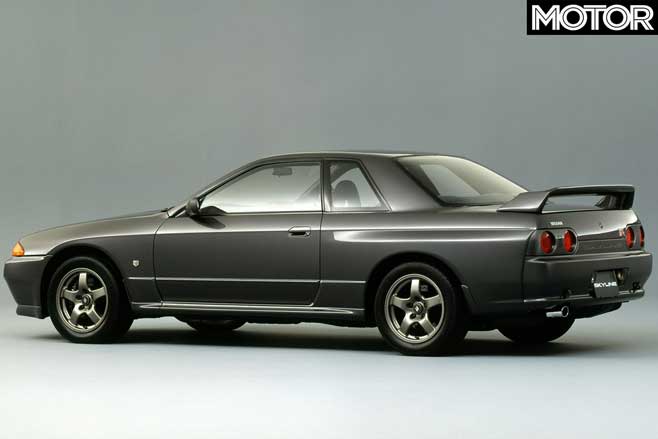
Although most of the kudos for the new Skyline will fall well and truly upon the top-of-the-range GT-R there are, altogether, 13 different models in the new line-up. They range from a basic 1.8-litre four-cylinder producing 68kW through to a potent 4WD 160kW 2.0-litre in-line six that employs a new roller-bearing turbocharger claimed to reduce friction by up to 60 per cent.
While some may marvel at the myriad of technological features incorporated on the GT-R, especially the chassis and drivetrain, it’s the engine that provides the impetus for the whole car.
The new 2.6-litre engine (codenamed RB26DETT) is based on the familiar inline six-cylinder block fitted to the current 3.0-litre Skyline and once used by Holden in the 3.0-litre turbocharged VL Commodore. Twin belt-driven camshafts sit astride the engine operating a 24-valve head while two ceramic Garrett turbochargers together with intercoolers as well as an advanced electronics package, controlling both injection and ignition, round out what can only be described as an extremely potent and purposeful race-bred powerplant.
Nissan has come tantalisingly close to the benchmark 223kW (300bhp) figure with power and torque outputs quoted at 211kW (280bhp) at 6800rpm and 353Nm at 4400rpm respectively.
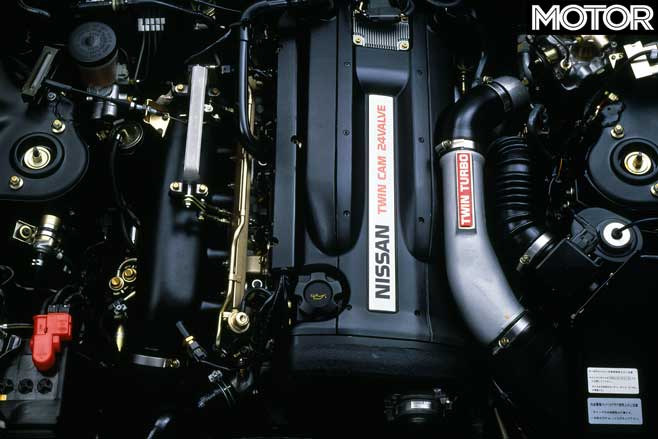
There are suggestions engineers toyed with the idea of “dialling” in extra horsepower by increasing the turbo boost pressure but discussions among prominent Japanese automotive authorities regarding excessive power outputs in relation to . environmental issues halted it.
Understandably Nissan has chosen to keep tightlipped about performance figures for the GT-R except the basic 0-100km/h and standing 400m which together reflect the effectiveness of the car’s incredibly high power output as well as its ability to transfer it to the bitumen.
From a standing start the GT-R sizzles to 100km/h in just 5.03 seconds and thereafter it doesn’t let up: 400m is covered in an amazing 13.47 seconds.
These times compare more than favourably against its two most highly rated Group A competitors, namely Ford and Holden. Ford’s all-conquering Sierra RS500 returns 6.40sec and 14.70sec respectively for the same tests, while Holden’s Group A VL Commodore tends to look somewhat staid at 7.04sec and 15.22sec. It must be said, though, that manufacturer’s claims are often hard to duplicate.
All that performance takes a power of stopping when required. Nissan has taken no risks by fitting the GT-R with a formidable anti-lock braking system that on paper looks more likely to appear on a European supercar. Massive, aluminium four-piston 296mm by 30.5mm ventilated discs sit up front while the rear end gets a two-piston 297mm by 18mm variety.
With such a lofty power output in road going form, it was essential to engineer a transmission and drivetrain set-up that could handle the quoted power output of 410kW (550bhp) at 7600rpm which the car is said to be developing in Group A trim.
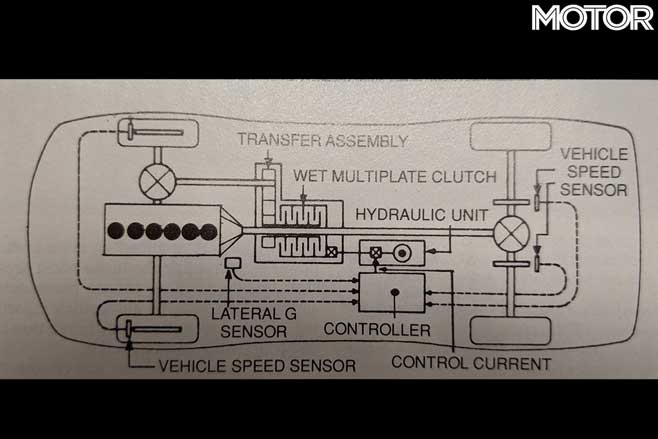
And that Nissan has. It’s called ATTESA ETS or, for the techno minded, Advanced Total Traction Engineering System for All terrains and Electronic Torque Split. It is unique among production four wheel drive systems as it employs an accelerometer to detect lateral or sideways movements and adjusts the torque split (power) accordingly to each wheel. Other manufacturers are known to be working on such systems but Nissan is the only company confident enough to put one into production.
Put simply the ATTESA ETS system consists of a computer controlled multi-plate clutch encased in oil as well as a hydraulic unit triggered by changes in thc speed sensors and accelerometer, which applies pressure to the clutch to vary torque split.
Driving through a Trojan-like five-speed gearbox and limited-slip differential, the hydraulic unit reduces torque to the front wheels as lateral movement is increased, thus combining the cornering characteristics of a conventional rear wheel drive set-up together with the sure-footed traction provided by four-wheel drive.
One thing we must dispute though 15 Nissan’s claim that ATTESA ETS is the first 4WD system to be combined with anti-lock braking. Lancia has been developing such a system for a number of years now and recently unveiled a production version on the new 16-valve Delta Integrale.
Nissan obviously considers its new ATTESA ETS system is ready to withstand the enormous stresses encountered during the rigors of competitive Group A motor racing. This is certainly not the first time 4WD has been considered for the race track: Lotus once raced an all-wheel drive car in Formula One, but in recent times weight has prohibited manufacturers from even contemplating such a move. Our bet is that, rule book permitting, Nissan will develop the ATTESA ETS system for fitment on its potent Group C sportscar challenger which recently qualified in 12th position at the Le Mans 24 hour race.
The new Skyline’s suspension also sets new standards for Nissan. The car is fitted with the company’s recently developed multi-link suspension set-up which first appeared on the new 300ZX. Its history has a novel twist in that its design was spawned out of an ideas basket initiated by the company’s 901 chassis development leader, Takaaki Uno, who took aside his engineers and asked them to generate at least 100 new design proposals for future models.
A number of front-end multi-link setups were tested before a final production version was chosen using a lateral link, a trailing strut and a diagonal upper control link which locates the steering knuckle on each side of the car.
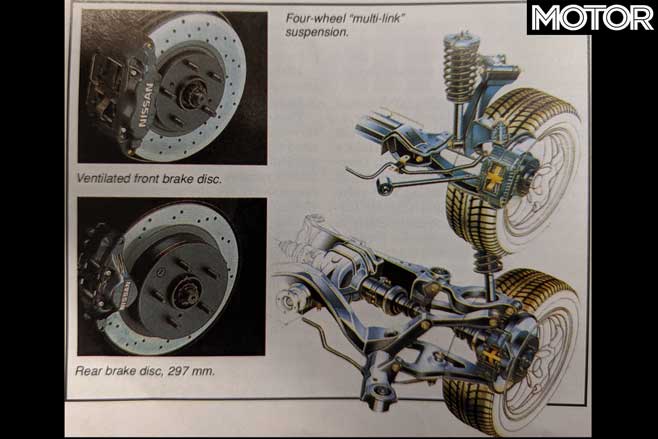
It’s obvious Nissan’s engineers had a long hard look at other manufacturers‘ setups and while some may regard the Skyline’s front suspension as revolutionary it is in essence a sophisticated version of the tried and proven independent set-up that utilises unequal length upper and lower control arms. It is also strikingly similar to the system used by Honda except that it employs one extra link between the knuckle and the upper locating link.
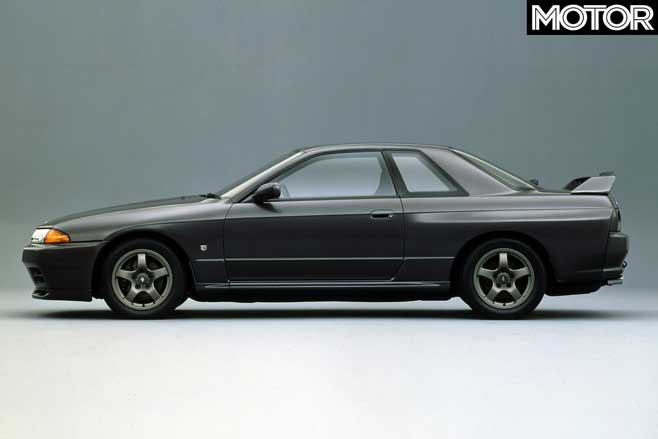
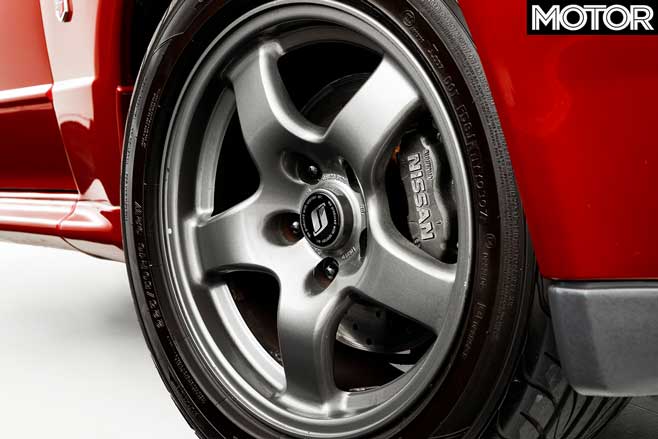
From the ground up the GT-R exudes aggressiveness and this is nowhere more evident than the rubber with which the car is shod. Meaty 225/50 R16 92V Bridgestone RE71 Potenza radials sit upon equally purposeful 8JJx16 alloy wheels providing the sort of grip and traction a car with 211kW on tap requires. The five-spoke wheel design supplies substantial airflow to the braking system and blends well with the car’s styling.
Similarly interesting as the new ATTESA ETS 4WD is Nissan’s new Super HICAS four-wheel steering system another Skyline GT-R first.
The 4WS system employed on the GT-R is a third generation version of the original Super HICAS system. Whereas the older system was often criticised for its ungainly low-speed manoeuvrability, the new Super HICAS does away with that by initially turning the rear wheels in the opposite direction to those at the front before switching back the other way to run in unison.
This, says Nissan, improves lowdown steering responsiveness and feel while still maintaining the useful gains during high-speed cornering. While it is in effect similar to Honda’s patented 4WS system its operation is by hydraulic pressure, depending upon its speed and angle, as opposed to conventional mechanical gears.
In a racing environment the Super HICAS 4WS system, together with the GTR’s power-assisted rack and pinion steering, should prove most useful on tight and twisty circuits where cornering speeds, as opposed to outright top-end speed, come into play.
Those lucky enough to have driven the GT-R say its the best handling car to come out of Japan – high praise when you consider the numerous models the country pumps out each year. Four-wheel steering is still an unknown quantity on the race track but from our experience, given the right circumstances, it should perform well.
With such impressive mechanical credentials the Skyline’s body stylists certainly had the job before them especially when you consider the two varying functions the car is expected to perform. On one hand it must act as a slightly upmarket family-orientated sedan while on the other it must fulfil the role of an all-conquering race car.
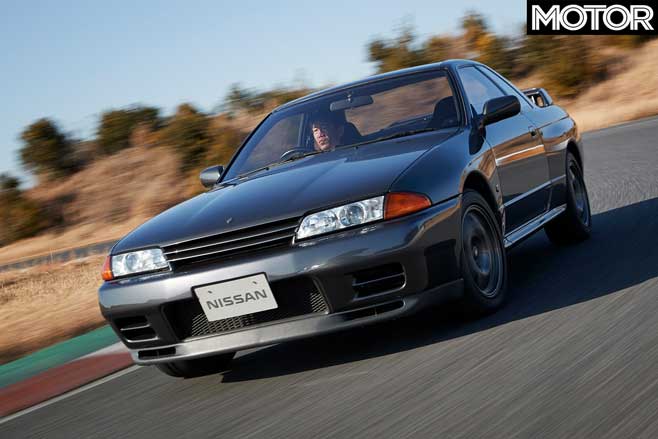
As with Nissan’s engineers, the stylists have risen to the task well and sculpted an extremely attractive package. There’s no doubting, the curvaceous but aggressive styling is definitely a winner. Sure there’s nothing to stamp the styling as revolutionary but the addition of rear-wheel arch blisters, side-skirting, a large front air dam and a high boot mounted spoiler combine to make the GT-R one of the most attractive while at the same time purposeful cars to come out of Japan.
But attractiveness doesn’t always augur well in the aerodynamics department! The GT-R‘s rather “clumsy” 0.40Cd atests to that and, together with the car’s hefty kerb weight of 1430kg, must pose at least a few problems for the engineers at NISMO (Nissan’s racing department) whose job it is to develop the car into a lean and mean winning machine.
For weight saving purposes Nissan has fitted an aluminium bow net and front panels. But with such extensive chassis mechanicals the GT-R was always going to be a heavyweight. For comparison, the Sierra RS500 and Group A Commodore tip the scales at 1240kg and 1410kg respectively.
Much of the GT-R’s poor aerodynamics can be contributed to the wide Bridgestone RE71 Potenza tyres as well as the added aerodynamic aids which, on the ram track, are necessary to provide optimal downforce for high-speed stability. The more sedate two and four-door Skylines vary from a respectable 0.31 through to 0.33.
The ever increasing trend by Japanese manufacturers toward rounded tail lights is continued throughout the Skyline range and when viewed from the rear the GT-R conjures up memories of the early Mazda RX-series rotaries that boasted the round light treatment.
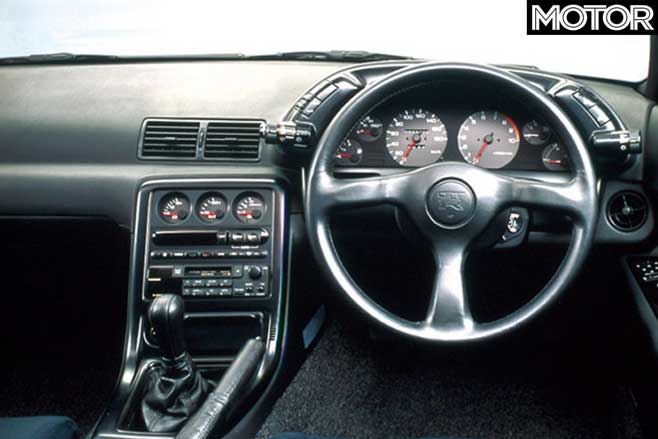
Considering the purpose of the GT-R, its interior appointments are extremely high in specification. Unlike other cars intended to perform race-track duties there are no obvious weight saving measures incorporated into GT-R’s interior. The instrument layout provides a stimulating and functional driving environment.
A large speedometer and tachometer (redlined at 8000rpm) dominate the dash while an array of secondary switch controls are mounted high around the binnacle within easy finger-tip reach of the steering wheel. Other controls, including a turbo boost gauge, are positioned on a centre console which slopes downwards and integrates with the transmission tunnel. The seats and their lowly-placed position as well as the thick leather gripped three-spoked steering wheel further enhance the interior’s sporty theme.
As one may expect of such a car the new GT-R is the toast of the Japanese automotive fraternity. But it doesn’t end there. Nissan has big plans for the entire Skyline range prime target being Toyota’s big-selling Cressida.
Unfortunately it has not been decided whether Australia will even get the car at this stage. Insiders say the car is being evaluated and with Nissan’s current Australian manufacturing plants being retooled to produce the forthcoming AD50 Matilda project, to be shared by Ford and Nissan, the bet is that with such an expansive model line-up the Australian subsidiary will think long and hard before it makes any firm decision.
Word is that Nissan at this stage intends to market the desirable GT-R on the domestic Japanese market only. It seems the Japanese have finally discovered that if you have a car as good as the GT-R you keep it to yourself and it’s certain Nissan will have no trouble in finding customers for the compulsory 500 evolution models required under Group A regulations.
From the leather-gripped steering wheel through to the high rear-deck spoiler the Skyline’s intentions are clear: to succeed both in the marketplace and on the world’s motor racing circuits. If it does prove successful will be stamped revolutionary. If it fails you can be sure the number crunchers at Nissan will pour millions of dollars into improving it.
While we don’t fully agree with Nissan’s claims that the new Skyline has unlimited potential, it certainly elevates the already keen awareness of Japan’s unrelenting push towards automotive supremacy.
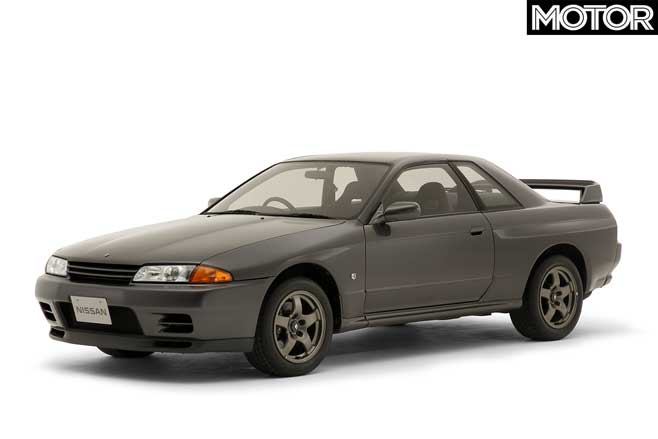
FAST FACTS 1989 Nissan R32 Skyline GT-R BODY: 2-door, 2+2 seat coupe DRIVE: electronically controlled torque-split all-wheel drive ENGINE: 2568cc inline-6, DOHC, 24v, twin-turbocharged BORE/STROKE: 86.0 x 73.7mm COMPRESSION: 8.5:1 POWER: 211kW @ 6800rpm TORQUE: 353Nm @ 4400rpm SPECIFIC OUTPUT: 82.2kW/litre WEIGHT: 1430kg (kerb) POWER-TO- WEIGHT: 148kW/tonne TRANSMISSION: 5-speed manual SUSPENSION (f): independent by “multi-link” system – unequal upper and lower control arms with coil springs and anti-roll bar SUSPENSION (r): independent by “multi-link” system with coil springs and anti-roll bar L/W/h: 4545/1755/1340mm WHEELBASE: 2615mm TRACKS: 1480/1480mm (f/r) GROUND CLEARANCE: 135mm STEERING: power-assisted rack-and-pinion; rear-steering by shaft/computer controlled gearbox BRAKES: 296mm steel ventilated discs, 4-piston calipers (f); 297mm steel ventilated discs, 2-piston calipers (r) WHEELS: 16.0 x 8.0-inch (f/r) TYRES: Bridgestone Potenza RE71; 225/50 VR16 (f/r) PRICE: $110,000 (new)
Performance figures 0-100km/h: 5.05sec 0-400m: 13.47sec
You’re never too old to be afforded the opportunity to act like a big kid. Once again, the internet proves this to be true. With Father’s Day is just around the corner, we’ve found the perfect present. Dads, you can thank us later for this one.
Starting life as a Power Wheels Porsche GT3 toy for kids, the toddler-friendly electric motor has been ripped out and replaced with a 450cc KTM dirt bike engine. It reeks of one of those crazy ideas after a few bevvies, but this time, someone actually went through with it. The whole creation looks like a lot of fun – if not potentially slightly dangerous. And by slightly, we mean quite a bit.
Visually it’s an insane bit of kit. Despite the engine being at the wrong end of the miniature GT3, the exhaust runs through the body, remaining faithful to the actual car with a central exit point at the back. Power is sent to the rear wheels, it has electric start, fuel pump and fan, while it’s also fitted with a six-speed ’box.
However, health and safety officers would have an absolute field day with the backyard creation. For starters, a pair of chain sets run between your legs, the fuel cell is perilously positioned and the coolant lines run right beside you and, according to the creator, get “a little hot”.
The throttle (thumb) and brakes are operated via the steering wheel, but there are foot-operated pedals for the clutch and rear brake. The seat sits on a slider, so parents of all shapes and sizes can have their turn behind the wheel.
The chassis was built from scratch and, somewhat unsurprisingly, has no suspension other than the rubber stretched over the 10-inch ATV-style rims. Apparently the mini-me GT3 generates so much grip that the stresses on the chassis keep self-adjusting the camber. If you’re expecting comfort, you’re in for back-breaking disappointment.
The design remains as faithful to the Stuttgart product as possible, but aside from the offset wheels and low-profile tyres, it comes flush with a huge, cut-down ‘tuner’ rear wing. If we aren’t already excited enough, apparently this build is only phase one with a lot more to come like LED-esque headlights and more mechanical upgrades.
Check out the channel on your next late-night YouTube binge to see similar creations racing each other around dirt tracks, mastering car-park courses and playing in the sand. You’ll be consumed for hours, although, maybe there should be a ‘don’t try this at home’ disclaimer…
The drip-feed of official details regarding Porsche’s battery-electric Taycan is set to ramp up with its global reveal less than a month away.
Now, the German maker has given us a sneak-peak inside the cabin, revealing a large portion of the 992 911-inspired dash design. Is the time being set to “9.11” on the large infotainment screen and Sport Chrono-style stopwatch a coincidence? We think not.
The powertrain of the Taycan is unquestionably a tech tour de force, hence Porsche is teaming up with Apple to provide full Apple Music integration with access to more than 50 million songs.
Of course, the system uses the internet to offer a seemingly endless array of tunes to those with a subscription, so Porsche has included three years of internet connectivity with the Taycan. Whether this will include Australia is yet to be determined.
The new system ties in with Porsche’s voice assistant, which means you can use the inbuilt voice-control system to access songs, albums, playlists or radio stations on Apple Music.
Additionally, if you’re listening to the radio and like a song, you can opt to add it to a custom playlist while listening to the song. Porsche has curated its own playlists on Apple Music which are available to stream – let’s hope it isn’t all Rammstein.
Apple CarPlay will be offered, however, there’s no word on Android Auto. The Apple Music library can be heard through an optional Burmester High-End surround sound system.
Aesthetically the cropped, dimly lit photo showcases a familiar, suede-wrapped steering wheel with a digital instrument cluster.
There’s a breakout menu for things like traction control and suspension settings, while overall the styling is minimalist, with a Taycan motif greeting passengers. The stopwatch conveniently ties the electric model to the petrol-powered range.
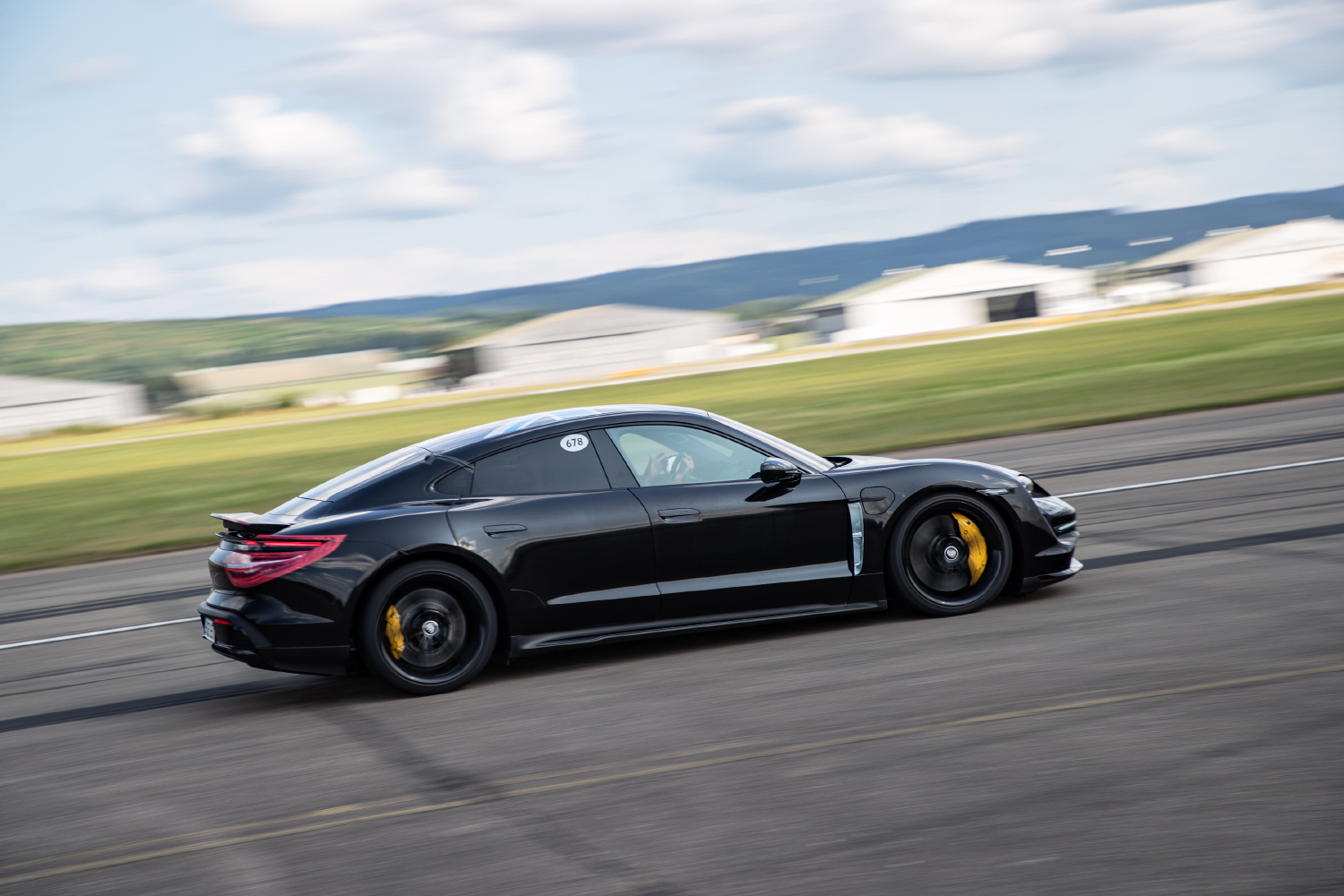
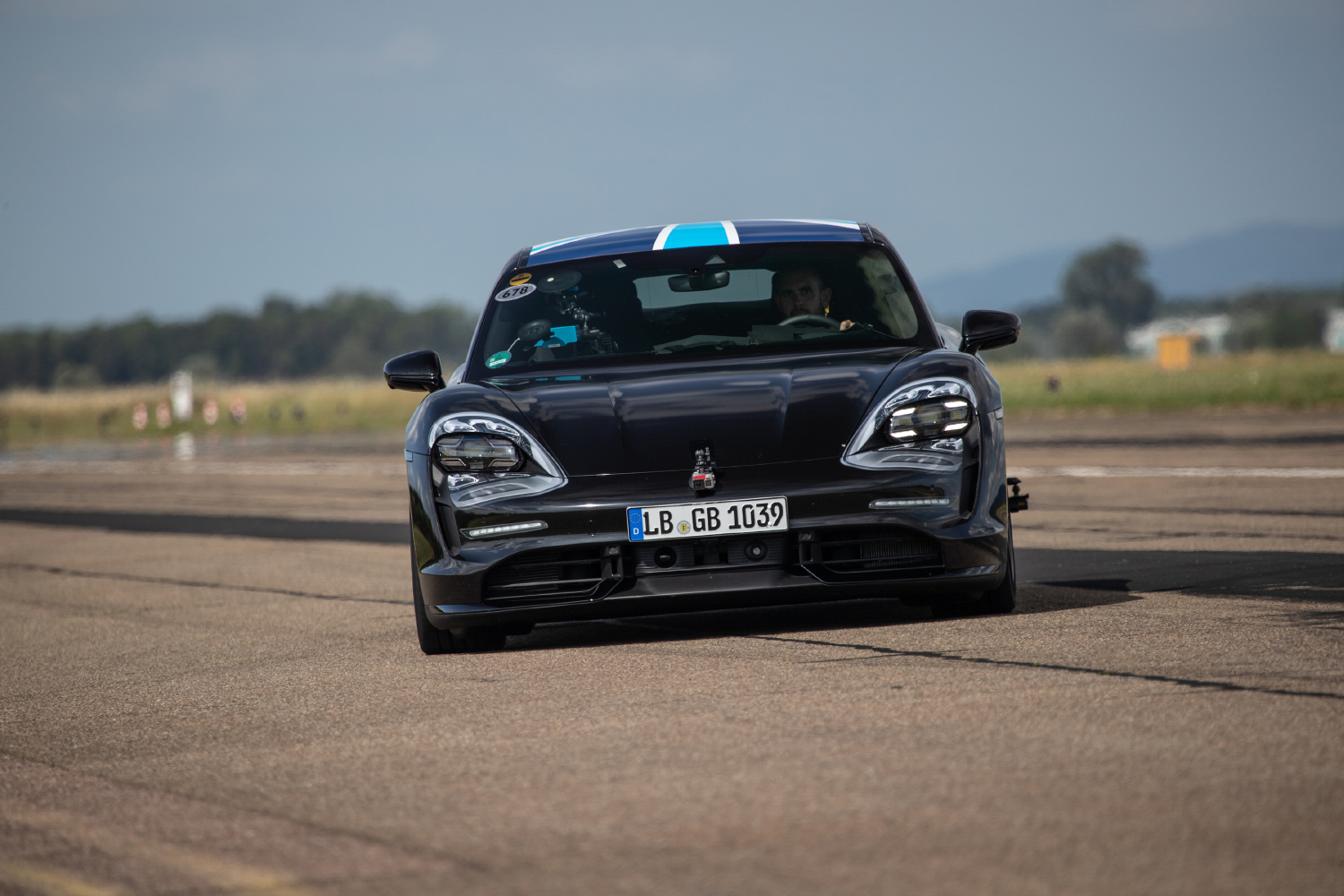
The Taycan is expected to have around 440kW, with its electric motors sending power to all four wheels.A production-ready version will be unveiled in September.
This feature first appeared in Wheels, May 1991
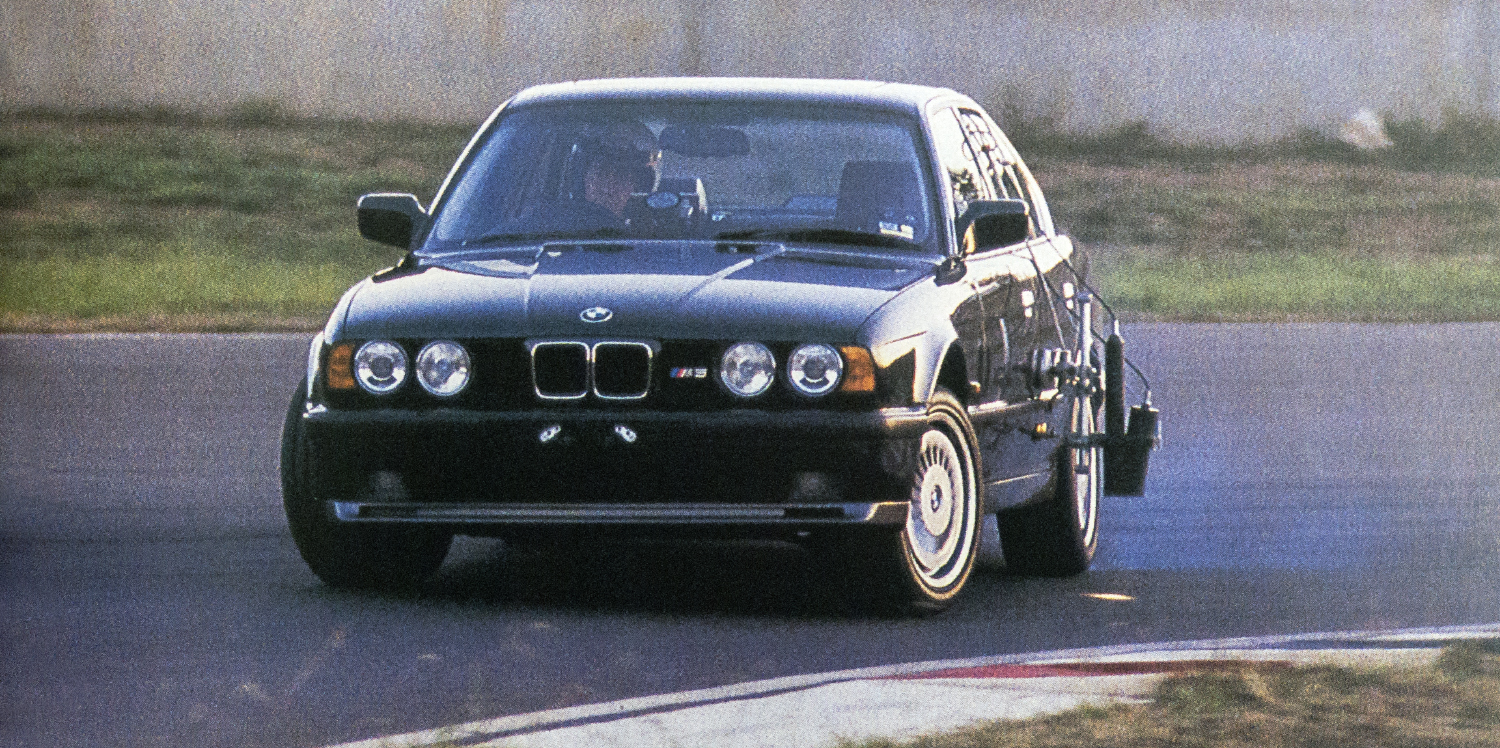
After testing 12 affordables, we plotted and schemed to bring together the most exotic, high profile machines in the business to determine the title Best Handling Car: Ferrari Modial t 348 vs Honda NSX vs Skyline GT-R vs BMW M5 vs Carrera 4.
Mercedes-Benz would not provide a 500 SL. It was inconvenient. There were no 348 tb examples to be had from importers, dealers or private owners. The best we could muster was the Mondial cabrio, with similar power output to the 348 tb but slightly different engine specifications, and a longer wheelbase.
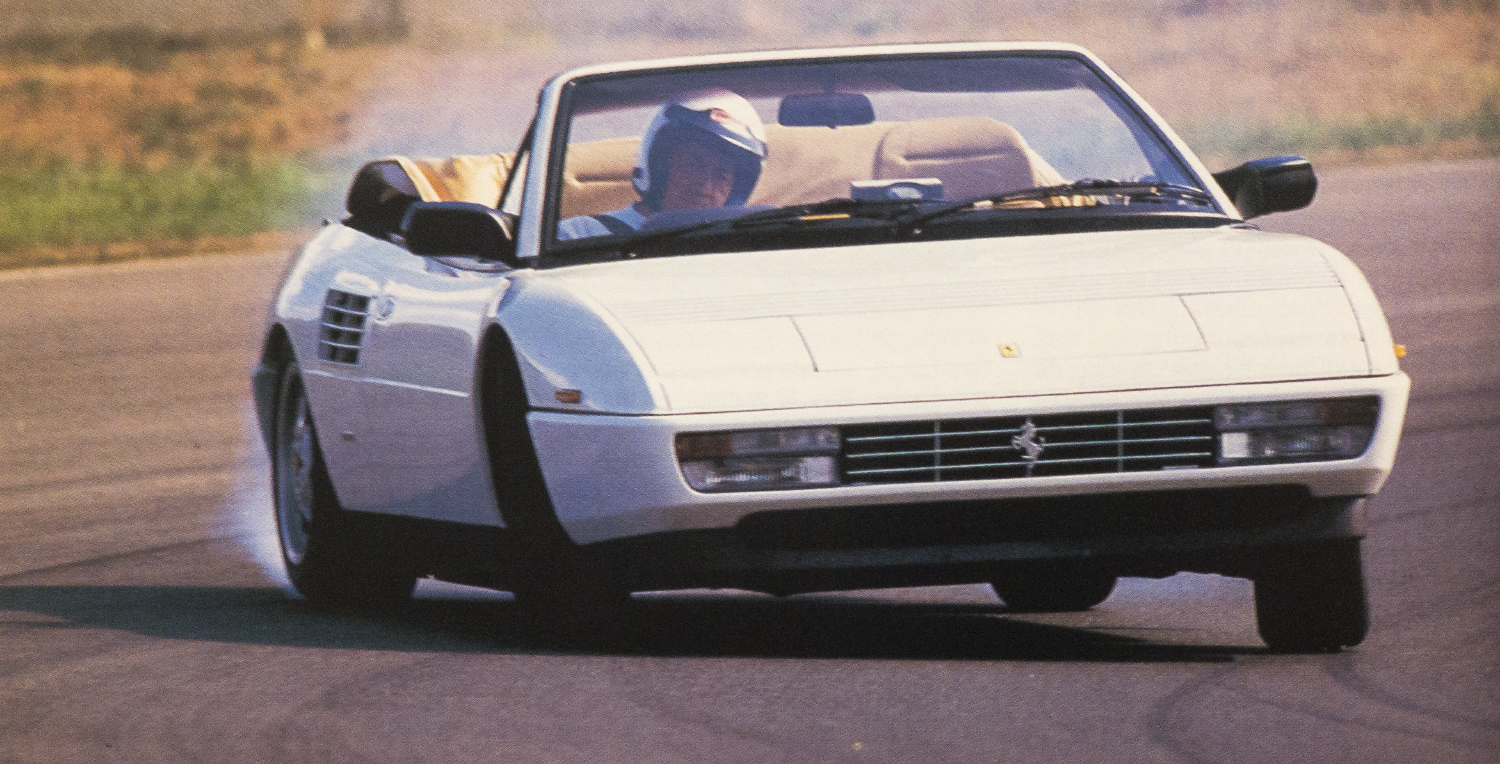
As the cars wheeled into Eastern Creek, preparations were already well underway. There was the exacting task of prepping the circuit for the 12 hour day that lay ahead: laying the reflective speed-trap tapes; arranging double lane change and slalom chutes to the standards laid down by the Society of Automobile Engineers; calibrating instruments like our Leitz Coreveit EEP-3 and Valentine Researach Inc. G-analyst – all done before a wheel could be turned in anger.
Handling is an inexact science, an art form often misunderstood. Ask a group of aficionados to explain the difference between handling, grip and directional stability, and you’ll get a dozen answers.
We define it simply: it’s the way a car performs up to the limit of its adhesion and beyond. There are obvious influencing factors like suspension and tyres. Less obvious are throttle response and adjustability, weight transfer and distribution, centre of gravity, wheelbase to track ration, and a host of other highly technical factors the boffins describe with terms like yaw and pitch, and polar moment of inertia. All of them can be measured, plotted, graphed and analysed… and still produce a car with all the predictability and easy manner of Saddam Hussein.
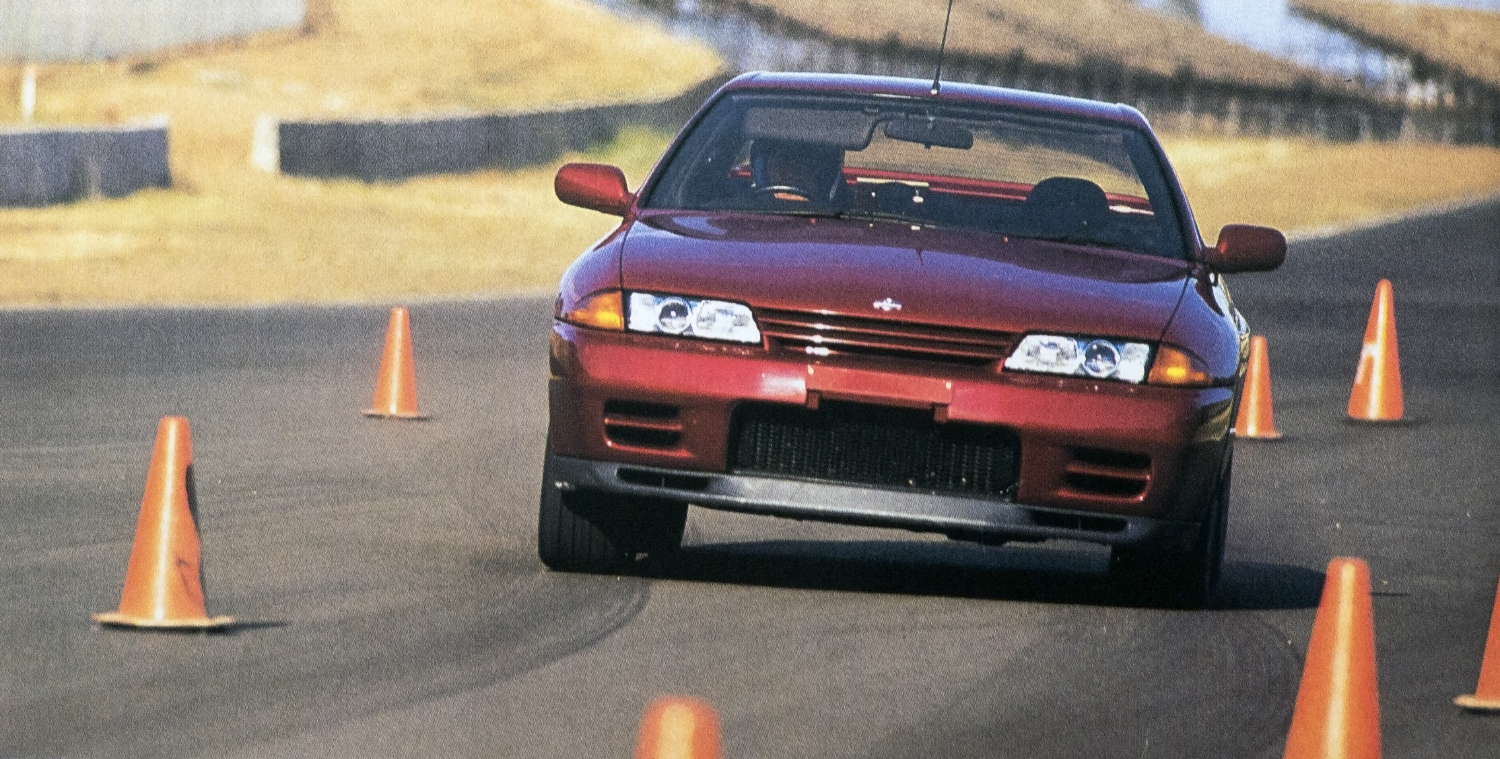
It’s a special car, the GT-R. And Kevin Bartlett agrees.
“Beautiful, just beautiful. Because the Skyline’s four-wheel driven you have to point it in the right direction and be precise, but if you make a mistake it doesn’t do anything stupid. You . just slowly apply the power, slowly let it off. Anything violent and it will only continue to do badly what it’s already started doing.”
“It’s not heavy in the steering and turn-in is gradual. It’s predominantly an understeerer on turn-in, if you don’t toss the car a little bit. If you toss it, the GT-R then becomes a slight oversteerer. When you get plenty of throttle in it stops that oversteer and will actually come back to understeer.
“Through and out of the chicane it’s just absolutely amazing. Third gear, low torque, 100 kays and you’re pulling 120 on the exit. It’s just like a rodeo, when they open the gate and the bull comes rushing out. Directional change is good and it has beautiful throttle control; more so than any other turbo car I’ve ever driven. Just fabulous.
COMPUTER ANALYSIS: Although its price is lower than the other four, the incredible Skyline GT-R generated bigger numbers on our test equipment. The Nissan hit a 1.10 lateral G peak, an amazing achievement for a car on road tyres. It was fastest through Corner 1 , despite its entry speed being slowest of all. That its exit speed from this comer was the only one above 100 km/h is tribute to both the outright grip of the GT-R and its ability to maintain very high cornering levels at the same time as accelerating hard.
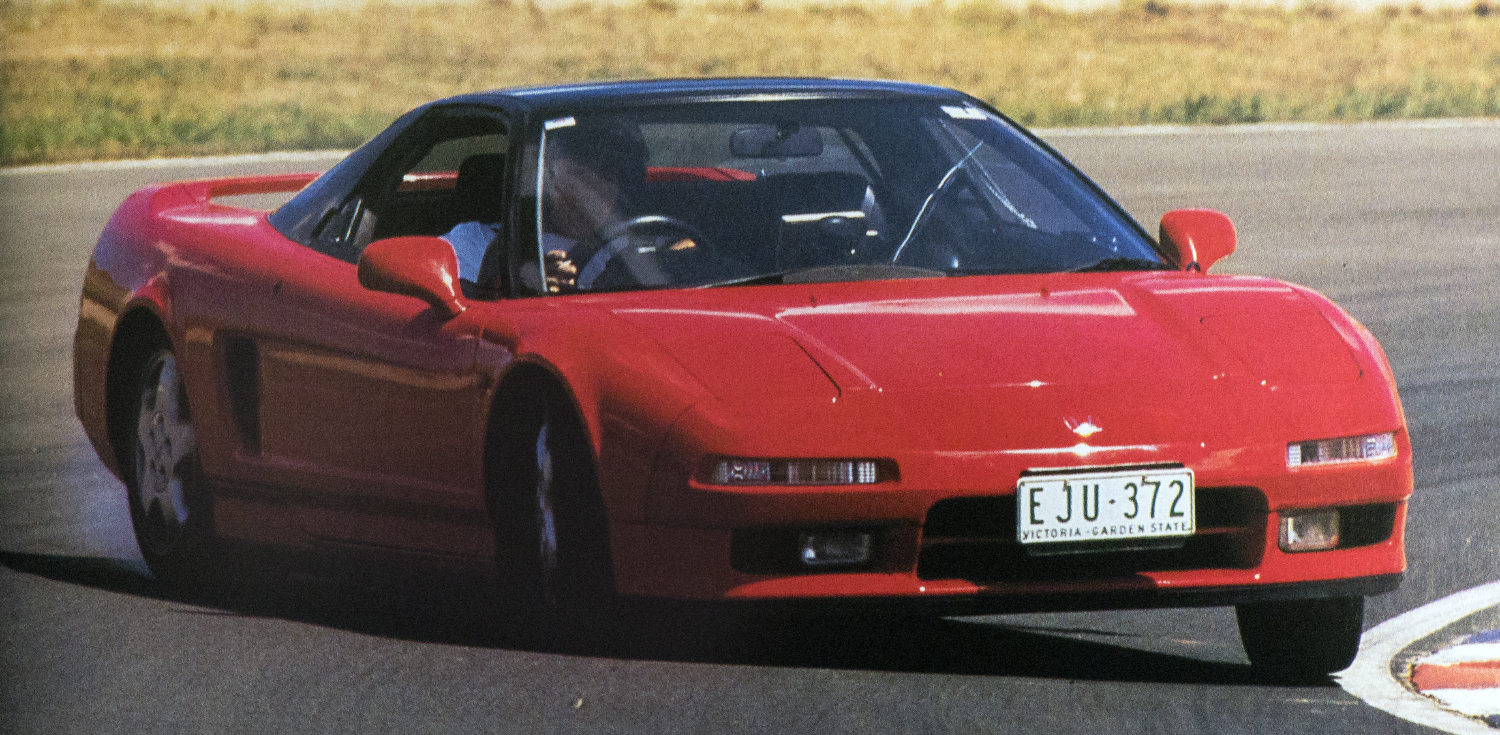
It doesn’t lack for agility either. Through both the double lane change and the slalom the Nissan was quickest. Its advantage was most pronounced through the slalom, where its four-wheel drive system made it visibly more neutral in attitude between the orange cones.
ON THE ROAD: In a word – extraordinary! This is the world’s newest benchmark, no risk. The Skyline GT-R is an awesome car, because its enormously powerful engine doesn’t overpower the enormously proficient chassis. Simply squirting the GT-R hard in a straight line is a real buzz. Doing so while blasting out of a comer is a rare experience.
And to do so when the exit is rippled like a washboard is an absolute revelation. The thing just grips and goes, and you feel like you’ve been shot out of a cannon. The GT-R’s handling qualities start with a good driving position and a proper driving seat that glues your bum and shoulders to the car. The ride’s fairly firm, a bit choppy across small bumps and corrugations, but not uncomfortably sharp.
Try very hard and you can unstick the GT-R’s rear end, or ultimately both ends bodily together, but even then the whole thing stays finely balanced, very predictable and superbly controllable. . . if you’re as quick as it is. Our only problem with the GT-R is wondering what Nissan can possibly do for an encore.
AND THE WINNER IS …
The instruments all agree. Nissan’s Skyline GT-R is emasurably superior to the Honda NSX, BMW M5, Porche Carrera 4 and Ferrari Mondial t 348. In such exalted company, that’s anincredible achievement . But not only did the Nissan impress the silicon chips out of our computerised equipment, it felt fabulous to the flesh and bone testers, on both track and road.
It turns into corners with crispness and accuracy, then launches on exit with incredible force. Nissan’s sophisticated steering and transmission systems are always effective, never intrusive.
Behind the conquering GT-R the order is not so clear cut. Honda’s NSX has the second best set of computer numbers and was well regarded by the on-road test crew. But Kevin Bartlett’s criticism of the inconsistency of its off-throttle oversteer at the limit makes the decision difficult.
While the M5 can’t quite match the outright grip of the NSX or GT-R, its behaviour at the limit is impeccable for a car of its size and type. Its grip might be fierce, but forgiveness is also oart of the M5’s nature.
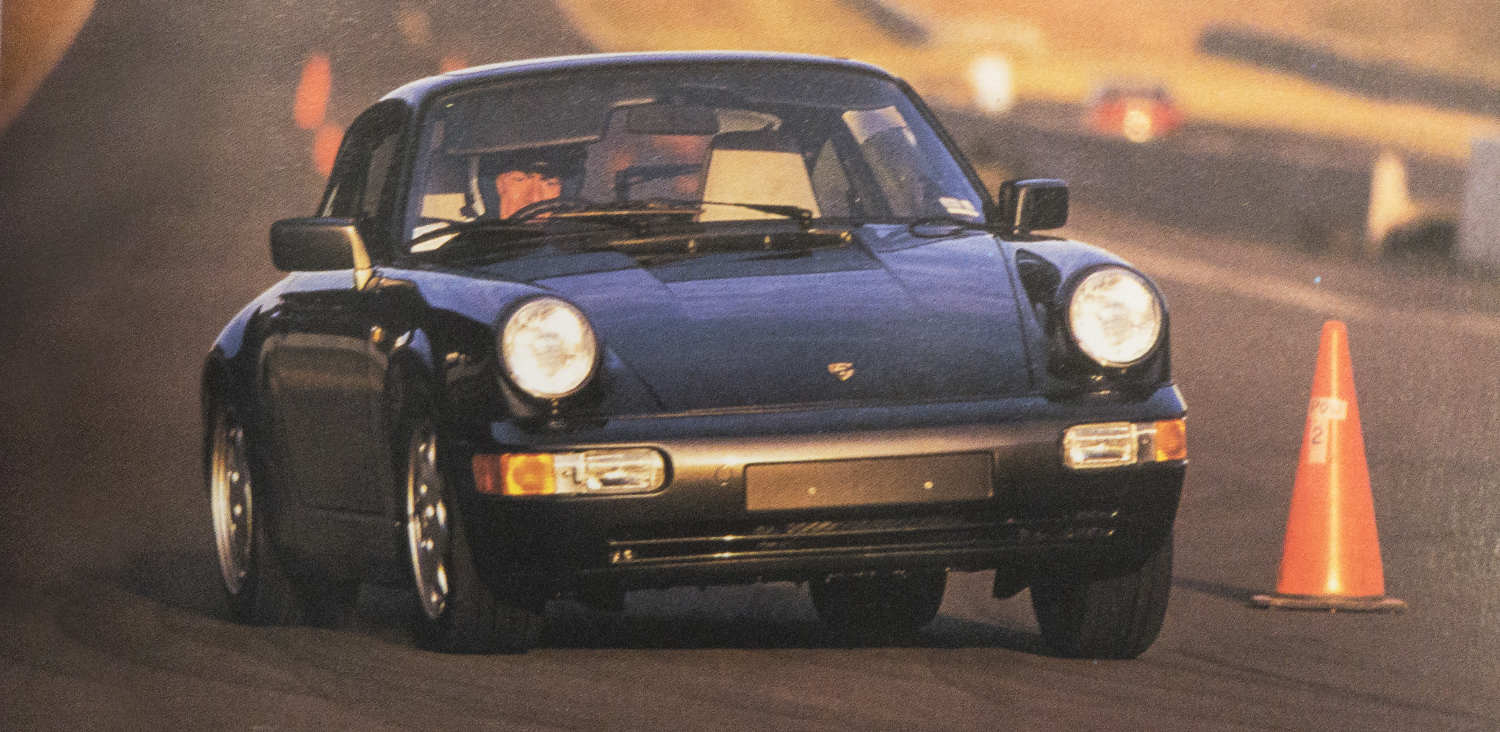
Though far from sluggish, neither the Porche nor Ferrari could quite match the withering pace set by the other three cars. The Carera 4 noses ahead of the Mondial t 348, however, with its higher Gs, greater corner speeds and turn-in response.
Times are certainly a ‘changin’ when Japan has Europe’s measure and Nissan beats Ferrari in a painstakingly fair fight.
Given the lack of flair in most current Nissan products, it’s difficult to remember that for a brief period between 1989 and about 1994 the Nissan Motor Company was a dynamic, exciting carmaker hell-bent on global domination.
Yes, you read that correctly. An ambitious global product program called Project 901 (which translated as ‘number one in the ’90s’) was intended to set Nissan on a course for all-out technological warfare, displacing Honda as Japan’s premier car manufacturer in the process. And in the beginning it really did start out well.
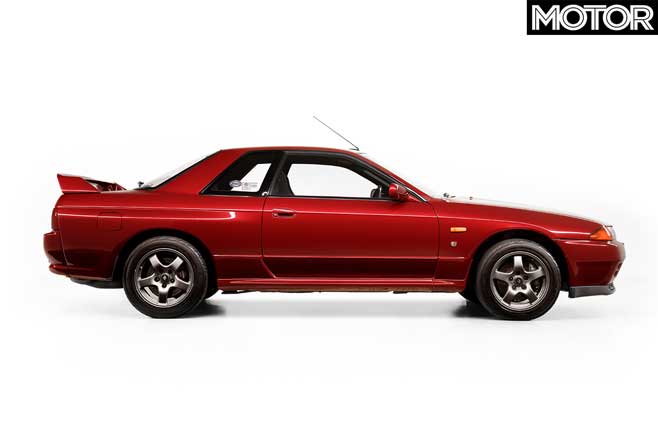
However, the crowning glory was without doubt the 1991 Nissan R32 Skyline GT-R.
Reviving Nissan’s revered GT-R badge after 15 years on the bench, the flagship R32 Skyline was a totally new car, completely at odds with its square-edged rear-drive predecessor. While the R32’s pumped-up form carried a surprising amount of visual restraint for an ’80s Japanese car, the reality was a sublime combination of brute force and beautiful engineering. In mid-1989, the level of technology (with accompanying acronyms) crammed into the GT-R’s compact form was unheard of.
The R32 acted as a flag-waver for Nissan’s burgeoning engineering expertise and featured ‘Super HICAS’ four-wheel steering as well as an ‘ATTESA-ETS’ (Advanced Total Traction Engineering System for All-terrains, with Electronic Torque Split) all-wheel drive system.
The ATTESA set-up could send 100 per cent of the GT-R’s thrust to its limited-slip rear axle until it needed to deploy everything it had, at which point up to 50 per cent of drive could be directed to its surprisingly modest 225/50R16 front tyres.
Suspension was a multi-link arrangement at both ends – the front employing a lateral link, trailing strut and diagonal upper control link that located the steering knuckle on each side of the car. And the brakes consisted of 296mm ventilated front discs with four-piston aluminium calipers and 297mm rears with two-piston calipers.
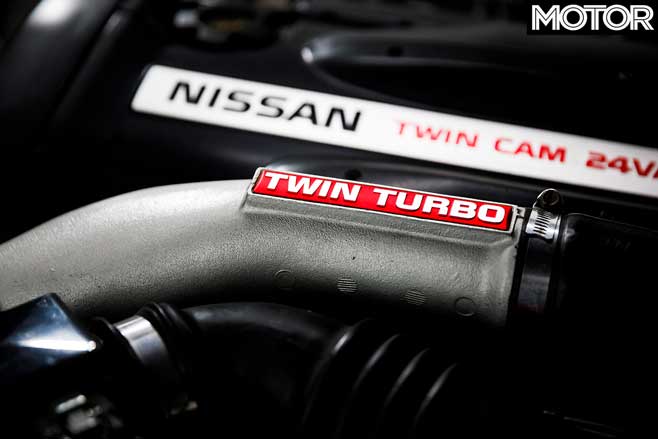
But under the GT-R’s subtly creased aluminium bonnet beat the heart of Nissan’s racecar for the road – the RB26DETT, an engine code that would quickly become common parlance.
Buyer’s Guide: Nissan R32 Skyline GT-R
A 2568cc relative of the RB30E 3.0-litre straight-six engine series already powering Nissan’s R31 Skyline range (and Holden’s VL Commodore) in Australia, the RB26DETT added dual belt-driven overhead camshafts, four valves per cylinder, a pair of ceramic Garrett turbochargers and an intercooler.
The result was a robust 205kW at 6800rpm and 355Nm at 4400rpm – the power figure not coincidentally right on Japan’s old ‘gentlemen’s agreement’ for maximum quoted output. Given the GT-R’s not-so-lithe 1430kg kerb weight in Aussie guise, the reality was probably quite a bit more – especially if you take into account Nissan’s 0-100km/h claim of 5.0sec.
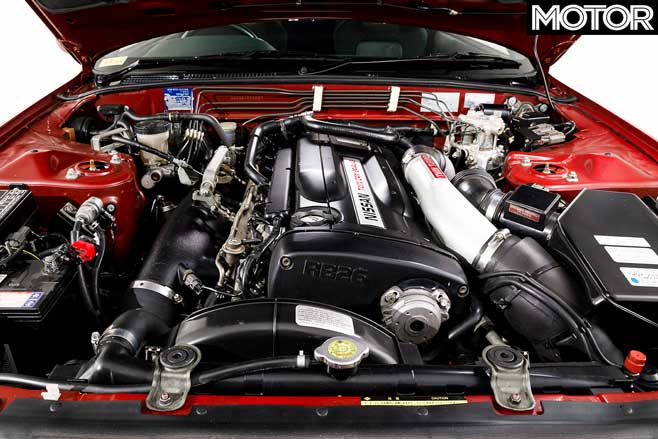
The GT-R’s centre-mounted tacho turned red at 7450rpm, but such was the engine’s balance (and outright brawn) that it could extend all the way to the 8200rpm rev-limiter without its power curve plunging into a hole.
Only the RB26DETT’s driveability characteristics betrayed its late-1980s heritage – the engine needing 3000rpm on board before the fireworks started to erupt, stirred along by a manual transmission with just five gear ratios.
Where all this R32 GT-R hoopla fits into an Aussie context is linked directly to the desires and aspirations of Nissan Australia’s motorsport team and Special Vehicles Division (SVD). And some ill-fated decisions by management.
First, some background.
Following several generations of fully imported Skylines, Nissan Japan gave the Australians a green light to fully manufacture the HR31 Skyline in Clayton, in conjunction with a four-cylinder variant (the Pintara) and an Australian-commissioned station wagon – all replacing the rear-drive Bluebird (1981-’86).
The logic at the time was that Australia was predominantly a rear-wheel drive market, and there was a turbocharged Skyline racecar to act as a halo vehicle (which wouldn’t have been the case had the cramped front-drive U11 Bluebird entered local production).
As Paul Beranger, long-time chief of Nissan Australia’s design department (1977-’92) and manager of Nissan’s motorsport division, points out: “The overriding reason we went motor racing, or continued to go motor racing, was because it supported the image of local manufacturing.”
Setting up the Special Vehicles Division in 1987 then acted as a bridge between local manufacturing and motor racing, while producing some terrific road cars like the Skyline GTS sedan.
But management in its wisdom decided that the front-drive U12 Bluebird (the second-gen Pintara, dubbed ‘Project Matilda’ and launched in November 1989) would become Nissan Australia’s great white hope – twinned with a badge-engineered Ford Corsair as part of the Button Plan’s model-reduction target – thereby killing any chance of the R32 Skyline range reaching Australian production. While opening the door for the R32 GT-R.
“We always wanted to connect our mainstream product with motorsport, otherwise why bother?” Beranger says. “And after we finished building Skyline at Clayton – which itself was a bad decision because it was a good money-maker for us, and a good car too – we then had to think of another way of making the motorsport connection work.
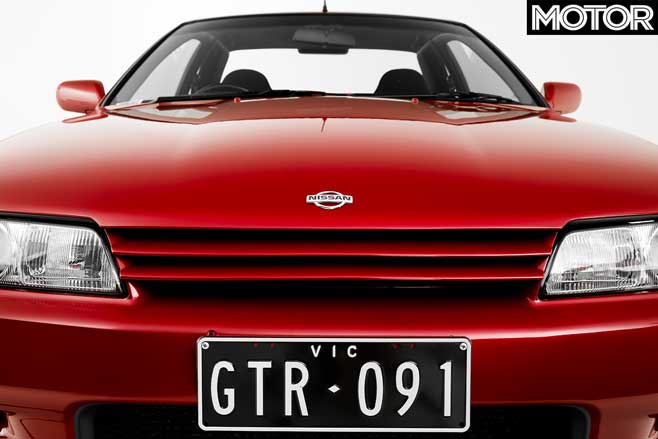
“We didn’t have a local car that would demonstrate that what we raced on Sunday would sell on Monday. So a guy called Ted Arcadipane, who is essential to this story and was in our business planning group, put together a paper with me on importing the R32 GT-R.”
The DR30 and HR31 Skyline racecars (wearing Peter Jackson tobacco livery) had maintained Nissan’s race presence but couldn’t hold a candle to the R32.
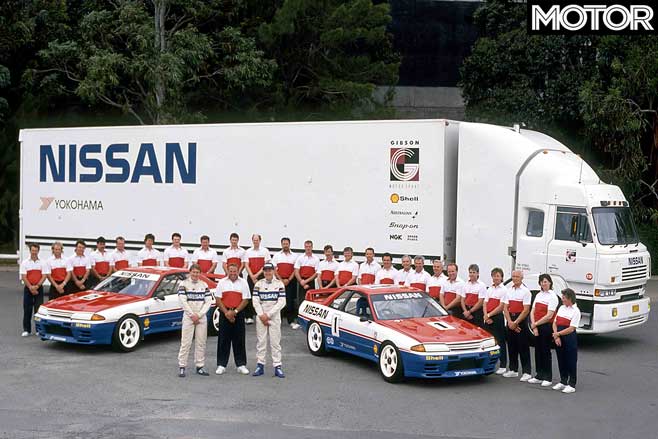
“Given how hard Fred Gibson and his team struggled with the previous Skylines, by the time we got to the R32, I guess we were pre-empting what ultimately happened – that it was going to be the gun vehicle,” Beranger recalls. “We didn’t predict that it was going to destroy Group A [the rules were changed in 1993, effectively banning the all-wheel drive Nissan], but we certainly had a strong feeling that it was going to be the gun car in Australia for motorsport.
“That’s also why we decided to import 100 production cars. We put a business case together with what I knew at the time were the local changes required to get the car ADRed. That went to local management, who approved it, and then we went back to Japan and said, ‘Please can we do this?’”
Nissan Australia imported a couple of R32 GT-R road cars in about August ’89 and unveiled them at Bathurst that October, flagging what was to happen with the race team the following season, and one of them was road-tested by Modern Motor in its April 1990 issue. And then the local engineers set about getting their heads around what needed to be modified for the road cars to meet the notoriously fickle Australian Design Rules.
As this was a uniquely Australian initiative, a lot had to be done to the car. “That was our biggest challenge”, Beranger says. “Japan agreed for us to do [the GT-R], but they threw it back on us, saying, ‘Okay, we will support you, but you do the work’ – which was very substantial. The GT-R was only built for Japan’s domestic market, so we needed to make all sorts of changes – radios, headlights and taillights [done by Hella Australia], mufflers for drive-by noise, seatbelts…”
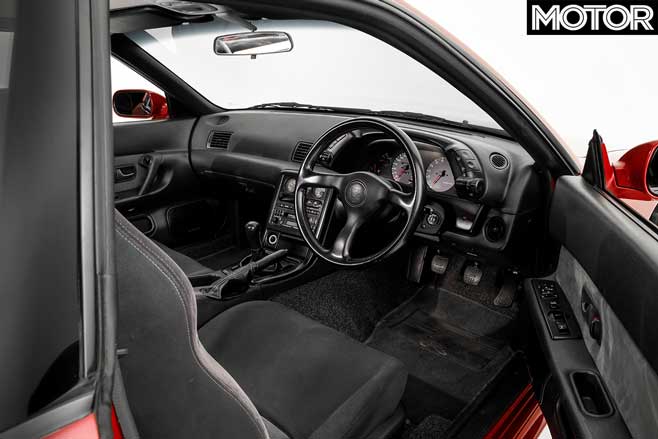
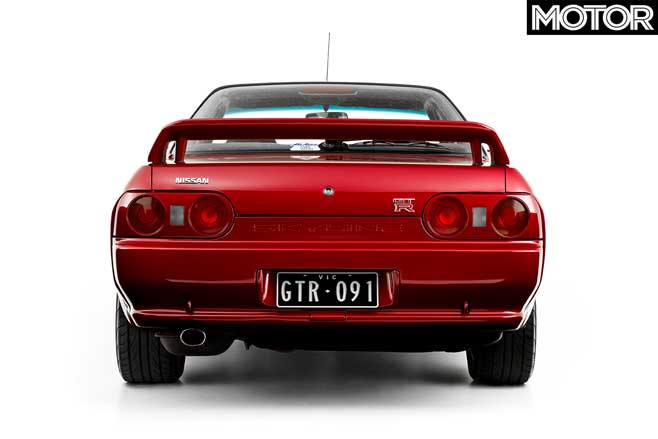
The side turn indicators and rear high-mount stop light were sourced from the 300ZX, the Japanese-market ‘S’ bonnet badge (for Skyline) made way for a Nissan logo, and the GT-R received a new ‘bee-sting’ antenna mounted at the back of the roof “because the Japanese car had a glass-mounted antenna, which was rubbish”.
The Aussies also wanted Yokohama tyres because Nissan’s local motorsport team was sponsored by them, but Japan refused, seeing that the GT-R had been developed around Bridgestones (Potenza RE71s, to be exact).
The GT-R’s mechanicals remained intact, with one notable exception. “We had to add a transmission cooler, because the Japanese engineers did theoretical projections to show that the transmission would overheat in outback Australia if you drove it at 180km/h for two hours!”
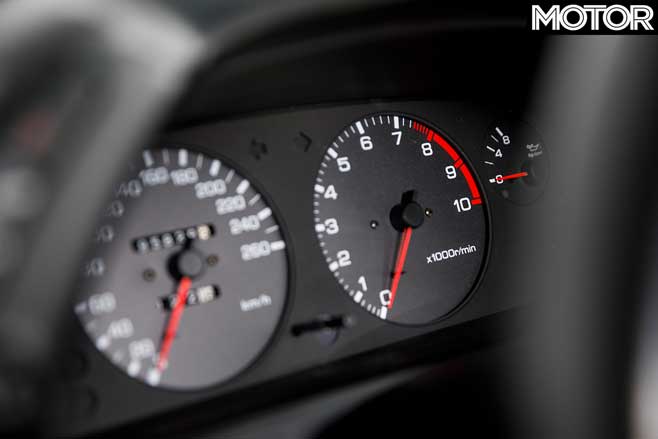
The thing was, at that speed the GT-R would have run out of fuel after about an hour, but as Beranger pointed out: “We didn’t want any delays to the program, so when a Japanese engineer tells you it needs a transmission cooler, you just go along with it and install one.”
The early racecars had a few problems with cracking blocks, which Nismo in Japan fixed by ribbing them, and the Japanese transmissions weren’t up to the stresses of Australia’s fierce Group A competition either – necessitating a switch to a locally made Hollinger ’box that proved both much tougher and cheaper. When the road cars went on sale in mid-’91, there was no impediment to the GT-R’s excellence.
Journalists loved the car, gushing over its dynamics. Its superb steering feel and response – astounding for a 4WS car of the era – the adjustability of its handling balance (even power oversteer!) and the surefooted sophistication of its all-round chassis talent instantly elevated the ballsy Nissan super-coupe to legend status. It truly was Godzilla.
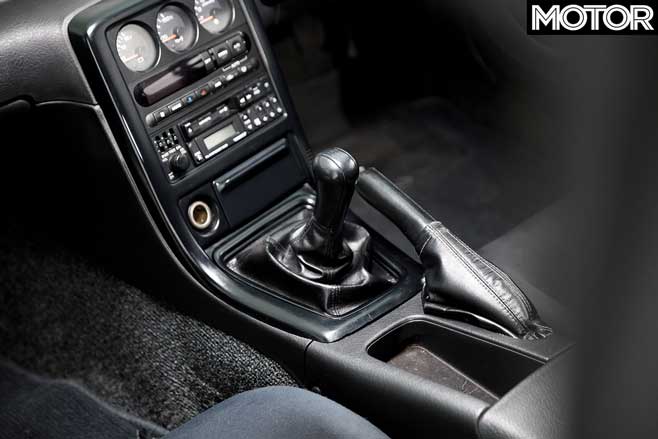
But so was its price. The race GT-Rs were already winning local races, which made some inside Nissan Australia excited and, unfortunately, money-hungry.
“The Japanese were just as surprised about the $110,000 price tag as many of us in Australia were,” Beranger muses, “but that was just a greedy sales team believing they could make a killing. And they fell over with that one.
“The GT-R was so much more expensive than a [$70K] 300ZX that it was very difficult for people to accept that a Nissan, however technically advanced, could cost $110,000 [$210K in today’s money] … and that ultimately caused the car to bog down in the dealerships. It really struggled.”
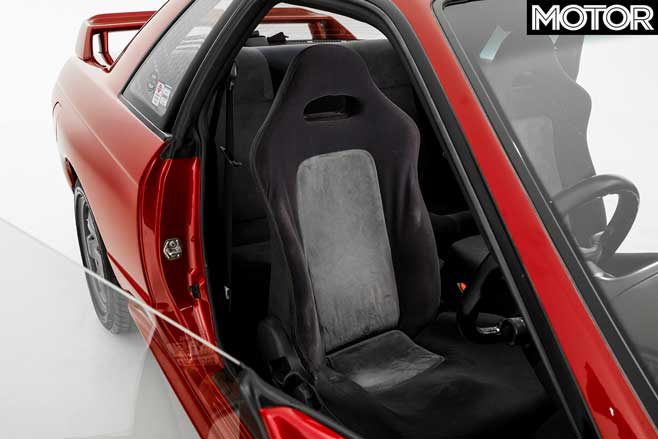
Our 100 GT-Rs were built in several batches during 1991 – 28 cars in May, 22 in June, and the remaining 50 in August. To reduce complexity, they were only available in three colours (Black Pearl, Jet Silver and Red Pearl – split 30/25/45) rather than the nine variations offered in Japan, and each was jam-packed with equipment.
But there were still unsold cars hanging around in dealerships 12 months later acting as ‘demo’ cars. Had the GT-R been more realistically priced – “I think from memory we were talking $80K-$85K, something like that, and it would’ve made money, absolutely” Beranger claims – then things might have turned out differently.
Still, it hasn’t stopped Aussie-plated GT-Rs pulling close to that amount three decades later. Today, no one remembers (or cares) that the GT-R was overpriced at launch, and probably underrated by the broader public at the time. Instead, the R32 Skyline GT-R has transcended all of that, as well as the ultimate failure of Project 901 to deliver on Nissan’s bold promise.
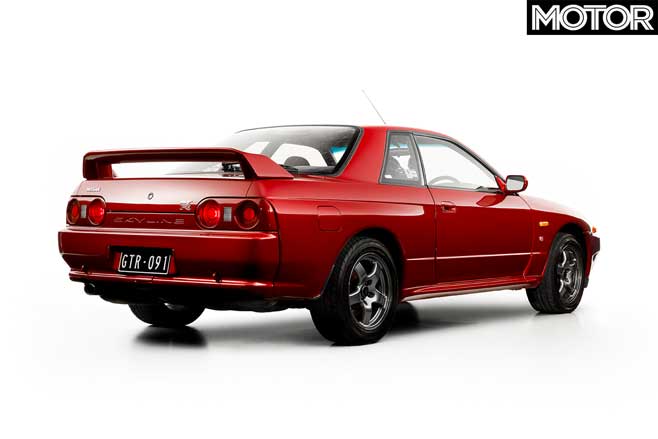
Thanks to the global reach of PlayStation and Gran Turismo, not to mention grey vehicle imports, history has completely rewritten the way people view the R32, especially in the places like the US where it was never sold. It remains Nissan’s hero car and has since left the rest of the excellent R32 Skyline range trailing off into history.
The following R33 GT-R of 1995 – while undoubtedly tough-looking and available in many more markets – simply gained weight and girth over its svelte predecessor, leaving the R32 standing proud as the purest of its type.
Nissan Japan ended up building 43,937 R32 Skyline GT-Rs across a five-year period – a significant number when you think about it – but what’s of even greater importance is that this was Godzilla at its sweetest. A never to be repeated combination of brawn and brains, brimming with visual restraint and emotional swagger.
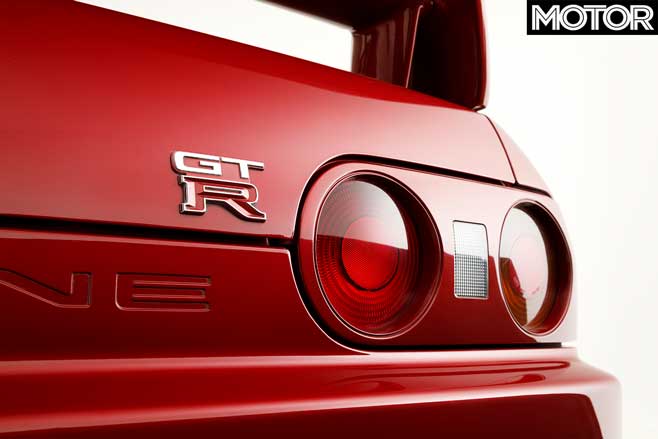
FAST FACTS 1991 Nissan R32 Skyline GT-R BODY: 2-door, 2+2 seat coupe DRIVE: all-wheel ENGINE: 2568cc inline-6, DOHC, 24v, twin-turbocharged BORE/STROKE: 86.0 x 73.7mm COMPRESSION: 8.5:1 POWER: 205kW @ 6800rpm TORQUE: 355Nm @ 4400rpm WEIGHT: 1530kg (kerb) POWER-TO- WEIGHT: 134kW/tonne TRANSMISSION: 5-speed manual SUSPENSION: multi-links, coil springs, anti-roll bar (f); multi-links, coil springs, anti-roll bar (r) L/W/h: 4545/1755/1340mm WHEELBASE: 2615mm TRACKS: 1480/1480mm (f/r) STEERING: power-assisted rack-and-pinion; rear-steering BRAKES: 295mm steel ventilated discs, 4-piston calipers (f); 297mm steel ventilated discs, 2-piston calipers (r) WHEELS: 16.0 x 8.0-inch (f/r) TYRES: Bridgestone Potenza RE71; 225/50 VR16 (f/r) PRICE: $110,000 (new)
EA Games has let slip the full car list for the newest instalment of the Need For Speed franchise, revealing a whopping lineup of 127 playable cars spread across 32 different manufacturers.
Announced at the same time as the release of Need For Speed Heat’s gameplay trailer (below), the car list confirms there will be plenty of choices for players, with a good spread of brands from Europe, the USA and Japan. There’s even one Chinese-made vehicle on the list: the Polestar 1 that also serves as the game’s cover car.
BMW, Nissan and Porsche each have a total of 13 vehicles on the car list, the most of any manufacturers present. That said, there are a lot of repeats that bulk up the count, mainly convertible versions of some models, as well as multiple variations of the same basic car – there are three varieties of Mercedes-AMG GT, for example, not to mention four Lamborghini Huracan variants and four Lamborghini Aventador options.
We also noted the curious exclusion of any Toyota products. Toyota sat out the last NFS title, Need For Speed Payback, and it looks like the company’s video gaming hiatus will continue with Heat. You’ll be able to drive the Toyota 86’s identical brother the Subaru BRZ, but if you were hoping for a steer of the new Toyota Supra then you’re in for some disappointment.
There’s some oddball stuff too, like a Land Rover Defender 110, Chevrolet C10 pickup, Mini Countryman JCW, a 1963 Volkswagen Beetle and Volvo 242DL. The inclusion of classic supercars like the Lamborghini Countach, Ferrari F40 and Ferrari Testarossa are no surprise though, given they’ll mesh perfectly with Heat’s Miami Vice vibe.
For the full list of cars in Need For Speed Heat, scroll down to the bottom.
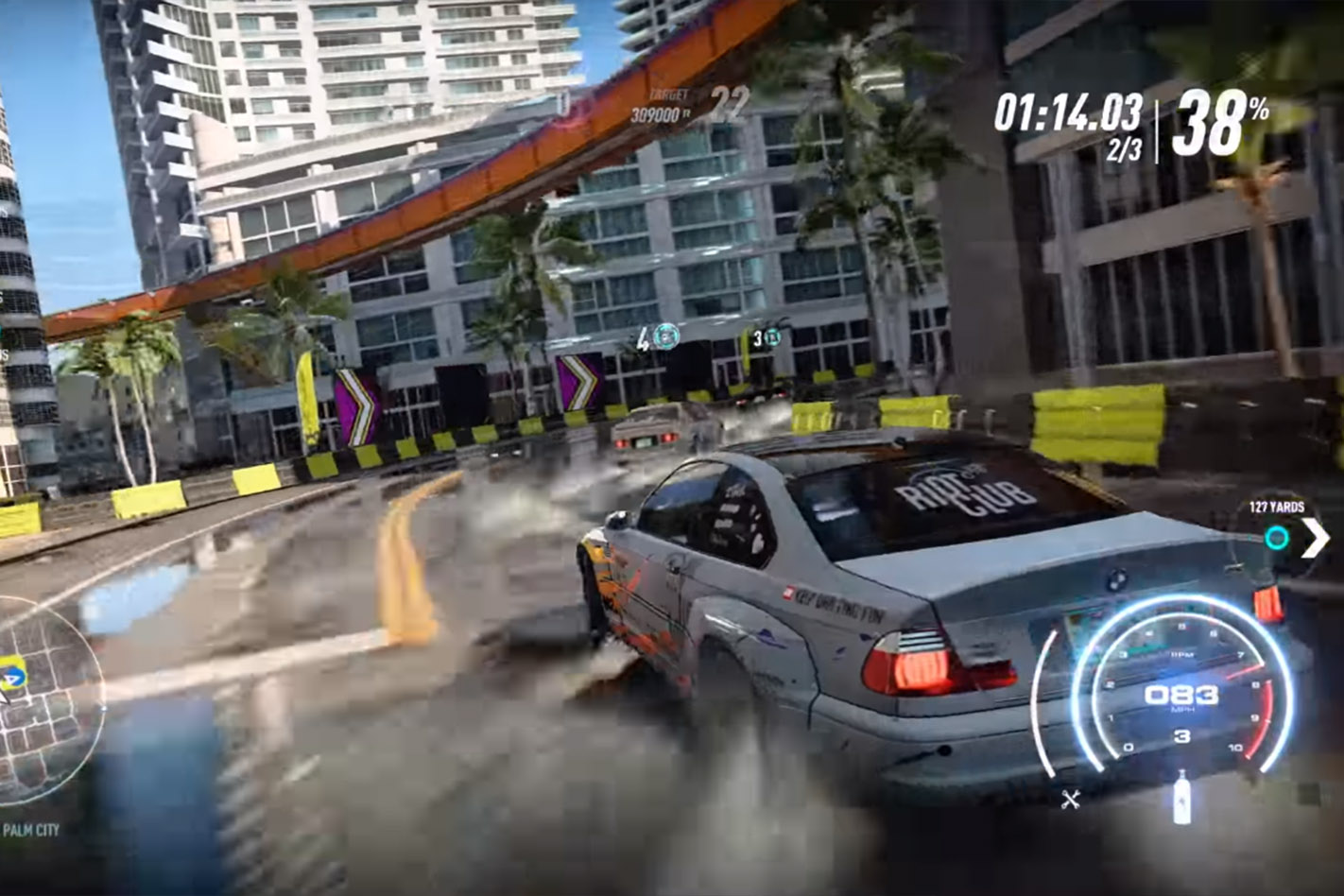
We can see plenty of the cars in action in the gameplay trailer. While there are no shots suggesting we’ll finally see an in-car view, we will say this: the visual rendering is definitely up to NFS’ usual high standard, with plenty of atmospheric light, reflection and particle effects to add some graphical wow factor.
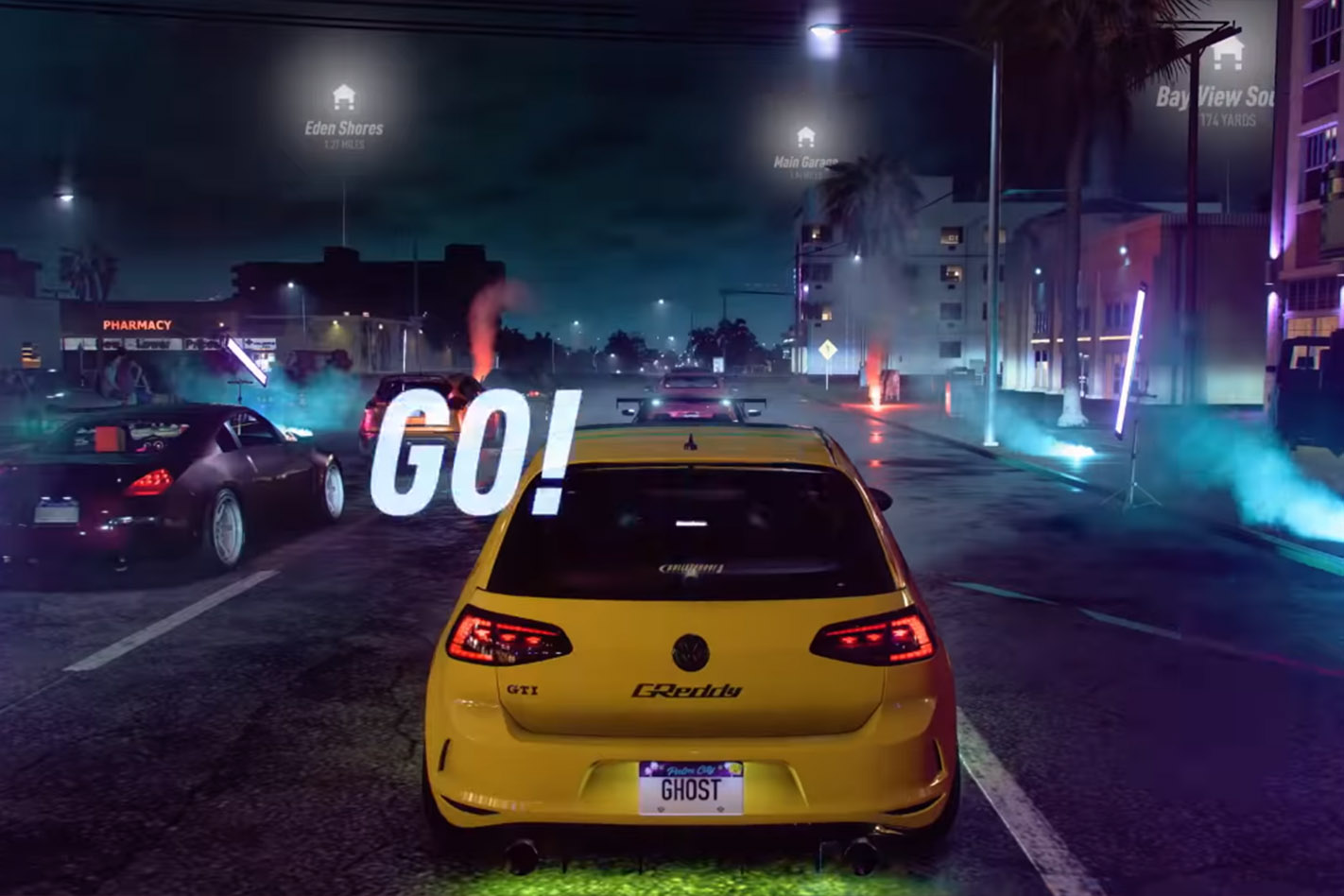
Damage doesn’t appear to be extensively modelled, however, if that footage of a Corvette sliding into four palm trees in quick succession is anything to go by.
The video reiterates what we already know: gameplay will be split into two different styles, with legally-sanctioned competitive racing and challenges happening during daytime, while the night is all about illegal street racing. The police force appears to be active during both the day and night cycle, but their aggressiveness ramps up when the sun goes down.
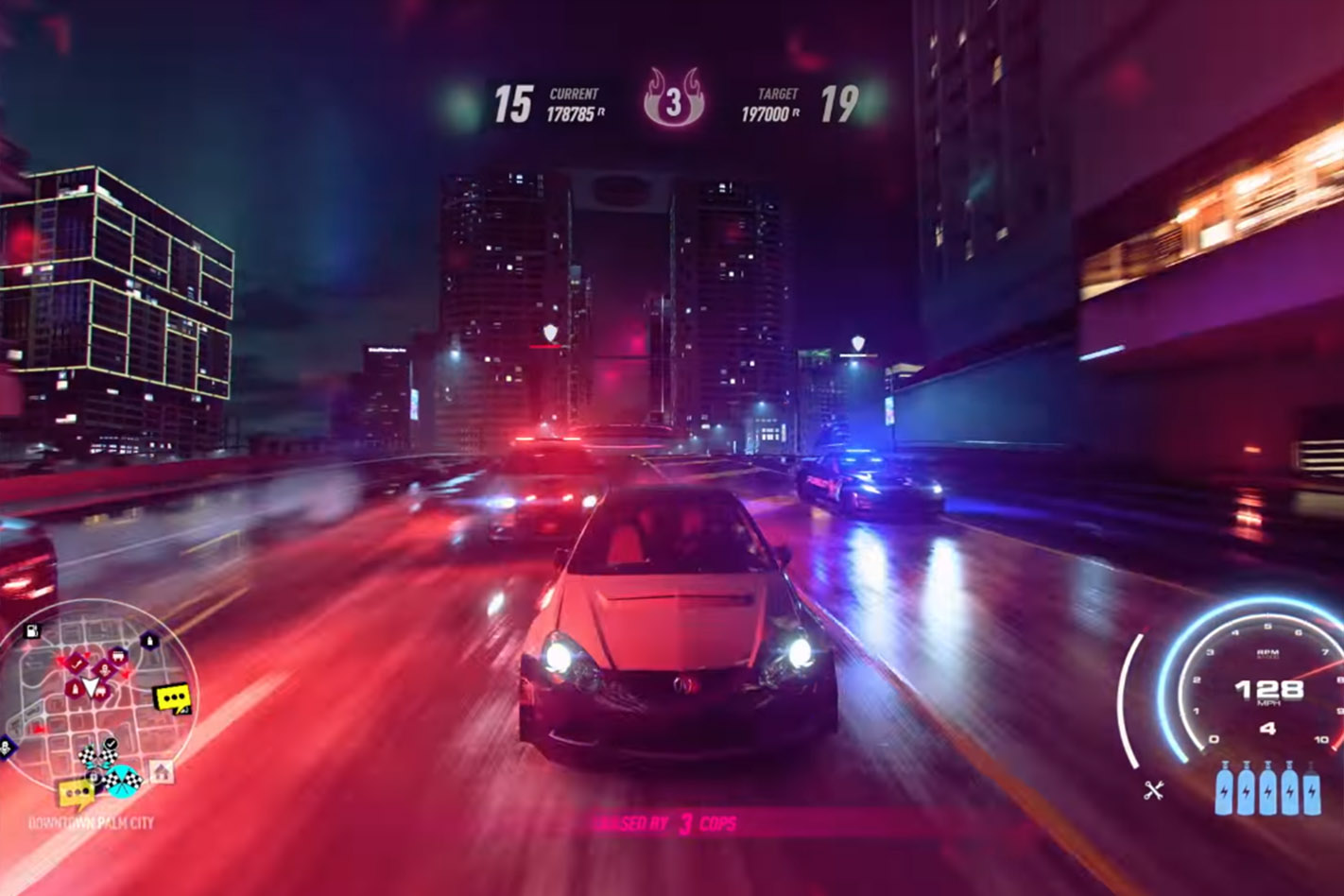
Think you’ll just avoid the cops and mainly do day races? It seems that won’t be possible, with the ‘reputation’ points needed to unlock certain parts and vehicles only able to be obtained through street racing at night.
The money to fund those upgrades can only be earned through the daytime races too, so it appears moving forward in the game will require an even split of day/night activity.
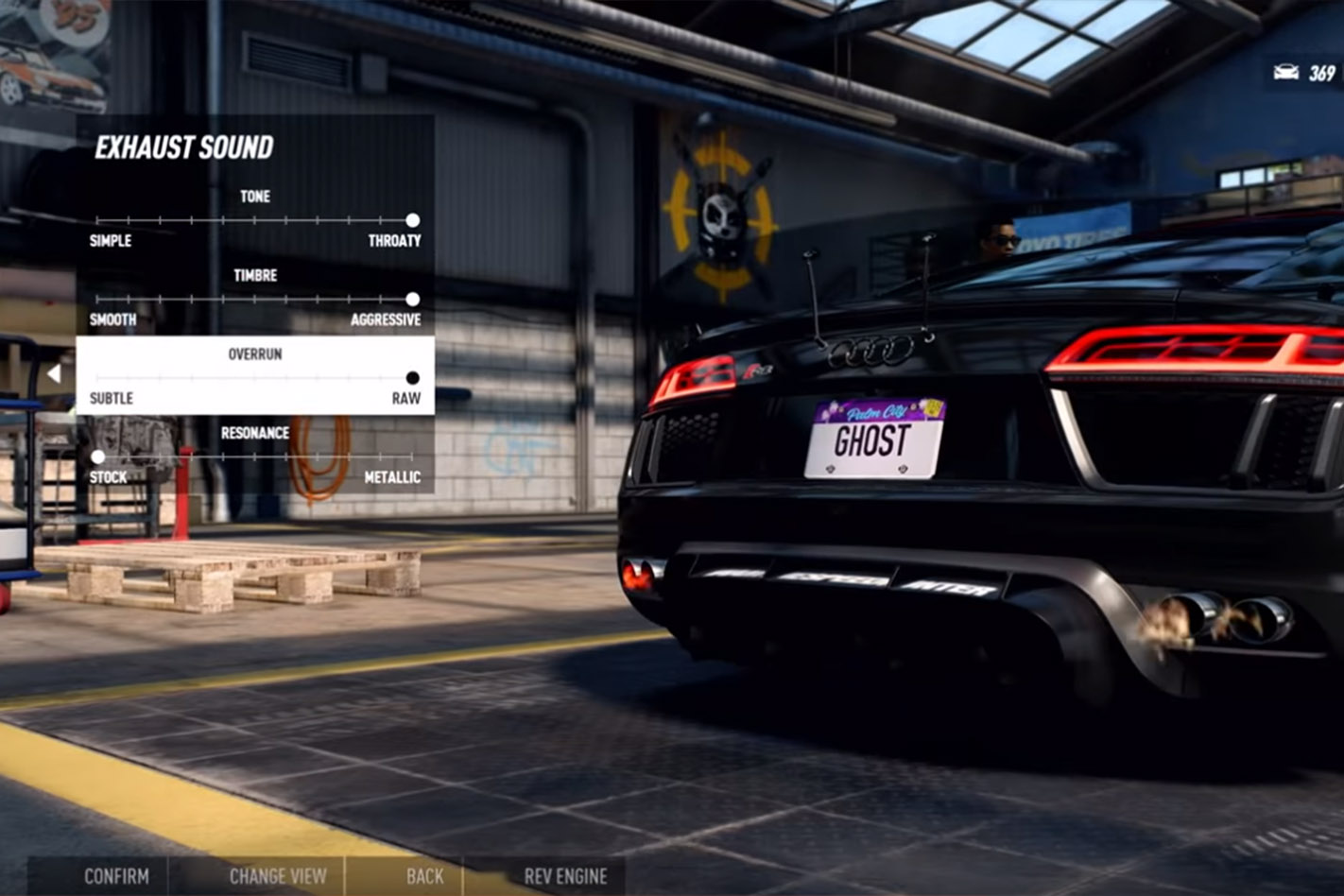
Some other interesting elements of Heat were also revealed in the gameplay trailer, namely the ability for players to customise the actual sound of their exhaust, with sliders for tone, timbre, overrun and resonance able to be fiddled with to your satisfaction. Probably pointless as far as performance is concerned, but hey, sound matters.
If you think introducing exhaust customisation is a bit ridiculous, Heat also introduces branded apparel into the world of car games. Want to deck out your character in a full Adidas outfit? You can! Definitely a feature for all you hypebeasts out there.
Need For Speed Heat officially goes on sale on November 8 across PC, Xbox One and Playstation 4.
THE CARS
Alfa Romeo
- 2016 Alfa Romeo Giulia Quadrofoglio
- 2017 Aston Martin DB11
- 2016 Aston Martin Vulcan
- 1964 Aston Martin DB5
- 2019 Audi R8 V10 Performance Coupe
- 2017 Audi S5 Sportback
- 2020 BMW Z4 M40i
- 2019 BMW M2 Competition
- 2018 BMW i8 Coupe
- 2018 BMW i8 Roadster
- 2018 BMW M5
- 1988 BMW E30 M3 Evolution II
- 2006 BMW E46 M3
- 2006 BMW E46 M3 GTR
- 2010 BMW E92 M3
- 2014 BMW F84 M4
- 2016 BMW F84 M4 GTS
- 2018 BMW F83 M4 Convertible
- 2016 BMW X6 M
- 1987 Buick GNX
- 2013 Chevrolet Corvette Z06
- 2017 Chevrolet Corvette Grand Sport
- 2019 Chevrolet Corvette ZR1 Coupe
- 1967 Chevrolet Camaro SS
- 2014 Chevrolet Camaro Z28
- 1965 Chevrolet C10 Stepside Pickup
- 2017 Chevrolet Colorado ZR2
- 1955 Chevrolet Bel Air
- 2014 Dodge Challenger SRT8
- 1969 Dodge Charger
- 2019 Ferrari 488 Pista
- 2018 Ferrari FXX-K Evo
- 2016 Ferrari LaFerrari
- 2015 Ferrari 488 GTB
- 2014 Ferrari 458 Italia
- 2014 Ferrari 458 Spider
- 1988 Ferrari F40
- 1984 Ferrari Testarossa Coupé
- 2017 Ford GT
- 2016 Ford F-150 Raptor
- 2016 Ford F-150 Raptor (Fem From NFSP)
- 2016 Ford Focus RS
- 2015 Ford Mustang GT
- 1990 Ford Mustang Foxbody
- 1969 Ford Mustang Boss 302
- 1965 Ford Mustang
- 1992 Honda NSX Type-R
- 2017 Acura NSX
- 2004 Acura RSX-S
- 2009 Honda S2000
- 2000 Honda Civic Type-R
- 2015 Honda Civic Type-R
- 2017 Infiniti Q60S
- 2017 Jaguar F-Type R Coupe
- 2019 Jaguar F-Type R Convertible
- 2016 Koenigsegg Regera
- 1989 Lamborghini Countach 25th Anniversary
- 1995 Lamborghini Diablo SV
- 2010 Lamborghini Murciélago SV
- 2018 Lamborghini Aventador S
- 2018 Lamborghini Aventador S Roadster
- 2018 Lamborghini Huracan
- 2018 Lamborghini Huracan Spyder
- 2018 Lamborghini Huracan Performante
- 2018 Lamborghini Huracan Performante Spyder
- 2019 Lamborghini Aventador SVJ Coupe
- 2019 Lamborghini Aventador SVJ Roadster
- 2016 Land Rover Defender 110 Double Cab Pickup
- 2015 Land Rover Range Rover Sport SVR
- 2006 Lotus Exige S
- 1996 Mazda MX5
- 2015 Mazda MX5
- 2002 Mazda RX-7 Spirit R
- 2018 McLaren 570S Spider
- 2018 McLaren 600LT
- 2015 McLaren 570S
- 2015 McLaren P1
- 2015 McLaren P1 GTR
- 2015 Mercedes-AMG GT
- 2017 Mercedes-AMG GT R
- 2019 Mercedes-AMG GT S Roadster
- 2018 Mercedes-AMG C63 Coupe
- 2017 Mercedes-AMG G63
- 2014 Mercedes-AMG A 45
- 1967 Mercury Cougar
- 2017 MINI Countryman John Cooper Works
- 2008 Mitsubishi Lancer Evolution X
- 2007 Mitsubishi Lancer Evolution IX 2007
- 2018 Nissan 370Z 50th Anniversary Edition
- 2018 Nissan 370Z Nismo
- 2017 Nissan GT-R
- 2017 Nissan GT-R Nismo
- 2008 Nissan 350Z
- 2003 Nissan 350Z (Rachel’s from NFSU2)
- 2002 Nissan Silvia Spec-R Aero
- 2002 Nissan Skyline GT-R (Eddie’s from NFSU)
- 1999 Nissan Skyline GT-R V·Spec
- 1996 Nissan 180SX Type X
- 1993 Nissan Skyline GT-R V·Spec
- 1971 Nissan Fairlady 240ZG
- 1971 Nissan Skyline 2000 GT-R
- 2017 Pagani Huayra BC
- 1970 Plymouth Barracuda
- 2020 Polestar Polestar 1
- 1977 Pontiac Firebird
- 1973 Porsche 911 Carrera RSR 2.8
- 1996 Porsche 911 Carrera S
- 2018 Porsche 911 GT2 RS
- 2018 Porsche 911 Carrera GTS
- 2018 Porsche 911 Carrera GTS Cabriolet
- 2018 Porsche 911 Targa 4 GTS
- 2018 Porsche 911 Turbo S Exclusive Series
- 2018 Porsche 911 Turbo S Exclusive Series Cabriolet
- 2019 Porsche 911 GT3 RS
- 2018 Porsche 718 Cayman GTS
- 2017 Porsche Panamera Turbo
- 2015 Porsche 918 Spyder
- 2015 Porsche Cayman GT
- 2014 SRT Viper GTS
- 2006 Subaru Impreza WRX STI
- 2010 Subaru Impreza WRX STI
- 2014 Subaru BRZ Premium
- 1963 Volkswagen Beetle
- 1976 Volkswagen Golf GTI
- 2016 Volkswagen Golf GTI Clubsport
- 1975 Volvo 242DL
- 1970 Volvo Amazon P130
