
We all know that brakes are for slowing and, ultimately, stopping a car. But how do they work? Well, there are plenty of different types of brakes that have been tried in the last century, but they all work on the same principle of physics. That is, they use friction to convert kinetic energy into heat (and often a bit of noise) to slow the car.
When you step on the brake pedal, you cause two friction surfaces to come together. That friction converts the car’s momentum into heat and it slows down. Most modern cars have what’s called a disc brake on each wheel and in that case, when the brake pedal is pushed, fluid (which is non-compressible, remember) pushes stationary brake pads onto a disc, or rotor, that’s turning with the car’s wheels.

The harder you push the brake pedal, the harder the brake pads squeeze the rotors and the faster the car slows down. And the more heat is generated. Ever spun a pushbike wheel and grabbed the tyre to stop it? The car tyre is the rotor and your hand is the brake pads.
The conversion of kinetic energy to heat is why your hand gets hot when you do this. The big change to braking over the last few years has been in hybrid cars which start to brake by switching their electric motor to a generator and converting kinetic energy into electricity to recharge the on-board batteries.
But again, this conversion from kinetic to another type of energy is what slows the vehicle down. And when a hybrid has to stop fast, conventional disc brakes take over.
JAGUAR XE 25t PRESTIGE Score: 83/100
Price & Equipment | 15/20
Just under $65K buys you either of these mid-size sedans. Opposing drive layouts aside, they have plenty in common, including the fact they’re less-chosen alternatives to the Germans. In this spec, the XE shares a high level of standard equipment with the S60 but its space-saver alloy spare beats Volvo’s sealant kit.
Interior & Versatility | 16/20
Unique ‘Jaguar Drive’ selector is central to the XE’s understated, ambient-lit interior. It gets leather-faced
10-way power adjustable front seats with four-way lumbar adjust and driver-side memory, a powered steering column, 8.0-inch touchscreen and 380W Meridian audio. A 40/20/40 rear seat is handy and 455L boot generous.
Performance & Economy | 16/20
Mechanical similarity and weight parity fail to explain why the Jaguar is slower and thirstier on paper than the Volvo. On the road, however, the Jag’s 177kW 2.0-litre turbo-petrol engine pushes the 1530kg XE with verve and offers effortless shove in most situations courtesy of a 340Nm torque plateau from 1750-4000rpm.
Ride & Refinement | 18/20
Blend of poise and ride polish is so good it’s almost French (back when supple ride was a Gallic cornerstone). XE rides with terrific compliance, with road and suspension noise enviably well suppressed. Slightly narrower tyres and fatter sidewalls than the S60 help, but it likely has more to do with the suspension. 18/20
Steering & Handling | 18/20
With well-connected electric steering and a beautifully balanced rear-drive chassis, the Jag doesn’t need gimmicks to handle, though its torque-vectoring system, which uses the brakes to point the car, can be felt helping it around corners. It’s the XE’s balance and involvement (and its lovely ride) that helped it win a comparo last issue.
VOLVO S60 T5 R-DESIGN Score: 74/100
Price & Equipment | 14/20
Common features include auto wipers and lights, sat-nav, voice control, Bluetooth, hill-start assist and a rear-view camera. But the Volvo misses out on a driver’s knee airbag, while much of the advanced safety tech (collision warning with full auto brake, lane-departure, forward-collision, blind-spot info) costs extra.
Interior & Versatility | 15/20
Sportier in R-Design trim, yet decidedly Scandinavian, the S60 interior is nevertheless appealing. Shorter 2776mm wheelbase doesn’t unduly affect cabin space, though boot only holds 380L. Smaller 7.0-inch display screen betrays cabin’s age and some minor controls are unintuitive, but Harman Kardon audio quality matches the Jag’s.
Performance & Economy | 16/20
The S60 is up a mere 3kW and 10Nm and weighs just 3kg less than the Jag. Front-drive means it’s not as quick off the mark, but in-gear response is enthusiastic and at 6.3sec, it gets to 100km/h half a second quicker than the Jag. It’s also thrifty (6.4L/100km versus 7.5) but the new four doesn’t match the warble of Volvo’s old fiver.
Ride & Refinement | 15/20
More firm than floaty, with a suspension calibration that favours taut absorbency. The R-Design ‘sport chassis’ brings stiffer springs and dampers than in lesser variants, for a greater handling focus than the non-sporting Prestige-spec Jaguar. Top marks for body solidity and quietness, and long-haul occupant comfort.
Steering & Handling | 14/20
Sport chassis can’t make up for the S60’s single biggest departure from its rival (and most competitors) – front-wheel drive. It still handles obediently, responds with accuracy and resists bodyroll well, but where the Jag’s pilot will continue to uncover layers of ability, the Volvo driver will ultimately be left a bit underwhelmed.
VERDICT
The Volvo S60 missed the grid for last month’s Audi A4-meets-rivals comparo, but, like the Jaguar XE, it’s a less-chosen model that deserves a look. However, while Jaguar delivered a car to make eschewing the usual Euro suspects not only worthwhile but the smart choice, the Volvo makes it more difficult to justify foregoing the alternatives. The Jag looks sharper, has a classier interior, rides with supreme comfort, and involves and entertains its driver. The XE provides similar performance to the Volvo, with the benefit of rear-drive power-down, and both offer eight-speed autos, idle-stop and good efficiency. Perhaps there’s greater value at $50K with the S60 T4 – a price point only the Infiniti Q50 can match – but it is Jaguar head-and-shoulders above Volvo in this circa-$65K showdown.
Forgive me for not being as excited as the i-thingy brigade about Apple spreading its app-happy wings to develop a car.
If all the rumours are true – and there’s plenty of evidence and innuendo to suggest that the i-smoke must eventually lead to fire – the world’s second-largest tech company will be hoping to do to transport what it has done to the music and phone industries.
It’s a big call. But while Apple doesn’t always nail the bullseye first time around, it usually gets close to the target once lessons are learnt. The iPod, iPhone and iPad are perfect examples.
Apple is not alone in wanting to tackle cars. Google is also hoping to shape transport, predominantly by sidestepping the driver with robots, though it remains to be seen if they’ll do what they’re told. The Google car’s much-publicised crash earlier this year was evidence of the challenges ahead, especially when it comes to dealing with human drivers who won’t always behave like a computer. As a result, the company said it would make “refinements to our software”, something we suspect will be happening for decades to come.
Apple and Google have shaped our tech worlds. But each has made plenty of mistakes, and in Google’s case the list of failures is longer than the very short list of (admittedly very big) successes. Google Glass anyone?
Cars are also a lot more complex and demanding than a search engine, and they have to last much longer than an iPhone or MacBook. They need to withstand a crash, and protect you in the process, and be easy to repair afterwards. They need to be able to cope with wind, rain, snow and sun, and they need to work within a second of start-up across a 100-degree temperature range.
They also need to work faultlessly the minute you drive them out of the car dealership. This alone will require the tech giants to develop their four-wheeled products in a very different way to their usual i-fare.
As with its rivals, Apple often rushes things to market then works on fixing the issues once they’re in consumer hands. Remember the teething problems with Apple Maps? You can’t do that with cars. You can’t use consumers to help develop air-con or entertainment systems, let alone the braking or crash-avoidance systems.
History suggests, though, that Apple won’t have issues finding buyers. There are millions of fanbois around the world eager to buy anything with the Apple logo. But there’s a big difference between having a new phone or watch or iPad go on the fritz for a minute or two, and a ‘technical glitch’ at 100km/h on a freeway.
FAST LEARNERS
From the outside, Apple appears to be playing it smart when it comes to developing its top-secret car. The California-based company has been hiring experts from across the automotive industry – including some engineers from Holden – to at least shortcut some of the lessons learnt from more than 100 years of car-making. And, as with everyone at Apple, secrecy appears paramount to their future employment; it’s understood part of the deal is not to talk to anyone outside the company about what they’re up to.
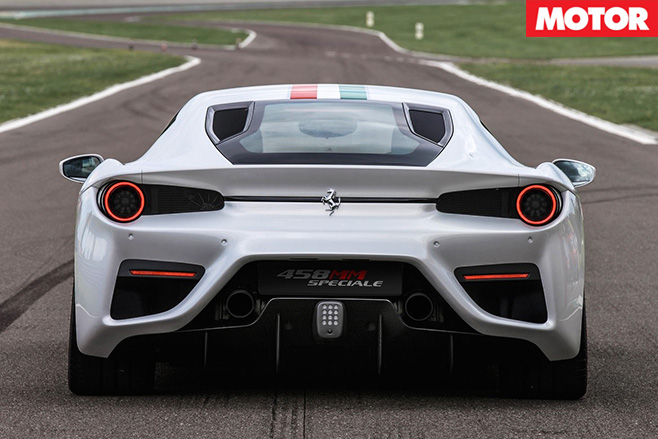
Worked over version of Maranello’s glorious atmo V8 is the vision of one well-heeled British customer
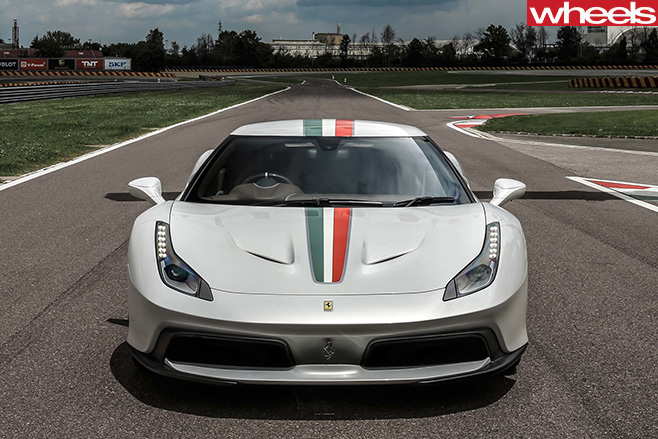
DO regular Ferraris bore you? This is the Ferrari 458 MM Speciale, a bespoke build carried out by Ferrari for one very fortunate (and cashed-up) individual who wanted something a little less ‘ordinary’ than the usual Prancing Horse.
It could be the best version of Ferrari’s highly acclaimed 458, and arguably even better than the Ferrari 488 that replaced it – but we’ll never know, because we will never drive it. And Ferrari won’t say who owns it.
There’s nothing more calming than a family road trip. The sound of trees rushing past your windscreen as your tyres smooth out the asphalt, and music blares from your car’s speakers. The kids calmly glued to the backseat, giggling, laughing, crying, and then screaming, “Are we there yet? How much longer? I need to pee. I’m booooored!”
Calming, right?
But family road trips don’t have to be an ordeal of monotony. Forget Friday night board games, part of the fun of spending time together in a metal box on four wheels is forced family bonding – and you’ve got hours to entertain.
Don’t panic. We’ve got you covered.
1. Alphabet game – Players have to list objects that begin with each letter of the alphabet and can be seen in an ‘I spy’ style game. If you want to make it competitive, players have to write down what they see and the first one to get a word for each letter of the alphabet wins. The letter X might be a bit of a struggle though, so use it as a joker for an object that can appear anywhere.
2. Animal name –Name an animal (giraffe). Then get the next person to also name an animal that starts with the last letter (elephant), and continue (turtle) until someone can’t think of one (echidna). This game also works with other genres too, like movies, countries or celebrities.
3. Guess the tune – This one is a lot of fun, and there are two ways it can be played. Option A: One player hums a song and the rest of the car has to guess the tune. To make it a little easier, pick a segment like ‘theme songs’ or ‘pop songs’. Option B: Play the first two seconds of a song on the radio or via a CD and then get the passengers to guess it.
4. I spy – I spy is a rite of passage for any road trip. If you don’t know how to play it, all you need to do is learn the phrase, “I spy with my little eye, something beginning with”. Don’t let anyone trick you – you actually have to be able to see it. If you’ve got really little ones in the back, you should get some crackers – M for motecontrol (remote control) and F for fongs (thongs), right?
5. Punch buggy – This game is probably the most aggressive, but it’s a favourite. When someone sees an old Volkswagen Beetle, they yell, “PUNCH BUGGY,” and punch someone in the arm. There are modified versions of this though, if you’d prefer not to have your kids punching each other in the back seat. Replace Beetles with taxis or number plates starting with a certain letter. The first to yell out the code word gets a point, and the one with the most points wins – no violence and everyone’s happy.
6. Word by word story – Who doesn’t remember playing this game in primary school? Someone starts off with a word and everyone in the car takes it in turns to add to the story.
7. If I were in charge – Ever wondered what you’d do to make the world a better place? In this game, it gives kids the chance to really use their imagination and get their brains ticking. Everyone in the car gets a turn saying what they would do to change the world and make it better. Kids can come up with some hilarious ideas, and they may even surprise you.
8. Alphabetical categories –Similar to the alphabet game, this game has every person say a word in order of the alphabet. The difference is they don’t need to see it. Pick a topic (countries), and then everyone says a word in alphabetical order. For example, player one; Australia, player two; Belgium, player three; Cambodia, and so it goes. When you reach the end, you go back to A. The person who can’t think of a name with the letter drops out of the game and you start again. You can pick any topic – food, drinks, names. Extra tip for the adults, this makes a great drinking game when no one has to drive.
9. 21 questions – Just like the game ‘who am I?’ the aim of this game is to guess what someone is thinking by asking 21 questions. Questions can’t be repeated and the person to guess the right answer wins and gets to start round two. To make sure no one cheats, ask the kids to write it down on a piece of paper.
10. The cone of silence – The perfect game when you just want a few minutes peace. Tell everyone in the car to stay quiet. First person to break the cone of silence loses, and the one who stays quiet the longest wins. Offer snacks to keep the kids motivated and stop them talking when they get bored, otherwise you could be asking to play this game every 30 seconds. Also perfect when you want to try and get the kids to fall asleep, it’s the perfect ruse.
Now find out what top features to look for in a family car.
All good things must end – and our time with the Bang For Your Bucks class-winning BMW M135i has indeed been good, such that we’re quite sorry to see it off.
For this author, the combination of hot hatch nimbleness, a scorching turbocharged 3.0-litre straight-six and, in particular, rear-drive, led to at least one late night investigating finance options. Yep, that tempting.
For those readers just tuning in, it’s worth recapping the big news with BMW’s rear-drive hot hatch, that being the price – $62,900, or a quite sizeable $14K cheaper than the equivalent car in 2012. There’s been a facelift since then, too.
The big drop was a key reason why the M135i was included in – and won – the hotly-contested $50K-$100K class at last year’s Bang, despite the mechanical upgrades being limited to five extra kilowatts, now 240kW. But BMW knew it had a wheel in no need of reinventing, with the M135i keeping up, both metaphorically and literally, with newer and cheaper hot hatch rivals. Its 4.84sec to 100km/h, as tested, will still pip the all-wheel drive DSG Golf R. At $9K more, so it should, to some extent.
But the core thing is the M135i is still a sweetly satisfying thing to drive fast. You’d be surprised just how few cars that visit the MOTOR office have that must-go-for-a-drive-this-weekend quality about them – and the M135i, after a long, fast drive, makes you think ‘when can I do this again’ rather than, ‘okay, I think I’ve had enough’.
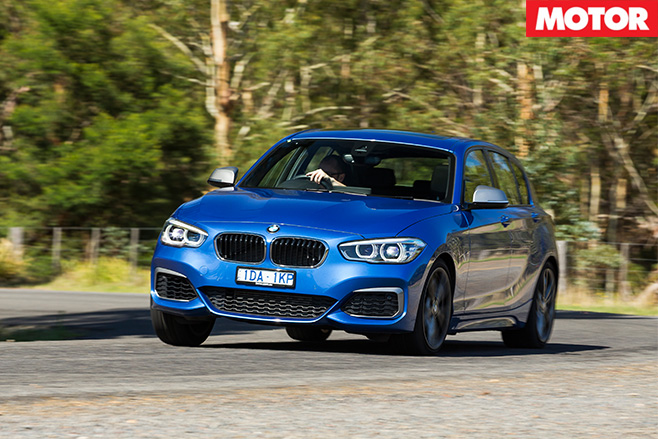
I’ve only small gripes to report over my time 1DA-1KP. The brake pedal calibration and darty variable steering take some getting used to around town. And no digital speedo is probably more a personal bugbear; the analogue jobbie does the job. I do love the M135i’s interior and it feels like this is where a lot of your coin is going. It’s a quality place to sit, even for nine hours at a time.
Perhaps my main irreconcilable difference with the M135i is the styling. It’s a bit plain. The Golf R, for example’s sake, looks far tougher.
And despite prevaricating on the issue some months ago, I feel confident confirming you should get the optional mechanical limited-slip diff. In some ways, particularly if you count yourself an enthusiast, why wouldn’t you buy your 240kW rear-drive hot hatch with one?
My position was cemented after a recent blat in a such-fitted M235i. Traction is strong in the stock car (which simulates an LSD by braking the spinning inside wheel, transferring torque back to the outside), but it can’t match the satisfyingly consistent and predictable action of a true mechanical unit. Consider it very much a longer-term investment in your enjoyment of the car.
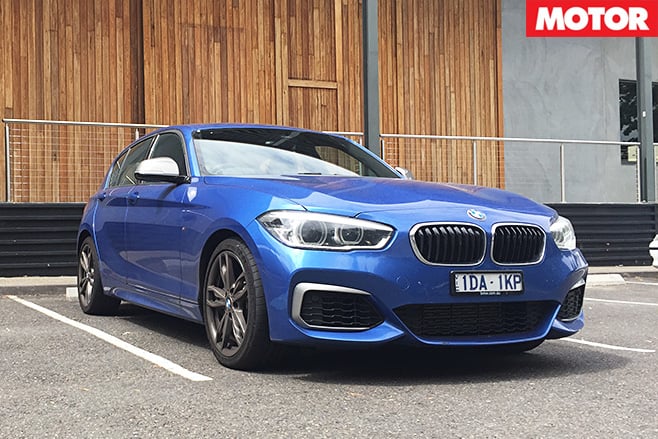
For what it’s worth, over 5800km of city, country and hard driving, the M135i returned an average of 10.7L/100km. BMW claims an average of 7.5L. Best we saw was 7.1L on the Hume, or 646km to a tank. The worst, 12.2L and 380km/tank. Tempting to wonder which way the wind was blowing at the time of BMW’s testing, though we imagine the testers weren’t driving anything like we were, sorry to say for them.
Although even that is now at an end. MOTOR will always miss a rear-drive straight-six, but this one especially.
Month: Five Liked: The moment, when driving an M235i with the optional LSD, we realised the M135i needs one Disliked: Saying goodbye! Favourite moment: A VL Turbo, wildly spitting and hissing, shall we say “fooled” by the subtle styling
Fuel this month: 11.7L/100km Average: 10.7L/100km Distance this month: 714km Total: 11,235km
Want to see more of our BMW-M135i-long-termer? Check out the below:
- Part 1 of the BMW M135i long term test
- Part 2 of the BMW M135i long term test
- Part 3 of the BMW M135i long term test
- Part 4 of the BMW M135i long term test
Mark Webber done good and run strong in F1, and his ballsiness made us proud. But he didn’t win. Rob Margeit meets the young man who’s determined to go one better.
First published in the November 2011 issue of Wheels magazine, Australia’s most experienced and most trusted car magazine since 1953.
SEBASTIAN VETTEL probably didn’t pay too much attention to the gangly kid with the toothy smile and the nest of curly hair when he attended the Formula BMW World Final in Valencia, Spain, back in 2006. Vettel, then a rising star and mere months away from making his F1 debut with BMW, probably wouldn’t have noticed the then 16-year-old Aussie amongst a field of around 40 young racers trying to make a name for themselves in the junior ranks. If he had, the future triple world champ would have had an early glimpse at his future teammate.
Daniel Ricciardo cuts an unassuming figure in the F1 paddock. But underneath that warm smile, that mop of unruly hair, stands a man who is arguably one of the quickest drivers in the world. And don’t be fooled by the perma-grin; Ricciardo is a serious player in a serious sport. And next year, he takes over the mantle as Vettel’s teammate at the dominant Red Bull Racing.
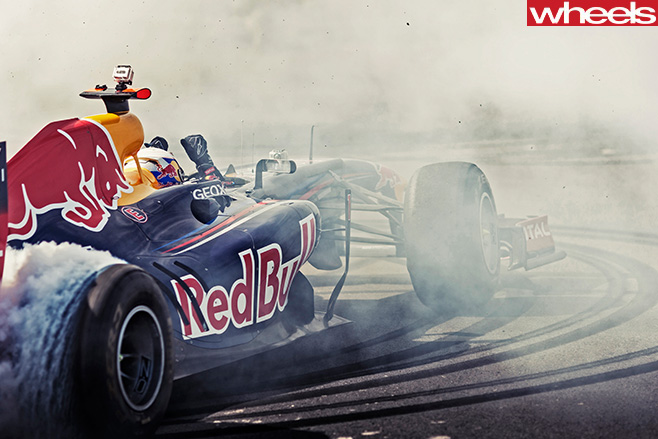
Now that role falls on the 24-year-old shoulders of Ricciardo. It’s a passing of the baton, of sorts, the young up-and-coming Aussie replacing F1’s oldest driver. But don’t think that Ricciardo will slot comfortably into the ‘not bad for a number two’ role that has become Webber’s default position in the team.
Ricciardo’s promotion to the Red Bull ‘A Team’ brings with it a weight of expectation. As the most sought-after seat in F1, Ricciardo has seen off the challenges of Kimi Raikkonen and, if rumours are to be believed, Ferrari ace Fernando Alonso. It’s the kind of success that carries a burden. Yet Ricciardo is unbowed by the challenge that lies ahead. He knows what the team expects. And he knows having Vettel as a teammate is far from the easiest job in the world.
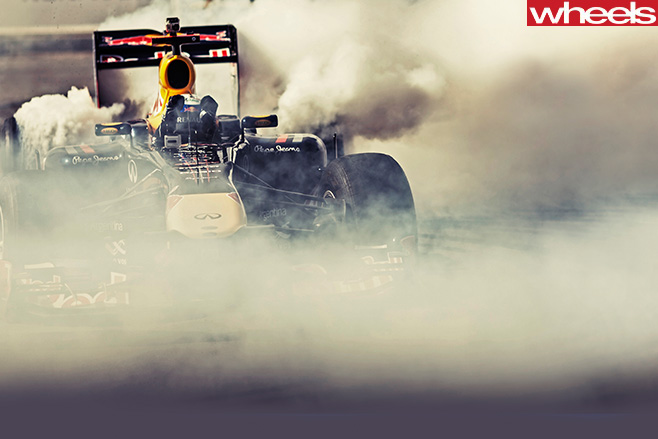
It’s a tall order. Since bursting on to the F1 scene in 2007, Vettel has never been beaten by a teammate over the course of a season. And since 2010, despite the best efforts of the best drivers in the world, no one has had his measure. It’s a glaring statistic.
Webber has been a pillar of sorts for Ricciardo since the youngster made his F1 debut in 2011. The elder statesman of F1, acutely aware of how tough it is for an Australian to break into the sport, let alone in a competitive environment, has offered advice, not on how to drive the car – Ricciardo is more than capable – but on how to deal with the F1 limelight. He’s also schooled the young gun in the inner workings of the Red Bull Racing team.
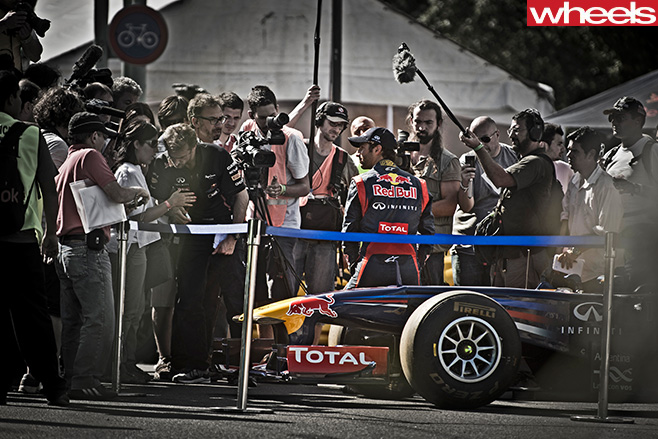
But he remains cautious about taking on too much from Webber, whose fractious relationship with teammate Vettel has been headline fodder since, well, ever since the German reached F1.
“In terms of me personally,” says Ricciardo, “I want to discover it for myself. Mark has been really good to me since I’ve been in F1, but I don’t want to rely on him to really help me get to the next step – in a respectful way of, course – I am just trying to discover it and do it to an extent by myself.” The Ricciardo/Vettel dynamic will be an interesting narrative to 2014. Vettel’s dominance over Webber on the track has spilled over into the garage, where the German holds an undeniable status within the team.
Vettel has already fired the first warning shot, shrouded in humour. He will do everything in his power to ensure the status quo is maintained. “I’ll have another Australian trying to make my life difficult,” he quipped to the media on the weekend of Ricciardo’s confirmation as his teammate. “I don’t want to marry him, so I don’t have to be best friends with him, but I think we’ll get on with each other.”
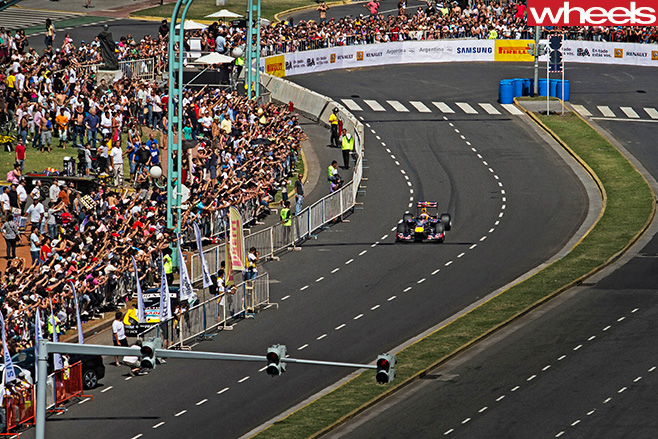
There remains one telling difference between Ricciardo and Webber at Red Bull. Webber was already an established star when he joined the team in 2007. He was not, is not, a product of the Red Bull junior driver development program. Vettel is, and as a result has enjoyed, to say the least, the patronage of the team’s gruff motorsport adviser, Dr Helmut Marko. Webber was afforded no such favouritism.
Ricciardo, on the other hand, is also a product of the Red Bull Junior team, hand-picked at the end of 2007 by Marko. It’s Marko who has guided the younger Aussie’s career, just as he has Vettel’s. It’s Marko who placed Ricciardo at the Hispania Racing Team for his F1 debut mid-way through 2011, and subsequently Toro Rosso in 2012. It’s Marko who had a large say in Webber’s replacement at Red Bull Racing.
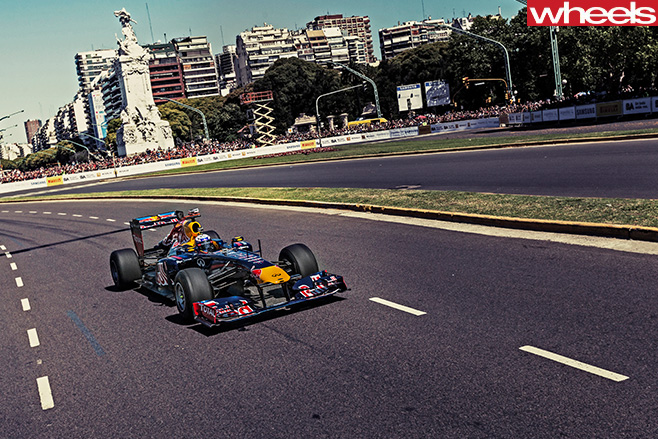
And Marko, for his part, makes no secret of his plans for Ricciardo. “He has to put pressure on Sebastian by mid-season in 2014 at the latest; he has to be a real team player…”
That’s a veiled jibe at Webber who, while outwardly presenting a united front for Red Bull has, at times spoken out against a hierarchy that, on the surface, favoured his German teammate.
It’s a suggestion denied by Red Bull team boss Christian Horner, who offered a succinct, “Both drivers, as has always been the case, will get identical opportunity and equipment. Inevitably there’ll be a natural pecking order and that will be determined by the driver that’s in front on the track.”
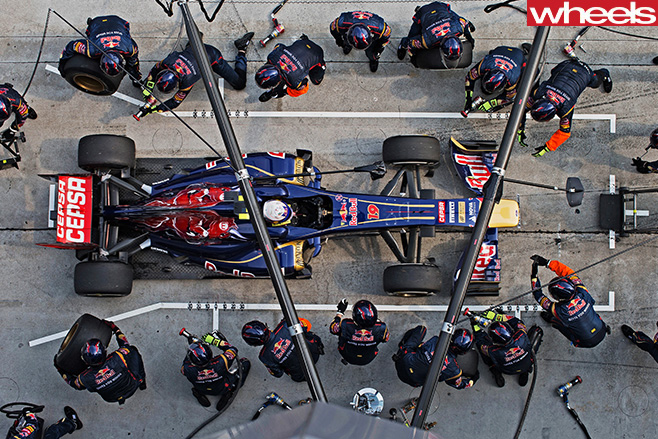
Ricciardo’s reputation has been built on outright pace. Much like Webber before him, who regularly qualified his slow and unwieldy Jaguar in a place it had no right to be, Ricciardo has time and again qualified his Toro Rosso – sister car to Red Bull in name, but not performance –inside the top-10, well beyond the efforts of his teammate, Jean-Eric Vergne.
Any doubts that Ricciardo was fast enough for Red Bull were quickly erased when the young Aussie got behind the wheel of this year’s dominant Red Bull RB9 at F1’s mid-season test in July at Silverstone. Under enormous pressure, knowing his day in the car was an audition for his future, Ricciardo was immediately on the pace. But what impressed Red Bull’s engineers more was his consistency over long runs. While team data was not made public, Ricciardo was, according to insider gossip, as quick as Vettel on similar fuel loads and on similarly worn tyres when the German took over testing duties the following day.
That, right there, was the clincher. Put down your glasses. Dan’s the man for Red Bull.
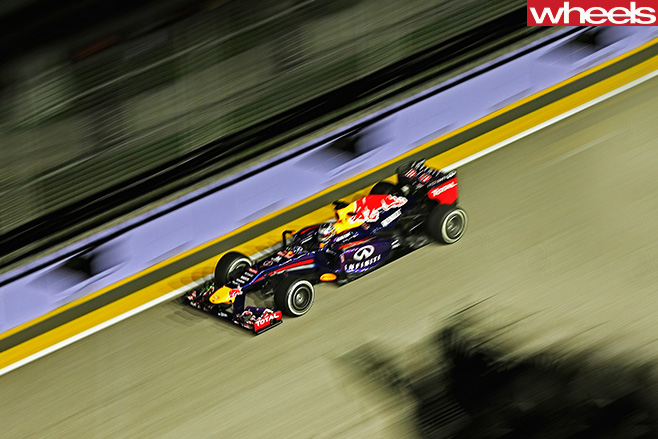
Mark Webber isn’t just walking away from F1 – after nine grands prix wins and one agonisingly close tilt at the world championship – he’s giving up the most feted seat in the sport, the golden ticket, a Red Bull drive.
Why? Was he, at 36, just getting too old? Or had the smiling assassin, Sebastien Vettel, finally worn him down?
“The decision’s been creeping up on me for a while,” he says. “I’ve been asking myself for the last few years whether or not to continue and in December I decided to stop at the end of 2013.
“You never get bored of driving the car. An F1 car on a qualifying lap is something special. It’s all the peripheral stuff that saps your energy and your motivation – the travel, the media commitments and the politics. It all adds up and it eventually outweighs the enjoyment you get from driving the car. That’s where I am.”
But did he also feel like he was losing his edge? “The first thing to go as you get older is that last tenth of a second in qualifying,” he says. As we went to press, Webber was yet to out-qualify Vettel this year. Soon that will be Ricciardo’s problem.
“It’s been an amazing 12 years in F1. It’s now time to let someone else have a go.”
BMW is planning to reposition its high-end coupes by bringing back the 8 Series and evolving the 6 Series into a leaner, meaner, Porsche 911 fighter.
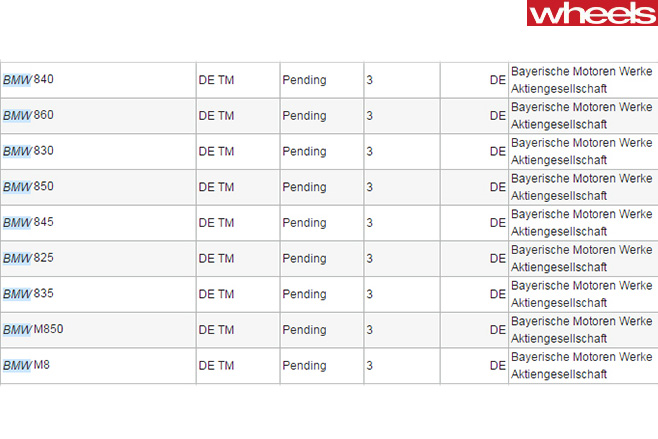
Pending trademark applications with the global intellectual property registrar have exposed a range of nine possible 8 Series model designations, including a flagship BMW M8 variant.
The full list of applications includes; 825, 830, 835, 840, 845, 850, 860, M850 and M8 – suggesting a range of six-, eight- and twelve-cylinder engines could be used.
A company insider confirmed to Auto Express in the UK that the applications represent an imminent plan to restructure BMW’s product family, and that the trademarks were not being parked for a rainy day.
The return of the 8 Series as BMW’s flagship model frees up the 6 Series to enter the fight between the Porsche 911 and Mercedes-AMG GT.
BMW and Toyota have been jointly developing a sports car platform to underpin the resurrected Toyota Supra and an as-yet-unconfirmed BMW model. Sources at both companies have confirmed the scalability of the collaborative platform. A versatile platform that allows for different-sized vehicles to be built upon it could provide a basis for the next-generation 6 Series.
The new 8 series would adopt the position of flagship two-door in BMW’s line-up, competing against luxury alternatives like the Mercedes-Benz S-Class Coupe. It will once again share duties with the BMW 7 Series in showcasing the company’s cutting-edge technology.
BMW phased out the 8 Series in the late-90s. It was last sold in Australia in 1999. If BMW does introduce an M8 model it will be the realisation of an idea first mooted more than two decades ago. BMW M8 prototypes featured the V12 engine eventually put to use in the McLaren F1. The F1 still holds the record for the fastest naturally-aspirated production car.
For some the Ferrari 458 isn’t Speciale enough – or at least for one British buyer who politely asked the Italians to design a one-off styling special.
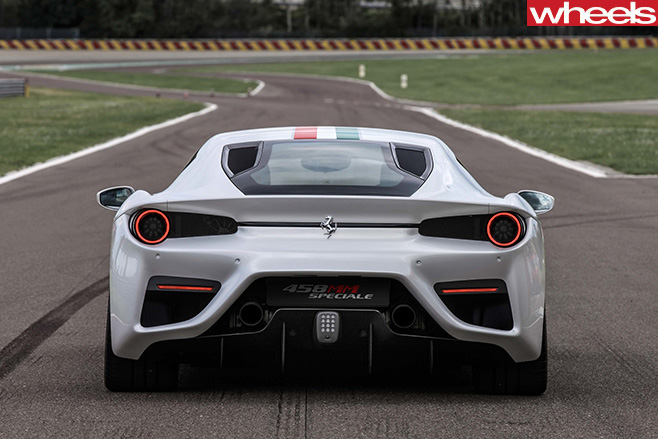
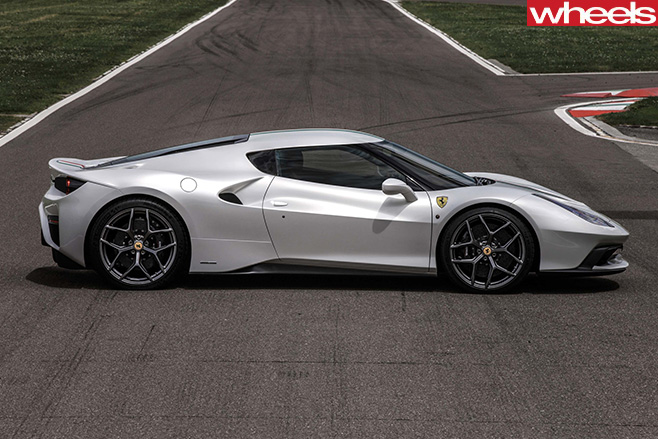
Called the 458 MM Speciale – we assume a nod to the undisclosed buyer’s initials – this version of the naturally aspirated V8-engined supercar has completely different panels to the production car, yet is no aftermarket accessory pack.
Instead the MM was designed in-house by Ferrari Styling Centre as the brand’s “latest one-off creation” as directed by a single buyer. Unsurprisingly there’s no dollar figure attached to this more-than-Speciale supercar.
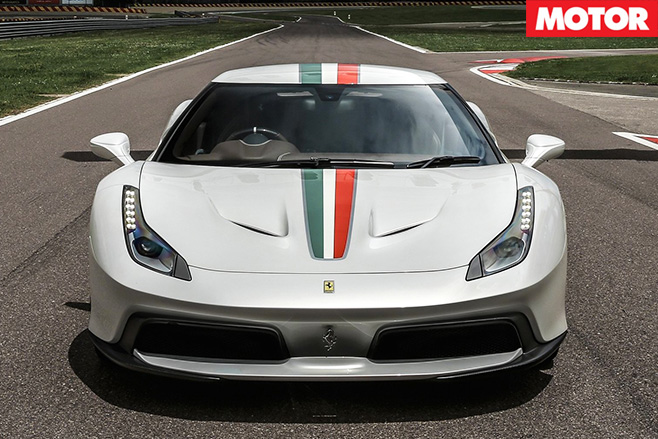
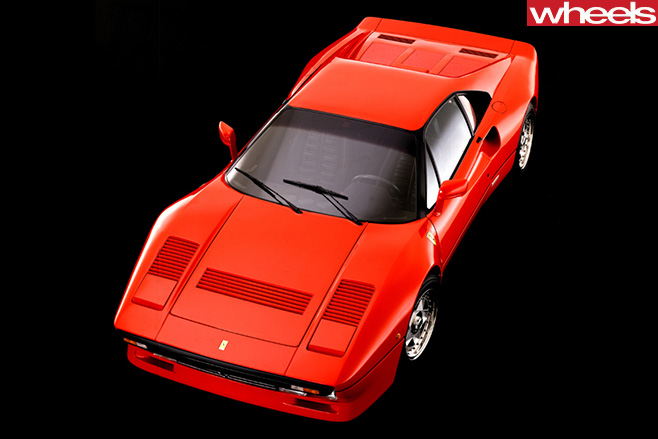
The buyer apparently demanded “extremely sporty lines” and specified “a ‘visor’ effect for the glasshouse … a black-painted A-pillar, very much in the style of the 1984 Ferrari GTO.”
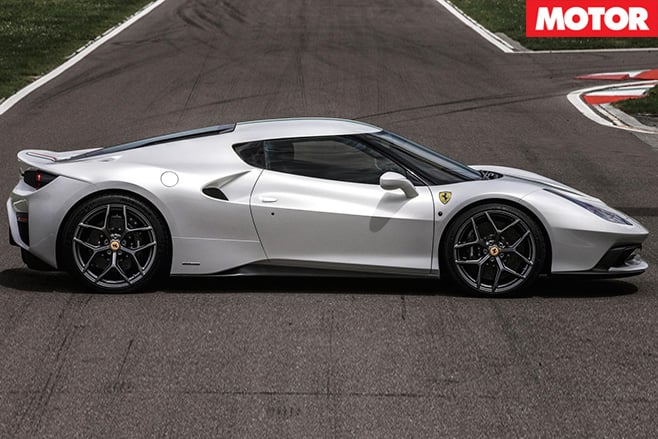
Those edgy lines continue at the rear, which has a more sharply defined lip spoiler than the 458 Speciale and a more angular rear bar treatment.
AFTER months of rumour and innuendo, V8 Supercars has confirmed this year’s KL City 400 Supercar Extravaganza will be a fizzer.
The blame for cancelling what has carried a very showy name in light of what is not happening on the streets of the Malaysian capital has been aimed squarely at an unresolved legal dispute as promoters for the event fight over the rights to its potential multimillion-dollar spoils.
V8 Supercars CEO James Warburton said in a statement: “We have been formally advised by the Malaysian promoter that due to ongoing legal action in Malaysia, to which we’re not a party, there is insufficient time to prepare the street circuit in Kuala Lumpur for the event on August 12-14.
“The event has therefore been cancelled.”
Boning this year’s KL championship race reduces the title series to 14 events, with no chance of a make-good round emerging. There is now a sizeable gap between the rounds at Queensland Raceway and Sydney Motorsport Park.
A cloud has been hanging over the KL race for some time but Supercars and the promoter were hoping the issues would be resolved in time. The original promoter, GT Global, and new promoter City Motorsports have been embroiled in a legal stoush, with the KL City Hall firmly declaring it would not support the event as long as the race was clouded by an ongoing court action.
Apologising to race fans, some of whom have booked holidays to Malaysia based around the V8 Supercars race, Warburton conceded it was inconvenient for these people but emphasised it was “a matter outside of our control”.
“We explored a number of other options with the Malaysian promoter to ensure this year’s race went ahead including moving the event to the Sepang International Circuit,” said Warburton. But all attempts were stymied.
V8 Supercars is certainly not enjoying much luck with its renewed efforts to establish a select few additional races outside Australasia.
The series’ first Asian foray came in 2005 to Shanghai. But after losing money, the Chinese promoter chose not to repeat the exercise. Since then, V8 Supercars has visited Bahrain (2006-8, 2010) and Abu Dhabi (2010-12). Again, the crowds were modest, even if the then chairman of V8 Supercars was less so…
Three years ago, the series hooked up with the new Circuit of the Americas track near Austin, Texas, but the promoter opted out of any further visits.
At different times over the years, the category has sought rounds in several Asian countries including the Philippines, India, Thailand and Indonesia. Political and economic stability, and in some cases a poor automotive culture, makes the task always difficult.
Warburton remains his optimistic self on the matter of Asian races. “We are absolutely committed to continuing to expand the series into Asia and are currently considering a number of other options to race in the region beyond 2016,” he said.
Warburton hasn’t given up on Malaysia either. “We have a four-year agreement to race in Malaysia until the end of 2019 and we look forward to returning to Kuala Lumpur when all the local legal issues have been resolved.
“We believe this event on the streets of KL will be one not to be missed.” But not this year…
