
Have you ever had that feeling after going to a Grand Prix – or even after watching a particularly engaging race on TV – that you desperately need your very own slice of the achingly exclusive and equally expensive international circus that is Formula 1?
For us, that desire is usually sated by buying a branded cap, coffee mug or scale model racing car. Yet, for some F1 fans – and, among them, we’d wager McLaren lovers are disproportionately represented – overspending on official merch doesn’t go near scratching that itch.
Enter the P1 GTR, from one of two brands that can give you a road car with even a hint of Formula 1 DNA – that’s McLaren (rather than Ferrari). The 35-only, limited-edition GTR was previewed at the 2014 Pebble Beach Concours d’Elegance before its official reveal at Geneva last year, and production began with the completion of the 375th and final P1.
Just like the P1, a carbonfibre MonoCage chassis houses the engine in the rear-mid position – it’s the same 3.8-litre M838T twin-turbo 90-degree V8, with a battery-powered twin-motor powertrain in a higher state of tune.
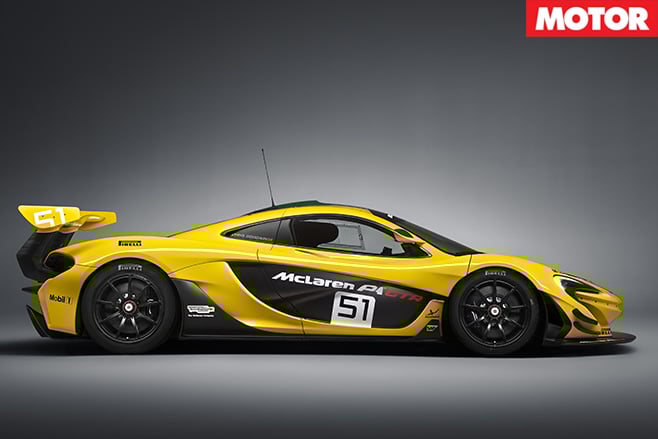
Further upgrades to the P1 include an F1-inspired carbonfibre steering wheel, lightweight polycarbonate side windows, a light Inconel and titanium exhaust, and 19-inch Pirelli slicks. An ERS-style push-to-pass system and a DRS rear wing complete the F1-esque package.
The GTR is 50kg lighter than the P1 and produces 735kW, though it’s not clear whether the extra kilowatts come from the engine or the electric motors. There’s also no official 0-100km/h figure. Why not? Well, that brings us to the GTR’s raison d’etre.
The justification for all this extra performance is that the GTR isn’t a road car, but a track-focused machine reserved for owners of the regular P1! It’s designed as the centrepiece of a bespoke track-day program and to make punters feel like F1 stars (or, at least, like Pastor Maldonado). Here, only lap times matter. Lap times and money. Lots of money…
The P1 GTR costs 1.98million quid (AU$3.77million), but you can’t drive it on the road, so there’s not much point parking it in the driveway. And, given this is such a specialised machine, wouldn’t it be better off in the capable hands of the McLaren GTR workshop, anyway?
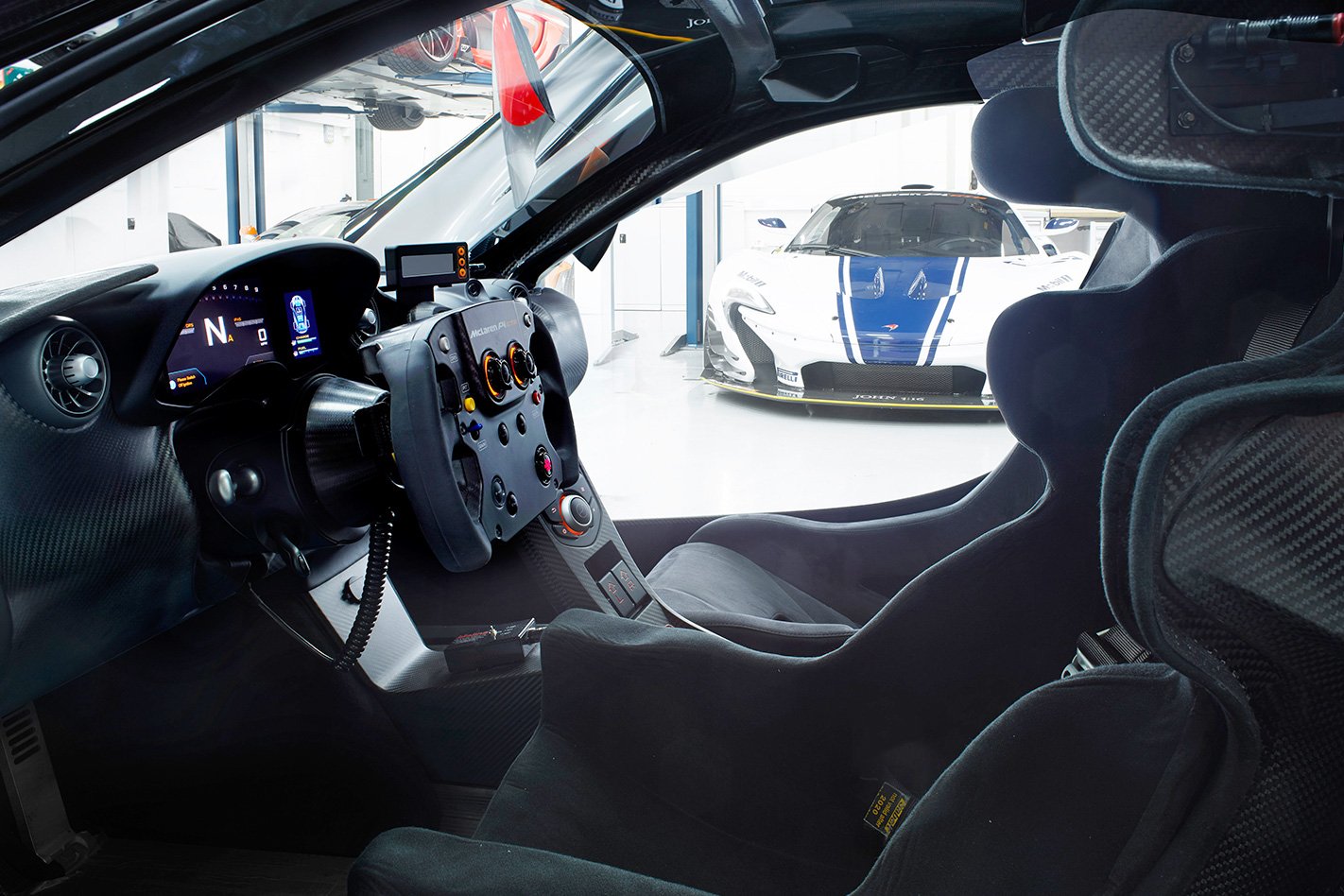
P1 nursery: Inside the vault
1. Holy ship The McLaren P1 GTR workshop is in Woking, England, near McLaren Special Operations and the McLaren GT team. P1 GTRs, which the brand rightly describes as ‘the fastest and most exciting McLaren this side of our Formula 1 cars’, are garaged at the facility and prepped for and transported to bespoke events as part of the McLaren driver program. McLaren ships 80 tonnes of support equipment to each event.
2. Circuit training The program’s inaugural event was held at the Circuit de Catalunya in Spain last October and future outings are planned at Spa-Francorchamps in Belgium, Yas Marina in Abu Dhabi, the Circuit of the Americas in the United States, and Silverstone in the UK (incidentally, the ‘base’ McLaren P1 already holds the road-car lap record at the latter two circuits).
3. Celebrity status In the meantime, the GTRs – and their moneyed owners – undergo development back at HQ. There, the talent is fitted for a custom carbonfibre seat, tailor-made race suit, helmet and oversized designer sunnies. There’s also access to VIPs – they can pen their car’s livery with maestro Frank Stephenson, or swap cleaning tips with Ron Dennis over a gin and tonic, for example.
4. Expert help Hand-picked McLaren engineers and technicians are available at the P1 GTR workshop to discuss set-up and tuning, and drivers can work with personal fitness trainers and driver coaches. Simulator training sessions at the nearby McLaren Technology Centre seal a regime that’s redolent of Formula 1 on every level.
5. Home bodies Owners can park their GTRs in their garage if they so choose. Some buyers chose to skip the mega track days and just buy their 1:1 scale driveway ornaments for a bargain AU$3.24million. But, hey, why miss out on all the fun, especially when it only costs an extra half million or so.
Pinching F1 tech
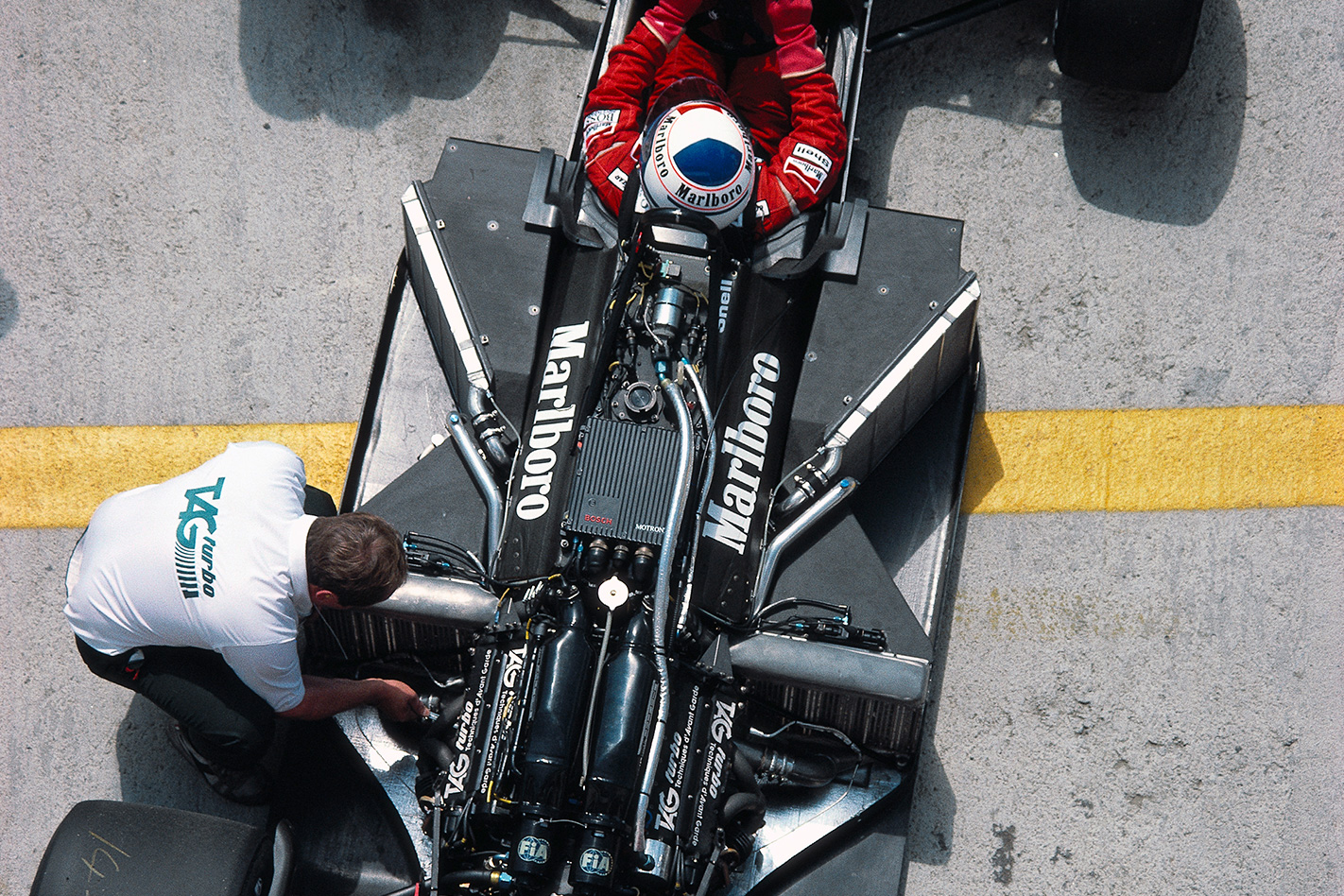
GTR is grand prix inspired You could be forgiven for being a bit cynical about F1-inspired technology in an era when every hot hatch and hi-po sedan makes the claim. Doubly so because we’re talking about the same era in which Formula 1 cars boast passenger-car-inspired technology, such as the petrol/electric hybrid system. However, the McLaren P1 GTR has actual Formula 1 tech at its core. The first racing car to be built around a carbonfibre tub was the 1981 McLaren MP4/1, while the McLaren F1 GTR was the first road car to be built around a carbonfibre tub. Today, the technology is central to the P1 GTR and every McLaren road car.
Ambitious performance claims for Japan’s fastest supercar are no longer, with Nissan shelving the often fanciful 0-100km/h times for its GT-R.
At the launch of the 2017 Nissan GT-R, due in Australia in September 2016, senior members of the development team for what’s claimed to be the biggest change to the R35 model since it went on sale in 2007, claimed the 0-100km/h time is no longer important.
“We haven’t measured the 0-100 or overall top speed,” said MY17 R35 program director, Bob Laishley. “We just don’t think we need to worry too much [about 0-100km/h claims]. We haven’t done anything to improve on that situation or make it worse.”
Despite an extra 15kW and 9Nm Nissan claims off-the-line acceleration hasn’t changed for the MY17 GT-R.
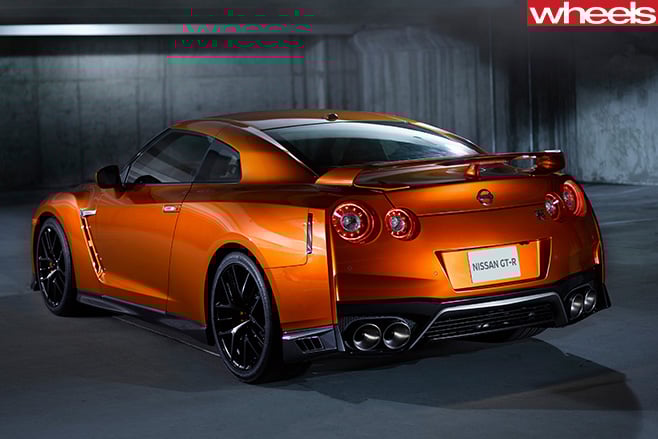
The original R35 GT-R had a 0-100km/h claim of 3.2 seconds but changes to launch control software and tweaks to the transmission resulted in a more aggressive launch and Nissan lowered the 0-100km/h time firstly to 2.8 seconds and, later, to 2.7 seconds.
When Wheels tested the most recent iteration of the GT-R late in 2013, we clocked a 0-100km/h time of 3.2 seconds – a full 19 percent worse than Nissan’s claimed time.
The GT-R is no stranger to controversy. Years ago claims of record-breaking Nurburgring lap times were disputed by Porsche, the maker of the 911 Turbo that is often put up as the benchmark by which the GT-R is measured.
AUDI will soon have a version of its big, family friendly Q7 SUV on sale in Australia that will feature a special 48-volt electric system. It will be the first of a number of cars that will start to roll out with higher voltages.
The problem is that unlike tyres, brakes, engines and suspension systems that have changed dramatically as the years rolled by, the 12-volt electrical system used in cars today has been around for a long time. In the meantime, vehicles built today put even more demand on a car’s electrical system, and sticking with 12 volts is like trying to fill a swimming pool with a garden hose – what if we used a fire hose instead?
What car makers want to do is include even more electronic driver aids, such as electric turbochargers that reduce turbo lag – that ever-so-slight moment of hesitation at the traffic lights that hits a turbocharged engine when the slow-speed spin of the turbo can’t force enough air into the engine to give it more pep. It’s a problem for small petrol engines, and diesels.
Audi’s solution for this particular problem is to spin up one of the SQ7’s three turbochargers on its diesel V8 engine using electricity. However, because the system needs a fair serve of electricity to work effectively, Audi decided that using 48 volts was a better way to do it.
Dig around the new SQ7’s electrical system, though, and it still uses a conventional 12-volt battery. That’s because other parts of the car, such as the lights, radio, electric windows and windscreen wipers, still rely on the old 12-volt system.
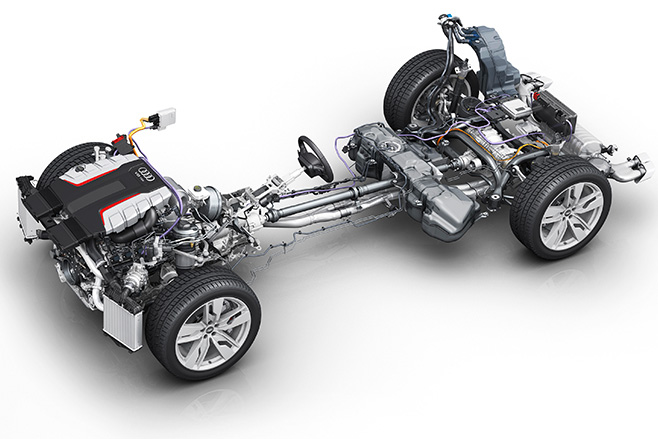
The Q7’s 48-volt battery, closely related to the one used in your smartphone and those used in many hybrid-engined and electric vehicles and about the same size as a conventional car battery, is hidden away under the boot floor.
The higher voltage system has other applications, too. Car makers are starting to roll out more stop-start engines that are able to turn off the engine while you’re stopped at the traffic lights, in a traffic jam, or waiting at an intersection, and re-start it as soon as you lift a foot off the brake pedal to start moving again.
These systems place a huge demand on a 12-volt battery – just watch a video of someone hand-cranking an old car’s engine to see how much effort it involves – and it therefore makes sense to replace them with more powerful, less stressed 48-volt ones.
Audi is also using its 48-volt system to tweak the Q7’s suspension system as the SUV drives along the road. It uses electronically controlled sway bars to stiffen up the car’s ride in the blink of an eye if you’re having a bit of fun behind the wheel, and soften it up just as quickly when you’re lolling around town. One day the suspension system will also top up batteries by converting the road’s lumps and bumps into electricity.
Audi has also flagged the 48-volt system will soon roll out to other parts of the car’s electronics, including pumps and air-conditioning, stereo systems and heating.
The Audi Q7 is an expensive luxury car, but cheaper brands are also looking at 48-volt systems as a step forward.
Europe-based vehicle electronics maker Delphi – once a part of global car making giant General Motors – has built a hybrid system that it has already trialled in a Honda Civic hatchback.
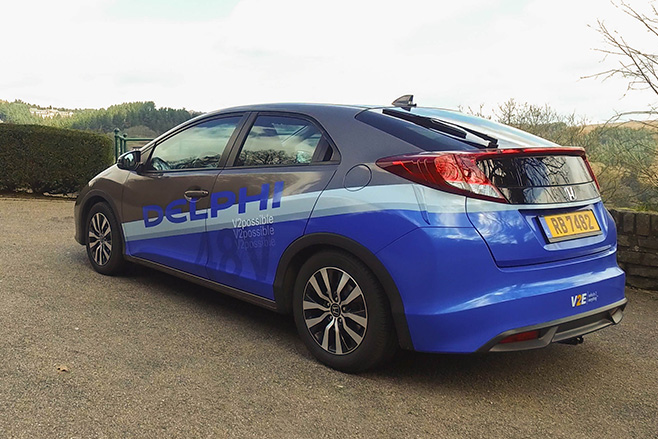
Delphi’s system replaces the car’s 12-volt generator with a 48-volt version that can jump in to give the engine a boost while accelerating. The system is also designed to use the electric generator to scavenge electricity while braking, and use it to top up the 48-volt battery.
It says the technology can save up to 15 percent of a car owner’s fuel bill.
Delphi has revealed it has two as-yet unnamed manufacturers signed up to roll out its own take on the 48-volt system late next year, one of which is believed to be one of the world’s biggest car makers, Volkswagen. Swedish brand Volvo has also toyed with a similar system for its upcoming models, many of which are due this year and the next.
There’s other 48-volt works in progress, too, such as an electrically driven rear axle that helps a petrol- or diesel-engined front-wheel-drive car, while Land Rover has trialled a hybrid system that sandwiches between the engine and gearbox. Both ideas are yet to make it into a production car, so watch this space.
So about buying that bigger battery? Hopefully the answer is no. You’ll still need to regularly check the health of the standard 12-volt one, and make sure it never goes flat, but you should never have to look at the beefier 48-volt one as the car’s electronic brain will be programmed to take good care of it.
And unlike a conventional 12-volt car battery that should last about five years if looked after, the lithium ion batteries should last about a decade before needing a replacement.
BMW’s 3 Series Gran Turismo is getting a makeover, with new versions sporting fresh styling and more powerful and efficient engines.
Since the 3 Series GT was introduced three years ago, BMW claims 130,000 have been worldwide, with only 317 sold in Australia last year.
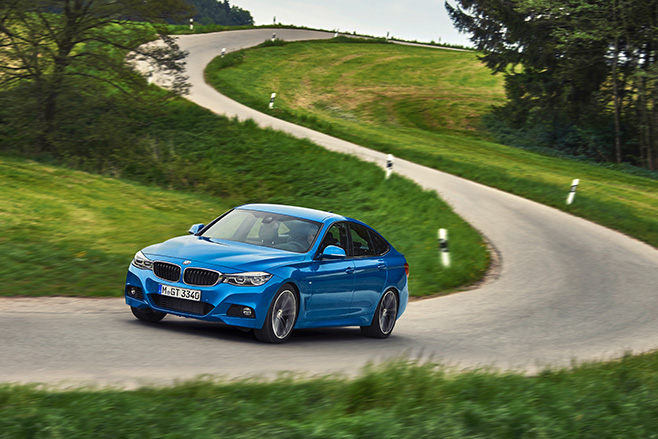
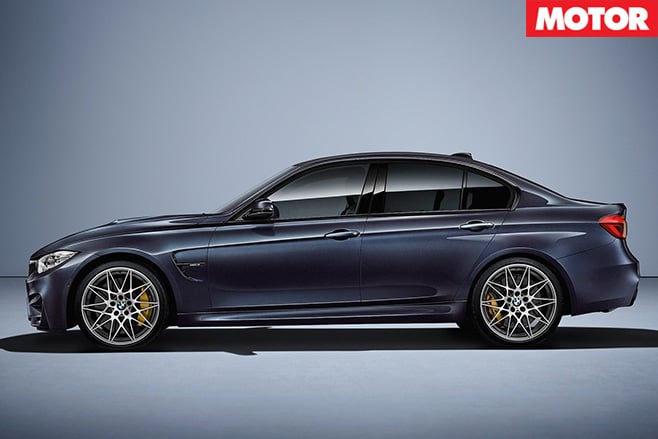
The ungainly and slow-selling 3 Series GT will get a mild styling update and the 2017 model will wear new LED headlights, fog lights and taillights to give it a more sporting appearance, two new exterior colours and three new wheel designs. Chrome and gloss interiors will add to its elegance.
In the cabin, the GT will feature BMW’s ‘Professional’ navigation system with a more user-friendly interface. Bluetooth will come as standard and buyers can option an inductive tray for wirelessly charging smartphones, and a WiFi hotspot.
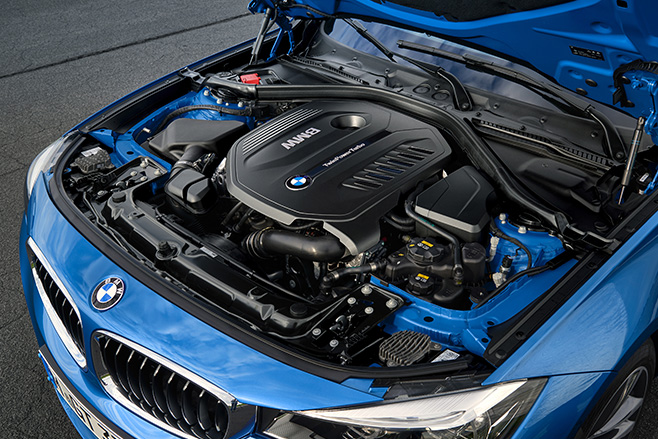
According to BMW, the 3 Series Gran Turismo will offer a total of 18 engine, transmission and drivetrain configurations across the Sport Line, Luxury Line and M Sport variants.
The four-cylinder engine in the 320i and 330i will produce 135kW and 185kW, respectively, while the top spec 340i will get BMW’s new all-aluminium six-cylinder petrol engine, producing 240kW. A new twin-turbo, four-cylinder, turbo-diesel (165kW) will be available in the 325d.
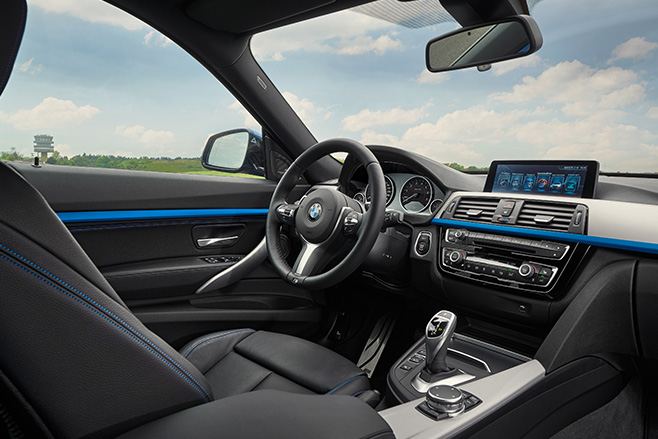
Thanks to the 3 Series GT refinements and technologies, such as Auto Stop-Start and Eco Pro mode, BMW claims fuel economy for the three petrol and five diesel engines has improved 14 percent. Actual fuel figures will be released closer to the official launch date, which is yet to be confirmed. BMW has also not confirmed prices.
BMW will produce a 500-unit M3 30 Jahre anniversary special and Australia has its hand up for a slice of the cake.
German for ‘30 years’, the 30 Jahre celebrates three decades since the compact M-car range started with the 1986 E30 generation, followed by the 1992 E36, 2000 E46, 2007 E92 and the current 2014 F80.
As with the M3 Competition Pack arriving soon, it gets more power than the standard M-car, with the 3.0-litre twin-turbo six-cylinder’s 331kW output up 14kW (although 550Nm is unchanged) and the 0-100km/h claim falling by a tenth to 4.0 seconds flat.
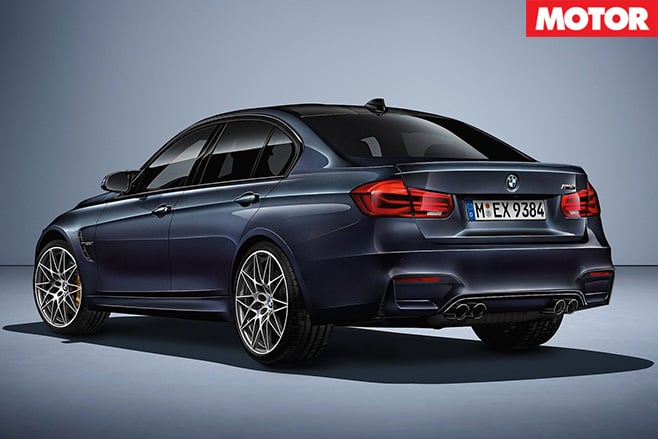
The new springs and dampers and ESC tune of the M3 Competition Pack also carry over, as do the multi-spoke 20-inch alloy wheels with 265mmm front/285mm rear rubber.
All units will be produced in either the E30 colour Macao Blue or Frozen Silver metallics. Each scores BMW Individual Show Line gloss black accents on the grille and exhaust, and a carbonfibre front splitter, mirror caps, rear diffuser and rear spoiler, with M stripes adorning the carbonfibre roof.
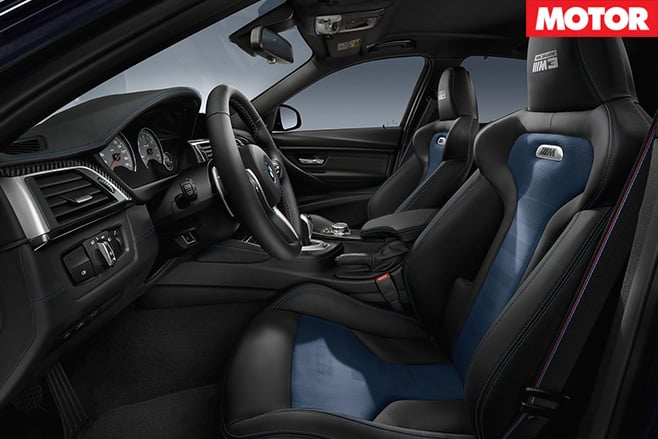
Rounding out the interior changes are “skeletal” sports buckets from the Competition Pack but exclusively cloaked in Merino leather in black/blue or black/Silverstone with colour-matching contrast seams.
In Germany the M3 30 Jahre costs a hefty €10K more than the M3 Competition Pack. The UK has secured 30 units and MOTOR understands BMW Australia is keen to go toe-to-toe with that primary right-hand drive market and match that allocation.
Youichi Hara is gesturing at a silver metal rabbit. With his best broken English he’s trying to explain why Thumper’s leaping off a Datsun’s bonnet, like a classic Jaguar ornament.
But he’s wasting his breath. As his gravelly voice murmurs on, nobody’s really listening. Only a few from a tribe of Australians pay him the courtesy; the rest have scattered.
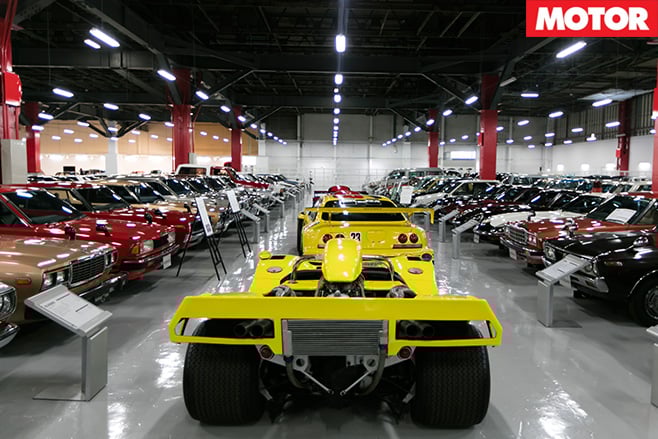
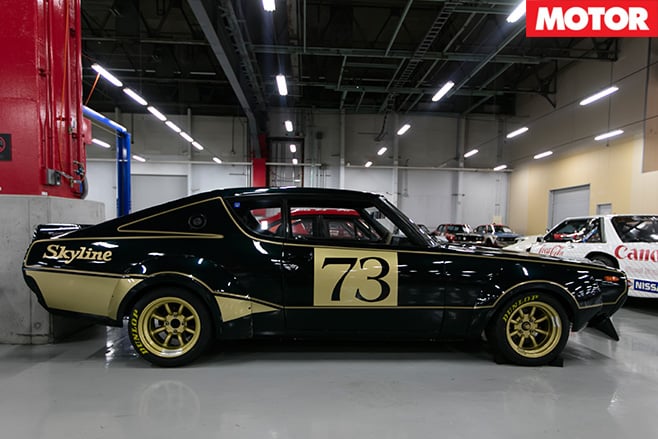
Behind him, under the fluorescent lighting haze of a warehouse that once thrived as an assembly plant, Nissan has amassed the world’s most impressive army of its own heroes. It’s known as the Zama Heritage Collection.
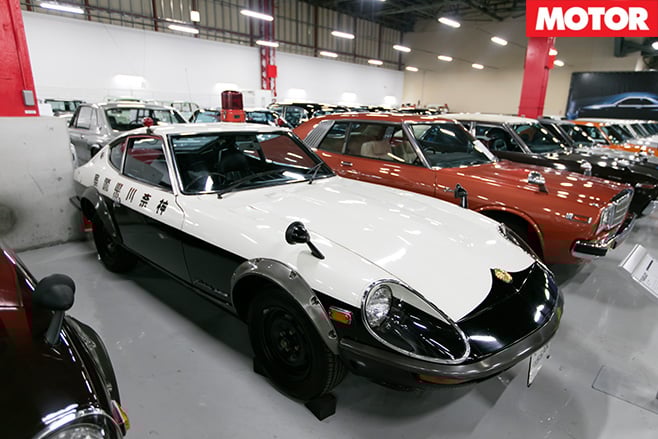
Now when we call the warehouse ‘secret’, we’re not talking about crawling through an underground tunnel for access. It’s open to public tours, provided you book online. But because the collection is nestled within Nissan’s Zama factory site, which bustles as a technical centre and produces lithium-ion battery cells, everywhere outside is off limits.
Ironically, though, nothing about the warehouse grabs you like the priceless machinery inside it. Outside it’s completely nondescript. If it was street-side you’d walk right by it, oblivious to the 300 rare road and race Nissans that huddle within its walls.
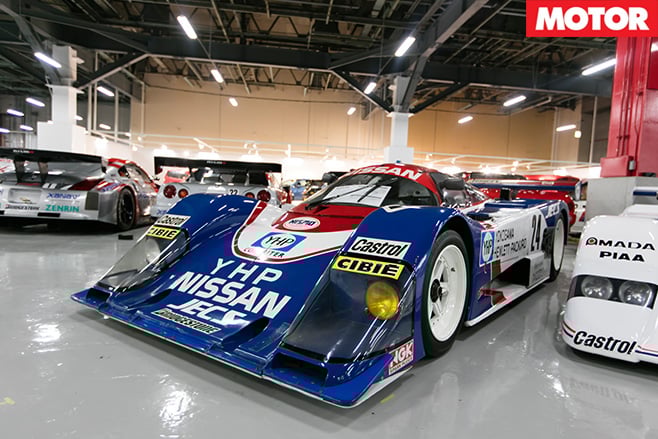
For instance, Nissan’s MID4 Type II, of which three working prototypes were built, rub shoulders with a bizarre hatch-based stadium car and small, lime-coloured Hypermini – an electric two-door hatch that looks a lot like Mercedes-Benz’s Smart car.
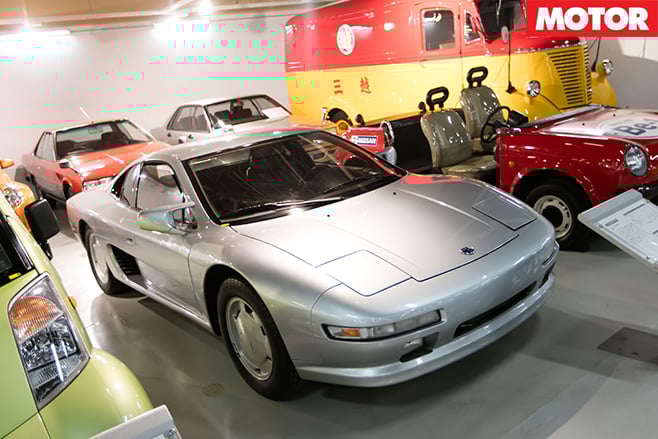
So in a way, it’s the genetic godfather of Nissan’s modern sports cars, preserved here as a reminder of what could have been.
But the real attractions are the racing weapons and the road cars they inspired. As we follow Hara-san down an aisle of classic Datsuns, I quietly peel off to avoid missing out on the prolific legends.
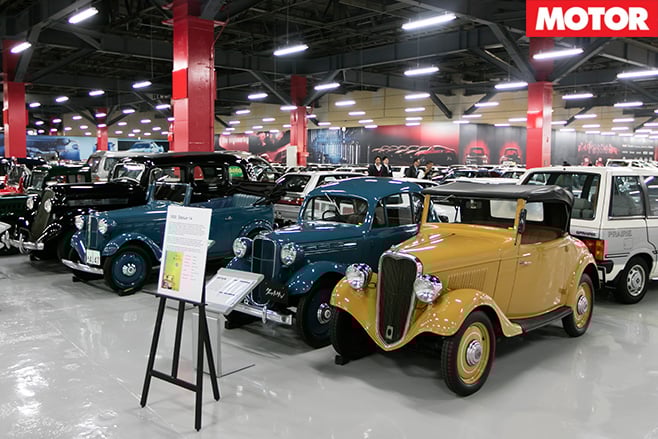
Its soft edges and deep blue paint mean it’s not particularly striking in the metal. But it exudes an aura, a pull, which partly stems from the fact that if Nissan had ended up selling the car, it’s mooted it would have cost AU$1.3m back in 1998.
With one eye locked on my watch I pinball between cars and try to drink in as many priceless beasts as possible. But at this point, our Nissan minders are filtering through the warehouse collection, rounding up the loose Australians with Pacman-like focus. They direct us towards the exit, hours too soon.
But the main thing I’ll remember, if I ever return, is to book a longer visit.
Nismo’s singing tribute
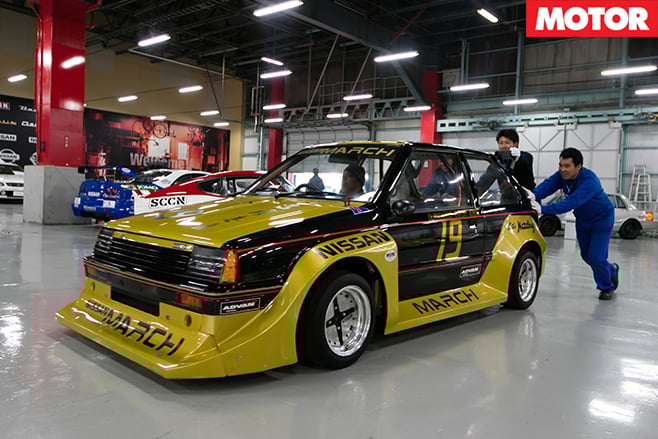
Scattered around the Zama warehouse was everything from a baseball stadium car to a sedan specifically modified to hold the ’64 Olympic torch.
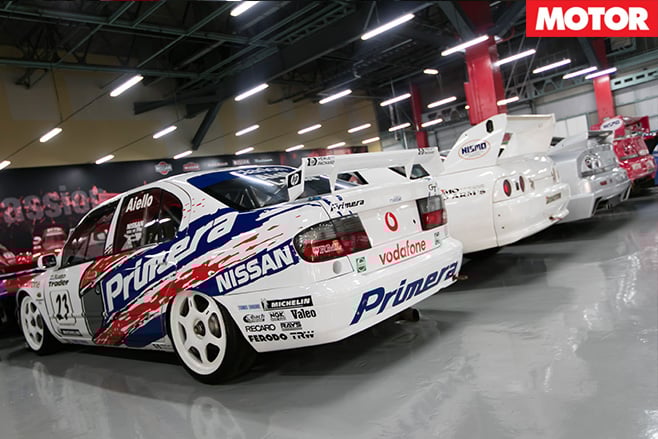
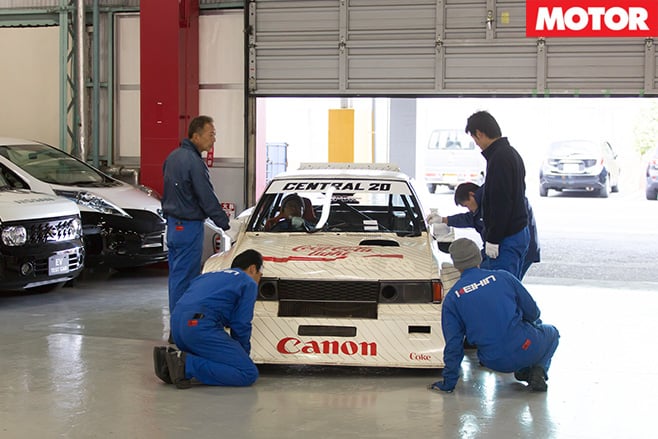
However, what caught my eye was this Nissan March (right). If you think it looks like the Super Silhouette racers that defined Japanese Group 5 racing in the ’70s, you’re right. Nismo built the car for Masahiko Kondo, or ‘Matchy’, a pop-rock celebrity. Matchy was the car’s ambassador, but also quite the racer, and today runs the Super GT outfit Kondo Racing.
While the road car’s 1.0-litre four made do with 42kW, Nismo thrust a larger 1.5-litre four into its nose, effectively tripling its output.
It then slapped Group 5-style fenders on either side of it to add 150mm of track width. Today Matchy’s March joins the real Silhouette cars in display areas, like a mascot.
Real road racers
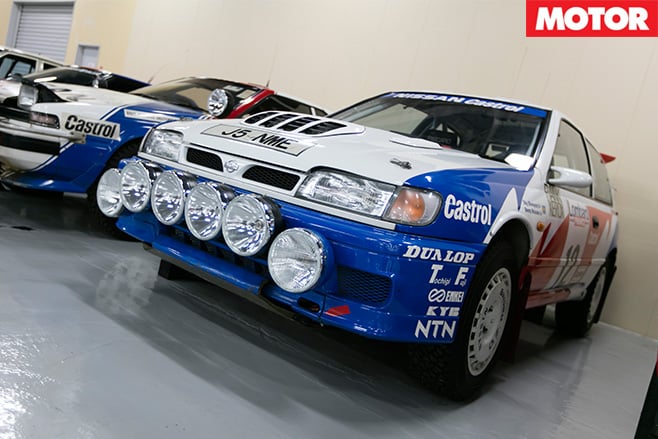
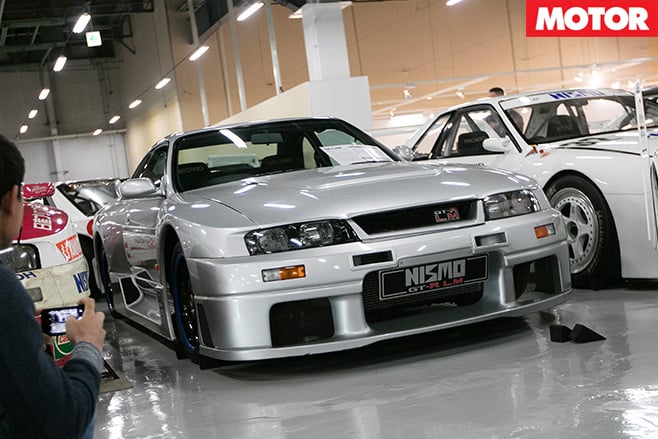
As far as Skylines go, the R33 GT-R LM is rarer than Tassie tiger teeth. When Group C regulations were shelved at the end of 1994, Nissan scrambled for something to race at Le Mans. In its pantry was the R33 GT-R, successor to the all-winning R32 GT-R. It pumped its guards, dropped its front driveshafts and tickled its engine, but before it could race Nissan needed to homologate the mods on one road-registered car. That honour went to the Zama Collection’s example, which was registered in the UK.
It didn’t do too well racing in ’95 or ’96, so it was scrapped.
A year later, history repeated itself, but this time Nissan designed the racecar first, the sole road car needed for homologation, second.
The resulting R390 GT1 was a carbon-chassis, 410kW beauty that claimed third at Le Mans.
A five-year plan from Nissan’s performance division will yield go-fast SUVs and – possibly – a ute with one eye on the race track. And Australia is on the global expansion hit list for the brand which is planning a big family.
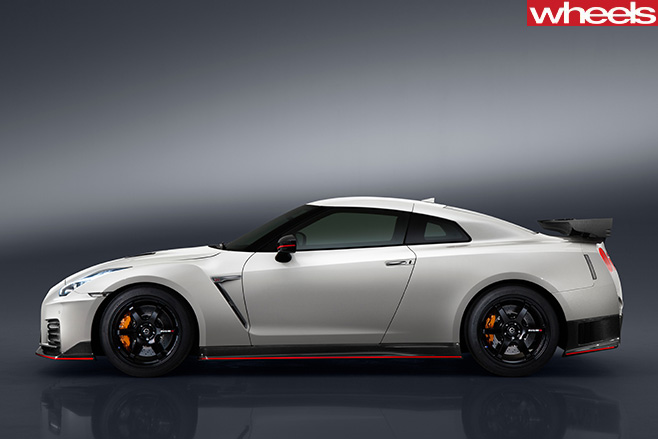
First out of the blocks for Australia is likely to be the Nismo version of the Nissan GT-R, possibly as early as 2017.
Speaking days after the reveal of the updated MY17 Nissan GT-R Nismo – with 441kW it’s the most powerful Nissan ever produced – the man responsible for Nismo road cars has raised hopes that Australia will soon have some spicier Nissans.
“We’re trying to reinforce Nismo … to build on the products that we have, introduce new models and grow and expand globally,” said program manager and Nissan performance car specialist, Bob Laishley.
“We’ve got to be careful not just to have Nismo for Nismo’s sake. We carefully select what we’re trying to do with Nismo, different markets have different requirements.”
“We’re looking at everything from crossovers to pickups,” he said. “It’s an area we certainly have to explore. We’ve just launched the [Nismo] Patrol in the Middle East to huge success; it’s been very, very well received.”
Laishley pointed to Europe as key to the expansion and development of Nismo.
“Europe can hopefully lead our development because if we can satisfy the European petrol heads then we’ll have a good product.”
He said a small Nismo, possibly based on the next generation Micra and/or Pulsar, was a high chance.
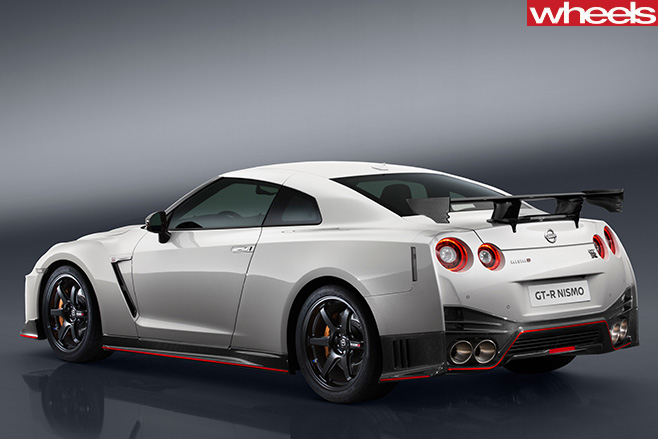
Laishley also added that the strength of the Nissan brand and increasing worldwide demand for performance models is making the case for broadening the Nismo appeal beyond the Japanese market.
“There’s a recognition that growing Nismo outside of Japan is a good idea and that’s what we’re trying to do,” said Laishley.
Importantly, he said Australia was in the mix for countries that would get Nismo product.
Laishley also left the door open to future Nismo cars sharing some components with high-performance Ralliart models from Mitsubishi, the company Nissan has announced it plans to take a controlling 34 percent stake in.
“These are all questions I’m asking internally as well. You can draw your own conclusions; I’m not going to comment,” he smiled.
Honda Australia expects its reborn NSX supercar to arrive Down Under in less than six months but still can’t – or won’t – say how much it will cost. What’s more, a global waiting list may leave buyers hanging.
Production is underway in the US where a bare-bones Honda NSX retails for about the same price as the 397kW Audi R8 V10, which is listed in Australia for $287,580. Tick a few boxes for the options Aussie buyers expect as standard in its competitors and the NSX price quickly creeps up.
Australian NSXs are likely to get a higher level of standard equipment than the US market, which points to a higher price for our right-hand drive models. In the UK, the right-hand drive NSX has a confirmed price of GBP130,000 – much closer to UK pricing for the 449kW Audi R8 V10 Plus which sells in Australia for $314,504.
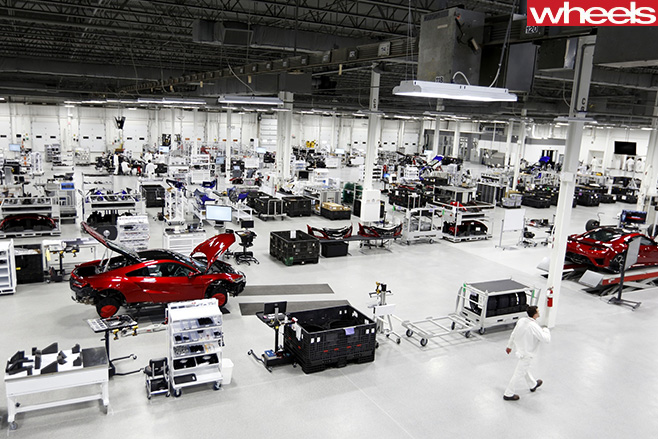
If that seems like a lot to pay for a Honda, consider its heavyweight engine output figures of 427kW and 550Nm. Those numbers stick the NSX in the same pen as the seriously premium company listed above.
Speaking to Wheels last week, Honda Australia managing director Stephen Collins said Aussie pricing will be locked in by July. He was reluctant to put even a ballpark figure on it in the meantime.
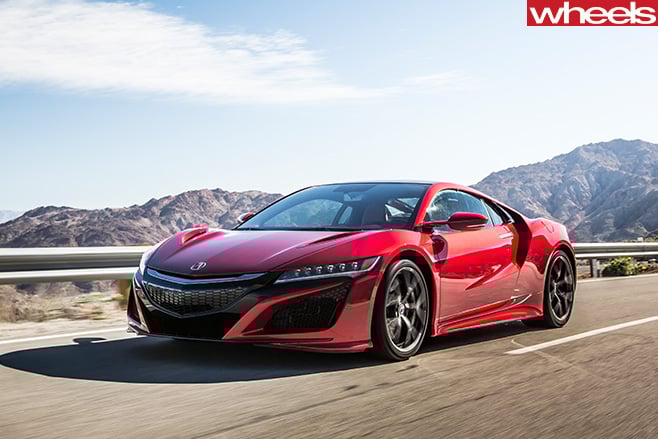
“We haven’t been given an allocation or number of build spots,” said Collins. “It will depend on global demand and it will depend on us as to how we can price the car and how many pre-orders we can take.”
Even if you can get your name in the order books, Collins cautioned that there’s no guarantee of receiving a car in the first batch.
“We expect a waiting list worldwide.”
Just five Honda dealerships in Australia have sales rights for the NSX; one each in Brisbane, Sydney, Melbourne, Adelaide and Perth.
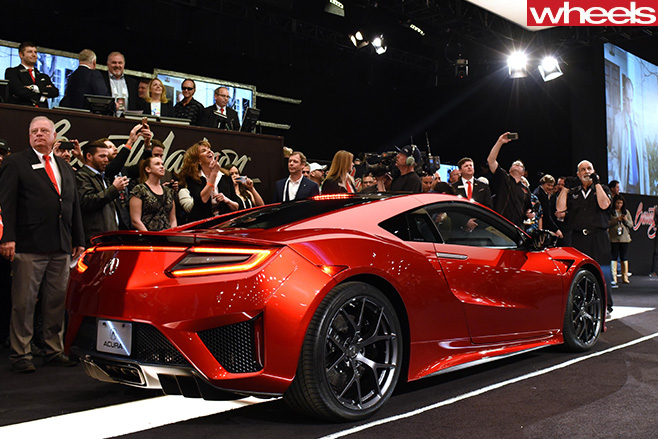
“NSX appeals to the sort of customers who want the latest and greatest in tech,” said Collins. “I think that’s what the original NSX customers were like too. The essence of the car is pretty similar to what it was back then.”
“We have a long history with this car. It’s about showcasing the brand’s technology and getting back to those sport routes.”
The 2017 Honda NSX uses a twin-turbo V6 engine and three electric motors to achieve its total output of 427kW and 550Nm. Power is fed through a nine-speed dual-clutch transmission and all-wheel drive.
Brains may be invaluable for all that cerebral stuff, but for a purely visceral hit, brawn rules, so take your pick from 25 of the best heavy-metal heroes of the last 50 years.
First published in the April 2012 issue of Wheels magazine, Australia’s most experienced and most trusted car magazine since 1953.
25. Ford Tickford AUIII TE50 5.6
Back in 2001 few Aussie muscle cars better cleared slow drivers from the fast lane than a ‘T3 stroker’. The hard-edged V8 howl and jutting Coulthard-esque jaw had dithering Camry and Corolla drivers driving for the scenery.
The T3 was the culmination of the short-lived Ford Tickford Experience (FTE) that had launched in 1999. The brand was supplanted by FPV three years later after a series of disappointing models, and the T3.

The heavy-duty five-speed manual was stirred slowly via an oversized and roughly-stitched gearknob. Executing a fast two-three shift was like throwing a punch… and one of the reasons the TE50 never recorded acceleration times to match the sound and fury of the engine. Wheels’ best was 0-100km/h in 6.0sec and 0-400m in 14sec flat, while sister mag Motor got 5.9 and 13.9 out of its long-termer after 15,000km.
24. Mercedes-Benz 300 SEL 6.3
The Pontic GTO started the muscle-car era, and the Ford Falcon XR GT gave Aussies their first taste of it. But the muscular 1968 300 SEL was essentially the first AMG product, and it ignited a German power war that today has culminated in the 412kW BMW M5, 410kW Porsche Panamera Turbo S and 410kW Mercedes-Benz E63 AMG.
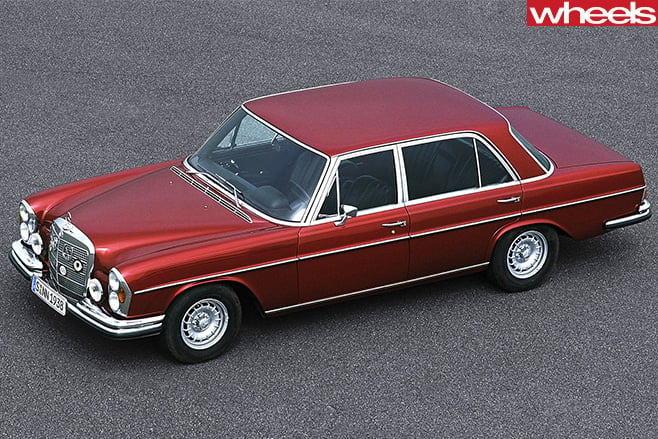
AMG built several 300 SEL-based race cars, most fitted with the 6.8-litre V8 that would power the 1975 450 SEL. The first such racer was the ‘Red Sow’ that bellowed and grunted its way to second outright at the 1970 Spa 24 hours.
23. HSV VTII GTS 300
Having first appeared on the 1968 HK Monaro, the GTS badge certainly wasn’t new to Holden fans when HSV first slapped it on a VP 20 years ago (itself a mild reworking of the VN SS Group A – see p 92). HSV then built a GTS in every series of Commodore from VP onwards, including 5.7-litre stroker in VR, VS and VT Series I.
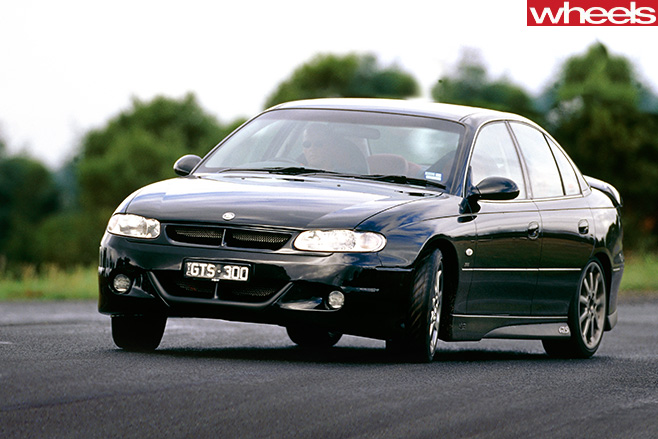
Like all GEN III V8s, the Callaway C4B isn’t one of the all-time great engines, but it set HSV on a path that would culminate in the 7.0-litre W427 (p101). And it gave Holden fans a decade of power bragging rights.
22. Ford Falcon XR GT
Launched first as an option pack in 1964, then as its own model in 1966, the Pontiac GTO (p100) is considered by most people the father of the muscle car. Though half a world away, it didn’t take us Aussies long to catch on to the trend. The 1967 XR GT is our godfather of grunt and its emphatic 1-2 victory at that year’s Gallaher 500 at Mount Panorama set the ‘Win-on-Sunday, sell-on-Monday’ mantra that was used by Ford and Holden (and briefly Chrysler Australia) through Improved Production, Group C and Group A touring car racing.
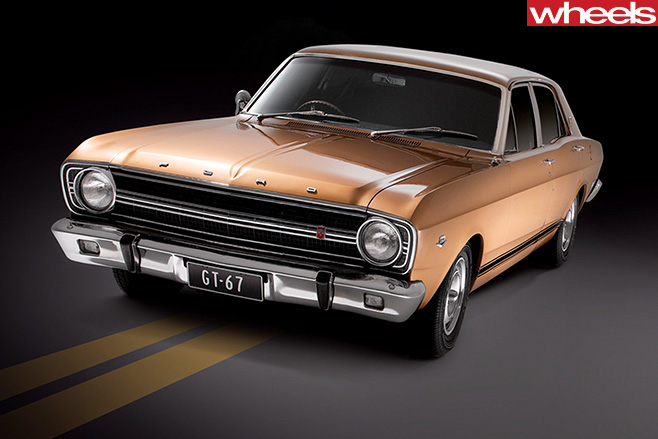
All XR GTs were painted GT Gold, though the car’s Bathurst win prompted a silver-and-red special edition of the succeeding XT GT, to match Gallaher cigarette packs.
21. Ford Falcon XA GT RPO83
When the 1972 ‘Supercar scare’ killed off the Phase IV Falcon (four of which were built) Ford was left holding a bunch of go-fast parts with no home. Enter the non-publicised XA GT with Regular Production Option (RPO) 83. While the RPO was the hottest thing in the Ford catalogue, it’s not strictly a Phase IV by another name.
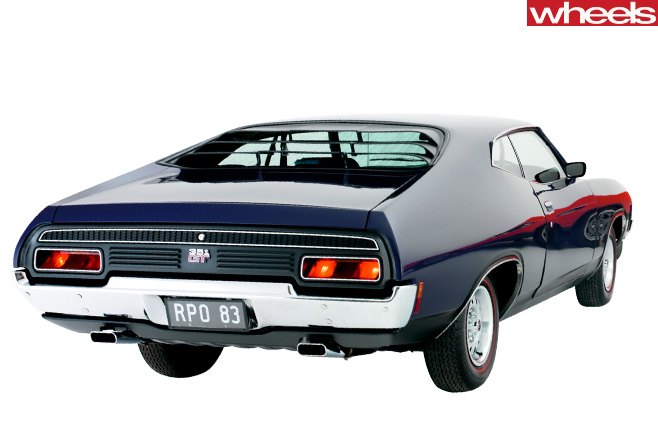
Phase IV or not, the XA GT won Bathurst in 1973, giving Allan Moffat his third victory there. Forty three Yellow Glow RPOs were built, split across both body variants, making it the most common colour of a car rarer than the Phase III (only 300 of which were built). Only one example each (whether Hardtop or sedan) was Ansett Blue, Brambles Red, Corporate Blue, Repco Green, and Sogo Port Wine.
Simcoe to lobby for V8 muscle car’s Aussie visa.
NEWLY appointed boss of General Motors Global Design, Australian Mike Simcoe, has vowed to support a push for affordable V8-powered rear-drive performance for Holden after the locally built Commodore expires at the end of 2017.
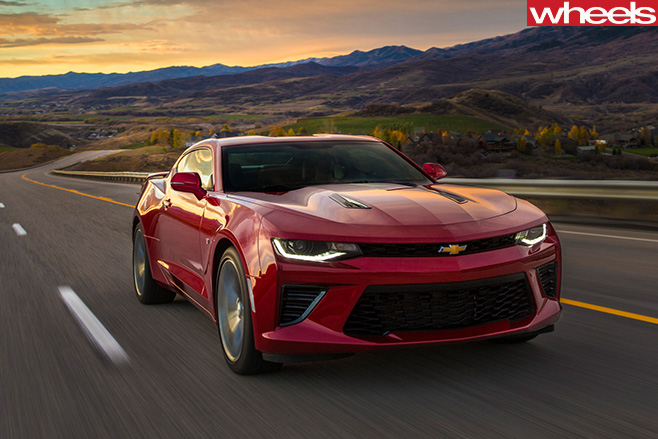
Simcoe confirmed executives from both Holden and regional overseer GM International have approached him for lobbying help on the subject when he gets to the halls of power in Detroit.
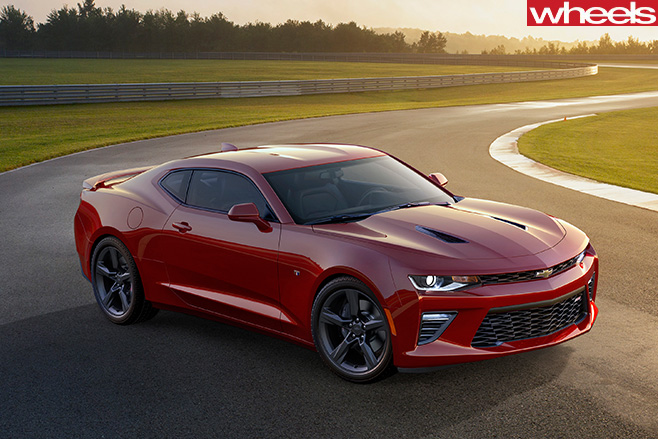
“If you’re asking about a rear-wheel-drive performance V8 … I understand the things this market needs so I will certainly help wherever I can,” Simcoe told Wheels. “Some people at Holden have already asked the question.”
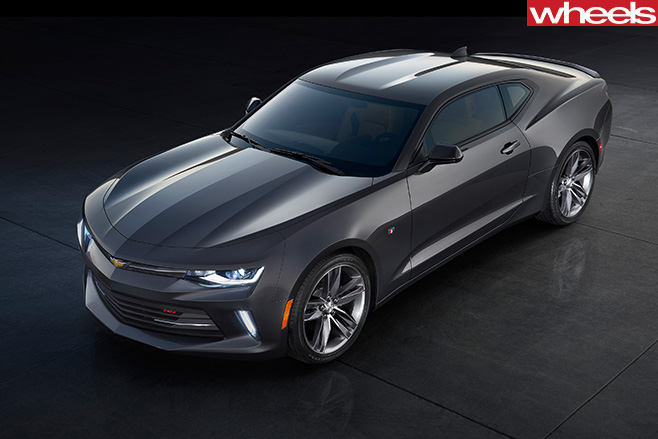
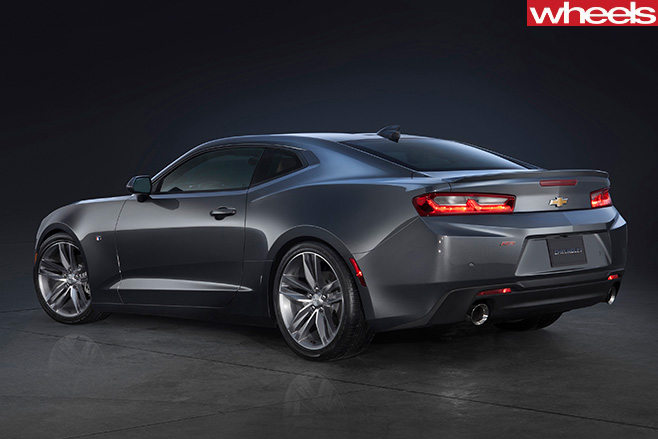
Attention is now clearly being paid to the Mustang’s success outside its traditional markets. At last month’s New York motor show, Camaro chief engineer Al Oppenheiser told Australian media that, while GM was aware of the Mustang’s success, no decision has been made about RHD.

As the father of the modern Monaro and VE Commodore, Mike Simcoe’s rise to the head of GM Global Design has been punctuated with stunning, emotive vehicles.
