
Aston Martin’s new Vanquish Zagato concept dazzled so many at Italy’s Villa d’Este concours show last weekend the firm’s boss is now interested in its production.
Andy Palmer, company CEO, quizzed Twitter this morning with the idea of producing the stunning concept it designed with Italian design firm Zagato, saying “we had so much attention this weekend… should we produce it?”.
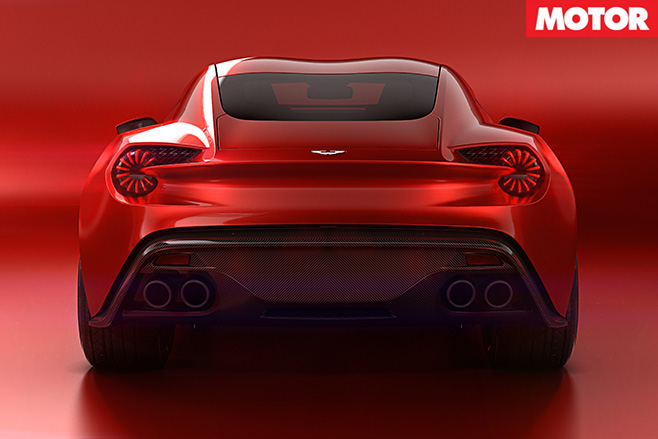
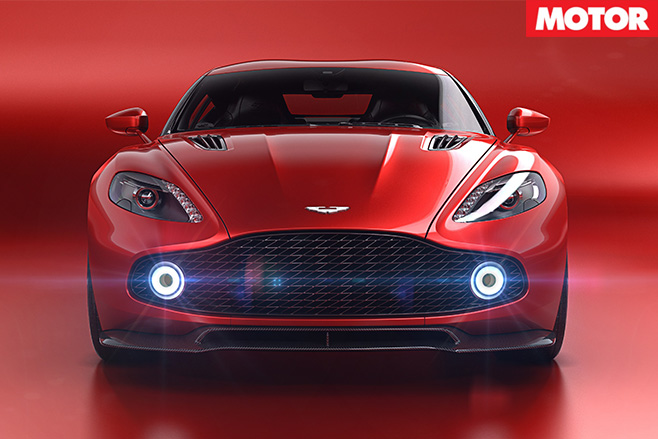
Penned by a team led by the car maker’s chief designer Marek Reichman and Andrea Zagato, the new bodywork has erased unsightly shut lines with the use of larger one-piece panels for the rear three-quarter items and front wings.
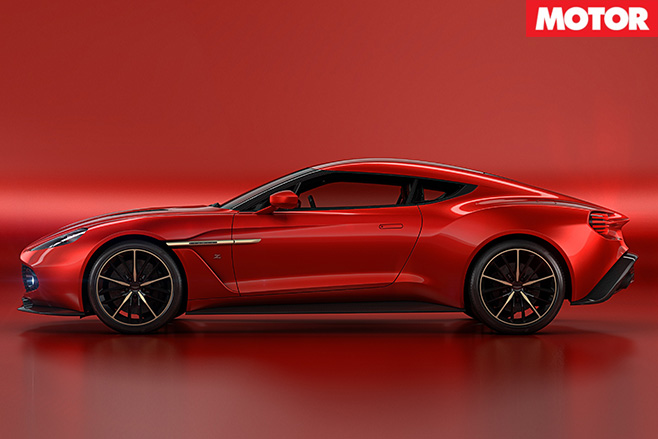
Barking through a new quad-exhaust system the standard 6.0-litre V12’s been massaged slightly, taking power from 424kW to 441kW. Meanwhile, we can only interpret the claim of ‘enhanced driving dynamics’ means its suspension’s been tweaked as well.
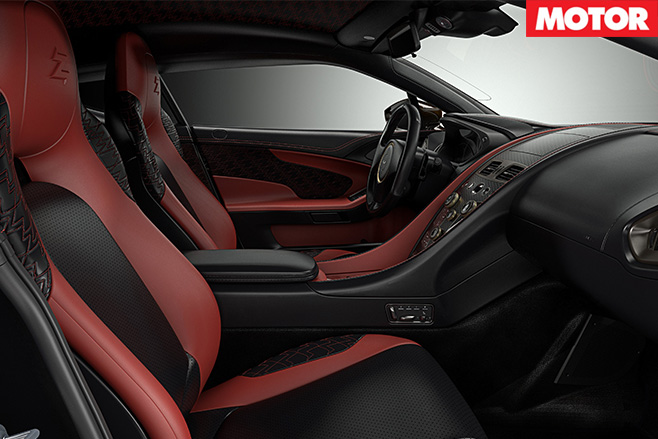
Herringbone-pattern carbon fibre and aniline leather spruce up its interior, while ‘Z’-printed inserts and a ‘Z’ stitched headrest remind you of the Milan based firm’s influence.
So we’ll watch this space closely to see if the Vanquish joins the firm’s series of Zagato special-editions.
McLaren boss Ron Dennis concerned that the world championship could lose “one or two” teams.
There have been a couple of exciting races this year, with the promise of new engine regulations spicing up the 2017 world championship, but some teams towards the rear of the Formula One grid are struggling to survive economically.
McLaren chairman Ron Dennis senses one or two teams could exit the championship before the end of the current season.
Speaking with F1 Racing, Dennis said that while he is happy with F1’s overall stability, there were individual teams in financial jeopardy.
“I wouldn’t be too surprised if one or two of those teams fail to make it to the end of the season,” he said.
But Dennis suggests that the teams’ parlous situations are a result of their own financial mismanagement, rather than evidence of any central problems with F1. He suggested the teams in strife have been spending more money than they have and ignoring basic economics.
He blamed the sports addictive qualities, which encourage some players to overspend in the belief that the next performance upgrade will miraculously make their cars competitive.
It was Tim Slade’s time. Dream time. In 226 previous V8 Supercar races, the South Australian had never been on the top of the podium.
Then came the Woodstock Winton Supersprint at the weekend. Bingo! Slade was unstoppable, taking his maiden win from pole position on Saturday and then repeating the win on Sunday, from fourth on the grid, to become only the second driver this year, after Scott McLaughlin, to score more than one race victory.
It was a weekend for massive celebrations for the Brad Jones Racing Team (BJR) and Slade, who drove for Paul Morris’s team, Stone Brothers Racing (which evolved into Erebus Racing) and Walkinshaw Racing, before signing with BJR for 2016.
On Sunday night there was a lot of love in the air at BJR, a family team co-owned by brothers Brad and Kim Jones and based, rather unfashionably, in Albury, just up the road from Winton. They were celebrating the first time a BJR driver had won both days on a championship weekend. Undoubtedly, the wins were the result of a clever blend of great race strategy and fast and faultless driving. Again, we appreciate that motor racing is the ultimate team sport.
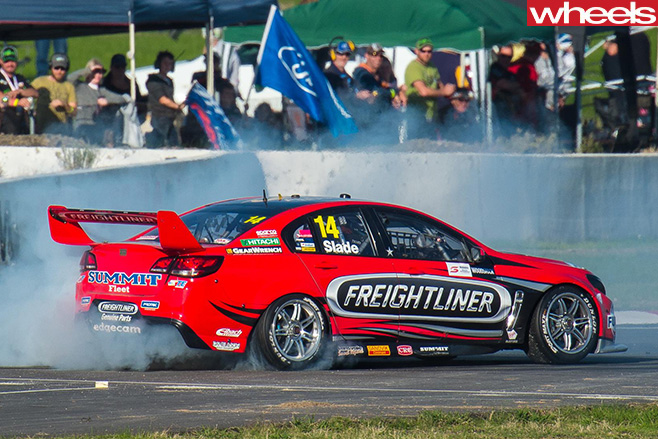
Slade made a great start and immediately signalled he had blistering pace behind the fast-starting Coulthard, Mostert and Lowndes. Then came the pit stops, and Slade emerged in front, opening a handy 9sec gap over Coulthard , who raced Slade’s Freightliner Holden last year.
A further threat was reigning champion, Mark Winterbottom, who after a poor qualifying had moved forward and was fuelled to race to the end. Typical Winton midfield chaos was evident too. Notably, Ford young gun Cameron Waters was mugged and gang tackled early by a few tough old hands, but regrouped and ultimately finished fifth.
A safety car threw many strategies into an instant review, some teams quickly opting to take a three-stop tactic. BJR stuck with its plan of two stops for Slade and after his final dash to the pits, he emerged 2.6secs clear of warring Ford drivers Winterbottom and Coulthard, who were fighting over second place.
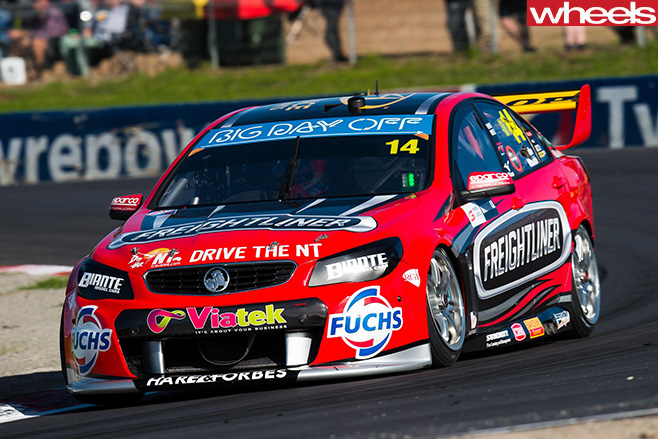
“We had great speed today and the car looked after its tyres really well. I was focused on making no mistakes and pressing on. I don’t think there will be much of the tyres left now, though, that was my first victory burnout and it was awesome.
“The category is so competitive so I’d like to keep this momentum happening but who knows what could happen? You don’t go into the next race thinking you’re going to clean sweep it. I know there is a lot of hard work involved and hopefully we get a bit of luck. Everything has worked in our favour this weekend. This does give me some good confidence heading into the next round at Darwin because I feel the track is a high grip one as well. I’ll worry about it a little more next week after the wins sink in!”
Winterbottom, who stayed cool under pressure and preserved his tyres magnificently as he kept second place ahead of the persistent Coulthard, again showed that he has the race smarts to be a serious contender this year. His points grab lifted the Prodrive Australia star to the top of the Supercar standings above Volvo driver Scott McLaughlin, who took a second and 11th over the weekend.
Triple Eight’s Jamie Whincup, admitting his Red Bull Commodore is bereft of real pace, sits third after pocketing a fifth and a ninth at Winton. His teammate Shane van Gisbergen was not his usual menacing self either, taking ninth on Saturday and fourth Sunday.
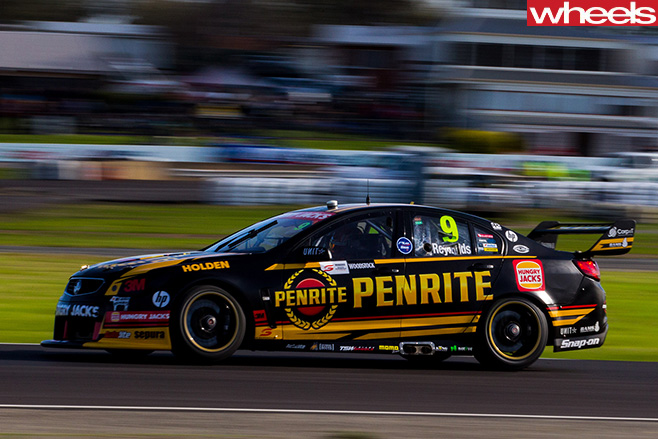
Mostert had a miserable Sunday, slipping from pole to 20th after a puncture ruined his race. He is having trouble converting his blinding qualifying speed into solid race results.
HRT’s classy drivers, Garth Tander and James Courtney, continue to be frustrated by the lack of speed from their Commodores, their lowly qualifying slots condemning them to a weekend of misery and biffo. These two deserve much more. Courtney was in savage conflict with a Ford driver in each race. On Saturday he was cleared of wrongdoing after a clash with Waters, finishing 19th. Then on Sunday, pole man Mostert slammed into Courtney, damaging the Holden’s suspension and costing the HRT driver 14 laps. He was classified 25th.
Mostert escaped censure from the control tower but had to pit with a punctured tyre, dropping to 20th, a sad follow-up to his seventh a day earlier.
But there was hope and a few smiles at Erebus on Sunday evening after David Reynolds aggressively worked his way from 17th to sixth, and set the fastest lap of the race. Team owner Betty Klimenko’s crew are starting to sort out their old HRT Commodore.
But in Ned Kelly country, it was Slade and the local team stealing all the wins on offer.
Hinchcliffe takes emotional pole and two Aussies qualify for 100th Indianapolis 500
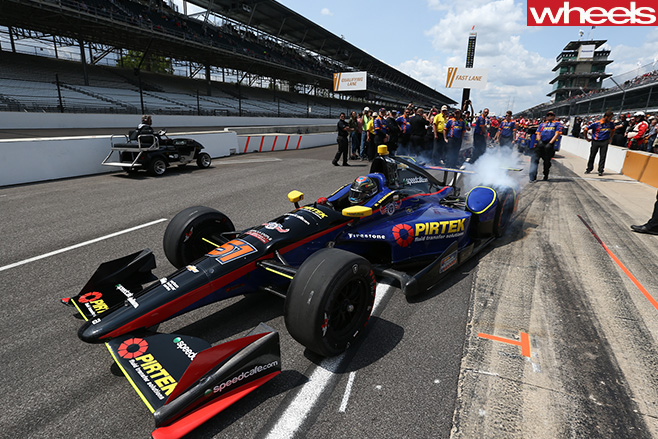
Driving a Honda-powered Dallara, Hincliffe’s four qualifying laps at an average of 230.760mph gave him pole over Americans Josef Newgarden (Chevrolet) and Ryan Hunter-Reay (Honda) by the proverbial bee’s willy.
Australian Will Power, seeking to go one better than his nail-biting second to Juan Pablo Montoya a year ago, will start sixth on the outside of row two in next Sunday’s Indy, the 100th running of the 500.
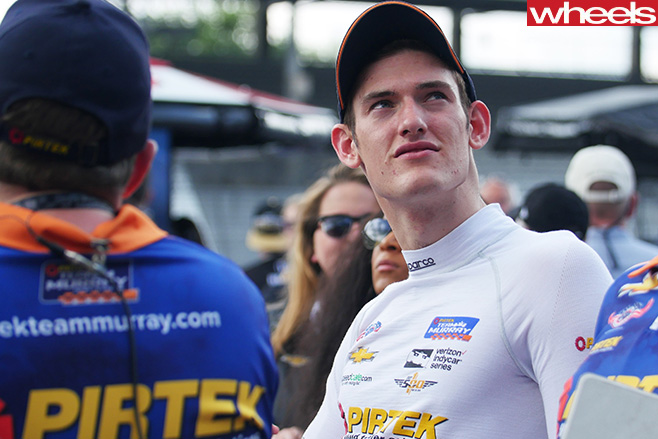
Matt Brabham has qualified the Australian-entered #61 Pirtek Team Murray Chevrolet in 27th after an impressive build up. The 22-year-old rookie’s four laps averaged at 225.847mph.
The Indianapolis-based Brabham will become the third generation Brabham to start the Indianapolis 500 after his grandfather, Sir Jack Brabham, started four times, debuting in 1961, and his father Geoff made 10 starts, beginning in 1983.
“It is a wonderful feeling to say that I’ve been able to qualify for the race, it is one of those special moments in life,” said a relieved Brabham. “We’re here and I’ve made it and I’m going to be racing in the Indianapolis 500. How cool is that? I’ve qualified for the Indianapolis 500! I’m happy.”
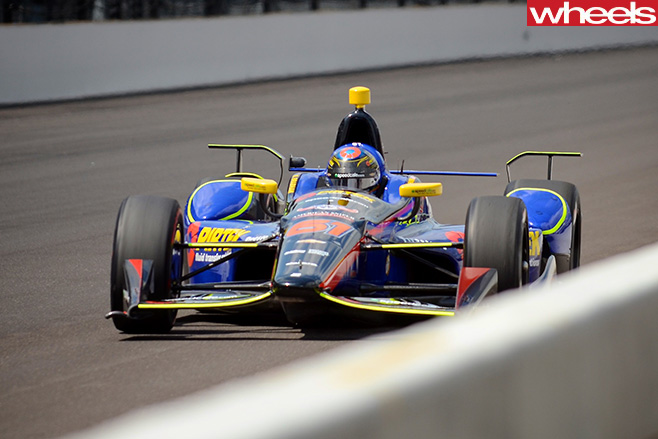
The colourful Queenslander, known around motorsport on two continents as ‘Crusher’, admits “the energy, hours and frustrations have been enormous, but nothing we were not expecting or that we were scared of”.
“Matt Brabham has justified our decision to start this journey by doing an amazing job in the car, which has had the paddock talking for the entire month of May,” said Murray.
“The kid is the real deal and I can only hope that next Sunday’s race is the springboard for a rich and successful career.”
Lorenzo pips Marquez in unforgettable Italian MotoGP duel
A day earlier, with the Saturday crowd roaring its approval, Rossi pulled a rabbit out of his helmet with a brilliant pole position, upstaging his bitter rivals Jorge Lorenzo and Marc Marquez, who were back on the second row.
Maverick Viñales (Suzuki) and Andrea Iannone (Ducati) shared the front row with Rossi at a track where overtaking is never easy.
The Mugello MotoGP race begun with an interesting stat: in the previous eight races, the pole setter took the victory.
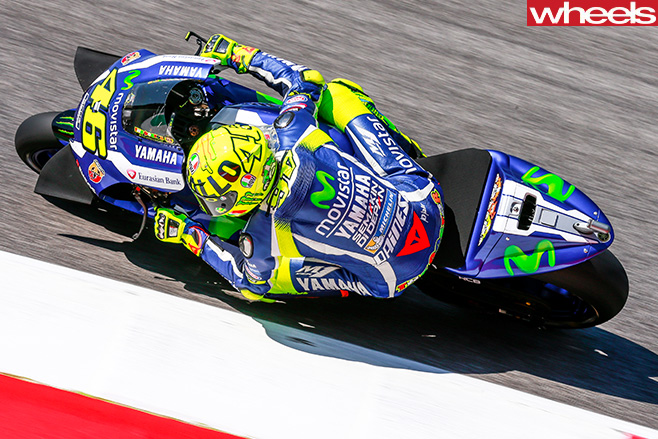
When Lorenzo hits the front in a MotoGP race, it is usually game over, as he falls into a metronomic display of perfect, blindingly quick lappery.
Rossi, though, was clearly targeting his first win at Mugello since 2008 and, with most of the 100,000 spectators roaring approval, the veteran superstar kept sticking his nose beneath his team-mate in high-speed braking duels. A few times he ran wide, dropped back, but quickly moved back into Lorenzo’s slipstream. Marquez, meanwhile, was closing on both.
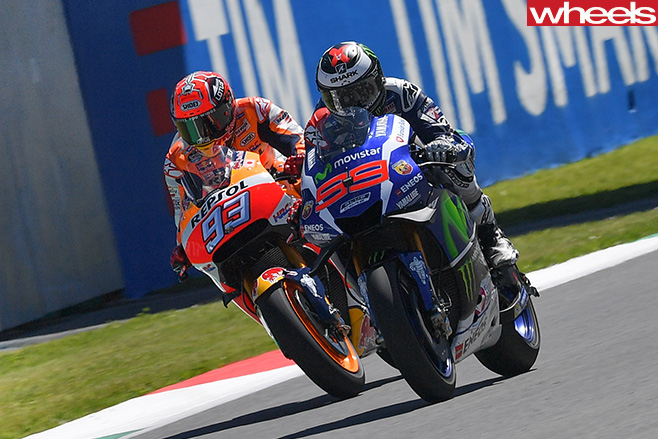
Sniffing a chance, Marquez closed on Lorenzo, and poked his nose ahead briefly before ceding to the Yamaha.
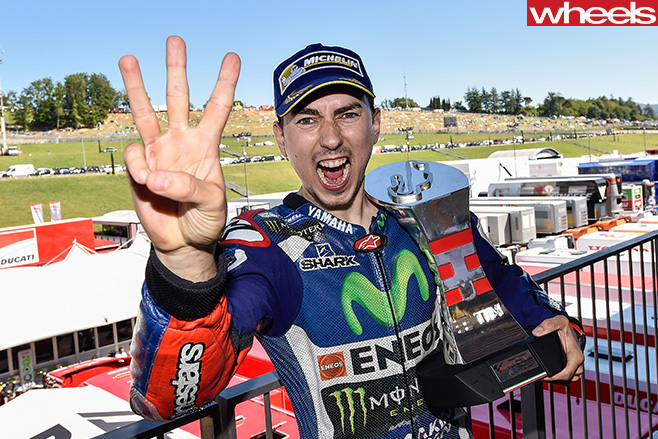
Then came a stunning, unforgettable final lap, during which Marquez and Lorenzo swapped the lead several times. Marquez held a margin exiting the final corner, but the Honda’s weakness – power down traction and stability – gave Lorenzo a second chance and he launched his YZR-M1 past his compatriot to steal the victory, his third of the season, by a mere 0.019sec.
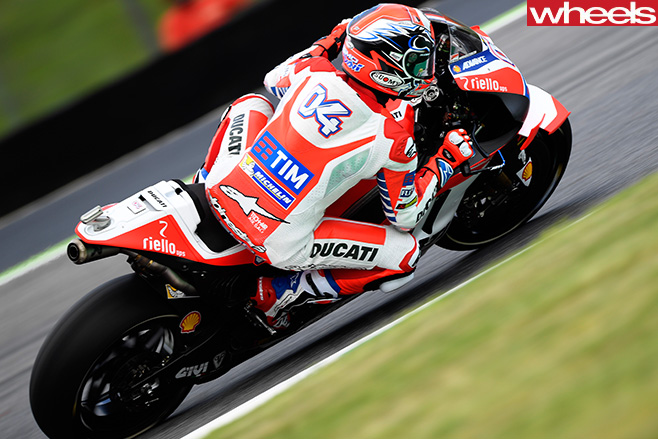
Iannone was third, from Honda’s Dani Pedrosa and then Dovizioso.
Aussie Jack Miller, who started from 17th, was torpedoed in a first-lap backmarkers’ dustup.
Lorenzo is now 10 points up on Marquez as the MotoGP series moves to Spain. Rossi has fallen 37 points back.
Meeke and Citroën spring dominant Rally of Portugal victory
Leading from the second stage to the end, Kris Meeke and co-driver Paul Nagle stunned their Volkswagen and Hyundai rivals with a crushing performance at Rally of Portugal.
The Northern Irishman, returning to the championship after missing the previous two rallies in the Americas, brushed off the cobwebs to win the four-day rough road event by 29.7sec in Citroën’s DS 3. It was his second WRC success after victory in Argentina last year. Meeke is driving in only selected events this year while Citroën develops a new car for 2017.
Meeke, 36, became the fourth different winner in five WRC rounds this season following the successes of Sébastien Ogier, Jari-Matti Latvala and Hayden Paddon.
Meeke took the lead in the second stage on Friday morning and remained trouble-free on the rocky mountain roads in the north of the country, making the most of clean, grippy conditions courtesy of his low start position. He controlled the closing final day and a half after building an early lead of almost a minute. The final margin: 29.7secs.
“It was nearly a perfect weekend, a textbook performance,” said Meeke. “This year is all about gathering experience and I couldn’t have done any more. We’ll use these rallies this year for our benefit and try to mount a title challenge next year.”
After an overly-cautious opening day, a rejuvenated Andreas Mikkelsen upped his pace to dislodge his team-mate and championship leader Sébastien Ogier from second place. Set-up changes to his Volkswagen Polo R inspired the Norwegian, who won Sunday’s opening two stages and finished 4.8sec ahead of the reigning world champion.
Ogier suffered two punctures on the final day. With just one spare wheel in his Polo R, he compromised his pace to ensure he completed the final Power Stage and reach the finish after topping up one of the flat tyres with air.
In the WRC2 category, third place was looking probably for the Australian crew of Scott Pedder and co-driver Dale Moscatt until a spin on the final Power Stage cost almost 18secs and lost them the position by just 0.2sec.
Kiwi Hayden Paddon suffered a catastrophic retirement on Saturday when his Hyundai i20 caught fire and was completely destroyed after a relatively minor crash.
Bravery is a rare phenomenon in the automotive industry. Sure, every brand will tell you it follows its own unique engineering ethos, but take a more critical look and few makers today actually stray from the pack and risk losing sales in the process.
Take engine efficiency, for example. The general industry consensus is downsized turbo engines are the way to save fuel and reduce emissions with a conventional combustion engine.
It’s certainly true that the average small turbo donk is terrific at delivering impressive fuel consumption… in the official test. Countless road tests have suggested, however, that in some cases the real-world efficiency of these engines isn’t much better than that of a bigger naturally aspirated engine, especially in urban driving.
We didn’t think manufacturers were actually bending the rules – not until Dieselgate, anyway – we just figured the canny engineers had worked out how to optimise their engines to deliver during the test.
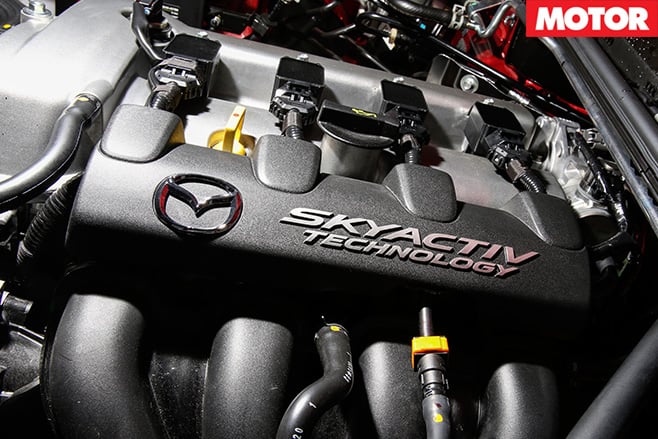
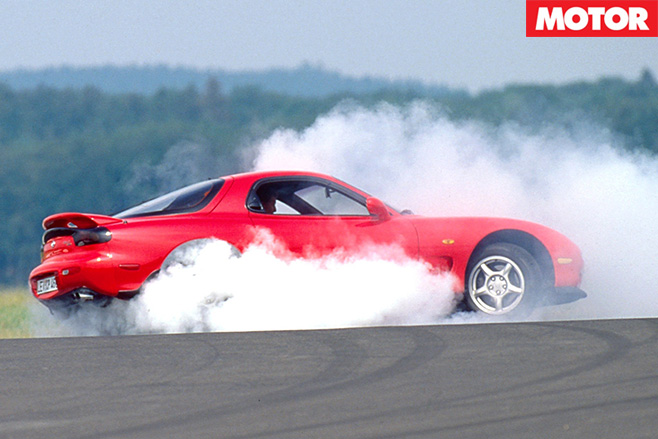
There was plenty of scope for improvement because historically the brand has been off-the-pace in the low fuel consumption race. But recent developments have delivered genuine gains with its Skyactiv engines since 2011. So much so that Hiroshima gives us a 6.1L/100km performance car without a snail or battery in sight.
Now there’s geographical influence in Mazda’s engine approach. Legislation in parts of Europe classifies engines based on cubic capacity. This means that, say, a 1.4-litre falls into a less costly bracket than a 2.0-litre. The 1.4 needs a turbo to provide atmo 2.0-litre performance (or better) and there you have it: a pretty convincing case for the downsized turbo engine, and the reason you’re hard pressed to find a non-turbo Fiat, Renault or Volkswagen these days.
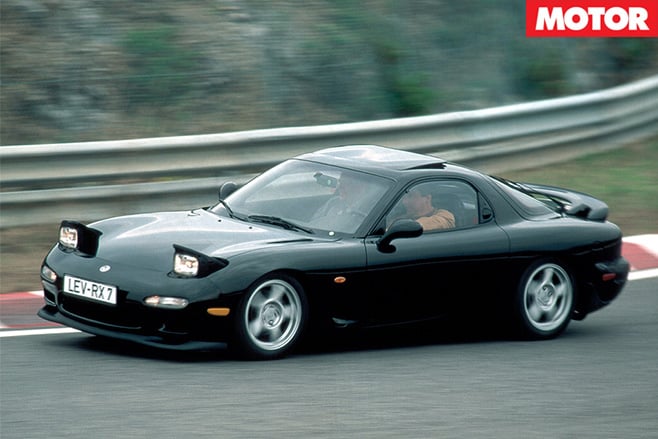
There’s more to it, though. Even a cursory glance at Mazda’s history reveals it to be the only brand, to this day, to give the world a truly different mass-produced internal combustion engine, the Wankel rotary.
There’s your real reason. This trail-blazing manufacturer didn’t hesitate to take its own path because if it didn’t, well, it wouldn’t be Mazda.
Against the backdrop of Mazda history, the brand’s largely naturally-aspirated approach to fuel saving and power making, when most of the industry is agreed on smaller turbocharged engines, actually isn’t that bold at all.
Rotary returns!
But this one will need a turbo
Real gains
Skyactiv’s the limit
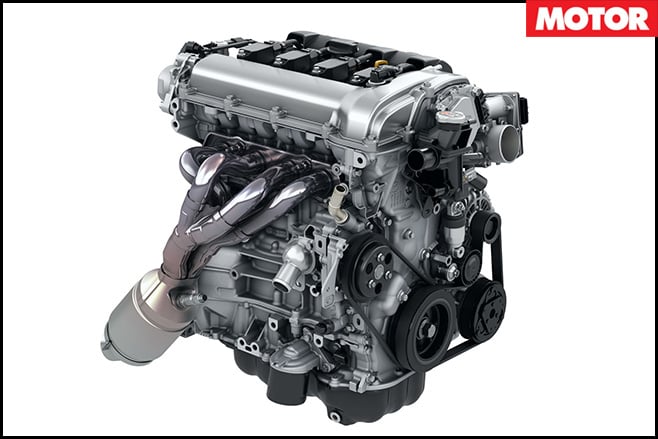
2. FINE LINE High compression is good, because it breeds efficiency – more power with less fuel – but the limiting factor is detonation, where combustion happens before the spark, which can lead to engine failure.
3. UNDER PRESSURE High cylinder temperatures cause detonation, which Mazda systematically avoids in its Skyactiv-G engine. Petrol directly injected under high pressure through multi-hole injectors creates a fine atomisation of fuel, cooling the cylinder. Staging the injection allows the flame front to be carefully controlled, with help from specially designed piston cavities.
4. TIMING’S KEY Clever valve timing phasing allows Mazda to rid more hot gas on each stroke, aiding cooling. A 4-2-1 exhaust also reduces residual hot gas, as cylinders are paired to keep out-of-phase exhaust pulses apart, which could otherwise push exhaust gases back into a neighbouring port. The result is a happy 14:1 compression (same as a Ferrari 458 Speciale) for petrol variants (or 13:1 in Oz, to run on 91 octane).
5. REACH FOR THE SKY Think a 14:1 compression ratio is high? Mazda, which has more than 150 patents on its Skyactiv tech, has played with even higher compression petrol prototypes, from 15:1 to 18:1 compression. A Homogeneous Charge Compression Ignition engine – a compression rather than spark ignition petrol engine, sort of like a diesel – is the logical conclusion and could be here in a few years.
BMW has given itself another present in celebration of its 100th anniversary, revealing the BMW 2002 Hommage concept that arrives half a century after the launch of the 02 range.
“Exactly 50 years ago, the 02 range kick-started an era of success for BMW,” BMW Group Design senior vice-president Adrian van Hooydonk said at the car’s reveal overnight.
“This compact coupe is one of the vehicles which made the brand what it is today.The 2002 sat at the top of the range and was the first series-produced car anywhere in Europe to come with turbo technology. That set the seal on the coupe as a genuine sports car,” he said.
“At the same time, the 2002 Turbo was at the technological vanguard of engine development at BMW. The BMW 2002 Hommage is our way of raising a glass to all these achievements.”
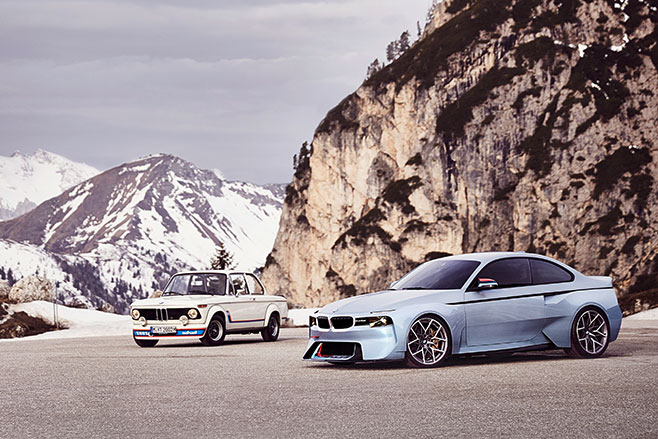
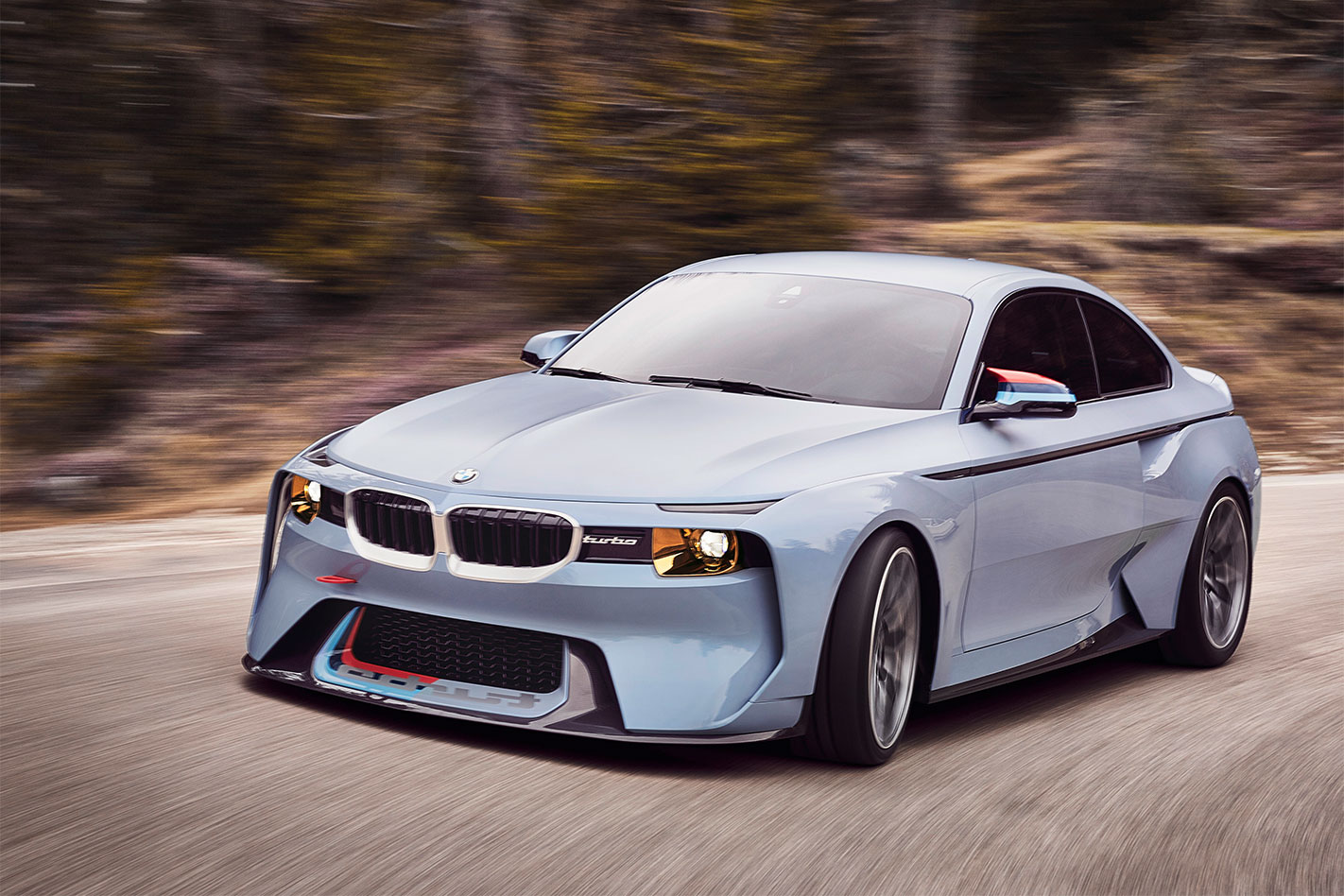
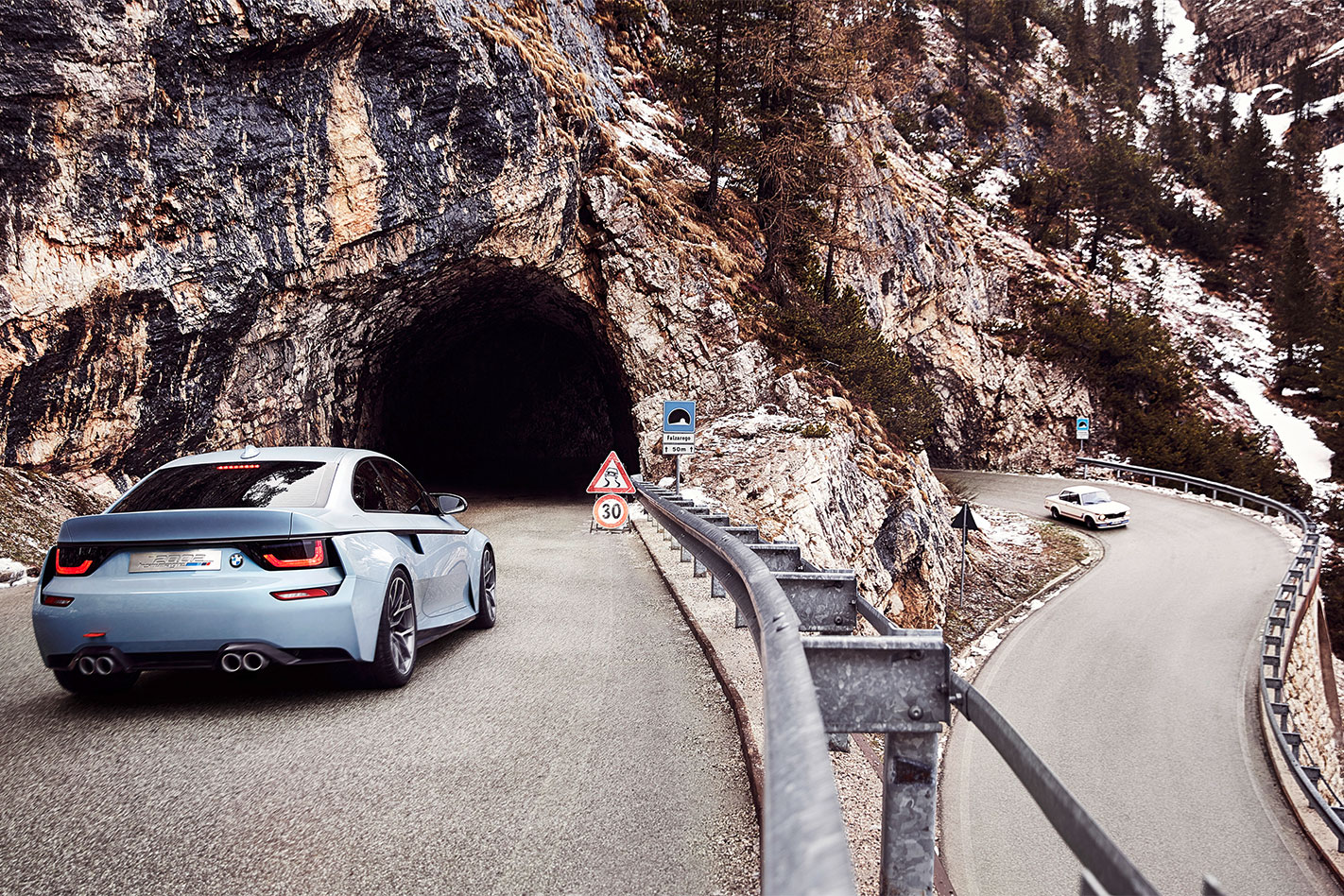
The 2 Series-based BMW 2002 Hommage features the signature two-door 2002 “shark nose” via a deep, somewhat kerb-unfriendly splitter marking a number of bespoke aerodynamic enhancements.
“Aerodynamic details like the large spoilers at the front and rear team up with the profusion of air intakes to optimise airflow around the car and maximise downforce in every driving situation,” BMW said.
The modern-day interpretation ditches the chrome that ringed the original in favour of a carbonfibre strip that is used to split the body up into distinct sections.
BMW said a particularly striking feature of the car’s flanks are the “voluminously moulded wheel arches, which frame the body like four brackets and add stature”.
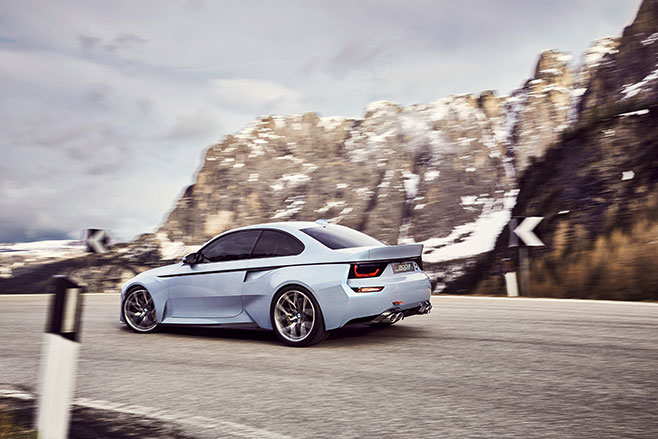
“In the process, they recall the homologated version of the BMW 2002 turbo, which needed broad extensions bolted onto its body to accommodate a significantly wider track,” BMW said.
“The Hommage car integrates this detail neatly into flanks designed with clear dedication to the job at hand.”
There’s other visual cues that take inspiration from the original. There is the blacked-out grille, and a set of indicator repeater lamps that sit above the single-lens headlights. The word “Turbo” is reversed out on the splitter, just like the 1970s-era car.
Unfortunately BMW gives us no word as to what’s under the bonnet, but the original car – BMW’s first production turbo – used a turbocharged 2.0-litre four-cylinder engine producing 127kW/240Nm.
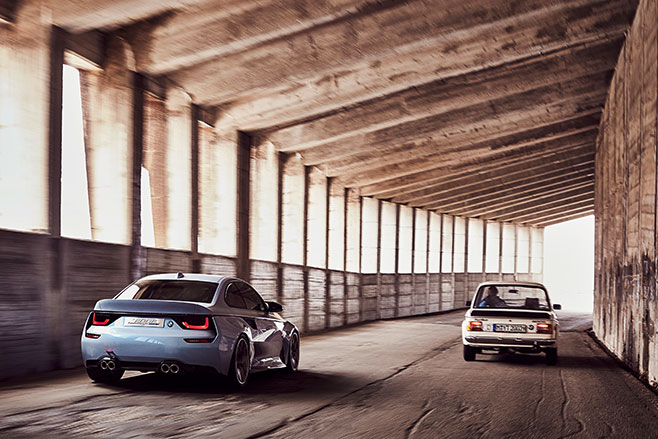
BMW has gathered together all its Hommage concepts at this year’s Villa d’Este concours, the venue for the unveil of its latest creation, the 2002 Hommage.
Sadly, none of these impressive shapes have made production, although various design elements have found their way onto future production BMWs. Here’s a recap of the series so far.
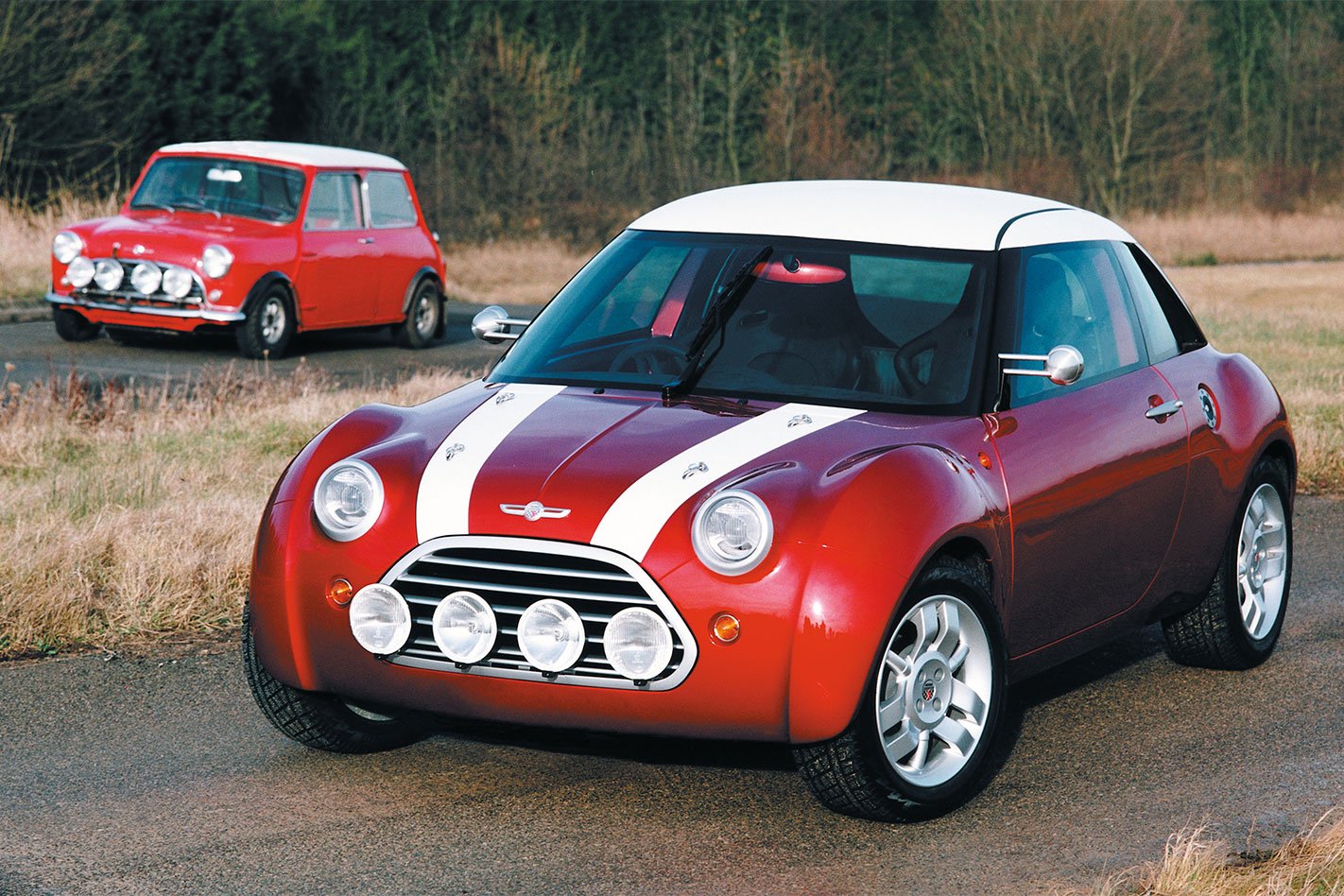
1997 – MINI ACV30
Bug-eyed, mid-engined ACV30 unveiled at the 1997 Monte Carlo Rally and pre-dates the launch of the ‘New MINI’.

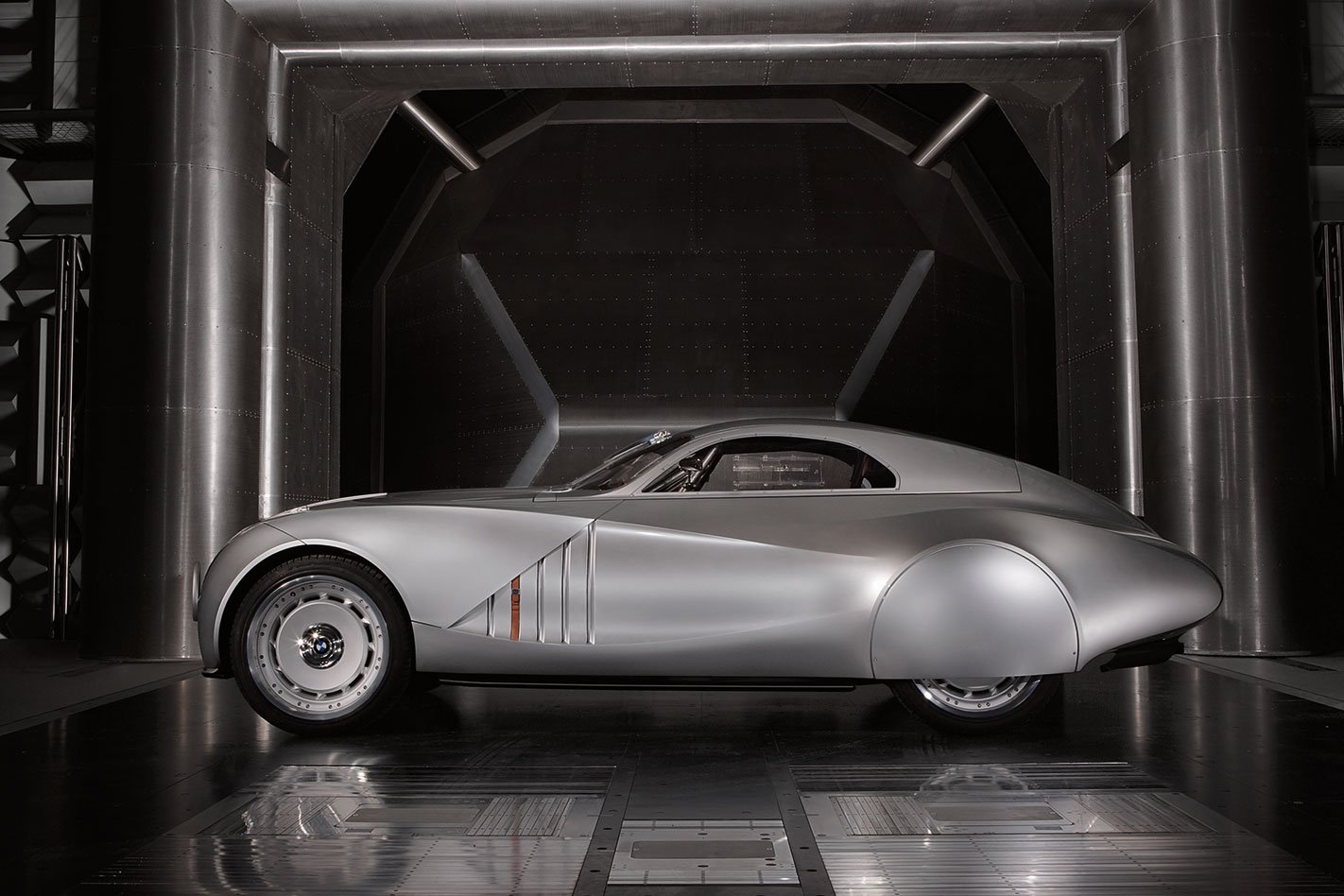
Beautiful streamliner a throwback to the BMW 328 Mille Miglia Touring Coupe that won the famous road race in 1940.

The first official ‘Hommage’ car, paying tribute to BMW’s first supercar, the M1. Sadly didn’t make production, but proportions and styling cues present in current i8.


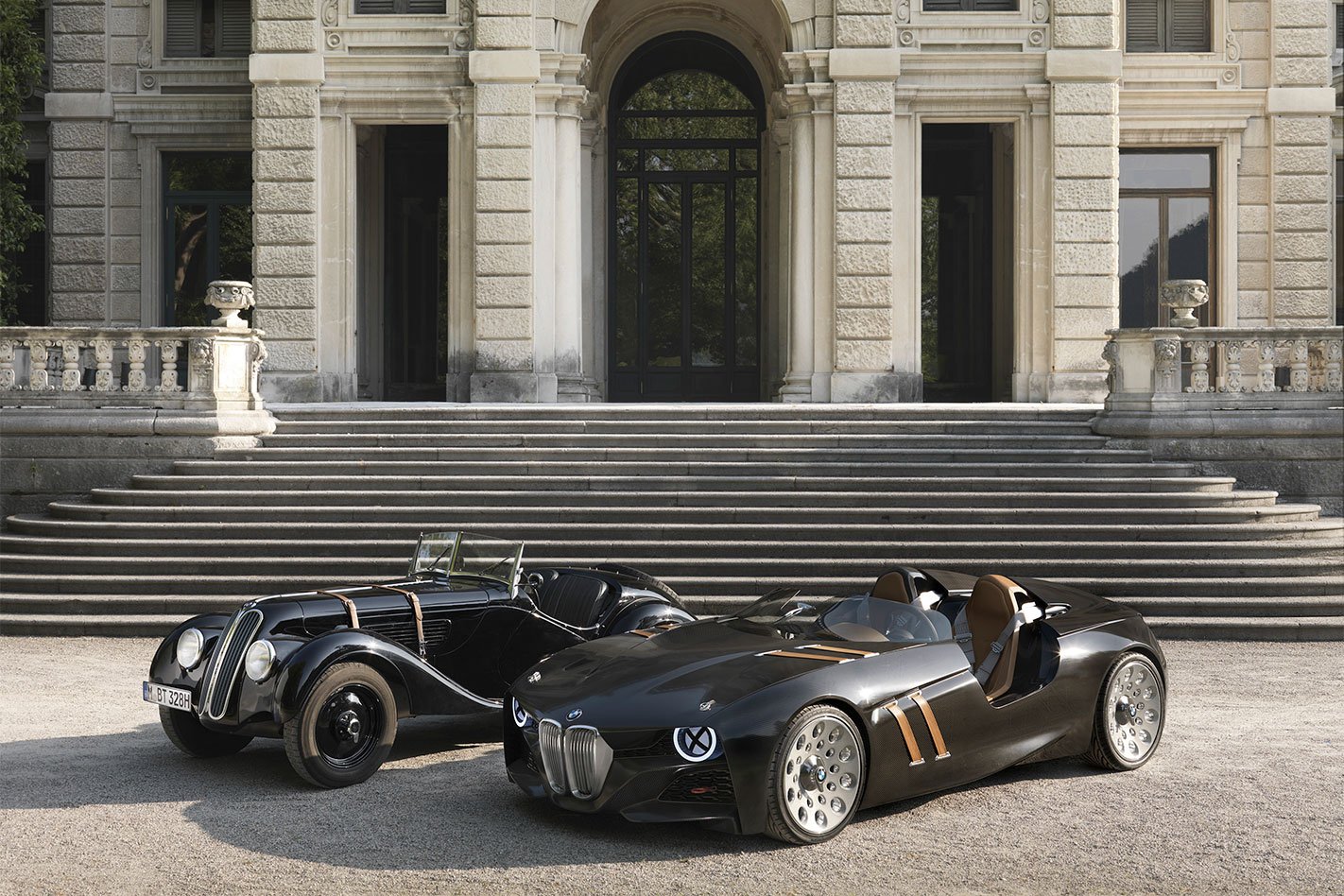
Curious open-top roadster built to celebrate 75th birthday of the original 328 racing car.

A modern interpretation of the winged ‘Batmobile’ that dominated German touring car racing in the 1970s.
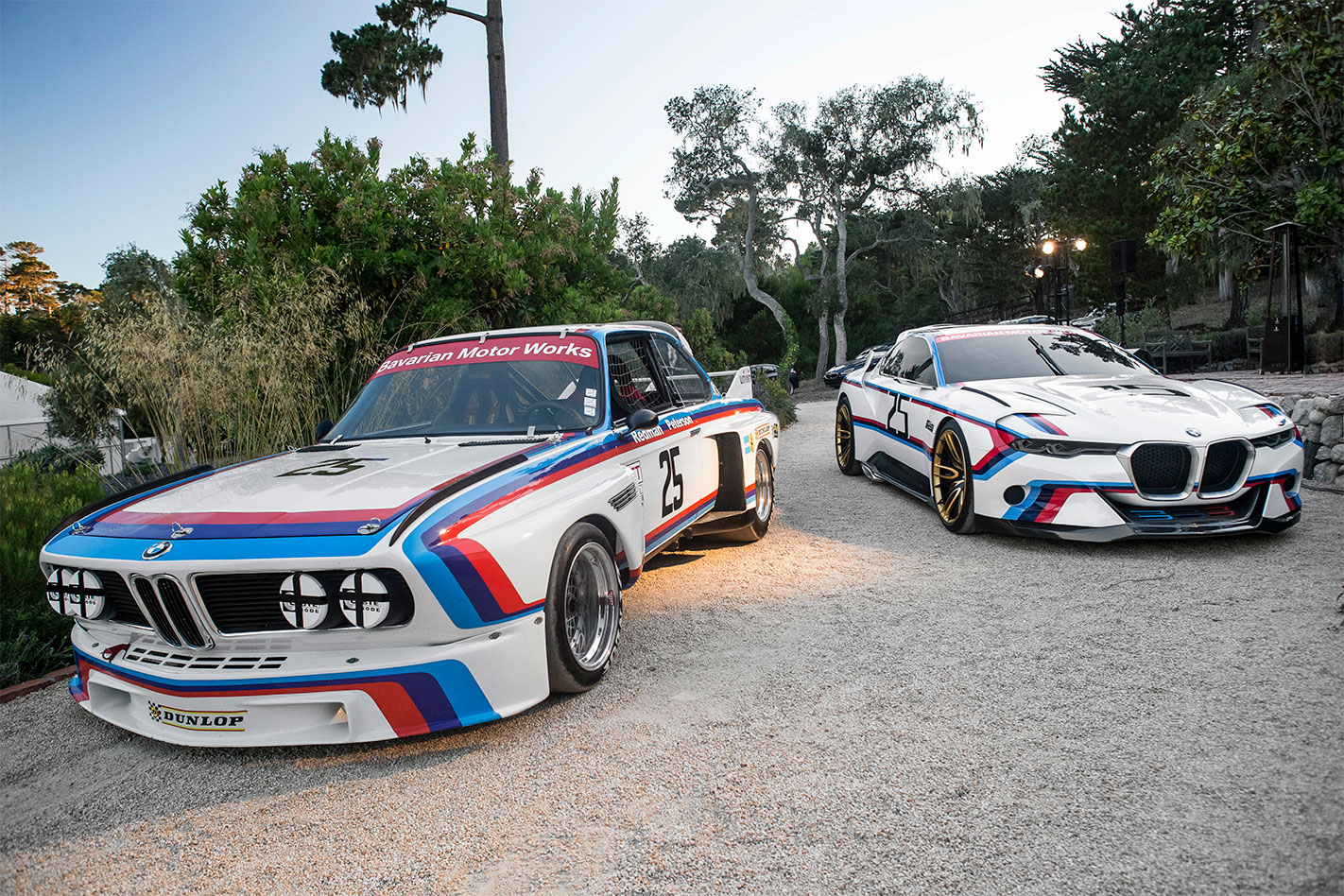
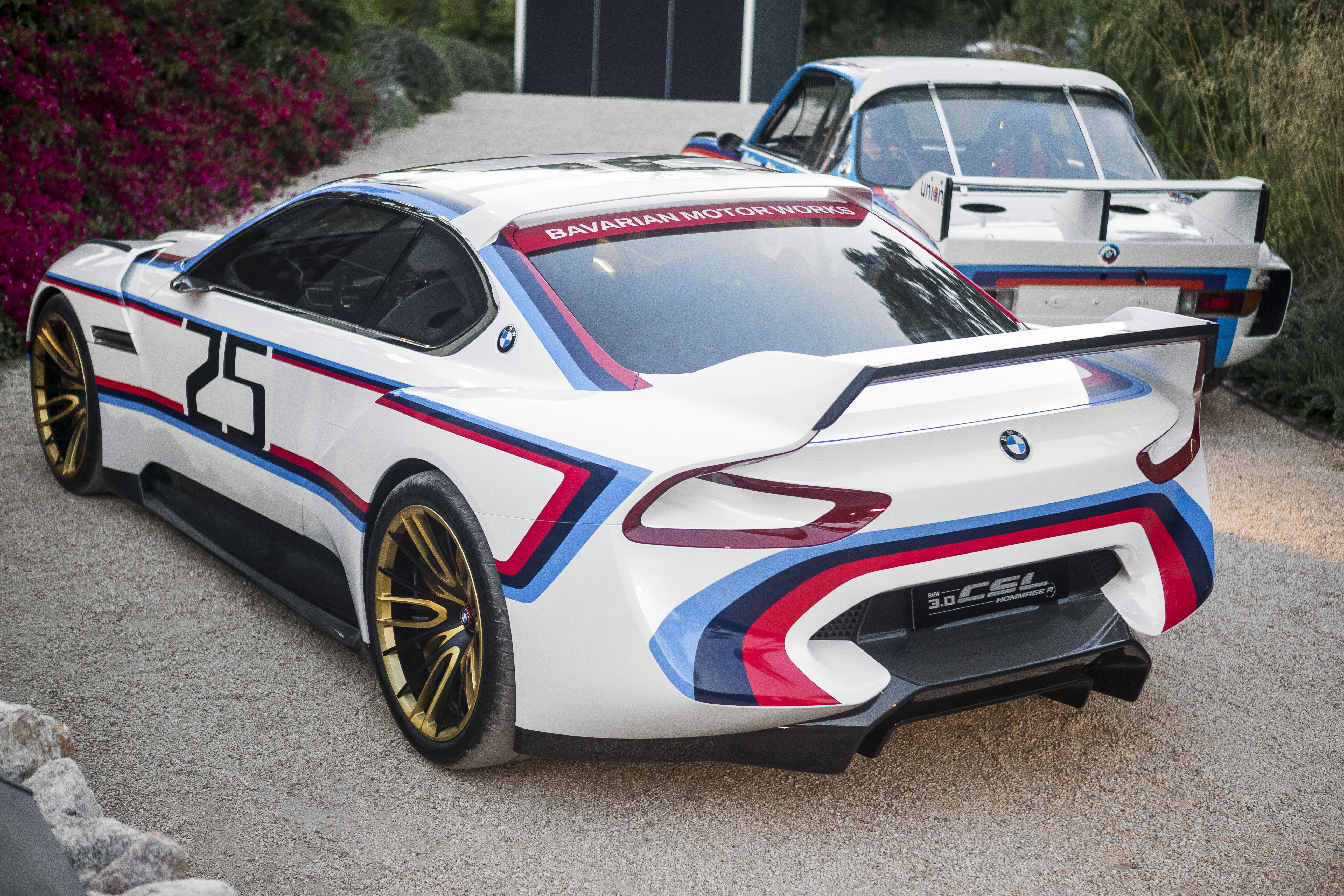
The latest in the series celebrates 50 years since the introduction of BMW’s ’02’ series and is inspired by BMW’s first turbocharged production car, the 2002 Turbo.

BMW has unveiled the latest in its Hommage series of concept cars at this year’s Villa d’Este concours in Italy.
The compact coupe has been created to celebrate 50 years since the introduction of BMW’s 1602 two-door coupe.
That car morphed into the iconic 2002, the most famous variant of which became BMW’s first turbocharged production car.
The 2002 Turbo is obviously the inspiration for this new concept. If the name wasn’t a big enough hint, the giant ‘turbo’ badge on the front grille is a dead giveaway, as is the reversed turbo script on the front air dam.
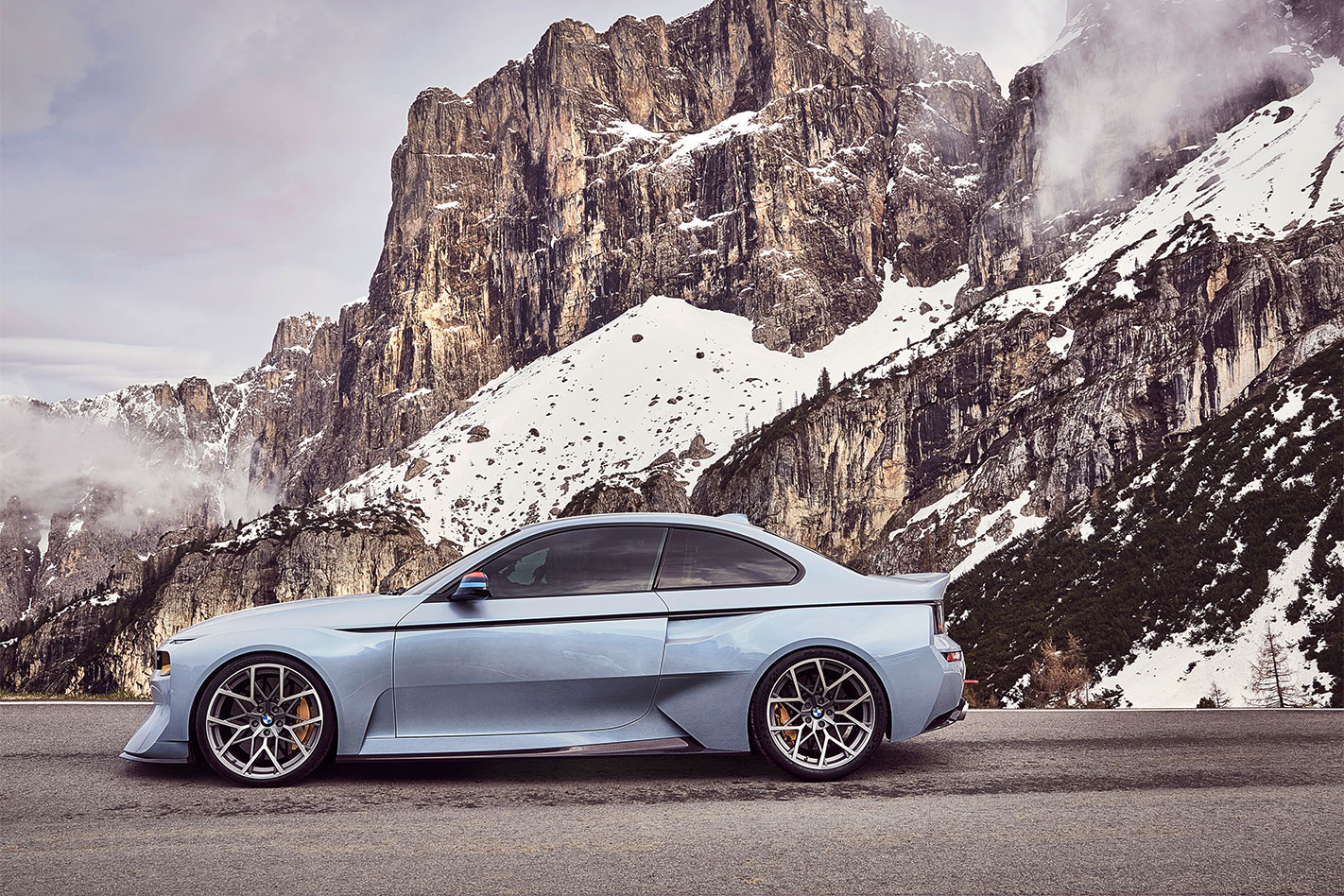
Coated in exotically-titled ‘Space Race Metal’ paint, we reckon it looks awesome, though as with all BMW’s Hommage concepts, there are no plans for production, nor is it likely to influence the styling of future models.
Frustratingly, the only technical specification revealed by BMW is that the 2002 Hommage wears 20-inch alloy wheels, though as all the Hommage concepts thus far have worked, there will be an engine of some sort lurking under the chiselled bodywork.
Given its inspiration, it’s not too much of a stretch to speculate that a high-powered turbocharged four-cylinder lies under the bonnet.
The original 2002 Turbo is one of the great turbocharged icons, developing 127kW/240Nm thanks to a KKK snail. Launched at the 1973 Frankfurt Motor show, just 1672 were built.
The new Bentley Bentayga is set to add plenty of cash to Crewe’s coffers, with the $423,600 SUV expected to increased sales by 50 per cent.
Bentley’s sales dipped eight per cent in 2015, primarily due to the slowdown in the Chinese economy, however with the first Bentaygas now reaching customers strong sales growth is expected as the British firm climbs towards its goal of 20,000 sales by 2020.
Speaking at the Bentayga’s local unveiling, Manager of Asia-Pacific Dealer Sales, David Simpson, told MOTOR: “I think we’ve seen the first year or two’s worth of purchase intents cover the first year of production, so we’re very comfortable that the car’s been received well. Now the first dealer demonstrators are arriving, we’re comfortable that that number still stands.”
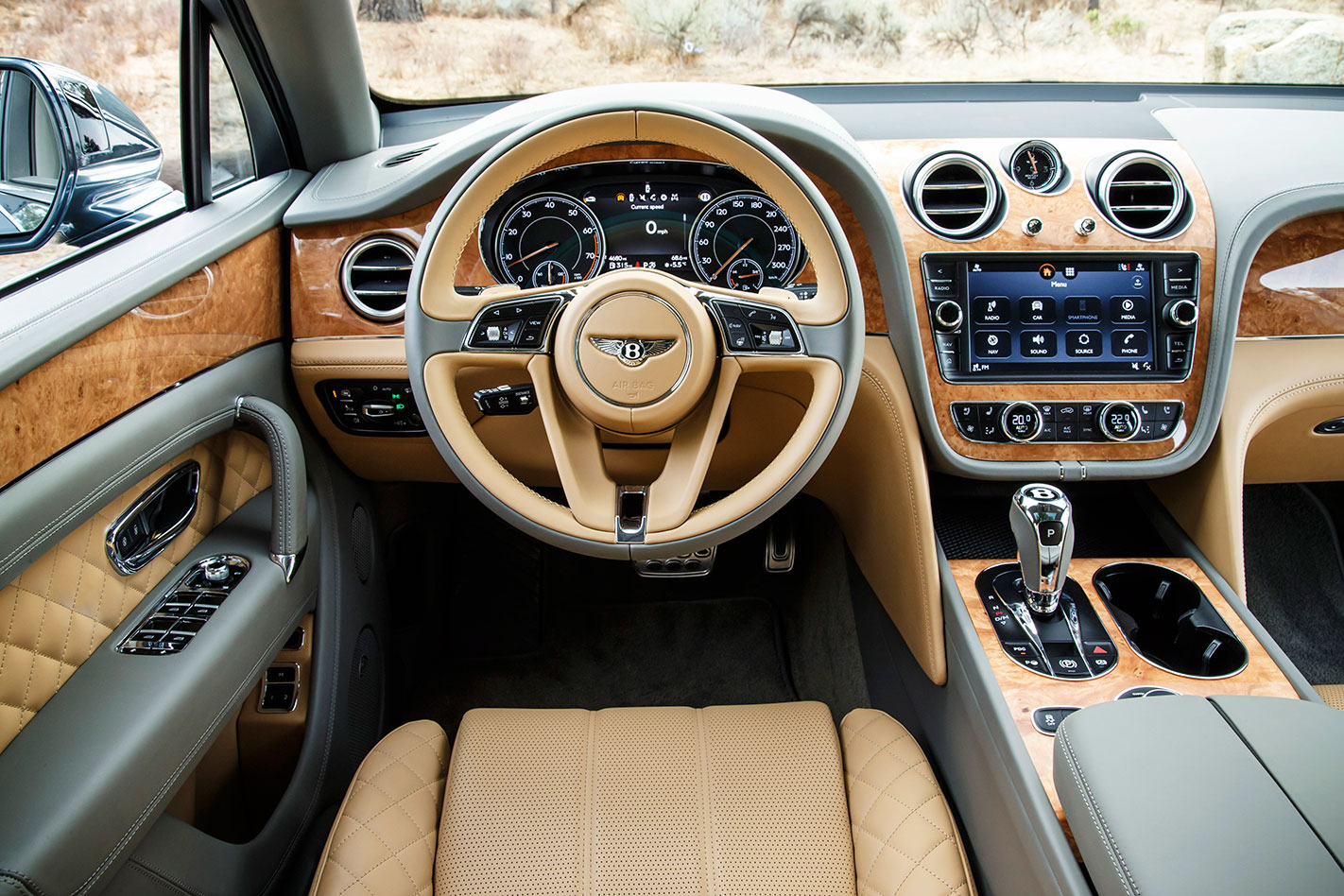
“We find that Australians want to actually see the car and drive the car before they part with any deposits, whereas in other countries there’s a rush to be first. Australian buyers are more sophisticated…but we know the interest is there, the phone’s ringing every other day asking when the cars are coming.”
Despite the potential sales growth, Simpson sees no threat to Bentley’s exclusivity: “I think we’re competing in several different markets and these markets aren’t saturated. If you look at SUV, we’re creating a new luxury SUV market that hasn’t existed before.”
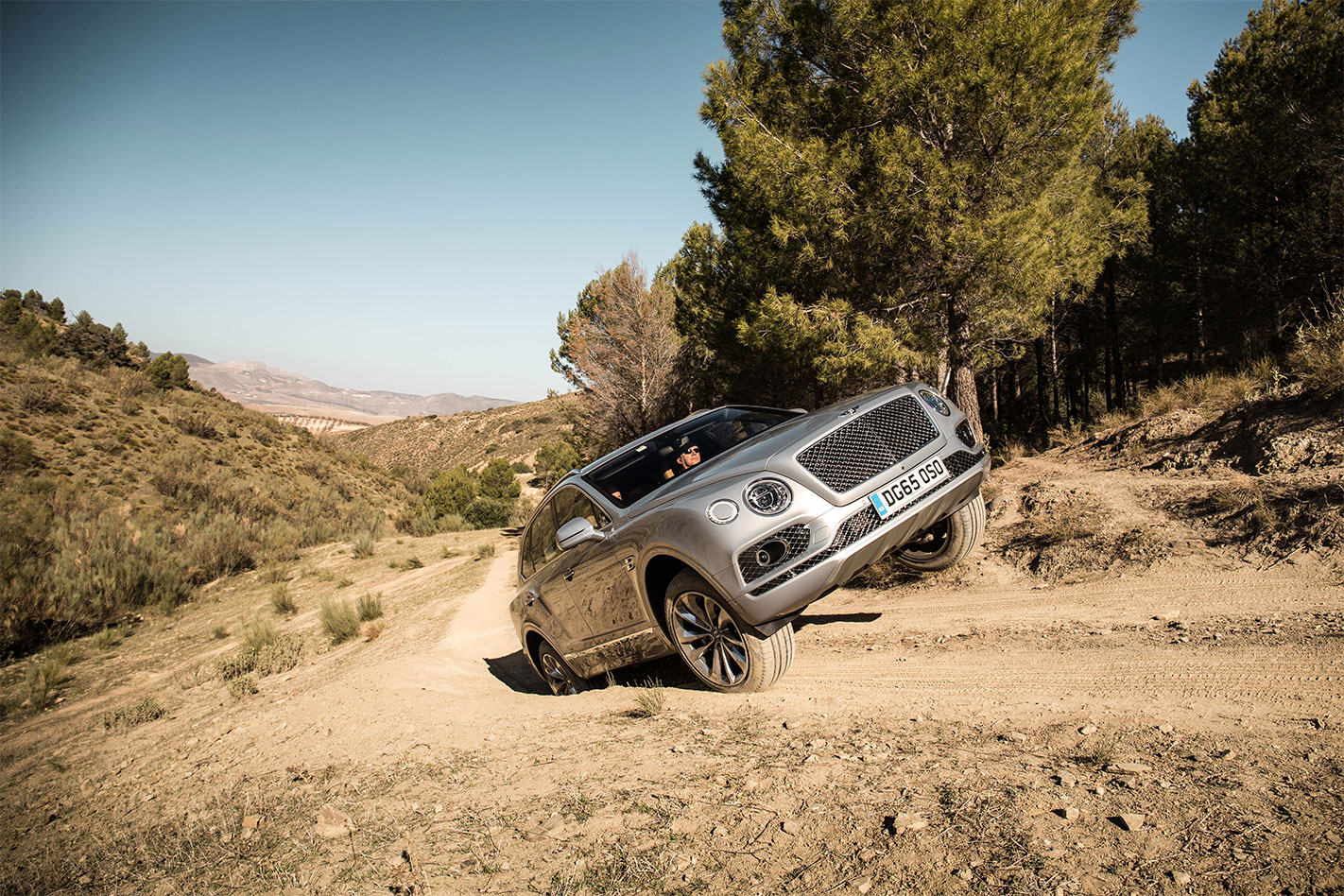
While currently restricted to W12 power, the Bentayga range will expand with V8, diesel and hybrid power over the coming years. MOTOR will be bringing you a first local drive of the Bentayga in the not-too-distant future, but until then here’s our verdict from the international launch.
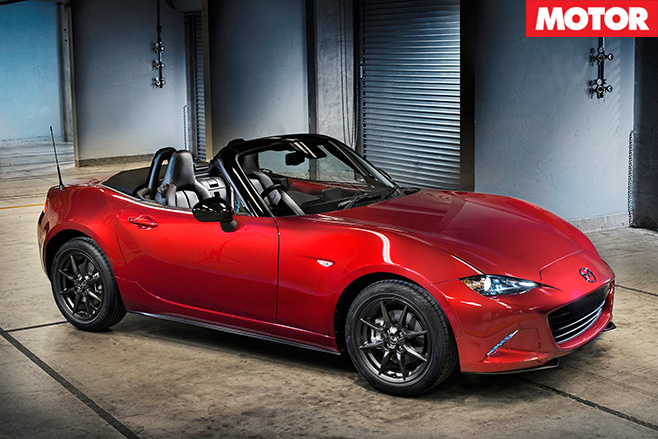
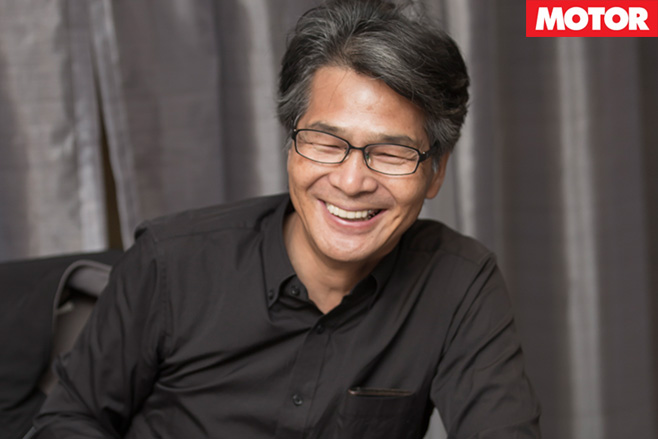
Well, this is awkward. MOTOR is sitting in a hotel conference room on Queensland’s Sunshine Coast with Nobuhiro Yamamoto – program manager for the new MX-5, the big boss – and his interpreter. The hesitant laughs seem to chill our coffees; one question has hit a nerve.
And unless the conversation goes in a different direction, this interview is over… It’s the rotary engine. Yamamoto-san might be the father of the new ND, but he’s been with Mazda a rather long time, since 1973, and it was daydreaming about rotaries in high school that drew him to Toyo Kogyo, as Mazda was then known.
He signed up, and before long was on the team developing the Wankel powerplant – a dream come true. In fact, he spent two decades on the rotary engine, refining and perfecting with genuine, studiously Japanese passion.
He worked on the third generation RX-7 (and owned a first-generation car himself) but his eyes seem to light up most recalling his time working on the piston-less, howling quad-rotor 787B – the car that won at Le Mans in 1991.
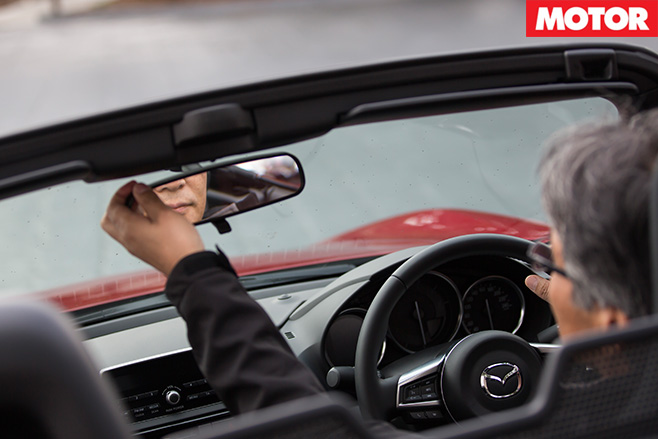
Saving the probing rotary questions until last meant we were able to cover ground like what Yamamoto-san wanted to do with ND MX-5, but couldn’t. And why you’ll never see a factory high-powered, or coupe version, of Mazda’s famous sports car.
What characteristics of the original NA were you trying to recapture with the ND? “When NA was first launched, that really shocked everybody because people learned with this first generation NA about the genuine fun-to-drive [feeling], and the joy of owning that car itself. And also the pleasure of customising that car.
That’s really the nature of good things about this car called the lightweight sports, and however as time passed by that pure, genuine nature about having this lightweight sports, that kind of weakened. People started to forget, what’s the real nature about this car and what it’s about.
I heard a very good anecdote describing what NA, NB and NC are about: NA is a car that’s best fun to drive, NB is the best handling car, NC is the best performance car, and when it comes to ND, actually has everything of the prior generations I would say, because we set this vision of really giving the best of all those things. That anecdote is really a good one I think.”
Is there anything with ND that you wanted to do, but couldn’t? “Well actually to be honest I wanted to make it a little bit lighter [laughs]. But rather than something I wanted to do but was not able to do, we started the development of this car eight years ago … and when we started, it’s like climbing a mountain, you come to see many things that you didn’t know before, but once you started climbing the mountain you see the different sceneries and you see far ahead, the far distance from a higher height, and just like that I come to discover maybe we should be doing more here or more there, maybe we can do even more than we are doing now, but it’s not about something I was not able to do, I come to see many potentials.”
Do you think we will see a dual clutch MX-5? “I think your question is a very good one. I believe not maybe dual-clutch, but I thought it’s necessary to provide a two-pedal system and I just looked around the world, what kind of dual-clutch system we could find that could fit in this vehicle, because we thought, if we tried to develop a dual-clutch system in-house, we were going to spend too much resources and we can’t justify that given this vehicle’s scale and those things.
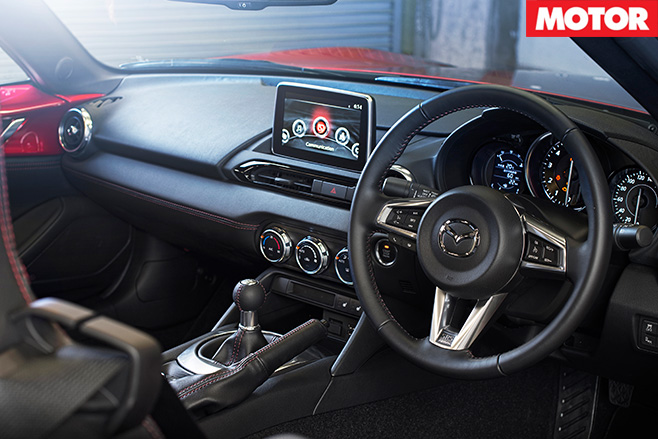
So we kind of gave up on having it, and we don’t have it. So while we don’t have a dual-clutch system the current one we have in this car, the six-speed system, it has very good response and it has good performance I’d say. I think it’s good that we have it.”
MX-5 is often criticised for not having enough power, what would you say to these people? “[Smiles] I would say, why do you need that power that you won’t be able to use up at maximum level? This car is about having fun, so if you have extra power you don’t really use fully, then it’s a waste I would say! [laughs]”
Do you think the MX-5 could handle more power and more grip? “This car has a lot of potential but I think it depends on the driver’s skill level. If the driver is like a beginner level, then the person doesn’t need big power or big grip, I guess, but when it comes to the driver being an expert driver, then more performance level should be provided because the person needs that. So it depends on the skill level of the driver itself, I think.”
Porsche puts a roof on the Boxster and calls it Cayman, could you do the same with MX-5? “I think in the past we’ve done the same thing and you’re alluding to that [in the ’90s there was a Coupe MX-5 concept car]. The type of car the MX-5 is, is very simple – two-seater, compact, open top car. So if you close the roof like a Cayman does, it’s no longer an MX-5 so inside ourselves, there is no such car.”
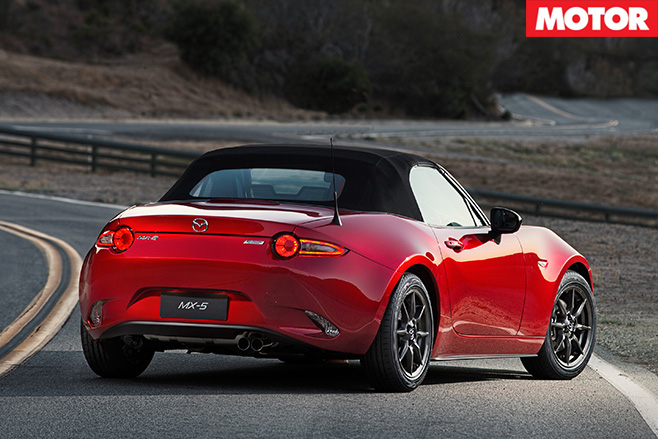
So maybe if there are management in the company that say, ‘well, in order to expand the business we need to have a coupe, and we have to make it’, then I’m afraid the company’s direction itself will go in a wrong way.
And maybe another point, if the media and journalists start talking about those things, like ‘maybe in order to make more money for this manufacturer, this manufacturer needs this kind of type of thing’, something funny – funny ideas – if management of the company reads and sees these articles, they get ideas as well, and then the company also goes in the wrong direction, so that’s something I am afraid of as well. [laughs]”
I will be careful then! [Everyone laughs]
People talk about acceleration performance, cornering performance, the potential of the vehicles, and just compare based on those things, but the important thing is what kind of scenes will these cars be driven, and I think that’s more important than just looking at the figures of performance.”
Would you like to see more Mazda sports cars? “Of course the answer is yes. Mazda is a tiny company and having a lot of variety of models and selling them in large scale volumes, doesn’t really fit the company Mazda. So I’d say Mazda, I think is more fitting to keep maintaining strong relationships with customers, a fewer number of customers maybe, and just keep being loved by those customers.
So I want to see a sports car but maybe a number of sports models coming out of Mazda is not really something Mazda should be doing… rather I’d like to keep focused on a good connection with customers.”
That’s all I have to say. Not just Mazda employees but Mazda fans and all those people involved, they actually want to see Mazda come back and I think that’s a good thing for company employees as well. Last June in UK, Goodwood Festival was held and as a sponsor Mazda put five models over there including 787B and really people loved it and that Le Mans victory was like, 20 years ago.
But still we have such a lot of enthusiasm about that victory, and for the car itself, and people talk about the car being there, a lot. It was really great seeing that, and I was so impressed as well.”
What is the future of the rotary engine? “[Smiling but seeming guarded and hesitant] Today, I’d like to refrain from answering that question because I want to speak to the discussion of the MX-5.”
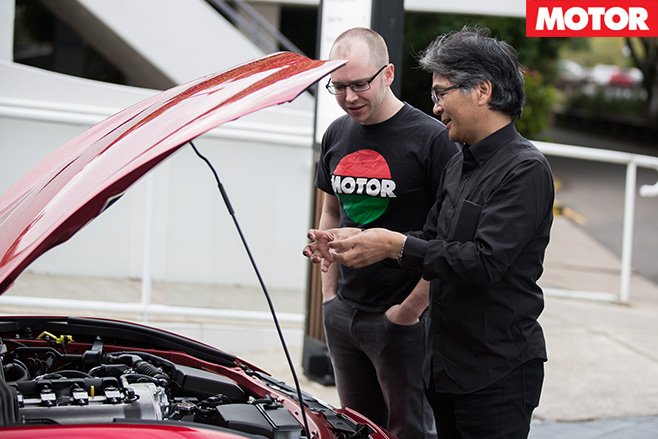
And then we clumsily wrapped it up and headed out to the car park to poke at some bits under an MX-5’s bonnet. Along the way Yamamoto-san relaxed a little, and MOTOR made it known, it’d be great to see another RX-7. Yamamoto-san smiled silently (which, in fairness, could also be because he couldn’t understand what we were saying). And we’re mixed on how to interpret Yamamoto-san’s guardedness.
You’d certainly seem that way yourself if your company was planning a Le Mans return and a new rotary sports car and you were getting asked about it before you could say anything.
We seriously hope it’s the former, and it’s safe to say we’ll know soon enough.
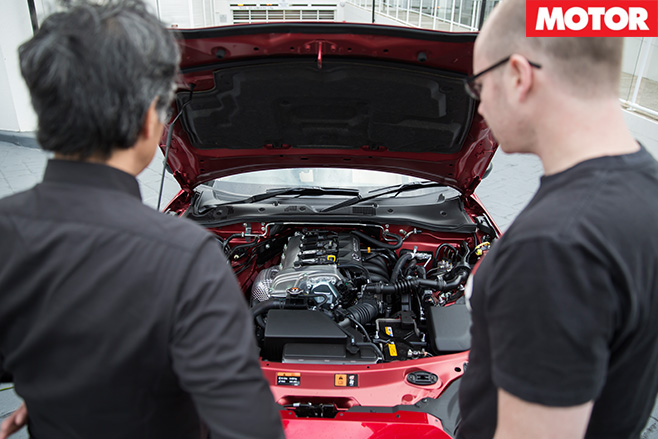
In the shed
What does Mr MX-5 drive? “Actually two vehicles,” he says. “I have an NC [previous MX-5] and also a Mazda 6 that’s called Atenza in Japan. I’m afraid that I said Mazda 6 and not RX-8 [laughs].
“Actually there’s a reason for me buying this Atenza Mazda 6, I have a family and my wife is the kind of person who always wants to sit in the rear seats [laughs] and when it comes to RX-8, if I had an RX-8 then she cannot get in and out easily because of that car’s door structure. That’s the reason why I had to buy a Mazda 6.
“Of course when I drive the NC, since there are only two seats available, so she has to sit in the front!”
But then he tickles the classic performance car enthusiast in all of us: “The first generation RX-7 is something I used to own,” Yamamoto-san fesses up.
5 engineering morsels: ND MX-5
Cheers for all this, Yamamoto-san
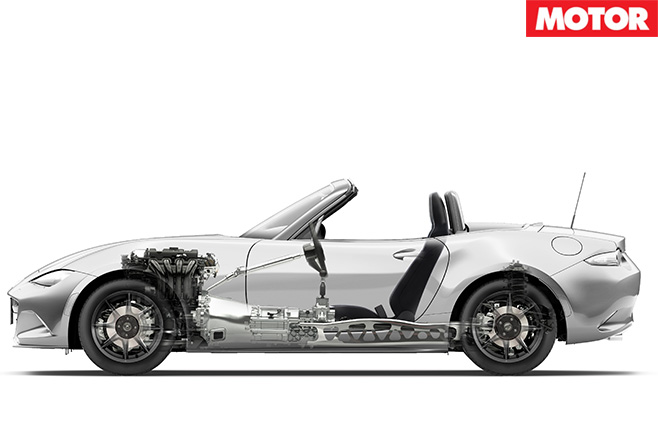
Two: Balance The transmission’s distended bellhousing places the gearbox an unconventionally long way behind the engine. That places its weight toward the car’s centre of mass, chasing the magic 50:50 weight distribution. It’s another example of of Yamamoto-san’s pursuit of excellence over excess.
Three: Slick Shifting The manual shift is a delight. Short-throw, buttery and mechanical, it’ll take your mind off just how tight the cabin is. Part of its precision is the bridge-like brace between the gearbox and rear axle assembly that eliminates the relative twist between them.
Four: Sitting pretty Seating position is another asset to the handling and balance. Although the occupants’ seating – hence weight – is low, if you’re the kind of person who regularly ducks for ceiling fans, you’ll be very happy the MX-5 is a convertible.
Five: Suspension Initially the MX-5’s softly-softly suspension might catch you off-guard. But the roll, dive and squat teaches you to be super-smooth with your inputs and once you’re in the groove, it’s superb fun. A tight, twisty, relatively slow road is what the MX-5 likes best.
The hot hatch genre started with the very simple concept of putting a big engine in a small car to make it go really fast.
Okay, so back in the late 1970s a fuel-injected 1.8 qualified as ‘a big engine’ and ‘really fast’ was 0-100km/h in around nine seconds, but you have to start somewhere. This trend continued until we had the likes of the Ford Focus RS sporting a 2.5-litre turbo five and the VW Golf R32 stuffed full of 3.2 litres of narrow-angle V6.
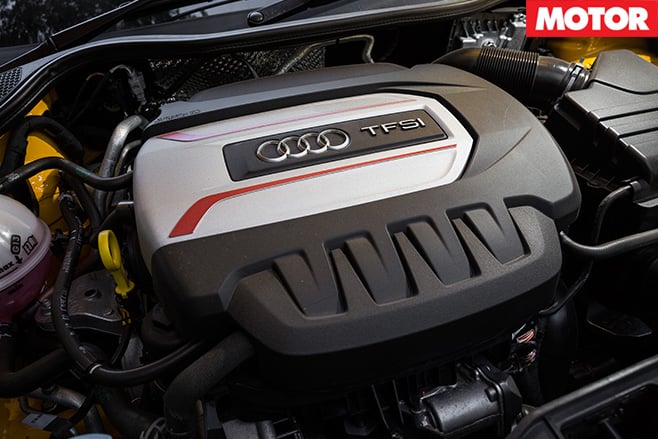
Stricter emission laws have sadly seen an end to those heady days, but in creating the S1 Audi stuck to the traditional recipe, stuffing its smallest car with the 2.0-litre turbocharged four-cylinder from the larger, heavier S3. Of course, it’s not quite that simple these days.
That’s the bad news. The good news is that little turbo puffs harder, pressurising the air to 20psi compared to the S3’s 17psi; so peak torque is within 10Nm, with all 370 newtons available from just 1600rpm. You can feel the restriction at the top end, but in day-to-day driving how often do you find yourself at 5000rpm and above? The S1 is extraordinarily punchy in everyday driving, with a rich seam of torque that can be mined with the voracity of BHP in a resources boom.
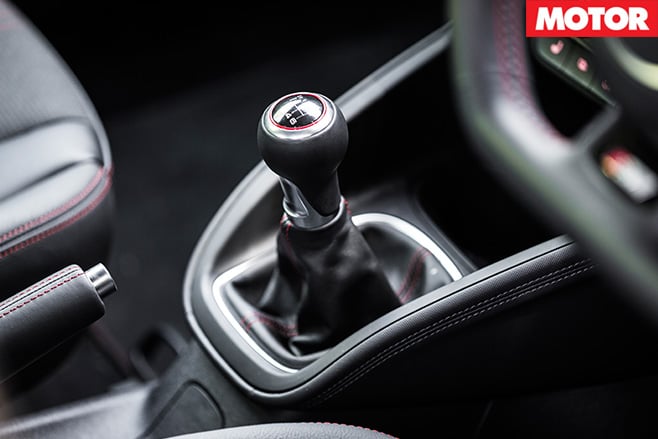
The six-speed manual means there’s no annoying dual-clutch hesitation when pulling away from rest, and both the shift and clutch are light enough to be no chore even in heavy traffic. The gearchange itself is good without being great; it has that pleasing quality of almost falling into the next gear, however a very definite rhythm is needed for smooth progress. Enthusiasts will enjoy the challenge of nailing it, but the extra effort is no doubt why manuals fall from most buyers’ shopping lists.
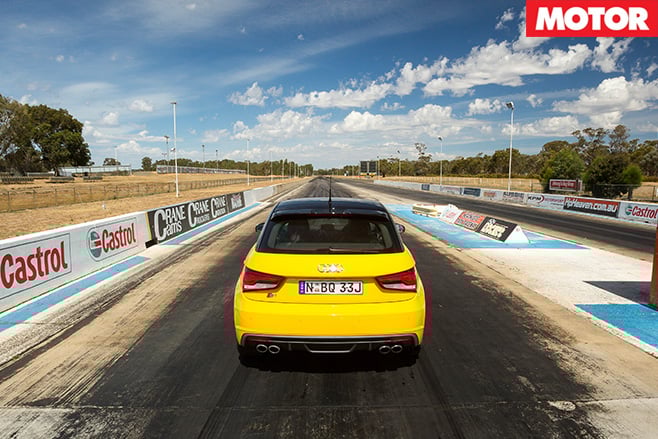
However, the S1’s cause isn’t helped by the ECU limiting revs to just 4000rpm when stationary. Obviously it’s good for drivetrain longevity in the hands of mechanically unsympathetic owners, but it’s a right pain when you’re trying to extract the best numbers on the drag strip. Simply drop the clutch and the car bogs down, falls off boost and takes almost six-and-a-half seconds to hit the ton, but there is another way.
With so much urge down low, slipping the clutch a little (as awful as it sounds) fires the S1 off the line much more effectively. Hold the car against the handbrake briefly right at the clutch take-up point and release it rather than dump it and the engine falls into its juicy torque band rather than dying completely. Even on a 40-degree day it jumps to 100km/h in 5.89sec and crosses the quarter mile in 14.00sec at 165.10km/h, but it turns out temperature doesn’t really affect the S1.
Its speed-in-gear numbers illustrate its true flexibility, though. Its 3.6sec effort from 80-120km/h in third gear will match a previous-gen V8 Commodore, while repeating the trick in sixth takes just 6.6sec, more than a second faster than more powerful hatches like the Focus ST and Astra VXR.
I still think the S1 should have the full-house 210kW tune; it would be a more appropriate tribute to the famous badge, and it irritates me that Audi went out of its way to detune the S1, but even slightly neutered its performance is still one of the highlights of the car.
Month: Three Liked: The solid push in the back as the boost arrives Disliked: Performance testing in 40-degree temps Favourite moment: Heel-toeing and double-clutching my way through the month
Fuel this month: 9.4L/100km Average: 8.8L/100km Distance this month: 1968.5km Total: 5559km
Want to see more of our Audi S1 long-termer? Check out the below:
