
It’s Ford v Holden – with a twist, now that the Blue Oval’s Mustang performance hero has arrived.
ON PAPER, this fight is close. Both are V8 icons. Both have more than 300kW. Both are six-speed automatics and cost a brush under $60,000.
And if you believe the official performance claims from Holden and Ford, just one tenth separates these two in the sprint to 100km/h.
But how does all this translate into the real world over the quarter mile? Will Holden’s 6.2-litre SS-V Redline trounce its new pony car rival? Or will the leaner, two-door ’Stang claim straight-line bragging rights?
Watch the video to find out.
Multiple Targa Tasmania winners Jason and John White have swapped Italian exotica for American muscle, purchasing a Dodge Viper ACR for this year’s Targa Tasmania.
The switch has come about due to the Targa regulations, introduced to return the focus to showroom-specification vehicles and curb speeds slightly. There are two categories, GT2 and GT4, dealing with two-wheel drive and four-wheel drive vehicles respectively.
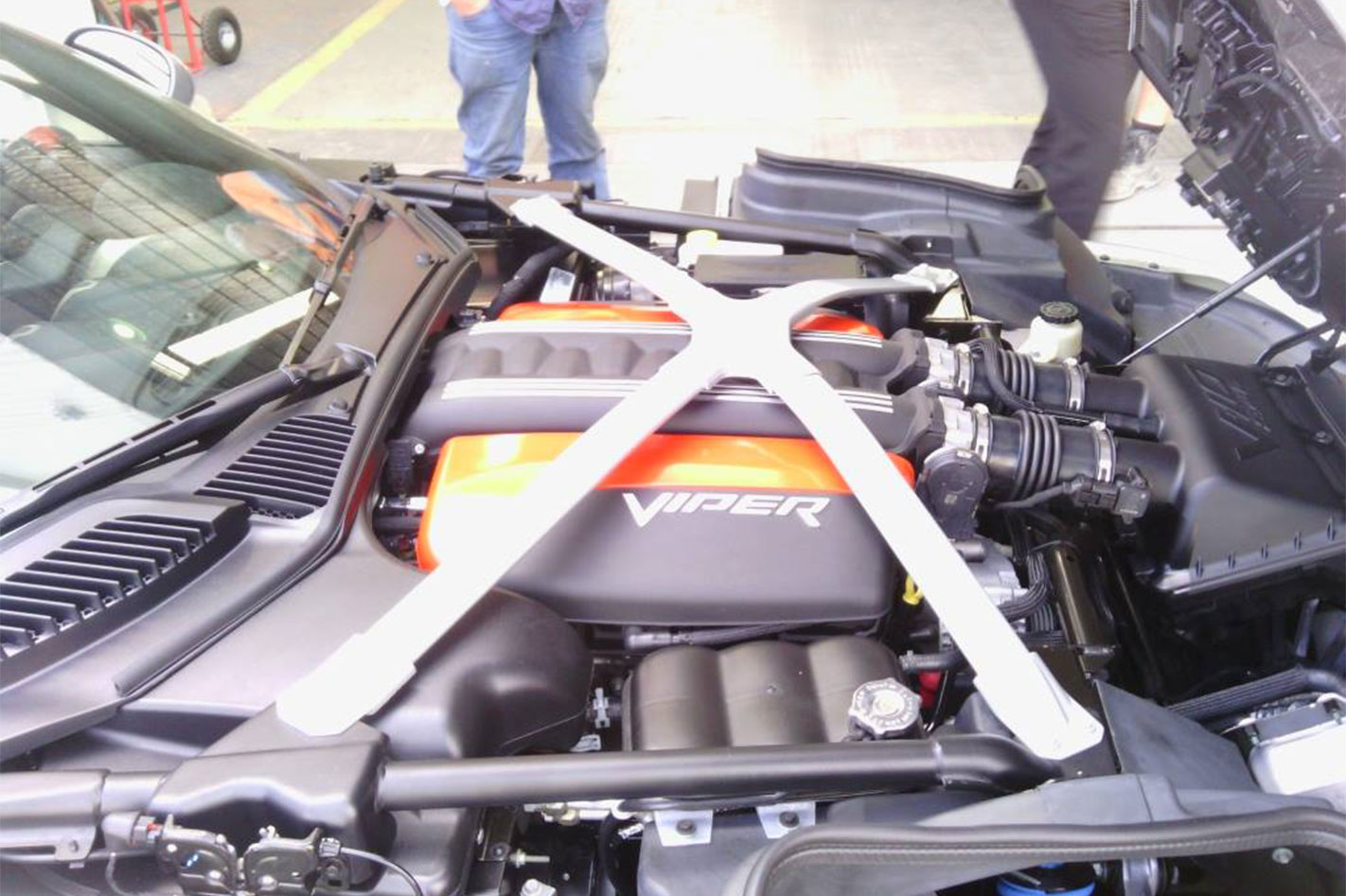
Cost was a major consideration thanks to the severe fire that enveloped their previous Lamborghini Gallardo Squarda Corse at the 2014 Targa Wrest Point which required the White Hot Motorsport crew “spend two years of budget fixing it.”
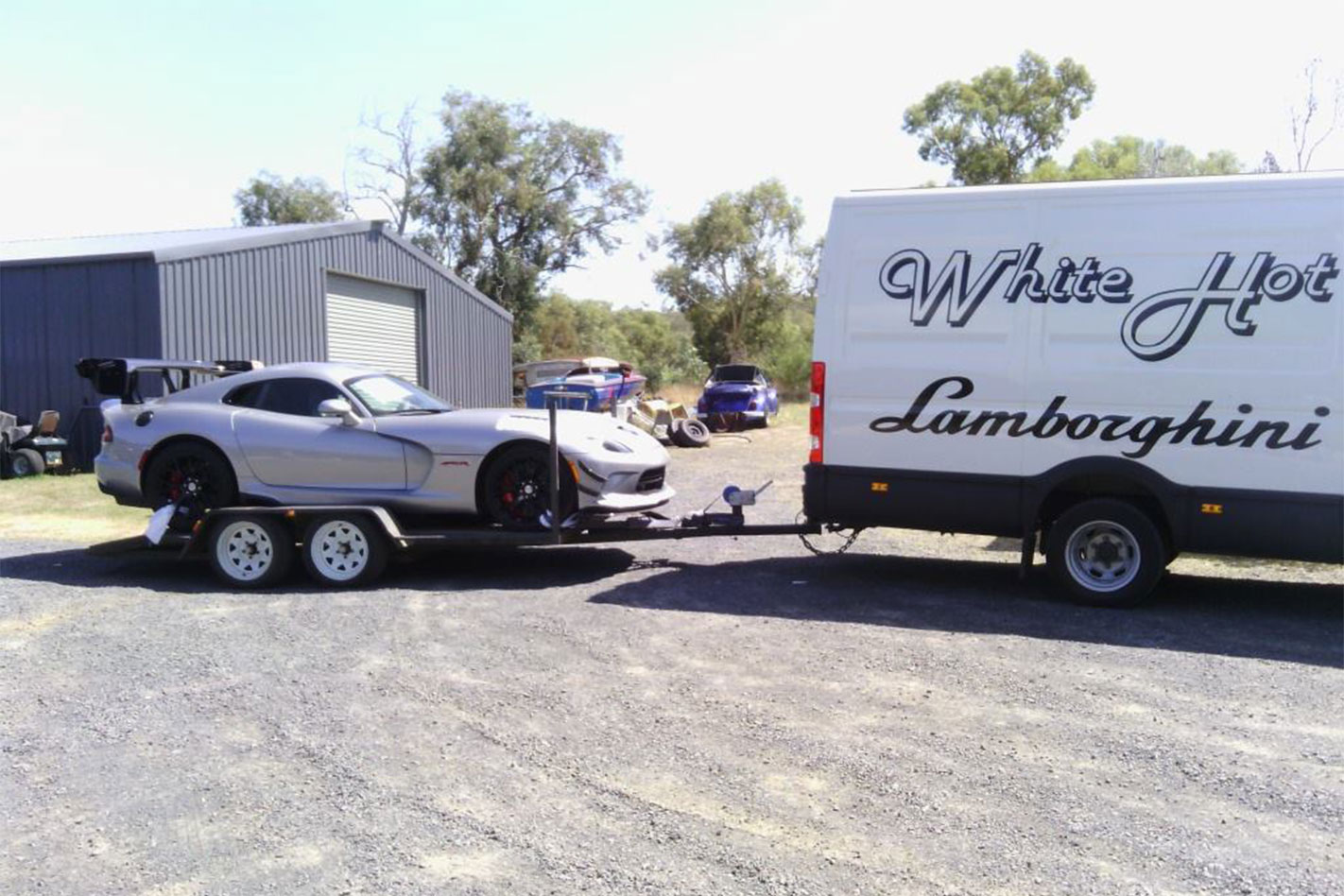
It was a devastatingly effective package, the Whites’ steering it to four of their five Targa Tas victories. Just how effective can be seen in the video below taken from Targa Tasmania 2012.
White Hot Motorsport took delivery of the Viper just eight weeks prior to the start of this year’s event, giving it a brief shakedown at Targa Hellyer Gorge before stripping it to fit the required safety gear.
The Whites will face stiff competition in the GT2 category from the likes of Jim Richards in a Porsche Cayman GT4 and Matt Close in a Porsche 911 GT3.
The 25th running of Targa Tasmania takes place from April 11-16.
This weekend marks the first round of the 2016 Formula 1 season. To celebrate, here are the eight craziest Australian Grands Prix.
2009 – Brawn blows everyone away It wasn’t even meant to be on the grid, but Ross Brawn’s last-minute thrown-together Brawn BGP 001 dominated the opening round of the 2009 season. The team locked out the top two positions in qualifying and the race and set up Button’s first, and to date only, championship win.
1995 – Crash kings The final Grand Prix to be held on the streets of Adelaide will be remembered for two crashes. The first was the dreadful accident that almost killed Mika Hakkinen, emergency trackside procedures saving the Finn’s life. The second accident was thankfully much more amusing than dangerous, David Coulthard locking up while entering the pit lane and ending his race in the pit entry barriers.
1996 – Brundle flies; Villeneuve stars The first Melbourne Grand Prix started with a bang when Martin Brundle launched over the back of Coulthard into turn three on the first lap and turned his Jordan into a canoe. The race was also notable for rookie Jacques Villeneuve starring in his debut race, scoring pole position and fastest lap but having to give best to team mate (and eventual champion) Damon Hill.
2014 – Ricciardo is stripped Twenty-fourteen saw the introduction of the new-generation hybrid power units, and they put the drivers to a massive test thanks to a downpour in qualifying. Local boy Daniel Ricciardo starred in his first race for Red Bull, wrestling his car to second place on the grid. It was a position he held at the chequered flag, only for to be excluded in post-race scrutineering thanks to a fuel flow irregularity.
1998 – McLaren messes up McLaren absolutely dominated the 1998 race, its Adrian Newey-designed MP4-13 lapping the entire field. Unfortunately, the team didn’t get to enjoy much positive press as the race was marred by McLaren team orders, David Coulthard moving over and handing the win to team mate Mika Hakkinen to howls of protest from fans and race organisers.
2002 – First corner melee helps Mark Another action-packed season opening, with Ralf Schumacher sailing over the head of Rubens Barichello and triggering chaos behind, eight cars being eliminated on the first corner. The attrition continued, allowing local boy Mark Webber to score a fairytale fifth place on debut in the woefully outpaced Minardi.
1986 – Mansell tyre explodes One of the most dramatic season finales in the history of the sport, three drivers, Nigel Mansell, Nelson Piquet and Alain Prost, entered the race with a chance of winning the world championship. Mansell scored pole position before slipping back in the race, but even with Piquet leading his third place would secure him the title, before a spectacular tyre blowout eliminated him from the running. This caused Williams to pit team mate Piquet as a precaution, but despite a late charge Prost would secure his second world championship.
1994 – Schumacher plays dirty Heading into the final round of the season, Michael Schumacher led Damon Hill by a single point. Schumacher led the race until he ran wide on lap 36, damaging his car; Hill, following closely but unaware of Schumacher’s problem, tried to duck up the inside of Schumacher only for the German to turn in and take out Hill, thus securing the first of seven world titles.
BROCK’S BACK! Limited run Holden Director revealed; faster Ferrari F12 driven; Falcon’s Sprint to the finish; V8 brawl as Mustang takes on Commodore; V8 Supercars’ future laid bare
ALSO INSIDE THIS EDITION:
- Why the carmakers want you to be a better driver
- Bugatti Chiron, Aston DB11 revealed
- First steer of the turbo, and Turbo, Porsche 911
- Audi R8, BMW M2 tracked and tested
- Off-road in Bentley’s Bentayga
- Audi A4 v BMW 3 Series v Jaguar XE v Lexus IS v Merc C-Class
- The kid with 3000 cars
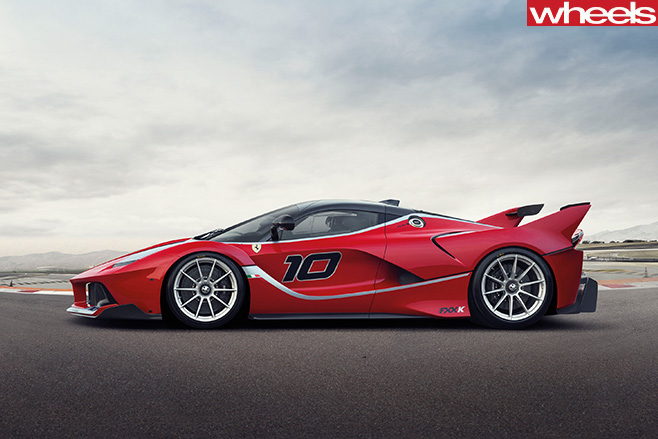
FERRARI’S design director will make his first visit to Australia in May, to take part in this year’s Vivid Ideas Festival.
Flavio Manzoni, whose key designs include the LaFerrari, the 488GTB and the new GTC4Lusso, will discuss the future of Ferrari design in a special presentation at Sydney’s Museum of Contemporary Art.
He will also get up close and personal with Ferrari owners and fans at a string of customer and press events.
“I will bring a powerpoint presentation and with the help of sketches, explain our approach to design and how we are thinking about futuristic and modern Ferraris, but always keeping in mind the history and DNA of the brand.”
Vivid is billed as the world’s largest festival of light, music and ideas, and attracted more than 1.7 million people last year. The 2016 Festival will run over 23 nights, starting on Friday May 27.
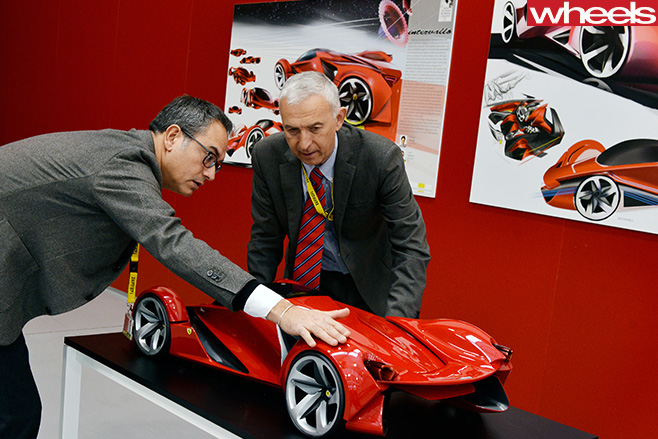
Manzoni joined Ferrari in 2010 after a stint as Volkswagen’s senior designer, and has since instilled a different design culture at the famous Italian brand.
“There is a clear philosophy now that we’ve been developing and we now have an in-house design centre and a complete team of designers and modellers that live and breathe the brand,” he said.
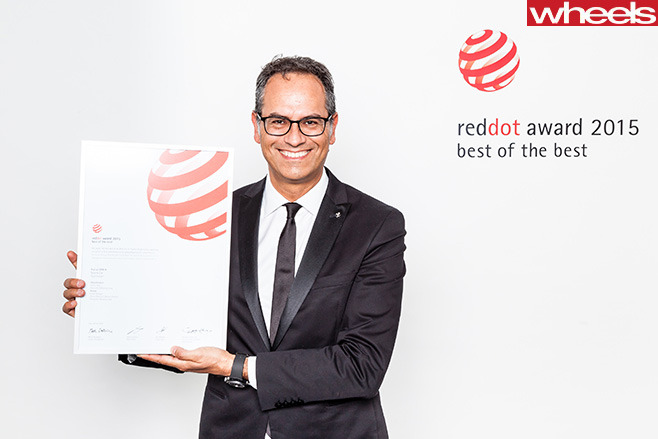
Manzoni will be in Australia for five days.
“It’s pretty exciting to get him here because he really doesn’t travel much” said Ferrari Australasia CEO Herbert Appleroth.
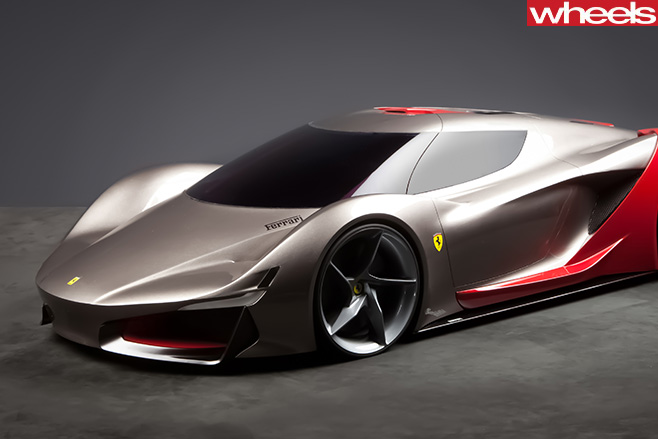
“Vivid is the largest cultural design event in the Southern Hemisphere, so as well as Manzoni’s public appearances, it’s an opportunity for a large collection of the design industry to come together.”
Tickets to see Manzoni’s presentation will go on sale to the public on March 20.
Both the Skoda Superb 206TSI 4×4 sedan and wagon can sprint from zero to 100km/h in 5.8 seconds thanks to a Golf R powertrain for Golf R prices.
The latest large car from the Czech Republic is priced from $50,990 for the 206TSI 4×4 sedan and $52,690 for the 206TSI 4×4 wagon, both plus on-road costs. Each are as large as a Holden Calais but with V8- rather than V6-rivalling performance.
The 2.0-litre turbocharged four-cylinder engine produces a Golf R-matching 206kW and Golf GTI-alike 350Nm, replacing the previous Superb’s 3.6-litre naturally aspirated V6, itself poached from the Passat R36.
It also means the all-wheel drive flagship’s 5.8sec 0-100km/h beats the forthcoming four-cylinder Porsche Macan medium SUV by nine-tenths to that performance benchmark.
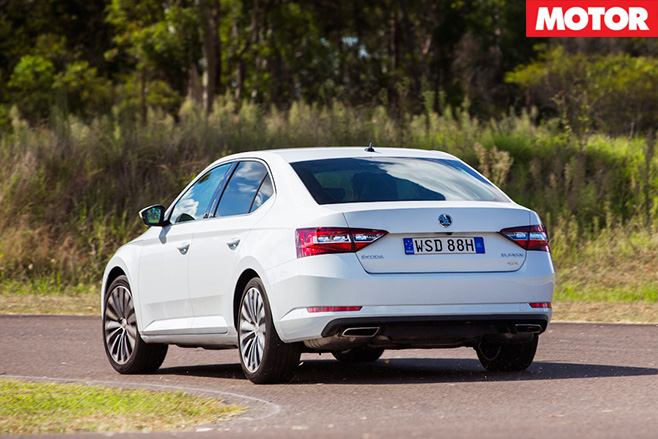
On recent form, however, it appears Australians may well prefer the Superb 206TSI wagon. Of Skoda’s entire range, the most popular model is currently the Octavia, of which almost half of all buyers choose the sporty RS flagship, of which the wagon is favoured over the sedan.
Choosing the 206TSI over its lesser brethren also buys 235/40 19-inch tyres with sports suspension, keyless auto-entry and start, steering wheel-mounted paddleshifters and LED interior lighting.
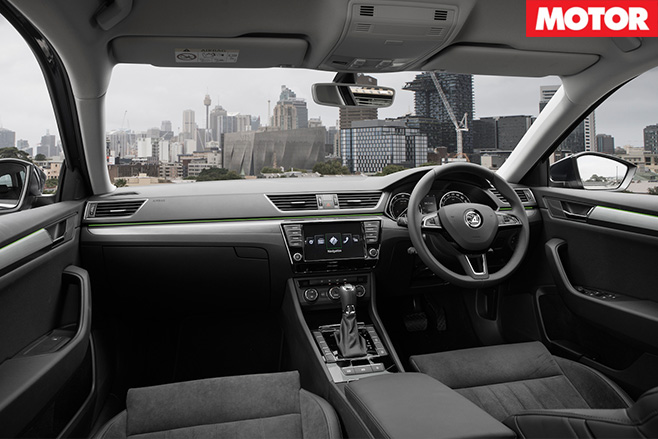
It isn’t exactly wanting for kit, though ride quality may be improved with the optional adaptive suspension, which is bundled with 12-speaker premium audio, blind-spot monitor, lane-keep assist, auto park assist and electric tail-gate for $3400 extra. Time will tell.
Perforated leather, electrically adjustable passenger’s seat, front seat ventilation and rear seat heating, and even a function for the rear outboard passenger to fold up the front passenger seat, all comes part of a further $1500 package.
Optioned as such, you’re looking at one very large, very brisk, 1573kg/4861mm-long sports-luxury sedan or wagon.
AMG has gone new-model crazy.
Fresh on the heels of the new Mercedes-AMG E43, C43 and C43 Cabriolet, the power-crazed boffins from Affalterbach have given us this – the GLC 43 4MATIC.
It’s the newest member of AMG’s rapidly expanding line of second-tier sport models, which sits at the core of the brand’s plan to offer the most comprehensive performance car line-up in the world.
It also fills the gap between the regular GLC range and the even angrier, performance-focused AMG GLC 63 due later this year.
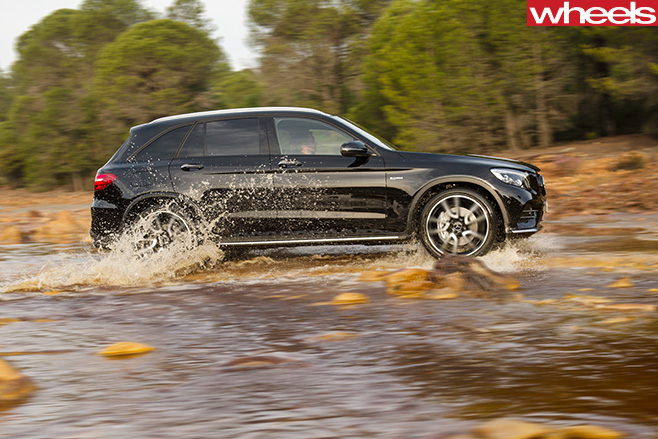
It might sound modest in the power-crazed land of AMG, but the six-pot has enough poke to shoot the GLC 43 from rest to 100km/h in 4.9sec, meaning it will trounce most hot hatches in a traffic light grand prix.
The power is split front and rear via a rear-biased four-wheel drive system, and sent through Merc’s venerable nine-speed auto, which cops an AMG-specific tune for faster shift times.
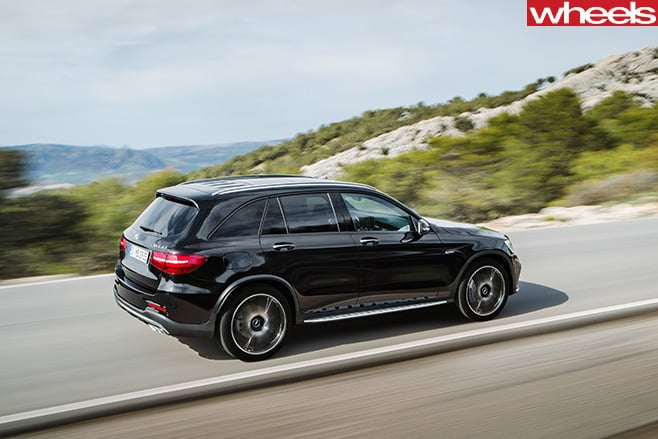
Visually, the changes are subtle and effective, with the biggest difference arriving in the form of 19-inch five-spoke alloys with a high-gloss finish. There’s also more aggressive front and rear bumpers and unique AMG exhausts.
Inside, it’s what we’ve come to expect from AMG with plenty of red stitching and chunkier sports seats.
The GLC 43 will arrive locally in December.
THE Ford Falcon XR6 Sprint and XR8 Sprint are the final performance production models of Ford Australia’s family sedan, marking the end of 56 years of continuous local production.
The limited-edition $54,990 Falcon Sprint XR6 may not be the fan favourite (the V8 wins the popularity contest) but maybe real Ford drivers will want the XR6. It’s lighter, ultimately faster on a track, and cheaper.
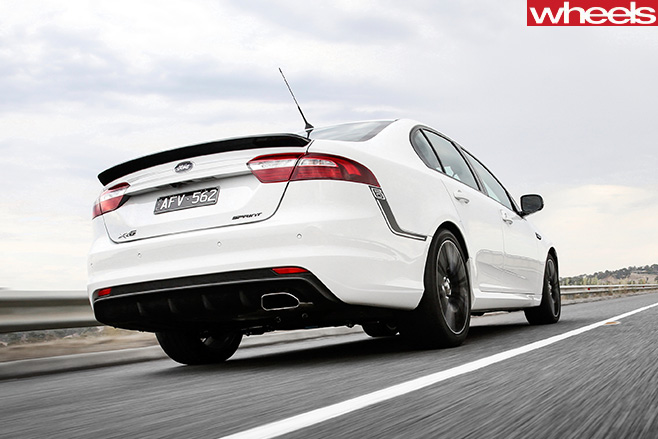
WHY WE’RE TESTING IT There’s mega interest in these last two Falcons-with-attitude. The Broadmeadows mob has shown a real determination to send the Falcon XR badge off into highway heaven with a significant bang. How much is rhetoric and do the impressive power and torque numbers translate into a real-world blast of the senses? More importantly, ultimately is it a fine motor car?
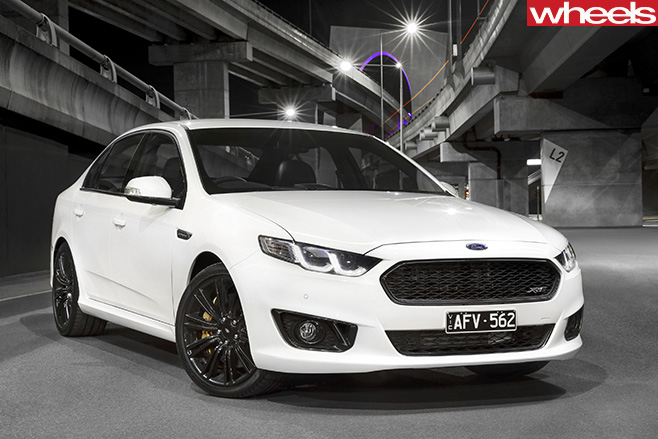
PLUS: Brutal acceleration and effortless torque, standout ride and handling; potentially robust retained values MINUS: Family sedan and taxi genes impossible to hide; that driving position
THE WHEELS REVIEW IT’S an undeniably sad time, this look at the last new (and a thankfully wild) iteration of the locally made Ford Falcon breed. The Falcon disappears on Bathurst 1000 eve in October after a rich history dating back to 1960.
In-line sixes and bent eights were the staple of Ford Australia local manufacturing and big in the motoring lives of many of us, so fitting it is that the Blue Oval has worked at creating standout examples of each in the form of the Falcon XR6 Sprint and XR8 Sprint.
It started with the blokes and ladies from a small product engineering team thrashing out their achievable wish lists, with help and inspiration from the recently redundant Ford Performance Vehicles parts bin.
The passionate engineering team set out to produce among the most powerful V8 and turbo engines ever from the 5.0-litre Miami and 4.0-litre Barra.
There was also the understanding that having a mountain of grunt is futile if the car can’t put it on the deck. The overarching challenge was to create a ride and handling tune around the new Pirelli rubber with the objective of engine, chassis, tyres and suspension working together cohesively.
There’s a lot of urge to control.
Choosing between the V8 and turbo six is tough. The feeling is the XR6 Sprint would be a mite faster on a track although on the road, there’s no great difference dynamically on the highway. A brief drive of the manual XR8 confirmed to us that the auto variant would be way more liveable, especially in metro motoring.
With the launch control process, there’s a disconcerting fleeting hesitation and then the Pirellis bite and gallop while the turbo I6 gets rather frenzied. With the subdued exhaust finally bellowing, and crackling on over-run, it’s a jet-fighter surge towards the horizon…
The V8 and six will nail the 0-400 metres in somewhere between 4.5 and 4.8 seconds. “Somewhere” is best we can suggest. The Ford guys don’t want to be pinned to a number, and we struggled to find a flat, straight piece of road on the drive program to get valid times.
The Ford team is complimentary about the role of the chosen 35-series, 19-inch Pirelli rubber in making the rollicking Sprint pair so manageable under heavy acceleration. The 245 fronts and 265 rears help tame the wild horses, giving the Sprints the lateral and power-down grip the development team targeted. Yes, the tyres are a noisy on coarse surfaces, but we can pretty much guarantee no owner will mind.
The ride quality of both Sprint XRs is nothing short of dazzling, devoid of any jarring or loss of body control over bumps whilst unflappable in a series of corners.
The brake package, inherited from the GT F, is up to any job with vented discs all around (355mm fronts; 330mm rears) with Brembo fixed aluminium callipers (six-pot fronts; four-pot rears) in an semi-gloss gold. Red callipers are so yesterday… More importantly, the pedal feel is brilliant and the stopping performance impressive.
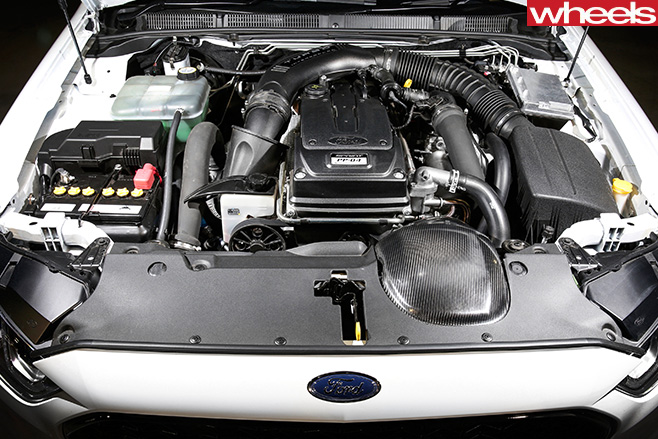
The XR6 Sprint weighs in at 1818kg, or 64 kilos less than the auto version of its V8 brother. The absence of two cylinders saves 23 kilos, while a lighter exhaust helps bring down the mass. The XR6 Sprint is also the only Ford engine anywhere using a carbon-fibre air intake, paper thin yet so strong and providing valuable space in a crowded engine bay.
The styling of the XR Sprints brings a rare subtlety to the genre. They’re so pleasantly understated that Ford worried that the heartland CUBs mightn’t go for them. Wrong. They bowled over the dealers in an indecent stampede.
Externally, the Sprint series are differentiated by black headlamp bezels, small black rear deck spoiler, new front foglamp surrounds. 19-inch black wheels, and Brembo brake package in gold.
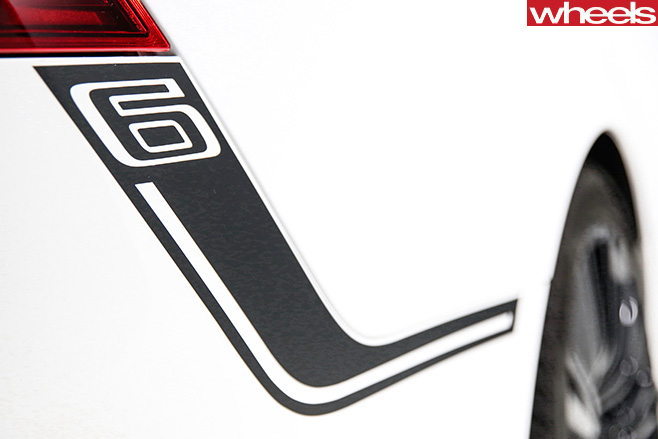
The XR8 Sprint also has a distinctive black painted roof and black wing mirrors. The six gets a hockey stick decal on its haunches; the eight wears an island outline.
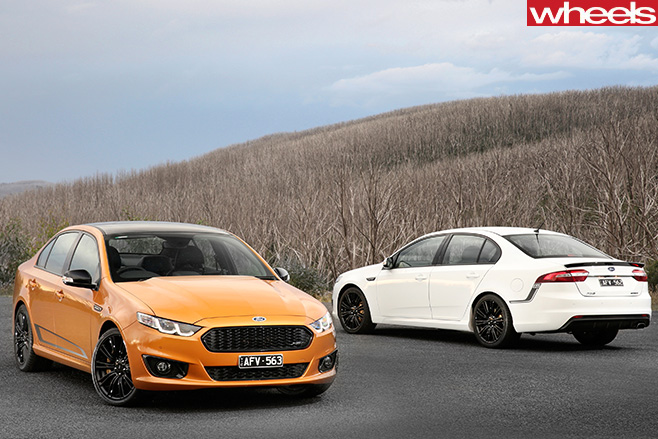
Yes, this is an unbridled sports sedan but not without its bespoke touches.
The cabin makes a statement with its dark yet not-quite-sinister charcoal leather seats with suede splashes. The sports seats from the XR but with trim and stitching changes for the Sprint, get some power adjustment. The seats are a little high for ideal relationship with the steering wheel. However, the cushion is nicely shaped for the tush, although the torso is not restrained enough by the seat backs during fast motoring.
Both Sprints get Ford’s interior command centre, meaning excellent and simple connectivity with SYNC2 voice control and the eight-inch colour touch screen we know from other Fords. The audio is AM/FM/digital with a quaint single slot for CD. Dual-zone climate control is standard, too, and lest you forget what you’ve bought, the Sprint logo is scattered liberally around the car.
Safety gear extends to the usual Falcon offerings – stability control and six airbags.
Now the bad news. If you want to own an XR6 Sprint, you’re just too darn late. All were snapped up before the on-sale date. Same with the XR8 Sprint manual. Left are just a handful of V8 autos.
SPECS Model: Ford Falcon XR6 Sprint Engine: 3984cc in-line 6cyl, dohc, 24v, turbo Max power: 325kW @ 6000rpm (overboost function 370kW) Max torque: 576Nm @ 2750rpm (overboost 650Nm) Transmission: 6-speed automatic Weight: 1818kg 0-100km/h: 4.5-4.8sec rumoured Fuel economy: 12.8L/100km (combined) Price: $54,990 On sale: May
ITS name comes from Ford’s history, but the look of the last Ford Falcon intentionally owes nothing to the past.
“We weren’t trying to do anything retrospective; it was all about being the best and the most forward looking and the most optimistic for Ford as a company,” Ford Falcon XR6 Sprint and XR8 Sprint lead designer Nick Eterovic told Wheels.
The final Falcon model to come out of Broadmeadows before the assembly line irrevocably halts on October 7 has no stripes, big wings or Super Roos spinning tyres.
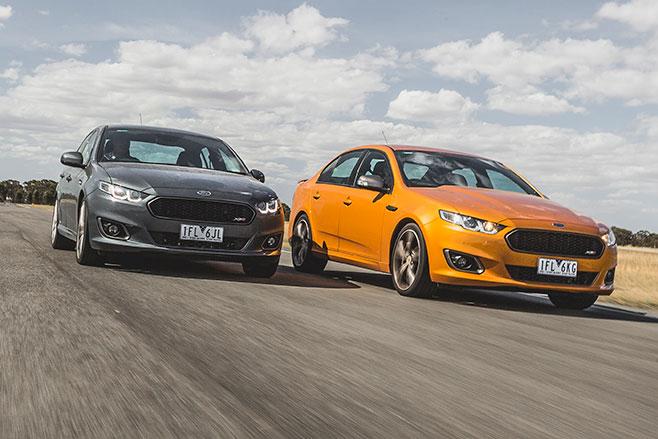
“We drew inspiration from current and future trends rather than going back,” Eterovic explained. “There’s no kangaroo with wheels on the side and that’s just one example of an iconic example we could have picked up.
“It’s a much more worldly approach and even a look at some of the European cars that’s are gaining more and more popularity.
“We wanted it to look low, planted, technical and modern and hint to future portfolios.”
If the latter truly is the case, then expect black to be a popular part of the Ford portfolio going forward, because black is the is the colour of the Falcon Sprint, especially the XR8 which alone has a twice-painted black roof and quad pipes in black. Both cars also have black alloy wheels, a first for Ford Australia.
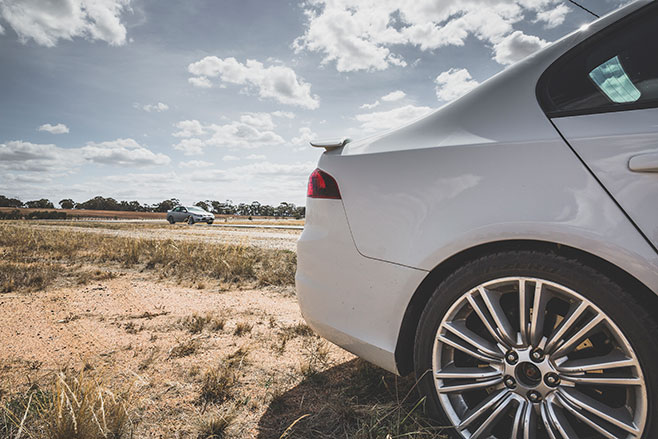
One nod to tradition is the ‘island’ graphic in the V8’s door, while the I6 has a new ‘hockey stick’ graphic on the rear corner. All in black of course.
“It’s a very modern colour,” says Eterovic.
It’s also the colour of finality, Wheels points out: “That never came to us,” Eterovic responded after a startled pause.
“We wanted to make the car a legitimate in the series walk,” he added. “Rather than be a dressed-up XR this was going to be a Sprint.
“So we made sure the Sprint had enough elements to guarantee its own place within the line-up.”
For what is obviously a budget and time-constrained limited edition, the Sprint has had a significant amount of effort put into its appearance. The new front foglight meant new tooling for the bumper while the V8s require two trips down the assembly line to have the roof blacked out.
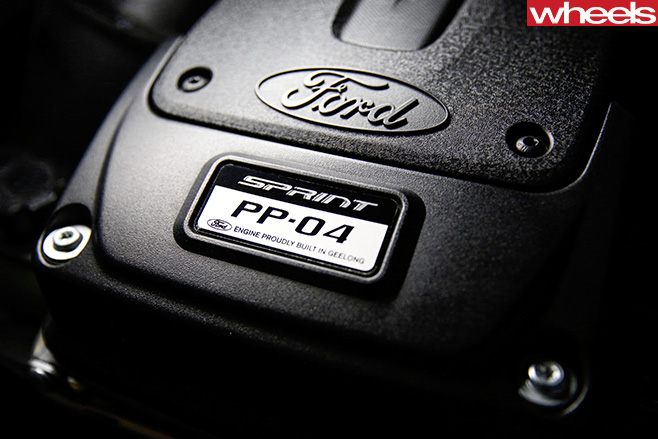
There was also some innovative thinking. The XR6 Sprint has its build number recessed into the surface of the cylinder head rather than just stuck on. That was done at no cost because the team at the Geelong engine reclaimed and modified an engine die used for the old AU Falcon XR6 Intech VCT.
“We are going the extra mile, we are doing things properly,” said Eterovic. “Out of respect to the car we are dealing with complications and processes that normally wouldn’t have otherwise been easy to achieve.”
Want more? Read all about the Ford Falcon XR6 and XR8 development program in the April edition of Wheels, on sale now. Subscribe via Magshop, the iPad via the iTunes Store, or on Android devices via Google Play.
Skoda’s voluminous new-gen Superb transforms itself into a strikingly handsome and individual left-field alternative.
WHAT IS IT? Skoda’s opportunity to demonstrate what it can do with the Volkswagen Group’s ‘Modular Transverse Matrix’ (MQB) platform when stretched to a sizeable 2841mm wheelbase for its impressive all-new liftback-sedan and wagon.
WHY WE’RE TESTING IT Given the dynamic and packaging excellence of Volkswagen’s closely related B8 Passat (launched here in October), it’ll be interesting to see if Skoda’s approach can produce an even more compelling medium-to-large alternative. With greater room for the money, a pair of Volkswagen Golf GTI/R-related turbo-petrol engines and a range-topping all-wheel-drive variant, the slick new Superb may well be the antidote to Australia’s indulgence with SUVs.
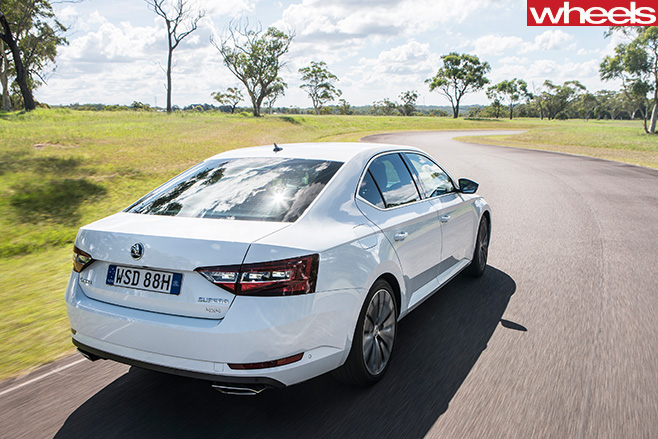
THE WHEELS VERDICT If punters aren’t won over by the new-gen Superb’s palatial interior space and reasonably trim sticker price, then maybe its exceedingly handsome styling will do the trick. Given the visual awkwardness of the old Superb sedan, Skoda has performed a miraculous turn-around in making the new sedan the looker of the range, complete with a neat liftback tailgate, a ginormous 625 litres of boot space and an Octavia RS engine, all for 40 grand. More dynamic panache would be appreciated but at least the grippy 4×4 variant gives the Skoda Superb a genuine point of difference over its relatively conservative rivals.
PLUS: Beautifully proportioned styling; unbeatable space; excellent quality; sweet turbo-petrols; refinement; ride; solidity MINUS: Not as dynamically poised as a Passat; adaptive dampers only available as part of a pricey options pack; 206kW turbo-petrol deserves a fruitier exhaust note
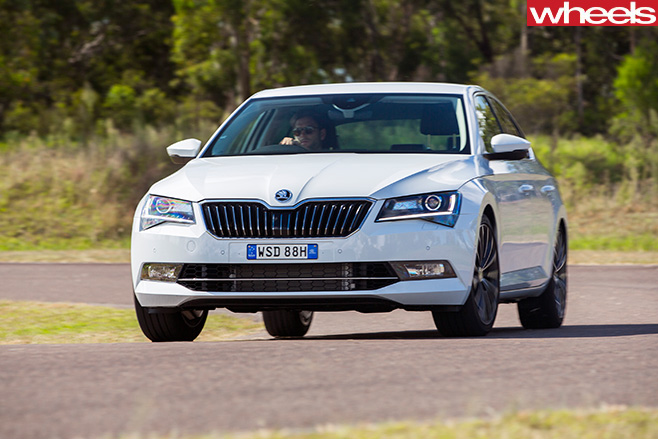
Skoda buyers, on the other hand, have sporty wagons in their DNA. The biggest-selling model in the Aussie Octavia line-up is clearly the RS wagon, so Skoda (wisely) paid close attention to this phenomenon when decking out the all-new B8 Superb for its Down Under debut.
Indeed, our ‘base’ Superb scores the Octavia RS’s excellent 162kW/350Nm 2.0-litre turbo-petrol four, also shared with VW’s Golf GTI, while the Skoda flagship nabs the Golf R’s 206kW engine and Haldex-coupled all-wheel-drive system. Both drivetrains also feature in the VW Passat in Europe, yet they’re conspicuously absent here, giving the Superb a sizeable leg-up over its German sibling if you value performance. And while the Superb’s 140kW/400Nm 2.0-litre turbo-diesel might seem familiar (and priced $2K cheaper than VW’s Passat TDI), its loping nature and improved refinement somehow suit the more laid-back Skoda better than they do the sportier Volksy.
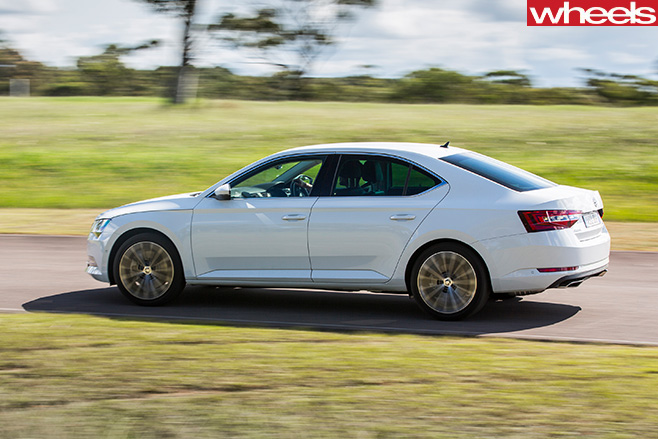
The $39,990 Superb 162 TSI will hit 100km/h in just 7.0sec, which is bang on what a 210kW V6 Commodore can manage, yet it drinks just 6.4L/100km on the government cycle – nearly a litre less than the old 118kW base model. It’s a sweet thing to drive, too, with a subtly raspy engine note and acres of load-lugging torque (the same 350Nm as the 206kW version).
Jump to the 19-inch-wheeled Superb 4×4 and the first thing that comes to mind is ‘cut-price Audi Avant Quattro’. Given the 4×4’s 110kg weight gain, the primo Superb’s claimed 5.8sec-to-100 time is bolstered by its off-the-line purchase and thrust, but it still feels respectably agile on really tight roads, especially when kicking drive to the rear when exiting hairpins – the uprated engine’s throaty chubbiness proving particularly satisfying between 4000 and 6000rpm.
Thing is, the Superb doesn’t overwhelm you with its hard-driven chassis poise like a Passat does. While it has the muscle its VW sister lacks, the Czech limousine clearly favours interstate effortlessness over ultimate amusement. Adaptive dampers are optional – packaged in a $3400-$4700 Tech pack with premium audio and safety electronics – and welcome if your driving enthusiasm covers freeway blasting and back-road carving. But even then, the Superb is more about confidence-inspiring composure than egging its driver on.
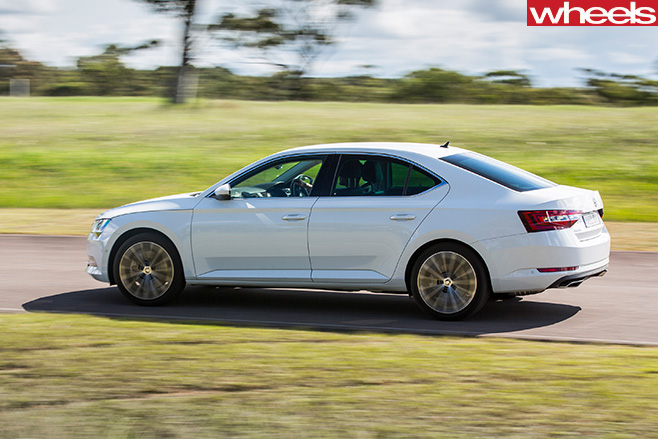
Elevated enough for a clear view in all directions, yet close enough to the road to feel connected to the experience, the Superb treads a rare path in offering the best of both worlds – car and SUV. If you purchase a ‘4WD’ simply to sit higher, without giving the new Superb some attention, then that’s your problem.
With a very comprehensive equipment list, an abundance of practical storage ideas, a trio of tempting options packs ($1500 Comfort, $1700 Image and $3400-4700 Tech pack) and one of the most attractive styling efforts to hit the medium-to-large category in many years, the suave, yet subtly quirky Skoda Superb could well set the benchmark for what an Aussie sedan and wagon should be.
SPECS Model: Skoda Superb 206 TSI 4×4 Engine: 1984cc 4cyl, dohc, 16v, turbo Max power: 206kW @ 6500rpm Max torque: 350Nm @ 1700-5600rpm Transmission: 6-speed dual-clutch Weight: 1573kg 0-100km/h: 5.8sec (claimed) Fuel economy: 7.3L/100km Price: $50,990 On sale: Now
